1. Introduction
As critical infrastructure for flood mitigation and water resources management, sluice gates perform vital functions such as flow regulation, flood diversion, water storage, and sediment flushing by controlling water retention and release. Steel radial gates are widely employed in sluices to regulate orifice flow and retain water due to their advantages of lower operating effort, favorable partial-opening performance, and reduced pier height and thickness [
1,
2]. In recent years, extreme precipitation events have occurred frequently worldwide [
3,
4,
5,
6], such as the “7·23” extreme rainstorm in Beijing in 2023 [
7], which often trigger flood disasters. During floods upstream of sluices, the flow erodes the ground surface and carries various floating objects [
8]; these can be transported downstream and impact steel radial gates, potentially leading to structural failure. Investigating the dynamic response and damage of steel radial gates under floating object impact is therefore of great significance for ensuring river flood-discharge capacity and enhancing flood risk management and the resilience of flood-control systems [
9,
10].
The upstream surroundings of gates vary across projects, sometimes including adjacent construction sites or steel-processing facilities where steel tubes may be stored. Although hollow steel tubes are denser than water, their open ends and complex flow structures during flood discharge can lead to non-uniform velocity distribution. This results in a hydrodynamic pressure difference between the upper and lower parts of the tube, which can generate considerable lift [
11]. Together with buoyancy, this effect allows tubes to float dynamically and be carried downstream, enabling floods to transport engineering-related steel tubes into contact with radial gates. In recent years, sluice operators have reported instances of steel tubes impacting radial gates during flood discharge, highlighting the need for research on this issue.
Numerous studies have been conducted on gate collision resistance, most focusing on ship impacts [
12]. Sourne et al. [
13] simplified the impact force as a quasi-static load combined with a linear reaction distribution model to calculate ship impact forces. Buldgen et al. [
14,
15] divided the gate resistance into two deformation stages: local instability and global bending. An et al. [
16] validated a numerical simulation method for ship impact on miter gates using results from an efficient algorithm for anti-collision performance. Farinha et al. [
17] simulated the response of lock gates under collisions by different ship types using explicit dynamic finite element analysis, assessing crashworthiness based on criteria such as structural deformation energy distribution and skin-plate damage area. Chi et al. [
18] analyzed ship impact forces on triangular lock gates via the finite element method and compared the errors in existing impact formulas. Zhang et al. [
19] simulated ships impacting steel radial gates after cable breakage and found that impact angle influences gate displacement. Shen [
20] established a single-leaf finite element model of miter gates and demonstrated that impact position and angle significantly affect the dynamic response. As cantilever structures, steel radial gates respond mainly through global bending deformation. Li et al. [
21] showed that under ship impact, the initial kinetic energy is primarily absorbed by the skin plate and longitudinal beams. Jiang [
22] applied a static method to analyze factors affecting the anti-collision performance of miter gates. Various measures have been proposed to improve ship-lock crashworthiness, such as installing a rod system combined with an anti-collision panel on the outer side of the support arm [
23,
24] or preliminary ship interception. Jin et al. [
25] compared two interception devices—an anti-collision beam with a buffer cylinder and a plastic anti-collision beam—through numerical simulations. Wang et al. developed a new crashworthy device made of rubber composite and performed in situ real-ship collision tests [
26].
Beyond ship impact, studies on other floating objects impacting steel gates are relatively limited. Liu, Chen et al. [
27,
28] employed fluid–structure interaction (FSI) methods to simulate floating ice impacts on plane steel gates, modeling ice with an elastic constitutive relation. Ping [
29] used an elastic-fracture constitutive model for ice and found that ice blocks undergo plastic compression and tensile failure upon impact. Li [
30] treated logs as rigid bodies and established an FSI model to analyze gate response under log impact. Dong, Pei et al. [
31,
32] considered the scenario of a flood overtopping closed gates and simulated flood-transported logs impacting the support arms of radial gates, simplifying logs as spheres and cylinders. In these studies on floating object impacts, the Cowper–Symonds model is commonly adopted to account for the strain-rate hardening of steel under dynamic loads, and an elastic–plastic constitutive model is used for post-yield hardening [
33].
The response of steel radial gates under steel tube impact exhibits pronounced dynamic effects. Besides direct impact, research on the dynamic response of gate structures also involves conditions such as explosion and hydrodynamic excitation. Accurate determination of dynamic loads is essential for reliable analysis. Wei et al. [
34] used pressure sensors to measure pulsating pressures induced by discharge flow beneath a sluice gate, revealing low-frequency pulsation characteristics. Through experiments and simulations, Xu et al. [
35] analyzed the curvature characteristics of underflow downstream of vertical sluice gates and the resulting centripetal force. Regarding structural dynamic response, Pang et al. [
36] studied gate behavior under underwater explosion, showing high stress in the skin plate, main crossbeams (MCBs), longitudinal beams, and horizontal secondary beams. Wang [
37] theoretically analyzed the dynamic response of plane steel gates under underwater explosion using a plastic hinge–steel rod model. Tieleman et al. [
38] developed a computational model for gate response under combined quasi-steady and impulsive wave loads in marine environments, where Von Mises stress served as a failure criterion. Liu et al. [
1] identified typical vibration modes of radial steel gates—overall rotation about trunnion pins, strut bending, and bending–torsion coupling—with the latter prone to causing catastrophic damage. Targeting tidal impact and reciprocating water pressure, Zhu et al. [
39] performed cyclic loading tests on gate steel structures to investigate their mechanical properties. Liang et al. [
40] established a single-degree-of-freedom nonlinear model to analyze the creep-vibration mechanism of emergency gates induced by high-dam spillway discharge. Chen [
41] developed an FSI model based on steady incompressible fluid theory for dynamic characteristic analysis of plane steel gates. These studies on gate dynamic response under explosion or hydrodynamic excitation provide valuable references for the present work.
In summary, existing research has primarily focused on steel gates under ship impact, with other floating objects limited mainly to logs or spherical shapes. No study has addressed the dynamic response of steel radial gates under steel tube impact. Based on an actual radial gate project, this study establishes numerical models of the gate and steel tubes, simulates the dynamic response under tube impact, and analyzes influencing factors and deformation modes. The work aims to further reveal the failure mechanism of such structures under different impact conditions, providing a scientific basis for ensuring gate reliability during extreme flood disasters and enhancing disaster prevention resilience.
2. Establishment of Numerical Model for Dynamic Response
2.1. Overview of the Gate
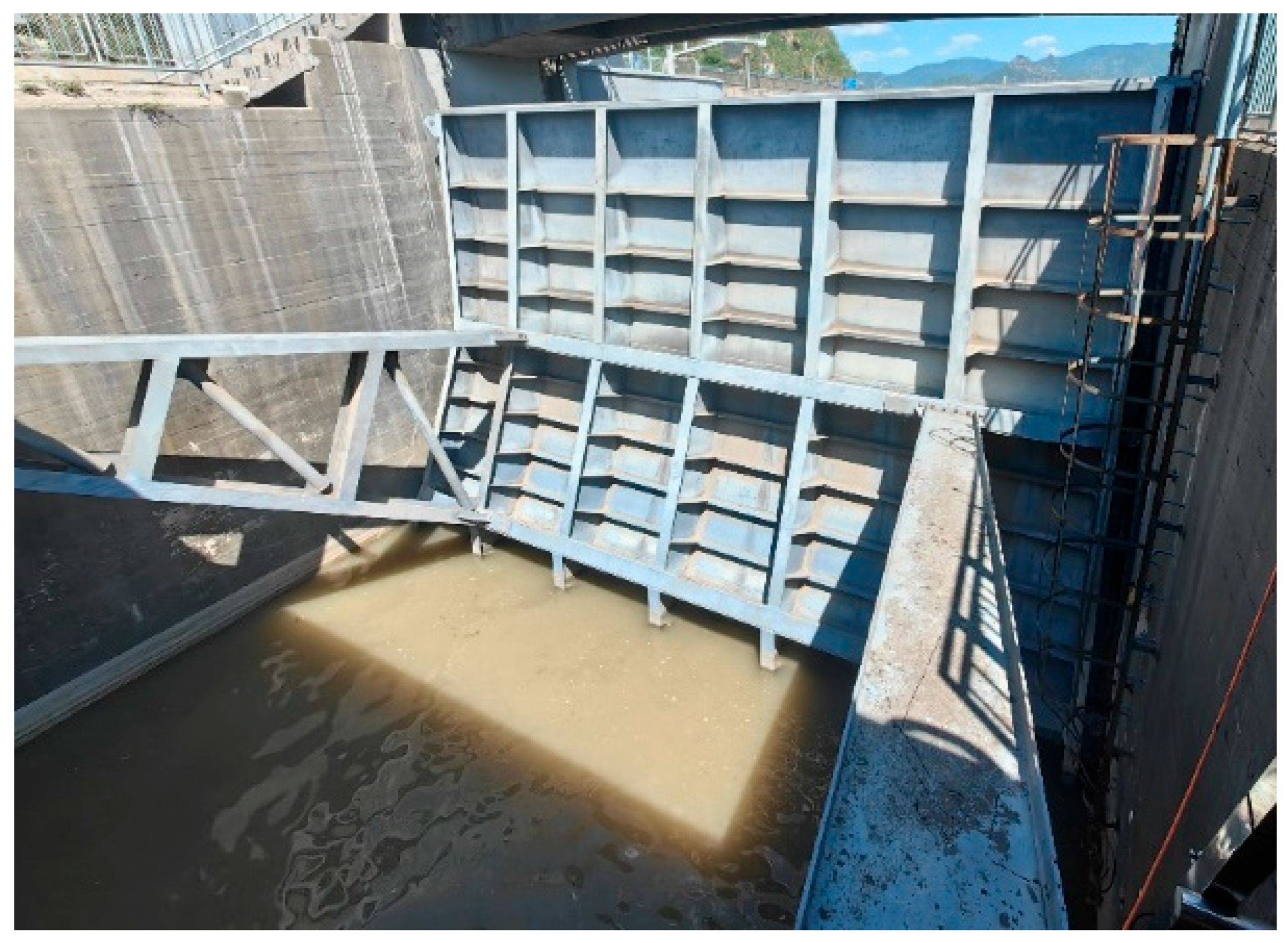
This study was conducted on a steel radial gate of a river sluice project (
Figure 1). The gate investigated in this study is a key component of a multi-sluice barrage project. The barrage consists of 17 openings, each with a clear width of 12.0 m and separated by 2.0 m-thick concrete piers. It is classified as a Class II hydraulic structure, with a design discharge of 5000 m
3/s (corresponding to a 100-year flood) and a check discharge of 7700 m
3/s (corresponding to a 1000-year flood). In recent years, extreme rainfall events have caused rapid rises in upstream water levels, sometimes exceeding the check flood level, and floodwaters have transported significant amounts of sediment, vegetation, and even vehicles downstream. These conditions highlight the realistic threat of large-debris impacts on radial gates and support the relevance of the impact scenarios considered in this study. During a basin-scale catastrophic flood, steel tubes were temporarily stored at a construction site upstream of the project, and the project operation and maintenance personnel reported that the gate was impacted by these tubes carried downstream by the floodwaters released from upstream. It should be noted that, while the gate model is based on an actual project, the impact parameters analyzed in this study are not limited to site-specific conditions. Instead, a wide range of tube sizes, impact velocities, angles, and impact locations is considered to ensure the general applicability of the findings. This approach allows the study to serve as a fundamental reference for assessing the impact resistance of similar radial gates under extreme flood events.
The sluice gate in the project is a radial gate with four inclined arms and an MCB framework, where the arms form a V-shaped configuration. The gate measures 8.0 m in height and 12.0 m in width, with a skin plate outer radius of 9.51 m. The hinge support is located 6.5 m above the base plate.
The skin plate is supported by a beam system consisting of MCBs, horizontal secondary beams, and longitudinal beams. The rear flange of each MCB is bolted to the end plate of the corresponding arm. The MCBs, edge longitudinal beams, and arms are fabricated with I-shaped sections, while the central longitudinal beams are fabricated with a T-shaped section. The horizontal secondary beams are made of channel steel: Type 20a for the top and bottom beams, and Type 16a for the others. For Type 20a, the web thickness is 7 mm, flange thickness is 11 mm, total section height is 200 mm, and total width is 73 mm. For Type 16a, the web thickness is 6.5 mm, flange thickness is 10 mm, total section height is 160 mm, and total width is 63 mm. Transverse stiffeners are welded to the webs of the longitudinal beams to provide support for the horizontal secondary beams. Each pair of arms is interconnected by a composite I-shaped beam and tie rods made of ϕ159 × 6 steel tubes.
Table 1 lists the plate dimensions (expressed as thickness × width) of the primary composite-sectional members used in the gate. The web thicknesses of the edge and central longitudinal beams are 14 mm and 10 mm, respectively. The front edge of each web is welded to the curved skin plate without a fixed width. The skin plate itself is 10 mm thick. All steel components of the gate are fabricated from Q235 steel.
All numerical simulations in this study were performed using the LS-DYNA R7.0 explicit dynamics analysis platform.
2.2. Dynamic Constitutive Model of Steel
The material constitutive model plays a critical role in establishing a numerical model. Under impact loading, the steel in a radial gate undergoes dynamic response at high strain rates, necessitating the adoption of a dynamic constitutive model that accounts for strain rate hardening [
42,
43,
44]. Moreover, if the impact induces stress high enough to cause yielding and plastic deformation in the steel, the constitutive model should also capture strain hardening during plastic flow. In this study, the Johnson–Cook constitutive model is adopted to describe the yield stress of the gate steel as follows:
In the formula, σy denotes the yield stress; A denotes the uniaxial yield stress; B and n are strain hardening-related coefficients; εp denotes the cumulative plastic strain; c is the strain rate hardening-related coefficient; εr denotes the strain rate; εr0 denotes the quasi-static strain rate threshold; T* denotes the normalized temperature; and m is the temperature softening-related coefficient.
Under impact loading, steel experiences complex loading paths wherein both the multiaxial stress state and the pronounced strain rate hardening effect influence its fracture behavior. A uniaxial stress or strain criterion is inadequate to assess how close the steel is to its fracture limit state. In this study, the Johnson–Cook constitutive model is employed, which utilizes a damage parameter D to quantify the proximity to fracture. The fracture strain is first determined based on the stress state of the steel by applying Equation (2).
In the formula,
D1 to
D5 are calculation coefficients;
σ* is related to the stress state and is calculated using Equation (3);
εf,min denotes the minimum fracture strain.
In the formula, p denotes the mean stress; σeff denotes the von Mises equivalent stress.
The calculation formula for the steel damage parameter is
The aforementioned damage parameter calculation effectively incorporates the influences of both the complex spatial stress state and the high strain rate in the gate steel under impact. The damage parameter
D quantifies the progressive degradation of steel under impact. When
D = 1, material failure is assumed, and the corresponding element is removed in the simulation. In structural impact engineering, damage levels are often qualitatively classified as low damage (0 ≤
D < 0.2), medium damage (0.2 ≤
D < 0.5), and high damage (0.5 ≤
D < 0.8) [
45]. For sluice gates subjected to steel tube impact, it is recommended that the damage remains within the low damage range to ensure serviceability and repairability. Thus, a damage parameter below 0.2 is considered an acceptable limit for gate operation and maintenance.
The project gate is fabricated from Q235 steel. For the Johnson–Cook constitutive parameters of this grade, the yield strength is taken as its standard yield strength. Given the negligible thermal effects during impact, the temperature softening term coefficient is set to zero. The remaining parameters are assigned based on dynamic constitutive test results for Q235 steel [
46]. All constitutive parameter values are listed in
Table 2.
The Johnson–Cook parameters listed in
Table 2 were calibrated based on dynamic tensile tests covering a strain rate range from quasi-static (~8 × 10
−4/s) to 300/s [
46]. For the impact scenarios considered in this study (impact velocities of 1–8 m/s), the local strain rates can be estimated using the characteristic dimension
L (e.g., plate thickness of 6–26 mm) and impact velocity
v, i.e., on the order of
v/
L. This estimation yields local strain rates predominantly in the range of 10
0–10
2 s
−1, which falls well within the calibrated range of the material model. Moreover, the same set of parameters has been successfully employed in numerical simulations of impact events at different velocity levels, including a drop hammer impact on a latticed shell at approximately 7.9 m/s and a Taylor impact test at a striking velocity of up to 437.4 m/s [
47]. In both cases, the simulation results showed good agreement with experimental data. This demonstrates the applicability of the adopted Johnson–Cook parameters over a wide range of strain rates and further supports their use in the present study to reasonably capture the dynamic response of Q235 steel under the investigated impact conditions.
2.3. Boundary Conditions
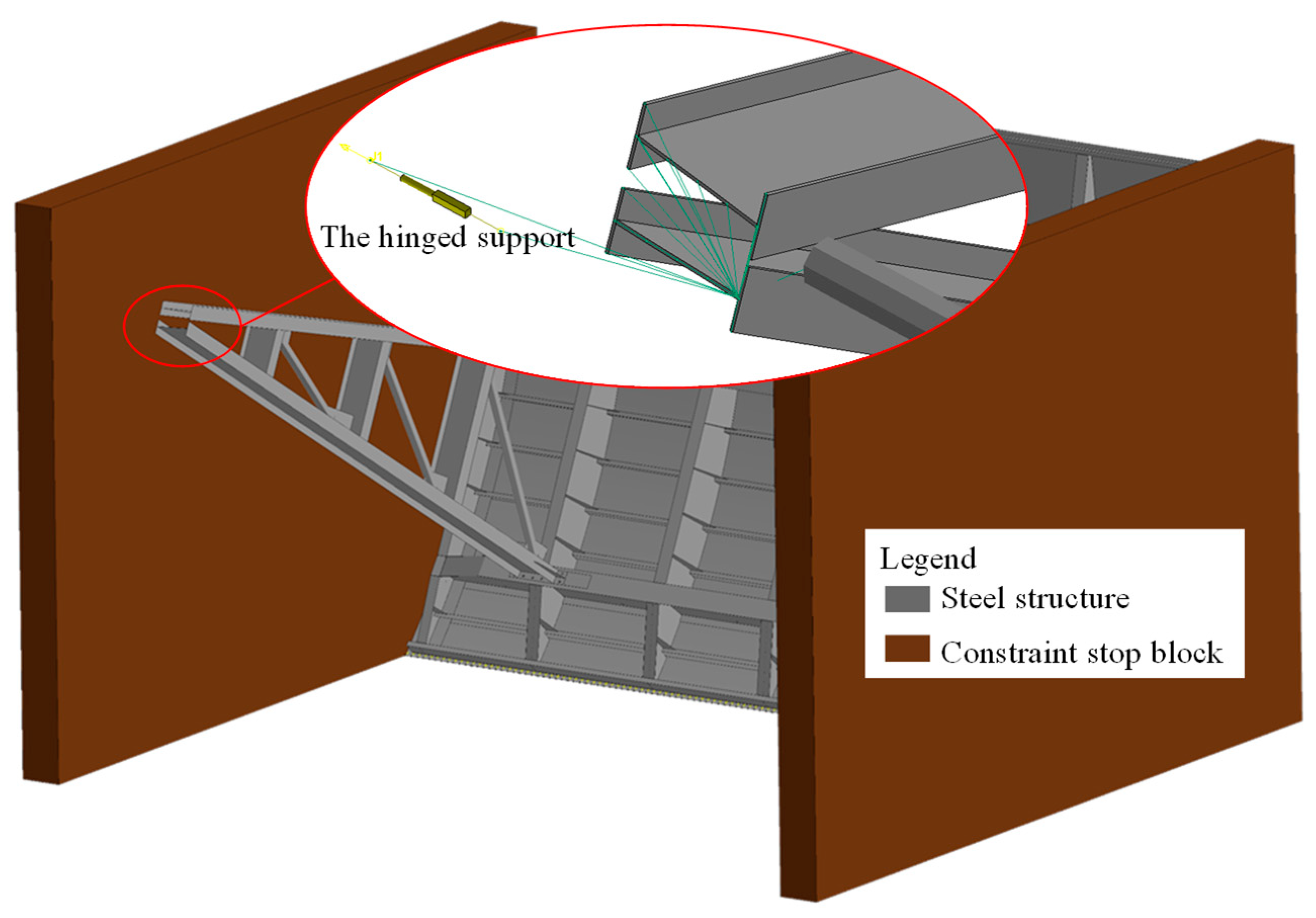
The steel radial gate is supported by arms on hinged supports fixed to the gate piers. To simulate the free-rotation behavior of the mechanical hinge, a rigid constraint is applied to combine the nodes of the movable part of the hinge with those at the hinged end of the support-arm numerical model, forming a rigid assembly. A revolute joint constraint then connects this assembly to the nodes of the fixed part of the hinge. The bottom of the skin plate is supported on the sluice-chamber floor, with vertical displacements constrained at its bottom-edge nodes. Furthermore, contact constraints are applied between both sides of the skin plate and the gate piers. A rigid-body model of the piers is established, and the contact pairs between the piers and the skin plate are defined as boundary conditions.
The steel radial gate is supported by arms on hinged supports fixed to the gate piers. To simulate the free-rotation behavior of the mechanical hinge, a rigid constraint is applied to combine the nodes of the movable part of the hinge with those at the hinged end of the support-arm numerical model, forming a rigid assembly. A revolute joint constraint then connects this assembly to the nodes of the fixed part of the hinge, as shown in
Figure 2. This explicit modeling of the hinge is considered necessary to correctly release the rotational degree of freedom around the trunnion pin. If the hinge were simplified as a fixed constraint, the rotational flexibility of the entire gate structure would be artificially suppressed, potentially leading to an overestimation of its stiffness and an inaccurate distribution of impact-induced internal forces.
The bottom of the skin plate is supported on the sluice-chamber floor, with vertical displacements constrained at its bottom-edge nodes. This treatment is based on the consideration that, during impact, the self-weight of the gate tends to maintain its bottom edge in contact with the sill. Even if in-plane membrane forces develop due to large deflections, their vertical component is unlikely to overcome the downward gravitational force. Therefore, vertical separation at the bottom edge is not expected, and a fixed vertical constraint can be adopted as a reasonable simplification for the numerical model.
Furthermore, contact constraints are applied between both sides of the skin plate and the gate piers. A rigid-body model of the piers is established, and the contact pairs between the piers and the skin plate are defined as boundary conditions. Modeling the concrete piers as rigid bodies is a common simplification in impact simulations, justified by their significantly higher stiffness compared to the steel gate. This allows the analysis to focus on the structural response of the gate itself. More importantly, this approach enables the use of a surface-to-surface contact algorithm between the gate panel and the piers. Such contact modeling is necessary to capture the possible lateral interaction between the panel edges and the piers. Under impact, large deflections may generate in-plane membrane forces that could pull the lateral edges of the panel inward. In such cases, a simple displacement boundary condition on the sides would artificially constrain this motion, whereas a contact algorithm allows for the realistic simulation of potential separation and subsequent re-contact between the gate and the piers. This is considered important for a reliable assessment of the gate’s dynamic behavior.
In this study, the gate piers and chamber floor are modeled as rigid constraints, and local details such as water seals are not explicitly considered. This simplification is consistent with common practice in impact analyses of steel gates, where the focus is on the global response of the main structure. The rigid constraint assumption implies that the impact energy is entirely dissipated by the gate. While actual supports have finite compliance, this approach provides a conservative estimation of the gate’s displacement and damage, offering a safety-oriented assessment of its impact resistance.
2.4. Simulation of Impact Scenarios
The Belytschko–Tsay shell element is adopted to establish the numerical model of the steel radial gate. This type of element uses a convected coordinate system and can effectively reflect the characteristics of large deformation, rigid body displacement, and other behaviors of steel structures after instability. The same shell element is also used to establish the numerical model of the steel tube impacting the gate, with the steel constitutive parameters consistent with those of the gate steel. The Belytschko–Tsay shell element employs a single integration point. To suppress its zero-energy modes, the Flanagan–Belytschko stiffness form is adopted to control hourglass energy, with the hourglass coefficient set to the LS-DYNA default value of 0.1.
Explicit dynamics analysis is used to simulate the impact response of the steel gate. For this type of time-domain integration, the central difference method is employed, and the stability condition must be satisfied. The time step size is determined by
where Δ
t is the current time step,
α is the time step scale factor,
Lc is the characteristic length of the element, and
a is the material sound speed (initially computed from the elastic wave speed). In this study, the LS-DYNA default scale factor
α = 0.9 is used. For shell elements, the characteristic length is calculated as the element area divided by the smaller of the longest edge and the longest diagonal.
The steel tube impact event investigated in this study was verbally reported by the operation and maintenance personnel following an extreme flood event. According to onsite feedback, the tubes originated from an upstream construction site where they had been temporarily stored before being entrained by floodwaters. Due to the emergency conditions during the disaster and the subsequent discharge of floodwaters, no on-site measurement or documentation of the actual tube dimensions (outer diameter, wall thickness, or segment length) was possible, and no physical evidence remained.
Since the primary objective of this study is not to replicate a specific undocumented event, but rather to derive generalizable insights into the impact response of radial gates through parametric analysis, a representative range of tube cross-sections and segment lengths was selected based on commonly used specifications in construction practice, in accordance with the national standard Dimensions, shapes, masses and tolerances of steel tubes (GB/T 17395-2024) [
48]. The cross-sectional dimension of a steel tube is conventionally denoted as
ϕD ×
S, where
D is the nominal outer diameter and S is the nominal wall thickness (both in mm). The mass of the impactor was varied by selecting tubes with different cross-sectional dimensions and segment lengths, covering a spectrum from approximately 0.5 t to 9.7 t. This ensures that the simulated scenarios were engineeringly plausible despite the absence of site-specific measurements.
It should be noted that although a hollow steel tube, open at both ends, fills with water when submerged—resulting in an average density close to or even exceeding that of water—it may still be entrained and transported by high-velocity flood flows. Reference [
11] investigated particle dynamics in high-speed open channel flows and demonstrated that under such conditions, non-uniform velocity distributions and turbulent structures generate significant pressure differences around an object, producing lift forces (including Saffman and Magnus forces) sufficient to lift it from the bed. This mechanism enables sediment particles denser than water to move in saltation; similarly, a hollow steel tube in high-speed flood flows may experience comparable lift effects due to the complex velocity field around the tube and the internal void, allowing it to be transported downstream in a saltation-like or partially suspended mode and to impact the gate at various attitudes.
The trajectory of a steel tube in floodwaters is highly uncertain due to several factors: the complexity and spatiotemporal variability of the flow field; the complex interaction between the tube and the flow; the random initial conditions when the tube is entrained; and possible collisions with obstacles during its downstream travel. These factors together result in a wide possible range of impact velocities, angles, and orientations. Accordingly, various impact angles and velocities were considered in the parametric study to cover as many plausible impact scenarios as possible.
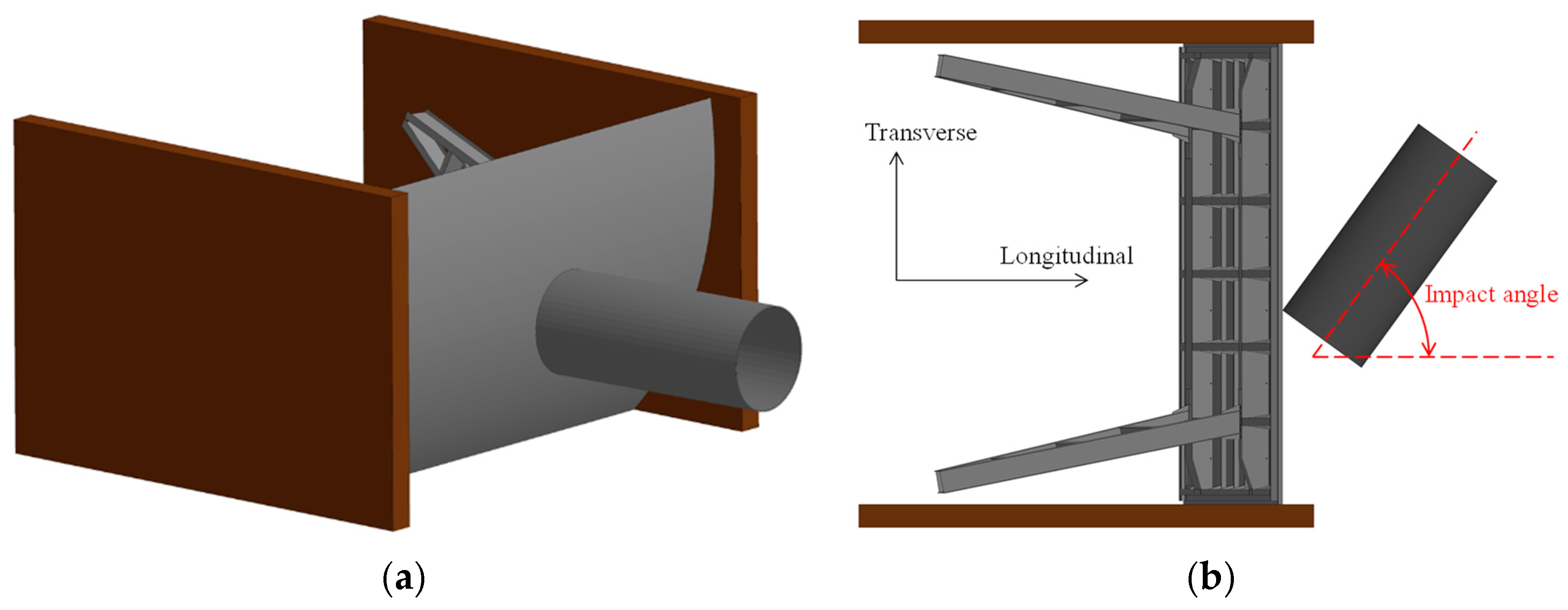
Figure 3 shows the schematic diagram of the steel tube impacting the steel radial gate.
As shown in
Figure 3, the numerical model of the steel tube is positioned on the upstream side of the skin plate, adjacent to it (
Figure 3a). An initial downstream velocity is imposed on the tube to simulate its floating motion and impart impact kinetic energy. This study analyzes the effects of the tube’s mass, impact velocity, and impact angle on the gate response. The impact angle is defined as the angle between the tube axis and the longitudinal axis of the gate (
Figure 3b). An automatic surface-to-surface contact algorithm, based on the segment-to-segment approach with a penalty function coefficient of 0.1, is used to simulate the impact between the tube and the skin plate.
Furthermore, the gate response under impact from the steel tube is compared with that from a spherical impactor. The equivalent spherical size for each tube is determined by mass equivalence. The spherical model is positioned so that its closest point to the skin plate coincides with that of the corresponding tube, ensuring identical initial impact points.
Prior to impact simulation, the gravitational acceleration field and the hydrostatic pressure on the skin plate are applied incrementally from zero to their full values—standard gravity and the pressure corresponding to the flood head, respectively—to establish the initial static structural response. The water depth upstream of the gate is 7.35 m. The static response of the steel radial gate is relatively small and nearly linear; therefore, an implicit solver is employed for this phase. The subsequent impact simulation uses the static response results as the initial condition, with all static loads remaining unchanged.
The present study focuses on the mechanical behavior and collision resistance of the steel radial gate structure under impact by a floating object. While hydrodynamic effects (e.g., added mass, damping) are present in a real flood event, their explicit simulation is omitted to establish a clearer understanding of the structural response itself. This approach is common in fundamental collision mechanics research. First, for the transient impact durations considered, the influence of hydrodynamic damping on the energy balance is typically secondary, often accounting for less than 10% of the total energy in similar scenarios [
12]. Second, and more importantly, this simplification allows the investigation to isolate and quantify the influence of key structural and impact parameters—such as impactor geometry, mass, velocity, angle, and location—on the gate’s dynamic response.
In this study, the total displacement at a node is defined as the magnitude of its three-dimensional displacement vector, representing the straight-line distance the node has moved from its original position. The global deformation of the gate is then characterized by the maximum total displacement, which is the largest nodal displacement magnitude across the entire model.
2.5. Numerical Model Verification and Validation
2.5.1. Parametric Sensitivity Analysis
Numerical simulations of structural dynamic responses under impact using the finite element method are influenced by non-physical parameters such as mesh size and contact model settings. To evaluate the effects of these parameters, this study compares numerical results obtained under identical impact conditions but with varying mesh sizes, contact penalty factors, and contact damping ratios. Based on this sensitivity analysis, appropriate parameter values are selected to establish the final numerical model.
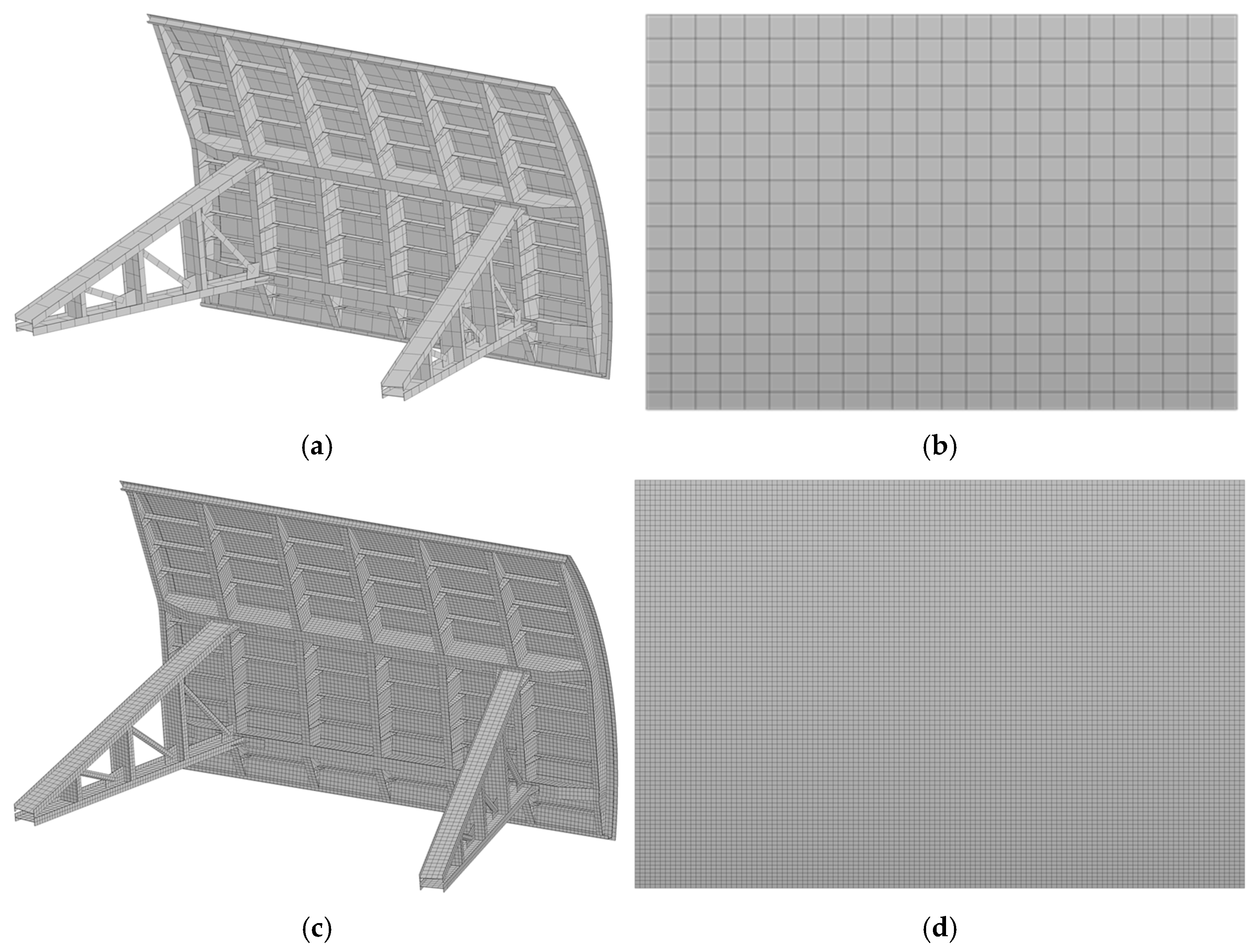
To assess the sensitivity of the numerical results to mesh size, seven gate models with mesh sizes ranging from 50 mm to 500 mm were developed. Taking the 500 mm and 100 mm mesh models as examples, the finite element meshes are illustrated in
Figure 4.
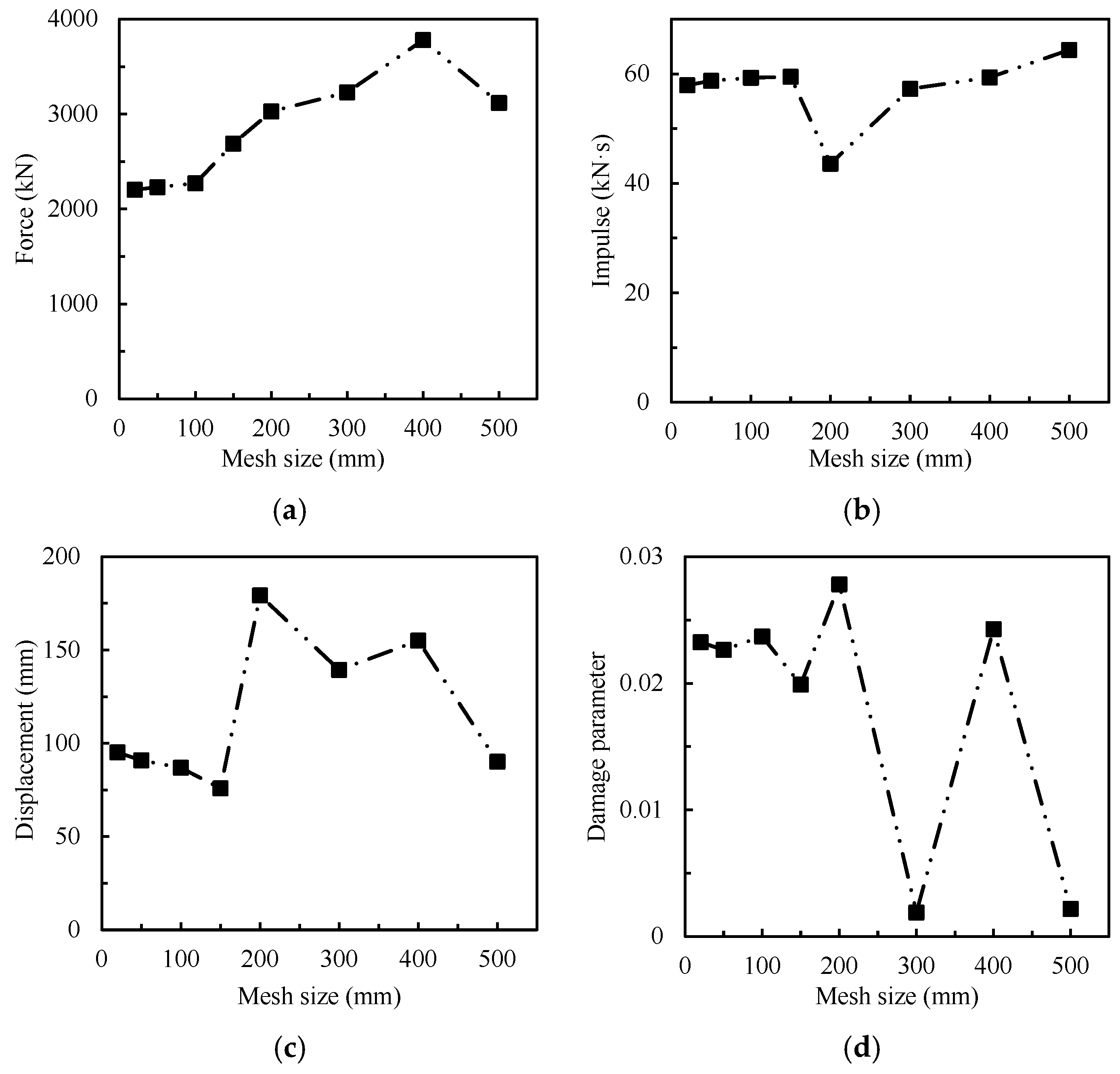
Dynamic response analyses were performed for the same impact scenario using numerical models with different mesh sizes. The peak impact force, impact impulse, maximum total displacement, and damage parameter extracted from each model are presented in
Figure 5, which illustrates the relationship between these responses and mesh size.
As shown in
Figure 5a, when the mesh size is smaller than 400 mm, the peak impact force decreases with decreasing mesh size. The impact impulse generally exhibits a decreasing trend as the mesh size is refined, with the minimum value observed at a mesh size of 200 mm (
Figure 5b). For mesh sizes not exceeding 150 mm, the maximum total displacement decreases with further mesh refinement (
Figure 5c). The maximum damage parameter displays oscillatory variations but tends to stabilize as the mesh size decreases (
Figure 5d). All response quantities—peak impact force, impulse, maximum displacement, and damage parameter—converge as the mesh is refined. Adopting a convergence criterion of 5%, as is commonly used in engineering computations, the relative differences between the results obtained with the 100 mm mesh and those with the 50 mm mesh are 1.8% for peak impact force, 0.9% for impulse, 4.38% for maximum displacement, and 4.72% for damage parameter, all below the 5% threshold. Therefore, the model with a mesh size of 100 mm satisfies the mesh convergence requirements and is adopted for subsequent numerical simulations.
The contact force between the impactor and the skin plate is simulated using a penalty-based contact algorithm, where the contact force is calculated as the product of contact stiffness and penetration depth. In LS-DYNA, the contact stiffness
k is expressed as
where
fp is the dimensionless penalty factor, and
m1 and
m2 are the masses of the contacting segments.
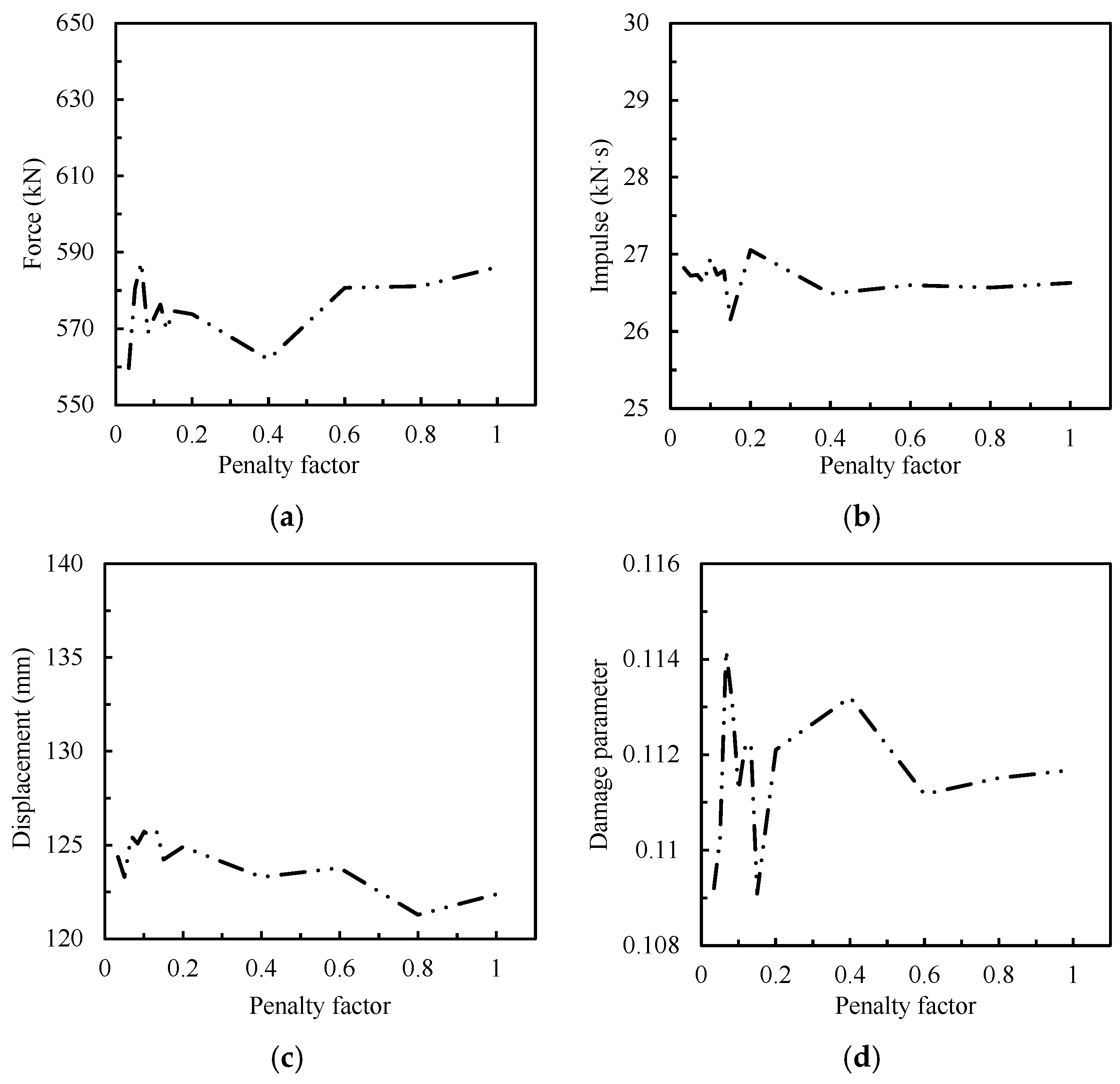
The default value of the penalty factor in LS-DYNA is 0.1. To investigate its influence, numerical models with penalty factors ranging from 0.03 to 1.0 were established while keeping all other parameters unchanged.
Figure 6 presents the relationship between the calculated dynamic responses and the penalty factor.
As shown in
Figure 6, varying the penalty factor between 0.03 and 1.0 results in negligible changes in the peak impact force, impact impulse, maximum total displacement, and damage parameter. The differences between the maximum and minimum values for these response quantities are 4.95%, 3.46%, 3.65%, and 4.67%, respectively. Given the limited sensitivity, the default penalty factor of 0.1 is adopted in this study.
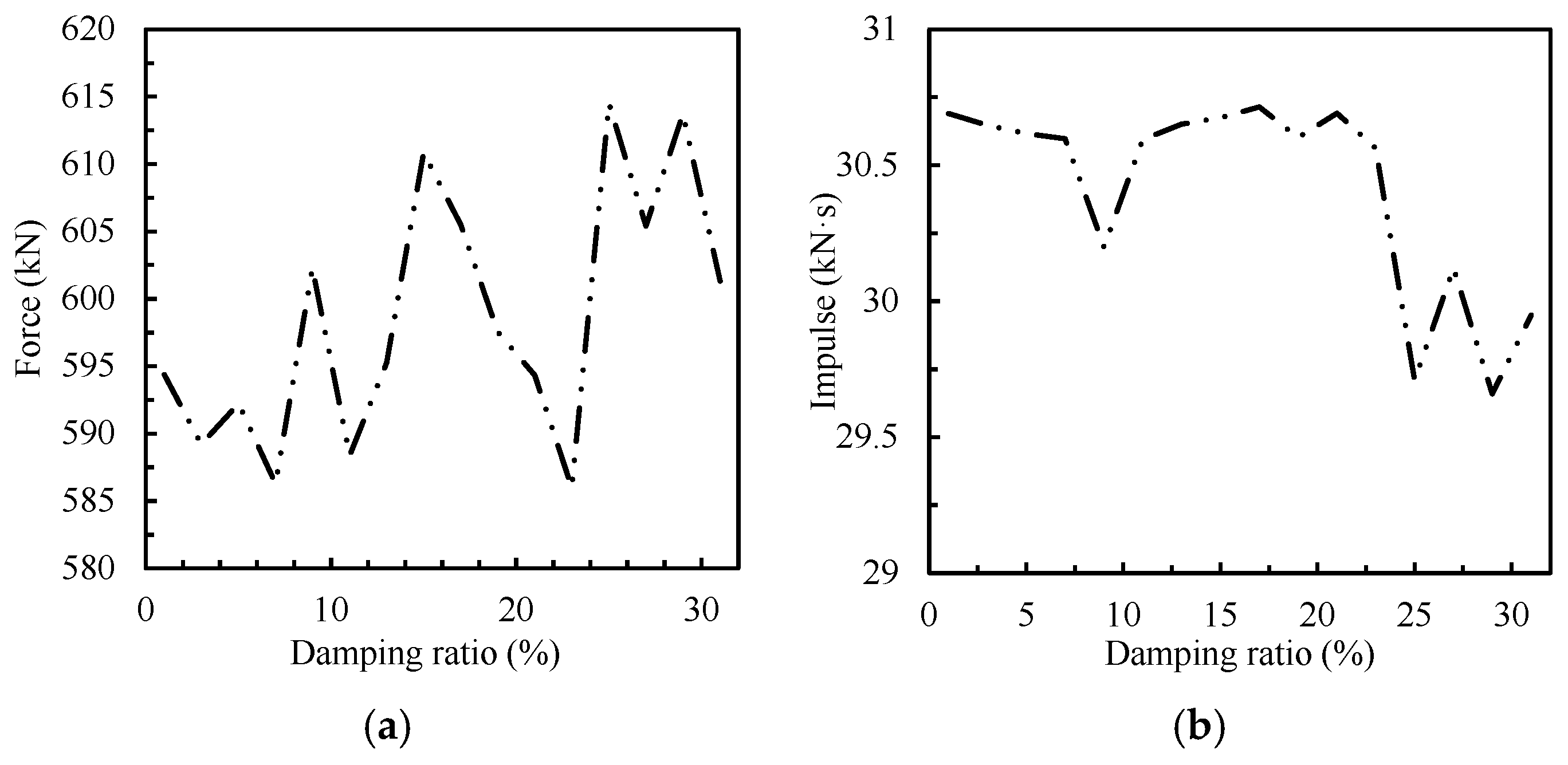
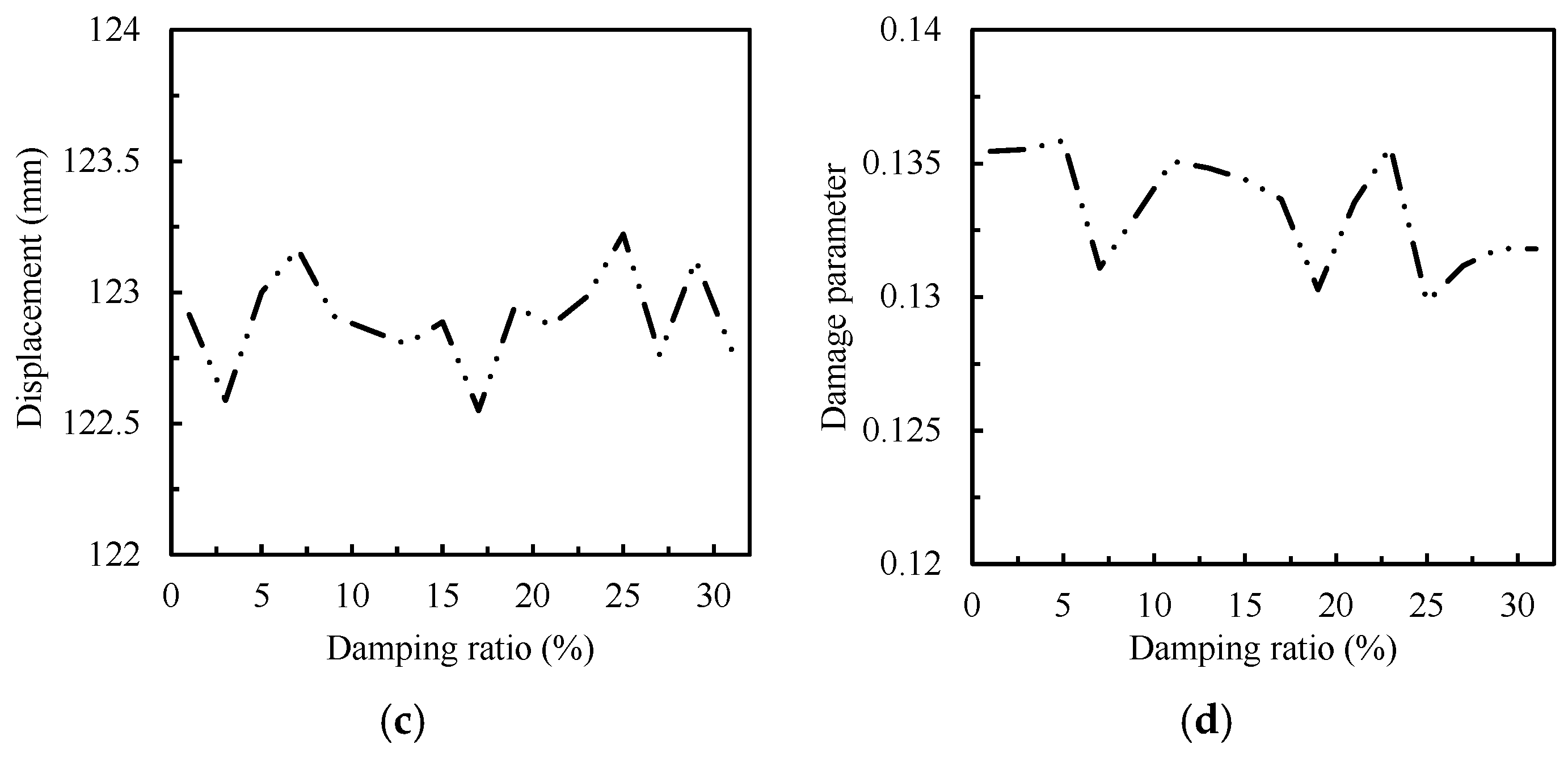
To mitigate numerical oscillations, a damping ratio is introduced in the contact definition between the impactor and the skin plate, typically ranging from 10% to 20%. To examine the influence of this parameter, damping ratios from 1% to 31% were considered.
Figure 7 illustrates the relationship between the numerical results and the contact damping ratio.
Figure 7 indicates that the peak impact force, impact impulse, maximum total displacement, and damage parameter exhibit oscillatory variations with increasing damping ratio, albeit with small amplitudes. The differences between the maximum and minimum values are 4.87%, 3.56%, 0.55%, and 4.66%, respectively. Based on these results, a contact damping ratio of 15% is selected for this study.
2.5.2. Validation
Using shell elements to establish numerical models of steel structures and simulate their dynamic response under impact is a common approach for such problems. Many laboratory impact tests have also validated the accuracy of this numerical simulation method, with some studies reporting relative errors of less than 5% between numerical results and experimental data [
49,
50,
51]. Furthermore, numerous numerical simulations of the dynamic response of steel structures under impact have adopted the Johnson–Cook constitutive model for steel, as used in this study, and have achieved good agreement with experimental results, including cases employing the same constitutive parameters as in this paper [
47,
52]. Thus, existing research indicates that the numerical simulation method adopted in this study possesses a certain accuracy for calculating the dynamic response of steel sluice gates under impact. In this subsection, energy analysis and comparison with theoretical results are employed to further assess the validity of the numerical simulation method.
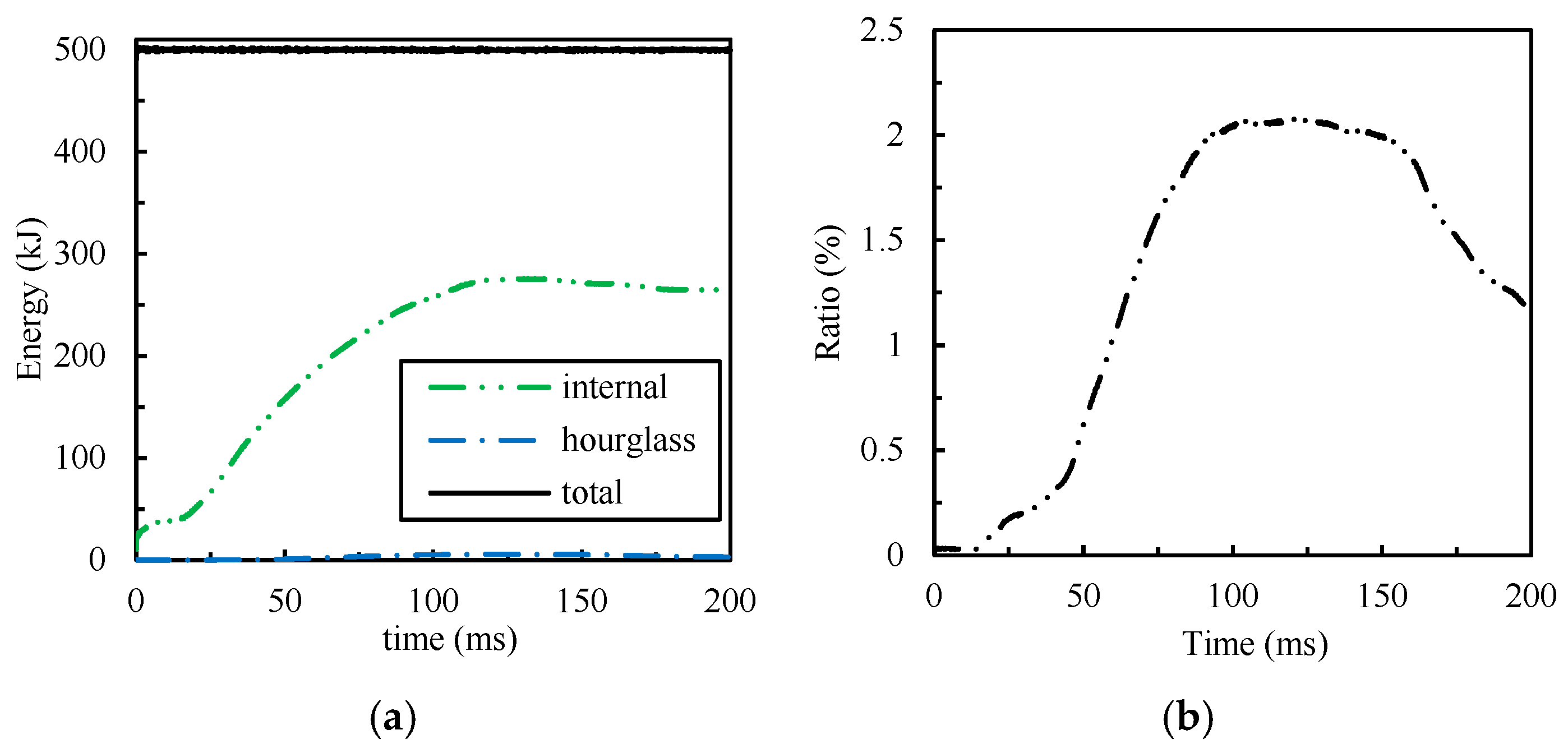
First, the numerical model is assessed from the perspectives of energy balance and hourglass energy control. Taking one simulation case as an example, the energy results are extracted and analyzed.
Figure 8 presents the energy time histories and the related quantities required for this evaluation.
As shown in
Figure 8a, the total energy of the model remains stable throughout the response (around 500 kJ); the difference between the maximum and minimum total energy is only 2.54%. This indicates that the numerical model maintains energy balance without spurious energy generation or dissipation.
During the dynamic response, the hourglass energy varies but remains consistently small compared to the internal energy (
Figure 8a). The ratio of hourglass energy to internal energy at each time step is plotted in
Figure 8b. The maximum ratio is 2.08%, well below the commonly accepted engineering limit of 5%. Therefore, the adopted hourglass control method effectively suppresses zero-energy modes of the single-integration-point elements and prevents numerical artifacts from influencing the results.
Currently, published experimental data on the dynamic response of steel gate structures under impact are scarce, making it difficult to directly validate the numerical simulation through experimental comparison. In numerical simulation studies on the impact resistance of steel gates, analytical solutions are often used to verify the validity of numerical results [
16]. Reference [
16] has already validated the numerical simulation from the perspective of structural internal forces. The following section validates the numerical model in this paper from the perspective of structural displacement response.
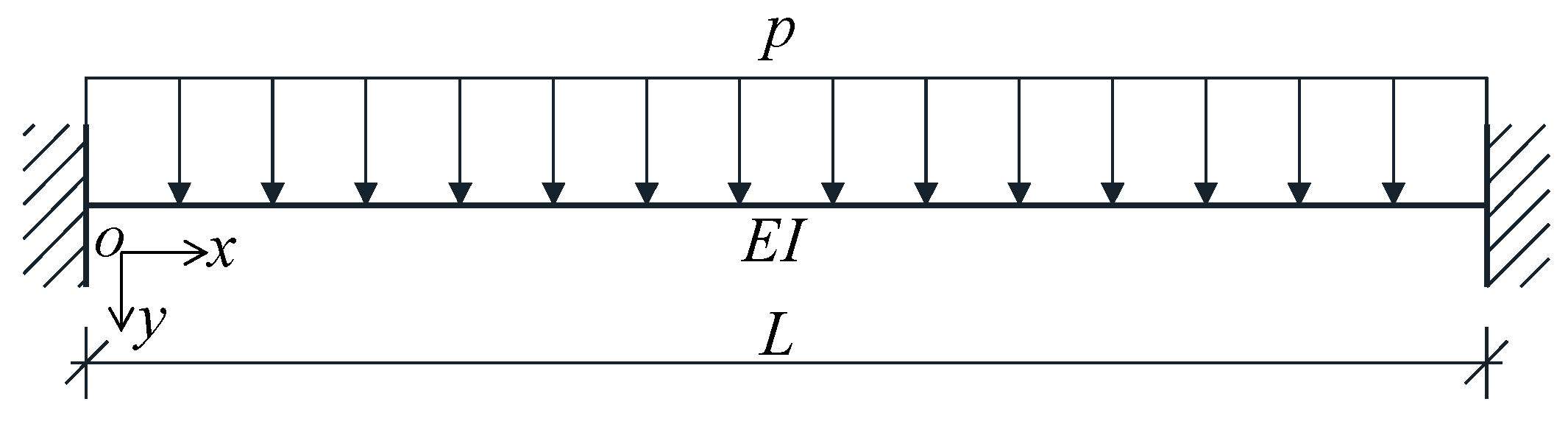
The primary load-bearing spatial frame structure of a radial gate is composed of I-beams.
Figure 9 illustrates a fixed-end I-beam subjected to a uniformly distributed load. In the figure, the magnitude of the external uniformly distributed load on the beam is denoted as
p, the span as
L, and the flexural rigidity of the cross-section as
EI.
For the beam in
Figure 9, the analytical solution for the vertical deflection
v exists [
53]:
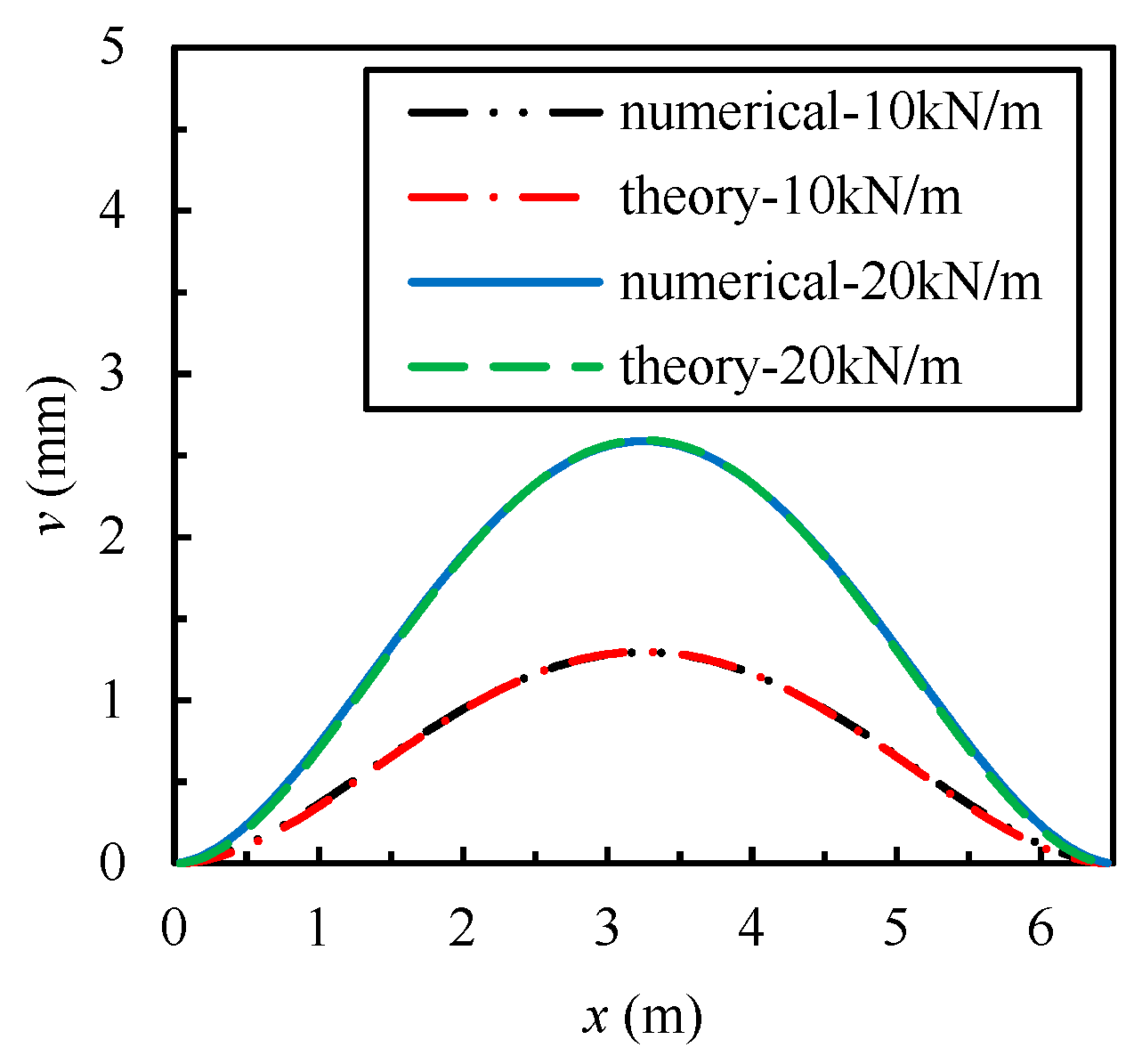
Taking a fixed-end beam with a span of 6.5 m as an example, with a cross-section height of 300 mm, width of 220 mm, web thickness of 14 mm, and flange thickness of 18 mm, the numerical simulation method in this paper was used to calculate the deflections of this beam under uniformly distributed loads of 10 and 20 kN/m.
Figure 10 compares the deflections at various sections obtained from the numerical simulation with the analytical solutions.
As can be seen from
Figure 10, the deflection distribution of the steel beam obtained from the numerical simulation agrees well with the analytical solutions. The relative errors of the maximum deflection from the numerical simulation compared to the analytical solution are 0.25% and 0.26% for the 10 and 20 kN/m load cases, respectively. It should be noted that the above analytical validation pertains to the elastic response of a beam under a static, uniformly distributed load and does not directly validate the nonlinear dynamic process under impact. Nevertheless, this comparison confirms the accuracy of the numerical method in simulating the fundamental mechanical behavior (e.g., bending stiffness, deformation distribution) of steel structures, thereby providing a basis for the subsequent complex impact simulations.
In summary, due to the lack of full-scale experimental data, the rationality of the numerical model for the dynamic response of the radial gate under impact is comprehensively verified through energy analysis, comparison with analytical solutions, and support from existing literature.
3. Comparison of Steel Tube and Spherical Impactor Impacts
To investigate the influence of impactor shape on the gate’s dynamic response, a spherical impactor model with a mass equivalent to the steel tube was used as a baseline for comparison. The sphere, being the most fundamental continuum impactor model, allows for isolating the effect of shape by keeping mass and impact velocity identical. Two steel tube cross-sections were selected, ϕ1168 × 24 and ϕ2540 × 24, both with a segment length of 6.0 m, corresponding to masses of 4.06 t and 8.94 t, respectively. Based on mass equivalence, the equivalent spherical radii for these two tube sizes are 499.22 mm and 648.39 mm. The impact velocities considered in this study are 1.0 m/s and 5.0 m/s, representing low and moderate flood-driven speeds. These parameter combinations cover a range of kinetic energy levels and ensure a representative comparison between the tube and sphere models.
In all simulation cases presented in this section, a consistent impact location was used for both the steel tube and the spherical impactor. The initial point of contact was positioned vertically near the MCB and horizontally at a distance of 1.2 m from the gate’s vertical axis of symmetry, perpendicular to the flow direction. For the steel tube models, the tube axis was oriented parallel to the flow direction.
3.1. Comparison of Impact Forces
Numerical simulations of the steel radial gate impacted by steel tubes and spherical impactors were performed following the methodology in
Section 2. The impact force was derived from the contact force between the impactor and the skin plate in the simulation results.
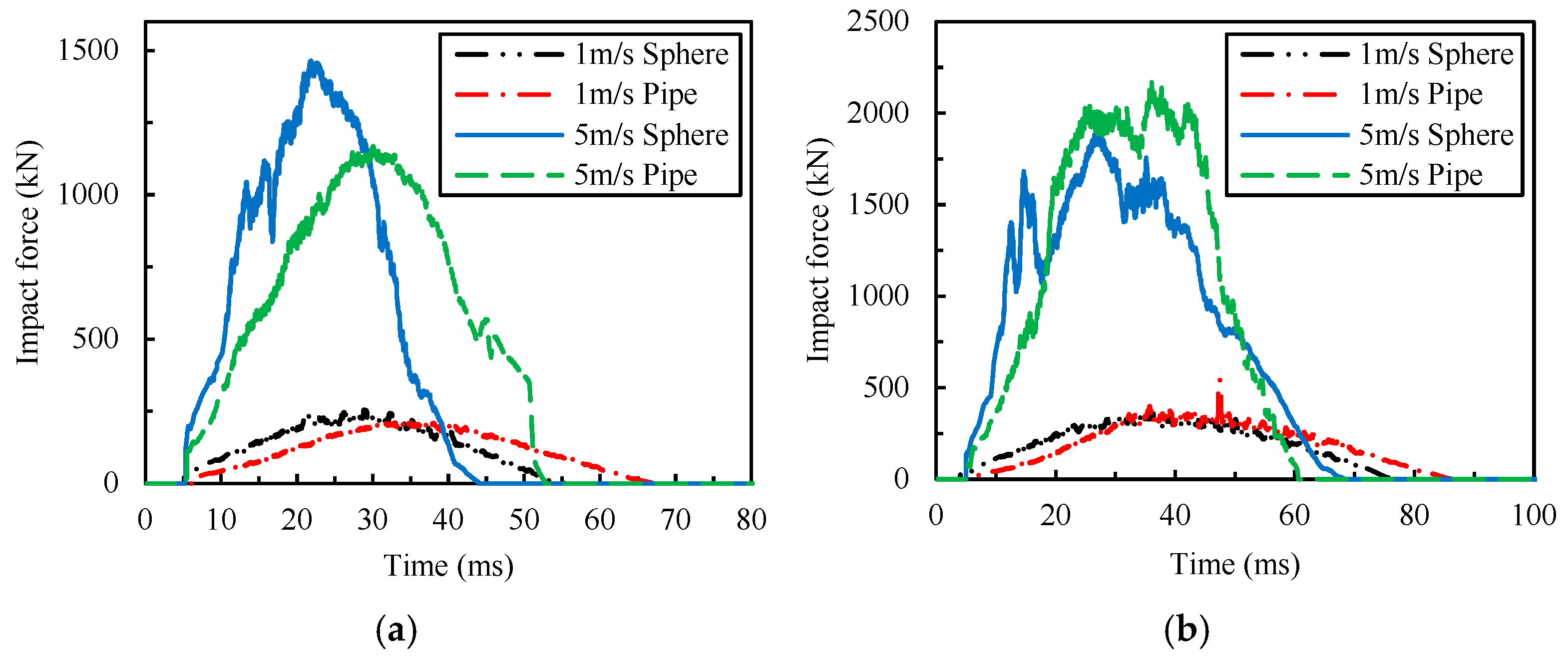
Figure 11 presents the time-history curves of the impact force on the gate for impactors of different masses.
Figure 11 reveals significant differences in impact forces between steel tubes and their mass-equivalent spherical counterparts. For the 4.06 t impactor, the peak impact forces of the tube are lower than those of the sphere across all tested velocities (
Figure 11a). Conversely, for the 8.94 t impactor, the tube yields higher peak forces than the sphere (
Figure 11b).
The peak impact forces obtained from the numerical simulations are summarized in
Table 3. Throughout this paper, the “Error” reported in the tables is defined as the absolute relative difference between the results obtained from the spherical impactor model and those from the steel tube model. The results indicate that, depending on the impact mass, using a spherical model can lead to either an underestimation or an overestimation of the peak impact force compared to the more realistic tube model. In the cases presented in this section, the error in the peak force predicted by the spherical model ranges from 12.75% to 33.86%.
The impact impulse was calculated by integrating the time-history curves in
Figure 11, with the results presented in
Table 4.
Table 4 shows that, across all scenarios with varying impactor masses and velocities, the impact impulses on the gate predicted by the spherical model are consistently lower than those predicted by the tube model. From a load perspective, this indicates that using a mass-equivalent sphere may yield non-conservative—and therefore potentially unsafe—results for gate response analysis. In the present study, the error associated with the spherical model’s predictions ranges from 3.48% to 10.58%.
3.2. Comparison of Displacements
To analyze the gate’s dynamic response process, the time-history of the maximum total displacement was extracted.
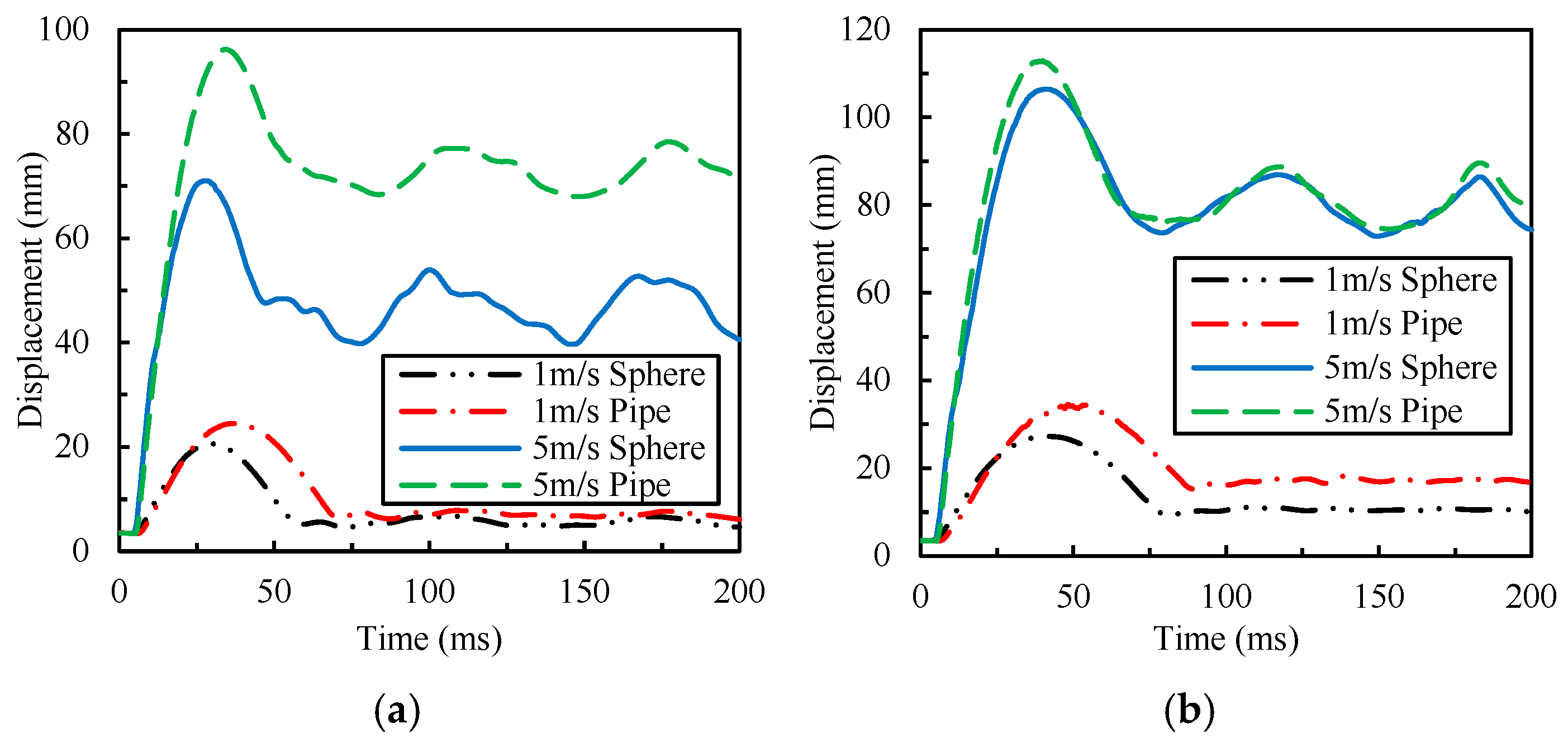
Figure 12 presents the time-history curves for the maximum total displacement under impact by objects of different masses.
Figure 12 indicates that the gate’s maximum total displacement induced by the steel tube impact exceeds that caused by the spherical impactor. Following impact, the displacement peaks, then decays to a residual level before stabilizing, exhibiting small-amplitude oscillations around this residual displacement.
The peak values of the maximum total displacement under various impact scenarios are summarized in
Table 5.
Table 5 shows that the maximum total displacement of the gate predicted by the tube model consistently exceeds that predicted by the spherical model. From a displacement perspective, this indicates that using a spherical model for impact simulation yields non-conservative (i.e., potentially unsafe) results for the gate response. In the cases presented here, the relative error of the spherical model’s results ranges from 5.68% to 26.16%.
3.3. Comparison of Damage
The Johnson–Cook constitutive model was employed to calculate the damage parameters of the steel gate under impact. The cumulative damage parameter peaked at the final time step of the simulation.
Table 6 lists the maximum damage parameters for various impact scenarios, characterizing the extent of gate damage.
Table 6 indicates differences in the simulated gate damage between the tube and spherical models. Compared to the tube model, the spherical model yields damage results with errors ranging from 2.40% to 56.26%. Notably, under the 8.94 t mass and 1.0 m/s velocity scenario, the spherical model underestimates the damage by 51.53% relative to the tube model. This significant error demonstrates that using a spherical model can lead to potentially unsafe results with substantial inaccuracy.
The differences observed in the impact force, gate displacement, and damage between the steel tube and the mass-equivalent spherical impactor originate from fundamental disparities in their geometric and mechanical characteristics. First, their mass distribution differs significantly: a sphere possesses an isotropic mass distribution, whereas the mass of a steel tube is concentrated in its cylindrical wall. This results in distinct moments of inertia and rotational dynamic behavior during impact. Second, the stiffness characteristics are not equivalent. The bending and local compressive stiffness of the tubular section are markedly different from the uniform compressive stiffness of a solid sphere, influencing both energy transfer and local indentation behavior at the contact interface. Finally, the evolution of the contact area during impact follows distinctly different patterns. A sphere typically initiates contact at a point, with the contact area expanding symmetrically. In contrast, a tube may present initial line or area contact, with the contact mode evolving dynamically depending on its orientation and deformation. These inherent differences in shape, structural stiffness, and contact interaction collectively demonstrate that simplifying the tubular impactor to a spherical model can lead to potentially erroneous estimates of the gate’s dynamic response.
4. Analysis of Influencing Factors on Dynamic Response
4.1. Impact Scenario Parameters
The dynamic response of engineering structures to impact is largely governed by the mass and velocity of the impactor. Higher mass and velocity correspond to greater initial kinetic energy and, consequently, a more significant gate response—a conclusion applicable to various impactors such as spherical impactors and driftwood.
In the case of a steel tube impacting a steel radial gate, specific impact scenarios are influenced by multiple factors, including tube specifications, initial orientation (pose), and floodwater level. Furthermore, the tube’s significantly larger longitudinal dimension introduces additional variables. Beyond mass and velocity, parameters like tube dimensions, impact angle, and impact location also vary across scenarios.
To analyze the influence of these parameters on the gate’s dynamic response, numerical simulations were conducted for various impact scenarios, with subsequent analysis based on the results. The selected parameters are detailed below.
To ensure result representativeness, simulations involved steel tubes of different masses, 0.92 t and 9.67 t, corresponding to ϕ406 × 16 and ϕ2540 × 26 tubes, respectively, both with a segment length of 6.0 m. For the 9.67 t case, additional tubes (ϕ1727 × 18 and ϕ1930 × 22, with segment lengths of 12.7 m and 9.3 m, respectively) were included to analyze the influence of tube geometry.
Regarding impact location, different initial contact points were defined. Considering geometric constraints imposed by the gate piers and chamber floor, only geometrically feasible locations were simulated. Impact location is described in both vertical and transverse coordinates, specifically by the vertical distance from the initial contact point to the gate chamber floor and its transverse distance from the gate’s axis of symmetry.
Numerical simulations were performed for impact angles ranging from 0° to 90° to investigate the effect of the impact angle when tubes of different masses strike different vertical positions on the skin plate.
4.2. Displacement
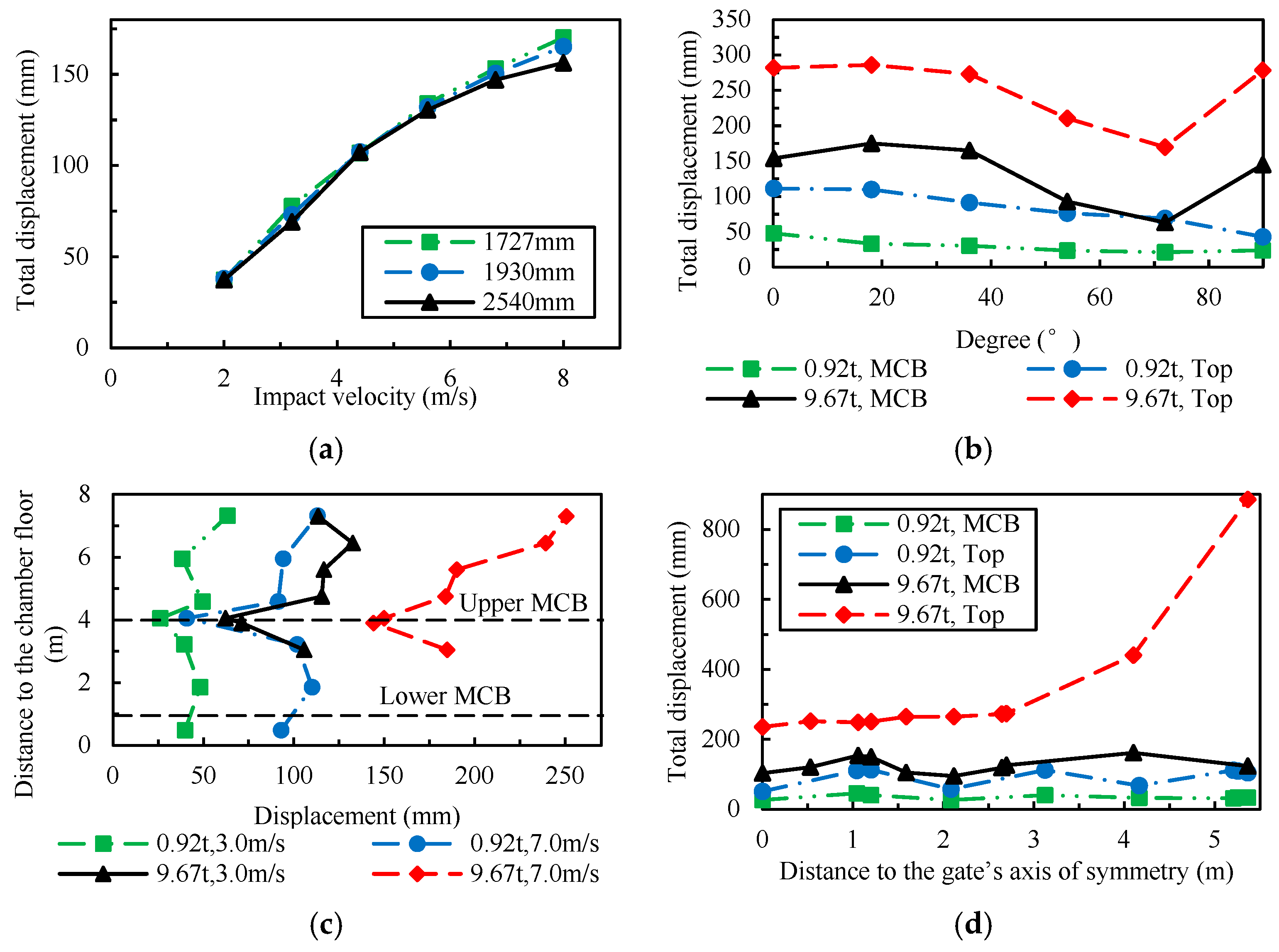
The maximum total displacement of the gate, which reflects its deformation extent, was extracted from the numerical simulation results for various impact parameters. The influence of these parameters on the maximum total displacement is illustrated in
Figure 13.
As illustrated in
Figure 13, the gate’s maximum total displacement exhibits clear dependencies on the impact parameters. Displacement increases with impact velocity (
Figure 13a), with a maximum variation of 11.0% observed for tubes of identical mass but different cross-sections and lengths.
The impact angle significantly influences the displacement (
Figure 13b). Generally, a negative correlation exists between displacement and impact angle within the 0° to 72° range. An exception is noted for the 9.67 t tube, where displacement at an 18° impact angle slightly exceeds that at 0° by up to 13.7%.
The vertical location of the initial impact point is a critical factor (
Figure 13c). Displacement is minimized when impact occurs near the Upper MCB. In contrast, impacts near the top of the gate result in considerably larger displacements. A specific comparison reveals that the displacement caused by a 0.92 t tube impacting the top area at 3.0 m/s is marginally greater (by 1.8%) than that caused by a 9.67 t tube impacting the Upper MCB area at the same velocity.
The effect of the horizontal impact location is interrelated with both the tube mass and the vertical impact location (
Figure 13d). For the 0.92 t tube, or for the 9.67 t tube when impacting near the Upper MCB, the maximum total displacement displays oscillatory variations with changes in horizontal location. However, for the 9.67 t tube impacting near the gate top, the displacement increases continuously as the horizontal location approaches the gate edge, and this increase occurs at an accelerating rate.
Among all the cases presented in this section, the combination of an impact point near both the gate edge (horizontally) and the gate top (vertically) produces the largest displacement, with a maximum total displacement recorded at 885.2 mm.
4.3. Damage
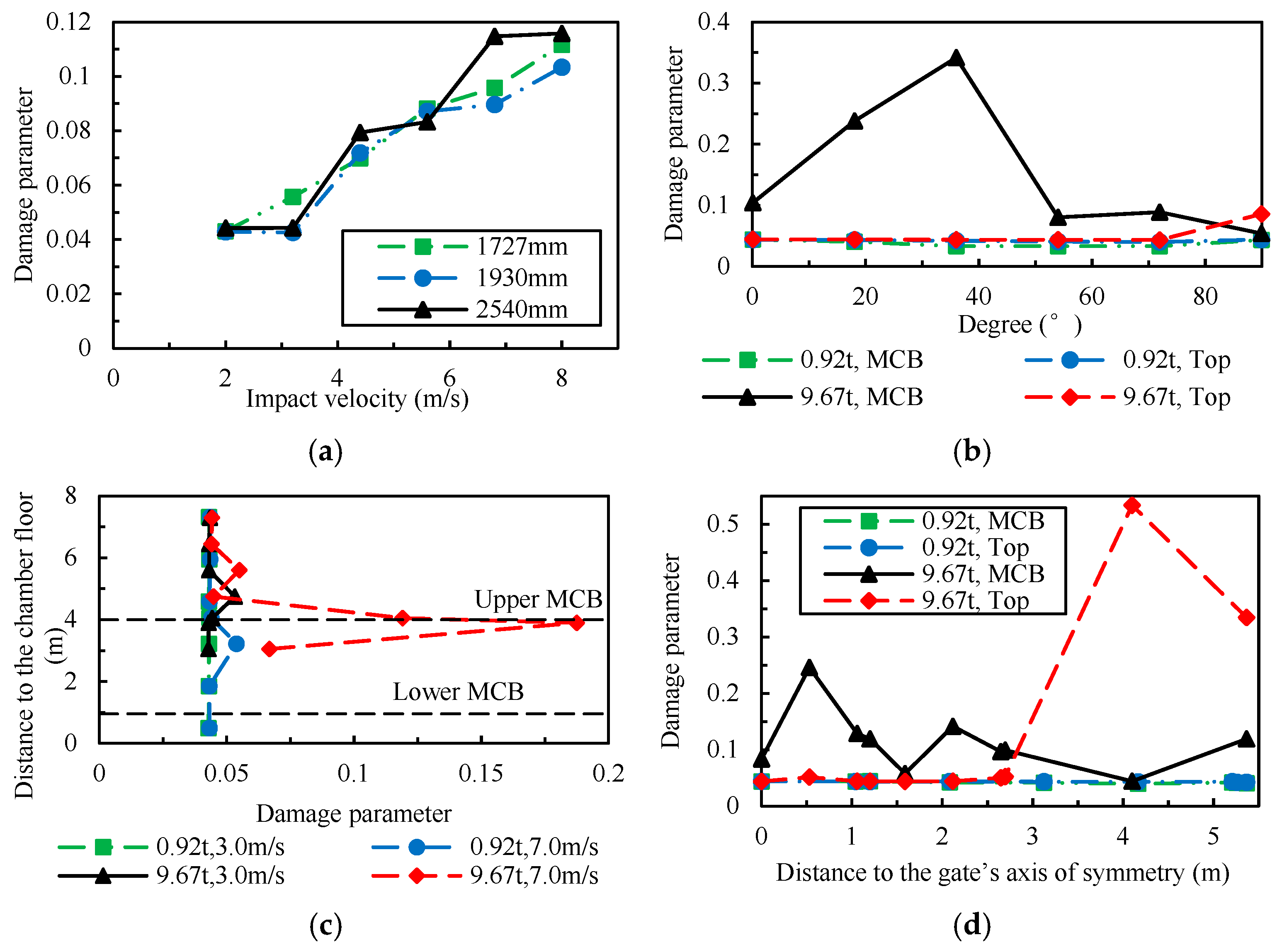
The maximum damage parameters of the gate, extracted from numerical simulations under various impact conditions, are used to quantify the extent of gate damage. The influence of different impact parameters on this damage is presented in
Figure 14.
Figure 14 illustrates the effects of various impact parameters on gate damage. Overall, damage shows a positive correlation with impact velocity (
Figure 14a), with a maximum difference of 28.0% observed for tubes of identical mass but varying cross-sections and lengths.
The effect of the impact angle is interdependent on both tube mass and initial velocity (
Figure 14b). For the 0.92 t tube, damage variation across angles is minimal, with a maximum coefficient of variation of 12.7% at a given velocity. For the 9.67 t tube, the critical angle depends on the impact location: a 36° angle causes maximum damage (parameter = 0.34) when impacting near the MCB, while a 90° angle is most severe (parameter = 0.09) for impacts near the gate top.
Regarding vertical impact location, damage is maximized near the Upper MCB (
Figure 14c). For impacts with identical mass and velocity, the vertical position yielding peak damage can be up to 0.78 m away from the MCB.
The influence of horizontal impact location is contingent on both tube mass and vertical location (
Figure 14d). For the 0.92 t tube, damage tends to decrease as the impact point moves horizontally toward the panel edge. For the 9.67 t tube, the worst-case horizontal location varies: it is 0.5 m from the gate’s symmetry axis when impacting vertically near the Upper MCB, and shifts to the vicinity of the support arm–MCB joint when impacting near the gate top.
Among all cases in this section, the maximum damage parameter of 0.53 occurs when the impact point is located both near the gate top (vertically) and close to the MCB–support arm joint (horizontally).
Based on the analysis of how various impact parameters affect the maximum displacement and damage of the steel radial gate, the underlying mechanisms governing the dynamic response can be further elucidated.
For steel tubes with identical mass and initial impact velocity but different cross-sectional dimensions and lengths, the initial kinetic energy imparted to the gate is the same. However, differences in mass distribution and structural stiffness lead to variations in the tube’s moment of inertia, bending stiffness, axial stiffness, as well as local inertial forces, compressive stiffness, and plate warping stiffness at the contact region. These discrepancies alter the dynamic impact process, including energy transfer and contact evolution, ultimately resulting in differences in the gate’s maximum displacement and damage. In the cases examined, these variations reached up to 11.0% for displacement and 28.0% for damage.
The influence of the impact angle on the gate response involves a competition between two distinct mechanisms. When the tube axis is nearly perpendicular to the skin plate (impact angle close to 0°), the initial contact area is small, concentrating the rapidly rising impact force on a limited region. This intensifies local deformation and stress, tending to increase both displacement and damage. Conversely, when the tube axis approaches parallelism with the skin plate (angle near 90°), the tube’s tendency to rotate about a vertical axis is suppressed. This reduces the portion of initial kinetic energy converted into rotational kinetic energy, allowing more energy to be transferred to the gate as translational kinetic energy and internal energy, which can also lead to larger displacements and damage. Consequently, the gate response may exhibit a monotonic decrease with increasing angle in some cases, while in others it shows complex, non-monotonic behavior depending on which mechanism dominates.
The vertical location of the initial impact point plays a critical role because of the gate’s structural configuration. The upper MCB possesses high flexural rigidity. When the tube strikes the skin plate near the upper MCB, the gate undergoes relatively small deformations but experiences larger internal forces; accordingly, the maximum displacement is modest, whereas the damage parameter is higher. Above the upper MCB, the gate structure behaves essentially as a cantilever supported by the upper MCB. This cantilever region has lower overall bending stiffness, so impacts near the gate top induce substantially larger displacements, all other parameters being equal.
The effect of the horizontal impact location is more intricate, owing to the complex beam grillage system of the gate. The skin plate and horizontal secondary beams are supported by multiple longitudinal beams spaced horizontally, dividing the panel into several spans. Simultaneously, the main crossbeams rest on the two pairs of support arms, creating both central spans and cantilevered end segments. Displacements and internal forces in the beam system depend not only on the stiffness of the components but also on the lever arm from the impact point to the supports and on the boundary conditions at those supports. Moreover, the lever arm influences bending moment and shear force in opposite ways, adding further complexity. As a result, the relationship between the horizontal impact position and the gate’s maximum displacement or damage is not straightforward. It is noteworthy that impacts near the gate edge tend to excite the cantilever-plate deformation mode, producing large displacements at the upper corner. In contrast, impacts near the MCB–support arm joints concentrate high local compressive forces at the supports, leading to elevated damage. This explains why, in the numerical simulations, the largest displacement occurred when the impact point was horizontally close to the gate edge, whereas the most severe damage was observed when the impact point was near an MCB–support arm joint.
5. Analysis of Deformation Modes
Although the influence of various impact parameters on the gate response is complex during a steel tube impact, the resulting deformation conforms to identifiable patterns. Analyzing these deformation modes is crucial for elucidating the underlying response laws, revealing damage mechanisms, and informing future anti-collision design methodologies for radial gates.
Beyond the scenarios analyzed in
Section 4, a comprehensive set of 142 numerical simulations was conducted. This set includes additional scenarios covering a tube mass range of 0.48–9.67 t and an impact velocity range of 2.0–8.0 m/s. The impact velocity of floating tubes against radial gates in floodwaters is set with an upper limit of 8.0 m/s in this study, which serves as an engineering estimate to cover a wide range of potential extreme scenarios for parametric analysis, rather than a precisely calculated value for a specific flood event. This value is determined based on a synthesis of practical engineering requirements and research objectives. Under extreme hydrological events such as catastrophic floods or dam breaks, mountain rivers often exhibit high intrinsic flow velocities, which impart considerable initial speed to floating tubes. During flood discharge operations involving multi-orifice radial steel gates, it is common for some gate orifices to remain open while others are closed. In the regions of closed orifices, flood flow is obstructed by the gate structure, resulting in flow separation and localized turbulence. These hydraulic conditions can generate locally high flow velocities, accelerating tubes passing through such zones. Moreover, this research focuses on the impact resistance and deformation patterns of steel radial gates subjected to floating tubes. Adopting a relatively high impact velocity upper limit ensures that the findings encompass a wide range of extreme impact scenarios encountered in engineering practice, thereby enhancing the general applicability of the conclusions.
The deformation modes were analyzed based on the results of these simulations. The analysis of deformation modes is based on the positional relationship between the node experiencing the maximum total displacement and the initial impact point of the tube.
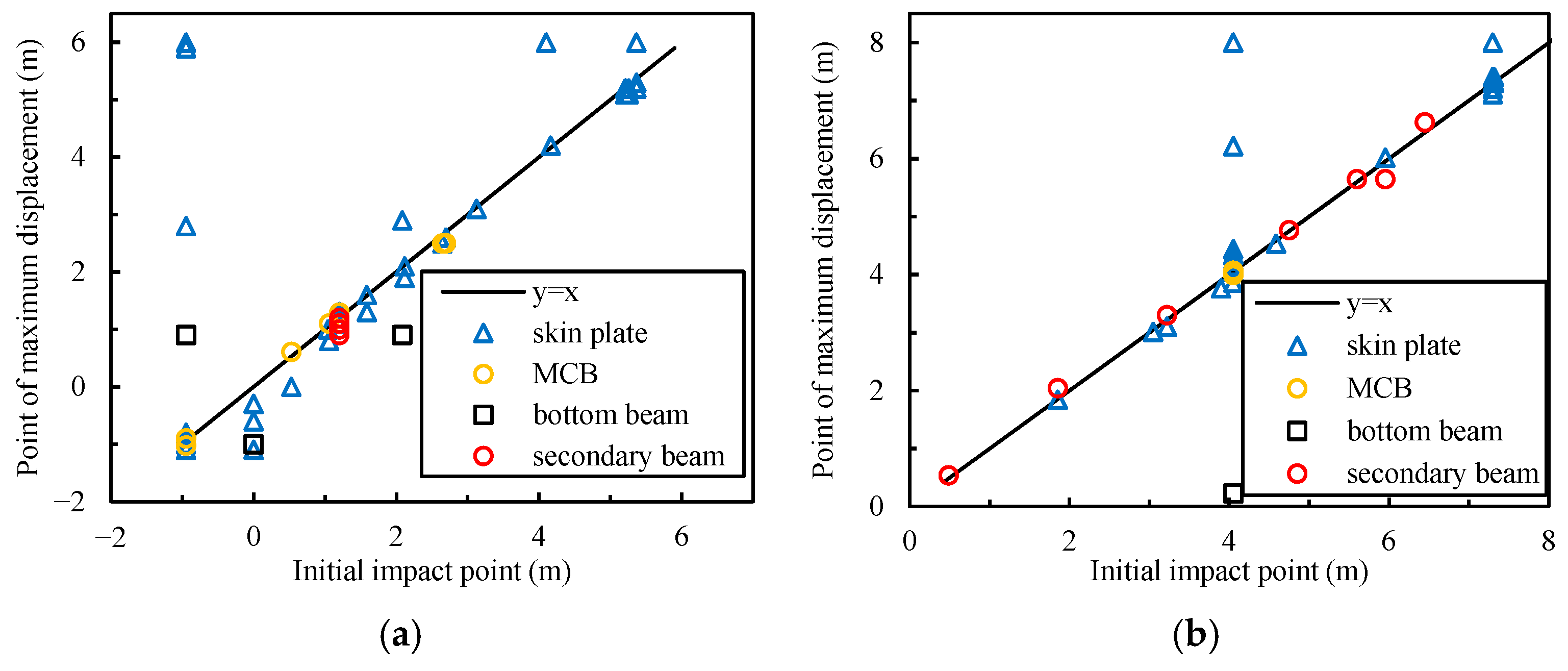
Figure 15 illustrates this relationship by plotting the coordinates of both points for all simulated scenarios. Different scatter point styles denote the structural component (e.g., panel, beam) in which the maximum displacement node is located. Since the skin plate and beam system follow a fixed-radius circular arc, their positions are primarily defined by transverse and vertical coordinates; accordingly, only these two-dimensional coordinate results are plotted.
Figure 15 reveals that, in most impact scenarios, the node of maximum total displacement—while located on various gate components—remains in close proximity to the initial impact point. This observation aligns with the expected characteristics of a local deformation mode under impact. In a subset of scenarios, however, this node is located at a considerable distance from the impact point; in these cases, it is invariably situated on either the skin plate or the bottom beam.
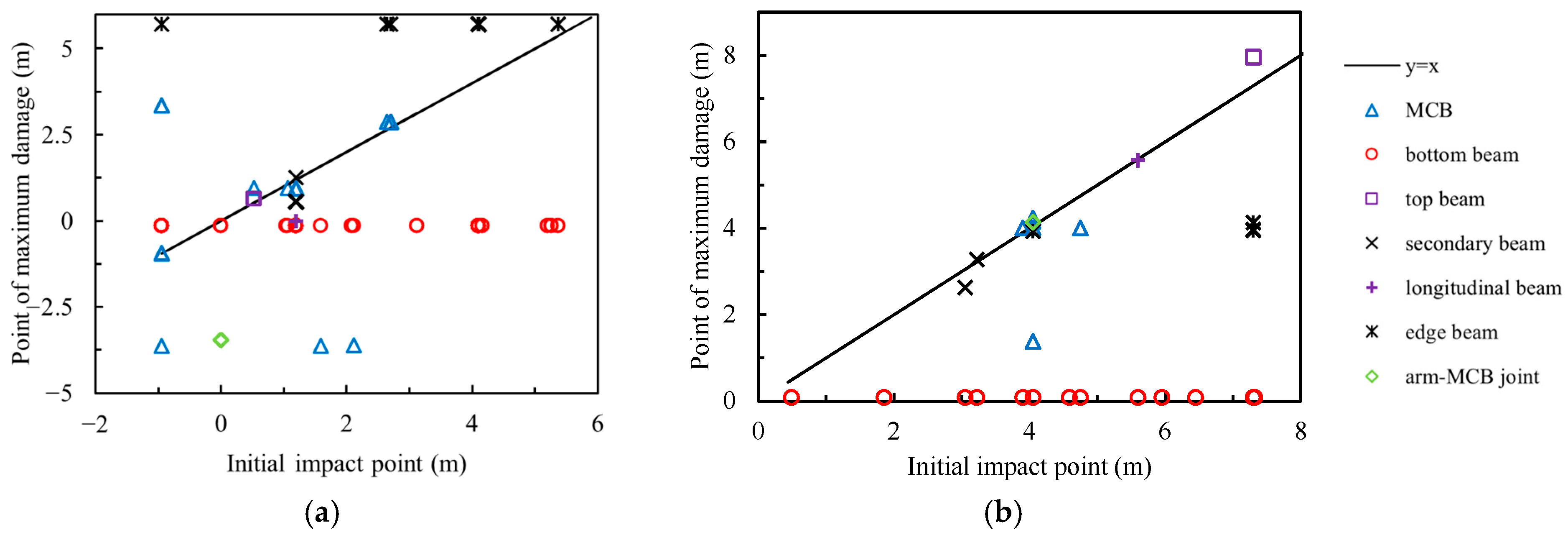
From the numerical simulations across all parameter sets, the coordinates of the element centroid with the highest damage parameter (hereafter termed the point of maximum damage) and those of the initial impact point were extracted. The spatial relationship between these two sets of coordinates is presented in
Figure 16, where distinct scatter point styles indicate the specific structural component containing the point of maximum damage.
Figure 16 shows that in some impact cases, the point of maximum damage is located near the initial impact point, consistent with a local deformation mode. In others, this point is considerably distant, potentially situated on various structural components such as the MCB, bottom beam, MCB–support arm joint, or side longitudinal beam. It is worth noting that when the point of maximum damage is located on the bottom beam, its vertical distance to the sluice chamber floor remains nearly constant. This is because the gate has only one bottom beam with limited sectional dimensions, resulting in negligible variation in the vertical coordinates of points along it. Similarly, the horizontal distance from the gate’s axis of symmetry also remains nearly constant in such cases, as the maximum damage on the bottom beam consistently occurs near its mid-span.
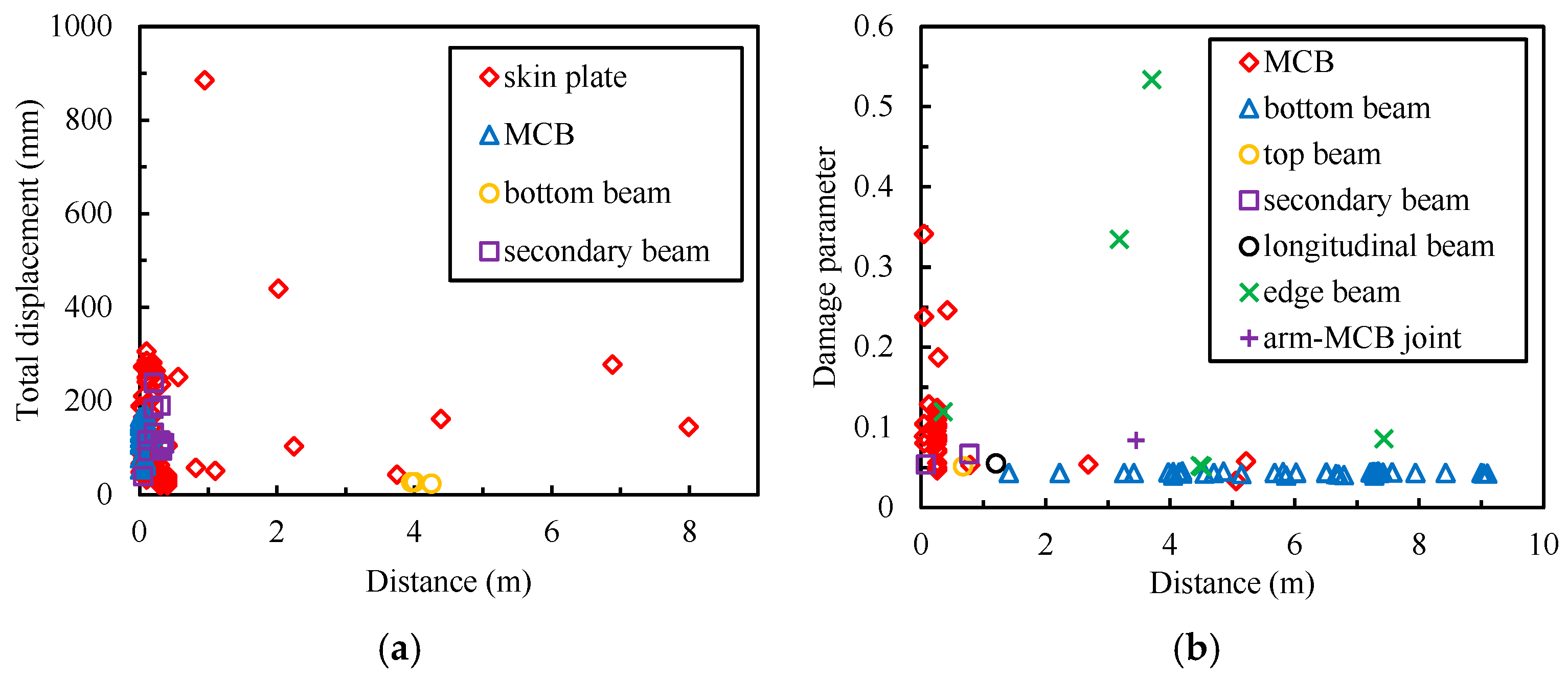
The distances from the initial impact point to both the point of maximum total displacement and the point of maximum damage vary across different scenarios.
Figure 17 plots the relationships between the maximum total displacement, the maximum damage parameter, and their respective distances from the impact point.
Figure 17 reveals a general trend wherein larger gate displacements (
Figure 17a) or more severe damage (
Figure 17b) are associated with the points of maximum response (displacement or damage) being closer to the initial impact location. Conversely, scenarios in which these points are distant from the impact point typically exhibit smaller responses.
Despite the general trend observed in
Figure 17, where points of maximum displacement or damage are frequently located near the impact zone in many scenarios, notable exceptions exist. In a subset of cases with significant gate response, the locations of maximum displacement or damage are found at a considerable distance from the initial impact point. Specifically, a large maximum total displacement occurring far from the impact point is typically observed when the displacement peak is located on the skin plate. Similarly, instances of severe damage far from the impact point are often associated with the side longitudinal beam.
The separation distance between the point of maximum displacement and the point of maximum damage itself provides insight into the deformation mode.
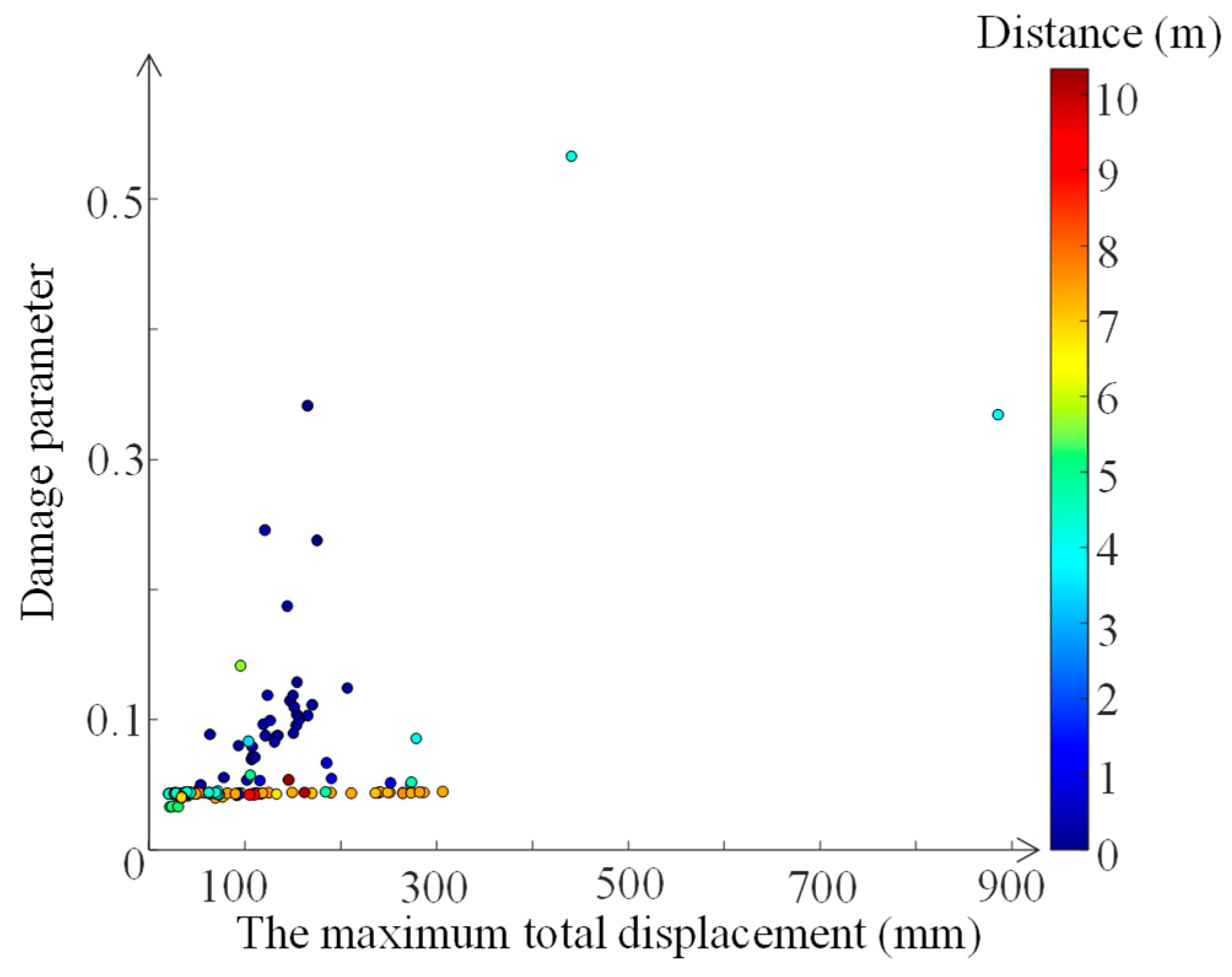
Figure 18 presents a color-coded scatter plot of this separation distance, derived from numerical simulations across the full range of impact parameters. In this figure, the color of each scatter point represents the separation distance between the point of maximum displacement and the point of maximum damage, while the horizontal and vertical coordinates correspond to the maximum total displacement and the maximum damage parameter, respectively.
Figure 18 reveals two distinct patterns based on the separation between the points of maximum displacement and maximum damage. In one group of scenarios, this distance is less than 1.0 m. In the other, it exceeds 1.0 m, which includes cases with substantial displacement or damage. Notably, in the scenarios producing the very largest displacement and damage, this separation approaches 4.0 m—a finding inconsistent with a localized deformation mode.
For scenarios resulting in minor gate displacement and damage, the dynamic impact response is small. Consequently, the overall deformation mode arises from the superposition of both dynamic (impact-induced) and static (gravity and hydrostatic pressure) deformation components. Since these two components differ spatially, their superposition leads to significant separation among the initial impact point, the point of maximum displacement, and the point of maximum damage.
Research on gate anti-collision performance primarily concerns adverse scenarios with large displacements and damage. Analysis of the numerical simulation results across all scenarios, particularly those presented in
Figure 17 and
Figure 18, reveals that among cases with significant gate response, two distinct patterns emerge based on the spatial relationships among the initial impact point, the point of maximum total displacement, and the point of maximum damage. In the first pattern, both the point of maximum total displacement and the point of maximum damage are located close to the initial impact point. In the second pattern, the point of maximum total displacement and the point of maximum damage are both situated at a considerable distance from the initial impact point, and they are also typically far apart from each other. These two patterns correspond to two characteristic deformation modes of the steel radial gate under tube impact. Representative results illustrating these modes are presented in
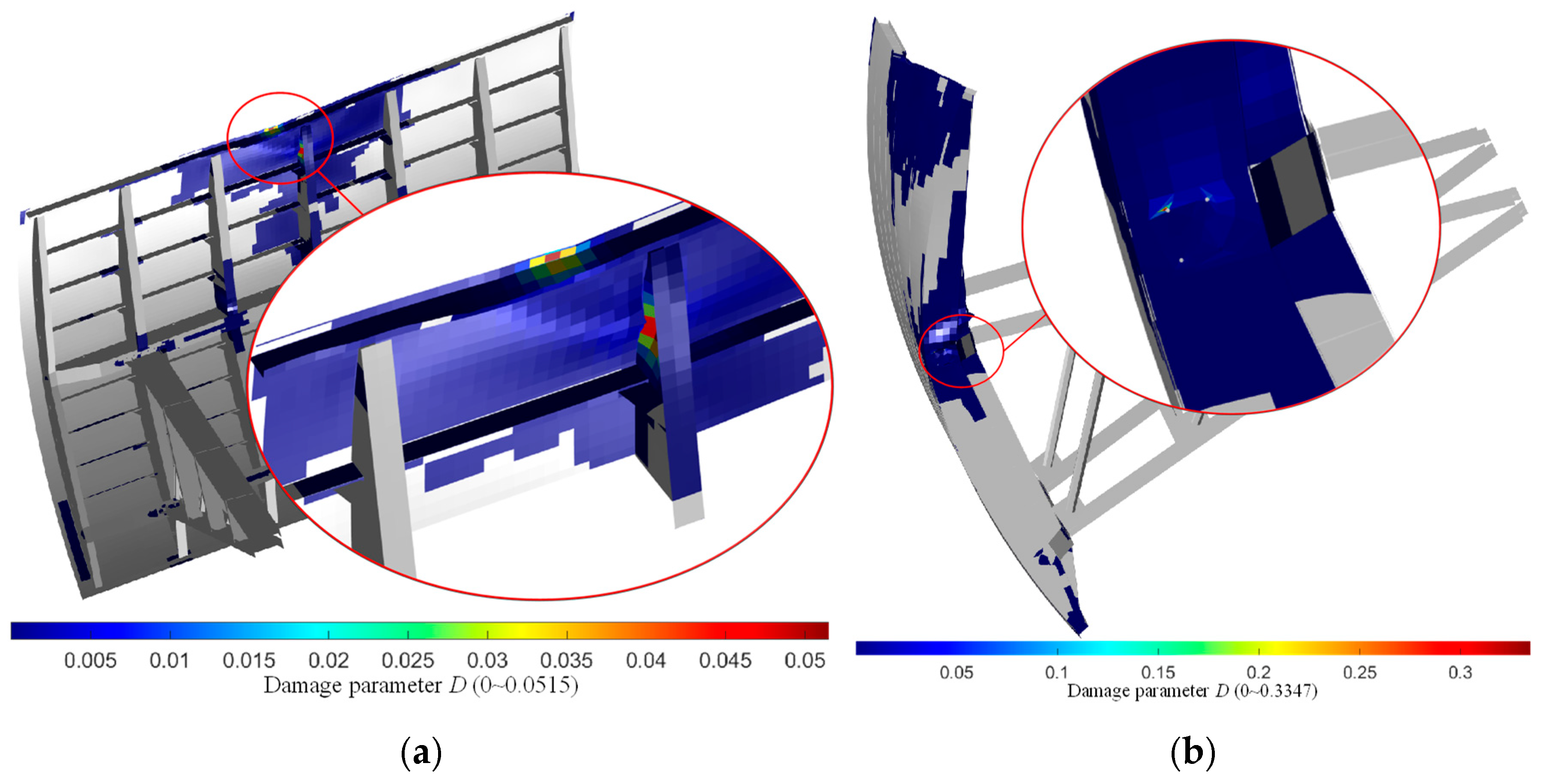
Figure 19. The color in the contour plot of the figure corresponds to the magnitude of the damage parameter.
Figure 19 illustrates the two primary deformation modes that occur when a steel radial gate exhibits a significant dynamic response to a steel tube impact: the Local Bending Deformation Mode (
Figure 19a) and the Cantilever Plate Deformation Mode (
Figure 19b).
The Local Bending Deformation Mode is typical for steel structures under impact. Its development in this context is attributed to two factors: first, the impact velocity of the tube is relatively small because of limitations from flood flow; second, the gate’s panel and beam components possess either a high width-to-thickness ratio or a low height-to-span ratio. These geometric and kinematic conditions favor the development of bending deformation over shear or combined bending-shear deformation.
The Cantilever Plate Deformation Mode tends to occur when the impact location is near both the top and the edge of the gate. In this mode, the system comprising the skin plate, side longitudinal beam, and secondary beams behaves like a cantilever plate supported along two edges by the upper MCB and the support-arm longitudinal beam. An impact on this plate system induces relatively large displacements at the top corner area, irrespective of the impact point’s precise location. This explains the observed large separation between the point of maximum total displacement and the initial impact point. Furthermore, the deformation mechanism involves the formation of a plastic hinge line along the connection between the MCB end and the top of the support-arm longitudinal beam. Concurrently, the junction of the side longitudinal beam and the upper MCB acts as a fixed support for a cantilever segment, developing high internal forces. These regions—the plastic hinge line and the high-stress support area—are prone to concentrated damage, which accounts for the significant distance between the point of maximum damage and the impact point.
To establish an objective and repeatable criterion for discriminating between the deformation modes, the spatial distance between the point of maximum damage and the point of maximum total displacement, denoted as
Dsep, is proposed as a discriminative index. Based on the statistical distribution of results (
Figure 18), a clear threshold is defined: the response is classified as the Local Bending Deformation Mode when
Dsep ≤ 1.0 m, and as the Cantilever Plate Deformation Mode when
Dsep > 1.0 m.
6. Discussion
This study primarily focuses on the dynamic response and damage modes of a steel radial gate subjected to a single impact from a single steel tube. In actual extreme flood disasters, however, the gate may experience sequential or random impacts from multiple floating objects (e.g., multiple tubes). The resulting accumulation of residual deformation and superposition of damage could significantly exacerbate the final extent of structural failure and lead to degradation of the gate’s overall impact resistance. Compared to a single impact, the structural response under multiple impacts involves complex nonlinear dynamic coupling and path-dependent damage evolution. Consequently, the most critical impact scenario (e.g., the sequence and spatial distribution of impacts) would become more complex to define, and the associated safety assessment would be more challenging. Although simulating multiple impacts was beyond the scope of this study—due to the high computational cost, the need for sophisticated material cumulative damage models, and the uncertainty in defining impact sequences—the methods and conclusions presented here provide a valuable reference. Future research can build upon this work by considering factors such as impact sequences, time intervals, and spatial variations to further elucidate the cumulative damage mechanism and safety margin of radial gates under extreme flood conditions. It should be noted that the impact velocity of 8.0 m/s adopted in this study is an engineering estimation based on possible extreme flood scenarios, rather than a value derived from detailed fluid dynamics calculations. A more accurate determination of tube velocity under actual flood conditions is a direction for future work.
The steel tube dimensions in this study are based on standard nominal sizes. In practical engineering, uncertainties in geometric parameters may arise from manufacturing deviations and service-induced wear. For example, the outer diameter deviation typically does not exceed ±1.5%, and the wall-thickness deviation generally remains within ±15% [
48]. This research employs a parametric analysis to investigate the influencing factors of the dynamic response and the deformation modes of a radial steel gate subjected to circular steel tube impact. The deterministic numerical approach adopted here, which explores a defined range of key variables (mass, cross-section, impact angle, and location), is sufficient to achieve the study’s objective of identifying governing trends and failure mechanisms. The geometric variations within the stated deviation ranges are not expected to alter the qualitative conclusions drawn regarding these response characteristics and deformation modes. Hence, a full probabilistic study was not conducted within the scope of this work. Future studies may extend the present findings by introducing probability distributions for a more refined reliability assessment.