1. Introduction
Some of the main issues in stability and performance of hydraulic structures such as dams, earthen embankments and levees are caused by internal erosion, piping and breach formation and expansion. A study has investigated levee failures for about 9 years in the UK [
1]. They showed that the majority of failures are due to breaches during and after floods, for example, the Cumbria flood in the northwest of the UK along the rivers Cocker and Derwent in 2009, in which many flood defense structures failed. Cumbria, in the northwest of the UK, has experienced significant flooding events over the past decades, particularly in areas along rivers such as the River Eden and the River Derwent. These floods often occur during periods of heavy rainfall, especially in the winter months. Cumbria’s topography, with its hills and valleys, can exacerbate the impact of heavy rain, leading to rapid runoff and increased risk of flooding in low-lying areas. The floods in Cumbria have caused damage to infrastructures including earthen embankments.
A feature of flood defense structures is the phreatic line, which separates the cross-section of embankments into saturated and unsaturated portions, and it is therefore very important to include water seepage in stability analysis [
2]. Besides the effect of soil stress distribution, water can also affect the soil shear strength. Considering the importance of shear strength in stability analysis, it is clear that the phreatic line plays a significant role in the evaluation of levee and earthen embankment failures. Furthermore, the level of the phreatic line can control the saturated zone, and therefore, affects breach initiation and expansion. A research article published in 2017 showed that a higher phreatic line aggravates breach expansion and shortens breach duration [
3]. A research report from the Environmental Agency, UK (“Flood and Coastal Erosion Risk Management Research & Development Programme” 2023), suggested various research scenarios about soil erosion as well as breach formation to develop understanding of the processes. Meanwhile, it is predicted that there will be a higher number and more severe failures due to floods in the future.
Rikkert [
4] proposed a three-phase, performance-based methodology for assessing levee safety by integrating both historical hydraulic performance and physical degradation indicators. The approach begins with the estimation of a prior probability of failure based on conventional geotechnical parameters and levee geometry. This probability is then updated using Bayesian inference to account for past hydraulic loading events that the levee has successfully withstood. A final correction is applied to reflect the current structural condition, incorporating observational data such as settlement, animal activity, and surface wetness. The method was applied to canal levees in the Netherlands, demonstrating that incorporating actual performance history and field inspection data can result in significantly lower and more realistic failure probabilities compared to traditional assessments. The study underscores the value of condition-based and experience-informed evaluations in achieving more accurate and efficient levee reliability analyses.
In addition, Moayed [
5] suggests that the shape of the phreatic line affects the stability of the earthen embankment and dam as excessive exit gradients may lead to piping. The process of piping is a form of seepage erosion resulting in voids (i.e., the pipe) where soil materials are washed away, with an eventual collapse of the embankment possible. Such erosion can propagate and form a pipe that can undermine the stability of the embankment. Piping occurs rapidly along the levee foundation or body, potentially leading to sinkholes, crest settlement, and structural failure [
6].
The phreatic line should always be kept below the downstream toe in order to prevent the internal erosion of the soil mass caused by the piping phenomenon. In embankment reservoirs, the free water surface is not always constant and stable. Therefore, it is clear that phreatic line determination is vital in designing and monitoring embankments. Besides determining the elevation of the phreatic line on the upstream and downstream faces of the embankment, the location and shape of the phreatic line throughout the embankment must also be determined to provide the necessary accuracy in the analysis [
4].
Fry’s study [
7] has investigated dam failures from 2010 to 2012. He reported that internal erosion is the main threat of water retaining structures, where 23 failures of 44 identified failures were due to internal erosion. A platform called “International Levee Performance Database” (ILPD) is another attempt in the field of levee safety [
8]. According to ILPD, there were 12 failures in UK embankments from 2013 to 2023, which is the same as the previous decade from 2003 to 2013. This comparison shows that the importance of pre-studies on phreatic line has been neglected in the construction phase and further studies are required on embankment’s safety.
Research carried out by Ventini [
9] combined centrifuge experiments and numerical modeling to study transient seepage in a scaled silty–sandy river embankment. The study showed good agreement between measured and simulated pore pressures and highlighted that steady-state assumptions can overestimate saturation and lead to conservative stability assessments.
Han, Y [
10] used a three-dimensional finite element model of a high tailings dam to analyze seepage under complex topography and calibrated permeability from observed phreatic lines. The results identified critical zones where the phreatic surface rises due to valley convergence, supporting targeted drainage and monitoring for dam safety.
Zhang [
11] proposed an analytical solution to describe phreatic surface evolution in reservoir-induced landslides by solving the Boussinesq equation under unsteady seepage. Application to the Majiagou landslide showed good agreement with monitored groundwater levels, illustrating that suitably-adapted analytical models can be accurate and efficient for phreatic line prediction.
Rotunno [
12] developed a three-phase model for backward erosion piping in porous media, explicitly representing water, fluidized soil, and solid. The formulation provides a detailed description of pipe initiation and progression, but it is mathematically complex and computationally demanding for routine levee assessments.
The complexity of using algorithms to adjust the width and heights of the elements in numerical modeling led to the advent of the natural element method (NEM). The NEM offers the advantages of both meshless methods and finite element methods. In comparison with finite element methods, the NEM provides an excellent quality of natural neighbor interpolations that are richer than those corresponding to polynomial interpolations on finite element meshes, which allows for considerable distortion of the background mesh being used to construct the NEM interpolation. By using the Voronoi diagrams to determine the natural neighbor nodes, the node influence domain in the NEM is defined, and the phenomenon of interpolation tending to be disproportionately biased toward areas of higher nodal density is avoided. As the NEM’s shape function satisfies the linear interpolation characteristics on the boundary, the boundary conditions can be applied accurately without having to be treated particularly [
13].
Zhu [
14] analyzed elastoplastic problems by using the NEM. The NEM has been calculated to be approximately equivalent to the finite element method (FEM) with quadrangular or hexahedral elements and higher than the FEM with triangular or tetrahedral elements in terms of accuracy. Considering the easier preprocessing of the NEM compared to the FEM, the advantage of the NEM over the FEM is obvious [
15]. In another study, the bending deflection of the thin plate and the thick plate on the Winkler foundation was calculated using the Laplace interpolation function of the natural neighbor. Moreover, the raft foundation, the superstructure, and the subgrade were investigated jointly [
16].
Generally, in reviewing the previous studies, it is evident that, although different numerical methods have been used, the details of the modeling process show the complexity and time-consuming process of modeling, especially for the real field models. On the other hand, the majority of studies modeled the embankments with macro-scale modeling and then extracted the data for specific parameters. However, in some studies, a specific parameter can be calculated in a faster and easier way, rather than modeling the whole setup. To the best of the author’s knowledge, natural element modeling is not a common method in earthen embankment seepage studies. The proposed NEM has simpler preprocessing than typical FEM seepage models because only node locations are required, without constructing element meshes; this can reduce the effort needed to set up embankment models in practice. However, a detailed comparison of CPU time, memory usage, and modeling man-hours between the NEM and the FEM was not performed here and is left for future work. This study addresses this gap by developing a mesh-free natural element method formulation specifically tailored for direct phreatic line estimation in homogeneous earthen embankments.
2. Materials and Methods
The modeling strategies developed in this paper seek to increase the prediction capabilities to the evaluation of the phreatic line to characterize the hydraulic conditions contributing to piping phenomena. Other modeling approaches have a high dependency on the number and size of mesh cells. In contrast, this research uses a mesh-free natural element modeling approach to model seepage in earthen embankments.
In the current study, a natural element method based on a Sibson interpolation is proposed for the simulation of piping progression in earthen embankments. The Sibson method is a high-accuracy interpolation scheme that has several advantages over traditional methodologies, including linear precision, locality, and reducing the interpolation algorithm. A more detailed description of the method is presented by [
17]. The Delaunay triangulation and Voronoi diagram are utilized in the proposed numerical interpolation in this current research.
Assume a set of distinct nodes, N, in a p-dimensional Euclidean space (R
p).
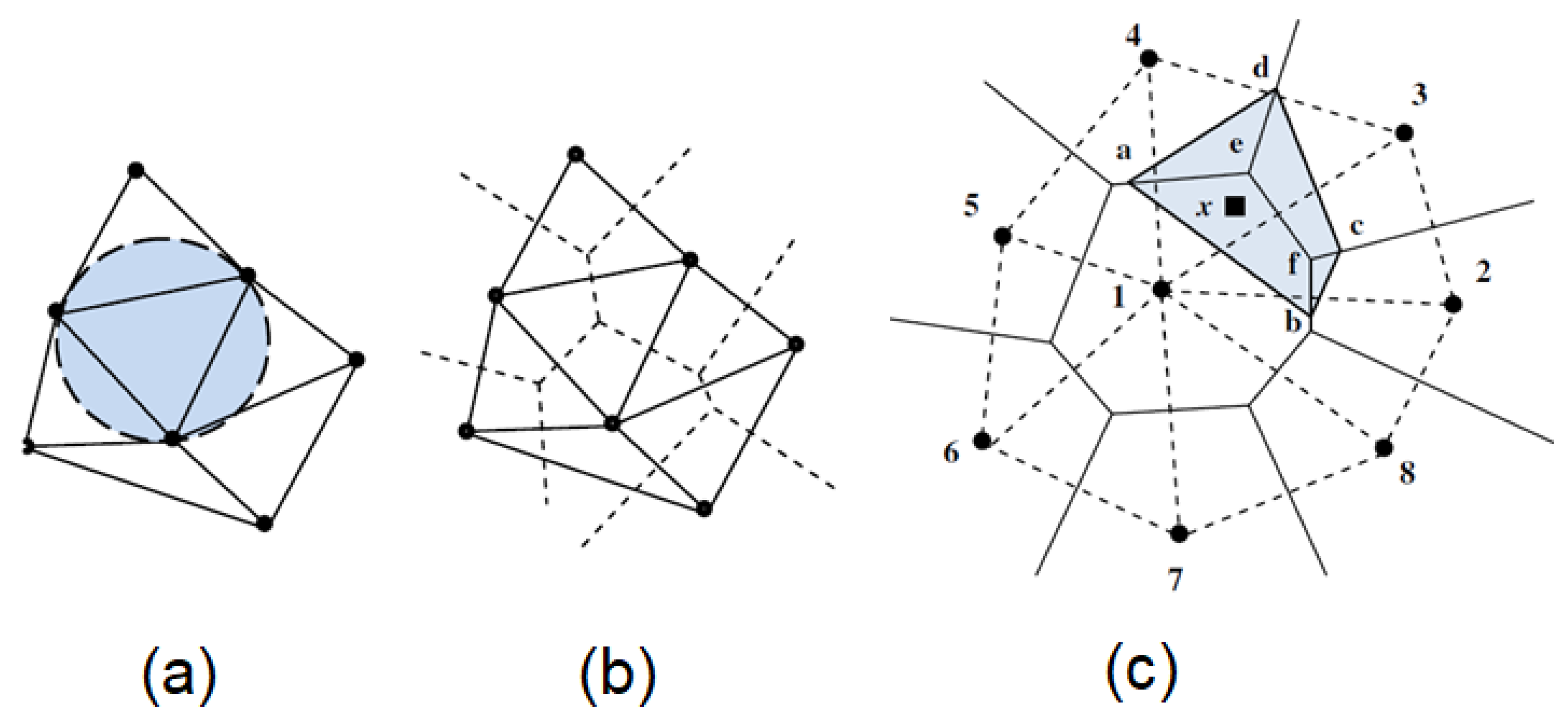
Figure 1a presents the circumcircle criteria diagram. The first-order Voronoi diagram of the set N is a subdivision of the space into Voronoi cells, as in
Figure 1b:
where
and
represent the Euclidian distances between x and x
I, and x and x
J, respectively. The Delaunay triangulation is the topological dual of the Voronoi diagram, which can be obtained by connecting all the sets of points that share a common (p-1)-dimensional facet. While the Voronoi structure is unique, the Delaunay triangulation is not, as degenerate cases might arise as more possible Delaunay triangulations might exist [
18]. The second-order Voronoi diagram in
Figure 1c constructed by means of the points with the first closest nodes as the
and the second nearest node as the
, can be mathematically defined as Equation (2):
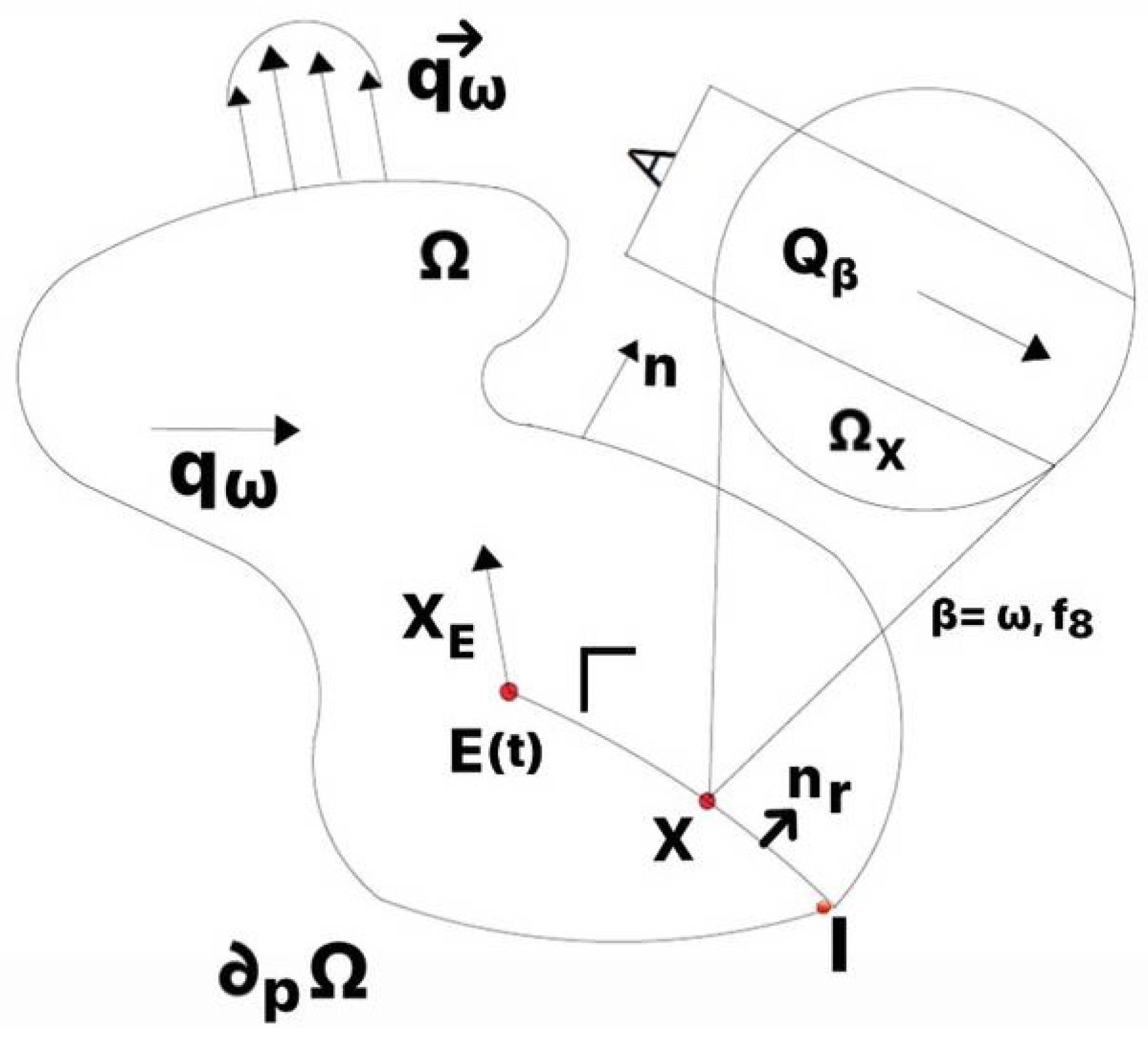
For piping-related seepage, the mass balance in the porous medium and pipe can be expressed as follows:
where
and
represent the fluid and solid mass contents, and
and
are the flow rates in the porous medium and in the pipe, respectively. The exchange terms
,
are due to the erosion process localized along the erosion line
Γ, while
,
, and
are the measures of propagation of the pipe tip
E(t) ∈
Γ (localization along
Γ and at
E are expressed by the Dirac functions
δ,
Γ and
δE).
Figure 2 shows the exchange term
shows the water exchange through the pipe walls.
In this model, the soil material properties are assumed to be homogeneous and isotropic, and the water level is assumed steady. This simplification is adopted to focus on evaluating the natural element method for phreatic line estimation; in principle, spatially variable hydraulic conductivity fields (layered or heterogeneous embankments) can also be represented within the same NEM framework by assigning different properties to different node groups [
19]. The underground seepage in a porous medium represented by the domain,
, is represented by means of a parabolic partial differential Equation (5) [
20]:
For the steady water level conditions considered in this study, ∂h/∂t = 0, so the equation reduces to the steady-state Laplace equation ∇2h = 0 (or ∇2ϕ = 0 in terms of piezometric head ϕ).
With boundary nodes placed along the embankment perimeter: upstream face uses Dirichlet condition h = H_reservoir; downstream toe uses fixed flux q_b; and top/downstream faces are impermeable (q_n = 0).
where
,
is the hydraulic conductivity coefficient in x and y directions,
and
are the imposed head and flux portions of the domain boundary (
) and
is the total hydraulic head, which is calculated by Equation (8):
where p is the total pressure,
is the specific gravity of fluid (water), y represents elevation head, v is the average velocity of water and g represents gravitational acceleration. Therefore,
represents pressure head and
is velocity head.
According to the original work of Sibson [
21], natural neighbor coordinates of x with respect to its neighbor
I are defined as the ratio of the cell
Tl that is moved to
Tx when adding
x to the initial pointset to the total area of
Tx. So, if
and
represent the Lebesgue measurements of
Tx and
Txl respectively, the natural neighbor coordinate
x with respect to the node
l is defined as Equation (9):
where k
i(x) is the area of the Voronoi cell of x
l that is transferred to x, and k(x) is the total area of the Voronoi cell x.
With reference to
Figure 1c, the Sibson shape function with node 3 at point
x can be defined as Equation (10):
Sibson interpolants (Equations (9) and (10)) discretize hydraulic head in Equation (5) via Galerkin weak form.
The piezometric head in this study can be expressed as Equation (11):
where
,
, and
are the position, pressure, and specific gravity of the fluid, respectively.
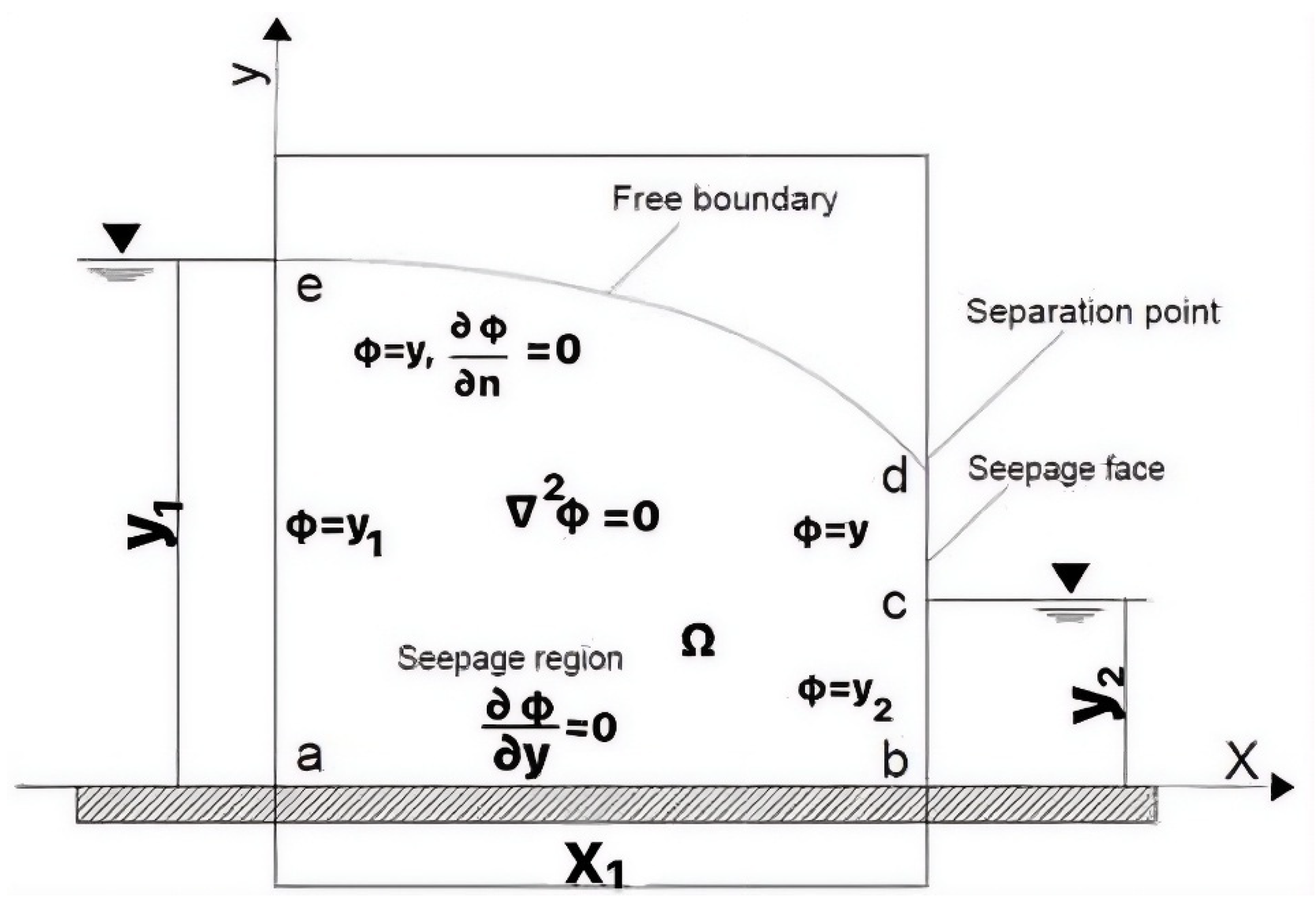
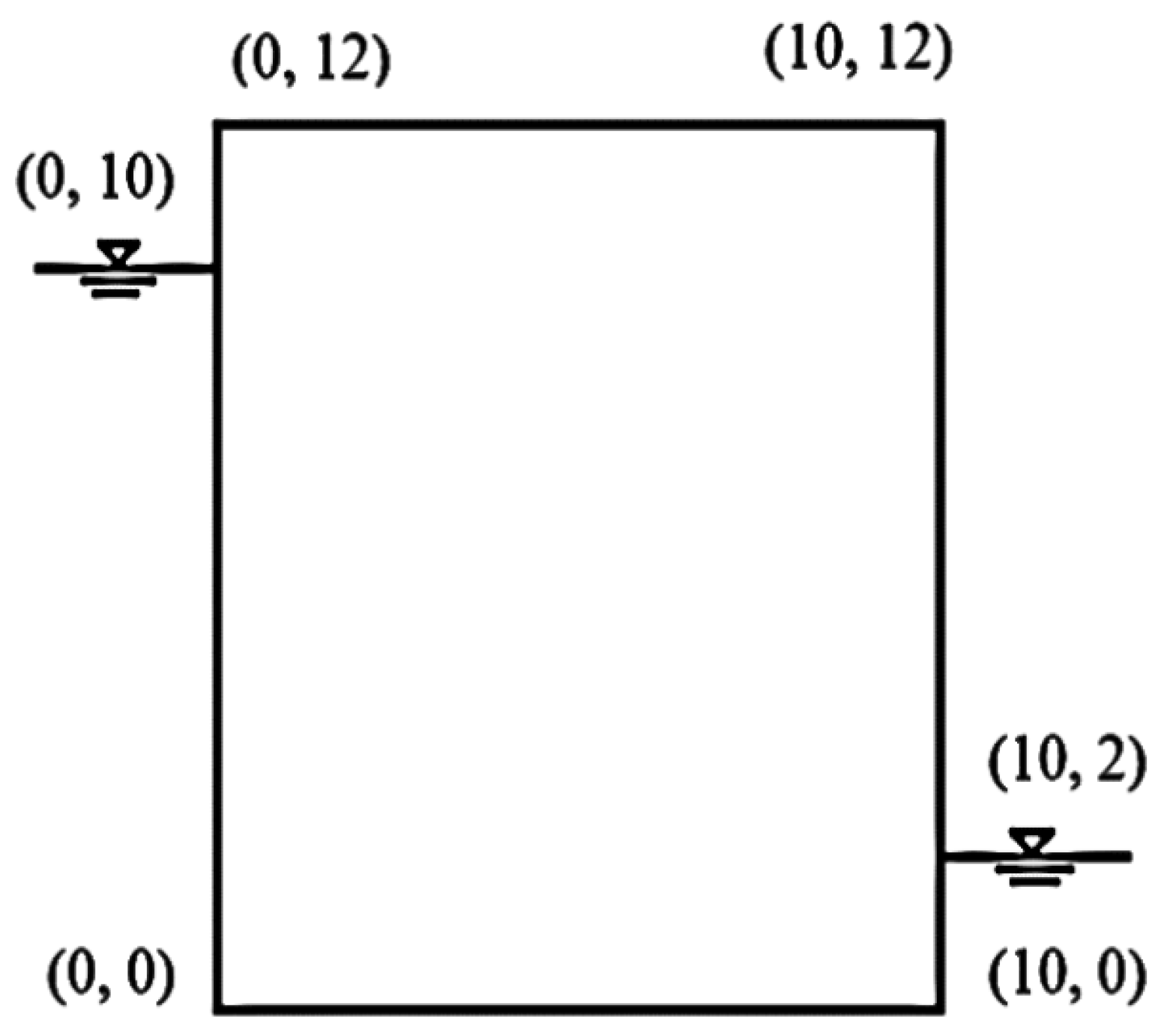
Figure 3 shows the boundary conditions.
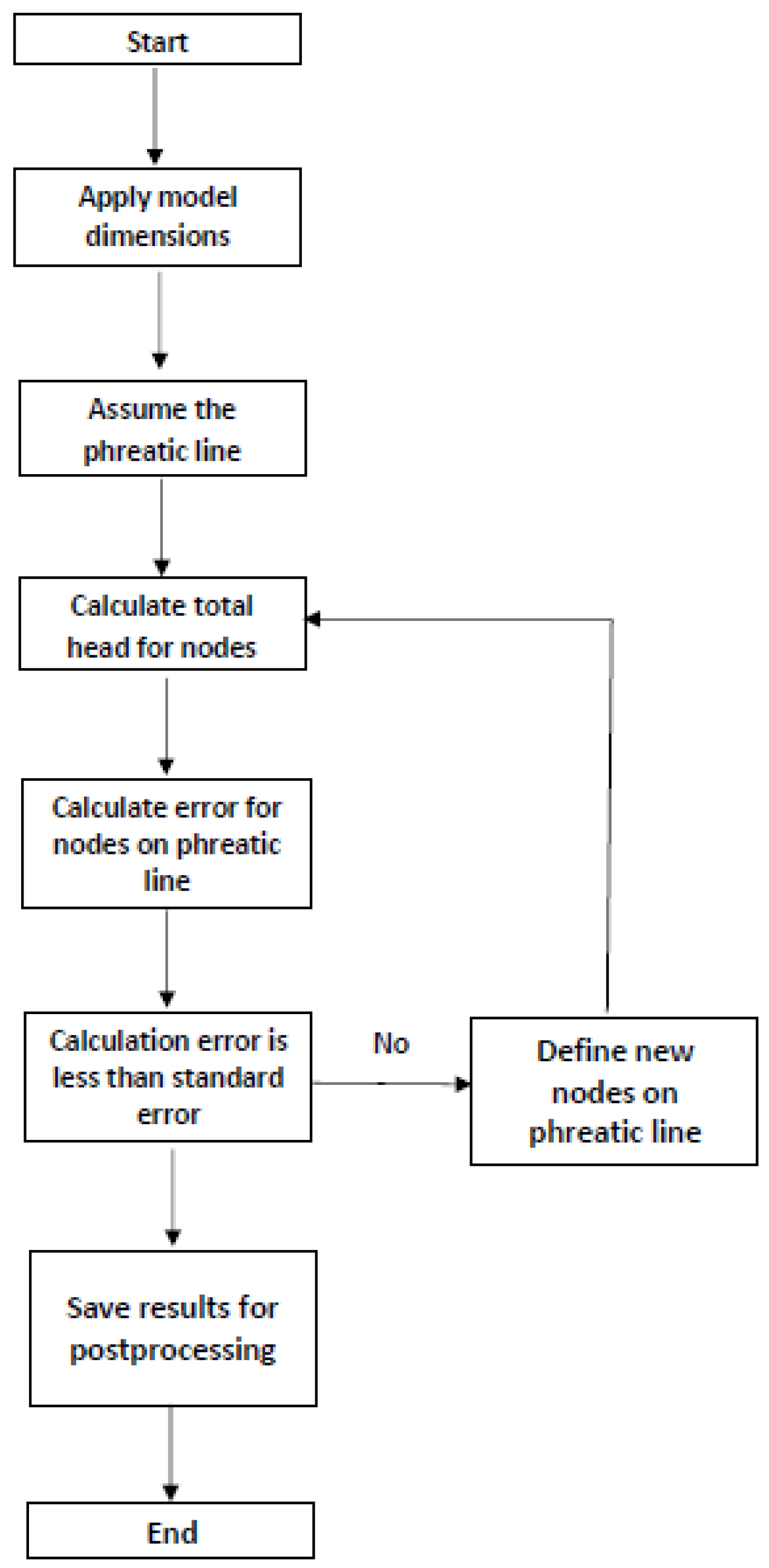
Figure 4 shows the schematic flowchart used in the modeling technique. To calculate the phreatic line, first, an estimation is made by applying specific boundary conditions at the considered nodes. Then a first iteration of the analysis is applied and the total head values computed. Afterwards, with a modified phreatic line, the analysis is repeated. The position of the phreatic line is acceptable if the difference between the total heads of two iterations is less than a tolerance value. The iterative process continues until stability is reached.
The 0.01 m RMS tolerance corresponds to typical piezometer measurement precision and standard engineering practice for phreatic line determination, balancing computational efficiency with practical accuracy.
2.1. Validation Data
For validation, the proposed numerical model has been compared with two series of piezometric data of embankments. One from O’Kelly [
23] datasets on the West Coast Main Line in Cumbria, UK and the other one from the IJkdijk full-scale test conducted by Planès [
24].
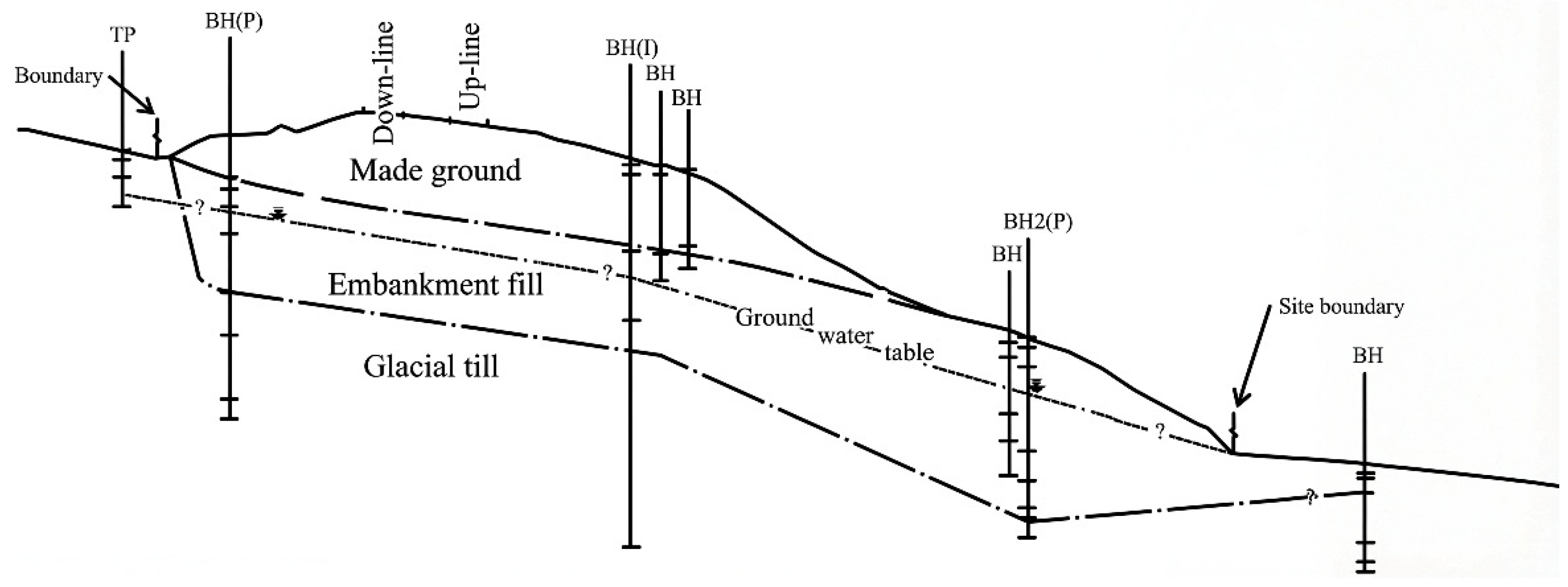
The Bessie Ghyll is an asymmetrical embankment which has been located about 1.5 km southwest of the village of Great Strickland, Cumbria, UK. O’Kelly [
23] reported field investigation of an embankment on the West Coast Main Line near Cumbia (UK) using piezometers and inclinometers in a place that slope failures have happened before. They further reported that the site investigations revealed seepage, water logging and bulging along the Up-line toe of the embankment. At the embankment toe, the groundwater table is almost coincident with the ground surface. The groundwater table could be as high as 0.3 m below the mid-height of the slope face and 3.7 m below the embankment crest between September and October.
In this study, Borehole #2 with piezometer (BH2 (P)) has been selected as the last failure happened in that area based on the study done by O’Kelly [
23].
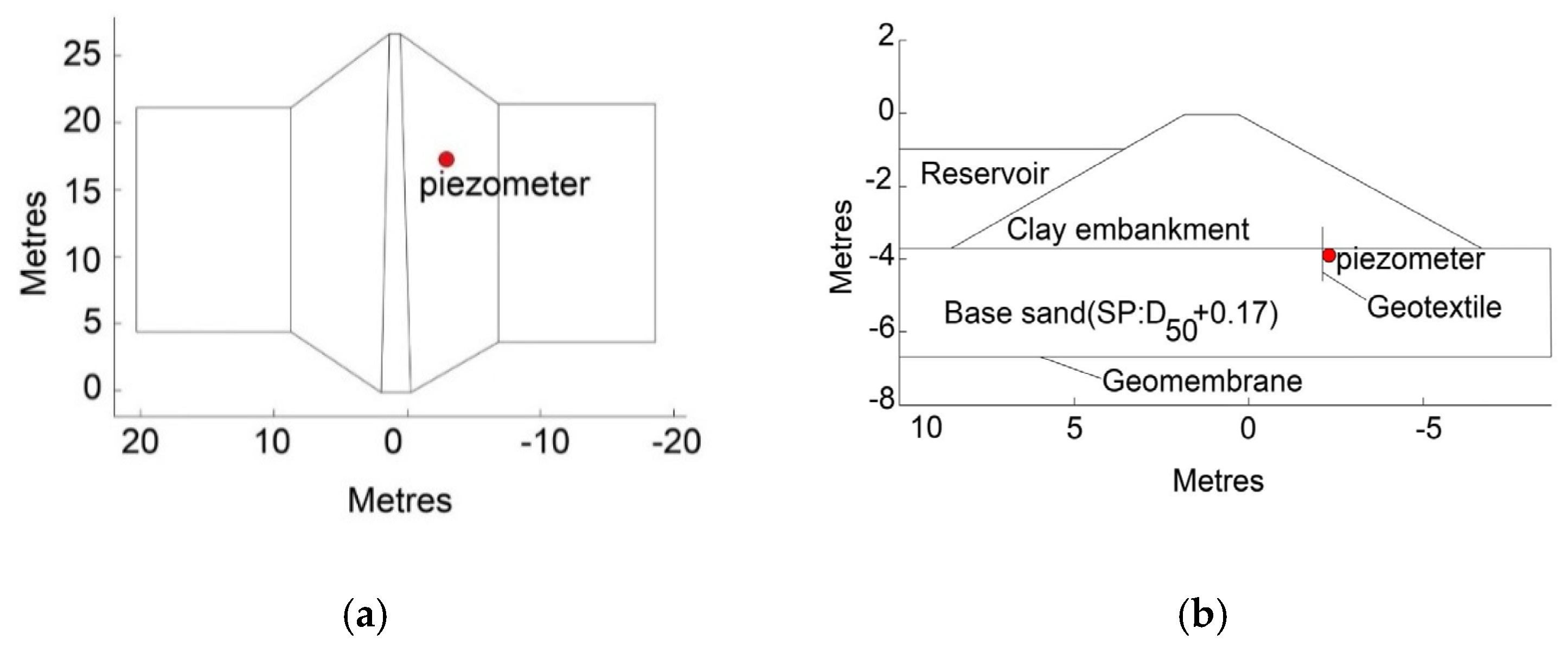
Figure 5 shows the details of boreholes.
The IJkdijk (‘calibration levee’ in Dutch), which is very similar in terms of geometry to the embankments in Cumbria, has been selected as it is a unique experimental full-scale levee in the Netherlands. Another reason to select that as one of two measurement references is the similarity of its quantities with collected data from Chapel House Embankment Dam in Cumbria [
25]. The advantage of Planes’ [
24] data measurement is the accuracy of the experiment and its repetition. The IJkdijk has been constructed to study possible failures in detail and has two main targets—advancing understanding of levee behavior and evaluating novel sensor technologies for flood early warning systems in real-world situations [
26]—and therefore it would be useful to calibrate our model with its datasets too. The piezometer #2 located on the downside half of the body of the IJkdijk with the highest head among other piezometers has been selected (
Figure 6). It should be added that the upstream surface in IJkdijk is between 3.2 and 3.5 m.
These two studies have been selected to represent both experimental and field structures and also to check the proposed model accuracy for both symmetric and asymmetrical flood defense structures.
2.2. Node Number Analysis
Figure 7 shows the seepage through the porous medium of a semi-permeable rectangular earthen embankment that has been investigated in a hypothetical model.
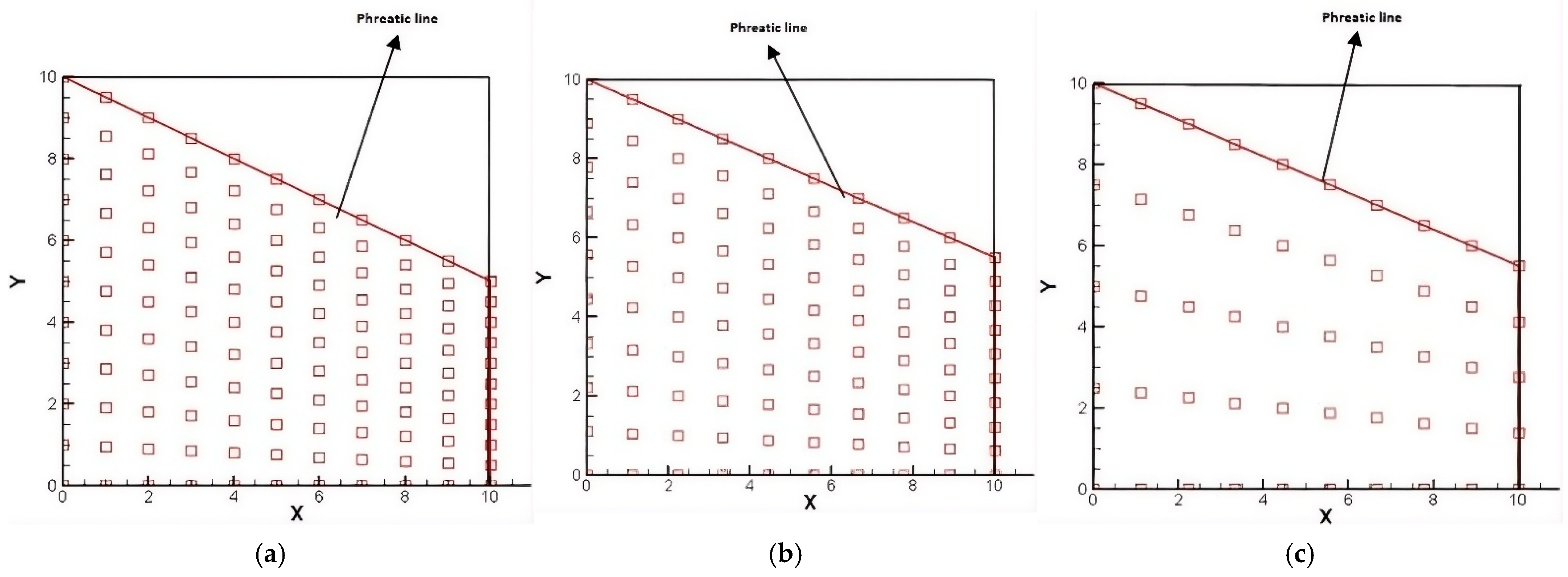
To discretize the embankment’s physical domain using the proposed mesh-free natural element method, the porous medium was modeled with three different node distributions: 120, 100, and 50 nodes. These configurations were tested to assess numerical convergence. The resulting simulations were then compared with field observations from the IJkdijk experiment as well as with results obtained from conventional finite element and mesh-free methods. The latter is an element-free method that includes global shape functions instead of elements.
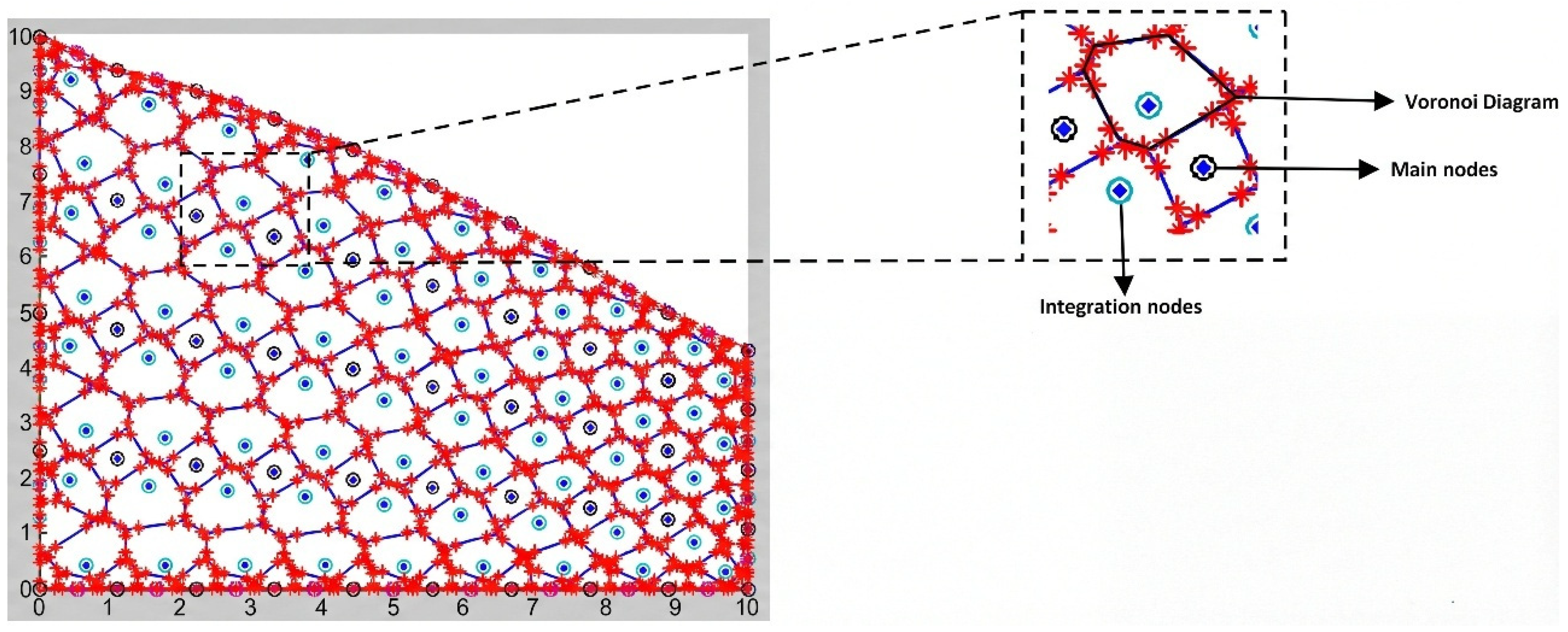
Figure 8 illustrates the nodes position in different modes based on the number of nodes, and also how the phreatic line has been affected in these three modes. While a higher number of nodes, such as 400, may better capture the geometric complexity of physical embankments, our mesh sensitivity analysis, based on comparison with the IJkdijk data, showed that the 120-node configuration provides sufficient accuracy for the purposes of this study. Nodes were distributed on a uniform rectangular grid with 2.5 m spacing covering the embankment cross-section.
Figure 9 shows the discretization of the earth embankment after stabilizing the phreatic line in the 50 nodes state as a sample case.
In this study, these three node configurations were used to perform a node-sensitivity analysis, and the 120-node case was selected as it provided stable phreatic line and discharge/release estimates with negligible change under further refinement.
3. Results
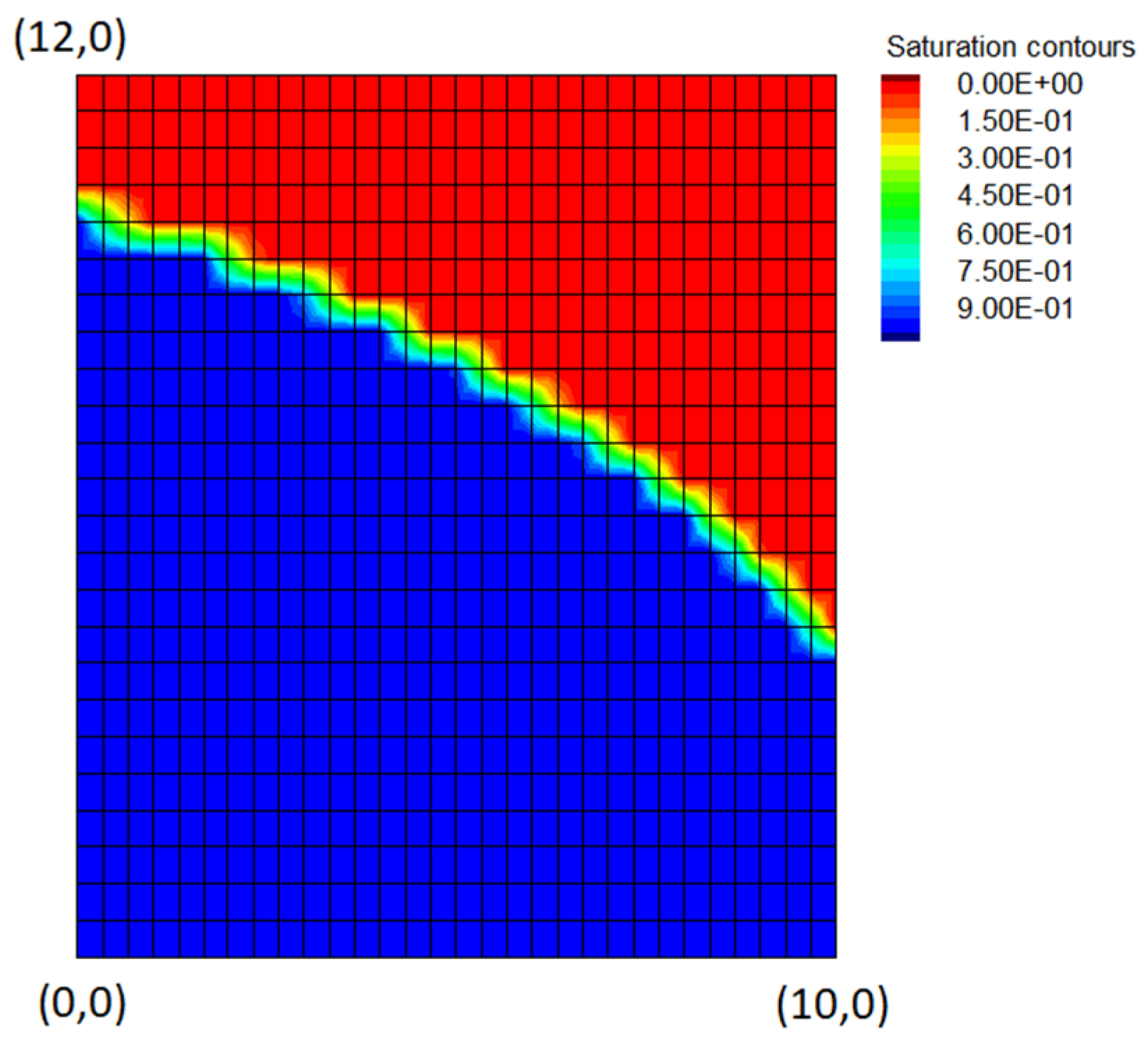
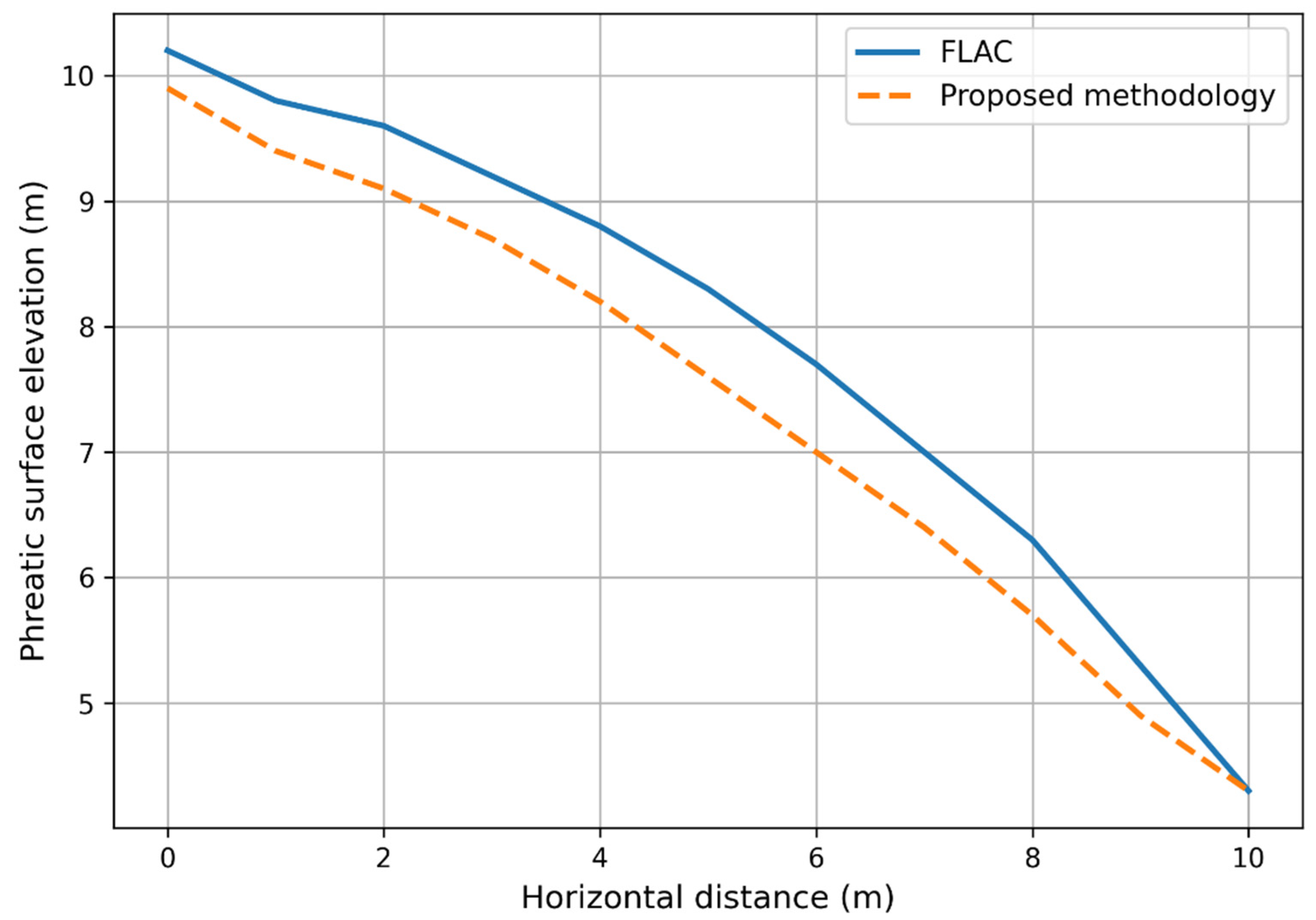
The phreatic surface gained from the natural element method was modeled in FLAC2D software version 9.1 to be compared with the NEM solution. A single hydraulic conductivity value was used and kept identical in both the NEM and FLAC2D; no parameter tuning was introduced specifically to improve agreement. The FLAC2D model used the same 2D cross-section geometry as the NEM setup, with identical hydraulic boundary conditions (upstream total head, downstream seepage face, and impermeable base) and the same homogeneous hydraulic conductivity and unit weight parameters. A structured quadrilateral grid with an average element size comparable to the NEM node spacing was adopted, and a steady-state seepage analysis was performed using FLAC2D’s default iterative solver with convergence tolerance matching the NEM 0.01 m criterion. The FLAC model is developed, and the hydraulic boundary condition of the model is adjusted to satisfy
Figure 6. According to the graphs in
Figure 10 and
Figure 11, both surfaces’ results for phreatic line and saturation rate match well with the results from the paper’s method; the details of the accuracy can be seen in
Table 1 and
Table 2, in which the results are compared with other proposed models and experimental research, respectively. NEM-FLAC phreatic line comparison shows max deviation = 0.12 m and RMSE = 0.07 m.
Also, seepage discharge rates (q) and the release elevation (a) obtained from the numerical model by the natural element method have been compared with the lab data collected by Rushton and Redshaw [
27], as well as numerical results obtained by means of finite element modeling by Taylor and Brown [
28], and free element results by Li [
29]. The results are presented in
Table 1.
By comparing the relative error obtained for discharge flow and release elevation from the natural element method with other studies, it can be seen that the proposed numerical model performs better than the finite element and free element methods for the example cases. On the other hand, the convergence of the numerical results with mesh refinement has been demonstrated with simulations comprising a higher number of nodes, increasing the accuracy of the results.
In another phase of the study, the validation has been done based on physical embankments in the Netherlands and the UK, presented in
Table 2. To discretize the physical model of the embankment, the porous medium was assigned with 400 nodes, based on nodes sensitive analysis, as the previous comparison in
Table 1 showed that a higher number of nodes provide higher accuracy.
Numerical results were compared with observational reports in the piezometer to ensure the accuracy of the simulation. Relative error analysis calculated by natural element modeling demonstrates the capability of the numerical model to be used for simulation of the leakage flow within the embankment body.
For Bessie Ghyll, the embankment is stratified (embankment fill, made ground, and glacial till), whereas the present model uses an equivalent homogeneous hydraulic conductivity. The relative errors for this case therefore reflect both numerical/model error and the simplification of the layered structure to an effective homogeneous medium.
The superior accuracy at IJkdijk reflects its homogeneous experimental embankment construction and controlled boundary conditions, whereas Bessie Ghyll’s field stratigraphy (distinct layers of embankment fill, glacial till, and made ground) introduces physical heterogeneity not captured by the equivalent homogeneous model.
4. Discussion
The review and comparison of the results show the acceptable accuracy of the current modeling. As
Table 2 summarizes, the average relative error and the highest relative error of the model for both embankments were less than 10%. The result for the IJkdijk embankment shows even higher accuracy compared to the embankment in Bessie Ghyll, where the average relative error of the model is less than 2%. That could be explained as a result of more accurate collected data measurement for the artificial facilities which are designed and made for such measurements in IJkdijk, particularly. Bessie Ghyll’s higher average of relative error (5.43% vs. 1.87%) reflects unmodeled field heterogeneity. Because both models use the same geometry, material properties, and boundary conditions, the close agreement primarily reflects the consistency of the underlying formulations rather than differences in model setup.
The use of a homogeneous isotropic conductivity in the Bessie Ghyll case is a deliberate simplification of its documented stratigraphy. The good agreement obtained for the phreatic level, despite this simplification, suggests that the proposed NEM formulation can still provide useful screening-level estimates when detailed layer properties are not available and an effective hydraulic conductivity must be used. Nevertheless, in applications where strong contrasts in hydraulic conductivity are critical, the method should be used with an explicitly heterogeneous parameterization, which is straightforward to implement by assigning different conductivities to nodes within each layer.
In addition, the natural element method avoids explicit mesh generation, simplifying preprocessing compared to conventional modeling approaches, particularly for variable boundary conditions. The demonstrated accuracy makes this NEM formulation practically attractive for phreatic line assessment in seepage analysis.
The combined assumptions provide robust screening-level predictions for design but should incorporate site-specific layering, transient loading, and 3D effects for detailed site-scale analysis.