Article

Evaluating the Environmental Footprint: An LCA Study of a Pilot System Treating Potassium Mining Wastewater

1
School of Chemical Engineering, National Technical University of Athens, 9 Iroon Polytechniou St., 15780 Athens, Greece
2
Department of Inorganic, Analytical Chemistry and Electrochemistry, Faculty of Chemistry, Silesian University of Technology, ul. B. Krzywoustego 6, 44-100 Gliwice, Poland
3
Lenntech Water Treatment Solutions, Distributieweg 3, 2645 EG Delfgauw, The Netherlands
4
Water Protection Department, Central Mining Institute—National Research Institute, Plac Gwarków 1, 40-166 Katowice, Poland
5
Thermossol Steamboilers, 94 Tatoiou Str., Acharnes, 13677 Athens, Greece
6
Sealeau, Zuidlarenstraat 57, 2545 VP The Hague, The Netherlands
7
Nevis Novel Environmental Solutions, 9 Spefsippou Str., 10675 Athens, Greece
*
Author to whom correspondence should be addressed.
Water 2026, 18(5), 584; https://doi.org/10.3390/w18050584
Submission received: 23 December 2025 / Revised: 6 February 2026 / Accepted: 19 February 2026 / Published: 28 February 2026
(This article belongs to the Section Wastewater Treatment and Reuse)

Abstract

Potassium mining activities result in the discharge of highly saline wastewaters, creating severe environmental impacts in water and soil. This study evaluates the environmental performance of a novel pilot system developed in the framework of the LIFE Brine-Mining project. The system comprises membrane, precipitation and thermal technologies, recovering high-purity water and five valuable resources from it: magnesium hydroxide, calcium carbonate, calcium sulfate, sodium chloride, and potassium chloride. A cradle-to-grave Life Cycle Assessment (LCA) was performed following the standards ISO14040 and EN15804 and using 1 m3 of potassium wastewater as functional unit. The LCA results indicated that the novel system environmental impact is mainly affected by the use of chemicals (20.63 × 100 kg/FU) during its operation and energy consumption (1.39 × 101 kWh/FU). The chemical use dominates areas like the Abiotic Depletion, and the Eutrophication Potential, and the Water Depletion Potential. The novel pilot system was compared with another novel configuration that treated a brine from coal mining activities and with a conventional method of potassium brine management, which is the disposal in underground old mines. The potassium brine treatment system exhibited lower environmental impact than the coal mine brine system, and outperformed compared to the conventional disposal method.

1. Introduction

Potassium is considered one of the main nutrients for plant growth [1]. In fertilizers, potassium is commonly present in the form of potassium chloride, potassium sulfate, and potassium nitrate [2]. The major potassium-producing countries are Canada, the USA, Russia, Germany, Belarus, Spain, the United Kingdom, China, and Brazil [3]. The global potash market is continuously growing. The market size was estimated at around USD 62.37 billion in 2024, and it is expected to grow at a compound annual rate (CAGR) of 5.3% from 2025 to 2032, due to the increasing global population. Out of all the types of potassium products in the market, potassium chloride dominated the global market with a revenue share of 53% in 2024. Among all the different sectors in which potassium can be applied, agriculture had by far the largest field of application, with a revenue share of 93.1% in 2024 [4]. Potash brine comes from underground deposits containing high concentrations of potassium salts. Potash deposits are formed through a combination of geological and climatic processes. Most major deposits originated from the evaporation of ancient seas or saltwater inland bodies millions of years ago. Prolonged evaporation caused dissolved salts to precipitate, crystallize and settle at the bottom of the basins [5]. Over time, groundwater and natural geological processes dissolved these salt layers and created potash-rich brines. Potash is drilled from very deep points under the ground, around 1400 m [6].
Although mines have adopted brine management measures, like discharge in evaporation ponds, backfilling discharge, and landfill application, these solutions still face challenges [7].
The disposal of brine into the land and waterways causes the salinization of soil and freshwater, contributes to ground subsidence, and leads to biological degradation. In rivers and lakes, the water quality is affected and the aquatic ecosystem is destroyed [6]. Landscape modification, noise from the mine operation, and changes in wildlife habitat are some more adverse impacts of potash mining operations [8].
Many methods are used for the treatment of saline wastewaters, both biological and physicochemical [9]. In biological methods, pollutants are removed from saline wastewaters through the metabolism of the microorganisms. Activated sludge can effectively treat salinity with a TDS equal to 4000 mg/L, but above that threshold, the efficiency decreases [10]. The physicochemical methods include membrane-based technologies, such as nanofiltration, electrodialysis, reverse osmosis, and membrane distillation [11]. Overall, for the treatment of saline wastewaters, a combination of conventional and novel technologies is required, while the specific characteristics of the wastewater to be treated and the system energy efficiency are important parameters that need to be taken into consideration [12].
The desalination technologies today are well developed, but they also have some drawbacks, such as the generation of byproducts, high energy demand, and the management of the used membranes [13]. Furthermore, the emissions of greenhouse gases (GHGs) from fossil fuel-powered desalination plants have a detrimental effect on the environment and contribute to global warming by emitting CO2 [14]. Therefore, the environmental sustainability of desalination technologies should be assessed through comprehensive environmental studies. The most commonly used environmental tool for sustainability evaluation is the LCA, as it can assess a product’s environmental impact by reviewing all the stages of its life, from raw material extraction to its disposal [15,16]. Another advantage of the LCA study is the identification of areas that need to be improved in terms of energy consumption, emissions, water use and waste generation [17]. Therefore, through a holistic approach, LCA has the ability to guide the sustainable development of a product or a technology [18,19]. The number of LCA studies on desalination technologies has grown since 2004, but most of them have focused on the use of reverse osmosis, while there is a limited number on thermal desalination processes [20]. Recently, an LCA study was incorporated to evaluate the environmental performance of hydrogen production technologies using wastewater as a feedstock, covering both conventional and emerging methods, such as steam methane reforming, electrolysis, microbial electrolysis cells, and thermochemical processes like aqueous phase reforming and hydrothermal liquefaction [21].
The goal of this study is to assess the environmental impact of a novel system treating potassium mining wastewater. An LCA study was employed, covering all the relevant life cycle stages of the process, from raw material extraction to end-of-life disposal. The following sections include a description of the pilot system units, the life cycle inventory, and the results of the LCA for the novel pilot system. The system was also compared with another desalination system, which treated coal mine wastewater, and with a common method of brine management, which is underground disposal. A sensitivity analysis was performed to highlight potential areas for environmental footprint improvement of the pilot system during both construction and operation phases.

2. Materials and Methods

2.1. Description of the Pilot System

The potassium mining wastewater that was treated by the project pilot system was very saline, as it was characterized by a Total Dissolved Solids content equal to 18%. Table 1 presents the potash mining brine composition.
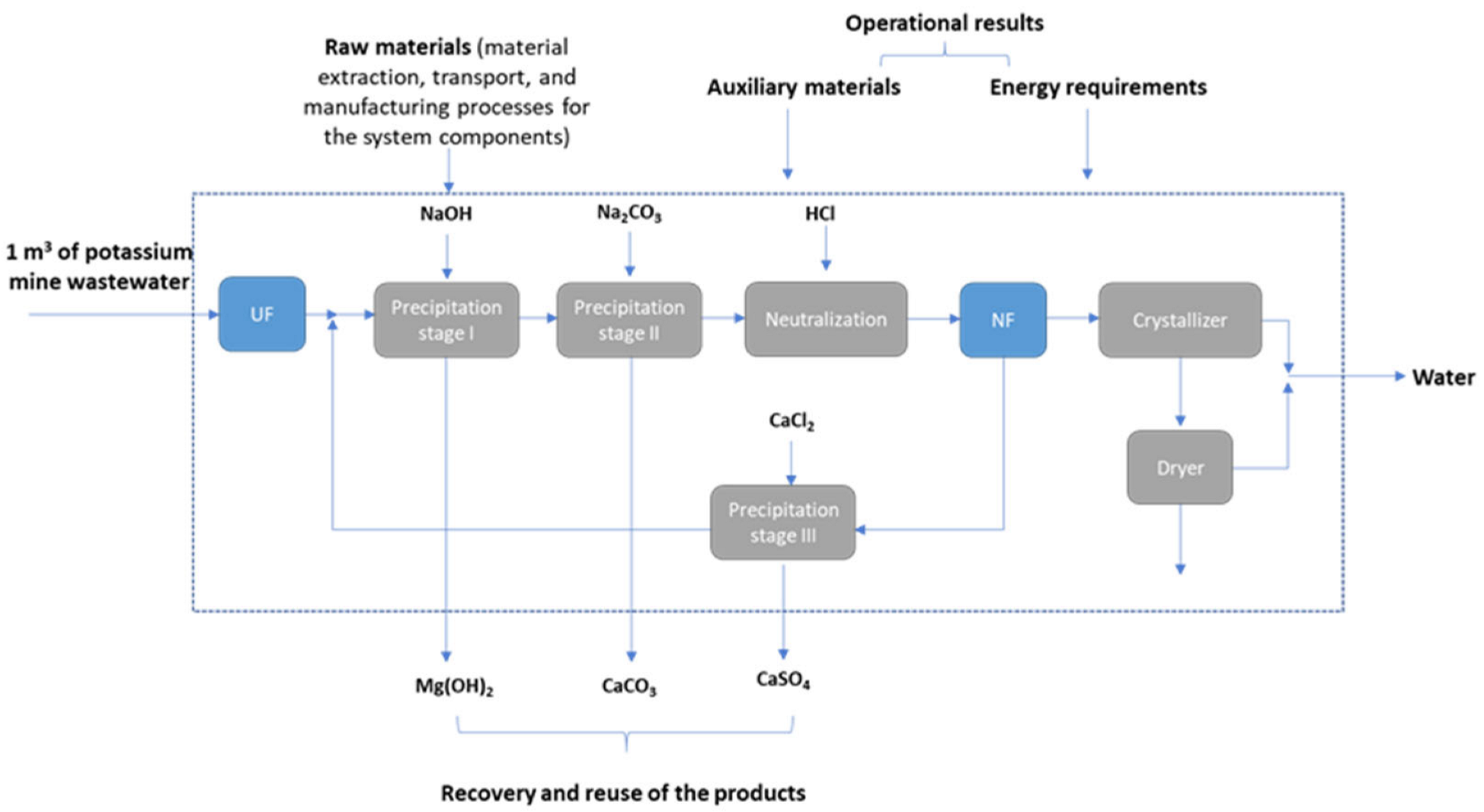
As demonstrated in Figure 1, the system’s first technology step is ultrafiltration, which removes suspended solids from the inlet brine, reducing its turbidity. After the ultrafiltration, two sequencing precipitation units are placed, which precipitate magnesium as magnesium hydroxide (Mg(OH)2) and calcium as calcium carbonate (CaCO3). The effluent from the second precipitation reactor is neutralized and then flows into nanofiltration for the separation of monovalent from divalent ions. The divalent ion-rich stream flows into the third precipitation reactor, in which sulfates are precipitated as calcium sulfate (CaSO4). The monovalent ion-rich stream flows into the final technology of the pilot system, which comprises a crystallizer and a dryer. From the combination of the two systems, pure NaCl in a solid form is recovered, as well as clean water. The boundaries of the system on which LCA was applied are demonstrated in Figure 1.

2.2. Pilot System Units

The ultrafiltration unit of the pilot system is equipped with a filtration tank, pumps, a blower, valves, and a control cabinet. The membranes consist of silicon carbide (SiC). The wastewater was continuously fed to the membrane while filtration was taking place. Backwash and air blowing were used to clean the membranes, and if necessary, NaOCl, HCl, and NaOH were also used for the cleaning.
The first precipitation unit received the ultrafiltration permeate and precipitated magnesium as magnesium hydroxide with the addition of NaOH. To clean it, the precipitation unit was drained and then cleaned with water.
The second precipitation unit received the effluent from the first precipitation unit and precipitated calcium as calcium carbonate with the addition of Na2CO3. To clean it, the precipitation unit was drained and then cleaned with water.
The effluent from the second precipitation unit was basic, with a pH value of around 10, due to the addition of NaOH and Na2CO3 in the previous steps. Therefore, before it flowed into the nanofiltration unit for the separation of the monovalent from divalent ions, the effluent had to be neutralized in a dedicated unit with the addition of hydrochloric acid, to reduce its pH value to 7.
Through nanofiltration, the neutralized effluent was separated into two different flows through membranes. The first flow, also called nanofiltration permeate, was rich in monovalent ions, mainly sodium ions (Na) and chlorides (Cl). The second flow, also called nanofiltration concentrate, was rich in divalent ions, mainly sulfates. The nanofiltration concentrate flowed into the third precipitation unit, where the sulfates precipitated as calcium sulfate (CaSO4) with the addition of calcium chloride (CaCl2).
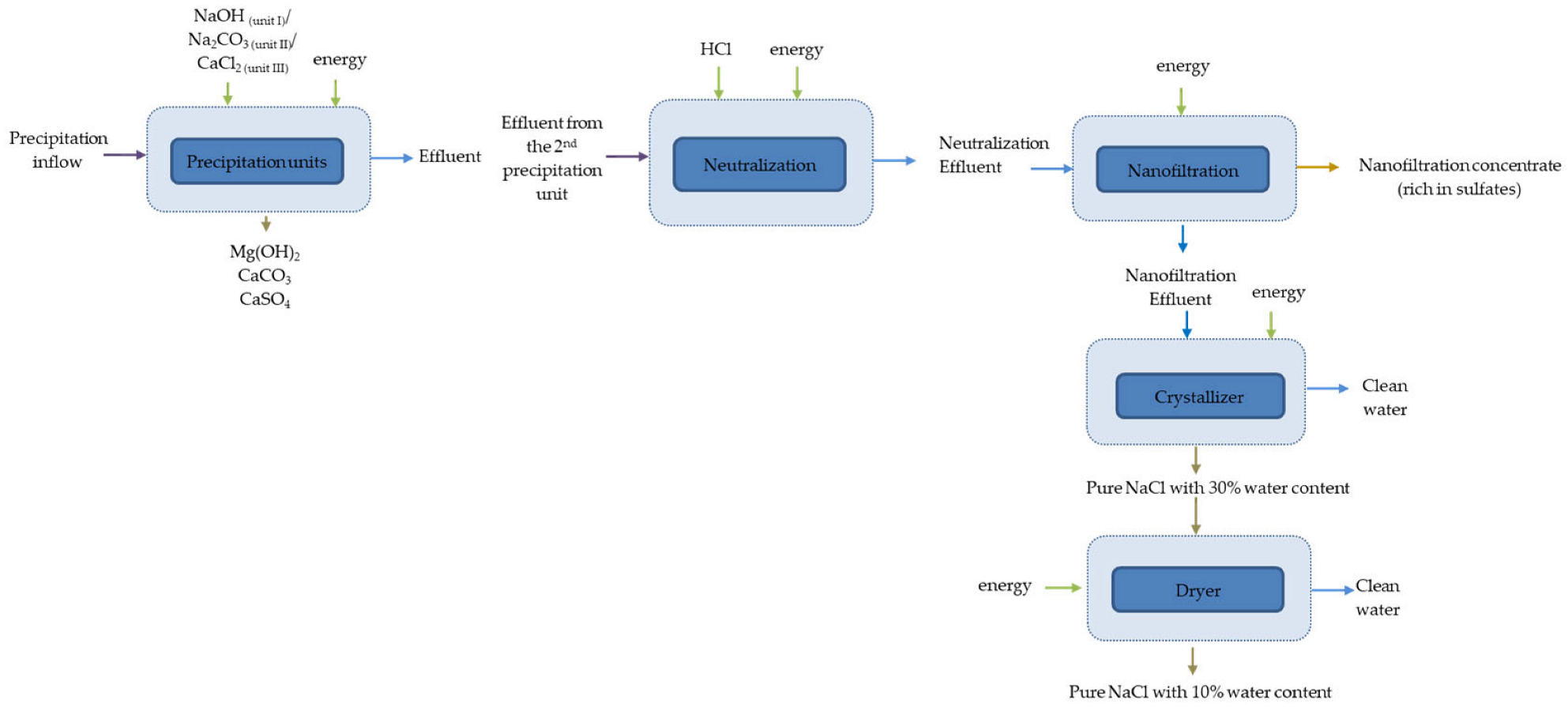
The TDS content of the nanofiltration permeate was around 19%, consisting mainly of sodium chloride. The effluent was treated in a crystallizer, which recovered clean water and sodium chloride with 99.9% purity. The water content of this stream was around 30%. For further drying, a dryer was used for the recovery of solid salt, with a water content equal to 10%. Figure 2 demonstrates the inflows and the outflows of the precipitation units, the neutralization, the nanofiltration, the crystallizer, and the dryer. As it is shown, the inflows of the precipitation units are NaOH (unit I), Na2CO3 (unit II), CaCl2 (unit III), the inflow (each precipitation unit has a different inflow), and energy. The outflows of the precipitation units are Mg(OH)2 (unit I), CaCO3 (unit II), and CaSO4 (unit III). The inflow of the neutralization unit is the effluent from the second precipitation unit, with HCl to neutralize the solution and energy. The outflow is the neutralization effluent. The inflows of the nanofiltration unit are the neutralization effluent and energy. The outflows are the nanofiltration concentrate, which heads to the third precipitation tank (Figure 1), and the nanofiltration effluent, which heads to the crystallizer. The crystallizer input is the nanofiltration effluent and energy. The crystallizer outputs are clean water and pure NaCl with 30% water content. The dryer input is pure NaCl with 30% water content and energy. The dryer outflows are clean water and pure NaCl with 10% water content.

2.3. Life Cycle Assessment (LCA)

The LCA study is a standardized method consisting of four stages: (a) definition and scope, (b) life-cycle inventory (LCI), (c) life-cycle impact assessment (LCIA), and (d) interpretation [22]. For its completion, both primary and secondary data were collected.
Primary data were collected from the pilot system operation, while secondary data were derived from the ecoinvent database. Key results were interpreted to identify critical areas of the system that most contribute to the environmental burdens. The LCA study followed the context provided by ISO14040 [23] and EN15804 standards, which ensure that the environmental impacts are assessed consistently [23,24].
The scope of the LCA study was to identify the system environmental hot spots and then compare their overall environmental impact with that of a corresponding desalination system and an alternative wastewater management method.
The functional unit of the system was defined as 1 m3 of potassium mining wastewater, and it was assumed that the pilot system has a life span of 20 years. The LCA study followed a cradle-to-grave approach, covering the entire life cycle from raw material extraction to end-of-life stages. Specifically, the system boundaries encompass the stages indicated in Table 2.
Stages A1–A3 cover the processes associated with the pilot system construction.
Stage A1 includes the extraction of raw materials necessary for the system components, such as stainless steel, plastics, membranes, pipes, pumps and any other equipment used in the system technologies. Stage A2 refers to the transportation of these materials from various countries to the pilot system site. Stage A3 includes the manufacturing and packaging processes of the different components.
Stages B1 and B6 represent the operational life of the system. Stage B1 includes emissions and materials use during operation. It focuses mainly on the consumption of chemicals such as NaOH, Na2CO3, HCl, and CaCl2. Stage B6 represents the energy consumption during the system operation, mainly the electricity use.
Stage D refers to the environmental benefits outside the system boundary through resource recovery. The pilot system enables the recovery of water and of valuable resources, such as Mg(OH)2, CaCO3, CaSO4, and NaCl. The recovered resources reduce the need for material production and thus contribute positively to the system’s environmental performance.

2.4. Life Cycle Inventory

Based on the breakdown of each technology into its components, the Life Cycle Inventory of the pilot system was formed. For each technology, named as a sector, e.g., ultrafiltration, precipitation reactors, the inventory encompasses a list of all the corresponding components, the quantity of each component, their mass, and the raw materials used for their production (see Table 3, Table 4, Table 5, Table 6, Table 7, Table 8 and Table 9).
Stage A1—extraction of raw materials.
Table 3. Stage A1—extraction of raw materials.
LCA Stages UnitProductsNumberMaterialsMassUnitper FUUnit
A1: Raw materialsRaw materialsUltrafiltrationDegassing valve1PVC0.5kg6.68 × 10−6kg/FU
Raw materialsControl cabinet1 30kg2.00 × 10−4kg/FU
Raw materialsFiltration/backwash pump1PP/PE20kg4.01 × 10−4kg/FU
Raw materialsPressure indicator1SS1kg6.68 × 10−6kg/FU
Raw materialsVentilation valve drain pipe1PVC0.5kg6.68 × 10−6kg/FU
Raw materialsLevel switch2Plastic0.25kg3.34 × 10−6kg/FU
Flow indicator1ETFE025kg5.56 × 10−7kg/FU
PA 6T0.25kg5.56 × 10−7kg/FU
Raw materialsEPDM0.25kg5.56 × 10−7kg/FU
Raw materialsFeed pump1PP/PE10kg2.00 × 10−4kg/FU
Raw materialsSprinkler pump1PP/PE2kg4.01 × 10−5kg/FU
Raw materialsDrain pump1PP/PE10kg2.00 × 10−4kg/FU
Raw materialsInlets (e.g., for raw water, NaOCl)3PVC2kg4.01 × 10−5kg/FU
Raw materialsSiemens TDE panel1PP/PE5kg3.34 × 10−5kg/FU
Raw materialsCeramic UF membranes1Ceramic100kg4.67 × 10−3kg/FU
Raw materialsPVC pipes1PVC10kg6.68 × 10−5kg/FU
Raw materialsPVC valves5PVC5kg3.34 × 10−4kg/FU
Raw materialsPermeate and feed tanks2PP300kg8.01 × 10−3kg/FU
Raw materialsInsulated containerAir conditioning1 40kg5.34 × 10−4kg/FU
Raw materialsInsulated container1SS2380kg1.59 × 10−2kg/FU
Raw materialsNanofiltrationFeed pump1SS31610kg2.00 × 10−4kg/FU
Raw materials20-micron filter1PP0.5kg3.34 × 10−4kg/FU
Raw materialsSS valves4SS10kg5.34 × 10−4kg/FU
Raw materialsSkid structure1SS100kg1.34 × 10−3kg/FU
Raw materialsPVC valves6PVC1kg8.01 × 10−5kg/FU
Raw materialsControl cabinet1PVC/Al50kg3.34 × 10−4kg/FU
Raw materials5-micron filter1PP0.5kg3.34 × 10−4kg/FU
Raw materialsHigh-pressure pump (HPP)1SS 1.440840kg8.01 × 10−4kg/FU
Raw materialsNF membranes5PA25kg5.84 × 10−3kg/FU
Raw materialsFlow transmitter3ETFE; PA 6T; EPDM0.25kg1.00 × 10−5kg/FU
Raw materialsPressure transmitter10SS316L0.5kg1.34 × 10−4kg/FU
Raw materialsConductivity transmitter2SS316L0.5kg1.34 × 10−5kg/FU
Raw materialsTemperature transmitter2SS316L0.5kg6.68 × 10−6kg/FU
Raw materialsSS piping1SS20kg1.34 × 10−4kg/FU
Raw materialsPVC piping1PVC20kg1.34 × 10−4kg/FU
Raw materialsInsulated containerAir conditioning1 40kg5.34 × 10−4kg/FU
Raw materialsRaw container1Corton steel3800kg2.54 × 10−2kg/FU
Raw materialsBuffer TanksTank 1000 L1PP100kg1.34 × 10−3kg/FU
Raw materialsTank 2000 L1PP150kg2.00 × 10−3kg/FU
Raw materialsTank 3000 L1PP200kg2.67 × 10−3kg/FU
Raw materialsTank 60 L dosing2PE25kg6.68 × 10−4kg/FU
Raw materialsCatchment tank 80 L2PE50kg1.34 × 10−3kg/FU
Raw materials4 m3 crystallizerClean water collection tank1Plastic50kg3.34 × 10−4kg/FU
Raw materialsCrystallization shell1Stainless steel200kg1.34 × 10−3kg/FU
Raw materialsVacuum pump (inc. booster)1Stainless steel4kg8.01 × 10−5kg/FU
Raw materialsSubmersible pump1Stainless steel10kg2.00 × 10−4kg/FU
Raw materialsWater pump1Stainless steel10kg2.00 × 10−4kg/FU
Raw materialsCompressor with hot and cold radiators1Stainless steel15kg2.00 × 10−4kg/FU
Raw materialsHydrocyclone1Stainless steel30kg2.00 × 10−4kg/FU
Raw materialsFlow, pressure, temperature, level sensors connected to control panel6Stainless steel1.5 2.40 × 10⁻⁴kg/FU
Raw materialsControl panel1PVC/Al20kg1.34 × 10−4kg/FU
Raw materialsDryerHeating bath1Stainless steel100kg6.68 × 10−4kg/FU
Raw materialsHeater 4 kW1Stainless steel8kg5.34 × 10−5kg/FU
Raw materialsVacuum pump1Stainless steel4kg8.01 × 10−5kg/FU
Raw materialsWater collection tank1Plastic50kg3.34 × 10−4kg/FU
Raw materialsShneck Engine 3 ph 380 V1Metal6kg4.01 × 10−5kg/FU
Raw materialsFlow transmitter1ETFE; PA 6T; EPDM0.25kg3.34 × 10−6kg/FU
Raw materialsValves15Stainless steel1kg2.00 × 10−4kg/FU
Raw materialsSS Spiral1Stainless steel40kg2.67 × 10−4kg/FU
Raw materialsControl panel1PVC/Al20kg1.34 × 10−4kg/FU
Raw materialsHot water recirculation pump1stainless steel3kg6.01 × 10−5kg/FU
Raw materialsPrecipitation unitsIBC tanks4Plastic and iron65kg8.68 × 10−4kg/FU
8.68 × 10⁻⁴kg/FU
Reactors6Plastic and iron 1.30 × 10⁻³kg/FU
Raw materials65kg1.30 × 10−3kg/FU
Raw materialsInsulated container1SS2300kg1.54 × 10−2kg/FU
Raw materialsDosing pumps4SS and PP5kg each4.01 × 10−4kg/FU
Online measurement system1PVC and Al 6.68 × 10⁻⁵kg/FU
Raw materials20kg6.68 × 10−5kg/FU
Raw materialsCables15Copper, PVC40kg/km4.01 × 10−3kg/FU
Raw materialsPumps3Duplex SS67kg4.03 × 10−3kg/FU
Raw materialsSS piping1SS30kg2.00 × 10−4kg/FU
Raw materialsPVC piping1PVC20kg1.34 × 10−4kg/FU
A1: Packaging of RMPackaging of RMNylon (pallet wrap)Nylon (pallet wrap)--2.5kg1.67 × 10−5kg/FU
palletpallet--10items6.68 × 10−5items/Fu
Stage A2—Transport to manufacturing.
Table 4. Stage A2—Transport to manufacturing.
LCA Stages UnitProductsMassUnitper FUUnit
A2TransportationGermanyLorry734km4.97 × 10−3tn·km/FU
TransportationUKVessel26km1.45 × 10−3tn·km/FU
TransportationUKLorry26km7.18 × 10−3tn·km/FU
TransportationNetherlandsLorry9407.75km9.36 × 10−2tn·km/FU
TransportationFranceLorry81km2.91 × 10−3tn·km/FU
TransportationSpainLorry11km1.70 × 10−3tn·km/FU
TransportationSwitzerlandLorry450.5km7.35 × 10−3tn·km/FU
TransportationTurkeyLorry0.5km1.78 × 10−5tn·km/FU
TransportationCyprusLorry315.75km1.41 × 10−3tn·km/FU
TransportationCyprusVessel315.75km2.23 × 10−2tn·km/FU
TransportationChinaLorry206km7.54 × 10−4tn·km/FU
TransportationChinaVessel206km3.31 × 10−2tn·km/FU
TransportationPolandLorry23km6.93 × 10−5tn·km/FU
Stage A3—Manufacturing.
Table 5. Stage A3—Manufacturing.
LCA Stages UnitProductsMassUnitper FUUnit
A3Packaging of RM wasteNylon (pallet wrap)- 1.67 × 10⁻⁵kg/FU
Packaging of RM wastepallet- 2.00 × 10⁻³kg/FU
Transportation of packaging of RM wasteTransportation of wasteLorry300km6.06 × 10−4tn·km/FU
Stage B1—Emissions from the system.
Table 6. Stage B1—Emissions from the system.
LCA Stages UnitProductsMassUnitper FUUnit
B1Transportation—Material use and packaging materialsPolandLorry500km1.03 × 101tn·km/FU
Material useNaOH---5.23 × 100kg/FU
Material useNa2CO3---2.14 × 100kg/FU
Material useHCl---8.80 × 100kg/FU
Material useCaCl2---4.46 × 100kg/FU
Packaging materialsSack-1290items4.33 × 10−3kg/FU
Packaging materialsPallet-5items1.00 × 10−3items/Fu
Stage B.6—Energy consumption.
Table 7. Stage B.6—Energy consumption.
LCA Stages Unitper FUUnit
B6EnergyElectricity1.39 × 101kWh/FU
Stages C—Dismantling, transportation for disposal, waste treatment, final disposal.
Table 8. Stages C—Dismantling, transportation for disposal, waste treatment, final disposal.
LCA Stages UnitMassUnitper FUUnit
C1EnergyDiesel for demolition machinery----
C2TransportTransportation of each system unit200km2.25 × 10−2tn·km/FU
C3Waste processingTreatment of steel--2.16 × 10⁻²kg/FU
C3Waste processingTreatment of electric equipment--5.41 × 10⁻²kg/FU
C3Waste processingTreatment of plastic--2.16 × 10⁻²kg/FU
C3Waste processingTreatment of aluminum scrap--1.08 × 10⁻²kg/FU
C3Waste processingTreatment of paper sack--4.33 × 10⁻³kg/FU
C3TransportTransportation of materials for disposal200km1.10 × 10−2tn·km/FU
C4DisposalLandfill of plastic treatment--3.24 × 10⁻²kg/FU
C4DisposalLandfill of plastic treatment--2.16 × 10⁻²kg/FU
C4Waste processingTreatment of pallet--1.00 × 10⁻³kg/FU
Stage D—Reuse/recycling.
Table 9. Stage D—Reuse/recycling.
LCA Stages Unitper FUUnit
DReuse/RecyclingRecovery of water6.79 × 102kg/FU
DReuse/RecyclingRecovery of NaCl1.28 × 102kg/FU
DReuse/RecyclingRecovery of Mg(OH)27.53 × 100kg/FU
DReuse/RecyclingRecovery of CaCO32.02 × 100kg/FU
DReuse/RecyclingRecovery of CaSO45.47 × 100kg/FU
DReuse/RecyclingRecovery of KCl2.95 × 101kg/FU

3. Results

3.1. Life Cycle Impact Assessment

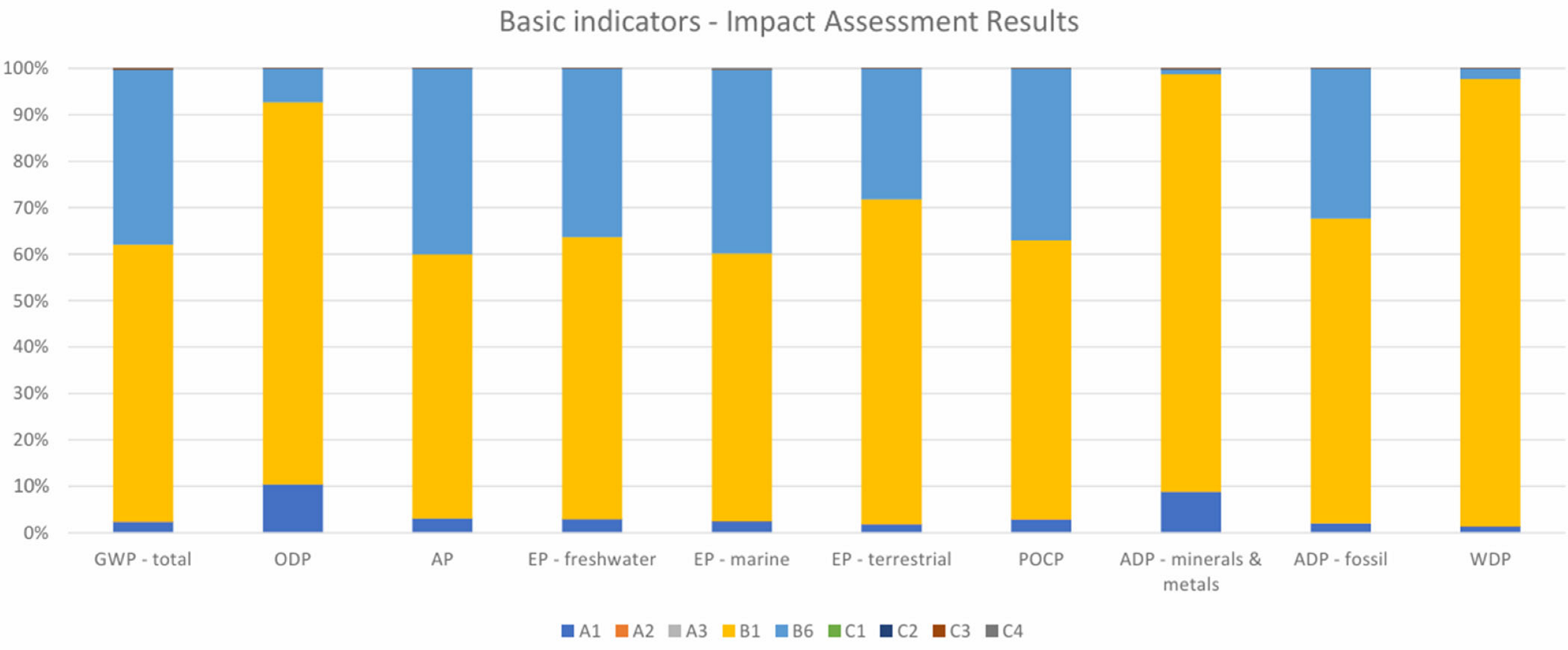
Figure 3 presents the Life Cycle Impact Assessment for the treatment of potassium mining wastewater and provides the relative contribution of the operational factors, mainly the chemical use and the energy consumption, in the different environmental impact categories. As demonstrated in Figure 3, the main contributor to all the environmental impact categories is the use of chemicals in the pilot system, followed by energy consumption. Global Warming Potential (GWP) refers to an increase in the average global temperature due to greenhouse gas emissions [25]. It is affected by the use of chemicals, with 65% in the novel pilot system, and also 25% from its energy consumption. Ozone Depletion (ODP) refers to the estimated impact of a substance on the depletion of the ozone layer [26]. In the novel pilot system, the Ozone Depletion Potential is generally low, equal to 1.09 × 10⁻⁷ Kg CFC 11 eq. The main contribution to it is the use of chemicals, at around 70%.
The Acidification Potential (AP) refers to the possibility that the system contributes to environmental acidification [27], and it is 55% dominated by the system energy consumption, followed by contributions from the use of chemicals. Freshwater (EP-freshwater), Marine (EP-marine), and Terrestrial (EP-terrestrial) Eutrophication Potentials are mainly affected by the use of chemicals, and secondarily by the system’s energy consumption. The use of chemicals contributes around 50% to the Freshwater Eutrophication, 50% to Marine Eutrophication, and 70% to Terrestrial Eutrophication. The Photochemical Ozone Creation Potential (POCP), which is a measure of the formation of ground-level ozone, a major component of smog, from various pollutants [28], is mainly affected by the chemical consumption of the pilot system, and secondarily by its energy use. The Abiotic Depletion Potential (ADP) represents the depletion of non-renewable resources, such as minerals and metals (ADP-minerals and metals), as well as fossil fuels (ADP-fossil) [29]. The contribution of the use of chemicals to the ADP of minerals and metals is around 90%, and to the ADP of fossil fuels is around 60%. Water Depletion Potential (WDP) aims to assess the potential impact of water consumption on the availability of water resources for both humans and ecosystems [30,31], and is affected by chemical use at around 65–70%.

3.2. Comparison of the Novel Pilot System Configuration with Other Desalination Systems

The novel pilot system configuration was set for the treatment of potassium wastewater characterized by 18% TDS content. The energy consumption of this system is equal to 15 kWh/m3. Figure 1 presents the process flow diagram of the pilot system configuration for the treatment of the potassium wastewater.
The system was only compared with another system of the Brine-Mining project, as no LCAs were found in the literature for high-salinity wastewater treatment systems achieving high-purity water recovery, almost zero-liquid discharge, and the recovery of marketable salts. Tsalidis et al. (2022) [32] assessed the environmental performance of a novel coal mine brine treatment technique in the framework of the project Zero-Brine, but the TDS content was quite low, around 3.8%.
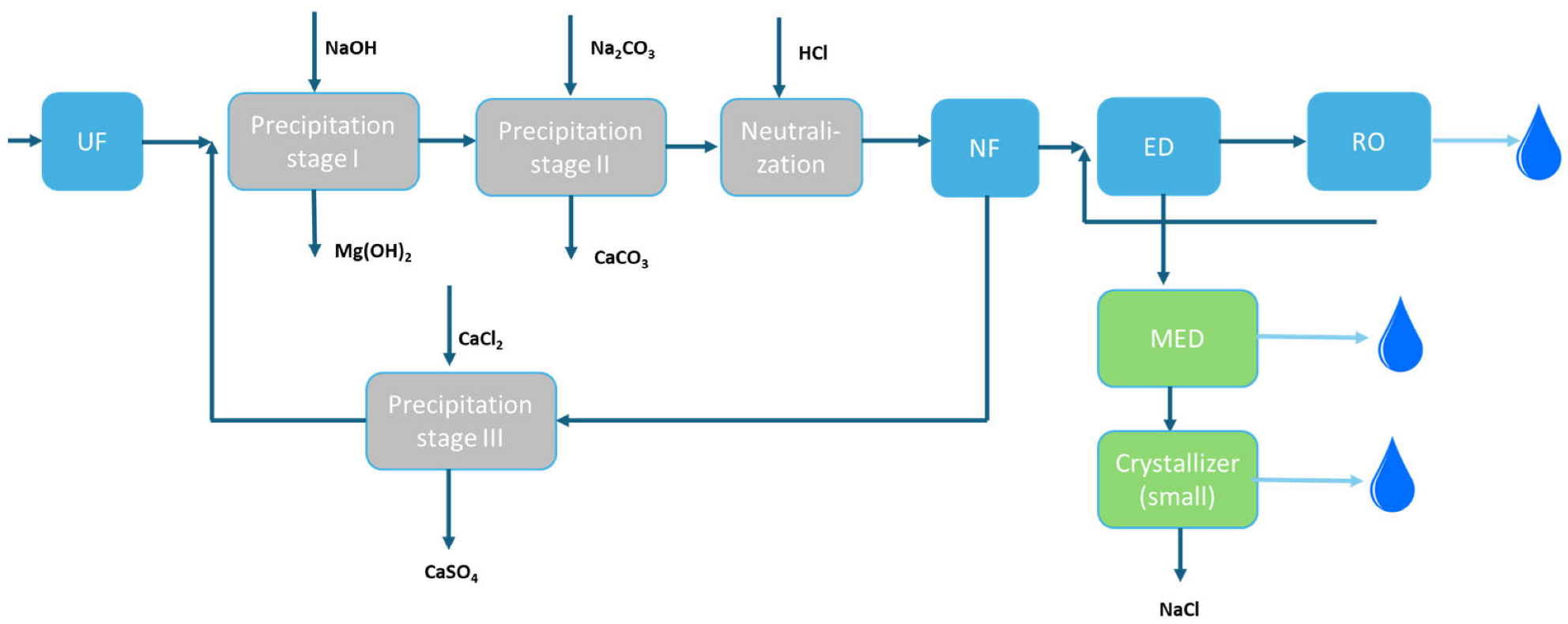
In the framework of the LIFE project, titled Brine-Mining, the same technologies were used for the treatment of a coal mine wastewater with a salinity of 8%. For the treatment of this wastewater, a different configuration was used. The configuration employed four (4) membrane technologies: an ultrafiltration, a nanofiltration, an electrodialysis, and a reverse osmosis; and three (3) precipitation units: an evaporator, a crystallizer, and a dryer. Four (4) salts were recovered from this configuration. The system energy consumption is equal to 44 kWh/m3. Figure 4 presents the system configuration for the treatment of the saline coal mine wastewater. As is demonstrated in Figure 4, the raw brine goes through an ultrafiltration unit for the removal of suspended solids. The permeate from the ultrafiltration heads to the first precipitation unit. There, NaOH is added for the precipitation of Mg(OH)2. The effluent from the first precipitation unit is added to the second precipitation unit. There, Na2CO3 is added and CaCO3 is precipitated. The effluent from the second precipitation unit travels to a neutralization unit, in which HCl is added to neutralize the effluent pH value. The neutralization effluent undergoes nanofiltration to remove sulfate and any remaining calcium and magnesium from the effluent. The nanofiltration effluent moves towards the electrodialysis unit, while the nanofiltration concentrate goes to the third precipitation unit, in which CaCl2 is added for the precipitation of CaSO4. From the electrodialysis, a partly diluted effluent and a concentrated stream are produced. The partly diluted effluent goes through reverse osmosis, where clean water is produced. The concentrated stream, which is rich in sodium (Na) and chlorides (Cl), moves forward to a MED evaporator where it is concentrated. The MED produces clean water, and the MED concentrate then flows into the crystallizer from which clean water and NaCl of high purity are produced.
The potassium wastewater was characterized by a TDS content equal to 18%, while the coal mine wastewater TDS content was 8%.
Table 10 presents a comparative Life Cycle Assessment of the two pilot systems. The first one treats saline coal mine brine, and the second treats potassium mine brine.
The potassium mine brine system generally exhibits lower environmental impact than the coal mine brine system. The Global Warming Potential of the coal mine brine system (7.42 × 101 Kg CO2 eq.) is higher than the other system (4.09 × 101 Kg CO2 eq.). The main driver for this difference is the three-times-higher energy consumption of the coal mine brine system than the potassium mine brine configuration.
Both systems have a very low Ozone Depletion Potential, exhibiting minimal impact on the ozone layer. The slight difference in the two values, with the coal mine brine ODP being higher (1.18 × 10⁻⁶ Kg CFC-11 eq.) than the corresponding value of the potassium mining brine system (1.05 × 10⁻⁶ Kg CFC-11 eq.), is negligible.
The Acidification Potential of the coal mine brine system (5.55 × 10⁻¹ mol H+ eq.) is nearly double that of the potassium mining brine system (2.89 × 10⁻¹ mol H+ eq.), suggesting a greater contribution to acidification rain and similar impacts. The different impact of the two systems is linked to the use of chemicals and energy consumption. However, the mass of the chemicals used is similar for the two systems; as for the coal mine brine system, the use of chemicals was 20.86 kg/h, while for the potassium mining brine, equal to 17.63 kg/h. So, it is more likely that this difference is attributed to the much higher energy consumption of the coal mine brine system than the other system.
In all types of Eutrophication Potential, the coal mine brine system exhibits higher impact than the potassium mine brine system. The Freshwater Eutrophication Potential indicates higher possibility for release of phosphorus into water bodies, while the Marine Eutrophication Potential indicates the release of nitrogen into marine environments. The excessive flow of nitrogen and potassium, can lead to oxygen depletion and algal growth [33]. Therefore, the difference between the two systems impact in the Eutrophication Potential is mainly attributed to the difference in their energy consumption. The Photochemical Ozone Creation Potential of the coal mine brine system (2.30 × 10⁻¹ Kg NMVOC eq.) is higher than the potassium mining brine system (1.26 × 10⁻¹ Kg NMVOC eq.), exhibiting greater contribution to the release of volatile organic compounds that end up in the formation of smog. The difference is mainly attributed to the higher energy use that generally provokes higher emissions.
The coal mine brine Abiotic Depletion Potential referring to minerals and metals (1.27 × 10⁻³ Kg Sb eq.) is higher than the potassium mining brine system (8.88 × 10⁻⁴ Kg Sb eq.), indicating greater consumption of minerals and metals resources. The corresponding Abiotic Depletion Potential referring to fossils for the coal mine brine system (9.31 × 10² MJ) is higher than the potassium mining brine system (5.50 × 10² MJ), indicating greater reliance on fossil fuels for the coal mine brine treatment process than the potassium mining process.
The Water Depletion Potential of the coal mine brine system (1.99 × 101 m3) is lower than the corresponding value (2.15 × 101 m3) for the potassium mining brine system. This is a significant exception to the general condition of lower impact of the potassium mine brine system compared to the coal mine brine treatment system, indicating that the potassium mine brine system may be more water-demanding. However, the difference between the two systems is slightly different.
From the comparison of the two systems, it is shown that the three times higher energy consumption of the coal mine brine system contributes to its higher Global Warming Potential, Eutrophication Potential, Acidification Potential, Photochemical Ozone Creation Potential, and Abiotic Depletion Potential. Both systems have very small Ozone Depletion Potential, while the Water Depletion Potential is the only exception, as it is higher for the potassium mine brine system than the coal mine brine system.

3.3. Sensitivity Analysis

A sensitivity analysis was conducted to assess the changes in the auxiliary equipment used and its respective impact on the Global Warming Potential. Two different scenarios were investigated. Table 4 and Table 5 present the sensitivity analysis for the potassium mine brine system for the Global Warming Potential. More in specific, Table 11 presents the results of the sensitivity analysis evaluating how changes in material consumption influence the total Global Warming Potential (GWP) of the potassium mine brine treatment across all life cycles, and Table 12 presents the sensitivity analysis results for the fossil-based Global Warming Potential (GWP-fossil) of the potassium mine brine treatment system. In both cases, two scenarios are evaluated: The first scenario is a 10% decrease in the materials used, and the second scenario is a 10% increase in the materials used.
First scenario—10% decrease in materials consumption: a 10% decrease in material consumption results in a slight decrease in the total Global Warming Potential from 4.09 × 101 to 3.86 × 101 Kg CO2 eq. All stages, except B6, which is the electricity consumption, indicated a 9.1% decrease for the GWP.
Second scenario—10% increase in material consumption: a 10% increase in material consumption results in a slight increase in the total Global Warming Potential to 4.37 × 101 Kg CO2 eq. All stages, except the electricity consumption, indicated a 11.1% increase for the GWP.
The sensitivity analysis indicated that the material consumption significantly affects the system’s environmental impact.

3.4. System Comparison with Underground Disposal Method (Wastewater from Potassium Extraction)

Wastewater coming from mining operations can undergo various forms of treatment or management systems. One common method, depending on the composition of the wastewater, is the disposal of the wastewater in old underground mines that are not used. This method will be described as ‘underground disposal’ throughout this research work.
A Life Cycle Assessment (LCA) was performed to assess the impact of the potassium wastewater underground disposal. The main activity comes from energy use in pumps and soil contamination. The purpose of this LCA was to compare the potassium mining brine system with the underground disposal, which is the current implemented method. To make the two systems comparable, the production of salt products (NaCl, CaSO4, Mg(OH)2, CaCO3, NaCl) in the pilot system was taken into consideration. The functional unit is 1 m3 of wastewater. The results of the LCIA are demonstrated in Table 13, which presents a comparative Life Cycle Impact Assessment between the innovative pilot system treating potassium mining wastewater and the conventional management method of underground disposal.
The potassium mine brine system, while having a higher impact in some categories, demonstrates important advantages compared to the conventional underground disposal method for most of the impact indicators.
The conventional treatment method has a significantly higher Global Warming Potential (2.94 × 10² Kg CO2 eq.) than the novel pilot system (4.09 × 101 Kg CO2 eq.), even though the system has slightly higher fossil GWP. This indicates that other factors, such as the energy used for pumping in underground disposal, have a greater impact on the conventional method of treatment.
The Ozone Depletion Potential of the conventional method (5.00 × 10⁻⁷ Kg CFC 11 eq.) is lower than the potassium mine brine system (1.05 × 10⁻⁶ Kg CFC 11 eq.); however, both values are quite low, indicating low environmental detrimental. The Acidification Potential of the conventional treatment method (2.11 × 10⁻¹ mol H+ eq.) is also lower than the brine treatment system (2.89 × 10⁻¹ mol H+ eq.), indicating less contribution to acid rain and similar phenomena, and it is probably attributed to the use of chemicals in the potassium mine brine system.
The Eutrophication Potential of all types (Freshwater, Marine, Terrestrial) is higher for the conventional method compared to the brine treatment system, indicating that the conventional method creates remaining solid substances that can contribute to nutrient pollution in land and waterways. Also, the Photochemical Ozone Creation Potential of the conventional method (1.97 × 10⁻¹ Kg NMVOC eq.) is higher than the brine treatment system (1.26 × 10⁻¹ Kg NMVOC eq.), indicating that this method contributes more to smog creation.
As for the Abiotic Depletion Potential, a special kind of contribution has been observed: even though the conventional method exhibits higher ADP for minerals and metals (3.34 × 10⁻³ Kg Sb eq.) than the potassium mine brine system (8.88 × 10⁻⁴ Kg Sb eq.), it exhibits lower ADP for fossils (3.74 × 10² MJ) than the system (5.50 × 10² MJ). This is attributed to the fact that the infrastructure for the conventional underground disposal method requires metals, while the pilot system’s energy consumption drives its fossil fuel depletion.
As for the Water Depletion Potential, the conventional method is more water-intensive (5.06 × 101 m3) than the potassium mine brine system (2.15 × 101 m3). The higher WDP in the conventional system is mainly due to the complete loss of water during the underground disposal, while, on the other hand, from the pilot system, clean water is recovered.
The pilot system seems to have a higher potential to cause cancer and non-cancer-related health effects compared to the conventional method. This is potentially attributable to the use of chemicals in the brine treatment system.
The conventional method’s Ionizing Radiation Potential (3.85 × 10⁻¹ kBq U235 eq.) is lower than that of the potassium brine system (8.37 × 10⁻¹ kBq U235 eq.). The IRP is primarily connected to energy consumption; therefore, the Brine-Mining system has a higher impact in this category.
The conventional method’s Particulate Matter Formation is higher (7.52 × 10⁻⁷ Disease Incidence) than that of the brine treatment system (7.20 × 10⁻⁷). The formation of particulate matter is linked both to energy consumption and to industrial processes that release particles. The pilot system has a higher energy demand than the conventional system, but the conventional method of discharging wastewater underground can potentially lead to the mobilization of existing particulate matter in soil, which can end up in the air.
The conventional method’s Soil Quality Potential is equal to 8.25 × 10⁻², suggesting that it has a very detrimental impact on soil quality, compared to the pilot system’s corresponding value (7.98 × 101). This is attributed to the direct discharge of wastewaters in underground mines.
From the comparison of the two systems, it seems that while the brine treatment system has some drawbacks related to chemical use and energy consumption, it is a more sustainable solution for potassium mining wastewater compared to underground disposal, which poses a threat to soil, water, and air quality.


4. Discussion

The environmental impact of a novel pilot system to treat potassium mining brine was assessed through an LCA study. From the LCA analysis, it was shown that the main environmental burden of the system is attributed to the operation phase, rather than to the construction or demolition phase. The production of raw materials during the construction phase contributed only marginally to the ODP and ADP (less than 10% in each of these two indicators). It was also proven that the system’s environmental impact is mainly affected by the energy consumption and the use of chemicals for its operation. Each environmental impact category is affected by the following two factors to different proportion: the use of chemicals contributes 65% to the Global Warming Potential, while the energy consumption to 25%. Regarding the Ozone Depletion Potential, chemical use contributes 70%, while energy consumption is a minor factor. The chemical consumption influenced the Eutrophication Potential by almost half, except for terrestrial eutrophication, which contributed 70%. The Photochemical Ozone Creation Potential and the Abiotic Depletion Potential are all dominated by chemical use. The ADP for minerals and metals is 90%, while the ADP for fossil fuels is 60%. The energy consumption contributes to the Acidification Potential by 55%, while its contribution to the Water Depletion Potential is 65–70%.
The potassium mine brine system was compared to another desalination system that treated coal mine brine. The coal mine brine was characterized by half the salinity (8% TDS) of the potassium brine (18% TDS), while both systems recovered valuable salts of high purity from the saline wastewaters treatment.
The environmental impact of the two systems was assessed, proving that the potassium brine system has a lower environmental impact compared to the coal mine brine system, especially for Global Warming, Acidification, Eutrophication, and the Photochemical Ozone Creation Potential. The difference in the environmental impact of the two systems is attributed to the higher energy consumption of the coal mine brine system compared to the potassium mine brine. The main reason for this difference is the higher energy consumption of the coal mine brine system, which includes two more technologies than the potassium brine system, the electrodialysis and the RO, which are quite energy-intensive. In some other categories, both systems exhibit similar impacts, such as in the Abiotic Depletion Potential for minerals and metals. Overall, the potassium mine brine system is more sustainable, except for its impact on the Water Depletion Potential, as it requires slightly more water than the coal mine brine system.
The novel pilot system for the potassium brine treatment was also compared to the conventional method, which is the disposal of potassium mine brine in underground mines. The pilot system demonstrates lower environmental impact in areas such as Global Warming, Acidification, Eutrophication, Water Depletion, and Soil Quality compared to underground disposal, but has a higher impact on the Abiotic Depletion Potential for minerals and metals, and Ionizing Radiation Potential, mainly due to the novel system’s energy demand. Overall, the novel system is a more sustainable solution for potassium mine brine treatment than the underground disposal.

5. Future Research Work

Based on this study, future research should focus on the optimization of the pilot system’s operational phase. The main focus should be on a reduction in chemical consumption and energy demand, as these two stages were identified as the main contributors to the environmental impact of the system. Additionally, future work can explore the system’s scale-up and long-term operational performance to enhance its sustainability.

Author Contributions

Writing—Original Draft Preparation, S.K.; Writing—Review and Editing, M.K. and M.A.; Investigation, Data Curation, K.M.; Investigation, Data provision, D.D.; Investigation, G.G., A.S., C.X., K.P. and D.P.; Supervision, D.M. All authors have read and agreed to the published version of the manuscript.

Funding

This project has received funding from the European Union, Life Environment and Resource efficiency 2018, LIFE18/ENV/GR/000019 (Demonstration of an advanced technique for eliminating coal mine wastewater (brines) combined with resource recovery, https://brinemining.eu (accessed on 18 February 2026).

Data Availability Statement

The original contributions presented in this study are included in the article. Further inquiries can be directed to the corresponding author.

Conflicts of Interest

Author Dionysia Diamantidou was employed by the company LENNTECH. Author Christina Xenogianni was employed by the company THERMOSSOL. Author Kallirroi Panteleaki was employed by the company SEALEAU. Author Dmitry Ponomarenko was employed by the company NEVIS. The remaining authors declare that the research was conducted in the absence of any commercial or financial relationships that could be construed as a potential conflict of interest.

Abbreviations

The following abbreviations are used in this manuscript:
APAcidification Potential
CAGRCompound Annual Growth Rate
EPEutrophication Potential
GWPGlobal Warming Potential
IRPIonizing Radiation Potential
LCALife Cycle Assessment
LCILife Cycle Inventory
LCIALife Cycle Impact Assessment
ODPOzone Depletion Potential
PEPolyethylene
POCPPhotochemical Ozone Creation Potential
PPPolypropylene
PVCPolyvinyl chloride
TDSTotal Dissolved Solids
USDUnited States Dollar
WDPWater Depletion Potential

References

  1. University of Minnesota Extension. Potassium for Crop Production. Available online: https://extension.umn.edu/phosphorus-and-potassium/potassium-crop-production (accessed on 25 April 2023).
  2. ScienceDirect Topics. Potassium Fertilizers—An Overview. Available online: https://www.sciencedirect.com/topics/agricultural-and-biological-sciences/potassium-fertilizers (accessed on 25 April 2023).
  3. Potash Mining Market—Global Industry Analysis, Size, Share, Growth, Trends and Forecast 2016–2024. 2024. Available online: https://www.transparencymarketresearch.com/potash-mining-market.html (accessed on 28 April 2023).
  4. Grand View Research. Potash Market Size, Share & Trends Analysis Report; Grand View Research: San Francisco, CA, USA, 2025; Available online: https://www.grandviewresearch.com/industry-analysis/potash-market-report (accessed on 21 July 2025).
  5. The Geology of Potash: A Comprehensive Guide. Available online: https://www.numberanalytics.com/blog/geology-of-potash-comprehensive-guide (accessed on 21 July 2025).
  6. Ushakova, E.; Perevoshchikova, A.; Menshikova, E.; Khayrulina, E.; Perevoshchikov, R.; Belkin, P. Environmental Aspects of Potash Mining: A Case Study of the Verkhnekamskoe Potash Deposit. Mining 2023, 3, 176–204. [Google Scholar] [CrossRef]
  7. Pumjan, S.; Long, T.T.; Loc, H.H.; Park, E. Deep well injection for the waste brine disposal solution of potash mining in Northeastern Thailand. J. Environ. Manag. 2022, 311, 114821. [Google Scholar] [CrossRef] [PubMed]
  8. Higgins, J. Environmental Aspects of Phosphate and Potash Mining; United Nations Environment Programme: Nairobi, Kenya, 2001. [Google Scholar]
  9. Srivastava, A.; Parida, V.K.; Majumder, A.; Gupta, B.; Gupta, A.K. Treatment of saline wastewater using physicochemical, biological, and hybrid processes: Insights into inhibition mechanisms, treatment efficiencies and performance enhancement. J. Environ. Chem. Eng. 2021, 9, 105775. [Google Scholar] [CrossRef]
  10. Rehman, Z.; Mushtaq, A. Advancements in Treatment of High-Salinity Wastewater: A Critical Review. Int. J. Chem. Biochem. Sci. 2023, 23, 1–10. [Google Scholar]
  11. Ghosal, P.; Sahu, S.; Patel, H.; Ghosal, P.S. A comprehensive review on desalination using membrane-based technologies in India: A bibliometric analysis and meta-analysis. Desalination 2024, 598, 118418. [Google Scholar] [CrossRef]
  12. Sahu, P. A comprehensive review of saline effluent disposal and treatment: Conventional practices, emerging technologies, and future potential. J. Water Reuse Desalin. 2020, 11, 33–65. [Google Scholar] [CrossRef]
  13. Zhou, J.; Chang, V.W.-C.; Fane, A.G. Life Cycle Assessment for desalination: A review on methodology feasibility and reliability. Water Res. 2014, 61, 210–223. [Google Scholar] [CrossRef] [PubMed]
  14. Gevorkov, L.; Domínguez-García, J.L.; Trilla, L. The Synergy of Renewable Energy and Desalination: An Overview of Current Practices and Future Directions. Appl. Sci. 2025, 15, 1794. [Google Scholar] [CrossRef]
  15. Tunley Environmental. 6 Benefits of a Life Cycle Assessment. Available online: https://www.tunley-environmental.com/en/insights/benefits-of-a-life-cycle-assessment (accessed on 5 March 2025).
  16. Ecochain. Life Cycle Assessment (LCA)—Everything You Need to Know. Available online: https://ecochain.com/blog/life-cycle-assessment-lca-guide/ (accessed on 5 March 2025).
  17. 6 benefits of Life Cycle Assessment (LCA). Available online: https://lca-software.org/6-benefits-of-life-cycle-assessment-lca/ (accessed on 5 March 2025).
  18. Benefits of Life Cycle Approaches—Life Cycle Initiative. Available online: https://www.lifecycleinitiative.org/starting-life-cycle-thinking/benefits/ (accessed on 5 March 2025).
  19. Vaayu. LCA Benefits: Understanding the Advantages of Life Cycle Assessment. Available online: https://www.vaayu.tech/insights/lca-benefits (accessed on 5 March 2025).
  20. Alhaj, M.; Tahir, F.; Al-Ghamdi, S.G. Life-cycle environmental assessment of solar-driven Multi-Effect Desalination (MED) plant. Desalination 2022, 524, 115451. [Google Scholar] [CrossRef]
  21. Liang, Y.; Shahabuddin, M. Hydrogen production from wastewater: Technology readiness, economic and environmental assessment, and scale-up challenges with mitigation strategies. Fuel 2025, 411, 138023. [Google Scholar] [CrossRef]
  22. Li, H.; Saboori, A.; Cao, X. Information synthesis and preliminary case study for life cycle assessment of reflective coatings for cool pavements. Int. J. Transp. Sci. Technol. 2016, 5, 38–46. [Google Scholar] [CrossRef]
  23. cove.tool Help Center. Understanding LCA Standards: ISO 14040/14044. Available online: https://help.covetool.com/en/articles/8814594-understanding-lca-standards-iso-14040-14044 (accessed on 5 March 2025).
  24. Muralikrishna, I.V.; Manickam, V. Air Pollution Control Technologies. In Environmental Management; Butterworth-Heinemann: Oxford, UK, 2017; pp. 337–397. [Google Scholar] [CrossRef]
  25. ScienceDirect Topics. Ozone Depletion Potential—An Overview. Available online: https://www.sciencedirect.com/topics/earth-and-planetary-sciences/ozone-depletion-potential (accessed on 7 February 2025).
  26. Goel, V.; Nautiyal, H.; Kumar, J.; Sethi, M.; Alam, T.; Singh, T.; Khargotra, R. Acidification potential estimation for small hydropower using LCA methodology in India. Sci. Rep. 2025, 15, 5768. [Google Scholar] [CrossRef] [PubMed]
  27. Brough, D.; Jouhara, H. The aluminium industry: A review on state-of-the-art technologies, environmental impacts and possibilities for waste heat recovery. Int. J. Thermofluids 2020, 1–2, 100007. [Google Scholar] [CrossRef]
  28. Dincer, I.; Abu-Rayash, A. Sustainability Modeling. In Energy Sustainability; Academic Press: Oxford, UK, 2020; pp. 119–164. [Google Scholar] [CrossRef]
  29. Ansorge, L.; Beránková, T. LCA Water Footprint AWARE Characterization Factor Based on Local Specific Conditions. Eur. J. Sustain. Dev. 2017, 6, 13–20. [Google Scholar] [CrossRef]
  30. Designing Buildings. Water Deprivation Potential WDP. Available online: https://www.designingbuildings.co.uk/wiki/Water_deprivation_potential_WDP (accessed on 5 March 2025).
  31. US EPA. The Effects: Dead Zones and Harmful Algal Blooms. Available online: https://www.epa.gov/nutrientpollution/effects-dead-zones-and-harmful-algal-blooms (accessed on 20 February 2025).
  32. Hertwich, E.G.; Gibon, T.; Bouman, E.A.; Arvesen, A.; Suh, S.; Heath, G.A.; Bergesen, J.D.; Ramirez, A.; Vega, M.I.; Shi, L. Integrated life-cycle assessment of electricity-supply scenarios confirms global environmental benefit of low-carbon technologies. Proc. Natl. Acad. Sci. USA 2015, 112, 6277–6282. [Google Scholar] [CrossRef] [PubMed]
  33. Wang, P.; Wang, J.; Qin, Q.; Wang, H. Life cycle assessment of magnetized fly-ash compound fertilizer production: A case study in China. Renew. Sustain. Energy Rev. 2017, 73, 706–713. [Google Scholar] [CrossRef]
Figure 1. Process flow diagram of innovative desalination system—LCA system boundaries.
Water 18 00584 g001
Figure 2. Precipitation units, neutralization, nanofiltration, crystallizer, and dryer inflows and outflows.
Water 18 00584 g002
Figure 3. Impact assessment results for the treatment of the potassium mining wastewater.
Water 18 00584 g003
Figure 4. Process flow diagram of the pilot system configuration for the treatment of the coal mine wastewater.
Water 18 00584 g004
Table 1. Potash mine wastewater composition.
Potash Mine Wastewater
Na+58,758mg/L
K+18,280mg/L
Mg2+3539mg/L
Ca2+990mg/L
Cl117,240mg/L
SO42−4820mg/L
Table 2. LCA stages.
StagesSpecific Description of Each Stage
A1Extraction of raw materials
A2Transport to manufacturing
A3Manufacturing
B1Emissions from the system/chemicals/auxiliary materials
B6Energy use
C1Disassembly and demolition
C2Transport to waste disposal
C3Waste handling
C4Final handling
DImpact outside the life cycle
Table 10. Comparison of the two pilot systems treating saline wastewaters, based on the LCA results.
Impact CategoriesUnitNovel Pilot System for the Treatment of Saline Coal Mine Brine (L650)Novel Pilot System for the Treatment of Potassium Mine Brine (KCl)
GWP—totalKg CO2 eq.7.42 × 1014.09 × 101
ODPKg CFC-11 eq.1.18 × 10−61.05 × 10⁻⁶
APmol H+ eq.5.55 × 10−12.89 × 10⁻¹
EP-freshwaterKg P eq.4.04 × 10−22.17 × 10⁻²
EP-marineKg N eq.7.62 × 10−24.07 × 10⁻²
EP-terrestrialmol N eq.9.13 × 10−15.87 × 10⁻¹
POCPKg NMVOC eq.2.30 × 10−11.26 × 10⁻¹
ADP-minerals and metalsKg Sb eq.1.27 × 10−38.88 × 10⁻⁴
ADP-fossilMJ9.31 × 1025.50 × 102
WDPm31.99 × 1012.15 × 101
Table 11. Sensitivity analysis for various scenarios (GWP-total).
ScenariosReference UnitA1A2A3B1B6C1C2C3C4Total
BaselineGWP—total
(Kg CO2 eq.)
9.57 × 10−13.16 × 10−21.46 × 10−42.44 × 1011.54 × 1010.00 × 1004.36 × 10−37.89 × 10−21.15 × 10−34.09 × 101
10% decrease in material consumptionGWP—total8.70 × 10−12.87 × 10−21.33 × 10−42.22 × 1011.54 × 1010.00 × 1003.96 × 10−37.17 × 10−21.05 × 10−33.86 × 101
10% increase in material consumption(Kg CO2 eq.)1.06 × 1003.51 × 10−21.62 × 10−42.71 × 1011.54 × 1010.00× 1004.84 × 10−38.77 × 10−21.28 × 10−34.37 × 101
Baseline
10% decrease in material consumptionGWP—total−9.1%−9.1%−9.1%−9.1%0.0%-−9.1%−9.1%−9.1%−5.7%
10% increase in material consumption(Kg CO2 eq.)11.1%11.1%11.1%11.1%0.0%-11.1%11.1%11.1%6.9%
Table 12. Sensitivity analysis for various scenarios (GWP-fossil).
ScenariosReference UnitA1A2A3B1B6C1C2C3C4Total
BaselineGWP—fossil
(Kg CO2 eq.)
9.57 × 10−13.16 × 10−21.46 × 10−42.39 × 1011.54 × 1010.00 × 1004.35 × 10−37.83 × 10−21.07 × 10−34.04 × 101
10% decrease in material consumptionGWP—total8.70 × 10−12.87 × 10−21.32 × 10−42.17 × 1011.54 × 1010.00 × 1003.96 × 10−37.12 × 10−29.73 × 10−43.81 × 101
10% increase in material consumption(Kg CO2 eq.)1.06 × 1003.51 × 10−21.62 × 10−42.66 × 1011.54 × 1010.00 × 1004.84 × 10−38.71 × 10−21.19 × 10−34.32 × 101
Baseline
10% decrease in material consumptionGWP—total−9.1%−9.1%−9.1%−9.1%0.0%-−9.1%−9.1%−9.1%−5.7%
10% increase in material consumption(Kg CO2 eq.)11.1%11.1%11.1%11.1%0.0%-11.1%11.1%11.1%6.9%
Table 13. Comparison of the novel pilot system for the treatment of potassium wastewater with the conventional method.
IndicatorUnitConventional Treatment MethodInnovative Pilot System
GWP—fossilKg CO2 eq.4.07 × 1014.04 × 101
GWP—biogenicKg CO2 eq.0.00 × 1000.00 × 100
GWP—lulucKg CO2 eq.3.10 × 10−22.95 × 10⁻²
GWP—totalKg CO2 eq.2.94 × 1024.09 × 101
ODPKg CFC 11 eq.5.00 × 10−71.05 × 10⁻⁶
APmol H+ eq.2.11 × 10−12.89 × 10⁻¹
EP—freshwaterKg P eq.3.08E × 10−22.17 × 10⁻²
EP—marineKg N eq.2.39 × 10−14.07 × 10⁻²
EP—terrestrialmol N eq.3.60 × 10−15.87 × 10⁻¹
POCPKg NMVOC eq.1.97 × 10−11.26 × 10⁻¹
ADP—minerals and metalsKg Sb eq.3.34 × 10−38.88 × 10⁻⁴
ADP—fossilMJ3.74 × 1025.50 × 102
WDPm35.06 × 1012.15 × 101
Potential Comparative Toxic Unit for ecosystems (ETP-fw)CTUe6.24 × 1013.31 × 102
Potential Comparative Toxic Unit for humans—non-cancer effects (HTP-nc)CTUh7.77 × 10−87.16 × 10⁻⁷
Potential Comparative Toxic Unit for humans—cancer effects (HTP-c)CTUh2.31 × 10−81.29 × 10⁻⁷
Potential Human exposure efficiency relative to U235 (IRP)kBq U235 eq.3.85 × 10−18.37 × 10⁻¹
Potential incidence of disease due to PM emissions (PM)Disease Incidence7.52 × 10−77.20 × 10⁻⁷
Potential Soil quality index (SQP)Dimensionless8.25 × 1027.98 × 101
Disclaimer/Publisher’s Note: The statements, opinions and data contained in all publications are solely those of the individual author(s) and contributor(s) and not of MDPI and/or the editor(s). MDPI and/or the editor(s) disclaim responsibility for any injury to people or property resulting from any ideas, methods, instructions or products referred to in the content.