Article

Valence-Dependent Adsorption of Sb(III) and Sb(V) on Spinel MFe2O4 Ferrites: Spectroscopic Insights into Surface Hydroxyl and Metal–Oxygen Interactions


1
School of Environmental Engineering, Guangdong Polytechnic of Environmental Protection Engineering, Guangzhou 510655, China
2
Key Laboratory for Water Quality and Conservation of the Pearl River Delta, Ministry of Education, School of Environmental Science and Engineering, Guangzhou University, Guangzhou 510006, China
3
State Key Laboratory of Environmental Geochemistry, Institute of Geochemistry, Chinese Academy of Sciences, Guiyang 550081, China
4
Stockbridge School of Agriculture, University of Massachusetts, Amherst, MA 01003, USA
5
Key Laboratory of Environmental Pollution Monitoring and Disease Control, Ministry of Education, School of Public Health, Guizhou Medical University, Guiyang 561113, China
*
Authors to whom correspondence should be addressed.
†
These authors contributed equally to this work.
Water 2026, 18(5), 569; https://doi.org/10.3390/w18050569
Submission received: 17 January 2026 / Revised: 23 February 2026 / Accepted: 25 February 2026 / Published: 27 February 2026
(This article belongs to the Section Wastewater Treatment and Reuse)

Abstract

Antimony (Sb) contamination in water poses significant environmental and health risks due to its high toxicity, persistence and complex redox behavior. Magnetic spinel ferrites (MFe2O4) have shown promise for Sb removal; however, the intrinsic influence of divalent metal species (M2+) in regulating Sb(III)/Sb(V) adsorption performance and interfacial mechanisms remains poorly understood. In this study, MnFe2O4, ZnFe2O4 and NiFe2O4 nanoparticles were synthesized and systematically evaluated to elucidate how M2+ governs Sb immobilization behavior. Batch adsorption experiments revealed pronounced M–dependent selectivity. MnFe2O4 exhibited the highest Sb(III) adsorption capacity (229.89 mg·g−1), whereas NiFe2O4 showed superior affinity toward Sb(V) (up to 257.07 mg·g−1). Adsorption kinetics for both Sb species followed pseudo-second-order models, indicating chemically controlled processes. Isotherm analyses indicated predominantly monolayer complexation for Sb(III), while Sb(V) adsorption displayed mixed adsorption characteristics, reflecting surface heterogeneity. Mechanistic investigations based on FTIR and XPS analyses suggest that Sb(III) immobilization is dominated by inner-sphere complexation with surface Fe–O/Fe–OH groups, whereas Sb(V) adsorption involves synergistic coordination with both Fe–O and M–O (Mn–O/Ni–O) functional groups. XPS analysis of Sb-loaded ZnFe2O4 revealed the coexistence of Sb(III) and Sb(V) species after Sb(III) adsorption, indicating surface-confined partial oxidation; the extent of solution-phase conversion was not independently quantified. Therefore, the redox process is interpreted as an interfacial phenomenon rather than bulk oxidation in solution. These results clarify that M2+ species influence Sb removal behavior by modulating the reactivity of surface functional groups and interfacial redox characteristics, rather than merely altering adsorption capacity. This work provides spectroscopic insight into M-dependent structure–activity relationships in spinel ferrites and offers a theoretical basis for the rational design of magnetic adsorbents for selective and efficient Sb remediation.

1. Introduction

Antimony contamination in aquatic environments has emerged as a critical environmental issue due to its high toxicity, persistence and bioaccumulative nature [1,2]. As a strategic metalloid extensively used in metallurgy, flame retardants, electronics and chemical manufacturing, Sb is continuously released into the environment through mining, smelting, fossil fuel combustion and industrial wastewater discharge [3,4,5,6]. In natural and engineered water systems, Sb predominantly exists in two oxidation states, antimonite (Sb(III)) and antimonate (Sb(V)). Among them, Sb(III) exhibits significantly higher toxicity, mobility and bioavailability, whereas Sb(V) is thermodynamically more stable and commonly detected in oxic environments [5,7]. Consequently, Sb has been designated a priority pollutant by the United States Environmental Protection Agency (USEPA) and European Union, which have established stringent regulatory standards, including drinking water concentration limits [8,9]. The coexistence and interconversion of Sb(III)/Sb(V) greatly complicate Sb remediation, necessitating treatment technologies that are not only efficient but also mechanistically adaptable to Sb speciation.
To date, various technologies including coagulation/flotation, membrane separation, ion exchange, electrochemical treatment and adsorption have been developed for Sb removal from wastewater [10,11,12]. Among these, adsorption is widely regarded as the most promising approach owing to its operational simplicity, cost-effectiveness and high removal efficiency [13,14,15]. However, traditional adsorption materials, such as activated carbon, natural clays, ion-exchange resins and zero-valent iron are often limited by low adsorption capacity, poor selectivity toward different Sb species, and difficult solid–liquid separation, all of which restrict their practical application [16,17]. In particular, many iron-based materials exhibit relatively low Sb uptake and lack intrinsic magnetic properties, resulting in secondary pollution risks and inefficient recovery [6,18]. Importantly, spinel-type MFe2O4 ferrites have emerged as effective candidates to overcome these limitations, as confirmed by previous reports [19,20]. These materials exhibit distinct M2+-dependent selectivity toward Sb(III) and Sb(V), while their intrinsic superparamagnetism enables rapid and efficient solid–liquid separation. Furthermore, Fe/Mn-based materials have been shown to possess excellent adsorption capacity for Sb(III) in related studies [21], further supporting the potential of transition metal-based composites for the remediation of antimony-contaminated water.
Magnetic spinel ferrites (MFe2O4, where M represents a divalent transition metal) have recently attracted increasing attention as advanced adsorbents for water treatment applications. These materials possess a face-centered cubic spinel structure with mixed-valence cations distributed between tetrahedral and octahedral sites, conferring several intrinsic advantages, including high chemical stability, abundant surface hydroxyl groups, tunable electronic structure and excellent magnetic separability [22,23,24]. Previous studies have demonstrated that MFe2O4 materials can effectively remove various inorganic contaminants, such as Cr(VI), phosphate and arsenic species [12,25,26]. Importantly, emerging evidence suggests that MFe2O4 also exhibits strong affinity toward Sb(III) and Sb(V), with removal efficiencies and behaviors strongly dependent on the identity of the divalent metal (M) [6,19,21,27]. Recent XANES/EXAFS investigations have further confirmed that Sb(III) and Sb(V) adsorption on iron oxides and spinel ferrites mainly proceeds through inner-sphere complexation via Fe–O–Sb bond formation, providing direct structural evidence for the interfacial binding mechanisms [19].
Despite these advances, critical scientific questions remain unanswered. Most existing studies have primarily focused on reporting adsorption capacities and removal efficiencies, while the intrinsic regulatory role of M2+ species in governing Sb adsorption performance and reaction pathways remains poorly understood. Experimental observations consistently show that different MFe2O4 materials display markedly distinct selectivity toward Sb(III) and Sb(V), yet the underlying structure-activity relationships have not been systematically elucidated. More importantly, certain ferrites, such as ZnFe2O4, have been reported to induce partial oxidation of Sb(III) to Sb(V) during adsorption, whereas others (e.g., Fe3O4 or MnFe2O4) primarily immobilize Sb through non-redox surface complexation [19]. Whether these differences arise from variations in surface functional group distribution, M–O bond characteristics, electronic structure, or interfacial electron transfer behavior remains unclear.
From a mechanistic perspective, Sb adsorption onto iron-based oxides is generally attributed to surface hydroxyl-mediated complexation. However, in spinel ferrites, the coexistence of Fe–O and M–O units introduces additional complexity, potentially enabling synergistic or competitive interactions during Sb binding. The manner in which M2+ incorporation modulates the abundance, reactivity and electronic environment of surface Fe–O/Fe–OH groups, and how this modulation translates into differential adsorption affinity and redox behavior toward Sb(III)/Sb(V), has not yet been comprehensively addressed. Clarifying these relationships is essential for advancing from empirical material screening toward rational, mechanism-driven adsorbent design.
Here, we propose a testable hypothesis that the Sb (III)/Sb (V) adsorption selectivity of MFe2O4 ferrites is predominantly governed by the M–O bond strength and surface hydroxyl density, which are modulated by the incorporated divalent metal cations (Mn2+/Zn2+/Ni2+) in the spinel lattice. In this study, MnFe2O4, ZnFe2O4 and NiFe2O4 nanoparticles were synthesized as representative spinel ferrites to systematically investigate the influence of divalent metal species in regulating Sb(III)/Sb(V) removal behavior. By integrating batch adsorption experiments with comprehensive physicochemical characterizations (SEM, XRD, FTIR and XPS), this work aims to (i) compare the adsorption kinetics, isotherms and environmental responsiveness of Sb(III) and Sb(V) on different MFe2O4 materials; (ii) elucidate the distinct adsorption and immobilization mechanisms of Sb species, with particular emphasis on the participation of Fe–O, Fe–OH and M–O functional groups; and (iii) clarify the mechanistic origin of M-dependent selectivity and redox behavior in Sb removal. This work provides mechanistic insight into how divalent metal species regulate the surface chemistry and interfacial reactivity of spinel ferrites, thereby controlling Sb adsorption performance and transformation pathways. The findings establish a structure-activity framework that supports the rational design of magnetic ferrite adsorbents for efficient and selective remediation of Sb-contaminated water.

2. Materials and Methods

2.1. Chemicals and Reagents

Antimony potassium tartrate (C4H4KO7Sb·0.5H2O) and zinc chloride (ZnCl2, 98%) were purchased from Shanghai Aladdin Reagent Co., Ltd. (Shanghai, China). Sodium hydroxide (NaOH) and sodium acetate (NaAc) were obtained from Shanghai Pharmaceutical Group (Shanghai, China). Iron chloride hexahydrate (FeCl3·6H2O) was purchased from Shanghai McLean Biochemical Technology Co., Ltd. (Shanghai, China). Manganese acetate tetrahydrate (Mn(Ac)2·4H2O), nickel chloride (NiCl2), ethylene glycol (EG), polyethylene glycol (PEG), thiourea and L-ascorbic acid were obtained from Shanghai Yien Chemical Technology Co., Ltd. (Shanghai, China). Potassium borohydride (KBH4) was sourced from Tianjin Damao Chemical Reagent Factory (Tianjin, China). Hydrochloric acid (HCl) was purchased from Guangzhou Chemical Reagent Co., Ltd. (Guangzhou, China). All chemicals were of analytical grade and used as received without further purification. Deionized water (resistivity ≥ 18.2 MΩ·cm), produced using a Milli-Q water purification system (Direct-Q 8UV—R, Merck Millipore, Darmstadt, Germany), was used throughout all experiments.

2.2. Synthesis of MFe2O4 Spinel Ferrites

Nanocrystalline MFe2O4 (M = Mn, Zn, Ni) spinel ferrites were synthesized via a solvothermal method. In a typical procedure for MnFe2O4 synthesis, 5.0 mmol of FeCl3·6H2O and 2.5 mmol of Mn(Ac)2·4H2O were dissolved in 40 mL of EG under continuous stirring to form a homogeneous solution. Subsequently, 3.6 g of NaOH and 1.5 g of PEG were added slowly with vigorous stirring. The resulting mixture was transferred into a Teflon-lined stainless-steel autoclave and heated at 200 °C for 12 h. After cooling to room temperature, the black-brown precipitate was collected by magnetic separation, thoroughly washed several times with deionized water and absolute ethanol to remove residual ions and organic species, and then freeze-dried to obtain the MnFe2O4 powder. ZnFe2O4 and NiFe2O4 were synthesized following the same procedure, with Mn(Ac)2·4H2O replaced by equimolar amounts of ZnCl2 and NiCl2, respectively [28,29].

2.3. Batch Adsorption Experiments

Stock solutions of Sb(III) and Sb(V) were prepared using C4H4KO7Sb·0.5H2O and KSb(OH)6, respectively. Solution pH was adjusted using 0.1 M HCl and 0.01 M NaOH. To evaluate the effect of pH, adsorption experiments were conducted over initial pH ranges of 3.0~8.0 for Sb(III) and 3.0~10.0 for Sb(V), with an initial Sb concentration of 100 mg·L−1. Optimal pH, defined as the value corresponding to maximum adsorption capacity, was subsequently used for all kinetic and isotherm experiments. Although continuous pH monitoring was not performed during the kinetic studies due to the focus on equilibrium mechanisms, final pH measurements from the isotherm experiments (conducted under identical conditions) confirmed that the pH showed insignificant variation. For kinetic studies, experiments were conducted at the optimal pH with an initial Sb concentration of 100 mg·L−1. Aliquots were collected at predetermined time intervals ranging from 1 to 720 min. Adsorption isotherms were established by varying the initial Sb concentrations from 5 to 200 mg·L−1, with a contact time of 720 min to ensure equilibrium.
To evaluate the influence of coexisting anions, competitive adsorption experiments were conducted under individual testing mode: adsorption tests were carried out separately in the presence of chloride (Cl−), nitrate (NO3−), sulfate (SO42−) and phosphate (PO43−) at concentrations of 0.41, 0.82 and 3.28 mmol·L−1. These concentrations correspond to Sb-to-anion molar ratios of 1:0.5, 1:1 and 1:4, respectively, with a fixed initial Sb(III)/Sb(V) concentration of 0.82 mmol·L−1. The study focused on anionic competition because anions directly compete for surface adsorption sites in natural water matrices, whereas cations typically exert only indirect effects. Accordingly, experiments investigating the influence of coexisting cations were not conducted.
All batch adsorption experiments were conducted in 50 mL centrifuge tubes with an adsorbent dosage of 0.25 g·L−1. The suspensions were agitated at 200 rpm and 25 °C for 720 min. Each experiment was conducted in triplicate, and blank controls were included for quality assurance. After adsorption, the suspensions were filtered through 0.22 μm membrane filters, and the residual Sb (Sb(III)/Sb(V)) concentration was determined via atomic fluorescence spectrometry (AFS-9780, Beijing Kechuang Haiguang Instrument Co., Ltd., Beijing, China), using 10% L-ascorbic acid and thiourea as reducing agents. The adsorption capacity (q, mg·g−1) was calculated using Equation (1):
q = ( c 0 − c e ) × V m
where c0 and ce represent the initial and equilibrium Sb concentration (mg·L−1), respectively, V is the solution volume (L), and m is the mass of the adsorbent (g).

2.4. Characterization Methods

The morphological and elemental properties of the samples were examined utilizing field-emission scanning electron microscopy (FE-SEM, SU8220, Hitachi Ltd., Tokyo, Japan) equipped with energy-dispersive X-ray spectroscopy (EDS), operated at an accelerating voltage of 30 keV under high-vacuum conditions. Crystalline phase identification was carried out through X-ray diffraction (XRD, PW3040/60, PANalytical, Almelo, The Netherlands) with Cu Kα radiation (λ = 1.5406 Å, 60 kV, 55 mA), over a 2θ range of 5~90° with a scanning rate of 6°/min. Surface functional groups were analyzed by Fourier-transform infrared spectroscopy (FTIR, VERTEX 70, Bruker Optics, Ettlingen, Germany) using the KBr pellet method, with spectra collected over 400~4000 cm−1 at a resolution of 4 cm−1. Surface elemental composition and chemical states were examined using X-ray photoelectron spectroscopy (XPS, Escalab 250 Xi, Thermo Fisher Scientific, Waltham, MA, USA) with monochromatic Al Kα radiation. Binding energies were calibrated against the C 1s peak at 284.8 eV, and spectral deconvolution was conducted using Thermo Avantage software (v5.9931). Prior to characterization, adsorbent samples after Sb adsorption were thoroughly washed with deionized water and lyophilized to remove physically adsorbed species while preserving the structural integrity of the adsorption complexes.

3. Results

3.1. Characterization of Nanocrystalline MFe2O4

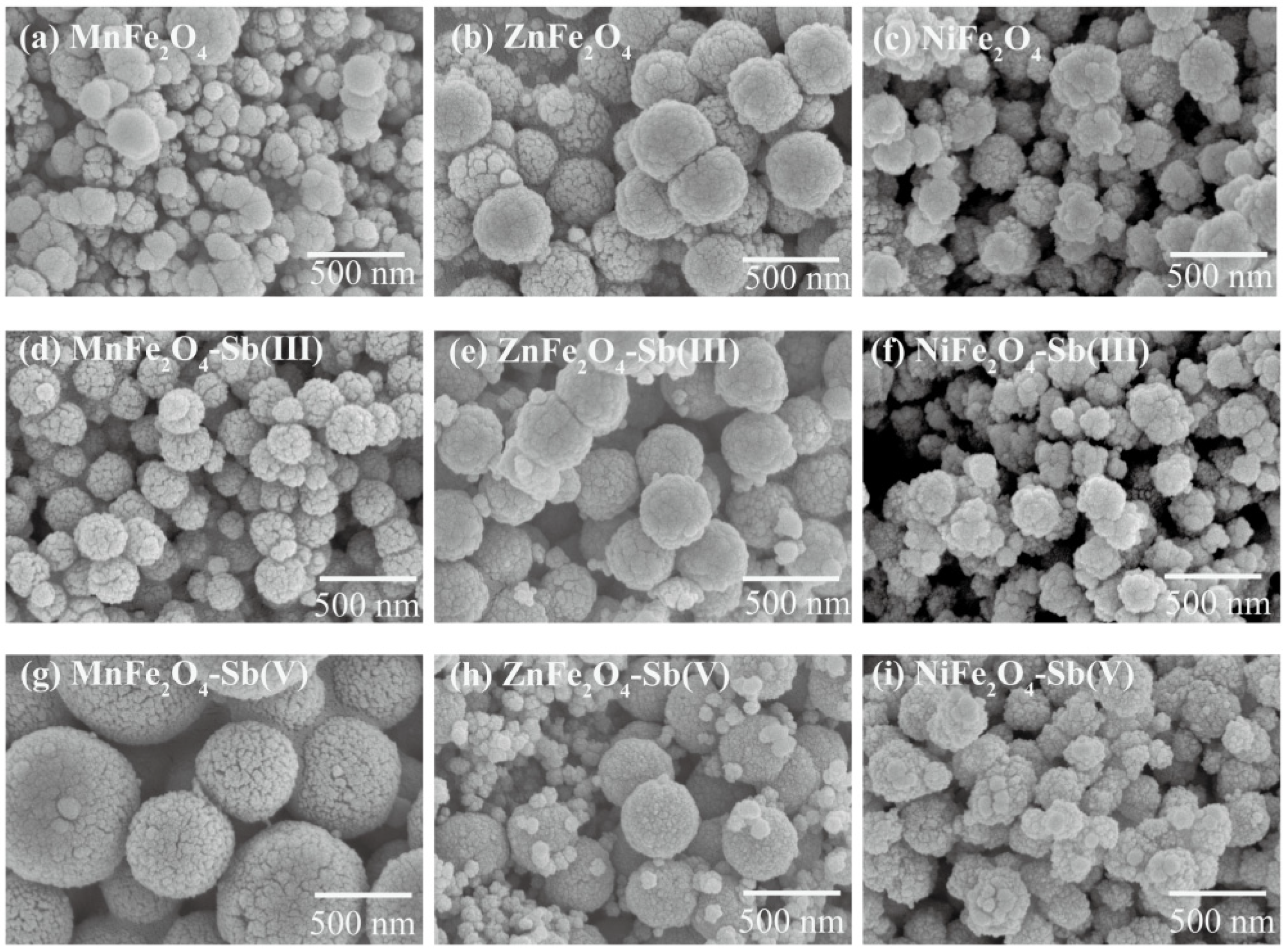
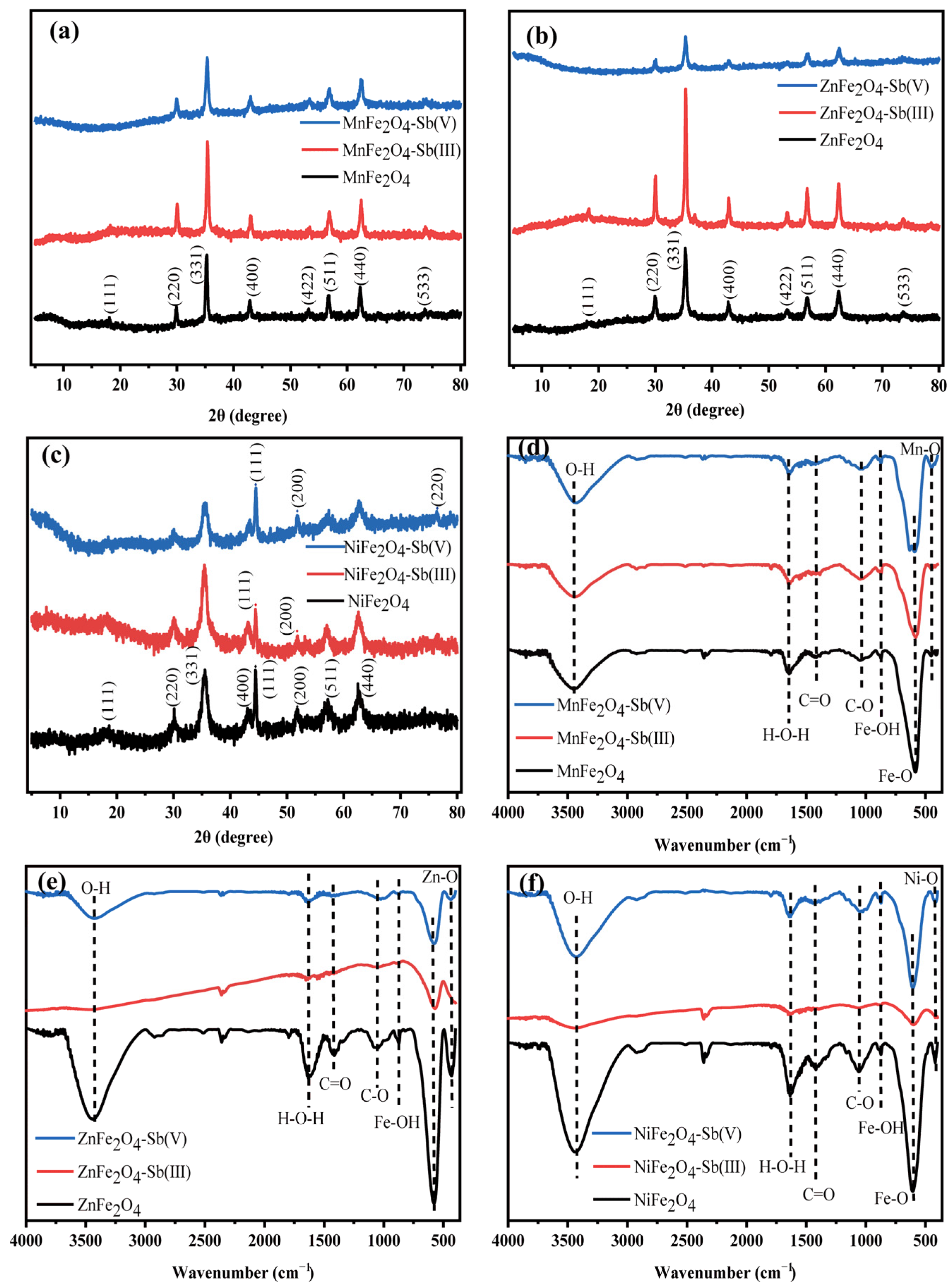
The three synthesized MFe2O4 ferrites consist of aggregated nanoscale particles with relatively uniform morphology. ZnFe2O4 exhibits a cauliflower-like morphology with the largest particle size, whereas NiFe2O4 and MnFe2O4 form smaller aggregates. NiFe2O4 particles demonstrate a pronounced tendency toward stacking, while MnFe2O4 exhibits the highest degree of morphological heterogeneity. The crystalline structures of MnFe2O4, ZnFe2O4 and NiFe2O4 were first examined by XRD. All diffraction patterns exhibit a series of characteristic peaks that can be well indexed to a cubic spinel structure, consistent with the standard spinel ferrite phase [21,30,31]. No impurity peaks associated with secondary iron oxides (e.g., Fe3O4, FeOOH or α-Fe2O3) were detected, indicating the successful formation of phase-pure MFe2O4 materials. The peak positions are generally similar across the three ferrites, indicating that substitution with different divalent metal ions does not alter the fundamental spinel framework. Nevertheless, slight shifts in peak positions can be observed among MnFe2O4, ZnFe2O4 and NiFe2O4, which can be reasonably attributed to differences in ionic radii and cation distribution within the spinel lattice. Such subtle lattice distortions imply that divalent metal substitution modulates the local coordination environment of Fe–O polyhedra, potentially influencing surface electronic structure and interfacial reactivity while preserving the overall crystallographic integrity [31,32].

3.2. Adsorption Behavior of Sb(III)/Sb(V) on MFe2O4

3.2.1. Effect of Solution pH

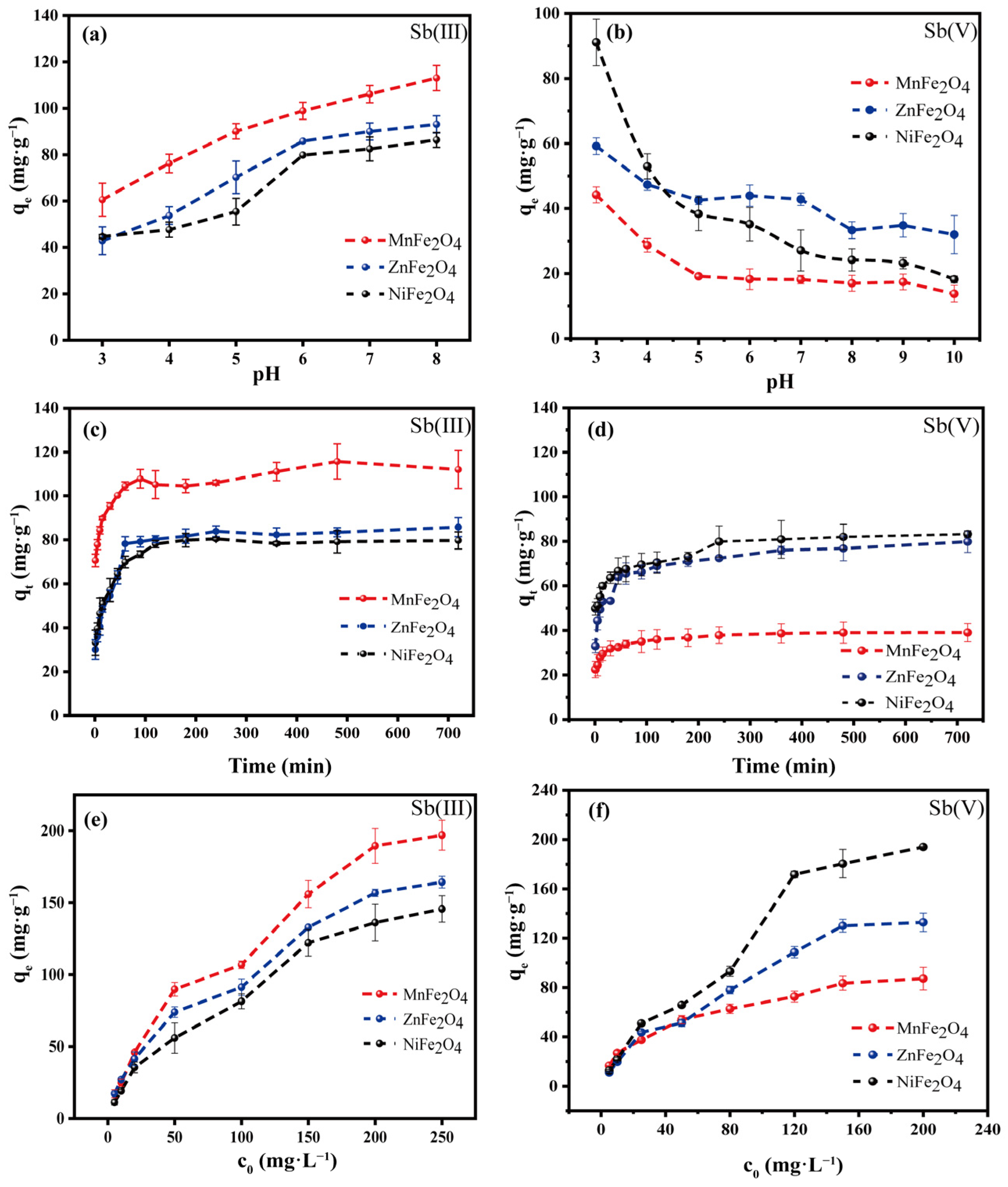
Solution pH is a crucial parameter governing the adsorption efficiency, as it affects both the surface charge property of MFe2O4 and the chemical speciation of antimony in aqueous solution [33,34]. The effect of solution pH on Sb(III) and Sb(V) adsorption by MnFe2O4, ZnFe2O4 and NiFe2O4 was systematically investigated, as shown in Figure 1a,b. For Sb(III), the adsorption capacity increased steadily as pH rose from 3.0 to 8.0. This pH range was deliberately selected based on Sb(III) speciation: when pH < 3.0, Sb(III) is protonated to Sb(OH)2+, which reduces its coordination affinity with the surface Fe–O/Fe–OH functional groups; at pH > 8.0, Sb(III) hydrolyzes to form negatively charged Sb(OH)4− species. Given that the point of zero charge (pHzc) of MFe2O4 is approximately 6.0 [34,35,36], the surface becomes negatively charged at pH > pHzc, leading to electrostatic repulsion with Sb(OH)4− and potentially compromising adsorption reliability. Within the pH 3.0~8.0 range, Sb(III) exists predominantly as the neutral species Sb(OH)3, which facilitates interaction with surface functional groups via ligand exchange or coordination mechanisms [37]. For Sb(V), which primarily occurs as negatively charged oxyanions (e.g., Sb(OH6−)), adsorption is more sensitive to surface charge and electrostatic interactions. Accordingly, the experimental pH range was extended to 3.0~10.0 to capture the transition of the MFe2O4 surface from positively to negatively charged across its pHzc (~6.0). At pH < 3.0, Sb(V) converts to neutral Sb(OH)5, weakening the electrostatic driving force for adsorption; at pH > 10.0, the high density of negative surface charge intensifies electrostatic repulsion with Sb(OH)6−, resulting in a marked decline in adsorption capacity. Notably, MnFe2O4 exhibits higher Sb(III) adsorption capacity across the investigated pH range, whereas ZnFe2O4 and NiFe2O4 show comparable but relatively lower performances. The trend was reversed for Sb(V) adsorption. These results indicate that divalent metal substitution influences Sb uptake behavior even under identical solution chemistry, suggesting that the modulation of surface reactivity is metal-dependent and extends beyond purely electrostatic control.

3.2.2. Adsorption Kinetics

The adsorption kinetics of Sb(III) and Sb(V) on MFe2O4 were investigated under the optimal pH conditions identified above, with the results shown in Figure 1c,d. For all materials and both Sb species, the adsorption process exhibits a characteristic two-stage behavior, consisting of a rapid initial uptake followed by a slower approach to equilibrium. This kinetic pattern is commonly attributed to the progressive occupation of available surface active sites [21]. Within the first 30 min, MnFe2O4, ZnFe2O4 and NiFe2O4 achieved 88.58%, 65.04% and 73.20% of their respective equilibrium adsorption capacities for Sb(III), indicating highly efficient early-stage adsorption. MnFe2O4 and ZnFe2O4 reached adsorption equilibrium at approximately 90 min, while NiFe2O4 required a longer contact time (120 min). Among the three ferrites, MnFe2O4 exhibited the fastest Sb(III) removal rate, which can be reasonably attributed to differences in surface structural properties and the intrinsic affinities of transition metal sites toward Sb(III), as previously reported [38]. In contrast, the adsorption kinetics of Sb(V) showed pronounced material-dependent differences. NiFe2O4 demonstrated a rapid increase in adsorption capacity, exceeding 70 mg·g−1 within 120 min and reaching equilibrium at approximately 240, with a capacity of 79.86 mg·g−1. ZnFe2O4 exhibits moderate Sb(V) uptake, reaching 70 mg·g−1 at 180 min and stabilizing at 72.40 mg·g−1 after 240 min. By comparison, MnFe2O4 showed much slower Sb(V) adsorption capacity, reaching equilibrium within 60 min but with a significantly reduced uptake of only 33.84 mg·g−1. These results indicate that although MnFe2O4 exhibits faster adsorption kinetics, NiFe2O4 possesses the greatest potential for Sb(V) removal in terms of equilibrium capacity.
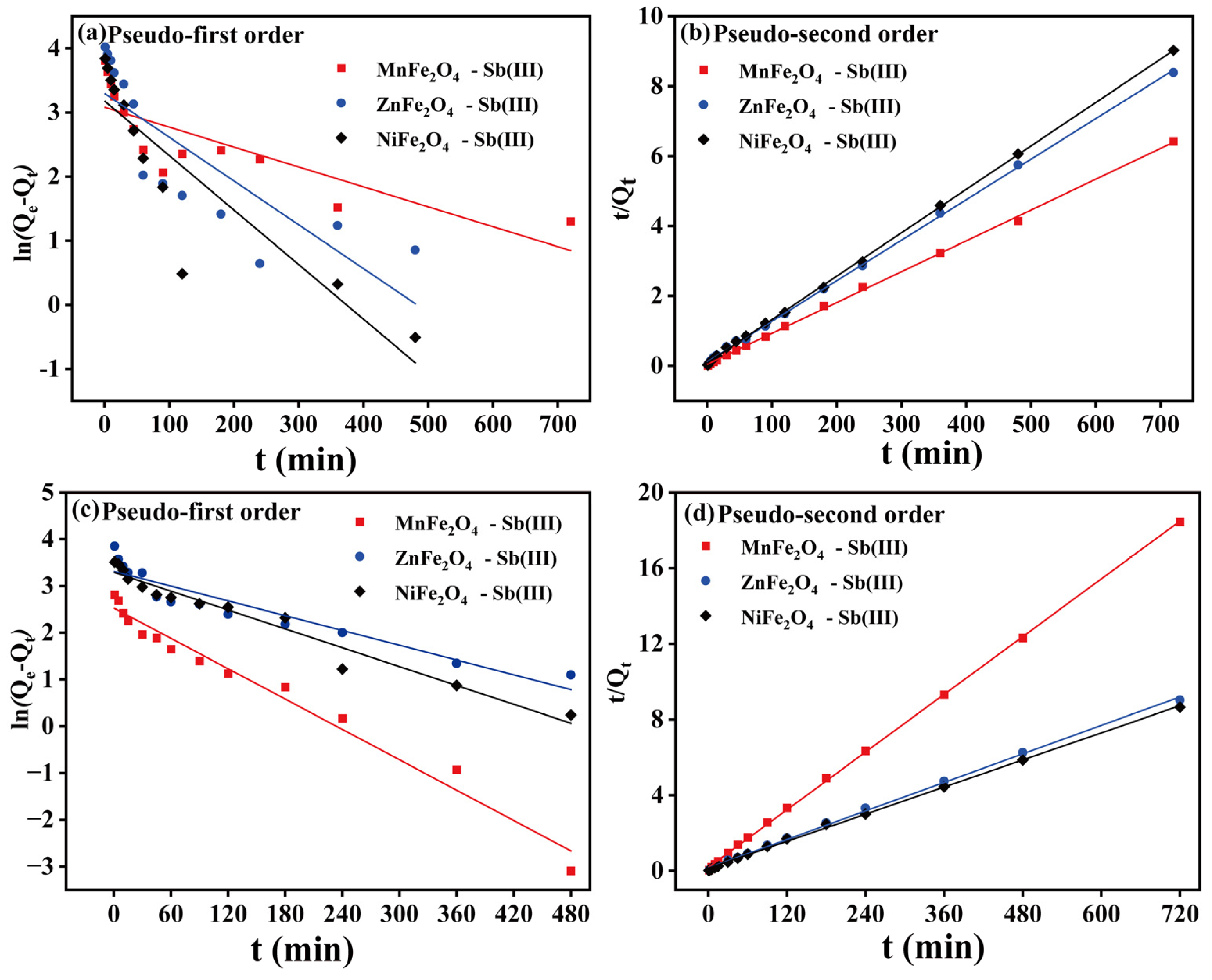
To quantitatively describe the adsorption kinetics, the experimental data for both Sb(III) and Sb(V) were fitted using pseudo-first-order and pseudo-second-order kinetic models (Table 1 and Figure 2). For all systems, the pseudo-second-order model provided a superior fit compared to the pseudo-first-order model, as evidenced by higher correlation coefficients and close agreement between model-predicted equilibrium adsorption capacities (qe) and experimental values [39]. This suggests that chemisorption dominates the adsorption process, a finding consistent with the conclusion reported that chemisorption governs Sb(III) adsorption on Fe/Mn-modified graphene oxide-chitosan composites [21]. However, the specific kinetic behaviors differed markedly between Sb(III) and Sb(V), reflecting the distinct interaction mechanisms associated with each oxidation state. Kinetic parameters further reveal a clear rate advantage for MnFe2O4, which exhibited a high initial adsorption rate (h0 = k2 × qe2 ≈ 12.85 mg·g−1·min−1) and reached equilibrium within 90 min, faster than ZnFe2O4 and NiFe2O4 (both~120 min). Similarly, for Sb(V), MnFe2O4 again exhibited the highest kinetic rate constant (k2 = 0.0035), exceeding those of ZnFe2O4 (0.0010) and NiFe2O4 (0.0011). Consequently, MnFe2O4 reached equilibrium within 60 min, whereas ZnFe2O4 and NiFe2O4 required up to 240 min, confirming its kinetic advantage for Sb(V) adsorption despite its lower equilibrium capacity. Such variations further suggest that divalent metal identity influences not only the adsorption capacity but also the kinetics of Sb-surface interactions.

3.2.3. Adsorption Isotherms and Capacity Comparison

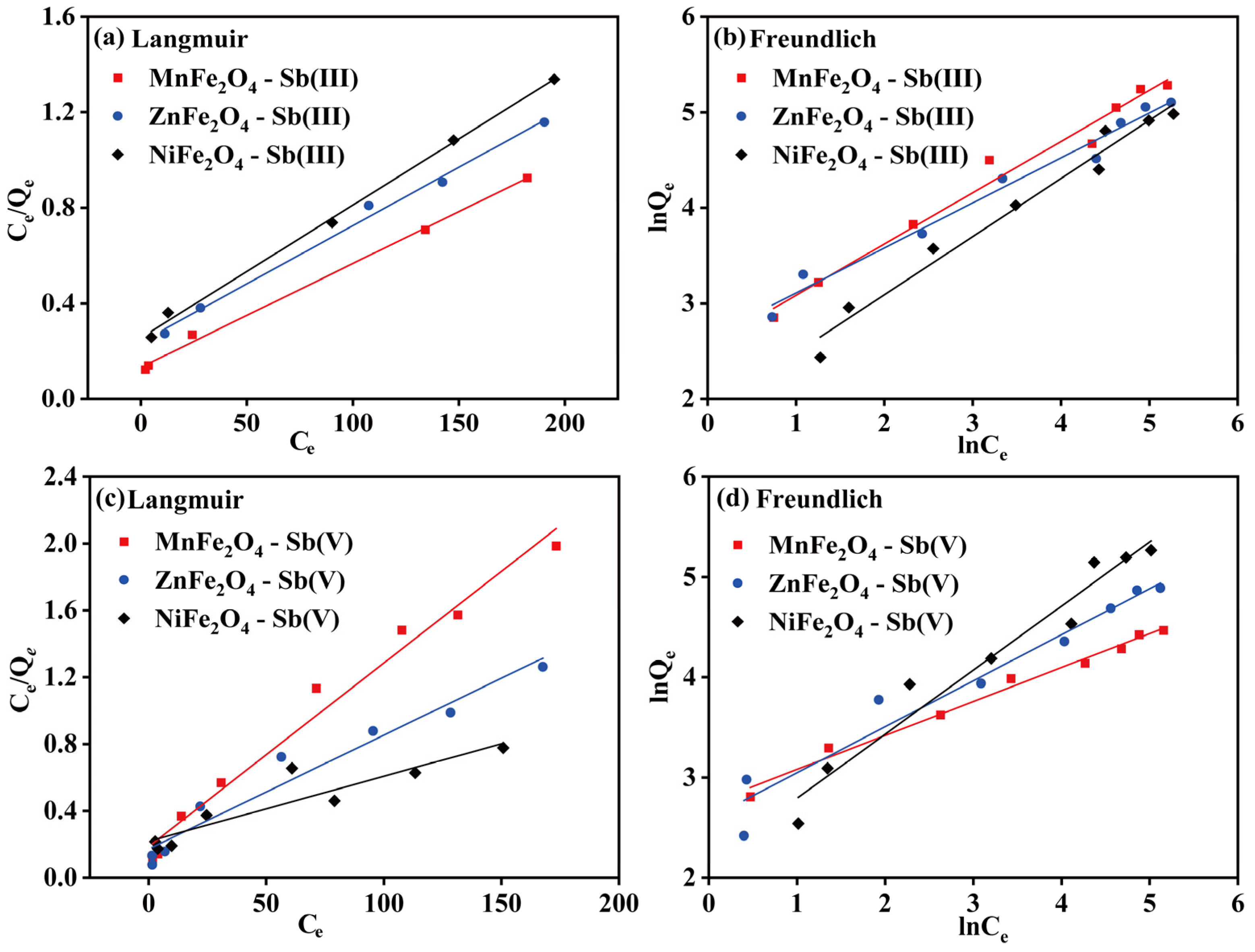
Adsorption isotherms of Sb(III) and Sb(V) on MnFe2O4, ZnFe2O4 and NiFe2O4 were obtained at the optimal pH conditions by varying the initial Sb concentration, with the corresponding results shown in Figure 1e,f, Table 2 and Figure 3. The adsorption capacities of both Sb species increased with rising initial concentrations, consistent with typical adsorption isotherm behavior. For Sb(III), the adsorption isotherms for all three ferrites are well described by the Langmuir model, as evidenced by higher correlation coefficients compared to the Freundlich model [40]. This result indicates that Sb(III) adsorption occurs predominantly via monolayer coverage on energetically uniform surface sites [40,41]. Among the tested materials, MnFe2O4 exhibits the highest maximum adsorption capacity, followed by ZnFe2O4 and NiFe2O4. Moreover, MnFe2O4 exhibited the highest Langmuir constant (KL = 0.029 L·mg−1), suggesting a stronger affinity for Sb(III), consistent with its superior adsorption performance. This capacity sequence is consistent with the kinetic results, further confirming the strong affinity of Mn-containing surface sites toward Sb(III). In contrast, the adsorption behavior of Sb(V) differs markedly from that of Sb(III). For Sb(V), both Langmuir and Freundlich models provide reasonable fits to the experimental data, suggesting the involvement of heterogeneous surface sites and variable interaction energies [42,43]. The Freundlich exponent 1/n values for all three ferrites were below 1 (0.339 for MnFe2O4, 0.459 for ZnFe2O4 and 0.639 for NiFe2O4), which generally indicates stronger affinity. ZnFe2O4 and NiFe2O4 exhibit substantially higher adsorption capacities for Sb(V) compared with MnFe2O4, highlighting a pronounced divalent-metal-dependent effect on Sb(V) uptake. Notably, NiFe2O4 shows the highest equilibrium capacity for Sb(V), in agreement with its superior performance observed in the kinetic experiments. The distinct isotherm characteristics between Sb(III) and Sb(V) reflect their fundamentally different interaction modes with MFe2O4 surfaces. The strong Langmuir-type behavior observed for Sb(III) implies dominant site-specific interactions, whereas the mixed Langmuir–Freundlich behavior of Sb(V) indicates more complex adsorption processes involving surface heterogeneity and possibly multiple binding configurations.
From a comparative perspective, these results clearly demonstrate that divalent metal substitution does not exert a uniform effect on antimony adsorption but instead regulates the adsorption capacity in a valence-dependent manner. Specifically, MnFe2O4 is more favorable for Sb(III) adsorption, whereas ZnFe2O4 and NiFe2O4 exhibit a clear advantage for Sb(V) removal. Such contrasting trends cannot be explained solely by differences in surface area or morphology. Literature-reported specific surface areas of solvothermal-synthesized MFe2O4 (65.6 m2·g−1 for MnFe2O4, 112.9 m2·g−1 for ZnFe2O4 and 70–90 m2·g−1 for NiFe2O4) [44,45,46,47] show only minor variations that exert no significant influence on the adsorption behavior. This points to fundamental differences in surface chemistry induced by divalent metal incorporation. To further contextualize the performance of the prepared materials, a comparison with recent relevant studies shows that MFe2O4-based materials typically require relatively high dosage (0.5~2.5 g·L−1) for effective removal of heavy metals or dyes, with adsorption capacities below 100 mg·g−1 [23,48,49]. In contrast, the present study achieves efficient adsorption of Sb(III) and Sb(V) at a significantly lower adsorbent dosage of 0.25 g·L−1. This result further confirms the regulatory effect of divalent metal substitution on the surface chemical properties of MFe2O4, enabling it to maintain high adsorption performance while drastically reducing adsorbent dosage, which is mainly attributed to the enrichment of Fe-O/M-O active sites and the enhanced valence selectivity for Sb species.

3.2.4. Effects of Coexisting Anions

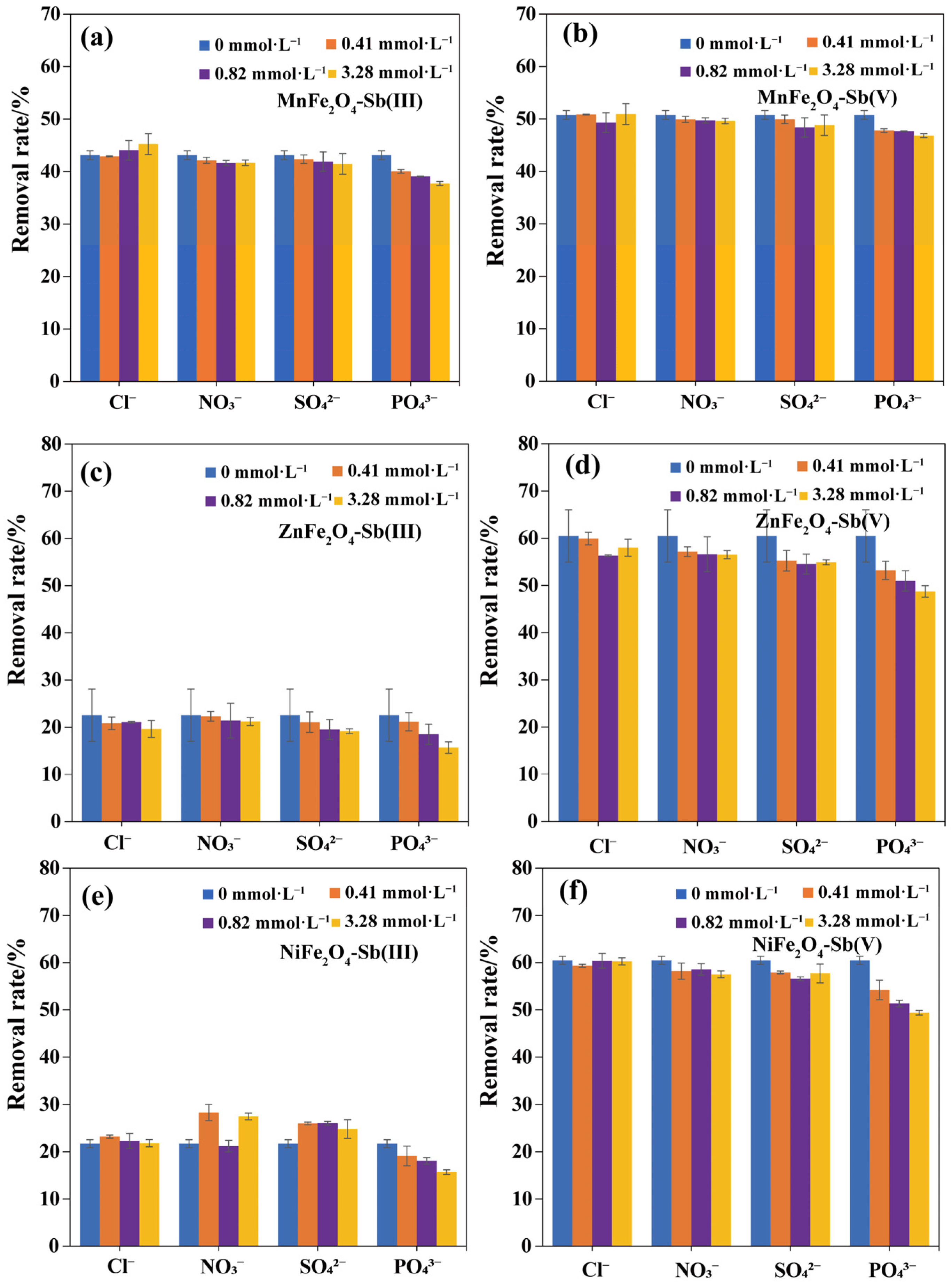
The influence of common coexisting anions on the adsorption of Sb(III) and Sb(V) by MnFe2O4, ZnFe2O4 and NiFe2O4 was evaluated to assess the performance and selectivity of MFe2O4 ferrites under complex aqueous conditions (Figure 4). The results reveal markedly different responses depending on both the anion identity and the oxidation state of antimony. For Sb(III), the presence of Cl−, SO42− and NO3− exerted negligible effects on adsorption across all three ferrites, even at elevated anion concentrations. In contrast, PO43− cause moderate inhibition of Sb(III) uptake. This inhibitory effect was most pronounced at the highest concentration tested (3.28 mmol·L−1), where Sb(III) removal efficiencies decreased by 5.32%, 6.28% and 5.82% for MnFe2O4, ZnFe2O4 and NiFe2O4, respectively. Overall, however, Sb(III) adsorption remained relatively stable in the presence of competing anions, indicating a weak dependence on electrostatic interactions and limited competition for surface adsorption sites. Sb(V) adsorption was considerably more sensitive to coexisting anions. PO43− exerted the most significant inhibitory effect, reducing Sb(V) removal by 3.93%, 11.78% and 11.10% for MnFe2O4, ZnFe2O4 and NiFe2O4, respectively, at 3.28 mmol·L−1. SO42− also shows a noticeable suppression of Sb(V) uptake, whereas Cl− and NO3− have minimal influence. The pronounced interference by PO43− can be attributed to the strong chemical similarity between Sb and P, which belong to the same group in the periodic table and form structurally analogous oxyanions. This similarity facilitates direct competition for surface adsorption sites [50,51]. Additionally, PO43− hydrolysis in aqueous solution releases OH−, which may further inhibit Sb adsorption by altering surface charge and reducing the availability of reactive hydroxyl groups.
Despite the overall suppression induced by competing anions, MnFe2O4 maintains relatively higher Sb(V) adsorption selectivity compared with ZnFe2O4 and NiFe2O4 under identical conditions. This enhanced resistance to competitive adsorption suggests a stronger affinity of Mn-containing surfaces toward Sb(V), allowing partial preservation of adsorption performance even in the presence of high concentrations of competing oxyanions [52,53,54]. From an environmental perspective, the contrasting responses of Sb(III) and Sb(V) to coexisting anions further underscore the critical role of antimony speciation in determining adsorption selectivity. The comparatively robust uptake of Sb(III) by MnFe2O4, together with the divalent-metal-dependent tolerance toward Sb(V) competition, particularly ZnFe2O4 and NiFe2O4, indicates that MFe2O4 ferrites are promising candidates for Sb removal in complex water matrices where multiple inorganic anions coexist.

3.3. Adsorption and Transformation Mechanisms

3.3.1. Structural Stability of MFe2O4 During Sb Adsorption

Compared to the pristine MFe2O4 samples, discernible but moderate morphological variations were observed after Sb(III) and Sb(V) adsorption (Figure 5). For MnFe2O4, the particles exhibit an apparent increase in agglomerate size and a tendency to adopt a more spherical appearance, accompanied by the development of slit-like surface features and the attachment of numerous fine particles. In the case of ZnFe2O4, the overall morphology remains largely preserved, although the surface slits become less pronounced and small particles are observed adhering to the surfaces. Similarly, NiFe2O4 shows enhanced particle stacking after Sb adsorption, resulting in a relatively more compact aggregated structure. These observed surface modifications, including particle accumulation and textural changes, indicate that both Sb(III) and Sb(V) participate in surface reactions with MFe2O4 to varying extents, leading to their effective immobilization on the adsorbent surface. After adsorption and magnetic separation, all supernatants were visually clear and colorless, suggesting that the MFe2O4 ferrites exhibit excellent chemical stability without leaching of colored species. This qualitative observation supports the potential of these materials for practical wastewater treatment applications.
The XRD patterns of MnFe2O4, ZnFe2O4 and NiFe2O4 after Sb(III) and Sb(V) adsorption (Figure 6a–c) remain well consistent with those of the pristine materials. All characteristic diffraction peaks corresponding to the cubic spinel structure are preserved, and no new crystalline phases associated with antimony compounds or secondary iron oxides are detected. These results indicate that Sb adsorption does not induce detectable structural reconstruction or phase transformation of the MFe2O4 lattice [55,56,57]. Therefore, the observed differences in adsorption behavior and capacity cannot be attributed to changes in bulk crystallinity and are more likely governed by surface and interfacial processes.
FTIR spectra provide direct evidence for the involvement of surface functional groups during Sb adsorption on MFe2O4 ferrites (Figure 6d–f). For pristine MnFe2O4, the characteristic Fe–OH peak at 890 cm−1 and Fe–O stretching bands at 578 and 438 cm−1 are clearly identifiable. After Sb(III) adsorption, these bands are noticeably weakened, indicating the participation of surface Fe–O and Fe–OH groups in Sb(III) binding. A similar spectral evolution is observed for ZnFe2O4, except that the F–OH peak at 890 cm−1 disappeared completely after adsorption, suggesting a stronger involvement of hydroxyl-associated sites. In NiFe2O4, the Fe–OH vibration at 890 cm−1 and the Fe–O band at 578 cm−1 show reduced intensities following Sb(III) uptake [38]. These spectral changes collectively indicate that Sb(III) interacts preferentially with surface Fe–O and Fe–OH functional groups, which act as the primary binding sites for Sb(III) immobilization. Although the adsorption behaviors of Sb(III) and Sb(V) share common features, their FTIR responses reveal notable differences in the functional groups involved. After Sb(V) adsorption, the Fe–O stretching bands of MnFe2O4 (586 cm−1), ZnFe2O4 (578 cm−1) and NiFe2O4 (606 cm−1) all show weakening or peak shifts. Meanwhile, the M–O vibrations (Mn–O at 450 cm−1, Zn–O at 431 cm−1 and Ni–O at 420 cm−1) are also weakened or shifted. These changes suggest that Sb(V) adsorption involves both Fe–O and M–O functional groups. Notably, the weakening of the Fe–OH peak in ZnFe2O4 further implies that Fe–OH groups may also contribute to Sb(V) immobilization. The broad –OH stretching band around 3400 cm−1 and the bending vibration near 1630 cm−1 show intensity variations after Sb uptake, suggesting the participation of surface hydroxyl groups in the adsorption process. These changes are more pronounced for Sb(V) adsorption, consistent with its anionic nature and stronger dependence on hydroxyl-mediated interactions, as evidenced by the competitive anion experiments. Collectively, the FTIR results indicate that Sb adsorption on MFe2O4 ferrites is fundamentally governed by functional group–mediated interactions.

3.3.2. Surface Chemical Interactions and Sb Speciation from XPS Analysis

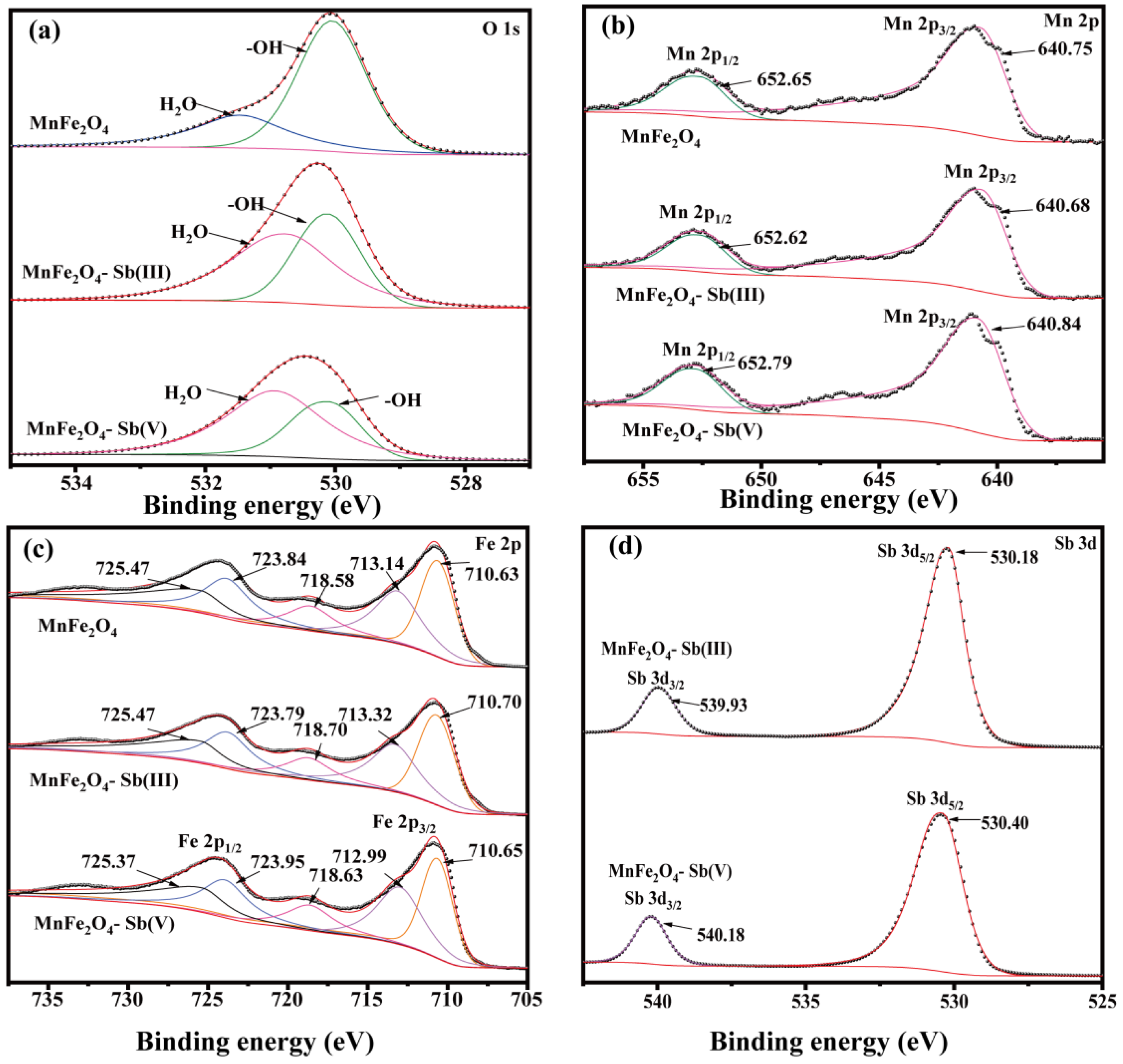
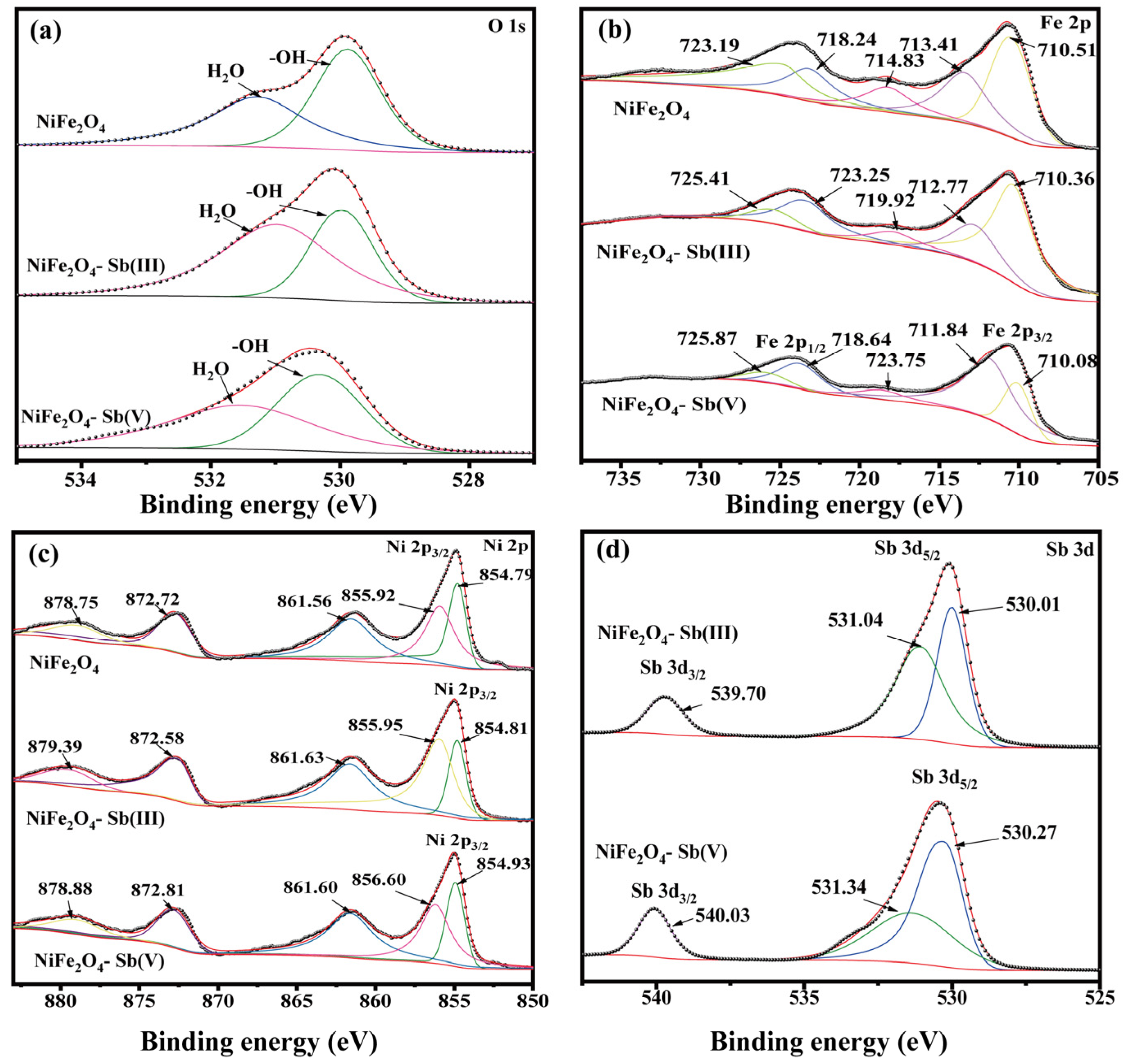
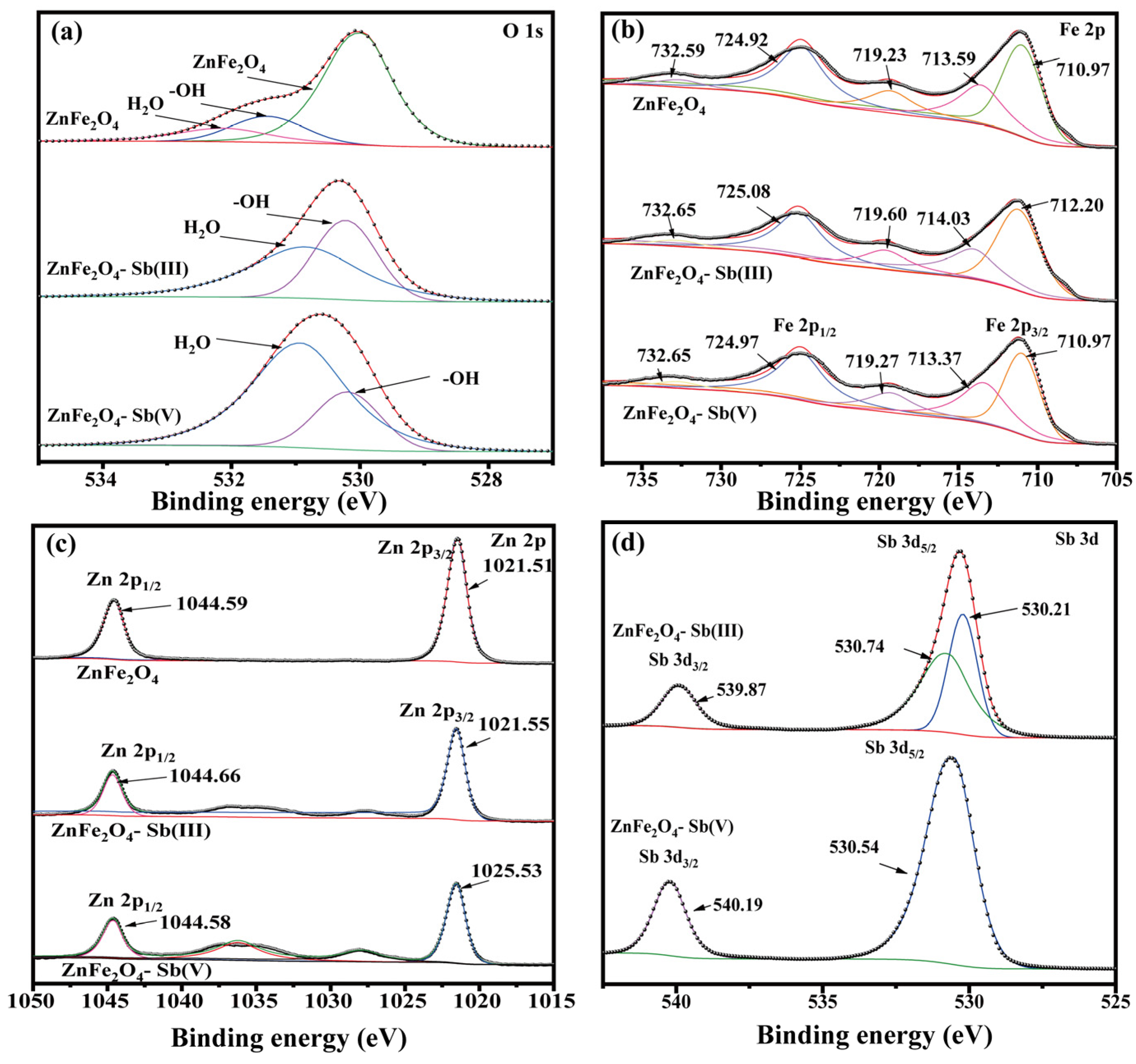
XPS was employed to elucidate the surface chemical interactions and binding mechanisms between MFe2O4 (M = Mn, Zn, Ni) ferrites and Sb(III)/Sb(V). Both survey and high-resolution spectra were analyzed to decode changes in surface composition, functional groups and Sb speciation following adsorption. After exposure to Sb(III) or Sb(V), distinct Sb 3d signals appear in all MFe2O4 samples, directly confirming the successful immobilization of Sb on the ferrite surfaces [58]. High-resolution O 1s spectra of pristine MFe2O4 can be deconvoluted into lattice oxygen (O2−), surface hydroxyl (–OH) and adsorbed H2O components. After Sb(III) and Sb(V) adsorption, the –OH contribution decreases markedly for all samples, indicating that surface hydroxyl groups act as universal active sites for Sb binding, likely through ligand exchange or hydroxyl-mediated surface complexation. Consistently, Fe 2p spectra exhibit slight binding energy shifts and intensity variations after adsorption, reflecting changes in the local electronic environment of Fe sites and supporting the formation of Fe–O–Sb linkages [59,60]. Together with the O 1s results, these observations confirm that Fe–O and Fe–OH groups constitute the primary binding framework for both Sb(III) and Sb(V) on MFe2O4 surfaces.
The role of divalent metal sites was further clarified by M 2p spectra. For MnFe2O4 and NiFe2O4, noticeable binding energy shifts of Mn 2p3/2 and Ni 2p3/2 are observed after Sb(V) adsorption, suggesting the involvement of Mn–O and Ni–O groups in Sb(V) complexation (Figure 7 and Figure 8). ZnFe2O4 shows a subtle Zn 2p3/2 shift after Sb(III) adsorption, indicating participation of Zn–O groups (Figure 9) [61,62]. Notably, these divalent metal–oxygen interactions are more pronounced for Sb(V) than for Sb(III), indicating that M–O groups selectively enhance Sb(V) adsorption [63]. Their limited contribution to Sb(III) binding is consistent with the weaker sensitivity of Sb(III) adsorption to surface heterogeneity and competing anions observed in the batch experiments.
The Sb 3d spectra provide direct evidence for valence-dependent behavior. For MnFe2O4 and NiFe2O4, only Sb(III) signals are detected after Sb(III) adsorption, indicating immobilization via non-redox surface complexation. In contrast, Sb-loaded ZnFe2O4 exhibits both Sb(III) and Sb(V) species in the Sb 3d spectra after Sb(III) adsorption, demonstrating that ZnFe2O4 can oxidize Sb(III) to less toxic Sb(V). This unique property is attributed to the high redox potential of Zn3+–Fe3+ pairs in its spinel structure. For Sb(V) adsorption, all samples show a characteristic Sb 3d5/2 peak centered at approximately 530.18 eV, confirming stable Sb(V) immobilization via surface complexation [52].
Collectively, Sb adsorption on MFe2O4 ferrites is primarily governed by surface complexation mediated by –OH and Fe–O groups, which act as universal binding sites for both Sb(III) and Sb(V). Divalent metal–oxygen groups (Mn–O, Zn–O and Ni–O) play a secondary but selective role, preferentially enhancing Sb(V) adsorption through synergistic interactions. Among the three materials, ZnFe2O4 exhibits an additional redox functionality, enabling partial oxidation of Sb(III) to Sb(V) during adsorption, whereas MnFe2O4 and NiFe2O4 immobilize Sb(III) mainly via non-redox complexation pathways. This valence-dependent behavior, regulated by divalent metal substitution, provides a coherent explanation for the observed differences in adsorption capacity, kinetics and selectivity among the MFe2O4 ferrites.

4. Conclusions

This study systematically investigated the regulatory role of divalent metal cations (M2+ = Mn, Zn, Ni) in spinel ferrites (MFe2O4) on the valence-dependent adsorption of Sb(III) and Sb(V), providing mechanistic insights into surface functional group interactions and interfacial redox behavior. Nanocrystalline MnFe2O4, ZnFe2O4 and NiFe2O4 were successfully synthesized via a solvothermal method and evaluated through integrated batch adsorption experiments and spectroscopic analyses. The results demonstrate a pronounced M2+-dependent valence selectivity: MnFe2O4 exhibited the highest affinity for Sb(III) (229.89 mg·g−1), while NiFe2O4 showed superior Sb(V) uptake (257.07 mg·g−1). Kinetic data conformed well to the pseudo-second-order model, indicating chemisorption-controlled processes. Isotherm analysis revealed that Sb(III) adsorption followed the Langmuir model, consistent with monolayer inner-sphere complexation, whereas Sb(V) adsorption displayed mixed Langmuir–Freundlich characteristics, reflecting surface heterogeneity and the involvement of multiple binding modes.
Mechanistic investigations elucidated the distinct roles of surface functional groups. Sb(III) immobilization was primarily mediated by Fe–O and Fe–OH groups via inner-sphere complexation. In contrast, Sb(V) adsorption involved synergistic interactions with both Fe–O and M–O (Mn–O, Zn–O, Ni–O) functionalities. Notably, XPS analysis revealed that ZnFe2O4 induced partial oxidation of Sb(III) to Sb(V) on the surface, attributed to Fe3+-mediated interfacial electron transfer modulated by Zn2+ substitution, a redox behavior not observed for MnFe2O4 or NiFe2O4. Structural characterization confirmed that all MFe2O4 ferrites maintained excellent crystalline stability throughout the adsorption process, with no detectable phase transformation. Competitive adsorption studies showed that Sb(III) uptake was largely unaffected by coexisting anions, whereas Sb(V) adsorption was inhibited by phosphate due to direct competition for surface sites and structural analogies between Sb and P oxyanions. Notably, MnFe2O4 exhibited greater resilience to anionic competition for Sb(V), suggesting a stronger intrinsic affinity of Mn–O sites.
While this work provides fundamental insights into M2+-regulated surface reactivity and valence-dependent adsorption mechanisms, it is important to acknowledge that desorption and regeneration studies were beyond the scope of this investigation. Future work should address adsorbent reusability to fully assess practical applicability. In summary, this study establishes a structure-activity framework linking divalent metal substitution in spinel ferrites to tunable surface chemistry, selective Sb speciation removal and interfacial redox functionality. These findings advance the mechanistic understanding of MFe2O4 ferrites as magnetic adsorbents and provide a rational basis for designing next-generation materials tailored for efficient remediation of antimony-contaminated waters.

Author Contributions

L.M.: Conceptualization, resources, writing—review and editing, funding acquisition; J.Z. (Jie Zheng): methodology, software, formal analysis, writing—original draft preparation; F.L.: software, methodology, investigation; Y.C.: formal analysis, investigation; R.H.: software, data curation; J.Z. (Jiayi Zhang): data curation, visualization; N.W.: Conceptualization, writing—review and editing, supervision, project administration, funding acquisition; Z.N.: writing—review and editing, supervision, funding acquisition; Z.Z.: investigation, resources, writing—review and editing, project administration. All authors have read and agreed to the published version of the manuscript.

Funding

The authors gratefully acknowledge the funding support from the National Natural Science Foundation of China (42277202, 42307281, U21A2034), Guangzhou Special Topic on Basic and Applied Basic Research (2025A04J5459), Guangdong Basic and Applied Basic Research Foundation (2022A1515110900) and the Guizhou Provincial Major Scientific and Technological Program (No. [2024]013).

Data Availability Statement

The original contributions presented in this study are included in the article. Further inquiries can be directed to the corresponding authors.

Conflicts of Interest

The authors declare that they have no known competing financial interests or personal relationships that could have appeared to influence the work reported in this paper.

References

  1. Chen, G.; Zhao, J.; Chen, S.; Zheng, Z.; Su, Z.; Luo, J.; Liang, G. Perspective of Environmentally Friendly Antimony Selenide-Based Solar Cell. Appl. Phys. Lett. 2024, 125, 200502. [Google Scholar] [CrossRef] [Scilit]
  2. Lai, Z.; He, M.; Lin, C.; Ouyang, W.; Liu, X. Interactions of Antimony with Biomolecules and Its Effects on Human Health. Ecotoxicol. Environ. Saf. 2022, 233, 113317. [Google Scholar] [CrossRef] [Scilit] [PubMed]
  3. Yi, B.; Zhao, Z.; Gao, X.; Zhao, D.; Liu, X.; Zhang, W.; Zhang, Z.; Zhang, C. Antimony Exposure Induces Bladder Cancer Metastasis via Activation of the SUMOylation-Dependent TGF-β/Smad2/3 Axis. Environ. Res. 2025, 285, 122589. [Google Scholar] [CrossRef] [Scilit] [PubMed]
  4. Zhu, Y.; Shao, J.; Jiang, Y.; Zhang, K.; Shi, Q.; Qu, Q.; Zheng, H. Sb Nanocrystallites Derived from Industrial Antimony White as Promising Alloying-Type Anodes for Na-Ion Batteries. J. Alloys Compd. 2022, 926, 166808. [Google Scholar] [CrossRef] [Scilit]
  5. Filella, M.; Belzile, N.; Chen, Y.-W. Antimony in the Environment: A Review Focused on Natural Waters: I. Occurrence. Earth-Sci. Rev. 2002, 57, 125–176. [Google Scholar] [CrossRef] [Scilit]
  6. Bai, Y.; Tang, X.; Sun, L.; Yin, W.; Hu, G.; Liu, M.; Gong, Y. Application of Iron-Based Materials for Removal of Antimony and Arsenic from Water: Sorption Properties and Mechanism Insights. Chem. Eng. J. 2022, 431, 134143. [Google Scholar] [CrossRef] [Scilit]
  7. Krachler, M.; Emons, H.; Zheng, J. Speciation of Antimony for the 21st Century: Promises and Pitfalls. TrAC Trends Anal. Chem. 2001, 20, 79–90. [Google Scholar] [CrossRef] [Scilit]
  8. Rakshit, S.; Sarkar, D.; Punamiya, P.; Datta, R. Antimony Sorption at Gibbsite–Water Interface. Chemosphere 2011, 84, 480–483. [Google Scholar] [CrossRef] [Scilit]
  9. Pintor, A.M.A.; Vieira, B.R.C.; Boaventura, R.A.R.; Botelho, C.M.S. Removal of Antimony from Water by Iron-Coated Cork Granulates. Sep. Purif. Technol. 2020, 233, 116020. [Google Scholar] [CrossRef] [Scilit]
  10. Li, J.; Zheng, B.; He, Y.; Zhou, Y.; Chen, X.; Ruan, S.; Yang, Y.; Dai, C.; Tang, L. Antimony Contamination, Consequences and Removal Techniques: A Review. Ecotoxicol. Environ. Saf. 2018, 156, 125–134. [Google Scholar] [CrossRef] [Scilit]
  11. Meng, L.; Wu, M.; Chen, H.; Xi, Y.; Huang, M.; Luo, X. Rejection of Antimony in Dyeing and Printing Wastewater by Forward Osmosis. Sci. Total Environ. 2020, 745, 141015. [Google Scholar] [CrossRef] [Scilit]
  12. Mitrakas, M.; Mantha, Z.; Tzollas, N.; Stylianou, S.; Katsoyiannis, I.; Zouboulis, A. Removal of Antimony Species, Sb(III)/Sb(V), from Water by Using Iron Coagulants. Water 2018, 10, 1328. [Google Scholar] [CrossRef] [Scilit]
  13. Gupta, K.; Joshi, P.; Gusain, R.; Khatri, O.P. Recent Advances in Adsorptive Removal of Heavy Metal and Metalloid Ions by Metal Oxide-Based Nanomaterials. Coord. Chem. Rev. 2021, 445, 214100. [Google Scholar] [CrossRef] [Scilit]
  14. Ismail, U.M.; Vohra, M.S.; Onaizi, S.A. Adsorptive Removal of Heavy Metals from Aqueous Solutions: Progress of Adsorbents Development and Their Effectiveness. Environ. Res. 2024, 251, 118562. [Google Scholar] [CrossRef] [Scilit]
  15. Ullah, M.H.; Rahman, M.J. Adsorptive Removal of Toxic Heavy Metals from Wastewater Using Water Hyacinth and Its Biochar: A Review. Heliyon 2024, 10, e36869. [Google Scholar] [CrossRef] [Scilit] [PubMed]
  16. Lin, S.-H.; Juang, R.-S. Adsorption of Phenol and Its Derivatives from Water Using Synthetic Resins and Low-Cost Natural Adsorbents: A Review. J. Environ. Manag. 2009, 90, 1336–1349. [Google Scholar] [CrossRef] [Scilit]
  17. Zhang, C.; Jiang, H.; Deng, Y.; Wang, A. Adsorption Performance of Antimony by Modified Iron Powder. RSC Adv. 2019, 9, 31645–31653. [Google Scholar] [CrossRef] [Scilit]
  18. Guo, X.; Wu, Z.; He, M.; Meng, X.; Jin, X.; Qiu, N.; Zhang, J. Adsorption of Antimony onto Iron Oxyhydroxides: Adsorption Behavior and Surface Structure. J. Hazard. Mater. 2014, 276, 339–345. [Google Scholar] [CrossRef] [Scilit]
  19. Tu, Y.-J.; Wang, S.-L.; Lu, Y.-R.; Chan, T.-S.; Johnston, C.T. New Insight in Adsorption of Sb(III)/Sb(V) from Waters Using Magnetic Nanoferrites: X-Ray Absorption Spectroscopy Investigation. J. Mol. Liq. 2021, 330, 115691. [Google Scholar] [CrossRef] [Scilit]
  20. Rahman, M.N.; Hossain, M.A. Transition Metal Based Spinel Ferrites: A Review. Mater. Today Sustain. 2026, 33, 101252. [Google Scholar] [CrossRef] [Scilit]
  21. Mo, H.; Shan, H.; Xu, Y.; Liao, H.; Lu, M.; Peng, S.; Zhao, Y. The Sustainable Remediation of Antimony(III)-Contaminated Water Using Iron and Manganese-Modified Graphene Oxide–Chitosan Composites: A Comparative Study of Kinetic and Isotherm Models. Sustainability 2024, 16, 7599. [Google Scholar] [CrossRef] [Scilit]
  22. Tabesh, F.; Mallakpour, S.; Hussain, C.M. Recent Advances in Magnetic Semiconductor ZnFe2O4 Nanoceramics: History, Properties, Synthesis, Characterization, and Applications. J. Solid State Chem. 2023, 322, 123940. [Google Scholar] [CrossRef] [Scilit]
  23. Akbar, A.; Bhavani Lakshmi, M.; Das, T.K.; Ghosh, M. Spinel Ferrites in the Photocatalytic and Adsorptive Remediation of Dyes and Heavy Metals: A Review. J. Water Process Eng. 2025, 71, 107259. [Google Scholar] [CrossRef] [Scilit]
  24. Kefeni, K.K.; Mamba, B.B.; Msagati, T.A.M. Application of Spinel Ferrite Nanoparticles in Water and Wastewater Treatment: A Review. Sep. Purif. Technol. 2017, 188, 399–422. [Google Scholar] [CrossRef] [Scilit]
  25. Hosseini, S.A.; Abbasian, A.R.; Gholipoor, O.; Ranjan, S.; Dasgupta, N. Adsorptive Removal of Arsenic from Real Sample of Polluted Water Using Magnetic GO/ZnFe2O4 Nanocomposite and ZnFe2O4 Nanospinel. Int. J. Environ. Sci. Technol. 2019, 16, 7455–7466. [Google Scholar] [CrossRef] [Scilit]
  26. Lei, Y.; Huo, T.; Yin, T.; Xiao, X.; Ma, Y.; Wang, H.; Liu, M. Magnetic Sulfide–Modified MFe2O4/Montmorillonite (M=Fe, Zn) for Efficient Sorption of Cd(II). Water Air Soil Pollut. 2024, 235, 82–97. [Google Scholar] [CrossRef] [Scilit]
  27. Deng, R.-J.; Jin, C.-S.; Ren, B.-Z.; Hou, B.-L.; Hursthouse, A. The Potential for the Treatment of Antimony-Containing Wastewater by Iron-Based Adsorbents. Water 2017, 9, 794. [Google Scholar] [CrossRef] [Scilit]
  28. Nizam, T.; Thomas, M.; George, M.; Joseph, A. Adsorption Efficiency of Sol–Gel Derived Nano Metal Ferrites, MFe2O4 (M = Ni, Zn, Cu) on the Removal of Cr (VI) Ions from Aqueous Solution. J. Sol-Gel Sci. Technol. 2022, 101, 618–629. [Google Scholar] [CrossRef] [Scilit]
  29. Xian, G.; Kong, S.; Li, Q.; Zhang, G.; Zhou, N.; Du, H.; Niu, L. Synthesis of Spinel Ferrite MFe2O4 (M = Co, Cu, Mn, and Zn) for Persulfate Activation to Remove Aqueous Organics: Effects of M-Site Metal and Synthetic Method. Front. Chem. 2020, 8, 177–187. [Google Scholar] [CrossRef] [Scilit]
  30. Harada, M.; Kuwa, M.; Sato, R.; Teranishi, T.; Takahashi, M.; Maenosono, S. Cation Distribution in Monodispersed MFe2 O4 (M = Mn, Fe, Co, Ni, and Zn) Nanoparticles Investigated by X-Ray Absorption Fine Structure Spectroscopy: Implications for Magnetic Data Storage, Catalysts, Sensors, and Ferrofluids. ACS Appl. Nano Mater. 2020, 3, 8389–8402. [Google Scholar] [CrossRef] [Scilit]
  31. Talebniya, S.; Sharifi, I.; Saeri, M.R.; Doostmohammadi, A. Study of Cation Distribution and Magnetic Properties of MFe2O4 (M = Fe, Co, Zn, Mn, and Cu) Nanoparticles. J. Supercond. Novel Magn. 2022, 35, 899–908. [Google Scholar] [CrossRef] [Scilit]
  32. Rafiq, M.A.; Javed, A.; Rasul, M.N.; Khan, M.A.; Hussain, A. Understanding the Structural, Electronic, Magnetic and Optical Properties of Spinel MFe2O4 (M = Mn, Co, Ni) Ferrites. Ceram. Int. 2020, 46, 4976–4983. [Google Scholar] [CrossRef] [Scilit]
  33. Kang, M.; Kawasaki, M.; Magara, Y. Effect of pH on the Removal of Arsenic and Antimony Using Reverse Osmosis Membranes. Desalination 2000, 131, 293–298. [Google Scholar] [CrossRef] [Scilit]
  34. Qi, Z.; Lan, H.; Joshi, T.P.; Liu, R.; Liu, H.; Qu, J. Enhanced Oxidative and Adsorptive Capability towards Antimony by Copper-Doping into Magnetite Magnetic Particles. RSC Adv. 2016, 6, 66990–67001. [Google Scholar] [CrossRef] [Scilit]
  35. Jia, Z.; Peng, K.; Xu, L. Preparation, Characterization and Enhanced Adsorption Performance for Cr(VI) of Mesoporous NiFe2O4 by Twice Pore-Forming Method. Mater. Chem. Phys. 2012, 136, 512–519. [Google Scholar] [CrossRef] [Scilit]
  36. Peng, L.; Bai, H.; Rong, L.; Liu, J.; Wang, G.; Wang, J.; Xian, H. Efficient Separation of Uranium in Solution by ZnFe2O4 Doped with ZrO2: Adsorption Behaviors and Mechanism Study. Water Air Soil Pollut. 2024, 235, 228–245. [Google Scholar] [CrossRef] [Scilit]
  37. He, X.; Min, X.; Peng, T.; Ke, Y.; Zhao, F.; Sillanpää, M.; Wang, Y. Enhanced Adsorption of Antimonate by Ball-Milled Microscale Zero Valent Iron/Pyrite Composite: Adsorption Properties and Mechanism Insight. Environ. Sci. Pollut. Res. 2020, 27, 16484–16495. [Google Scholar] [CrossRef] [Scilit]
  38. Ivanets, A.; Prozorovich, V.; Roshchina, M.; Kouznetsova, T.; Budeiko, N.; Kulbitskaya, L.; Hosseini-Bandegharaei, A.; Masindi, V.; Pankov, V. A Comparative Study on the Synthesis of Magnesium Ferrite for the Adsorption of Metal Ions: Insights into the Essential Role of Crystallite Size and Surface Hydroxyl Groups. Chem. Eng. J. 2021, 411, 128523. [Google Scholar] [CrossRef] [Scilit]
  39. Sen Gupta, S.; Bhattacharyya, K.G. Kinetics of Adsorption of Metal Ions on Inorganic Materials: A Review. Adv. Colloid Interface Sci. 2011, 162, 39–58. [Google Scholar] [CrossRef] [Scilit]
  40. Foo, K.Y.; Hameed, B.H. Insights into the Modeling of Adsorption Isotherm Systems. Chem. Eng. J. 2010, 156, 2–10. [Google Scholar] [CrossRef] [Scilit]
  41. Fan, H.-T.; Sun, W.; Jiang, B.; Wang, Q.-J.; Li, D.-W.; Huang, C.-C.; Wang, K.-J.; Zhang, Z.-G.; Li, W.-X. Adsorption of Antimony(III) from Aqueous Solution by Mercapto-Functionalized Silica-Supported Organic–Inorganic Hybrid Sorbent: Mechanism Insights. Chem. Eng. J. 2016, 286, 128–138. [Google Scholar] [CrossRef] [Scilit]
  42. Hudcová, B.; Erben, M.; Vítková, M.; Komárek, M. Antimonate Adsorption onto Mg-Fe Layered Double Hydroxides in Aqueous Solutions at Different pH Values: Coupling Surface Complexation Modeling with Solid-State Analyses. Chemosphere 2019, 229, 236–246. [Google Scholar] [CrossRef] [Scilit] [PubMed]
  43. Jeppu, G.P.; Clement, T.P. A Modified Langmuir-Freundlich Isotherm Model for Simulating pH-Dependent Adsorption Effects. J. Contam. Hydrol. 2012, 129–130, 46–53. [Google Scholar] [CrossRef] [Scilit]
  44. Yao, J.; Deng, Y.; Pan, S.; Korna, R.; Wen, J.; Yuan, N.; Wang, K.; Li, H.; Yang, Y. The Difference in the Adsorption Mechanisms of Magnetic Ferrites Modified Carbon Nanotubes. J. Hazard. Mater. 2021, 415, 125551. [Google Scholar] [CrossRef] [Scilit]
  45. Wang, J.; Ren, F.; Jia, B.; Liu, X. Solvothermal Synthesis and Characterization of NiFe2O4 Nanospheres with Adjustable Sizes. Solid State Commun. 2010, 150, 1141–1144. [Google Scholar] [CrossRef] [Scilit]
  46. Xiao, J.; Yang, W.; Gao, S.; Sun, C.; Li, Q. Fabrication of Ultrafine ZnFe2O4 Nanoparticles for Efficient Photocatalytic Reduction CO2 under Visible Light Illumination. J. Mater. Sci. Technol. 2018, 34, 2331–2336. [Google Scholar] [CrossRef] [Scilit]
  47. Stoia, M.; Muntean, E.; Păcurariu, C.; Mihali, C. Thermal Behavior of MnFe2O4 and MnFe2O4/C Nanocomposite Synthesized by a Solvothermal Method. Thermochim. Acta 2017, 652, 1–8. [Google Scholar] [CrossRef] [Scilit]
  48. Shen, Y.; Fu, F.; Tang, B. Ethylenediamine-Functionalized MnFe2O4 @ferrihydrite as a Magnetic Adsorbent for Removal of Cr(VI): Adsorption and Mechanism Studies. J. Environ. Chem. Eng. 2023, 11, 110230. [Google Scholar] [CrossRef] [Scilit]
  49. Firmino, H.; Nascimento, E.; Costa, K.; Arzuza, L.; Araujo, R.; Sousa, B.; Neves, G.; Morales, M.; Menezes, R. High-Efficiency Adsorption Removal of Congo Red Dye from Water Using Magnetic NiFe2O4 Nanofibers: An Efficient Adsorbent. Materials 2025, 18, 754. [Google Scholar] [CrossRef] [Scilit]
  50. Li, G.; Gao, S.; Zhang, G.; Zhang, X. Enhanced Adsorption of Phosphate from Aqueous Solution by Nanostructured Iron(III)–Copper(II) Binary Oxides. Chem. Eng. J. 2014, 235, 124–131. [Google Scholar] [CrossRef] [Scilit]
  51. Wang, Y.; Gong, Y.; Lin, N.; Yu, L.; Du, B.; Zhang, X. Enhanced Removal of Cr(VI) from Aqueous Solution by Stabilized Nanoscale Zero Valent Iron and Copper Bimetal Intercalated Montmorillonite. J. Colloid Interface Sci. 2022, 606, 941–952. [Google Scholar] [CrossRef] [Scilit]
  52. Wang, X.; He, M.; Lin, C.; Gao, Y.; Zheng, L. Antimony(III) Oxidation and Antimony(V) Adsorption Reactions on Synthetic Manganite. Geochemistry 2012, 72, 41–47. [Google Scholar] [CrossRef] [Scilit]
  53. Yong Lee, S.; Kim, H.; Jang, H.; Hwang, M.-J.; Bong Lee, K.; Choi, J.-W.; Jung, K.-W. Fabrication of Manganese Ferrite (MnFe2O4) Microsphere-Coated Magnetic Biochar Composite for Antimonate Sequestration: Characterization, Adsorption Behavior, and Mechanistic Understanding. Appl. Surf. Sci. 2022, 578, 152005. [Google Scholar] [CrossRef] [Scilit]
  54. Zubair, Y.O.; Fuchida, S.; Tokoro, C. Adsorption and Microscopic Analysis of Arsenate Uptake by Magnetic Fe Nanoparticles: A Detailed Study on Coexisting Anions Effects. Water Air Soil Pollut. 2022, 233, 484–504. [Google Scholar] [CrossRef] [Scilit]
  55. Abdi, Z.; Azaripour Masouleh, P.; Malek Khachatourian, A. Fabrication of NiFe2O4@PEI and NiFe2O4@PPy Nanospheres for Adsorptive and Photocatalytic Removal of Organic Dyes. Inorg. Chem. Commun. 2023, 153, 110833. [Google Scholar] [CrossRef] [Scilit]
  56. Ramadan, R.; Uskoković, V.; El-Masry, M.M. Triphasic CoFe2O4/ ZnFe2O4 / CuFe2O4 Nanocomposite for Water Treatment Applications. J. Alloys Compd. 2023, 954, 170040. [Google Scholar] [CrossRef] [Scilit]
  57. Tavares, D.S.; Lopes, C.B.; Almeida, J.C.; Vale, C.; Pereira, E.; Trindade, T. Spinel-Type Ferrite Nanoparticles for Removal of Arsenic(V) from Water. Environ. Sci. Pollut. Res. 2020, 27, 22523–22534. [Google Scholar] [CrossRef] [Scilit]
  58. Xu, X.; Liang, W.; Yang, J.; Jin, B.; Zhang, Y.; Wang, F.; Cao, Y.; Chen, Q.; He, L. Oxygen-Enriched Intensified Volatilization Mechanism and Behavior of Antimony from Antimony-Gold Concentrates. Sep. Purif. Technol. 2025, 364, 132445. [Google Scholar] [CrossRef] [Scilit]
  59. Xie, L.X.; Zhong, Y.; Chen, Y.Y.; Zhou, G.Y.; Yang, C. Effective Adsorption of Antimony (V) from Contaminated Water by a Novel Composite Manganese Oxide/Oxyhydroxide as an Adsorbent. Water Sci. Technol. 2022, 85, 2463–2478. [Google Scholar] [CrossRef] [Scilit]
  60. Yuan, Y.; Cao, P.; Zhang, L.; Zhang, L.; Luo, D.; Jin, X.; Fu, J. Experimental Research on the Preparation of Composite Adsorbent Based on Iron Manganese Mud to Remove Sb(III) from Water. Water Air Soil Pollut. 2023, 234, 736–751. [Google Scholar] [CrossRef] [Scilit]
  61. Chandekar, K.V.; Yadav, S.P. Comprehensive Study of MFe2O4 (M=Co, Ni, Zn) Nanostructures Prepared by Co-Precipitation Route. J. Alloys Compd. 2023, 960, 170838. [Google Scholar] [CrossRef] [Scilit]
  62. Zhou, H.; Yi, Q.; Wei, G.; Zhang, Y.; Hou, Y.; Huang, Z.; Zheng, A.; Zhao, Z.; Li, H. Reaction Performance and Lattice Oxygen Migration of MnFe2O4 Oxygen Carrier in Methane-Carbon Dioxide Reaction System. Int. J. Hydrogen Energy 2020, 45, 30254–30266. [Google Scholar] [CrossRef] [Scilit]
  63. Mo, H.; Shan, H.; Xu, Y.; Liao, H.; Peng, S. Advancing Antimony(III) Adsorption: Impact of Varied Manganese Oxide Modifications on Iron–Graphene Oxide–Chitosan Composites. Molecules 2024, 29, 4021. [Google Scholar] [CrossRef] [Scilit]
Figure 1. Effects of (a,b) solution pH, (c,d) adsorption time and (e,f) initial concentration on Sb(III)/Sb(V) adsorption by MFe2O4.
Water 18 00569 g001
Figure 2. Pseudo-first-order (a,c) and Pseudo-second-order (b,d) kinetic model fitting on Sb(III)/Sb(V) adsorption by MFe2O4.
Water 18 00569 g002
Figure 3. Model fitting for Langmuir (a,c) and Freundlich (b,d) isothermal adsorption models on Sb(III)/Sb(V) adsorption by MFe2O4.
Water 18 00569 g003
Figure 4. Effect of coexisting ions on the adsorption of Sb(III)/Sb(V) by MFe2O4: (a) MnFe2O4-Sb(III), (b) MnFe2O4-Sb(V), (c) ZnFe2O4-Sb(III), (d) ZnFe2O4-Sb(V), (e) NiFe2O4-Sb(III), and (f) NiFe2O4-Sb(V).
Water 18 00569 g004
Figure 5. SEM images of MFe2O4 before and after Sb(III)/Sb(V) adsorption.
Water 18 00569 g005
Figure 6. XRD patterns (a–c) and FTIR spectra (d–f) of MFe2O4 after Sb(III)/Sb(V) adsorption.
Water 18 00569 g006
Figure 7. XPS spectra of MnFe2O4 after Sb(III)/Sb(V) adsorption, where (a) O 1s, (b) Mn 2p, (c) Fe 2p, and (d) Sb 3d represent the corresponding elemental regions, respectively.
Water 18 00569 g007
Figure 8. XPS spectra of NiFe2O4 after Sb(III)/Sb(V) adsorption, where (a) O 1s, (b) Fe 2p, (c) Ni 2p, and (d) Sb 3d represent the corresponding elemental regions, respectively.
Water 18 00569 g008
Figure 9. XPS spectra of ZnFe2O4 after Sb(III)/Sb(V) adsorption, where (a) O 1s, (b) Fe 2p, (c) Zn 2p, and (d) Sb 3d represent the corresponding elemental regions, respectively.
Water 18 00569 g009
Table 1. Parameters fitted for pseudo-first-order and pseudo-second-order kinetic models.
AdsorbentSb Oxidation
State
Pseudo-First-OrderPseudo-Second-Order
qe
(mg·g−1)
k1 (1·min−1)R2qe
(mg·g−1)
k2
(mg·(g·min)−1)
R2
MnFe2O4Sb(III)21.810.0030.670113.380.00100.990
ZnFe2O4Sb(III)27.070.0070.68086.280.00100.990
NiFe2O4Sb(III)24.060.0090.80080.510.00200.990
MnFe2O4Sb(V)12.550.0110.97339.350.00351.000
ZnFe2O4Sb(V)27.480.0050.88579.680.00100.999
NiFe2O4Sb(V)26.960.0070.96083.750.00110.999
Table 2. Fitting parameters for Langmuir and Freundlich isothermal adsorption models.
AdsorbentSb Oxidation
State
LangmuirFreundlich
qm
(mg·g−1)
KL
(L·mg−1)
R2KF
(L·mg−1)
1/nR2
MnFe2O4Sb(III)229.890.0290.99012.780.5360.980
ZnFe2O4Sb(III)204.920.0160.99013.970.4710.980
NiFe2O4Sb(III)180.180.0160.9806.510.6080.980
MnFe2O4Sb(V)91.070.0480.97615.510.3390.986
ZnFe2O4Sb(V)146.840.0330.94513.310.4590.945
NiFe2O4Sb(V)257.070.0140.8268.620.6390.953
Disclaimer/Publisher’s Note: The statements, opinions and data contained in all publications are solely those of the individual author(s) and contributor(s) and not of MDPI and/or the editor(s). MDPI and/or the editor(s) disclaim responsibility for any injury to people or property resulting from any ideas, methods, instructions or products referred to in the content.