Review

Biopolymer-Modified Membranes for Sustainable MBRs: Surface-Chemistry Design Rules and Micropollutant Bioconversion Pathways


by
Marcin H. Kudzin
*,
Zdzisława Mrozińska
and
Renata Żyłła
*
Lukasiewicz Research Network—Lodz Institute of Technology, 19/27 Marii Sklodowskiej-Curie Street, 90-570 Lodz, Poland
*
Authors to whom correspondence should be addressed.
Water 2026, 18(5), 571; https://doi.org/10.3390/w18050571
Submission received: 22 January 2026 / Revised: 16 February 2026 / Accepted: 18 February 2026 / Published: 27 February 2026
(This article belongs to the Section Wastewater Treatment and Reuse)

Abstract

Membrane bioreactors (MBRs) exhibit highly variable removal efficiencies for pharmaceutical metabolites and organic micropollutants, even under similar operating conditions. Diclofenac and carbamazepine, for instance, show elimination rates that differ markedly across installations and studies. The membrane’s separation parameters—pore size, diameter, or structure—and the chemical nature of its material do not fully explain these differences. Instead, processes at the sludge–membrane interface, particularly sorption and biofilm-related interactions, appear to dominate. Recent studies indicate that MBR performance depends largely on events at the membrane surface: microbial adhesion mechanisms, biofilm development, and community organization. Better pollutant removal stems from prolonged contact with the biofilm and transformation within this layer, not from mechanical filtration alone. Here, we examine membrane surface modification strategies using biopolymers (cellulose, chitosan, and alginate) and their effects on membrane–biofilm interactions. Research suggests that effective biopolymer coatings for MBRs must stabilize the hydration layer, maintain near-neutral surface charge, show moderate cross-linking density for durability and flexibility, and create controlled nanotopography that favors porous, active biofilms over compact sludge layers. This understanding supports the development of durable, low-energy MBR membranes with improved stability and more predictable micropollutant removal in real-world applications.

1. Introduction

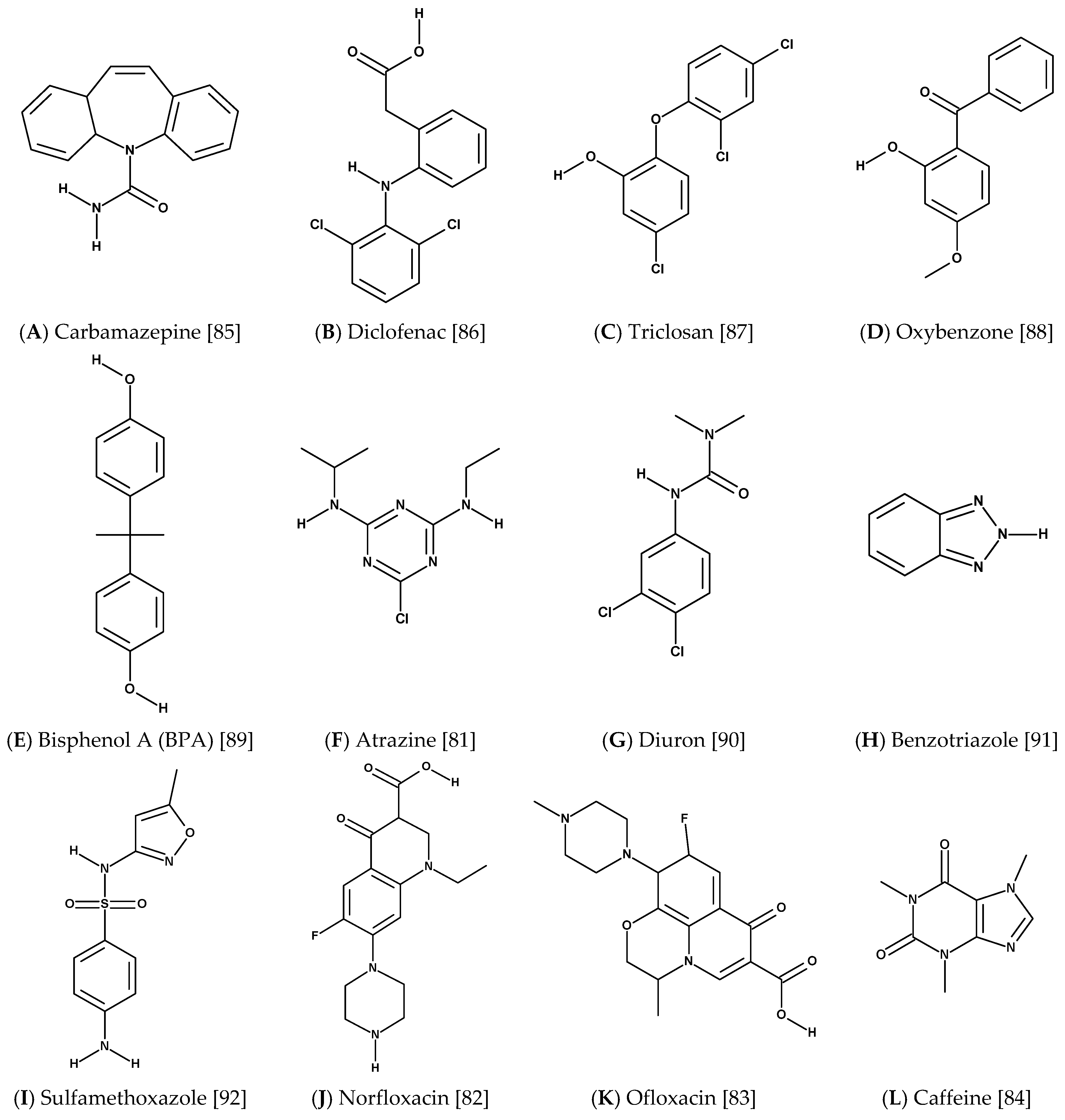
Municipal effluents contain pharmaceuticals, personal-care additives, endocrine disruptors, pesticides, and industrial chemicals at concentrations of 10–500 ng L−1 [1]. Conventional activated sludge (CAS) plants remove less than 30% of these persistent polar compounds. Treated effluent thus becomes the dominant source of micropollutants entering aquatic environments [1,2]. MBRs separate Hydraulic Retention Time (HRT) from Solids Retention Time (SRT), allowing operation at high biomass concentrations (8–15 g L−1) and long sludge ages (30–80 days). These conditions favor slow-growing degraders and cometabolic reactions [2,3]. MBRs nearly eliminate suspended solids and pathogens while improving the removal of certain micropollutants. Removal rates differ markedly by compound. Carbamazepine, diclofenac, and benzotriazole pass through at more than 50% of their inlet concentration [1,3]. Removal depends on factors like hydrophobicity (log D), ionization state (pKa), redox potential, and temperature [3], but also on the microbial community’s metabolism and local concentration gradients created by the membrane [2,4]. Membrane surfaces directly influence biodegradation pathways, shaping MBR design [1,4].
In MBRs, membranes function as reactive interfaces that affect mass transport, concentration polarization, and extracellular polymeric substance accumulation [2,4]. At bulk micropollutant concentrations of ng-µg L−1, conversion kinetics become mass-transfer-limited by interfacial adsorption/desorption, biofilm diffusion, and enzyme–substrate encounter probability. Hydrophobic micropollutants sorb to membrane surfaces, enriching 10–100× above bulk levels through reversible partitioning governed by sorption equilibrium, thereby accelerating biocatalytic attack [3]. When sorption becomes irreversible, compounds are trapped in regions with low bioavailability, which limits further transformation [3]. Where biodegradation occurs—in bulk liquid, suspended flocs, cake layer, or surface-attached biofilm—determines both conversion rate and product spectrum for micropollutants [4,5].
Membrane fouling limits MBR deployment. In full-scale MBRs, transmembrane pressure typically increases during operation (0.2–1.0 kPa d−1). This increase leads to higher energy consumption (15–40%). It also shortens membrane service life, in some cases by up to 30% [2,4,6]. Biofouling results from multiple physical, chemical, and biological factors. Soluble microbial products, extracellular polymeric substances, colloids and inorganic precipitates interact dynamically with surface chemistry and local shear [4]. Biofouling results from the colonization and growth of biofilms on the membrane surface. These biofilms can recover after disturbance and are regulated by quorum sensing and microbial interactions. Controlling biofouling, therefore, presents a major challenge [5]. Classical counter-measures (intermittent aeration, back-flushing, in situ NaOCl pulses, carrier addition or hybrid configurations) reduce but do not eliminate biofilm development [4,5].
High biomass retention (SRT 30–80 d; MLSS 8–15 g L−1) makes MBRs sustainable but unavoidably increases fouling. Surface-attached biomass creates a local reaction zone. Diffusion through the layer generates oxygen and substrate gradients that increase contact time and support catalytic activity near the membrane [4,5].
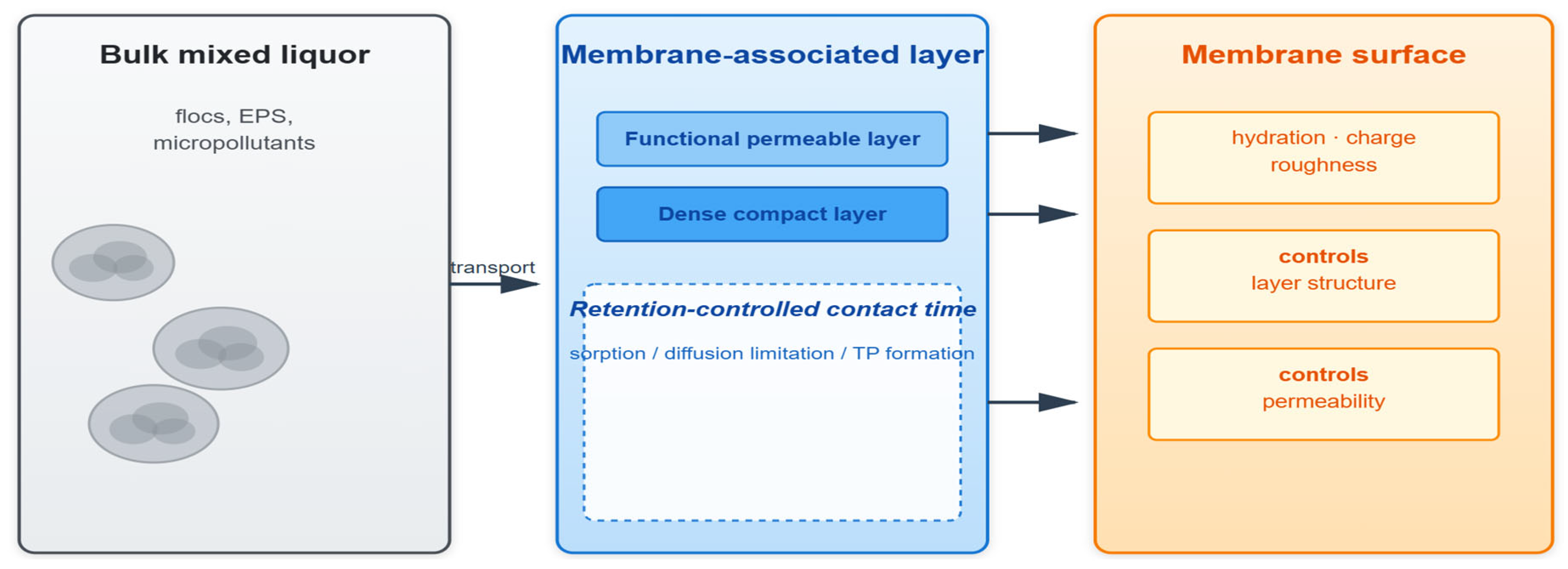
Studies differentiate detrimental fouling from functionally active biofilms [4,5,7]. Some biofilms remain permeable and metabolically active. Such layers can enhance micropollutant attenuation without destabilizing operation. In these cases, TMP increase rates remain low (below 0.15 kPa d−1), and flux recovery after cleaning can exceed 85% [7,8,9]. The conceptual role of the membrane as a coupled reaction–transport interface is illustrated in Figure 1.
Surface modification aims to tune hydrophilicity, charge and topography without resorting to toxic reagents. Polysaccharides offer dense, renewable functionality: chitosan (pKa ≈ 6.3) introduces cationic –NH3+ groups; alginate supplies anionic –COO; and cellulose and its nanocrystals (CNCs) expose –OH grids that organize bound water [8,9,11,12,13].
Chitosan coatings on PVDF membranes lowered water contact angle and increased steady-state flux by 30% during 30-day submerged MBR operation [12]. Similarly, in PES membranes, low CNC loading (0.3 wt%) significantly reduced irreversible fouling (from 38% to 12%); flux recovery remained high (>85%) over five cleaning cycles [8,9]. When CNC content was increased from 0.3 to 1.0 wt%, the flux recovery ratio decreased from 85% to 68%. This decline was attributed to nanoparticle agglomeration occurring during the phase-inversion process [9]. Cross-linking with genipin or citric acid can raise the elastic modulus of the coating from 0.8 to 2.1 GPa (AFM nanoindentation) and cut mass loss during 500 ppm NaOCl cleaning from 24% to <7% [14,15]. Most studies evaluate only flux recovery [8,9,14,16]. Direct correlations between surface chemistry (functional group density, charge, and hydration) and micropollutant removal are limited [4,7,17].
Micro/ultrafiltration rejects dissolved micropollutants only marginally; retention must, therefore, be engineered to prolong catalyst-substrate contact. In EMBRs, laccase or peroxidase is retained by UF/NF membranes while pollutants are transformed in the recirculation loop [11]. NF membranes that retain both enzyme and substrate increased the removal of carbamazepine, diclofenac, and sulfamethoxazole from 20 to 85% (UF) to >90% [11].
The immobilization matrix and its surface chemistry govern enzyme loading, stability, and the local pH microenvironment. Laccase immobilized on chitosan-modified supports shows improved reusability compared with unmodified PVDF [16]. Recent reviews identify pore size distribution, surface charge, and hydrophilic balance as decisive parameters for long-term operational stability [18,19]. We examine biopolymer-modified membranes to identify quantitative relationships between surface hydration, charge, topography, chemical stability, and MBR performance. Trends are compared across laboratory and pilot-scale systems in the context of sustainable membrane design.
The aim of this review is to synthesize current evidence on biopolymer-modified membranes in MBR systems and to identify practical surface-chemistry design principles governing fouling behavior, flux stability, and micropollutant bioconversion.
This review outlines the main MBR and EMBR configurations together with their operational limitations and discusses the principal biopolymer classes applied in membrane surface modification, including cellulose-based materials, chitosan, and alginate. The final part of the review examines how interfacial chemistry shapes fouling development, long-term flux behavior, and micropollutant removal. Particular attention is given to conditions representative of real mixed liquor, such as ionic strength, divalent cation interactions, and oxidative cleaning stress, to provide practical guidance for the design of durable, low-energy MBR membranes with more consistent treatment performance.

2. Membrane Bioreactor Configurations and Operating Constraints

2.1. MBR System Types

Membrane bioreactors decouple Hydraulic Retention Time (HRT) from Sludge Retention Time (SRT), enabling operation at elevated biomass (8–15 g L−1 MLSS) and extended SRTs (30–80 d) [1,3]. Despite these advantages, several micropollutants remain poorly removed. Compounds such as carbamazepine, benzotriazole, and diclofenac show removals below 50%, even at long sludge retention times [3,20].
In EMBRs, higher micropollutant attenuation occurs when enzymes and substrates are both retained at the membrane interface. Removal increases from 20–85% (UF) to >90% (NF). Retention-controlled exposure correlates with enhanced enzymatic transformation, but attenuation reflects transient retention rather than irreversible bioconversion—effects remain system- and scale-dependent [11,20,21].
Hybrid configurations combining activated sludge with membrane-immobilized enzymes exhibit high apparent attenuation of bisphenol A and sulfamethoxazole under controlled lab conditions (~20 °C). Enzymatic activity dropped 40% within ten cycles on supports lacking hydroxyl or amine anchoring groups. Enzymatic stability depends strongly on surface chemistry; performance remains highly sensitive to immobilization strategy and operational duration [11,20].

2.2. Membrane Placement and Reactor Configuration

Submerged MBRs operate at 0.03–0.15 bar and <0.5 kWh m−3—operating under low transmembrane pressure and relatively low specific energy demand. Transmembrane pressure increases 0.2–0.6 kPa d−1 because aeration-induced shear cannot fully counterbalance continuous biomass contact during 24 h operation [4,7]. Side-stream MBR modules operate at higher pressures (≈1–4 bar) and specific energy consumptions (≈0.6–1.2 kWh m−3). Elevated cross-flow velocities (3–5 m s−1) limit fouling accumulation, resulting in lower TMP increase rates (<0.1 kPa d−1). Elevated shear limits stable cake layer development and promotes bulk-phase micropollutant conversion, reducing membrane-proximal residence times by 2–3 fold [7]. Submerged MBRs develop thicker, slower-evolving cake layers that may serve as secondary reaction zones; side-stream systems promote bulk mixed-liquor transformation. Enhanced micropollutant transformation occurs at redox potentials below −100 to −200 mV in biofilms, though effects vary by compound [4,7]. Membrane material properties and module placement are interdependent and must be evaluated together. Hydrophilic membranes with moderately negative charge form porous cake layers (100–200 µm), show lower TMP increase rates, and may support micropollutant attenuation while retaining energetic advantages of low-pressure configurations [2,6].

2.3. Fouling, Selectivity and Membrane Stability

Fouling is the dominant operational cost driver in full-scale MBRs. Energy demand increases 15–40% when the TMP rise accelerates from 0.1 to 0.5 kPa d−1, shortening chemical cleaning intervals from ~28 to 7 days [2,4,6]. Fouling develops in distinct stages. Soluble microbial products (<0.45 µm) form initial conditioning layers within minutes. Over the following hours, extracellular polymeric substances and micro-colonies accumulate. Under sustained filtration, divalent-ion-bridged gels (Ca2+/Mg2+-mediated) consolidate. This consolidation increases compressive fouling resistance, which can exceed 1012 m−1 after 72 h [4].
Surface chemistry critically determines fouling reversibility and severity. Comparative studies show membranes with strongly negative charge and limited hydration (carboxylated PVDF: ζ-potential (zeta potential) −22 mV, contact angle 72°) exhibit higher irreversible fouling resistance than hydrated, moderately charged surfaces (CNC-grafted PVDF: ζ −12 mV, contact angle 45°) after identical fouling–cleaning protocols [8,9]. Maximizing surface charge alone is insufficient. Effective fouling control requires a balance between electrostatic interactions and interfacial hydration.
Micropollutant selectivity is similarly influenced by coupled membrane properties and fouling layer development. For example, size exclusion by UF membranes (e.g., nominal MWCO ≈150 kDa) contributes minimally to the rejection of low-molecular-weight compounds such as diclofenac (<5% at influent concentrations on the order of 200 ng L−1). However, during extended operation (for example, when cake layers reach ~1 μm after ~10 days), the effective residence time can increase several-fold, enhancing the apparent attenuation. For instance, reported removals rose from about 35% to 60–70% in lab trials [1,3,20]. In enzymatic MBRs, NF membranes with tight cut-offs (MWCO 200 Da) retain immobilized enzymes (>95%) and micropollutants like sulfamethoxazole (90%), yielding higher apparent turnover than UF systems. The observed increase in removal is mainly related to longer residence times near the membrane surface. It does not result from intrinsic size-based selectivity of the membrane [11].
Chemical aging further constrains the long-term selectivity and stability of MBR membranes. Repeated exposure to alkaline hypochlorite solutions (≈500 ppm NaOCl, pH ≈ 11, ≈30 °C) alters membrane surface properties. PES membranes exhibited a ζ-potential shift from approximately −18 mV to −10 mV following NaOCl exposure. A comparable change was observed for PVDF membranes, with ζ-potential increasing from about −22 mV to −14 mV under similar oxidative conditions. These surface charge modifications were associated with faster development of irreversible fouling, observed after only a few cleaning cycles [6]. Sustained MBR performance requires maintaining pore architecture and surface functionality beyond 1000 h; high initial permeability alone is insufficient.

2.4. Membrane-Driven Micropollutant Bioconversion

MBR membranes create microenvironments where local redox gradients and residence times determine micropollutant fate [22]. PVDF cake layers (100–200 µm) concentrate diclofenac from ~200 ng L−1 bulk to 2–5 µg L−1 locally, shortening half-life from 8 h to 2 h and raising removal from 35% to 60–70% [3,20]. Excessively compact EPS-dominated fouling layers impose strong diffusion limitations, suppressing mass transfer and reducing apparent biotransformation rates versus hydrated, porous biofilms [4,7].
Enzymatic MBRs show stronger retention effects. NF membranes (MWCO 200 Da) retain both laccase (>95%) and sulfamethoxazole (>90%), raising turnover 4-fold versus UF systems (10 kDa) where substrates permeate [11]. The extent of this enhancement is compound-specific. At pH 5, sulfamethoxazole shows a 4-fold increase in apparent turnover; carbamazepine shows a 1.5-fold increase, reflecting compound chemistry differences [11].
Enzyme retention itself is a prerequisite for membrane-driven contact time control. Studies consistently show rapid laccase loss with permeate when membranes have insufficiently tight cut-offs; membranes with effective enzyme retention (MWCO < 10 kDa) enable sustained membrane-proximal exposure and associated apparent bioconversion [11,21]. Recent work suggests that complete fouling elimination is unrealistic. Instead, controlling fouling structure and reversibility has become a more practical design objective. Hydrated bio-cake layers with moderate porosity (≈100–200 µm) support low TMP rise (<0.15 kPa d−1), locally reducing conditions (redox < −150 mV), and extended micropollutant residence times (≈3–5-fold) without severe diffusion constraints. Membrane surface properties play a role comparable to biological operating parameters. Surface charge, hydrophilicity, and roughness can be as important as sludge age or enzyme selection. Table 1 compiles representative performance ranges reported for common MBR configurations.
Table 1 shows that differences in reported micropollutant attenuation between MBR configurations are largely driven by contact time at the membrane interface and the evolution of fouling layers, rather than by membrane material alone. Conventional activated sludge systems remain limited by low sludge retention and solids wash-out, which explains the consistently low removal of persistent compounds such as carbamazepine and diclofenac. Submerged aerobic MBRs improve attenuation by promoting membrane-proximal retention and biotransformation, although this benefit is accompanied by higher biofouling rates and increased aeration demand [1,2,4,7,20]. In side-stream MBRs, elevated shear stabilizes TMP development but shortens membrane-associated residence times, which limits gains in micropollutant transformation despite higher energy input. By contrast, high-retention UF/NF configurations achieve substantially higher apparent removals, reflecting retention-driven biotransformation rather than intrinsic selectivity, at the cost of steeper TMP increase and a narrower operating window [2,7,20]. Hybrid MBR systems combined with activated carbon report the highest removals, but their performance is constrained by sorbent exhaustion and replacement. Anaerobic MBRs remain dominated by sorption-controlled behavior and show limited attenuation of polar pharmaceuticals. Enzymatic MBRs can achieve near-complete removal under controlled conditions; however, enzyme deactivation and stability remain critical limitations for long-term operation [7,11,17,23,24].
The concentration data compiled in Table 2 illustrate these effects for five micropollutants (four pharmaceuticals and one industrial micropollutant) commonly detected in municipal wastewater. Conventional MBR effluents for diclofenac and carbamazepine frequently exceed proposed EU environmental quality standards (EQS AA 50 ng L−1 [25] and risk-based groundwater threshold 250 ng L−1, respectively), despite extended SRT [11,17,26,27]. Sulfamethoxazole concentrations in unmodified MBR permeate remain well above the precautionary 10 ng L−1 value [11,28,29]. Systems with enzymatically active or retention-enhanced membranes lower effluent levels by roughly one order of magnitude [11,21,28,30,31,32], bringing diclofenac below or near the proposed EQS and carbamazepine well within the threshold [11,31]. For benzotriazole, already moderate MBR removal is sufficient to approach national reference values, while EMBR configurations widen the compliance margin further [33,34,35,36]. Because these gains track with membrane-proximal residence time rather than nominal MWCO [11,21,30], they support a contact time-controlled biotransformation mechanism rather than size-based rejection.

3. Biopolymer Membrane Modifiers

Biopolymers such as cellulose, chitosan, and alginate contain multiple hydroxyl, carboxylate, or amine groups. These functional groups enable interaction with common membrane materials such as PVDF and PES. Surface loadings reach the mmol g−1 range at the polymer level, corresponding to effective surface coverages up to ~1 µmol cm−2 after deposition. In laboratory studies, such modifications consistently increase surface polarity and wettability, while no cytotoxic leachables have been detected under standard extraction and cell-viability assays [4,7].
Before examining each biopolymer in detail, a comparative overview helps to clarify their distinct characteristics and optimal application contexts. Table 3 summarizes the key chemical, physical, and operational properties of the three main biopolymer families used in MBR membrane modification. As this comparison reveals, no single biopolymer offers universal superiority. Rather, selection depends on matching biopolymer characteristics to specific wastewater composition, operational constraints, and performance objectives.
Table 2 highlights several important trade-offs. Cellulose modifications offer the best combination of hydration stability and chemical resistance, making them suitable for diverse wastewater compositions and extended operation. However, their neutral charge provides limited electrostatic control over fouling. Chitosan’s cationic character enables strong interactions with anionic foulants and microbes, but this advantage becomes a liability at elevated ionic strength, where its moderately positive charge (typically +8 to +15 mV) accelerates calcium-mediated EPS bridging. Alginate’s structural similarity to native EPS allows it to “blend” with fouling layers and promote permeable architectures, yet its ionic cross-linking mechanism renders it vulnerable to feed chemistry variations. These observations inform the detailed mechanistic discussions that follow in Section 3.1, Section 3.2 and Section 3.3.
The surface charge of chitosan-modified membranes depends strongly on pH. At neutral pH, chitosan (pKa 6.3) shifts membrane ζ-potential from moderately negative (−18 mV) toward near-neutral or slightly positive (+8 mV), reducing irreversible fouling resistance during submerged MBR operation over several weeks [12,13]. Cross-linking with genipin or citric acid enhances mechanical robustness, increasing the chitosan layer elastic modulus from 0.8 to 2.1 GPa as measured by AFM nanoindentation under dry or semi-dry conditions and reducing coating mass loss during repeated hypochlorite cleaning (from 20 to 25% to <7% under 500 ppm NaOCl). Under hydrated conditions, reported moduli are typically one to two orders of magnitude lower, reflecting polymer swelling and increased chain mobility [14,15].
Cellulose-based modifiers, particularly cellulose nanocrystals (CNCs), have also received considerable attention. Incorporating CNCs at low loadings (~0.3 wt%) decreases water contact angles from ~70° to <50°, improves flux recovery (often >85% after multiple chemical cleaning cycles), and limits initial protein adsorption to sub-µg cm−2 levels under lab fouling assays [8,9,16].
Ca2+-cross-linked alginate forms “egg-box” hydrogel networks with 5–20 nm mesh sizes. Such structures correlate with reduced deposition of humic substances while maintaining relatively high pure-water permeability, often reported above ~100 L m−2 h−1 bar−1, depending on cross-link density and ionic conditions [18,43].
More recent surface-engineering approaches, including layer-by-layer assembly and polydopamine-assisted grafting, enable finer control over coating thickness (usually tens to a few hundred nanometres) and surface charge density. These strategies tune interfacial properties to reduce fouling or enhance enzyme immobilization [5,7].
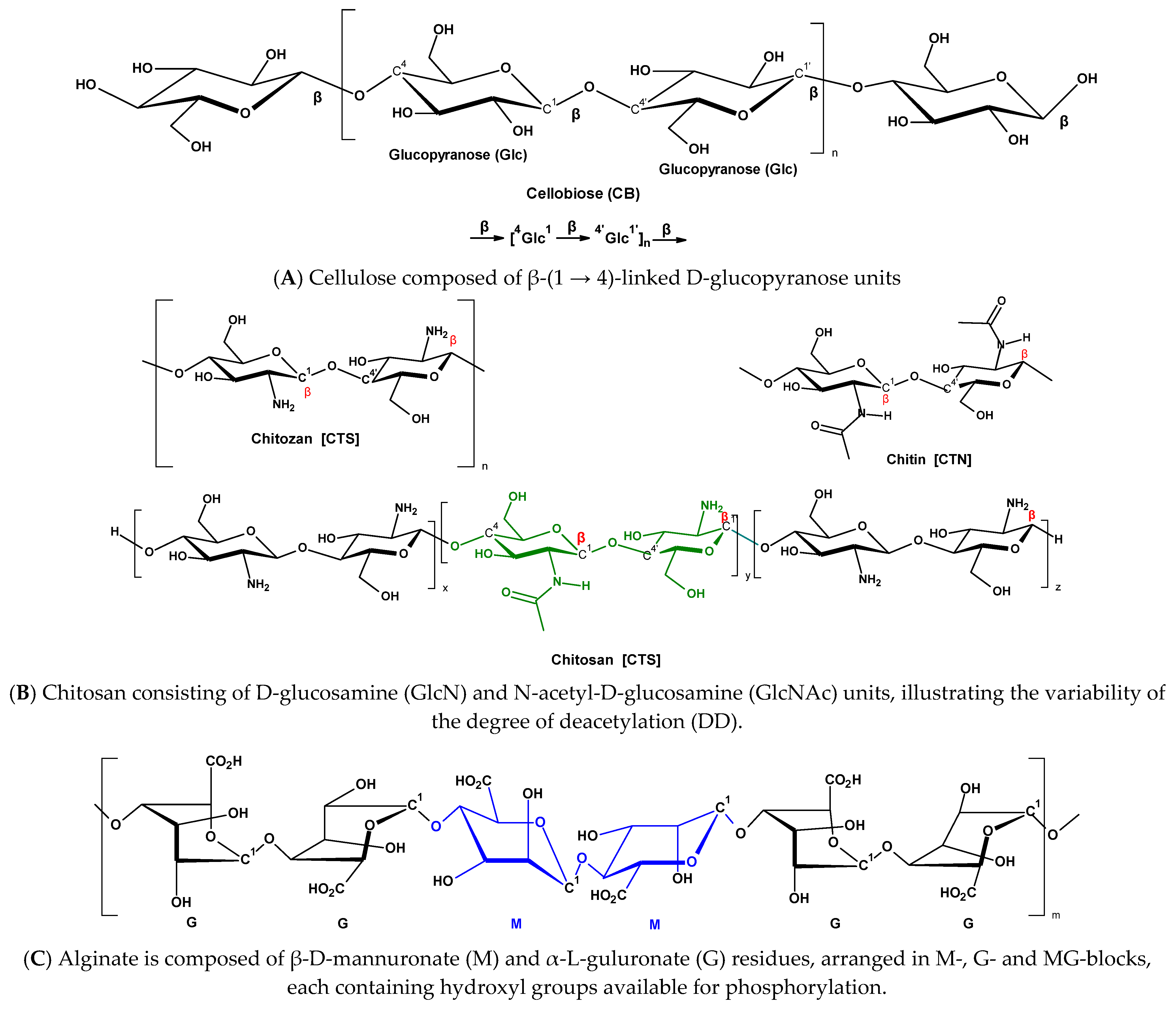
Biopolymer coatings act as reactive interfaces. They stabilize hydration layers, modulate local pH, and concentrate micropollutants, transiently shifting fouling layers from diffusion barriers toward permeable, catalytic zones. Magnitude depends on polymer chemistry and reactor scale [18,43,44,45,46]. The chemical structures of representative biopolymers used for membrane modification are shown in Figure 2.
Cellulose derivatives contain 4–5 mmol/g hydroxyl groups, forming 1–2 nm hydration layers. This hydration reduces protein adsorption to <0.5 µg/cm2 and decreases static water contact angle by 20–30° during early filtration [8,9]. When CNCs are blended into PES membranes at low loadings (~0.3 wt%), studies show equilibrium water contact angle reduction from ~70° to <50° while maintaining tensile strength >3 MPa. Under repeated chemical cleaning (five cycles with 500 ppm NaOCl), such membranes retain high flux recovery (>85%) and exhibit lower irreversible fouling resistance, decreasing from 3.2 to 1.1 × 10¹² m−1 [8,9].
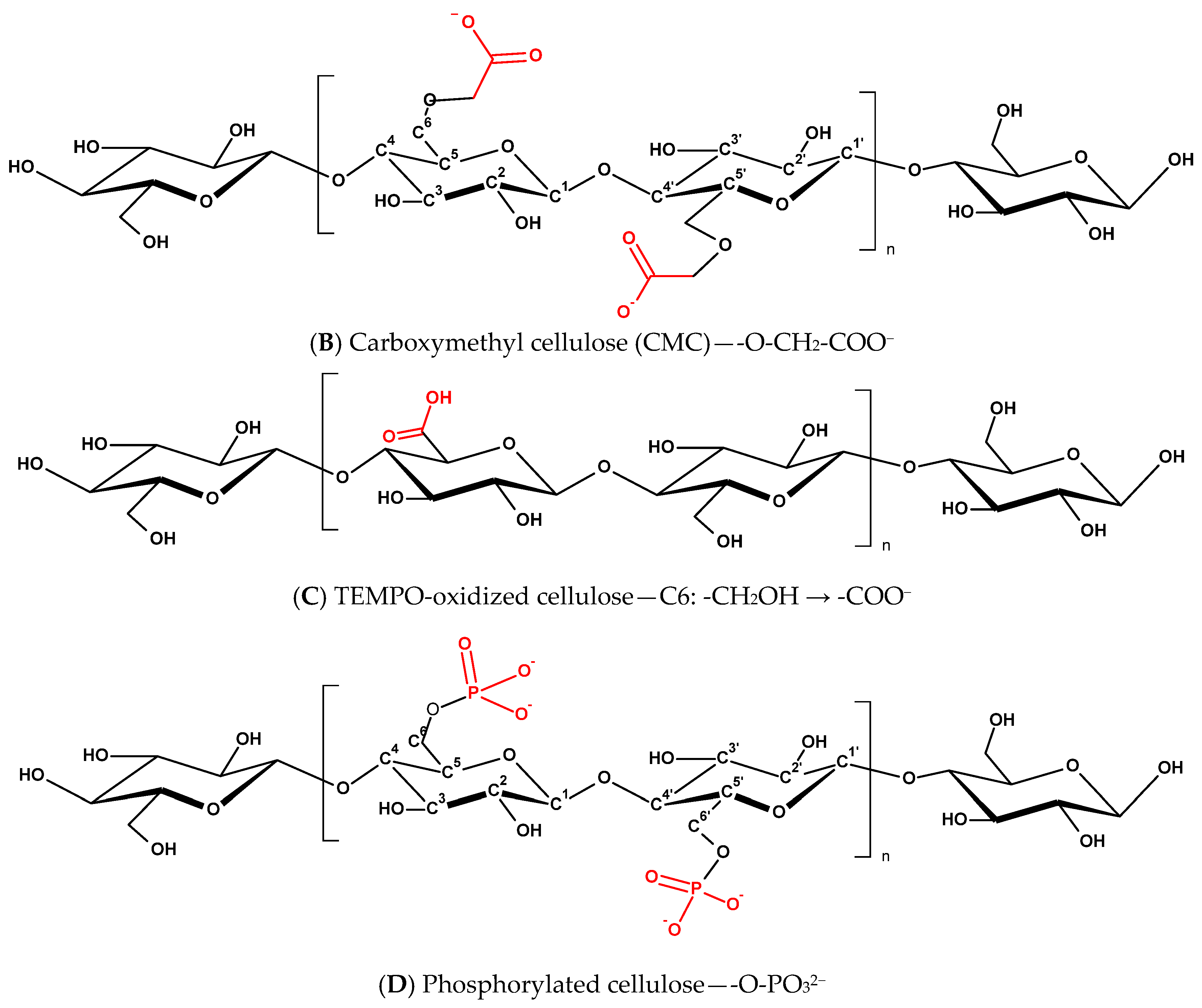
Chemical modification of cellulose further expands the range of interfacial functionalities. TEMPO-oxidized cellulose introduces carboxylate groups at densities of 1.2 mmol g−1, chelating divalent cations and shifting membrane surface ζ-potentials toward more negative values (−25 mV at pH 7). These properties reduce EPS adhesion and lower TMP increase rates (<0.15 kPa d−1) during extended submerged MBR operation under lab conditions, even at elevated ionic strength [8,9].
Phosphorylated cellulose derivatives, with reported phosphate contents on the order of ~0.8 mmol g−1, have been described to further enhance interfacial hydration and buffer capacity. Localized pH shifts of 0.3–0.5 units within the membrane-proximal fouling layer may favor specific oxidative transformation pathways for phenolic compounds like bisphenol A under controlled conditions [9].
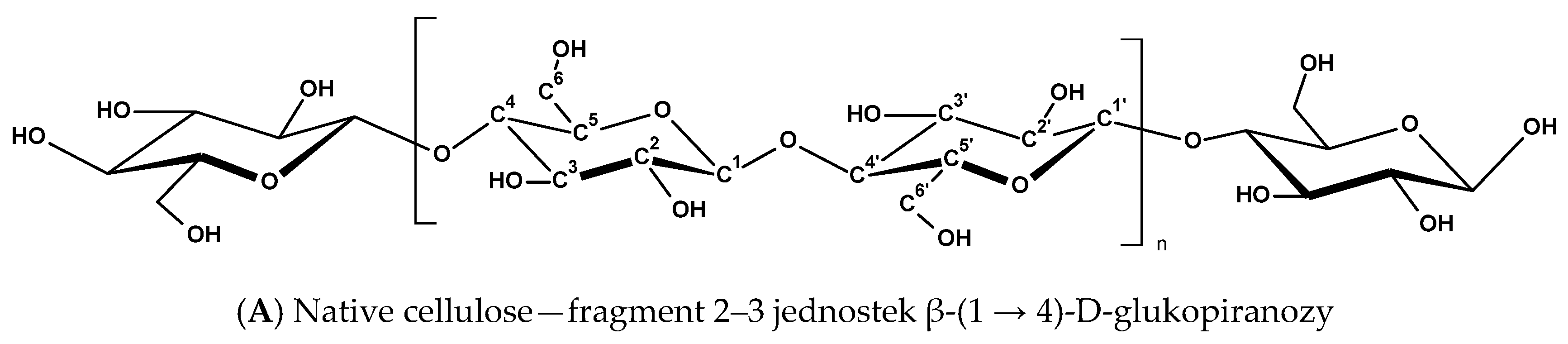
Cellulose-based modifications influence membrane hydrophilicity and interfacial microenvironment evolution. Control of hydration, surface charge, and local chemical gradients enables fouling layers to evolve toward more permeable and reactive interfacial states rather than diffusion-limited barriers. The magnitude and persistence of this behavior depend on coating chemistry, operating conditions, and scale [8,9]. Common cellulose derivatives relevant to membrane surface engineering are presented in Figure 3.
In MBRs, cellulose-modified surfaces altered biofilm structure and development. Hydrated CNC coatings (≈150 µm) reduce interfacial free energy from 38 to 24 mJ m−2, delaying irreversible fouling onset by tens of hours [7,9]. Such permeable bio-cake layers, with reported porosities in the range of about 0.65–0.75, correlate with increased effective residence times for selected micropollutants. For example, local residence time of diclofenac increases by three-fold, accompanied by higher apparent attenuation (e.g., from ~35% to ~60–70%), without inducing rapid transmembrane pressure increase (TMP slopes remaining below ~0.15 kPa d−1) [7,8]. The effects arise from transient retention and membrane-proximal biotransformation, not size exclusion.
Chemical derivatization of cellulose further modulates interfacial interactions. Carboxymethyl cellulose, with reported degrees of substitution around 0.7 and carboxylate densities of approximately 1.1 mmol g−1, has been described to chelate divalent cations and induce modest local pH shifts (on the order of +0.3 units) within the membrane-proximal fouling layer. Such micro-environmental changes have been suggested to favor specific oxidative pathways, including phenolate oxidation of compounds such as bisphenol A, under controlled conditions [14].
Similarly, phosphorylated cellulose (~0.8 mmol g−1 phosphate) bound Mg2+ and formed anionic networks, reducing SMP adhesion. Reported outcomes include lower EPS accumulation rates, with reductions of about 25–30% relative to unmodified PVDF membranes under comparable fouling assays [15].
Cellulose coatings degrade during long-term operation. Prolonged exposure to microbial cellulases and oxidative cleaning agents (e.g., ~500 ppm NaOCl) induces partial hydrolysis of grafted layers, with mass losses on the order of 15–20% within ~40 cleaning cycles. Covalent stabilization strategies, including cross-linking with citric acid or genipin, correlate with substantially lower mass loss (<5%) and improved retention of surface electrokinetic properties over 1000 h of operation [13].

3.1. Chitosan as Membrane Modifier

Chitosan (pKa ≈ 6.3) acquires a positive charge through amine protonation at pH 6–7. Chitosan surface amine density reaches 2–4 mmol g−1, enabling strong electrostatic interactions with negatively charged components such as lipopolysaccharides in Gram-negative cell walls, alginate-like EPS strands, and anionic micropollutants including diclofenac and sulfamethoxazole [12,13,14]. Surface charge depends on the deacetylation degree, molecular weight, and coating protocol.
Chitosan dip-coating (0.5 mg cm−2) on PVDF shifts ζ-potential from −18 mV to +8 mV, lowers water contact angle by 20°, and reduces irreversible fouling resistance from 3.2 to 1.1 × 10¹² m−1 over 30 days in submerged MBR (TDS < 500 mg L−1, Ca2+ < 2 mM) [10]. However, as discussed below, this moderately positive charge (+8 mV) lies outside the recommended −15 to +5 mV window and may accelerate Ca-EPS bridging under higher ionic strength conditions typical of municipal wastewater (30–60 mM, Ca2+ 2–5 mM) [7,14].
Maintaining membrane ζ-potential within the range of −15 to +5 mV minimizes Ca-EPS bridging across typical municipal wastewater compositions (ionic strength 30–60 mM; Ca2+ 2–5 mM) [7,14]. Surfaces with ζ > +5 mV—such as the +8 mV chitosan coating reported by Le Roux et al. [13]—represent system-specific exceptions that perform adequately under low-salinity conditions (Ca2+ < 2 mM, ionic strength < 20 mM) but risk accelerated gel compaction when exposed to typical municipal wastewater matrices [14]. Consequently, for robust performance across diverse feed compositions, the −15 to +5 mV window should be targeted; moderately positive surfaces (+5 to +10 mV) are acceptable only when influent ionic strength and Ca2+ concentration are consistently low and can be verified through pre-treatment [7,13,14].
Cross-linking with genipin increases elastic modulus from 0.8 to 2.1 GPa and limits mass loss to <7% during 40 cycles of 500 ppm NaOCl cleaning [12].
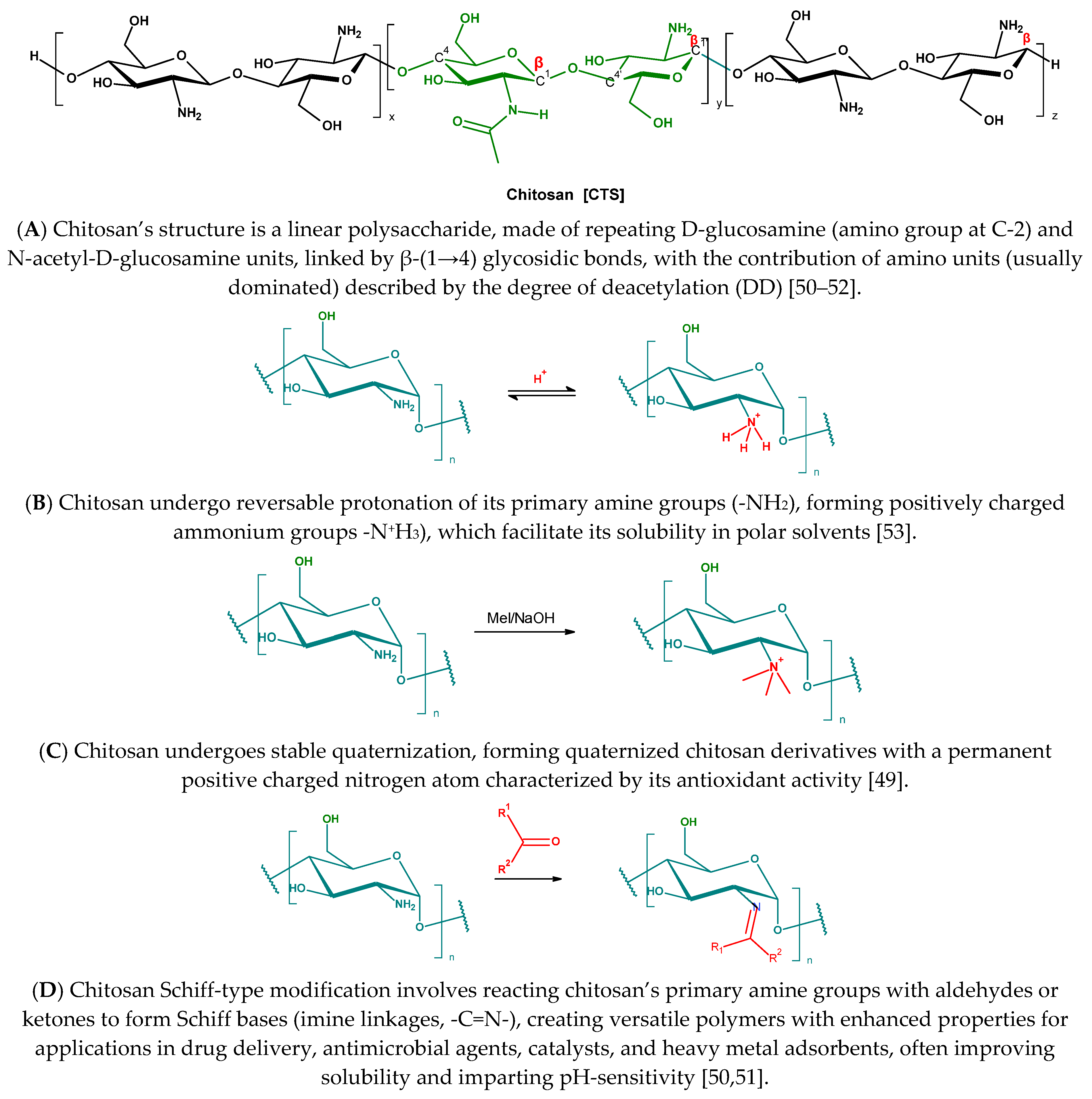
Quaternized derivatives (DQ = 45%) maintain a permanent +15 mV surface charge even at pH 9, representing a specialized modification for high-ionic-strength industrial effluents (>100 mM NaCl) [49]. In such environments, extreme Debye screening (λ_D < 0.5 nm) suppresses electrostatic interactions to the extent that divalent-cation bridging becomes less dependent on surface charge magnitude. Instead, antimicrobial properties of quaternary ammonium groups provide the dominant antifouling mechanism by limiting initial cell attachment, rather than relying on charge-based EPS repulsion [49]. These strongly cationic surfaces are therefore not recommended for typical municipal MBRs (ionic strength 30–60 mM), where they would accelerate Ca-EPS bridging, but may offer advantages in specific industrial contexts where conventional charge-window strategies fail due to screening effects. Representative functional motifs (primary amine, quaternary ammonium, Schiff-base) are summarized in Figure 4.
Chitosan-modified surfaces steer microbial attachment rather than simply blocking it. Moderately cationic chitosan layers promoted thin, loosely bound biofilms with lower protein-to-carbohydrate ratios and more open architecture. These structural changes enhanced enzymatic activity and diclofenac removal in submerged MBRs [7,14].
For enzyme immobilization, electrostatic interactions between protonated amine groups (–NH3+) and laccase (pI ≈ 3.6) can substantially increase enzyme loading and reusability on functionalized membrane supports compared with unmodified PVDF membranes [16]. However, oxidative cleaning conditions (e.g., hypochlorite exposure) and extreme pH values have been consistently reported to reduce laccase activity over repeated reuse cycles, highlighting the importance of support chemistry and cleaning compatibility for long-term stability [16]. Long-term stability is nevertheless conditional: exposure to pH > 9 or 500 ppm NaOCl reduces surface charge by 30% and causes 15% mass loss within 40 cleaning cycles. Cross-linking with genipin or citric acid limits leaching to <5% and preserves ζ > +10 mV for >1000 h of continuous operation [12,13]. Although chitosan-based coatings provide antifouling and bioactive functionality, their susceptibility to oxidative cleaning and alkaline conditions limits long-term stability under full-scale cleaning-in-place and shear [45].

3.2. Alginate and Anionic Polysaccharides

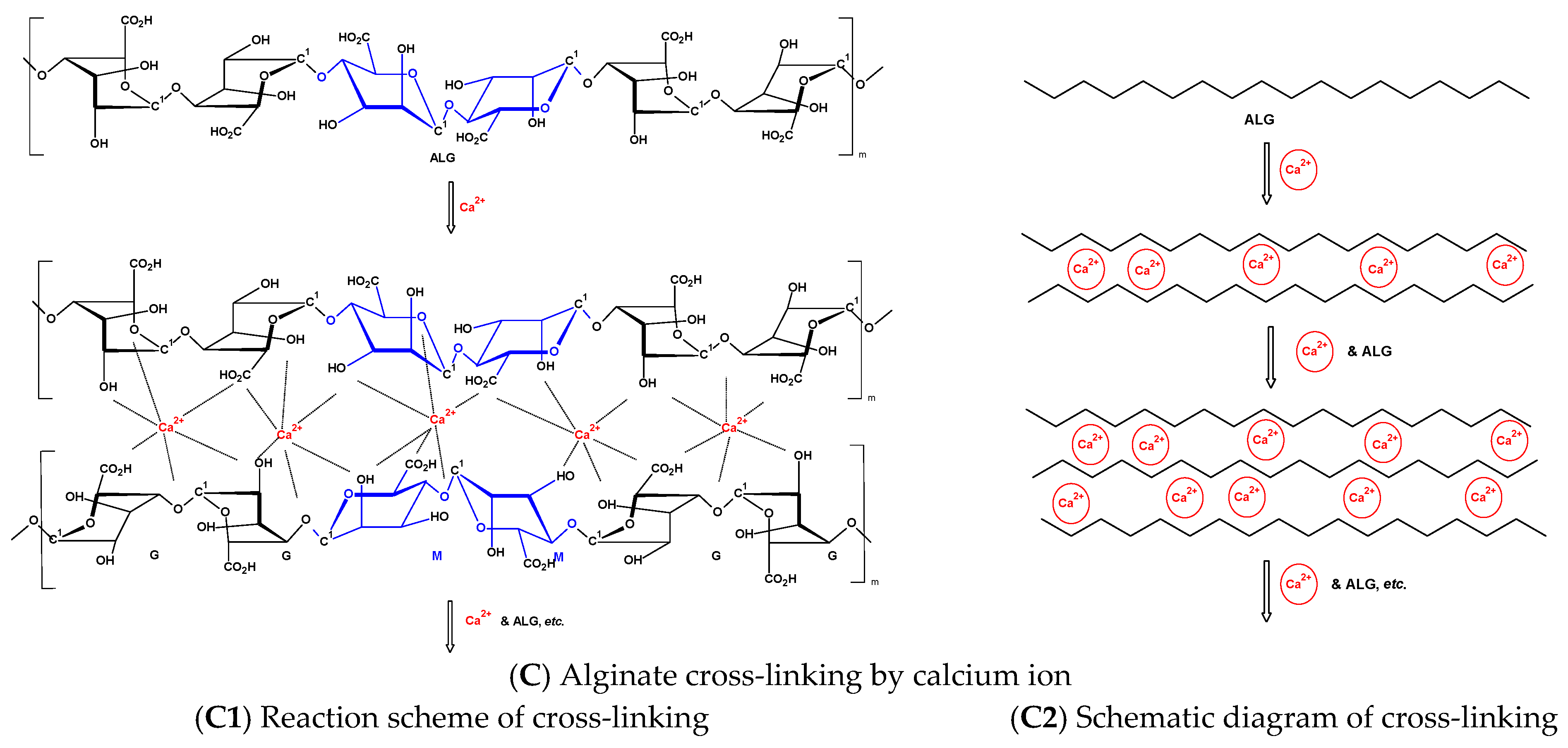
Alginate (4–5 mmol/g carboxylate) forms ionically cross-linked networks via Ca2+. Ca2+ egg-box structures show elastic moduli of 0.8–2.1 GPa and mesh sizes on the order of 5–20 nm, resulting in hydrated interfacial layers when applied to PVDF or PES membrane supports [10,43,56]. Alginate coatings (0.5 mg cm−2) reduce water contact angle from 68° to 42° and cut BSA adsorption by 50–60%. Under submerged MBR operation, such coatings correlate with relatively low TMP increase rates (reported below ~0.12 kPa d−1) during operation periods of several weeks (e.g., ~40 days), although performance remains sensitive to operating conditions and water chemistry [8,10].
Varying Ca2+/Na+ ratios (0.5–2.0 mol mol−1) controls alginate cross-link density and induces reversible swelling (65–85% hydration). Swollen gels transiently store micropollutants in the proximal fouling layer (~100 µm), prolonging residence times and increasing apparent attenuation. For example, reported diclofenac removal efficiencies have increased from approximately 35–40% to around 60–70% in lab trials, without a corresponding increase in hydraulic resistance [14].
High concentrations of divalent cations can compromise these beneficial properties. Ca2+ >5 mM compacted alginate gels, reducing mesh size and water permeability. Under controlled conditions, periodic rinsing with chelating agents like citrate (10 mM) reverses gel compaction by partially removing bound Ca2+, restoring permeability and network structure on short time scales (minutes). Long-term full-scale stability of this reversible behavior is unknown [57].
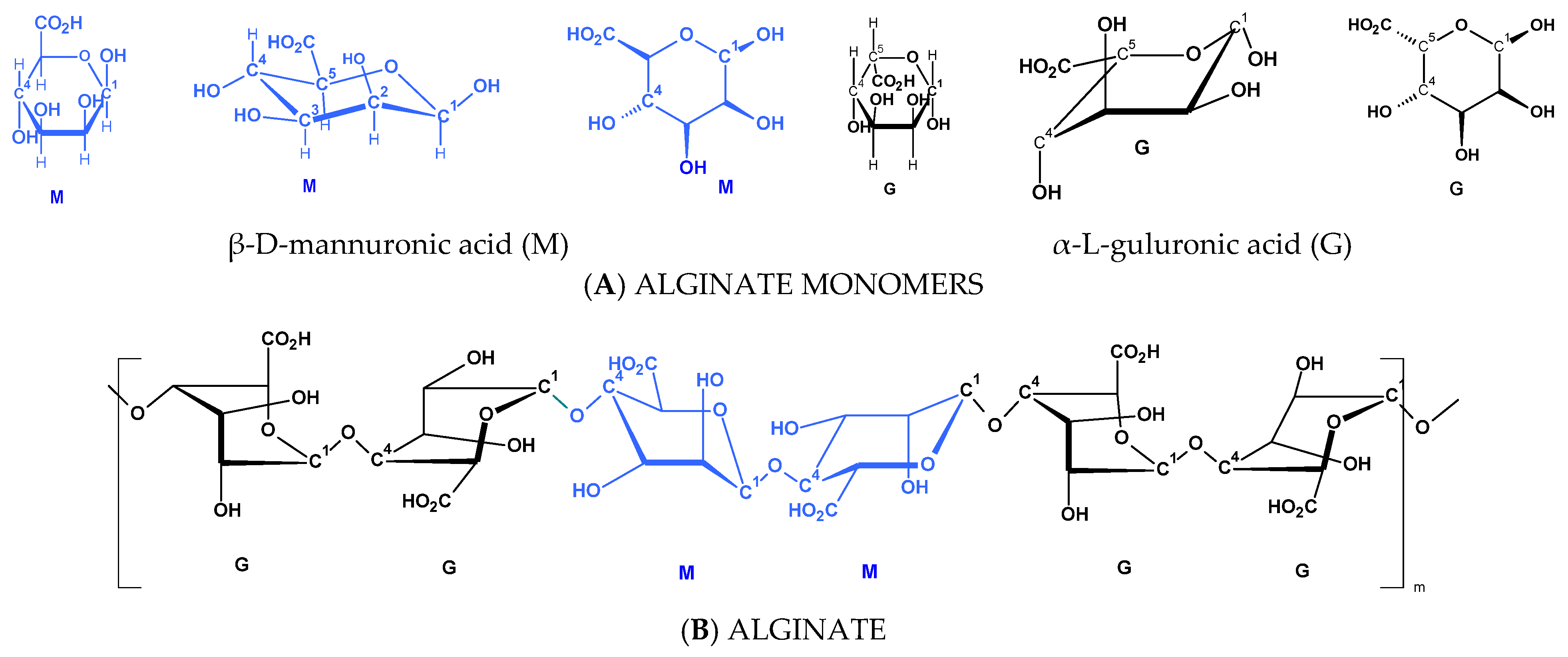
The characteristic anionic structure of alginate and its ability to form ionically cross-linked networks are schematically illustrated in Figure 5 [10,43,56].
In MBR systems, alginate-modified membranes interact with native extracellular polymeric substances (EPSs), reflecting the structural similarity between alginate and the mannuronic/guluronic acid backbones commonly present in EPS produced by genera such as Pseudomonas and Zoogloea [7]. Laboratory-scale Ca2+-cross-linked alginate coatings applied at surface loadings of about 0.5 mg cm−2 (Ca/Na ≈ 1.5 mol mol−1) can be associated with lower irreversible fouling rates, with reported TMP increase decreasing from ~0.18 to ~0.09 kPa d−1 under submerged operation. These effects correlate with preferential association of incoming EPS with the hydrated alginate layer rather than with the underlying PVDF surface, resulting in fouling layers with higher porosity (reported ε ≈ 0.73 compared with ≈0.54) and limited thickness (<150 µm) after extended operation (≈30 days) under controlled conditions [7,14].
At the same time, the stability of ionically cross-linked alginate networks is sensitive to fluctuations in water chemistry. Variations in ionic strength within ranges typical of municipal wastewater (Na+ ≈ 20–80 mM) promote partial Ca2+/Na+ exchange, leading to transient swelling (on the order of ~20%) and associated reductions in water permeability (≈30%) within several hours. Under laboratory conditions, periodic rinsing with chelating agents such as citrate (e.g., ~10 mM) reverses this compaction by re-establishing Ca2+ cross-links, restoring mesh structure and permeability on short time scales (<15 min) [15].
Covalent stabilization strategies have been proposed to mitigate these effects. For example, cross-linking with adipic acid dihydrazide at low concentrations (≈0.2 wt%) reduce swelling ratios (from ~65% to ~25%) and limit coating mass loss to below ~5% over repeated oxidative cleaning cycles (≈40 NaOCl treatments) while still allowing transient micropollutant accumulation and higher apparent attenuation of compounds such as diclofenac (reported increases from ~38% to ~60–70%) in lab trials [40].
While laboratory studies report favorable performance, alginate-based coatings exhibit uncertain stability under full-scale MBR operation. Variations in divalent-ion concentrations, competitive chelation, and repeated hydraulic compaction destabilize alginate networks, limiting the transferability of reversible gel behavior to long-term full-scale operation [43].

3.3. Nanocellulose in Membrane Design

CNCs (5–20 nm wide, 100–300 nm long) and CNFs (10–50 nm wide, 1–5 µm long) combine high stiffness (Young’s modulus >100 GPa) with large surface area (150–400 m2 g−1). At loadings ≤0.5 wt%, they reinforce membranes without compromising mechanical integrity [8,9,40]. Blending 0.5 wt% CNCs into PVDF increases pure-water permeability and improves fouling resistance. For example, reported water flux values have increased from about 110 to ~160 L m−2 h−1 bar−1, while irreversible fouling resistance decreased from around 3.2 to ~1.1 × 10¹² m−1 after repeated chemical cleaning (e.g., five cycles with ~500 ppm NaOCl), with flux recovery ratios exceeding ~85% [8,9]. Nanocellulose surface functionalization further expands its range of interfacial effects. Carboxylated (CNCs), with reported carboxylate densities on the order of ~1.4 mmol g−1, shift membrane ζ-potentials toward more negative values (≈−25 mV) and substantially reduce bacterial adhesion in model assays (e.g., reductions exceeding ~90% for Staphylococcus aureus*). Phosphorylated cellulose derivatives (~0.8 mmol g−1 phosphate) enhance cation binding and transient micropollutant retention, increasing apparent enzymatic turnover under controlled conditions [8,9].
Stable dispersion of nanocellulose within polymer matrices is critical for long-term performance. Approaches include physical dispersion and chemical compatibilization strategies, which reduce agglomeration and sustain mechanical integrity under prolonged shear exposure in lab systems [15]. Similarly, some CNC- or CNF-modified membranes show resistance to oxidative cleaning, retaining a large fraction of surface functionality and mechanical properties after multiple hypochlorite cleaning cycles under alkaline conditions [12].
Cellulose-based modifications are generally more chemically robust than chitosan- or alginate-based coatings; however, full-scale data on long-term fiber swelling, mechanical fatigue, and pore blockage during continuous operation remain scarce, constraining extrapolation from lab studies [58].

3.4. Stability and Aging of Biopolymer-Modified Membranes

During extended MBR operation, biopolymer-based surface modifications are subjected to multiple stress factors. Biological stress arises from extracellular enzymes, including cellulases and proteases, present in activated sludge. Chemical stress is mainly associated with repeated cleaning using alkaline hypochlorite solutions, typically around 500 ppm NaOCl at pH ~11 and temperatures close to 30 °C. In addition, membrane surfaces experience cyclic pH variations, commonly ranging from about 5.5 to 9.0 during operation. Physically adsorbed biopolymer layers have limited durability. For example, chitosan coatings applied without covalent anchoring lose on the order of ~30% of their mass within ~40 cleaning cycles, accompanied by shifts in surface ζ-potential (≈15 mV) and a more than two-fold increase in irreversible fouling resistance (e.g., from ~1.1 to ~2.4 × 10¹² m−1) under laboratory-scale MBR operation [13,14].
Covalent grafting and hybrid composite strategies consistently improve resistance to chemical aging. Genipin-cross-linked chitosan coatings, at reported cross-link densities around ~0.2 mmol g−1, retain the majority of their initial surface charge (>95% retention of an initial ζ ≈ +12 mV) and to limit coating mass loss to below ~5% after extended hypochlorite exposure (≈1000 h) while maintaining adequate mechanical integrity (tensile strength ≥ 3 MPa) in lab trials [12].
The balance between chemical stability and interfacial functionality is strongly controlled by cross-link density. At intermediate cross-link densities (e.g., ~0.3 mmol g−1), reported mass loss remains low (<6% over ~40 cleaning cycles), while reductions in water self-diffusion coefficients are comparatively modest (≈15–20% relative to uncross-linked chitosan), preserving the dynamic hydration layer associated with antifouling behavior, retention of immobilized enzyme activity remain relatively high (often ≥70–75%) [12,14]. Increasing cross-link density beyond this range yields diminishing returns. At 0.4 mmol g−1, elastic modulus increased marginally (2.1 → 2.3 GPa) while segmental mobility dropped 40%, water diffusion fell 35%, and enzymatic activity declined 25–30% [13,40]. At even higher cross-link densities (>0.4–0.5 mmol g−1), several studies report pronounced reductions in swelling capacity (e.g., from ~65% to ~25%) and hindered diffusion of low-molecular-weight solutes (<500 Da), shifting micropollutant accumulation from transient retention toward more irreversible sequestration; fouling layers increasingly behave as diffusion barriers rather than permeable, reactive interfaces [40]. Dynamic mechanical analysis shows that loss of segmental mobility, reflected by a decrease in the loss tangent (tan δ < ~0.3 at cross-link densities above ~0.45 mmol g−1), correlates with reduced flux recovery after hydraulic cleaning, with declines of about 35–40% [12,15].
Optimal long-term performance occurs at intermediate chemical stabilization; soft covalent anchoring strategies, including cross-linking with citric acid, adipic dihydrazide, or genipin at moderate densities (approximately 0.2–0.4 mmol g−1), correlate with preservation of segmental mobility (often ~60–70%), limited drift in surface electrokinetic properties (Δζ within ±5 mV), and comparatively stable TMP evolution under extended operation [15].
However, not all biopolymer modifications improve performance. Over-cross-linking of chitosan (>0.5 mmol g−1) substantially reduces enzymatic activity and effective diffusivity, while prolonged exposure to biological degradative agents, such as fungal cellulases, leads to partial hydrolysis of nanocellulose-based coatings, accompanied by adverse shifts in surface charge and increased irreversible fouling [9,40]. Balanced stabilization must preserve both durability and reactivity.

4. Design Principles for Surface Modification

Membrane surfaces rapidly condition with proteins, polysaccharides, cations, and microbial products present in wastewater. This conditioning, occurring within minutes, restructures the outermost interfacial region (typically the top 5–20 nm) and dominantly influences both fouling evolution and membrane—proximal transformation processes [4,6,7]. Surface modification approaches prioritize interfacial properties relevant under operating conditions. Surface chemistry correlates with performance through four key relationships:
  • Hydration stability matters more than contact angle. Fouling correlates with bound hydration layer stability, not static contact angle. Surfaces supporting strongly bound hydration layers (≥1.5 water molecules nm−2, quantified by 1H-NMR T2 relaxation or differential scanning calorimetry of non-freezing water) consistently show lower irreversible fouling rates and more stable TMP evolution under MBR operation [9,42,59,60]. Contact angle reduction by itself yields short-lived antifouling effects that deteriorate after repeated chemical cleaning. Long-term MBR membranes sustaining persistent hydration layers can maintain TMP increase rates below approximately 0.15 kPa d−1 for more than 40 days. By comparison, surface modifications evaluated primarily on the basis of contact angle reduction (e.g., from 72° to 45°) often provide only transient antifouling effects, which diminish after repeated hypochlorite cleaning [5,7,9].
  • Optimal charge window, not maximum charge. Near-neutral ζ-potentials (−15 to +5 mV) minimize divalent-cation-mediated EPS bridging and gel compaction compared to strongly charged surfaces. ζ-potential values in the range of −15 to +5 mV repeatedly correlate with higher fractions of reversible fouling and slower cake consolidation, whereas strongly cationic surfaces (ζ +20 to +25 mV) promote rapid gel compaction under elevated ionic strength conditions typical of municipal wastewater [4,14]. Limiting electrostatic extremes is critical for maintaining permeable fouling layers.
  • Balance between cross-link density and polymer mobility. Studies on covalently stabilized biopolymer coatings further highlight a trade-off between chemical durability and interfacial functionality. Moderate cross-link densities preserve sufficient polymer mobility to sustain hydration and local pH-buffering effects while simultaneously limiting chemical degradation during repeated oxidative cleaning. Intermediate cross-linker densities (~0.2–0.4 mmol g−1) provide a favorable balance between chemical durability and interfacial functionality in biopolymer coatings. At these densities, AFM nano-indentation measurements report elastic moduli of approximately 1.5–2.1 GPa, while a substantial fraction of polymer segmental mobility (about 60–70%) is retained. Under laboratory aging conditions, such coatings show only modest local pH shifts (≈0.3–0.5 units) and limited mass loss (<5%) during prolonged hypochlorite exposure (up to 1000 h at 500 ppm NaOCl) [8]. Excessive cross-link density limits interfacial hydration and reactivity.
  • Porosity-matched roughness. Nanoscale surface roughness influences fouling-layer architecture when matched to cake porosity. Moderate roughness introduced by nanocellulose-based modifications promotes more open EPS packing, reduces cake compressibility, and increases effective fouling-layer porosity. RMS values in the range of 20–40 nm (AFM, 5 × 5 µm scans), coupled with cake porosities of ε ≥ 0.7, link to higher effective diffusivities for low-MW micropollutants (200–400 Da), often retaining ≥40% of corresponding aqueous-phase diffusivity under lab conditions [13,15].
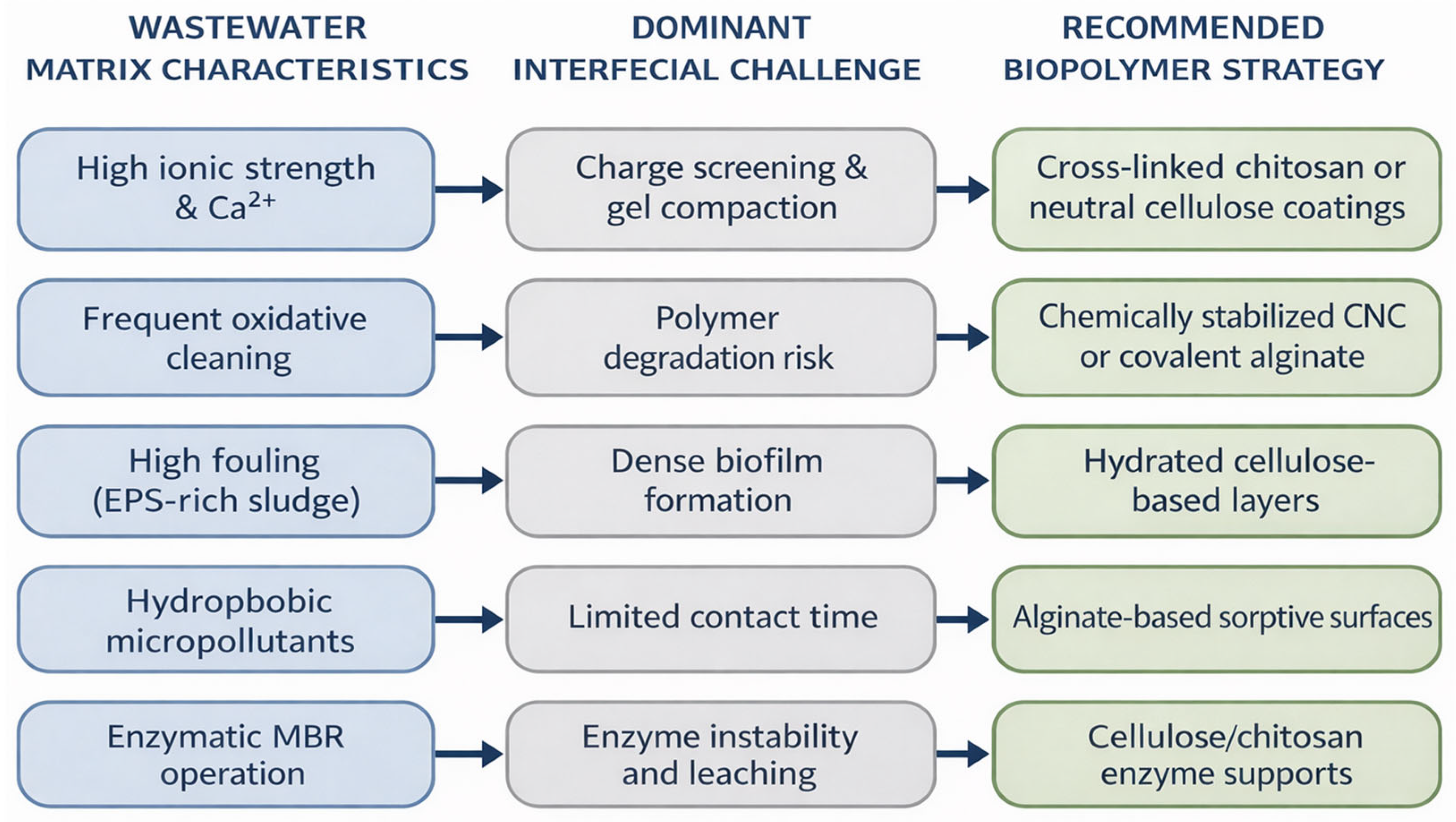
  • Building on the performance windows summarized in Table 4, a practical selection guideline is proposed to assist in choosing biopolymer surface modifications based on wastewater matrix characteristics and dominant operational constraints (Figure 6). The framework translates interfacial design principles into an intuitive decision pathway linking wastewater chemistry with suitable polymer strategies.
Membrane surface modification in MBRs involves managing interfacial evolution rather than simply selecting materials based on bulk properties. Table 3 presents four surface properties that consistently correlate with improved MBR performance. The ranges represent performance windows-not universal optima-identified under specific experimental conditions. Optimal values shift depending on wastewater composition, operating temperature, cleaning protocols, and target micropollutants. Importantly, these parameters interact synergistically, as discussed in the following sections.
As Table 4 demonstrates, these parameters do not act independently. Evidence strength varies: hydration stability and surface charge show strong support across multiple studies, while optimal roughness and cross-linking density remain more context-dependent.
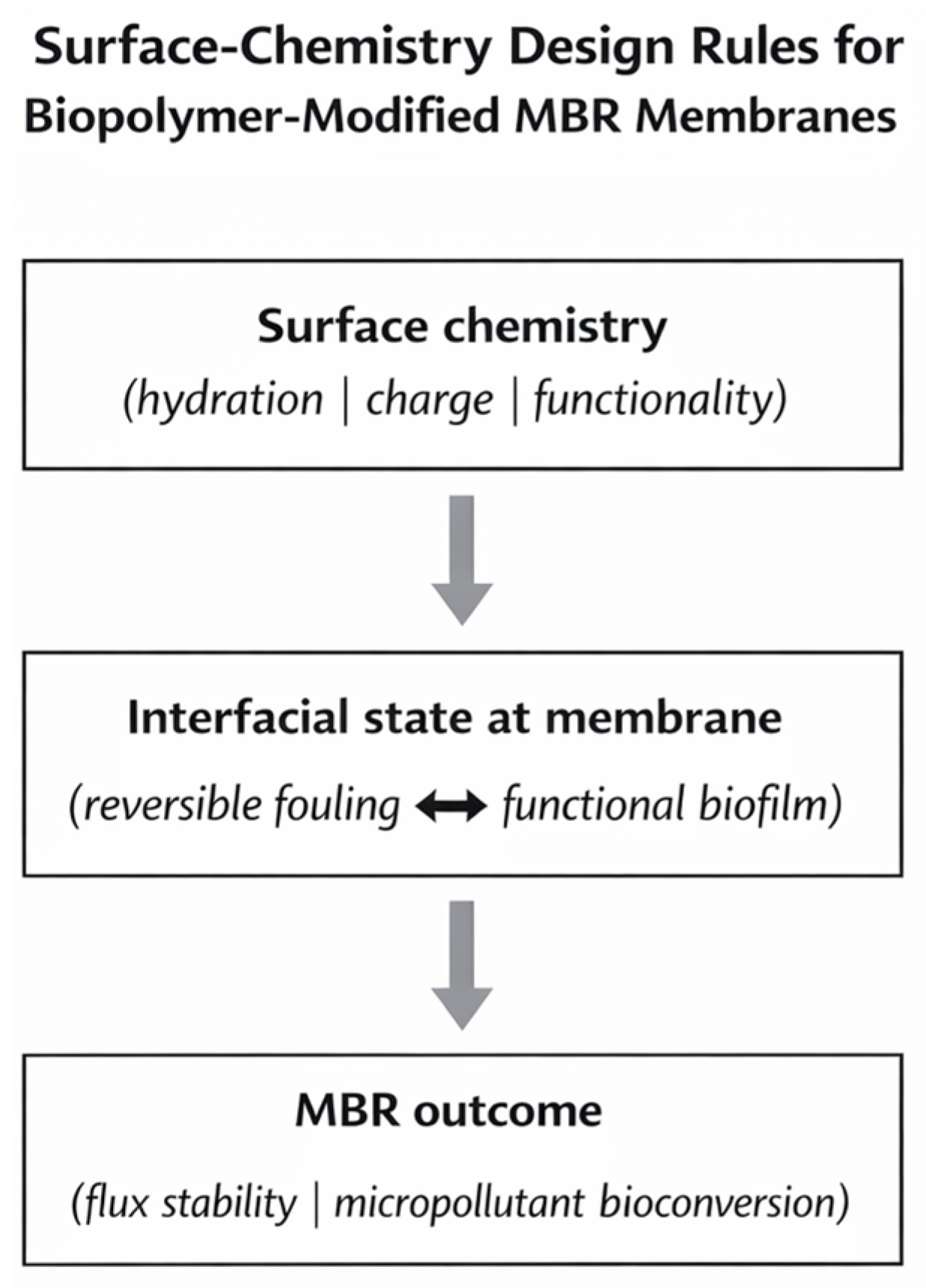
Membrane surface modification in MBRs involves managing interfacial evolution rather than fixing material properties. Full-scale validation of these ranges is outstanding. Figure 7 shows how these boundaries link surface chemistry to fouling and bioconversion in operating MBRs.

4.1. Hydration Stability over Wettability

Static water contact angle poorly predicts long-term performance. Contact angle drops (70° → 45°) occur initially, but conditioning films form within minutes of operation and displace a substantial fraction of interfacial water. Conditioning films reduce bound-water fraction by 30–40% in the first hours [9,42]. Membranes that maintain stable hydration layers show improved resistance to fouling. Interfaces retaining more than ~1.5 water molecules per nm2 exhibit lower irreversible fouling resistance. Such hydration levels have been quantified by 1H-NMR T2 relaxation times below ~20 ms, corresponding to approximately 2–3 tightly bound-water molecules per nm2. Irreversible fouling resistance remained <1 × 10¹² m−1 beyond 40 days. In contrast, surface modifications assessed mainly through contact angle reduction often lose their antifouling effect after only a few hypochlorite cleaning cycles (≈4–5 cycles) [9,42,59,60].
Hydration stability strongly influences flux recovery after hydraulic cleaning. Reported flux recovery values are typically 50–60% for weakly hydrated layers and 80–90% for interfaces maintaining stable hydration under representative shear (≈0.4 Pa) and biomass concentrations (≈8 g L−1 MLSS) [2,6,7,8,10].
Biopolymer-based surface modifications have been widely explored as a means of increasing interfacial hydration. Several biopolymer modifications enhanced interfacial hydration. Nanocellulose-modified membranes containing ~0.3 wt % CNC introduce high densities of hydroxyl groups (≈4 mmol g−1) and retain substantial bound-water fractions after extended oxidative aging. Ca2+-cross-linked alginate coatings applied at surface loadings of about 0.5 mg cm−2 maintain elevated hydration, even at increased ionic strength. Covalently stabilized chitosan networks also preserve high hydration levels over multiple cleaning cycles while maintaining near-neutral surface charge (Figure 5) [2,7,14,61].
Experimental evidence from long-term MBR operation shows that stability of interfacial hydration, rather than initial wettability, governs sustained performance. Surface modifications should be evaluated based on their ability to sustain a substantial bound-water fraction during operation rather than on static contact angle reduction alone. Enhanced hydration also influences the structure and dynamics of membrane-associated biofilms. Cellulose-based surface modifications reduce interfacial free energy and delay the transition from reversible to irreversible fouling while still permitting limited microbial attachment [7]. These permeable biofilms act as secondary reaction zones, transforming micropollutants without excessive hydraulic resistance. At the same time, cellulose derivatives are susceptible to enzymatic hydrolysis and gradual leaching during prolonged biological exposure, which limits their long-term stability and necessitates appropriate stabilization strategies [13].

4.2. Minimize Irreversible Adsorption

Extracellular polymeric substances (EPSs) and soluble microbial products (SMPs) play a central role in the development of irreversible fouling in MBR systems. Proteins and polysaccharides adsorb within minutes; Ca2+ bridges promote consolidation of polysaccharide-rich networks into mechanically stable cake layers over time scales of several hours (6–12 h) [4,6,7]. Surfaces combining hydrophobic domains, H-bonding sites, and electrostatic attractions favor irreversible adsorption. In particular, strongly cationic interfaces (e.g., ζ-potentials on the order of +20 to +25 mV) correlate with higher probabilities of irreversible EPS attachment and rapid increases in compressive fouling resistance, with reported values exceeding ~2 × 10¹² m−1 after short filtration periods (~24 h) [6,7,15].
Antifouling behavior is enhanced when surface–foulant interactions remain weak and reversible. For biopolymer-modified membranes, this behavior correlates with near-neutral surface charge, moderate densities of hydrogen-bonding groups, and limited nanoscale roughness. ζ-potentials of −15 to +5 mV reduce Ca2+-mediated EPS bridging while repelling anionic SMP. Similarly, hydroxyl group densities of 2–4 mmol g−1 support interfacial hydration without promoting irreversible protein locking, while RMS surface roughness values below 40 nm show fewer high-affinity contact points for large aggregates and lower propensity for colloid entrapment [42,56,62].
Covalent stabilization of biopolymer layers further modulates adsorption reversibility. Reported cross-link densities in the range of about 0.2–0.4 mmol g−1 correlate with the formation of transient adsorption sites, where EPS components can attach but detach under representative hydrodynamic shear (≈0.4 Pa wall shear). Hypochlorite cleaning yielded 80% reversible fouling and 90% flux recovery (system-dependent) [15].
Avoiding high-affinity binding sites is more effective than suppressing initial foulant attachment. Stable operation correlates with interfacial states where deposition and shear- or relaxation-assisted detachment remain dynamically balanced. This is consistent with the distinction between reversible cake-layer fouling and chemically irreversible components discussed in MBR fouling reviews [6,7,63].

4.3. Control Surface Charge and Ionic Strength Effects

Charge Window, Not Maximum Charge

Electrostatic interactions govern early fouling. Strongly charged surfaces repel proteins at low ionic strength, but this fails in mixed liquor [6,7]. At 50 mM sodium, the Debye length shrinks to ~0.3 nm, limiting electrostatic reach. Divalent Ca2+ (2–3 mM) further screens surface charge while bridging EPS to the membrane. Effective repulsion in strongly charged membranes drops to a few millivolts, insufficient to prevent contact and fouling [4,6,7,64]. High surface charge amplifies fouling under realistic conditions. Compact Ca2+-bridged EPS gels form rapidly on strongly charged membranes, stiffening the cake and accelerating antifouling loss [7,65].
Fouling reversibility improves when membrane surfaces remain near-neutral, rather than highly charged. ζ-potentials in the approximate range of −15 to +5 mV across environmentally relevant pH values (≈6–8) correlate with reduced Ca2+-mediated bridging and more permeable fouling layers under MBR conditions. The influence of surface charge does not act in isolation. The propensity for Ca2+-EPS bridging at higher surface charge values (e.g., ≥+20 mV) depends on the combined effects of surface roughness and bulk water chemistry. Enhanced Ca2+-EPS bridging occurs primarily under conditions combining elevated surface charge with increased nanoscale roughness and sufficient bulk-phase divalent cation availability, whereas such effects are markedly attenuated under smoother surface topographies or lower Ca2+ concentrations [66].
Within near-neutral charge regimes, electrostatic attraction is insufficient to promote irreversible EPS anchoring. At the same time, hydration-promoting functional groups (hydroxyl, phosphate, and zwitterionic moieties) remain partially ionized and effective in sustaining interfacial hydration. Zwitterionic surface chemistries based on sulfobetaine or carboxybetaine motifs are used in antifouling studies. These interfaces maintain ζ-potentials of −3 to +3 mV. Charge neutrality persists at ionic strengths up to 100 mM, limiting divalent-cation-mediated bridging. High fractions of reversible fouling have been reported during extended submerged MBR operation at laboratory or pilot scale [67].
A practical guideline is to employ weakly charged or zwitterionic surface functionalities combined with Ca2+-chelating groups to limit ionic bridging. Maintaining a controlled surface-charge window, rather than maximizing charge density, promotes reversible EPS interactions and improves long-term fouling resistance under submerged MBR conditions [7,67].
Figure 8 shows zwitterionic functional motifs commonly used to impart antifouling properties to membrane surfaces.
Effective MBR surface design requires moderate charge density, not extreme values. Near-neutral ζ-potential regimes, usually within approximately −15 to +5 mV under environmentally relevant pH conditions, have been repeatedly associated with a favorable balance between interfacial hydration and fouling reversibility. Within this range, sufficient polar functionality is retained to sustain strongly bound hydration layers (often exceeding ~1.5 H2O molecules nm−2). The propensity for Ca2+—mediated EPS bridging observed on strongly cationic surfaces is substantially reduced [14,59,60]. Representative zwitterionic chemistries include sulfobetaine, carboxybetaine, and phosphorylcholine. These interfaces exhibit strong water binding while remaining comparatively insensitive to variations in ionic strength (e.g., 50–100 mM Na+) and divalent cation concentrations typical of municipal wastewater (≈2 mM Ca2+). Under lab and pilot-scale submerged MBR conditions, such surfaces show high fractions of reversible fouling during extended operation [14,59,60].
At higher ionic strengths (≥100 mM), electrostatic interactions are strongly screened (Debye length < 0.5 nm). Under these conditions, near-neutral charge regimes alone become less effective. Zwitterionic functionalities or Ca2+-chelating ligands are required to maintain predominantly reversible fouling behavior, highlighting the increasing importance of hydration-dominated and ion-complexation mechanisms over simple charge control [60].
For biopolymer-modified membranes, similar interfacial behavior arises from balanced functional group presentation rather than from maximizing any single surface property. Across multiple studies, moderate densities of anionic functionalities (carboxylate or phosphate groups of 0.3–0.4 mmol g−1) correlate with effective Ca2+ chelation without inducing excessive surface charging. In parallel, hydroxyl- or amine-rich moieties at levels of 2–3 mmol g−1 sustain interfacial hydration and support dynamically resilient water layers [7,8,67].
In some cases, the incorporation of zwitterionic motifs, such as carboxybetaine grafts on chitosan-based coatings, has further reduced net surface charge while preserving strong water structuring. Interfaces exhibiting this combination of moderate charge density and high hydration capacity promote predominantly reversible EPS attachment—detachment behavior under the modest wall shear typical of submerged MBRs (≈0.4 Pa), rather than the formation of compact, Ca2+-bridged gel layers [7,8,67]. Available evidence indicates that durable antifouling performance under variable ionic conditions of real MBR mixed liquor is more closely linked to coupling moderate surface charge with strong hydration, rather than to extreme electrostatic repulsion [7,60,67].

4.4. Integrated Design Narrative: From Biofilm Function to Cleaning-Resistant Surfaces

Under exposure to real mixed liquor, antifouling behavior evolves dynamically rather than reflecting an intrinsic material property. Protein adsorption occurs rapidly at the membrane surface. Over the following hours, EPS networks consolidate through Ca2+-mediated interactions. During multi-day operation, this consolidation increases compressive fouling resistance. Reported resistance values are on the order of, or can exceed, 1012 m−1, depending on process conditions and wastewater chemistry [4,7]. Under these regimes, even small differences in nanoscale interfacial structure can result in pronounced divergence in TMP evolution, separating unstable TMP increases of about 0.4 kPa d−1 from more stable behavior near 0.1 kPa d−1 [4,7].
Second, the effective diffusivity of representative micropollutants (≈200–400 Da) is partly retained, often at ≥40% of the aqueous-phase value, limiting mass transfer constraints within the fouling layer [70,71].
Third, apparent micropollutant attenuation is often higher than for pristine membranes, with detected transformation products indicating membrane-proximal biotransformation rather than passive sequestration [5,7,70]. In this review, removal therefore refers to bulk-phase attenuation unless supported by evidence of true degradation. Fouling is considered detrimental when TMP increase rates exceed ~0.25 kPa d−1 or when multiple performance metrics deteriorate simultaneously, regardless of cake thickness [4,7].
Although reported thresholds depend on wastewater composition and operating conditions, converging evidence links functional fouling behavior to specific structural features of the fouling layer. These include relatively high porosity (ε > 0.70), intermediate thickness (≈100–200 µm), and moderate specific cake resistance (α_c < 5 × 10¹³ m kg−1), which together limit compressive consolidation and preserve transport pathways [4,5,7,71,72]. Porosity near ε ≈ 0.70 recurs most frequently: values above this level are correlated with effective diffusivity ratios >0.40, whereas lower porosities often coincide with diffusion-limited behavior. Deviations occur when porosity and thickness interact, highlighting their coupled influence rather than a single universal threshold [7,70,71].
The relationship between cake porosity and effective diffusivity depends on operating conditions. Changes in EPS composition, ionic strength, shear history, and operating time can shift this relationship. Under favorable conditions, bio-cakes with thicknesses of around ~150 µm and porosities near ε ≈ 0.73 maintain low TMP increase rates (~0.12–0.14 kPa d−1) during multi-week operation. For compounds such as diclofenac and carbamazepine, these layers retain about 40–50% of aqueous-phase diffusivity. In such cases, enhanced apparent attenuation has been reported together with detectable transformation products, consistent with biotransformation occurring close to the membrane surface [7,70,71]. Despite their thickness, high porosity preserves transport pathways and hydraulic stability.
In contrast, thinner but denser layers (≈40–60 µm; ε ≈ 0.50–0.58) are associated with steeper TMP slopes (~0.30–0.40 kPa d−1), reduced diffusivity (~15–25%), limited attenuation gains, and poor flux recovery [19,48,51], indicating that porosity-controlled mass transfer, rather than thickness alone, governs the transition to detrimental fouling [4,5,7,70,71,72].
At the microscale, hydrated porous layers act as coupled reaction–transport zones, locally enriching moderately polar micropollutants to low-µg L−1 levels and shortening apparent half-lives without compromising TMP [5,7,70]. Early-stage interfacial features—moderate roughness (RMS ≈ 20–40 nm) and near-neutral charge—favor dispersed micro-colonies and higher effective diffusivity compared with smoother, unmodified surfaces [7,8,71].

4.5. Retention-Controlled Bioconversion

In MBRs targeting trace organic contaminants, the membrane functions not only as a size-selective barrier but as a reaction–transport interface that controls molecular residence time near catalytic sites. Surface chemistry, therefore, determines whether micropollutants are transiently retained and transformed or pass through largely unchanged [6,73].
Lab-scale studies on enzymatic MBRs show NF skins with nominal MW cut-offs of ~200 Da, which retain both laccase and selected substrates, correlate with substantially higher apparent turnover rates than UF membranes (10 kDa) that allow substrate permeation. These observations support the importance of controlled retention and contact time, rather than enzyme loading alone, once catalytic capacity is no longer limiting [11,17].
Polar and persistent compounds such as carbamazepine can strongly sorb into dense Ca2+-mediated EPS matrices. This sorption reduces freely dissolved concentrations near the membrane surface. In some cases, concentrations fall below enzymatic Michaelis constants, with reported Km values for recombinant laccase on the order of ~3 µg L−1, observed reaction rates decline, even when nominal residence times are extended [15,17]. As a result, apparent removal reflects accumulation rather than true biotransformation.
Comparative EMBR enhanced apparent attenuation is observed primarily when retention remains reversible; transient concentration increases can occur near the membrane surface, while desorption still proceeds on time scales comparable to, or shorter than, biofilm consolidation. Reported dissociation half-lives are typically on the order of tens of minutes. In NF-based systems, this behavior correlates with higher apparent removal of compounds such as diclofenac, carbamazepine, sulfamethoxazole, and atrazine compared with UF configurations. Importantly, these observations do not indicate clear long-term accumulation of parent compounds [11,17].
Surface chemistry governs reaction–transport coupling at the membrane interface rather than acting as a simple binary separator. Moderate electrostatic interactions (e.g., weakly anionic functionalities combined with Ca2+-chelating groups) coupled with strong interfacial hydration extend contact time sufficiently to support catalytic turnover while maintaining desorption rates that limit conversion of the membrane into a long-term sink [8,16,19]. Table 5 lists key surface-chemistry design principles for biopolymer-modified MBR membranes.
Table 6 compares performance metrics for biopolymer-modified membranes across lab and pilot studies.
Reported values illustrate the typical magnitude of changes in wettability, surface charge, fouling behavior (e.g., FRR, critical flux, and fouling cycle duration), and removal performance observed under MBR operating conditions, providing data-level reference points for the design principles discussed in Section 4 [11,61,74,75].
Across the reviewed laboratory and pilot-scale studies, enhanced micropollutant attenuation is most reported in systems where membrane-proximal retention remains reversible, allowing transient concentration increases without long-term sequestration [76,77].
The design principles presented in Section 4 provide a mechanistic understanding of how surface chemistry influences fouling behavior and micropollutant transformation. To translate these principles into practical guidance for material selection, Table 7 presents a decision framework that links wastewater characteristics and operational constraints to recommended biopolymer modifications. This framework emerged from a comparative analysis of performance data across diverse feed compositions, MBR configurations, and operating conditions. While not exhaustive, it provides a starting point for rational material selection tailored to site-specific conditions rather than generic best-practice recommendations.
Table 6 illustrates that no single biopolymer offers universal superiority across all wastewater compositions and operational scenarios. Selection depends on matching surface-chemistry characteristics to the specific combination of ionic strength, divalent cation concentration, organic loading, and operational constraints present at a given site. The priority hierarchy—chemical stability first, charge control second, and hydration capacity third—reflects the observation that modifications failing to survive cleaning cycles or maintain target surface properties provide little long-term benefit, regardless of their initial antifouling performance.

5. Functional Biofouling in Modified MBRs

Biofilm formation on membrane surfaces is inherent to MBR operation. Historical approaches to membrane design have prioritized complete suppression of microbial attachment and biofilm development [4,6,7]. Lab studies show surface chemistry steers biofilm phenotype [4,6,7]. The old fouled/clean binary is obsolete–membrane interfaces span a continuum of porosity, hydration, and redox [4,5]. Biofilm characteristics on membrane surfaces differ substantially depending on interfacial properties. Biopolymer-modified surfaces consistently promote hydrated, permeable layers (≈100–200 μm, ε > 0.7) that locally enrich micropollutants like diclofenac, extend contact times with catalytic biomass, and enhance apparent transformation, all while maintaining TMP increase below 0.15 kPa d−1 under controlled conditions [5,7,70]. The alternative is instructive. Ca2+-consolidated biofilms (ε < 0.5) achieve similar thickness but strangle both flux and reactivity [5,7]. Surface nanoscale characteristics determine the biofouling phenotype. A CNC-roughened surface with ζ ≈ −12 mV nucleates dispersed micro-colonies; a smooth, strongly anionic surface (ζ ≈ −25 mV) triggers Ca-EPS bridging and gel collapse within hours. Surface chemistry influences the type and structure of biofilm that develops.
Moderate surface roughness combined with weak surface charge promotes dispersed micro-colonies instead of compact, continuous biofilms. Such interfacial architectures correlate with higher effective diffusivity and enhanced access of enzymes or redox-active microorganisms to retained micropollutants [7,71]. Excessive surface roughness promotes irreversible colloid entrapment and accelerates fouling, indicating a trade-off rather than a universal optimum. Moderate nanoscale roughness (RMS ~20–40 nm) disrupts close packing of cells/EPS while staying below the ~50 nm threshold for irreversible colloid trapping and rapid fouling [8].
Once formed, the fouling layer must withstand hydraulic drag while remaining sufficiently permeable for mass transfer. Studies on alginate-based coatings show that moderately cross-linked Ca2+–alginate networks (cross-link density ~0.2 mmol Ca2+ g−1; elastic modulus ~0.8–2.1 GPa) tolerate aeration-induced shear (~0.4 Pa) while retaining reversible swelling (~15%) during back-pulsing. Under lab conditions, this behavior partially released retained micropollutants and transformation products [14,40]. In contrast, higher cross-link densities (>0.4 mmol g−1) rigidify the polymer network, reduce local water mobility, and diminish apparent enzymatic activity, highlighting a trade-off between mechanical stability and interfacial reactivity rather than a single optimal state. The durability of these interfacial layers is further challenged during repeated chemical cleaning. Lab-scale studies employing periodic hypochlorite cleaning (500 ppm NaOCl at pH 11, 30 °C) show physically adsorbed chitosan layers undergo substantial mass loss (15–20% within 40 cleaning cycles), accompanied by surface-charge drift of ~15 mV and increased irreversible fouling resistance [12,13]. By contrast, covalently stabilized modifications like genipin-cross-linked chitosan show markedly lower mass loss (<5%) and more stable surface electrokinetic properties (remaining within −15 to +5 mV) over extended operation times exceeding 1000 h under controlled conditions [12,13].
Covalent anchoring chemistry focuses on balancing long-term durability with interfacial flexibility. Anchoring strategies employing relatively soft covalent linkers, such as citric acid or adipic dihydrazide, preserve a substantial fraction of polymer segmental mobility (~60–70%) while maintaining resistance to oxidative degradation. As a result, these systems form hydrated, compliant interfacial layers that retain sponge-like transport behavior without rapid mechanical or chemical failure [12].
Multiple studies report a performance window rather than a single optimal target. This window is commonly characterized by hydrated and moderately porous interfacial layers, with thicknesses of 100–200 µm, high porosity, near-neutral surface charge, and moderate nanoscale roughness. These states stabilized TMP evolution and enhanced micropollutant transformation in lab MBRs (Figure 5) [15].
Table 8 classifies the main biofouling-related interfacial states observed during MBR operation and links them to characteristic structural features and hydraulic response.
Conventional biocidal coatings exhibit limited long-term effectiveness under real mixed-liquor conditions due to rapid conditioning and biofilm adaptation, rather than achieving sustained “zero-fouling” performance. Biopolymer-modified surfaces work differently: they control the biofilm spectrum by offering hydrated, weak-affinity interfaces that allow microbial attachment while preventing dense biofilm formation. A 0.5 mg cm−2 alginate-Ca2+ gel (ζ −18 mV, RMS 25 nm) cuts EPS anchoring energy from 38 to 24 mJ m−2 and channels Pseudomonas into isolated micro-colonies (<5% coverage); the resulting 150 µm cake (ε = 0.73) stays mechanically fragile and is peeled off at 0.4 Pa shear without chemicals [8,9,59]. Because microbial viability is not compromised, the same interfacial conditions selectively enrich laccase-producing Comamonadaceae (up to ~1.8-fold), promoting the formation of a reactive, enzyme-rich cake layer. This state is associated with substantially higher apparent diclofenac attenuation under laboratory-scale operation while maintaining low hydraulic resistance (TMP slope < 0.15 kPa d−1) [5,7,70].
Hydrated, permeable interfacial layers improve the hydraulic and energetic performance of MBR systems. Higher effective permeability can be maintained under favorable fouling conditions. Permeable layers achieved 25 L m−2 h−1 bar−1 versus 15 L m−2 h−1 bar−1 for compact EPS layers. This difference reduces aeration demand by approximately 20%. As a result, specific energy consumption can decrease from about 0.45 to 0.35 kWh m−3 during extended operation periods of around 90 days under laboratory or pilot-scale conditions [4,5]. In parallel, reduced fouling severity and slower performance drift allow less frequent chemical cleaning (once rather than three times per quarter), which may extend membrane service life by more than 20% and lower the environmental burden associated with cleaning reagents and membrane disposal [15]. Surface chemistry influences hydrodynamic and biological processes at the membrane interface and modulates fouling behavior.

6. Micropollutant Bioconversion Pathways in Biopolymer-Modified MBR Systems

6.1. Overview: From Interfacial Design to Transformation Outcomes

The surface-chemistry design principles established in Section 4-stable hydration (>1.5 H2O/nm2) [8,9], near-neutral charge (ζ ≈ −15 to +5 mV) [7,60], moderate cross-linking (0.2–0.4 mmol/g) [14,59], and controlled roughness (RMS 20–40 nm) [8,9]—collectively determine how the membrane-proximal environment influences micropollutant fate. Section 5 demonstrated that these parameters program biofilm architecture, steering fouling layers toward permeable, hydrated structures (ε > 0.7, thickness 100–200 µm) [4,5,7] rather than compact, diffusion-limited gels. This chapter examines how such functional interfacial layers modify micropollutant transformation pathways and whether apparent removal reflects true bioconversion or transient retention.
Micropollutants in municipal wastewater are present at trace concentrations (10–500 ng L−1), where conventional treatment mechanisms-bulk-phase biodegradation in suspended flocs, sorption to activated sludge, and volatilization-show limited effectiveness [1,3]. Extended sludge retention times (SRT 30–80 d) and high biomass concentrations (MLSS 8–15 g L−1) [2,3] in MBRs enrich slow-growing specialists capable of cometabolic degradation, yet removal efficiencies for persistent compounds such as carbamazepine, diclofenac, and benzotriazole often remain below 50% in conventional configurations [3,20]. The membrane interface, however, creates a distinct microenvironment where residence time, substrate concentration, redox potential, and enzymatic activity differ substantially from bulk mixed liquor [4,6,7]. Understanding how biopolymer modifications alter these interfacial conditions is critical to advancing rational MBR design.

6.2. Sorption-Mediated Concentration at Modified Interfaces

Micropollutant retention at membrane surfaces arises from a combination of hydrophobic interactions, electrostatic effects, hydrogen bonding, and cation bridging [3,64]. The relative contribution of each mechanism depends on both compound properties (log D, pKa, molecular structure) and interfacial characteristics defined by biopolymer modification.
Hydrophobic partitioning dominates for nonpolar compounds (log D > 2.5) such as triclosan, musks, and certain UV filters [1,3]. These compounds partition into hydrophobic domains within biofilms and membrane polymer matrices. Reported bioconcentration factors—defined as the ratio of interfacial to bulk aqueous concentration—range from 102 to 104 for highly hydrophobic micropollutants [4,78]. However, strong irreversible sorption can reduce bioavailability, effectively sequestering compounds in diffusion-limited micro-domains where enzymatic access is hindered [3,17].
Biopolymer modifications that increase surface hydration reduce hydrophobic partitioning. Cellulose- and chitosan-modified membranes with reported bound-water densities exceeding ~1.5 H2O/nm2 show lower equilibrium sorption coefficients (Kd) for nonpolar compounds—typically reduced by 40–60% relative to unmodified PVDF—while maintaining sufficient transient retention to support catalytic turnover [8,9]. This balance reflects the competing effects of reduced hydrophobic domains and enhanced water structuring at polar biopolymer interfaces.
Electrostatic interactions govern the retention of ionizable compounds. Anionic micropollutants (e.g., diclofenac and naproxen; pKa 3–5) interact with cationic surface groups, while cationic pharmaceuticals (e.g., fluoroquinolone antibiotics; pKa 6–8) are attracted to anionic functionalities [3,17]. The near-neutral charge window (ζ ≈ −15 to +5 mV) recommended in Section 4 moderates these interactions. Chitosan-modified membranes with ζ ≈ +8 mV at pH 7 retain anionic diclofenac at concentrations ~5–10× above bulk levels within the interfacial biofilm, yet desorption half-lives remain in the range of tens of minutes rather than hours, preserving bioavailability for enzymatic attack [12,17].
Strongly charged surfaces (|ζ| > 20 mV) promote irreversible retention through Ca2+-mediated bridging. In the presence of divalent cations (Ca2+ ~2 mM in municipal wastewater), anionic micropollutants can form ternary complexes with Ca2+ ions and negatively charged biopolymer functionalities, effectively immobilizing compounds within dense EPS gels (ε < 0.5) [4,66], apparent removal may reach 80–90%, yet mass-balance studies reveal that parent compounds accumulate within the fouling layer rather than undergoing true bioconversion [17,78].
Hydrogen bonding and π-π interactions contribute to the retention of aromatic compounds with hydroxyl, amine, or carbonyl groups. Cellulose-based modifications, rich in hydroxyl functionalities (4–5 mmol/g), provide multiple sites for hydrogen-bond formation with polar micropollutants such as bisphenol A, sulfamethoxazole, and benzotriazoles [8,9]. Moderate retention via hydrogen bonding—characterized by binding constants Kb in the range 103−104 M−1—extends contact time while allowing reversible desorption [16,17].
Surface roughness influences both the area available for sorption and the local hydrodynamic environment. The moderate roughness range (RMS 20–40 nm) identified in Section 4 increases the effective surface area by approximately 15–30% relative to smooth membranes, enhancing initial sorption capacity without promoting irreversible colloid entrapment [8,13]. More critically, roughness affects biofilm architecture. Nanocellulose-modified membranes with RMS ~30 nm favor the formation of dispersed micro-colonies rather than continuous biofilm carpets [7,70]. This microcolonial structure maintains high cake porosity (ε > 0.7) and effective diffusivity (Deff ≥ 40% of aqueous values for 200–400 Da solutes), allowing micropollutants to access catalytically active biomass throughout the fouling layer rather than being trapped at the outermost interface [13,15,70]. In contrast, smooth surfaces (RMS < 10 nm) with strongly anionic charge (ζ < −25 mV) develop compact, stratified biofilms (ε ~0.5) where diffusion limitation becomes severe within 50–100 µm from the membrane surface [7,78].

6.3. Biotransformation Pathways and Mechanisms

Laccase (EC 1.10.3.2) and peroxidase (EC 1.11.1.7) are copper-containing and heme-containing oxidoreductases, respectively, capable of oxidizing phenolic and aromatic micropollutants under mild conditions [11,17]. Bacterial laccases, particularly those from Comamonadaceae and related β-proteobacteria enriched in MBR biofilms, exhibit broader substrate specificity and lower Michaelis constants (Km ~3–10 µM) compared to fungal enzymes (Km > 50 µM for many pharmaceuticals) [17,70].
Biopolymer-modified membranes influence enzymatic transformation through three primary mechanisms. First, enzyme immobilization and stabilization: Chitosan and alginate provide amine and carboxylate anchoring sites that enhance laccase retention and operational stability. Studies on chitosan-modified supports report enzyme half-lives exceeding 200 h under continuous operation, compared to 40–80 h for free enzyme in bulk solution [16,18]. The moderate cross-linking densities (0.2–0.4 mmol/g) recommended in Section 4 maintain sufficient polymer chain mobility to allow substrate diffusion while chemically stabilizing the immobilized enzyme against oxidative and thermal deactivation [12,14].
Second, local concentration enhancement: As discussed in Section 6.2, reversible sorption increases micropollutant concentrations in the enzyme’s immediate vicinity. For diclofenac (bulk concentration 200 ng L−1), transient retention within a 150 µm porous biofilm (ε = 0.73) on a CNC-modified membrane increases local concentrations to 2–5 µg L−1—sufficient to exceed typical Km values and sustain turnover [4,7,78]. Third, microenvironment control: The hydration layer stabilized by biopolymer modification (>1.5 H2O/nm2) maintains local pH within optimal ranges (pH 6–8 for bacterial laccases) and preserves enzyme conformation [8,14]. Additionally, moderate surface roughness creates sheltered microenvironments where enzymatic activity is protected from bulk-phase shear while remaining accessible to substrates [7,70].
Diclofenac provides a useful example. This recalcitrant anti-inflammatory pharmaceutical (2-[(2,6-dichlorophenyl)amino]benzeneacetic acid) has a biodegradation half-life exceeding 8 h in conventional activated sludge [3,17]. Within biofilms on chitosan-modified membranes (ζ ≈ +8 mV, cross-linking 0.3 mmol/g), bacterial laccases catalyze initial phenolic hydroxylation, followed by oxidative coupling to form dimers and trimers [17,70]. The apparent half-life decreases to ~2 h, and overall removal increases from 35% (unmodified MBR) to 68% while maintaining low TMP increase rates (<0.15 kPa d−1) [4,7,78]. Importantly, laccase-mediated oxidation does not achieve complete mineralization. Transformation products include 4′-hydroxydiclofenac, 5-hydroxydiclofenac, and chlorinated quinone derivatives, which retain partial estrogenic activity and require further degradation by bacterial consortia [17,79].
Many micropollutants serve as poor primary carbon and energy sources but can be transformed and cometabolically degraded fortuitously by enzymes induced during growth on other substrates [3,20]. Extended SRT (30–80 d) in MBRs enriches slow-growing specialists such as nitrifiers, ammonia-oxidizing archaea, and heterotrophic bacteria with broad-specificity oxygenases [2,3]. Biopolymer-modified membranes influence cometabolic activity through biofilm community structuring. Metagenomic analyses of biofilms on cellulose-modified PVDF membranes reveal 1.5–2× enrichment of Nitrospira, Nitrosomonas, and ammonia-oxidizing Thaumarchaeota relative to bulk mixed liquor [7,71]. These organisms produce cytochrome P450 monooxygenases and ammonia monooxygenase (AMO), which non-specifically hydroxylate aromatic rings and aliphatic chains in pharmaceuticals and pesticides [3,20].
Surface chemistry affects cometabolic efficiency by modulating oxygen availability and redox gradients. Hydrated, porous biofilms (ε > 0.7) maintain oxygen penetration depths of 100–150 µm, supporting aerobic cometabolism throughout most of the cake layer [70,71]. In contrast, dense gels (ε < 0.5) become anoxic at depths >50 µm, shifting metabolism toward anaerobic pathways that show lower turnover rates for many recalcitrant compounds [4,70]. Representative cometabolic pathways include carbamazepine transformation via 10,11-dihydro-10,11-epoxycarbamazepine intermediate catalyzed by cytochrome P450 [79]; sulfamethoxazole degradation through N4-acetylation and hydroxylation at positions 4 and 5 [17,80]; and atrazine N-dealkylation to desethylatrazine and desisopropylatrazine, though ring cleavage remains limited [20,81].
Biofilm stratification creates redox gradients that enable sequential aerobic–anoxic–anaerobic transformations. In biofilms on biopolymer-modified membranes, redox potential (Eh) typically decreases from +200 mV near the biofilm–liquid interface to −150 to −250 mV at depths >100 µm from the membrane surface [4,70]. These reducing microenvironments favor reductive dehalogenation, where chlorinated compounds such as triclosan and diclofenac undergo reductive dechlorination catalyzed by facultative anaerobes, producing less halogenated intermediates that are more susceptible to aerobic ring cleavage [17,70]. Nitro reduction in nitroaromatic compounds proceeds to aromatic amines [79]. Additionally, dye molecules and certain pharmaceuticals containing azo linkages are reductively cleaved under anaerobic conditions [76]. The balance between aerobic oxidation in the outer biofilm and anaerobic reduction in deeper layers depends on biofilm thickness, porosity, and substrate loading. The optimal range identified in Section 5—iofilm thickness 100–200 µm with ε > 0.7-maintains sufficient oxygen penetration to support aerobic processes while preserving redox gradients that enable sequential transformations [4,5,7].

6.4. Transformation Products and Mass-Balance Closure

Disappearance of parent compounds from the aqueous phase is reported as “removal”, yet this terminology conflates true biodegradation with transient retention and transformation to undetected products [11,17,20]. Comprehensive assessment requires identification of transformation products (TPs) via LC-MS/MS or GC-MS, quantification of TP concentrations in permeate, retentate, and biofilm extracts, closure of mass balances where the sum of parent compound, identified TPs, and mineralized fraction approaches 100%, and toxicity profiling of major TPs using bioassays such as estrogenic activity or bacterial growth inhibition [17,79].
Studies that include TP profiling reveal critical limitations. For example, laccase-mediated oxidation of diclofenac produces 4′-hydroxydiclofenac and quinone imine derivatives that exhibit 2–5× higher estrogenic activity than the parent compound at pH <6 [79]. Similarly, partial oxidation of bisphenol A yields hydroxylated intermediates (e.g., hydroquinone) and dimers with retained endocrine-disrupting potential [11,17]. Biofilms on biopolymer-modified membranes can shift product spectra toward higher oxidation states compared to bulk-phase degradation. Chitosan-immobilized laccase promotes formation of fully oxidized trimers and tetramers from phenolic substrates, which show lower estrogenic activity and are more readily mineralized by heterotrophic bacteria in downstream biofilm zones [11,70]. However, this advantage depends on maintaining sufficient redox diversity within the biofilm-achieved through the porosity and thickness ranges identified in Section 5.
Most reviewed studies report parent-compound removal without closing mass balances. Common issues include undetected polar TPs, which are often more polar than parent compounds and are lost during sample preparation or not detected by standard analytical methods optimized for parent compounds [17,79]. Sorption to biomass and membrane complicates differentiation between retention and degradation, as hydrophobic compounds partition into sludge and polymer matrices [3,78]. Volatilization of certain compounds during aeration contributes to apparent removal without biotransformation [1,3]. Complete degradation to CO2 is rarely measured directly; radiotracer studies using 14C-labeled compounds provide definitive evidence but are resource-intensive and available for only a limited number of micropollutants [17,20]. Mass-balance studies with comprehensive TP profiling are needed, particularly for systems claiming enhanced removal via biopolymer modification. Without such data, it remains unclear whether improved performance reflects genuine bioconversion or redistribution within the treatment system [17,20].

6.5. Linking Surface-Chemistry Design Rules to Transformation Outcomes

Hydration and reversible retention. The design parameter of bound-water density exceeding 1.5 H2O/nm2 operates through a mechanism where hydration layers reduce irreversible sorption while allowing transient retention, leading to enhanced enzymatic turnover for moderately polar compounds. Micropollutants with log D 0.5–2.5 (e.g., diclofenac, sulfamethoxazole, and bisphenol A) show optimal transformation on hydrated interfaces [17,78]. Cellulose-modified membranes with bound water ~2.5 H2O/nm2 as measured by DSC exhibit transient retention factors of 5–15× (bulk to interfacial concentration), desorption half-lives of 15–45 min, and apparent transformation efficiency of 55–80% versus 30–50% on unmodified membranes [4,7,8]. Mechanistically, stable hydration maintains compound bioavailability by preventing irreversible partitioning into hydrophobic domains. This balance is critical for enzymatic reactions, where substrate concentration must exceed Km but remain accessible to catalytic sites [11,17].
Near-neutral charge and electrostatic moderation. The design parameter of ζ-potential between −15 and +5 mV limits Ca2+-mediated sequestration and moderates ionic interactions, preventing accumulation while preserving diffusive access. Strongly anionic surfaces (ζ < −20 mV) retain anionic micropollutants through Ca2+ bridging, forming dense gels (ε ~0.5) with hindered diffusion [4,66]. Reported outcomes include apparent removal of 70–85% with high parent-compound disappearance, yet mass balance reveals less than 40% true degradation with more than 50% retained in the cake layer, and minimal biofilm TP formation as accumulation dominates [78]. Near-neutral surfaces (ζ ≈ −10 mV) show apparent removal of 55–70%, mass balance indicating 60–75% true degradation with less than 30% retained, and diverse products indicating active biotransformation [7,17]. This pattern confirms that moderate charge facilitates catalytic transformation by preserving reversible retention and limiting diffusion barriers [4,7].
Cross-linking density and enzymatic activity. The design parameter of cross-linking density between 0.2 and 0.4 mmol/g balances stability with polymer mobility and water transport, preserving enzyme activity and maintaining TP release. Genipin-cross-linked chitosan membranes at 0.3 mmol/g cross-linking retain immobilized laccase activity exceeding 70% over 40 cleaning cycles, water self-diffusion at 80% of uncross-linked value, and micropollutant effective diffusivity at approximately 50% of aqueous value [12,14]. Higher cross-linking (>0.5 mmol/g) rigidifies the network, resulting in enzyme activity below 50% due to hindered conformational flexibility, water mobility at 55% due to restricted hydration dynamics, and delayed TP release with accumulation within the polymer matrix [13,43]. These observations underscore the importance of moderate cross-linking in maintaining interfacial reactivity alongside chemical durability.
Roughness and biofilm community assembly. The design parameter of RMS between 20 and 40 nm promotes dispersed micro-colonies and disrupts dense packing, enriching degrader populations while maintaining porosity. Comparative metagenomic CNC-modified membranes (RMS ~30 nm) enrich Comamonadaceae laccase producers by 1.8-fold versus smooth membranes, Nitrospira cometabolic oxygenases by 1.5-fold, and increase overall biofilm diversity (Shannon index) by 25% [7,71]. This community shift correlates with faster apparent half-lives (diclofenac 2 h versus 5 h on smooth membrane), higher TP diversity (6–8 detected products versus 3–4), and sustained transformation with activity maintained over 60 d operation [7,78]. Mechanistically, moderate roughness creates microhabitats that shelter slow-growing specialists from bulk-phase washout while preserving diffusive access to substrates [71].

6.6. Representative Micropollutant Classes and Removal Limitations

Understanding compound-specific behavior requires considering physicochemical properties, prevalent transformation pathways, and how these interact with interfacial design. Table 9 summarizes major micropollutant classes, representative examples, dominant limitations in conventional MBRs, modification strategies, and key references.
Carbamazepine is highly persistent and resists most conventional biological treatments. Transformation requires cytochrome P450-mediated epoxidation or direct photocatalytic attack. Biopolymer modifications show limited benefit unless coupled with immobilized oxidative enzymes (laccases, peroxidases) or photocatalysts [3,17,79]. Diclofenac is moderately biodegradable under aerobic conditions via bacterial laccases. Chitosan-modified membranes (ζ ≈ +8 mV, RMS ~25 nm) consistently show 60–80% removal versus 30–50% in unmodified systems. Key TPs include hydroxylated derivatives and quinones; toxicity remains a concern [4,7,17,78].
Sulfamethoxazole is amenable to enzymatic transformation (N4-acetylation, hydroxylation). NF-based EMBRs retaining both enzyme and substrate achieve greater than 90% removal. Hydrated interfaces (>1.5 H2O/nm2) prevent irreversible sorption while extending contact time [11,17,80]. Bisphenol A rapidly sorbs to EPS and biomass (log D ~3.4). Transformation depends on maintaining aerobic conditions and reversible retention. Alginate-modified membranes with Ca2+ cross-linking (ε > 0.7) show 65–75% removal with low TP accumulation, whereas dense gels accumulate BPA without significant degradation [11,17]. Atrazine is a persistent herbicide requiring cometabolic degradation by Pseudomonas and Rhodococcus species. Extended SRT (>60 d) and stable biofilm communities are necessary. Cellulose-modified surfaces enriching degraders show 40–55% removal versus less than 30% in conventional activated sludge [20,81].
Representative molecular structures of selected micropollutants are shown in Figure 9, covering major compound classes relevant to MBR systems, including pharmaceuticals (carbamazepine and diclofenac), personal care products (triclosan and oxybenzone), endocrine-disrupting compounds (bisphenol A), pesticides (atrazine and diuron), industrial chemicals (benzotriazole), antibiotics (sulfamethoxazole, norfloxacin, and ofloxacin), and stimulants (caffeine) [17,81,82,83,84,85,86,87,88,89,90,91,92].

6.7. Summary and Integration

Micropollutant transformation in biopolymer-modified MBRs depends on sorption, enzymatic catalysis, cometabolic activity, and redox-controlled pathways, all influenced by the interfacial properties defined in Section 4. The functional fouling concept from Section 5-where permeable, hydrated biofilms enhance transformation instead of impairing performance-is supported by mechanistic evidence linking surface chemistry to bioconversion outcomes.
Reversible retention enabled by hydration exceeding 1.5 H2O/nm2 and near-neutral charge increases local substrate concentrations 5–15× while preserving bioavailability for enzymes [4,7,8,17]. Moderate cross-linking (0.2–0.4 mmol/g) maintains enzyme activity exceeding 70% and avoids mass transfer impairment at higher cross-linking densities [12,14]. Controlled roughness (RMS 20–40 nm) enriches degrader populations 1.5–2× and maintains biofilm porosity (ε > 0.7), sustaining effective diffusivity for low-MW solutes [7,71,78]. However, transformation product formation, toxicity, and mass-balance closure remain underexplored, with many reported “removal” efficiencies reflecting retention or conversion to uncharacterized TPs rather than mineralization [17,20,79].
Key unresolved questions require TP profiling with toxicity assessment for key pharmaceuticals and EDCs, mass-balance studies confirming mineralization versus redistribution, long-term validation exceeding six months under variable feed conditions, and direct comparison of transformation pathways on modified versus unmodified membranes with identical biofilm characteristics [11,17,20]. The evidence supports that rational surface engineering can enhance micropollutant transformation by creating interfacial conditions that favor catalytic activity, community enrichment, and reversible substrate access. However, translating laboratory observations to full-scale systems requires addressing durability, economic viability, and operational complexity-topics covered in Section 7.

7. Long-Term Stability of Modified Membranes

Routine MBR operation—repeated shear (~0.4 Pa), hypochlorite cleaning (500 ppm NaOCl, pH 11, 30 °C), and biological exposure—degrades membrane stability over time. This occurs as a result of the combined mechanical, chemical, and biological stresses imposed during operation. Physically adsorbed chitosan lost 15–20% mass within 40 cleaning cycles. This loss is usually associated with a progressive shift in surface charge (approximately +15 mV) and a concomitant increase in irreversible fouling resistance, which together lead to a gradual attenuation of the antifouling effects observed shortly after membrane modification [7,59,99]. In contrast, covalently stabilized modifications, such as genipin-cross-linked chitosan, retain more than 95% of their initial surface charge (≈+12 mV), exhibit less than 5% mass loss, and maintain low TMP increase rates (<0.15 kPa d−1) over extended operation times exceeding 1000 h [13,100].
Stability thresholds of biopolymer-modified membranes are strongly influenced by the anchoring characteristics at the molecular level. AFM nano-indentation studies of genipin-cross-linked chitosan networks show that cross-link densities in the range of roughly 0.15–0.30 mmol g−1 produce a substantial rise in elastic modulus for hydrated surface layers—from around 0.7–0.9 GPa up to about 1.8–2.3 GPa. Networks within this cross-linking window maintain some degree of swelling (10–20% by volume) and demonstrate adequate mechanical robustness to withstand repeated deformation cycles caused by hydrodynamic forces or aeration [101].
At cross-link densities above approximately 0.4 mmol g−1, AFM measurements indicate increased rigidity of the polymer network. Transport studies show a concurrent decrease in water mobility and self-diffusion, typically by 30–40%. Higher rigidity also reduces the accessibility of the polymer matrix to biomolecules. As a result, apparent enzymatic activity and interfacial reactivity decrease. These observations reflect a trade-off between mechanical reinforcement and mass-transfer-dependent functionality in heavily cross-linked chitosan surface layers [101].
Anchoring chemistry controls how interfacial properties evolve during extended operation. Grafting strategies based on citric acid or adipic dihydrazide preserve a substantial fraction of segmental mobility (~60–70%), introduce Ca2+-chelating carboxylate functionalities (≈0.2–0.4 mmol g−1), and maintain elevated hydration levels (>1.5 bound-water molecules nm−2). Such characteristics correlate with more resilient, hydrated interfacial layers that recover permeability and reactivity following repeated cleaning cycles under laboratory-scale conditions, rather than forming brittle, compacted skins [43,45,58].
Long-term performance requires a balance between compliance and chemical stability. Sustained MBR performance requires surface modifications that enable controlled interfacial evolution over extended operation [2,102].
Table 10 summarizes dominant aging stressors, characteristic degradation signatures, and typical cleaning-related constraints reported for biopolymer-modified membranes.
Long-term performance improved most with molecularly blended or covalently grafted biopolymers. Lab-scale investigations of nanocellulose/PVDF composites and genipin-cross-linked chitosan skins show that such systems maintain high flux recovery ratios (typically >90% after 30 fouling–cleaning cycles) while exhibiting limited loss of surface-associated nitrogen or carbohydrate signals (<5%), values well below thresholds correlated with performance drift (15%) [4,7,9]. Physically adsorbed layers showed lower flux recovery (<70%) and higher mass loss (>20%) [13,59]. To facilitate comparison across studies and to support the translation of case study observations into more generalizable design considerations, routine reporting of a small set of benchmarking indicators would be beneficial. These include: (a) flux recovery ratio after extended fouling–cleaning cycles (e.g., FRR at cycle 30); (b) cumulative coating mass loss (µg cm−2); and (c) changes in surface electrokinetic and wetting properties upon aging (e.g., Δζ and Δθ). Such metrics enable more consistent comparison across materials and may help bridge laboratory screening with subsequent pilot- or full-scale module assessment. Long-term stability depends on anchoring chemistry, interfacial compliance, and accumulated chemical and mechanical stress. These effects are scale-dependent [14,94].

8. Conclusions

Biopolymer coatings primarily shape the near-wall layer at the membrane surface. They modify interfacial properties rather than the bulk parameters of the membrane itself. In MBR operation, fouling layer formation (contaminant and biomass build-up on the membrane surface) is unavoidable in practice. More important than fouling presence is its functional character—its impact on permeability and filtration stability. Layer structure determines performance. The layer may remain loose, porous, and biologically active, or it can evolve into a compact, gel-like structure with high hydraulic resistance [4,5,7,10].
Cellulose-, chitosan-, and alginate-based coatings can stabilize surface hydration and alter electrokinetic behavior. They do not prevent microbial adhesion. However, they can steer early-stage biofilm development toward more hydrated and permeable structures. This supports filtration stability and, in some cases, improves the biotransformation of organic micropollutants. Notably, a fouling layer does not necessarily mean a loss of performance [4,5,7].
The design of biopolymer coatings for MBR membranes should focus on four key parameters at the membrane–biofilm interface: hydration (1), electrostatic character (2), cross-linking degree (3), and nanotopography (4). Under laboratory conditions, the most favorable functional biofilms have been observed on surfaces with high hydration (>~1.5 H2O molecules per nm2), near-neutral charge (ζ = −15 to +5 mV), a moderate coating cross-linking degree (0.2–0.4 mmol·g−1), and nanoscale roughness in the range of 20–40 nm. A stable, strongly hydrated interfacial layer promotes the formation of a more porous and permeable biofilm structure, limiting the development of dense, hydraulically resistive fouling. Near-neutral surfaces can simultaneously support fouling control and maintain microbial colonization capacity. In contrast, strongly charged surfaces may favor fouling compaction or reduce biofilm activity. Cross-linking degree determines the chemical and mechanical stability of the functional layer, including resistance to Clean-In-Place (CIP) procedures. It also affects coating flexibility and the availability of adhesion sites. Nanotopography is also important. Moderate nanoscale roughness promotes dispersed micro-colonies and a heterogeneous biofilm architecture, rather than a uniform, compact layer with high flow resistance [8,9,13,15].
A key implementation criterion is coating durability, which is largely determined by the immobilization strategy. Coatings covalently anchored to the membrane surface typically show higher resistance to chemical and mechanical stress during cleaning (Clean-In-Place) than layers maintained only by adsorption and non-specific interactions (van der Waals forces, electrostatic interactions, and hydrogen bonding). In practice, controlling the structure of the fouling layer is more realistic than attempting to eliminate it entirely. Thin, well-hydrated biofilms can improve micropollutant removal because they extend contact with biomass and support biotransformation [6,13,15,59,106].
Translating laboratory findings into real operating conditions remains challenging. A large share of available data comes from tests performed with synthetic wastewater and under stable operating regimes. Full-scale installations, however, run under variable influent flow, temperature fluctuations, shifts in microbiome composition, and cost constraints. Long-term pilot studies (≥6 months) using real municipal wastewater, including standard cleaning procedures and operational variability, are still lacking. Future work should integrate quantitative micropollutant removal assessment with coating durability under operational conditions (chemical and mechanical stability, and CIP resistance), identification and mass balance of transformation products, and long-term pilot-scale validation. Without such datasets, it is difficult to reliably assess the usefulness and scalability of biopolymer-based modifications beyond laboratory conditions [1,4,6,11,17,107].

Author Contributions

Conceptualization: M.H.K.; writing—original draft preparation: M.H.K. and Z.M.; writing—review and editing: M.H.K., Z.M. and R.Ż.; supervision: M.H.K.; funding acquisition: R.Ż. All authors have read and agreed to the published version of the manuscript.

Funding

This work was supported by the National Science Centre, Poland, under grant number 2021/43/B/ST8/01854.

Data Availability Statement

No new data were created or analyzed in this study.

Conflicts of Interest

The authors declare no conflicts of interest.

Abbreviations

The following abbreviations are used in this manuscript:
AFMAtomic force microscopy
AnMBRAnaerobic membrane bioreactor
BPABisphenol A
CASConventional activated sludge
CNCCellulose nanocrystal
CNFsCellulose nanofibrils
DOCDissolved organic carbon
EDCsEndocrine-disrupting compounds
EMBREnzymatic membrane bioreactor
EPSExtracellular polymeric substance
FRRFlux recovery ratio
FTIRFourier-transform infrared spectroscopy
GACGranular activated carbon
GOGraphene oxide
HRTHydraulic retention time
HR-MBRHigh-retention membrane bioreactor
MBRMembrane bioreactor
MFMicrofiltration
MLSSMixed liquor suspended solids
NFNanofiltration
PDAPolydopamine
PESPolyethersulfone
pHMeasure of acidity/alkalinity
PhACsPharmaceutical compounds
PVDFPoly(vinylidene fluoride)
RMSRoot mean square (surface roughness parameter)
ROReverse osmosis
SEMScanning electron microscopy
SMBRSubmerged membrane bioreactor
SMPsSoluble microbial products
SRTSolids retention time
TMPTransmembrane pressure
TPsTransformation products
TrOCsTrace organic contaminants
UFUltrafiltration
WWTPsWastewater treatment plants
XPSX-ray photoelectron spectroscopy

References

  1. Luo, Y.; Guo, W.; Ngo, H.H.; Nghiem, L.D.; Hai, F.I.; Zhang, J.; Liang, S.; Wang, X.C. A Review on the Occurrence of Micropollutants in the Aquatic Environment and Their Fate and Removal during Wastewater Treatment. Sci. Total Environ. 2014, 473–474, 619–641. [Google Scholar] [CrossRef] [PubMed]
  2. Meng, F.; Chae, S.R.; Drews, A.; Kraume, M.; Shin, H.S.; Yang, F. Recent Advances in Membrane Bioreactors (MBRs): Membrane Fouling and Membrane Material. Water Res. 2009, 43, 1489–1512. [Google Scholar] [CrossRef]
  3. Li, C.; Cabassud, C.; Guigui, C. Evaluation of Membrane Bioreactor on Removal of Pharmaceutical Micropollutants: A Review. Desalin. Water Treat. 2015, 55, 845–858. [Google Scholar] [CrossRef]
  4. Meng, F.; Zhang, S.; Oh, Y.; Zhou, Z.; Shin, H.S.; Chae, S.R. Fouling in Membrane Bioreactors: An Updated Review. Water Res. 2017, 114, 151–180. [Google Scholar] [CrossRef]
  5. Aslam, M.; Ahmad, R.; Kim, J. Recent Developments in Biofouling Control in Membrane Bioreactors for Domestic Wastewater Treatment. Sep. Purif. Technol. 2018, 206, 297–315. [Google Scholar] [CrossRef]
  6. Le-Clech, P.; Chen, V.; Fane, T.A.G. Fouling in Membrane Bioreactors Used in Wastewater Treatment. J. Memb. Sci. 2006, 284, 17–53. [Google Scholar] [CrossRef]
  7. Drews, A. Membrane Fouling in Membrane Bioreactors—Characterisation, Contradictions, Cause and Cures. J. Memb. Sci. 2010, 363, 1–28. [Google Scholar] [CrossRef]
  8. Zhang, D.; Karkooti, A.; Liu, L.; Sadrzadeh, M.; Thundat, T.; Liu, Y.; Narain, R. Fabrication of Antifouling and Antibacterial Polyethersulfone (PES)/Cellulose Nanocrystals (CNC) Nanocomposite Membranes. J. Memb. Sci. 2018, 549, 350–356. [Google Scholar] [CrossRef]
  9. Bai, L.; Wu, H.; Ding, J.; Ding, A.; Zhang, X.; Ren, N.; Li, G.; Liang, H. Cellulose Nanocrystal-Blended Polyethersulfone Membranes for Enhanced Removal of Natural Organic Matter and Alleviation of Membrane Fouling. Chem. Eng. J. 2020, 382, 122919. [Google Scholar] [CrossRef]
  10. Flemming, H.C.; Wingender, J. The Biofilm Matrix. Nat. Rev. Microbiol. 2010, 8, 623–633. [Google Scholar] [CrossRef]
  11. Asif, M.B.; Hai, F.I.; Dhar, B.R.; Ngo, H.H.; Guo, W.; Jegatheesan, V.; Price, W.E.; Nghiem, L.D.; Yamamoto, K. Impact of Simultaneous Retention of Micropollutants and Laccase on Micropollutant Degradation in Enzymatic Membrane Bioreactor. Bioresour. Technol. 2018, 267, 473–480. [Google Scholar] [CrossRef] [PubMed]
  12. Wang, C.; Yang, F.; Meng, F.; Zhang, H.; Xue, Y.; Fu, G. High Flux and Antifouling Filtration Membrane Based on Non-Woven Fabric with Chitosan Coating for Membrane Bioreactors. Bioresour. Technol. 2010, 101, 5469–5474. [Google Scholar] [CrossRef]
  13. Le Roux, I.; Krieg, H.M.; Yeates, C.A.; Breytenbach, J.C. Use of Chitosan as an Antifouling Agent in a Membrane Bioreactor. J. Memb. Sci. 2005, 248, 127–136. [Google Scholar] [CrossRef]
  14. Qiu, Q.; Xu, F.; Zhou, W.; Zhao, X.; Li, Y.; Gao, H.; Sun, S.; Li, H.; Zhu, X.; Wu, D. Crosslinked Chitosan-Modified Ultrafiltration Membranes for Efficient Surface Water Treatment and Enhanced Anti-Fouling Performances. Green Process. Synth. 2024, 13, 20240115. [Google Scholar] [CrossRef]
  15. Nazri, A.I.; Ahmad, A.L.; Hussin, M.H. Microcrystalline Cellulose-Blended Polyethersulfone Membranes for Enhanced Water Permeability and Humic Acid Removal. Membranes 2021, 11, 660. [Google Scholar] [CrossRef]
  16. Hou, J.; Dong, G.; Ye, Y.; Chen, V. Enzymatic Degradation of Bisphenol-A with Immobilized Laccase on TiO2 Sol–Gel Coated PVDF Membrane. J. Memb. Sci. 2014, 469, 19–30. [Google Scholar] [CrossRef]
  17. Tadkaew, N.; Hai, F.I.; McDonald, J.A.; Khan, S.J.; Nghiem, L.D. Removal of Trace Organics by MBR Treatment: The Role of Molecular Properties. Water Res. 2011, 45, 2439–2451. [Google Scholar] [CrossRef]
  18. Cen, Y.K.; Liu, Y.X.; Xue, Y.P.; Zheng, Y.G. Immobilization of Enzymes in/on Membranes and Their Applications. Adv. Synth. Catal. 2019, 361, 5500–5515. [Google Scholar] [CrossRef]
  19. Zdarta, A.; Zdarta, J. Study of Membrane-Immobilized Oxidoreductases in Wastewater Treatment for Micropollutants Removal. Int. J. Mol. Sci. 2022, 23, 14086. [Google Scholar] [CrossRef]
  20. Asif, M.B.; Ansari, A.J.; Chen, S.S.; Nghiem, L.D.; Price, W.E.; Hai, F.I. Understanding the Mechanisms of Trace Organic Contaminant Removal by High Retention Membrane Bioreactors: A Critical Review. Environ. Sci. Pollut. Res. 2019, 26, 34085–34100. [Google Scholar] [CrossRef] [PubMed]
  21. Nguyen, L.N.; Hai, F.I.; Price, W.E.; Kang, J.; Leusch, F.D.L.; Roddick, F.; van de Merwe, J.P.; Magram, S.F.; Nghiem, L.D. Degradation of a Broad Spectrum of Trace Organic Contaminants by an Enzymatic Membrane Reactor: Complementary Role of Membrane Retention and Enzymatic Degradation. Int. Biodeterior. Biodegrad. 2015, 99, 115–122. [Google Scholar] [CrossRef]
  22. Mahlangu, O.T.; Nkambule, T.I.; Mamba, B.B.; Hai, F.I. Strategies for Mitigating Challenges Associated with Trace Organic Compound Removal by High-Retention Membrane Bioreactors (HR-MBRs). npj Clean Water 2024, 7, 18. [Google Scholar] [CrossRef]
  23. Monsalvo, V.M.; McDonald, J.A.; Khan, S.J.; Le-Clech, P. Removal of Trace Organics by Anaerobic Membrane Bioreactors. Water Res. 2014, 49, 103–112. [Google Scholar] [CrossRef]
  24. Nguyen, L.N.; Hai, F.I.; Kang, J.; Price, W.E.; Nghiem, L.D. Removal of Trace Organic Contaminants by a Membrane Bioreactor–Granular Activated Carbon (MBR–GAC) System. Bioresour. Technol. 2012, 113, 169–173. [Google Scholar] [CrossRef]
  25. Leverett, D.; Merrington, G.; Crane, M.; Ryan, J.; Wilson, I. Environmental Quality Standards for Diclofenac Derived under the European Water Framework Directive: 1. Aquatic Organisms. Environ. Sci. Eur. 2021, 33, 133. [Google Scholar] [CrossRef]
  26. Hai, F.I.; Li, X.; Price, W.E.; Nghiem, L.D. Removal of Carbamazepine and Sulfamethoxazole by MBR under Anoxic and Aerobic Conditions. Bioresour. Technol. 2011, 102, 10386–10390. [Google Scholar] [CrossRef]
  27. Li, C.; Cabassud, C.; Reboul, B.; Guigui, C. Effects of Pharmaceutical Micropollutants on the Membrane Fouling of a Submerged MBR Treating Municipal Wastewater: Case of Continuous Pollution by Carbamazepine. Water Res. 2015, 69, 183–194. [Google Scholar] [CrossRef]
  28. Tufail, A.; Alharbi, S.; Alrifai, J.; Ansari, A.; Price, W.E.; Hai, F.I. Combining Enzymatic Membrane Bioreactor and Ultraviolet Photolysis for Enhanced Removal of Trace Organic Contaminants: Degradation Efficiency and by-Products Formation. Process Saf. Environ. Prot. 2021, 145, 110–119. [Google Scholar] [CrossRef]
  29. Haugland, J.O.; Kinney, K.A.; Johnson, W.H.; Camino, M.M.A.; Whitman, C.P.; Lawler, D.F. Laccase Removal of 2-Chlorophenol and Sulfamethoxazole in Municipal Wastewater. Water Environ. Res. 2019, 91, 281–291. [Google Scholar] [CrossRef] [PubMed]
  30. Asif, M.B.; Hai, F.I.; Kang, J.; van de Merwe, J.P.; Leusch, F.D.L.; Price, W.E.; Nghiem, L.D. Biocatalytic Degradation of Pharmaceuticals, Personal Care Products, Industrial Chemicals, Steroid Hormones and Pesticides in a Membrane Distillation-Enzymatic Bioreactor. Bioresour. Technol. 2018, 247, 528–536. [Google Scholar] [CrossRef] [PubMed]
  31. Sadeghzadeh, S.; Golgoli, M.; Masjoudi, M.; Ghobadi Nejad, Z.; Zargar, M.; Borghei, S.M. Removal of Carbamazepine and Diclofenac by Laccase-Based Membrane Bioreactor. Int. J. Environ. Sci. Technol. 2024, 21, 6249–6260. [Google Scholar] [CrossRef]
  32. Ba, S.; Haroune, L.; Soumano, L.; Bellenger, J.P.; Jones, J.P.; Cabana, H. A Hybrid Bioreactor Based on Insolubilized Tyrosinase and Laccase Catalysis and Microfiltration Membrane Remove Pharmaceuticals from Wastewater. Chemosphere 2018, 201, 749–755. [Google Scholar] [CrossRef]
  33. Weiss, S.; Reemtsma, T. Membrane Bioreactors for Municipal Wastewater Treatment—A Viable Option to Reduce the Amount of Polar Pollutants Discharged into Surface Waters? Water Res. 2008, 42, 3837–3847. [Google Scholar] [CrossRef] [PubMed]
  34. Herzog, B.; Lemmer, H.; Helmreich, B.; Horn, H.; Müller, E. Monitoring Benzotriazoles: A 1 Year Study on Concentrations and Removal Efficiencies in Three Different Wastewater Treatment Plants. Water Sci. Technol. 2014, 69, 710–717. [Google Scholar] [CrossRef]
  35. Kloepfer, A.; Jekel, M.; Reemtsma, T. Occurrence, Sources, and Fate of Benzothiazoles in Municipal Wastewater Treatment Plants. Environ. Sci. Technol. 2005, 39, 3792–3798. [Google Scholar] [CrossRef]
  36. Kowalska, K.; Felis, E.; Sochacki, A.; Bajkacz, S. Removal and Transformation Pathways of Benzothiazole and Benzotriazole in Membrane Bioreactors Treating Synthetic Municipal Wastewater. Chemosphere 2019, 227, 162–171. [Google Scholar] [CrossRef]
  37. Stadlmair, L.F.; Letzel, T.; Drewes, J.E.; Grassmann, J. Enzymes in Removal of Pharmaceuticals from Wastewater: A Critical Review of Challenges, Applications and Screening Methods for Their Selection. Chemosphere 2018, 205, 649–661. [Google Scholar] [CrossRef]
  38. Oberoi, A.S.; Jia, Y.; Zhang, H.; Khanal, S.K.; Lu, H. Insights into the Fate and Removal of Antibiotics in Engineered Biological Treatment Systems: A Critical Review. Environ. Sci. Technol. 2019, 53, 7234–7264. [Google Scholar] [CrossRef]
  39. Tambosi, J.L.; de Sena, R.F.; Favier, M.; Gebhardt, W.; José, H.J.; Schröder, H.F.; de Fatima Peralta Muniz Moreira, R. Removal of Pharmaceutical Compounds in Membrane Bioreactors (MBR) Applying Submerged Membranes. Desalination 2010, 261, 148–156. [Google Scholar] [CrossRef]
  40. Barhoum, A.; Deshmukh, K.; García-Betancourt, M.L.; Alibakhshi, S.; Mousavi, S.M.; Meftahi, A.; Sabery, M.S.K.; Samyn, P. Nanocelluloses as Sustainable Membrane Materials for Separation and Filtration Technologies: Principles, Opportunities, and Challenges. Carbohydr. Polym. 2023, 317, 121057. [Google Scholar] [CrossRef] [PubMed]
  41. Klemm, D.; Kramer, F.; Moritz, S.; Lindström, T.; Ankerfors, M.; Gray, D.; Dorris, A. Nanocelluloses: A New Family of Nature-Based Materials. Angew. Chemie Int. Ed. 2011, 50, 5438–5466. [Google Scholar] [CrossRef]
  42. Shahkaramipour, N.; Tran, T.N.; Ramanan, S.; Lin, H. Membranes with Surface-Enhanced Antifouling Properties for Water Purification. Membranes 2017, 7, 13. [Google Scholar] [CrossRef]
  43. Lee, K.Y.; Mooney, D.J. Alginate: Properties and Biomedical Applications. Prog. Polym. Sci. 2012, 37, 106–126. [Google Scholar] [CrossRef]
  44. Klemm, D.; Heublein, B.; Fink, H.P.; Bohn, A. Cellulose: Fascinating Biopolymer and Sustainable Raw Material. Angew. Chemie Int. Ed. 2005, 44, 3358–3393. [Google Scholar] [CrossRef]
  45. Rinaudo, M. Chitin and Chitosan: Properties and Applications. Prog. Polym. Sci. 2006, 31, 603–632. [Google Scholar] [CrossRef]
  46. Campo, V.L.; Kawano, D.F.; da Silva, D.B.; Carvalho, I. Carrageenans: Biological Properties, Chemical Modifications and Structural Analysis—A Review. Carbohydr. Polym. 2009, 77, 167–180. [Google Scholar] [CrossRef]
  47. Isogai, A.; Saito, T.; Fukuzumi, H. TEMPO-Oxidized Cellulose Nanofibers. Nanoscale 2011, 3, 71–85. [Google Scholar] [CrossRef]
  48. Heinze, T.; Liebert, T. Unconventional Methods in Cellulose Functionalization. Prog. Polym. Sci. 2001, 26, 1689–1762. [Google Scholar] [CrossRef]
  49. Luan, F.; Wei, L.; Zhang, J.; Tan, W.; Chen, Y.; Dong, F.; Li, Q.; Guo, Z. Preparation and Characterization of Quaternized Chitosan Derivatives and Assessment of Their Antioxidant Activity. Molecules 2018, 23, 516. [Google Scholar] [CrossRef] [PubMed]
  50. Mourya, V.K.; Inamdar, N.N. Chitosan-Modifications and Applications: Opportunities Galore. React. Funct. Polym. 2008, 68, 1013–1051. [Google Scholar] [CrossRef]
  51. Yaneva, Z.; Ivanova, D.; Nikolova, N.; Tzanova, M. The 21st Century Revival of Chitosan in Service to Bio-Organic Chemistry. Biotechnol. Biotechnol. Equip. 2020, 34, 221–237. [Google Scholar] [CrossRef]
  52. Aranaz, I.; Alcántara, A.R.; Civera, M.C.; Arias, C.; Elorza, B.; Caballero, A.H.; Acosta, N.; Velasco, H.; Mecerreyes, D.; Antonio, R.; et al. Chitosan: An Overview of Its Properties and Applications. Polymer 2021, 13, 3256. [Google Scholar] [CrossRef] [PubMed]
  53. Wang, Q.Z.; Chen, X.G.; Liu, N.; Wang, S.X.; Liu, C.S.; Meng, X.H.; Liu, C.G. Protonation Constants of Chitosan with Different Molecular Weight and Degree of Deacetylation. Carbohydr. Polym. 2006, 65, 194–201. [Google Scholar] [CrossRef]
  54. Kong, M.; Chen, X.G.; Xing, K.; Park, H.J. Antimicrobial Properties of Chitosan and Mode of Action: A State of the Art Review. Int. J. Food Microbiol. 2010, 144, 51–63. [Google Scholar] [CrossRef]
  55. Sashiwa, H.; Aiba, S.I. Chemically Modified Chitin and Chitosan as Biomaterials. Prog. Polym. Sci. 2004, 29, 887–908. [Google Scholar] [CrossRef]
  56. Grant, G.T.; Morris, E.R.; Rees, D.A.; Smith, P.J.C.; Thom, D. Biological Interactions between Polysaccharides and Divalent Cations: The Egg-Box Model. FEBS Lett. 1973, 32, 195–198. [Google Scholar] [CrossRef]
  57. Nazari, S.; Abdelrasoul, A. Impact of Membrane Modification and Surface Immobilization Techniques on the Hemocompatibility of Hemodialysis Membranes: A Critical Review. Membranes 2022, 12, 1063. [Google Scholar] [CrossRef]
  58. Hubbe, M.A.; Ferrer, A.; Tyagi, P.; Yin, Y.; Salas, C.; Pal, L.; Rojas, O.J. Nanocellulose in Thin Films, Coatings, and Plies for Packaging Applications: A Review. BioResources 2017, 12, 2143–2233. [Google Scholar] [CrossRef]
  59. Rana, D.; Matsuura, T. Surface Modifications for Antifouling Membranes. Chem. Rev. 2010, 110, 2448–2471. [Google Scholar] [CrossRef]
  60. He, M.; Gao, K.; Zhou, L.; Jiao, Z.; Wu, M.; Cao, J.; You, X.; Cai, Z.; Su, Y.; Jiang, Z. Zwitterionic Materials for Antifouling Membrane Surface Construction. Acta Biomater. 2016, 40, 142–152. [Google Scholar] [CrossRef]
  61. Song, W.; Xu, D.; Yang, X.; Li, J.; Zhao, P.; Wang, X.; Ng, H.Y. Membrane Surface Coated with Zwitterions for Fouling Mitigation in Membrane Bioreactor: Performance and Mechanism. J. Memb. Sci. 2023, 676, 121622. [Google Scholar] [CrossRef]
  62. Yu, H.; Shangguan, S.; Xie, C.; Yang, H.; Wei, C.; Rong, H.; Qu, F. Chemical Cleaning and Membrane Aging in MBR for Textile Wastewater Treatment. Membranes 2022, 12, 704. [Google Scholar] [CrossRef]
  63. Meng, F.; Zhang, H.; Yang, F.; Li, Y.; Xiao, J.; Zhang, X. Effect of Filamentous Bacteria on Membrane Fouling in Submerged Membrane Bioreactor. J. Memb. Sci. 2006, 272, 161–168. [Google Scholar] [CrossRef]
  64. Xu, P.; Drewes, J.E.; Kim, T.U.; Bellona, C.; Amy, G. Effect of Membrane Fouling on Transport of Organic Contaminants in NF/RO Membrane Applications. J. Memb. Sci. 2006, 279, 165–175. [Google Scholar] [CrossRef]
  65. Zhang, Y.; Wang, C.; Zhang, L.; Shi, J.; Yuan, H.; Lu, J. Doubly Modified MWCNTs Embedded in Polyethersulfone (PES) Ultrafiltration Membrane and Its Anti-Fouling Performance. J. Polym. Eng. 2022, 42, 885–898. [Google Scholar] [CrossRef]
  66. Lin, H.; Zhang, M.; Wang, F.; Meng, F.; Liao, B.Q.; Hong, H.; Chen, J.; Gao, W. A Critical Review of Extracellular Polymeric Substances (EPSs) in Membrane Bioreactors: Characteristics, Roles in Membrane Fouling and Control Strategies. J. Memb. Sci. 2014, 460, 110–125. [Google Scholar] [CrossRef]
  67. Chen, S.; Li, L.; Zhao, C.; Zheng, J. Surface Hydration: Principles and Applications toward Low-Fouling/Nonfouling Biomaterials. Polymer 2010, 51, 5283–5293. [Google Scholar] [CrossRef]
  68. Chen, S.; Zheng, J.; Li, L.; Jiang, S. Strong Resistance of Phosphorylcholine Self-Assembled Monolayers to Protein Adsorption: Insights into Nonfouling Properties of Zwitterionic Materials. J. Am. Chem. Soc. 2005, 127, 14473–14478. [Google Scholar] [CrossRef] [PubMed]
  69. Shao, Q.; He, Y.; White, A.D.; Jiang, S. Difference in Hydration between Carboxybetaine and Sulfobetaine. J. Phys. Chem. B 2010, 114, 16625–16631. [Google Scholar] [CrossRef] [PubMed]
  70. Torresi, E.; Polesel, F.; Bester, K.; Christensson, M.; Smets, B.F.; Trapp, S.; Andersen, H.R.; Plósz, B.G. Diffusion and Sorption of Organic Micropollutants in Biofilms with Varying Thicknesses. Water Res. 2017, 123, 388–400. [Google Scholar] [CrossRef]
  71. Torresi, E.; Fowler, S.J.; Polesel, F.; Bester, K.; Andersen, H.R.; Smets, B.F.; Plósz, B.G.; Christensson, M. Biofilm Thickness Influences Biodiversity in Nitrifying MBBRs—Implications on Micropollutant Removal. Environ. Sci. Technol. 2016, 50, 9279–9288. [Google Scholar] [CrossRef]
  72. Hwang, B.K.; Lee, W.N.; Yeon, K.M.; Park, P.K.; Lee, C.H.; Chang, I.S.; Drews, A.; Kraume, M. Correlating TMP Increases with Microbial Characteristics in the Bio-Cake on the Membrane Surface in a Membrane Bioreactor. Environ. Sci. Technol. 2008, 42, 3963–3968. [Google Scholar] [CrossRef]
  73. Luo, W.; Hai, F.I.; Price, W.E.; Guo, W.; Ngo, H.H.; Yamamoto, K.; Nghiem, L.D. High Retention Membrane Bioreactors: Challenges and Opportunities. Bioresour. Technol. 2014, 167, 539–546. [Google Scholar] [CrossRef] [PubMed]
  74. Iman, H.N.; Susilo, H.; Satriyatama, A.; Budi, I.D.M.; Kurnia, K.A.; Wenten, I.G.; Khoiruddin, K. Separation Properties and Fouling Resistance of Polyethersulfone Membrane Modified by Fungal Chitosan. BMC Chem. 2024, 18, 224. [Google Scholar] [CrossRef]
  75. Pervez, M.N.; Balakrishnan, M.; Hasan, S.W.; Choo, K.H.; Zhao, Y.; Cai, Y.; Zarra, T.; Belgiorno, V.; Naddeo, V. A Critical Review on Nanomaterials Membrane Bioreactor (NMs-MBR) for Wastewater Treatment. npj Clean Water 2020, 3, 43. [Google Scholar] [CrossRef]
  76. Hai, F.I.; Yamamoto, K.; Fukushi, K. Hybrid Treatment Systems for Dye Wastewater. Crit. Rev. Environ. Sci. Technol. 2007, 37, 315–377. [Google Scholar] [CrossRef]
  77. Margot, J.; Rossi, L.; Barry, D.A.; Holliger, C. A Review of the Fate of Micropollutants in Wastewater Treatment Plants. Wiley Interdiscip. Rev. Water 2015, 2, 457–487. [Google Scholar] [CrossRef]
  78. Pomiès, M.; Choubert, J.M.; Wisniewski, C.; Coquery, M. Modelling of Micropollutant Removal in Biological Wastewater Treatments: A Review. Sci. Total Environ. 2013, 443, 733–748. [Google Scholar] [CrossRef]
  79. Jewell, K.S.; Castronovo, S.; Wick, A.; Falås, P.; Joss, A.; Ternes, T.A. New Insights into the Transformation of Trimethoprim during Biological Wastewater Treatment. Water Res. 2016, 88, 550–557. [Google Scholar] [CrossRef]
  80. Asif, M.B.; Hou, J.; Price, W.E.; Chen, V.; Hai, F.I. Removal of Trace Organic Contaminants by Enzymatic Membrane Bioreactors: Role of Membrane Retention and Biodegradation. J. Memb. Sci. 2020, 611, 118345. [Google Scholar] [CrossRef]
  81. National Center for Biotechnology Information. PubChem Compound Summary for CID 2256, Atrazine. 2025. Available online: https://pubchem.ncbi.nlm.nih.gov/compound/Atrazine (accessed on 2 January 2026).
  82. National Center for Biotechnology Information. PubChem Compound Summary for CID 4539, Norfloxacin. 2025. Available online: https://pubchem.ncbi.nlm.nih.gov/compound/Norfloxacin (accessed on 2 January 2026).
  83. National Center for Biotechnology Information. PubChem Compound Summary for CID 4583, Ofloxacin. 2025. Available online: https://pubchem.ncbi.nlm.nih.gov/compound/Ofloxacin (accessed on 2 January 2026).
  84. National Center for Biotechnology Information. PubChem Compound Summary for CID 2519, Caffeine. 2025. Available online: https://pubchem.ncbi.nlm.nih.gov/compound/Caffeine (accessed on 2 January 2026).
  85. National Center for Biotechnology Information. PubChem Compound Summary for CID 2554, Carbamazepine. 2025. Available online: https://pubchem.ncbi.nlm.nih.gov/compound/Carbamazepine (accessed on 30 December 2025).
  86. National Center for Biotechnology Information. PubChem Compound Summary for CID 3033, Diclofenac. 2025. Available online: https://pubchem.ncbi.nlm.nih.gov/compound/Diclofenac (accessed on 2 January 2026).
  87. National Center for Biotechnology Information. PubChem Compound Summary for CID 5564, Triclosan. 2025. Available online: https://pubchem.ncbi.nlm.nih.gov/compound/Triclosan (accessed on 2 January 2026).
  88. National Center for Biotechnology Information. PubChem Compound Summary for CID 4632, 2-Hydroxy-4-methoxybenzophenone. 2025. Available online: https://pubchem.ncbi.nlm.nih.gov/compound/2-Hydroxy-4-methoxybenzophenone (accessed on 2 January 2026).
  89. National Center for Biotechnology Information. PubChem Compound Summary for CID 6623, Bisphenol A. 2025. Available online: https://pubchem.ncbi.nlm.nih.gov/compound/Bisphenol-A (accessed on 2 January 2026).
  90. National Center for Biotechnology Information. PubChem Compound Summary for CID 3120, Diuron. 2025. Available online: https://pubchem.ncbi.nlm.nih.gov/compound/Diuron (accessed on 2 January 2026).
  91. National Center for Biotechnology Information. PubChem Compound Summary for CID 7220, 1H-Benzotriazole. 2025. Available online: https://pubchem.ncbi.nlm.nih.gov/compound/1H-Benzotriazole (accessed on 2 January 2026).
  92. National Center for Biotechnology Information. PubChem Compound Summary for CID 5329, Sulfamethoxazole. 2025. Available online: https://pubchem.ncbi.nlm.nih.gov/compound/Sulfamethoxazole (accessed on 2 January 2026).
  93. Ternes, T.A. Occurrence of Drugs in German Sewage Treatment Plants and Rivers. Water Res. 1998, 32, 3245–3260. [Google Scholar] [CrossRef]
  94. Joss, A.; Siegrist, H.; Ternes, T.A. Are We about to Upgrade Wastewater Treatment for Removing Organic Micropollutants? Water Sci. Technol. 2008, 57, 251–255. [Google Scholar] [CrossRef]
  95. Onesios, K.M.; Yu, J.T.; Bouwer, E.J. Biodegradation and Removal of Pharmaceuticals and Personal Care Products in Treatment Systems: A Review. Biodegradation 2008, 20, 441–466. [Google Scholar] [CrossRef]
  96. Verlicchi, P.; Al Aukidy, M.; Zambello, E. Occurrence of Pharmaceutical Compounds in Urban Wastewater: Removal, Mass Load and Environmental Risk after a Secondary Treatment—A Review. Sci. Total Environ. 2012, 429, 123–155. [Google Scholar] [CrossRef] [PubMed]
  97. Clara, M.; Strenn, B.; Kreuzinger, N. Carbamazepine as a Possible Anthropogenic Marker in the Aquatic Environment: Investigations on the Behaviour of Carbamazepine in Wastewater Treatment and during Groundwater Infiltration. Water Res. 2004, 38, 947–954. [Google Scholar] [CrossRef] [PubMed]
  98. Reemtsma, T.; Miehe, U.; Duennbier, U.; Jekel, M. Polar Pollutants in Municipal Wastewater and the Water Cycle: Occurrence and Removal of Benzotriazoles. Water Res. 2010, 44, 596–604. [Google Scholar] [CrossRef]
  99. Oliveira Filho, M.; Mailler, R.; Rocher, V.; Fayolle, Y.; Causserand, C. Comprehensive Study of Supported PVDF Membrane Ageing in MBR: A Direct Comparison between Changes at Bench Scale and Full Scale. Sep. Purif. Technol. 2021, 279, 119695. [Google Scholar] [CrossRef]
  100. Andersson, S.L.; Baresel, C.; Andersson, S.; Westling, K.; Eriksson, M.; Munoz, A.C.; Persson, G.; Narongin-Fujikawa, M.; Johansson, K.; Rydberg, T. Chemical-Saving Potential for Membrane Bioreactor (MBR) Processes Based on Long-Term Pilot Trials. Membranes 2024, 14, 126. [Google Scholar] [CrossRef] [PubMed]
  101. Kildeeva, N.; Chalykh, A.; Belokon, M.; Petrova, T.; Matveev, V.; Svidchenko, E.; Surin, N.; Sazhnev, N. Influence of Genipin Crosslinking on the Properties of Chitosan-Based Films. Polymers 2020, 12, 1086. [Google Scholar] [CrossRef]
  102. Nguyen, T.; Roddick, F.A.; Fan, L. Biofouling of Water Treatment Membranes: A Review of the Underlying Causes, Monitoring Techniques and Control Measures. Membranes 2012, 2, 804–840. [Google Scholar] [CrossRef]
  103. Azis, K.; Ntougias, S.; Melidis, P. Fouling Control, Using Various Cleaning Methods, Applied on an Mbr System through Continuous Tmp Monitoring. Desalin. Water Treat. 2019, 167, 343–350. [Google Scholar] [CrossRef]
  104. Chheang, M.; Hongprasith, N.; Ratanatawanate, C.; Lohwacharin, J. Effects of Chemical Cleaning on the Ageing of Polyvinylidene Fluoride Microfiltration and Ultrafiltration Membranes Fouled with Organic and Inorganic Matter. Membranes 2022, 12, 280. [Google Scholar] [CrossRef] [PubMed]
  105. Li, K.; Su, Q.; Li, S.; Wen, G.; Huang, T. Aging of PVDF and PES Ultrafiltration Membranes by Sodium Hypochlorite: Effect of Solution PH. J. Environ. Sci. 2021, 104, 444–455. [Google Scholar] [CrossRef] [PubMed]
  106. El Batouti, M.; Alharby, N.F.; Elewa, M.M. Review of New Approaches for Fouling Mitigation in Membrane Separation Processes in Water Treatment Applications. Separations 2021, 9, 1. [Google Scholar] [CrossRef]
  107. Bolan, N.; Sarkar, B.; Yan, Y.; Li, Q.; Wijesekara, H.; Kannan, K.; Tsang, D.C.W.; Schauerte, M.; Bosch, J.; Noll, H.; et al. Remediation of Poly- and Perfluoroalkyl Substances (PFAS) Contaminated Soils—To Mobilize or to Immobilize or to Degrade? J. Hazard. Mater. 2021, 401, 123892. [Google Scholar] [CrossRef] [PubMed]
Figure 1. Conceptual scheme of an MBR membrane functioning as a reaction–transport interface. The membrane influences interfacial layer structure, mass transfer, and micropollutant transformation processes [2,6,10].
Water 18 00571 g001
Figure 2. Chemical repeat units of representative biopolymers used for membrane modification in MBR systems: (A) Cellulose composed of β-(1→4)-linked D-glucopyranose units. (B) Chitosan consisting of D-glucosamine (GlcN) and N-acetyl-D-glucosamine (GlcNAc) units, illustrating the variability of the degree of deacetylation (DD). (C) Alginate built from β-D-mannuronic acid (M) and α-L-guluronic acid (G) residues arranged in homopolymeric and heteropolymeric blocks. (D) κ-Carrageenan showing alternating galactose units bearing sulfate ester groups, responsible for its anionic character. Functional groups responsible for interfacial behavior are indicated in the structures, including hydroxyl (–OH), amine (–NH2/–NH3+), carboxylate (–COO), and sulfate ester (–SO3) moieties. Color coding distinguishes polymer backbones and charged functionalities.
Water 18 00571 g002aWater 18 00571 g002b
Figure 3. Chemical structures of common cellulose derivatives used for membrane modification in membrane bioreactor (MBR) systems [41,47,48]: (A) Native cellulose composed of β-(1→4)-linked D-glucopyranose units. (B) Carboxymethyl cellulose (CMC) bearing carboxylate functionalities that enhance hydrophilicity and introduce negative surface charge. (C) TEMPO-oxidized cellulose showing selective oxidation of primary hydroxyl groups to carboxylate moieties at the C6 position. (D) Phosphorylated cellulose containing phosphate ester groups, providing strong anionic character and metal-ion coordination capability. Structures are shown as simplified repeating-unit fragments.
Water 18 00571 g003aWater 18 00571 g003b
Figure 4. (A) Native chitosan consisting of D-glucosamine (GlcN) and N-acetyl-D-glucosamine (GlcNAc) units, illustrating the variability of the degree of deacetylation (DD) [50,51,52]. (B) Protonated chitosan showing positively charged amino groups under acidic to neutral conditions [53]. (C) Quaternized chitosan motif providing permanent cationic charge independent of pH [49]. (D) Schiff base-type modification representing covalent functionalization of chitosan amino groups. Structures are shown as simplified repeating-unit fragments [50,51]. Representative functional motifs of chitosan relevant to membrane modification in membrane bioreactor (MBR) systems [45,54,55].
Water 18 00571 g004
Figure 5. Representative chemical structure of alginate and its relevance to membrane bioreactor (MBR) applications. (A) Alginate monomers: β-D-mannuronic acid (M) and α-L-guluronic acid (G). (B) Alginate backbone composed of β-D-mannuronic acid (M) and α-L-guluronic acid (G) residues arranged in blockwise sequences. (C) Calcium-mediated egg-box cross-linking between G-blocks, responsible for gel formation, mechanical stability, and ion-bridging behavior at membrane interfaces. (C1) Simplified coordination scheme illustrating interaction of Ca2+ ions with carboxylate groups of guluronate residues. (C2) Schematic representation of intermolecular junction zones formed between adjacent G-blocks through Ca2+ bridging. Color coding distinguishes alginate chains and Ca2+ ions; carboxylate groups involved in coordination are highlighted. The high density of carboxylate groups underlies alginate’s strong hydration, anionic character, and chemical similarity to extracellular polymeric substances (EPSs) in MBR systems [7,41,42].
Water 18 00571 g005aWater 18 00571 g005b
Figure 6. Guideline framework for selecting biopolymer surface modifications according to wastewater matrix characteristics and dominant interfacial challenges in MBR systems [4,7,8,12,13,14,15,40].
Water 18 00571 g006
Figure 7. Surface-chemistry design principles for biopolymer-modified membranes in MBRs. Surface chemistry affects interfacial structure at the membrane–biofilm interface and governs flux stability and micropollutant transformation pathways [2,6,10].
Water 18 00571 g007
Figure 8. Representative zwitterionic functional motifs used to impart antifouling properties to membrane surfaces in membrane bioreactor (MBR) systems [60,67,68,69]: (A) Sulfobetaine motif featuring permanently charged ammonium and sulfonate groups. (B) Carboxybetaine motif combining quaternary ammonium and carboxylate functionalities. (C) Phosphorylcholine motif inspired by natural phospholipid headgroups, providing strong hydration and resistance to nonspecific adsorption.
Water 18 00571 g008
Figure 9. Representative chemical structures of selected organic micropollutants discussed in Table 8, covering major compound classes relevant to membrane bioreactor (MBR) systems. Pharmaceuticals: (A) carbamazepine [85], (B) diclofenac [86]. Personal care products: (C) triclosan [87], (D) oxybenzone [88]. Endocrine-disrupting compounds: (E) bisphenol A [89]. Pesticides: (F) atrazine [81], (G) diuron [90]. Industrial chemicals: (H) benzotriazole [91]. Antibiotics and markers: (I) sulfamethoxazole [92]; (J) norfloxacin [82]; (K) ofloxacin [83]; (L) caffeine [84]. Structures are shown for representative purposes and are not intended to reflect relative concentrations or removal efficiencies [17,93,94,95,96,97,98].
Water 18 00571 g009
Table 1. Operating performance and micropollutant removal across common MBR configurations [1,2,4,11,17,20,21,23].
MBR
Configuration
Membrane
Type
TMP Rise
[kPa d−1]
Dominant
Mechanism
Apparent
Attenuation [%]
Ref.
CAS (reference)--Bulk biodegradationCBZ 20,
DCF 30
[1,20]
Submerged MBRMF/UF0.2–0.6Biofilm-mediated conversionCBZ 45,
DCF 65
[2,4,7]
Side-stream MBRMF/UF<0.1Bulk-phase biotransformationCBZ 40,
DCF 60
[2,7]
High-retention MBRUF/NF0.3–0.8Retention-controlled
Bioconversion
CBZ 70,
DCF 90
[2,20]
MBR + GACMF/UF0.2–0.4Sorption-assisted
+ biodegradation
CBZ 90,
DCF 95
[17,24]
AnMBRMF/UF0.1–0.3Sorption-dominatedCBZ 25,
NP 80
[7,23]
EMBRUF/NF0.2–0.5Enzymatic conversion
+ retention
SMX 99,
BPA 97
[11]
Notes: Submerged MBR—submerged membrane bioreactor with membranes immersed directly in the bioreactor and operated under low transmembrane pressure; Side-stream MBR—membrane bioreactor with external membrane modules operated under cross-flow conditions and elevated shear; High-retention MBR—membrane bioreactor employing high-retention membranes (tight UF or NF) to prolong micropollutant residence time near the membrane interface; MBR + GAC—membrane bioreactor combined with granular activated carbon for enhanced sorption-assisted removal; AnMBR—anaerobic membrane bioreactor operated under oxygen-free conditions; EMBR—enzymatic membrane bioreactor using free or immobilized enzymes for catalytic micropollutant transformation; CBZ—carbamazepine; DCF—diclofenac; SMX—sulfamethoxazole; BPA—bisphenol A; NP—nonylphenol. Values are representative steady-state removals reported at 20 °C, SRT 30–60 d, MLSS 8–12 g L−1.
Table 2. Micropollutant concentrations and regulatory compliance in MBR systems.
CompoundInfluent (Cin)
(ng/L)
Effluent—Unmodified
MBR (Cout)
(ng/L)
Effluent—Modified
Membrane/EMBR (Cout)
(ng/L)
Regulatory Benchmark
(ng/L) *
Ref.
Diclofenac830–1480125–26018–4250 (proposed EQS AA, EU 2022)[11,21,25,30,31]
Carbamazepine580–1150290–52055–145250 (proposed risk-based groundwater threshold, EU 2022)[11,17,26,27,31]
Sulfamethoxazole480–185085–31012–6510 (precautionary proposed value, EU 2022)[11,28,29,32,37]
Trimethoprim210–78045–1608–38500 (screening-based risk value)[32,37,38,39]
Benzotriazole950–2800190–58035–1152000 (selected EU Member State reference values)[33,34,35,36]
Notes: * Concentration ranges are indicative and compiled from several pilot- and full-scale studies; actual values vary with operating conditions (e.g., HRT, enzyme dosage, and membrane type) and influent composition. Regulatory benchmarks refer to the EC 2022 proposal revising the Water Framework Directive (COM(2022) 540) and the Groundwater Directive, or to risk-based reference values where no formal EQS exists. Diclofenac, carbamazepine, sulfamethoxazole, and trimethoprim are pharmaceuticals; benzotriazole is an industrial corrosion inhibitor included as a co-occurring priority micropollutant under emerging regulatory scrutiny [33,34,35,36].
Table 3. Comparative properties of biopolymers [7,8,9,12,13,14,15,40,41,42,43].
PropertyCellulose/CNCsChitosanAlginateRef.
Chemical structureLinear β-1,4-glucan;
mainly –OH groups
Linear β-1,4-glucosamine; partially deacetylatedGuluronate/mannuronate blocks; –COO groups[8,9,12,41]
Charge at pH 7Neutral to weakly negative (native); more negative after oxidation/modificationTypically cationic (+8 to +15 mV)Strongly anionic
(−15 to −25 mV)
[8,12,14,42]
Primary advantageStable hydration; good mechanical integrity; chemically robustAntimicrobial effect; tunable surface charge; widely availableEPS-like behavior; easy and reversible gelation[7,8,13,14]
Primary limitationSusceptible to enzymatic degradation (cellulases)pH/ionic-strength sensitive; may become “over-cationic”Sensitive to ionic strength; Ca2+/Na+ exchange[13,15,40,43]
Cross-linking strategiesCitric acid, genipin Genipin, glutaraldehyde, citric acid (usually required)Ca2+ (ionic);
adipic dihydrazide (covalent)
[12,13,14,15,40]
Typical
loading
0.3–0.5 wt% (blended);
0.5–2 mg cm−2
0.3–1 mg cm−20.3–0.8 mg cm−2[8,9,12,14]
Chemical stabilityExcellent (grafted);
moderate (adsorbed)
Moderate (improves after cross-linking)Poor-moderate (ionic); good (covalent)[9,12,13,15,40]
Critical
parameter
Dispersion quality;
avoid agglomeration
Cross-link density
0.2–0.4 mmol/g
Ca2+ control;
covalent stabilization
[12,13,14,15,40]
Cost Low-mediumMediumMedium-high*
Notes: CNCs—cellulose nanocrystals; EPSs—extracellular polymeric substances; OH—hydroxyl; Charge values at pH 7; ionic strength 30–50 mM; *—cost estimates are relative.
Table 4. Design rule evidence base [4,7,8,12,13,14,15,40].
ParameterRecommended RangeMeasurementPrimary MechanismPerformance CorrelationRef.
Surface charge−15 to +5 mVζ-potential at pH 7, IS 30–60 mMMinimize Ca-EPS bridgingTMP < 0.15 kPa/d;
RF > 60%
[4,7,14]
Cross-linking0.2–0.4 mmol/gNinhydrin; FTIR; titrationBalance stability +
mobility
Coating retention > 95%; enzyme > 70%[12,13,15,40]
Roughness (RMS)20–40 nmAFM (5 × 5 μm)Disrupt packing
without trapping
Cake ε > 0.7;
Deff. > 40%
[8,13,15]
Notes: ζ—zeta potential; IS—ionic strength; TMP—transmembrane pressure; RF—reversible fouling fraction; ε—cake-layer porosity; Deff.—effective diffusivity (reported as fraction of aqueous-phase diffusivity, Deff./D0).
Table 5. Surface-chemistry design rules for biopolymer-modified MBR membranes [4,5,6,7,8,9,10,16,18,20,59,60].
Design RuleMeasured DescriptorsRepresentative MaterialRef.
Hydrated interfaceHydration capacity; FRRCellulose, nanocellulose coatings[4,5,7]
Near-neutral/
zwitterionic charge
ζ vs. pH/
ionic strength
Zwitterionic grafts;
bioinspired polysaccharides
[7]
Steric repulsionBrush thicknessPolysaccharide brushes; PDA-grafting[7,59]
Functional biofilm controlCake porosity; TMP riseHydrophilic biopolymer surfaces[4,6,10]
Chemical stabilityPerformance after cleaningCross-linked polysaccharides[7,16,59]
Retention-catalysis balanceRetention degreeEMBR; immobilized enzymes[11,18,20]
Notes: FRR—flux recovery ratio; ζ—zeta potential; pH—hydrogen ion activity (measure of acidity/alkalinity); TMP—transmembrane pressure; PDA—polydopamine; EMBR—enzymatic membrane bioreactor.
Table 6. Representative quantitative benchmarks anchoring surface-chemistry design rules for biopolymer-modified membranes in membrane bioreactors (MBRs) [11,61,74,75].
System/
Modification
Experimental ContextKey Surface FeaturePerformanceRef.
Chitosan-modified PES (UF)UF treating real textile wastewaterIncreased hydrophilicity; ~40% permeability increaseHigh metal removal (>94% Cd; >85% Pb);
improved FRR
[74]
Zwitterionic PVDF (SMBR)Bench-scale SMBR;
municipal wastewater
Near-neutral surface charge under operationHigher critical flux;
reduced TMP growth
[61]
GO-CNC/PVDF compositeLong-term MBR (~70 days)Moderately more negative ζ-potential (~−17 mV)Improved permeability stability; reduced cleaning frequency[75]
UF vs. NF EMBR (laccase)Enzymatic MBR for TrOC oxidationRetention-controlled contact time (NF)Higher apparent transformation in NF (up to ~99%)[11]
Notes: PES—polyethersulfone; PVDF—poly(vinylidene fluoride); UF—ultrafiltration; NF—nanofiltration; SMBR—submerged membrane bioreactor; MBR—membrane bioreactor; EMBR—enzymatic membrane bioreactor; TrOCs—trace organic contaminants; FRR—flux recovery ratio; TMP—transmembrane pressure; ζ—zeta potential; GO—graphene oxide; CNCs—cellulose nanocrystals; Cd—cadmium; Pb—lead.
Table 7. Measurement methods [7,8,9,12,13,14,15,42,59,60].
PropertyMethodKey ParametersInterpretation GuidelineRef.
Hydration1H-NMR T2 relaxometryT2 time (ms)T2 < 20 ms → tightly bound (>1.5 H2O/nm2)[9,42,59,60]
DSCNon-freezing water (%)Higher fraction = stronger hydration[9,60]
Surface chargeStreaming potentialζ-potential vs. pH, ISMeasure at pH 6–8, IS 30–60 mM[7,14]
Cross-linkingNinhydrin assayFree amine (mmol/g)Optimal: 0.2–0.4 mmol/g[12,13]
FTIRAmide I/II ratioHigher Amide I = increased cross-linking[13,15]
RoughnessAFM tapping modeRMS (nm) over 5 × 5 μmOptimal: 20–40 nm[8,13,15]
StabilityHypochlorite agingMass loss, Δζ, ΔθGood: <5% loss, |Δζ| < 5 mV over 40 cycles[12,14,15]
Notes: 1H-NMR—proton nuclear magnetic resonance; T2—transverse relaxation time; DSC—differential scanning calorimetry; ζ—zeta potential; IS—ionic strength; FTIR—Fourier-transform infrared spectroscopy; AFM—atomic force microscopy; RMS—root-mean-square roughness; Δζ—change in zeta potential after aging; Δθ—change in water contact angle.
Table 8. Biofouling and interfacial states in MBRs and associated micropollutant behavior [4,5,6,7,10,59,72].
Interfacial StateDiagnostic FeaturesHydraulic ResponseRef.
Conditioning filmThin organic conditioning layerLow; largely reversible[4,6,7]
Hydrated permeable bio-cakePorous, hydrated,
weakly compacted layer
Low-moderate;
stable TMP
[4,5,7,10]
Compacted EPS gel layerDense, gel-like structureHigh; rapid TMP increase[4,7,10,72]
Pore blocking/internal foulingPore-mouth obstruction;
internal deposition
High;
poor recovery
[4,6,7]
Aged post-cleaning interfaceAltered chemistry and roughnessVariable; often deteriorating[6,7,59]
Notes: TMP—transmembrane pressure; EPSs—extracellular polymeric substances.
Table 9. Representative micropollutant classes, dominant limitations in conventional MBR systems and modification strategies [1,3,7,11,17,20,24,79].
Micropollutant ClassRepresentative
Examples
Dominant Limitation in MBRsModification StrategyRef.
PharmaceuticalsSulfamethoxazole, diclofenac, carbamazepineLow removal;
TP accumulation
Enzyme immobilization; reversible retention[1,3,17]
Personal care products (PCPs)antimicrobial biocides (e.g., triclosan), sunscreen agents, fragrance additivesSorption-dominated;
incomplete mineralization
Hydration enhancement; porosity control[1,3,7]
Endocrine-disrupting compounds (EDCs)Bisphenol A,
nonylphenol
Persistent intermediates; SRT-sensitiveRedox layering;
community enrichment
[11,17]
Pesticides/
herbicides
Atrazine, diuronLow turnover of recalcitrantCometabolic consortia; extended contact[20,81]
Industrial/
household chemicals
Benzotriazoles,
phenolic additives
Poor removal of polar speciesNear-neutral charge;
hydrogen bonding
[7,24]
Notes: TPs—transformation products; PCPs—personal care products; EDCs—endocrine-disrupting compounds; SRT—sludge retention time.
Table 10. Aging stressors and cleaning compatibility of biopolymer-modified membranes in MBR operation [4,7,9,13,14,15,40,62,103,104,105].
Biopolymer ModificationDominant Aging StressorsCleaning CompatibilityRef.
Chitosan coatings
(adsorbed vs. cross-linked)
Chemical/biological attack; shearSensitive to oxidants;
improved when covalently anchored
[13,14]
Nanocellulose blended in PES/PVDFOxidative/alkaline cleaning; shearGenerally good;
limited by base polymer
[9,15,40]
Nanocellulose membranes/
composites
Long-term wet operation;
oxidation
Variable;
depends on composite architecture
[40,104]
Notes: PES—polyethersulfone; PVDF—poly(vinylidene fluoride); MBR—membrane bioreactor.
Disclaimer/Publisher’s Note: The statements, opinions and data contained in all publications are solely those of the individual author(s) and contributor(s) and not of MDPI and/or the editor(s). MDPI and/or the editor(s) disclaim responsibility for any injury to people or property resulting from any ideas, methods, instructions or products referred to in the content.