Article

Diurnal Variation in Water–Air Greenhouse Gas Fluxes Across Different Aquatic Vegetation Habitats in a Shallow Subtropical Lake

1
College of Fisheries and Life Sciences, Dalian Ocean University, Dalian 116023, China
2
Changshu Research Station of Lake and Reservoir Ecosystems, Institute of Hydrobiology, Chinese Academy of Sciences, 7 South Donghu Road, Wuchang District, Wuhan 430072, China
3
University of Chinese Academy of Sciences, Beijing 100049, China
4
College of Animal Science and Technology, Yangtze University, Jingzhou 434023, China
5
Jiangsu Sino-French Water Co., Ltd., Changshu 215500, China
*
Authors to whom correspondence should be addressed.
Water 2026, 18(5), 557; https://doi.org/10.3390/w18050557
Submission received: 14 January 2026 / Revised: 13 February 2026 / Accepted: 24 February 2026 / Published: 26 February 2026
(This article belongs to the Special Issue Research on the Carbon and Water Cycle in Aquatic Ecosystems)

Abstract

Lakes are important sources of greenhouse gases (GHGs), but diurnal flux dynamics across different aquatic vegetation habitats are not well quantified, leading to uncertainties in ecosystem-scale budgets. Here, we used high-frequency monitoring (static chamber coupled with Picarro G2301) to examine diurnal CO2 and CH4 fluxes at the water–air interface in three habitats—submerged macrophytes (SM), emergent macrophytes (EM), and non-vegetated control (BC)—in the shallow lake (Changshu Emergency Water Source Lake). During the study period, the lake was a consistent net CO2 sink (mean flux: −17.53 ± 1.64 μmol·m−2·d−1) but a net CH4 source (mean flux: 5.86 ± 1.70 μmol·m−2·d−1). Pronounced diel variability was observed: CO2 uptake was strongly enhanced during the day, whereas CH4 emissions peaked at night. Vegetation type exerted a strong control on flux magnitudes, with the SM habitat showing the highest CO2 uptake and the EM habitat the lowest CH4 emissions. Generalized linear models (GLMs) revealed that the regulatory effects of key environmental drivers (e.g., temperature, dissolved oxygen, turbidity) on gas fluxes varied significantly by habitat type and diurnal cycle, exhibiting distinct patterns of differentiation. Our findings highlight that accurate assessment of GHG fluxes from shallow lakes—and thus reliable carbon budgeting—must explicitly account for both diurnal cycles and the distinct regulatory roles of aquatic vegetation types.

1. Introduction

Greenhouse gas (GHG) emissions are a primary driver of global warming [1], with atmospheric concentrations of key gases such as carbon dioxide (CO2) and methane (CH4) continuing to rise [2]. Collectively, CO2 and CH4 are estimated to contribute approximately 75% and 18%, respectively, to total radiative forcing [3]. By 2019, global average mole fractions had reached 410.5 ± 0.2 ppm for CO2 and 1877 ± 2 ppb for CH4, representing 148% and 260% of pre-industrial (pre-1750) levels [4]. GHG emissions not only exacerbate global climate warming, but also lead to more frequent occurrences of extreme weather events such as heatwaves, heavy rainfall, and droughts, which have brought significant impacts on the production and daily life of human society [5]. Given the escalating global attention, controlling GHG emissions is a pressing and imperative challenge that must be confronted [6].
Freshwater systems may serve as significant source of atmospheric GHGs and can counterbalance terrestrial carbon sequestration considerably [7]. As crucial freshwater ecosystems, lakes function in carbon storage, transport, and transformation, and they also serve as significant responders to climate change [8]. Despite covering only about 4% of the global land surface, their contribution to the atmospheric GHG budget is considerable [9,10]. For instance, lakes and reservoirs in China emit an estimated 175 Tg CO2-equivalent annually, with lakes alone responsible for 73.4% of this flux [11]. Consequently, understanding GHG dynamics in lake ecosystems has become a research priority in the context of climate change.
Aquatic vegetation serves as a critical regulator in lake ecosystems, governing biogeochemical and energy cycles while modulating GHG exchange dynamics [12,13]. The effects and mechanisms by which different aquatic vegetation types influence GHG emissions at the lake water-air interface vary substantially [14,15]. For instance, submerged macrophytes directly regulate GHG production and emission via photosynthesis and respiration [16], while indirectly modulating these processes by altering water chemistry through environmental feedbacks [15]. Their canopy also physically suppresses gas fluxes by inhibiting vertical mixing and wave disturbance [17]. In contrast, emergent macrophytes primarily act as conduits for gas transport, directly facilitating emissions [18], and indirectly shape fluxes by modifying the aquatic microenvironment [19]. This multiplicity of mechanisms leads to considerable uncertainty in predicting the net impact of different vegetation on the kinetics of CO2 and CH4 emissions. Elucidating these differences is critical for accurately predicting lake-atmosphere interactions and informing vegetation-based carbon management strategies.
Furthermore, GHG fluxes exhibit pronounced diel variation. Studies have shown that daytime CH4 emissions can be significantly higher than nighttime fluxes, and extrapolating daily budgets from daytime-only measurements can lead to overestimations by 25% on average, with errors up to 46% during peak growth periods [20]. Similar diel patterns, varying with plant growth stage, have been observed in other lake systems [21]. While most research operates on annual or seasonal scales, investigations into diel flux dynamics across different vegetated habitats are limited. Therefore, resolving the diel variation patterns of GHGs under different vegetation types is essential for accurate budget constraining.
The middle and lower reaches of China’s Yangtze River basin host the country’s greatest concentration of freshwater lakes, with their total lake area accounting for a large proportion of the national total [22]. The carbon cycles of these lakes are integral to regional and global budgets [23], yet the mechanisms controlling GHG emissions, particularly from ubiquitous shallow lakes, are not fully understood. To address the identified gaps, this study selected a typical shallow lake in this region—the Changshu Emergency Reservoir. We aimed to: (1) quantify and compare the diel variation patterns of CO2 and CH4 fluxes at the water-air interface across three dominant habitats (submerged macrophytes, emergent macrophytes, and non-macrophytes zones); (2) identify the key environmental drivers governing these fluxes in each habitat; and (3) elucidate the mechanistic roles of different aquatic vegetation types in modulating GHG emission processes. Our findings aim to provide a refined understanding of lake carbon cycling and inform effective strategies for nature-based carbon management.

2. Materials and Methods

2.1. Study Area

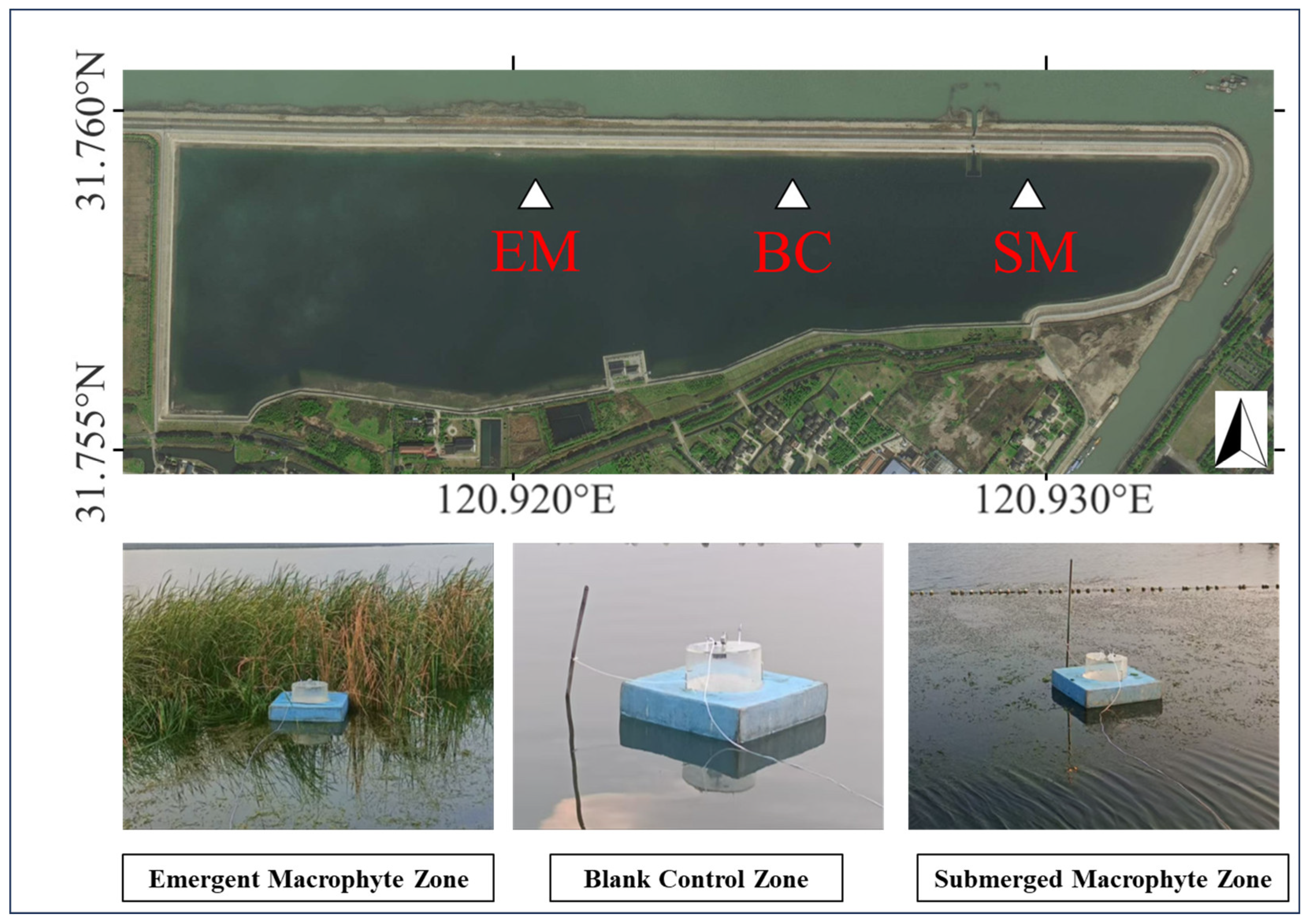
The Changshu Emergency Water Source Lake (N 31°45′41′′, E 120°55′6′′) is located in Xupu Town, northern Changshu City, China. Bordered by the Shenhai Expressway to the east, the Wangyu River to the west, the Changhe Expressway to the south, and the Yangtze River to the north, the lake covers an area of 0.98 km2 with a total and effective storage capacity of approximately 6.35 × 10⁶ m3 and 5.06 × 10⁶ m3, respectively. It functions as a backup drinking water source for Changshu City, directly supplied by the Yangtze River [24]. From 2017 to 2018, baseline investigations revealed an initial absence of aquatic vegetation, limited self-purification capacity, and a structurally imbalanced ecosystem. Between 2018 and 2023, ecological restoration measures were implemented, including fish community adjustment and aquatic vegetation reconstruction [25]. These efforts significantly improved the aquatic environment, resulting in the establishment of dominant submerged vegetation (Hydrilla verticillata; biomass: 1350–3390 g/m2; coverage: ~30%) and emergent vegetation (Acorus calamus; biomass: 1950–2250 g/m2; coverage: ~15%). Percent coverage is defined as the vegetated area as a percentage of the total lake area. Based on these dominant vegetation types, three sampling sites were established in the northern part of the lake: a submerged macrophytes (SM) zone dominated by H. verticillata, a non-vegetated blank control (BC) zone, and an emergent macrophytes (EM) zone dominated by A. calamus. The three sampling habitats (SM, BC, EM) were established in an area of the lake with relatively uniform water depth (mean depth: approximately 1.2–1.8 m) to ensure comparable light conditions in the water column. The non-vegetated control (BC) zone was intentionally located where water clarity was sufficient (Secchi depth > 1.0 m) to exclude light limitation as the primary reason for the absence of macrophytes (Figure 1).

2.2. Measured Parameters

2.2.1. CO2 and CH4 Emission Flux Monitoring

Sampling was conducted during clear weather conditions to minimize interference from wind- or rain-induced water surface disturbances. Diurnal monitoring of CO2 and CH4 fluxes at the water–air interface was carried out in September 2024. Measurements commenced at 13:00 on September 5 and were repeated at 4 h intervals until 9:00 on September 6, covering a complete 24 h cycle. Each measurement round recorded no fewer than 80 data points. Within each of the three sampling areas (SM, BC, and EM), three replicate sampling points were selected for simultaneous sampling to meet the requirements of replicate measurement analysis. Fluxes were determined using the floating static chamber method coupled with a Picarro (Picarro, Sunnyvale, CA, USA) G2301 cavity ring-down spectroscopy analyzer (for CO2, CH4, and H2O). This instrument provides high precision and sensitivity for gas concentration measurements [26]. During each sampling interval, concurrent meteorological conditions and key water physicochemical parameters were recorded to support subsequent analysis. The floating chamber method is a simple and economical approach for measuring the direct diffusive flux at the surface of aquatic ecosystems [27]. This method involves enclosing air within a static chamber floating on the water surface, and then calculating the gas flux based on changes in gas concentration inside the chamber. The chamber has a volume of 0.0628 m3 and covers a water surface area of 0.126 m2. The exterior of the chamber is wrapped with aluminum foil and insulating foam to minimize the effect of light on greenhouse gas evasion. Prior to each measurement, the chamber was briefly lifted to allow the internal gas concentration to equilibrate with the ambient atmosphere, and then it was placed on the water surface. The concentrations of CO2 and CH4 were analyzed on-site using a Picarro G2301 CO2/CH4/H2O analyzer (precision: CO2 < 70 ppb/25 ppb, CH4 < 0.5 ppb/0.22 ppb). The greenhouse gas flux based on the static chamber method was calculated using the following expression [28]:
F = d c d t × V A R T × F 1
where F is the gas flux (μmol/m2/d); dc/dt is the rate of change in gas concentration inside the chamber (ppm/h); V is the chamber volume (L); A is the area enclosed by the floating chamber (m2); R is the ideal gas constant (8.2 × 10⁻⁵ m3·atm/K/mol); T is the absolute temperature inside the chamber (K), converted from measured Celsius temperature; and F1 is a unit conversion factor (24 h/d) [29]. The chamber was deployed with its base submerged at least 2 cm below the water surface to minimize boundary-layer effects and ensure a sealed air–water interface. A positive flux indicates net emission from water to the atmosphere, whereas a negative value denotes net uptake by the water body.

2.2.2. Determination of Environmental Parameters

Environmental parameters were measured synchronously with GHG flux sampling. The internal temperature of the static chamber was monitored using an integrated sensor. Meteorological variables—including above-water air temperature (AT; °C), atmospheric pressure (AP; hpa), wind speed (WS; m/s), and relative humidity (RH; %)—were recorded with a PH-II-C portable weather meter (Wuhan Xinhui Technology Co., Ltd., Wuhan, China). Water depth (WD; m) was measured using an SM-5 portable depth sounder (SPEEDTECH, Japan), and transparency (SD; m) was determined with a Secchi disk. In situ water temperature (WT; °C), pH, and dissolved oxygen (DO; mg/L) were monitored with a YSI ProPlus multiparameter probe (YSI, USA). Turbidity was measured using a HACH 2100Q turbidimeter. Turbidity (TUR, NTU) was measured using a Hach 2100Q portable turbidimeter (Hach Company, USA). Each sample was poured into a clean cuvette to the marked line, the outer surface was wiped with a lint-free cloth, and the cuvette was then placed into the instrument for reading. Each sample was measured in triplicate, and the average value was recorded as the final turbidity result in NTU. Surface water samples were collected at 0.5 m depth for subsequent laboratory analysis. The permanganate index (CODMn; mg/L) was measured titrimetrically following Chinese national standard GB 11892-89. Total phosphorus (TP; mg/L) was determined using the ammonium molybdate spectrophotometric method (GB 11893-1989). Total nitrogen (TN; mg/L) was analyzed via alkaline potassium persulfate digestion–UV spectrophotometry (GB 11894-1989). Ammonium (NH4+-N; mg/L) was quantified with Nessler’s reagent spectrophotometry (HJ 535-2009), and chlorophyll-a (Chl.a; μg/L) was measured spectrophotometrically (SL 88-2012).

2.3. Statistical Analysis

All statistical analyses and graphical presentations were performed using R (version 4.5.1) in the RStudio (2025.09.1+401) integrated development environment. Since the data violated the assumption of normality, a two-way non-parametric ANOVA (Scheirer-Ray-Hare test) was employed to assess the significant effects of time, treatments, and their interaction on climatic factors (AT, AP, WS, and HR), water quality parameters (WD, SD, WT, DO, CODMn, TP, TN, NH4+-N, Chl-a), and greenhouse gas fluxes using the “rcompanion” package [30]. Subsequent to identifying the specific differences, the wilcox.test was conducted within the R package “stats” [31]. To examine the influence of environmental factors on flux dynamics, Generalized Linear Models (GLMs) were employed. A GLM was constructed with flux as the response variable and thirteen environmental factors as explanatory variables, using a Gaussian distribution with an identity link function. Model significance and variance decomposition were assessed via Type II analysis of variance implemented in the “car” package [32]. To visualize the relative contribution of each predictor, the environmental factors were categorized into two groups: atmospheric factors (AT, AP, WS, RH) and water physicochemical factors (TUR, WT, pH, ORP, DO, TN, TP, CODMn, Chl.a). A bar plot illustrating the proportion of variance explained by each factor was generated using the “ggplot2” package [33]. Differences were considered significant at an α level of 0.05 (i.e., p-value < 0.05) for all tests.

3. Results

3.1. Variation Characteristics of Climatic Factors

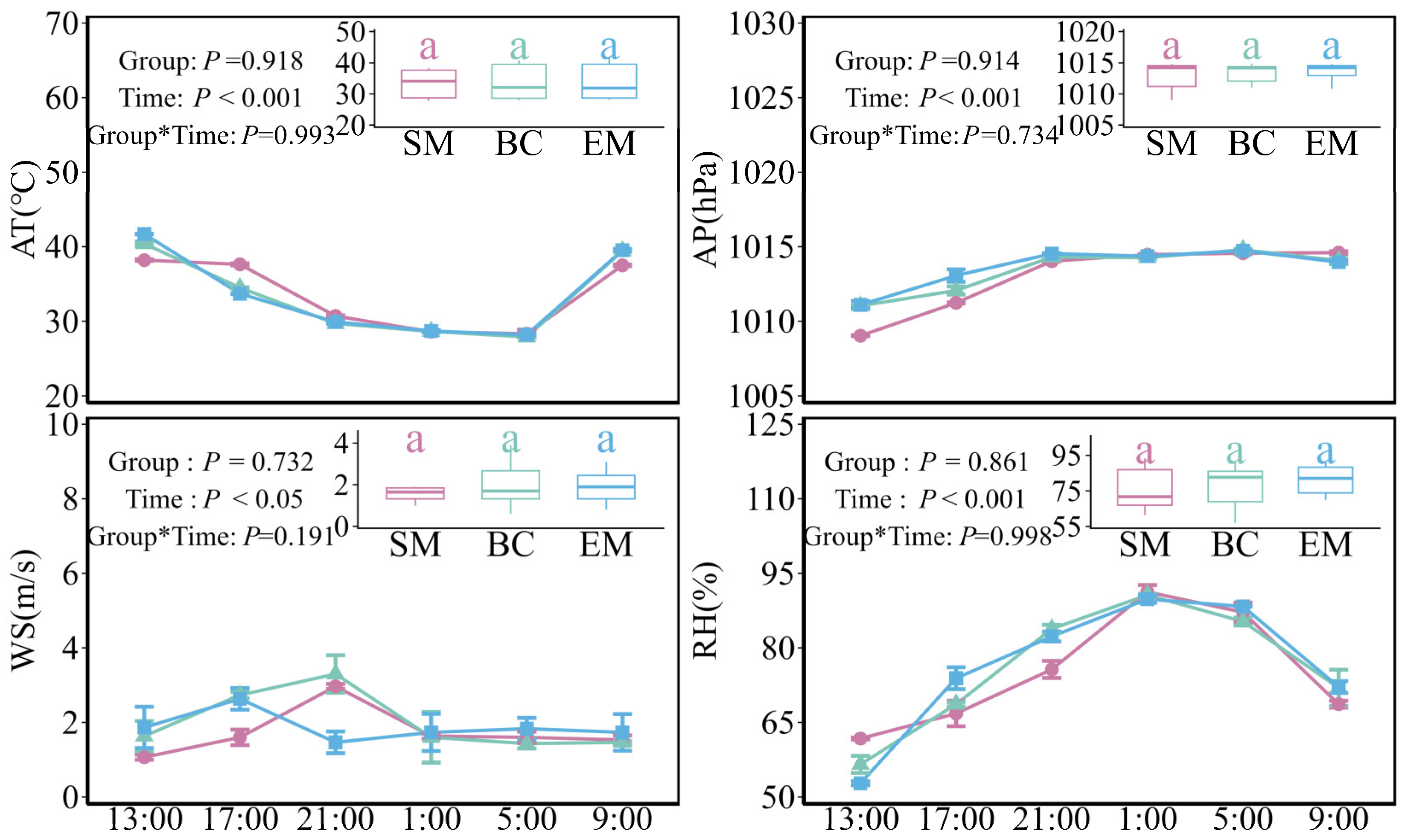
Air temperature exhibited pronounced diurnal variation, influenced by solar radiation, with a mean of 33.78 ± 0.88 °C. Daytime temperatures (38.17 ± 0.44 °C; range: 33.7–41.7 °C) were notably higher than nighttime values (29.11 ± 0.14 °C; range: 27.8–30.8 °C). Temperature peaked in the early afternoon and gradually declined thereafter, reaching a minimum at 5:00 before rising again, resulting in a diurnal amplitude of up to 9 °C. Statistical analysis confirmed significant variation across time (p < 0.001), but no significant differences among the three habitat groups (p = 0.918) or for the time × group interaction (p = 0.993). Atmospheric pressure fluctuated between 1009.0 and 1014.9 hPa (mean: 1013.27 ± 0.22 hPa), showing a distinct diurnal pattern with the lowest value at 13:00 and a peak at 5:00. Mean daytime pressure (1012.20 ± 0.25 hPa) was significantly lower than mean nighttime pressure (1014.45 ± 0.04 hPa). Pressure varied significantly over time (p < 0.001), while no group effect (p = 0.914) or interaction effect (p = 0.734) was detected. Wind speed varied from 0.6 to 3.9 m/s (mean: 1.80 ± 0.10 m/s), generally increasing from 13:00 to 21:00 and remaining stable thereafter. Temporal variation was significant (p < 0.05), but neither group differences (p = 0.732) nor the interaction (p = 0.191) reached significance. Relative humidity averaged 75.8 ± 1.8% (range: 52.1–93.4%), with a clear diurnal cycle: lowest at 13:00, highest at 01:00, and significantly lower during the day (65.48 ± 1.55%) than at night (85.73 ± 0.98%). Similar to other climatic variables, relative humidity showed strong temporal variation (p < 0.001) but no significant group effect (p = 0.443) or interaction (p = 0.998) (Table 1; Figure 2).

3.2. Spatiotemporal Variation in Water Quality Parameters

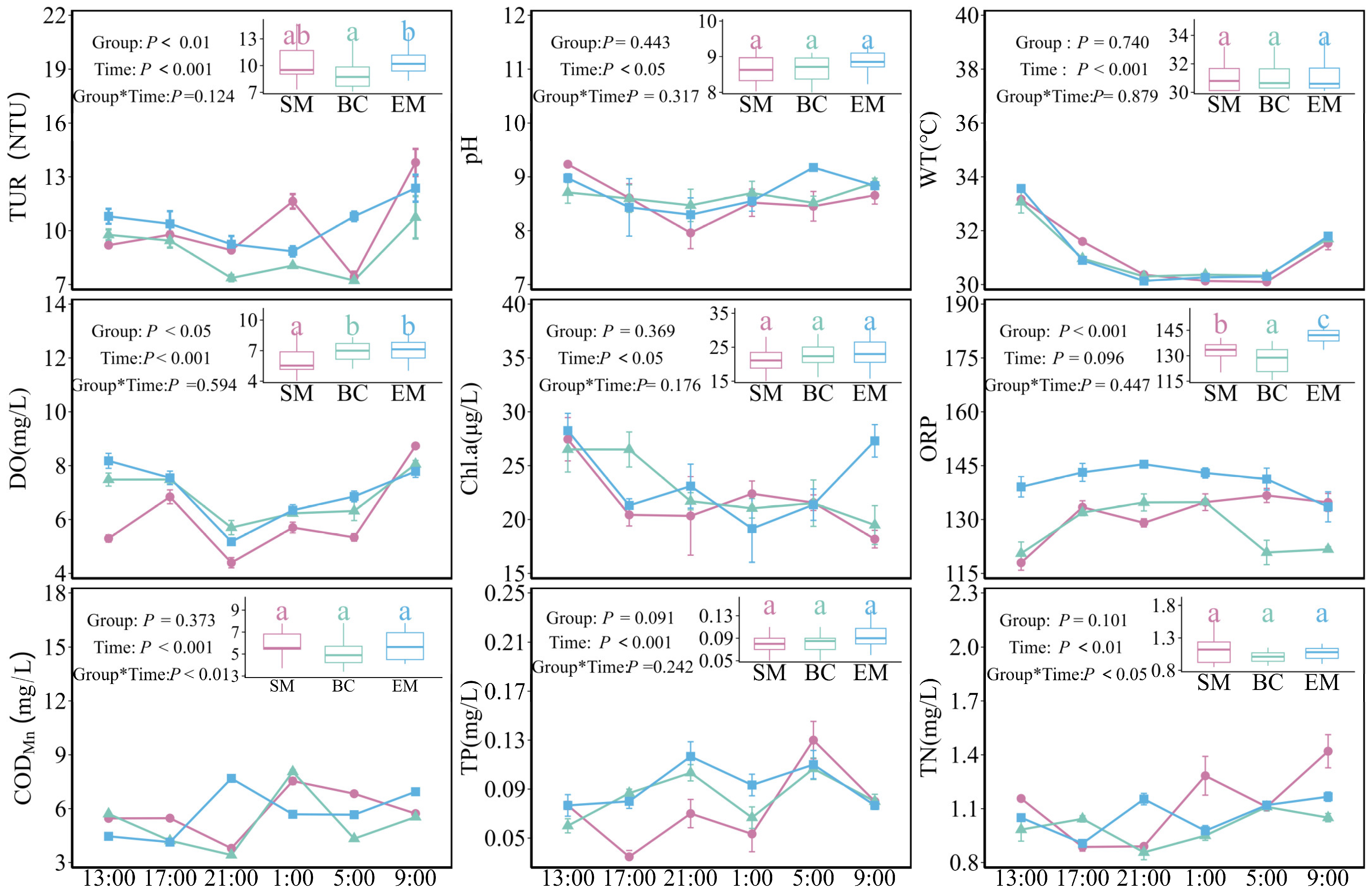
Water quality parameters exhibited distinct spatiotemporal patterns (Table 1). Mean TUR varied significantly over time (p < 0.001) and among habitats (p < 0.01), showing a U-shaped diurnal trend with a minimum at 21:00 and a peak at 09:00. Spatially, TUR followed the order EM > SM > BC. Mean pH also showed significant diurnal variation (p < 0.05; mean 8.64 ± 0.45), declining from 13:00 to a minimum at 21:00 before rising again, with higher daytime (8.77 ± 0.41) than nighttime values (8.52 ± 0.46). WT changed significantly over time (p < 0.001; mean 31.14 ± 1.25 °C), peaking at 13:00 and reaching minima at 1:00 and 5:00; the diurnal amplitude was 1.77 °C, with more stable nighttime values (30.26 ± 0.11 °C) than daytime (32.03 ± 0.96 °C). Mean DO also exhibited significant diurnal variation (p < 0.001; mean 6.60 ± 1.27 mg/L), decreasing from 13:00 to a minimum at 21:00, then rising to a peak at 09:00. Daytime DO (7.26 ± 1.12 mg/L) was higher and more variable than nighttime DO (5.76 ± 0.77 mg/L). DO also differed significantly among habitats (p < 0.05), with lower concentrations in SM than in BC and EM. Mean ORP varied markedly among habitats (p < 0.001), being significantly higher in EM than in SM and BC. Mean TN changed significantly over time (p < 0.001; mean 1.06 ± 0.16 mg/L), following a pattern similar to TUR and DO, with a minimum at 21:00 and a maximum at 9:00. Mean Chl.a, CODMn, and TP showed considerable variability but no clear spatiotemporal trends, with respective means of 22.64 ± 4.02 μg/L, 5.59 ± 1.36 mg/L, and 0.08 ± 0.03 mg/L (Figure 3).

3.3. Variation Characteristics of Diurnal CO2 and CH4 Emission Fluxes at the Water-Air Interface

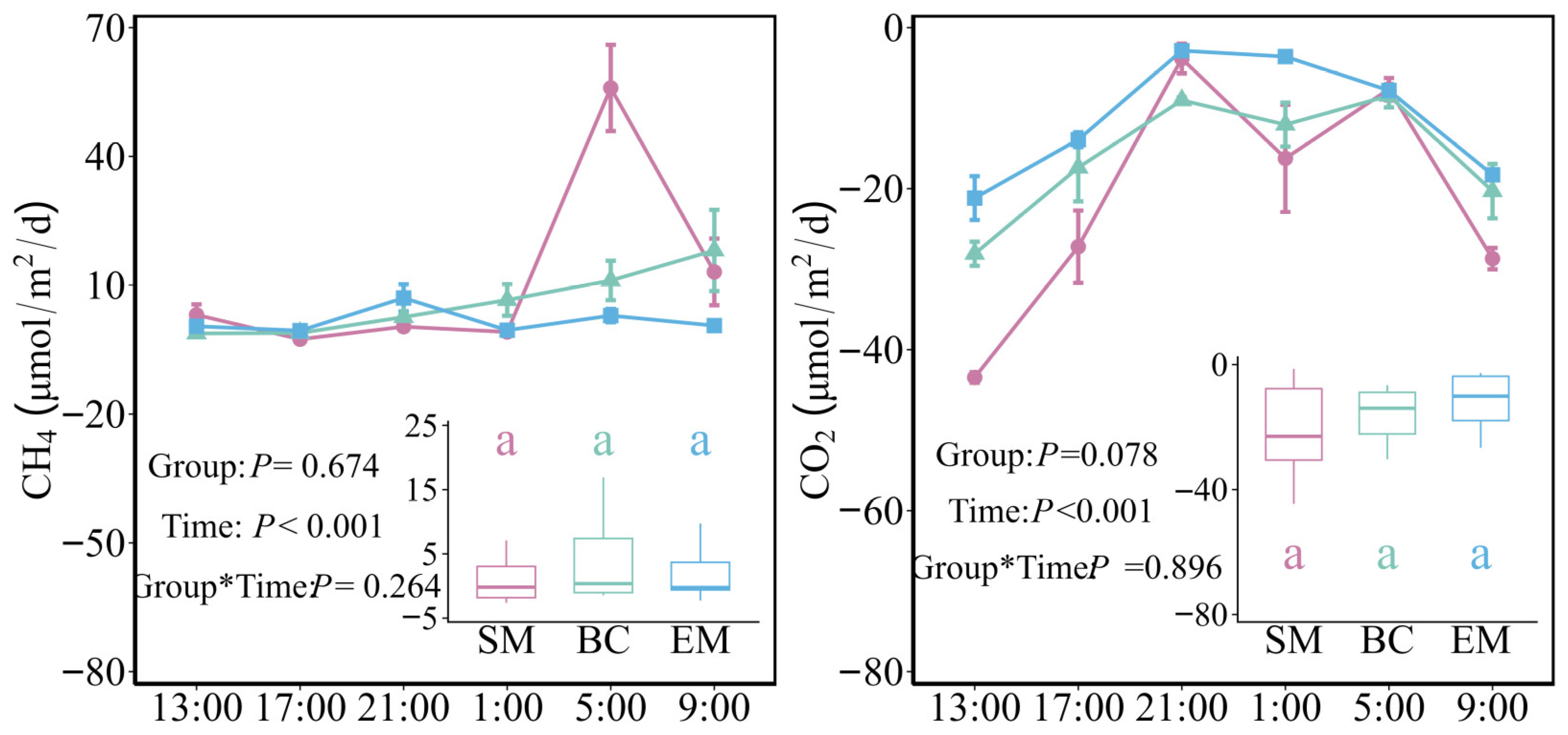
CO2 and CH4 fluxes exhibited distinct diurnal patterns and opposing directions. Throughout the monitoring period, CO2 fluxes were consistently negative, indicating net atmospheric uptake, whereas CH4 fluxes were predominantly positive, reflecting net emissions from the water. The overall ranges were −52.14 to −3.43 μmol/m2/d for CO2 and −2.61 to 75.30 μmol/m2/d for CH4. CO2 flux varied significantly over time (p < 0.001), following a pattern of initial increase to a peak at 21:00, then declining to its lowest point at 13:00. Although no overall difference was detected among habitats (p = 0.674), the flux magnitude at several time points (e.g., 13:00, 17:00, 1:00, and 9:00) tended to be highest in the EM zone, intermediate in BC, and lowest in SM. CH4 fluxes also exhibited significant temporal variation (p < 0.001), with pronounced habitat-specific differences at particular times: at 5:00, CH4 fluxes in the SM zone were significantly higher than those in the BC and EM zones (p < 0.001). Notably, CH4 fluxes in the SM zone peaked at 5:00, a time that typically corresponds to the pre-dawn period when dissolved oxygen levels in the water column reach their lowest point after nighttime respiratory consumption, creating the most pronounced anaerobic conditions. Since methane production is strictly dependent on anaerobic environments, metabolically generated methane readily accumulates and reaches an emission peak during this period. In contrast, at 21:00, CH4 fluxes in the EM zone were significantly higher than those in the SM and BC zones (p < 0.05). No overall habitat effect was observed (p = 0.674). In detail, CH4 flux in the SM zone peaked sharply at 55.96 μmol/m2/d at 05:00 but was low at other times, with a minimum of −2.57 μmol/m2/d at 17:00. In the BC zone, flux increased gradually from 13:00, reaching a maximum of 18.10 μmol/m2/d at 9:00. In the EM zone, flux remained relatively stable and peaked modestly at 7.03 μmol/m2/d at 21:00 (Figure 4).

3.4. Variation Characteristics of CO2 and CH4 Emission Fluxes at the Water-Air Interface Across Different Habitats

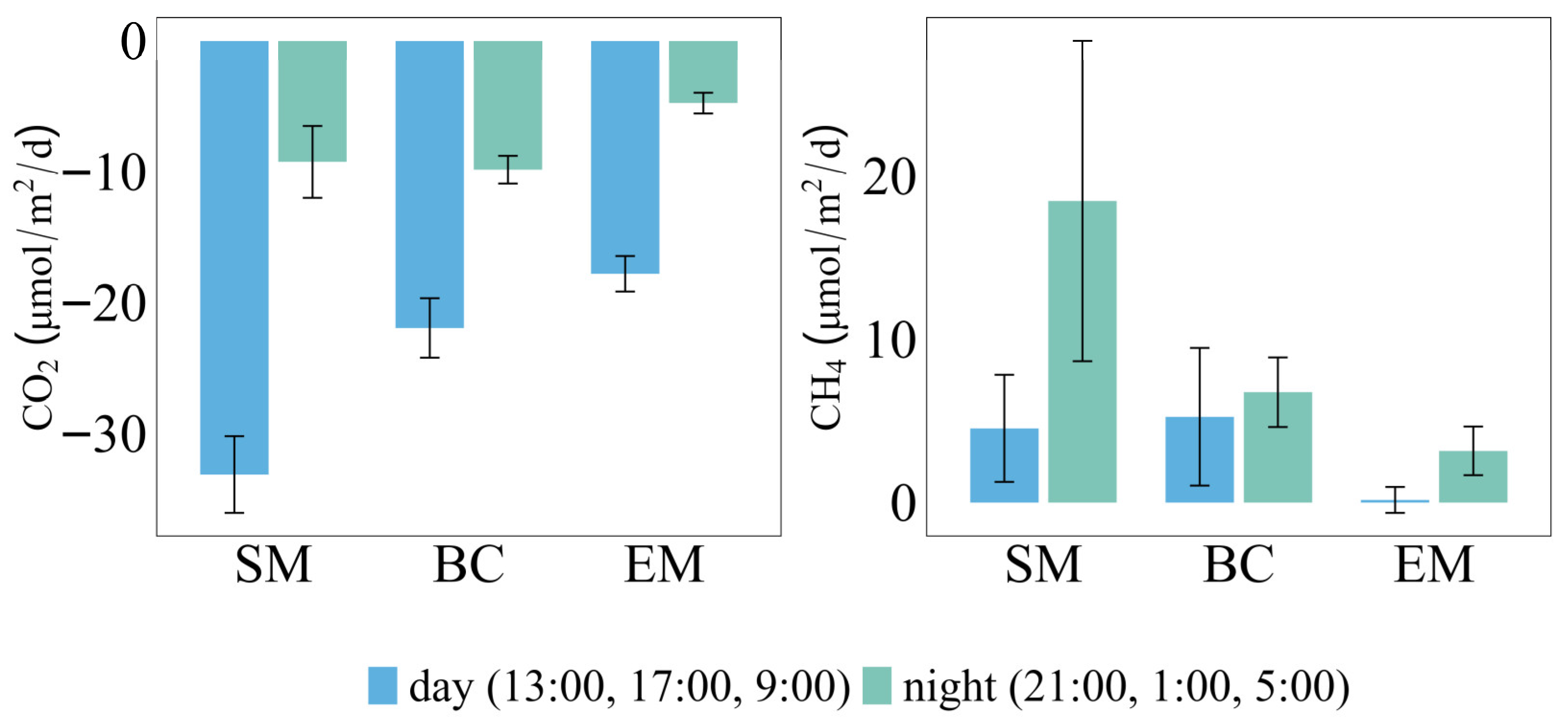
The magnitudes of CO2 and CH4 fluxes differed clearly among habitats. CH4 emissions were highest in the SM zone (11.51 ± 5.30 μmol/m2/d), intermediate in the BC zone (6.01 ± 2.30 μmol/m2/d), and lowest in the EM zone (1.66 ± 0.90 μmol/m2/d). In contrast, CO2 uptake (negative flux) was strongest in the SM zone (−21.18 ± 3.49 μmol/m2/d), moderate in the BC zone (−15.88 ± 1.90 μmol/m2/d), and weakest in the EM zone (−11.27 ± 1.63 μmol/m2/d). CO2 fluxes showed pronounced diurnal variation in all habitats. Daytime mean uptake was substantially greater than nighttime uptake: in the SM zone, daytime uptake (−33.12 ± 2.87 μmol/m2/d) was about 3.6 times higher than nighttime uptake (−9.24 ± 3.27 μmol/m2/d); in the BC zone, the ratio was about 2.2 (−21.93 ± 2.35 vs. −9.84 ± 1.10 μmol/m2/d); and in the EM zone, daytime uptake (−17.79 ± 1.36 μmol/m2/d) exceeded nighttime uptake (−4.75 ± 0.80 μmol/m2/d) by approximately 3.7 times. CH4 emissions also exhibited distinct diurnal patterns. In the SM zone, nighttime emissions (18.47 ± 10.00 μmol/m2/d) were about 4 times higher than daytime emissions (4.55 ± 3.33 μmol/m2/d). In the BC zone, the mean daytime emission rate was 5.26 ± 4.00 μmol/m2/d, while the mean nighttime rate was 6.76 ± 2.00 μmol/m2/d. Consequently, daytime emissions averaged 77.81% of the nighttime level. In the EM zone, nighttime emissions (3.17 ± 1.33 μmol/m2/d) markedly exceeded daytime emissions (0.16 ± 0.83 μmol/m2/d), with the latter representing only ~5% of the former (Figure 5).

3.5. Influence of Environmental Factors on CO2 and CH4 Emission Fluxes at the Water-Air Interface

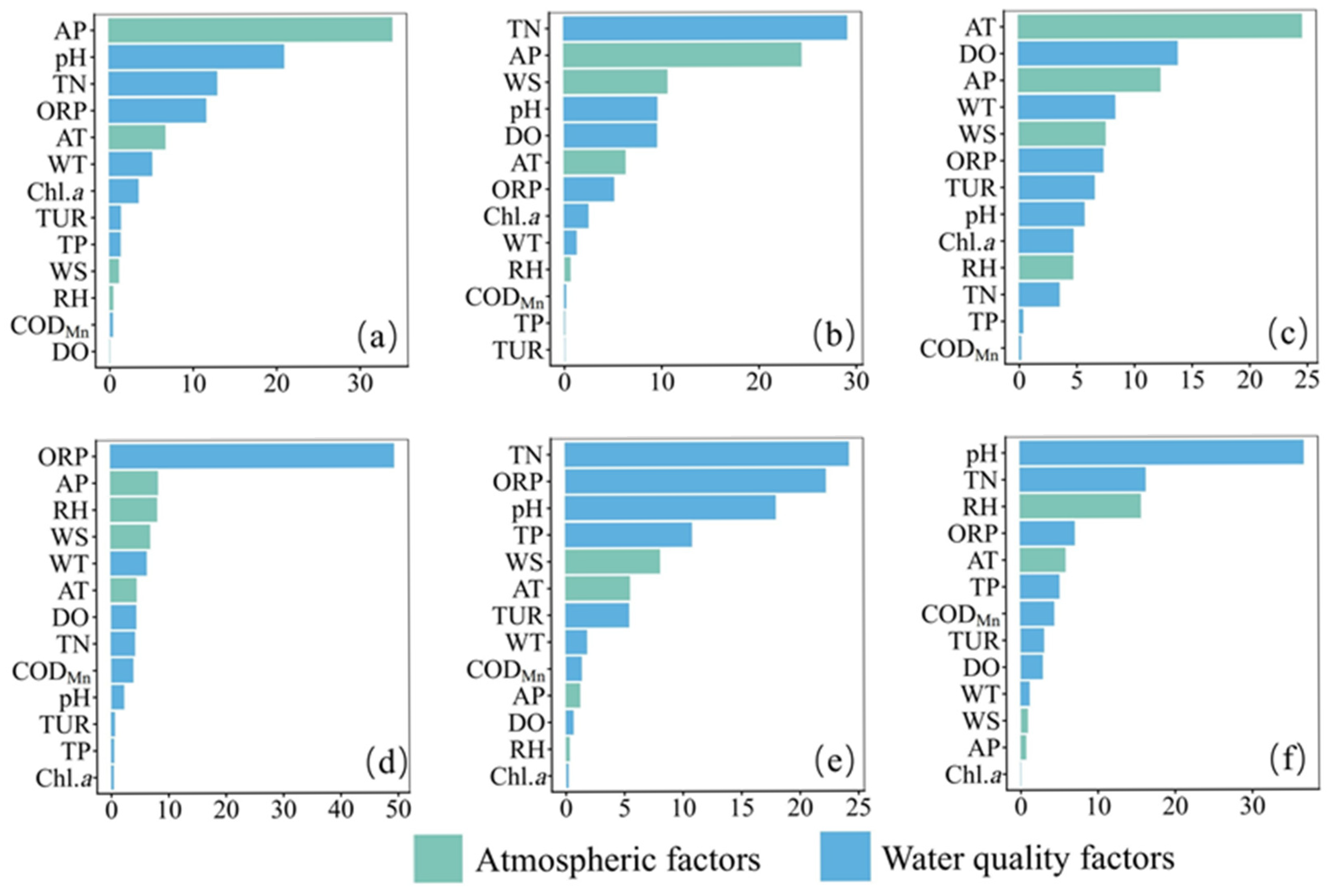
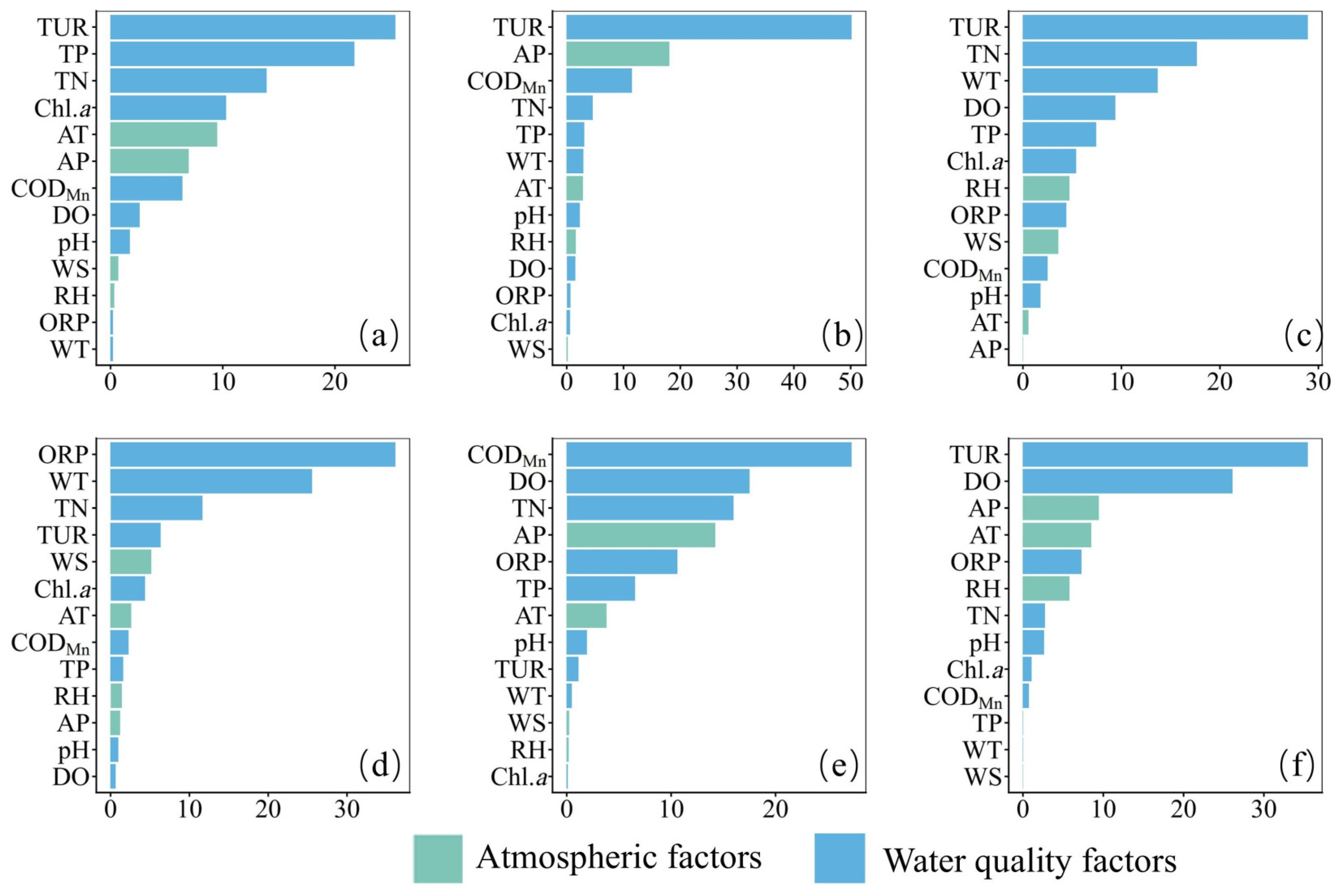
Generalized linear model (GLM) statistical results indicated that the environmental drivers of CO2 and CH4 fluxes varied significantly across aquatic vegetation habitats and between day and night, with distinct dominant factors and explanatory powers. For CO2 fluxes, physical and metabolic factors—primarily AT (p < 0.001, explaining ~23.9% of variance) and DO (p < 0.01, explaining ~13.4% of variance)—exerted significant positive effects in the BC zone (Figure 6c). In contrast, TN was the only significant regulator in the SM zone, where it showed a negative effect (p < 0.05, ~26.0% variance explained) (Figure 6b). No significant drivers were detected in the EM zone (Figure 6d). At the diurnal scale, daytime CO2 fluxes were jointly explained by TN (p < 0.05), pH (p < 0.1), and ORP (p < 0.1), accounting for approximately 59.4% of the variance (Figure 6e), whereas no significant explanatory factors were identified during the night (Figure 6f). Regarding CH4 fluxes, TUR exhibited a strong negative influence in the SM zone (p < 0.01, ~45.9% variance explained) (Figure 7b). In the BC zone, a multi-factor synergistic driving pattern was observed, with significant positive effects from TUR (p < 0.001, ~29.8% variance explained), WT (p < 0.01), DO (p < 0.05), TN (p < 0.01, ~18.5% variance explained), and TP (p < 0.05) (Figure 7c). Again, no significant drivers were identified in the EM zone (Figure 7d). On a diurnal basis, daytime CH4 fluxes were significantly correlated with permanganate index (CODMn; p < 0.01), DO (p < 0.05), and TN (p < 0.05) (Figure 7e), while nighttime fluxes were primarily negatively regulated by TUR (p < 0.05) (Figure 7f). Collectively, these results suggest that vegetation cover and light conditions jointly shape the spatiotemporal heterogeneity of greenhouse gas flux patterns.

4. Discussion

4.1. Effects of Different Aquatic Vegetation Types on Greenhouse Gas Fluxes

At the water–air interface of the Changshu Emergency Water Source Lake, CO2 fluxes were consistently negative across the three studied habitats (mean: −17.53 ± 1.64 μmol/m2/d), indicating that the system functioned as a net CO2 sink (Figure 5). In contrast, CH4 fluxes were predominantly positive (mean: 5.86 ± 1.70 μmol/m2/d), representing a net CH4 source (Figure 5). The three habitats in this study all exhibited net absorption of CO2, which is consistent with observations from some subtropical shallow lakes dominated by submerged macrophytes or high primary productivity. For example, in clear-water lakes in Uruguay where submerged macrophytes are predominant, the open-water areas also function as net CO2 sinks throughout the year [34]. This is generally attributed to the rate of CO2 fixation through photosynthesis by aquatic plants and phytoplankton exceeding the release rate from ecosystem respiration. As a water source site, the water quality in the study area may be relatively favorable for photosynthesis, which could be an important reason for its role as a CO2 sink. However, many studies have also shown that subtropical eutrophic shallow lakes are typically net sources of CO2. For instance, Lake Donghu in Wuhan acts as an emission source on an annual scale [35]. This discrepancy highlights the critical regulatory role of specific environmental conditions in lakes on the direction of carbon balance.
Vegetation type strongly influenced both the magnitude and direction of gas fluxes [16,19]. In our study, CO2 fluxes were highest in the emergent macrophytes (EM) zone, intermediate in the non-vegetated control (BC) zone, and lowest in the submerged macrophytes (SM) zone. The elevated CO2 efflux in the EM zone is likely facilitated by the well-developed aerenchyma of emergent plants, which enhance gas transport and reduce oxidative consumption during diffusion [36]. In the BC zone, CO2 emissions were primarily driven by microbial mineralization of sediment organic matter, though lower inputs of labile plant-derived carbon may limit decomposition rates [37]. Furthermore, exposed sediments in the BC zone experience stronger temperature fluctuations due to lack of plant shading, which can enhance temperature-sensitive sediment respiration [38]. In contrast, the SM zone showed the strongest net CO2 uptake, resulting from the combined effects of limited plant-mediated gas transport and high photosynthetic activity supported by greater macrophyte biomass.
CH4 fluxes showed the opposite spatial trend: SM > BC > EM (Figure 5). The highest CH4 emissions in the SM zone likely result from dense canopy-induced oxygen limitation, which promotes persistent sediment anoxia and methanogenesis. Submerged macrophytes also can channel CH4 from sediments to the water column through their tissues, particularly at night when photosynthetic oxygen release ceases [39]. In the BC zone, moderate CH4 fluxes likely result from wind- and wave-induced sediment disturbances that create transient anaerobic micro-sites, although the lack of fresh organic inputs from plants limits overall methanogenic substrate [40]. The lowest CH4 emissions occurred in the EM zone, where oxygen translocation by emergent-plant roots creates an oxic rhizosphere that suppresses methanogen activity and promotes CH4 oxidation.
Collectively, these patterns demonstrate that aquatic vegetation types modulate GHG fluxes through distinct mechanisms: by altering redox conditions, regulating organic-matter inputs, and modifying gas-transport pathways [41]. Submerged vegetation enhances daytime CO2 uptake via photosynthesis, whereas emergent vegetation suppresses CH4 release through rhizospheric oxygenation [42]. These habitat-specific and diurnally variable controls must be incorporated into lake-carbon assessments to improve the accuracy of regional and global GHG budgets.

4.2. Diurnal Variation Characteristics of Greenhouse Gases in Different Aquatic Vegetation Habitats

Greenhouse gas fluxes in the study lake exhibited clear diurnal rhythms, driven by the balance between in situ production and transport processes, which are modulated by climatic conditions, water quality, vegetation biomass and plant community composition [43,44]. As illustrated in Figure 5, CO2 uptake was markedly stronger during the day than at night across all habitats. This pattern reflects daytime photosynthetic CO2 fixation, which largely offsets respiratory release, whereas at night respiration dominates, reducing net uptake [45], Consistent with the inherent circadian photosynthetic rhythm of freshwater macrophytes [46]. The diurnal contrast was most pronounced in vegetated zones. Although nighttime CO2 fluxes were similar in the SM and BC zones, daytime uptake was substantially greater in the SM zone, highlighting the role of aquatic vegetation in enhancing daytime carbon assimilation.
CH4 fluxes also showed consistent diurnal variation, with higher emissions at night in all habitats (Figure 5). The day–night difference was most evident in the SM and EM zones, but less distinct in the BC zone. This trend aligns with some shallow-lake studies (e.g., Taihu Lake) [47] but contrasts with others, underscoring the context-dependent nature of CH4 dynamics [20,48]. The observed pattern can be explained by diel shifts in oxygen availability. DO exhibited a significant diurnal variation (p < 0.001). Daytime DO concentrations were not only higher than nighttime values but also exhibited greater variability (7.26 ± 1.12 mg/L vs. 5.76 ± 0.77 mg/L). During daytime, oxygen released by photosynthesis suppresses anaerobic methanogenesis and promotes methane oxidation, leading to CH4 oxidation before emission. At night, respiration rapidly depletes oxygen, creating hypoxic conditions that favor methanogenesis while inhibiting methanotrophic activity, thereby enhancing net CH4 release. The distinct diurnal patterns observed in both CO2 and CH4 fluxes, and their modulation by vegetation type, emphasize that habitat-specific diel dynamics are fundamental to understanding and predicting the net carbon balance of shallow vegetated lakes.

4.3. Key Environmental Factors Affecting Greenhouse Gas Fluxes

This study, based on linear modeling analysis, reveals that CO2 and CH4 fluxes are jointly regulated by multiple environmental factors, and that the strength and direction of these relationships vary with vegetation type and diel period. Overall, both fluxes exhibited significant positive correlations with air and water temperature, a pattern consistent with observations in other aquatic systems such as Lake Taihu and urban water bodies in Nanjing [49,50,51]. Elevated temperatures typically enhance microbial respiration and organic matter decomposition while reducing gas solubility, collectively promoting gas release [52,53,54,55].
The contrasting correlation patterns among vegetation zones highlight the decisive role of plant functional types. The submerged macrophyte zone, emergent macrophyte zone, and non-vegetated area constitute distinctly different ecosystems. In the non-vegetated open-water zone, the fluxes of both gases exhibited significant correlations with multiple environmental factors (particularly physical factors and those indicative of sediment–water interface activity), consistent with the absence of biotic structural buffering and the dominance of physical and chemical processes in this habitat [51,56]. The presence of submerged macrophytes “switched” the dominant regulatory pathway: CO2 flux became significantly negatively correlated with TN—a proxy for biological assimilation intensity—whereas CH4 flux showed a strong negative correlation with TUR, which reflects water column stability and light penetration. This underscores the capacity of submerged macrophyte canopies to differentially regulate distinct carbon cycling pathways by modulating light transmission, nutrient cycling, and physical structure [56,57]. In the emergent macrophyte zone, the absence of significant environmental drivers for either gas may indicate that emissions in this habitat are predominantly governed by biogeochemical processes not directly measured in this study—such as plant-mediated gas transport and rhizosphere redox microenvironments [53,54]—or that multiple antagonistic processes reach equilibrium in this habitat. Diel differences further accentuate the dynamic nature of this regulation: during the day, factors associated with photosynthesis and aerobic conditions (e.g., TN and pH for CO2; CODMn and DO for CH4) exert enhanced influence [58]; at night, factors linked to respiratory consumption and hypoxic conditions (e.g., TUR and DO for CH4) become prominent, whereas CO2 flux may shift to being dominated by unmonitored processes such as sediment mineralization respiration [52,53,54]. Although this study provided high-frequency, habitat-resolved observations of diurnal greenhouse gas dynamics, sediment properties were not quantitatively analyzed, and the current vegetation distribution may be partially linked to underlying sediment heterogeneity. Future work should integrate sediment profile measurements and incubation experiments to disentangle the direct physiological effects of vegetation from indirect regulation via long-term sediment modification, and conduct cross-seasonal monitoring to assess the stability of the observed diurnal patterns.

5. Conclusions

This high-frequency diurnal study in a shallow urban lake demonstrated that CO2 and CH4 fluxes exhibit strong diurnal and habitat-dependent patterns. The lake consistently functioned as a net CO2 sink and a net CH4 source during the investigation. The key mechanisms identified were: (1) submerged macrophytes showed stronger CO2 uptake, while emergent macrophytes exhibited the weakest CH4 emissions; (2) both gases showed marked diurnal asymmetry, with higher CH4 emissions and reduced CO2 uptake at night; (3) the influence of key environmental drivers (e.g., temperature, dissolved oxygen, turbidity) on fluxes varied substantially across habitats and between day and night. These findings highlight that reliable quantification of lake-atmosphere carbon exchange—and thus robust carbon budgeting and climate-smart lake management—requires explicit consideration of diurnal variability and vegetation-mediated habitat heterogeneity.

Author Contributions

R.G.: Resources; Investigation; Data curation; Writing—original draft. C.G.: Methodology; Resources; Supervision; Writing—Review and Editing. J.K.: Resources; Writing—Review and Editing. Y.X.: Investigation; Resources. K.G.: Investigation; Resources. C.D.: Investigation; Resources. X.S.: Investigation; Resources. T.Z.: Resources; Writing—Review and Editing. J.L.: Resources; Writing—Review and Editing. W.L.: Methodology; Supervision; Resources; Writing—Review and Editing. All authors have read and agreed to the published version of the manuscript.

Funding

This research was supported by the National Natural Science Foundation of China (32373136, 32303010), the China Postdoctoral Science Foundation (2023M733698), the Innovative Talents Project of Jian city (jasb202310324), the Yellow River Delta Industry Leading Talent Project (DYRC20200215).

Data Availability Statement

The original contributions presented in this study are included in the article. Further inquiries can be directed to the corresponding author.

Conflicts of Interest

Author Xuefeng Shi was employed by the company Jiangsu Sino-French Water Co., Ltd. The remaining authors declare that the research was conducted in the absence of any commercial or financial relationships that could be construed as a potential conflict of interest.

References

  1. Xing, Y.; Wang, X. Impact of Agricultural Activities on Climate Change: A Review of Greenhouse Gas Emission Patterns in Field Crop Systems. Plants 2024, 13, 2285. [Google Scholar] [CrossRef] [PubMed]
  2. Jones, M.W.; Peters, G.P.; Gasser, T.; Andrew, R.M.; Schwingshackl, C.; Gütschow, J.; Houghton, R.A.; Friedlingstein, P.; Pongratz, J.; Le, Q.C. National contributions to climate change due to historical emissions of carbon dioxide, methane, and nitrous oxide since 1850. Sci. Data 2023, 10, 155. [Google Scholar] [CrossRef] [PubMed]
  3. Lequy, E.; Asmala, E.; Ibrom, A.; Loubet, B.; Massad, R.S.; Markager, S.; Markager, S.; Garnier, J. Contribution from a eutrophic temperate estuary to the landscape flux of nitrous oxide. Water Res. 2022, 222, 118874. [Google Scholar] [CrossRef]
  4. WMO. State of the Global Climate 2020: Provisional Report; World Meteorological Organization: Geneva, Switzerland, 2020. [Google Scholar]
  5. Hong, H.X.; Zang, K.P.; Chen, Y.Y.; Lin, Y.; Li, J.X.; Qing, X.M.; Qiu, S.S.; Xiong, H.Y.; Jiang, K.; Fang, S.X. Monitoring of atmospheric CH4, CO, CO2, N2O and SF6 using three-channel gas chromatography. Chin. J. Chromatogr. 2022, 40, 763–771. [Google Scholar] [CrossRef]
  6. Möller, T.; Högner, A.E.; Schleussner, C.F.; Bien, S.; Kitzmann, H.S.; Lamboll, D.R.; Rogelj, J.; Donges, F.J.; Rockström, J.; Wunderling, N. Achieving net zero greenhouse gas emissionscritical to limit climate tipping risks. Nat. Commun. 2024, 15, 6192. [Google Scholar] [CrossRef]
  7. DelSontro, T.; Beaulieu, J.J.; Downing, J.A. Greenhouse gas emissions from lakes and impoundments: Upscaling in the face of global change. Limnol. Oceanogr. Lett. 2018, 3, 64–75. [Google Scholar] [CrossRef]
  8. Tranvik, L.J.; Downing, J.A.; Cotner, J.B.; Loiselle, S.A.; Striegl, R.G.; Ballatore, T.J.; Dillon, P.; Finlay, K.; Fortino, K.; Knoll, L.B.; et al. Lakes and Reservoirs as Regulators of Carbon Cycling and Climate. Limnol. Oceanogr. 2009, 54, 2298–2314. [Google Scholar] [CrossRef]
  9. Zhang, L.; Liao, Q.J.H.; Gao, R.; Luo, R.; Liu, C.; Zhong, J.C.; Wang, Z.D. Spatial variations in diffusive methane fluxes and the role of eutrophication in a subtropical shallow lake. Sci. Total Environ. 2020, 759, 143495. [Google Scholar] [CrossRef]
  10. Ran, L.; Butman, D.E.; Battin, T.J.; Yang, X.K.; Tian, M.Y.; Duvert, D.; Hartmann, J.; Geeraert, N.; Liu, S.D. Substantial decrease in CO2 emissions from Chinese inland waters due to global change. Nat. Commun. 2021, 12, 1730. [Google Scholar] [CrossRef]
  11. Li, S.Y.; Bush, R.T.; Santos, I.R.; Zhang, Q.F.; Song, K.F.; Mao, R.; Wen, Z.D.; Lu, X.X. Large greenhouse gases emissions from China’s lakes and reservoirs. Water Res. 2018, 147, 13–24. [Google Scholar] [CrossRef]
  12. Gong, X.J.; Yuan, X.Z.; Liu, T.T.; Kong, W.W.; Liu, H.; Wang, X.F. A Review on the Effects of Aquatic Plants on Greenhouse Gas Emissions from Freshwater Ecosystems. Earth Environ. 2020, 48, 496–509. (In Chinese) [Google Scholar]
  13. Guo, C.; Li, W.; Hansen, A.G.; Li, S.Q.; Ke, J.; Jeppesen, E.; Liao, C.S.; Yuan, J.; Zhang, T.L.; Guo, C.B.; et al. Diverse foraging in small-bodied fishes: Effects on water quality and submerged macrophytes in shallow subtropical lake ecosystems. Freshwater Biol. 2025, 70, e70136. [Google Scholar] [CrossRef]
  14. Puche, E.; Roger, B.; Vargas-Sánchez, M.; Sánchez-Carrillo, S.; Rodrigo, A.M. Freshwater macrophyte type (macroalgae versus phanerogams) mainly determines detritus-derived greenhouse gases production: A microcosm experiment. J. Environ. Sci. 2025, 157, 674–689. [Google Scholar] [CrossRef] [PubMed]
  15. Chen, H.; Xing, P.; Kao, S.J.; An, S.L.; Mao, Z.D.; Fan, S.M.; Li, B.; Yan, Q.Y.; Wu, Q.L.L. Macrophyte Restoration Promotes Lake Microbial Carbon Pump to Enhance Aquatic Carbon Sequestration. Glob. Change Biol. 2025, 31, e70086. [Google Scholar] [CrossRef]
  16. Li, Q.Q.; Liu, R.X.; Jing, Z.M.; Wei, Y.J.; Tu, S.Q.; Yu, H.B.; Gao, H.J.; Yuan, P. High potential in synergizing the reduction of dissolved organic carbon concentration and carbon dioxide emissions for submerged-vegetation-covered river network. J. Environ. Sci. 2025, 151, 298–309. [Google Scholar] [CrossRef]
  17. Sand-Jensen, K.; Andersen, M.R.; Martinsen, K.T.; Borum, J.; Kristensen, E.; Kragh, T. Shallow plant-dominated lakes-extreme environmental variability, carbon cycling and ecological species challenges. Ann. Bot. 2019, 124, 355–356. [Google Scholar] [CrossRef]
  18. Oliveira-Junior, E.S.; Tang, Y.; van den Berg, S.J.P.; Cardoso, S.J.; Lamers, L.P.M.; Kosten, S. The impact of water hyacinth (Eichhornia crassipes) on greenhouse gasemission and nutrient mobilization depends on rooting and plant coverage. Aquat. Bot. 2018, 145, 1–9. [Google Scholar] [CrossRef]
  19. Wang, X.F.; Long, Y.X.; Yu, L.L.; Wu, S.N.; Chen, Q.Y.; Liu, Z.W.; Zhang, H.Q.; Wang, Y.S. Effects of different aquatic plants on CO2 and CH4 emission fluxes from landscape water. Acta Ecol. Sin. 2023, 43, 3592–3606. (In Chinese) [Google Scholar] [CrossRef]
  20. Zhang, Z.Z.; Li, J.; Yu, R.H.; Xia, X.H.; Sun, H.Y.; Lu, C.W.; Lu, X.X. Signiffcant monthly and diel variations of CH4 emission from a shallow eutrophic lake with submerged aquatic vegetation. Aquat. Bot. 2023, 188, 103670. [Google Scholar] [CrossRef]
  21. Duan, X.N.; Wang, X.K.; Chen, L.; Mu, Y.J.; Ouyang, Z.Y. Methane emission patterns from plants in lake wetland of Wuliangsu Lake. Environ. Sci. 2007, 28. (In Chinese) [Google Scholar] [CrossRef]
  22. Qin, B.Q. Approaches to mechanisms and control of eutrophication of shallow lakes in the middle and lower reaches of the Yangtze River. J. Lake Sci. 2002, 14, 193–202. Available online: https://europepmc.org/article/cba/379625 (accessed on 6 January 2026). (In Chinese)
  23. Cole, J.J.; Prairie, Y.T.; Caraco, N.F.; McDowell, W.H.; Tranvik, L.J.; Striegl, R.G.; Duarte, C.M.; Kortelainen, P.; Downing, J.A.; Middelburg, J.J.; et al. Plumbing the Global Carbon Cycle: Integrating Inland Waters into the Terrestrial Carbon Budget. Ecosystems 2007, 10, 171–184. [Google Scholar] [CrossRef]
  24. Li, S.Q.; Shi, X.F.; Li, J.F.; Mai, Z.; Guo, C.; Chu, J.Y.; Di, C.H.; Li, W.; Liu, J.S. Growth differences between Hydrilla verticillata and Myriophyllum spicatum in a newly constructed water source lake in Changshu and their impacts on the aquatic environment. Acta Hydrobiol. Sin. 2022, 47, 1139–1147. (In Chinese) [Google Scholar] [CrossRef]
  25. Li, S.Q.; Guo, C.; Liao, C.S.; Ke, J.; Hansen, A.G.; Shi, X.F.; Zhang, T.L.; Jeppesen, E.; Li, W.; Liu, J.S. Improvement of water quality through coordinated multi-trophic level biomanipulations: Application to a subtropical emergency water supply lake. Sci. Total Environ. 2024, 946, 176888. [Google Scholar] [CrossRef] [PubMed]
  26. Zhang, J.J.; Cao, L.F.; Liu, Z.H.; Wan, L.L.; Cao, X.Y.; Zhou, Y.Y.; Song, C.L. Relationship between eutrophication and greenhouse gases emission in shallow freshwater lakes. Sci. Total Environ. 2024, 925, 171610. [Google Scholar] [CrossRef] [PubMed]
  27. Li, H.; Wang, X.F.; Yuan, X.Z.; Wang, J.L.; Li, X.X.; Zhou, T. Review on monitoring methods for greenhouse gases fluxes in freshwater ecosystems. J. Lake Sci. 2023, 35, 1153–1172. (In Chinese) [Google Scholar] [CrossRef]
  28. Raymond, P.A.; Zappa, C.J.; Butman, D.; Bott, T.L.; Potter, J.; Mulholland, P.; Laursen, A.E.; McDowell, W.H.; Newbold, D. Scaling the gas transfer velocity and hydraulic geometry in streams and small rivers. Limnol. Oceanogr. Fluids Environ. 2012, 2, 41–53. [Google Scholar] [CrossRef]
  29. Sun, H.Y. Dynamic of Greenhouse Gases and Their Impact Mechanisms in the Shallow Lake Ulansuhai. Ph.D. Thesis, Inner Mongolia University, Hohhot, China, 2022. [Google Scholar]
  30. Mangiafico, S. rcompanion: Functions to Support Extension Education Program Evaluation. Version 2.5.2, Comprehensive R Archive Network (CRAN): Vienna, Austria, 2026. Available online: https://cran.r-project.org/web/packages/rcompanion/index.html (accessed on 16 December 2025). [CrossRef]
  31. R Core Team. R: A Language and Environment for Statistical Computing; R Foundation for Statistical Computing: Vienna, Austria, 2021. [Google Scholar]
  32. Fox, J.; Weisberg, S. An R Companion to Applied Regression, 3rd ed.; Sage: Thousand Oaks CA, USA, 2019; Available online: https://www.john-fox.ca/Companion/ (accessed on 16 December 2025).
  33. Wickham, H. ggplot2: Elegant Graphics for Data Analysis; Springer: New York, NY, USA, 2016; ISBN 978-3-319-24277-4. [Google Scholar]
  34. Colina, M.; Kosten, S.; Silvera, N.; Clemente, J.M.; Meerhoff, M. Carbon fluxes in subtropical shallow lakes: Contrasting regimes differ in CH4 emissions. Hydrobiologia 2022, 849, 3813–3830. [Google Scholar] [CrossRef]
  35. Xing, Y.P.; Xie, P.; Yang, H.; Ni, L.Y.; Wang, Y.S.; Rong, K.W. Methane and carbon dioxide fluxes from a shallow hypereutrophic subtropical Lake in China. Atmos. Environ. 2005, 39, 5532–5540. [Google Scholar] [CrossRef]
  36. Demars, B.O.L.; Gíslason, G.M.; Ólafsson, J.S.; Russell, M.J.; Friberg, N.; Hood, J.M.; Thompson, J.J.D.; Freitag, T.E. Impact of warming on CO2 emissions from streams countered by aquatic photosynthesis. Nat. Geosci. 2016, 9, 758–761. [Google Scholar] [CrossRef]
  37. Yang, K.; Liu, L.X.; Han, Y.W.; Deng, H.D.; Zheng, Y.P.; Zhang, E.X. Preliminary study on greenhouse gas changes and influencing factors during plant purification of eutrophic water. China Environ. Sci. 2023, 43, 5403–5411. (In Chinese) [Google Scholar] [CrossRef]
  38. Zhao, R.Y.; Zhang, Q.Z.; Li, Y.X.; Su, L. Study on differences in effects of different types of aquatic plants on water chemical properties. Yangtze River 2019, 50, 64–68. (In Chinese) [Google Scholar]
  39. Qiu, J.L. Simulation Study on the Temporal Dynamics of Methane Flux in Submerged Plant Zones of Taihu Lake. Master’s Thesis, Nanjing University of Information Science & Technology, Nanjing, China, 2023. (In Chinese) [Google Scholar]
  40. Hu, Q.W.; Zhu, L.L.; Xing, R.X.; Yao, B.; Hu, B.H. Methane release from Carex wetland in Poyang Lake. Acta Ecol. Sin. 2011, 31, 4851–4857. (In Chinese) [Google Scholar] [CrossRef]
  41. Bastviken, D.; Tranvik, L.J.; Downing, J.A.; Crill, P.M.; Enrich-Prast, A. Freshwater methane emissions offset the continental carbon sink. Science 2011, 331, 50. [Google Scholar] [CrossRef] [PubMed]
  42. Brix, H.; Sorrell, B.K.; Lorenzen, B. Are Phragmites-dominated wetlands a net source or net sink of greenhouse gases? Aquat. Bot. 2001, 69, 313–324. [Google Scholar] [CrossRef]
  43. Bipradeep, M.; Kuldeep, B.; Amit, K.; Nirmali, B. India’s contribution to greenhouse gas emission from freshwater ecosystems: A comprehensive review. Water 2022, 14, 2965. [Google Scholar] [CrossRef]
  44. Li, G.; Xu, J.; Tang, Y.; Wang, Y.; Lou, J.; Xu, S.; Iqbal, B.; Li, Y.; Du, D. Impact of plant community diversity on greenhouse gas emissions in Riparian Zones. Plants 2024, 13, 2412. [Google Scholar] [CrossRef]
  45. Zhang, C.; Wang, J.L.; Xiao, Q.; Guo, Y.L.; Miao, Y. Day and night variations of dissolved inorganic carbon and flux in Chaotian River, Guilin, Guangxi. Acta Geosci. Sin. 2021, 42, 555–564. (In Chinese) [Google Scholar] [CrossRef]
  46. Chotikarn, P.; Pramneechote, P.; Sinutok, S. Photosynthetic responses of freshwater macrophytes to the daily light cycle in Songkhla Lagoon. Plants 2022, 11, 2806. [Google Scholar] [CrossRef]
  47. Zhang, M.; Xiao, Q.T.; Zhang, Z.; Gao, Y.Q.; Zhao, J.Y.; Pu, Y.N.; Wang, W.; Xiao, W.; Liu, S.D.; Lee, X.H. Methane flux dynamics in a submerged aquatic vegetation zone in a subtropical lake. Sci. Total Environ. 2019, 672, 400–409. [Google Scholar] [CrossRef]
  48. Wang, X.R.; Wan, R.R.; Zhao, X.S.; Li, B.; Fan, X.W.; Xiao, Q.T.; Wang, H.R.; Song, J.P.; Song, Z.Y.; Jiang, Y.; et al. Hydrological seasonality shapes diel methane emission variations in China’s largest floodplain lake. J. Hydrol. 2026, 665, 134706. [Google Scholar] [CrossRef]
  49. Han, Y.; Zheng, Y.F.; Wu, R.J.; Yin, J.F.; Xu, J.X.; Xu, P. Characteristics of greenhouse gas emissions from typical water in Nanjing in spring. China Environ. Sci. 2013, 33, 1360–1371. (In Chinese) [Google Scholar]
  50. Xiao, Q.T. Study on Greenhouse Gas (CO2, CH4, N2O) Fluxes at the Water-Air Interface of Taihu Lake. Master’s Thesis, Nanjing University of Information Science & Technology, Nanjing, China, 2014. (In Chinese) [Google Scholar]
  51. Jia, L.; Pu, Y.N.; Yang, S.J.; Su, R.M.Z.; Qin, Z.H.; Zhang, M. Emission characteristics of CH4 and CO2 and their influencing factors in algal-type regions of Lake Taihu. Environ. Sci. 2018, 39, 2316–2329. (In Chinese) [Google Scholar] [CrossRef]
  52. Raymond, P.A.; Hartmann, J.; Lauerwald, R.; Sobek, S.; McDonald, C.; Hoover, M.; Butman, D.; Striegl, R.; Mayorga, E.; Humborg, C.; et al. Global carbon dioxide emissions from inland waters. Nature 2013, 503, 355–359. [Google Scholar] [CrossRef]
  53. Segers, R. Methane production and methane consumption: A review of processes underlying wetland methane fluxes. Biogeochemistry 1998, 41, 23–51. [Google Scholar] [CrossRef]
  54. Bridgham, S.D.; Cadillo-Quiroz, H.; Keller, J.K.; Zhuang, Q. Methane emissions from wetlands: Biogeochemical, microbial, and modeling perspectives from local to global scales. Glob. Change Biol. 2013, 19, 1325–1346. [Google Scholar] [CrossRef]
  55. He, B.; Li, Z.; Yao, X.; Guo, J.S.; Chen, Y.B.; Li, C. Model estimation and sensitivity analysis of greenhouse gas emissions across water-air interface of the Pengxi River in the Three Gorges Reservoir. J. Lake Sci. 2017, 29, 705–712. (In Chinese) [Google Scholar] [CrossRef][Green Version]
  56. Diao, F.; Qian, T.; Qiu, W.J.; Anwaier, A.; Guan, B.H.; Huang, X.L.; Xing, P.; Wu, Q.L.; Su, Y.L.; Li, K.Y. Role of submerged macrophytes with different growth forms in CO2 and CH4 emissions: Insights from a year-long mesocosm study. J. Plant Ecol. 2025, rtaf201. [Google Scholar] [CrossRef]
  57. Baliña, S.; Sánchez, M.L.; del Giorgio, P.A. Physical factors and microbubble formation explain differences in CH4 dynamics between shallow lakes under alternative states. Front. Environ. Sci. 2022, 10, 892339. [Google Scholar] [CrossRef]
  58. Hanson, P.C.; Bade, D.L.; Carpenter, S.R.; Kratz, T.K. Lake metabolism: Relationships with dissolved organic carbon and phosphorus. Limnol. Oceanogr. 2003, 48, 1112–1119. [Google Scholar] [CrossRef]
Figure 1. Schematic Diagram of Sampling Points in the Changshu Emergency Water Source Lake. The area shown above is the Changshu Emergency Water Source Lake, with the three habitats—the submerged macrophytes (SM) zone, the non-vegetated blank control (BC) zone, and the emergent macrophytes (EM) zone—illustrated above.
Water 18 00557 g001
Figure 2. Spatiotemporal variation in climatic factors. A line graph at the bottom of the figure illustrates the temporal variation in climatic factors (AT: air temperature; AP: atmospheric pressure; WS: wind speed; RH: relative humidity). In the upper-right corner, box plots present the data distribution for the three habitats—the submerged macrophytes (SM) zone, the non-vegetated blank control (BC) zone, and the emergent macrophytes (EM) zone. The upper-left corner displays the results of the non-parametric Scheirer-Ray-Hare test employed to assess the significant effects of Time, Treatments, and their interaction. Different letters indicate a significant difference (p < 0.05). Values represents mean ± SE.
Water 18 00557 g002
Figure 3. Variation characteristics of water quality parameters (pH; DO: dissolved oxygen; WT: water temperature; ORP: oxidation-reduction potential; TP: total phosphorus; TN: total nitrogen; TUR: turbidity; CODMn: permanganate index; Chl.a: chlorophyll-a). The bottom panel of the figure presents a line graph depicting the temporal variation in environmental factors. Box plots in the upper-right corner illustrate the data distribution across the three habitats: the submerged macrophytes (SM) zone, the blank control (BC) zone, and the emergent macrophytes (EM) zone. The upper-left corner displays the results of the non-parametric Scheirer-Ray-Hare test employed to assess the significant effects of Time, Treatments, and their interaction. Different letters indicate a significant difference (p < 0.05). Values represents mean ± SE.
Water 18 00557 g003
Figure 4. Diurnal Variations in CO2 and CH4 Fluxes. The bottom panel of the figure presents line graphs depicting the temporal variations in CO2 and CH4 fluxes. Box plots in the upper-right corner illustrate the data distribution across the three habitats: the submerged macrophytes (SM) zone, the non-vegetated blank control (BC) zone, and the emergent macrophytes (EM) zone. The upper-left corner displays the results of the non-parametric Scheirer-Ray-Hare test employed to assess the significant effects of Time, Treatments, and their interaction. Different letters indicate a significant difference (p < 0.05).Values represent mean ± SE.
Water 18 00557 g004
Figure 5. Comparison of CO2 and CH4 emission fluxes across different habitats. Daytime (09:00, 13:00, 17:00) and nighttime (21:00, 01:00, 05:00) emissions of CO2 and CH4 were quantified in the three habitats: the submerged macrophytes (SM) zone, the non-vegetated blank control (BC) zone, and the emergent macrophytes (EM) zone. Values represent mean ± SE.
Water 18 00557 g005
Figure 6. Variance in CO2 flux accounted for by each predictor variable (%) at the water-air interface of the Changshu Emergency Water Source Lake. (AT: air temperature; AP: atmospheric pressure; WS: wind speed; RH: relative humidity; pH; DO: dissolved oxygen; WT: water temperature; ORP: oxidation-reduction potential; TP: total phosphorus; TN: total nitrogen; TUR: turbidity; CODMn: permanganate index; Chl.a: chlorophyll-a). Panels show the analysis under different conditions: (a) Overall, (b) Submerged macrophytes zone, (c) Blank control zone, (d) Emergent macrophytes zone, (e) Daytime, and (f) Nighttime.
Water 18 00557 g006
Figure 7. Variance in CH4 flux accounted for by each predictor variable (%) at the water-air interface of the Changshu Emergency Water Source Lake. (AT: air temperature; AP: atmospheric pressure; WS: wind speed; RH: relative humidity; pH; DO: dissolved oxygen; WT: water temperature; ORP: oxidation-reduction potential; TP: total phosphorus; TN: total nitrogen; TUR: turbidity; CODMn: permanganate index; Chl.a: chlorophyll-a). Panels show the analysis under different conditions: (a) Overall, (b) Submerged macrophytes zone, (c) Blank control zone, (d) Emergent macrophytes zone, (e) Daytime, and (f) Nighttime.
Water 18 00557 g007
Table 1. Detailed results of the Scheirer-Ray-Hare test analyzing the effects of time, group, and their interaction (time × group) on environmental factors: air temperature (AT), atmospheric pressure (AP), wind speed (WS), relative humidity (RH), pH, dissolved oxygen (DO), water temperature (WT), oxidation-reduction potential (ORP), total phosphorus (TP), total nitrogen (TN), turbidity (TUR), permanganate index (CODMn), and chlorophyll-a (Chl.a).
VariablesEffectsdfHp
AT
(°C)
Group20.171p = 0.918
Time549.475p < 0.001
Time*Group102.350p = 0.993
AP
(hPa)
Group20.179p = 0.914
Time543.248p < 0.001
Time*Group106.907p = 0.734
WS
(m/s)
Group20.624p = 0.732
Time513.468p < 0.05
Time*Group1013.614p = 0.191
RH
(%)
Group20.298p = 0.861
Time548.785p < 0.001
Time*Group101.695p = 0.998
pHGroup21.628p = 0.443
Time513.082p < 0.05
Time*Group1011.545p = 0.317
DO
(mg/L)
Group26.213p < 0.05
Time535.311p < 0.001
Time*Group108.332p = 0.596
WT
(°C)
Group20.601p = 0.740
Time545.743p < 0.001
Time*Group105.175p = 0.879
TUR
(NTU)
Group29.810p < 0.01
Time521.094p < 0.001
Time*Group1015.218p = 0.124
ORP
(mV)
Group224.306p < 0.001
Time59.341p = 0.096
Time*Group109.929p = 0.447
Chl.a
(μg/L)
Group21.994p = 0.369
Time514.459p < 0.05
Time*Group1013.938p = 0.369
CODMn
(mg/L)
Group21.970p = 0.373
Time522.351p < 0.001
Time*Group1027.308p < 0.01
TN
(mg/L)
Group24.580p = 0.101
Time519.436p < 0.01
Time*Group1022.462p < 0.05
TP
(mg/L)
Group24.803p = 0.091
Time523.742p < 0.001
Time*Group1012.675p = 0.242
Disclaimer/Publisher’s Note: The statements, opinions and data contained in all publications are solely those of the individual author(s) and contributor(s) and not of MDPI and/or the editor(s). MDPI and/or the editor(s) disclaim responsibility for any injury to people or property resulting from any ideas, methods, instructions or products referred to in the content.