Article

Optimization of Low-Impact Development Spatial Layout Under Multi-Objective Constraints for Sponge City Retrofitting in Older Communities


College of Hydraulic Science and Engineering, Yangzhou University, Yangzhou 225009, China
*
Author to whom correspondence should be addressed.
Water 2026, 18(4), 513; https://doi.org/10.3390/w18040513
Submission received: 10 January 2026 / Revised: 6 February 2026 / Accepted: 19 February 2026 / Published: 20 February 2026
(This article belongs to the Section Urban Water Management)

Abstract

Old urban areas are often prone to waterlogging and sewage contamination owing to their haphazard spatial arrangements, extensive impervious surfaces, and insufficient drainage infrastructure, thereby posing significant risks to both public safety and aquatic ecosystems. Sponge City retrofitting offers a viable solution. Currently, the study area is facing issues of waterlogging and pollution caused by rainfall. Conventional modeling approaches for optimizing the spatial allocation of Low-Impact Development (LID) practices typically quantify only the overall retrofit proportion. However, these methods fail to specify the optimal placement of individual facilities to balance hydrological benefits against construction costs. To bridge this gap between theoretical optimization and practical implementation, this study proposes an iterative approximation framework. First, the Non-Dominated Sorting Genetic Algorithm II (NSGA-II) was coupled with the Storm Water Management Model (SWMM) to generate a Pareto front, from which optimal solutions were selected using the Analytic Hierarchy Process (AHP). The configuration was further refined through multiple iterations of “exhaustive search combined with Euclidean distance” analysis to determine the optimal types and locations of LID facilities. The results show that: In Scenario 3, the Euclidean distance after LID retrofitting achieved a narrowing gap from 5 to 3 to 1. This indicates that the proposed progressive approximation solving process can be directly applied to specific retrofit targets, providing concrete construction guidance for LID retrofitting in older communities’ areas. Conclusions showed that (1) the specific locations for implementing LID facilities within sub-catchments become progressively clearer, ultimately defining precise retrofitting sites. (2) The proposed progressive approximation approach effectively and systematically reduces this disparity. (3) Retrofitted LID measures effectively managed stormwater and controlled pollution.

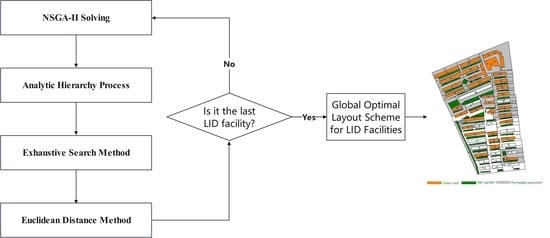
Graphical Abstract

1. Introduction

Urban communities are the fundamental units of urban society and the primary residential environment for inhabitants. Many older communities, however, were initially developed without systematic planning principles [1], leading to common problems such as disorganized spatial layouts, high building density, extensive impervious surfaces, and insufficient drainage capacity of pipeline networks. These issues have contributed to the degradation of natural regulatory functions within the urban water cycle [2]. In recent years, the increasing frequency of extreme rainfall events [3] has further exacerbated the long-standing challenges of flooding and pollution in these aging urban areas [4]. Sponge City retrofitting in older communities is widely regarded as a comprehensive strategy to improve the living environment and enhance urban resilience by addressing these urgent hydrological issues. A Sponge City is defined as an urban development approach that implements source-control measures to establish resilient stormwater infrastructure. This strategy effectively reduces runoff volume, mitigates peak flow, and controls pollutants [5]. By doing so, it strengthens urban disaster resilience and water security [6], thereby promoting a healthier urban water environment [7]. LID represents a core management measure whose objective is to manage stormwater runoff at the source by mimicking pre-development hydrologic conditions [8]. LID techniques integrate vegetation, soils, and terrain features to achieve on-site regulation of stormwater runoff through processes such as infiltration, detention, evaporation, and filtration. Research has established that in older communities, three LID practices—rain gardens, permeable pavements, and green roofs—are notably effective [9], These measures significantly contribute to reducing runoff volume, mitigating peak flow, delaying hydrograph response, and enhancing the broader urban environment [10,11,12,13].
Hydrological and water quality models are extensively used to evaluate Sponge City designs by simulating hydrological responses and pollutant loads under various rainfall scenarios. The simulated data provide a critical quantitative basis for assessing the effectiveness of LID facilities. Established models such as SWMM, MIKE URBAN Collection System (MIKE URBAN CS), InfoWorks Collection System (InfoWorks CS), System for Urban Stormwater Treatment and Analysis INtegration (SUSTAIN), and Model for Urban Stormwater Improvement Conceptualisation (MUSIC) [14,15,16,17,18,19] have been extensively utilized in previous research. Among these, SWMM is widely utilized for simulating urban runoff and water quality. The model supports simulations across multiple spatial scales—from watershed [20], and municipal [21], down to community levels [22]—and can be applied to both single-event and long-term continuous analyses [23]. As a result, SWMM has proven to be a robust tool for evaluating the performance of various stormwater systems under both current and projected rainfall conditions in urban settings [24]. The effectiveness of runoff and pollution control measures can be quantitatively assessed using specific metrics, such as the runoff coefficient, peak runoff rate, and pollutant washoff load [25]. Furthermore, the hydrological and pollution control effectiveness was evaluated by comparing the simulation results before and after the implementation of LID facilities, as well as under different layout scenarios. However, the effectiveness of low-impact development (LID) measures is significantly influenced by both the allocated implementation area and the design rainfall return period. Furthermore, the extensive range of possible layout combinations renders the design process a complex combinatorial optimization problem [26].
Multi-objective optimization is therefore essential for determining the optimal Sponge City retrofit strategy [27]. This is because retrofits in older communities necessitate trade-offs among competing goals [22], given typical site constraints such as limited space, aging infrastructure, and budgetary limitations [28]. Consequently, the selection of appropriate LID types and their specific placement remains a critical and non-trivial challenge [29]. To address these challenges, multi-objective optimization algorithms—such as genetic algorithms, particle swarm optimization, and machine learning—are commonly employed to identify a set of Pareto-optimal solutions [30,31,32,33,34,35]. Among these, NSGA-II (Non-dominated Sorting Genetic Algorithm II), as a classic multi-objective evolutionary algorithm, offers the following advantages: (1) Field applicability and robustness: It is widely and maturely applied in stormwater management optimization, providing a reliable foundation for this study; (2) Solving efficiency and stability: Its elitism and crowding distance mechanisms effectively maintain population diversity. Even when coupled with the computationally intensive SWMM, it can converge to a well-distributed, high-quality solution set within a reasonable number of iterations. Compared with decomposition-based algorithms such as MOEA/D, NSGA-II is more robust for problems with unknown Pareto-front shapes and complex inter-objective relationships, and its integration with SWMM is simpler and more stable. Subsequently, Multi-Criteria Decision-Making (MCDM) techniques—such as the Analytic Hierarchy Process (AHP), Fuzzy Comprehensive Evaluation (FCE), and TOPSIS—are employed to normalize the objective space, assign criterion weights, and ultimately select a final compromise solution from the Pareto set [36,37,38,39]. Among these, AHP offers the following strengths: (1) Structured subjective judgment: Through pairwise comparison matrices, it can hierarchically and quantitatively process decision-makers’ preferences regarding the importance of objectives while checking consistency. This aligns well with real-world decision-making scenarios that require consensus-building; (2) Transparent and interpretable process: The steps of constructing the hierarchy, performing comparisons, and synthesizing results in AHP are clear, facilitating communication and adjustments with experts, thereby enhancing the traceability and acceptance of the selected solution.
Nevertheless, due to the inherent complexity of sub-catchment delineation and diverse land uses, the layout optimization of LID facilities in existing research has often employed multi-objective optimization methods. These approaches have explored various configuration schemes for different types of LID facilities, achieving significant progress. Some studies have further focused on the precise spatial allocation of LID facilities. For instance, Zhang et al. [40] systematically reviewed strategies and optimization tools for the spatial layout of LID-BMP-GI practices across different scales, providing an important theoretical foundation for LID spatial optimization. Zhu et al. [41] utilized the fully distributed watershed modeling framework of the Spatially Explicit Integrated Modeling System (SEIMS) along with the NSGA-II algorithm to select spatial allocation units for BMPs.
Although some studies have achieved spatially explicit optimization, challenges remain in delineating specific fine-grained locations for these allocation units, such as individual buildings, road segments, or green space units. This limitation makes it difficult for the optimization results to effectively guide on-site renovation and construction, potentially leading to conflicts during the retrofitting of older communities. For instance, Kumar et al. [42] optimized the areal proportions of green roofs and infiltration trenches, assigning them 25% and 50% of the sub-catchment area, respectively. However, their study did not identify which specific buildings or infrastructure elements should be retrofitted. Similarly, Ghaffari et al. [43] showed varied LID adoption rates across sub-catchment categories, with permeable pavements consistently occupying the largest share, yet no precise spatial layout was specified. In the work of Zhou et al. [44], only the areal coverage of bioretention cells, green roofs, and permeable pavements within zones suitable for green infrastructure (e.g., green spaces, roofs, roads, and plazas) was reported, without detailing exact deployment strategies.
While the aforementioned studies provide valuable references for LID planning, their outcomes primarily remain at the level of areal proportion optimization within sub-catchments. They fail to achieve optimization at the scale of determining whether individual building facilities should undergo LID retrofitting—that is, they do not adequately account for practical retrofit constraints at fine-scale units. In practice, each sub-catchment comprises multiple fixed-area elements—such as roofs, green spaces, and impervious surfaces—which require integrated retrofitting due to their distinct structural, functional, or drainage characteristics. Current optimization results typically yield theoretical “optimal percentages” for LID coverage but do not account for whether such targets can be feasibly applied to discrete building blocks. For instance, a model may prescribe green roofs for 50% of a sub-catchment, yet actual implementation could only achieve 40% or extend to 60%, as retrofit decisions are necessarily all-or-none at the building level. Such mismatches between theoretical proportions and constructible units introduce uncertainty, may raise construction costs, and offer limited practical guidance for determining exact retrofit locations. Therefore, optimizing LID retrofitting at the level of individual buildings or infrastructure elements is crucial for deriving accurate and implementable spatial layouts.
To enhance the practicality and feasibility of optimized LID designs, this study proposes a progressive approximation framework that bridges the gap between theoretical optimal values and practical constraints in LID planning. The methodology employs a hybrid strategy combining exhaustive search and Euclidean distance evaluation for optimal LID siting. The process begins by generating a Pareto front using the NSGA-II algorithm, from which the final optimal solution is selected by applying the AHP. All feasible spatial configurations are then enumerated, with the one minimizing the comprehensive Euclidean distance—factoring in practical community constraints—being chosen as the final retrofit plan. To bridge this gap between sub-catchment ratios and building-specific implementation, this study develops a multi-objective optimization framework. The framework operates through sequential steps: first, the NSGA-II algorithm is coupled with the SWMM to generate a Pareto-optimal solution set; second, the AHP method is applied to evaluate and rank these solutions; finally, an iterative process integrating exhaustive search and Euclidean distance analysis determines the optimal spatial layout for LID deployment. Compared to existing methods, the incremental approximation approach proposed in this study places fine-scale units at the core of optimization. It fully integrates the practical retrofit constraints of older communities, thereby constructing a progressive decision-making framework that bridges theoretical optimization and on-site implementation. This framework generates actionable LID layout plans that correspond directly to specific retrofit objects and clearly defined spatial locations. As a result, the optimization outcomes can provide direct guidance for construction, offering more practical and operable technical support for LID retrofits in aging communities.
The remainder of this paper is organized as follows. Section 2 describes the study area and the rainfall scenarios used in the analysis. Section 3 details the methodological framework, which consists of three key stages: (1) development and calibration of the SWMM; (2) establishment of a multi-objective optimization framework that couples NSGA-II with SWMM to generate Pareto-optimal LID schemes, from which the final solution is selected using the AHP method; and (3) an exhaustive search combined with Euclidean distance analysis to identify the implementable scheme that most closely approximates the theoretical optimum. Section 4 presents the results, including a comparative analysis of objective function values, runoff and flooding control performance, runoff quality, and the spatial distribution of LID facilities. Section 5 provides a discussion of these findings, and Section 6 summarizes the major conclusions.

2. Research Flowchart

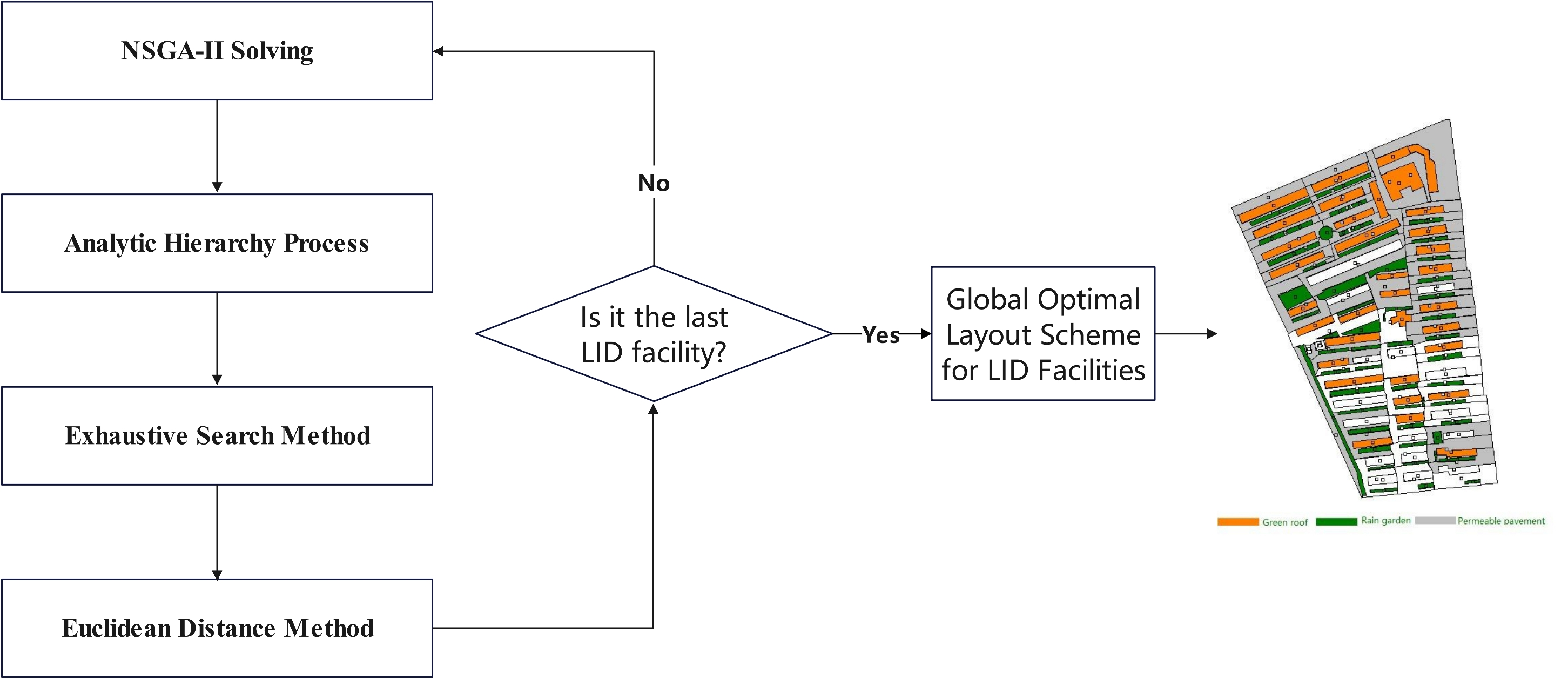
In LID retrofitting, individual building blocks function as indivisible units. For example, roofs and green spaces can only be retrofitted in their entirety or not at all, as partially modifying a single roof or vegetated area is impractical. To address these real-world constraints, this study first applied a multi-objective optimization framework to determine the theoretically optimal LID area allocation across the study site. An exhaustive search was then conducted to identify all feasible retrofit combinations at the sub-catchment level. For each combination, the deviation between the practically retrofitted area and the theoretical optimum was calculated. The solution with the smallest deviation was selected as the final optimal scheme. The overall workflow of this procedure is presented in Figure 1.
To illustrate, consider the example of green roofs. Suppose the theoretically optimal proportion of green roofs within a sub-catchment is determined to be 60%. If no feasible combination of buildings can achieve this exact ratio, the closest attainable proportion—55% in this case—is selected as the optimal value for that sub-catchment. This process is repeated for each LID practice, enabling the identification of specific buildings within each sub-catchment that should be retrofitted.

3. Methodology and Study Area

3.1. Study Area

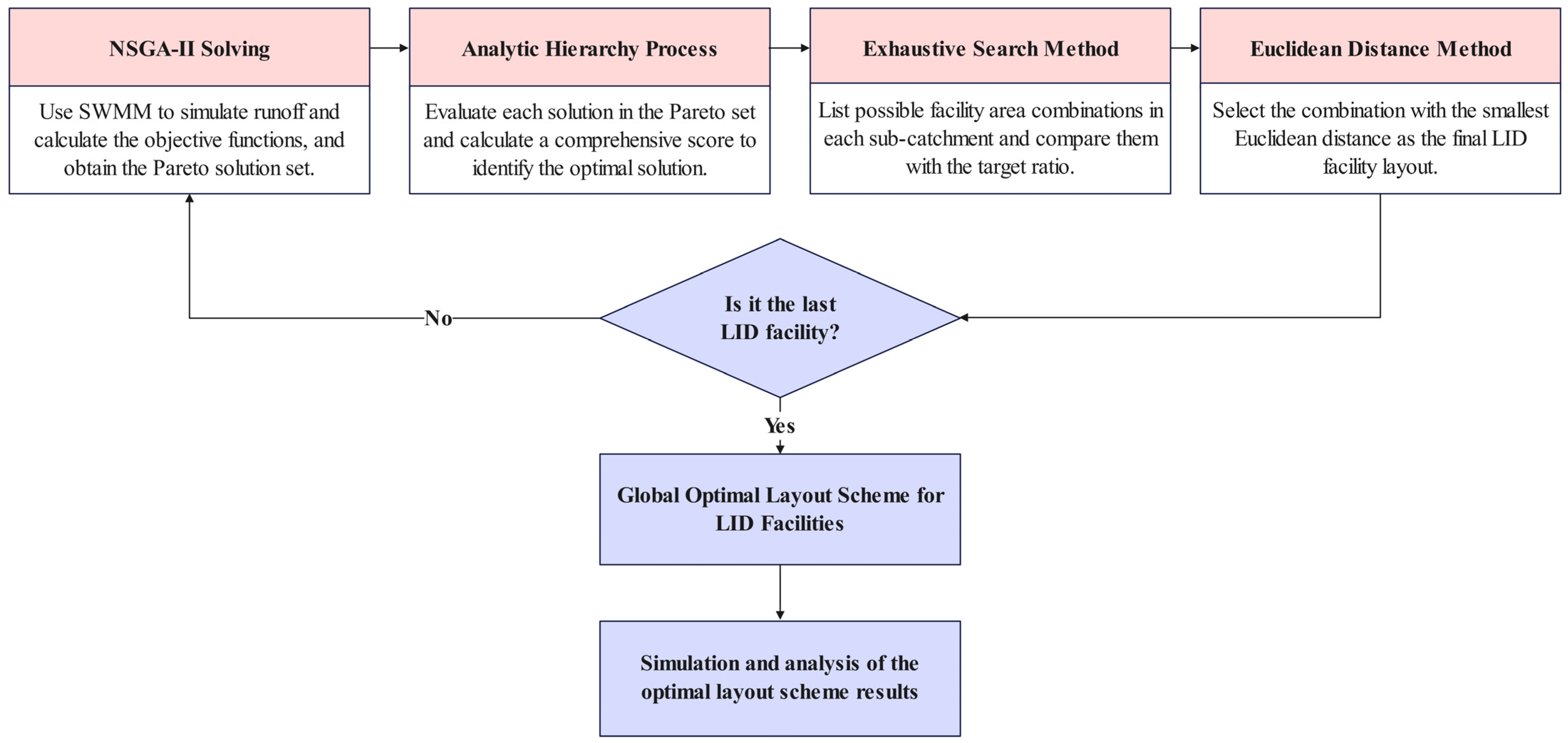
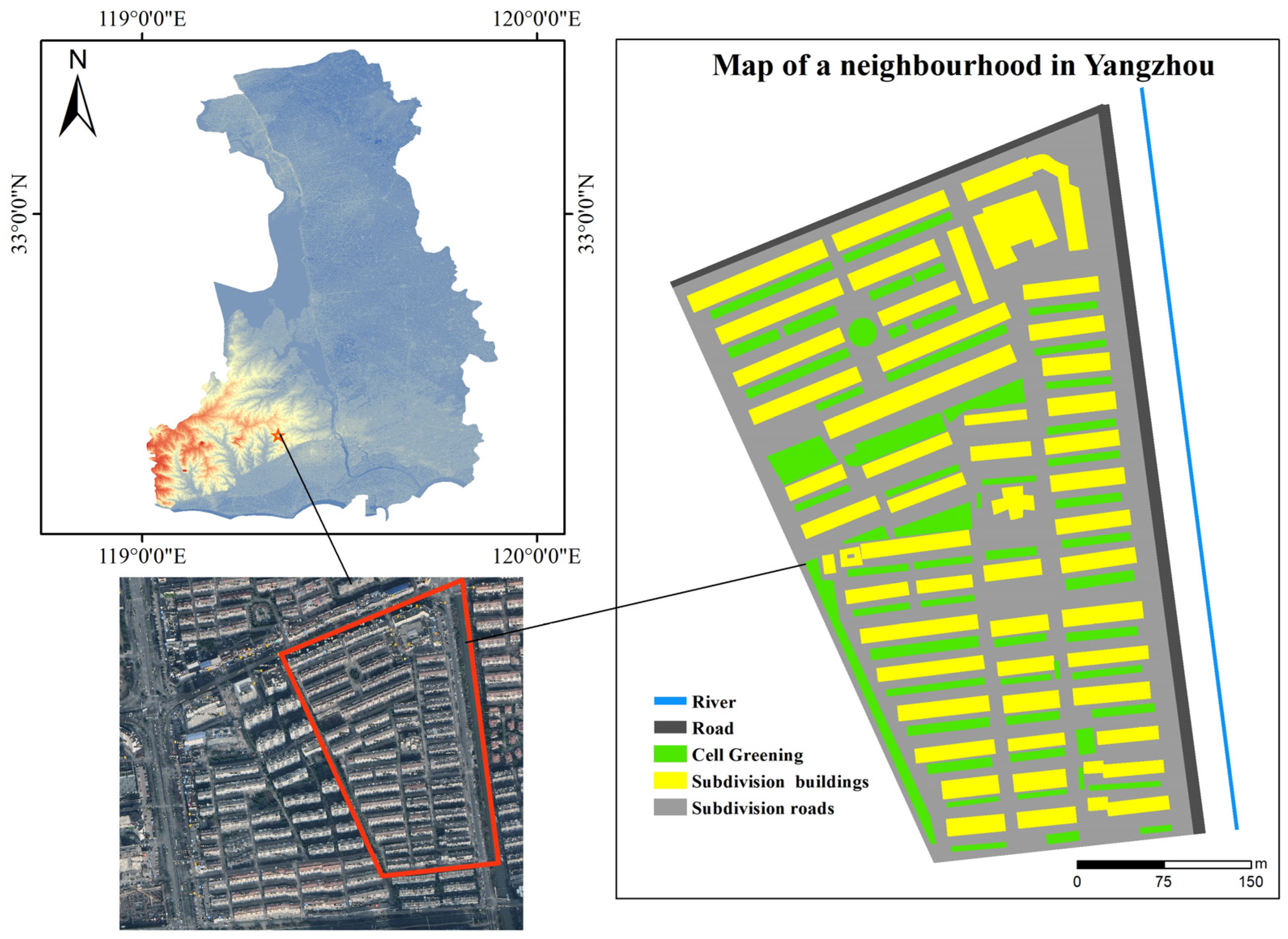
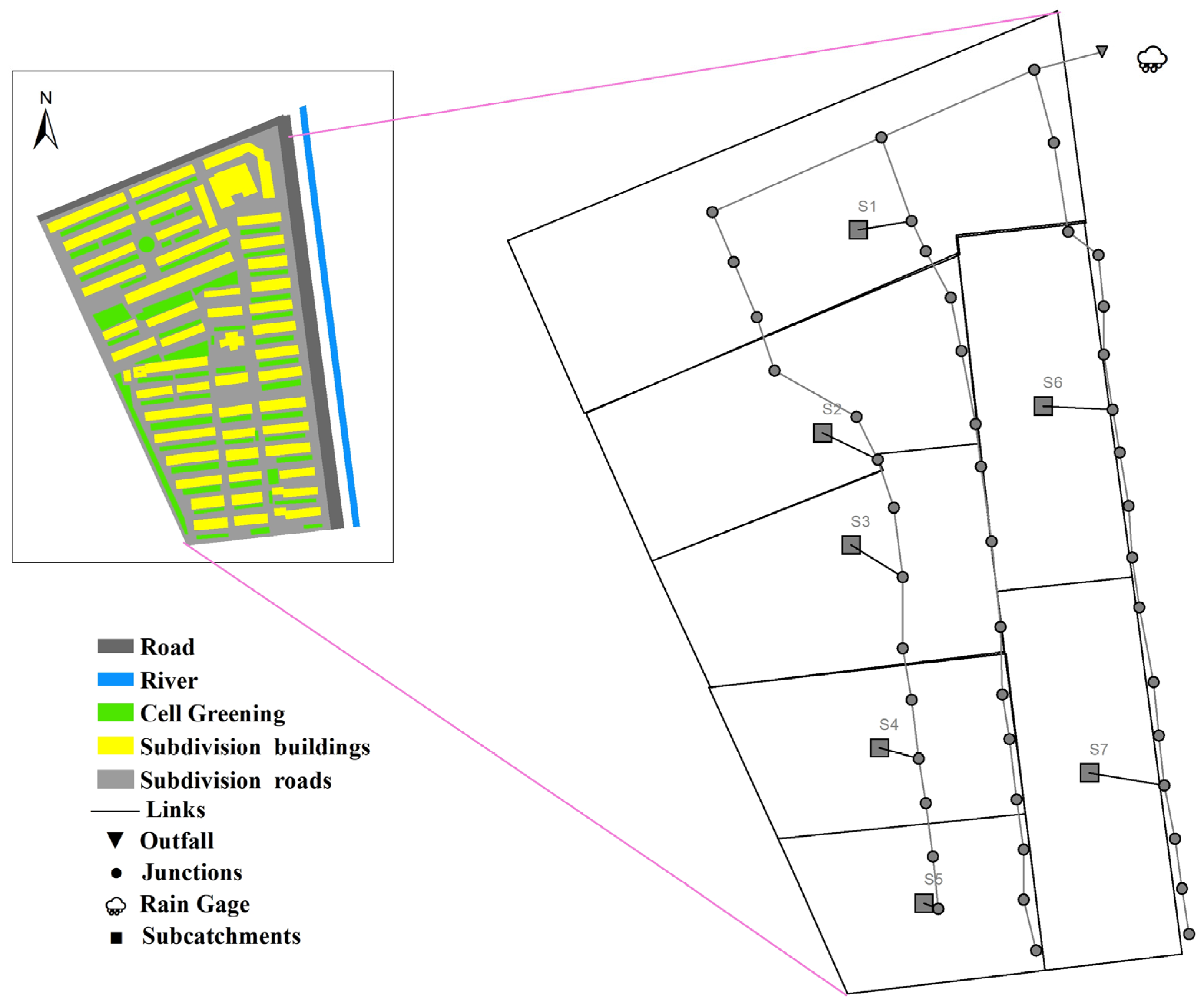
The study site is an 18-hectare older residential district in Yangzhou City, Jiangsu Province, China (32°15′ N–33°25′ N, 119°01′ E–119°54′ E). The area has a subtropical monsoon climate characterized by four distinct seasons and a mean annual precipitation ranging from 800 to 1200 mm. Precipitation is highly seasonal, with 60–80% occurring during the summer and autumn months. The terrain is generally flat, exhibiting minimal topographic variation (Figure 2). A key feature is the district’s independent drainage system. During a 2020 renovation, the stormwater and sewage pipelines were physically separated from upstream networks. As a result, all runoff generated within the district discharges directly into an eastern river. The site is bounded on three sides by municipal roads and solid perimeter walls, forming a hydrologically isolated unit. This configuration prevents cross-regional flow exchange and minimizes external hydrological interference, making the site well-suited for evaluating LID performance.
The terrain of the study area is generally flat, with slightly higher elevations in the northwestern and northeastern sections. Land use is distributed as follows: built-up area covers 4.81 ha, green space 2.30 ha, and impervious surfaces 11.36 ha. Before retrofitting, the district contained no LID facilities and supported only sparse vegetation, resulting in extensive impervious cover and dense development. These conditions make the site highly susceptible to surface ponding during rainfall events. Prolonged or intense precipitation frequently leads to waterlogging, and ponded water dissipates slowly due to the naturally limited infiltration capacity of the terrain.

3.2. SWMM

The Storm Water Management Model (SWMM), developed by the US Environmental Protection Agency (USEPA), is a widely adopted dynamic simulation tool for analyzing urban hydrological processes. It is commonly applied to model rainfall–runoff responses, assess urban flooding, design drainage systems, estimate non-point source pollutant loads, and evaluate flood risk. The model operates through three core computational modules: hydrological, hydraulic, and water quality [45]. The modeling in this study was conducted using EPA SWMM 5.2. The hydrological module simulates the rainfall–runoff process by converting precipitation into surface runoff through the simulation of infiltration, evaporation, and overland flow routing. The hydraulic module conducts one-dimensional hydrodynamic simulations of flow propagation within conduits and pipe networks. The water quality module simulates pollutant buildup, washoff, and transport [46]. Specifically, the key parameters for the SWMM and the LID facilities were adopted from calibrated and validated values reported in published studies conducted in areas with similar geographical locations, climatic conditions, and land cover types. This approach helps to reduce the uncertainty in parameter calibration and provides a reliable initial parameter set for the modeling exercise. All parameter configurations for the hydrological and water quality processes, along with LID controls, are detailed in Tables S1–S3 Supplementary Material [47,48,49,50,51,52]. Furthermore, to streamline the computation and based on the consistency of surface characteristics within the study area, the model assumes that key hydrological parameters remain constant during the simulation. This assumption is generally accepted for short-duration design storm scenarios. The water quality module simulates only suspended solids (SS) as a representative pollutant, given that SS is the most prevalent key indicator in urban surface runoff, often co-migrating with various pollutants, and its accumulation and wash-off processes are relatively well-established. This approach helps to clearly evaluate the effectiveness of LID in controlling particulate pollutants within the optimization framework. A schematic of the implemented SWMM is provided in Figure 3.

3.2.1. Rainfall Design

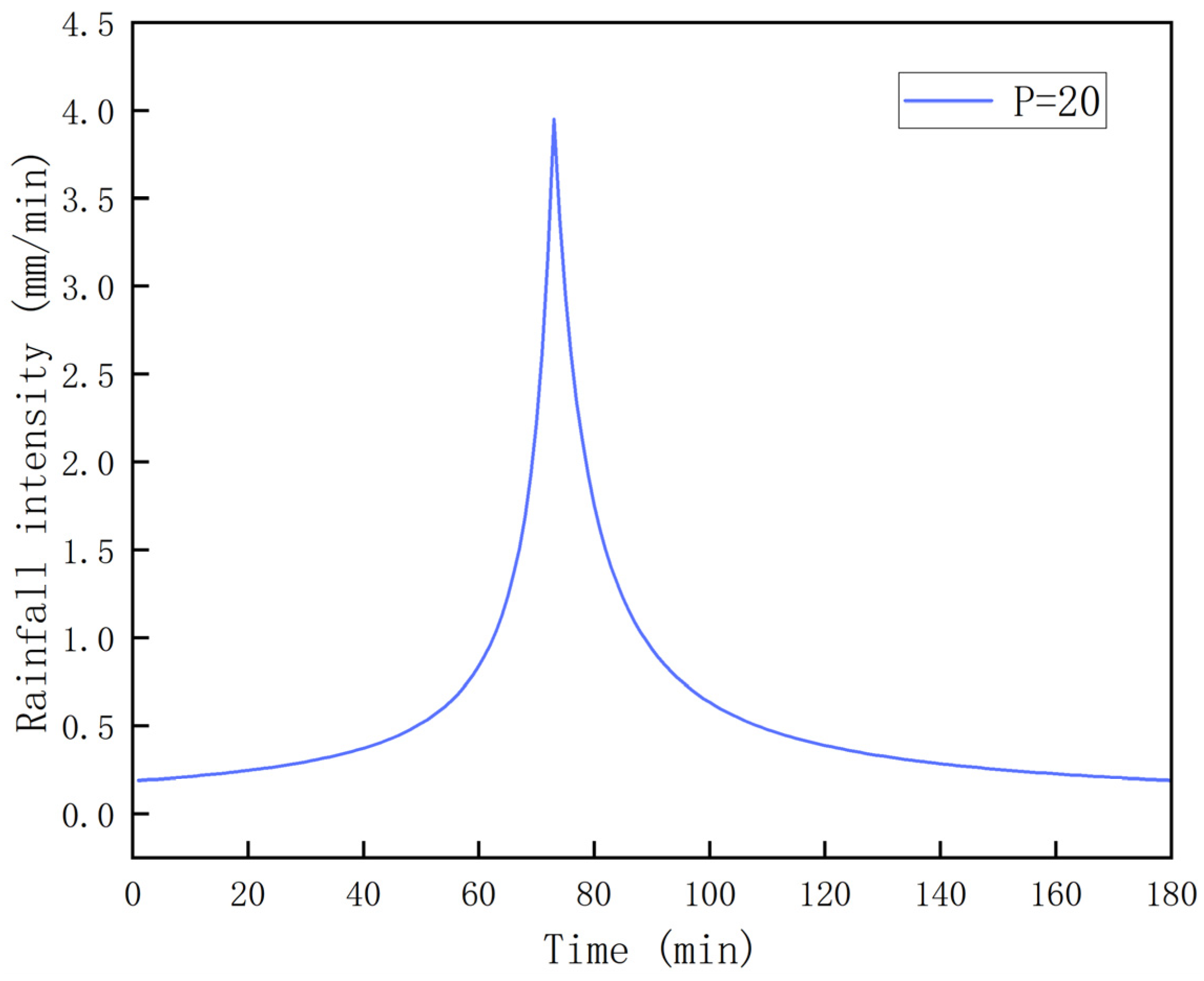
The rainfall inputs for simulation included both observed events (7 May and 17 August 2024) and synthetic hyetographs generated using the Chicago method. The measured rainfall data were obtained from an automatic weather station within the study area, with a data completeness rate exceeding 99%. To evaluate their representativeness, the peak intensity, total rainfall depth, and duration of the two recorded rainfall events were compared against local rainfall records from the past decade. The results indicate that both events fall within the range of typical heavy rainfall events in the region, making them suitable for model calibration and validation. For the synthetic events, a storm duration of 180 min (t = 180) and a peak rainfall coefficient (r) of 0.401 were adopted, based on the 20-year return period storm intensity formula for Yangzhou City (Equation (1)) [22]. These parameters were used to construct the design hyetograph (Figure 4).
i = 15.988 1 + 0.677 l g P t + 15.3 0.744
where i represents the design storm intensity [L/(ha·s)], P the return period (year), and t the rainfall duration (min).

3.2.2. Model Calibration and Validation

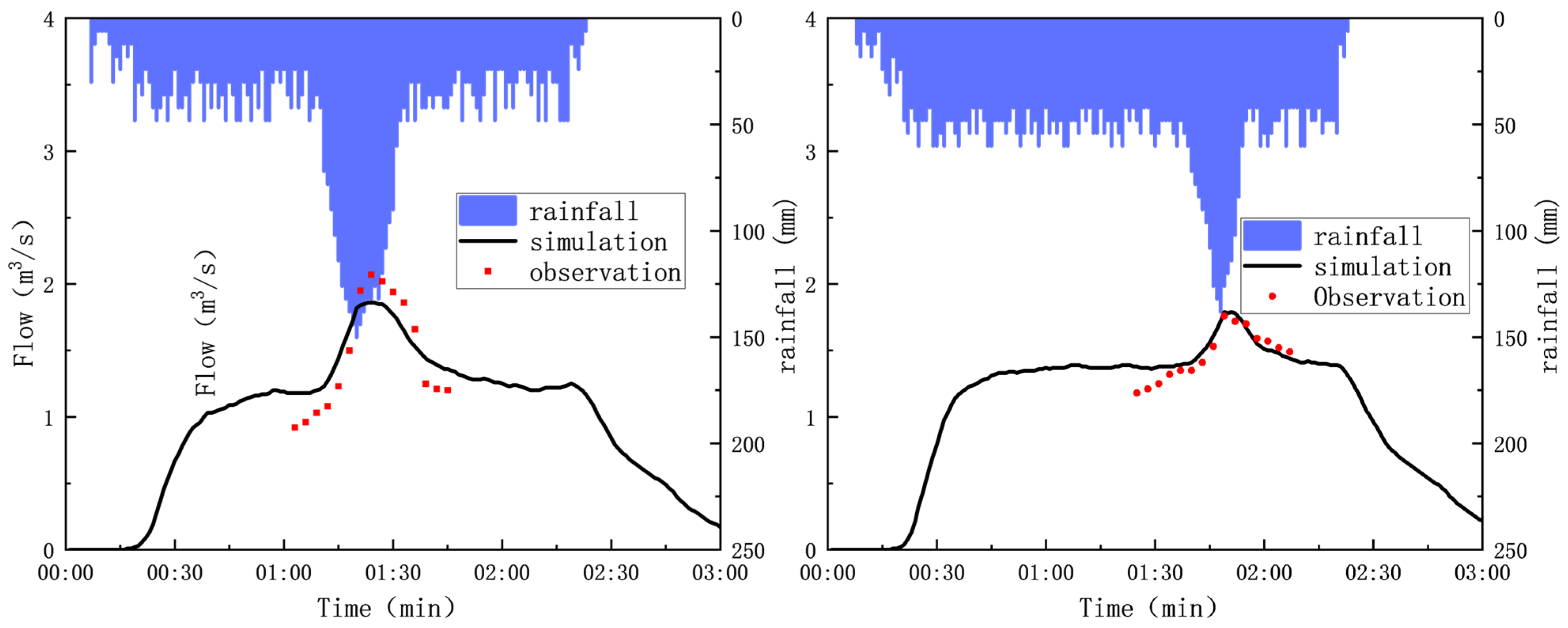
Given the limited availability of historical rainfall and pollutant data for the study area, model parameters were calibrated and validated using two rainfall events recorded at nearby monitoring stations (7 May and 17 August 2024), along with corresponding outflow discharge measurements at the catchment outlet. Model performance was evaluated using the Nash–Sutcliffe efficiency (NSE), where a value above 0.65 is generally considered satisfactory, and values closer to 1 indicate better agreement between simulated and observed results. As shown in Figure 5, the NSE values for the two validation events were 0.786 and 0.798, both exceeding the 0.65 threshold, confirming that the model achieved reliable accuracy.

3.2.3. LID Scenario Design

Based on building characteristics, spatial layout, and sub-catchment boundaries, suitable LID practices were selected for each sub-catchment. Two simulation scenarios were established: (1) a baseline scenario without any LID measures, serving as a control to quantify the benefits of retrofitting; and (2) an optimized LID configuration that maximizes cost-effectiveness, representing the final deployment layout and used to evaluate the performance of the multi-objective optimization framework.

3.3. Optimization Model Setup

3.3.1. Multi-Objective Functions

The study area’s limited drainage capacity and high impervious coverage make it prone to waterlogging during rainfall events. Prolonged drainage times can also exacerbate pollutant accumulation. At the same time, retrofit construction must remain cost-effective within constrained budgets. To address these interrelated challenges, three objective functions were defined for rehabilitating the older residential district: construction cost, stormwater runoff reduction rate, and total suspended solids (TSS) load reduction rate. Their detailed formulations are given below:
(1) Annual cost function of LID facilities:
f 1 = A i × C i
where f 1 represents the cost objective function, i denotes the i-th type of LID facility, A i is the area of the i-th type of LID facility (m2), and C i is the unit cost of the i-th type of LID facility (CNY/m2). The LID system’s construction and maintenance costs were determined based on relevant literature and local engineering projects. The unit costs used in this study are listed in Table S4 of the Supplementary Material.
(2) The objective function for stormwater runoff reduction rate [33] is as follows:
f 2 = i = 1 n A i × Φ o , i Φ L I D , i A t × Φ o , i
where f 2 represents the stormwater runoff reduction rate objective function, A i is the retrofitted area of the i-th LID unit (m2), A t is the total area of the study region (m2), Φ o , i and Φ L I D , i are the runoff coefficients of the i-th LID unit before and after retrofitting, and n denotes the total number of LID unit types. The runoff coefficients used in this study are listed in Table S5 of the Supplementary Material.
(3) The objective function for the TSS load reduction rate [44] is as follows:
f 3 = S S 1 S S 2 S S 1 × 100 %
where f 3 represents the TSS load reduction rate objective function, and SS1 and SS2 denote the TSS concentrations before and after optimization (mg/L), respectively.

3.3.2. Constraints on LID Implementation

The deployment of LID facilities must adhere to practical site constraints. Drawing on established guidelines [53], the allowable implementation areas for rain gardens, green roofs, and permeable pavements are defined as follows:
Green roofs may cover 30–70% of the total building roof area within a sub-catchment.
Rain gardens may occupy 30–100% of the available green space area within a sub-catchment.
Permeable pavements may replace 50–70% of the impervious surface area within a sub-catchment.
These area constraints for each LID type are formulated as:
0.3 × A R A G R 0.7 × A R
0.5 × A P A P P 0.7 × A P
0.3 × A G A R G 1.0 × A G
where A R , A P , and A G represent the total areas of building roofs, impervious surfaces, and green spaces in the sub-catchment, respectively, and A G R , A P P , and A R G are the implemented areas of green roofs, permeable pavements, and rain gardens, respectively.

3.4. LID Optimal Allocation Determination Technique

3.4.1. Identification of Optimal Solution Set Based on NSGA-II Algorithm

The Non-dominated Sorting Genetic Algorithm II (NSGA-II) [54], is a widely used multi-objective optimization algorithm, recognized for its computational efficiency, rapid non-dominated sorting, and ability to generate well-distributed Pareto fronts. In this study, NSGA-II is applied to simultaneously optimize the types and spatial arrangement of LID facilities. This process yields a set of Pareto-optimal solutions that provide a decision-support basis for subsequent planning [55].
The specific workflow is as follows: in each optimization iteration, a Python script first dynamically loads and parses the input file (.inp) via the SWMM API. It then adjusts the area parameters of LID units in each sub-catchment in real time based on the decision variables generated by the algorithm, thereby optimizing the layout of LID facilities [56]. After the modifications are made, the script drives SWMM to execute a complete hydrodynamic simulation, advancing the computation step by step over time. Once the simulation is completed, Python automatically extracts key outputs—such as cumulative runoff volume, rainfall depth, and pollutant loads at the outfall—through the data interface. These data are immediately used to compute the objective functions and area constraints; the results are then fed back to the NSGA-II algorithm to evaluate individual fitness and generate the next generation of candidate solutions. This cycle repeats until the preset number of iterations is reached, ultimately yielding a Pareto-optimal solution set [57]. The entire process forms a closed-loop optimization of “automated parameter modification → real-time simulation execution → instantaneous result feedback,” ensuring efficient and precise data exchange and collaborative optimization between the physical model and the intelligent algorithm.
The optimization algorithm was implemented in Python 3.8, with the following configuration: the algorithm utilized a population size of 100 and evolved for a maximum of 500 generations, with decision variables constrained to the range [0, 1].

3.4.2. Determination of the Optimal Solution Using the AHP

The Pareto-optimal solution set generated by the NSGA-II algorithm typically contains multiple non-dominated alternatives [58], which does not directly yield a single preferred solution for practical implementation. To address this, the Analytic Hierarchy Process (AHP) was applied. Pairwise comparisons were conducted to evaluate the relative importance of each performance indicator in achieving Sponge City objectives [59], and corresponding weight coefficients were derived [60,61]. Using these weights and the normalized values of each solution, a comprehensive evaluation score was calculated for every alternative in the Pareto set. The solution with the highest score was selected as the optimal Sponge City retrofit plan. This approach streamlines decision-making, enhances the scientific rigor and interpretability of the optimization outcomes, and provides a more rational basis for multi-objective planning.

3.4.3. LID Facility Area Matching Method Based on Euclidean Distance

The study area was conceptualized within SWMM by representing the actual drainage network through a simplified system of nodes. Land use in each sub-catchment was classified into three categories: building roofs, green spaces, and impervious surfaces. The model was built by linking these sub-catchments through the pipe network, resulting in a final configuration consisting of 7 sub-catchments, 59 nodes, 59 conduits, and 1 outfall discharging into the eastern river.
Following the identification of the optimal solution from the NSGA-II-derived Pareto set using AHP, a discrepancy emerged between the theoretically optimal LID areas and the practically available areas for implementing facilities. To address this mismatch, a refinement procedure was introduced. Since the sizes of roofs, green spaces, and impervious surfaces within each sub-catchment are fixed and discrete, each possible combination of LID retrofitting areas produces a unique hydrological response. Therefore, an exhaustive search was conducted to evaluate all feasible retrofitting area combinations across all sub-catchments.
For example, if the theoretically optimized proportion for green roofs is 70% and sub-catchment S2 contains 7 retrofittable roofs, any combination of 4 to 6 roofs would fall within an acceptable implementation range (e.g., 65–75%). The same approach is used to identify feasible implementation ranges for rain gardens and permeable pavements. The Euclidean distance (Equation (8)) is then calculated for every possible combination of feasible LID options across all three facility types. The combination with the minimum Euclidean distance is selected, as it represents the practical implementation scheme that most closely matches the theoretical optimum.
This iterative process proceeds until the implemented area ratios of all LID facilities align with the theoretical optimum, ultimately determining the final retrofit configuration for specific buildings and infrastructure [52].
ρ = x 2 x 1 2 + y 2 y 1 2 + z 2 z 1 2
where ρ denotes the Euclidean distance; x 1 and x 2 are the ideal and actual values for green roofs, respectively; y 1 and y 2 are the ideal and actual values for rain gardens, respectively; and z 1 and z 2 are the ideal and actual values for permeable pavements, respectively.

3.4.4. Decision Scheme Comparison and Validation

(1) Scheme 1: Direct Comparison Method
The Pareto-optimal solution set is first ranked using the AHP to determine the ideal solution. This ideal solution is then compared with all solutions obtained from the Euclidean distance method, and the one exhibiting the minimum Euclidean distance to the ideal is selected.
(2) Scheme 2: Secondary Optimization Method
Beginning with the solution closest to the ideal value based on Euclidean distance, the NSGA-II algorithm is used to regenerate an optimized solution set. The AHP is then reapplied to select the optimal solution from this new set, followed by a recalculation of the Euclidean distance to identify the solution nearest to the ideal.
(3) Scheme 3: Iterative Fixation Method
Starting from the solution with the smallest Euclidean distance, the NSGA-II and AHP procedures are applied iteratively. In each iteration, the area ratio for one sub-catchment is fixed, and the optimization is repeated for the remaining sub-catchments. This sequential fixation continues until the optimized area ratios for all sub-catchments align closely with the practically implementable area ratios.

4. Results

4.1. Optimization Outcomes

4.1.1. Ideal Results

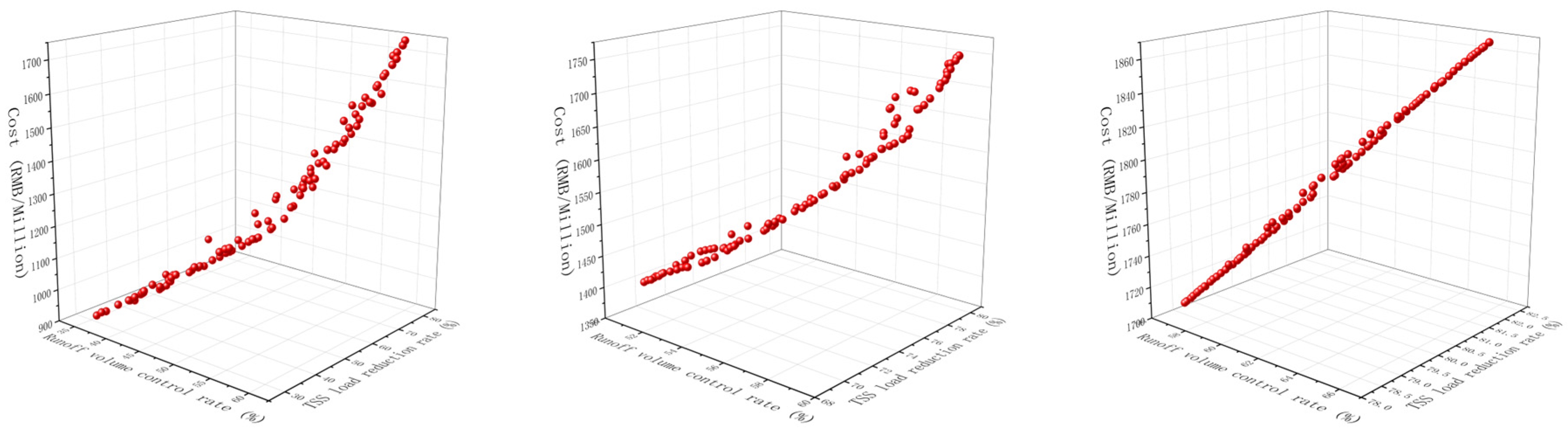
Using the NSGA-II algorithm with 500 iterations, a set of 100 non-dominated solutions was generated for each of the three rainfall scenarios. Each solution corresponds to a Pareto-optimal LID configuration [62] representing a distinct trade-off among the three objective functions. Together, these solutions form a three-dimensional Pareto front. The distribution of solutions across the three scenarios is illustrated in Figure 6.
The multi-objective optimization produced three distinct Pareto-optimal sets, corresponding to successively higher levels of investment. The first set involves costs ranging from 9.23 to 17.42 million CNY, achieving runoff reduction rates of 36.11–59.03% and TSS reduction rates of 29.52–79.09%. The second set, with costs between 13.99 and 17.52 million CNY, delivers improved performance: runoff reduction of 50.70–59.30% and TSS reduction of 69.75–79.58%. The third and most effective set requires an investment of 17.10 to 18.67 million CNY and yields the highest benefits, with runoff reduction reaching 56.97–65.47% and TSS reduction reaching 78.41–82.21%. This result indicates that, through optimization, runoff control and pollutant reduction can be simultaneously achieved within limited costs, providing direct evidence for balancing economic and environmental objectives in the renovation of older communities.
Both stormwater runoff and TSS reduction rates show a positive correlation with investment cost. Among the three schemes, Scheme 3 achieves the highest hydrological performance, albeit at a correspondingly higher cost. Scheme 1 is the most economical option but yields the lowest environmental benefits. Scheme 2 represents a balanced compromise, offering effective performance at a moderate investment level.
The 100 Pareto-optimal solutions were evaluated using the AHP. The judgment matrix produced the following weight coefficients for the three objectives: construction cost (0.633), stormwater runoff reduction rate (0.260), and TSS load reduction rate (0.110). Using these weights together with the normalized objective values, the optimal LID configuration for each rainfall scenario was identified (Table 1).
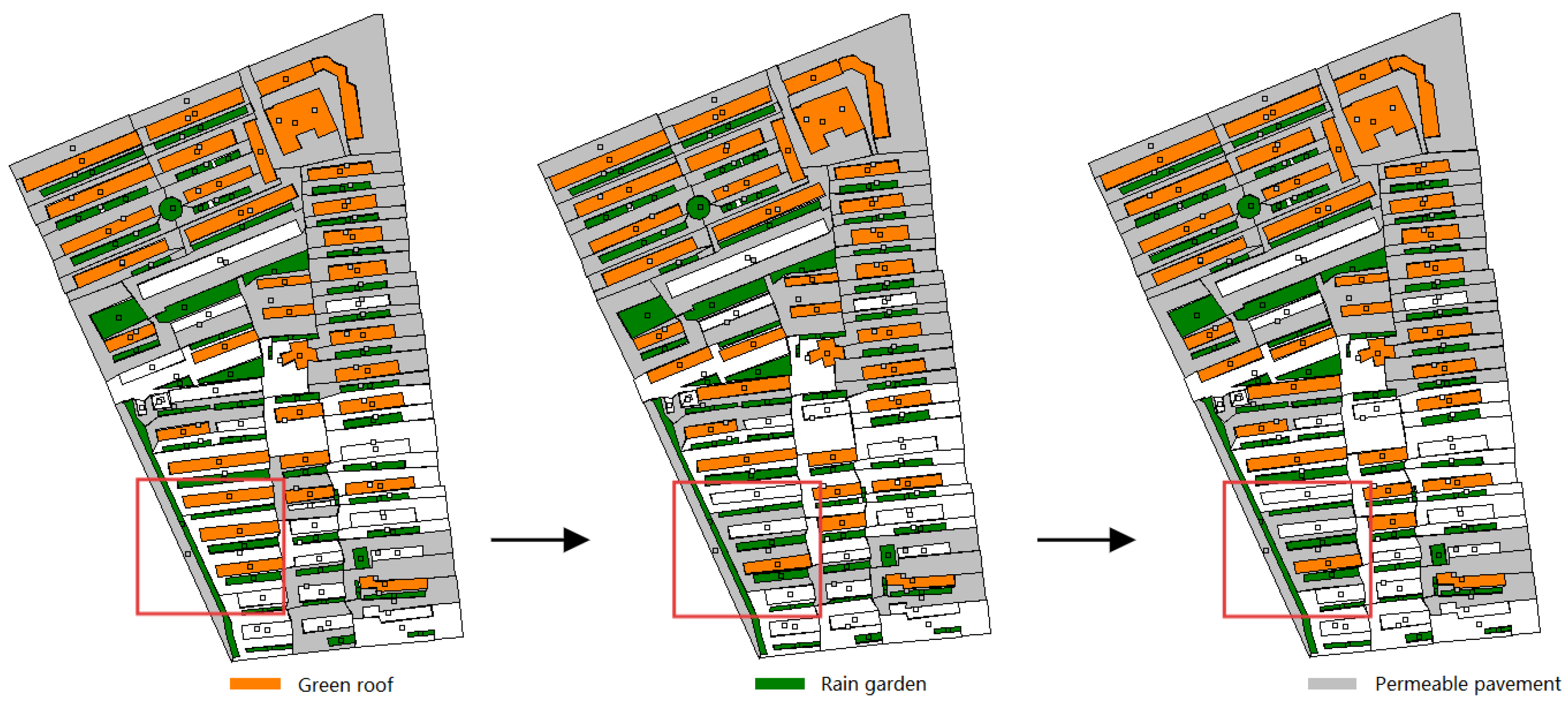
The three Pareto-optimal schemes followed similar LID deployment strategies. Green roofs covered 69.89–70.06% of the available roof area, rain gardens occupied 97.93–100% of the green space, and permeable pavements replaced 69.28–70.00% of the impervious surfaces. These layouts achieved strong performance, reducing stormwater runoff by 58.85–59.30% and TSS loads by 79.11–79.51%, at a corresponding cost of 17.42–17.52 million CNY.
Across the three schemes, both the proportions of LID facilities and the resulting objective functions showed only minor variations. The area ratios for all facilities changed by less than 1%, except for rain gardens, which varied by up to 3%. This consistency is expected because Scheme 2 and Scheme 3 represent spatial refinements of Scheme 1, where a subset of LID facilities is fixed in place. This constraint limits significant deviations in both the overall layout and the final performance. This further demonstrates that, within a defined cost range, preferred solutions that exhibit stability in both environmental performance and spatial layout can be identified, thereby enhancing the reliability and decision support value of the planning outcomes.

4.1.2. Comparative Analysis of Different Outcomes

The theoretically ideal solution was first identified from the NSGA-II-generated Pareto front using the AHP. An exhaustive search combined with Euclidean distance analysis was then applied to obtain the optimal practical solution (Scheme 1). This solution served as the starting point for a further round of optimization using NSGA-II. The same evaluation and search procedure then yielded Scheme 2. By iteratively repeating this cycle of optimization and spatial refinement, Scheme 3 was ultimately derived. The Euclidean distances between the ideal and implemented LID area ratios for each sub-catchment are presented in Table 2, Table 3 and Table 4.
Across the three successive schemes, the maximum Euclidean distance decreased monotonically from 5 to 3 to 1. This consistent reduction indicates that the implemented LID areas progressively approached the theoretical optimum for each sub-catchment. The results demonstrate that the iterative approximation framework effectively reduces the disparity between practical implementation and theoretical planning, yielding a final LID layout that aligns closely with the optimal configuration. This process shows that, through repeated coordination and approximation, the final layout scheme can approach the theoretically optimal runoff control and pollutant reduction effects while maintaining cost control, thus systematically supporting the entire decision-making process of the iterative approximation and optimization.

4.2. Optimized Schemes and Implementation Effects

4.2.1. Spatial Distribution of Optimized Schemes

Figure 7 shows the evolution of LID facility layouts across the sub-catchments through the three iterative schemes. A notable spatial change is the redistribution of permeable pavement deployment from the central area to the western part of the southern sector. This shift strategically addresses the low-lying topography of the western zone, a natural depression where stormwater tends to accumulate. The concentration of runoff in this area necessitated targeted LID interventions to effectively mitigate waterlogging risks.

4.2.2. Comparison of Runoff Regulation Effects

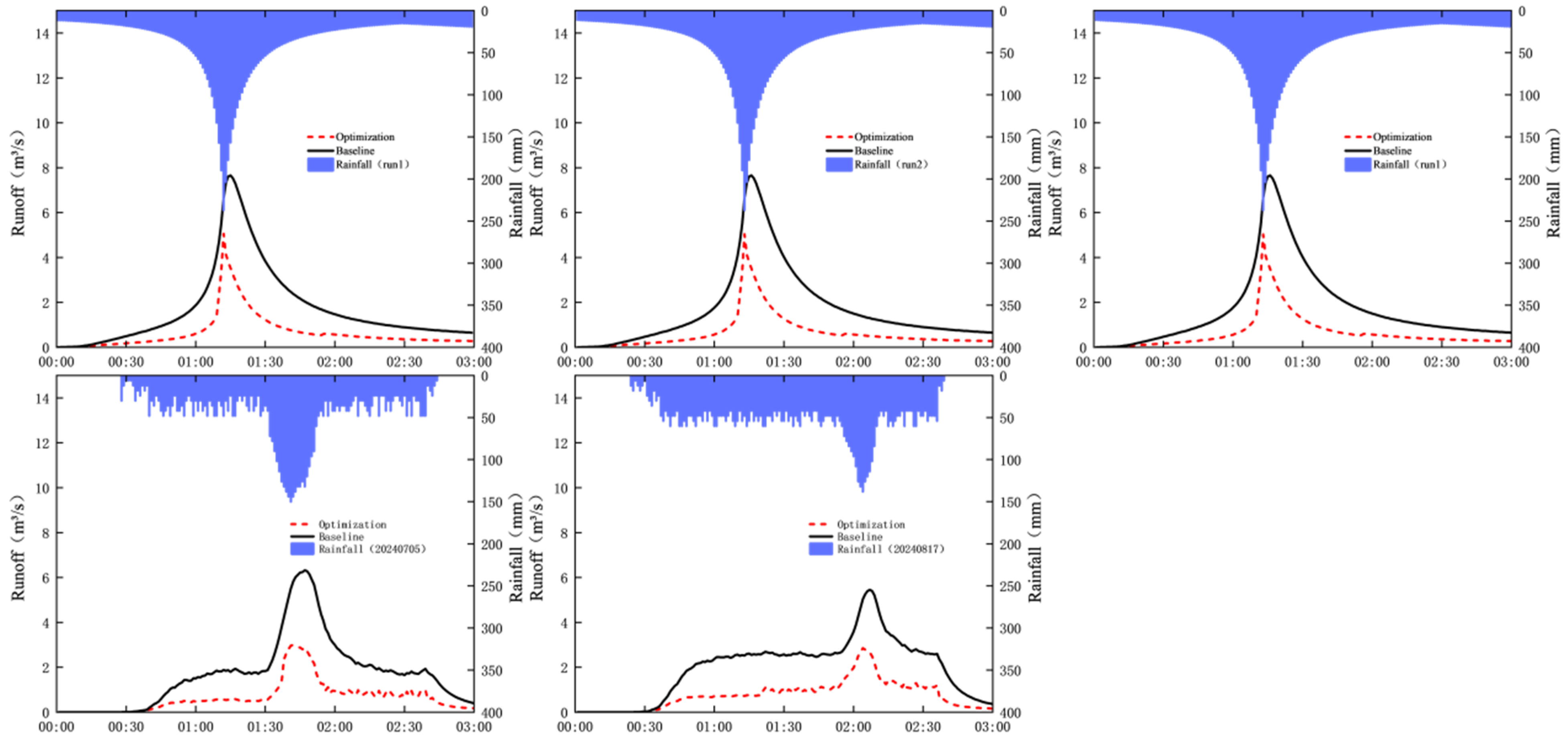
Based on the cost-optimal LID layout schemes, SWMM simulations were performed to assess runoff control performance under each rainfall scenario. The results were then compared with the baseline (no-LID) scenario, as presented in Figure 8.
Following LID implementation, the peak flow rates under the design rainfall event decreased from the baseline of 7.66 m3/s to 5.06, 5.04, and 5.03 m3/s for the three schemes, demonstrating peak flow reduction rates of 33.94%, 34.20%, and 34.33%, respectively. For the two observed rainfall events, peak flows were reduced from 6.32 m3/s to 2.97 m3/s (a 53.01% reduction) and from 5.45 m3/s to 2.85 m3/s (a 47.71% reduction).
The results indicate that LID facilities significantly reduce peak flows and contribute meaningfully to stormwater regulation. The three schemes performed comparably well in peak flow reduction, each effectively mitigating flood risk. Their efficacy was even more pronounced under actual rainfall conditions, confirming the robustness of LID strategies for urban waterlogging mitigation.

4.2.3. Comparison of Node Waterlogging Risk

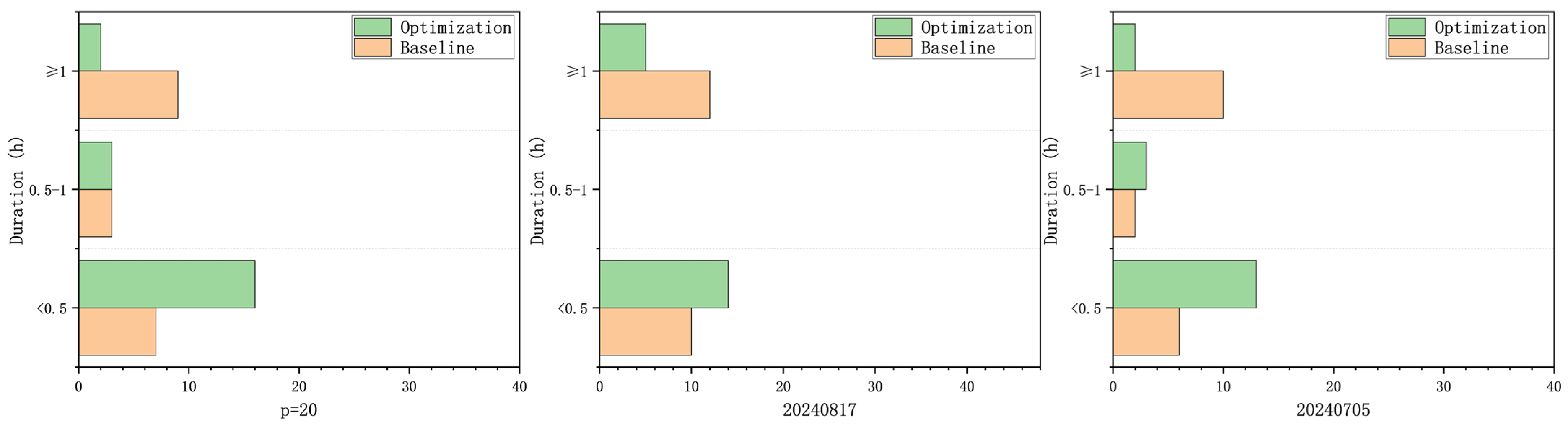
Node flooding was simulated under a 20-year return period design storm and two recorded rainfall events (7 May and 17 August 2024). The performance of the optimal LID retrofit was evaluated against a no-LID baseline using SWMM. Simulated flood durations were categorized into three intervals: <0.5 h, 0.5–1 h, and >1 h.
The distribution of nodal waterlogging durations was markedly bimodal: most nodes experienced either less than 0.5 h or more than 1 h of flooding, with relatively few falling into the intermediate 0.5–1 h range. Before LID retrofitting, a large proportion of nodes endured waterlogging exceeding 1 h. After implementation, flooding at the majority of nodes was limited to under 0.5 h, with only a small fraction still exceeding this duration.
These results highlight the dual regulatory role of LID facilities in both enhancing short-term stormwater retention and mitigating long-duration flood risks. By capturing and storing runoff, LID measures attenuate peak flows and accelerate the recession of waterlogged conditions, thereby increasing system resilience during prolonged rainfall. This mechanism effectively reduces the risk of extended inundation. A comparative analysis of node flooding dynamics across the different rainfall scenarios is shown in Figure 9.

4.2.4. Stormwater Runoff Quality Analysis

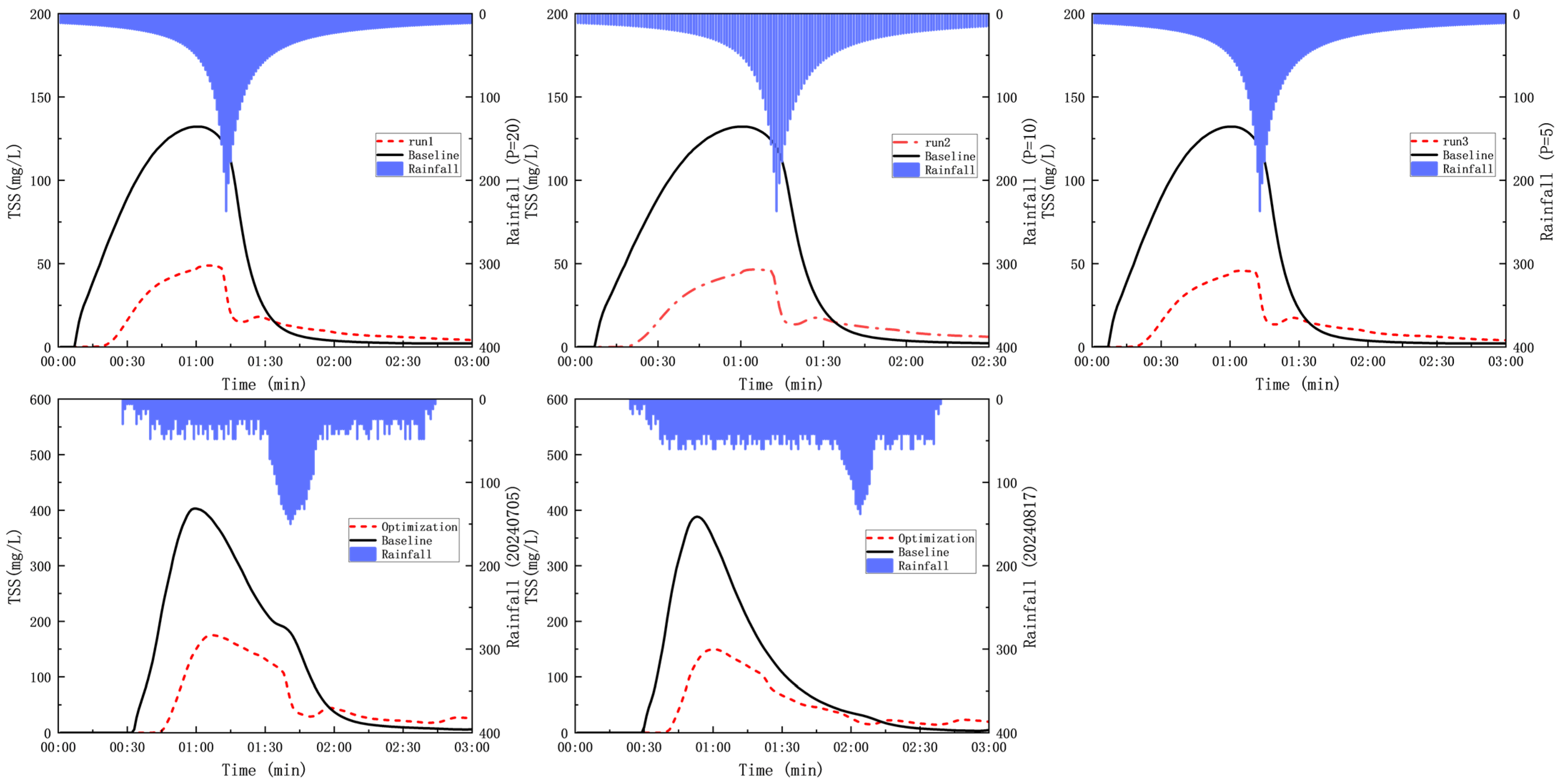
The effectiveness of the LID retrofits in reducing TSS loads was evaluated through SWMM water quality simulations (Figure 10). Under the 20-year return period design storm, peak TSS concentrations were reduced from a baseline of 132.22 mg/L to 48.88, 46.48, and 45.72 mg/L for the three schemes, representing reduction efficiencies of 63.03%, 65.00%, and 65.42%, respectively. This performance was corroborated during two observed rainfall events (7 May and 17 August 2024), where peak TSS concentrations fell from 402.92 and 388.24 mg/L (pre-retrofit) to 175.05 and 149.43 mg/L, corresponding to load reduction efficiencies of 56.55% and 61.51%, respectively.
These results confirm that LID systems effectively intercept and treat pollutants from the initial rainfall volume. However, their inherent hydraulic response lag allows for the temporary retention of pollutants early in the event. As the storm continues and the systems approach their storage or treatment capacity, a subsequent flushing of pollutants from the filter media or through system outlets can occur. This process may lead to a temporary rebound in effluent TSS concentrations.

5. Discussion

5.1. Optimal Spatial Layout of LID Facilities

A comprehensive multi-objective evaluation—which considered the defined objective functions, runoff control performance, nodal flooding risk, and stormwater quality—identified Scheme 3 as the optimal retrofit strategy. The continuous decrease in Euclidean distance reflects the convergence process of the optimization results from a globally theoretical optimum toward an engineering-feasible solution that accounts for practical constraints. This indicates that the finalized LID layout scheme is a reliable outcome achieved by comprehensively balancing hydrological benefits, spatial feasibility, and engineering implementation limitations. Such an approach helps mitigate adjustment risks during later implementation stages caused by mismatches between the plan and actual conditions. Thus, the optimization process accomplishes the transition from macro-scale proportional optimization to specific spatial allocation, thereby enhancing the practical applicability and operability of the research outcomes in the renovation of older communities. The specific area allocations for each LID type in Scheme 3 are detailed in Table 5.
In Scheme 3, the spatial distribution of LID facilities reveals a distinct pattern: the proportions of green roofs and permeable pavements vary across sub-catchments, whereas rain gardens are consistently implemented at their maximum feasible extent. This outcome arises from two key considerations. First, the optimization respects the predefined area constraints, ensuring that the combined footprint of all LID types in any sub-catchment does not exceed their respective upper limits. Second, to maximize overall system performance, the algorithm prioritizes rain gardens up to their allowable capacity, as they are identified under the given constraints as the most effective measure for achieving the defined hydrological objectives.
Furthermore, uneven distributions of roof and road cover, together with variations in topography, lead to an adaptive LID layout: facilities are strategically concentrated in low-lying, runoff-convergent zones while being more sparingly deployed in areas of gentle slope. This results in a final scheme where the allocation of LID types is hydrologically coherent, tailored to the specific topography, land use, and runoff generation patterns of each sub-catchment. The outcome confirms that the proposed iterative framework successfully addresses the key challenge of transforming a theoretical optimum into a spatially explicit, context-sensitive implementation plan.

5.2. Effectiveness Analysis of LID Facilities

The Pareto front reveals a fundamental trade-off: improving both stormwater runoff reduction and TSS load reduction requires greater investment. SWMM simulation results confirm the consistent effectiveness of LID facilities in addressing key hydrological challenges, including runoff volume, pollutant loads, peak flows, and node flooding. A comparative analysis shows that the retrofitted scenario delivers substantial improvements over the pre-retrofit baseline, particularly in overall runoff control, peak flow attenuation, and the reduction in prolonged flooding at nodes. Across the three schemes, the proportions of green roofs, rain gardens, and permeable pavements—as well as the corresponding objective function values—varied only minimally (within 3% for rain gardens and 1% for all other components). This consistency underscores the stability and robustness of the optimization results.
For runoff control, peak flow was reduced by over 33% for all three schemes under the design storm and by more than 47% during actual rainfall events, highlighting the effectiveness of LID facilities in mitigating urban waterlogging. Substantial pollutant removal was also achieved, with peak TSS concentration reductions exceeding 63% under simulated conditions and 56% during observed events. While a delayed hydraulic response was noted—manifested as a temporary rebound in TSS concentrations during later outflow stages—the overall retention and treatment of pollutants from the initial stormwater volume remained significant. This confirms the considerable value of LID measures in controlling urban non-point source pollution. Furthermore, analysis of nodal flooding demonstrated that LID facilities reduce prolonged waterlogging, lower the risk of extended inundation, and enhance the resilience of urban drainage systems.

5.3. Potential Benefits for Older Communities

(1) Achieving Synergy between Water Quantity Regulation and Water Quality Purification. The spatially optimized allocation of LID facilities—such as permeable pavements, rain gardens, and green roofs—effectively reduces stormwater runoff volume, peak flow, and pollutant loads. This directly alleviates the burden on drainage networks and mitigates waterlogging risks in older communities, thereby realizing coordinated improvements in both water quantity control and water quality enhancement.
(2) Effectively Resolving Spatial Conflicts and Ensuring Implementability. The generated site-specific LID layout scheme enables optimization results to be directly applied to construction, minimizing changes and obstacles during the implementation phase. This provides more actionable technical support for LID retrofitting in older communities.
(3) Establishing a Visual and Participatory Communication Foundation to Foster Social Consensus. The clarity of the scheme makes its impacts transparent, facilitating targeted public consultation, plan disclosure, and participatory design. This helps to address concerns and build a foundation of trust for the smooth advancement of the retrofitting project.

5.4. Adaptability of the Design Scheme

(1) Model Parameters: Key hydrological parameters in the SWMM (such as Manning’s roughness coefficient and infiltration parameters) as well as the performance parameters of LID facilities can be re-specified and calibrated according to the local climatic characteristics, soil types, and land-use attributes of the study area.
(2) Adjustment of Optimization Objectives and Constraints: The optimization objectives of NSGA-II can be added, removed, or replaced in line with management needs (e.g., adding waterlogging risk indicators or greenhouse gas reduction targets). Constraints such as the available area for LID implementation and the upper investment limit can be reset based on local planning conditions and policy requirements.
(3) Decision Preferences: The criteria and their weights in the AHP hierarchy can be updated through a new round of local expert consultation or stakeholder surveys, thereby reflecting the differentiated priorities of different cities in stormwater management objectives.

5.5. Limitations of the Methodology

The progressive approximation framework developed in this study effectively translates theoretical LID optimization into practical implementation. It systematically aligns ideal area targets with feasible site layouts, thereby resolving a key uncertainty in spatial placement. The methodology integrates three core steps: First, the NSGA-II algorithm generates a Pareto-optimal set balancing construction cost, runoff control, and TSS reduction. Second, the AHP quantifies the weights of multiple criteria—including hydrological performance, economic cost, and engineering practicality—to identify high-utility solutions. Finally, an exhaustive search enumerates all feasible retrofitting combinations within each sub-catchment, and the combination that minimizes the difference between actual and theoretical LID areas is selected as the optimal outcome. This iterative process ensures continued alignment between theoretical optimality and practical feasibility. The observed reduction in Euclidean distance from 5 to 1 (or to 0) confirms the framework’s robust convergence. Ultimately, the methodology enables precise, sub-catchment-scale spatial allocation of LID facilities, providing a reliable basis for engineering implementation.
Through the case application analysis, this study has validated the effectiveness of the proposed method in coordinating LID layout costs and hydrological–environmental benefits (using TSS as an indicator). At the same time, we recognize that certain conclusions are conditional:
(1) Rainfall data and model parameters are primarily derived from literature. The generalizability of the findings across different climate zones or long-term hydrological regimes requires further validation with extended local monitoring data.
(2) The pollutant control target is singular. Whether the effectiveness of LID facilities can be directly extended to other pollutants such as nitrogen and phosphorus necessitates follow-up studies incorporating multiple pollution indicators.
(3) The analysis is based on the initial performance of the facilities and static construction costs. Therefore, the obtained Pareto optimal solution set represents an ideal trade-off relationship at the planning stage. The impact of long-term performance degradation of facilities, maintenance costs, and other life-cycle factors on their long-term stability is an important direction for future in-depth research.
These limitations point to clear directions for improvement. In subsequent research, we will enhance the robustness and decision-support capability of the model by accumulating long-term monitoring data, expanding the pollutant indicator system, and introducing life-cycle cost–benefit analysis.

6. Conclusions

This study examined the effectiveness of different LID combination ratios in an older residential district in Yangzhou City and proposed a progressive approximation framework to bridge the gap between ideal design targets and practical implementation constraints in LID planning. Multi-objective optimization was performed using the NSGA-II algorithm. The resulting Pareto-optimal solution set was then evaluated with the AHP, followed by multiple iterative cycles of exhaustive search and Euclidean distance analysis to determine the cost-effective optimal spatial allocation of LID facilities. The main findings are as follows:
(1)
The specific locations for implementing LID facilities within sub-catchments are progressively refined, ultimately identifying precise retrofit sites.
(2)
Although achieving perfect alignment between ideal and actual values is difficult, the proposed progressive approximation approach effectively and systematically reduces this discrepancy, guiding practical outcomes to converge toward the theoretical optimum.
(3)
LID facilities demonstrate effective performance in both runoff reduction and pollution control. As investment costs increase, the associated hydrological and environmental benefits show gradual improvement; however, a clear trade-off exists between economic input and environmental performance.
This study effectively reconciles on-ground LID facility areas with their theoretically optimized layouts and pinpoints exact implementation sites, thereby establishing a practical, site-specific basis for Sponge City retrofitting in older communities. This effectively enhances stormwater regulation and non-point source pollution control, thereby realizing spatially optimized, precise allocation of LID facilities in old neighborhoods. Moreover, it provides a clear basis for community communication, and the optimization results can guide concrete implementation, offering more actionable technical support for LID retrofitting in such areas. In practice, however, it is essential to seek a reasonable balance between cost and multiple benefits based on actual constraints and objectives, rather than solely pursuing benefit maximization. To further enhance urban water security under changing climatic conditions, future research should integrate life-cycle cost–benefit analysis and synergistic control of multiple pollutants.

Supplementary Materials

The following supporting information can be downloaded at: https://www.mdpi.com/article/10.3390/w18040513/s1, Table S1: SWMM Hydrological Parameters; Table S2: SWMM Model Water Quality Parameters; Table S3: Parameters of selected LID practices for storm water management model; Table S4: Unit Price Range for LID Facilities; Table S5: Runoff coefficient.

Author Contributions

Conceptualization, L.Z.; methodology, L.K. and L.Z.; validation, W.Z.; formal analysis, L.Z.; investigation, W.Z. and D.W.; data curation, W.Z. and D.W.; writing—original draft preparation, W.Z.; writing—review and editing, L.K. and L.Z.; supervision, L.K. and L.Z. All authors have read and agreed to the published version of the manuscript.

Funding

This research was funded by the Postgraduate Research & Practice Innovation Program of Jiangsu Province (SJCX24_2251), National Natural Science Foundation of China (52579078), and Postdoctoral Research Funding Program of Jiangsu Province (No. 2020Z223).

Data Availability Statement

The original contributions presented in this study are included in the article. Further inquiries can be directed to the corresponding author.

Acknowledgments

The authors gratefully acknowledge Lin Yang and Junzhi Liu, who provided valuable advice for this paper.

Conflicts of Interest

The authors declare no conflicts of interest.

Abbreviations

The following abbreviations are used in this manuscript:
LIDLow-Impact Development
SWMMStorm Water Management Model
NSGA-IINon-Dominated Sorting Genetic Algorithm II
AHPAnalytic Hierarchy Process
TSSTotal Suspended Solids
GRGreen roof
RGRain Garden
PPPermeable Pavements

References

  1. Wang, R.; Wu, H.; Chiles, R.; Yang, Y. Sustainability outcomes and policy implications: Evaluating China’s “old urban neighborhood renewal” experiment. PLoS ONE 2024, 19, e0301380. [Google Scholar] [CrossRef]
  2. Zamani, M.G.; Saniei, K.; Nematollahi, B.; Zahmatkesh, Z.; Poor, M.M.; Nikoo, M.R. Developing sustainable strategies by LID optimization in response to annual climate change impacts. J. Clean. Prod. 2023, 416, 137931. [Google Scholar] [CrossRef]
  3. Dharmarathne, G.; Waduge, A.; Bogahawaththa, M.; Rathnayake, U.; Meddage, D. Adapting cities to the surge: A comprehensive review of climate-induced urban flooding. Results Eng. 2024, 22, 102123. [Google Scholar] [CrossRef]
  4. Gu, T.; Hao, E.; Ma, L.; Liu, X.; Wang, L. Exploring the determinants of residents’ behavior towards participating in the sponge-style old community renewal of China: Extending the theory of planned behavior. Land 2022, 11, 1160. [Google Scholar] [CrossRef]
  5. Chan, F.K.S.; Griffiths, J.A.; Higgitt, D.; Xu, S.; Zhu, F.; Tang, Y.-T.; Xu, Y.; Thorne, C.R. “Sponge City” in China—A breakthrough of planning and flood risk management in the urban context. Land Use Policy 2018, 76, 772–778. [Google Scholar] [CrossRef]
  6. Wang, J.; Xue, F.; Jing, R.; Lu, Q.; Huang, Y.; Sun, X.; Zhu, W. Regenerating sponge city to sponge watershed through an innovative framework for urban water resilience. Sustainability 2021, 13, 5358. [Google Scholar] [CrossRef]
  7. Shi, C.; Xia, Y.; Qiu, H.; Wang, X.; Zhou, Y.; Li, Y.; Liu, G.; Li, S.; Gao, W.; Xu, T.; et al. Exploring public attitudes toward implementing green infrastructure for sponge city stormwater management. Sci. Rep. 2024, 14, 24252. [Google Scholar] [CrossRef]
  8. Eckart, K.; McPhee, Z.; Bolisetti, T. Performance and implementation of low impact development—A review. Sci. Total Environ. 2017, 607, 413–432. [Google Scholar] [CrossRef]
  9. Liu, Q.; Zhao, F.; Zheng, C.; Lian, J.; Da, Z.; Duan, M. Optimization Framework for Urban Flood Mitigation Strategies Considering Collaborative Drainage Mechanisms. Water Res. X 2025, 30, 100474. [Google Scholar] [CrossRef]
  10. Zhu, W.; Liu, K.; Wang, S.; Wang, M.; Liu, S. Simulating blue and green infrastructure tools via SWMM in order to prevent flood hazard in an urban area. Nat. Hazards 2024, 120, 9585–9607. [Google Scholar] [CrossRef]
  11. Shen, M.; Wang, P.; Jia, H.; Yang, Y. Sponge city reconstruction of old communities in northwest China semi-arid areas: A case study of Huangshui Garden in Pilot Area of Xining City. Landsc. Archit. 2020, 27, 85–91. [Google Scholar] [CrossRef]
  12. Yu, Q.; Li, N.; Wang, J.; Wang, S. Comprehensive Performance Assessment for Sponge City Construction: A Case Study. Water 2023, 15, 4039. [Google Scholar] [CrossRef]
  13. Liu, Y.; Ahiablame, L.M.; Bralts, V.F.; Engel, B.A. Enhancing a rainfall–runoff model to assess the impacts of BMPs and LID practices on storm runoff. J. Environ. Manag. 2015, 147, 12–23. [Google Scholar] [CrossRef] [PubMed]
  14. Yang, Y.; Li, J.; Huang, Q.; Xia, J.; Li, J.; Liu, D.; Tan, Q. Performance assessment of sponge city infrastructure on stormwater outflows using isochrone and SWMM models. J. Hydrol. 2021, 597, 126151. [Google Scholar] [CrossRef]
  15. Pons, V.; Abdalla, E.M.H.; Tscheikner-Gratl, F.; Alfredsen, K.; Sivertsen, E.; Bertrand-Krajewski, J.-L.; Muthanna, T.M. Practice makes the model: A critical review of stormwater green infrastructure modelling practice. Water Res. 2023, 236, 119958. [Google Scholar] [CrossRef]
  16. Rubinato, M.; Shucksmith, J.; Saul, A.J.; Shepherd, W. Technology, Comparison between InfoWorks hydraulic results and a physical model of an urban drainage system. Water Sci. Technol. 2013, 68, 372–379. [Google Scholar] [CrossRef]
  17. Lee, J.G.; Selvakumar, A.; Alvi, K.; Riverson, J.; Zhen, J.X.; Shoemaker, L.; Lai, F.-H. Software, A watershed-scale design optimization model for stormwater best management practices. Environ. Model. Softw. 2012, 37, 6–18. [Google Scholar] [CrossRef]
  18. Montaseri, M.; Afshar, M.H.; Bozorg-Haddad, O. Development of simulation-optimization model (MUSIC-GA) for urban stormwater management. Water Resour. Manag. 2015, 29, 4649–4665. [Google Scholar] [CrossRef]
  19. Luo, P.; Xu, C.; Kang, S.; Huo, A.; Lyu, J.; Zhou, M.; Nover, D. Technology, Heavy metals in water and surface sediments of the Fenghe River Basin, China: Assessment and source analysis. Water Sci. Technol. 2021, 84, 3072–3090. [Google Scholar] [CrossRef]
  20. Ahiablame, L.; Shakya, R. Modeling flood reduction effects of low impact development at a watershed scale. J. Environ. Manag. 2016, 171, 81–91. [Google Scholar] [CrossRef]
  21. Dell, T.; Razzaghmanesh, M.; Sharvelle, S.; Arabi, M. Development and application of a SWMM-based simulation model for municipal scale hydrologic assessments. Water 2021, 13, 1644. [Google Scholar] [CrossRef]
  22. Jin, X.; Fang, D.; Chen, B.; Wang, H. Conservation; Recycling, Multiobjective layout optimization for low impact development considering its ecosystem services. Resour. Conserv. 2024, 209, 107794. [Google Scholar] [CrossRef]
  23. Fei, Y.; Rene, E.R.; Shang, Q.; Singh, R.P. Comprehensive effect evaluation of LID facilities implemented in sponge campuses: A case study. Ecol. Indic. 2023, 155, 110912. [Google Scholar] [CrossRef]
  24. Abduljaleel, Y.; Demissie, Y.J.W. Identifying cost-effective low-impact development (LID) under climate change: A multi-objective optimization approach. Water 2022, 14, 3017. [Google Scholar] [CrossRef]
  25. Zhang, Z.; Hu, W.; Wang, W.; Zhou, J.; Liu, D.; Qi, X.; Zhao, X. The hydrological effect and uncertainty assessment by runoff indicators based on SWMM for various LID facilities. J. Hydrol. 2022, 613, 128418. [Google Scholar] [CrossRef]
  26. Rezaei, A.R.; Ismail, Z.; Niksokhan, M.H.; Dayarian, M.A.; Ramli, A.H.; Yusoff, S. assessment, Optimal implementation of low impact development for urban stormwater quantity and quality control using multi-objective optimization. Environ. Monit. Assess. 2021, 193, 1–22. [Google Scholar] [CrossRef] [PubMed]
  27. Li, Y.; Zhao, Q.; Zhong, C. GIS and urban data science. Ann. GIS 2022, 28, 89–92. [Google Scholar] [CrossRef]
  28. Qiao, X.-J.; Liao, K.-H.; Randrup, T.B. Society, Sustainable stormwater management: A qualitative case study of the Sponge Cities initiative in China. Sustain. Cities 2020, 53, 101963. [Google Scholar] [CrossRef]
  29. Guan, X.; Wang, J.; Xiao, F. Sponge city strategy and application of pavement materials in sponge city. J. Clean. Prod. 2021, 303, 127022. [Google Scholar] [CrossRef]
  30. Liong, S.-Y.; Chan, W.T.; ShreeRam, J. Peak-flow forecasting with genetic algorithm and SWMM. J. Hydraul. Eng. 1995, 121, 613–617. [Google Scholar] [CrossRef]
  31. Taghizadeh, S.; Khani, S.; Rajaee, T. Hybrid SWMM and particle swarm optimization model for urban runoff water quality control by using green infrastructures (LID-BMPs). Urban For. Urban Green. 2021, 60, 127032. [Google Scholar] [CrossRef]
  32. Yang, Y.; Chui, T.F.M. Modeling and interpreting hydrological responses of sustainable urban drainage systems with explainable machine learning methods. J. Hydrol. Earth Syst. Sci. 2021, 25, 5839–5858. [Google Scholar] [CrossRef]
  33. Wang, J. Multi-Objective Optimization of Sponge City Based on SWMM Model and Urban Expansion Simulation. Master’s Thesis, Harbin Institute of Technology, Harbin, China, 2021. [Google Scholar] [CrossRef]
  34. Wang, G.; Han, Q.; de Vries, B. The multi-objective spatial optimization of urban land use based on low-carbon city planning. Ecol. Indic. 2021, 125, 107540. [Google Scholar] [CrossRef]
  35. Lopes, M.D.; da Silva, G.B.L. An efficient simulation-optimization approach based on genetic algorithms and hydrologic modeling to assist in identifying optimal low impact development designs. Landsc. Urban Plan. 2021, 216, 104251. [Google Scholar] [CrossRef]
  36. Dadrasajirlou, Y.; Karami, H.; Mirjalili, S. Using AHP-PROMOTHEE for selection of best low-impact development designs for urban flood mitigation. Water Resour. Manag. 2023, 37, 375–402. [Google Scholar] [CrossRef]
  37. Li, J.; Yao, Y.; Ma, M.; Li, Y.; Xia, J.; Gao, X. A multi-index evaluation system for identifying the optimal configuration of LID facilities in the newly built and built-up urban areas. Water Resour. Manag. 2021, 35, 2129–2147. [Google Scholar] [CrossRef]
  38. Chae, S.T.; Chung, E.-S.; Jiang, J. Enhancing Water Cycle Restoration through LID practices considering Climate Change: A study on permeable pavement planning by an iterative MCDM Model. Water Resour. Manag. 2024, 38, 3413–3428. [Google Scholar] [CrossRef]
  39. Taheri, P.; Moghaddam, M.R.A.; Piadeh, F. Sustainability assessment of low-impact development methods for urban stormwater management: A multi-criteria decision-making approach. Sustain. Cities Soc. 2025, 118, 106025. [Google Scholar] [CrossRef]
  40. Zhang, K.; Chui, T.F.M. A comprehensive review of spatial allocation of LID-BMP-GI practices: Strategies and optimization tools. Sci. Total Environ. 2018, 621, 915–929. [Google Scholar] [CrossRef] [PubMed]
  41. Zhu, L.-J.; Qin, C.-Z.; Zhu, A.-X.; Liu, J.; Wu, H. Effects of Different Spatial Configuration Units for the Spatial Optimization of Watershed Best Management Practice Scenarios. Water 2019, 11, 262. [Google Scholar] [CrossRef]
  42. Kumar, S.; Guntu, R.K.; Agarwal, A.; Villuri, V.G.K.; Pasupuleti, S.; Kaushal, D.R.; Gosian, A.K.; Bronstert, A. Multi-objective optimization for stormwater management by green-roofs and infiltration trenches to reduce urban flooding in central Delhi. J. Hydrol. 2022, 606, 127455. [Google Scholar] [CrossRef]
  43. Ghaffari, H.; Haghbin, S.; Mahjouri, N. Redesigning urban drainage systems under uncertainty: A robust multi-objective approach for data-sparse catchments. Nat. Hazards 2025, 121, 17965–17990. [Google Scholar] [CrossRef]
  44. Zhou, H.; Gao, C.; Luan, Q.; Shi, L.; Lu, Z.; Liu, J. Multi-objective optimization of distributed green infrastructure for effective stormwater management in space-constrained highly urbanized areas. J. Hydrol. 2024, 644, 132065. [Google Scholar] [CrossRef]
  45. Niazi, M.; Nietch, C.; Maghrebi, M.; Jackson, N.; Bennett, B.R.; Tryby, M.; Massoudieh, A. Storm water management model: Performance review and gap analysis. J. Sustain. Water Built Environ. 2017, 3, 04017002. [Google Scholar] [CrossRef]
  46. Mohammed, M.H.; Zwain, H.M.; Hassan, W.H. Modeling the impacts of climate change and flooding on sanitary sewage system using SWMM simulation: A case study. Results Eng. 2021, 12, 100307. [Google Scholar] [CrossRef]
  47. Zhou, H.; Zhao, X.; Wu, R. Alleviating urban pluvial floods via dual-use water plazas orchestrated by predictive algorithms. J. Hydrol. 2024, 640, 131695. [Google Scholar] [CrossRef]
  48. Yuan, Y.; Gan, Y.; Xu, Y.; Xie, Q.; Shen, Y.; Yin, Y. SWMM-based assessment of urban mountain stormwater management effects under different LID scenarios. Water 2022, 14, 78. [Google Scholar] [CrossRef]
  49. Liu, K.; Kinouchi, T.; Zhao, G.; Johnson, F.; Zhang, K. Cost-effectiveness of green infrastructure under climate change: Model parameterization, uncertainty and sensitivity. J. Hydrol. 2025, 661, 133796. [Google Scholar] [CrossRef]
  50. Xu, K.; Zhang, X.; Bin, L.; Shen, R. An improved global resilience assessment method for urban drainage systems: A case study of Haidian Island, south China. J. Environ. Manag. 2024, 360, 121135. [Google Scholar] [CrossRef]
  51. Li, J.; Zhou, W.; Tao, C. The Impact of Urbanization on Surface Runoff and Flood Prevention Strategies: A Case Study of a Traditional Village. Land 2024, 13, 1528. [Google Scholar] [CrossRef]
  52. Li, S.; Li, Y.; Yang, Y.; Wang, J.; Ren, X. Study on simulation and control of rainfall runoff pollutionin new urban district. Water Wastewater Eng. 2021, 57, 72–77. [Google Scholar] [CrossRef]
  53. Li, Q.; Wang, F.; Yu, Y.; Huang, Z.C.; Li, M.T.; Guan, Y.T. Comprehensive performance evaluation of LID practices for the sponge city construction: A case study in Guangxi, China. J. Environ. Manag. 2019, 231, 10–20. [Google Scholar] [CrossRef] [PubMed]
  54. Deb, K.; Pratap, A.; Agarwal, S.; Meyarivan, T. A fast and elitist multiobjective genetic algorithm: NSGA-II. IEEE Trans. Evol. Comput. 2002, 6, 182–197. [Google Scholar] [CrossRef]
  55. Xie, Y.; Wang, H.; Wang, K.; Ge, X.; Ying, X. The Application and Potential of Multi-Objective Optimization Algorithms in Decision-Making for LID Facilities Layout. Water Resour. Manag. 2024, 38, 5403–5417. [Google Scholar] [CrossRef]
  56. Shu, X.; Xu, Z.; Ye, C.; Liao, R.; Protection, J.W.R. Study on Joint Probability Distribution of Urban Flood Characteristics Under Spatial Layout Optimization of Sponge Facilities. Water Resour. Prot. 2024. published online. Available online: https://link.cnki.net/urlid/32.1356.tv.20240827.1128.010 (accessed on 18 February 2026).
  57. Hou, Q.; Xu, H.; Xie, M.; Luo, P.; Cheng, Y. A cellular automata coupled multi-objective optimization framework for blue-green infrastructure spatial allocation. Water Res. X 2025, 28, 10387. [Google Scholar] [CrossRef]
  58. Liu, H.-L.; Gu, F.; Zhang, Q. Decomposition of a multiobjective optimization problem into a number of simple multiobjective subproblems. IEEE Trans. Evol. Comput. 2013, 18, 450–455. [Google Scholar] [CrossRef]
  59. Rana, V.K.; Suryanarayana, T.M.V. GIS-based multi criteria decision making method to identify potential runoff storage zones within watershed. Ann. GIS 2020, 26, 149–168. [Google Scholar] [CrossRef]
  60. Yifan, Y.; Pan, G.; Jie, L.; Xiang, Z. The evaluation of LID facilities layout of sponge city based on SWMM and analytic hierarchy process. Eng. J. Wuhan Univ. 2023, 56, 961–968. [Google Scholar] [CrossRef]
  61. Sun, H.; Li, L.; Tian, Y.; Zhang, T.; Zuo, W.; Cai, G.; Zhang, F. Sponge city planning and design based on multi-objective optimization and comprehensive evaluation. Acta Sci. Circumstantiae 2020, 40, 3605–3614. [Google Scholar] [CrossRef]
  62. Jiang, Y.; Li, J.; Gao, J.; Xia, J. A multi-objective optimization and evaluation framework for LID facilities considering urban surface runoff and shallow groundwater regulation. J. Clean. Prod. 2024, 478, 143921. [Google Scholar] [CrossRef]
Figure 1. Framework flowchart.
Water 18 00513 g001
Figure 2. Location and layout of the study area.
Water 18 00513 g002
Figure 3. Schematic Representation of the SWMM for the Study Area.
Water 18 00513 g003
Figure 4. Rainfall hyetograph under a 20-year return period.
Water 18 00513 g004
Figure 5. Calibration and Validation Results of the SWMM.
Water 18 00513 g005
Figure 6. Pareto solution sets for multi-objective optimization under the three scenarios (both stormwater runoff reduction rate and TSS removal rate improve with increasing cost, with the third scenario demonstrating the best overall performance).
Water 18 00513 g006
Figure 7. Variations in LID facility layouts under the three scenarios within the study area.
Water 18 00513 g007
Figure 8. Comparison of runoff peaks under different rainfall conditions (peak flow is reduced to varying degrees, indicating that LID facilities can effectively attenuate peak runoff).
Water 18 00513 g008
Figure 9. Comparison of node flooding under different rainfall conditions (LID facilities extend the duration of short-term waterlogging while effectively shortening the duration of long-term waterlogging).
Water 18 00513 g009
Figure 10. Comparison of TSS Concentrations.
Water 18 00513 g010
Table 1. Cost-optimal allocation schemes based on comprehensive benefit evaluation.
SchemeGR (%)RG (%)PP (%)Cost
(Million CNY)
Storm-Water Runoff Reduction Rate (%)TSS Load Reduction Rate (%)
169.8997.9369.981742.1259.0379.09
269.9999.8170.001751.5359.3079.51
370.06100.0069.281744.6258.8579.15
Table 2. Calculation of Euclidean distance between ideal and actual LID area values in sub-catchments (1).
Sub-CatchmentIdeal Value (%)Actual Value (%)Optimal Euclidean Distance
GRRGPPGRRGPP
S110097991001001004
S254100100531001001
S3501004153100414
S48494178793204
S520995520100605
S6899799871001004
S7431003243100311
Table 3. Calculation of Euclidean distance between ideal and actual LID area values in sub-catchments (2).
Sub-CatchmentIdeal Value (%)Actual Value (%)Optimal Euclidean Distance
GRRGPPGRRGPP
S1100991001001001001
S253100100531001000
S3751004175100410
S4591003060100322
S5201002020100243
S687100100871001000
S7431003143100310
Table 4. Calculation of Euclidean distance between ideal and actual LID area values in sub-catchments (3).
Sub-CatchmentIdeal Value (%)Actual Value (%)Optimal Euclidean Distance
GRRGPPGRRGPP
S1100991001001001001
S253100100531001000
S3751004175100410
S4591003360100321
S52010002010000
S687100100871001000
S7431003143100310
Table 5. Proportions of LID Facilities in Scheme 3.
Sub-CatchmentGR (%)RG (%)PP (%)
1100.00100.00100.00
252.63100.00100.00
375.00100.0040.69
459.62100.0033.12
519.51100.000.03
687.27100.00100.00
742.86100.0031.19
Disclaimer/Publisher’s Note: The statements, opinions and data contained in all publications are solely those of the individual author(s) and contributor(s) and not of MDPI and/or the editor(s). MDPI and/or the editor(s) disclaim responsibility for any injury to people or property resulting from any ideas, methods, instructions or products referred to in the content.