Optimization of Low-Impact Development Spatial Layout Under Multi-Objective Constraints for Sponge City Retrofitting in Older Communities



Abstract
1. Introduction
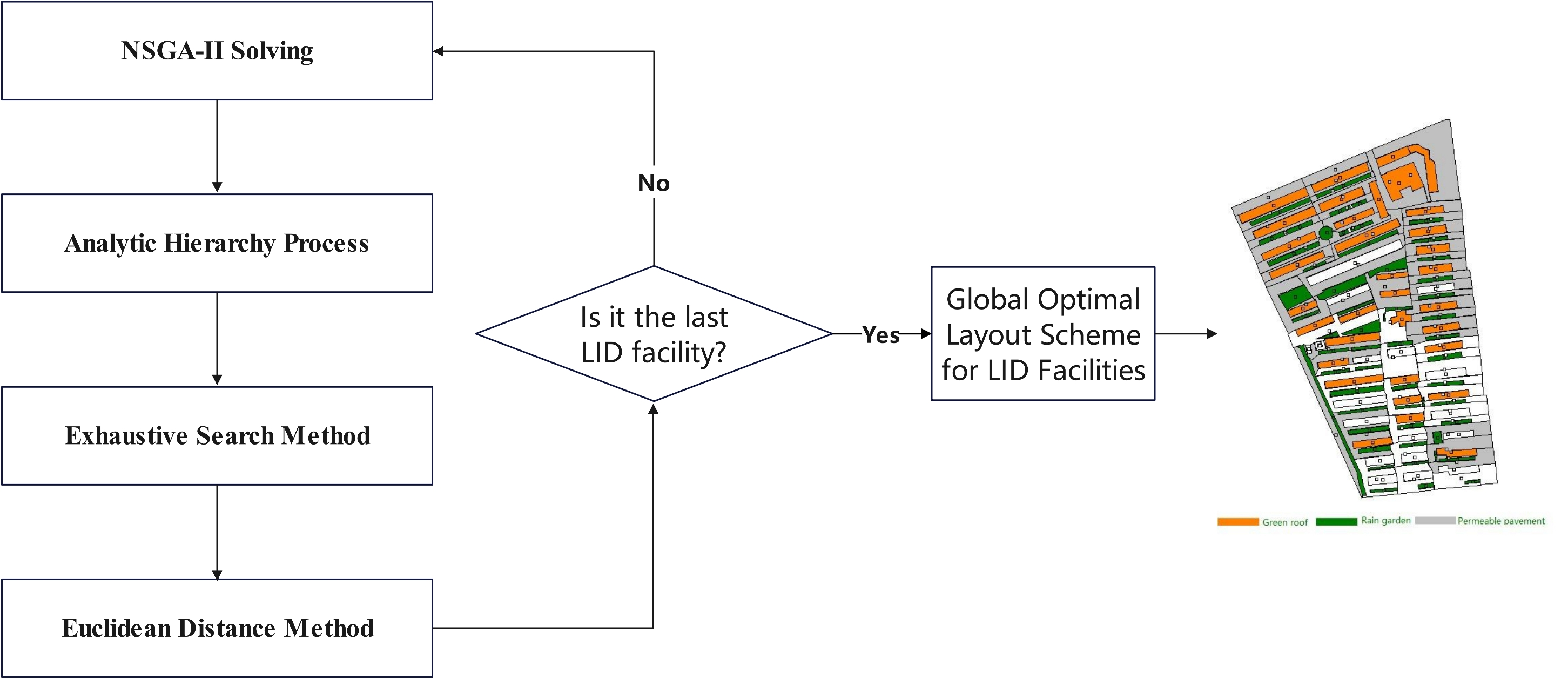
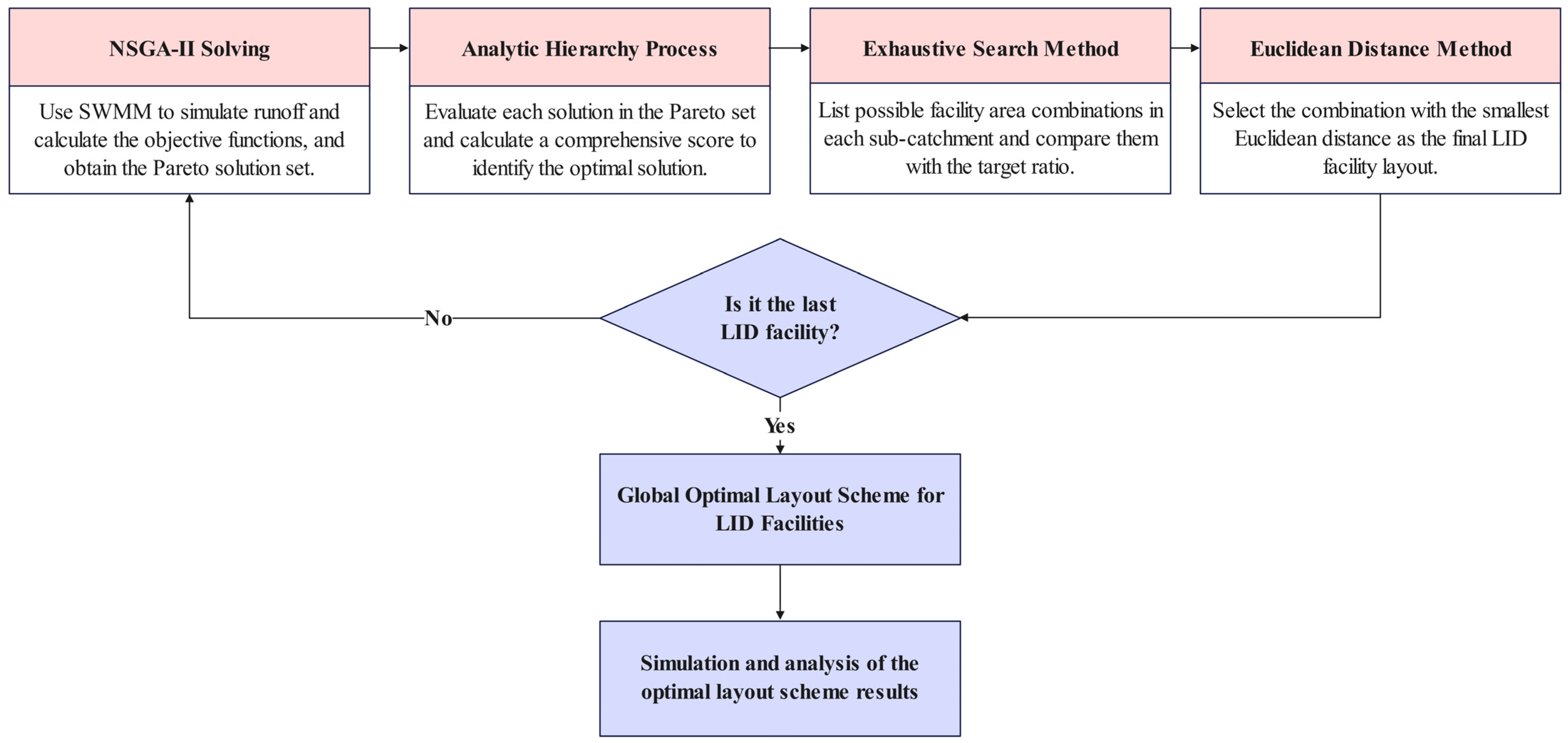
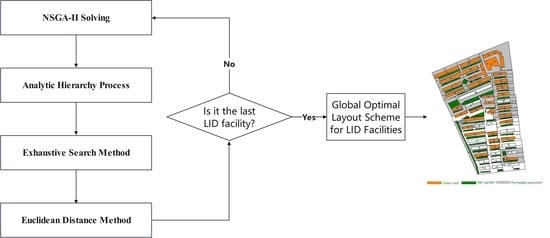
2. Research Flowchart
3. Methodology and Study Area
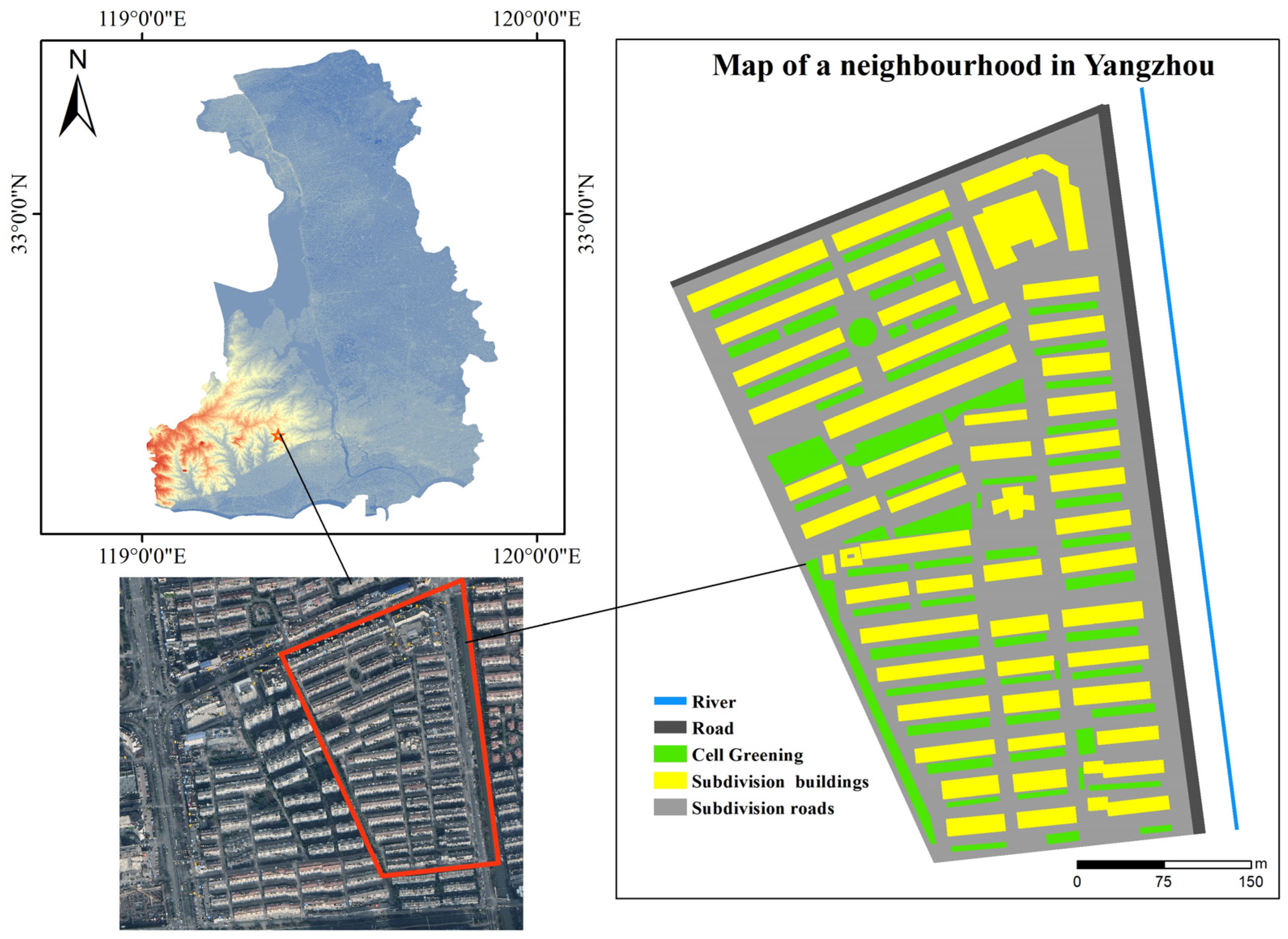
3.1. Study Area
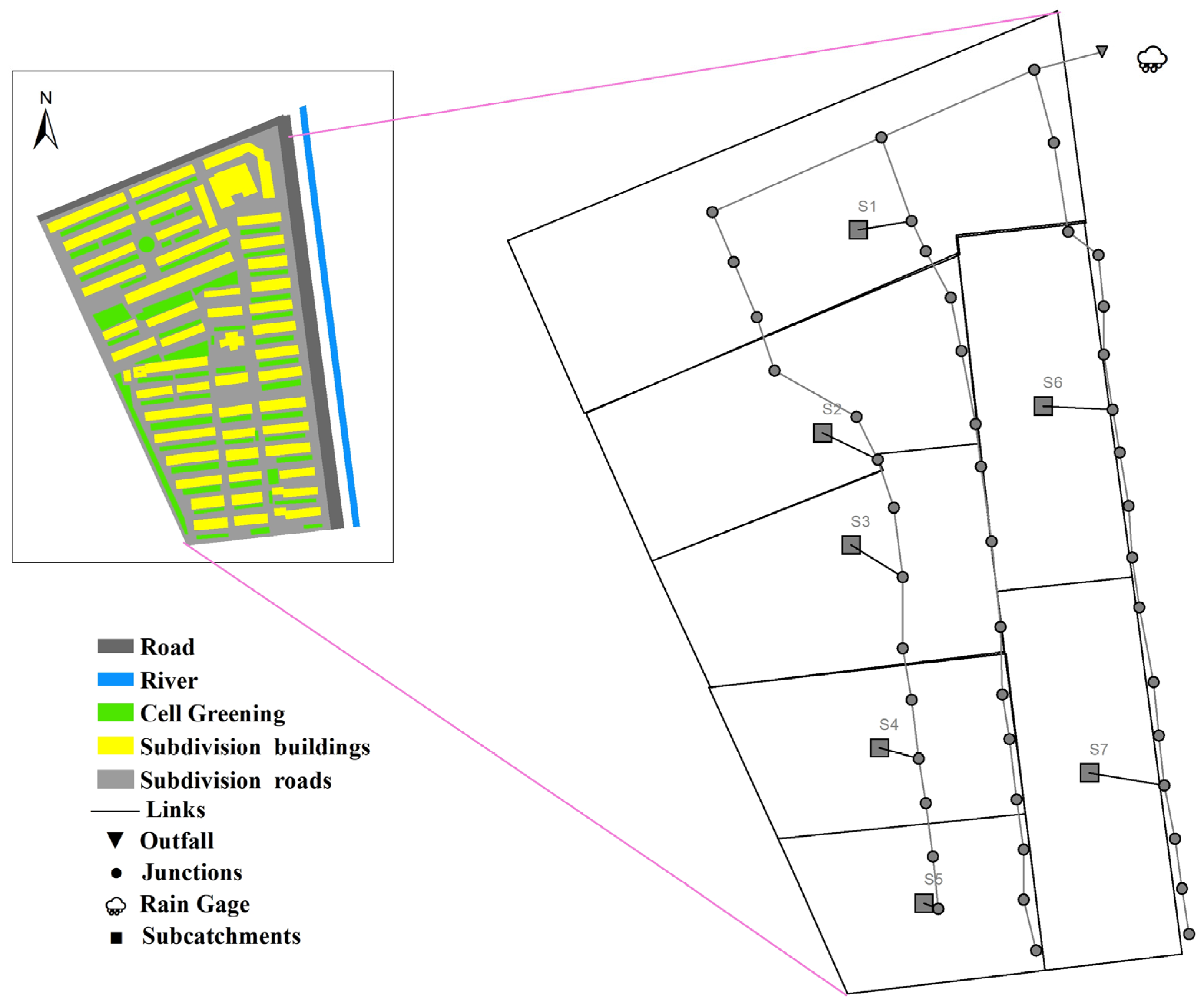
3.2. SWMM
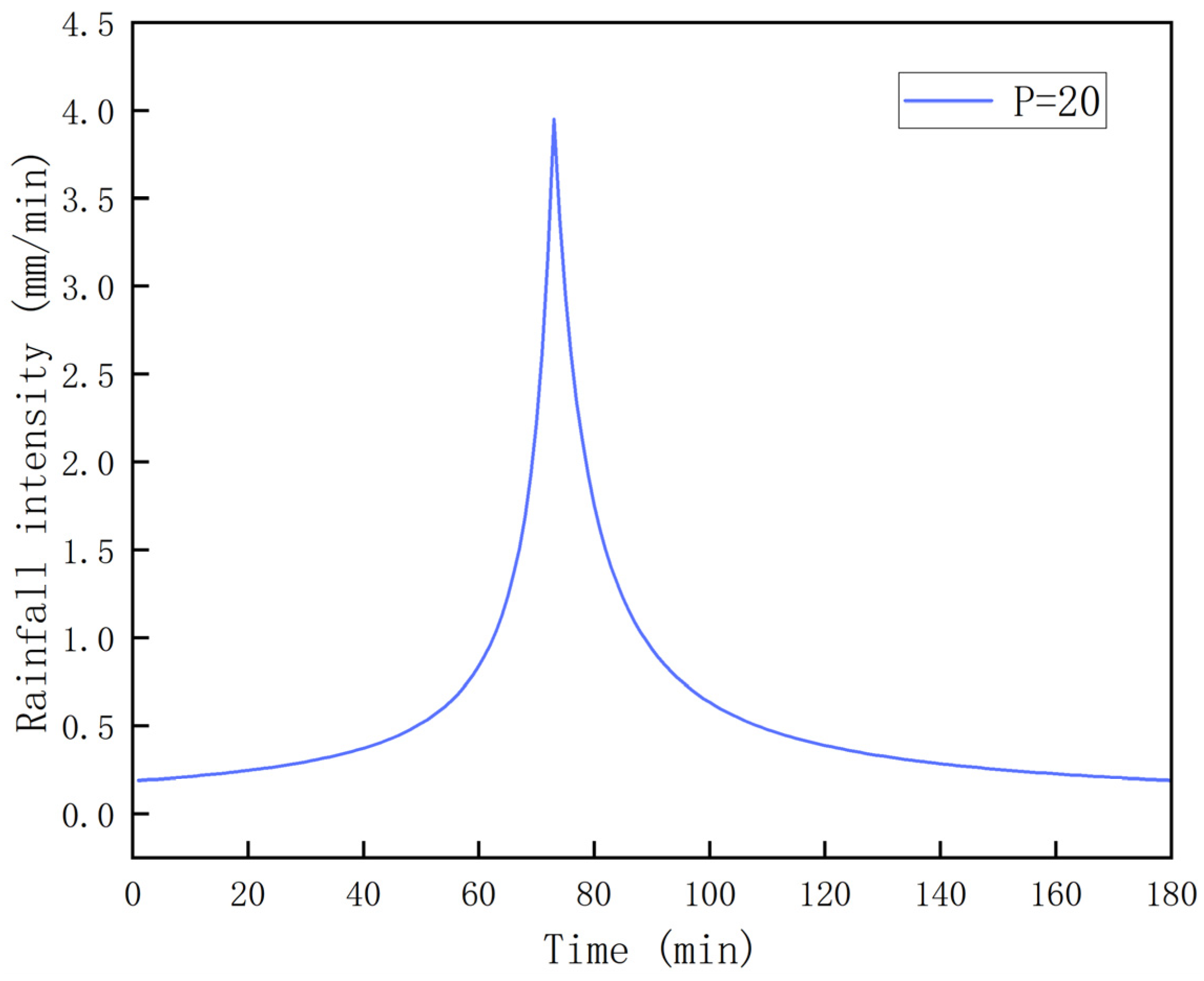
3.2.1. Rainfall Design
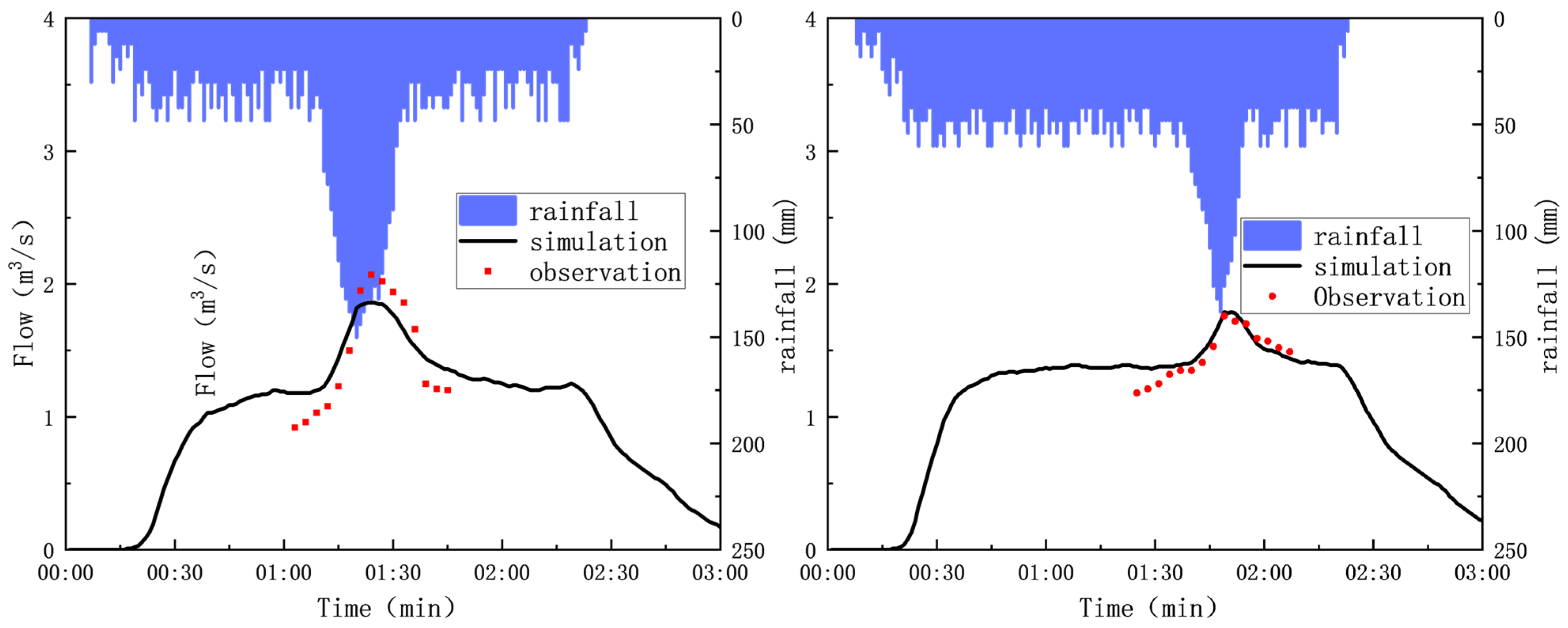
3.2.2. Model Calibration and Validation
3.2.3. LID Scenario Design
3.3. Optimization Model Setup
3.3.1. Multi-Objective Functions
3.3.2. Constraints on LID Implementation
3.4. LID Optimal Allocation Determination Technique
3.4.1. Identification of Optimal Solution Set Based on NSGA-II Algorithm
3.4.2. Determination of the Optimal Solution Using the AHP
3.4.3. LID Facility Area Matching Method Based on Euclidean Distance
3.4.4. Decision Scheme Comparison and Validation
4. Results
4.1. Optimization Outcomes
4.1.1. Ideal Results
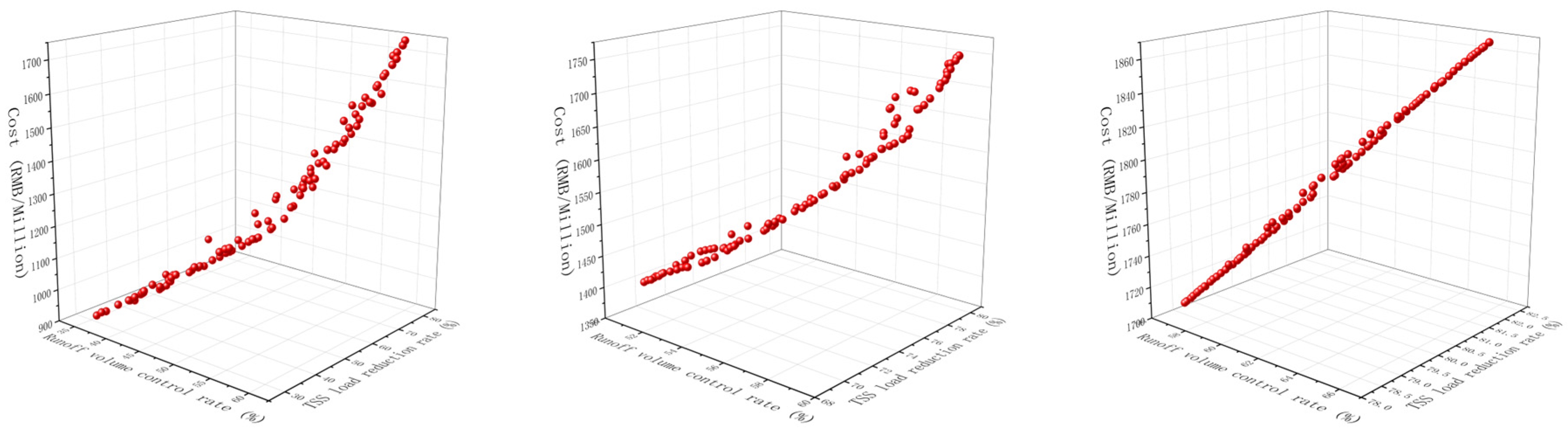
4.1.2. Comparative Analysis of Different Outcomes
4.2. Optimized Schemes and Implementation Effects
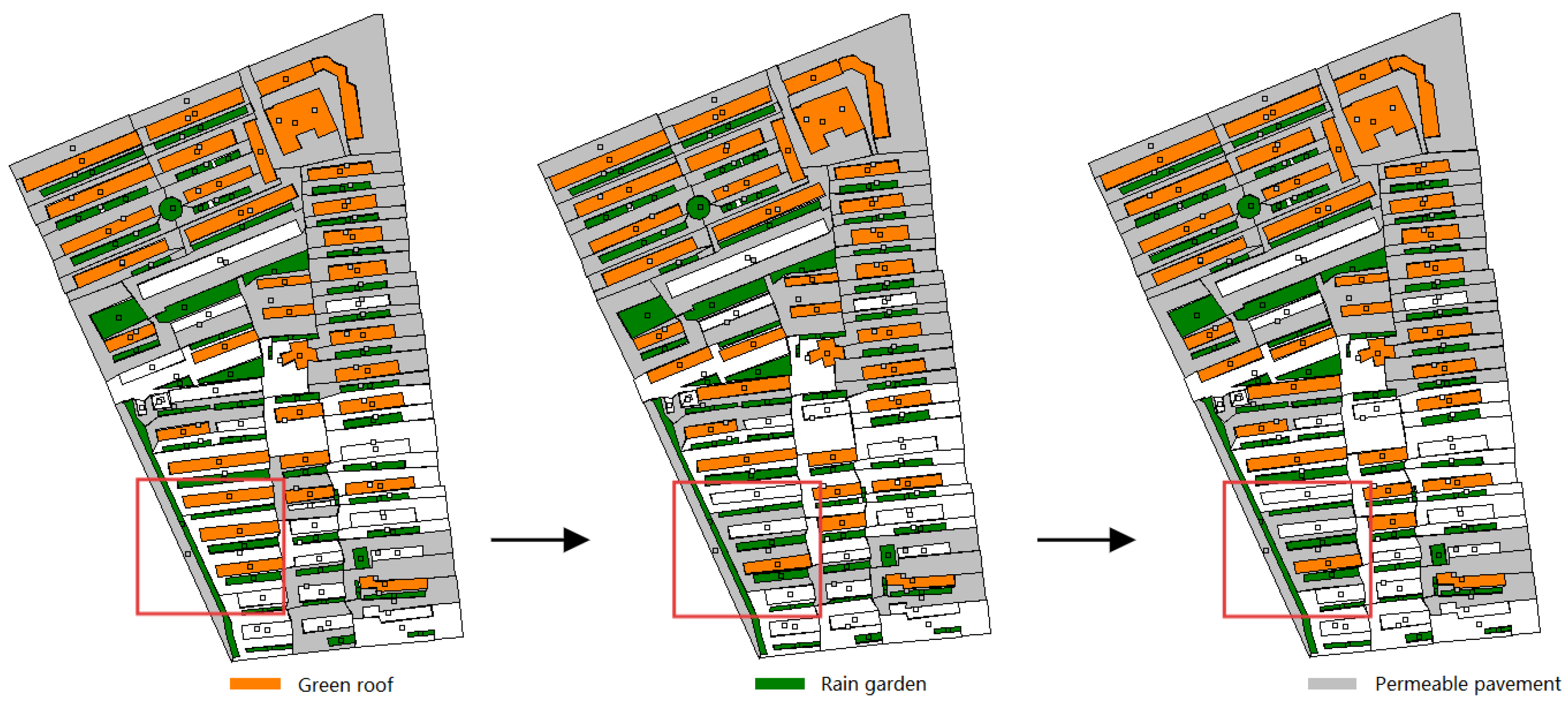
4.2.1. Spatial Distribution of Optimized Schemes
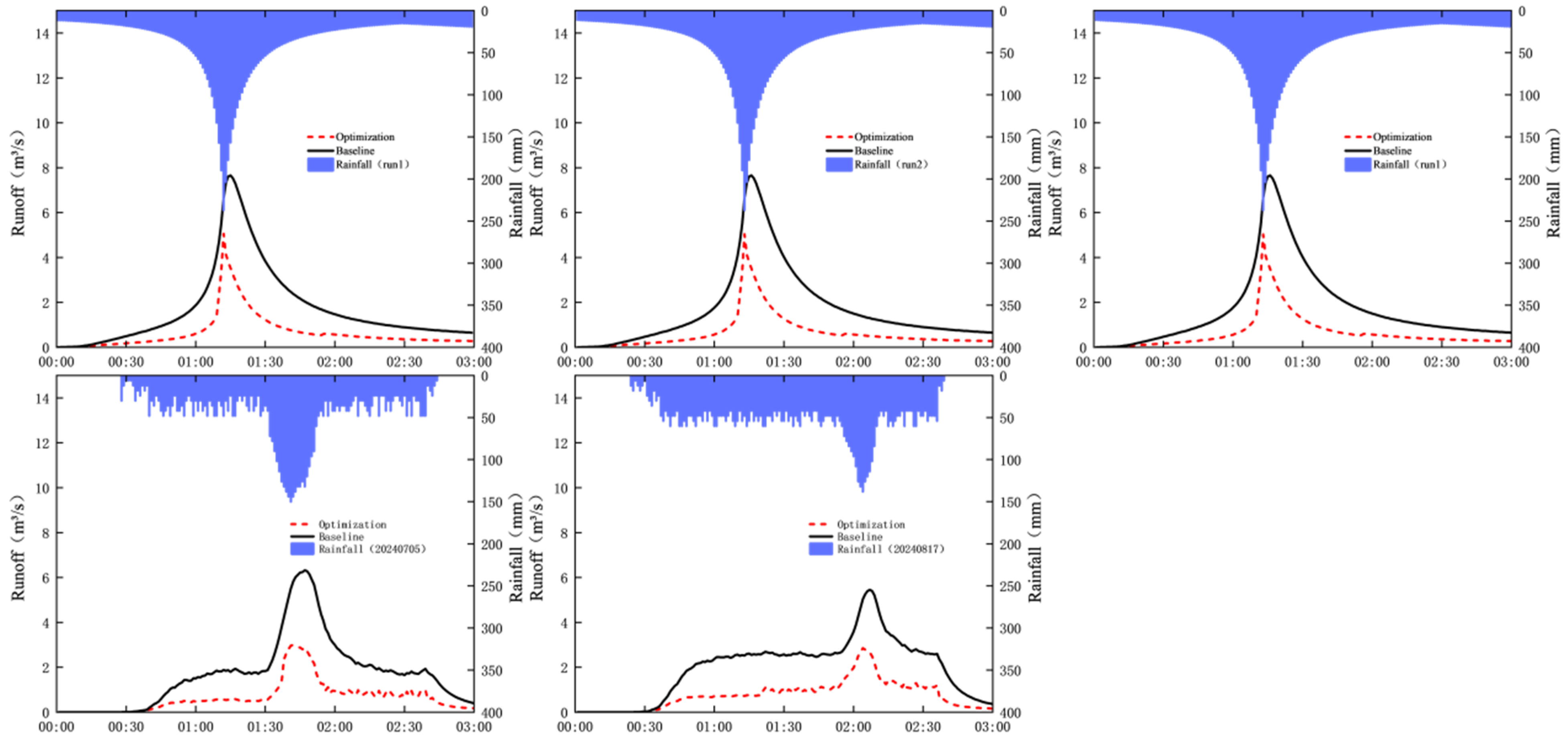
4.2.2. Comparison of Runoff Regulation Effects
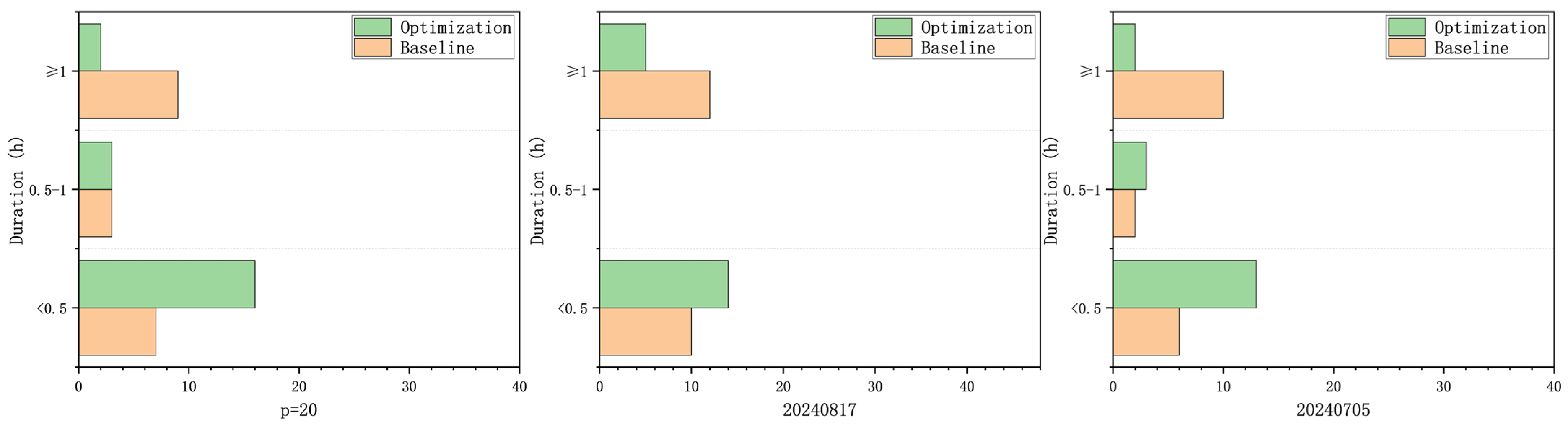
4.2.3. Comparison of Node Waterlogging Risk
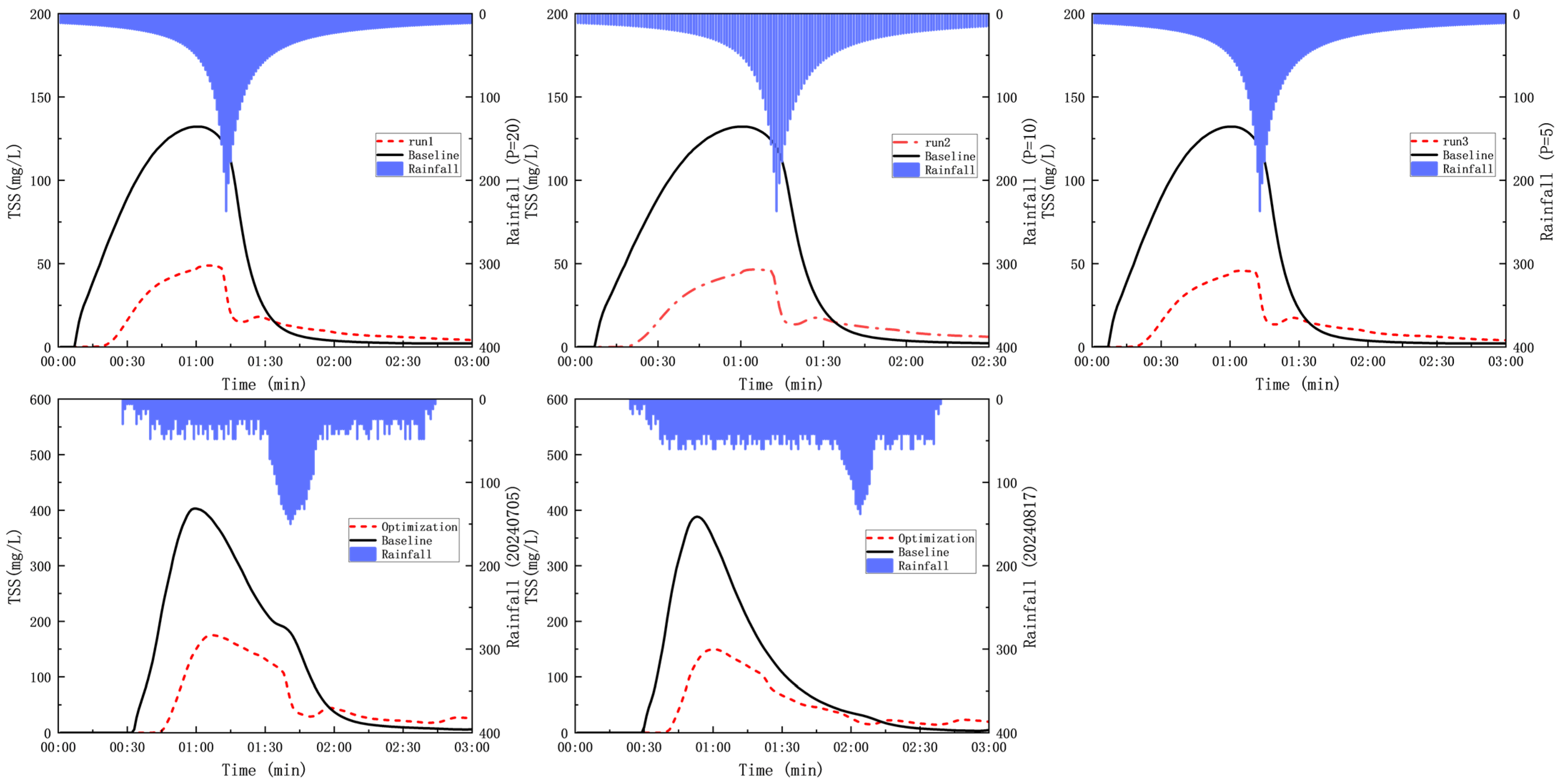
4.2.4. Stormwater Runoff Quality Analysis
5. Discussion
5.1. Optimal Spatial Layout of LID Facilities
5.2. Effectiveness Analysis of LID Facilities
5.3. Potential Benefits for Older Communities
5.4. Adaptability of the Design Scheme
5.5. Limitations of the Methodology
6. Conclusions
- (1)
- The specific locations for implementing LID facilities within sub-catchments are progressively refined, ultimately identifying precise retrofit sites.
- (2)
- Although achieving perfect alignment between ideal and actual values is difficult, the proposed progressive approximation approach effectively and systematically reduces this discrepancy, guiding practical outcomes to converge toward the theoretical optimum.
- (3)
- LID facilities demonstrate effective performance in both runoff reduction and pollution control. As investment costs increase, the associated hydrological and environmental benefits show gradual improvement; however, a clear trade-off exists between economic input and environmental performance.
Supplementary Materials
Author Contributions
Funding
Data Availability Statement
Acknowledgments
Conflicts of Interest
Abbreviations
| LID | Low-Impact Development |
| SWMM | Storm Water Management Model |
| NSGA-II | Non-Dominated Sorting Genetic Algorithm II |
| AHP | Analytic Hierarchy Process |
| TSS | Total Suspended Solids |
| GR | Green roof |
| RG | Rain Garden |
| PP | Permeable Pavements |
References
- Wang, R.; Wu, H.; Chiles, R.; Yang, Y. Sustainability outcomes and policy implications: Evaluating China’s “old urban neighborhood renewal” experiment. PLoS ONE 2024, 19, e0301380. [Google Scholar] [CrossRef]
- Zamani, M.G.; Saniei, K.; Nematollahi, B.; Zahmatkesh, Z.; Poor, M.M.; Nikoo, M.R. Developing sustainable strategies by LID optimization in response to annual climate change impacts. J. Clean. Prod. 2023, 416, 137931. [Google Scholar] [CrossRef]
- Dharmarathne, G.; Waduge, A.; Bogahawaththa, M.; Rathnayake, U.; Meddage, D. Adapting cities to the surge: A comprehensive review of climate-induced urban flooding. Results Eng. 2024, 22, 102123. [Google Scholar] [CrossRef]
- Gu, T.; Hao, E.; Ma, L.; Liu, X.; Wang, L. Exploring the determinants of residents’ behavior towards participating in the sponge-style old community renewal of China: Extending the theory of planned behavior. Land 2022, 11, 1160. [Google Scholar] [CrossRef]
- Chan, F.K.S.; Griffiths, J.A.; Higgitt, D.; Xu, S.; Zhu, F.; Tang, Y.-T.; Xu, Y.; Thorne, C.R. “Sponge City” in China—A breakthrough of planning and flood risk management in the urban context. Land Use Policy 2018, 76, 772–778. [Google Scholar] [CrossRef]
- Wang, J.; Xue, F.; Jing, R.; Lu, Q.; Huang, Y.; Sun, X.; Zhu, W. Regenerating sponge city to sponge watershed through an innovative framework for urban water resilience. Sustainability 2021, 13, 5358. [Google Scholar] [CrossRef]
- Shi, C.; Xia, Y.; Qiu, H.; Wang, X.; Zhou, Y.; Li, Y.; Liu, G.; Li, S.; Gao, W.; Xu, T.; et al. Exploring public attitudes toward implementing green infrastructure for sponge city stormwater management. Sci. Rep. 2024, 14, 24252. [Google Scholar] [CrossRef]
- Eckart, K.; McPhee, Z.; Bolisetti, T. Performance and implementation of low impact development—A review. Sci. Total Environ. 2017, 607, 413–432. [Google Scholar] [CrossRef]
- Liu, Q.; Zhao, F.; Zheng, C.; Lian, J.; Da, Z.; Duan, M. Optimization Framework for Urban Flood Mitigation Strategies Considering Collaborative Drainage Mechanisms. Water Res. X 2025, 30, 100474. [Google Scholar] [CrossRef]
- Zhu, W.; Liu, K.; Wang, S.; Wang, M.; Liu, S. Simulating blue and green infrastructure tools via SWMM in order to prevent flood hazard in an urban area. Nat. Hazards 2024, 120, 9585–9607. [Google Scholar] [CrossRef]
- Shen, M.; Wang, P.; Jia, H.; Yang, Y. Sponge city reconstruction of old communities in northwest China semi-arid areas: A case study of Huangshui Garden in Pilot Area of Xining City. Landsc. Archit. 2020, 27, 85–91. [Google Scholar] [CrossRef]
- Yu, Q.; Li, N.; Wang, J.; Wang, S. Comprehensive Performance Assessment for Sponge City Construction: A Case Study. Water 2023, 15, 4039. [Google Scholar] [CrossRef]
- Liu, Y.; Ahiablame, L.M.; Bralts, V.F.; Engel, B.A. Enhancing a rainfall–runoff model to assess the impacts of BMPs and LID practices on storm runoff. J. Environ. Manag. 2015, 147, 12–23. [Google Scholar] [CrossRef] [PubMed]
- Yang, Y.; Li, J.; Huang, Q.; Xia, J.; Li, J.; Liu, D.; Tan, Q. Performance assessment of sponge city infrastructure on stormwater outflows using isochrone and SWMM models. J. Hydrol. 2021, 597, 126151. [Google Scholar] [CrossRef]
- Pons, V.; Abdalla, E.M.H.; Tscheikner-Gratl, F.; Alfredsen, K.; Sivertsen, E.; Bertrand-Krajewski, J.-L.; Muthanna, T.M. Practice makes the model: A critical review of stormwater green infrastructure modelling practice. Water Res. 2023, 236, 119958. [Google Scholar] [CrossRef]
- Rubinato, M.; Shucksmith, J.; Saul, A.J.; Shepherd, W. Technology, Comparison between InfoWorks hydraulic results and a physical model of an urban drainage system. Water Sci. Technol. 2013, 68, 372–379. [Google Scholar] [CrossRef]
- Lee, J.G.; Selvakumar, A.; Alvi, K.; Riverson, J.; Zhen, J.X.; Shoemaker, L.; Lai, F.-H. Software, A watershed-scale design optimization model for stormwater best management practices. Environ. Model. Softw. 2012, 37, 6–18. [Google Scholar] [CrossRef]
- Montaseri, M.; Afshar, M.H.; Bozorg-Haddad, O. Development of simulation-optimization model (MUSIC-GA) for urban stormwater management. Water Resour. Manag. 2015, 29, 4649–4665. [Google Scholar] [CrossRef]
- Luo, P.; Xu, C.; Kang, S.; Huo, A.; Lyu, J.; Zhou, M.; Nover, D. Technology, Heavy metals in water and surface sediments of the Fenghe River Basin, China: Assessment and source analysis. Water Sci. Technol. 2021, 84, 3072–3090. [Google Scholar] [CrossRef]
- Ahiablame, L.; Shakya, R. Modeling flood reduction effects of low impact development at a watershed scale. J. Environ. Manag. 2016, 171, 81–91. [Google Scholar] [CrossRef]
- Dell, T.; Razzaghmanesh, M.; Sharvelle, S.; Arabi, M. Development and application of a SWMM-based simulation model for municipal scale hydrologic assessments. Water 2021, 13, 1644. [Google Scholar] [CrossRef]
- Jin, X.; Fang, D.; Chen, B.; Wang, H. Conservation; Recycling, Multiobjective layout optimization for low impact development considering its ecosystem services. Resour. Conserv. 2024, 209, 107794. [Google Scholar] [CrossRef]
- Fei, Y.; Rene, E.R.; Shang, Q.; Singh, R.P. Comprehensive effect evaluation of LID facilities implemented in sponge campuses: A case study. Ecol. Indic. 2023, 155, 110912. [Google Scholar] [CrossRef]
- Abduljaleel, Y.; Demissie, Y.J.W. Identifying cost-effective low-impact development (LID) under climate change: A multi-objective optimization approach. Water 2022, 14, 3017. [Google Scholar] [CrossRef]
- Zhang, Z.; Hu, W.; Wang, W.; Zhou, J.; Liu, D.; Qi, X.; Zhao, X. The hydrological effect and uncertainty assessment by runoff indicators based on SWMM for various LID facilities. J. Hydrol. 2022, 613, 128418. [Google Scholar] [CrossRef]
- Rezaei, A.R.; Ismail, Z.; Niksokhan, M.H.; Dayarian, M.A.; Ramli, A.H.; Yusoff, S. assessment, Optimal implementation of low impact development for urban stormwater quantity and quality control using multi-objective optimization. Environ. Monit. Assess. 2021, 193, 1–22. [Google Scholar] [CrossRef] [PubMed]
- Li, Y.; Zhao, Q.; Zhong, C. GIS and urban data science. Ann. GIS 2022, 28, 89–92. [Google Scholar] [CrossRef]
- Qiao, X.-J.; Liao, K.-H.; Randrup, T.B. Society, Sustainable stormwater management: A qualitative case study of the Sponge Cities initiative in China. Sustain. Cities 2020, 53, 101963. [Google Scholar] [CrossRef]
- Guan, X.; Wang, J.; Xiao, F. Sponge city strategy and application of pavement materials in sponge city. J. Clean. Prod. 2021, 303, 127022. [Google Scholar] [CrossRef]
- Liong, S.-Y.; Chan, W.T.; ShreeRam, J. Peak-flow forecasting with genetic algorithm and SWMM. J. Hydraul. Eng. 1995, 121, 613–617. [Google Scholar] [CrossRef]
- Taghizadeh, S.; Khani, S.; Rajaee, T. Hybrid SWMM and particle swarm optimization model for urban runoff water quality control by using green infrastructures (LID-BMPs). Urban For. Urban Green. 2021, 60, 127032. [Google Scholar] [CrossRef]
- Yang, Y.; Chui, T.F.M. Modeling and interpreting hydrological responses of sustainable urban drainage systems with explainable machine learning methods. J. Hydrol. Earth Syst. Sci. 2021, 25, 5839–5858. [Google Scholar] [CrossRef]
- Wang, J. Multi-Objective Optimization of Sponge City Based on SWMM Model and Urban Expansion Simulation. Master’s Thesis, Harbin Institute of Technology, Harbin, China, 2021. [Google Scholar] [CrossRef]
- Wang, G.; Han, Q.; de Vries, B. The multi-objective spatial optimization of urban land use based on low-carbon city planning. Ecol. Indic. 2021, 125, 107540. [Google Scholar] [CrossRef]
- Lopes, M.D.; da Silva, G.B.L. An efficient simulation-optimization approach based on genetic algorithms and hydrologic modeling to assist in identifying optimal low impact development designs. Landsc. Urban Plan. 2021, 216, 104251. [Google Scholar] [CrossRef]
- Dadrasajirlou, Y.; Karami, H.; Mirjalili, S. Using AHP-PROMOTHEE for selection of best low-impact development designs for urban flood mitigation. Water Resour. Manag. 2023, 37, 375–402. [Google Scholar] [CrossRef]
- Li, J.; Yao, Y.; Ma, M.; Li, Y.; Xia, J.; Gao, X. A multi-index evaluation system for identifying the optimal configuration of LID facilities in the newly built and built-up urban areas. Water Resour. Manag. 2021, 35, 2129–2147. [Google Scholar] [CrossRef]
- Chae, S.T.; Chung, E.-S.; Jiang, J. Enhancing Water Cycle Restoration through LID practices considering Climate Change: A study on permeable pavement planning by an iterative MCDM Model. Water Resour. Manag. 2024, 38, 3413–3428. [Google Scholar] [CrossRef]
- Taheri, P.; Moghaddam, M.R.A.; Piadeh, F. Sustainability assessment of low-impact development methods for urban stormwater management: A multi-criteria decision-making approach. Sustain. Cities Soc. 2025, 118, 106025. [Google Scholar] [CrossRef]
- Zhang, K.; Chui, T.F.M. A comprehensive review of spatial allocation of LID-BMP-GI practices: Strategies and optimization tools. Sci. Total Environ. 2018, 621, 915–929. [Google Scholar] [CrossRef] [PubMed]
- Zhu, L.-J.; Qin, C.-Z.; Zhu, A.-X.; Liu, J.; Wu, H. Effects of Different Spatial Configuration Units for the Spatial Optimization of Watershed Best Management Practice Scenarios. Water 2019, 11, 262. [Google Scholar] [CrossRef]
- Kumar, S.; Guntu, R.K.; Agarwal, A.; Villuri, V.G.K.; Pasupuleti, S.; Kaushal, D.R.; Gosian, A.K.; Bronstert, A. Multi-objective optimization for stormwater management by green-roofs and infiltration trenches to reduce urban flooding in central Delhi. J. Hydrol. 2022, 606, 127455. [Google Scholar] [CrossRef]
- Ghaffari, H.; Haghbin, S.; Mahjouri, N. Redesigning urban drainage systems under uncertainty: A robust multi-objective approach for data-sparse catchments. Nat. Hazards 2025, 121, 17965–17990. [Google Scholar] [CrossRef]
- Zhou, H.; Gao, C.; Luan, Q.; Shi, L.; Lu, Z.; Liu, J. Multi-objective optimization of distributed green infrastructure for effective stormwater management in space-constrained highly urbanized areas. J. Hydrol. 2024, 644, 132065. [Google Scholar] [CrossRef]
- Niazi, M.; Nietch, C.; Maghrebi, M.; Jackson, N.; Bennett, B.R.; Tryby, M.; Massoudieh, A. Storm water management model: Performance review and gap analysis. J. Sustain. Water Built Environ. 2017, 3, 04017002. [Google Scholar] [CrossRef]
- Mohammed, M.H.; Zwain, H.M.; Hassan, W.H. Modeling the impacts of climate change and flooding on sanitary sewage system using SWMM simulation: A case study. Results Eng. 2021, 12, 100307. [Google Scholar] [CrossRef]
- Zhou, H.; Zhao, X.; Wu, R. Alleviating urban pluvial floods via dual-use water plazas orchestrated by predictive algorithms. J. Hydrol. 2024, 640, 131695. [Google Scholar] [CrossRef]
- Yuan, Y.; Gan, Y.; Xu, Y.; Xie, Q.; Shen, Y.; Yin, Y. SWMM-based assessment of urban mountain stormwater management effects under different LID scenarios. Water 2022, 14, 78. [Google Scholar] [CrossRef]
- Liu, K.; Kinouchi, T.; Zhao, G.; Johnson, F.; Zhang, K. Cost-effectiveness of green infrastructure under climate change: Model parameterization, uncertainty and sensitivity. J. Hydrol. 2025, 661, 133796. [Google Scholar] [CrossRef]
- Xu, K.; Zhang, X.; Bin, L.; Shen, R. An improved global resilience assessment method for urban drainage systems: A case study of Haidian Island, south China. J. Environ. Manag. 2024, 360, 121135. [Google Scholar] [CrossRef]
- Li, J.; Zhou, W.; Tao, C. The Impact of Urbanization on Surface Runoff and Flood Prevention Strategies: A Case Study of a Traditional Village. Land 2024, 13, 1528. [Google Scholar] [CrossRef]
- Li, S.; Li, Y.; Yang, Y.; Wang, J.; Ren, X. Study on simulation and control of rainfall runoff pollutionin new urban district. Water Wastewater Eng. 2021, 57, 72–77. [Google Scholar] [CrossRef]
- Li, Q.; Wang, F.; Yu, Y.; Huang, Z.C.; Li, M.T.; Guan, Y.T. Comprehensive performance evaluation of LID practices for the sponge city construction: A case study in Guangxi, China. J. Environ. Manag. 2019, 231, 10–20. [Google Scholar] [CrossRef] [PubMed]
- Deb, K.; Pratap, A.; Agarwal, S.; Meyarivan, T. A fast and elitist multiobjective genetic algorithm: NSGA-II. IEEE Trans. Evol. Comput. 2002, 6, 182–197. [Google Scholar] [CrossRef]
- Xie, Y.; Wang, H.; Wang, K.; Ge, X.; Ying, X. The Application and Potential of Multi-Objective Optimization Algorithms in Decision-Making for LID Facilities Layout. Water Resour. Manag. 2024, 38, 5403–5417. [Google Scholar] [CrossRef]
- Shu, X.; Xu, Z.; Ye, C.; Liao, R.; Protection, J.W.R. Study on Joint Probability Distribution of Urban Flood Characteristics Under Spatial Layout Optimization of Sponge Facilities. Water Resour. Prot. 2024. published online. Available online: https://link.cnki.net/urlid/32.1356.tv.20240827.1128.010 (accessed on 18 February 2026).
- Hou, Q.; Xu, H.; Xie, M.; Luo, P.; Cheng, Y. A cellular automata coupled multi-objective optimization framework for blue-green infrastructure spatial allocation. Water Res. X 2025, 28, 10387. [Google Scholar] [CrossRef]
- Liu, H.-L.; Gu, F.; Zhang, Q. Decomposition of a multiobjective optimization problem into a number of simple multiobjective subproblems. IEEE Trans. Evol. Comput. 2013, 18, 450–455. [Google Scholar] [CrossRef]
- Rana, V.K.; Suryanarayana, T.M.V. GIS-based multi criteria decision making method to identify potential runoff storage zones within watershed. Ann. GIS 2020, 26, 149–168. [Google Scholar] [CrossRef]
- Yifan, Y.; Pan, G.; Jie, L.; Xiang, Z. The evaluation of LID facilities layout of sponge city based on SWMM and analytic hierarchy process. Eng. J. Wuhan Univ. 2023, 56, 961–968. [Google Scholar] [CrossRef]
- Sun, H.; Li, L.; Tian, Y.; Zhang, T.; Zuo, W.; Cai, G.; Zhang, F. Sponge city planning and design based on multi-objective optimization and comprehensive evaluation. Acta Sci. Circumstantiae 2020, 40, 3605–3614. [Google Scholar] [CrossRef]
- Jiang, Y.; Li, J.; Gao, J.; Xia, J. A multi-objective optimization and evaluation framework for LID facilities considering urban surface runoff and shallow groundwater regulation. J. Clean. Prod. 2024, 478, 143921. [Google Scholar] [CrossRef]



| Scheme | GR (%) | RG (%) | PP (%) | Cost (Million CNY) | Storm-Water Runoff Reduction Rate (%) | TSS Load Reduction Rate (%) |
|---|---|---|---|---|---|---|
| 1 | 69.89 | 97.93 | 69.98 | 1742.12 | 59.03 | 79.09 |
| 2 | 69.99 | 99.81 | 70.00 | 1751.53 | 59.30 | 79.51 |
| 3 | 70.06 | 100.00 | 69.28 | 1744.62 | 58.85 | 79.15 |
| Sub-Catchment | Ideal Value (%) | Actual Value (%) | Optimal Euclidean Distance | ||||
|---|---|---|---|---|---|---|---|
| GR | RG | PP | GR | RG | PP | ||
| S1 | 100 | 97 | 99 | 100 | 100 | 100 | 4 |
| S2 | 54 | 100 | 100 | 53 | 100 | 100 | 1 |
| S3 | 50 | 100 | 41 | 53 | 100 | 41 | 4 |
| S4 | 84 | 94 | 17 | 87 | 93 | 20 | 4 |
| S5 | 20 | 99 | 55 | 20 | 100 | 60 | 5 |
| S6 | 89 | 97 | 99 | 87 | 100 | 100 | 4 |
| S7 | 43 | 100 | 32 | 43 | 100 | 31 | 1 |
| Sub-Catchment | Ideal Value (%) | Actual Value (%) | Optimal Euclidean Distance | ||||
|---|---|---|---|---|---|---|---|
| GR | RG | PP | GR | RG | PP | ||
| S1 | 100 | 99 | 100 | 100 | 100 | 100 | 1 |
| S2 | 53 | 100 | 100 | 53 | 100 | 100 | 0 |
| S3 | 75 | 100 | 41 | 75 | 100 | 41 | 0 |
| S4 | 59 | 100 | 30 | 60 | 100 | 32 | 2 |
| S5 | 20 | 100 | 20 | 20 | 100 | 24 | 3 |
| S6 | 87 | 100 | 100 | 87 | 100 | 100 | 0 |
| S7 | 43 | 100 | 31 | 43 | 100 | 31 | 0 |
| Sub-Catchment | Ideal Value (%) | Actual Value (%) | Optimal Euclidean Distance | ||||
|---|---|---|---|---|---|---|---|
| GR | RG | PP | GR | RG | PP | ||
| S1 | 100 | 99 | 100 | 100 | 100 | 100 | 1 |
| S2 | 53 | 100 | 100 | 53 | 100 | 100 | 0 |
| S3 | 75 | 100 | 41 | 75 | 100 | 41 | 0 |
| S4 | 59 | 100 | 33 | 60 | 100 | 32 | 1 |
| S5 | 20 | 100 | 0 | 20 | 100 | 0 | 0 |
| S6 | 87 | 100 | 100 | 87 | 100 | 100 | 0 |
| S7 | 43 | 100 | 31 | 43 | 100 | 31 | 0 |
| Sub-Catchment | GR (%) | RG (%) | PP (%) |
|---|---|---|---|
| 1 | 100.00 | 100.00 | 100.00 |
| 2 | 52.63 | 100.00 | 100.00 |
| 3 | 75.00 | 100.00 | 40.69 |
| 4 | 59.62 | 100.00 | 33.12 |
| 5 | 19.51 | 100.00 | 0.03 |
| 6 | 87.27 | 100.00 | 100.00 |
| 7 | 42.86 | 100.00 | 31.19 |
Disclaimer/Publisher’s Note: The statements, opinions and data contained in all publications are solely those of the individual author(s) and contributor(s) and not of MDPI and/or the editor(s). MDPI and/or the editor(s) disclaim responsibility for any injury to people or property resulting from any ideas, methods, instructions or products referred to in the content. |
© 2026 by the authors. Licensee MDPI, Basel, Switzerland. This article is an open access article distributed under the terms and conditions of the Creative Commons Attribution (CC BY) license.
Share and Cite
Zhang, W.; Wu, D.; Kong, L.; Zhu, L. Optimization of Low-Impact Development Spatial Layout Under Multi-Objective Constraints for Sponge City Retrofitting in Older Communities. Water 2026, 18, 513. https://doi.org/10.3390/w18040513
Zhang W, Wu D, Kong L, Zhu L. Optimization of Low-Impact Development Spatial Layout Under Multi-Objective Constraints for Sponge City Retrofitting in Older Communities. Water. 2026; 18(4):513. https://doi.org/10.3390/w18040513
Chicago/Turabian StyleZhang, Wenjie, Dian Wu, Lingzhong Kong, and Liming Zhu. 2026. "Optimization of Low-Impact Development Spatial Layout Under Multi-Objective Constraints for Sponge City Retrofitting in Older Communities" Water 18, no. 4: 513. https://doi.org/10.3390/w18040513
APA StyleZhang, W., Wu, D., Kong, L., & Zhu, L. (2026). Optimization of Low-Impact Development Spatial Layout Under Multi-Objective Constraints for Sponge City Retrofitting in Older Communities. Water, 18(4), 513. https://doi.org/10.3390/w18040513