Water Supply in the Czech Republic: Review of Infrastructure Risks and Comparison with Worldwide Practices


Abstract
1. Introduction
- Q1: What are the dominant biological, chemical, and cyber-physical threats affecting water distribution systems, and in what ways can these threats interact to produce complex risk scenarios?
- Q2: Which monitoring, detection, disinfection, and digital approaches have been reported as effective in international practice for the early identification and management of contamination and disruption events?
- Q3: What specific strengths and vulnerabilities characterise the Czech water sector, and what priorities emerge from this analysis for policy development, investment strategies, and future research?
2. Materials and Methods (Methods of Review)
- The current state and structural characteristics of drinking-water infrastructure in the Czech Republic, with particular emphasis on WDSs;
- A comparative analysis of international regulatory frameworks, standards, and risk profiles affecting drinking-water safety;
- Lessons learned from selected international and Czech case studies addressing contamination events, cyberattacks, and system failures;
- The identification of key research gaps and policy-relevant recommendations related to monitoring, digitalisation, governance, and system resilience.
The Literature Search and Screening Process
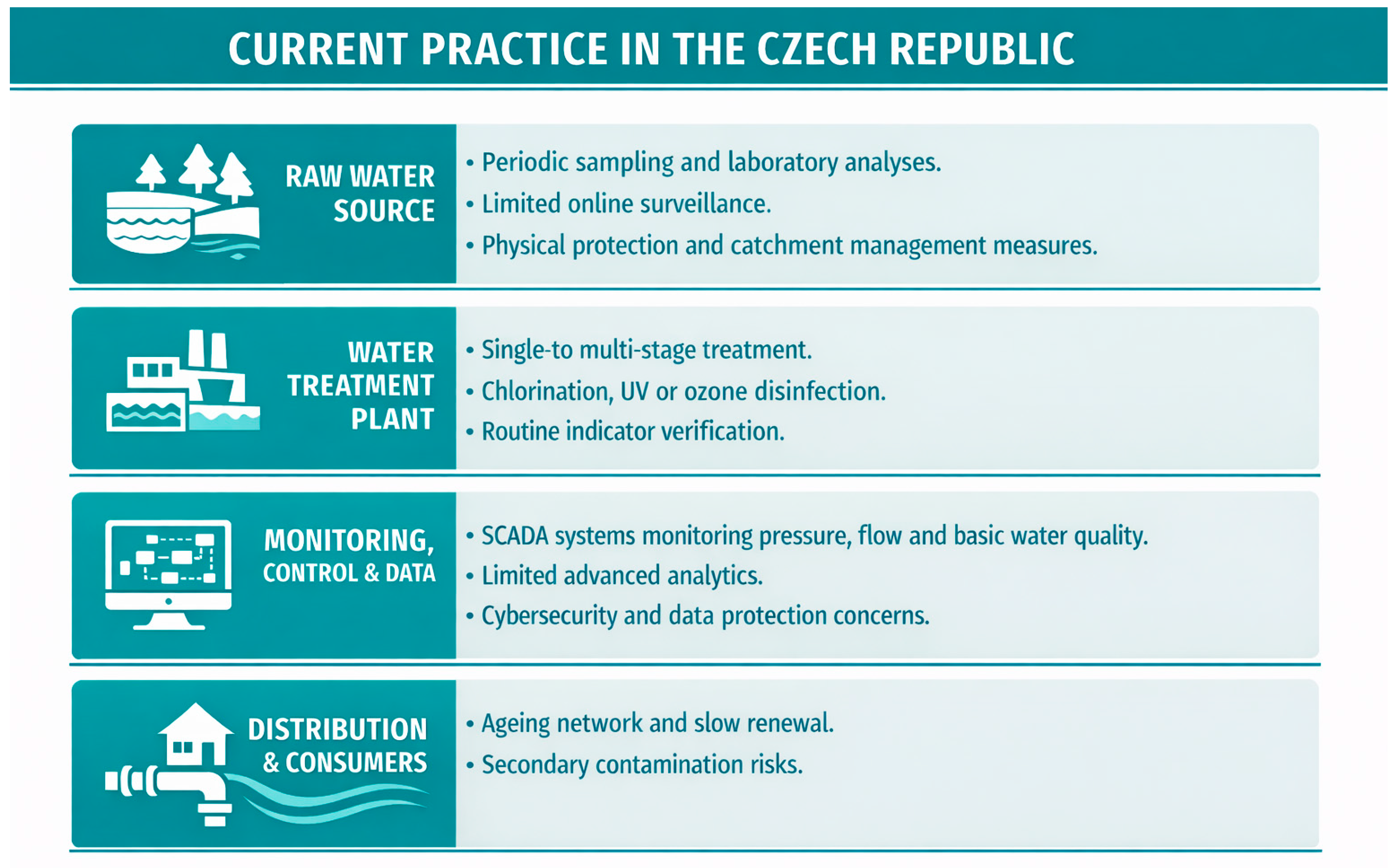
3. Overview—Water Infrastructure in the Czech Republic
3.1. Performance Indicators and Network Vulnerability
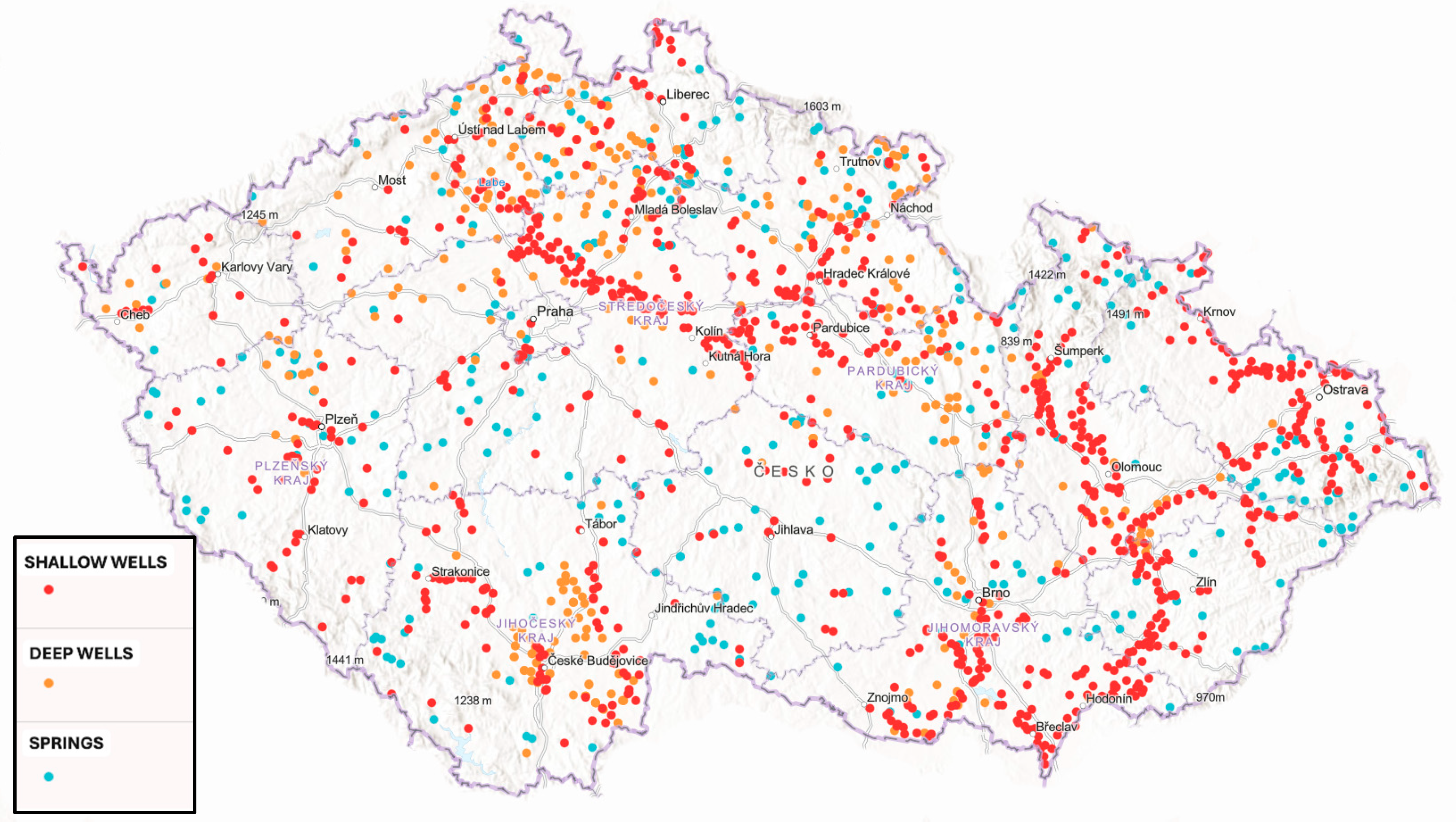
3.2. Interpretation of Water Source Distribution and Regional Vulnerability
3.3. Strategic Assessment of the Czech Water Distribution System (SWOT Analysis)
4. Global Comparison of Problems and Trends
4.1. International Standards—Similarities and Differences
4.2. Shared Global Challenges
- (1)
- Ageing Infrastructure.
- In many industrialised countries, a large share of WDSs was constructed before 1980, and renewal rates remain below 1% per year. Leaks, pressure losses, and pipe failures increase the risk of secondary contamination.
- (2)
- Climate Change and Extreme Events.
- Floods, droughts, and temperature fluctuations place additional stress on water supply systems, affecting both the quantity and the quality of available water.
- (3)
- Emerging Contaminants.
- Pharmaceuticals, PFASs, pesticides, and microplastics persist through conventional treatment and remain inconsistently regulated across countries.
- (4)
- Direct Cyber-Physical Threats.
- Attacks targeting SCADA/OT systems can directly disrupt physical operations, including chemical dosing, pressure control, and pumping, potentially leading to contamination or operational incidents. Effective mitigation requires OT-specific incident response procedures, integration with multi-barrier protection strategies, rapid system isolation or transition to manual control, and independent verification of critical measurements.
- (5)
- Systemic Vulnerabilities of Digitalisation.
- Beyond deliberate attacks, digitalisation introduces systemic risks through expanded attack surfaces, legacy infrastructures, fragmented patch management, vendor dependencies, limited network segmentation, and human factors. Compromised data integrity poses a particularly critical challenge, as unreliable or manipulated data can undermine predictive analytics and crisis decision-making, underscoring the need for minimum cyber hygiene standards, data governance, and interoperable data frameworks.
- (6)
- Institutional Fragmentation and Governance Gaps.
- Many systems remain divided among numerous operators with uneven resources, limiting investment and crisis coordination.
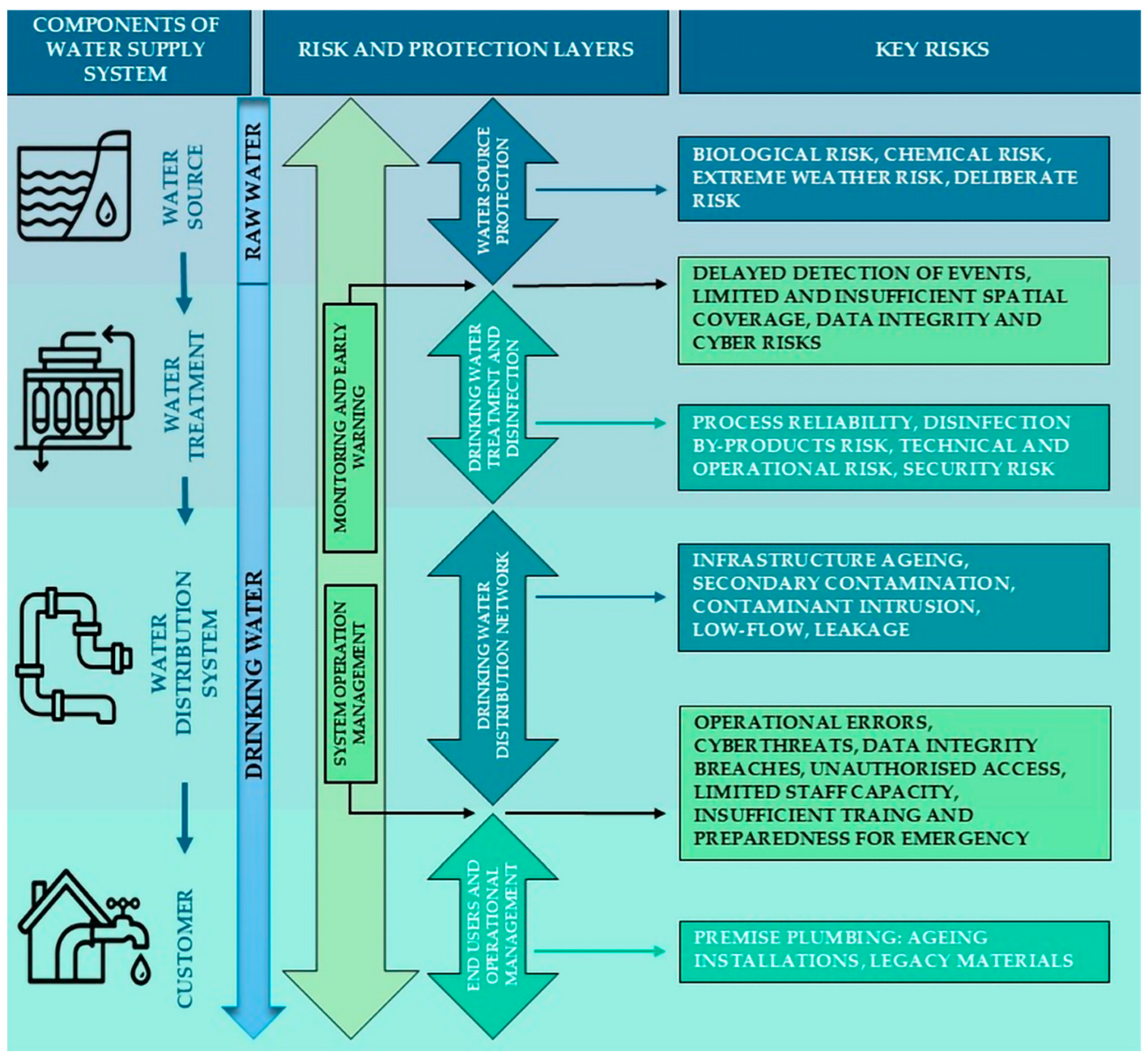
4.3. Types of Risks Affecting Water Distribution Systems (WDSs)
4.3.1. Technical Failures and Natural Disasters
4.3.2. Biological Contamination
4.3.3. Chemical Contamination
4.3.4. Cyberattacks and Sabotage
4.4. Overview of Contaminants and Indicators
4.5. Contamination Management and Detection Technologies
4.5.1. Chlorination and Chloramines
4.5.2. Monitoring and Biosensors
4.5.3. Emerging and Alternative Technologies
4.6. Lessons from International and Czech Case Studies
5. Discussion
5.1. Comparison with International Experience
5.2. Comparative Synthesis
- Strengths—high drinking-water quality, robust EU-aligned legislation, dense infrastructure network, and long tradition of chlorination ensuring residual disinfection.
- Weaknesses—ageing pipelines, highly fragmented ownership, limited adoption of digital tools, and insufficient integration of emerging contaminants into standards.
- Southern/Eastern Europe—more frequent exceedances of nitrates and pesticides, but less fragmented institutional frameworks.
- Western/Northern Europe and USA/Israel—greater emphasis on biofilms, pharmaceuticals, PFASs, and advanced digitalisation (IoT and AI-based predictive systems), together with faster infrastructure renewal.
5.3. Future Perspectives
- Accelerated renewal of ageing infrastructure, supported by unified methodologies for condition assessment.
- Strengthening digitalisation and cybersecurity, learning from countries already deploying IoT and AI for predictive water management.
- Integration of emerging contaminants, both pharmaceuticals and biofilm-related pathogens, into monitoring and regulation, in line with EU and WHO recommendations.
- Institutional consolidation and inter-municipal cooperation to reduce fragmentation and enable long-term investment.
5.4. Socio-Technical Aspects, Risk Communication, and Public Trust
6. Research Gaps
6.1. Predictive Modelling and Early Warning
6.2. IoT Sensors and Digitalisation
- (1)
- Online early-warning pilot in a medium-sized urban network.
- A pilot implementation of an online early-warning system could be conducted in a representative medium-sized water distribution network over a period of 6–12 months. The pilot would combine sensors measuring residual chlorine, turbidity, pressure, and conductivity with basic anomaly detection algorithms. Evaluation metrics should include detection time, false alarm rates, operational costs, and the system’s ability to localise abnormal events within the network.
- (2)
- Hybrid digital twin pilot (hydraulic + data-driven).
- A second pilot could focus on the development of a hybrid digital twin integrating EPANET-based hydraulic modelling with data-driven inference over a period of 12–18 months. The primary objectives would be improved estimation of water residence times, identification of critical network nodes, and simulation of contamination scenarios. Performance should be assessed based on predictive accuracy and practical usability in emergency and crisis management contexts.
- (3)
- OT cyber hygiene baseline pilot for small utilities.
- A third pilot demonstration could target the establishment of an OT cyber hygiene baseline at a small water utility over approximately six months. Key components would include network segmentation, patch and update management, access control audits, and the implementation of a basic incident response checklist. Success metrics should include the number of identified vulnerabilities, response times to simulated incidents, and the outcomes of staff training activities.
6.3. Pharmaceuticals and Emerging Contaminants
6.4. Biofilms and Microbial Risks
6.5. Cybersecurity of Water Infrastructure
6.6. Socio-Technical Integration in the Czech Water Sector
- (1)
- Joint Mapping of Roles and Decision-Making Processes.
- Technical risk assessments within distribution networks (e.g., vulnerable nodes, failure impacts, contamination risks) should be systematically linked with a clear delineation of responsibilities, information flows, and potential decision-making bottlenecks. The resulting outputs should inform the revision and updating of Water Safety Plans.
- (2)
- Risk Communication and Public Trust.
- Research should evaluate the clarity and effectiveness of warning messages and public recommendations, as well as examine public perceptions of continuous monitoring, digitalisation measures, and interventions addressing micropollutants (e.g., pharmaceuticals and PFASs).
- (3)
- Assessment of Operator Capacities.
- A comparative evaluation of large and small operators should be conducted with regard to emergency procedures, cybersecurity preparedness, data management capabilities, and the ability to share information under harmonised standards. The objective is to identify capacity gaps and to define minimum baseline requirements applicable across the sector.
- (4)
- Integrated Exercises (Technical and Communication Dimensions).
- Tabletop or simulation-based exercises should be implemented to combine technical scenarios (e.g., contamination events, cyber incidents, pressure anomalies) with an evaluation of decision-making processes, information exchange, and public communication strategies.
6.7. Infrastructure Renewal and Asset Management
6.8. Legislative Framework and Risk Communication
6.9. Harmonisation of International Standards
- the toxicological basis of current standards and their protective capacity;
- the socio-economic feasibility of implementing stricter or more lenient thresholds;
- pathways for policy harmonisation, including evidence-based dialogue across the WHO, EU, and EPA frameworks.
7. Limitations
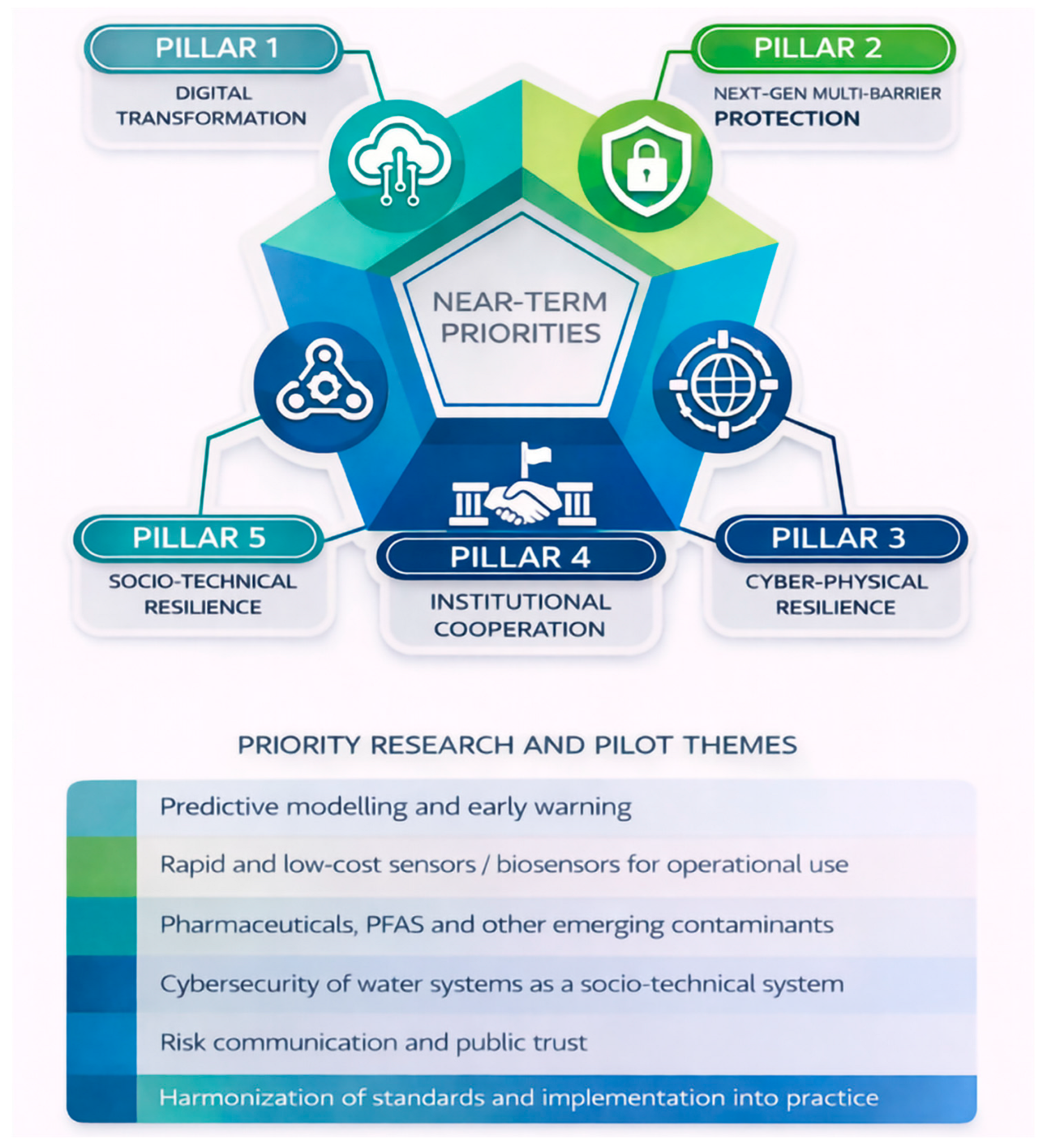
8. Conclusions and Recommendations
8.1. Recommendations for Practice
- (1)
- Accelerate the renewal of critical network components through risk-based asset management, taking into account pipe age, failure frequency, operational significance, and potential impacts on consumers, supported by the systematic collection and evaluation of operational data.
- (2)
- Establish a minimum standard for continuous monitoring at operationally critical points (e.g., residual disinfectant concentration, turbidity/conductivity, pressure, and flow) and harmonise evaluation and reporting procedures across utilities.
- (3)
- Strengthen the cybersecurity of control systems, including network segmentation, access control management, secure data backup, incident response procedures, and staff training. Digital tools, including artificial intelligence (AI), should be implemented gradually and securely, with clearly defined responsibilities, human oversight, and robust data governance rules. In this context, AI is particularly relevant for early warning systems, failure prediction, anomaly detection in operational datasets, and the timely identification of deviations in disinfectant dosing. However, the use of AI is appropriate only where sufficient data quality and sound governance structures are ensured. Key considerations include model reliability and interpretability (explainability), the risk of erroneous decisions under changing operational conditions, cybersecurity vulnerabilities, the protection of sensitive operational data, and the preservation of human decision-making authority in critical interventions.
- (4)
- Integrate emerging contaminants into decision-making and monitoring frameworks, including the development of clear response procedures for the detection of micropollutants and the strategic planning of treatment technologies where required by the risk profile of water sources.
- (5)
- Improve biofilm management through a combination of operational measures, targeted diagnostics, and verification of disinfection effectiveness across different pipe materials and operational regimes.
- (6)
- Enhance crisis preparedness and communication by expanding exercise scenarios to include cyber incidents and intentional contamination events, harmonising communication protocols, and strengthening public trust through transparent and consistent procedures.
8.2. Recommendations for Research
- (1)
- Predictive management and early warning systems: Integration of sensors, hydraulic models, and artificial intelligence, including advanced machine learning techniques, to enable anomaly detection, early warning, and decision support. This should include validation of applicability across different operational contexts (e.g., varying utility sizes, source types, network configurations, and operational regimes).
- (2)
- Micropollutants (pharmaceuticals, PFASs): Systematic mapping of occurrence under Czech conditions, assessment of long-term low-level exposure risks, and evaluation of the effectiveness of advanced removal technologies.
- (3)
- Biofilms: Investigation of regrowth mechanisms and resistance patterns, as well as assessment of the effectiveness of control strategies depending on pipe material and operational conditions.
- (4)
- Cyber-operational resilience: Intrusion detection, system redundancy, operational robustness, and the role of the human factor in maintaining secure and reliable system performance.
- (5)
- Risk communication: Consumer responses during incident situations, the use of digital alert channels, and strategies for restoring public trust following service disruptions or contamination events.
8.3. Recommended Phased Implementation Framework
- (1)
- Period of 0–12 months: Establishment of a minimum security and monitoring baseline, including continuous measurement at operationally critical points and the implementation of basic cybersecurity measures for control systems.
- (2)
- Period of 1–3 years: Development of risk-based asset management practices, targeted renewal of the most vulnerable network components, and expansion of data records and performance indicators (KPIs).
- (3)
- Period of 3+ years: System-wide strengthening of resilience, including the establishment of harmonised data and data-sharing standards, improved interoperability, pilot projects for advanced operational management, regular training and simulation exercises, and the development of shared regional capacities to support smaller utilities.
8.4. Final Synthesis
Author Contributions
Funding
Data Availability Statement
Conflicts of Interest
References
- Wang, K.; Yu, J.; Hou, D.; Yin, H.; Yu, Q.; Huang, P.; Zhang, G. Optical Detection of Contamination Event in Water Distribution System Using Online Bayesian Method with UV–Vis Spectrometry. Chemom. Intell. Lab. Syst. 2019, 191, 168–174. [Google Scholar] [CrossRef]
- World Health Organization. Guidelines for Drinking-Water Quality: Fourth Edition Incorporating the First and Second Addenda; World Health Organization: Geneva, Switzerland, 2022; Available online: https://www.who.int (accessed on 14 November 2025).
- Eliades, D.G.; Vrachimis, S.G.; Moghaddam, A.; Tzortzis, I.; Polycarpou, M.M. Contamination Event Diagnosis in Drinking Water Networks: A Review. Annu. Rev. Control 2023, 55, 420–441. [Google Scholar] [CrossRef]
- Rodríguez-Martínez, C.; Quiñones-Grueiro, M.; Llanes-Santiago, O. Cyberattack Diagnosis in Water Distribution Networks: Combining Data-Driven and Structural Analysis Methods. J. Water Resour. Plann. Manag. 2023, 149, 04023013. [Google Scholar] [CrossRef]
- Skolicki, Z.; Arciszewski, T.; Houck, M.H.; De Jong, K. Co-Evolution of Terrorist and Security Scenarios for Water Distribution Systems. Adv. Eng. Softw. 2008, 39, 801–811. [Google Scholar] [CrossRef]
- Arrighi, C.; Tarani, F.; Vicario, E.; Castelli, F. Flood Impacts on a Water Distribution Network. Nat. Hazards Earth Syst. Sci. 2017, 17, 2109–2122. [Google Scholar] [CrossRef]
- Palma, L.; Hatam, F.; Di Nardo, A.; Prévost, M. Contaminations in water distribution systems: A critical review of detection and response methods. Aqua—Water Infrastruct. Ecosyst. Soc. 2024, 73, 1285. [Google Scholar] [CrossRef]
- Ben Boubaker, K. Water Industry: A Look Back at Twenty Years of Cyber Attacks. Stormshield Security Monitor 2021. Updated 22 March 2024. Available online: https://www.stormshield.com/news/twenty-years-of-cyber-attacks-on-the-world-of-water/ (accessed on 19 August 2024).
- Furst, K.E.; Graham, K.E.; Weisman, R.J.; Adusei, K.B. It’s Getting Hot in Here: Effects of Heat on Temperature, Disinfection, and Opportunistic Pathogens in Drinking Water Distribution Systems. Water Res. 2024, 260, 121913. [Google Scholar] [CrossRef]
- Danneels, J.J. Protecting Water Supply Systems from Terrorists. Testimony Before the U.S. House of Representatives Committee on Science; U.S. House of Representatives Committee on Science: Washington, DC, USA, 2001. [Google Scholar]
- Renwick, D.V. Potential Public Health Impacts of Deteriorating Distribution System Infrastructure. J. Am. Water Work. Assoc. 2019, 111, 42–53. [Google Scholar] [CrossRef] [PubMed]
- Zhang, Y.; Wang, L.; Liu, Z.; Wei, W. A Cyber-Insurance Scheme for Water Distribution Systems Considering Malicious Cyberattacks. IEEE Trans. Inf. Forensics Secur. 2021, 16, 3498–3513. [Google Scholar] [CrossRef]
- Acharya, A.; Liu, J.; Shin, S. Evaluating the multi-dimensional resilience of the water distribution network to contamination events. Water Supply 2023, 23, 1416–1433. [Google Scholar] [CrossRef]
- Hopland, A.O.; Kvamsdal, S.F. Drinking water contamination and treatment costs. Water Resour. Econ. 2023, 43, 100225. [Google Scholar] [CrossRef]
- Mekal, A.D.; El-Shazly, M.M.; Ragab, M.; Marzouk, E.R. Comparison of modern and 40-year-old drinking water pipeline in northern Sinai region, Egypt: Characteristics and health risk assessment. J. Trace Elem. Miner. 2023, 5, 100078. [Google Scholar] [CrossRef]
- World Health Organization (WHO). Water Safety Plan Manual: Step-by-Step Risk Management for Drinking-Water Suppliers; WHO Press: Geneva, Switzerland, 2009. [Google Scholar]
- Zhang, Q.; Zheng, F.; Kapelan, Z.; Savic, D.; He, G.; Ma, Y. Assessing the Global Resilience of Water Quality Sensor Placement Strategies within Water Distribution Systems. Water Res. 2020, 172, 115527. [Google Scholar] [CrossRef] [PubMed]
- World Health Organization (WHO). Guidelines for Drinking-Water Quality: Small Water Supplies; WHO Press: Geneva, Switzerland, 2024. [Google Scholar]
- U.S. Environmental Protection Agency (EPA). A Water Security Handbook: Planning for and Responding to Drinking Water Contamination Threats and Incidents; EPA: Washington, DC, USA, 2006. [Google Scholar]
- Singh, Y.; Walingo, T. Smart Water Quality Monitoring with IoT Wireless Sensor Networks. Sensors 2024, 24, 2871. [Google Scholar] [CrossRef]
- Li, Z.; Liu, H.; Zhang, C.; Fu, G. Real-Time Water Quality Prediction in Water Distribution Networks Using Graph Neural Networks with Sparse Monitoring Data. Water Res. 2024, 250, 121018. [Google Scholar] [CrossRef]
- Nirmala, D.; Pooja, G.; Sowmya, U.; Mohamed, A.; Durdona, A.; Vignesh Kumar, V.; Rajavarman, R.; Parkunam, N. System for Water Quality Monitoring and Distribution. E3S Web Conf. 2023, 399, 01016. [Google Scholar] [CrossRef]
- Li, Z.; Liu, H.; Zhang, C.; Fu, G. Generative Adversarial Networks for Detecting Contamination Events in Water Distribution Systems Using Multi-Parameter, Multi-Site Water Quality Monitoring. Environ. Sci. Ecotechnol. 2023, 14, 100231. [Google Scholar] [CrossRef] [PubMed]
- Dadebo, D.; Obura, D.; Kimera, D. Hydraulic Modeling and Prediction of Performance for a Drinking Water Supply System towards the Achievement of Sustainable Development Goals (SDGs): A System Case Study from Uganda. Groundw. Sustain. Dev. 2023, 22, 100951. [Google Scholar] [CrossRef]
- Shahmirnoori, A.; Saadatpour, M.; Rasekh, A. Using Mobile and Fixed Sensors for Optimal Monitoring of Water Distribution Network under Dynamic Water Quality Simulations. Sustain. Cities Soc. 2022, 82, 103875. [Google Scholar] [CrossRef]
- Hu, Z.; Chen, W.; Wang, H.; Tian, P.; Shen, D. Integrated Data-Driven Framework for Anomaly Detection and Early Warning in Water Distribution System. J. Clean. Prod. 2022, 373, 133977. [Google Scholar] [CrossRef]
- Hu, Z.; Chen, W.; Shen, D.; Chen, B.; Ye, S.; Tan, D. Optimal Sensor Placement for Contamination Identification in Water Distribution System Considering Contamination Probability Variations. Comput. Chem. Eng. 2021, 153, 107404. [Google Scholar] [CrossRef]
- Hindiyeh, M.; Albatayneh, A.; Tarawneh, R.; Suleiman, S.; Juaidi, A.; Abdallah, R.; Jellali, S.; Jeguirim, M. Preparedness Plan for the Water Supply Infrastructure during Water Terrorism—A Case Study from Irbid, Jordan. Water 2021, 13, 2887. [Google Scholar] [CrossRef]
- Ramotsoela, D.T.; Hancke, G.P.; Abu-Mahfouz, A.M. Attack Detection in Water Distribution Systems Using Machine Learning. Hum. -Centric Comput. Inf. Sci. 2019, 9, 13. [Google Scholar] [CrossRef]
- He, G.; Zhang, T.; Zheng, F.; Zhang, Q. An Efficient Multi-Objective Optimization Method for Water Quality Sensor Placement within Water Distribution Systems Considering Contamination Probability Variations. Water Res. 2018, 143, 165–175. [Google Scholar] [CrossRef]
- SOVAK ČR. Situační Zpráva SOVAK ČR ke Kvalitě Vody v ČR. 2021. Available online: https://www.sovak.cz/node/5925 (accessed on 14 November 2025).
- SOVAK ČR. Kvalita Pitné Vody v ČR. 2021. Available online: https://www.sovak.cz/node/6185 (accessed on 14 November 2025).
- Státní Zdravotní Ústav (SZÚ). Zpráva o Kvalitě Pitné Vody v ČR za Rok 2022; Státní Zdravotní Ústav: Prague, Czech Republic, 2023. [Google Scholar]
- Ministerstvo Zemědělství. Zpráva o Stavu Vodního Hospodářství České Republiky v Roce 2022. 2022. Available online: https://www.mzcr.cz/ (accessed on 14 November 2025).
- Ministerstvo Zemědělství. Zpráva o Stavu Vodního Hospodářství České Republiky v Roce 2023. 2023. Available online: https://www.vakinfo.cz/wp-content/uploads/2024/09/zprava-o-stavu-vodniho-hospodarstvi-ceske-republiky-v-roce-2023.pdf (accessed on 14 November 2025).
- Velvyslanectví České Republiky v Bratislavě. Základní Informace o ČR. 2024. Available online: https://mzv.gov.cz/bratislava/cz/cr_a_eu/zakladni_informace_o_cr (accessed on 14 November 2025).
- Říhová Ambrožová, J. Drinking Water Quality in the Czech Republic. Czech J. Food Sci. 2009, 27, 80–87. [Google Scholar] [CrossRef]
- Caithamlová, M.; Kročová, Š.; Mariňáková, J. Operation of Water Supply Systems in the Czech Republic—Risk Analysis. Appl. Sci. 2024, 14, 1572. [Google Scholar] [CrossRef]
- Národní Úřad pro Kybernetickou a Informační Bezpečnost. NÚKIB v Roce 2023 Zaznamenal Rekordní Počet Kybernetických Incidentů. 2024. Available online: https://nukib.gov.cz/cs/infoservis/aktuality/2073-nukib-v-roce-2023-zaznamenal-rekordni-pocet-kybernetickych-incidentu/ (accessed on 14 November 2025).
- Tuhovčák, L. Quo Vadis, České Vodárenství? Vodní Hospodářství. 2022. Available online: https://vodnihospodarstvi.cz/quo-vadis-ceske-vodarenstvi (accessed on 14 November 2025).
- Kalášek, D.; Navrátil, J. Kybernetická Bezpečnost a Kritická Infrastruktura ve Vodárenství. Vodní Hospodářství. 2022. Available online: https://vodnihospodarstvi.cz/kyberneticka-bezpecnost-a-kriticka-infrastruktura-ve-vodarenstvi/ (accessed on 13 November 2025).
- Barák, F. Výhledy pro Vodárenství; SOVAK ČR: Prague, Czech Republic, 2012. [Google Scholar]
- Transparency International—Česká republika. Privatizace Vodárenství v České Republice: Kam Odtékají Zisky? Transparency International ČR: Prague, Czech Republic, 2009; ISBN 978-80-87123-08-9. [Google Scholar]
- Tuhovčák, L.; Kučera, T. Hodnocení Technického Stavu Vodárenské Infrastruktury jako Základ Tvorby Plánů Financování její Obnovy. Vodovod.info. 2017. Available online: https://www.vodovod.info/vodarenstvi/odborne/374-hodnoceni-technickeho-stavu-vodarenske-infrastruktury-jako-zaklad-tvorby-planu-financovani-jeji-obnovy (accessed on 14 November 2025).
- Vojtěchovská Šrámková, M.; Žák, V. Kvalita pitné vody z veřejných vodovodů za rok 2020. SOVAK—Časopis Oboru Vodovodů A Kanaliz. 2021, 30, 6–8. [Google Scholar]
- Czech Statistical Office. Statistical Data and Publications. CZSO. 2024. Available online: https://www.czso.cz/ (accessed on 7 April 2025).
- Petružela, L.; Hubáčková, J.; Šťastný, V. Ochrana kritické infrastruktury veřejného zásobování obyvatel pitnou vodou: Legislativní rámec. In Sborník Konference Pitná Voda 2012; W&ET Team: České Budějovice, Czech Republic, 2012; pp. 41–46. ISBN 978-80-905238-0-7. [Google Scholar]
- Šobr, M. Vodní zdroje na našem území. Živa 2022, 70, 206–210. [Google Scholar]
- Státní Zdravotní Ústav (SZÚ). Zpráva o Kvalitě Pitné Vody v ČR za Rok 2024: Systém Monitorování Zdravotního Stavu Obyvatelstva ve Vztahu k Životnímu Prostředí, Subsystém II—Zdravotní Důsledky a Rizika Znečištění Pitné Vody; SZÚ: Prague, Czech Republic, 2025. [Google Scholar]
- Český Hydrometeorologický Ústav (ČHMÚ). Pozorovací síť Podzemních vod. 2025. Available online: https://chmi.maps.arcgis.com/home (accessed on 14 November 2025).
- Czech Republic. Act No. 258/2000 Coll., on the Protection of Public Health, as Amended. 2000. Available online: https://leap.unep.org/en/countries/cz/national-legislation/act-no-2582000-public-health-protection (accessed on 20 November 2025).
- Czech Republic. Decree No. 252/2004 Coll., Laying Down Hygienic Requirements for Drinking and Hot Water and the Frequency and Scope of Drinking Water Monitoring, as Amended. 2004. Available online: https://www.ecolex.org/details/legislation/decree-no-2522004-laying-down-potable-water-and-warm-water-requirements-and-regulating-check-frequency-lex-faoc073961/?type=legislation&xsubjects=Energy&page=170 (accessed on 16 February 2026).
- Czech Republic. Decree No. 371/2023 Coll., Amending Decree No. 252/2004 Coll., Laying Down Hygienic Requirements for Drinking and Hot Water and the Frequency and Scope of Drinking Water Monitoring. 2023. Available online: https://szu.gov.cz/wp-content/uploads/2025/05/Summary_report_2023.pdf (accessed on 20 November 2025).
- European Union. Directive (EU) 2020/2184 of the European Parliament and of the Council of 16 December 2020 on the quality of water intended for human consumption (recast). Off. J. Eur. Union 2020, L435, 1–62. [Google Scholar]
- Kožíšek, F. Proč voda s chlorem, proč voda bez chloru? In Sborník Konference Pitná Voda 2010; W&ET Team: České Budějovice, Czech Republic, 2010; pp. 35–40. ISBN 978-80-254-6854-8. [Google Scholar]
- Kožíšek, F.; Pumann, P.; Jeligová, H.; Paul, J. Hledání vhodné strategie přístupu k léčivům v pitné vodě. In Sborník z 16. Ročníku Konference Pitná Voda 2022; Dobiáš, P., Ed.; ENVI-PUR: Prague, Czech Republic, 2022; pp. 81–86. ISBN 978-80-905059-9-5. [Google Scholar]
- Státní Zdravotní Ústav (SZÚ). Monitoring Pitné Vody. 2024. Available online: https://szu.gov.cz/temata-zdravi-a-bezpecnosti/zivotni-prostredi/kvalita-vody/pitna-voda/monitoring-pitne-vody (accessed on 11 April 2025).
- World Health Organization (WHO). PFOS and PFOA in Drinking-Water: Background Document for Development of WHO Guidelines for Drinking-Water Quality; WHO Press: Geneva, Switzerland, 2022. [Google Scholar]
- U.S. Environmental Protection Agency (EPA). Our Current Understanding of the Human Health and Environmental Risks of PFAS; EPA: Washington, DC, USA, 2025. Available online: https://www.epa.gov/pfas/our-current-understanding-human-health-and-environmental-risks-pfas (accessed on 11 December 2025).
- Doupal, J. Pozorovatelny Civilní Obrany: Výstavba v Československu v Letech 1951–1989; Brigadýr: Prague, Czech Republic, 2015; p. 270. [Google Scholar]
- Hasičský Záchranný sbor České Republiky. Krizové Řízení a CNP Systém Krizového Řízení. 2024. Available online: https://hzscr.gov.cz/clanek/krizove-rizeni-a-cnp-system-krizoveho-rizeni-system-krizoveho-rizeni (accessed on 14 November 2025).
- Ministerstvo Vnitra České Republiky. Koncepce Ochrany Obyvatelstva 2025–2030. 2021. Available online: https://www.mvcr.cz/ (accessed on 14 November 2025).
- Pražské Vodovody a Kanalizace. a.s. Cvičení Hyg-Toxy 2023. 2023. Available online: https://www.pvk.cz/aktuality/cviceni-hyg-toxy-2023/ (accessed on 21 August 2024).
- Česká Televize (ČT24). V Obavě z Terorismu Cvičily Vodárny v Praze Útok na Vodojem. Zasahovala Policie i Hasiči. 2016. Available online: https://ct24.ceskatelevize.cz/clanek/regiony/v-obave-z-terorismu-cvicily-vodarny-v-praze-utok-na-vodojem-zasahovala-policie-i-hasici-106954 (accessed on 21 August 2024).
- Krajské Vojenské Velitelství Hlavní Město Praha. Komplexní Útok na Vojenském Cvičení SAFEGUARD 2024. 2024. Available online: https://kvv-hlavnimestopraha.mo.gov.cz/aktuality/komplexni-utok-na-vojenskem-cviceni-safeguard-2024 (accessed on 27 August 2024).
- HUTIRA s.r.o. V Případě Kontaminace Zdrojů Pitné Vody Zasáhnou v Jihomoravském Kraji Mobilní Úpravny Vody HUTIRA CCW. 2017. Available online: https://www.hutira.cz (accessed on 5 December 2017).
- Vodárenská Akciová Společnost. a.s. Připravenost na Krizovou Situaci “Výpadek Elektrické Energie Velkého Rozsahu” (Blackout JMK 2014); Vodárenská Akciová Společnost, a.s.: Brno, Czech Republic, 2014. [Google Scholar]
- Czech Republic. Act No. 240/2000 Coll., on Crisis Management and on Amendments to Certain Acts (Crisis Act), as amended. 2000. Available online: https://ec.europa.eu/echo/files/civil_protection/national_disaster_management_system/czech_republic/240_2000_crisis_management_act.pdf (accessed on 16 February 2026).
- Kožíšek, F.; Paul, J.; Pumann, P. Resolving Complaints about the Quality of Drinking Water among Water Supply Operators in the Czech Republic. Water Policy 2025, 27, 385–399. [Google Scholar] [CrossRef]
- Deník Veřejné Správy. Kvalitní Pitná Voda a Modernizace Vodárenské Infrastruktury. 2020. Available online: https://www.dvs.cz/clanek.asp?id=6786420 (accessed on 10 December 2024).
- Hubáčková, J.; Petružela, L.; Šťastný, V. Posuzování zranitelnosti úpraven vod, akumulace a distribučních systémů pro zásobování obyvatelstva pitnou vodou. In Pitná Voda 2014; Sborník Konference; W&ET Team: České Budějovice, Czech Republic, 2014; pp. 39–44. ISBN 978-80-905238-1-4. [Google Scholar]
- Hubáčková, J.; Petružela, L.; Šťastný, V. Proč ochrana kritické infrastruktury v oblasti zásobování obyvatel pitnou vodou? In Pitná Voda 2014; Sborník Konference; W&ET Team: České Budějovice, Czech Republic, 2014; pp. 31–36. [Google Scholar]
- Český Hydrometeorologický Ústav (ČHMÚ). Aktualizace Komplexní Studie Dopadů, Zranitelnosti a Zdrojů Rizik Souvisejících se Změnou Klimatu v ČR z Roku 2015; Ministerstvo životního prostředí ČR: Prague, Czech Republic, 2019. [Google Scholar]
- Jia, R.; Du, K.; Song, Z.; Xu, W.; Zheng, F. Scenario reduction-based simulation method for efficient serviceability assessment of earthquake-damaged water distribution systems. Reliab. Eng. Syst. Saf. 2024, 246, 110086. [Google Scholar] [CrossRef]
- Sobeck, J.; Smith-Darden, J.; Hicks, M.; Kernsmith, P.; Kilgore, P.E.; Treemore-Spears, L.; McElmurry, S. Stress, Coping, Resilience and Trust during the Flint Water Crisis. Behav. Med. 2020, 46, 202–216. [Google Scholar] [CrossRef]
- Gebhartová, J.; Caletková, J.; Beneš, I. Zvýšení odolnosti systému zásobování pitnou vodou. In Pitná Voda 2014; Sborník Konference; W&ET Team: České Budějovice, Czech Republic, 2014; pp. 33–38. ISBN 978-80-905238-1-4. [Google Scholar]
- Bazargan-Lari, M.R.; Taghipour, S.; Habibi, M. Real-Time Contamination Zoning in Water Distribution Networks for Contamination Emergencies: A Case Study. Environ. Monit. Assess. 2021, 193, 336. [Google Scholar] [CrossRef]
- Tuptuk, N.; Hailes, S. A Systematic Review of the State of Cyber-Security in Water Systems. Water 2021, 13, 81. [Google Scholar] [CrossRef]
- Liu, G.; Zhang, Y.; Knibbe, W.-J.; Feng, C.; Liu, W.; Medema, G.; van der Meer, W. Potential Impacts of Changing Supply-Water Quality on Drinking Water Distribution: A Review. Water Res. 2017, 116, 135–148. [Google Scholar] [CrossRef] [PubMed]
- Pilarski, D.C.; Barkdoll, B.D. Sensitivity of Contaminant Spread to Decay Rate in Water Distribution Systems with Implications for the Spread of Emerging Contaminants. Water Supply 2020, 20, 3242–3250. [Google Scholar] [CrossRef]
- Bojago, E.; Tyagi, I.; Ahamad, F.; Chandniha, S.K. GIS-Based Spatial–Temporal Distribution of Water Quality Parameters and Heavy Metals in Drinking Water: Ecological and Health Modelling. Phys. Chem. Earth 2023, 130, 103399. [Google Scholar] [CrossRef]
- Brahmbhatt, P.; Maheshwari, A.; Gudi, R.D. Digital Twin Assisted Decision Support System for Quality Regulation and Leak Localization Task in Large-Scale Water Distribution Networks. Digit. Chem. Eng. 2023, 9, 100127. [Google Scholar] [CrossRef]
- Eliades, D.G.; Panayiotou, C.G.; Polycarpou, M.M. Contamination Event Detection in Drinking Water Systems Using a Real-Time Learning Approach. Procedia Eng. 2014, 89, 1089–1096. [Google Scholar] [CrossRef]
- Khaksar Fasaee, M.A.; Monghasemi, S.; Nikoo, M.R.; Shafiee, M.E.; Berglund, E.Z.; Hashempour Bakhtiari, P. A K-Sensor Correlation-Based Evolutionary Optimization Algorithm to Cluster Contamination Events and Place Sensors in Water Distribution Systems. J. Clean. Prod. 2021, 319, 128763. [Google Scholar] [CrossRef]
- Fumani, S.M.R. Contaminant Intrusion in Water Distribution Systems: Advanced Modelling Approaches. Ph.D. Thesis, The University of British Columbia (Okanagan), Kelowna, BC, Canada, 2013. [Google Scholar]
- Harif, S.; Azizyan, G.; Givehchi, M.; Dehghani Darmian, M. Analysis and Quality Management of Water Distribution Networks under Pollution Intrusion in the Situation of Water Pressure Reduction (Case Study: Zahedan Water Distribution Network). Irrig. Water Eng. 2023, 14, 297–307. [Google Scholar] [CrossRef]
- Harif, S.; Azizyan, G.; Dehghani Darmian, M.; Givehchi, M. Selecting the Best Location of Water Quality Sensors in Water Distribution Networks by Considering the Importance of Nodes and Contaminations Using NSGA-III (Case Study: Zahedan Water Distribution Network, Iran). Environ. Sci. Pollut. Res. 2023, 30, 53229–53252. [Google Scholar] [CrossRef]
- Housh, M.; Ostfeld, A. An Integrated Logit Model for Contamination Event Detection in Water Distribution Systems. Water Res. 2015, 75, 210–223. [Google Scholar] [CrossRef]
- Nazempour, R.; Saniee Monfared, M.A.; Zio, E. A Complex Network Theory Approach for Optimizing Contamination Warning Sensor Location in Water Distribution Networks. Int. J. Disaster Risk Reduct. 2018, 30, 225–234. [Google Scholar] [CrossRef]
- Sunderland, E.M.; Hu, X.C.; Dassuncao, C.; Tokranov, A.K.; Wagner, C.C.; Allen, J.G. A Review of the Pathways of Human Exposure to Poly- and Perfluoroalkyl Substances (PFASs) and Present Understanding of Health Effects. J. Expo. Sci. Environ. Epidemiol. 2019, 29, 131–147. [Google Scholar] [CrossRef] [PubMed]
- Fenton, S.E.; Ducatman, A.; Boobis, A.; DeWitt, J.C.; Lau, C.; Ng, C.; Smith, J.S.; Roberts, S.M. Per- and Polyfluoroalkyl Substance Toxicity and Human Health Review: Current State of Knowledge and Strategies for Informing Future Research. Environ. Toxicol. Chem. 2021, 40, 606–630. [Google Scholar] [CrossRef] [PubMed]
- Wu, T.; Fang, J.; Hong, J.; Jiang, Y.; Du, K.; Zhang, W.; Zhang, S.; Pan, T.; Fu, L.; Mao, W.; et al. Integrating Nontargeted Metabolomics and Machine Learning to Assess PFAS Exposure Associations with Liver Cancer Risk. Environ. Int. 2025, 207, 110014. [Google Scholar] [CrossRef]
- Khoury, N.; Babio, N.; Martínez, M.A.; Serafeim, E.; Costopoulou, D.; Plaza-Diaz, J.; Leondiadis, L.; Salas-Salvadó, J. Plasma Per- and Polyfluoroalkyl Substances (PFAS) and Cardiometabolic Risk Factors in an Elderly Spanish Population at High Cardiovascular Risk. Sci. Total Environ. 2025, 1009, 180971. [Google Scholar] [CrossRef]
- Quan, H.; Ji, F.; Zhong, Z.; Li, R.; Lu, H. PFAS in Bottled Water from China: High Prevalence of Ultrashort-Chain Compounds, Health Risks, and Global Insights. J. Hazard. Mater. 2025, 499, 140184. [Google Scholar] [CrossRef] [PubMed]
- Grmelová, N.; Läteenmäki-Uutela, A.; Štěpánek, P. Different Regulatory Approaches to Enhanced Water Protection in Selected European Jurisdictions. Water Int. 2023, 48, 188–201. [Google Scholar] [CrossRef]
- Laubenstein, H.; Leflaive, X. Water Investment Planning and Financing. In OECD Environment Working Papers; OECD Publishing: Paris, France, 2024; p. 237. [Google Scholar] [CrossRef]
- IPCC. Climate Change 2022: Impacts, Adaptation and Vulnerability. Contribution of Working Group II to the Sixth Assessment Report of the Intergovernmental Panel on Climate Change; Pörtner, H.O., Roberts, D.C., Tignor, M., Poloczanska, E.S., Mintenbeck, K., Alegría, A., Craig, M., Langsdorf, S., Löschke, S., Möller, V., et al., Eds.; Cambridge University Press: Cambridge, UK, 2022; p. 3056. [Google Scholar] [CrossRef]
- Puust, R.; Kapelan, Z.; Savic, D.A.; Koppel, T. A Review of Methods for Leakage Management in Pipe Networks. Urban Water J. 2009, 7, 25–45. [Google Scholar] [CrossRef]
- Bates, B.C.; Kundzewicz, Z.W.; Wu, S.; Palutikof, J.P. (Eds.) Climate Change and Water. Technical Paper of the Intergovernmental Panel on Climate Change; IPCC Secretariat: Geneva, Switzerland, 2008; p. 210. ISBN 978-92-9169-123-4. [Google Scholar]
- Odhiambo, M.; Viñas, V.; Sokolova, E.; Pettersson, T.J.R. Health Risks due to Intrusion into the Drinking Water Distribution Network: Hydraulic Modelling and Quantitative Microbial Risk Assessment. Environ. Sci. Water Res. Technol. 2023, 9, 1701–1716. [Google Scholar] [CrossRef]
- Sgroi, M.; Lancioni, N.; Parlapiano, M.; Giorgi, L.; Fusi, V.; Mattioli, M.; Darvini, G.; Soldini, L.; Eusebi, A.L.; Fatone, F. A New Experimental Approach to Chemical Ageing in Materials and Piping for Drinking Water Infrastructure Exposed to Chlorine Dioxide. J. Hazard. Mater. 2025, 500, 140437. [Google Scholar] [CrossRef] [PubMed]
- Pérez-Gimeno, A.; Almendro-Candel, M.B.; Lucas, I.G.; Rodríguez-Espinosa, T.; Sala-Sala, V.; Jordán, M.M.; Zorpas, A.A.; Navarro-Pedreño, J. A Review of the Impact of Climate Change on the Presence of Microorganisms in Drinking Water. Sci 2025, 7, 132. [Google Scholar] [CrossRef]
- Zhou, Z.; Zhong, D.; Zhang, Z.; Ma, W.; Chen, J.; Zhuang, M.; Li, F.; Zhang, J.; Zhu, Y.; Su, P. Biofilm on the pipeline wall is an important transmission route of resistome in drinking water distribution system. Environ. Pollut. 2023, 335, 122311. [Google Scholar] [CrossRef]
- Chohan, I.M.; Ahmad, A.; Sallih, N.; Bheel, N.; Ali, M.; Deifalla, A.F. A Review on Life Cycle Assessment of Different Pipeline Materials. Results Eng. 2023, 19, 101325. [Google Scholar] [CrossRef]
- Hyllestad, S.; Iversen, A.; MacDonald, E.; Amato, E.; Sørby Borge, B.Å.; Bøe, A.; Sandvin, A.; Brandal, L.T.; Lyngstad, T.M.; Naseer, U.; et al. Large waterborne Campylobacter outbreak: Use of multiple approaches to investigate contamination of the drinking water supply system, Norway, June 2019. Eurosurveillance 2020, 25, 2000011. [Google Scholar] [CrossRef]
- Olinger, D. Alamosa sued over salmonella in drinking water. The Denver Post. 1 March 2010. Available online: https://www.denverpost.com/2010/03/01/alamosa-sued-over-salmonella-in-drinking-water/ (accessed on 8 April 2025).
- Kožíšek, F.; Jeligová, H.; Dvořáková, A. Epidemický výskyt vodou přenosných chorob v České republice za období 1995–2005. Epidemiol. Mikrobiol. Imunol. 2009, 58, 124–131. Available online: https://www.prolekare.cz/casopisy/epidemiologie/2009-3-3/epidemicky-vyskyt-vodou-prenosnych-chorob-v-ceske-republice-za-obdobi-1995-az-2005-15416 (accessed on 14 November 2025). [PubMed]
- LeChevallier, M.W.; Prosser, T.; Stevens, M. Opportunistic Pathogens in Drinking Water Distribution Systems—A Review. Microorganisms 2024, 12, 916. [Google Scholar] [CrossRef]
- MacKenzie, W.R.; Hoxie, N.J.; Proctor, M.E.; Gradus, M.S.; Blair, K.A.; Peterson, D.E.; Kazmierczak, J.J.; Addiss, D.G.; Fox, K.R.; Rose, J.B.; et al. A Massive Outbreak in Milwaukee of Cryptosporidium Infection Transmitted through the Public Water Supply. N. Engl. J. Med. 1994, 331, 161–167. [Google Scholar] [CrossRef]
- Miettinen, I.; Lepistö, O.; Pitkänen, T.; Kuusi, M.; Maunula, L.; Laine, J.; Hänninen, M.-L. A Scandinavian Emergency for Drinking Water Network Contamination: The Nokia Case Study. In Water Contamination Emergencies; Hrudey, S.E., Hrudey, E.J., Eds.; Royal Society of Chemistry: Cambridge, UK, 2011; pp. 133–152. [Google Scholar] [CrossRef]
- Robertson, L.J.; Hermansen, L.; Gjerde, B.K.; Strand, E.; Alvsvåg, J.O.; Langeland, N. Application of Genotyping during an Extensive Outbreak of Waterborne Giardiasis in Bergen, Norway, during Autumn and Winter 2004. Appl. Environ. Microbiol. 2006, 72, 2212–2217. [Google Scholar] [CrossRef]
- Giardia Outbreak in Bergen 2004—What Was the Source of Infection? Tidsskr. Den Nor. Legeforening 2015, 135, 1435–1436. [CrossRef]
- Moreno, Y.; Moreno-Mesonero, L.; Soler, P.; Zornoza, A.; Soriano, A. Influence of drinking water biofilm microbiome on water quality: Insights from a real-scale distribution system. Sci. Total Environ. 2024, 921, 171086. [Google Scholar] [CrossRef]
- Rose, J.B.; Huffman, D.E.; Gennaccaro, A. Risk and control of waterborne cryptosporidiosis. FEMS Microbiol. Rev. 2002, 26, 113–123. [Google Scholar] [CrossRef]
- Nascetti, S.; Busani, L.; Bartoli, F.; Orioli, R.; Stenico, A.; Regele, D. Community waterborne outbreak linked to a firefighting response during the COVID-19 emergency. Ann. Ist Super Sanità 2021, 57, 226–232. [Google Scholar] [CrossRef]
- Morris, S. The Camelford Poisoning: Black Water, a Driver’s Mistake and “Terrible” Advice. The Guardian. 2012. Available online: https://www.theguardian.com/society/2012/mar/14/camelford-water-poisoning-inquest (accessed on 14 March 2012).
- Muambo, K.E.; Kim, M.G.; Kim, D.H.; Park, S.; Oh, J.E. Pharmaceuticals in Raw and Treated Water from Drinking Water Treatment Plants Nationwide: Insights into Their Sources and Exposure Risk Assessment. Water Res. X 2024, 24, 100256. [Google Scholar] [CrossRef]
- Temido, J.; Sousa, J.; Malheiro, R. SCADA and Smart Metering Systems in Water Companies: A Perspective Based on the Value Creation Analysis. Procedia Eng. 2014, 70, 1629–1638. [Google Scholar] [CrossRef][Green Version]
- Švamberk, A. Hacker Pronikl do Systému Floridské Vodárny, Pokusil se Otrávit Odběratele. Novinky.cz. 2021. Available online: https://www.novinky.cz/clanek/zahranicni-amerika-hacker-pronikl-do-systemu-floridske-vodarny-pokusil-se-otravit-odberatele (accessed on 14 November 2025).
- Vítek, J. Hacker se Pokusil Otrávit Vodu z Floridské Úpravny. Svět Hardware. 2021. Available online: https://www.svethardware.cz/hacker-se-pokusil-otravit-vodu-z-floridske-upravny (accessed on 14 November 2025).
- Ribeiro, A. Oldsmar Water Treatment Plant Incident Allegedly Caused by Human Error, Not Remote Access Cybersecurity Breach. Industrial Cyber. 2023. Available online: https://industrialcyber.co/utilities-energy-power-water-waste/oldsmar-water-treatment-plant-incident-allegedly-caused-by-human-error-not-remote-access-cybersecurity-breach/ (accessed on 28 August 2024).
- National CSIRT-CY. Hackers Tried Poisoning Town After Breaching Its Water Facility. 2021. Available online: https://csirt.cy/alerts/hackers-tried-poisoning-town-after-breaching-its-water-facility-2 (accessed on 21 August 2024).
- ČTK. Hackeři v USA prý Napadli Systém Dodávající Pitnou Vodu. OVodárenství.cz. 22 November 2011. Available online: https://www.ovodarenstvi.cz/clanky/hackeri-v-usa-pry-napadli-system-dodavajici-pitnou-vodu/ (accessed on 8 April 2025).
- Collier, K. A Hacker Tried to Poison a Calif. Water Supply. It Was as Easy as Entering a Password. NBC News. 2021. Available online: https://www.nbcnews.com/tech/security/hacker-tried-poison-calif-water-supply-was-easy-entering-password-rcna1206 (accessed on 14 November 2025).
- Bartov, S.L. Iran Cyberattack on Israel’s Water Supply Could Have Sickened Hundreds Report. The Times of Israel. 2020. Available online: https://www.timesofisrael.com/iran-cyberattack-on-israels-water-supply-could-have-sickened-hundreds-report/ (accessed on 14 November 2025).
- DW. Israel Stops Cyberattack on Water System. DW News. 2020. Available online: https://www.dw.com/en/israel-thwarted-attack-on-water-systems-cyber-chief/a-53596796 (accessed on 14 November 2025).
- Lyngaas, S. Russia-Linked Hacking Group Suspected of Carrying Out Cyberattack on Texas Water Facility, Cybersecurity Firm Says. CNN Politics. 2024. Available online: https://www.cnn.com/2024/04/17/politics/russia-hacking-group-suspected-texas-water-cyberattack/index (accessed on 14 November 2025).
- Miller, K. Texas Towns Report Cyberattacks. The Texas Tribune. 2024. Available online: https://www.texastribune.org/2024/04/19/texas-cyberattacks-russia/ (accessed on 14 November 2025).
- Nöstlinger, N.; Lau, S. German Authorities Suspect Water Supply Sabotage on Military Base. POLITICO. 2024. Available online: https://www.politico.eu/article/water-supply-sabotage-military-bases-germany-nato-cologne-geilenkirchen/ (accessed on 14 November 2025).
- Euronews. German Town Issues Water Contamination Warning in Potential Army Base Sabotage Case. Euronews. 2024. Available online: https://www.euronews.com/my-europe/2024/08/14/german-town-issues-water-contamination-warning-in-potential-army-base-sabotage-case (accessed on 14 November 2025).
- Zadražilová, J. Sabotáž v Německých Kasárnách. Někdo Kontaminoval Vodu. Novinky.cz. 2024. Available online: https://www.euronews.com/my-europe/2024/08/16/german-town-issues-water-contamination-warning-in-potential-army-base-sabotage-case (accessed on 14 November 2025).
- Kybernetické Hrozby ve Vodním Hospodářství. Průmyslová Ekologie. Zdroj: SOVAK ČR. 2022. Available online: https://www.prumyslovaekologie.cz/info/kyberneticke-hrozby-ve-vodnim-hospodarstvi (accessed on 16 August 2024).
- Sharma, S.; Bhattacharya, A. Drinking water contamination and treatment techniques. Appl. Water Sci. 2016, 7, 1043–1067. [Google Scholar] [CrossRef]
- Fawell, J.; Nieuwenhuijsen, M.J. Contaminants in Drinking Water. Br. Med. Bull. 2003, 68, 199–208. [Google Scholar] [CrossRef]
- Zhu, H.; Xia, Y.; Zhang, Y.; Kang, Y.; Ding, Y.; Chen, R.; Feng, H. Distribution Characteristics and Transformation Mechanism of Per- and Polyfluoroalkyl Substances in Drinking Water Sources: A Review. Sci. Total Environ. 2024, 916, 169566. [Google Scholar] [CrossRef]
- Sharma, A.; Kumar, V.; Shahzad, B.; Tanveer, M. Worldwide pesticide usage and its impacts on ecosystem. SN Appl. Sci. 2019, 1, 1446. [Google Scholar] [CrossRef]
- Szabo, J.; Minamyer, S. Decontamination of chemical agents from drinking water infrastructure: A literature review and summary. Environ. Int. 2014, 72, 119–123. [Google Scholar] [CrossRef]
- Camel, V.; Bermond, A. The Use of Ozone and Associated Oxidation Processes in Drinking Water Treatment. Water Res. 1998, 32, 3208–3222. [Google Scholar] [CrossRef]
- Environmental Protection Agency. Report of the Microbial and Disinfection Byproducts Rule Revisions Working Group. National Drinking Water Advisory Council. 2023. Available online: https://www.epa.gov/dwsixyearreview/report-microbial-and-disinfection-byproducts-rule-revisions-working-group (accessed on 14 November 2025).
- Oliveira, I.M.; Gomes, I.B.; Simões, L.C.; Simões, M. A Review of Research Advances on Disinfection Strategies for Biofilm Control in Drinking Water Distribution Systems. Water Res. 2024, 253, 121273. [Google Scholar] [CrossRef]
- Pan, R.; Zhang, T.-Y.; He, H.; Zheng, Z.-X.; Dong, Z.-Y.; Zhao, H.-X.; Xu, M.-Y.; Luo, Z.-N.; Hu, C.-Y.; Tang, Y.-L.; et al. Mixed Chlorine/Chloramines in Disinfected Water and Drinking Water Distribution Systems (DWDSs): A Critical Review. Water Res. 2023, 247, 120736. [Google Scholar] [CrossRef] [PubMed]
- Qiu, M.; Salomons, E.; Ostfeld, A. A Framework for Real-Time Disinfection Plan Assembling for a Contamination Event in Water Distribution Systems. Water Res. 2020, 174, 115625. [Google Scholar] [CrossRef]
- Vreeburg, J.; Boxall, J.B. Discolouration in potable water distribution systems: A review. Water Res. 2007, 41, 519–529. [Google Scholar] [CrossRef]
- Tsitsifli, S.; Kanakoudis, V. Assessing the Impact of DMAs and the Use of Boosters on Chlorination in a Water Distribution Network in Greece. Water 2021, 13, 2141. [Google Scholar] [CrossRef]
- Sime, Y.D.; Kansal, M.L. Optimizing the Number, Locations, and Chlorine Dosages of Booster Chlorination Stations in Water Distribution Networks. Water Supply 2024, 24, 2534–2546. [Google Scholar] [CrossRef]
- Seth, A.; Hackebeil, G.A.; Haxton, T.; Murray, R.; Laird, C.D.; Klise, K.A. Evaluation of Chlorine Booster Station Placement for Water Security. Comput. Aided Chem. Eng. 2018, 47, 463–468. [Google Scholar]
- Yáñez-Sedeño, P.; Campuzano, S.; Pingarrón, J.M. Fullerenes in Electrochemical Catalytic and Affinity Biosensing: A Review. Carbon Res. 2017, 3, 21. [Google Scholar] [CrossRef]
- Yang, L.; Bashir, R. Electrical/Electrochemical Impedance for Rapid Detection of Foodborne Pathogenic Bacteria. Biotechnol. Adv. 2008, 26, 135–150. [Google Scholar] [CrossRef] [PubMed]
- Sorensen, J.; Lapworth, D.; Marchant, B.; Nkhuwa, D.; Pedley, S.; Stuart, M.; Bell, R.; Chirwa, M.; Kabika, J.; Liemisa, M.; et al. In-Situ Tryptophan-Like Fluorescence: A Real-Time Indicator of Faecal Contamination in Drinking Water Supplies. Water Res. 2015, 81, 38–46. [Google Scholar] [CrossRef] [PubMed]
- Craik, S.A.; Weldon, D.; Finch, G.R.; Bolton, J.R.; Belosevic, M. Inactivation of Cryptosporidium parvum oocysts using medium- and low-pressure ultraviolet radiation. Water Res. 2001, 35, 1387–1398. [Google Scholar] [CrossRef] [PubMed]
- Nováková, J. Pražské Trubky Pamatují Císaře. Lidovky.cz. 29 July 2008. Available online: https://www.lidovky.cz/domov/prazske-trubky-pamatuji-cisare.A080729_084428_ln_praha_svo (accessed on 7 January 2026).
- Hasičský záchranný sbor Jihomoravského kraje. Vaše Cesty k Bezpečí Aneb Chytré Blondýnky Radí: Povodně; HZS Jihomoravského kraje: Brno, Czech Republic, 2024; Available online: https://www.krizport.cz (accessed on 7 January 2026).
- Perveen, S.; Haque, A.-U. Drinking water quality monitoring, assessment and management in Pakistan: A review. Heliyon 2023, 9, e13872. [Google Scholar] [CrossRef]
- Grigg, N.S. Digital Transformation in Water Utilities: Status, Challenges, and Prospects. Smart Cities 2025, 8, 99. [Google Scholar] [CrossRef]
- Aktuálně.cz. Systém Povodí Vltavy Napadli Hackeři. Přehrady ani Dodávky Vody v Ohrožení Nejsou; Economia, a.s.: Prague, Czech Republic, 2020; 7 April 2020; Available online: https://zpravy.aktualne.cz/domaci/informacni-system-povodi-vltavy-napadli-hackeri/r~fe9196b478d811eab115ac1f6b220ee8/?lp=1 (accessed on 7 January 2026).
- Česká Televize (ČT24). Stáčení Minerální Vody v Náchodě Vyřadil Kybernetický Útok; Podle Pachatelů Proto, že Zařízení Vzniklo v Izraeli; ČT24: Prague, Czech Republic, 2023; 30 November 2023; Available online: https://ct24.ceskatelevize.cz/clanek/regiony/staceni-mineralky-v-nachode-vyradil-kyberneticky-utok-podle-pachatelu-proto-ze-zarizeni-vzniklo-v-iz-343733 (accessed on 7 January 2026).



| Element | Description |
|---|---|
| Databases | Scopus, Web of Science, PubMed, Google Scholar, ScienceDirect |
| Institutional sources | WHO, EC, EPA, SZÚ, MZe, CHMI, NÚKIB/NCIB, SOVAK ČR |
| Time span | 1994–2025 |
| Languages | English, Czech |
| Document types | Peer-reviewed articles, reports, guidelines |
| Search strings (examples) | WDS AND contamination; PFAS AND drinking water; SCADA AND cybersecurity |
| Inclusion criteria | Relevance to WDS risks; monitoring/detection/incident management; empirical or guideline-based |
| Exclusion criteria | Wastewater; lab-only; no full text |
| Cut-off date | 26 December 2025 |
| KPI (IWA PI Code; Unit) | Short Definition (As Used in Practice) | Why it Matters for Risk | Data Availability (CZ) |
|---|---|---|---|
| QS9; %—Pressure of supply adequacy (%) | Share of service connections/delivery points meeting the target pressure (typically assessed at peak demand hour) | Low/unstable pressure increases intrusion risk and degrades service reliability | Low–Medium |
| QS12; No./1000 connections—Interruptions per connection | Total number of supply interruptions/number of service connections × 1000 (annual) | Captures customer impact of outages; supports benchmarking of operational resilience | Medium |
| QS17; %—Microbiological (%) | Share of compliant microbiological tests (annual) | Direct public-health safety outcome indicator | High |
| QS18; %—Physical-chemical (%) | Share of compliant physical-chemical tests (annual) | Captures chemical compliance and longer-term quality issues | High |
| Op17; %/year—Replaced or renewed mains (%/year) | Length of mains replaced/renewed during the year/total mains length × 100 | Low renewal rate accelerates ageing, failures, and vulnerability | Medium |
| Op22; m3/connection/year—Water losses (m3/connection/year) | Total water losses per service connection per year | Core leakage/efficiency KPIs indirectly relates to the infrastructure condition | Medium |
| Op25; dimensionless—Infrastructure leakage index (ILI) | Ratio-type leakage benchmark (ILI) | Standard IWA benchmark for leakage management and prioritising interventions | Low (computed by a subset of larger utilities; not harmonised or routinely reported sector-wide) |
| Op26; No./100 km/year—Mains failures | Number of mains failures per 100 km per year | Direct condition KPI; failures trigger pressure transients and contamination pathways | Low–Medium |
| S—Strengths | W—Weaknesses |
| High population coverage by public water supply systems. | Ageing infrastructure and a low renewal rate of certain pipeline sections (higher failure rates, pressure anomalies). |
| Long-term high compliance with hygienic limits (stable drinking-water quality). | Fragmented ownership and operation (more difficult coordination of investments, standards, and crisis procedures). |
| Regulation harmonised with EU legislation and an established system of sanitary monitoring and supervision. | Non-uniform database (KPIs, failure records, pressure drops, incidents) and limited interoperability between entities. |
| Experience in managing traditional crisis situations (floods, accidents, supply interruptions). | Uneven level of digitalisation and online monitoring (often limited to outside main facilities and smaller systems). |
| Existing professional and institutional capacity within the sector (methodologies, knowledge sharing). | Uneven preparedness (especially among smaller operators: staffing capacity, cyber-OT security, emergency exercises). |
| O—Opportunities | T—Threats |
| Targeted risk-based investments in network renewal (risk-based asset management)—greater impact on safety and resilience. | Climate extremes (droughts and floods) are increasing operational stress and fluctuations in raw water quality. |
| Expansion of online monitoring and anomaly detection (IoT, early warning, integration of hydraulic data). | Emerging contaminants (e.g., PFASs, pharmaceuticals) and the resulting demand for new treatment technologies and monitoring approaches. |
| Introduction of minimum data standards and sector-wide KPI sharing (improved comparability and risk management). | Cyberattacks targeting IT/OT systems (SCADA) and the risk of operational manipulation (dosing, valves, pressure regimes). |
| Shared services and regional cooperation (joint audits, exercises, cyber capacities, laboratories). | Energy and investment pressures (rising OPEX/CAPEX) are leading to deferred renewal and increased vulnerability. |
| Utilisation of national/EU programmes for modernisation, digitalisation, and cybersecurity enhancement. | Workforce capacity constraints and ageing expertise (shortage of qualified personnel for operation and security). |
| Parameters | Limit Czech Republic | Limit WHO | Limit EPA |
|---|---|---|---|
| Nitrates (NO3−) | 50 mg/L | 50 mg/L | 10 mg/L as N (≈45 mg/L NO3−) |
| Nitrites (NO2−) | 0.5 mg/L | 3 mg/L | 1 mg/L as N (≈3.3 mg/L NO2−) |
| Lead (Pb) | 5 µg/L | 10 µg/L | 15 µg/L (Action Level) |
| PFASs | Total PFAS: 0.1 µg/L | Total PFAS: 0.5 µg/L; PFOA: 0.1 µg/L; PFOS: 0.1 µg/L | PFOA: 0.004 µg/L = 4 ng/L; PFOS: 0.004 µg/L = 4 ng/L; PFNA: 0.01 µg/L = 10 ng/L; PFHxS: 0.010 µg/L = 10 ng/L |
| Radon (Rn) | 300 Bq/L | 100 Bq/L | Proposed: 4000 pCi/L (~148 Bq/L) |
| Trichloromethane (Chloroform) | 30 μg/L | 300 μg/L | 80 μg/L |
| Fluorides (F−) | 1.5 mg/L | 1.5 mg/L | Maximum contaminant level (MCL): 4.0 mg/L; secondary (aesthetic) standard (SMCL): 2.0 mg/L |
| Chlorite (ClO2−) | 250 µg/L = 0.25 mg/L | 0.7 mg/L | Maximum contaminant level (MCL): 1.0 mg/L; maximum contaminant level goal (MCLG): 0.8 mg/L |
| Manganese (Mn) | 0.05 mg/L | 0.4 mg/L | 0.1 mg/L (long-term); 0.3 mg/L (short-term) |
| Iron (Fe) | 0.2 mg/L | 0.3 mg/L | 0.3 mg/L |
| Selenium (Se) | 20 µg/L | 40 µg/L | 50 µg/L |
| Uranium (U) | 15 µg/L | 30 µg/L | 30 µg/L |
| Pesticides | Individual pesticide: 0.1 µg/L; total pesticides: 0.5 µg/L | Individual limits for each pesticide | Individual limits for each pesticide |
| Chlorine (Cl2) | 0.3 mg/L | 5 mg/L | 4 mg/L |
| Sulphates (SO42−) | 250 mg/L | No specific limit. Above 500 mg/L laxative effect | 250 mg/L; above 500 mg/L laxative effect |
| Mercury (Hg) | 1 µg/L | 6 µg/L | 2 µg/L |
| Cadmium (Cd) | 5 µg/L | 3 µg/L | 5 µg/L |
| Aluminium (Al) | 0.2 mg/L | Operational target: <0.1 mg/L (with coagulation), <0.2 mg/L otherwise) | 0.05–0.2 mg/L |
| Cyanides (CN−) | 0.05 mg/L = 50 µg/L | 70 µg/L (long-term); 500 µg/L (short-term) | 200 µg/L |
| Benzene | 1 µg/L | 10 µg/L | 5 µg/L |
| Microorganisms (Cryptosporidium, E. coli, Legionella, Enterococci, Coliform bacteria) | No tolerance | No tolerance | No tolerance |
| Aspect | Traditional SCADA System | Advanced IoT-Based Solutions |
|---|---|---|
| Data acquisition | Periodic measurement of a limited number of parameters (flow, pressure, residual chlorine). | Continuous multi-parameter and real-time monitoring (turbidity, microbiology, residual disinfectants, PFASs, etc.). |
| Communication | Centralised architecture often relies on proprietary protocols. | Decentralised, cloud-integrated communication based on open-standard protocols (MQTT, OPC UA, LoRaWAN). |
| Predictive capability | Reactive—alarms are generated only after an incident occurs. | Predictive—AI/ML models forecast operational failures, anomalies, and potential contamination events. |
| Coverage | Typically limited to main facilities (treatment plants, pumping stations). | Sensor networks are deployed throughout the entire distribution system, including remote sites and households. |
| Cybersecurity | Moderate level—vulnerable to targeted SCADA intrusions. | Broader attack surface, but improved intrusion detection, encryption, and anomaly response are possible. |
| Cost and scalability | High initial CAPEX with limited flexibility. | Modular, scalable architecture with lower per-sensor cost and simplified expansion. |
| Flexibility/ integration | Rigid and difficult to expand, with limited interoperability. | Highly adaptable and interoperable, fully integrable with digital twin and smart city ecosystems. |
| Thematic Area | Current Situation | Research Needs |
|---|---|---|
| Predictive modelling and early warning | Monitoring is based mainly on periodic sampling and SCADA systems with limited forecasting capability. | Integration of hydraulic models with real-time data; application of AI/ML for prediction of failures and contamination events. |
| IoT sensors and digitalisation | SCADA dominates, IoT deployment remains limited; cybersecurity incidents are increasing. | Development and testing of low-cost IoT sensors; real-time monitoring of chlorine, turbidity, and microbiology; cybersecurity frameworks for digital systems. |
| Pharmaceuticals and PFASs | Detected in raw water; no binding limits; limited treatment technologies applied. | Systematic screening and risk assessment; pilot testing of activated carbon, oxidation, and membrane technologies; alignment with EU and EPA standards. |
| Biofilms and microbial risks | Biofilm risks are insufficiently studied; reliance on chlorination may be inadequate. | Research on biofilm dynamics across pipe materials; evaluation of disinfection efficiency; assessment of antibiotic resistance mechanisms. |
| Cybersecurity of infrastructure | 262 incidents were reported in 2023; SCADA systems remain vulnerable; preparedness levels vary. | Development of intrusion detection and redundancy systems; modelling of cyber-physical risks; human factors in infrastructure resilience. |
| Infrastructure renewal and asset management | Ageing networks and insufficient renewal rates; lack of unified methodology. | Predictive asset management tools; condition-based renewal planning; optimisation of investment prioritisation. |
| Legislative framework and risk communication | EU-harmonised hygiene law; lack of standards for pharmaceuticals, PFASs, and biofilms; limited public engagement. | Integration of emerging contaminants into legislation; transparent communication protocols and digital alert systems. |
| International standards harmonisation | Large differences among EU, WHO, and EPA limits (e.g., nitrites, PFASs, radon). | Comparative toxicological studies; socio-economic feasibility of stricter thresholds; evidence-based policy dialogue for international alignment. |
Disclaimer/Publisher’s Note: The statements, opinions and data contained in all publications are solely those of the individual author(s) and contributor(s) and not of MDPI and/or the editor(s). MDPI and/or the editor(s) disclaim responsibility for any injury to people or property resulting from any ideas, methods, instructions or products referred to in the content. |
© 2026 by the authors. Licensee MDPI, Basel, Switzerland. This article is an open access article distributed under the terms and conditions of the Creative Commons Attribution (CC BY) license.
Share and Cite
Horníček, R.; Raclavský, J. Water Supply in the Czech Republic: Review of Infrastructure Risks and Comparison with Worldwide Practices. Water 2026, 18, 512. https://doi.org/10.3390/w18040512
Horníček R, Raclavský J. Water Supply in the Czech Republic: Review of Infrastructure Risks and Comparison with Worldwide Practices. Water. 2026; 18(4):512. https://doi.org/10.3390/w18040512
Chicago/Turabian StyleHorníček, Roman, and Jaroslav Raclavský. 2026. "Water Supply in the Czech Republic: Review of Infrastructure Risks and Comparison with Worldwide Practices" Water 18, no. 4: 512. https://doi.org/10.3390/w18040512
APA StyleHorníček, R., & Raclavský, J. (2026). Water Supply in the Czech Republic: Review of Infrastructure Risks and Comparison with Worldwide Practices. Water, 18(4), 512. https://doi.org/10.3390/w18040512