Review

Harmful Cyanobacterial Blooms in Tropical and Neotropical Freshwaters: Environmental Drivers, Toxin Dynamics, and Management Gaps


by
Gabriela García
1,
Sergio de los Santos Villalobos
2,
Pablo Gutiérrez-Moreno
3 and
Kathia Broce
4,5,6,*
1
Programa de Doctorado en Biocencias y Biotecnología, Facultad de Ciencias y Tecnología, Universidad Tecnológica de Panamá, Panama City 0819-07289, Panamá, Panama
2
Laboratorio de Biotecnología del Recurso Microbiano, Instituto Tecnológico de Sonora, 5 de Febrero 818 Sur, Col. Centro, Ciudad Obregón 85000, Sonora, Mexico
3
Ecology and Aquatic Ecotoxicology Laboratory, Research Center for Emerging and Zoonotic Diseases, Gorgas Memorial Institute of Health Studies, Santiago Este 0816-02593, Veraguas, Panama
4
Sistema Nacional de Investigación-SNI, Secretaría Nacional de Ciencia, Tecnología e Innovación (SENACYT), Panama City 0816-02852, Panamá, Panama
5
Centro de Estudios Multidisciplinarios en Ciencias, Ingenieria y Tecnología, CEMCIT-AIP, Panama City 0819-07289, Panamá, Panama
6
Centro de Investigaciones Hidráulicas e Hidrotécnicas, Universidad Tecnológica de Panamá, Panama City 0819-07289, Panamá, Panama
*
Author to whom correspondence should be addressed.
Water 2026, 18(4), 510; https://doi.org/10.3390/w18040510
Submission received: 20 January 2026 / Revised: 9 February 2026 / Accepted: 14 February 2026 / Published: 20 February 2026

Abstract

Cyanobacterial blooms are intensifying globally under climate warming, eutrophication, and hydrological alteration, yet most mechanistic understanding derives from temperate lakes. Tropical and neotropical freshwaters operate under persistently warm conditions, weak seasonality, and hydrological variability that can sustain extended bloom windows and alter toxin production patterns spatiotemporally, requiring targeted synthesis. This review synthesizes recent experimental and field evidence, complemented by foundational frameworks, to evaluate cyanobacterial diversity, functional ecology, and cyanotoxin dynamics in tropical freshwater habitats. We highlight recurring trait syndromes, coordinated sets of physiological and functional traits, that recur across warm systems, including buoyancy regulation, diazotrophy, and thermal tolerance, which confer competitive advantages under warm, nutrient-rich conditions. These traits are prominent in dominant genera such as Microcystis, Raphidiopsis, and Planktothrix. We assess how temperature, nutrient stoichiometry, water residence time, and light interact to modulate bloom persistence and toxin production. We summarize appropriate monitoring and management approaches suited to warm, hydrologically dynamic basins. These including strategies addressing internal loading and integrated early-warning frameworks combining molecular tools and remote sensing. Substantial gaps persist in toxin quantification, biogeochemical fluxes, molecular surveillance, and coordinated risk assessment across the tropics. We argue that region-specific, integrative frameworks are urgently needed to improve early-warning capacity and mitigate cyanoHAB risks in tropical freshwater ecosystems.

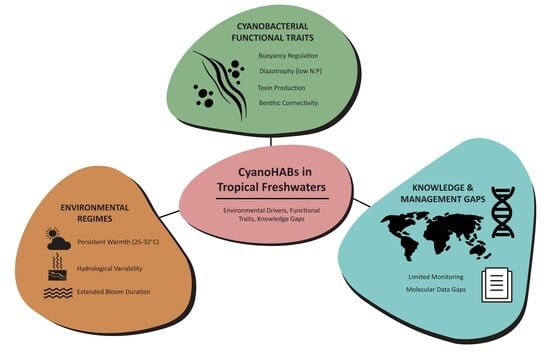
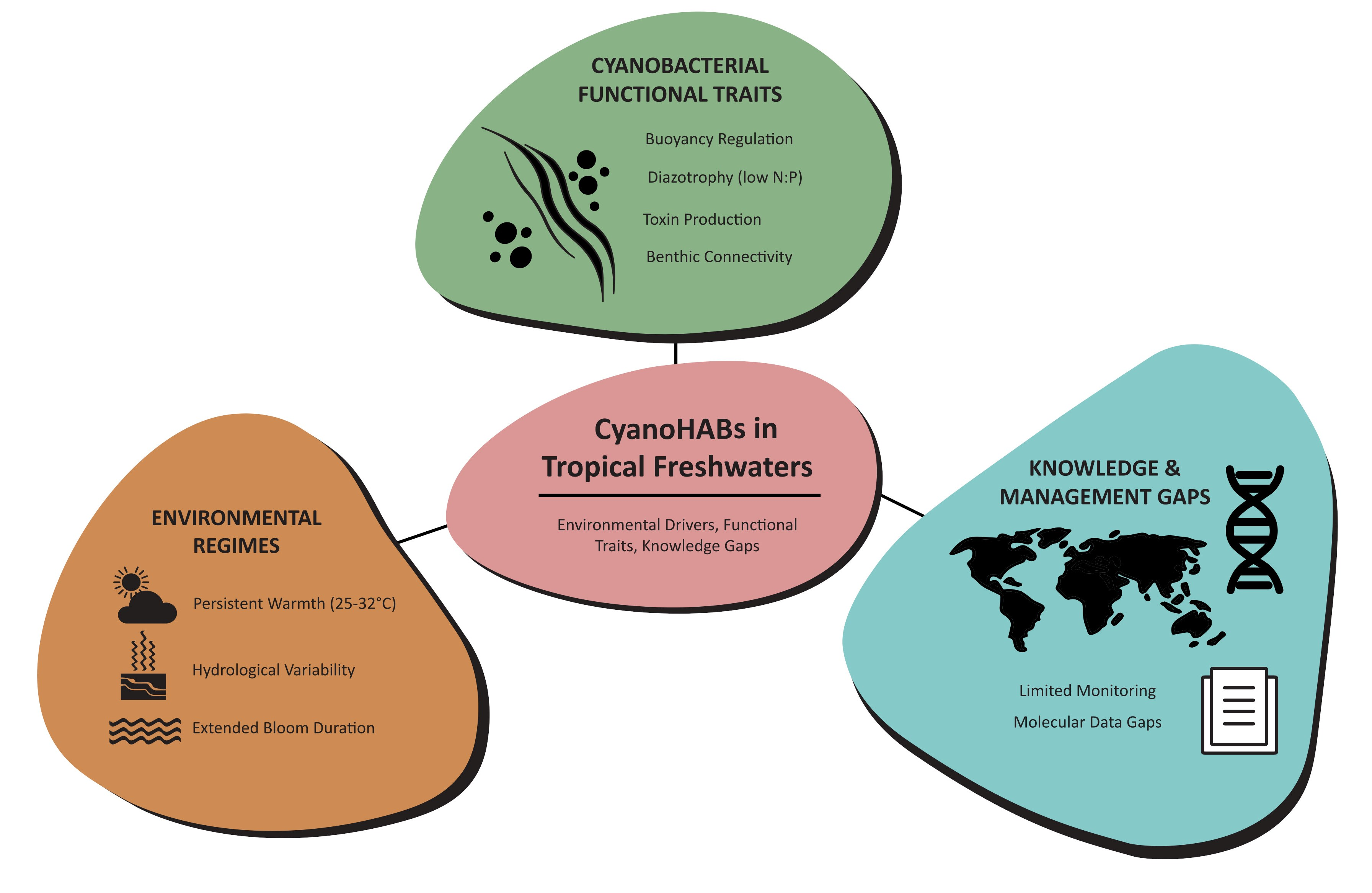
Graphical Abstract

1. Introduction

Cyanobacteria are photosynthetic prokaryotes [1] that occupy a wide diversity of illuminated environments [2], including freshwater and marine ecosystems [3], soils [4], and extreme habitats [5]. Beyond their foundational role in aquatic primary production, many taxa synthesize bioactive secondary metabolites, including microcystins, saxitoxins, anatoxins, and cylindrospermopsins, which can cause mass mortality events in aquatic fauna and pose serious risks to human and ecosystem health [6,7].
Over the past two decades, harmful cyanobacterial blooms (cyanoHABs) have intensified worldwide [8], driven primarily by climate warming, nutrient enrichment, and hydrological alterations that modify water-column stability, nutrient cycling, and microbial community dynamics [9,10]. Molecular approaches, including qPCR and metagenomics, have strengthened bloom surveillance by enabling rapid detection of toxin biosynthesis genes (e.g., mcy, sxt, ana) and improved taxonomic resolution [11,12]. However, gene presence does not necessarily translate into active toxin production, underscoring the need to interpret molecular signals alongside ecological and physicochemical evidence.
Most mechanistic understanding of cyanobacterial bloom ecology has been developed in temperate systems. Comparative studies in these regions demonstrate that warming, interacting with nutrient availability and water-column stability, can elevate cyanobacterial dominance and toxin concentrations at broad spatial scales [13,14]. By contrast, tropical and neotropical freshwaters operate under distinct environmental regimes, including persistently warm temperatures, intense irradiance, extended or recurrent stratification, and pronounced hydrological seasonality [15,16,17]. Evidence from tropical freshwater systems in South America (e.g., Brazil), Africa, and Southeast Asia shows that these conditions can sustain prolonged bloom windows and alter cyanotoxin dynamics in ways that are not fully captured by temperate-derived frameworks [18,19,20]. Because these systems are highly sensitive to climatic variability and land-use change, tropical lakes and reservoirs may also provide early indications of ecological transitions expected to intensify elsewhere under future warming scenarios [21].
CyanoHABs pose direct risks to public health through exposure to cyanotoxins in drinking water and recreational setting [22,23]. They also represent a growing challenge for water treatment and water-security management across tropical regions [24]. In Latin America, research output on cyanobacterial ecology has increased, yet major gaps persist, and monitoring remains geographically concentrated. A regional synthesis documented 295 cyanoHAB events across 14 countries between 2000 and 2019, including confirmed cyanotoxins in nine countries, while highlighting inconsistent bloom definitions and heterogeneous monitoring strategies that hinder cross-system comparability and coordinated risk assessment [25]. In Central America, peer-reviewed ecological studies remain particularly scarce. Panama exemplifies this regional knowledge gap: the Gatún Reservoir, an essential drinking-water source and a key component of the Panama Canal hydrological system, still lacks peer-reviewed ecological assessments of bloom dynamics, toxin expression, or nutrient thresholds. Available evidence is currently limited to graduate theses reporting microcystins across intake sites [26] and detecting mcy genes in a substantial proportion of sampled locations [27]. Although not peer-reviewed, these studies provide the only existing evidence of cyanotoxin occurrence and toxigenic potential in one of Central America’s most strategic freshwater reservoirs, highlighting a broader paradox in tropical regions: systems with high climatic sensitivity and water-security relevance often have the least ecological data available.
Targeted synthesis is essential to inform monitoring frameworks and management strategies aimed at protecting water quality and ecosystem services in tropical freshwater systems. Accordingly, this review integrates recent peer-reviewed experimental and field-based studies (2020–2025), complemented by foundational frameworks, to examine: (i) taxonomic diversity and community structure; (ii) functional ecology related to nutrient (N, P) cycling, environmental stressors (temperature, light, hydrology), and toxin-producing capacity; (iii) environmental and physicochemical drivers that modulate bloom dynamics under tropical regimes; and (iv) key research, monitoring, and management gaps. By consolidating evidence across tropical and neotropical systems, we aim to provide a rigorous foundation for developing region-appropriate cyanoHAB mitigation strategies under accelerating climate and land-use change. In doing so, we highlight integrative monitoring approaches that couple molecular diagnostics (qPCR, metagenomics), remote sensing for early bloom detection, and hydrologically informed physicochemical measurements tailored to the pronounced environmental variability of tropical aquatic systems.
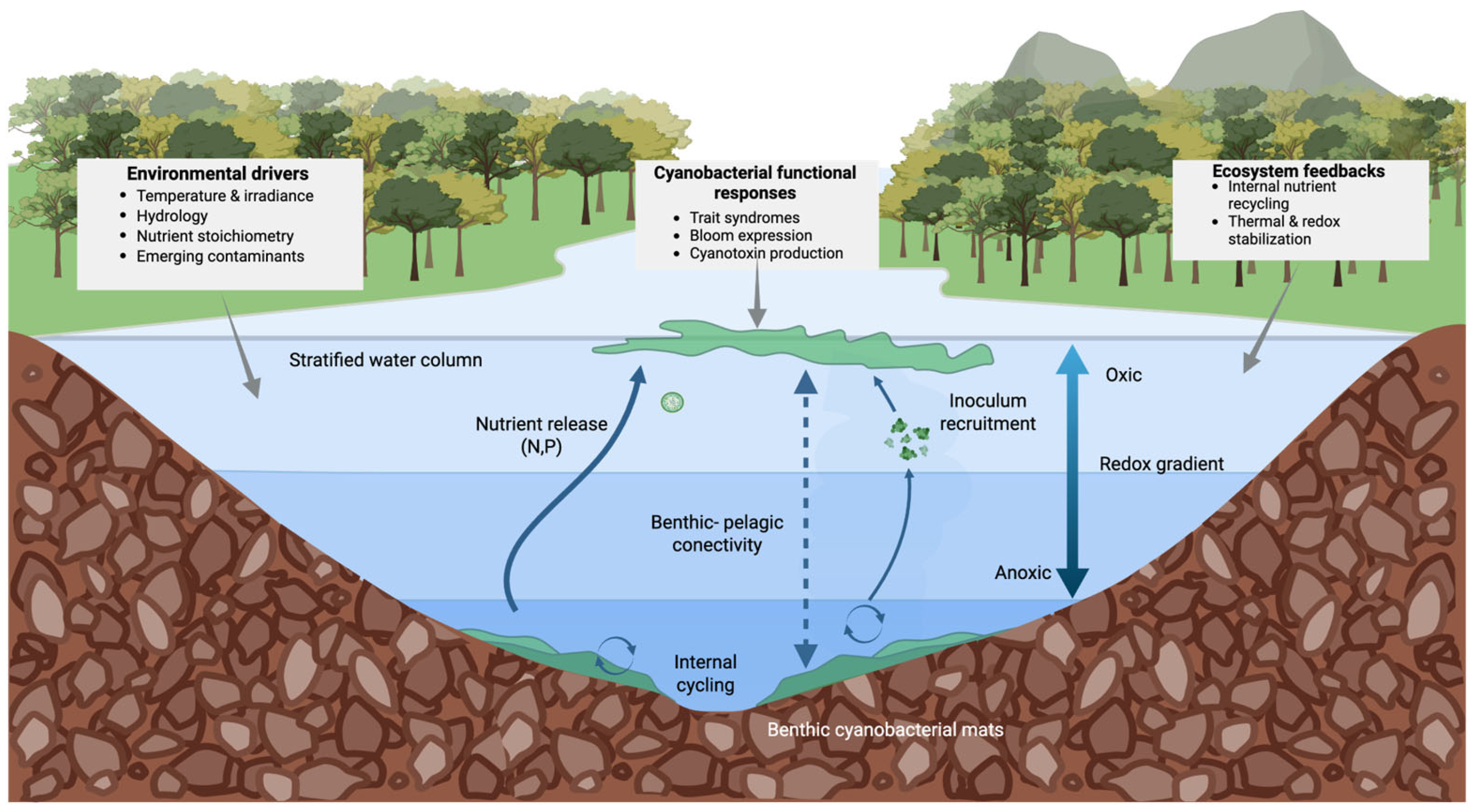
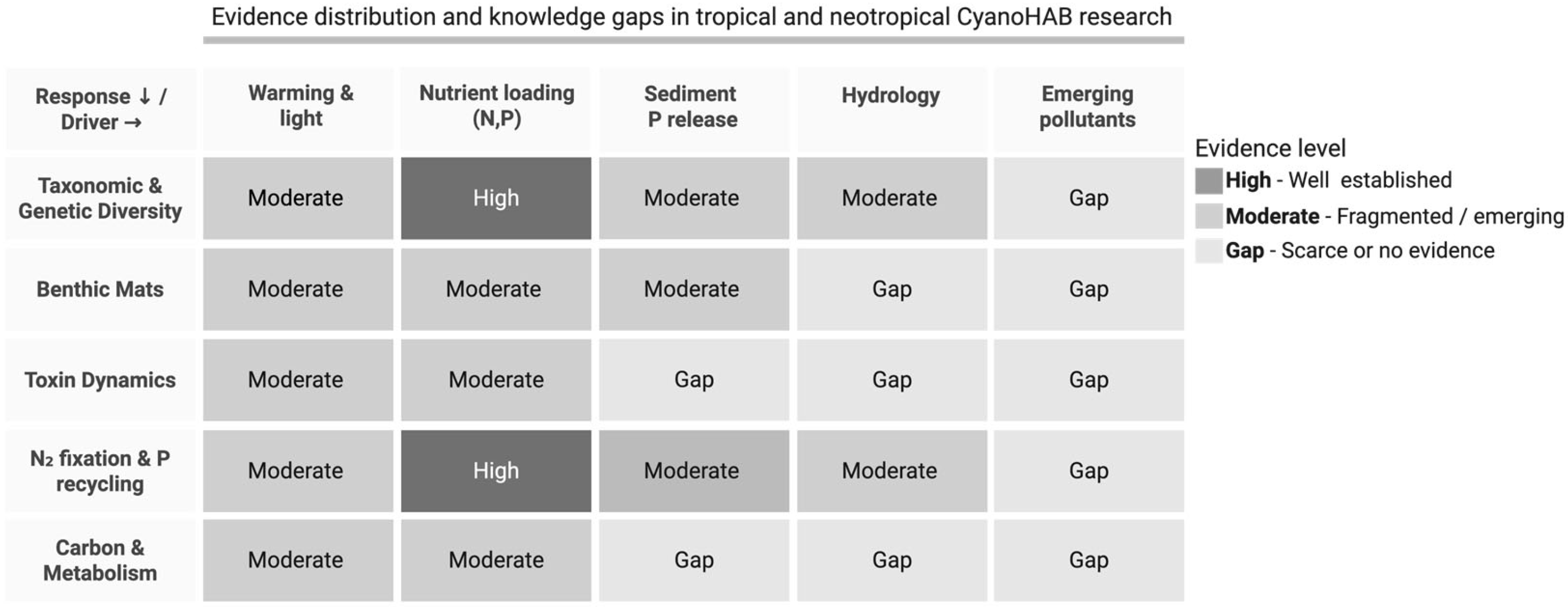
Throughout this review, cyanobacterial blooms are used as a general term for cyanobacterial proliferations, whereas cyanoHABs refers specifically to harmful events with documented ecological or human health impacts; tropical is used in a climatic sense, and neotropical denotes systems within the Neotropical biogeographic region. Artificial intelligence assistance (ChatGPT, OpenAI, GPT-5.2) was used to support language editing and the conceptual organization of Figure 1 and Figure 2. The tool was employed solely for writing and presentation purposes; all intellectual content, figure design, and conclusions are entirely the responsibility of the authors.

2. Cyanobacterial Ecology in Tropical Freshwater Systems: Diversity, Function, and Climatic Implications

Recent reviews have advanced global understanding of cyanobacterial taxonomy, molecular detection methods, and toxin biosynthesis pathways [28]. However, tropical and neotropical freshwater ecosystems exhibit distinctive ecological dynamics shaped by persistently high temperatures, strong irradiance, hydrological variability, and nutrient imbalances, which select for functional traits that differ from those commonly observed in temperate systems [17,29]. This section synthesizes recent experimental and field-based studies published between 2020 and 2025 on cyanobacterial diversity, functional ecology, and biogeographic patterns in tropical freshwater ecosystems, with emphasis on the traits and environmental drivers that underpin bloom dominance and ecosystem impacts under warm-region regimes [17,30,31,32].

2.1. Taxonomic Composition and Morphological Adaptations in Tropical Systems

Cyanobacteria comprise a phylogenetically diverse group encompassing unicellular, colonial, and filamentous forms with heterocysts and mucilaginous sheaths, enabling colonization of a wide range of aquatic microhabitats [33]. This morphological and functional diversity translates into high community variability, particularly in tropical freshwater ecosystems where temperature, irradiance, hydrology, and nutrient availability impose distinctive selective pressures [29,34]. Despite increasing research effort, global cyanobacterial diversity remains underestimated, with biodiversity assessments strongly biased toward temperate regions and planktonic habitats [29]. Recent syntheses indicate that a substantial proportion of newly described taxa originate from benthic or periphytic environments, underscoring the importance of underexplored tropical habitats for resolving cyanobacterial diversity and functional traits [33].
Benthic and periphytic cyanobacterial assemblages remain largely overlooked in tropical freshwater research, despite their ecological and taxonomic importance [34]. Notably underexplored habitats include epilithic and periphytic communities in tropical streams [35,36], epiphytic assemblages in lakes [37], benthic mats in shallow wetlands and rice paddies [12,38], and periphyton in the littoral zones of tropical reservoirs [39]. These non-planktonic habitats may support cyanobacterial lineages adapted to specific hydrological regimes, substrates, and light environments [38,40]. In Panama, cyanobacterial assemblages including filamentous and heterocystous taxa have been documented in geothermal systems with water temperatures ranging from 34 to 61 °C, underscoring the thermal tolerance and ecological plasticity of tropical strains [41]. However, they are still sampled far less frequently than open-water planktonic communities in tropical bloom studies [40].
Experimental and field-based studies demonstrate that warming and nutrient imbalances promote community assembly toward taxa exhibiting traits related to nitrogen acquisition, colony formation, and resistance to environmental stress. Experimental warming favors cyanobacterial dominance and alters ecosystem functioning by promoting species sorting under elevated temperatures [42]. Physiological responses to temperature and nutrient stoichiometry vary among key tropical taxa: nitrogen fixation capacity and EPS production in Dolichospermum respond to nitrogen availability, whereas Raphidiopsis raciborskii exhibits competitive advantages under variable N:P ratios and thermal gradients [43,44]. Filamentous benthic genera such as Calothrix, Tolypothrix, and Scytonema are frequently reported in periphytic habitats across tropical rivers and reservoirs, reflecting adaptation to fluctuating light and hydrological regimes [34]. Cultivable cyanobacteria isolated from tropical reservoir sediments further reveal high morpho-functional diversity, including potential toxin producers [45].
Despite these advances, major limitations persist. Many tropical taxa remain uncultivated or lack functional characterization, constraining ecological interpretation and toxin-risk assessment. Geographic gaps in cyanobacterial research remain pronounced across Latin America, Africa, and Southeast Asia, particularly for invasive taxa and benthic assemblages [46]. Morphological plasticity and cryptic diversity further complicate species-level resolution under tropical environmental variability [29]. Furthermore, molecular monitoring in tropical systems is still limited by the poor coverage of available qPCR assays, primer sets designed primarily for temperate climate strains, and the underrepresentation of tropical cyanobacteria in reference genomic databases [28]. These shortcomings hinder reliable detection and quantification of taxa, as well as toxin risk assessments. While integration of microscopy with molecular approaches has revealed previously undetected picoplanktonic and cryptic diversity [47], as recently demonstrated in Panamanian freshwater systems [48], public genomic repositories remain heavily biased toward temperate model strains [28]. Improving taxonomic and functional resolution of tropical cyanobacterial assemblages is therefore critical for advancing ecological understanding and strengthening early-warning and toxin risk-management frameworks.

2.2. Ecological Functions in Pelagic and Benthic Tropical Regimes

Cyanobacteria in tropical freshwater ecosystems perform key ecological functions, including primary production, biological nitrogen fixation, and internal nutrient cycling, and, particularly in benthic habitats, sustain complex microbial consortia [12,49]. These functions are strongly modulated by drivers characteristic of tropical and subtropical systems, high temperature, hydrological variability, and extreme thermal events, which differ markedly from temperate regimes and shape cyanobacterial biomass, dominance, and bloom dynamics [50,51].

2.2.1. Primary Production and Carbon Fixation

Cyanobacteria often dominate primary production in tropical eutrophic systems and may account for up to 95% of phytoplankton biomass during warm, dry seasons, as documented in shallow Brazilian lakes [50,52]. Similar dominance patterns, along with temperature-related constraints on net carbon fixation, have also been observed in tropical freshwater systems across Africa and Southeast Asia, including reservoirs and impundments [19,53]. Elevated temperatures (>28 °C) enhance photosynthetic rates but disproportionately increase respiratory demand; because respiration typically responds more strongly to temperature than photosynthesis, net carbon assimilation is expected to decline with progressive warming [54]. Consequently, tropical freshwaters experiencing intensified cyanoHABs may function as less efficient carbon sinks, with implications for ecosystem carbon balances, air–water CO2 exchange, and regional greenhouse gas emissions.
In warm, stratified lakes, prolonged thermal stability further reinforces cyanobacterial dominance by favoring taxa with vertical migration capacity. Long-term observations in a mesoeutrophic plateau lake show that warming and increased nutrient-use efficiency select for vertically migrating phytoplankton [55]. Buoyant genera such as Microcystis regulate their position via intracellular gas vesicles, enabling access to high-light surface waters and deeper nutrient pools; experimental evidence indicates that rising temperatures accelerate buoyancy regulation and migration dynamics, enhancing competitive advantage over non-motile phytoplankton [56].
While pelagic processes dominate system-scale primary production, benthic compartments play an increasingly recognized role in biomass persistence and internal nutrient retention in tropical freshwaters. Omics-based field studies show that benthic mats dominated by filamentous cyanobacteria, particularly Microcoleus (including taxa formerly classified as Phormidium), can sustain substantial biomass under severe nutrient limitation, with dissolved inorganic nitrogen and phosphorus often near or below detection limits [12,57]. Experimental work further demonstrates that mat-forming cyanobacteria accumulate intracellular polyphosphate during periods of elevated phosphate availability and subsequently remobilize these reserves to sustain growth under phosphorus scarcity, highlighting polyphosphate as a key internal phosphorus buffer in cyanobacterial mats [38,58].
Despite these advances, empirical data on net primary productivity, community metabolism, and carbon fluxes in tropical and subtropical lentic systems remain scarce. Recent syntheses emphasize that carbon budgets of tropical lakes are still poorly constrained due to limited measurements of ecosystem-scale metabolism, carbon export, and air–water gas exchange, restricting our ability to quantify the role of cyanoHAB-dominated systems in regional and global carbon cycling [40,59,60].

2.2.2. Nitrogen Fixation in Phosphorus-Enriched Systems

Many tropical lakes and reservoirs are phosphorus-rich but seasonally nitrogen-limited because of intense nitrogen cycling, hydrological variability, and anthropogenic inputs. Under these conditions, diazotrophic cyanobacteria such as Raphidiopsis and Dolichospermum frequently dominate and sustain blooms through heterocyst-based N2 fixation, particularly in warm, stratified eutrophic tropical reservoirs [61,62,63]. The high energetic cost and oxygen sensitivity of nitrogenase favor the spatial segregation of N2 fixation into specialized heterocysts that maintain low-oxygen microenvironments, a strategy that is especially effective in metabolically active tropical surface waters [64].
Experimental and field evidence indicates that warming, nitrogen scarcity, and reduced water volume synergistically promote diazotroph proliferation and internal nitrogen cycling. In Brazilian tropical reservoirs, N2 fixation is tightly linked to thresholds in dissolved inorganic nitrogen and phosphorus and can supply a substantial fraction of the annual nitrogen budget, particularly during periods of low water volume and strong stratification [62,65]. Similarly, in a shallow tropical freshwater lake, reduced water level and elevated temperature during the dry season enhanced phytoplankton primary production, nitrogen assimilation, and N2 fixation rates relative to the monsoon period, illustrating how drought and warming intensify diazotrophic activity [66].
In benthic compartments, metagenomic analyses of nutrient-depleted Microcoleus dominated mats reveal high abundances of nif, nar, nir and nosZ genes in both cyanobacteria and co-occurring heterotrophic bacteria, indicating tightly coupled N2 fixation and denitrification within the mat matrix [12]. Together, these findings suggest that diazotrophic cyanobacteria and associated microbial consortia can partially compensate for nitrogen deficits in tropical freshwaters and contribute to internal nitrogen recycling. However, quantitative in situ measurements of fixation rates, nitrogen-loss pathways, and microbial turnover remain scarce for most tropical lakes and reservoirs, limiting our ability to constrain whole-ecosystem nitrogen budgets and to predict bloom persistence under future warming and hydrological stress [67].

2.2.3. Phosphorus Cycling and Microzone Dynamics

Benthic and aggregate-associated cyanobacteria can strongly mediate phosphorus (P) dynamics through steep physicochemical gradients within extracellular polymeric substances (EPS), generating microzones in which P availability diverges from bulk water concentrations. In freshwater eutrophic lakes, Microcystis colonies can store a substantial fraction of particulate P within EPS, with ~40–65% of aggregate/particulate P occurring as EPS-associated P (EPS-P) and 16–34% of EPS-P present as soluble reactive P (SRP). Experimental evidence further indicates rapid replenishment of EPS-P following phosphate resupply, supporting EPS as a dynamic extracellular P buffer under fluctuating nutrient regimes [68].
Proteogenomic and physiological studies of freshwater benthic mats and periphyton dominated by filamentous cyanobacteria (e.g., Microcoleus) reveal multiple high-affinity phosphate transporters and phosphatases, consistent with Pho-regulon regulation under P limitation [57,58]. However, in tropical freshwater reservoirs, field evidence indicates that cyanobacterial dominance and community shifts are strongly driven by reactive phosphorus availability, hydrological mixing, and water-level fluctuations, rather than by bulk nutrient concentrations alone, as shown in small tropical reservoirs where bloom-forming taxa respond to seasonal mixing and P redistribution [53]. Despite these mechanistic insights, quantitative phosphorus budgets encompassing storage, release, and turnover in mat-dominated habitats of tropical and subtropical lentic systems remain scarce, limiting ecosystem-scale generalization of benthic contributions to internal P cycling [40,59].

2.2.4. Microbial Interactions and Nutrient Feedbacks

Cyanobacterial mats host complex microbial consortia composed of numerous bacterial taxa with complementary metabolic functions. Field-based and omics studies in nutrient-limited riverine mats document the co-occurrence of benthic cyanobacteria such as Microcoleus and Oscillatoria together with diverse heterotrophic lineages within Proteobacteria, Planctomycetota, and Bacteroidota, harboring genes involved in nitrogen fixation, denitrification, and phosphorus acquisition [12]. In combination with global syntheses of toxic benthic cyanobacterial proliferations, these findings support the view that mats function as biogeochemical “hotspots” capable of regenerating nutrients and sustaining biomass under otherwise limiting conditions [40].
Recent co-culture and multi-omics experiments further demonstrate that heterotrophic bacteria can enhance cyanobacterial growth through metabolic complementation and increased nutrient accessibility. In filamentous cyanobacteria-dominated photogranules, associated Chloroflexi and Proteobacteria promote polysaccharide biosynthesis and supply essential vitamins (e.g., B1 and B12), thereby stimulating cyanobacterial proliferation and aggregate stability [69]. Complementarily, studies on freshwater Microcystis blooms show that phycospheric heterotrophic bacteria mineralize phosphonates via C–P lyase and related pathways, releasing phosphate that sustains phosphorus-limited cyanobacteria and contributes to bloom persistence [70]. Long-term observations in estuarine reservoirs reveal tight co-occurrence between picocyanobacteria and heterotrophic bacteria involved in nitrogen transformation and organic matter remineralization, indicating that enhanced internal nutrient recycling can maintain cyanobacterial dominance under nutrient-limited conditions [71].
Beyond their role in nutrient cycling, tropical and subtropical benthic mats are increasingly linked to toxin production, particularly anatoxin-a and microcystins. A global synthesis of toxic benthic freshwater cyanobacteria and recent field surveys in tropical rivers of central Mexico report frequent detection of toxin genes and compounds in benthic assemblages, leading to the adoption of the term “Cyanobacterial Harmful Algal Mats” (CyanoHAMs) to describe these proliferations [35,40]. Together, these findings underscore the dual ecological role of cyanobacterial mats as efficient nutrient recyclers and as emerging environmental and public-health hazards.

2.3. Biogeographic Patterns and Tropical Systems as Climate Sentinels

Tropical cyanobacteria exhibit distinct biogeographic patterns shaped by persistently warm temperatures, hydrological variability, and widespread nutrient enrichment [72]. These contidions result in assemblages dominated by heat-tolerant, nitrogen-fixing, and ecologically flexible taxa. Compared with temperate systems, tropical freshwater environments sustain longer periods of cyanobacterial activity [73]. They also favor species capable of maintaining growth and photosynthetic performance under elevated thermal regimes [73]. Experimental studies indicate that bloom-forming taxa such as Microcystis display broad thermal niches, with growth optima typically between 25 and 32 °C [73]. Sustained activity above 30 °C exceeds the tolerance ranges of many temperate phytoplankton competitors [73,74].
A paradigmatic example of climate-responsive biogeography is Raphidiopsis raciborskii (formerly Cylindrospermopsis raciborskii). Integrative analyses combining genomic, phylogenetic, and toxin data reveal a global distribution spanning tropical, subtropical, and temperate region, with continent-specific toxin-producing lineages [75]. Molecular surveys based on qPCR detection of toxin biosynthesis genes (e.g., cyr and sxt clusters) corroborate the geographic structuring of toxigenic Raphidiopsis lineages [75,76]. Recent surveys document its increasing occurrence in central–eastern Europe and peri-Alpine lakes, while species distribution models identify air temperature and phosphorus availability as key predictors of biomass and presence [77,78]. Long-distance dispersal mediated by migratory waterbirds further facilitates its spread into previously uncolonized lentic systems, reinforcing its characterization as a climate-sensitive invasive cyanobacterium [79].
At the regional scale, Latin American syntheses report high bloom frequency but also pronounced geographic and methodological biases. Aguilera et al. [25] documented 295 cyanobacterial bloom and cyanotoxin events between 2000 and 2019 across 14 countries. Their analysis highlights substantial heterogeneity in monitoring approaches and regulatory thresholds, which limits regional comparability. Complementary analyses indicate that phosphorus enrichment and lake morphometry act as primary drivers of biomass and bloom occurrence [80]. Temperature functions as an amplifying factor under eutrophic conditions [81]. These patterns, summarized in Table 1, illustrate how tropical and subtropical systems combine strong nutrient forcing with high thermal suitability while remaining under-monitored relative to their ecological and public-health risk.
Climate and hydrodynamic modelling further underscore the value of tropical lakes as analogues for future temperate conditions. Projections suggest that many mid-latitude lakes will experience surface-water warming of +2–4 °C by mid- to late century, increasing the frequency of thermal regimes currently characteristic of low-latitude systems [88]. When contrasted with experimentally derived thermal niches of dominant bloom-forming taxa, tropical and subtropical lakes approximate the thermal and trophic states that many temperate systems are expected to approach in coming decades [73,75,77]. Consistent with this view, empirical studies from neotropical and subtropical reservoirs show that warming and hydrological alteration intensify cyanobacterial dominance and extend bloom duration in stratified systems [74,81]. Despite their relevance as climate sentinels, comparable datasets from Africa, Southeast Asia and Oceania remain scarce, limiting global synthesis and cross-regional comparisons.

2.4. Knowledge Gaps

Despite this progress, critical knowledge gaps remain. Long-term data on productivity and metabolic balance of cyanobacterial mats across tropical regions are scarce, as most studies are short-term or system-specific, limiting generalization of production–respiration dynamics [40,59]. Quantitative in situ estimates of nitrogen fixation and phosphorus storage, release, and recycling by benthic mats in tropical freshwaters remain limited, leaving the relative contributions of diazotrophy, denitrification, and internal phosphorus loading to whole-ecosystem nutrient budgets poorly constrained [12,68].
In addition, tropical freshwater mats remain underrepresented in genomic and metagenomic databases biased toward temperate model systems, hindering comparative and trait-based analyses [40]. Finally, few studies explicitly integrate microbiology, biogeochemistry, hydrology, and toxin dynamics in mat-dominated tropical freshwaters, despite growing evidence that such interdisciplinary approaches are essential for monitoring, mitigation, and management [35,59].

3. Environmental Drivers of Cyanobacterial Proliferation in Tropical Freshwater Systems

The proliferation of cyanobacteria in tropical freshwater ecosystems arises from the interaction of multiple environmental drivers, including nutrient enrichment, thermal structure, hydrological stability, and light availability, which operate differently than in temperate systems due to persistently high temperatures, weak seasonality, and elevated microbial metabolic rates. Ecohydrological models and long-term time series from tropical reservoirs show that the combination of chronic eutrophication, characterized by high nitrogen and phosphorus loads, and warm thermal regimes increases the probability, intensity, and duration of cyanobacterial blooms, even in systems experiencing frequent water-column mixing during very warm summers [30,89].
Quantitative studies from various tropical regions further support these patterns. In the Koka Reservoir (Ethiopia), phytoplankton biomass decreased markedly at river mouths during periods of heavy rainfall and runoff, due to hydrodynamically induced turbidity and reduced euphotic depth, despite persistently high concentrations of soluble reactive phosphorus and dissolved inorganic nitrogen [82]. At the Mae Kuang Dam (Thailand), a five-year monitoring study documented an almost 20-fold increase in cyanobacteria density (from 7180 to 1.4 × 10⁵ cells L−1) between 2015 and 2019, coinciding with elevated concentrations of soluble reactive phosphorus (up to 0.66 mg L−1) during wet seasons [19].
In shallow tropical reservoirs, interactions among nutrients, temperature, and water-level fluctuations often promote near-perennial bloom states. Long-term studies and functional-group analyses indicate that extreme hydrological conditions, such as prolonged droughts followed by intense rainfall events, destabilize phytoplankton community structure and shift assemblages toward dominance by colonial and filamentous cyanobacteria under warm, hypereutrophic conditions [31,52]. At the regional scale, compilations of bloom occurrences across Latin America reveal widespread recurrence of cyanobacterial events, but also strong geographic biases and limited long-term monitoring coverage, which constrain the robust disentangling of climatic, hydrological, and nutrient drivers of bloom dynamics [25].

3.1. Nutrient Enrichment and Stoichiometric Imbalances

Nutrient enrichment is a central driver of cyanobacterial dominance, but its expression in tropical and subtropical systems often differs from that in temperate freshwaters. In many tropical and semiarid catchments, diffuse phosphorus inputs derived from soil erosion, livestock activities and domestic discharges create a persistent background of high phosphorus availability, while dissolved nitrogen is more vulnerable to losses through denitrification in warm, anoxic sediments and rapid microbial transformations. These processes promote conditions of apparent nitrogen limitation during much of the year [65,89].
Under these conditions, studies in semiarid tropical reservoirs show that reductions in water volume during prolonged droughts increase cyanobacterial biomass primarily through the proliferation of heterocystous filamentous taxa and enhanced heterocyst production. This response is not driven solely by low bulk N:P ratios; rather, elevated trophic status, reduced light availability within the water column and increased salinity collectively explain the competitive advantage of diazotrophic taxa such as Raphidiopsis and Dolichospermum [64].
Stoichiometric imbalances are further reinforced by internal phosphorus loading from sediments, which is particularly pronounced in warm, shallow lakes. In Lake Taihu, a large eutrophic subtropical lake, sediment phosphorus fluxes have been shown to equal or exceed external inputs, especially under anoxic or hypoxic summer conditions, maintaining high dissolved phosphorus concentrations that sustain blooms despite reductions in watershed nutrient loads [90,91,92,93].
In parallel, dissolved organic nitrogen broadens the ecological niche of cyanobacteria under conditions of apparent inorganic nitrogen limitation. In the same system, time-series analyses and incubation experiments demonstrate that fractions of dissolved organic nitrogen are bioavailable and are internally transformed into inorganic forms, contributing to the maintenance of high cyanobacterial biomass during periods of low external nitrogen supply [94]. Field experiments and measurements of ammonium regeneration further indicate the existence of a tightly coupled internal recycling loop, in which cyanobacteria-dominated phytoplankton communities stimulate ammonium regeneration within the water column, and this regenerated ammonium in turn sustains bloom persistence during periods of nitrogen scarcity [95].
Taken together, chronic phosphorus enrichment, strong internal phosphorus loading from warm sediments, and intensive recycling of organic and inorganic nitrogen maintain persistently low effective N:P ratios that favour diazotrophic and nitrogen-tolerant cyanobacteria in tropical lakes and reservoirs. Importantly, these nutrient-driven feedbacks establish background conditions upon which hydrological variability and thermal structure act, helping to explain the persistence of blooms even after the implementation of catchment-scale nutrient-reduction measures.

3.2. Hydrological Regime and Water Residence Time

Hydrology strongly modulates cyanobacterial dynamics in tropical freshwaters by controlling water volume, residence time, mixing intensity, and nutrient transport. In semiarid tropical reservoirs, extreme hydrological variability, ranging from intense rainfall to prolonged drought, drives large oscillations in water level and storage volume, with direct consequences for phytoplankton structure and bloom development [31,52]. Hydraulic residence time (HRT) mediates many of these effects by regulating biomass accumulation versus flushing losses: long residence times favour the persistence of slow-growing, bloom-forming cyanobacteria, whereas shorter residence times can reduce biomass through dilution.
However, evidence from warm, nutrient-enriched systems indicates that reduced residence time alone is often insufficient to suppress blooms. In a restored eutrophic lake, cyanobacterial biomass increased along the flow path despite very short residence times (~3 days), and nutrient-enrichment assays revealed rapid growth responses within days, particularly under elevated phosphorus availability [96]. These findings highlight that, under tropical thermal regimes, hydrological control interacts strongly with nutrient availability rather than acting as an independent regulating mechanism.
In flowing systems, hydrological variability also governs the development, persistence, and redistribution of benthic cyanobacterial mats. Low-flow periods promote stable, high-light conditions that favour mat accrual, while oxygen bubble entrapment within the extracellular matrix can increase buoyancy and trigger autogenic detachment, allowing mats to float and accumulate along river margins [40]. Conversely, high-flow events fragment mats and enhance hydraulic scour, promoting downstream transport of biomass and associated cyanobacterial material across freshwater networks [40,97]. These processes link hydrological disturbance regimes with benthic–pelagic connectivity and the spatial redistribution of cyanobacteria and their by-products, setting the stage for broader ecosystem-scale impacts under variable flow conditions.

3.3. Thermal and Light Regimes

Tropical freshwater systems commonly experience extended periods with surface-water temperatures exceeding 26 °C, overlapping with the thermal optima of many bloom-forming cyanobacteria. Laboratory experiments with Microcystis aeruginosa demonstrate that growth rates peak under warm conditions (28–32 °C) and remain high at temperatures above 30 °C, indicating broader thermal tolerance than that of many eukaryotic phytoplankton competitors [73]. Controlled warming experiments further show that elevated temperatures modify cellular physiology and toxin dynamics, including shifts in the allocation of microcystins between freely soluble and protein-bound pools, highlighting temperature-sensitive regulation beyond simple biomass effects [98,99].
Field observations from tropical and subtropical reservoirs are consistent with these experimental patterns. In the Billings Reservoir (Brazil), microcystin concentrations increase markedly during periods of elevated water temperature and high cyanobacterial biomass, with more frequent exceedances of guideline values above 25 °C [100]. Similarly, long-term monitoring in a deep, warm monomictic lake in Mexico identified seasonal stratification and water temperature as key predictors of Microcystis aeruginosa bloom development, underscoring the role of thermal structure in regulating bloom timing and intensity under warm-climate regimes [101]. In the Koka Reservoir (Ethiopia), Microcystis and Raphidiopsis (formerly Cylindrospermopsis) comprised 41% and 46%, respectively, of the cyanobacterial biomass under nutrient-enriched conditions, although high turbidity during periods of heavy rainfall temporarily suppressed bloom formation [82]. At the Mae Kuang Dam (Thailand), sustained water temperatures of 26–31 °C, along with warm air temperatures (30–33 °C), facilitated a 20-fold increase in cyanobacterial density over five years, with blooms dominated by Anabaena (=Dolichospermum), Chroococcus, and Aphanizomenon coinciding with warm seasons, high irradiance, and elevated soluble reactive phosphorus [19].
High solar irradiance characteristic of low-latitude regions further interacts with temperature to shape cyanobacterial performance. Experimental evidence indicates that combined thermal and light stress alters oxidative balance and cellular metabolism in bloom-forming taxa, with downstream consequences for growth, stress tolerance, and toxin regulation under irradiance levels typical of tropical surface waters [73,99]. These responses support the view that light and temperature act synergistically rather than independently in controlling cyanobacterial physiology in tropical systems.
Thermal stratification, reinforced by persistent surface heating and reduced vertical mixing, also strengthens redox gradients in the water column and sediments. Under warm conditions, these gradients enhance sediment–water nutrient exchanges, allowing internal phosphorus release to sustain high nutrient availability during bloom periods and reinforcing cyanobacterial dominance even when external inputs are reduced [93,102]. Rather than acting in isolation, thermal and light regimes therefore modulate the expression of nutrient and hydrological drivers, contributing to positive feedback that stabilize blooms in tropical and subtropical freshwaters.

3.4. Synergistic Interactions Among Environmental Drivers

Cyanobacterial blooms in tropical freshwater systems rarely arise from a single environmental driver; instead, they emerge from synergistic interactions among temperature, irradiance, hydrology, and nutrient cycling that generate reinforcing feedbacks regulating bloom initiation, persistence, and recurrence. Elevated temperatures accelerate microbial metabolism and internal nutrient recycling, while thermal stratification enhances sediment–water phosphorus fluxes, sustaining high nutrient availability within the euphotic zone and favouring bloom-forming cyanobacteria in nutrient-enriched systems [93,103].
In tropical semiarid reservoirs, long-term datasets show that pronounced hydrological variability, characterized by intense rainfall events followed by drawdown and prolonged drought, drives large oscillations in water level and storage volume. These fluctuations alter nutrient concentrations, light climate, and residence time, frequently shifting phytoplankton communities toward colonial and filamentous cyanobacteria under warm and eutrophic conditions. Such patterns illustrate that hydrology modulates the expression of nutrient and temperature effects rather than acting as an independent driver [31,52].
Hydrometeorological anomalies, including short-term heat waves and extreme precipitation events, further modify bloom dynamics by interacting with background trophic status and thermal structure. Mesocosm experiments combining press warming with episodic heat-wave events demonstrate earlier bloom onset and increased cyanobacterial biomass under nutrient-rich conditions, particularly at the benthic–pelagic interface [103]. High-frequency monitoring and modelling in warm and subtropical lakes similarly indicate that intense rainfall events can alter stratification and nutrient availability, with bloom responses depending strongly on event timing, basin morphometry, and flushing intensity [31,32,104].
Emerging stressors such as microplastics add an additional layer of complexity to these multi-driver interactions by modifying physical and chemical exposure pathways within bloom-forming systems. Experimental and field evidence indicates that microplastics can interact with cyanobacterial biomass and dissolved toxins, potentially influencing transport, persistence, and bioavailability without directly regulating cyanobacterial growth [105,106,107]. The implications of these interactions for toxin fate and risk are addressed in detail in Section 4.
Taken together, these findings support a multi-driver framework in which warming, irradiance, hydrological variability, internal nutrient loading, and emerging contaminants interact to shape cyanobacterial bloom dynamics in tropical freshwaters through ecosystem-level feedback, including internal nutrient recycling and the stabilization of thermal and redox conditions that reinforce cyanobacterial dominance. These interacting processes and feedbacks are conceptually synthesized in Figure 1, which integrates thermal structure, hydrology, nutrient recycling, benthic–pelagic connectivity, and contaminant-mediated exposure pathways under tropical freshwater conditions.

3.5. Synthesis and Outstanding Knowledge Gaps

Tropical freshwater ecosystems provide particularly favourable conditions for cyanobacterial proliferation because multiple environmental drivers, high and relatively stable temperatures, strong irradiance, hydrological variability, and chronic nutrient enrichment, converge and frequently amplify one another. Although recent advances have clarified many individual mechanisms, critical gaps remain that specifically limit driver-based prediction, early-warning capacity, and effective management of cyanobacterial blooms in tropical freshwaters.
Integrated, high-resolution field evidence linking multiple drivers within the same systems is still scarce. Most tropical lakes and reservoirs lack coordinated long-term programmes that simultaneously quantify nutrient budgets (including internal loading), stratification and redox dynamics, hydrology, and cyanobacterial responses, constraining mechanistic attribution of bloom dynamics to specific driver interactions. In addition, benthic–pelagic connectivity is rarely incorporated into predictive frameworks, despite growing evidence that benthic cyanobacterial mats contribute to nutrient recycling and may act as inoculum sources under warm and hydrologically variable conditions.
Emerging pathways that modulate bloom persistence and toxin exposure rather than primary growth also remain poorly constrained. Dissolved organic nitrogen, internally regenerated ammonium, and contaminant-mediated interactions are increasingly recognized as modifiers of cyanobacterial dominance and toxin dynamics, yet their ecosystem-scale relevance in tropical systems is still poorly resolved. Finally, most predictive and management frameworks remain biased toward temperate taxa and seasonal regimes, limiting their applicability to warm, hydrologically dynamic tropical freshwaters and to key functional groups such as diazotrophs and benthic cyanobacteria.
Addressing these gaps will require coordinated approaches integrating long-term multi-driver monitoring, targeted experiments, high-resolution biogeochemistry, and modeling explicitly parameterized for tropical conditions. Such integration is essential to move from descriptive understanding toward predictive capacity and effective management of cyanobacterial blooms in tropical freshwater ecosystems.

4. Major Cyanotoxin Classes and Their Ecological and Environmental Roles

Cyanobacteria synthesize a wide range of bioactive secondary metabolites, among which microcystins (MCs), cylindrospermopsins (CYNs), anatoxins (ATXs), and saxitoxins (STXs) are the most frequently reported in freshwater systems. Microcystins are cyclic heptapeptide hepatotoxins, produced mainly by Microcystis, Dolichospermum and Planktothrix via NRPS/PKS pathways, that inhibit serine/threonine protein phosphatases 1 and 2A, leading to hepatocellular damage and tumor promotion [108,109]. Cylindrospermopsin is a tricyclic guanidinium alkaloid that inhibits protein and glutathione synthesis and induces oxidative stress [108]. Saxitoxins comprise a family of guanidinium alkaloids that block voltage-gated Na+ channels, whereas anatoxin-a and the related organophosphate guanitoxin interfere with neuromuscular transmission through nicotinic acetylcholine receptor binding or irreversible acetylcholinesterase inhibition, respectively, resulting in rapid neurotoxicity [109,110].
Beyond their relevance for human and wildlife health, cyanotoxins can confer ecological advantages to their producers by mediating interactions with grazers and competitors. Experimental feeding and mesocosm studies demonstrate that toxic Microcystis and Raphidiopsis reduce daphniid filtration rates and alter grazing behavior, thereby weakening top-down control on cyanobacterial biomass [111,112]. These ecological consequences are examined in detail in Section 4.2.

4.1. Environmental Modulation of Cyanotoxin Production

Cyanotoxin production is not constitutive but is strongly modulated by environmental drivers, including temperature, nutrient stoichiometry, light regime, and co-occurring stressors. Laboratory and mesocosm studies show that ecologically realistic warming alters both cyanobacterial growth and toxin quotas, with thermal acclimation experiments demonstrating that microcystin (MC) production depends on thermal history as well as instantaneous temperature, leading to context-dependent changes in toxin yield per unit biomass [98]. Incubation experiments during a Planktothrix-dominated winter bloom further showed that a +3 °C temperature increase significantly elevated microcystin concentrations, with additional interactive effects of light intensity and nutrient enrichment [113]. At the community level, short-term warming (+2–5 °C) in eutrophic lakes increased the relative abundance of toxin-producing cyanobacteria and strengthened associations between mcy genes and cyanobacterial dominance, indicating selective advantages for toxic genotypes under warming scenarios [114].
Nutrient stoichiometry further regulates cyanotoxin synthesis, particularly in diazotrophic taxa. Experimental studies on saxitoxin-producing Raphidiopsis raciborskii showed that reduced nitrogen and phosphorus availability upregulated expression of the biosynthetic gene sxtA4, with coordinated responses in genes involved in nitrogen metabolism (ntcA, nifH) and phosphate acquisition (pstS) [115]. Moderate nutrient limitation increased intracellular saxitoxin content in some cases, whereas strong phosphorus reduction altered toxin congener profiles despite enhanced transcription, highlighting a frequent decoupling between growth and toxicity under nutrient stress.
Light and oxidative stress act as additional modulators of cyanotoxin dynamics. Multifactorial experiments demonstrate that microcystin responses to irradiance and nutrient enrichment are non-linear and depend on background thermal conditions [113]. At the cellular level, exposure to cylindrospermopsin and microcystin-LR induces oxidative stress, mitochondrial dysfunction, and reduced viability in human kidney cells, underscoring the close mechanistic link between cyanotoxins and redox regulation [108]. Integrative syntheses further emphasize that temperature, light and nutrient limitations jointly regulate toxin production and its ecological consequences, including altered grazing pressure and competitive interactions in aquatic food webs [109].
Emerging contaminants can additionally modify cyanotoxin fate without directly affecting cellular production. Laboratory studies show that polypropylene and polyethylene terephthalate microplastics readily absorb multiple microcystin congeners, with sorption strongly influenced by polymer type and particle size [105,106]. Field evidence confirms that naturally weathered microplastics accumulate cyanobacterial toxins in eutrophic lakes [107], and recent syntheses highlight their dual role as sinks and mobile carriers that may alter toxin transport, persistence and bioavailability [116]. Together, these findings demonstrate that cyanotoxin production and persistence are governed by interacting environmental drivers, temperature, nutrient stoichiometry, and light, whose effects are often non-linear and context-dependent, particularly under warm and nutrient-enriched conditions [98,113,114].

4.2. Ecological Impacts on Aquatic Communities and Ecosystem Functioning

Cyanotoxins affect aquatic communities across multiple trophic levels and can alter ecosystem structure and functioning. At the base of the food web, toxic cyanobacterial blooms reduce phytoplankton diversity through allelopathic interactions, selective grazing resistance, and light limitation associated with high biomass and surface scums. These processes favor toxin-producing or tolerant taxa, destabilize phytoplankton community composition, and modify patterns of primary production and energy transfer [109]. Experimental and in vitro studies using purified toxins or toxic cell extracts further demonstrate growth inhibition, oxidative stress, and impaired cellular function in a wide range of non-target organisms exposed to environmentally realistic concentrations of microcystins and cylindrospermopsin [108,117].
Zooplankton are particularly sensitive to cyanotoxins, making them key mediators of toxin effects on pelagic food webs. In a neotropical reservoir, exposure to a saxitoxin-producing strain of Raphidiopsis raciborskii significantly reduced survival, grazing efficiency, and reproductive output of Daphnia, weakening top–down control on cyanobacterial biomass even when alternative, nutritionally adequate algal resources were present [118]. Comparable responses, including reduced filtration rates, altered behavior, and population declines, have been reported for other cladocerans, copepods, and benthic invertebrates exposed to microcystin-rich diets or dissolved cyanotoxins, reinforcing the capacity of toxic blooms to restructure consumer communities [111].
Fish and amphibians experience both acute and chronic effects following cyanotoxin exposure, including oxidative stress, tissue damage, endocrine disruption, impaired growth, and reduced reproductive performance. Chronic sublethal exposure to microcystins and other cyanotoxins has been associated with histopathological alterations and changes in antioxidant enzyme activity in fish inhabiting tropical and subtropical lakes and reservoirs used for water supply, fisheries, and aquaculture, while bioaccumulation in edible tissues poses additional risks to human consumers [109,119].
At the ecosystem scale, the senescence and decomposition of dense cyanobacterial blooms promote hypoxia or anoxia, increase sediment oxygen demand, and enhance internal nutrient loading through redox-driven phosphorus release, reinforcing eutrophic feedback and bloom recurrence [109]. Long-term monitoring in subtropical reservoirs demonstrates that sustained co-occurrence of high cyanobacterial biomass with elevated microcystin and saxitoxin concentrations can generate chronic ecological risk across seasons, with risk quotients for aquatic life frequently exceeding threshold values [11]. Collectively, these processes position cyanotoxins as key ecological mediators linking cyanobacterial dominance with trophic restructuring and altered ecosystem functioning in tropical freshwater systems [11,109].

4.3. Human and Ecosystem Health Risks in the Tropics

Tropical and neotropical regions face risks from cyanobacterial toxins because high bloom potential frequently coincides with limited monitoring capacity and inadequate water-treatment infrastructure. A synthesis of Ibero-American freshwaters documented widespread occurrence of toxic cyanobacteria and cyanotoxins, particularly microcystins, in reservoirs used for drinking water, irrigation, and aquaculture, with many sites lacking systematic surveillance and long-term datasets [120]. In several Brazilian and Mexican reservoirs, microcystin concentrations have repeatedly exceeded WHO guideline values during warm, stratified periods, resulting in water-supply disruptions, fish mortality events, and restrictions on recreational use [109,120].
In Panama, peer-reviewed evidence remains scarce, and available information is largely derived from unpublished academic theses. Early assessments reported the presence of microcystins in raw water from Gatun Lake and other water intakes within the Panama Canal basin, with concentrations associated with elevated phosphorus levels and warm conditions [26]. Subsequent molecular analyses detected mcyB and mcyE genes in raw water from Gatun Reservoir, indicating the presence of potentially toxigenic cyanobacterial genotypes in a substantial proportion of samples [27]. While these studies are not peer-reviewed publications, they provide preliminary evidence of cyanotoxin occurrence and toxigenic potential in strategically important water-supply reservoirs.
More recently, peer-reviewed ecological assessments have begun to emerge. Phytoplankton-based bioindicator analyses in small tropical streams identified the occurrence of Planktothrix sp. in eutrophic reaches downstream of agricultural activities, reflecting deteriorated ecological conditions under nutrient enrichment [121]. Although cyanotoxin concentrations were not quantified in these systems, Planktothrix is a well-documented producer of microcystins and other bioactive peptides in freshwater environments [109], reinforcing concern about the emergence of toxic taxa in small tropical catchments. Although peer-reviewed evidence from Panama remains limited, the available molecular and phytoplankton-based studies provide consistent early signals of cyanobacterial and cyanotoxin risks in strategically important freshwater systems, highlighting the need for systematic, long-term monitoring in the region.
Together, these observations suggest that rural and peri-urban tropical watersheds, including reservoirs and small streams, may already be experiencing early stages of eutrophication and cyanobacterial proliferation. Given the reliance of many communities on untreated or minimally treated surface waters for domestic use, irrigation, fisheries, and livestock, cyanotoxin contamination represents a growing One-Health challenge linking human health, animal health, biodiversity, and freshwater ecosystem services across the neotropics [120].

4.4. Management Challenges and Research Needs

Managing cyanotoxin risks in tropical freshwater systems requires integrated strategies that combine limnological, toxicological, and socio-economic perspectives. Although nutrient load reduction remains a cornerstone of cyanoHAB management, its effectiveness in warm lakes and reservoirs is often constrained by high internal phosphorus loading, persistent thermal stratification, and long water residence times. Experimental and field-based evidence indicates that internal phosphorus recycling can substantially contribute to the bioavailable nutrient pool, sustaining cyanobacterial blooms even when external inputs are reduced, underscoring the need to explicitly address sediment phosphorus release, hydrological manipulation (e.g., artificial mixing or controlled flushing), and catchment-scale land-use practices in mitigation strategies [93,120].
Monitoring programmes in tropical regions should move beyond sporadic cell counts and chlorophyll-a measurements to incorporate routine quantification of multiple cyanotoxin classes using analytical approaches such as ELISA or LC–MS/MS, molecular screening of toxin biosynthesis genes (e.g., mcy, cyr, sxt, ana) in planktonic and benthic communities, and high-frequency measurements of key environmental drivers including temperature, water residence time, and nutrient stoichiometry [109,120]. In under-resourced basins, combining low-cost field kits, satellite remote sensing, and community-based surveillance offers a pragmatic pathway to strengthen early-warning capacity and link scientific monitoring with local decision-making [120].
Key research needs in tropical and neotropical systems include expanding comparable measurements of cyanotoxins across lakes, reservoirs, rivers, wetlands, and small streams spanning gradients of land use, hydrological regime, and thermal structure; isolating and characterizing regional cyanobacterial strains to link toxin gene potential with realized toxin production under field-relevant stressors such as warming, nutrient imbalance, and high irradiance; and experimentally evaluating how emerging contaminants modify toxin exposure pathways. Experimental and field evidence indicates that microplastics can modify cyanotoxin transport, persistence, and bioavailability through adsorption processes influenced by polymer type and particle size, and by interactions with co-occurring contaminants [105,106,107,122]. These findings underscore the need to explicitly integrate contaminant-mediated pathways into cyanotoxin monitoring, risk assessment, and management frameworks in tropical freshwater systems.
Finally, there is a critical need to develop predictive frameworks explicitly parameterized for tropical conditions, integrating hydrology, climate variability, microbial ecology, and toxin monitoring to support adaptive management and policy design for drinking-water security, aquaculture, and ecosystem conservation [93,120]. As climate warming lengthens stratification periods and intensifies hydrological extremes, tropical freshwater ecosystems will continue to function as natural laboratories for understanding cyanobacterial and cyanotoxin responses to multi-stressor scenarios, making strengthened research, monitoring, and modelling efforts essential for both local risk management and global freshwater-quality forecasting. The main management and monitoring actions recommended for tropical freshwater systems are summarized in Table 2.

5. Synthesis and Future Perspectives

Tropical freshwater ecosystems are increasingly recognized as pivotal systems for understanding global trajectories of cyanobacterial proliferation and cyanotoxin production. Evidence synthesized in this review indicates that interacting climatic and nutrient-related drivers sustain extended cyanobacterial growing seasons and modulate toxin biosynthesis in tropical freshwater ecosystems [8,72,85]. Despite this relevance, tropical and neotropical freshwaters remain substantially underrepresented in the cyanobacteria and cyanotoxin literature relative to temperate systems, with pronounced data gaps across Latin America, Africa, and Southeast Asia [25,120].

5.1. Emerging Patterns Under Climate and Land-Use Change

Recent studies show that bloom-forming cyanobacteria in tropical and subtropical regions exhibit high metabolic plasticity and broad ecological tolerance. Genera such as Microcystis, Raphidiopsis, and Planktothrix frequently dominate eutrophic lakes and reservoirs under conditions of elevated temperature and phosphorus enrichment, combining traits such as buoyancy regulation, nitrogen fixation, high thermal optima, and, in some strains, elevated toxin production [8,72,85]. Thermal acclimation experiments further demonstrate that warming within ecologically realistic ranges (approximately 20–32 °C) can significantly modify growth rates and microcystin production, underscoring the potential for climate warming to amplify harmful traits rather than merely increase biomass [98].
Land-use change acts as a reinforcing driver. Agricultural intensification, deforestation, and urban expansion increase external nutrient and sediment inputs, shifting oligotrophic or mesotrophic waters toward eutrophic states prone to recurrent blooms. A synthesis of 295 cyanobacterial bloom events across 14 Latin American countries documented strong associations between bloom occurrence, nutrient enrichment, and land-use pressure, while also revealing major monitoring gaps in several tropical nations [25].
In Panama, available evidence, although still limited, aligns with these regional patterns. As summarized in Section 4.3, microcystins and toxigenic genotypes have been detected in raw water from the Panama Canal basin, and phytoplankton-based assessments in rural streams have documented the occurrence of potentially toxic cyanobacteria under nutrient-enriched conditions. Together, these observations suggest that Panamanian freshwater systems may already be entering early stages of eutrophication-associated cyanobacterial risk.
Climate change is expected to intensify these patterns. Global analyses indicate that warming is strengthening and lengthening stratification in many lakes, thereby expanding the temporal window favorable for cyanobacterial dominance [124]. In parallel, a decade-long study in a tropical semiarid reservoir showed that extreme hydrological variability, heavy rainfall followed by prolonged drought, restructures phytoplankton functional groups, with colonial and filamentous cyanobacteria dominating under warm, low-water conditions [31]. Collectively, these processes suggest a shift from episodic to increasingly persistent bloom regimes across tropical and subtropical freshwater networks.

5.2. Knowledge Gaps and Research Limitations in Tropical Regions

Despite increasing recognition of cyanobacterial risks in the tropics, data scarcity remains a major constraint for robust ecological and health-risk assessment (Figure 2). Continental-scale reviews show that long-term monitoring and experimental studies are concentrated in a small number of large reservoirs or temperate regions, while small lakes, wetlands, headwater streams, floodplains, and artificial ponds are rarely surveyed for cyanobacteria or cyanotoxins [25,120].
Key limitations include insufficient toxin quantification, only a minority of Ibero-American studies report measured concentrations of microcystins or other cyanotoxins, and strong geographic bias, with long-term datasets concentrated mainly in Brazil and Mexico [25,120]. In Panama, the evidence base relies largely on unpublished academic theses and a small number of case studies documenting microcystins, toxin genes, and early signs of eutrophication in reservoirs and rural streams [26,27,121]. A compilation of available occurrence records (Table S1) illustrates the fragmented and presence-only nature of cyanobacterial data in Panama, with limited taxonomic resolution and no systematic information on bloom intensity or toxin production.
Molecular surveillance also remains underdeveloped. Although qPCR, amplicon sequencing, and metagenomics are increasingly recognized as effective tools for detecting toxigenic genotypes, their routine integration into monitoring programs is still limited across tropical regions [120]. Finally, few tropical studies explicitly integrate cyanobacterial bloom and toxin dynamics with ecosystem-level processes such as organic-matter decomposition, nutrient cycling, or whole-ecosystem metabolism, despite clear experimental evidence of toxin-mediated disruption of pelagic and detrital pathways [109,118].

5.3. Perspectives for Integrated Management and Monitoring

Mitigating cyanobacterial risks in tropical freshwaters requires multi-scalar and interdisciplinary approaches that explicitly account for warm-region environmental regimes. While reductions in external nutrient loads remain essential, management strategies must also address internal phosphorus loading, altered nitrogen cycling, and warming-enhanced stratification in tropical lakes and reservoirs [85,124,125].
Catchment-scale measures, including riparian forest restoration and land-use regulation, are among the most effective long-term interventions, as intact riparian zones reduce nutrient and sediment runoff and buffer thermal and light stress [120,126]. Complementarily, biological indicators, such as phytoplankton community structure, benthic cyanobacterial mats, and macroinvertebrate assemblages, offer cost-effective tools for ecological assessment and early detection of bloom-related impacts in tropical systems, as demonstrated by recent syntheses linking biodiversity organization to hydrological and land-use gradients in neotropical freshwaters [121,127].
Strengthening analytical capacity and governance frameworks is equally critical. Coordinated monitoring networks across tropical regions could support predictive models integrating climate projections, hydrology, land-use dynamics, and toxin occurrence, thereby improving decision-making for drinking-water safety, aquaculture, and ecosystem conservation [8,25,85]. Partnerships with local communities, water utilities, and health agencies can further enhance participatory surveillance and risk communication, particularly in rural areas dependent on untreated or minimally treated surface waters [120].

5.4. Concluding Remarks

Tropical and neotropical freshwater ecosystems, long underrepresented in cyanobacterial research, are emerging as critical sentinels of global change. Their extended growing seasons, strong climate sensitivity, and rapid exposure to anthropogenic stressors provide unique insight into how multiple drivers interact to shape cyanobacterial ecology and toxicity in a warming world [8,85]. Bridging the knowledge gap between temperate and tropical regions will enhance predictive capacity, support more equitable water-management strategies, and help safeguard biodiversity, food security, and human health in the Global South. Strengthening tropical research and monitoring is therefore not only a regional priority, but a prerequisite for a truly global understanding of cyanobacterial risks under climate change [25,120].

6. Conclusions

Tropical freshwater ecosystems offer critical insight into the global ecology of cyanobacteria under accelerating environmental change. In contrast to many temperate systems, tropical lakes, reservoirs, wetlands, and streams sustain prolonged or near-continuous cyanobacterial activity due to persistently warm temperatures, pronounced hydrological variability, and chronic nutrient enrichment. These conditions position tropical freshwaters as key systems for anticipating future trajectories of cyanobacterial blooms in a warming world.
This distinction is critical because, in contrast to temperate systems, tropical harmful cyanobacterial blooms are not constrained by a winter dormancy or annual reset, as water temperatures remain high throughout the year. Bloom occurrence in tropical freshwaters is often regulated by hydrological seasonality, particularly dry–rainy cycles, water residence time, and mixing regimes, rather than by summer stratification alone. As a result, blooms tend to intensify during warm, hydrologically stable periods, commonly during the dry season or early dry-season transitions, when light availability and water-column stability are highest, while intense rainfall and high inflows can temporarily suppress blooms through flushing and increased turbidity.
Cyanobacterial success in tropical ecosystems is driven by distinctive structural, metabolic, and functional trait syndromes that enhance performance under warm, nutrient-imbalanced conditions. Experimental and field evidence synthesized here indicates that these traits confer resilience to climatic and hydrological stressors, enabling bloom persistence and sustained toxin biosynthesis across fluctuating environmental regimes. Despite their ecological and societal importance, tropical freshwater ecosystems are still severely underrepresented in global monitoring and research efforts. Long-term ecological datasets, systematic cyanotoxin quantification, and molecular characterization of toxigenic strains at appropriate spatial and temporal scales are still scarce across much of the tropics. This imbalance constrains the development of predictive models, early-warning systems, and management strategies tailored to warm, hydrologically dynamic environments.
Addressing these limitations will require integrative approaches that explicitly link microbiology, hydrology, biogeochemistry, and socio-environmental contexts. Strengthening regional research networks, expanding molecular and high-frequency monitoring tools, and developing context-specific management frameworks are essential steps toward improving both ecosystem protection and public-health preparedness. By prioritizing tropical freshwater ecosystems in future cyanobacteria and cyanotoxin research, the scientific community can reduce long-standing geographic biases and build the empirical foundation needed for equitable, effective, and climate-resilient freshwater governance across the Neotropics and other tropical regions.

Supplementary Materials

The following supporting information can be downloaded at: https://www.mdpi.com/article/10.3390/w18040510/s1, Table S1: Occurrence records of cyanobacteria in Panamanian freshwater ecosystems.

Author Contributions

G.G. conceived the review, conducted the literature search and data curation, and wrote the first draft of the manuscript. P.G.-M. contributed to the preparation and synthesis of tables and participated in the critical revision of the manuscript. S.d.l.S.V. contributed to critical revision and provided substantive comments that improved the manuscript. K.B. supervised the work, contributed expert input, and participated in the review and editing of the manuscript. All authors have read and agreed to the published version of the manuscript.

Funding

This research was supported by the International Atomic Energy Agency (IAEA) through the Project RLA7026 (ARCAL CLXXVII), “Assessing Organic and Inorganic Environmental Contamination in Aquatic Ecosystems in Latin America and the Caribbean, and its Impact on the Risk of Proliferation of Cyanotoxin-Producing Cyanobacteria Affecting Human Health.” The project is nationally coordinated by Aydeé Cornejo, researcher at the Gorgas Memorial Institute for Health Studies. G.G. received a fellowship from IFARHU-SENACYT (Contract No. 270-2024-013). K.B. was supported by the National Research System of Panama (SNI; National Researcher Category I).

Data Availability Statement

No new data were created or analyzed in this study.

Acknowledgments

We thank Valerie Ramos Esquivel for conducting the literature search, data curation, and figure preparation. Ernesto Morales, Jr. is acknowledged for the design and layout of the revised graphical abstract. This review was conducted as part of the doctoral thesis of Gabriela García, developed within the framework of Project RLA7026. Figure 1 and Figure 2 are created using BioRender.com. During the preparation of this manuscript, the authors used ChatGPT (OpenAI, GPT-5.2) for language refinement, structural editing, improvement in clarity and readability, and to support the conceptualization of Figure 1 and Figure 2. The authors have reviewed and edited the output and take full responsibility for the content of this publication.

Conflicts of Interest

The authors declare no conflicts of interest.

References

  1. Whitton, B.A.; Potts, M. Introduction to the Cyanobacteria. In Ecology of Cyanobacteria II; Springer: Dordrecht, The Netherlands, 2012; pp. 1–13. ISBN 9789400738546. [Google Scholar]
  2. Stal, L.J. Cyanobacteria. In Algae and Cyanobacteria in Extreme Environments; Seckbach, J., Ed.; Springer: Dordrecht, The Netherlands, 2007; pp. 659–680. [Google Scholar]
  3. Díez, B.; Ininbergs, K. Ecological Importance of Cyanobacteria. In Cyanobacteria; John Wiley & Sons, Ltd.: Chichester, UK, 2013; pp. 41–63. ISBN 9781118402238. [Google Scholar]
  4. Pankratova, E.M. Functioning of Cyanobacteria in Soil Ecosystems. Eurasian Soil Sci. 2006, 39, S118–S127. [Google Scholar] [CrossRef]
  5. Büdel, B. Cyanobacteria: Habitats and Species. In Plant Desiccation Tolerance; Ecological Studies: Analysis and Synthesis; Springer: Berlin/Heidelberg, Germany, 2011; pp. 11–21. ISBN 9783642191053. [Google Scholar]
  6. Buratti, F.M.; Manganelli, M.; Vichi, S.; Stefanelli, M.; Scardala, S.; Testai, E.; Funari, E. Cyanotoxins: Producing Organisms, Occurrence, Toxicity, Mechanism of Action and Human Health Toxicological Risk Evaluation. Arch. Toxicol. 2017, 91, 1049–1130. [Google Scholar] [CrossRef] [PubMed]
  7. Moreira, C.; Gomes, C.; Vasconcelos, V.; Antunes, A. Risk Assessment of Cyanobacteria Toxic Metabolites on Freshwater Ecosystems Applying Molecular Methods. Environ. Sci. Pollut. Res. Int. 2023, 30, 219–227. [Google Scholar] [CrossRef] [PubMed]
  8. Song, L.; Jia, Y.; Qin, B.; Li, R.; Carmichael, W.W.; Gan, N.; Xu, H.; Shan, K.; Sukenik, A. Harmful Cyanobacterial Blooms: Biological Traits, Mechanisms, Risks, and Control Strategies. Annu. Rev. Environ. Resour. 2023, 48, 123–147. [Google Scholar] [CrossRef]
  9. Kleinteich, J.; Frassl, M.A.; Schulz, M.; Fischer, H. Climate Change Triggered Planktonic Cyanobacterial Blooms in a Regulated Temperate River. Sci. Rep. 2024, 14, 16298. [Google Scholar] [CrossRef]
  10. Hatton, D.A.; Roe, H.M.; Patterson, R.T.; Leavitt, P.R.; McCann, E.T.; McMullin, D.R.; Walsh, C.R.; Bartlett, S.A.; Blaauw, M. Assessing the Impacts of Land-use Change and Climate Variability on Cyanobacterial Abundance and Toxicity in Shallow Lakes. Freshw. Biol. 2025, 70, e70066. [Google Scholar] [CrossRef]
  11. Moraes, M.A.B.; Rodrigues, R.A.M.; Schlüter, L.; Podduturi, R.; Jørgensen, N.O.G.; Calijuri, M.C. Influence of Environmental Factors on Occurrence of Cyanobacteria and Abundance of Saxitoxin-Producing Cyanobacteria in a Subtropical Drinking Water Reservoir in Brazil. Water 2021, 13, 1716. [Google Scholar] [CrossRef]
  12. Sohrab, A.; Kaiser, S.; Bhattarai, B.; Stancheva, R.; Goel, R. The Ecology of Cyanobacteria and Their Synergism with Bacterioplankton in Benthic Mats under Nutrient Limitations in the Virgin River in Zion’s National Park. Sci. Total Environ. 2025, 997, 180194. [Google Scholar] [CrossRef]
  13. Urrutia-Cordero, P.; Ekvall, M.K.; Ratcovich, J.; Soares, M.; Wilken, S.; Zhang, H.; Hansson, L.-A. Phytoplankton Diversity Loss along a Gradient of Future Warming and Brownification in Freshwater Mesocosms. Freshw. Biol. 2017, 62, 1869–1878. [Google Scholar] [CrossRef]
  14. Mantzouki, E.; Lürling, M.; Fastner, J.; de Senerpont Domis, L.; Wilk-Woźniak, E.; Koreivienė, J.; Seelen, L.; Teurlincx, S.; Verstijnen, Y.; Krztoń, W.; et al. Temperature Effects Explain Continental Scale Distribution of Cyanobacterial Toxins. Toxins 2018, 10, 156. [Google Scholar] [CrossRef]
  15. Lewis, W.M., Jr. Tropical Limnology. Annu. Rev. Ecol. Syst. 1987, 18, 159–184. [Google Scholar] [CrossRef]
  16. Roldán Pérez, G.; Ramírez Restrepo, J.J. Fundamentos de Limnología Neotropical; Academia Colombiana de Ciencias Exactas, Físicas y Naturales: Bogotá, Colombia, 2022; ISBN 9789585296909. [Google Scholar]
  17. Chicalote-Castillo, D.; Ramírez-García, P.; Luna-Pabello, V.M. Consideration in Vitro of Photosynthetically Active Radiation as a Relevant Parameter Associated with Cyanobacteria in a Tropical Monomictic Aquatic System. Aquat. Ecol. 2025, 59, 1385–1396. [Google Scholar] [CrossRef]
  18. Omara, T.; Nagawa, C.B.; Kyarimpa, C.; Böhmdorfer, S.; Rosenau, T.; Lugasi, S.O.; Matovu, H.; Odongo, S.; Ssebugere, P. Lacustrine Cyanobacteria, Algal Blooms and Cyanotoxins in East Africa: Implications for Human and Ecological Health Protection. Phycology 2023, 3, 147–167. [Google Scholar] [CrossRef]
  19. Kunpradid, T.; Chaimongkhon, P.; Tagun, R. Seasonal Dynamics and Environmental Drivers of Phytoplankton Composition in a Tropical Dam over 5 Years in Chiang Mai, Thailand. Trends Sci. 2024, 21, 7930. [Google Scholar] [CrossRef]
  20. Schneider, M.P.C.; Cunha, E.; Silva, L.; Leão, J.; Tavares, V.C.; Brabo de Sousa, E.; Faustino, S. Cyanobacterial Blooms and the Presence of Cyanotoxins in the Brazilian Amazon. Toxins 2025, 17, 296. [Google Scholar] [CrossRef]
  21. Guimarães, A.; Silva, P.; Silva, D.P. Evaluating the Growth Potential of Harmful Cyanobacteria in Aquatic Environments under Climate Change Scenarios. Acta Limnol. Bras. 2025, 37, e5. [Google Scholar] [CrossRef]
  22. Messineo, V.; Bruno, M.; De Pace, R. The Role of Cyano-HAB (Cyanobacteria Harmful Algal Blooms) in the One Health Approach to Global Health. Hydrobiology 2024, 3, 238–262. [Google Scholar] [CrossRef]
  23. Villalobos, T.; Suárez-Isla, B.; Garcia, C. Health and Environmental Impacts of Cyanobacteria and Cyanotoxins from Freshwater to Seawater. Toxins 2025, 17, 126. [Google Scholar] [CrossRef]
  24. Codd, G.A.; Testai, E.; Funari, E.; Svirčev, Z. Cyanobacteria, Cyanotoxins, and Human Health. In Water Treatment for Purification from Cyanobacteria and Cyanotoxins; Hiskia, A.E., Triantis, T.M., Antoniou, M.G., Kaloudis, T., Dionysiou, D.D., Eds.; John Wiley & Sons Ltd.: Chichester, UK, 2020; pp. 37–68. [Google Scholar]
  25. Aguilera, A.; Almanza, V.; Haakonsson, S.; Palacio, H.; Benitez Rodas, G.A.; Barros, M.U.G.; Capelo-Neto, J.; Urrutia, R.; Aubriot, L.; Bonilla, S. Cyanobacterial Bloom Monitoring and Assessment in Latin America. Harmful Algae 2023, 125, 102429. [Google Scholar] [CrossRef]
  26. Castillo Gómez, M.C. Factores Ambientales Que Influyen En La Presencia de Microcistinas En Aguas de La Cuenca Del Canal de Panamá. Master’s Thesis, Universidad de Panamá, Panama City, Panama, 2015. [Google Scholar]
  27. González Rodríguez, K.L. Identificación Molecular de Cianobacterias Potencialmente Tóxicas En El Embalse Gatún En Panamá. Master’s Thesis, Universidad de Panamá, Panama City, Panama, 2022. [Google Scholar]
  28. Chávez-Luzanía, R.A.; Ortega-Urquieta, M.E.; Aguilera-Ibarra, J.; Morales-Sandoval, P.H.; Hernández-Coss, J.A.; González-Vázquez, L.A.; Jara-Morales, V.B.; Arredondo-Márquez, S.H.; Olea-Félix, M.J.; de Los Santos-Villalobos, S. Transdisciplinary Approaches for the Study of Cyanobacteria and Cyanotoxins. Curr. Res. Microb. Sci. 2024, 7, 100289. [Google Scholar] [CrossRef]
  29. Dvořák, P.; Hašler, P.; Casamatta, D.A.; Poulíčková, A. Underestimated Cyanobacterial Diversity: Trends and Perspectives of Research in Tropical Environments. Fottea 2021, 21, 110–127. [Google Scholar] [CrossRef]
  30. Qin, B.; Deng, J.; Shi, K.; Wang, J.; Brookes, J.; Zhou, J.; Zhang, Y.; Zhu, G.; Paerl, H.W.; Wu, L. Extreme Climate Anomalies Enhancing Cyanobacterial Blooms in Eutrophic Lake Taihu, China. Water Resour. Res. 2021, 57, e2020WR029371. [Google Scholar] [CrossRef]
  31. Costa, M.R.A.; Cardoso, M.M.L.; Selmeczy, G.B.; Padisák, J.; Becker, V. Phytoplankton Functional Responses Induced by Extreme Hydrological Events in a Tropical Reservoir. Hydrobiologia 2023, 851, 849–867. [Google Scholar] [CrossRef] [PubMed]
  32. Qiu, Y.; Xu, H.; Zou, W.; Zhu, G.; Wu, Z.; Paerl, H.W.; Shi, K.; Shi, P.; Kang, L.; Zhao, X.; et al. Rainstorm Regimes Modulate Cyanobacterial Bloom Dynamics in Deep Reservoirs: Synergistic Effects of Nutrient Pulses and Hydrological Perturbations. Limnol. Oceanogr. 2025, 70, 3462–3476. [Google Scholar] [CrossRef] [PubMed]
  33. Kaštovský, J. Welcome to the Jungle!: An Overview of Modern Taxonomy of Cyanobacteria. Hydrobiologia 2024, 851, 1063–1077. [Google Scholar] [CrossRef]
  34. Cartajena Alcántara, M.G.; Carmona Jiménez, J.; Perona Urizar, E. Aspectos Ecológicos, Taxonómicos y de Distribución de Cianobacterias Bentónicas En Cinco Ríos de La Región Central de México. Acta Bot. Mex. 2020, 127, e1639. [Google Scholar] [CrossRef]
  35. Caro-Borrero, A.; Márquez-Santamaria, K.; Carmona-Jiménez, J.; Becerra-Absalón, I.; Perona, E. Cyanobacterial Harmful Algal Mats (CyanoHAMs) in Tropical Rivers of Central Mexico and Their Potential Risks through Toxin Production. Environ. Monit. Assess. 2024, 196, 408. [Google Scholar] [CrossRef]
  36. Da Silva, B.S.; Zandona, E.; Neres de Lima, V.; Moulton, T.P.; Tromboni, F.; Thomas, S.A.; Feijó-Lima, R. Longitudinal Effects of Land-Cover Transitions on the Periphyton Community of a Tropical Stream. J. Limnol. 2024, 83, 93. [Google Scholar] [CrossRef]
  37. Ferencz, B.; Toporowska, M.; Dawidek, J. Role of Hydrology in Cyanobacterial Blooms in the Floodplain Lakes. Water 2023, 15, 1547. [Google Scholar] [CrossRef]
  38. Jentzsch, L.; Grossart, H.-P.; Plewe, S.; Schulze-Makuch, D.; Goldhammer, T. Response of Cyanobacterial Mats to Ambient Phosphate Fluctuations: Phosphorus Cycling, Polyphosphate Accumulation and Stoichiometric Flexibility. ISME Commun. 2023, 3, 6. [Google Scholar] [CrossRef]
  39. Felisberto, S.A.; Souza, D.B.d.S.e. Characteristics and Diversity of Cyanobacteria in Periphyton from Lentic Tropical Ecosystem, Brazil. Adv. Microbiol. 2014, 04, 1076–1087. [Google Scholar] [CrossRef]
  40. Wood, S.A.; Kelly, L.; Bouma-Gregson, K.; Humbert, J.F.; Laughinghouse, H.D., 4th; Lazorchak, J.; McAllister, T.; McQueen, A.; Pokrzywinski, K.; Puddick, J.; et al. Toxic Benthic Freshwater Cyanobacterial Proliferations: Challenges and Solutions for Enhancing Knowledge and Improving Monitoring and Mitigation. Freshw. Biol. 2020, 65, 1824–1842. [Google Scholar] [CrossRef] [PubMed]
  41. Him Fábrega, J.J. Descripción Biológica de Aguas Termales de Los Pozos de Calobre, Veraguas, Panamá. Rev. Científica Guacamaya 2020, 4, 53–63. [Google Scholar]
  42. Moresco, G.A.; Dias, J.D.; Cabrera-Lamanna, L.; Baladán, C.; Bizic, M.; Rodrigues, L.C.; Meerhoff, M. Experimental Warming Promotes Phytoplankton Species Sorting towards Cyanobacterial Blooms and Leads to Potential Changes in Ecosystem Functioning. Sci. Total Environ. 2024, 924, 171621. [Google Scholar] [CrossRef]
  43. Deng, D.; Meng, H.; Ma, Y.; Guo, Y.; Wang, Z.; He, H.; Xie, W.; Liu, J.-E.; Zhang, L. The Cumulative Impact of Temperature and Nitrogen Availability on the Potential Nitrogen Fixation and Extracellular Polymeric Substances Secretion by Dolichospermum. Harmful Algae 2024, 135, 102633. [Google Scholar] [CrossRef]
  44. Meriggi, C.; Johnson, R.K.; Laugen, A.T.; Drakare, S. Effects of Temperature and N:P Ratio on the Invasion Success of the Cyanobacterium Raphidiopsis Raciborskii. Aquat. Invasions 2024, 19, 275–286. [Google Scholar] [CrossRef]
  45. Arismendi-González, L.; Universidad de Antioquia; Arroyave, E.; Orozco, L.Y.; Arboleda-Baena, C.M.; Sepúlveda-Sánchez, M.; Palacio-Betancur, H.; Muskus-López, C.E.; Pohlon, E.; Flórez-Molina, M.T.; et al. Composition and Diversity of Culturable Cyanobacteria in Sediment Samples from the Upper Layers of Two Tropical Reservoirs. Actual. Biol. 2024, 46, e4605. [Google Scholar] [CrossRef]
  46. Alvarez Dalinger, F.S.; Borja, C.N.; Muñoz, C.; Moraña, L.B.; Lozano, V.L. Invasive Freshwater Algae and Cyanobacteria Are Overlooked: Insights from a Bibliometric Study. Hydrobiologia 2025, 852, 2277–2292. [Google Scholar] [CrossRef]
  47. Malashenkov, D.V.; Dashkova, V.; Zhakupova, K.; Vorobjev, I.A.; Barteneva, N.S. Comparative Analysis of Freshwater Phytoplankton Communities in Two Lakes of Burabay National Park Using Morphological and Molecular Approaches. Sci. Rep. 2021, 11, 16130. [Google Scholar] [CrossRef]
  48. Delgado Pérez, J.T. Análisis Comparativo de La Eficacia de Los Métodos de Filtración Activo y Pasivo Para Documentar La Diversidad Genética de Cianobacterias En Los Ríos de La Bahía Almirante, Bocas Del Toro. Master’s Thesis, Universidad de Panamá, Panama City, Panama, 2023. [Google Scholar]
  49. Saleem, A.; Anwar, S.; Saud, S.; Kamal, T.; Fahad, S.; Nawaz, T. Cyanobacteria Diversity and Ecological Roles: Insights into Cyanobacterial Adaptations and Environmental Implications. J. Umm Al-Qura Univ. Appl. Sci. 2025. [Google Scholar] [CrossRef]
  50. Giani, A.; Taranu, Z.E.; von Rückert, G.; Gregory-Eaves, I. Comparing Key Drivers of Cyanobacteria Biomass in Temperate and Tropical Systems. Harmful Algae 2020, 97, 101859. [Google Scholar] [CrossRef] [PubMed]
  51. Haakonsson, S.; Montesino, Y.; Renom, M.; Aubriot, L. Extreme Temperatures Increase the Frequency of Cyanobacterial Blooms in Subtropical Reservoirs. Sci. Total Environ. 2025, 1009, 181086. [Google Scholar]
  52. Vanderley, R.F.; Ger, K.A.; Becker, V.; Bezerra, M.G.T.A.; Panosso, R. Abiotic Factors Driving Cyanobacterial Biomass and Composition under Perennial Bloom Conditions in Tropical Latitudes. Hydrobiologia 2021, 848, 943–960. [Google Scholar] [CrossRef]
  53. Dalu, T.; Wasserman, R.J. Cyanobacteria Dynamics in a Small Tropical Reservoir: Understanding Spatio-Temporal Variability and Influence of Environmental Variables. Sci. Total Environ. 2018, 643, 835–841. [Google Scholar] [CrossRef]
  54. Colina, M.; Meerhoff, M.; Cabrera-Lamanna, L.; Kosten, S. Experimental Warming Promotes CO2 Uptake but Hinders Carbon Incorporation toward Higher Trophic Levels in Cyanobacteria-Dominated Freshwater Communities. Sci. Total Environ. 2024, 920, 171029. [Google Scholar] [CrossRef]
  55. Cao, J.; Wu, Y.; Li, Z.-K.; Hou, Z.-Y.; Wu, T.-H.; Chu, Z.-S.; Zheng, B.-H.; Yang, P.-P.; Yang, Y.-Y.; Li, C.-S.; et al. Dependence of Evolution of Cyanobacteria Superiority on Temperature and Nutrient Use Efficiency in a Meso-Eutrophic Plateau Lake. Sci. Total Environ. 2024, 927, 172338. [Google Scholar] [CrossRef]
  56. Feng, G.; Visser, P.M.; Huisman, J.; Verspagen, J.M.H. Rising Temperature Accelerates Buoyancy Regulation and Vertical Migration of the Bloom-Forming Cyanobacterium Microcystis. Water Res. 2025, 286, 124259. [Google Scholar] [CrossRef]
  57. Tee, H.S.; Waite, D.; Payne, L.; Middleditch, M.; Wood, S.; Handley, K.M. Tools for Successful Proliferation: Diverse Strategies of Nutrient Acquisition by a Benthic Cyanobacterium. ISME J. 2020, 14, 2164–2178. [Google Scholar] [CrossRef]
  58. Zhang, Q.; Jia, L.; Chen, Y.; Yan, H.; Chen, Q.; Zhang, J.; Sun, H. Molecular Mechanisms of the Cyanobacterial Response to Different Phosphorus Sources. Sustainability 2024, 16, 5642. [Google Scholar] [CrossRef]
  59. Razanamahandry, V.F.; Borges, A.V.; Brosens, L.; Morana, C.; Razafimbelo, T.; Rafolisy, T.; Govers, G.; Bouillon, S. Biogeochemical Functioning of Lake Alaotra (Madagascar): A Reset of Aquatic Carbon Sources along the Land–Ocean Aquatic Continuum. Biogeosciences 2025, 22, 2403–2424. [Google Scholar] [CrossRef]
  60. Rivera-Herrera, M.; Alcocer, J.; Oseguera, L.A.; Vargas-Sánchez, M.; García-Oliva, F.; Sánchez-Carrillo, S. Comparing Particulate Carbon Fluxes in Tropical Karst Lakes with Different Trophic Statuses. Water 2025, 17, 1030. [Google Scholar] [CrossRef]
  61. Xiao, L.-J.; Lei, L.-M.; Peng, L.; Lin, Q.-Q.; Naselli-Flores, L. Iron Operates as an Important Factor Promoting Year-Round Diazotrophic Cyanobacteria Blooms in Eutrophic Reservoirs in the Tropics. Ecol. Indic. 2021, 125, 107446. [Google Scholar] [CrossRef]
  62. Moutinho, F.H.M.; Marafão, G.A.; Calijuri, M.d.C.; Moreira, M.Z.; Marcarelli, A.M.; Cunha, D.G.F. Environmental Factors and Thresholds for Nitrogen Fixation by Phytoplankton in Tropical Reservoirs. Int. Rev. Hydrobiol. 2021, 106, 5–17. [Google Scholar] [CrossRef]
  63. Mendes, C.F.; Dos Santos Severiano, J.; Moura, G.C.d.; Dos Santos Silva, R.D.; Monteiro, F.M.; Barbosa, J.E.d.L. The Reduction in Water Volume Favors Filamentous Cyanobacteria and Heterocyst Production in Semiarid Tropical Reservoirs without the Influence of the N:P Ratio. Sci. Total Environ. 2022, 816, 151584. [Google Scholar] [CrossRef]
  64. Li, Y.; Yu, Y.-X.; Ma, S.-N.; Qiao, R.-T.; Cui, Y.-D.; Wang, H.-J.; Wang, H.-Z. Pelagic Cyanobacterial Nitrogen Fixation in Lakes and Ponds of Different Latitudinal Zones. Aquat. Sci. 2022, 84, 42. [Google Scholar] [CrossRef]
  65. Barjau-Aguilar, M.; Merino-Ibarra, M.; Ramírez-Zierold, J.A.; Castillo-Sandoval, S.F.; Vilaclara-Fatjó, G.; Guzmán-Arias, A.P.; Macek, M.; Alcántara-Hernández, R.J.; Sánchez-Carrillo, S.; Valdespino-Castillo, P.M.; et al. Nitrogen and Phosphorous Retention in Tropical Eutrophic Reservoirs with Water Level Fluctuations: A Case Study Using Mass Balances on a Long-Term Series. Water 2022, 14, 2144. [Google Scholar] [CrossRef]
  66. Rathi, A.; Sarkar, S.; Rahman, A.; Khan, M.A.; Kumar, S. Monsoon Decline versus Summertime Intensification of Carbon and Nitrogen Fixation in a Shallow Tropical Lake. Int. J. Ecohydrol. Hydrobiol. 2025, 25, 100670. [Google Scholar] [CrossRef]
  67. Fulweiler, R.W.; Rinehart, S.; Taylor, J.; Kelly, M.C.; Berberich, M.E.; Ray, N.E.; Oczkowski, A.; Balint, S.; Benavides, M.; Church, M.J.; et al. Global Importance of Nitrogen Fixation across Inland and Coastal Waters. Science 2025, 388, 1205–1209. [Google Scholar] [CrossRef]
  68. Duan, Z.; Tan, X.; Shi, L.; Zeng, Q.; Ali, I.; Zhu, R.; Chen, H.; Parajuli, K. Phosphorus Accumulation in Extracellular Polymeric Substances (EPS) of Colony-Forming Cyanobacteria Challenges Imbalanced Nutrient Reduction Strategies in Eutrophic Lakes. Environ. Sci. Technol. 2023, 57, 1600–1612. [Google Scholar] [CrossRef]
  69. Kong, L.; Feng, Y.; Du, W.; Zheng, R.; Sun, J.; Rong, K.; Sun, W.; Liu, S. Cross-Feeding between Filamentous Cyanobacteria and Symbiotic Bacteria Favors Rapid Photogranulation. Environ. Sci. Technol. 2023, 57, 16953–16963. [Google Scholar] [CrossRef]
  70. Zhao, L.; Lin, L.-Z.; Zeng, Y.; Teng, W.-K.; Chen, M.-Y.; Brand, J.J.; Zheng, L.-L.; Gan, N.-Q.; Gong, Y.-H.; Li, X.-Y.; et al. The Facilitating Role of Phycospheric Heterotrophic Bacteria in Cyanobacterial Phosphonate Availability and Microcystis Bloom Maintenance. Microbiome 2023, 11, 142. [Google Scholar] [CrossRef] [PubMed]
  71. Li, H.; Jiang, M.; Li, P.; Xu, Z.; Jiang, P.; Chen, L.; Gin, K.Y.-H.; He, Y. Picocyanobacterial-Bacterial Interactions Sustain Cyanobacterial Blooms in Nutrient-Limited Aquatic Environments. Environ. Res. 2024, 260, 119508. [Google Scholar] [CrossRef] [PubMed]
  72. Huisman, J.; Codd, G.A.; Paerl, H.W.; Ibelings, B.W.; Verspagen, J.M.H.; Visser, P.M. Cyanobacterial Blooms. Nat. Rev. Microbiol. 2018, 16, 471–483. [Google Scholar] [CrossRef] [PubMed]
  73. Hu, L.; Wang, H.; Cui, J.; Zou, W.; Li, J.; Shan, K. Temperature-Dependent Growth Characteristics and Competition of Pseudanabaena and Microcystis. Water 2023, 15, 2404. [Google Scholar] [CrossRef]
  74. Tanvir, R.U.; Hu, Z.; Zhang, Y.; Lu, J. Cyanobacterial Community Succession and Associated Cyanotoxin Production in Hypereutrophic and Eutrophic Freshwaters. Environ. Pollut. 2021, 290, 118056. [Google Scholar] [CrossRef]
  75. Vico, P.; Bonilla, S.; Cremella, B.; Aubriot, L.; Iriarte, A.; Piccini, C. Biogeography of the Cyanobacterium Raphidiopsis (Cylindrospermopsis) Raciborskii: Integrating Genomics, Phylogenetic and Toxicity Data. Mol. Phylogenet. Evol. 2020, 148, 106824. [Google Scholar] [CrossRef]
  76. Jiang, Y.; Chen, Y.; Yang, S.; Li, R. Phylogenetic Relationships and Genetic Divergence of Paralytic Shellfish Toxin- and Cylindrospermopsin- Producing Cylindrospermopsis and Raphidiopsis. Harmful Algae 2020, 93, 101792. [Google Scholar] [CrossRef]
  77. Kokociński, M.; Graco-Roza, C.; Jasser, I.; Karosienė, J.; Kasperovičienė, J.; Kobos, J.; Koreivienė, J.; Mankiewicz-Boczek, J.; Soininen, J.; Szczurowska, A. Environmental Factors Determining the Distribution Patterns of Invasive Raphidiopsis Raciborskii and R. Mediterranea in Central East Europe. Front. Microbiol. 2025, 16, 1533716. [Google Scholar] [CrossRef]
  78. Austoni, M.; Boscaini, A.; Buzzi, F.; Cerasino, L.; Franzini, G.; Giacomazzi, F.; Marchesi, M.; Zampieri, C.; Salmaso, N. Recent Spread of Raphidiopsis Raciborskii in the Lake District South of the Alps. Adv. Oceanogr. Limnol. 2025, 16, 13225. [Google Scholar] [CrossRef]
  79. Sha, Z.; Chen, H.; Jin, L.; Zheng, Q.; Lu, Y.; Sido, M.Y.; Willis, A.; Liu, C.; Yang, J. Evidence of Global Dispersal of the Harmful Cyanobacterium, Raphidiopsis Raciborskii, in Lentic Freshwaters through Migratory Waterbirds. Harmful Algae 2025, 142, 102786. [Google Scholar] [CrossRef]
  80. Liu, G.; Luo, Y.; Yang, K.; Guan, Y.; Zhou, Z.; Chen, H.; Chen, L.; Zhu, S. Climate-Nutrient-Morphology Interactions Drive Algal Blooms in Chinese Lakes. Environ. Res. 2026, 290, 123430. [Google Scholar] [CrossRef]
  81. Bonilla, S.; Aguilera, A.; Aubriot, L.; Huszar, V.; Almanza, V.; Haakonsson, S.; Izaguirre, I.; O’Farrell, I.; Salazar, A.; Becker, V.; et al. Nutrients and Not Temperature Are the Key Drivers for Cyanobacterial Biomass in the Americas. Harmful Algae 2023, 121, 102367. [Google Scholar] [CrossRef]
  82. Tigli, M.; Bak, M.P.; Janse, J.H.; Strokal, M.; Janssen, A.B.G. The Future of Algal Blooms in Lakes Globally Is in Our Hands. Water Res. 2025, 268, 122533. [Google Scholar] [CrossRef] [PubMed]
  83. Gebrehiwot, M.; Kifle, D.; Triest, L. Partitioning the Influence of Hydrodynamics-Induced Physical Variables and Nutrients on Phytoplankton Assemblages in a Shallow Tropical Reservoir (Koka, Ethiopia). Limnology 2020, 21, 269–274. [Google Scholar] [CrossRef]
  84. Curren, E.; Leaw, C.P.; Lim, P.T.; Leong, S.C.Y. The Toxic Cosmopolitan Cyanobacteria Moorena Producens: Insights into Distribution, Ecophysiology and Toxicity. Environ. Sci. Pollut. Res. Int. 2022, 29, 78178–78206. [Google Scholar] [CrossRef]
  85. Ishikawa, M.; Bleninger, T.; Lorke, A. Hydrodynamics and Mixing Mechanisms in a Subtropical Reservoir. Inland Waters 2021, 11, 286–301. [Google Scholar] [CrossRef]
  86. Burford, M.A.; Carey, C.C.; Hamilton, D.P.; Huisman, J.; Paerl, H.W.; Wood, S.A.; Wulff, A. Perspective: Advancing the Research Agenda for Improving Understanding of Cyanobacteria in a Future of Global Change. Harmful Algae 2020, 91, 101601. [Google Scholar] [CrossRef]
  87. Woolway, R.I.; Albergel, C.; Frölicher, T.L.; Perroud, M. Severe Lake Heatwaves Attributable to Human-induced Global Warming. Geophys. Res. Lett. 2022, 49, e2021GL097031. [Google Scholar] [CrossRef]
  88. Yang, H.; Lohmann, G.; Shi, X.; Müller, J. Evaluating the Mechanism of Tropical Expansion Using Idealised Numerical Experiments. Ocean-Land-Atmos. Res. 2023, 2, 0004. [Google Scholar] [CrossRef]
  89. Amorim, C.A.; Dantas, Ê.W.; do Nascimento Moura, A. Modeling Cyanobacterial Blooms in Tropical Reservoirs: The Role of Physicochemical Variables and Trophic Interactions. Sci. Total Environ. 2020, 744, 140659. [Google Scholar] [CrossRef]
  90. Xu, H.; McCarthy, M.J.; Paerl, H.W.; Brookes, J.D.; Zhu, G.; Hall, N.S.; Qin, B.; Zhang, Y.; Zhu, M.; Hampel, J.J.; et al. Contributions of External Nutrient Loading and Internal Cycling to Cyanobacterial Bloom Dynamics in Lake Taihu, China: Implications for Nutrient Management. Limnol. Oceanogr. 2021, 66, 1492–1509. [Google Scholar] [CrossRef]
  91. Yin, H.; Zhang, M.; Yin, P.; Li, J. Characterization of Internal Phosphorus Loading in the Sediment of a Large Eutrophic Lake (Lake Taihu, China). Water Res. 2022, 225, 119125. [Google Scholar] [CrossRef] [PubMed]
  92. Yin, H.; Yin, P.; Yang, Z. Seasonal Sediment Phosphorus Release across Sediment-Water Interface and Its Potential Role in Supporting Algal Blooms in a Large Shallow Eutrophic Lake (Lake Taihu, China). Sci. Total Environ. 2023, 896, 165252. [Google Scholar] [CrossRef] [PubMed]
  93. Swann, M.M.; Cortes, A.; Forrest, A.L.; Framsted, N.; Sadro, S.; Schladow, S.G.; De Palma-Dow, A. Internal Phosphorus Loading Alters Nutrient Limitation and Contributes to Cyanobacterial Blooms in a Polymictic Lake. Aquat. Sci. 2024, 86, 46. [Google Scholar] [CrossRef]
  94. Yao, X.; Zhang, Y.; Zhang, L.; Zhu, G.; Qin, B.; Zhou, Y.; Xue, J. Emerging Role of Dissolved Organic Nitrogen in Supporting Algal Bloom Persistence in Lake Taihu, China: Emphasis on Internal Transformations. Sci. Total Environ. 2020, 736, 139497. [Google Scholar] [CrossRef]
  95. Xue, J.; Yao, X.; Zhao, Z.; He, C.; Shi, Q.; Zhang, L. Internal Loop Sustains Cyanobacterial Blooms in Eutrophic Lakes: Evidence from Organic Nitrogen and Ammonium Regeneration. Water Res. 2021, 206, 117724. [Google Scholar] [CrossRef]
  96. Huang, Y.; Fu, M.; Chen, G.; Zhang, J.; Xu, P.; Pan, L.; Zhang, X.; Chen, X. Reducing the Water Residence Time Is Inadequate to Limit the Algal Proliferation in Eutrophic Lakes. J. Environ. Manag. 2023, 330, 117177. [Google Scholar] [CrossRef]
  97. Carpenter, K.D.; Rosen, B.H.; Donahue, D.; Duncan, K.; Hilbrandt, B.; Lewis, C.; Swan, K.; Triplett, T.; Welch, E. Reservoir and Riverine Sources of Cyanotoxins in Oregon’s Cascade Range Rivers Tapped for Drinking Water Supply. Phycology 2025, 5, 16. [Google Scholar] [CrossRef]
  98. Layden, T.J.; Kremer, C.T.; Brubaker, D.L.; Kolk, M.A.; Trout-Haney, J.V.; Vasseur, D.A.; Fey, S.B. Thermal Acclimation Influences the Growth and Toxin Production of Freshwater Cyanobacteria. Limnol. Oceanogr. Lett. 2022, 7, 34–42. [Google Scholar] [CrossRef]
  99. Roy, S.; Guljamow, A.; Dittmann, E. Impact of Temperature on the Temporal Dynamics of Microcystin in Microcystis Aeruginosa PCC7806. Front. Microbiol. 2023, 14, 1200816. [Google Scholar] [CrossRef]
  100. Godoy, R.F.B.; Trevisan, E.; Battistelli, A.A.; Crisigiovanni, E.L.; do Nascimento, E.A.; da Fonseca Machado, A.L. Does Water Temperature Influence in Microcystin Production? A Case Study of Billings Reservoir, São Paulo, Brazil. J. Contam. Hydrol. 2023, 255, 104164. [Google Scholar] [CrossRef] [PubMed]
  101. Montero, E.; Vázquez, G.; Caballero, M.; Favila, M.E.; Martínez-Jerónimo, F. Seasonal Variation of Microcystis Aeruginosa and Factors Related to Blooms in a Deep Warm Monomictic Lake in Mexico. J. Limnol. 2021, 80, 2013. [Google Scholar] [CrossRef]
  102. Tammeorg, O.; Nürnberg, G.K.; Tõnno, I.; Toom, L.; Nõges, P. Spatio-Temporal Variations in Sediment Phosphorus Dynamics in a Large Shallow Lake: Mechanisms and Impacts of Redox-Related Internal Phosphorus Loading. Sci. Total Environ. 2024, 907, 168044. [Google Scholar] [CrossRef] [PubMed]
  103. Urrutia-Cordero, P.; Zhang, H.; Chaguaceda, F.; Geng, H.; Hansson, L.-A. Climate Warming and Heat Waves Alter Harmful Cyanobacterial Blooms along the Benthic-Pelagic Interface. Ecology 2020, 101, e03025. [Google Scholar] [CrossRef]
  104. Larsen, M.L.; Baulch, H.M.; Schiff, S.L.; Simon, D.F.; Sauvé, S.; Venkiteswaran, J.J. Extreme Rainfall Drives Early Onset Cyanobacterial Bloom. Facets 2020, 5, 899–920. [Google Scholar] [CrossRef]
  105. Pestana, C.J.; Moura, D.S.; Capelo-Neto, J.; Edwards, C.; Dreisbach, D.; Spengler, B.; Lawton, L.A. Potentially Poisonous Plastic Particles: Microplastics as a Vector for Cyanobacterial Toxins Microcystin-LR and Microcystin-LF. Environ. Sci. Technol. 2021, 55, 15940–15949. [Google Scholar] [CrossRef]
  106. Moura, D.S.; Pestana, C.J.; Moffat, C.F.; Hui, J.; Irvine, J.T.S.; Edwards, C.; Lawton, L.A. Adsorption of Cyanotoxins on Polypropylene and Polyethylene Terephthalate: Microplastics as Vector of Eight Microcystin Analogues. Environ. Pollut. 2022, 303, 119135. [Google Scholar] [CrossRef]
  107. Hataley, E.K.; Shahmohamadloo, R.S.; Almirall, X.O.; Harrison, A.L.; Rochman, C.M.; Zou, S.; Orihel, D.M. Experimental Evidence from the Field That Naturally Weathered Microplastics Accumulate Cyanobacterial Toxins in Eutrophic Lakes. Environ. Toxicol. Chem. 2022, 41, 3017–3028. [Google Scholar] [CrossRef]
  108. Diez-Quijada, L.; Puerto, M.; Gutiérrez-Praena, D.; Turkina, M.V.; Campos, A.; Vasconcelos, V.; Cameán, A.M.; Jos, Á. In Vitro Toxicity Evaluation of Cyanotoxins Cylindrospermopsin and Microcystin-LR on Human Kidney HEK293 Cells. Toxins 2022, 14, 429. [Google Scholar] [CrossRef]
  109. Vilar, M.; Ferrão-Filho, A. (Eco)Toxicology of Cyanobacteria and Cyanotoxins: From Environmental Dynamics to Adverse Effects. Toxics 2022, 10, 648. [Google Scholar] [CrossRef]
  110. Jos, A.; Casas-Rodríguez, A.; Plata-Calzado, C.; Diez-Quijada, L.; Medrano-Padial, C.; Puerto, M.; Prieto, A.I.; Cameán, A.M. Novel Toxicity Aspects of Cyanotoxins. In Proceedings of the 7th Iberian Congress on Cyanotoxins/3rd Iberoamerican Congress on Cyanotoxins; MDPI: Basel, Switzerland, 2022; p. 10. [Google Scholar]
  111. Vilar, M.C.P.; da Silva Ferrão-Filho, A.; Azevedo, S.M.F.O. Single and Mixed Diets of the Toxic Cyanobacteria Microcystis Aeruginosa and Raphidiopsis Raciborskii Differently Affect Daphnia Feeding Behavior. Food Webs 2022, 32, e00245. [Google Scholar] [CrossRef]
  112. Nandini, S.; Sarma, S.S.S. Experimental Studies on Zooplankton-Toxic Cyanobacteria Interactions: A Review. Toxics 2023, 11, 176. [Google Scholar] [CrossRef] [PubMed]
  113. Andersen, I.M.; Rusche, K.C.; Voyles, M.E.; Bros, A.J.; Knoll, L.B. Influence of Light, Temperature, and Nutrients on Microcystin Concentration during a Winter Cyanobacteria-Dominated Bloom. J. Plankton Res. 2025, 47, fbaf061. [Google Scholar] [CrossRef] [PubMed]
  114. Manna, B.; Jay, E.; Zhang, W.; Zhou, X.; Lyu, B.; Thomas, G.M.; Singhal, N. Short-Term Warming Induces Cyanobacterial Blooms and Antibiotic Resistance in Freshwater Lake, as Revealed by Metagenomics Analysis. Water 2024, 16, 2655. [Google Scholar] [CrossRef]
  115. Zare, M.; Barçante, B.; Pimentel, J.d.S.M.; Giani, A. Nutrient-Driven Regulation of Saxitoxin Gene Expression and Toxin Production in Raphidiopsis Raciborskii (Cyanobacteria). J. Phycol. 2025, 61, 1738–1752. [Google Scholar] [CrossRef]
  116. Ren, X.; Mao, M.; Feng, M.; Peng, T.; Long, X.; Yang, F. Fate, Abundance and Ecological Risks of Microcystins in Aquatic Environment: The Implication of Microplastics. Water Res. 2024, 251, 121121. [Google Scholar] [CrossRef]
  117. Garita-Alvarado, C.A.; Bojorge-García, M.G.; Cantoral-Uriza, E.A. Cyanotoxins Bioaccumulation in Freshwater Ecosystems in Latin America: A Review. Hidrobiologica 2023, 33, 353–365. [Google Scholar]
  118. Dos Reis, G.C.; de Carvalho, G.H.A.; Vilar, M.C.P.; Azevedo, S.M.F.d.O.e.; Ferrão-Filho, A.d.S. Saxitoxin-Producing Raphidiopsis Raciborskii (Cyanobacteria) Constrains Daphnia Fitness and Feeding Rate despite High Nutritious Food Availability. Toxics 2023, 11, 693. [Google Scholar] [CrossRef]
  119. Passos, L.S.; de Almeida, É.C.; Villela, A.; Fernandes, A.N.; Marinho, M.M.; Gomes, L.C.; Pinto, E. Cyanotoxins and Water Quality Parameters as Risk Assessment Indicators for Aquatic Life in Reservoirs. Ecotoxicol. Environ. Saf. 2022, 241, 113828. [Google Scholar] [CrossRef]
  120. Munoz, M.; Cirés, S.; de Pedro, Z.M.; Colina, J.Á.; Velásquez-Figueroa, Y.; Carmona-Jiménez, J.; Caro-Borrero, A.; Salazar, A.; Santa María Fuster, M.-C.; Contreras, D.; et al. Overview of Toxic Cyanobacteria and Cyanotoxins in Ibero-American Freshwaters: Challenges for Risk Management and Opportunities for Removal by Advanced Technologies. Sci. Total Environ. 2021, 761, 143197. [Google Scholar] [CrossRef]
  121. Morán Mora, M.A.; Morán Mora, M.A.; Aguilar Llerena, J. Evaluación Del Estado Ecológico de La Quebrada La Sonadora En Cermeño, Coclé, Panamá, Utilizando Fitoplancton Como Bioindicador. Rev. Semilla Del Este 2025, 5, 185–202. [Google Scholar] [CrossRef]
  122. Verdú, I.; González-Pleiter, M.; Leganés, F.; Rosal, R.; Fernández-Piñas, F. Microplastics Can Act as Vector of the Biocide Triclosan Exerting Damage to Freshwater Microalgae. Chemosphere 2021, 266, 129193. [Google Scholar] [CrossRef]
  123. Aguilera, A.; Gómez, E.B.; Kaštovský, J.; Echenique, R.O.; Salerno, G.L. The Polyphasic Analysis of Two Native Raphidiopsis Isolates Supports the Unification of the Genera Raphidiopsis and Cylindrospermopsis (Nostocales, Cyanobacteria). Phycologia 2018, 57, 130–146. [Google Scholar] [CrossRef]
  124. Woolway, R.I.; Merchant, C.J. Worldwide Alteration of Lake Mixing Regimes in Response to Climate Change. Nat. Geosci. 2019, 12, 271–276. [Google Scholar] [CrossRef]
  125. Paerl, H.W.; Gardner, W.S.; Havens, K.E.; Joyner, A.R.; McCarthy, M.J.; Newell, S.E.; Qin, B.; Scott, J.T. Mitigating Cyanobacterial Harmful Algal Blooms in Aquatic Ecosystems Impacted by Climate Change and Anthropogenic Nutrients. Harmful Algae 2016, 54, 213–222. [Google Scholar] [CrossRef]
  126. Paerl, H.W.; Otten, T.G. Harmful Cyanobacterial Blooms: Causes, Consequences, and Controls. Microb. Ecol. 2013, 65, 995–1010. [Google Scholar] [CrossRef]
  127. Valente-Neto, F.; Mello, J.L.S.; Pestana, G.C.; Shimabukuro, E.M.; de Siqueira, A.S.; Covich, A.P.; Saito, V.S. Ecological Perspectives on the Organization of Biodiversity in Neotropical Streams. Hydrobiologia 2025, 852, 3025–3047. [Google Scholar] [CrossRef]
Figure 1. Conceptual framework of cyanobacterial bloom dynamics in tropical and neotropical freshwater lakes and reservoirs. Solid arrows indicate directional processes and flows (e.g., nutrient release and inoculum recruitment); dashed arrows represent benthic-pelagic connectivity; circular arrows indicate the internal cycle; the double vertical arrow represents the redox gradient (oxic-anoxic). Created in BioRender. García, G. (2026) https://www.biorender.com/.
Water 18 00510 g001
Figure 2. Research coverage and knowledge gaps on tropical and neotropical cyanobacterial blooms. Arrows indicate the direction of interpretation: drivers are arranged horizontally (→) and responses vertically (↓). The heat map summarizes the relative strength of the available evidence, linking major environmental drivers with cyanobacteria and ecosystem responses, based on a qualitative synthesis of peer-reviewed studies from tropical and neotropical freshwater systems, highlighting key research gaps. Created in BioRender. García, G. (2026) https://www.biorender.com/.
Water 18 00510 g002
Table 1. Summary of thermal traits, biogeographic expansions and bloom intensification patterns for selected tropical and subtropical cyanobacteria.
Species or GroupEcological Pattern and EvidenceThermal Traits and ConditionsReferences
Raphidiopsis raciborskiiGlobal expansion from tropical origins into temperate lakes and reservoirs, primarily associated with temperature and phosphorus availability.Broad thermal tolerance; optimal growth and toxin production at 25–30 °C; persistence under episodic cold winters[75,76,78,79]
Mixed cyanobacterial blooms (Microcystis, Dolichospermum, Planktothrix)Recurrent and quasi-perennial blooms in eutrophic neotropical reservoirs, driven by phosphorus enrichment and hydrological instability.Development under warm surface waters (>25 °C), strong stratification and reduced water volume[25,60,81,82]
Benthic mats dominated by Microcoleus spp.Dense benthic mats in warm oligotrophic rivers, sustained by internal nutrient recycling under extreme nutrient limitation.Proliferation under warm temperatures, high irradiance, low DIN and DIP, and strong diel pH and oxygen fluctuations[12,35,40,83]
Microcystis spp.Dominant bloom-forming genus in tropical and subtropical lakes, with warming enhancing bloom persistence and surface dominance.Optimal growth at 25–35 °C; sustained dominance above 30 °C under high nutrient availability and stable stratification[70,71,73,84]
Modeled cyanoHAB risk (lake systems)Projected expansion of tropical-like thermal and hydrodynamic regimes into mid-latitude lakes, increasing cyanoHAB suitability.Surface-water warming of +2–4 °C; longer stratification periods and more frequent lake heatwaves[85,86,87,88]
Latin American freshwater datasetContinental-scale evidence of bloom occurrence in warm, nutrient-enriched systems, constrained by spatial bias and limited long-term monitoringBlooms concentrated in warm, nutrient-enriched systems used for water supply and recreation[25,60,81,85]
Note(s): Table 1 summarizes qualitative ecological and thermal patterns described in the literature. Quantitative indicators (e.g., bloom frequency, biomass, toxin concentrations, or nitrogen fixation rates) are reported inconsistently across regions, systems, and methodologies, and are therefore not systematically included.
Table 2. Recommended management and monitoring actions for cyanotoxin risk mitigation in tropical freshwater ecosystems.
Action CategoryTool/ApproachWhat Is AddressedReferences
External nutrient reductionCatchment-scale nutrient load reduction (N and P)Reduces external nutrient inputs that promote cyanobacterial growth; remains a foundational strategy despite limitations in warm systems[50,62,109]
Internal phosphorus managementSediment management (e.g., dredging, P immobilization); hydrological manipulationAddresses internal P recycling that sustains blooms even after external load reductions[109,123]
Hydrodynamic controlArtificial mixing and controlled flushingDisrupts thermal stability and limits the competitive advantage of buoyant cyanobacteria in warm reservoirs[120]
Chemical toxin monitoringELISA and LC–MS/MS quantification of multiple cyanotoxin classesEnables detection of dissolved and particulate toxins beyond cell counts or chlorophyll-a[105,109]
Molecular monitoringScreening of toxin biosynthesis genes (e.g., mcy, cyr, sxt, ana)Provides early warning of toxigenic potential in planktonic and benthic communities[28,109]
Remote sensing surveillanceSatellite-based monitoring integrated with field dataExpands spatial and temporal coverage for bloom detection and early warning, particularly in data-limited tropical regions[93,120]
Emerging contaminant pathwaysInclusion of microplastics in monitoring frameworksAccounts for adsorption, transport, and altered bioavailability of cyanotoxins mediated by microplastics[105,106,107,122]
Predictive frameworksDevelopment of tropical-specific models integrating hydrology, climate, and toxin monitoringSupports forecasting and adaptive management under tropical climatic and hydrological conditions[25,109]
Disclaimer/Publisher’s Note: The statements, opinions and data contained in all publications are solely those of the individual author(s) and contributor(s) and not of MDPI and/or the editor(s). MDPI and/or the editor(s) disclaim responsibility for any injury to people or property resulting from any ideas, methods, instructions or products referred to in the content.