Article

Experimental Investigation of Upstream Water-Level Dynamics for a Standard Open-Channel Sluice Gate and a Simplified Model


1
Institute of Farmland Irrigation, Chinese Academy of Agricultural Sciences, Xinxiang 453002, China
2
Key Laboratory of Water Saving Irrigation Engineering, Ministry of Agriculture and Rural Affairs, Xinxiang 453002, China
*
Author to whom correspondence should be addressed.
Water 2026, 18(4), 476; https://doi.org/10.3390/w18040476
Submission received: 14 January 2026 / Revised: 7 February 2026 / Accepted: 11 February 2026 / Published: 12 February 2026
(This article belongs to the Section Hydraulics and Hydrodynamics)

Abstract

Understanding how gate-opening variations affect the upstream water level is essential for quantitative water allocation and automation in irrigation canals. Using an indoor recirculating rectangular open-channel facility equipped with a standard flat sluice gate, we deployed five upstream water-level gauges (Points 1#D–5#H) and conducted step response tests and pseudo-random binary sequence (PRBS) tests under four representative operating conditions (Q ≈ 30–85 m3/h). For step tests, the upstream water-level dynamics were well approximated by a first-order plus dead-time (FOPDT) model. Under low flow (Condition A, Q ≈ 29.5 m3/h) with a 1.5 → 2.0 cm opening step, the identified parameters were K ≈ −15.4 mm/mm, L ≈ 4.5–5.7 s, and T ≈ 71 s, and the five points exhibited strong spatial consistency. Under higher flow (Condition B, Q ≈ 72.5 m3/h) with a 3.0 → 3.5 cm step, the gain magnitude decreased (K ≈ −10.6 mm/mm), the dead time increased moderately (L ≈ 8.0–10.3 s), and the time constant became smaller (T ≈ 41–43 s), indicating a faster response but weaker sensitivity to gate-opening changes. For PRBS tests, a discrete-time ARX (2,2,1) model was identified between gate opening and the upstream level deviation at Point 3#F. The identified ARX models achieved R2 of 0.992 (Condition C) and 0.946 (Condition D), with MAE and RMSE within 0.65–1.85 mm, and residual diagnostics supported the adequacy of the selected model structure. Finally, steady-state gains derived from dynamic identification were consistent with static water-level–flow–opening relations obtained from quasi-steady experiments, providing a physical basis for the models. The proposed simplified models offer a unified and engineering-friendly plant description for designing and comparing controllers such as PID, fuzzy control, and reinforcement learning-based approaches.

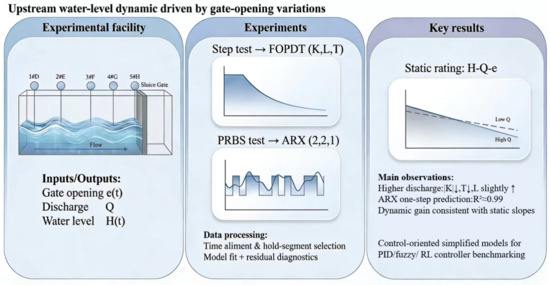
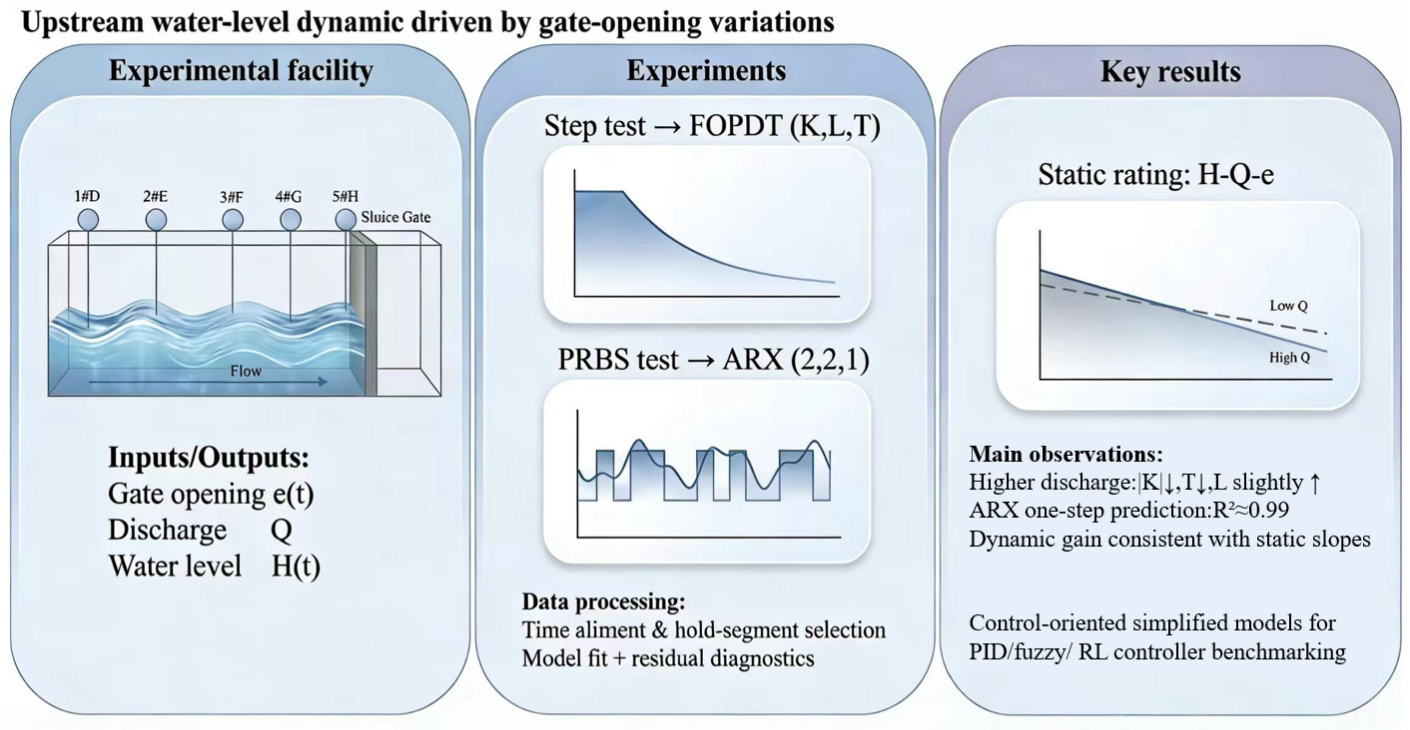
Graphical Abstract

1. Introduction

With the advancement of modern irrigation and the construction of digital twin irrigation districts, canal water scheduling increasingly demands higher gate control accuracy and faster responses. Standard sluice gates are widely used in open-channel conveyance systems because of their simple structure and convenient operation. Existing studies have extensively investigated hydraulic characteristics under free and submerged outflow, including discharge coefficients, regime transitions, water-surface profiles, and turbulence features, which support gate design and flow measurement [1,2,3,4,5,6]. Classical stage–discharge relations and discharge-coefficient equations for sluice gates have long been developed to cover both free and submerged underflow conditions, and recent studies further refined these relations by explicitly accounting for submergence effects and upstream energy losses, supported by extensive experimental validation [7,8,9,10,11,12].
In automated control scenarios, however, gate openings are adjusted continuously, and the upstream water level exhibits typical dynamic responses [13,14]. Nonlinear model predictive control has also been applied for gate control in open canals with flexible water demands [15]. More generally, predictive control strategies have been investigated for decentralized operation of irrigation canals [16]. Using only static rating relations, such as opening–level or opening–discharge relations, may lead to poor performance, oscillations, or even instability when designing controllers. Therefore, it is important to obtain the dynamic input–output relationship from gate opening to upstream water level and to develop simplified models with clear physical meanings for engineering use. For control-oriented applications, reduced-order canal-pool models, such as integrator delay type approximations, have been widely adopted as practical surrogates of Saint-Venant dynamics, enabling controller design with limited computational cost [17,18,19,20]. In addition, a variety of feedback control algorithms for irrigation canals have been developed and summarized in the literature, providing practical baselines for controller benchmarking [21,22,23]. Field/laboratory system identification studies also show that low-order discrete-time models can provide sufficiently accurate predictions for control and water-level regulation [22,24,25,26,27,28].
To address the above-outlined needs, this study contributes in three ways. First, step response tests are conducted under multiple operating conditions and used to identify first-order plus dead-time (FOPDT) models that quantify the dynamic mapping from gate opening to upstream water level. Second, pseudo-random binary sequence (PRBS) tests are performed, and a discrete-time autoregressive with exogenous input (ARX) model is identified to provide a control-oriented representation suitable for digital implementation. Third, static rating experiments are carried out to obtain water-level–flow–opening relations and to verify the steady-state consistency between the static relations and the identified dynamic models.
Although reduced-order models have long been used for the control of irrigation canals, including integrator delay family approximations [17,18,19,20,21,24,28], many classical formulations are developed at the canal-pool scale and relate flow variations to water-level variations at pool boundaries. In contrast, the present work targets a complementary but operationally central problem: the local dynamic mapping from sluice gate opening to the upstream water level immediately in front of a standard flat gate. The added value lies in (i) a unified and repeatable experimental protocol combining step response tests, PRBS excitation, and quasi-steady rating experiments under multiple representative discharges; (ii) a spatial-consistency analysis of dynamic parameters using five upstream gauges; and (iii) a systematic consistency check between quasi-steady hydraulic relations and dynamically identified steady-state gains. These elements jointly provide an engineering-friendly basis for controller tuning, benchmarking, and gain-scheduled implementation across operating conditions.
Recent advances in digital twin calibration and MPC-based management of canal systems further emphasize the need for accurate, control-oriented dynamic models that map gate opening to upstream water level and can be readily embedded in real-time controllers [29,30,31]. Complementary hydrodynamic studies on transient processes at partially lifted sluice gates also highlight the importance of capturing unsteady gate-induced responses in simplified yet physically interpretable forms [32]. In practice, the upstream water level in front of a gate is the primary variable for water delivery and scheduling, and its transient deviations directly affect regulation accuracy and operational safety, including overshoot/undershoot and constraint violations.
This paper presents step tests and PRBS tests conducted on an indoor rectangular channel with a standard flat gate. Five upstream water-level points were monitored to evaluate spatial consistency. An FOPDT model was identified from step response, and a discrete-time ARX model was identified from PRBS data, providing continuous- and discrete-time simplified plants, respectively. Static experiments were also performed to obtain water-level–flow–opening relations and to verify steady-state consistency between static and dynamic models. PRBS-based identification has been widely used in irrigation-channel modeling, and complete procedures from experiment design to model validation have been reported, showing that low-order models can be accurate and suitable for prediction and control [26,27,33].

2. Experimental Program

2.1. Experimental Facility

Experiments were carried out in an indoor recirculating rectangular open-channel facility at the hydraulic laboratory of the Farmland Irrigation Research Institute, Chinese Academy of Agricultural Sciences. The system mainly consists of a regulating tank, a pumping and supply pipeline with a variable-frequency drive, an electromagnetic flow meter, a 15 m long transparent acrylic rectangular flume with a width of 0.30 m and a depth of 0.40 m on a nearly horizontal bed, and a downstream tailwater tank returning to the regulating tank to form a closed loop.
A stilling section and flow straighteners were installed at the inlet to reduce disturbances and improve inflow uniformity. The test gate is a standard flat sluice gate driven by an electric actuator. The actuator stroke was calibrated to provide discrete gate-opening control, and the opening signal was recorded by a displacement sensor and converted to the actual opening height.
The inflow discharge was controlled by adjusting the pump frequency and monitored by the electromagnetic flow meter in the supply pipeline. During each test, gate opening, operation state (hold/open), flow rate, and water levels were recorded synchronously by the data acquisition system.

2.2. Measurement Points and Instrumentation

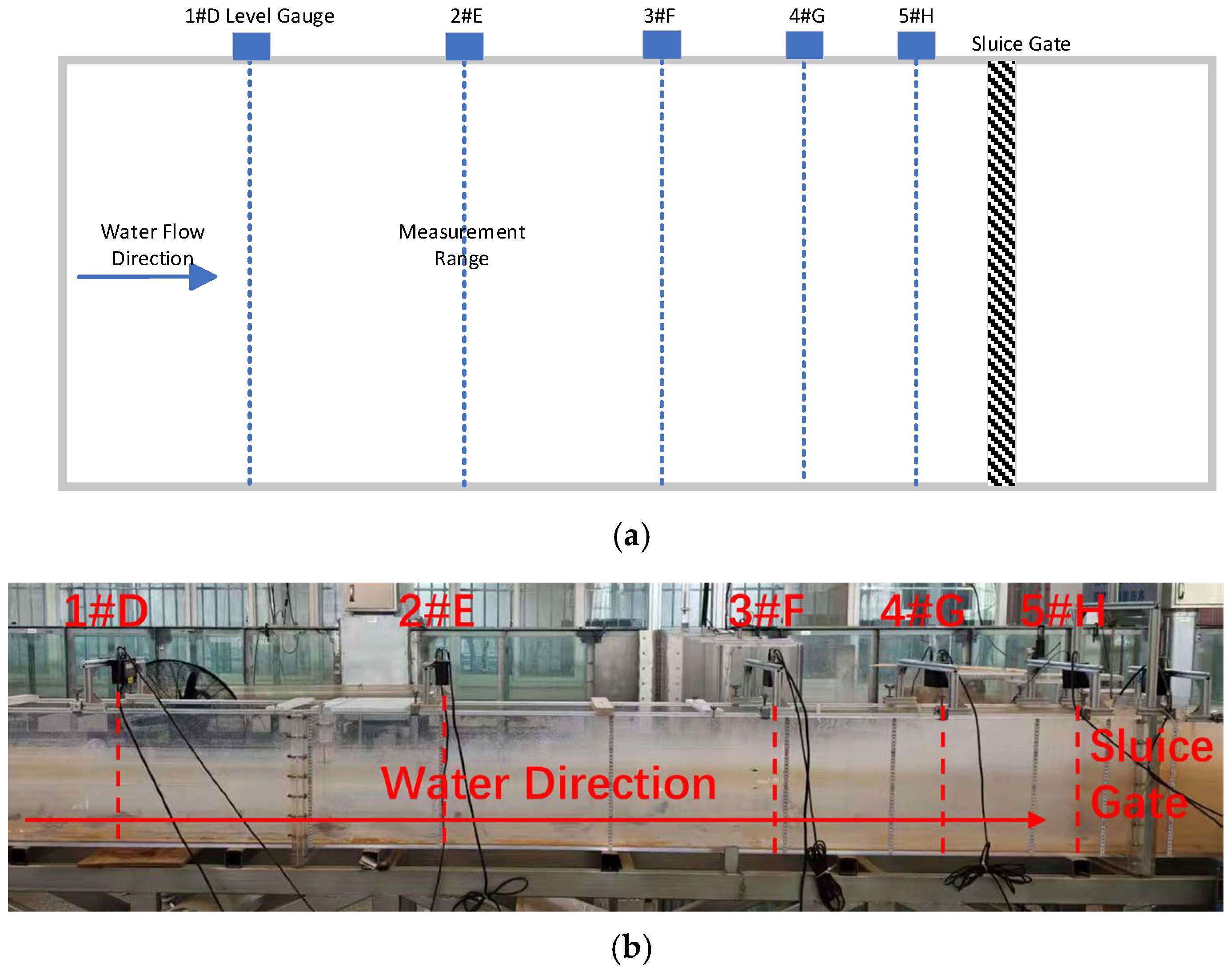
To quantify the upstream water-level response to gate-opening changes, five water-level measurement points were arranged along the centerline upstream of the gate, denoted as Points 1#D–5#H. From far to near, the points were located 3.0 m, 2.1 m, 1.1 m, 0.7 m, and 0.2 m upstream of the gate, respectively, as shown in Figure 1. These points capture both the longitudinal distribution and the dynamic response within the upstream reach of interest. Given the high spatial consistency of the step response parameters across the five upstream gauges (see the Results in Section 3.1), Point 3#F, located 1.10 m upstream of the gate, was selected as a representative output for PRBS-based identification to keep the discrete-time model simple and engineering-oriented.
Upstream water levels were measured at five points using an ultrasonic level meter (NHRI_USWM A60; range 0.1–0.6 m; resolution 0.1 mm; sampling frequency up to 10 Hz; repeat precision < 0.1 mm). Discharge was measured using an electromagnetic flow meter (Supmea LDG-SUP-DN125; DN125; flow range 22–220 m3/h; accuracy ±0.5% of full scale; repeatability 0.16%). Gate opening was recorded from the actuator controller with a position resolution of 1 mm. All signals were logged by the data acquisition system at a nominal sampling period Ts = 1.2 s.

2.3. Measurement Accuracy and Uncertainty

Let σH denote the standard deviation of the pre-step water-level fluctuations within the baseline window, which aggregates sensor noise and short-term hydraulic disturbances. We use σH as an empirical measure of the noise/uncertainty level relevant to detectability and parameter estimation. With a pre-step window of Npre samples, the standard error of the baseline mean is u H p r e ¯ = σ H / N p r e . Therefore, the standard uncertainty of the deviation signal ΔH(t) = H(t) − Hpre can be approximated by
u Δ H σ H 2 + σ H N p r e 2 = σ H 1 + 1 N p r e
For Npre = 40, √(1 + 1/Npre) ≈ 1.01, indicating that the uncertainty is dominated by short-term fluctuations rather than baseline-mean estimation.
For the PRBS tests, the demeaned output y′(k) is obtained by removing the operating-point mean, which similarly reduces sensitivity to absolute-level offsets.

2.4. Test Conditions and Procedures

Four representative operating conditions were selected based on stable operation of the facility (Table 1). Conditions A and B are step tests representing low and higher inflows, while Conditions C and D are PRBS tests covering moderate and near-maximum inflows.
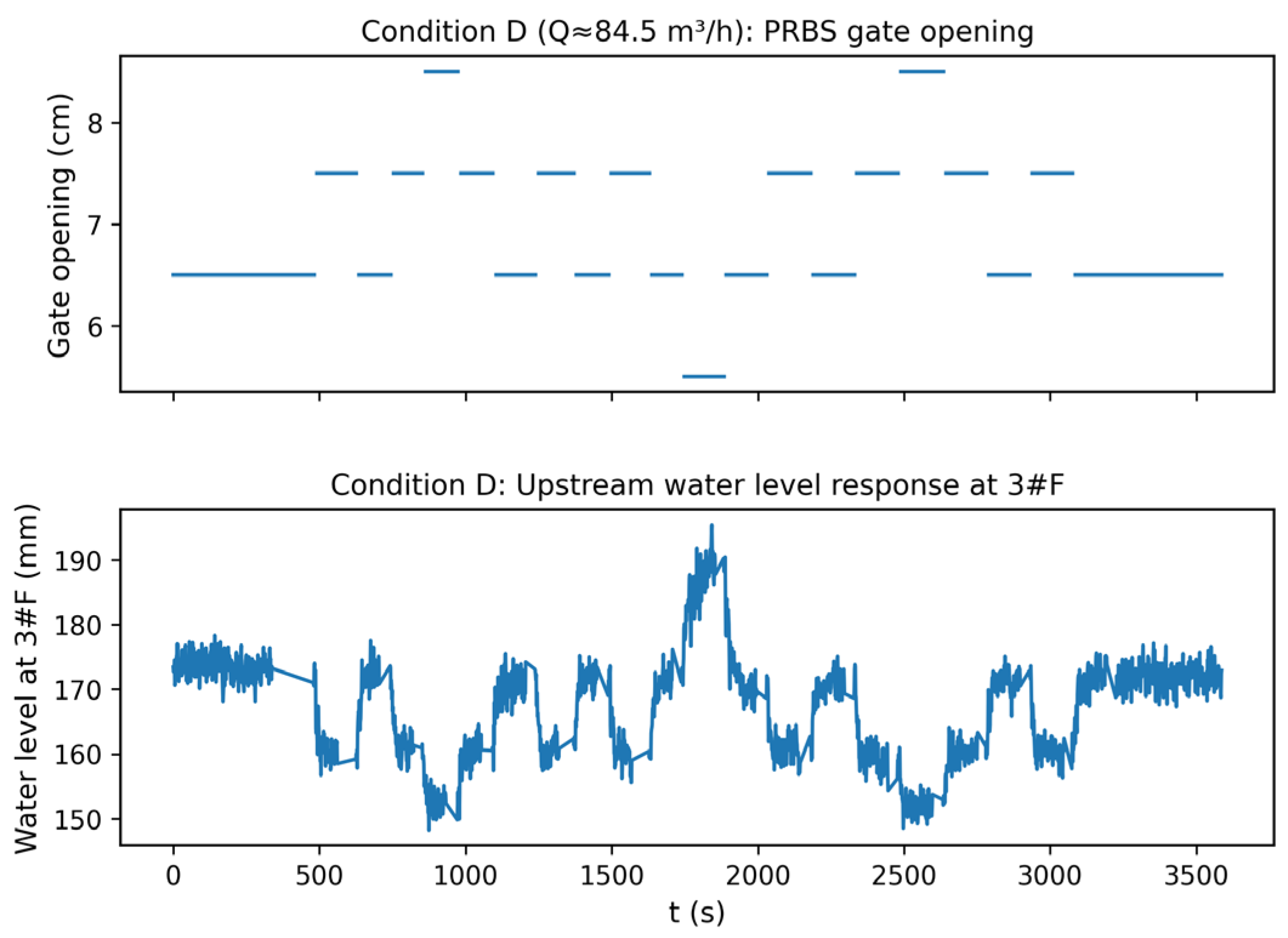
For each step test, the inflow was first regulated to a target steady value. After the upstream level stabilized, the gate opening was increased by 0.5 cm, i.e., 5 mm, and maintained long enough to reach a new steady state. For PRBS tests, the gate opening was excited by a pseudo-random binary sequence around a baseline opening, and only hold periods, when the actuator was stationary, were used for identification; open periods correspond to actuator motion and were excluded.

2.5. Data Processing and Model Identification

Data processing and identification include (i) pre-processing and alignment using time stamps, (ii) selection of steady-state segments before and after a step, (iii) identification of an FOPDT model from step responses, and (iv) identification of an ARX model from PRBS data.
For each step test, actuator transition records with missing opening values were removed. Let t = 0 denote the step onset, i.e., the start of gate motion. With a nominal sampling period Ts = 1.2 s, the pre-step steady segment was defined as the 40 valid samples immediately preceding the step onset. The post-step steady segment was defined as the last 40 valid samples within the constant-opening holding period after the response entered a quasi-steady regime (small fluctuations). The means and standard deviations of these two segments were computed for each gauge. For step response analysis, the water-level deviation is defined as ΔH(t) = H(t) − Hpre, where Hpre is the mean over the pre-step steady hold segment. These quasi-steady segments are used only to estimate the steady-state gain and the noise level (for defining the response onset), while the dynamic parameters are extracted from the full transient trajectory. The time constant T was determined using the 63.2% criterion after accounting for the dead time L.
Under a fixed inflow, the relationship between gate opening e(t) as input and upstream water level H(t) as output can be approximated by an FOPDT transfer function [34,35]. Here, water level refers to the stage measured by the gauges relative to the channel bed in this flume.
G i s = K i T i s + 1 e L i s
Here, Ki is the steady gain, Ti is the time constant, and Li is the dead time. Ki was calculated as the ratio ΔH/Δe using steady-state changes. Li was defined as the elapsed time from the step onset, t = 0, to the first instant when |ΔH(t)| exceeds three times the pre-step standard deviation. Ti was estimated as the elapsed time after the dead time, from t = Li, until the response reaches 63.2% of the total steady change ΔH [36].
For PRBS tests, a discrete-time ARX model was used to relate the demeaned gate-opening deviation u′(k) (derived from the opening series e(t)) to the demeaned upstream water-level deviation y′(k) at Point 3#F. With orders na = nb = 2 and delay nk = 1, the model can be written as
y k = a 1 y k 1 + a 2 y k 2 + b 1 u k 1 + b 2 u k 2 + ε k
Note that y′(k) corresponds to the sampled water-level deviation ΔH(t) at discrete time k after demeaning. Here, ai (i = 1, …, na) are the autoregressive coefficients multiplying past outputs y′(k − i), bj (j = 1, …, nb) are the exogenous-input coefficients multiplying past inputs u′(k − j), and nk denotes the input delay in samples. The one-step-ahead prediction error ε(k) is assumed to be zero-mean. The parameters were estimated by least squares using only valid hold samples after removing missing values and obvious outliers. After removing actuator motion intervals recorded as open, the remaining hold samples were concatenated to form the identification dataset, and lagged terms were computed on this hold-only sequence. To avoid constructing regressors across gaps between successive hold segments, any sample whose required lags fell outside the same hold segment was discarded; in practice, the first max (na, nk + nb − 1) samples of each hold segment were excluded when forming the regression vectors.
Model performance was evaluated by the coefficient of determination (R2) as well as mean absolute error (MAE) and root mean square error (RMSE); residual sequences were further inspected for bias and abnormal patterns. The metrics are defined as follows:
R 2 = 1 y k y ^ k 2 y k y ¯ 2
MAE = 1 N y k y ^ k
RMSE = 1 N y k y ^ k 2
where ŷ′(k) is the one-step-ahead prediction and N is the number of valid samples. Because y′(k) is demeaned, its sample mean y ¯ is close to zero in this study.

3. Results and Discussion

3.1. Step Response Under Low Flow (Condition A)

3.1.1. Steady-State Changes Before and After the Step

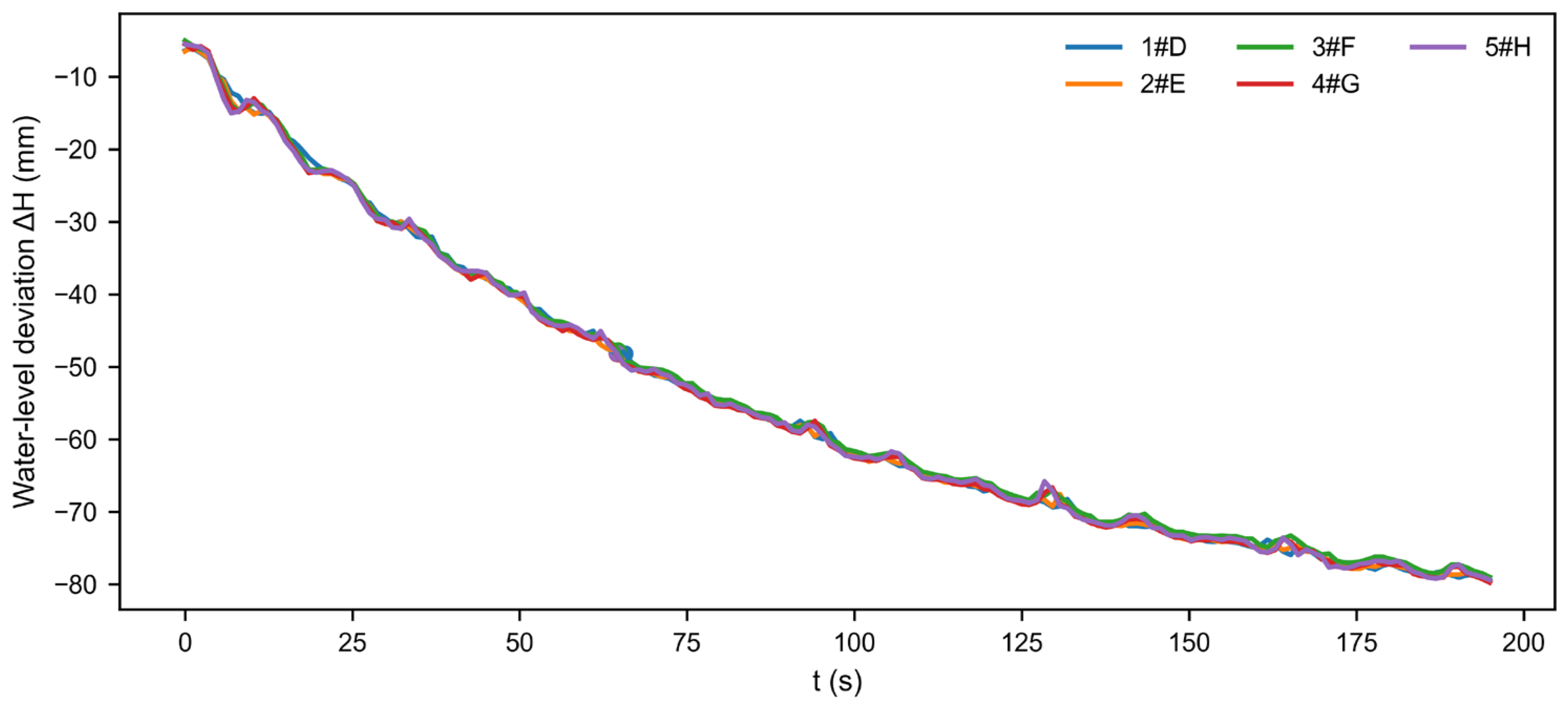
In Condition A (Q ≈ 29.5 m3/h), the opening was increased from 1.5 cm to 2.0 cm. All five points showed a clear decrease in upstream water level after the step (Table 2), with a total drop of approximately 76–77 mm. The corresponding transient step responses of ΔH at the five upstream points are shown in Figure 2.

3.1.2. Identified FOPDT Parameters and Dynamic Characteristics

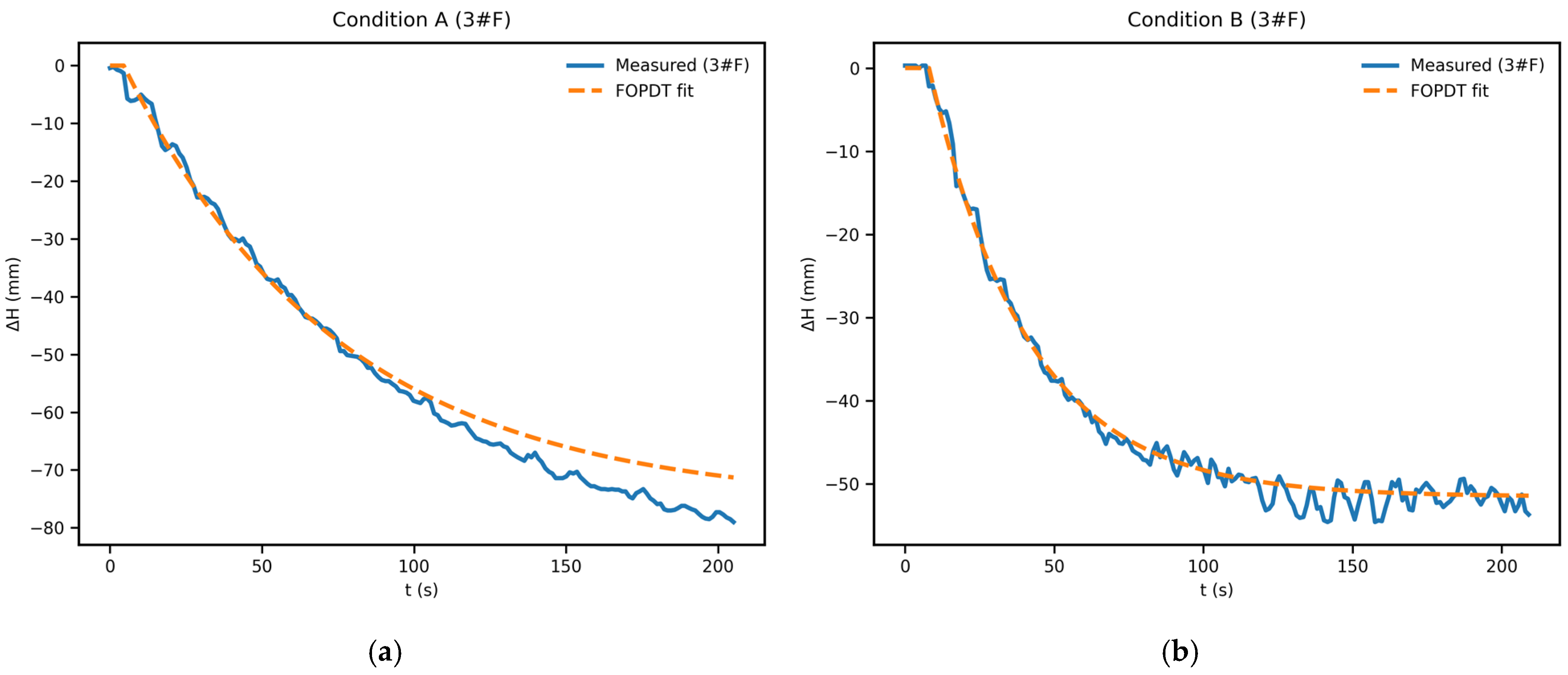
The identified gains are highly consistent across space (Ki ≈ −15.3 to −15.4 mm/mm), indicating that a single representative point within the upstream reach can be used for a single-input single-output (SISO) model in this condition. The dead time is about 4.5–5.7 s, suggesting that the upstream level begins to respond noticeably several seconds after the actuator step. Because Points 1#D–5#H are located progressively farther upstream from the gate, the dead time is expected to increase with distance; the small non-monotonic variations among points are mainly attributable to threshold-based onset detection and measurement noise. The time constant is about 71 s, meaning that roughly 63% of the total water-level change occurs within about 70–72 s after the response starts. For illustration, Figure 3a compares the measured step response (ΔH) at Point 3#F with the fitted FOPDT model for Condition A. Figure 3b shows the measured step response (ΔH) and FOPDT fit at Point 3#F for Condition B. The overall response is smooth and well captured by a first-order inertia with dead time.

3.2. Step Response Under Higher Flow (Condition B)

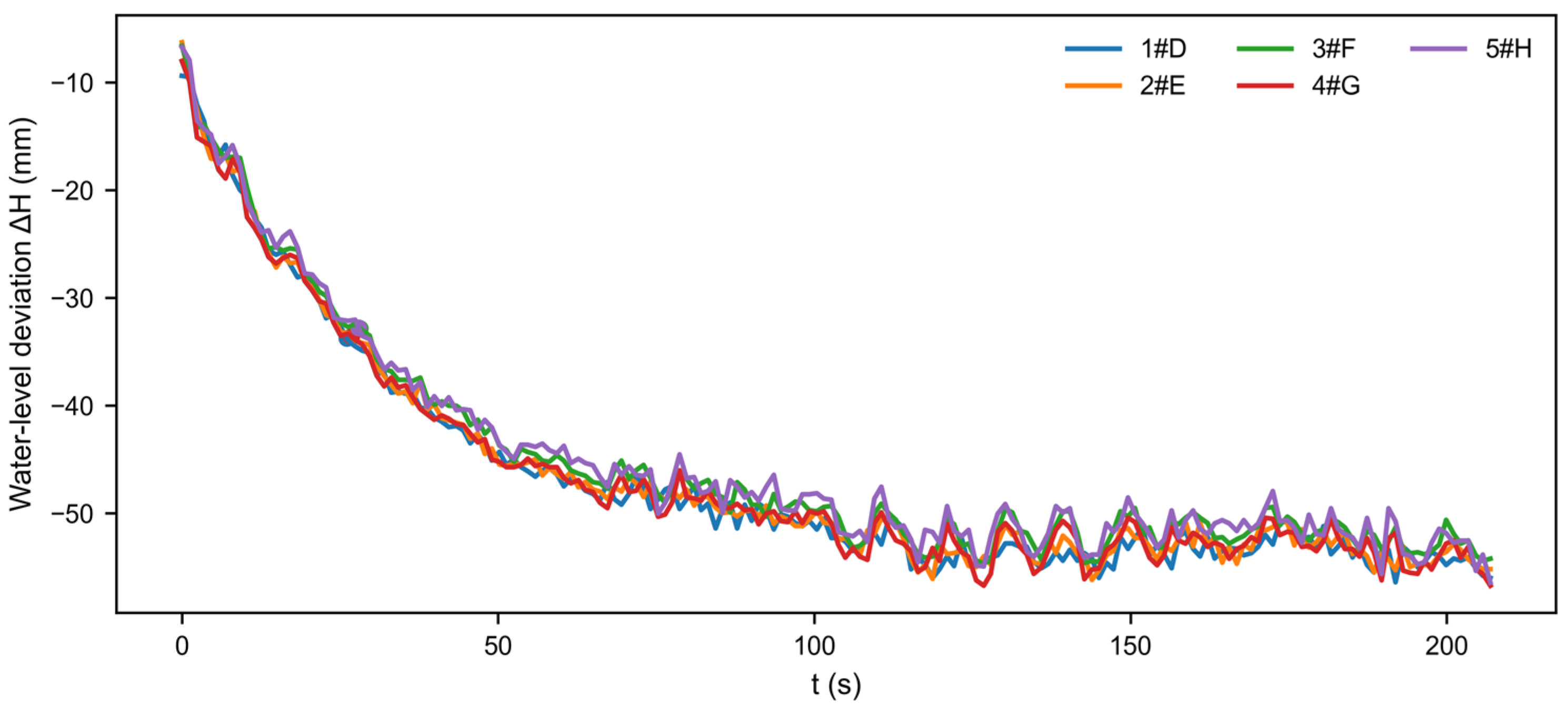
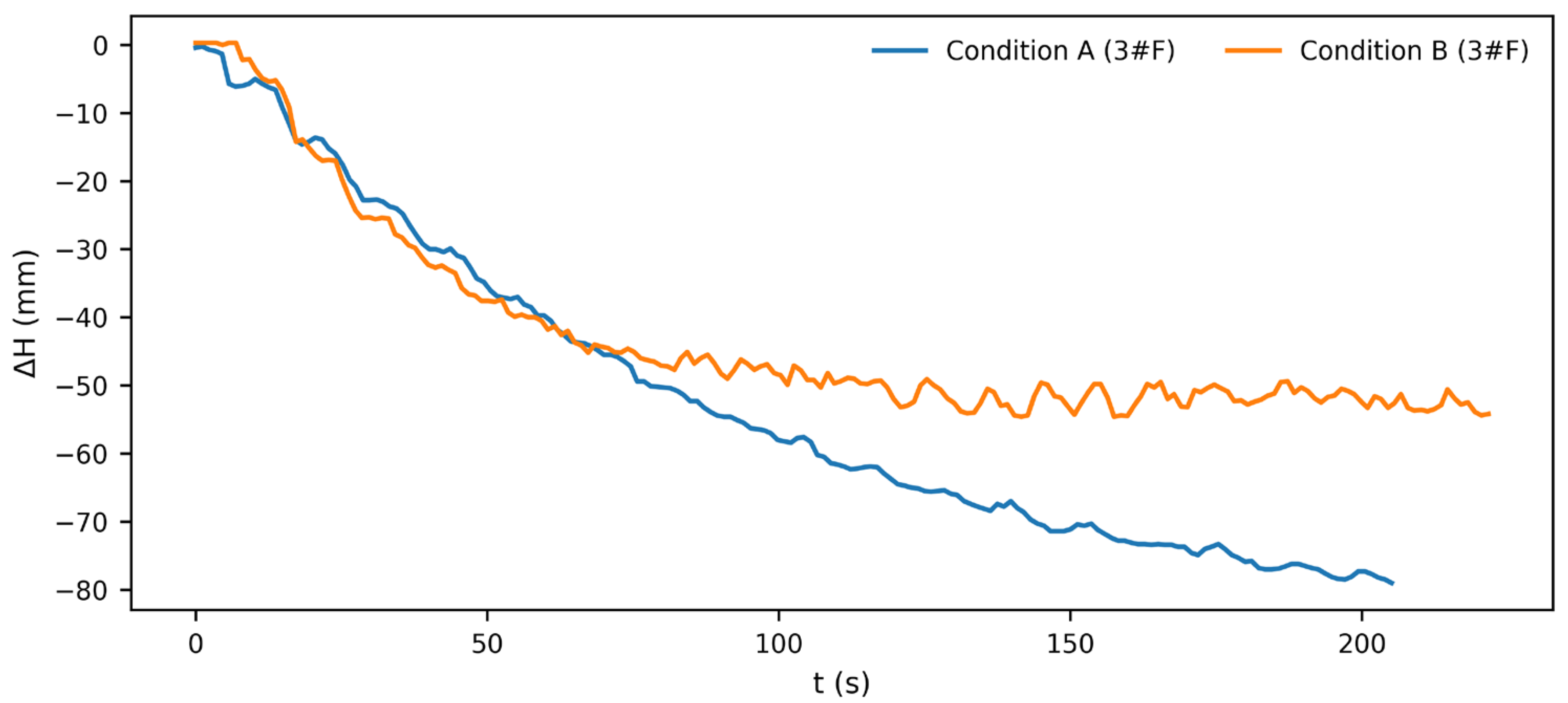
Condition B represents a higher-flow case (Q ≈ 72.5 m3/h) with a 3.0 → 3.5 cm opening step. The upstream water level decreased by about 52–54 mm (Table 3), which is smaller than in Condition A despite the same opening increment (Δe = 5 mm). The five point step-response trajectories are shown in Figure 4. A direct comparison of the step responses at Point 3#F under Conditions A and B is provided in Figure 5.
Note that the reported dead time L is an apparent delay defined by a threshold-based onset criterion. Specifically, L is the elapsed time from the step onset to the first instant when |ΔH(t)| exceeds three times the pre-step standard deviation. As such, L depends not only on physical propagation and actuator behavior but also on sensor noise level, sensor placement, and the adopted detectability criterion. In the present setup, the gauges are 0.2–3.0 m upstream of the gate, so the order-of-magnitude gravity-wave travel time is on the order of 1 s and is smaller than the identified delays of about 4–10 s. This indicates that wave propagation alone cannot explain L. Moreover, under higher-flow conditions the steady change ΔH tends to be smaller while fluctuations can be stronger, which reduces the signal-to-noise ratio and delays threshold crossing. Therefore, the observed increase in L at higher discharge likely reflects a combination of actuator/transient development and threshold-based detectability, and L should be interpreted as an engineering-relevant detectability delay rather than a pure transport delay.
Compared with Condition A, the gain magnitude decreases from about 15.4 to 10.6 mm/mm, implying that the upstream level becomes less sensitive to opening changes at higher flow. The time constant decreases to about 41–43 s, reflecting a faster adjustment to the new steady state. Meanwhile, the dead time increases to about 8–10 s, which may be related to actuator dynamics, wave propagation, and the chosen detection threshold.
Overall, the results indicate that flow condition significantly affects both steady sensitivity K and dynamic speed L and T. Thus, using a single fixed-parameter model for all operating conditions can be inappropriate for controller tuning, and a parameter set that varies with operating condition is recommended.

3.3. PRBS Tests and Discrete-Time Model Identification

3.3.1. PRBS Excitation

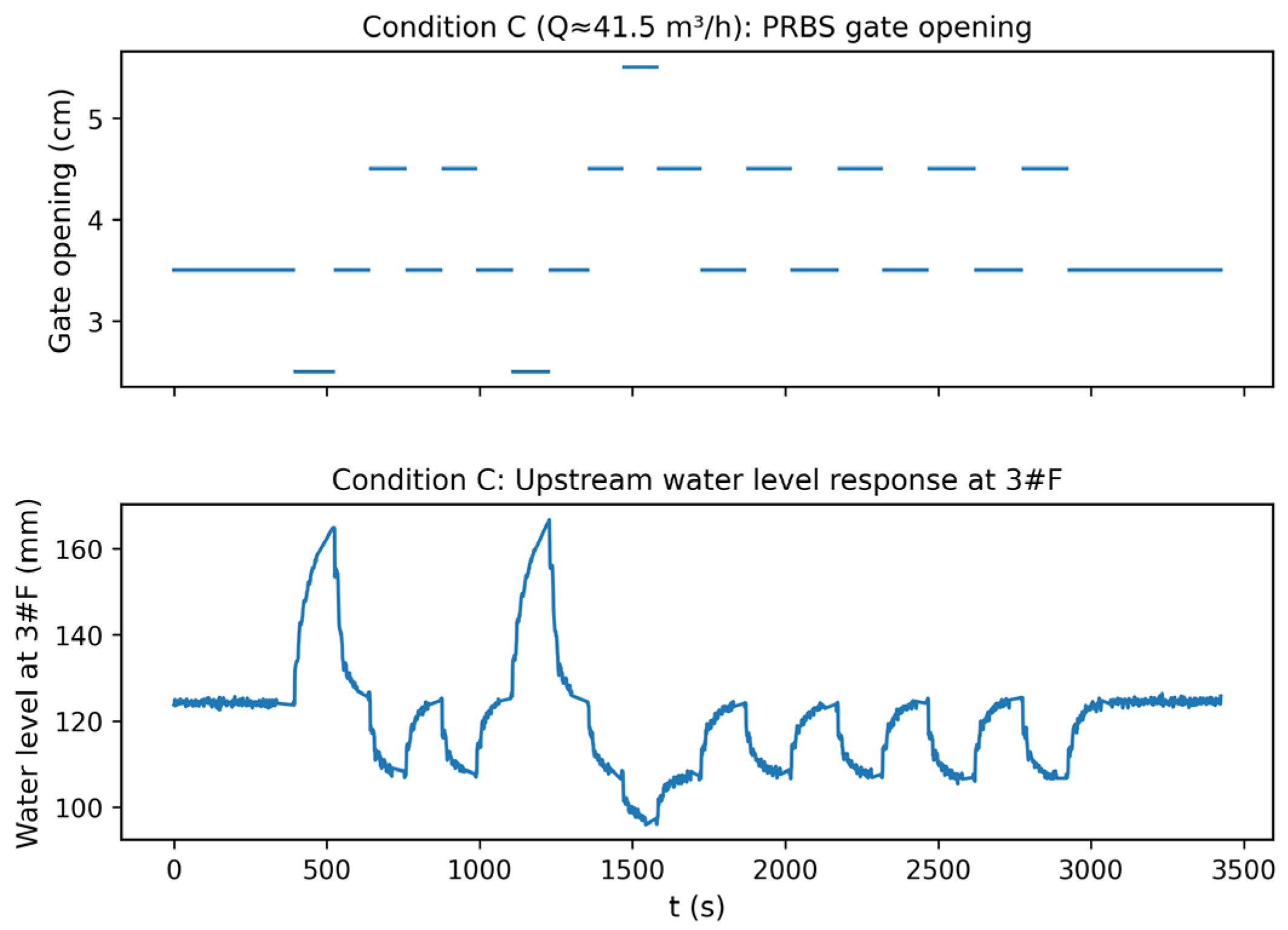
To obtain a discrete-time representation suited for digital control, PRBS tests were conducted in Conditions C and D. The gate opening alternated around a baseline opening with a 1 cm step size. Only hold segments were used for identification to avoid actuator transition effects [37]. The PRBS gate opening sequence and the corresponding upstream water-level response at Point 3#F in Condition C are shown in Figure 6. The corresponding PRBS input and upstream water level response for the higher-flow Condition D are shown in Figure 7.

3.3.2. ARX Model Structure and Identification Method

We tested candidate low-order ARX structures with na and nb from 1 to 5 and nk from 0 to 2. One-step-ahead prediction was evaluated using AIC/BIC together with hold-out validation on PRBS hold segments. In our datasets, increasing the order beyond ARX (2,2,1) led to only minor changes in fit while increasing parameter count and sensitivity to noise; therefore, ARX (2,2,1) was retained as a parsimonious structure for consistent use across operating conditions.
In canal automation, the primary concern is often the effect of opening deviation on level deviation. Therefore, the PRBS data were demeaned to form u′(k) and y′(k). An ARX (2,2,1) structure was selected to balance simplicity and the ability to capture dominant dynamics [38]. The sampling interval of the logged data is Ts = 1.2 s, so the identified ARX model can be interpreted as a one-step predictor with a time step of 1.2 s.
In the ARX model, the coefficients ai multiply lagged output terms and characterize the intrinsic (autoregressive) dynamics, whereas the coefficients bj multiply lagged input terms and characterize the influence of gate-opening deviation on the water-level deviation.
Parameter estimation followed standard least-squares identification for linear regression. After excluding actuator motion intervals recorded as open, the remaining data comprise multiple hold segments. Missing samples (NaN) were removed and obvious nonphysical spikes were corrected within each hold segment. To prevent regressors from spanning time gaps between segments, samples whose required lags fell outside the same hold segment were discarded; the first max(na, nk + nb − 1) samples of each hold segment were excluded. Model adequacy was evaluated by R2, MAE, RMSE, and by inspecting the residual sequence ε(k). Here, na and nb denote the output and input orders, respectively, and nk denotes the input delay in samples.

3.3.3. Identification Results and Model-Fit Comparison

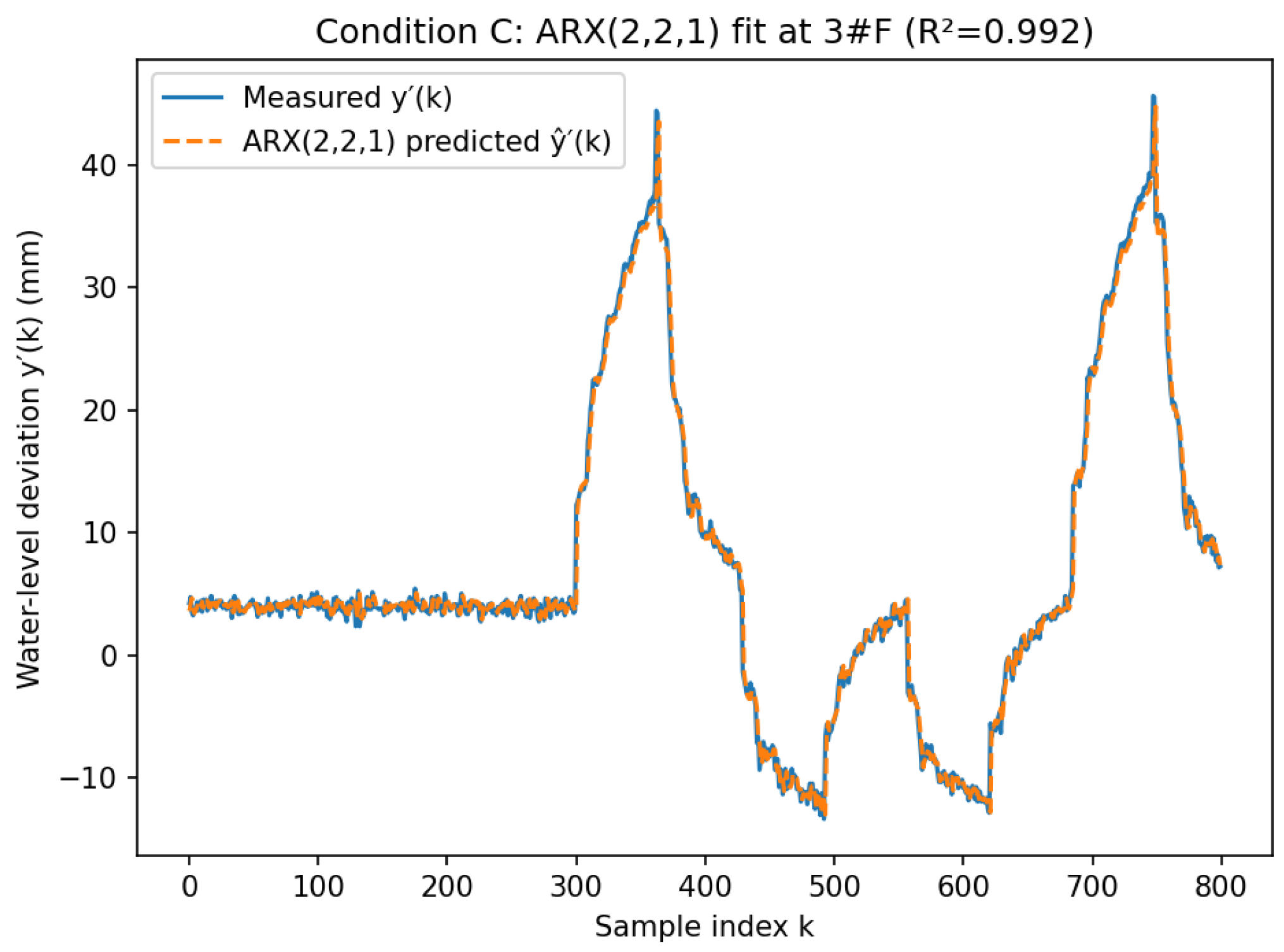
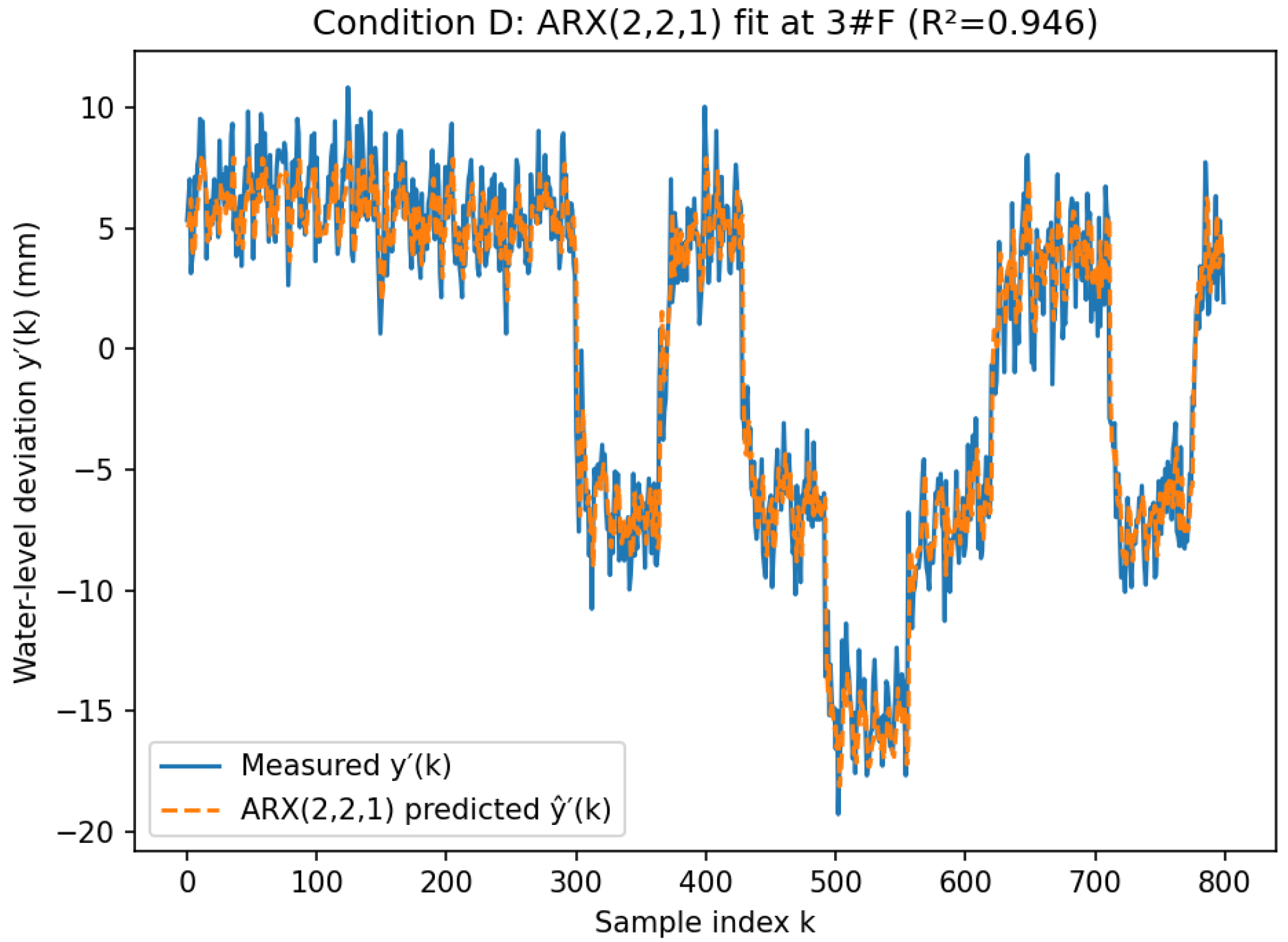
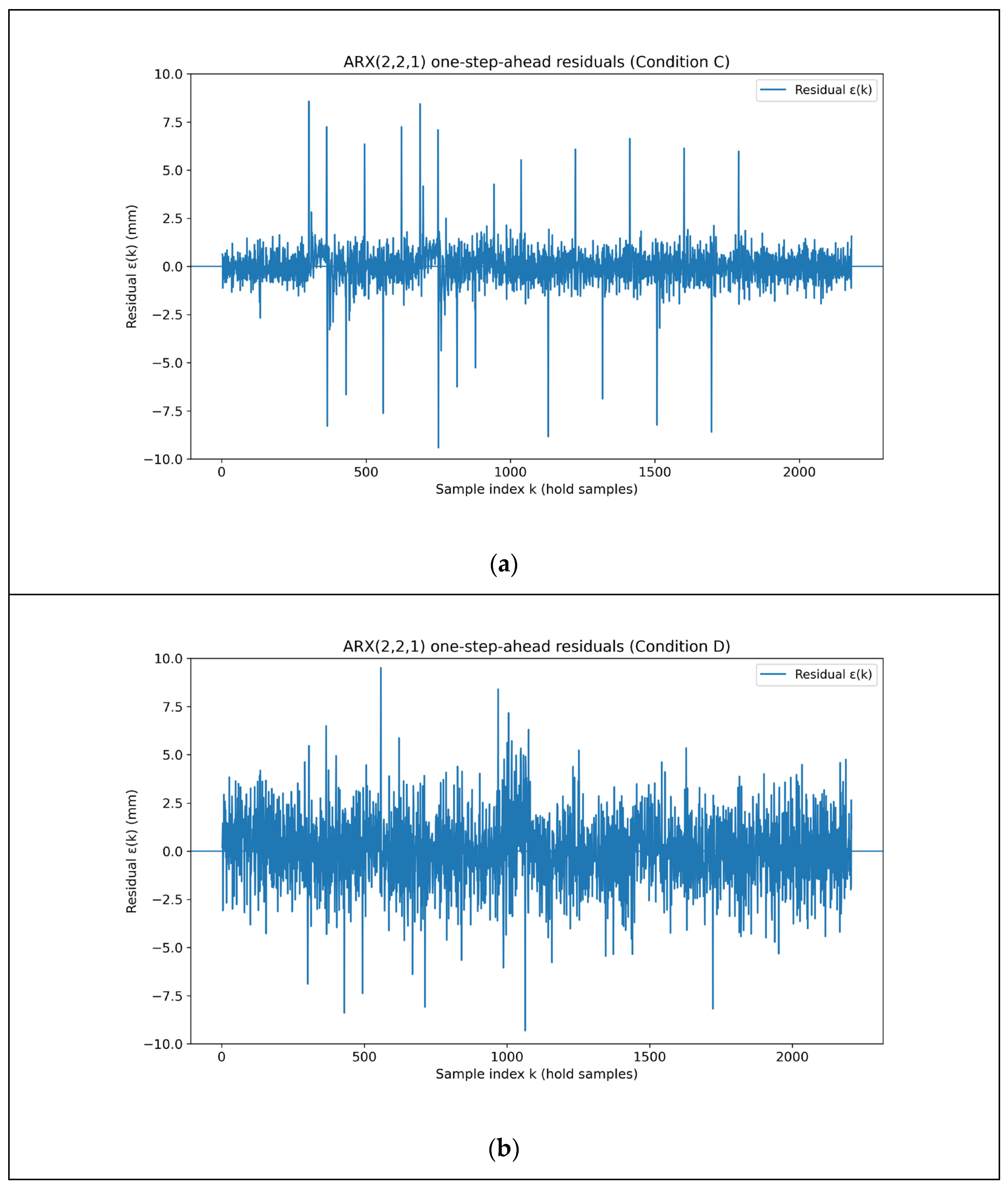
Table 4 summarizes the identified ARX parameters and fit metrics. Condition C exhibits very good agreement (R2 = 0.992; RMSE = 1.04 mm). Condition D shows a lower but still acceptable fit (R2 = 0.946; RMSE = 1.85 mm), likely due to stronger fluctuations at higher flow and a larger operating range of the gate opening. The measured-versus-predicted comparisons are shown in Figure 8 and Figure 9, and the corresponding one-step-ahead residual diagnostics are shown in Figure 10.
A key diagnostic is whether the residuals fluctuate around zero without obvious trends or bursts. In this study, residuals generally remain centered around zero, while a small number of spikes correspond to transient disturbances and/or sensor artifacts. Given the engineering goal of a compact model for control design, the ARX (2,2,1) structure is considered adequate for the tested conditions.

3.4. Static Water-Level–Flow–Opening Relation and Steady-State Consistency

3.4.1. Features of Quasi-Steady Measurements

Static experiments were conducted by adjusting the gate opening and pump frequency until the upstream water level and discharge became stable. The resulting dataset provides quasi-steady relations among upstream water level, discharge, and gate opening, which are useful for cross-validating the steady gains of dynamic models.

3.4.2. Basic Trends of Static Relations

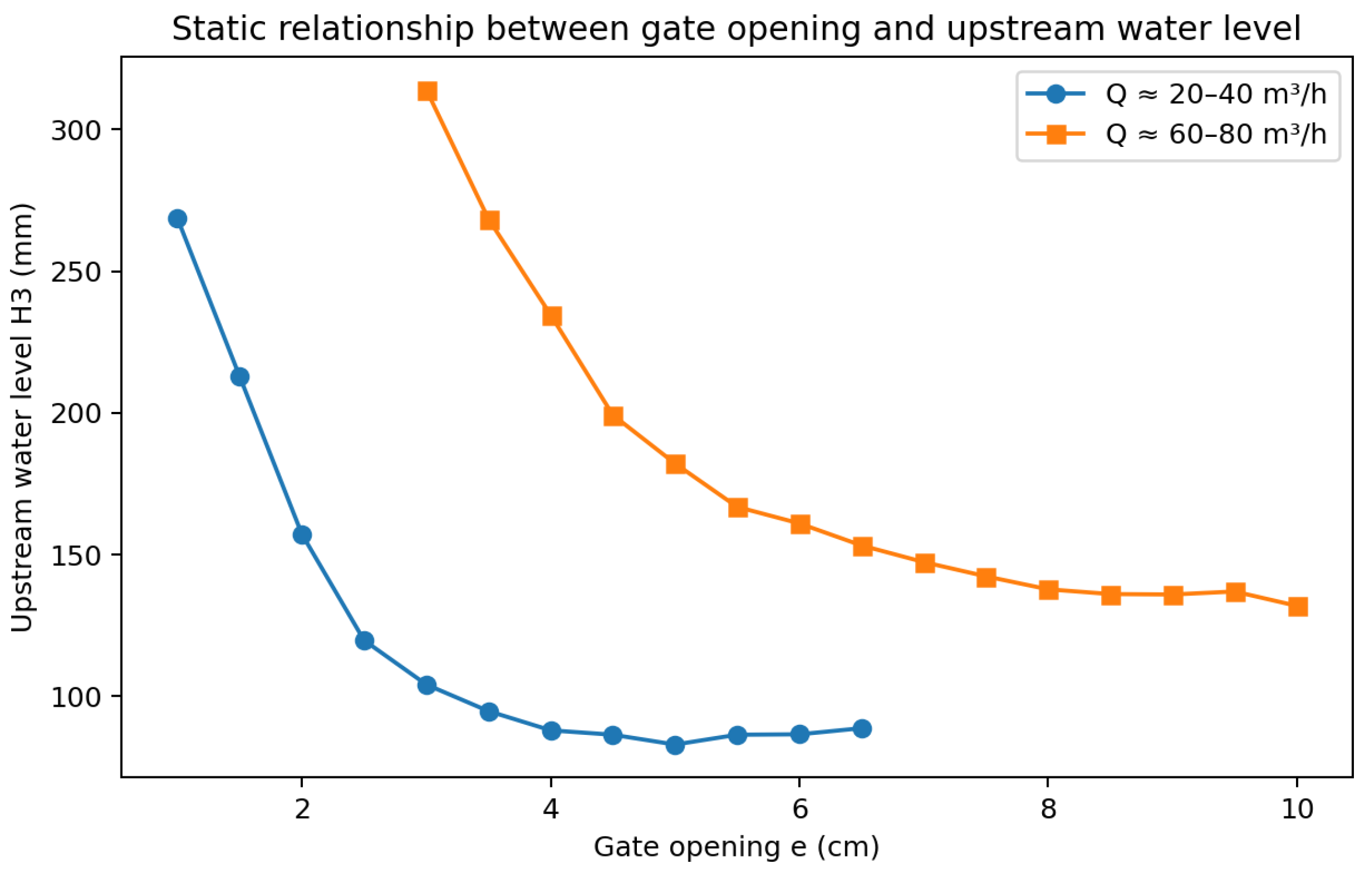
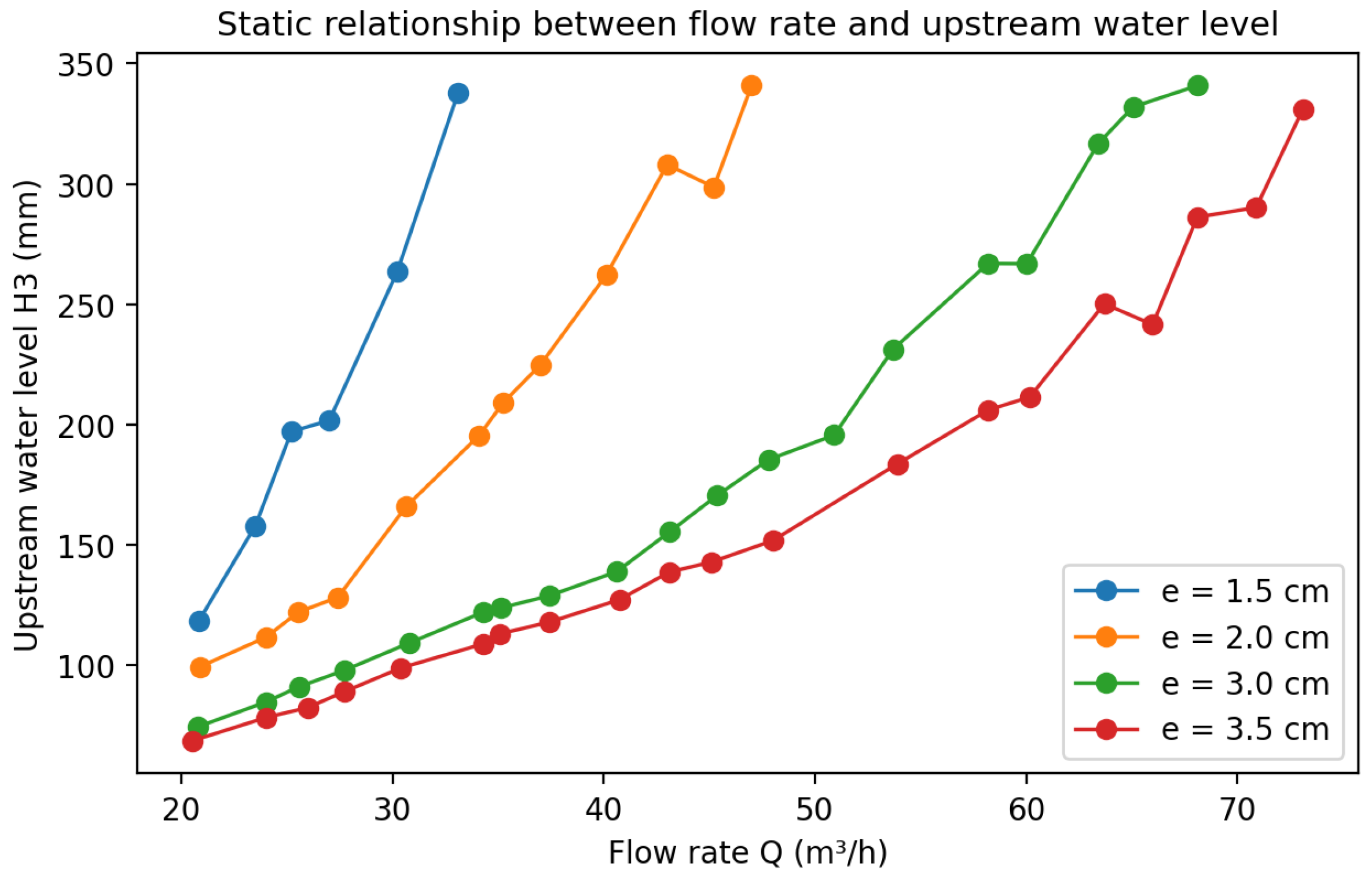
The upstream water level at the representative point (Point 3#F, denoted H3) decreases as the gate opening increases under a given discharge. At higher discharge, the slope of H3 versus opening becomes smaller, indicating reduced sensitivity. Similarly, under a fixed opening, H3 generally increases with discharge. These trends are consistent with basic open-channel hydraulics with a local control section at the gate. The H3–e relationship is summarized in Figure 11. The discharge-dependent trends are further summarized in Figure 12, which presents H3 as a function of Q for multiple gate openings.

3.4.3. Consistency Between Static Gain and Step-Identified Gain

From step tests, the steady gains at the representative point are approximately KA ≈ ΔH3/Δe ≈ −15.4 mm/mm (Condition A) and KB ≈ ΔH3/Δe ≈ −10.6 mm/mm (Condition B). This gain reduction with increasing discharge is consistent with the quasi-steady H3–e relation in Figure 11, where the local slope magnitude becomes smaller at higher flow rates. That is, under low flow, a + 1 mm opening increase causes about a 15 mm drop in upstream water level, while under higher flow, the same opening increase causes about a 10 mm drop, reflecting reduced hydraulic sensitivity at larger discharges [39].
To verify that the steady gains inferred from dynamic identification are consistent with static hydraulics, quasi-steady data with similar discharge levels and identical opening pairs were extracted to compute static gains. As shown in Table 5, the static gains agree well with the step-identified gains for both low and higher flows.
The steady-state consistency provides a physical basis for the simplified models. Mechanistically, changing gate opening alters the local control section and associated energy losses. At low flow, the upstream level is strongly governed by the local gate control, so an opening increment produces a relatively large water-level change (larger |K|). At higher flow, the upstream level is jointly constrained by inflow and distributed frictional and local losses, so the same opening increment yields a smaller relative change (smaller |K|). For dynamic parameters, the dead time L can be interpreted as the time needed for the effect of gate movement to propagate and exceed the noise threshold at a measurement point, whereas the time constant T reflects the dominant inertia of the upstream reach, influenced by wave propagation, storage, and dissipation.

3.5. Practical Implications and Limitations

The identified simplified models provide directly usable information for control design and digital implementation. For example, the FOPDT parameters, namely the steady gain, apparent delay, and time constant, can be used for initial controller tuning and for estimating the expected settling time after a gate-opening adjustment. The observed gain decrease from Condition A to Condition B indicates that controller parameters may need to be adjusted across different discharge levels, for example, via gain scheduling, to maintain a consistent closed-loop response.
The ARX model offers a compact discrete-time representation that is convenient for real-time prediction and embedded control. Because the model is expressed directly in sampled-data form, it can be integrated into a digital twin framework for online simulation, state estimation, and model-based supervision without additional continuous-to-discrete conversion.
Compared with classical integrator delay and related canal-pool models used for pool-scale regulation [17,18,19,20,21,24,28], the present models provide a local, engineering-friendly plant description for the upstream water-level loop at a sluice gate, where gate opening is the manipulated input and the immediately upstream level is the regulated output. In practice, the two model classes are complementary. Pool-scale models support system-wide coordination, while the proposed local gate models support local loop tuning, benchmarking, and digital twin supervision.
This study focuses on an indoor recirculating rectangular channel with a standard flat gate under controlled boundary conditions; the identified numerical parameters therefore reflect those conditions. In practical canals, downstream water level, i.e., submergence, can modify the discharge sensitivity and backwater profile, thereby changing the steady gain magnitude and the apparent delay. Channel roughness and geometry, including width, slope, cross-sectional area, and storage, influence the partition between local gate losses and distributed frictional losses and can affect both the effective time constant and the steady sensitivity to opening changes. Scale effects, including relative roughness and the similarity of turbulent and free-surface flow dynamics, may further shift the parameter values when transferring from laboratory to field settings.
Importantly, even when numerical values change, the observed qualitative trend of decreasing gain magnitude |K| with increasing discharge is expected to hold in many field scenarios because, at higher flow, the upstream level is jointly constrained by inflow and distributed frictional losses in addition to local gate control; consequently, a fixed opening increment tends to produce a smaller relative change in the upstream level. Therefore, the proposed simplified models should be interpreted as dependent on operating conditions, and their parameters should be calibrated or updated for the target canal geometry and boundary conditions. In addition, PRBS-based identification can be influenced by measurement noise and unmodeled disturbances, motivating further validation under broader operating regimes and varied downstream conditions.

4. Conclusions

  • Step tests demonstrate that the upstream water-level response to a gate-opening increment can be approximated by an FOPDT model. Under low flow (Condition A), the identified parameters are K ≈ −15.4 mm/mm, L ≈ 4.5–5.7 s, and T ≈ 71 s, and the five upstream points show strong spatial consistency.
  • Under higher flow (Condition B), the gain magnitude decreased (K ≈ −10.6 mm/mm), the time constant became smaller (T ≈ 41–43 s), and the dead time increased moderately (L ≈ 8–10 s). These changes indicate a faster response but weaker sensitivity to opening changes at higher discharges.
  • PRBS tests support a compact discrete-time ARX (2,2,1) model between gate-opening deviation and upstream level deviation at the representative point. The identified models achieve R2 of 0.992 (Condition C) and 0.946 (Condition D), with MAE and RMSE within 0.65–1.85 mm, and residual inspection does not reveal major systematic bias.
  • Future work will include combined step and PRBS tests under identical operating conditions when feasible and extension to a wider range of inflows and downstream levels to quantify parameter variations. These efforts will support the implementation and validation of automatic upstream water-level control based on the simplified models. The models can also support controller design and benchmarking for proportional–integral/proportional–integral–derivative (PI/PID) controllers and internal model control (IMC) based PID tuning [40,41]. The reported model parameters were obtained from an indoor recirculating rectangular channel with a standard flat gate under the tested boundary and operating conditions. Therefore, the numerical values of the identified parameters may vary with changes in downstream conditions, channel roughness, and a wider range of discharges and gate openings. Although the numerical values are specific to the tested facility, the main qualitative behaviors, such as weaker steady sensitivity at higher discharge and the need for parameter sets that vary with operating condition, are expected to remain applicable to real canals. Future work will extend the experiments to broader operating regimes and explore controller design and validation based on the identified simplified models.

Author Contributions

Conceptualization, methodology, D.L. and M.J.; formal analysis, D.L., M.J., M.L. and H.L.; investigation, D.L., M.L., M.J., W.Z., Y.W. and J.Q.; writing—original draft preparation, D.L.; writing—review and editing, D.L., M.L., M.J., H.L. and J.Q. All authors have read and agreed to the published version of the manuscript.

Funding

The Henan Provincial Key R&D and Promotion Special Science and Technology Tackling Project (Project No. 242102320238); The Agricultural Science and Technology Innovation Program of the Chinese Academy of Agricultural Sciences.

Data Availability Statement

The data that support this study will be shared upon reasonable request to the corresponding author. The data are not publicly available due to their involvement in an ongoing investigation or experiment.

Conflicts of Interest

The authors declare that they have no conflicts of interest.

Nomenclature

  • List of notations
SymbolDescription
QDischargeu(k)Gate opening input at sample k
eGate openingy(k)Water level output at sample k
ΔeGate opening deviation from operating pointu’(k)Demeaned gate opening deviation
HUpstream water levely’(k)Demeaned water level deviation
ΔHWater level deviation relative to the pre-step steady levelkDiscrete time sample index
HiWater level at measurement point inaARX output order
KSteady-state gain of the FOPDT modelnbARX input order
LDead time of the FOPDT modelnkARX input delay (in samples)
TTime constant of the FOPDT model

References

  1. Shen, Z.-N.; Zhang, W.-Z.; Jiang, M.-L.; Lü, M.-C. Study on Discharge Characteristics of Open Channel under the Regulation of Flat Gate. Water Sav. Irrig. 2021, 56–60. (In Chinese) [Google Scholar]
  2. Zhang, W.; Jia, X.; Wang, Y. Experimental investigation of hydraulic characteristics for open channel gates. Water 2024, 16, 3717. [Google Scholar] [CrossRef]
  3. Yoosefdoost, A.; Lubitz, W. Sluice gate design and calibration: Simplified models to distinguish flow conditions and estimate discharge coefficient and flow rate. Water 2022, 14, 1215. [Google Scholar] [CrossRef]
  4. Kubrak, E.; Kubrak, J.; Kiczko, A.; Kubrak, M. Flow measurements using a sluice gate; analysis of applicability. Water 2020, 12, 819. [Google Scholar] [CrossRef]
  5. Guan, G.; Huang, Y.; Xiong, J.; Jin, W. Uniform Flow Rate Calibration Model for Flat Gate under Free-Submerged Orifice Flow. Trans. Chin. Soc. Agric. Eng. (Trans. CSAE) 2020, 36, 197–204. (In Chinese) [Google Scholar] [CrossRef]
  6. Vaheddoost, B.; Safari, M.J.S.; Ilkhanipour Zeynali, R. Discharge coefficient for vertical sluice gate under submerged condition using contraction and energy loss coefficients. Flow Meas. Instrum. 2021, 80, 102007. [Google Scholar] [CrossRef]
  7. Swamee, P.K. Sluice-Gate Discharge Equations. J. Irrig. Drain. Eng. 1992, 118, 56–60. [Google Scholar] [CrossRef]
  8. Habibzadeh, A.; Vatankhah, A.R.; Rajaratnam, N. Role of Energy Loss on Discharge Characteristics of Sluice Gates. J. Hydraul. Eng. 2011, 137, 1079–1084. [Google Scholar] [CrossRef]
  9. Cassan, L.; Belaud, G. Experimental and Numerical Investigation of Flow under Sluice Gates. J. Hydraul. Eng. 2012, 138, 367–373. [Google Scholar] [CrossRef]
  10. Bijankhan, M.; Ferro, V.; Kouchakzadeh, S. New stage–discharge relationships for free and submerged sluice gates. Flow Meas. Instrum. 2012, 28, 50–56. [Google Scholar] [CrossRef]
  11. Shayan, H.K.; Farhoudi, J. Effective parameters for calculating discharge coefficient of sluice gates. Flow Meas. Instrum. 2013, 33, 96–105. [Google Scholar] [CrossRef]
  12. Silva, C.O.; Rijo, M. Flow Rate Measurements under Sluice Gates. J. Irrig. Drain. Eng. 2017, 143, 06017001. [Google Scholar] [CrossRef]
  13. Galvis Restrepo, E. Predictive Control with Dynamic Constraints for Closure and Opening Operations of Irrigation Canals. Ph.D. Thesis, Universitat Politècnica de Catalunya, Barcelona, Spain, 2016. [Google Scholar] [CrossRef]
  14. Sepúlveda Toepfer, C. Instrumentation, Model Identification and Control of an Experimental Irrigation Canal. Ph.D. Thesis, Universitat Politècnica de Catalunya, Barcelona, Spain, 2008. [Google Scholar] [CrossRef]
  15. Kong, L.; Liu, Y.; Li, J.; Tian, Y.; Yang, Q.; Chen, Z. Nonlinear Model Predictive Controller for Gate Control in Open Canal Irrigation Systems with Flexible Water Demands. Comput. Electron. Agric. 2024, 222, 109023. [Google Scholar] [CrossRef]
  16. Gomez, M.; Rodellar, J.; Mantecon, J. Predictive control method for decentralised operation of irrigation canals. Appl. Math. Model. 2002, 26, 1039–1056. [Google Scholar] [CrossRef]
  17. Schuurmans, J.; Clemmens, A.J.; Dijkstra, S.; Hof, A.; Brouwer, R. Modeling of Irrigation and Drainage Canals for Controller Design. J. Irrig. Drain. Eng. 1999, 125, 338–344. [Google Scholar] [CrossRef]
  18. Litrico, X.; Fromion, V. Simplified Modeling of Irrigation Canals for Controller Design. J. Irrig. Drain. Eng. 2004, 130, 373–383. [Google Scholar] [CrossRef]
  19. Litrico, X.; Fromion, V. Frequency Modeling of Open-Channel Flow. J. Hydraul. Eng. 2004, 130, 806–815. [Google Scholar] [CrossRef]
  20. Clemmens, A.J.; Tian, X.; van Overloop, P.J.; Litrico, X. Integrator Delay Zero Model for Design of Upstream Water-Level Controllers. J. Irrig. Drain. Eng. 2017, 143, B4015001. [Google Scholar] [CrossRef]
  21. Clemmens, A.J.; Schuurmans, J. Simple Optimal Downstream Feedback Canal Controllers: Theory. J. Irrig. Drain. Eng. 2004, 130, 26–34. [Google Scholar] [CrossRef]
  22. Malaterre, P.O.; Rogers, D.C.; Schuurmans, J. Classification of canal control algorithms. J. Irrig. Drain. Eng. 1998, 124, 3–10. [Google Scholar] [CrossRef]
  23. Wahlin, B.T.; Clemmens, A.J. Automatic Downstream Water-Level Feedback Control of Branching Canal Networks. J. Irrig. Drain. Eng. 2006, 132, 198–207. [Google Scholar] [CrossRef]
  24. Schuurmans, J.; Bosgra, O.H.; Brouwer, R. Open-channel flow model approximation for controller design. Appl. Math. Model. 1995, 19, 525–530. [Google Scholar] [CrossRef]
  25. Schuurmans, J. Control of Water Levels in Open-Channels. Ph.D. Thesis, Delft University of Technology, Delft, The Netherland, 1997. Available online: https://resolver.tudelft.nl/uuid:4852fc0e-e54f-49aa-bfdb-750230539774 (accessed on 9 January 2026).
  26. Weyer, E. System identification of an open water channel. Control Eng. Pract. 2001, 9, 1289–1299. [Google Scholar] [CrossRef]
  27. Eurén, K.; Weyer, E. System Identification of Open Water Channels with Undershot and Overshot Gates. IFAC Proc. Vol. 2005, 38, 638–643. [Google Scholar] [CrossRef]
  28. Conde, G.; Quijano, N.; Ocampo-Martinez, C. Modeling and control in open-channel irrigation systems: A review. Annu. Rev. Control 2021, 51, 153–171. [Google Scholar] [CrossRef]
  29. Liu, W.; Guan, G.; Tian, X.; Cao, Z.; Chen, X.; Shi, L. A Real-Time Refined Roughness Estimation Framework for the Digital Twin Model Calibration of Irrigation Canal Systems. J. Irrig. Drain. Eng. 2024, 150, 10227. [Google Scholar] [CrossRef]
  30. Ranjbar, R.; Segovia Castillo, P.; Duviella, E.; Etienne, L.; Maestre, J.M.; Camacho, E.F. Digital Twin of Calais Canal with Model Predictive Controller: A Simulation on a Real Database. J. Water Resour. Plan. Manag. 2024, 150, 05024002. [Google Scholar] [CrossRef]
  31. Zhu, Z.; Guan, G.; Wang, K. Distributed Model Predictive Control Based on the Alternating Direction Method of Multipliers for Branching Open Canal Irrigation Systems. Agric. Water Manag. 2023, 285, 108372. [Google Scholar] [CrossRef]
  32. Cozzolino, L.; Varra, G.; Cimorelli, L.; Della Morte, R. Mathematical and Numerical Modelling of Rapid Transients at Partially Lifted Sluice Gates. Adv. Water Resour. 2023, 181, 104562. [Google Scholar] [CrossRef]
  33. Söderström, T.; Stoica, P. System Identification; Prentice Hall: Englewood Cliffs, NJ, USA, 1989. [Google Scholar]
  34. Skogestad, S. Simple analytic rules for model reduction and PID controller tuning. J. Process Control 2003, 13, 291–309. [Google Scholar] [CrossRef]
  35. Muresan, C.I.; Ionescu, C.M. Generalization of the FOPDT model for identification and control purposes. Processes 2020, 8, 682. [Google Scholar] [CrossRef]
  36. Wu, X.; Xu, J. Study on a Linear System Identification Method Based on Step-Response Curve Features. Meas. Control Technol. 2019, 38, 127–133, 139. (In Chinese) [Google Scholar]
  37. Godfrey, K. Perturbation Signals for System Identification; Prentice Hall International (UK) Ltd.: Great Britain, UK, 1993. [Google Scholar]
  38. Ljung, L. System identification. In Signal Analysis and Prediction; Procházka, A., Uhlíř, J., Rayner, P.W.J., Eds.; Birkhäuser Boston: Boston, MA, USA, 1998; pp. 163–173. [Google Scholar] [CrossRef]
  39. Ding, A.; Guo, X.; Chen, W.; Wu, Y.; Liu, Z. Hydraulic Sensitivity Analysis of Diversion Offtakes and Check Gates in Water Conveyance Canals. Yellow River 2010, 32, 109–111, 113. (In Chinese) [Google Scholar]
  40. Rana, V.M. MatLab/Simulink Based PI Controller Modeling with Unsteady State Simulation Results for Multiple Canal Pools System. In Hydraulics and Fluid Mechanics, Volume 1; Pandey, M., Umamahesh, N.V., Ahmad, Z., Oliveto, G., Eds.; Lecture Notes in Civil Engineering; Springer: Singapore, 2025; Volume 547, pp. 381–394. [Google Scholar] [CrossRef]
  41. Rivera, D.E.; Morari, M.; Skogestad, S. Internal model control: PID controller design. Ind. Eng. Chem. Process Des. Dev. 1986, 25, 252–265. [Google Scholar] [CrossRef]
Figure 1. Layout and photo of the upstream water-level gauges. (a) Front view (longitudinal elevation) showing gauge locations (Points 1#D–5#H) upstream of the sluice gate; dashed lines indicate the effective measurement range (0–0.40 m). (b) Photo of the experimental flume with annotated gauge positions and flow direction.
Water 18 00476 g001
Figure 2. Step responses of upstream water-level deviations (ΔH) at Points 1#D–5#H (Condition A, Q ≈ 29.5 m3/h).
Water 18 00476 g002
Figure 3. Measured step responses (ΔH) and fitted FOPDT models at Point 3#F: (a) Condition A; (b) Condition B (t = 0 at the step onset).
Water 18 00476 g003
Figure 4. Step responses of upstream water-level deviations (ΔH) at Points 1#D–5#H (Condition B, Q ≈ 72.5 m3/h).
Water 18 00476 g004
Figure 5. Comparison of measured step responses (ΔH) at Point 3#F under Conditions A and B (t = 0 at the step onset).
Water 18 00476 g005
Figure 6. PRBS gate-opening sequence and the corresponding upstream water-level response at Point 3#F (Condition C).
Water 18 00476 g006
Figure 7. PRBS gate-opening sequence and the corresponding upstream water-level response at Point 3#F (Condition D).
Water 18 00476 g007
Figure 8. Measured vs. one-step-ahead predicted water-level deviations at Point 3#F (Condition C).
Water 18 00476 g008
Figure 9. Measured vs. one-step-ahead predicted water-level deviations at Point 3#F (Condition D).
Water 18 00476 g009
Figure 10. One-step-ahead residuals ε(k) of the ARX (2,2,1) model for (a) Condition C and (b) Condition D (hold samples only).
Water 18 00476 g010
Figure 11. Upstream water level H3 versus gate opening e under low and high flows.
Water 18 00476 g011
Figure 12. Upstream water level H3 versus discharge Q under multiple gate openings.
Water 18 00476 g012
Table 1. Test conditions and operating parameters.
ConditionTest TypeTarget Flow Q (m3/h)Pump
Frequency (Hz)
Gate-Opening
Excitation
Primary Purpose
AStep test≈29.5≈15Step: 1.5 cm to 2.0 cmIdentify an FOPDT model under low-flow condition; analyze K, L, T, and spatial consistency
BStep test≈72.5≈32.3Step: 3.0 cm to 3.5 cmIdentify an FOPDT model under higher-flow condition and compare with Condition A
CPRBS test≈41.5≈18.2PRBS about 3.5 cm with a 1 cm step sizeIdentify a discrete-time ARX model under moderate flow
DPRBS test≈84.5≈33.2PRBS about 6.5 cm with a 1 cm step sizeIdentify a discrete-time ARX model near the maximum operating flow and compare with Condition C
Table 2. Upstream water-level statistics and identified FOPDT parameters for Condition A.
PointPre-Step Mean (mm)Pre-Step SD (mm)Post-Step Mean (mm)Post-Step SD (mm)ΔH (mm)K (mm/mm)L (s)T (s)
1#D226.60.32149.62.33−77.0−15.415.771.5
2#E231.70.33154.62.41−77.1−15.424.571.1
3#F231.60.35155.32.42−76.3−15.274.571.2
4#G235.30.39158.22.43−77.0−15.414.571.5
5#H238.00.38161.12.42−76.9−15.394.570.8
Table 3. Upstream water-level statistics and identified FOPDT parameters for Condition B.
PointPre-Step Mean (mm)Pre-Step SD (mm)Post-Step Mean (mm)Post-Step SD (mm)ΔH (mm)K (mm/mm)L (s)T (s)
1#D337.61.12283.91.46−53.7−10.7510.341.1
2#E342.11.08288.61.44−53.5−10.719.242.2
3#F340.50.59288.21.39−52.3−10.468.043.3
4#G346.61.28293.21.61−53.5−10.6910.342.2
5#H348.00.63295.91.88−52.2−10.439.243.3
Table 4. Identified ARX (2,2,1) parameters and goodness-of-fit metrics.
Conditiona1a2b1b2R2MAE (mm)RMSE (mm)
C0.7130.248−1.931.170.9920.651.04
D0.5750.148−2.53−0.510.9461.421.85
Table 5. Comparison of steady gains obtained from static tests and step response identification.
ConditionSourceTypical Flow Q (m3/h)Gate-Opening Change Δe (mm)Upstream Water-Level Change ΔH3 (mm)Steady Gain K (mm/mm)
AStatic
tests
≈26.3+5 (1.5 to 2.0 cm)−79.5−15.9
AStep
test
≈29.5+5 (1.5 to 2.0 cm)≈−77≈−15.4
BStatic
tests
≈68.1+5 (3.0 to 3.5 cm)−54.6−10.9
BStep
test
≈72.5+5 (3.0 to 3.5 cm)≈−53≈−10.6
Disclaimer/Publisher’s Note: The statements, opinions and data contained in all publications are solely those of the individual author(s) and contributor(s) and not of MDPI and/or the editor(s). MDPI and/or the editor(s) disclaim responsibility for any injury to people or property resulting from any ideas, methods, instructions or products referred to in the content.