Article

Impacts of Extreme Temperature and Drought on Water Quality and Phytoplankton Biomass in Nanwan Reservoir (China)


1
College of Fisheries, Xinyang Agriculture and Forestry University, Xinyang 464000, China
2
Guangxi Key Laboratory of Marine Environmental Science, Guangxi Academy of Marine Sciences, Guangxi Academy of Sciences, Nanning 530007, China
3
Beibu Gulf Marine Industry Research Institute, Fangchenggang 538000, China
4
Xinyang Nanwan Reservoir Affairs Center, Xinyang 464000, China
5
School of Environment, Tsinghua University, Beijing 100084, China
*
Authors to whom correspondence should be addressed.
Water 2026, 18(3), 411; https://doi.org/10.3390/w18030411
Submission received: 24 December 2025 / Revised: 30 January 2026 / Accepted: 31 January 2026 / Published: 4 February 2026
(This article belongs to the Section Water Quality and Contamination)

Abstract

Climate change has led to increasingly frequent and unpredictable droughts and high-temperature events, creating extreme conditions that profoundly impact the productivity of freshwater ecosystems. In this study, we evaluated the effects of extreme temperature and drought events on Nanwan Reservoir, a large, deep body of water in Xinyang, China, by assessing water quality and phytoplankton biomass. Field investigations were conducted during both high-temperature and drought (HTD) conditions in 2019 and normal-temperature and non-drought (NTND) conditions in 2020. HTD conditions significantly disrupted the thermocline and oxycline structures, leading to prolonged stratification during this period. Although phosphorus concentrations remained relatively stable across both periods, nitrogen levels were markedly lower during HTD events, indicating a possible shift in nutrient limitation from phosphorus to nitrogen. Additionally, a complex relationship between environmental variables and phytoplankton biomass was observed under HTD conditions. These findings advance our understanding of primary production responses to extreme weather events in Nanwan Reservoir, highlighting the importance of incorporating this knowledge into water resource management and ecological conservation strategies.

1. Introduction

Driven by anthropogenic activities, rapid global warming has emerged over the past half-century as a major threat to the stability of aquatic ecosystems, with significant consequences for biodiversity and function [1,2]. Climate change has increased the frequency and intensity of extreme weather events, including severe droughts, typhoons, and heavy rainfall [3,4,5]; as such, there is an urgent need to further evaluate its impacts on aquatic ecosystems [6].
Compared to marine ecosystems, freshwater ecosystems such as lakes and reservoirs are smaller in scale but play a crucial role by providing a wide range of services. They are also more sensitive to climate change [7] and can be used as both indicators and integrators of the process, as they are closely connected to their surrounding catchment areas and their responses to environmental changes are often immediate and pronounced [8,9,10,11,12,13,14,15]. Since surface water temperature (WT) and thermocline strength are largely regulated by air temperature, rising temperatures intensify water column stratification and prolong its duration [16,17]. These changes in WT can significantly affect aquatic biota, leading to shifts in species composition, biomass, and productivity [18,19].
In phytoplankton, population dynamics are regulated by a range of abiotic environmental factors, including temperature, light intensity, pH, dissolved oxygen (DO), and nutrient availability. These parameters are all significantly influenced by climate change, particularly through shifts in weather patterns; for example, global warming alters precipitation regimes, thereby affecting nutrient loading in freshwater ecosystems [20,21]. Moreover, rising WTs can modify the chemical characteristics of water bodies influenced by precipitation, indirectly shaping phytoplankton community composition and structure [22,23]. These climate-induced changes complicate the underlying mechanisms driving harmful algal blooms in eutrophic lakes, often reducing the effectiveness of conventional bloom control strategies [24,25,26].
The combination of elevated temperatures and decreased precipitation contributes to the onset of drought conditions. Previous studies have specifically addressed the impacts of drought on lakes and reservoirs, which typically manifest through lowered water levels and reduced nutrient inflows. For instance, in Lake Taihu (China), interannual variability in cyanobacterial bloom phenology has shown a strong correlation with local climatic conditions over the past two decades [27], with elevated temperatures associated with earlier bloom onset and prolonged duration [28]. Similarly, Lake Dongting (China) experienced a severe drought during the summer of 2022, during which significantly elevated phosphorus concentrations were recorded compared to historical averages [29]. This increase was likely due to phosphorus accumulation resulting from reduced water volume.
Nanwan Reservoir is located approximately 8.5 km southwest of Xinyang City in Henan Province, China. It encompasses a watershed area of 1100 km2 and a water surface area of 75 km2, with a maximum depth of 30 m and a total storage capacity of 1.63 billion m3 [30,31]. The reservoir plays a critical role in regional water supply, serving agricultural, industrial, and domestic needs; for example, it serves as a primary source of drinking water for the urban population of Xinyang. Previous studies have identified reservoir bays and dam areas as hotspots for harmful algal blooms, highlighting the need for effective nutrient management strategies to mitigate bloom risks in this large, deep body of water [32]. In 2019, Xinyang experienced an exceptionally rare and prolonged extreme weather event, characterized by nearly two months of continuous high temperatures and drought from August to October. This extended period of climatic stress likely had substantial impacts on the reservoir’s ecosystem services, particularly water availability and primary productivity.
In this study, we investigated water quality parameters and chlorophyll a (Chl. a) concentrations, using them as proxies for total phytoplankton biomass in Nanwan Reservoir during different stages of a drought event, to evaluate the effects of extreme weather on primary producer biomass. By comparing conditions during the drought period with those from a climatologically normal year, we aim to provide new insights into how such extreme events influence total phytoplankton biomass in deep reservoirs. Our findings contribute to the growing body of knowledge on the impacts of climate change on freshwater ecosystems and offer practical guidance for the ecological management and protection of large reservoirs under these conditions.

2. Materials and Methods

2.1. Investigation Period and Sample Collection

Between July and September in the years 2016 to 2021, average air temperatures in the study area ranged from 26.0 °C to 27.5 °C, with the highest and lowest averages recorded in 2019 and 2020, respectively (Table S1). Total cumulative precipitation was 136.9 mm in 2019 compared to 555.6 mm in 2020 (Figure S1a), while the total annual precipitation in 2019 (588.6 mm) was also lower than that recorded in 2020 (1466.7 mm) (Figure S1b). The average precipitation anomaly (PA) percentage (a weather pattern-based indicator of drought classification (Table S2) from July to September in 2019 was −69.3%, indicating moderate drought weather [33]. In contrast, the average PA for the same period in 2020 was 24.6%, indicating no drought. Therefore, these two contrasting periods—a high-temperature and drought (HTD) period from August to September 2019 and a normal-temperature and non-drought (NTND) period from July to September 2020—were selected for comparison. Field investigations were conducted during both the early and late stages of each period. For the HTD period in 2019, field sampling was carried out on 13 August and 30 September, representing the early and late stages, respectively. For the NTND period in 2020, fieldwork was conducted on 12 July and 27 September.
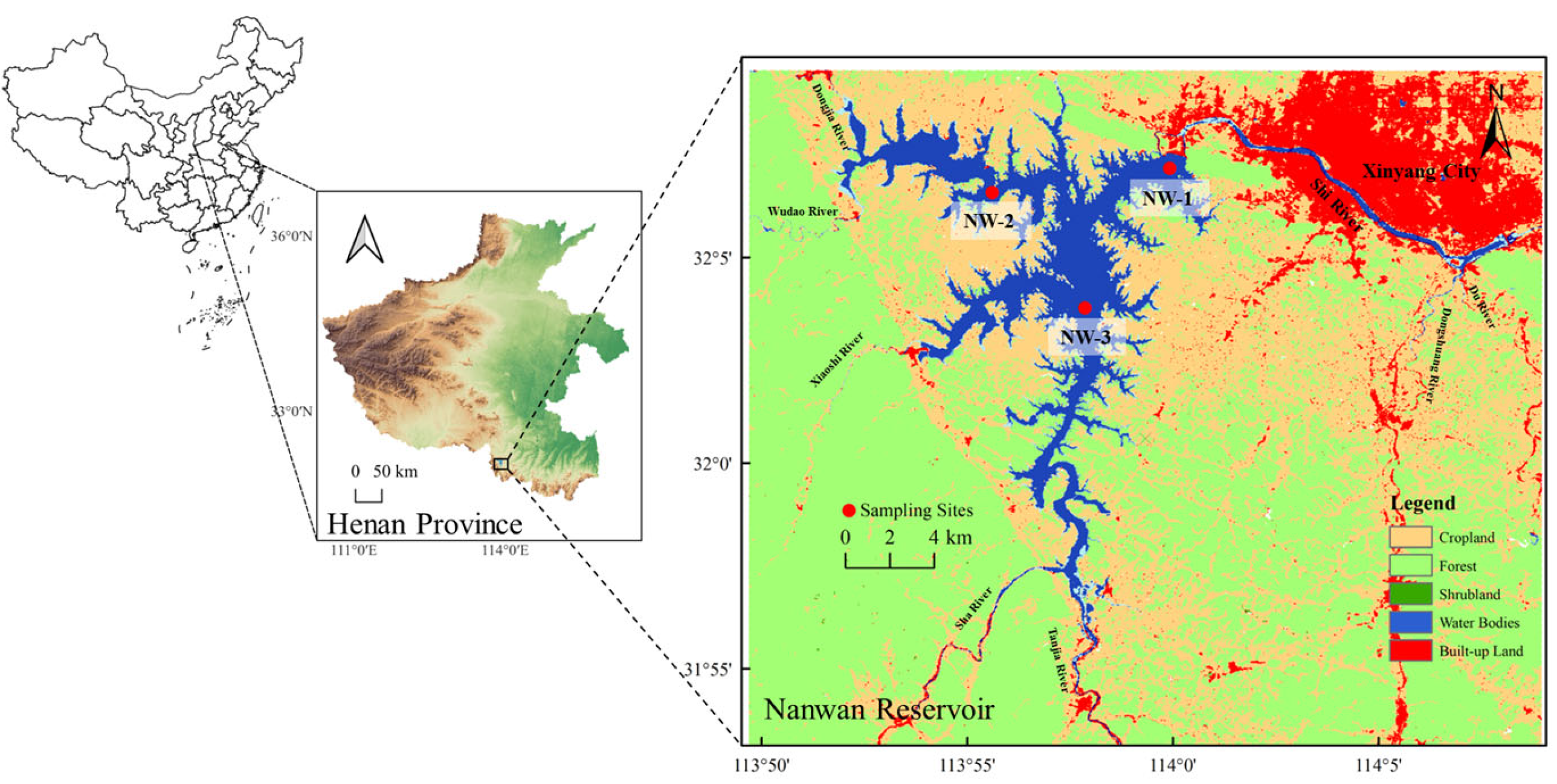
Three offshore sampling sites—NW1, NW2, and NW3—were established in the southern, western, and eastern regions of Nanwan Reservoir, respectively (Figure 1), in order to adequately represent the reservoir’s environmental conditions [32]. NW1 is situated in the central region and corresponds to the main inflow; NW2 is situated in the western part and corresponds to the secondary inflow; and NW3 is situated in the northern part and corresponds to the dam. Vertical profiles of WT and DO concentrations were measured in situ using a portable DO meter (Pro 20, YSI, Yellow Springs, OH, USA) at intervals from 0.5 m below the surface to the bottom. Water transparency (Secchi depth, SD) was determined using a standard Secchi disk (Puruiqi Experimental Instrument Co., Ltd., Yancheng, China). Water samples were collected using a 5 L plexiglass water sampler (Xingshan Technology Co., Ltd., Nanjing, China) at depths of 0.5 m, 5 m, 10 m, and/or 15 m, depending on seasonal water levels and site-specific depths. All collected water samples were transported to the laboratory and analyzed for water quality indicators within 24 h. Water pH was measured on-site using a digital pH meter (PHBJ-260, Lei Ci, Shanghai, China).

2.2. Demarcation of the Thermocline and Oxycline

The thermocline can be determined using several methods, such as gradient criterion method with a turbulence threshold [34], the temperature-gradient threshold method [35], and the density-gradient threshold method [36]. In this study, the thermocline is defined using the temperature-gradient threshold approach, i.e., the water layer in which the vertical temperature gradient exceeds 1 °C per meter [37]. In contrast, both the upper and lower layers adjacent to the thermocline exhibit more gradual temperature changes, with gradients of less than 1 °C per meter. In cases where the water column is shallow and no thermocline is observed, the entire water column is considered to be part of the upper layer of the thermocline. The oxycline, often influenced by the presence of the thermocline, is defined in this study as the water layer displaying the steepest DO concentration gradient [38]. In the layers above and below the oxycline, changes in DO concentration are relatively small compared to those observed within the oxycline itself [39], while any region within the water column where DO concentrations fall below 0.2 mg/L is classified as an anoxic zone [39].

2.3. Nutrient Profiles

Nutrient concentrations and chemical oxygen demand (CODMn) were determined according to the procedures described in the Water and Wastewater Monitoring and Analysis Methods [40]. Unfiltered water samples were used to measure total nitrogen (TN), total phosphorus (TP), and CODMn. Filtered samples (0.45 μm polyester fiber membrane, 50 mm diameter; Shanghai Xingya Purification Materials Factory, Shanghai, China) were used to analyze concentrations of ammonium ( NH 4 + -N), nitrate ( NO 3 -N), and phosphorus ( PO 4 3 -P). Each parameter was analyzed in triplicate, and ultrapure water was used as a blank control. The standard curve of each parameter exhibited linearity, with a coefficient of determination (R2) of 0.999 used to ensure accuracy and reliability. Detection limits and spiked recovery rates for the measured nutrient concentrations are shown in Table S3.
TN was extracted via potassium persulfate oxidation. Specifically, 5 mL of alkaline potassium persulfate solution was added to each sample, sealed with a ground-glass stopper, and autoclaved at 121 °C for 30 min. After cooling, 1 mL of 10% (v/v) hydrochloric acid was added. Absorbance was measured at 220 nm and 275 nm using a UV-Vis spectrophotometer (UV1700, Meixi, Shanghai, China). TP was determined with the molybdenum–antimony colorimetric method following potassium persulfate digestion. After digestion, 1 mL of 10% ascorbic acid solution was added and mixed thoroughly, followed by 2 mL of molybdate solution. The mixture was left to develop color for 15 min before absorbance was measured at 700 nm. NH 4 + -N concentrations were determined using Nessler’s reagent spectrophotometric method: 1.0 mL of potassium sodium tartrate solution and 1.5 mL of Nessler’s reagent were sequentially added to each sample. After a 10 min reaction period, absorbance was measured at 420 nm. NO 3 -N concentrations were measured using ultraviolet spectrophotometry. The ion-exchange resin was first washed, soaked in methanol overnight, and then rinsed with deionized water. Zinc sulfate solution and sodium hydroxide were added to each sample to adjust pH to 7.0, followed by aluminum hydroxide suspension. After centrifugation, the supernatant was passed through the prepared resin adsorption column. The eluate was collected, and aliquots were transferred into cuvettes. Each aliquot received 1.0 mL of hydrochloric acid and 0.1 mL of aminosulfonic acid solution. Absorbance was recorded at 220 nm and 275 nm using a 10 mm path-length quartz cuvette (Jinghe Optical Instrument Co., Ltd., Wuxi, China). PO 4 3 -P in the filtrate was determined using the same molybdenum–antimony colorimetric method as TP but without the potassium persulfate digestion step. CODMn was analyzed using the acidic permanganate method (Method A): Samples were treated with a solution of sulfuric acid and potassium permanganate and heated in a boiling water bath for 30 min. While still hot, a known volume of standardized sodium oxalate solution was added and thoroughly mixed. The remaining solution was immediately titrated with standardized potassium permanganate until a faint pink color persisted. The volume of potassium permanganate consumed was used to calculate the CODMn concentration, with the permanganate solution standardized prior to use with sodium oxalate.

2.4. Eutrophication Indicator

The eutrophication status of Nanwan Reservoir was assessed using the trophic level index (TLI), which employs a numerical scale ranging from 0 to 100 to categorize trophic levels and provides a systematic framework for classifying the eutrophic status of reservoirs based on established criteria [41,42,43]. The TLI was calculated using Equation (1) below [41]:
TLI   ( ) = j = 1 m TLI ( j )   ×   W j ,
where TLI(j) denotes the nutritional state index of the jth substance (environmental parameter), and Wj denotes the proportion of the jth substance in the reservoir. In this study, TN, TP, SD, chlorophyll a (Chl. a), and CODMn were selected as the key environmental parameters. The corresponding coefficients and calculation details have been described in a previous study [44]. Under comparable nutrient conditions, a higher TLI value indicates a greater degree of nutrient enrichment, reflecting poorer water quality and more severe eutrophication (Table S4).

2.5. Phytoplankton Biomass

Chlorophyll a (Chl. a) concentration is widely regarded as a reliable proxy for total phytoplankton biomass in aquatic ecosystems [45,46,47]. In this study, Chl. a concentrations of phytoplankton assemblages were determined using the hot ethanol extraction method [48] to evaluate phytoplankton growth under different environmental conditions. For each measurement, 500 mL of water was filtered through 0.45 μm polyester fiber filters (Shanghai Xingya Purification Materials Factory, Shanghai, China). Filters containing retained phytoplankton were stored at −20 °C until further processing. Chl. a was extracted by immersing the filters in 90% (v/v) ethanol and heating in a water bath at 80 °C for 2 min. The extracts were then kept in the dark for up to 6 h to complete pigment extraction. Absorbance was measured using a UV-V is spectrophotometer (UV1700, Meixi, Shanghai, China). Chl. a concentration (μg/L) was calculated according to Equation (2) below [48]:
Chl .   a = 27.9 × { ( E 665 E 750 ) A 665 A 750 } × V e V s ,
where E665 and E750 denote the absorbance values of the ethanol extract at 665 nm and 750 nm, respectively, A665 and A750 denote the absorbance values of the acidified ethanol extract at the same wavelengths, Ve (mL) is the volume of the ethanol extract, and Vs (L) is the volume of the filtered water sample. Chl. a concentrations were analyzed in triplicate for each sample.

2.6. Statistical Analysis

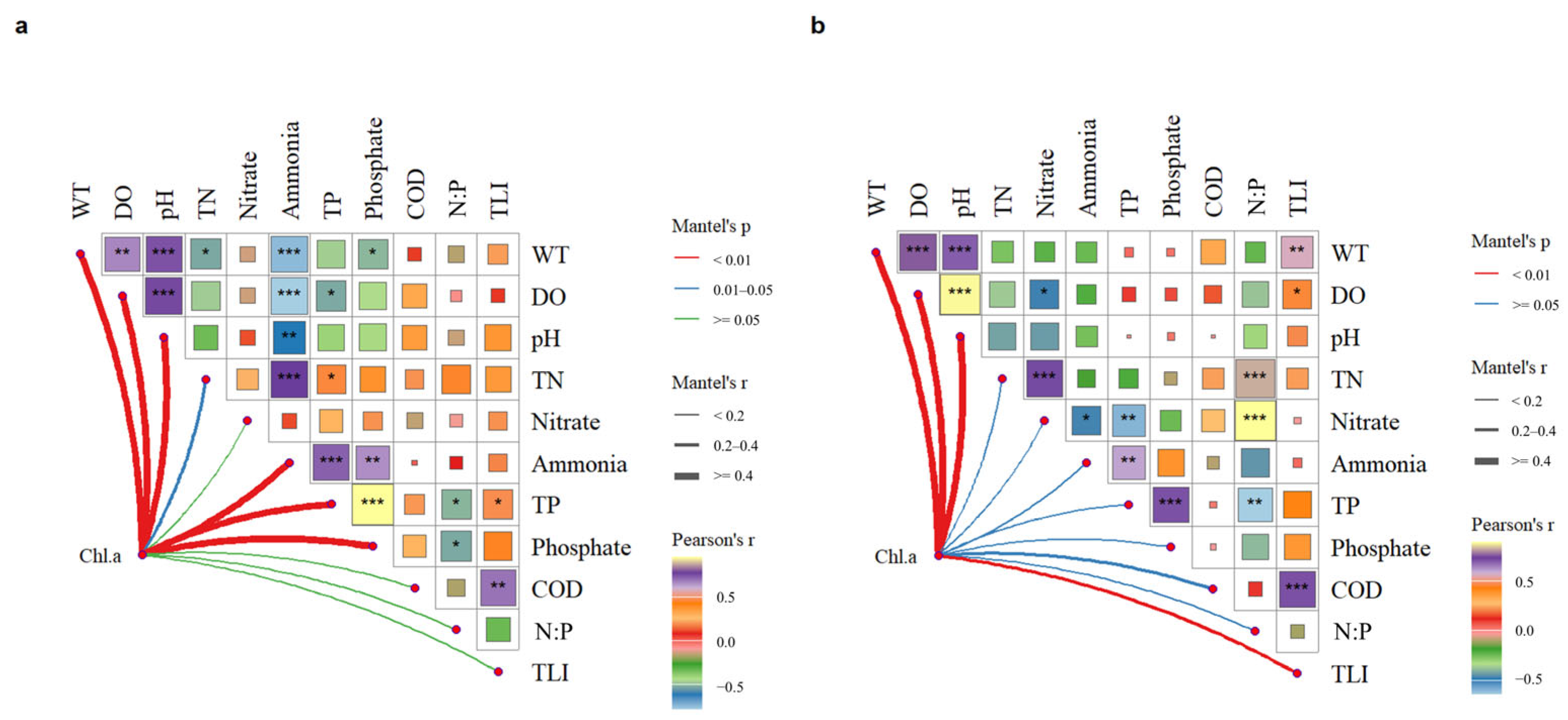
To assess differences between groups, Student’s t-tests were performed using the ‘t.test’ function in R. Prior to conducting t-tests, homogeneity of variance was evaluated using the ‘var.equal’ function. If variances were equal, the ‘var.equal’ argument in the ‘t.test’ function was set to TRUE; otherwise, it was set to FALSE. A Mantel test was used to evaluate the correlation between environmental variables and Chl. a concentration. In addition to the directly measured environmental variables (i.e., WT, DO, pH, TN, NO 3 -N, NH 4 + -N, TP, PO 4 3 -P, and CODMn), the indirect variables, including the nitrogen-to-phosphorus molar ratio (N:P) and TLI, were also included in the Mantel test to evaluate potential correlations. In addition, stepwise regression analysis was conducted to identify key environmental factors influencing Chl. a concentrations. Given that our Pearson correlation analysis indicated a strong collinearity between TP and PO 4 3 -P (see Section 3), only PO 4 3 -P was included as the representative phosphorus variable in our stepwise regression model. All statistical analyses were performed using R software (version 4.3.0). A significance level of p < 0.05 was used for all tests.

3. Results

3.1. WT and DO

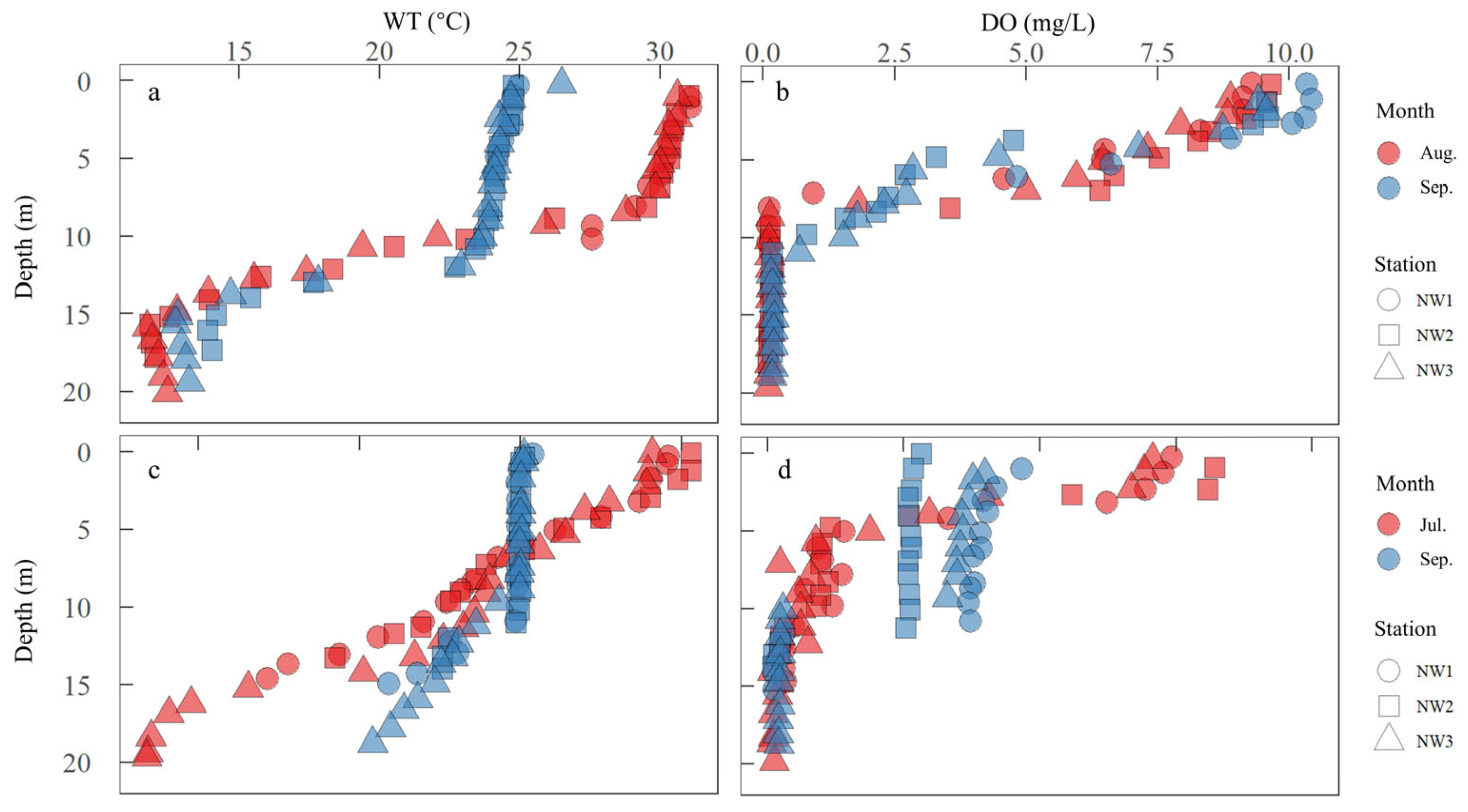
At all three sampling sites, surface WT at 0.5 m depth ranged from 30.6 to 31.1 °C during the early stage of the HTD period in 2019, and from 29.1 to 30.3 °C during the same stage of the NTND period in 2020 (Figure 2a,c). A distinct thermocline was observed during both periods (Figure 2a,c, Table S5), with stronger stratification during the HTD period. In the early stage of HTD period, the thermocline developed between 9 and 16 m and later stabilized at approximately 13–15 m, especially at sites NW2 and NW3 (Figure 2a). In contrast, during the early stage of the NTND period, the thermocline extended more gradually from the surface down to 20 m (Figure 2c). By the late stage of both periods, surface WT declined to 24.8–26.5 °C during the HTD period and 25.1–25.4 °C during the NTND period (Figure 2a,c). In both cases, surface temperature remained relatively constant down to ~10 m, followed by a gradual decrease to the bottom, though the temperature declined more sharply in the HTD period (Figure 2a).
Vertical DO profiles during the early stages of both periods were similar, with concentrations decreasing from the surface to approximately 10 m depth, approaching near-zero levels at greater depths. These profiles were characterized by a clear oxycline (Figure 2b,d, Table S5). In the late stage, however, differences emerged (Figure 2b,d). During the late HTD period, the DO profile resembled that of the early stage, with surface DO concentrations around 10 mg/L gradually declining to approximately 0.1 mg/L below 10 m (Figure 2b). In contrast, during the late NTND period, DO concentrations ranged from 2.5 to 5 mg/L between the surface and 10 m depth, then dropped sharply to <0.1 mg/L below that depth (Figure 2d).
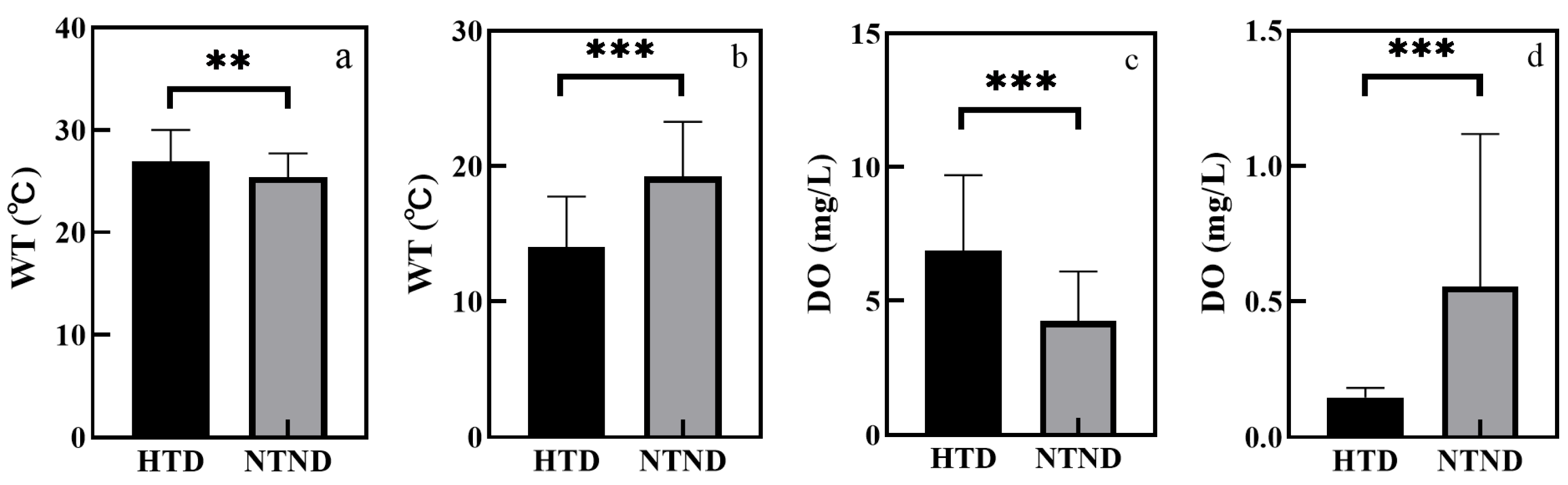
Across all three sampling sites, the mean WT in the upper thermocline layer was 26.9 ± 3.1 °C (0–12 m) during the HTD period and 25.4 ± 2.3 °C (0–19 m) during the NTND period (Figure 3a). In the lower thermocline layer, WT averaged 14.0 ± 3.7 °C (10–20 m) for the HTD period and 19.2 ± 3.9 °C (8–20 m) for the NTND period (Figure 3b). DO concentrations in the upper oxycline layer averaged 6.88 ± 2.79 mg/L (0–10 m) during the HTD period and 4.24 ± 1.83 mg/L (0–12 m) during the NTND period (Figure 3c). In the lower oxycline layer, DO levels were significantly lower during the HTD period (0.15 ± 0.03 mg/L; 8–20 m) compared to the NTND period (0.56 ± 0.56 mg/L; 4–20 m) (Figure 3d). All four paired comparisons of WT and DO between the HTD and NTND periods were statistically significant (t-test, p < 0.05 for all comparisons) (Figure 3).

3.2. Water Quality Parameters, Chl. a, and TLI

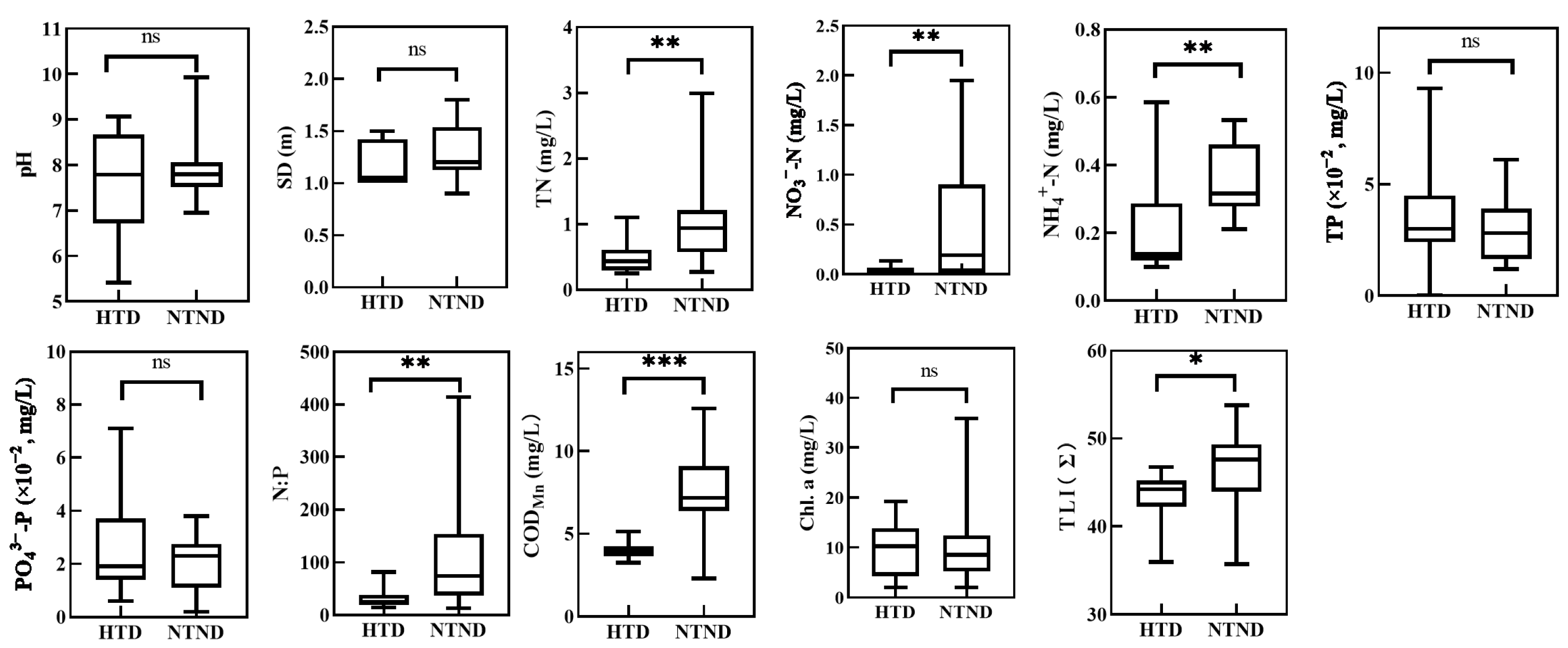
Both the HTD and NTND periods exhibited alkaline conditions, with average pH values of 7.64 ± 1.05 and 7.98 ± 0.77, respectively, though a wider pH range was observed during the HTD period (Figure 4). Water transparency, measured using SD, showed relatively narrow variation, with mean values of 1.17 ± 0.23 m for the HTD period and 1.29 ± 0.30 m for the NTND period (Figure 4). Of the nitrogen nutrients, the concentrations of TN, NO 3 -N, and NH 4 + -N were all significantly higher during the NTND period than in the HTD period (t-test, p < 0.05 for all). Notably, NO 3 -N concentrations were extremely low during the HTD period (0.05 ± 0.03 mg/L), while in the NTND period, they were approximately nine times higher (0.44 ± 0.58 mg/L) (Figure 4). In contrast, phosphorus nutrients, including TP and PO 4 3 -P, did not differ significantly between the two periods (t-test, p > 0.05 for both), though slightly elevated concentrations were observed during the HTD period. On average, TP concentrations were 0.04 ± 0.02 mg/L in the HTD period and 0.03 ± 0.02 mg/L in the NTND period, while PO 4 3 -P concentrations were 0.03 ± 0.01 mg/L in the HTD period and 0.02 ± 0.01 mg/L in the NTND period (Figure 4). Chl. a concentrations were slightly lower during the HTD period (9.66 ± 5.15 μg/L) compared to the NTND period (10.42 ± 8.76 μg/L), though the difference was not statistically significant (t-test, p > 0.05). However, N:P molar ratio, CODMn and TLI values were significantly lower in the HTD period (t-test, p < 0.05). The average N:P molar ratio, CODMn, and TLI were 30.68 ± 16.49 versus 106.18 ± 94.34, 4.00 ± 0.46 mg/L versus 7.04 ± 2.44 mg/L, and 43.33 ± 2.94 versus 46.57 ± 4.51 in the HTD period compared to the NTND period, respectively (Figure 4).

3.3. Correlation Between Environmental Factors and Phytoplankton Biomass

During the HTD period, eighteen pairs of environmental variables exhibited statistically significant correlations (p < 0.05) (Figure 5a), indicating a more complex interaction network compared to the NTND period, in which fifteen significant correlations were observed (p < 0.05) (Figure 5b). Specifically, during the HTD period, WT was positively correlated with pH (r = 0.75) and DO (r = 0.68) and negatively correlated with TN (r = −0.52), NH 4 + -N (r = −0.74), and PO 4 3 -P (r = −0.50) (Figure 5a), while during the NTND period, WT was positively correlated with DO (r = 0.77), pH (r = 0.70), and TLI (r = 0.57) (Figure 5b). The Mantel test revealed that Chl. a concentration was significantly correlated with seven environmental factors during the HTD period, with Mantel correlation coefficients ranging from 0.27 to 0.59 (p < 0.05) (excluding NO 3 -N, CODMn, N:P ratio, and TLI, which were not significantly correlated) (Figure 5a). In contrast, during the NTND period, Chl. a concentration showed significant correlations with only four variables, WT, DO, pH and TLI, with stronger Mantel coefficients ranging from 0.34 to 0.72 (p < 0.01 for all) (Figure 5b).
Stepwise regression analysis further identified the key environmental drivers of phytoplankton biomass, represented by Chl. a concentration. During the HTD period, pH and NH 4 + -N were the most influential predictors (Residual Sum of Squares [RSS] = 146.31; Akaike Information Criterion [AIC] = 43.72, R2 = 0.68) (Table 1), with pH showing the strongest correlation (p < 0.01). In contrast, during the NTND period, DO and TLI were the most influential predictors (RSS = 238.92, AIC = 55.61, R2 = 0.84) (Table 1), with DO showing statistical significance (p < 0.01). These results suggest that the relationship between phytoplankton biomass and environmental factors shifted under the influence of catastrophic weather events, with different variables driving phytoplankton growth during drought and non-drought conditions.

4. Discussion

In the present study, the average temperature above the thermocline during the HTD period (26.9 °C) was 1.5 °C higher than that observed during the NTND period (25.4 °C), which contributed to the formation of a relatively thinner thermocline during the HTD period due to enhanced thermal stratification caused by stronger density gradients in warmer surface waters [49,50,51]. Since a distinct thermocline is structured in deep lakes and reservoirs during summer [50,52], given that thermal stratification creates distinct hydrodynamic conditions across water layers and inhibits vertical mixing due to temperature gradients [53], the resulting stagnation of the water column under catastrophic drought conditions may have further altered the reservoir’s physicochemical properties. Temperature is a key environmental factor influencing phytoplankton growth [54], with phytoplankton biomass being positively correlated with WT during both the HTD and NTND periods; however, although surface WT during the HTD period was higher than during the NTND period, stepwise analysis did not identify a significant effect of temperature on phytoplankton biomass. These results suggest that the effect of temperature may be masked by other highly correlated parameters during the summer season.
The oxycline, characterized by the steepest gradient in DO concentrations, plays a crucial role in regulating oxygen availability within the water column [39]. In this study, we also observed distinct patterns in the development of the oxycline between the HTD and NTND periods in Nanwan Reservoir. During the HTD period, the vertical DO distribution remained consistent between the early and late stages, indicating a persistently strong oxycline from August to September. In contrast, during the NTND period, the oxycline weakened notably by September. Surface DO concentrations during the HTD period were approximately 3 mg/L higher than those observed during the NTND period. Because the median Chl. a concentration was higher in the HTD period than in the NTND period, the elevated DO levels observed during the HTD period may be partially attributed to enhanced phytoplankton photosynthetic activity under higher temperatures [55]. However, extreme hypoxic conditions (<0.1 mg/L) were detected below 7 m during the HTD period, likely resulting from inhibited vertical mixing and increased oxygen consumption by microbial and benthic respiration [52]. Water hypoxia poses a serious threat to the ecological health of aquatic systems. For example, bottom-dwelling fish typically require DO concentrations between 4.3 and 5.7 mg/L for survival [51]. When DO levels fall below 0.7 mg/L, benthic organisms often abandon their burrows and become exposed at the sediment–water interface, resulting in elevated mortality rates [56]. In this study, DO concentrations in the bottom waters of Nanwan Reservoir also dropped to approximately 0.1 mg/L below 10 m during the NTND period, suggesting that hypoxic conditions frequently occur in deeper layers, regardless of catastrophic weather. Nevertheless, the combination of high temperatures and prolonged drought during HTD conditions appears to exacerbate bottom-water hypoxia. Sustained water column stratification and reduced mixing during such periods may compromise the ecological functioning of the reservoir, threaten aquatic productivity, and disrupt nutrient cycling, ultimately impacting biodiversity and water quality.
Concentrations of nitrogen species in Nanwan Reservoir were significantly lower during the HTD period compared to the NTND period. This reduction is likely due to decreased precipitation during the catastrophic drought, which would have reduced nutrient loading from the surrounding watershed. Although precipitation–runoff–nutrient input data were not available in this study, numerous studies have shown that precipitation significantly influences nutrient loading in freshwater ecosystems [57,58,59]. Similar observations have been reported in other freshwater systems; for instance, in Lake Dongting (China), TN concentrations declined by approximately 70% following an extreme drought in the summer of 2022 (0.57 mg/L) compared to the historical average from 1999 to 2017 (1.74 mg/L) [29]. In addition to reduced external loading, the low concentrations of inorganic nitrogen observed in surface waters during the HTD period may also reflect rapid uptake by phytoplankton stimulated by elevated temperatures. In contrast, phosphorus concentrations remained relatively stable between the HTD and NTND periods in Nanwan Reservoir, which may be due to the combined influences of abiotic and biotic pathways. The Redfield molar ratio (C:P = 106 and N:P = 16) is commonly used to assess nutrient limitations for phytoplankton growth [60]. It is established that oligotrophic and mesotrophic lakes typically exhibit phosphorus limitation [45,61]; in this study, the average N:P molar ratio during the HTD period was 31, significantly lower than the value of 106 recorded during the NTND period. These findings suggest a nutrient limitation in phytoplankton growth may shift from severe phosphorus to nitrogen under drought conditions in Nanwan Reservoir. This is consistent with our previous research, which also indicated that nitrogen availability plays a key role in regulating phytoplankton biomass in this reservoir [32]. Extreme drought conditions can induce nitrogen limitation even in eutrophic water bodies, particularly when anaerobic conditions develop in the water column and sediments. In aquatic systems, phosphorous is often derived from internal sources through processes such as adsorption, flocculation, sedimentation, and release from anoxic sediments [61,62,63,64]. For example, in Lake Biwa (Japan), extreme phosphorus limitation has been observed, with N:P ratios exceeding 100 at depths of 10–20 m during the peak phytoplankton growth season from July to October [45]. In Lake Balaton (Hungary), long-term stratification led to phosphorus being released from bottom sediments, which triggered phytoplankton blooms [65]. Similarly, in Lake Taihu (China), water column stratification facilitates internal phosphorus release, thereby exacerbating bloom formation [66]. Compared to nitrogen, phosphorus in sediments is more readily stored in large quantities within water bodies, known as endogenous phosphorus [64]. Nitrogen release from sediments accounts for only 9% of the TN in the water body, whereas phosphorus release contributes up to 43% of the TP [67]. Therefore, the large quantity of phosphorus released from the bottom sediment may partially contribute to phosphorus availability for phytoplankton growth [68], consequently resulting in relatively stable phosphorus concentrations despite varied weather patterns.
The pH during the HTD period was slightly lower than that recorded during the NTND period, although a wide range of fluctuations were identified. In freshwater ecosystems with relatively small water bodies, pH is largely regulated by multiple abiotic and biotic factors, such as precipitation [69,70] and phytoplankton photosynthesis [71]. During the HTD period, owing to the limited influence of precipitation, water pH may have been primarily regulated by phytoplankton through biological processes, including CO2 consumption and release during photosynthesis and respiration, respectively. Although direct evidence of such physiological responses was not available, evaluating carbon assimilation by phytoplankton communities could help clarify their physiological responses to drought weather. CODMn is widely recognized as an integrated indicator of the extent to which water bodies are contaminated by organic pollutants and reductive inorganic substances [40]. In the Nanwan Reservoir, a significant decrease in CODMn was observed during the HTD period, which can be attributed to reduced precipitation and, consequently, a decline in external inputs of organic and inorganic pollutants from the surrounding watershed. Similarly, the TLI was significantly lower during the HTD period compared to the NTND period. This reduction is likely associated with decreased nutrient loading, particularly nitrogen, under drought conditions. The overall improvement in water quality observed during the HTD period may therefore be partially explained by nutrient limitation caused by the reduced inflow of polluted runoff from the watershed. Notably, the COVID-19 pandemic, which began in late 2019, drastically altered human activities worldwide [72]. However, Henan Province, as one of the most important agricultural regions in China, showed no significant changes in key agricultural indicators during the pandemic period, including cultivated land area, effective irrigated area, chemical fertilizer use, and agricultural carbon emissions [73]. In Xinyang city, the agricultural land was 822.86 and 830.99 thousand hectares in 2019 and 2020, respectively, with total grain production reaching 560.38 and 574.56 million tons, while domestic sewage discharge remained relatively stable at 3729 and 3740 tons over the same period [74]. These data support that changes in nutrient levels in Nanwan Reservoir may be primarily driven by drought conditions. Since Nanwan Reservoir is an important drinking water source for Xinyang City, as mentioned above, short-term drought-induced water quality improvements are not expected to adversely affect its potable water supply. Nonetheless, previous studies have reported that drought conditions can promote nutrient recycling, enhance eutrophication, and degrade water quality in shallow aquatic systems [75,76]. However, the Nanwan Reservoir, a large, deep body of water, exhibited a pronounced thermocline during the HTD period. This stratification likely limited the upward diffusion of internally released pollutants from the hypolimnion to the surface layers.
Nutrients can be transported from deeper layers to the surface through vertical water convection, potentially stimulating phytoplankton blooms [77,78]. In large lakes and reservoirs, surface-layer nutrients are often rapidly depleted due to intense phytoplankton uptake [45,61]. Consequently, nutrient resupply from deeper layers via water circulation plays a critical role in sustaining phytoplankton productivity [79,80]. In the present study, absent severe phosphate limitation during the HTD period, which may explain the relative stability of total phytoplankton biomass observed during the investigation period. Although correlation analyses revealed significant associations between phytoplankton biomass and several environmental factors, both the Mantel test and stepwise regression indicated that extreme drought conditions introduced a more complex network of relationships between environmental variables and phytoplankton growth compared to under normal conditions. The observed positive correlations between phytoplankton biomass and pH and/or DO concentrations in Nanwan Reservoir likely reflect enhanced photosynthetic activity within the phytoplankton community. Overall, our findings provide evidence that catastrophic drought events can disrupt primary production processes in large, deep reservoirs. Moreover, they highlight the intricate and dynamic ecological responses of phytoplankton communities to shifting environmental conditions [81] and suggest that such events may alter phytoplankton community structure through complex relationships driven by differing physiological adaptations and species competition [82,83]. Integrating the role of functional phytoplankton community groups with diverse weather patterns will be essential to unravel the specific ecological mechanisms governing primary productivity in freshwater ecosystems.

5. Conclusions

In this study, we investigated the effects of extreme drought events on the water quality and phytoplankton biomass in a large temperate reservoir. Distinct thermoclines and oxyclines were consistently present during summer, but drought conditions significantly disrupted these structures, leading to a prolonged period of stratification which likely limited the upward diffusion of internally released pollutants from the hypolimnion to the surface layers. Because phosphorus concentrations remained relatively stable throughout the study period, nutrient limitation in phytoplankton growth may shift from severe phosphorus to nitrogen under drought conditions. Despite the limited number of field samples taken in this study, due to the complex network among environmental variables and phytoplankton biomass induced by extreme droughts, we hypothesize that both phosphorus and nitrogen loading may play important roles in regulating phytoplankton growth under drought conditions in Nanwan Reservoir. These responses to severe weather events highlight the need to incorporate such insights into water resource management and ecological conservation strategies based on long-term monitoring data.

Supplementary Materials

The following supporting information can be downloaded at: https://www.mdpi.com/article/10.3390/w18030411/s1, Figure S1: Cumulative precipitation in Xinyang City (Henan Province, China) during July, August, and September from 2015 to 2021 (a), and monthly precipitation in 2019 and 2020 (b). Meteorological data were provided by the National Basic Weather Station at Tanshanbao, located in the western suburbs of Xinyang City (114.0433° E, 32.1372° N). Precipitation data were collected using an SL3-1 tipping-bucket rain gauge; Table S1: The average air temperature, standard deviation (s.d.), and temperature range in Xinyang City (Henan Province, China) during July, August, and September from 2016 to 2021. Data was provided by the National Basic Weather Station at Tanshanbao, located in the western suburbs of Xinyang City (114.0433° E, 32.1372° N); Table S2: Drought classification based on precipitation anomaly percentage (PA, %) as defined in [33]; Table S3: Detection limits and spiked recovery rate for the measured nutrient concentrations. TN: total nitrogen; TP: total phosphorus; NH+ 4-N: ammonium; NO− 3-N: nitrate; PO3− 4-P: phosphorus; CODMn: chemical oxygen demand; Table S4: Trophic status classification of freshwater ecosystems [42,43,44]; Table S5: Thermocline and oxycline depths at three sampling sites (NW1, NW2, NW3) in Nanwan Reservoir in August and September 2019 and July and September 2020.

Author Contributions

Conceptualization, methodology, visualization, validation, formal analysis, writing—original draft, K.W.; methodology, investigation, formal analysis, writing—review and editing, Z.H.; conceptualization, supervision, data curation, funding acquisition, writing—review and editing, Y.T.; supervision, funding acquisition, writing—review and editing, X.L.; investigation, writing—review and editing, C.J.; investigation, writing—review and editing, C.S.; investigation, writing—review and editing, Y.M.; writing—review and editing, H.G.; writing—review and editing, L.Z.; project administration, funding acquisition, writing—review and editing, X.G. All authors have read and agreed to the published version of the manuscript.

Funding

This work was supported by the Key Research and Development and Promotion Special Project (Science and Technology Tackling Project) of Henan Province (No. 212102310850), the Natural Science Foundation of Guangxi Zhuang Autonomous Region (No. 2025GXNSFAA069312), the Natural Science Foundation of Henan Province (No. 242300420175), the Innovative Research Team of Reservoir Ecological Fisheries in the Huai River Basin of Xinyang Agriculture and Forestry University (No. XNKJTD-016), the National-level Research Project Support Fund at Xinyang Agriculture and Forestry University (No. pyjj20230108), the China Postdoctoral Science Foundation (No. 2023M741994), and the Investigation of Aquatic Biodiversity and Environmental Conditions in Key Waters of Henan Province.

Data Availability Statement

The original contributions presented in this study are included in the article/Supplementary Material. Further inquiries can be directed to the corresponding authors.

Acknowledgments

We express our sincere gratitude to all those who contributed to this research project. Special thanks to the affairs center of Nanwan Reservoir in Xinyang City, Henan Province, China, for their invaluable assistance and cooperation throughout the sampling process. We also extend our appreciation to Haojun Zhang for his assistance in the creation of Figure 1.

Conflicts of Interest

The authors declare no conflicts of interest.

References

  1. Dong, J.; Gao, Y.N.; Li, G.B. A review: Responses of phytoplankton communities to eutrophication and climate warming in freshwater lakers. Acta Hydrobiol. Sin. 2016, 40, 615–623, (In Chinese with English abstract). [Google Scholar] [CrossRef]
  2. Lv, X.T.; Lv, Y.L.; Song, S.; Wang, T. Eutrophication in cold-water lakes driven by combined effects of climate change and human activities. Acta Ecol. Sin. 2017, 37, 7375–7386, (In Chinese with English abstract). [Google Scholar] [CrossRef]
  3. Su, X.; Chu, J.; Zhang, T.; Jiang, T.; Wang, G. Spatio-temporal evolution trend of groundwater drought and its dynamic response tometeorological drought in Northwest China. Water Resour. Prot. 2022, 38, 34–42, (In Chinese with English abstract). [Google Scholar] [CrossRef]
  4. Li, J.; Thompson, D.W.J. Widespread changes in surface temperature persistence under climate change. Nature 2021, 599, 425–430. [Google Scholar] [CrossRef] [PubMed]
  5. Pörtner, H.O.; Roberts, D.C.; Masson-Delmotte, V.; Zhai, P.; Poloczanska, E.; Mintenbeck, K.; Tignor, M.; Alegría, A.; Nicolai, M.; Okem, A.; et al. (Eds.) Technical Summary. In IPCC Special Report on the Ocean and Cryosphere in a Changing Climate; Cambridge University Press: Cambridge, UK; New York, NY, USA, 2019; pp. 39–69. [Google Scholar]
  6. Hu, B.; Pan, M.; Shi, P.; Xu, J.; Zhang, M. Effect of climate warming and eutrophication on N2O flux at water-air interface of shallow lakers. Acta Hydrobiol. Sin. 2021, 45, 625–635, (In Chinese with English abstract). [Google Scholar]
  7. Jackson, M.C.; Loewen, C.J.G.; Vinebrooke, R.D.; Chimimba, C.T. Net effects of multiple stressors in freshwater ecosystems: A meta-analysis. Glob. Change Biol. 2016, 22, 180–189. [Google Scholar] [CrossRef]
  8. Moser, K.A.; Baron, J.S.; Brahney, J.; Oleksy, I.A.; Saros, J.E.; Hundey, E.J.; Sadro, S.A.; Kopáek, J.; Sommaruga, R.; Kainz, M.J. Mountain lakes: Eyes on global environmental change. Glob. Planet. Change 2019, 178, 77–95. [Google Scholar] [CrossRef]
  9. Woolway, R.I.; Merchant, C.; Hoek, J.V.D.; Azorin-Molina, C.; Jones, I.D. Northern Hemisphere atmospheric stilling accelerates lake thermal responses to a warming world. Geophys. Res. Lett. 2019, 46, 11983–11992. [Google Scholar] [CrossRef]
  10. Woolway, R.I.; Kraemer, B.M.; Lenters, J.D.; Merchant, C.J.; O’Reilly, C.M.; Sharma, S. Global lake responses to climate change. Nat. Rev. Earth Environ. 2020, 1, 388–403. [Google Scholar] [CrossRef]
  11. Zhu, L.; Zhang, G.; Yang, R.; Liu, C.; Yang, K.; Qiao, B.; Han, B. Lake variations on Tibetan Plateau of recent 40 years and future changing tendency. Bull. Chin. Acad. Sci. 2019, 34, 1254–1263, (In Chinese with English abstract). [Google Scholar] [CrossRef]
  12. Yu, X.; Zhuge, Y.; Liu, X.; Du, Q.; Tan, H. Volution mechanism of dissolved oxygen stratification in a large deep reservoir. J. Lake Sci. 2020, 32, 1496–1507, (In Chinese with English abstract). [Google Scholar]
  13. Jeppesen, E.; Kronvang, B.; Olesen, J.E.; Audet, J.; Sndergaard, M.; Hoffmann, C.C.; Andersen, H.E.; Lauridsen, T.L.; Liboriussen, L.; Larsen, S.E. Climate change effects on nitrogen loading from cultivated catchments in Europe: Implications for nitrogen retention, ecological state of lakes and adaptation. Hydrobiologia 2011, 663, 1–21. [Google Scholar] [CrossRef]
  14. Smol, J.P. The power of the past: Using sediments to track the effects of multiple stressors on lake ecosystems. Freshw. Biol. 2010, 55, 43–59. [Google Scholar] [CrossRef]
  15. Livingstone, D.M. Impact of secular climate change on the thermal structure of a large temperate central European lake. Algae 2003, 57, 205–225. [Google Scholar] [CrossRef]
  16. Schindler, D.W.; Bayley, S.E.; Parker, B.R. The effects of climatic warming on the properties of boreal lakes and streams at the Experimental Lakes Area, northwestern Ontario. Limnol. Oceanogr. 1996, 41, 1004–1017. [Google Scholar] [CrossRef]
  17. Wilhelm, S.; Adrian, R. Impact of summer warming on the thermal characteristics of a polymictic lake and consequences for oxygen, nutrients and phytoplankton. Freshw. Biol. 2008, 53, 226–237. [Google Scholar] [CrossRef]
  18. Magnuson, J.J.; Robertson, D.M.; Benson, B.J.; Wynne, R.H.; Livingstone, D.M.; Arai, T.; Assel, R.A.; Barry, R.G.; Card, V.; Kuusisto, E. Historical Trends in Lake and River Ice Cover in the Northern Hemisphere. Science 2000, 289, 1743–1746. [Google Scholar] [CrossRef]
  19. Adrian, R.; Walz, N.; Hintze, T.; Hoeg, S.; Rusche, R. Effects of ice duration on plankton succession during spring in a shallow polymictic lake. Freshw. Biol. 1999, 41, 621–632. [Google Scholar] [CrossRef]
  20. Rogora, M.; Mosello, R.; Arisci, S. The Effect of Climate Warming on the Hydrochemistry of Alpine Lakes. Water Air Soil Pollut. 2003, 148, 347–361. [Google Scholar] [CrossRef]
  21. Bergström, A.-K.; Jansson, M. Atmospheric nitrogen deposition has caused nitrogen enrichment and eutrophication of lakes in the northern hemisphere. Glob. Change Biol. 2006, 12, 635–643. [Google Scholar] [CrossRef]
  22. Chuai, X.; Chen, X.; Yang, L.; Zeng, J.; Miao, A.; Zhao, H. Effects of climatic changes and anthropogenic activities on lake eutrophication in different ecoregions. Int. J. Environ. Sci. Technol. 2012, 9, 503–514. [Google Scholar] [CrossRef]
  23. Sommaruga-WÖgrath, S.; Koinig, K.A.; Schmidt, R.; Sommaruga, R.; Tessadri, R.; Psenner, R. Temperature effects on the acidity of remote alpine lakes. Nature 1997, 387, 64–67. [Google Scholar] [CrossRef]
  24. Burforda, M.A.; Careyb, C.C.; Hamilton, D.P.; Huisman, J.; Paerl, H.W.; Wood, S.A.; Wulff, A. Perspective: Advancing the research agenda for improving understanding of cyanobacteria in a future of global change. Harmful Algae 2020, 91, 101601. [Google Scholar] [CrossRef] [PubMed]
  25. Qin, B. Shallow lake limnology and control of eutrophication in Lake Taihu. J. Lake Sci. 2020, 32, 1229–1243, (In Chinese with English abstract). [Google Scholar] [CrossRef]
  26. Ho, J.C.; Michalak, A.M.; Pahlevan, N. Widespread global increase in intense lake phytoplankton blooms since the 1980s. Nature 2019, 574, 667–670. [Google Scholar] [CrossRef]
  27. Zhang, M.; Duan, H.; Shi, X.; Yu, Y.; Kong, F. Contributions of meteorology to the phenology of cyanobacterial blooms: Implications for future climate change. Water Res. 2012, 16, 442–452. [Google Scholar] [CrossRef]
  28. Kim, H.G.; Cha, Y.K.; Cho, K.H. Projected climate change impact on cyanobacterial bloom phenology in temperate rivers based on temperature dependency. Water Res. 2024, 249, 120928. [Google Scholar] [CrossRef]
  29. Wang, D.; Han, J.; Li, R.; Tang, X. Nutritional characteristics in the waterbody of Lake Dongting area nutrient condition andassociated improvement measures under the extreme drought in 2022. J. Lake Sci. 2023, 35, 1970–1978, (In Chinese with English abstract). [Google Scholar] [CrossRef]
  30. Yu, G.Z.; Su, H.; Liu, X.C.; Zhao, C.M.; Gao, H.; Huang, K. Effects of function changes of the large reservoirs in Xinyang of Henan Province on water qualities -using Nanwan Reservoir as an example. Areal Res. Dev. 2009, 28, 115–119, (In Chinese with English abstract). [Google Scholar]
  31. Fu, M.; Wang, Z.; Liang, X. Floristic composition and plant community diversity of water-level fluctuation zone of Nanwan Reservoir. Desalin. Water Treat. 2023, 291, 233–241. [Google Scholar] [CrossRef]
  32. Tian, Y.; Ju, C.; Wu, K.; Liu, X.; Zhang, H.; Guan, J.; Ge, Y.; Zhao, L.; Su, C.; Yang, T.; et al. Morphological characteristics and annual population dynamics of Microcystis (Cyanobacteria) in Nanwan Reservoir (Xinyang, China). Water 2024, 16, 3569. [Google Scholar] [CrossRef]
  33. GB/T20481-2017; Grades of Meteorological Drought. China National Standardization Administration: Beijing, China, 2018. (In Chinese)
  34. MacIntyre, S.; Fram, J.P.; Kushner, P.J.; Bettez, N.D.; O’brien, W.; Hobbie, J.; Kling, G.W. Climate-related variations in mixing dynamics in an Alaskan arctic lake. Limnol. Oceanogr. 2009, 54, 2401–2417. [Google Scholar] [CrossRef]
  35. Liu, M.; Zhang, Y.; Shi, K.; Zhu, G.; Wu, Z.; Liu, M.; Zhang, Y. Thermal stratification dynamics in a large and deep subtropical reservoir revealed by high-frequency buoy data. Sci. Total Environ. 2019, 651, 614–624. [Google Scholar] [CrossRef] [PubMed]
  36. Read, J.S.; Rose, K.C. Physical responses of small temperate lakes to variation in dissolved organic carbon concentrations. Limnol. Oceanogr. 2013, 58, 921–931. [Google Scholar] [CrossRef]
  37. Gauthier, J.; Prairie, Y.T.; Beisner, B.E. Thermocline deepening and mixing alter zooplankton phenology, biomass and body size in a whole-lake experiment. Freshw. Biol. 2014, 59, 998–1011. [Google Scholar] [CrossRef]
  38. Bertrand, A.; Ballon, M.; Chaigneau, A. Acoustic observation of living organisms reveals the upper limit of the oxygen minimum zone. PLoS ONE 2010, 5, e10330. [Google Scholar] [CrossRef]
  39. Qiu, X.P.; Huang, T.L.; Zeng, M.Z. Responses of dissolved oxygen on thermal stratification and eutrophication in lakes and reservoirs-An example in Zhoucun Reservoir in Zaozhuang City. China Environ. Sci. 2016, 36, 1547–1553, (In Chinese with English abstract). [Google Scholar]
  40. Wei, F. Methods for Monitoring and Analyzing Water and Wastewater, 4th ed.; China Environmental Science Press: Beijing, China, 2002. (In Chinese) [Google Scholar]
  41. Wang, Y.; Guo, M.; Li, X.; Liu, G.; Hua, Y.; Zhao, J.; Huguet, A.; Li, S. Shifts in microbial communities in shallow lakes depending on trophic states: Feasibility as an evaluation index for eutrophication. Ecol. Indic. 2022, 136, 108691. [Google Scholar] [CrossRef]
  42. Jin, X.; Liu, S.; Zhang, Z. Chinese Lake Environment, 4th ed.; China Ocean Press: Beijing, China, 1995. (In Chinese) [Google Scholar]
  43. Yang, M.L.; Hu, Z.J.; Liu, Q.G.; Ren, L.P.; Chen, L.S.; Li, P.P. Evaluation of water quality by two trophic state indices in Lake Qiandaohu during 2007–2011. J. Shanghai Ocean Univ. 2013, 22, 240–245, (In Chinese with English abstract). [Google Scholar] [CrossRef]
  44. Huang, W.; Liang, N.; Zhou, L.; Lu, J. Study on the water eutrophication evolution characteristics of Junshan Lake. Water Supply 2022, 22, 8698–8707. [Google Scholar] [CrossRef]
  45. Liu, X.; Yi, R.; Ohashi, M.; Maruo, M.; Iseri, Y.; Hao, A.; Zhao, M.; Ban, S. Spatio-temporal variations of orthophosphate in a large mesotrophic lake and implications for phytoplankton productivity. Inland Waters 2025, 15, 1–15. [Google Scholar] [CrossRef]
  46. Liu, X.; Dur, G.; Ban, S.; Sakai, Y.; Ohmae, S.; Morita, T. Planktivorous fish predation masks anthropogenic disturbances on decadal trends in zooplankton biomass and body size structure in Lake Biwa, Japan. Limnol. Oceanogr. 2020, 65, 667–682. [Google Scholar] [CrossRef]
  47. McQuatters-Gollop, A.; Raitsos, D.E.; Edwards, M.; Pradhan, Y.; Mee, L.D.; Lavender, S.J.; Attrill, M.J. A long-term chlorophyll data set reveals regime shift in North Sea phytoplankton biomass unconnected to nutrient trends. Limnol. Oceanogr. 2007, 52, 635–648. [Google Scholar] [CrossRef]
  48. Chen, Y.; Gao, X. Comparison of two methods for Phytoplankton Chlorophyll-a Concentration Measurement. J. Lake Sci. 2000, 12, 185–188, (In Chinese with English abstract). [Google Scholar] [CrossRef]
  49. Li, X. Limnology, 4th ed.; Science Press: Beijing, China, 2013. (In Chinese) [Google Scholar]
  50. Lin, J.; Su, Y.; Zhong, H.; Chen, Y.; Li, Y.; Lin, H. Vertical distribution of phytoplankton in a eutrophic reservoir, Shanzi Reservoir (Fujian) during summer stratification. J. Lake Sci. 2010, 22, 244–250, (In Chinese with English abstract). [Google Scholar]
  51. Diaz, R.J.; Rosenberg, R. Spreading dead zones and consequences for marine ecosystems. Science 2008, 321, 926–929. [Google Scholar] [CrossRef]
  52. Wu, Z.; Liu, M.; Lan, J.; He, J.; Yu, Z. Vertical distribution of phytoplankton and physic-chemical characteristics in the lacustrine zone of Xin’anjiang Reservoir (Lake Qiandao) in subtropic China during summer stratification. J. Lake Sci. 2012, 24, 460–465, (In Chinese with English abstract). [Google Scholar] [CrossRef]
  53. Komatsu, E.; Fukushima, T.; Harasawa, H. A modeling approach to forecast the effect of long-term climate change on lake water quality. Ecol. Modell. 2007, 209, 351–366. [Google Scholar] [CrossRef]
  54. Paerl, H.W.; Hall, N.S.; Calandrino, E.S. Controlling harmful cyanobacterial blooms in a world experiencing anthropogenic and climatic-induced change. Sci. Total Environ. 2011, 409, 1739–1745. [Google Scholar] [CrossRef]
  55. Raven, J.A.; Geider, R.J. Temperature and algal growth. New Phytol. 1988, 110, 441–461. [Google Scholar] [CrossRef]
  56. Diaz, R.; Rosenberg, R. Marine benthic hypoxia: A review of its ecological effects and the behavioural response of benthic macrofauna. Oceanogr. Mar. Biol. 1995, 33, 245–303. [Google Scholar]
  57. Qian, H.; Qian, Y.; Gao, R. Analysis of the response relationship between different pollutants in Chaohu Lake in flowing rivers and rainfall. Water Resour. Dev. Manag. 2023, 9, 46–53, (In Chinese with English abstract). [Google Scholar] [CrossRef]
  58. Zhou, B.; Li, X.-g.; Tong, S.-c.; Lv, X.-b.; Guo, C.-c.; Lei, K. Spatial and temporal distribution of nitrogen in the Liaohe River Basin and its responses to land use and rainfall. Environ. Sci. 2024, 45, 2373–2384, (In Chinese with English abstract). [Google Scholar] [CrossRef]
  59. Liu, W.; Yu, D.; Li, K.; Zheng, L.; Zhu, L.; Gui, S.; Wei, Y. Effects of rainfall characteristics on River Water qualityin different water periods: A case study of Nanchang section in the Ganjiang River. Environ. Eng. 2023, 41, 91–99, (In Chinese with English abstract). [Google Scholar] [CrossRef]
  60. Redfield, A.C. The biological control of chemical factors in the environment. Am. Sci. 1958, 46, 230A-221. [Google Scholar]
  61. Wetzel, R. Limnology: Lake and River Ecosystems, 4th ed.; Gulf Professional Publishing: Houston, TX, USA, 2001. [Google Scholar]
  62. Chen, J.; Xu, H.; Zhan, X.; Zhu, G.; Qin, B.; Zhang, Y. Mechanisms and research methods of phosphorus migration and transformation acrosssediment-water interface. J. Lake Sci. 2019, 31, 907–918, (In Chinese with English abstract). [Google Scholar] [CrossRef]
  63. Duhamel, S.; Nogaro, G.; Steinman, A.D. Effects of water level fluctuation and sediment-water nutrient exchange on phosphorus biogeochemistry in two coastal wetlands. Aquat. Sci. 2016, 79, 57–72. [Google Scholar] [CrossRef]
  64. Schindler, D.W.; Carpenter, S.R.; Chapra, S.C.; Hecky, R.E.; Orihel, D.M. Reducing Phosphorus to Curb Lake Eutrophication is a Success. Environ. Sci. Technol. 2016, 50, 8923–8929. [Google Scholar] [CrossRef]
  65. Istvánovics, V.; Honti, M.; Torma, P.; Kousal, J. Record-setting algal bloom in polymictic Lake Balaton (Hungary): A synergistic impact of climate change and (mis) management. Freshw. Biol. 2022, 67, 1091–1106. [Google Scholar] [CrossRef]
  66. Qin, B.; Deng, J.; Shi, K.; Wang, J.; Brookes, J.; Zhou, J.; Zhang, Y.; Zhu, G.; Paerl, H.W.; Wu, L. Extreme climate anomalies enhancing Cyanobacterial blooms in Eutrophic Lake Taihu, China. Water Resour. Res. 2021, 57, e2020WR029371. [Google Scholar] [CrossRef]
  67. Sun, C.; Wang, S.; Wang, H.; Hu, X.; Yang, F.; Tang, M.; Zhang, M.; Zhong, J. Internal nitrogen and phosphorus loading in a seasonally stratified reservoir: Implications for eutrophication management of deep-water ecosystems. J. Environ. Manag. 2022, 319, 115681. [Google Scholar] [CrossRef] [PubMed]
  68. Lavery, P.S.; Oldham, C.E.; Ghisalberti, M. The use of Fick’s First Law for predicting porewater nutrient fluxes under diffusive conditions. Hydrol. Process. 2001, 15, 2435–2451. [Google Scholar] [CrossRef]
  69. Gorham, E.; Underwood, J.K.; Martini, F.B.; Ogden, J.G., III. Natural and anthropogenic causes of lake acidification in Nova Scotia. Nature 1986, 324, 451–453. [Google Scholar] [CrossRef]
  70. Henriksen, A.; Brakke, D. Increasing contributions of nitrogen to the acidity of surface waters in Norway. Water Air Soil Pollut. 1988, 42, 183–201. [Google Scholar] [CrossRef]
  71. Xu, D.; Wang, H.; Han, D.; Chen, A.; Niu, Y. Phytoplankton community structural reshaping as response to the thermal effect of cooling water discharged from power plant. Environ. Pollut. 2021, 285, 117517. [Google Scholar] [CrossRef]
  72. Ciotti, M.; Angeletti, S.; Minieri, M.; Giovannetti, M.; Benvenuto, D.; Pascarella, S.; Sagnelli, C.; Bianchi, M.; Bernardini, S.; Ciccozzi, M. COVID-19 outbreak: An overview. Chemotherapy 2020, 64, 215–223. [Google Scholar] [CrossRef]
  73. Li, J.; Nie, H.; Xu, G. Characteristics analysis on carbon reduction of crop production in Henan province based on the Statistical Yearbook data. Chin. J. Agrometeorol. 2023, 44, 759–768, (In Chinese with English abstract). [Google Scholar] [CrossRef]
  74. Xinyang Municipal Bureau of Statistics. Xinyang Statistical Yearbook-2021, 4th ed.; China Statistics Press Co., Ltd.: Beijing, China, 2021. [Google Scholar]
  75. Braga, G.G.; Becker, V.; Rodrigues de Mendonça, J.; Pinheiro de Oliveira, J.N.; de Medeiros Bezerra, A.F.; Torres, L.M.; Galvão, Â.M.F.; Mattos, A. Influence of extended drought on water quality in tropical reservoirs in a semiarid region. Acta Limnol. Bras. 2015, 27, 15–23. [Google Scholar] [CrossRef]
  76. Beklioglu, M.; Romo, S.; Kagalou, I.; Quintana, X.; Bécares, E. State of the art in the functioning of shallow Mediterranean lakes: Workshop conclusions. Hydrobiologia 2007, 584, 317–326. [Google Scholar] [CrossRef]
  77. Chang, T.; Li, J.; Chen, W.; Guo, X.; Liu, W.; Li, Y.; Wu, F. Research progress in theories and approaches for lake ecosystem restoration. Adv. Water Sci. 2024, 35, 1005–1020. (In Chinese) [Google Scholar]
  78. Qin, B.; Paerl, H.W.; Brookes, J.D.; Liu, J.; Jeppesen, E.; Zhu, G.; Zhang, Y.; Xu, H.; Shi, K.; Deng, J. Why Lake Taihu continues to be plagued with cyanobacterial blooms through 10 years (2007–2017) efforts. Sci. Bull. 2019, 64, 354–356. [Google Scholar] [CrossRef]
  79. Smith, V.H.; Tilman, G.D.; Nekola, J.C. Eutrophication: Impacts of excess nutrient inputs on freshwater, marine, and terrestrial ecosystems. Environ. Pollut. 1999, 100, 179–196. [Google Scholar] [CrossRef]
  80. Xie, P.; Chen, J.; Liu, J. A regime shift from cyanobacterial steady state to non-cyanobacterial one by using non-traditional biomanipulation-A whole lake testing experiment in Lake Donghu, Wuhan. J. Lake Sci. 2023, 35, 1–11, (In Chinese with English abstract). [Google Scholar] [CrossRef]
  81. Li, P.; Shi, W.; Liu, Q.; Yu, Y.; He, G.; Chen, L.; Ren, L.; Hong, R. Spatial and temporal distribution patterns of chlorophyll-a and the correlation analysis with environmental factors in Lake Qiandao. J. Lake Sci. 2011, 23, 568–574, (In Chinese with English abstract). [Google Scholar] [CrossRef]
  82. Zhang, H.; Peng, Y.Q.; Zou, X.N.; Zhang, T.T.; Liao, Z.H.; Lin, X.P.; Qiao, Y.M.; Chen, R. The characteristics of phytoplankton community structure and its relationship with environmental factors during extreme drought of a large-scale reservoir-Take Xinfengjiang Reservoir for example. China Environ. Sci. 2024, 44, 329–343, (In Chinese with English abstract). [Google Scholar] [CrossRef]
  83. Beaver, J.R.; Casamatta, D.A.; East, T.L.; Havens, K.E.; Rodusky, A.J.; James, R.T.; Tausz, C.E.; Buccier, K.M. Extreme weather events influence the phytoplankton community structure in a large lowland subtropical lake (Lake Okeechobee, Florida, USA). Hydrobiologia 2013, 709, 213–226. [Google Scholar] [CrossRef]
Figure 1. Location of Nanwan Reservoir in Xinyang, Henan Province, China, and the three sampling sites: NW-1, NW-2, and NW-3 (red circles).
Water 18 00411 g001
Figure 2. Vertical distribution of water temperature (WT, °C) and dissolved oxygen (DO) concentration (mg/L) in Nanwan Reservoir during the early (red) and late (blue) stages of the HTD period in 2019 (a,b) and the NTND period in 2020 (c,d).
Water 18 00411 g002
Figure 3. Average water temperature (WT, °C) and dissolved oxygen (DO) concentrations (mg/L) in the upper and lower layers of the thermocline and oxycline during the HTD and NTND periods in Nanwan Reservoir. (a) Upper and (b) lower thermocline layers and (c) upper and (d) lower oxycline layers. Student’s t-test results are also provided. ** p < 0.01, *** p < 0.001.
Water 18 00411 g003
Figure 4. Boxplots of pH, transparency (SD, m), nutrients (mg/L), nitrogen-to-phosphorus molar ratio (N:P), CODMn (mg/L), Chl. a concentration (mg/L), and TLI (∑) in Nanwan Reservoir during the HTD and NTND periods. Student’s t-test results are also provided. * p < 0.05, ** p < 0.01, *** p < 0.001, ns = no statistical difference.
Water 18 00411 g004
Figure 5. The Mantel tests show correlations both between different environmental parameters and in the relationship between chlorophyll a (Chl. a) concentration and each parameter during the HTD (a) and NTND (b) periods in Nanwan Reservoir. *, **, and *** indicate statistical significance at p < 0.05, p < 0.01, and p < 0.001, respectively.
Water 18 00411 g005
Table 1. The best stepwise multiple regression model for chlorophyll a (Chl. a) concentration using nine environmental parameters during the HTD and NTND periods in Nanwan Reservoir. The environmental parameters included in the regression model are detailed in Figure 5.
PeriodVariablesdfEstimateSEtp
HTDIntercept15−9.147.77−1.78>0.05
RSS = 146.31, AIC = 43.72, R2 = 0.68pH 2.760.903.06<0.01
NH 4 + -N −10.495.66−1.86>0.05
NTNDIntercept17−11.979.56−1.25>0.05
RSS = 238.92, AIC = 55.61, R2 = 0.84DO 2.990.407.54<0.01
TLI 0.290.211.36>0.05
Disclaimer/Publisher’s Note: The statements, opinions and data contained in all publications are solely those of the individual author(s) and contributor(s) and not of MDPI and/or the editor(s). MDPI and/or the editor(s) disclaim responsibility for any injury to people or property resulting from any ideas, methods, instructions or products referred to in the content.