Article

Mechanical Properties, Acoustic Emission (AE), and Electromagnetic Radiation (EMR) Characteristics of Sandstone with Different Water Contents Under Impact Loading

School of Resource & Environment and Safety Engineering, Hunan University of Science and Technology, Xiangtan 411201, China
*
Author to whom correspondence should be addressed.
Water 2026, 18(3), 410; https://doi.org/10.3390/w18030410
Submission received: 5 January 2026 / Revised: 26 January 2026 / Accepted: 29 January 2026 / Published: 4 February 2026

Abstract

To analyze the characteristics of acoustic emission (AE) and electromagnetic radiation (EMR) signals in specimens with different water contents during impact loading, impact tests were conducted on sandstone under dry, natural, and saturated conditions using the split Hopkinson pressure bar (SHPB) system. The results show that water reduces the dynamic compressive strength and elastic modulus of sandstone, changes the failure mode from tensile failure to tensile-shear failure, and increases the amount of small-sized fragments after failure. AE and EMR signals effectively reflect the entire deformation process of specimens with different water contents under impact loading. In the elastic stage, only EMR signals appear, indicating that EMR is more sensitive to crack generation. In the yield stage, the AE signal count and energy increase sharply, indicating that the response to specimen failure is better. By comparing AE and EMR signals at different stages, it was found that water inhibits both the propagation and energy of AE and EMR signals. The damage factor D, quantified by AE and EMR counts, accurately represents the damage suffered by specimens with different water contents during impact loading. This study significantly advances the understanding of failure mechanisms in specimens with varying water contents and contributes to practical engineering monitoring of water-bearing rock mass stability.

1. Introduction

As underground space engineering advances to greater depths, the surrounding rock becomes increasingly exposed to dynamic hazards such as stress waves from excavation and blasting, mechanical rock drilling, and disturbances from adjacent tunnel excavations [1,2]. In deep rock engineering, groundwater intrusion further complicates our understanding of the surrounding rock properties [3,4]. Therefore, it is essential to investigate the mechanical properties of rocks with varying water contents under dynamic impact conditions and to capture precursor information for rock failure.
Water intrusion into rocks can cause significant changes in their physical and mechanical properties [5,6]. Chen et al. [7] conducted experiments on 54 combinations of coal and rock to investigate the effects of different water contents on the mechanical properties and crack development of coal rocks. Xia et al. [8] utilized electron microscopy to observe rocks with varying soaking times and identified two key stages: water swelling (saturation process) and long-term soaking damage. Liu et al. [9] analyzed the energy differences of water-bearing sandstones under uniaxial compression and established a damage evolution equation based on energy dissipation.
Water also impacts the geophysical properties of rocks, such as AE and EMR [10,11,12]. AE and EMR have proven valuable in revealing deformation and damage characteristics in loaded rocks and are widely utilized in disaster monitoring and early warning systems for underground rock engineering [13,14,15]. Extensive research has been conducted on the acoustic emission characteristics during rock damage processes [16]. Mogi [17] examined the acoustic emission characteristics during rock compression and discovered a consistent pattern of acoustic emission evolution and rock compression. Filiimonov et al. [18] found that the intensity of acoustic emission signals in salt rock becomes more pronounced with increasing loading rates. Zhang et al. [19] summarized the fractal characteristics of acoustic emission during the indirect stretching of shale. Regarding EMR characteristics during unstable fracture processes [20,21], He et al. [22] investigated changes in the electromagnetic radiation frequency of rocks during uniaxial compression, connecting the generation of low-frequency signals to fracture deformation rates and vibration frequencies. Likewise, Wei et al. [23] conducted uniaxial compression tests on four different types of rocks and studied the effect of quartz content on EMR strength. Hu et al. [24] employed fractal theory to analyze the time series of rock EMR in multi-stage loading experiments, discovering that the time-varying pattern of EMR is determined by damage evolution. G. Lacidogna et al. [25] conducted monitoring of acoustic emission (AE) signals and electromagnetic radiation (EMR) signals during the uniaxial compression of four different brittle materials: concrete, Syracuse Limestone, Carrara Marble, and Green Luserna Granite. Their findings revealed that under identical conditions, AE signals are consistently present throughout the damage process of rocks, whereas EMR signals are only observable during instances of rapid stress drop or at the point of failure.
Existing studies have primarily focused on the mechanical properties and acoustic emission (AE) and electromagnetic radiation (EMR) characteristics of rock during compression, tension, and similar processes. However, research on these characteristics under impact loading, particularly the variation patterns before and after water infiltration into rock (corresponding to dry, natural, and saturated states, respectively), remains limited. Therefore, this study conducted impact tests on sandstone under dry, natural, and saturated conditions while simultaneously monitoring AE and EMR signals to investigate the mechanical, AE, and EMR characteristics of the rock samples and the influence of water. This research is of great significance for enriching the failure theory of water-bearing rock, monitoring the stability of water-bearing rock masses, and evaluating the effectiveness of hydraulic measures for water-bearing rock.

2. Test Device and Principle

2.1. Specimen Preparation

Sandstone, as a sedimentary rock, is widely present in the field of geotechnical engineering, and its physical and mechanical properties are greatly influenced by the types of internal cements and components, especially when studying the intrusion of water into rocks [26,27,28]. Therefore, sandstone is selected as the experimental material in this paper. To ensure the validity of the test results, firstly, a cylindrical core was drilled from the same sandstone block, and then processed into a cylinder with a diameter of 50 mm and a height of 50 mm [29,30,31]. Through XRD testing (Table 1), it was found that the mineral composition of this sandstone mainly consists of quartz, plagioclase, potash feldspar, and calcite, and the strong hydrophilicity of montmorillonite and illite is the main reason for the softening of red sandstone when it meets water. The density of sandstone is 2276 kg/m3, the average longitudinal wave velocity is 2768.5 m/s, the uniaxial compressive strength is 90.1 MPa, the elastic modulus is 11.4 GPa, the internal friction angle is 42°, and its Poisson’s ratio is 0.25.
Specimens with different water contents can be obtained through methods such as oven-drying and water saturation [5,6]. The specific procedures are as follows:
The steps for preparing specimens with different water contents are as follows:
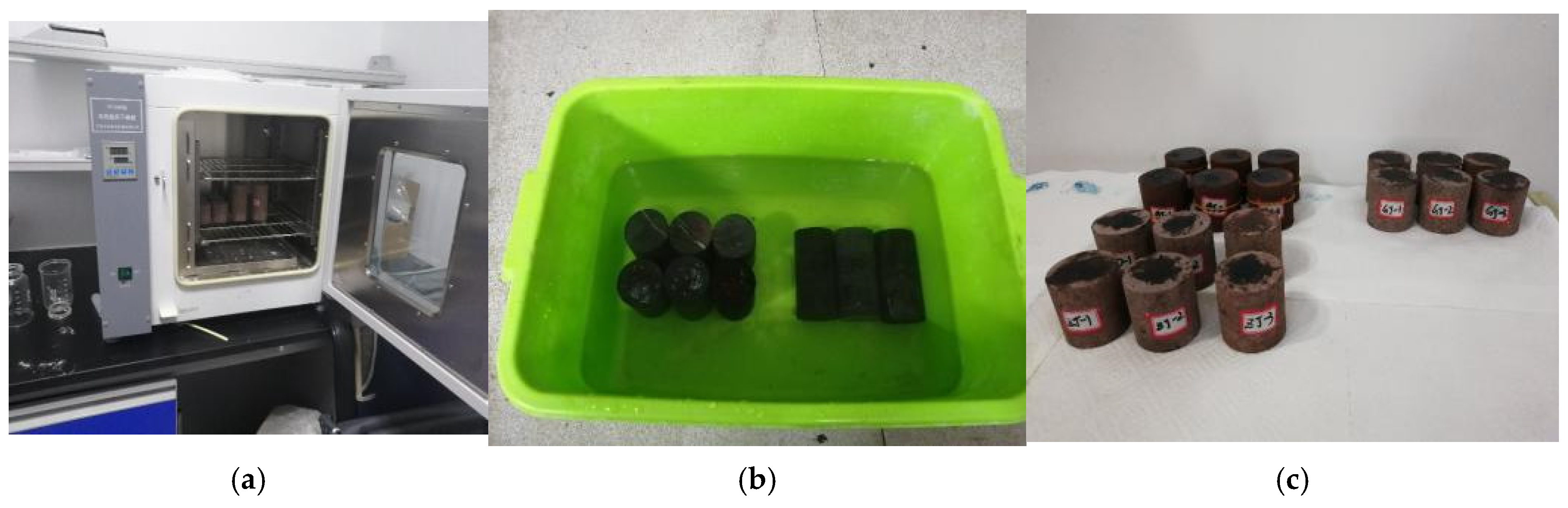
  • Dry specimens: All specimens are placed in a drying oven and subjected to heat drying at 46 °C for 24 h until their mass stabilizes, indicating completion of the drying process. Take 1/3 specimens as dry specimens.
  • Natural specimens: take 1/3 of the dried specimens, cool them to room temperature (24 °C and 56% RH) and keep them for 7 days until their weight stabilizes, which indicates that the natural specimen treatment is completed.
  • Saturated specimens: After the remaining dried specimens, are naturally cooled, immerse the specimens in water for 7 days until their quality stabilizes, indicating that the saturation treatment is completed. The treatment process of specimens with different water contents is shown in Figure 1.

2.2. Experimental System

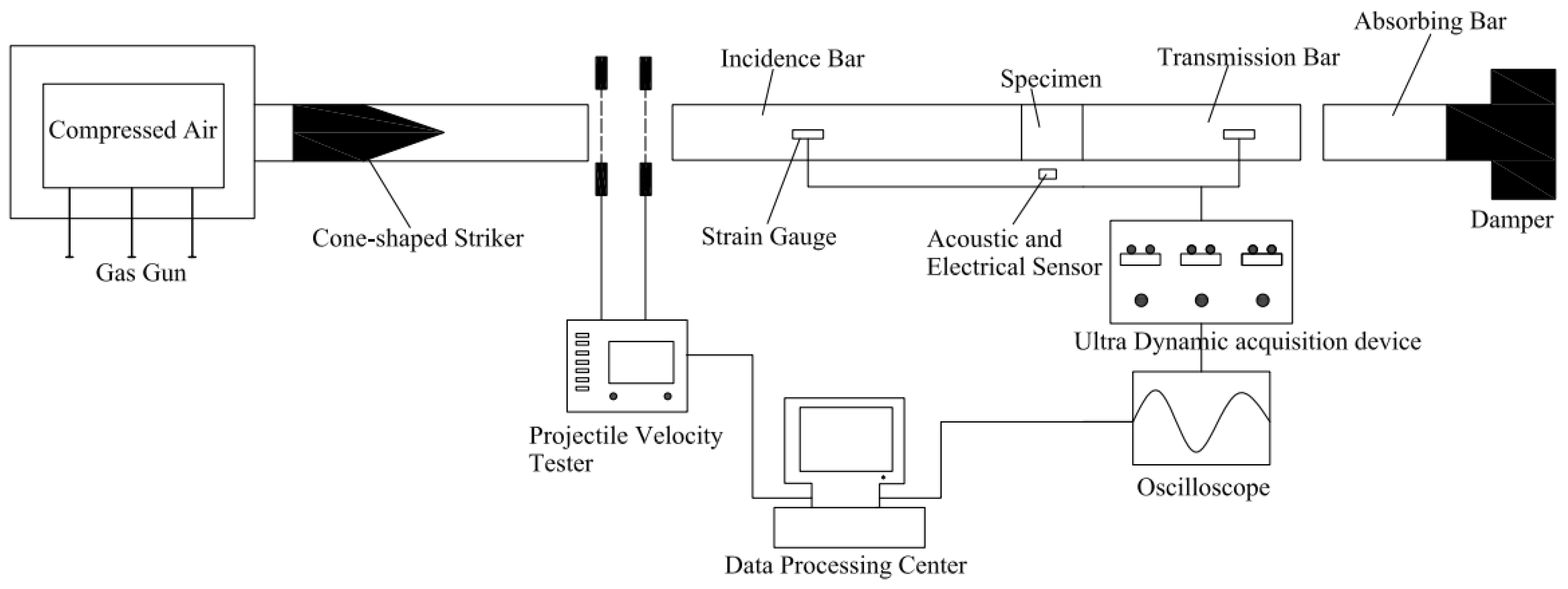
The test employed a 75 mm split Hopkinson pressure bar test system, capable of high strain rate loading of heterogeneous brittle materials such as rocks. Both the bars and the striker are made of 40 Cr alloy steel, with a density of 7810 kg/m3, a Poisson’s ratio of 0.28, an elastic modulus of 240 GPa, a longitudinal wave velocity of 5500 m/s, a diameter of 50 mm, and incident and transmission bar lengths of 2.0 m and 1.0 m, respectively. Please refer to paper [32,33] for more detailed information about this system. The test device is shown in Figure 2.
The acoustic emission acquisition system used in the experiment is the newly developed AEwin-USB Acoustic Emission Detection System by Physical Acoustics Corporation (PAC). The acquisition process involves acoustic emission sensors attached to the specimen surface that monitor AE signals in real time, which are then converted into digital signals by the acoustic emission acquisition main unit. The entire AE acquisition system has a frequency range of 20 kHz to 1 MHz, and is characterized by high integration, small data acquisition errors, and simple, convenient operation. The electromagnetic radiation acquisition system is the KBD5 Electromagnetic Radiation Detection System designed by China University of Mining and Technology, consisting of a monitoring main unit, electromagnetic radiation receiving antenna, power supply, communication cables, and a corresponding operating system. The acquisition frequency range is 1–30 kHz.
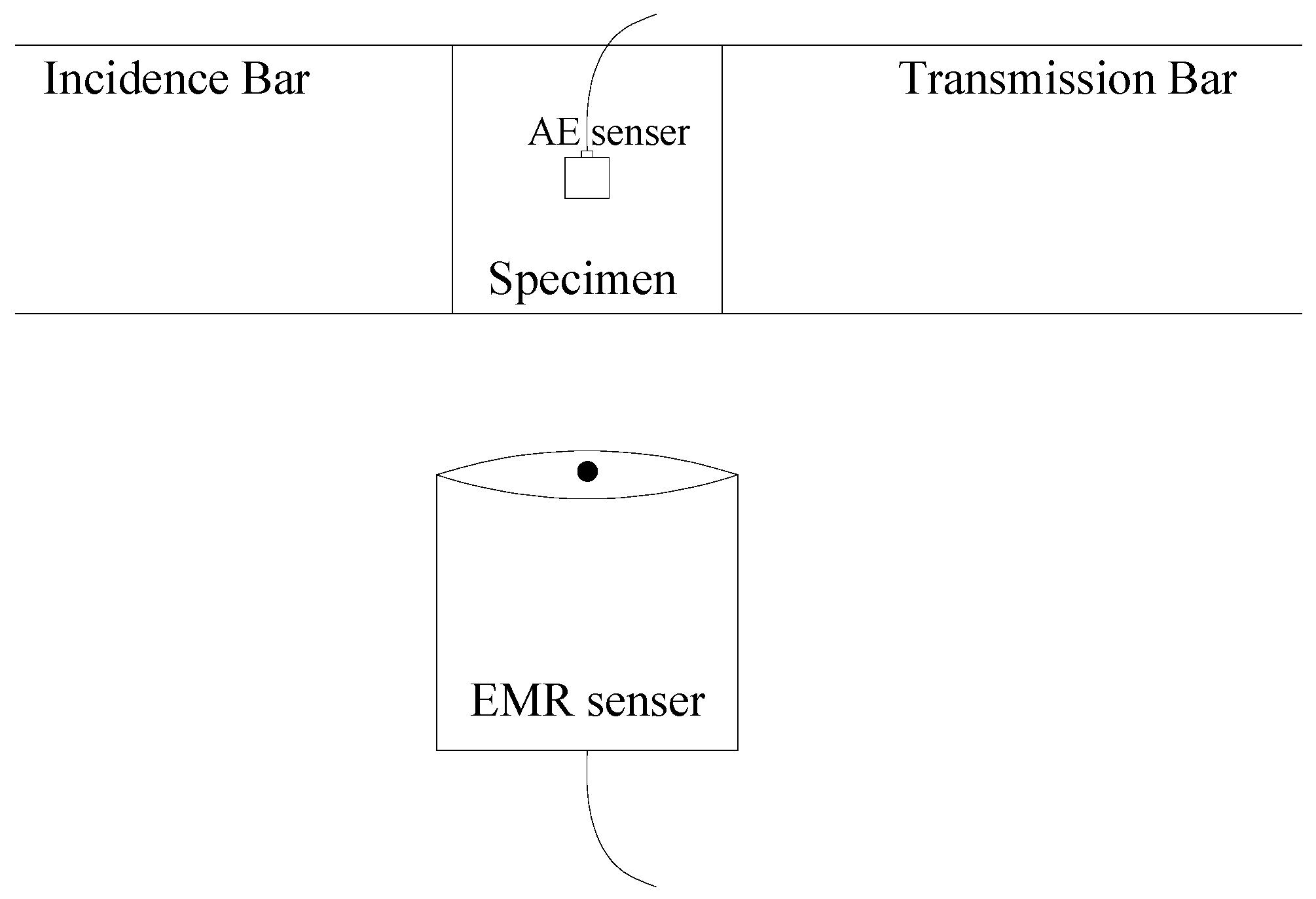
To mitigate external environmental interference with EMR signals, the specimen-fixing region in the split Hopkinson pressure bar (SHPB) system and the signal-receiving antenna were both wrapped with radiation-shielding fabric. Prior to the experiment, multiple tests of the acoustic emission acquisition system and electromagnetic radiation acquisition system revealed that the AE and EMR levels in the laboratory environment ranged from 36–39 dB and 41–45 dB, respectively. Consequently, the AE and EMR thresholds were set at 40 dB and 45 dB. Vaseline was used as a coupling medium to attach the acoustic emission sensors to the specimen surface. For saturated specimens, the high moisture content resulted in poor adhesion between the sensor and the specimen. It was demonstrated through testing that gently wrapping the acoustic emission sensor with a single layer of transparent tape could maintain firm contact without detachment while having negligible effect on the specimen’s dynamic mechanical properties, acoustic emission parameters, and electromagnetic radiation parameters. The electromagnetic radiation receiving antenna was then positioned horizontally at a vertical distance of approximately 4–5 cm from the specimen. Figure 3 illustrates the relative positions of the acoustic emission sensor, electromagnetic radiation sensor, and the specimen.

2.3. Experimental Principles

As recommended by References [34,35], for rock specimens with a small aspect ratio, the one-dimensional wave theory suggests that the spindle-shaped punch generates an approximate half sine wave propagating through the specimen multiple times. This leads to stress–strain equilibrium at the specimen’s end faces, allowing calculation of the average stress, strain, and strain rate of the specimen as follows:
σ ( t ) = E e A e 2 A s ε I t + ε R t + ε T ( t )
ε ( t ) = C e L s 0 t ε I t ε R t ε T ( t ) d t
ε ˙ ( t ) = C e L s ε I t ε R t ε T ( t )
where Ee and Ae represent the elastic modulus and cross-sectional area of the elastic rod, respectively; As and Ls denote the cross-sectional area and length of the specimen, respectively; Ce is the longitudinal wave velocity of the elastic rod; t signifies the duration of the stress wave; ϵI(t), ϵR(t), and ϵT(t) correspond to the incident strain, reflection strain, and transmission strain at time t, respectively.
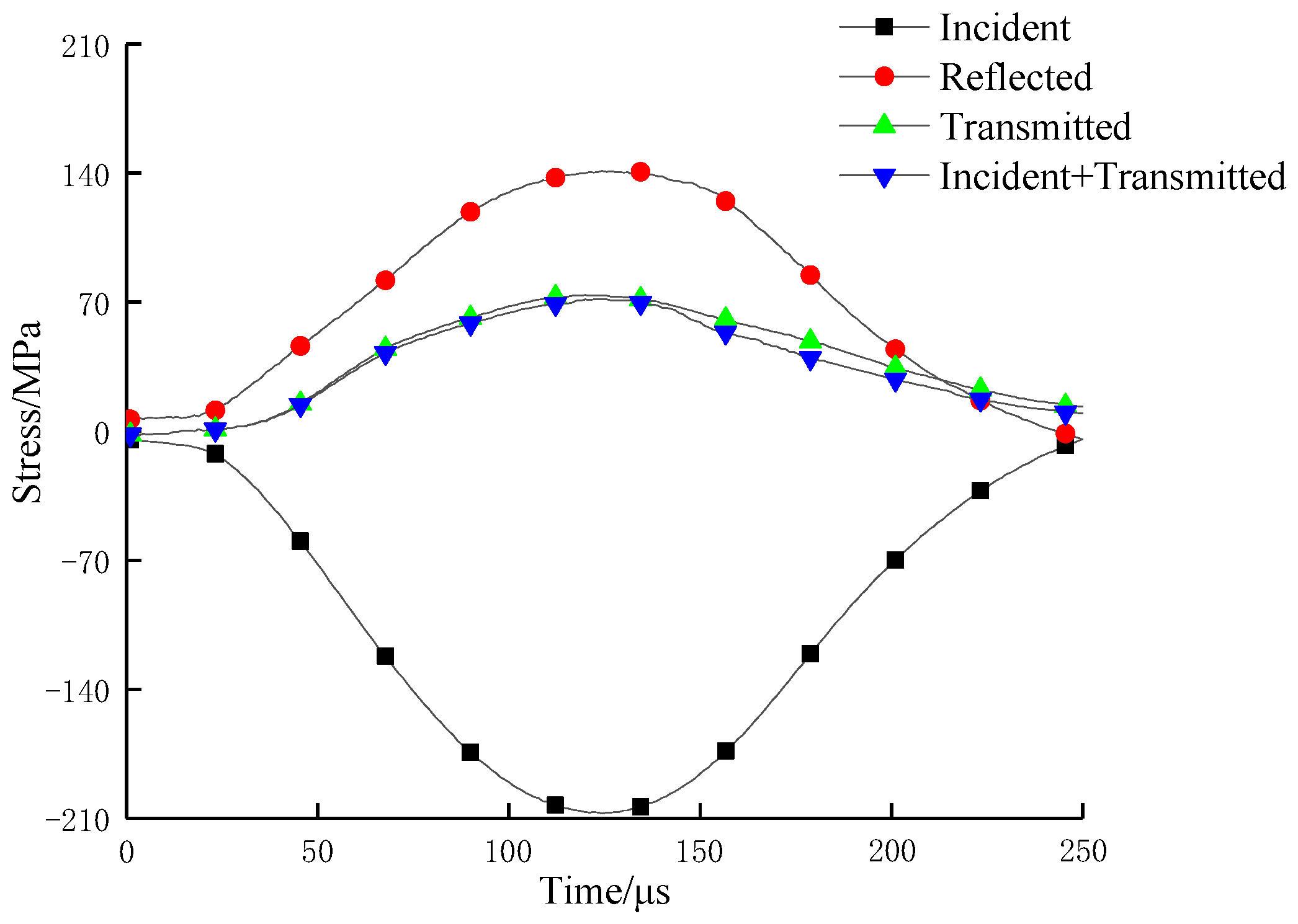
Dynamic stress equilibrium is a prerequisite for the validity of dynamic test results. Figure 4 presents the dynamic stress equilibrium curves at both ends of specimen ZD-2. The superposition of the incident and reflected waves at the incident end almost coincides with the transmitted wave at the transmitted end, indicating that the two end surfaces of the specimen can achieve and maintain dynamic stress equilibrium during the dynamic loading process, thereby validating the effectiveness of the dynamic test results.

3. Test Results and Analysis

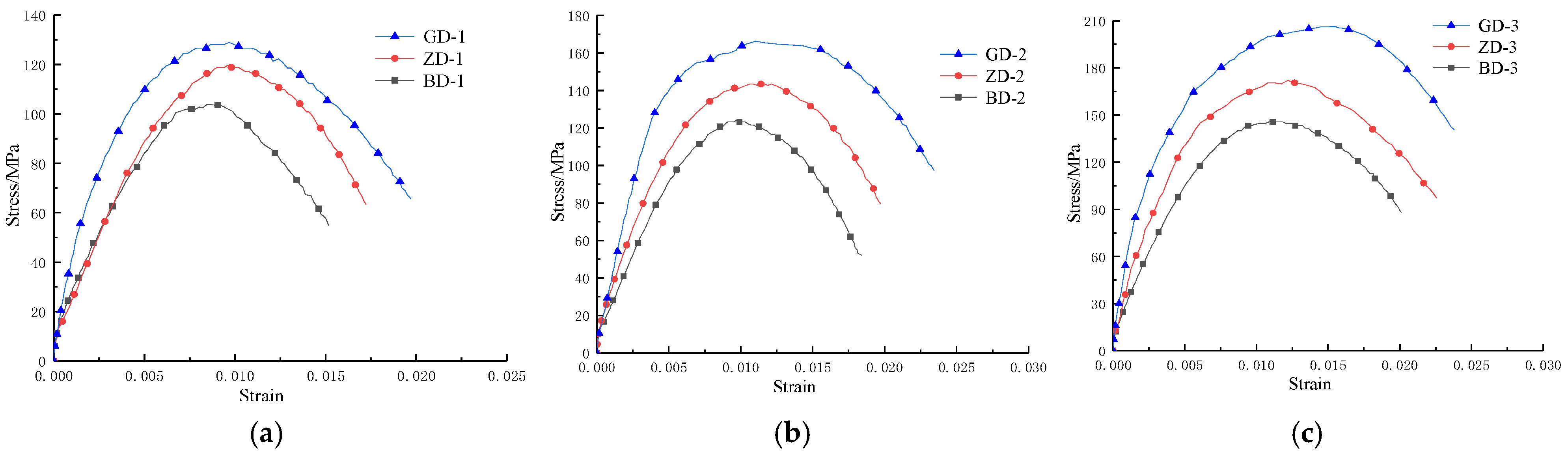
By controlling the compressed air pressure to achieve different initial bullet velocities, the specimens underwent three distinct strain rates. Stress–strain curves were plotted for specimens with different water contents subjected to varying strain rates, and the relationship between peak strength, elastic modulus, and strain rate was examined. The stress–strain curves of specimens with different water contents are shown in Figure 5, and the strength characteristic parameters are shown in Table 2.

3.1. Strength Characteristics

As can be seen from Figure 5, the dynamic stress–strain curves of different water-bearing sandstones are generally similar and can all be divided into four stages [36]: the compaction stage, the elastic stage, the yield stage, and the post-peak stage. In the initial stress stage, the curve shows slight traces of crack compaction, then quickly enters the elastic stage, where stress and strain are essentially linearly related. Subsequently, as cracks continuously propagate and develop, the stress increase tends to level off. After reaching the peak strength, the dynamic stress–strain curve does not exhibit the sharp drop observed in static loading curves. This is because the dynamically loaded specimens experienced excessively rapid loading in the early stage and still retain certain bearing capacity after reaching the dynamic peak strength, resulting in a more gradual decline of the dynamic stress–strain curve in the post-peak stage.
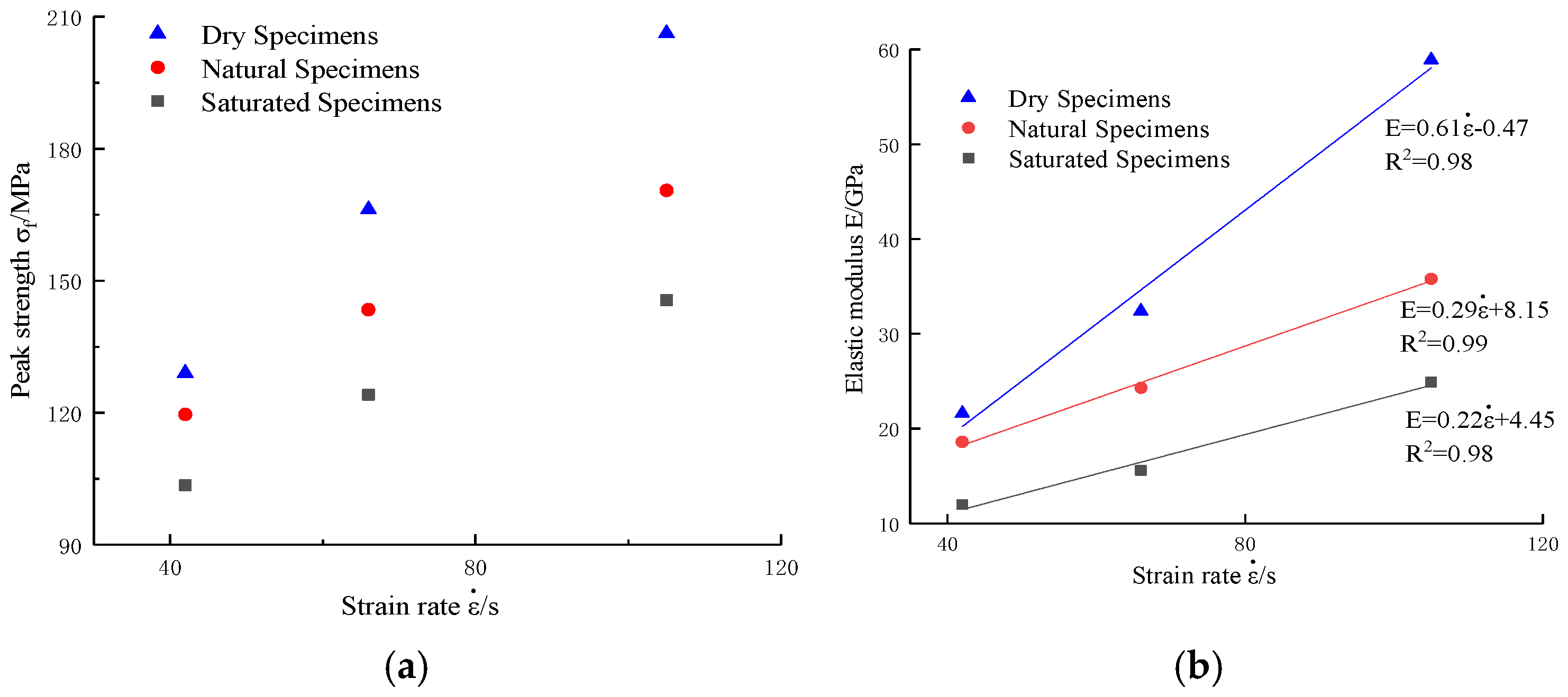
Figure 6a shows the relationship between the dynamic peak strength of the specimens and the strain rate. It can be found that under the same strain rate, the dynamic peak strength of the specimens decreases with the increase of water content, which reflects the softening effect of water on the dynamic compressive strength of rock [9,37]. To quantify this effect, the dynamic compressive strength of specimens with different water contents is compared with that of dry specimens to obtain their respective softening coefficients. As defined, the softening coefficient of dry specimens is 1, and the lower the dynamic compressive strength of a specimen, the smaller its resulting softening coefficient. At a strain rate of 42 s−1, the dynamic compressive strengths of natural and water-saturated specimens decrease by 7.29% and 18.2%, respectively, compared with dry specimens, with corresponding softening coefficients of 0.93 and 0.82. When the strain rate increases to 66 s−1, the dynamic compressive strengths of natural and water-saturated specimens decrease by 13.7% and 25.3%, respectively, with corresponding softening coefficients of 0.86 and 0.75. At a strain rate of 105 s−1, the dynamic compressive strength of all water-bearing samples is the highest, with natural and water-saturated specimens decreasing by 17.3% and 29.4%, respectively, compared with dry specimens, and corresponding softening coefficients of 0.83 and 0.71.
The dynamic elastic modulus can characterize the ability of rock to resist deformation under dynamic loading. The slope of the line connecting the starting point of the dynamic stress–strain curve and the point at 50% peak stress in Figure 3 is taken as the dynamic elastic modulus of the specimens [37,38]. The dynamic elastic modulus at the same water content is fitted with the strain rate, as shown in Figure 6b. It can be seen that when the specimens have the same water content, the fitted dynamic elastic modulus basically increases linearly with increasing strain rate: when the strain rate of water-saturated specimens increases from 42 s−1 to 66 s−1 and 105 s−1, their dynamic elastic modulus increases by 30.0% and 107.5%, respectively; when the strain rate of dry specimens increases from 42 s−1 to 66 s−1 and 105 s−1, their dynamic elastic modulus increases by 54.6% and 172.7%, respectively. This is because when the loading rate increases, the deformation time of the specimens is shortened, and the specimen’s ability to resist external deformation is enhanced, which macroscopically manifests as an increase in the dynamic elastic modulus of the specimens.

3.2. Acoustic Emission Signals Characteristics

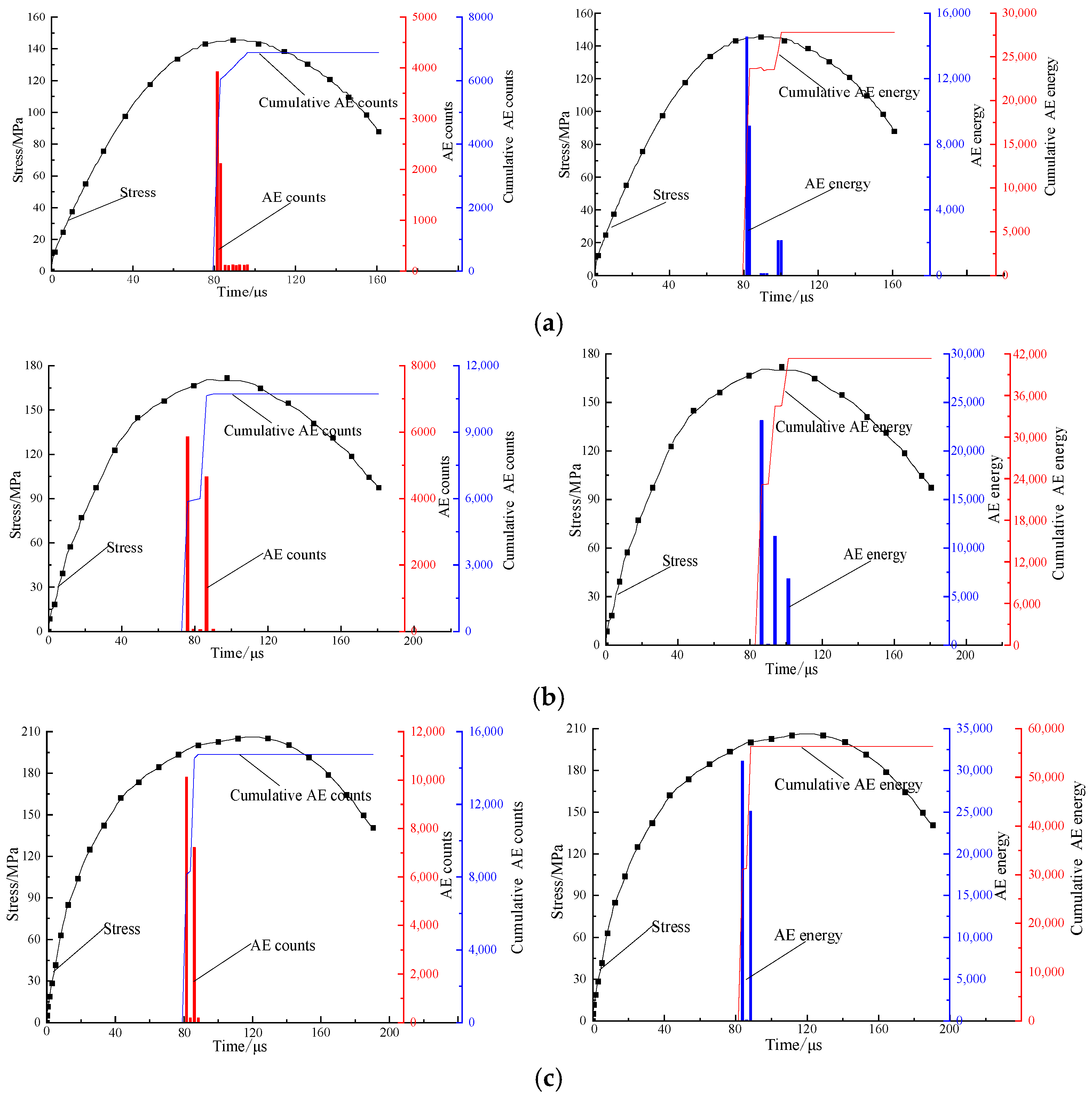
At high strain rates, specimens exhibit the highest dynamic peak stress, and the AE and EMR signals generated during their failure process are also the strongest. Therefore, BD-3, ZD-3 and GD-3 are selected to analyze the influence of different water contents on the acoustic emission signals of sandstone. In Figure 7, the red column and blue column represent real-time AE counts and energy, respectively, and the black line, blue line, and red line represent stress, cumulative AE counts, and energy, respectively. Initially, AE activity, including counts and energy, is negligible across all specimens. However, as stress approaches the peak strength, AE counts and energy spike dramatically, which is a response to the short loading duration and rapid crack propagation characteristic of impact loading. This results in a limited capture of AE signals, with peak AE values reflecting the cumulative effect of the initial stress wave [39,40]. After reaching the peak strength, the acoustic emission signals of specimens with different water contents all decreased, but their rates of decline showed differences: the AE signals of BD-3 persisted for 18 μs after the peak, ZD-3 for 13 μs, and GD-3 for 9 μs. By comparing the ringing counts and energy of specimens during the corresponding period, it was found that during the post-peak stage, although the duration of acoustic signals increases with increasing water content, both their counts and energy decrease. It is inferred that this may be due to the production of more debris in water-bearing specimens during the failure process, resulting in low-energy, high-density acoustic emission signals.
For specimens with different water contents, their AE signals peaks all occur prior to the stress peak, demonstrating the early warning capability of acoustic emission signals. However, the early warning time is related to the water content in sandstone: the AE signals peak of BD-3 occurs 8.5 μs ahead of the stress peak, that of ZD-3 occurs 22.7 μs ahead, and that of GD-3 occurs 37.4 μs ahead, indicating that the propagation of acoustic emission signal decreases with the increase of water content.
The cumulative AE counts and energy are the sum of real-time AE counts and energy. Throughout the entire process, the cumulative AE counts and energy for BD-3 were 6884 and 27,805, respectively; those for ZD-3 were 10,722 and 41,350, representing increases of 55.7% and 48.7% relative to BD-3; and those for GD-3 were 14,742 and 56,379, representing increases of 37.4% and 36.3% relative to ZD-3. Although the presence of water prolongs the duration of AE signals, it suppresses the AE signals.

3.3. Electromagnetic Radiation Signals Characteristics

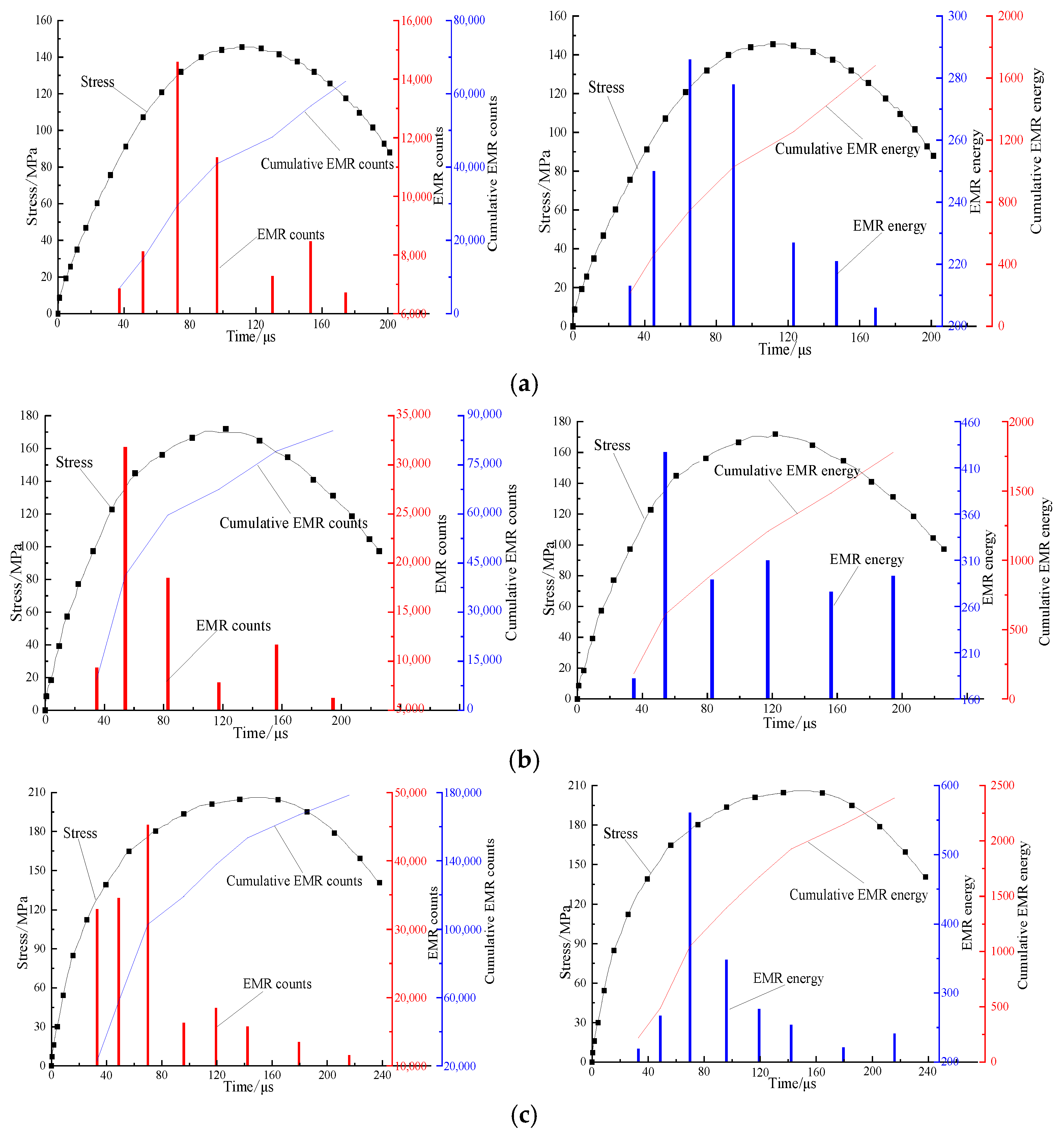
Figure 8 shows the EMR counts and energy for the specimens BD-3, ZD-3, and GD-3. In the figure, the red column and the blue column represent real-time EMR counts and energy, respectively, and the black line, blue line, and red line represent stress, cumulative EMR counts, and energy, respectively. During the compaction stage, the rapid loading speed prevents the internal cracks in the specimens from promptly closing, causing them to quickly advance to the elastic stage. Consequently, the EMR detection equipment registers almost no signals during this initial stage. As the load increases and fractures and cracks develop further, EMR signals begin to be detected. Upon reaching the yield stage, EMR signals experience a sharp rise, with both the number of EMR counts and energy peaking as the specimens approaches peak strength. In the later stage of the peak phase, unlike AE signals, EMR signals last longer during this stage, and this duration is not significantly related to water content. This is because AE sensors are mounted on the specimen surface, whereas EMR sensors are positioned away from the specimen; when the specimen is rapidly destroyed by impact, the transmission of AE signals is interrupted, while the EMR signals remain detectable. EMR signals have better early warning for crack generation, while AE signals have better early warning for rock failure.
For specimens with different water contents, their EMR signal peaks all occur prior to the stress peak, indicating that electromagnetic radiation signals also possess early warning capabilities. The propagation velocity of electromagnetic radiation signals also decreases with increasing water content: compared to the stress peak time, the EMR signal peak of BD-3 occurs 38.9 μs ahead, that of ZD-3 occurs 65.8 μs ahead, and that of GD-3 occurs 83.4 μs ahead. Another interesting phenomenon is that for the same specimen, EMR signal reach their peak values earlier than AE signals, indicating that electromagnetic radiation signals propagate faster.
The cumulative EMR counts and energy represent the sum of the real-time EMR counts and energy. Throughout the loading process, BD-3 accumulated EMR counts and energy of 63,363 and 1681, respectively. ZD-3 recorded higher cumulative EMR counts and energy of 85,436 and 1777, representing increases of 34.8% and 5.71% relative to BD-3. GD-3 exhibited the strongest EMR signals, with cumulative counts and energy reaching 178,420 and 2388, exceeding those of ZD-3 by 108.8% and 34.3%. This indicates that electromagnetic radiation signals are likewise suppressed by the presence of water.

4. Discussion

4.1. The Impact of Water on Specimen Failure

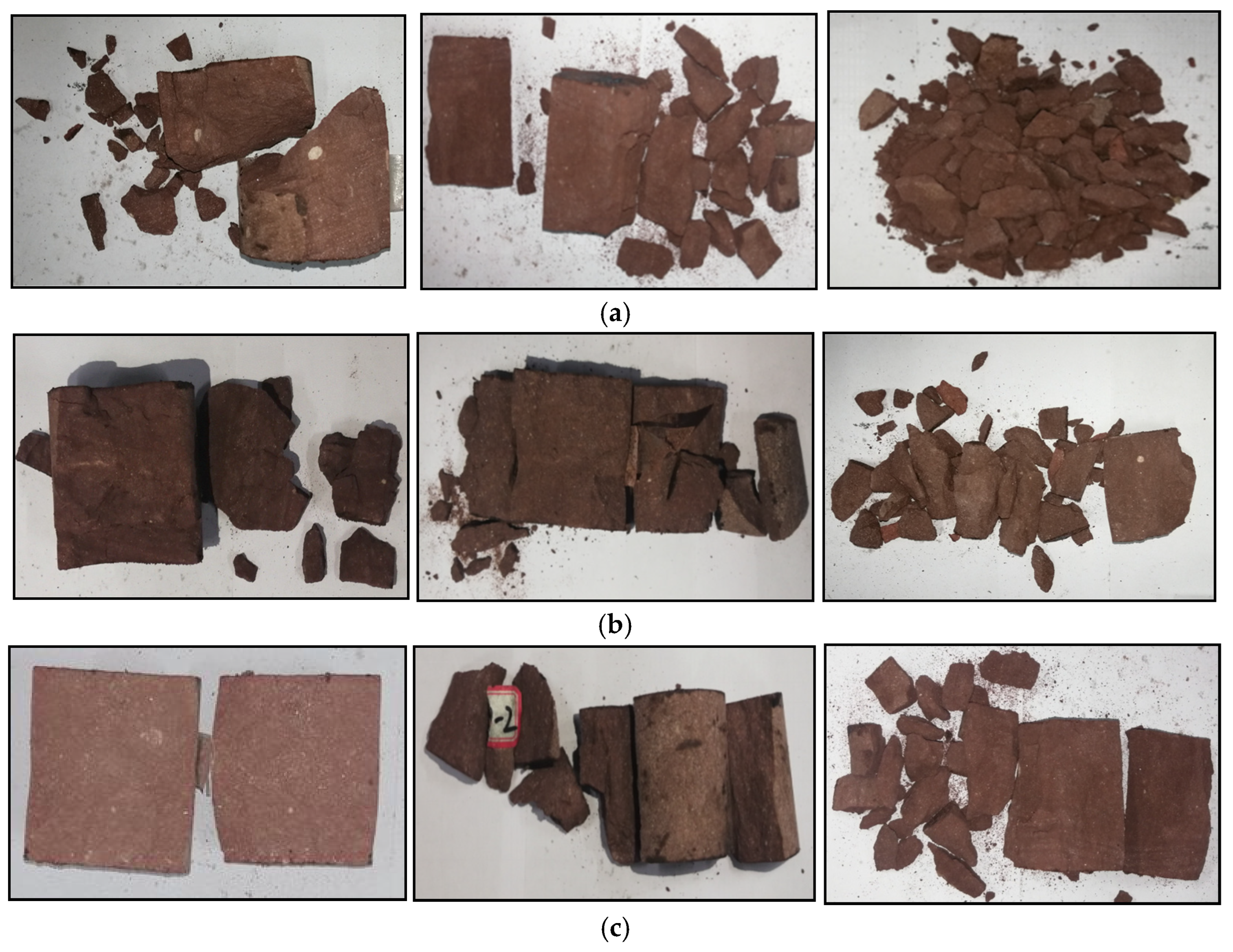
The failure patterns of specimens with different water contents are shown in Figure 9. At a strain rate of 42 s−1, the dry specimens developed high strain at the ends, subsequently generating splitting cracks along the axial direction, and eventually failed into two regular halves, exhibiting splitting tensile failure [41]. The natural specimens also underwent tensile failure along the axial direction, with one half remaining intact while the other fractured into irregular large-sized blocks, indicating tensile failure as the dominant mode with shear failure as secondary. The saturated specimens, however, developed shear slip at approximately 30° along the ends, exhibiting shear failure. When the strain rate was 66 s−1, the damage range of specimens with different water contents gradually expanded from the center toward the edges, with increasing degrees of failure, transitioning from large fragments to small fragments, with increasing fragment quantity and gradually decreasing fragment volume, all exhibiting tensile-compressive shear failure. When the strain rate increased to 105 s−1, the number and size of internal cracks increased and extended through the entire specimen: the dry specimens began to produce small fragments, the natural specimens had no large fragments remaining, while the saturated specimens failed into powdery small fragments, all exhibiting tensile-compressive shear failure.
Water exerts softening, corrosion, and water wedge effects on rocks [42,43]. When water molecules penetrate into the intergranular spaces of rock particles, they weaken the bonding force between mineral particles, leading to a reduction in the rock’s strength and deformation parameters and thus exerting a rock-softening effect. Meanwhile, water can dissolve certain mineral components between rock particles, which lowers the frictional force among the particles and results in a corrosive effect on the rock. When the pore water in rock is under pressure, the water pressure at the crack tips promotes crack initiation and propagation under the action of stress concentration, causing a decrease in the rock’s yield strength and peak strength. At low strain rates, dry rock specimens undergo axial tensile failure, whereas saturated specimens, affected by the softening, corrosion, and water wedge effects of water, have their internal structure filled with defects and are therefore highly susceptible to end-oriented shear failure under impact load. At high strain rates, dry specimens generate numerous small fragments due to tensile-compressive shear failure, while saturated specimens break down into a large number of small fragments and powder. This provides indirect evidence for the softening, corrosion, and water wedge effects of water on rocks.

4.2. Effects of Water on AE and EMR Signals Under Impact Loading

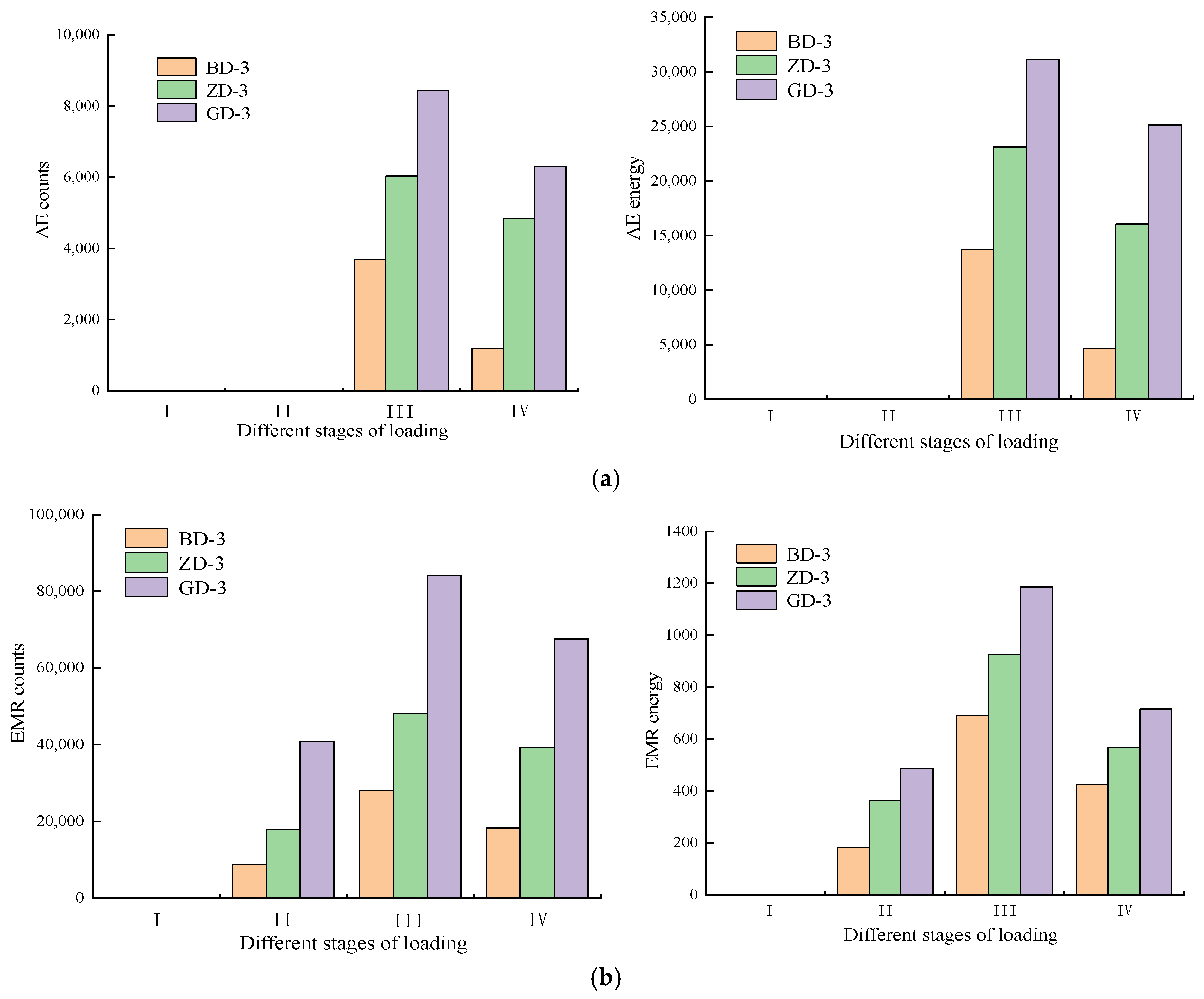
To analyze the effect of water on AE and EMR signals of specimens at different deformation stages during the impact process, the signals of specimens BD-3, ZD-3 and GD-3 were statistically compiled, as shown in Figure 10. The horizontal axis in the figure represents the compaction (I), elastic (II), yield (III), and post-peak failure (IV) stages. It can be clearly seen from Figure 10 that at different deformation stages of the specimens, both the counts and energy of AE and EMR decrease with increasing water content, indicating that the presence of water weakens the propagation and energy of AE and EMR signals. This observation is consistent with existing research, which shows that water intrusion into rock leads to physical and chemical degradation (its mineral composition contains montmorillonite and illite which are soluble in water) [44,45], reducing intermolecular forces, bonding forces, and the internal friction coefficient, thereby weakening the propagation and energy of AE and EMR signals.
Compared with AE signals, EMR signals appear during the elastic stage of specimens, mainly due to the different mechanisms behind these two signals. Acoustic emission signals are mainly generated through specimen deformation, crack propagation, and mutual friction and vibration between rock particles [46]. Electromagnetic radiation signals, however, involve various microscopic radiation mechanisms, including charge separation and relaxation caused by crack propagation, variable charge motion, and Coulomb fields formed by surface charges and frictional sliding [14]. Therefore, the propagation speed of EMR signals is faster than that of AE signals when specimens fracture. In the yield stage, the EMR signal counts for GD-3 are nearly 10 times those of the AE signals, but the energy of AE signals is 25 times that of EMR signals, indicating that although EMR propagates faster, acoustic emission signals are more sensitive to specimen damage.

4.3. Employing AE and EMR to Assess Damage in Specimens with Different Water Contents

To quantitatively evaluate the degree of damage in rock specimens, Kong et al. [47,48] developed expressions for damage variables in sandstone during deformation and fracturing, considering both AE and EMR counts. In this study, AE and EMR damage factors, denoted as D, are introduced to describe the degree of damage in specimens with different water contents during the impact process. The damage factors D for AE and EMR are defined from the perspective of AE and EMR counts as follows:
D = 1 2 N t N + M t M
where ∑Nt is the cumulative AE counts at time t; ∑N is the total cumulative AE counts over the entire experiment; ∑Mt is the cumulative EMR counts at time t; and ∑M is the total cumulative EMR counts over the entire experiment.
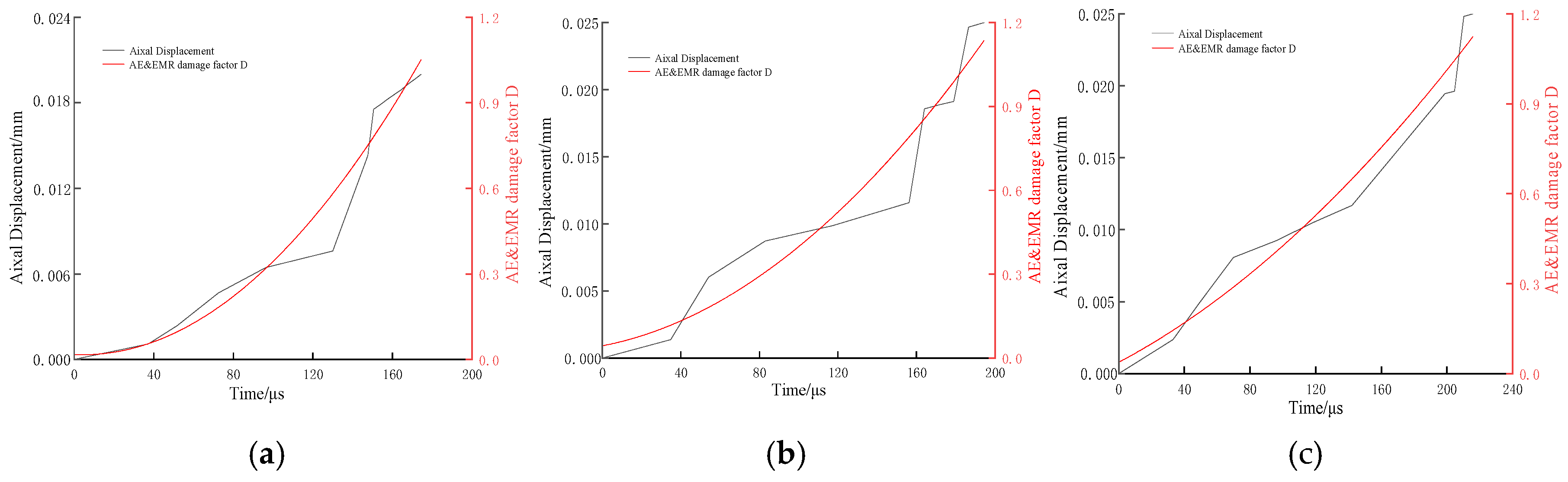
The damage factors of BD-3, ZD-3, and GD-3 were calculated, as shown in Figure 11. Due to the absence of signals from specimens with different water contents during the compaction stage, the damage factor curve does not originate from the coordinate origin. From the figure, it is evident that the damage factor effectively captures the degree of damage in specimens with different water contents, in comparison to the displacement-time curve. During the elastic stage at t = 40 μs, GD-3 exhibits the highest damage factor, whereas BD-3 shows the lowest. This difference can be attributed to the softening effect caused by immersion in water, reflecting a decrease in elastic modulus. Upon entering the plastic stage, BD-3, being the weakest in strength, undergoes the most significant impact damage under identical air pressure, resulting in the fastest increase in its corresponding damage factor. In the post-peak stage, cracks propagate through specimens with varying water contents, reaching maximum strain, while the damage factor approaches 1.

5. Conclusions

In this study, impact loading tests were conducted on sandstone specimens with different moisture contents. The influence of moisture content on rock mechanical properties, acoustic emission signals (AE), and electromagnetic radiation signals (EMR) was analyzed, leading to the following conclusions:
  • The presence of water reduces the dynamic compressive strength and elastic modulus of sandstone. This effect was quantified using softening coefficients, revealing that the softening effect intensifies with increasing water content. After water infiltrates into the rock, the specimen failure mode transitions from tensile failure to tensile-shear failure, with an increase in small-sized fragments after failure, and this transition is particularly pronounced at higher strain rates.
  • AE and EMR signals can effectively characterize the complete deformation process of specimens with different water contents under impact loading. Neither AE nor EMR signals were observed during the compaction stage across specimens with different water contents, which is attributed to the excessively rapid impact velocity. Owing to their distinct generation mechanisms, only EMR signals emerged during the elastic stage. Upon entering the yield stage, AE and EMR signals reached their peak values, demonstrating that both possess effective early warning capabilities.
  • Water inhibits both the propagation and energy of AE and EMR signals. EMR signals can serve as better precursors for crack generation in specimens, while AE signals show better response to rock failure.
  • By comprehensively considering AE counts and EMR counts, the AE and EMR damage factor D was determined. This damage factor can effectively describe the damage degree of specimens with different water contents during the impact process, providing important guidance for field monitoring of water-bearing sandstone stability.

Author Contributions

Conceptualization, Y.L.; methodology, Y.L. and Q.W.; software, Y.L. and Z.Y.; validation, Z.Y.; formal analysis, Y.L. and Z.Y.; investigation, Z.Y.; resources, F.Z. and Q.W.; data curation, Y.L.; writing—original draft preparation, Y.L.; writing—review and editing, F.Z. and Q.W.; visualization, Y.L.; supervision, F.Z. and Z.Y.; project administration, F.Z. and Z.Y.; funding acquisition, F.Z. All authors have read and agreed to the published version of the manuscript.

Funding

This work was supported by the National Natural Science Foundation of China (Grant Nos. 51674116 and No. 51904101), and the Natural Science Foundation of Hunan Province (Grant Nos. 2020JJ4311 and 2020JJ5188).

Data Availability Statement

The data presented in this study are available on request from the corresponding author. The data are not publicly available due to the fact that the tests were conducted in the laboratory.

Conflicts of Interest

The authors declare no conflicts of interest.

References

  1. Jiang, Y.; Chen, L.; Wang, D.; Luan, H.; Zhang, G.; Dong, L.; Liang, B. Mechanical properties and acoustic emission characteristics of soft rock with different water contents under dynamic disturbance. Int. J. Coal Sci. Technol. 2024, 11, 36. [Google Scholar] [CrossRef]
  2. Jiang, Y.; Liang, B.; Wang, D.; Luan, H.; Zhang, G.; Dong, L.; Chen, L. Experimental study on failure mechanical properties and acoustic emission characteristics of soft rock–coal combination under dynamic disturbance. Eng. Fail. Anal. 2024, 158, 108016. [Google Scholar] [CrossRef]
  3. Wu, D.; Peng, J.; Xia, Z. Water-induced physicochemical and pore changes in limestone for surrounding rock across pressure aquifers. J. Mt. Sci. 2024, 21, 3186–3200. [Google Scholar] [CrossRef]
  4. Yi, S.; Zhang, Y.; Yi, H.; Li, X.; Wang, X.; Wang, Y.; Chu, T. Study on the Instability Activation Mechanism and Deformation Law of Surrounding Rock Affected by Water Immersion in Goafs. Water 2022, 14, 3250. [Google Scholar] [CrossRef]
  5. Abbey, A.L.; Randolph-Flagg, N.; Villa, K.D.; Kim, S.L.; Shuster, D.L. Tracing short-lived hydrothermal circulation systems and water–rock interactions around small-scale intrusions. Geochim. Cosmochim. Acta 2024, 366, 113–127. [Google Scholar] [CrossRef]
  6. Bohnsack, D.; Potten, M.; Freitag, S.; Einsiedl, F.; Zosseder, K. Stress sensitivity of porosity and permeability under varying hydrostatic stress conditions for different carbonate rock types of the geothermal Malm reservoir in Southern Germany. Geotherm. Energy 2021, 9, 15. [Google Scholar] [CrossRef]
  7. Chen, T.; Yao, Q.-l.; Wei, F.; Chong, Z.-h.; Zhou, J.; Wang, C.-b.; Li, J. Effects of water intrusion and loading rate on mechanical properties of and crack propagation in coal–rock combinations. J. Cent. South Univ. 2017, 24, 423–431. [Google Scholar] [CrossRef]
  8. Xia, H.; Zhang, H.; Zhang, J. Research on Damage Mechanism and Mechanical Characteristics of Coal Rock under Water Immersion. Sustainability 2023, 15, 13095. [Google Scholar] [CrossRef]
  9. Liu, Y.; Zhao, F.; Wu, Q.; Fan, B.; Tang, Z. Experimental Research on Energy Evolution of Sandstone with Different Moisture Content under Uniaxial Compression. Sustainability 2024, 16, 4636. [Google Scholar] [CrossRef]
  10. Shen, R.; Chen, H.; Zhao, E.; Li, T.; Fan, W.; Yuan, Z. Electromagnetic radiation prediction of damage characteristics of water-bearing sandstone under cyclic loading and unloading. Bull. Eng. Geol. Environ. 2022, 81, 183. [Google Scholar] [CrossRef]
  11. Liu, D.; Wang, Z.; Zhang, X.; Wang, Y.; Zhang, X.; Li, D. Experimental investigation on the mechanical and acoustic emission characteristics of shale softened by water absorption. J. Nat. Gas Sci. Eng. 2018, 50, 301–308. [Google Scholar] [CrossRef]
  12. Ju, Y.; Jin, A.; Zhao, Y.; Tang, S. Iron ore grade’s impact on uniaxial compression behavior and acoustic emission characteristics. Mater. Today Commun. 2024, 39, 108856. [Google Scholar] [CrossRef]
  13. Kong, B.; Wang, E.; Li, Z. The effect of high temperature environment on rock properties—An example of electromagnetic radiation characterization. Environ. Sci. Pollut. Res. 2018, 25, 29104–29114. [Google Scholar] [CrossRef]
  14. He, X.; Nie, B.; Chen, W.; Wang, E.; Dou, L.; Wang, Y.; Liu, M.; Hani, M. Research progress on electromagnetic radiation in gas-containing coal and rock fracture and its applications. Saf. Sci. 2012, 50, 728–735. [Google Scholar] [CrossRef]
  15. Li, D.; Wang, E.; Li, Z.; Jia, H.; Wang, D.; Kong, X.; Wang, X.; Wang, X.; Ali, M. A causal mechanism for anomalous electromagnetic radiations from coal and rock failure. Geophysics 2018, 83, E423–E434. [Google Scholar] [CrossRef]
  16. Kong, X.; Wang, E.; Hu, S.; Shen, R.; Li, X.; Zhan, T. Fractal characteristics and acoustic emission of coal containing methane in triaxial compression failure. J. Appl. Geophys. 2016, 124, 139–147. [Google Scholar] [CrossRef]
  17. Kiyoo, M. Study of elastic shocks caused by the fracture of heterogeneous materials and its relations to earthquake phenomena. Bull. Earthq. Res. Inst. 1962, 40, 125–173. [Google Scholar]
  18. Filimonov, Y.; Lavrov, A.; Shkuratnik, V. Acoustic Emission in Rock Salt: Effect of Loading Rate. Strain 2002, 38, 157–159. [Google Scholar] [CrossRef]
  19. Zhang, S.W.; Shou, K.J.; Xian, X.F.; Zhou, J.P.; Liu, G.J. Fractal characteristics and acoustic emission of anisotropic shale in Brazilian tests. Tunn. Undergr. Space Technol. 2018, 71, 298–308. [Google Scholar] [CrossRef]
  20. Qiu, L.; Zhu, Y.; Song, D.; He, X.; Wang, W.; Liu, Y.; Xiao, Y.; Wei, M.; Yin, S.; Liu, Q. Study on the Nonlinear Characteristics of EMR and AE during Coal Splitting Tests. Minerals 2022, 12, 108. [Google Scholar] [CrossRef]
  21. Shen, R.; Li, T.; Li, H.; He, S.; Zhao, E.; Hou, Z.; Chen, T. Study on the effect of water on electromagnetic radiation characteristics of fractured sandstone under load. Environ. Earth Sci. 2021, 80, 87. [Google Scholar] [CrossRef]
  22. He, L.; Li, Q.; An, B. A Study of the Characteristics of Micro-Seismic (ME) and Electromagnetic Radiation (EMR) Signals under the Static Load Conditions of Rocks. Appl. Sci. 2023, 13, 12910. [Google Scholar] [CrossRef]
  23. Wei, M.; Song, D.; He, X.; Li, Z.; Qiu, L.; Lou, Q. Effect of Rock Properties on Electromagnetic Radiation Characteristics Generated by Rock Fracture During Uniaxial Compression. Rock Mech. Rock Eng. 2020, 53, 5223–5238. [Google Scholar] [CrossRef]
  24. Hu, S.; Wang, E.; Li, Z.; Shen, R.; Liu, J. Time-Varying Multifractal Characteristics and Formation Mechanism of Loaded Coal Electromagnetic Radiation. Rock Mech. Rock Eng. 2014, 47, 1821–1838. [Google Scholar] [CrossRef]
  25. Lacidogna, G.; Carpinteri, A.; Manuello, A.; Durin, G.; Schiavi, A.; Niccolini, G.; Agosto, A.J.S. Acoustic and electromagnetic emissions as precursor phenomena in failure processes. Strain 2011, 47, 144–152. [Google Scholar] [CrossRef]
  26. Sun, X.M.; Ding, J.X.; He, L.S.; Shi, F.K.; Miao, C.Y.; Zhang, Y.; Zhu, M.Q.; Yang, J.K.; Xie, C. Quantitative characterization of water absorption pore structure evolution in sandstone based on nitrogen adsorption and mercury intrusion. J. Cent. South Univ. 2024, 31, 182–195. [Google Scholar] [CrossRef]
  27. Han, P.; Zhang, C.; Wang, X.; Wang, L. Study of mechanical characteristics and damage mechanism of sandstone under long-term immersion. Eng. Geol. 2023, 315, 107020. [Google Scholar] [CrossRef]
  28. Zhou, Z.; Cai, X.; Ma, D.; Cao, W.; Chen, L.; Zhou, J. Effects of water content on fracture and mechanical behavior of sandstone with a low clay mineral content. Eng. Fract. Mech. 2018, 193, 47–65. [Google Scholar] [CrossRef]
  29. Gu, X.; Liang, X.; Li, X.; Chu, R.; Tong, T.; Yang, F.; Li, H.; Shao, X.; Wang, L.; Zhang, Q. Spallation fracture of cement paste cylinder by SHPB experiment and peri dynamic simulation incorporating asymmetry, strain-rate dependency and damage softening. Int. J. Impact Eng. 2025, 206, 10548. [Google Scholar] [CrossRef]
  30. Yao, Y.; Zhao, F.; Li, J.; Liu, J.; Liu, Z.; Wang, Y.; Zhuang, R.; Liu, L.; Zhao, Y.; Xu, Z. SHPB Experiment and MPM Simulation on Dynamic Properties of Unsaturated Clay Under Impact Loading. Appl. Sci. 2025, 15, 3132. [Google Scholar] [CrossRef]
  31. Qin, Z.; Liu, Y.; Zhang, F.; Liu, N.; Cao, B. Weakening behaviors of water saturated Island coal body subjected to SHPB tests. Sci. Rep. 2025, 15, 21334. [Google Scholar] [CrossRef]
  32. Guangfa, G. Stress wave effects and their mechanisms on stress-strain curves in the elastic phase of SHPB tests. Int. J. Impact Eng. 2024, 193, 105061. [Google Scholar] [CrossRef]
  33. Stopka, G.; Gieleta, R.; Panowicz, R.; Wałach, D.; Kaczmarczyk, G.P. High Strain Rate Response of Sandstones with Different Porosity under Dynamic Loading Using Split Hopkinson Pressure Bar (SHPB). Appl. Sci. 2024, 14, 5347. [Google Scholar] [CrossRef]
  34. Shan, J.; Xu, S.; Liu, Y.; Zhou, L.; Wang, P. Dynamic breakage of glass sphere subjected to impact loading. Powder Technol. 2018, 330, 317–329. [Google Scholar] [CrossRef]
  35. Tan, Y.-Y.; Yu, X.; Elmo, D.; Xu, L.-H.; Song, W.-D. Experimental study on dynamic mechanical property of cemented tailings backfill under SHPB impact loading. Int. J. Miner. Metall. Mater. 2019, 26, 404–416. [Google Scholar] [CrossRef]
  36. Liu, S.; Xu, J. Study on dynamic characteristics of marble under impact loading and high temperature. Int. J. Rock Mech. Min. Sci. 2013, 62, 51–58. [Google Scholar] [CrossRef]
  37. Zhou, X.-P.; Gu, S.-Y. Dynamic mechanical properties and cracking behaviors of persistent fractured granite under impact loading with various loading rates. Theor. Appl. Fract. Mech. 2022, 118, 103281. [Google Scholar] [CrossRef]
  38. Feng, S.; Zhou, Y.; Wang, Y.; Lei, M. Experimental research on the dynamic mechanical properties and damage characteristics of lightweight foamed concrete under impact loading. Int. J. Impact Eng. 2020, 140, 103558. [Google Scholar] [CrossRef]
  39. Yanhao, N.; Quanle, Z.; Yansong, N.; Xiaoli, Z.; Bichuan, Z. Combined effect mechanism of linear loading and disturbance with different amplitudes on sandstone. Geomech. Geophys. Geo-Energy Geo-Resour. 2024, 10, 56. [Google Scholar] [CrossRef]
  40. Zhang, C.; Miao, S.; Su, L. Seismic behavior of granular slope under railway embankment in large-scale shaking table test. Eng. Geol. 2022, 305, 106714. [Google Scholar] [CrossRef]
  41. Huang, R.; Guan, Z.; Qin, J.; Wen, Y.; Lai, Z. Strain rate effect of concrete based on split Hopkinson pressure bar (SHPB) test. J. Build. Eng. 2024, 86, 108856. [Google Scholar] [CrossRef]
  42. Gong, C.G.; Wang, W.; Shao, X.W. Effect of water chemical corrosion on mechanical properties and failure modes of pre-fissured sandstone under uniaxial compression. Acta Geotech. Int. J. Geoengin. 2021, 16, 1083–1099. [Google Scholar] [CrossRef]
  43. Chen, G.; Li, T.; Wang, W.; Zhu, Z.; Chen, Z.; Tang, O. Weakening effects of the presence of water on the brittleness of hard sandstone. Bull. Eng. Geol. Environ. 2019, 78, 1471–1483. [Google Scholar] [CrossRef]
  44. Aly, N.; Hamed, A.; Abd El-Al, A. The Impact of Hydric Swelling on the Mechanical Behavior of Egyptian Helwan Limestone. Period. Polytech. Civ. Eng. 2020, 64, 589–596. [Google Scholar] [CrossRef]
  45. Yu, Y.; Wang, J.; Feng, G.-L.; Geng, D.-X.; Guo, H.-S. Damage evolution and acoustic emission characteristics of hydro chemically corroded limestone. Bull. Eng. Geol. Environ. 2023, 82, 112. [Google Scholar] [CrossRef]
  46. Xin, Y.; Sun, Q.; Jia, H.; Yuan, S.; Ge, Z.; Tang, L. Acoustic emission (AE) characteristics of limestone during heating. J. Therm. Anal. Calorim. 2022, 147, 13725–13736. [Google Scholar] [CrossRef]
  47. Kong, B.; Wang, E.; Li, Z.; Wang, X.; Liu, X.; Li, N.; Yang, Y. Electromagnetic radiation characteristics and mechanical properties of deformed and fractured sandstone after high temperature treatment. Eng. Geol. 2016, 209, 82–92. [Google Scholar] [CrossRef]
  48. Kong, B.; Wang, E.; Li, Z.; Wang, X.; Liu, J.; Li, N. Fracture Mechanical Behavior of Sandstone Subjected to High-Temperature Treatment and Its Acoustic Emission Characteristics Under Uniaxial Compression Conditions. Rock Mech. Rock Eng. 2016, 49, 4911–4918. [Google Scholar] [CrossRef]
Figure 1. Treatment of specimens with different water contents: (a) drying treatment; (b) saturation treatment; (c) specimen number.
Water 18 00410 g001
Figure 2. Schematic diagram of the split Hopkinson pressure bar test system.
Water 18 00410 g002
Figure 3. Schematic of AE and EMR sensor locations on the specimen.
Water 18 00410 g003
Figure 4. Dynamic stress equilibrium curves of specimen ZD-2.
Water 18 00410 g004
Figure 5. Stress–strain curves of specimens with different water contents: (a) strain rate 42 s−1; (b) strain rate 66 s−1; (c) strain rate 105 s−1.
Water 18 00410 g005
Figure 6. Curves of peak strength and elastic modulus versus strain rate for specimens with different water contents: (a) peak strength; (b) elastic modulus.
Water 18 00410 g006
Figure 7. Stress–time–AE signal parameter curves for specimens with different water contents: (a) BD-3; (b) ZD-3; (c) GD-3.
Water 18 00410 g007
Figure 8. Stress–time–EMR signal parameter curves for specimens with different water contents: (a) BD-3; (b) ZD-3; (c) GD-3.
Water 18 00410 g008
Figure 9. Failure patterns of specimens with different water contents at various strain rates: (a) BD-1, BD-2, BD-3; (b) ZD-1, ZD-2, ZD-3; (c) GD-1, GD-2, GD-3.
Water 18 00410 g009
Figure 10. Comparison of AE and EMR signals for specimens with different water contents: (a) AE counts and energy; (b) EMR counts and energy.
Water 18 00410 g010
Figure 11. Strain–time–damage factor curves for specimens with different water contents: (a) BD-3; (b) ZD-3; (c) GD-3.
Water 18 00410 g011
Table 1. Mineral composition of the red sandstone (%).
QuartzPlagioclasePotassium FeldsparCalciteDolomiteIlliteMontmorilloniteHematite
47.026.819.62.11.71.20.90.7
Table 2. Strength characteristic parameters of specimens.
Specimen NumberL/
mm
D/
mm
Density g/cm3Longitudinal Wave (m/s)Strain Rate
ε ˙ /s−1
Moisture ContentPeak Strength/MPaElastic Modulus/GPa
Moisture Content/%Average
BD-149.8250.202393.62620.77421.711.70105.512.0
BD-249.9050.102383.52607.41661.57124.115.6
BD-349.8250.102422.82645.931051.87145.624.9
ZD-149.8050.202286.42773.67420.920.84119.616.6
ZD-249.9250.062272.32764.26660.81143.422.3
ZD-349.7850.202237.92743.291050.78170.538.8
GD-149.9250.102187.32943.724200129.021.6
GD-249.8250.182176.92958.63660166.233.4
GD-349.8250.102184.52953.091050206.258.9
Disclaimer/Publisher’s Note: The statements, opinions and data contained in all publications are solely those of the individual author(s) and contributor(s) and not of MDPI and/or the editor(s). MDPI and/or the editor(s) disclaim responsibility for any injury to people or property resulting from any ideas, methods, instructions or products referred to in the content.