Brief Report

How Important Is Solid Phase PFAS Release from Legacy Coastal Landfills to the Water Environment?


1
School of Environmental and Life Sciences, University of Hull, Hull HU6 7TS, UK
2
School of Geography, Politics and Sociology, Newcastle University, Newcastle upon Tyne NE1 7RU, UK
3
School of Biological and Environmental Sciences, Liverpool John Moores University, Liverpool L3 5AJ, UK
4
School of Engineering, Newcastle University, Newcastle upon Tyne NE1 7RU, UK
5
Environment and Sustainability Institute and Camborne School of Mines, Exeter University, Penryn TR10 9FE, UK
6
School of Earth and Environment, University of Leeds, Leeds LS2 9JT, UK
*
Authors to whom correspondence should be addressed.
Water 2026, 18(3), 383; https://doi.org/10.3390/w18030383
Submission received: 19 December 2025 / Revised: 26 January 2026 / Accepted: 29 January 2026 / Published: 2 February 2026
(This article belongs to the Section Water Quality and Contamination)

Highlights

What are the main findings?
  • Legacy PFAS are detectable in 47% of solid phase samples at eroding historical coastal landfills.
  • Consistent detection of PFOA and PFOS at a waste disposal site operating in the 1970s and 1980s.
  • Flux (mass over time) of PFAS in solid phase release is similar in magnitude to documented PFAS release via leachate at landfills.
What are the implications of the main findings?
  • The age of the landfill has a bearing on PFAS detection.
  • The rapid sampling method demonstrated here is suitable for PFAS risk assessment at other eroding legacy waste sites.
  • Flux data are important for contextualising the significance of PFAS release to the water environment.

Abstract

Historical landfills in coastal environments are at increasing risk of erosion under changing climate conditions. Various studies have highlighted pollutant release associated with potentially toxic elements and flame retardants from such erosional processes, but there has been little focus on per- and poly-fluoroalkyl substance (PFAS) release as a result of physical erosion at such sites, despite landfills being highlighted as a key source of PFAS to the water environment. This study presents a rapid screening approach that could be adopted at scale by regulators to assess the presence and potential flux of PFAS released at three historical municipal waste landfill sites in the UK. The sites selected cover a range of epochs prior to rigorous environmental regulation from the second half of the twentieth century. At the older waste deposits (Withernsea: 1950s–1960s; Hessle: 1930s–1970s), all 52 PFAS analysed in solid materials were below the detection limits except for two samples where modest concentrations (0.92–1.98 ng/g) of perfluorooctane sulfonate (PFOS) and perfluoroethylcyclohexane sulfonate (PFecHS) were detected. At the more recently operational site (Crosby: 1970s–1980s), the legacy PFAS chemicals, PFOS and perfluorooctanoic acid (PFOA), were present in all samples in modest concentrations (6.01–8.22 ng/g for PFOS; 0.62–1.20ng/g for PFOA) below contaminated land thresholds. At this site, it was possible to model the flux of PFAS release based on LiDAR surveys of the eroding waste terrace over an 18-year period. This showed an annualised total solid phase PFAS (PFOS plus PFOA in this case) flux in the region of 2.5–16.9 g/yr, which is towards the lower end of the reported landfill leachate flux at inland sites. While such releases are relatively modest on an individual site basis, in transitional and coastal waters in heavily urbanised and (post-)industrial regions, the aggregated solid phase PFAS flux from the large number of eroding historical landfills (n = 114) could be significant.

1. Introduction

Per- and polyfluorinated chemicals (PFASs) are a group of anthropogenic organic chemicals characterised by carbon-fluorine bonds that are difficult to break down. They are widely distributed across environmental compartments, have the potential to bioaccumulate and biomagnify [1,2,3], and are implicated in a range of potentially negative ecological and human health effects [4,5]. Numerous studies on PFAS distribution in industrial and post-industrial settings have either directly observed or linked closed municipal solid waste (MSW) disposal sites (legacy landfills) as key PFAS sources to ground and surface water receptors [6,7,8,9]. Where such landfills date from epochs prior to modern environmental regulation, they often were unlined and operated on a dilute and disperse model, which could increase potential pollutant release risks. In the UK and many other jurisdictions, there are significant numbers of legacy landfills in low-lying coastal areas that are increasingly prone to flooding or erosion [10]. Recent estimates in the UK suggest there are up to 1400 legacy municipal waste sites that are in areas subject to current flooding or erosion, and a further 700 that may become so by 2100 [11]. Such coastal landfill sites have been shown to be potential sources of a range of pollutants such as potentially toxic elements (PTEs, e.g., As, Cd, Cr, Cu, Pb, Ni and Zn [12,13]) and some persistent organic pollutants such as polybrominated diphenyl ethers (PDBEs, [14]), but there remains uncertainty on waste composition and specific chemical risks at legacy landfill sites given the generally poor record keeping at the time of waste disposal prior to more stringent regulation from the 1970s onwards.
Given the large number of legacy landfills potentially susceptible to erosion or flooding, and the growing concern around PFAS sources to the water environment, there is a critical need to screen the potential PFAS risks associated with eroding legacy landfill sites. Global studies have consistently highlighted the risk of PFAS leachate pathways from landfills [8], with some studies demonstrating significant, direct PFAS pathways to adjacent freshwater receptors [9]. Recent regulatory reviews in the UK have found a range of PFAS routinely present in landfill leachate at twenty-four permitted sites [15]. However, these studies targeted predominantly operating or recently closed sites and potential leachate pathways only [15]. At eroding coastal sites, it is likely that a key PFAS pathway to the coastal zone is from eroding solids (and subsequent physical and chemical breakdown), rather than leachate plumes, which are often attenuated in near-field sediments (which may themselves be subsequently prone to physical erosion in some settings). Furthermore, PFAS mass balance studies in the United States suggest that the bulk (up to 84%) of landfill PFAS inventory is retained in solid phases annually [16], highlighting the potential risks associated with physical erosion pathways.
It would be anticipated that landfill age would also have a major bearing on PFAS composition and presence, given the development of PFAS chemistry in the 1930s, widespread commercial production and use in the 1950s, and a dramatic increase in the number of PFAS compounds developed and used thereafter [17]. Furthermore, some long-chain PFAS have now been phased out of production by leading manufacturers due to growing environmental and health concerns (e.g., perfluorooctanoic acid, PFOA, and perfluorooctane sulfonate, PFOS) and are also being regulated out of active use (e.g., PFOA and its salts; and some perfluorinated silane compounds under UK REACH legislation [18]). As such, identifying both enduring sources of legacy PFAS to the water environment is crucial for informing long term catchment and coastal planning [19].
This study aims to provide the first solid phase PFAS data from actively eroding legacy landfill sites into the UK water environment using a rapid sampling approach that could be replicated at scale by regulatory authorities and practitioners, making use of best-available commercial laboratory screening. The specific objectives of this study are to (a) determine the presence or otherwise of PFAS in solid phases eroding from legacy landfill sites using commercial laboratory PFAS analysis, (b) consider whether PFAS composition is related to landfill age, and (c) for actively eroding sites, make the first estimate of solid phase PFAS flux from landfills to coastal environments.

2. Materials and Methods

2.1. Study Sites

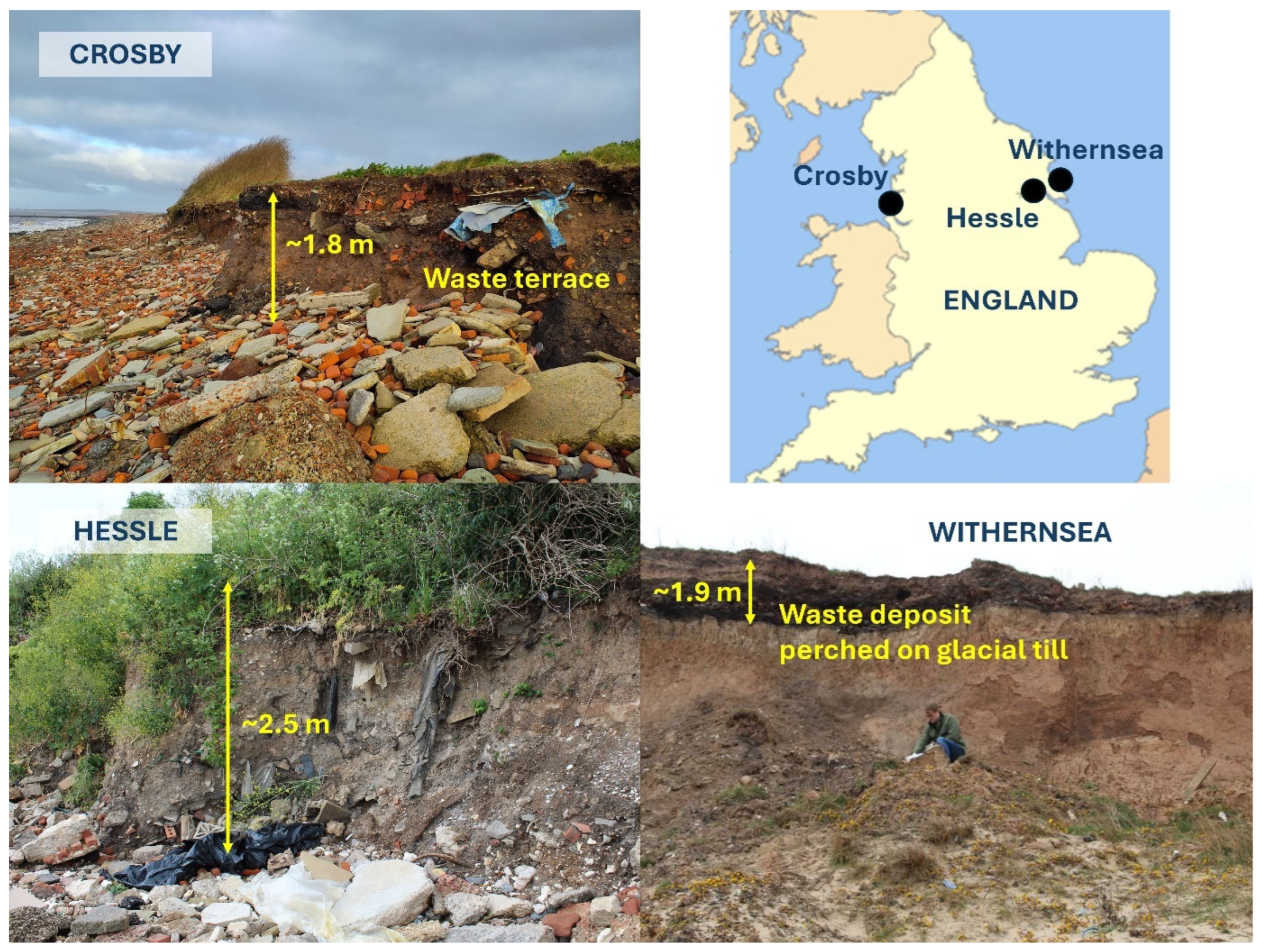
Three legacy (i.e., closed) coastal landfill sites were selected for sampling that spanned a range of epochs of disposal and were highlighted as being of high risk of current and future erosion in national screening exercises [11] (Figure 1). Crosby Beach landfill (Merseyside) received MSW from the 1970s to the 1980s according to official records, whilst the Hessle MSW landfill (East Riding of Yorkshire) operated between 1932 and 1978 [20]. The Withernsea (East Riding of Yorkshire) landfill represents the oldest of the sampled sites and operated from a period from the early 20th Century up until the 1960s (i.e., the earliest widespread commercial PFAS use). Detailed descriptions of site histories and example waste artefacts for estimating the age of samples that were collected concurrently are provided in Appendix A (Table A1) and in [12].
The waste deposits were all a mixture of fine fraction (e.g., landfill cover material/fine wastes) and bulk materials (e.g., construction and demolition waste, some large plastic sheeting, etc., see Figure 1). At each of the sites, five bulk samples (∼1 kg) of fines from the waste matrix were taken for PFAS analysis. Each bulk sample consisted of a pooled and homogenised composite of ∼6 × ∼150 g subsamples recovered along a 10 m section of exposed, eroding materials, up to a depth of no more than 100 mm below the exposed surface, collected with stainless steel trowel and mixed using the trowel in a 5L HDPE containers prior to cold storage (<4 °C) and laboratory analysis. All samples were taken from deposits above high water marks, but potentially in the splash zone during storm events. Surface layers of approximately 10 mm were therefore removed to avoid potential PFAS contamination from tidal waters or sea spray (e.g., [21]). The five bulk samples from each site consisted of the fine-fraction (sieved in the field at <20 mm diameter particle size) matrix and were collected at even intervals across the eroding waste frontage at each landfill. Whilst this provides good coverage of actively eroding wastes, it must be highlighted that at sites with long operational histories (e.g., Hessle), the sampling provides only a snapshot of the wastes deposited at a particular timepoint. Visual inspection of the eroding frontage showed that this finer fraction comprised roughly 50% of the waste volume, which is consistent with the range of bulk characterisation of MSW in other studies (e.g., [22]). Systematic quantification of these fractions through intrusive bulk (1 m3) sampling was not possible in this preliminary study due to the risk of potential disturbance to sensitive areas, and is not in keeping with the rapid assessment approach outlined here. Waste artefacts collected (Appendix A, Table A1) were collected opportunistically where they emerged from the waste matrix next to the sample locations.
In addition, five samples for bulk density measurement were each taken at Crosby, Hessle and Witnernsea with one sample taken from the central point of the six sub-sampling locations for PFAS analysis (see above). These waste matrix samples were collected in sealed cylindrical plastic containers (polypropylene, length = 55 mm, ⌀ = 45 mm, volume = 70 mL) and gently hammered into the waste matrix for moisture content and bulk density analysis. Reference samples were taken in a similar manner from nearby superficial deposits at all locations, which consisted of glacial till of Devensian age (Hessle and Withernsea) and mature dune deposits of Quaternary age (Crosby) for all analyses, which serve as effective field blanks. These were all consistently fine-grained material (<20 mm diameter), so they did not require physical separation.

2.2. PFAS Analysis

Waste samples were sent for analysis at a commercial laboratory (ALS Laboratories (UK) Ltd., Deeside, UK) within one week of sampling using the accredited method TM338 [23]. The samples were spiked with isotopically labelled standards and then extracted by solid phase extraction (SPE). Then they were analysed for 52 PFAS compounds (Supporting Information Table S1), using isotope dilution high performance liquid chromatography–tandem mass spectrometry (HPLC-MS/MS). The mean recovery for labelled PFAS was 82% (range = 75% to 103%). Laboratory blanks consisting of certified PFAS-free de-ionised water were processed with each analysis batch. The limits of detection (LOD) ranged from 0.5 ng/g PFOA to 10 ng/g 6:2 FTAB in solid samples, which are all above toxicological screening thresholds (see Supporting Information Table S1 for details).

2.3. Flux Estimates

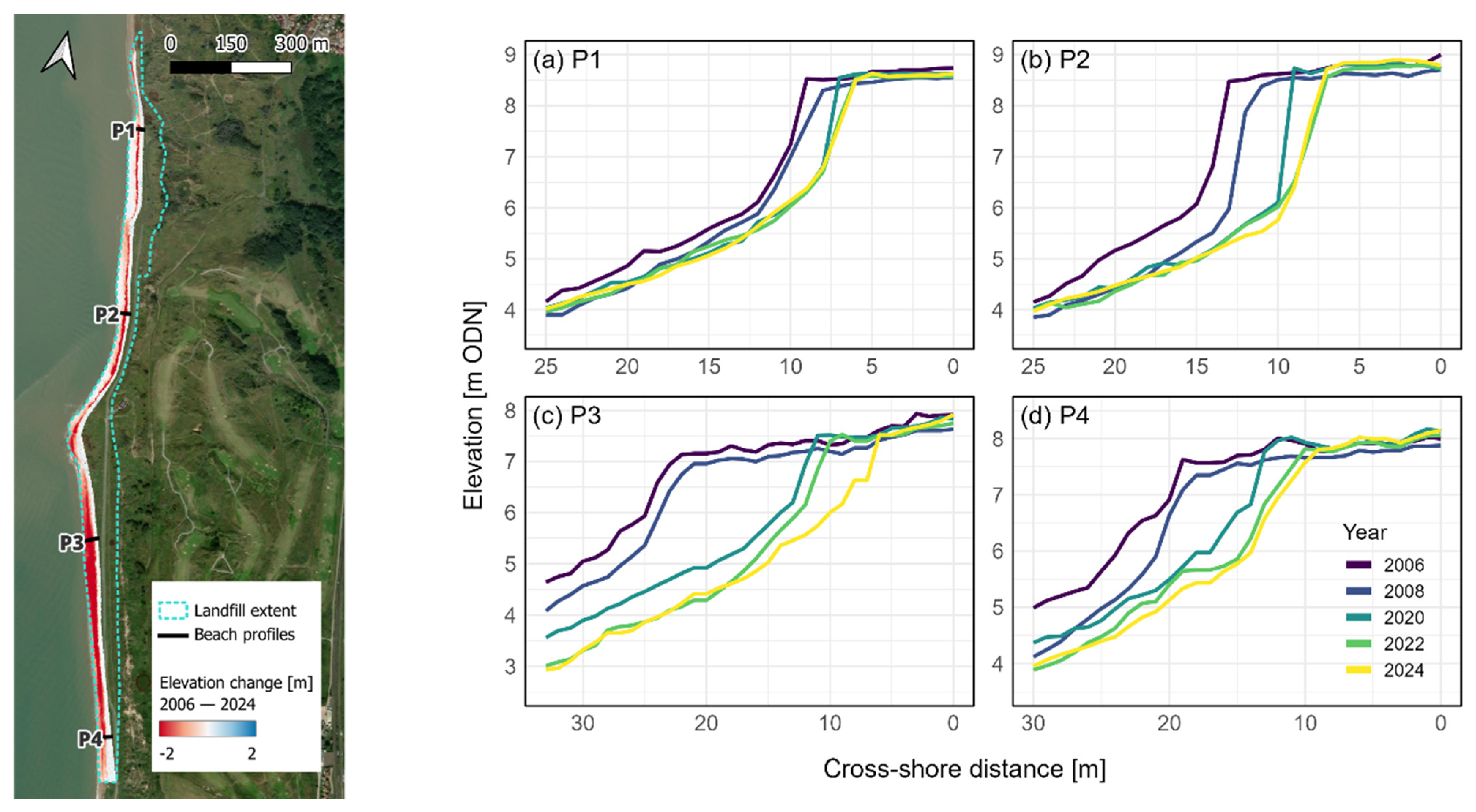
At the Crosby site only, an estimate of change in waste volume over time was undertaken through analysis of LiDAR (Light Detection and Ranging) derived digital elevation models (DEMs) available from coastal monitoring agencies between 2006 and 2024. The derived topographic maps have a 1 m spatial resolution and therefore allow quantification of change in the volume of the waste terrace at Crosby Beach. The volume of the waste terrace above current sea levels (0 m Ordnance Datum Newlyn; ODN) was calculated for each survey epoch in QGIS 3.22, and differencing between surveys allowed for the calculation of a time series of overall beach terrace (i.e., eroding landfill, Figure 1) volumetric change.
To account for uncertainty in individual DEMs, a minimum level of detectable change was calculated following the error-propagation approach detailed in [24] by Brasington et al. (2003). Root mean square error (RMSE) was estimated from around 1000 survey points per survey taken along a fixed reference track, where elevation was presumed to be unchanging. The resulting vertical RMSE across all 5 surveys was 0.099 m, resulting in a minimum detectable elevation change threshold of 0.14 m, below which observed elevation differences were discounted as they were considered indistinguishable from background noise. Any change within +/− 0.14 m was therefore zeroed for the purpose of volumetric change calculations.
These resulting volume estimates were coupled with bulk density data and PFAS concentration data, and fines percentage of the waste (assuming a range and median of published values: 40%, 50% and 80% volume: 22) to estimate the total solid phase PFAS flux from the landfill over time.

3. Results

3.1. PFAS Presence and Concentration

All three reference sites showed all 52 monitored PFAS to be below prescribed detection limits (Supporting Information Table S1). All samples from Withernsea and Hessle showed similar non-detects, with the exception of two Hessle samples showing the presence of branched PFOS (1.9 ng/g) in one sample (HU–H5), and the eight-carbon cyclic PFAS perfluoroethylcyclohexane sulfonate (PFecHS; 0.917 ng/g: Table 1) in another sample (HU-H4). The Crosby samples showed all measured PFAS compounds below detection limits with the exception of PFOA, linear PFOS and branched PFOS, which were consistently present in all five site samples (Table 1). Median concentrations were 0.789 ng/g (range: 0.620–1.200 ng/g) for PFOA; 1.47 ng/g (range: 0.740–2.76 ng/g) for branched PFOS; and 4.58 ng/g (range: 2.06–5.46 ng/g) for linear PFOS, respectively (Table 1). The percentage of linear PFOS (of total PFOS) ranged from 64.7 to 82.9% (median: 73.6%) in the Crosby samples.

3.2. PFAS Flux

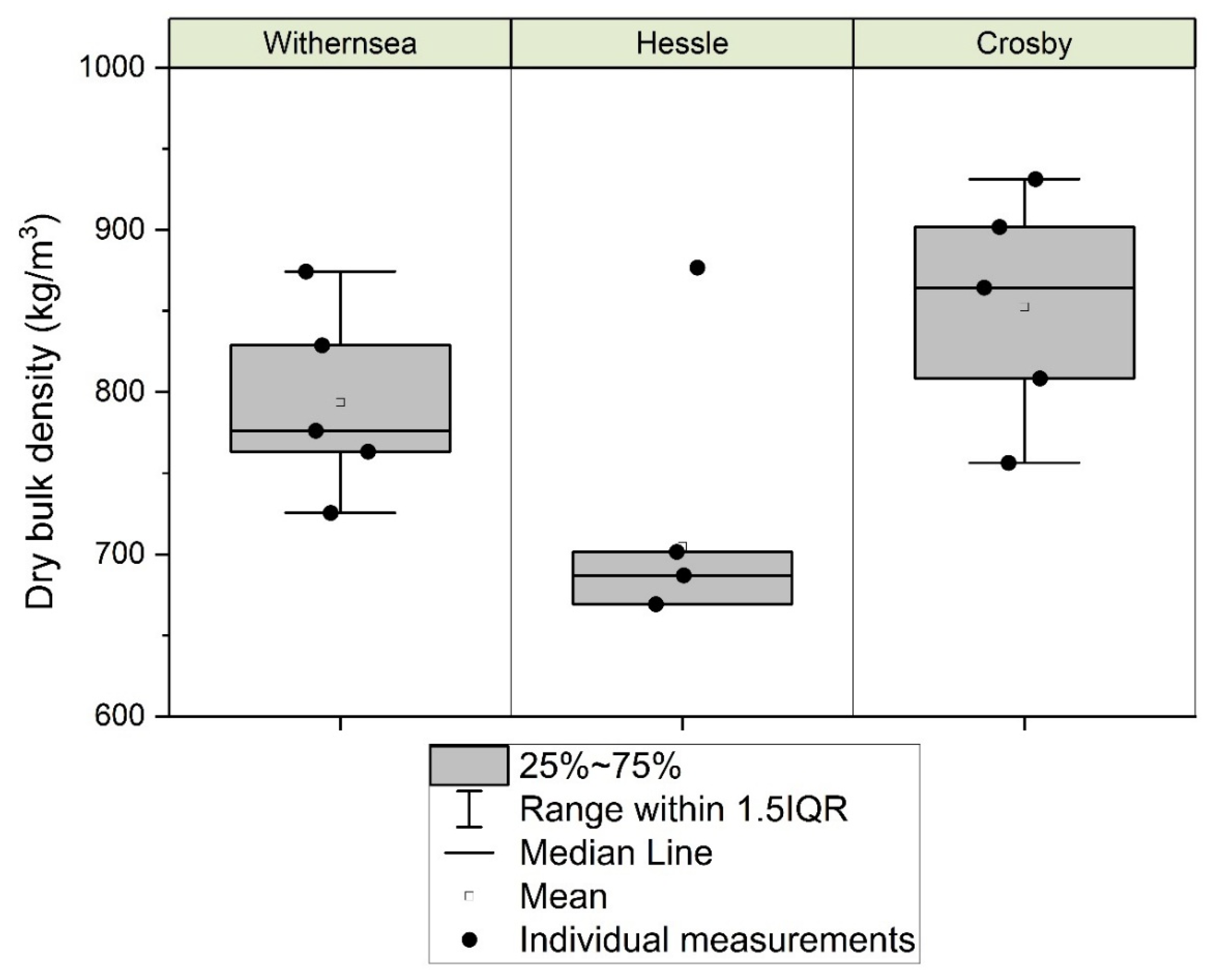
The bulk density of waste samples varied from 0.59 to 0.93 t/m3 (mean: 0.78 t/m3; standard deviation: 0.1) across the three sites, with the Crosby site showing a slightly higher average (0.85 t/m3; standard deviation: 0.07) than the other sites (Appendix A; Figure A1). Flux estimates are only computed for the Crosby site, where consistent detection of PFOS and PFOA was apparent. The change in waste terrace morphology and rates of material loss are shown in Figure 2. Over the monitoring period (2006–2024), a total of 43,263 m3 was lost from the waste deposit, with rapid loss in the early monitoring epoch (2006–2008) of 15,619 m3, followed by more gradual loss in the subsequent epochs. Coupling the bulk density measurements with PFOS/PFOA concentration from dry samples gave PFOA flux ranging 0.8–2.1 g/yr and PFOS flux ranging from 2.0 to 14.7 g/yr, with a median of 0.8 g/yr and 6.3 g/yr for PFOA and PFOS, respectively (Table 2). The total of detected PFAS flux (i.e., sum of detected PFOA, linear PFOS and branched PFOS) is estimated to be in the range of 2.5–16.9 g/yr over the monitoring period. Table 3 includes some comparative flux estimates from environmental PFAS monitoring in other studies, which are discussed in Section 4.
Table 1. PFAS concentrations (all ng/g) for compounds found above the detection limit in at least one sample. Descriptive statistics are only present for sites where all values are above detection limits.
SAMPLE (Site)PFOALinear PFOSBranched PFOSTotal PFOSPFECHS
HU_H4 (Hessle)<0.5<0.6<0.6<1.20.92
HU_H5 (Hessle)<0.5<0.61.981.98<0.5
HU-C1 (Crosby)1.045.462.768.22<0.5
HU-C2 (Crosby)1.204.581.636.21<0.5
HU-C3 (Crosby)0.622.060.742.80<0.5
HU-C4 (Crosby)0.794.981.036.01<0.5
HU-C5 (Crosby)0.742.701.474.17<0.5
Crosby mean (+/− standard deviation) 0.87 (0.24) 3.96 (1.49) 1.53 (0.77) 5.48 (2.07) -
Crosby median (range) 0.79 (0.62–1.20) 4.58 (2.06–5.46) 1.47 (0.74–2.76) 6.01 (1.98–8.22) -
Table 2. Flux estimates for PFOA and PFOS release from the Crosby site based on waste terrace volume loss, bulk density data, and concentration data. Note: Annualised fines loss assumes scenarios of 40%, 50% and 80% of the landfill volume is fine material, with the rest being bulky deposits (e.g., construction and demolition wastes) as per published MSW composition data [22].
ScenarioTotal Volume Loss (2006–2024; m3)Annualised Volume Loss (m3)Annualised Fines Volume loss (m3)Bulk Density (kg/m3)PFOA (ng/g)PFOS (ng/g)PFOA Flux (g/yr)PFOS Flux (g/yr)PFAS Flux (g/yr)
Minimum43,2632403.5961.47560.622.800.452.032.48
Median1201.88640.796.050.826.287.10
Maximum1922.89311.208.222.1514.716.9
Table 3. PFAS flux estimates from this study are compared with a range of literature estimates.
PFAS Flux TypeFlux Estimate (g/yr)Location and DerivationReference
Solid phase total PFAS flux from eroding landfill (median estimates)Total PFAS: 7.1 g/yr (range: 2.5–16.9 g/yr)
PFOS: 6.3 g/yr (range: 2.0–14.7 g/yr)
PFOA: 0.8 g/yr (range: 0.5–2.1 g/yr)
Crosby legacy landfill (England) based on PFAS concentrations in five bulk waste samples, bulk density measurements and LiDAR assessment of volume change in five monitoring intervals from 2006 to 2024. This study
Total PFOS and PFOA load from Fazakerley and Formby wastewater treatment works, which discharge into the same receiving transitional/coastal water body as the Crosby landfillFazakerley WwTW: PFOS: 132 g/yr
PFOA: 147 g/yr
Formby WwTW: PFOS: 90 g/yr
PFOA: 270 g/yr
Based on reported (n > 12) and modelled PFAS releases from the national chemicals investigation programme scheme[7]
Total PFOS and PFOA load from 44 wastewater treatment works in the Mersey basinPFOS: 5170 g/yr
(average of 117.5 g/yr per site)
PFOA: 23,700 g/yr (average of 538.6 g/yr per site)
River Mersey (England) based on reported (n > 12) and modelled PFAS releases from the national chemicals investigation programme scheme. [7]
Instream total PFAS flux gain where landfill leachate plume enters surface waterTotal PFAS: 36 g/yrDyment’s Creek, Ontario (Canada). Based on monitoring PFAS concentration and flow upstream and downstream of the known landfill leachate plume input to surface water. Gain in PFAS load reported.[9]
Average release of 28 PFAS from ten Norwegian landfills in leachate Total PFAS: median 49 g/yr (range 9.2–510 g/yr)
PFOS: median 0.65 g/yr (range: 0.15–1.6)
PFOA: median 1.2 g/yr (range: 0.66–18.0)
Survey of ten Norwegian landfills receiving predominantly MSW, across a representative geographical range. [25]
Total instream PFAS flux at tidal limit (with breakdown for PFOS and PFOA)Total PFAS: 68,100 g/yr
PFOS: 9810 g/yr
PFOA: 14,360 g/yr
River Mersey (England), based on 32 samples for PFAS concentration across a range of flows. Load based on the product of flow and concentration.[7]

4. Discussion

4.1. PFAS in Eroding Legacy Waste

The samples collected here represent three example sites from a large number of eroding coastal legacy waste sites [11] across an age range of disposal from the 1940s to the 1980s. The absence of recorded PFAS compounds above detection limits at Withernsea and, for all but two compounds, in two different samples at Hessle, does not necessarily mean there is no risk associated with PFAS at these locations. It may be that with more refined methods, such as non-target screening and total organic fluorine assays [26,27], more consistent detection could be provided. However, this study aimed to provide an approach that could be broadly adopted for screening by regulatory agencies using commercial facilities, with LODs that are suitable for initial soil screening to regulatory standards [28].
The data suggest that age and waste composition are important drivers of likely PFAS presence. Artefacts collected from the area where samples for analysis were taken suggest a window of age for the actively eroding waste at Withernsea around the 1950s–1960s (Appendix A; Table A1), which would be in the early phases of commercial and domestic PFAS use [17]. As such, it is not unexpected that PFAS concentrations fall below detection limits. Materials collected from the Hessle site, which, according to official records, operated from 1932 to 1978 [20], showed an abundance of plastic debris (principally food packaging) around sample locations, which were dated based on listed products and logos to the late 1950s and 1970s (see Appendix A; Table A1). Again, this would represent a relatively early phase of mass PFAS use in consumer products, and given the long (46 year) interval of waste acceptance at this site. It is likely that the eroding frontage provides a snapshot of only part of this period of deposition, hence the presence of PFOS in only one sample and PFecHS in another. The latter is another legacy PFAS (phased out of commercial use) that was widely used in chrome-plating and hydraulic fluids and has been routinely detected in landfill leachate [9]. Whilst there are no formal soil or sediment guidelines for PFecHS, the concentrations in the one sample reported here are similar in magnitude to those reported from contaminated soils near major airports [29].
According to official records, the Crosby site operated more recently than the other two sites, and artefacts collected from eroding wastes are consistent with material from the late 1970s to the mid-1980s (see Supporting Information Table S1). The narrow window of site operation may be partly responsible for the consistency in detection and values for PFOS and PFOA from samples at the Crosby site (Table 1). The absolute concentrations of PFOS and PFOA at Crosby (Table 1) are moderate when compared with UK regulatory guidance on soil PFAS, which recommends screening levels of 0.013 mg PFOS per kg (dry weight), and 0.019 mg PFOA per kg (dry weight) based on toxicological guidance for the secondary poisoning of birds and mammals [28]. All values at Crosby fall below these, with peak concentrations being equivalent to 63% and 6% of the respective PFOS and PFOA soil screening thresholds (Appendix A. Table A2). Whilst no formal marine sediment PFAS guidelines are adopted in the UK or EU, the concentrations reported here fall below tentative sediment quality standards for PFOS (60 ng/g [30]) and are within a similar order of magnitude to reported background marine sediment concentrations (PFOA: median 0.29 ng/g; max: 1.4 ng/g) in the North East Atlantic [31].
The ratio of linear to branched PFOS in the material is consistent with the approximate 70% linear to 30% branched isomers reported to be produced by 3M in PFOS products [32] (Table 1), suggesting minimal transformation of the bulk PFOS in the landfill solids. The presence of PFOS and PFOA at Crosby is consistent with the age of the deposits and widespread use of these compounds in a range of consumer goods such as surface coatings on fabrics, cookware and paper products, and aqueous fire-fighting foams containing PFOA and PFOS which could be associated with the extensive construction and demolition wastes co-disposed in the landfill, prior to large scale substitution of these legacy PFAS with short chain alternatives [17].

4.2. PFAS Flux

At the Crosby site, where consistent PFOA and PFOS were apparent, fluxes in the order of 2.5–9.2 g PFOS; 0.6–1.3 g PFOA per year were estimated (Table 2). To contextualise these values, Table 3 shows documented PFAS fluxes from a range of studies, including local river systems and documented wastewater treatment works sources. The annual PFOA and PFOS flux at Crosby is relatively modest when compared to documented releases from large wastewater treatment works in the region (Table 3), including those discharging within the same receiving transitional coastal water body, which are typically one to two orders of magnitude higher. However, the value is consistent in magnitude with documented fluxes from landfill leachates reported elsewhere [25]. The rate of this solid phase release will, however, likely be less consistent than leachate releases from large landfills, given the importance of extreme events in driving erosion of coastal waste deposits [33] as suggested by the high variability in waste terrace retreat rate over the monitored epochs (Figure 2). We would also anticipate that the immediate ecological risk associated with solid phase release of PFAS would be less than that of aqueous release via leachate, but there is scope for subsequent transfer from sediment-bound forms with erosion and dissolution processes once released into coastal waters.

4.3. Management Implications

This study demonstrates the presence of measurable PFAS in solid deposits eroding from two of the three coastal legacy landfill sites studied. The presence of legacy PFAS (PFOS and PFOA) at one site was consistent in all samples, albeit at values that would not directly cause concern with regard to soil screening quality. However, the estimated flux based on retreat of the waste deposits at this site is equivalent to documented PFOA and PFOS leaching rates from inland landfills [25]. Whilst this is a relatively modest flux compared to reported data on local wastewater treatment works PFAS releases and riverine PFAS flux [7,19], the cumulative impact of PFAS release from coastal landfills in some regions could be notable given the close geographical clustering of many legacy landfills in areas of high population and centres of former industry [11]. Efforts to quantify these contributions from both landfill plumes [9] and solid phase erosion (particularly during short-duration extreme events) to receiving watercourses should be prioritised.
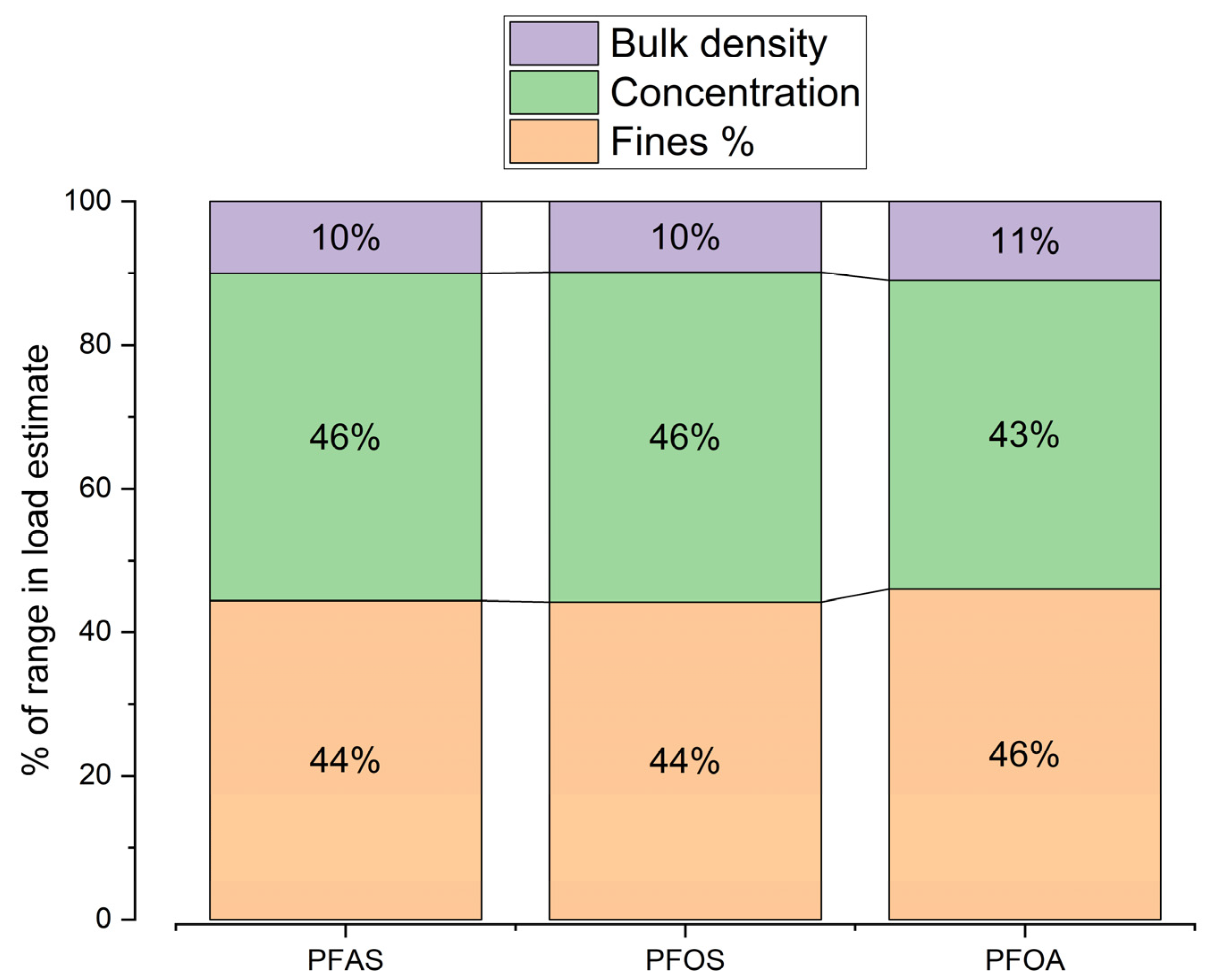
As a means for identifying and assessing potential PFAS risk from eroding coastal waste deposits, the approach adopted here could provide a routine and relatively low-cost approach for initial risk screening. However, in some cases such an approach will only offer a snapshot in time of the potential contents of an eroding landfill, particularly for those with long periods of waste acceptance (like the Hessle site here), and more refined (and expensive) analytical approaches (e.g., Total Organic Fluorine, TOF and Total Oxidizable Precursor, TOP assay; non-target screening) would enhance the approach for legacy PFAS not covered by the sample suite. The screening approach here also gives quite a high range in flux values (Table 2), which are principally derived from assumptions around fines content of the sampled waste (~45% of the range in flux values is derived from these) and variations in PFAS concentration (~45% of the range, see Appendix A; Figure A2). Efforts to constrain these values would require additional sampling efforts for PFAS concentration and intrusive ground investigations for bulk sampling to accurately quantify fine content on a site-by-site basis, both of which would add high cost to investigations. At high-risk coastal landfill sites, for example, large municipal waste sites with high flood risk or significant erosion forecasts [11,13], such detailed (and costly) ground investigations for solid phase and leachate sampling may likely be needed to assess the full suite of PFAS (and other pollutant) risks.
Based on the data collected in this study, coastal landfills that operated under more relaxed environmental regulatory regimes from the late 1960s to the 1980s, at a time of rising consumerism and increased everyday use, and production of PFOA and PFOS [34], should be a particular focus for more in-depth studies of PFAS presence, behaviour and potential release. This should include rapid PFAS screening of waste materials and any leachates present, as well as possible impacts on near-field coastal sediments. National exercises to prioritise and manage legacy landfills should ensure records of the estimated age of deposits are compiled and subsequently used to inform risk assessments [11] and site investigations.

5. Conclusions

Detectable PFAS were present in 47% of municipal solid waste samples taken from three actively eroding coastal landfills in England. At the oldest of the sites receiving waste in the 1950s–1960s, there were consistent non-detects and only occasional detection of PFOA and PFecHS at another site where waste samples were likely from the 1950s–1970s. Legacy PFAS (PFOS and PFOA) were present in all samples at one of the three sites, which received municipal solid waste in the 1970s and 1980s, at concentrations that fall below national soil screening standards. The estimated PFAS flux from this site, from coupling waste terrace erosion estimates with concentration and bulk density data, suggested only modest release rates consistent with reported landfill leachate flux estimates and shows that historical coastal landfills are likely to present long-term, low-level sources of legacy PFAS to coastal systems. The approach described here provides a relatively low-cost, rapid screening method for PFAS in eroding wastes and highlights a tangible pollution pathway from eroding wastes to the surrounding coastal environment.

Supplementary Materials

The following supporting information can be downloaded at: https://www.mdpi.com/article/10.3390/w18030383/s1, Supplementary Information Table S1: SupportingInfo_Table_S1_PFAS_Landfill data.csv containing solid phase PFAS data from all samples.

Author Contributions

Conceptualization, W.M.M., S.J.P., P.B., A.L.R., I.T.B., A.P.J. and K.A.H.-E.; methodology, W.M.M., S.J.P., P.B., A.L.R., A.L., I.T.B., A.P.J. and K.A.H.-E.; software, S.J.P. and W.M.M.; validation, W.M.M., A.L.R., P.B., S.J.P. and I.T.B.; formal analysis, W.M.M., A.L.R., S.J.P. and I.T.B.; investigation, W.M.M., A.L.R., S.J.P. and A.L.; data curation, W.M.M., S.J.P. and A.L.R.; writing—original draft preparation, W.M.M., S.J.P. and A.L.R.; writing—review and editing, P.B., I.T.B., K.A.H.-E., A.P.J., A.L., A.L.R., S.J.P. and W.M.M.; visualisation, W.M.M., S.J.P. and A.L.R.; supervision, W.M.M., A.L.R. and I.T.B.; project administration, I.T.B., W.M.M., K.A.H.-E. and A.P.J.; funding acquisition, I.T.B., A.P.J., K.A.H.-E. and W.M.M. All authors have read and agreed to the published version of the manuscript.

Funding

This research was funded by the UK Natural Environment Research Council (NERC) under grant numbers NE/T003286/1, NE/T003022/1, NE/T002824/1 (Legacy wastes in the coastal zone: Environmental risks and management futures); and NE/Y006518/1 (StormFlux: Effect of Storm Babet on pollution fluxes from remobilised mine wastes).

Data Availability Statement

Data are available for download from links provided in Supplementary Materials.

Acknowledgments

We would like to thank Edie Mayes for assistance with field sampling and Mike Mills for assistance with sample preparation.

Conflicts of Interest

The authors declare no conflicts of interest.

Appendix A

Appendix A.1. Site Details and Waste Artefacts

As is typical of many legacy waste sites, formal records of detailed waste acceptance are not available. Both the Crosby and Hessle sites appear on the official Environment Agency Historical Landfill Database [20], but the Withernsea site does not. The Crosby site is listed as operating from 1976 to 1981 [12] and forms a small terrace at the top of the beach that is actively eroding. This waste terrace had extensive visible plastic sheets and bags emerging along the frontage, and whilst this site was not a high priority for collecting dateable artefacts given the narrow window of operation, plastic snack wrappers collected were consistent with production from the mid to late 1970s (Table A1). Prior to the modern waste disposal, the beach area was used for disposal of World War II demolition wastes [11], which form much of the subaerial beach deposits (Figure 1).
The Hessle site had a much more extensive period of waste acceptance in official records (1932–1978) with listed wastes including household, commercial, industrial, inert and liquid sludge being received [20]. The deposit varies in height but consists of up to 3 m of waste terrace that is perched on glacial till and estuarine silts. Much of the area marked as landfill has been redeveloped for commercial offices and industrial premises. Given the extensive period of operation, where feasible in sampling, identifiable waste artefacts were collected from across the eroding frontage to try and constrain dates of the sampled eroding waste. These included several plastic food wrappers (Table A1) which suggested that eroding material was likely to range from the late 1950s to the early 1970s.
The Withernsea site does not appear in national landfill databases but is thought to have operated over several decades up until closure in the 1960s [12]. The waste consists of a relatively thin layer (up to ~3 m thickness) of compacted waste, with some evidence of combustion prior to disposal (e.g., ashes and partially melted glass bottles). Artefacts collected were dominated by ceramic homeware, pharmaceutical and beverage glass bottles, but did also include some early plastic material associated with personal care products and toys (Table A1). These are typically consistent with brands and products from the late 1950s and early 1960s (Table A1).
Table A1. Selected waste artefacts found in eroding frontage at each site that provide indicative age estimates of the landfills.
ArtefactDescription and Approximate Dating
Water 18 00383 i0a1Site: Crosby
Artefact: Plastic potato chip snack wrapper found in waste matrix. ‘Twists’ produced by the company Smiths and consistent with branding from the mid-1970s [35]. No best-before end date visible.
Water 18 00383 i0a2Site: Hessle
Artefact: Plastic wrapper for Bonus bread found in waste matrix. Plastic-covered metal twist-tie in place and associated labelling highlighting the recent packaging innovation with the “New Bonus stays fresher longer!” slogan. Twist-ties were invented in 1961 [36], so likely places this plastic wrapper in the early to mid-60s at the earliest.
Water 18 00383 i0a3Site: Hessle
Artefact: Plastic wrapper for Wonderloaf Home Bake part-baked bread found in waste matrix. “Wonderloaf” brand name first used in 1955 by United Bakeries [37]. Use of Celsius measurement alongside Fahrenheit in cooking instructions suggests a date range of early-1960s to early-1970s. Online forum posts indicate that the Wonderloaf factory closed around 1978 [38].
Water 18 00383 i0a4Site: Hessle
Artefact: New Zealand lamb branded heavy duty plastic meat packaging embedded in the waste matrix. Includes the lamb in front of a globe logo with “The best in the world” slogan that had limited use from the mid-1950s [39] as an alternative to the more commonly used rosette [40]. Plastic meat packaging was introduced broadly from the late-1950s into early-1960s [41].
Water 18 00383 i0a5Site: Withernsea
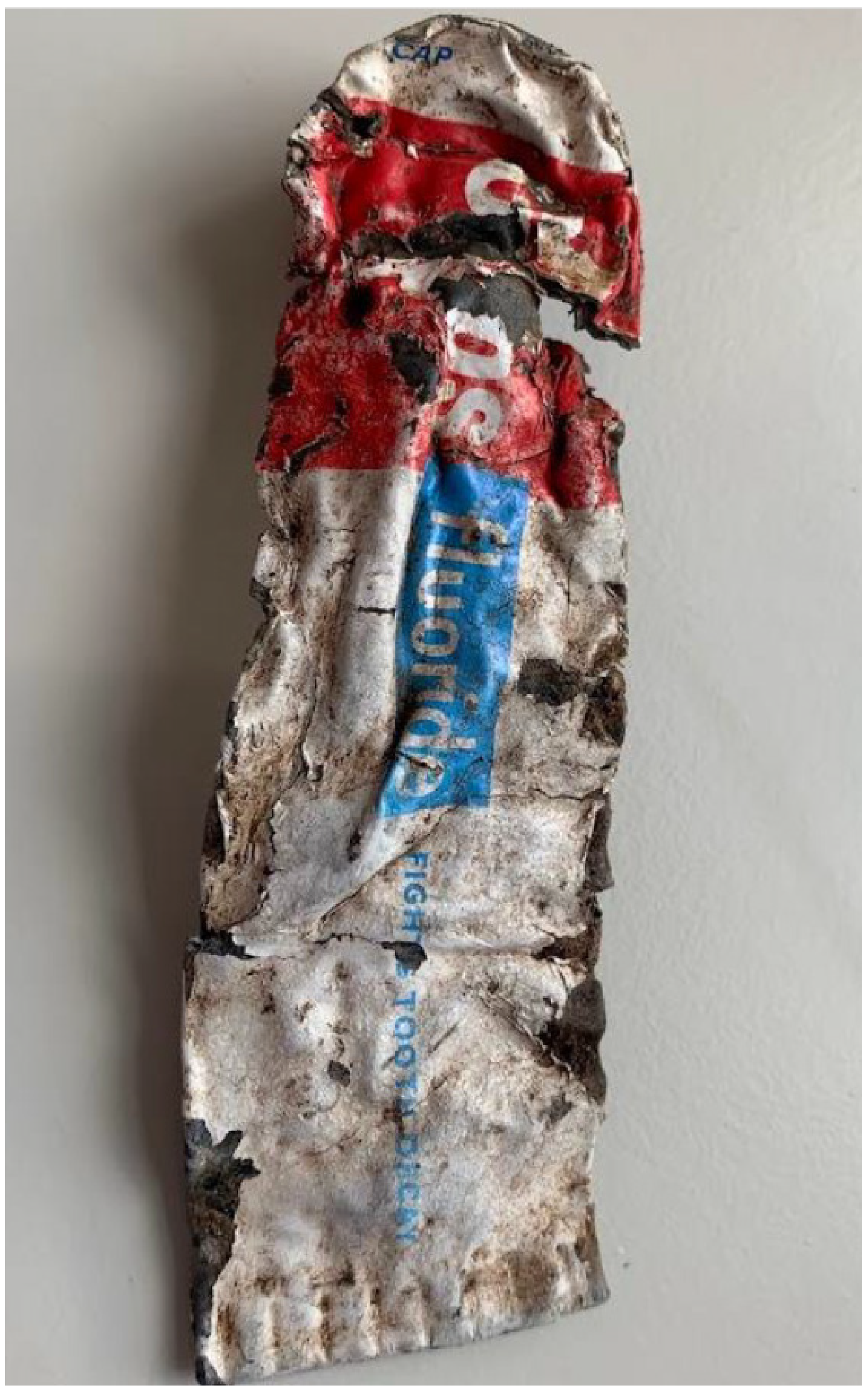
Artefact: Gibbs branded toothpaste likely to be from the late 1960s as it is labelled ‘Gibbs fluoride’. Colgate and Gibbs were the first companies to add fluoride to toothpaste in the mid-1960s [42]. Branding is consistent with 1965–1970 Gibbs adverts [43].
Water 18 00383 i0a6Site: Withernsea
Artefact: Max Factor Hollywood Creme Puff Compact Instant Make-Up (Atomic Star design) found within waste matrix. One of the few plastic items observed at the site. Introduced to the market by Max Factor in 1953 [44].
Water 18 00383 i0a7Site: Withernsea
Artefact: Plastic “Groucho goggles” or “Beagle Puss glasses” found with waste matrix. Plastic version of the glasses mass-marketed from the late 1950s [45].
Water 18 00383 i0a8Site: Withernsea
Artefact: Glass Brylcreem jar with embossed ‘Brylcreeem’ logo on base. Distinctive textured, hand-shaped design in glass used for Brylcreem from the 1940s and changed to plastic packaging in the 1960s [46].

Appendix A.2. Waste Bulk Density Data

Figure A1. Distribution of dry bulk density measurements for waste samples taken from the three study sites. Note: the Environment Agency uses waste density of 0.83 tonnes per cubic metre (830 kg/m3) for non-hazardous waste in routine waste management data [47], which is broadly consistent with data here (data set mean of 784 kg/m3). Grey box denotes interquartile range.
Water 18 00383 g0a1

Appendix A.3. Comparison of PFAS Concentrations with Category 4 Screening Levels

The Hazard Index (HI) associated with human exposure to PFAS in soils in contaminated land settings is derived by CL:AIRE [48] in the UK for four PFAS (PFOA, PFOS, PFHxS, and PFNA). This is based on dividing reported soil concentrations by Category 4 Screening Levels (C4SL) which themselves are derived from review of toxicological studies and health-based guidance values to consider the likely risk of human exposure via oral, inhalation and dermal routes to generate a Hazard Quotient (HQ). Different C4SLs are set depending on land use with higher risk values for residential properties and locations where food is grown for public consumption (e.g., allotments [48]). In this case the public open space (parkland) is used, given the open nature of the Crosby waste site. The Hazard Index (HI) is calculated as follows:
HI = HQPFOA + HQPFOS + HQPFHxS + HQPFNA
The risk of human exposure across a range of likely exposure routes is considered acceptable (subject to uncertainties and site-specific constraints) if the individual PFAS and total PFAS hazard index is <1. These individual PFOA and PFOS Hazard Quotients and overall HI are all well below this threshold in all Crosby samples (Table A2).
Table A2. PFAS Hazard Index for Crosby site (only) calculated as per [47] (Section 4.2). Note total PFAS HI based on HQPFOA and HQPFOS given PFHxS and PFNA were <LOD.
SampleConcentration (µg/kg)Hazard QuotientHazard Index
PFOAPFOSPFOAPFOS
HU_C11.048.220.0130.1040.12
HU_C21.206.210.0150.0790.09
HU_C30.622.80.0080.0350.04
HU_C40.7896.010.0100.0760.09
HU_C50.7374.170.0090.0530.06
Figure A2. Data show the percentage of the range in flux estimates that can be attributed to each of the three changing variables used in the minimum, median and maximum flux estimates: bulk density, PFAS concentration data, and the assumption of % of fines in the waste deposit (as per [22]).
Water 18 00383 g0a2

References

  1. Khan, B.; Burgess, R.M.; Cantwell, M.G. Occurrence and bioaccumulation patterns of per-and polyfluoroalkyl substances (PFAS) in the marine environment. ACS ES&T Water 2023, 3, 1243–1259. [Google Scholar] [CrossRef]
  2. Lesmeister, L.; Lange, F.T.; Breuer, J.; Biegel-Engler, A.; Giese, E.; Scheurer, M. Extending the knowledge about PFAS bioaccumulation factors for agricultural plants–A review. Sci. Total Environ. 2021, 766, 142640. [Google Scholar] [CrossRef]
  3. Miranda, D.D.A.; Peaslee, G.F.; Zachritz, A.M.; Lamberti, G.A. A worldwide evaluation of trophic magnification of per- and polyfluoroalkyl substances in aquatic ecosystems. Integr. Environ. Assess. Manag. 2022, 18, 1500–1512. [Google Scholar] [CrossRef]
  4. Sunderland, E.M.; Hu, X.C.; Dassuncao, C.; Tokranov, A.K.; Wagner, C.C.; Allen, J.G. A review of the pathways of human exposure to poly- and perfluoroalkyl substances (PFASs) and present understanding of health effects. J. Expo. Sci. Environ. Epidemiol. 2019, 29, 131–147. [Google Scholar] [CrossRef]
  5. National Academies of Sciences, Engineering, and Medicine. Potential health effects of PFAS. In Guidance on PFAS Exposure, Testing, and Clinical Follow-Up; National Academies Press: Washington, DC, USA, 2022. [Google Scholar]
  6. Coffin, E.S.; Reeves, D.M.; Cassidy, D.P. PFAS in municipal solid waste landfills: Sources, leachate composition, chemical transformations, and future challenges. Curr. Opin. Environ. Sci. Health 2023, 31, 100418. [Google Scholar] [CrossRef]
  7. Byrne, P.; Mayes, W.M.; James, A.L.; Comber, S.; Biles, E.; Riley, A.L.; Runkel, R.L. PFAS river export analysis highlights the urgent need for catchment-scale mass loading data. Environ. Sci. Technol. Lett. 2024, 11, 266–272. [Google Scholar] [CrossRef]
  8. Li, J.; Xi, B.; Zhu, G.; Yuan, Y.; Liu, W.; Gong, Y.; Tan, W. A critical review of the occurrence, fate and treatment of per- and polyfluoroalkyl substances (PFAS) in landfills. Environ. Res. 2023, 218, 114980. [Google Scholar] [CrossRef] [PubMed]
  9. Roy, J.W.; Propp, V.R.; Hua, T.; Brown, S.J.; Brinovcar, C.; Smith, J.E.; De Silva, A.O. Per- and poly-fluoroalkyl substances (PFAS) contamination of surface waters by historic landfills via groundwater plumes: Ecosystem exposure and downstream mass loading. Environ. Sci. Process. Impacts 2025, 27, 1074–1087. [Google Scholar] [CrossRef]
  10. Nicholls, R.J.; Beaven, R.P.; Stringfellow, A.; Monfort, D.; Le Cozannet, G.; Wahl, T.; Gebert, J.; Wadey, M.; Arns, A.; Spencer, K.L.; et al. Coastal landfills and rising sea levels: A challenge for the 21st century. Front. Mar. Sci. 2021, 8, 710342. [Google Scholar] [CrossRef]
  11. Riley, A.L.; Amezaga, J.; Burke, I.T.; Byrne, P.; Cooper, N.; Crane, R.A.; Comber, S.D.; Gandy, C.J.; Hudson-Edwards, K.A.; Jennings, E.; et al. Incorporating conceptual site models into national-scale environmental risk assessments for legacy waste in the coastal zone. Front. Environ. Sci. 2022, 10, 1045482. [Google Scholar] [CrossRef]
  12. Burke, I.T.; Onnis, P.; Riley, A.L.; Gandy, C.J.; Ramos, V.; Rollinson, G.K.; Byrne, P.; Crane, R.A.; Hudson-Edwards, K.A.; Jennings, E.; et al. Speciation and leaching behaviour of inorganic contaminants in actively eroding historical coastal municipal solid waste landfills. Mar. Pollut. Bull. 2025, 219, 118341. [Google Scholar] [CrossRef] [PubMed]
  13. Brand, J.H.; Spencer, K.L. Potential contamination of the coastal zone by eroding historic landfills. Mar. Pollut. Bull. 2019, 146, 282–291. [Google Scholar] [CrossRef]
  14. Saxena, P.; Song, X.; Zhang, B.; Sarkar, A.; Achari, G. Profiling PBDE emissions from coastal landfills: Impact of waste management practices. Waste Manag. Bull. 2025, 3, 391–401. [Google Scholar] [CrossRef]
  15. Phoenix Engineering. Phase 2 Landfill Leachate Report: Investigation of Persistent Organic Pollutants (POPs), Per- and Poly-Fluoroalkyl Substances (PFAS) and Other Water Framework Directive Priority Substances in Landfill Leachates. Report for Department for Environment, Food and Rural Affairs. 2024. Available online: https://sciencesearch.defra.gov.uk/ProjectDetails?ProjectId=21648 (accessed on 17 December 2025).
  16. Tolaymat, T.; Robey, N.; Krause, M.; Larson, J.; Weitz, K.; Parvathikar, S.; Phelps, L.; Linak, W.; Burden, S.; Speth, T.; et al. A critical review of perfluoroalkyl and polyfluoroalkyl substances (PFAS) landfill disposal in the United States. Sci. Total Environ. 2023, 905, 167185. [Google Scholar] [CrossRef]
  17. Gaines, L.G. Historical and current usage of per- and polyfluoroalkyl substances (PFAS): A literature review. Am. J. Ind. Med. 2023, 66, 353–378. [Google Scholar] [CrossRef]
  18. UK Health and Safety Executive. UK Registration, Evaluation, Authorisation and Restriction of Chemicals (REACH). 2025. Available online: https://www.hse.gov.uk/reach/index.htm (accessed on 17 December 2025).
  19. Byrne, P.; Mayes, W.M.; James, A.L.; Comber, S.; Biles, E.; Riley, A.L.; Verplanck, P.L.; Bradley, L. Spatially-resolved source apportionment of per- and polyfluoroalkyl substances (PFAS) within a post-industrial river catchment. Sci. Total Environ. 2025, 1001, 180502. [Google Scholar] [CrossRef] [PubMed]
  20. Environment Agency. Historic Landfill Sites. 2025. Available online: https://environment.data.gov.uk/dataset/7a955570-d465-11e4-a37c-f0def148f590 (accessed on 17 December 2025).
  21. Sha, B.; Johansson, J.H.; Salter, M.E.; Blichner, S.M.; Cousins, I.T. Constraining global transport of perfluoroalkyl acids on sea spray aerosol using field measurements. Sci. Adv. 2024, 10, eadl1026. [Google Scholar] [CrossRef]
  22. Parrodi, J.C.H.; Höllen, D.; Pomberger, R. Characterization of fine fractions from landfill mining: A review of previous investigations. Composites 2018, 6, 46–62. [Google Scholar] [CrossRef]
  23. ALS Laboratories Ltd. The Determination of Per- and Polyfluoroalkyl Substances (PFAS) in Soils by LC-MS/MS. 2022. Available online: https://www.alsenvironmental.co.uk/media-uk/method_statements/hawarden/contaminated-land-organics/tm338---pfas-in-soils-method-summary_2.pdf (accessed on 17 December 2025).
  24. Brasington, J.; Langham, J.; Rumsby, B. Methodological sensitivity of morphometric estimates of coarse fluvial sediment transport. Geomorphology 2023, 53, 299–316. [Google Scholar] [CrossRef]
  25. Knutsen, H.; Mæhlum, T.; Haarstad, K.; Slinde, G.A.; Arp, H.P.H. Leachate emissions of short-and long-chain per-and polyfluoroalkyl substances (PFASs) from various Norwegian landfills. Environ. Sci. Process. Impacts 2019, 21, 1970–1979. [Google Scholar] [CrossRef]
  26. Forster, A.L.B.; Zhang, Y.; Westerman, D.C.; Richardson, S.D. Improved total organic fluorine methods for more comprehensive measurement of PFAS in industrial wastewater, river water, and air. Water Res. 2023, 235, 119859. [Google Scholar] [CrossRef]
  27. Megson, D.; Niepsch, D.; Spencer, J.; Dos Santos, C.; Florance, H.; MacLeod, C.L.; Ross, I. Non-targeted analysis reveals hundreds of per- and polyfluoroalkyl substances (PFAS) in UK freshwater in the vicinity of a fluorochemical plant. Chemosphere 2024, 367, 143645. [Google Scholar] [CrossRef]
  28. Environment Agency. Derivation and Use of Soil Screening Values for Assessing Ecological Risks; Report—ShARE id26 (Revised); Environment Agency: Bristol, UK, 2023. Available online: https://assets.publishing.service.gov.uk/media/61e7de5c8fa8f505985ef41c/Soil_screening_values_for_assessing_ecological_risk_-_report.pdf (accessed on 17 December 2025).
  29. Wang, Y.; Vestergren, R.; Shi, Y.; Cao, D.; Xu, L.; Cai, Y.; Zhao, X.; Wu, F. Identification, tissue distribution, and bioaccumulation potential of cyclic perfluorinated sulfonic acids isomers in an airport impacted ecosystem. Environ. Sci. Technol. 2016, 50, 10923–10932. [Google Scholar] [CrossRef] [PubMed]
  30. Simpson, S.L.; Liu, Y.; Spadaro, D.A.; Wang, X.; Kookana, R.S.; Batley, G.E. Chronic effects and thresholds for estuarine and marine benthic organism exposure to perfluorooctane sulfonic acid (PFOS)-contaminated sediments: Influence of organic carbon and exposure routes. Sci. Total Environ. 2021, 776, 146008. [Google Scholar] [CrossRef]
  31. Boitsov, S.; Bruvold, A.; Hanssen, L.; Jensen, H.K.B.; Ali, A. Per- and polyfluoroalkyl substances (PFAS) in surface sediments of the North-east Atlantic Ocean: A non-natural PFAS background. Environ. Adv. 2024, 16, 100545. [Google Scholar] [CrossRef]
  32. Langberg, H.A.; Arp, H.P.H.; Breedveld, G.D.; Slinde, G.A.; Høiseter, Å.; Grønning, H.M.; Jartun, M.; Rundberget, T.; Jenssen, B.M.; Hale, S.E. Paper product production identified as the main source of per- and polyfluoroalyl substances (PFAS) in a Norwegian lake: Source and historic emission tracking. Environ. Pollut. 2021, 273, 116259. [Google Scholar] [CrossRef] [PubMed]
  33. Pitman, S.J.; Burke, I.T.; Jay, H.; Cooper, N.; Mayes, W.M.; Jarvis, A.P. Long-term coastal dynamics: The evolution of a mixed sediment mega-nourishment consisting of colliery spoil. J. Environ. Manag. 2024, 371, 123106. [Google Scholar] [CrossRef]
  34. Smithwick, M.; Norstrom, R.J.; Mabury, S.A.; Solomon, K.; Evans, T.J.; Stirling, I.; Taylor, M.K.; Muir, D.C.G. Temporal Trends of Perfluoroalkyl Contaminants in the North American Arctic, 1972–2002. Env. Sci Technol 2024, 16, 100545. [Google Scholar] [CrossRef]
  35. Potter, M. Smiths Twists Advert 1975 HQ. Available online: https://youtu.be/4aWJ2ZrsUxs?si=BYXyxAEqC1eCJzbd (accessed on 17 December 2025).
  36. Los Angeles Times. Charles Burford dies at 81: Inventor created equipment for baking industry. Los Angeles Times, 22 May 2013. Available online: https://www.latimes.com/local/obituaries/la-me-charles-burford-20130523-story.html (accessed on 17 December 2025).
  37. Grace’s Guide. Spillers. 2025. Available online: https://www.gracesguide.co.uk/Spillers#cite_note-1 (accessed on 17 December 2025).
  38. Bowes and Bounds Connected. The Wonderloaf Fleet Being Cleaned. 2014. Available online: https://bowesandbounds.org/photo/the-wonderloaf-fleet-being-cleaned (accessed on 17 December 2025).
  39. Harben, P. New Zealand Lamb: Helpful Hints by Harben: Buying, Cooking, Carving; New Zealand Meat Producers Board: Wellington, New Zealand, 1954. [Google Scholar]
  40. Clemens, R.; Babcock, B.A. Country of Origin as a Brand: The Case of New Zealand Lamb; Center for Agricultural and Rural Development (CARD) at Iowa State University: Ames, IA, USA, 2004. [Google Scholar] [CrossRef]
  41. Lansin Commodity. Plastic Wrap. Lansin Commodity, 4 May 2025. Available online: https://www.lansincommodity.com/info/plastic-wrap-81971930.html#:~:text=Food%20plastic%20cling%20wrap%20is,household%20staple%20for%20wrapping%20food (accessed on 17 December 2025).
  42. Rugg-Gunn, A. Preventing the preventable–the enigma of dental caries. Br. Dent. J. 2001, 191, 478–488. [Google Scholar] [CrossRef]
  43. Science Museum Group. Box for Tube of “Gibbs” Toothpaste [Photograph]. 2025. Available online: https://collection.sciencemuseumgroup.org.uk/objects/co97720/box-for-tube-of-gibbs-toothpaste (accessed on 17 December 2025).
  44. March, B. Hollywood’s Iconic Product, Max Factor’s Crème Puff, Turns 60. 2013. Available online: https://www.cosmopolitan.com/uk/beauty-hair/makeup/a24203/max-factor-creme-puff-iconic-product/ (accessed on 17 December 2025).
  45. Viegut, B. Embalmed in Plastic: The Nuances of Groucho Glasses. 2023. Available online: https://www.printmag.com/featured-design-history/embalmed-in-plastic-the-nuances-of-groucho-glasses/ (accessed on 17 December 2025).
  46. Chesters, A. A Brief History of Brylcreem. 2012. Available online: https://www.theguardian.com/fashion/fashion-blog/2012/apr/02/brief-history-of-brylcreem (accessed on 17 December 2025).
  47. Environment Agency. Waste Management Data. 2012. Available online: https://webarchive.nationalarchives.gov.uk/ukgwa/20140328141656/http:/www.environment-agency.gov.uk/research/library/data/150328.aspx (accessed on 17 December 2025).
  48. CL: AIRE. Interim Category 4 Screening Levels for Per- and Polyfluoroalkyl Substances (PFAS): Perfluorooctanoic Acid (PFOA), Perfluorononanoic Acid (PFNA), Perfluorohexane Sulfonic Acid (PFHxS) and Perfluorooctane Sulfonic Acid (PFOS). 2024. Available online: https://claire.co.uk/phoca-download/1-publications-library/91-c4sls-phase-2.html?download=999:interim-pfas (accessed on 17 December 2025).
Figure 1. Sample site location map and indicative images of eroding waste materials at each location. Broad sample locations shown top right and yellow arrows provide indication of scale at field sites.
Water 18 00383 g001
Figure 2. Topographic change at the Crosby beach landfill deposit showing aggregate elevation change in the waste terrace (2006–2024; left) and waste terrace cross-sectional change over the different LiDAR sampling epochs (ad).
Water 18 00383 g002
Disclaimer/Publisher’s Note: The statements, opinions and data contained in all publications are solely those of the individual author(s) and contributor(s) and not of MDPI and/or the editor(s). MDPI and/or the editor(s) disclaim responsibility for any injury to people or property resulting from any ideas, methods, instructions or products referred to in the content.