
Article

Mechanisms and Empirical Analysis of How New Quality Productive Forces Drive High-Quality Development to Enhance Water Resources Carrying Capacity in the Weihe River Basin


by
Haozhe Yu
*,
Jie Wu
,
Feiyan Xiao
,
Lei Shi
and
Yimin Huang
School of Humanities, Shaanxi University of Technology, Hanzhong 723001, China
*
Author to whom correspondence should be addressed.
Water 2026, 18(3), 339; https://doi.org/10.3390/w18030339
Submission received: 29 December 2025 / Revised: 17 January 2026 / Accepted: 27 January 2026 / Published: 29 January 2026
(This article belongs to the Section Urban Water Management)

Abstract

Water-scarce river basins face the dual challenge of sustaining development progress while maintaining water resources carrying capacity (WRCC), yet city-scale evidence remains limited on how New Quality Productive Force (NQPF)-driven high-quality development reshapes WRCC through coupled coordination and development–pressure decoupling processes. Using a balanced panel of 15 cities in the Weihe River Basin (WRB) during 2014–2023, an integrated analytical framework was implemented by combining composite index evaluation (WRCC and the high-quality development index (HQDI)), the Coupling Coordination Degree (CCD) model, Tapio decoupling diagnosis between HQDI and total water use (TWU), and logarithmic mean Divisia index (LMDI) decomposition. The results indicate that: (1) both the HQD index and WRCC exhibited sustained growth, with their CCD improving significantly from mild imbalance to primary coordination, while a distinct spatial pattern of “Guanzhong leading, northern Shaanxi improving, and eastern Gansu stabilizing” emerged; (2) the HQDI–WRCC linkage was further supported by pooled statistical tests and a two-way fixed effects specification with city-clustered robust standard errors, confirming a significant positive association (Pearson = 0.517, p < 0.01; Spearman = 0.183, p < 0.05) and a stable positive effect of HQDI on WRCC (β = 0.194, p = 0.0088); (3) Tapio results reveal an overall transition from earlier volatility toward a later-period regime dominated by Weak Decoupling (WD) and Strong Decoupling (SD), implying that development progress became less dependent on rising TWU, although pronounced inter-city heterogeneity persisted; (4) LMDI decomposition further identified water use intensity and industrial structure as primary inhibitors of water consumption, whereas the R&D scale effect increased nearly 60-fold, emerging as a major driver of water demand. This study provides a mechanistic basis for coordinating ecological protection and high-quality development under rigid water constraints in water-scarce basins.

1. Introduction

Water is the foundation of life, a critical input for production, and the cornerstone of ecological systems. Under the combined pressures of global climate change and rapid urbanization, water resource constraints have become a core bottleneck limiting sustainable development [1]. In response, the Chinese government has proposed a “spatial balance, systematic governance, and coordinated policy efforts” strategy, endowing water resources carrying capacity (WRCC) with renewed strategic significance [2].
The Weihe River Basin (WRB) is a major tributary in the middle reaches of the Yellow River and serves as an important ecological and economic corridor in China. The per capita availability of water resources in this basin is far below the internationally recognized warning threshold of 400 m3 per person, and several areas have long operated under conditions of persistent water overload [3]. Unlike traditional extensive development models (often characterized by low-quality infrastructure and high resource consumption), which exert a negative squeeze on carrying capacity, high-quality development focuses on decoupling growth from environmental pressure. Therefore, exploring the specific mechanism of HQD is critical for finding solutions to water scarcity. This analysis is also essential for promoting the coordinated evolution of the “Human–Water–City–Industry” system and for supporting high-quality development across the Yellow River Basin as a whole.
WRCC is a key indicator for assessing the coordination between socioeconomic development and the resource–environment system. Internationally, research has evolved from static capacity identification toward dynamic simulation and system feedback analysis [4,5,6,7]. Recent studies have increasingly focused on the impacts of urbanization, utilizing socio-hydrological models to analyze how factors such as urban expansion, agricultural competition, and pollution jointly constrain the sustainability of urban water resource systems [8,9].
Chinese scholars have extensively explored the interaction mechanisms between high-quality development and WRCC. Previous studies constructing multidimensional evaluation models have demonstrated that industrial structure optimization, technological progress, and green development are critical for alleviating water constraints [10,11,12,13]. Specifically, research on the Yellow River and Han-Weihe Basins indicates a significant bidirectional relationship, where technological advancement and factor allocation serve as core driving forces [14,15]. Furthermore, quantitative assessments in Northwest China suggest that strengthened basin-wide coordination and optimized water-use structures are key pathways for enhancing sustainable carrying capacity [16,17].
With the continuous deepening of the concept of high-quality development, scholarly attention has gradually shifted from traditional perspectives emphasizing factor inputs and scale expansion toward an examination of the evolutionary mechanisms of economic systems. Against this background, New Quality Productive Forces (NQPFs), formally proposed by the Chinese government in 2023, represent an advanced productivity state generated by revolutionary technological breakthroughs and the innovative allocation of production factors. Distinct from traditional extensive growth models, NQPF is characterized by “high technology, high efficiency, and high quality,” with a qualitative leap in Total Factor Productivity (TFP) as its core indicator. While the nomenclature is specific to the Chinese context, its core connotation resonates strongly with widely recognized global paradigms. Conceptually, NQPF shares a fundamental theoretical lineage with Industry 4.0, Green Innovation, and Sustainable Productivity. However, unlike these international concepts, which often focus on specific dimensions, NQPF represents a holistic integration of these elements. It essentially functions as a comprehensive framework for the “Digital-Green Twin Transition,” aiming to overcome resource–environment constraints through the synergy of digital intelligence and green development [18,19,20,21,22,23]. For instance, Lei et al. [19] and Xu et al. [20] highlighted the role of NQPF in enhancing green efficiency and innovation synergies. Building on this, Liu et al. [21] and Wang et al. [23] empirically demonstrated the significant positive correlation between NQPF and high-quality development through comprehensive measurement frameworks. Furthermore, Shen et al. [22] elucidated the internal logic of how NQPF transforms production modes via technological breakthroughs to empower development quality. Overall, Chinese scholarship has largely proceeded along the logical chain of “technological innovation–factor optimization–green transformation,” revealing the key mechanisms through which NQPF contribute to breaking resource–environment constraints and promoting sustainable economic growth.
Although originating from the Chinese context, the theoretical core of NQPF aligns closely with international notions of ‘innovation-driven development’ and ‘green productivity’ [24,25,26]. International studies, such as those by Khan et al. [27] and Shabbir et al. [28], have empirically validated that green innovation and technological progress significantly enhance long-term economic growth and green GDP, identifying innovation as the key pathway for reconciling growth with environmental protection. While international research focuses more on empirical validation, Chinese scholarship emphasizes mechanism construction. In this sense, NQPF can be understood as a localized and systematized extension of these global sustainable development paradigms within the Chinese academic discourse.
On this basis, existing studies have underscored that high-quality development and WRCC should be advanced within an integrated framework to support the Sustainable Development Goals [29]. Evidence further suggests that innovation and institution-related factors—such as innovation capacity, coordination and openness, as well as technological innovation and institutional regulation—play key roles in strengthening regional resilience and shaping the development–water-use nexus [30,31]. Accordingly, increasing attention has been directed toward diagnosing this interaction through a complementary lens that captures both the static coordination of subsystem states and the dynamic decoupling of development progress from water-use pressure over time. This dual perspective provides a direct methodological bridge to the subsequent coupling, coordination and Tapio decoupling analyses applied in this study.
However, existing studies have largely examined WRCC–development interactions through observable channels such as economic structure and water-use efficiency, whereas the intrinsic coupling mechanisms linking NQPF, high-quality development, and WRCC remain insufficiently explored. In addition, evidence at the city scale is still limited for typical middle-reach basins such as the Weihe River Basin (WRB), where ecological vulnerability and industrial concentration jointly intensify water constraints. To fill these gaps, an integrated city-level framework—combining composite evaluation, coupling coordination analysis, Tapio decoupling diagnosis, and LMDI decomposition—is applied to quantify the spatiotemporal dynamics of WRCC–HQD interactions and to identify key drivers under the NQPF logic. The resulting evidence is expected to clarify the development pathway under rigid water constraints and to provide basin-specific implications for coordinating ecological protection and high-quality development in the WRB and the broader Yellow River Basin.

2. Materials and Methods

2.1. Mechanisms Through Which High-Quality Development Driven by New Quality Productive Forces Enhances Water Resources Carrying Capacity

2.1.1. Theory of Water Resources Carrying Capacity

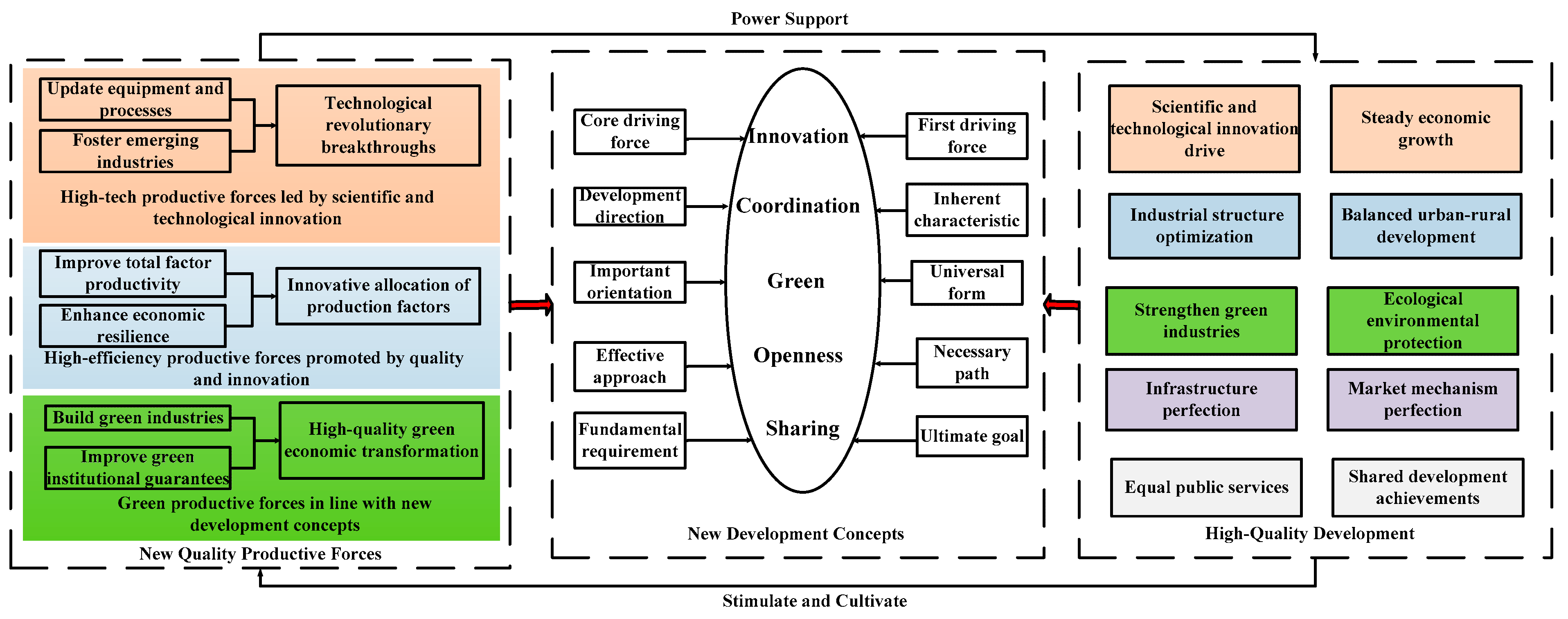
Water resources carrying capacity is an important indicator for assessing the degree of coordination between regional socioeconomic development and water resource systems, and it constitutes a critical foundation for achieving high-quality economic development. Although a unified definition has not yet been established in the academic community, WRCC is generally understood as the maximum level of support that water resources can provide for socioeconomic activities under specific natural conditions and techno-economic levels. In general, WRCC can be conceptualized as a composite system composed of three interrelated components: the carrying medium, the carrying object, and the mode of utilization. The carrier includes natural elements such as water resources, the water environment, and aquatic ecosystems; the carrying object refers to population, industrial, and urban systems; and the mode of utilization functions as the linkage between the two, being reflected in multidimensional regulatory factors such as resource-use efficiency, industrial structure, and management institutions [32] (Figure 1).
From the perspective of system evolution, WRCC is not a static capacity but a dynamic process that changes with different stages of socioeconomic development. Its evolutionary trajectory generally conforms to an inverted U-shaped Kuznets curve of water resource utilization. In the initial stage (the left side of the curve), the pace of economic growth exceeds improvements in resource-use efficiency, resulting in a strong coupling between water consumption and economic expansion. At this stage, the driving force of growing water demand substantially outweighs the decoupling force. At the turning-point stage, the combined effects of strengthened resource constraints, rising costs, and institutional adjustments gradually shift the relationship between economic growth and water demand toward coordination. In the mature stage (the right side of the curve), progress in water conservation technologies, optimization of industrial structure, and improvements in management institutions facilitate the decoupling of economic growth from water resource use. This stage is characterized by a situation in which the decoupling force exceeds the growth force, leading to a continuous enhancement of WRCC.
Under the context of high-quality development driven by the new quality productive forces, the dynamic evolution of WRCC exhibits new characteristics. On the one hand, technological innovation promotes iterative upgrading of water conservation and reuse technologies, thereby improving resource-use efficiency. On the other hand, optimization of industrial structure and upgrading of factor allocation reduce resource consumption intensity per unit of output, driving economic growth to shift from a “resource-dependent” pattern toward an “innovation-driven” trajectory. Meanwhile, the development of digital governance and smart water management systems enables intelligent monitoring, allocation, and management of water resources, forming an internal logical chain of “new quality productive forces → high-quality development → enhancement of carrying capacity”. Consequently, WRCC should be regarded not only as a manifestation of resource constraints but also as an important indicator for assessing regional sustainable development under the influence of new, quality productive forces.

2.1.2. Interactive Relationship Between New Quality Productive Forces and High-Quality Development

(1)
Internal alignment between the green transformation of new quality productive forces and high-quality development
New quality productive forces (NQPFs) originate from revolutionary technological breakthroughs and the deep restructuring of industrial systems. As noted in the Introduction, their core function is to drive a qualitative leap in productivity. Specifically, within the framework of the “Digital-Green Twin Transition,” NQPF promotes the transition of production modes from extensive to intensive forms. Through the promotion of energy conservation, low-carbon production, and resource recycling, NQPF effectively enhances Green Total Factor Productivity (Green TFP). This process mirrors the global standard of Sustainable Manufacturing, where economic growth is progressively decoupled from environmental degradation. This attribute is highly consistent with the principles of “innovation, coordination, green development, openness, and sharing” emphasized in high-quality development. Consequently, new structural momentum is injected into economic growth, providing critical support for sustainable development under resource and environmental constraints [33].
(2)
Connotations of high-quality development and its implicit resource–environmental logic
High-quality development emphasizes the realization of structural optimization, efficiency improvement, and environmental coordination across economic, social, and ecological dimensions. Its core objective lies in breaking away from reliance on factor-intensive resource inputs and enhancing total factor productivity through technological innovation and institutional optimization, thereby shifting the mode of economic growth from quantitative expansion to qualitative improvement. During this process, the carrying capacity of resources and the environment emerges as a key variable that simultaneously constrains and supports development, ultimately defining the sustainable boundary of economic growth. As a fundamental production factor, water resources constitute a rigid constraint on high-quality development, and their utilization efficiency and allocation structure directly reflect the quality of economic development and the degree of coordination between economic activities and the resource–environment system.
At a broader level, the essence of high-quality development lies in accelerating the transformation of development modes and adjusting economic structures. Economic growth is expected to shift from primary dependence on material resource consumption toward reliance on technological progress, improvements in labor quality, and management innovation. In this framework, innovation is positioned as the primary driving force, coordination as an intrinsic characteristic, green development as a universal form, openness as an inevitable pathway, and sharing as the fundamental objective. Rather than focusing solely on economic scale and growth speed, greater emphasis is placed on development quality and sustainability. At the macro scale, high-quality development is manifested in stable economic growth, balanced regional and urban–rural development, innovation-driven green transformation, and more equitable distribution of development outcomes. Throughout this process, the carrying capacity of resources and the environment must be fully considered. This pursuit of quality and efficiency implicitly reflects a profound logical chain in which the resource–environment system serves as the foundational support for economic development, highlighting the intrinsic linkage between high-quality development and resource–environment constraints.
(3)
Interaction mechanism between new quality productive forces and high-quality development
New quality productive forces enhance economic output efficiency through technological progress and industrial upgrading, thereby reducing water consumption and energy use per unit of GDP. As a result, dependence of economic growth on resource consumption is weakened, and relative or absolute decoupling between economic growth and resource utilization is promoted. Meanwhile, the intrinsic requirements of high-quality development further exert reverse pressure on production modes, accelerating green transformation and technological advancement and facilitating the generation and diffusion of new quality productive forces. Through this bidirectional interaction, resource-use efficiency is continuously improved, ecological constraints are gradually alleviated, and water resources’ carrying capacity is dynamically enhanced (Figure 2).
New quality productive forces provide strong momentum for high-quality development, while the internal demands of high-quality development further stimulate the cultivation and application of new quality productive forces. This interactive mechanism not only promotes economic growth and productivity improvement but also contributes to resource and environmental protection. It reflects the inherent laws and synergistic linkages of modern economic systems and offers a new perspective for exploring resource–environment effects.
Overall, new quality productive forces and high-quality development should not be regarded as parallel processes. Instead, coupled co-evolution is achieved through decoupling mechanisms during the transition from resource-constrained economic systems to innovation-driven development pathways. New quality productive forces constitute the fundamental driving force for decoupling, high-quality development represents the strategic objective of decoupling, and optimization of the decoupling state is ultimately manifested in the continuous enhancement of water resources carrying capacity.

2.1.3. Mechanisms Through Which High-Quality Development Enhances Water Resources Carrying Capacity

Two opposing forces operate between water resource utilization and socioeconomic development. One is the decoupling force, whereby high-quality development promotes improvements in water-use efficiency; the other is the growth force, through which economic expansion drives increases in water resource consumption. The relative strength of these two forces jointly determines the dynamic evolution of water resources’ carrying capacity. When the decoupling force exceeds the growth force, the dependence of economic growth on water consumption is weakened, and regional development enters a sustainable stage characterized by efficient utilization and green circulation. Conversely, when the growth force dominates, water resource overexploitation and declines in carrying capacity are more likely to occur [34].
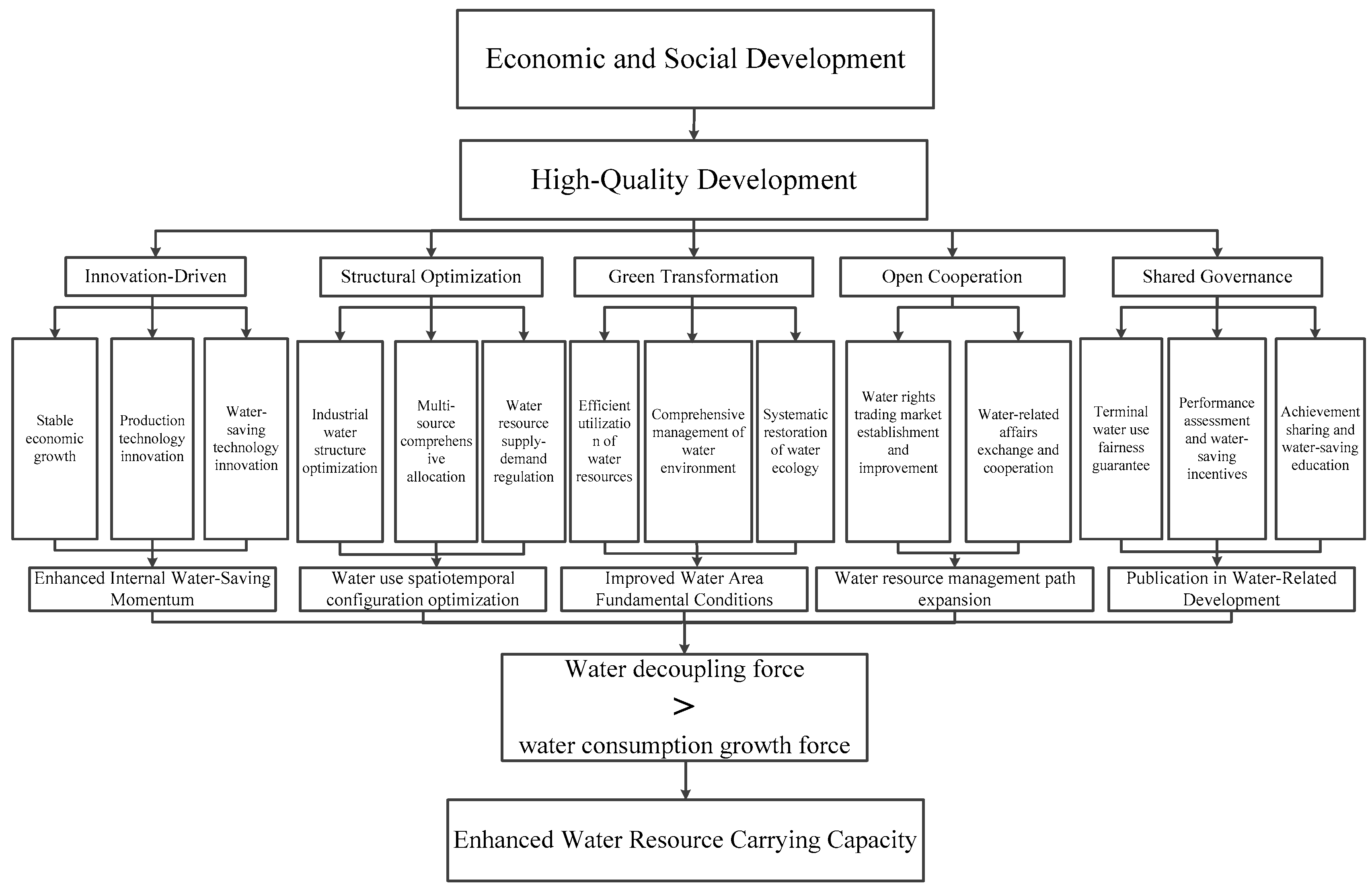
From a mechanistic perspective, high-quality development strengthens the water decoupling force and weakens the water-consumption growth force through multiple, clearly traceable pathways, thereby enabling sustained improvement in water resources carrying capacity (Figure 3). Specifically, the logic in Figure 3 can be read from top to bottom as “high-quality development → mechanism pathways → changes in force balance → enhanced WRCC”. Under the innovation-driven pathway, production-technology upgrading and the R&D and diffusion of water-saving technologies (e.g., process optimization, recycling systems, and the utilization of unconventional water resources) generate internal water-saving momentum and reduce the water-use intensity associated with economic growth, thus enhancing the decoupling force. Through structural optimization, adjustments in industrial structure and water-use structure, together with multi-source water allocation and water-demand regulation, reduce the share of high water-consuming activities and improve the spatiotemporal configuration of water use, thereby simultaneously strengthening the decoupling force and weakening the growth force. The green transformation pathway promotes efficient utilization of water resources, comprehensive water-environment management, and systematic restoration of water ecology, improving fundamental water-area conditions and effectively expanding the sustainable boundary of water–ecological security, which in turn reinforces the decoupling force. The open cooperation pathway forms a multilevel collaborative governance framework through cross-regional regulation, information sharing, and water-rights trading mechanisms, expanding water-resource management instruments and alleviating spatial mismatches between supply and demand, thereby reducing growth-driven pressure. Finally, the shared governance pathway enhances social participation and equitable distribution systems through terminal water-use fairness guarantees, performance assessment and water-saving incentives, and water-saving education, generating endogenous momentum for collective water conservation and further consolidating the decoupling force.
Through the combined effects of these mechanisms during the process of economic growth, the growth force is gradually replaced by the decoupling force, resulting in a sustained enhancement of water resources carrying capacity. This process further demonstrates that, under the impetus of new quality productive forces, high-quality development fundamentally transforms water resource utilization patterns through multidimensional mechanisms, thereby achieving continuous improvement in carrying capacity.

2.2. Evaluation System and Methods

2.2.1. Construction of the Evaluation Indicator Systems for High-Quality Development and Water Resources Carrying Capacity

(1)
Evaluation indicator system for high-quality development
To scientifically measure the level of high-quality development, we constructed a multidimensional evaluation system based on the “Five Development Concepts” (Innovation, Coordination, Green, Openness, and Sharing), which serves as the theoretical core of China’s new development philosophy. The selection of specific indicators was grounded in a systematic review of existing literature [15,16,17,23,31,35,36] and adapted to the specific characteristics of the Weihe River Basin. Furthermore, to ensure data reliability and comparability across the administrative boundaries of Shaanxi, Gansu, and Ningxia, all indicators were selected based on the statistical caliber of the China Statistical Yearbook and official provincial statistics. The rationale for the specific indicators is as follows:
Innovation: as the core driver of new, quality productive forces, we selected R&D expenditure intensity (X1) and Intensity of fiscal science and technology expenditure (X3) to characterize innovation input; Patents per 10,000 people (X2) for output; and GDP per capita (X4) for the economic foundation. Coordination: addressing the basin’s industrial and urban–rural imbalances, we selected the Advanced industrial structure index (X5) and the Rationalization of industrial structure index (X6). Additionally, Urbanization rate (X7), Regional income level (X8), and Urban–rural income ratio (X9) were chosen to assess the coordination of the dual urban–rural structure. Green: given the ecological fragility, Green coverage rate of built-up areas (X10) indicates ecological livability. To measure the environmental cost, Centralized wastewater treatment rate (X11), Wastewater discharge per unit of industrial value added (X12), and SO2 emissions per unit of industrial value added (X13) were included. Openness: for this inland region, Foreign trade dependence (X14) was selected to measure its integration into national and global markets. Sharing: to reflect social welfare, Hospital beds per 10,000 people (X15), Library collections per 100 people (X16), and Per capita road area (X17) represent public service supply. Education fiscal expenditure intensity (X18) and Average wage of employed persons (X19) reflect human capital and wealth distribution. The detailed indicator system is presented in Table 1.
(2)
Evaluation indicator system for water resources carrying capacity
The WRCC evaluation system focuses on the interactive mechanism between human activities and the water environment. Drawing upon the “Carrying Medium–Utilization–Carrying Object” theoretical framework proposed in established studies [32], indicators were selected to accurately reflect the resource-based water scarcity characteristic of the Weihe River Basin [14,15,16,17,35]. Given that the basin is located in an arid and semi-arid region where water supply is a rigid constraint, the selection of indicators places special emphasis on the natural availability of water resources and the efficiency of utilization structures. This system aims to capture the dynamic balance between the basin’s natural water endowment and the pressure exerted by socioeconomic development. Ultimately, a comprehensive evaluation system consisting of 10 indicators was established (Table 2). The rationale for the specific indicators is as follows:
Carrying Medium (Support): to reflect the natural endowment and potential supply capacity in an arid climate, Water production coefficient (Y1) and Water production modulus (Y2) were selected to characterize precipitation conversion and yield efficiency. Additionally, per capita water resources availability (Y3) was chosen to reflect the absolute scarcity relative to the population size. Utilization (Regulation): Water use per 10,000 CNY of GDP (Y4) was selected as the core metric for overall technical efficiency. Furthermore, considering the dominance of irrigation in the basin, structural indicators for Agricultural water use (Y5), Industrial water use (Y6), Domestic water use (Y7), and Ecological water use (Y8) were included. Optimizing the allocation among these sectors is considered critical for enhancing carrying capacity in water-scarce regions. Carrying Object (Pressure): Population density (Y9) was selected to indicate the rigid pressure from social agglomeration. The proportion of tertiary industry (Y10) was chosen to reflect the positive feedback of economic restructuring, as shifting towards the tertiary industry typically reduces water stress compared to water-intensive industrial or agricultural activities.

2.2.2. Semi-Trapezoidal Fuzzy Membership Comprehensive Index Model

The semi-trapezoidal fuzzy membership model (STFMM) is a mathematical approach that transforms attribute values of individual indicators into membership degrees, that is, the degree to which an indicator belongs to a given fuzzy set. By converting indicators with different units and value ranges into standardized membership values, this model enables horizontal comparison and comprehensive evaluation across indicators. Owing to these advantages, it has been widely applied in fuzzy comprehensive evaluation and multi-criteria decision-making studies [37].
  • Step 1: Data standardization
  • For positive indicators:
    Ψ ( e i j ) = e i j a i j A i j a i j = 1 e i j A i j e i j a i j A i j a i j a i j < e i j < A i j 0 e i j a i j
    For negative indicators:
    Ψ ( e i j ) = A i j e i j A i j a i j = 1 e i j a i j A i j e i j A i j a i j a i j   < e i j < A i j 0 e i j A i j
    where eij denotes the observed value of the j indicator in the i region. aij and Aij represent the theoretical lower and upper bounds, respectively, of the j indicator for the i sample. Ψ ( e i j ) denotes the fuzzy membership degree of the j indicator for the i region.
  • Step 2: Determination of indicator weights
  • The weight of each indicator is calculated as:
    ω j = α ω j 1 + ( 1 α ) ω j 2
    where ω j denotes the weight of the j indicator. To avoid bias arising from single weighting methods and to improve the accuracy of weight assignment, a combined subjective–objective weighting approach was adopted. Specifically, the entropy weight method (EWM) was used to determine objective weights, while the analytic hierarchy process (AHP) was applied to obtain subjective weights. Here, ω j 1 represents the objective weight, ω j 2 represents the subjective weight, and α is the combination coefficient, which is generally set to 0.5.
To ensure scientific accuracy, a combined weighting method integrating the Entropy Weight Method (EWM) and Analytic Hierarchy Process (AHP) was adopted. First, EWM determined objective weights based on data volatility, where higher dispersion implies greater information value, thus minimizing subjective bias. Second, AHP determined subjective weights involving five experts from the fields of water resources management and regional economics. All judgment matrices passed the consistency check (CR < 0.1). Finally, comprehensive weights were derived by coupling EWM and AHP. This approach effectively balances data-driven objectivity with professional domain knowledge, ensuring the allocation reflects both statistical characteristics and practical significance.
  • Step 3: Calculation of the comprehensive index
  • The comprehensive index is calculated using the weighted average method:
    U i = ω j Ψ ( e i j )
    where U i denotes the comprehensive index of high-quality development or the comprehensive index of water resources carrying capacity for the i region.

2.2.3. Coupling Coordination Degree Model

To quantify the system-state interaction between high-quality development and water resources carrying capacity, the Coupling Coordination Degree (CCD) model is employed. The scientific rationale for selecting this model resides in its capacity to evaluate the bidirectional feedback and systemic harmony between high-quality development (the qualitative driver) and water resources carrying capacity (the foundational constraint). Unlike simple linear correlation, the coupling degree (C) derived from physics identifies the strength of interaction and interdependence between subsystems. On this basis, the coordination degree (D) is constructed to evaluate whether the two subsystems evolve in a matched and synchronized manner—specifically, whether improvements in the HQDI are accompanied by a comparable enhancement of the WRCC [12,13,15]. By characterizing the consistency of development states, the CCD model addresses a key diagnostic question: is the quality upgrade of the socioeconomic system harmonized with the improvement of the basin’s carrying capacity, or does a structural imbalance persist? A higher D value indicates that the subsystems are advancing toward systemic order and mutual optimization, whereas a lower D value implies potential tension between development progress and water-support conditions. The model is expressed as follows:
  • Step 1: Calculation of the coupling degree (C)
  • The coupling degree, which measures the degree of interaction and interdependence between the two systems, is calculated as:
    C = U e U w U e + U w 2 2
    where Ue denotes the comprehensive index of high-quality development, Uw denotes the comprehensive index of water resources carrying capacity, and C represents the coupling degree. The value of C ranges from 0 to 1. A value closer to 1 indicates a stronger coupling relationship between the two systems and a tendency toward the formation of a more ordered structure, whereas lower values indicate a weaker and more disordered interaction.
  • Step 2: Calculation of the comprehensive system index (T)
  • The comprehensive system index, which reflects the overall development level of the two systems, is calculated as:
    T = β 1 U e + β 2 U w
    where β1 and β2 are weighting coefficients. Based on the assumed equal importance of the two systems, the weights are set as β1 = β2 = 0.5.
  • Step 3: Calculation of the coordination degree (D)
  • The coupling coordination degree is calculated as:
    D = C × T
The value of the coordination degree (D) ranges from 0 to 1. A value closer to 1 indicates a higher level of coordination between high-quality development ( U e ) and water resources carrying capacity ( U w ), reflecting a more harmonized system state. Conversely, a value closer to 0 indicates severe imbalance. To further identify the specific limiting factors, the coordination types are subdivided based on the difference between the two system indices, drawing on classification standards from established literature [38,39]. A threshold of 0.1 is adopted to distinguish the synchronous range. The specific classification logic for the subclasses (Table 3) is as follows: Lagged water resources carrying capacity ( U e U w > 0.1): This indicates that the high-quality development index is significantly higher than the water resources carrying capacity index, implying that water resources are the lagging factor constraining development. Lagged high-quality development ( U w U e > 0.1): This indicates that the water resources carrying capacity index is significantly higher than the high-quality development index, implying that water resource endowment is sufficient relative to the current level of socioeconomic development. Coordinated development ( U e U w 0.1 ): This indicates that the two systems are matched and evolving synchronously.

2.2.4. Tapio Decoupling Model

The decoupling model is widely applied to diagnose whether socioeconomic development can be achieved with reduced resource–environmental pressure, thereby revealing the extent to which growth becomes separated from resource consumption. Accordingly, the Tapio decoupling model was employed to examine the pressure–development elasticity between the high-quality development index (HQDI) and total water use (TWU) in the Weihe River Basin. Specifically, by comparing the relative change in TWU with the relative change in HQDI, the Tapio elasticity indicates whether progress in high-quality development is accompanied by (i) an absolute reduction in water use (strong decoupling), (ii) slower growth of water use than HQDI (weak decoupling), or (iii) continued dependence on increasing water consumption (negative decoupling). This dynamic diagnosis complements the CCD model: while CCD characterizes the coordination of subsystem states at a given time, Tapio decoupling captures whether water-use pressure is being weakened relative to development progress over time. Therefore, the Tapio results provide process-based evidence for interpreting how high-quality development may enhance WRCC through efficiency improvement and structural upgrading under water constraints. The model is expressed as follows:
e t = Δ W T U / W T U Δ H Q D I / H Q D I = W T U t W T U 0 / W T U 0 H Q D I t H Q D I 0 / H Q D I 0
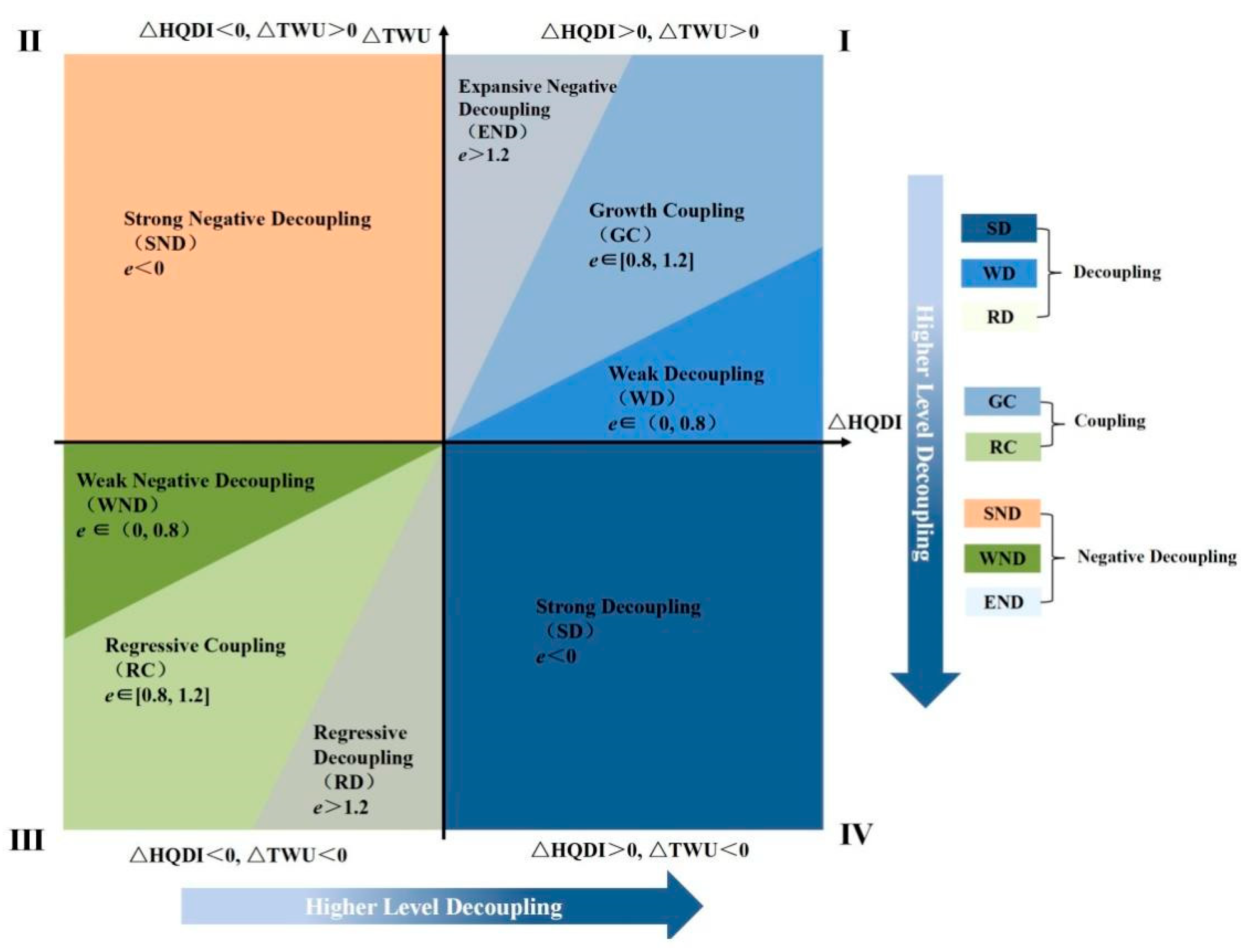
where e t denotes the decoupling index between high-quality economic development and water resource utilization in t year; ∆HQDI and Δ W T U represent the rates of change in the high-quality development index and total water use, respectively; W T U t and W T U 0 denote total water use in t year and in the base year; and H Q D I t and H Q D I 0 denote the high-quality development index in t year and in the base year, respectively. According to the classification criteria proposed in the literature [40], the decoupling status can be categorized into eight types (Figure 4). As shown in Figure 4, the Tapio decoupling framework is divided into four quadrants (I–IV) according to the directional changes in high-quality development (∆HQDI) and total water use ( Δ W T U ), representing different combinations of economic growth or contraction and water resource expansion or reduction.
According to the Tapio decoupling model, eight decoupling states can be identified: Strong Decoupling (SD), Weak Decoupling (WD), Regressive Decoupling (RD), Expansive Negative Decoupling (END), Weak Negative Decoupling (WND), Strong Negative Decoupling (SND), Growth Coupling (GC), and Regressive Coupling (RC). Among these states, Strong Decoupling (SD) represents the most desirable decoupling condition, in which high-quality economic growth is accompanied by a reduction in water resource consumption. Weak Decoupling (WD) is considered a suboptimal state, where water consumption continues to increase but at a slower rate than economic growth. In contrast, Strong Negative Decoupling (SND) represents the least desirable state, characterized by economic contraction alongside increasing water resource consumption.

2.2.5. LMDI Driving Factor Decomposition Model

To quantitatively reveal the mechanisms through which high-quality development influences changes in water resource utilization at the basin scale, the Logarithmic Mean Divisia Index (LMDI) method was employed to decompose total water use in the Weihe River Basin. In an innovative extension, science and technology research and development factors were incorporated into the driving-force analysis of water use in the basin. Changes in water resource utilization were systematically examined from six dimensions: water use intensity, industrial structure, research and development efficiency, research and development scale, urbanization level, and population size. The objective was to identify the dominant factors influencing water resource utilization during the process of high-quality development and to quantify the contribution of each factor to changes in water use, thereby elucidating the role of new productive forces in improving water use efficiency and enhancing regional water resources carrying capacity [41,42].
T W U t = i = 1 3 W U i , t G D P i , t × G D P i , t G D P t × G D P t T e c h t × T e c h t U P t × U P t P t   ×   P t = i = 1 3 G i , t S i , t E t C t U t P t
where T W U t denotes total water use in period t; W U i , t denotes water use of the i industrial sector in period t; G D P i , t denotes the gross domestic product of the iii-th industrial sector in period t; G D P t ,   T e c h t , U P t and P t denote total gross domestic product, research and development expenditure, urban population, and total population at the end of period t, respectively. G i , t represents water use per unit of gross domestic product, reflecting water use efficiency and characterizing water use intensity; S i , t denotes the ratio of the output value of the i industrial sector to total gross domestic product, reflecting the industrial structure; E t denotes the ratio of gross domestic product to research and development expenditure, reflecting research and development efficiency; C t denotes the ratio of research and development expenditure to urban population, reflecting research and development scale; U t denotes the ratio of urban population to total population, reflecting the level of urbanization; and P t denotes total population, reflecting population size.
Assuming that the change in total water use from the base period t0 to the study period t1 is T W U t , the change in total water use can be decomposed into the effects of water use intensity, industrial structure, research and development efficiency, research and development scale, urbanization, and population size, as follows:
T W U 0 , t   =   T W U t T W U 0 = T W U G + T W U S + T W U E + T W U C + T W U U + T W U P
The contribution of each driving factor is calculated as:
T W U G = i = 1 3 W U i , t W U i , 0 l n W U i , t l n W U i , 0 l n G i , t G i , 0
T W U S = i = 1 3 W U i , t W U i , 0 l n W U i , t l n W U i , 0 l n S i , t S i , 0
T W U E = i = 1 3 W U i , t W U i , 0 l n W U i , t l n W U i , 0 l n E t E 0
T W U C = i = 1 3 W U i , t W U i , 0 l n W U i , t l n W U i , 0 l n C t C 0
T W U U = i = 1 3 W U i , t W U i , 0 l n W U i , t l n W U i , 0 l n U t U 0
T W U P = i = 1 3 W U i , t W U i , 0 l n W U i , t l n W U i , 0 l n P t P 0
where T W U G denotes the water use intensity effect; T W U S denotes the industrial structure effect; T W U E denotes the research and development efficiency effect; T W U C denotes the research and development scale effect; T W U U denotes the urbanization effect; and T W U P denotes the population size effect.

2.3. Study Area and Data Sources

2.3.1. Overview of the Study Area

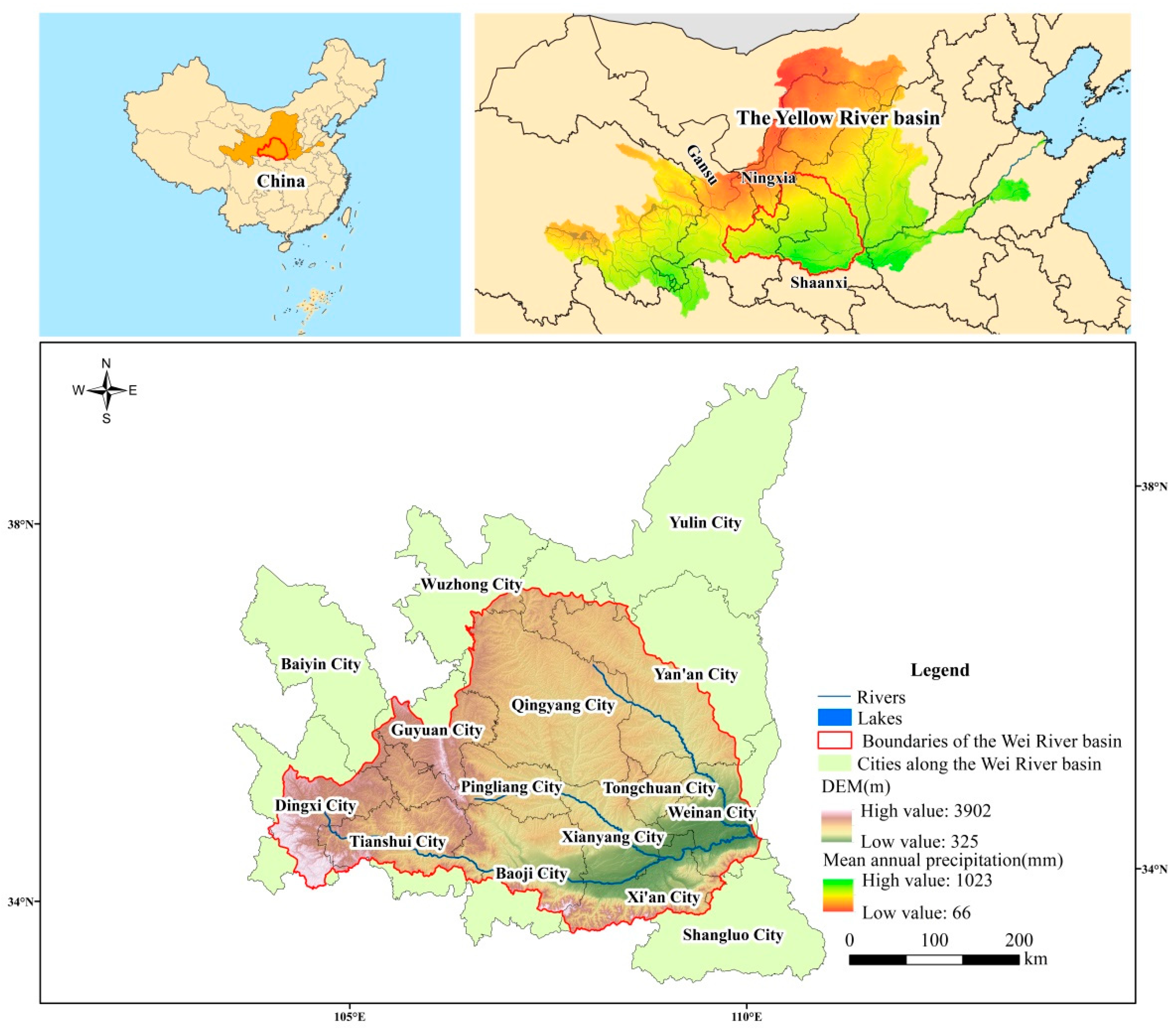
The Weihe River Basin is the largest first-order tributary basin of the Yellow River Basin (Figure 5). Geographically, the basin is located approximately between 103°35′–110°18′ E and 32°39′–37°34′ N. The main stem of the Weihe River has a total length of about 818 km, and the basin covers an area of approximately 1.36 × 10⁵ km2. The overall topography slopes from southwest to northeast, forming a typical basin-like structure. The western margin is bounded by the Qinling Mountains and the residual ranges of the Liupan Mountains, while the eastern part joins the Yellow River at Tongguan.
The basin exhibits diverse landform types, including mountains, hills, tablelands, and river valleys, which together constitute a distinctive mountain–plateau–tableland–valley composite geomorphological pattern. Climatically, the Weihe River Basin is situated in a warm temperate, semi-humid continental monsoon climate zone, with a mean annual temperature ranging from 8 to 13 °C and an average annual precipitation of approximately 600–800 mm. Precipitation is mainly concentrated between June and September and shows pronounced spatial and temporal variability. Combined with high evaporation rates, these conditions contribute to hydrological characteristics marked by the coexistence of droughts and floods.
The Weihe River Basin spans three provinces (autonomous regions), namely Gansu, Ningxia, and Shaanxi, and flows through 15 cities, including Wuzhong, Guyuan, Xi’an City, Tongchuan, Baoji, Weinan, Yan’an, Yulin, Shangluo, Tianshui, Pingliang, Qingyang, and Dingxi. The portion of the basin located in Shaanxi Province accounts for approximately 50.1% of the total basin area. The basin is characterized by high population density, concentrated industrial activities, and intensive economic development, resulting in pronounced contradictions between water supply and demand and substantial pressure on the ecological environment. It therefore represents a key region for ecological protection and high-quality development within the Yellow River Basin.

2.3.2. Data Sources

The data used in this study were mainly derived from statistical records on socioeconomic development, resources, and the environment for cities within the Weihe River Basin over the past decade (2014–2023).
(1)
Socioeconomic data
These data include gross domestic product, value added of the three industrial sectors, population size, urbanization rate, fiscal expenditure, education expenditure, and per capita gross domestic product. The data were primarily obtained from provincial Statistical Yearbooks and Statistical Communiques on National Economic and Social Development. All gross domestic product indicators were calculated at comparable prices to eliminate the influence of price fluctuations.
(2)
Resource and environmental data
These data include agricultural, industrial, domestic, and ecological water use, total water use, total water resources, precipitation, wastewater discharge, wastewater treatment rates, sulfur dioxide emissions, industrial exhaust gas emissions, and green coverage rates. The data were sourced from provincial Water Resources Bulletins, Ecological and Environmental Statistical Yearbooks, Environmental Quality Bulletins, as well as publicly available datasets from the Water Resources Management Center of the Ministry of Water Resources.
(3)
Science and technology innovation data
These data include the number of authorized patents, intensity of research and development (R&D) expenditure, and fiscal expenditure on science and technology. The data were obtained from the China Statistical Yearbook on Science and Technology and the China Urban Science and Technology Innovation Capacity Evaluation Report.

3. Results and Analysis

3.1. Analysis of the Interaction Between High-Quality Development and Water Resources Carrying Capacity in the Weihe River Basin

3.1.1. Evaluation of the High-Quality Development Index in the Weihe River Basin

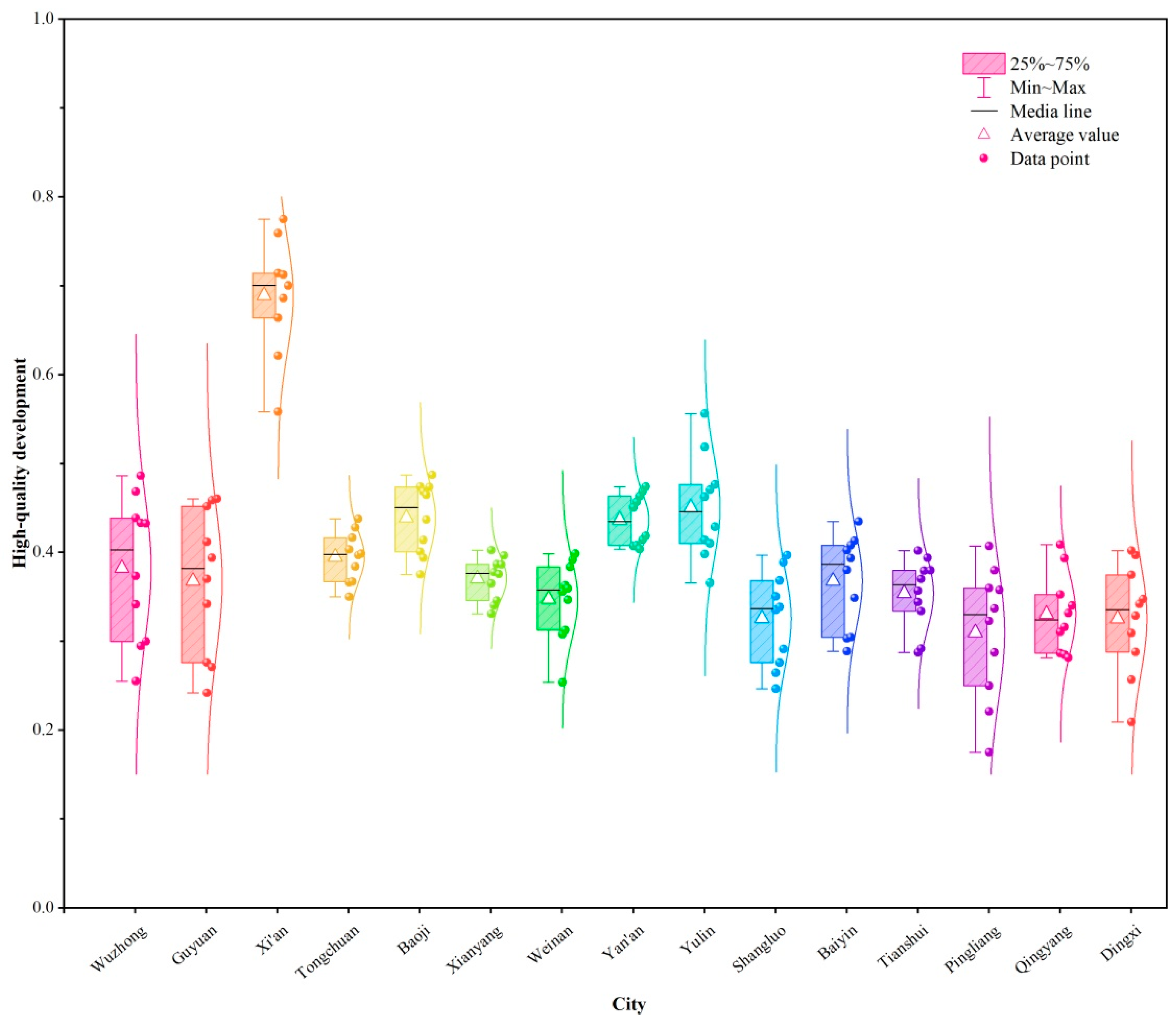
Based on Equations (1)–(4), the high-quality development index of cities in the Weihe River Basin from 2014 to 2023 was calculated, and its temporal variation was illustrated using boxplots. Figure 6 presents the levels of high-quality development across multiple cities in the basin. Different colors and symbols are used to describe the distribution characteristics of the data, including the interquartile range (25–75th percentiles), the minimum–maximum range, the median, the mean, and individual observations.
As shown in Figure 6, substantial disparities are observed in the level of high-quality development among cities in the Weihe River Basin. Xi’an City exhibits a relatively high HQDI, with both the interquartile range and the minimum–maximum range located at higher levels. In addition, the mean and median values are clearly higher than those of other cities, indicating that Xi’an City occupies a leading position within the basin and demonstrates advantages in economic performance, technological capacity, and ecological development. Baoji City shows a boxplot positioned in the middle range with a certain degree of dispersion. As an important industrial city, its equipment manufacturing base provides support for innovation; however, pressures associated with the upgrading of traditional industries during industrial restructuring, together with constraints imposed by geographical conditions on green development, have led to data fluctuations, reflecting instability during the transformation process. Xianyang City, benefiting from its proximity to Xi’an City, displays a boxplot position close to the middle range with a relatively concentrated distribution, indicating relatively stable development. Nevertheless, compared with Xi’an City, gaps in innovation capacity and industrial upgrading suggest that further endogenous development remains necessary despite external spillover effects.
Upstream cities such as Tianshui City and Pingliang City are characterized by boxplots positioned toward the lower end with more dispersed data. Fragile ecological environments, constrained natural conditions, and weak development foundations limit progress in innovation and openness, resulting in relatively low and unstable levels of high-quality development and a highly homogeneous industrial structure. Resource-based cities such as Yulin City and Yan’an City exhibit relatively higher boxplot positions but with noticeable dispersion. Although energy industries provide strong support for development, fluctuations in energy markets, industrial transformation pressures, and ecological protection requirements cause development levels to vary in response to market and policy changes. Cities such as Shangluo City and Weinan City are generally positioned at medium or relatively lower levels. Shangluo City benefits from favorable ecological conditions but faces economic constraints, indicating the need to further tap ecological potential, while Weinan City, as a major agricultural city, faces substantial challenges related to industrial structure adjustment, resulting in development volatility.
Overall, due to differences in local conditions, cities within the Weihe River Basin exhibit heterogeneous development patterns in the boxplots, reflecting an uneven distribution of high-quality development. Each city should formulate development strategies tailored to its specific characteristics, as revealed by the figure, in order to promote coordinated and integrated development across the entire basin.

3.1.2. Evaluation of the Water Resources Carrying Capacity Index in the Weihe River Basin

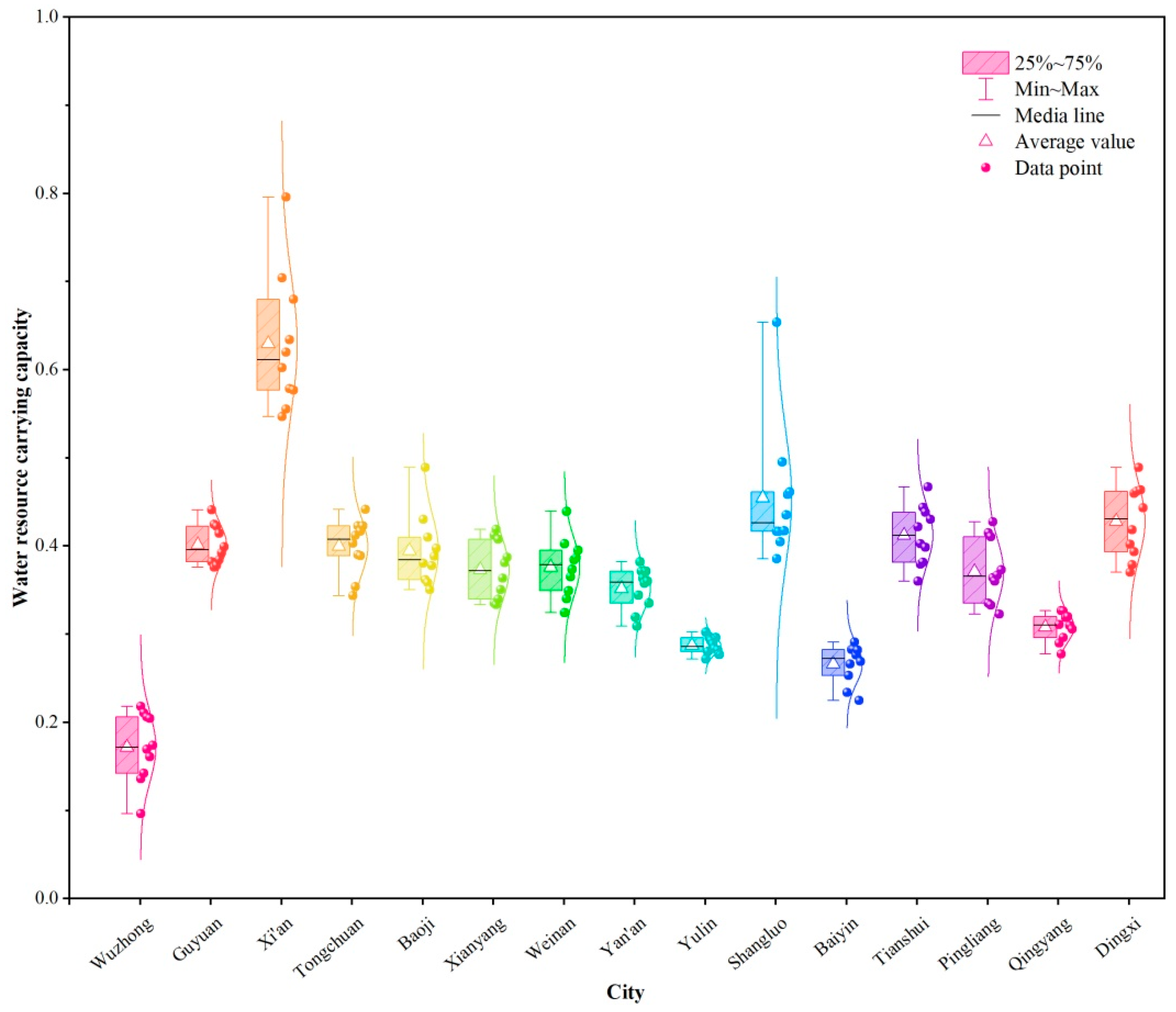
Figure 7 illustrates the distribution of the comprehensive index of water resources carrying capacity for cities in the Weihe River Basin using boxplots. From the perspective of spatial differentiation, a pronounced imbalance in water resources carrying capacity is observed among cities within the basin. In terms of data distribution characteristics, the majority of cities exhibit a certain degree of dispersion. The interquartile ranges of the boxplots vary across cities, indicating differences in the internal stability of water resources carrying capacity. For some cities, data points are closely clustered around the median, suggesting relatively stable water resources carrying conditions. In contrast, other cities show more dispersed data points, implying that their water resources’ carrying capacity is more susceptible to multiple influencing factors and exhibits greater fluctuations.
Upstream cities such as Tianshui City and Pingliang City tend to exhibit lower levels of water resources carrying capacity. Carrier-related indicators, such as the water yield coefficient (Y1) and water yield modulus (Y2), are constrained by natural conditions, resulting in relatively limited total water resources. Meanwhile, due to comparatively lower levels of economic development, inefficiencies in water use are evident in terms of utilization modes, with a relatively high proportion of agricultural water use and comparatively extensive management of industrial and domestic water use. With respect to carrying objects, although population density (Y9) may not be high, a homogeneous industrial structure and a low proportion of the tertiary sector contribute to an overall lower level of water resources carrying capacity. Consequently, these cities are characterized by boxplots positioned toward the lower end with more dispersed data.
As the core city of the basin, Xi’an City benefits from advantages in science and technology as well as economic development, continuously innovating in water use practices. The water use per unit of gross domestic product has declined steadily, and the relatively high proportion of the tertiary industry has played a significant role in enhancing water resources’ carrying capacity. As a result, Xi’an City exhibits a boxplot positioned toward the higher end with a more concentrated data distribution. Cities such as Baoji City and Xianyang City have continuously optimized their modes of water use; however, constraints related to industrial structure and geographical conditions place their water resources’ carrying capacity at a medium level, accompanied by a certain degree of data dispersion. In contrast, some cities, such as Dingxi City, display relatively low comprehensive index values, reflecting substantial pressure on water resources carrying capacity, potentially driven by water scarcity and low water use efficiency.
From an overall perspective, water resources carrying capacity in the Weihe River Basin does not follow a simple geographical gradient. This finding highlights the complexity of water resources carrying capacity, which is shaped by the combined effects of natural conditions, socioeconomic development, and management capacity.

3.1.3. Robustness and Scientific Linkage Verification of Composite Indices

To ensure the reliability of the index construction and weight assignment, a sensitivity analysis was conducted by comparing the combined EWM and AHP with an Equal Weighting Method. The HQDI and WRCC scores were recalculated using equal weights for all indicators, and a correlation analysis was conducted with the original results. The statistical results indicate a high degree of consistency between the two methods. Specifically, the Pearson correlation coefficient for HQDI is 0.989, and for WRCC is 0.894 (both significant at the 1% level). The Spearman rank correlations are similarly high (0.981 for HQDI and 0.939 for WRCC). These results suggest that the evaluation outcomes are robust and not heavily dependent on the specific weighting technique employed.
To further strengthen the scientific rigor of the linkage between HQDI and WRCC, statistical correlation tests and a panel-based validation of the driving relationship were performed using pooled observations across all cities and years. The correlation analysis indicates a statistically significant positive association between the two indices (Pearson r = 0.517, p < 0.01; Spearman ρ = 0.183, p < 0.05). On this basis, a two-way fixed effects model was estimated on the balanced panel of 15 cities during 2014–2023. By incorporating both city-specific and year-specific fixed effects, the model controlled for time-invariant regional characteristics and common temporal shocks. City-clustered robust standard errors were reported to account for heteroskedasticity and within-city serial correlation. The results show that HQDI is positively and significantly associated with WRCC (β = 0.194, t = 2.66, p = 0.0088). This implies that, after controlling for unobserved city and year factors, higher levels of high-quality development correspond to improved water resources carrying capacity. Quantitatively, a 1-unit increase in the high-quality development index is associated with a 0.194-unit enhancement in water resources carrying capacity, which substantiates this positive linkage. Taken together, these tests provide additional empirical support for the analytical framework and reduce concerns that the observed HQDI–WRCC relationship is driven by spurious co-movements.

3.1.4. Evaluation of the Coupling Coordination Between High-Quality Development Index and Water Resources Carrying Capacity Index in the Weihe River Basin

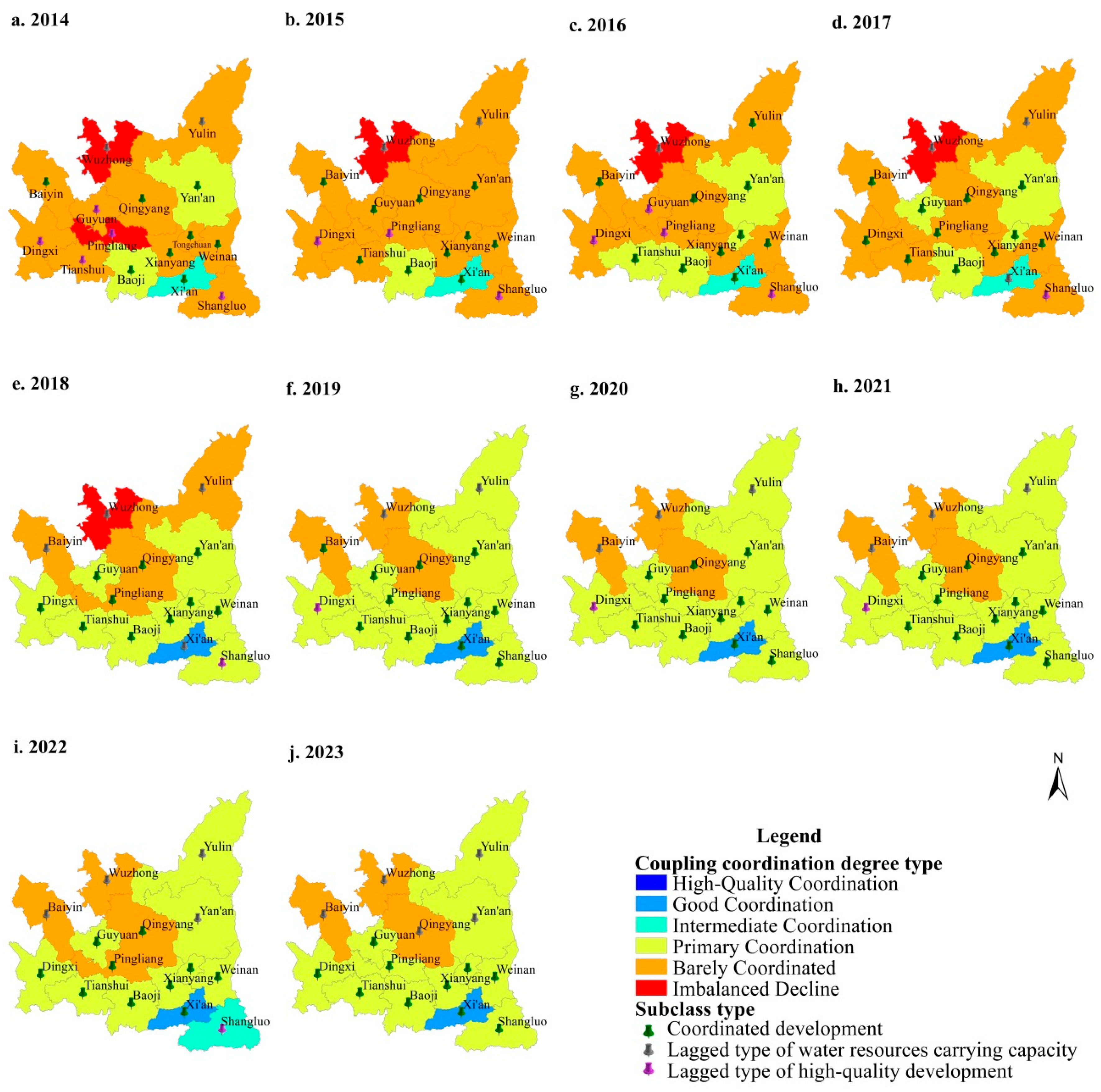
As illustrated in Figure 8, from a temporal perspective, the coupling coordination degree between water resources carrying capacity and high-quality development in cities of the Weihe River Basin exhibited a dynamic upward trend during the period 2014–2023. In 2014, the distribution of coupling coordination types within the basin was relatively complex, with only a very limited number of cities classified as high-quality coordination. Good coordination, barely coordinated, and primary coordination types accounted for a relatively large proportion, while several cities were characterized by an imbalanced decline. This pattern indicates that, in the initial stage, the overall level of coordination between water resources carrying capacity and high-quality development in the basin was relatively low, with a considerable number of cities experiencing uncoordinated development. By 2023, the number of cities classified as high-quality coordination had increased. Although their spatial distribution remained relatively concentrated, the overall coverage expanded to some extent. Areas characterized by good coordination also showed a tendency to spread, while the proportions of barely coordinated and primary coordination areas declined, and the number and extent of cities experiencing imbalanced decline were markedly reduced. These changes suggest that notable progress was achieved in improving the coordination between water resources carrying capacity and high-quality development over the past decade, resulting in an overall enhancement of the coupling coordination level.
During the period 2014–2018, cities within the basin were mainly in an accumulation stage of coordination improvement. Some cities began to shift from lower coordination types to higher ones; for example, several areas initially classified as barely coordinated gradually upgraded to primary coordination, and in a few cases even entered the category of good coordination. However, the overall pace of change during this period was relatively slow, and the expansion of high-quality coordination areas remained limited. In contrast, the period from 2018 to 2023 represented a phase of relatively rapid change. High-quality coordination and good coordination areas expanded at an accelerated pace, primary coordination areas continued to improve, and barely coordinated and imbalanced decline areas consistently decreased. This stage may be attributed to the combined effects of policy implementation, technological progress, and adjustments in regional development strategies, which collectively promoted stronger synergies between water resources carrying capacity and high-quality development.
Marked differences in coupling coordination degree were observed among cities within the Weihe River Basin. Core cities with relatively strong economic foundations and more advanced water resources management, such as Xi’an City, tended to exhibit higher coordination types in most years. These cities achieved a relatively balanced relationship between rational water resource utilization and high-quality development, with subtypes predominantly characterized as coordinated development. In contrast, some peripheral or economically less developed cities with more complex water resource conditions, such as Pingliang City and Wuzhong City, generally displayed lower coordination types, mainly barely coordinated or primary coordination, and even experienced imbalanced decline during certain periods. Their subtypes were more frequently characterized as lagged water resources carrying capacity or lagged high-quality development, reflecting the considerable challenges faced by these cities in coordinating water resources and development.
From a spatial perspective, a clear pattern of agglomeration was evident. Areas with higher coordination levels were primarily concentrated in core cities and their surrounding regions, forming distinct clusters. For example, regions centered on Xi’an City benefited from industrial agglomeration and technological spillover effects, which facilitated coordinated progress in water resources management and high-quality development in neighboring areas, thereby enhancing the coupling coordination degree. At the same time, a diffusion effect was also observed. Over time, successful development models and practices from highly coordinated areas gradually spread to surrounding regions, leading to improvements in cities that previously exhibited lower coordination levels. As a result, coordination types in these areas were progressively upgraded, and the spatial pattern showed a trend of diffusion from core areas toward peripheral regions.
The spatial distribution of different subtypes was uneven. The coordinated development subtype was mainly concentrated in areas with higher coordination levels and largely overlapped with regions classified as high-quality coordination and good coordination, indicating relatively balanced relationships between water resources and development. In contrast, the lagged water resources carrying capacity subtype and the lagged high-quality development subtype were predominantly distributed in areas with lower coordination levels. Specifically, the lagged water resources carrying capacity subtype was more common in regions with relatively scarce water resources or weaker water management capacity, while the lagged high-quality development subtype tended to occur in cities with weaker economic foundations or less optimized industrial structures. These patterns highlight the distinct constraints faced by different regions in achieving coordinated development between water resources’ carrying capacity and high-quality development.

3.2. Decoupling State Analysis Between Water Resources Utilization and High-Quality Economic Development in the Weihe River Basin

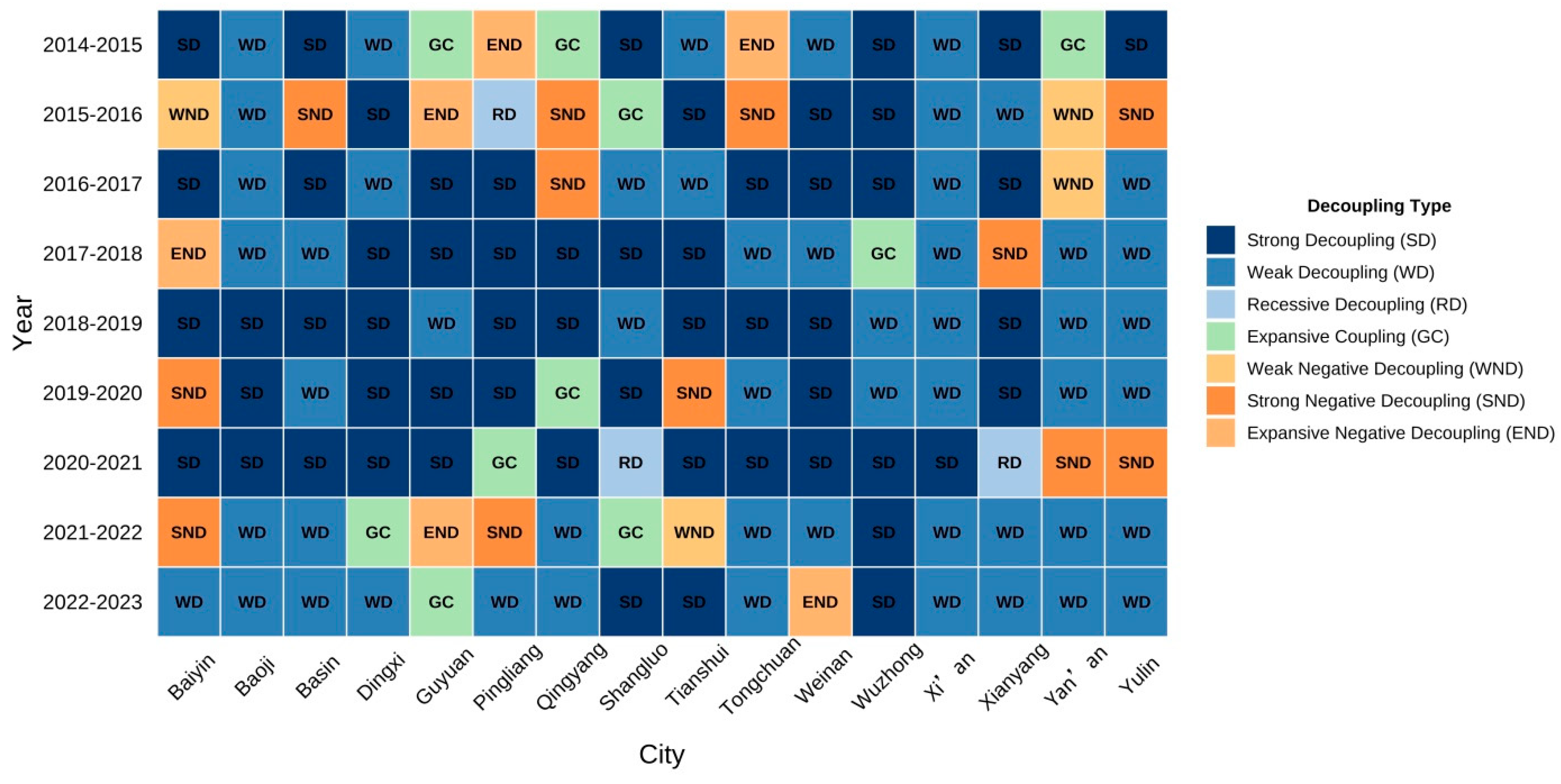
Based on the Tapio decoupling model established above, the relationship between total water use (TWU) and the high-quality development index (HQDI) was quantified and classified for the period 2014–2023. The results indicate that the decoupling relationship between economic development and water resources utilization in the basin exhibits pronounced temporal and spatial differentiation. Overall, the decoupling pattern has evolved from a fluctuating state toward a more stable state, and from localized improvement toward broader coordination (Figure 9).

3.2.1. Temporal Evolution Characteristics

From a time-series perspective, the decoupling state between TWU and HQDI in the Weihe River Basin experienced three stages during 2014–2023, namely a stage of fluctuation, a stage of optimization, and a stage of stabilization.
The first stage (2014–2016) represents a period of fluctuating adjustment, during which significant differences in decoupling states were observed among cities. Cities such as Tongchuan City, Qingyang City, and Pingliang City experienced Expansive Negative Decoupling (END) and Growth Coupling (GC), indicating that economic growth remained dependent on water-intensive industries, with water use increasing synchronously with economic expansion. In contrast, cities such as Wuzhong City, Weinan City, and Shangluo City achieved Strong Decoupling (SD) at an earlier stage, reflecting initial effectiveness in water-saving agriculture and ecological water use management.
The second stage (2017–2020) can be characterized as a period of rapid transition, during which the overall decoupling pattern in the basin improved markedly, and the proportion of Strong Decoupling (SD) increased significantly. Between 2018 and 2019, most cities shifted toward Weak Decoupling (WD) or Strong Decoupling (SD), indicating the phased effects of industrial structure optimization and the promotion of water-saving technologies. During this stage, the dependence of economic growth on water resource consumption declined substantially.
The third stage (2020–2023) represents a period of stabilization and reinforcement. Strong Decoupling (SD) and Weak Decoupling (WD) became the dominant decoupling states, while Expansive Negative Decoupling (END) decreased significantly. This pattern suggests that the Weihe River Basin as a whole entered a stage of high-quality development characterized by improved water use efficiency and innovation-driven growth. In particular, during 2022–2023, the vast majority of cities in the basin maintained Strong Decoupling (SD) or Weak Decoupling (WD), indicating a more coordinated relationship between economic growth and water resources utilization and the gradual consolidation of a water-saving growth model.

3.2.2. Spatial Differentiation Characteristics

From a spatial perspective, the decoupling relationship between economic growth and water resources utilization in the Weihe River Basin exhibits pronounced regional differentiation. The spatial pattern can be summarized as the coexistence of three types: core-city-led regions, lagging resource-oriented regions, and stable ecological-oriented regions. This pattern highlights the significant influence of economic functional positioning and modes of resource utilization on decoupling states.
First, core urban areas demonstrate a stable positive decoupling trend. The Guanzhong urban agglomeration, represented by Xi’an City, Xianyang City, and Weinan City, constitutes the most economically active region within the basin. Although some years in the early period (2014–2016) were characterized by Weak Decoupling (WD) or Growth Coupling (GC) due to urban expansion and infrastructure development, a clear improvement in decoupling states has been observed since 2017. Over successive years, this region predominantly maintained Weak Decoupling (WD) or Strong Decoupling (SD). This relatively stable decoupling pattern can be attributed to the agglomeration of high-tech industries, the promotion of water-saving technologies, and the development of reclaimed water utilization systems. In particular, Xi’an City, supported by an innovation-driven economic structure, achieved substantial improvements in water use efficiency and played a leading role in promoting coordinated economic and ecological development within the basin.
Second, resource-intensive and energy-oriented regions exhibit relatively lagging and more volatile decoupling performance. Energy-based cities such as Yulin City, Yan’an City, Qingyang City, and Baiyin City were primarily characterized by Growth Coupling (GC) or Strong Negative Decoupling (SND) in the early period. This pattern reflects the dominant role of coal chemical industries, mining, and energy processing in economic growth, with water use increasing alongside economic output. With the implementation of energy conservation policies and green transformation measures, these cities gradually transitioned toward Weak Decoupling (WD) after 2020, although noticeable stage-specific fluctuations remain. Further improvement in decoupling performance in these regions depends on promoting green and circular development of the energy industrial chain, advancing technological substitution in water-intensive industries, and enhancing systems for water reuse.
Third, ecologically oriented and agriculture-dominated regions maintain relatively high decoupling stability. Cities such as Wuzhong City, Tianshui City, Pingliang City, and Shangluo City have consistently remained in states of Strong Decoupling (SD) or Weak Decoupling (WD) over extended periods. This pattern indicates that regions dominated by agricultural water-saving practices, ecological conservation, and water resources management have achieved notable effectiveness in controlling water use and enforcing ecological constraints. Although economic growth in these regions is relatively moderate, higher levels of ecological governance and institutionalized water management result in a degree of coordination between water resources utilization and economic growth that exceeds the basin average, making these regions an important stabilizing support for overall water security in the Weihe River Basin.
Overall, the spatial differentiation of decoupling patterns in the Weihe River Basin reflects diverse pathways shaped by the combined effects of economic structure and resource endowment. Core urban clusters achieve stable decoupling through technological innovation and industrial upgrading, resource-based cities exhibit fluctuating decoupling under transformation pressures, and agricultural and ecological regions realize stable decoupling through institutional management. These spatial characteristics indicate that coordination between water resources utilization and economic growth in the basin is no longer determined solely by natural hydrological conditions, but is increasingly influenced by regional functional positioning, industrial structure optimization, and innovation capacity. With the diffusion of new quality productive forces, the improvement of regional innovation systems, and the strengthening of cross-regional water resources coordination mechanisms, decoupling states within the basin are expected to become more balanced, facilitating a spatial transition from “differentiated coordination” toward “overall synergy”.

3.3. Decoupling Drivers Analysis Based on the LMDI Decomposition Model

3.3.1. Overall Decoupling Drivers Analysis of the Weihe River Basin

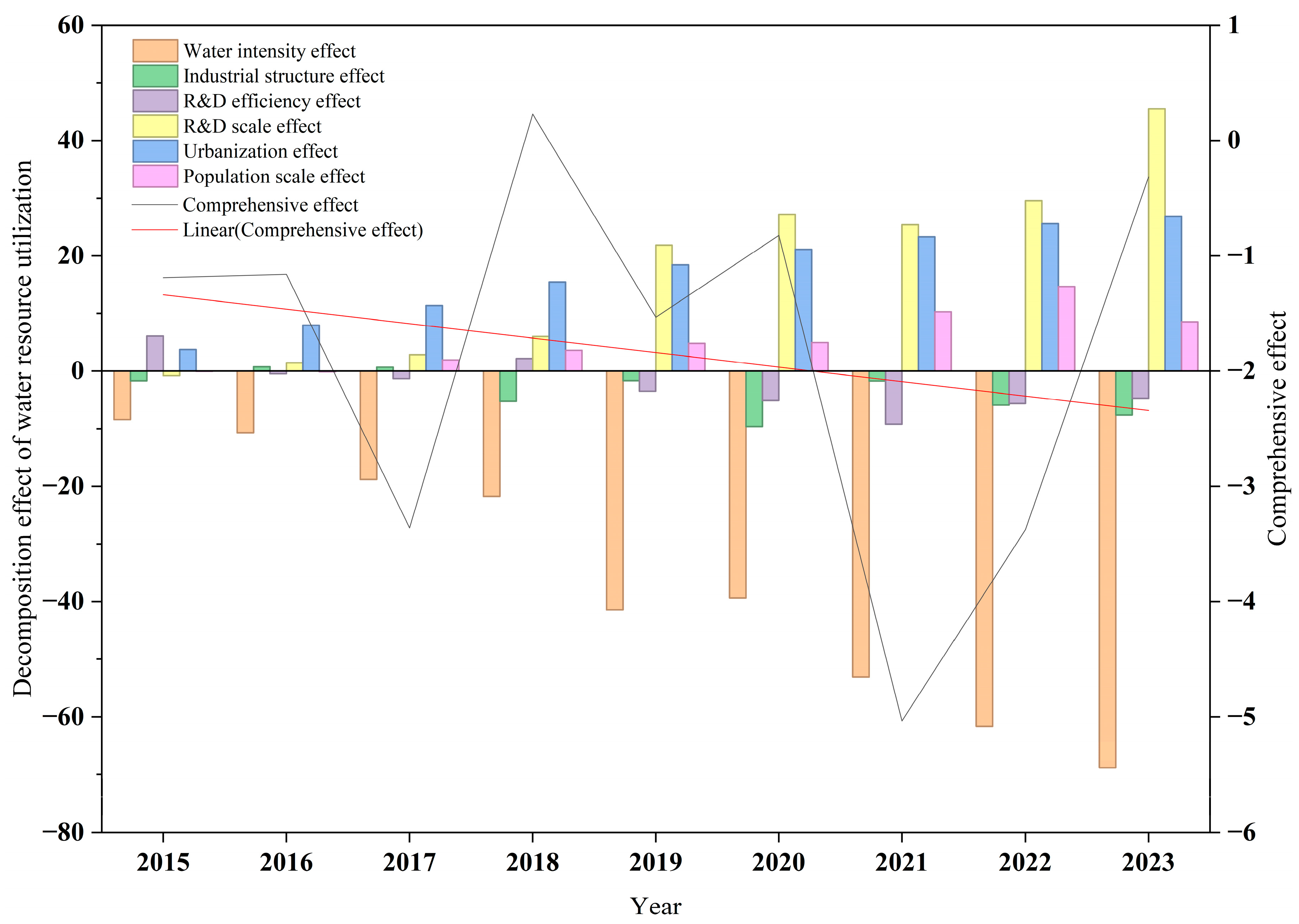
Using Equations (9)–(16), the effects of TWU and GDP in the Weihe River Basin from 2014 to 2023 were decomposed, and the results are presented in Figure 9 and Figure 10.
The water use intensity effect reflects the restraining role of water-saving practices and technological efficiency on total water use. The industrial structure effect captures the water-saving contribution arising from industrial upgrading and structural optimization. The R&D efficiency effect and R&D scale effect, respectively, measure the impacts of innovation output efficiency and the scale of R&D investment on water resource utilization. In contrast, the urbanization effect and population scale effect represent the driving forces of socioeconomic expansion on water demand.
The comprehensive effect indicates that total water use in the Weihe River Basin exhibited an overall fluctuating downward trend during 2015–2023, decreasing from −1.19 × 10⁸ m3 in 2015 to −0.31 × 10⁸ m3 in 2023. The most pronounced negative values occurred in 2017 (−3.36 × 10⁸ m3) and 2021 (−5.03 × 10⁸ m3), suggesting that during periods when industrial restructuring and urban expansion progressed simultaneously, water-saving outcomes were temporarily weakened. By contrast, the values in 2018 (0.23 × 10⁸ m3) and 2023 (−0.31 × 10⁸ m3, close to zero) approached a balanced state, indicating that technological innovation and structural optimization partially offset the increase in water demand induced by socioeconomic expansion. The linear fitting equation (y = −0.1256x − 1.212, R2 = 0.04) suggests that although the comprehensive effect did not decline significantly, overall water-use efficiency continued to improve steadily.
Among the individual effects, the water use intensity effect consistently acted as the largest negative contributor, decreasing from −8.42 × 10⁸ m3 to −68.83 × 10⁸ m3 and accounting for more than 60% of the total variation. This effect represents the dominant force suppressing growth in water use, reflecting the substantial effectiveness of water-saving technology diffusion, process optimization, and intensified management. The industrial structure effect remained negative overall, reaching −5.24 × 10⁸ m3 in 2018 and −7.62 × 10⁸ m3 in 2023, indicating that industrial transformation and the reduction in high water-consuming sectors generated notable water-saving benefits, although the marginal contribution tended to stabilize.
The R&D efficiency effect was negative overall during 2015–2023, with positive values observed only in 2015 (6.05 × 10⁸ m3) and 2018 (2.18 × 10⁸ m3), while the minimum value occurred in 2021 (−9.22 × 10⁸ m3). These results indicate that improvements in R&D efficiency generally exerted a restraining influence on water consumption, although the water-saving effect remained limited. The negative values suggest that while technological innovation has improved water-use efficiency during the process of high-quality development in the Weihe River Basin, the transformation efficiency of technological achievements, the diffusion of green technologies, and the quality of R&D outputs require further enhancement. At present, improvements in R&D efficiency are concentrated in specific sectors and have not yet formed a systematic diffusion effect of water-saving technologies. Overall, the negative R&D efficiency effect reflects a transitional stage in which technological innovation is shifting from quantitative expansion toward qualitative improvement. With the refinement of the R&D system and the expansion of high-tech industries, further gains in R&D efficiency are expected to promote water conservation and energy optimization, ultimately realizing a virtuous cycle of “enhancing efficiency through innovation and promoting water saving through efficiency gains.”
In contrast, the R&D scale effect increased markedly during 2015–2023, rising from −0.78 × 10⁸ m3 in 2015 to 45.50 × 10⁸ m3 in 2023—an increase of nearly 60 times—and became a major positive driver of changes in water use. Although this increase partially reflects the accelerated agglomeration of new quality productive forces centered on technological innovation, as well as the expansion of high-tech R&D activities, experimental operations, and technology commercialization that support industrial upgrading, the rapid growth also reveals clear shortcomings in water-saving performance within high-tech industries. The continuous expansion of the R&D scale effect indicates that during the transition toward an innovation-driven development model, water demand associated with technological activities has increased rapidly, and some emerging industries remain characterized by high energy and high water consumption, resulting in relatively low water-use efficiency. This finding corroborates the generally negative R&D efficiency effect, suggesting that quantitative expansion of innovation has not yet been fully transformed into qualitative improvements in water-saving performance. Overall, while the R&D scale effect embodies new momentum for high-quality development, its strong growth reflects a stage characterized by “high input–high consumption” within the innovation system. Future efforts should strengthen the water-saving orientation of technological activities while expanding R&D investment, promote the coordinated development of green manufacturing, circular water use, and energy-saving technologies, and shift R&D scale expansion from an input-intensive model toward an efficiency-oriented growth pattern, thereby enabling technological innovation to genuinely enhance water-use efficiency.
Both the urbanization effect and population scale effect exerted positive driving influences on water use. The former increased from 3.72 × 10⁸ m3 to 26.83 × 10⁸ m3—an approximately sixfold rise—while the latter fluctuated between −0.07 × 10⁸ m3 and 14.66 × 10⁸ m3. These trends indicate that socioeconomic development and population agglomeration continue to impose sustained pressure on water resources in the basin.
Overall, changes in water use in the Weihe River Basin during 2015–2023 are characterized by “enhanced water-use efficiency, emerging innovation-driven effects, stabilized structural contributions, and rising demand pressure.” The water use intensity effect and R&D scale effect, respectively, dominated the suppressing and promoting ends of water-use change. The former highlights the sustained impact of technological progress and management optimization in water saving, while the latter reflects the influence of innovation investment and technological agglomeration on resource utilization. In contrast, the marginal contributions of the industrial structure effect and R&D efficiency effect weakened, while urbanization and population expansion partially offset water-saving gains. Generally speaking, the mechanism of water resource utilization in the Weihe River Basin has gradually shifted from a traditional “structural adjustment–intensity control” model toward a parallel pattern of “water-use efficiency improvement and innovation-driven development,” with technological innovation increasingly emerging as the core driving force for enhancing water resources carrying capacity under the framework of new quality productive forces.

3.3.2. Analysis of Decoupling Drivers in Cities of the Weihe River Basin

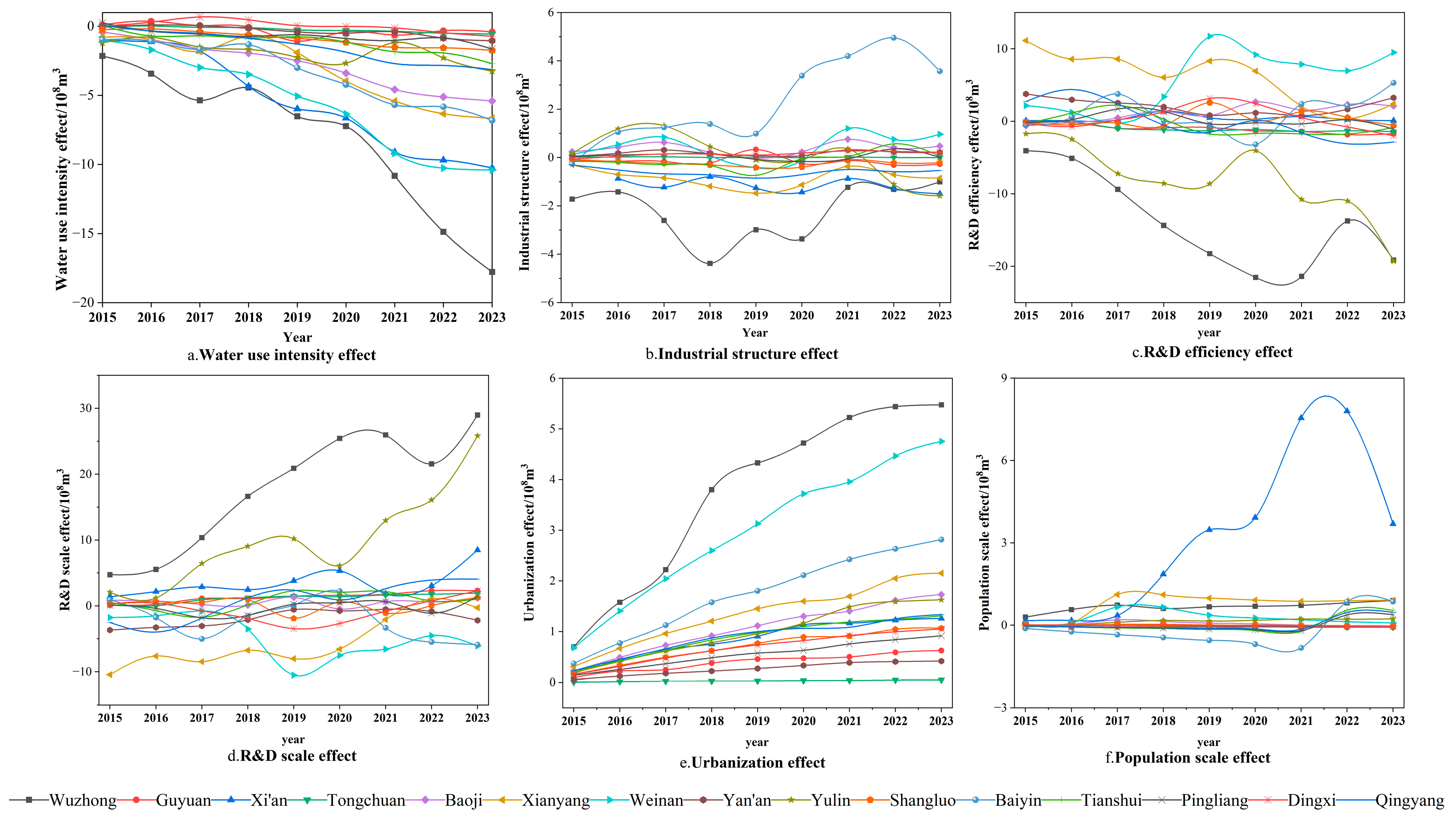
Based on the decomposition results of the logarithmic mean Divisia index (LMDI) model (Figure 11), variations in the Weihe River Basin during 2015–2023 were jointly driven by six effects: the water use intensity effect (Figure 11a), industrial structure effect (Figure 11b), R&D efficiency effect (Figure 11c), R&D scale effect (Figure 11d), urbanization effect (Figure 11e), and population scale effect (Figure 11f). The temporal evolution and spatial differentiation of each driving factor are analyzed as follows.
Figure 11a shows that the water use intensity effect exhibited a continuous downward trend during 2015–2023, remaining negative for almost all cities, indicating the significant impacts of water-saving technology promotion and improvements in management efficiency. Wuzhong recorded the largest decline, decreasing from −2.15 × 10⁸ m3 in 2015 to −17.77 × 10⁸ m3 in 2023, demonstrating the strongest water-saving effect. Cities in the Guanzhong region, such as Baoji, Weinan, and Xianyang, maintained values between −6 and −10 × 108 m3, reflecting steady improvements in water-use efficiency. Spatially, Ningxia and eastern Gansu (e.g., Wuzhong, Pingliang, and Dingxi) constituted the core water-saving zones with the largest negative values, whereas the Guanzhong Plain showed relatively moderate declines due to persistent industrial and urban water demand. Yulin and Yan’an exhibited fluctuations, suggesting that adjustments in the energy sector exerted a strong influence on water-use intensity. Overall, the water use intensity effect dominated the reduction in water use and served as the primary driving force behind basin-wide water-saving improvements.
The industrial structure effect was dominated by negative values (Figure 11b), indicating that industrial upgrading contributed to suppressing water consumption. Overall, Xi’an, Wuzhong, and Weinan showed relatively large declines, decreasing from −0.42 × 10⁸, −1.72 × 10⁸, and −0.29 × 10⁸ m3 to −1.49 × 10⁸, −1.00 × 10⁸, and −0.85 × 10⁸ m3, respectively. This reflects the contraction of secondary industries and the expansion of the tertiary sector. In contrast, energy-oriented cities such as Yan’an and Baiyin exhibited positive fluctuations during certain years (2018–2021), with peak values reaching 0.99 × 10⁸ and 3.57 × 10⁸ m3, respectively, indicating the short-term water demand expansion associated with energy and chemical industry growth. Spatially, Guanzhong and Ningxia formed stable negative-value zones with sustained water-saving effects, whereas parts of northern Shaanxi and eastern Gansu showed weak positive fluctuations, suggesting that industrial transformation remains in a transitional stage. Overall, the industrial structure effect displayed a “fluctuating decline” over time and a spatial pattern of “strong suppression in Guanzhong and Ningxia but limited improvement in northern Shaanxi and eastern Gansu,” driven by differences in industrial upgrading speed, energy restructuring, and changes in high water-consuming sector shares.
The R&D efficiency effect exhibited an overall negative tendency (Figure 11c), indicating that high-quality development exerted a suppressive influence on water consumption growth, although significant regional differences were observed. Weinan (from 11.14 × 10⁸ to 9.49 × 10⁸ m3) and Xianyang (from 8.59 × 10⁸ to 2.39 × 10⁸ m3) maintained positive values over long periods, suggesting that improvements in R&D efficiency had not yet been fully translated into water-saving benefits and that R&D activities may have induced short-term water demand increases. In contrast, cities such as Yulin and Shangluo experienced large fluctuations (e.g., Yulin from −7.21 × 10⁸ m3 in 2017 to −19.29 × 10⁸ m3 in 2023), closely linked to energy-chemical R&D and heavy-industry-dominated structures. Spatially, Ningxia showed consistently negative values with a clear water-saving orientation, whereas Guanzhong and parts of northern Shaanxi exhibited mixed positive and negative values, reflecting differences in the coordination between technological innovation and water-saving objectives. Temporally, the R&D efficiency effect followed a pattern of “initial increase followed by decline, with an overall negative tendency,” mainly influenced by technology commercialization rates, industrial upgrading speed, and the maturity of water-saving innovation systems.
The R&D scale effect displayed a pronounced upward trend (Figure 11d), indicating that expanding research investment and intensified innovation activities continuously stimulated water demand. Wuzhong, Yulin, and Xi’an recorded the most significant increases, rising from 4.73 × 10⁸, −3.67 × 10⁸, and 1.40 × 10⁸ m3 to 28.98 × 10⁸, 25.82 × 10⁸, and 8.49 × 10⁸ m3, respectively, highlighting the water-use pressures associated with R&D agglomeration and high-tech industrial expansion. In contrast, cities such as Guyuan, Dingxi, and Pingliang showed relatively small increases, reflecting weaker R&D foundations. Spatially, high-value areas were concentrated in the core cities of Guanzhong and Ningxia, while low-value areas were mainly located in northern Shaanxi and eastern Gansu. Although the expansion of the R&D scale effect reflects the vitality of innovation-driven development, its high magnitude also indicates that R&D activities in some regions remain resource-intensive, and that water-saving-oriented research and green manufacturing systems require further improvement.
A comparison between the R&D efficiency effect and the R&D scale effect reveals that the latter was the primary positive driver of water-use changes, whereas the former was predominantly negative, indicating that technological innovation has partially improved water-use efficiency alongside industrial upgrading. However, the relative magnitudes of these effects do not directly reflect development level, but rather the development stage of industrial structures and the relative pace of technological expansion versus efficiency transformation. For example, differences between Wuzhong and Xi’an illustrate this distinction: Wuzhong exhibited a large R&D scale effect (28.98 × 10⁸ m3 in 2023) accompanied by a markedly negative R&D efficiency effect, indicating a predominantly extensive industrial structure where the introduction of advanced or water-saving industries generates strong adjustment effects, but where the innovation system remains at an early stage. By contrast, Xi’an showed relatively balanced and stable R&D scale and efficiency effects (8.49 × 10⁸ and 0.09 × 10⁸ m3 in 2023), reflecting a mature transition toward high-value-added industries and a more coordinated relationship between innovation, economic growth, and water resource utilization.
The urbanization effect exhibited clear spatial differentiation (Figure 11e), with the Guanzhong Plain urban agglomeration contributing most strongly. Xi’an, Xianyang, and Weinan increased from 0.18 × 10⁸, 0.19 × 10⁸, and 0.68 × 10⁸ m3 in 2015 to 1.26 × 10⁸, 1.63 × 10⁸, and 4.75 × 10⁸ m3 in 2023, respectively, becoming major drivers of water demand growth due to metropolitan expansion, industrial agglomeration, and infrastructure development. Resource-oriented cities such as Wuzhong and Yulin also experienced substantial increases (from 0.70 × 10⁸ to 5.47 × 10⁸ m3, and from 0.19 × 10⁸ to 1.63 × 10⁸ m3, respectively), reflecting accelerated energy development and industrialization. In contrast, Guyuan, Dingxi, and Pingliang showed relatively small increases (approximately 0.6–1.0 × 10⁸ m3), indicating limited urbanization and population agglomeration capacity. Overall, urbanization-driven water demand in the basin has gradually shifted from domestic use toward production and public services, suggesting that the region remains in a phase of “high water-consuming urbanization.” With the advancement of smart water management and water-saving urban systems, the urbanization effect is expected to gradually weaken and transition from quantity expansion to efficiency-oriented water use.
The population scale effect exhibited low magnitude and slow growth (Figure 11f), generally fluctuating between 0.1 and 1.0 × 10⁸ m3, indicating a relatively limited contribution of population growth to water demand. Spatially, the effect was slightly higher in the Guanzhong Plain urban agglomeration, where Xi’an, Baoji, and Xianyang increased from 0.16 × 10⁸, 0.03 × 10⁸, and 0.03 × 10⁸ m3 in 2015 to 3.69 × 10⁸, 0.91 × 10⁸, and 0.08 × 10⁸ m3 in 2023, reflecting increased domestic and public-service water demand associated with population concentration. In contrast, Wuzhong, Guyuan, and Dingxi maintained relatively stable values (0.6–0.9 × 10⁸ m3), indicating slow population growth and limited impacts of urban expansion and industrial development on water use. Overall, although the population scale effect shows clear spatial differences, its magnitude remains low, suggesting a diminishing marginal contribution of population growth to water resource utilization. As population growth stabilizes and water-saving awareness improves, future changes in water use will increasingly depend on industrial restructuring and improvements in urbanization quality rather than population expansion alone.

4. Discussion

This study is framed within the logic of “NQPF–HQD–WRCC” and employs an integrated analytical paradigm combining fuzzy membership-based comprehensive evaluation, coupling coordination analysis, Tapio decoupling, and LMDI decomposition to characterize the city-level relationship between WRCC and the HQDI in the Weihe River Basin and to identify its driving mechanisms. This technical route is consistent with mainstream practices in recent WRCC–high-quality development research, which typically integrates multidimensional indicator-based assessment with coupling/decoupling diagnostics and decomposition or scenario-based approaches to enhance robustness. For example, Li et al. identified the spatiotemporal evolution and key constraints of WRCC in Northwest China using an improved TOPSIS method coupled with obstacle-degree diagnosis, highlighting the pivotal role of the socioeconomic subsystem within the carrying-capacity system [17]. Sun et al. integrated the PSR framework with combined subjective–objective weighting, variable fuzzy pattern recognition, and system dynamics scenario simulation, demonstrating that policy packages such as water-saving measures and inter-basin water diversion can substantially improve WRCC and enable scenario-based inference [43]. These studies provide a methodologically comparable benchmark for the multi-method integrated framework adopted here.
Regarding temporal evolution and spatial patterns, the findings were broadly aligned with recent basin-scale evidence from the Yellow River Basin. Xie et al. reported that both WRCC and high-quality development levels increased during 2000–2020, with coupling coordination improving over time and exhibiting a spatial gradient of “downstream > midstream > upstream”; mechanistically, industrial factors were identified as a major driver, with significant interaction effects among drivers [15]. Ma et al. further quantified an increase in the mean coupling coordination degree from 0.579 to 0.671, showing that provincial capital cities generally achieved higher coordination and that intercity disparities tended to converge [44]. Consistent with these findings, the Weihe River Basin at the city scale also shows overall improvement in coordination alongside pronounced spatial heterogeneity, where core cities play a leading role—matching the general spatial regularities of “coordination enhancement–industry-driven dynamics–core-city advantage (with a tendency toward convergence) [15,44]”. Meanwhile, Lai et al., based on the three-dimensional water ecological footprint and the Tapio model, found that decoupling in the Yellow River Basin (2010–2022) was dominated by strong decoupling and followed an optimization pathway from END to SD/WD, while also noting prominent structural mismatches manifested as high shares of agricultural water use and domestic grey-water footprints [40]. The Tapio results similarly indicate a shift from fluctuating states toward more stable decoupling, with SD/WD prevailing in the later period. This cross-basin consistency supports the interpretation that growth trajectories are moving toward water-saving modes, while also implying that sustained decoupling improvement requires concurrent structural optimization and efficiency gains [40].
The LMDI decomposition further reveals marked regional heterogeneity in how R&D-related effects shape water-use dynamics. In innovation-strong cities such as Xi’an and Xianyang, both the R&D scale effect and the R&D efficiency effect are positive. This suggests a stage-dependent, rigid demand for high-quality water associated with large-scale R&D activities, operation of experimental facilities, and upgrading processes in high-tech manufacturing (e.g., semiconductors and new materials). Such a pattern is indicative of a stage-specific “rebound effect” (Jevons paradox): although technological progress improves water-use efficiency at the unit level, the potential water-saving gains can be offset by rapid expansion of R&D-intensive manufacturing activities. In contrast, cities such as Guyuan and Wuzhong display a positive R&D scale effect but a negative R&D efficiency effect, implying that efficiency improvements have already been translated into an overall restraining impact on total water use. This is likely attributable to stringent, policy-driven water constraints (e.g., “water-determined production”) that incentivize innovation to be directed toward practical domains such as water-saving dryland agriculture and retrofitting of water-intensive processes. Overall, the R&D-related effects should not be interpreted as a direct proxy for a city’s absolute innovation capacity; rather, they represent stage-dependent signals jointly shaped by development stage, industrial structure, and resource constraints.
It is acknowledged that high-quality development is not inherently dependent on a river basin setting, as evidenced by successful transformations in arid regions globally (e.g., Israel) through demand-side efficiency and technological innovation [45]. In this study, the Weihe River Basin serves as the analytical unit because water scarcity constitutes a rigid constraint for this specific region. Consequently, the HQDI–WRCC relationship is interpreted as a bidirectional constraint–adaptation process: while water endowment defines the initial development boundary, high-quality development actively enhances carrying capacity through structural decoupling and efficiency gains, rather than exhibiting a passive, one-way dependence.

5. Conclusions

(1) This study establishes a mechanistic framework linking New Quality Productive Forces (NQPFs) to Water Resources’ Carrying Capacity (WRCC). Theoretically, NQPF functions as a catalyst that strengthens the “decoupling force” through technological innovation, industrial structural optimization, and resource-use efficiency gains. This mechanism counteracts the expansive “growth force,” fundamentally enabling a transition from resource-dependent growth to innovation-driven sustainability in arid river basins.
(2) During 2014–2023, the Weihe River Basin exhibited sustained upward trajectories in both WRCC and the high-quality development level (HQDI). The coupling coordination degree between the two systems shifted significantly from mild imbalance to primary coordination. Spatially, a distinct gradient of “Guanzhong region leading, northern Shaanxi region improving, and eastern Gansu region stabilizing” characterizes the basin’s development, reflecting the heterogeneity in economic foundations and governance capacities.
(3) A progressive decoupling transition defines the basin’s recent development trajectory. The relationship between economic growth and water consumption has largely shifted from expansive coupling toward weak or strong decoupling, confirming that high-quality development constraints have effectively moderated water demand. However, pronounced inter-city heterogeneity persists, implying that the shift toward a mature water-saving growth model remains uneven across regions.
(4) Water Use Intensity and Industrial Structure emerged as the dominant inhibitors of water consumption growth, validating the efficacy of water-saving technologies and green industrial transformation. In contrast, the R&D Scale effect acts as a major positive driver of water demand, reflecting the resource intensity associated with the rapid agglomeration of innovation activities. Notably, while the R&D Efficiency effect proved predominantly negative (water-saving), its impact varies significantly across cities, implying that the conversion of technological input into actual water-saving benefits requires further optimization to offset scale-driven pressures.
Overall, NQPF-driven high-quality development serves as the core engine for enhancing WRCC. To sustain this momentum, future policies should focus on: (i) Transforming R&D patterns, shifting from “scale expansion” to “efficiency-oriented” innovation to mitigate the rebound effect of water demand; (ii) Differentiated governance, where core cities (e.g., Xi’an) leverage innovation spillovers while resource-based cities accelerate structural greening; and (iii) Cross-regional coordination, establishing unified water management mechanisms to bridge the developmental gap between upstream and downstream regions.

Author Contributions

Conceptualization, H.Y.; Methodology, H.Y. and J.W.; Data curation, H.Y., L.S. and Y.H.; Writing—original draft preparation, H.Y.; Writing—review and editing, H.Y., F.X. and J.W. All authors have read and agreed to the published version of the manuscript.

Funding

This research was supported by the Natural Science Basic Research Program of Shaanxi Province, China (No. 2023-JC-QN-0310), the National Natural Science Foundation of China (No. 42301240), the Natural Science Basic Research Program of Shaanxi Province, China (No. 2025JC–YBQN–338), the Social Science Fund of Shaanxi Province, China (No. 2021D066), and the Youth Hanjiang Scholars Program of Shaanxi University of Technology, China (No. X20240150).

Data Availability Statement

The data presented in this study are included in the article. Further inquiries can be directed to the corresponding author.

Conflicts of Interest

The authors declare no conflicts of interest.

References

  1. Yang, D.W.; Yang, Y.T.; Xia, J. Hydrological Cycle and Water Resources in a Changing World: A Review. Geosci. Front. 2021, 12, 101159. [Google Scholar] [CrossRef]
  2. Li, X.F.; Wang, Y.C.; Huang, C.X.; Li, F.Q.; Wu, G.D. Multi-Objective Optimization of Water Resource Allocation with Spatial Equilibrium Considerations: A Case Study of Three Cities in Western Gansu Province. Sustainability 2025, 17, 8582. [Google Scholar] [CrossRef]
  3. Zhang, C.; Li, J.; Zhou, Z.X. Water Resources Security Pattern of the Weihe River Basin Based on Spatial Flow Model of Water Supply Service. Geogr. Sci. 2021, 41, 350–359. [Google Scholar] [CrossRef]
  4. Mijic, A.; Liu, L.; O’Keeffe, J.; Dobson, B.; Chun, K.P. A Meta-Model of Socio-Hydrological Phenomena for Sustainable Water Management. Nat. Sustain. 2024, 7, 121. [Google Scholar] [CrossRef]
  5. Javanbakht-Sheikhahmad, F.; Rostami, F.; Azadi, H.; Veisi, H.; Amiri, F.; Witlox, F. Agricultural Water Resource Management in the Socio-Hydrology: A Framework for Using System Dynamics Simulation. Water Resour. Manag. 2024, 38, 1451. [Google Scholar] [CrossRef]
  6. Naeem, K.; Zghibi, A.; Elomri, A.; Mazzoni, A.; Triki, C. A Literature Review on System Dynamics Modeling for Sustainable Management of Water Supply and Demand. Sustainability 2023, 15, 6826. [Google Scholar] [CrossRef]
  7. Gain, A.; Hossain, S.; Benson, D.; Di Baldassarre, G.; Giupponi, C.; Huq, N. Social-Ecological System Approaches for Water Resources Management. Environ. Politics 2021, 30, 1205. [Google Scholar] [CrossRef]
  8. Roobavannan, M.; Kandasamy, J.; Vigneswaran, S. Policy Measures to Lead Sustainable Development of Agriculture Catchment: Socio-Hydrology Modeling Insights. Hydrology 2025, 12, 29. [Google Scholar] [CrossRef]
  9. Poudel, N.; Shaw, R. Challenges of Urban Water Security and Drivers of Water Scarcity in Kathmandu Valley, Nepal. Urban Sci. 2025, 9, 54. [Google Scholar] [CrossRef]
  10. Wang, X.Y.; Zhang, S.L.; Gao, C.; Tang, X.P. Coupling Coordination and Driving Mechanisms of Water Resources Carrying Capacity under the Dynamic Interaction of the Water–Social–Economic–Ecological Environment System. Sci. Total Environ. 2024, 920, 171011. [Google Scholar] [CrossRef]
  11. Zhu, Q.Y.; Cao, Y. Research on Provincial Water Resources Carrying Capacity and Coordinated Development in China Based on Combined Weighting TOPSIS Model. Sci. Rep. 2024, 14, 12497. [Google Scholar] [CrossRef]
  12. Zhang, Q.R.; Bee, H.; Wang, Y.; He, J.J. Coupling Coordination and Sustainability among Water Resource Carrying Capacity, Urbanization, and Economic Development Based on the Integrated Model. Front. Environ. Sci. 2025, 13, 1563946. [Google Scholar] [CrossRef]
  13. Wei, Z.Q.; Ji, D.D.; Yang, L. Comprehensive Evaluation of Water Resources Carrying Capacity in Henan Province Based on Entropy Weight TOPSIS–Coupling Coordination–Obstacle Model. Environ. Sci. Pollut. Res. 2023, 30, 115820. [Google Scholar] [CrossRef]
  14. Wang, X.F.; Jiang, C.H. Research Progress on High-Quality Development in the Yellow River Basin under the Rigid Constraint of Water Resources. Water Resour. Econ. 2023, 41, 18. [Google Scholar] [CrossRef]
  15. Xie, Q.; Lu, Z.H.; Yun, X.Z. Coupling Coordination and Driving Mechanism between Water Resources Carrying Capacity and High-Quality Development in the Yellow River Basin. Chin. J. Agric. Resour. Reg. Plan. 2025, 46, 91. Available online: https://link.cnki.net/urlid/11.3513.S.20240516.1435.013 (accessed on 26 January 2026).
  16. Deng, L.L.; Yin, J.B.; Tian, J.; Li, Q.X.; Guo, S. Comprehensive Evaluation of Water Resources Carrying Capacity in the Han River Basin. Water 2021, 13, 249. [Google Scholar] [CrossRef]
  17. Li, J.H.; Xia, F.Q.; Yang, D.G.; Huo, J.W. Comprehensive Evaluation of Water Resource Carrying Capacity in Northwest China. Water 2025, 17, 67. [Google Scholar] [CrossRef]
  18. Tang, J.; Lyu, L.; Wang, N. New Quality Productivity and China’s Strategic Shift Towards Sustainable and Innovation-Driven Economic Development. J. Interdiscip. Insights 2024, 3, 36. [Google Scholar] [CrossRef]
  19. Lei, X.K.; Zhao, W.L.; Du, H. Study on the Impact of New Quality Productive Forces on Agricultural Green Production Efficiency. Sci. Rep. 2025, 15, 20625. [Google Scholar] [CrossRef]
  20. Xu, Y.S.; Wang, R.X.; Zhang, S.F. Digital Economy, Green Innovation Efficiency, and New Quality Productive Forces: Empirical Evidence from Chinese Provincial Panel Data. Sustainability 2025, 17, 633. [Google Scholar] [CrossRef]
  21. Liu, Z.Q.; Zhang, H.; Guo, C.Y.; Yang, Y.C. New Quality Productive Forces Enabling High-Quality Development: Mechanism, Measurement, and Empirical Analysis. Sustainability 2025, 17, 8146. [Google Scholar] [CrossRef]
  22. Shen, K.R.; Jin, T.Y.; Zhao, Q. Empowering High-Quality Development with New Productive Forces. Nanjing Soc. Sci. 2024, 1, 37. [Google Scholar] [CrossRef]
  23. Wang, G.; Guo, W.J. Measurement of China’s New Productive Forces and Its Impact on High-Quality Economic Development. Financ. Dev. Res. 2024, 7, 15. [Google Scholar] [CrossRef]
  24. Hardi, I.; Mutig Idroes, G.; Márquez-Ramos, L.; Noviandy, T.R.; Idroes, R. Inclusive innovation and green growth in advanced economies. Sustain. Futures 2025, 9, 100540. [Google Scholar] [CrossRef]
  25. Kwilinski, A.; Dacko-Pikiewicz, Z.; Szczepanska-Woszczyna, K.; Lyulyov, O.; Pimonenko, T. The role of innovation in the transition to a green economy: A path to sustainable growth. J. Open Innov. Technol. Mark. Complex. 2025, 11, 100530. [Google Scholar] [CrossRef]
  26. Lu, Y.; Ahmad, S.; Noureen, S.; Salman, M. Green growth and sustainable energy transitions: Evaluating the critical role of technology, resource efficiency, and innovation in Europe’s low-carbon future. Humanit. Soc. Sci. Commun. 2025, 12, 1527. [Google Scholar] [CrossRef]
  27. Khan, A.; Khan, T.; Ahmad, M. The Role of Technological Innovation in Sustainable Growth: Exploring the Economic Impact of Green Innovation and Renewable Energy. Environ. Chall. 2025, 18, 101109. [Google Scholar] [CrossRef]
  28. Shabbir, M.N.; Linh, D.T. Globalizing Green Innovation: Impact on Green GDP and Pathways to Sustainability. Res. Econ. 2025, 79, 101042. [Google Scholar] [CrossRef]
  29. Yang, S.H.; Li, Z.G.; Zhang, Z.X.; Yu, K.Y. Coordinating high-quality economic development and water resources carrying capacity in the Yangtze River Basin cities: Achieving sustainable development goals. J. Hydrol. Reg. Stud. 2025, 60, 102502. [Google Scholar] [CrossRef]
  30. Lin, L.; Gu, T.Y.; Shi, Y. The influence of new quality productive forces on high-quality agricultural development in China: Mechanisms and empirical testing. Agriculture 2024, 14, 1022. [Google Scholar] [CrossRef]
  31. Jiang, X.C.; Liu, J.H. Decoupling Analysis of Water Resources Utilization Efficiency and High-Quality Economic Development in the Yellow River Basin. Resour. Ind. 2023, 25, 65. [Google Scholar] [CrossRef]
  32. Yu, H.Z.; Li, L.J.; Li, J.Y. Comprehensive Evaluation of Water Resources Carrying Capacity in the Beijing-Tianjin-Hebei Region Based on Quantity–Quality–Water Bodies–Flow. Resour. Sci. 2020, 42, 358. [Google Scholar] [CrossRef]
  33. Shi, J.X.; Xu, L. The Strategic Significance and Realization Path of Accelerating the Formation of New Quality Productive Forces. Res. Financ. Econ. 2024, 1, 3. [Google Scholar] [CrossRef]
  34. Wang, X.F.; Shen, D.J. The Impact of High-Quality Development on Water Resources Carrying Capacity in the Yellow River Basin. J. Environ. Econ. Res. 2019, 4, 47. [Google Scholar] [CrossRef]
  35. Huang, D.C.; Lin, X.; He, Z.Q. A Study on the Decoupling Relationship between High-Quality Economic Development and Water Resource Consumption in the Yellow River Basin. Econ. Manag. Rev. 2022, 38, 25. [Google Scholar] [CrossRef]
  36. Wei, M.; Li, S.H. Measuring the Level of High-Quality Economic Development in China in the New Era. J. Quant. Tech. Econ. 2018, 35, 3. [Google Scholar] [CrossRef]
  37. Wang, H.W.; Yan, M.; Gao, Y.; Wang, Y.Q.; Dai, X.H. Evaluation System for Assessing the Operational Efficiency of Urban Combined Sewer Systems Using AHP–Fuzzy Comprehensive Evaluation: A Case Study. Water 2023, 15, 3434. [Google Scholar] [CrossRef]
  38. Yang, M.; Jiao, M.; Zhang, J. Coupling Coordination and Interactive Response Analysis of Ecological Environment and Urban Resilience in the Yangtze River Economic Belt. Int. J. Environ. Res. Public Health 2022, 19, 11988. [Google Scholar] [CrossRef] [PubMed]
  39. Kang, S.; Jia, X.; Zhao, Y.; Luo, M.; Wang, H.; Zhao, M. The Coupling Coordination Relationship Between Urbanization and the Eco-Environment in Resource-Based Cities, Loess Plateau, China. ISPRS Int. J. Geo-Inf. 2024, 13, 437. [Google Scholar] [CrossRef]
  40. Lai, Z.C.; Li, L.; Huang, M.; Tao, Z.M.; Shi, X.T.; Li, T. Spatiotemporal evolution and decoupling effects of sustainable water resources utilization in the Yellow River Basin: Based on three-dimensional water ecological footprint. J. Environ. Manag. 2024, 366, 121846. [Google Scholar] [CrossRef]
  41. Wang, S.; Qin, C.; Han, Y. The Driving Effects of the Total Water Use Evolution in China from 1965 to 2019. Water 2023, 15, 3572. [Google Scholar] [CrossRef]
  42. Li, Y.; Han, Y.; Li, H.; Feng, K. Understanding Agricultural Water Consumption Trends in Henan Province: A Spatio-Temporal and Determinant Analysis Using Geospatial Models. Agriculture 2024, 14, 2253. [Google Scholar] [CrossRef]
  43. Sun, X.G.; Peng, A.B.; Hu, S.R.; Shi, Y.; Lu, L.; Aorui, B. Dynamic Successive Assessment of Water Resource Carrying Capacity Based on System Dynamics Model and Variable Fuzzy Pattern Recognition Method. Water 2024, 16, 304. [Google Scholar] [CrossRef]
  44. Ma, L.; Zhao, X.C.; Yan, B.J.; Fan, J.R.; Wang, M.M.; Liu, M.Q. How Does the Coupling Coordination between High-Quality Development and Eco-Environmental Carrying Capacity in the Yellow River Basin over Time. Front. Environ. Sci. 2024, 12, 1403265. [Google Scholar] [CrossRef]
  45. Tal, A. Seeking Sustainability: Israel’s Evolving Water Management Strategy. Science 2006, 313, 1081–1084. [Google Scholar] [CrossRef]
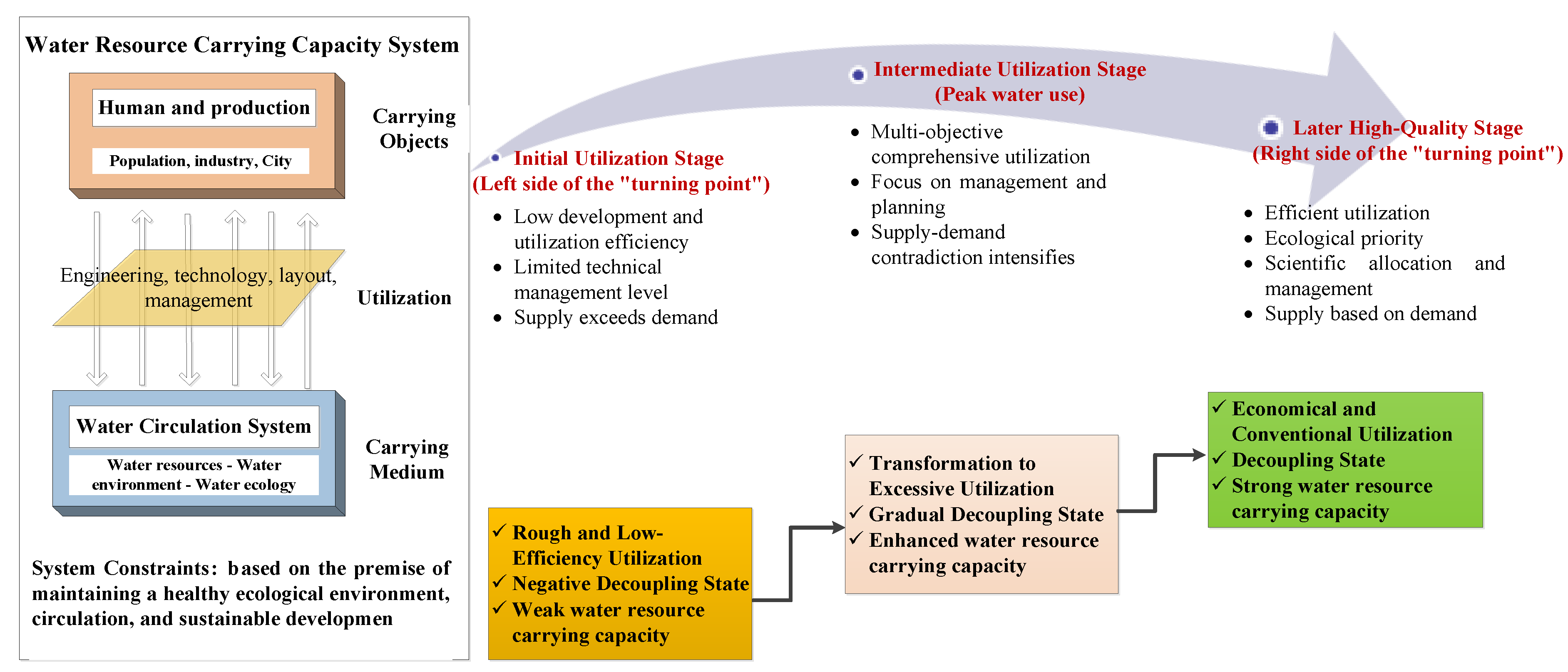
Figure 1. Conceptual framework of the water resources carrying capacity system.
Water 18 00339 g001
Figure 2. Theoretical framework of the interaction between new quality productive forces and high-quality development.
Water 18 00339 g002
Figure 3. Conceptual framework of the mechanisms enhancing water resources carrying capacity.
Water 18 00339 g003
Figure 4. Classification criteria for the decoupling levels between water resource utilization and high-quality development.
Water 18 00339 g004
Figure 5. Weihe River Basin.
Water 18 00339 g005
Figure 6. High-quality development index of cities in the Weihe River Basin.
Water 18 00339 g006
Figure 7. Water resources carrying capacity index of cities in the Weihe River Basin.
Water 18 00339 g007
Figure 8. Coupling coordination degree between the high-quality development index and the water resources carrying capacity index in cities of the Weihe River Basin.
Water 18 00339 g008
Figure 9. Decoupling states between TWU and HQDI in cities of the Weihe River Basin.
Water 18 00339 g009
Figure 10. Decomposition of driving effects of total water use in the Weihe River Basin.
Water 18 00339 g010
Figure 11. Decomposition of driving effects of total water use in cities of the Weihe River Basin.
Water 18 00339 g011
Table 1. Comprehensive evaluation indicator system for high-quality development in the Weihe River Basin.
Criterion LayerPrimary IndicatorSecondary IndicatorCalculation Method and Indicator Direction
InnovationTechnological innovationR&D expenditure intensity (X1)R&D expenditure/GDP (%), +
Patents per 10,000 people (X2)Total patents granted/total population (per 10,000 persons), +
Intensity of fiscal science and technology expenditure (X3)Science & technology expenditure/total fiscal expenditure (%), +
GDP per capita (X4)GDP/total population (CNY), +
CoordinationIndustrial structureAdvanced industrial structure index (X5)Tertiary industry output/Secondary industry output, +
Rationalization of industrial structure index (X6)(Primary industry/GDP × 1) + (Secondary industry/GDP × 2) + (Tertiary industry/GDP × 3), +
Urban–rural developmentUrbanization rate (X7)Urban population/total population (%), +
Regional income level (X8)Regional GDP per capita/national GDP per capita (%), +
Urban–rural income ratio (X9)Urban per capita disposable income/rural per capita disposable income, −
GreenEnvironmental qualityGreen coverage rate of built-up areas (X10)Green coverage rate of built-up areas (%), +
Pollution reductionCentralized wastewater treatment rate (X11)Centralized wastewater treatment rate (%), +
Wastewater discharge per unit of industrial value added (X12)Wastewater discharge/industrial value added (t/10,000 CNY), −
SO2 emissions per unit of industrial value added (X13)SO2 emissions/industrial value added (kg/10,000 CNY), −
OpennessImport and export developmentForeign trade dependence (X14)Total import and export/GDP, +
SharingInfrastructure levelHospital beds per 10,000 people (X15)Number of beds/total population (beds per 10,000 persons), +
Library collections per 100 people (X16)Library collections/total population (volumes per 100 persons), +
Per capita road area (X17)Road area/total population (m2/person), +
Education investment levelEducation fiscal expenditure intensity (X18)Education expenditure/total fiscal expenditure (%), +
Income levelAverage wage of employed persons (X19)Average wage of employed persons (CNY), +
Table 2. Comprehensive evaluation indicator system for water resources carrying capacity in the Weihe River Basin.
Criterion LayerIndicatorCalculation Method and Indicator Direction
Carrying mediumWater production coefficient (Y1)Total water resources/precipitation, +
Water production modulus (Y2)Total water resources/land area (104 m3/km2), +
Per capita water resources availability (Y3)Total water resources/total population (m3/person), +
UtilizationWater use per 10,000 CNY of GDP (Y4)Total water use/GDP (m3/10,000 CNY), −
Agricultural water use (Y5)Agricultural water use statistics (108 m3), −
Industrial water use (Y6)Industrial water use statistics (108 m3), −
Domestic water use (Y7)Domestic water use statistics (108 m3), −
Ecological water use (Y8)Ecological water use statistics (108 m3), +
Carrying objectPopulation density (Y9)Total population/land area (persons/km2), −
Proportion of tertiary industry (Y10)Value added of tertiary industry/GDP (%), +
Table 3. Classification criteria for coupling coordination degree.
D ValueTypeSubclass CriterionCoupling Coordination Subclass
[0, 0.5)Imbalanced Decline U e U w > 0.1Imbalanced Decline—lagged type of water resources carrying capacity
U w U e > 0.1Imbalanced Decline—lagged type of high-quality development
0 U e U w 0.1 Imbalanced Decline
[0.5, 0.6)Barely Coordinated U e U w > 0Barely Coordinated—lagged type of water resources carrying capacity
U w U e > 0.1Barely Coordinated—lagged type of high-quality development
0 U e U w 0.1 Barely Coordinated
[0.6, 0.7)Primary Coordination U e U w > 0Primary Coordination—lagged type of water resources carrying capacity
U w U e > 0.1Primary Coordination—lagged type of high-quality development
0 U e U w 0.1 Primary Coordination
[0.7, 0.8)
[0.7, 0.8)
[0.7, 0.8)
Intermediate Coordination U e U w > 0Intermediate Coordination—lagged type of water resources carrying capacity
U w U e > 0.1Intermediate Coordination—lagged type of high-quality development
0 U e U w 0.1 Intermediate Coordination
[0.8, 0.9)Good Coordination U e U w > 0Good Coordination—lagged type of water resources carrying capacity
U w U e > 0.1Good Coordination—lagged type of high-quality development
0 U e U w 0.1 Good Coordination
[0.9, 1.0)High-Quality Coordination U e U w > 0High-Quality Coordination—lagged type of water resources carrying capacity
U w U e > 0.1High-Quality Coordination—lagged type of high-quality development
0 U e U w 0.1 High-Quality Coordination
Disclaimer/Publisher’s Note: The statements, opinions and data contained in all publications are solely those of the individual author(s) and contributor(s) and not of MDPI and/or the editor(s). MDPI and/or the editor(s) disclaim responsibility for any injury to people or property resulting from any ideas, methods, instructions or products referred to in the content.