Article

Impact of Drought Events on the Greenhouse Gas Balance of a Temperate Mire in the Biebrza Wetlands, Central Europe


by
Krzysztof Fortuniak
1,*,
Włodzimierz Pawlak
1,
Mariusz Siedlecki
1,
Jan Górowski
2 and
Tomasz Gwizdałła
3
1
Department of Meteorology and Climatology, Faculty of Geographical Sciences, University of Lodz, Narutowicza 88, 90-139 Lodz, Poland
2
Doctoral School of Exact and Natural Sciences, University of Lodz, Narutowicza 68, 90-136 Lodz, Poland
3
Department of Intelligent Systems, Faculty of Physics and Applied Informatics, University of Lodz, Pomorska 149/153, 90-236 Lodz, Poland
*
Author to whom correspondence should be addressed.
Water 2026, 18(3), 314; https://doi.org/10.3390/w18030314
Submission received: 30 December 2025 / Revised: 20 January 2026 / Accepted: 23 January 2026 / Published: 26 January 2026
(This article belongs to the Section Water and Climate Change)

Abstract

Wetlands play a significant role in the climate system due to their ability to store large amounts of carbon, while remaining highly sensitive to hydrometeorological variability. Droughts can profoundly alter these ecosystems, causing them to become significant sources of CO2 and reducing CH4 emissions. However, long-term observational evidence quantifying this response remains scarce. Here, we analyze a 12-year dataset (2013–2024) of CO2 and CH4 fluxes measured using the eddy-covariance method at a site in the Biebrza wetlands of northeastern Poland. The study period included both cool, wet years and hot, dry years characterized by extremely low water table levels. In the warmest and driest year, 2024, the mire acted as a substantial CO2 source with a net emission of 1260 ± 400 g CO2 m−2 y−1. Other drought-affected years, 2019 and 2023, also showed high net emissions of 1020 ± 230 and 840 ± 300 g CO2 m−2 y−1, respectively. Conversely, the wettest year, 2013, exhibited a considerable net uptake of CO2 of −990 ± 250 g CO2 m−2 y−1. During dry years, CH4 emissions declined markedly to values close to measurement uncertainty (1–3 g CH4 m−2 y−1). When expressed as CO2 equivalents, drought conditions consistently transformed the mire into a strong net greenhouse gas source.

1. Introduction

Wetland ecosystems are characterized by high sensitivity to the effects of climate change. Projected shifts in temperature and precipitation regimes have the potential to disrupt, or even fundamentally transform, the role of wetlands in the carbon cycle. In particular, an increased frequency of dry and anomalously warm years may diminish the capacity of wetlands to act as carbon sinks, causing them instead to become net sources of atmospheric carbon dioxide [1,2,3,4,5]. Given that peatlands store an estimated one-third of the world’s organic carbon and more than half of the carbon currently present in the atmosphere [2,6,7,8], such a functional shift could initiate substantial positive climate feedback, further amplifying global warming. Consequently, evaluating the response of wetlands to drought is of critical importance in the context of contemporary climate change.
Natural wetlands possess a substantial capacity for carbon accumulation, primarily due to suppressed oxidation under cool, anaerobic conditions [2,9,10]. Elevated water table levels (WTLs) restrict the decomposition of soil organic carbon by creating anoxic environments that inhibit aerobic microbial activity [11,12]. This effect is reinforced by relatively low summer soil temperatures resulting from the insulating properties of peat [13]. Moreover, the progressive accumulation of organic matter enhances soil water-holding capacity, promoting further water table rise and reinforcing conditions favorable for carbon sequestration [14,15,16]. This classical water-peat feedback mechanism allows natural wetlands to remain effective carbon sinks as long as environmental conditions remain stable.
Lowering groundwater levels and increasing temperatures can substantially disrupt these mechanisms. A decline in water table depth accelerates carbon losses by enhancing soil respiration—primarily heterotrophic, relating to the microbial decomposition of organic matter and litter, rather than autotrophic, associated with the root systems of underground vegetation [15]. Consequently, the WTL is a key regulator of greenhouse gas fluxes from peat soils [17,18], and even minor changes on the order of a few centimeters can lead to pronounced variations in carbon dioxide emissions [17,19]. Recent model-based estimates derived from experimental manipulations indicate that water table drawdown could increase global CO2 emissions by up to 1.13 Gt yr−1, contributing to a net warming effect despite concurrent reductions in CH4 emissions [20]. Experimental studies in boreal peatlands likewise show an almost linear increase in CO2 fluxes with water table lowering [11]. Furthermore, warming-induced drought events amplify these losses, reducing net ecosystem productivity by over 700 g C m−2 during extreme conditions [21].
However, some studies indicate that lowered groundwater levels do not necessarily lead to enhanced net carbon emissions. The complexity of hydro-biochemical processes and ecosystem adaptation strategies, such as a proportional increase in photosynthesis and respiration under warmer and drier conditions [22], can lead to no significant reduction in net ecosystem productivity. Additionally, differences between long-term and short-term wetland responses, driven by vegetation adaptation, may act as an additional mitigating factor [5,23]. The plant–microbe interactions can stabilize carbon storage during periods of climatic stress. For example, Holocene drying events triggered woody plant expansion and microbial shifts that suppressed decomposition, creating a natural buffer for carbon retention [24]. Similarly, experimental warming combined with elevated CO2 has been found to increase root-derived carbon inputs, partially offsetting losses from enhanced decomposition [25].
Addressing the question of how natural wetlands respond to drought therefore requires direct ecosystem-scale measurements conducted over sufficiently long time periods that encompass both wet years and episodes of extreme dryness. The eddy-covariance technique appears particularly well suited for this purpose, as it enables continuous and largely noninvasive observations and integrates all processes governing surface–atmosphere gas exchange over extensive areas [26]. As such, it captures the net effect of interacting hydrological, biogeochemical, and biological processes operating under climate-induced stress. In contrast, results derived from laboratory studies, field manipulation experiments, and chamber measurements, while generally supporting the expected reduction in wetland CO2 uptake potential under drought conditions [9,27,28,29,30], are subject to important limitations. Manipulative experiments may overlook potential productivity gains associated with longer growing seasons and elevated temperatures [6], whereas chamber techniques provide only spot flux estimates and can introduce microclimatic artifacts [31].
The main objective of this study is to provide an empirical assessment of drought impact on net CO2 and CH4 fluxes in a Central European mire. Although drought can be classified into several types including meteorological soil hydrological and hydrogeological drought, in this study it is treated as a period of exceptionally low groundwater levels. The experimental basis of the study consists of twelve years of eddy-covariance measurements (2013–2024) at a site located within the Biebrza National Park wetlands. The study period was characterized by pronounced variability in hydrometeorological conditions, including the occurrence of extremely dry years, which enabled achievement of the study objectives. The experimental data were analyzed with respect to both interannual variability and the influence of drought on the seasonal dynamics of the investigated greenhouse gas fluxes. The application of the eddy-covariance method enabled continuous and largely noninvasive monitoring of the ecosystem and allowed many of the limitations associated with manipulative experiments and chamber measurements to be avoided.

2. Materials and Methods

2.1. Measurement Site and Study Area

The wetlands of the Biebrza National Park rank among the largest in Central Europe, encompassing more than 250 km2. Situated within the Biebrza River valley in northeastern Poland, the area forms a broad depression subdivided by distinct morphological features into the Upper, Middle, and Lower Basins [32]. Owing to the low valley gradient and the extensive floodplain, the Biebrza River meanders strongly and forms numerous side channels, oxbow lakes, and wide floodplains that constitute an integral part of the peatland mosaic.
The wetlands of the Biebrza Valley are sustained by complex interactions among seasonal river flooding, groundwater discharge, and precipitation, with snowmelt playing a particularly important role [33]. Spring floods following snowmelt in March or April occur almost every year, although the extent and duration of inundation vary depending on peak discharge and snow accumulation [34,35]. While the hydrological regime of the valley is generally considered near-natural, drainage works carried out during the nineteenth and twentieth centuries in the Middle Biebrza Basin locally altered wetland ecosystems and led to peat mineralization in the vicinity of canals and drainage networks.
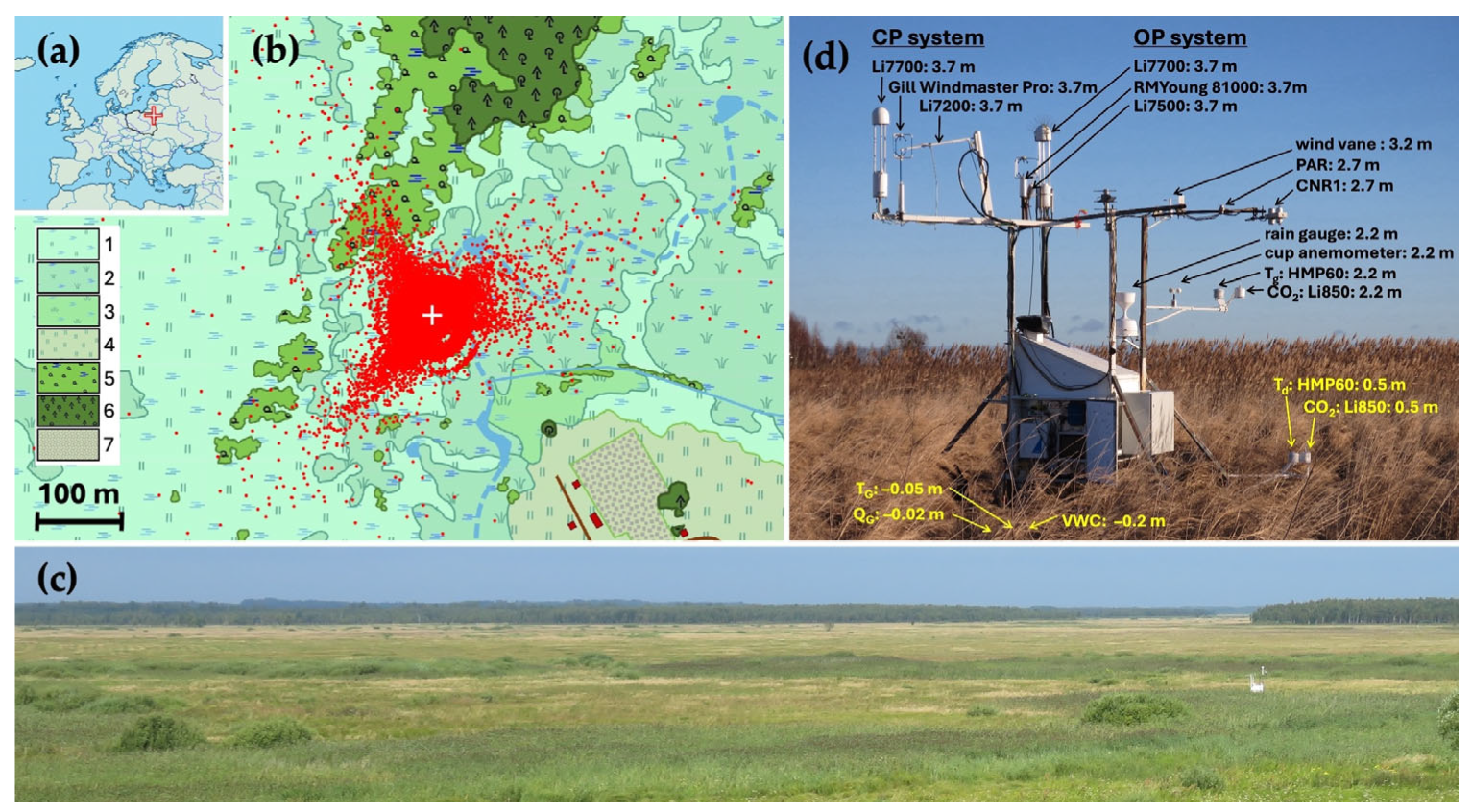
The measurement site [36,37,38,39,40,41] (53°35′30.8″ N, 22°53′32.4″ E; 109 m a.s.l.) was located in an extensive flat section of the Middle Basin, adjacent to a small, nearly overgrown stream (the Kopytkówka River). This part of the Middle Basin represents a partially dehydrated mire with soligenous and topogenous water inputs that sustain generally high soil moisture [42]. The site is located approximately 2.5 km from the main Biebrza river channel and is not directly affected by river flooding. Nevertheless, the river exerts a strong indirect influence on local groundwater levels through a network of tributaries and drainage ditches [42]. However, groundwater supplied by lateral inflow from adjacent plateaus, supplemented by rainfall and snowmelt, constitutes the dominant water source for peatlands in the Middle Biebrza Basin [42]. The study area is characterized by a small groundwater slope, with hydraulic gradients ranging from 0.1‰ to 0.4‰ [42,43]. The underground inflow is estimated as 0.146 mm d−1 [43]. The site is underlain by thick deposits of limnetic and telmatic mud [44], while the uppermost layer (0–20 cm) consists predominantly of tall-sedge peat. Vegetation in the vicinity is dominated by reeds, sedges, and rushes, characteristic of the regional wetland flora (Figure 1b,c).
The study is based on research conducted between 2013 and 2024, during which, in 2020, at the turn of April and May, the Biebrza wetlands were affected by a massive surface fire, which burned the previous year’s dry aboveground plant matter in the source area of the EC system and deposited ash, thereby altering the physicochemical properties of the soil. Importantly, due to its surface character, the fire did not affect the peat deposits. This led to exceptionally vigorous vegetation growth during the following spring. The EC system sustained some damage, but flux measurements were resumed approximately one week after the fire, allowing a complete annual dataset to be obtained for the fire-affected year as well. Nevertheless, due to the atypical conditions and exceptionally high gross primary production observed in that year [38,40], it was excluded from the comparative analyses, although it was retained in the multi-year estimates.

2.2. Instrumentation

This study utilized data collected between 2013 and 2024 through an open-path eddy-covariance system equipped with fast-response sensors operating at a frequency of 10 Hz: a sonic anemometer (RM Young 81000), a CO2/H2O analyzer (LI-7500, LI-COR Inc., Lincoln, NE, USA), and a CH4 analyzer (LI-7700, LI-COR Inc.). The sensors were mounted such that the midpoint of the optical path was 3.7 m above ground level. At this measurement height, the location of the maximum flux footprint contribution, calculated using the Kljun method [45], was situated within 100 m of the tower in more than 90% of cases, with a median distance of approximately 40 m, and showed a slight predominance toward the southwest and northwest sectors (Figure 1b). Only about 0.01% of footprint maxima extended over non-wetland areas. The system was controlled by a CR5000 datalogger (Campbell Scientific Inc., Logan, UT, USA), which stored 15 min data files on a local PC housed in an instrumentation shelter beneath the EC system (Figure 1d).
To quantify the possible bias of the LI-7500 sensor, additional measurements were carried out during 2022–2024 using a closed-path system equipped with a LI-7200 CO2/H2O analyzer (LI-COR Inc.) and a WindMaster Pro sonic anemometer (Gill Instruments Ltd., Hampshire, UK). This system was installed on the same tower, with the inlet positioned at the same height as the midpoint of the open-path measurement path.
Complementary meteorological and hydrological variables were monitored with slow-response sensors connected to the same datalogger. Radiation balance components (CNR1 radiometer) and photosynthetically active radiation (upward- and downward-facing PAR sensors) were measured at 2.7 m a.g.l., positioned more than 3 m from the shelter. Air temperature and relative humidity (HMP60, Vaisala Co. Ltd., Vantaa, Finland) were recorded at 0.5 and 2 m, while precipitation (standard rain gauge), wind speed and direction (cup anemometer and vane), and atmospheric pressure were measured above the shelter at 2.2 m. Soil heat flux (heat-flux plates), soil moisture (volumetric water-content sensors), and soil temperature were monitored in the immediate vicinity of the shelter.
The measurement system operated fully autonomously and was accessible remotely via the mobile phone network. Monthly site visits were carried out for routine maintenance, during which data were retrieved, and sensors were inspected and cleaned. Additional ancillary manual measurements were also performed during these visits.
Groundwater levels were recorded at 1 h intervals using an automatic pressure transducer installed in a 50 mm diameter PVC piezometer located 10 m east of the tower. The perforated section of the piezometer was placed in the middle of the peat layer, ensuring that the recorded water levels were representative of peat soil conditions and were reported relative to the peat surface.

2.3. Turbulent Fluxes Calculation, Verification, and Gap-Filling

Turbulent fluxes were calculated as the covariance of vertical wind speed and the variable of interest using the classical box averaging method for hourly intervals. To ensure comparability with other studies, the calculations were performed using EddyPro v.7.0 software with basic settings. The flux calculations were preceded by preliminary processing and control of the raw data (despiking, amplitude resolution and absolute limits checking, dropout detection, and skewness-kurtosis analysis). Covariance was maximized within a ±2 s window, and a double rotation of the natural wind coordinates was applied [46]. Sonic temperature measurements were corrected for humidity effects [47], and density fluctuations were accounted for following [48]. The corrections for high-pass and low-pass filtering were applied according to [49,50].
In the quality-control procedure, the fulfilment of the theoretical assumptions underlying the eddy-covariance method was evaluated using both the standard stationarity and well-developed turbulence tests implemented in EddyPro and three additional criteria: the flux stationarity criterion [51], the non-stationarity ratio [52], and the relative covariance stationarity criterion [53,54]. Only data initially assigned a “0” quality flag in EddyPro and subsequently passing all three supplementary tests were classified as high-quality (HQ). Fluxes associated with low friction velocity ( u < 0.1 m s−1) were removed from the HQ subset. These HQ data were then used to derive the functional relationships required for gap-filling and to define flux limits. Additionally, CH4 fluxes measured when the Li7700 signal strength fell below 45% were excluded from the HQ dataset.
Before calculating seasonal or annual totals, gaps in the flux time series must be filled, as they are not randomly distributed and typically occur during adverse weather, which would otherwise bias the results toward fair-weather conditions. To obtain the most representative continuous CO2 and CH4 flux records, we applied a multi-step, multi-method gap-filling procedure that also incorporated fluxes computed at 5 min resolution. The workflow combined several established approaches, including mean diurnal variation [55], marginal distribution sampling [56,57], artificial neural networks [58,59,60], non-linear regression, and net ecosystem exchange partitioning for CO2 flux [56,58,61]—see [36] for details.

2.4. Uncertainty Analysis

A robust quantification of the uncertainty inherent in long-term mean EC fluxes remains challenging, yet it is indispensable for a sound interpretation of their interannual dynamics. Although numerous sources of random and systematic error in EC observations have been recognized, a broadly endorsed and standardized framework for evaluating uncertainties in cumulative turbulent fluxes is still lacking. In this study, we assessed the uncertainty associated with annual and monthly aggregates of the analyzed fluxes by considering four contributing factors: random measurement error, data screening practices (including the choice of the u threshold), spectral correction, and gap-filling procedures [36]. The strategy adopted here is intentionally conservative, resulting in comparatively large uncertainty estimates; however, given the study’s aims, such an approach is critical for evaluating whether any inferred changes in the wetland’s carbon-sequestration function remain robust within the bounds of uncertainty.
A further and distinct source of uncertainty concerns the potential underestimation of CO2 fluxes when measured with the LI-7500 or, more broadly, with open-path (OP) sensors. Comparisons with closed-path (CP) systems and chamber measurements indicate that a systematic OP bias may persist throughout all seasons, leading to an overestimation of CO2 uptake by the ecosystem [62,63,64,65,66,67,68,69]. Although the mechanisms underlying this bias remain under debate, they are most frequently linked to additional sensible heat flux resulting from the air heating within the sensor path or to spectroscopic effects—namely, absorption-line broadening driven by barometric pressure, temperature, and dilution by other gases. Several correction schemes have been proposed to mitigate OP bias [62,68,70], yet other studies contend that such adjustments may not be required [71,72,73,74]. Given that the magnitude and relevance of the correction appear to depend on many factors, parallel OP–CP measurements are generally recommended for bias quantification [62,65,66,67]. In our study, three years of concurrent OP and CP measurements (2022–2024) enabled us to derive the following empirical correction factor, DFCO2 (μmol m−2 s−1):
D F C O 2 = 0.539 + 0.0064 · Q h 0.0031 · Q e ,
where Qh and Qe represent the OP-derived sensible and latent heat fluxes. The correction factor should be added to CO2 flux originally measured by the OP system. The proposed formulation provides more robust long-term flux estimates at the Biebrza site than previously published approaches, with an uncertainty of approximately 20% in the annual cumulative correction. Given that the problem is purely instrumental and concerns the response of sensors rather than the ecosystem, it is reasonable to apply Equation (1) throughout the entire 12-year measurement period. However, a comprehensive evaluation of OP–CP discrepancies and a comparison of alternative correction approaches lie beyond the scope of this work. Notably, our data reveal no pronounced seasonal pattern in CP–OP differences, and the cumulative discrepancy grows almost monotonically over the year. As a result, the above correction produces outcomes nearly identical to those obtained by assuming a constant systematic offset of 0.49 μmol m−2 s−1—an estimate consistent with previously reported ranges. Because the application of OP corrections remains somewhat controversial, we follow the practice adopted in other studies [75] and present separately the uncorrected OP system flux along with a possible correction factor. Consequently, unless otherwise specified, all CO2 flux values given below are uncorrected values.

3. Results

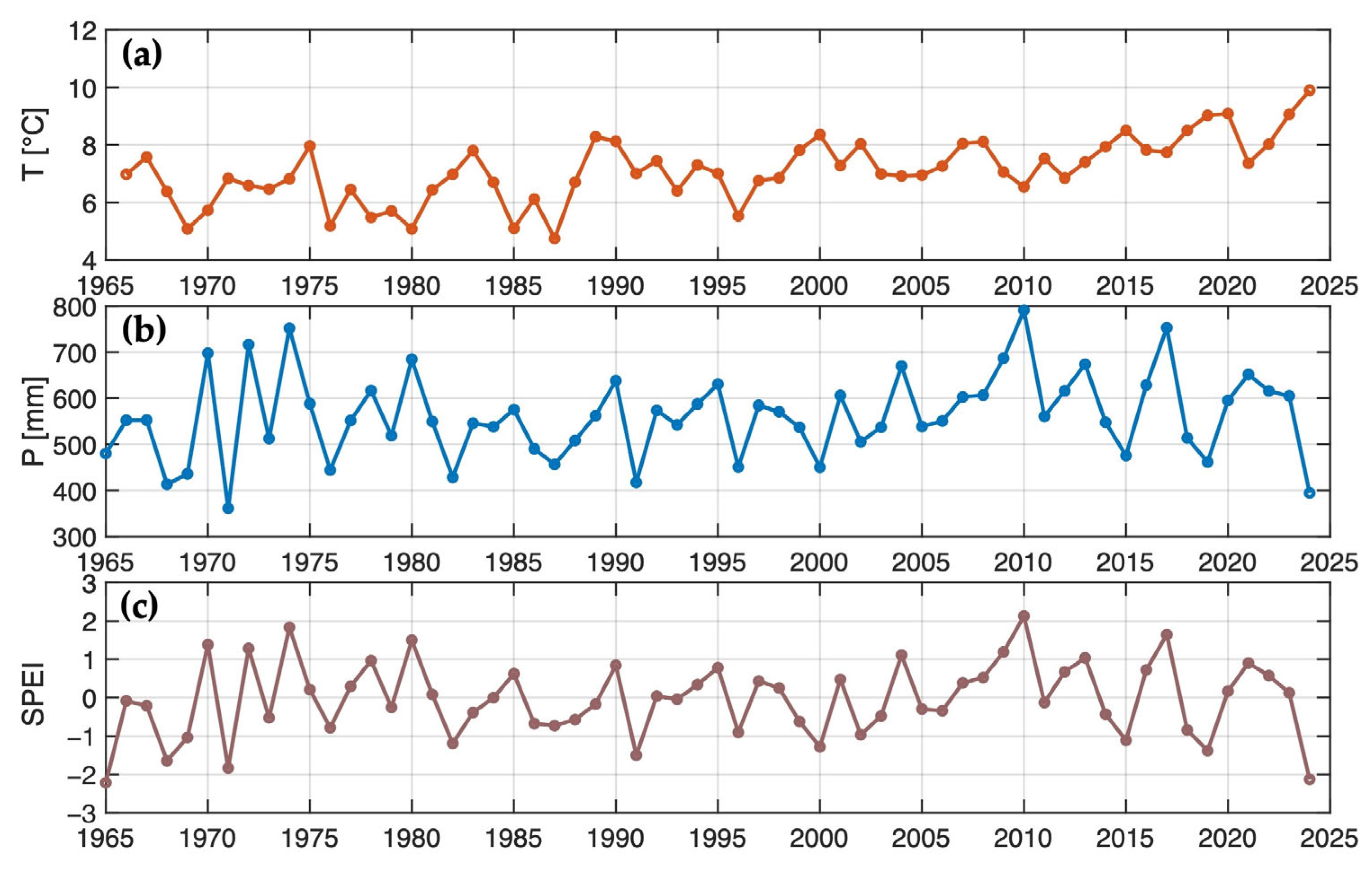
The study period is among the warmest in the history of observations. The mean air temperature in north-eastern Poland between 2013 and 2024 was 8.2 °C, compared with 7.4 °C for the 1991–2020 reference period and 6.6 °C for 1971–2000 (mean values from two synoptic stations, Suwałki and Białystok, located about 60 km north and south, respectively, from the EC site). The year 2024 was the warmest in the observational record, with a mean annual temperature of 9.9 °C, followed by 2023, 2020, and 2019, which also exhibited exceptionally high annual temperatures (Figure 2a).
In contrast, precipitation totals during the study period were generally close to long-term averages (Figure 2b). Between 2013 and 2024, the mean annual precipitation amounted to 592 mm, compared with 574 mm for 1991–2020 and 549 mm for 1971–2000. Nevertheless, substantial interannual variability was observed. In particular, 2024 was exceptionally dry, with an annual total of only 394 mm, placing it among the driest years on record. Similarly, precipitation totals in 2019 and 2015 were markedly below the long-term mean. A similar picture is presented by Standardized Precipitation Evapotranspiration Index (SPEI) variability (Figure 2c) with evapotranspiration calculated using the adjusted Hargreaves formula [39,76], which indicates 2024 as extremely dry and 2015 and 2019 as moderately dry. However, regional SPEI values do not fully reflect the hydrological conditions in the vicinity of the measuring station (Figure 3a). This is to some extent a result of changes in the structure and annual distribution of precipitation. The observed warming trend, expressed mainly through milder winters, shorter and thinner snow cover, and a rapid spring thaw, limits groundwater recharge, so that subsequent summer precipitation is often insufficient to compensate for these deficits, thereby promoting drought conditions.
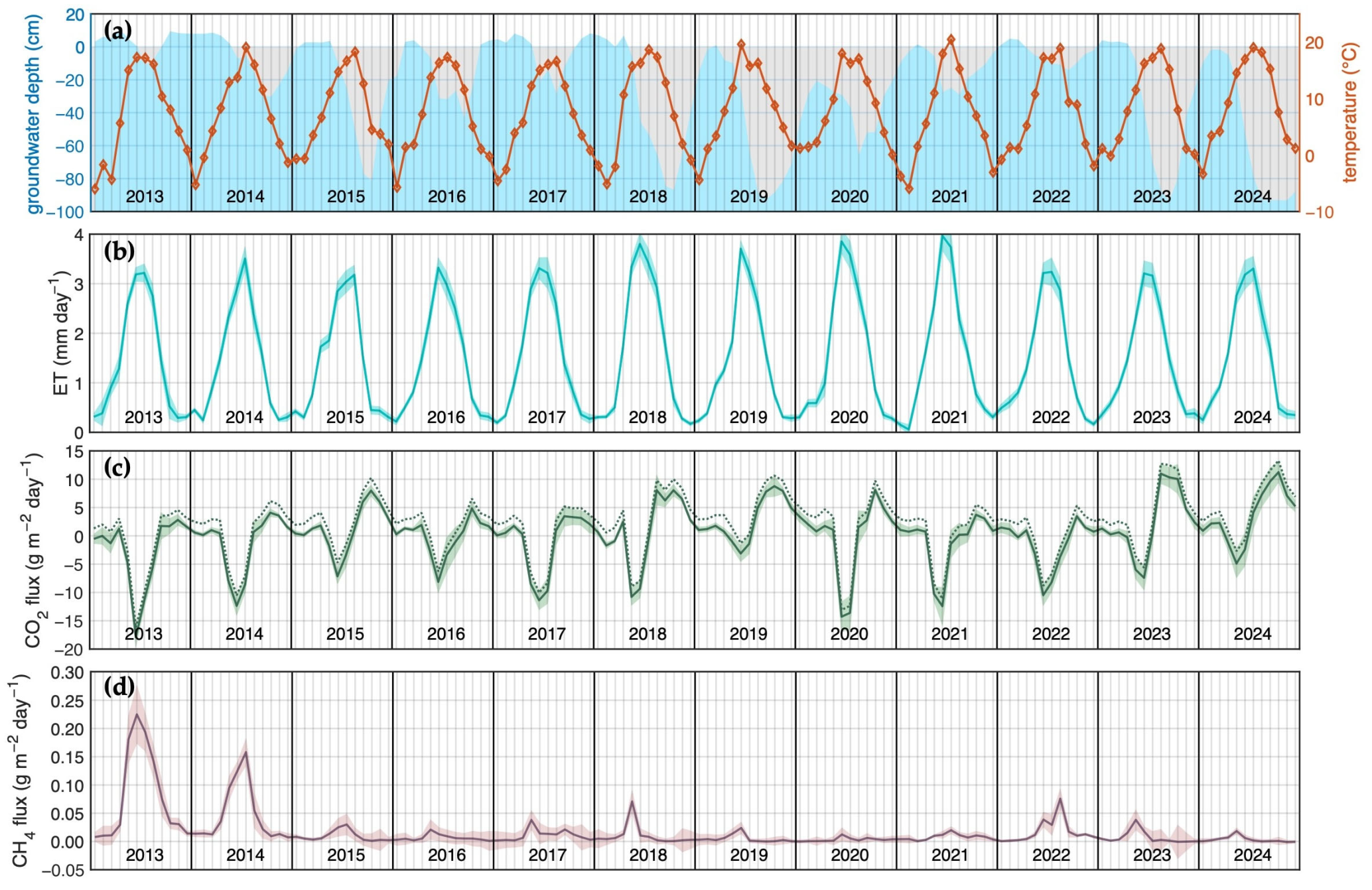
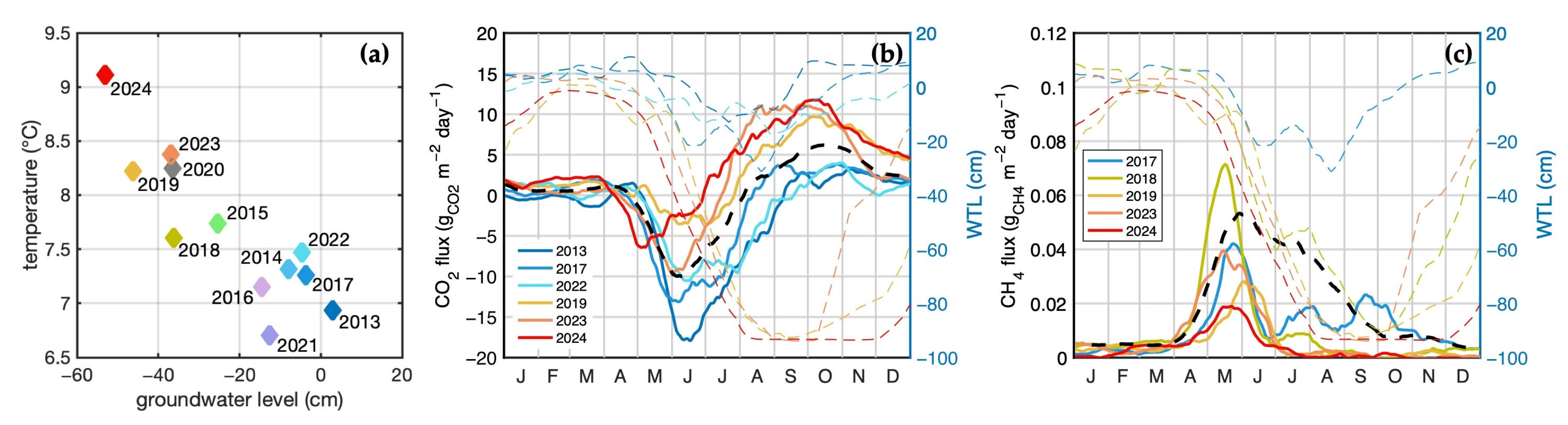
Despite nearly normal precipitation during the study period, several extremely dry summers were experienced (Figure 3a,) due to the complexity of hydrometeorological processes in the Biebrza Valley, and changes in the annual distribution of precipitation, in particular the lack of continuous snow cover in winter. The last year of measurements was especially dry, characterized by exceptionally low precipitation and high air temperatures. The mean annual groundwater level declined to −53 cm and remained at a record low of approximately −90 cm from June onward. Other notably dry years include 2019, with a mean annual WTL of −46 cm, as well as 2018, 2020, and 2023, for which mean annual WTL values were around −36 cm (Figure 4a). In general, the lowest groundwater levels occurred during the second half of the year, with minima typically observed in September and October. On the other hand, 2013 was both the wettest and one of the coldest years on record, with a mean annual WTL of +2.9 cm (Table 1, Figure 4a).
The components of ecosystem–atmosphere gas exchange responded differently to this pronounced hydrometeorological variability. Evapotranspiration exhibited relatively low interannual variability, with summer maxima remaining nearly constant regardless of groundwater level or air temperature, and only slightly elevated values observed during 2018–2021 (Figure 3b).
In contrast, net CO2 exchange was highly sensitive to moisture and thermal conditions (Figure 3c). Cool, wet summers were associated with strong CO2 uptake during the growing season and relatively low emissions during the remainder of the year, whereas dry and hot years showed reduced summer uptake accompanied by markedly enhanced autumn emissions (Figure 4b).
In 2024, the warmest and driest year of the study period, a record annual CO2 emission of 1260 g CO2 m−2 y−1 was observed. At the same time, the maximum seasonal CO2 uptake occurred unusually early, reflecting exceptionally high air temperatures in April (mean April temperature of 10.7 °C compared with 7.1 °C for the entire measurement period) combined with an exceptionally early decline in groundwater level, which reached −40 cm already by the end of May. Consequently, the investigated ecosystem became a net CO2 source as early as late June. In other years affected by severe drought (2019 and 2023), which were characterized by more typical spring temperatures, the maximum CO2 uptake occurred in June, and the transition from a CO2 sink to a source took place in the second half of July. Similar to 2024, these years were also associated with substantial annual CO2 emissions. These values increase markedly (by approximately 700 g CO2 m−2 y−1) when the correction for potential underestimation of emissions by the open-path system is applied. The strongest CO2 release during dry years was observed in late September or early October, with mean daily fluxes approaching 12 g CO2 m−2 d−1 in 2024.
The wettest measurement year (2013) was characterized by strong net CO2 uptake, reaching 990 g CO2 m−2 y−1. The maximum uptake, with daily sums of FCO2 approaching −18 g CO2 m−2 d−1, occurred in mid-June, and negative CO2 fluxes persisted until the first decade of September. In subsequent wet years, June uptake was less pronounced, with daily values on the order of −11 to −13 g CO2 m−2 d−1. In addition, in 2017, a decline in WTL in August led to an earlier transition from a CO2 sink to a source. During the period of most intense autumn CO2 release, fluxes were substantially lower than in dry years and remained in the range of 4–5 g CO2 m−2 d−1.
Methane flux proved to be the most sensitive to drought conditions. Only during the first two measurement years did this flux exhibit a pronounced annual cycle, primarily controlled by air temperature, with distinct maxima in the summer months (Figure 3d). In June 2013, methane emissions reached up to 0.225 g CH4 m−2 d−1, whereas in 2014 the strongest flux of 0.158 g CH4 m−2 d−1 was recorded in July. In subsequent years, summer CH4 emissions were strongly constrained by declining groundwater levels. In some years, including 2017, 2018, 2019, and 2023, high groundwater levels immediately after winter allowed for an initial increase in emissions in response to rising spring temperatures. However, this increase was strongly suppressed in the following months as groundwater levels decreased (Figure 4c). As a result, except for the first two years and 2022, annual CH4 emissions remained within the range of measurement uncertainty (Table 1). The high sensitivity of CH4 flux to groundwater level fluctuations is clearly illustrated by the example of 2017, when increases in water table level during the warm season were accompanied by enhanced CH4 emissions.

4. Discussion

The results of twelve years of measurements at the Biebrza site clearly demonstrate that during drought-affected years, wetlands can shift from functioning as a CO2 sink to becoming a net CO2 source. Although this effect has been frequently hypothesized, it remains relatively poorly documented in long-term eddy-covariance observations of ecosystems exposed solely to natural climatic variability. At the Biebrza site, drought episodes triggered exceptionally intense CO2 emissions. For comparison, at the Rzecin site in western Poland during 2004–2011, a slightly positive annual CO2 balance of 62 ± 106 g CO2 m−2 y−1 was reported in 2006, a year characterized by an unusually warm summer and low precipitation totals [77]. In the same year, emissions at the Fäjemyr site in southern Sweden reached 192 ± 95 g CO2 m−2 y−1, increasing to 317 ± 107 g CO2 m−2 y−1 during the even drier year of 2008 [3]. During the drought of 2018, three northern European mire ecosystems exhibited annual CO2 emissions of 56 g CO2 m−2 y−1 at Degerö, 67 g CO2 m−2 y−1 at Siikaneva, and 200 g CO2 m−2 y−1 at Mycklemossen [78]. In contrast, our estimates for extreme drought years exceed 1000–1200 g CO2 m−2 y−1 and reach as much as 1700–1900 g CO2 m−2 y−1 when accounting for the correction applied to open-path measurements. These values are closer to those reported for agricultural land established on artificially drained peatlands, particularly sites converted to pasture [79,80].
The mean net CO2 flux over the entire observation period at the Biebrza site is positive, indicating net CO2 emission, and amounts to 97 ± 340 g CO2 m−2 y−1 (without considering the correction for OP measurements of 670 g CO2 m−2 y−1). In contrast, most natural wetlands located in temperate zones exhibit reported values that are negative, with a typical range of −820 to −80 g CO2 m−2 y−1 (for sites with multi-year or decadal eddy-covariance datasets [77]). Positive annual CO2 balances have primarily been reported for drained peatlands converted to pasture or other agricultural uses [79,80,81]. It should be emphasized, however, that annual CO2 fluxes at the studied site are characterized primarily by very high variability arising from their sensitivity to changes in hydrometeorological conditions, particularly water table level. Consequently, the multi-year mean, which generally remains close to zero, exhibits a high degree of reactivity to the number of dry and wet years within the analyzed period. Analogous considerations apply to the CH4 flux, whose mean value over the 12-year study period amounts to 6.4 ± 3.4 g CH4 m−2 y−1.
This fact, in conjunction with the increasing drought frequency, gives rise to a more fundamental question regarding the comparability of multi-year mean fluxes among sites when they are derived from different time intervals, as well as the robustness of global-scale estimates based on such eddy-covariance observations [82]. For example, our earlier estimates for the same site based on the first two years of measurements indicated strong CO2 uptake and substantial CH4 emissions [37], whereas analyses for the 2013–2018 period yielded mean values of −180 ± 350 g CO2 m−2 y−1 and 10.0 ± 5.3 g CH4 m−2 y−1, respectively [36]. Therefore, in order to realistically determine the average greenhouse gas balance in wetlands under climate change conditions, long-term measurement datasets (30+ [82]) or measurement-based empirical models [39] are needed.
The drivers most identified as controlling annual greenhouse gas emissions are air or soil temperature and water table level [3,17,18,83,84,85]. At the Biebrza mire, however, the pronounced interannual variability of WTL observed during the study period caused water table level to emerge as the dominant environmental control of annual exchange [36,39]. This is confirmed by stepwise regression analysis including temperature and WTL. After excluding the fire-affected year 2020, the resulting p-values for temperature and WTL are 0.21 and 3.3 × 10⁻⁷, respectively, with corresponding error estimates of 2.8 and 146.0. Consequently, after excluding 2020, the relationship between the annual cumulative CO2 flux (non-corrected OP) and WTL takes an almost linear form [11,85] (R2 = 0.95, p < 10−6):
F C O 2 = 37 · W T L 713 ,
where WTL is expressed in centimeters and FCO2 denotes the mean annual CO2 flux in g CO2 m−2 y−1. This result underscores the importance of long-term observations, as our earlier analyses [36], which ended in 2018, a year characterized by relatively low emissions, suggested a stabilization of annual CO2 emissions at approximately 400–500 g CO2 m−2 y−1 for WTL values below about −25 cm (see Figure 5 in [36]). Only the occurrence of subsequent extremely dry years demonstrates that this linear relationship holds across the entire observed range of WTL variability. This relationship also shows that the studied mire changes its character from a CO2 sink to a CO2 source when the average annual WTL falls below −20 cm. This value corresponds to the findings of [86], which indicate a level of −22 cm as a change point associated with more drought-adapted plant taxa and signals ecosystem degradation in ombrotrophic peatlands across Europe.
Similar to the annual totals, the monthly mean fluxes at the Biebrza site also exhibit very high variability depending on hydrometeorological conditions. Negative CO2 flux values occurred in all years only in May and June; however, the magnitude of these fluxes differed widely between dry and wet years, ranging from −1.1 to −10.8 g CO2 m−2 d−1 in May and from −2.4 to −17.9 g CO2 m−2 d−1 in June. For almost the entire period from June to October, the differences between the highest and lowest 30-day moving averages of the CO2 flux (Figure 4) remain on the order of 10–15 g CO2 m−2 d−1. Therefore, although the mean annual course shown in Figure 4 indicates characteristic periods of CO2 uptake and release during the year, it is debatable whether in our case these values can be regarded as “typical” and thus suitable for quantifying the drought effect itself as the difference between emissions in a typical year and in a drought year [78]. This issue is even more evident for the CH4 flux, for which the multi-year mean seasonal pattern is dominated by the first two years with strong emissions and only weakly reflects the variability observed in subsequent years.
In contrast to annual totals, at the monthly scale, the influence of water table level on CO2 emissions at the study site is not as unequivocally dominant. Stepwise regression analysis of monthly CO2 fluxes against air temperature and WTL, performed at a significance level of p < 0.01, indicates that WTL is the only significant controlling variable in July, August, October, and November, whereas temperature is the sole significant driver in March and September. In December, the model identifies both variables as significant contributors.
When a less restrictive significance threshold is applied (p < 0.05), the influence of the WTL extends to February, June, and September, while temperature additionally affects monthly CO2 fluxes in January, February, July, and November. This seasonal alternation between hydrological and thermal controls underscores the complexity of CO2 exchange regulation at sub-annual timescales and suggests that the dominance of the WTL observed at the annual scale emerges from the cumulative effect of seasonally varying drivers rather than from a uniform control throughout the year.
The annual CO2 flux courses shown in Figure 4b also have important methodological implications. Gas exchange measurements are often limited to the growing season, whereas the presented patterns demonstrate that substantial CO2 emissions also occur during November and December, especially in dry years, largely as a result of the thermal inertia of the soil. Consequently, measurements restricted to the growing season may be associated with substantial errors when used to estimate annual carbon balances.
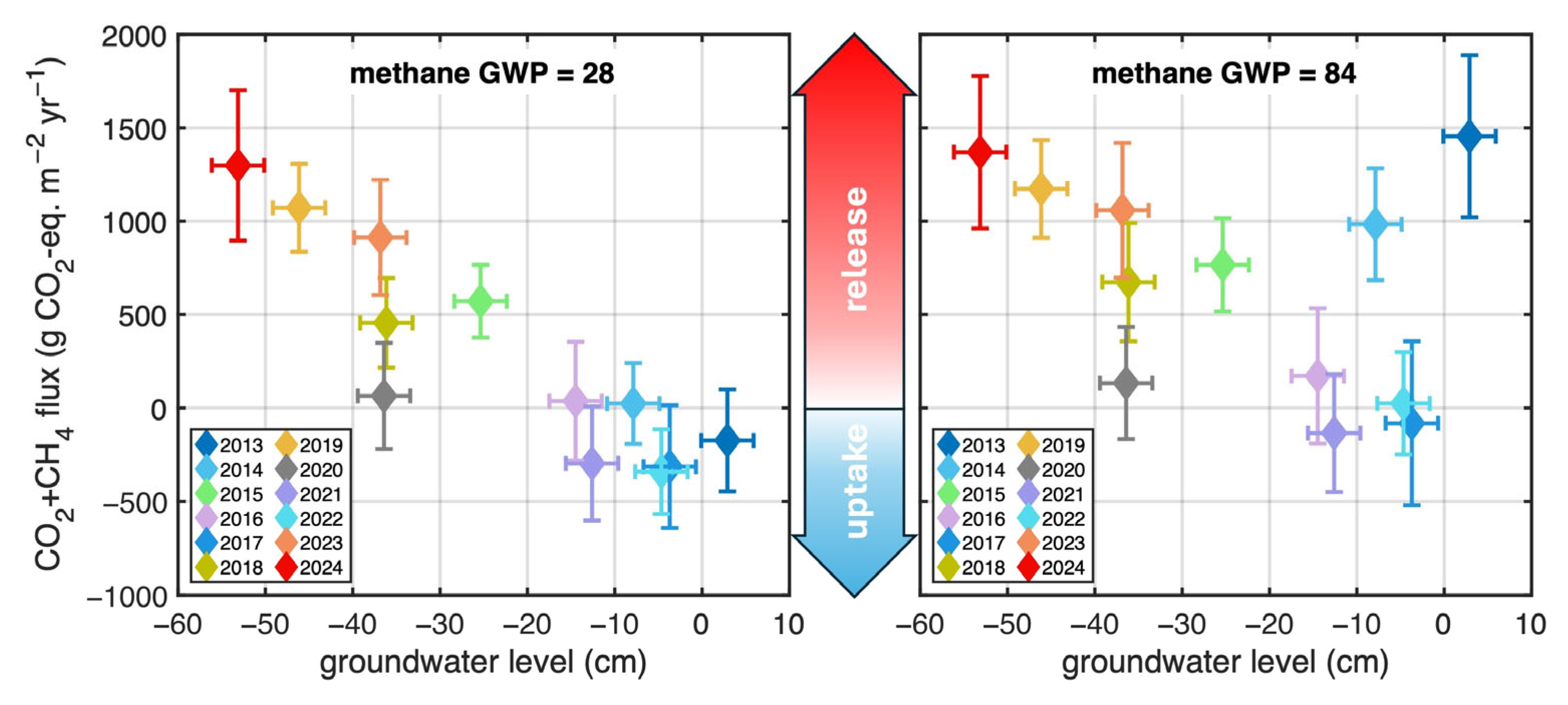
Given that drought intensifies CO2 release while reducing CH4 emissions, the concept of global warming potential (GWP) should be used to estimate the total effect of drought. This extensively utilized metric is delineated as the time-integrated radiative forcing engendered by a pulse emission of a specified component in comparison to an equivalent pulse emission of CO2 [87]. GWP is typically calculated for fixed time horizons, most commonly 20 or 100 years. At the Biebrza site, analysis over the 100-year time horizon (methane GWP = 28) shows that drought periods clearly shift the mire from a carbon sink under wet conditions to a net source during dry years (Figure 5). Nevertheless, when the mean annual water table level remains above approximately −20 cm, the ecosystem can still be considered climate neutral or slightly mitigating the warming trend. In the 20-year perspective (methane GWP = 84), strong emissions during drought periods remain evident. At the same time, wet periods characterized by high CH4 emissions, particularly during the first two years of the study, also exert a markedly negative effect on the radiative balance. From this shorter-term perspective, a mean water table level close to −10 cm appears to be optimal in terms of minimizing climate impacts. This finding is consistent with the conclusions of [86], who identified a similar water table level as an optimal target for both wetland conservation and restoration.
The proposed corrections for OP measurements, which exhibit a rather marginal impact on monthly totals (Figure 3), attain notably elevated values in the context of annual totals (Table 1). Accounting for these corrections does not alter the qualitative conclusions regarding the impact of drought on CO2 exchange. However, when viewed over the entire measurement period, they suggest that the investigated ecosystem would act as a strong CO2 source in all years except the first year of observations. Because some years were characterized by relatively wet and cool conditions, such strong CO2 release during those years appears inconsistent with the generally accepted mechanisms of carbon accumulation in peatland ecosystems. The applied correction of approximately 0.5 μmol m−2 s−1, although comparable to values reported by other authors [62,66,68,69], is of the same order as the measurement uncertainty that may affect both open-path and closed-path systems. Therefore, we believe that before such a correction is applied routinely, more detailed studies addressing discrepancies between the two systems are required, which are beyond the scope of this work. At present, we prefer to treat this correction primarily as an additional source of measurement uncertainty.
When interpreting the results, it is also necessary to acknowledge a limitation common to many long-term eddy-covariance studies, namely the representativeness of a single measurement site within a spatially heterogeneous wetland system and the potential extrapolation of the results to the scale of the entire Biebrza Wetlands. The Biebrza Wetlands form a complex mosaic of peatland types that differ in hydrological regime, vegetation structure, and drainage history across the Upper, Middle, and Lower Basins. A comprehensive assessment of site representativeness, spatial variability of greenhouse gas fluxes within the Biebrza Valley, or total emissions from the wetland complex would require multiple eddy-covariance towers, which remains challenging due to financial and logistical constraints. Therefore, this study focuses primarily on long-term temporal variability, highlighting, among other aspects, the difficulty of defining a representative multi-year mean flux even at a single, well-characterized site. While the absolute magnitudes of the fluxes are likely site-specific, the observed relationships between water table level, temperature, and greenhouse gas exchange may be applicable to similar temperate peatlands experiencing increasing hydroclimatic variability, including comparable wetland ecosystems within the Biebrza National Park.

5. Conclusions

The presented results demonstrate a clear and pronounced impact of drought on gas exchange in temperate mire. Drought episodes lead to very strong CO2 release, both in terms of the direct CO2 flux and when expressed as CO2 equivalents. This response is proof of positive feedback between the greenhouse gas balance of wetlands and climate change. Warming that promotes more frequent and intense droughts enhances carbon release from wetlands, while increasing atmospheric carbon concentrations in turn accelerate climate warming.
At the investigated mire, the water table level is the dominant control on annual CO2 and CH4 emissions. For CO2, the relationship with WTL takes the form of a linear function within the observed range of variability. At the same time, the very large interannual variability in WTL during the study period, and the associated variability in greenhouse gas fluxes, raises concerns about the representativeness of multi-year means derived from relatively short measurement records. Consequently, long-term, continuous, ecosystem-scale measurements are essential for robust quantification of wetland responses to climate change. Furthermore, given the capacity of wetland ecosystems to exhibit a variety of adaptive mechanisms, including shifts in plant species composition or changes in the physicochemical properties of peat, multi-year observations are necessary to adequately capture these long-term ecosystem adjustments.
Finally, it is important to acknowledge several limitations of the presented results. First, the analysis is based on eddy-covariance measurements from a single flux tower, which raises the common question of site representativeness. Although the surroundings of the measurement site are typical of many habitats within the Middle Biebrza Basin, the quantitative results remain to a large extent site specific. Second, the inherent limitations of the eddy-covariance method itself must be considered. In particular, open-path measurements require gap-filling of a relatively large fraction of missing data, which substantially increases measurement uncertainty. These uncertainties are further amplified by discrepancies between open-path and closed-path systems, which still require more detailed investigation. In addition, the eddy-covariance method performs poorly under stable stratification, resulting in relatively limited information on nocturnal emissions. Third, although the measurement period is rather long for studies simultaneously addressing CO2 and CH4 fluxes, caution is required when extrapolating the results to future climate conditions. Long-term ecosystem changes, including shifts in vegetation composition and peat properties, may substantially modify ecosystem responses and render simple extrapolations misleading.
Still, the results provide strong support for the need to protect temperate wetland ecosystems by maintaining groundwater levels close to −10 cm. Such conditions appear to represent an appropriate target not only for peatland conservation and restoration but also for optimizing their role in the global greenhouse gas balance. Beyond their scientific relevance, the findings of this study may also inform decision making by local authorities and managers of national parks and protected areas, supporting the development and optimization of effective wetland mitigation and climate adaptation strategies.

Author Contributions

Conceptualization, methodology, K.F. and W.P.; software—gap-filling procedures K.F. and T.G.; validation, K.F.; formal analysis, K.F.; investigation—field data collection, W.P., K.F., J.G. and M.S.; investigation—raw data processing, W.P.; resources, K.F.; data curation, W.P.; writing—original draft preparation, K.F.; writing—review and editing, all; visualization, supervision, project administration, and funding acquisition, K.F. All authors have read and agreed to the published version of the manuscript.

Funding

Funding for this research was provided by the National Science Centre, Poland under project UMO-2020/37/B/ST10/01219 and University of Lodz under IDUB project B2511513000300.07.

Data Availability Statement

The data presented in this study are available upon request from the corresponding author due to their use in ongoing research projects, in accordance with institutional data sharing policies.

Acknowledgments

The authors thank the authorities of the Biebrza National Park for allowing the continuous measurements in the area of the Park. Furthermore, we would like to thank the owners of the agritourist farm “Dworek na końcu świata” for their guardianship.

Conflicts of Interest

The authors declare no conflicts of interest.

Abbreviations

The following abbreviations are used in this manuscript:
ECeddy-covariance
OPopen-path eddy-covariance system
CPclosed-path eddy-covariance system
WTLwater table level

References

  1. Davidson, E.A.; Janssens, I.A. Temperature Sensitivity of Soil Carbon Decomposition and Feedbacks to Climate Change. Nature 2006, 440, 165–173. [Google Scholar] [CrossRef]
  2. Jungkunst, H.F.; Krüger, J.P.; Heitkamp, F.; Erasmi, S.; Fiedler, S.; Glatzel, S.; Lal, R. Accounting More Precisely for Peat and Other Soil Carbon Resources. In Recarbonization of the Biosphere; Springer Netherlands: Dordrecht, The Netherlands, 2012; pp. 127–157. [Google Scholar]
  3. Lund, M.; Christensen, T.R.; Lindroth, A.; Schubert, P. Effects of Drought Conditions on the Carbon Dioxide Dynamics in a Temperate Peatland. Environ. Res. Lett. 2012, 7, 045704. [Google Scholar] [CrossRef]
  4. Silvola, J. Carbon-Dioxide Dynamics in Mires Reclaimed for Forestry in Eastern Finland. Ann. Bot. Fenn. 1986, 23, 59–67. [Google Scholar]
  5. Laiho, R. Decomposition in Peatlands: Reconciling Seemingly Contrasting Results on the Impacts of Lowered Water Levels. Soil. Biol. Biochem. 2006, 38, 2011–2024. [Google Scholar] [CrossRef]
  6. Gallego-Sala, A.V.; Charman, D.J.; Brewer, S.; Page, S.E.; Prentice, I.C.; Friedlingstein, P.; Moreton, S.; Amesbury, M.J.; Beilman, D.W.; Björck, S.; et al. Latitudinal Limits to the Predicted Increase of the Peatland Carbon Sink with Warming. Nat. Clim. Change 2018, 8, 907–913. [Google Scholar] [CrossRef]
  7. Gorham, E. Northern Peatlands: Role in the Carbon Cycle and Probable Responses to Climatic Warming. Ecol. Appl. 1991, 1, 182–195. [Google Scholar] [CrossRef]
  8. Yu, Z.C. Northern Peatland Carbon Stocks and Dynamics: A Review. Biogeosciences 2012, 9, 4071–4085. [Google Scholar] [CrossRef]
  9. Olefeldt, D.; Euskirchen, E.S.; Harden, J.; Kane, E.; McGuire, A.D.; Waldrop, M.P.; Turetsky, M.R. A Decade of Boreal Rich Fen Greenhouse Gas Fluxes in Response to Natural and Experimental Water Table Variability. Glob. Change Biol. 2017, 23, 2428–2440. [Google Scholar] [CrossRef]
  10. Roulet, N.T.; Lafleur, P.M.; Richard, P.J.H.; Moore, T.R.; Humphreys, E.R.; Bubier, J. Contemporary Carbon Balance and Late Holocene Carbon Accumulation in a Northern Peatland. Glob. Change Biol. 2007, 13, 397–411. [Google Scholar] [CrossRef]
  11. Heikkinen, J.; Lång, K.; Honkanen, H.; Myllys, M. Mitigation of Greenhouse Gas Emissions by Optimizing Groundwater Level in Boreal Cultivated Peatland. Wetlands 2024, 44, 78. [Google Scholar] [CrossRef]
  12. Kwon, M.J.; Ballantyne, A.; Ciais, P.; Qiu, C.; Salmon, E.; Raoult, N.; Guenet, B.; Göckede, M.; Euskirchen, E.S.; Nykänen, H.; et al. Lowering Water Table Reduces Carbon Sink Strength and Carbon Stocks in Northern Peatlands. Glob. Change Biol. 2022, 28, 6752–6770. [Google Scholar] [CrossRef]
  13. Swindles, G.T.; Mullan, D.J.; Brannigan, N.T.; Fewster, R.E.; Sim, T.G.; Gallego-Sala, A.; Blaauw, M.; Lamentowicz, M.; Jassey, V.E.J.; Marcisz, K.; et al. Climate and Water-Table Levels Regulate Peat Accumulation Rates across Europe. PLoS ONE 2025, 20, e0327422. [Google Scholar] [CrossRef]
  14. Yang, T.; Sun, J.; Li, Y.; Wang, M.; Li, H.; Wang, S.; Xia, Z.; Yu, Z. Impact of Climate-Induced Water-Table Drawdown on Carbon and Nitrogen Sequestration in a Kobresia-Dominated Peatland on the Central Qinghai-Tibetan Plateau. Commun. Earth Environ. 2025, 6, 188. [Google Scholar] [CrossRef]
  15. Ma, L.; Zhu, G.; Chen, B.; Zhang, K.; Niu, S.; Wang, J.; Ciais, P.; Zuo, H. A Globally Robust Relationship between Water Table Decline, Subsidence Rate, and Carbon Release from Peatlands. Commun. Earth Environ. 2022, 3, 254. [Google Scholar] [CrossRef]
  16. Ise, T.; Dunn, A.L.; Wofsy, S.C.; Moorcroft, P.R. High Sensitivity of Peat Decomposition to Climate Change through Water-Table Feedback. Nat. Geosci. 2008, 1, 763–766. [Google Scholar] [CrossRef]
  17. Evans, C.D.; Peacock, M.; Baird, A.J.; Artz, R.R.E.; Burden, A.; Callaghan, N.; Chapman, P.J.; Cooper, H.M.; Coyle, M.; Craig, E.; et al. Overriding Water Table Control on Managed Peatland Greenhouse Gas Emissions. Nature 2021, 593, 548–552. [Google Scholar] [CrossRef]
  18. Wilson, D.; Farrell, C.A.; Fallon, D.; Moser, G.; Müller, C.; Renou-Wilson, F. Multiyear Greenhouse Gas Balances at a Rewetted Temperate Peatland. Glob. Change Biol. 2016, 22, 4080–4095. [Google Scholar] [CrossRef]
  19. Koch, J.; Elsgaard, L.; Greve, M.H.; Gyldenkærne, S.; Hermansen, C.; Levin, G.; Wu, S.; Stisen, S. Water-Table-Driven Greenhouse Gas Emission Estimates Guide Peatland Restoration at National Scale. Biogeosciences 2023, 20, 2387–2403. [Google Scholar] [CrossRef]
  20. Huang, Y.; Ciais, P.; Luo, Y.; Zhu, D.; Wang, Y.; Qiu, C.; Goll, D.S.; Guenet, B.; Makowski, D.; De Graaf, I.; et al. Tradeoff of CO2 and CH4 Emissions from Global Peatlands under Water-Table Drawdown. Nat. Clim. Change 2021, 11, 618–622. [Google Scholar] [CrossRef]
  21. Quan, Q.; Zhou, J.; Hanson, P.J.; Ricciuto, D.; Sebestyen, S.D.; Weston, D.J.; Chanton, J.P.; Wilson, R.M.; Kostka, J.E.; Zhou, Y.; et al. Drought-Induced Peatland Carbon Loss Exacerbated by Elevated CO2 and Warming. Science 2025, 390, 367–370. [Google Scholar] [CrossRef]
  22. Flanagan, L.B.; Syed, K.H. Stimulation of Both Photosynthesis and Respiration in Response to Warmer and Drier Conditions in a Boreal Peatland Ecosystem. Glob. Change Biol. 2011, 17, 2271–2287. [Google Scholar] [CrossRef]
  23. Wang, H.; Richardson, C.J.; Ho, M. Dual Controls on Carbon Loss during Drought in Peatlands. Nat. Clim. Change 2015, 5, 584–587. [Google Scholar] [CrossRef]
  24. Zhang, Y.; Huang, X.; Zhao, B.; Yan, C.; Zhao, H.; Zhang, H.; Halamka, T.A.; Peel, R.H.; Vreeken, M.; Gallego-Sala, A.V.; et al. Microbial Responses to Changing Plant Community Protect Peatland Carbon Stores during Holocene Drying. Nat. Commun. 2025, 16, 6912. [Google Scholar] [CrossRef]
  25. Ofiti, N.O.E.; Schmidt, M.W.I.; Abiven, S.; Hanson, P.J.; Iversen, C.M.; Wilson, R.M.; Kostka, J.E.; Wiesenberg, G.L.B.; Malhotra, A. Climate Warming and Elevated CO2 Alter Peatland Soil Carbon Sources and Stability. Nat. Commun. 2023, 14, 7533. [Google Scholar] [CrossRef]
  26. Baldocchi, D. Assessing the Eddy Covariance Technique for Evaluating Carbon Dioxide Exchange Rates of Ecosystems: Past, Present and Future. Glob. Change Biol. 2003, 9, 479–492. [Google Scholar] [CrossRef]
  27. Moore, T.R.; Knowles, R. The Iinfluence of Water Table Levels on Methane and Carbon Dioxide Emissions from Peatland Soils. Can. J. Soil. Sci. 1989, 69, 33–38. [Google Scholar] [CrossRef]
  28. Alm, J.; Schulman, L.; Walden, J.; Nykänen, H.; Martikainen, P.J.; Silvola, J. Carbon Balance of a Boreal Bog during a Year with an Exceptionally Dry Summer. Ecology 1999, 80, 161–174. [Google Scholar] [CrossRef]
  29. Fenner, N.; Freeman, C. Drought-Induced Carbon Loss in Peatlands. Nat. Geosci. 2011, 4, 895–900. [Google Scholar] [CrossRef]
  30. Jassey, V.E.J.; Reczuga, M.K.; Zielińska, M.; Słowińska, S.; Robroek, B.J.M.; Mariotte, P.; Seppey, C.V.W.; Lara, E.; Barabach, J.; Słowiński, M.; et al. Tipping Point in Plant–Fungal Interactions under Severe Drought Causes Abrupt Rise in Peatland Ecosystem Respiration. Glob. Change Biol. 2018, 24, 972–986. [Google Scholar] [CrossRef] [PubMed]
  31. Wang, K.; Liu, C.; Zheng, X.; Pihlatie, M.; Li, B.; Haapanala, S.; Vesala, T.; Liu, H.; Wang, Y.; Liu, G.; et al. Comparison between Eddy Covariance and Automatic Chamber Techniques for Measuring Net Ecosystem Exchange of Carbon Dioxide in Cotton and Wheat Fields. Biogeosciences 2013, 10, 6865–6877. [Google Scholar] [CrossRef]
  32. Okruszko, H. Przyrodniczo-Rolnicza Charakterystyka Doliny Biebrzy. Zesz. Probl. Postępów Nauk. Rol. 1973, 134, 173–199. [Google Scholar]
  33. Marcinkowski, P.; Piniewski, M.; Grygoruk, M.; Mirosław-Świątek, D. Climate Change in the Biebrza Basin—Projections and Ecohydrological Implications. Ecohydrol. Hydrobiol. 2024, 24, 796–807. [Google Scholar] [CrossRef]
  34. Keizer, F.M.; Schot, P.P.; Okruszko, T.; Chormański, J.; Kardel, I.; Wassen, M.J. A New Look at the Flood Pulse Concept: The (Ir)Relevance of the Moving Littoral in Temperate Zone Rivers. Ecol. Eng. 2014, 64, 85–99. [Google Scholar] [CrossRef]
  35. Ignar, S.; Maksymiuk-Dziuban, A.; Mirosław-Świątek, D.; Chormański, J.; Okruszko, T.; Wysocki, P. Temporal Variability of the Selected Flood Parameters in the Biebrza River Valley. Ann. Wars. Univ. Life Sci. SGGW. Land. Reclam. 2011, 43, 135–142. [Google Scholar] [CrossRef]
  36. Fortuniak, K.; Pawlak, W.; Siedlecki, M.; Chambers, S.; Bednorz, L. Temperate Mire Fluctuations from Carbon Sink to Carbon Source Following Changes in Water Table. Sci. Total Environ. 2021, 756, 144071. [Google Scholar] [CrossRef]
  37. Fortuniak, K.; Pawlak, W.; Bednorz, L.; Grygoruk, M.; Siedlecki, M.; Zieliński, M. Methane and Carbon Dioxide Fluxes of a Temperate Mire in Central Europe. Agric. Meteorol. 2017, 232, 306–318. [Google Scholar] [CrossRef]
  38. Pawlak, W.; Fortuniak, K.; Siedlecki, M.; Górowski, J. The Impact of Wildfire on the Variability of Net CO2 Flux and Its Components in Wetlands (Biebrza National Park, Poland Case Study). Acta Geogr. Lodz. 2025, in press. [Google Scholar]
  39. Fortuniak, K.; Pawlak, W.; Chambers, S.; Siedlecki, M.; Artz, R.; Górowski, J.; Gwizdałła, T.; Podlaski, K. Development of a Semi-Empirical Net Ecosystem Exchange Model for Biebrza Wetlands to Study Their Sensitivity to Climatic Extremes and Multi-Year Variability. Ecol. Model. 2026, 513, 111442. [Google Scholar] [CrossRef]
  40. Górowski, J.; Fortuniak, K.; Siedlecki, M.; Pawlak, W. Long-Term Dynamics of PAR and CO2 Exchange in a Temperate Wetland: Vegetation Development and Climatic Drivers. Clim. Dyn. 2025, 63, 377. [Google Scholar] [CrossRef]
  41. Pawlak, W.; Fortuniak, K.; Siedlecki, M. The Redox Potential of Soil as an Additional Factor Describing the Variability of Methane Fluxes from a Wetland during Dry Conditions: A Case Study for Biebrza National Park, Poland. Meteorol. Z. 2025, 33, 1216. [Google Scholar] [CrossRef]
  42. Grygoruk, M.; Batelaan, O.; Okruszko, T.; Mirosław-Świątek, D.; Chormański, J.; Rycharski, M. Groundwater Modelling and Hydrological System Analysis of Wetlands in the Middle Biebrza Basin. In Modelling of Hydrological Processes in the Narew Catchment; Springer: Berlin/Heidelberg, Germany, 2011; pp. 89–109. [Google Scholar]
  43. Pajnowska, H. Hydrogeology and the Groundwater Inflow of the Middle Biebrza Basin. Zesz. Probl. Postępów Nauk. Rol. 1996, 432, 45–70. (In Polish) [Google Scholar]
  44. Okupny, D.; Fortuniak, K.; Kloss, M.; Ziułkiewicz, M.; Forysiak, J.; Fortuniak, A.; Bednorz, L.; Pawlak, W. Wstępna Charakterystyka Geologiczna i Paleobotaniczna Mokradła w Kopytkowie Na Tle Analizy Współczesnych Warunków Wodnych i Szaty Roślinnej (Dolina Biebrzy, NE Polska). Acta Geogr. Lodz. 2016, 105, 149–162. [Google Scholar]
  45. Kljun, N.; Calanca, P.; Rotach, M.W.; Schmid, H.P. A Simple Parameterisation for Flux Footprint Predictions. Bound. Layer Meteorol. 2004, 112, 503–523. [Google Scholar] [CrossRef]
  46. Kaimal, J.C.; Finnigan, J.J. Atmospheric Boundary Layer Flows; Oxford University Press: Oxford, UK, 1994; ISBN 9780195062397. [Google Scholar]
  47. Schotanus, P.; Nieuwstadt, F.T.M.; De Bruin, H.A.R. Temperature Measurement with a Sonic Anemometer and Its Application to Heat and Moisture Fluxes. Bound. Layer Meteorol. 1983, 26, 81–93. [Google Scholar] [CrossRef]
  48. Webb, E.K.; Pearman, G.I.; Leuning, R. Correction of Flux Measurements for Density Effects Due to Heat and Water Vapour Transfer. Q. J. R. Meteorol. Soc. 1980, 106, 85–100. [Google Scholar] [CrossRef]
  49. Moncrieff, J.; Clement, R.; Finnigan, J.; Meyers, T. Averaging, Detrending, and Filtering of Eddy Covariance Time Series. In Handbook of Micrometeorology; Kluwer Academic Publishers: Dordrecht, The Netherlands, 2024; pp. 7–31. [Google Scholar]
  50. Moncrieff, J.; Massheder, J.M.; de Bruin, H.; Elbers, J.; Friborg, T.; Heusinkveld, B.; Kabat, P.; Scott, S.; Soegaard, H.; Verhoef, A. A System to Measure Surface Fluxes of Momentum, Sensible Heat, Water Vapour and Carbon Dioxide. J. Hydrol. 1997, 188–189, 589–611. [Google Scholar] [CrossRef]
  51. Foken, T.; Wichura, B. Tools for Quality Assessment of Surface-Based Flux Measurements. Agric. Meteorol. 1996, 78, 83–105. [Google Scholar] [CrossRef]
  52. Mahrt, L. Flux Sampling Errors for Aircraft and Towers. J. Atmos. Ocean. Technol. 1998, 15, 416–429. [Google Scholar] [CrossRef]
  53. Dutaur, L.; Cieslik, S.; Carrara, A.; Lopez, A. The Detection of Nonstationarity in the Determination of Deposition Fluxes. In Proceedings of the EUROTRAC Symposium ’98; Garmisch-Partenkirchen, Germany, March 1998, Borrell, P.M., Borrell, P., Eds.; WIT Press: Southampton, UK, 1999; Volume 28, pp. 171–176. [Google Scholar]
  54. Nemitz, E.; Hargreaves, K.J.; McDonald, A.G.; Dorsey, J.R.; Fowler, D. Micrometeorological Measurements of the Urban Heat Budget and CO 2 Emissions on a City Scale. Environ. Sci. Technol. 2002, 36, 3139–3146. [Google Scholar] [CrossRef]
  55. Falge, E.; Baldocchi, D.; Olson, R.; Anthoni, P.; Aubinet, M.; Bernhofer, C.; Burba, G.G.; Ceulemans, R.; Clement, R.; Dolman, H.; et al. Gap Filling Strategies for Defensible Annual Sums of Net Ecosystem Exchange. Agric. Meteorol. 2001, 107, 43–69. [Google Scholar] [CrossRef]
  56. Reichstein, M.; Falge, E.; Baldocchi, D.; Papale, D.; Aubinet, M.; Berbigier, P.; Bernhofer, C.; Buchmann, N.; Gilmanov, T.; Granier, A.; et al. On the Separation of Net Ecosystem Exchange into Assimilation and Ecosystem Respiration: Review and Improved Algorithm. Glob. Change Biol. 2005, 11, 1424–1439. [Google Scholar] [CrossRef]
  57. Wutzler, T.; Lucas-Moffat, A.; Migliavacca, M.; Knauer, J.; Sickel, K.; Šigut, L.; Menzer, O.; Reichstein, M. Basic and Extensible Post-Processing of Eddy Covariance Flux Data with REddyProc. Biogeosciences 2018, 15, 5015–5030. [Google Scholar] [CrossRef]
  58. Moffat, A.M.; Papale, D.; Reichstein, M.; Hollinger, D.Y.; Richardson, A.D.; Barr, A.G.; Beckstein, C.; Braswell, B.H.; Churkina, G.; Desai, A.R.; et al. Comprehensive Comparison of Gap-Filling Techniques for Eddy Covariance Net Carbon Fluxes. Agric. Meteorol. 2007, 147, 209–232. [Google Scholar] [CrossRef]
  59. Kim, Y.; Johnson, M.S.; Knox, S.H.; Black, T.A.; Dalmagro, H.J.; Kang, M.; Kim, J.; Baldocchi, D. Gap-filling Approaches for Eddy Covariance Methane Fluxes: A Comparison of Three Machine Learning Algorithms and a Traditional Method with Principal Component Analysis. Glob. Change Biol. 2020, 26, 1499–1518. [Google Scholar] [CrossRef] [PubMed]
  60. Papale, D.; Valentini, R. A New Assessment of European Forests Carbon Exchanges by Eddy Fluxes and Artificial Neural Network Spatialization. Glob. Change Biol. 2003, 9, 525–535. [Google Scholar] [CrossRef]
  61. Lasslop, G.; Reichstein, M.; Papale, D.; Richardson, A.D.; Arneth, A.; Barr, A.; Stoy, P.; Wohlfahrt, G. Separation of Net Ecosystem Exchange into Assimilation and Respiration Using a Light Response Curve Approach: Critical Issues and Global Evaluation. Glob. Change Biol. 2010, 16, 187–208. [Google Scholar] [CrossRef]
  62. Järvi, L.; Mammarella, I.; Eugster, W.; Ibrom, A.; Siivola, E.; Dellwik, E.; Keronen, P.; Burba, G.G.; Vesala, T. Comparison of Net CO2 Fluxes Measured with Open- and Closed-Path Infrared Gas Analyzers in an Urban Complex Environment. Boreal. Environ. Res. 2009, 14, 499–514. [Google Scholar]
  63. Anthoni, P.M.; Unsworth, M.H.; Law, B.E.; Irvine, J.; Baldocchi, D.; Van Tuyl, S.; Moore, D. Seasonal Differences in Carbon and Water Vapor Exchange in Young and Old-Growth Ponderosa Pine Ecosystems. Agric. Meteorol. 2002, 111, 203–222. [Google Scholar] [CrossRef]
  64. Ono, K.; Miyata, A.; Yamada, T. Apparent Downward CO2 Flux Observed with Open-Path Eddy Covariance over a Non-Vegetated Surface. Theor. Appl. Clim. 2008, 92, 195–208. [Google Scholar] [CrossRef]
  65. Kittler, F.; Eugster, W.; Foken, T.; Heimann, M.; Kolle, O.; Göckede, M. High-quality Eddy-covariance CO2 Budgets under Cold Climate Conditions. J. Geophys. Res. Biogeosci 2017, 122, 2064–2084. [Google Scholar] [CrossRef]
  66. Deventer, M.J.; Roman, T.; Bogoev, I.; Kolka, R.K.; Erickson, M.; Lee, X.; Baker, J.M.; Millet, D.B.; Griffis, T.J. Biases in Open-Path Carbon Dioxide Flux Measurements: Roles of Instrument Surface Heat Exchange and Analyzer Temperature Sensitivity. Agric. Meteorol. 2021, 296, 108216. [Google Scholar] [CrossRef] [PubMed]
  67. Holl, D.; Wille, C.; Sachs, T.; Schreiber, P.; Runkle, B.R.K.; Beckebanze, L.; Langer, M.; Boike, J.; Pfeiffer, E.-M.; Fedorova, I.; et al. A Long-Term (2002 to 2017) Record of Closed-Path and Open-Path Eddy Covariance CO2 Net Ecosystem Exchange Fluxes from the Siberian Arctic. Earth Syst. Sci. Data 2019, 11, 221–240. [Google Scholar] [CrossRef]
  68. Burba, G.G.; McDermitt, D.K.; Grelle, A.; Anderson, D.J.; Xu, L. Addressing the Influence of Instrument Surface Heat Exchange on the Measurements of CO2 Flux from Open-path Gas Analyzers. Glob. Change Biol. 2008, 14, 1854–1876. [Google Scholar] [CrossRef]
  69. Burba, G.G.; Anderson, D.J. A Brief Practical Guide to Eddy Covariance Flux Measurements: Principles and Workflow Examples for Scientific and Industrial Applications; LI-COR Biosciences: Lincoln, NE, USA, 2010. [Google Scholar]
  70. Wang, L.; Lee, X.; Wang, W.; Wang, X.; Wei, Z.; Fu, C.; Gao, Y.; Lu, L.; Song, W.; Su, P.; et al. A Meta-Analysis of Open-Path Eddy Covariance Observations of Apparent CO2 Flux in Cold Conditions in FLUXNET. J. Atmos. Ocean. Technol. 2017, 34, 2475–2487. [Google Scholar] [CrossRef]
  71. Nakano, T.; Shinoda, M. Interannual Variation in Net Ecosystem CO2 Exchange and Its Climatic Controls in a Semiarid Grassland of Mongolia. J. Agric. Meteorol. 2018, 74, 92–96. [Google Scholar] [CrossRef]
  72. Haslwanter, A.; Hammerle, A.; Wohlfahrt, G. Open-Path vs. Closed-Path Eddy Covariance Measurements of the Net Ecosystem Carbon Dioxide and Water Vapour Exchange: A Long-Term Perspective. Agric. Meteorol. 2009, 149, 291–302. [Google Scholar] [CrossRef]
  73. Bowling, D.R.; Bethers-Marchetti, S.; Lunch, C.K.; Grote, E.E.; Belnap, J. Carbon, Water, and Energy Fluxes in a Semiarid Cold Desert Grassland during and Following Multiyear Drought. J. Geophys. Res. Biogeosci. 2010, 115. [Google Scholar] [CrossRef]
  74. Wohlfahrt, G.; Fenstermaker, L.F.; Arnone, J.A., III. Large Annual Net Ecosystem CO2 Uptake of a Mojave Desert Ecosystem. Glob. Change Biol. 2008, 14, 1475–1487. [Google Scholar] [CrossRef]
  75. Ney, P.; Graf, A.; Bogena, H.; Diekkrüger, B.; Drüe, C.; Esser, O.; Heinemann, G.; Klosterhalfen, A.; Pick, K.; Pütz, T.; et al. CO2 Fluxes before and after Partial Deforestation of a Central European Spruce Forest. Agric. Meteorol. 2019, 274, 61–74. [Google Scholar] [CrossRef]
  76. Hargreaves, G.H.; Samani, Z.A.S. Reference Crop Evapotranspiration from Temperature. Appl. Eng. Agric. 1985, 1, 96–99. [Google Scholar] [CrossRef]
  77. Poczta, P.; Urbaniak, M.; Sachs, T.; Harenda, K.M.; Klarzyńska, A.; Juszczak, R.; Schüttemeyer, D.; Czernecki, B.; Kryszak, A.; Chojnicki, B.H. A Multi-Year Study of Ecosystem Production and Its Relation to Biophysical Factors over a Temperate Peatland. Agric. Meteorol. 2023, 338, 109529. [Google Scholar] [CrossRef]
  78. Rinne, J.; Tuovinen, J.-P.; Klemedtsson, L.; Aurela, M.; Holst, J.; Lohila, A.; Weslien, P.; Vestin, P.; Łakomiec, P.; Peichl, M.; et al. Effect of the 2018 European Drought on Methane and Carbon Dioxide Exchange of Northern Mire Ecosystems. Philos. Trans. R. Soc. B Biol. Sci. 2020, 375, 20190517. [Google Scholar] [CrossRef]
  79. Gilmanov, T.G.; Aires, L.; Barcza, Z.; Baron, V.S.; Belelli, L.; Beringer, J.; Billesbach, D.; Bonal, D.; Bradford, J.; Ceschia, E.; et al. Productivity, Respiration, and Light-Response Parameters of World Grassland and Agroecosystems Derived from Flux-Tower Measurements. Rangel. Ecol. Manag. 2010, 63, 16–39. [Google Scholar] [CrossRef]
  80. Hatala, J.A.; Detto, M.; Sonnentag, O.; Deverel, S.J.; Verfaillie, J.; Baldocchi, D. Greenhouse Gas (CO2, CH4, H2O) Fluxes from Drained and Flooded Agricultural Peatlands in the Sacramento-San Joaquin Delta. Agric. Ecosyst. Environ. 2012, 150, 1–18. [Google Scholar] [CrossRef]
  81. Petrescu, A.M.R.; Lohila, A.; Tuovinen, J.-P.; Baldocchi, D.; Desai, A.R.; Roulet, N.T.; Vesala, T.; Dolman, A.J.; Oechel, W.C.; Marcolla, B.; et al. The Uncertain Climate Footprint of Wetlands under Human Pressure. Proc. Natl. Acad. Sci. USA 2015, 112, 4594–4599. [Google Scholar] [CrossRef] [PubMed]
  82. Baldocchi, D.; Chu, H.; Reichstein, M. Inter-Annual Variability of Net and Gross Ecosystem Carbon Fluxes: A Review. Agric. Meteorol. 2018, 249, 520–533. [Google Scholar] [CrossRef]
  83. Strachan, I.B.; Pelletier, L.; Bonneville, M.-C. Inter-Annual Variability in Water Table Depth Controls Net Ecosystem Carbon Dioxide Exchange in a Boreal Bog. Biogeochemistry 2016, 127, 99–111. [Google Scholar] [CrossRef]
  84. Swenson, M.M.; Regan, S.; Bremmers, D.T.H.; Lawless, J.; Saunders, M.; Gill, L.W. Carbon Balance of a Restored and Cutover Raised Bog: Implications for Restoration and Comparison to Global Trends. Biogeosciences 2019, 16, 713–731. [Google Scholar] [CrossRef]
  85. McVeigh, P.; Sottocornola, M.; Foley, N.; Leahy, P.; Kiely, G. Meteorological and Functional Response Partitioning to Explain Interannual Variability of CO2 Exchange at an Irish Atlantic Blanket Bog. Agric. Meteorol. 2014, 194, 8–19. [Google Scholar] [CrossRef]
  86. Draga, M.; Gałka, M.; Knorr, K.; Glatzel, S.; Chojnicki, B.H.; Fritz, C.; Jassey, V.E.J.; Juszczak, R.; Meyer, H.; Robroek, B.J.M.; et al. Long-Term Ecological Baselines and Critical Thresholds in Ombrotrophic Peatlands of Europe: Implications for Restoration Strategies. Glob. Change Biol. 2025, 31, 70629. [Google Scholar] [CrossRef]
  87. Myhre, G.; Shindell, D.; Bréon, F.-M.; Collins, W.; Fuglestvedt, J.; Huang, J.; Koch, D.; Lamarque, J.-F.; Lee, D.; Mendoza, B.; et al. Anthropogenic and Natural Radiative Forcing. In Climate Change 2013—The Physical Science Basis; Stocker, F.T., Qin, D., Plattner, G.-K., Tignor, M., Allen, S.K., Boschung, J., Nauels, A., Xia, Y., Bex, V., Midgley, P.M., Eds.; Cambridge University Press: Cambridge, UK; New York, NY, USA, 2013; pp. 659–740. [Google Scholar]
Figure 1. Location of the measurement site, marked by a red cross (a); immediate surroundings of the site with points indicating the location of the maximum flux source area (b); general view of the Biebrza wetlands surrounding the measurement site (c); and instrumentation of the measurement tower (d). Map legend: 1—area dominated by medium high sedges (association Caricetum rostratae), 2—area dominated by American Reed and ferns (association Thelypteridi-Phragmitetum), 3—area dominated by calamus (association Acoretum calami), 4—grassland, 5—bushes, 6—forest and trees, and 7—agriculture.
Water 18 00314 g001
Figure 2. Long-term variability of (a) mean annual air temperature (T), (b) annual precipitation (P), and (c) the Standardized Precipitation Evapotranspiration Index (SPEI) in the region encompassing the measurement site.
Water 18 00314 g002
Figure 3. Monthly values of selected parameters in Biebrza during 2013–2024: (a) water table level and air temperature; (b) evapotranspiration; (c) CO2 flux, with the dashed line indicating the OP–CP correction; and (d) CH4 flux. Shaded areas indicate measurement uncertainty.
Water 18 00314 g003
Figure 4. Mean annual air temperature versus water table level (WTL) at the Biebrza site (a); seasonal dynamics of CO2 flux (30-day moving averages) in the wettest and driest years (b); and seasonal dynamics of CH4 flux (30-day moving averages) for selected years (c). Dashed lines in panels (b,c) indicate water table level (WTL), while the bold black dashed line represents mean values for the entire measurement period, excluding 2020 due to fire disturbance. Letters on the x-axis in panels (b,c) indicate consecutive months.
Water 18 00314 g004
Figure 5. Annual total CO2 and CH4 emissions at the Biebrza site expressed as CO2 equivalents for the 100-year (methane GWP = 28) and 20-year (methane GWP = 84) time horizons, shown as a function of the mean annual water table level (without considering the OP system correction).
Water 18 00314 g005
Table 1. Mean annual values of air temperature, Ta (°C); water table level, WTL (cm); evapotranspiration, ET (mm y−1); CO2 flux, FCO2 (g CO2 m−2 y−1); CO2 flux correction due to differences between open-path and closed-path measurements, DFCO2 (g CO2 m−2 y−1); and CH4 flux, FCH4 (g CH4 m−2 y−1).
YearTaWTLETFCO2DFCO2FCH4
20136.93530 ± 30−990 ± 250650 ± 13029 ± 4
20147.3−8510 ± 40−460 ± 200690 ± 14017 ± 3
20157.7−25520 ± 40470 ± 190710 ± 1403 ± 2
20167.2−14520 ± 40−30 ± 310670 ± 1402 ± 2
20177.3−4550 ± 50−430 ± 310630 ± 1304 ± 4
20187.6−36590 ± 40350 ± 230680 ± 1404 ± 3
20198.2−46520 ± 301020 ± 230710 ± 1402 ± 1
20208.2−36580 ± 4030 ± 280660 ± 1301 ± 1
20216.7−13560 ± 50−380 ± 300630 ± 1303 ± 1
20227.5−5530 ± 40−520 ± 220670 ± 1307 ± 2
20238.4−37530 ± 40840 ± 300680 ± 1303 ± 2
20249.1−53550 ± 501260 ± 400690 ± 1301 ± 1
Mean7.7−23540 ± 4097 ± 340680 ± 1306.4 ± 3.4
Disclaimer/Publisher’s Note: The statements, opinions and data contained in all publications are solely those of the individual author(s) and contributor(s) and not of MDPI and/or the editor(s). MDPI and/or the editor(s) disclaim responsibility for any injury to people or property resulting from any ideas, methods, instructions or products referred to in the content.