Visible Light Modulating Abatement of Pharmaceuticals in Water by Zinc Single-Atom Catalyst on Biochar Support


Abstract
1. Introduction
2. Materials and Methods
2.1. Materials
2.2. Synthesis of Zn Single-Atom Catalyst on Biochar Support
2.3. Characterization
2.4. Contaminant Degradation
2.5. Electrochemical Measurement
2.6. Quenching
2.7. Superoxide Radical Detection
2.8. Degradation Products of TMP
3. Results and Discussion
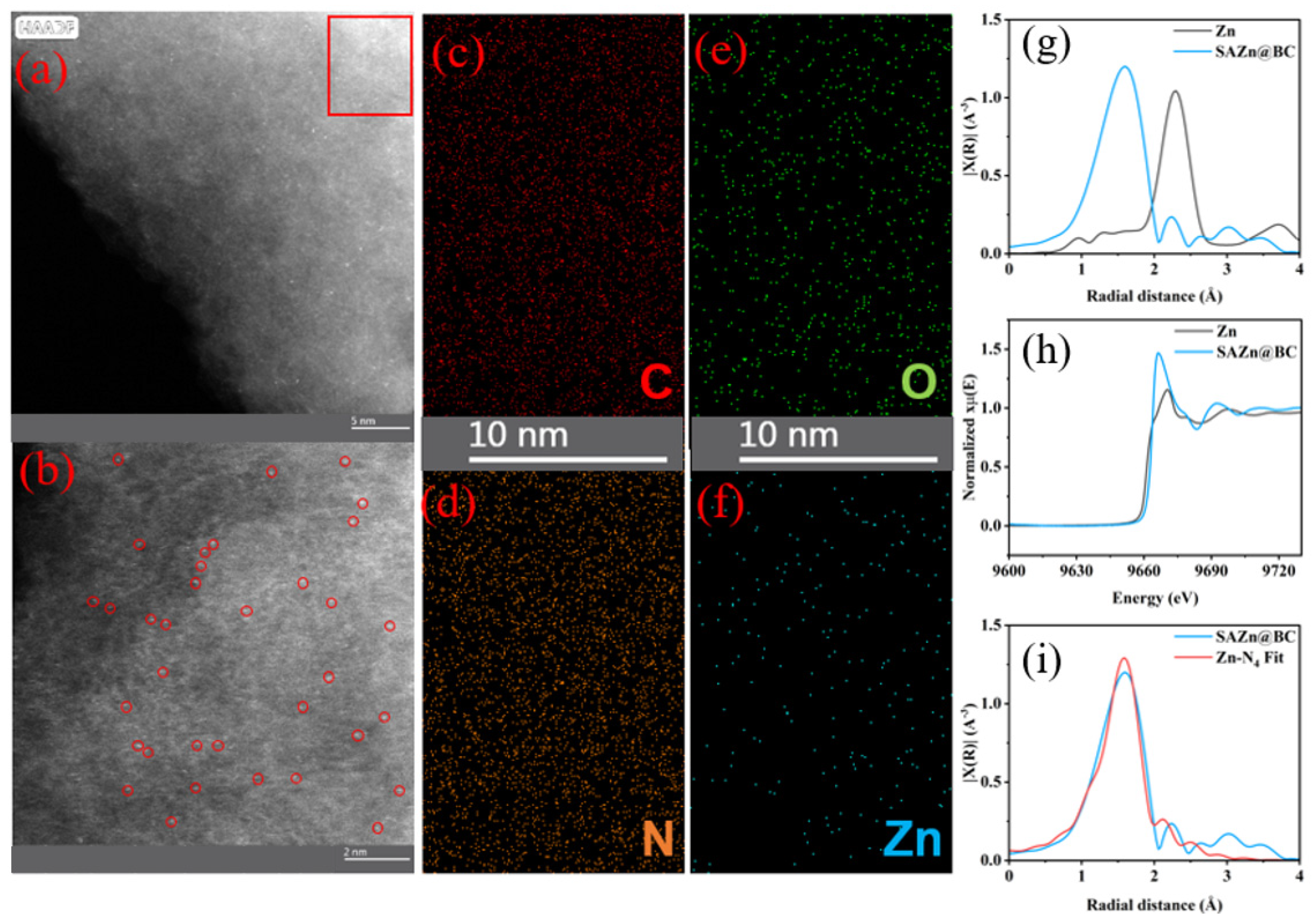
3.1. Catalyst Characterizations
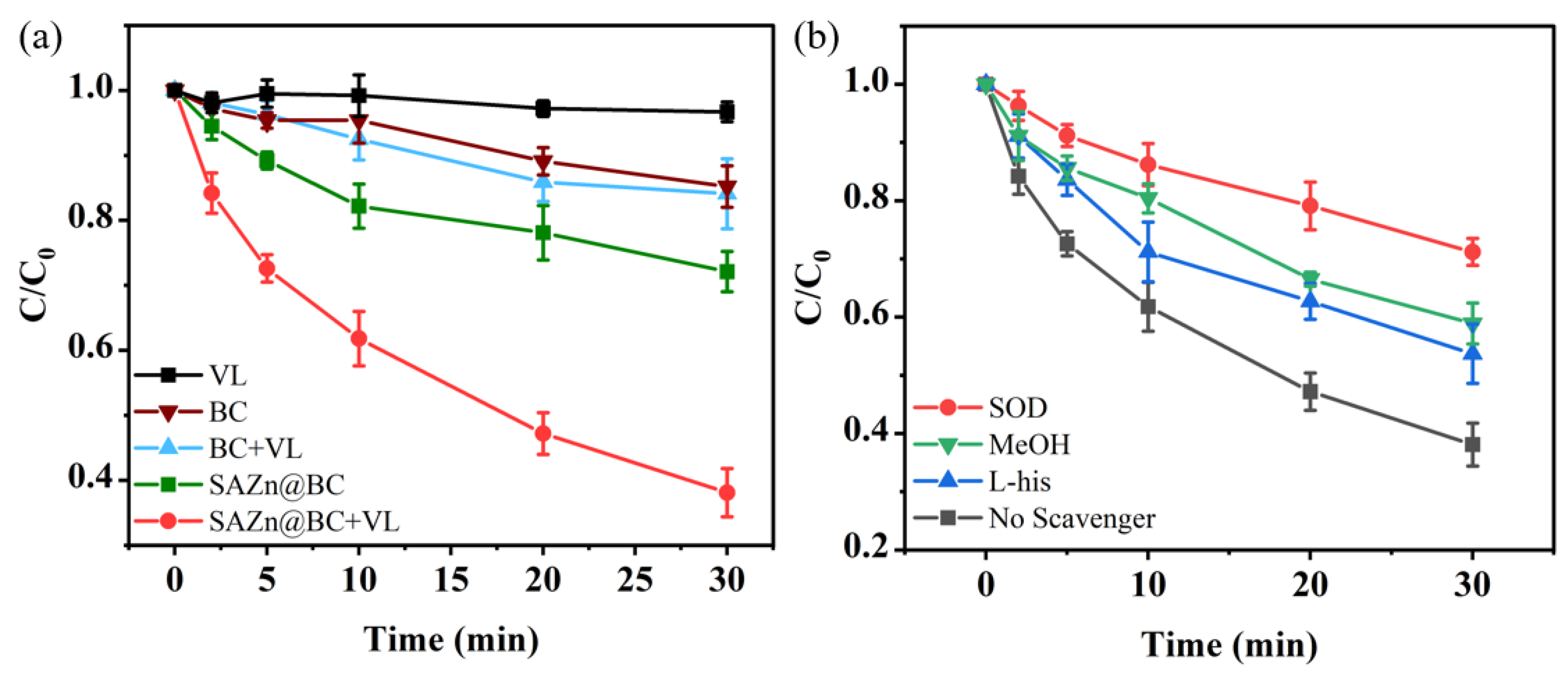
3.2. Degradation of TMP by SAZn@BC Catalyst and Quenching Test
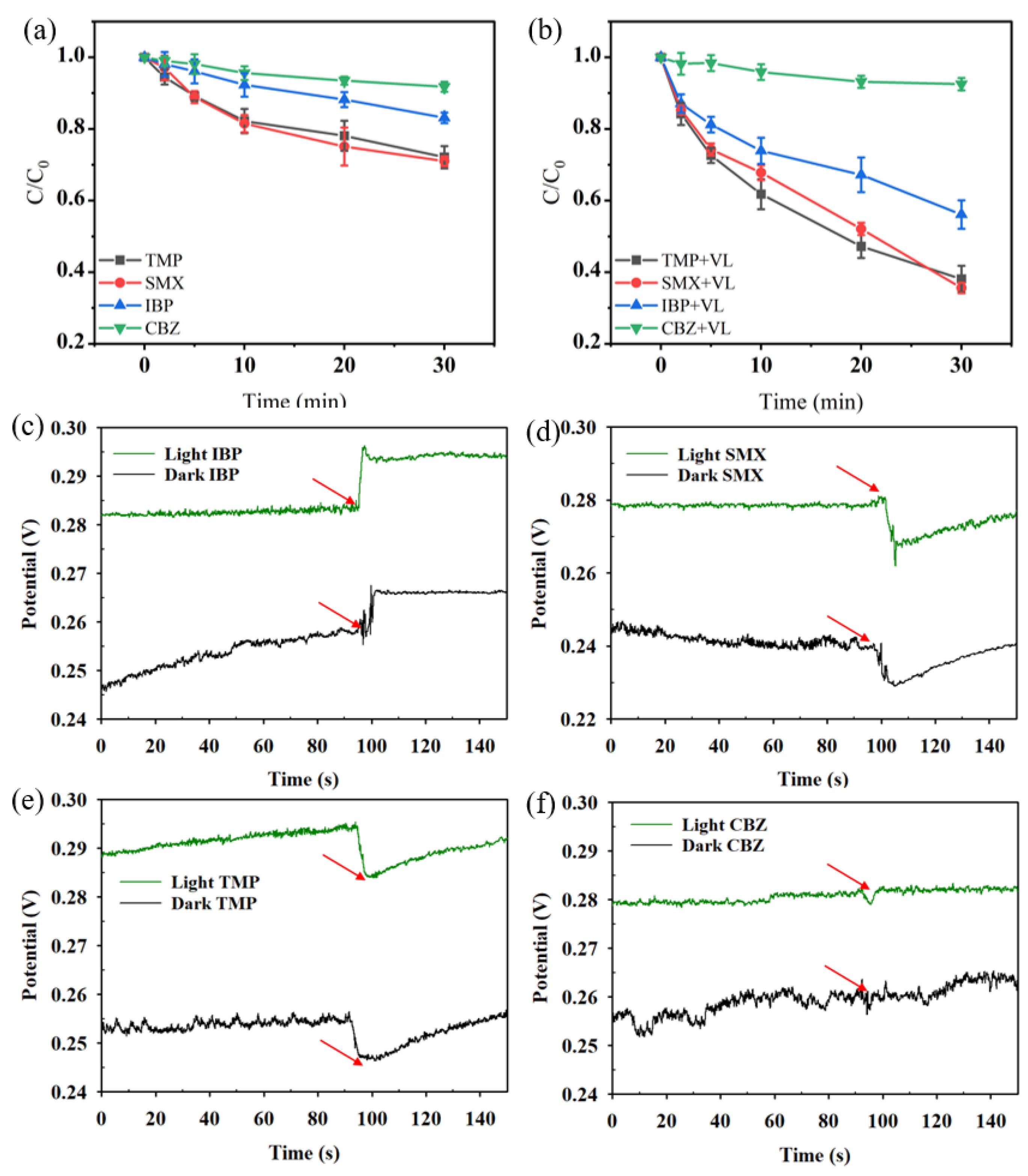
3.3. Degradation of Pharmaceuticals by SAZn@BC and Direct Electron Transfer
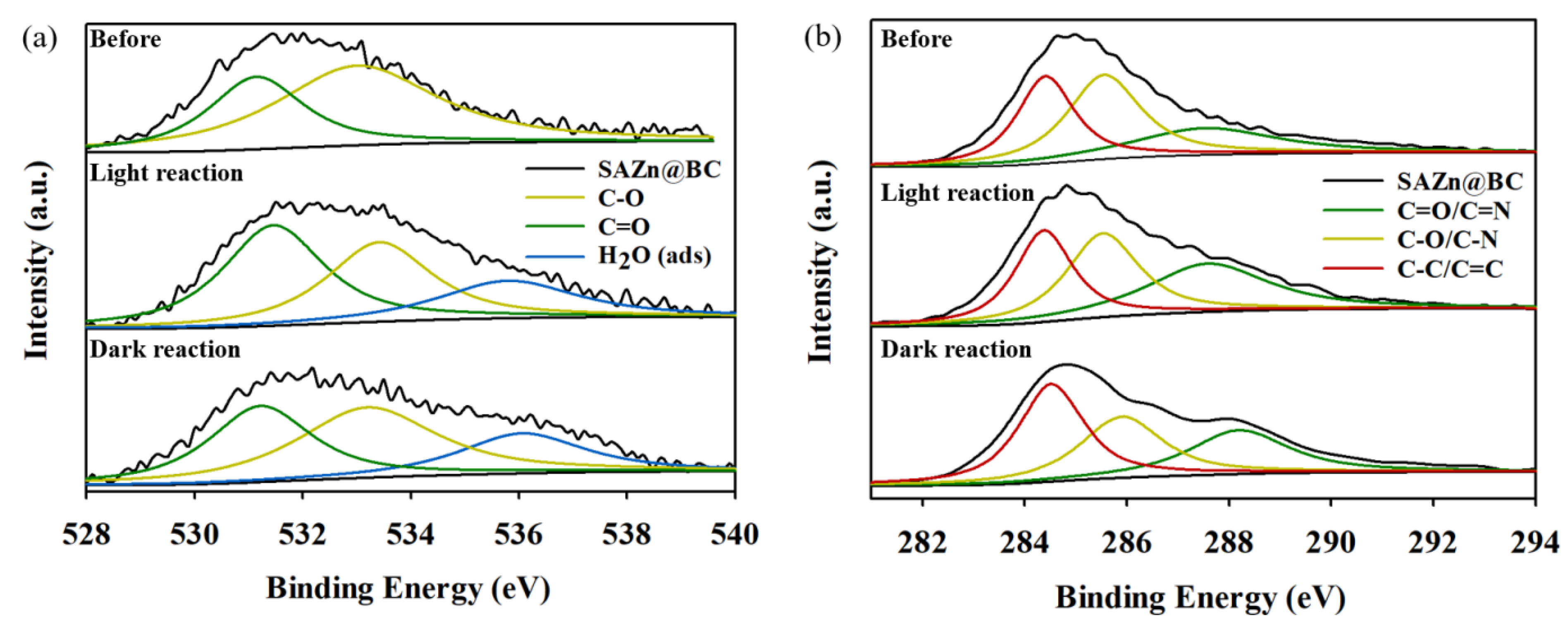
3.4. The Role of Oxygen Functional Groups
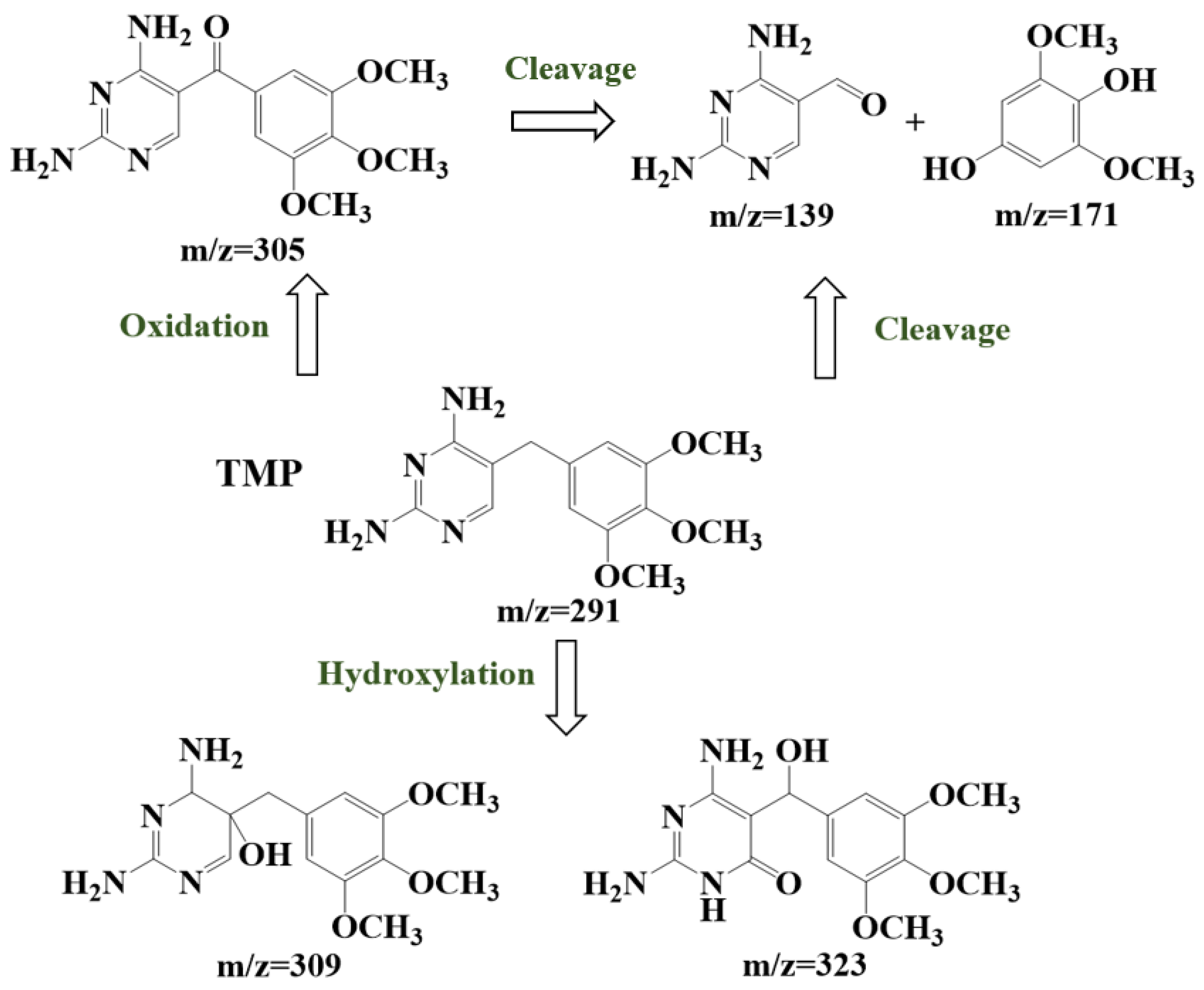
3.5. TMP Degradation Products
4. Conclusions
Supplementary Materials
Author Contributions
Funding
Data Availability Statement
Conflicts of Interest
References
- Ait-Kadi, M. Water for Development and Development for Water: Realizing the Sustainable Development Goals (SDGs) Vision. Aquat. Procedia 2016, 6, 106–110. [Google Scholar] [CrossRef]
- Arora, N.K.; Mishra, I. United Nations Sustainable Development Goals 2030 and Environmental Sustainability: Race against Time. Environ. Sustain. 2019, 2, 339–342. [Google Scholar] [CrossRef]
- Hoek van Dijke, A.J.; Herold, M.; Mallick, K.; Benedict, I.; Machwitz, M.; Schlerf, M.; Pranindita, A.; Theeuwen, J.J.E.; Bastin, J.-F.; Teuling, A.J. Shifts in Regional Water Availability Due to Global Tree Restoration. Nat. Geosci. 2022, 15, 363–368. [Google Scholar] [CrossRef]
- Alcamo, J. Water Quality and Its Interlinkages with the Sustainable Development Goals. Curr. Opin. Environ. Sustain. 2019, 36, 126–140. [Google Scholar] [CrossRef]
- Sharma, V.K.; Ma, X.; Zboril, R. Single Atom Catalyst-Mediated Generation of Reactive Species in Water Treatment. Chem. Soc. Rev. 2023, 52, 7673–7686. [Google Scholar] [CrossRef] [PubMed]
- Su, C.-Y.; Xu, Y.; Zhang, W.; Zhao, J.; Tang, X.; Tsai, C.-H.; Li, L.-J. Electrical and Spectroscopic Characterizations of Ultra-Large Reduced Graphene Oxide Monolayers. Chem. Mater. 2009, 21, 5674–5680. [Google Scholar] [CrossRef]
- Kovalakova, P.; Cizmas, L.; McDonald, T.J.; Marsalek, B.; Feng, M.; Sharma, V.K. Occurrence and Toxicity of Antibiotics in the Aquatic Environment: A Review. Chemosphere 2020, 251, 126351. [Google Scholar] [CrossRef]
- Muir, D.C.G.; Getzinger, G.J.; McBride, M.; Ferguson, P.L. How Many Chemicals in Commerce Have Been Analyzed in Environmental Media? A 50 Year Bibliometric Analysis. Environ. Sci. Technol. 2023, 57, 9119–9129. [Google Scholar] [CrossRef]
- Zou, H.; Wang, H.; Sun, H.; Sun, W.; Luo, S.; Li, T.; Duan, X.; Zhan, S. Single-Atom Cobalt Catalysts Encapsulating Cobalt Nanoparticles with Built-In Electric Field for Ultrafast and Lasting Peroxymonosulfate Activation. ACS EST Water 2024, 4, 2433–2444. [Google Scholar] [CrossRef]
- Cui, J.; Shao, S.; Gao, J.; Yang, Z.; Li, L.; Zeng, S.; Wang, K.; Cui, J.; Zhao, Y.; Hu, C. Efficient Single-Atom Fe-Catalyzed Fenton-like Reaction Involving Peroxymonosulfate for BPA Degradation by High-Valent Fe (IV)=O. ACS EST Water 2022, 2, 2698–2705. [Google Scholar] [CrossRef]
- Sohn, S.; Kim, M.-K.; Lee, Y.-M.; Sohn, E.J.; Choi, G.Y.; Chae, S.-H.; Zoh, K.-D. Removal Characteristics of 53 Micropollutants during Ozonation, Chlorination, and UV/H2O2 Processes Used in Drinking Water Treatment Plant. Chemosphere 2024, 352, 141360. [Google Scholar] [CrossRef] [PubMed]
- Kaiser, S.K.; Chen, Z.; Faust Akl, D.; Mitchell, S.; Pérez-Ramírez, J. Single-Atom Catalysts across the Periodic Table. Chem. Rev. 2020, 120, 11703–11809. [Google Scholar] [CrossRef] [PubMed]
- Li, Z.; Ji, S.; Liu, Y.; Cao, X.; Tian, S.; Chen, Y.; Niu, Z.; Li, Y. Well-Defined Materials for Heterogeneous Catalysis: From Nanoparticles to Isolated Single-Atom Sites. Chem. Rev. 2019, 120, 623–682. [Google Scholar] [CrossRef] [PubMed]
- Yuan, J.; Wen, Y.; Dionysiou, D.D.; Sharma, V.K.; Ma, X. Biochar as a Novel Carbon-Negative Electron Source and Mediator: Electron Exchange Capacity (EEC) and Environmentally Persistent Free Radicals (EPFRs): A Review. Chem. Eng. J. 2021, 429, 132313. [Google Scholar] [CrossRef]
- Yuan, J.; Han, Y.; Sathiyan, K.; Sharma, V.K.; Mokarizadeh, A.H.; Tsige, M.; Jiang, J.; Ma, X. Elucidating Multiple Reaction Pathways for the Degradation of Antibiotics in Water by a Self-Active Single-Atom Zinc Catalyst on Biochar. RSC Sustain. 2023, 1, 2296–2304. [Google Scholar] [CrossRef]
- Xue, X.; Xue, N.; Ouyang, D.; Yang, L.; Wang, Y.; Zhu, H.; Aihemaiti, A.; Yin, J. Biochar-Based Single-Atom Catalyst with Fe-N3O-C Configuration for Efficient Degradation of Organic Dyes by Peroxymonosulfate Activation. ACS Appl. Mater. Interfaces 2023, 15, 57003–57014. [Google Scholar] [CrossRef]
- Li, Z.; Li, K.; Ma, S.; Dang, B.; Li, Y.; Fu, H.; Du, J.; Meng, Q. Activation of Peroxymonosulfate by Iron-Biochar Composites: Comparison of Nanoscale Fe with Single-Atom Fe. J. Colloid Interface Sci. 2021, 582, 598–609. [Google Scholar] [CrossRef]
- Agrawal, S.; Casanova, D.; Trivedi, D.J.; Prezhdo, O. V Enhanced Charge Separation in Single Atom Cobalt Based Graphitic Carbon Nitride: Time Domain Ab Initio Analysis. J. Phys. Chem. Lett. 2024, 15, 2202–2208. [Google Scholar] [CrossRef]
- Brunelle, L.D.; Batt, A.L.; Chao, A.; Glassmeyer, S.T.; Quinete, N.; Alvarez, D.A.; Kolpin, D.W.; Furlong, E.T.; Mills, M.A.; Aga, D.S. De Facto Water Reuse: Investigating the Fate and Transport of Chemicals of Emerging Concern from Wastewater Discharge through Drinking Water Treatment Using Non-Targeted Analysis and Suspect Screening. Environ. Sci. Technol. 2024, 58, 2468–2478. [Google Scholar] [CrossRef]
- Bell, J.; Wen, Y.; Ma, X.; McDonald, T.J.; Huang, C.-H.; Sharma, V.K. Interaction of Peracetic Acid with Chromium (III): Understanding Degradation of Coexisting Organic Pollutants in Water. J. Hazard. Mater. 2022, 438, 129537. [Google Scholar] [CrossRef]
- DiPippa, A.D.; Mou, X. Meta-Analysis of the Distribution of Pharmaceuticals and Personal Care Products in Natural Streams of United States and Its Correlations with Anthropogenic Factors. ACS EST Water 2024, 4, 427–435. [Google Scholar] [CrossRef]
- Goto, H.; Hanada, Y.; Ohno, T.; Matsumura, M. Quantitative Analysis of Superoxide Ion and Hydrogen Peroxide Produced from Molecular Oxygen on Photoirradiated TiO2 Particles. J. Catal. 2004, 225, 223–229. [Google Scholar] [CrossRef]
- Yang, F.; Song, P.; Liu, X.; Mei, B.; Xing, W.; Jiang, Z.; Gu, L.; Xu, W. Highly Efficient CO2 Electroreduction on ZnN4-based Single-atom Catalyst. Angew. Chem. Int. Ed. 2018, 57, 12303–12307. [Google Scholar] [CrossRef] [PubMed]
- Han, L.; Song, S.; Liu, M.; Yao, S.; Liang, Z.; Cheng, H.; Ren, Z.; Liu, W.; Lin, R.; Qi, G. Stable and Efficient Single-Atom Zn Catalyst for CO2 Reduction to CH4. J. Am. Chem. Soc. 2020, 142, 12563–12567. [Google Scholar] [CrossRef]
- Li, J.; Chen, S.; Yang, N.; Deng, M.; Ibraheem, S.; Deng, J.; Li, J.; Li, L.; Wei, Z. Ultrahigh-loading Zinc Single-atom Catalyst for Highly Efficient Oxygen Reduction in Both Acidic and Alkaline Media. Angew. Chem. Int. Ed. 2019, 58, 7035–7039. [Google Scholar] [CrossRef]
- Gaya, U.I.; Abdullah, A.H. Heterogeneous Photocatalytic Degradation of Organic Contaminants over Titanium Dioxide: A Review of Fundamentals, Progress and Problems. J. Photochem. Photobiol. C Photochem. Rev. 2008, 9, 1–12. [Google Scholar] [CrossRef]
- Lee, K.M.; Lai, C.W.; Ngai, K.S.; Juan, J.C. Recent Developments of Zinc Oxide Based Photocatalyst in Water Treatment Technology: A Review. Water Res. 2016, 88, 428–448. [Google Scholar] [CrossRef]
- Lu, Y.; Cai, Y.; Zhang, S.; Zhuang, L.; Hu, B.; Wang, S.; Chen, J.; Wang, X. Application of Biochar-Based Photocatalysts for Adsorption-(Photo) Degradation/Reduction of Environmental Contaminants: Mechanism, Challenges and Perspective. Biochar 2022, 4, 45. [Google Scholar] [CrossRef]
- Ma, J.; Wei, Z.; Spinney, R.; Dionysiou, D.D.; Xiao, R. Emerging Investigator Series: Could the Superoxide Radical Be Implemented in Decontamination Processes? Environ. Sci. 2021, 7, 1966–1970. [Google Scholar] [CrossRef]
- Wen, Y.; Huang, C.-H.; Ashley, D.C.; Meyerstein, D.; Dionysiou, D.D.; Sharma, V.K.; Ma, X. Visible Light-Induced Catalyst-Free Activation of Peroxydisulfate: Pollutant-Dependent Production of Reactive Species. Environ. Sci. Technol. 2022, 56, 2626–2636. [Google Scholar] [CrossRef]
- Bui, T.X.; Choi, H. Comment on “Adsorption and Desorption of Oxytetracycline and Carbamazepine by Multiwalled Carbon Nanotubes”. Environ. Sci. Technol. 2010, 44, 4828. [Google Scholar] [CrossRef] [PubMed]
- Iovino, P.; Chianese, S.; Canzano, S.; Prisciandaro, M.; Musmarra, D. Ibuprofen Photodegradation in Aqueous Solutions. Environ. Sci. Pollut. Res. 2016, 23, 22993–23004. [Google Scholar] [CrossRef] [PubMed]
- Hai, F.I.; Yang, S.; Asif, M.B.; Sencadas, V.; Shawkat, S.; Sanderson-Smith, M.; Gorman, J.; Xu, Z.-Q.; Yamamoto, K. Carbamazepine as a Possible Anthropogenic Marker in Water: Occurrences, Toxicological Effects, Regulations and Removal by Wastewater Treatment Technologies. Water 2018, 10, 107. [Google Scholar] [CrossRef]
- Wang, C.; Zhan, Z.; Liu, H.; Li, Y.; Wu, J.; Sun, P.; Shen, G. Single-Atom Iron Cocatalyst for Highly Enhancing TiO2 Photocatalytic Degradation of Antibiotics and Antibiotic-Resistant Genes. Chem. Eng. J. 2024, 482, 148906. [Google Scholar] [CrossRef]
- Song, Y.; Qi, J.; Tian, J.; Gao, S.; Cui, F. Construction of Ag/g-C3N4 Photocatalysts with Visible-Light Photocatalytic Activity for Sulfamethoxazole Degradation. Chem. Eng. J. 2018, 341, 547–555. [Google Scholar] [CrossRef]
- Tsiampalis, A.; Frontistis, Z.; Binas, V.; Kiriakidis, G.; Mantzavinos, D. Degradation of Sulfamethoxazole Using Iron-Doped Titania and Simulated Solar Radiation. Catalysts 2019, 9, 612. [Google Scholar] [CrossRef]
- Mirzaei, A.; Chen, Z.; Haghighat, F.; Yerushalmi, L. Hierarchical Magnetic Petal-like Fe3O4-ZnO@ g-C3N4 for Removal of Sulfamethoxazole, Suppression of Photocorrosion, by-Products Identification and Toxicity Assessment. Chemosphere 2018, 205, 463–474. [Google Scholar] [CrossRef]
- Mirzaei, A.; Yerushalmi, L.; Chen, Z.; Haghighat, F. Photocatalytic Degradation of Sulfamethoxazole by Hierarchical Magnetic ZnO@ G-C3N4: RSM Optimization, Kinetic Study, Reaction Pathway and Toxicity Evaluation. J. Hazard. Mater. 2018, 359, 516–526. [Google Scholar] [CrossRef]
- Zhou, L.; Zhang, W.; Chen, L.; Deng, H. Z-Scheme Mechanism of Photogenerated Carriers for Hybrid Photocatalyst Ag3PO4/g-C3N4 in Degradation of Sulfamethoxazole. J. Colloid Interface Sci. 2017, 487, 410–417. [Google Scholar] [CrossRef]
- Tomara, T.; Frontistis, Z.; Petala, A.; Mantzavinos, D. Photocatalytic Performance of Ag2O towards Sulfamethoxazole Degradation in Environmental Samples. J. Environ. Chem. Eng. 2019, 7, 103177. [Google Scholar] [CrossRef]
- Chen, J.; Hu, J.; Lin, Y.; Liu, X.; Liang, J.; Zhang, K.; Jiang, B.; Luo, H.; Li, L.; An, X. Visible Light-Driven Cl-g-C3N4 Activated Peroxydisulfate Process for TMP Efficient Degradation in a Wide PH Range. J. Water Process Eng. 2024, 59, 105056. [Google Scholar] [CrossRef]
- Malefane, M.E.; Feleni, U.; Mafa, P.J.; Kuvarega, A.T. Fabrication of Direct Z-Scheme Co3O4/BiOI for Ibuprofen and Trimethoprim Degradation under Visible Light Irradiation. Appl. Surf. Sci. 2020, 514, 145940. [Google Scholar] [CrossRef]
- Pan, B.; Liao, M.; Zhao, Y.; Lv, Y.; Qin, J.; Sharma, V.K.; Wang, C. Visible Light Activation of Ferrate (VI) by Oxygen Doped ZnIn2S4/Black Phosphorus Nanolayered Heterostructure: Accelerated Oxidation of Trimethoprim. J. Hazard. Mater. 2023, 460, 132413. [Google Scholar] [CrossRef] [PubMed]
- Jiang, N.; Xu, H.; Wang, L.; Jiang, J.; Zhang, T. Nonradical Oxidation of Pollutants with Single-Atom-Fe (III)-Activated Persulfate: Fe (V) Being the Possible Intermediate Oxidant. Environ. Sci. Technol. 2020, 54, 14057–14065. [Google Scholar] [CrossRef]
- Li, Y.; Yang, T.; Qiu, S.; Lin, W.; Yan, J.; Fan, S.; Zhou, Q. Uniform N-Coordinated Single-Atomic Iron Sites Dispersed in Porous Carbon Framework to Activate PMS for Efficient BPA Degradation via High-Valent Iron-Oxo Species. Chem. Eng. J. 2020, 389, 124382. [Google Scholar] [CrossRef]
- Peng, X.; Wu, J.; Zhao, Z.; Wang, X.; Dai, H.; Wei, Y.; Xu, G.; Hu, F. Activation of Peroxymonosulfate by Single Atom Co-NC Catalysts for High-Efficient Removal of Chloroquine Phosphate via Non-Radical Pathways: Electron-Transfer Mechanism. Chem. Eng. J. 2022, 429, 132245. [Google Scholar] [CrossRef]
- Xu, H.; Jiang, N.; Wang, D.; Wang, L.; Song, Y.; Chen, Z.; Ma, J.; Zhang, T. Improving PMS Oxidation of Organic Pollutants by Single Cobalt Atom Catalyst through Hybrid Radical and Non-Radical Pathways. Appl. Catal. B 2020, 263, 118350. [Google Scholar] [CrossRef]
- Yang, T.; Fan, S.; Li, Y.; Zhou, Q. Fe-N/C Single-Atom Catalysts with High Density of Fe-Nx Sites toward Peroxymonosulfate Activation for High-Efficient Oxidation of Bisphenol A: Electron-Transfer Mechanism. Chem. Eng. J. 2021, 419, 129590. [Google Scholar] [CrossRef]
- Ren, W.; Nie, G.; Zhou, P.; Zhang, H.; Duan, X.; Wang, S. The Intrinsic Nature of Persulfate Activation and N-Doping in Carbocatalysis. Environ. Sci. Technol. 2020, 54, 6438–6447. [Google Scholar] [CrossRef]
- Mekassa, B.; Tessema, M.; Chandravanshi, B.S.; Tefera, M. Square Wave Voltammetric Determination of Ibuprofen at Poly (l-Aspartic Acid) Modified Glassy Carbon Electrode. IEEE Sens. J. 2017, 18, 37–44. [Google Scholar] [CrossRef]
- Arvand, M.; Ansari, R.; Heydari, L. Electrocatalytic Oxidation and Differential Pulse Voltammetric Determination of Sulfamethoxazole Using Carbon Nanotube Paste Electrode. Mater. Sci. Eng. C 2011, 31, 1819–1825. [Google Scholar] [CrossRef]
- da Silva, H.; Pacheco, J.G.; Magalhães, J.M.C.S.; Viswanathan, S.; Delerue-Matos, C. MIP-Graphene-Modified Glassy Carbon Electrode for the Determination of Trimethoprim. Biosens. Bioelectron. 2014, 52, 56–61. [Google Scholar] [CrossRef] [PubMed]
- Wang, H.; Zhang, M.; Ma, Y.; Wang, B.; Shao, M.; Huang, H.; Liu, Y.; Kang, Z. Selective Inactivation of Gram-Negative Bacteria by Carbon Dots Derived from Natural Biomass: Artemisia Argyi Leaves. J. Mater. Chem. B 2020, 8, 2666–2672. [Google Scholar] [CrossRef] [PubMed]
- Chen, Z.; Zhao, J.; Cabrera, C.R.; Chen, Z. Computational Screening of Efficient Single-atom Catalysts Based on Graphitic Carbon Nitride (G-C3N4) for Nitrogen Electroreduction. Small Methods 2019, 3, 1800368. [Google Scholar] [CrossRef]
- An, S.; Zhang, G.; Wang, T.; Zhang, W.; Li, K.; Song, C.; Miller, J.T.; Miao, S.; Wang, J.; Guo, X. High-Density Ultra-Small Clusters and Single-Atom Fe Sites Embedded in Graphitic Carbon Nitride (g-C3N4) for Highly Efficient Catalytic Advanced Oxidation Processes. ACS Nano 2018, 12, 9441–9450. [Google Scholar] [CrossRef]
- Sirtori, C.; Agüera, A.; Gernjak, W.; Malato, S. Effect of Water-Matrix Composition on Trimethoprim Solar Photodegradation Kinetics and Pathways. Water Res. 2010, 44, 2735–2744. [Google Scholar] [CrossRef]
- Fan, G.; Ning, R.; Yan, Z.; Luo, J.; Du, B.; Zhan, J.; Liu, L.; Zhang, J. Double Photoelectron-Transfer Mechanism in Ag−AgCl/WO3/g-C3N4 Photocatalyst with Enhanced Visible-Light Photocatalytic Activity for Trimethoprim Degradation. J. Hazard. Mater. 2021, 403, 123964. [Google Scholar] [CrossRef]
- Luo, X.; Zheng, Z.; Greaves, J.; Cooper, W.J.; Song, W. Trimethoprim: Kinetic and Mechanistic Considerations in Photochemical Environmental Fate and AOP Treatment. Water Res. 2012, 46, 1327–1336. [Google Scholar] [CrossRef]
- Cai, Q.; Hu, J. Decomposition of Sulfamethoxazole and Trimethoprim by Continuous UVA/LED/TiO2 Photocatalysis: Decomposition Pathways, Residual Antibacterial Activity and Toxicity. J. Hazard. Mater. 2017, 323, 527–536. [Google Scholar] [CrossRef]
- Cai, Z.; Song, Y.; Jin, X.; Wang, C.-C.; Ji, H.; Liu, W.; Sun, X. Highly Efficient AgBr/h-MoO3 with Charge Separation Tuning for Photocatalytic Degradation of Trimethoprim: Mechanism Insight and Toxicity Assessment. Sci. Total Environ. 2021, 781, 146754. [Google Scholar] [CrossRef]


Disclaimer/Publisher’s Note: The statements, opinions and data contained in all publications are solely those of the individual author(s) and contributor(s) and not of MDPI and/or the editor(s). MDPI and/or the editor(s) disclaim responsibility for any injury to people or property resulting from any ideas, methods, instructions or products referred to in the content. |
© 2026 by the authors. Licensee MDPI, Basel, Switzerland. This article is an open access article distributed under the terms and conditions of the Creative Commons Attribution (CC BY) license.
Share and Cite
Zhang, Z.; Li, C.; Yuan, J.; He, Z.; Wu, C.; Yang, W. Visible Light Modulating Abatement of Pharmaceuticals in Water by Zinc Single-Atom Catalyst on Biochar Support. Water 2026, 18, 313. https://doi.org/10.3390/w18030313
Zhang Z, Li C, Yuan J, He Z, Wu C, Yang W. Visible Light Modulating Abatement of Pharmaceuticals in Water by Zinc Single-Atom Catalyst on Biochar Support. Water. 2026; 18(3):313. https://doi.org/10.3390/w18030313
Chicago/Turabian StyleZhang, Zhiyuan, Cong Li, Jieming Yuan, Zhengming He, Chengzhang Wu, and Wanning Yang. 2026. "Visible Light Modulating Abatement of Pharmaceuticals in Water by Zinc Single-Atom Catalyst on Biochar Support" Water 18, no. 3: 313. https://doi.org/10.3390/w18030313
APA StyleZhang, Z., Li, C., Yuan, J., He, Z., Wu, C., & Yang, W. (2026). Visible Light Modulating Abatement of Pharmaceuticals in Water by Zinc Single-Atom Catalyst on Biochar Support. Water, 18(3), 313. https://doi.org/10.3390/w18030313