Beyond ‘Business as Usual’: A Research Agenda for the Operationalisation of Nature-Based Solutions in Flood Risk Management in The Netherlands



Abstract
1. Introduction
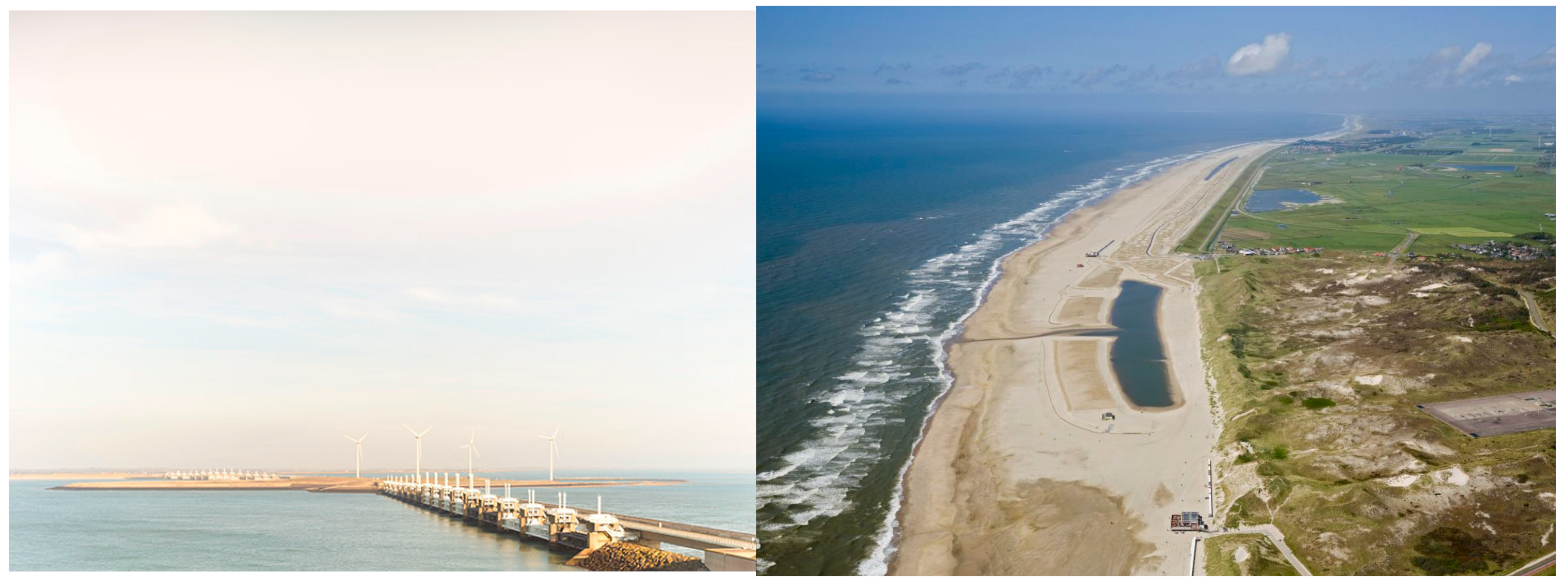
1.1. ‘Business as Usual’ in Dutch Flood Risk Management
1.2. Benefits of Mainstreaming Nature-Based Solutions to Flood Risk Management in The Netherlands
‘actions to protect, sustainably manage, and restore natural and modified ecosystems that address societal challenges effectively and adaptively, simultaneously providing human well-being and biodiversity benefits’ [27].
‘solutions that are inspired and supported by nature, that are cost-effective, and that simultaneously provide environmental, social and economic benefits and help build resilience’… Nature-based solutions need to therefore benefit biodiversity and support the delivery of a range of ecosystem services [28].
Which knowledge gaps hinder the operationalisation of NBSs in Dutch FRM, and what further research is required to address them?
2. Methodology
3. Results: Barriers to the Operationalisation of NBSs in Dutch FRM and the Research Required to Address Them
- A.
- Assessment of the adequacy of prevailing law and policy for the further operationalisation and mainstreaming of NBSs in Dutch FRM
- B.
- Insight into appropriate incentive structures that may trigger public actors to move beyond a preference for the ‘business-as-usual’ approach to FRM
- C.
- Clear requirements for coordination across the highly fragmented departments that will be required to operationalise NBSs
- D.
- Solutions to overcome the limitation that private land ownership poses in obtaining the additional space required to implement NBSs in FRM in The Netherlands
- E.
- Need for a clear toolbox for policy makers of the various NBS options available and in what physical and geographic contexts these may be applied
- F.
- Clarity on the long-term cost-effectiveness of NBS for FRM
- G.
- Deeper investigation into the social dimension of NBSs for FRM
4. Discussion: Charting the Course to Mainstreaming Nature-Based Solutions in Flood Risk Management in the Dutch Context and Beyond
5. Conclusions
Author Contributions
Funding
Data Availability Statement
Conflicts of Interest
Appendix A. Literature Included in Semi-Structured Literature Review
| Aloscious, A.A.; Artuso, M.; Moghadam, S.T. Nature-Based Solutions for Flood Mitigation: The Case Study of Kochi. Sustainability 2025, 17, 1983. |
| Anderson, C.C.; Renaud, F.G. A Review of Public Acceptance of Nature-Based Solutions: The ‘Why’, ‘When’, and ‘How’ of Success for Disaster Risk Reduction Measures. AMBIO 2021, 50, 1552–1573. https://doi.org/10.1007/s13280-021-01502-4. |
| Anderson, C.C.; Renaud, F.G.; Hanscomb, S.; Munro, K.E.; Gonzalez-Ollauri, A.; Thomson, C.S.; Pouta, E.; Soini, K.; Loupis, M.; Panga, D.; et al. Public Acceptance of Nature-Based Solutions for Natural Hazard Risk Reduction: Survey Findings from Three Study Sites in Europe. Front. Environ. Sci. 2021, 9, 678938. https://doi.org/10.3389/fenvs.2021.678938. |
| Apine, E.; Stojanovic, T. Is the Coastal Future Green, Grey or Hybrid? Diverse Perspectives on Coastal Flood Risk Management and Adaptation in the UK. Camb. Prism. Coast. Futur. 2024, 2, 1–34. |
| Berg, M.; Spray, C.J.; Blom, A.; Slinger, J.H.; Stancanelli, L.M.; Snoek, Y.; Schielen, R.M. Assessing the IUCN global Standard for Nature-Based Solutions in Riverine Flood Risk Mitigation. Environ. Dev. 2024, 51, 101025. https://doi.org/10.1016/j.envdev.2024.101025. |
| Bogdzevič, K. Floods and Nature-Based Solutions. A Call for a Legal Approach. Curr. Opin. Environ. Sci. Heal. 2023, 36, 100521. https://doi.org/10.1016/j.coesh.2023.100521. |
| Bridges, T.S.; Jeffrey, K.K.; Jonathan, D.S.; Michael, W.B.; Georganna, C.; Quirijn, L.; Ram, K.M. International Guidelines on Natural and Nature-Based Features for Flood Risk Management; Special Report; Engineer Research and Development Center (USA): Vicksburg, MS, USA, 2021. Available online: https://hdl.handle.net/11681/41946 (accessed on 8 May 2025). |
| Capobianco, V.; Palau, R.M.; Solheim, A.; Gisnås, K.; Gilbert, G.; Danielsson, P.; van der Keur, P. The Potential Use of Nature-Based Solutions as Natural Hazard Mitigation Measure for Linear Infrastructure in the Nordic Countries. Geoenvironmental Disasters 2024, 11, 27. https://doi.org/10.1186/s40677-024-00287-4. |
| Chappell, N.A.; Beven, K.J. Nature-Based Solutions for Effective Flood Mitigation: Potential Design Criteria. Environ. Res. Lett. 2024, 19, 074006. https://doi.org/10.1088/1748-9326/ad4fa2. |
| Christopher, N.; Vachette, A.; Horne, A.; Kosovac, A. Enhancing River Floodplain Management with Nature-Based Solutions: Overcoming Barriers and Harnessing Enablers. WIREs Water 2024, 11, e1723. https://doi.org/10.1002/wat2.1723. |
| Cohen-Shacham, E.; Walters, G.; Janzen, C.; Maginnis, S. (Eds.) Nature-Based Solutions to Address Global Societal Challenges; IUCN: Gland, Switzerland, 2016. https://doi.org/10.2305/IUCN.CH.2016.13.en. |
| Cohen-Shacham, E.; Andrade, A.; Dalton, J.; Dudley, N.; Jones, M.; Kumar, C.; Maginnis, S.; Maynard, S.; Nelson, C.R.; Renaud, F.G.; et al. Core Principles for Successfully Implementing and Upscaling Nature-Based Solutions. Environ. Sci. Policy 2019, 98, 20–29. https://doi.org/10.1016/j.envsci.2019.04.014. |
| Dang, N.A.; Benavidez, R.; Tomscha, S.A.; Nguyen, H.; Tran, D.D.; Nguyen, D.T.H.; Loc, H.H.; Jackson, B.M. Ecosystem Service Modelling to Support Nature-Based Flood Water Management in the Vietnamese Mekong River Delta. Sustainability 2021, 13, 13549. https://doi.org/10.3390/su132413549. |
| Davis, M.; Naumann, S. Making the Case for Sustainable Urban Drainage Systems as a Nature-Based Solution to Urban Flooding. In Nature-Based Solutions to Climate Change Adaptation in Urban Areas: Linkages between Science, Policy and Practice; Kabisch, N., Korn, H., Stadler, J., Bonn, A., Eds.; Springer International Publishing: Cham, Switzerland, 2017. https://doi.org/10.1007/978-3-319-56091-5_8. |
| De Knegt, B.; Breman, B.C.; Le Clec’H, S.; Van Hinsberg, A.; Lof, M.E.; Pouwels, R.; Roelofsen, H.D.; Alkemade, R. Exploring the Contribution of Nature-Based Solutions for Environmental Challenges in The Netherlands. Sci. Total. Environ. 2024, 929, 172186. https://doi.org/10.1016/j.scitotenv.2024.172186. |
| Asitha, D.S.; Amaratunga, D.; Haigh, R. Green and Blue Infrastructure as Nature-Based Better Preparedness Solutions for Disaster Risk Reduction: Key Policy Aspects. Sustainability 2022, 14, 16155. |
| Inge, D.; Fantini, E. Nature Based Solution for Flood Control in The Netherlands. Socialising Water or Naturifying Society? Rass. Ital. Di Sociol. 2020, 61, 253–278. https://doi.org/10.1423/97800. |
| van Doorn-Hoekveld, W.J.; Gilissen, H.K.; Groothuijse, F.A.G.; van Rijswick, H.F.M.W. Adaptation to Climate Change in Dutch Flood Risk Management: Innovative Approaches and Related Challenges. Utrecht Law Rev. 2022, 18, 51–69. https://doi.org/10.36633/ulr.860. |
| Willemijn van, D.H. Distributional Effects of EU Flood Risk Management and the Law; The Netherlands, Flanders and France as Case Studies; Utrecht University: Utrecht, The Netherlands, 2018. |
| van Doornik, T.J.; Jung, M.P.; van Loon-Steensma, J.M. Finding Common Ground: A Comparison Between Coastal Nature-Based Solutions in The Netherlands and British Columbia, Canada. Nature-Based Solutions 2024, 6, 100173. https://doi.org/10.1016/j.nbsj.2024.100173. |
| Driessen, P.P.J.; Hegger, D.L.T.; Kundzewicz, Z.W.; Van Rijswick, H.F.M.W.; Crabbé, A.; Larrue, C.; Matczak, P.; Pettersson, M.; Priest, S.; Suykens, C.; et al. Governance Strategies for Improving Flood Resilience in the Face of Climate Change. Water 2018, 10, 1595. https://doi.org/10.3390/w10111595. |
| Dubois, E.; Cherif, S.M.A.; Abidine, M.M.; Bah, M.F.O.; Chenal, J.; Marshall, M.; Oumarou, W.; Grossiord, C.; Perona, P. Nature-Based Solution Enhances Resilience to Flooding and Catalyzes Multi-Benefits in Coastal Cities in the Global South. Sci. Total. Environ. 2024, 928, 172282. |
| Egegård, C.H.; Lindborg, M.; Gren, Å.; Marcus, L.; Pont, M.B.; Colding, J. Climate Proofing Cities by Navigating Nature-Based Solutions in a Multi-Scale, Social–Ecological Urban Planning Context: A Case Study of Flood Protection in the City of Gothenburg, Sweden. Land 2024, 13, 143. https://doi.org/10.3390/land13020143. |
| Sarabi, S.E.; Han, Q.; Romme, A.G.L.; de Vries, B.; Wendling, L. Key Enablers of and Barriers to the Uptake and Implementation of Nature-Based Solutions in Urban Settings: A Review. Resources 2019, 8, 121. https://doi.org/10.3390/resources8030121. |
| Ferreira, C.S.S.; Potočki, K.; Kapović-Solomun, M.; Kalantari, Z. Nature-Based Solutions for Flood Mitigation and Resilience in Urban Areas. In Nature-Based Solutions for Flood Mitigation: Environmental and Socio-Economic Aspects; Carla, S.S., Ferreira, Z.K., Thomas, H., Paulo, P., Eds.; Springer International Publishing: Cham, Switzerland, 2022; pp. 59–78. https://doi.org/10.1007/698_2021_758. |
| S.Ferreira, C.; Mourato, S.; Kasanin-Grubin, M.; Ferreira, A.J.; Destouni, G.; Kalantari, Z. Effectiveness of Nature-Based Solutions in Mitigating Flood Hazard in a Mediterranean Peri-Urban Catchment. Water 2020, 12, 2893. |
| Gain, A.K.; Rahman, M.M.; Sadik, S.; Adnan, M.S.G.; Ahmad, S.; Ahsan, S.M.M.; Rahman, A.U.; Balke, T.; Datta, D.K.; Dewan, C.; et al. Overcoming Challenges for Implementing Nature-Based Solutions in Deltaic Environments: Insights from the Ganges-Brahmaputra Delta in Bangladesh. Environ. Res. Lett. 2022, 17, 064052. https://doi.org/10.1088/1748-9326/ac740a. |
| Ghosh, P.; Sudarsan, J.S.; Nithiyanantham, S. Nature-Based Disaster Risk Reduction of Floods in Urban Areas. Water Resour. Manag. 2024, 38, 1847–1866. https://doi.org/10.1007/s11269-024-03757-4. |
| Griffiths, J.; Borne, K.E.; Semadeni-Davies, A.; Tanner, C.C. Selection, Planning, and Modelling of Nature-Based Solutions for Flood Mitigation. Water 2024, 16, 2802. |
| Han, S.; Kuhlicke, C. Barriers and Drivers for Mainstreaming Nature-Based Solutions for Flood Risks: The Case of Sout Korea. Int. J. Disaster Risk Sci. 2021, 12, 661–672. https://doi.org/10.1007/s13753-021-00372-4. |
| Hankin, B.; Page, T.; McShane, G.; Chappell, N.; Spray, C.; Black, A.; Comins, L. How Can We Plan Resilient Systems of Nature-Based Mitigation Measures in Larger Catchments for Flood Risk Reduction Now and in the Future? Water Secur. 2021, 13, 100091. |
| Hartmann, T.; Slavíková, L.; McCarthy, S. Nature-Based Solutions in Flood Risk Management. In Nature-Based Flood Risk Management on Private Land: Disciplinary Perspectives on a Multidisciplinary Challenge; Springer International Publishing: Cham, Switzerland, 2019; pp. 3–8 |
| Heijer, F.D.; Rijke, J.; Bosch-Rekveldt, M.; de Leeuw, A.; Barciela-Rial, M. Asset Management of Flood Defences as a Co-Production—An Analysis of Cooperation in Five Situations in The Netherlands. J. Flood Risk Manag. 2023, 16, e12909. https://doi.org/10.1111/jfr3.12909. |
| Hill, B.; Liang, Q.; Bosher, L.; Chen, H.; Nicholson, A. A Systematic Review of Natural Flood Management Modelling: Approaches, Limitations, and Potential Solutions. J. Flood Risk Manag. 2023, 16, e12899. https://doi.org/10.1111/jfr3.12899. |
| Howarth, M.; Smithwick, E.A.H.; McPhillips, L.; Mejia, A. Scaling Nature-Based Solutions for Fluvial Floods: A Worldwide Systematic Review. WIREs Water 2025, 12, e70011. https://doi.org/10.1002/wat2.70011. |
| Inácio, M.; Barboza, F.; Villoslada, M. The Protection of Coastal Lagoons as a Nature-Based Solution to Mitigate Coastal Floods. Curr. Opin. Environ. Sci. Heal. 2023, 34, 100491. |
| Kaufmann, M.; Wiering, M. Dilemmas of an Integrated Multi-Use Climate Adaptation Project in The Netherlands: The Oekense Beek. In Nature-Based Flood Risk Management on Private Land: Disciplinary Perspectives on a Multidisciplinary Challenge; Thomas, H., Lenka, S., Simon, M., Eds.; Springer International Publishing: Cham, Switzerland, 2019; pp. 193–207. https://doi.org/10.1007/978-3-030-23842-1_21. |
| Keech, D.; Clarke, L.; Short, C. Nature-Based Solutions in Flood Risk Management: Unlocking Spatial, Functional and Policy Perceptions Amongst Practitioners in South-West England. Nature-Based Solutions 2023, 4, 100096. |
| King, P.; Bark, R.H. From Local Solutions to Catchment-Wide Management: An Investigation of Upstream-Downstream Trade-Offs When Scaling out Nature-Based Flood Risk Management. Ecosyst. People 2024, 20, 2426716. https://doi.org/10.1080/26395916.2024.2426716. |
| Kok, S.; Bisaro, A.; de Bel, M.; Hinkel, J.; Bouwer, L.M. The Potential of Nature-Based Flood Defences to Leverage Public Investment in Coastal Adaptation: Cases from The Netherlands, Indonesia and Georgia. Ecol. Econ. 2021, 179, 106828. https://doi.org/10.1016/j.ecolecon.2020.106828. |
| Koning, J.; Boogaard, F.C. Mapping, Assessing, and Evaluating the Effectiveness of Urban Nature-Based Solutions to Climate Change Effects in The Netherlands. In Handbook of Nature-Based Solutions to Mitigation and Adaptation to Climate Change; Walter, L.F., Gustavo, J.N., Desalegn, Y.A., Eds.; Springer International Publishing: Cham, Switzerland, 2023; pp. 1–32. https://doi.org/10.1007/978-3-030-98067-2_104-1. |
| Koutsovili, E.I.; Tzoraki, O.; Kalli, A.A.; Provatas, S.; Gaganis, P. Participatory Approaches for Planning Nature-Based Solutions in Flood Vulnerable Landscapes. Environ. Sci. Policy 2023, 140, 12–23. https://doi.org/10.1016/j.envsci.2022.11.012. |
| Krauze, K.; Wagner, I. From Classical Water-Ecosystem Theories to Nature-Based Solutions—Contextualizing Nature-Based Solutions for Sustainable City. Sci. Total. Environ. 2019, 655, 697–706. https://doi.org/10.1016/j.scitotenv.2018.11.187. |
| Li, J.; Nassauer, J.I.; Webster, N.J. Landscape Elements Affect Public Perception of Nature-Based Solutions Managed by Smart Systems. Landsc. Urban Plan. 2022, 221, 104355. https://doi.org/10.1016/j.landurbplan.2022.104355. |
| Mabrouk, M.; Han, H.; Fan, C.; Abdrabo, K.I.; Shen, G.; Saber, M.; Kantoush, S.A.; Sumi, T. Assessing the Effectiveness of Nature-Based Solutions-Strengthened Urban Planning Mechanisms in Forming Flood-Resilient Cities. J. Environ. Manag. 2023, 344, 118260. https://doi.org/10.1016/j.jenvman.2023.118260. |
| Manes, S.; Vale, M.M.; Pires, A.P.F. Nature-Based Solutions Potential for Flood Risk Reduction Under Extreme Rainfall Events. AMBIO 2024, 53, 1168–1181. |
| Marino, M.; Baptist, M.J.; Alkharoubi, A.I.K.; Nasca, S.; Cavallaro, L.; Foti, E.; Musumeci, R.E. Nature-Based Solutions as Building Blocks for Coastal Flood Risk Reduction: A model-Based Ecosystem Service Assessment. Sci. Rep. 2025, 15, 12070. https://doi.org/10.1038/s41598-025-95230-4. |
| Markus-Michalczyk, H. Nature-Based Solutions for Flood Risk Reduction: North Sea Region, Flat Coasts and Estuaries. In SDGs in the European Region; Walter, L.F., Maria, A.P.D., Sara, M., Elizabeth, P., Alex, H., Eds; Springer International Publishing: Cham, Switzerland, 2023; pp. 367–388. https://doi.org/10.1007/978-3-031-17461-2_94. |
| Massenberg, J.R.; Toke, E.P. Nature-Based Solutions for Flood Risk Reduction; DCE—Danish Centre for Environment and Energy: Aarhus, Denmark, 2024. Available online: https://dce.au.dk/fileadmin/dce.au.dk/Udgivelser/Videnskabelige_rapporter_600-699/SR623.pdf (accessed on 22 May 2025) |
| van der Meulen, F.; Ijff, S.; van Zetten, R. Nature-Based Solutions for Coastal Adaptation Management, Concepts and Scope, an Overview. Nord. J. Bot. 2023, 2023, e3290. https://doi.org/10.1111/njb.03290. |
| Moraes, R.P.L.; Reguero, B.G.; Mazarrasa, I.; Ricker, M.; Juanes, J.A. Nature-Based Solutions in Coastal and Estuarine Areas of Europe. Front. Environ. Sci. 2022, 10, 829526. https://doi.org/10.3389/fenvs.2022.829526. |
| Oral, H.V.; Carvalho, P.; Gajewska, M.; Ursino, N.; Masi, F.; van Hullebusch, E.D.; Kazak, J.K.; Exposito, A.; Cipolletta, G.; Andersen, T.R.; et al. A Review of Nature-Based Solutions for Urban Water Management in European Circular Cities: A Critical Assessment Based on Case Studies and Literature. Blue-Green Syst. 2020, 2, 112–136. https://doi.org/10.2166/bgs.2020.932. |
| Pagano, A.; Pluchinotta, I.; Pengal, P.; Cokan, B.; Giordano, R. Engaging Stakeholders in the Assessment of NBS Effectiveness in Flood Risk Reduction: A Participatory System Dynamics Model for Benefits and Co-Benefits Evaluation. Sci. Total. Environ. 2019, 690, 543–555. https://doi.org/10.1016/j.scitotenv.2019.07.059. |
| Palinkas, C.M.; Orton, P.; Hummel, M.A.; Nardin, W.; Sutton-Grier, A.E.; Harris, L.; Gray, M.; Li, M.; Ball, D.; Burks-Copes, K.; et al. Innovations in Coastline Management with Natural and Nature-Based Features (NNBF): Lessons Learned from Three Case Studies. Front. Built Environ. 2022, 8, 814180. |
| Pontee, N.; Narayan, S.; Beck, M.W.; Hosking, A.H. Nature-Based Solutions: Lessons from around the World. Proc. Inst. Civ. Eng.-Marit. Eng. 2016, 169, 29–36. https://doi.org/10.1680/jmaen.15.00027. |
| Potočki, K.; Bekić, D.; Bonacci, O.; Kulić, T. Hydrological Aspects of Nature-Based Solutions in Flood Mitigation in the Danube River Basin in Croatia: Green vs. Grey Approach. In Nature-Based Solutions for Flood Mitigation: Environmental and Socio-Economic Aspects; Carla, S.S., Ferreira, A.K., Thomas, H., Paulo, P., Eds.; Springer International Publishing: Cham, Switzerland, 2022; pp. 263–288. https://doi.org/10.1007/698_2021_770. |
| Pugliese, F.; Caroppi, G.; Zingraff-Hamed, A.; Lupp, G.; Gerundo, C. Assessment of NBSs Effectiveness for Flood Risk Management: The Isar River Case Study. J. Water Supply: Res. Technol. 2022, 71, 42–61. |
| Quagliolo, C.; Roebeling, P.; Mendonça, R.; Pezzoli, A.; Comino, E. Integrating Biophysical and Economic Assessment: Review of Nature-Based Adaptation to Urban Flood Extremes. Urban Sci. 2022, 6, 53. https://doi.org/10.3390/urbansci6030053. |
| Radfar, S.; Mahmoudi, S.; Moftakhari, H.; Meckley, T.; Bilskie, M.V.; Collini, R.; Alizad, K.; Cherry, J.A.; Moradkhani, H. Nature-Based Solutions as Buffers Against Coastal Compound Flooding: Exploring Potential Framework for Process-Based Modeling of Hazard Mitigation. Sci. Total. Environ. 2024, 938, 173529. |
| Raška, P.; Bezak, N.; Ferreira, C.S.; Kalantari, Z.; Banasik, K.; Bertola, M.; Bourke, M.; Cerdà, A.; Davids, P.; de Brito, M.M.; et al. Identifying Barriers for Nature-Based Solutions in Flood Risk Management: An Interdisciplinary Overview Using Expert Community Approach. J. Environ. Manag. 2022, 310, 114725. |
| Bin Rosmadi, H.S.; Ahmed, M.F.; Bin Mokhtar, M.; Halder, B.; Scholz, M. Nature-Based Solutions (NbS) for Flood Management in Malaysia. Water 2024, 16, 3606. |
| Ruangpan, L.; Vojinovic, Z.; Di Sabatino, S.; Leo, L.S.; Capobianco, V.; Oen, A.M.P.; McClain, M.E.; Lopez-Gunn, E. Nature-Based Solutions for Hydro-Meteorological Risk Reduction: A State-of-the-Art Review of the Research Area. Nat. Hazards Earth Syst. Sci. 2020, 20, 243–270. https://doi.org/10.5194/nhess-20-243-2020. |
| Sánchez-García, C.; Corvacho-Ganahín, Ó.; Riu, A.S.; Francos, M. Nature-Based Solutions (NbSs) to Improve Flood Preparedness in Barcelona Metropolitan Area (Northeastern Spain). Hydrology 2024, 11, 213. https://doi.org/10.3390/hydrology11120213. |
| Santoro, S.; Pluchinotta, I.; Pagano, A.; Pengal, P.; Cokan, B.; Giordano, R. Assessing Stakeholders’ Risk Perception to promote Nature Based Solutions as Flood Protection Strategies: The Case of the Glinščica River (Slovenia). Sci. Total Environ. 2019, 655, 188–201. https://doi.org/10.1016/j.scitotenv.2018.11.116. |
| Seenath, A.; Mahadeo, S.M.R.; Catterson, J. Public Perceptions of Nature-Based Coastal Solutions in the UK. J. Environ. Manag. 2025, 373, 1–13. |
| Sherren, K.; Rahman, H.M.T.; Manuel, P.; Wells, E.; Rapaport, E.; van Proosdij, D. Reimagining Nature-Based Coastal Adaptation: A Nested Framework. J. Flood Risk Manag. 2024, 17, e13026. https://doi.org/10.1111/jfr3.13026. |
| Short, C.; Clarke, L.; Carnelli, F.; Uttley, C.; Smith, B. Capturing the Multiple Benefits Associated with Nature-Based Solutions: Lessons from a Natural Flood Management Project in the Cotswolds, UK. Land Degrad. Dev. 2019, 30, 241–252. https://doi.org/10.1002/ldr.3205. |
| Figlus, J.; Smith, J.M.; Tomiczek, T.; McFall, B.C. Natural and Nature-Based Features for Flood Risk Management; Frontiers Media SA: Lausanne, Switzerland, 2023. Available online: https://books.google.com/books?hl=en&lr=&id=V6W7EAAAQBAJ&oi=fnd&pg=PP1&dq=%22nature-based+solution%22+%22flood-risk+management%22+%22coastal%E2%80%9D+&ots=Voz21ma3H4&sig=yUFITvYagBEnhD9T_zZiRDHaBNU (accessed on 22 May 2025). |
| Snel, K.A.W.; Priest, S.J.; Hartmann, T.; Witte, P.A.; Geertman, S.C.M. ‘Do the Resilient Things. ’Residents’ Perspectives on Responsibilities for Flood Risk Adaptation in England. J. Flood Risk Manag. 2021, 14, e12727. https://doi.org/10.1111/jfr3.12727. |
| Soanes, L.; Pike, S.; Barker, D.; Butt, C.; John, L.; Medcalf, K.; Naumann, E.; Rouse, C.; Samuel, C.; Mukhida, F. Opportunity Mapping for Nature-Based Solutions: Mitigating Storm Surge and Land Erosion in the Caribbean. Nature-Based Solutions 2023, 4, 100095. https://doi.org/10.1016/j.nbsj.2023.100095. |
| Souliotis, I.; Voulvoulis, N. Operationalising Nature-Based Solutions for the Design of Water Management Interventions. Nature-Based Solutions 2022, 2, 100015. https://doi.org/10.1016/j.nbsj.2022.100015. |
| Storlazzi, C.D.; Reguero, B.G.; Alkins, K.C.; Shope, J.B.; Gaido-Lassarre, C.; Viehman, T.S.; Beck, M.W. Hybrid Coral Reef Restoration Can be a Cost-Effective Nature-Based Solution to Provide Protection to Vulnerable Coastal Populations. Sci. Adv. 2025, 11, eadn4004. https://doi.org/10.1126/sciadv.adn4004. |
| Sturiale, L.; Scuderi, A.; Timpanaro, G. Citizens’ Perception of the Role of Urban Nature-Based Solutions and Green Infrastructures towards Climate Change in Italy. Front. Environ. Sci. 2023, 11, 1105446. https://doi.org/10.3389/fenvs.2023.1105446. |
| Tafel, L.; Ott, E.; Brillinger, M.; Schulze, C.; Schröter, B. Attitudes of Administrative Decision-Makers towards Nature-Based Solutions for Flood Risk Management in Germany. Sustain. Sci. 2022, 17, 135–149. https://doi.org/10.1007/s11625-021-01072-0. |
| Thaler, T.; Hudson, P.; Viavattene, C.; Green, C. Natural Flood Management: Opportunities to Implement Nature-Based Solutions on Privately Owned Land. WIREs Water 2023, 10, e1637. https://doi.org/10.1002/wat2.1637. |
| Theochari, A.-P.; Baltas, E. The Nature-Based Solutions and Climate Change Scenarios toward Flood Risk Management in the Greater Athens Area—Greece. Nat. Hazards 2024, 120, 4729–4747. https://doi.org/10.1007/s11069-024-06409-3. |
| Tiwari, A.; Rodrigues, L.C.; Lucy, F.E.; Gharbia, S. Building Climate Resilience in Coastal City Living Labs Using Ecosystem-Based Adaptation: A Systematic Review. Sustainability 2022, 14, 10863. https://doi.org/10.3390/su141710863. |
| Turconi, L.; Faccini, F.; Marchese, A.; Paliaga, G.; Casazza, M.; Vojinovic, Z.; Luino, F. Implementation of Nature-Based Solutions for Hydro-Meteorological Risk Reduction in Small Mediterranean Catchments: The Case of Portofino Natural Regional Park, Italy. Sustainability 2020, 12, 1240. https://doi.org/10.3390/su12031240. |
| van der Meulen, G.J.M.; de Vries, J.J.; van Well, L.; Kannekens, F.A. Towards a Common Language for Mainstreaming Nature-Based Solutions Through Coastal Systems in the North Sea Region: The Manabas Coast Project. J. Mar. Sci. Eng. 2025, 13, 509. https://doi.org/10.3390/jmse13030509. |
| Waylen, K.A.; Holstead, K.L.; Colley, K.; Hopkins, J. Challenges to Enabling and Implementing Natural Flood Management in Scotland. J. Flood Risk Manag. 2018, 11, S1078–S1089. https://doi.org/10.1111/jfr3.12301. |
| Zhou, K.; Kong, F.; Yin, H.; Destouni, G.; Meadows, M.E.; Andersson, E.; Chen, L.; Chen, B.; Li, Z.; Su, J. Urban Flood Risk Management Needs Nature-Based Solutions: A Coupled Social-Ecological System Perspective. Npj Urban Sustain. 2024, 4, 25. |
Appendix B. PRISMA Checklist
| Section and Topic | Item No. | Checklist Item | Location |
| TITLE | |||
| Title | 1 | Identify the report as a systematic/semi-systematic review. | Title, Abstract |
| ABSTRACT | |||
| Abstract | 2 | Provide a structured summary. | Abstract |
| INTRODUCTION | |||
| Rationale | 3 | Describe the rationale for the review. | Section 1 |
| Objectives | 4 | State the objective(s) or question(s) addressed. | Section 1.2 |
| METHODS | |||
| Eligibility criteria | 5 | Specify the inclusion and exclusion criteria. | Section 2 |
| Information sources | 6 | Specify all databases and sources searched. | Section 2 |
| Search strategy | 7 | Present the full search strategy. | Section 2 |
| Selection process | 8 | Specify methods for screening and selection. | Section 2 |
| Data collection process | 9 | Specify methods used to collect data. | Section 2 |
| RESULTS | |||
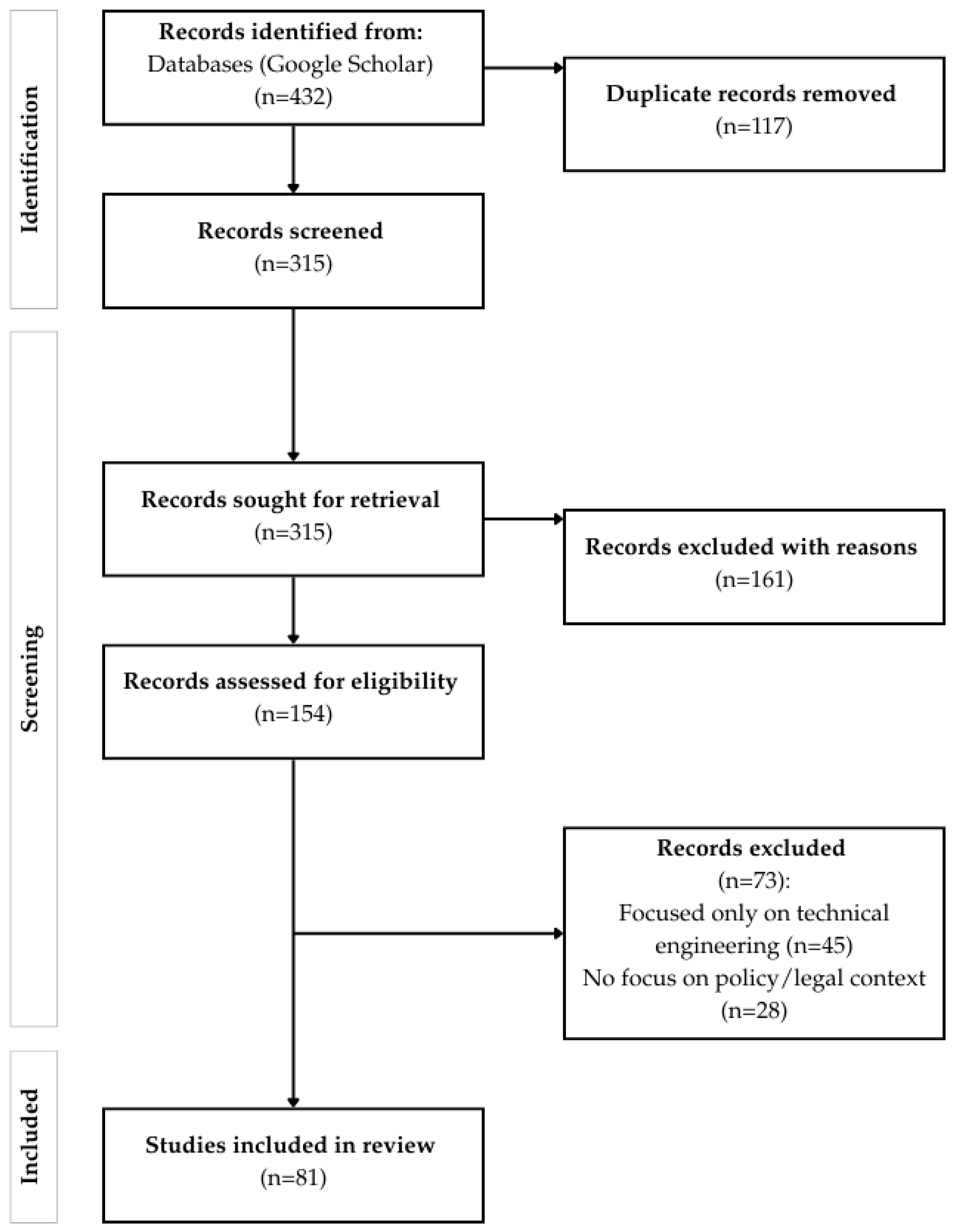
| Study selection | 16 | Describe the results of the selection process. | Section 2, Figure 2 |
| Characteristics | 17 | Present characteristics for each study. | Appendix A |
| Results of focus areas | 18 | Present the synthesis of identified barriers. | Section 3 |
| DISCUSSION | |||
| Interpretation | 23 | Provide general interpretation of the results. | Section 4 |
References
- Souliotis, I.; Voulvoulis, N. Natural Capital Accounting Informing Water Management Policies in Europe. Sustainability 2021, 13, 11205. [Google Scholar] [CrossRef]
- Mir, Y.H.; Mir, S.; Ganie, M.A.; Bhat, J.A.; Shah, A.M.; Mushtaq, M.; Irshad, I. Overview of Land Use and Land Cover Change and Its Impacts on Natural Resources. In Ecologically Mediated Development: Promoting Biodiversity Conservation and Food Security; Jatav, H.S., Rajput, V.D., Minkina, T., Eds.; Springer Nature: Singapore, 2025; pp. 101–130. [Google Scholar] [CrossRef]
- Souliotis, I.; Voulvoulis, N. Operationalising Nature-Based Solutions for the Design of Water Management Interventions. Nat.-Based Solut. 2022, 2, 100015. [Google Scholar] [CrossRef]
- Tabari, H. Climate Change Impact on Flood and Extreme Precipitation Increases with Water Availability. Sci. Rep. 2020, 10, 13768. [Google Scholar] [CrossRef]
- IPCC. Climate Change 2023: Synthesis Report; IPCC: Geneva, Switzerland, 2023. [Google Scholar] [CrossRef]
- van Alphen, J.; van der Biezen, S.; Bouw, M.; Hekman, A.; Kolen, B.; Steijn, R.; Zanting, H.A. Room for Sea-Level Rise: Conceptual Perspectives to Keep The Netherlands Safe and Livable in the Long Term as Sea Level Rises. Water 2025, 17, 437. [Google Scholar] [CrossRef]
- van Alphen, J.; Haasnoot, M.; Diermanse, F. Uncertain Accelerated Sea-Level Rise, Potential Consequences, and Adaptive Strategies in The Netherlands. Water 2022, 14, 1527. [Google Scholar] [CrossRef]
- van Doorn-Hoekveld, W.J.; Gilissen, H.K.; Groothuijse, F.A.G.; van Rijswick, H.F.M.W. Adaptation to Climate Change in Dutch Flood Risk Management: Innovative Approaches and Related Challenges. Utrecht Law Rev. 2022, 18, 2. [Google Scholar] [CrossRef]
- Krauze, K.; Wagner, I. From Classical Water-Ecosystem Theories to Nature-Based Solutions—Contextualizing Nature-Based Solutions for Sustainable City. Sci. Total Environ. 2019, 655, 697–706. [Google Scholar] [CrossRef]
- Kok, S.; Bisaro, A.; de Bel, M.; Hinkel, J.; Bouwer, L.M. The Potential of Nature-Based Flood Defences to Leverage Public Investment in Coastal Adaptation: Cases from The Netherlands, Indonesia and Georgia. Ecol. Econ. 2021, 179, 106828. [Google Scholar] [CrossRef]
- Ministry of the Interior and Kingdom Relations. Omgevingswet (Environment and Planning Act); Ministry of the Interior and Kingdom Relations: The Hague, The Netherlands, 2024.
- van Doorn-Hoekveld, W.; Gilissen, H.K.; van Rijswick, H.F.M.W.; Freriks, A.; van Loon-Steensma, J.M. Kansen en aandachtspunten voor nature-based solutions in voorlanden. H2O 2023, 2023, 7. [Google Scholar]
- Groothuijse, F.A.G.; Boeve, M.N.; van den Broek, G.M.; Keessen, A.M.; van Rijswick, H.F.M.W. Juridisch-Bestuurlijke Evaluatie Ruimte voor de Rivier; Utrecht Centre for Water, Oceans and Sustainability Law, Utrecht University: Utrecht, The Netherlands, 2018; Available online: https://www.uu.nl/sites/default/files/juridisch_bestuurlijke_evaluatie_pkb_rvr_def_24_april_2018_.pdf (accessed on 19 April 2025).
- Boeve, M.N.; van den Broek, G.M.; Groothuijse, F.A.G.; Keessen, A.M.; van Rijswick, H.F.M.W. Evaluatie PKB Ruimte voor de Rivier: Juridisch-bestuurlijke lessen voor toekomstige grootschalige infrastructurele overheidsprojecten. Tijdschr. Omgevingsrecht 2019, 2, 52–64. [Google Scholar] [CrossRef]
- Marchau, V.A.W.J.; Walker, W.E.; Bloemen, P.J.T.M.; Popper, S.W. (Eds.) Decision Making Under Deep Uncertainty: From Theory to Practice; Springer: Cham, Switzerland, 2019. [Google Scholar] [CrossRef]
- Bloemen, P.J.T.M.; Hammer, F.; van der Vlist, M.J.; Grinwis, P.; van Alphen, J. DMDU into Practice: Adaptive Delta Management in The Netherlands. In Decision Making Under Deep Uncertainty: From Theory to Practice; Marchau, V.A.W.J., Walker, W.E., Bloemen, P.J.T.M., Popper, S.W., Eds.; Springer: Cham, Switzerland, 2019; pp. 321–351. [Google Scholar] [CrossRef]
- Haasnoot, M.; Biesbroek, R.; Lawrence, J.; Muccione, V.; Lempert, R.; Glavovic, B. Defining the Solution Space to Accelerate Climate Change Adaptation. Reg. Environ. Change 2020, 20, 37. [Google Scholar] [CrossRef]
- Ministry of Infrastructure and Water Management (I&W). Knowledge Programme Sea Level Rise; Ministry of I&W: The Hague, The Netherlands, 2024.
- Steenstra, M.; van Wesenbeeck, B.; van Maren, D.S. Meegroeien Met de Zee: Verkennende Studie naar de Potentie van Sedimentatie als Strategie voor de Lange Termijn; Deltares & Wageningen Marine Research: Delft, The Netherlands, 2025. [Google Scholar]
- Delta Programme Commissioner. Knowledge Programme Sea Level Rise: Progress Report 2025 and the Fourth Direction ‘Growing Along’; Ministry of Infrastructure and Water Management: The Hague, The Netherlands, 2025.
- de Bruin, K. Water Resilience for Economic Resilience in The Netherlands: From Floods to Drought; Alliance for Global Water Adaptation (AGWA): Corvallis, OR, USA, 2024. [Google Scholar]
- United Nations Environment Programme (UNEP). The Economics of Nature-Based Solutions: Current Status and Future Priorities; UNEP: Nairobi, Kenya, 2020. [Google Scholar]
- Publications Office of the European Union. Regulation (EU) 2021/1119 (European Climate Law); Publications Office of the European Union: Luxembourg, 2021. [Google Scholar]
- European Commission. The European Green Deal; European Commission: Brussels, Belgium, 2019.
- Ministerie van Landbouw, Natuur en Voedselkwaliteit (LNV). De Eerste Agenda Natuurinclusief; Ministerie van Algemene Zaken: The Hague, The Netherlands, 2022.
- European Commission. Communication from the Commission to the European Parliament, the Council, the European Economic Social and Committee and the Committee of the Regions: A Water Resilience Initiative for Europe; European Commission: Brussels, Belgium, 2024. Available online: https://eur-lex.europa.eu/legal-content/EN/TXT/PDF/?uri=celex:52025DC0280 (accessed on 19 April 2025).
- Cohen-Shacham, E.; Walters, G.; Janzen, C.; Maginnis, S. (Eds.) Nature-Based Solutions to Address Global Societal Challenges; IUCN: Gland, Switzerland, 2016. [Google Scholar] [CrossRef]
- Publications Office of the European Union. Regulation (EU) 2024/1991 (Nature Restoration Law); Publications Office of the European Union: Luxembourg, 2024. [Google Scholar]
- Oral, H.V.; Carvalho, P.; Gajewska, M.; Ursino, N.; Masi, F.; van Hullebusch, E.D.; Kazak, J.K.; Exposito, A.; Cipolletta, G.; Andersen, T.R.; et al. A Review of Nature-Based Solutions for Urban Water Management in European Circular Cities: A Critical Assessment Based on Case Studies and Literature. Blue-Green Syst. 2020, 2, 112–136. [Google Scholar] [CrossRef]
- Koning, J.; Boogaard, F.C. Mapping, Assessing, and Evaluating the Effectiveness of Urban Nature-Based Solutions to Climate Change Effects in The Netherlands. In Handbook of Nature-Based Solutions to Mitigation and Adaptation to Climate Change; Leal Filho, W., Nagy, G.J., Ayal, D.Y., Eds.; Springer: Cham, Switzerland, 2023; pp. 1–32. [Google Scholar] [CrossRef]
- Sharifi, A. Co-Benefits and Synergies between Urban Climate Change Mitigation and Adaptation Measures: A Literature Review. Sci. Total Environ. 2021, 750, 141642. [Google Scholar] [CrossRef]
- Grafakos, S.; Trigg, K.; Landauer, M.; Chelleri, L.; Dhakal, S. Analytical Framework to Evaluate the Level of Integration of Climate Adaptation and Mitigation in Cities. Clim. Change 2019, 154, 87–106. [Google Scholar] [CrossRef]
- Moraes, R.P.L.; Reguero, B.G.; Mazarrasa, I.; Ricker, M.; Juanes, J.A. Nature-Based Solutions in Coastal and Estuarine Areas of Europe. Front. Environ. Sci. 2022, 10, 829526. [Google Scholar] [CrossRef]
- Busscher, T.; van den Brink, M.; Verweij, S. Strategies for Integrating Water Management and Spatial Planning: Organising for Spatial Quality in the Dutch ‘Room for the River’ Program. J. Flood Risk Manag. 2019, 12, e12448. [Google Scholar] [CrossRef]
- Van Belzen, J.; Rienstra, G.U.; Bouma, T.J. Dubbele Dijken als Robuuste Waterkerende Landschappen voor een Welvarende Zuidwestelijke Delta; NIOZ Report 2021-01; Royal Netherlands Institute for Sea Research (NIOZ): Texel, The Netherlands, 2021. [Google Scholar] [CrossRef]
- Silva, R.; Oumeraci, H.; Martínez, M.L.; Chávez, V.; Lithgow, D.; van Rijswick, H.F.M.W.; van Tussenbroek, B.I.; Bouma, T.J. Ten Commandments for Sustainable, Safe, and W/Healthy Sandy Coasts Facing Global Change. Front. Mar. Sci. 2021, 8, 616321. [Google Scholar] [CrossRef]
- Van Slobbe, E.; de Vriend, H.J.; Aarninkhof, S.; Lulofs, K.; de Vries, M.; Dircke, P. Building with Nature: In The Netherlands: Distinct, Complementary or Hybrid? Water Resour. Manag. 2013, 27, 937–951. [Google Scholar] [CrossRef]
- Inácio, M.; Karnauskaitė, D.; Mikša, K.; Gomes, E.; Kalinauskas, M.; Pereira, P. Nature-Based Solutions to Mitigate Coastal Floods and Associated Socioecological Impacts. In Nature-Based Solutions for Flood Mitigation: Environmental and Socio-Economic Aspects; Ferreira, C.S.S., Kalantari, Z., Hartmann, T., Pereira, P., Eds.; Springer: Cham, Switzerland, 2022; pp. 35–58. [Google Scholar] [CrossRef]
- Cohen-Shacham, E.; Andrade, A.; Dalton, J.; Dudley, N.; Jones, M.; Kumar, C.; Maginnis, S.; Nelson, C.R.; Renaud, F.G.; Welling, R.; et al. Core Principles for Successfully Implementing and Upscaling Nature-Based Solutions. Environ. Sci. Policy 2019, 98, 20–29. [Google Scholar] [CrossRef]
- Rendón, O.R.; Sandorf, E.D.; Beaumont, N.J. Heterogeneity of Values for Coastal Flood Risk Management with Nature-Based Solutions. J. Environ. Manag. 2022, 304, 114212. [Google Scholar] [CrossRef] [PubMed]
- Spalding, M.; Mcivor, A.; Tonneijck, F.; Tol, S.; van Eijk, P. Mangroves for Coastal Defence: Guidelines for Coastal Managers and Policy Makers; Nature Conservancy and Wetlands International: Wageningen, The Netherlands, 2014. [Google Scholar]
- Marino, M.; Baptist, M.J.; Alkharoubi, A.I.K.; Nasca, S.; Cavallaro, L.; Foti, E.; Musumeci, R.E. Nature-Based Solutions as Building Blocks for Coastal Flood Risk Reduction: A Model-Based Ecosystem Service Assessment. Sci. Rep. 2025, 15, 12070. [Google Scholar] [CrossRef]
- Inácio, M.; Barboza, F.R.; Villoslada, M. The Protection of Coastal Lagoons as a Nature-Based Solution to Mitigate Coastal Floods. Curr. Opin. Environ. Sci. Health 2023, 34, 100491. [Google Scholar] [CrossRef]
- Weisscher, S.A.; Baar, A.; van Belzen, J.; Bouma, T.J.; Kleinhans, M.G. Transitional polders along estuaries: Driving land-level rise and reducing flood propagation. Nature Based Solutions. 2022, 2, 100022. [Google Scholar] [CrossRef]
- Dai, L.; van Rijswick, H.F.M.W.; Wörner, R. Rainproof Cities in The Netherlands: Approaches in Dutch water governance to climate-adaptive urban planning. Int. J. Water Resour. Dev. 2018, 34, 652–674. [Google Scholar] [CrossRef]
- Dai, L.; van Rijswick, H.F.M.W.; Driessen, P.P.J.; Keessen, A.M. Governance of the Sponge City Programme in China with Wuhan as a case study. Int. J. Water Resour. Dev. 2018, 34, 578–596. [Google Scholar] [CrossRef]
- Snyder, H. Literature Review as a Research Methodology: An Overview and Guidelines. J. Bus. Res. 2019, 104, 333–339. [Google Scholar] [CrossRef]
- Page, M.J.; McKenzie, J.E.; Bossuyt, P.M.; Boutron, I.; Hoffmann, T.C.; Mulrow, C.D.; Shamseer, L.; Tetzlaff, J.M.; Akl, E.A.; Brennan, S.E.; et al. The PRISMA 2020 statement: An updated guideline for reporting systematic reviews. BMJ 2021, 372, n71. [Google Scholar] [CrossRef]
- Harvey, N.A. Coordinating the Water, Energy and Food Nexus Through Law; Utrecht University: Utrecht, The Netherlands, 2025. [Google Scholar]
- van Esterik, M. Nature-Based Solutions in de Gebouwde Omgeving: De Rol van het Recht. Tijdschr. Omgevingsrecht 2024, 3, 111–131. [Google Scholar] [CrossRef]
- van der Meulen, G.J.M.; de Vries, J.J.; van Well, L.; Kannekens, F.A. Towards a Common Language for Mainstreaming Nature-Based Solutions Through Coastal Systems in the North Sea Region: The Manabas Coast Project. J. Mar. Sci. Eng. 2025, 13, 509. [Google Scholar] [CrossRef]
- Raška, P.; Bezak, N.; Ferreira, C.S.S.; Kalantari, Z.; Banasik, K.; Bertola, M.; Bourke, M.; Cerdà, A.; Davids, P.; de Brito, M.M.; et al. Identifying Barriers for Nature-Based Solutions in Flood Risk Management: An Interdisciplinary Overview Using Expert Community Approach. J. Environ. Manag. 2022, 310, 114725. [Google Scholar] [CrossRef]
- Ershad Sarabi, S.; Han, Q.; Romme, A.G.L.; de Vries, B.; Wendling, L. Key Enablers of and Barriers to the Uptake and Implementation of Nature-Based Solutions in Urban Settings: A Review. Resources 2019, 8, 121. [Google Scholar] [CrossRef]
- Kaufmann, M. Limits to Change—Institutional Dynamics of Dutch Flood Risk Governance. J. Flood Risk Manag. 2018, 11, 250–260. [Google Scholar] [CrossRef]
- Craig, R.K.; Cosens, B.; Garmestani, A.S.; Ruhl, J.B. Panarchy and Law in the Anthropocene. In Applied Panarchy: Applications and Diffusion Across Disciplines; Gunderson, L.H., Allen, C.R., Garmestani, A., Eds.; Island Press: Washington, DC, USA, 2022; pp. 181–201. [Google Scholar]
- Ruhl, J.B. Panarchy and the Law. Ecol. Soc. 2012, 17, 31. [Google Scholar] [CrossRef]
- Gilissen, H.K.; Alexander, M.; Beyers, J.-C.; Chmielewski, P.; Matczak, P.; Schellenberger, T.; Suykens, C. Bridges over Troubled Waters: An Interdisciplinary Framework for Evaluating the Interconnectedness within Fragmented Flood Risk Management Systems. J. Water Law 2016, 25, 12–26. [Google Scholar]
- Gilissen, H.K. Met Recht naar Klimaatbestendige en Duurzame Delta’s (Legal Pathways Toward Climate Resilient and Sustainable Deltas); Utrecht University: Utrecht, The Netherlands, 2025. [Google Scholar]
- Du, H.; Triyanti, A.; Hegger, D.L.T.; Gilissen, H.K.; Driessen, P.P.J.; van Rijswick, H.F.M.W. Enriching the Concept of Solution Space for Climate Adaptation by Unfolding Legal and Governance Dimensions. Environ. Sci. Policy 2022, 127, 253–262. [Google Scholar] [CrossRef]
- Harvey, N.; Garmestani, A.; Allen, C.R.; Buijze, A.; van Rijswick, M. Identifying Untapped Legal Capacity to Promote Multi-Level and Cross-Sectoral Coordination of Natural Resource Governance. Sustain. Sci. 2023, 18, 2473–2487. [Google Scholar] [CrossRef]
- Barshini, T.; van Rijswick, H.F.M.W.; van Doorn-Hoekveld, W.; Groothuijse, F.A.G. De Onteigeningsbevoegdheid van het Waterschapsbestuur Onder de Omgevingswet; Utrecht Centre for Water, Oceans and Sustainability Law, Utrecht University: Utrecht, The Netherlands, 2021; Available online: https://dspace.library.uu.nl/bitstream/handle/1874/415790/Onteigeningsadvies_provincie_N_B_en_waterschappen_DEF.pdf?sequence=1 (accessed on 7 April 2025).
- Wamsler, C. Mainstreaming Ecosystem-Based Adaptation: Transformation toward Sustainability in Urban Governance and Planning. Ecol. Soc. 2015, 20, 30. [Google Scholar] [CrossRef]
- Davids, P.; Boelens, L.; Tempels, B. The Effects of Tailor-Made Flood Risk Advice for Homeowners in Flanders, Belgium. Water Int. 2019, 44, 539–553. [Google Scholar] [CrossRef]
- Goulden, S.; Portman, M.E.; Carmon, N.; Alon-Mozes, T. From Conventional Drainage to Sustainable Stormwater Management: Beyond the Technical Challenges. J. Environ. Manag. 2018, 219, 37–45. [Google Scholar] [CrossRef]
- den Heijer, F.; Rijke, J.; Bosch-Rekveldt, M.; de Leeuw, A.; Barciela-Rial, M. Asset Management of Flood Defences as a Co-Production—An Analysis of Cooperation in Five Situations in The Netherlands. J. Flood Risk Manag. 2023, 16, e12909. [Google Scholar] [CrossRef]
- Waylen, K.A.; Holstead, K.L.; Colley, K.; Hopkins, J. Challenges to Enabling and Implementing Natural Flood Management in Scotland. J. Flood Risk Manag. 2018, 11, S1078–S1089. [Google Scholar] [CrossRef]
- Davis, M.; Naumann, S. Making the Case for Sustainable Urban Drainage Systems as a Nature-Based Solution to Urban Flooding. In Nature-Based Solutions to Climate Change Adaptation in Urban Areas: Linkages Between Science, Policy and Practice; Kabisch, N., Korn, H., Stadler, J., Bonn, A., Eds.; Springer: Cham, Switzerland, 2017; pp. 123–137. [Google Scholar] [CrossRef]
- Pontee, N.; Narayan, S.; Beck, M.W.; Hosking, A.H. Nature-Based Solutions: Lessons from around the World. Proc. Inst. Civ. Eng. Mar. Eng. 2016, 169, 29–36. [Google Scholar] [CrossRef]
- Kaufmann, M.; Wiering, M. Dilemmas of an Integrated Multi-Use Climate Adaptation Project in The Netherlands: The Oekense Beek. In Nature-Based Flood Risk Management on Private Land: Disciplinary Perspectives on a Multidisciplinary Challenge; Hartmann, T., Slavíková, L., McCarthy, S., Eds.; Springer: Cham, Switzerland, 2019; pp. 193–207. [Google Scholar] [CrossRef]
- Akerboom, S.; van Rijswick, H.F.M.W. Participeren Moet je Leren. In 2030: Het Juridische Instrumentarium voor Mitigatie van Klimaatverandering, Energietransitie en Adaptatie in Nederland; Backes, C.W., Brans, E.H.P., Gilissen, H.K., Eds.; Boom Juridisch: Den Haag, The Netherlands, 2020; pp. 317–343. Available online: https://research-portal.uu.nl/en/publications/participeren-moet-je-leren/ (accessed on 28 March 2025).
- Groothuijse, F.A.G.; van Rijswick, H.F.M.W.; Gilissen, H.K.; Boeve, M.N.; van Doorn-Hoekveld, W. Juridische Borging Alternatieve Maatregelen Veilige Vecht; Utrecht Centre for Water, Oceans and Sustainability Law, Utrecht University: Utrecht, The Netherlands, 2022; Available online: https://dspace.library.uu.nl/bitstream/handle/1874/420133/Veilige_Vecht_DEF_30_maart_2022.pdf?sequence=1 (accessed on 25 March 2025).
- Gilissen, H.K.; van Doorn-Hoekveld, W.; van Rijswick, H.F.M.W. Voorland en Veiligheid: Juridische Aandachtspunten bij het Betrekken van Voorlanden in de Beoordeling, het Ontwerp en het Beheer van Primaire Waterkeringen; Utrecht Centre for Water, Oceans and Sustainability Law, Utrecht University: Utrecht, The Netherlands, 2018; Available online: https://dspace.library.uu.nl/handle/1874/363342 (accessed on 25 March 2025).
- Buerkert, J.; Gilissen, H.K.; van Rijswick, H.F.M.W. Increasing Climate Resilience in Urbanized Areas: Practical Recommendations for Improving Stakeholder Participation from The Netherlands. In Festskrift till Jan Darpö; Forsberg, M., Nilsson, A., Zetterberg, C., Eds.; Iustus Förlag AB: Uppsala, Sweden, 2022; pp. 97–123. Available online: https://research-portal.uu.nl/en/publications/increasing-climate-resilience-in-urbanized-areas-practical-recomm/ (accessed on 25 March 2025).
- Santoro, S.; Pluchinotta, I.; Pagano, A.; Pengal, P.; Cokan, B.; Giordano, R. Assessing Stakeholders’ Risk Perception to Promote Nature Based Solutions as Flood Protection Strategies: The Case of the Glinščica River (Slovenia). Sci. Total Environ. 2019, 655, 188–201. [Google Scholar] [CrossRef]
- van Rijswick, H.F.M.W.; Dai, L.; Wörner, R. Hoe maken we Nederlandse Steden Regenbestendig? Klimaatbeleid in Amsterdam, Rotterdam en Utrecht. In Verwant met Verband: Ruimte, Recht en Wetenschap: Vriendenbundel voor prof. mr. J. Struiksma; Huisman, P., Neerhof, R., van Ommeren, F., Eds.; Instituut voor Bouwrecht: Den Haag, The Netherlands, 2019; pp. 493–514. Available online: https://research-portal.uu.nl/ws/files/70349235/Marleen_van_Rijswick_en_Liping_Dai_en_Rebecca_Worner_Klimaatbestendige_steden_Struiksmabundel.pdf (accessed on 25 March 2025).
- Short, C.; Clarke, L.; Carnelli, F.; Uttley, C.; Smith, B. Capturing the Multiple Benefits Associated with Nature-Based Solutions: Lessons from a Natural Flood Management Project in the Cotswolds, UK. Land Degrad. Dev. 2019, 30, 241–252. [Google Scholar] [CrossRef]
- Bogdzevič, K. Floods and Nature-Based Solutions. A Call for a Legal Approach. Curr. Opin. Environ. Sci. Health 2023, 36, 100521. [Google Scholar] [CrossRef]
- Bridges, T.S.; King, J.K.; Simm, J.D.; Beck, M.W.; Collins, G.; Lodder, Q.; Mohan, R.K. International Guidelines on Natural and Nature-Based Features for Flood Risk Management; Engineer Research and Development Center (U.S.): Vicksburg, MS, USA, 2021. [Google Scholar]
- De Knegt, B.; Breman, B.C.; Le Clec’h, S.; van Hinsberg, A.; Lof, M.E.; Pouwels, R.; Roelofsen, H.D.; Alkemade, R. Exploring the Contribution of Nature-Based Solutions for Environmental Challenges in The Netherlands. Sci. Total Environ. 2024, 929, 172186. [Google Scholar] [CrossRef]
- van Doornik, T.J.; Jung, M.P.S.; van Loon-Steensma, J.M. Finding Common Ground: A Comparison between Coastal Nature-Based Solutions in The Netherlands and British Columbia, Canada. Nat.-Based Solut. 2024, 6, 100173. [Google Scholar] [CrossRef]
- Sturiale, L.; Scuderi, A.; Timpanaro, G. Citizens’ Perception of the Role of Urban Nature-Based Solutions and Green Infrastructures towards Climate Change in Italy. Front. Environ. Sci. 2023, 11, 1105446. [Google Scholar] [CrossRef]
- Li, J.; Nassauer, J.I.; Webster, N.J. Landscape elements affect public perception of nature-based solutions managed by smart systems. Landsc. Urban Plan. 2022, 221, 104355. [Google Scholar] [CrossRef]
- Anderson, C.C.; Renaud, F.G. A Review of Public Acceptance of Nature-Based Solutions: The ‘Why’, ‘When’, and ‘How’ of Success for Disaster Risk Reduction Measures. Ambio 2021, 50, 1552–1573. [Google Scholar] [CrossRef] [PubMed]
- Anderson, C.C.; Renaud, F.G.; Hanscomb, S.; Munro, K.E.; Gonzalez-Ollauri, A.; Thomson, C.S.; Pouta, E.; Soini, K.; Loupis, M.; Panga, D.; et al. Public Acceptance of Nature-Based Solutions for Natural Hazard Risk Reduction: Survey Findings From Three Study Sites in Europe. Front. Environ. Sci. 2021, 9, 678938. [Google Scholar] [CrossRef]
- van Esterik, M. Nature-based solutions en wisselpolders: Klimaatadaptatie, waterveiligheid en natuurherstel in de Zuidwestelijke Delta: Deel I—De Unierechtelijke dimensie. Tijdschr. Bouwr. 2025, 12, 1092–1108. [Google Scholar]
- Gilissen, H.K.; Hegger, D.L.T.; Mees, H.; van den Ende, M.; van Rijswick, H.F.M.W. Op weg naar een Handreiking voor de Implementatie van Klimaatadaptatie: Lessen uit het Project ‘Klimaatbestendige Woonwijken regio Utrecht’; Utrecht University: Utrecht, The Netherlands, 2021; Available online: https://www.uu.nl/sites/default/files/uu-rebo-geo-klimaatbestendige-woonwijken-2021.pdf (accessed on 28 March 2025).



| Research Question | Methodology | Disciplinary Focus |
|---|---|---|
| What institutional/legal characteristics require reflection within the regulatory environment to enable the operationalisation of NBSs? | A literature review of the findings of the existing research on NBSs identifying what characteristics enable and constrain the operationalisation of NBSs. This will entail, in particular, characteristics that enable coordination across the various policy domains required to implement NBSs as well as characteristics that promote and enable decision makers to move beyond the ‘business-as-usual’ approach to FRM and dare to explore the potential for NBSs. | Law, political science, public policy, and governance. |
| What untapped capacity exists within the existing law and policy regulating FRM that can enable decision makers to pursue NBSs in practice in The Netherlands? | A doctrinal review of all applicable laws and policies regulating FRM to identify existing capacity to promote NBSs. This review may be conducted in a multi-level environment, including national as well as regional laws and policies. | Law. |
| Part 1: What existing public responsibilities are reflected within the prevailing law that require public officials to pursue NBSs for FRM in The Netherlands? Part 2: What existing private responsibilities are reflected within the prevailing law that require individual landowners to yield ownership rights in certain circumstances to enable public actors to pursue NBSs for FRM in The Netherlands? Part 3: In light of the existing responsibilities of public and private actors within the prevailing law, is there a need for a strategic land policy to enable the mainstreaming of NBSs for FRM in The Netherlands, and, if so, what form could this take? | Although Dutch law has clear procedural requirements for land expropriation where required for water management, research indicates that public actors avoid this resort for fear of negative popular opinion. Expropriation and compensation schemes, though necessary, are not the only means of enabling public bodies to access the privately owned land required to implement NBSs. There is potential for solutions, such as the formulation of shared (public/private) responsibilities for water management, construction of legal duties to act in a manner that promotes the interest of the community in the face of climate change, and co-ownership structures that could better enable access to private land while simultaneously ensuring that public opinion does not negatively perceive NBS implementation efforts. | Law. |
| What incentive structures are required to encourage public actors to look beyond grey infrastructural solutions in Dutch FRM and instead pursue NBSs? | The current ‘business-as-usual’ approach, which prioritises grey infrastructure for flood risk management, is widely regarded—both nationally and internationally—as highly successful. Given its proven effectiveness, long-standing implementation, and the established and familiar administrative procedures it offers public authorities, shifting toward NBSs will require the introduction of targeted incentives within the policy domain to redirect entrenched practices. | Law, political science, public policy, governance, and economics. |
| Which policy domains are involved in the implementation of NBSs and what existing institutional mechanisms can public actors utilise to enable coordination across the various policy domains required to operationalise NBSs in Dutch FRM? | The broader scope of NBSs thus requires coordination across multiple policy domains, which challenged by existing institutional fragmentation or ‘sectoral silos’. Relevant policy domains include FRM, water quality, nature conservation, nature restoration, recreation/tourism, and spatial planning, amongst others. Public actors require clear guidelines on what their coordination obligations are under prevailing law, and what mechanisms they may use to fulfil these obligations. Research should investigate both formal (law and policy) and informal (standard operating procedures and customs) institutional mechanisms. | Law, political science, public policy, and governance. |
| Which forms of NBSs present the most potential for successful application for FRM in The Netherlands? | Given the lack of consensus on which FRM to apply in which context, there is a need for research to formulate guidelines for decision makers on which NBS to prioritise in feasibility assessments. Not all forms of NBSs can be considered all the time. Guidelines can be tailored to specific regions, e.g., coastal, estuaries, rivers, and lakes. | Engineering, spatial planning, economics, and governance. |
| What are the economic implications (societal costs and benefits), both upfront and in the future, of implementing NBSs for FRM in The Netherlands? | Cost–benefit analyses and upfront investment cost estimates, as well as projected maintenance costs and economic quantification of co-benefits is required to better understand the financial implications and returns associated with NBSs. | Economics. |
| What social factors shape the existing (lack of) tolerance for NBS in The Netherlands, and how may these factors be tapped into to educate and promote a positive perception of NBSs for FRM? | Empirical investigation of the historical context shaping prevailing public perceptions, as well as the national, regional, and local culture(s) and identities (and the interaction thereof) that shape public perception. Empirical results may inform the development of means of promoting a positive public perception of NBSs, including through the use of the arts. | Broad range of social sciences and humanities, including the arts and cultural studies. |
Disclaimer/Publisher’s Note: The statements, opinions and data contained in all publications are solely those of the individual author(s) and contributor(s) and not of MDPI and/or the editor(s). MDPI and/or the editor(s) disclaim responsibility for any injury to people or property resulting from any ideas, methods, instructions or products referred to in the content. |
© 2026 by the authors. Licensee MDPI, Basel, Switzerland. This article is an open access article distributed under the terms and conditions of the Creative Commons Attribution (CC BY) license.
Share and Cite
Harvey, N.A.; Gilissen, H.K.; van Rijswick, M. Beyond ‘Business as Usual’: A Research Agenda for the Operationalisation of Nature-Based Solutions in Flood Risk Management in The Netherlands. Water 2026, 18, 286. https://doi.org/10.3390/w18020286
Harvey NA, Gilissen HK, van Rijswick M. Beyond ‘Business as Usual’: A Research Agenda for the Operationalisation of Nature-Based Solutions in Flood Risk Management in The Netherlands. Water. 2026; 18(2):286. https://doi.org/10.3390/w18020286
Chicago/Turabian StyleHarvey, Nicola Ann, Herman Kasper Gilissen, and Marleen van Rijswick. 2026. "Beyond ‘Business as Usual’: A Research Agenda for the Operationalisation of Nature-Based Solutions in Flood Risk Management in The Netherlands" Water 18, no. 2: 286. https://doi.org/10.3390/w18020286
APA StyleHarvey, N. A., Gilissen, H. K., & van Rijswick, M. (2026). Beyond ‘Business as Usual’: A Research Agenda for the Operationalisation of Nature-Based Solutions in Flood Risk Management in The Netherlands. Water, 18(2), 286. https://doi.org/10.3390/w18020286