An Operational Streamflow Forecasting System for a Data-Scarce Catchment in Tanzania


Abstract
1. Introduction
2. Materials and Methods
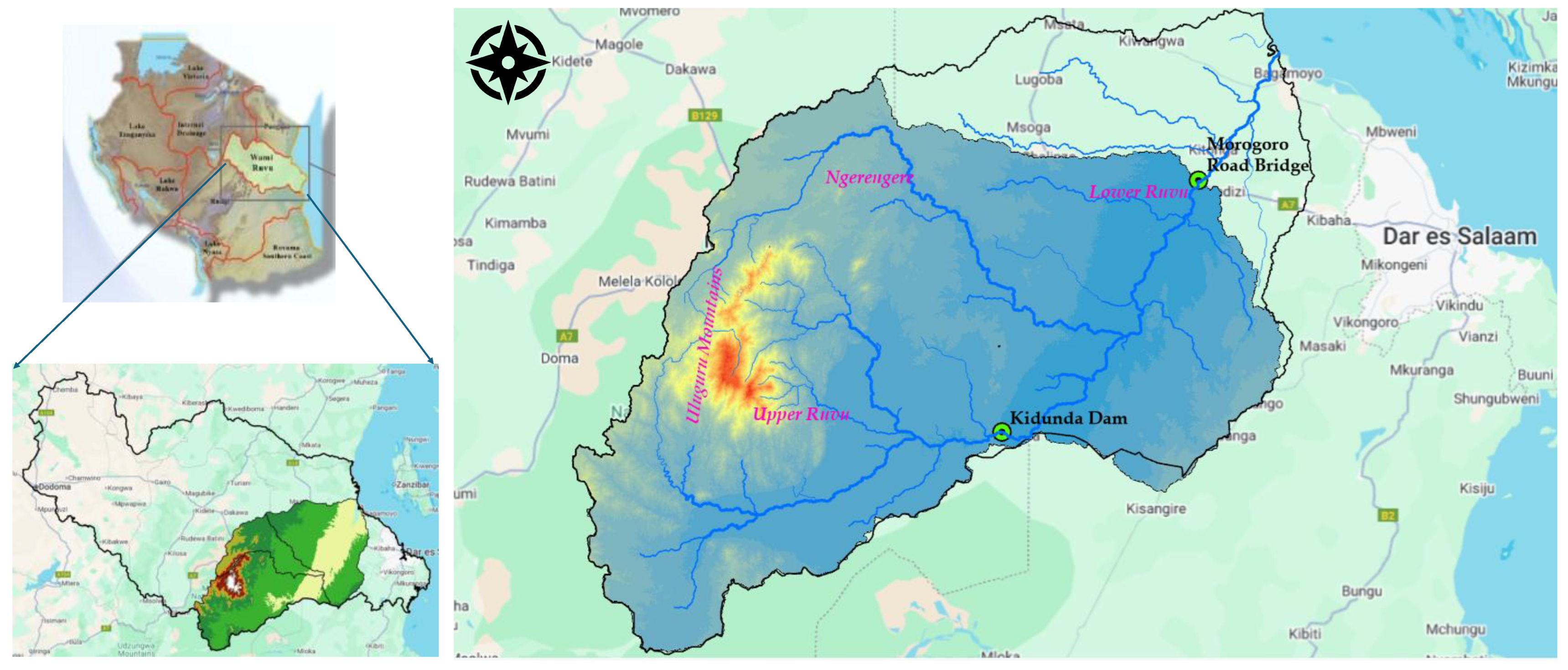
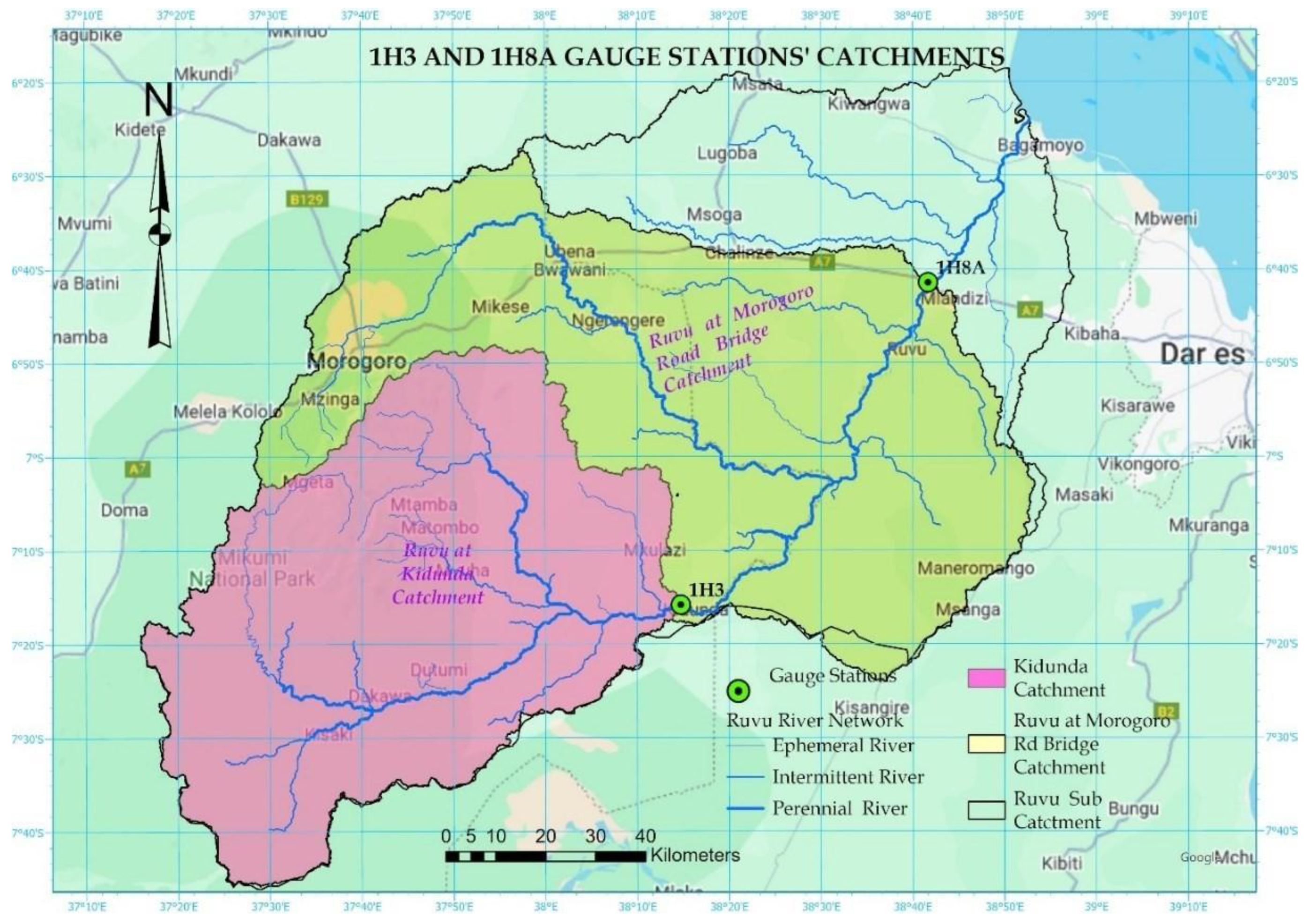
2.1. Study Area
2.2. Characteristics of the Study Area
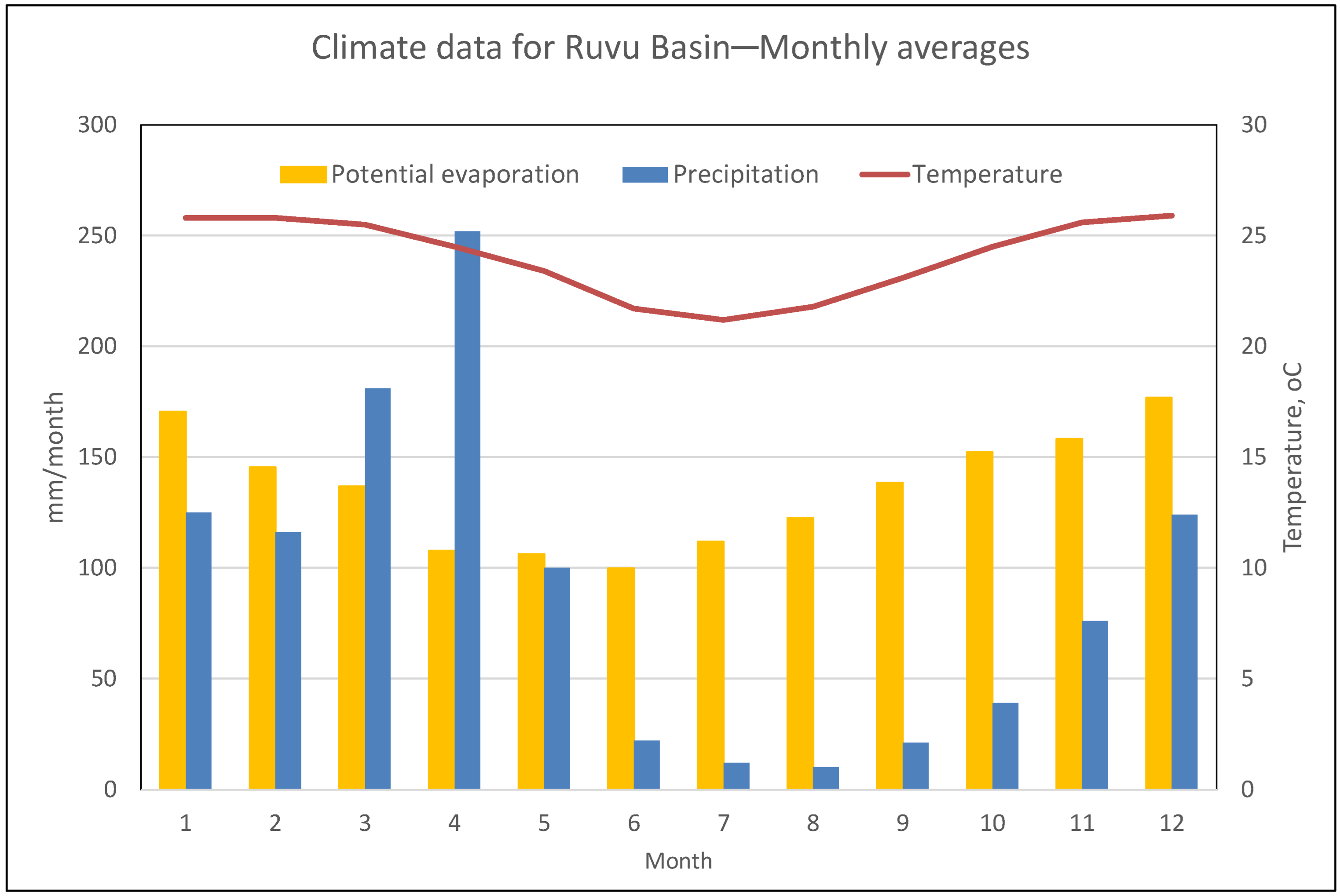
2.2.1. Climate
2.2.2. Topography
2.3. Surface Water Availability
2.4. Socio-Economic Activities
2.5. Data and Data Analysis
2.5.1. Precipitation Data
2.5.2. Selecting Rainfall Gauging Stations
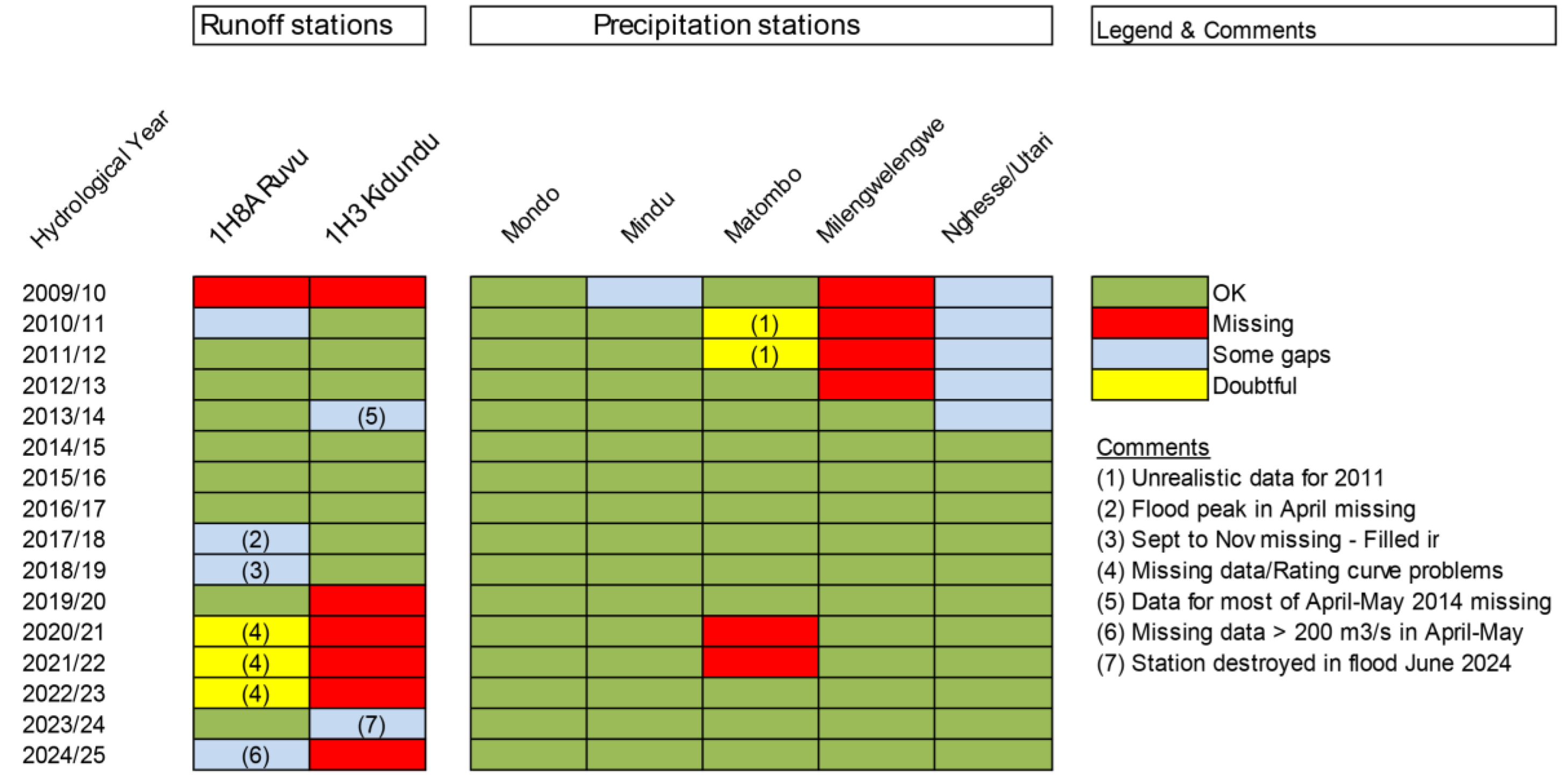
2.5.3. Precipitation Data Quality Analysis
2.5.4. Runoff Data
2.5.5. Selecting Runoff Gauging Stations
2.5.6. Potential Evapotranspiration Data
2.5.7. Meteorological Forecasts Data
2.5.8. Final Data Selection for the Calibration and Verification Periods
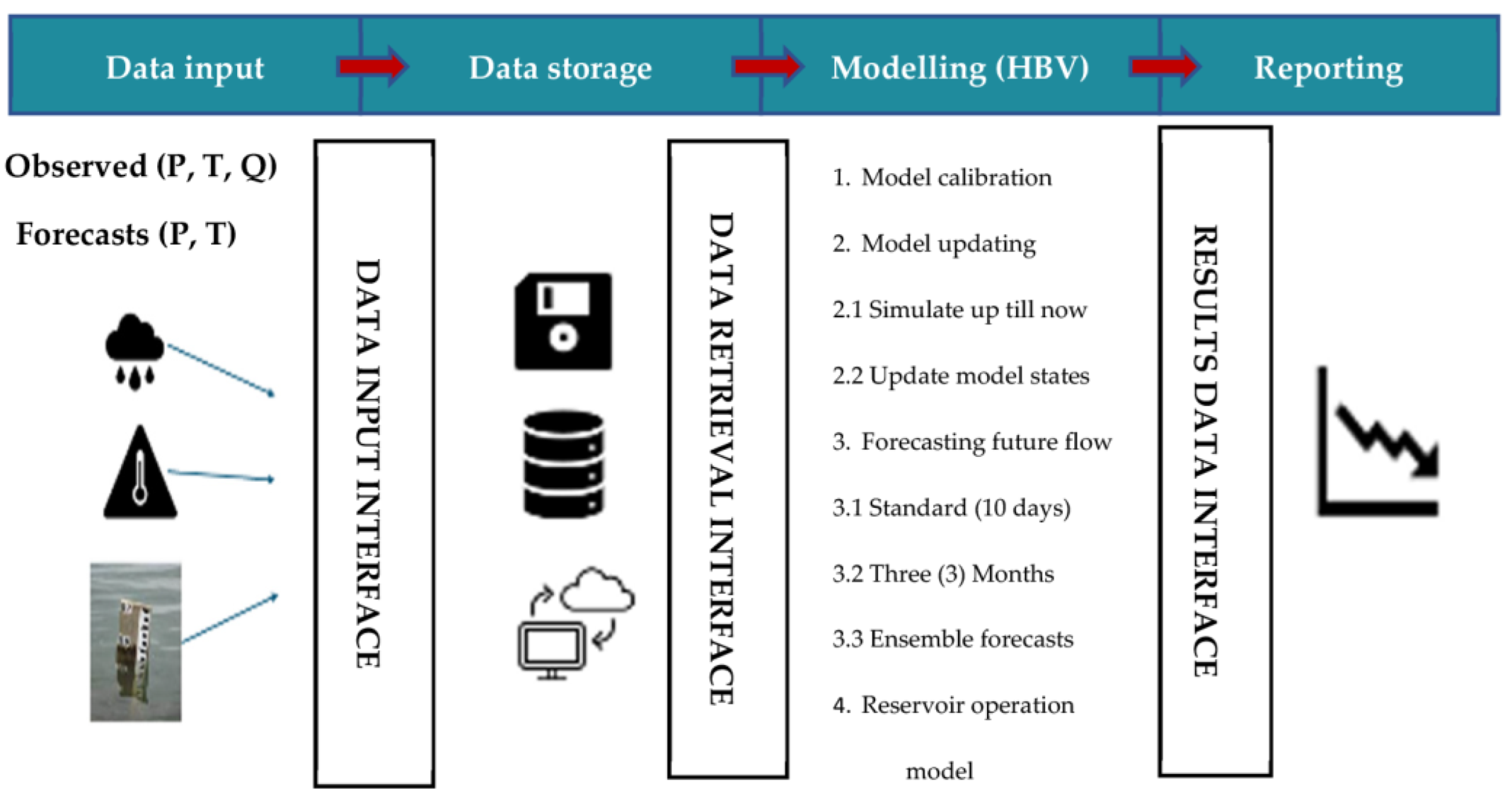
2.6. The Operational Forecasting Model System—Components and Structure
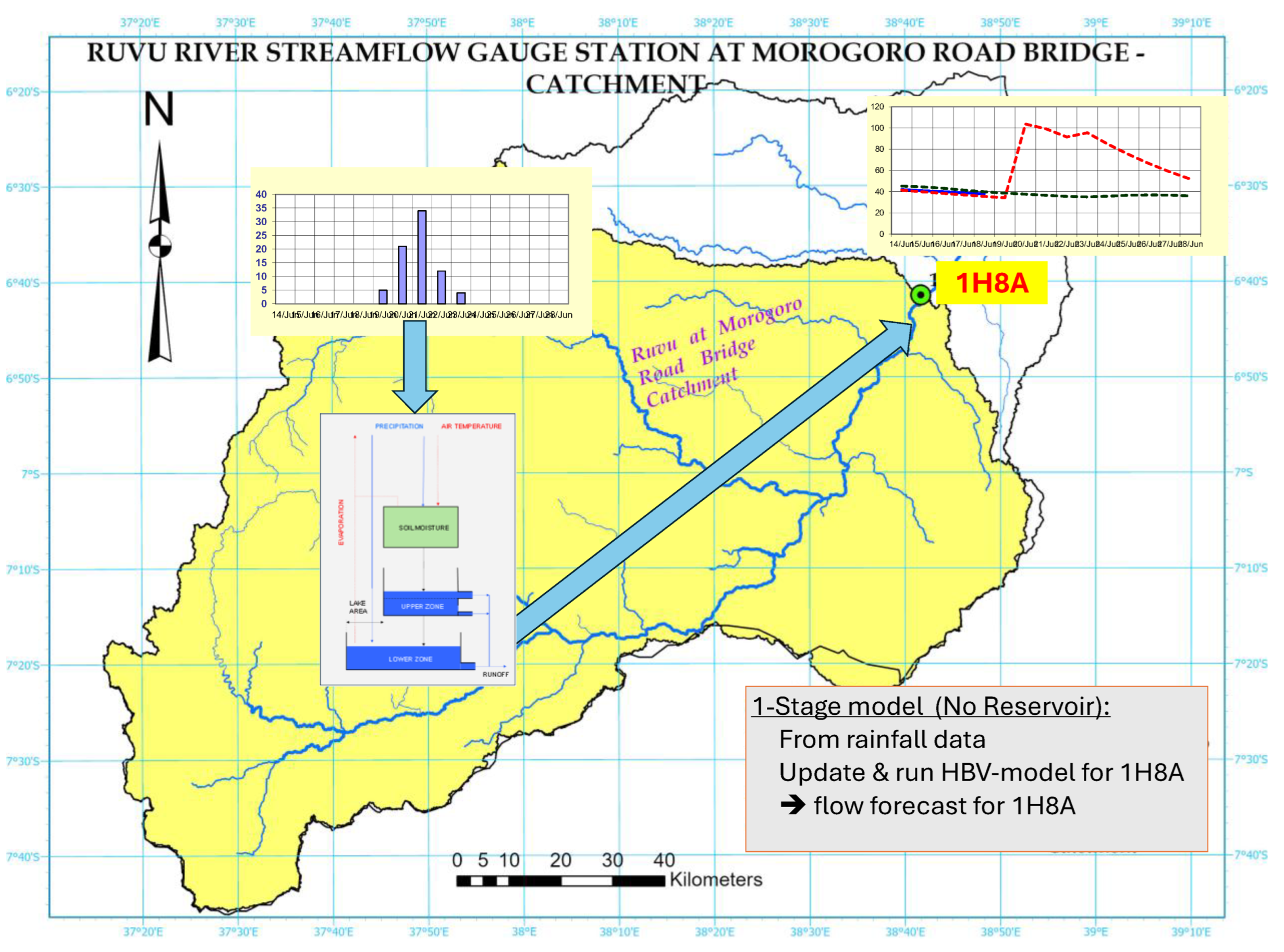
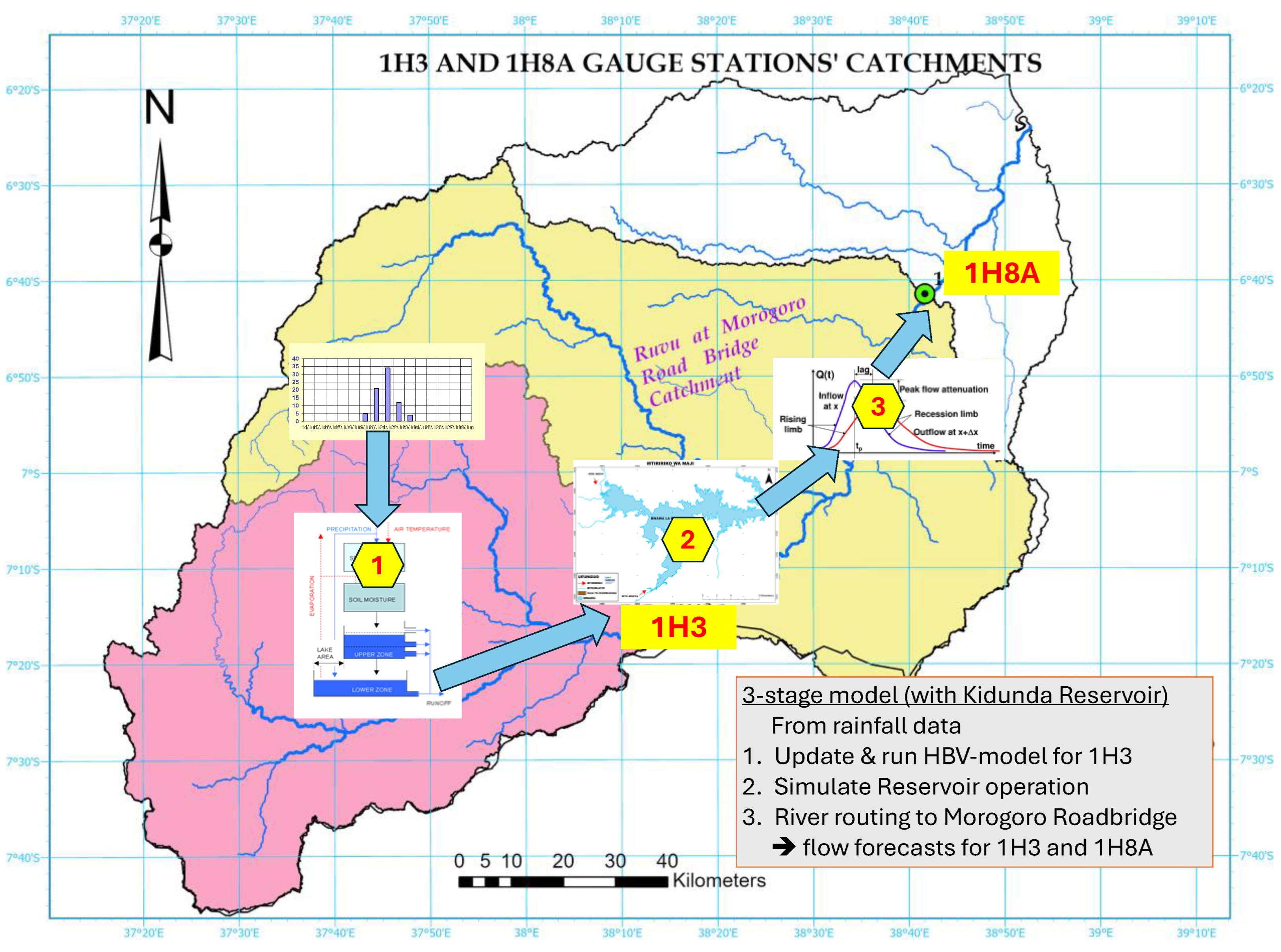
2.6.1. The Ruvu–HBV Flow Forecasting System—Model Structure
2.6.2. The Operational Model System—Data Collection, Transfer, and Storage
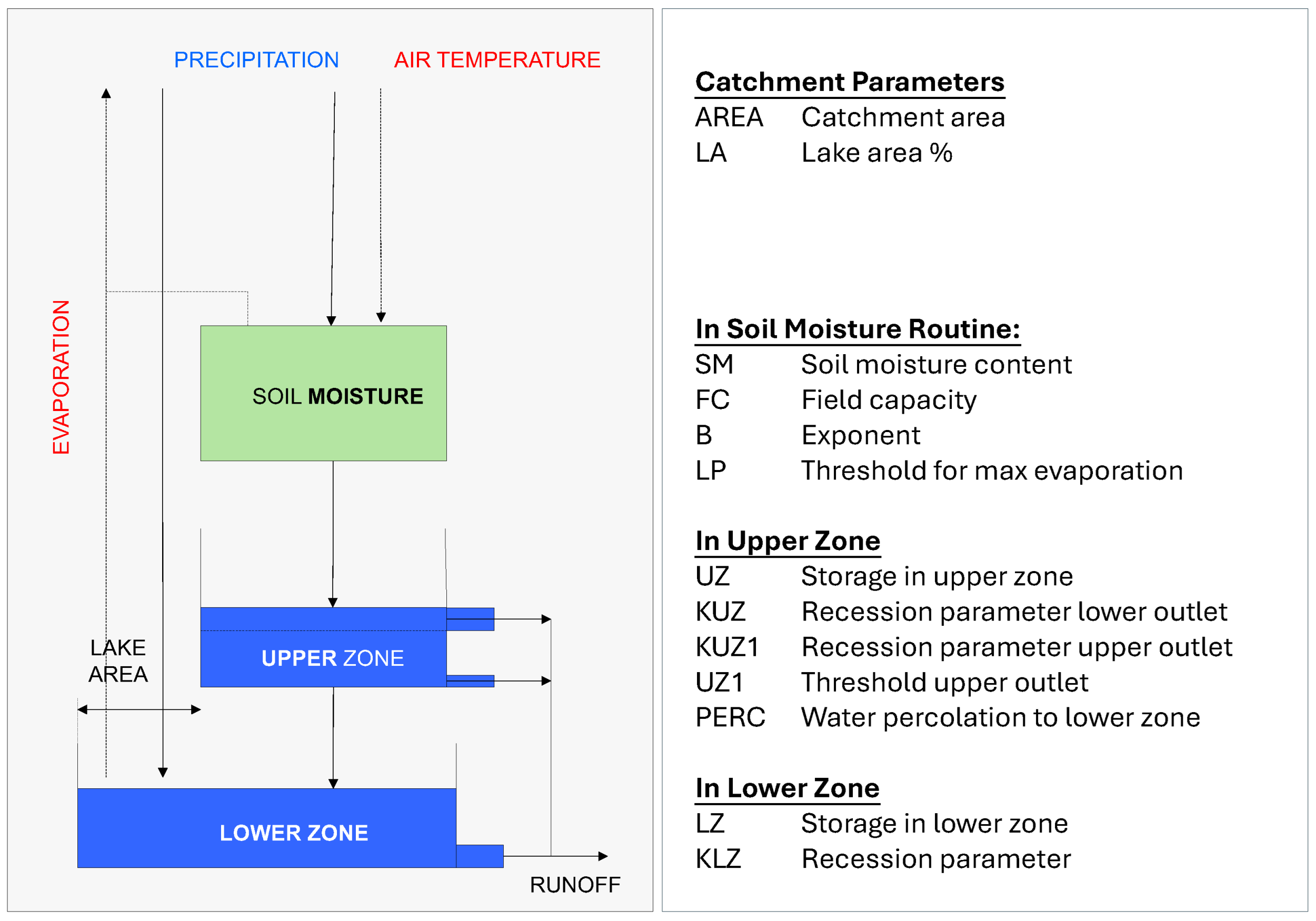
2.6.3. Rainfall–Runoff Model—The HBV Model
2.6.4. Hydrological Model Calibration and Validation
2.6.5. The Operational Forecasting Model System—User Interface
- A meteorological forecast for precipitation (and possibly temperature);
- A hydrological model for transforming precipitation into runoff;
- The model states at the time of the forecast.
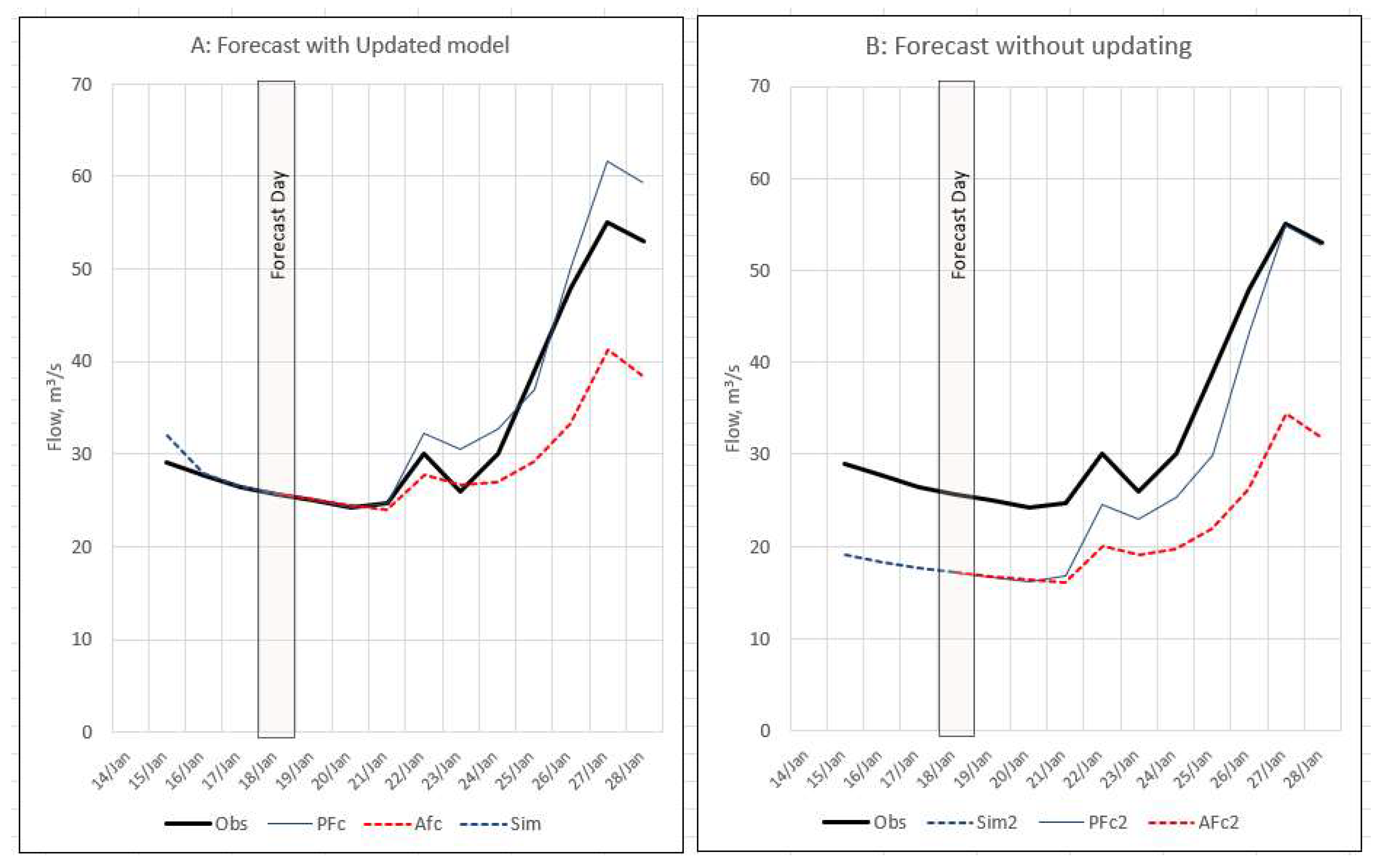
2.6.6. The Model Updating Process
2.7. Forecast Quality Analysis—Methodology
- The precipitation forecasts;
- The hydrological model structure;
- The hydrological model calibration;
- Initial conditions in the catchment when a forecast is issued.
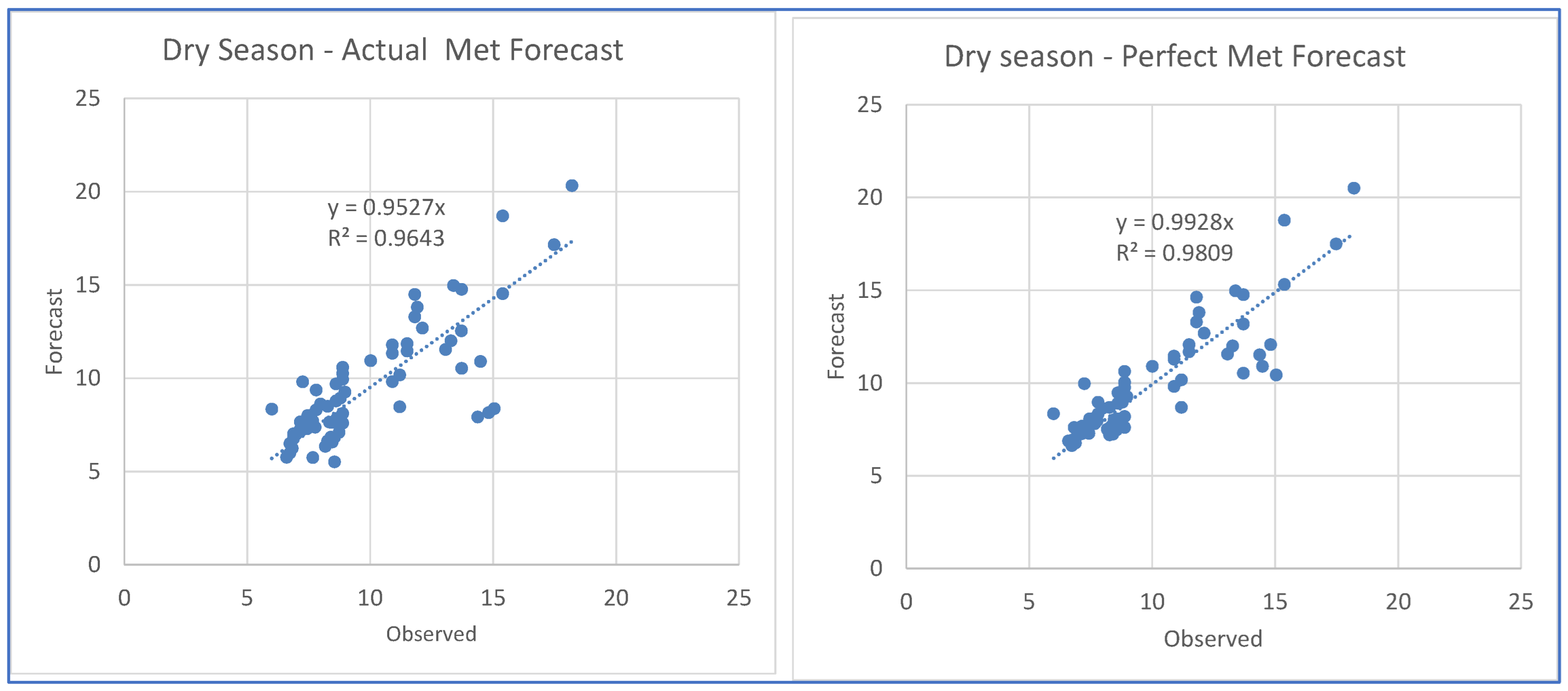
- Dry season (September–November, flows from 5 to 30 m3/s);
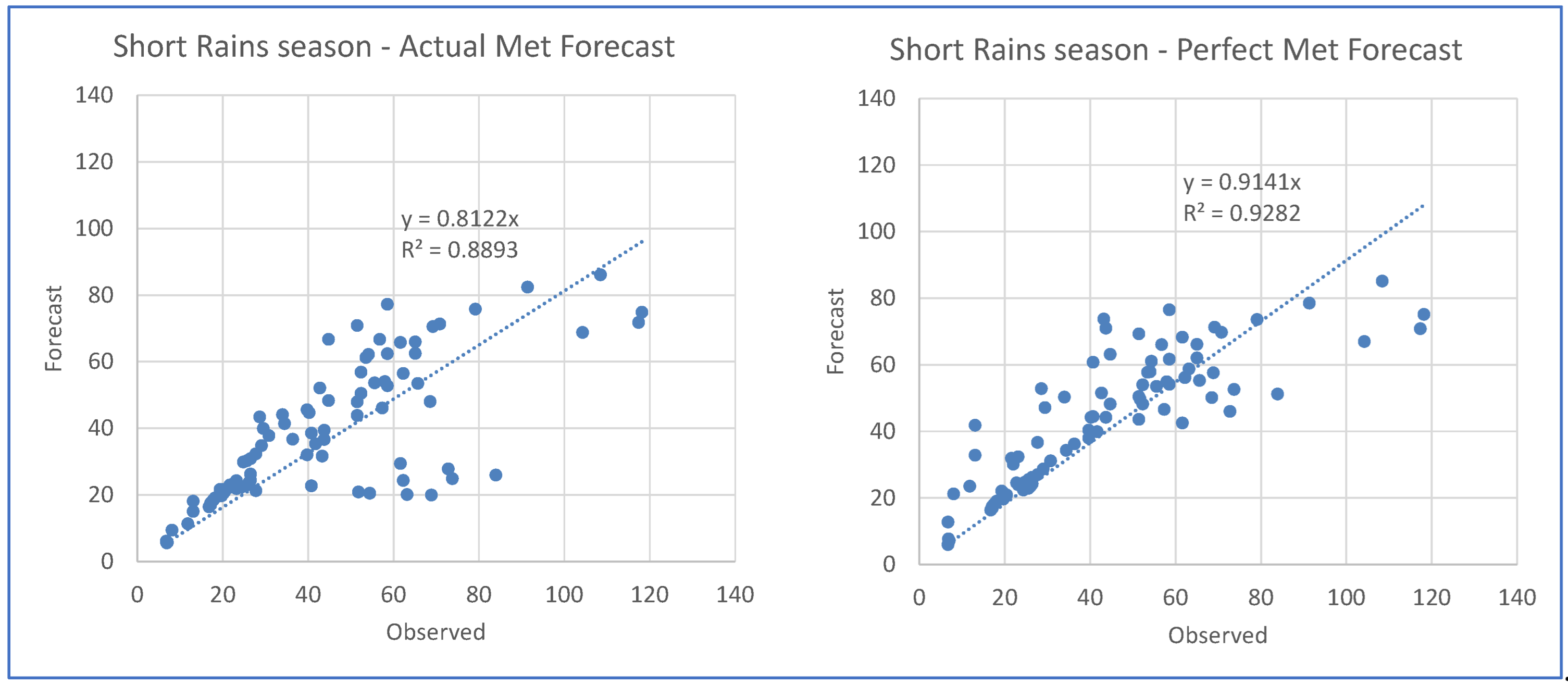
- Short Rains (December–February, flows from 10 to 120 m3/s);
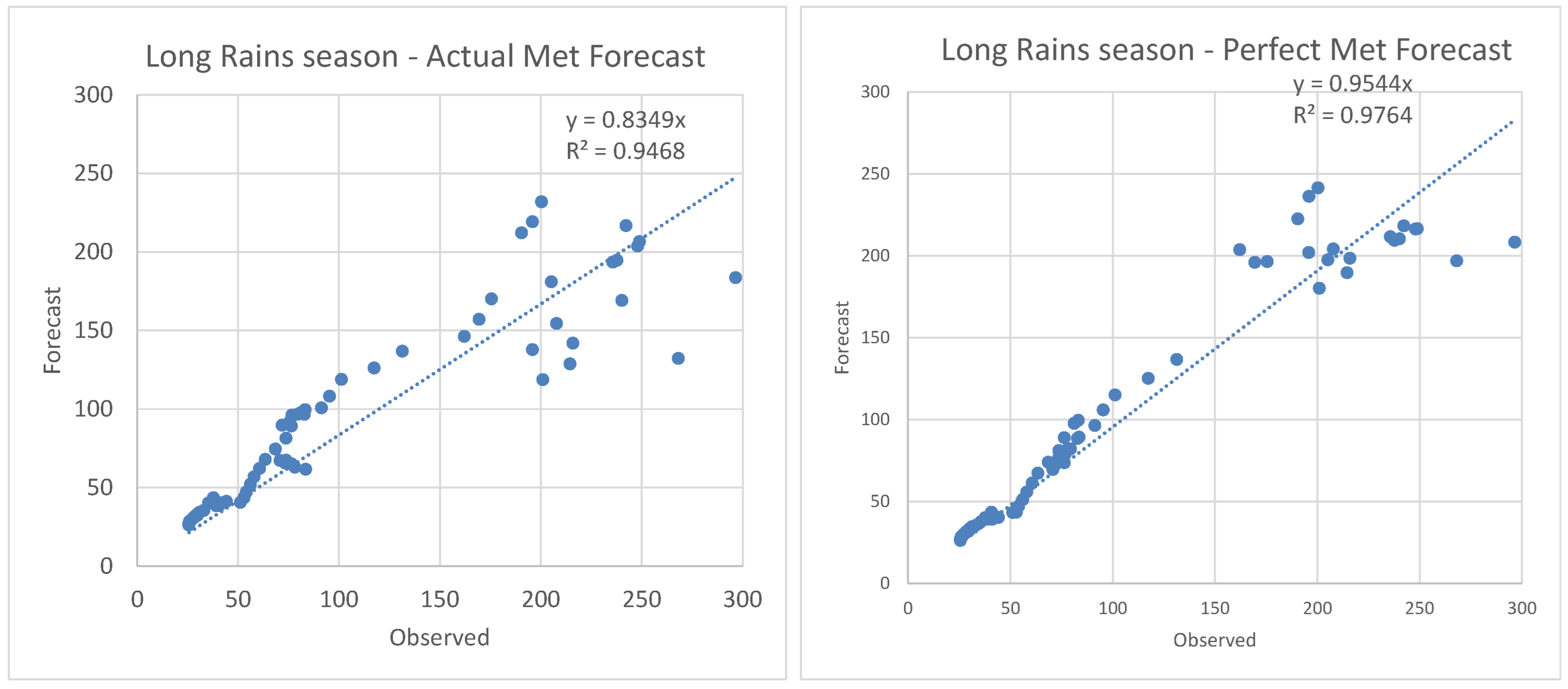
- Long Rains (May–June, flows from 5 to 200 m3/s).
3. Results
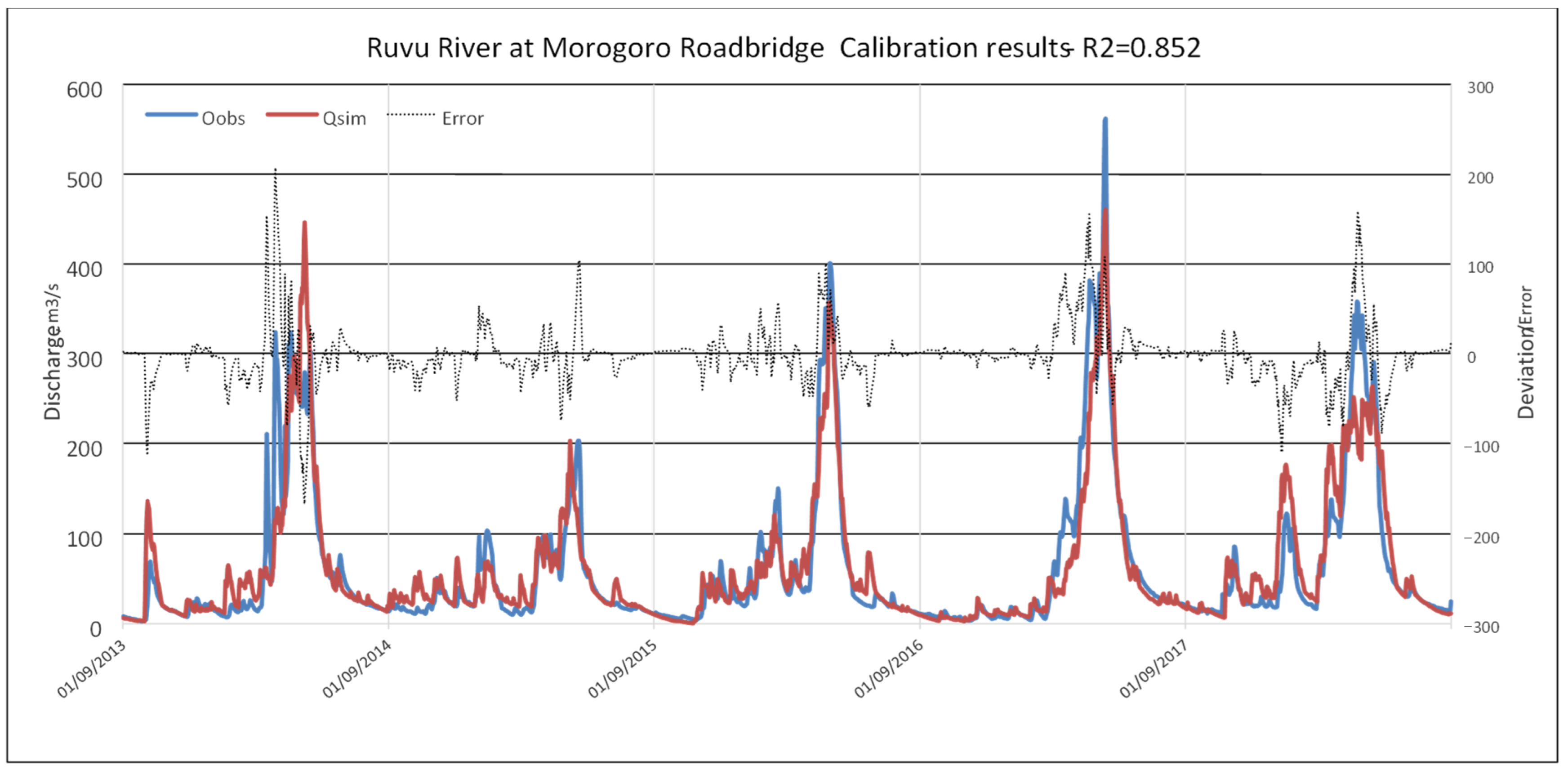
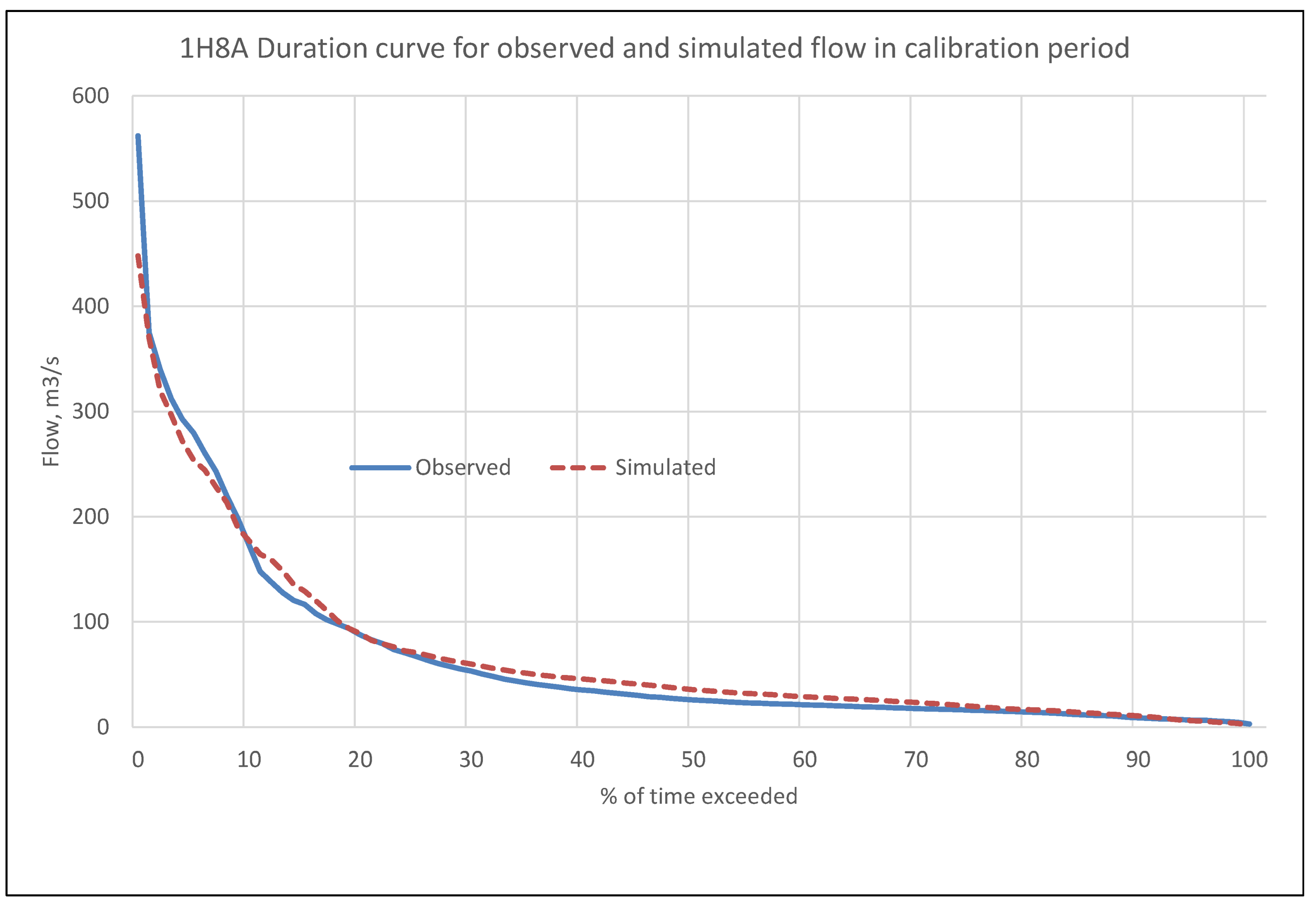
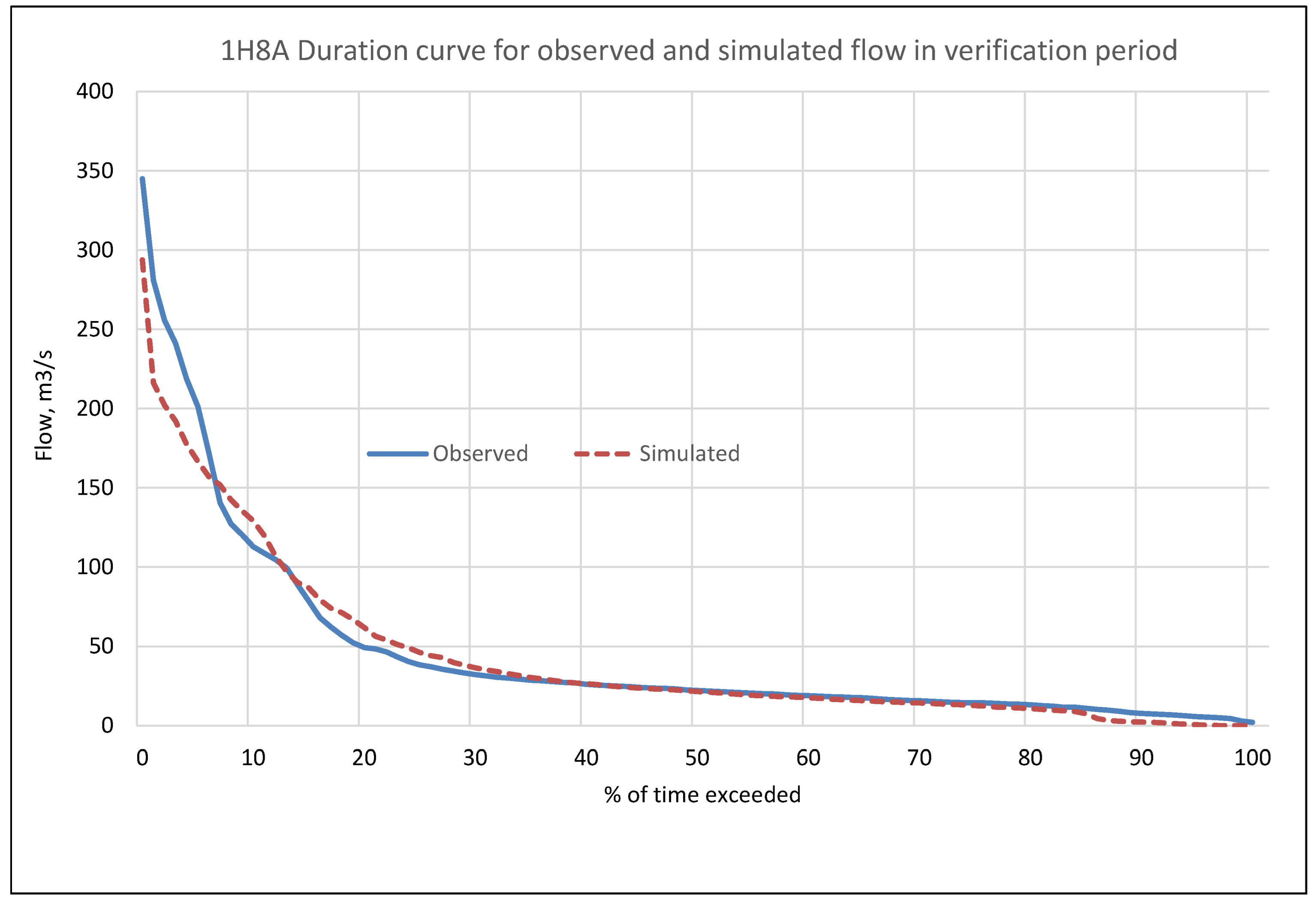
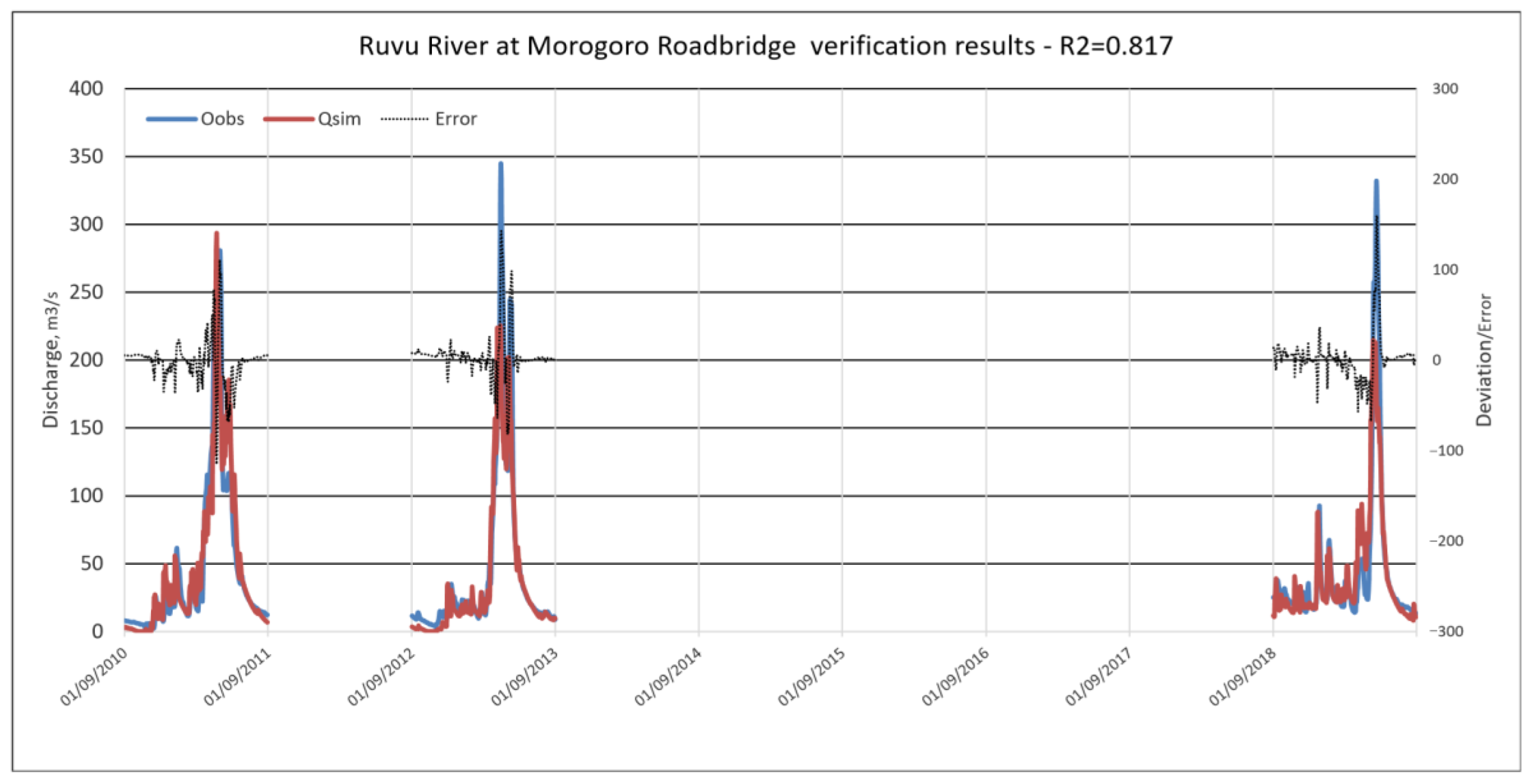
3.1. Model Calibration Results, 1H8A Ruvu at Morogoro Roadbridge
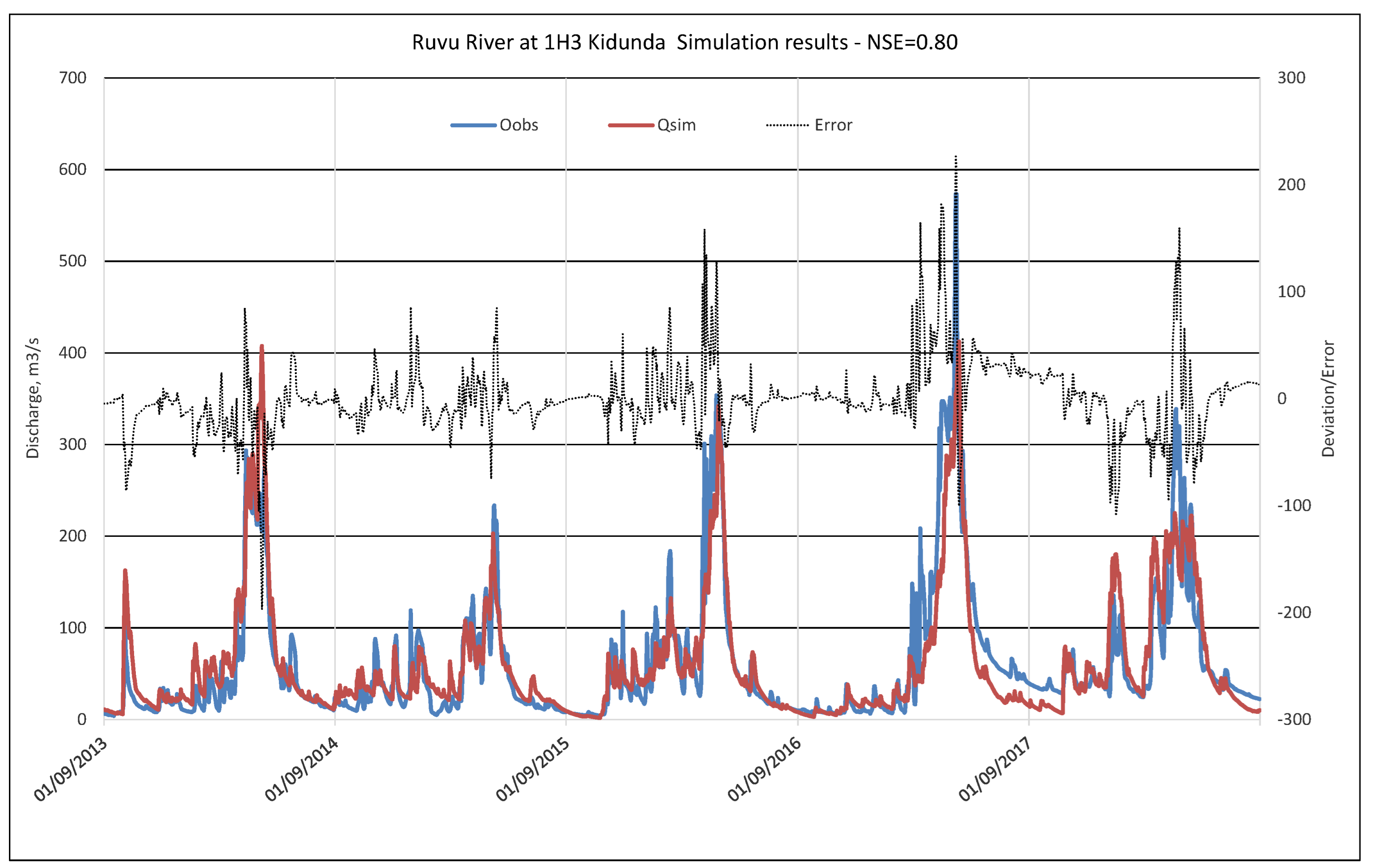
3.2. Model Calibration Results, 1H3 Kidunda
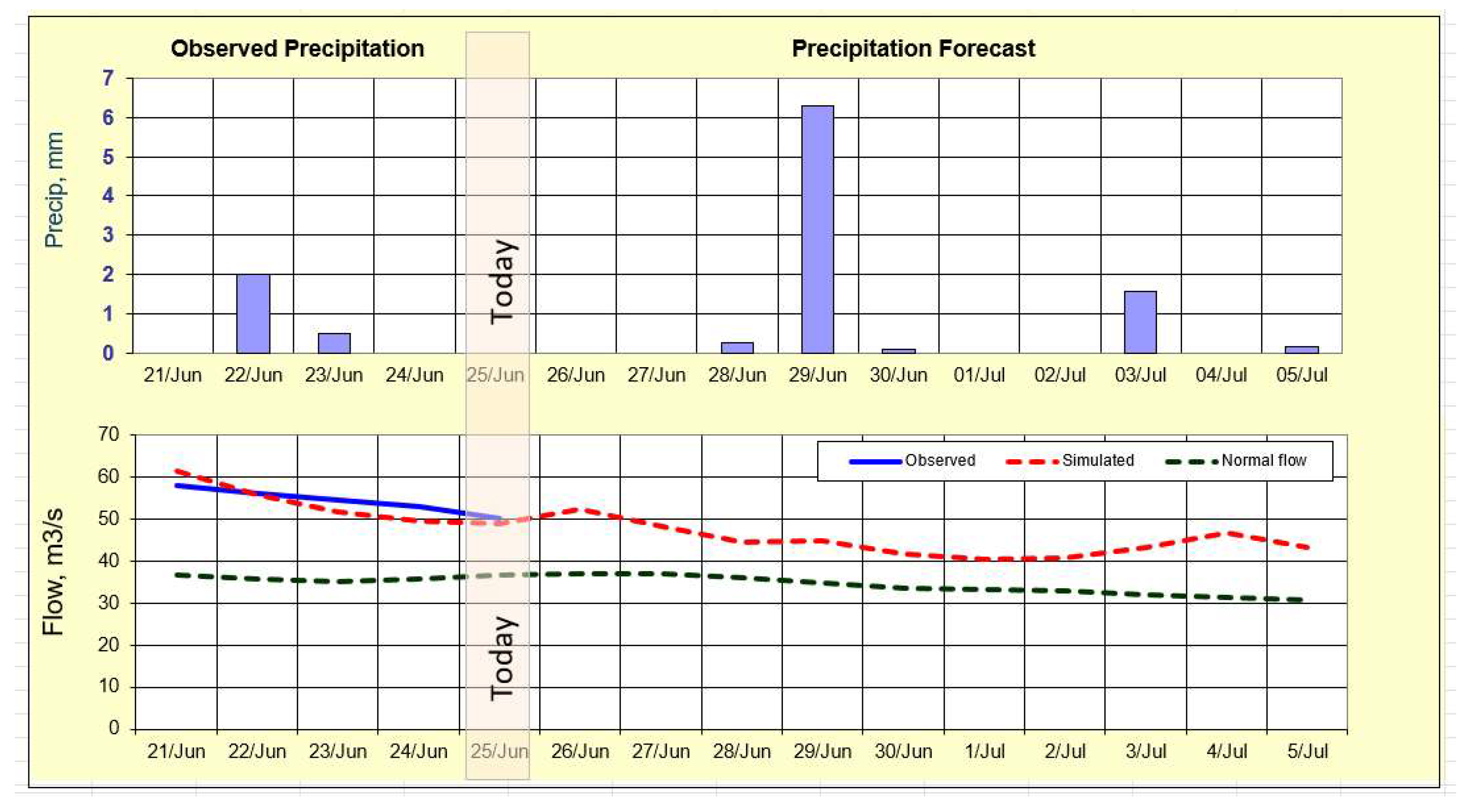
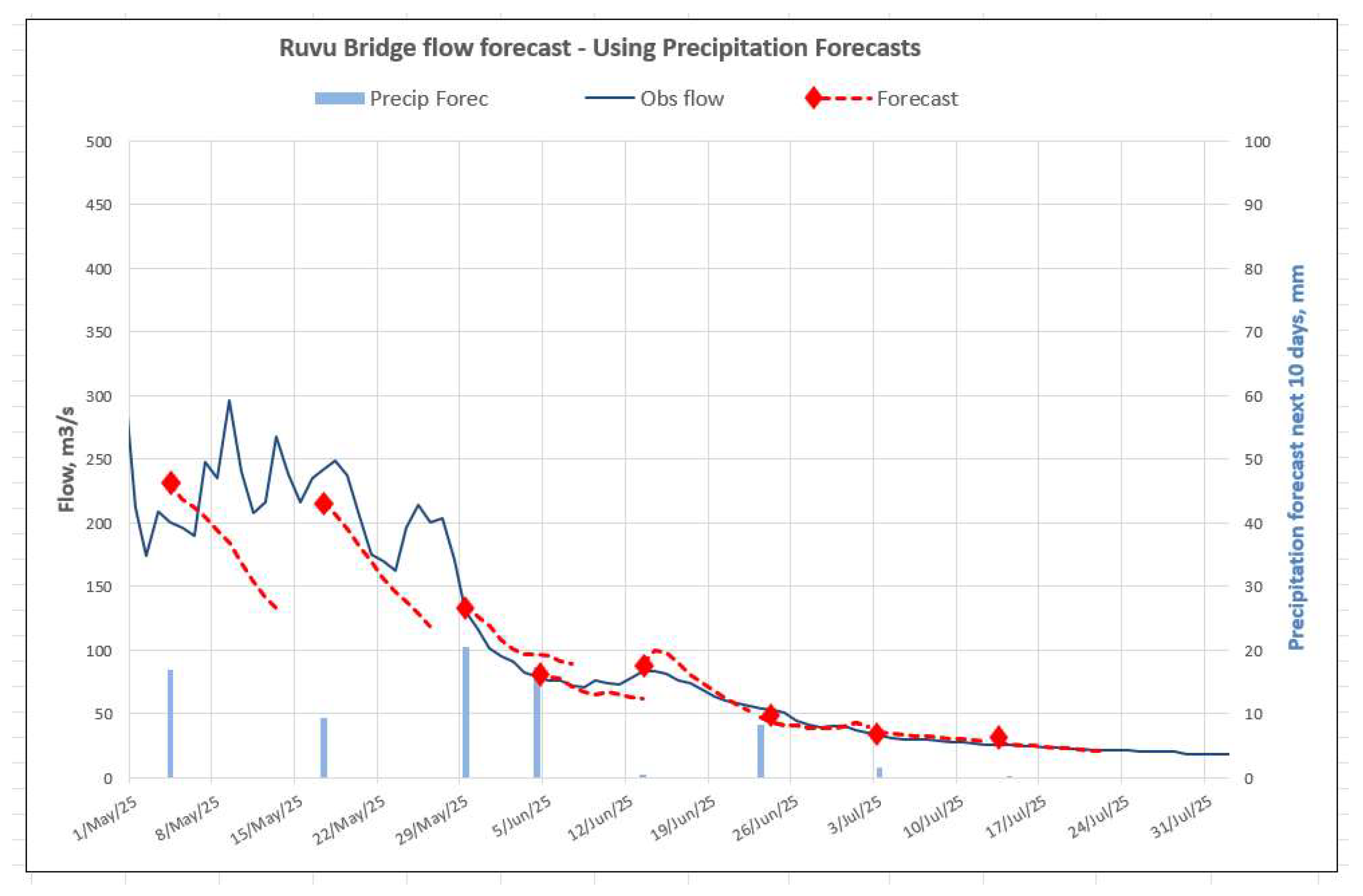
3.3. Operational 10-Day Flow Forecasting Results
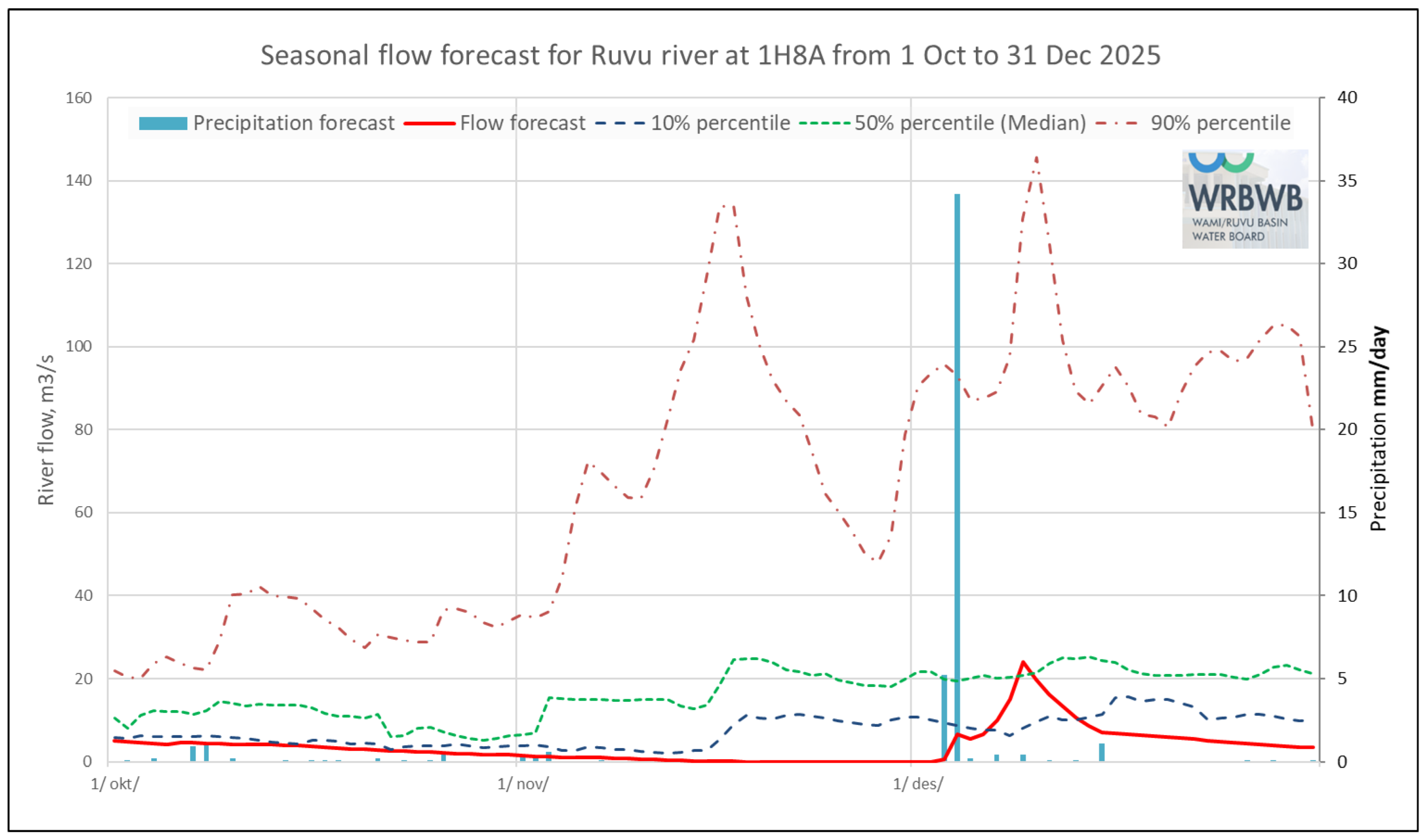
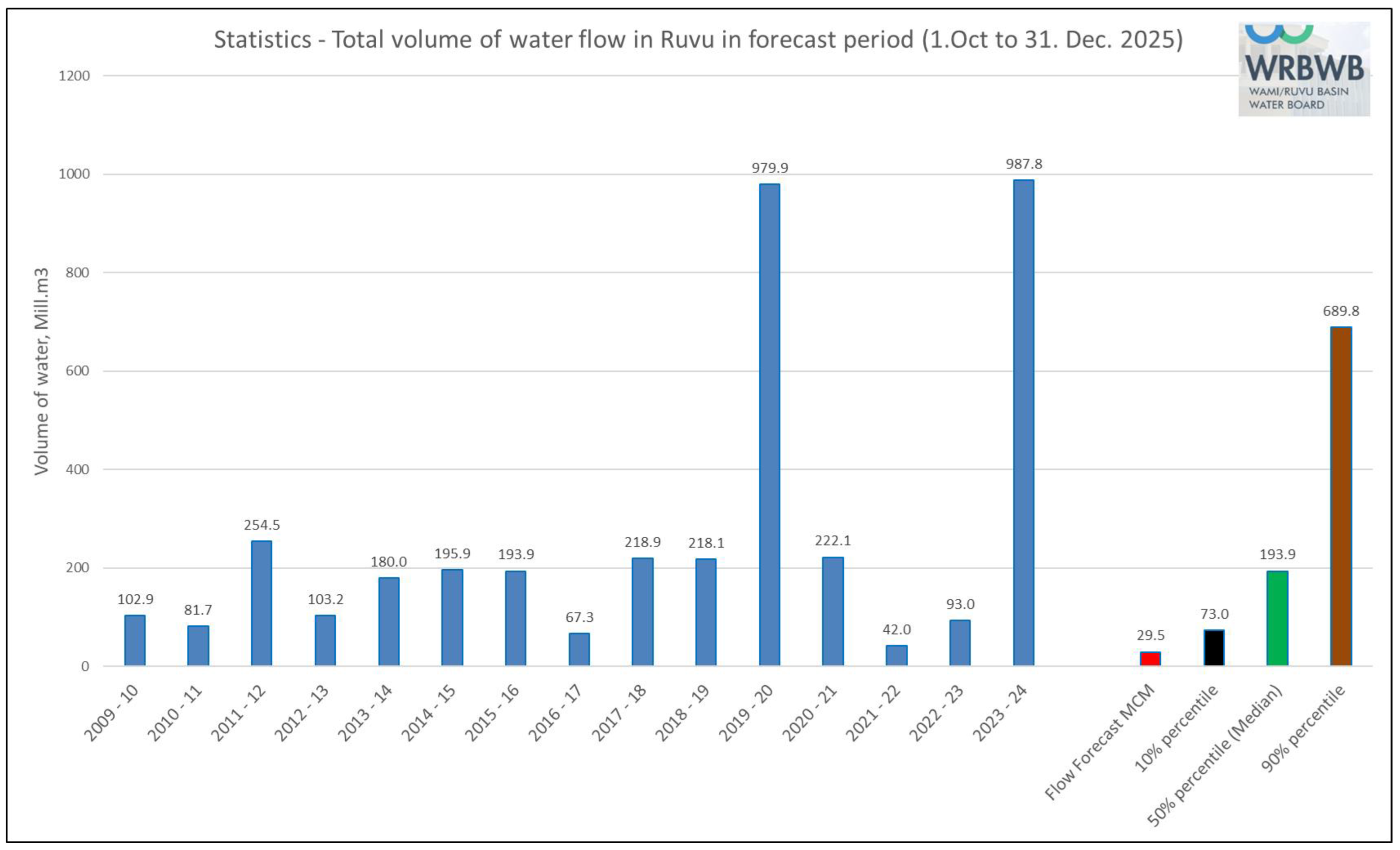
3.4. Seasonal Flow Forecasting Results
3.5. Forecast Quality Analysis—Results
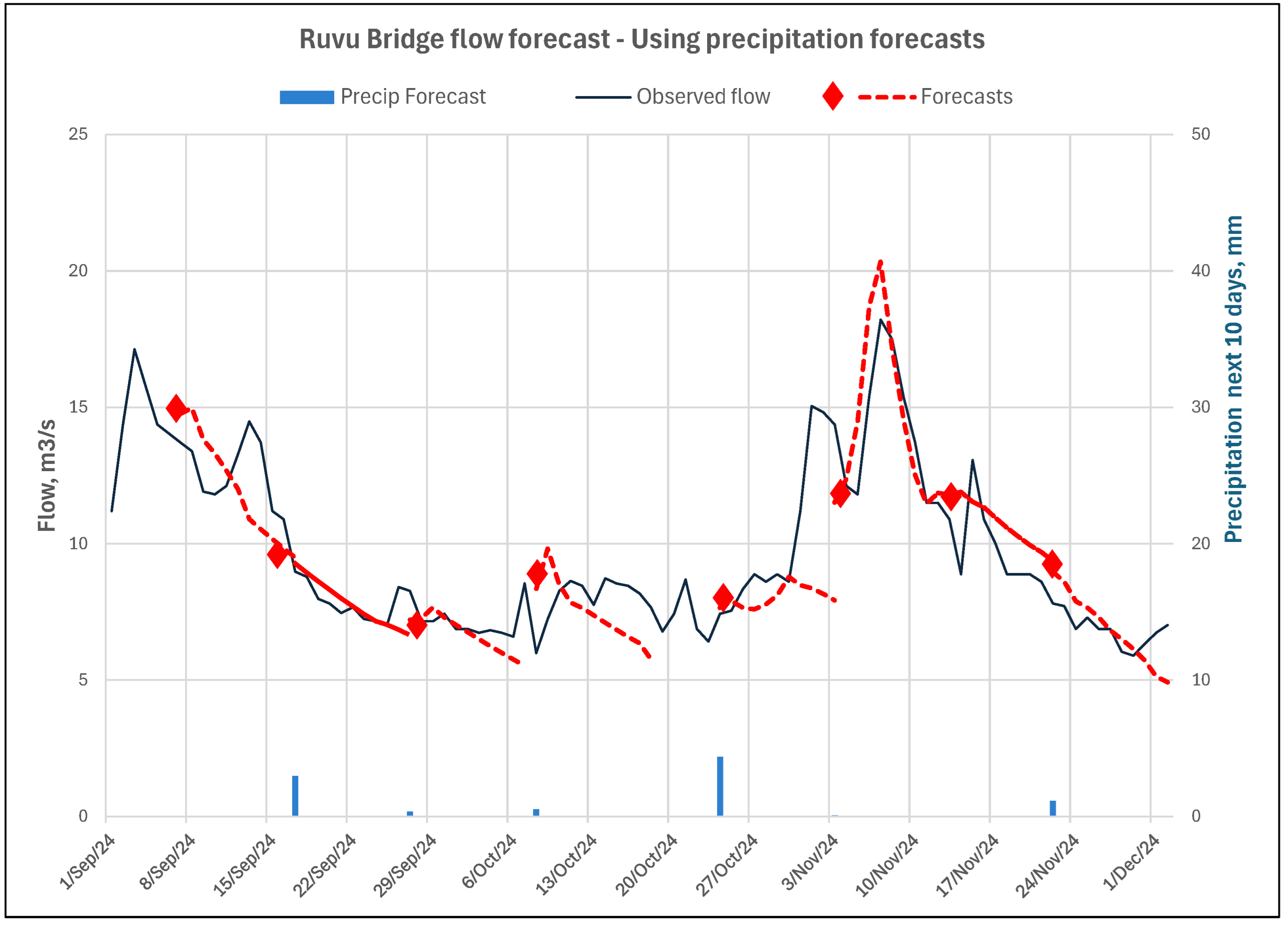
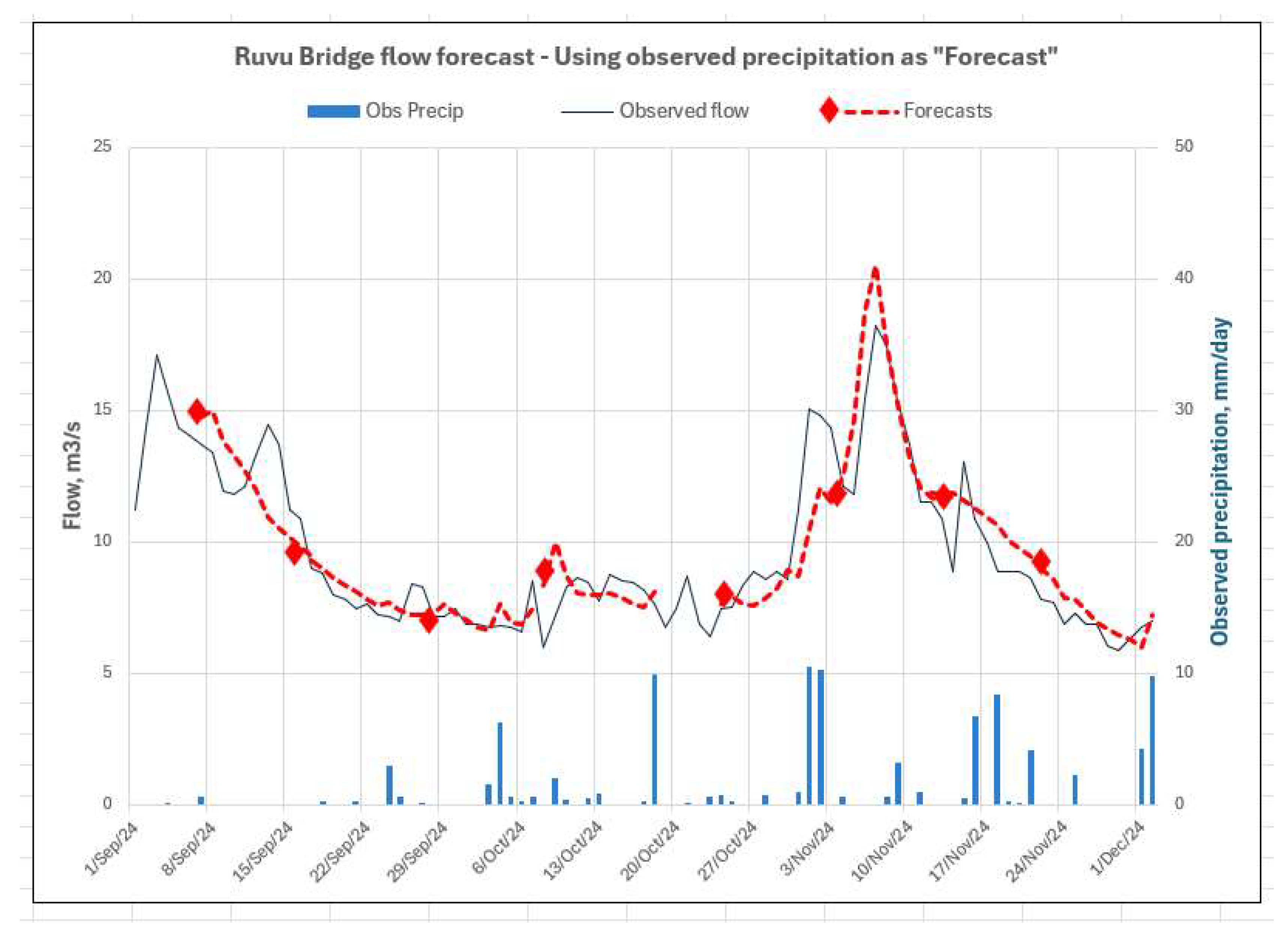
3.5.1. Case 1: Dry Season: Low Flow—September to November 2024
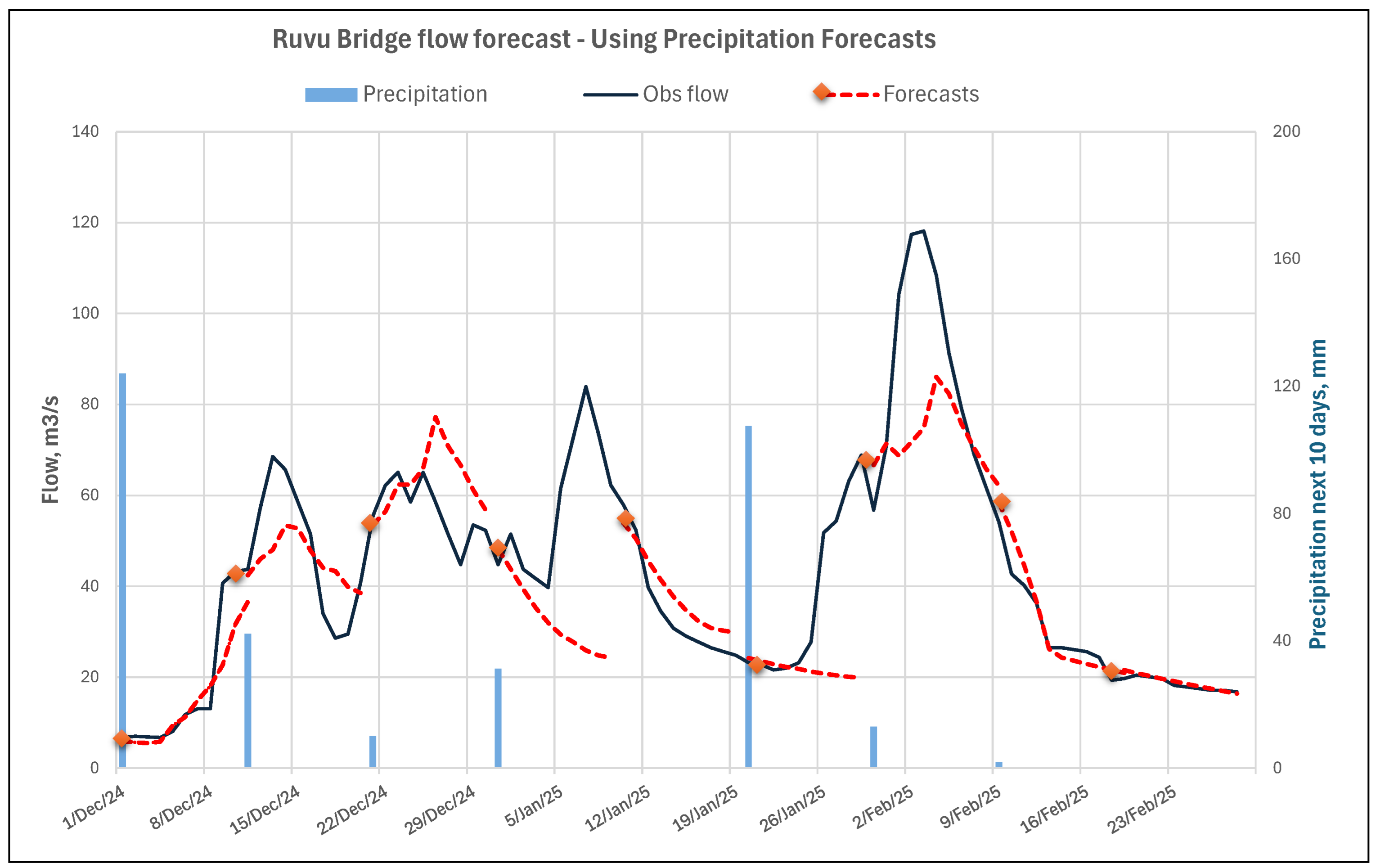
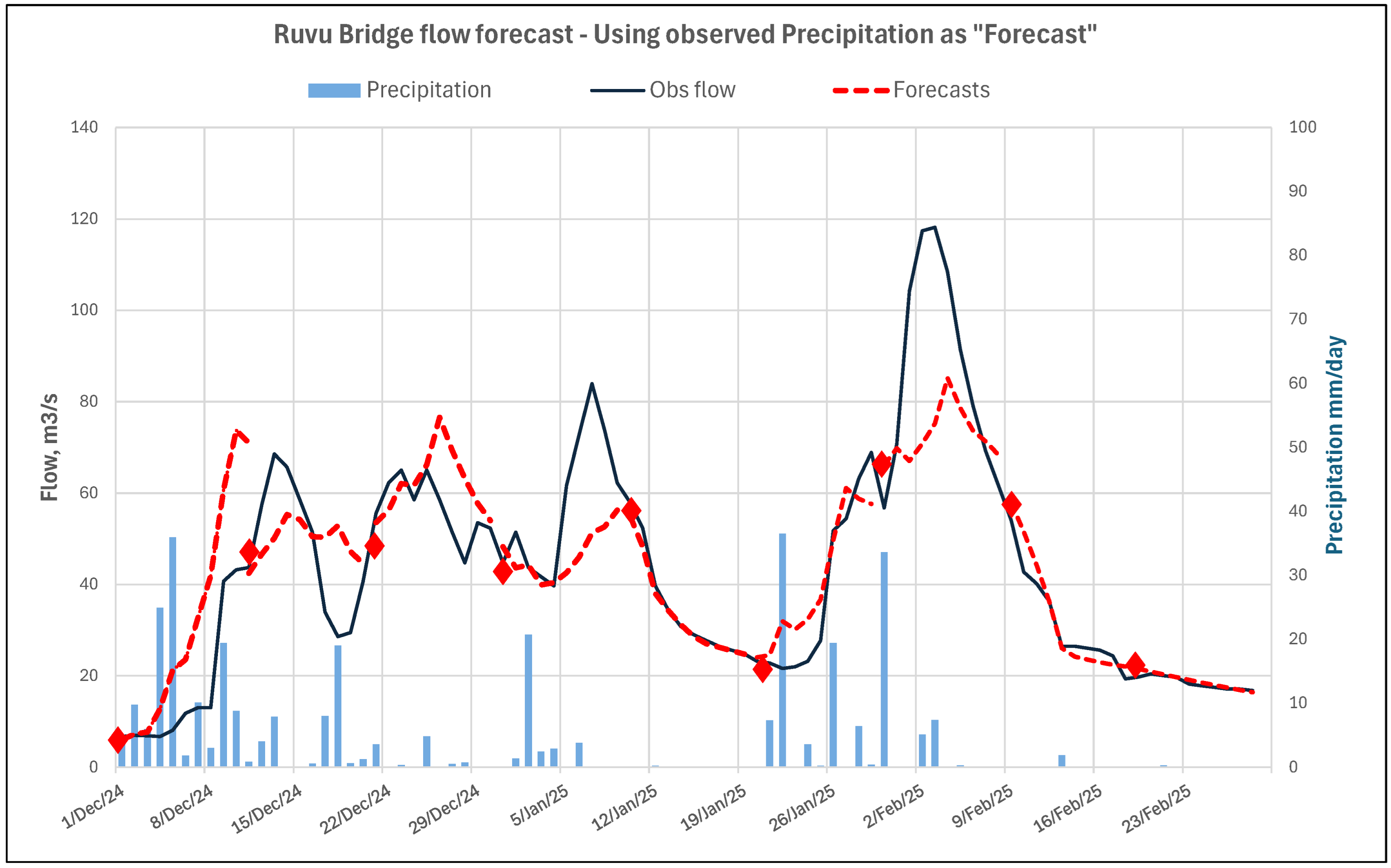
3.5.2. Case 2: Short Rains: Medium–High Flow—December–February 2024/2025
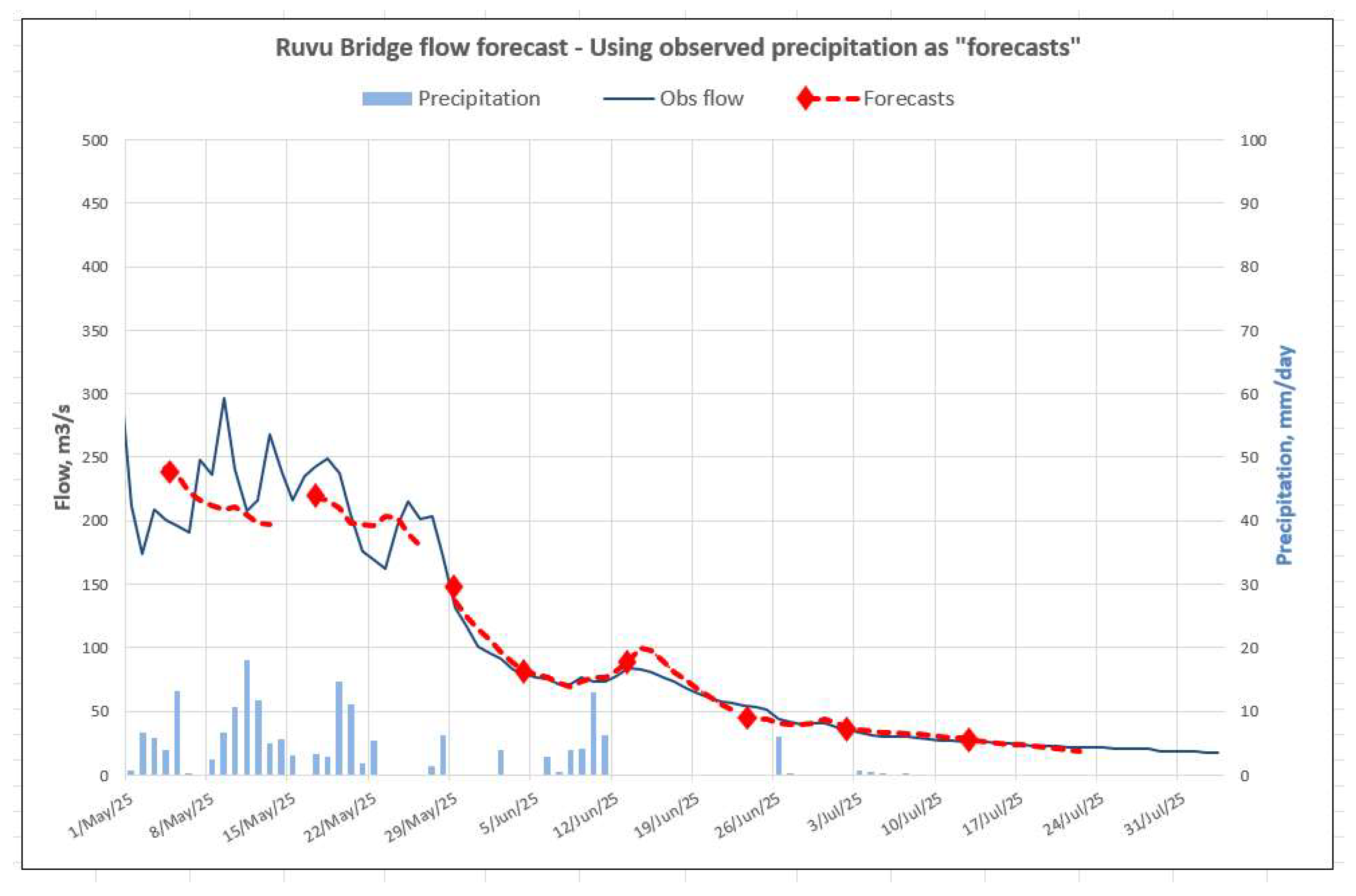
3.5.3. Case 3: Long Rains: Forecasts During High Flow May–June 2025
3.5.4. Statistical Analysis
4. Discussion
4.1. Model Calibration
4.2. 10-Day Forecast
4.3. Seasonal Forecast
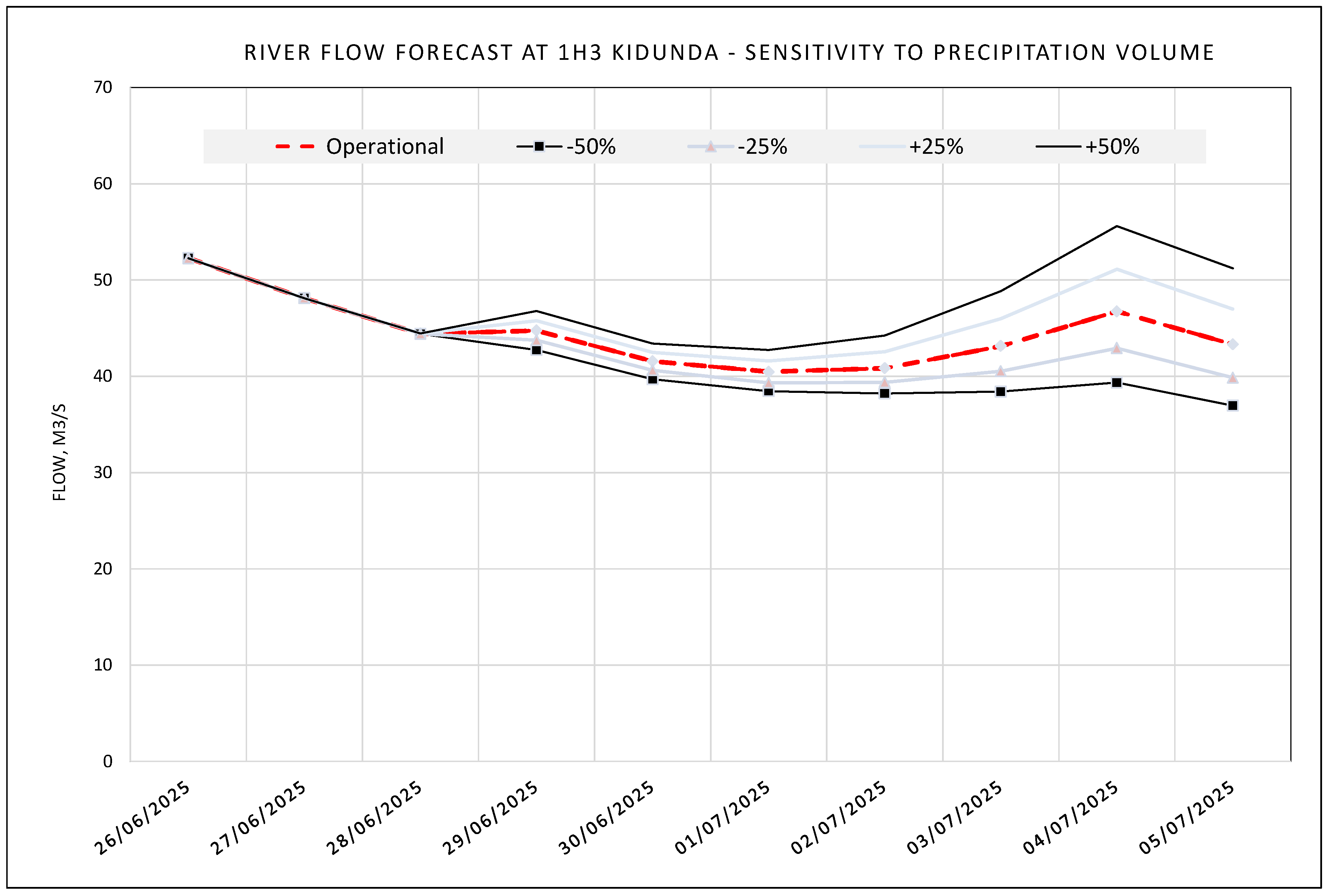
4.4. Ensemble Forecasts
5. Conclusions
- Infrastructure vulnerability: The complete destruction of the Kidunda (1H3) gauging station in April 2024 and damage to the 1H8A staff gauge highlighted the fragility of monitoring networks. Mitigation involved data correlation and temporary repairs, though this limited verification for 1H3.
- Inherent data scarcity: Non-concurrent records, missing data, and sparse spatial coverage were endemic. The response was a conservative, best-available-data approach, prioritizing quality over quantity and employing statistical infilling.
- Meteorological forecast limitations: Global and regional forecast products (Yr.no, TMA) introduced significant uncertainty, especially during rainy seasons. The study quantified this impact, providing a clear target for future improvements in local meteorological modelling.
6. Recommendations
6.1. Institutionalize and Modernize Hydrometeorological Monitoring Networks
- Prioritizing resilient and redundant monitoring infrastructure. Key stations like Kidunda (1H3) must be rebuilt with robust design and real-time telemetry to withstand extreme events.
- Strategic expansion of automated networks. Investments should focus on deploying cost-effective, automated weather stations (like TAHMO) to improve spatial coverage, particularly in topographically complex and data-sparse areas, to reduce areal precipitation uncertainty.
- Establishing national data stewardship protocols. This includes formalizing procedures for continuous quality control, gap-filling, rating curve maintenance, and open-data sharing to create a sustainable and high-quality data foundation for all water sector applications.
6.2. Embed Forecasting Systems Within Local Institutional Frameworks
- Formalizing the institutional home for the forecasting service within a relevant national or basin authority (e.g., Wami–Ruvu Basin Water Board), ensuring dedicated budgets and staffing.
- Implementing continuous capacity-building programmes. This includes advanced training for model maintenance, forecast interpretation, and system updating for engineers and technicians at local partner higher learning institutions like the Dar es Salaam Institute of Technology (DIT).
- Developing clear operational protocols that integrate forecast products into the standard decision-making workflows of water supply utilities (e.g., DAWASA) and disaster management agencies.
6.3. Prioritize Improvements in Meteorological Forecasting
- Foster deeper collaboration between hydrological and meteorological services (TMA) to co-develop bias-corrected, downscaled forecast products tailored for hydrological input.
- Invest in and evaluate ensemble prediction systems (EPS) to quantify and communicate forecast uncertainty, which is crucial for risk-based water management and reservoir operation.
6.4. Adopt and Promote the Phased, Pragmatic Modelling Paradigm
- Promoting the use of transparent, adaptable conceptual models (like HBV) as a first step in operational forecasting in developing regions, avoiding premature adoption of overly complex systems that exceed local maintenance capacity.
- Documenting and sharing modular system blueprints, including data preparation scripts, calibration routines, and dashboard designs, to reduce start-up costs for new basins.
- Planning for adaptive model evolution. Systems should be designed from the outset, as demonstrated with the three-stage Kidunda dam model, to accommodate future changes in catchment regulation and land use.
6.5. Implement a Cycle of Continuous Performance Review and System Evolution
- Instituting a formal forecast verification routine to routinely assess performance against observations, diagnose emerging errors, and trigger necessary model updates or recalibration.
- Developing a structured feedback mechanism with forecast end-users (e.g., reservoir operators and city water managers) to ensure the system evolves to meet practical decision-making needs.
- Exploring incremental technological upgrades, such as coupling with hydraulic routing models for flood inundation mapping or integrating seasonal climate forecasts for long-term water resources planning, as local capacity grows.
6.6. Advocate for Strategic Policy and Investment
- Mainstreaming operational hydrological forecasting into national water resources management policies, climate adaptation strategies, and infrastructure development plans.
- Securing dedicated, long-term funding for monitoring networks, model maintenance, and capacity development, moving from project-based to programme-based support.
- Fostering regional knowledge networks among East African countries facing similar challenges to share solutions, data, and tools, thereby increasing collective efficiency and resilience.
Author Contributions
Funding
Data Availability Statement
Acknowledgments
Conflicts of Interest
References
- Sene, K. Hydrological Forecasting. In Hydrometeorology; Springer: Dordrecht, the Netherlands, 2010. [Google Scholar] [CrossRef]
- Sene, K. Hydrometeorology: Forecasting and Applications, 2nd ed.; Springer International Publishing: Cham, Switzerland, 2016. [Google Scholar] [CrossRef]
- He, M.; Lee, H. Advances in Hydrological Forecasting. Forecasting 2021, 3, 517–519. [Google Scholar] [CrossRef]
- Zhao, X.; Wang, H.; Bai, M.; Xu, Y.; Dong, S.; Rao, H.; Ming, W. A Comprehensive Review of Methods for Hydrological Forecasting Based on Deep Learning. Water 2024, 16, 1407. [Google Scholar] [CrossRef]
- Lucatero, D.; Madsen, H.; Refsgaard, J.C.; Kidmose, J.; Jensen, K.H. Seasonal streamflow forecasts in the Ah-lergaarde catchment, Denmark: The effect of preprocessing and post-processing on skill and statistical consistency. Hydrol. Earth Syst. Sci. 2018, 22, 3601–3617. [Google Scholar] [CrossRef]
- Bruland, O.; Kolberg, S.; Tøfte, L.S.; Engeland, K. ENKI—operational hydrological forecasting system. In Proceedings of the 17th International Northern Research Basins Symposium and Workshop, Iqaluit-Pangnirtung-Kuujjuaq, Canada, 12–18 August 2009. [Google Scholar]
- Sunday, R.; Masih, I.; Werner, M.; van der Zaag, P. Streamflow forecasting for operational water management in the Incomati River Basin, Southern Africa. Phys. Chem. Earth Parts A/B/C 2014, 72, 1–12. [Google Scholar] [CrossRef]
- Nadeem, M.U.; Waheed, Z.; Ghaffar, A.M.; Javaid, M.M.; Hamza, A.; Ayub, Z.; Nawaz, M.A.; Waseem, W.; Hameed, M.F.; Zeeshan, A.; et al. Application of HEC-HMS for flood forecasting in hazara catchment Pakistan, south Asia. Int. J. Hydrol. 2022, 6, 7–12. [Google Scholar] [CrossRef]
- Troin, M.; Arsenault, R.; Wood, A.W.; Brissette, F.; Martel, J. Generating ensemble streamflow forecasts: A review of methods and approaches over the past 40 years. Water Resour. Res. 2021, 57, e2020WR028392. [Google Scholar] [CrossRef]
- Lerat, J.; Chiew, F.; Robertson, D.; Andréassian, V.; Zheng, H. Data Assimilation Informed model Structure Improvement (DAISI) for robust prediction under climate change: Application to 201 catchments in southeastern Australia. Water Resour. Res. 2024, 60, e2023WR036595. [Google Scholar] [CrossRef]
- Charles, S.P.; Wang, Q.J.; Ahmad, M.-U.; Hashmi, D.; Schepen, A.; Podger, G.; Robertson, D.E. Seasonal streamflow forecasting in the upper Indus Basin of Pakistan: An assessment of methods. Hydrol. Earth Syst. Sci. 2018, 22, 3533–3549. [Google Scholar] [CrossRef]
- Godet, J.; Payrastre, O.; Javelle, P.; Bouttier, F. Assessing the ability of a new seamless short-range ensemble rainfall product to anticipate flash floods in the French Mediterranean area. Nat. Hazards Earth Syst. Sci. 2023, 23, 3355–3377. [Google Scholar] [CrossRef]
- Vogel, E.; Lerat, J.; Pipunic, R.; Frost, A.; Donnelly, C.; Griffiths, M.; Hudson, D.; Loh, S. Seasonal ensemble forecasts for soil moisture, evapotranspiration and runoff across Australia. J. Hydrol. 2021, 601, 126620. [Google Scholar] [CrossRef]
- Cassagnole, M.; Ramos, M.-H.; Zalachori, I.; Thirel, G.; Garçon, R.; Gailhard, J.; Ouillon, T. Impact of the quality of hydrological forecasts on the management and revenue of hydroelectric reservoirs—A conceptual approach. Hydrol. Earth Syst. Sci. 2021, 25, 1033–1052. [Google Scholar] [CrossRef]
- Jajarmizad, M.; Harun, S.; Salarpour, M. A review on theoretical consideration and types of models in hydrology. J. Environ. Sci. Technol. 2012, 5, 249–261. [Google Scholar] [CrossRef]
- Abebe, N.A.; Ogden, F.L.; Pradhan, N.R. Sensitivity and uncertainty analysis of the conceptual HBV rain-fall–runoff model: Implications for parameter estimation. J. Hydrol. 2010, 389, 301–310. [Google Scholar] [CrossRef]
- Wang, Y.; Wang, Y.; Wang, Y.; Li, C.; Ju, Q.; Jin, J.; Deng, X.; Sun, G.; Bao, Z. Applicability of the HBV model to a human-influenced catchment in northern China. Hydrol. Res. 2023, 54, 208–219. [Google Scholar] [CrossRef]
- Kavetski, D.; Clark, M.P. Numerical troubles in conceptual hydrology: Approximations, absurdities and impact on hypothesis testing. Hydrol. Process. 2011, 25, 661–670. [Google Scholar] [CrossRef]
- Pagano, T.C.; Wood, A.W.; Ramos, M.-H.; Cloke, H.L.; Pappenberger, F.; Clark, M.P.; Cranston, M.; Kavetski, D.; Mathevet, T.; Sorooshian, S.; et al. Challenges of Operational River Forecasting. J. Hydrometeorol. 2014, 15, 1692–1707. [Google Scholar] [CrossRef]
- Blöschl, G.; Bierkens, M.F.; Chambel, A.; Cudennec, C.; Destouni, G.; Fiori, A.; Kirchner, J.W.; McDonnell, J.J.; Savenije, H.H.; Sivapalan, M.; et al. Twenty-three un-solved problems in hydrology (UPH)—A community perspective. Hydrol. Sci. J. 2019, 64, 1141–1158. [Google Scholar] [CrossRef]
- Astagneau, P.C.; Bourgin, F.; Andréassian, V.; Perrin, C. Lead-time-dependent calibration of a flood forecasting model. J. Hydrol. 2024, 644, 132119. [Google Scholar] [CrossRef]
- Najafi, H.; Shrestha, P.K.; Rakovec, O.; Apel, H.; Vorogushyn, S.; Kumar, R.; Thober, S.; Merz, B.; Samaniego, L. High-resolution impact-based early warning system for riverine flooding. Nat. Commun. 2024, 15, 3726. [Google Scholar] [CrossRef] [PubMed]
- WMO. Guide to Hydrological Practices, Volume 1, Hydrology—From Measurement to Hydrological Information, 6th ed.; WMO: Geneva, Switzerland, 2008; Available online: http://www.hydrology.nl/images/docs/hwrp/WMO_Guide_168_Vol_I_en.pdf (accessed on 30 April 2023).
- Ndomba, P.M. Streamflow Data Needs for Water Resources Management and Monitoring Challenges: A Case Study of Wami River Subabasin in Tanzania. In Nile River Basin, Ecohydrological Challenges, Climate Change and Hydropolitics; Melesse, A.M., Abtew, W., Setegn, S.G., Eds.; Springer International Publishing: Cham, Switzerland, 2014; pp. 101–140. [Google Scholar] [CrossRef]
- Mikova, K.; Makupa, E.E. Current Status of Hydrological Forecast Service In Tanzania. In Proceedings of the V International Scientific and Practical Conference on Modern Problems of Reservoirs and Catchments, Perm, Russia, 29–31 May 2015. [Google Scholar]
- World Bank Group. Assessment of the State of Hydrological Services in Developing Countries; The World Bank: Washington, DC, USA, 2018. [Google Scholar]
- Ndomba, P.; Mtalo, F.; Killingtveit, A. SWAT Model application in a data scarce tropical complex catchment in Tanzania. Phys. Chem. Earth Parts A/B/C 2008, 33, 626–632. [Google Scholar] [CrossRef]
- Jjunju, E.; Killingtveit, A. Modelling climate change impacts on hydropower in East Africa. Int. J. Hydropower Dams Water Storage Hydropower Develop. Afr. 2015, 15–20. [Google Scholar]
- Banda, V.D.; Dzwairo, R.B.; Singh, S.K.; Kanyerere, T. Hydrological Modelling and Climate Adaptation under Changing Climate: A Review with a Focus in Sub-Saharan Africa. Water 2022, 14, 4031. [Google Scholar] [CrossRef]
- Tibangayuka, N.; Mulungu, D.M.M.; Izdori, F. Evaluating the performance of HBV, HEC-HMS and ANN models in simulating streamflow for a data scarce high-humid tropical catchment in Tanzania. Hydrol. Sci. J. 2022, 67, 2191–2204. [Google Scholar] [CrossRef]
- Shagega, F.P.; Munishi, S.E.; Kongo, V.M. Assessment of potential impacts of climate change on water resources in Ngerengere catchment, Tanzania. Phys. Chem. Earth Parts A/B/C 2019, 116, 102804. [Google Scholar] [CrossRef]
- Tibangayuka, N.; Mulungu, D.M.; Izdori, F. Performance evaluation, sensitivity, and uncertainty analysis of HBV model in Wami Ruvu basin, Tanzania. J. Hydrol. Reg. Stud. 2022, 44, 101266. Available online: https://www.sciencedirect.com/science/article/pii/S2214581822002798 (accessed on 30 June 2024).
- IWRMDP-URT. Integrated Water Resources Management and Development Plan for Wami/Ruvu Basin; Component III—Volume 5: IWRMDP for Upper Ruvu Catchment, REF: WRB-URP.03.; United Republic of Tanzania: Dodoma, Tanzania, 2020. [Google Scholar]
- Ngana, J.; Mahay, F.; Cross, K. Wami Basin: A Situation Analysis; Report for the Wami/Ruvu Basin Water Office, Supported by IUCN; International Union for Conservation of Nature and Natural Resources: Gland, Switzerland, 2010; Available online: https://waterandnature.org/download/wami-basin-a-situation-analysis/ (accessed on 30 April 2023).
- Alphayo, S.M.; Sharma, M.P. Impact of Land Use on Water Quality in Ruvu River Basin, Tanzania. In Technology and Environment Management for Smart India: Challenges, Opportunities and Strategies; Chauhan, S.N., Ed.; Bloomsbury: Delhi, India, 2018; pp. 21–27. ISBN 978-93-87146-12-9. [Google Scholar]
- Wami/Ruvu Basin Water Office (WRBWO). Business Plan; WRBWO: Morogoro, Tanzania, 2008. [Google Scholar]
- Shayeghi, A.; Azizian, A.; Brocca, L. Reliability of reanalysis and remotely sensed precipitation products for hydrological simulation over the Sefidrood River Basin, Iran. Hydrol. Sci. J. 2020, 65, 296–310. [Google Scholar] [CrossRef]
- Wanzala, M.A.; Ficchi, A.; Cloke, H.L.; Stephens, E.M.; Badjana, H.M.; Lavers, D.A. Assessment of global reanalysis precipitation for hydrological modelling in data-scarce regions: A case study of Kenya. J. Hydrol. Reg. Stud. 2022, 41, 101105. [Google Scholar] [CrossRef]
- Koutsouris, A.J.; Seibert, J.; Lyon, S.W. Utilization of Global Precipitation Datasets in Data Limited Regions: A Case Study of Kilombero Valley, Tanzania. Atmosphere 2017, 8, 246. [Google Scholar] [CrossRef]
- Tongal, H.; Booij, M.J. Simulation and forecasting of streamflows using machine learning models coupled with base flow separation. J. Hydrol. 2018, 564, 266–282. [Google Scholar] [CrossRef]
- Tarfaya, C.; Houichi, L.; Heddam, S. Prediction of Index rainfall in ungauged regions of Algeria: Survey of rule-based models using geographic predictors. Arab. J. Geosci. 2022, 15, 668. [Google Scholar] [CrossRef]
- Shortridge, J.E.; Guikema, S.D.; Zaitchik, B.F. Empirical streamflow simulation for water resource management in data-scarce seasonal watersheds. Hydrol. Earth Syst. Sci. Discuss. 2015, 12, 11083–11127. [Google Scholar] [CrossRef]
- Guo, B.; Zhang, J.; Xu, T.; Song, Y.; Liu, M.; Dai, Z. Assessment of multiple precipitation interpolation methods and uncertainty analysis of hydrological models in Chaohe River basin, China. Water SA 2022, 48, 324–334. [Google Scholar] [CrossRef]
- Zakwan, M.; Muzzammil, M.; Alam, J. Developing Stage-Discharge Relations using Optimization Techniques. Aquademia Water Environ. Technol. 2017, 1, 05. [Google Scholar] [CrossRef]
- Thornthwaite, C.W. An approach toward a rational classification of climate. Geogr. Rev. 1948, 38, 55–94. [Google Scholar] [CrossRef]
- Rusnam, R.; Yanti, N.R. Potential Evapotranspiration uses Thornthwaite Method to the Water Balance in Padang City. IOP Conf. Ser. Earth Environ. Sci. 2021, 757, 012041. [Google Scholar] [CrossRef]
- Arsenault, M.; Wood, A.W.; Brissette, F.; Martel, J.-L. The hazards of split-sample validation in hydrological model calibration. J. Hydrol. 2018, 566, 346–362. [Google Scholar] [CrossRef]
- Shen, H.; Tolson, B.A.; Mai, J. Time to update the split-sample approach in hydrological model calibration. Water Resour. Res. 2022, 58, e2021WR031523. [Google Scholar] [CrossRef]
- Bergström, S.; Forsman, A. Development of a conceptual deterministic rainfall-runoff model. Nord. Hydrol. 1973, 4, 147–170. [Google Scholar] [CrossRef]
- Killingtveit, Å.; Sælthun, N.R. Hydropower Development; Vol. 7, Hydrology; Division of Hydraulic Engineering, NTH: Trondheim, Norway, 1995; 213p, ISBN 82-7598-026-7. [Google Scholar]
- Seibert, J.; Bergström, S. A retrospective on hydrological catchment modelling based on half a century with the HBV model. Hydrol. Earth Syst. Sci. 2022, 26, 1371–1388. [Google Scholar] [CrossRef]
- Bergstrøm, S. The HBV-model—its structure and application; SMHI Reports Hydrology. J. Water Resour. Prot. 1992, 8, 1–27. [Google Scholar]
- Killingtveit, Å.; Brate, T.I. HBV-Model for Lotus 123—User’s Manual; Division of Hydraulic and Environmental Engineering; Norwegian Institute of Technology: Trondheim, Norway, 1991. [Google Scholar]
- Seibert, J.; Vis, M.J.P. Teaching hydrological modelling with a user-friendly catchment-runoff-model software package. Hydrol. Earth Syst. Sci. 2012, 16, 3315–3325. [Google Scholar] [CrossRef]
- Hamududu, B.H.; Killingtveit, Å. Hydropower Production in Future Climate Scenarios; the Case for the Zambezi River. Energies 2016, 9, 502. [Google Scholar] [CrossRef]
- Hamududu, B.H.; Killingtveit, Å. Hydropower Production in Future Climate Scenarios: The Case for Kwanza River, Angola. Energies 2016, 9, 363. [Google Scholar] [CrossRef]
- Moriasi, D.N.; Arnold, J.G.; van Liew, M.W.; Bingner, R.L.; Harmel, R.D.; Veith, T.L. Model Evaluation Guidelines for Systematic Quantification of Accuracy in Watershed Simulations. Trans. ASABE 2007, 50, 885–900. [Google Scholar] [CrossRef]
- Moriasi, D.N.; Gitau, M.W.; Pai, N.; Daggupati, N. Hydrologic and water quality models: Performance measures and evaluation criteria. Am. Soc. Agric. Biol. Eng. 2015, 58, 1763–1785. [Google Scholar]
- Duan, Q.; Sorooshian, S.; Gupta, V. Effective and efficient global optimization for conceptual rainfall-runoff models. Water Resour. Res. 1992, 28, 1015–1031. [Google Scholar] [CrossRef]
- Beldring, S. Real Time Updating of Hydrological Forecasting Models: Methods and Information Sources. NVE Report nr 17. 2000. Available online: https://publikasjoner.nve.no/dokument/2000/dokument2000_17.pdf (accessed on 30 June 2024).
- Gochis, D.J.; Barlage, M.; Cabell, R.; Casali, M.; Dugger, A.; FitzGerald, K.; McAllister, M.; McCreight, J.; RafieeiNasab, A.; Read, L. The WRF-Hydro Modelling System Technical Description (Version 5.1.1); NCAR Technical Note; National Center for Atmospheric Research (NCAR): Boulder, CO, USA, 2020; 107p. [Google Scholar]
- Liu, Y.; Weerts, A.H.; Clark, M.; Franssen, H.-J.H.; Kumar, S.; Moradkhani, H.; Seo, D.-J.; Schwanenberg, D.; Smith, P.; van Dijk, A.I.J.M. Advancing data assimilation in operational hydrologic forecasting: Progresses, challenges, and emerging opportunities. Hydrol. Earth Syst. Sci. 2012, 16, 3863–3887. [Google Scholar] [CrossRef]
- Mazzoleni, M.; Noh, S.J.; Lee, H.; Liu, Y.; Seo, D.-J.; Amaranto, A.; Alfonso, L.; Solomatine, D.P. Real-time assimilation of streamflow observations into a hydrological routing model: Effects of model structures and updating methods. Hydrol. Sci. J. 2018, 63, 386–407. [Google Scholar] [CrossRef]
- Jamei, M.; Jamei, M.; Ali, M.; Karbasi, M.; Farooque, A.A.; Malik, A.; Cheema, S.J.; Esau, T.J.; Yaseen, Z.M. Quantitative improvement of streamflow forecasting accuracy in the Atlantic zones of Canada based on hydro-meteorological signals: A multi-level advanced intelligent expert framework. Ecol. Inform. 2024, 80, 102455. [Google Scholar] [CrossRef]
- Microsoft Press. Microsoft Excel/Visual Basic Reference, 2nd ed.; Microsoft: Redmond, WA, USA, 1995; pp. 718–732. [Google Scholar]
- Ndomba, P.; Killingtveit, Å. Volume 1 Ruvu-HBV Model—Systems Overview; DIT/RS/MN/01/R.No6; Dar es Salaam Institute of Technology (DIT): Dar es Salaam, Tanzania, 2025. [Google Scholar]
- Killingtveit, Å.; Ndomba, P. Volume 2 Ruvu-HBV Model—Calibration and Verification; DIT/RS/MN/01/R.No7; Dar es Salaam Institute of Technology (DIT): Dar es Salaam, Tanzania, 2025. [Google Scholar]
- Killingtveit, Å.; Ndomba, P. Volume 3 Ruvu-HBV Model—User Manual; DIT/RS/MN/01/R.No8; Dar es Salaam Institute of Technology (DIT): Dar es Salaam, Tanzania, 2025. [Google Scholar]
- Killingtveit, Å.; Ndomba, P. Volume 4 Ruvu-HBV Model—Technical Documentation; DIT/RS/MN/01/R.No9; Dar es Salaam Institute of Technology (DIT): Dar es Salaam, Tanzania, 2025. [Google Scholar]
- Ndomba, P.; Killingtveit, Å. Volume 5 Ruvu-HBV Model—Input Data Processing; DIT/RS/MN/01/R.No10; Dar es Salaam Institute of Technology (DIT): Dar es Salaam, Tanzania, 2025. [Google Scholar]
- Killingtveit, Å.; Ndomba, P. Volume 6 Ruvu-HBV Model—Model Updating and Data Assimilation; DIT/RS/MN/01/R.NO 11; Dar es Salaam Institute of Technology (DIT): Dar es Salaam, Tanzania, 2025. [Google Scholar]

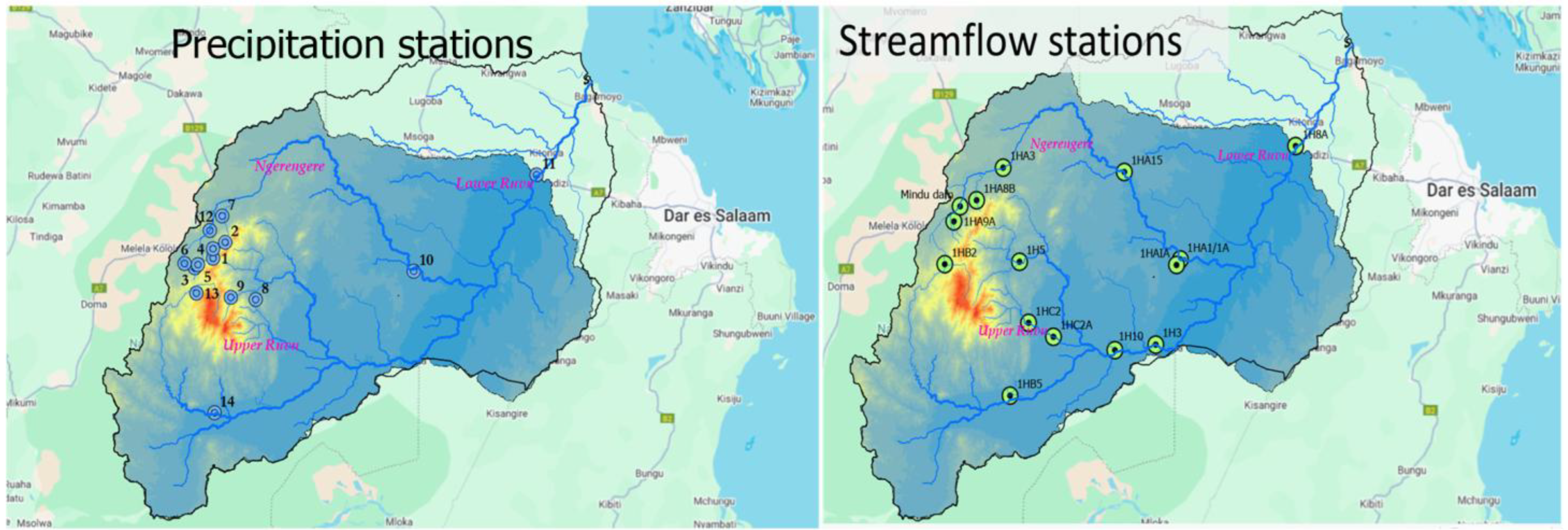


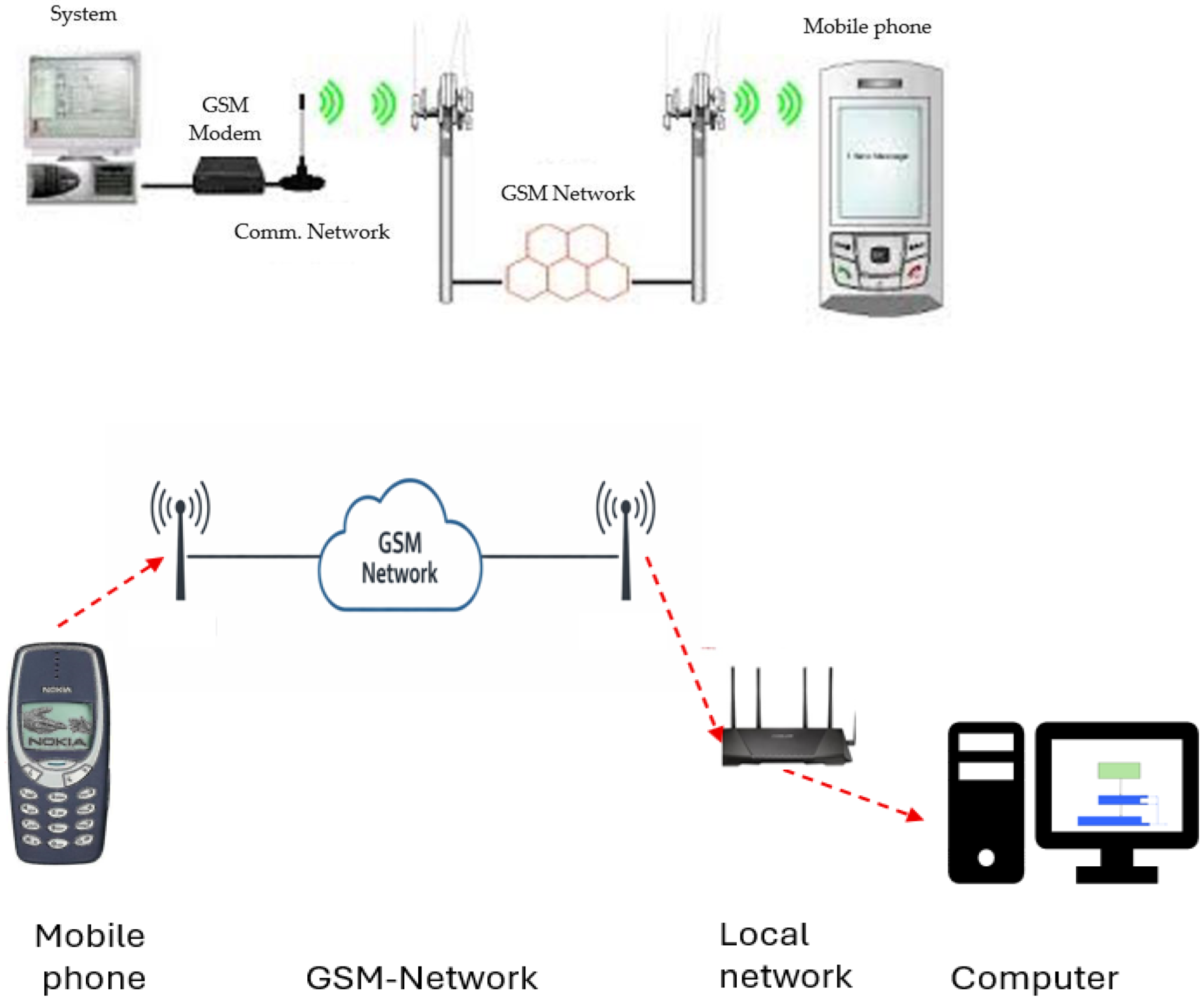

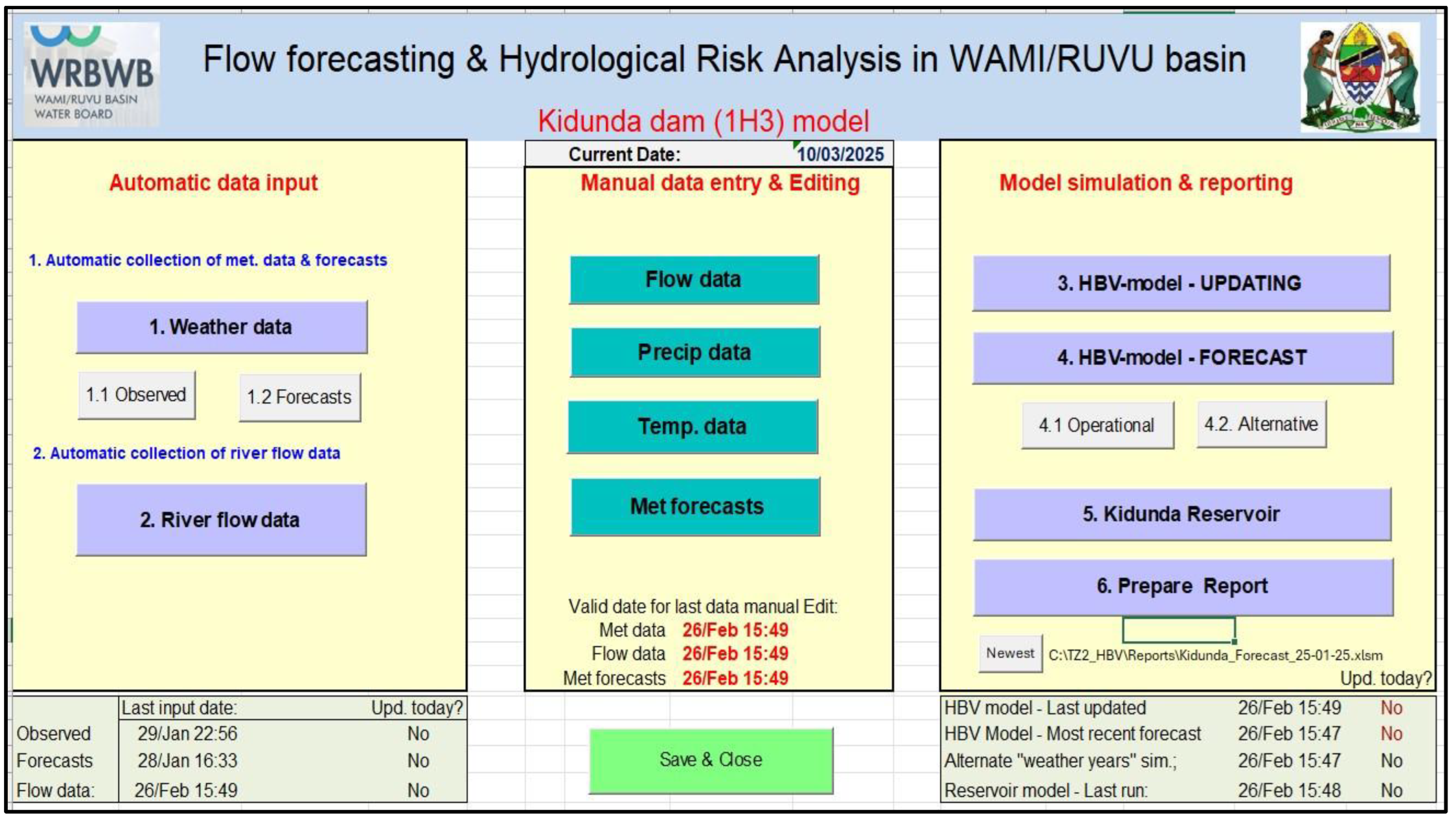

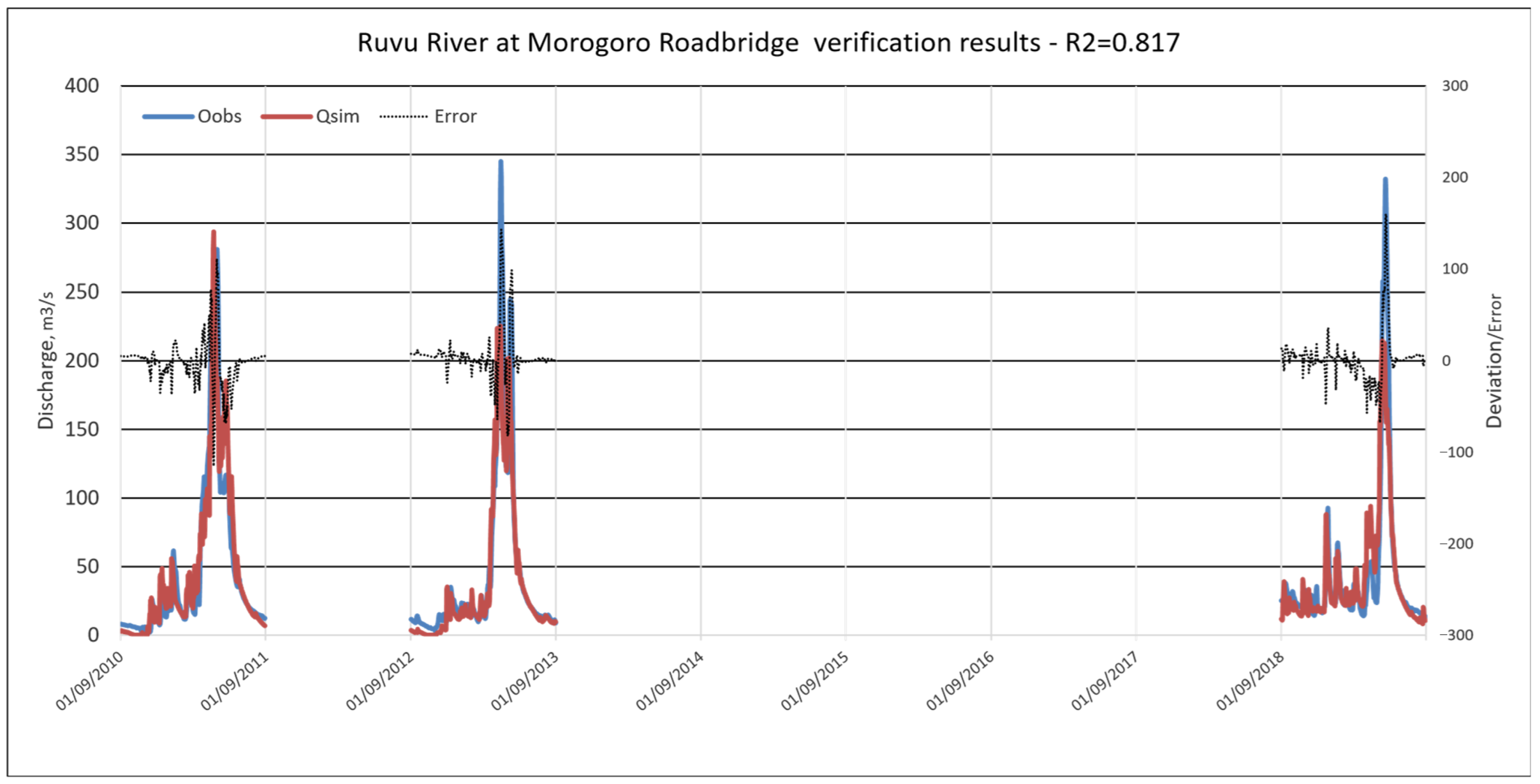









| SN | Station | Code | Geographic Location | Validity Period | Record Length | % Missing | Thiessen Area (%) | ||
|---|---|---|---|---|---|---|---|---|---|
| Lat | Long | Start | End | ||||||
| 1 | Mlali | 9637051 | −6.966 | 37.536 | 1956.01 | 2023.12 | 23831 | 4.1 | 1 |
| 2 | Morogoro Maji | 9637052 | −6.818 | 37.660 | 1956.01 | 2023.12 | 24191 | 0.0 | 11 |
| 3 | Kwandewa Masa (Mongwe) | 9637049 | −6.970 | 37.580 | 1959.12 | 2023.12 | 22171 | 5.2 | 0 |
| 4 | Morning Side Farm | 9637046 | −6.900 | 37.670 | 1966.01 | 2023.12 | 20864 | 1.5 | 2 |
| 5 | Mondo | 9637045 | −6.950 | 37.630 | 1970.01 | 2023.12 | 19723 | 2.2 | 1 |
| 6 | Hobwe | 9637047 | −6.980 | 37.570 | 1971.02 | 2023.12 | 19047 | 1.6 | 0 |
| 7 | Ruhungo | 9637048 | −6.920 | 37.630 | 1971.01 | 2023.12 | 19292 | 0.3 | 0 |
| 8 | Matombo Mission | 9737006 | −7.080 | 37.770 | 1971.01 | 2023.12 | 17277 | 10.8 | 12 |
| 9 | Kibungo juu Sec. School | 9737024 | −7.073 | 37.688 | 1973.01 | 2023.12 | 11466 | 0.0 | 2 |
| 10 | Nghesse (Utari Bridge) | 9738009 | −6.992 | 38.291 | 2005.03 | 2023.12 | 5353 | 22.9 | 34 |
| 11 | Morogoro Roadd Bridge | 9637057 | −6.863 | 37.620 | 2009.01 | 2023.12 | 5478 | 0.0 | 1 |
| 12 | Mindu Dam | 9638029 | −6.690 | 38.695 | 2013.01 | 2023.12 | 4017 | 0.0 | 12 |
| 13 | Langali Sec. at Mgeta | 9737044 | −7.059 | 37.575 | 2013.01 | 2023.12 | 4017 | 1.2 | 4 |
| 14 | Milengwelengwe Met. | 9737029 | −7.435 | 37.633 | 2013.02 | 2023.12 | 3982 | 0.9 | 21 |
| Station | Code | Geographic Location | Network Density [23] ** | Rating Curve Validity Period | No. of Flow Gaugings | Reliability | Remarks | ||
|---|---|---|---|---|---|---|---|---|---|
| Latitude | Longitude | Start | End | ||||||
| Ruvu at Kidunda | 1H3 | −7.264 | 38.246 | 5(S) | 1993 | 2020 | 19 | Reliable | Recently demolished by flood waters of 29th April, 2024. Revitalization is going on. |
| Ruvu at Kibungo | 1H5 | −7.024 | 37.809 | 1(S) | 2013 | 2021 | 45 | Unreliable | Recalibration recommended. |
| Ruvu at Morogoro Road Bridge | 1H8A | −6.691 | 38.694 | 7(S) | 2004 | 2020 | 79 | Unreliable | Underestimated recent (2023–2024) low flows and peak discharges. Recalibration recommended |
| Mvuha at Ngagama | 1HC2 | −7.200 | 37.838 | 1(S) | 2007 | 2021 | 16 | Unreliable | Recalibration recommended |
| Mgeta at Dhutumi | 1HB5 | −7.410 | 37.778 | 1(S) | Not published | ||||
| Catchment | Area, km2 | Average Flow 2013–2017, m3/s | Specific Runoff L/(s × km2) | % of Total Flow at 1H8A (%) |
|---|---|---|---|---|
| 1H3 Kidunda | 6665 | 47.96 | 7.2 | 94 |
| 1H8A Ruvu (local) | 7696 | 3.30 | 0.4 | 6 |
| 1H8A Ruvu (total) | 14,361 | 51.26 | 3.6 | 100 |
| SN | Station | Code | Geographic Location | Elevation (Masl) | Validity Period | Record Length | % Missing | ||
|---|---|---|---|---|---|---|---|---|---|
| Lat | Long | Start | End | ||||||
| 1 | Kibungo Juu | TA00591 | −7.070 | 37.690 | 1012 | 2018.12 | 2023.02 | 1515 | 37.8 |
| 2 | Langali Sec School | TA00592 | −7.059 | 37.575 | 1099 | 2018.12 | 2025.07 | 2416 | 23.6 |
| 3 | Ngerengere Utali | TA00594 | −6.992 | 38.291 | 115 | 2018.12 | 2025.07 | 2406 | 0.12 |
| 4 | Matombo primary school | TA00792 | −7.053 | 37.765 | 275 | 2023.02 | 2025.07 | 889 | 20.6 |
| 5 | Milengwelengwe secondary school | TA00793 | −7.437 | 37.634 | 162 | 2023.02 | 2025.07 | 889 | 23.2 |
| Nash–Sutcliffe efficiency | Range −∞ to 1 | |
| Pearson correlation Coefficient | Range −1 to 1 Optimal value 1 | |
| Coefficient of determination | Range 0 to 1 Optimal value: 1 | |
| Error in average flow (water balance) | Optimal value: 0 | |
| Standard deviation ratio | Range 0 to ∞ Optimal value 0 | |
| Kling–Gupta efficiency | α is the variability of prediction errors β is a bias term. | Range −∞ to 1 Optimal value 1 |
| Performance Rating | NSE | R2 | PBIAS (%) | RSR |
|---|---|---|---|---|
| Unsatisfactory | ≤0.50 | ≤0.60 | ≥±15 | ≤0.7 |
| Satisfactory | 0.50 < NSE ≤ 0.70 | 0.60 < R2 ≤ 0.75 | ±10 < PBIAS ≤ ±15 | 0.6 < RSR ≤ 0.7 |
| Good | 0.70 < NSE ≤ 0.80 | 0.75 < R2 ≤ 0.85 | ±5 < PBIAS ≤ ±10 | 0.5 < RSR ≤ 0.6 |
| Very good | >0.80 | >0.85 | <±5 | 0 < RSR ≤ 0.5 |
| Catchment | 1H8A Ruvu at Morogoro Roadbridge | Optimal Parameter Set | |||
|---|---|---|---|---|---|
| Model fit Parameter | Calibration period | Verification period | Area | 14,361 | km2 |
| PKORR | 0.875 | ||||
| 62.106 m3/s | 44.024 m3/s | FC | 1743 | mm | |
| 62.289 m3/s | 42.031 m3/s | BETA | 2.55 | ||
| r | 0.923 | 0.905 | LP% | 92% | |
| NSE | 0.850 | 0.820 | KUZ2 | 0.100 | 1/day |
| R2 | 0.852 | 0.819 | KUZ1 | 0.087 | 1/day |
| PBIAS | −0.3% | 4.50% | UZ1 | 40 | mm |
| RSR | 0.4 | 0.4 | PERC | 0.3 | mm/day |
| KGE | 87% | 84% | KLZ | 0.025 | 1/day |
| Catchment | 1H3 Kidunda | Optimal Parameter Set | ||
|---|---|---|---|---|
| Model fit Parameters | Calibration period | Verification period | Area | 6665 km2 |
| PKORR | 1.14 | |||
| 60.823 m3/s | 40.213 m3/s | FC | 2200 mm | |
| 60.596 m3/s | 41.676 m3/s | BETA | 2.00 | |
| r | 0.893 | 0.906 | LP% | 80% |
| NSE | 0.800 | 0.820 | KUZ2 | 0.110 1/day |
| R2 | 0.797 | 0.821 | KUZ1 | 0.100 1/day |
| PBIAS | 0.4% | −3.60% | UZ1 | 20.3 mm |
| RSR | 0.5 | 0.4 | PERC | 0.7 mm/day |
| KGE | 86% | 88% | KLZ | 0.037 1/day |
| Season | Dry | Short Rains | Long Rains | All year |
|---|---|---|---|---|
| Number# of forecast days | 70 | 90 | 67 | 227 |
| Met Forecast | ||||
| R2 | 0.964 | 0.889 | 0.947 | 0.933 |
| PBIAS | 4.7 | 18.8 | 16.6 | 13.5 |
| “Perfect” Forecast | ||||
| R2 | 0.981 | 0.928 | 0.976 | 0.962 |
| PBIAS | 0.7 | 8.6 | 4.6 | 4.6 |
| Improvement (r2) | 0.017 | 0.039 | 0.029 | 0.028 |
Disclaimer/Publisher’s Note: The statements, opinions and data contained in all publications are solely those of the individual author(s) and contributor(s) and not of MDPI and/or the editor(s). MDPI and/or the editor(s) disclaim responsibility for any injury to people or property resulting from any ideas, methods, instructions or products referred to in the content. |
© 2026 by the authors. Licensee MDPI, Basel, Switzerland. This article is an open access article distributed under the terms and conditions of the Creative Commons Attribution (CC BY) license.
Share and Cite
Ndomba, P.M.; Killingtveit, Å. An Operational Streamflow Forecasting System for a Data-Scarce Catchment in Tanzania. Water 2026, 18, 285. https://doi.org/10.3390/w18020285
Ndomba PM, Killingtveit Å. An Operational Streamflow Forecasting System for a Data-Scarce Catchment in Tanzania. Water. 2026; 18(2):285. https://doi.org/10.3390/w18020285
Chicago/Turabian StyleNdomba, Preksedis Marco, and Ånund Killingtveit. 2026. "An Operational Streamflow Forecasting System for a Data-Scarce Catchment in Tanzania" Water 18, no. 2: 285. https://doi.org/10.3390/w18020285
APA StyleNdomba, P. M., & Killingtveit, Å. (2026). An Operational Streamflow Forecasting System for a Data-Scarce Catchment in Tanzania. Water, 18(2), 285. https://doi.org/10.3390/w18020285