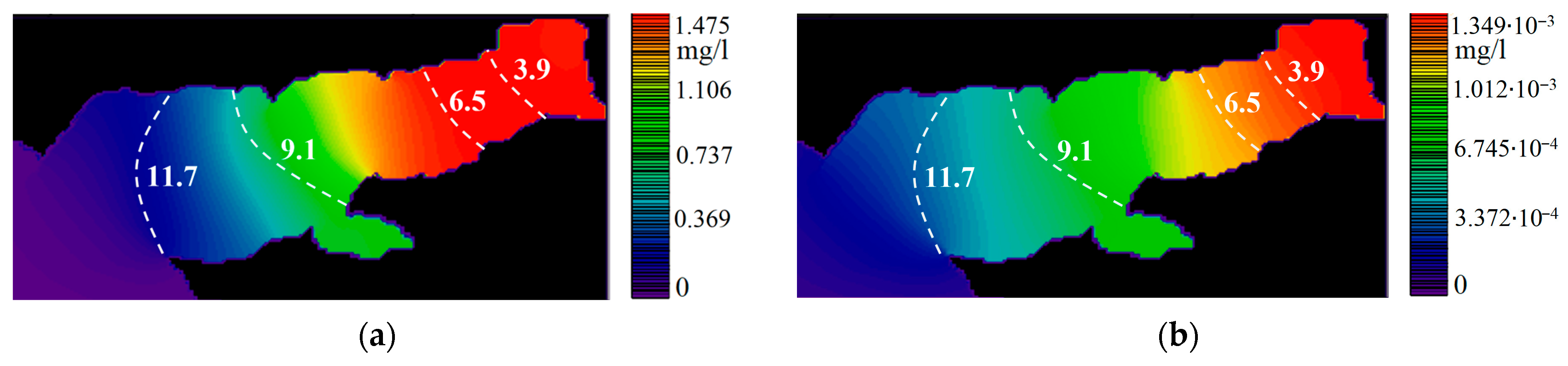
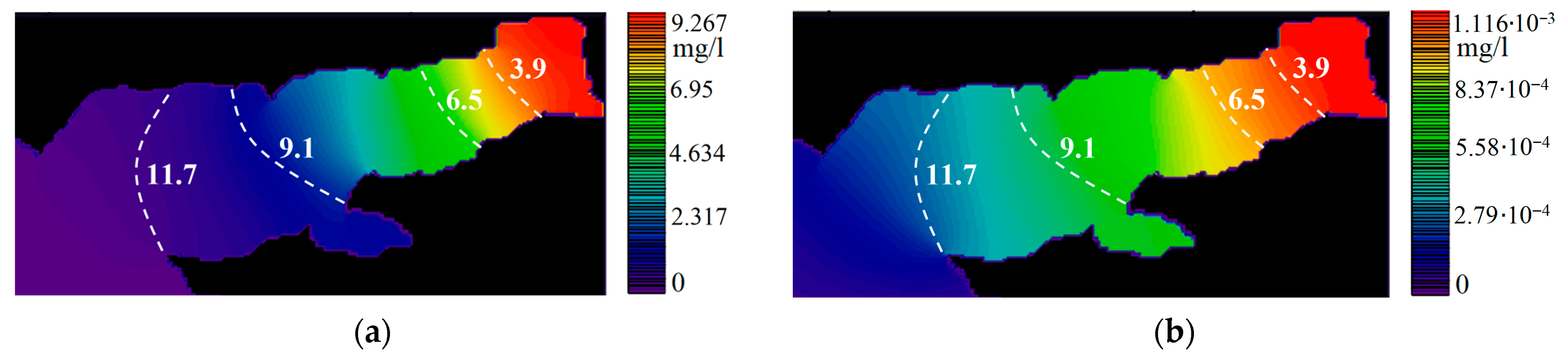
Mathematical Modeling of Biological Rehabilitation of the Taganrog Bay Considering Its Salinization



Abstract
1. Introduction
2. Materials and Methods
2.1. Model of Phytoplankton Population Dynamics and Biogeochemical Cycles and Its Linearization
2.2. Specifying the Model Input Data
Data Sources and Validation
2.3. Construction of a Discrete Model and Its Numerical Implementation
2.4. Description of the Computational Experiment
3. Results
4. Discussion
5. Conclusions
Author Contributions
Funding
Data Availability Statement
Acknowledgments
Conflicts of Interest
References
- Berdnikov, S.V.; Kulygin, V.V.; Dashkevich, L.V. Causes of the rapid increase in salinity of the Azov Sea in the 21st century. Mar. Hydrophys. J. 2023, 39, 760–778. [Google Scholar]
- Overman, C.; Wells, S. Modeling Cyanobacteria Vertical Migration. Water 2022, 14, 953. [Google Scholar] [CrossRef] [Scilit]
- Gerbersdorf, S.U.; Schubert, H. Vertical migration of phytoplankton in coastal waters with different UVR transparency. Environ. Sci. Eur. 2011, 23, 36. [Google Scholar] [CrossRef] [Scilit]
- Brookes, J.D.; Ganf, G.G. Variations in the buoyancy response of Microcystis aeruginosa to nitrogen, phosphorus and light. J. Plankton Res. 2001, 23, 1399–1411. [Google Scholar] [CrossRef] [Scilit]
- Zhao, H.; Zhu, W.; Chen, H.; Zhou, X.; Wang, R.-C.; Li, M. Numerical simulation of the vertical migration of Microcystis (cyanobacteria) colonies based on turbulence drag. J. Limnol. 2017, 76, 190–198. [Google Scholar] [CrossRef] [Scilit]
- Chorus, I.; Welker, M. (Eds.) Toxic Cyanobacteria in Water, 2nd ed.; CRC Press: Boca Raton, FL, USA, 2021. [Google Scholar]
- Matishov, G.G.; Fushtey, T.V. On the problem of harmful “water blooms” in the Azov Sea. Res. Russ. 2003, 6, 213–225. [Google Scholar]
- Xiao, M.; Burford, M.A.; Wood, S.A.; Aubriot, L.; Ibelings, B.W.; Prentice, M.J.; Galvanese, E.F.; Harris, T.D.; Hamilton, D.P. Schindler’s legacy: From eutrophic lakes to the phosphorus utilization strategies of cyanobacteria. FEMS Microbiol. Rev. 2022, 46, fuac029. [Google Scholar] [CrossRef] [Scilit]
- Zhu, W.; Feng, G.; Chen, H.; Wang, R.; Tan, Y.; Zhao, H. Modelling the vertical migration of different-sized Microcystis colonies: Coupling turbulent mixing and buoyancy regulation. Environ. Sci. Pollut. Res. 2018, 25, 30339–30347. [Google Scholar] [CrossRef] [Scilit] [PubMed]
- Xue, Z.; Zhu, W.; Zhu, Y.; Fan, X.; Chen, H.; Feng, G. Influence of wind and light on the floating and sinking process of Microcystis. Sci. Rep. 2022, 12, 5655. [Google Scholar] [CrossRef] [Scilit]
- Fournier, C.; Fernandez-Fernandez, R.; Cirés, S.; López-Orozco, J.A.; Besada-Portas, E.; Quesada, A. LSTM networks provide efficient cyanobacterial blooms forecasting even with incomplete spatio-temporal data. Water Res. 2024, 267, 122553. [Google Scholar] [CrossRef] [Scilit]
- Neverova, G.; Zhdanova, O. Mathematical Modeling of the Evolutionary Dynamics of a Planktonic Community Using a Discrete-Time Model. Mathematics 2023, 11, 4673. [Google Scholar] [CrossRef] [Scilit]
- Bogdanov, N.I. Biological Rehabilitation of Reservoirs, 3rd ed.; IO PGSKhA: Penza, Russia, 2008; 151p. [Google Scholar]
- Aly, S.M.; ElBanna, N.I.; Fathi, M. Chlorella in aquaculture: Challenges, opportunities, and disease prevention for sustainable development. Aquac. Int. 2024, 32, 1559–1586. [Google Scholar] [CrossRef] [Scilit]
- Bogdanov, N.I. Chlorella Suspension in the Diet of Farm Animals, 2nd ed.; Health and Ecology: Penza, Russia, 2007; 48p. [Google Scholar]
- Kudinov, N.V.; Filina, A.A.; Nikitina, A.V.; Bondarenko, D.V.; Razveeva, I.F. Simulation of Vertical Movements of Seawater in Stratified Reservoirs. Adv. Eng. Res. 2023, 23, 212–224. [Google Scholar] [CrossRef] [Scilit]
- Novikov, M.; Pakhomova, S.; Berezina, A.; Yakushev, E. Model-Based Analysis of the Oxygen Budget in the Black Sea Water Column. Water 2024, 16, 2380. [Google Scholar] [CrossRef] [Scilit]
- Yakushev, E.V.; Pollehne, F.; Jost, G.; Kuznetsov, I.; Schneider, B.; Umlauf, L. Analysis of the water column oxic/anoxic interface in the Black and Baltic seas with a numerical model. Mar. Chem. 2007, 107, 388–410. [Google Scholar] [CrossRef] [Scilit]
- Sukhinov, A.; Belova, Y.; Chistyakov, A.; Beskopylny, A.; Meskhi, B. Mathematical Modeling of the Phytoplankton Populations Geographic Dynamics for Possible Scenarios of Changes in the Azov Sea Hydrological Regime. Mathematics 2021, 9, 3025. [Google Scholar] [CrossRef] [Scilit]
- Voloshchuk, M.S.; Kartamysheva, T.B.; Shevtsova, E.A.; Zhukova, S.V.; Podmareva, T.I.; Elfimova, N.S. Assessment of the influence of abiotic factors on the dynamics of the size range and biomass of the population of the invasive mollusk Anadara kagoshimensis (Tokunaga, 1906) in the Azov Sea. Adv. Mod. Nat. Sci. 2025, 7, 20–27. [Google Scholar] [CrossRef] [Scilit]
- About Summer Blooms of Blue-Green Algae in Taganrog Bay. Available online: https://azniirkh.vniro.ru/content/read/archive/novosti/o-letnih-tsveteniyah-sinezelenyih-vodorosley-v-taganrogskom-zalive (accessed on 4 November 2025).
- Kovaleva, G.V. Issue VIII: Modelling and Analysis of Natural Hazards in the Sea of Azov Region. In Studies of the Southern Scientific Centre of the Russian Academy of Sciences (Series), 2nd ed.; Matishov, G.G., Berdnikov, S.V., Eds.; SSC RAS Publishers: Rostov-on-Don, Russia, 2020; 328p. [Google Scholar]
- Sukhinov, A.I.; Nikitina, A.V.; Atayan, A.M.; Litvinov, V.N.; Belova, Y.V.; Chistyakov, A.E. Supercomputer simulation of hydrobiological processes of coastal systems. Math. Models Comput. Simul. 2022, 14, 677–690. [Google Scholar] [CrossRef] [Scilit]
- Unified State System of Information on the Situation in the World Ocean. Available online: http://hmc.meteorf.ru/sea/azov/sst/sst_azov.html (accessed on 10 April 2025).
- Rakhimbaeva, E.O.; Alyshov, T.A.; Belova, Y.V. Automatic Depth Value Recognition on Pilot Charts Using Deep Learning Methods. Comput. Math. Inf. Technol. 2025, 9, 52–60. [Google Scholar] [CrossRef] [Scilit]
- Belova, Y.V.; Chistyakov, A.E. Modeling the Dynamics of Harmful Phytoplankton Species Concentration in Taganrog Bay of the Azov Sea. Saf. Technog. Nat. Syst. 2025, 9, 284–293. [Google Scholar] [CrossRef] [Scilit]
- Sukhinov, A.I.; Sidoryakina, V.V. Approximation of Boundary Conditions of the Second and Third Types in Convection–Diffusion Equations with Applications to Environmental Hydrophysics. Comput. Math. Inf. Technol. 2025, 9, 16–29. [Google Scholar] [CrossRef] [Scilit]
- Sukhinov, A.I.; Chistyakov, A.E. Adaptive analog-SSOR iterative method for solving grid equations with nonselfadjoint operators. Math. Models Comput. Simul. 2012, 4, 398–409. [Google Scholar] [CrossRef] [Scilit]
- Unified State System of Information on the Situation in the World Ocean. Available online: http://esimo.oceanography.ru/esp1/index.php?sea_code=11§ion=5&menu_code=979 (accessed on 4 November 2025).
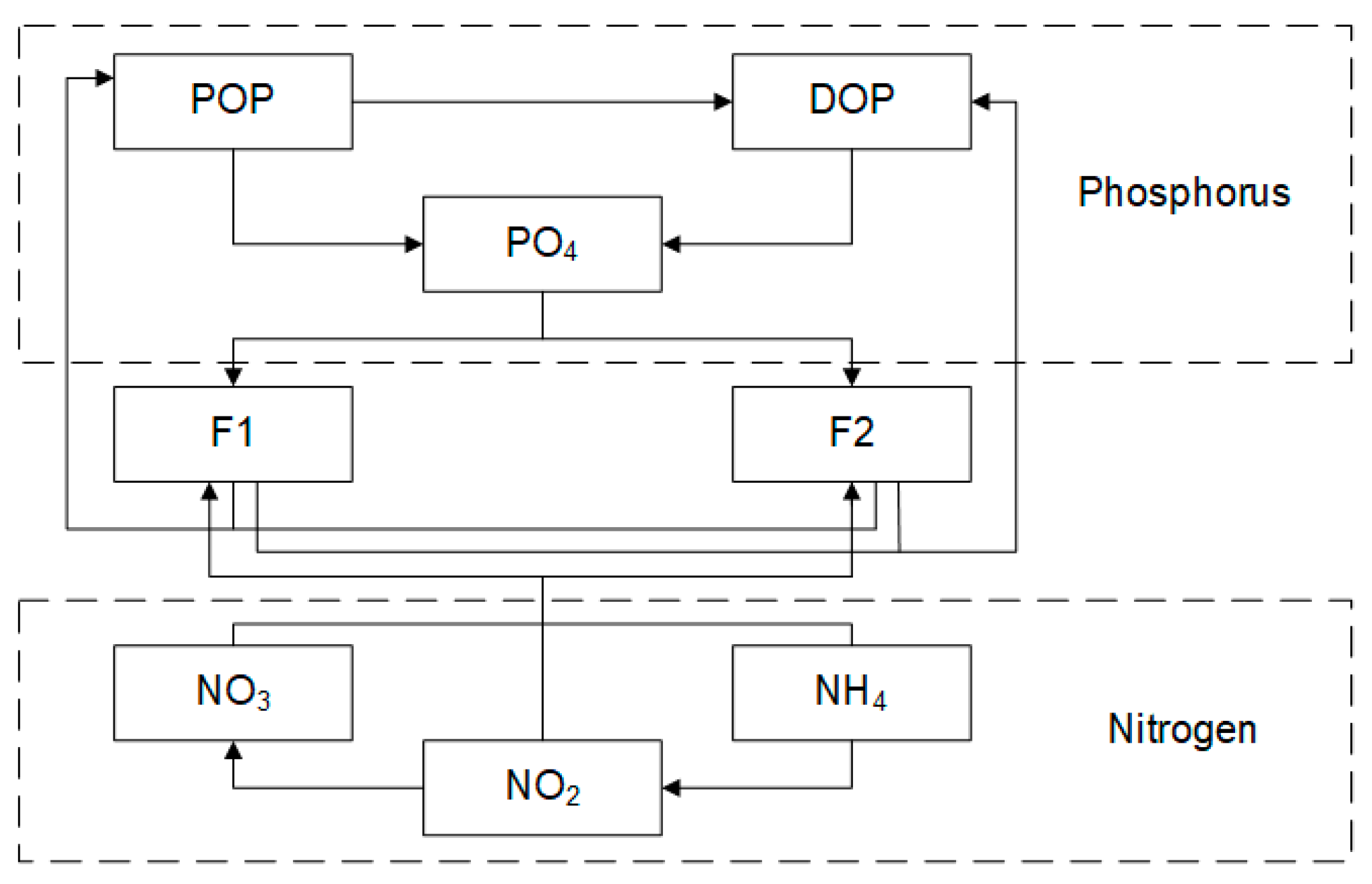





| No | Name | Designation | Description |
|---|---|---|---|
| 1 | green algae (Chlorella vulgaris) | F1 | They are at the base of the food chain. Growth rate is determined by the availability of nutrients (phosphates, nitrates, nitrites, and ammonium), as well as optimal temperature, salinity, and light conditions. Biomass decreases due to excretion and mortality. They compete with cyanobacteria for resources. |
| 2 | cyanobacteria (Aphanizomenon flos-aquae) | F2 | They are potentially toxic. Growth rate is determined by the availability of nutrients (phosphates, nitrates, nitrites, and ammonium), as well as optimal temperature, salinity, and light conditions. Biomass decreases due to excretion and mortality. |
| 3 | dissolved organic phosphorus | DOP | It is released by phytoplankton populations during excretion. Its concentration increases due to the autolysis of dissolved organic phosphorus and decreases during phosphatification. |
| 4 | particulate organic phosphorus | POP | It is a product of microalgae death. It is converted into a dissolved form through autolysis and, through phosphatification, into the mineral form of phosphorus. |
| 5 | Phosphates | PO4 | Inorganic phosphorus compounds. Their concentration increases due to the conversion of organic forms of phosphorus into mineral forms during phosphatification. They are a biogen for phytoplankton populations. |
| 6 | Nitrates | NO3 | It is the main form of nitrogen for consumption by microalgae. |
| 7 | Nitrites | NO2 | in the presence of dissolved oxygen molecules, they are oxidized to nitrates. They are also consumed by phytoplankton populations. |
| 8 | Ammonia | NH4 | In the presence of dissolved oxygen molecules, it is oxidized to nitrites. It is the least preferred form of nitrogen for microalgae to consume. |
Disclaimer/Publisher’s Note: The statements, opinions and data contained in all publications are solely those of the individual author(s) and contributor(s) and not of MDPI and/or the editor(s). MDPI and/or the editor(s) disclaim responsibility for any injury to people or property resulting from any ideas, methods, instructions or products referred to in the content. |
© 2026 by the authors. Licensee MDPI, Basel, Switzerland. This article is an open access article distributed under the terms and conditions of the Creative Commons Attribution (CC BY) license.
Share and Cite
Sukhinov, A.; Belova, Y. Mathematical Modeling of Biological Rehabilitation of the Taganrog Bay Considering Its Salinization. Water 2026, 18, 255. https://doi.org/10.3390/w18020255
Sukhinov A, Belova Y. Mathematical Modeling of Biological Rehabilitation of the Taganrog Bay Considering Its Salinization. Water. 2026; 18(2):255. https://doi.org/10.3390/w18020255
Chicago/Turabian StyleSukhinov, Alexander, and Yulia Belova. 2026. "Mathematical Modeling of Biological Rehabilitation of the Taganrog Bay Considering Its Salinization" Water 18, no. 2: 255. https://doi.org/10.3390/w18020255
APA StyleSukhinov, A., & Belova, Y. (2026). Mathematical Modeling of Biological Rehabilitation of the Taganrog Bay Considering Its Salinization. Water, 18(2), 255. https://doi.org/10.3390/w18020255