Article

Assessment of Water Balance and Future Runoff in the Nitra River Basin, Slovakia

1
Institute of Hydrology SAS, Dúbravská cesta 9, 841 04 Bratislava, Slovakia
2
Faculty of Mathematics, Physics, and Informatics, Comenius University Bratislava, Mlynská dolina F1, 842 48 Bratislava, Slovakia
*
Author to whom correspondence should be addressed.
Water 2026, 18(2), 208; https://doi.org/10.3390/w18020208
Submission received: 7 November 2025 / Revised: 31 December 2025 / Accepted: 10 January 2026 / Published: 13 January 2026

Abstract

This study integrates 90 years of hydrometeorological observations (1930/31–2019/20) with end-century projections (2080–2099) to evaluate climate-driven changes in the water balance of the Nitra River basin (2094 km2), Slovakia. Despite a modest 2–3% increase in annual precipitation from 1930/31–1959/60 to 1990/91–2019/20, mean annual runoff declined from 229 mm to 201 mm (≈−12%), primarily due to enhanced evapotranspiration stemming from a +1.08 °C basin-wide temperature increase. An empirical regression from 90 hydrological years shows that +100 mm in precipitation boosts runoff by ≈41 mm, while +1 °C in temperature reduces it by ≈13 mm. The BILAN monthly water balance model was calibrated for 1930/31–2019/20 to decompose runoff components. Over the 90-year period, the modeled annual runoff averaged 222 mm, comprising a 112 mm baseflow (50.4%), a 91 mm interflow (41.0%), and a 19 mm direct runoff (8.6%), underscoring the key role of groundwater and subsurface flows in sustaining streamflow. In the second part of our study, the monthly water balance model BILAN was recalibrated for 1995–2014 to simulate future runoff under three CMIP6 Shared Socioeconomic Pathways. Under the sustainability pathway SSP1-1.9 (+0.88 °C; +1.1% precipitation), annual runoff decreases by 8.9%. The middle-of-the-road scenario SSP2-4.5 (+2.6 °C; +3.1% precipitation) projects a 17.5% decline in annual runoff, with particularly severe reductions in autumn months (September −32.3%, October −35.8%, December −40.4%). The high-emission pathway SSP5-8.5 (+5.1 °C; +0.4% precipitation) yields the most dramatic impact with a 35.2% decrease in annual runoff and summer deficits exceeding 45%. These results underline the extreme sensitivity of a mid-sized Central European basin to temperature-driven evapotranspiration and the critical importance of emission mitigation, emphasizing the urgent need for adaptive water management strategies, including new storage infrastructure to address both winter floods and intensifying summer droughts.

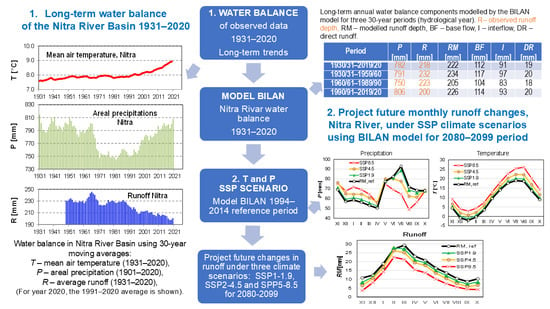
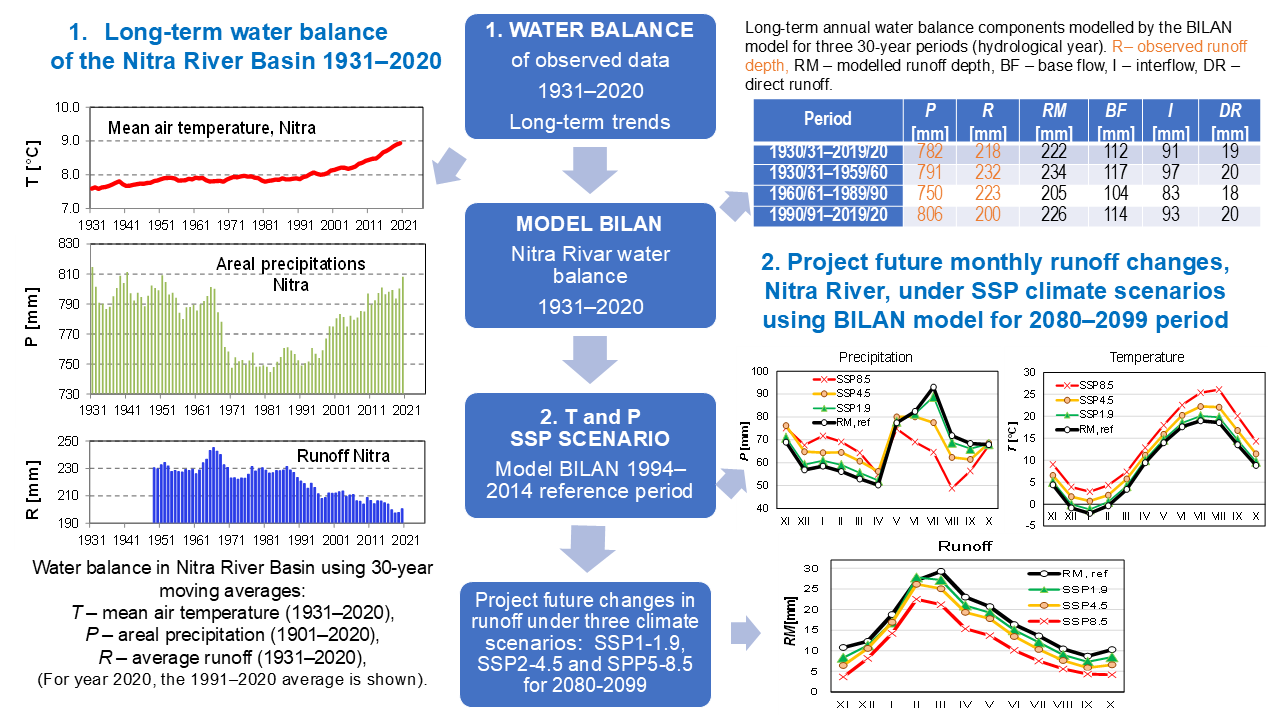
Graphical Abstract

1. Introduction

Water resources are critical for sustaining ecosystems, ensuring human livelihoods, and promoting economic growth globally. Surface waters–including rivers, lakes, and reservoirs–are particularly important due to their accessibility and direct impact on local communities. However, this resource faces increasing threats from climate change, pollution, and unsustainable anthropogenic interventions [1,2,3]. Global projections for the late 21st century indicate that changes in river flow regimes will be strongly region-dependent. While flow increases are anticipated in high-latitude and certain tropical basins (e.g., Lena, Yukon, Congo), persistent declines are projected for regions such as southern South America, the western United States, the Iberian Peninsula, and the Danube River basin [4,5,6,7,8]. In these vulnerable areas, the combination of reduced precipitation and increased evaporative demand significantly amplifies the risk of low flows and hydrological drought. Beyond changes in mean annual runoff, many catchments—particularly those influenced by snowmelt—are expected to undergo pronounced shifts in seasonality [9].
Central Europe is particularly sensitive to climate variability due to its transitional location between oceanic and continental climate influences. In this region, monthly water balance models have become indispensable tools for assessing hydrological components and projecting future changes, with model selection typically driven by data availability and specific basin characteristics [9,10,11,12,13,14,15,16,17]. The BILAN model, a conceptual lumped-parameter tool developed by the T.G. Masaryk Water Research Institute, has proven especially robust for monthly water balance simulations across diverse geographical contexts in Central Europe [18,19,20,21,22,23].
Despite the established utility of hydrological models in the region, there remains a critical gap in long-term, integrated assessments for specific Slovak river basins. While recent studies have examined runoff regime changes under various climate scenarios, comprehensive analyses that seamlessly combine multi-decadal historical trends (90+ years) with future projections based on the latest CMIP6 Shared Socioeconomic Pathways (SSPs) are currently non-existent for Slovak river basins. Existing research often relies on older emission scenarios (SRES, RCPs) or focuses on shorter time horizons.
The Nitra River basin in western Slovakia represents a strategically important catchment extensively utilized for agriculture and industry [24,25,26]. It faces unique challenges, including a historical legacy of industrial modification and increasing irrigation demands. To date, this basin lacks a unified assessment that links observed long-term hydrological changes with scenario-based future projections derived from high-resolution climate models. Addressing this gap is essential for developing adaptive water management strategies, as highlighted by recent drought prognosis studies in the region.
This study aims to bridge this knowledge gap by analyzing the hydrological balance of the Nitra River basin at the Nitrianska Streda gauge. The specific objectives are to: (1) quantify temporal trends in water balance components (precipitation, evapotranspiration, runoff) over a 90-year historical period (1931–2020) to establish a robust baseline; and (2) project future runoff regime changes for the 2080–2099 horizon under three distinct CMIP6 emission scenarios (SSP1-1.9, SSP2-4.5, and SSP5-8.5) using the calibrated BILAN model (version 2016). By comparing historical trends with future projections, this research seeks to identify critical seasonal shifts and inform decision-making for sustainable water allocation in the Danube basin region.

2. Materials and Methods

2.1. Study Area

The Nitra River basin (2094 km2) is located in western Slovakia (Figure 1). The lower part of the basin belongs to Slovakia’s most significant agriculturally utilized areas. The Upper Nitra basin was historically an industrial center featuring one of Slovakia’s most significant fuel-energy complexes based on lignite mining. Industrial coal mining in the Nitra basin ended in December 2023 after 114 years, in alignment with European climate goals for carbon neutrality by 2050.
The Nitra River originates in the Malá Fatra Mountains below Reváň peak (1205 m a.s.l.) at approximately 770 m in elevation and flows as a left tributary of the Váh River.
The basin extends between coordinates 48°58′ N, 18°34′ E (northernmost point) and 47°57′ N, 18°08′ E (southernmost point), with elevations ranging from 175 m a.s.l. at the river mouth to 1346 m on Vtáčnik Mountain.
The study area encompasses geomorphologic units, including Podunajská rovina (plain), Tribeč, Strážovské vrchy, Vtáčnik, and Pohronský Inovec mountains. Two protected landscape areas—Strážovské vrchy and Ponitrie—are located within the catchment.
Mean annual air temperature varies between 9–10 °C in hilly areas and approximately 5 °C at higher altitudes. Mean annual precipitation in the basin upstream of the Nitrianska Streda gauge is approximately 800 mm.
The catchment is highly susceptible to flooding, with historical records documenting various river flash, and pluvial floods. Recent notable flooding events include April 2006 (Bebrava River), June 2010 (regional flooding along the Nitra River and tributaries), April 2013 (Žitava River), and flash floods in June 2013 and July 2014. The basin has an elongated to fan-shaped profile with an average slope of 10.1°, a river network density of 1.29 km/km2, and a forest cover of 54.1% (predominantly deciduous forests, 41.2%).

2.2. Data

Hydrometeorological data were provided by the Slovak Hydrometeorological Institute (SHMÚ). The dataset includes mean daily discharge, monthly precipitation totals, and mean monthly air temperature for the 1901–2020 (precipitation) and November 1930–2020 (other variables) periods. Inspection confirmed no observation gaps in the data for the selected stations. Table 1 summarizes the main station characteristics.
Average monthly precipitation totals for the Nitra River basin were calculated using the elevation–precipitation relationship method. For each month, the linear relationship between monthly precipitation totals and station elevation was established, and the precipitation value corresponding to the basin’s median elevation (420 m a.s.l.) was determined. This approach accounts for orographic effects on precipitation distribution. Similarly, average monthly air temperatures were calculated using data from three stations (Hurbanovo, Prievidza, and Banská Štiavnica), with elevation correction to the median basin elevation.

2.3. Long-Term Hydrological Balance

The hydrological balance method was employed to quantify water circulation within a closed system, focusing on a single concentrated runoff at the closed profile of the catchment area. In this approach, atmospheric precipitation serves as the sole input to the basin’s hydrological balance. Over a sufficiently long period, the change in soil water content between the beginning and end of the period can be considered negligible. Consequently, the total annual actual (basin) evapotranspiration can be approximated as the difference between precipitation and runoff. The basic water balance equation used is as follows:
P = R + ET + ∆S,
where P represents the observed annual precipitation depth [mm], R represents the observed annual average runoff depth [mm], ET is the annual actual evapotranspiration depth [mm], and ∆S represents the average total losses that have a higher significance in shorter time intervals ∆t.
For the long-term hydrological balance, this component might be neglected and replaced by ∆S = 0. However, when performing a long-term monthly balance, if monthly total evapotranspiration is determined independently, the change in water storage within the basin can be calculated using the water balance equation. Precipitation, being the primary input to the hydrological cycle, plays a crucial role in the basin’s hydrological balance. Air temperature is the secondary factor, as it significantly influences evapotranspiration.

2.4. The BILAN Model

2.4.1. Model Selection and Justification

The conceptual lumped-parameter hydrological BILAN (version 2016) [18,19,20,21,22,23] model was selected for this study based on several criteria: (1) its proven applicability in Central European catchments with similar hydroclimatic conditions; (2) its monthly time-step structure suitable for water resource management applications; (3) its ability to directly incorporate water use data (abstractions and releases), which is critical for this basin; (4) the availability of internal calibration algorithms that optimize model parameters systematically; and (5) its computational efficiency, enabling extensive scenario simulations. While more parsimonious models exist (e.g., 2–4-parameter models), the BILAN model’s 8-parameter structure provides the necessary flexibility to represent complex hydrological processes in a basin with anthropogenic modifications and varied topography. The additional parameters allow for better representation of snow processes (critical given the elevation range of 175–1346 m), soil moisture dynamics, and groundwater processes.

2.4.2. Model Structure and Processes

BILAN is a rainfall–runoff hydrological model operating at monthly (or daily) time steps. The model simplifies the catchment into three interconnected water reservoirs representing different hydrological storages: snowpack storage (SS), soil moisture storage in the unsaturated zone (SW), and groundwater storage in the saturated zone (GS). The model accounts for the following processes:
Precipitation partitioning: Precipitation is partitioned between rainfall and snowfall based on air temperature. Snow accumulation and melt are simulated as functions of temperature.
Evapotranspiration: The potential evapotranspiration can be estimated by the method derived by Oudin [27]. The relation for the PET value on a given day i requires only the air temperature T as input. Actual evapotranspiration (ET) is limited by soil moisture availability.
Infiltration and percolation: Water infiltrates into the unsaturated zone (INF), with excess water contributing to interflow. Percolation (PERC) transfers water from the unsaturated to the saturated zone based on soil moisture content.
Runoff generation: Total runoff (RM) consists of three components:
RM = DR + I + BF,
where (DR) represents direct runoff (fast runoff component bypassing soil processes), (I) represents interflow or hypodermic flow (excess water from the unsaturated zone), and (BF) denotes baseflow (slow groundwater contribution). The model distinguishes three vertical levels: the surface, soil zone, and groundwater zone. The flows between these reservoirs are determined by model algorithms, which are controlled by eight free parameters. The model employs eight free parameters (DGWL, DGWU, SOCR, ALFA, RC, GLAC, TEMP, and DGWS) that are optimized during calibration.

2.5. Climate Change Scenarios

Increased air temperature and changes in precipitation affect the hydrological cycle of rivers and strongly influence water resource availability. In this study, climate scenarios were obtained from the World Bank Climate Change Knowledge Portal [28], based on the Coupled Model Intercomparison Project Phase 6 (CMIP6). The CMIP6 framework employs Shared Socioeconomic Pathways (SSPs), a set of scenarios that link qualitative socioeconomic narratives with quantitative trajectories for greenhouse gas emissions and land use [29]. Unlike previous scenario generations, SSPs are defined by their specific challenges to climate change mitigation and adaptation, providing a more integrated basis for assessing climate impacts [30].
Due to the unavailability of individual downscaled model outputs for the Nitra basin [31], a Multi-Model Ensemble comprising 28 Global Climate Models (GCMs) was utilized to represent the range of plausible climate futures. The analysis focuses on the long-term horizon 2080–2099. Three distinct SSPs were selected to cover a broad spectrum of potential futures:
-
SSP1-1.9 (Sustainability): A low-emission pathway representing a green development trajectory aligned with the 1.5 °C Paris Agreement goal.
-
SSP2-4.5 (Middle-of-the-Road): A medium-emission pathway where historical patterns of development continue throughout the century.
-
SSP5-8.5 (Fossil-fueled Development): A high-emission pathway assuming unconstrained growth in economic output and energy use.
The projected mean monthly air temperature anomalies and mean monthly percentage changes in precipitation derived from these scenarios were used as inputs to perturb the reference climatology for the BILAN hydrological model simulations.

3. Results

3.1. Water Balance over Three 30-Year Periods

3.1.1. Long-Term Trends During 1931–2020 Period

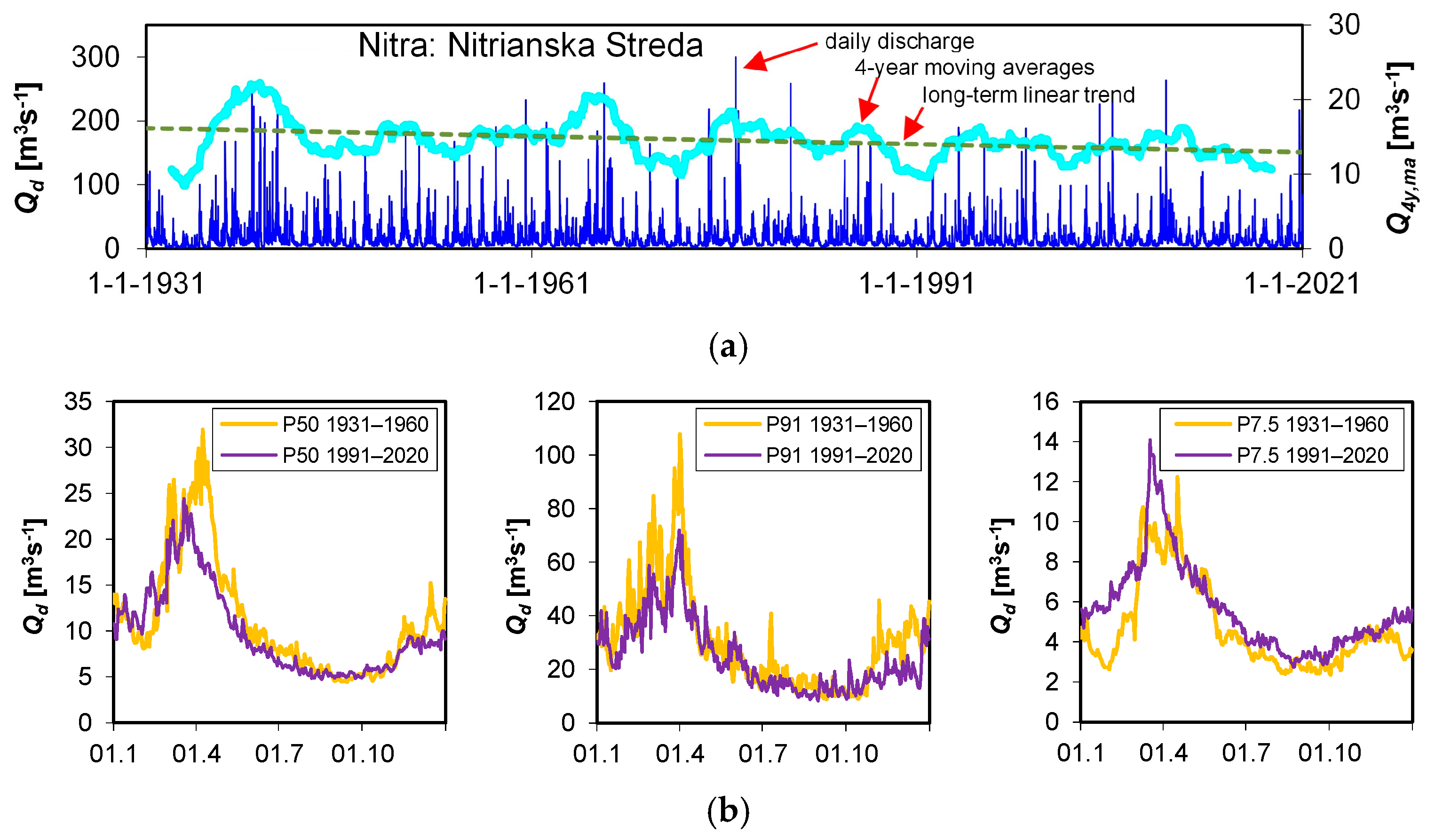
For the 1931–2020 period, the long-term average annual discharge of the Nitra River was 14.5 m3s−1, with a maximum daily average discharge of 300 m3s−1 recorded on December 3, 1976, and a minimum of 2.0 m3s−1 in 1940 (Figure 2a). The maximum peak discharge was recorded on August 20, 1966 (316 m3s−1). The Nitra River is characterized by peak discharges in March and April, with minimum flows in August and September (Figure 2b).
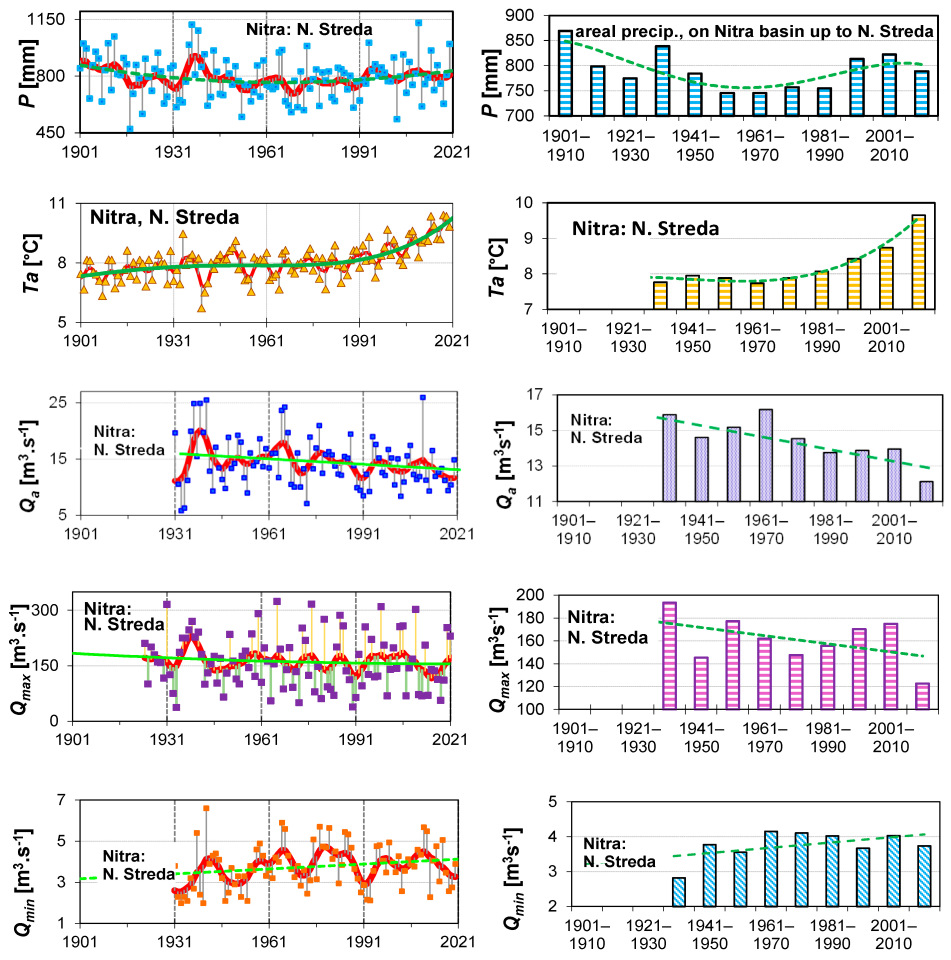
Long-term mean annual precipitation depth in the Nitra River basin was 781 mm during 1931–2020. The highest monthly precipitation occurred in July 1960 (238 mm), and the lowest in October 1951 (1.1 mm). The highest annual basin-wide precipitation was 1129 mm in 2010, and the lowest was 474 mm in 1917. The decade 1901–1910 was the wettest (874 mm), while 1951–1960, 1961–1970, and 1981–1990 were the driest (Figure 3).
Annual precipitation depths showed a decreasing trend from 1901 to 1950, followed by stability until 1990, then a slight increase after 1990. Air temperature remained stable from 1931 to 1980 but increased after 1980, from 7.99 °C (1971–1980) to 9.3 °C (2011–2020). Mean annual runoff exhibited a decreasing trend despite precipitation increase, driven by higher evapotranspiration resulting from temperature rise. Maximum annual discharges decreased similarly to average discharges, while minimum discharges remained constant since 1960, likely due to reservoir regulation (Figure 3).
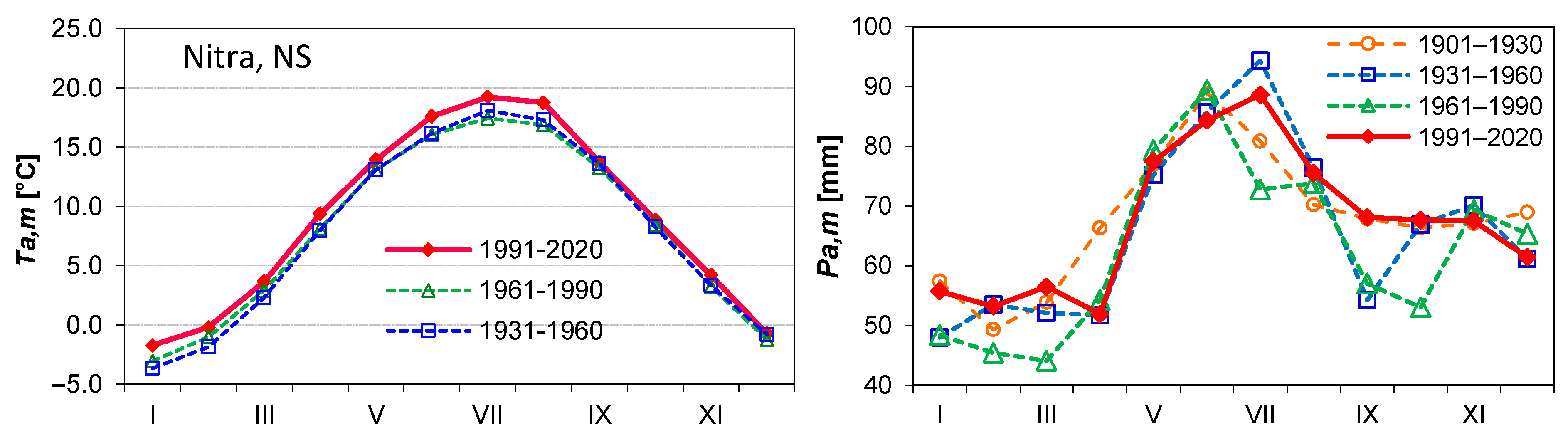
The long-term mean annual air temperature in the basin for 1931–2020 was 8.23 °C, with the highest average monthly temperatures in July (19.22 °C) and the lowest in January (−1.72 °C) (Figure 4). Figure 4 illustrates a similarity between the monthly precipitations of 1901–1930 and 1991–2020.

3.1.2. Water Balance for Three 30-Year Periods Based on Observed Data

The values of key water balance components for the Nitra basin over three 30-year periods are presented in Table 2. The 1930/31–1959/60 period (hydrological years) was the wettest, with a runoff of 232 mm and a runoff coefficient of 0.29. The 1960/61–1989/90 period had the lowest precipitation (750 mm) but was the coldest, resulting in lower evapotranspiration (527 mm) and a runoff coefficient of 0.30. The 1990/91–2019/20 period was the warmest, resulting in high evapotranspiration (606 mm per year). Despite increased precipitation, runoff dropped to 200 mm, and the runoff coefficient dropped to 0.25.
Based on annual values measured over a 90-year period (1930/31–2019/20), a regression analysis was conducted to derive a simple empirical relationship for estimating future annual runoff from the Nitra basin, considering annual runoff, precipitation, and air temperature.
Rest = 0.413 P − 12.96 T
where Rest represents mean annual runoff from the Nitra basin [mm], P represents annual areal precipitation in the Nitra basin, and T represents mean annual air temperature in the basin. Summary statistics of the estimated coefficients of the relationship (3) are presented in Table 3.
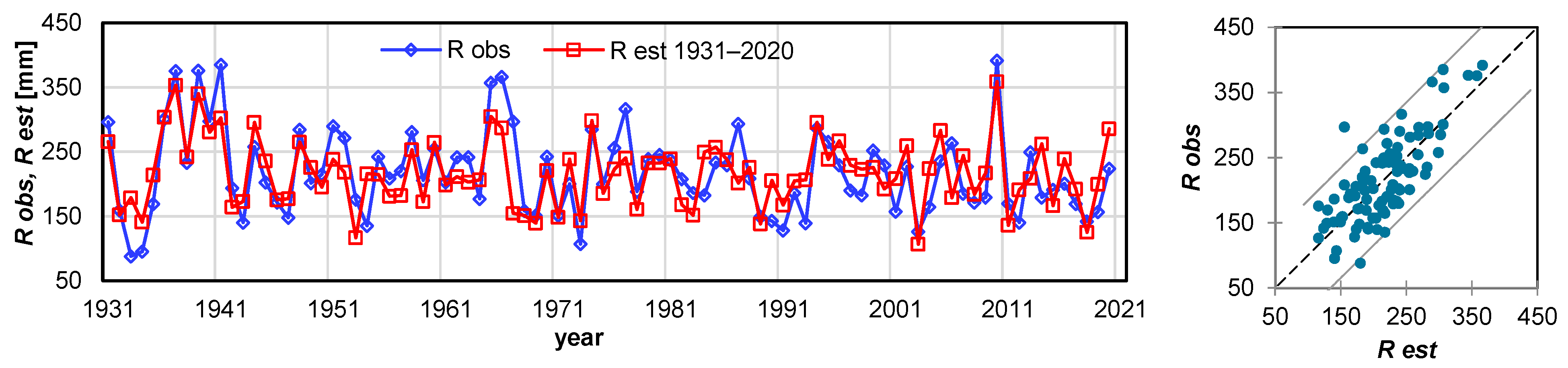
According to Equation (3), a 100 mm increase in annual precipitation results in a 41 mm increase in runoff, while a 1 °C average annual temperature increase causes a 13 mm decrease in runoff. The observed data and estimated values exhibit strong agreement, capturing similar interannual variability and long-term trends (see Figure 5 for comparison).

3.1.3. Water Balance for Three 30-Year Periods According to BILAN Model

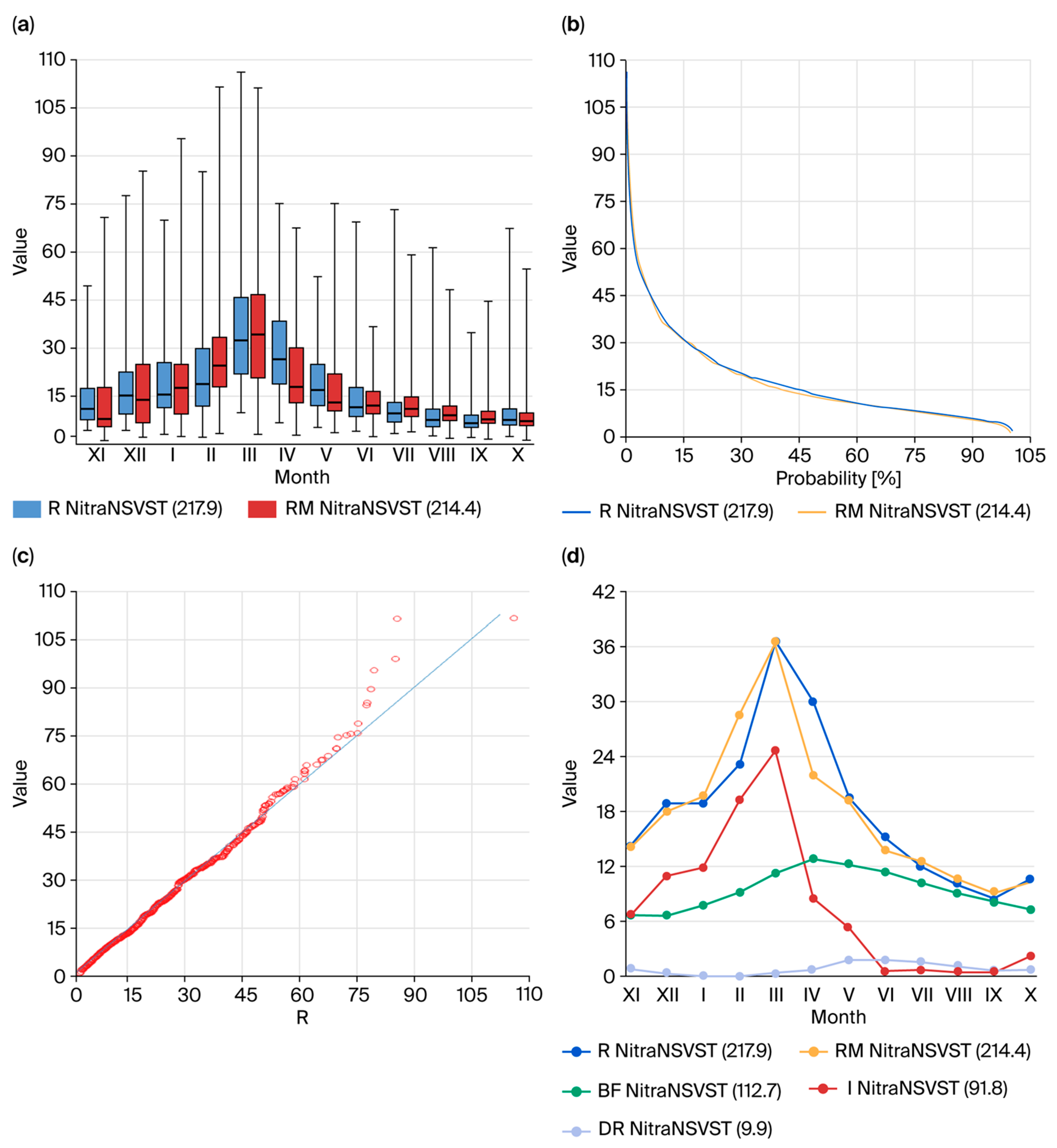
The BILAN model was calibrated using monthly data for the hydrological years 1930/31 to 2019/2020. The gradient optimization method was used, consisting of mean square error minimization followed by logarithmic Nash–Sutcliffe efficiency optimization. The logarithmic Nash–Sutcliffe efficiency was 0.596, with a correlation coefficient of 0.78 (R2 = 0.61). The lower correlation reflects the 90-year calibration period during which changes occurred in catchment hydrological conditions. Calibrating over the entire period provided a single parameter set, enabling comparisons across different time periods, which was the primary objective. An example of the model calibration results is presented graphically in Figure 6, showing (a) monthly boxplot comparison of measured versus modeled runoff; (b) monthly exceedance curves; (c) a measured/modeled runoff comparison plot; and (d) average monthly runoff components including baseflow, interflow, and direct runoff.
Table 4 presents the annual values of base flow (BF), interflow (I), and direct runoff (DR) in millimeters for whole period 1930/31–2019/20 and for the three sub-periods. The long-term average baseflow (BF) accounted for 50.4% of the total modeled runoff (RM), the interflow (I) for 41.0%, and the direct runoff (DR) for 8.6%.
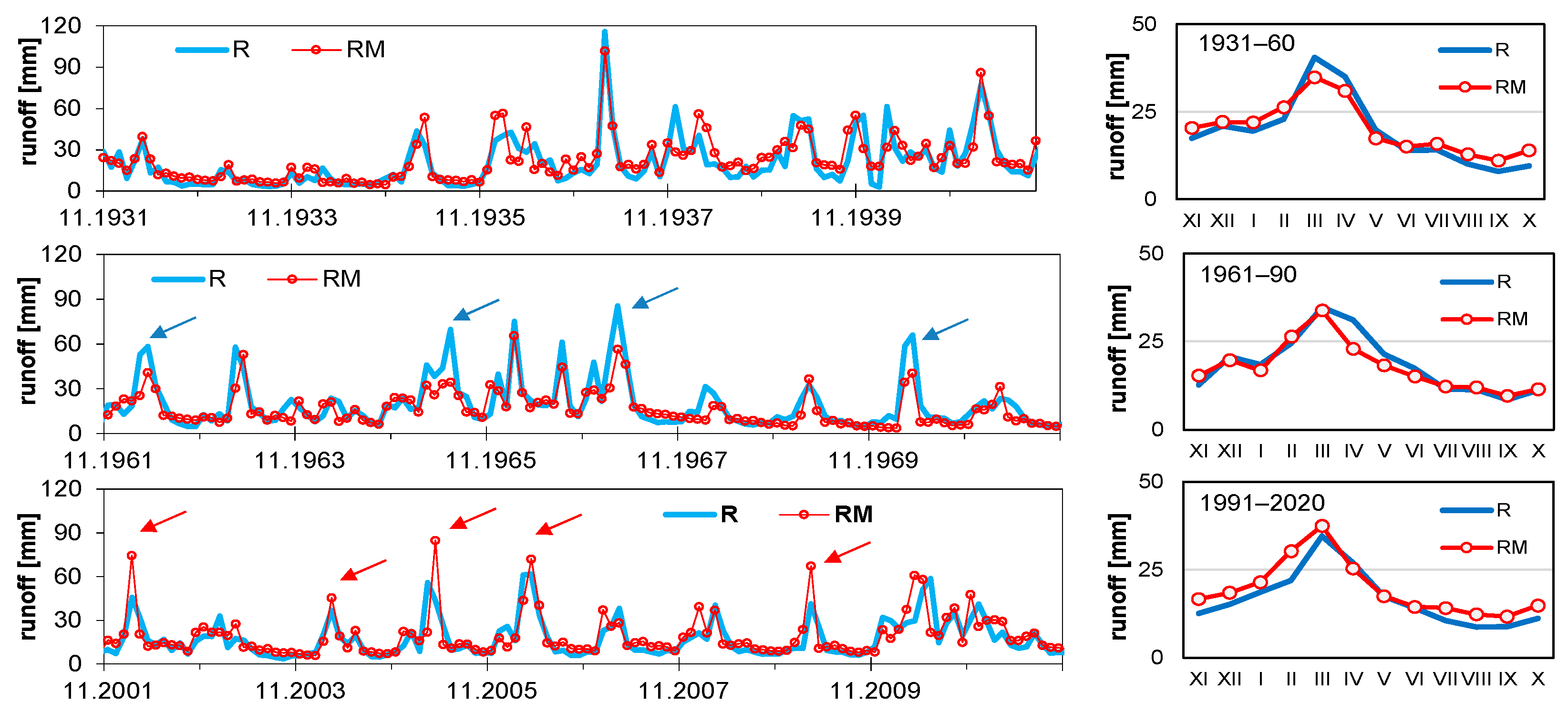
Figure 7 graphically illustrates the changes in selected components of the hydrological balance of the Nitra River, calculated at a monthly time step, for three 30-year subperiods: (I) 1931/32–1960/61, (II) 1961/62–1990/91, and (III) 1991/92–2020/21. The middle panel of Figure 7 shows that the modeled runoff (RM) values during April–June underestimated the measured runoff (R) for the 1960/61–1989/90 period. Conversely, in the most recent 30-year period, the monthly modeled runoff values for ten months (except April and May) exceeded the measured values. This discrepancy can be attributed to water abstractions for irrigation within the basin.

3.2. Projected Future Changes in River Discharge Under Climate Scenarios

Future changes in discharge (converted to runoff depths) were simulated using the BILAN model for 2080–2099. As mentioned earlier, to simulate future runoff conditions, we utilized climate projection data derived from the CMIP6 ensemble available via the World Bank Climate Change Knowledge Portal [28]. The study period was defined as 2080–2099. The hydrological modeling was driven by data from three distinct Shared Socioeconomic Pathways: SSP1-1.9, SSP2-4.5, and SSP5-8.5. The projected monthly changes–specifically, the absolute increase in air temperature [°C] and the relative percentage change in precipitation [%] were applied to the observed baseline time series (reference period 1995–2014). The average annual air temperature is projected to increase by 0.88 °C (resp. 2.60 and 5.11 °C) by 2080–2099, compared to reference period 1995–2014. Annual precipitation is projected to increase by 1.0% (resp. 3.1 and 0.4%) relative to 1995–2014 (Table 5).
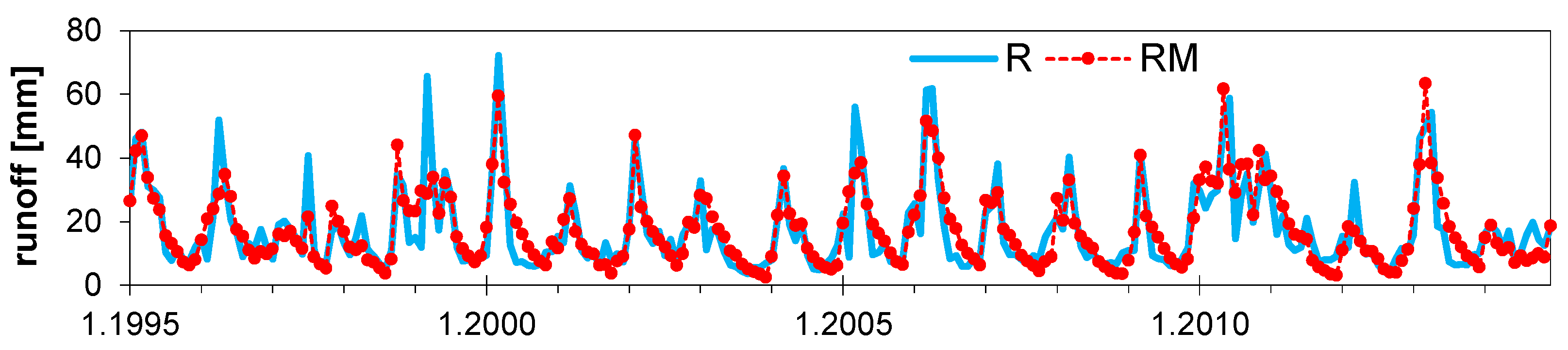
The conceptual BILAN model was used to simulate the far future (2080–2099) hydrological balance in Nitra river basins. The model was recalibrated using monthly data from the scenario reference period 1995–2014 and verified in 2015–2020 period. The potential evapotranspiration was estimated by using a relationship derived by [27], employing solar radiation and air temperature and requiring air temperature as the sole input. Figure 8 shows the course of the measured (R) and modeled (RM) monthly runoff depths. The correlation coefficient between the measured and modeled values reached 0.82 (R2 = 0.718), optimization criterion NS was 0.723.
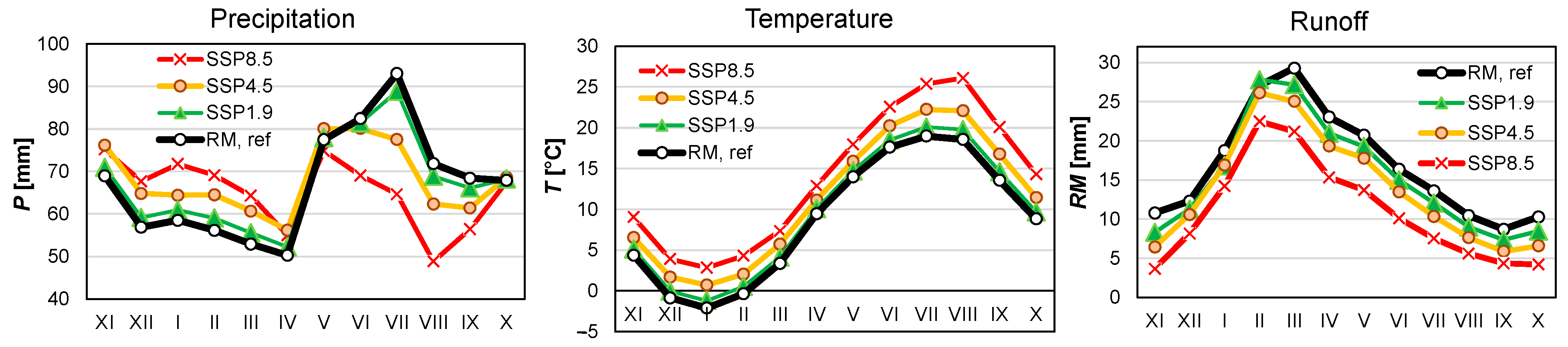
The input monthly data series of air temperature and precipitation were transformed for the 2080–2099 period, and the series of monthly runoff depths R was simulated by the model BILAN. Figure 9 provides a visual comparison of projected changes in monthly precipitation P, monthly temperature T, and R runoff depths for 2080–2099 compared to the reference period 1995–2014, clearly showing the divergent outcomes between the three scenarios.
The ensemble of CMIP6 GCM projections under SSP4.5 projected annual runoff decreases to 166.2 mm, representing a 17.5% decrease. Despite the 3.1% precipitation increase, intensified evapotranspiration associated with a +2.6 °C temperature rise dominates, resulting in widespread runoff reductions. The strongest decreases occur in September (−32.3%), October (−35.8%), and December (−40.4%), with reductions across all months. Table 6 presents the projected changes in long-term monthly runoff for 2080–2099 compared to the 1995–2014 reference period. Projections under SSP8.5 projected annual runoff decreases to 130.5 mm, representing the 35.2% decrease.
From five SSP available scenarios, we deliberately selected three contrasting ones. The aim was to demonstrate that the distant future remains highly uncertain: different changes in the monthly precipitation pattern can lead to significant alterations in both total annual and monthly runoff, even when annual precipitation changes only minimally. These three scenarios require fundamentally different landscape management measures. However, constructing new reservoirs is necessary: under the second and third scenarios, for winter protection against high liquid precipitation, and for summer water capture to augment streamflow.

Projected Changes in Runoff Components

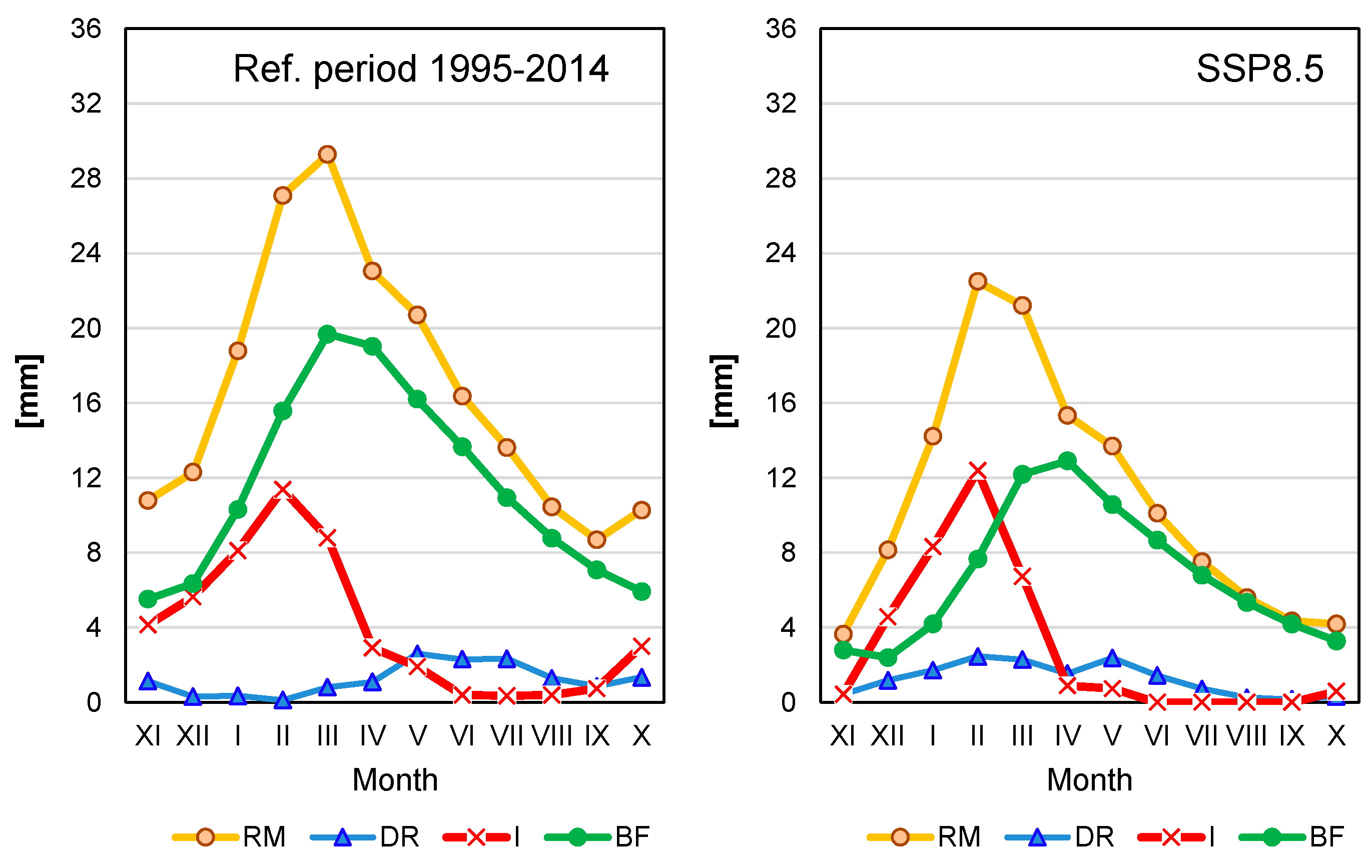
Changes in runoff components—baseflow (BF), interflow (I), and direct runoff (DR)—for reference period 1995–2014 and according to SSP8.5 scenarios for the 2080–2099 period are presented in Figure 10.
The relative contributions of each component remain relatively stable across scenarios, with baseflow continuing to dominate the runoff regime. However, the absolute magnitudes of all components decrease substantially under the three SSP scenarios due to the combined effects of higher temperatures and altered precipitation patterns. The projected annual course of total runoff and its components shows the persistence of baseflow dominance even under future climate change, though with markedly different absolute volumes between the three scenarios. It is interesting how the higher modeled direct runoff has shifted from May–June to the months of January–March.

4. Discussion and Conclusions

We consider the most significant contribution of this study to be the evaluation of the 90-year past and a glimpse into the 80-year future. The extremes of past periods show us the boundaries that must be accounted for when planning landscape measures.

4.1. Historical Water Balance Trends and Sensitivity

The first part of this study provides a comprehensive assessment of the hydrological balance of the Nitra River catchment up to the Nitrianska Streda gauging station over a 90-year period (November 1930–2020). Long-term observations indicate that, despite a moderate increase in precipitation of approximately +2% between the 1930/31–1959/60 and 1990/91–2019/20 periods, the mean annual runoff declined from 229 mm to 201 mm (−12%). In lowland rivers of southern Slovakia, an even more pronounced decline in streamflow has been observed [32]. This decrease is primarily attributed to enhanced evapotranspiration resulting from a rise in mean air temperature of +1.08 °C.

4.2. Future Runoff Projections Under SSP Scenarios

In the second part of this study, the BILAN model was applied to simulate water balance changes and to project future runoff development in the Nitra River. The model was first calibrated for the 1930/31–2019/20 period to enable comparison between the observed and simulated water balance components. The relatively weak correlation between observed and simulated monthly discharges reflects anthropogenic changes within the catchment as well as potential inconsistencies in the measurement of precipitation, air temperature, and discharge. Systematic discrepancies were identified: the model underestimates spring runoff (April–June) during 1960/61–1989/90 and substantially overestimates runoff during 1990/91–2019/20, which may be related to water withdrawals for irrigation and industry that are not explicitly represented in the lumped conceptual model.
For future projections, the BILAN model was recalibrated using monthly data from the scenario reference period 1995–2014 and verified in the 2015–2020 period. The model demonstrated sufficient accuracy in simulating hydrological processes, with a correlation coefficient of 0.85 (R2 = 0.718) between observed and simulated monthly runoff values. This satisfactory performance supports the reliability of the model for projecting future hydrological conditions.
The projections to 2080–2099 indicate substantial changes in the hydrological balance of the Nitra catchment under three distinct Shared Socioeconomic Pathways from the CMIP6 Multi-Model Ensemble. Under the sustainability pathway SSP1-1.9, the mean annual air temperature is projected to increase by 0.88 °C compared to the reference period 1995–2014, accompanied by a 1.1% increase in annual precipitation. Despite this relatively modest climate forecast, annual runoff decreases by 8.9%, from 201.4 mm to 183.5 mm. The strongest reductions occur in autumn and early winter months, with November experiencing a 23.0% decline.
The middle-of-the-road scenario SSP2-4.5 projects a mean temperature increase of +2.6 °C and a 3.1% increase in total precipitation. However, the impacts of these climatic changes on runoff are severe. Annual runoff declines by 17.5%, from 201.4 mm to 166.2 mm. The strongest decreases occur in autumn and winter: September (−32.3%), October (−35.8%), and December (−40.4%), with reductions across all months. Despite the modest precipitation increase, intensified evapotranspiration associated with the temperature rise dominates the water balance, resulting in widespread runoff reductions.
The high-emission pathway SSP5-8.5 predicts the most pronounced temperature increase of +5.1 °C, with only a marginal 0.4% increase in total precipitation. This scenario yields the most dramatic hydrological impact, with annual runoff decreasing by 35.2%, from 201.4 mm to 130.5 mm. Summer months experience catastrophic declines exceeding 45%, with September showing a 49.9% reduction and October reaching 59.2%. Winter precipitation increases substantially (+22.6% in January, +23.1% in February), but this is offset by massive summer deficits (−30.5% in July, −32.0% in August). The seasonal redistribution of precipitation, particularly the decline in summer rainfall combined with extreme temperature increases, threatens to fundamentally alter the basin’s hydrological regime.

4.3. Comparison with Previous Studies

Our findings reveal substantial differences compared to previous modeling studies for the Nitra basin [33,34,35,36,37], as well as with findings from neighboring Central European countries [38,39,40,41,42].
E.g. our SSP-based projections for the Nitra River basin indicate a clear tendency toward decreasing annual runoff toward the end of the century, with the strongest decline simulated under SSP5-8.5 (201.4 mm→130.5 mm; −35.2%). These results are consistent with the drought-oriented perspective presented by Fendeková et al. [33], who classify the Nitra basin (and southern Slovakia in general) among the most drought-prone regions and emphasize the increasing role of evapotranspiration and storage deficits in shaping future hydrological drought development. In this sense, their conclusions support the interpretation that even if precipitation does not decrease strongly in annual totals, the basin can still experience worsening hydrological conditions due to rising atmospheric demand and prolonged deficit accumulation. The agreement is particularly strong in the “impact narrative”: increasing drought stress is expected to manifest through reduced water availability and persistence of deficits, not only through changes in mean precipitation.
At the same time, published hydrological projections for the Nitra basin are not uniform. Sleziak et al. [9], using the TUW rainfall–runoff model and older RCP-based climate forcings, reported runoff increases for the Nitra basin under some scenario settings. This contrast usefully demonstrates how sensitive projected runoff direction (increase vs. decrease) can be to the choice of climate scenario family (CMIP5/RCP versus CMIP6/SSP), the implied magnitude of warming, and–crucially–the seasonal structure of precipitation change, not just annual totals. In our SSP framework, SSP5-8.5 combines very strong warming (+5.1 °C) with only marginal annual precipitation change (+0.4%) and pronounced summer precipitation decreases, which together produce a runoff decline that is difficult to offset by winter precipitation gains. Therefore, keeping both comparisons [33] and [9] in the discussion highlights that differences among published outcomes for the same basin can plausibly arise from different scenario choices and forcing datasets, rather than from inconsistency in catchment behavior itself.

4.4. Validation of Future Projections via Empirical Regression

A striking validation of our BILAN model projections is provided by comparing the SSP5-8.5 scenario results with the simple empirical relationship derived from historical data (Equation (3)). This comparison reveals a remarkable consistency between the complex hydrological modeling and the fundamental sensitivity observed over the past 90 years.
Under the SSP5-8.5 scenario for the 2080–2099 horizon, the Multi-Model Ensemble projects a mean annual air temperature increase of +5.1 °C and a negligible precipitation increase of +0.4% (effectively +3 mm relative to the 781 mm long-term average). When we substitute these delta values into our regression Equation (3), the estimated change in annual runoff is −64.9 mm. Given the reference runoff of approximately 201 mm, this represents a decrease of approximately 32%.
Independently, the recalibrated BILAN model simulated a runoff decrease of 35.2% (from 201.4 mm to 130.5 mm) under the same SSP5-8.5 climate forcing (Table 6). The deviation between the simple regression estimate (−32%) and the comprehensive model simulation (−35%) is minimal.
In conclusion, the successful application of the BILAN hydrological model has provided valuable insights into the components of the water balance and potential future runoff scenarios. Continued research on this issue remains crucial. Results from different regions vary considerably [43,44,45]: in some areas, runoff is projected to increase, whereas in Central and Southern Europe, a decline is more likely. Further attention should be directed toward the development of alternative approaches that are less dependent on specific climate scenarios.

Author Contributions

Conceptualization, P.P. and I.L.; methodology, P.P.; software, P.P. and J.P.; validation, P.P., J.P., and V.B.M.; formal analysis, P.P. and D.H.; investigation, P.P. and Z.B.; resources, P.P.; data curation, P.P.; writing—original draft preparation, P.P.; writing—review and editing, I.L. and Z.B.; visualization, I.L. and P.P.; project administration, P.P. and V.B.M.; funding acquisition, P.P. All authors have read and agreed to the published version of the manuscript.

Funding

This work was supported by the VEGA Grant Agency under Contract No. 2/0015/23 “Comprehensive analysis of the quantity and quality of water regime development in streams and their mutual dependence in selected Slovak basins” and by project MVTS, “WATSIM II”.

Data Availability Statement

The hydrological data used in this study were obtained from the Slovak Hydrometeorological Institute (SHMÚ) under a data-sharing agreement for scientific research purposes. These data are not publicly available due to restrictions imposed by the data provider, but they can be accessed from SHMÚ upon reasonable request and with permission of the Institute.

Acknowledgments

The authors express their sincere gratitude to the two anonymous reviewers for their thorough and constructive comments, which significantly helped to improve the quality and clarity of this manuscript.

Conflicts of Interest

The authors declare no conflicts of interest.

References

  1. Makanda, K.; Nzama, S.; Kanyerere, T. Assessing the role of water resources protection practice for sustainable water resources management: A review. Water 2022, 14, 3153. [Google Scholar] [CrossRef]
  2. Mahajan, S.; Martinez, J. Water, water, but not everywhere: Analysis of shrinking water bodies using open access satellite data. Int. J. Sustain. Dev. World Ecol. 2020, 28, 326–338. [Google Scholar] [CrossRef]
  3. Bănăduc, D.; Simić, V.; Cianfaglione, K.; Barinova, S.; Afanasyev, S.; Öktener, A.; McCall, G.; Simić, S.; Curtean-Bănăduc, A. Freshwater as a Sustainable Resource and Generator of Secondary Resources in the 21st Century: Stressors, Threats, Risks, Management and Protection Strategies, and Conservation Approaches. Int. J. Environ. Res. Public Health 2022, 19, 16570. [Google Scholar] [CrossRef] [PubMed]
  4. Nikulin, G.; Kjellstrom, E.; Hansson, U.; Strandberg, G.; Ullerstig, A.; Wilby, R.L.; Cannaby, H.; Barring, L.; Wrench, D.; Wolf, J. Evaluation and future projections of temperature, precipitation and wind extremes over Europe from an ensemble of regional climate models. Tellus A 2011, 63, 41–55. [Google Scholar] [CrossRef]
  5. Pechlivanidis, I.G.; Arheimer, B.; Donnelly, C.; Hundecha, Y.; Huang, S.; Aich, V.; Samaniego, L.; Eisner, S.; Shi, P. Analysis of hydrological extremes at different hydro-climatic regimes under present and future conditions. Clim. Change 2017, 141, 467–481. [Google Scholar] [CrossRef]
  6. Müller, O.V.; McGuire, P.C.; Vidale, P.L.; Hawkins, E. River flow in the near future: A global perspective in the context of a high-emission climate change scenario. Hydrol. Earth Syst. Sci. 2024, 28, 2179–2201. [Google Scholar] [CrossRef]
  7. George, J.; Pavizham, A. Long-term changes in climatic variables over the Bharathapuzha river basin, Kerala, India. Theor. Appl. Climatol. 2020, 142, 269–286. [Google Scholar] [CrossRef]
  8. Liu, H.; Gulakhmadov, A.; Shaimuradov, F. Impact Analysis of Climate Change on Hydropower Resource Development in the Vakhsh River Basin of Tajikistan. Hydrology 2025, 12, 294. [Google Scholar] [CrossRef]
  9. Sleziak, P.; Výleta, R.; Hlavčová, K.; Danáčová, M.; Aleksić, M.; Szolgay, J.; Kohnová, S. A hydrological modeling approach for assessing the impacts of climate change on runoff regimes in Slovakia. Water 2021, 13, 3358. [Google Scholar] [CrossRef]
  10. Kohnová, S.; Rončák, P.; Hlavčová, K.; Szolgay, J.; Rutkowska, A. Future impacts of land use and climate change on extreme runoff values in selected catchments of Slovakia. Meteorol. Hydrol. Water Manag. 2019, 7, 47–55. [Google Scholar] [CrossRef]
  11. Pekárová, P.; Halmová, D.; Sabová, Z.; Pekár, J.; Miklánek, P.; Bačová Mitková, V.; Prohaska, S.; Kohnová, S.; Garaj, M. Sensitivity of Runoff Due to Changes in the Characteristics of the Water Balance in the Danube River Region. J. Hydrol. Hydromech. 2023, 71, 399–412. [Google Scholar] [CrossRef]
  12. Delaigue, O.; Brigode, P.; Thirel, G.; Coron, L. airGRteaching: An open-source tool for teaching hydrological modeling with R. Hydrol. Earth Syst. Sci. 2023, 27, 3293–3327. [Google Scholar] [CrossRef]
  13. Badora, D.; Wawer, R.; Król-Badziak, A.; Nieróbca, A.; Kozyra, J.; Jurga, B. Hydrological Balance in the Vistula Catchment under Future Climates. Water 2023, 15, 4168. [Google Scholar] [CrossRef]
  14. Ayoubi, T.; Reinhardt-Imjela, C.; Schulte, A. Assessment of Water Resources under Climate Change in Western Hindukush Region: A Case Study of the Upper Kabul River Basin. Atmosphere 2024, 15, 361. [Google Scholar] [CrossRef]
  15. Liu, Y.; Su, Y.; Wang, L.; Zhao, Y. Simulation and Evaluation of Runoff in Tributary of Weihe River Basin in Western China. Water 2024, 16, 221. [Google Scholar] [CrossRef]
  16. Probst, E.; Mauser, W. Climate Change Impacts on Water Resources in the Danube River Basin: A Hydrological Modelling Study Using EURO-CORDEX Climate Scenarios. Water 2023, 15, 8. [Google Scholar] [CrossRef]
  17. Soares, P.M.M.; Careto, J.A.M.; Cardoso, R.M.; Goergen, K.; Katragkou, E.; Sobolowski, S.; Coppola, E.; Ban, N.; Belušić, D.; Berthou, S.; et al. The added value of km-scale simulations to describe temperature over complex orography: The CORDEX FPS-Convection multi-model ensemble runs over the Alps. Clim. Dyn. 2024, 62, 4491–4514. [Google Scholar] [CrossRef]
  18. Pavlík, P.; Vizina, A. The current version of the BILAN model. Vodohospod. Tech. Ekon. Inf. 2022, 67, 52–53. [Google Scholar]
  19. Machlica, A.; Horvát, O.; Horáček, S.; Oosterwijk, J.; Van Loon, A.F.; Fendeková, M.; Van Lanen, H.A. Influence of model structure on base flow estimation using Bilan, Frier and HBV-light models. J. Hydrol. Hydromech. 2012, 60, 242–251. [Google Scholar] [CrossRef]
  20. Hanel, M.; Vizina, A.; Máca, P.; Pavlásek, J. A Multi-Model Assessment of Climate Change Impact on Hydrological Regime in the Czech Republic. J. Hydrol. Hydromech. 2012, 60, 152–161. [Google Scholar] [CrossRef]
  21. Melišová, E.; Vizina, A.; Staponites, L.R.; Hanel, M. The Role of Hydrological Signatures in Calibration of Conceptual Hydrological Model. Water 2020, 12, 3401. [Google Scholar] [CrossRef]
  22. Ba, D.; Langhammer, J.; Maca, P.; Bodian, A. Testing sensitivity of BILAN and GR2M models to climate conditions in the Gambia River Basin. J. Hydrol. Hydromech. 2024, 72, 131–147. [Google Scholar] [CrossRef]
  23. Trnka, M.; Vizina, A.; Hanel, M.; Balek, J.; Fischer, M.; Hlavinka, P.; Semerádová, D.; Štěpánek, P.; Zahradníček, P.; Skalák, P.; et al. Increasing available water capacity as a factor for increasing drought resilience or potential conflict over water resources under present and future climate conditions. Agric. Water Manag. 2022, 264, 107460. [Google Scholar] [CrossRef]
  24. Somlyody, L.; Masliev, I.; Petrovič, P.; Kularathna, M. Water Quality Management in the Nitra River Basin. IIASA Report 1994. Available online: https://pure.iiasa.ac.at/id/eprint/4219/1/CP-94-002.pdf (accessed on 2 April 2024).
  25. Gacko, I.; Muchová, Z.; Jurík, Ľ.; Šinka, K.; Fabian, L.; Petrovič, F. Decision Making Methods to Optimize New Dam Site Selections on the Nitra River. Water 2020, 12, 2042. [Google Scholar] [CrossRef]
  26. Kišš, V.; Šurda, P. Analysis of air temperature and precipitation in Nitra, Slovakia in 2005–2019. Acta Hortic. Regiotect. Spec. Issue Nitra Slovaca Univ. Agric. Nitriae 2021, 24, 45–49. [Google Scholar] [CrossRef]
  27. Oudin, L.; Moulin, L.; Bendjoudi, H.; Ribstein, P. Estimating potential evapotranspiration without continuous daily data: Possible errors and impact on water balance simulations. Hydrol. Sci. J. 2010, 55, 209. [Google Scholar] [CrossRef]
  28. World Bank. Climate Data Projections: Slovak Republic. Climate Change Knowledge Portal. Available online: https://climateknowledgeportal.worldbank.org/country/slovak-republic/climate-data-projections (accessed on 22 December 2025).
  29. Riahi, K.; van Vuuren, D.; Kriegler, E.; Edmonds, J.; O’Neill, B.C.; Fujimori, S.; Bauer, N.; Calvin, K.; Dellink, R.; Fricko, O.; et al. The Shared Socioeconomic Pathways and their energy, land use, and greenhouse gas emissions implications: An overview. Glob. Environ. Change 2017, 42, 153–168. [Google Scholar] [CrossRef]
  30. O’Neill, B.; Kriegler, E.; Ebi, K.; Kemp-Benedict, E.; Riahi, K.; Rothman, D.S.; van Ruijven, B.J.; van Vuuren, D.P.; Birkmann, J.; Kok, K.; et al. The roads ahead: Narratives for shared socioeconomic pathways describing world futures in the 21st century. Glob. Environ. Change 2017, 42, 169–180. [Google Scholar] [CrossRef]
  31. Schneeberger, K.; Allerberger, F.; Ventruba, E.; Schwab, K.; Scholl-Poensgen, C.; Pecho, J.; Garaj, M.; Cuervo Blanco, T.; Janoska, P.; Kospo, A.; et al. Revision and Update of the National Strategy on Adaptation to Climate Change in Slovakia. Deliverable 2.3: Climate Risk and Vulnerability Assessment Slovakia; Directorate-General for Structural Reform Support, European Union: Brussels, Belgium, 2024; 247p. [Google Scholar]
  32. Pekárová, P.; Halmová, D.; Bačová Mitková, V.; Poórová, J.; Blaškovičová, L.; Pekár, J.; Leščešen, I.; Bajtek, Z. Temporal variability of average and low flows in Slovak rivers: A 90-year perspective. J. Hydrol. Reg. Stud. 2025, 60, 102560. [Google Scholar] [CrossRef]
  33. Fendeková, M.; Poórová, J.; Slivová, V. (Eds.) Hydrological Drought in Slovakia and Prognosis of Its Development; Comenius University Bratislava, Faculty of Natural Sciences: Bratislava, Slovakia, 2018; p. 181. ISBN 978-80-223-4510-1. [Google Scholar]
  34. Rončák, P.; Hlavčová, K.; Kohnová, S.; Szolgay, J. Impacts of future climate change on runoff in selected catchments of Slovakia. In Climate Change Adaptation in Eastern Europe; Leal Filho, W., Trbic, G., Filipovic, D., Eds.; Springer: Cham, Switzerland, 2019; pp. 287–301. [Google Scholar] [CrossRef]
  35. Báder, L. The Climatic Energy Balance Diagram (CEBD) highlights changes in the hydrological cycle of the Danube River basin. J. Hydrol. Hydromech. 2025, 73, 24–33. [Google Scholar] [CrossRef]
  36. Tall, A.; Kandra, B.; Pavelková, D.; Gomboš, M. Development of water-balance components in lysimeter with a controlled groundwater level. Acta Hydrol. Slovaca 2025, 26, 92–100. [Google Scholar] [CrossRef]
  37. Kišš, V.; Pagáč, J.; Tárník, A.; Čimo, J. Changes in Vegetation Period Length in Slovakia under the Conditions of Climate Change for 1931–2110. Sustainability 2022, 14, 12220. [Google Scholar] [CrossRef]
  38. Blagojević, B.; Mihailović, V.; Bogojević, A.; Plavšić, J. Detecting Annual and Seasonal Hydrological Change Using Marginal Distributions of Daily Flows. Water 2023, 15, 2919. [Google Scholar] [CrossRef]
  39. Soltani, K.; Amiri, A.; Ebtehaj, I.; Cheshmehghasabani, H.; Fazeli, S.; Gumiere, S.J.; Bonakdari, H. Advanced Forecasting of Drought Zones in Canada Using Deep Learning and CMIP6 Projections. Climate 2024, 12, 119. [Google Scholar] [CrossRef]
  40. Danielescu, S.; Adamescu, M.C.; Cheval, S.; Dumitrescu, A.; Cazacu, C.; Borcan, M.; Postolache, C. Climate Change Impacts on Hydrological Processes in a South-Eastern European Catchment. Water 2022, 14, 2325. [Google Scholar] [CrossRef]
  41. Muelchi, R.; Rössler, O.; Schwanbeck, J.; Weingartner, R.; Martius, O. River runoff in Switzerland in a changing climate—Runoff regime changes and their time of emergence. HESS 2021, 25, 3071–3086. [Google Scholar] [CrossRef]
  42. Hanus, S.; Hrachowitz, M.; Zekollari, H.; Schoups, G.; Vizcaino, M.; Kaitna, R. Future changes in annual, seasonal and monthly runoff signatures in contrasting Alpine catchments in Austria. Hydrol. Earth Syst. Sci. 2021, 25, 3429–3453. [Google Scholar] [CrossRef]
  43. Shahvari, N.; Khalilian, S.; Mosavi, S.H.; Mortazavi, S.A. Assessing climate change impacts on water resources and crop yield: A case study of Varamin plain basin, Iran. Environ. Monit. Assess. 2019, 191, 134. [Google Scholar] [CrossRef]
  44. Teutschbein, C.; Seibert, J. Bias correction of regional climate model simulations for hydrological climate-change impact studies: Review and evaluation of different methods. J. Hydrol. 2012, 456–457, 12–29. [Google Scholar] [CrossRef]
  45. Maraun, D.; Shepherd, T.G.; Widmann, M.; Zappa, G.; Walton, D.; Gutierrez, J.M.; Hagemann, S.; Richter, I.; Soares, P.M.M.; Hall, A.; et al. Towards process-informed bias corrections of climate change simulations. Nat. Clim. Change 2017, 7, 764–773. [Google Scholar] [CrossRef]
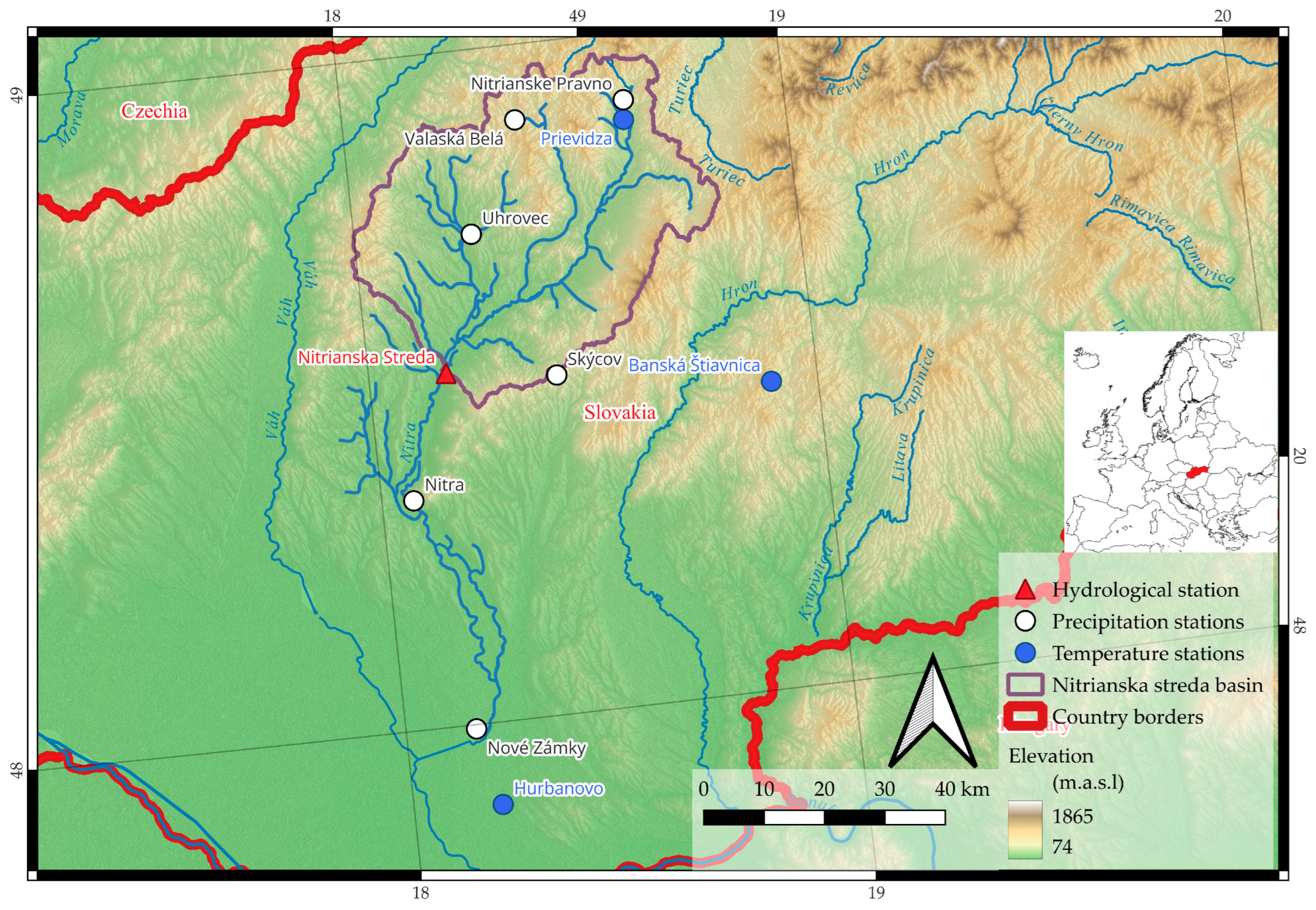
Figure 1. Location of the Nitra River basin, Slovakia, with main tributaries and monitoring stations and with long-term meteorological stations highlighted.
Water 18 00208 g001
Figure 2. (a) Daily discharge at Nitrianska Streda (1931–2020) with 4-year moving averages and long-term linear trend. (b) Long-term mean daily discharge regime comparing 1931–1960 and 1991–2020. P50 means 50 discharge percentiles.
Water 18 00208 g002
Figure 3. Annual precipitation, P; air temperature, Ta; average annual discharge, Qa; annual maximum, Qmax; and annual minimum, Qmin, for the Nitra River at Nitrianska Streda on annual and decadal timescales, showing long-term linear (P, Ta) and polynomial (Q) trends (green line), and 4-year moving averages (red line).
Water 18 00208 g003
Figure 4. Monthly averages of basin average air temperature and precipitation in the Nitra River basin for three/four 30-year periods (1901–1930, 1931–1960, 1961–1990, and 1991–2020), showing similar temperature patterns but varying precipitation distribution.
Water 18 00208 g004
Figure 5. Observed vs. estimated annual runoff depths from the empirical Equation (3), observed data (blue), estimated values (red), and scatter plot demonstrating correlation around the 1:1 line.
Water 18 00208 g005
Figure 6. Calibration of the BILAN model (1930/31–2019/20): (a) monthly boxplot of measured (blue) vs. modeled (red) runoff depth; (b) monthly exceedance curves; (c) observed–modeled comparison; (d) average monthly runoff components: baseflow (BF), interflow (I), and direct runoff (DR).
Water 18 00208 g006
Figure 7. Mean monthly runoff depths [mm] by three subperiods: (left)—monthly values, (right)—observed R vs. modeled RM seasonal cycle, highlighting spring underestimation (II); recent overestimation (III).
Water 18 00208 g007
Figure 8. Recalibration performance (1995–2014): measured R vs. modeled RM monthly runoff depths; correlation r = 0.85.
Water 18 00208 g008
Figure 9. Projected monthly precipitations, temperatures, and modeled runoff depths (RM) [mm] for 2080–2099 vs. reference 1995–2014, under the SSP scenarios.
Water 18 00208 g009
Figure 10. Projected annual course of total runoff RM, and components BF, I, and DR for reference period 1995–2014 and for 2080–2099, under and SSP8.5. Outputs of the model BILAN.
Water 18 00208 g010
Table 1. Characteristics of hydrometeorological stations used in this study.
Station NameStation TypeLatitude (ϕ)Longitude (λ)Elevation (m a.s.l.)Data Series Length
Nitrianska StredaHydrological48.87° N18.64° E3901931–2020
Nové ZámkyPrecipitation47.59° N18.29° E1151901–2020
Nitrianske Pravno48.52° N18.37° E351
Valaská Belá48.53° N18.23° E455
Uhrovec48.44° N18.20° E193
Skýcov48.30° N18.25° E409
HurbanovoMeteorological
(Air Temperature)
47.52° N18.11° E115November 1930–2020
Prievidza48.46° N18.35° E260
Banská Štiavnica48.26° N18.55° E575
Table 2. Annual water balance components for the Nitra River basin for three 30-hydrological-year periods (1 November–31 October).
YearP
[mm]
R
[mm]
ET
[mm]
T
[°C]
k
1930/31–1959/607912325597.860.29
1960/61–1989/907502235277.900.30
1990/91–2019/208062006068.940.25
Notes: P—precipitation depth, R—runoff depth, ET—evapotranspiration, T—average annual air temperature, k—runoff coefficient. The hydrological year runs from November to October.
Table 3. Linear regression coefficients, standard errors, and confidence intervals for Equation (3): Rest = 0.413 P − 12.96 T.
CoefficientsStd.
Error
t
Statistic
p-ValueLower
95% Cl
Upper
95% Cl
Lower
90.0% Cl
Upper
90.0% Cl
P0.4130.03213.072.47 × 10−220.350.4760.360.466
T−12.963.029−4.274.74 × 10−5−18.97−6.95−17.997−7.92
Notes: Rest = estimated annual runoff depth [mm]; P = annual areal precipitation [mm]; T = mean annual air temperature [°C]. Sample size: n = 90 hydrological years (1930/31–2019/20).
Table 4. Long-term annual water balance components simulated by the BILAN model for three 30-year periods (hydrological year). P—precipitation depth depth, R—observed runoff depth, RM—modeled runoff depth, BF—base flow, I—interflow, DR—direct runoff.
PeriodP
[mm]
R
[mm]
RM
[mm]
BF
[mm]
I
[mm]
DR
[mm]
1930/31–2019/207822182221129119
1930/31–1959/607912322341179720
1960/61–1989/907502232051048318
1990/91–2019/208062002261149320
Table 5. Projected anomaly of average mean surface temperature (diff T) and projected anomaly of precipitation percent change (P%) according to SSP1-1.9, SSP2-4.5 and SSP5-8.5 scenario. Multi-Model Ensemble, 2080–2099 to 1995–2014 reference period. Nitra River basin. (https://climateknowledgeportal.worldbank.org/country/slovak-republic/climate-data-projections) URL (accessed on December 10, 2025).
Months
IIIIIIIVVVIVIIVIIIIXXXIXIIYear
diff. T SSP1-1.9 [°C]0.910.890.770.630.720.871.111.21.080.860.730.830.88
P SSP1-1.9 [%]4.15.15.04.00.7−1.2−4.5−4.1−3.30.42.94.01.1
diff. T SSP2-4.5 [°C]2.82.42.41.71.92.63.33.53.22.62.22.62.6
P SPP2-4.5 [%]10.114.914.711.83.3−2.8−16.7−13.2−10.21.010.514.03.1
diff. T SPP5-8.5 [°C]5.04.74.03.44.04.96.47.56.55.54.74.85.1
P SPP5-8.5 [%]22.623.121.69.4−3.4−16.3−30.5−32.0−17.6−0.59.019.00.4
Table 6. Projected monthly and annual runoff changes (2080–2099 vs. reference 1995–2014 under SSP climate scenarios for the Nitra River at the Nitrianska Streda gauging station.
Months
XIXIIIIIIIIIVVVIVIIVIIIIXXYear
1995–2014 [mm]10.812.318.827.129.323.020.716.413.610.48.710.3201.4
SSP1.98.311.316.827.827.221.019.315.012.19.07.38.5183.5
Change in %−23.0−8.2−10.32.7−7.2−9.0−7.0−8.3−11.5−13.8−15.5−17.5−8.9
SSP4.56.410.616.926.125.119.317.813.510.37.65.96.6166.2
Change in %−40.4−13.9−9.9−3.5−14.4−16.1−14.0−17.7−24.1−26.9−32.3−35.8−17.5
SSP8.53.68.214.222.521.215.313.710.17.55.64.44.2130.5
Change in %−66.3−33.7−24.3−16.9−27.6−33.4−33.9−38.3−44.8−46.4−49.9−59.2−35.2
Disclaimer/Publisher’s Note: The statements, opinions and data contained in all publications are solely those of the individual author(s) and contributor(s) and not of MDPI and/or the editor(s). MDPI and/or the editor(s) disclaim responsibility for any injury to people or property resulting from any ideas, methods, instructions or products referred to in the content.