
Review of Sediment Modeling Tools Used During Removal of the Elwha River Dams


Abstract
1. Introduction
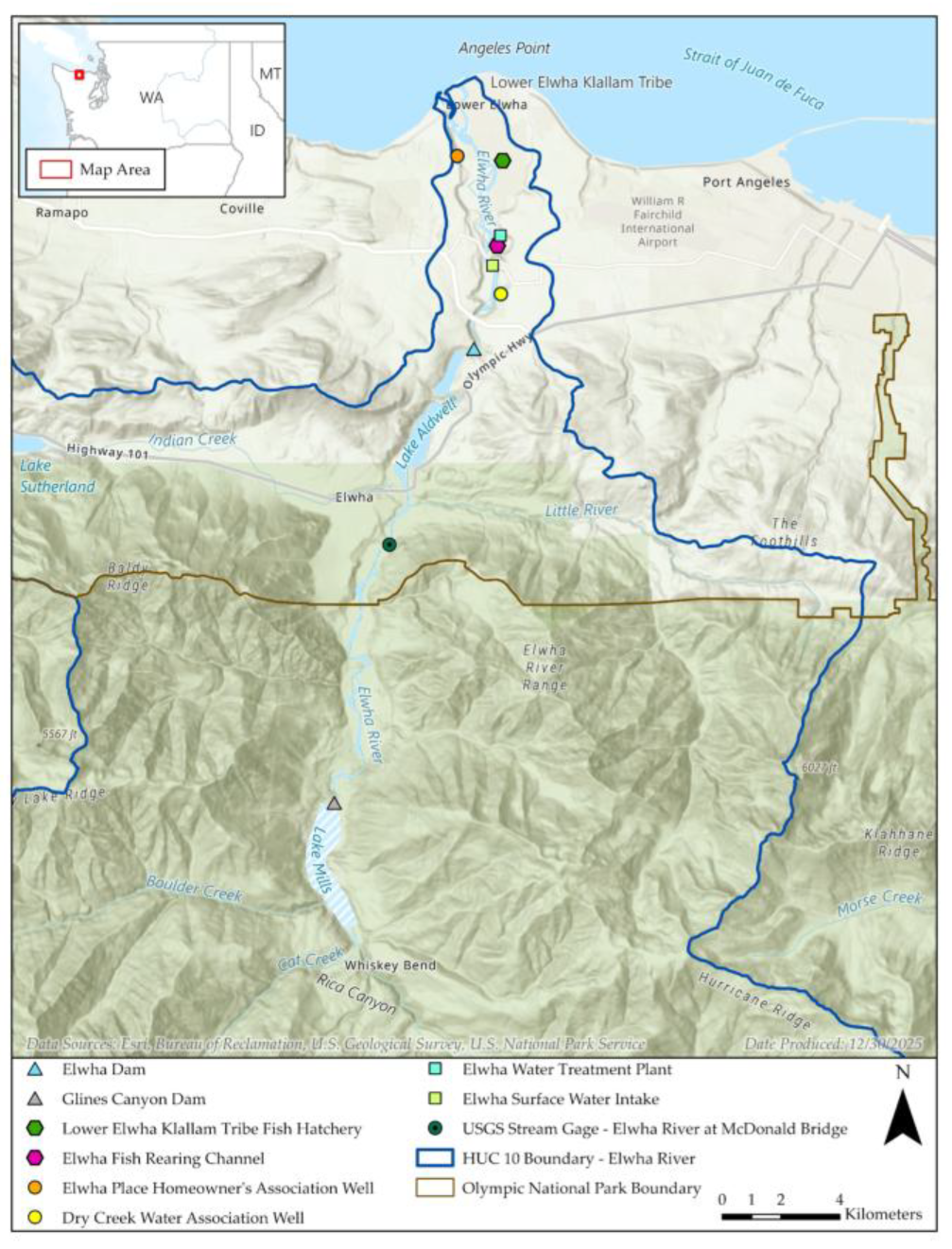
2. Study Site
3. Review of Sediment Modeling Tools Used for Dam Removal
3.1. Conceptual Modeling and Geomorphic Analysis
- • Construction of the ESWI and EWTP to, respectively, divert and pre-treat river water for municipal and industrial users. (Numerical modeling was used to predict the concentrations to be dealt with.)
- • Construction of a new Water Treatment Plant for the City of Port Angeles.
- • Upgrades to the existing industrial water treatment plant.
- • New and deeper municipal wells were drilled for the Dry Creek Water Association and the Elwha Place Homeowners Association.

| Criteria | Findings | Information From | |
|---|---|---|---|
| Reservoir Area | |||
| 1 | River incised to pre-dam valley bottom indicates low likelihood of further removal-related incision. | Exposure of pre-dam tree stumps, historical photos and pre-dam & contemporary topography indicate river through former reservoir reached pre-dam valley bottom by October 2017. | Repeat fluvial audit; contemporary ground-based photos; historical and contemporary surveys. |
| 2 | At least one flood peak greater than the 5-year flood has occurred since dam removal. | Seven peaks ranging from 2 to 10 yr recurrence intervals have occurred since removal. | Stream gauging and analysis. |
| 3 | Lateral erosion of terraces is localized (not along entire bank line), only occurs during floods, and a flood of a given magnitude erodes less than the previous flood of a similar magnitude. | Terrace erosion reduced annually since dam removal: larger, more frequent flooding in WY 2016 eroded less sediment than in WY 2015; a peak flow no larger than a 2 yr flood in WY 2017 eroded minimal sediment; a 2 to 5 yr flood in WY 2018 eroded 5–10% of the terraces eroded previously. | Repeat fluvial audit. |
| 4 | Annual erosion of remaining sediment is less than natural variability in year-to-year background sediment loads. | By the start of WY 2018, erosion volumes were less than the natural variability in background loads. | Stream gauging; sedimentological data; repeat topographical & bathymetrical surveys; calculation of natural background sediment loads; geomorphic change detection. |
| 5 | Net annual erosion from the reservoir relative to natural background loads exhibits an exponential decay over time. | Net erosion declined exponentially from 63 times background rate in WY 2013 to 0.4 and 0.8 times the background rates in WYs 2017 and 2018, respectively. | As for criterion 4. |
| 6 | Woody vegetation covering the majority of fine sediment deposits on reservoir hillslopes and terrace surfaces prevents erosion by rainfall runoff, snowmelt and wind. | By the end of 2017, reservoir hillslopes and sediment terraces were covered in dense vegetation, including woody species. | Repeat surveys; oblique time lapse photos. |
| Downstream river channel | |||
| 1 | Recovery of pool–riffle morphology indicates that most of the released coarse sediment has been transported to the coastal delta. | The pool-riffle morphology, with abundant gravel bars and wood deposits, re-established itself within a more complex, laterally migrating, naturally dynamic channel by 2014. Sediment erosion and deposition occur within the active channel and floodplain. | Repeat topographical survey & ground-based photography. |
| 2 | Most of the eroded reservoir sediment has been transported to the Elwha River mouth. | 90% of the eroded reservoir sediment has been transported to the coast, greatly enlarging the delta [67]. Sediment remaining in the river has been sorted to restore fish habitat and natural river ecosystem function. | Historical survey; pre- and post-removal topographic and bathymetric survey; aerial LiDAR; sedimentological data; geomorphic change detection; gauging data; sediment transport data; calculation of natural background sediment loads; sediment budgeting. |
| 3 | Lateral channel migration and associated terrace and bank erosion is limited to periods during floods. | Lateral channel migration and bank erosion occurred during floods but reduced in longitudinal length and in surface area over time. | Repeat fluvial audit. |
3.2. Reservoir Drawdown Experiments
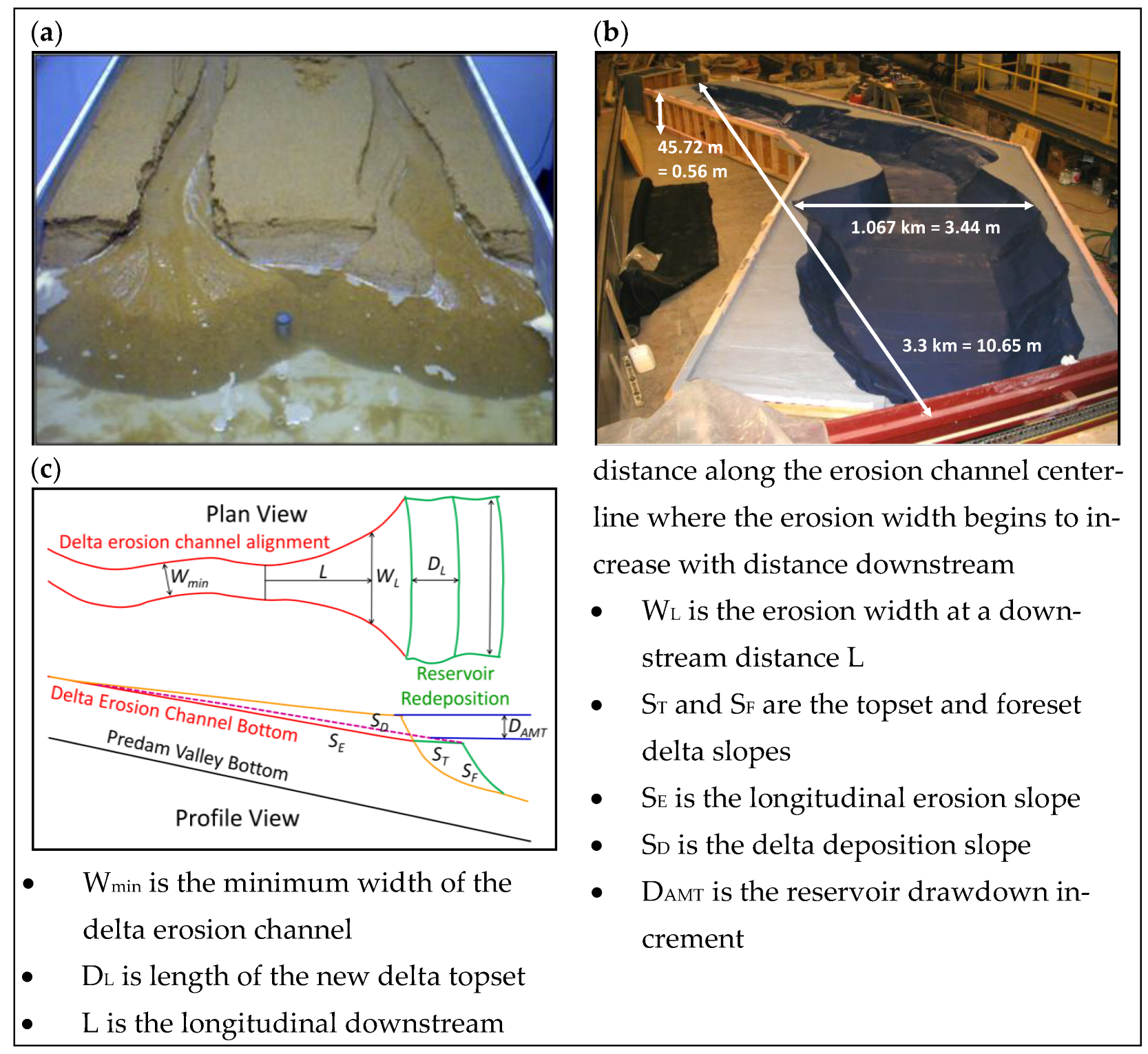
3.3. Mass Balance Modeling Phase 1
- • That 15% to 35% of the coarse sediment and ~50% of the fine sediment would be eroded from the reservoirs;
- • The date on which coarse sediment would first be released downstream;
- • That maximum downstream fines concentrations would be in the range 10,000–50,000 mg/L;
- • That bed elevations in the lower river would rise appreciably;
- • That reservoir sediment erosion rates would decrease exponentially once dam removal was completed and a few floods had occurred.
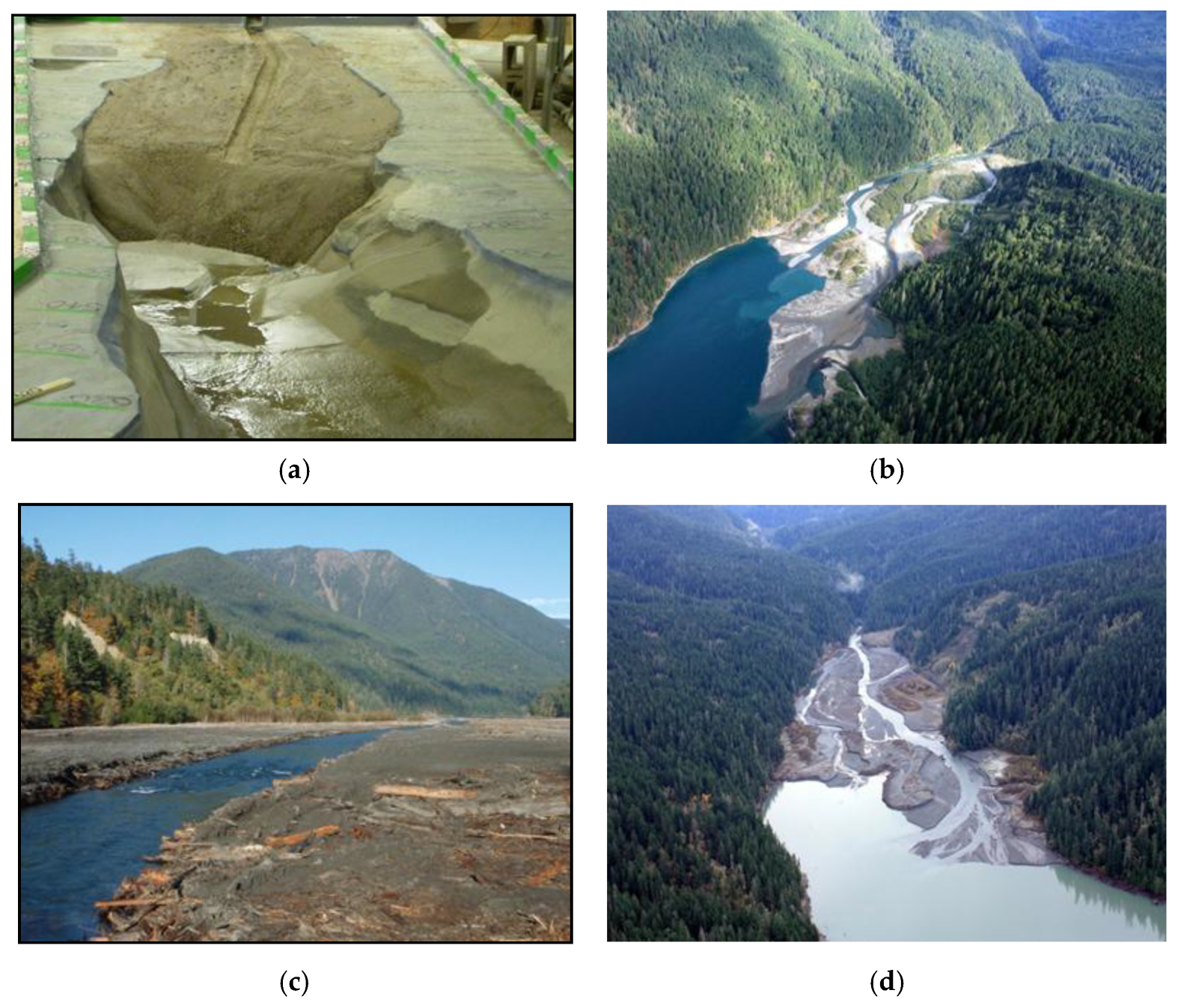
3.4. Physical Modeling
3.5. Mass Balance Modeling Phase 2
3.6. One-Dimensional Numerical Modeling
3.7. Two-Dimensional Numerical Modeling
3.8. Monitoring and Adaptive Management During Dam Removal
- • Formazin nephelometric units (FNUs): water, unfiltered, monochrome near infra-red LED light, 780–900 nm, detection angle 90 ± 2.5 degrees for the period 1 August 2003, to 2 June 2019 (5917 measurements)
- • Formazin Backscatter Units (FBUs): water, unfiltered, monochrome near infra-red LED light source, 780–900 nm, detection angle 0–45 degrees to incident light (backscatter), for the period 18 September 2013, to 18 December 2019 (6417 measurements)
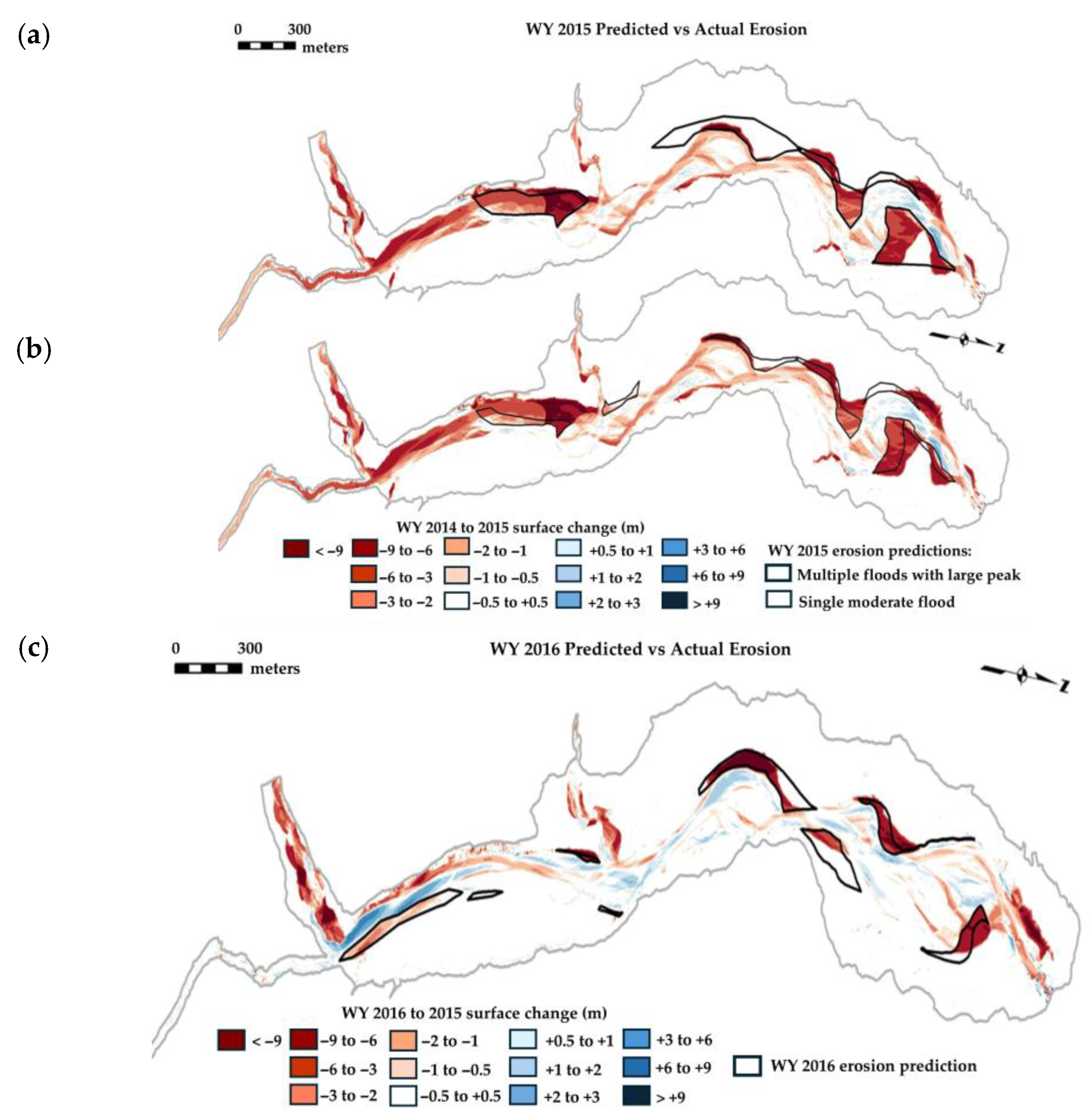
3.9. Synoptic Forecasting/Earthcasting
- • Post-erosion, the dynamically stable longitudinal channel slope would approximate the pre-dam channel slope;
- • Once the river incised to the pre-dam valley bottom, additional downcutting would be minimal;
- • Exposed bedrock, boulders and tributary fans would continue to constrain future channel alignments, such that the alignment observed at the end of dam removal would be maintained;
- • Erosion-resistant materials in the terraces (tree stumps, cohesive sediments) would continue to limit erosion locally;
- • Where velocity vectors were parallel to silt-clay terraces, there would be limited erosion;
- • Where velocity vectors were sub-parallel to silt-clay terraces, erosion would occur at a rate that increased with the angle of flow attack;
- • All else being equal, low terraces would erode faster than high terraces;
- • The width of the active floodplain would increase through time, with the rate of lateral erosion decreasing as width increased.
4. Strengths and Weaknesses of the Different Elwha Models
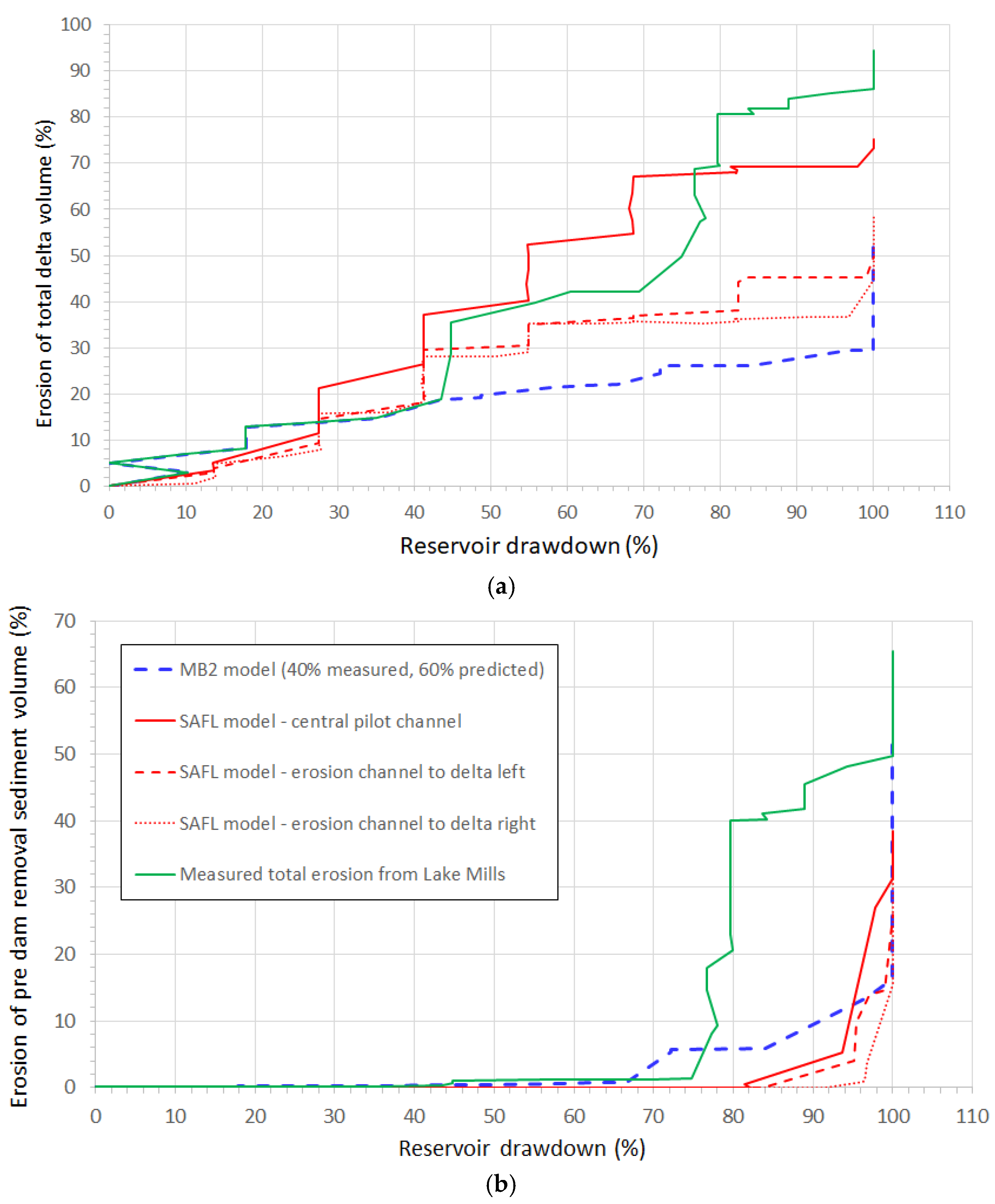
4.1. Comparison of Simulated and Observed Reservoir Sediment Erosion Volumes
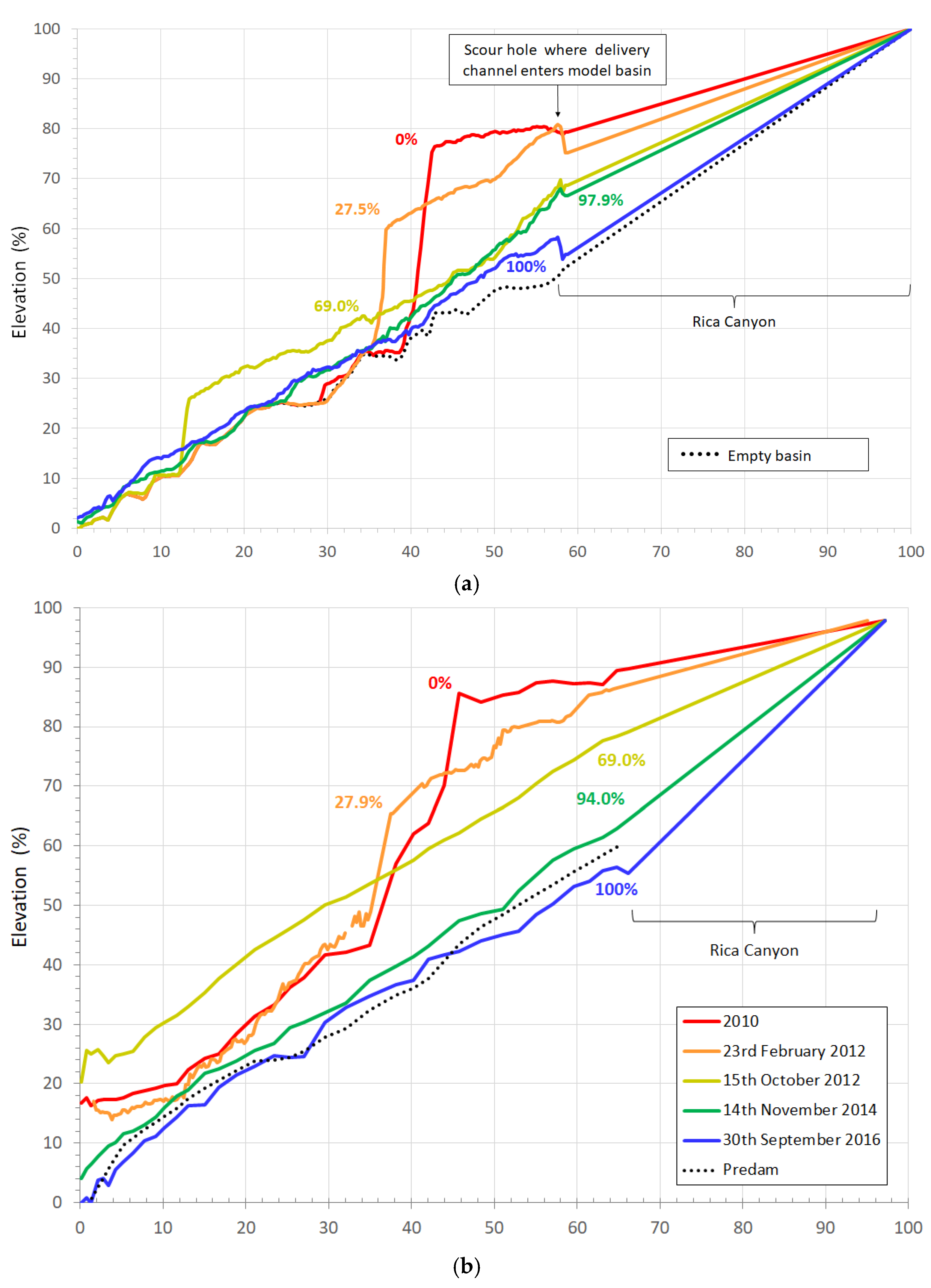
4.2. Comparison of Simulated and Observed Long-Stream Adjustments
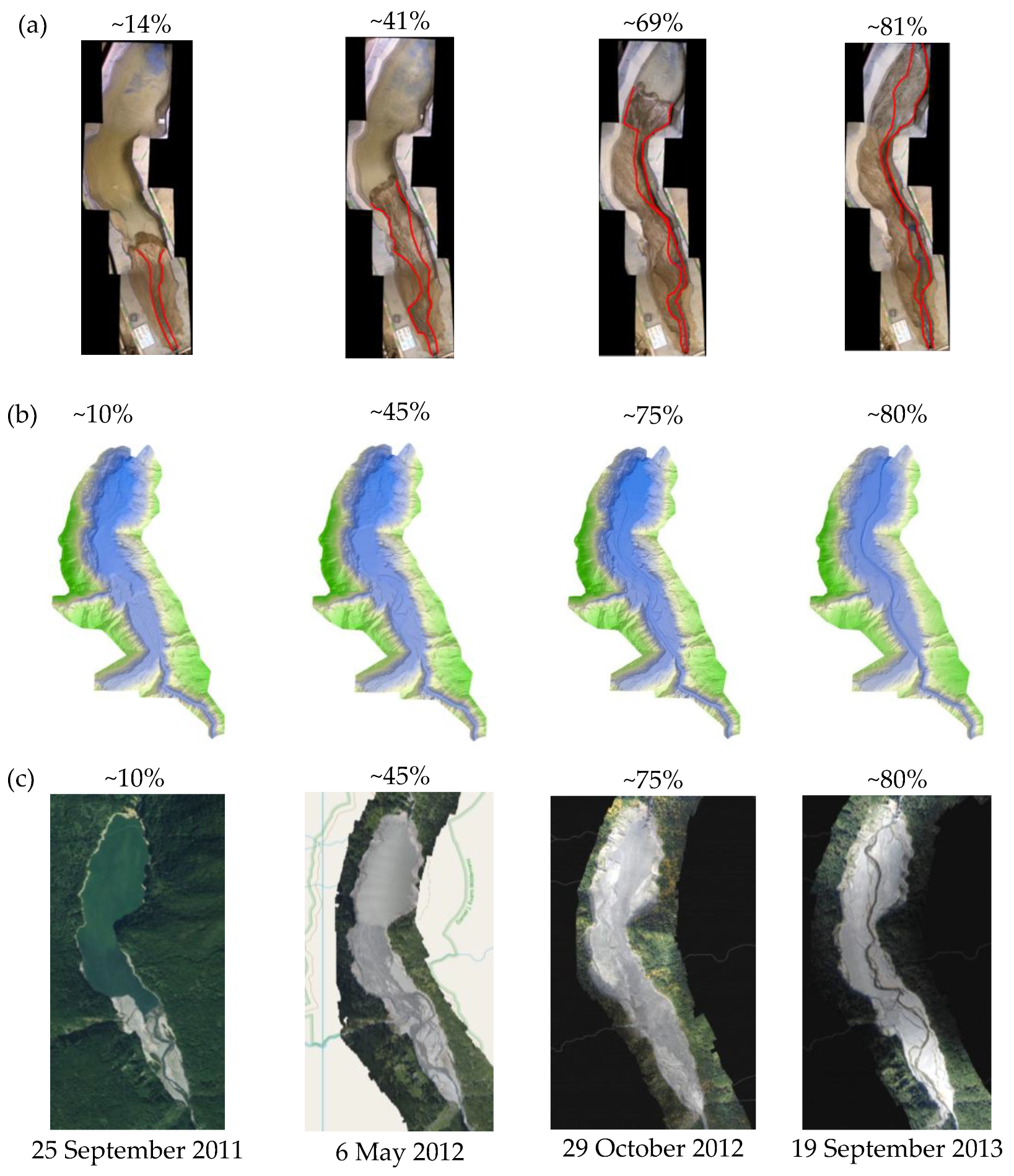
4.3. Comparison of Planform Evolution
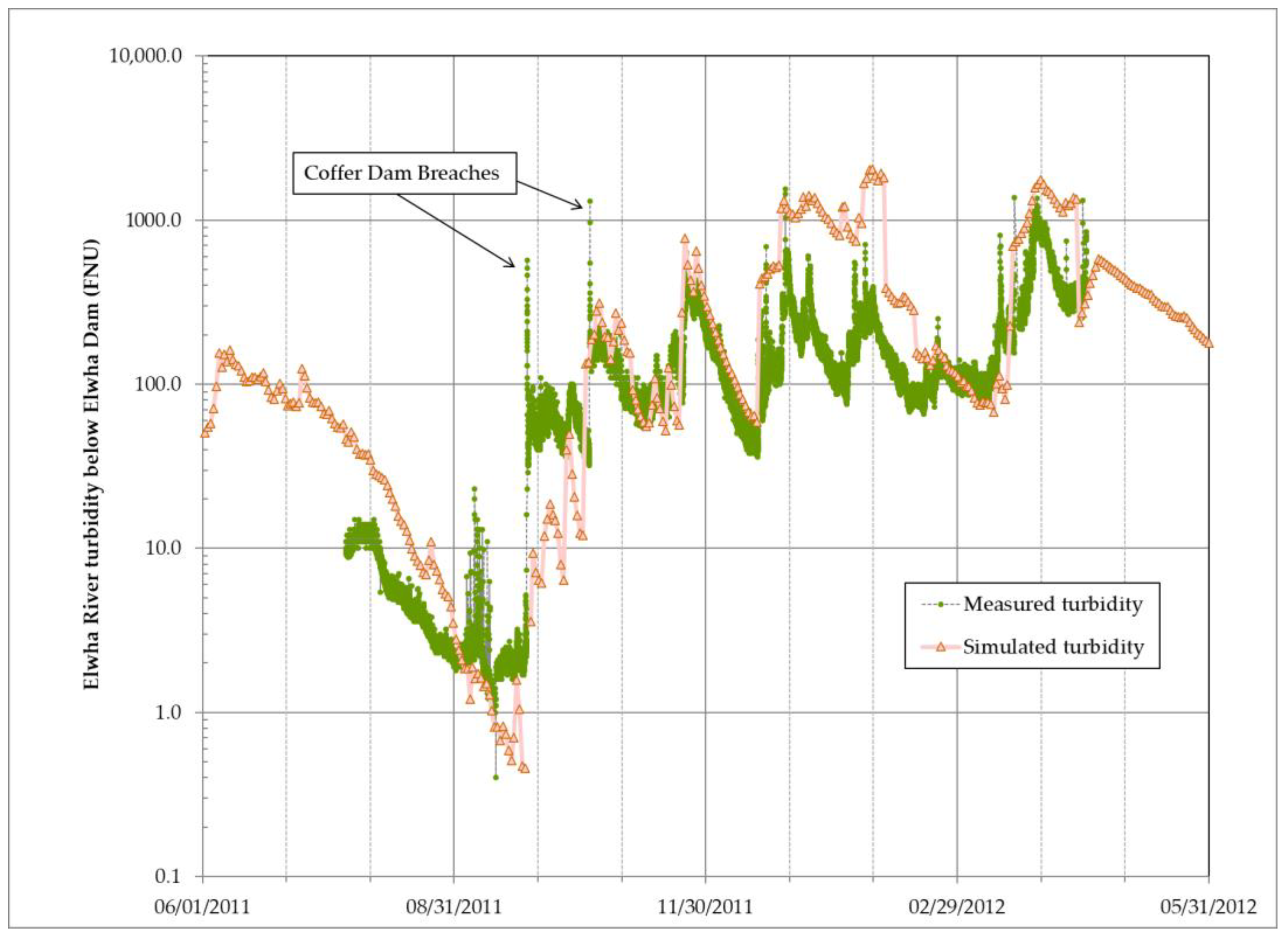
4.4. Fine Sediment Concentrations
4.5. Synthesis Summary of Modeling Tools
5. Discussion
5.1. Simulation of Geomorphic Processes
5.2. Remaining Knowledge Gaps and Future Directions
6. Conclusions
Author Contributions
Funding
Data Availability Statement
Acknowledgments
Conflicts of Interest
Abbreviations
| 1D | One-dimensional |
| 2D | Two-dimensional |
| MB1 | Mass balance model version 1 |
| MB2 | Mass balance model version 2 |
| SAFL | Saint Anthony Falls Laboratory |
| USGS | United States Geological Survey |
| WY | Water year |
References
- Bellmore, J.R.; Duda, J.J.; Craig, L.S.; Greene, S.L.; Torgersen, C.E.; Collins, M.J.; Vittum, K. Status and trends of dam removal research in the United States. WIREs Water 2016, 4, e1164. [Google Scholar] [CrossRef]
- Barbarossa, V.; Schmitt, R.J.P.; Huijbregts, M.A.J.; Zarfl, C.; King, H.; Schipper, A.M. Impacts of current and future large dams on the geographic range connectivity of freshwater fish worldwide. Proc. Natl. Acad. Sci. USA 2020, 117, 3648–3655. [Google Scholar] [CrossRef] [PubMed]
- Birnie-Gauvin, K.; Nielsen, J.; Frandsen, S.B.; Olsen, H.M.; Aarestrup, K. Catchment-scale effects of river fragmentation: A case study on restoring connectivity. J. Environ. Manag. 2020, 264, 110408. [Google Scholar] [CrossRef]
- Duda, J.J.; Torgersen, C.E.; Brenkman, S.J.; Peters, R.J.; Sutton, K.T.; Connor, H.A.; Kennedy, P.; Corbett, S.C.; Welty, E.Z.; Geffre, A.; et al. Reconnecting the Elwha River: Spatial patterns of fish response to dam removal. Front. Ecol. Evol. 2021, 9, 765488. [Google Scholar] [CrossRef]
- Dynesius, M.; Nilsson, C. Fragmentation and Flow Regulation of River Systems in the Northern Third of the World. Science 1994, 266, 753–762. [Google Scholar] [CrossRef]
- Heinz Centre. Dam Removal: Science and Decision Making; The H. John Heinz III Center for Science, Economics and the Environment: Washington, DC, USA, 2002; 221p. [Google Scholar]
- Hess, J.E.; Paradis, R.L.; Moser, M.L.; Weitkamp, L.A.; Delomas, T.A.; Narum, S.R. Robust recolonization of Pacific lamprey following dam removals. Trans. Am. Fish. Soc. 2020, 150, 56–74. [Google Scholar] [CrossRef]
- Magilligan, F.J.; Graber, B.E.; Nislow, K.H.; Chipman, J.W.; Sneddon, C.S.; Fox, C.A. River restoration by dam removal: Enhancing connectivity at watershed scales. Elem. Sci. Anthr. 2016, 4, 000108. [Google Scholar] [CrossRef]
- McAllister, D.E.; Craig, J.F.; Davidson, N.; Delaney, S.; Seddon, M. Biodiversity Impacts of Large Dams; Background Paper Nr. 1 prepared for IUCN/UNEP/WCD; International Union for the Conservation of Nature (IUCN): Gland, Switzerland, 2001; 63p. [Google Scholar]
- Pejchar, L.; Warner, K. A river might run through it again: Criteria for consideration of dam removal, and interim lessons from California. Environ. Manag. 2001, 28, 561–575. [Google Scholar] [CrossRef]
- Pohl, M.M. Bringing down our dams: Trends in American dam removal rationales. J. Am. Water Resour. Assoc. 2002, 38, 1511–1519. [Google Scholar] [CrossRef]
- Reid, A.J.; Carlson, A.K.; Creed, I.F.; Eliason, E.J.; Gell, P.A.; Johnson, P.T.J.; Kidd, K.A.; MacCormack, T.J.; Olden, J.D.; Ormerod, S.J.; et al. Emerging threats and persistent conservation challenges for freshwater biodiversity. Biol. Rev. 2018, 94, 849–873. [Google Scholar] [CrossRef]
- East, A.E.; Pess, G.R.; Bountry, J.A.; Magirl, C.S.; Ritchie, A.C.; Logan, J.B.; Randle, T.J.; Mastin, M.C.; Duda, J.J.; Liermann, M.C.; et al. Large-scale dam removal on the Elwha River, Washington, USA: River channel and floodplain geomorphic change. Geomorphology 2015, 228, 765–786. [Google Scholar] [CrossRef]
- Petts, G.E. Impounded Rivers: Perspectives for Ecological Management; John Wiley & Sons: New York, NY, USA, 1984. [Google Scholar]
- Poff, N.L.; Allan, J.D.; Bain, M.B.; Karr, J.R.; Prestegaard, K.L.; Richter, B.D.; Sparks, R.E.; Stromberg, J.C. The natural flow regime: A paradigm for conservation and restoration of river ecosystems. Bioscience 1997, 47, 769–784. [Google Scholar] [CrossRef]
- Wik, S.J. Reservoir Drawdown—Case-Study in Flow Changes to Potentially Improve Fisheries. J. Energy Eng. 1995, 121, 89–96. [Google Scholar]
- Bergstedt, L.C.; Bergersen, E.P. Health and movements of fish in response to sediment sluicing in the Wind River, Wyoming. Can. J. Fish. Aquat. Sci. 1997, 54, 312–319. [Google Scholar] [CrossRef]
- National Research Council. Upstream: Salmon and Society in the Pacific Northwest, 1st ed.; National Academy Press: Washington DC, USA, 1996; 452p. [Google Scholar]
- Packman, A.I.; MacKay, J.S. Interplay of stream-subsurface exchange, clay particle deposition, and streambed evolution. Water Resour. Res. 2003, 39, 1097. [Google Scholar] [CrossRef]
- Randle, T.J.; Bountry, J. Dam Removal Analysis Guidelines for Sediment. Advisory Committee on Water Information, Subcommittee on Sedimentation. 2017; 211p. Available online: https://www.usbr.gov/tsc/techreferences/mands/mands-pdfs/DamRemovalAnalysisGuidelinesForSediment12-2017_508.pdf (accessed on 1 January 2026).
- Servizi, J.A.; Martens, D.W. Sub-lethal responses of coho salmon (Oncorhynchus kisutch) to suspended sediments. Can. J. Fish. Aquat. Sci. 1992, 49, 1389–1395. [Google Scholar] [CrossRef]
- Bountry, J.; Randle, T.J.; Ritchie, A.C. Adaptive Sediment Management Program Final Report for the Elwha River Restoration Project; Technical Report SRH-2018-13; U.S. Department of the Interior, Bureau of Reclamation, Geological Survey, National Park Service: Denver, CO, USA, 2018. [Google Scholar]
- URS and Stillwater Sciences. Matilija Dam Removal, Sediment Transport, and Robles Diversion Mitigation Project: Draft Initial Options Screening Report; Prepared for Ventura County Watershed Protection District; URS Corporation: Oakland, CA, USA, 2014; 104p. [Google Scholar]
- Federal Energy Regulatory Commission. Final Environmental Impact Statement for Hydropower License Surrender and Decommissioning. Federal Energy Regulatory Commission Office of Energy Projects. 2022. Available online: https://elibrary.ferc.gov/eLibrary/filelist?accession_number=20220826-3006 (accessed on 1 January 2026).
- Bellmore, J.R.; Pess, G.R.; Duda, J.J.; O’Connor, J.E.; East, A.E.; Foley, M.M.; Wilcox, A.C.; Major, J.J.; Shafroth, P.B.; Morley, S.A.; et al. Conceptualizing Ecological Responses to Dam Removal: If You Remove It, What’s to Come? BioScience 2019, 69, 26–39. [Google Scholar] [CrossRef]
- Cheng, F.; Granata, T. Sediment transport and channel adjustments associated with dam removal: Field observations. Water Resour. Res. 2007, 43, W03444. [Google Scholar] [CrossRef]
- Collins, M.J.; Snyder, N.P.; Boardman, G.; Banks, W.S.; Andrews, M.; Baker, M.E.; Conlon, M.; Gellis, A.; McClain, S.; Miller, A.; et al. Channel Response to Sediment Release: Insights from a Paired Analysis of Dam Removal. Earth Surf. Process. Landf. 2017, 42, 1636–1651. [Google Scholar] [CrossRef]
- Cui, Y.; Collins, M.J.; Andrews, M.; Boardman, G.C.; Wooster, J.K.; Melchior, M.; McClain, S. Comparing 1-D sediment transport modeling with field observations: Simkins Dam removal case study. Int. J. River Basin Manag. 2018, 17, 185–197. [Google Scholar] [CrossRef]
- Doyle, M.W.; Stanley, E.H.; Harbor, J.M. Channel adjustments following two dam removals in Wisconsin. Water Resour. Res. 2003, 39, 1011. [Google Scholar] [CrossRef]
- Fields, J.; Renshaw, C.; Magilligan, F.; Dethier, E.; Rossi, R. A mechanistic understanding of channel evolution following dam removal. Geomorphology 2021, 395, 107971. [Google Scholar] [CrossRef]
- Major, J.J.; O’Connor, J.E.; Podolak, C.J.; Keith, K.; Grant, G.E.; Spicer, K.R.; Pittman, S.; Bragg, H.M.; Wallick, J.R.; Tanner, D.Q.; et al. Geomorphic Response of the Sandy River, Oregon to Removal of Marmot Dam; USGS Professional Paper 1792; U.S Geological Survey: Reston, VA, USA, 2012; 64p. [Google Scholar]
- Major, J.J.; East, A.E.; O’Connor, J.E.; Grant GEWilcox, A.C.; Magirl, C.S.; Collins, M.J.; Tullos, D.D. Geomorphic responses to dam removal in the United States—A two-decade perspective. In Gravel-Bed Rivers: Processes and Disasters; Tsutsumi, D., Laronne, J.B., Eds.; John Wiley and Sons: Hoboken, NJ, USA, 2017; pp. 355–383. [Google Scholar]
- O’Connor, J.E.; Duda, J.J.; Grant, G.E. 1000 dams down and counting. Science 2015, 348, 496–497. [Google Scholar] [CrossRef]
- Sawaske, S.R.; Freyberg, D.L. A comparison of past small dam removals in highly sediment-impacted systems in the U.S. Geomorphology 2012, 151–152, 50–58. [Google Scholar] [CrossRef]
- Simons, D.B.; Li, R.M. Sediment Problems Associated with Dam Removal—Muskegon River, Michigan. In Engineering Analysis of Fluvial Systems; Simons, Li & Associates: Newport Beach, CA, USA, 1982. [Google Scholar]
- Stanley, E.H.; Luebke, M.A.; Doyle, M.W.; Marshall, D.W. Short-term changes in channel form and macro invertebrate communities following low head dam removal. J. North Am. Benthol. Soc. 2002, 21, 172–187. [Google Scholar] [CrossRef]
- Tang, L.; Mo, K.; Zhang, J.; Wang, J.; Chen, Q.; He, S.; Zhu, C.; Lin, Y. Removing tributary low-head dams can compensate for fish habitat losses in dammed rivers. J. Hydrol. 2021, 598, 126204. [Google Scholar] [CrossRef]
- American Rivers. American Rivers Dam Removal Database. 2021. Available online: https://figshare.com/articles/dataset/American_Rivers_Dam_Removal_Database/5234068 (accessed on 1 January 2026).
- Dam Removal Europe. Website Case Studies—Dam Removal Europe. 2021. Available online: https://damremoval.eu/case-studies/ (accessed on 1 January 2026).
- Duda, J.J.; Wagner, E.J.; Wieferich, D.J.; Johnson, R.C.; Bellmore, J.R. USGS Dam Removal Science Database v3.0 (ver. 4.0, June 2021): U.S. Geological Survey Data Release, USGS Dam Removal Science Database v4.0—ScienceBase-Catalog; Western Fisheries Research Center: Seattle, WA, USA, 2018. [Google Scholar]
- Buscombe, D.; Warrick, J.A.; Ritchie, A.; East, A.E.; McHenry, M.; McCoy, R.; Foxgrover, A.; Wohl, E. Remote sensing large-wood storage downstream of reservoirs during and after dam removal: Elwha River, Washington, USA. Earth Space Sci. 2024, 11, e2024EA003544. [Google Scholar] [CrossRef]
- Cui, Y.; Wooster, J.K.; Braudrick, C.A.; Bruce, K. Lessons Learned from Sediment Transport Model Predictions and Long-Term Post-removal Monitoring: Marmot Dam Removal Project on the Sandy River in Oregon. J. Hydraul. Eng. 2014, 140, 04014044. [Google Scholar] [CrossRef]
- East, A.E.; Logan, J.B.; Mastin, M.C.; Ritchie, A.C.; Bountry, J.A.; Magirl, C.S.; Sankey, J.B. Geomorphic evolution of a gravel-bed river under sediment-starved versus sediment-rich conditions: River response to the world’s largest dam removal. J. Geophys. Res. Earth Surf. 2018, 123, 3338–3369. [Google Scholar] [CrossRef]
- East, A.E.; Harrison, L.R.; Smith, D.P.; Logan, J.B.; Bond, R.M. Six years of fluvial response to a large dam removal on the Carmel River, California, USA. Earth Surf. Process. Landf. 2023, 48, 1487–1501. [Google Scholar] [CrossRef]
- Ely, L.L.; DeMott, A.D.; Free BJRitchie, A.C. Decadal-scale effects of a dam removal on channel geomorphology, sediment and large wood on the Elwha River, Washington, USA. Geomorphology 2025, 478, 109676. [Google Scholar] [CrossRef]
- Ibisate, A.; Ollero, A.; Ballarin, D.; Horacio, J.; Mora, D.; Mesanza, A.; Ferrer-Boix, C.; Acín, V.; Granado, D.; Martín-Vide, J.P. Geomorphic monitoring and response to two dam removals: Rivers Urumea and Leitzaran (Basque Country, Spain). Earth Surf. Process. Landf. 2016, 41, 2239–2255. [Google Scholar] [CrossRef]
- McCaffery, R.; Duda, J.J.; Soissons, L.; Roussel, J.M. Editorial: Large-scale dam removal and ecosystem restoration. Front. Ecol. Evol. 2024, 12, 1471146. [Google Scholar] [CrossRef]
- Randle, T.J.; Bountry, J.A.; Ritchie, A.C.; Wille, K.B. Large-scale dam removal on the Elwha River, Washington, USA: Erosion of reservoir sediment. J. Geomorphol. 2015, 246, 709–728. [Google Scholar] [CrossRef]
- Ritchie, A.C.; Warrick, J.A.; East, A.E.; Magirl, C.S.; Stevens, A.W.; Bountry, J.A.; Randle, T.J.; Curran, C.A.; Hilldale, R.C.; Duda, J.J.; et al. Morphodynamic evolution following sediment release from the world’s largest dam removal. Sci. Rep. 2018, 8, 13279. [Google Scholar] [CrossRef] [PubMed]
- Peters, R.J.; Anderson, J.H.; Duda, J.J.; McHenry, M.; Pess, G.R.; Brenkman, S.J.; Johnson, J.R.; Liermann, M.C.; Denton, K.P.; Beirne, M.M.; et al. Challenges of implementing a multi-agency monitoring and adaptive management strategy for federally threatened Chinook salmon and steelhead trout during and after dam removal in the Elwha River. Front. Environ. Sci. 2024, 12, 1291265. [Google Scholar] [CrossRef]
- Wang, H.W.; Kuo, W.C. Geomorphic responses to a large check-dam removal on a mountain river in Taiwan. River Res. Appl. 2016, 32, 1094–1105. [Google Scholar]
- Warrick, J.A.; Bountry, J.A.; East, A.E.; Magirl, C.S.; Randle, T.J.; Gelfenbaum, G.; Ritchie, A.C.; Pess, G.R.; Leung, V.; Duda, J.J. Large-scale dam removal on the Elwha River, Washington, USA: Source-to-sink sediment budget and synthesis. Geomorphology 2015, 246, 729–750. [Google Scholar] [CrossRef]
- Wilcox, A.C.; O’Connor, J.E.; Major, J.J. Rapid Reservoir Erosion, Hyper concentrated Flow, and Downstream Deposition Triggered by Breaching of 38-m-Tall Condit Dam, White Salmon River, Washington. J. Geophys. Res. Earth Surf. 2014, 119, 1376–1394. [Google Scholar] [CrossRef]
- Duda, J.J.; Warrick, J.A.; Magirl, C.S. (Eds.) Coastal Habitats of the Elwha River, Washington: Biological and Physical Patterns and Processes Prior to Dam Removal; US Department of the Interior, US Geological Survey: Reston, VA, USA, 2011. [Google Scholar]
- Beechie, T.J.; Liermann, M.; Pollock, M.M.; Baker, S.; Davies, J. Channel pattern and river–floodplain dynamics in forested mountain river systems. Geomorphology 2006, 78, 124–141. [Google Scholar] [CrossRef]
- Warrick, J.A.; Draut, A.E.; McHenry, M.L.; Miller, I.M.; Magirl, C.S.; Beirne, M.M.; Stevens, A.W.; Logan, J.B. Geomorphology of the Elwha River and its delta. In Coastal Habitats of the Elwha River, Washington—Biological and Physical Patterns and Processes Prior to Dam Removal; Duda, J.J., Warrick, J.A., Magirl, C.S., Eds.; U.S. Geological Survey Scientific Investigations Report 2011 5120; US Geological Survey: Reston, VA, USA, 2011; pp. 47–74. [Google Scholar]
- U.S. Department of the Interior (DOI). Draft Environmental Impact Statement for Elwha River Ecosystem Restoration; National Park Service: Olympic National Park, WA, USA, 1994. [Google Scholar]
- U.S. Department of the Interior (DOI). Final Environmental Impact Statement for Elwha River Ecosystem Restoration; National Park Service: Olympic National Park, WA, USA, 1995. [Google Scholar]
- Grant, G.E.; O’Connor, J.E.; Wolman, M.G. A River Runs Through It: Conceptual Models in Fluvial Geomorphology. In Treatise on Geomorphology; Shroder, J.F., Ed.; Academic Press: San Diego, CA, USA, 2013; Volume 9, pp. 6–21. [Google Scholar]
- U.S. Department of the Interior (DOI). Elwha River Ecosystem Restoration Implementation, Draft Environmental Impact; National Park Service: Olympic National Park, WA, 1996. [Google Scholar]
- U.S. Department of the Interior (DOI). Elwha River Ecosystem Restoration Implementation, Final Environmental Impact; National Park Service: Olympic National Park, WA, 1996. [Google Scholar]
- Konrad, C.P. Simulating the recovery of suspended sediment transport and river-bed stability in response to dam removal on the Elwha River, Washington. Ecol. Eng. 2009, 35, 1104–1115. [Google Scholar] [CrossRef]
- Childers, D.; Kresch, D.L.; Gustafson, D.L.; Randle, T.J.; Melena, J.T.; Cluer, B. Hydrological Data Collected During the 1994 Lake Mills Drawdown Experiment, Elwha River, Washington; Water Resources Investigations Report, 99-4215; U.S. Geological Survey: Tacoma, WA, USA, 2000; 115p. [Google Scholar]
- Morris, G.L.; Fan, J. Reservoir Sedimentation Handbook: Design and Management of Dams, Reservoirs, and Watersheds for Sustainable Use; McGraw-Hill: New York, NY, USA, 1998; Available online: https://reservoirsedimentation.com/ (accessed on 1 January 2026).
- Randle, T.J.; Young, C.A.; Melena, J.T.; Ouellette, E.M. Sediment Analysis and Modeling of the River Erosion Alternative, Elwha River Ecosystem and Fisheries Restoration Project, Washington; Elwha Technical Series PN-95-9; U.S. Department of the Interior, Bureau of Reclamation: Boise, ID, USA, 1996; 145p. [Google Scholar]
- Wolman, M.G.; Leopold, L.B. River Floodplains: Some Observations on Their Formation; Professional Paper, 282-C; U.S. Geological Survey: Reston, VA, USA, 1957; pp. 87–109. [Google Scholar]
- Warrick, J.A.; Ritchie, A.; East, A.E.; Magirl, C.S.; Bountry, J.A.; Randle, T.J. Fluvial and coastal morphodynamic evolution following a massive sediment release from the world’s largest dam removal. In Proceedings of the GSA 2017 Annual Meeting, Seattle, WA, USA, 25 October 2017. [Google Scholar]
- Hosey and Associates. Distribution and Composition of Sediments Stored in Lake Aldwell and Lake Mills and Sediment Transport Characteristics (Unpublished Report); Elwha Project (FERC No. 2683) and Glines Project (FERC No. 588); James River II, Inc.: Port Angeles, WA, USA, 1990. [Google Scholar]
- Gilbert, J.; Link, R. Alluvium Distribution in Lake Mills, Glines Canyon Project and Lake Aldwell, Elwha Project, Washington; Elwha Technical Series PN-95-4; U.S. Bureau of Reclamation, Pacific Northwest Region: Boise, ID, USA, 1995; 72p. [Google Scholar]
- Bromley, C. The Morphodynamics of Sediment Movement Through a Reservoir During Dam Removal. Ph.D. Thesis, University of Nottingham, Nottingham, UK, 2007; p. 316. [Google Scholar]
- Randle, T.J.; Bountry, J.A.; Wille, K.B. Mass Balance Model for Reservoir Sediment Erosion; US Department of the Interior, Bureau of Reclamation: Washington, DC, USA, 2021; 58p. [Google Scholar]
- Leung, V.; Mohrig, D.C.; Buttles, J.L.; Johnson, J.P.; Montgomery, D.R. Flume experiments on the effects of buried wood debris on delta processes and sediment exhumation during a phased base-level drop. In Large Woody Debris and River Morphology in Scour Pool Formation, Dam Removal, and Delta Formation; Ph.D. Thesis; Leung, V., Ed.; University of Washington: Seattle, WA, USA, 2019; pp. 88–119. Available online: https://digital.lib.washington.edu/server/api/core/bitstreams/efd82784-1449-4b78-8be1-79a48e220b64/content (accessed on 1 January 2026).
- Bountry, J.A.; Ferrari, R.; Wille, K.; Randle, T.J. 2010 Survey Report for Lake Mills and Lake Aldwell on the Elwha River, Washington; SRH-2010-23; U.S. Department of the Interior, Bureau of Reclamation: Denver, CO, USA, 2011. [Google Scholar]
- Ritchie, A.C.; Winter, B.D.; Warrick, J.A. Elwha PlaneCam—Aerial Imagery and Derivatives from Periodic and Event-Response Surveys of the Elwha River, Olympic Mountains, and Washington Coast, in Remote Sensing Coastal Change Simple Data Distribution Service: U.S. Geological Survey Data Service. 2025. Available online: https://cmgds.marine.usgs.gov/data-services/rscc/Elwha_PlaneCam/ (accessed on 26 November 2025).
- Lai, Y.G. Modeling of Delta Erosion During Elwha Dam Removal with SRH-2D; Technical Report No. SRH-2014-31; U.S. Bureau of Reclamation: Washington, DC, USA, 2014; 49p. [Google Scholar]
- Lai, Y.G. Bank erosion modeling with SRH-2D on the Rio Grande, New Mexico. In Proceedings of the SEDHYD-2015, 3rd Joint Federal Interagency Conference, Reno, NV, USA, 19–23 April 2015. [Google Scholar]
- U.S. Department of the Interior (DOI). Elwha River Ecosystem Restoration Implementation, Draft Supplement to the Final Environmental Impact Statement; National Park Service: Olympic National Park, WA, USA, 2004. [Google Scholar]
- U.S. Department of the Interior (DOI). Elwha River Ecosystem Restoration Implementation, Final Supplement to the Final Environmental Impact Statement; National Park Service: Olympic National Park, WA, USA, 2005. [Google Scholar]
- U.S. Department of the Interior (DOI). Record of Decision, Elwha River Ecosystem Restoration Implementation, Final Supplement to the Final Environmental Impact Statement; National Park Service: Olympic National Park, WA, USA, 2005. [Google Scholar]
- Magirl, C.S.; Hilldale, R.C.; Curran, C.A.; Duda, J.J.; Straub, T.D.; Domanski, M.; Foreman, J.R. Large-scale dam removal on the Elwha River, Washington, USA: Fluxes of river sediment. Geomorphology 2015, 246, 669–686. [Google Scholar] [CrossRef]
- Randle, T.J.; Bountry, J.A.; Smillie, G. Technical Basis for Elwha Restoration Adaptive Sediment Management and Monitoring Plan; Report Number: SRH-2012-10; Bureau of Reclamation and National Park Service, U.S. Department of the Interior: Washington, DC, USA, 2012. [Google Scholar]
- Randle, T.J.; Bountry, J.A.; Smillie, G. Elwha River Restoration: Sediment Adaptive Management Summary; Report Number: SRH-2012-09; Bureau of Reclamation and National Park Service, U.S. Department of the Interior: Washington, DC, USA, 2012. [Google Scholar]
- Sellars, W. Philosophy and the Scientific Image of Man. In Frontiers of Science and Philosophy; Colodny, R., Ed.; University of Pittsburgh Press: Pittsburgh, PA, USA, 1962; pp. 35–78. [Google Scholar]
- Bundgaard, R.C. A procedure of short-range weather forecasting. In Compendium of Meteorology; Byers, H.R., Landsberg, H.E., Wexler, H., Haurwitz, B., Spilhaus, A.F., Willett, H.C., Houghton, H.G., Malone, T.F., Eds.; American Meteorological Society: Boston, MA, USA, 1951; pp. 766–795. [Google Scholar]
- Ferdowsi, B.; Gartner, J.D.; Johnson, K.N.; Kasprak, A.; Miller, K.L.; Nardin, W.; Ortiz, A.C.; Tejedor, A. Earthcasting: Geomorphic forecasts for society. Earth’s Future 2021, 9, e2021EF002088. [Google Scholar] [CrossRef]
- Cui, Y.; Wilcox, A. Chapter 23: Development and application of numerical models of sediment transport associated with dam removal. In Sedimentation Engineering: Theory, Measurements, Modeling, and Practice; Garcia, M.H., Ed.; ASCE manual 110; ASCE: Reston, VA, USA, 2008; pp. 995–1020. [Google Scholar] [CrossRef]
- Thorne, C.R.; Osman, A.M. The influence of bank stability on regime geometry of natural channels. In River Regime; John Wiley & Sons, Ltd.: Chichester, UK, 1988; pp. 135–147. [Google Scholar]
- Thorne, C.R.; Bathurst, J.C.; Hey, R.D. (Eds.) Sediment Transport in Gravel-Bed Rivers; J. Wiley & Sons: Chichester, UK, 1987; 995p. [Google Scholar]
- Laslier, M.; Hubert-Moy, L.; Dufour, S. Mapping Riparian Vegetation Functions Using 3D Bispectral LiDAR Data. Water 2019, 11, 483. [Google Scholar] [CrossRef]




| Model or Tool | Location | Time Period Applicable |
|---|---|---|
| Conceptual model | Lake Mills to Elwha River mouth | Prior to dam removal, during dam removal, and post dam removal floods. |
| Reservoir drawdown experiment | Lake Mills | Prior to dam removal (April 1994). |
| Mass balance modeling 1 | Lake Mills and Lake Aldwell | Simulated dam removal (~1.5 years) and post dam removal floods (~1.83 years). * |
| Physical modeling | Lake Mills | Simulated dam removal (~1.5 years) and post dam removal floods. * |
| Mass balance modeling 2 | Lake Mills and Lake Aldwell | Measured reservoir drawdown and dam removal (1.5 years from October 2010 to April 2012). Simulated dam removal (1.75 years from April 2012 to January 2014) and post dam removal floods (2.83 years from January 2014 through November 2016). |
| 1D numerical modeling | Rica Canyon (above Lake Mills) to Elwha River mouth | Simulated historical Lake Mills sedimentation (1927 to 1994). Simulated pre dam removal (2 years), dam removal (2 years), and post dam removal (4 years). * |
| 2D numerical modeling | Lake Mills | Simulated erosion measured in physical model. |
| Synoptic forecasting | Lake Mills | Simulated terrace erosion during water years 2015 and 2016. |
| Model or Tool | Lake Mills Sediment Erosion | Sediment Transport to the Sea | Sediment Concentration Patterns and Peaks | Aggradation and Flood Stage | ||
|---|---|---|---|---|---|---|
| Channel Incision | Channel Widening | Erosion Volume | ||||
| Conceptual model | QC | QC | QC | QC | QC | QC |
| Reservoir drawdown experiment | A1DP | A1DP | n/a | n/a | A1DP | n/a |
| Mass balance modeling 1 | QC | QC | AF2 | n/a | AF10 | n/a |
| Physical modeling | AF2 | AF2 | QC | n/a | n/a | n/a |
| Mass balance modeling 2 | QC | QC | AF2 | n/a | AF10 | n/a |
| 1D numerical modeling | QC | QI | AF2 | AF2 | AF10 | AF10 |
| 2D numerical modeling | QC | QC | QC | n/a | n/a | n/a |
| Synoptic forecasting | n/a | QC | AF2 | n/a | n/a | n/a |
| Model or Tool | Strengths | Limitations | Appropriate Uses |
|---|---|---|---|
| Conceptual model | Describes the important physical processes and cause and effect relationships. Qualitative predictions guide subsequent numerical model choices and interpretation of results. Not limited by numerical model capabilities or physical model scale issues. | Quantitative predictions are not provided. | Applicable to reservoir sediment erosion and redeposition, downstream transport and deposition, and environmental impacts. |
| Reservoir drawdown experiment | Observations and measurements of reservoir sediment erosion and redeposition can be made during the first stage of simulated dam removal. | Only provides data for the first stage of reservoir drawdown. May not be allowed if downstream sediment release were to cause significant impacts. | For cases where the sediment erosion responses to reservoir drawdown are highly uncertain. |
| Mass balance modeling 1 | Fast simulations of reservoir sediment erosion, redeposition, and downstream release | Inability of cross-sections to define complex reservoir geometry. Channel erosion slopes and lateral coefficients must be estimated and calibrated. | For wide reservoirs trapping decades or more worth of upstream sediment supply. |
| Physical modeling | Simulated all the important physical processes related to coarse sediment that occurred within the real reservoir. | Scale effects prohibited the simulation of fine sediment and cohesion and made armor forming grains too coarse. | For wide reservoirs trapping decades worth of upstream sediment supply. |
| Mass balance modeling 2 | Relatively fast simulations of reservoir sediment erosion, redeposition and downstream release | Sensitive to the estimation of channel erosion slopes and lateral coefficients. | Wide reservoirs trapping decades or more worth of upstream sediment loads. |
| 1D numerical modeling | Simulation of sediment erosion from relatively narrow reservoirs and downstream sediment transport and deposition. | Cross-section-based model cannot simulate lateral sediment erosion or deposition processes within the reservoir or downstream channel. | Relatively narrow reservoirs trapping several years’ worth of upstream sediment loads. |
| 2D numerical modeling | Accurate hydraulic simulations for a given discharge, channel geometry, and roughness. | Lateral sediment erosion can only be accurately simulated over a distance less than one channel width. | Simulations of hydraulics with non-erodible boundaries, vertical sediment elevation changes, and modest lateral erosion. |
| Synoptic forecasting | Provides estimates of future localized sediment erosion during discrete events. | Requires the measurement of previous sediment erosion during discrete events, 2D hydraulic fixed-bed modeling, and knowledge of processes. | Lateral erosion of reservoir sediment terraces. |
Disclaimer/Publisher’s Note: The statements, opinions and data contained in all publications are solely those of the individual author(s) and contributor(s) and not of MDPI and/or the editor(s). MDPI and/or the editor(s) disclaim responsibility for any injury to people or property resulting from any ideas, methods, instructions or products referred to in the content. |
© 2026 by the authors. Licensee MDPI, Basel, Switzerland. This article is an open access article distributed under the terms and conditions of the Creative Commons Attribution (CC BY) license.
Share and Cite
Bromley, C.; Randle, T.J.; Bountry, J.A.; Thorne, C.R. Review of Sediment Modeling Tools Used During Removal of the Elwha River Dams. Water 2026, 18, 199. https://doi.org/10.3390/w18020199
Bromley C, Randle TJ, Bountry JA, Thorne CR. Review of Sediment Modeling Tools Used During Removal of the Elwha River Dams. Water. 2026; 18(2):199. https://doi.org/10.3390/w18020199
Chicago/Turabian StyleBromley, Chris, Timothy J. Randle, Jennifer A. Bountry, and Colin R. Thorne. 2026. "Review of Sediment Modeling Tools Used During Removal of the Elwha River Dams" Water 18, no. 2: 199. https://doi.org/10.3390/w18020199
APA StyleBromley, C., Randle, T. J., Bountry, J. A., & Thorne, C. R. (2026). Review of Sediment Modeling Tools Used During Removal of the Elwha River Dams. Water, 18(2), 199. https://doi.org/10.3390/w18020199