Analyzing the Impact of High-Frequency Noise on Hydrological Runoff Modeling: A Frequency-Based Framework for Data Uncertainty Assessment


Abstract
1. Introduction
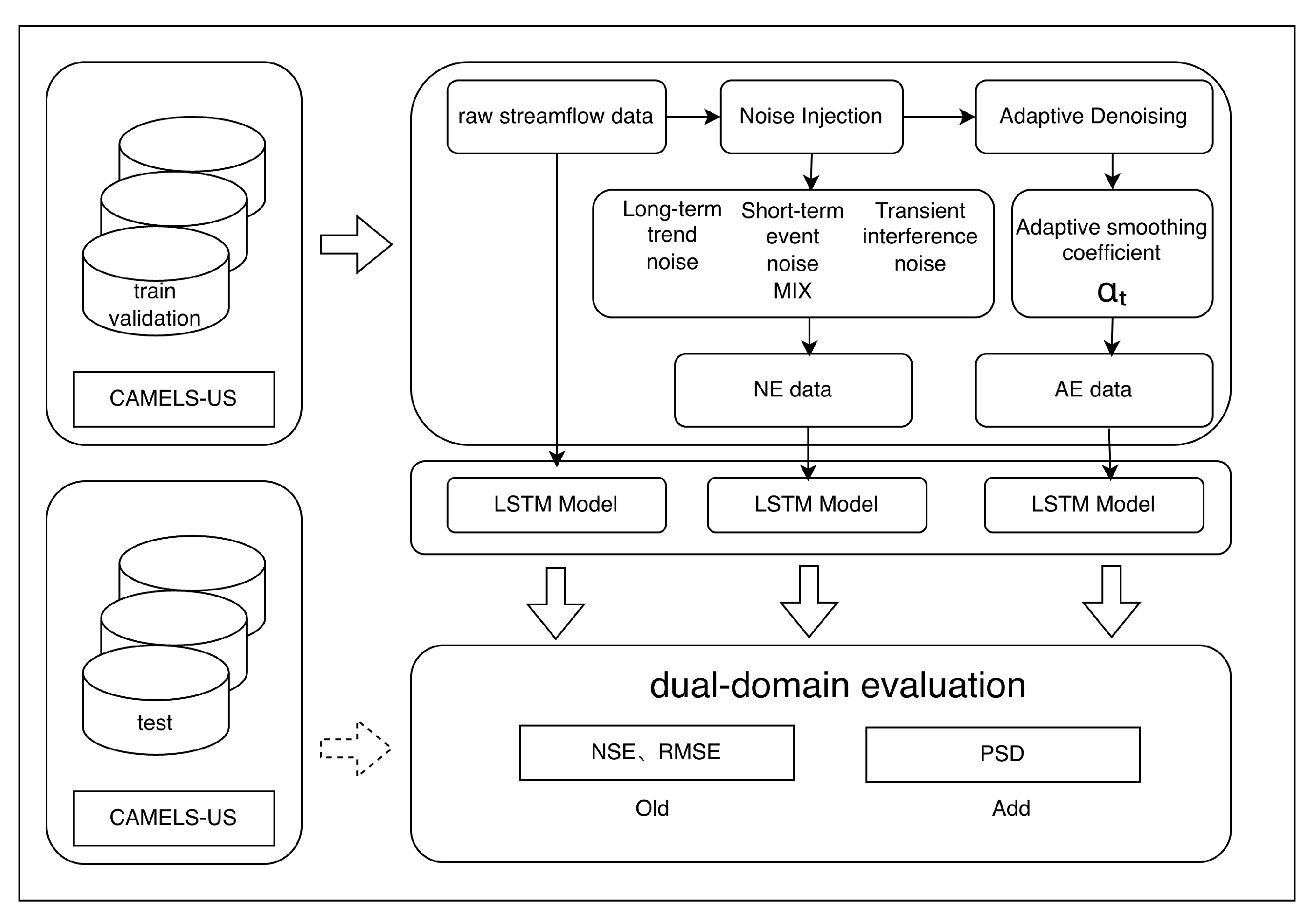
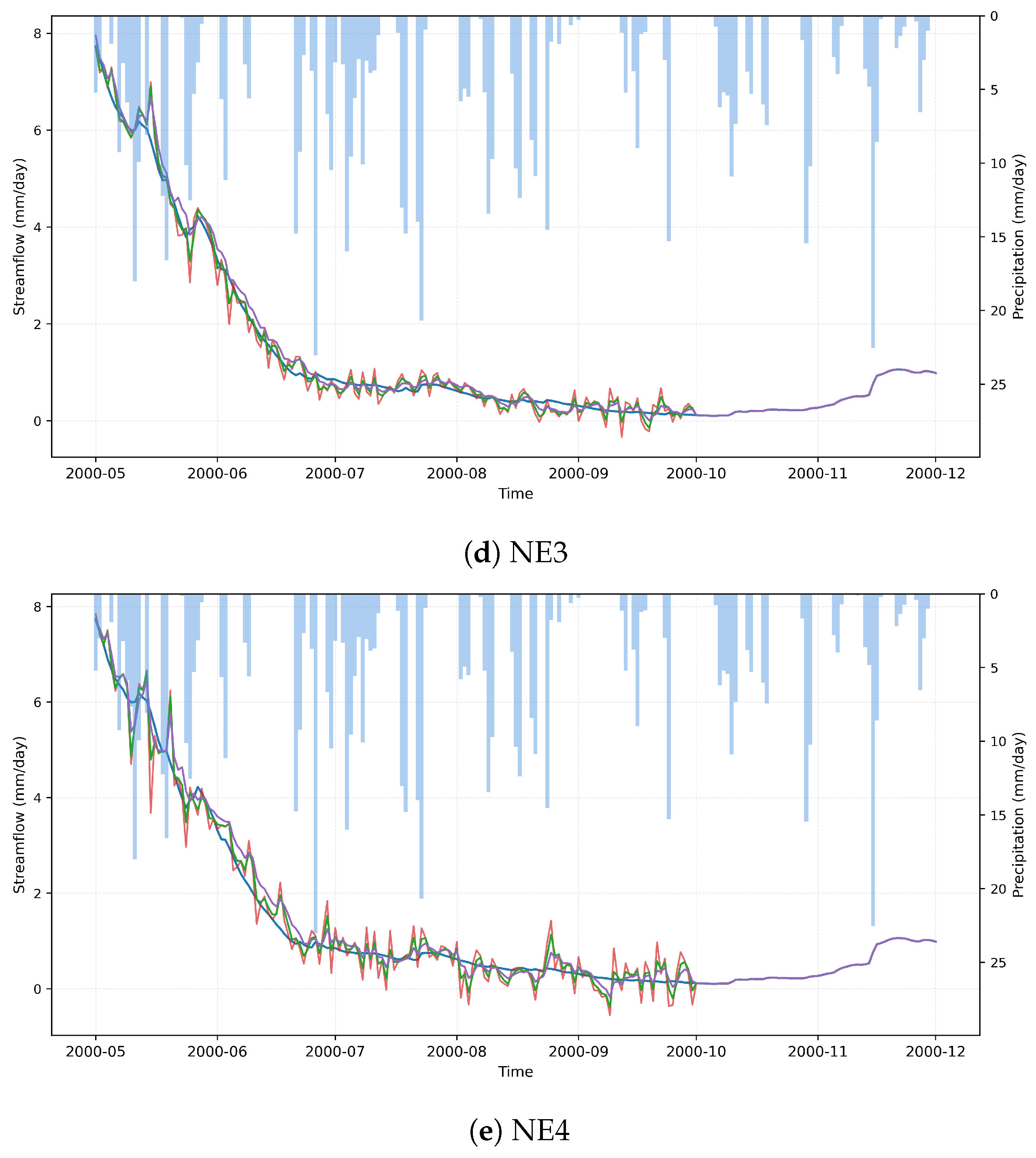
- We propose a three-category noise typology specific to hydrological characteristics and a frequency domain evaluation framework, filling the gap of lacking a systematic, physically relevant noise assessment system in existing research.
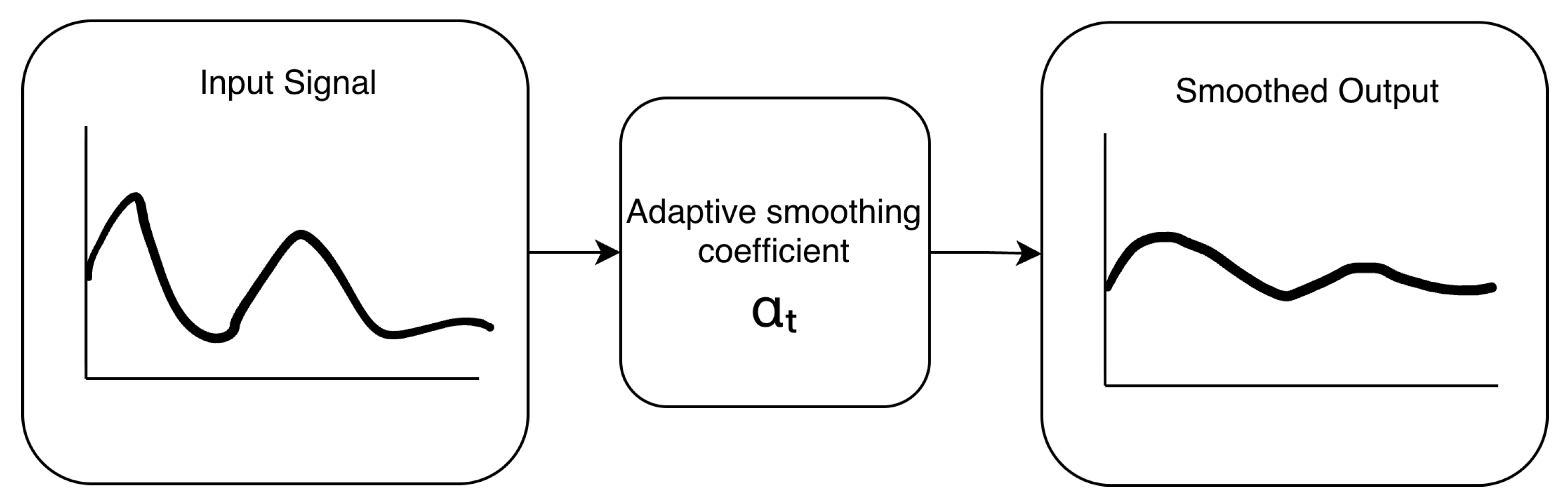
- We develop the AEWMA adaptive denoising algorithm, which achieves an effective balance between noise suppression and hydrological signal preservation through an IQR-based dynamic adjustment mechanism.
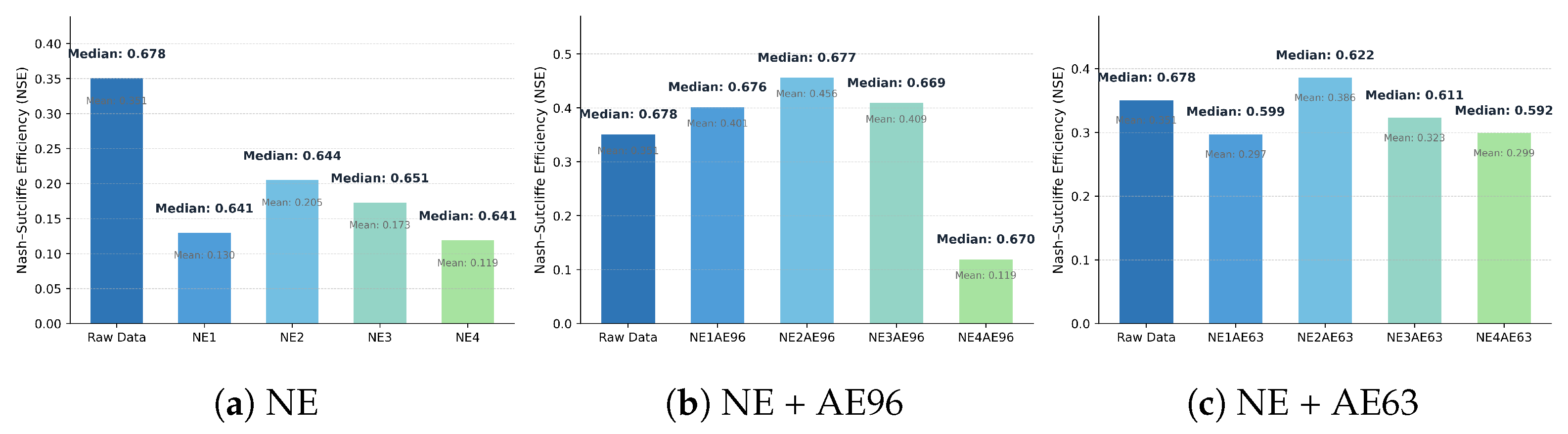
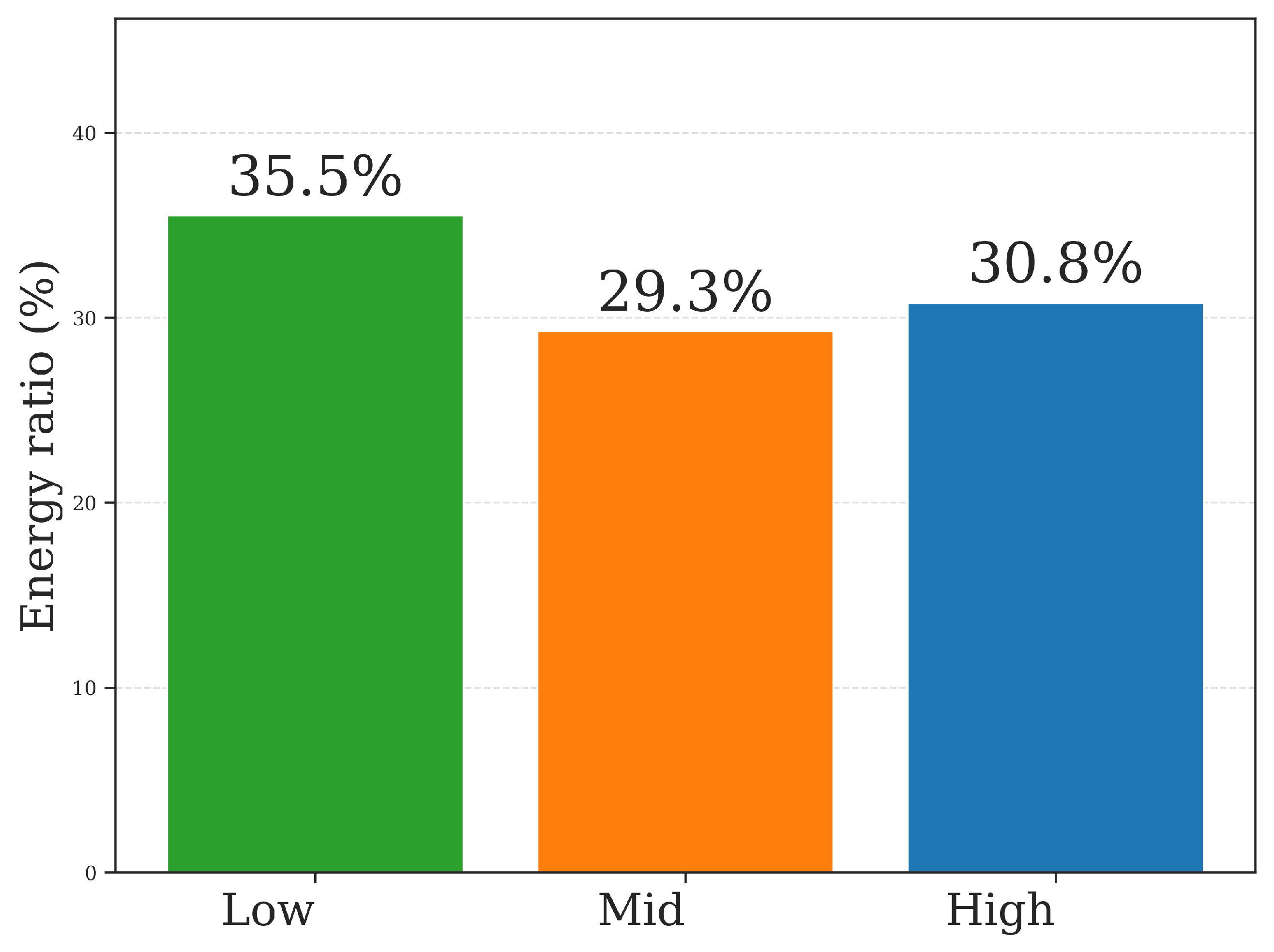
- Through dual-domain (time and frequency) analysis, we quantify the vulnerability of LSTM models to different noise types and for the first time propose quantitative thresholds based on spectral energy ratios, providing guidance for data quality control in operational hydrological forecasting systems.
2. Materials and Methods
2.1. Dataset and Variable Selection
2.2. Noise Typology Based on Temporal and Physical Characteristics
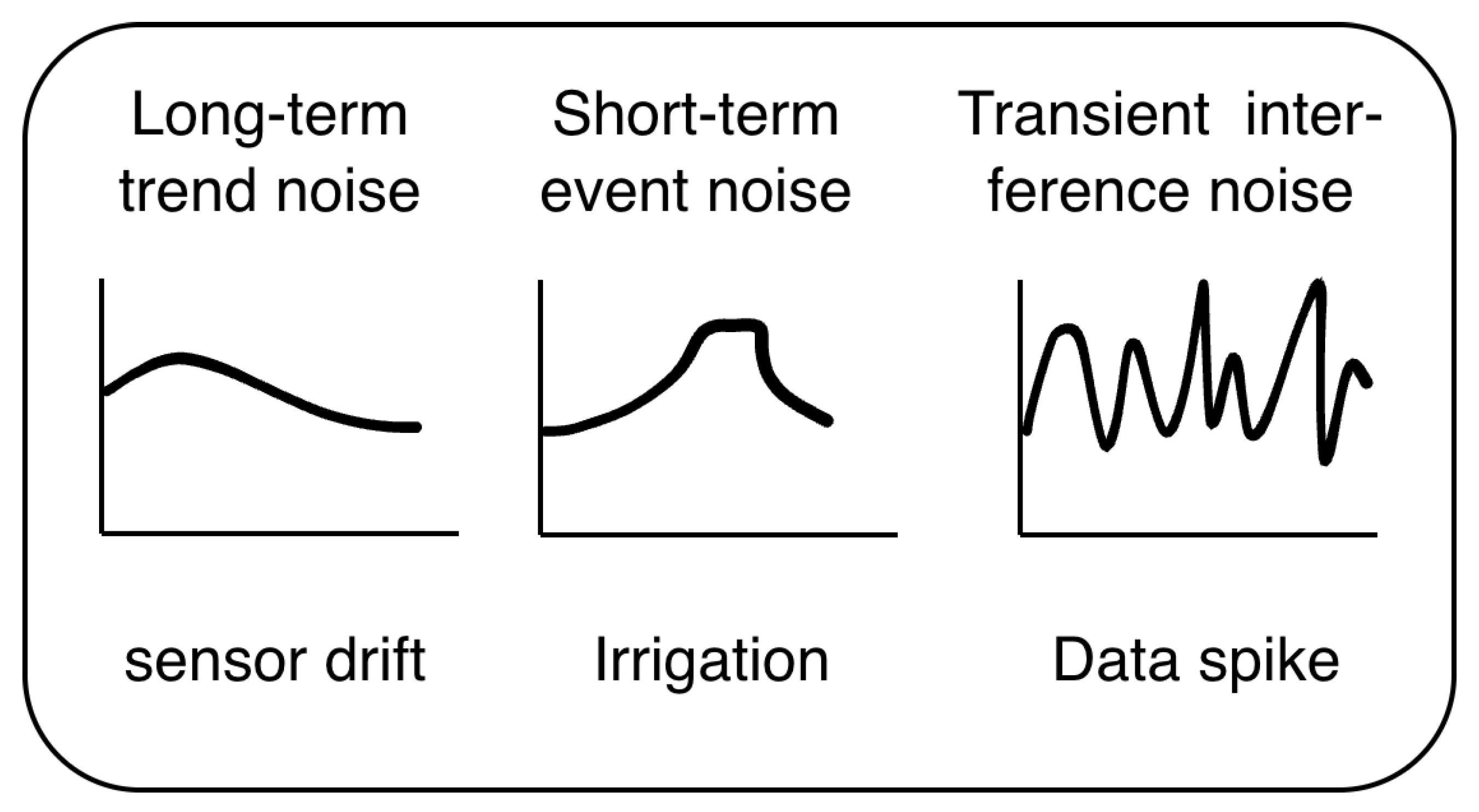
- Long-term trend noise: This type of noise spans time scales of several weeks or longer and is typically induced by gradual sensor drift or variations in ambient temperature and humidity [8,9,41]. It slowly distorts the baseline trend of runoff records and interferes with the model’s ability to capture long-term hydrological dynamics, potentially leading to systematic overestimation or underestimation of runoff trends [20,42]. Removing this noise enables the model to more accurately track long-term runoff trends, reduce systematic bias, and improve long-range predictive accuracy.
- Short-term event noise: This noise spans hours to several days and typically arises from transient anthropogenic disturbances such as reservoir operations, agricultural irrigation, or other land-use interventions [10,43]. Electromagnetic interference also poses a known challenge in environmental monitoring systems. These disturbances significantly affect runoff by altering land surface properties, modifying evapotranspiration patterns, or directly withdrawing water. During critical hydrological events—such as flood formation or peak flow periods, this noise can introduce spurious fluctuations and reduce the model’s sensitivity to sudden changes, potentially delaying flood peak predictions. Eliminating this type of noise can enhance the model’s accuracy in predicting short-term hydrological processes, including rainfall-runoff responses and flood peak timing.
- Transient interference noise: Occurring over time scales of seconds to minutes, this noise typically results from abrupt sensor failures such as data transmission losses or electromagnetic pulses [44,45,46]. Frequent occurrences of this noise can lead to model overfitting, as the model may memorize local noise artifacts instead of learning global hydrological patterns, thereby compromising generalization performance. Removing such transient noise improves model robustness by reducing overfitting to local anomalies and promoting the learning of broader hydrological principles.
2.3. Synthetic Noise Injection Strategy
2.4. Adaptive Denoising Design: From EWMA to AEWMA
2.5. LSTM Model Configuration and Experimental Control
2.6. Evaluation Metrics
3. Results and Discussion
3.1. Noise Injection and Denoising Results
3.2. LSTM Results Under Noise and Denoising
3.3. Distributional Characteristics of Prediction Errors Under Noise and Denoising
3.4. Frequency-Domain Results via PSD Analysis
3.5. Discussion
4. Conclusions
Author Contributions
Funding
Data Availability Statement
Acknowledgments
Conflicts of Interest
Appendix A

References
- Kratzert, F.; Klotz, D.; Brenner, C.; Schulz, K.; Herrnegger, M. Rainfall–runoff modelling using long short-term memory (LSTM) networks. Hydrol. Earth Syst. Sci. 2018, 22, 6005–6022. [Google Scholar] [CrossRef]
- Guo, J.; Liu, Y.; Zou, Q.; Ye, L.; Zhu, S.; Zhang, H. Study on optimization and combination strategy of multiple daily runoff prediction models coupled with physical mechanism and LSTM. J. Hydrol. 2023, 624, 129969. [Google Scholar] [CrossRef]
- Chen, S.; Feng, Y.; Li, H.; Ma, D.; Mao, Q.; Zhao, Y.; Liu, J. Enhancing runoff predictions in data-sparse regions through hybrid deep learning and hydrologic modeling. Sci. Rep. 2024, 14, 26450. [Google Scholar] [CrossRef]
- Li, H.; Zhang, C.; Chu, W.; Shen, D.; Li, R. A process-driven deep learning hydrological model for daily rainfall-runoff simulation. J. Hydrol. 2024, 637, 131434. [Google Scholar] [CrossRef]
- Akinsoji, A.H.; Adelodun, B.; Adeyi, Q.; Salau, R.A.; Odey, G.; Choi, K.S. Integrating machine learning models with comprehensive data strategies and optimization techniques to enhance flood prediction accuracy: A review. Water Resour. Manag. 2024, 38, 4735–4761. [Google Scholar] [CrossRef]
- Renard, B.; Kavetski, D.; Kuczera, G.; Thyer, M.; Franks, S.W. Understanding predictive uncertainty in hydrologic modeling: The challenge of identifying input and structural errors. Water Resour. Res. 2010, 46, 1–22. [Google Scholar] [CrossRef]
- Shin, Y.; Na, K.Y.; Kim, S.E.; Kyung, E.J.; Choi, H.G.; Jeong, J. LSTM-Autoencoder Based Detection of Time-Series Noise Signals for Water Supply and Sewer Pipe Leakages. Water 2024, 16, 2631. [Google Scholar] [CrossRef]
- Goebel, K.; Yan, W. Correcting sensor drift and intermittency faults with data fusion and automated learning. IEEE Syst. J. 2008, 2, 189–197. [Google Scholar] [CrossRef]
- Helm, I.; Jalukse, L.; Leito, I. Measurement uncertainty estimation in amperometric sensors: A tutorial review. Sensors 2010, 10, 4430–4455. [Google Scholar] [CrossRef]
- Neupane, R.P.; Kumar, S. Estimating the effects of potential climate and land use changes on hydrologic processes of a large agriculture dominated watershed. J. Hydrol. 2015, 529, 418–429. [Google Scholar] [CrossRef]
- Alías, F.; Alsina-Pagès, R.M. Review of wireless acoustic sensor networks for environmental noise monitoring in smart cities. J. Sensors 2019, 2019, 7634860. [Google Scholar] [CrossRef]
- Jiang, Y.; Xu, Z.; Xiong, L. Runoff variation and response to precipitation on multi-spatial and temporal scales in the southern Tibetan Plateau. J. Hydrol. Reg. Stud. 2022, 42, 101157. [Google Scholar] [CrossRef]
- Moges, E.; Demissie, Y.; Larsen, L.; Yassin, F. Review: Sources of hydrological model uncertainties and advances in their analysis. Water 2021, 13, 28. [Google Scholar] [CrossRef]
- McMillan, H.K.; Westerberg, I.K.; Krueger, T. Hydrological data uncertainty and its implications. Wiley Interdiscip. Rev. Water 2018, 5, e1319. [Google Scholar] [CrossRef]
- Hansun, S. A new approach of moving average method in time series analysis. In Proceedings of the 2013 Conference on New Media Studies (CoNMedia), Tangerang, Indonesia, 27–28 November 2013; IEEE: New York, NY, USA, 2013; pp. 1–4. [Google Scholar]
- Pang, J.; Luo, W.; Yao, Z.; Chen, J.; Dong, C.; Lin, K. Water quality prediction in urban waterways based on wavelet packet Denoising and LSTM. Water Resour. Manag. 2024, 38, 2399–2420. [Google Scholar] [CrossRef]
- Shao, P.; Feng, J.; Lu, J.; Tang, Z. Data-driven and knowledge-guided denoising diffusion probabilistic model for runoff uncertainty prediction. J. Hydrol. 2024, 638, 131556. [Google Scholar] [CrossRef]
- Bai, L.; Chen, Z.; Xu, J.; Li, W. Multi-scale response of runoff to climate fluctuation in the headwater region of Kaidu River in Xinjiang of China. Theor. Appl. Climatol. 2016, 125, 703–712. [Google Scholar] [CrossRef]
- Xu, D.M.; Liao, A.D.; Wang, W.; Tian, W.C.; Zang, H.F. Improved monthly runoff time series prediction using the CABES-LSTM mixture model based on CEEMDAN-VMD decomposition. J. Hydroinform. 2024, 26, 255–283. [Google Scholar] [CrossRef]
- Bunde, A. The different types of noise and how they effect data analysis. Chem. Ing. Tech. 2023, 95, 1758–1767. [Google Scholar] [CrossRef]
- Du, Y.; Bao, A.; Zhang, T.; Ding, W. Quantifying the impacts of climate change and human activities on seasonal runoff in the Yongding River basin. Ecol. Indic. 2023, 154, 110839. [Google Scholar] [CrossRef]
- Tarasova, L.; Basso, S.; Zink, M.; Merz, R. Exploring controls on rainfall-runoff events: 1. Time series-based event separation and temporal dynamics of event runoff response in Germany. Water Resour. Res. 2018, 54, 7711–7732. [Google Scholar] [CrossRef]
- Sang, Y.F.; Wang, D.; Wu, J.C.; Zhu, Q.P.; Wang, L. The relation between periods’ identification and noises in hydrologic series data. J. Hydrol. 2009, 368, 165–177. [Google Scholar] [CrossRef]
- Li, B.; Zheng, T.; Wang, R.; Liu, J.; Guo, J.; Tan, X.; Xiao, T.; Zhu, J.; Wang, J.; Cai, X. Predictor-corrector enhanced transformers with exponential moving average coefficient learning. Adv. Neural Inf. Process. Syst. 2024, 37, 20358–20382. [Google Scholar]
- Haq, A.; Gulzar, R.; Khoo, M.B.C. An efficient adaptive EWMA control chart for monitoring the process mean. Qual. Reliab. Eng. Int. 2018, 34, 563–571. [Google Scholar] [CrossRef]
- Hodge, V.; Austin, J. A survey of outlier detection methodologies. Artif. Intell. Rev. 2004, 22, 85–126. [Google Scholar] [CrossRef]
- Wan, X.; Wang, W.; Liu, J.; Tong, T. Estimating the sample mean and standard deviation from the sample size, median, range and/or interquartile range. BMC Med Res. Methodol. 2014, 14, 135. [Google Scholar] [CrossRef]
- Nash, J.E.; Sutcliffe, J.V. River flow forecasting through conceptual models part I—A discussion of principles. J. Hydrol. 1970, 10, 282–290. [Google Scholar] [CrossRef]
- Schaefli, B.; Gupta, H.V. Do Nash values have value? Hydrol. Process. 2007, 21, 2075–2080. [Google Scholar] [CrossRef]
- Welch, P. The use of fast Fourier transform for the estimation of power spectra: A method based on time averaging over short, modified periodograms. IEEE Trans. Audio Electroacoust. 2003, 15, 70–73. [Google Scholar] [CrossRef]
- Hassanzadeh, M.; Shahrrava, B. Linear version of Parseval’s theorem. IEEE Access 2022, 10, 27230–27241. [Google Scholar] [CrossRef]
- Por, E.; Van Kooten, M.; Sarkovic, V. Nyquist–Shannon sampling theorem. Leiden Univ. 2019, 1, 1–2. [Google Scholar]
- Addor, N.; Newman, A.J.; Mizukami, N.; Clark, M.P. The CAMELS data set: Catchment attributes and meteorology for large-sample studies. Hydrol. Earth Syst. Sci. 2017, 21, 5293–5313. [Google Scholar] [CrossRef]
- Elshorbagy, A.; Simonovic, S.P.; Panu, U.S. Noise reduction in chaotic hydrologic time series: Facts and doubts. J. Hydrol. 2002, 256, 147–165. [Google Scholar] [CrossRef]
- Nourani, V.; Partoviyan, A. Hybrid denoising-jittering data pre-processing approach to enhance multi-step-ahead rainfall–runoff modeling. Stoch. Environ. Res. Risk Assess. 2018, 32, 545–562. [Google Scholar] [CrossRef]
- Kim, G.I.; Chung, K. Extraction of Features for Time Series Classification Using Noise Injection. Sensors 2024, 24, 6402. [Google Scholar] [CrossRef] [PubMed]
- Groos, J.; Ritter, J. Time domain classification and quantification of seismic noise in an urban environment. Geophys. J. Int. 2009, 179, 1213–1231. [Google Scholar] [CrossRef]
- Mahmood, M.Q.; Wang, X.; Aziz, F.; Pang, T. Evaluating the sustainability of groundwater abstraction in small watersheds using time series analysis. Groundw. Sustain. Dev. 2024, 26, 101288. [Google Scholar] [CrossRef]
- Chow, V.T.; Kareliotis, S.J. Analysis of stochastic hydrologic systems. Water Resour. Res. 1970, 6, 1569–1582. [Google Scholar] [CrossRef]
- Yevjevich, V. Stochastic models in hydrology. Stoch. Hydrol. Hydraul. 1987, 1, 17–36. [Google Scholar] [CrossRef]
- Khatri, P.; Gupta, K.K.; Gupta, R.K. Drift compensation of commercial water quality sensors using machine learning to extend the calibration lifetime. J. Ambient Intell. Humaniz. Comput. 2021, 12, 3091–3099. [Google Scholar] [CrossRef]
- Wang, Y.; Zhang, L.; Qi, X.; Yang, X.; Tan, Q. A Baseline Drift-Elimination Algorithm for Strain Measurement-System Signals Based on the Transformer Model. Appl. Sci. 2024, 14, 4447. [Google Scholar] [CrossRef]
- Mitra, N.A.; Usama, I.S.; Nasrin, A. Role of impoundment and irrigation in intensive agriculture watersheds. J. Hydrol. 2025, 662, 134075. [Google Scholar] [CrossRef]
- Demeyer, S.; Kristoffersen, S.K.; Le Pichon, A.; Larsonnier, F.; Fischer, N. Contribution to uncertainty propagation associated with on-site calibration of infrasound monitoring systems. Remote Sens. 2023, 15, 1892. [Google Scholar] [CrossRef]
- Maurya, P.K.; Christensen, F.E.; Kass, M.A.; Pedersen, J.B.; Frederiksen, R.R.; Foged, N.; Christiansen, A.V.; Auken, E. Technical note: Efficient imaging of hydrological units below lakes and fjords with a floating, transient electromagnetic (FloaTEM) system. Hydrol. Earth Syst. Sci. Discuss. 2021, 26, 2813–2827. [Google Scholar] [CrossRef]
- Lin, T.; Yao, X.; Yu, S.; Zhang, Y. Electromagnetic noise suppression of magnetic resonance sounding combined with data acquisition and multi-frame spectral subtraction in the frequency domain. Electronics 2020, 9, 1254. [Google Scholar] [CrossRef]
- Leigh, C.; Alsibai, O.; Hyndman, R.J.; Kanaarachchi, S.; King, O.C.; McGree, J.M. A framework for automated anomaly detection in high frequency water-quality data from in situ sensors. Sci. Total Environ. 2019, 664, 885–898. [Google Scholar] [CrossRef]
- Coxon, G.; Freer, J.; Westerberg, I.K.; Wagener, T.; Woods, R.; Smith, P.J. A novel framework for discharge uncertainty quantification applied to 500 UK gauging stations. Water Resour. Res. 2015, 51, 5531–5546. [Google Scholar] [CrossRef]
- McMillan, H.; Jackson, B.; Clark, M.; Kavetski, D.; Woods, R. Rainfall uncertainty in hydrological modelling: An evaluation of multiplicative error models. J. Hydrol. 2011, 400, 83–94. [Google Scholar] [CrossRef]
- Abbaszadeh, P. Improving hydrological process modeling using optimized threshold-based wavelet de-noising technique. Water Resour. Manag. 2016, 30, 1701–1721. [Google Scholar] [CrossRef]
- Xie, Y.; Huang, Q.; Chang, J.; Liu, S.; Wang, Y. Period analysis of hydrologic series through moving-window correlation analysis method. J. Hydrol. 2016, 538, 278–292. [Google Scholar] [CrossRef]
- Xu, D.M.; Li, Z.; Wang, W.C.; Hong, Y.H.; Gu, M.; Hu, X.X.; Wang, J. WaveTransTimesNet: An enhanced deep learning monthly runoff prediction model based on wavelet transform and transformer architecture. Stoch. Environ. Res. Risk Assess. 2025, 39, 883–910. [Google Scholar] [CrossRef]
- Quilty, J.; Adamowski, J. Addressing the incorrect usage of wavelet-based hydrological and water resources forecasting models for real-world applications with best practices and a new forecasting framework. J. Hydrol. 2018, 563, 336–353. [Google Scholar] [CrossRef]
- Rhif, M.; Ben Abbes, A.; Farah, I.R.; Martínez, B.; Sang, Y. Wavelet transform application for/in non-stationary time-series analysis: A review. Appl. Sci. 2019, 9, 1345. [Google Scholar] [CrossRef]
- Kratzert, F.; Klotz, D.; Shalev, G.; Klambauer, G.; Hochreiter, S.; Nearing, G. Towards learning universal, regional, and local hydrological behaviors via machine learning applied to large-sample datasets. Hydrol. Earth Syst. Sci. 2019, 23, 5089–5110. [Google Scholar] [CrossRef]




| Meteorological Forcings (6) | Catchment Attributes (14) |
|---|---|
| Precipitation (prcp) | Mean annual precipitation (p_mean) |
| Shortwave radiation (srad) | Precipitation seasonality (p_seasonality) |
| Maximum temperature (tmax) | Fraction of precipitation as snow (frac_snow) |
| Minimum temperature (tmin) | Aridity index (aridity) |
| Vapor pressure (vp) | Geological porosity (geol_porosity) |
| Day length (dayl) | Geological permeability (geol_permeability) |
| Soil depth (soil_depth_statsgo) | |
| Soil porosity (soil_porosity) | |
| Soil conductivity (soil_conductivity) | |
| Mean elevation (elev_mean) | |
| Mean slope (slope_mean) | |
| Catchment area (area_gages2) | |
| Forest fraction (frac_forest) | |
| Maximum leaf area index (lai_max) |
| Group | Experiment Label | p | L | Var | Scenario Description | ||
|---|---|---|---|---|---|---|---|
| Scenario 1: Mild Environmental Noise | |||||||
| 1-1 | NE1AE96 | 0.4 | 10 | 0.05 | 0.9 | 0.6 | Light random noise with mild smoothing |
| 1-2 | NE1AE63 | 0.4 | 10 | 0.05 | 0.6 | 0.3 | Potential over-smoothing under aggressive filtering |
| Scenario 2: Intermittent Disturbances | |||||||
| 2-1 | NE2AE96 | 0.4 | 20 | 0.1 | 0.9 | 0.6 | Infrequent events with moderate denoising |
| 2-2 | NE2AE63 | 0.4 | 20 | 0.1 | 0.6 | 0.3 | Strong smoothing may suppress true short-term signals |
| Scenario 3: Compound Noise Environment | |||||||
| 3-1 | NE3AE96 | 0.8 | 20 | 0.05 | 0.9 | 0.6 | Mixture of drift and small-scale noise |
| 3-2 | NE3AE63 | 0.8 | 20 | 0.05 | 0.6 | 0.3 | Robustness testing under compound perturbations |
| Scenario 4: Extreme Noise Stress Test | |||||||
| 4-1 | NE4AE96 | 0.8 | 10 | 0.1 | 0.9 | 0.6 | Threshold test under strong high-frequency contamination |
| 4-2 | NE4AE63 | 0.8 | 10 | 0.1 | 0.6 | 0.3 | Extreme case with intensive smoothing |
| Category | Parameter |
|---|---|
| Model Architecture | |
| First LSTM Layer | 1 layer with 128 hidden units |
| Dropout Layer | 30% dropout rate |
| Fully Connected Layer | 16 neurons, ReLU activation |
| Output Layer | 1 neuron, linear activation |
| Training Settings | |
| Loss Function | Mean Squared Error (MSE) |
| Optimizer | Adam optimizer, learning rate = 0.001 |
| Batch Size | 512 |
| Epochs | 100 |
| Learning Rate Scheduler | factor = 0.1, patience = 10, min_lr = 1 × 10⁻⁶ |
| Early Stopping | Patience = 10, min_delta = 0.001 |
| Data Configuration | |
| Sequence Length(input window) | 100 days |
| Input Features | 6 meteorological variables + 14 static attributes |
| Training Period | 40%: 1 October 1985 to 1 October 1995 |
| Validation Period | 20%: 1 October 1995 to 1 October 2000 |
| Test Period | 40%: 1 October 2000 to 1 October 2010 |
| Group | Experiment Label | Mean NSE | Median NSE | Mean RMSE | Median RMSE |
|---|---|---|---|---|---|
| Raw Data | - | 0.3506 | 0.6785 | 1.3627 | 1.1526 |
| Noise 1 | NE1 | 0.1300 | 0.6410 | 1.4510 | 1.2380 |
| Group 1-1 | NE1AE96 | 0.4010 | 0.6760 | 1.3750 | 1.1910 |
| Group 1-2 | NE1AE63 | 0.2970 | 0.5990 | 1.5380 | 1.2640 |
| Noise 2 | NE2 | 0.2050 | 0.6440 | 1.4470 | 1.2600 |
| Group 2-1 | NE2AE96 | 0.4560 | 0.6770 | 1.3740 | 1.1660 |
| Group 2-2 | NE2AE63 | 0.3860 | 0.6220 | 1.4950 | 1.2510 |
| Noise 3 | NE3 | 0.1730 | 0.6510 | 1.4400 | 1.2400 |
| Group 3-1 | NE3AE96 | 0.4090 | 0.6690 | 1.3770 | 1.1900 |
| Group 3-2 | NE3AE63 | 0.3230 | 0.6110 | 1.5110 | 1.2720 |
| Noise 4 | NE4 | 0.1190 | 0.6410 | 1.4520 | 1.2300 |
| Group 4-1 | NE4AE96 | 0.3850 | 0.6700 | 1.3760 | 1.1780 |
| Group 4-2 | NE4AE63 | 0.2990 | 0.5920 | 1.5340 | 1.2920 |
Disclaimer/Publisher’s Note: The statements, opinions and data contained in all publications are solely those of the individual author(s) and contributor(s) and not of MDPI and/or the editor(s). MDPI and/or the editor(s) disclaim responsibility for any injury to people or property resulting from any ideas, methods, instructions or products referred to in the content. |
© 2026 by the authors. Licensee MDPI, Basel, Switzerland. This article is an open access article distributed under the terms and conditions of the Creative Commons Attribution (CC BY) license.
Share and Cite
Liu, T.; Ouyang, W.; Adnan, M.; Zhang, C. Analyzing the Impact of High-Frequency Noise on Hydrological Runoff Modeling: A Frequency-Based Framework for Data Uncertainty Assessment. Water 2026, 18, 195. https://doi.org/10.3390/w18020195
Liu T, Ouyang W, Adnan M, Zhang C. Analyzing the Impact of High-Frequency Noise on Hydrological Runoff Modeling: A Frequency-Based Framework for Data Uncertainty Assessment. Water. 2026; 18(2):195. https://doi.org/10.3390/w18020195
Chicago/Turabian StyleLiu, Tianxu, Wenyu Ouyang, Muhammad Adnan, and Chi Zhang. 2026. "Analyzing the Impact of High-Frequency Noise on Hydrological Runoff Modeling: A Frequency-Based Framework for Data Uncertainty Assessment" Water 18, no. 2: 195. https://doi.org/10.3390/w18020195
APA StyleLiu, T., Ouyang, W., Adnan, M., & Zhang, C. (2026). Analyzing the Impact of High-Frequency Noise on Hydrological Runoff Modeling: A Frequency-Based Framework for Data Uncertainty Assessment. Water, 18(2), 195. https://doi.org/10.3390/w18020195