Article

Variation Characteristics of Hydraulic Circulation in Groundwater Circulation Well Under Natural Hydraulic Gradient Influence and Method to Expand Applicability

1
Shenyang Center of China Geological Survey, Shenyang 110034, China
2
Key Laboratory of Groundwater Resources and Environment of Ministry of Education, Jilin University, Changchun 130021, China
3
Jilin Provincial Key Laboratory of Water Resources and Water Environment, Jilin University, Changchun 130021, China
4
National and Local Joint Engineering Laboratory for Petrochemical Contaminated Site Control and Remediation Technology, Jilin University, Changchun 130021, China
*
Authors to whom correspondence should be addressed.
Water 2026, 18(2), 164; https://doi.org/10.3390/w18020164
Submission received: 20 November 2025 / Revised: 26 December 2025 / Accepted: 6 January 2026 / Published: 8 January 2026

Abstract

Natural hydraulic gradients in aquifers disrupt the symmetry and closure of circulation systems of groundwater circulation wells (GCW). To address the unsuitability of traditional dual-screen GCWs in establishing hydraulic circulation under high hydraulic gradients, this study proposes enhancing the applicability and remediation efficiency via multi-screen GCWs, and assesses the evolution of hydraulic circulation characteristics as hydraulic gradient changes as well as applicable hydraulic gradient ranges for different screen quantities. Results indicate that the influence of hydraulic gradient on the hydraulic circulation characteristics of GCWs with different screen quantities follows similar trends. Influence radius (R) and circulation efficiency (Pr) exhibit an overall decreasing trend with increasing hydraulic gradient. Offset angle of circulation zone is positively correlated with hydraulic gradient, with downstream offset angle (θD) exceeding upstream offset angle (θU). Triple-screen GCW extends the applicable hydraulic gradient range (0~9.3‰) beyond dual-screen GCW (0~4.3‰), decreases θU and θD by 3.42° and 4.12°, respectively, and increases Pr by 27.62%. Therefore, these findings demonstrate that a multi-screen GCW can effectively expand the applicable hydraulic gradient range and enhance the remediation efficiency of GCWs. This research deepens the understanding of circulation characteristics under the influence of hydraulic gradient and is expected to expand the engineering applicability of GCW technology.

1. Introduction

As a key technology in the field of in situ remediation of contaminated aquifers, groundwater circulation well (GCW) technology, which has been developed since the mid-20th century, has gradually become an important alternative to the traditional pump-and-treat (P&T) technology due to its unique integrated pumping and injection design [1,2,3]. GCW employs two screens within a single wellbore, one for pumping and the other for injection. Through the coordinated operation of pumping and injection, a closed hydraulic circulation system is established within the aquifer surrounding the wellbore [4,5,6,7]. Contaminated groundwater is extracted through one screen and treated through a treatment unit to remove pollutants, and the treated water is reinjected into the aquifer through the other screen [8,9]. This process drives the groundwater to form a circulation zone. Compared to P&T, the closed hydraulic circulation system of GCW effectively reduces excessive groundwater extraction [1,10], avoiding secondary environmental issues such as land subsidence and aquifer depletion caused by long-term pumping. Currently, GCW technology is applied in remediation projects at multiple sites, and it has demonstrated excellent technical adaptability and remediation potential [11,12,13,14,15,16].
In the aquifer, the formation of naturally occurring hydraulic gradients (I) is closely related to topographical variations, hydrological recharge or discharge conditions, and geological structural heterogeneity. Hydraulic gradients exhibit distinct characteristics across various types of aquifers. In plain aquifers, hydraulic gradients are generally at a lower magnitude [17]. In mountainous fissure aquifers or edge areas of valley terraces, hydraulic gradients significantly increase due to topographical undulations and medium connectivity [18]. As the fundamental driving force for directed groundwater flow, natural hydraulic gradients directly influence contaminant migration that continuously spreads downstream [19,20,21,22]. The three-dimensional closed flow field formed by GCWs can encapsulate the contaminant plume within the circulation zone to minimize downstream migration and dispersion [23,24,25], and can effectively control secondary pollution. Consequently, GCWs can efficiently intercept and remove pollutants migrating downstream under the influence of natural hydraulic gradients within the hydraulic circulation range. Its hydraulic circulation characteristics determine the operational performance of GCWs.
Most current studies on the hydraulic circulation characteristics of GCWs have been limited to ignoring the influence of environmental groundwater flow on the GCW-driven flow field [26,27,28,29,30]. The studies by Vats et al. [23], Tatti et al. [2], and Zhu et al. [27] demonstrate that when a GCW is unaffected by natural hydraulic gradients, the shape of the circulation zone approximates an axisymmetric ellipsoid, with the circulation flow field symmetrically distributed around the central axis of the GCW. The impact of hydraulic gradients on the hydraulic characteristics of GCWs has been partially investigated under low hydraulic gradients [31,32,33]. The studies by Philip et al. [31] and Xia et al. [33] indicate that groundwater flow dominated by natural hydraulic gradients alters the morphology of the circulation zone to disrupt the symmetry of the circulation system. Some treated and reinjected water is entrained by the background flow toward the downstream and fails to form an effective circulation remediation zone around the well, resulting in a reduction in the circulation range. If the hydraulic circulation zone is smaller than the contamination plume, the background flow field carries contaminated groundwater rapidly downstream, resulting in a reduction in the amount of contaminants effectively captured by GCW. However, existing studies have not quantitatively assessed the variation patterns of three-dimensional hydraulic circulation characteristics of GCWs under different hydraulic gradients. Furthermore, as the hydraulic gradient continues to increase, a GCW may fail to form an effective hydraulic circulation zone, rendering the GCW technology inapplicable. Therefore, it is essential to clarify the evolution of three-dimensional hydraulic circulation characteristics of GCWs with varying hydraulic gradients and to determine the applicable hydraulic gradient range for GCWs. This will provide precise theoretical support for practical engineering applications and design.
To address the issues of limited hydraulic circulation range and reduced remediation efficiency of GCWs under larger hydraulic gradients, a method is needed to enhance the applicability and remediation efficiency of GCWs by considering the effects of hydraulic gradients. During the development of GCW technology, researchers and engineers worldwide have conducted extensive studies focused on optimizing the technology. Currently, optimization approaches are primarily categorized into three types. The first category involves adjusting hydrodynamic parameters [27,34], such as increasing the pumping and injection flow rates, altering the circulation mode, and extending the pumping and injection period. The second category involves improving the well structure [35,36], such as optimizing the length of the screens and adjusting the spacing between screens. The third category involves coupling auxiliary technologies, such as chemical oxidation [37], thermal remediation [38], surfactants [14], and biotechnology [39,40]. However, these methods have been developed and studied under conditions of no natural hydraulic gradient or low hydraulic gradient, failing to overcome the technical limitations imposed by the dominant interference of hydraulic gradient-driven flows on the GCW circulation system. Consequently, their effectiveness in enhancing GCW performance is somewhat limited. Therefore, a new optimization approach is required. Multi-screen GCW incorporates multiple screens at different depths along the wellbore, with each screen equipped with an independent pumping or injection unit. It can transform the single large circulation unit of traditional dual-screen GCWs into multiple smaller circulation units, thereby improving hydraulic circulation efficiency [2,41]. Simultaneously, the interference caused by hydraulic gradients on the stability of circulation units is mitigated by reducing the spatial scale of individual circulation units. To our knowledge, no studies have yet explored the use of multi-screen GCWs to enhance the applicability and remediation efficiency of GCWs under larger hydraulic gradients.
To address the aforementioned issues, this study employs numerical simulation methods and utilizes particle tracking models to visualize the hydraulic circulation of GCWs. The objectives are to quantify the evolution patterns of three-dimensional hydraulic circulation characteristics of GCWs as hydraulic gradients vary, determine the applicable hydraulic gradient ranges for GCWs with different numbers of screens, and clarify the potential for expanding the applicability and enhancing the remediation efficiency of GCW technology under larger hydraulic gradients by constructing multi-screen GCWs. This research provides theoretical support for guiding the practical engineering application of GCW technology in groundwater pollution remediation.

2. Materials and Methods

2.1. Groundwater Flow Model of GCW

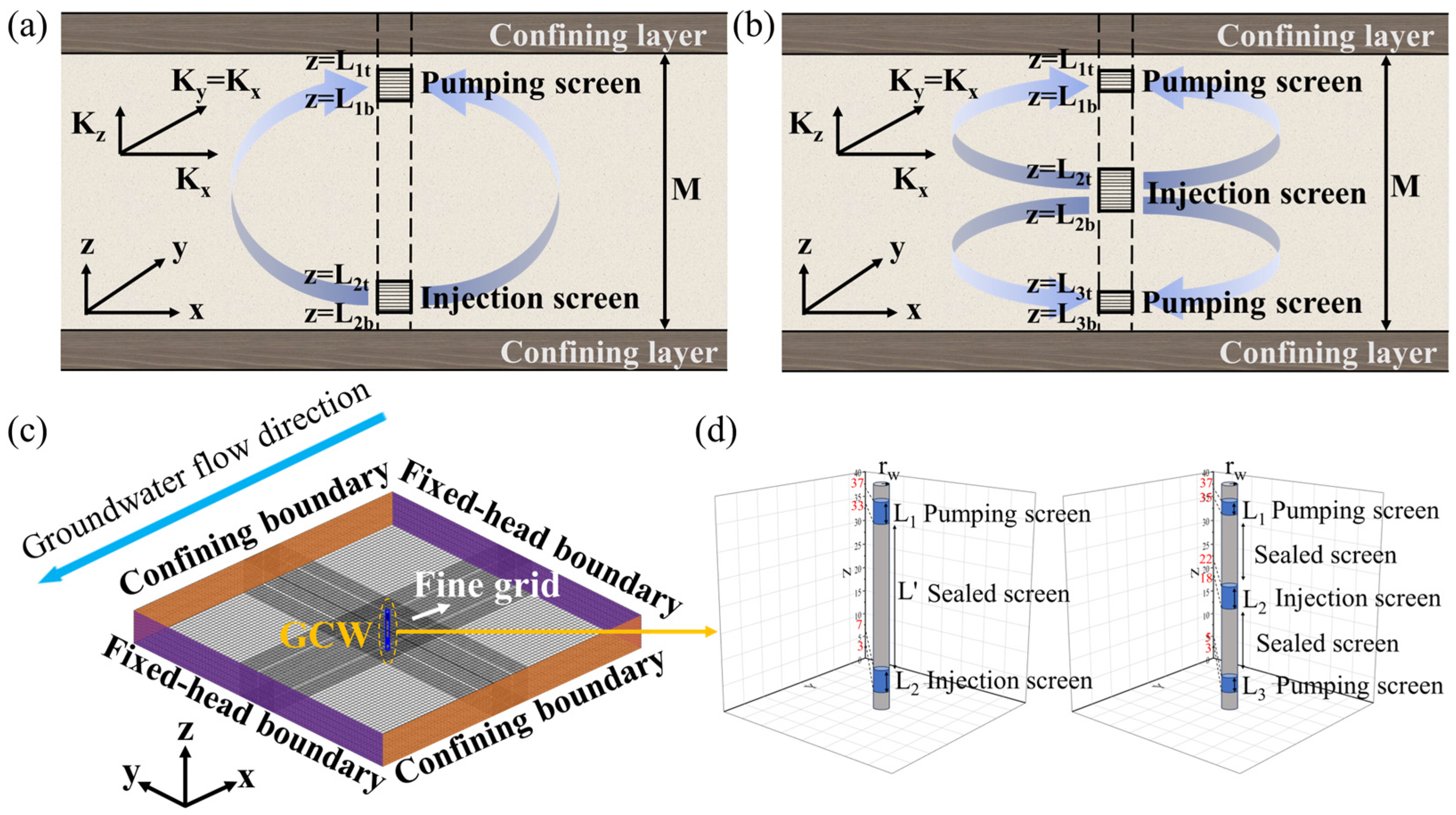
This study employed the GMS 10.7 software to establish a numerical model, and the conceptual model of groundwater flow related to the GCW system is shown in Figure 1a,b. The aquifer was conceptualized as a homogeneous, anisotropic, uniformly thick, and confined steady-state flow model. The mathematical model was established based on Darcy’s law and the principle of mass conservation. The partial differential equations, initial conditions, and boundary conditions are as follows.
x K x h x + y K y h y + z K z h z + W = 0 x , y , z Ω ; t 0 h x , y , z , t t = 0 = h 0 x , y , z x , y , z Ω ; t 0 h x , y , z , t Γ 1 = h 1 x , y , z x , y , z Γ 1 ; t 0 h N Γ 2 = 0 x , y , z Γ 2 ; t 0
where Kx, Ky, and Kz are the hydraulic conductivities along the x, y, and z coordinate axes, respectively (m/d); W is the source–sink term (L/d); h is the groundwater head (m); h0 is the initial head (m); h1 is the known head (m); t is time (d); Γ1 is the fixed-head boundary; Γ2 is the confining boundary; Ω is the range of the simulation area; N is the outward normal direction of Γ2. Table 1 lists the input values used in the model.
As shown in Figure 1c, the GCW was positioned at the center of the simulation area. To avoid the interference of the model boundaries on the hydraulic circulation of the GCW, the simulation area was set to 400 m × 400 m, which was significantly larger than the estimated range of hydraulic circulation of GCWs. This area was discretized both horizontally and vertically. In the horizontal direction, the maximum grid size at the model boundaries was 5 m × 5 m. Within a 50 m radius centered on the GCW, the grid was refined to a minimum size of 1 m × 1 m to enhance resolution near the wellbore. The aquifer had a thickness of 40 m, and the model area was vertically divided into 80 layers with a spacing of 0.5 m per layer. The two boundaries parallel to the direction of groundwater flow were confining boundaries. The two boundaries perpendicular to the direction of groundwater flow were fixed-head boundaries, with their head calculated based on the given hydraulic gradient. As shown in Figure 1d, the GCW was conceptualized as screens with identical x and y coordinates but varying z coordinates. For the dual-screen GCW, the total length of the screens and sealed screen was 34 m, with each screen measuring 4 m in length and the sealed screen spanning 26 m. The dual-screen GCW operated in an “upper screen for pumping and lower screen for injection” mode, with pumping and injection flow rates of 400 m3/d. For the triple-screen GCW, the total length of the screens and sealed screens was 34 m, which was consistent with that of the dual-screen GCW. To ensure uniform flow flux through the screens, the upper and lower screens were each 2 m in length, while the middle screen spanned 4 m. The upper and lower sealed screens were each 13 m in length. The triple-screen GCW operated in a “middle screen injection, upper and lower screen pumping” mode, with pumping flow rates of 200 m3/d and injection flow rates of 400 m3/d. The input parameters for the model are provided in Table 1.

2.2. Particle Tracking Model

To visualize the hydraulic circulation characteristics of GCWs, a particle tracking model was constructed using the MODPATH module in GMS software. A total of 100 particles (5 rows × 5 columns × 4 faces) were released in each unit of the injection screens. The migration process of GCW-driven flow was described by the trajectories of these particles.

2.3. Characterization Indexes for the Three-Dimensional Hydraulic Circulation of GCWs

2.3.1. Influence Radius

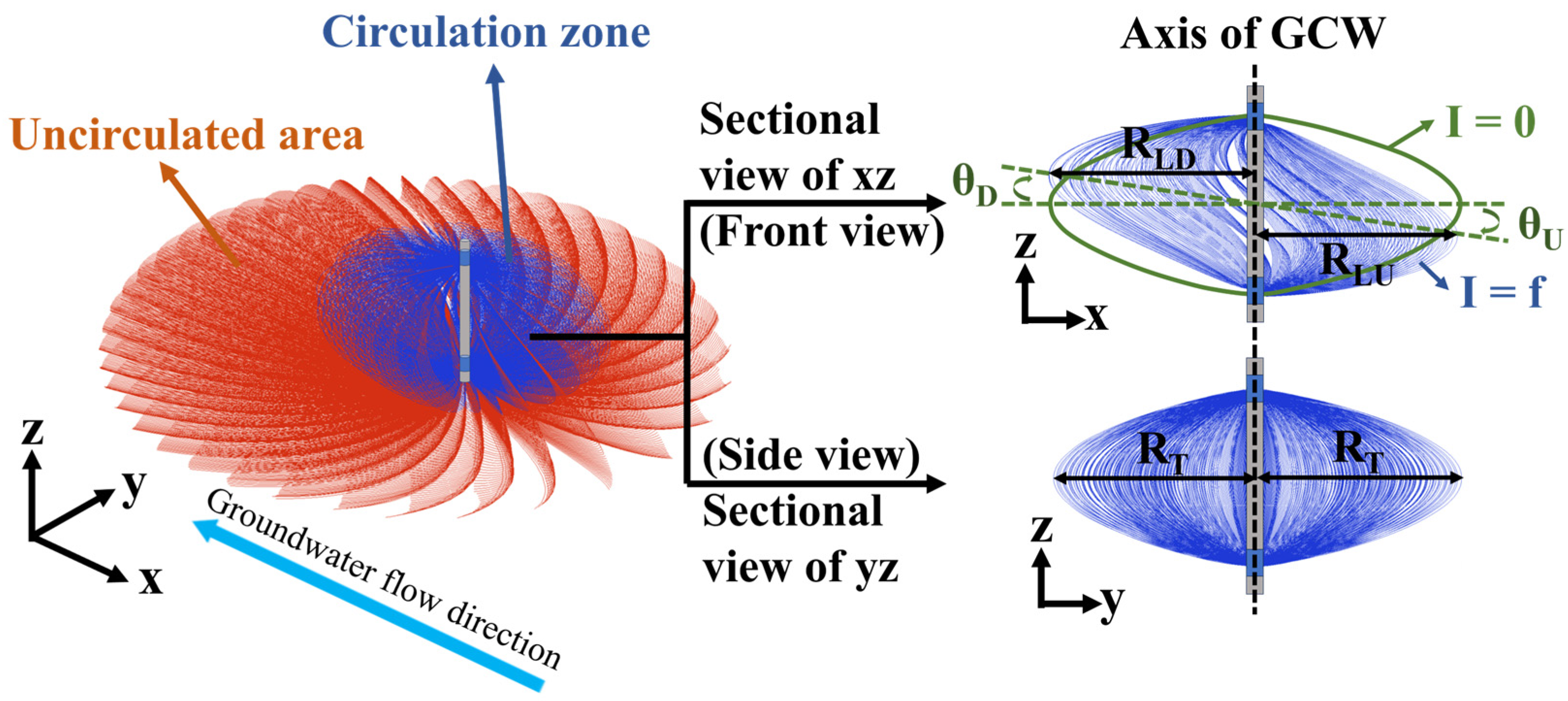
The characteristics of the circulation zone have always been a focus of GCW research, particularly regarding the study of the influence radius (R), because the successful application of GCW technology requires understanding and predicting its influence area before installation. Currently, in field applications, R is primarily estimated by injecting dyes into the GCW and observing the dye traces in monitoring wells [42]. In laboratory studies, tracers are typically injected to observe their distribution range in the sand tank [35]. In this study, the particle tracking method is employed, and R is determined by measuring the maximum migration distance of particles that constitute the circulation zone. As shown in Figure 2, due to the influence of the natural flow field, the distortion of the circulation zone results in variations in R across different directions. Perpendicular to the hydraulic gradient, the horizontal influence radii (RT) on both sides of GCW are the same. Parallel to the hydraulic gradient, the longitudinal influence radii (RL) on both sides of GCW differ and are categorized into upstream longitudinal influence radius (RLU) and downstream longitudinal influence radius (RLD).

2.3.2. Offset Angle of Circulation Zone

As shown in Figure 2, the offset angle (θ) is defined as the upward (+) or downward (−) angular displacement of the farthest point of the circulation zone formed at a hydraulic gradient of f relative to the farthest point of the circulation zone at a hydraulic gradient of 0. This index can quantify the degree of deformation of the circulation zone caused by the natural flow field.

2.3.3. Circulation Efficiency

The particle recovery rate (Pr) is defined as the ratio of the number of particles recovered from the pumping screen to the number of particles released from the injection screen. This indicator can quantify the circulation efficiency of GCWs, reflecting the closure of the circulation flow field and the ability to establish hydraulic circulation. A higher Pr indicates a stronger capability of GCWs to establish hydraulic circulation, enabling faster capture of more contaminants. It also indicates better closed-loop performance of the circulation flow field, effectively confining contaminants within the circulation unit to prevent their escape into the background flow field, which could cause secondary pollution.

3. Results and Discussion

3.1. Influence of Hydraulic Gradient on the Hydraulic Circulation Characteristics of Dual-Screen GCW

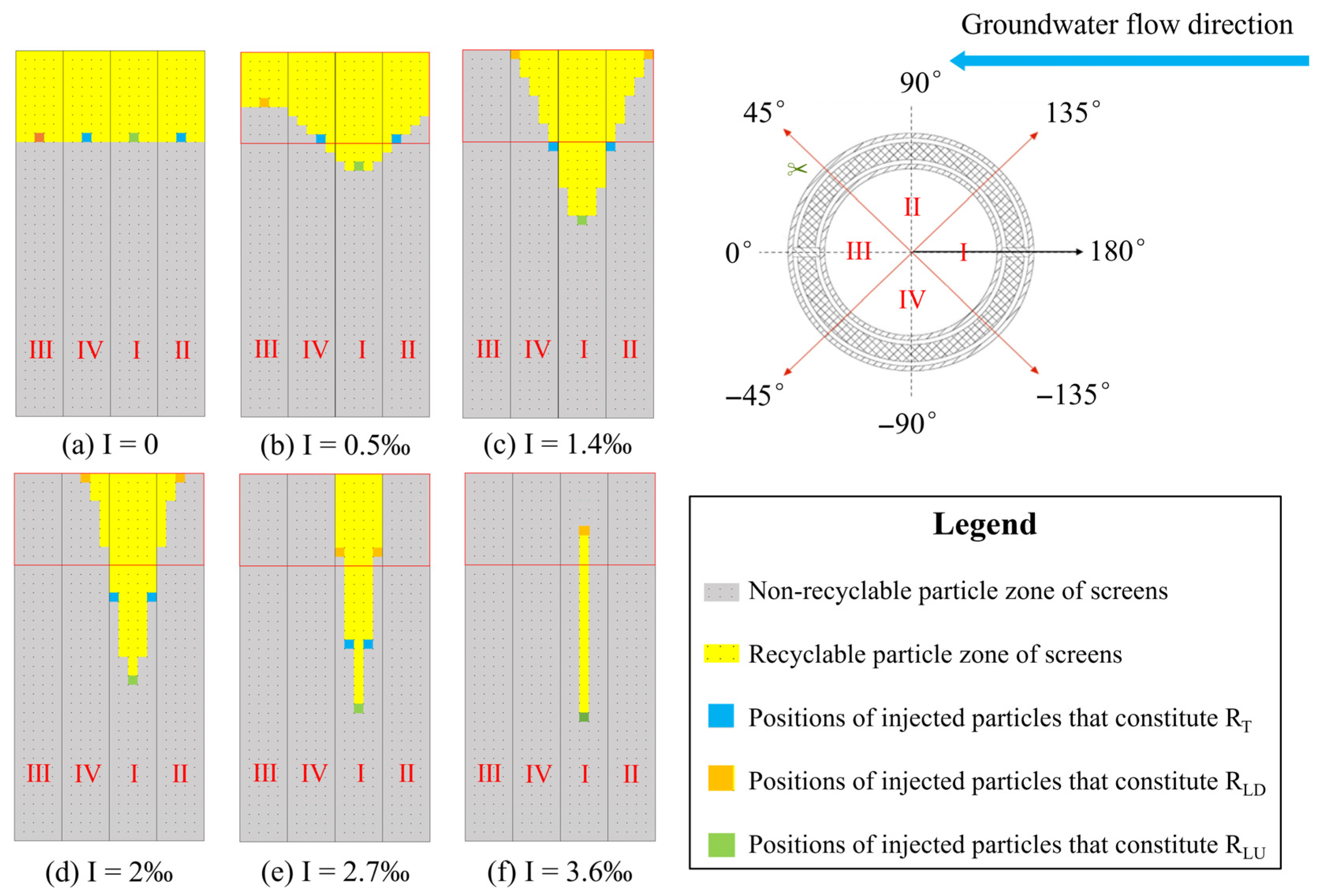
As shown in Figure 3, the regions on the injection screen capable of forming circulation and the release positions of particles constituting the RL and RT at one year are marked. The screen is divided into four regions: Area I near the upstream, Area III near the downstream, and Areas II and IV perpendicular to the natural flow field. When the screen is extended with a hydraulic gradient (I) of 0, the region capable of forming circulation is a regular rectangle. As the hydraulic gradient increases, the shape of the region capable of forming circulation changes. In Areas III, II, and IV, particles released near the downstream are carried downstream by the natural flow and fail to form hydraulic circulation, resulting in a reduction in the area of these regions. In contrast, particles in Area I are recovered faster by the pumping screen under the influence of the natural flow field, leading to an increase in the area of the recoverable particle region. When I increases to 1.4‰, all particles released in Area III of the injection screen cannot form hydraulic circulation. When I increases to 2.7‰, only particles in Area I can form hydraulic circulation. However, as the hydraulic gradient continues to increase, some particles in Area I are also carried downstream by the stronger natural flow field, preventing them from forming hydraulic circulation and reducing the area of this region. Consequently, when I reaches 3.6‰, only particles released at the 180° position in Area I can be recovered. This indicates that as the hydraulic gradient increases, the circulation efficiency of GCW becomes very low. Additionally, due to the alteration in the region capable of forming circulation, the release positions of particles constituting the RL and RT change, leading to variations in the influence radius of GCW.

3.1.1. Influence Radius

(1)
Longitudinal influence radius
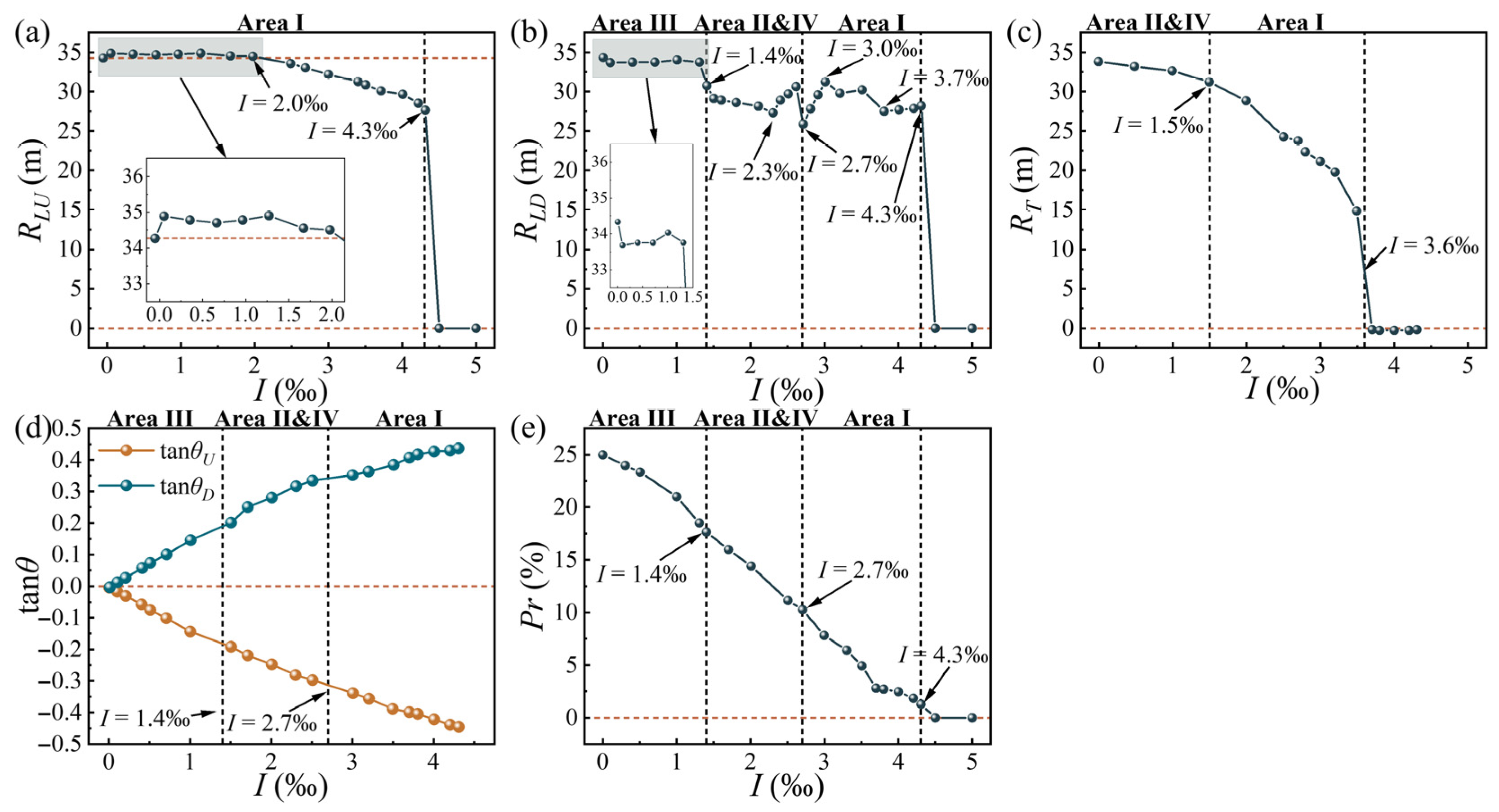
Figure 4a shows the relationship between hydraulic gradient and RLU at one year. As indicated in the figure, when the hydraulic gradient ranges from 0 to 4.3‰, the particle release positions are all at the 180° position in Area I. When the hydraulic gradient ranges from 0 to 2.0‰, RLU fluctuates between 34.26 m and 34.93 m as the hydraulic gradient increases. Within this range, the presence of the hydraulic gradient increases the RLU. When the hydraulic gradient ranges from 2.0‰ to 4.3‰, RLU decreases gradually as the hydraulic gradient increases without any fluctuations. Specifically, RLU decreases from 34.52 m to 27.68 m, a reduction of 6.84 m. When the hydraulic gradient exceeds 4.3‰, RLU is 0. This indicates that the influence of the hydraulic gradient on RLU can be divided into three stages. In the first stage, when the hydraulic gradient is small (less than 2.0‰), it has a weak promoting effect on RLU. In the second stage, when the hydraulic gradient is large (greater than 2.0‰), it exerts a strong inhibitory effect on RLU. In the third stage, when the hydraulic gradient is excessively large (greater than 4.3‰), the driving effect of the hydraulic gradient completely dominates, and the GCW can no longer drive water flow to form a circulation zone.
Figure 4b illustrates the relationship between hydraulic gradient and RLD at one year. It can be observed that the variation in RLD with respect to the hydraulic gradient is more complex than that of RLU. When the hydraulic gradient ranges from 0 to 1.3‰, RLD slightly fluctuates between 33.69 m and 34.32 m. At this stage, the particle release positions are all located at the 0° position in Area III and gradually shift toward the position closer to the sealed screen. When the hydraulic gradient increases to 1.4‰, all particles released in Area III are unable to form hydraulic circulation. Consequently, the particle release positions constituting RLD shift from the original 0° position in Area III to the ±68° positions in Areas II and IV, resulting in RLD decreasing from 33.76 m to 30.76 m. Subsequently, as the hydraulic gradient increases to 2.3‰, 2.7‰, 3.0‰, and 3.7‰, the particle release positions constituting RLD change again, causing fluctuations in RLD. In conclusion, when the hydraulic gradient ranges from 1.4‰ to 4.3‰, RLD fluctuates between 25.9 m and 31.25 m. When the hydraulic gradient exceeds 4.3‰, RLD is 0. Therefore, the influence of the hydraulic gradient on RLD can also be divided into three stages. In the first stage, when the hydraulic gradient is small (less than 1.4‰), its inhibitory effect on RLD is minor compared to the water circulation driven by GCW, resulting in negligible changes in RLD. In the second stage, when the hydraulic gradient is large (greater than 1.4‰), its dominant role gradually increases. RLD exhibits strong fluctuations with variations in the release positions of particles constituting RLD, but overall shows a significant inhibitory effect compared to the case of I = 0. In the third stage, when the hydraulic gradient is excessively large (greater than 4.3‰), the driving effect of the hydraulic gradient completely dominates, and the GCW can no longer form a circulation zone.
(2)
Horizontal influence radius
Figure 4c illustrates the relationship between hydraulic gradient and RT at one year. When the hydraulic gradient ranges from 0 to 1.5‰, the particles constituting RT are released from Areas II and IV in the injection screen, with RT decreasing from 34.32 m to 31.21 m. When the hydraulic gradient ranges from 1.5‰ to 3.5‰, the particles constituting RT are released from Area I in the injection screen, with RT decreasing further from 31.21 m to 14.85 m. Although RT decreases as the hydraulic gradient increases, the rate of decrease gradually becomes more pronounced. When the hydraulic gradient exceeds 3.6‰, the GCW is unable to form a horizontal influence radius. It can be seen that compared with RL, the variation in RT with hydraulic gradient is relatively straightforward, with RT decreasing monotonically as the hydraulic gradient increases. However, the hydraulic gradient value at which GCW fails to form RT (3.6‰) is smaller than that for RT (4.3‰). This is because when I > 3.6‰, all particles involved in forming the circulation zone are released at the 180° position in Area I of the injection screen, and the circulation zone appears only as a straight line in the side view.

3.1.2. Offset Angle of Circulation Zone

Figure 4d illustrates the relationship between the hydraulic gradient and the offset angle of the circulation zone at one year. It can be observed that the offset angle of the circulation zone increases as the hydraulic gradient increases, with the θD being slightly larger than the θU. When I = 0, the circulation zone exhibits no deflection, and the farthest point of particle movement lies on the horizontal line passing through the midpoint between the two screens. When I = 1.4‰ (where all particles released in Area III of the injection screen cannot form hydraulic circulation), tanθU is −0.1906, indicating a downward deviation of 10.79°, and tanθD is 0.2047, indicating an upward deviation of 11.57°. When I = 2.7‰ (where all particles released in Areas II and IV of the injection screen cannot form hydraulic circulation), tanθU is −0.3129, indicating a downward deviation of 17.37°; tanθD is 0.3861, indicating an upward deviation of 21.11°. When I = 3.6‰ (where only particles released in the 180° position of Area I in the injection screen can form hydraulic circulation), tanθU is −0.3985, indicating a downward deviation of 21.73°; tanθD is 0.4083, indicating an upward deviation of 22.21°. Therefore, if the hydraulic gradient is excessively high, the circulation zone will undergo severe deformation. This deformation may prevent the circulation zone from encapsulating the contaminant plume, thereby increasing the risk of plume diffusion and secondary contamination.

3.1.3. Circulation Efficiency

Figure 4e shows the relationship between hydraulic gradient and Pr at one year. As shown in the figure, Pr decreases gradually as the hydraulic gradient increases. When the hydraulic gradient is 0, Pr is 25%. When I = 1.4‰ (where all particles released in Area III of the injection screen cannot form hydraulic circulation), Pr is 17.63%. When I = 2.7‰ (where all particles released in Areas II and IV of the injection screen cannot form hydraulic circulation), Pr is 10.25%. When I = 3.6‰ (where only particles released at the 180° position in Area I of the injection screen can form hydraulic circulation), Pr is 3.2%. When I > 4.3‰, the GCW is unable to form a circulation zone, resulting in Pr being 0. This clearly shows that, unlike RL, the hydraulic gradient exhibits a complete inhibitory effect on Pr. The increase in hydraulic gradient will inevitably cause some particles to escape into the background flow field, increasing the risk of contaminant migration and diffusion.

3.2. Influence of Hydraulic Gradient on the Hydraulic Circulation Characteristics of Triple-Screen GCW

3.2.1. Influence Radius

(1)
Longitudinal influence radius
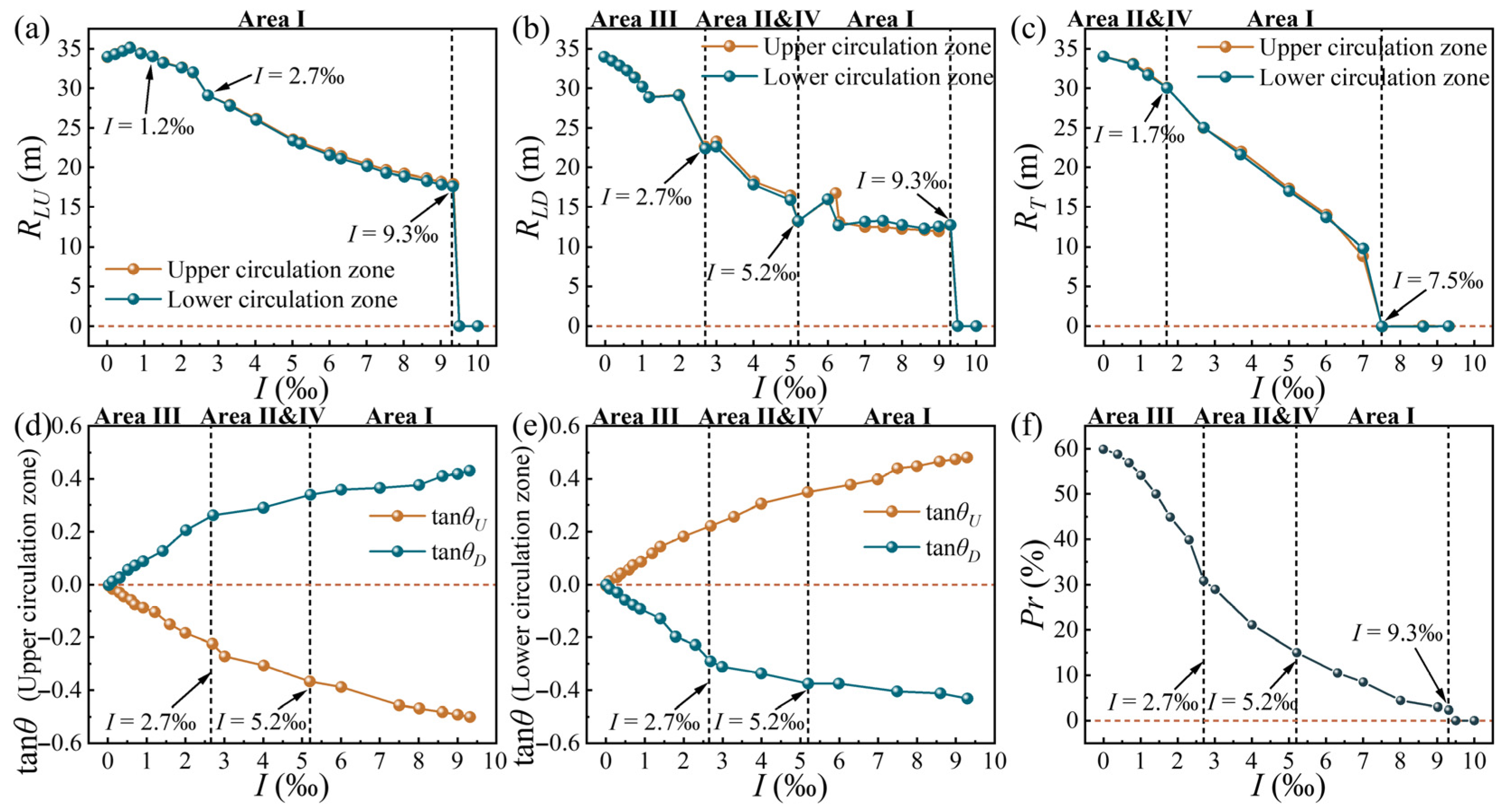
Figure 5a shows the relationship between hydraulic gradient and RLU at one year. It can be observed that the release positions of particles constituting RLU are all at the 180° position in Area I. The RLU values of the two circulation zones formed by the three screens are essentially identical. When the hydraulic gradient ranges from 0 to 1.2‰, RLU fluctuates between 33.95 m and 35.18 m as the hydraulic gradient increases. Within this range, the presence of the hydraulic gradient increases the RLU. When the hydraulic gradient ranges from 1.2‰ to 9.3‰, RLU decreases gradually with the increase in the hydraulic gradient without any fluctuations. Specifically, RLU decreases from 34.08 m to 17.63 m, a reduction of 16.45 m. When the hydraulic gradient exceeds 9.3‰, RLU is 0. Therefore, the influence pattern of hydraulic gradient on RLU in the triple-screen GCW is similar to that in the dual-screen GCW, which can also be divided into three stages. In the first stage, when the hydraulic gradient is small (less than 1.2‰), it has a weak promoting effect on RLU. In the second stage, when the hydraulic gradient is large (greater than 1.2‰), it exhibits an inhibitory effect on RLU, with RLU decreasing monotonically as the hydraulic gradient increases. In the third stage, when the hydraulic gradient is excessively large (greater than 9.6‰), the GCW is unable to form a circulation zone.
Figure 5b illustrates the relationship between hydraulic gradient and RLD at one year. The RLD values of the two circulation zones formed by the triple-screen GCW are essentially identical, so only the upper circulation zone is analyzed. When the hydraulic gradient increases to 2.7‰, particles released in Area III cannot form hydraulic circulation, and the particle release positions shift from the original 0° position in Area III to the ±68° positions in Areas II and IV, resulting in RLD decreasing from 33.99 m to 22.66 m. Subsequently, when the hydraulic gradient increases to 5.2‰, particles released in Areas II and IV of the injection screen cannot form a hydraulic circulation, and RLD decreases further from 22.66 m to 13.20 m. Afterward, RLD briefly increases with the increase in hydraulic gradient before stabilizing. When the hydraulic gradient exceeds 9.3‰, the GCW is unable to form a circulation zone, resulting in RLD being 0. It can be seen that compared to the dual-screen GCW, the RLD of the triple-screen GCW is influenced by the hydraulic gradient in a relatively simple manner, generally decreasing with the increase in the hydraulic gradient. Occasional fluctuations still occur due to changes in the release particle positions, but these fluctuations are significantly smaller than that of the dual-screen GCW. This is because the triple-screen GCW reduces the length of the sealed screen, and particles released from positions closer to the sealed screen are less affected by the hydraulic gradient. It also indicates that reducing the spatial scale of individual circulation zones can mitigate the interference of hydraulic gradients in the fluctuation of circulation units.
(2)
Horizontal influence radius
Figure 5c illustrates the relationship between hydraulic gradient and RT at one year. It can be observed that the RT values of the two circulation zones are essentially identical. When the hydraulic gradient ranges from 0 to 1.7‰, the particles constituting RT are released from Areas II and IV of the injection screen, with RT decreasing from 34.02 m to 30.08 m. When the hydraulic gradient ranges from 1.7‰ to 7.0‰, the particles constituting RT are released from Area I, with RT further decreasing from 30.08 m to 8.83 m. When I ≥ 7.5‰, RT is 0. This indicates that RT decreases monotonically with increasing hydraulic gradient, and the upper limit of hydraulic gradient forming RT (7.5‰) is lower than that for RL (9.3‰). This phenomenon and its underlying cause are consistent with those of the dual-screen GCW.

3.2.2. Offset Angle of Circulation Zone

Figure 5d,e illustrate the relationship between the hydraulic gradient and the offset angle of the circulation zone at one year. It can be observed that the upper and lower circulation zones exhibit different offset patterns, which is due to the different circulation modes of the circulation units. If the triple-screen GCW is considered as the superposition of two dual-screen GCWs, the upper GCW involves pumping from the upper screen and injection from the lower screen, representing a reverse circulation mode, while the lower GCW involves injection from the upper screen and pumping from the lower screen, representing a standard circulation mode. The upstream circulation zone always offsets toward the injection screen, while the downstream circulation zone always offsets toward the pumping screen.
Take the upper circulation zone as an example (Figure 5d). When I = 0, the circulation zone does not undergo any deviation, and the farthest point of particle movement lies on the horizontal line passing through the midpoint between the two screens. When I = 2.7‰ (where all particles released in Area III of the injection screen cannot form hydraulic circulation), tanθU is −0.2230, indicating a downward deviation of 10.79°, while tanθD is 0.2652, indicating an upward deviation of 14.85°. When I = 5.2‰ (where all particles released in Areas II and IV of the injection screen cannot form hydraulic circulation), tanθU is −0.3658, indicating a downward deviation of 20.09°, while tanθD is 0.3396, indicating an upward deviation of 18.75°. When I = 7.5‰ (where only particles released in the 180° position of Area I in the injection screen can form hydraulic circulation), tanθU is −0.4562, indicating a downward deviation of 24.52°, while tanθD is 0.4390, indicating an upward deviation of 23.70°.
For the upper circulation zone, when the hydraulic gradient is low, the downstream circulation zone exhibits a greater offset angle than the upstream circulation zone. This occurs because particles released at a smaller angle to the groundwater flow direction experience greater displacement due to the hydraulic gradient. Conversely, when the hydraulic gradient is high, the upstream circulation zone shows a greater offset angle than the downstream circulation zone. This is because the proximity of the screen to the aquifer roof limits the deformation of the circulation zone. Similarly, for the lower circulation zone (Figure 5e), the same pattern is observed due to the influence of the confining layer roof.

3.2.3. Circulation Efficiency

Figure 5f illustrates the variation in Pr as the hydraulic gradient ranges from 0 to 9.3‰ at one year. As shown in the figure, Pr gradually decreases with increasing hydraulic gradient. When the hydraulic gradient is 0, Pr is 60%. When I = 2.7‰ (where all particles released in Area III of the injection screen cannot form hydraulic circulation), Pr is 31%. When I = 5.2‰ (where all particles released in Areas II and IV of the injection screen cannot form hydraulic circulation), Pr is 15%. When I = 7.5‰ (where only particles released in the 180° position of Area I in the injection screen can form hydraulic circulation), Pr is 5.5%. It can be observed that the circulation efficiency and the ability to establish hydraulic circulation of the triple-screen GCW are superior to those of the dual-screen GCW, under the same hydraulic gradient.

3.3. Feasibility of Increasing the Number of Screens to Expand GCW Applicability and Enhance Repair Efficiency

Under the conditions of this aquifer within one year, the dual-screen GCW can form a circulation zone within a hydraulic gradient range of 0 to 4.3‰, while the triple-screen GCW can form a circulation zone within a hydraulic gradient range of 0 to 9.3‰. This demonstrates that splitting a large circulation zone into two smaller circulations by increasing the number of screens can increase the upper limit of the hydraulic gradient for the GCW to form circulation zone. Furthermore, comparing the performance indicators of GCW operation with a hydraulic gradient of 2‰ at one year (Table 2) reveals that the influence radii of the dual-screen GCW and triple-screen GCW are not significantly different. However, increasing the number of screens can effectively reduce deformation of the circulation zone and enhance the circulation efficiency. Compared to the dual-screen GCW, the θU and θD of the triple-screen GCW are reduced by 3.42° and 4.12°, respectively, and the Pr increases by 27.62%. This is attributed to the triple-screen GCW reducing the distance between the screens, thereby minimizing the deformation of released particles near the sealed screen under the influence of the hydraulic gradient. Furthermore, adding screens allows new screens to form new circulation units with the original screens, improving screen utilization and thereby enhancing circulation efficiency. Therefore, under conditions of higher hydraulic gradients, the triple-screen GCW can effectively expand the applicable range of hydraulic gradients for GCWs and significantly improve the circulation efficiency of GCWs.

4. Conclusions

This study visualized the water flow driven by GCWs using a particle tracking model, representing the circulation zone as a three-dimensional graphic composed of countless particle trajectories. Three-dimensional hydraulic circulation characteristics of GCWs were characterized by longitudinal influence radius (RL), horizontal influence radius (RT), offset angle of circulation zone (θ), and particle recovery rate (Pr). The research investigates the influence of hydraulic gradient on the hydraulic circulation characteristics of GCWs, elucidates the applicable ranges of hydraulic gradient for GCWs with different numbers of screens, and clarifies the potential to enhance the applicability and operational performance of GCWs under larger hydraulic gradients via multi-screen GCWs. Specifically, the following conclusions were obtained.
(1) The hydraulic circulation characteristics of GCWs with different numbers of screens exhibit similar patterns of influence from hydraulic gradient. The distribution of particle release zones forming hydraulic circulation on the screen continuously varies with the hydraulic gradient. RL exhibits fluctuating variations with these zone changes, while RT decreases monotonically as the hydraulic gradient increases. The hydraulic gradient also significantly reduces the circulation efficiency of GCWs and causes deformation of the circulation zone with θ increasing as the hydraulic gradient increases.
(2) The dual-screen GCW can form a circulation zone within a hydraulic gradient range of 0 to 4.3‰ at one year, while the triple-screen GCW can form a circulation zone within a hydraulic gradient range of 0 to 9.3‰. Therefore, increasing the number of screens can effectively increase the upper limit of the hydraulic gradient for GCWs to form circulation zones and expand the applicable range of hydraulic gradients for GCWs.
(3) Compared to the dual-screen GCW at one year, the θU and θD of the triple-screen GCW are reduced by 3.42° and 4.12°, respectively, and the Pr increases by 27.62%. Therefore, under conditions of higher hydraulic gradients, the triple-screen GCW can significantly improve the circulation efficiency of GCWs and reduce the deformation of the circulation zone.
From the perspective of engineering practice requirements, these conclusions can provide a scientific basis for predicting effects and avoiding risks in GCW engineering design. The multi-screen optimization scheme not only expands the technical application scope but also effectively solves the circulation failure problem under high hydraulic gradients, providing a practical optimization path for engineering applications and holding important guiding significance for the practical application of GCWs.

Author Contributions

S.D.: writing—original draft, methodology, investigation, data curation. J.C.: supervision, project administration, funding acquisition. R.Z.: writing—review and editing, project administration, funding acquisition. Q.Z.: formal analysis. All authors have read and agreed to the published version of the manuscript.

Funding

This work was supported by the National Key Research and Development Program of China (Grant No. 2022YFC3703101) and the Joint Program of Liaoning Provincial Science and Technology Plan (Grant No. 2024-MSLH-500).

Data Availability Statement

The original contributions presented in this study are included in the article. Further inquiries can be directed to the corresponding authors.

Acknowledgments

We would like to thank the anonymous reviewers and the editor.

Conflicts of Interest

The authors declare that they have no known competing financial interests or personal relationships that could have appeared to influence the work reported in this paper.

References

  1. Ciampi, P.; Esposito, C.; Bartsch, E.; Alesi, E.J.; Petrangeli Papini, M. Pump-and-treat (P&T) vs groundwater circulation wells (GCW): Which approach delivers more sustainable and effective groundwater remediation? Environ. Res. 2023, 234, 116538. [Google Scholar] [CrossRef] [PubMed]
  2. Tatti, F.; Papini, M.P.; Torretta, V.; Mancini, G.; Boni, M.R.; Viotti, P. Experimental and numerical evaluation of Groundwater Circulation Wells as a remediation technology for persistent, low permeability contaminant source zones. J. Contam. Hydrol. 2019, 222, 89–100. [Google Scholar] [CrossRef] [PubMed]
  3. Elmore, A.C.; Graff, T. Best Available Treatment Technologies Applied to Groundwater Circulation Wells. Remediat. J. 2002, 12, 63–80. [Google Scholar] [CrossRef]
  4. Ciampi, P.; Esposito, C.; Bartsch, E.; Alesi, E.J.; Papini, M.P. 3D dynamic model empowering the knowledge of the decontamination mechanisms and controlling the complex remediation strategy of a contaminated industrial site. Sci. Total Environ. 2021, 793, 148649. [Google Scholar] [CrossRef]
  5. Ciampi, P.; Esposito, C.; Bartsch, E.; Alesi, E.J.; Rehner, G.; Morettin, P.; Pellegrini, M.; Olivieri, S.; Ranaldo, M.; Liali, G.; et al. A data-driven modeling approach for the sustainable remediation of persistent arsenic (As) groundwater contamination in a fractured rock aquifer through a groundwater recirculation well (IEG-GCW®). Environ. Res. 2023, 217, 114827. [Google Scholar] [CrossRef]
  6. Johnson, R.L.; Simon, M.A. Evaluation of groundwater flow patterns around a dual-screened groundwater circulation well. J. Contam. Hydrol. 2007, 93, 188–202. [Google Scholar] [CrossRef]
  7. Feng, S.; Cheng, D.; Zhan, H.; Yang, S.; Zhao, X.; Jin, H.; Zhang, L. Evolution characteristics of remediation process of secondary contaminant sources of low-permeability lens driven by circulating well. J. Hydrol. 2022, 613, 128408. [Google Scholar] [CrossRef]
  8. Wang, P.; Li, J.; An, P.; Yan, Z.; Xu, Y.; Pu, S. Enhanced delivery of remedial reagents in low-permeability aquifers through coupling with groundwater circulation well. J. Hydrol. 2023, 618, 129260. [Google Scholar] [CrossRef]
  9. Ciampi, P.; Esposito, C.; Petrangeli Papini, M. Review on groundwater circulation wells (GCWs) for aquifer remediation: State of the art, challenges, and future prospects. Groundw. Sustain. Dev. 2024, 24, 101068. [Google Scholar] [CrossRef]
  10. Kahler, D.M.; Kabala, Z.J. Rapidly Pulsed Pumping Accelerates Remediation in A Vertical Circulation Well Model. Water 2018, 10, 1423. [Google Scholar] [CrossRef]
  11. Qiu, H.; Xu, J.; Yuan, Y.; Alesi, E.J.; Liang, X.; Cao, B. Low-disturbance land remediation using vertical groundwater circulation well technology: The first commercial deployment in an operational chemical plant. Sci. Total Environ. 2024, 944, 173804. [Google Scholar] [CrossRef] [PubMed]
  12. Ciampi, P.; Esposito, C.; Papini, M.P. Hydrogeochemical Model Supporting the Remediation Strategy of a Highly Contaminated Industrial Site. Water 2019, 11, 1371. [Google Scholar] [CrossRef]
  13. Papini, M.P.; Majone, M.; Arjmand, F.; Silvestri, D.; Sagliaschi, M.; Sucato, S.; Alesi, E.; Barstch, E.; Pierro, L. First Pilot Test on the Integration of GCW (Groundwater Circulation Well) with ENA (Enhanced Natural Attenuation) for Chlorinated Solvents Source Remediation. In Proceedings of the 5th International Conference on Industrial Biotechnology (IBIC), Bologna, Italy, 10–13 April 2016; Volume 49, pp. 91–96. [Google Scholar]
  14. Knox, R.; Sabatini, D.; Harwell, J.; Brown, R.; West, C.; Blaha, F.; Griffin, C. Surfactant remediation field demonstration using a vertical circulation well. Groundwater 1997, 35, 948–953. [Google Scholar] [CrossRef]
  15. Pierre, L.; Matturro, B.; Rossetti, S.; Sagliaschi, M.; Sucato, S.; Alesi, E.; Bartsch, E.; Arjmand, F.; Papini, M.P. Polyhydroxyalkanoate as a slow-release carbon source for in situ bioremediation of contaminated aquifers: From laboratory investigation to pilot-scale testing in the field. New Biotechnol. 2017, 37, 60–68. [Google Scholar] [CrossRef]
  16. Ciampi, P.; Esposito, C.; Bartsch, E.; Alesi, E.J.; Rehner, G.; Papini, M.P. Remediation of chlorinated aliphatic hydrocarbons (CAHs) contaminated site coupling groundwater recirculation well (IEG-GCW®) with a peripheral injection of soluble nutrient supplement (IEG-C-MIX) via multilevel-injection wells (IEG-MIW). Heliyon 2022, 8, e11402. [Google Scholar] [CrossRef]
  17. Zhang, Y.; Cao, W.; Wang, W.; Dong, Q. Distribution of groundwater arsenic and hydraulic gradient along the shallow groundwater flow-path in Hetao Plain, Northern China. J. Geochem. Explor. 2013, 135, 31–39. [Google Scholar] [CrossRef]
  18. Jazayeri, A.; Werner, A.D.; Jenkins, T. Effects of porous media thickness and its hydraulic gradient history on the formation of sand boils: Experimental investigation. Sci. Total Environ. 2023, 880, 163235. [Google Scholar] [CrossRef]
  19. Wang, X.; Ren, L.; Long, T.; Geng, C.; Tian, X. Migration and remediation of organic liquid pollutants in porous soils and sedimentary rocks: A review. Environ. Chem. Lett. 2023, 21, 479–496. [Google Scholar] [CrossRef]
  20. Zeng, J.; Tabelin, C.B.; Gao, W.; Tang, L.; Luo, X.; Ke, W.; Jiang, J.; Xue, S. Heterogeneous distributions of heavy metals in the soil-groundwater system empowers the knowledge of the pollution migration at a smelting site. Chem. Eng. J. 2023, 454, 140307. [Google Scholar] [CrossRef]
  21. Joun, W.-T.; Lee, K.-K. Experimental study for visualizing CO2-dissolved water plume migration under hydraulic gradient conditions and implication for field monitoring data. J. Environ. Manag. 2024, 357, 120814. [Google Scholar] [CrossRef]
  22. Li, B.; Zhang, H.; Long, J.; Fan, J.; Wu, P.; Chen, M.; Liu, P.; Li, T. Migration mechanism of pollutants in karst groundwater system of tailings impoundment and management control effect analysis: Gold mine tailing impoundment case. J. Clean. Prod. 2022, 350, 131434. [Google Scholar] [CrossRef]
  23. Vats, O.P.; Sharma, B.; Stamm, J.; Bhattacharjya, R.K. Groundwater Circulation Well for Controlling Saltwater Intrusion in Coastal aquifers: Numerical study with Experimental Validation. Water Resour. Manag. 2020, 34, 3551–3563. [Google Scholar] [CrossRef]
  24. Saad, S.; Javadi, A.A.; Abd-Elhamid, H.F.; Farmani, R. Mitigating seawater intrusion in coastal aquifers: Novel approach with treated wastewater injection and groundwater circulation. J. Hydrol. 2023, 626, 130139. [Google Scholar] [CrossRef]
  25. Ciampi, P.; Felli, G.; Feriaud, D.; Esposito, C.; Papini, M.P. 3D GeoRemediation: A Digital Hydrogeophysical-Chemical Clone and Virtual Hydraulic Barrier with Groundwater Circulation Wells (GCWs) for Groundwater Remediation. Sustainability 2024, 16, 5216. [Google Scholar] [CrossRef]
  26. Huang, J.Q.; Goltz, M.N. A three-dimensional analytical model to simulate groundwater flow during operation of recirculating wells. J. Hydrol. 2005, 314, 67–77. [Google Scholar] [CrossRef]
  27. Zhu, Q.; Wen, Z.; Zhan, H.; Yuan, S. Optimization Strategies for in Situ Groundwater Remediation by a Vertical Circulation Well Based on Particle-Tracking and Node-Dependent Finite Difference Methods. Water Resour. Res. 2020, 56, e2020WR027396. [Google Scholar] [CrossRef]
  28. Chen, J.-S.; Jang, C.-S.; Cheng, C.-T.; Liu, C.-W. Conservative solute approximation to the transport of a remedial reagent in a vertical circulation flow field. J. Hydrol. 2010, 390, 155–168. [Google Scholar] [CrossRef]
  29. Zhang, F.; Zhu, H.; Zhang, D.; Feng, R.; Zhao, Y.; Liu, H.; Yang, S.; Wang, W. Method of evaluating the radius of influence of a circulating well based on hydraulic head difference. Hydrogeol. J. 2024, 32, 817–834. [Google Scholar] [CrossRef]
  30. Tu, K.; Wu, Q.; Simunek, J.; Chen, C.; Zhu, K.; Zeng, Y.; Xu, S.; Wang, Y. An Analytical Solution of Groundwater Flow in a Confined Aquifer With a Single-Well Circulation System. Water Resour. Res. 2020, 56, e2020WR027529. [Google Scholar] [CrossRef]
  31. Philip, R.D.; Walter, G.R. Prediction of flow and hydraulic head fields for vertical circulation wells. Groundwater 1992, 30, 765–773. [Google Scholar] [CrossRef]
  32. Toscani, L.; Stefania, G.A.; Masut, E.; Prieto, M.; Legnani, A.; Gigliuto, A.; Ferioli, L.; Battaglia, A. Groundwater flow numerical model to evaluate the water mass balance and flow patterns in Groundwater Circulation Wells (GCW) with varying aquifer parameters. Acque Sotter.-Ital. J. Groundw. 2022, 11, 9–19. [Google Scholar] [CrossRef]
  33. Xia, Q.; Zhang, Q.; Xu, M.; Tang, Y.G.; Teng, H.W. Visualizing hydraulic zones of a vertical circulation well in presence of ambient flow. Desalin. Water Treat. 2019, 159, 151–160. [Google Scholar] [CrossRef]
  34. Jin, Y.; Holzbecher, E.; Sauter, M. Dual-Screened Vertical Circulation Wells for Groundwater Lowering in Unconfined Aquifers. Groundwater 2016, 54, 15–22. [Google Scholar] [CrossRef] [PubMed]
  35. Chen, S.; Huang, Z.; Zhou, R. Influence of process parameters on the operation effectiveness of groundwater circulation well and multi-objective optimization design. J. Environ. Manag. 2025, 373, 123589. [Google Scholar] [CrossRef]
  36. Fang, Z.; Ke, H.; Ma, Y.; Zhao, S.; Zhou, R.; Ma, Z.; Liu, Z. Design optimization of groundwater circulation well based on numerical simulation and machine learning. Sci. Rep. 2024, 14, 11506. [Google Scholar] [CrossRef]
  37. Wang, X.; Zhang, L.; Han, C.; Zhang, Y.; Zhuo, J. Simulation study of oxytetracycline contamination remediation in groundwater circulation wells enhanced by nano-calcium peroxide and ozone. Sci. Rep. 2023, 13, 9136. [Google Scholar] [CrossRef]
  38. Li, B.; Yuan, Y.; Lu, L.; Liu, S.; Wang, P.; Yao, M.; Dong, J. Synergistic approach of GCW-ISTR for enhanced remediation of semi-volatile organic contaminants in groundwater: Modeling and experimental validation. Environ. Res. 2024, 263, 119995. [Google Scholar] [CrossRef]
  39. Zhao, Y.; Qu, D.; Zhou, R.; Yang, S.; Ren, H. Efficacy of forming biofilms by Pseudomonas migulae AN-1 toward in situ bioremediation of aniline-contaminated aquifer by groundwater circulation wells. Environ. Sci. Pollut. Res. 2016, 23, 11568–11573. [Google Scholar] [CrossRef]
  40. Xu, L.; Zhu, H.; Wei, J.; Chen, W.; Ma, H.; Pu, S. Integration of immobilized microorganisms with a groundwater circulation well for the remediation of naphthalene-contaminated aquifers. J. Clean. Prod. 2025, 520, 146127. [Google Scholar] [CrossRef]
  41. Stamm, J.; Eldho, T.; Scholz, M. Flow simulation of a system of groundwater circulation well and pumping well for NAPL site remediation. WIT Trans. Ecolog. Environ. 1998, 23, 99–106. [Google Scholar] [CrossRef]
  42. Elmore, A.C.; DeAngelis, L. Modeling a ground water circulation well alternative. Ground Water Monit. Remediat. 2004, 24, 66–73. [Google Scholar] [CrossRef]
Figure 1. Schematic diagram of the GCW simulation system: (a) conceptual model of dual-screen GCW; (b) conceptual model of triple-screen GCW; (c) grid generation and boundaries; (d) source–sink phase.
Water 18 00164 g001
Figure 2. Three-dimensional hydraulic circulation patterns of GCW.
Water 18 00164 g002
Figure 3. The areas of injection screens that form hydraulic circulation and release positions of particles constituting the longitudinal influence radii (RL) and the horizontal influence radii (RT) at one year.
Water 18 00164 g003
Figure 4. Curves of RLU (a), RLD (b), RT (c), tanθ (d), and Pr (e) for dual-screen GCW with hydraulic gradient at one year.
Water 18 00164 g004
Figure 5. Curves of RLU (a), RLD (b), RT (c), tanθ (d,e), and Pr (f) for triple-screen GCW with hydraulic gradient at one year.
Water 18 00164 g005
Table 1. Parameters of the GCW numerical model.
ParameterDefinitionInput ValueUnit
Hydrogeological
condition
MAquifer thickness40m
KhHorizontal hydraulic conductivity (Kx, Ky)30m/d
KvVertical hydraulic conductivity (Kz)3m/d
Kh/KvHydraulic conductivity anisotropy ratio10/
nPorosity0.33/
μSpecific yield0.12/
h0Initial water head40m
Double-screen
GCW
rwWell radius1.5m
L1tVertical coordinate of upper screen top37m
L1bVertical coordinate of upper screen bottom33m
L2tVertical coordinate of lower screen top7m
L2bVertical coordinate of lower screen bottom3m
Q1Upper screen pumping flow−400m3/d
Q2Lower screen injection flow400m3/d
Triple-screen
GCW
rwWell radius1.5m
L1tVertical coordinate of upper screen top37m
L1bVertical coordinate of upper screen bottom35m
L2tVertical coordinate of middle screen top22m
L2bVertical coordinate of middle screen bottom18m
L3tVertical coordinate of lower screen top5m
L3bVertical coordinate of lower screen bottom3m
Q1Upper screen pumping flow−200m3/d
Q2Middle screen injection flow400m3/d
Q3Lower screen pumping flow−200m3/d
Table 2. Comparison of performance between dual-screen GCW and triple-screen GCW at one year.
Number of ScreensRLU (m)RLD (m)RT (m)θUθDPr
234.5231.9629.09−13.83°15.73°14.38%
332.6429.2430.69−10.41°11.61°42%
Disclaimer/Publisher’s Note: The statements, opinions and data contained in all publications are solely those of the individual author(s) and contributor(s) and not of MDPI and/or the editor(s). MDPI and/or the editor(s) disclaim responsibility for any injury to people or property resulting from any ideas, methods, instructions or products referred to in the content.