Quasi-2D Axisymmetric Modelling of Smooth–Turbulent Transient Flow: Comparison with 1D and 3D-CFD Models


Abstract
1. Introduction
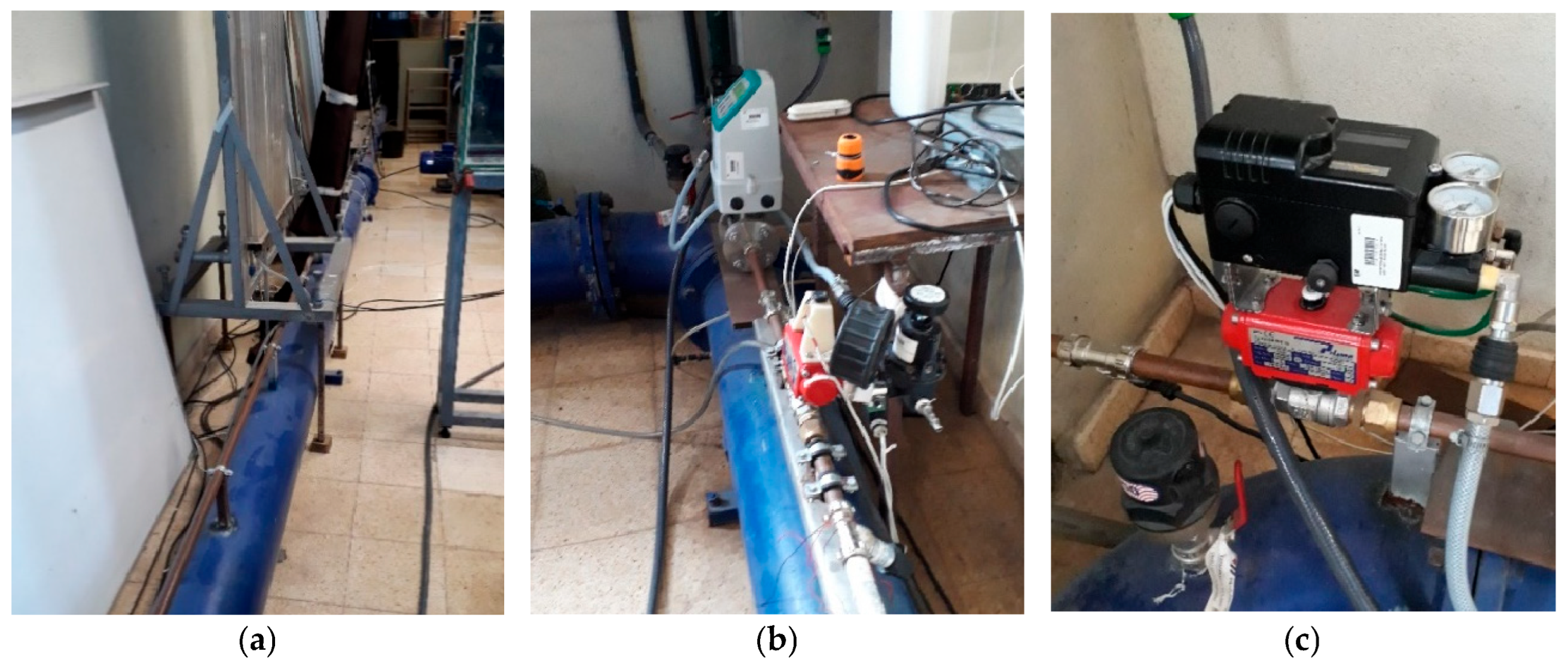
2. Experimental Facility
3. Numerical Models
3.1. The Quasi-2D Axisymmetric Model
3.2. The 1D Unsteady Friction Models
3.2.1. Convolution Integral-Based (CIB) Models
3.2.2. Instantaneous Acceleration-Based (IAB) Models
3.3. The 3D-CFD Model
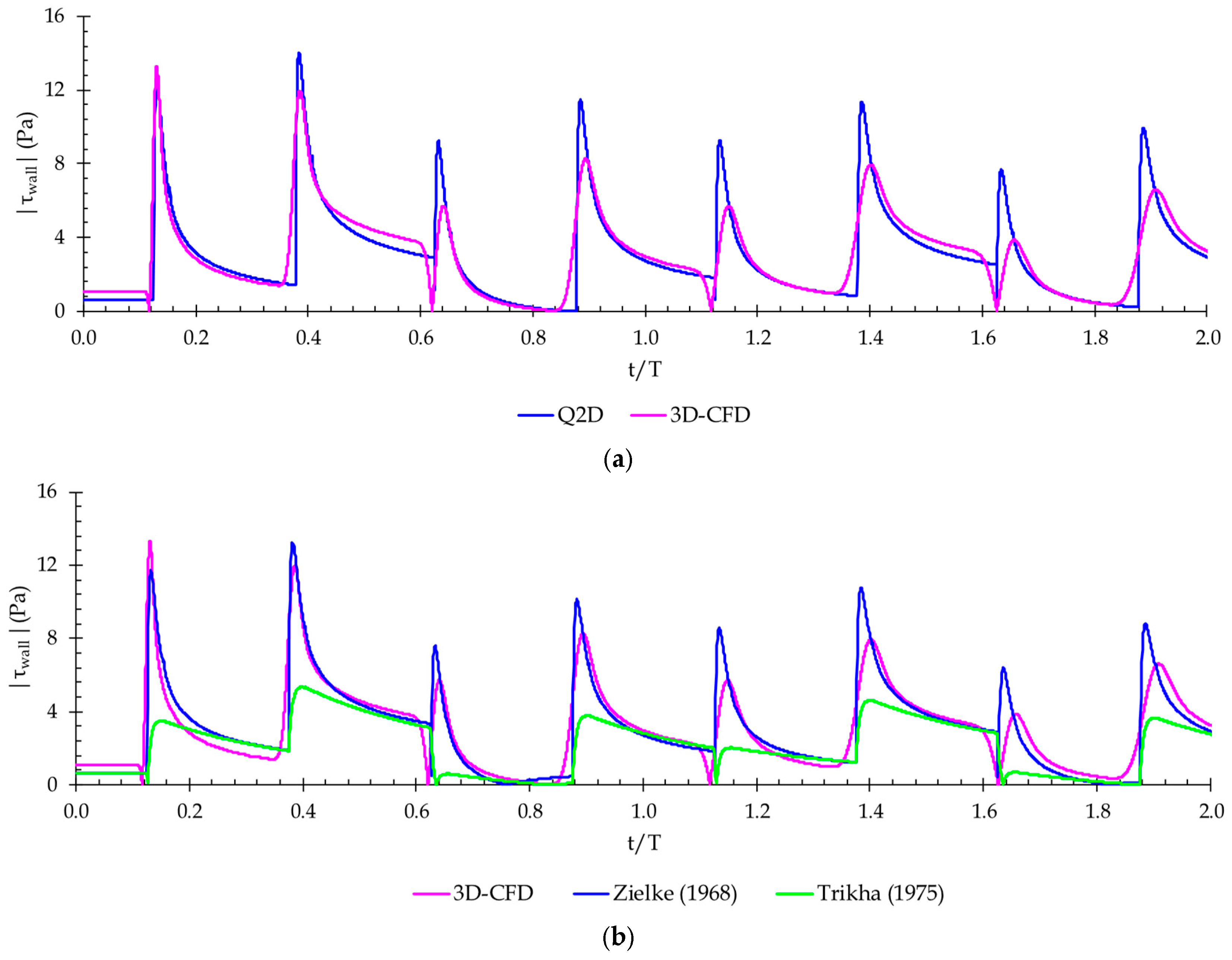
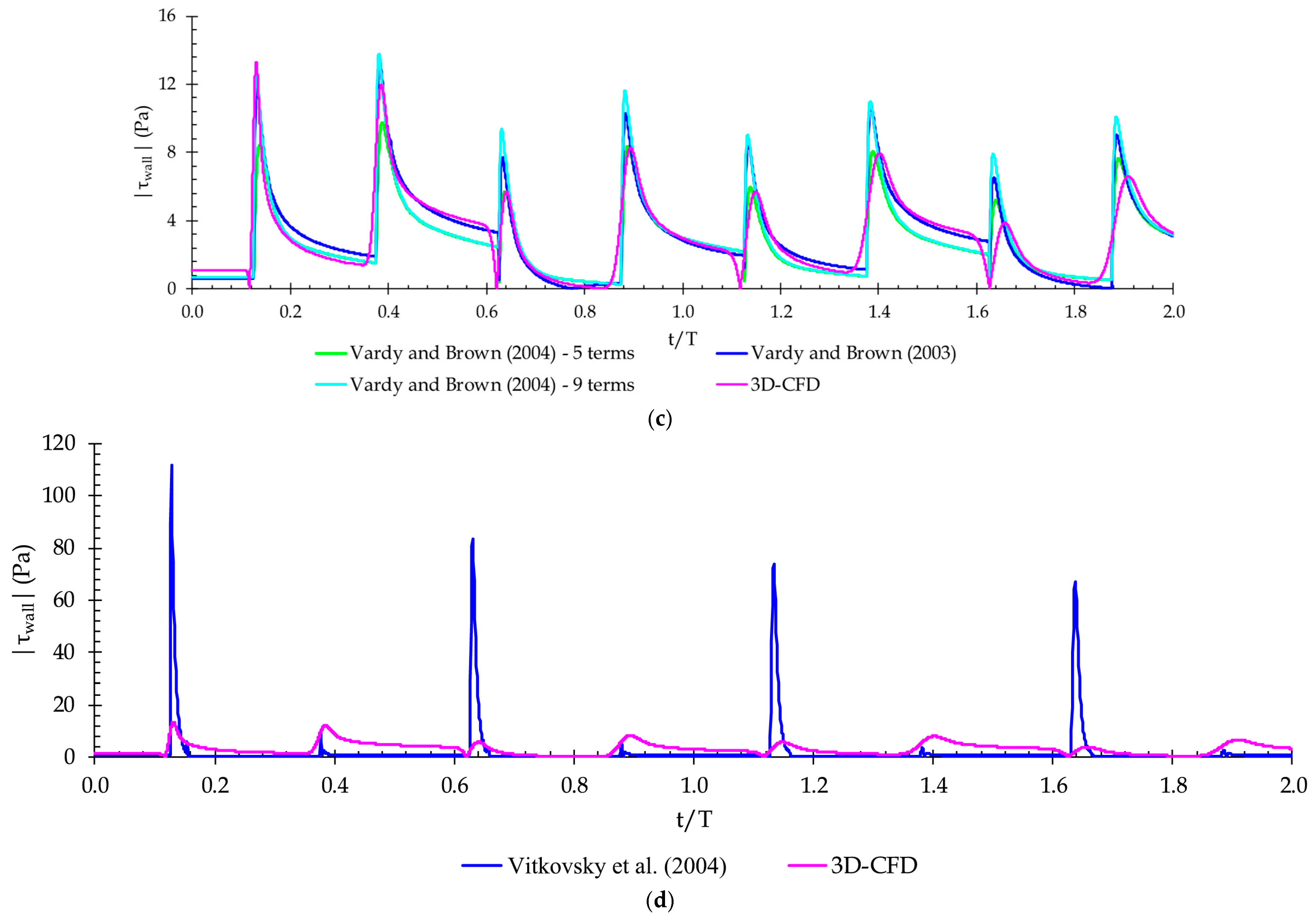
4. Q2D and 3D-CFD Model Results
4.1. Considerations on the Computational Effort
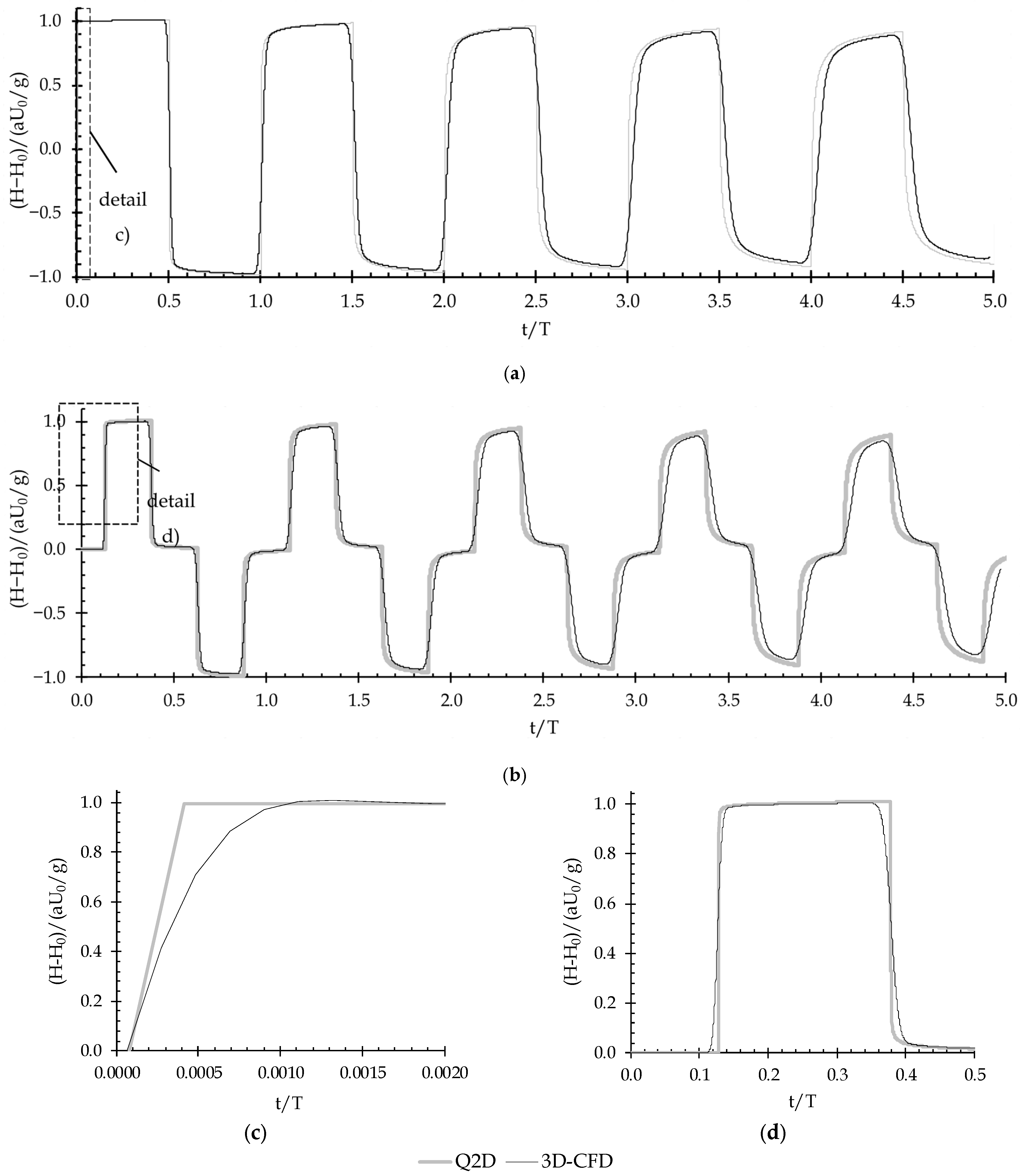
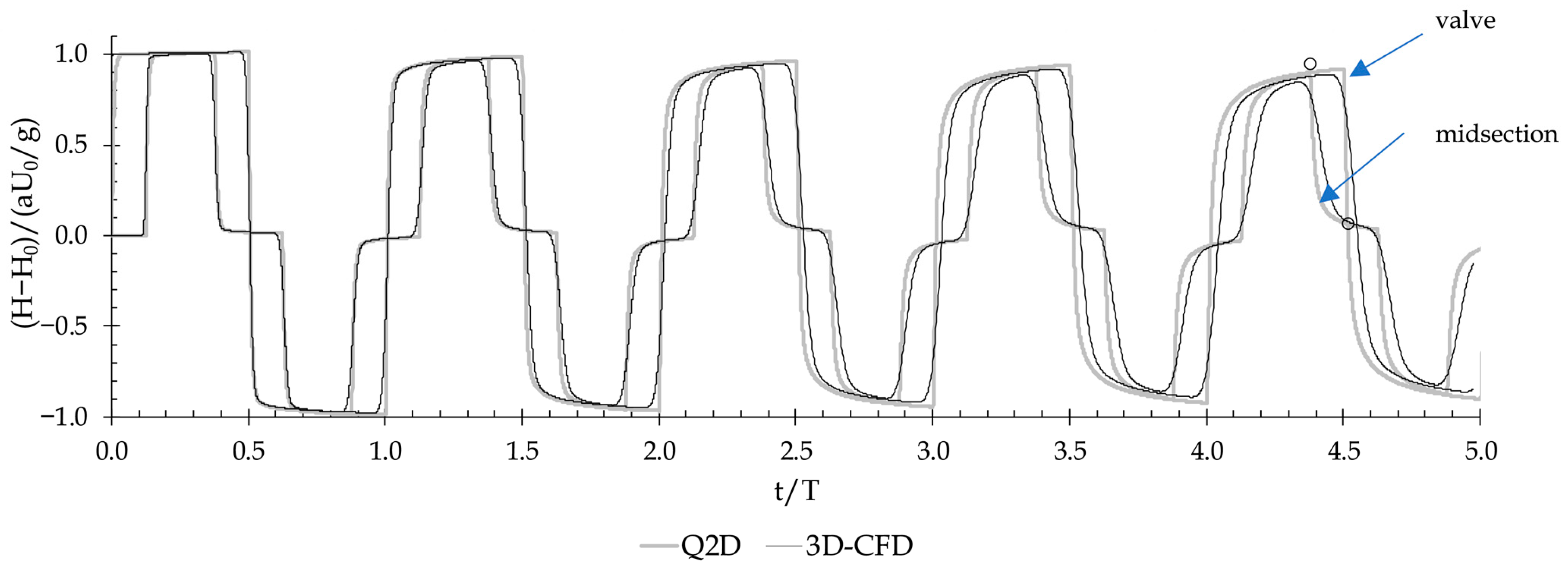
4.2. Instantaneous Valve Manoeuvre
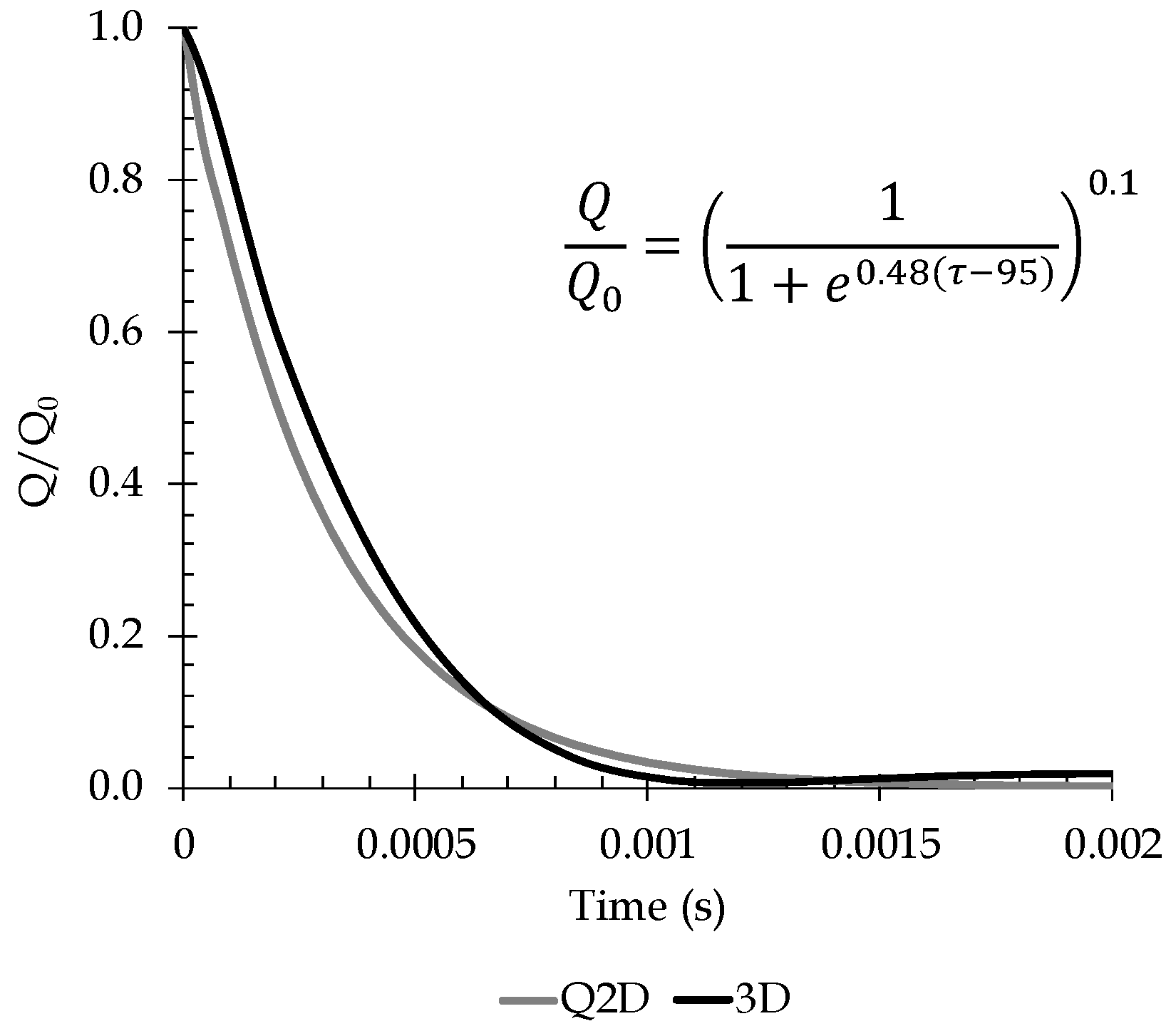
4.3. Valve Closure Calibration
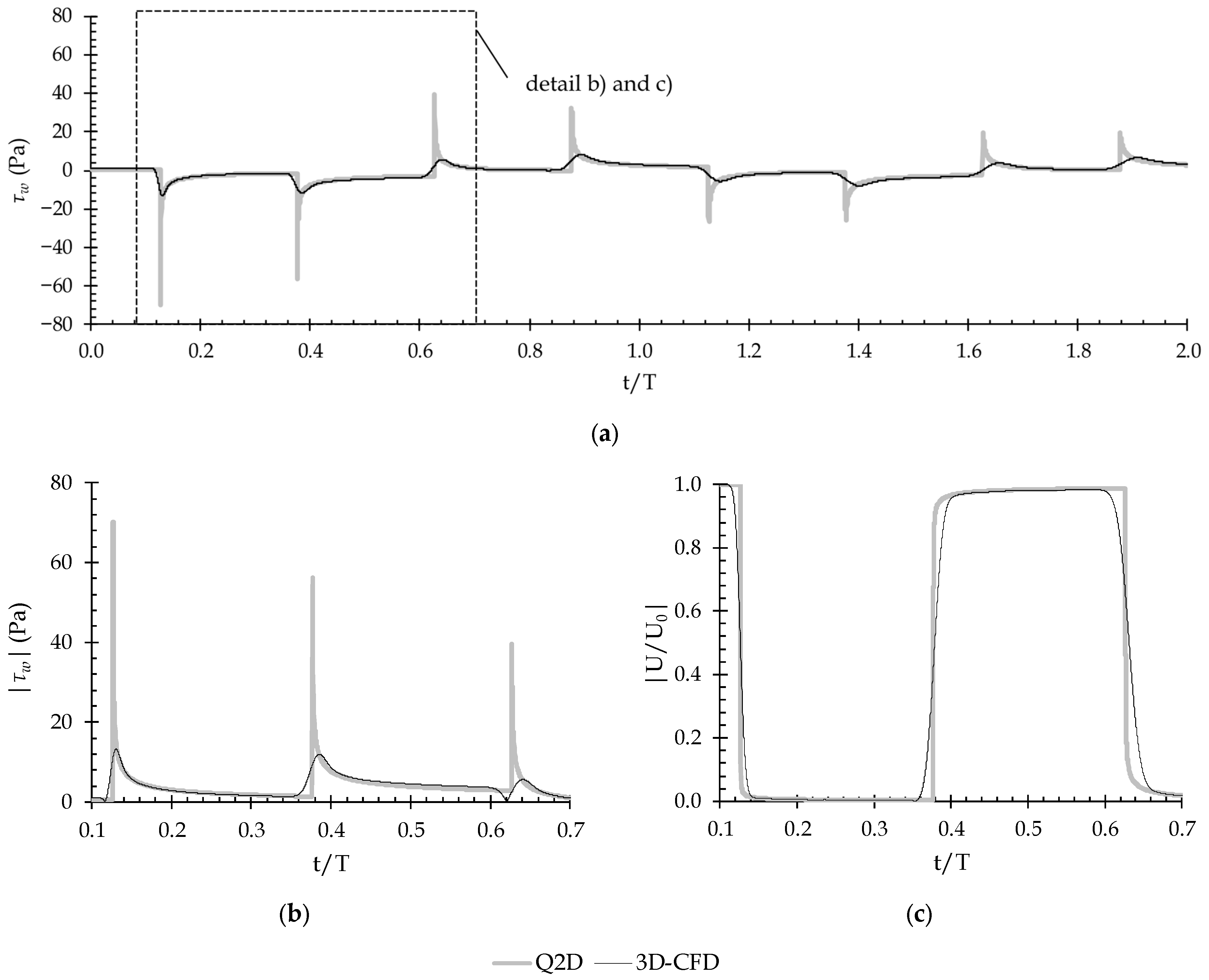
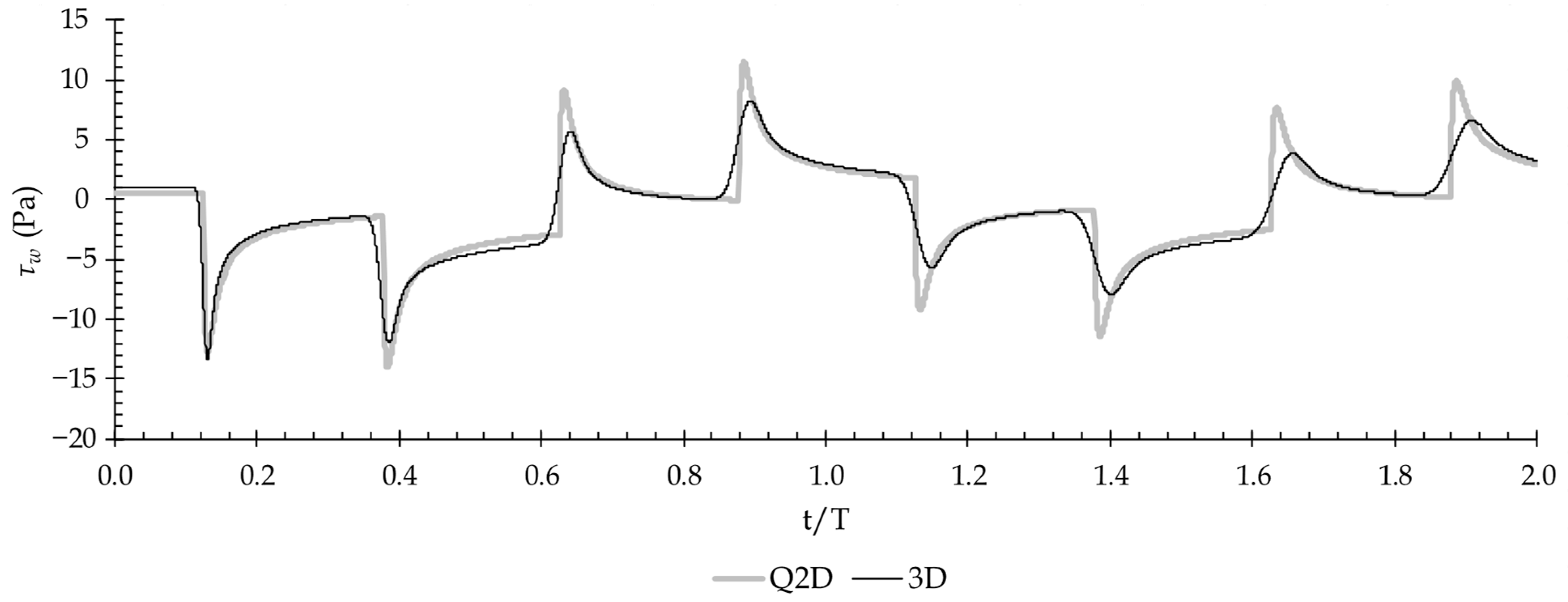
4.4. Discussion of Differences in Results from the Q2D and the 3D-CFD Models
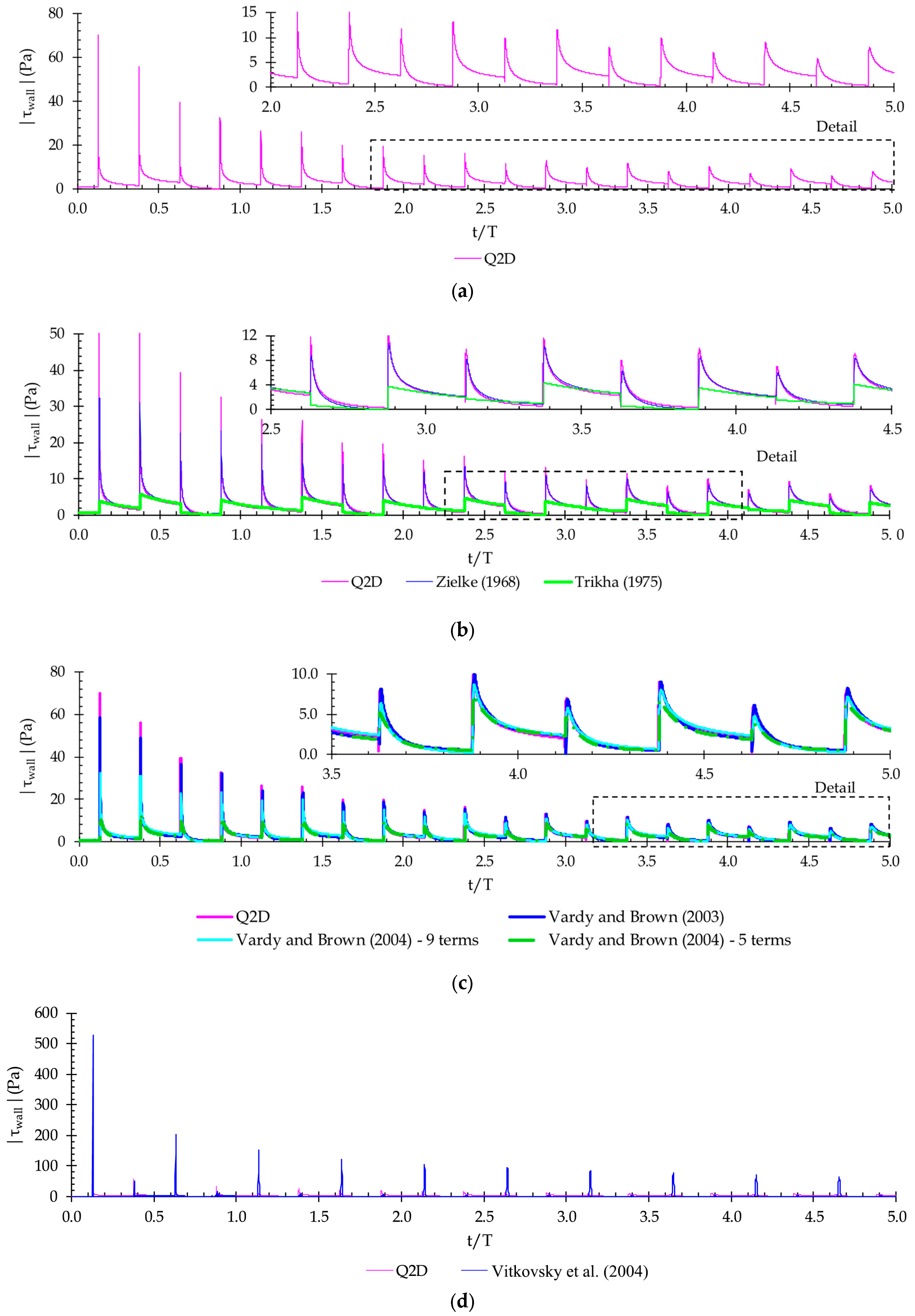
5. Q2D and 1D Model Results
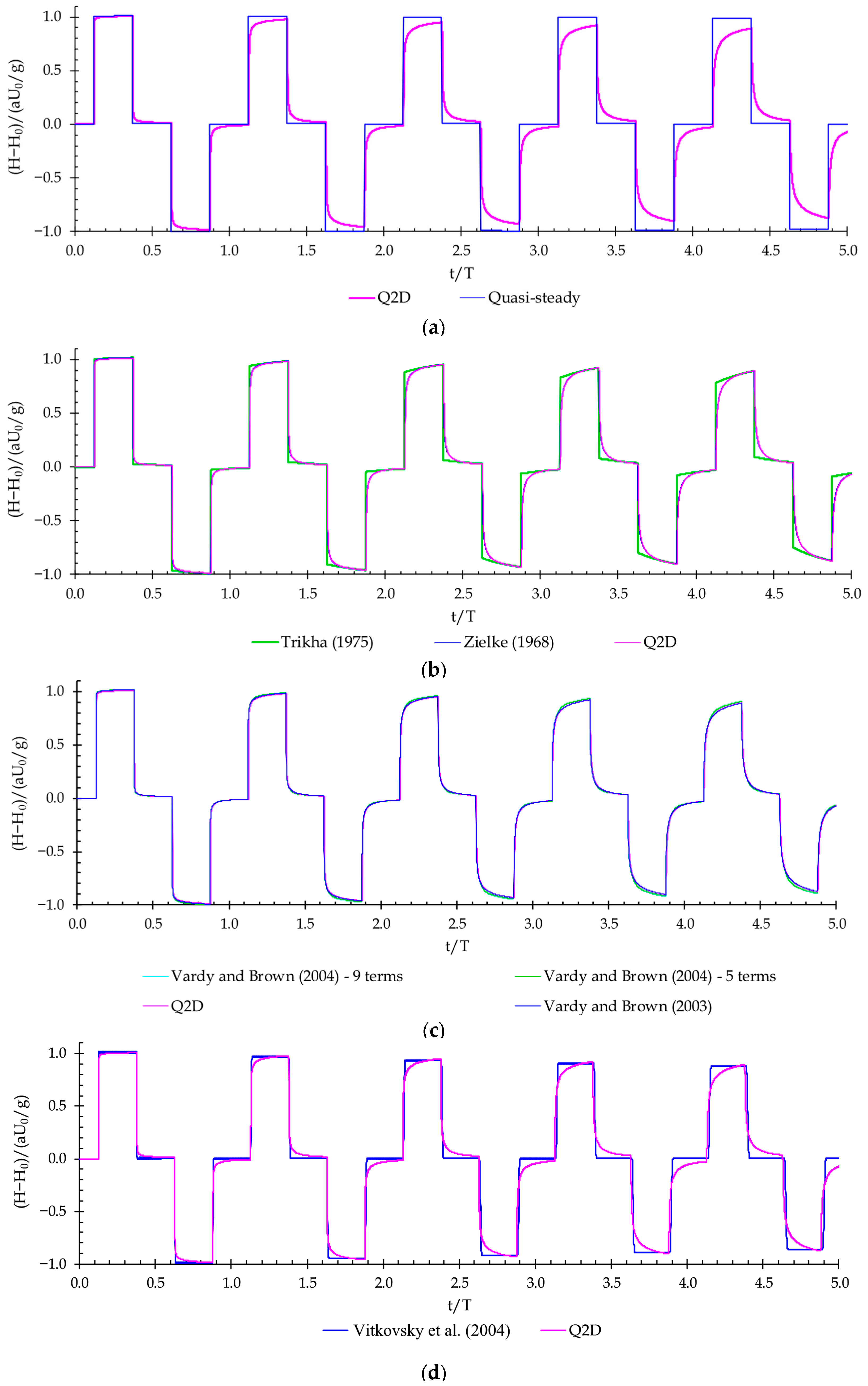
5.1. Instantaneous Valve Manoeuvre
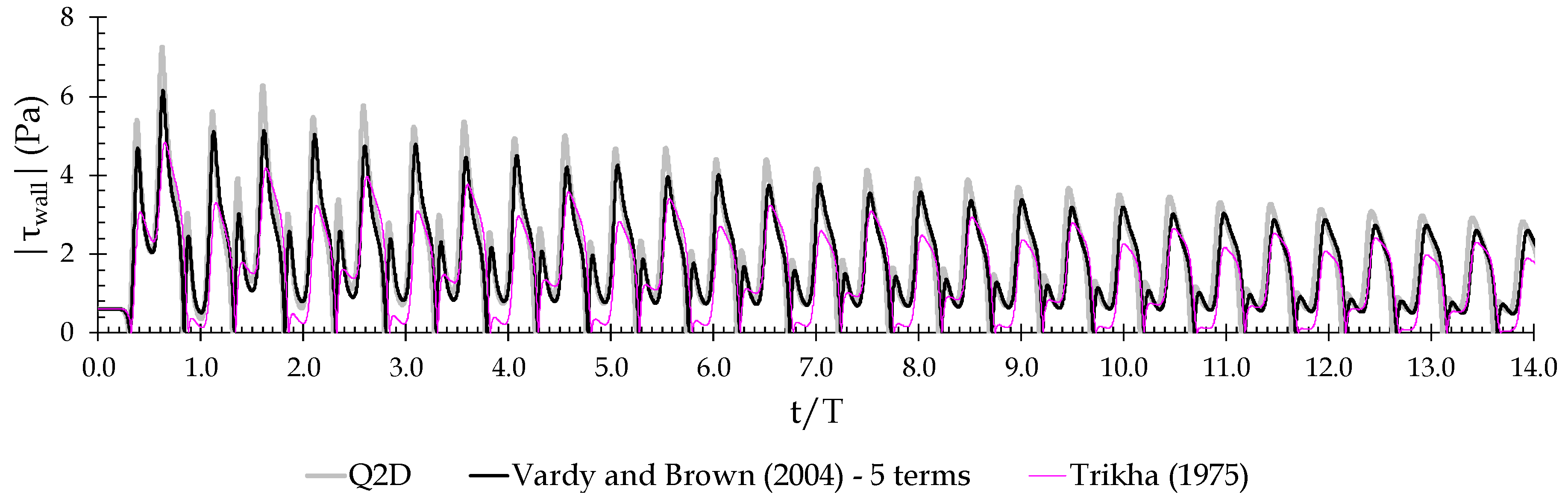
5.2. Calibrated Valve Manoeuvre
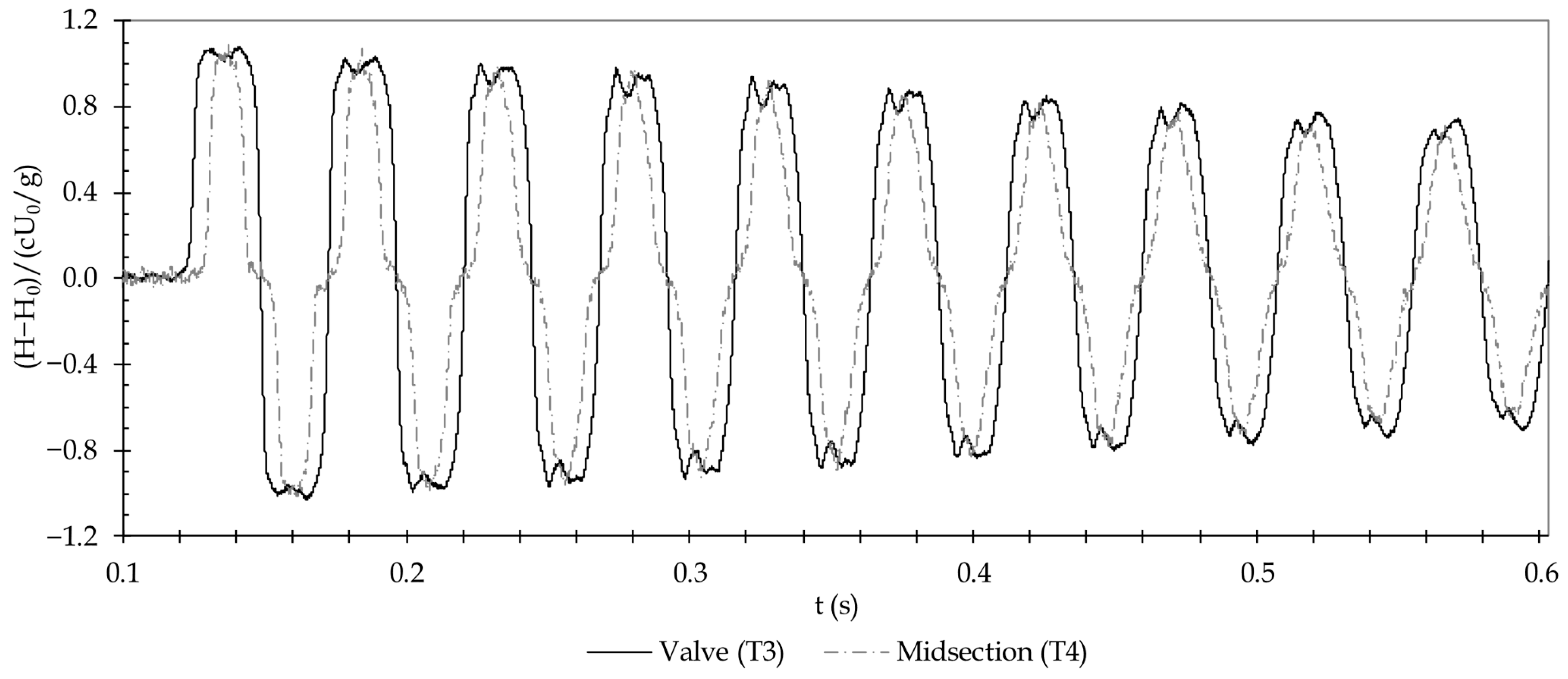
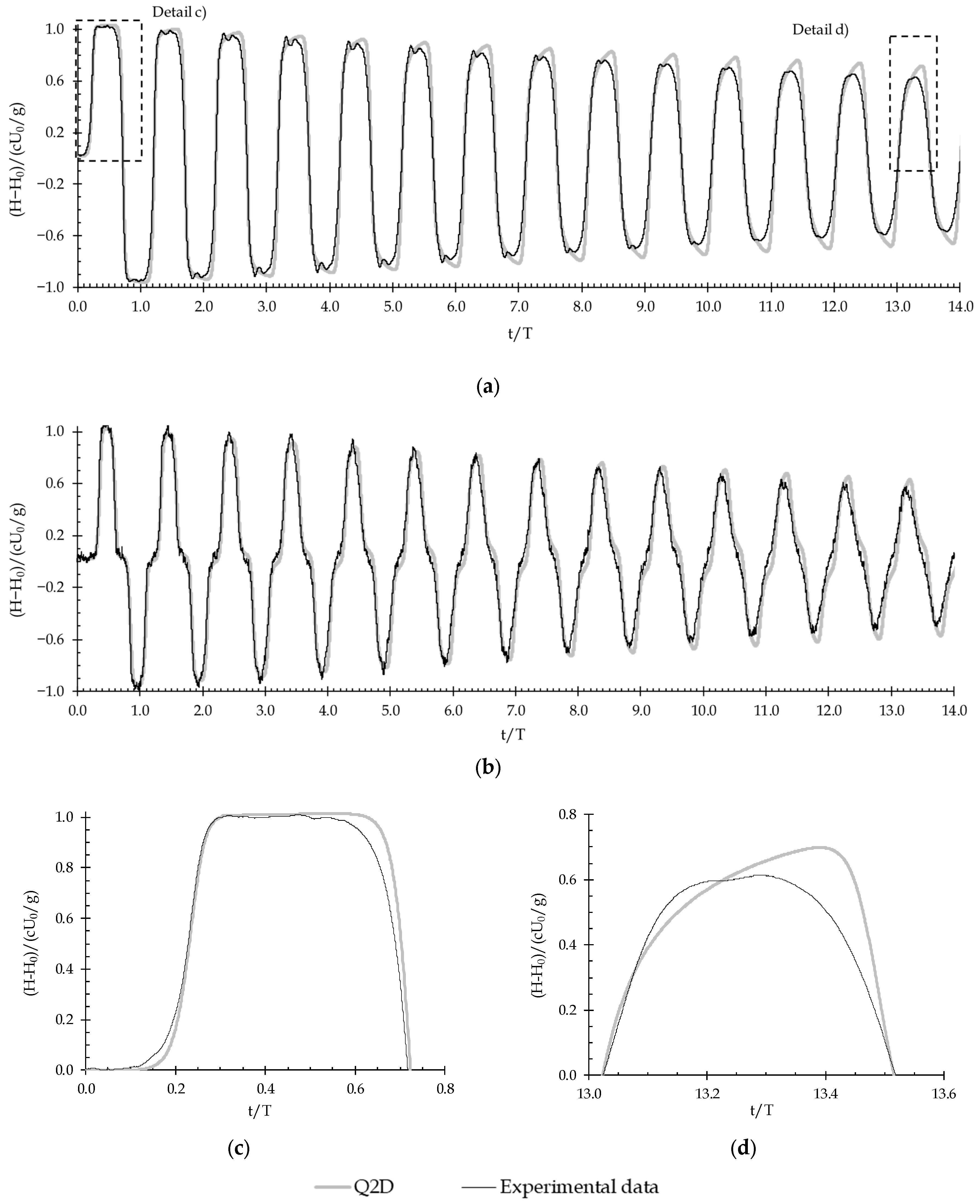
6. Q2D Model Results vs. Experimental Data
7. Conclusions
Author Contributions
Funding
Data Availability Statement
Acknowledgments
Conflicts of Interest
Abbreviations and Nomenclature
| 1D | One-dimensional |
| 2D | Two-dimensional |
| 3D | Three-dimensional |
| CFD | Computation fluid dynamics |
| CIB | Convolution integral-based method |
| Q2D | Quasi-2D axisymmetric model |
| GS | Geometric sequence cylinder mesh |
| IAB | Instantaneous acceleration-based model |
| UF | Unsteady friction |
| CR | geometric sequence common ratio (-) |
| c | pressure wave speed (m/s) |
| D | pipe inner diameter (m) |
| H | piezometric head (m) |
| g | acceleration due to gravity (m/s2) |
| L | pipe length (m) |
| Q | flow rate or discharge (m3/s) |
| NC | total number of cylinders of the radial mesh (-) |
| Re | Reynolds number (-) |
| r | distance from the axis in the radial direction (m) |
| t | time (s) |
| T | pressure wave period (T = 4L/c) (s) |
| mean velocity of the fluid in the pipe cross-section (m/s) | |
| W | weighting function (-) |
| ∆rj | ) |
| u | axial velocity (m/s) |
| turbulence velocity fluctuation on the axial direction (m/s) | |
| radial velocity (m/s) | |
| turbulence velocity fluctuation on the radial direction (m/s) | |
| x | distance along the pipe (m) |
| ν | kinematic viscosity of liquid (m2/s) |
| y | distance from the pipe wall, measured in the radial direction (m) |
| time interval (s) | |
| Von Kármán constant (-) | |
| ≈ 2/3μ) (Pa.s) | |
| ν | kinematic viscosity (m2/s) |
| ε | eddy viscosity (m2/s) |
| dynamic viscosity (Pa.s) | |
| τw | total wall shear stress (Pa) |
| τwu | unsteady wall shear stress (Pa) |
| τws | steady wall shear stress (Pa) |
| liquid density (kg/m3) |
References
- Vardy, A.E.; Brown, J.M.B. Transient turbulent friction in smooth pipe flows. J. Sound Vib. 2003, 259, 1011–1036. [Google Scholar] [CrossRef]
- Covas, D.; Stoianov, I.; Ramos, H.; Graham, N.; Maksimovic, C. The dynamic effect of pipe-wall viscoelasticity in hydraulic transients. Part 1: Experimental analysis and creep characterization. J. Hydraul. Res. 2004, 42, 517–532. [Google Scholar] [CrossRef]
- Ferras, F.; Manso, A.; Schleiss, A.; Covas, I.C.D. Experimental distinction of damping mechanisms during hydraulic transients in pipe flow. J. Fluids Struct. 2016, 66, 424–446. [Google Scholar] [CrossRef]
- Urbanowicz, K.; Bergant, A.; Stosiak, M.; Karpenko, M.; Bogdevičius, M. Developments in analytical wall shear stress modelling for water hammer phenomena. J. Sound Vib. 2023, 562, 117848. [Google Scholar] [CrossRef]
- Urbanowicz, K.; Jing, H.; Bergant, A.; Stosiak, M.; Lubecki, M. Progress in analytical modeling of water hammer. J. Fluids Eng. 2023, 145, 081203. [Google Scholar] [CrossRef]
- Ghidaoui, M.S.; Zhao, M.; McInnis, D.A.; Axworthy, D.H. A review of water hammer theory and practice. Appl. Mech. Rev. 2005, 58, 49–76. [Google Scholar] [CrossRef]
- Brunone, B.; Golia, U.; Greco, M. Modelling of fast transients by numerical methods. In International Conference on Hydraulic Transients with Water Column Separation, Proceedings of the 9th Round Table of the IAHR Group, Valencia, Spain, 4–6 September 1991; IAHR: Madrid, Spain, 1991; pp. 273–280. [Google Scholar]
- Brunone, B.; Golia, U.; Greco, M. Some remarks on the momentum equation for fast transients. In International Conference on Hydraulic Transients with Water Column Separation, Proceedings of the 9th Round Table of the IAHR Group, Valencia, Spain, 4–6 September 1991; IAHR: Madrid, Spain, 1991; pp. 201–209. [Google Scholar]
- Vitkovsky, J.; Stephens, M.; Bergant, A.; Lambert, M.; Simpson, A. Efficient and accurate calculation of Vardy–Brown unsteady friction in pipe transients. In Proceedings of the 9th International Conference on Pressure Surges, Chester, UK, 24–26 March 2004. [Google Scholar]
- Zielke, W. Frequency-dependent friction in transient pipe flow. J. Basic Eng. 1968, 90, 109–115. [Google Scholar] [CrossRef]
- Vardy, A.E.; Brown, J.M.B. Transient turbulent friction in fully rough pipe flows. J. Sound Vib. 2004, 270, 233–257. [Google Scholar] [CrossRef]
- Vardy, A.E.; Hwang, K.-L. A characteristic model of transients in pipes. J. Hydraul. Res. 1991, 29, 669–684. [Google Scholar] [CrossRef]
- Zhao, M.; Ghidaoui, M. Investigation of turbulence behavior in pipe transients using a k–ε model. J. Hydraul. Res. 2006, 44, 682–692. [Google Scholar] [CrossRef]
- Martins, N.M.C.; Carriço, N.J.G.; Ramos, H.M.; Covas, I.C.C. Velocity distribution in pressurized pipe flow using CFD: Accuracy and mesh analysis. Comput. Fluids 2014, 105, 218–230. [Google Scholar] [CrossRef]
- Martins, N.; Brunone, B.; Meniconi, S.; Ramos, H.M.; Covas, D.I.C. CFD and 1D approaches for the unsteady friction analysis of low Reynolds number turbulent flows. J. Hydraul. Eng. 2017, 143, 04017050. [Google Scholar] [CrossRef]
- Martins, N.; Brunone, B.; Meniconi, S.; Ramos, H.M.; Covas, D.I.C. Efficient computational fluid dynamics model for transient laminar flow modelling: Pressure wave propagation and velocity profile changes. J. Fluids Eng. 2018, 140, 011002. [Google Scholar] [CrossRef]
- Vardy, A.E. Acceleration-dependent unsteady friction revisited. In Proceedings of the 13th International Conference on Pressure Surges, Bordeaux, France, 14–16 November 2018; BHR Group: Brittany, France, 2018; pp. 265–282. [Google Scholar]
- Adamkowski, A.; Lewandowski, M. Experimental examination of unsteady friction models for transient pipe flow simulation. J. Fluids Eng. 2006, 128, 1351–1363. [Google Scholar] [CrossRef]
- Ariyaratne, C.; He, S.; Vardy, A.E. Wall friction and turbulence dynamics in decelerating pipe flows. J. Hydraul. Res. 2010, 48, 810–821. [Google Scholar] [CrossRef]
- Trikha, A. An efficient method for simulating frequency-dependent friction in transient liquid flow. J. Fluids Eng. 1975, 97, 97–105. [Google Scholar] [CrossRef]
- Vardy, A.E.; Brown, J.M.B. Efficient approximation of unsteady friction weighting functions. J. Hydraul. Eng. 2004, 130, 1097–1107. [Google Scholar] [CrossRef]
- Ferreira, J.; Martins, N. Ball valve behaviour under steady and unsteady conditions. J. Hydraul. Eng. 2018, 144, 04018005. [Google Scholar] [CrossRef]
- Cebeci, T. Analysis of Turbulent Flows with Computer Programs, 3rd ed.; Elsevier: Oxford, UK, 2013. [Google Scholar]
- Abreu, J.; Betâmio de Almeida, A. Timescale behavior of the wall shear stress in unsteady laminar pipe flows. J. Hydraul. Eng. 2009, 135, 415–424. [Google Scholar] [CrossRef]
- Che, T.; Duan, H.; Lee, P.J.; Meniconi, S.; Pan, B.; Brunone, B. Radial pressure wave behavior in transient laminar pipe flows under different flow perturbations. J. Fluids Eng. 2018, 140, 101203. [Google Scholar] [CrossRef]
- Zidouh, H. Velocity profiles and wall shear stress in turbulent transient pipe flow. Int. J. Dyn. Fluids 2009, 5, 61–83. [Google Scholar]
- Martins, N.M.C.; Wahba, E.M. On the hierarchy of models for pipe transients: From quasi-two-dimensional water hammer models to full three-dimensional computational fluid dynamics models. ASME J. Press. Vessel Technol. 2022, 144, 021402. [Google Scholar] [CrossRef]
- Urbanowicz, K.; Andrade, D.M.; Kubrak, M.; Kodura, A. Accuracy and limitations of 1D and Q2D water hammer models for laminar and turbulent flows. J. Braz. Soc. Mech. Sci. Eng. 2025, 47, 666. [Google Scholar] [CrossRef]
- Ferreira, P.L.; Covas, D.I.C. New Optimized Equal-Area Mesh Used in Axisymmetric Models for Laminar Transient Flows. Water 2023, 15, 1402. [Google Scholar] [CrossRef]
- Ferreira, P.M.L. Axisymmetric Model for Pressurized Transient Flow: Efficient Meshes’ Analysis; Instituto Superior Técnico: Lisbon, Portugal, 2022. [Google Scholar]
- Kita, Y.; Adachi, Y.; Hirose, K. Periodically oscillating turbulent flow in a pipe. Bull. JSME 1980, 23, 656–664. [Google Scholar] [CrossRef]
- Bratland, O. Frequency-dependent friction and radial kinetic energy variation in transient pipe flow. In Proceedings of the 5th International Conference on Pressure Surges, Hanover, Germany, 22–24 September 1986; BHRA, The Fluid Engineering Centre: Bedford, UK, 1986. [Google Scholar]
- Ferreira, P.L.; Covas, D.I.C. Mesh Sensitivity Analysis of Axisymmetric Models for Smooth–Turbulent Transient Flows. Fluids 2024, 9, 268. [Google Scholar] [CrossRef]
- Vardy, A.E.; Brown, J.M.B. Transient, turbulent, smooth pipe friction. J. Hydraul. Res. 1995, 33, 435–456. [Google Scholar] [CrossRef]
- Vardy, A.; Brown, J.; He, S.; Ariyaratne, C.; Gorji, S. Applicability of frozen-viscosity models of unsteady wall shear stress. J. Hydraul. Eng. 2015, 141, 04014073. [Google Scholar] [CrossRef]
- He, S.; Jackson, J.D. A study of turbulence. A study of turbulence under conditions of transient flow in a pipe. J. Fluid Mech. 2000, 408, 1–38. [Google Scholar] [CrossRef]
- Zhao, M.; Ghidaoui, M. Efficient quasi-two-dimensional model for water hammer problems. J. Hydraul. Eng. 2003, 129, 1007–1013. [Google Scholar] [CrossRef]
- Mitra, A.; Rouleau, W. Radial and axial variations in transient pressure waves transmitted through liquid transmission lines. J. Fluids Eng. 1985, 107, 105–111. [Google Scholar] [CrossRef]
- Kagawa, T.; Lee, I.; Kitagawa, A.; Takenaka, T. High-speed and accurate computing method of frequency-dependent friction in laminar pipe flow for the method of characteristics. Trans. Jpn. Soc. Mech. Eng. 1983, 49, 2638–2644. [Google Scholar] [CrossRef]
- Schohl, G.A. Improved approximate method for simulating frequency-dependent friction in transient laminar flow. J. Fluids Eng. 1993, 115, 420–424. [Google Scholar] [CrossRef]



Disclaimer/Publisher’s Note: The statements, opinions and data contained in all publications are solely those of the individual author(s) and contributor(s) and not of MDPI and/or the editor(s). MDPI and/or the editor(s) disclaim responsibility for any injury to people or property resulting from any ideas, methods, instructions or products referred to in the content. |
© 2026 by the authors. Licensee MDPI, Basel, Switzerland. This article is an open access article distributed under the terms and conditions of the Creative Commons Attribution (CC BY) license.
Share and Cite
Ferreira, P.; Covas, D. Quasi-2D Axisymmetric Modelling of Smooth–Turbulent Transient Flow: Comparison with 1D and 3D-CFD Models. Water 2026, 18, 141. https://doi.org/10.3390/w18020141
Ferreira P, Covas D. Quasi-2D Axisymmetric Modelling of Smooth–Turbulent Transient Flow: Comparison with 1D and 3D-CFD Models. Water. 2026; 18(2):141. https://doi.org/10.3390/w18020141
Chicago/Turabian StyleFerreira, Pedro, and Dídia Covas. 2026. "Quasi-2D Axisymmetric Modelling of Smooth–Turbulent Transient Flow: Comparison with 1D and 3D-CFD Models" Water 18, no. 2: 141. https://doi.org/10.3390/w18020141
APA StyleFerreira, P., & Covas, D. (2026). Quasi-2D Axisymmetric Modelling of Smooth–Turbulent Transient Flow: Comparison with 1D and 3D-CFD Models. Water, 18(2), 141. https://doi.org/10.3390/w18020141