3.1. Effects of Microplastic Sizes and Concentrations
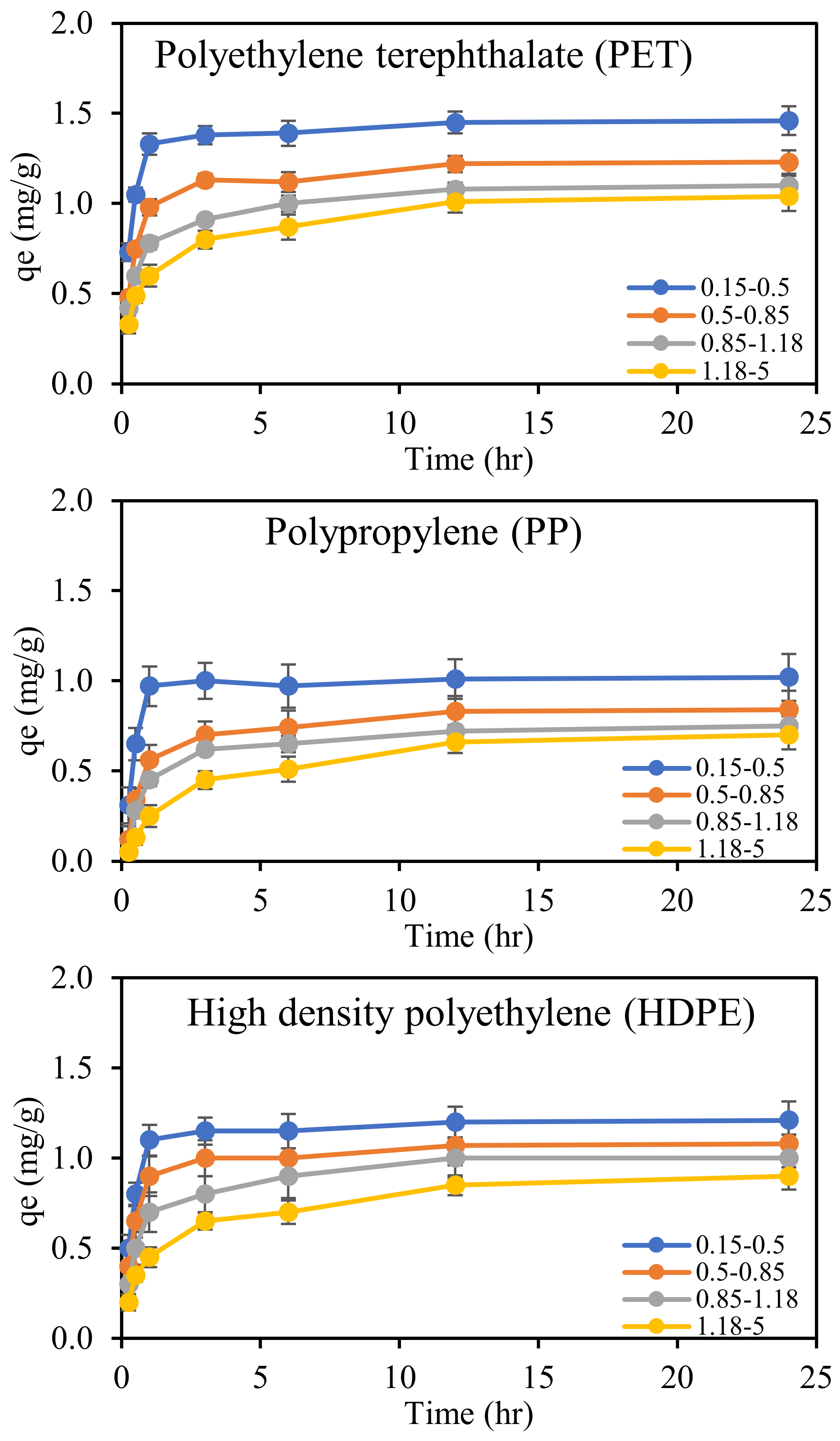
Preliminary single-solute experiments using cefalexin were conducted to select the microplastic particle size and dosage for the subsequent multicomponent experiments. Cefalexin was chosen because of its environmental relevance, high water solubility, and reliable analytical quantification under the experimental conditions. Its use enabled the consistent assessment of the particle size and microplastic dosage before conducting the more analytical and resource-intensive experiments with the nine-antibiotic mixture. These tests were intended for operational optimisation rather than to establish behaviour representative of every antibiotic in the mixture. The selected conditions were subsequently applied consistently to the nine-antibiotic adsorption experiments. The adsorption capacity of cefalexin was first evaluated using all three microplastics (PET, PP, and HDPE) of the following particle sizes (mm): 0.15–0.5, 0.5–0.85, 0.85–1.18, and 1.18–5. Additionally, tests were performed at microplastic concentrations of 100, 1000, and 2000 mg/L. The adsorption of cefalexin onto PET microplastics exhibited clear size-dependent adsorption behaviour, as shown in
Figure 1. Across four tested microplastic sizes, adsorption occurred rapidly in the initial stages (0 to 3 h), indicating that surface interactions mostly controlled the adsorption capacity during this period. The smallest particle size range (0.15–0.5 mm) reached an equilibrium adsorption capacity of approximately 1.46 mg/g by 24 h, whereas the largest size range (1.18–5 mm) achieved only 1.04 mg/g under identical conditions. This observation is consistent with the theoretical expectation that smaller particles have a higher surface-area-to-volume ratio, thereby providing more active sites for the interaction with antibiotic molecules [
21]. This behaviour also aligns with the fundamental principles of adsorption thermodynamics, in which smaller microplastics exhibit a larger specific surface area and more available adsorption sites per unit mass [
22]. Likewise, PP and HDPE microplastics in the smallest size range (0.15–0.5 mm) exhibited the highest adsorption capacity after 24 h of operation time, reaching approximately 1.02 mg/g and 1.21 mg/g, respectively. In contrast, the largest size (1.18–5 mm) exhibited adsorption levels of only 0.70 mg/g and 0.90 mg/g for PP and HDPE, respectively, indicating a consistent decline trend in adsorption efficiency with increasing particle size. Therefore, this inverse relationship between the particle size and adsorption is consistent with the results for all microplastics and aligns with the standard adsorption theory, which foresees that smaller particles have higher surface-area-to-volume ratios, increasing the number of available active binding sites per unit mass.
However, compared with PET microplastics under identical conditions, PP exhibited slightly lower adsorption across all microplastic sizes. This can be attributed to PP’s lower surface polarity and fewer oxygen-containing functional groups, which limit the potential for hydrogen bonding and electrostatic interactions with cefalexin [
23]. Moreover, the chemical inertness and hydrophobicity of PP reduce its reactivity with aquatic contaminants unless it is extensively aged [
24]. Furthermore, HDPE’s surface is generally hydrophobic, and its relatively low polarity hinders strong electrostatic or hydrogen-bonding interactions with polar antibiotic compounds. Despite this, HDPE still exhibited moderate adsorption, which may be attributed to hydrophobic interactions and vdW forces, particularly for smaller particles with irregular, reactive surfaces formed during plastic manufacturing and/or environmental exposure [
25]. Among the polymers (PET, PP, and HDPE), HDPE exhibits intermediate cefalexin adsorption. PET outperforms PP due to its higher surface polarity and ester carbonyl functional groups, which facilitate hydrogen bonding, whereas PP generally adsorbs less due to its highly inert, non-polar surface. On the other hand, the profusion of HDPE in aquatic environments and its degradation into smaller particles reinforce its importance as an antibiotic carrier in aquatic systems, particularly when aged or combined with other pollutants that enhance its adsorption properties.
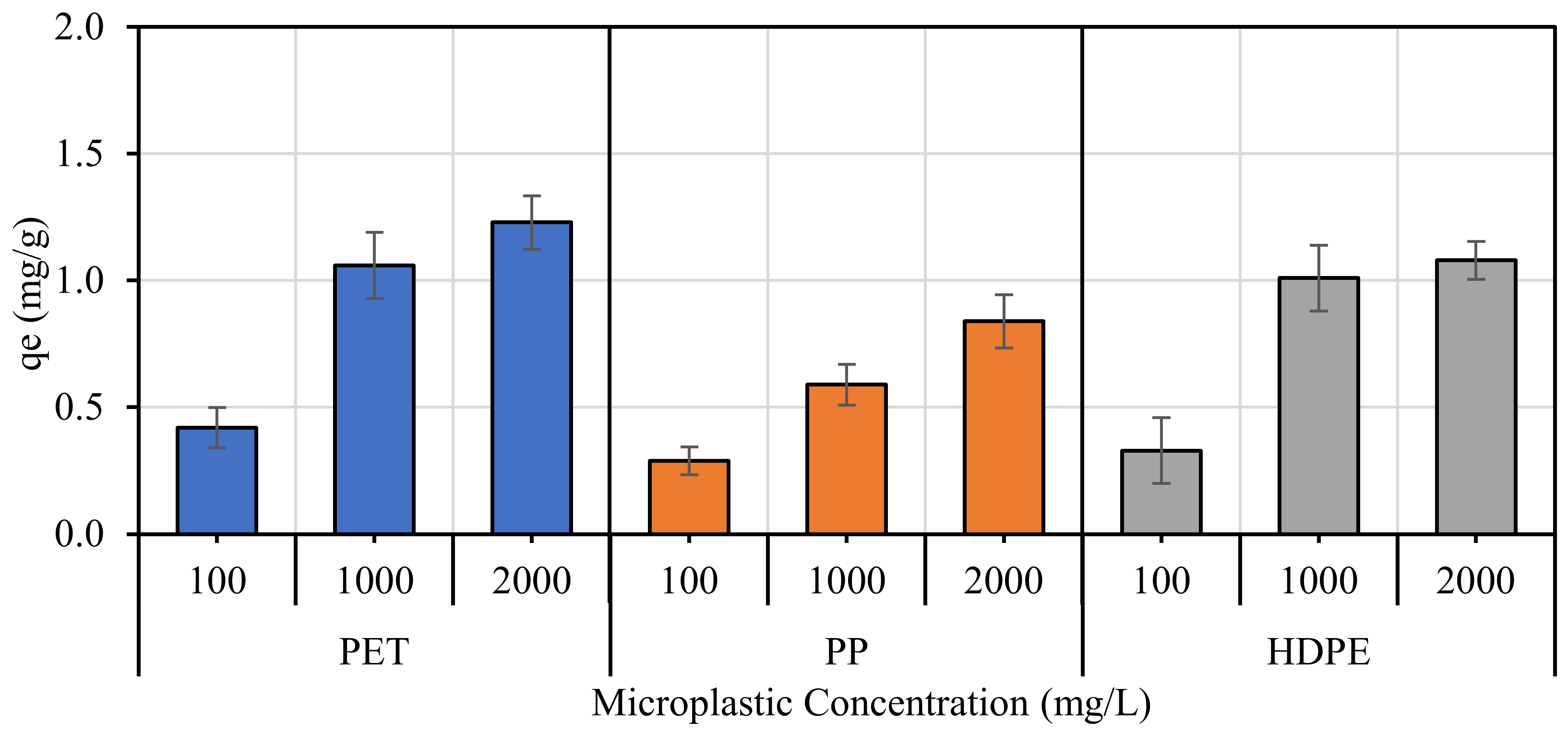
The concentration of microplastics strongly induced the adsorption of cefalexin (
Figure 2), a first-generation cephalosporin antibiotic, onto microplastics in a water solution. After 24 h of operation, adsorption capacities followed a clear trend across all three polymer types: higher microplastic concentrations yielded higher adsorption values (
Figure 2). For instance, PET reached 1.23 mg/g, 1.06 mg/g, and 0.42 mg/g at concentrations of 2000 mg/L, 1000 mg/L, and 100 mg/L, respectively. This trend is attributed to the increase in total available surface area and binding sites with increasing microplastic dosage [
22]. At lower concentrations, the microplastics rapidly become saturated with antibiotic molecules, which limits further antibiotic adsorption. However, at higher microplastic dosages, surface site availability remains in excess relative to the cefalexin concentration, allowing continued adsorption throughout the 24-h period. Although higher microplastic concentrations provide a greater total surface area, this alone cannot explain the increased qe, as qe is normalised to the microplastic mass. The observed increase may instead reflect concentration-dependent adsorption-site utilisation and particle–solute interactions under the experimental conditions.
Among the polymers, PET consistently outperformed both PP and HDPE, which is consistent with its more polar surface and semi-crystalline structure, enhancing its interaction with polar and hydrogen-bonding groups in cefalexin [
26]. In contrast, PP and HDPE, being hydrophobic and lacking functional groups, adsorbed lower amounts of cefalexin (0.84 mg/g and 1.08 mg/g at 2000 mg/L, respectively). Moreover, the adsorption amount showed a rapid initial adsorption during the first 1–3 h, and then a gradual approach to the equilibrium condition was observed. This is governed mainly by hydrophobic and vdW interactions and suggests that external surface adsorption dominates initially, with intra-particle diffusion and equilibrium dynamics taking over later—consistent with pseudo-second-order kinetic behaviour, where chemisorption is the rate-limiting step [
27]. Therefore, this study highlights that elevated microplastic concentrations in polluted waters could substantially increase antibiotic adsorption. This could intensify the environmental persistence, hypothetically facilitating the spread of antibiotic resistance genes (ARGs) by mobile microplastic vectors [
28].
3.2. Adsorption Kinetics Across Microplastic Types
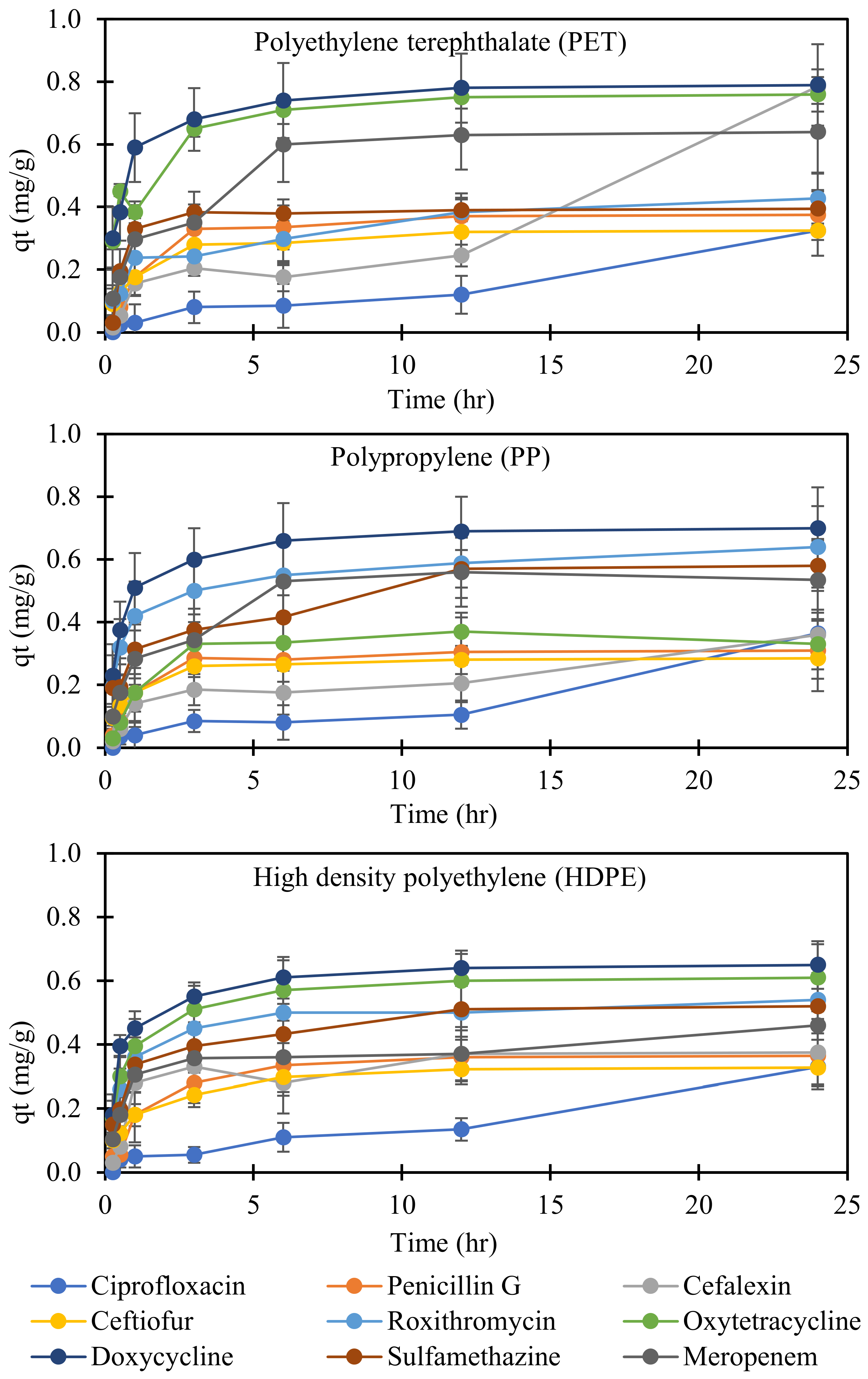
The time-dependent adsorption profiles (
Figure 3) show an initial uptake of nine antibiotics in a mixed solution onto PET, PP, and HDPE microplastics, followed by a gradual approach to equilibrium within 24 h. This behaviour is characteristic of adsorption on heterogeneous polymeric surfaces, where abundant external adsorption sites predominate in the early stage before surface saturation and diffusion limitations become significant [
29]. Moreover, the adsorption profiles of nine antibiotics onto PET, PP, and HDPE microplastics (
Figure 3) reveal an initial uptake during the first 2 to 4 h, followed by a slower approach to equilibrium within 24 h. This two-stage adsorption behaviour is distinctive, with external-surface adsorption dominating in the early stages and progressively slowing as surface sites become saturated [
30,
31]. Compared with PET, the equilibrium adsorption capacities on PP are generally lower, reflecting the non-polar and aliphatic nature of polypropylene, which lacks aromatic rings or polar functional groups capable of strong specific interactions. Compared with PET and PP, HDPE exhibits an intermediate adsorption capacity, reflecting its non-polar but semi-crystalline structure, which favours hydrophobic interactions but lacks aromatic rings or polar functional groups for strong, specific binding.
Despite clear differences in the microplastic surface chemistry, the adsorption kinetics for all antibiotics on PET, PP, and HDPE were consistently best described by the pseudo-second-order (PSO) kinetic model, with the coefficients of determination (R
2) generally higher than 0.90 and reaching up to 0.97–0.99 for several antibiotics (
Table S3). The universal applicability of the PSO model across microplastics suggests that antibiotic adsorption is influenced more by the availability and reactivity of surface adsorption sites than by polymer-specific diffusion limitations. In contrast, the PFO kinetic model performed moderately across all three microplastics, with R
2 values of approximately 0.80 or higher for most antibiotics, which is comparatively lower than PSO. These features indicate numerical differences in PFO and limit its mechanistic significance, demonstrating that adsorption is not dominated by simple physisorption that depends solely on the availability of vacant surface sites. Similar inadequacies of the PFO model have been widely reported in antibiotic adsorption onto microplastics and polymeric sorbents, where multisite, chemically driven adsorption processes predominate [
22]. The relatively high PSO rate constants observed for several antibiotics, including ceftiofur, doxycycline, sulfamethazine, meropenem, and roxithromycin, further indicate a rapid surface association upon antibiotic interaction with the microplastic surface. These kinetic features support adsorption mechanisms which may involve electron donor–acceptor interactions, hydrogen bonding, π–π stacking, and hydrophobic partitioning, rather than diffusion-limited physical adsorption [
32]. The dominance of PSO kinetics for antibiotic–microplastic interactions is consistent with previous studies and is widely interpreted as indicative of chemically controlled adsorption behaviour, even for non-polar polymers such as PP and HDPE [
33,
34,
35].
The intra-particle diffusion (IPD) model was applied as a diagnostic assessment to determine whether diffusion-related limitations contributed to the adsorption kinetics of PET, PP, and HDPE microplastics (
Figure S2). The IPD plot exhibited the clear multi-linear behaviour for all antibiotics, with none of the regression lines passing through the origin. From
Table 1, this observation, with non-zero intercept values (C = −0.0035 to 0.2771 mg/g for PET, 0.0017 to 0.2422 mg/g for PP, and 0.0014 to 0.2212 mg/g for HDPE), demonstrates that intra-particle diffusion is not the sole rate-limiting step. Instead, adsorption may be controlled by a combination of boundary-layer (film) diffusion and surface interactions. A Boyd plot analysis further showed that the regression lines did not pass through the origin, indicating that film diffusion/external mass transfer was more influential than intra-particle diffusion [
21,
36]. This interpretation is consistent with the relatively large particle size and expected low-porosity nature of the tested PET, PP, and HDPE microplastics, which would limit the internal diffusion pathways. Therefore, the IPD analysis was used here primarily to exclude intra-particle diffusion as the dominant rate-controlling mechanism rather than to imply substantial diffusion within microplastic pores.
3.3. Equilibrium Adsorption Behaviour and Isotherm Modelling
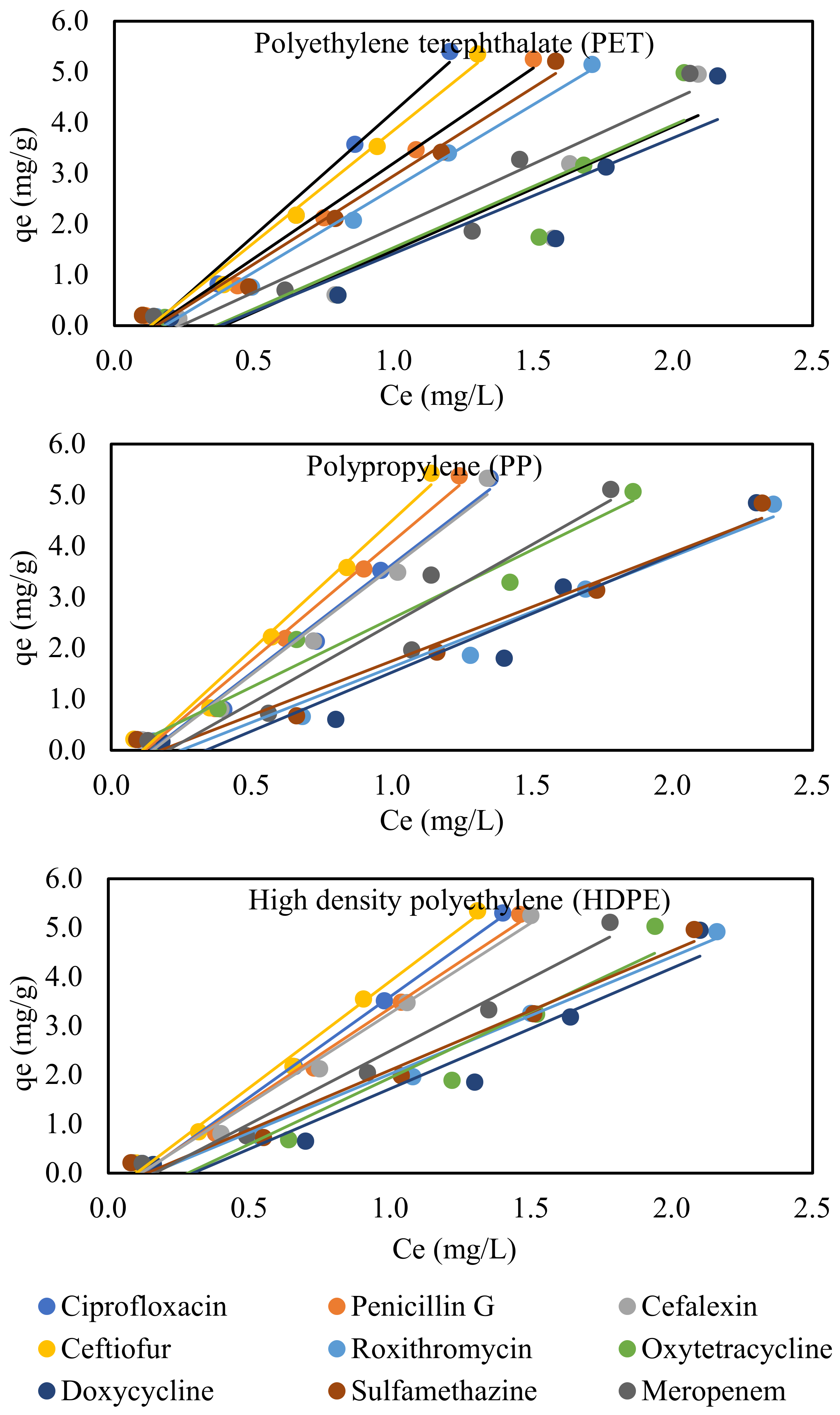
Figure 4 presents the experimental equilibrium adsorption isotherms of antibiotics on PET, PP, and HDPE microplastics over a concentration range of 0.5–12 mg/L. In this study, the adsorption capacity (qe) increased non-linearly with increasing equilibrium concentration (Ce), indicating heterogeneous surface adsorption rather than ideal monolayer exposure. This non-linearity suggests the presence of energetically diverse adsorption sites and concentration-dependent interaction mechanisms, which are commonly observed in antibiotic–microplastic systems and are consistent with Freundlich-type behaviour [
22]. Across the three tested microplastics, PET exhibited a stronger adsorption affinity at low Ce for several antibiotics (
Figure 4), as reflected by the rapid initial isotherm rises for ciprofloxacin, ceftiofur, sulfamethazine, and roxithromycin. This adsorption behaviour can be attributed to the chemically heterogeneous PET surface, which contains ester groups, aromatic chains, and surface cracking, which enable site-specific interactions such as hydrogen bonding and π–π interactions [
37].
In contrast, adsorption onto PP and HDPE microplastics was primarily driven by hydrophobic interactions and diffusion, reflecting the non-polar, chemically inert nature of polyolefin surfaces. Although both microplastics exhibited heterogeneous adsorption behaviour, their isotherms showed a comparatively weaker adsorption affinity at a low Ce (
Figure 4), confirming the absence of aromatic rings or polar functional groups capable of strong site-specific binding [
38]. Nevertheless, antibiotic-dependent differences were observed on both PP and HDPE, showing that the molecular hydrophobicity, size, and functional-group distribution remain important parameters of adsorption affinity even in non-polar systems [
39]. Notably, on HDPE, antibiotics such as ciprofloxacin, ceftiofur, penicillin G, and meropenem exhibited relatively reasonable isotherm slopes at low Ce, indicating favourable surface interactions at environmentally relevant concentrations. In contrast, oxytetracycline and doxycycline displayed more gradual increases in the adsorption capacity, suggesting that steric hindrance and conformational constraints may limit the efficient surface adsorption on the semi-crystalline HDPE matrix. These trends highlight that, although hydrophobic interactions dominate adsorption on polyolefins, the molecular structure continues to modulate the adsorption efficiency [
40]. Therefore, PET acts as a chemically active adsorbent with stronger site-specific interactions, whereas PP and HDPE function primarily as partitioning media, resulting in a weaker but still selective adsorption across the tested concentration range.
The Freundlich model provided a robust and physically meaningful description of antibiotic adsorption onto PET, PP, and HDPE microplastics, with high coefficients of determination (R
2 = 0.95–0.99) and generally low RMSE (0.0440–0.4107) values (
Table S6). This confirms that adsorption occurs on energetically heterogeneous surfaces rather than on an ideal monolayer. The Freundlich constant (K
F) varied substantially among antibiotics and microplastics, highlighting strong antibiotic-specific and microplastic-dependent interactions. In contrast, although the Langmuir model yielded statistical correlations (R
2 = 0.78–0.0.98, RMSE = 0.2861–0.8315) for all three microplastics, the derived Langmuir parameters were physically less suitable, though the Langmuir model-derived adsorption capacity (Qm) and affinity constant (KL) followed a non-linear fitting but had lower R
2 and higher RMSE values for nearly all antibiotics (
Table S5). Such parameters limit the fundamental assumptions of the Langmuir model, which presumes monolayer adsorption on a homogeneous surface with identical adsorption sites and no adsorbate–adsorbent interactions [
41]. Therefore, the apparent goodness of fit arises from non-linearisation artifacts rather than true mechanistic strength, a limitation well-documented for heterogeneous polymeric adsorbents for microplastics [
42]. Consequently, the Langmuir model is mechanistically improper for describing the antibiotic adsorption on PET, PP, and HDPE microplastics and is not used to infer the adsorption capacity or surface diffusion behaviour. Hence, the Freundlich model provides a more realistic and environmentally relevant framework for describing the antibiotic partitioning onto PET, PP, and HDPE microplastics across the tested concentration range.
On the other hand, the multi-component Sheindorf–Rebuhn–Sheintuch (SRS) model also provided a description of antibiotic adsorption onto all three microplastics, exhibiting multi-component Freundlich isotherms across all microplastics. Moderate coefficients of determination, where R
2 varies in a range of 0.7200 to 0.9310, together with consistently high RMSE (0.4614–1.6342) values (
Table S7), demonstrate the superior predictive capability of the SRS model when multiple antibiotics coexist. However, meropenem adsorption on PET and PP, doxycycline on PP, sulfamethazine on PP and HDPE, and oxytetracycline on HDPE showed lower R
2 values. These results confirm that competitive interactions and surface heterogeneity equally dominate adsorption behaviour, executing multi-solute models insufficient for environmentally relevant systems [
43]. The SRS interaction parameter αij, which quantifies the relative and competitive strength of each antibiotic, revealed pronounced antibiotic- and microplastic-dependent selectivity. Across all three tested microplastics, αij exhibited values up to 0.56, indicating a greater competitiveness for available adsorption sites under multicomponent conditions. These antibiotics generally possess aromatic moieties, moderate hydrophobicity, or compact molecular structures that favour surface accessibility and competitive dominance [
44]. Nonetheless, antibiotics with comparatively high adsorption capacities, such as meropenem, doxycycline, and oxytetracycline, was less competitive in multicomponent systems. This behaviour is attributed to steric constraints and the large molecular size, which limit their ability to compete for surface sites; yet, they consistently show a higher adsorption due to the strong intrinsic affinity. However, the RMSE value of the SRS model differed from that of the Freundlich model, indicating a comparatively distinct goodness of fit based on the RMSE criterion. This difference does not necessarily indicate a modelling dispute, as the two models represent different adsorption systems. The Freundlich model describes the adsorption behaviour of individual components, whereas the SRS model accounts for competitive adsorption in a multicomponent system. Consequently, the SRS model involves additional complexity associated with interactions among coexisting adsorbates, which may result in greater deviations between the experimental and predicted adsorption capacities. Therefore, this work does not compare the Freundlich and SRS models; instead, it presents them as applicable to single-component and multicomponent adsorption systems.
3.4. Mechanistic Interpretation of Antibiotic–Microplastic Interactions
3.4.1. Effects of Polymer Type
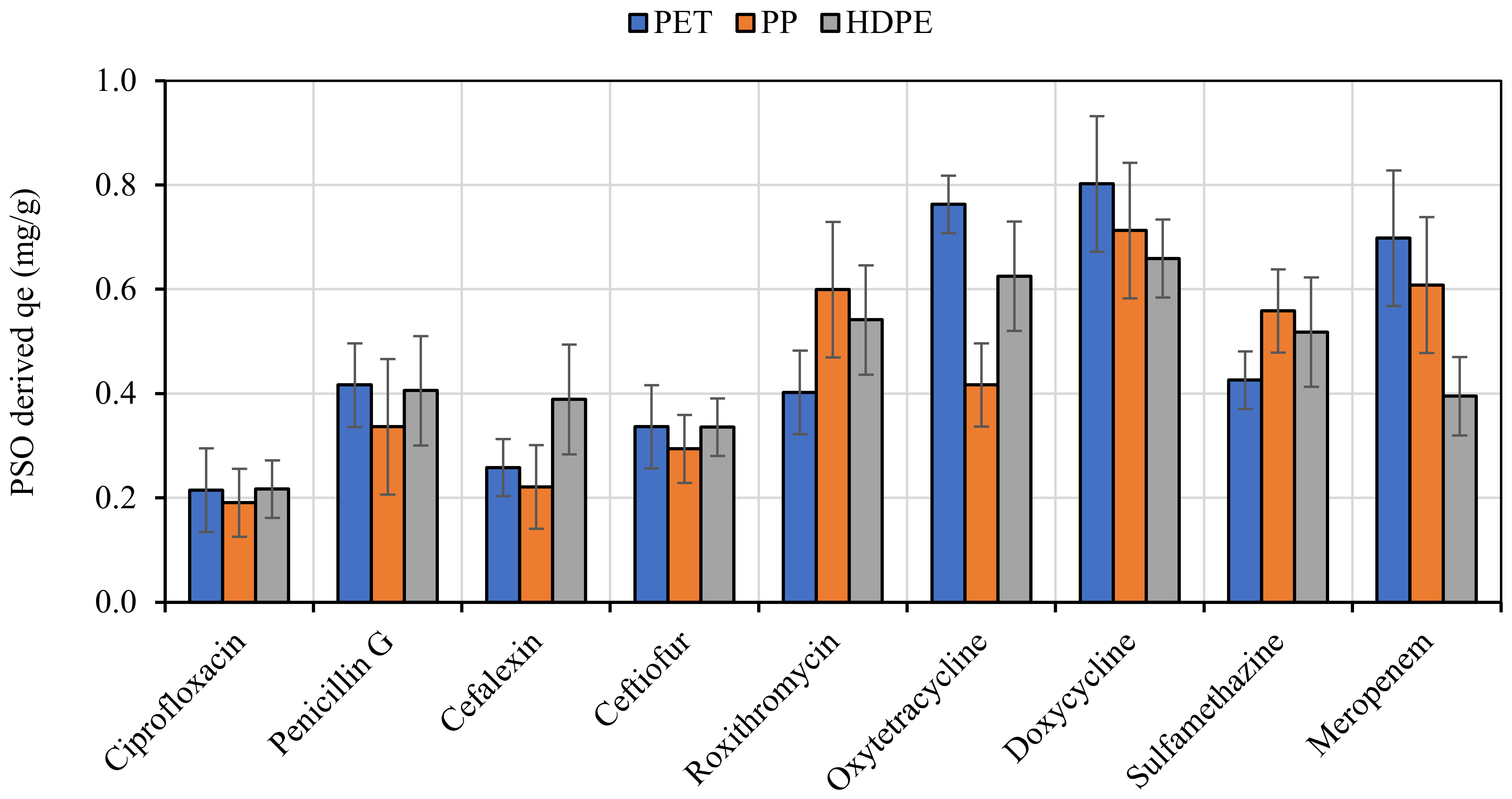
The polymer type of microplastics represents the main structural variable controlling the antibiotic adsorption behaviour, as it defines the surface functionality, aromaticity, polarity, and chain structure. These properties determine the dominant interaction pathways at the solid–liquid interface. The three tested microplastics provide chemically distinct adsorption behaviour as shown in
Figure 5. PET is an aromatic polyester containing ester linkages and π-electron-rich terephthalate rings, whereas PP and HDPE are non-polar polyolefins composed of saturated hydrocarbon chains. In this study, PET showed enhanced selectivity toward π-conjugated and multifunctional antibiotics. The pseudo-second-order-derived equilibrium adsorption capacities (qe) demonstrate systematic polymer-dependent selectivity across all nine antibiotics. Doxycycline (0.8023 mg/g) and oxytetracycline (0.7631 mg/g) showed the highest adsorption capacities on PET, followed by meropenem (0.6979 mg/g) and roxithromycin (0.4025 mg/g). In contrast, ciprofloxacin displayed substantially lower adsorption (0.2150 mg/g), while penicillin G (0.166 mg/g), cefalexin (0.2584 mg/g), ceftiofur (0.3364 mg/g), and sulfamethazine (0.4260 mg/g) exhibited intermediate values. This preferential adsorption of doxycycline and oxytetracycline is mechanistically consistent with PET’s aromatic terephthalate rings and polar ester carbonyl groups, which enable π–π stacking, electron donor–acceptor interactions, and hydrogen bonding. The similar preferential retention of aromatic antibiotics on polyester and other aromatic polymers has been widely attributed to π–π interactions and surface polarity effects [
45,
46]. The excellent PSO fits (R
2 up to 0.9983) further indicate that adsorption on PET is dominated by surface-controlled processes involving specific interfacial interactions rather than by diffusion-limited adsorption.
In contrast, PP and HDPE lack aromatic rings and polar functional groups, preventing strong π–π stacking and hydrogen bonding. Adsorption on these polyolefins is governed primarily by non-specific diffusive interactions and molecular accommodation within amorphous surface regions. On PP, a relatively high adsorption was observed, in PSO fit, for doxycycline (0.7127 mg/g), roxithromycin (0.5992 mg/g), sulfamethazine (0.5586 mg/g), and meropenem (0.6084 mg/g), whereas ciprofloxacin (0.1907 mg/g) and cefalexin (0.2212 mg/g) showed limited adsorption. The strong adsorption on PP suggests stabilisation via vdW forces between the PP hydrophobic domains and their matrix. Ref. [
41] also reported a similar diffusive-dominated adsorption of antibiotics onto polyethylene and polypropylene microplastics.
HDPE exhibited adsorption behaviour broadly comparable to that of PP, but with subtle distinctions that reflect the differences in crystallinity and chain packing density. Doxycycline (0.6593 mg/g), oxytetracycline (0.6252 mg/g), roxithromycin (0.5414 mg/g), and sulfamethazine (0.5180 mg/g) again showed strong adsorption, whereas ciprofloxacin (0.2172 mg/g) and meropenem (0.3953 mg/g) displayed a comparatively lower uptake. The slightly reduced adsorption of remaining antibiotics onto HDPE relative to PP indicates that increased crystallinity and reduced chain mobility restrict surface accommodation. According to Koelmans, et al. [
47], polymer crystallinity has been shown to affect adsorption by limiting the number of available amorphous domains and reducing the number of accessible interaction sites.
Therefore, the consistent variation in adsorption capacity across PET, PP, and HDPE confirms that the polymer surface chemistry and chain structure fundamentally dictate antibiotic adsorption. PET functions as a chemically selective adsorbent because its aromatic and polar domains promote specific interactions, whereas PP and HDPE act as low-surface-energy substrates dominated by diffusive interactions and molecular incorporation. The observed polymer-dependent adsorption trend demonstrates that the microplastic polymer type is a critical factor in contaminant partitioning behaviour in aquatic systems. Needless to say, this study did not independently characterize the physicochemical properties of microplastics, including the crystallinity, porosity, surface charge, and surface chemistry. Therefore, the proposed adsorption mechanisms based on these properties are interpretations supported by the previous literature rather than direct mechanistic evidence from the materials used in the present experiments.
3.4.2. Effects of Van Der Waals and π–π Interactions
van der Waals (vdW) diffusion forces and π–π interactions establish the dominant non-covalent stabilisation mechanisms governing antibiotic adsorption onto microplastics. The relative importance of these forces varies systematically with polymer chemistry and is reflected in both equilibrium adsorption capacities (qe) and kinetic parameters (
Table S3). PET provides an aromatic and partially polar surface environment due to its terephthalate rings and ester linkages. This structural feature enables π–π interactions between PET’s aromatic domains and the conjugated ring systems of several antibiotics. According to the PSO fit, the enhanced adsorption of doxycycline (0.8023 mg/g), oxytetracycline (0.7631 mg/g), meropenem (0.6979 mg/g), and roxithromycin (0.4205 mg/g) on PET reflects contributions from π–π interactions in addition to diffusive stabilisation. Oxytetracycline and doxycycline contain extended conjugated systems that can stack parallel to PET’s aromatic rings, increasing the interfacial stabilisation energy. π–π interactions between aromatic antibiotics and PET have been previously documented and are recognized as a key contributor to the selective adsorption on aromatic polymers [
48].
In polyolefins, PP, and HDPE, which lack aromatic rings and polar functional groups, adsorption is primarily stabilized by vdW interactions between hydrocarbon chains and the hydrophobic domains of antibiotics. This mechanism is consistent with the relatively strong adsorption of roxithromycin (PP: 0.5992 mg/g; HDPE: 0.5414 mg/g), sulfamethazine (PP: 0.5586 mg/g; HDPE: 0.5180 mg/g), doxycycline (PP: 0.7127 mg/g; HDPE: 0.6593 mg/g), and oxytetracycline (PP: 0.4167 mg/g; HDPE: 0.6252 mg/g), according to the PSO fit. These antibiotics contain extended hydrocarbon chains and aromatic domains that can establish strong diffusive contacts with non-polar polymer surfaces. Even β-lactam antibiotics such as ceftiofur (PP: 2942 mg/g; HDPE: 0.3358 mg/g) and penicillin G (PP: 0.3369 mg/g; HDPE: 0.4057 mg/g) exhibit moderate adsorption, suggesting that widespread dispersion forces predominate over specific bonding. The high PSO rate constants (K2) observed for ceftiofur on PP (5.8703 g
−1·mg
−1·h
−1) and for meropenem on HDPE (5.0491 g
−1·mg
−1·h
−1) further indicate rapid stabilisation upon surface contact, consistent with the surface-controlled dispersive association rather than diffusion-limited uptake. Similar vdW-dominated adsorption behaviour on polyethylene and polypropylene has been widely reported for antibiotics and hydrophobic organic compounds [
46].
Notably, ciprofloxacin exhibits relatively low adsorption across all polymers (PET: 0.2150 mg/g; PP: 0.1907 mg/g; HDPE: 0.2172 mg/g), despite containing aromatic rings. This observation underscores that π–π interactions are orientation-dependent and require a favourable symmetrical alignment between aromatic planes. The presence of bulky substituents and an uneven charge distribution in ciprofloxacin may limit efficient interactions with PET surfaces, thereby reducing the adsorption efficiency. Similarly, cefalexin exhibited moderate adsorption (PET: 0.2584 mg/g; PP: 0.2212 mg/g; HDPE: 0.3889 mg/g), indicating that the limited conjugation and conformational flexibility hinder effective π–π interactions. Across all polymers, the dominance of PSO kinetics (R2 > 0.90 for most antibiotics) indicates that these molecular interactions operate at the external surface rather than within the internal diffusion mechanism. The drop in performance of the pseudo-first-order model and the absence of true intra-particle diffusion further confirm that adsorption stabilisation is governed by rapid surface-level vdW and π–π interactions. Therefore, the results and kinetic modelling demonstrate that vdW dispersion forces provide the fundamental stabilisation mechanism for adsorption on non-aromatic polyolefins (PP and HDPE), whereas π–π interactions significantly enhance the selectivity and adsorption strength on aromatic PET surfaces.
3.4.3. Effects of Crystallinity
The crystallinity of polymer exerts a secondary but mechanically meaningful influence on antibiotic adsorption by regulating the chain packing density, the segmental mobility, and the proportion of accessible amorphous regions at the polymer surface. Although PET, PP, and HDPE are generally considered low-porosity polymers and therefore do not support classical pore-filling diffusion, their semi-crystalline structure governs close molecular contact between antibiotics and polymer chains. In semi-crystalline polymers, adsorption predominantly occurs within amorphous regions where the chain mobility and free volume are higher [
45]. Thus, crystallinity controls adsorption indirectly through surface accommodation and diffusive contact rather than through internal pore diffusion.
PET basically presents a diverse semi-crystalline structure, combining rigid aromatic crystalline domains with amorphous regions containing ester linkages. Adsorption quantities of all nine antibiotics on PET, ranging from 0.2150–0.8023 mg/g as shown in
Table S3, indicate that strong interactions occur primarily at accessible amorphous-aromatic surface sites rather than within crystalline interiors. The particularly high adsorption of doxycycline (0.8023 mg/g) and oxytetracycline (0.7631 mg/g) suggests that aromatic domains enhance specific interfacial stabilisation, whereas the absence of internal diffusion performance in the IPD analysis confirms that adsorption remains surface-controlled. The multilinear IPD models and nonzero intercepts across PET, PP, and HDPE indicate that antibiotic adsorption is governed not by the penetration into crystalline matrices but by external surface interactions and boundary-layer effects (
Table 1). Similar results have been reported for antibiotic–microplastic contaminant systems, where the adsorption capacity correlates more strongly with amorphous phase accessibility than with total crystallinity [
49].
Across all nine antibiotics, HDPE and PP displayed adsorption patterns consistent with crystallinity-controlled surface change. HDPE, characterized by long linear chains and relatively high crystallinity, exhibited strong adsorption, ranging from 0.2172 mg/g to 0.6593 mg/g. The relatively strong adsorption of oxytetracycline (0.6252 mg/g) and doxycycline (0.6593 mg/g) suggests that accessible amorphous domains within HDPE enable sufficient diffusive interactions despite the overall high crystallinity. However, subtle differences emerged compared with PP. For example, cefalexin adsorbed more strongly on HDPE (0.3889 mg/g) than on PP (0.2212 mg/g), whereas doxycycline showed slightly higher adsorption on PP (0.7127 mg/g) than on HDPE (0.6593 mg/g). These variations are attributed to the differences in the chain structure. HDPE’s linear chains pack densely in crystalline regions but provide relatively uniform amorphous regions, whereas PP’s overhanging methyl groups introduce steric hindrance along the chains, altering the surface packing density and local free-volume distribution. The methyl substituents in PP can reduce close-chain packing within crystalline regions but may also influence the surface conformational accessibility, leading to antibiotic-specific differences.
The data across all nine antibiotics indicate that crystallinity does not determine adsorption directly but instead controls the spatial accessibility and conformational flexibility of surface interaction domains. Highly crystalline polymers limit molecular transformation at the efficient trend, whereas amorphous regions enable diffusive stabilisation and interfacial adjustment. The observed antibiotic-specific differences between PP and HDPE further suggest that the chain structure and crystalline morphology slightly influence the surface packing and interaction mechanisms. Therefore, crystallinity indirectly affects adsorption by controlling surface rigidity, the availability of the amorphous fraction, and molecular capacity.
3.4.4. Effects of Pore-Filling Interactions
Pore-filling interactions did not play a dominant role in the adsorption of the nine tested antibiotics onto the PET, PP, and HDPE microplastics investigated in this study. In general, pore-filling is associated with highly porous adsorbents, influencing interconnected micropores and large internal surface areas, such as activated carbon or engineered mesoporous materials [
42,
50]. In contrast, the microplastics used here are non-porous, semi-crystalline polymer particles with negligible internal pore networks. Therefore, adsorption is expected to occur predominantly at external surfaces and within near-surface amorphous domains rather than through the diffusion-driven filling of internal micropores. The PSO kinetic model results strongly support this interpretation. The intra-particle diffusion (IPD) plots for all nine antibiotics showed clear multi-linear behaviour, and none of the regression lines passed through the origin. According to the IPD kinetic model, the non-zero intercept values (PET: up to 0.2771 mg/g; PP: up to 0.2422 mg/g; HDPE: up to 0.2212 mg/g) indicate that intra-particle diffusion is not the only rate-limiting step. Higher intercepts were observed for strongly adsorbing antibiotics (doxycycline and oxytetracycline), whereas lower intercepts were observed for weakly adsorbing antibiotics (ciprofloxacin and cefalexin). This trend reflects the variations in boundary-layer resistance rather than differences in pore diffusion, as expected for porous sorbents [
51].
The Boyd plot analysis further confirms the absence of pore-controlled adsorption. Although this analysis yielded moderate-to-high correlation coefficients for several antibiotics, none of the Boyd plots intersected the origin, indicating that external film diffusion governs the mass transfer across PET, PP, and HDPE. Such behaviour is inconsistent with pore-filling controlled adsorption, which would require intra-particle diffusion to dominate the rate-controlling step. The dominance of film diffusion is also consistent with the relatively large particle size and the non-porous, compact morphology of polyolefins and PET microplastics reported in previous studies [
47]. Nonetheless, the absence of pore-filling interactions does not mean the surface is completely homogeneous. Semi-crystalline polymers contain amorphous regions, chain borders, surface defects, and micro voids formed during recycling or weathering, which may produce surface irregularities that enhance local adsorption [
52]. These differences may help explain the higher adsorption capacities observed in this study for tetracyclines (doxycycline and oxytetracycline) and bulky molecules such as roxithromycin by providing conformational space at the near-surface interface. Therefore, it is evident that adsorption occurs primarily at external and near-surface domains, with adsorption governed by film diffusion followed by molecular stabilisation through dispersive, π–π, or surface interactions. Therefore, interpreting antibiotic adsorption onto PET, PP, and HDPE microplastics in terms of classical pore-filling is mechanistically inappropriate.
3.5. Effects of Salinity and Organic Matter
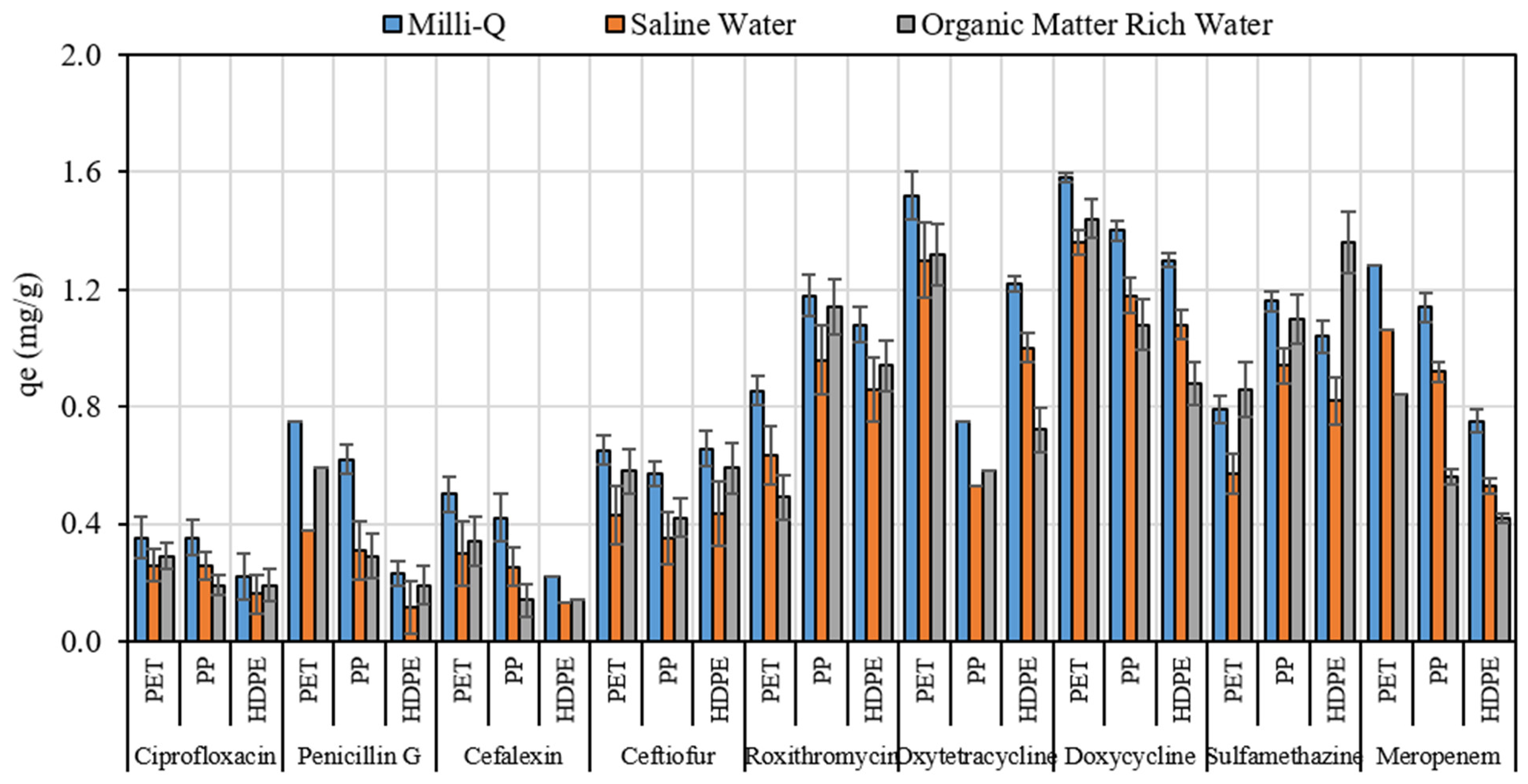
Figure 6 clearly demonstrates that the composition of the water matrix strongly and efficiently influences the adsorption of antibiotics onto PET, PP, and HDPE microplastics. Across all antibiotics and microplastic types, the adsorption capacities (qe) follow a consistent trend: Milli-Q water > Organic matter > Saline water. This trend focuses on the effects of the increased ionic strength in saline water and of dissolved organic matter in organic-matter-rich water, as well as their competitive interactions on microplastic–antibiotic partitioning. Milli-Q water represents a controlled system where adsorption is governed primarily by fundamental microplastic–antibiotic interactions. Likewise, saline water and organic-matter-rich water impose additional physicochemical constraints that, to varying degrees, dominate adsorption. From
Figure 6, it is evident that, in Milli-Q water, adsorption capacities are consistently highest for all antibiotics and microplastics, showing no hindrance to the interactions between antibiotic compounds and microplastic surfaces. The observed trends among plastics (generally, PET ≥ PP > HDPE) are consistent with differences in the surface chemistry. PET exhibits a higher adsorption capacity for most antibiotics due to the presence of aromatic rings and ester groups, which facilitate hydrogen bonding and π–π interactions [
53]. This is particularly evident for tetracycline antibiotics (oxytetracycline and doxycycline), which display the highest qe values on PET. In contrast, PP and HDPE, which are non-polar polyolefins, rely primarily on hydrophobic and vdW interactions, resulting in a comparatively lower adsorption. These observations also support prior studies demonstrating that adsorption in Milli-Q water reflects microplastic surface functionality and antibiotic molecular structure rather than external solution effects [
54].
In saline water analysis, adsorption abilities onto microplastics dropped considerably for all antibiotics. This reduction is the most definite for PET and PP, particularly for charged and polar antibiotics such as ciprofloxacin, cefalexin, and sulfamethazine. The high ionic strength in saline water reduces the electrical double layer at the microplastic surface, leading to electrostatic screening and reduced attractive forces between ionizable antibiotics and surface functional groups, also supported by Kuang, et al. [
55]. Furthermore, abundant Na
+ and Cl
− ions compete with antibiotics for hydration and proximity to surfaces, thereby suppressing adsorption. For polyolefin plastics (PP and HDPE), which already depend on weak hydrophobic interactions, the presence of salts reduces the effective antibiotic activity in solution, thereby lowering their tendency to partition onto plastic surfaces. Needless to say, oxytetracycline and doxycycline still maintain a relatively higher adsorption in saline water, particularly on PET, suggesting that strong hydrogen bonding and complex interactions partially overcome ionic competition.
In the organic-matter-rich water analysis, the adsorption capacities generally stay between those of Milli-Q water and saline water. Basically, the presence of humic acid introduces dissolved organic matter that affects adsorption through several mechanisms, as discussed below. First, humic substances can interact with antibiotics in solution, thereby reducing the fraction of antibiotics that is freely available to interact with microplastic surfaces [
56]. This effect was particularly evident for oxytetracycline, doxycycline, and sulfamethazine, which are known to form stable complexes with humic acids. As a result, the adsorption of these antibiotics was obviously lower than in Milli-Q water. Second, humic acid can adsorb onto microplastic surfaces, effectively passivating adsorption sites and altering surface properties [
57]. This “conditioning film” effect reduces direct antibiotic–microplastic interactions, where surface functional groups are more readily directed by dissolved organic matter. In fact, the adsorption of some hydrophobic antibiotics (e.g., roxithromycin) in organic-matter-rich water remains comparable to or slightly higher than in saline water, indicating that dissolved organic matter effects are less suppressive than ionic strength effects. This observation supports the understanding that dissolved organic matter primarily influences adsorption through complexation and site competition, rather than electrostatic screening. Therefore, the results demonstrate that adsorption capacities are higher with Milli-Q water than under environmentally realistic conditions. Both saline water and organic-matter-rich water reduce antibiotic partitioning onto microplastics. In saline water, the high ionic strength is likely to minimize the role of microplastics as antibiotic carriers. In contrast, in organic-matter-rich water systems, microplastics may still act as selective adsorbents, particularly for hydrophobic and polyfunctional antibiotics. These findings highlight the necessity of considering water matrix effects when assessing the environmental fate, mobility, and ecological risks of antibiotics associated with microplastics.
3.6. Implications for Predicting Environmental Behaviour
This study provides quantitative evidence that microplastics can affect the environmental fate of antibiotics in the aquatic systems. However, their function is significantly controlled by the microplastic type, water chemistry, and co-existence of different antibiotics. Consequently, microplastics are unlikely to affect the transport and distribution of all antibiotics uniformly across different aquatic environments. The consistently higher adsorption of nine tested antibiotics on PET compared to PP and HDPE indicates that the surface chemistry of microplastics is a key factor in antibiotic–microplastic interactions. This observation is consistent with the prior literature that adsorption to microplastics is influenced by the polymer structure and surface functionality rather than the microplastic presence alone [
54]. As PET is commonly found in wastewater-derived microplastics, the antibiotic partitioning onto microplastics can vary significantly across different water environments, depending on the type of microplastic present. Although the measured adsorption capacities indicate a relatively low adsorption affinity, they demonstrate that antibiotics can partition from the aqueous phase onto microplastic surfaces. Under environmentally relevant conditions, the overall contribution of this process to antibiotic mobility likely depends on the microplastic abundance, antibiotic concentration, polymer properties, environmental aging, and surrounding water chemistry. Therefore, the present results should not be interpreted as evidence that microplastics are a dominant sink for antibiotics in natural waters. Rather, they show microplastics can act as temporary carriers or secondary reservoirs, with adsorbed antibiotics potentially undergoing transport, desorption, or redistribution as environmental conditions change. Furthermore, kinetic models demonstrated that adsorption onto microplastics is instantaneous and surface-controlled, with the pseudo-second-order model and film diffusion identified as the rate-limiting mechanisms, a finding also supported by Yu, et al. [
58]. However, because the surface chemistry, charge, roughness, specific surface area, and crystallinity were not directly characterised, their contributions represent possible literature-supported explanations rather than mechanisms confirmed by the present study.
The kinetic results suggest that antibiotic partitioning onto microplastics can occur over timescales relevant to intermittent contamination events. From an environmental perspective, this suggests that microplastics can interact with dissolved antibiotics in periodic contamination events, including wastewater effluent discharge, stormwater flushing, and agricultural runoff. A similar adsorption behaviour has been reported for antibiotics interacting with polyethylene and polystyrene microplastics, showing the environmental possibility of short-term antibiotic accumulation near production sources [
48]. Association with suspended microplastics could potentially facilitate antibiotic transport, whereas adsorption onto settled particles could contribute to contaminant retention in sediments. The better fit of the pseudo-second-order model and the results of the diffusion analysis should nevertheless be interpreted as empirical descriptions of the adsorption data and mass-transfer behaviour, rather than direct confirmation of a specific chemical adsorption mechanism.
The experiments using NaCl- and humic-acid-containing model solutions further demonstrate that aqueous chemistry can influence antibiotic–microplastic partitioning. The reduction in adsorption in the presence of NaCl suggests that the increased salinity may modify antibiotic speciation and the interactions occurring at the microplastic–water interface [
47]. On the other hand, the steady decrease in adsorption observed in organic-matter-rich water containing humic acid suggests that dissolved organic matter can reduce the adsorption quantity primarily by complexing antibiotics at the microplastic surface. Such effects of natural organic matter on the adsorption behaviour have been reported and are attributed to both competitive binding and the formation of conditioning films on plastic surfaces [
59]. However, these individual mechanisms were not directly quantified and should therefore be regarded as possible explanations for the observed trends. Moreover, the simplified NaCl and humic acid systems do not reproduce the full ionic, organic, colloidal, and biological complexity of natural seawater or surface water. Accordingly, the results represent controlled evaluations of salinity and humic-acid effects rather than direct simulations of natural waters.
The multi-component adsorption by the SRS model further demonstrates that a mixture of nine antibiotics performs differently from single-solute systems. Competitive interactions significantly altered surface partitioning, indicating that microplastics may selectively concentrate certain antibiotics while preventing the adsorption of others, depending on mixture composition. This observation is consistent with the Freundlich-derived multicomponent adsorption model (SRS model) and highlights the limitations of single-solute approaches for predicting contaminant behaviour in a complex environmental matrix [
60]. Such selectivity may result in spatially diverse exposure patterns, rather than the uniform accumulation of all antibiotics on microplastic surfaces. Thus, environmental assessments based exclusively on single-antibiotic adsorption experiments may overestimate or underestimate the microplastic-associated fraction of individual antibiotics in complex contaminant mixtures.
Overall, the results indicate that microplastics should be regarded as conditional vectors rather than universal carriers of antibiotics. Their environmental relevance depends on the polymer composition, aqueous chemistry, and contaminant mixtures, all of which vary spatially and temporally in organic-matter-rich water or saline water [
61]. The concentrations employed in the present adsorption experiments were selected to facilitate model development and comparison and may be higher than those commonly detected in natural aquatic systems. Therefore, quantitative extrapolation of the results to environmental conditions should be undertaken cautiously. Further investigations using environmentally relevant antibiotic concentrations, naturally aged microplastics and actual wastewater, surface water and seawater are required to confirm the observed relationships under more complex conditions. Therefore, environmental fate and transport models must be considered to account for heterogeneous, competitive, and matrix-dependent adsorption behaviour, which is essential for accurately assessing the mobility, persistence, and ecological risks of antibiotics associated with microplastic pollution.