Article

Ecological Quality Assessment of Mediterranean Wadis in the Bizerte Lagoon Catchment (Northern Tunisia) Using Benthic Diatoms


by
Soulaima Azizi
1,2,
Sondes Melliti Ben Garali
1,
Kaouther Mejri Kousri
1,
Mustapha Béjaoui
3,
Anne Eulin-Garrigue
4,
Abdelhafidh Khazri
3,
Abdullah A. Saber
5,
Marco Cantonati
2,* and
Asma Sakka Hlaili
1
1
Unit of Plant Biology and Phytoplanktonology, Laboratory of Plant Toxicology and Microbiology (LR18ES38), Faculty of Sciences of Bizerte, University of Carthage, Bizerte 7021, Tunisia
2
Department of Biological, Geological and Environmental Sciences—BiGeA, Alma Mater Studiorum—University of Bologna, 40126 Bologna, Italy
3
Laboratory of Environmental Biomonitoring (LR01ES14), Faculty of Sciences of Bizerte, University of Carthage, Zarzouna 7021, Tunisia
4
Hydreco, 97388 Kourou Cedex, French Guiana
5
Department of Biology, College of Science, Imam Mohammad Ibn Saud Islamic University (IMSIU), Riyadh 11623, Saudi Arabia
*
Author to whom correspondence should be addressed.
Water 2026, 18(16), 2014; https://doi.org/10.3390/w18162014
Submission received: 1 July 2026 / Revised: 29 July 2026 / Accepted: 13 August 2026 / Published: 18 August 2026

Abstract

The study presents an integrated assessment of water quality in wadis of the Bizerte Lagoon catchment (Northern Tunisia), using benthic diatom assemblages. Seasonal sampling was conducted between winter 2023 and winter 2024 in three wadis exposed to varying anthropogenic pressures. In each wadi, upstream and downstream stations were surveyed to assess spatial variability. Diatom assemblages showed clear responses to both environmental gradient and seasonal variation. Pollution-tolerant taxa, particularly Navicula veneta, Gomphonema parvulum, and Nitzschia inconspicua, were mainly recorded during winter in downstream stations of wadis most impacted by nutrient enrichment and organic pollution. halophilic and marine-related taxa, including Gyrosigma kuetzingii, Navicula salinarum, Navicula simulata, Halamphora coffeaeformis and Haslea ostrearia, dominated during warmer seasons in the high-conductivity wadi. Pollution-sensitive taxa, such as Encyonema minutum, Cymbella affinis and Gomphonema affine, were restricted to the least disturbed wadi. Diatom-based indices confirmed the predominance of hypertrophic conditions in all wadis and revealed a clear gradient of environmental degradation, with ecological status ranging from moderate to poor and bad quality. These findings highlight the strong potential of benthic diatoms and their ecological indices as valuable tools for monitoring eutrophication and salinization gradients in Mediterranean coastal wadis, although their adaptation and calibration to Tunisian freshwater ecosystems still require further validation.

1. Introduction

Freshwater ecosystems are among the most productive environments on Earth, providing essential ecosystem services, such as biodiversity support, nutrient cycling and water resources for human activities [1,2]. Unfortunately, these ecosystems are increasingly threatened by rapid population growth, overexploitation of surface and groundwater reserves, and the discharge of untreated pollutants into the environment [3,4]. These pressures have significantly altered the physical, chemical, and biological properties of freshwater systems, often resulting in eutrophication, oxygen depletion, and major changes in aquatic community structure [3]. Moreover, climate change is exacerbating the existing pressures on freshwater resources through shifts in precipitation regimes and the increasing frequency of extreme events such as droughts and floods [5]. Consequently, freshwater availability is expected to decline further, intensifying global water scarcity. It is projected that, from 2025 onward, nearly two-thirds of the world’s population could experience conditions of water stress [6,7]. In this context, the assessment of water quality has become essential for detecting ecological alteration, identifying the sources of pollution, and supporting the development of sustainable management and restoration strategies [3,8]. To address these growing challenges, a wide range of tools has been developed for freshwater monitoring and ecological assessment, including physical and chemical analyses and biological indicators.
Benthic diatoms are among the most widely used bioindicators for water quality assessment due to their high sensitivity to environmental changes and their rapid response to variations in nutrient levels, organic pollution, salinity, conductivity, pH, and hydrological conditions [9,10,11,12,13]. Their short life cycle, high species diversity, and close attachment to substrates allow them to reflect local ecological conditions with great precision [9,10]. Moreover, diatom communities reflect the cumulative effects of multiple environmental stressors over time, which makes them particularly effective indicators of eutrophication, organic enrichment, and anthropogenic disturbance. Consequently, the analysis of benthic diatom assemblages provides a reliable tool for evaluating the ecological status of freshwater ecosystems and supporting water management strategies [10,13,14]. Furthermore, several diatom-based ecological indices can be calculated from species composition and relative abundances. Among the most widely used are the Specific Pollution Sensitivity Index (SPI), the Biological Diatom Index (BDI), and the Trophic Diatom Index (TDI). These indices integrate species-specific ecological preferences and sensitivities into standardized metrics of water quality, trophic conditions, and anthropogenic pressures [15,16]. Hence, they are widely applied in freshwater biomonitoring programs and constitute key components of ecological assessment frameworks, particularly within the context of the European Water Framework Directive (WFD, 2000/60/EC, European Union 2000). The SPI was originally developed in France by Coste (1982) [17] to assess ecological quality and pollution levels in freshwater ecosystems using benthic diatoms. The BDI was later proposed by Coste [18] as a standardized diatom-based tool for river monitoring and ecological status assessment. In the United Kingdom, the TDI was developed by Kelly and Whitton (1995) [9] specifically to evaluate eutrophication and nutrient enrichment in freshwater systems through the analysis of benthic diatom assemblages. Since their development, these indices have been widely validated and successfully applied across several aquatic ecosystems in the Northern Mediterranean, demonstrating their effectiveness for ecological quality assessment and water management purposes [19,20].
Although much interest has been given to diatom diversity and diatom-based indices in Northern Mediterranean regions, their use in water quality assessment remains limited in southern regions, particularly in North Africa. Paradoxically, these regions are among the most water-stressed areas worldwide [21,22] and are increasingly affected by water scarcity and the degradation of freshwater resources, reflecting the broader environmental challenges across North Africa [21,23]. Indeed, only a few studies have applied diatom assemblages for environmental assessment. In Morocco, diatoms have been used in recent research to evaluate ecological status and anthropogenic pressures in rivers, reservoirs and wadis, including the Sidi Chahed, Mikkès and Mellah systems [16]. Diatom communities have also been employed as indicators of organic pollution and nutrient enrichment in Algerian wadis, such as Kebir-East, and in Egypt, particularly in the Nile River system [24,25].
In contrast, diatom-based approaches remain largely underexplored in Tunisian freshwater ecosystems. There, ecological assessments have predominantly relied on physicochemical parameters and macroinvertebrate communities [26,27], with little integration of diatom assemblages despite their well-established sensitivity to environmental changes. This represents a significant knowledge gap in biomonitoring approaches across Southern Mediterranean freshwater systems, particularly in North Africa, where aquatic ecosystems are increasingly affected by water scarcity and growing anthropogenic pressures. Wadis, as intermittent and highly variable freshwater systems typical of arid and semi-arid Mediterranean landscapes, play a key hydrological and ecological role by ensuring groundwater recharge, sustaining specialized aquatic communities, and connecting inland catchments to downstream coastal ecosystems [23,27]. Despite this ecological significance and their strong socio-economic value for water supply and agriculture, wadis remain among the least monitored freshwater ecosystems in the Southern Mediterranean region, leaving their ecological status largely unassessed.
In North Tunisia, several wadis, such as Ben Hessine, Guenniche and Haima, drain into the Bizerte Lagoon, a coastal ecosystem of major ecological and socio-economic importance. This Lagoon supports high biodiversity and essential human activities, particularly fisheries and aquaculture [28]. These tributary systems are increasingly affected by environmental degradation resulting from urban discharges, agricultural runoff and industrial effluents [26,29], contributing to ecological imbalance and environmental degradation of the Bizerte Lagoon [8,30,31,32]. In the context of water scarcity and freshwater resource degradation in Tunisia, understanding and monitoring the ecological status of these wadis is therefore essential for the sustainable management and conservation of the lagoon ecosystem.
This study aims to evaluate the ecological quality of freshwater systems within the catchment area of the Bizerte Lagoon through a multi-scale approach, integrating both spatial and seasonal variability. The assessment is based on benthic diatom assemblages and diatom-based ecological indices, recognized as sensitive bioindicators of environmental change and water quality degradation. By combining biological indicators with spatio-temporal analysis, this study provides a more comprehensive understanding of ecological dynamics within these tributary systems and their potential influence on the lagoon ecosystem. To our knowledge, this is the first study in Tunisia, and one of the few in North Africa, to apply a diatom-based biomonitoring approach at this scale under Mediterranean environmental conditions.

2. Materials and Methods

2.1. Study Area

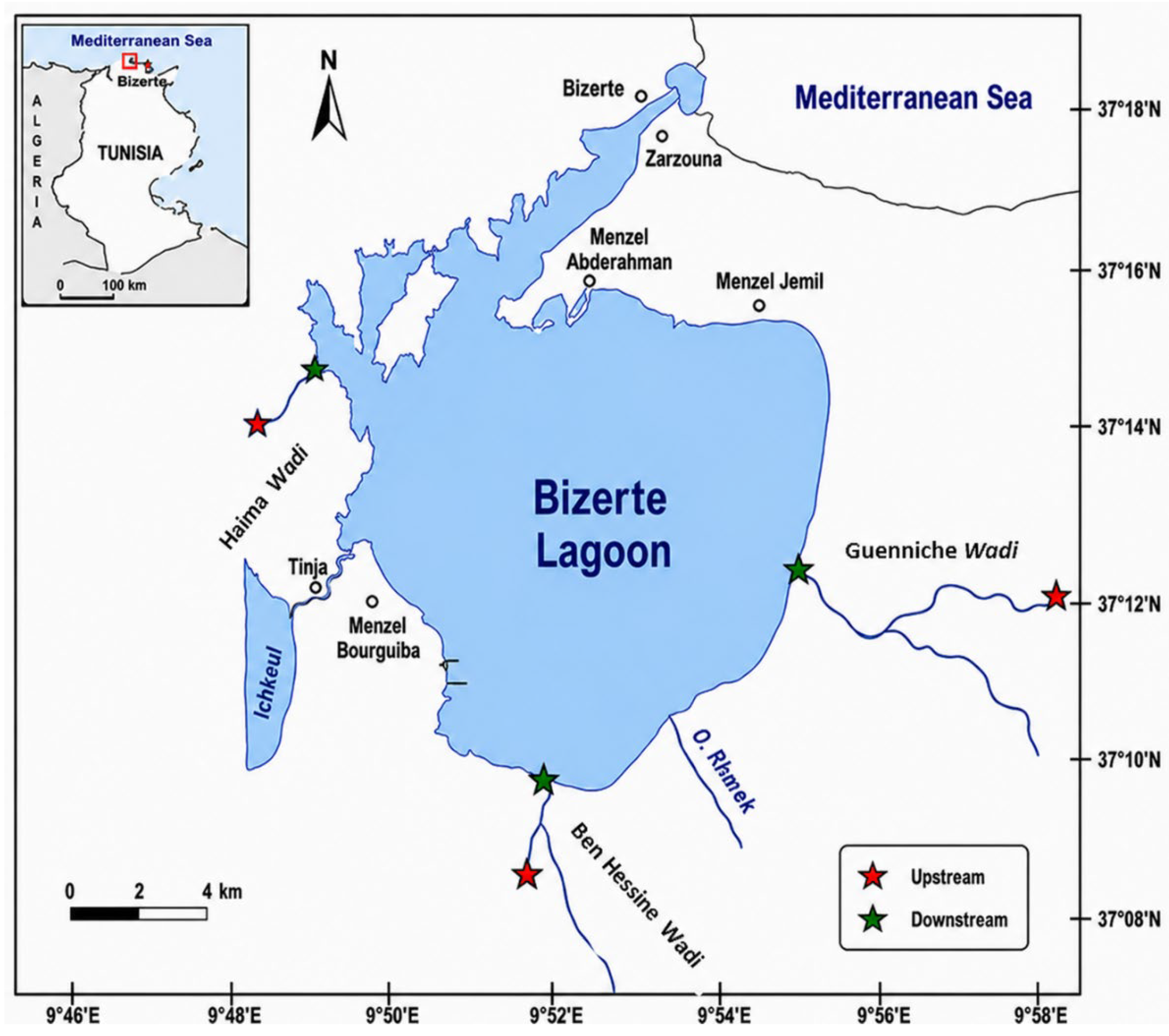
The studied wadis are located within the catchment area of the Bizerte Lagoon in Northern Tunisia (Figure 1). They constitute major freshwater inputs to the Lagoon, particularly during the wet season (from October to April), with average annual inflows estimated at 4.27, 4.21, and 16.5 mm3 for Ben Hessine, Guenniche and Haima wadis, respectively [26,33]. The watersheds cover approximately 45 km2 for Ben Hessine, 86 km2 for Guenniche and 104 km2 for Haima. Ben Hessine and Haima wadis are primarily exposed to urban discharges and agricultural runoff, while Guenniche wadi is subject to multiple sources of pollution, including agricultural practices, industrial effluents, domestic discharge and wastewater treatment plant releases [26,33,34]. These anthropogenic pressures differ among the three wadis according to land use and human activities within their respective catchments, resulting in varying degrees and types of environmental disturbance. The main sources of pollution affecting each investigated wadi are summarized in Table 1. As a result, these wadis receive substantial inputs of nutrients, organic matter, and various contaminants [29,35], leading to the deterioration of water quality and potentially impairing the ecological integrity of these freshwater ecosystems.
Two sampling stations were selected along each wadi, one upstream and one downstream, to assess spatial variability and the influence of cumulative anthropogenic pressures along the watercourse. This approach enabled the comparison of physicochemical and biological parameters between sites. The nomenclature of the stations and their hydrological and environmental characteristics are presented in Table 1.

2.2. Water Sampling for Chemical Analyses

Seasonal sampling was conducted at all stations in winter 2023 (February), spring 2023 (May), summer 2023 (July), autumn 2023 (November), and winter 2024 (January), in order to investigate the seasonal variability. The upstream station of Haima wadi was excluded from the autumn 2024 and winter 2024 campaigns due to restricted access to the private property where the site is located.
Due to the shallow water depth of all sampling stations (15–60 cm, Table 1), water samples (in triplicate) were collected from the surface in 2 L polyethylene bottles previously acid-washed (10% HCl) and vigorously rinsed with ultrapure water. The 2 L sample volume was selected to provide sufficient water for all planned physicochemical analyses while ensuring an adequate reserve for sample handling and processing. Samples were stored in isothermal containers, transported to the laboratory and processed within 24 h of collection. Subsamples (1 L) for inorganic nutrient analyses were filtered on 0.2 µm polycarbonate membranes and the filtrates were used to determine nitrate (NO3), nitrite (NO2) and ammonium (NH4) according to the standard spectrophotometric procedures described by Parsons et al. (1984) [36]. The detection limits of the analytical methods were 4.6 × 10⁻⁴ mg L−1 for nitrite and 9 × 10⁻⁴ mg L−1 for both nitrate and ammonium.
Total nitrogen (TN) and total phosphorus (TP) were determined following the persulfate digestion method proposed by Valderrama (1981) [37]. Subsamples (500 mL) were digested using potassium persulfate under high-temperature and pressure conditions to convert nitrogen and phosphorus compounds into nitrate and orthophosphate forms, respectively. Following digestion, nutrient concentrations were determined using a spectrophotometer. Detection limits for TN and TP analyses were 0.02 mg L−1 and 0.01 mg L−1, respectively.
The determination of biological oxygen demand over five days (BOD5) and chemical oxygen demand (COD) was made on 500 mL subsamples. BOD5 was determined following the incubation method, based on the difference in dissolved oxygen concentrations before and after a 5-day incubation period at 20 °C in darkness [38]. COD was determined using the dichromate oxidation method under acidic conditions following standard methods for water analysis [38].
For chlorophyll a (Chl a) analysis, subsamples (500 mL) were filtered through Whatman GF/F glass fiber filters (0.7 µm pore size, 47 mm diameter). Chlorophyll pigments were extracted in a 90% acetone solution (v/v) for 30 h in darkness at 4 °C, and pigment concentrations were subsequently determined according to the spectrophotometric method described by Parsons et al. (1984) [36].
In situ measurements of physicochemical parameters were performed at each station. Water temperature, conductivity, and pH were recorded using a multi-parameter probe (WTW Multi 1970i, WTW, Weilheim, Germany), whereas dissolved oxygen concentrations were measured with an oximeter (WTW Oxi 330/set, WTW, Weilheim, Germany ).

2.3. Diatom Sampling, Preparation and Identification

During seasonal sampling campaigns, benthic diatom assemblages were collected from epilithic substrates in all study stations. A composite sample was obtained by gently brushing biofilms from 7 to 10 submerged stones selected in flowing sections of each wadi. This multi-substrate approach, consistent with standard biomonitoring practices, ensures a representative assessment of epilithic diatom assemblages [39,40] and follows the European standard protocol for diatom sampling in running waters [40]. The collected materials were immediately preserved in 95% ethanol and subsequently cleaned using hydrogen peroxide following the method described by Krammer and Lange-Bertalot (1986) [41]. After digestion, the samples were rinsed several times with distilled water to remove residual organic matter and chemical reagents. The cleaned materials were then mounted in Naphrax® (Brunel Microscopes Ltd., Wiltshire, UK) by placing a drop of the cleaned suspension onto a coverslip prior to slide preparation. At least 400 valves were identified and counted on each slide under light microscopy using a Di-Li 2025-20 microscope (Di-Li, Kaiserslautern, Germany) equipped with a 20 MP USB 3.0 camera, as well as a Bioimager microscope (BUM360FLL) (Bioimager Inc., Vancouver, BC, Canada) fitted with a USB 3.0 BIC-E3S CMOS 20 MP camera.

2.4. Calculation of Diatom-Based Ecological Indices

Diatom species relative abundances were integrated into the OMNIDIA database and processed using the OMNIDIA software (version 5.3) for index calculation [42]. Each identified taxon was assigned its corresponding species-specific code within the software database. Based on the taxonomic composition and relative abundance of benthic diatom assemblages, the BDI, SPI and TDI indices (Table 2) were calculated and used as standardized tools for freshwater biomonitoring and ecological assessment. To our knowledge, these indices have not yet been applied in the environmental assessment of Tunisian aquatic ecosystems.

2.5. Statistical Analyses

Seasonal and spatial variations in physicochemical parameters, nutrient concentrations and diatom-based indices were evaluated using two-way analysis of variance (ANOVA) [43]. Prior to the analyses, data normality and homogeneity of variances were verified using the Shapiro–Wilk and Levene tests, respectively [44]. Relationships between biological metrics and environmental variables were assessed using Spearman’s rank correlation analysis [45,46]. All statistical analyses were performed using SPSS Statistics version 18.0 for Windows.

3. Results

3.1. Physical and Chemical Variability

Physical and chemical parameters were expressed as seasonal minimum, mean and maximum values (Table 3). Most parameters exhibited significant spatial and seasonal fluctuations (ANOVA, p < 0.001), whereas pH remained relatively stable throughout the study period, varying between 7.3 and 8.0, which indicated predominantly neutral to alkaline conditions. No significant spatial or seasonal variation in pH was observed among the studied stations.
For most stations, water temperature peaked in summer and reached lower values in winter. The highest temperature (29 °C) was measured at station H2 (Haima downstream) during summer 2023, while the lowest (10 °C) was observed at station H1 (Haima upstream) in winter 2023.
In Ben Hessine (i.e., stations B1 and B2) and Haima (i.e., stations H1 and H2) wadis, seasonal mean dissolved oxygen concentrations ranged between 5.8 and 7.5 mg O2 L−1. In contrast, Guenniche wadi showed episodes of severe oxygen depletion, particularly at the downstream station (i.e., G2), where seasonal mean concentrations approached the critical threshold of 2 mg O2 L−1. The lowest dissolved oxygen concentrations were consistently recorded at Guenniche, indicating poorer oxygenation conditions compared with the other wadis. In all stations, the maxima of dissolved oxygen were consistently registered in winter.
In most stations, seasonal mean BOD5 values exceeded 10 mg O2 L−1, indicating elevated organic pollution. The highest seasonal mean values (24–26.4 mg O2 L−1) were observed in Guenniche upstream and downstream, whereas the lowest levels (12.6–13 mg O2 L−1) were recorded in Ben Hessine wadi. Overall, Guenniche exhibited the highest organic pollution levels among the investigated wadis. For most wadis, the maximum BDO5 values were measured in summer. Seasonal mean COD concentrations consistently remained above 80 mg O2 L−1, reflecting persistently high levels of oxidizable pollutants. The peak concentration (130 mg O2 L−1) was observed in station G2 (Guenniche downstream) in summer 2023. Similarly, COD values were generally higher at Guenniche than at Ben Hessine and Haima.
A wide range of conductivity values was observed, with the minimum (1183 µS cm−1) recorded in station B1 (Ben Hessine upstream) in summer 2023. The highest values were measured in stations H1 and H2 (Haima upstream and downstream) in winter and autumn 2023, where conductivity exceeded 7000 µS cm−1.

3.2. Nutrients and Chl a Variability

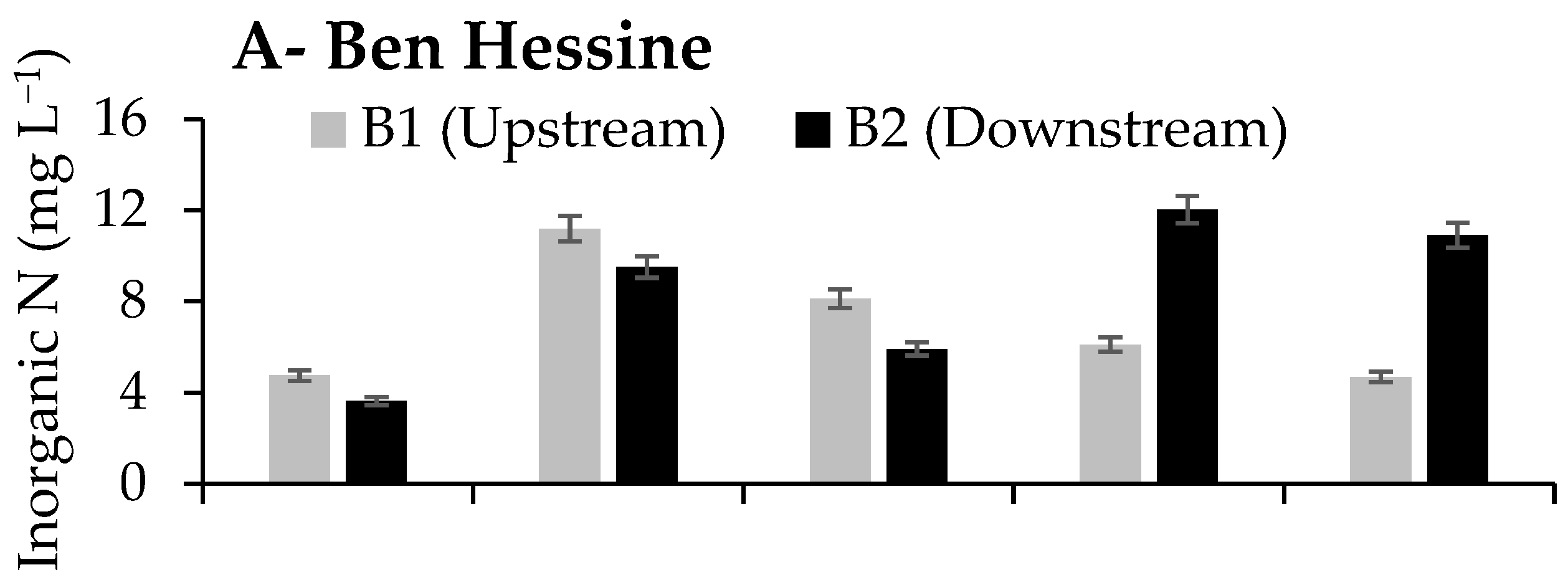
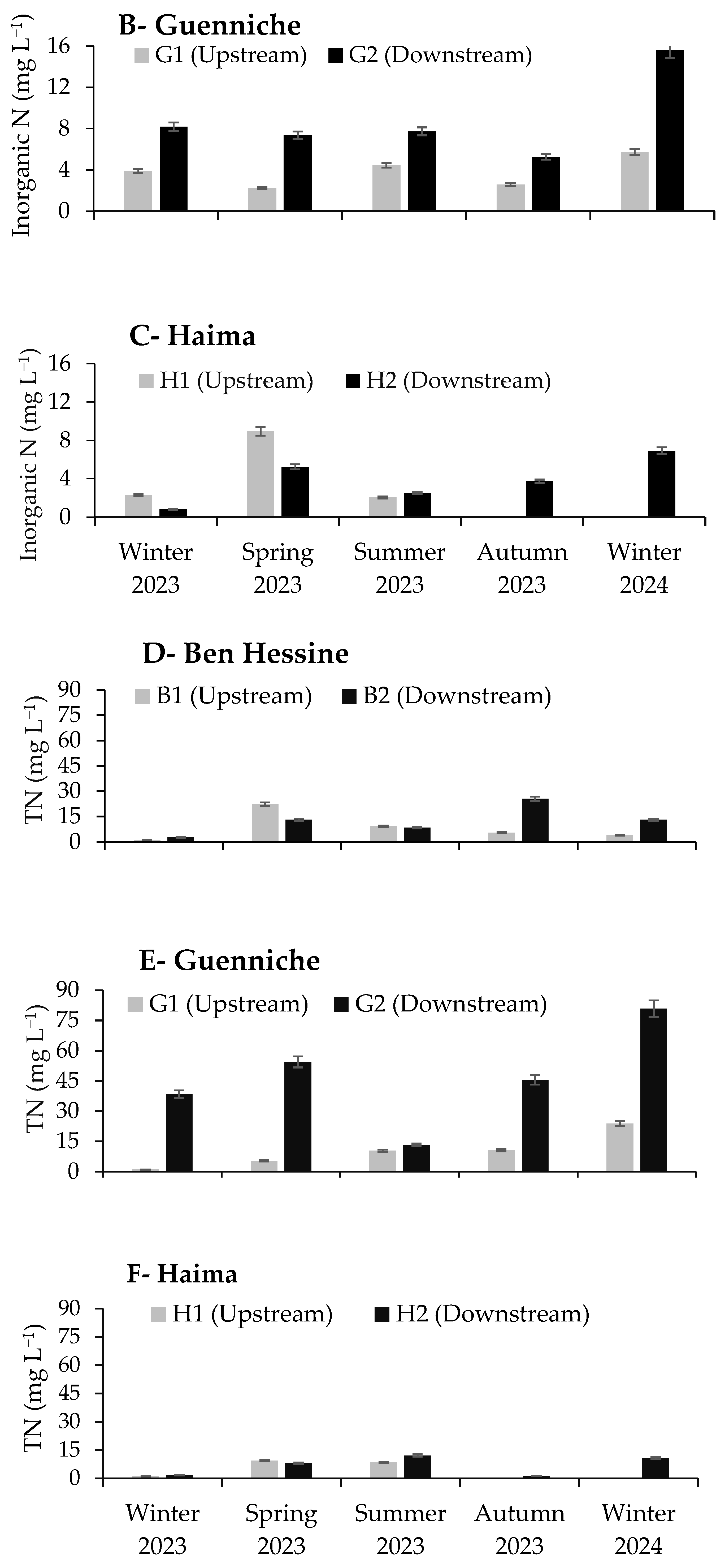
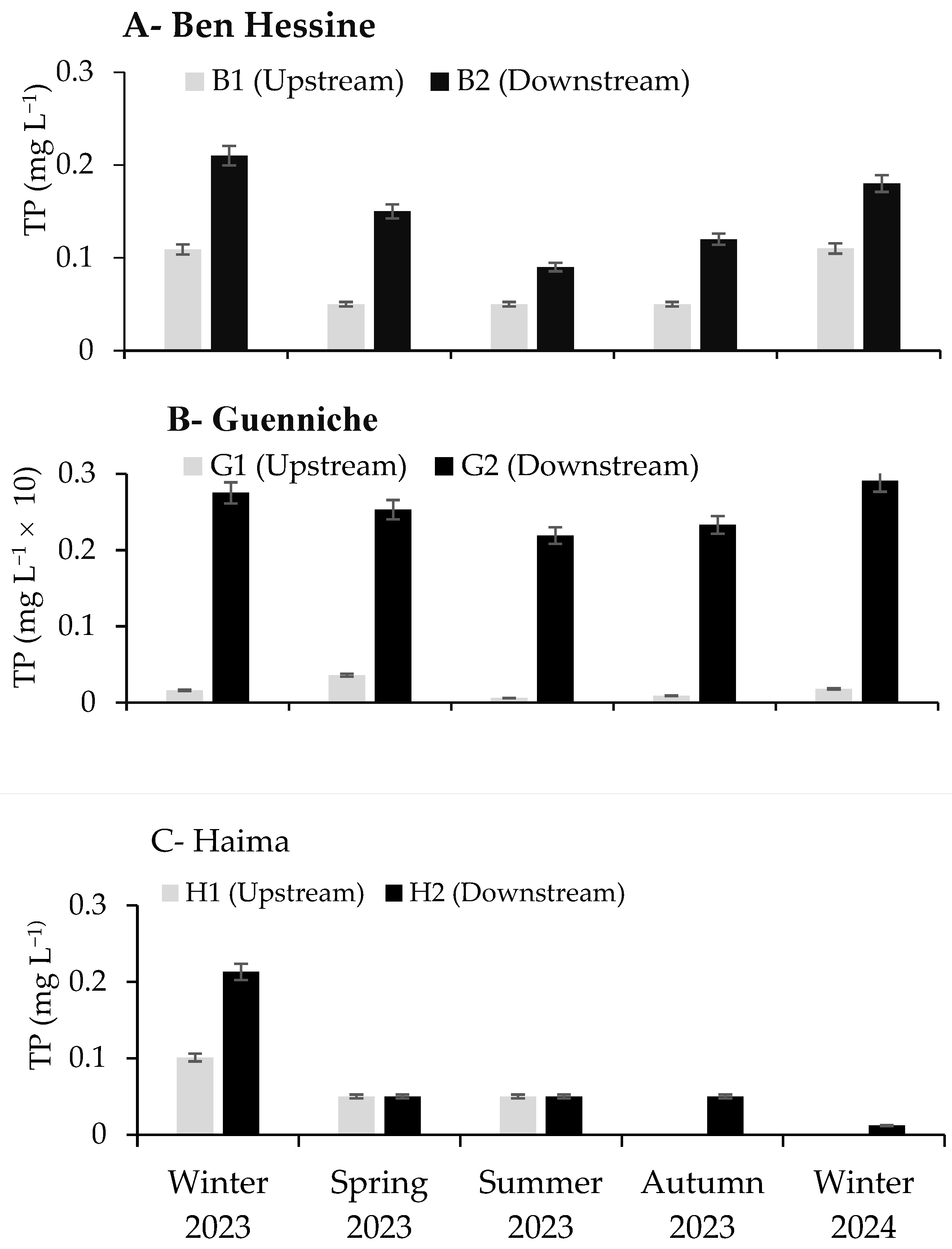
Nutrients displayed seasonal fluctuations (ANOVA, p < 0.001, Figure 2 and Figure 3), with higher levels registered mainly in winter and sometimes in spring. Nutrient concentrations also significantly varied across wadis and stations (ANOVA, p < 0.001, Figure 2 and Figure 3).
Inorganic nitrogen concentrations (i.e., NO2 + NO3 + NH4) were higher in Ben Hessine (3.63 –12.10 mg L−1) and Guenniche (2.29–15.62 mg L−1) wadis than in Haima wadi (0.82–8.95 mg L−1). In most seasons, higher concentrations were recorded in downstream stations (B2 and G2, particularly in winter 2024) than in upstream stations (B1 and G1) of Ben Hessine and Guenniche wadis. In contrast, Haima wadi exhibited higher concentrations in the upstream station (H1), particularly during spring 2023 (Figure 2A–C).
Regarding total nitrogen, Guenniche wadi clearly differed from the other two systems, with markedly higher concentrations throughout the study period. The downstream levels (G2: 13.20–89 mg L−1) greatly exceeded those measured in the upstream station (G1: 1–23.78 mg L−1). The highest values were observed in winter 2024. In the other wadis, TN levels were a little higher in downstream stations. Values ranged from 1 to 25.47 mg L−1 in Ben Hessine wadi, and from 1.60 to 12.1 mg L−1 in Haima wadi (Figure 2D–F).
Guenniche wadi also showed higher TP concentrations (0.16–2.93 mg L−1) compared with the other wadis (Ben Hessine: 0.05- 0.21 mg L−1; Haima: 0.05–0.22 mg L−1), particularly in the downstream station (G2), where the maximum value was recorded in winter 2024 (Figure 3A). In Ben Hessine and Haima wadis, TP concentrations were generally higher in downstream stations (B2 and H2) than in upstream stations (B1 and H1) across most seasons. In both systems, the highest concentrations were recorded in winter 2023 (Figure 3B,C).
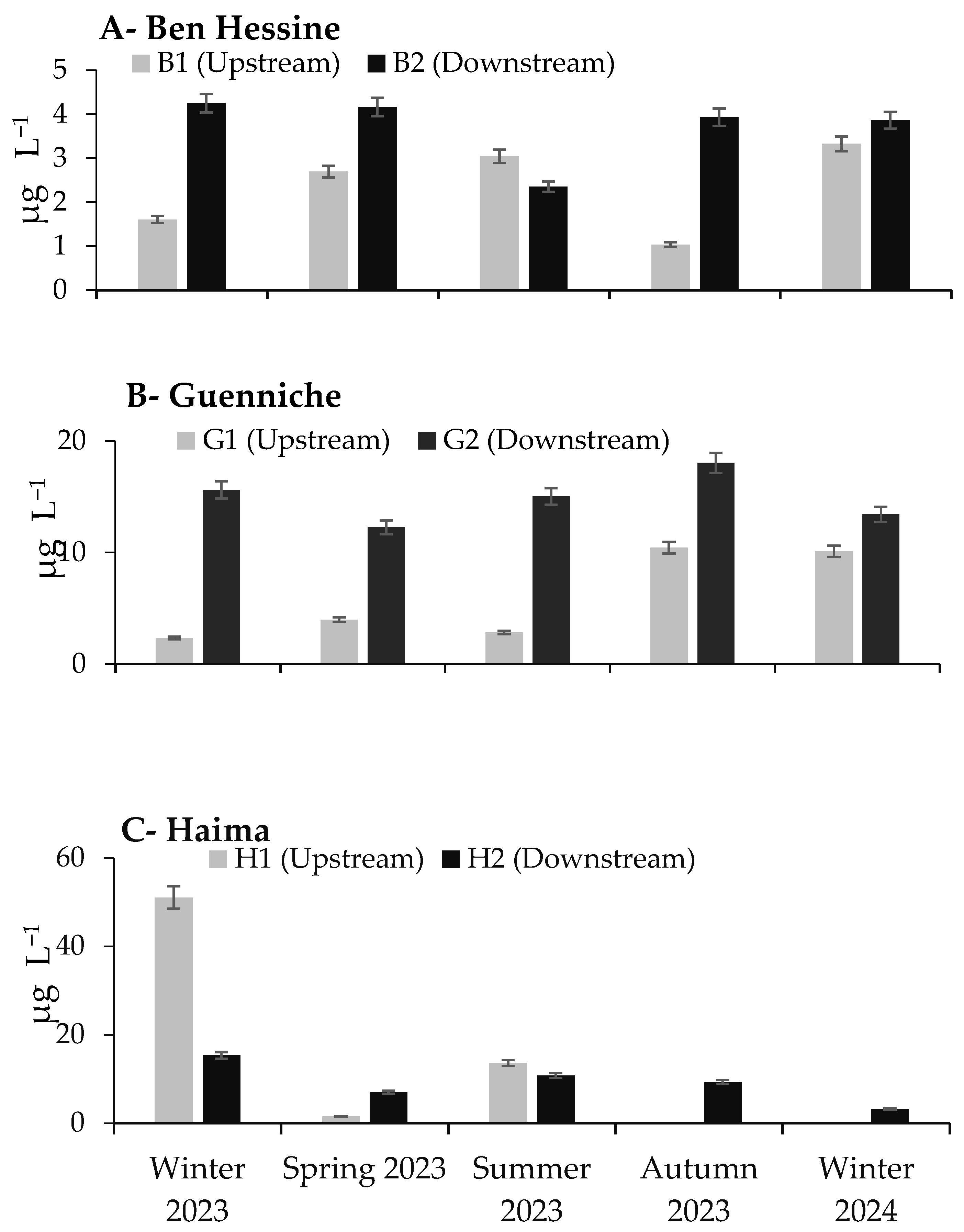
Chl a concentrations varied significantly both spatially and seasonally (ANOVA, p < 0.001; Figure 4). Ben Hessine wadi displayed lower concentrations compared with the other wadis. Values ranged from 1 µg L−1 (B1, autumn 2023) to 4.6 µg L−1 (B2, winter 2023), with generally higher concentrations observed downstream than upstream (Figure 4A). Guenniche wadi was characterized by the highest Chl a concentrations across most seasons (2.3–18 µg L−1), with consistently higher values in the downstream station relative to the upstream station (Figure 4B). During winter 2023, a pronounced Chl a peak (51 µg L−1) was observed upstream of Haima wadi (station H1), while a lower level (15.3 µg L−1) was recorded at station H2. In the remaining seasons, concentrations varied between 1.5 µg L−1 (H1, spring 2023) and 12.6 µg L−1 (H1, summer 2023). Chl a concentrations were positively correlated with TP (r = 0.475, p < 0.001) and TN (r = 0.305, p < 0.05).

3.3. Benthic Diatom Community Structure

The relative abundances of benthic diatoms showed significant spatial and seasonal variations (ANOVA, p < 0.001), indicating marked temporal dynamics in community structure. Overall, a total of 134 species belonging to 42 genera were identified in the epilithic samples collected at upstream and downstream stations of the three wadis during the five sampling seasons. The genera Nitzschia (30 species) and Navicula (21 species) displayed the highest species richness (Table A1). Several species were characterized by high occurrence frequencies and substantial relative abundances, whereas others were rare or restricted to particular sites. Based on their ecological affinities, the diatom assemblages could be classified into distinct groups, reflecting their differences in environmental conditions and habitat preferences (Table 4 and Table 5).

3.3.1. Dominant Diatom Taxa Associated with Eutrophication and Organic Pollution

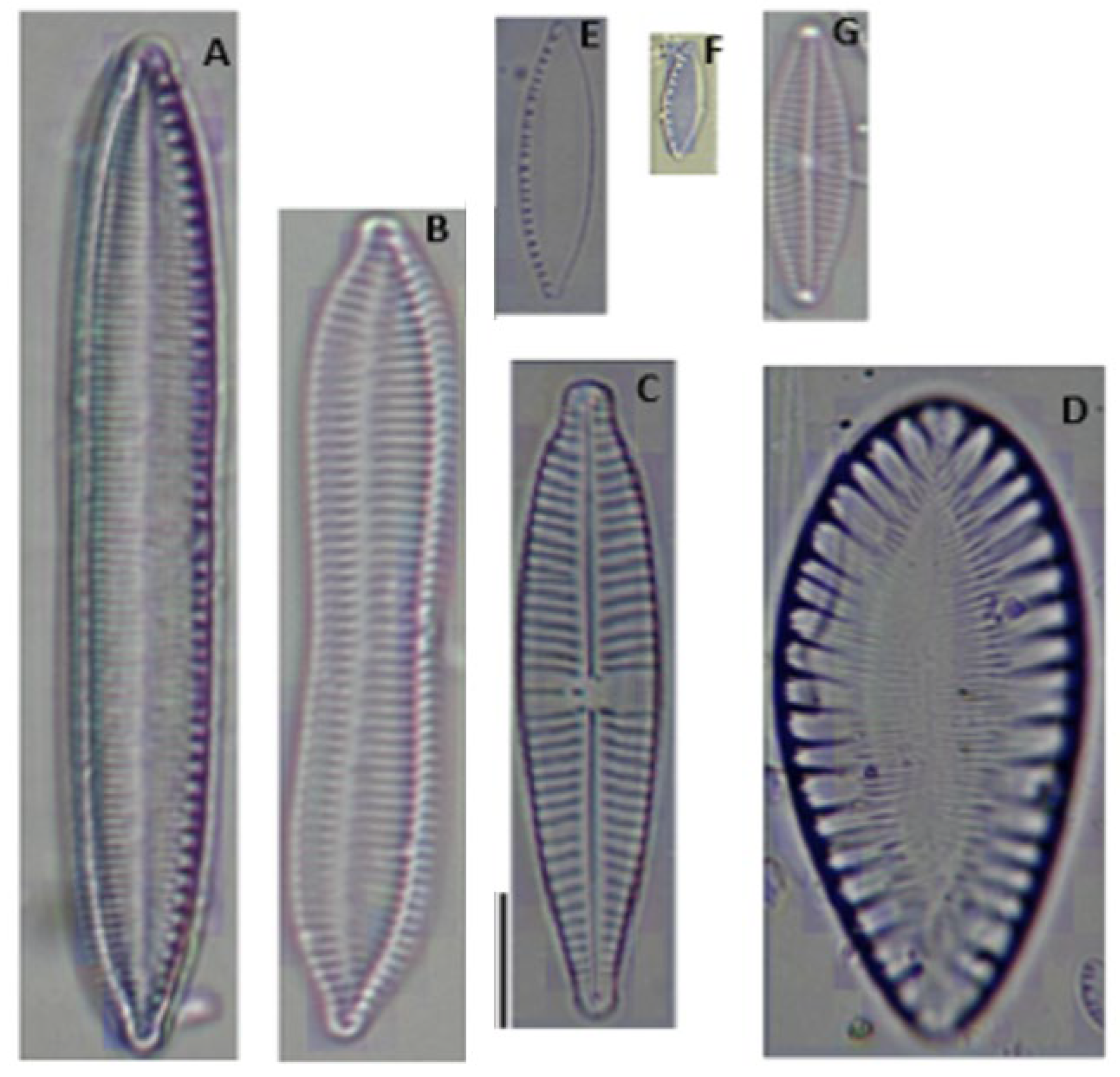
Gomphonema parvulum (Figure 5C; Table 4) was recorded at high frequency during the study period, occurring in 21 out of the 28 analyzed samples (i.e., 75% of samples) across most sampling stations. The species was particularly present in Guenniche wadi, contributing 2–28.2% of the total diatom assemblage. Its highest contribution was observed in station G2 (Guenniche downstream) during winter 2024. In Ben Hessine wadi, the relative abundance of G. parvulum ranged from complete absence in station B1 in spring 2023 to 26% in station B2 in autumn 2023. In contrast, the species was only weakly represented in both stations of Haima wadi, where its relative abundance did not exceed 3%. According to the ecological classification proposed by Levkov 2026 [47] (Table 4), G. parvulum is considered an eutraphentic species, typically associated with nutrient-rich environments and eutrophic conditions. Correlation analysis further revealed a significant positive relationship of the species relative abundance with concentrations of NO2 (r = 0.26, p < 0.05), TN (r = 0.23; p < 0.05), TP (r = 0.77, p < 0.001) and Chl a (r = 0.22, p < 0.05), but a negative correlation with DO (r = −0.25 p < 0.05) (Table 5).
Navicula veneta (Figure 5G; Table 4) also exhibited a high frequency of occurrence throughout the study, being detected in 25 of the 28 analyzed samples (i.e., 89% of samples). Similar to G. parvulum, this species reached particularly high relative abundance in station G2 (Guenniche downstream), ranging from 9 to 24.2%, with a maximum recorded in winter 2024. In station G1 (Guenniche upstream), N. veneta was continuously present but at comparatively lower abundances around 11%. This species was also recorded in Ben Hessine wadi throughout all sampling seasons, with higher mean relative abundance (12.5%) in the downstream station B2 compared to the upstream station B1 (6.8%). In contrast, N. veneta was either absent or poorly represented in Haima wadi, both upstream and downstream. The highest relative abundance recorded did not exceed 5% in station H2 during spring 2023. Significant positive relationships were found between N. veneta and TP (r = 0.646, p < 0.001), TN (r = 0.34, p < 0.001), NH4 (r = 0.31, p < 0.05), NO2 (r = 0.40, p < 0.001) and COD values (r = 0.21, p < 0.05). The species was, however, negatively related to DO (r = −0.30, p < 0.01) (Table 5). According to the ecological classification proposed by Levkov 2026 [47] (Table 4), this species is considered halophilic, reflecting its affinity for mineralized and nutrient-enriched environments.
Nitzschia inconspicua (Figure 5F; Table 4) was the most recorded species across all seasons and stations, with an occurrence frequency of 28/28 (i.e., 100% of samples). However, its relative abundance exhibited marked spatial and seasonal variations. The highest value (35.8%) was registered in Ben Hessine wadi at the downstream station (B2) during spring 2023. The upstream station (B1) of this wadi also showed an important contribution of the species (15.6%). In Guenniche wadi, the relative abundances of N. inconspicua ranged from 3.5% in station G1 (summer 2023) to 33.3% in G2 (autumn 2023); however, lower values were recorded for Haima wadi (3–20.7%) in both stations. This species showed a significant positive correlation with NO2 concentration (r = 0.36, p < 0.01) and temperature (r = 0.36, p < 0.05) (Table 5). Ecologically, N. inconspicua was classified within mesotrophic conditions [49] and as a halophilictaxon (Levkov 2026 [47]) (Table 4).
Nitzschia palea (Figure 5E; Table 4) was also widely distributed across the investigated wadis, with an occurrence frequency of 26/28 (i.e., in 93% of samples). The highest relative abundances of this species were recorded in Guenniche wadi, where it reached 14.6% in the upstream station (G1) during summer 2023. In Haima and Ben Hessine wadis, the species had a comparatively lower contribution to the diatom assemblage, not exceeding 4.4%. It was even absent in B1 in summer 2023 and in H2 in autumn 2023. N. palea was found to be positively correlated with TP (r = 0.26, p < 0.05) and COD (r = 0.37, p < 0.01, Table 5). According to the ecological classification of Levkov and Mertens [47,50] (Table 4), this species is considered eutraphentic, indicating an affinity for nutrient-rich and organically polluted environments.
Surirella brebissonii (Figure 5D; Table 4) was also well represented within the investigated wadis, with an occurrence frequency of 21 out of 28 samples (i.e., 75% of samples). Ben Hessine wadi exhibited the highest occurrence frequency for this species in both upstream and downstream stations, along with the highest recorded relative abundance (7.9%) in B1 during winter 2023. This species also showed a low contribution in Haima wadi, with a maximal relative abundance of 3.5% recorded in the downstream station (H2) during winter 2024. In Guenniche wadi, S. brebissonii was mainly recorded in the upstream station (G1), where it reached a maximal relative abundance of 7.9% in autumn 2023. In contrast, this species was registered only once in the downstream station (G2) during autumn 2023, with a very low relative abundance (0.86%). No significant correlations were observed between this species and environmental variables. According to the ecological classification proposed by Levkov 2026 [47], S. brebissonii is considered a halophilic taxon (Table 4).
Tryblionella hungarica and Tryblionella apiculata (Figure 5A,B; Table 4) were also among the most frequently recorded taxa, occurring in 22 and 20 of the 28 samples (i.e., 71–78% of samples), respectively. Both species were predominantly associated with the upstream of Guenniche wadi, where they reached the highest relative abundances (17.6–18.8%) during winter 2023. During the other seasons, both species showed lower relative abundances, not exceeding 9%. T. apiculata was also relatively abundant at the upstream Haima wadi during several seasons. T. hungarica showed a significant positive correlation with TP (r = 0.40, p < 0.01; Table 5), whereas T. apiculata did not exhibit any significant correlation with the measured environmental variables. According to the ecological classification proposed by Levkov (2026) [47] (Table 4), T. hungarica is classified as eutraphentic, whereas T. apiculata is classified as halophilic.

3.3.2. Relatively Less Pollution-Tolerant Diatom Taxa

Several taxa indicative of low nutrient and organic pollution levels were recorded during the study, but with low occurrence frequencies and relative abundances. Encyonema minutum, an oligotraphentic species ([47]), was observed only three times in Ben Hessine wadi, reaching 3% relative abundance in the station B1 in winter 2024 and was negatively correlated with TP (r = −0.26, p < 0.05) and Chl a (r = −0.24, p < 0.05), but positively with temperature (r = −0.27, p < 0.05, Table 5). Similarly, Cymbella affinis and Gomphonema affine, known for their low tolerance to eutrophication, were found exclusively in Ben Hessine wadi during Winter 2024. While C. affinis remained rare (maximum relative abundance of 2%), G. affine reached 14.4% in the downstream station (B2). Both species showed negative relationships with pollution- and eutrophication-related variables, including TP, Chl a and BOD5 (Table 4 and Table 5).

3.3.3. Halophilic and Marine-Related Diatom Taxa

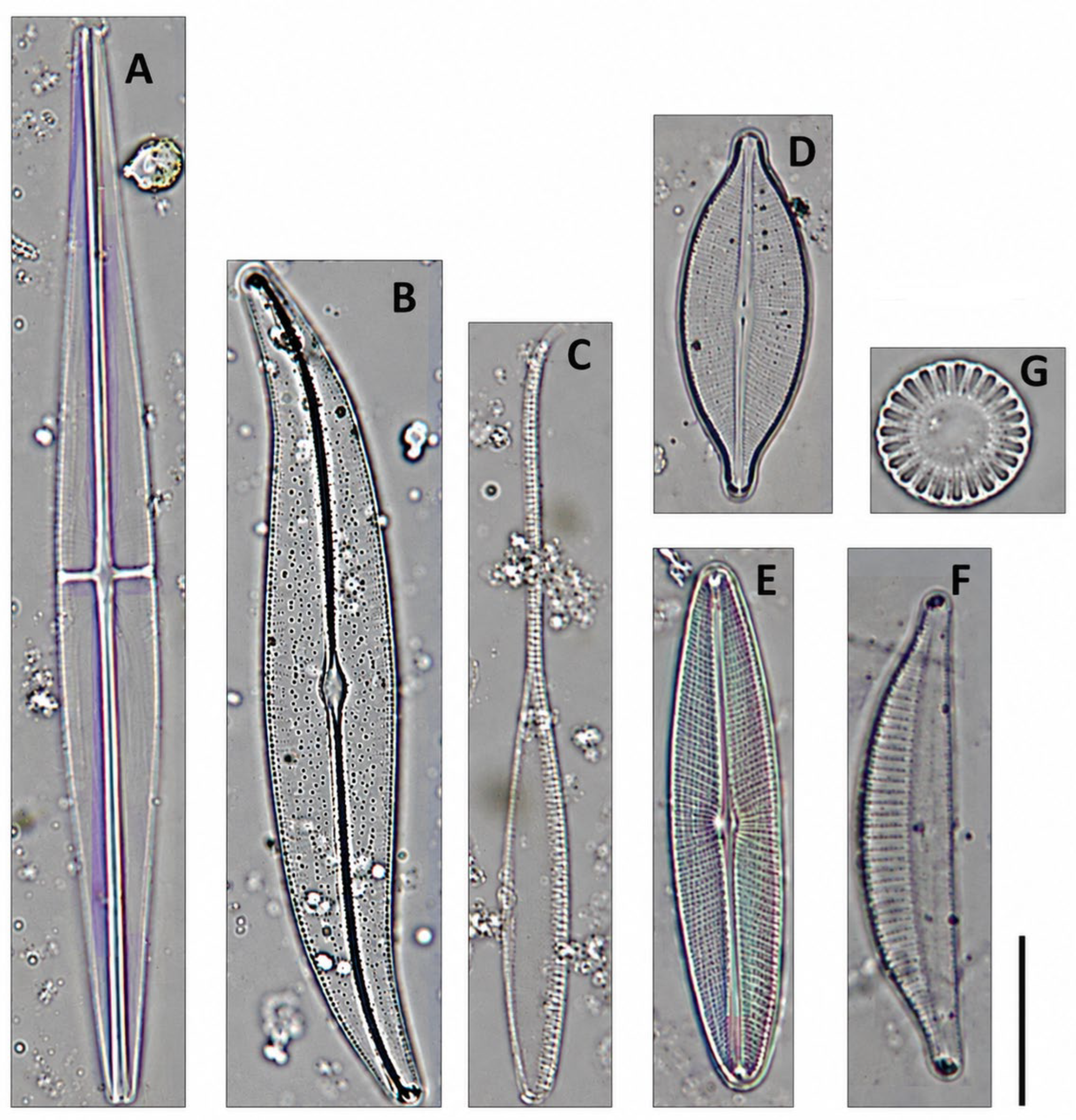
Several diatom species were predominantly associated with Haima wadi, the site characterized by the highest conductivity. Among these taxa, Navicula simulata, Gyrosigma kuetzingii, Navicula salinarum and Halamphora coffeaeformis (Figure 6; Table 4) were the most frequent (18/28, 17/28, 12/28 and 7/28, respectively; i.e., in 34–64% of samples), reaching maximum relative abundances of 18.3%, 18.4%, 17.5% and 15.5%, respectively. Consistent with their Halophilic character (Levkov 2026 [47]), all species, except N. salinarum, showed positive and significant correlations with conductivity (r = 0.27–0.46, p < 0.01), while Navicula simulata was also significantly correlated with NO3 (r = 0.30, p < 0.01) and NH4+ (r = 0.24, p < 0.05) (Table 4 and Table 5).
Marine taxa (Haslea ostrearia, Nitzschia nana, N. sigma, and N. acicularis; Figure 6; Table 4) were mainly recorded in the downstream stations of Haima and Ben Hessine wadis, but their low relative abundances (0–6.2%) and sporadic occurrence indicated limited ecological relevance within the benthic assemblages. Most of these species showed positive correlations with conductivity, notably H. ostrearia (r = 0.46, p < 0.001) and N. acicularis (r = 0.26, p < 0.05) (Table 5). Additionally, Entomoneis cf. alata and Conticribra weissflogii were also recorded during the study exclusively in Haima wadi, where they reached the maximum relative abundance (6.5% and 10.36%, respectively), particularly in summer and autumn 2023. These species also showed significant positive correlations with conductivity (r = 0.37–0.38, p < 0.001, Table 5), further supporting the influence of increasing salinity and marine-related conditions within this wadi.

3.4. Diatom-Based Ecological Indices

TDI values varied slightly among seasons or sampling, between 78.4 and 96.2. These consistently high values indicated hypertrophic conditions throughout the study area. Guenniche wadi exhibited a higher TDI value than the other wadis. Overall, downstream stations in all wadis displayed slightly elevated TDI values (82.1–96.2) compared to upstream stations (78.4–93.6), reflecting greater eutrophication pressure and increased nutrient enrichment in downstream locations (Table 6).
BDI and SPI indices significantly varied among wadis and stations (ANOVA, p < 0.05), reflecting spatial and seasonal differences in water quality and diatom communities. The inter-site comparison indicated that both indices recorded high values in Ben Hessine wadi (BDI: 8.2–14.3; SPI: 6–13), followed by moderately lower ranges in Haima wadi (BDI: 8.3–10.7; SPI: 7.4–12.6) and the lowest in Guenniche wadi (BDI: 4.2–10.7; SPI: 3.1–9.9). This distribution pattern reflected an overall moderate to poor ecological quality in Ben Hessine wadi, with most observations corresponding to Class III and Class IV of water quality. The moderate status in this wadi was predominantly observed during summer. In contrast, Haima wadi was predominantly characterized by poor ecological status (Class IV quality), while Guenniche wadi experienced the most degraded conditions, with dominance of bad water quality (Class V quality) (Table 6).
In Ben Hessine wadi, the inter-station comparison revealed a clear upstream–downstream gradient in water quality. Station B1 had higher values of BDI (9.8–14.3) and SPI (9.9–13) across most seasons compared to the downstream station B2 (BDI: 8.2–12.6; SPI: 6–12.1). This pattern indicated better ecological conditions upstream, mostly in Class III quality, whereas the downstream environment was more degraded, which was mainly in Class IV quality. At station B1, the highest index values were observed in summer (BDI: 14.3; SPI: 12.5) and autumn 2023 (BDI: 14.2; SPI: 13), indicating that these seasons are most favorable for diatom development. Conversely, both indices decreased during winter 2023 (BDI: 9.8; SPI: 9.9), reflecting a deterioration in diatom community health, associated with poorer ecological condition.
No marked differences were observed between upstream and downstream stations in Haima and Guenniche wadis, as ecological quality remained mostly within Class IV and Class V throughout most of the seasons. This spatial homogeneity indicated a strong and persistent anthropogenic disturbance throughout the systems.

4. Discussion

The study provided valuable insights into the ecological status of freshwater systems in a poorly investigated region of Northern Africa, SW Mediterranean. By integrating, for the first time, a diatom-based assessment with physicochemical analyses, offered a comprehensive evaluation of water quality and ecological health.

4.1. Water Quality Assessment Based on Physical and Chemical Indicators

The study showed significant seasonal and spatial variability in key physicochemical indicators of ecological quality, particularly dissolved oxygen, BOD5 and COD (Table 3), reflecting the combined influence of natural processes and anthropogenic activities on freshwater ecosystem functioning. Such variability is widely recognized as a major determinant of water quality and ecological status in lotic ecosystems [51,52]. Nevertheless, despite these variabilities, all indicators consistently highlighted a degraded ecological condition across the three wadis, with varying degrees of disturbance among sites, suggesting the existence of a pollution gradient. Seasonal mean concentrations of dissolved oxygen in Ben Hessine and Haima wadis ranged between 5.8 and 7.5 mg O2 L−1, indicating moderate ecological conditions according to Water Framework Directive-related classifications and the thresholds proposed by Best et al. (2007) [53]. Guenniche wadi exhibited substantially lower dissolved oxygen levels, particularly in the downstream station, where the seasonal mean concentration dropped to 2.8 mg O2 L−1, corresponding to critical ecological conditions and severe oxygen depletion. A previous study has also identified Guenniche wadi as the most oxygen-depleted system among several wadis in the region [26], highlighting that oxygen depletion is a recurrent feature of this system. In most wadis, the highest dissolved oxygen concentrations were observed during winter, likely due to lower water temperatures, which enhance oxygen solubility as well as increase flow conditions that promote water mixing. Similar seasonal patterns have been reported in the study wadis and in other Mediterranean watercourses, such as the Tiflet River in Morocco [54], confirming the influence of Mediterranean climatic conditions on oxygen dynamics within hydro-systems [55]. The reduced oxygen levels in study wadis are supported by the high seasonal mean of BOD5 (12.6–26.4 mg O2 L−1) and COD (94.7–120.5 mg O2 L−1) measured throughout the study area. According to Water Framework Directive-related classifications, these values indicated poor to very poor water quality and reflected substantial organic pollution. This suggests significant inputs of biodegradable and oxidizable organic matter, primarily originating from agricultural runoff and urban discharges. Similar levels of organic pollution have been documented in heavily impacted North African wadis such as Mikkes and Mellah, where agricultural runoff and domestic inputs represent major sources of environmental degradation [16]. The highest seasonal mean values of BOD5 and COD were consistently recorded in Guenniche wadi, suggesting a more advanced level of ecosystem degradation. This condition is likely driven by cumulative inputs from agricultural runoff, urban discharges, industrial effluents and wastewater treatment plant releases, all contributing to sustained organic loading and oxygen depletion.
The study also assessed the current eutrophication status by measuring the common trophic indicators, nutrient and Chl a concentrations [56,57]. Although these metrics showed significant seasonal and spatial variability (Figure 2, Figure 3 and Figure 4), they consistently revealed persistent eutrophication of the study wadis. Indeed, high concentrations of inorganic nitrogen (0.82–15.62 mg L−1), TN (1.04–80.89 mg L−1) and TP (0.05–2.91 mg L−1) were measured during all seasons and in all sites, which was obviously associated with nutrient inputs from human activities [25,32]. Similar increased nutrient concentrations were reported in other North African wadis and Mediterranean lotic systems which are under strong anthropogenic pressures [58,59]. For most nutrients, including TP, concentrations increased in winter and remained elevated in spring. This seasonal pattern was primarily driven by increased surface runoff and watershed leaching during rainy periods. which carry phosphorus from agricultural and urban areas into the watercourse. Rainfall events can also stir up phosphorus-rich sediments from the streambed, adding to the TP levels observed during this period [60,61]. Seasonal precipitation events are known to promote nutrient mobilization toward aquatic ecosystems, leading to elevated nutrient loads [16,60,61,62]. Guenniche wadi displayed the highest nutrient concentrations, particularly TN (1.04–80.89 mg L−1) and TP (2.19–2.91 mg L−1) (Figure 2 and Figure 3), indicating strong nutrient enrichment from domestic wastewater discharges and industrial effluents [33]. In addition, intensive agricultural practices in the watershed of this wadi, particularly the extensive use of phosphate-based fertilizers and herbicides [29], likely contributed to the elevated TP levels observed in Guenniche wadi. With a few exceptions, the nutrient concentrations measured downstream of most wadis generally exceeded those registered upstream, demonstrating the accumulation of substances along the river flow and also the contribution of local pollution sources along the watercourse.
Consistent with the nutrient-enriched conditions of the wadis, Chl a, a proxy for microalgal biomass, exhibited moderate to very high concentrations (1–51 µg L−1) (Figure 4). This reflects the key role of nutrient availability in regulating algal growth and primary productivity [20]. Chl a concentrations are comparable to those reported for other nutrient-rich freshwaters, such as the Nile River in Egypt, the Joumine Reservoir in Tunisia and Hammam Boughrara in Algeria [63,64]. The Chl a peak observed in Haim upstream during winter 2023 coincided with a pronounced microalgal bloom caused by the diatom Conticribra weissflogii. This event was likely explained by favorable conditions during this season (e.g., increased nutrient inputs from runoff, suitable light and temperature regimes, etc.), which together can promote rapid algal growth and biomass accumulation. For the other seasons, higher Chl a concentrations were registered in Guenniche wadi, particularly in the downstream station, which could be related to the substantial enrichment of this system by TN and TP. Indeed, Chl a concentrations were found to be significantly and positively correlated with TP and TN. These nutrients are widely recognized as major drivers of microalgal biomass and eutrophication in freshwater ecosystems, by stimulating algal growth under enriched conditions [65].

4.2. Response of Benthic Diatom Assemblages to Water Quality Degradation

The study presented an in-depth analysis of epilithic diatom assemblages to improve the evaluation of freshwater ecosystem quality in North Africa, where studies on diatom-based biomonitoring remain limited. Benthic diatoms are well known for their high sensitivity to environmental changes, which makes them reliable bioindicators of both ecological and trophic status in freshwater ecosystems [40,66].
The diatom assemblages recorded in the studied wadis exhibited relatively high taxonomic richness (134 taxa, 42 genera), exceeding that reported for five anthropogenically impacted wadis in the Greater Casablanca region (102 taxa, 44 genera) and for seven streams in the Drâa Basin, Morocco (86 taxa, 44 genera) [67,68]. This higher richness may reflect the greater environmental heterogeneity of the studied wadis, including their hydrological and physicochemical variability, as well as microhabitat differences among the sampled epilithic substrates (e.g., stone size, surface texture and exposure to current and light), which provide a range of ecological niches for diatom colonization.
Diatom assemblages were dominated, in terms of number of taxa, by Nitzschia (30 species) and Navicula (21 species), which are typical genera of disturbed aquatic ecosystems worldwide [16,69]. Furthermore, diatom assemblages clearly reflect spatial gradients of eutrophication and organic pollution among wadis, as taxa with varying degrees of pollution tolerance displayed distinct distribution patterns across sites.
Navicula veneta (Figure 5G) and Gomphonema parvulum (Figure 5C) were widely distributed across the investigated wadis, occurring in 89% and 75% of samples, respectively. Overall, they represented 0–28.21% of the total diatom assemblage. Both species are well known as pollution-tolerant taxa, frequently associated with eutrophic environments affected by organic pollution [47,70]. In our study, their preference for nutrient-enriched environments was supported by significant positive correlations between their relative abundances and concentrations of nitrogen and phosphorus nutrients. Both species showed negative correlations with dissolved oxygen. N. veneta and G. parvulum were further positively correlated with COD and Chl a, respectively (Table 5). Accordingly, these species displayed important presence in Guenniche wadi, with the highest relative abundances (24.88%) in the downstream station, the site most impacted by nutrient inputs and organic enrichment (Table 3, Figure 3). Both species also exhibited important relative abundances downstream of Ben Hessine wadi (28.21%), where inorganic nitrogen and TN reached quite high levels, further supporting their affinity for nutrient-rich environments. G. parvulum has been frequently reported in North African ecosystems, particularly along the Nile River in Egypt [71] and in Turkish ecosystems subjected to strong anthropogenic pressures [72]. Similarly, N. veneta was found to dominate across several freshwater and coastal ecosystems in Andalucía, Southern Spain, under strong anthropogenic pressure [65].
Nitzschia inconspicua (Figure 5F) was the most frequent species, occurring in 100% of samples and reflecting a broad ecological tolerance. The species formed significant fractions (33–36%) of diatom assemblages, particularly in downstream stations of Ben Hessine and Guenniche wadis. Its relative abundance was positively correlated with NO2 concentrations (Table 5), consistent with previous observations in Mediterranean ecosystems [66]. The species is a small benthic taxon typically adapted to disturbance and closely associated with substrate growth [48]. It is recognized for its tolerance to nutrient enrichment [50] and its halophiliccharacter, which likely explain its occurrence in both coastal and nutrient-rich environments. Similar occurrences have also been reported in Algerian freshwater systems [49].
Nitzschia palea (Figure 5E) was recorded at nearly all sites and seasons (in 93% of samples), exhibiting important presence particularly in Guenniche wadi. Furthermore, its relative abundance was positively related to TP and COD (Table 5), indicating a preference for nutrient-enriched and organically polluted water [47,50]. Its broad ecological tolerance and affinity to degraded environments are previously documented [41]. The species has also been frequently reported in several South Mediterranean freshwater ecosystems, including Oued Mikkes and Oued Mellah in Morocco [16], Wadi Melliti in Algeria [68], and multiple sampling sites along the Nile stream, under relatively different ecological conditions [71]. Surirella brebissonii was frequently observed throughout the studied period, occurring in 75% of samples and exhibiting moderate relative abundances in Ben Hessine et Guenniche wadis (1.23–14.62%). Despite no clear relationship being found between this species and nutrients in our study, the species is considered tolerant to high nutrient loads [47]. It is also recognized for its halophiliccharacter ([41]), and is frequently reported from several coastal environments, including the coastal area around La Rochelle in France [73] and the coastal Kara-Bogaz-Gol Bay in Turkmenistan [74].
The widespread occurrence of Tryblionella hungarica (in 78% of samples) and Tryblionella apiculata (in 71% of samples) highlights the predominance of eutrophic conditions in the investigated wadis. Both species are recognized as tolerant to nutrient enrichment and are commonly associated with organically and phosphorus-rich environments. In particular, T. hungarica has been identified as an indicator of eutrophic to hyperthropic conditions in European freshwater ecosystems [75]. T. apiculata also showed similar ecological preferences, supporting its occurrence in nutrient-rich environments. This interpretation is further supported by the significant positive correlation observed between T. hungarica and TP (Table 5), suggesting that its frequent occurrence, particularly in Guenniche, may reflect phosphorus-enriched conditions.
Other pollution-sensitive diatom taxa, including Encyonema minutum, Cymbella affinis and Gomphonema affine, exhibited limited frequencies (10% of samples) and relative abundances (2–14%) and were exclusively detected in Ben Hessine wadi. E. minutum and C. affinis showed negative relationships to TP and Chl a concentrations, while G. affine was negatively associated with BOD5 (Table 5), supporting their preferences for less impacted environments. Indeed, Encyonema species are generally associated with well-oxygenated waters with low nutrient inputs [47], and C. affinis and G. affine are commonly considered indicators of low nutrient enrichment [47]. The confinement of these sensitive taxa to Ben Hessine wadi suggests that this site may serve as a local refuge of diatom taxa associated with less degraded ecological quality. The decline of sensitive diatoms in response to nutrient enrichment and organic pollution, and their replacement by more tolerant taxa, is widely reported in Mediterranean freshwater ecosystems [47,48]. Consequently, the absence of E. minutum, C. affinis and G. affine from Guenniche and Haima wadis testified to their higher environmental degradation than Ben Hessine wadi.

4.3. Increasing Salinity as an Additional Driver of Diatom Community Composition

Although eutrophication was identified as the major ecological pressure affecting the studied wadis, increasing salinity associated with the decline in precipitation observed in recent years across the study area may also pose a significant threat to ecosystem quality. Such change could adversely affect aquatic communities, particularly benthic diatom assemblages.
In this context, several halophilictaxa were observed during our study, including Navicula simulata, Gyrosigma kuetzingii, Navicula salinarum and Halamphora coffeaeformis (Table 4; Figure 6). These taxa, indicative of saline influence, were frequently recorded throughout the study (34–64% of samples) and predominated in upstream and downstream stations of Haima wadi, which were characterized by the highest conductivity (Table 3). Their relative abundances were further positively correlated with conductivity (Table 5), confirming their affinity for saline conditions. N. simulate and H. coffeaeformis have also been observed in high-conductivity freshwater ecosystems [16,76,77]. N. salinarum has also been reported from coastal and marine ecosystems [41]. As for G. kuetzingii, it is a typical species of brackish and highly alkaline environments and is commonly associated with meso- to moderately eutrophic freshwater habitats, generally under conditions where organic pollution does not exceed the β-mesosaprobic level [41].
Several other taxa, including Entomoneis cf. alata, Haslea ostrearia, Nitzschia nana, Nitzschia sigma, Nitzschia acicularis and Conticribra weissflogii, which are typically marine or brackish species, were also recorded during the study period, although generally with relatively low abundances (0–10.36%). These taxa were mainly observed at the downstream station of Haima and Ben Hessine wadis, particularly during the warm seasons. This pattern may reflect the hydrological connectivity between the Bizerte Lagoon and the downstream sections of these wadis during dry periods, when reduced freshwater discharge and increased evaporation promote saline water intrusion and the upstream movement of brackish lagoon waters into the lower parts of the streams. Similar hydrological dynamics have been widely described in Mediterranean coastal systems and lagoons, where marine influence becomes more pronounced during summer and low-flow conditions due to density-driven saline intrusion and reduced hydraulic pressure from freshwater inflows. Most of these species also showed positive correlations with conductivity (Table 5), further supporting their affinity for saline environments. Their assemblages were relatively similar to those reported from coastal ecosystems such as the Northern Baltic Sea [77] and the Hartenbos Estuary in South Africa [78].

4.4. Ecological Relevance of Diatom-Based Indices

The study represents one of the first applications of diatom-based ecological indices for the quality assessment of aquatic ecosystems in Tunisian freshwater ecosystems.
These indices provided valuable information on the ecological conditions and environmental gradients characterizing the investigated wadis.
The TDI index (78.4–96.2, Table 6) indicated hypertrophic conditions in all investigated stations throughout the study period, reflecting widespread and persistent nutrient enrichment within the studied wadis. The highest TDI values were consistently recorded in both upstream and downstream stations of Guenniche wadi, where eutrophication-tolerant taxa, such as Navicula veneta and Gomphonema parvulum, were particularly abundant. Comparable findings have been reported from several Algerian rivers subjected to strong anthropogenic pressures and nutrient enrichment [49], as well as from various eutrophic Mediterranean streams and coastal rivers characterized by high nutrient loads and organic pollution [47]. These results are consistent with the ecological basis of the TDI, which has been widely recognized as a reliable indicator of nutrient enrichment, especially in relation to total phosphorus and nitrogen [9].
The BDI and SPI indices (Table 6), ranging from 4.2 to 14.3 and from 3.1 to 13, respectively, revealed ecological conditions ranging from moderate to bad across most investigated stations and seasons. Similar values of BDI were reported in several stations of the Sidi Chahed Reservoir in Morocco, which are under eutrophic and anthropogenically disturbed conditions [16]. In contrast to the TDI, which indicated similar hypertrophic conditions across wadis, BDI and SPI exhibited noticeable spatial variability, with a clear environmental gradient within the investigated sites.
Ben Hessine wadi exhibited a moderate ecological status (Class III quality) more frequently than the other wadis, particularly during the dry season (i.e., in summer). This seasonal improvement may be related to reduced surface runoff, which limits the transport of nutrients and organic matter from the surrounding catchments. Similar seasonal improvements in ecological quality during low-flow periods have been reported in Mediterranean freshwater ecosystems influenced by diffuse agricultural and urban pressures [78]. From a taxonomic perspective, the moderate ecological conditions in Ben Hessine wadi may also be explained by the occurrence of relatively less pollution-tolerant taxa, such as Encyonema minutum, Cymbella affinis and Gomphonema affine, which are generally associated with better ecological quality and lower organic pollution levels compared to strongly eutrophication-tolerant species [41]. The presence of these taxa, even with moderate abundances, likely contributed to the temporary increase in SPI and BDI values observed in Ben Hessine stations.
In contrast, most BDI and SPI values recorded in Haima wadi mostly indicated poor ecological status (Class IV quality) (Table 6), reflecting the significant anthropogenic pressures that affect the system, particularly agricultural activities [29]. The predominance of agricultural land use within the catchment likely enhances nutrient and organic matter inputs through runoff, thereby promoting eutrophication and altering benthic diatom assemblages. Similar impacts of agricultural pressures on nutrient enrichment and diatom-based ecological status have been widely reported in Mediterranean freshwater ecosystems [48,71]. BDI and SPI indices predominantly classified Guenniche wadi as bad (Class V quality) for most of the study period (Table 6). The particularly degraded ecological status observed in Guenniche, compared with the other investigated wadis, is likely the result of multiple pollution sources acting simultaneously rather than agricultural activities alone. Among these pressures, effluent discharge from the El Alia wastewater treatment plant represents a major driver of ecological degradation [33]. Such discharges are known to increase nutrient and organic matter loads, thereby promoting eutrophication and favoring pollution-tolerant diatom taxa (Navicula veneta and Gomphonema parvulum), which ultimately results in lower BDI and SPI values. Wastewater discharges are well known to promote nutrient enrichment, organic pollution, and severe alterations of benthic diatom assemblages, leading to the dominance of pollution-tolerant taxa and low IPS and IBD values. Similar degraded ecological conditions have been reported in the Ganhe River (China), subject to strong urban wastewater inputs, with very low IPS and IBD values [15]. Declines in diatom-based ecological indices in response to wastewater and urban pollution have been widely documented in eutrophic and heavily disturbed freshwater ecosystems, highlighting the sensitivity of these indices to organic and nutrient enrichment.
Currently, no diatom-based indices specifically developed for Tunisian freshwater are available. For this reason, the present study relied on indices originally established for Northern Mediterranean waters. However, the transferability of these indices remains limited, as eco-regional differences may lead to the occurrence of novel diatom species or to shifts in the ecological preferences of known taxa. In this context, the existing diatom-based indices have been recalibrated in several regions of the world, such as Brazil and Morocco, to better reflect local species composition and environmental gradients [16,79,80]. This highlights the need for an eco-regional adaptation of diatom indices to better reflect local environmental conditions. Therefore, more comprehensive investigations of benthic diatom assemblages across multiple wadis within the study region and ultimately throughout Tunisia are required to refine species ecological classification and develop a robust region-specific diatom index. Such effort would contribute to the refinement and calibration of diatom indices adapted to the regional context, thereby enhancing accuracy and ecological relevance of biomonitoring programs and supporting more effective water management in SW Mediterranean freshwater ecosystems.

5. Conclusions

The study advances knowledge on the ecological quality of freshwater ecosystems in the understudied Southwestern Mediterranean region by combining physical and chemical measurements with diatom-based bioassessment.
Physical and chemical analyses revealed persistent eutrophication and degraded ecological conditions throughout the investigated wadis, with the most pronounced impact observed in downstream stations and winter. These alterations were attributed to the combined influence of agricultural runoff, urban activities, industrial effluents, wastewater treatment plant releases, and salinization processes. However, the degree of disturbance varied among sites, suggesting the presence of a pollution gradient across the wadis. Guenniche wadi exhibited the most pronounced level of organic pollution and eutrophication, as evidenced by the highest seasonal mean concentrations of BOD5, COD, TN, TP and Chl a, together with critically low dissolved oxygen levels. Haima wadi was, however, characterized by the highest seasonal mean conductivity values, highlighting the significant influence of salinization in this system. Ben Hessine wadi displayed comparatively lower physical and chemical alteration.
Benthic diatom assemblages responded clearly to the environmental gradient, confirming their value as reliable indicators of ecological disturbance. Pollution-tolerant and eutrophic taxa were predominantly recorded in Guenniche wadi, where eutrophication was most pronounced. Several halophilic and marine-related taxa were particularly abundant in Haima wadi, especially in the downstream station, indicating the saline influence. In contrast, pollution-sensitive taxa were exclusively recorded in Ben Hessine wadi, with low frequencies and relative abundances, indicating a relatively better ecological status of this system.
Diatom-based ecological indices confirmed the widespread occurrence of hypertrophic conditions across studied wadis throughout the sampling period, with the most severe impairment observed in Guenniche wadi. These indices effectively discriminated among sites, revealing a clear gradient of environmental degradation. Ben Hessine wadi frequently exhibited a moderate ecological status (Class III), while Haima wadi was mostly characterized by a poor ecological status (Class IV). In contrast, Guenniche wadi displayed an ecological quality predominantly classified as bad (Class V).
These findings highlight the high sensitivity of benthic diatoms to the main environmental pressures affecting SW Mediterranean wadis, including eutrophication and salinization. Consequently, they constitute a valuable tool for the development of ecological assessment frameworks and can provide a scientific basis for the sustainable management of Tunisian freshwaters. To the best of our knowledge, this study represents the first ecological assessment of Tunisian wadis based on benthic diatoms, providing a valuable baseline for future biomonitoring and ecological research in the region.
Nevertheless, further investigations are required to develop diatom indices better adapted to the specific environmental conditions in Tunisian aquatic ecosystems.

Supplementary Materials

The following supporting information can be downloaded at: https://www.mdpi.com/article/10.3390/w18162014/s1, Table S1. Physical and chemical parameters measured at each sampling site and during each sampling campaign used in the statistical analyses. Table S2. Raw benthic diatom counts for all taxa recorded at each sampling site and sampling campaign used in the statistical analyses.

Author Contributions

S.A. Investigation, methodology, writing; M.B. and A.K. sampling and methodology; S.M.B.G. Methodology, drafting of the initial manuscript; K.M.K. statistical analyses, writing—review and editing; A.E.-G. sampling, methodology and writing; A.A.S.: validation, writing—review and editing; M.C. and A.S.H. supervision, investigation, writing—review and editing. All authors have read and agreed to the published version of the manuscript.

Funding

This research received no external funding.

Data Availability Statement

The original contributions presented in this study are included in the article/Supplementary Materials. Further inquiries can be directed to the corresponding author.

Conflicts of Interest

Author Anne Eulin-Garrigue was employed by the company Hydreco, Kourou Cedex, French Guiana. The remaining authors declare that the research was conducted in the absence of any commercial or financial relationships that could be construed as a potential conflict of interest.

Appendix A

Table A1. Complete list of diatom taxa recorded in the studied wadis, including their OMNIDIA codes, number of occurrences (number of samples in which each taxon was recorded across all sampling sites and seasons), and maximum relative abundance.
Omnidia CodeSpecies Names and Their AuthorsNumber of OccurrencesMaximum Relative Abundance (%)
ABANAchnanthes brevipes Cleve 189541.24
ACELAchnanthes coarctata Brebisson 188030.83
ADAMAchnanthidium saprophilum Round & Bukhtiyarova 199639.96
ADAMAchnanthidium atomoides Lange-Bertalot 200427.80
ADMOAchnanthidium delmontii Pérès et al. 201225.99
AERTAchnanthidium ertzii Lange-Bertalot 201111.95
ADEGAchnanthidium exiguum Grunow 199410.43
ADJKAchnanthidium jackii Rabenhorst 186167.32
ACLIAchnanthidium lineare W. Smith 18551615.85
ADMIAchnanthidium minutissimum Kützing 199425.21
ADMSAdlafia minuscula Lange-Bertalot 199981.60
ACOPAmphora copulata Kützing 198631.43
AMMCAmphora micra Levkov 200910.64
APEDAmphora pediculus 1885911.18
CAMPCaloneis amphisbaena 189410.25
CCBICampylodiscus clypeus Ehrenberg 184411.66
CEUGCocconeis lineata Ehrenberg 184922.37
CPLACocconeis placentula Ehrenberg 183867.74
CTWEConticribra weissflogii Grunow 2009510.36
CRBUCraticula buderi Lange-Bertalot 200023.17
CMNOCraticula minusculoides Lange-Bertalot 200122.55
CRMLCraticula molestiformis Lange-Bertalot 199612.93
ESBMCraticula subminuscula Manguin 201521.90
CCRECyclotella cretica John 199612.48
CAFFCymbella affinis Kützing var.affinis 184421.95
DTENDiatoma tenuis C. Agardh 181260.64
DBLCDiploneis balcanica K. Buczkó 201023.45
DOCUDiploneis oculata Cleve 189421.75
ELBIEncyonema lange-bertalotii Krammer 199722.55
EMNTEncyonema minutum (Hilse) D.G. Mann 199032.43
ENVEEncyonema ventricosum (C. Agardh) Grunow 187512.47
ENVAEncyonema ventricosum Agardh 187512.43
EALAEntomoneis alata cf Ehrenberg 184526.5
FPSPFallacia pygmaea Lange-Bertalot 1990101.92
FPELFistulifera pelliculosa Lange-Bertalot 199717.82
FVAUFragilaria vaucheriae Kützing 201210.23
FVASFrustulia vulgaris (Thwaites) De Toni 189132.37
Gogorevia exilis Kützing 202044.5
GAFFGomphonema affine Kützing 1880214.45
GCVTGomphonema clavatulum E. Reichardt 199911.5
GGCLGomphonema gracile Ehrenberg 183859.56
GMISGomphonema minusculum Krasske 1932116.43
GPARGomphonema parvulum var. Lange-Bert. 19832128.2
GPATGomphonema parvulum Kützing 1990 abnormal form52.53
GPSAGomphonema pseudoaugur Lange-Bertalot 197912.68
GPASGomphonema saprophilum (Lange-Bertalot & E. Reichardt) Abarca, R. Jahn, J. Zimmermann & Enke 201467.37
GYKUGyrosigma kuetzingii Grunow 18941719.4
HACOHalamphora coffeaeformis Levkov 1903715.25
HPVEHalamphora paraveneta Lange-Bertalot10.32
HVENHalamphora veneta (Kützing) Levkov45.63
HAABHantzschia amphioxys Ehrenberg 188021.71
HOSTHaslea ostrearia Simonsen 197465
HHUNHippodonta hungarica Lange-Bertalot 199643.33
-Humidophila perpusilla Lange-Bertalot 201411.48
MAATMayamaea atomus Lange-Bertalot 199752.93
MAPEMayamaea permitis Lange-Bertalot 199784.5
NANTNavicula antonii Lange-Bertalot 200039.23
NCRONavicula cari Ehrenberg 186123.91
NCRYNavicula cryptocephala Kützing 184445.25
NCTONavicula cryptotenelloides Lange-Bertalot 199311.43
NERINavicula erifuga Lange-Bertalot 198523
NESCNavicula escambia (Patrick) Lange-Bertalot 200733
NEXINavicula exilis Kützing 184415.23
NPHYNavicula phyllepta Kützing 188572.97
NPHPNavicula phylleptosoma Lange-Bertalot 199931.42
NPUTNavicula punctulata W. Smith 187132.5
NSALNavicula salinarum Grunow var.salinarum1217.5
NSARNavicula salinarum var. rostrata Lange-Bertalot16.8
NSIANavicula simulata Manguin1818.3
-Navicula teratorogenic10.45
NTPANavicula tripunctata Bory 18221334.4
NVDANavicula vandamii Schoeman 2000215.2
NVTGNavicula veneta Kützing 1844 abnormal fo.21.73
NVENNavicula veneta Kützing 1844 2524.19
NCIHNavicula cincta Ehrenberg 186132.15
NVITNavicula vitrea Hustedt 194310.74
-Navicula cf.12
NZARNitzschia amphibia Grunow 1862116.2
NACANitzschia acicularis Kützing 185330.43
NCPLNitzschia capitellata Hustedt 1952144.5
NCPLNitzschia capitellata Hustedt in A. Schmidt20.73
NDISNitzschia dissipata Kützing 18601711.5
NFICNitzschia filiformis (W. Smith) Van Heurck 1896326.6
NUMBNitzschia umbonata Lange-Bertalot 197810.95
NFOMNitzschia fonticola (Grunow) Grunow 188110.37
NIFINitzschia frustulum (Kützing) Grunow 1880122
NFTENitzschia frustulum (Kützing)Grunow abnormal fo. 188011.24
NINCNitzschia inconspicua Grunow 18622835.78
NZITNitzschia inconspicua Grunow abnormal form 186262.36
NZLRNitzschia longissima Grunow 186220.5
NLBANitzschia lorenziana Grunow 188020.86
NMELNitzschia microcephala Grunow 188021
NNANNitzschia nana Grunow 1881920
NPHSNitzschia palea Kützing W. Smith 18562614
NPATNitzschia palea Kützing var. tenuirostris 188137.9
NPADNitzschia palea var. debilis11.26
NIPMNitzschia perminuta (Grunow) M. Peragallo 19031111.26
NIPMNitzschia perminuta (Grunow) M. Peragallo Abnormal 190321.35
NZSANitzschia salinarum Grunow 188110.5
-Nitzschia saporotolerans112.38
NSTSNitzschia soratensis E.A.Morales & M.L.Vis 2007127.84
NISCNitzschia scalpelliformis Grunow 188012
NSIGNitzschia sigma (Kützing) W.M.Smith 187872.81
NSIGNitzschia sigma (Kützing) Teratorogenic 187810.39
NISONitzschia solita Hustedt 195362.43
NSUANitzschia subacicularis Hustedt 193811.9
-Nitzschia cf.13
PFMAPlanothidium frequentissimum Lange-Bertalot 199963.3
PTLAPlanothidium lanceolatum Lange-Bertalot 199953.48
PTLAPlanothidium pumilum cf13.3
-Planothidium victorii, J.Braidwood & C.Kilroy 201211.42
PSATPsammothidium subatomoides Hustedt 1996 cf 111.95
PSATPsammothidium subatomoides Hustedt 1996 cf 210.86
-Psammothidium sp 2 cf. 10.81
PSPEPseudostaurosira perminuta Sabbe & Vyverman11
RABBRhoicosphenia abbreviata (C. Agardh) Lange-Bertalot 1980230.3
NMTOSellaphora atomoides Wetzel & Van de Vijver 2015723
EOMISellaphora nigri (De Notaris) Wetzel & Ector 2015317
SNINStauronella cf. indubitabilis Lange-Bertalot & Genkal10.5
SNARStauronella arctica (Hustedt) Cf Lange-Bertalot23.5
-Stephanocyclus meneghinianus (Kützing) Kulikovskiy, Genkal & Kociolek 202223.43
SACOSurirella angusta Kützing 184410.9
SBKUSurirella brebissonii Krammer & Lange-Bertalot 1987217.9
SBKUSurirella lacrimula J.D.English 2012212.46
SOAPSurirella ovalis Kütz. var.apiculata O.Muller610.5
SSGLSurirella striatula Turpin 182711.2
-Surirella teratorogenic21.6
TFASTabularia fasciculata (Agardh)Williams et Round 198675.9
TTABTabularia tabulata (C.A. Agardh) Snoeijs424.3
TAPITryblionella apiculata W.Gregory 18572017.6
THLITryblionella hungarica (Grunow) Frenguelli 19422218.8
TLEVTryblionella levidensis Wm. Smith 188022.9
TLITTryblionella littoralis (Grunow in Cl. & Grun.) 188120.92
-Tryblionella tryblio Cantonati & Lange-Bertalot. 201710.5
UUACUlnaria ulna Compère 200142.5
UACUUlnaria acus Kützing 200331.5

References

  1. Dudgeon, D.; Arthington, A.H.; Gessner, M.O.; Kawabata, Z.-I.; Knowler, D.J.; Lévêque, C.; Naiman, R.J.; Prieur-Richard, A.-H.; Soto, D.; Stiassny, M.L.J.; et al. Freshwater Biodiversity: Importance, Threats, Status and Conservation Challenges. Biol. Rev. 2006, 81, 163–182. [Google Scholar] [CrossRef] [Scilit] [PubMed]
  2. De Carvalho, F.G.; Loyau, A.; Kelly-Irving, M.; Schmeller, D.S. Aquatic Ecosystem Indices: Linking Ecosystem Health to Human Health Risks. Biodivers. Conserv. 2025, 34, 723–767. [Google Scholar] [CrossRef] [Scilit]
  3. Liu, J.; Yang, H.; Gosling, S.N.; Kummu, M.; Flörke, M.; Pfister, S.; Hanasaki, N.; Wada, Y.; Zhang, X.; Zheng, C.; et al. Water Scarcity Assessments in the Past, Present, and Future. Earth’s Future 2017, 5, 545–559. Available online: https://agupubs.onlinelibrary.wiley.com/doi/full/10.1002/2016ef000518 (accessed on 6 May 2026). [CrossRef] [Scilit] [PubMed]
  4. Bernhardt, J.R.; O’Connor, M.I. Aquatic Biodiversity Enhances Multiple Nutritional Benefits to Humans. Proc. Natl. Acad. Sci. USA 2021, 118, e1917487118. [Google Scholar] [CrossRef] [Scilit] [PubMed]
  5. Ciampittiello, M.; Marchetto, A.; Boggero, A. Water Resources Management under Climate Change: A Review. Sustainability 2024, 16, 3590. [Google Scholar] [CrossRef] [Scilit]
  6. UNESCO. The United Nations World Water Development Report 2018: Nature-Based Solutions for Water; UNESCO: Paris, France, 2018. [Google Scholar]
  7. Feld, C.K.; Lorenz, A.W.; Peise, M.; Fink, M.; Schulz, C.-J. Direct and Indirect Effects of Salinisation on Riverine Biota: A Case Study from River Wipper, Germany. Hydrobiologia 2023, 850, 3043–3059. [Google Scholar] [CrossRef] [Scilit]
  8. Sakka Hlaili, A.; Khalifa, I.S.; Bouchouicha-Smida, D.; Garali, S.M.; Ksouri, J.; Chalghaf, M.; Bates, S.S.; Lundholm, N. Toxic and potentially toxic diatom blooms in Tunisian (SW Mediterranean) waters: Review of ten years of investigations. Adv. Environ. Res. 2016, 48, 51–69. [Google Scholar]
  9. Kelly, M.G.; Whitton, B.A. The Trophic Diatom Index: A New Index for Monitoring Eutrophication in Rivers. J. Appl. Phycol. 1995, 7, 433–444. [Google Scholar] [CrossRef] [Scilit]
  10. Potapova, M.; Charles, D.F. Diatom Metrics for Monitoring Eutrophication in Rivers of the United States. Ecol. Indic. 2007, 7, 48–70. [Google Scholar] [CrossRef] [Scilit]
  11. Cantonati, M.; Poikane, S.; Pringle, C.M.; Stevens, L.E.; Turak, E.; Heino, J.; Richardson, J.S.; Bolpagni, R.; Borrini, A.; Cid, N.; et al. Characteristics, Main Impacts, and Stewardship of Natural and Artificial Freshwater Environments: Consequences for Biodiversity Conservation. Water 2020, 12, 260. [Google Scholar] [CrossRef] [Scilit]
  12. Charles, A.; Martyn, G.; Kelly, M.; Stevenson, J.; Poikane, S.; Theroux, S.; Zgrundo, A.; Cantonati, M. Benthic algae assessments in the EU and the US: Striving for consistency in the face of great ecological diversity. Ecol. Indic. 2021, 121, 107082. [Google Scholar] [CrossRef] [Scilit]
  13. De Araújo, S.E.; von Rückert, G.; Figueredo, C.C. Epilithic Diatom Communities as Efficient Bioindicators for Evaluating Land Use Impacts on a Tropical Watershed. Limnology 2026, 27, 219–234. [Google Scholar] [CrossRef] [Scilit]
  14. Rimet, F.; Ector, L.; Cauchie, H.-M.; Hoffmann, L. Changes in Diatom-Dominated Biofilms during Simulated Improvements in Water Quality: Implications for Diatom-Based Monitoring in Rivers. Eur. J. Phycol. 2009, 44, 567–577. [Google Scholar] [CrossRef] [Scilit]
  15. Yang, Y.; Cao, J.-X.; Pei, G.-F.; Liu, G.-X. Using Benthic Diatom Assemblages to Assess Human Impacts on Streams across a Rural to Urban Gradient. Environ. Sci. Pollut. Res. 2015, 22, 18093–18106. [Google Scholar] [CrossRef] [Scilit] [PubMed]
  16. Ouballouk, Y.; Haddadi, Y.; Saidi, A.; Belghiti, M.L.; Chahlaoui, A.; Rahou, A.; Alaoui, K.; Amahzoune, C. Water Quality Assessment of a Semi-Arid Saline Reservoir and Its Tributaries Using Diatom Assemblages: Application of the Biological Diatom Index (BDI) in Morocco. Water Air Soil. Pollut. 2026, 237, 747. [Google Scholar] [CrossRef] [Scilit]
  17. Coste, M. Study of Biological Methods for the Quantitative Assessment of Water Quality; CEMAGREF, Water Quality Division: Lyon, France, 1982.
  18. Lenoir, A.; Coste, M. Development of a practical diatom index of overall water quality applicable to the French National Water Board Network. In Use of Algae for Monitoring Rivers II; Whitton, B.A., Rott, E., Eds.; Institut für Botanik, Universität Innsbruck: Innsbruck, Austria, 1996; pp. 29–45. [Google Scholar]
  19. Blanco, S.; Ector, L.; Huck, V.; Monnier, O.; Cauchie, H.M.; Hoffmann, L.; Bécares, E. Diatom Assemblages and Water Quality Assessment in the Duero Basin (Nw Spain). Belg. J. Bot. 2008, 141, 39–50. [Google Scholar]
  20. Berthon, V.; Bouchez, A.; Rimet, F. Using Diatom Life-Forms and Ecological Guilds to Assess Organic Pollution and Trophic Level in Rivers: A Case Study of Rivers in South-Eastern France. Hydrobiologia 2011, 673, 259–271. [Google Scholar] [CrossRef] [Scilit]
  21. Li, L. The State of the World’s Land and Water Resources for Food and Agriculture (SOLAW): Systems at Breaking Point; FAO: Rome, Italy, 2021. [Google Scholar]
  22. Akram, W.; Hussain, Z.; Adeel, S. Water and Food Security in the Middle Eastern and Northern African Countries. In The Water, Climate, and Food Nexus: Linkages, Challenges and Emerging Solutions; Behnassi, M., Al-Shaikh, A.A., Gurib-Fakim, A., Barjees Baig, M., Bahir, M., Eds.; Springer International Publishing: Cham, Switzerland, 2024; pp. 33–58. [Google Scholar] [CrossRef] [Scilit]
  23. Van Vliet, M.T.H.; Jones, E.R.; Flörke, M.; Franssen, W.H.P.; Hanasaki, N.; Wada, Y.; Yearsley, J.R. Global Water Scarcity Including Surface Water Quality and Expansions of Clean Water Technologies. Environ. Res. Lett. 2021, 16, 024020. [Google Scholar] [CrossRef] [Scilit]
  24. Saber, A.A.; El-Sheekh, M.; Nikulin, A.Y.; Cantonati, M.; Saber, H. Taxonomic and Ecological Observations on Some Algal and Cyanobacterial Morphospecies New for or Rarely Recorded in Either Egypt or Africa. Egypt. J. Bot. 2021, 61, 283–301. [Google Scholar] [CrossRef] [Scilit]
  25. Belal, D.M.; Khalifa, N.; Abd El-Hady, H.H.; Abdelmageed, A.A.; Hegab, M.H.; Gaber, K.M.; Zaher, S.S. Insight into Planktonic and Benthic Assemblages from Some Nile Islands Nearshore Ecosystem in North and South Egypt. Egypt. J. Aquat. Res. 2025, 51, 48–56. [Google Scholar] [CrossRef] [Scilit]
  26. Ben Garali, A.; Ouakad, M.; Gueddari, M. Contamination of superficial sediments by heavy metals and iron in the Bizerte Lagoon, northern Tunisia. Arab. J. Geosci. 2010, 3, 295–306. [Google Scholar] [CrossRef] [Scilit]
  27. Slimani, N.; Sánchez-Fernández, D.; Guilbert, E.; Boumaïza, M.; Thioulouse, J. Water Quality Shapes Freshwater Macroinvertebrate Communities in Northern Tunisia; Springer International Publishing: Cham, Switzerland, 2021. [Google Scholar]
  28. Nasri, A.; Allouche, M.; Hannachi, A.; Barhoumi, B.; Wahbi, A.; Harrath, A.H.; Mahmoudi, E.; Beyrem, H.; Boufahja, F. Ecotoxicity of polybrominated diphenyl ether (BDE-47) on a meiobenthic community with special emphasis on nematodes: Taxonomic and trophic diversity assessment. Environ. Pollut. 2021, 277, 116727. [Google Scholar] [CrossRef] [Scilit] [PubMed]
  29. Mhadhbi, T.; Pringault, O.; Nouri, H.; Spinelli, S.; Beyrem, H.; Gonzalez, C. Evaluating Polar Pesticide Pollution with a Combined Approach: A Survey of Agricultural Practices and POCIS Passive Samplers in a Tunisian Lagoon Watershed. Environ. Sci. Pollut. Res. 2019, 26, 342–361. [Google Scholar] [CrossRef] [Scilit] [PubMed]
  30. Sahraoui, I.; Grami, B.; Bates, S.S.; Bouchouicha, D.; Chikhaoui, M.A.; Mabrouk, H.H.; Hlaili, A.S. Response of potentially toxic Pseudo-nitzschia (Bacillariophyceae) populations and domoic acid to environmental conditions in a eutrophied SW Mediterranean coastal lagoon (Tunisia). Estuar. Coast. Shelf Sci. 2012, 102–103, 95–104. [Google Scholar] [CrossRef] [Scilit]
  31. Bancon-Montigny, C.; Raïs, N.; Chahinian, N.; Dowse, L.; Rodier, C.; Tournoud, M.G. Comparison of index systems for rating water quality in intermittent rivers. Environ. Monit. Assess. 2018, 190, 70. [Google Scholar] [CrossRef] [Scilit] [PubMed]
  32. Mahfoudhi, G.; Barhoumi, B.; Velázquez-Gómez, M.; Al-Rawabdeh, A.M.; Touil, S.; Driss, M.R.; Zalouk-Vergnoux, A.; Lacorte, S. Past and Present Contaminants in Sediment Samples Collected from Bizerte Lagoon and Inflowing Rivers, Tunisia: Occurrence and Potential Risks. Environ. Pollut. 2025, 384, 126926. [Google Scholar] [CrossRef] [Scilit] [PubMed]
  33. Grünberger, O.; Hamdi, R.; Lagacherie, M.; Chaabane, H. Pesticide contamination pattern of surface water in an urban–agricultural Mediterranean watershed (Wadi Guenniche, Bizerte Lagoon, northern Tunisia). J. Environ. Sci. Health B 2024, 59, 521–539. [Google Scholar] [CrossRef] [Scilit] [PubMed]
  34. Mansouri, T. Application of Remote Sensing and Geographic Information Systems to the Study of the Hydrological Functioning of Lake Bizerte and Its Watershed. Master’s Thesis, Faculty of Sciences of Tunis, Tunis, Tunisia, 1996. [Google Scholar]
  35. Necibi, M.; Mzoughi, N.; Néjib Daly Yahia, M.; Pringault, O. Distributions of organochlorine pesticides and polychlorinated biphenyls in surface water from Bizerte Lagoon, Tunisia. Desalin. Water Treat. 2015, 56, 2663–2671. [Google Scholar] [CrossRef] [Scilit]
  36. Parsons, E.I. A manual of chemical and biological methods for sea water analysis. Deep. Sea Res. A 1984, 3–7. [Google Scholar] [CrossRef] [Scilit]
  37. Valderrama, J.C. The simultaneous analysis of total nitrogen and total phosphorus in natural waters. Mar. Chem. 1981, 10, 109–122. [Google Scholar] [CrossRef] [Scilit]
  38. APHA. Standard Methods for the Examination of Water and Wastewater, 23rd ed.; American Public Health Association: Washington, DC, USA, 2017; Available online: https://www.scirp.org/reference/referencespapers?referenceid=2459667 (accessed on 10 May 2026).
  39. Kelly, M.G.; Cazaubon, A.; Coring, E.; Dell’Uomo, A.; Ector, L.; Goldsmith, B.; Guasch, H.; Hürlimann, J.; Jarlman, A.; Kawecka, B.; et al. Recommendations for the Routine Sampling of Diatoms for Water Quality Assessments in Europe. J. Appl. Phycol. 1998, 10, 215–224. [Google Scholar] [CrossRef] [Scilit]
  40. Cantonati, M.; Spitale, D. The Role of Environmental Variables in Structuring Epiphytic and Epilithic Diatom Assemblages in Springs and Streams of the Dolomiti Bellunesi National Park (South-Eastern Alps). Fundam. Appl. Limnol. 2009, 174, 117–133. [Google Scholar] [CrossRef] [Scilit]
  41. Krammer, K.; Lange-Bertalot, H. Bacillariophyceae. 1. Teil: Naviculaceae. In Süsswasserflora von Mitteleuropa, Band 2/1; Ettl, H., Gerloff, J., Heynig, H., Mollenhauer, D., Eds.; Gustav Fischer Verlag: Jena, Germany, 1986; 876p, Available online: https://diatoms.org/citations/krammer_k_and_lange-bertalot_h-1986-bacillariophyceae_1_teil_naviculaceae (accessed on 12 August 2026).
  42. Lecointe, C.; Coste, M.; Prygiel, J. “Omnidia”: Software for Taxonomy, Calculation of Diatom Indices and Inventories Management. Hydrobiologia 1993, 269, 509–513. [Google Scholar] [CrossRef] [Scilit]
  43. Eloranta, P.; Soininen, J. Ecological Status of Some Finnish Rivers Evaluated Using Benthic Diatom Communities. J. Appl. Phycol. 2002, 14, 1–7. [Google Scholar] [CrossRef] [Scilit]
  44. Zar, J.H. Biostatistical Analysis, 5th ed.; Prentice Hall: Upper Saddle River, NJ, USA, 2010. [Google Scholar]
  45. Shapiro, S.S.; Wilk, M.B. An Analysis of Variance Test for Normality (Complete Samples). Biometrika 1965, 52, 591–611. [Google Scholar] [CrossRef] [Scilit]
  46. Spearman, C. The Proof and Measurement of Association between Two Things. Am. J. Psychol. 1904, 15, 72–101. [Google Scholar] [CrossRef] [Scilit] [PubMed]
  47. Levkov, Z. Diatom Atlas of Macedonia. Available online: https://www.diatomatlas.mk/ (accessed on 27 June 2026).
  48. Rimet, F.; Bouchez, A. Life-forms, cell-sizes and ecological guilds of diatoms in European rivers. Knowl. Manag. Aquat. Ecosyst. 2012, 406, 01. [Google Scholar] [CrossRef] [Scilit]
  49. Kaddeche, H.; Chaib, N.; Noune, F.; Dzizi, S.; Blanco, S. Development of a New Diatom-Based Index (BDIAR) for Biomonitoring Mediterranean Streams Using Data from Algerian Rivers. Hydrobiologia 2024, 851, 2261–2277. [Google Scholar] [CrossRef] [Scilit]
  50. Mertens, A.; van der Wal, J.; Verweij, G.; Pex, B.; van Dulmen, A.; van Dam, H. A Revised List of Diatom Ecological Indicator Values in The Netherlands. Ecol. Indic. 2025, 172, 113219. [Google Scholar] [CrossRef] [Scilit]
  51. Kakore, B.G.; Mamun, M.; Lee, S.-J.; An, K.-G. Land-Use Pattern as a Key Factor Determining the Water Quality, Fish Guilds, and Ecological Health in Lotic Ecosystems of the Asian Monsoon Region. Water 2022, 14, 2765. [Google Scholar] [CrossRef] [Scilit]
  52. Ramaraju, A.S.; Jacob, S.J.P.; Kumar, A.A.; Vinoth, M. Seasonal dynamics of water quality and biotic communities in a freshwater urban marsh ecosystem. EPRA Int. J. Econ. Growth Environ. Issues (EGEI) 2025, 13, 5–23. [Google Scholar] [CrossRef] [Scilit]
  53. Best, M.A.; Wither, A.W.; Coates, S. Dissolved Oxygen as a Physico-Chemical Supporting Element in the Water Framework Directive. Mar. Pollut. Bull. 2007, 55, 53–64. [Google Scholar] [CrossRef] [Scilit] [PubMed]
  54. Elassassi, Z.; Ougrad, I.; Bedoui, I.; Kara, M.; El Bouch, M.; Assouguem, A.; Fadli, M.; Almeer, R.; Mohamed, H.R.H.; Peluso, I.; et al. Spatial and Temporal Variations of the Water Quality of the Tiflet River, Province of Khemisset, Morocco. Water 2022, 14, 1829. [Google Scholar] [CrossRef] [Scilit]
  55. Gasith, A.; Resh, V.H. Streams in Mediterranean Climate Regions: Abiotic Influences and Biotic Responses to Predictable Seasonal Events. Annu. Rev. Ecol. Syst. 1999, 30, 51–81. [Google Scholar] [CrossRef] [Scilit]
  56. Kuo, Y.M.; Chen, Y.H.; Chiu, Y.T.; Lin, T.F. Water Quality and Physicochemical Conditions Drive Chlorophyll-a Concentrations in Two Connected Subtropical Off-Stream Reservoirs. Sustain. Environ. Res. 2025, 35, 15. [Google Scholar] [CrossRef] [Scilit]
  57. Wetzel, R.G. Limnology Lake and River Ecosystems; Academic Press Elsevier: San Diego, CA, USA, 2001; Available online: https://www.scirp.org/reference/referencespapers?referenceid=3158217 (accessed on 10 June 2026).
  58. Ounissi, M.; Bouchareb, N. Nutrient distribution and fluxes from three Mediterranean coastal rivers (NE Algeria) under large damming. Comptes Rendus Géoscience 2013, 345, 81–92. [Google Scholar] [CrossRef] [Scilit]
  59. Cozzi, S.; Ibáñez, C.; Lazar, L.; Raimbault, P.; Giani, M. Flow Regime and Nutrient-Loading Trends from the Largest South European Watersheds: Implications for the Productivity of Mediterranean and Black Sea’s Coastal Areas. Water 2019, 11, 1. [Google Scholar] [CrossRef] [Scilit]
  60. Bernal, S.; von Schiller, D.; Sabater, F.; Martí, E. Hydrological Extremes Modulate Nutrient Dynamics in Mediterranean Climate Streams across Different Spatial Scales. Hydrobiologia 2013, 719, 31–42. [Google Scholar] [CrossRef] [Scilit]
  61. Weyers, S.L.; Gesch, R.W.; Forcella, F.; Eberle, C.A.; Thom, M.D.; Matthees, H.L.; Ott, M.; Feyereisen, G.W.; Strock, J.S. Surface Runoff and Nutrient Dynamics in Cover Crop–Soybean Systems in the Upper Midwest. J. Environ. Qual. 2021, 50, 158–171. [Google Scholar] [CrossRef] [Scilit] [PubMed]
  62. Seybold, E.C.; Dwivedi, R.; Musselman, K.N.; Kincaid, D.W.; Schroth, A.W.; Classen, A.T.; Perdrial, J.N.; Adair, E.C. Winter Runoff Events Pose an Unquantified Continental-Scale Risk of High Wintertime Nutrient Export. Environ. Res. Lett. 2022, 17, 104044. [Google Scholar] [CrossRef] [Scilit]
  63. Djelita, B.; Benadda, L. Spatio-Temporal Assessment of the Water Quality of the Hammam Boughrara Dam (North-West Algeria). J. Ecol. Eng. 2021, 22, 92–103. [Google Scholar] [CrossRef] [Scilit]
  64. Madyouni, H.; Almanza, V.; Benabdallah, S.; Joaquim-Justo, C.; Romdhane, M.S.; Habaieb, H.; Deliege, J.F. Assessment of water quality variations and trophic state of the Joumine Reservoir (Tunisia) by multivariate analysis. Water 2023, 15, 3019. [Google Scholar] [CrossRef] [Scilit]
  65. Fernández-Moreno, D.; Delgado, C.; González-Paz, L.; Blanco, S.; Sánchez-Castillo, P.M.; Pérez-Martínez, C. Exploring Epipelic Diatom Species Composition across Wetlands Conductivity Gradients in Southern Spain. Hydrobiologia 2024, 851, 4091–4105. [Google Scholar] [CrossRef] [Scilit]
  66. Haidar, N.S.A.; Meskini, N.; Messaouri, H.; Mougni-Baraka, A.S.M.; Nassor, N.S.; Lakhiari, H. Integrating Diatom Indices and Organic Pollution Metrics for Ecological Diagnosis of Urban Wadis in Greater Casablanca (Morocco). Ecol. Eng. Environ. Technol. 2026, 27, 153–170. [Google Scholar] [CrossRef] [Scilit] [PubMed]
  67. Lazrak, K.; Tazart, Z.; Berger, E.; Mouhri, K.; Loudiki, M. Spatial variation in benthic diatom communities in relation to salinity in the arid Drâa river basin (Southern Morocco). Appl. Ecol. Environ. Res. 2022, 20, 3709–3736. [Google Scholar] [CrossRef] [Scilit]
  68. Chaïb, N.; Alfarhan, A.H.; Al-Rasheid, K.A.S.; Samraoui, B. Environmental Determinants of Diatom Assemblages along a North African Wadi, the Kebir-East, North-East Algeria. J. Limnol. 2011, 70, 33. [Google Scholar] [CrossRef] [Scilit]
  69. Cantonati, M.; Kelly, M.G.; Lange-Bertalot, H. (Eds.) Freshwater Benthic Diatoms of Central Europe: Over 800 Common Species Used in Ecological Assessment; Koeltz Botanical Books: Schmitten-Oberreifenberg, Germany, 2017; pp. 1–942. [Google Scholar]
  70. Lacalamita, D.; Mongioví, C.; Crini, G. Chemical Oxygen Demand and Biochemical Oxygen Demand Analysis of Discharge Waters from Laundry Industry: Monitoring, Temporal Variability, and Biodegradability. Front. Environ. Sci. 2024, 12, 1387041. [Google Scholar] [CrossRef] [Scilit]
  71. Al-Afify, A.D.G.; Abdo, M.H.; Othman, A.A.; Abdel-Satar, A.M. Water Quality Assessment of Wadi El-Rayan Lakes, Egypt: Utilizing Pollution Indices and Indicator Bacteria. Environ. Progress. Sustain. Energy 2026, 45, e70327. [Google Scholar] [CrossRef] [Scilit]
  72. Yildirim, V.; Demirkapu, S. Taxonomic Composition of Epilithic Diatoms and Indicator Role in Freshwater Pools and the Effect of Pollution in the Keban Dam Lake, Turkey. Acta Sci. Biol. Sci. 2024, 46, e70839. [Google Scholar] [CrossRef] [Scilit]
  73. Du, G.; Yan, H.; Dupuy, C. Microphytobenthos as an Indicator of Environmental Quality Status in Intertidal Flats: Case Study of Coastal Ecosystem in Pertuis Charentais, France. Estuar. Coast. Shelf Sci. 2017, 196, 217–226. [Google Scholar] [CrossRef] [Scilit]
  74. Bulatov, S.A. The Diatom Flora (Bacillariophyta) of Kara-Bogaz-Gol Bay, the Caspian Sea: New Data. Russ. J. Mar. Biol. 2021, 47, 265–273. [Google Scholar] [CrossRef] [Scilit]
  75. Besse-Lototskaya, A.; Verdonschot, P.F.M.; Coste, M.; Vijver, B.V. de Evaluation of European Diatom Trophic Indices. Ecol. Indic. 2011, 11, 456. [Google Scholar] [CrossRef] [Scilit]
  76. Schultz, K.; Dreßler, M.; Karsten, U.; Prelle, L.R. Spatial and Temporal Patterns of Benthic Diatom Communities in a Coastal Peatland with Limited Connection to the Baltic Sea. Estuaries Coasts 2026, 49, 73. [Google Scholar] [CrossRef] [Scilit]
  77. Nunes, M.; Lemley, D.A.; Adams, J.B. Benthic diatom diversity and eutrophication in temporarily closed estuaries. Estuaries Coasts 2023, 46, 1987–2006. [Google Scholar] [CrossRef] [Scilit]
  78. Tornés, E.; Cambra, J.; Gomà, J.; Leira, M.; Ortiz, R.; Sabater, S. Indicator Taxa of Benthic Diatom Communities: A Case Study in Mediterranean Streams. Ann. Limnol.-Int. J. Lim. 2007, 43, 1–11. [Google Scholar] [CrossRef] [Scilit]
  79. Salomoni, S.E.; Rocha, O.; Hermany, G.; Lobo, E.A. Application of water quality biological indices using diatoms as bioindicators in the Gravataí River, RS, Brazil. Braz. J. Biol. 2011, 71, 949–959. [Google Scholar] [CrossRef] [Scilit]
  80. Talgatti, D.M.; Costa, C.S.B.; Canani, L.G.D.C.; Laughinghouse, H.D., IV; Torgan, L.C. Composition and Structure of the Benthic Diatom Community from Salt Marshes of Southern Brazil and Their Relationship to Environmental Variables. Acta Limnol. Bras. 2023, 35, e29. [Google Scholar] [CrossRef] [Scilit]
Figure 1. Location of the sampling stations in the three studied wadis within the Bizerte Lagoon catchment area (Southwestern Mediterranean).
Water 18 02014 g001
Figure 2. Seasonal variations in concentrations of inorganic nitrogen (NO2+ NO3+ NH4) and total nitrogen (TN) upstream and downstream of the studied wadis (mean ± SD).
Water 18 02014 g002aWater 18 02014 g002b
Figure 3. Seasonal variations in concentrations of total phosphorus (TP) upstream and downstream of the studied wadis (mean ± SD).
Water 18 02014 g003
Figure 4. Seasonal variation in Chl a concentrations upstream and downstream of the studied wadis (mean ± SD).
Water 18 02014 g004
Figure 5. Representative light microscope images of the dominant eutrophication-indicator diatom taxa recorded in the investigated wadis: (A) Tryblionella hungarica, (B) Tryblionella apiculata, (C) Gomphonema parvulum, (D) Surirella brebissonii, (E) Nitzschia palea, (F) Nitzschia inconspicua, and (G) Navicula veneta. Scale bar = 10 μm.
Water 18 02014 g005
Figure 6. Representative light microscope images of the dominant salinity-indicator diatom taxa recorded in the investigated Wadis: (A) Haslea ostrearia, (B) Gyrosigma kuetzingii, (C) Nitzschia acicularis, (D) Navicula salinarum, (E) Navicula simulata, (F) Halamphora coffeiformis, and (G) Stephanocyclus meneghinianus. Scale bar = 10 μm.
Water 18 02014 g006
Table 1. Geographical, hydrological and environmental characteristics of stations in the three studied wadis.
CodeGPS
Coordinates
Hydrological RegimeMax. Depth (cm)Flow
Velocity
(cm s−1)
Anthropogenic PressureShadingSampling Seasons
Ben Hessine (upstream)B137°07′21.98″ N 9°54′17.34″ EPermanent2025–75Agricultural runoff
(Cereal cultivation)
OpenWinter 2023, spring 2023, summer 2023, autumn 2023, winter 2024
Ben Hessine (downstream)B237.165° N, 9.870° EPermanent405–25Direct domestic dischargeOpenWinter 2023, spring 2023, summer 2023, autumn 2023, winter 2024
Guenniche (upstream)G137°10′9.94″ N 9°58′4.90″ EIntermittent155–25Direct domestic dischargeSemi-openWinter 2023, spring 2023, summer 2023, autumn 2023, winter 2024
Guenniche (downstream)G237°10′11″ N, 9°57′2″ EPermanent3525–75Wastewater
agriculture runoff
Industry discharge
Semi-openWinter 2023, spring 2023, summer 2023, autumn 2023, winter 2024
Haima
(upstream)
H137°13′27″ N, 9°44′43″ EIntermittent305–25Agricultural runoff (mixed crops)Semi-openWinter 2023, spring 2023, summer 2023
Haima
(downstream)
H237.225° N, 9.735° EPermanent605–25Agricultural runoff (mixed crops)OpenWinter 2023, spring 2023, summer 2023, autumn 2023, winter 2024
Table 2. Ecological and trophic classification of surface waters based on the Biological Diatom Index (BDI), the Specific Pollution Sensitivity Index (SPI), and the Trophic Diatom Index (TDI) (Kelly and Whitton, 1995; Eloranta and Soininen, 2002) [9,43].
Water Quality ClassEcological StatusBDI/SPITrophic LevelTDI
Class IHigh>17Oligotrophic<35
Class IIGood15–17Oligo-mesotrophic35–50
Class IIIModerate12–15Mesotrophic50–60
Class IVPoor8–12Eutrophic60–75
Class VBad<8Hypertrophic>75
Table 3. Physical and chemical parameters recorded in upstream and downstream stations of the studied wadis, presented as seasonal maximum, mean and minimum values.
StationsCodeT
(°C)
DO
(mg O2 L−1)
BOD5
(mg O2 L−1)
COD
(mg O2 L−1)
pHConductivity
(µS cm−1)
Ben Hessine WadiMax21.3 Sp9.7 Wi131.3 Su129.0 Su8.0 Wi24180 Wi1
B1Mean19.26.812.6106.67.52375
Min14.5 Wi22.0 Su2.0 Wi1103.0 Wi17.3 Sp1377 Wi2
Max23.7 Su7.0 Wi131.3 Su120 Sp7.8 Su3885 Wi1
B2Mean18.25.813.0100.07.52212
Min12.8 Wi13.1 Su1.0 Wi178.7 Wi17.4 Wi11183 Su
Guenniche WadiMax24.0 Su8.8 Wi144 Su115.0 Su7.9 Sp4900 Wi2
G1Mean18.05.524.0120.57.61965
Min12.0 Wi11.1 Su2 Wi1125.0 Wi27.3 Su828 Sp
Max23.6 Su4.5 Wi29.0 Su130 Su8.2 Su3250 Wi1
G2Mean19.62.826.4116.67.92190
Min15.5 W12.0 Sp22.0 Sp98.0 Sp7.6 Au1420 Au
Haima WadiMax23.7 Su9.7 Wi125 Su100.0 Sp7.7 Wi17630 Wi1
H1Mean17.67.515.094.77.86523
Min10.0 Wi16.0 Su3.0 Wi189.0 Wi18.0 Su4500 Sp
Max29.0 Su9.0 Wi129.0 Au110.0 Su8.0 Wi27060 Au
H2Mean19.26.020.1103.07.64917
Min11.0 Wi13.6 Su12.0 Wi187.0 Wi27.7 Wi11363 Wi1
Notes: T: water temperature; DO: dissolved oxygen; BOD5: biological oxygen demand; COD: chemical oxygen demand; Wi1: winter 2023; Sp = spring 2023; Su = summer 2023; Au = autumn 2023; Wi2 = winter 2024.
Table 4. Ecological profiles of the recorded diatom species, including the number of occurrences (N.O.), mean relative abundance (M.R.A), and ecological preferences according to Levkov [47] and the ecological classification proposed by Rimet and Bouchez [48].
N.O.M.R.A. (%)Ecological PreferencesEcological Classification
Species associated with hypertrophic conditionsGomphonema parvulum Kützing2128.20Eutraphentic3
Navicula veneta Kützing2524.19 Halophilic2
Nitzschia inconspicua Grunow2835.78Halophilic 1
Nitzschia palea Kützing W. Smith2614.00Eutraphentic3
Surirella brebissonii Krammer217.90Halophilic4
Tryblionella hungarica Grunow2218.80Eutraphentic4
Gyrosigma kuetzingii Grunow1719.40Mesotraphentic-
Halophilic speciesConticribra weissflogii Grunow510.36Eutraphentic-
Halamphora coffeaeformis C. Agardh715.25Eutraphentic3
Haslea ostrearia Simonsen65.00-4
Navicula salinarum Grunow1217.50-4
Navicula simulata Manguin1818.30Halophile
Entomoneis alata Ehrenberg26.50-3
Nitzschia acicularis Kützing30.43Eutraphentic2
Species with lower tolerance to eutrophic conditionsCymbella affinis Kützing22.00-3
Encyonema minutum Hilse32.97Oligotraphentic2
Gomphonema affine Kützing214.45-4
Notes: N.O. (Number of Occurrences) = number of samples in which each species was recorded across all sampling stations and seasons. M.R.A. (maximum relative abundance, %) = highest relative abundance (%) recorded for each species across all sampling stations and seasons. Ecological profile according to Rimet and Bouchez (2012) [48]: 1 = oligotrophic, 2 = oligo-mesotrophic, 3 = mesotrophic, 4 = eutrophic=; - = not defined.
Table 5. Spearman correlation between relative abundance of benthic diatoms and environmental parameters across sampling stations. Significance levels: ** 0.001 < p < 0.01; * 0.01 < p < 0.05; - non significatif; N = 84.
TDOBOD5CODNO3NO2NH4TNTPConductivityChl a
Species associated with hypertrophic conditionsGomphonema parvulum-−0.25 *---0.26 *-0.23 *0.77 **-0.22 *
Navicula veneta-−0.30 **-0.21 *-0.40 **0.31 **0.34 **0.64 **--
Nitzschia inconspicua0.23 *----0.36 **-----
Nitzschia palea---0.37 **----0.26 *--
Surirella brebissonii-----------
Tryblionella hungarica−0.35 **−0.26 *------0.40 **-0.27 *
Halophilic speciesGyrosigma kuetzingii-0.36 **-------0.30 **−0.21 *
Conticribra weissflogii---------0.37 **-
Halamphora coffeaeformis---------0.27 **-
Haslea ostrearia-0.38 **-------0.46 **-
Navicula salinarum-----------
Navicula simulata-0.28 **-------0.39 **−0.45 **
Nitzschia acicularis0.32 **0.24 *-------0.23 *-
Species with lower tolerance to eutrophic conditionsCymbella affinis0.34 **-------−0.21 *−0.19 *−0.30 **
Encyonema minutum0.27 **-------−0.23 *-−0.24 *
Gomphonema affine−0.23 *-−0.39 **--------
Table 6. Trophic levels and ecological status across the investigated wadis according to diatom-based ecological indices (TDI, BDI and SPT).
TDIBDI/SPIEcological Status
Values Trophic LevelValuesWater Quality Class
Ben HessineB1Winter 202389.9Hypertrophic9.8/9.9Class IV/Class IVPoor/Poor
B2Winter 202392.8Hypertrophic8.2/6.0Class IV/Class VPoor/Bad
B1Spring 202382.5Hypertrophic13.9/13.0Class III/Class IIIModerate/Moderate
B2Spring 202392.4Hypertrophic10.0/9.1Class IV/Class IVPoor/Poor
B1Summer 202383.9Hypertrophic14.3/12.5Class III/Class IIIModerate/Moderate
B2Summer 202384.9Hypertrophic12.6/12.3Class III/Class IIIModerate/Moderate
B1Autumn 202393.6Hypertrophic14.2/13.0Class III/Class IIIModerate/Moderate
B2Autumn 202394.2Hypertrophic9.4/8.8Class VI/Class IVPoor/Poor
B1Winter 202487.7Hypertrophic12.2/12.1Class III/Class IIIModerate/Moderate
B2Winter 202488.9Hypertrophic9.6/10.6Class IV/Class IVPoor/Poor
G1Winter 202384.7Hypertrophic4.2/4.6Class V/Class VBad/Bad
GuennicheG2Winter 202382.1Hypertrophic5.1/3.1Class V/Class VBad/Bad
G1Spring 202394.7Hypertrophic10.7/8.0Class IV/Class VPoor/Bad
G2Spring 202396.2Hypertrophic7.3/7.6Class V/Class VBad/Bad
G1Summer 202392.6Hypertrophic7.9/5.3Class V/Class VBad/Bad
G2Summer 202396.2Hypertrophic7.2/6.5Class V/Class VBad/Bad
G1Autumn 202391.2Hypertrophic6.9/9.1Class V/Class IVBad/Poor
G2Autumn 202387.1Hypertrophic7.6/9.9Class V/Class IVBad/Poor
G1Winter 202482.0Hypertrophic8.7/9.6Class IV/Class IVPoor/Poor
G2Winter 202489.8Hypertrophic6.1/8.2Class V/Class IVBad/Poor
H1Winter 202380.4Hypertrophic9.8/9.4Class IV/Class IVPoor/Poor
HaimaH2Winter 202391.0Hypertrophic9.0/9.6Class IV/Class IVPoor/Poor
H1Spring 202378.40Hypertrophic13.2/12.6Class III/Class IIIModerate/Moderate
H2Spring 202385.60Hypertrophic8.6/8.3Class IV/class IVPoor/Poor
H1Summer 202392.03Hypertrophic10.4/11.7Class IV/Class IVPoor/Poor
H2Summer 202392.80Hypertrophic10.7/10.8Class IV/Class IVPoor/Poor
H2Autumn 202390.56Hypertrophic8.3/7.4Class IV/Class VPoor/Bad
H2Winter 202493.00Hypertrophic9.5/9.6Class IV/Class IVPoor/Poor
Disclaimer/Publisher’s Note: The statements, opinions and data contained in all publications are solely those of the individual author(s) and contributor(s) and not of MDPI and/or the editor(s). MDPI and/or the editor(s) disclaim responsibility for any injury to people or property resulting from any ideas, methods, instructions or products referred to in the content.