Review

Unraveling Nitrous Oxide Emissions in Constructed Wetlands: Microbial Mechanisms, Driving Factors, and Mitigation Strategies

1
School of Light Industry Science and Engineering, Beijing Technology and Business University, Beijing 100048, China
2
State Key Laboratory of Regional Environment and Sustainability, School of Environment, Tsinghua University, Beijing 100084, China
*
Author to whom correspondence should be addressed.
Water 2026, 18(14), 1685; https://doi.org/10.3390/w18141685
Submission received: 9 June 2026 / Revised: 10 July 2026 / Accepted: 10 July 2026 / Published: 12 July 2026

Abstract

Constructed wetlands (CWs) are widely used for wastewater treatment but can also serve as significant sources of nitrous oxide (N2O), a potent greenhouse gas. Balancing efficient nitrogen removal with N2O mitigation remains a critical challenge for sustainable wastewater management. This review systematically elucidates the key microbial mechanisms underlying N2O emissions in CWs and summarizes corresponding mitigation strategies. Mechanistically, N2O production is primarily driven by hydroxylamine oxidation and nitrifier denitrification mediated by ammonia-oxidizing microorganisms, as well as incomplete heterotrophic denitrification resulting from electron-donor limitation. These pathways are tightly regulated by spatiotemporal redox gradients, carbon-to-nitrogen ratios, and influent strength conditions. To address these emissions, this review synthesizes mitigation strategies from an engineering perspective. Optimization of operational parameters, such as intermittent aeration and water-level regulation, together with the application of novel functional substrates, such as biochar and iron-carbon micro-electrolysis, can effectively facilitate electron transfer and improve micro-redox conditions. Furthermore, optimized plant species selection and community design, along with emerging low-carbon biological nitrogen removal processes, such as autotrophic denitrification and partial denitrification coupled with anammox, offer promising approaches for substantial emission reduction. Overall, this review provides practical guidance for designing efficient, low-carbon CWs toward carbon neutrality.

1. Introduction

Nitrous oxide (N2O) is a long-lived greenhouse gas (GHG) with an atmospheric residence time exceeding 100 years. Between 1750 and 2019, N2O was responsible for 6.4% of GHG-induced global warming, making it the third-largest driver of climate change after carbon dioxide (CO2, 66.8%) and methane (CH4, 16.7%) according to the IPCC Sixth Assessment Report (AR6) [1,2]. As traditional ozone-depleting substances such as chlorofluorocarbons have been effectively curbed, N2O has emerged as the primary anthropogenic ozone-depleting emission in the 21st century [3]. Controlling N2O emissions is therefore critical not only for climate mitigation but also for the coordinated management of stratospheric ozone protection and broader atmospheric environmental benefits [2].
Constructed wetlands (CWs) are a widely applied ecological wastewater treatment technology that can produce and emit N2O during nitrogen (N) removal [4]. Due to radial oxygen loss from plant rhizospheres and intermittent hydraulic loading, CWs form highly heterogeneous oxic-anoxic interfaces and redox gradients. Such micro-niches provide favorable conditions for key N transformation processes, including nitrification and denitrification, and further promote the coupling of these pathways [5]. However, they are also prone to substantial N2O production and emission due to imbalances between electron acceptors and donors and the accumulation of nitrogenous intermediates [6,7]. Studies have shown that, under certain operating conditions, the carbon footprint resulting from N2O emissions from CWs may even offset the environmental benefits of these ecological treatment systems [8].
Despite extensive research on N2O emissions in conventional wastewater treatment systems, plant–substrate–microbe interactions in CWs create additional micro-niches and regulatory pathways, leading to more complex N2O production and emission dynamics [9]. In the context of carbon neutrality, mitigating N2O emissions while maintaining efficient N removal has become essential for the development of low-carbon CWs. Here, low-carbon CWs are operationally defined as CW systems that reduce overall life-cycle GHG emissions while maintaining effective wastewater treatment. This includes direct emissions, especially N2O and CH4, as well as indirect emissions associated with aeration energy consumption, chemical or external carbon addition, substrate production, and system maintenance [10,11]. Accordingly, low-carbon biological N removal processes refer to N transformation pathways that reduce external organic carbon demand and avoid energy-intensive operations while minimizing N2O formation [12].
However, existing studies have mainly focused on emission factors and operational influences [1], whereas a comprehensive synthesis that links microbial mechanisms with engineering mitigation strategies remains lacking [8]. Recent advances in functional composite substrates, including biochar, iron-carbon (Fe-C), and manganese-based materials [13,14], and emerging biological N removal processes, such as sulfur/iron-driven autotrophic denitrification [7,14] and partial denitrification coupled with anammox in CWs [15], have shown promise for N2O mitigation. Nevertheless, these strategies have not been systematically integrated into a unified framework for low-carbon CWs.
Against this background, this review systematically analyzes N2O production and emission in CWs from both environmental and microbial perspectives. It examines the climatic impacts, flux characteristics, and emission profiles across various CW types. Subsequently, it elucidates the core microbial mechanisms, including hydroxylamine oxidation, nitrifier denitrification, and incomplete heterotrophic denitrification, alongside their driving factors. From an engineering perspective, the review then summarizes mitigation strategies, including operational optimization, functional substrate enhancement, plant community management, and the integration of novel low-carbon biological N removal processes. Ultimately, this review provides a theoretical framework and practical guidance for designing and operating low-carbon CWs.

2. Environmental Effects and Characteristics of N2O Emissions

N2O is a long-lived GHG with both high global warming potential and stratospheric ozone-depleting effects. According to the IPCC Sixth Assessment Report (AR6), its global warming potential over a 100-year time horizon (GWP100) is 273 relative to CO2 [1,16]. Therefore, N2O emissions have significant long-term cumulative climatic effects. Meanwhile, elevated N2O concentrations can accelerate stratospheric ozone depletion through photochemical reactions [17].

2.1. Global Warming Potential and Environmental Hazards of N2O

The atmospheric concentration of N2O has increased from 270 ppb in 1850 to 338.3 ppb in 2024, with the mean growth rate rising from 0.82 ± 0.33 ppb/year during 1980–2020 to 1.15 ± 0.12 ppb/year during 2021–2024 [2]. Given its long atmospheric lifetime, high global warming potential, and role in stratospheric ozone depletion, reducing N2O emissions has become an urgent climate and environmental priority. Even under a scenario of immediate cessation of fossil fuel use, global temperature rise is expected to exceed 1.5 °C or even 2 °C by 2100, further underscoring the importance of controlling non-CO2 GHGs such as N2O [2].
In addition to its greenhouse effect, the photochemical transformation of N2O in the stratosphere generates reactive N species, which participate in chain reactions that catalytically destroy ozone. As traditional ozone-depleting substances, such as chlorofluorocarbons, have been effectively curbed, N2O has become the dominant anthropogenic ozone-depleting emission source in the 21st century [3].

2.2. Characterization Methods for N2O Emission Flux and Data Features

2.2.1. Flux Characterization Methods and System Boundary Definition

N2O emissions from CWs are often characterized by the surface flux at the air–water or air–soil interface (J, typically in mg/m2/d). To enhance the rigor of cross-system comparisons, the flux is often converted into an emission factor (EF), defined as the percentage of N2O emissions relative to the influent total N (TN) loading, and is mathematically correlated with wetland surface area and influent TN loading [18].
Furthermore, conventional studies have often focused primarily on direct emissions from wetland surfaces. For example, a review of 52 studies on CWs indicates that 86% of the cases utilized the static chamber method for gas sampling, which primarily captures direct releases from the wetland surface to the atmosphere [18] and may overlook the indirect emissions of dissolved N2O exported via effluent. However, a substantial fraction of N2O produced within CWs can remain dissolved and be discharged with the effluent. In some systems, this pathway may even dominate the overall N2O budget. Dissolved N2O was estimated to contribute 31–43% of total potential emissions in the two stages over a full operational cycle, while inclusion of this pathway increased the estimated whole-system EF from 0.65% to 0.80% of the influent TN load [19]. Moreover, Jahangir et al. (2016) argued that treating CWs as a black box obscures dissolved N2O dynamics, which remain a key missing component in global GHG budgets [20]. Recent evidence further suggests that, although gaseous N2O emissions have received considerable attention, the ecological risks and downstream climate impacts associated with dissolved N2O in effluents remain largely underestimated [21]. Therefore, robust carbon footprint assessments should expand system boundaries beyond surface fluxes to include effluent dissolved N2O loads and downstream re-emission processes; otherwise, total N2O emissions from CWs may be substantially underestimated.
Additionally, flux characterization should be statistically correlated with influent water quality characteristics. For instance, meta-regression analysis has revealed significant correlations between N2O EFs and influent water quality characteristics, including COD, TN, and the COD/TN ratio, thereby establishing a predictive relationship between influent wastewater characteristics and N2O EFs for CWs [18]. Meanwhile, Webb et al. (2021) highlighted that uncertainties arising from sampling strategies, including monitoring frequency and seasonal variations, as well as from accounting methodologies, remain a major challenge for indirect N2O emission estimation, underscoring the need for improved predictive approaches [22].
Building upon this foundation, current methods for characterizing and predicting N2O fluxes are evolving from traditional empirical estimations to data-driven intelligent modeling approaches. For example, researchers have begun to employ machine learning techniques, such as extreme gradient boosting and random forest, alongside tree-structured Parzen estimator-optimized automated machine learning. By integrating multi-source monitoring data, including biochar properties, influent water quality, operational parameters, and treatment performance, these artificial intelligence models can dynamically simulate variations in N2O fluxes under complex operating conditions. This advancement not only overcomes the time-consuming and labor-intensive limitations of traditional static chamber and gas chromatography methods, which are frequently restricted by manual sampling frequencies, but also significantly enhances the accuracy of N2O emission prediction and supports optimization of climate benefits in CWs [23].

2.2.2. Emission Flux Characteristics of Various CW Types

The configuration of CWs strongly influences the spatial distribution of dissolved oxygen and redox potential, thereby shaping N2O emission characteristics across different system types (Table 1). A meta-analysis showed that N2O emissions from horizontal subsurface flow (HSSF) wetlands are significantly lower than those from vertical subsurface flow (VSSF) and free water surface (FWS) wetlands [24]. In VSSF wetlands, intermittent vertical loading enhances oxygen transfer between the substrate and the atmosphere. This robust reaeration capacity promotes an aerobic environment within the system, which supports effective nitrification but inhibits complete denitrification, thereby readily leading to N2O accumulation. In contrast, HSSF wetlands are more prone to forming stable anoxic and anaerobic zones, which favors denitrification and thus facilitates the complete conversion of N2O to N2 [24].
These flux-based comparisons, however, do not necessarily translate directly into system-level climate performance. Evaluating the overall climate impact of CWs solely based on areal emission fluxes can be misleading because different configurations vary substantially in N removal efficiency and land requirements. A life-cycle assessment found that although VSSF wetlands exhibit higher per-area N2O and GHG fluxes than HSSF wetlands, their higher N removal efficiency enables them to achieve the same effluent quality with a smaller land area. Consequently, in the scenarios assessed, total life-cycle GHG emissions and overall environmental impacts, including eutrophication potential, were less than half those of HSSF wetlands [25].
Table 1. Reported N2O emission flux ranges for different CW configurations.
Wetland TypeInfluent TypePlant SpeciesEmission Flux (mg/m2/d)Ref
Subsurface flowArtificial domestic wastewaterPhragmites australis,
Zizania latifolia,
Typha latifolia
−5.50–32.70[26]
FWSSwine wastewaterMyriophyllum aquaticum0.10–63.40[27]
FWSSwine wastewaterMyriophyllum aquaticum0.10–142.70[28]
VSSFSynthetic wastewaterPhragmites australis2.16–175.92[29]
VSSFSwine wastewaterPhragmites australis213.84–749.76[30]
HSSFSynthetic wastewaterIris pseudacorus2.16–223.92[31]
Subsurface flowSynthetic wastewaterAcorus calamus9.60–46.56[32]
The flux ranges summarized in Table 1 should be interpreted as indicative rather than directly comparable values because they were obtained under different influent compositions, plant species, loading rates, operational conditions, and monitoring protocols. Accordingly, CW configuration alone cannot fully explain N2O emission behavior. For example, a contrasting pattern was reported during greenhouse wastewater treatment. Under a hydraulic retention time of 10 days and a C/N ratio of 2.9, VSSF systems had the lowest N2O emissions, FWS systems had the highest, and HSSF systems were intermediate. However, when pollutant removal and GHG mitigation performance were considered together, HSSF systems showed the best overall performance, with 45% TN removal and 59% NO3 removal [33].

3. Microbial Mechanisms of N2O Emissions

From a microbial metabolic perspective, N2O production in CWs can be mainly attributed to three interrelated pathways (Figure 1): hydroxylamine (NH2OH) oxidation during ammonia oxidation, nitrifier denitrification by ammonia-oxidizing microorganisms, and incomplete heterotrophic denitrification [8,34]. These pathways are metabolically linked through shared intermediates such as NH2OH, NO2, and NO, and their relative contributions vary with oxygen availability, redox conditions, C/N ratio, temperature, and N loading. In general, transient oxygen limitation may enhance NH2OH-associated N2O formation, and sustained microaerobic conditions may favor nitrifier denitrification, whereas carbon limitation tends to promote incomplete heterotrophic denitrification [6,24].
Although other potential sources, such as fungal denitrification and comammox-related processes, may occur under specific conditions, their quantitative importance in CWs remains less consistently demonstrated [2]. Therefore, this review focuses on the three pathways that are most frequently reported, mechanistically established, and directly linked to operational controls in CWs, while acknowledging that minor or context-dependent pathways may also contribute to total N2O emissions.

3.1. Hydroxylamine Oxidation and Nitrifier Denitrification Pathways

NH2OH oxidation and nitrifier denitrification are two closely linked but mechanistically distinct N2O-producing pathways in ammonia-oxidizing microorganisms. During canonical nitrification, ammonia is first oxidized to NH2OH by ammonia monooxygenase and then to NO2 by hydroxylamine oxidoreductase. Under high ammonium loading, transient oxygen limitation, or NO2 accumulation, electron transfer during NH2OH oxidation may become imbalanced, leading to N2O formation through enzymatic side reactions or chemical reactions involving NH2OH and NO2 [34].
Nitrifier denitrification is one of the major pathways of N2O production mediated by ammonia-oxidizing microorganisms. This process is mainly driven by ammonia-oxidizing bacteria (AOB), in which NO2 is reduced to NO by copper-containing nitrite reductase (Cu-NIR, encoded by nirK), and NO is subsequently reduced to N2O by cytochrome c-dependent nitric oxide reductase (cNOR, encoded by cnorB/C). AOB, such as Nitrosomonas spp. and members of the genus Nitrosospira, play key roles in ammonia oxidation and nitrite production, thereby providing the substrate basis for nitrifier denitrification [35,36]. In AOB, nitrifier denitrification is metabolically connected to ammonia oxidation, with NO2 serving as the substrate for reduction to NO and subsequently N2O. This NO2 may be produced endogenously during ammonia oxidation or supplied exogenously from the surrounding environment. Under low-oxygen or nitrite-rich conditions, this pathway may help maintain electron flow, alleviate NO2 toxicity, and reduce NO2 availability for coexisting nitrite-oxidizing bacteria (NOB) [36]. The contribution of this pathway is regulated by oxygen concentration and is significantly enhanced under oxygen-limited conditions [2].
In addition, under acidic conditions, ammonia-oxidizing archaea (AOA) may also carry putative cytochrome P450Nor enzymes that are involved in the nitrifier denitrification pathway. Unlike denitrifying bacteria, nitrifier genomes lack homologs of N2O reductase genes, meaning that N2O produced via nitrifier denitrification cannot be further enzymatically reduced to N2 [2].
In recent years, the role of AOA in wetland N2O emissions has received increasing attention. Global wetland datasets indicate that although the absolute abundance of archaea in wetland soils is much lower than that of bacteria, the abundance of ammonia-oxidizing archaea is a key factor explaining global wetland N2O emissions. The abundance of archaeal amoA is strongly correlated with N2O emissions, and wetland environments at low latitudes, with warmer temperatures, or disturbed by drainage or agricultural use, may be more favorable for enhanced AOA activity, thereby leading to higher N2O release. These findings suggest that mechanistic analyses of N2O emissions in CWs should not focus solely on AOB, but should also consider AOA and their responses to changes in temperature, pH, and oxygen conditions [37].

3.2. Incomplete Denitrification During Heterotrophic Denitrification

Heterotrophic denitrification is a key process for NO3-N removal in CWs. In the typical denitrification process, NO3 is sequentially reduced to NO2, NO, N2O, and ultimately N2 [8]. When organic carbon sources are insufficient, dissolved oxygen is present at inhibitory levels, or N2O reductase activity is inhibited, the reduction of N2O to N2 may be incomplete, causing the system to shift from a sink to a source of N2O emissions [38].

3.3. Effects of Key Environmental Drivers on N2O Production

In this review, a conceptual distinction is made among microbial mechanisms, environmental drivers, and engineering mitigation strategies. Microbial mechanisms refer to biochemical and genetic processes that directly generate or reduce N2O, such as NH2OH oxidation, nitrifier denitrification, and nosZ-mediated N2O reduction. Environmental drivers, including oxygen availability, temperature, C/N ratio, influent N loading, and hydraulic conditions, do not directly produce N2O. Instead, they regulate pathway dominance by affecting redox conditions, substrate availability, enzyme activity, and microbial community composition. Engineering mitigation strategies, discussed in Section 4, are practical interventions designed to manipulate these drivers and redirect N transformation toward complete N removal with lower N2O accumulation.

3.3.1. Oxygen Environment and Temperature

Oxygen availability is a primary driver regulating the balance among ammonia oxidation, nitrifier denitrification, and heterotrophic denitrification. It controls the spatial distribution of aerobic, microaerobic, and anoxic microsites in CW substrates and rhizospheres. Sufficient oxygen supply promotes complete ammonia oxidation and may reduce N2O accumulation caused by oxygen stress. In contrast, restricted oxygen diffusion creates low-DO microsites in which NO2 accumulation and nitrifier denitrification are favored, thereby increasing N2O emissions [38].
Temperature is another important but nonlinear regulatory factor affecting microbial kinetics and community composition. Low temperatures generally suppress overall microbial activity, but their effects differ across functional groups. AOB are more sensitive to cold stress, whereas AOA exhibit higher thermal resilience. This may shift the relative contribution to N2O production from AOB-dominated nitrification toward AOA-associated pathways [39]. Therefore, temperature not only influences emission magnitude but also reshapes pathway dominance.

3.3.2. Carbon Availability and C/N Ratio

Carbon availability regulates N2O emissions mainly by controlling the supply of electron donors for denitrification. Readily biodegradable organic carbon can support the complete reduction of NO3/NO2 to N2 and reduce N2O accumulation. In contrast, insufficient carbon supply limits electron transfer to N2O reductase, resulting in incomplete heterotrophic denitrification and N2O release [31].
The C/N ratio represents the system-level balance between electron donors and electron acceptors. Under low C/N conditions, electron-donor limitation promotes NO2 accumulation and incomplete denitrification, while also increasing the potential for nitrifier denitrification. Increasing the C/N ratio can enhance electron availability and promote nosZ-mediated reduction of N2O to N2. However, excessively high C/N ratios may create strongly reducing conditions and increase CH4 emissions, indicating that N2O mitigation should be evaluated within a multi-GHG framework [6,24].

3.3.3. Influent Strength

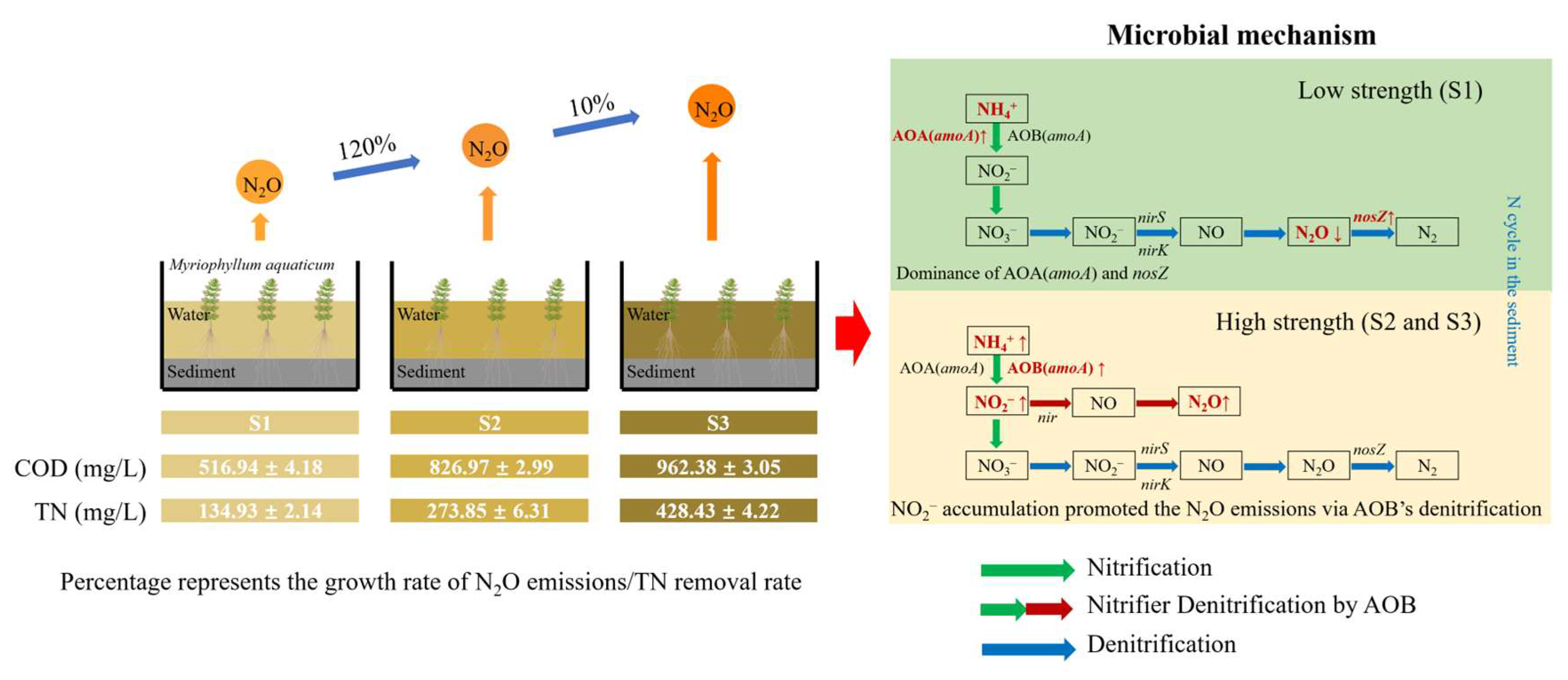
Influent strength acts as an integrated operational driver that simultaneously regulates substrate supply, oxygen consumption, and microbial community dynamics. Increased strength is generally associated with enhanced microbial activity and higher GHG emissions in CWs [4,40]. Taking CWs treating swine wastewater as an example, high influent strength significantly increased N2O emissions (Figure 2). The accumulation of high concentrations of NH4+ and NO2 promoted the proliferation of AOB and may have enhanced nitrifier denitrification. Meanwhile, the denitrifying community gradually shifted from being dominated by nosZ-carrying bacteria to being dominated by nirS-carrying bacteria, thereby increasing the potential for N2O production [4].

4. Key Regulation Strategies for N2O Emission Reduction

4.1. Optimizing System Operation Parameters

4.1.1. Oxygen Supply Modes and Water-Level Management

Intermittent aeration has been shown to be an effective strategy for balancing N removal efficiency and N2O mitigation. By supplying oxygen to the substrate, it enhances nitrification and creates alternating aerobic–anoxic conditions that support denitrification, thereby reducing N2O accumulation. For example, in a partial nitrification–CW system, aerating a vertical flow CW with waste gas from the partial nitrification process increased nosZ abundance and achieved an N2O removal rate of up to 88.72% [41].
Shallow-water areas are often hotspots for N2O emissions in CWs. Although areas with a water depth of 9 cm or less are small, their N2O contribution can approach 50% of the entire system due to low flow velocity, sediment hypoxia, and insufficient carbon sources, a pattern that becomes more pronounced during high-temperature seasons. Raising the water level from approximately 4 cm to over 17 cm can reduce N2O emissions by more than 95%. Therefore, significant water-level drops and sediment exposure should be avoided during operation and maintenance, and the designed water level should be maintained to mitigate emissions from high-emission zones [42].
However, water-level regulation does not simply mean that greater depth always leads to better performance; its effectiveness depends on synergistic coordination with other operating parameters. Studies have shown that if water-level fluctuations are finely coupled with hydraulic retention time, a low-emission zone with high N removal efficiency can be constructed. Hydraulic retention time was extended from 0.8 days to 2.97 days using barrier facilities in the plant bed and ditch system of the CW. Combined with twice-daily water-level fluctuations of 30 to 40 cm, this strategy formed a distinct redox gradient at the ditch edge to enrich anaerobic ammonium oxidation bacteria such as Candidatus Brocadia, contributing to approximately 43.0% of the N loss. Because the anaerobic ammonium oxidation process itself does not produce N2O, the N2O flux in this hotspot zone was reduced by 27.1% compared to nonhotspot zones [43].

4.1.2. Influent Strategies

Influent regulation aims to stabilize hydraulic and substrate conditions, thereby avoiding sudden shifts in oxygen demand, NO2 accumulation, and incomplete denitrification. Continuous feeding is generally more favorable for N2O mitigation than intermittent feeding because it maintains a more stable redox environment. Jia et al. (2011) reported that N2O emissions from subsurface-flow CWs under intermittent feeding were approximately five times higher than those under continuous feeding [29].
For high-strength wastewater, pretreatments such as solid–liquid separation or anaerobic digestion are essential to significantly reduce the influent NH4+ load, thereby decreasing the likelihood of N2O production [4]. In addition, the form of influent N should be considered. NO3-dominated influent may intensify denitrification demand and increase N2O accumulation when electron donors are insufficient, whereas NH4+-dominated influent can enhance plant uptake and root exudation, potentially alleviating electron competition during heterotrophic denitrification [44].

4.2. Regulating Substrates and Electron Donors

4.2.1. Biochar Substrates

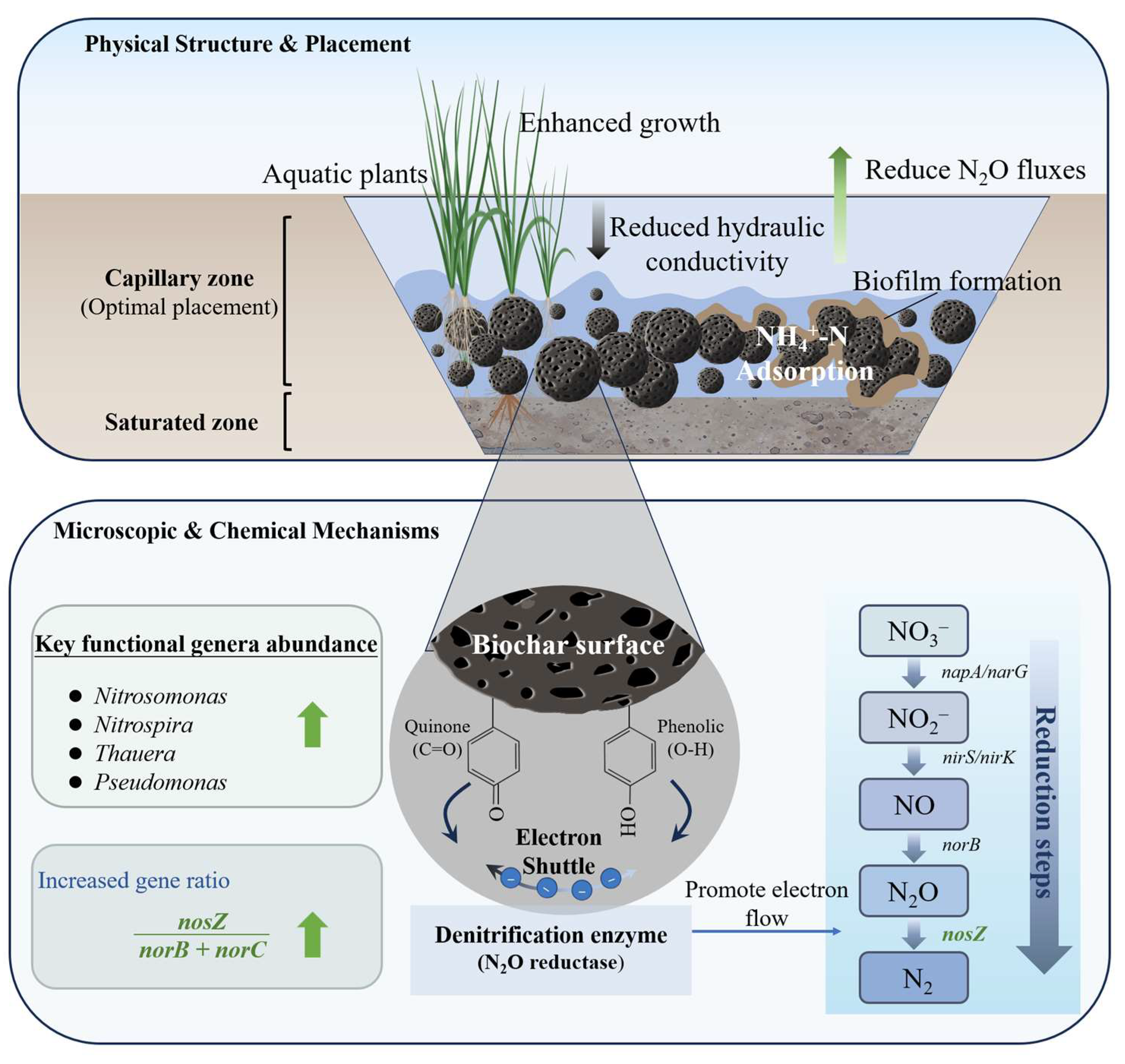
Biochar mainly functions as an electron-shuttling and microhabitat-regulating substrate (Figure 3). As a porous and carbon-rich material, biochar reduces N2O emissions through NH4+-N adsorption, biofilm formation, and plant growth enhancement [15]. Additionally, biochar can facilitate electron transfer via its surface functional groups, further promoting N2O reduction. Specifically, oxygen-containing functional groups on the biochar surface, such as phenolic and quinone groups, can act as electron shuttles, alleviating electron competition during denitrification and promoting electron flow toward the terminal reduction of N2O to N2 [45].
The mitigation performance of biochar strongly depends on its spatial placement and physicochemical form. Placement in the capillary zone has been identified as an effective strategy because the strong water retention capacity of biochar can create a steep moisture gradient, strengthen redox stratification, and improve the spatial coupling of nitrification and denitrification. This configuration has been reported to reduce the N2O/removed TN by 92.6% [45]. In terms of material form, granular biochar is generally more suitable than powdered biochar for CW applications because it has higher structural stability and a lower risk of washout, pore clogging, and effluent COD increase [23].
Biochar performance can be further improved when coupled with suitable operational regulation. For example, optimized water-level control combined with appropriate biochar dosage can create an anoxic microenvironment favorable for denitrifying enzyme activity, achieving efficient TN removal while restricting the N2O emission to 0.3% of the removed TN [46]. Under carbon-limited conditions, saturated biochar layers can also adsorb and slowly release organic matter, thereby buffering electron-donor shortages during unaerated phases and mitigating incomplete denitrification [47].
At the microbial level, biochar addition can enrich functional genera such as Nitrosomonas, Nitrospira, Thauera, and Pseudomonas [48], and increase the abundance ratio of nosZ/(norB + norC), thereby enhancing the potential for complete N2O reduction to N2 [49]. Overall, biochar mitigates N2O emissions mainly by redistributing electrons, stabilizing microhabitats, and improving the balance between N2O-producing and N2O-reducing processes, rather than by directly generating electrons within the system.

4.2.2. Fe-C Substrates

In contrast to biochar, Fe-C substrates act as reactive electron-generating media through in situ micro-electrolysis. Galvanic interactions between iron and carbon continuously release Fe2+ and electrons, directly supplying reducing power for denitrification and improving the thermodynamic favorability of the terminal reduction of N2O to N2. Therefore, Fe-C substrates can suppress incomplete heterotrophic denitrification while reducing nitrite accumulation, which further limits substrate availability for nitrifier denitrification [14].
In situ 15N-18O tracing studies have shown that Fe-C substrates significantly enhance pollutant removal efficiency, with NO3-N, TN, and organic matter removal rates reaching 97.73%, 77.68%, and 79.87%, respectively, while reducing N2O flux by 26.22%. Pathway analysis indicated that nitrate-driven denitrification remained the primary source of N2O, whereas nitrifier denitrification served as a secondary source. Fe-C addition promoted the complete reduction of NO3-N to N2 by increasing the abundances of nirS, nirK, and nosZ, thereby inhibiting N2O accumulation [14].
Under the alternating aerobic–anoxic conditions of tidal flow CWs, Fe-C micro-electrolysis accelerates Fe2+/Fe3+ cycling and enriches autotrophic denitrifying and Fe-reducing bacteria. The released Fe2+ served as an electron support autotrophic denitrification, while Fe3+ reduction under anoxic conditions was associated with Feammox. Consequently, a multi-pathway N removal network involving autotrophic denitrification, Feammox, and heterotrophic denitrification can be established, reducing N2O emissions per unit TN removed by up to 36.99% [50].
Overall, the key distinction is that biochar primarily facilitates electron redistribution through surface-mediated electron shuttling and microhabitat regulation, whereas Fe-C substrates actively generate electrons and participate in Fe2+/Fe3+ redox cycling. This mechanistic contrast clarifies their different roles in CW-based N2O mitigation and suggests that their complementary use may be a promising direction for future substrate design.

4.2.3. Manganese-Based Composite Substrates

By regulating the micro-redox environment of CWs, manganese-based materials can effectively inhibit GHG emissions while enhancing N removal efficiency. The preparation methods and forms of the substrates significantly influence their emission-reduction performance. Compared with conventional physical mixing, loading manganese oxides onto the surface of porous carriers, such as volcanic rocks, through chemical doping can optimize the oxidation–reduction potential around the substrate. Studies using 15N stable isotope labeling technology have confirmed that this optimized microenvironment can inhibit N2O accumulation during the denitrification process. Specifically, it improves electron supply to the terminal reductase nosZ, thereby alleviating the bottleneck associated with incomplete heterotrophic denitrification and ultimately achieving a substantial reduction in GHG emissions [51].
The combined use of manganese-based materials and carbon-rich substrates can produce a significant synergistic effect, providing an effective pathway for simultaneous water purification and GHG mitigation. When agricultural wastes, such as walnut shells, are combined with manganese ore, the walnut shells release organic carbon to promote heterotrophic denitrification, while the manganese ore acts as an electron exchange medium. This combination not only optimizes the microenvironment for N2O reduction but also creates redox conditions that are more favorable for methanotrophs than for methanogens, thereby promoting the conversion of CH4, a high-impact GHG, into CO2 [52]. Furthermore, activated carbon–manganese ore composites can further improve emission-reduction performance. Activated carbon serves not only as an adsorbent but also as an electron-transfer bridge and stabilizer for manganese species, thereby reducing manganese loss and reinforcing the manganese cycle. By increasing the protein-to-polysaccharide ratio in microbial extracellular polymeric substances, this composite substrate enhances extracellular electron transfer and promotes nitrogen and manganese transformations, ultimately suppressing N2O emissions [53].

4.3. Optimizing Plant Selection and Community Construction

Through species-specific screening, optimized community configuration, and scientific harvesting management, plants provide an effective ecological solution to overcome the trade-off between high N removal and elevated GHG emissions.

4.3.1. Selection of Plant Species

Plant roots can directly absorb NH4+ and NO3 and assimilate them into N-containing compounds, such as amino acids and proteins, thereby reducing N availability for nitrifying and denitrifying microorganisms [54]. Therefore, plant species with high N uptake capacity should be prioritized to enhance substrate competition and reduce N availability for microbial transformations. For example, under NO3-rich conditions, NO3-preferring plants with high NO3 uptake capacity may compete with denitrifiers and help reduce N2O production at the source [55].
The regulation of the rhizosphere microenvironment is another key consideration in plant species selection, mainly through root exudation and radial oxygen release. Root exudates, including organic acids, phenolic compounds, sugars, polysaccharides, and fatty-acid-related compounds, can affect N2O emissions by providing carbon and electron donors, modifying rhizospheric pH, and selectively shaping nitrifying and denitrifying microbial communities [54]. These effects are closely related to the balance among functional genes involved in N2O production and reduction.
For denitrification, phenolic compounds secreted by Typha spp., such as p-hydroxybenzoic acid and ferulic acid, have been reported to selectively promote complete denitrifying bacteria [54]. At the genetic level, the enrichment of complete denitrifiers is generally associated with increased nosZ abundance and a higher nosZ-to-nitrite reductase gene ratio, which enhances the capacity for the terminal reduction of N2O to N2 and mitigates N2O accumulation during incomplete denitrification [48].
For nitrification, some root exudates may suppress N2O formation by inhibiting ammonia oxidation. For example, linoleic acid has been reported to inhibit ammonia monooxygenase-related activity and the hydroxylamine oxidoreductase pathway, thereby suppressing nitrification [54]. Because NH2OH is a key intermediate and precursor of nitrification-derived N2O, inhibition of AMO-related NH4+ oxidation can reduce NH2OH formation and consequently decrease N2O production at the source.
However, plant effects are species-specific and may also increase N2O emissions. Systems containing Zizania latifolia showed higher N2O emissions than those planted with Phragmites australis and Typha latifolia. Fluorescence in situ hybridization further showed that AOBs were mainly enriched in the plant rhizosphere, especially during the growth season. This suggests that the root structure of Z. latifolia may transport more oxygen and organic matter to the rhizosphere, favoring AOB growth and stimulating nitrification-related N2O formation [26]. Therefore, plant selection should consider not only N uptake capacity but also root exudate composition, radial oxygen release, and their combined effects on amoA-related nitrification, as well as the denitrification gene balance between nirS/nirK and nosZ.

4.3.2. Diversity Configuration of Plant Communities

A rationally constructed multi-species mixed-planting system has a significant beneficial effect on N2O emission reduction. For example, compared to single-plant systems, specific mixed-planting patterns can not only increase the TN removal rate to 74.5–86.5%, but also significantly reduce the N2O conversion rate to below 4–8% through root niche differentiation and more comprehensive nutrient cycling [54]. Recent studies have further confirmed that a mixed-planting system composed of Cyperus alternifolius, Typha spp., and Acorus calamus can stably and efficiently remove COD (86.79%), NH4+-N (97.41%), NO3-N (98.55%), and total phosphorus (98.48%). Microscopic analysis revealed that the mixed-planting system significantly increased the relative abundance of Pseudogulbenkiania, a genus harboring complete denitrification gene sets. This shift toward a more complete denitrifying community structure is considered a key factor in effectively suppressing N2O emissions, thereby substantially reducing the global warming potential of the system [56].
However, in practical applications, attention must be paid to the potential trade-off of plant diversity on GHG emissions. Microcosm simulation studies have shown that if species richness is merely increased, although the system’s denitrification activity and plant N uptake will be significantly enhanced, with N removal efficiency reaching 75%, the absolute N2O emission rate may also increase substantially [57,58]. Therefore, in ecological restoration projects, plant species should not be increased blindly. Instead, combinations should be based on the niche complementarity between species, while comprehensively considering environmental costs to identify the optimal balance between enhancing water purification capacity and controlling the increase in GHG emissions.

4.3.3. Plant Harvesting Management

Plant harvesting is an important management practice for maintaining nutrient removal and regulating N2O emissions in CWs, but its effect is strongly time-dependent. The timing of harvesting relative to plant senescence is critical because nutrients accumulated in aboveground biomass may be remobilized to belowground organs during senescence or returned to the CW through litter decomposition, thereby changing carbon and N availability for nitrification and denitrification. Because growing shoots contained more N than withered shoots, harvesting before plant wilting is more effective for permanent N removal [59]. Nevertheless, harvesting may temporarily decrease N removal and increase N2O emissions by reducing plant uptake, disturbing rhizosphere conditions, promoting NO2-N accumulation, and causing incomplete denitrification; maintaining sufficient electron donors, such as increasing C/N to 6 or S/N to 1.1 under low-temperature conditions, can reduce post-harvest N2O emissions [59].
The effects of harvesting also depend on harvesting frequency and season. Long-term reed harvesting reduced soil total organic carbon and TN and shifted an alkaline wetland from an N2O source to an N2O sink [60]. In Myriophyllum aquaticum wetlands, low-frequency harvesting reduced annual cumulative N2O emissions by 18.5%, whereas high-frequency harvesting reduced emissions by only 7.4%; harvesting reduced N2O emissions mainly in winter and summer but increased them in spring and autumn. This seasonal pattern was closely associated with harvesting-induced changes in water Eh, sediment dissolved organic carbon and NH4+-N, as well as the abundance of key denitrification genes including narG, nirK/nirS, and nosZ [28]. Therefore, plant harvesting should be optimized according to plant phenology, senescence stage, harvesting frequency, seasonal carbon and N availability, and redox conditions to avoid incomplete denitrification and N2O accumulation.

4.4. Coupling Novel Low-Carbon Biological Nitrogen Removal Processes

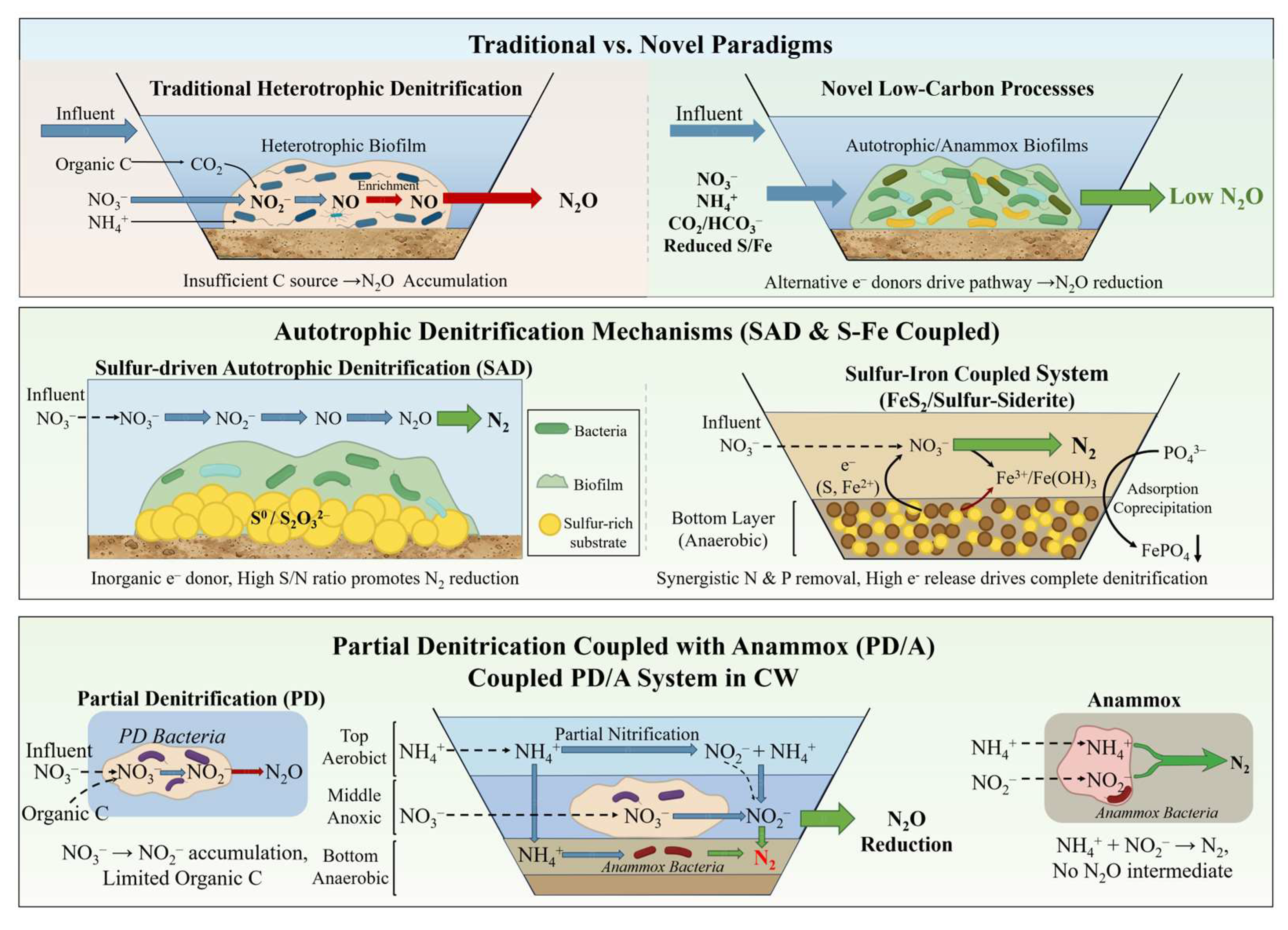
In the traditional urban wastewater treatment paradigm, CWs primarily rely on heterotrophic denitrification to achieve TN removal. However, in practical operation, insufficient carbon availability often leads to substantial N2O accumulation. To resolve the contradiction between N removal under low C/N ratios and high N2O emissions, increasing attention has been paid to introducing novel carbon-independent biological N removal processes into wetland systems. By reshaping wetland N metabolism and establishing autotrophic or mixotrophic pathways, these processes can reduce external carbon demand and suppress N2O generation through microbial metabolic regulation (Figure 4).

4.4.1. Emission-Reduction Mechanisms of Autotrophic Denitrification in CWs

By reshaping the electron-transfer pathways and microecological structure within CWs, autotrophic denitrification technology can effectively alleviate N2O accumulation caused by carbon limitation. Among them, autotrophic N removal processes represented by sulfur-based and sulfur–iron-coupled systems achieved synergistic improvements in N removal efficiency and GHG mitigation.
Sulfur-driven autotrophic denitrification (SAD) utilizes reduced sulfides (such as elemental sulfur, thiosulfate, or hydrogen sulfide) as inorganic electron donors, and inorganic carbon (such as CO2 or HCO3) as the sole carbon source for cell synthesis and metabolism. Because SAD requires no external organic carbon, the favorable conditions formed during the reaction, including a low dissolved oxygen level and a relatively high sulfide-to-N ratio, significantly promote the N2O reduction rate [12].
Although the SAD process is low-carbon and efficient, it has limitations such as the need for additional alkalinity supplementation and weak phosphorus removal capacity. Introducing composite substrates such as pyrite (FeS2), pyrrhotite, or sulfur–siderite can effectively compensate for these shortcomings and further enhance emission-reduction efficiency. These substrates are rich in reduced sulfur and iron, which can release electrons to drive the complete reduction of NO3 to N2. Meanwhile, Fe3+ and Fe(OH)3 are generated in the reaction to remove phosphorus through adsorption and coprecipitation, while also reducing acidification and thus alleviating the need for external alkalinity supplementation [12]. In practical applications, filling wetlands with a mixed substrate of sulfur and siderite can increase the TN removal rate to 91.6% and reduce N2O emissions by 93.4% compared to traditional quartz sand wetlands. This system directionally enriched denitrifying bacteria and significantly upregulated the abundance of functional genes related to N2O reduction and electron-transfer pathways [61].
Iron-bearing substrates, such as siderite-sulfur mixtures, are rich in reduced sulfur and iron. Their dissolution and biological oxidation processes can release abundant electrons to drive autotrophic denitrification, prompting the complete reduction of NO3 to N2 and thereby effectively alleviating N2O accumulation caused by insufficient carbon sources [61]. Further studies indicate that the vertical spatial distribution of substrates is critical for regulating the efficiency of sulfur/iron-coupled autotrophic denitrification and GHG emission reduction. Bottom-layer placement in the anaerobic zone can improve the utilization of reduced sulfur and Fe2+, enhance sulfur/iron-coupled autotrophic denitrification, and promote syntrophic interactions between nitrate-reducing bacteria and sulfur/iron-oxidizing bacteria. Electron and N balance analyses show that the bottom-layer placement can drive 66.58% of inorganic electrons towards sulfur oxidation coupled with complete denitrification, enabling 81.84% of the reduced nitrate to be converted into N2. Ultimately, N2O emissions account for only 0.36% of the converted nitrate, which is 39.60–53.60% lower than that of the middle- and top-placement modes [7].

4.4.2. Synergistic Emission-Reduction Strategy of Partial Denitrification Coupled with Anammox

Anaerobic ammonium oxidation (anammox) is a biochemical reaction catalyzed by anammox bacteria that converts NH4+-N into N2 using NO2 as an electron acceptor. Because the anammox metabolic pathway does not involve intermediate enzymatic steps that directly generate N2O, the process itself produces almost no GHGs. However, the stable supply of NO2, the essential substrate for anammox, remains a major bottleneck for applying this technology in CWs. Traditional partial nitrification is highly susceptible to fluctuations in temperature, dissolved oxygen, and free ammonia, resulting in unstable NO2 accumulation [12].
Partial denitrification (PD) refers to the controlled reduction of NO3, in which the denitrification process is arrested at the nitrite stage. The PD/anammox process does not require inhibition of nitrite-oxidizing bacteria because NO2 can be readily supplied through PD [12]. Spatially or temporally coupling PD with anammox in CWs can not only address N removal under low C/N ratio conditions but also substantially reduce GHG emissions. A literature-mining analysis reported that the N2O EF of the PD/anammox process ranged from 0.22% to 2.80%, with a median of 1.43%, which was lower than that of traditional biological N removal processes [62].
Table 2 summarizes reported N2O mitigation efficiencies and key emission indicators in CWs across operational optimization, substrate/electron-donor regulation, plant-mediated management, and process-level intensification. The compiled evidence indicates that N2O mitigation performance varies markedly among strategies, with reported reductions ranging from moderate decreases in hotspot fluxes to reductions exceeding 90% under optimized water-level control, biochar placement, or sulfur/iron-based autotrophic denitrification. However, these values should be interpreted with caution because the reported indicators differ among studies, including surface flux, cumulative emissions, EFs normalized to TN or NO3 removal, and N2O conversion ratios. Therefore, Table 2 is intended to provide a concise comparative overview rather than a direct ranking of mitigation strategies. Overall, the comparison highlights the system-dependent nature of N2O mitigation in CWs and suggests that integrated strategies combining stable hydraulic operation, optimized redox zoning, adequate electron-donor supply, and functional microbial pathway regulation are more promising than single-factor control.

5. Future Perspectives

Despite significant progress in elucidating N2O production pathways and mitigation strategies in CWs, several critical knowledge gaps and untapped opportunities remain. Addressing these challenges is essential for developing robust and scalable CW systems with verifiably low GHG emissions.

5.1. Mechanism-Informed Modeling and Artificial Intelligence Integration

Future research should advance toward predictive, mechanism-informed modeling frameworks that integrate microbial functional dynamics with key environmental and operational variables, including redox conditions, C/N ratios, temperature, influent N forms, hydraulic loading, and dissolved oxygen distribution. As highlighted in Section 2.2.1, recent advances in machine learning, including long short-term memory networks and AutoML frameworks based on tree-structured Parzen estimator optimization, offer promising tools for capturing nonlinear interactions between microbial processes and environmental drivers [23,65].
However, purely data-driven models often have limited transferability across CW types, climatic zones, and wastewater characteristics. Therefore, coupling mechanistic understanding with data-driven approaches could improve prediction accuracy, enable early warning of emission hotspots, and support real-time optimization of operating conditions to minimize N2O emissions under dynamic operational scenarios [66]. This shift would facilitate a transition from retrospective flux measurement to proactive emission management.

5.2. Scale-Up Challenges and Long-Term System Stability

Although laboratory- and pilot-scale studies have demonstrated the effectiveness of various N2O mitigation strategies, their full-scale performance and long-term operational stability remain uncertain [9]. Spatial heterogeneity in oxygen distribution, hydraulic short-circuiting, substrate clogging and aging, and microbial community succession may generate persistent emission hotspots that are not adequately captured by short-term experiments [67,68].
For novel functional substrates, long-term stability and economic viability remain major barriers to practical application. Biochar, Fe-C substrates, manganese-based composites, sulfur-based materials, and pyrite/pyrrhotite substrates may undergo gradual exhaustion, surface passivation, pore blockage, changes in electron-transfer capacity, or declining redox activity during long-term operation [69]. Potential secondary pollution, including heavy metal leaching from Fe-C or manganese-based substrates and sulfate accumulation from SAD, should also be carefully evaluated. Therefore, long-term field monitoring, combined with life-cycle assessment and techno-economic analysis, is essential for assessing the practical feasibility and sustainability of proposed substrate-based strategies [25,70].
Scaling up novel biological N removal processes in CWs also faces practical challenges. Autotrophic denitrification requires stable electron-donor release and appropriate pH/alkalinity control, while PD/anammox depends on the stable accumulation and spatial delivery of NO2 to anammox bacteria [12]. Feammox and iron-coupled N transformations further require the maintenance of suitable Fe2+/Fe3+ cycling and anaerobic microzones [71]. In full-scale CWs, seasonal variation, hydraulic fluctuation, uneven substrate distribution, and plant senescence may destabilize these processes. In addition, fluctuations in the C/N ratio and dissolved oxygen availability can alter competition among functional microbial guilds, such as heterotrophic versus autotrophic denitrifiers and ammonia-oxidizing versus nitrite-oxidizing bacteria. Standardized monitoring protocols and reporting frameworks are therefore urgently needed to enable cross-study comparisons and support evidence-based engineering decisions [9].

5.3. Trade-Offs Among Multiple Greenhouse Gas Emissions

Most existing studies have focused primarily on N2O mitigation; however, CWs also mediate CO2 and CH4 emissions [6]. Operational adjustments that suppress N2O formation, such as increasing carbon availability or promoting more reducing conditions, may unintentionally enhance CH4 production [52,72]. Although biochar offers potential for carbon sequestration [73], its production, transportation, and application, as well as those of other functional substrates such as Fe-C, may generate upstream CO2 emissions that require full life-cycle accounting. Intermittent aeration, although effective for reducing N2O emissions, can also increase energy consumption and associated indirect CO2 emissions [41].
Future research should therefore adopt an integrated GHG balance perspective [6]. Multi-objective optimization, combined with full life-cycle assessments, is needed to balance N removal efficiency, overall GHG emissions, energy consumption, substrate durability, and maintenance costs [24]. This approach would help move CW design beyond single-gas mitigation toward lower overall global warming potential.

5.4. System Boundary Expansion and Comprehensive Emission Accounting

A key limitation of current studies is their predominant focus on direct surface-to-atmosphere N2O fluxes, whereas dissolved N2O exported via effluents and its downstream re-emission are often neglected, as discussed in Section 2.2.1. This incomplete system boundary may substantially underestimate total GHG emissions from CWs [21].
Future studies should expand the system boundary by accounting for both direct atmospheric emissions and waterborne N2O export, including the re-emission or transformation of dissolved N2O in downstream receiving waters [19]. In addition, comprehensive emission accounting should include indirect emissions from aeration energy use, substrate production and replacement, plant harvesting, and routine maintenance. Such expanded and standardized accounting frameworks are needed to improve the accuracy of GHG inventories and to more reliably evaluate the true climate benefits of CWs.

6. Conclusions

CWs are widely applied ecological wastewater treatment systems that serve as both N removal platforms and potential sources of N2O. Therefore, reconciling efficient N removal with N2O mitigation is essential for developing sustainable, low-carbon wastewater treatment systems.
This review establishes a multiscale framework linking microbial mechanisms, environmental regulation, and engineering mitigation of N2O emissions in CWs. At the microbial level, N2O production is mainly governed by hydroxylamine oxidation during ammonia oxidation, nitrifier denitrification, and incomplete heterotrophic denitrification under electron-donor limitation. These pathways are regulated by redox conditions, C/N ratios, influent loading, functional genes such as amoA, nirS, nirK, and nosZ, and microbial community succession. Together, these factors determine whether N transformation proceeds toward complete removal or N2O accumulation.
From an engineering perspective, several mitigation strategies can reduce N2O emissions in CWs, including aeration and hydraulic regulation, functional substrates such as biochar and iron–carbon materials, plant community management, and coupling with advanced biological N removal processes. These strategies mainly act by reshaping redox microenvironments, enhancing electron transfer, and promoting complete denitrification. However, their effectiveness remains system-dependent and requires coordinated optimization across hydrological, biogeochemical, and ecological scales. Future studies should address scale-up and long-term performance challenges, with particular attention to system stability, economic feasibility, site-specific variability, and off-site N2O emissions, to support the design of reliable full-scale low-carbon CWs.

Author Contributions

Conceptualization, H.S. and B.S.; resources, Y.L. and B.S.; writing—original draft preparation, H.S.; writing—review and editing, B.S.; supervision, B.S.; funding acquisition, H.S. All authors have read and agreed to the published version of the manuscript.

Funding

This research was funded by the National Natural Science Foundation of China (No. 52300027).

Data Availability Statement

No new data were created or analyzed in this review. Data sharing is not applicable to this article.

Conflicts of Interest

The authors declare no conflicts of interest.

References

  1. IPCC. Climate Change 2021: The Physical Science Basis; Cambridge University Press: Cambridge, UK, 2021; pp. 673–815. [Google Scholar]
  2. Zhu, G.; Shi, H.; Zhong, L.; He, G.; Wang, B.; Shan, J.; Han, P.; Liu, T.; Wang, S.; Liu, C.; et al. Nitrous oxide sources, mechanisms and mitigation. Nat. Rev. Earth Environ. 2025, 6, 574–592. [Google Scholar] [CrossRef]
  3. Ravishankara, A.R.; Daniel, J.S.; Portmann, R.W. Nitrous oxide (N2O): The dominant ozone-depleting substance emitted in the 21st century. Science 2009, 326, 123–125. [Google Scholar] [CrossRef] [PubMed]
  4. Sun, H.; Wu, S.; Feng, S.; Jiang, C.; Wang, R.; Xu, S.; Cui, L.; Zhuang, X. Impact of influent strengths on nitrous oxide emission and its molecular mechanism in constructed wetlands treating swine wastewater. Environ. Res. 2022, 210, 112957. [Google Scholar] [CrossRef] [PubMed]
  5. Nyer, S.C.; Volkenborn, N.; Aller, R.C.; Graffam, M.; Zhu, Q.; Price, R.E. Nitrogen transformations in constructed wetlands: A closer look at plant-soil interactions using chemical imaging. Sci. Total Environ. 2022, 816, 151560. [Google Scholar] [CrossRef] [PubMed]
  6. Zhang, L.; Pan, W.; Xu, C.; Du, L.; Guo, X. Greenhouse gas emissions and control measures for constructed wetland: A systematic review. J. Environ. Manag. 2026, 397, 128222. [Google Scholar] [CrossRef]
  7. An, H.; Wang, Q.; Lu, X.; Ruan, T.; Ma, C.; Yao, L.; Tang, Y.; Wu, Z.; Zhou, Q.; Xiao, E. Unlocking low N2O emissions from nitrate-laden wastewater in constructed wetlands: Critical role of pyrrhotite substrate layer in mediating nitrate-dependent sulfide oxidation. Bioresour. Technol. 2026, 439, 133295. [Google Scholar] [PubMed]
  8. Yin, X.; Jiang, C.; Xu, S.; Yu, X.; Yin, X.; Wang, J.; Maihaiti, M.; Wang, C.; Zheng, X.; Zhuang, X. Greenhouse gases emissions of constructed wetlands: Mechanisms and affecting factors. Water 2023, 15, 2871. [Google Scholar] [CrossRef]
  9. Wu, H.; Wang, R.; Yan, P.; Wu, S.; Chen, Z.; Zhao, Y.; Cheng, C.; Hu, Z.; Zhuang, L.; Guo, Z.; et al. Constructed wetlands for pollution control. Nat. Rev. Earth Environ. 2023, 4, 218–234. [Google Scholar] [CrossRef]
  10. Hou, J.; Meng, F.; Yuan, Q.; Sun, Y.; Zhang, Y.; de Oliveira, J.A.P.; Zhang, L.; Cheng, H.; Yang, Z. Potential role of rural constructed wetlands in shaping water-land-energy-carbon nexus. Environ. Impact Assess. Rev. 2025, 115, 108036. [Google Scholar] [CrossRef]
  11. Cao, Y.; Zhang, P.; Jong, M.C.; Wang, S.; Yan, G.; Zuo, J.; Zhang, W. Potential of using nature-based solutions to upgrade wastewater treatment plants in China and reduce carbon emissions: A comparative study of advanced treatment processes and constructed wetlands. Resour. Conserv. Recycl. 2025, 218, 108220. [Google Scholar] [CrossRef]
  12. Jiao, F.; Chen, X.; Zhang, T.; Sun, C.; Qi, B.; Xu, S.; Zhou, X.; Zhang, Y.; Hu, Y.; Rong, C.; et al. Comprehensive review of constructed wetlands implemented with advanced biotechnologies for carbon-neutral treatment of urban wastewater: Enhanced removal of nitrogen and reduction of greenhouse gas emissions. Bioresour. Technol. 2026, 439, 133353. [Google Scholar] [CrossRef] [PubMed]
  13. Zhao, S.; Luo, Y.; Guo, F.; Chen, Y. Biochar enhances nitrogen removal and mitigates N2O emissions under salinity stress: Mechanism exploration and constructed wetland application. Bioresour. Technol. 2026, 452, 134584. [Google Scholar] [CrossRef] [PubMed]
  14. He, Q.; Feng, M. Revealing the iron-carbon effect on N2O production pathways in constructed wetlands: Based on 15N-18O isotope tracing and microbial analysis. J. Environ. Chem. Eng. 2025, 13, 120519. [Google Scholar] [CrossRef]
  15. Negi, D.; Verma, S.; Singh, S.; Daverey, A.; Lin, J.G. Nitrogen removal via anammox process in constructed wetland—A comprehensive review. Chem. Eng. J. 2022, 437, 135434. [Google Scholar] [CrossRef]
  16. Jones, M.W.; Peters, G.P.; Gasser, T.; Andrew, R.M.; Schwingshackl, C.; Gütschow, J.; Houghton, R.A.; Friedlingstein, P.; Pongratz, J.; Le Quéré, C. National contributions to climate change due to historical emissions of carbon dioxide, methane, and nitrous oxide since 1850. Sci. Data 2023, 10, 155. [Google Scholar] [CrossRef] [PubMed]
  17. Ruiz, D.J.; Prather, M.J.; Strahan, S.E.; Thompson, R.L.; Froidevaux, L.; Steenrod, S.D. How atmospheric chemistry and transport drive surface variability of N2O and CFC-11. J. Geophys. Res.-Atmos. 2021, 126, e2020JD033979. [Google Scholar] [CrossRef]
  18. Koutsou, O.P.; Fountoulakis, M.S.; Matsoukas, C.; Fyllas, N.M.; Stasinakis, A.S. Estimation of N2O emissions from wastewater characteristics in constructed wetlands. J. Environ. Chem. Eng. 2021, 9, 106632. [Google Scholar] [CrossRef]
  19. Filali, A.; Bollon, J.; Molle, P.; Mander, Ü.; Gillot, S. High-frequency measurement of N2O emissions from a full-scale vertical subsurface flow constructed wetland. Ecol. Eng. 2017, 108, 240–248. [Google Scholar] [CrossRef]
  20. Jahangir, M.M.R.; Richards, K.G.; Healy, M.G.; Gill, L.; Müller, C.; Johnston, P.; Fenton, O. Carbon and nitrogen dynamics and greenhouse gas emissions in constructed wetlands treating wastewater: A review. Hydrol. Earth Syst. Sci. 2016, 20, 109–123. [Google Scholar] [CrossRef]
  21. Zhang, Y.; Yan, L.; Chen, M.; Chen, W.; Zhao, Y.; Yang, X. Nitrogen removal in wastewater treatment plant effluent by biochar-based constructed wetlands under low temperature conditions associated mitigation of dissolved nitrous oxide. Bioresour. Technol. 2026, 455, 134846. [Google Scholar] [CrossRef] [PubMed]
  22. Webb, J.R.; Clough, T.J.; Quayle, W.C. A review of indirect N2O emission factors from artificial agricultural waters. Environ. Res. Lett. 2021, 16, 043005. [Google Scholar] [CrossRef]
  23. Jiang, B.; Zhang, Y.; Zhang, Z.; Yang, Y.; Song, H. Tree-structured parzen estimator optimized-automated machine learning assisted by meta-analysis for predicting biochar-driven N2O mitigation effect in constructed wetlands. J. Environ. Manag. 2024, 354, 120335. [Google Scholar] [CrossRef]
  24. Hu, S.; Zhu, H.; Banuelos, G.; Shutes, B.; Wang, X.; Hou, S.; Yan, B. Factors influencing gaseous emissions in constructed wetlands: A meta-analysis and systematic review. Int. J. Environ. Res. Public Health 2023, 20, 3876. [Google Scholar] [CrossRef] [PubMed]
  25. Fuchs, V.J.; Mihelcic, J.R.; Gierke, J.S. Life cycle assessment of vertical and horizontal flow constructed wetlands for wastewater treatment considering nitrogen and carbon greenhouse gas emissions. Water Res. 2011, 45, 2073–2081. [Google Scholar] [CrossRef] [PubMed]
  26. Wang, Y.; Inamori, R.; Kong, H.; Xu, K.; Inamori, Y.; Kondo, T.; Zhang, J. Nitrous oxide emission from polyculture constructed wetlands: Effect of plant species. Environ. Pollut. 2008, 152, 351–360. [Google Scholar] [CrossRef] [PubMed]
  27. Zhang, S.; Liu, F.; Luo, P.; Xiao, R.; Zhu, H.; Wu, J. Nitrous oxide emissions from pilot scale three-stage constructed wetlands with variable nitrogen loading. Bioresour. Technol. 2019, 289, 121687. [Google Scholar] [CrossRef] [PubMed]
  28. Zhang, S.; Lv, S.; Zhang, M.; Liu, F.; Cheng, L. Mechanism of nitrous oxide emission reduction in constructed wetlands based on plant harvesting management. Bioresour. Technol. 2025, 421, 132128. [Google Scholar] [CrossRef] [PubMed]
  29. Jia, W.; Zhang, J.; Li, P.; Xie, H.; Wu, J.; Wang, J. Nitrous oxide emissions from surface flow and subsurface flow constructed wetland microcosms: Effect of feeding strategies. Ecol. Eng. 2011, 37, 1815–1821. [Google Scholar] [CrossRef]
  30. Wang, Z.; Liu, C.; Liao, J.; Liu, L.; Liu, Y.; Huang, X. Nitrogen removal and N2O emission in subsurface vertical flow constructed wetland treating swine wastewater: Effect of shunt ratio. Ecol. Eng. 2014, 73, 446–453. [Google Scholar] [CrossRef]
  31. Gu, X.; Sun, S.; Zhang, M.; Bai, X.; He, S. Carbon chain, hydroxyl and carbonyl: Potential drivers of nitrogen removal enhancement and nitrous oxide emissions in constructed wetlands. J. Environ. Chem. Eng. 2025, 13, 115037. [Google Scholar] [CrossRef]
  32. Lyu, W.; Huang, L.; Xiao, G.; Chen, Y. Effects of carbon sources and COD/N ratio on N2O emissions in subsurface flow constructed wetlands. Bioresour. Technol. 2017, 245, 171–181. [Google Scholar] [CrossRef] [PubMed]
  33. Lévesque, V.; Antoun, H.; Rochette, P.; Dorais, M. Type of constructed wetlands influence nutrient removal and nitrous oxide emissions from greenhouse wastewater. Eur. J. Hortic. Sci. 2020, 85, 3–13. [Google Scholar] [CrossRef]
  34. Huang, L.; Xiong, H.; Jiang, C.; He, J.; Lyu, W.L.; Chen, Y. Pathways and biological mechanisms of N2O emission reduction by adding biochar in the constructed wetland based on 15N stable isotope tracing. J. Environ. Manag. 2023, 342, 118359. [Google Scholar] [CrossRef]
  35. Singh, P.; Bisen, M.; Kulshreshtha, S.; Kumar, L.; Choudhury, S.R.; Nath, M.J.; Mandal, M.; Kumar, A.; Patel, S.K.S. Advancement in anaerobic ammonia oxidation technologies for industrial wastewater treatment and resource recovery: A comprehensive review and perspectives. Bioengineering 2025, 12, 330. [Google Scholar] [CrossRef] [PubMed]
  36. Shaw, L.J.; Nicol, G.W.; Smith, Z.; Fear, J.; Prosser, J.I.; Baggs, E.M. Nitrosospira spp. can produce nitrous oxide via a nitrifier denitrification pathway. Environ. Microbiol. 2006, 8, 214–222. [Google Scholar] [PubMed]
  37. Bahram, M.; Espenberg, M.; Parn, J.; Lehtovirta-Morley, L.; Anslan, S.; Kasak, K.; Koljalg, U.; Liira, J.; Maddison, M.; Moora, M.; et al. Structure and function of the soil microbiome underlying N2O emissions from global wetlands. Nat. Commun. 2022, 13, 1430. [Google Scholar] [CrossRef] [PubMed]
  38. Zhang, G.; Hao, Q.; Gou, Y.; Wang, X.; Chen, F.; He, Y.; Liang, Z.; Jiang, C. Changing the order and ratio of substrate filling reduced CH4 and N2O emissions from the aerated constructed wetlands. Sci. Total Environ. 2024, 941, 173740. [Google Scholar] [CrossRef] [PubMed]
  39. Jiang, Z.; Tang, S.; Liao, Y.; Li, S.; Wang, S.; Zhu, X.; Ji, G. Effect of low temperature on contributions of ammonia oxidizing archaea and bacteria to nitrous oxide in constructed wetlands. Chemosphere 2023, 313, 137585. [Google Scholar] [CrossRef] [PubMed]
  40. Zhou, X.; Liang, C.; Jia, L.; Feng, L.; Wang, R.; Wu, H. An innovative biochar-amended substrate vertical flow constructed wetland for low C/N wastewater treatment: Impact of influent strengths. Bioresour. Technol. 2018, 247, 844–850. [Google Scholar] [CrossRef] [PubMed]
  41. Zhang, X.; Feng, C.; Xu, Z.; Yang, W.; Tong, K.; Wang, Y.; Liu, X. Coupling of partial nitrification and aerated vertical flow constructed wetland for enhancing nitrite removal and reducing nitrous oxide. J. Environ. Chem. Eng. 2023, 11, 109114. [Google Scholar] [CrossRef]
  42. Kasak, K.; Kill, K.; Uuemaa, E.; Maddison, M.; Aunap, R.; Riibak, K.; Okiti, I.; Teemusk, A.; Mander, U. Low water level drives high nitrous oxide emissions from treatment wetland. J. Environ. Manag. 2022, 312, 114914. [Google Scholar] [CrossRef]
  43. Wang, S.; Wang, W.; Liu, L.; Zhuang, L.; Zhao, S.; Su, Y.; Li, Y.; Wang, M.; Wang, C.; Xu, L.; et al. Microbial nitrogen cycle hotspots in the plant-bed/ditch system of a constructed wetland with N2O mitigation. Environ. Sci. Technol. 2018, 52, 6226–6236. [Google Scholar] [CrossRef] [PubMed]
  44. Wang, J.; Huang, J.; Cai, Z.; Li, Q.; Sun, Y.; Zhou, H.; Zhu, H.; Song, X.; Wu, H. Differential nitrous oxide emission and microbiota succession in constructed wetlands induced by nitrogen forms. Environ. Int. 2024, 183, 108369. [Google Scholar] [CrossRef] [PubMed]
  45. Wang, N.; Wang, X.; Shen, Z.; Zhang, Q.; Zhang, Y.; Zhong, Y.; Xu, D.; Ding, Y.; Bai, S. The steep moisture gradient induced by biochar amendment in the capillary zone significantly reduced N2O emissions in constructed wetlands. Environ. Res. 2026, 289, 123366. [Google Scholar] [CrossRef] [PubMed]
  46. Wang, X.; Shen, Z.; Zhang, Q.; Lyu, T.; Ding, Y.; Bai, S. Biochar amendment and water level optimization enhance nitrogen removal and reduce N2O emissions in vertical flow constructed wetlands via metagenomic analysis. J. Environ. Manag. 2025, 389, 126133. [Google Scholar] [CrossRef]
  47. Zhou, X.; Jia, L.; Liang, C.; Feng, L.; Wang, R.; Wu, H. Simultaneous enhancement of nitrogen removal and nitrous oxide reduction by a saturated biochar-based intermittent aeration vertical flow constructed wetland: Effects of influent strength. Chem. Eng. J. 2018, 334, 1842–1850. [Google Scholar] [CrossRef]
  48. Liang, Y.; Wang, Q.; Huang, L.; Liu, M.; Wang, N.; Chen, Y. Insight into the mechanisms of biochar addition on pollutant removal enhancement and nitrous oxide emission reduction in subsurface flow constructed wetlands: Microbial community structure, functional genes and enzyme activity. Bioresour. Technol. 2020, 307, 123249. [Google Scholar] [CrossRef] [PubMed]
  49. Wang, J.; Cai, Z.; Li, Y.; Sun, Y.; Wu, H.; Song, X.; Zhu, H. Microbiota and genetic potential for reducing nitrous oxide emissions by biochar in constructed wetlands. Sci. Total Environ. 2023, 903, 166489. [Google Scholar] [CrossRef] [PubMed]
  50. Zhao, L.; Zheng, Y.; Wang, Z.; Zhang, D.; Ma, D.; Zhao, Y.; Wang, X.; Chen, R.; Dzakpasu, M. Iron-carbon micro-electrolysis facilitates autotrophic denitrification and Feammox in tidal flow constructed wetlands for enhanced nitrogen removal and reduced N2O emissions. Chem. Eng. J. 2024, 486, 150367. [Google Scholar] [CrossRef]
  51. Ji, M.; Zhang, X.; Heng, J.; Tanveer, M.; Zhang, J.; Guo, Z.; Hu, Z. New insights for simultaneous nutrient removal enhancement and greenhouse gas emissions reduction of constructed wetland by optimizing its redox environment through manganese oxide addition. Water Res. 2024, 253, 121348. [Google Scholar] [CrossRef] [PubMed]
  52. Xu, G.; Li, Y.; Wang, J.; Yang, W.; Wang, S.; Kong, F. Effects of substrate combinations on greenhouse gas emissions and wastewater treatment performance in vertical subsurface flow constructed wetlands. Ecol. Indic. 2021, 121, 107189. [Google Scholar] [CrossRef]
  53. Huang, Y.; Zheng, X.; Zhao, Z.; Tao, J.; Hu, T.; Han, Z.; Lin, T. Integration of manganese ores with activated carbon into constructed wetland for greenhouse gas emissions reduction. J. Environ. Manag. 2025, 375, 124205. [Google Scholar] [CrossRef]
  54. Xiang, D.; Yu, J.; Huang, X. A review of mechanism of constructed wetland plants, substrates, and microorganisms influencing nitrous oxide production. ACS EST Water 2026, 6, 2656–2667. [Google Scholar] [CrossRef]
  55. Cai, Z.; Li, Q.; Bai, H.; Zhu, C.; Tang, G.; Zhou, H.; Huang, J.; Song, X.; Wang, J. Interactive effects of aquatic nitrogen and plant biomass on nitrous oxide emission from constructed wetlands. Environ. Res. 2022, 213, 113716. [Google Scholar] [CrossRef] [PubMed]
  56. Hu, S.; Feng, W.; Shen, Y.; Jin, X.; Miao, Y.; Hou, S.; Cui, H.; Zhu, H. Greenhouse gases emissions and carbon budget estimation in horizontal subsurface flow constructed wetlands with different plant species. Sci. Total Environ. 2024, 927, 172296. [Google Scholar] [CrossRef] [PubMed]
  57. Han, W.; Chang, J.; Fan, X.; Du, Y.; Chang, S.; Zhang, C.; Ge, Y. Plant species diversity impacts nitrogen removal and nitrous oxide emissions as much as carbon addition in constructed wetland microcosms. Ecol. Eng. 2016, 93, 144–151. [Google Scholar] [CrossRef]
  58. Chang, J.; Fan, X.; Sun, H.; Zhang, C.; Song, C.; Chang, S.; Gu, B.; Liu, Y.; Li, D.; Wang, Y.; et al. Plant species richness enhances nitrous oxide emissions in microcosms of constructed wetlands. Ecol. Eng. 2014, 64, 108–115. [Google Scholar] [CrossRef]
  59. Sun, S.; Gao, L.; He, S.; Huang, J.; Zhou, W. Nitrogen removal in response to plants harvesting in two kinds of enhanced hydroponic root mats treating secondary effluent. Sci. Total Environ. 2019, 670, 200–209. [Google Scholar] [CrossRef] [PubMed]
  60. Liu, F.; Zhang, Y.; Liang, H.; Gao, D. Long-term harvesting of reeds affects greenhouse gas emissions and microbial functional genes in alkaline wetlands. Water Res. 2019, 164, 114936. [Google Scholar] [CrossRef] [PubMed]
  61. Feng, C.; Zhang, X.; Gao, G.; Ren, K.; Li, Z.; Xu, Z.; Wei, D.; Zhang, J. A new insight on simultaneous water purification and greenhouse gas reduction by constructing sulfur-siderite driven autotrophic denitrification pathways in constructed wetlands. Water Res. 2025, 274, 123130. [Google Scholar] [CrossRef] [PubMed]
  62. Liu, S.; Wu, F.; Guo, M.; Zeng, M.; Liu, W.; Wang, Z.; Wu, N.; Cao, J. A comprehensive literature mining and analysis of nitrous oxide emissions from different innovative mainstream anammox-based biological nitrogen removal processes. Sci. Total Environ. 2023, 904, 166295. [Google Scholar] [CrossRef] [PubMed]
  63. Wang, X.; Shen, Z.; Zhang, Q.; Zhong, Y.; Wang, M.; Zhang, Y.; Bai, S.; Zhang, Y. Critical role of biochar in the production and emission of greenhouse gas N2O in constructed wetlands: A comprehensive review. J. Clean. Prod. 2025, 512, 145487. [Google Scholar] [CrossRef]
  64. Sun, Y.; Qi, S.; Zheng, F.; Huang, L.; Pan, J.; Jiang, Y.; Hou, W.; Xiao, L. Organics removal, nitrogen removal and N2O emission in subsurface wastewater infiltration systems amended with/without biochar and sludge. Bioresour. Technol. 2018, 249, 57–61. [Google Scholar] [CrossRef] [PubMed]
  65. Seshan, S.; Poinapen, J.; Zandvoort, M.H.; van Lier, J.B.; Kapelan, Z. Forecasting nitrous oxide emissions from a full-scale wastewater treatment plant using LSTM-based deep learning models. Water Res. 2025, 268, 122754. [Google Scholar] [CrossRef] [PubMed]
  66. Li, K.; Duan, H.; Liu, L.; Qiu, R.; van den Akker, B.; Ni, B.; Chen, T.; Yin, H.; Yuan, Z.; Ye, L. An integrated first principal and deep learning approach for modeling nitrous oxide emissions from wastewater treatment plants. Environ. Sci. Technol. 2022, 56, 2816–2826. [Google Scholar] [CrossRef] [PubMed]
  67. Okiti, I.; Efakwu, G.; Pindus, M.; Kasak, K. Environmental and biogeochemical drivers of CH4 and N2O flux variability in treatment wetlands. Ecol. Eng. 2025, 219, 107705. [Google Scholar] [CrossRef]
  68. Sacco, F.C.M.; Venditti, S.; Wilmes, P.; Steinmetz, H.; Hansen, J. Ageing process characterization of innovative substrates in vertical-flow constructed wetlands after treating greywater. J. Environ. Manag. 2025, 394, 127602. [Google Scholar] [CrossRef]
  69. Wei, S.; Jia, L.; Tan, J.; Zhang, J.; Guo, Z.; Hu, Z.; Dai, P.; Wu, H. Iron-carbon micro-electrolysis simultaneously enhanced nutrient and heavy metal removal in constructed wetlands for purifying polluted groundwater with variable hydraulic loadings. Chem. Eng. J. 2023, 470, 144367. [Google Scholar] [CrossRef]
  70. Miwornunyuie, N.; Alamu, S.O.; Mao, G.Z.; Benani, N.; Hunter, J.; Oguntimein, G. Comparative life cycle and techno-economic assessment of constructed wetland, microbial fuel cell, and their integration for wastewater treatment. Clean. Technol. 2025, 7, 57. [Google Scholar] [CrossRef]
  71. Liu, Y.; Xu, L.; Su, J.; Ali, A.; Huang, T.; Wang, Y.; Zhang, P. Microbially driven Fe-N cycle: Intrinsic mechanisms, enhancement, and perspectives. Sci. Total Environ. 2024, 908, 168084. [Google Scholar] [CrossRef] [PubMed]
  72. Li, M.; Wu, H.; Zhang, J.; Ngo, H.; Guo, W.; Kong, Q. Nitrogen removal and nitrous oxide emission in surface flow constructed wetlands for treating sewage treatment plant effluent: Effect of C/N ratios. Bioresour. Technol. 2017, 240, 157–164. [Google Scholar] [CrossRef] [PubMed]
  73. Lehmann, J. Bio-energy in the black. Front. Ecol. Environ. 2007, 5, 381–387. [Google Scholar] [CrossRef]
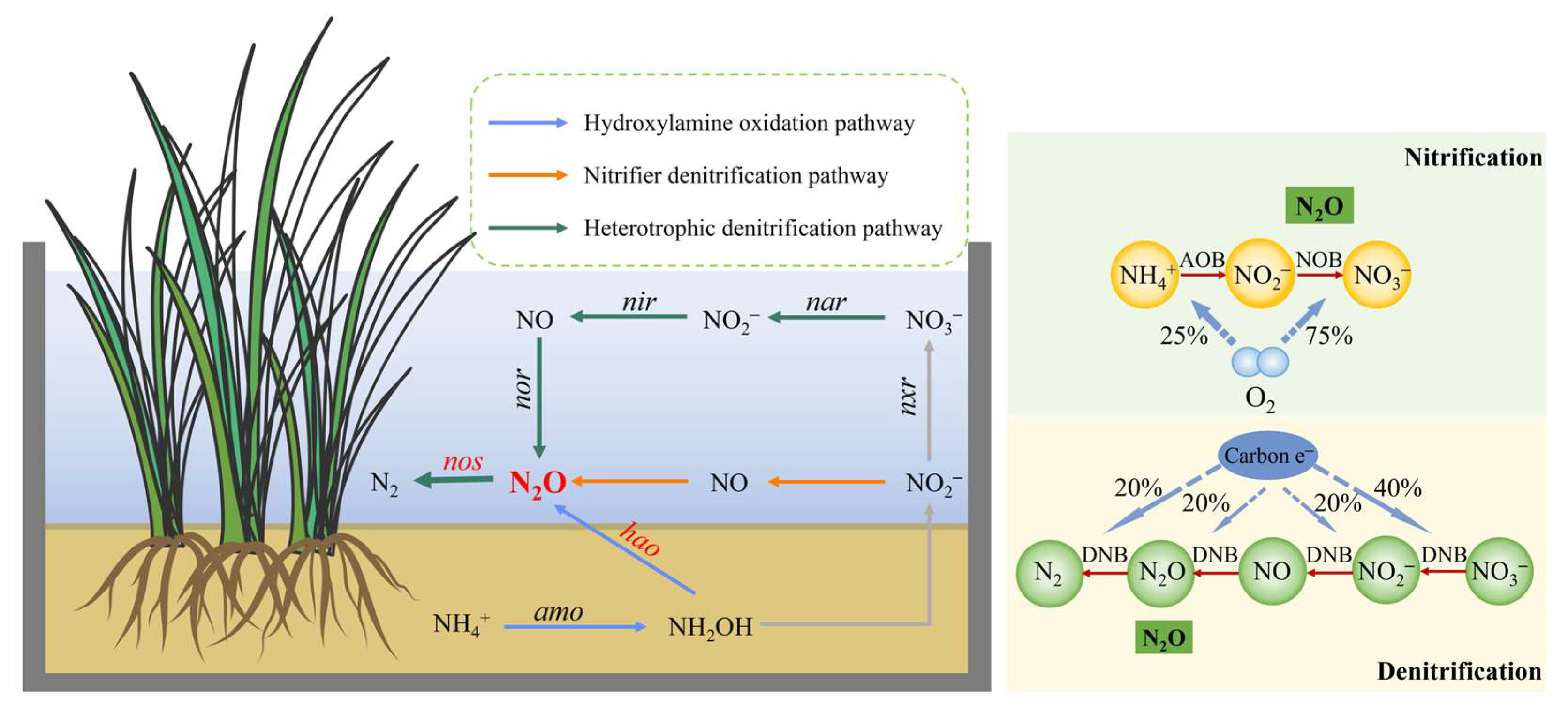
Figure 1. Fundamental microbial pathways of N2O production in constructed wetlands. Blue dashed arrows indicate the relative allocation of O2 or carbon/electron donors to each transformation step.
Water 18 01685 g001
Figure 2. Microbial responses of N2O emissions under different influent strength conditions [4].
Water 18 01685 g002
Figure 3. Mechanisms of N2O emission reduction by biochar in CWs.
Water 18 01685 g003
Figure 4. Low-carbon biological nitrogen removal processes for mitigating N2O emissions in constructed wetlands.
Water 18 01685 g004
Table 2. Comparative summary of reported N2O mitigation strategies in constructed wetlands.
CategoryMitigation StrategyMitigation PerformanceAdvantagesLimitationsRef
Operational optimizationIntermittent aerationUp to 88.72% N2O removal rateImproves nitrification and increases nosZ abundanceEnergy use; indirect CO2 emissions[41]
Operational optimizationHRT extension combined with water-level fluctuation27.1% hotspot N2O reductionEnhances anammox and N removalMay increase land footprint and operational complexity[43]
Operational optimizationWater level: 4 cm to >17 cm95.2% hotspot reductionSuppresses shallow-water hotspotsSite-specific hydraulic design[42]
Operational optimizationContinuous feeding~5-fold lower emissionsStabilizes conditionsLess flexible under load fluctuations[29]
Substrate/electron donorBiochar in capillary zone92.6% lower N2O/removed TNEnhances electron transfer and complete denitrificationDose and placement dependent[45]
Substrate/electron donorBiochar amendmentN2O flux: 271–884 μg/m2/hImproves N removal and microbial activityWashout risk; possible COD increase[63]
Substrate/electron donor45 cm water level with 40% biochar N2O/TN removed: 0.3%Higher electron transfer and nosZ; complete denitrificationWater-level- and dosage-dependent[46]
Substrate/electron donorCoupling aeration, biochar, and sludgeN2O rate: 18.4 mg/m2/dBetter oxygen supply, nitrification, and functional genesHigher energy use and complexity[64]
Substrate/electron donorFe-C substrate in tidal flow CWsUp to 36.99% lower N2O per TN removedDirect electron donor; enhances NO3 removalPotential Fe leaching risk; uncertain stability[50]
Substrate/electron donorSulfur–siderite-mixed substrate93.4% N2O reductionHigh TN removal; complete denitrificationAlkalinity demand; sulfate production[61]
Substrate/electron donorBottom-layer placement of pyrite or pyrrhotiteN2O: 0.36% of converted nitrateComplete denitrificationRisk of mineral passivation and reduced long-term activity[7]
Plant managementMulti-species plantingN2O conversion rate: 4–8%Niche complementarity; better N removalSpecies compatibility[54]
Plant managementLow-frequency harvesting18.5% lower cumulative N2OStable carbon supply; higher nosZHarvesting timing strongly affects performance[28]
Process intensificationSADEF: 0.01–0.8% of nitrate loadNo external carbonAlkalinity consumption; sulfate generation[12]
Process intensificationPD-anammoxEF: 0.22–2.80%Lower carbon demandStable PD control needed[62]
Disclaimer/Publisher’s Note: The statements, opinions and data contained in all publications are solely those of the individual author(s) and contributor(s) and not of MDPI and/or the editor(s). MDPI and/or the editor(s) disclaim responsibility for any injury to people or property resulting from any ideas, methods, instructions or products referred to in the content.