1. Introduction
Floods remain one of the most consequential natural hazards because they combine repeated physical exposure with large social, economic, and infrastructure losses. The problem is becoming more acute as climatic and demographic pressures interact. Large-scale assessments have shown that flood risk is being intensified by climate change in many regions, while expanding settlement and infrastructure footprints are increasing the number of people and assets located in hazard-prone terrain [
1,
2,
3,
4]. For rapidly growing urban zones in topographically constrained catchments, this interaction is especially important. In such settings, intense rainfall can be transformed quickly into concentrated runoff, and the consequences are amplified when urban development follows valley floors, road crossings, and waterways. These patterns are directly relevant to mountain cities in southwestern Saudi Arabia, where wadi systems, steep relief, and urban expansion can create localized but severe flood susceptibility conditions.
A large body of flood-mapping research has therefore focused on methods that can characterize inundation-prone terrain efficiently and reproducibly. Early remote sensing work established the value of satellite observations for monitoring flood extent and river inundation over broad areas [
5]. More recent studies have improved operational flood delineation using radar data, automated processing chains, and flood-specific spectral indices, which are particularly useful when rapid regional coverage is needed [
6,
7]. At the same time, review studies have stressed that no single mapping method is universally best. The appropriate method depends on the terrain, the available data, the urgency of the application, and the degree of uncertainty that can be tolerated [
8]. This matters in urban terrain because built surfaces, bridges, drainage structures, and narrow channels complicate both image-based flood detection and event-based interpretation, especially where observed inundation records are sparse.
Hydrodynamic models remain the benchmark for simulation of flood depth, velocity, and extent, but they also require a greater volume of boundary conditions, calibration support, and computational effort than many planning studies can provide. Raster-based inundation solvers and one-dimensional or two-dimensional hydraulic models have become increasingly capable, and comparative evaluation studies have shown their value for event reconstruction and floodplain prediction [
9,
10,
11]. However, these approaches also depend heavily on boundary conditions, channel geometry, friction parameterization, calibration data, and DEM quality. In many real planning contexts, especially outside heavily monitored basins, these inputs are incomplete or unavailable. That creates a practical need for screening-scale methods that can provide an interpretable first estimate of flood-prone terrain before more data-intensive simulation is attempted. DEM quality is particularly influential in this context, because the vertical structure of the terrain strongly controls drainage routing and the geometry of candidate floodplain zones [
12].
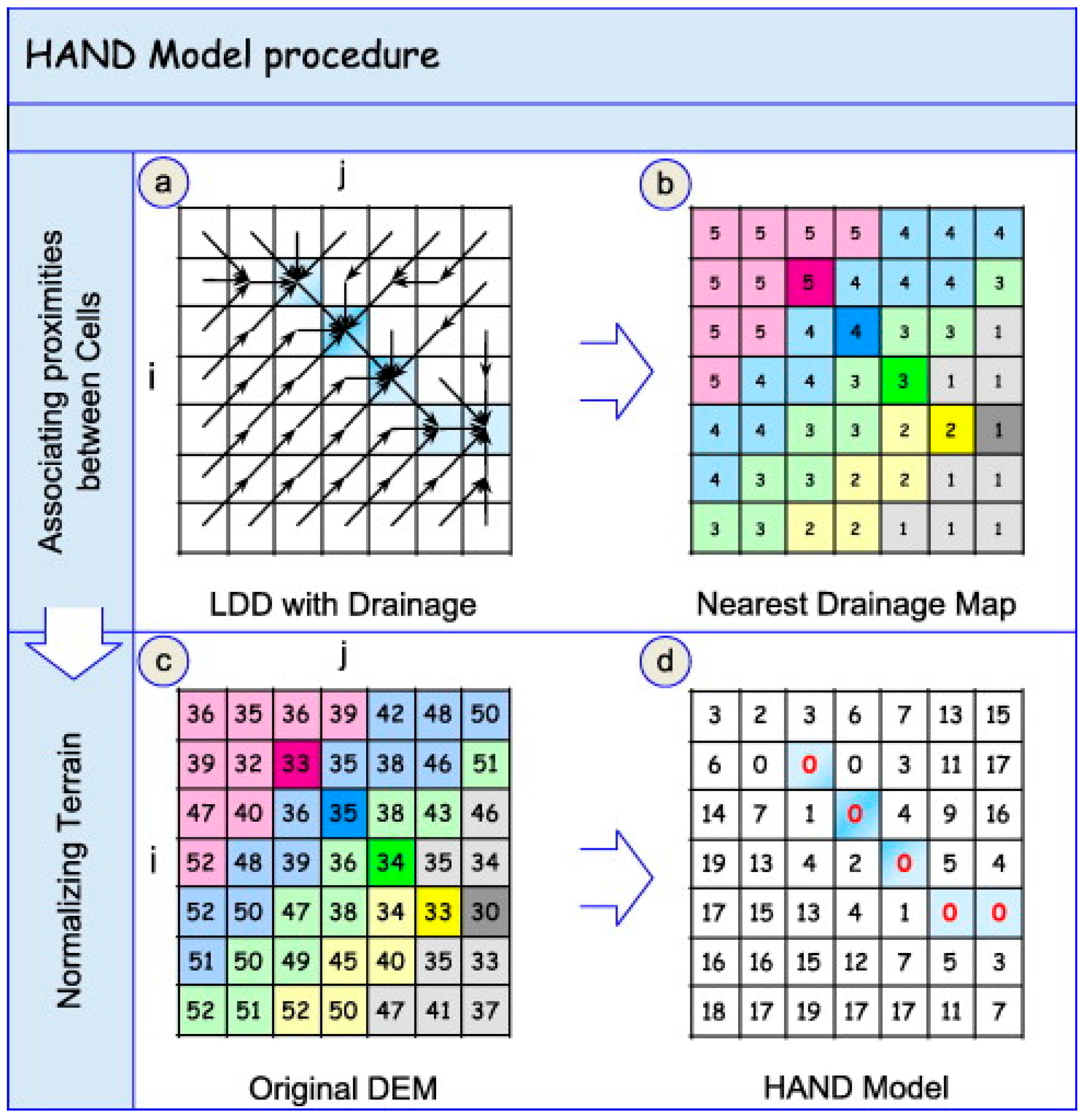
Within this broader literature, the Height Above Nearest Drainage approach has become an important terrain-based alternative for rapid susceptibility screening. The concept was first developed as a hydrologically meaningful terrain descriptor from SRTM-based topography, where it represented the vertical separation between a cell and its nearest hydraulically connected drainage cell [
13]. It was then extended into a floodplain-oriented model that better links local topography to drainage connectivity and relative inundation propensity [
14]. Subsequent studies have shown that geomorphic and HAND-based methods can be effective for identifying low-lying hydraulically connected terrain over large domains and in data-scarce contexts [
15]. They have also informed larger regional and national flood-hazard products that rely on topography as a primary organizing variable, even while remaining sensitive to drainage representation and elevation quality [
16]. This makes HAND particularly suitable when the immediate goal is susceptibility screening and exposure prioritization rather than dynamic event simulation [
17].
The relevance of this approach increases when hazard surfaces are linked directly to exposed assets. Recent continental and global work has shown that both flood frequency and flood losses can rise when warmed climates interact with growing human exposure [
18,
19]. Validation studies of broad-scale flood-hazard products likewise show that the most actionable insights emerge when susceptibility surfaces are translated into building and infrastructure implications that decision makers can act upon [
20]. Studies on disastrous river floods also emphasize that damage is rarely determined by hydrology alone. It depends on where urban development, roads, services, and settlements intersect with confined drainage paths and low-lying terrain [
21]. This literature supports an asset-oriented interpretation of flood susceptibility, especially in urban mountain catchments where roads and buildings often cluster around wadis and transport channels.
Flood susceptibility and flood-risk studies have also employed various GIS-based approaches that differ from terrain-normalization methods such as HAND. Multi-criteria decision-analysis methods, including GIS-AHP, combine several conditioning factors, such as elevation, slope, drainage density, land use, rainfall, and soil, to create weighted susceptibility maps [
22]. These approaches are useful when flood susceptibility is interpreted as the combined effect of multiple environmental and anthropogenic controls. However, their results may depend strongly on factor selection, weighting assumptions, and the availability of validation data. Other urban-planning-oriented approaches use spatial statistical or geostatistical units to examine how patterns of urban growth are associated with flood vulnerability [
23]. These methods are valuable for understanding the relationship between urban development and flood-prone areas, but they generally require detailed planning, historical, or official flood-zone datasets. In contrast, HAND provides a physically interpretable, terrain-based screening framework suitable for data-sparse catchments. It offers crucial utility during near-real-time flood emergencies, whereas traditional hydrodynamic models frequently face operational limitations [
24].
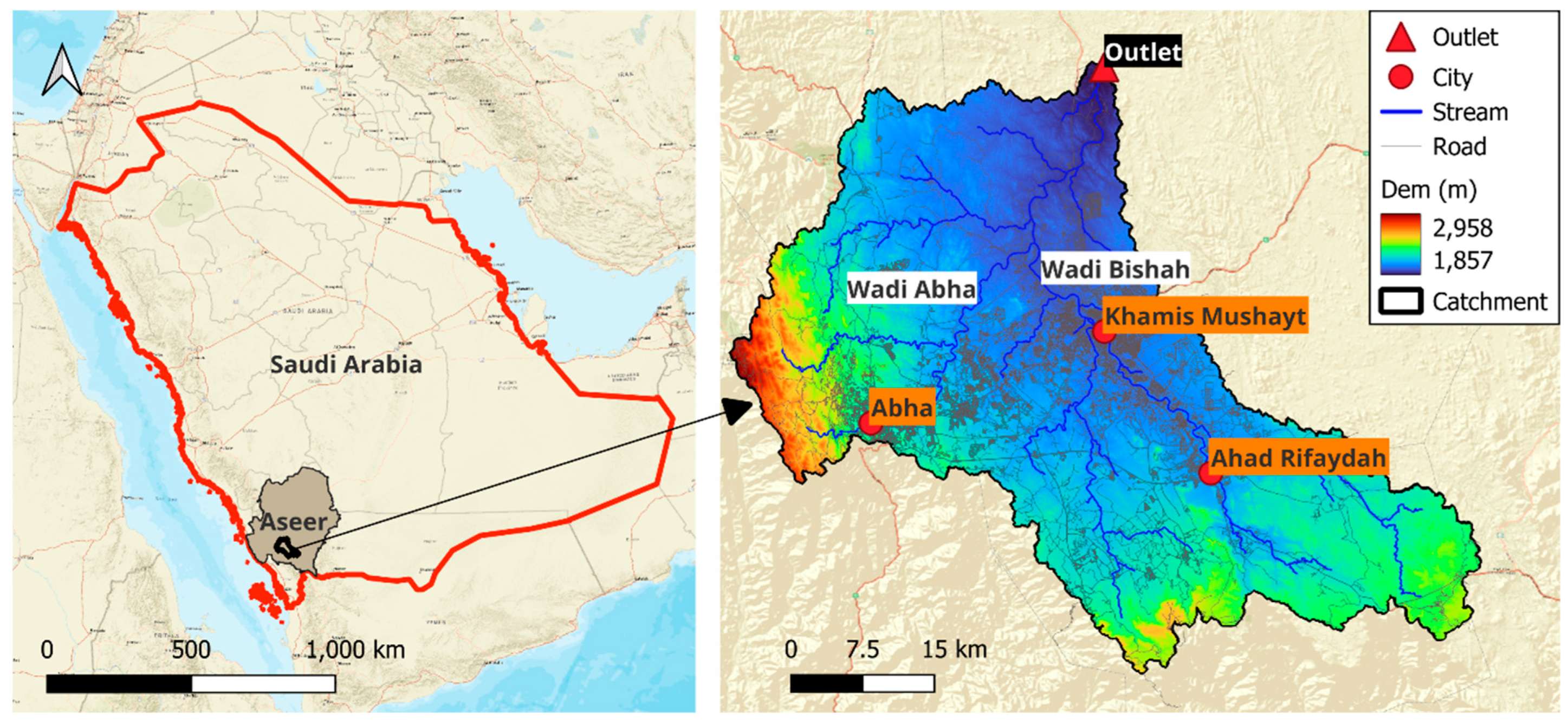
This study applies a HAND-based GIS workflow to a mountainous urban catchment in the Aseer Region of southwestern Saudi Arabia, where steep terrain, branching wadis, and expanding development create strong spatial contrasts in flood susceptibility. The study evaluates how mapped susceptibility changes when the drainage network is defined using four contributing-area thresholds of 1, 5, 10, and 20 km2. It then links the resulting HAND surfaces to building footprints and road networks to estimate exposed infrastructure under each scenario. By combining threshold sensitivity analysis with asset exposure mapping, the study provides a practical framework for screening flood-prone terrain and identifying robust hotspots for follow-up hydraulic investigation.
3. Results
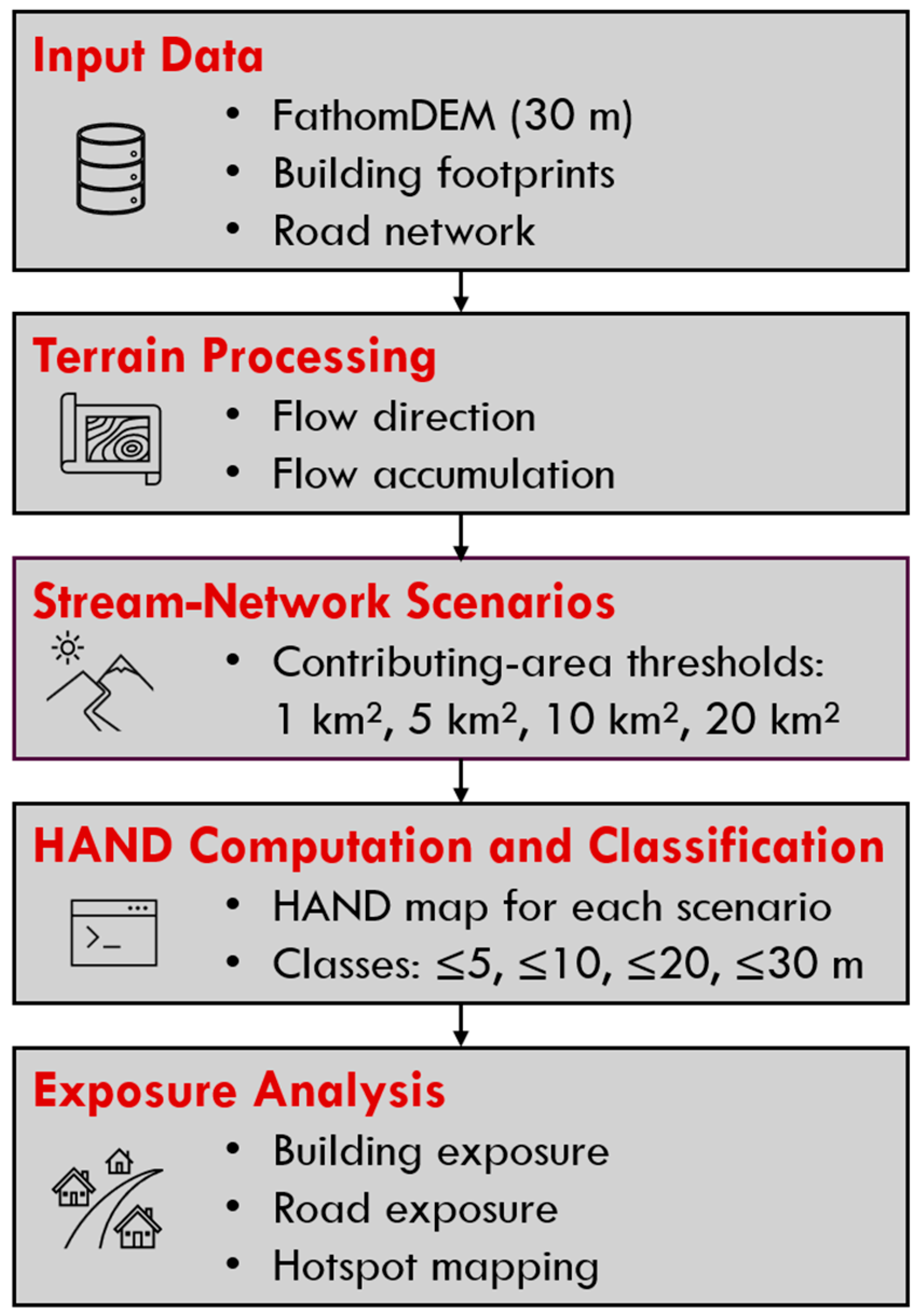
The Results Section follows the methodological workflow by first presenting the terrain and drainage structure, then the sensitivity of stream extraction to threshold selection, followed by the resulting HAND extent, building exposure, road exposure, and spatial hotspot patterns.
3.1. Terrain and Drainage Structure
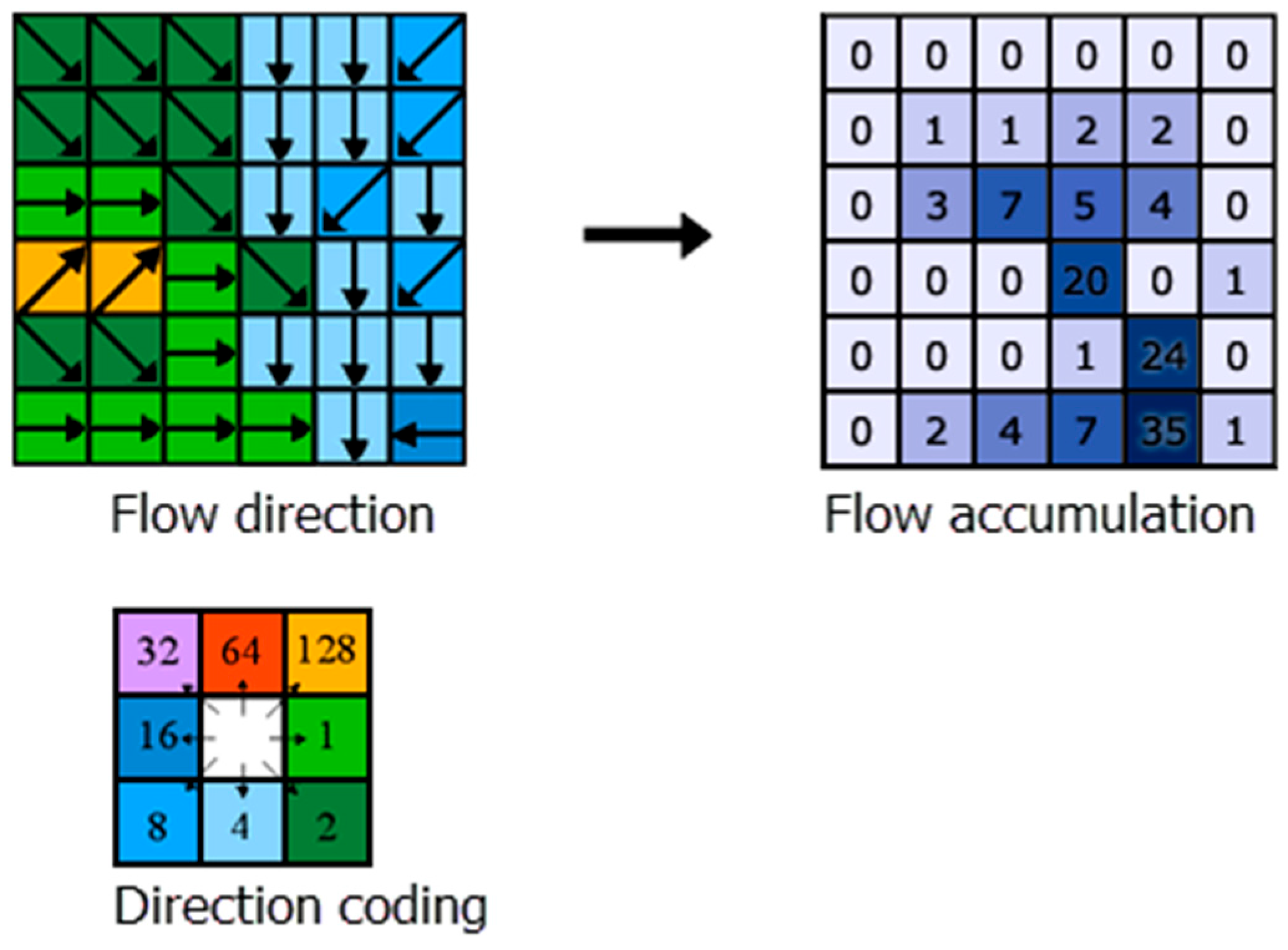
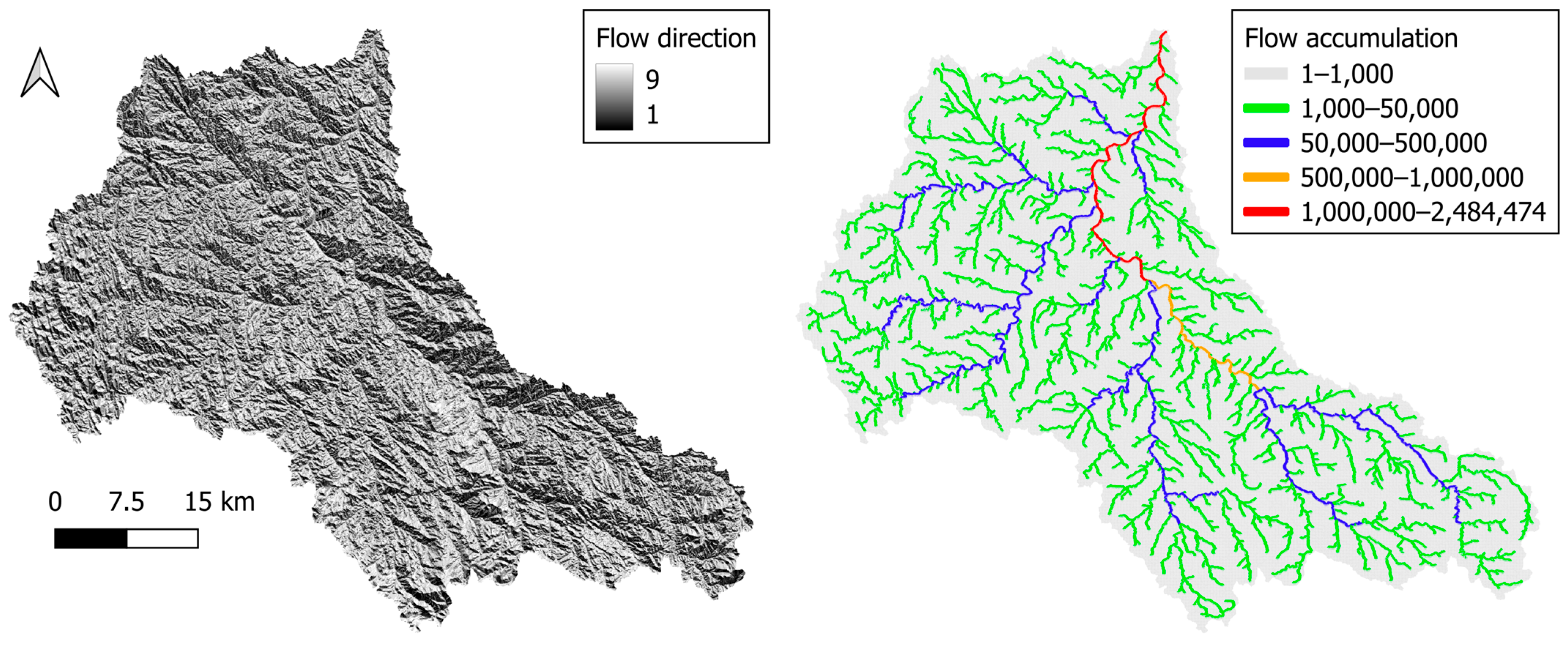
The flow-direction and flow-accumulation outputs confirm that the study catchment is organized around a strongly relief-controlled drainage system (
Figure 6). The flow-direction surface shows that runoff is routed downslope through a branching network of convergent paths, while the accumulation surface highlights a limited number of dominant drainage channels where upstream contributions become concentrated. These conduits coincide with the main wadi system and define the hydrologic skeleton of the catchment. In practical terms,
Figure 6 shows that runoff is not distributed evenly across the basin. Instead, it converges into a hierarchical drainage structure dominated by a few major pathways, with smaller tributary contributions feeding into the main urban belt. This terrain organization provides the hydrologic basis for the four stream-extraction scenarios examined in the following subsection. It also helps explain why later HAND results are concentrated along valley bottoms and connected drainage pathways rather than being spread uniformly across the catchment. This drainage structure is important because it establishes the terrain framework within which both susceptibility and infrastructure exposure are later mapped. In other words, the flow products do not only describe the catchment; they explain why the mapped hotspots concentrate along a limited set of connected valley floors.
3.2. Sensitivity of Stream Extraction to Threshold Selection
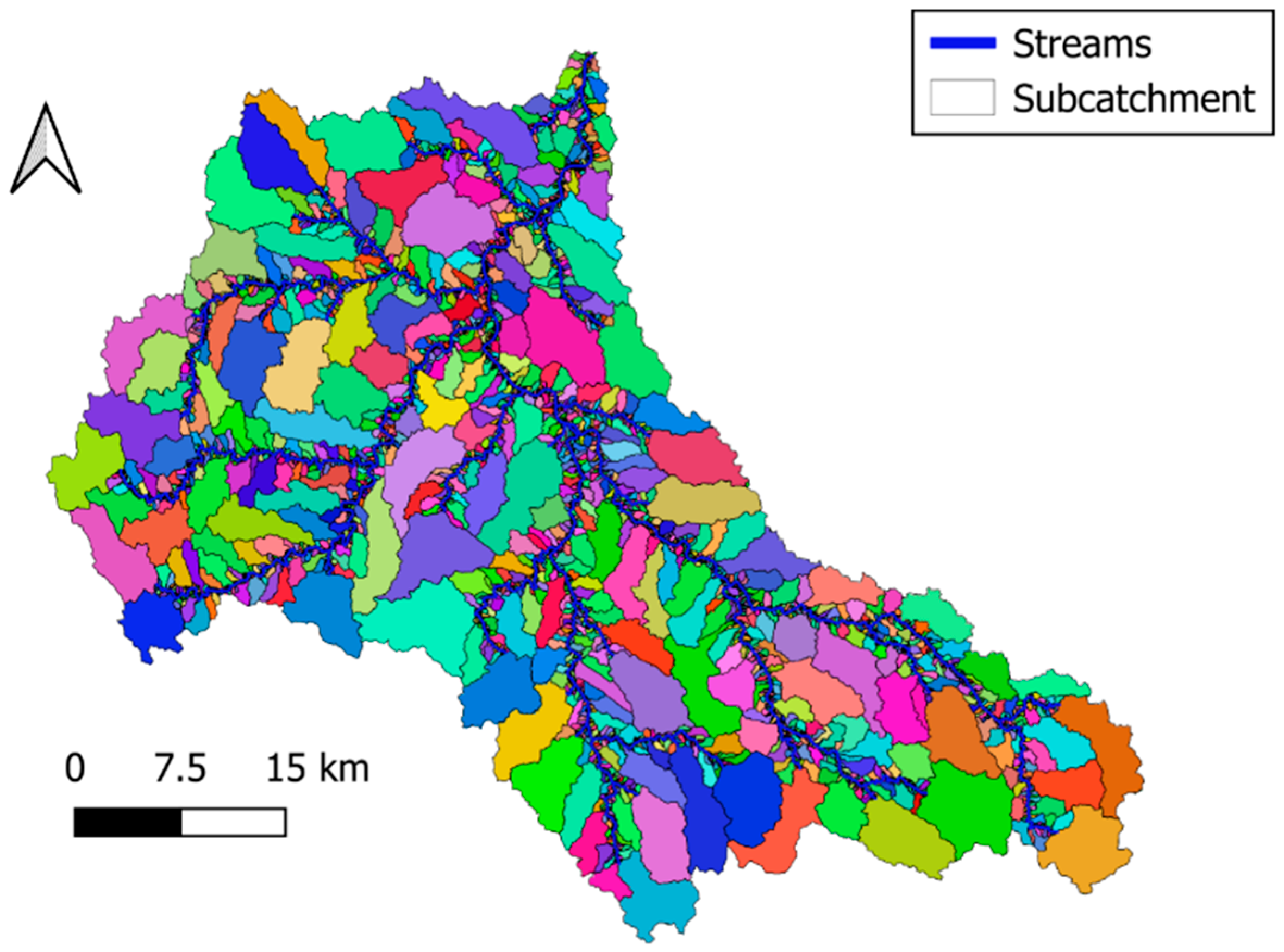
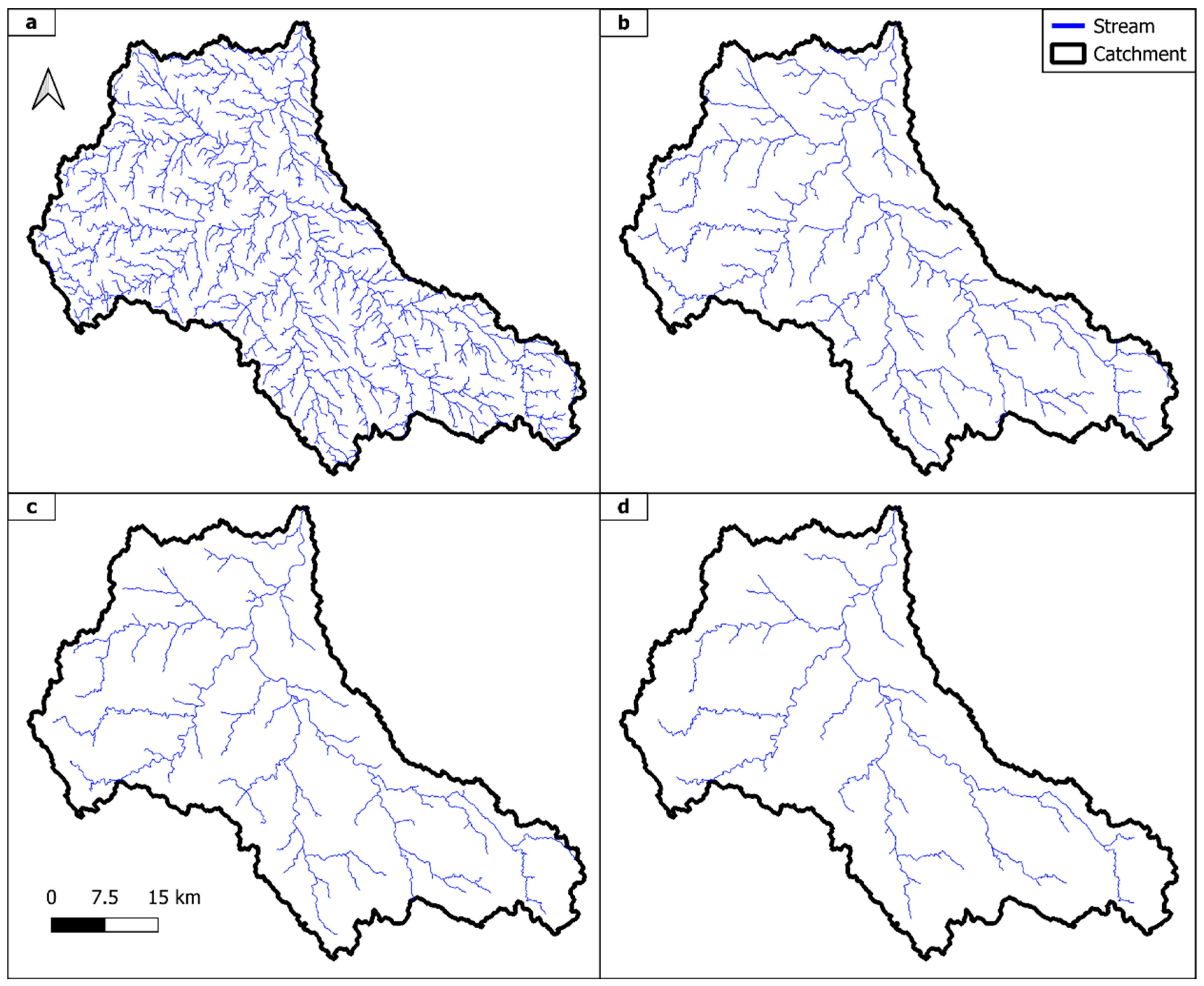
The extracted stream network changes markedly as the contributing-area threshold increases from 1 to 20 km
2 (
Figure 7). Under the 1 km
2 scenario, the drainage network is dense and includes many minor tributaries that extend into headwater slopes and local valley bottoms. As the threshold increases to 5 and 10 km
2, the network becomes progressively simpler, and many of the smaller branches are removed. By the 20 km
2 scenario, the drainage pattern is reduced largely to the dominant wadi channels and the larger tributaries that provide the main structural framework of the catchment. This change is important because the drainage network serves as the reference surface for the HAND calculation. A denser network places more terrain in close hydraulic relation to mapped drainage, whereas a more selective network restricts low-HAND terrain to areas adjacent to the main channels.
Figure 7 therefore shows more than a cartographic difference between the four stream maps. It illustrates the central sensitivity tested in this study, namely how alternative drainage definitions influence the spatial extent of terrain classified as potentially susceptible and, in turn, the number of exposed buildings and roads reported in the following sections.
3.3. HAND Extent Under Alternative Drainage Scenarios
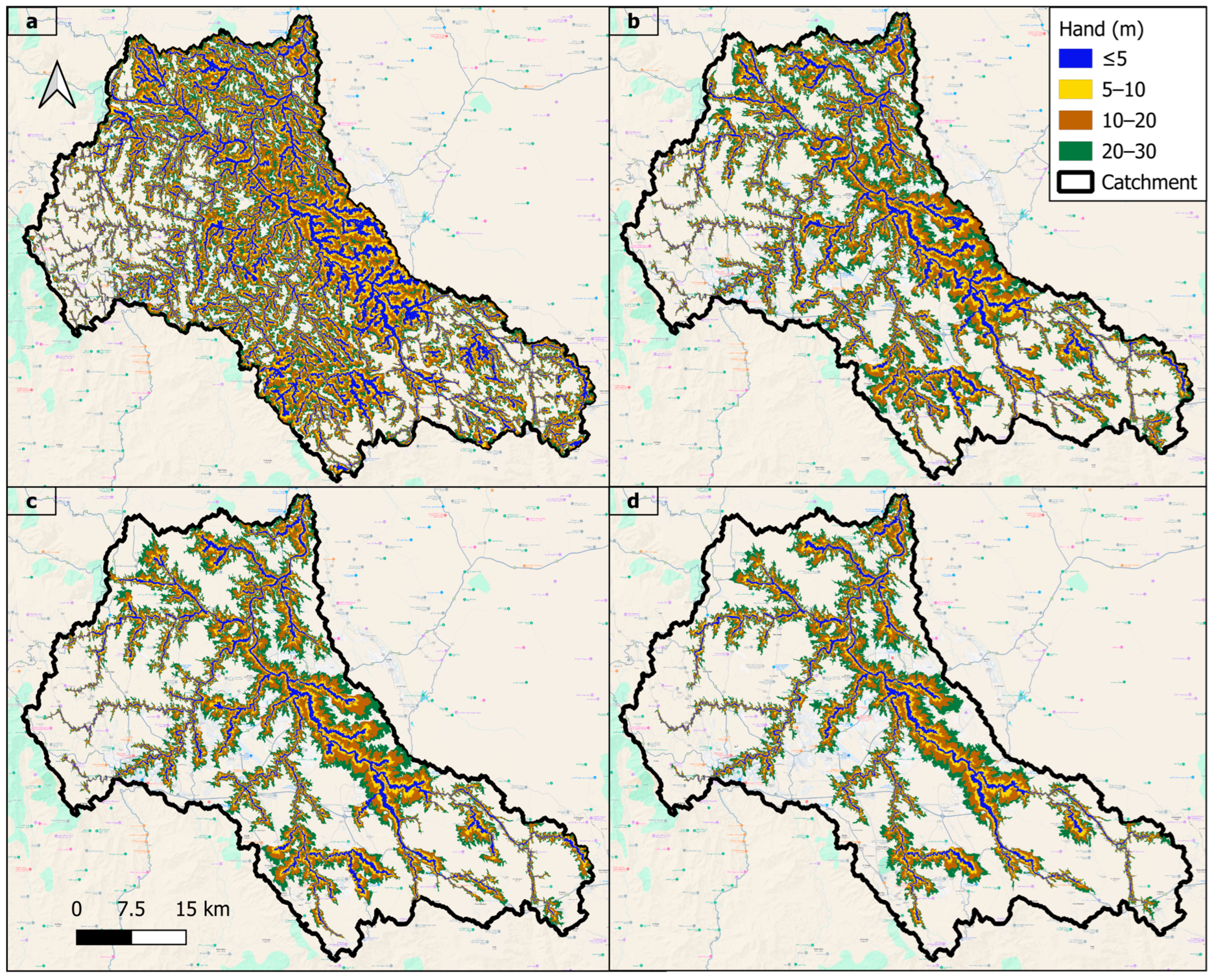
Figure 8 shows that the spatial extent of low-HAND terrain changes substantially across the four drainage scenarios, but the reduction is not spatially uniform. As the contributing-area threshold increases from 1 to 20 km
2, much of the peripheral low-HAND terrain associated with smaller tributaries disappears, while a persistent low-elevation belt remains aligned with the main urban–wadi belt. This pattern is especially evident along the Wadi Bishah system and the downstream urban area extending toward Ahad Rafidah and Khamis Mushait. The persistence of this pattern suggests that part of the mapped susceptibility is threshold-dependent, whereas another part is structurally controlled by the main drainage system and therefore remains stable across alternative drainage interpretations.
The areal statistics in
Table 1 confirm that the mapped low-HAND envelope contracts steadily as the contributing-area threshold becomes more conservative. The area classified as HAND ≤ 5 m declines from 367 km
2 in the 1 km
2 scenario to 188, 139, and 99 km
2 in the 5, 10, and 20 km
2 scenarios, respectively. Relative to the 2247 km
2 catchment, these values represent about 16.3%, 8.4%, 6.2%, and 4.4% of the basin. The same downward pattern extends to the broader cumulative classes. HAND ≤ 10 m decreases from 689 km
2 to 204 km
2, HAND ≤ 20 m decreases from 1210 km
2 to 445 km
2, and HAND ≤ 30 m decreases from 1548 km
2 to 695 km
2. The decline is strongest in the strictest low-HAND class, indicating that the smallest vertical separations from drainage are especially sensitive to the inclusion or exclusion of minor tributaries.
More important than the expected contraction in total area is the spatial stability of the main low-elevation zone. Although the peripheral susceptibility envelope changes substantially across the four scenarios, the same urban–wadi belt remains visible throughout. This suggests that the most critical part of the mapped susceptibility surface is not controlled by one threshold choice alone but by the dominant drainage structure of the catchment.
3.4. Building Exposure Across HAND Scenarios
The building analysis shows that exposure is strongly concentrated in low-HAND terrain and is highly sensitive to drainage-network definition (
Table 2). After applying the 50 m
2 minimum-area filter, approximately 166,000 building footprints remained from an initial inventory of about 210,000. Under the 1 km
2 scenario, 26,449 buildings fall within HAND ≤ 5 m, 65,590 within HAND ≤ 10 m, 118,683 within HAND ≤ 20 m, and 141,785 within HAND ≤ 30 m. These values correspond to about 15.9%, 39.5%, 71.5%, and 85.4% of the retained building stock. Under the 20 km
2 scenario, the corresponding counts decline to 5633, 22,477, 58,258, and 83,651, or about 3.4%, 13.5%, 35.1%, and 50.4% of retained buildings.
The decline is strongest in the strictest class. Between the 1 km2 and 20 km2 scenarios, the number of buildings within HAND ≤ 5 m decreases by about 78.7%, compared with declines of about 65.7%, 50.9%, and 41.0% in the ≤10 m, ≤20 m, and ≤30 m classes, respectively. These results show that building exposure is most uncertain near the margins of the drainage system, where mapped exposure changes sharply as smaller tributaries are removed. Even under the conservative 20 km2 scenario, however, the broader low-HAND classes remain substantial, indicating that a large share of the retained building stock still occupies relatively low terrain. The key finding is therefore not only that building counts decline as the drainage network becomes more selective, but that the same low-lying urbanized area continues to contain a large concentration of exposed buildings across all scenarios.
3.5. Road Exposure Across HAND Scenarios
Road exposure follows the same overall pattern observed for buildings, with the greatest concentration occurring in the lowest HAND classes and with marked sensitivity to drainage-network definition (
Table 3 and
Table 4). Road records with mean HAND ≤ 5 m decline from 8758 in the 1 km
2 scenario to 3410, 2294, and 1393 in the 5, 10, and 20 km
2 scenarios, respectively. In the broader HAND ≤ 30 m class, the corresponding counts decrease from 51,920 to 30,520. This shows that strict low-HAND road exposure contracts sharply as the drainage network becomes more selective, whereas the broader low-elevation road inventory remains substantial across all four scenarios.
The sensitivity is most evident in the HAND ≤ 5 m class. Between the 1 km2 and 20 km2 scenarios, road records within HAND ≤ 5 m decrease by about 84.1%, whereas the count within HAND ≤ 30 m decreases by about 41.2%. This contrast shows that the finest-scale road exposure is especially sensitive to the drainage mask used in the HAND workflow, while a large share of the transport network still occupies relatively low terrain even when only the larger drainage paths are retained.
Table 4 further shows that residential roads account for the largest share of the low-HAND road inventory in every scenario, representing roughly half of the road records in the HAND ≤ 5 m class. Service roads form the second largest group, followed by tertiary roads, whereas primary and trunk roads remain present but in much smaller numbers. This repeated class structure across the four thresholds shows that, although the total number of exposed road records changes with drainage-network definition, the dominant exposure pattern remains local-access oriented. In other words, the repeatedly exposed portion of the transport system is concentrated mainly in local-access and neighborhood circulation roads rather than in strategic interurban routes. This pattern is important because residential expansion and local access streets often occupy valley bottoms and minor drainage alignments. From a planning perspective, flood-related disruption may therefore first affect local accessibility, service access, and neighborhood circulation before causing broader regional network failure. In practical terms, the susceptibility map identifies where neighborhood accessibility and service circulation are most likely to remain constrained.
3.6. Exposure Hotspots
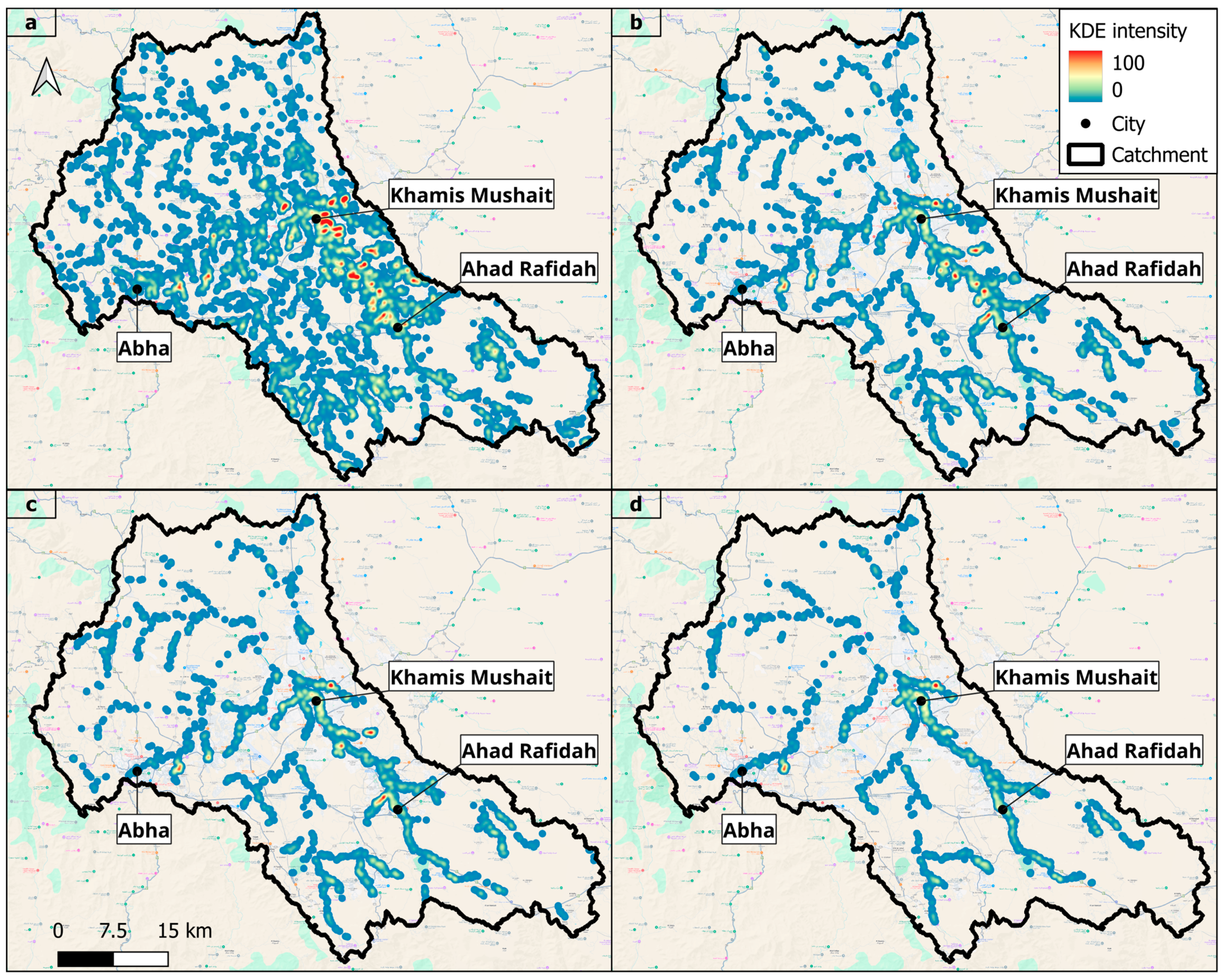
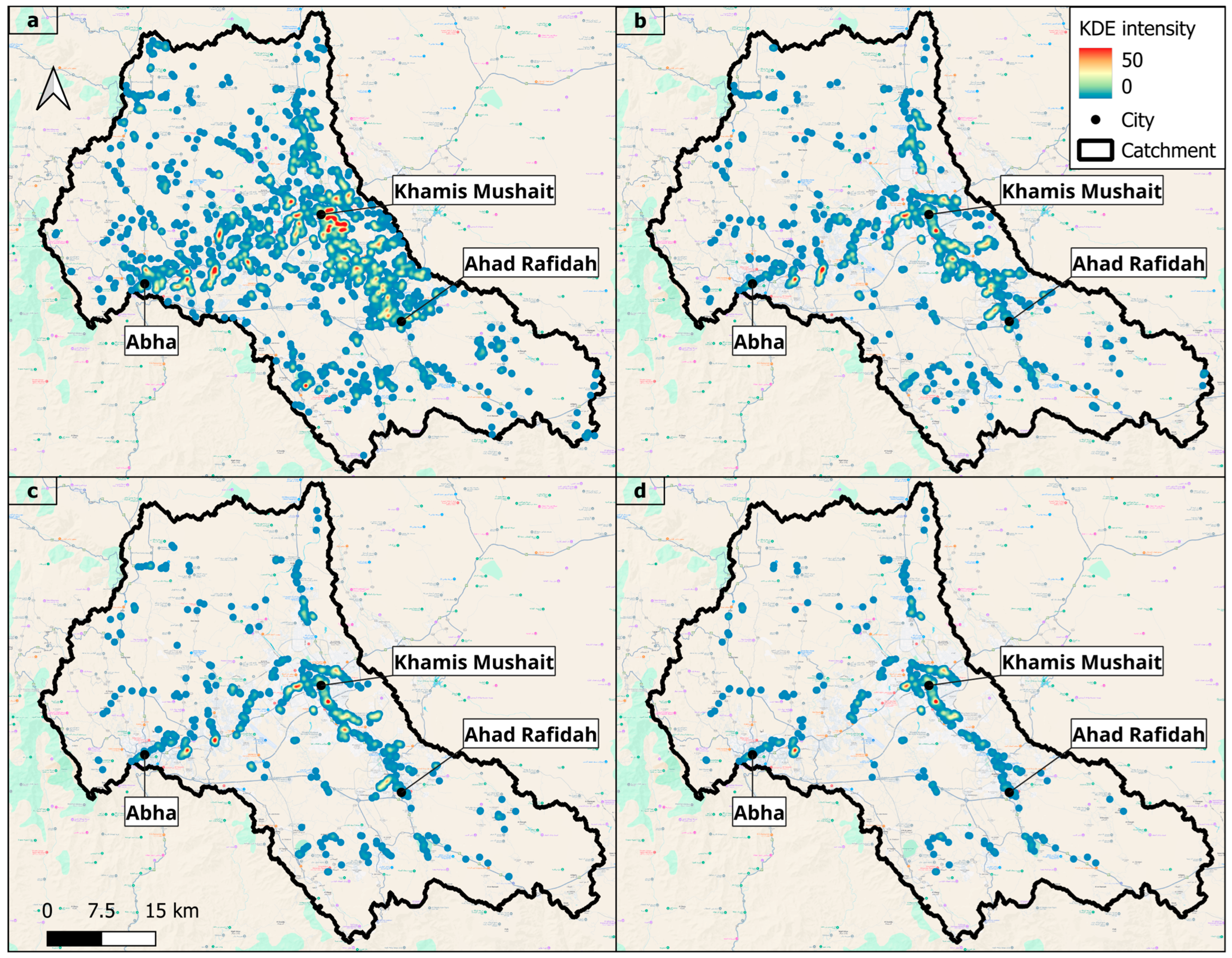
The hotspot maps provide an important spatial complement to the tabulated exposure results (
Figure 9 and
Figure 10). In both the building and road KDE surfaces, the highest concentrations of exposed assets remain aligned with the same drainage-connected urban zone even as the stream threshold becomes more conservative. Under the 1 km
2 scenario, hotspot patterns are broad and relatively diffuse, reflecting the inclusion of numerous minor tributaries and local valley-bottom features across the catchment. As the threshold increases to 5 and 10 km
2, much of this peripheral pattern contracts, and the hotspot structure becomes increasingly focused on the central drainage belt. By the 20 km
2 scenario, the surrounding low-intensity clusters are greatly reduced; however, the strongest hotspot zone remains clearly concentrated within the same urbanized drainage system.
This persistence is a key result of the study. It indicates that the central exposure cluster is not simply an artifact of one threshold choice or one dense tributary configuration. Instead, it represents a spatially robust hotspot that remains visible across all four drainage scenarios. The hotspot maps therefore reinforce the interpretation from the area, building, and road statistics by showing that although the total extent of low-HAND exposure is threshold-sensitive, the most persistent exposure cluster is spatially more stable. Practically, this persistent hotspot zone should be treated as a priority area for follow-up field investigation, drainage assessment, and more detailed hydraulic analysis.
4. Discussion
The analysis uses alternative drainage representations to distinguish threshold-sensitive peripheral susceptibility from a more persistent hotspot pattern associated with the main urban–wadi system. The value of the scenario design lies not simply in showing that different thresholds produce different HAND extents, which is expected, but in identifying which parts of the mapped susceptibility surface remain stable across plausible drainage interpretations. In raster hydrology, channel initiation is never a purely objective boundary. It is inferred from contributing area and routing structure, which means that the analyst’s threshold choice determines how much of the terrain is treated as organized drainage [
30,
31]. The current research turns that usually hidden assumption into an explicit scenario experiment. Instead of presenting one apparently definitive flood-susceptibility map, the paper shows that the mapped low-HAND envelope expands when minor tributaries are retained and contracts when only larger channels are preserved. It clarifies that some zones are robust across multiple drainage interpretations, while others remain contingent on how the stream network is defined.
The mechanism behind this pattern is linked to how HAND defines the drainage reference surface. Lower contributing-area thresholds produce denser stream networks and introduce more local drainage reference cells, especially along smaller tributaries and valley-bottom features. This reduces the vertical separation between nearby terrain and mapped drainage, which expands the area classified within low-HAND classes. In contrast, higher thresholds remove many minor drainage paths and force the surrounding terrain to be referenced to larger or more distant channels, which increases HAND values and contracts the susceptibility envelope. The persistence of exposure along the main urban–wadi zone occurs because the dominant wadis remain present under all tested thresholds, while buildings and roads are also concentrated along the same low-lying valley-floor setting.
The four scenarios should therefore be interpreted according to their intended planning use rather than as competing calibrated flood maps. The 20 km2 scenario provides a conservative representation of the main wadi system and is most appropriate for regional screening of major drainage-controlled susceptibility. The 5 and 10 km2 scenarios provide intermediate representations that retain larger tributary systems and are useful for urban planning where secondary drainage paths may influence exposure. The 1 km2 scenario is more conservative in the sense that it captures a wider envelope of potential tributary-related susceptibility, but it may also include drainage paths that are modified, culverted, or less clearly expressed in developed terrain. For practical application, the most defensible priority areas are therefore the hotspots that persist across multiple scenarios, especially those visible from the 1 km2 through 20 km2 thresholds. These areas are less dependent on a single threshold choice and should be prioritized for field verification and detailed hydraulic modeling.
A second issue concerns DEM conditioning and the representation of drainage connectivity in complex mountain-urban terrain. Flow routing, stream extraction, and watershed partitioning are all highly dependent on how the terrain surface handles pits, flats, artificial barriers, and local channel continuity [
32,
38]. Later work has shown that DEM preprocessing choices, including depression treatment and stream burning, can materially alter extracted drainage networks and watershed boundaries, especially when moderate-resolution DEMs are used in anthropogenically modified landscapes [
39,
40]. This matters here because the study area includes cities, roads, and likely culverts or engineered drainage structures that may not be fully represented in a 30 m terrain surface.
A related issue concerns the interpretation of smaller tributaries in developed terrain. In urban settings, some low-order drainage paths may no longer appear as clearly expressed natural channels because they have been modified by roads, culverts, grading, or urban expansion [
39,
40]. However, their topographic imprint may still influence local runoff concentration and drainage connectivity. For this reason, the minor tributaries retained under the lower-threshold scenarios should not be interpreted simply as either fully active natural channels or as mapping artefacts. Instead, they are better understood as terrain-derived drainage pathways whose present hydrologic function may range from open flow channels to modified or partially buried urban drainage alignments.
HAND is useful in this context because it converts terrain and drainage connectivity into an interpretable vertical index, but it should not be treated as a substitute for event-based inundation depth or recurrence-based hazard estimation. Recent studies continue to emphasize that DEM type and resolution are major sources of uncertainty in flood mapping, especially in data-scarce regions and urban settings where small elevation differences can strongly influence modeled pathways [
35,
41]. Accordingly, the framework identifies terrain-based susceptibility and exposure, not deterministic inundation footprints, and positions HAND as an efficient first-pass tool for prioritization.
The HAND approach can also be viewed in relation to data-driven and observation-based flood-susceptibility methods. Urban flood mapping studies increasingly combine remote sensing, GIS layers, machine learning, and flood-conditioning variables to capture the influence of terrain, rainfall, land cover, and urban development on flood occurrence [
42]. Other studies have used semi-supervised or ensemble learning approaches to link flood inventories with topographic, meteorological, and anthropogenic variables, allowing nonlinear relationships between urban form and flood occurrence to be represented more explicitly [
43,
44]. The HAND-based framework used in this research focuses on vertical connectivity to drainage rather than learning from historical flood inventories or weighting many explanatory variables. This makes it less comprehensive than data-driven models, but useful as a first-pass screening layer in data-scarce catchments. It identifies terrain-controlled exposure patterns and helps indicate where remote-sensing validation, machine-learning analysis, or hydraulic modeling should be applied next.
The exposure results also have strong planning significance. The dominance of residential and service roads within the strictest low-HAND class implies that flood-related disruption is likely to emerge first through local circulation and access problems rather than only through failure of major regional links. This is consistent with transport-flood research showing that even moderate inundation can create disproportionate accessibility impacts, network inefficiencies, and emergency-response delays [
45,
46]. The pattern seen in
Figure 9 and
Figure 10 suggests that the main urbanized valley-floor zone near Abha, Khamis Mushait, and Ahad Rafidah acts as the principal concentration of both building and road susceptibility, which in practice means that land-use control, drainage design, culvert capacity, and road-crossing maintenance in that zone may yield outsized risk-reduction benefits. This is precisely where a susceptibility map becomes operationally useful. It helps planners identify where follow-up site-level investigation is most justified.
Several limitations should be considered when interpreting the results. The analysis relies on a 30 m DEM, which is suitable for regional screening but may not fully resolve small channels, culverts, road embankments, walls, or local drainage modifications in developed areas. Additionally, the building footprints and road network were derived from open geospatial datasets, which may contain omissions, classification errors, or geometry inconsistencies. The HAND classes used in this study represent relative terrain susceptibility rather than calibrated flood depth, flood probability, or recurrence-based hazard. Quantitative validation was limited by the absence of consistent observed flood extents, gauge records, or documented post-event inundation maps for the study catchment. For this reason, the results should be interpreted as terrain-based susceptibility and exposure screening rather than validated inundation boundaries. Future work should compare the persistent HAND-based hotspots with satellite-derived flood extents, field observations, municipal drainage records, or documented flood impacts when such data become available. Furthermore, future urban expansion may alter exposure patterns, especially if development continues along valley floors, local tributaries, and road crossings.
The study points toward a sensible next step in multi-scale flood analysis. Broad-scale hydrographic frameworks have shown the value of representing channel structure and sub-grid drainage organization explicitly when moving from local terrain interpretation to larger-domain flood modeling [
47,
48,
49]. For this manuscript, the most defensible progression would be a two-stage workflow. The current HAND analysis should be retained as a screening and prioritization stage. This two-stage structure is transferable to other data-scarce catchments where detailed hydraulic inputs are limited. After that, the most persistent hotspots, namely those that remain visible from the 1 km
2 through 20 km
2 scenarios, should be taken forward for detailed validation and dynamic modeling. That second stage could use sub-grid or two-dimensional hydraulic methods where channel geometry, culverts, roughness, and event hydrographs can be incorporated more explicitly [
50,
51]. A further extension would be to integrate these HAND-based susceptibility and exposure layers into a web-based decision-support platform [
52,
53], allowing planners and emergency managers to interactively explore hotspot locations, exposed infrastructure, and threshold-dependent uncertainty. In addition, future work could examine artificial intelligence methods as a complementary layer for prioritization, such as using machine-learning models to combine HAND with land cover, road density, drainage proximity, and historical flood information in order to refine hotspot ranking and support more adaptive urban flood management.
5. Conclusions
This study presents a HAND-based GIS framework for terrain-based flood susceptibility and infrastructure exposure mapping in the mountainous urban catchment that includes Abha, Khamis Mushait, and Ahad Rafidah. The study explicitly accounts for alternative drainage representations by evaluating four stream-extraction scenarios rather than relying on a single fixed stream network. This provides a more transparent basis for interpreting DEM-derived flood susceptibility in a data-scarce environment.
Across the four drainage scenarios, the strictest susceptibility class, HAND ≤ 5 m, ranged from 367 km2 to 99 km2. More importantly, this variability was not spatially uniform. While much of the peripheral low-HAND terrain contracted as the stream network became more selective, the same central low-lying urban–wadi belt remained prominent across all scenarios. Buildings within HAND ≤ 5 m ranged from 26,449 to 5633, and road records in the same class ranged from 8758 to 1393; however, the most concentrated exposure remained aligned with the same low-lying urban area.
Practically, flood-prone terrain in the studied catchment is not confined to the major wadis alone. Smaller tributary systems and local valley bottoms account for a large share of the mapped building and road exposure, especially in the strictest HAND classes. For planning purposes, this means that rapid terrain screening can already support meaningful prioritization of urban assets, neighborhood accessibility concerns, and candidate locations for more detailed hydraulic studies. The paper offers a regional susceptibility and exposure assessment that can guide early-stage risk reduction, while also identifying the places where future validation and dynamic flood modeling are most needed.