1. Introduction
Wastewater treatment is often regarded as a background urban service—reliable, standardized, and largely invisible to the public. However, this perception masks the sector’s growing significance in energy consumption and climate-change mitigation [
1,
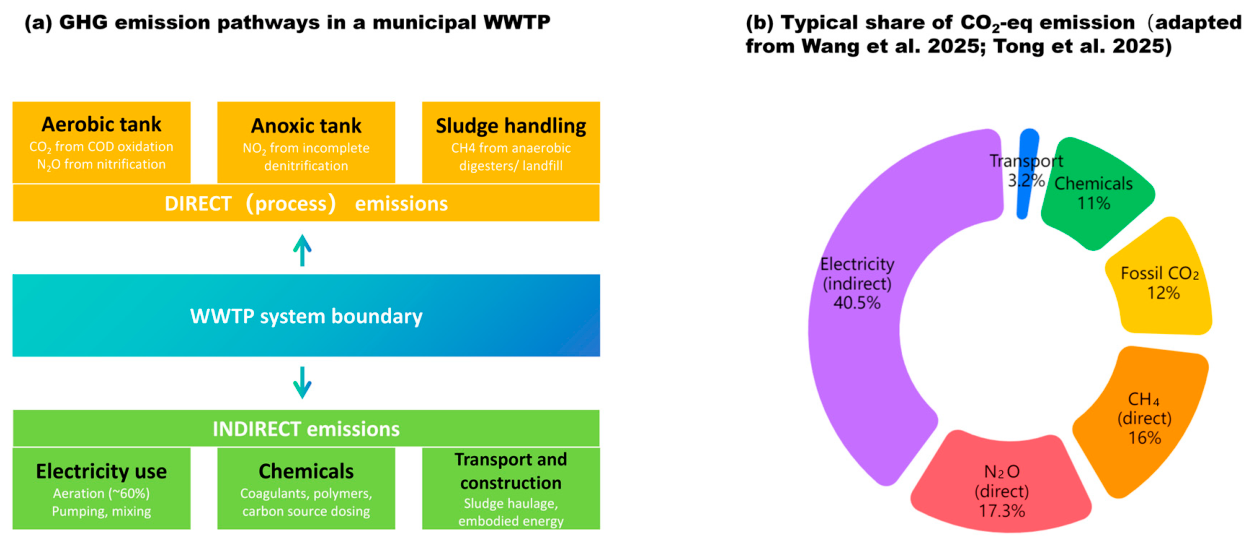
2]. Conventional activated sludge (CAS) systems are energy-intensive, with aeration alone accounting for a substantial share of operational demand. In addition, biological processes within WWTPs generate methane (CH
4) and nitrous oxide (N
2O), both of which have significantly higher global warming potentials than carbon dioxide [
3,
4,
5,
6].
Estimates of the sector’s contribution to global greenhouse gas emissions vary widely among studies, largely due to differences in system boundaries and accounting approaches. Recent studies suggest that the wastewater treatment industry is responsible for roughly 1.5–2.0 Gt CO
2-eq each year, equivalent to about 2–3% of global emissions. In China, the sector emitted around 197 Mt CO
2-eq in 2016 and is projected to reach 365 Mt CO
2-eq by 2030 [
5]. The picture is similar elsewhere: methane and nitrous oxide together account for a sizeable share of national non-CO
2 GHG inventories [
1,
6].
At the same time, wastewater contains a considerable amount of embedded chemical energy, primarily in the form of organic matter. Although theoretical analyses suggest that this energy could exceed treatment requirements, practical recovery remains limited under conventional process configurations. This gap between theoretical potential and operational reality has become a central motivation for rethinking wastewater treatment systems [
2,
7].
Consequently, carbon-neutral WWTPs have evolved from an academic concept into a strategic policy objective [
1]. Efforts toward low-carbon and carbon-neutral wastewater treatment are now advancing across several regions, although policy drivers and technical priorities differ. In the European Union, the recast Urban Wastewater Treatment Directive moves the sector toward energy neutrality and extended producer responsibility, building on early energy-positive demonstrations such as the Strass plant in Austria, which achieves about 160% net energy production [
2,
8]. Other landmark plants in the United States, the Netherlands and Singapore have followed [
2,
4,
7]. In the United States, utility-led programs have pursued energy self-sufficiency through anaerobic digestion, co-digestion, and biogas combined heat and power at large facilities. In China, the ‘dual-carbon’ goals (peak emissions before 2030, neutrality before 2060) have prompted national roadmaps for the sector, with growing attention to autotrophic nitrogen removal and resource recovery. These parallel efforts illustrate both a shared direction and the strongly context-dependent nature of feasible pathways [
8,
9,
10].
Two closely related but fundamentally different concepts should be distinguished throughout this review. “Energy-neutrality” refers to a plant whose on-site energy recovery offsets its operational energy demand, and “energy-positivity” to net energy export. “Carbon-neutrality” is a broader objective that additionally accounts for direct biological emissions (CH4 and N2O) and indirect emissions from chemicals and embodied energy. Because direct emissions and embodied energy are not captured by an energy balance alone, an energy-neutral plant is not necessarily carbon-neutral; the two terms are therefore not used interchangeably in the following sections.
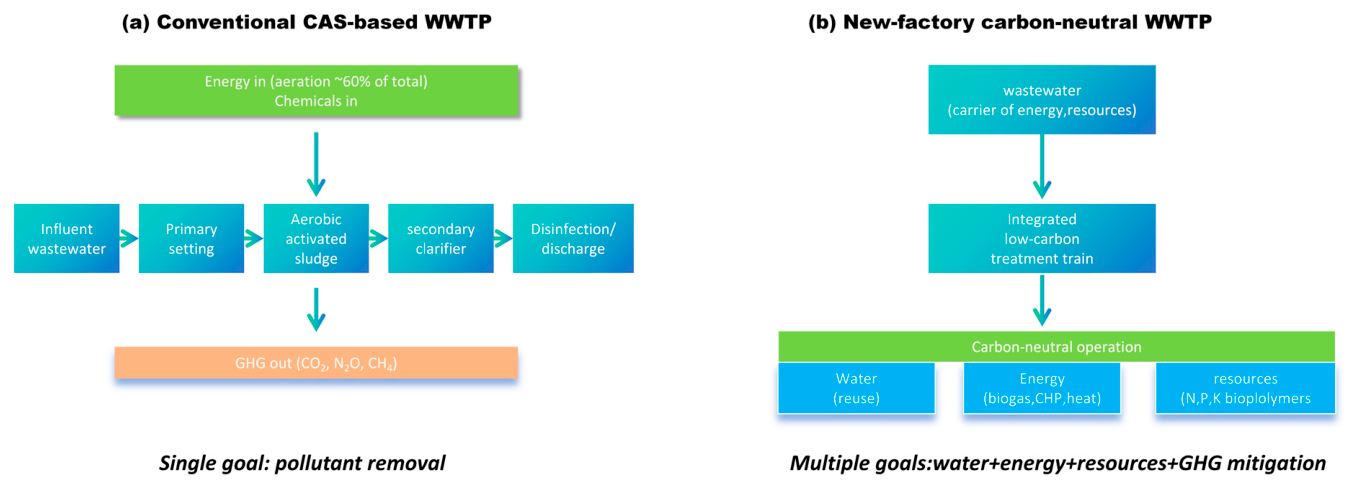
Closing the gap between today’s plant performance and the carbon-neutral ideal demands more than incremental adjustment. Multiple authors have argued that a true paradigm shift is needed: from end-of-pipe pollutant destruction to a multi-functional water factory that simultaneously produces clean water, generates energy, recovers materials and minimizes carbon emissions [
11,
12,
13].
Figure 1 contrasts this vision with the conventional layout.
Although numerous reviews have addressed individual technologies or specific assessment methods, comparatively few integrate process reconfiguration, resource recovery, and system-level sustainability assessment within a single critical framework while explicitly distinguishing performance across scales. The present review addresses this gap, and its significance lies in clarifying the conditions under which different strategies are most effective rather than advocating a single optimal solution.
This review critically examines technological pathways, system-level optimization strategies, and implementation challenges associated with carbon-neutral WWTPs. The literature underpinning this review was identified through a structured search of the Web of Science, Scopus, and Google Scholar databases, covering the period 2011–2026. Search terms combined keywords related to the treatment system (e.g., “wastewater treatment plant”, “municipal sewage”) with keywords related to the objective (e.g., “carbon neutral”, “energy neutral”, “low carbon”, “greenhouse gas”, “resource recovery”, “life-cycle assessment”). Studies were included if they reported quantitative performance data, methodological frameworks, or full-scale implementation experience relevant to carbon-neutral or low-carbon operation. Purely descriptive reports without methodological or quantitative content, and studies outside the municipal wastewater context (e.g., industrial-effluent-specific processes) were excluded. Where multiple studies reported similar findings, representative and frequently cited works were selected rather than an exhaustive enumeration of all available publications. Unlike a purely narrative compilation, this study adopts a structured synthesis approach based on a transparent search and selection procedure; it is intended as a critical narrative review rather than a formal systematic review or meta-analysis. Emphasis is placed on identifying consistent trends across the literature, evaluating discrepancies between laboratory-scale and full-scale performance, and comparing technologies using key performance indicators where data are available. Rather than proposing a single optimal pathway, the analysis aims to clarify the conditions under which different strategies are most effective.
2. Process Reconfiguration and Resource Recovery Pathways
Throughout this section, reported performance values are drawn from studies conducted at different scales—laboratory, pilot, and full scale—and under differing influent and operating conditions. The maturity and demonstration scale of each technology are therefore indicated where relevant (and summarized in
Table 1), and quantitative figures from bench-scale studies should not be interpreted as directly transferable to full-scale operation.
2.1. COD Capture and A-B Configurations
An increasing body of evidence suggests that further optimization of conventional activated sludge (CAS) systems alone is unlikely to achieve the energy reductions required for carbon-neutral operation [
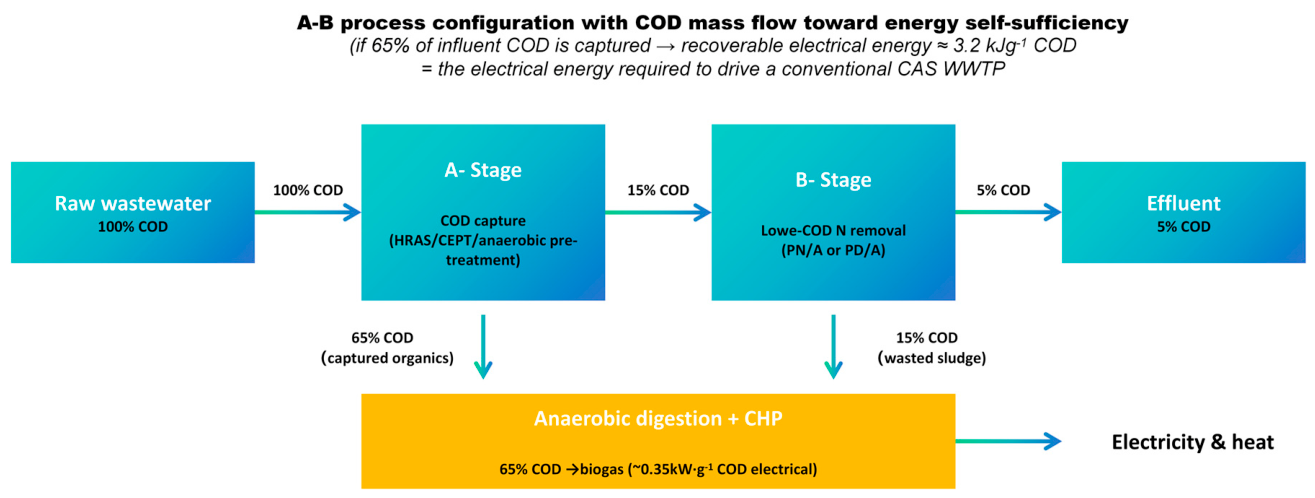
7]. A fundamental limitation lies in the sequence of carbon utilization: organic matter is first oxidized to biomass and carbon dioxide, and only subsequently subjected to anaerobic digestion. This inherently limits the proportion of recoverable energy, with only 20–50% of the in-plant energy typically being recovered. Consequently, the A-B process has emerged as an alternative configuration that prioritizes early-stage carbon capture. In this approach, the A-stage operates under conditions that favor rapid adsorption and capture of chemical oxygen demand (COD), while the B-stage focuses on nutrient removal under low-carbon conditions. By redirecting a larger fraction of influent COD toward anaerobic digestion, the system increases its potential for energy recovery [
7].
Figure 2 illustrates the COD mass flow.
Several technologies have been explored for the A-stage, including chemically enhanced primary treatment (CEPT), high-rate activated sludge (HRAS), and anaerobic pre-treatment systems such as upflow anaerobic sludge blanket (UASB) reactors or anaerobic membrane bioreactors (AnMBR). Reported COD capture efficiencies typically exceed 60%, and in some cases approach 90% under controlled conditions. However, these values are highly sensitive to influent characteristics and operational parameters [
7].
From an energy perspective, the benefits of COD capture are closely tied to downstream conversion efficiency. According to Wan et al., capturing 65% of influent COD and digesting it anaerobically can generate around 3.2 kJ per gram COD of recoverable electrical energy, an amount that approximately matches the energy demand of a conventional CAS plant [
7]. AnMBR-based A-stages further reduce sludge production and yield near-solid-free permeate, which simplifies downstream nutrient recovery [
7,
11]. Demonstrated plants such as Sheboygan (USA) and Strass (Austria) confirm that energy positive operation is technically achievable when COD capture is paired with co-digestion and rigorous heat management [
2,
8]. While theoretical calculations suggest that captured COD could offset a substantial fraction of plant energy demand, practical recovery depends on digestion efficiency, methane yield, and energy conversion losses. In full-scale systems, these factors often reduce the achievable gains.
Another critical consideration is the reduced availability of carbon in the B-stage. Lower influent COD can limit conventional denitrification, necessitating alternative nitrogen removal pathways such as partial nitritation–anammox. This creates an interdependence between process stages that must be carefully managed [
3,
15].
Despite its conceptual advantages, the A-B approach introduces additional complexity in process control and design. Operational stability, sludge handling, and integration with existing infrastructure remain key challenges. As a result, while the A-B configuration represents a promising direction, its implementation is likely to be most feasible in large or newly designed facilities rather than through simple retrofits.
2.2. Anaerobic Digestion and Energy Recovery
Anaerobic digestion (AD) remains the most mature and widely implemented technology for recovering energy from wastewater-derived organics. By converting organic matter into methane-rich biogas, AD enables partial or complete offset of plant energy demand when coupled with combined heat and power (CHP) systems [
3,
8]. In many full-scale facilities, particularly in Europe, AD has already enabled energy-neutral or even energy-positive operation. Hao et al. showed that successful European plants combine sludge AD with co-digestion of food waste, water-source heat pumps and on-site solar/wind generation to push beyond 100% energy self-sufficiency [
2]. Huang reviewed the global state of AD upgrading and reported that European plants such as Wolfgangsee–Ischl and Strass routinely produce 3 GWh per year of biogas, with surplus electricity sold back to the grid [
8].
The performance of AD systems depends on several factors, including sludge composition, hydraulic retention time, temperature, and pre-treatment. Co-digestion with external organic substrates, such as food waste, has consistently been shown to enhance biogas production and improve economic viability. In practice, co-digestion with food, kitchen or agricultural waste is consistently reported as one of the most cost-effective enhancements [
8,
16].
Beyond energy recovery, AD contributes to resource recovery through the production of nutrient-rich digestate. This material can be further processed for phosphorus recovery or used as a soil amendment, depending on regulatory constraints [
11,
17]. Ghimire et al. argued that the most resilient route to a circular-economy WWTP is to combine carbon capture in primary treatment with co-digestion of organic sludge and bioelectrochemical units that valorize residual COD [
17]. Puyol et al. extended this view by mapping the “partition–release–recover” strategy across PHA, single-cell protein, biopolymers and metal recovery [
11]. However, the environmental benefits of these pathways depend strongly on downstream handling and market conditions.
Despite its maturity, AD is not without limitations. Process stability can be affected by variations in feedstock composition, accumulation of inhibitory compounds such as ammonia, and operational disturbances. In addition, the economic feasibility of AD is highly scale-dependent. Smaller plants often struggle to justify the investment unless external substrates are available for co-digestion.
Overall, AD is likely to remain a cornerstone technology in future low-carbon WWTPs, particularly in the near term. However, its performance should be evaluated within a broader system context, taking into account energy integration, sludge management, and local economic conditions.
2.3. Low-Carbon Nitrogen Removal Pathways
2.3.1. Anammox-Based Pathways
Nitrogen removal remains one of the most energy-intensive processes in municipal wastewater treatment., primarily due to the aeration and carbon requirements of conventional nitrification–denitrification processes [
3,
15]. Autotrophic nitrogen removal via anaerobic ammonium oxidation (anammox) offers a fundamentally different pathway, in which ammonium and nitrite are directly converted to nitrogen gas without the need for organic carbon [
15].
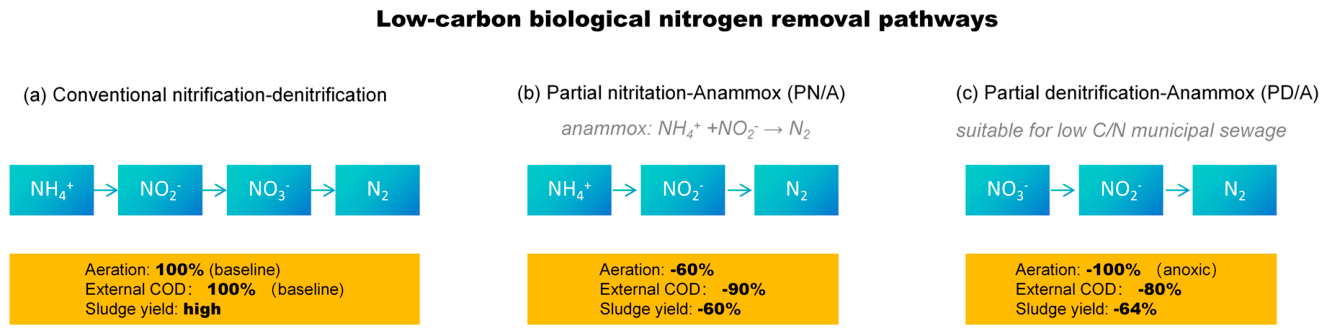
Among the various configurations, partial nitritation–anammox (PN/A) has received the most attention. In this process, approximately half of the ammonium is oxidized to nitrite, which is then consumed by anammox bacteria. Reported reductions in aeration demand and sludge production are substantial, making PN/A an attractive option for reducing both energy consumption and indirect emissions. PN/A saves around 60% of aeration energy and 90% of external organic carbon, with sludge production cut by about 60% [
3,
18]. Partial denitrification-anammox (PD/A) has also emerged as a promising alternative, particularly for low carbon-to-nitrogen ratio wastewater. By coupling partial denitrification with anammox, this approach enables more efficient utilization of residual organic carbon while maintaining low energy demand [
15]. A full-scale 2.5 × 10
5 m
3 d
−1 PD/A plant in Xi’an, China, demonstrates that the route can be operationalised at city scale with COD/N ratios in the 2.0–3.5 range [
15]. Their conceptual differences and resource savings are summarized in
Figure 3.
2.3.2. Practical Constraints and System Integration
Despite these advantages, large-scale implementation of anammox-based processes remains challenging. One of the primary difficulties is the suppression of nitrite-oxidizing bacteria (NOB), especially under low-temperature or low-ammonium conditions typical of mainstream wastewater. Maintaining stable partial nitritation requires careful control of dissolved oxygen, sludge retention time, and reactor configuration. In addition, anammox bacteria exhibit slow growth rates, resulting in long start-up periods and limited resilience to process disturbances. This can pose significant operational risks, particularly in full-scale systems subject to fluctuating influent conditions [
15,
19].
Another consideration is the interaction between carbon capture strategies and nitrogen removal. For example, upstream COD capture in A-B configurations reduces the availability of organic carbon, making autotrophic pathways more favorable but also more sensitive to process control. Alvarado et al. emphasized that energy savings should not be the only criterion: capturing organics in A-stage and treating low C/N sidestreams with PN/A can reduce direct CO
2-eq emissions by more than 30%, but the trade-offs in eutrophication and acidification potentials must be tracked using LCA [
20].
From a life-cycle perspective, the benefits of anammox are not limited to energy savings. Reduced aeration demand lowers indirect emissions, while lower sludge production decreases downstream handling requirements. However, these advantages must be balanced against potential increases in process complexity and control requirements.
Collectively, these observations indicate that while anammox-based processes are a key component of future low-carbon WWTPs, their implementation is likely to remain context-dependent, requiring careful integration with upstream and downstream processes.
2.4. Emerging Carbon-Neutral Technologies
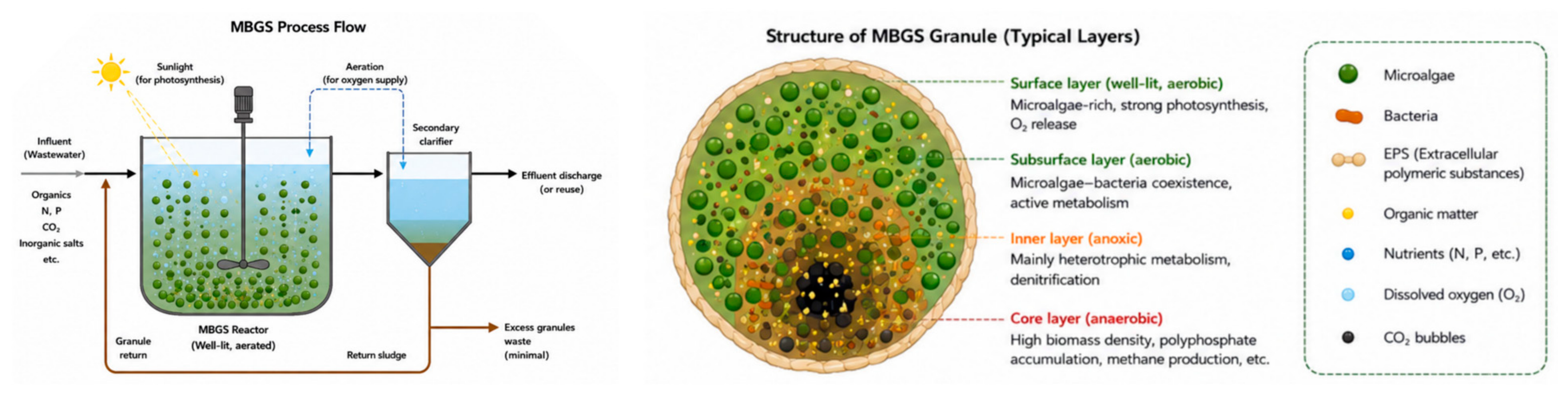
2.4.1. Microalgal-Bacterial Granular Sludge (MBGS)
Microalgae and bacteria can form a mutually beneficial metabolic consortium in which algae generate oxygen for bacterial COD oxidation and bacteria release the CO
2 that algae need for photosynthesis [
12,
21]. Granulating this consortium into compact, dense aggregates-the microalgal-bacterial granular sludge (MBGS) process-overcomes the harvesting bottleneck that has long limited algae-based wastewater treatment [
12].
Figure 4 shows the conceptual reactor.
Zhang et al. estimated that MBGS could shift the WWTP energy balance from +0.21 kWh m
−3 (CAS) to −0.18 kWh m
−3, with a 77% reduction in GHG emissions if deployed globally [
12]. Notably, even during dark periods, COD, ammonium and phosphate removals stay above 95% in laboratory operations, indicating that the symbiosis remains active in dark phases [
12]. Solar-driven photobioreactors integrated with hydrothermal liquefaction or anaerobic digestion enable both biomass valorization and improved photoconversion efficiency [
22]. Markou et al. summarized recent biorefinery-style platforms that combine microalgae with electrocoagulation, electro-oxidation and bioelectrochemical units to remove emerging pollutants while producing biofuels and biopolymers [
21].
2.4.2. Bioelectrochemical Systems
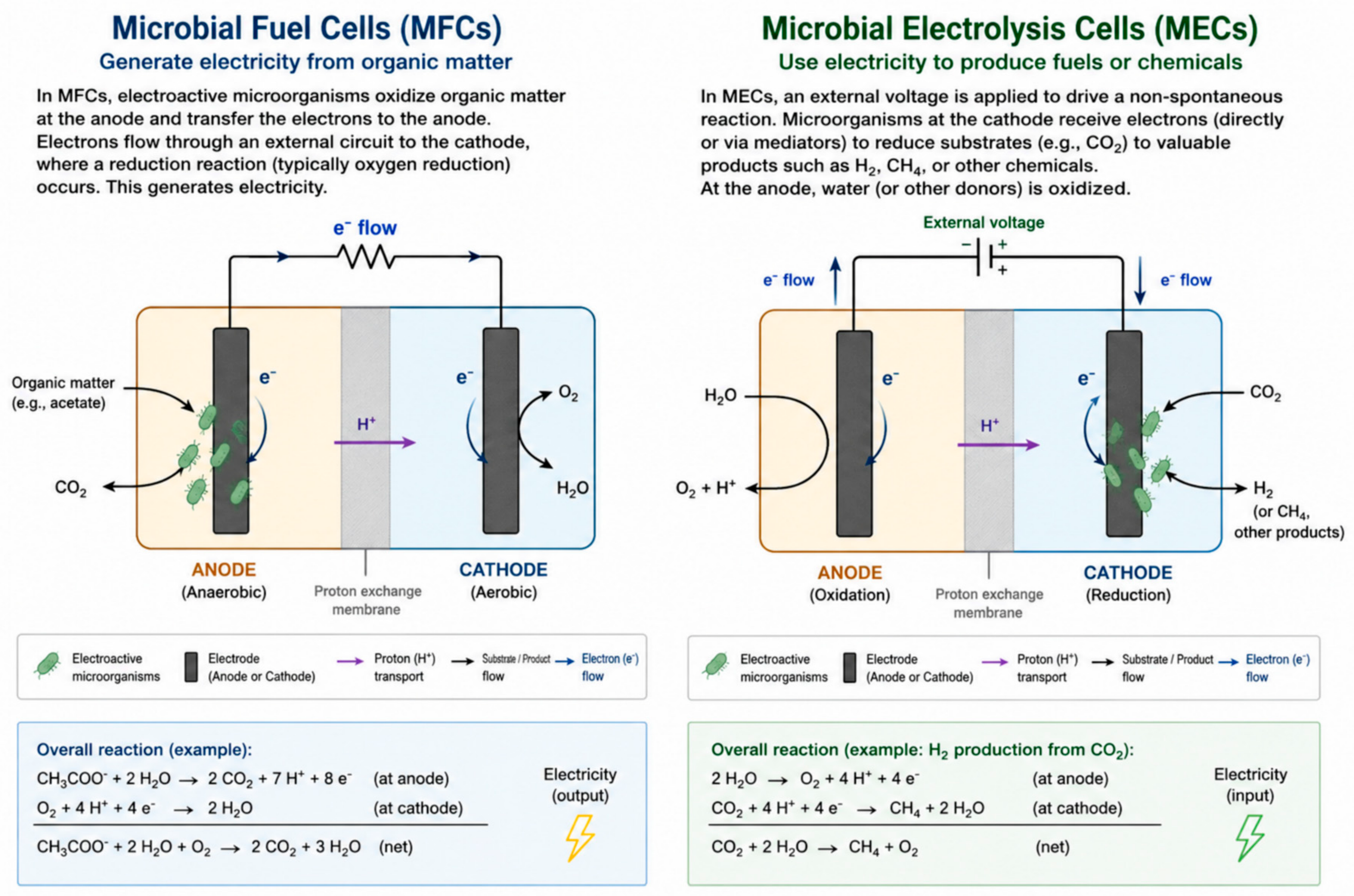
Bioelectrochemical systems (BES) such as microbial fuel cells (MFCs) and microbial electrolysis cells (MECs) convert chemical energy in COD into electrons that move through an external circuit [
3,
11,
18]. MFCs produce electricity directly. MECs add a small voltage to drive reduction at the cathode, yielding hydrogen, methane or other reduced products [
3].
Figure 5 illustrates both architectures.
Maximum area power densities of around 6.86 W m
−2 and volumetric densities up to 2.87 kW m
−3 have been reported in laboratory MFCs [
3], although scaling up has so far been limited by anode resistance, electrode material cost and the relatively low value of bio-electricity [
3]. Ghimire et al. proposed that bioelectrochemical anammox systems combining anaerobic membrane bioreactors with simultaneous nitrification and autotrophic denitrification could deliver 0.35–0.80 kWh m
−3 net energy production while removing nutrients with very low aeration [
17]. The Markou et al. review highlights that conductive nanomaterials and graphene-based electrodes are pushing performance closer to commercial viability [
21].
It should be emphasized that the reported performances summarized above are derived from different experimental scales and operational conditions. Consequently, direct comparisons should be interpreted with caution, and technology selection should always consider local wastewater characteristics, climatic conditions, and plant-specific constraints.
Taken together, the technologies reviewed above—from early-stage COD capture and anaerobic digestion to autotrophic nitrogen removal and emerging algal and bioelectrochemical systems—define the technical building blocks for low-carbon operation. However, their individual performance figures cannot be assessed in isolation: whether a given technology actually lowers a plant’s overall carbon footprint depends on how its energy, chemical, and emission balances combine at the system level. The following section therefore shifts from individual process performance to plant-wide accounting, optimization, and sustainability assessment.
4. Challenges, Trade-Offs and Future Perspectives
4.1. Carbon Trade-Offs in Advanced Treatment
The removal of micropollutants, including pharmaceuticals, endocrine-disrupting compounds, and per- and polyfluoroalkyl substances (PFAS), has become an increasingly important objective in wastewater treatment [
39,
40]. Conventional biological processes typically achieve only partial removal, necessitating the use of advanced treatment technologies to meet stricter regulatory standards [
29,
35]. Common approaches include ozonation, activated carbon adsorption, and advanced oxidation processes (AOPs) such as UV/H
2O
2. While effective, these technologies are often energy-intensive and can significantly increase the overall carbon footprint of the treatment system. As a result, there is growing interest in identifying lower-carbon alternatives [
39,
40].
Nature-based solutions, such as constructed wetlands, offer the advantage of low energy demand, but their performance can be highly variable and dependent on environmental conditions. Anaerobic membrane bioreactors (AnMBR) provide another alternative by combining biological treatment with physical retention, enabling both energy recovery and partial micropollutant removal. However, membrane fouling and operational costs remain important challenges [
39,
40]. Enzyme-based systems and hybrid treatment trains have also been explored. Enzymatic processes can selectively degrade certain compounds under mild conditions, while hybrid systems combining biological and advanced oxidation steps can achieve higher overall removal efficiency. In many cases, these integrated approaches outperform individual technologies, although their optimization requires careful design [
30,
34].
A key challenge in this area is balancing treatment performance with carbon efficiency. Technologies that achieve high removal rates may do so at the expense of increased energy consumption or chemical use. Consequently, evaluating micropollutant removal strategies requires a system-level perspective that accounts for both environmental benefits and carbon costs. This trade-off underscores the importance of integrating advanced treatment within a broader sustainability framework, rather than considering it as an isolated process step [
29].
4.2. Technical and Economic Constraints
Despite significant progress, several challenges continue to limit the transition toward carbon-neutral wastewater treatment. Technical barriers remain prominent, particularly for emerging processes. For example, maintaining stable anammox activity under mainstream conditions is still difficult [
21]. AD requires consistent feedstock, and high ammonia or volatile fatty acid concentrations can inhibit methanogens [
8]. AnMBR is hampered by membrane fouling, although intermittent operation can substantially reduce costs [
8,
11]. Microalgal systems still face scale-up issues, particularly in light penetration in dense suspensions and biomass dewatering, and bioelectrochemical systems must overcome electrode cost and area-power gaps before becoming mainstream [
3,
11,
22].
Economic considerations also play a critical role. While some technologies, such as anaerobic digestion, are well-established in large facilities, their feasibility in smaller plants is less certain [
8,
38]. Advanced treatment processes for micropollutant removal can impose substantial energy and cost burdens, especially in regions with strict regulatory requirements [
29,
39,
40]. Carbon credits and effluent trading schemes can shift these economics, but their global coverage is still patchy [
8,
36].
Another important factor is the variability of external conditions. Changes in electricity mix, regulatory frameworks, and market demand for recovered resources can all influence the relative attractiveness of different technologies. This dynamic context makes long-term planning inherently uncertain.
Future research should therefore focus on integrated approaches that combine technological innovation with system-level analysis. In particular, there is a need for standardized methods to evaluate trade-offs between energy use, emissions, and resource recovery. In addition, greater attention should be given to real-world performance data, as many emerging technologies have yet to demonstrate consistent results at full scale.
Ultimately, achieving carbon neutrality in wastewater treatment will depend not only on technological advances, but also on effective integration across engineering, policy, and economic domains.
4.3. Transition Pathways Toward Carbon-Neutral WWTPs
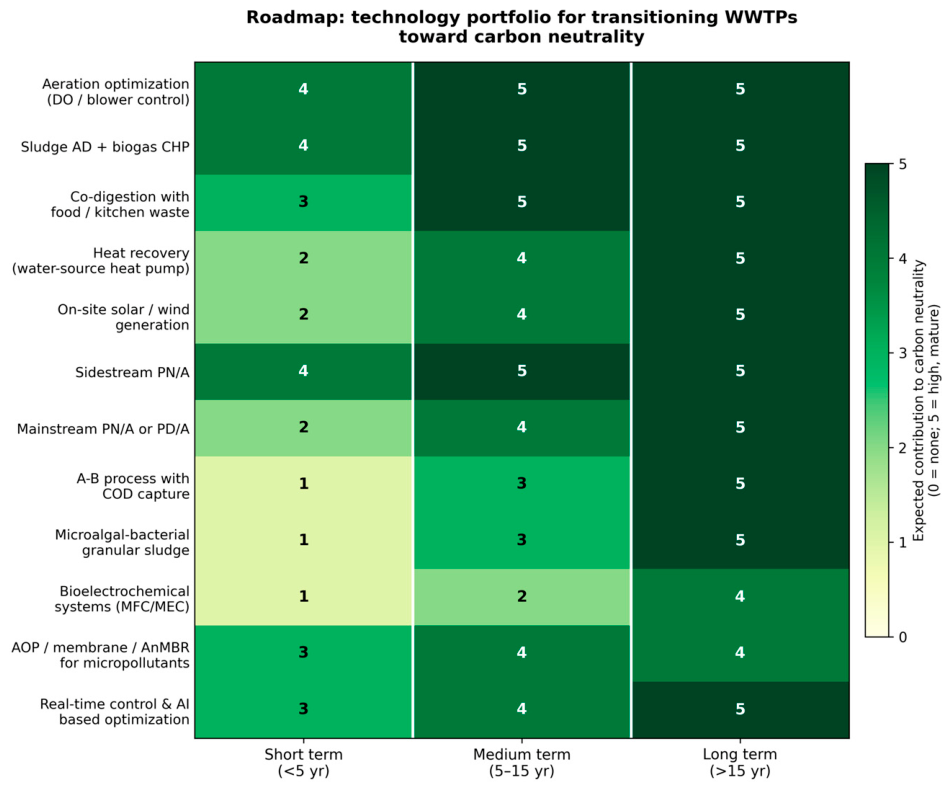
The transition toward carbon-neutral wastewater treatment is best understood as a phased process, rather than a single-step transformation. Different technologies contribute at different stages, depending on their maturity, cost, and operational complexity.
In the short term (<5 years), relatively low-risk measures such as aeration optimization, improved process control, and anaerobic digestion with combined heat and power offer immediate opportunities for emission reduction. These strategies are generally compatible with existing infrastructure and can be implemented with limited disruption [
2,
8,
15,
34].
In the medium term (5–15 years), more substantial modifications, including co-digestion, partial implementation of autotrophic nitrogen removal, and integration of renewable energy sources, become feasible. These approaches require greater investment and operational expertise but offer higher potential for carbon reduction [
8,
13,
15].
Long-term (>15 years) pathways involve more transformative changes, such as widespread adoption of A-B configurations, mainstream anammox processes, and emerging technologies including microalgal systems and bioelectrochemical platforms. While these options hold significant promise, their large-scale applicability remains uncertain [
7,
12,
19,
21] (
Figure 9).
The cell values in
Figure 9 are qualitative scores (0–5) assigned on the basis of three criteria drawn from the reviewed literature: technology maturity and demonstration scale, reported emission- or energy-reduction potential, and compatibility with existing infrastructure within the relevant time horizon. The scores are intended as a structured, indicative comparison rather than precise measured values, and indicative quantitative ranges are provided where data permit.
To complement the qualitative scores in
Figure 9, the principal technologies are associated with the following indicative quantitative improvements reported in the reviewed literature. Aeration optimization and improved process control act mainly on the dominant operational energy demand and the associated indirect emissions, which constitute roughly half of a plant’s total CO
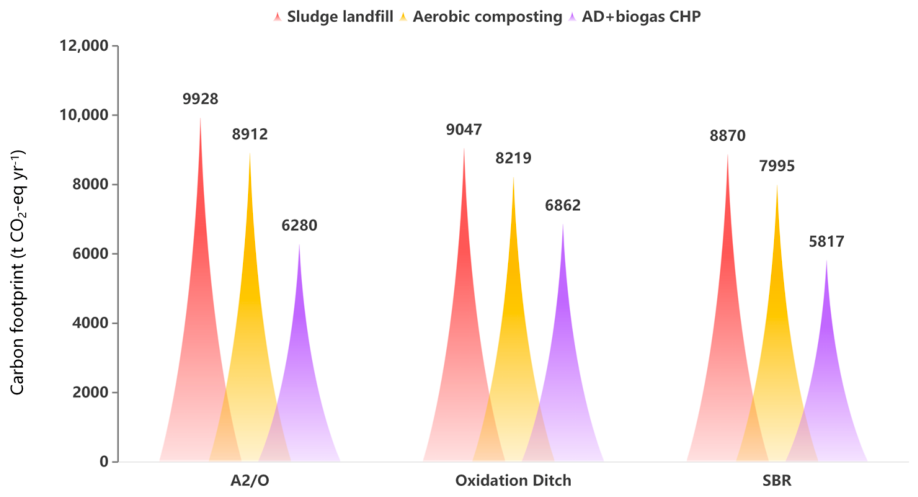
2-eq footprint. Anaerobic digestion with combined heat and power can reduce the overall carbon footprint by approximately 24–37% relative to direct sludge landfilling, and, when supported by co-digestion, can drive plants toward energy-neutral or energy-positive operation (e.g., ~160% net energy at the Strass plant). Among autotrophic nitrogen-removal routes, partial nitritation–anammox can save on the order of 60% of aeration energy and 90% of external carbon while cutting sludge production by about 60%, and partial denitrification–anammox has been demonstrated at full scale for low C/N wastewater. Early stage carbon-capture configurations (A–B process) can redirect about 65% of influent COD to anaerobic digestion, an amount approximately equivalent to the energy demand of a conventional activated-sludge plant. For emerging technologies, microalgal-bacterial granular sludge has been estimated to shift the plant energy balance from +0.21 kWh m
−3 to −0.18 kWh m
−3 with up to a 77% reduction in greenhouse-gas emissions, while bioelectrochemical systems remain at laboratory/pilot scale, with bioelectrochemical-anammox configurations projected to deliver about 0.35–0.80 kWh m
−3 of net energy. It should be noted that these values are indicative and depend strongly on influent characteristics, operating scale, and the local electricity mix; they should therefore be read together with the qualitative scores rather than as guaranteed full-scale outcomes.
Importantly, the proposed roadmap should not be interpreted as a universal sequence. Local factors—including influent characteristics, climate conditions, plant size, and electricity mix—can significantly influence the feasibility of specific technologies. In some cases, decentralized systems or hybrid configurations may offer more effective solutions than centralized high-tech approaches [
2,
6,
25,
36,
38,
41,
42].
A practical application of this roadmap therefore requires site-specific evaluation, ideally supported by life-cycle assessment, process modeling, and economic analysis. In this sense, the roadmap serves less as a prescriptive guide and more as a framework for structured decision-making.
Therefore, the proposed roadmap should be regarded as a flexible reference framework rather than a prescriptive implementation sequence, and practical decision-making should be guided by site-specific technical, environmental, and socioeconomic considerations.
4.4. Future Research Priorities
Although considerable progress has been made in recent years, the transition toward carbon-neutral wastewater treatment is still constrained by several unresolved technical and system-level issues. Much of the current literature remains focused on improving the performance of individual processes, whereas future advances will likely depend more on how different technologies are integrated, operated, and evaluated at plant scale.
One of the most important knowledge gaps concerns the long-term reliability of emerging low-carbon technologies under realistic operating conditions. Processes such as mainstream partial nitritation–anammox (PN/A), microalgal-bacterial granular sludge (MBGS), and bioelectrochemical systems (BES) have shown promising results in laboratory and pilot studies, but their large-scale implementation remains relatively limited. In particular, mainstream anammox systems continue to experience instability under low-temperature and low-ammonium conditions, especially when influent composition fluctuates. Similar uncertainties exist for algae-based systems, where light limitation, biomass separation, and seasonal variation can strongly influence performance. Bioelectrochemical technologies face a different set of barriers, including electrode durability, internal resistance, and relatively modest energy recovery. As a result, future work may benefit less from further short-term efficiency improvements and more from extended full-scale demonstration studies capable of evaluating operational robustness over longer time periods.
In addition, there is still no widely accepted framework for evaluating whether a wastewater treatment process can genuinely be considered “carbon neutral”. Reported outcomes often vary substantially depending on system boundaries, functional units, and assumptions regarding electricity mix, sludge handling, or avoided emissions. Technologies that appear favorable from an operational energy perspective do not necessarily exhibit lower overall environmental burdens once infrastructure construction, chemical production, and downstream sludge management are included. Greater consistency in carbon accounting and life-cycle assessment methodologies would therefore improve comparability across studies and support more reliable decision-making. Integrating environmental assessment with techno-economic analysis and resource recovery evaluation will likely become increasingly important as treatment objectives continue to expand beyond pollutant removal alone.
Another research direction expected to attract increasing attention is intelligent plant operation. Existing studies have demonstrated that machine learning and data-driven optimization can reduce aeration demand and improve process control under dynamic conditions. However, practical implementation remains uneven, partly because many facilities still lack sufficiently reliable online monitoring systems and high-frequency operational datasets. In addition, purely data-driven approaches often suffer from limited interpretability, which restricts operator confidence in real-world applications. Hybrid strategies that combine mechanistic process understanding with artificial intelligence may therefore offer a more practical direction than relying exclusively on either approach alone. The development of digital twins and adaptive control systems could also play a larger role in future low-carbon plant management, particularly as wastewater treatment systems become increasingly complex and interconnected.
The feasibility of carbon-neutral pathways is also highly context-dependent. Climate conditions, influent characteristics, plant size, electricity structure, and local regulatory priorities can all alter the relative advantages of specific technologies. Consequently, it is unlikely that a single universal pathway will emerge for all wastewater treatment plants. In some regions, centralized advanced treatment systems may be technically appropriate, whereas in others, decentralized or hybrid configurations may provide more realistic solutions with lower operational and economic burdens. Future research should therefore place greater emphasis on flexible and site-specific transition strategies rather than assuming that technologies successful in one setting can be transferred directly to another.
Ultimately, carbon-neutral wastewater treatment is unlikely to be achieved through a single technological breakthrough. More probably, progress will depend on the gradual integration of process innovation, system optimization, digital management, and sustainability assessment within adaptable engineering frameworks capable of responding to changing environmental and socioeconomic conditions.
4.5. Toward a Consistent Carbon-Neutrality Evaluation Framework
The frameworks currently used to assess carbon performance vary in scope and purpose. The IPCC emission-factor method is convenient for national-scale inventories but is too coarse for plant-level decisions. Mass-balance and operational-data-integration methods capture site-specific direct emissions more accurately but are sensitive to monitoring quality. Footprint-based approaches (carbon, water, and ecological footprints) support benchmarking across plants, while life-cycle assessment extends the boundary to construction, chemicals, and sludge management. A recurring difficulty is that these approaches adopt different system boundaries, functional units, and assumptions about electricity mix and avoided emissions, so their results are not directly comparable, and a process judged favorable under one framework may not be under another.
Drawing the foregoing analysis together, this review suggests that progress toward a widely accepted definition of ‘carbon neutrality’ for WWTPs would benefit from a small set of consistency principles:
- (i)
an explicitly stated and complete system boundary that includes direct CH4 and N2O emissions and embodied energy, not only operational electricity;
- (ii)
a standardized functional unit (e.g., per m3 treated and per kg pollutant removed);
- (iii)
transparent reporting of the assumed electricity mix and sludge-handling pathway;
- (iv)
integration of life-cycle assessment with techno-economic analysis and resource-recovery accounting.
We do not claim to provide a finished standard, but by organizing existing methods around these principles the review offers a structured basis on which a more harmonized evaluation framework could be developed.
5. Conclusions
This review has examined the pathways through which municipal wastewater treatment plants can transition toward carbon-neutral operation. Rather than identifying a single optimal solution, the analysis highlights a spectrum of strategies, each with distinct advantages, limitations, and contextual dependencies. Several specific outcomes emerge from this review:
First, carbon neutrality cannot be achieved through any single technology; rather, staged combinations are required, with anaerobic digestion plus CHP reducing the sludge-management footprint by roughly 24–37% in the near term and autotrophic nitrogen removal (PN/A) saving on the order of 60% of aeration energy and 90% of external carbon over the medium term.
Second, energy neutrality and carbon neutrality are distinct objectives: an energy-balanced plant may still carry substantial direct (CH4, N2O) and embodied emissions.
Third, the comparative assessment (
Table 1) shows that technology suitability is strongly condition-dependent—PD/A for low C/N wastewater, MBGS where light and climate permit, and bioelectrochemical systems presently confined to pilot scale.
Fourth, because reported outcomes are highly sensitive to system boundaries and functional units, the review proposes a set of consistency principles (
Section 4.5) intended to support more comparable carbon-neutrality evaluation.
Collectively, these findings indicate that future progress will depend on the coordinated integration of process optimization, resource recovery, digital management, and harmonized sustainability assessment rather than on any single breakthrough.