1. Introduction
The filter layer is a critical structural component for ensuring seepage stability in dam bodies such as earth–rock dams and tailings dams [
1]. Failure of the filter can, in minor cases, cause an abnormal rise in the phreatic line within the dam, and, in severe cases, trigger breach accidents, leading to substantial economic losses and serious ecological pollution. Currently, dam seepage disasters caused by improper design of filter materials are frequent [
2]. Therefore, developing innovative filter design methods with strong adaptability and well-defined parameters is an urgent engineering need to ensure the safe operation of dam structures.
In 1922, Terzaghi pioneered the first filter design criterion, establishing a new approach for seepage control in dams. After nearly half a century of practice, the dual functions of filters have been further clarified: soil retention and pressure dissipation. Soil retention requires filters to intercept the majority of base soil particles, preventing significant mass loss. Inadequate retention may lead to seepage failure mechanisms, notably piping [
3,
4,
5]. Pressure dissipation necessitates that pore water pressure largely dissipates as seepage enters the filter, ensuring efficient drainage. Compromised dissipation readily elevates phreatic surfaces [
6]. However, Terzaghi’s criterion—based on uniform cohesionless soils—exhibits limitations when applied to well-graded cohesionless soils. The control particle size (
d85) of base soil is often overestimated, impairing filtration efficacy [
7]. Secondly, reliance on characteristic particle sizes (
d15,
d85) inadequately predicts filtration performance and fails to account for the specific influence of filter gradation curves [
8]. Most critically, while Terzaghi’s method permits minor base soil loss for general hydraulic structures (provided overall seepage stability is maintained), this is unacceptable for tailings dams due to the environmental contamination risks posed by migrating tailings particles.
Since the 1980s, advancements in seepage control theory have established filter design as an independent system within dam seepage control frameworks [
9]. Given the extensive variety of natural soils, scholars worldwide have expanded Terzaghi’s filter criterion to develop design methods applicable to diverse soil types. These include cohesive soils [
10,
11,
12] and widely graded dispersive soils [
13]. The U.S. Bureau of Reclamation incorporated and refined Sherard’s design principles, extending Terzaghi’s criteria to base soils such as sands and gravels with
d85 > 5 mm [
7]. Locke et al. [
14] proposed the reduced PSD method for widely graded soils, leveraging the coarse fraction’s capacity to intercept fine particles (i.e., self-filtration) to optimize filter design. The China Institute of Water Resources and Hydropower Research (IWHR) conducted systematic studies aligned with practical projects [
7], broadening the scope of soil materials. Their work introduced filter design methodologies for soils including continuously graded non-uniform cohesionless soils, gap-graded gravels, multi-graded gravelly fine-grained soils, general cohesive soils, fissured clays, and dispersive clays.
In reality, the pore characteristics of filters profoundly govern both soil retention and hydraulic conductivity. Design methods exclusively focused on characteristic particle sizes neglect the influence of pore features on protected soils. Raut et al. [
13] demonstrated that comparing the constriction size (
Dc35) of filters with the representative particle size (
d85) of base soil more accurately represents physical filtration processes than the traditional
D15/
d85 criterion. Consequently, research priorities shifted from particle-to-particle toward pore-to-particle interactions, catalyzing the emergence of the constriction size distribution (CSD) method. Accurate quantification of CSD in granular media thus became pivotal. Current quantification approaches encompass direct observation or inverse analysis through filtration tests [
15], numerical simulations, digital techniques utilizing CT scanning [
16,
17,
18,
19], and probabilistic models founded on geometric assumptions [
20,
21]. Kalore et al. [
8] leveraged the CSD–base soil gradation relationship by treating particle and constriction sizes as stochastic variables to establish Probabilistic Assessment Criteria. Indraratna et al. [
21] incorporated relative density effects on filter porosity, proposing the combined particle and constriction size distribution (CP-CSD) method that integrates particle size distribution (PSD) with CSD. Rather et al. [
22] and Shire et al. [
23] further enhanced hydraulic conductivity predictions by embedding CSD and particle shape parameters into granular filter models. Collectively, these advances provide transformative perspectives for modern filter design.
Despite the significant advances achieved by the aforementioned methods, existing approaches still share a common limitation in that they primarily focus on static assessment of the soil-retention capacity of filters or passively utilize the inherent properties of soil to prevent particle migration, both regarding clogging as a failure mechanism to be avoided. The Natural Clogging Method (NCM) proposed in this study adopts a different design logic in that NCM does not statically evaluate whether a filter can retain the protected soil but dynamically simulates the clogging evolution process under real seepage conditions and adopts the steady-state gradation as the design output. Unlike the Constriction Size Distribution method which relies on tedious geometric or probabilistic characterizations of pore structure, NCM bypasses complex CSD calculations through physical infiltration tests, with the final filter structure determined by the natural interaction between particles and pores. Furthermore, unlike the self-filtering method which passively optimizes the gradation based on the inherent soil properties, NCM actively induces controllable clogging and transforms the clogging process traditionally regarded as a seepage failure mechanism into a design resource. A comparative analysis of various existing filter design methods is presented in
Table 1.
In conclusion, this study conceptualizes the filter and base soil as an integrated system during seepage, fully leveraging the self-filtration effect during soil clogging to propose a filter design approach based on the natural clogging concept. This method takes the interlayer coefficient of Terzaghi’s filter criterion as the design starting point, uses coarse particles with different gradations as the initial medium for filter design, and prepares the protected soil (tailings sand) as sediment-laden water at a specific concentration. This process forms a stable clogging layer within the filter, where coarse particles retain the base soil, amplifying its self-filtration capacity to achieve effective protection. The post-clogging gradation is then adopted as the finalized filter design. This research provides an innovative framework for designing filters in earth–rock dams and tailings ponds, offering both theoretical insights and practical guidance for enhancing anti-seepage performance and ensuring dam stability.
3. Analysis of Natural Clogging Seepage Results for Tailings Pond Filters
Upon completion of each test, tailings sand deposited on the upper surface of the filter, retained within the filter (sampled at four distinct elevations), and exfiltrated through the filter was separately collected. These samples underwent oven-drying, sieving, and weighing to determine the particle size distribution of tailings sand at different locations for each test scenario.
3.1. Clogging Mode Classification
Whether tailings sand, serving as the base soil, can penetrate the filter and induce clogging depends on the ratio of the effective opening size of the filter to the characteristic particle size of the tailings sand, as expressed by Equation (1) [
24].
where
λ denotes the clogging coefficient,
D0 represents the effective opening size of the filter, and
det signifies the equivalent particle size of the tailings sand, defined herein as
d20 [
25].
In the above equation the effective pore diameter
D0 is determined by the empirical formula proposed by Liu [
26] based on extensive hydraulic filling tests on cohesionless soils, as expressed by Equation (2).
where
n denotes the porosity of the filter, and
D20 represents the particle size at which 20% of the filter material mass is finer by mass. The coefficient 0.63 in the formula originates from the empirical formula proposed by Liu [
26], which was derived from systematic statistical analysis of extensive hydraulic filling test data on non-uniform cohesionless soils including experimental data from B.C. Istomina(B.C. Иcтoминa) and the China Institute of Water Resources and Hydropower Research, and reflects the statistical relationship between the effective pore diameter and the product of the equivalent particle size
D20 and the porosity
n.
Theoretically, tailings sand is retained by the filter when its effective pore size
D0 is smaller than the characteristic particle size
det of the tailings, whereas tailings penetrate the filter if
D0 >
det. However, during actual experiments, the pores formed by filter particles exhibit size variability, and tailings particles are inherently non-uniform. Consequently, when the clogging coefficient
λ > 1, internal clogging may still occur. The classification criteria for this phenomenon are defined in
Table 3.
The calculated clogging coefficients λ for the tested soils are presented in
Table 4. According to the classification criteria in
Table 3, conditions ZS-1 to ZS-2 with
λ > 4 exhibit non-siltation behavior, while ZS-3 to ZS-4 with 2 <
λ < 4 demonstrate pore constriction-induced internal siltation. Condition ZS-5 with 1 <
λ < 2 displays surface-internal siltation.
3.2. Particle Migration Patterns of Tailings Sand
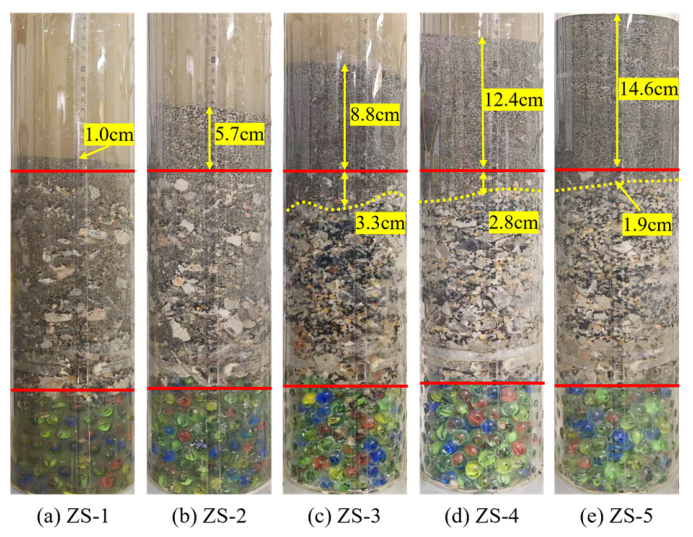
Figure 2 illustrates the deposition of tailings sand on filter surfaces and their infiltration states during experiments. Red lines indicate the initial top and bottom boundaries of filters during sample preparation, while yellow dashed lines demarcate infiltration depths of tailings sand; yellow arrows and numbers further annotate the deposition thickness and infiltration depth. As shown in
Figure 2a, filter ZS-1 (α = 20.8) contained the coarsest particles and its initial pore structure was excessively open. During testing, fine tailings sand particles penetrated directly through the filter layer and discharged from the base; internal pores were filled by fine particles, with only a thin clogging layer approximately 1 cm thick forming at the top surface. This indicates that when the initial interlayer coefficient is excessively large, the skeleton pore size of the filter layer is significantly larger than the tailings sand particles, such that effective internal retention cannot be established and fine particles predominantly penetrate through and are lost. This phenomenon validates the determination in the preceding section that for case ZS-1 the clogging coefficient λ exceeds 4, indicating that tailings sand particles penetrated through the filter layer and failed to form effective internal clogging. Excessive fine-particle migration through ZS-1 compromised tailings protection, deeming this filter ineffective. Thus, an interlayer coefficient α = 20.8 fails to satisfy the soil retention criterion for filter design.
Figure 2b shows that a substantial quantity of tailings sand particles entered and were retained within the filter layer, with clogging distributed over a relatively wide range such that traces of tailings sand clogging were clearly observable throughout the entire depth of the filter layer and the internal pores were essentially filled with fine particles. However, a markedly non-uniform distribution occurred along the depth direction, with the fine particle content in the upper portion significantly exceeding that in the lower portion, indicating that the filter layer was capable of establishing a certain degree of internal retention. Simultaneously, a thick clogging layer approximately 5.7 cm thick formed at the top surface of the filter layer, further inhibiting the migration of fine particles toward deeper regions. During the initial stage of testing, the relatively large initial pores of filter ZS-2 allowed a small number of tailings sand particles to penetrate through the filter layer and discharge from the base, yet as the upper and internal pores were gradually filled with fine particles, the seepage channels progressively narrowed and impeded the continued migration of upstream tailings sand particles toward the lower portion of the filter layer, causing the clogging state to eventually tend toward stability. Further analysis in conjunction with
Figure 3 indicates that the clogging coefficient λ of filter ZS-2 slightly exceeds the critical value of 4, with λ equal to 4.30 as presented in
Figure 4, and although this value approaches the boundary for the non-clogging classification, the actual seepage process did not exhibit sustained characteristics of penetration and loss. This is attributable to the fact that although a portion of fine particles penetrated during the early infiltration stage, the majority of particles were retained and deposited internally, and as clogging in the upper pores developed, the seepage resistance increased rapidly, ultimately achieving a stable clogging state dominated by internal filling and thick-layer deposition at the top surface. This demonstrates that filter ZS-2 possesses effective soil retention capacity, and its soil retention mechanism is manifested in that a small quantity of fine particles are allowed to penetrate during the initial stage, followed by rapid stabilization through internal self-clogging and thick-layer deposition at the top surface.
Figure 2c–e demonstrate that as the initial interlayer coefficient α decreases, the clogging depth of fine tailings sand particles within the filter interior progressively diminishes while the deposition depth above the filter layer increases correspondingly. Specifically, the clogging depth for ZS-3 (α = 10.4) is approximately 3.3 cm with an overlying deposition depth of approximately 8.8 cm, for ZS-4 (α = 8.3) the clogging depth is approximately 2.8 cm with an overlying deposition depth of approximately 12.4 cm, and for ZS-5 (α = 5.7) the clogging depth is approximately 1.9 cm with an overlying deposition depth of approximately 14.6 cm. This phenomenon is consistent with the clogging mode classification in
Table 3 in that as α decreases, the initial pore structure of the filter layer becomes denser, reducing the number of tailings sand particles capable of entering internal pores, and more fine particles are intercepted at the filter surface and shallow layers, thereby decreasing the clogging depth while increasing the surface deposition thickness. During the clogging stabilization stage, the effluent at the outlet was observed to transition gradually from an initially turbid state containing substantial fine particles to a clear state, indicating that the filter layer achieves effective retention of tailings sand particles through the synergistic action of internal clogging and surface interception, thereby providing satisfactory soil retention performance, which demonstrates that the soil retention criterion for filter design is satisfied when α ≤ 10.4. Whereas Terzaghi’s criterion requires α to be less than 4, the results for ZS-3 permit a preliminary determination that the soil retention criterion in Terzaghi’s method is relatively conservative.
It is important to note that the proposed threshold of α ≤ 10.4 is derived from a limited dataset comprising five discrete initial gradation conditions. The interval between α = 10.4 (ZS-3) and α = 15.6 (ZS-2) represents a transition zone wherein the true critical value may reside; finer gradation increments within this range (e.g., α = 12, 13, 14) were not tested in the present study. Consequently, α = 10.4 should be regarded as the upper bound of the effective retention domain observed under the current experimental conditions, rather than a universally applicable design constant.
3.3. Particle Size Distribution of Tailings Sand Across Filter Zones
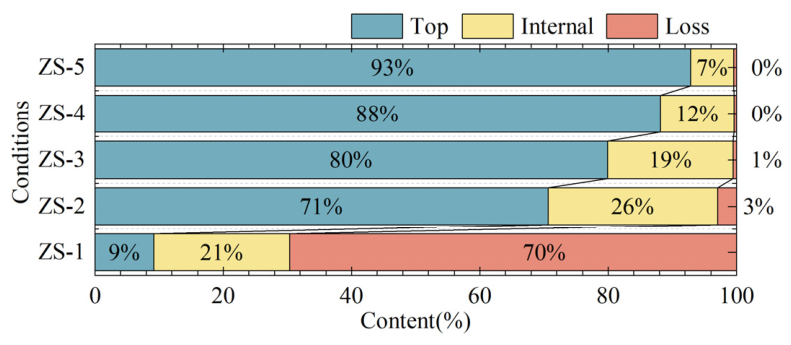
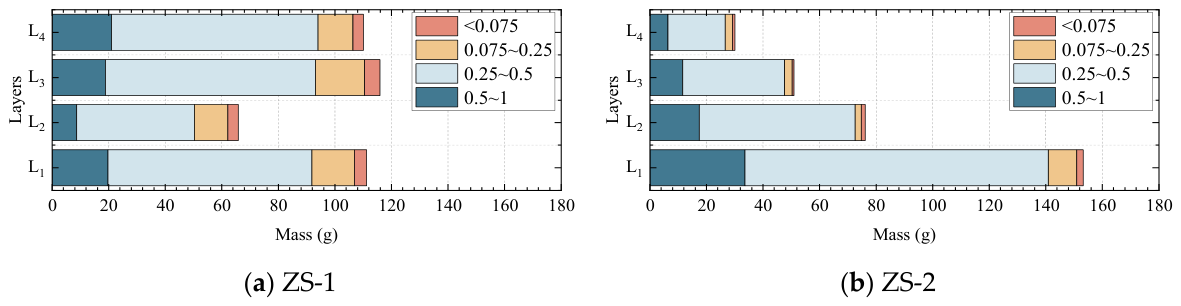
Upon completion of the sediment-laden seepage tests, the mass of tailings sand deposited on the filter surface, retained within the filter interior, and lost through penetration was statistically analyzed, and the results are presented in
Figure 3. As the interlayer coefficient α decreased, the deposited mass of tailings sand particles on the filter surface increased progressively while the internal clogging quantity decreased correspondingly, indicating that the retention location of fine particles gradually concentrated toward the surface layer. For ZS-1 (α = 20.8), the excessively large interlayer coefficient resulted in an overly open internal pore structure, allowing fine tailings sand particles to penetrate directly through the filter layer and discharge from the base, with the retention mass on the top surface and within the interior accounting for only approximately 30% and the loss fraction approaching 70%, thereby rendering the filter nearly ineffective. For ZS-2 to ZS-5, the interlayer coefficients were relatively small, and the overall retention rate of tailings sand particles exceeded 97% with the loss controlled within 3%. However, the steady-state clogging characteristics differed among these conditions. ZS-2 (α = 15.6) achieved a final retention rate of 97% yet exhibited minor fine-particle penetration during the initial testing stage with a relatively delayed clogging stabilization process, representing a transitional state of initial leakage followed by stabilization, while ZS-3 to ZS-5 (α ≤ 10.4) achieved rapid retention from the initial seepage stage without obvious fine-particle penetration, representing a secure steady state. The 1% to 3% difference in retention rates among ZS-2 to ZS-5 essentially reflects the physical trend of clogging efficiency converging toward a limiting value as α decreases. From an engineering safety perspective, α ≤ 10.4 can serve as the upper bound of the effective retention domain, and this limit ensures that the filter layer possesses reliable soil retention performance from the initial service stage and avoids the early penetration risk manifested in ZS-2. In comparison, the qualitative transition in retention performance between ZS-2 to ZS-5 and ZS-1, from 70% loss to over 97% retention, clearly demonstrates that the filter layer experiences penetration failure when the initial interlayer coefficient α is excessively large (e.g., 20.8). Further comparison of the steady-state characteristics between ZS-2 (α = 15.6) and ZS-3 to ZS-5 (α ≤ 10.4) indicates that the filter layer enters a secure soil retention state from the initial seepage stage when α decreases to 10.4 and below. Under conditions ZS-2 to ZS-5, tailings sand particles were jointly retained on the filter surface and within the interior, achieving a total retention rate exceeding 97%, with surface deposition accounting for 71% to 93% and internal clogging accounting for 7% to 26%. This indicates that as α decreases, the retention mechanism gradually shifts from internal filling dominance to surface interception dominance, and the integrated filter–clogging layer system provides effective protection for upstream tailings sand particles. Specifically, ZS-4 and ZS-5 achieved surface deposition rates of 88% and 93% respectively, demonstrating that when α is relatively small, the soil retention requirement in Terzaghi’s criterion for protecting at least 85% of the protected soil particles from loss is satisfied.
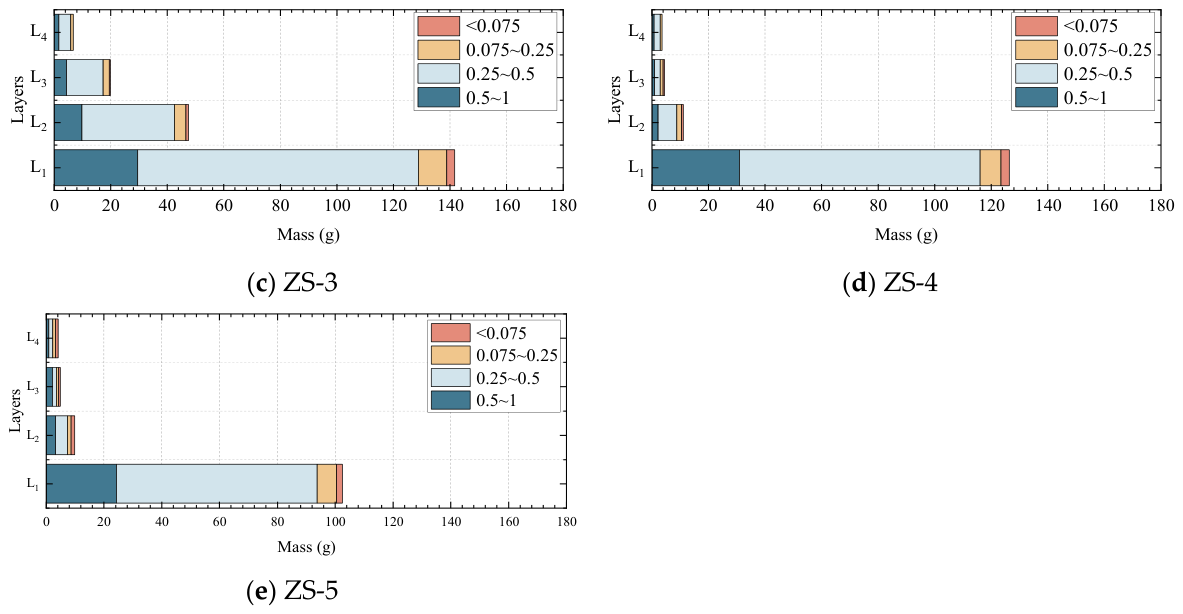
Figure 4 presents the mass content of tailings sand particles clogged within the filter across all tests. For conditions ZS-2 to ZS-5, the internally retained tailings mass progressively decreased with infiltration depth. Specifically, in layers
L1 to
L4, the percentage of fine tailings particles clogged in the uppermost layer (
L1) accounted for 48.9, 65.6, 86.8, and 84.5 percent of total internal clogging mass respectively, indicating predominant accumulation near the surface. This distribution arises from kinetic energy dissipation during particle migration through filter pores. Under consistent gravitational and hydraulic driving forces, the probability of individual particles traversing successive filters diminishes with depth [
27], resulting in exponential attenuation of particle retention along the depth profile [
28]. Concurrently, finer filter gradations increase collision frequency between particles and pore walls, amplifying kinetic energy loss per layer. Consequently, the mass of internally retained fine particles sequentially decreased from ZS-2 to ZS-5.
Figure 4b,c elucidate the operational mechanism: partial particle ingress into the filter fills pores to establish stability, thereby preventing subsequent particle exfiltration and promoting surface deposition. Notably, finer filter gradations require less internally retained mass to achieve stabilization. As
Figure 3 data confirm, ZS-4 and ZS-5 satisfied Terzaghi’s soil retention criterion solely through surface deposition (88% and 93% retention respectively). In contrast, ZS-2 and ZS-3 achieved compliance (97% and 99% total retention) only by combining surface accumulation with internal particle retention. This substantiates that effective filtration is not attributable to the filter alone but emerges from the joint filtration effect achieved by the filter and its retained particle matrix.
3.4. Hydraulic Conductivity Analysis of Filter
The preceding section established that over half of retained tailings particles clogged within the
L1 layer in effective filters ZS-2 to ZS-5. This implies that the void ratio and hydraulic conductivity of
L1 must be lower than those of underlying layers (
L2~
L4). To investigate filter hydraulic conductivity, the surface-deposited tailings layer (
L0) and the uppermost filter (
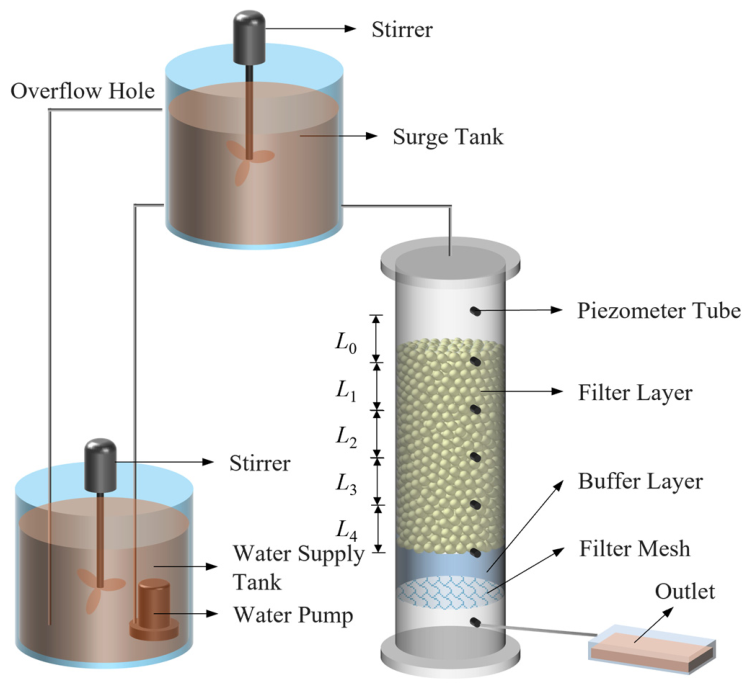
L1) were examined (as illustrated in
Figure 1). Hydraulic conductivities and hydraulic gradients at
L0 and
L1 during testing were calculated through statistical analysis of piezometric readings and seepage flow rates.
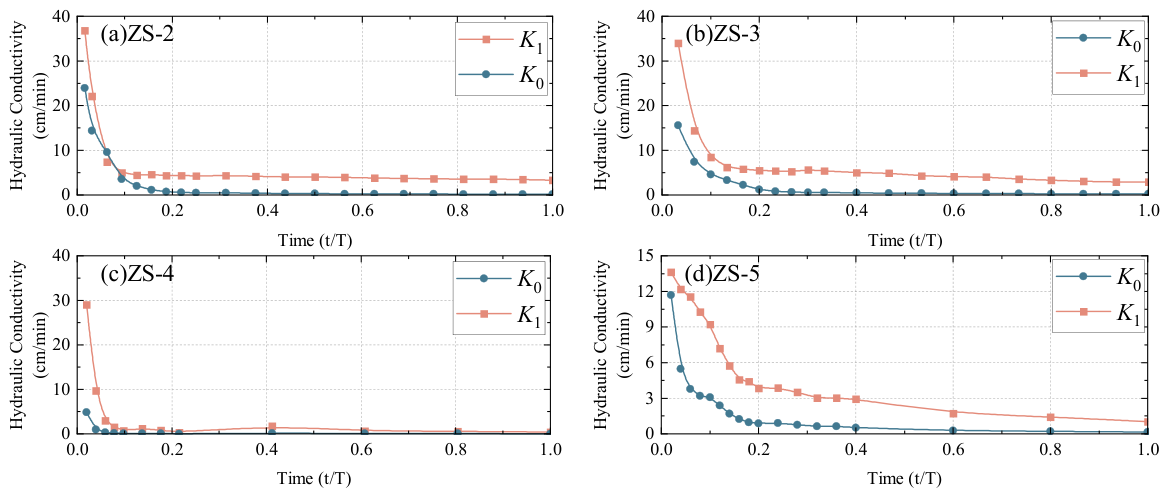
Figure 5a–d present the temporal variations in hydraulic conductivity for layers
L0 and
L1 during sediment-laden seepage in test conditions ZS-2 to ZS-5, and the time axis is normalized to facilitate analysis. It can be observed that during the initial stage of sediment-laden seepage, a substantial quantity of tailings sand entered the filter interior to cause clogging and rapidly accumulated on the filter surface, resulting in sharp decreases in the hydraulic conductivities of both
L1 and
L0. Specifically, the hydraulic conductivity of the filter layer
K0 in ZS-2 decreased from an initial value of 23.92 cm/min to a steady-state value of approximately 0.14 cm/min, representing a reduction of 99.4%, while the hydraulic conductivity of the tailings sand deposition layer
K1 decreased from an initial value of approximately 36.79 cm/min to a steady-state value of approximately 3.27 cm/min, representing a reduction of approximately 91.11%. Similar trends were observed for ZS-3 to ZS-5, with
K0 reductions of 98.6%, 99.2%, and 98.6%, and
K1 reductions of 91.6%, 94.5%, and 92.4%, respectively. As tailings sand continuously accumulated on the filter surface, the overall permeability of the specimen gradually became controlled by the tailings sand in layer
L0, and the piezometric levels and flow rates stabilized at this stage, indicating that clogging had entered a stable phase and the hydraulic conductivity had tended toward a constant value. Under steady-state conditions, the hydraulic conductivity of the filter layer
K0 for all test conditions decreased to the order of 0.1 cm/min, while the hydraulic conductivity of the deposition layer
K1 was maintained in the range of 0.42 to 3.27 cm/min, and the hydraulic conductivity of the filter layer remained consistently higher than that of the tailings sand deposition layer by a factor of approximately 6.2 to 23.7, which indicates that the filter skeleton retained relatively high permeability after clogging while the surface deposition layer provided the primary seepage resistance.
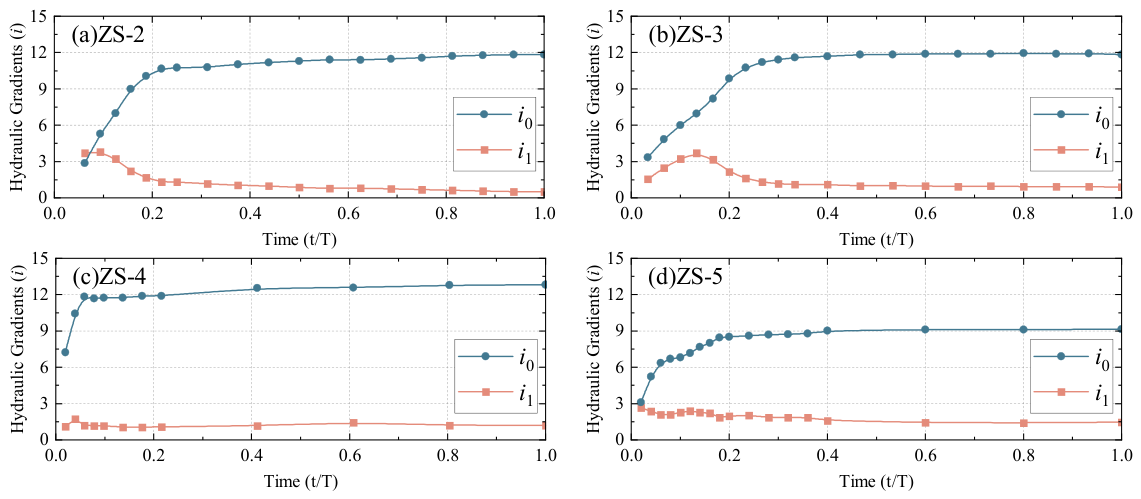
Figure 6a–d present the temporal variations in hydraulic gradients for layers
L0 and
L1 during sediment-laden seepage in test conditions ZS-2 to ZS-5. Unlike the trends shown in
Figure 5, the hydraulic gradient of layer
L0 increased significantly and tended toward stabilization as infiltration progressed, whereas the hydraulic gradient of layer
L1 exhibited varying degrees of initial elevation due to pore pressure accumulation and subsequently decreased rapidly to reach a stable state. Specifically, the steady-state hydraulic gradient values
i0 for ZS-2 to ZS-4 were concentrated in the range of 11.5 to 12.8, representing increases of approximately 0.8 to 3.1 times the initial values, while for ZS-5 the steady-state
i0 value was approximately 9.1 with an increase of approximately 1.9 times due to its relatively dense initial skeleton. The hydraulic gradient
i1 of the filter layer exhibited an opposite trend, decreasing from an initial value of approximately 3.7 to a steady-state value of 0.5 for ZS-2 with a reduction exceeding 85%, and to approximately 0.9, 1.2, and 1.4 for ZS-3 to ZS-5 respectively. At steady state, the
i0/
i1 ratios for all test conditions ranged between 6.3 and 23.7 and decreased with decreasing initial interlayer coefficient α, which is consistent with the variation pattern of the permeability margin of each filter layer and indicates that a smaller α results in the surface thick deposition layer bearing more head loss while the filter skeleton still maintains sufficient drainage capacity. This is because during the initial infiltration stage, fine tailings sand particles entering layer
L1 formed clogging within the pores, causing pore pressure in
L1 to be unable to dissipate in time and thus producing an initial elevation of the hydraulic gradient. During the middle and late stages, the natural release of pore pressure through the underlying filter layer and the redistribution of fine tailings sand particles within the filter layer under seepage forces caused the pore pressure in
L1 to gradually decrease and eventually stabilize. The tailings sand layer deposited on the filter surface possesses lower permeability relative to the filter layer, preventing the dissipation of pore pressure in
L0 and causing its hydraulic gradient to increase rapidly and ultimately stabilize at a relatively high level.
Beyond soil retention, filters must simultaneously satisfy hydraulic conductivity requirements to reduce internal pore pressures and control phreatic surfaces within embankments. Terzaghi stipulates that filter hydraulic conductivity should be governed by Equation (3) [
26]. Post-clogging measurements for ZS-2 to ZS-5 yielded
ib/
if ratios of 23.68, 13.16, 10.68, and 6.26 respectively, confirming compliance with drainage-induced pore pressure reduction requirements.
where
Kb and
ib denote the hydraulic conductivity and prevailing hydraulic gradient of the base soil, respectively, and
Kf and
if represent the hydraulic conductivity and prevailing hydraulic gradient of the filter, respectively.
3.5. Optimum Gradation Curve for the Filter
Section 3 demonstrates that filter designs ZS-2 to ZS-5 satisfy both soil retention and hydraulic conductivity criteria, with fine tailings particles predominantly clogged in layer
L1. Consequently, the gradation of
L1 after sediment-laden seepage defines the optimal filter design curve under self-clogging conditions, as illustrated in
Figure 7. Here,
Dmax and
Dmin represent the upper and lower boundary envelopes specified in the
Design Code for Rolled Earth-Rock Dams (NB/T 10872-2021), hereafter referred to as the Code [
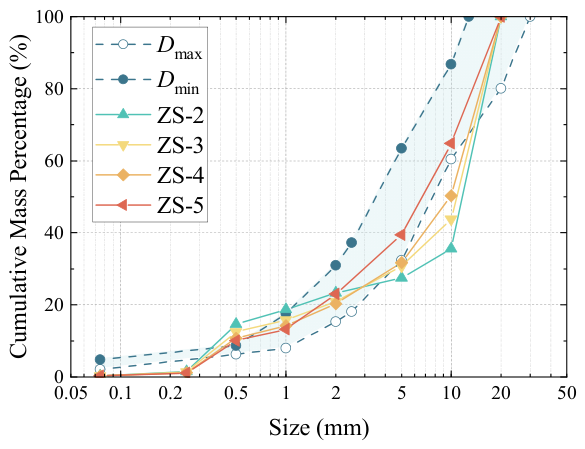
29]. The filter design method in this Code is based on Terzaghi’s filter criterion (α < 4) and the permeability criterion as theoretical foundations, combined with empirical corrections. Compared to the Code’s envelope method, the Natural Clogging Method explicitly defines the filter gradation curve. Final gradation curves of ZS-2 to ZS-5 align with the Code’s envelopes, where gradations ZS-2 to ZS-4 exhibit marginally higher coarse fraction content (5~20 mm range) than the upper boundary
Dmax, indicating that moderate relaxation of coarse particle limits does not compromise soil retention. ZS-5’s curve fully complies with the envelope, with characteristic particle sizes
D15 = 1.19 mm and
D85 = 15.75 mm (as shown in
Table 5), and the corresponding steady-state interlayer coefficient α = 2.48, satisfying and substantially falling below the safety limit of Terzaghi’s criterion α < 4. This confirms that filters designed by Natural Clogging Method satisfy the Code’s requirements and simultaneously meet both soil retention and hydraulic conductivity demands. Fundamentally, ZS-5’s gradation evolved through physical self-organization rather than empirical estimation, as natural clogging during infiltration formed a stable composite structure with retained particles. This demonstrates that leveraging soil’s self-filtration capability aligns with the Code’s safety principles, establishing the method’s scientific validity and engineering rationality.
The characteristic particle size parameters of the final gradation curves for ZS-2 to ZS-5, designed via the Natural Clogging Method, are presented in
Table 5. It can be observed that for the filter gradation curves of ZS-2 to ZS-5,
D15 progressively increases while
D85 gradually decreases. Filters with smaller initial interlayer coefficients develop enhanced uniformity during advanced clogging stages. The interlayer coefficients
α for all four filters range between 1.15 and 2.48, all significantly below the conservative limit of α < 4 recommended by Terzaghi’s criterion, indicating that the post-clogging gradation possesses an adequate safety margin within the Terzaghi framework. In summary, the filters designed by the Natural Clogging Method proposed in this study satisfy both soil retention and hydraulic conductivity requirements.
Comparison with Terzaghi’s criterion and the conventional envelope method further elucidates the advantages of NCM proposed in this study. In terms of soil retention, the filters designed by NCM (ZS-2 to ZS-5) achieved measured retention rates of 97% to 99% for the protected soil, with steady-state interlayer coefficients stabilized between 1.15 and 2.48, which are substantially lower than the conservative limit of 4 in Terzaghi’s criterion, indicating that the post-clogging gradation possesses a considerable safety margin against piping. Regarding permeability, the measured ib/if ratios ranged from 6.26 to 23.68, satisfying and exceeding the permeability requirements of Terzaghi’s criterion (typically ib/if ≥ 4 to 16). Unlike conventional methods that merely provide a gradation envelope range, NCM delivers a specific gradation curve under real seepage conditions, transforming the design process from empirical selection within an envelope into a deterministic output. Furthermore, NCM permits an initial interlayer coefficient of 10.4, whereas Terzaghi’s criterion strictly requires α to be less than 4, which reduces the demand for intermediate particle sizes and broadens the selection range of coarse filter materials. It should be noted that a complete quantitative comparison involving material costs, construction volume, and full life-cycle economic assessment remains to be addressed in future research.
4. Discussion and Limitations
Despite the design potential demonstrated by the Natural Clogging Method (NCM) proposed in this study under experimental conditions, this research remains at the proof-of-concept stage and is subject to several limitations.
First, this study employed only the medium tailings sand from the Lixi tailings dam as the protected soil, and proposed a soil retention threshold of α ≤ 10.4 based on five discrete initial gradations (α = 20.8, 15.6, 10.4, 8.3, and 5.7). This threshold currently represents an experimental observation with a restricted validation range, and its statistical significance is constrained by the limited sample size. Meanwhile, given the absence of intermediate gradation increments between α = 10.4 and 15.6, the comparison between ZS-2 (α = 15.6) and ZS-3 (α = 10.4) indicates that a transition zone may exist within this interval: the filter layer approaches failure when α exceeds approximately 15.6, whereas it tends toward a secure retention state when α decreases to the vicinity of 10.4 and below. Therefore, α = 10.4 represents only the upper bound of the effective retention domain observed under the current experimental conditions, rather than a universal design constant. This threshold is currently applicable only to fine-grained cohesionless soils similar to the tested tailings sand, and the applicability boundaries for cohesive soils, wide-gradation gravels, and other tailings materials with different mineral compositions, particle shapes, or gradation characteristics remain to be verified through future experiments with expanded soil sources and intermediate gradation increments (e.g., α = 12, 13, 14).
Second, it should be noted that all tests were conducted as single-run experiments without replication. The primary uncertainties in this test originate from the measurement error of the electronic balance (precision 0.01 g), standard sieve analysis losses, mass fluctuations during oven drying at 105 °C, flow rate measurement errors by the volumetric cylinder and stopwatch method, and operational errors in stratified sampling. These measurement errors primarily affect the precise values of the retention ratio, yet their cumulative effect is far from sufficient to alter the qualitative distinction between ZS-1 (approximately 70% loss, representing filter failure) and ZS-2 to ZS-5 (retention ratio > 97%, representing effective filtration). The 1% to 3% difference in retention rates among ZS-2 to ZS-5 falls within the superimposed range of measurement uncertainty and material inherent response variability under different gradation conditions, and should be interpreted as the physical trend of clogging efficiency converging with decreasing α, rather than a statistically significant quantitative distinction. The core conclusion of this study, namely that α ≤ 10.4 serves as the upper bound of the effective retention domain, does not depend on these minor differences but is based on the qualitative distinction between failure and effectiveness. Future research will conduct replicate tests targeting the transition zone (α = 10~16) to separate measurement errors from material inherent variability and establish the statistical confidence interval for this threshold.
Furthermore, the Natural Clogging Method proposed in this paper represents a promising laboratory-scale design method, and its broader engineering applicability remains to be validated through large-scale model tests or field measurement studies. This test aimed to determine the steady-state clogging gradation as a material design parameter, which falls within the scope of gradation characterization. The seepage apparatus adopted a diameter of 10 cm, approximately five times the maximum particle size, satisfying the dimensional requirements for seepage tests on coarse-grained soils, and existing literature [
2] has also commonly employed this scale to investigate filter performance. It should be noted that when applying the laboratory-determined gradation curve to full-scale tailings dams, field factors such as overburden stress, multidimensional seepage paths, and construction heterogeneity may influence the service evolution of the clogging layer, yet they do not alter the basic material gradation determined by standardized testing. The extent to which these field factors affect long-term applicability remains to be further investigated through field trials or centrifuge modeling.
Finally, the design gradation obtained in this study represents only the material parameter for the initial design stage. During decades of service in actual tailings dams, long-term factors such as cyclic hydraulic loading, chemical precipitation, and biological action may cause the permeability of the clogging layer to deviate from design expectations. Therefore, the method proposed in this paper is currently applicable primarily to the initial gradation design of filter layers, and the degradation patterns of long-term performance, maintenance cycles, and replacement criteria remain to be further investigated through long-term monitoring.
In summary, this study has preliminarily established a promising laboratory-scale filter design method through natural clogging tests, and its effectiveness has been validated under experimental conditions. Future work will focus on verification across multiple soil types, long-term progressive clogging evolution mechanisms, durability assessment of the design gradation, and validation of field-scale applicability, to advance this method from the laboratory design stage toward complete engineering application.




 ,
,