Article

Spatiotemporal Dynamics and Climatic Attribution of Natural Lake Extremes Across China’s Major Urban Agglomerations (2001–2023)

1
Shanxi Conservancy Technical Institute, Taiyuan 030032, China
2
Shanxi Hydrology and Water Resources Survey Bureau, Taiyuan 030024, China
3
College of Geological and Surveying Engineering, Taiyuan University of Technology, Taiyuan 030024, China
4
School of Urban Construction, Wuhan University of Science and Technology, Wuhan 430065, China
*
Author to whom correspondence should be addressed.
Water 2026, 18(13), 1569; https://doi.org/10.3390/w18131569 (registering DOI)
Submission received: 30 April 2026 / Revised: 12 June 2026 / Accepted: 18 June 2026 / Published: 26 June 2026
(This article belongs to the Section Water and Climate Change)

Abstract

Natural lakes in urbanizing regions face compounding climatic and anthropogenic pressures. Despite their socio-ecological importance, the dual vulnerability of these urban lakes to both long-term areal shrinkage and the shifting frequencies of extreme water events remains a critical research gap, often overlooked in favor of large, remote lake systems. We investigated surface area dynamics, extreme events, and climatic attribution of 7320 natural lakes across China’s five major urban agglomerations (Jing-Jin-Ji, Yangtze River Delta, Greater Bay Area, Chengdu-Chongqing, and Middle Yangtze) from 2001 to 2023. Using a satellite area product, we assessed long-term trends via Seasonal-Trend decomposition by Loess (STL). Regional climate shifts were detected via multi-scale Standardized Precipitation–Evapotranspiration Index (SPEI) breakpoint analysis, and climate attribution was performed by correlating detrended lake areas with SPEI. Results show 59.4% of lakes exhibit significant trends, with shrinkage (50%) vastly outpacing expansion (9.4%), most severely in Jing-Jin-Ji (−0.28%/year). Despite all agglomerations transitioning toward wetter conditions (2008–2013), extreme event responses diverged markedly regionally. Climate-driven lakes (14.5%) displayed stronger shrinkage and greater sensitivity to extremes than lakes with low climate sensitivity, particularly in Jing-Jin-Ji and Chengdu-Chongqing. These findings reveal pronounced spatial heterogeneity in urban lake vulnerability, providing an evidence base for sensitivity-stratified management strategies.

1. Introduction

Lakes store approximately 87% of the planet’s liquid surface freshwater and cover 3.7% of the non-glaciated land surface [1,2]. They provide critical ecosystem services including freshwater supply, flood regulation, biodiversity habitat, carbon cycling, and microclimate modulation [3,4]. In urbanized landscapes, lakes assume additional socioeconomic importance by moderating urban heat islands, recharging shallow aquifers, and supporting recreational and cultural values that underpin public well-being [5].
China harbors over 24,000 natural lakes exceeding 0.1 km2 [6], distributed across climatic zones from the arid Tibetan Plateau to the humid subtropical lowlands. Its unprecedented urbanization—with the urban population share rising from 18% in 1978 to over 65% in 2023 [7]—has concentrated population and economic activity within five major urban agglomerations (i.e., Jing-Jin-Ji in the semi-arid northern plains, Yangtze River Delta and Greater Bay Area along the humid southern and eastern coasts, Chengdu-Chongqing in the inland southwest basin, and Middle Yangtze in the central floodplains) that collectively host over 500 million residents [8]. The natural lakes embedded within these agglomerations face a uniquely intense combination of stressors, including land reclamation, impervious surface expansion, altered drainage networks, and elevated nutrient loading [9]. Understanding how these large lake systems respond to the compounding pressures of climate change and urbanization is therefore of critical scientific and practical significance.
The emergence of multi-decadal satellite archives has fundamentally transformed the capacity to monitor lake dynamics across large spatial extents and multi-decadal timescales. The Joint Research Centre (JRC) Global Surface Water dataset provides pixel-level monthly water occurrence histories at 30 m resolution from 1984 onward [10]. Building upon this foundation, Pi et al. [11] developed the Global Lakes (GLAKES) dataset comprising 3.4 million lakes globally via deep-learning classification, demonstrating that small lakes (less than 1 km2) dominate the variability in total lake area in half of the world’s inland lake regions. The HydroLAKES database further provides georeferenced polygons and morphometric attributes (area, depth, volume, watershed area, and residence time) for 1.4 million lakes worldwide [12], while GloLakes achieved absolute water storage estimation for over 27,000 lakes by integrating Landsat imagery with ICESat-2 altimetry [13]. Most recently, Li et al. [14] achieved a landmark advance by leveraging a deep-learning-based spatiotemporal fusion of MODIS and Landsat datasets, combined with high-performance computing, to achieve monthly mapping of 1.4 million lakes globally from 2001 to 2023 with basin-level median user’s and producer’s accuracies of 93% and 96%, respectively. Their analysis demonstrated that seasonality is the dominant driver of lake surface extent variations globally, with seasonality-dominated lakes constituting 66% of the global lake area and approximately 60% of total lake counts. These technological advances now enable the construction of high-frequency, multi-decadal lake surface area time series at the individual lake level, opening new possibilities for systematic characterization of both long-term trends and short-term extremes [15].
In China, lake dynamics have been investigated across multiple geographic contexts using these satellite archives. On the Tibetan Plateau, Zhang et al. [16] documented substantial lake expansion driven by increased precipitation and glacier melt under climate warming, while Lei et al. [17] reported that unprecedented expansion from 2017–2018 was linked to extreme precipitation events. In the densely populated Eastern Plain, lakes have experienced persistent shrinkage, with area losses attributed to the combined effects of the Three Gorges Dam regulation on downstream hydrology, sand mining in lake beds, and urban encroachment [18,19]. Xu et al. [20] recently provided a comprehensive regional comparison across China’s five natural geographic lake regions from 1990 to 2023, employing Partial Least Squares Structural Equation Modeling (PLS-SEM) to quantify the relative contributions of climatic, hydrological, and human drivers. Their results revealed that the Qinghai–Tibet Plateau responds primarily to climatic factors, whereas the Eastern Plain and Mongolia–Xinjiang Plateau regions are dominated by human activities. Wang et al. [21] found that approximately 569 million people reside in areas with declining surface water or terrestrial water storage. At the reservoir scale, Li et al. [22] introduced the Standardized Area Index for drought monitoring across 9235 small and medium-sized reservoirs, revealing a north–south divide in drought severity. Chen et al. [23] documented reservoir-driven expansion alongside increasing fragmentation of natural water bodies along coastal China. An et al. [24] demonstrated through multi-source satellite altimetry that reservoir-driven dynamics dominate surface water variability across Asia. Collectively, these studies demonstrate that China’s lake systems exhibit pronounced spatial heterogeneity in their responses to climate and anthropogenic forcing.
Despite this growing body of literature, three critical gaps persist. First, existing monitoring efforts concentrate predominantly on either remote high-altitude plateaus, individual iconic large lakes, or macro-scale regional comparisons across entire natural geographic units, leaving the thousands of small to medium-sized natural lakes embedded within China’s most economically productive and densely populated urban agglomerations largely uncharacterized. The five nationally designated agglomerations together harbor over 7000 natural lakes, yet no study has systematically assessed their dynamics as a coherent analytical unit. Second, studies tend to examine long-term shrinkage or expansion in isolation, without capturing the full spectrum of hydrological variability. Li et al. [25] demonstrated that both flood and drought events are becoming more frequent in China’s large reservoir drainage areas, but no analogous framework has assessed the dual exposure of urban natural lakes to both low-water and high-water extremes simultaneously. Third, while SPEI has been widely used to characterize meteorological drought in China [26], the application of multi-scale SPEI correlation frameworks to distinguish climate-driven lakes from lakes with low climate sensitivity within urbanized settings has not been attempted.
Unlike previous large-scale studies that predominantly focus on the long-term monotonic shrinkage of iconic remote lakes, this study provides a novel framework by simultaneously tracking both high-water and low-water extreme events across thousands of nationwide understudied, small-to-medium natural lakes embedded within highly human-modified urban matrices. To address these gaps, this study presents a comprehensive assessment of natural lake surface dynamics and extreme water events across China’s five major urban agglomerations from 2001 to 2023. We investigate 7320 natural lakes using the monthly surface extent dataset of Li et al. [14] and the HydroLAKES database. Three research questions guide the analysis:
  • What are the morphological characteristics and long-term surface area trends of natural lakes across these five agglomerations?
  • How have the frequencies of low-water and high-water extreme events changed in response to regional climate shifts?
  • To what extent does climate drive lake surface dynamics, and how do climate-driven lakes differ from lakes with low climate sensitivity?
The analytical framework integrates STL decomposition for trend extraction, calendar-month percentile thresholds for extreme event identification, Pettitt breakpoint analysis for climate shift detection, and lake-level SPEI correlation for climate attribution. By applying this framework systematically across five agglomerations spanning distinct climatic and socioeconomic contexts, this study provides new insights into the spatial heterogeneity of lake vulnerability in urbanized China.

2. Data and Methods

2.1. Study Area

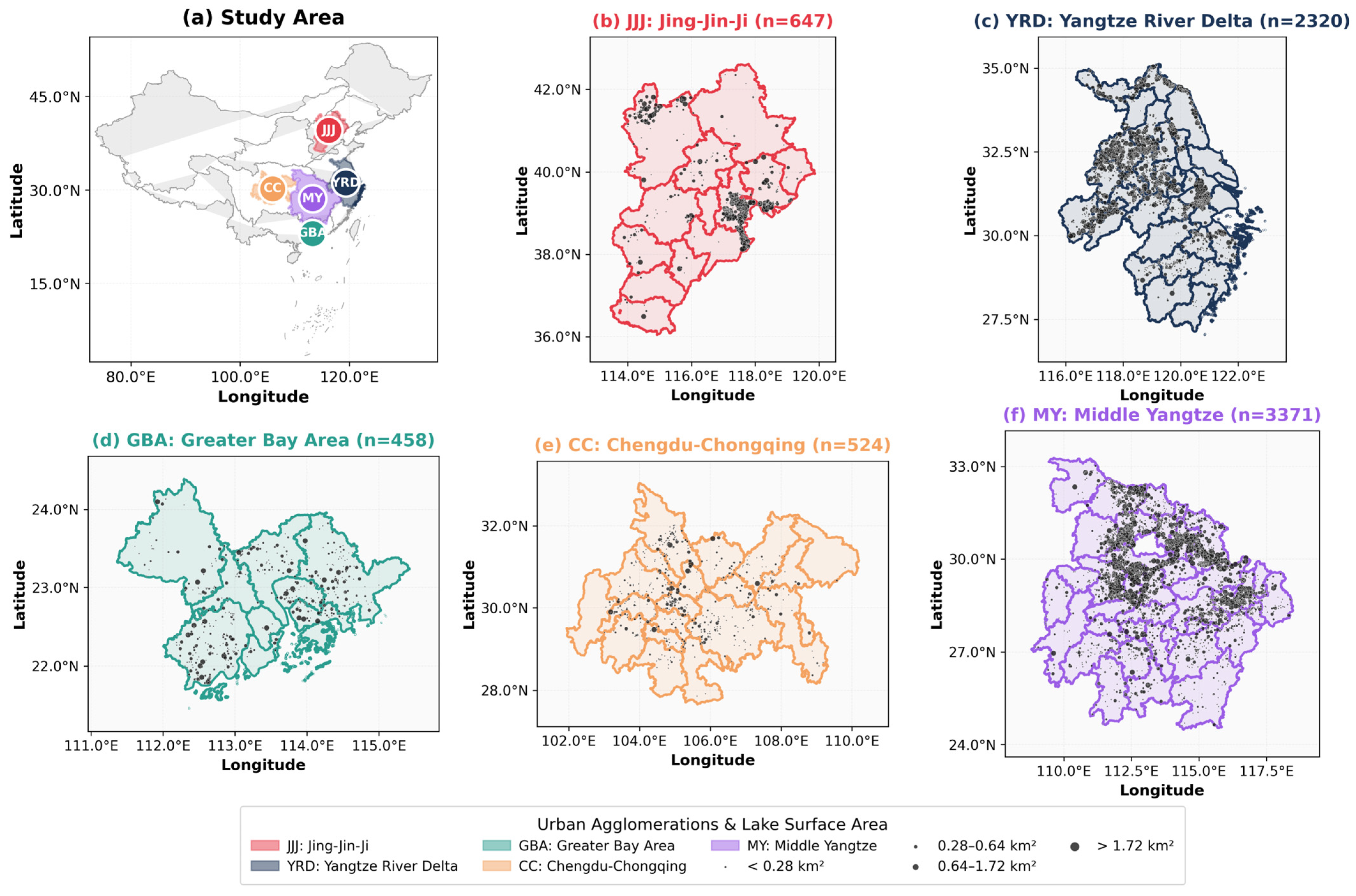
This study focuses on five nationally designated urban agglomerations in China (Figure 1), each representing distinct geographic, climatic, and socioeconomic contexts. A total of 7320 natural lakes (defined as non-reservoir water bodies in the HydroLAKES database [2]) are distributed across these agglomerations, with surface areas ranging from 0.03 to over 2398 km2. To eliminate the confounding effects of artificial regulation, natural lakes were explicitly distinguished from artificial water bodies by cross-referencing the HydroLAKES database with the GRanD (Global Reservoir and Dam) database, ensuring our final cohort strictly represents natural lake dynamics.
The Jing-Jin-Ji (JJJ) agglomeration, located in the semi-arid North China Plain, encompasses Beijing, Tianjin, and Hebei Province. It contains 647 lakes with a total area of 1218 km2 (mean: 1.88, median: 0.54 km2). This region is characterized by a continental monsoon climate with pronounced seasonality, limited precipitation (approximately 500 to 600 mm per year), and intensive groundwater extraction that has contributed to widespread water table decline [27]. The region has experienced persistent surface water area losses, consistent with the long-term shrinkage documented for the Eastern Plain Lake Region of China [28]. The Yangtze River Delta (YRD) agglomeration, centered on Shanghai, Jiangsu, and Zhejiang provinces, is the most lake-dense agglomeration in this study, containing 2320 lakes with a total area of 7824 km2 (mean: 3.37, median: 0.28 km2). Situated in the humid subtropical zone, this region features a dense network of lakes, rivers, and canals within the lower Yangtze floodplain and receives abundant precipitation (approximately 1000 to 1400 mm per year). It hosts some of China’s largest freshwater lakes, including Taihu Lake, where eutrophication and urbanization pressures have been extensively documented [29]. The Greater Bay Area (GBA), encompassing Guangdong Province, Hong Kong, and Macao, contains 458 predominantly small lakes with a total area of only 246 km2 (mean: 0.54 km2, median: 0.27 km2). This tropical to subtropical coastal zone experiences a monsoon climate with annual precipitation exceeding 1600 mm and has undergone rapid urban expansion that significantly modifies lake environments [29]. The Chengdu-Chongqing (CC) agglomeration, located in the Sichuan Basin, harbors 524 lakes with the smallest average size among all agglomerations (total: 174, mean: 0.33, median: 0.21 km2). This region is characterized by a humid subtropical climate with relatively even precipitation distribution (approximately 900 to 1200 mm per year) and significant topographic relief that confines lake formation to basin floors and terraced plateaus. The Middle Yangtze (MY) agglomeration, spanning Hubei, Hunan, and Jiangxi provinces, contains the largest number of lakes (3371) with a total area of 6993 km2 (mean: 2.07, median: 0.28 km2). This region encompasses the extensive floodplain lake systems of the middle Yangtze reach, including the Dongting and Poyang lake regions, where seasonal area fluctuations of several thousand square kilometers have been documented [18,20,30].
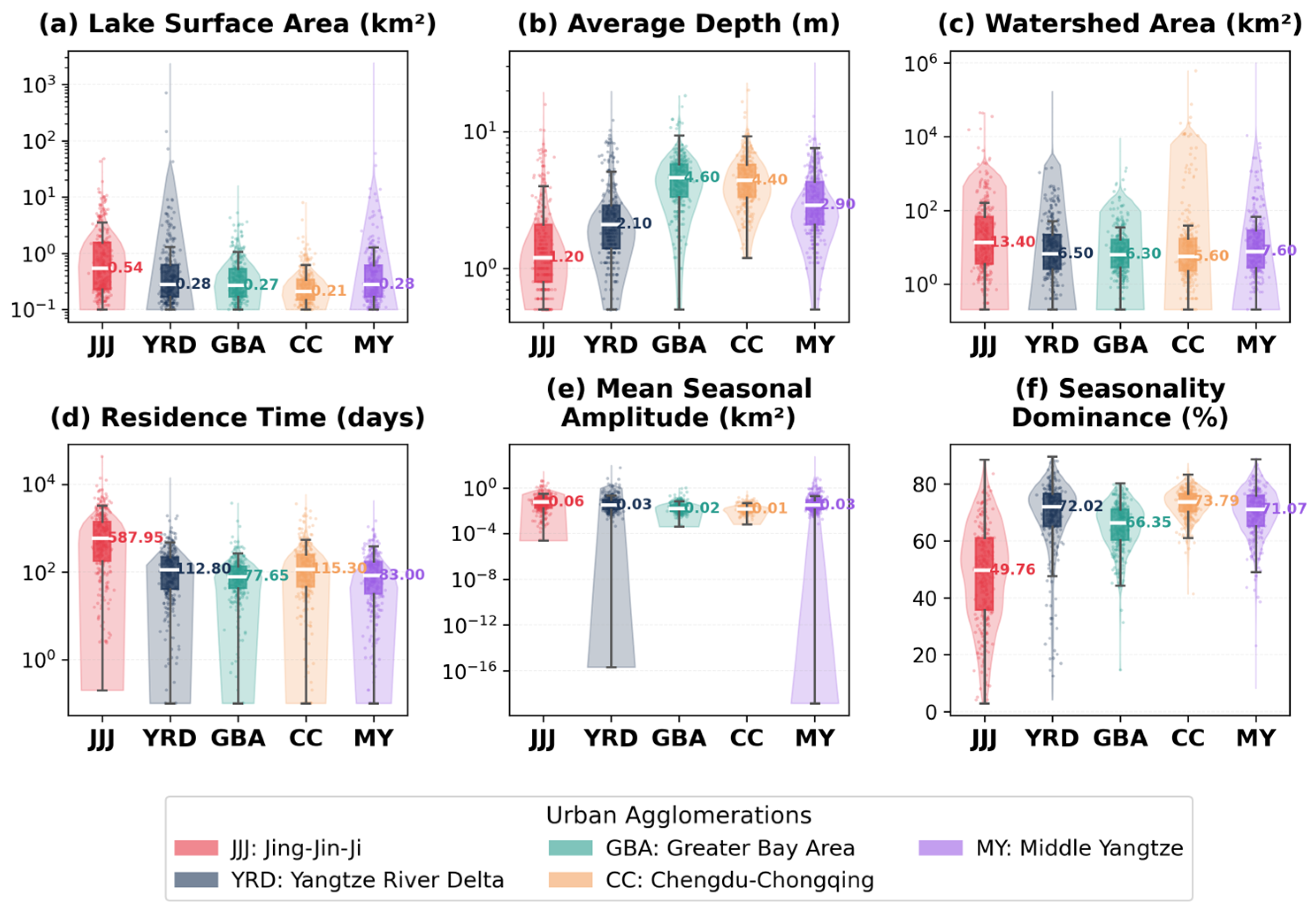
The majority of lakes across all five agglomerations are small water bodies: 66.7% have surface areas less than 0.5 km2, and 80.8% are smaller than 1 km2. Only 17 lakes exceed 50 km2 in area. This size distribution underscores the dominance of small lakes in these urban landscapes, consistent with the global finding of Pi et al. [14] that small lakes play outsized roles in lake dynamics variability. The morphological comparison of key hydrological attributes across the five agglomerations is presented in Figure 2.

2.2. Satellite-Derived Lake Surface Extent

Monthly lake surface area time series (2001 to 2023) were obtained from the global lake surface extent dataset developed by Li et al. [1], which represents a significant advance over previous single-source satellite products. This dataset was generated through a deep-learning-based spatiotemporal fusion of high temporal frequency MODIS imagery and high spatial resolution Landsat-based imagery, employing an algorithm that effectively suppresses cloud interference and sensor noise. The fusion approach achieves basin-level median user’s and producer’s accuracies of 93% and 96%, respectively, when validated against the JRC Global Surface Water dataset [13]. By resolving the inherent trade-off between spatial and temporal resolution that has long constrained lake monitoring from single satellite sources, this product provides gap-free monthly surface extent estimates for approximately 1.4 million lakes worldwide at an effective spatial resolution of 30 m. Lake boundaries and morphometric attributes (lake area, average depth, watershed area, volume, discharge, and residence time) were obtained from the HydroLAKES database version 1.0 [2], which provides georeferenced polygons for approximately 1.4 million lakes globally with a minimum area threshold of 0.1 km2. The mean seasonal amplitude for each lake was computed as the average difference between the annual maximum and minimum monthly area within each calendar year, and the seasonality dominance percentage was defined as the ratio of the seasonal component variance to the total time-series variance following seasonal-trend decomposition by Loess (STL decomposition).

2.3. Seasonal-Trend Decomposition and Long-Term Trend Analysis

To separate the long-term trend from seasonal and irregular components of the lake area time series, we applied Seasonal-Trend decomposition by Loess (STL) [31] with a period of 12 months using robust locally weighted regression. The STL procedure decomposes each lake’s monthly area time series into three additive components: a trend component capturing gradual multi-year changes, a seasonal component representing the repeating annual cycle, and a residual component containing irregular fluctuations. This decomposition approach has been widely applied to satellite-derived water body time series for isolating climate and anthropogenic signals from seasonal variability. The significance of the long-term trend was assessed using the Rao-modified Kendall test [32], which accounts for serial correlation in the trend component by adjusting the variance of the Mann–Kendall statistic. Lakes with p less than 0.05 were classified as having significant trends. To distinguish between rates of change, significant trends were further categorized as fast expansion (positive trend with absolute magnitude exceeding the median among all significant trends), slow expansion (positive but below the median), slow shrinkage (negative but below the median in absolute terms), and fast shrinkage (negative and exceeding the median). The median absolute trend among significant lakes (0.032% per year) served as the threshold for the fast versus slow classification. The linear trend of the STL trend component was expressed as a percentage change per period relative to the mean lake area.

2.4. Identification of Extreme Water Events

To identify anomalous low-water and high-water conditions while controlling for seasonal effects, we defined extremes based on the detrended time series (i.e., the sum of the STL seasonal and residual components). For each lake and each calendar month (January through December), we computed the 10th and 90th percentiles of the detrended values across the full 2001 to 2023 record. A month was classified as a low-water extreme if its detrended value fell below the corresponding calendar-month 10th percentile, and as a high-water extreme if it exceeded the 90th percentile. This calendar-month-specific threshold approach ensures that extremes are defined relative to the expected seasonal state rather than an annual mean, thereby avoiding the conflation of normal seasonal drawdown with genuine anomalies. This approach is conceptually analogous to the Standardized Area Index (SAI) framework developed by Li et al. [22] for reservoir drought monitoring, but extends the concept to encompass both tails of the distribution simultaneously. Annual frequencies of low-water and high-water extremes were then tabulated for each lake across the 23-year study period. Long-term trends in annual extreme frequencies were assessed using the Mann–Kendall test, with the Theil–Sen estimator providing the trend slope [33]. In addition, the change in mean annual extreme frequency between the pre-breakpoint and post-breakpoint periods (defined by the SPEI Pettitt breakpoints described in Section 2.5) was computed to quantify the response of extreme events to regional climate shifts.

2.5. SPEI Data and Climate Shift Detection

To characterize the climatic context, we employed the Standardized Precipitation–Evapotranspiration Index (SPEI), a widely used multi-scalar drought and wetness indicator that integrates both precipitation supply and potential evapotranspiration demand. By calculating the climatic water balance (the difference between precipitation and potential evapotranspiration), SPEI effectively captures the atmospheric moisture surplus or deficit. SPEI values at 18 accumulation timescales (1 to 18 months) were extracted for each lake location from the SPEI-HR dataset developed by Gebrechorkos et al. [3]. Unlike traditional global SPEI products with resolutions coarser than 50 km, the SPEI-HR dataset provides a 5 km (0.05°) gridded record computed from Multi-Source Weighted-Ensemble Precipitation (MSWEP) and potential evapotranspiration from the Global Land Evaporation Amsterdam Model (GLEAM). This high spatial resolution is particularly advantageous for resolving climatic gradients within and between urban agglomerations, where localized land-atmosphere feedbacks and urban heat island effects can produce substantial intra-agglomeration variability. For each urban agglomeration, we computed the cluster-mean SPEI by averaging across all constituent lakes for each month and timescale.
To detect structural shifts in the regional climate regime, we applied the Pettitt test [34] to the cluster-mean SPEI-3 time series for each agglomeration independently. The Pettitt test is a rank-based, non-parametric change-point detection method that identifies the time at which the most significant shift in the distribution of a time series occurs, with the null hypothesis of no change point rejected at p less than 0.05. The SPEI-3 timescale was selected for breakpoint detection because it captures seasonal-scale precipitation and evapotranspiration anomalies that are most relevant to lake surface area variability. The identified breakpoint dates were then used to partition the study period into pre-shift and post-shift phases for subsequent analysis of extreme event frequency changes. The statistical significance of pre- versus post-shift differences in SPEI was evaluated using the Mann–Whitney U test.

2.6. Climate Attribution of Lake Dynamics

To classify lakes according to their sensitivity to climatic forcing, we computed the Pearson correlation coefficient between each lake’s detrended monthly surface area anomaly and the collocated SPEI at each of the 18 accumulation timescales (SPEI-1 through SPEI-18). For each lake, the maximum absolute correlation (best r) across all 18 timescales was retained, along with the corresponding optimal SPEI timescale. The optimal timescale varies by lake, reflecting different hydrological memory characteristics: short timescales (1 to 3 months) characterize lakes sensitive to immediate rainfall events, while longer timescales (12 to 18 months) characterize large carry-over systems with substantial storage buffering. Lakes with best r greater than or equal to 0.3 (p less than 0.05) were classified as climate-driven, indicating that their surface area variability is significantly coupled to meteorological drought and wetness conditions. Within the climate-driven category, lakes with positive best r were designated as positively correlated (area expands during wet conditions), while those with negative best r were designated as negatively correlated. Lakes with best r less than 0.3 were classified as lakes with low climate sensitivity, implying that their dynamics are predominantly governed by potential anthropogenic influence or other drivers such as water abstraction, land use modification, or upstream regulation. The threshold of 0.3 was selected following the convention in hydroclimatic studies where r values of 0.3 to 0.5 indicate moderate coupling [35,36]. To assess whether climate-driven lakes or lakes with low climate sensitivity exhibit divergent behaviors, we compared their long-term STL trends, Mann–Kendall extreme frequency trends, and pre- versus post-breakpoint frequency changes using the Mann–Whitney U test.

3. Results

3.1. Long-Term Trends in Lake Surface Extent

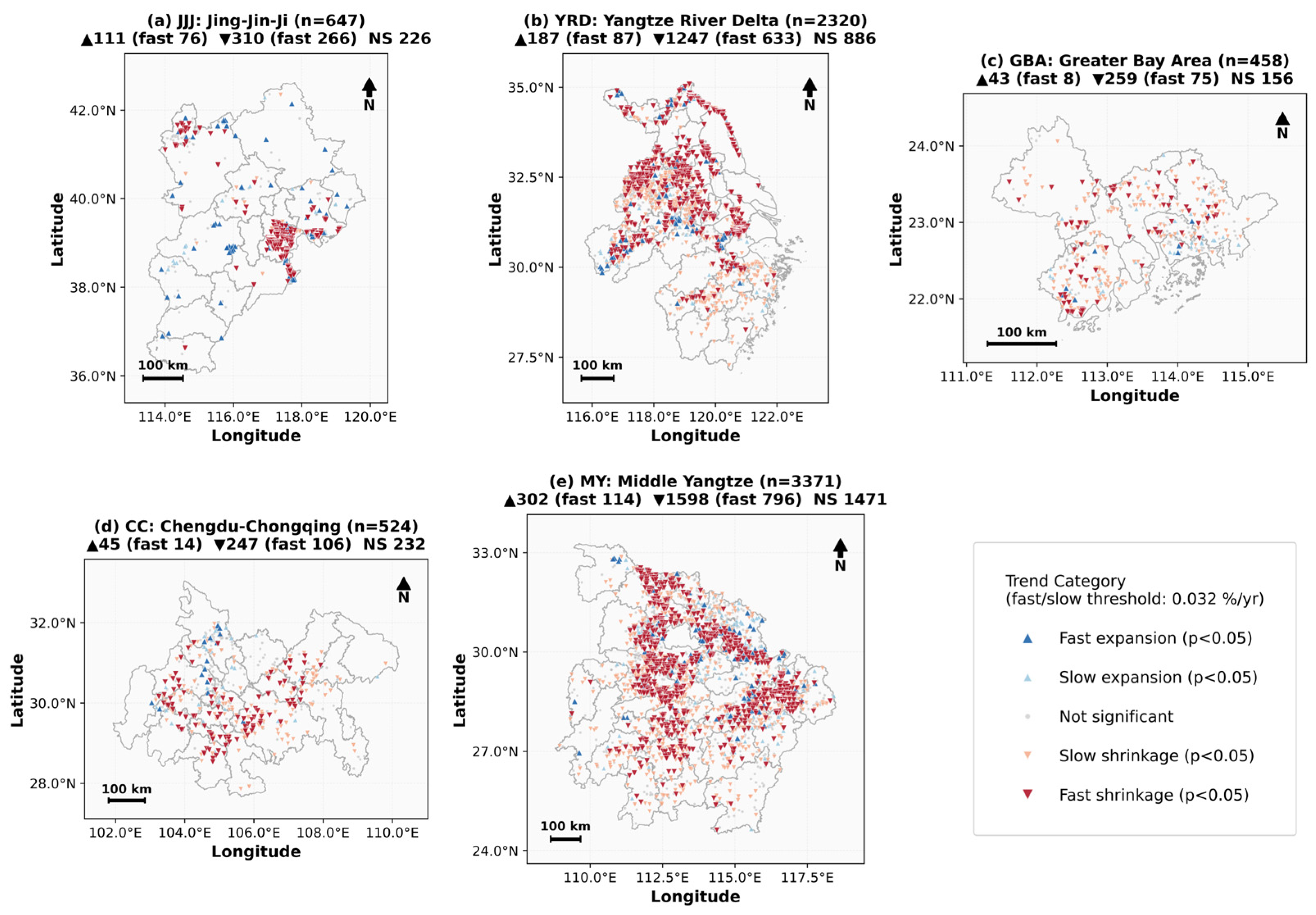
The STL decomposition and Rao-modified Kendall testing revealed that 59.4% of the 7320 lakes exhibited statistically significant long-term trends (p < 0.05) from 2001 to 2023 (Figure 3). Among these, shrinkage (50%) far outpaced expansion (9.4%), indicating a predominant trajectory of lake area loss across the five agglomerations. The remaining 40.6% of lakes showed no significant trend. Applying the median absolute trend threshold of 0.03%/yr, fast shrinkage accounted for 25.6% of all lakes (1876 lakes) and slow shrinkage for 24.4% (1785 lakes), while fast and slow expansion accounted for only 4.1% (299 lakes) and 5.3% (389 lakes), respectively. The mean long-term trend across all 7320 lakes was negative (−0.06%/yr), confirming that the aggregate trajectory of natural lakes in China’s urban agglomerations is one of gradual contraction. This overall pattern is consistent with the findings of Yao et al. [5], who reported that 53% of the world’s largest lakes experienced significant water storage declines, though the present study uniquely focuses on small to medium-sized natural lakes in urbanized settings and reveals shrinkage rates that exceed the global average in several agglomerations.
The severity of lake shrinkage varied markedly among the five agglomerations (Figure 3). JJJ exhibited the most pronounced contraction, with a mean trend of −0.28%/yr and a median of −0.08%/yr, values approximately four times the overall mean. Of its 647 lakes, 266 (41.1%) experienced fast shrinkage and only 35 (5.4%) showed slow expansion, yielding the most unfavorable expansion-to-shrinkage ratio among all agglomerations. Spatially, the most severe shrinkage in JJJ was concentrated in the low-elevation plain areas east of Tianjin and across the Hebei agricultural zone, where groundwater overdraft and irrigation demand are greatest. A secondary cluster of fast-shrinking lakes was observed along the margins of major river channels, suggesting that reduced upstream inflows contribute to lake contraction. In YRD, 633 lakes (27.3%) displayed fast shrinkage and 614 (26.5%) slow shrinkage, with a mean trend of −0.06%/yr. Despite the humid climate, the density of human development in this region drives lake losses that rival or exceed those in semi-arid JJJ on a per-lake basis. Shrinkage was most pronounced in the inland lake networks of northern Jiangsu and around the margins of major lakes such as Taihu and Hongze, while scattered expansion occurred near the coastal reclamation zones of Zhejiang. GBA and CC showed similar moderate mean trends (−0.02%/yr), with the majority of significant trends falling in the slow shrinkage category (184 and 141 lakes). GBA’s moderate shrinkage rate may partly reflect the region’s abundant precipitation and deeper lake morphology, which provide greater buffering capacity against area losses. MY contained the largest absolute numbers of both shrinking (1598) and expanding (302) lakes, reflecting this agglomeration’s overall size and geographic heterogeneity. Within MY, the floodplain lakes of the Dongting and Poyang basins showed the greatest variability, with some lakes expanding in association with flood-season inundation and enhanced river–lake connectivity, while surrounding smaller lakes shrank persistently under the combined influence of land reclamation and altered hydrological regulation.
These trend patterns are contextualized by the morphological differences among agglomerations documented in Figure 2. JJJ lakes are comparatively shallow (median depth: 1.2 m) with long residence times (median: 532 days), rendering them more sensitive to evaporative losses and less buffered against precipitation deficits than deeper lakes with more rapid water turnover. The combination of shallow depth and long residence time means that JJJ lakes integrate atmospheric moisture deficits over extended periods, amplifying the hydrological impact of even moderate drought events. By contrast, GBA and CC lakes are substantially deeper (median depths: 4.6 and 4.4 m) with shorter residence times (78 and 115 days), which may partially explain their more moderate shrinkage rates despite considerable urban development pressure. YRD and MY lakes occupy an intermediate position in depth (2.1 and 2.9 m) and exhibit the highest seasonality dominance (median: 72% and 71.1%), indicating that seasonal fluctuations constitute the largest share of their total variability. This observation is consistent with the global findings of Li et al. [1], who demonstrated that seasonality is the dominant mode of lake surface extent dynamics for approximately 60% of the world’s lakes. The strong seasonal signal in YRD and MY lakes reflects the pronounced monsoon-driven precipitation seasonality in the Yangtze River basin, where flood-season lake areas can exceed dry-season areas by several hundred percent in extreme cases.

3.2. Extreme Event Frequency Changes in Response to Climate Shifts

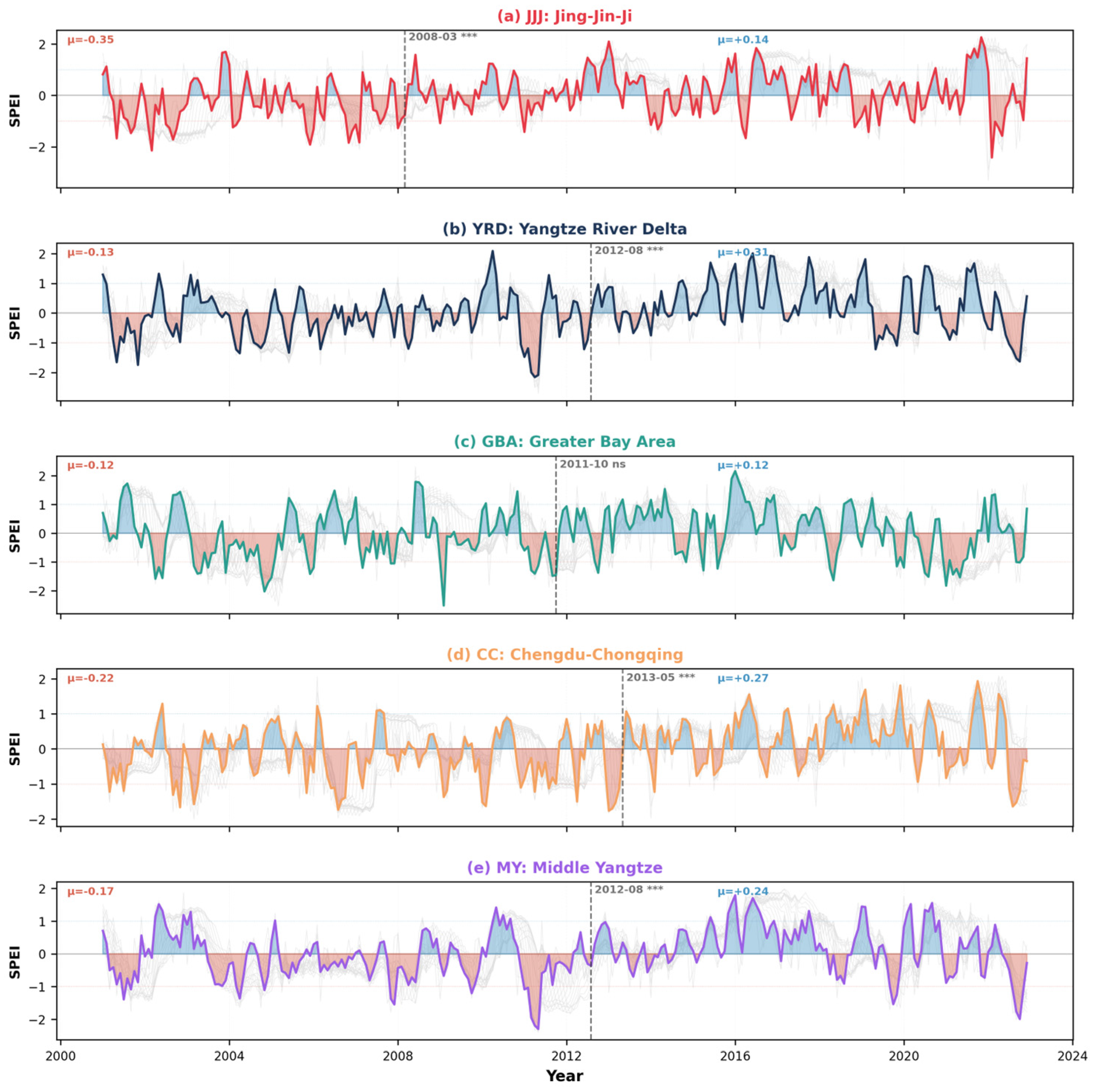
Pettitt breakpoint analysis on cluster-mean SPEI-3 time series identified statistically significant climate regime shifts in four of the five agglomerations (Figure 4). The breakpoints occurred in March 2008 for JJJ, August 2012 for YRD, May 2013 for CC, and August 2012 for MY. GBA exhibited a breakpoint in October 2011, though with marginal significance. All transitions involved shifts from drier pre-breakpoint conditions (negative mean SPEI-3) to wetter post-breakpoint conditions (positive mean SPEI-3). The magnitude of the shift, measured as the difference in mean SPEI-3 between the two periods, was greatest in CC (ΔSPEI-3 = +0.49, from −0.22 to +0.27), followed by JJJ (+0.49, from −0.35 to +0.14), YRD (+0.44), MY (+0.4), and GBA (+0.24). The proportion of months classified as dry (SPEI-3 < 0) decreased substantially after the breakpoint in all agglomerations: from 23.3% to 9% in JJJ, from 16.9% to 4.3% in CC, from 11.5% to 4.8% in YRD, from 8.6% to 4.8% in MY, and from 17.1% to 11.9% in GBA. These consistent wetting shifts align with the broader climatic trends documented across China, where increased precipitation variability and warming-driven intensification of the hydrological cycle have been reported [25,37].
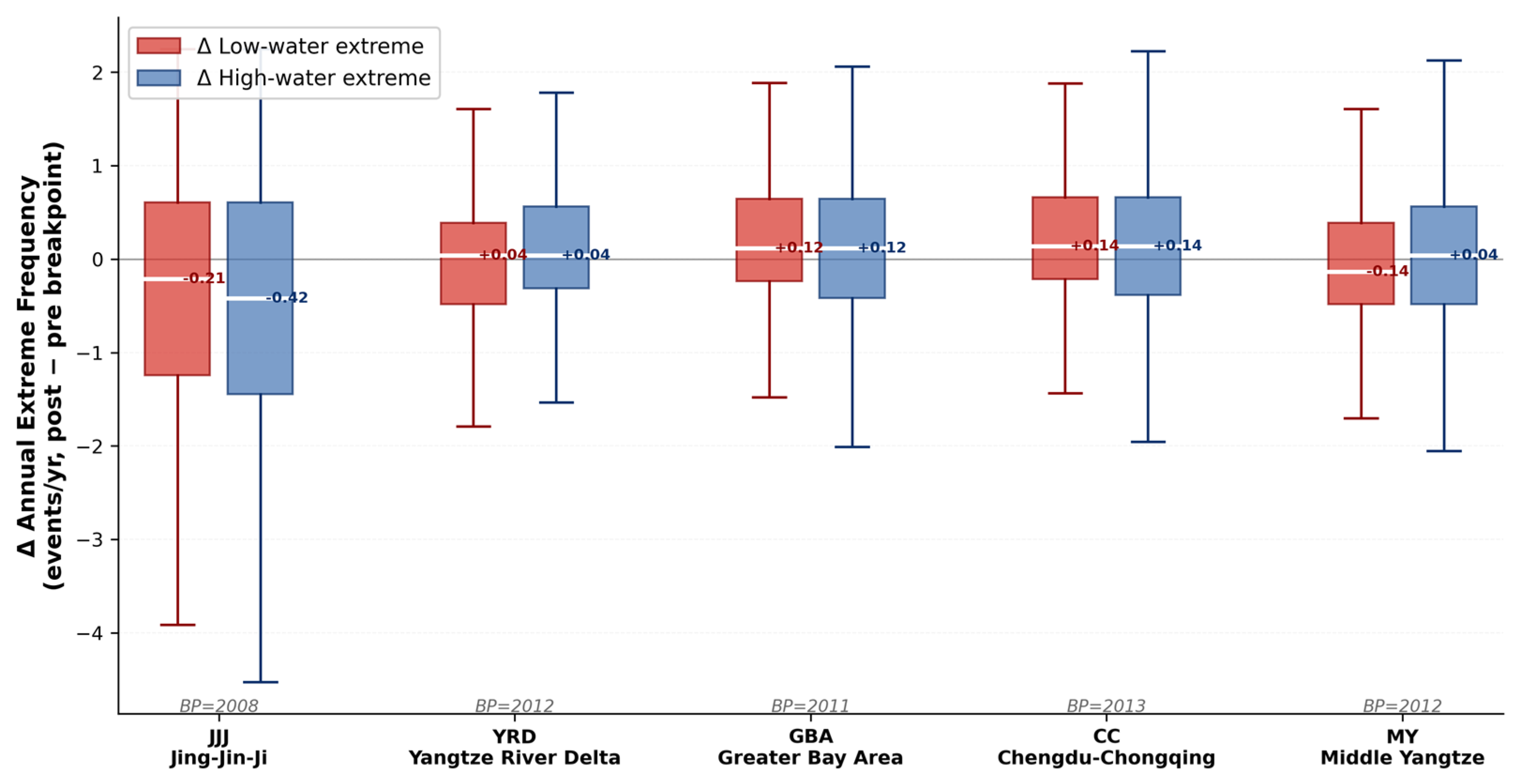
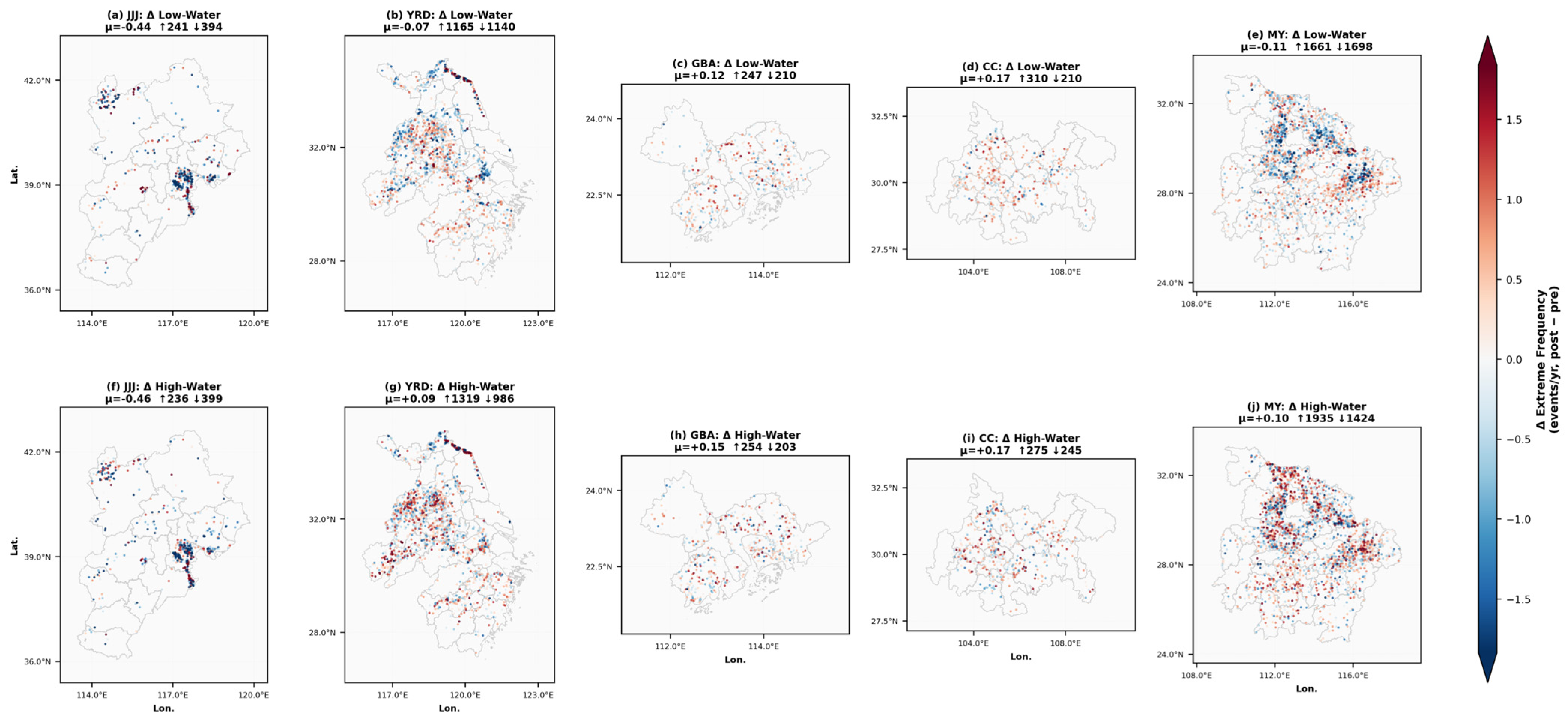
Despite the uniform direction of these climate shifts (all toward wetter conditions), the response of lake extreme event frequencies exhibited pronounced regional divergence (Figure 5 and Figure 6). In JJJ, both low-water and high-water extreme frequencies decreased significantly after the 2008 breakpoint (median Δlow = −0.21 events/yr; median Δhigh = −0.42 events/yr, p < 0.001), with 394 of 647 lakes (60.9%) experiencing reduced low-water extremes and 399 (61.7%) reduced high-water extremes. This symmetric decline is consistent with the strong wetting shift observed in SPEI-3, which effectively alleviated drought conditions while simultaneously moderating high-water variability in this water-limited environment. The result suggests that for semi-arid lakes with limited water inputs, even moderate increases in precipitation can substantially reduce the frequency of both extreme types by elevating the baseline lake level away from both threshold boundaries.
In contrast, GBA and CC exhibited increases in both extreme types after their respective breakpoints, a response pattern that appears counterintuitive in the context of wetter mean conditions. In GBA, low-water extremes increased (median Δlow = +0.12) and high-water extremes also increased (median Δhigh = +0.12), with 247 of 458 lakes showing increased low-water frequencies and 254 showing increased high-water frequencies. In CC, the pattern was even more pronounced: 310 of 524 lakes showed increased low-water and 275 showed increased high-water extreme frequencies. This bidirectional increase in extremes despite wetter mean conditions suggests that the wetting trend in these agglomerations is accompanied by increased precipitation variability rather than a uniform increase in water availability. The intensification of both extreme types implies a widening of the hydrological variability envelope, consistent with recent findings that compound extreme events are becoming more frequent across southern and southwestern China [25,37].
YRD and MY displayed asymmetric responses that differed from both the JJJ and GBA/CC patterns (Figure 6). In YRD, the post-breakpoint period saw a modest decrease in low-water extremes alongside a modest increase in high-water extremes (both median Δ = +0.04 events/yr), suggesting a net shift toward wetter conditions that selectively amplifies the high-water tail of the distribution. Spatially, the increase in high-water extremes in YRD was most prominent in the low-lying coastal and riverine lakes of southern Jiangsu and northern Zhejiang, while the decrease in low-water extremes was more evenly distributed across the agglomeration. In MY, a similar asymmetric pattern emerged, with low-water extremes decreasing (median Δlow = −0.14) and high-water extremes increasing (median Δhigh = +0.04). The asymmetry was particularly pronounced in the MY agglomeration, where 1935 of 3371 lakes (57.4%) showed more frequent high-water events after the 2012 breakpoint, reflecting the enhanced monsoon precipitation that directly amplifies seasonal inundation. This increase in high-water extremes was particularly concentrated in the Dongting and Poyang floodplain systems, where large-scale river–lake connectivity ensures that upstream precipitation anomalies propagate efficiently into lake water levels.

3.3. Climatic Attribution and Divergent Trajectories

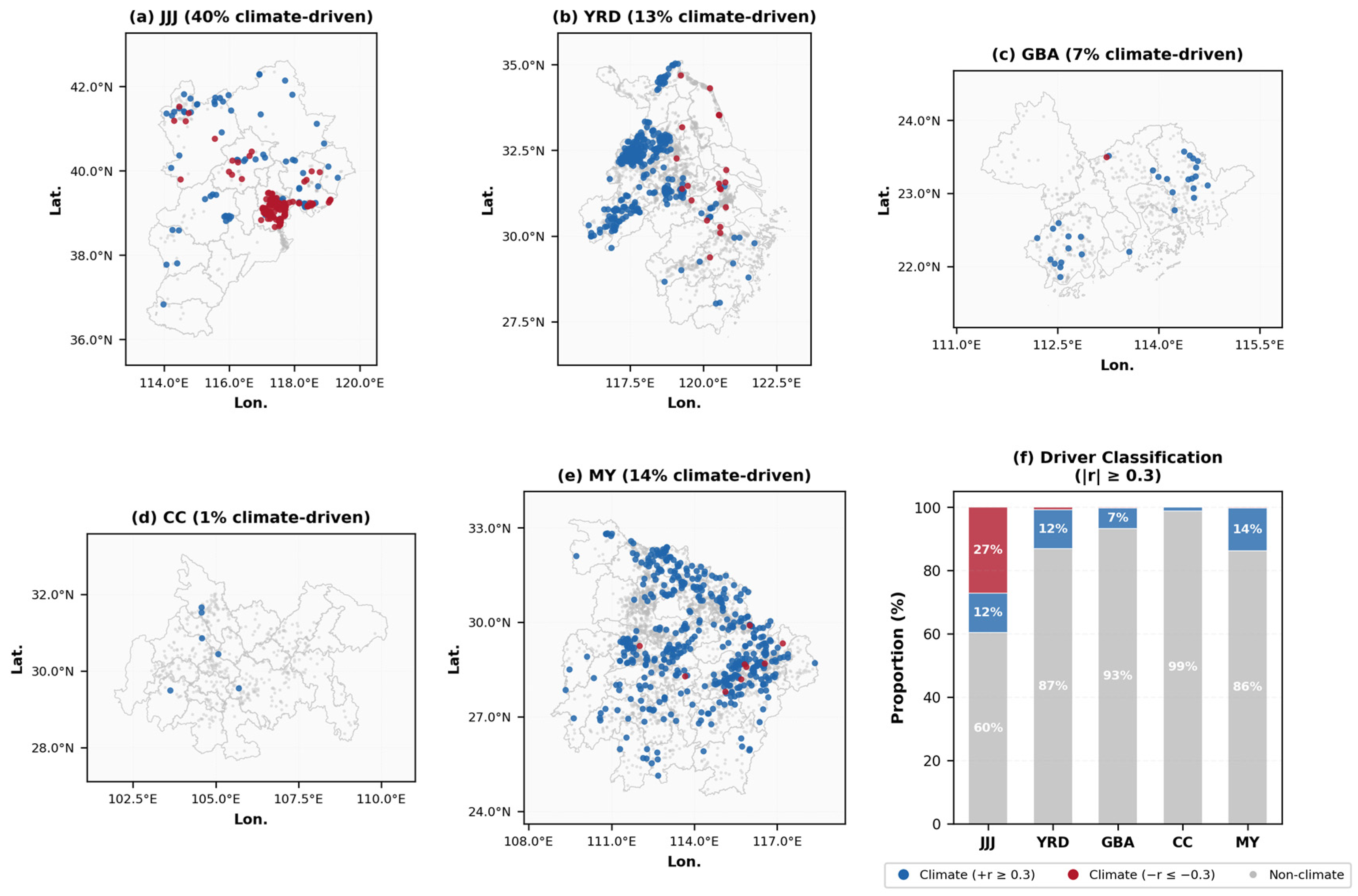
Multi-scale SPEI correlation analysis classified 1063 lakes (14.5%) as climate-driven (|best r| ≥ 0.3), of which 857 (11.7%) exhibited positive correlations (area expands under wet conditions) and 206 (2.8%) negative correlations (Figure 7). At higher thresholds, the climate-driven fractions were 32.8% (|r| ≥ 0.2), 5.7% (|r| ≥ 0.4), and 2.0% (|r| ≥ 0.5), indicating a continuous distribution of climate sensitivity across the lake population. The proportion of climate-driven lakes varied substantially among agglomerations. JJJ had the highest climate-driven fraction (39.6%, 256 of 647 lakes), reflecting the dominance of precipitation variability in determining lake dynamics in this water-limited region. Notably, 176 lakes (27.2%) in JJJ showed negative correlations with SPEI, a pattern indicative of lakes whose extent contracts during wet conditions, possibly due to increased surface runoff bypassing the lakes through channelized drainage or altered water management responses to precipitation events. YRD and MY had moderate climate-driven fractions (13.1% and 13.8%, respectively), predominantly with positive correlations, consistent with the expectation that lakes in humid regions expand under wet conditions and contract during droughts. GBA and CC had the lowest climate-driven fractions (6.8% and 1.1%), suggesting that anthropogenic modification has largely decoupled these lakes from direct climatic forcing. Spatially, climate-driven lakes in JJJ clustered in the northern and eastern portions of the agglomeration where orographic precipitation effects are strongest. In YRD and MY, climate-driven lakes tended to concentrate in the larger floodplain systems such as Poyang, Dongting, and Taihu, where extensive lake–river connectivity ensures that regional precipitation signals are efficiently transmitted to lake water levels.
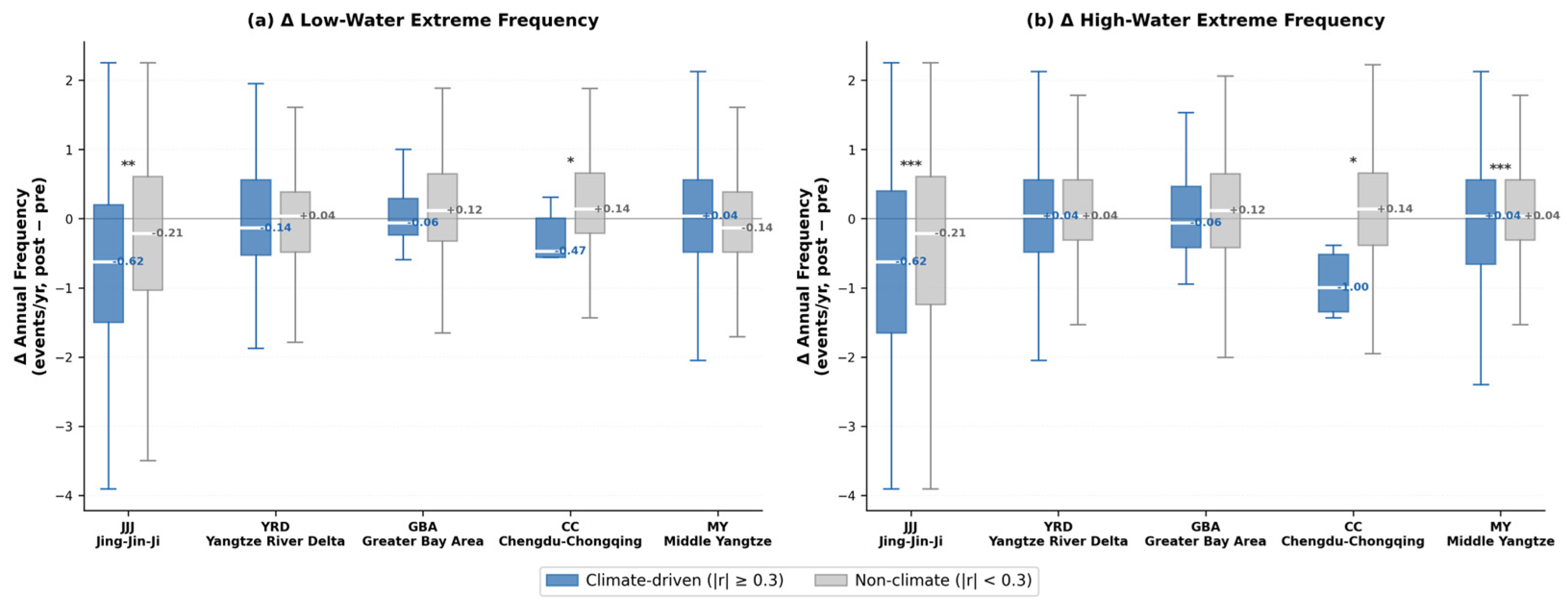
Climate-driven lakes and lakes with low climate sensitivity exhibited significantly divergent responses to climate shifts in several agglomerations (Figure 8). In JJJ, climate-driven lakes showed markedly larger declines in both extreme types after the 2008 breakpoint (median Δlow = −0.63 events/yr vs. −0.21 for lakes with low climate sensitivity; median Δhigh = −0.63 vs. −0.21; Mann–Whitney p < 0.01 and p < 0.001, respectively), indicating that these lakes are substantially more responsive to the regional wetting shift. This amplified responsiveness is expected for lakes whose dynamics are directly coupled to meteorological conditions: the wetting shift translates more efficiently into reduced extreme frequencies when the lake’s water balance is tightly linked to atmospheric moisture supply. In CC, the divergence was even more striking: climate-driven lakes showed declining extreme frequencies (median Δlow = −0.47, Δhigh = −1) while lakes with low climate sensitivity showed increases (Δlow = +0.14, Δhigh = +0.14), with significant between-group differences (p < 0.05 for both). This bifurcated response implies that in CC, the climate-mediated wetting alleviated extremes only in the subset of lakes whose dynamics are directly coupled to meteorological conditions, while lakes with low climate sensitivity continued to experience intensifying extremes from anthropogenic pressures operating independently of the regional climate trend. In YRD, GBA, and MY, between-group differences in breakpoint responses were either non-significant or inconsistent across extreme types, suggesting that local anthropogenic factors override the climate signal in these more densely developed agglomerations where human modification of the water cycle is most pervasive.
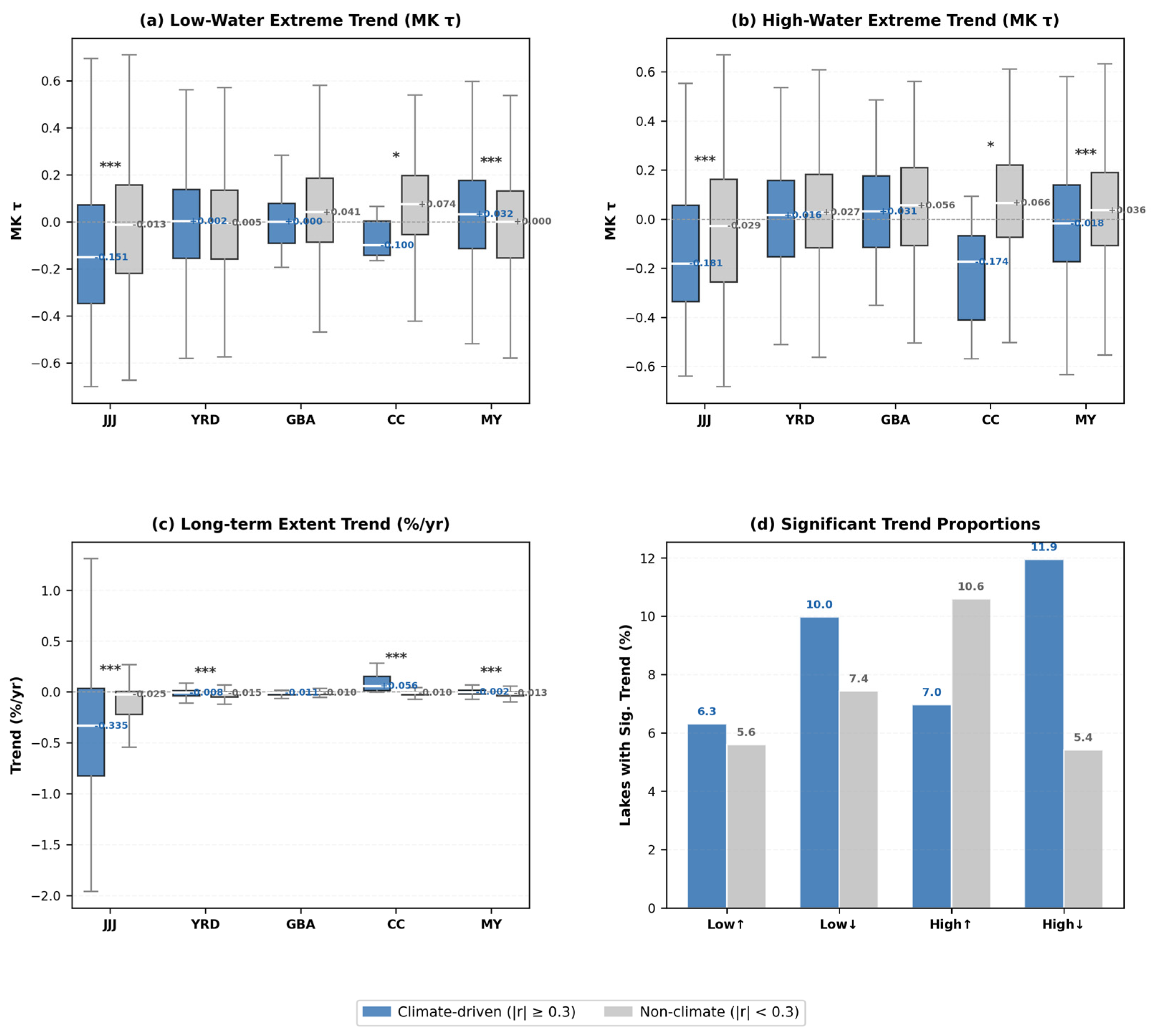
Long-term trajectory analysis over the full 2001 to 2023 period confirmed that climate-driven lakes occupy a distinct position in the overall trend landscape (Figure 9). Globally across all agglomerations, climate-driven lakes exhibited significantly more negative Mann–Kendall τ values for high-water extreme frequency trends (median τ = −0.04) compared to lakes with low climate sensitivity (median τ = +0.03), indicating a preferential decline in high-water extremes among climate-sensitive lakes over the full study period. Within JJJ, this divergence was especially pronounced: climate-driven lakes had median MK τ values of −0.15 and −0.18 for low-water and high-water trends, respectively, compared to −0.01 and −0.03 for lakes with low climate sensitivity. Similarly, the STL-derived long-term shrinkage rate for climate-driven lakes in JJJ (−0.34%/yr) was over thirteen times that of lakes with low climate sensitivity(−0.03%/yr), demonstrating that climate sensitivity dramatically amplifies the severity of long-term area loss in this water-scarce agglomeration. In MY, an contrasting pattern emerged: climate-driven lakes showed less negative long-term area trends (median STL trend −0.002%/yr) than lakes with low climate sensitivity(−0.01%/yr), indicating that climate coupling in this wetter region actually buffers against long-term shrinkage, presumably because the overall wetting trend provides sustained moisture inputs that offset other anthropogenic pressures. These divergent patterns highlight the fundamentally region-dependent nature of climate–lake coupling, where climate sensitivity amplifies vulnerability in water-scarce regions (JJJ) but provides partial protection in water-abundant regions (MY).

4. Discussion

4.1. Asymmetric Extreme Responses and Their Hydroclimatic Interpretation

The finding that all five agglomerations transitioned from drier to wetter SPEI conditions from 2008 to 2013, yet exhibited highly divergent extreme event responses, provides new evidence for the non-linear propagation of climate signals into lake systems. In JJJ, the symmetric decline in both low-water and high-water extremes following the 2008 wetting shift aligns with the expectation that increased precipitation alleviates drought stress in water-limited environments. This pattern is consistent with the broader observation by Xu et al. [20] that lake areas in northern China’s semi-arid regions respond strongly and directly to precipitation-driven climatic factors through PLS-SEM analysis. However, the simultaneous decline in high-water extremes in JJJ is less intuitive and may reflect the capacity of these shallow, low-volume lakes to absorb moderate precipitation increases without exceeding their 90th percentile thresholds, particularly given the extensive groundwater depletion and reduced baseflow in the North China Plain. Furthermore, extreme event frequencies are shaped by a complex climate–human feedback loop. During drier pre-breakpoint periods, agricultural and municipal sectors often invest heavily in groundwater pumping and diversion infrastructure. When the climate shifts to a wetter phase, this established pumping infrastructure, combined with upstream dam regulation and specific lake morphometry (e.g., shallow depth-to-area ratios), continues to artificially stress lake systems. Consequently, anthropogenic pressure can intensify despite alleviated meteorological drought. In this context, the wetting shift may have elevated JJJ lake levels from a severely depleted baseline toward a more moderate range, reducing the frequency of exceedances at both extremes without generating truly high-water conditions.
The contrasting responses in CC and GBA, where both extreme types increased despite wetter mean SPEI conditions, suggest that the wetting trend is accompanied by heightened precipitation variability rather than a uniform moisture increase. This interpretation is supported by recent findings that compound drought–heatwave events and extreme precipitation are becoming more frequent and intense across southwestern and southern China [25,37]. In these monsoon-driven regions, the alternation between periods of water surplus and deficit within the same year generates an expansion of the hydrological extremes envelope even as the mean state wets. The fact that CC’s lakes experienced the most dramatic increase in high-water extremes (median Δhigh = +0.17) despite having the strongest mean wetting shift (ΔSPEI-3 = +0.49) underscores the decoupling between mean climatic trends and extreme event dynamics, a phenomenon that has important implications for flood and drought risk assessment in rapidly urbanizing regions.
The asymmetric response observed in YRD and MY, where low-water extremes declined while high-water extremes increased, further supports the notion that wetting trends in humid regions manifest primarily through amplified flood-season peaks rather than reduced dry-season deficits. This pattern is consistent with the documented intensification of plum rain events and enhanced Yangtze River discharge variability [18,20,30]. The finding that 57.4% of MY lakes showed increased high-water extremes after the 2012 breakpoint has direct implications for flood risk management in the Dongting and Poyang floodplain systems, where rising high-water extremes compound the already significant flood hazard posed by Three Gorges Dam operation and altered river–lake interactions [19,21].
The distinction between climate-driven lakes and lakes with low climate sensitivity proved to be most consequential in JJJ and CC, where significant between-group differences in breakpoint responses were detected. The dramatic divergence in CC, where climate-driven lakes experienced declining extremes while lakes with low climate sensitivity experienced increasing extremes, implies that anthropogenic pressures (water abstraction for irrigation and urban supply, land use conversion, and upstream reservoir regulation) are not merely adding to climate effects but are producing opposing trajectories for different subsets of lakes within the same agglomeration. This finding extends the conceptual framework of Xu et al. [20], who demonstrated the dominant role of human factors in China’s eastern and southwestern lake regions at the macro-regional scale, by showing that even within a single urban agglomeration, the relative balance of climate and human drivers creates fundamentally different vulnerability profiles for individual lakes. The practical implication is that uniform conservation approaches applied at the agglomeration scale are inadequate; management must be stratified by each lake’s climate sensitivity, with tailored interventions for climate-driven lakes (focusing on climate adaptation) and lakes with low climate sensitivity (focusing on anthropogenic regulation).

4.2. Implications for Lake Management and Limitations

The pronounced spatial heterogeneity in lake trends and extreme event dynamics revealed by this study carries direct implications for lake management across China’s urban agglomerations. The severe and accelerating shrinkage in JJJ, where 41.1% of lakes exhibit fast shrinkage and climate-driven lakes contract at rates exceeding 0.3%/yr, demands urgent intervention through groundwater recharge programs, inter-basin water transfer initiatives such as the South-to-North Water Diversion Project, and land use controls around vulnerable lake margins. The finding that climate-driven lakes in JJJ are disproportionately affected underscores the inadequacy of uniform conservation approaches and argues for prioritization based on climate sensitivity assessment. In YRD and MY, where high-water extremes are intensifying while low-water extremes are declining, management attention should shift toward flood risk reduction for lakeside communities and infrastructure, particularly in the Dongting and Poyang floodplain systems where seasonal inundation is expanding. The relatively small proportions of climate-driven lakes in GBA (6.8%) and CC (1.1%) suggest that management interventions in these agglomerations should focus primarily on regulating human activities, including water abstraction, impervious surface expansion, and drainage modification, rather than relying on climate adaptation measures alone. The overall dominance of small lakes (80.8% less than 1 km2) underscores the importance of monitoring systems capable of resolving sub-kilometer water bodies in urbanized landscapes, consistent with the emphasis of Pi et al. [14] on the emerging and outsized roles of small lakes in global dynamics.
Several limitations of this study should be acknowledged and considered in the interpretation of results. First, the climate attribution threshold (|r| ≥ 0.3) is a conservative criterion, and the resulting 14.5% climate-driven fraction may underestimate the true extent of climatic influence, particularly for lakes where climate effects are modulated by human buffering. Sensitivity analyses at thresholds of 0.2 and 0.4 yielded climate-driven fractions of 32.8% and 5.7%, respectively, suggesting moderate sensitivity to threshold selection but consistent qualitative patterns. Second, the spatial resolution of the SPEI-HR dataset (5 km), while superior to traditional products, may not fully capture micro-climatic gradients within dense urban matrices, where heat island effects and localized precipitation patterns can deviate substantially from regional means. Third, the Pettitt breakpoint analysis assumes a single abrupt change point in the SPEI time series, whereas gradual or multiple shifts may better characterize some regions’ climate evolution. The marginal significance of the GBA breakpoint highlights this limitation and suggests that alternative change-point methods with greater sensitivity to gradual transitions may be warranted for some agglomerations. Fourth, the attribution framework distinguishes climate-driven from lakes with low climate sensitivity but does not identify specific anthropogenic drivers (e.g., water abstraction vs. land use change vs. upstream reservoir regulation), which would require integration of additional land use, hydrological, and socioeconomic datasets at the individual lake scale. Future work should address these limitations through higher-resolution climate inputs, multi-variable attribution frameworks incorporating remote sensing derived land use change data, and integration with in situ monitoring networks to validate satellite-based extreme event detection.

5. Conclusions

This study provides a comprehensive satellite-based assessment of 7320 natural lakes across China’s five major urban agglomerations (2001–2023), revealing that lake shrinkage is the dominant trajectory in urbanized China but that the mechanisms driving extreme events are fundamentally region-dependent. Three core findings emerge, directly addressing our primary research objectives. First, regarding morphological characteristics and long-term surface area trends, 59.4% of lakes exhibit significant long-term trends, with shrinkage (50%) outpacing expansion (9.4%) by a factor of five. The severity is greatest in semi-arid JJJ (mean: −0.28%/yr), where shallow lake morphology and long residence times amplify climate-driven losses. The dominance of small lakes (80.8% below 1 km2) across all agglomerations highlights an underappreciated vulnerability pool that conventional large-lake monitoring overlooks. Second, regarding extreme event frequency changes in response to regional climate shifts, a uniform wetting shift between 2008 and 2013 produced three distinct regional response modes: symmetric decline in both extremes (JJJ), bidirectional increase in both extremes (GBA, CC), and asymmetric increase in high-water extremes only (YRD, MY). This divergence demonstrates that mean climate trends are insufficient predictors of extreme event trajectories. Instead, the response mode is jointly governed by background aridity, precipitation variability structure, and the degree of anthropogenic modification. Third, regarding the extent of climatic driving forces, climate-driven lakes (14.5%) occupy a fundamentally distinct trajectory from lakes with low climate sensitivity. Climate sensitivity amplifies vulnerability in water-scarce JJJ—where climate-driven lakes shrink thirteen times faster—but buffers against shrinkage in water-abundant MY. This duality underscores that climate sensitivity is not inherently protective or destructive; its net effect depends on the regional water balance context. The practical implication is that effective lake management in urbanized regions must move beyond uniform policies toward sensitivity-stratified approaches that differentiate climate adaptation measures from anthropogenic regulation based on each lake’s position along this vulnerability spectrum.

Author Contributions

Conceptualization, Z.H. and X.S.; methodology, X.S.; software, L.T. and D.W.; validation, L.T. and F.X.; formal analysis, L.T.; investigation, L.T.; resources, L.T.; data curation, L.T. and X.S.; writing—original draft preparation, all authors; writing—review and editing, all authors. All authors have read and agreed to the published version of the manuscript.

Funding

This research was funded by Research and Promotion of Water Conservancy Science and Technology in Shanxi Province (NO. 2025ZF14). This research was supported by Open Research Foundation of National Engineering Research Center of Eco-Environment in the Yangtze River Economic Belt, China Three Gorges Corporation (GCZX2026041).

Data Availability Statement

The raw data supporting the conclusions of this article will be made available by the authors upon request.

Acknowledgments

The authors have reviewed and edited the output and take full responsibility for the content of this publication.

Conflicts of Interest

The authors declare no conflicts of interest.

References

  1. Verpoorter, C.; Kutser, T.; Seekell, D.A.; Tranvik, L.J. A global inventory of lakes based on high-resolution satellite imagery. Geophys. Res. Lett. 2014, 41, 6396–6402. [Google Scholar] [CrossRef]
  2. Yao, F.; Livneh, B.; Rajagopalan, B.; Wang, J.; Crétaux, J.-F.; Wada, Y.; Berge-Nguyen, M. Satellites reveal widespread decline in global lake water storage. Science 2023, 380, 743–749. [Google Scholar] [CrossRef] [PubMed]
  3. Woolway, R.I.; Kraemer, B.M.; Lenters, J.D.; Merchant, C.J.; O’Reilly, C.M.; Sharma, S. Global lake responses to climate change. Nat. Rev. Earth Environ. 2020, 1, 388–403. [Google Scholar] [CrossRef]
  4. Adrian, R.; O’Reilly, C.M.; Zagarese, H.; Baines, S.B.; Hessen, D.O.; Keller, W.; Livingstone, D.M.; Sommaruga, R.; Straile, D.; Van Donk, E.; et al. Lakes as sentinels of climate change. Limnol. Oceanogr. 2009, 54, 2283–2297. [Google Scholar] [CrossRef] [PubMed]
  5. Sun, R.; Chen, L. How can urban water bodies be designed for climate adaptation? Landsc. Urban Plan. 2012, 105, 27–33. [Google Scholar] [CrossRef]
  6. Ma, R.; Yang, G.; Duan, H.; Jiang, J.; Wang, S.; Feng, X.; Li, A.; Kong, F.; Xue, B.; Wu, J.; et al. China’s lakes at present: Number, area and spatial distribution. Sci. China Earth Sci. 2011, 54, 283–289. [Google Scholar]
  7. National Bureau of Statistics of China. China Statistical Yearbook 2024; China Statistics Press: Beijing, China, 2024. [Google Scholar]
  8. Fang, C.; Yu, D. Urban agglomeration: An evolving concept of an emerging phenomenon. Landsc. Urban Plan. 2017, 162, 126–136. [Google Scholar] [CrossRef]
  9. Liu, X.; Wang, S.; Ke, Y.; Gong, H.; Chen, B. High-resolution circa-2020 map of urban lakes in China. Sci. Data 2022, 9, 747. [Google Scholar] [CrossRef]
  10. Pekel, J.-F.; Cottam, A.; Gorelick, N.; Belward, A.S. High-resolution mapping of global surface water and its long-term changes. Nature 2016, 540, 418–422. [Google Scholar] [CrossRef] [PubMed]
  11. Pi, X.; Luo, Q.; Feng, L.; Xu, Y.; Tang, J.; Liang, X.; Ma, E.; Cheng, R.; Fensholt, R.; Brandt, M.; et al. Mapping global lake dynamics reveals the emerging roles of small lakes. Nat. Commun. 2022, 13, 5777. [Google Scholar] [CrossRef] [PubMed]
  12. Hou, J.; Van Dijk, A.I.; Renzullo, L.J.; Larraondo, P.R. GloLakes: Water storage dynamics for 27 000 lakes globally from 1984 to present derived from satellite altimetry and optical imaging. Earth Syst. Sci. Data 2024, 16, 201–218. [Google Scholar] [CrossRef]
  13. Messager, M.L.; Lehner, B.; Grill, G.; Nedeva, I.; Schmitt, O. Estimating the volume and age of water stored in global lakes using a geo-statistical approach. Nat. Commun. 2016, 7, 13603. [Google Scholar] [CrossRef] [PubMed]
  14. Li, L.; Long, D.; Wang, Y.; Woolway, R.I. Global dominance of seasonality in shaping lake-surface-extent dynamics. Nature 2025, 642, 361–368. [Google Scholar] [PubMed]
  15. Gebrechorkos, S.H.; Peng, J.; Dyer, E.; Miralles, D.G.; Vicente-Serrano, S.M.; Funk, C.; Beck, H.E.; Asfaw, D.T.; Singer, M.B.; Dadson, S.J. Global high-resolution drought indices for 1981–2022. Earth Syst. Sci. Data Discuss. 2023, 15, 5449–5466. [Google Scholar] [CrossRef]
  16. Zhang, G.; Yao, T.; Xie, H.; Yang, K.; Zhu, L.; Shum, C.K.; Bolch, T.; Yi, S.; Allen, S.; Jiang, L.; et al. Response of Tibetan Plateau lakes to climate change: Trends, patterns, and mechanisms. Earth-Sci. Rev. 2020, 208, 103269. [Google Scholar] [CrossRef]
  17. Lei, Y.; Yao, T.; Sheng, Y.; Zhang, E.; Wang, W.; Li, J. Unprecedented lake expansion in 2017–2018 on the Tibetan Plateau: Processes and environmental impacts. J. Hydrol. 2023, 619, 129333. [Google Scholar] [CrossRef]
  18. Feng, L.; Han, X.; Hu, C.; Chen, X. Four decades of wetland changes of the largest freshwater lake in China: Possible linkage to the Three Gorges Dam? Remote Sens. Environ. 2016, 176, 43–55. [Google Scholar] [CrossRef]
  19. Feng, L.; Hu, C.; Chen, X.; Cai, X.; Tian, L.; Gan, W. Assessment of inundation changes of Poyang Lake using multi-temporal series of Landsat images. Remote Sens. Environ. 2012, 121, 416–426. [Google Scholar]
  20. Xu, H.; Zhang, F.; Jim, C.Y.; Chan, N.W.; Tan, M.L.; Wei, L.; Lin, X.; Hu, G.; Wang, S.; Qiao, Q. Regional variations in lake areas in China due to human and natural environmental factors since 1990. Ecol. Indic. 2025, 172, 113307. [Google Scholar] [CrossRef]
  21. Wang, X.; Xiao, X.; Zou, Z.; Dong, J.; Qin, Y.; Doughty, R.B.; Menarguez, M.A.; Chen, B.; Wang, J.; Ye, H.; et al. Gainers and losers of surface and terrestrial water resources in China during 1989–2016. Nat. Commun. 2020, 11, 3471. [Google Scholar] [CrossRef] [PubMed]
  22. Li, Z.; Xu, S.; Li, C.; Lei, J.; Tan, D.; Tang, L. Assessment of surface water spatiotemporal changes and reservoir-based droughts in small and medium-sized reservoirs in China. Water 2025, 17, 1104. [Google Scholar]
  23. Chen, Y.; Li, H.; Song, S.; Zhou, Z.; Chen, C.; Guo, C.; Zheng, F. Fast Expansion of Surface Water Extent in Coastal Chinese Mainland from the 1980s to 2020 Based on Remote Sensing Monitoring. Water 2025, 17, 194. [Google Scholar] [CrossRef]
  24. An, Z.; Li, Z.; Jin, T.; Li, Y.; Gao, G.; He, Q. Water storage changes of lakes and reservoirs across Asia (2018–2023) and their effects in flood control. Geophys. Res. Lett. 2026, 53, e2025GL119131. [Google Scholar] [CrossRef]
  25. Li, X.; Wang, K.; Liu, C.; Zhao, G.; Jiang, Z.; Luo, Q.; Wang, G.; Zhang, D.; Yu, J.; Liu, X. Exacerbating hydrological extremes in China’s large reservoir drainage areas. J. Hydrol. 2025, 648, 133297. [Google Scholar]
  26. Vicente-Serrano, S.M.; Beguería, S.; López-Moreno, J.I. A multiscalar drought index sensitive to global warming: The Standardized Precipitation Evapotranspiration Index. J. Clim. 2010, 23, 1696–1718. [Google Scholar] [CrossRef]
  27. Zheng, C.; Liu, J.; Cao, G.; Kendy, E.; Wang, H.; Jia, Y. Can China cope with its water crisis? Perspectives from the North China Plain. Ground Water 2010, 48, 350–354. [Google Scholar] [CrossRef] [PubMed]
  28. Qin, B.; Xu, P.; Wu, Q.; Luo, L.; Zhang, Y. Environmental issues of Lake Taihu, China. Hydrobiologia 2007, 581, 3–14. [Google Scholar] [CrossRef]
  29. Deng, Y.; Jiang, W.; Wu, Z.; Peng, K.; Ling, Z.; Li, Z.; Wang, X. Assessing surface water losses and gains under rapid urbanization for SDG 6.6.1 using long-term Landsat imagery in the Guangdong-Hong Kong-Macao Greater Bay Area. Remote Sens. 2022, 14, 881. [Google Scholar]
  30. Wang, X.; Liu, Z.; Xu, Y.J.; Mao, B.; Jia, S. Extreme drought affects lake water quality, quantity, morphometry: Evidence from China’s largest fresh water lake under the 2022 global drought. Geosci. Front. 2025, 16, 102146. [Google Scholar] [CrossRef]
  31. Cleveland, R.B.; Cleveland, W.S.; McRae, J.E.; Terpenning, I. STL: A seasonal-trend decomposition. J. Off. Stat. 1990, 6, 3–73. [Google Scholar]
  32. Rao, A.R.; Hamed, K.H.; Chen, H.-L. Nonstationarities in Hydrologic and Environmental Time Series; Springer: Dordrecht, The Netherlands, 2003. [Google Scholar]
  33. Sen, P.K. Estimates of the regression coefficient based on Kendall’s tau. J. Am. Stat. Assoc. 1968, 63, 1379–1389. [Google Scholar] [CrossRef]
  34. Pettitt, A.N. A non-parametric approach to the change-point problem. J. R. Stat. Soc. Ser. C 1979, 28, 126–135. [Google Scholar] [CrossRef]
  35. Yang, Y.; Wang, J.; Chen, Y. Spatial heterogeneity and driving mechanism of the response of lake area to drought in China. Int. J. Digit. Earth 2025, 18, 2551092. [Google Scholar]
  36. Cohen, J. Statistical Power Analysis for the Behavioral Sciences, 2nd ed.; Lawrence Erlbaum Associates: Hillsdale, NJ, USA, 1988. [Google Scholar]
  37. Zscheischler, J.; Westra, S.; van den Hurk, B.J.J.M.; Seneviratne, S.I.; Ward, P.J.; Pitman, A.; AghaKouchak, A.; Bresch, D.N.; Leonard, M.; Wahl, T.; et al. Future climate risk from compound events. Nat. Clim. Change 2018, 8, 469–477. [Google Scholar] [CrossRef]
Figure 1. Spatial distribution of 7320 natural lakes across five major urban agglomerations in China: Jing-Jin-Ji (JJJ, 647 lakes), Yangtze River Delta (YRD, 2320 lakes), Greater Bay Area (GBA, 458 lakes), Chengdu-Chongqing (CC, 524 lakes), and Middle Yangtze (MY, 3371 lakes). Lake locations from HydroLAKES [2].
Water 18 01569 g001
Figure 2. Comparison of key morphological and hydrological characteristics across five agglomerations. The horizontal axis represents the five major urban agglomerations (Jing-Jin-Ji [JJJ], Yangtze River Delta [YRD], Greater Bay Area [GBA], Chengdu-Chongqing [CC], and Middle Yangtze [MY]). The vertical axis displays the distribution of the corresponding variables with their respective units: (af). The violin plots illustrate the probability density of the data, with overlaid box plots showing the interquartile ranges and the median values explicitly annotated.
Water 18 01569 g002
Figure 3. Spatial distribution of long-term trends (2001–2023): (a) JJJ, (b) YRD, (c) GBA, (d) CC, and (e) MY. Significance assessed by Rao-modified Kendall test (p < 0.05). Five categories: fast expansion, slow expansion, not significant, slow shrinkage, and fast shrinkage. The median absolute trend among significant lakes (0.032% per year) served as the quantitative threshold for the fast versus slow classification (i.e., trends exceeding 0.032% per year were classified as fast, while those below were slow).
Water 18 01569 g003
Figure 4. SPEI time series across five urban agglomerations (2001–2022). SPEI at 18 timescales (gray) with SPEI-3 highlighted. Red/blue shading indicates dry/wet conditions. Vertical dashed lines mark Pettitt breakpoints. ***: Extremely statistically significant difference, corresponding to p < 0.001.
Water 18 01569 g004
Figure 5. Spatial distribution of extreme frequency changes pre- vs. post-breakpoint. Top row (a–e): low-water. Bottom row (fj): high-water. Red = increased; blue = decreased.
Water 18 01569 g005
Figure 6. Box plot comparison of extreme frequency changes across five agglomerations. Paired box plots for low-water (red) and high-water (blue) changes.
Water 18 01569 g006
Figure 7. Climate attribution. (ae) Spatial classification into climate-driven (blue: positive r; red: negative r) lakes and lakes with low climate sensitivity (gray) (threshold |r| ≥ 0.3). (f) Stacked bar chart of proportions.
Water 18 01569 g007
Figure 8. Differential response of climate-driven lakes vs. lakes with low climate sensitivity to climate shift. Box plots comparing extreme frequency changes. Mann–Whitney U test significance annotated. *: Statistically significant difference, corresponding to p < 0.05; **: Highly statistically significant difference, corresponding to p < 0.01; ***: Extremely statistically significant difference, corresponding to p < 0.001.
Water 18 01569 g008
Figure 9. Divergent long-term trajectories: (a) Mann–Kendall τ for low-water trends, (b) τ for high-water trends, (c) STL long-term trends (%/year), and (d) significant trend proportions between climate-driven lakes (blue) and lakes with low climate sensitivity (gray). *: Statistically significant difference, corresponding to p < 0.05; ***: Extremely statistically significant difference, corresponding to p < 0.001.
Water 18 01569 g009
Disclaimer/Publisher’s Note: The statements, opinions and data contained in all publications are solely those of the individual author(s) and contributor(s) and not of MDPI and/or the editor(s). MDPI and/or the editor(s) disclaim responsibility for any injury to people or property resulting from any ideas, methods, instructions or products referred to in the content.