Article

Nitrogen Sources and Transformation Pathways in a Highly Urbanized Shallow Aquifer: Insights from an Integrated Hydrochemical and Isotopic Approach Incorporating δ15N-DON


1
Interdisciplinary Centre for River Basin Environment, University of Yamanashi, Kofu 400-0016, Japan
2
Hot Springs Research Institute of Kanagawa Prefecture, Odawara 250-0031, Japan
3
Faculty of Geo-Environmental Science, Rissho Univeristy, Kumagaya 360-0161, Japan
*
Author to whom correspondence should be addressed.
Water 2026, 18(13), 1550; https://doi.org/10.3390/w18131550 (registering DOI)
Submission received: 12 May 2026 / Revised: 16 June 2026 / Accepted: 20 June 2026 / Published: 25 June 2026
(This article belongs to the Section Water Quality and Contamination)

Abstract

This study investigates nitrogen sources and biogeochemical pathways in a highly urbanized shallow aquifer in Shinagawa Ward, Tokyo, using an integrated approach combining hydrochemical analysis, multivariate statistics (PCA and K-means cluster analysis), and stable nitrogen isotopes (δ15N-NH4+, δ15N-NO3, δ15N-DON, and dual δ15N–δ18O-NO3). K-means clustering (K = 2, silhouette = 0.54) partitioned all 41 samples into a background group (n = 34) and an ion-enriched group (n = 7; wells sbi 1, 2, 3, 4, 5, 13, and 19), with the latter exhibiting hydrochemical signatures consistent with localized sewage leakage. The convergence of hydrochemical, multivariate, and isotopic evidence suggests that soil organic matter may represent the dominant diffuse background source of nitrogen across the study area. DON constitutes the dominant fraction of total dissolved nitrogen (TDN), while the linear correlations between TDN and DON concentrations (r = 0.77, p < 0.001) and between δ15N-TDN and δ15N-DON (r = 0.88, p < 0.001) indicate a common primary source. The dominance of DON combined with the theoretical inverse relationship between δ15N-DON and DON concentration is consistent with active soil DON mineralization, supported by an isotope fractionation factor (ε = −4.4 ± 0.78‰). Dual isotope analysis of NO315N–N–δ18O slope = 0.51) points towards denitrification as an ongoing process in the aquifer. Taken together, the isotopic variations among nitrogen species suggest a transformation sequence from soil organic nitrogen → DON → NH4+/NO3 → N2, though each step in this sequence is supported to varying degrees of confidence. These findings highlight the value of δ15N-DON as a tracer for nitrogen source attribution and cycling in urban groundwater systems, and underscore the importance of considering all dissolved nitrogen fractions in contamination assessments.

1. Introduction

Groundwater is a vital source of drinking water worldwide, yet its quality is increasingly threatened by contamination in urbanized landscapes where anthropogenic inputs interact with natural processes [1]. Globally, nitrogen contamination of aquifers is a pressing environmental issue. In the United States, high nitrate levels are a leading reason for violations at regulated drinking water utilities [2]. Across the European Union, approximately 14% of drinking water wells still exceed nitrate concentration limits, and about 25% of groundwater bodies are classified as having poor chemical status, primarily due to agricultural nitrates and pesticides [2,3]. In China, rapid urbanization and intensive agriculture have led to similar challenges, with recent studies in the North China Plain reporting that over 47% of groundwater samples exceeded the WHO nitrate standard of 50 mg L−1, and health risk assessments identifying children as the most vulnerable population [4]. For instance, in the Qorveh-Dehgolan region of Iran, nitrate contamination in groundwater has been extensively documented, highlighting the global prevalence of this issue across different climatic and land-use settings [5]. In densely developed cities such as Shinagawa, Tokyo, shallow aquifers are especially vulnerable due to multiple inputs, including sewage leakage, urban runoff, and infiltration from aging water infrastructure [6]. Understanding the sources and transformation pathways of nitrogen in such settings is therefore critical for effective groundwater quality management.
Nitrogen cycling in groundwater is governed by a series of biogeochemical processes, including mineralization, nitrification, and denitrification, which control the transformation and mobility of nitrogen species. In subsurface environments, organic nitrogen is mineralized to ammonium (NH4+), which can be further oxidized to nitrate (NO3) under oxic conditions, while denitrification reduces NO3 to gaseous nitrogen (N2, N2O) under anoxic conditions [7]. Such diverse pathways complicate source identification and highlight the need for more advanced approaches.
Nitrogen isotope (δ15N) analysis provides a powerful tool for addressing these challenges. The isotopic composition of δ15N reflects both source signatures and isotopic fractionation during biogeochemical processes [7]. Typically, sewage and manure are enriched in δ15N (+5 to +25‰) due to volatilization and microbial processing, soil organic matter falls within +2 to +5‰, and synthetic fertilizers or atmospheric deposition exhibit lower values (−4 to +4‰) [7,8,9,10]. However, isotope values are also susceptible to interference due to overlapping values, for example, soil organic matter partially overlapping with sewage contamination or with atmospheric deposition. Therefore, many studies have also used isotope tools in combination with other techniques such as hydrology analysis, the combination of δ15N-NO3 vs. δ18O-NO3, and hydrochemical composition combined with multivariate analysis to elucidate the origins of nitrogen contamination and its transformation in the shallow aquifer. In some previous studies, geology was found to have a strong influence on groundwater chemistry [11,12], and thus provide a valuable context for interpreting nitrogen cycling in shallow aquifers.
In addition, dissolved organic nitrogen (DON) constitutes a substantial fraction of the total dissolved nitrogen pool in many aquatic systems, yet it has received far less attention than inorganic nitrogen species (NH4+ and NO3) in groundwater contamination studies [13]. Early efforts to measure δ15N-DON relied on direct methods (column separation, persulfate oxidation, membrane filtration) [14,15,16], but these approaches were often limited by low recovery, incomplete DIN removal, or impractical processing times. More recently, a mass balance approach, where δ15N-DON is calculated from the difference between total dissolved nitrogen (TDN) and dissolved inorganic nitrogen (DIN), has become widely adopted due to its simplicity and higher effective recovery [13,17]. These studies have successfully applied the mass balance method to freshwater and marine systems. Despite these advances, δ15N-DON applications in groundwater systems—particularly shallow urban aquifers—remain rare. Most existing studies have focused on marine and soil environments, leaving a critical gap in understanding DON dynamics in subsurface environments.
To address these gaps, this study integrates hydrochemical analysis, multivariate statistics (principal component analysis and K-means cluster analysis), and stable nitrogen isotope tracing (δ15N-NH4+, δ15N-NO3, δ15N-DON, and dual δ15N–δ18O-NO3) to investigate nitrogen contamination in the shallow groundwater of Shinagawa Ward, Tokyo. The specific objectives are to (1) identify the dominant nitrogen sources contributing to aquifer contamination and (2) elucidate the key biogeochemical transformation pathways controlling nitrogen fate in a highly urbanized subsurface environment.

2. Methods and Materials

2.1. Study Area

Shinagawa Ward is located in the southern part of Tokyo’s 23 wards and lies on Tokyo Bay. Geographically, the ward consists of natural uplands and lowlands, as well as reclaimed land [18]. The uplands are the eastern end of the Musashino Terrace. The lowland as well as the shoreline followed the course of the old Tokaido Road, which demarcated the natural lowland from the coastal shallows. Large-scale land reclamation began in the late Edo period and continued through the modern era, resulting in the present-day configuration of Shinagawa [19]. Geologically, the ward lies on the western margin of Tokyo Bay, where alluvial deposits are 15–20 m thick. These deposits include the Holocene, associated with post-glacial marine transgression about 12,000–11,000 years ago, and the late Pleistocene [20,21]. The lithology of the alluvial plain is highly variable, with interbedded layers of gravel, sand, silt, and organic-rich sediments, reflecting the complex depositional environment of riverine, estuarine, and marine processes [20]. This heterogeneity strongly influences groundwater flow and the fate of contaminants in the shallow aquifer system. Regional groundwater flow in the Tokyo lowland is influenced by the topographic gradient from the Musashino Upland towards Tokyo Bay. The upland serves as a recharge area with downward flow, while the lowland acts as a discharge area with upward flow [22]. However, decades of intensive groundwater pumping between the 1950s and 1970s substantially altered the natural hydraulic head distribution, replacing regional flow patterns with localized flows converging toward pumping centers [22]. Direct measurements of groundwater residence time in the Shinagawa shallow aquifer are not available. However, the aquifer is composed of highly permeable gravel to silty sand, and the shallow groundwater is significantly recharged by modern urban sources, including water supply and sewage leakage [6]. These characteristics are broadly consistent with relatively short residence times, potentially on the order of years to decades, as has been suggested for comparable shallow urban aquifers in coastal Japan [23].
Today, Shinagawa Ward is a highly urbanized area with a total population of 426,101 and a population density of 18,648 people/km2 [18]. More than 80% of the ward is covered by artificial structures. Sewerage coverage exceeded 96% as early as 1985 and reached over 99.5% by 1994 [24]. However, because much of the system consists of combined sewers that have been in operation for decades, aging infrastructure is a concern, particularly with regard to leakage and its potential impact on shallow groundwater quality [6,25].
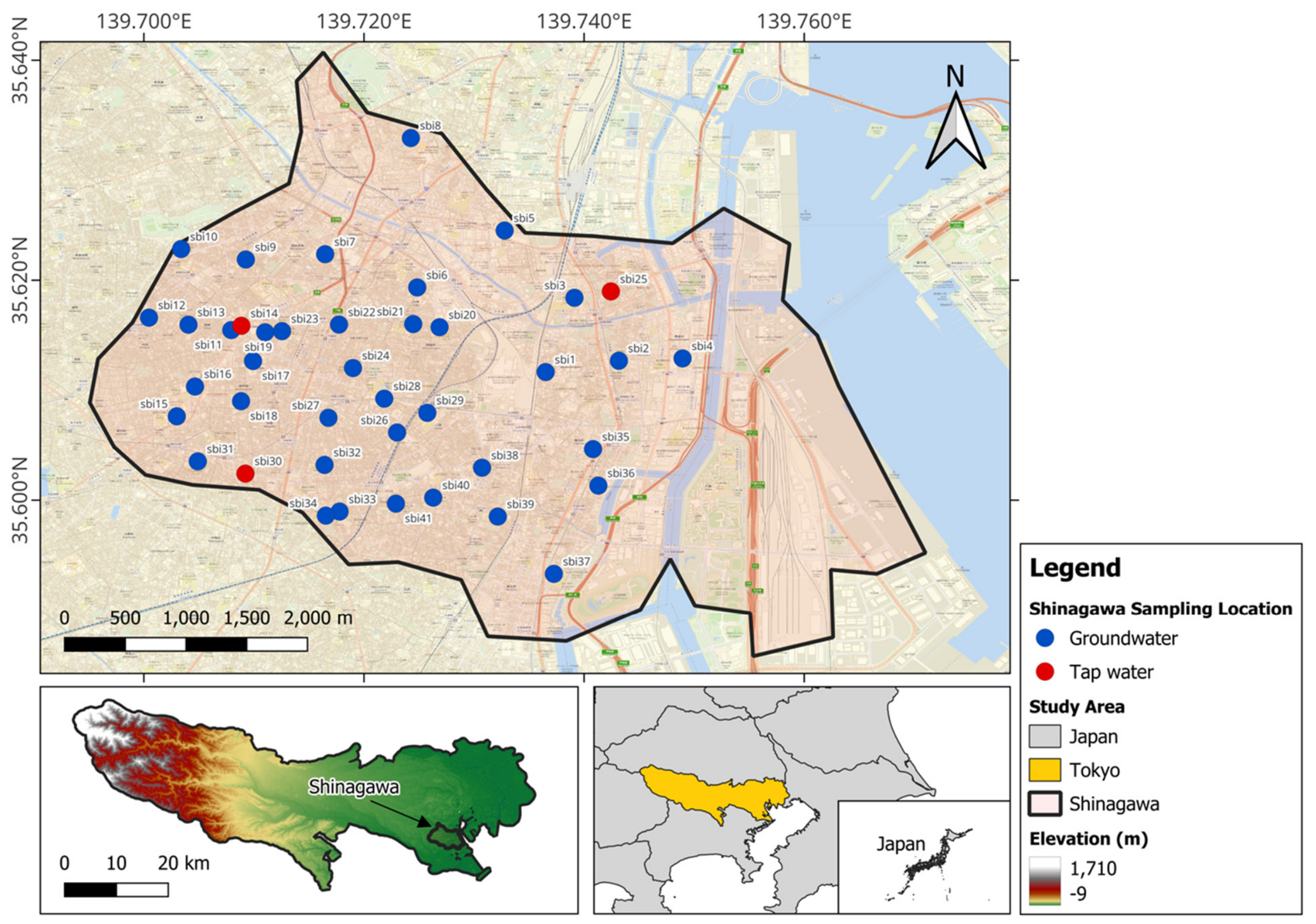
In this study, groundwater samples were collected from wells distributed throughout Shinagawa Ward, Tokyo, Japan (Figure 1). The wells range from shallow domestic and monitoring wells to public-access observation points, and together they provide a comprehensive view of groundwater conditions across the ward. By including sites from different geomorphological and urban settings—near the river flow, densely built-up lowlands, and reclaimed coastal zones—this design enables assessment of nitrogen sources and transformation processes in a spatially diverse but interconnected shallow groundwater system.

2.2. Sampling Method

In November 2023, 38 shallow groundwater samples and 3 tap water samples were collected across the study area. The samples were drawn from domestic wells or natural springs. All sampling sites had a maximum depth of less than 30 m.
In the field survey, the following items were measured: water temperature (D617, Techno Seven, Tokyo, Japan), pH and EC (electrical conductivity) (WM-32EP, DKKTOA, Tokyo, Japan), DO (dissolved oxygen) (HQ30d, HACH, Tokyo, Japan), ORP (RM-20P, DKK-TOA, Tokyo, Japan), and groundwater level (WL50M, Yamayo Measuring Instruments Co., Ltd., Tokyo, Japan). The reference electrode of the ORP meter used in this study was a 3.3 mol/L silver chloride electrode, so the values converted to the standard hydrogen electrode (SHE) were used for the results.

2.3. Analytical Methods

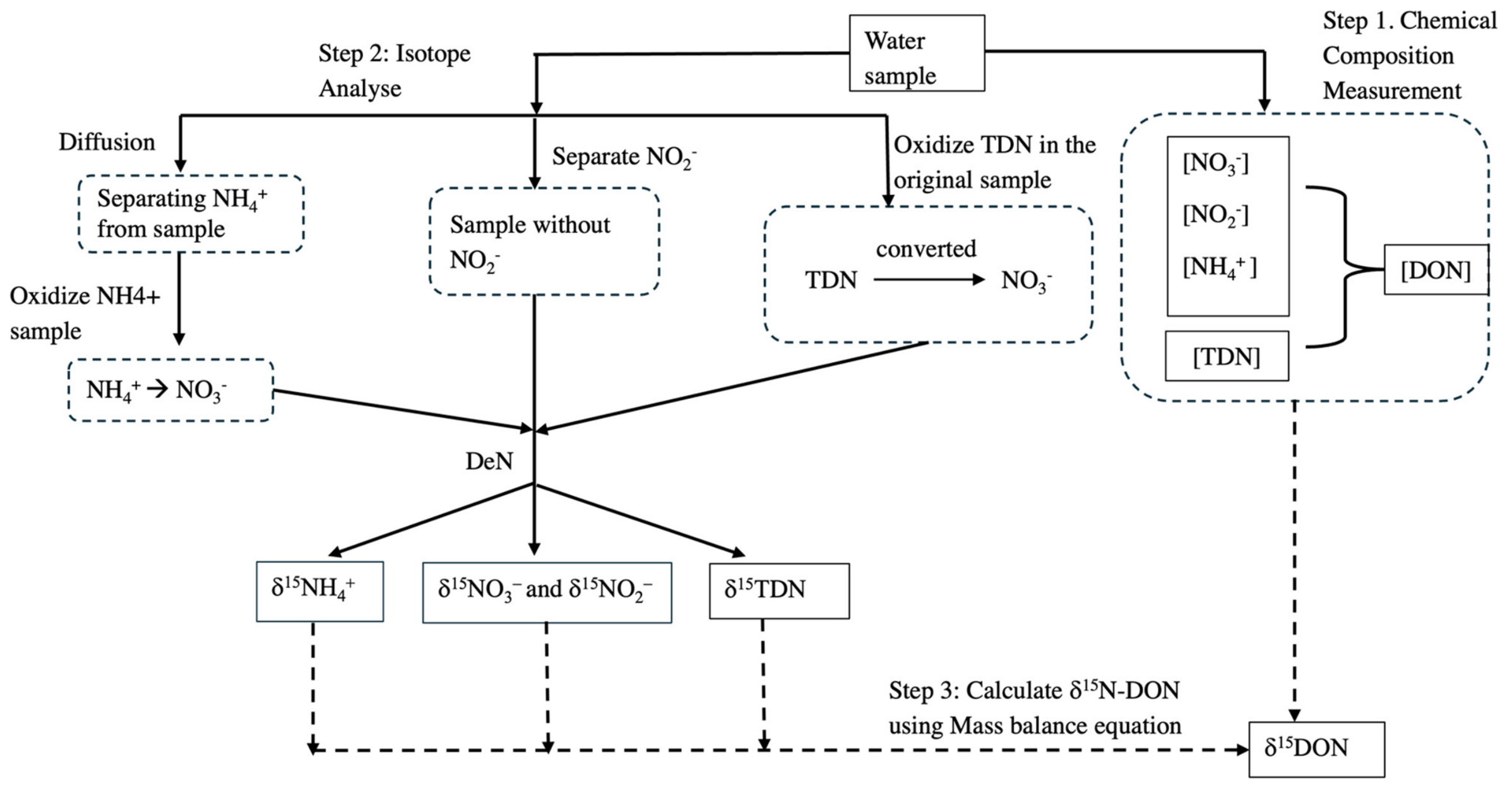
The groundwater samples were analyzed for the δ15N signature values and chemical composition to determine the source and elucidate the nitrogen cycling in the groundwater. The protocol scheme is shown in Figure 2. The protocol consisted of three steps: (1) measurement of nitrogen concentration; (2) measurement of δ15N value of NO3, NO2, NH4+, and TDN; (3) calculation of δ15N-DON.
Step 1: Measurement of N concentration
Concentrations of NO3, NO2, and NH4+ were determined using ion chromatography (DIONEX ICS-1100, Sunnyvale, CA, USA). Total dissolved nitrogen (TDN) was oxidized by the potassium peroxodisulfate digestion method with boric acid buffer (1 g NaOH + 5 g K2S2O8 + 6.183 g H3BO3 in 100 mL of milli-Q H2O) (120 °C, 1.5 atm, 60 min), converting all nitrogen species to NO3, followed by UV absorbance at 220 and 275 nm [26]. The method detection limits were 0.09 mg L−1 for TDN, 0.03 mg L−1 for NO3, 0.03 mg L−1 for NO2, and 0.04 mg L−1 for NH4+. Dissolved organic nitrogen (DON) was calculated as the difference between TDN and the sum of inorganic nitrogen species (NO3, NO2, and NH4+).
Step 2: Measurement of δ15N value
δ15N–NH4+ was measured using the gas-phase diffusion–oxidation–denitrification method [27]. A 50 mL sample containing ~10 µg NH4+ was placed in a 100 mL glass vial with a glass filter containing 25 µL of 2 M H2SO4 to trap NH3 gas. The vial was incubated at 80 °C for 5 days to allow complete diffusion of ammonium into the filter. For oxidative conversion of NH4+ to NO3, the filter was soaked in 5 mL of Milli-Q water for at least 10 min to redissolve NH4+. This solution, together with the TDN in the original sample, was oxidized by potassium peroxodisulfate with boric acid buffer, converting NH4+ (and all nitrogen species of TDN) to NO3. Since both the oxidized TDN and NH4+ solutions were converted to NO3, δ15N-TDN and δ15N -NH4+ were analyzed using the same procedure as δ15N–NO3.
δ15N–NO3 was measured using the denitrifying bacteria method [28]. To remove NO2, filtered samples (10 mL) were treated with amidosulfuric acid and HCl, neutralized with NaOH, and incubated overnight [29]. The NO2-free samples were then introduced into denitrifying bacterial cultures, incubated overnight at 25 °C, and terminated with NaOH. The resulting N2O was analyzed by EA–IRMS (Hydra 20–20, Sercon Ltd., Crewe, UK).
δ15N–NO2 was calculated by mass balance:
δ15NNO2 = ([NO2 + NO3] δ15N(NO2+NO3) − δ15NNO3)/[NO2]
where [NO2 + NO3] and δ15N(NO2 + NO3) represent the combined concentration and isotopic composition of NO2 and NO3, respectively. The δ15N (NO2 + NO3) values were obtained by the same denitrifier method as δ15N-NO3, except without the NO2 removal step [29]. For analyses focused solely on δ15N-DON without resolving individual nitrogen species, separation of NO3 and NO2 was not required.
Nitrogen isotope ratios are typically expressed as delta δ15N per mill (‰) and are calculated using the following equation:
δ 15 N   ( ) = R s a m p l e R s t a n d a r d R s t a n d a r d
where δ15N (‰) is the isotopic ratio of the sample relative to the atmospheric air standard. Rsample and Rstandard are the molar ratios of 15N/14N in the sample and standard, respectively.
Step 3: Calculation of δ15N-DON
Nitrogen compounds in the water environment are in both inorganic and organic forms. The δ15N−DON value was calculated by the mass balance equation [30] using concentrations and isotope values of NO3, NO2, NH4+ and TDN as the following mass balance equation:
δ15NDON = ([TDN]δ15NTDN − [NO315NNO3 − [NO215NNO2 − [NH4+15NNH4)/[DON]
where [TDN], [NO3], [NO2], [NH4+], and [DON] are the nitrogen concentrations of TDN, NO3, NO2, NH4+, and DON, respectively. δ15NTDN, δ15NNO3, δ15NNO2, δ15NNH4 and δ15NDON are the nitrogen stable isotopes of TDN, NO3, NO2, NH4+ and DON, respectively.

2.4. Rayleigh Fractionation Model

The Rayleigh equation to describe isotopic fractionation was used to calculate the remaining fraction (f) of the initial pool for each groundwater sample as:
δ 15 N - remaining   ( ) = δ 15 N - initial + ε × ln ( f )
where δ15N_remaining is the isotopic value of the reactant pool that is left. δ15N_initial is the starting isotopic value of the reactant. ε is the enrichment factor, representing the isotopic fractionation between product and reactant (typically negative for biological N processes, meaning the light isotope 14N is preferred). f is the fraction of the reactant remaining (a value between 0 and 1).
For the specific application to DON in this study, the remaining fraction f for each well was calculated as
f = [DON]sample/[DON]initial
δ15N−DONobserved = δ15N−DONinitial + ε × ln(f)
The selection of δ15Ninitial and [DON] initial is justified in Section 3.3 based on hydrochemical and isotopic criteria.

2.5. Validation of δ15N-DON Mass-Balance Approach

The indirect determination of δ15N-DON via isotope mass balance follows the protocol established by [13] and is expressed as (Equation (3)). The reliability of this calculation depends on the analytical precision of each measured component. Quality control data from the present study are reported below for each analytical method.
δ15N-TDN and δ15N-NO3 precision
TDN was quantitatively oxidized to NO3 prior to measurement; consequently, the δ15N-TDN values inherit the precision of the δ15N-NO3 method. TDN recovery tests were conducted with alanine and nitrate standards (n = 5), yielding recoveries of 92–103%. For δ15N -NO3 and δ18O-NO3 analysis, the bacterial denitrifier method was calibrated using international reference materials USGS32, USGS34, USGS35, and IAEA-N3 analyzed in replicate (n = 4) within each analytical run.
δ15N-NH4+ precision
The gas-phase diffusion method achieved a recovery of 100.79 ± 2.57% for samples with NH4+-N concentrations as low as 0.1 mg L−1. To verify measurement accuracy, an ammonium standard (Wako Pure Chemical Industries, Ltd., Osaka, Japan) with a certified δ15N value of −9.7 ± 0.4‰ was analyzed concurrently with field samples. The measured δ15N-NH4+ value of this QC standard (n = 5) was −10.5 ± 1.05‰, indicating acceptable analytical performance.
Validation of δ15N-DON mass-balance approach
Uncertainty in δ15N-DON was estimated by standard error propagation applied to the mass balance equation (Equation (3)), incorporating analytical precisions of ±0.4–1.1‰ for δ15N-TDN and δ15N-NO3, and ±1.05‰ for δ15N-NH4+. Propagated uncertainties ranged from ±0.42‰ to ±2.91‰ (median ±0.78‰) for samples with measurable DON concentrations (n = 34). Seven samples with DON concentrations approaching zero were excluded from this uncertainty propagation.

2.6. Multivariate Statistical Analysis

To objectively identify hydrochemical groupings and quantify inter-group differences, three complementary statistical methods were applied to the full dataset of 41 samples: principal component analysis (PCA), K-means cluster analysis, and the Mann–Whitney U test.
Seven hydrochemical parameters were included: Na+, Cl, SO42−, NH4+, K+, Mg2+, Ca2+ (all in mg L−1), and NO3/Cl (molar ratio). Two samples with missing SO42− or NH4+ values were retained by substituting the column median prior to analysis; all other parameters were complete. Prior to PCA and clustering, all variables were standardized to a zero mean and unit variance (z-score normalization) to remove the effect of differing concentration scales and units.
PCA was applied to identify the primary axes of hydrochemical variance. The first two principal components (PC1 and PC2), which together explained 67.3% of total variance (PC1: 42.2%; PC2: 25.1%), were used to visualize sample distribution and variable loadings in a biplot.
K-means cluster analysis was performed with the number of clusters K evaluated over the range K = 2–7. Cluster quality was assessed using the silhouette score, which measures the degree to which each sample is more similar to members of its own cluster than to those of the nearest neighboring cluster (score range: −1 to +1; higher values indicate better-defined partitions). K = 2 was selected based on its silhouette score of 0.539, as scores declined substantially for K ≥ 4 (silhouette ≤ 0.48), indicating over-partitioning relative to the actual structure of the data. Each K-means run was initialized with 10 random starts (n_init = 10) to ensure convergence to a stable solution.
Mann–Whitney U tests (two-tailed) were applied to each of the eight parameters to assess whether the concentration distributions differed significantly between the two clusters. This non-parametric test was chosen given the small size of Cluster 2 (n = 7) and the non-normal distribution of several hydrochemical variables. Significance thresholds were set at p < 0.05 (*), p < 0.01 (**), and p < 0.001 (***).

3. Results and Discussion

3.1. Hydrochemical Characteristics of Shallow Groundwater

The hydrochemical parameters of shallow groundwater (n = 38) and tap water (n = 3) within the study area are summarized in Table 1 and Table 2. Shallow groundwater is characterized by weakly acidic to weakly alkaline conditions (pH 6.30–9.11, mean 7.30), relatively low dissolved oxygen (DO; mean 1.05 mg L−1), and moderate oxidation–reduction potential (ORP; mean 151 mV). In contrast, tap water shows a narrower pH range (7.29–7.69, mean 7.48), higher DO (mean 10.2 mg L−1), and strongly oxidizing conditions (mean ORP 722 mV).
For cations, shallow groundwater shows the order Na+ > Ca2+ > Mg2+ > K+, with Ca2+ (mean 12.56 mg L−1) and Na+ (mean 13.93 mg L−1) as the dominant species. In tap water, the cation sequence is also Ca2+ > Na+ > Mg2+ > K+, with Ca2+ (mean 12.52 mg L−1) prevailing. For anions, shallow groundwater is dominated by SO42− and Cl, with mean concentrations of 15.21 mg L−1 and 14.19 mg L−1, respectively, while tap water exhibits a similar pattern, with mean SO42− and Cl concentrations of 25.73 mg L−1 and 13.55 mg L−1, respectively.
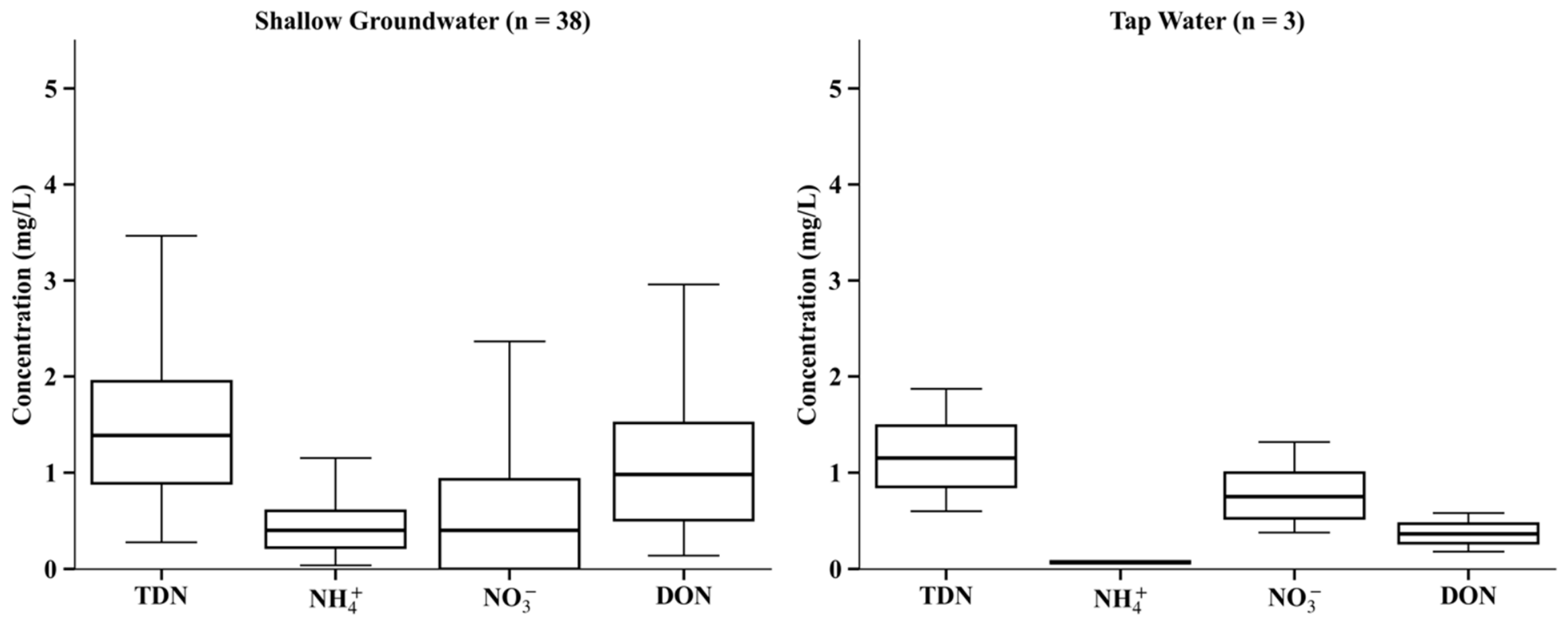
Regarding nitrogen species, shallow groundwater exhibits high variability; see Table 3 and Figure 3. The average concentration of TDN is 1.52 mg L−1, with mean concentrations of NH4+ (0.45 mg L−1), NO3 (0.53 mg L−1), and DON (1.11 mg L−1) contributing to the total pool. DON represents the dominant nitrogen fraction in shallow groundwater, whereas NO3 is dominant in tap water. Compared to tap water, which has a lower TDN concentration (mean 1.23 mg L−1) and consistently low NH4+ and NO3 levels, shallow groundwater shows evidence of nitrogen enrichment and more variable nitrogen cycling processes. These results indicate that shallow groundwater in the study area is more vulnerable to nitrogen contamination compared to the relatively stable and well-oxidized composition of tap water.

3.1.1. Hydrochemical Source Indicators

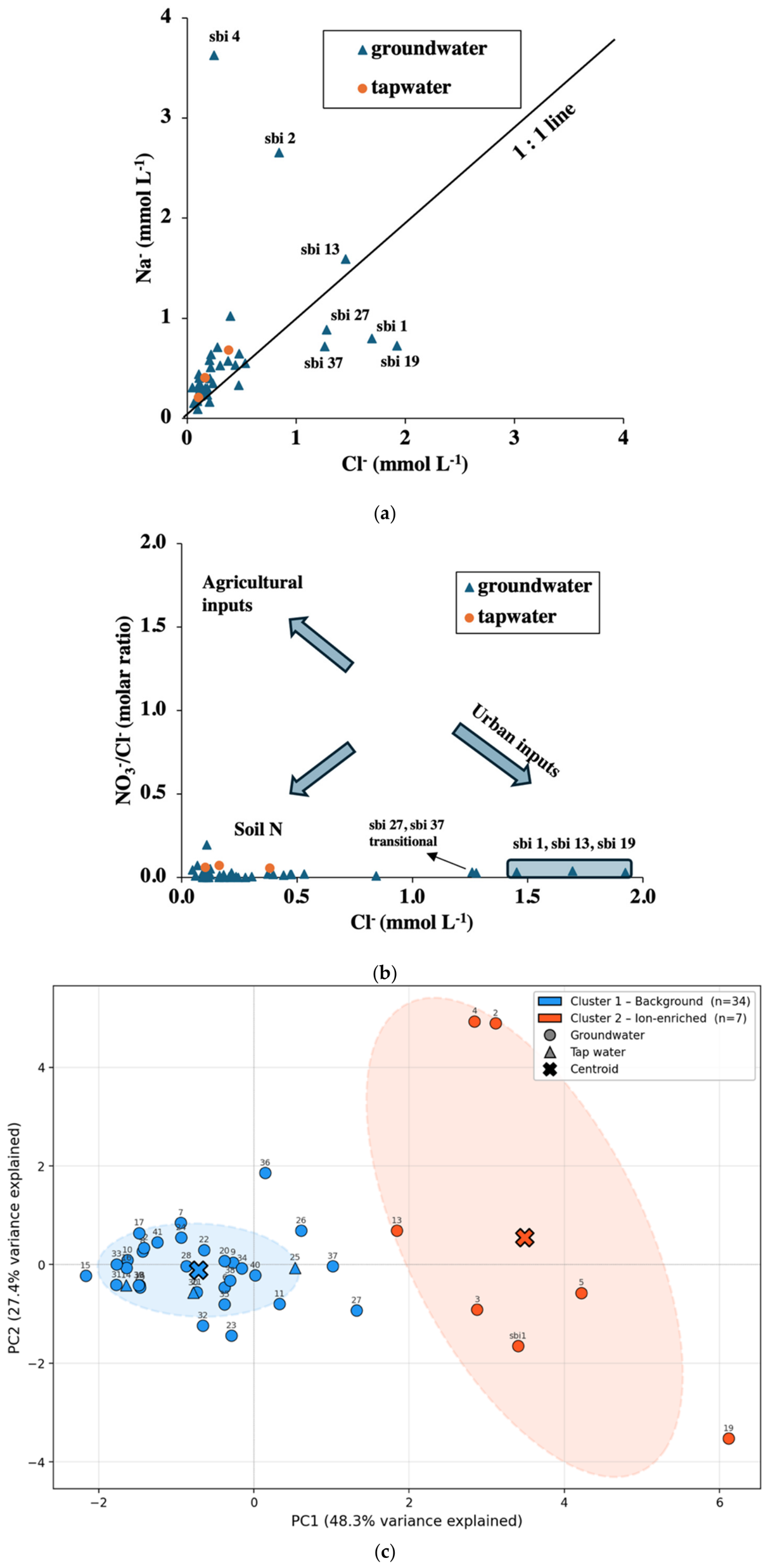
In aquatic environments, Cl is relatively stable and minimally influenced by physical, chemical, or biological processes. Its primary sources include agricultural activities, industrial effluents, and domestic sewage, making Cl a reliable indicator for tracing pollution sources in water bodies [31]. The Na+/Cl ratio is commonly used to further evaluate the sources and transformation processes of NO3 [32]. In this study, most shallow groundwater samples cluster near the 1:1 Na+/Cl line, with only a few outliers (Figure 4a). Deviations from this ratio typically indicate additional inputs, often from anthropogenic sources that elevate Cl concentrations relative to Na+ [33]. Within the study area, wells (sbi 1, sbi 2, sbi 4, sbi 13, sbi 19, sbi 27, and sbi 37) exhibit relatively high Na+ and/or Cl levels, suggesting localized inputs potentially from domestic wastewater (including leakage from aging sewer pipes).
The NO3/Cl ratio provides additional insight into nitrate sources and mixing processes. Soil-derived nitrogen is generally characterized by low Cl concentrations and low NO3/Cl ratios, whereas nitrogen from sewage and manure is associated with high Cl concentrations and low NO3/Cl ratios. In contrast, agricultural nitrogen typically exhibits low Cl levels and high NO3/Cl ratios [12,34]. In the present study, most groundwater samples follow the pattern indicative of soil-derived nitrogen. Only a subset of wells (sbi 1, sbi 13, sbi 19, sbi 27, and sbi 37) plot within the indicative pattern of sewage or manure influence (Figure 4b). The predominance of low Cl concentrations coupled with low NO3/Cl ratios across most samples suggests that soil-derived nitrogen constitutes the dominant background nitrogen source in the aquifer.
Collectively, Figure 4a,b consistently flag wells sbi 1, 13, and 19 as likely sewage-affected, while sbi 27 and 37 occupy an ambiguous position near the boundary between soil-derived and sewage influence fields. However, visual delineation of reference fields in scatter plots is inherently subjective and insufficient for unambiguous sample classification. K-means cluster analysis was therefore applied to objectively evaluate these preliminary groupings.

3.1.2. K-Mean Cluster Analysis

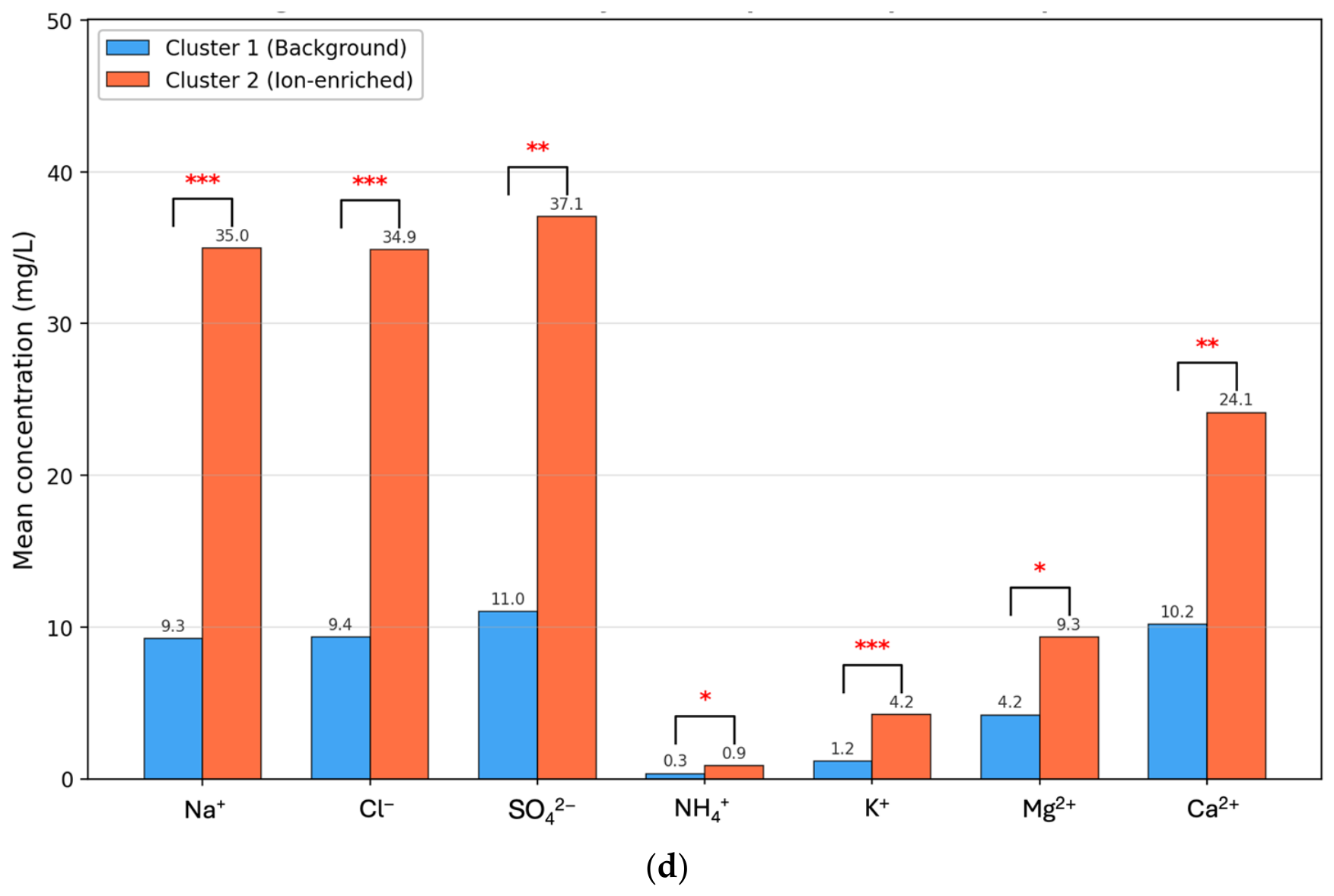
To objectively partition the hydrochemical dataset, K-means cluster analysis (K = 2) was applied to all 41 samples using standardized major ion and nitrogen species concentrations (Figure 4c,d). The optimal K = 2 solution yielded a silhouette coefficient of 0.54 and explained 75.7% of total variance in PCA space (Figure 4c), indicating a robust and meaningful separation.
Cluster 2 (n = 7; wells sbi 1, 2, 3, 4, 5, 13, 19) is distinguished from Cluster 1 (background group; n = 31) by significantly elevated concentrations of Na+ (p < 0.001), K+ (p < 0.001), Cl (p < 0.01), SO42− (p < 0.01), Ca2+ (p < 0.01), NH4+-N (p < 0.05), and Mg2+ (p < 0.05) (Figure 4d). This ionic signature—characterized by the concurrent enrichment of Na+, Cl alongside elevated Ca2+, Mg2+, K+, and SO42−—is consistent with groundwater affected by sewage leakage [2,14]. Wells sbi 1, 13, and 19, previously flagged by scatter plot analysis (Figure 4b), are confirmed as Cluster 2 members. Additionally, the cluster analysis identifies wells sbi 1, 2, 3, 4, and 5 as sewage-affected, all of which are located in the Kita-Shinagawa district, where sewage leakage has been independently documented [2].
Wells sbi 27 and 37 are assigned to Cluster 1 but are notable outliers within the background group: their Cl concentrations (44.7 mg L−1 and 45.3 equivalent to 1.26 and 1.28 mmol L−1, respectively) exceed the 95th percentile of the Cluster 1 distribution (0.785 mmol L−1). These wells are therefore interpreted as transitional, reflecting partial anthropogenic Cl enrichment of uncertain origin—consistent with their ambiguous position in Figure 4b—but insufficient to meet the multivariate threshold for Cluster 2 classification.
Collectively, the hydrochemical and multivariate evidence supports the following nitrogen source classification: (i) the large majority of wells (Cluster 1, n = 31) show nitrogen contamination consistent with a diffuse soil-derived background; (ii) three wells (sbi 1, 13, 19), flagged by both ionic ratio analysis and K-means clustering, and four additional wells in the Kita-Shinagawa district (sbi 2, 3, 4, 5), identified by cluster analysis and supported by previous field documentation [6], show nitrogen contamination consistent with localized sewage leakage; and (iii) two wells (sbi 27, 37) exhibit transitional hydrochemical characteristics, plotting near the boundary of the sewage/manure field in Figure 4b. Monitoring these transitional wells in future surveys may help detect early-stage sewage leakage in currently unaffected areas of the aquifer.

3.2. Nitrogen Contamination Source Identification

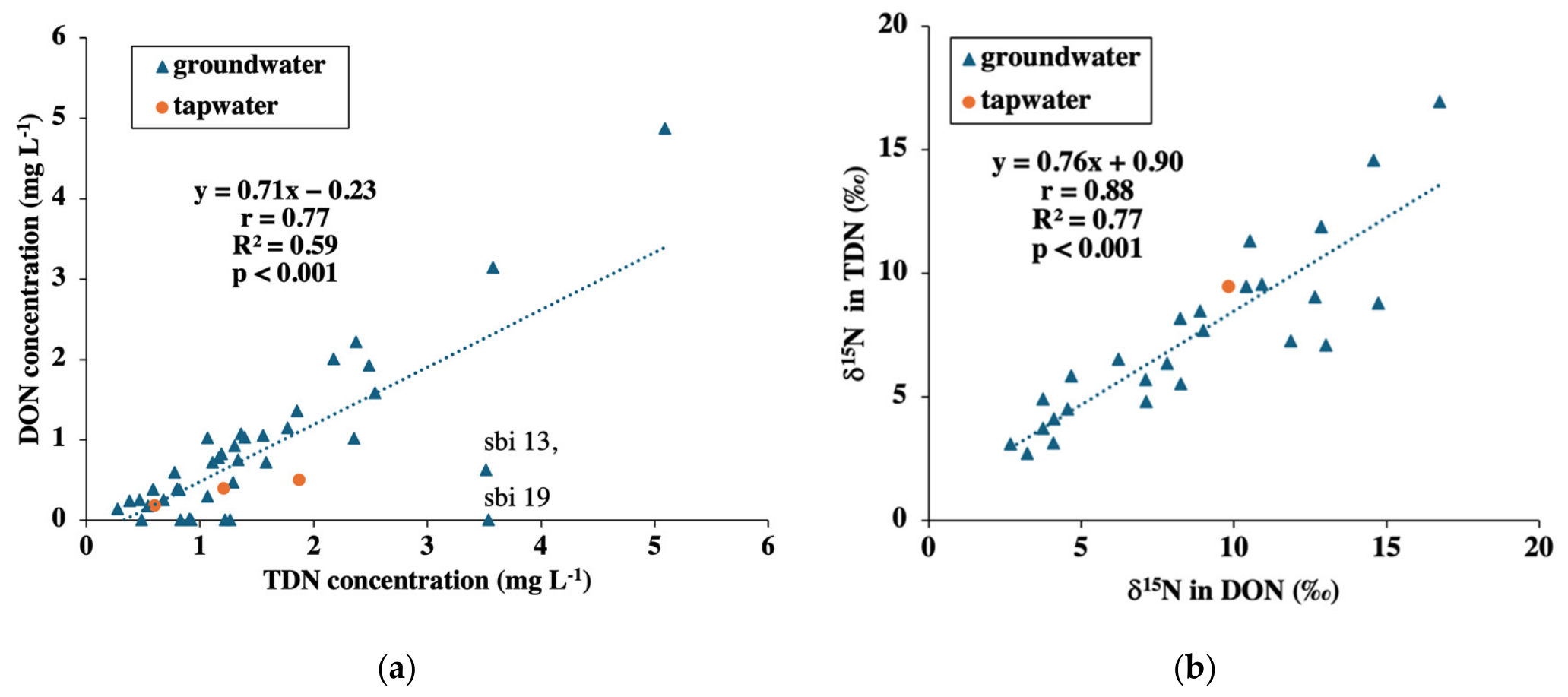
Analysis of shallow groundwater in Shinagawa reveals that TDN is predominantly composed of DON (Figure 3). This is further supported by linear correlations between TDN and DON concentrations (r = 0.77, R2 = 0.59, p < 0.001), as well as between their isotopic compositions (δ15N-TDN and δ15N-DON; r = 0.88, R2 = 0.77, p < 0.001) (Figure 5a,b). These relationships indicate that DON constitutes the dominant fraction of TDN and that both share a common primary source. These findings suggest that DON is the principal nitrogen species and a major vector of nitrogen contamination in the aquifer.
Within the context of the study area, this finding suggests a key biogeochemical pathway: a substantial portion of the observed NO3 is likely derived from the in situ mineralization and nitrification of DON. The most probable origin of this DON pool is the mineralization of soil-derived organic nitrogen, which releases DON into the shallow groundwater where it is progressively mineralized to NH4+ and subsequently nitrified to NO3. The prevailing contamination image for this region is altered by this perspective. Earlier studies primarily attributed nitrate contamination to direct sewage leakage from damaged infrastructure [6,25]. The current data, however, highlight a previously overlooked but significant subsurface source: the biogeochemical processing of soil-derived organic nitrogen via the DON pool.
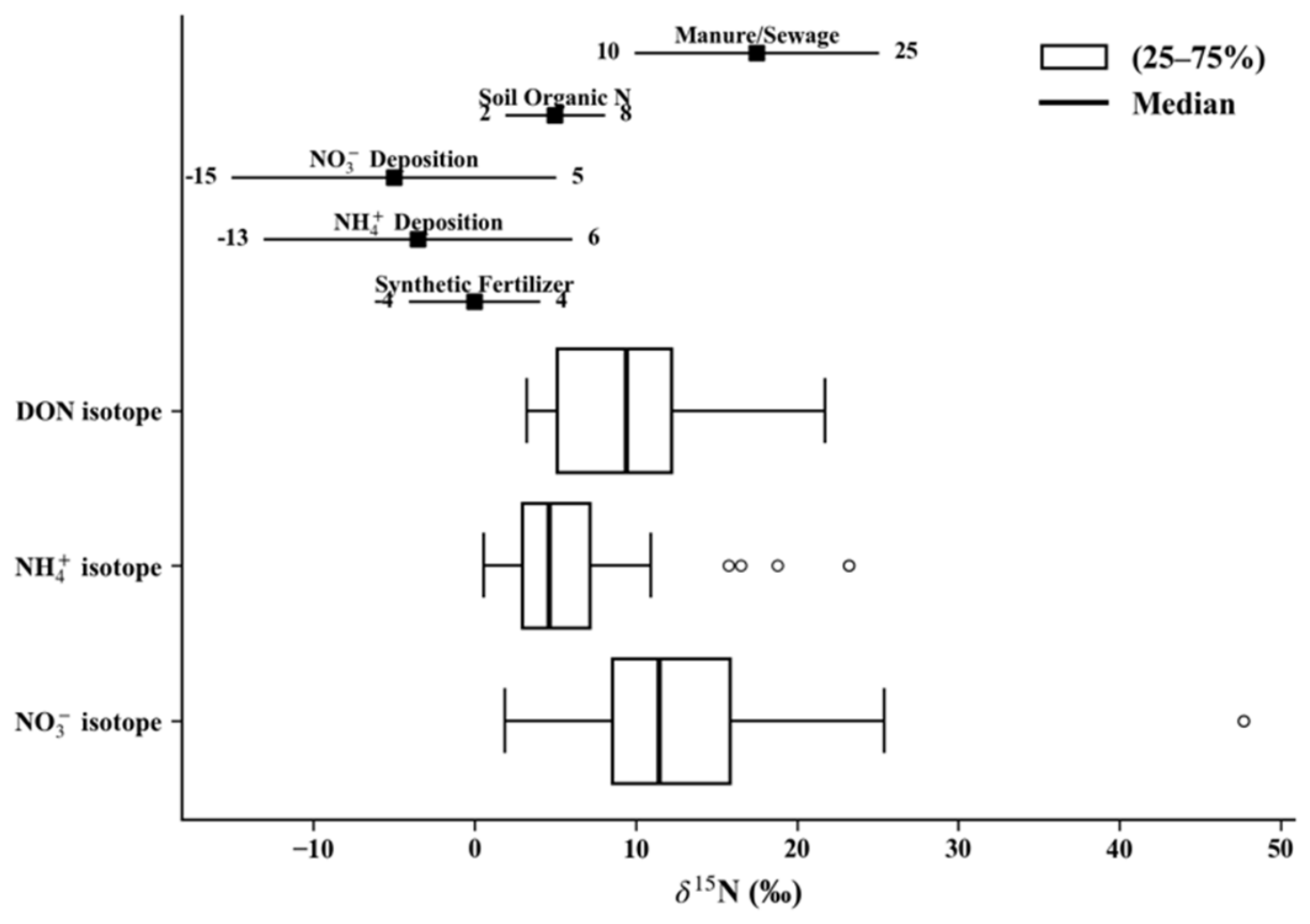
Integration of isotopic and hydrochemical data resolves the nitrogen sources. The δ15N-DON values ranged from +3.23‰ to +21.72‰ (mean +9.85‰), overlapping typical ranges for both soil nitrogen and sewage/manure (Figure 5b). Hydrochemical indices (Na+/Cl, NO3/Cl ratios) combined with multivariate analysis reveal a pattern: nitrogen contamination in most wells shares a common background signature, suggesting a pervasive source (likely soil-derived), while specific wells (sbi 1, 2, 3, 4, 5, 13, 19) show deviations indicative of localized inputs from sewage.
Therefore, the combined dataset suggests that nitrogen contamination in Shinagawa’s shallow groundwater is predominantly associated with regional mineralization of soil-derived organic nitrogen. Overprinting this background are discrete, localized impacts from sewage leakage at specific points, consistent with previous findings of leakages in the Shinagawa region. For instance, Itoh Yuki et al. [6] also identified sewage influence at well sbi 1, 2, 3, 4, 5 within a narrower study area in Kita-Shinagawa. In summary, this refines the existing understanding by identifying soil-N as the major regional contributor, with sewage influence confined to cumulative point sources.

3.3. Nitrogen Transformation Assessment Using Isotopic Values

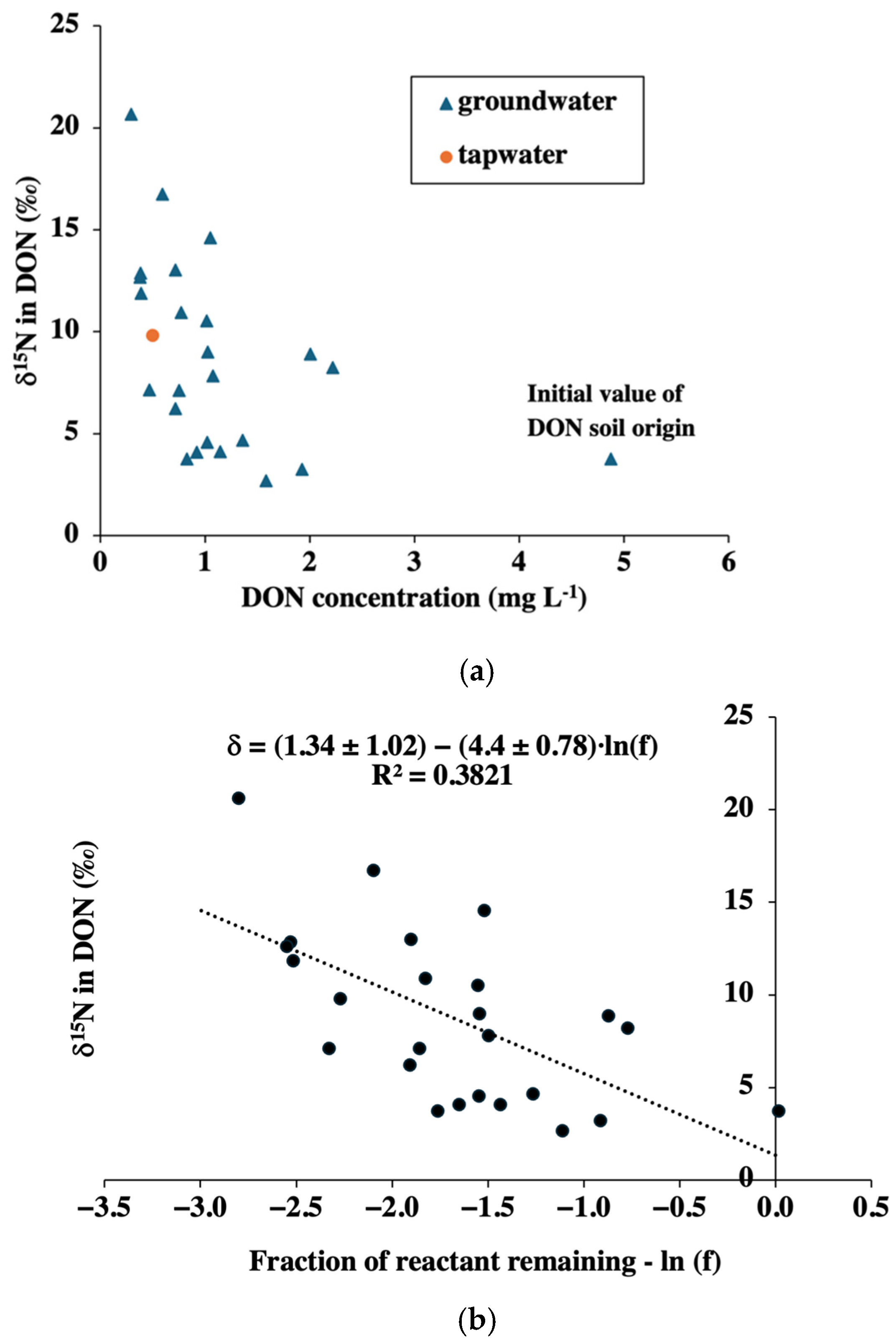
The isotopic data are broadly consistent with active DON mineralization within the aquifer. A clear negative correlation between δ15N-DON and DON concentration (Figure 6a) suggests progressive 15N enrichment in the residual DON pool as DON is consumed. This trend is compatible with the kinetic isotopic fractionation during the conversion of DON to NH4+ via mineralization, where bonds containing 14N are preferentially broken, and 15N enrichment accelerates as the reactant pool nears depletion [35,36].
To quantitatively assess the isotope fractionation associated with DON mineralization, the Rayleigh distillation model was applied. The selection of an appropriate initial reference point (f = 1) is critical for this calculation. Among all sampled wells, sbi 16 was chosen as the representative of the least-altered, initial DON pool based on three criteria: (i) it displayed the highest DON concentration (4.87 mg L−1); (ii) it exhibited the low δ15N-DON value (3.23‰), indicating minimal isotopic enrichment from fractionation; and (iii) hydrochemical conditions at this well (DO = 0.36 mg L−1, ORP = +74 mV) suggest suppressed mineralization activity, preserving the DON pool. While other wells also exhibited low DO, they did not simultaneously show the high DON and low δ15N-DON characteristic of sbi 16. Accordingly, δ15N-DON and DON concentrations at sbi 16 are taken as representative of the initial source signature for Rayleigh fractionation modeling. The remaining fraction f was calculated as the ratio of DON concentration at each well to the maximum DON concentration measured at sbi 16 (Equation (4)).
Application of the Rayleigh equation in this study (δ = (1.34 ± 1.02) − (4.4 ± 0.78) × ln(f)) yielded an isotope fractionation factor (ε) of approximately −4.4 ± 0.78‰ (Figure 6b). This value falls within the range reported for DON mineralization processes. For instance, Möbius et al. [37] documented ε values between −1‰ and −5‰ in marine systems, while Kendall et al. [38] noted that DON-related fractionation tends to be smaller and more variable than the stronger fractionations commonly observed for NO3 or NH4+ (−5 to −15‰). The obtained ε value is therefore consistent with the interpretation that DON mineralization may be an active process in the aquifer.
However, interpreting N-isotope dynamics in shallow groundwater is complex, as fractionation signals are not constant and reflect the cumulative effects of sequential and potentially overlapping reactions [7]. In this system, mineralization of DON preferentially converted 14N-DON atoms to 14N-NH4+atoms, resulting in δ15N-NH4+ values that are isotopically lighter than δ15N-DON (Figure 7). Under typical conditions, subsequent nitrification would yield δ15N-NO3 that is also isotopically lighter than its δ15N-NH4+ precursor. Here, however, measured δ15N-NO3 values were generally higher than δ15N-NH4+, indicating an additional process has enriched the NO3 pool post-formation.
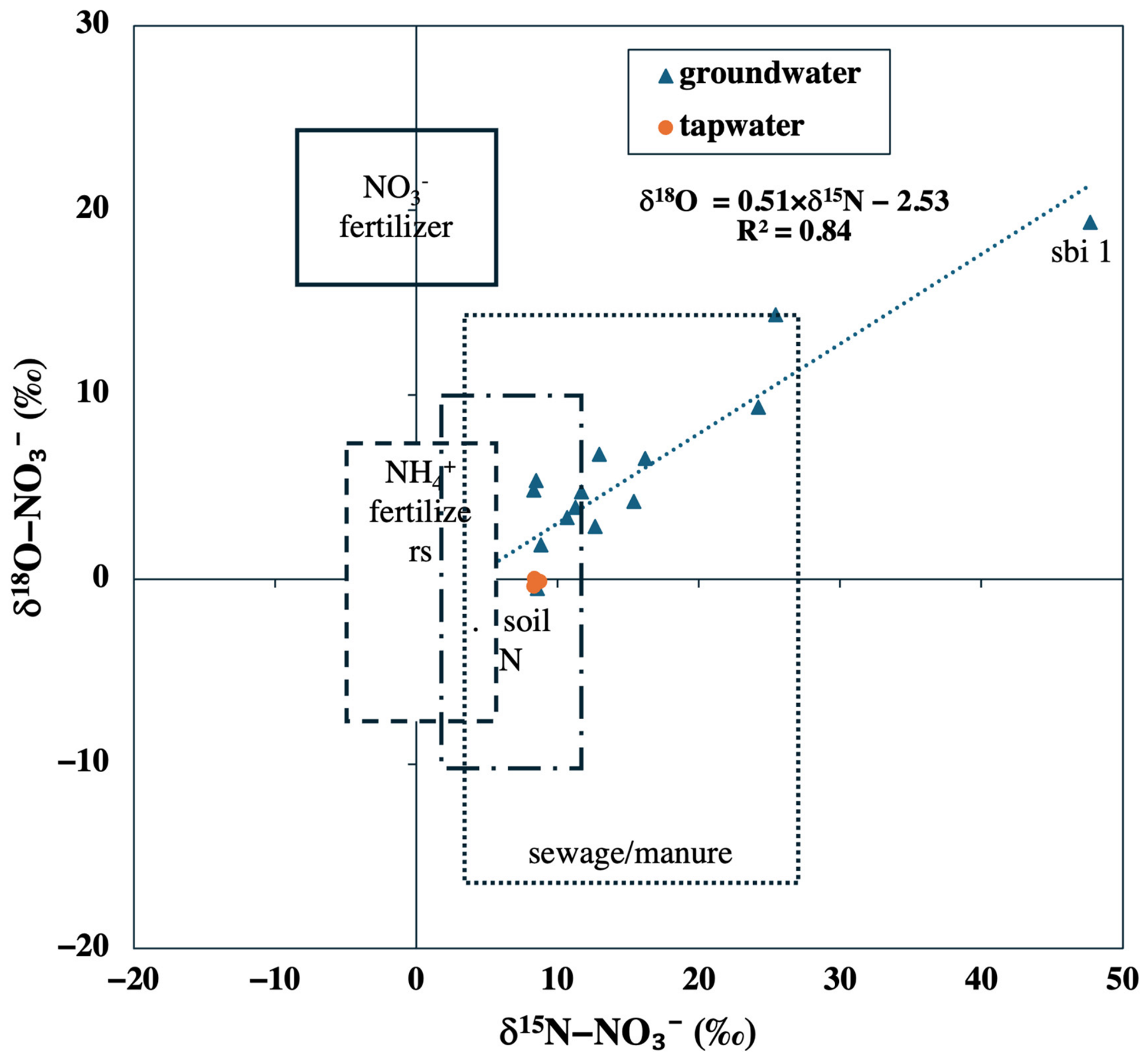
Measured δ15N and δ18O values of NO3 ranged from +1.9‰ to +47.7‰ and from −5‰ to +19.3‰, respectively. A strong positive correlation between δ15N and δ18O (r2 = 0.84, p < 0.001) follows the relationship δ18O = 0.51 × δ15N − 2.53 (Figure 8). To evaluate whether nitrification could explain the observed δ18O–NO3 values, we compared them with the theoretical range for nitrification-derived NO3. The δ18O of shallow groundwater in Shinagawa ranges from −8.7‰ to −7.4‰ [39]. Given that nitrification incorporates approximately 1/3 of oxygen from dissolved O218O ≈ +24‰) and 2/3 from ambient H2O, the expected δ18O–NO3 from nitrification alone would range from +2.2‰ to +3.1‰. Our measured δ18O–NO3 values (mean = +5.37‰, median = +4.73‰) are substantially higher than this range, suggesting that nitrification is unlikely to be the dominant process controlling the isotopic composition of NO3. Moreover, the observed slope (~0.51) closely matches the theoretical expectation for denitrification [38], and aligns with results from previous studies [7,40,41,42]. This slope, combined with the δ18O enrichment above, points towards denitrification as a key process controlling the isotopic enrichment of NO3 in Shinagawa’s shallow groundwater.
The highest δ15N-NO3 value (+47.71‰) was recorded at well Sbi 001. This well belongs to Cluster 2, indicating sewage influence, and also exhibits strong isotopic enrichment in δ18O-NO3 (+19.31‰) with moderate residual NO3 (3.55 mg L−1). This combination suggests that denitrification is actively fractionating a nitrate pool that is already enriched in 15N due to sewage input, resulting in exceptionally high δ15N values. The observed signal thus likely reflects the superimposition of both source and process signatures, rather than representing an analytical outlier.
Although mineralization (favored under oxic conditions) and denitrification (occurring under anoxic conditions) represent contrasting redox processes, they can coexist within the same shallow aquifer. Shallow groundwater systems often display micro-scale redox heterogeneity—oxygenated microsites embedded within anoxic zones—allowing both processes to operate simultaneously but spatially separated [7]. This coexistence is further supported by local hydrogeological characteristics. The Quaternary alluvial aquifer in Shinagawa comprises interbedded sandy and silty layers. The more permeable sandy layers facilitate oxygen replenishment and water infiltration, creating favorable conditions for nitrification. In contrast, the finer-grained silt/clay lenses, often enriched in organic matter, tend to become locally anoxic, serving as hotspots for denitrification [43]. This lithological control on redox conditions helps explain why both mineralization and denitrification can occur across the study area, reflecting a picture of oxic and anoxic microenvironments rather than a single uniform redox state.
Figure 8. Relationship between δ15N–NO3 and δ18O–NO3 in the study area. Distinct nitrate sources exhibit characteristic isotopic ranges: nitrate fertilizers (δ15N = −5 to 5‰; δ18O = 17 to 25‰), ammonium fertilizers (δ15N = −8 to 5‰; δ18O = −8 to 8‰), soil organic nitrogen (δ15N = 2 to 8‰; δ18O = −10 to 10‰), and sewage/manure (δ15N = 4 to 25‰; δ18O = −15 to 15‰) [44,45,46].
Water 18 01550 g008
Compared to other urbanized coastal aquifers worldwide, the nitrogen contamination pattern in Shinagawa exhibits both similarities and distinctive features. In developing Asian mega-cities such as Manila and Jakarta, heavier δ15N values in shallow groundwater relative to deep wells indicate sewage infiltration, and denitrification has been documented in both locations [42,47]. However, in contrast to Shinagawa, where DON dominates the nitrogen pool, nitrate is typically the dominant nitrogen species in those aquifers. The Osaka metropolitan area, another highly urbanized coastal region in Japan, shows similar evidence of denitrification in tidal river zones, though with a stronger focus on surface water–groundwater interaction rather than DON dynamics [43]. Collectively, these comparisons highlight that while sewage infiltration is a common driver of nitrogen contamination in urban aquifers, the dominance of DON and the soil-derived nitrogen appears to be particularly pronounced in Shinagawa. Alternatively, it is also possible that the role of DON remains underappreciated or has been overlooked in other urban groundwater studies, as suggested by recent reviews calling for greater attention to dissolved organic nitrogen as a “missing piece” in the nitrogen cycle of vadose zone-groundwater systems.
A limitation of this study is that groundwater samples were collected on a single occasion (November 2023). Therefore, seasonal variability in nitrogen sources and transformation processes—such as changes in recharge rate, redox conditions, or microbial activity during spring, summer, or after rainfall events—remains uncharacterized. As a result, the inferred transformation sequence and source apportionment should be considered as a snapshot representative of late autumn conditions. Future studies incorporating multi-seasonal sampling are needed to assess the temporal stability of the observed patterns and to validate the proposed biogeochemical pathway.

4. Conclusions

This study provides new insights into nitrogen sources and transformation pathways in the shallow urban groundwater of Shinagawa Ward, Tokyo. The combined application of hydrochemical analysis, stable nitrogen isotopes, and multivariate statistical methods (PCA and K-means cluster analysis) suggests that the pervasive nitrogen background is most consistent with soil organic matter as the dominant source, rather than sewage leakage as the sole contributor—a finding that broadens the conceptual framework for nitrogen contamination in highly urbanized aquifer systems.
Localized sewage influence appears to be confined to a discrete subset of wells (sbi 1, 2, 3, 4, 5, 13, and 19), independently identified by both multivariate clustering and confirmed to be consistent with previous studies in the same area. Wells sbi 27 and sbi 37 display transitional hydrochemical signatures that may represent early-stage or partial contamination and could serve as sentinel points for monitoring the progression of sewage-derived nitrogen in future assessments.
Isotopic analysis of dissolved organic nitrogen (δ15N-DON), combined with the observed dominance of DON within the total dissolved nitrogen pool, provides evidence consistent with an active biogeochemical transformation sequence: soil organic nitrogen → DON → (mineralization/nitrification) → NO3, with denitrification potentially attenuating nitrate under reducing conditions. While this inferred transformation pathway is internally coherent across multiple lines of evidence, its full validation would benefit from seasonal monitoring and process-level investigation in future work.
Taken together, these findings underscore the importance of incorporating DON and its isotopic composition into groundwater nitrogen assessments. Overlooking this fraction risks misattributing sources and underestimating the nitrogen cycle in urban subsurface environments.

Author Contributions

L.A.P.T. conceptualized the study, performed data processing, and wrote the original manuscript. Y.I. conducted sampling and ion composition analysis and reviewed the manuscript. S.L. participated in sampling and manuscript review. M.Y. contributed to methodology development and manuscript review. R.O. assisted with methodology and data curation. T.N. served as the corresponding author, contributed to conceptualization, supervised the research, and administered the project. All authors have read and agreed to the published version of the manuscript.

Funding

This research was funded by the Ministry of Education, Culture, Sports, Science and Technology (MEXT). This research was supported by the Japan Society for the Promotion of Science (JSPS) KAKENHI Grant Number JP26K15255.

Data Availability Statement

The original contributions presented in this study are included in the article. Further inquiries can be directed to the corresponding author.

Acknowledgments

The authors thank the citizens of Shinagawa City, Tokyo, for their cooperation and support during the groundwater sampling campaign.

Conflicts of Interest

The authors declare no competing interests.

References

  1. Vitousek, P.M.; Aber, J.D.; Howarth, R.W.; Likens, G.E.; Matson, P.A.; Schindler, D.W.; Schlesinger, W.H.; Tilman, D.G. Human alteration of the global nitrogen cycle: Sources and consequences. Ecol. Appl. 1997, 7, 737–750. [Google Scholar]
  2. Jiang, Y.; Levison, J.; Schilling, K. Nitrate from field to stream: Characterization and mitigation. Front. Environ. Sci. 2025, 13, 1730350. [Google Scholar] [CrossRef]
  3. Cooper, R.J.; Hiscock, K.M. Groundwater resources: Challenges & solutions. Camb. Prism. Water 2025, 3, e1. [Google Scholar]
  4. Liu, H.; Zhang, G.; Guo, H.; Wang, Z.; Ge, Q. Occurrences of nitrate-contaminated groundwater in the piedmont aquifers: Hydrogeochemical characteristics and health risks. Environ. Geochem. Health 2024, 46, 366. [Google Scholar] [CrossRef] [PubMed]
  5. Guleria, A.; Mehdinejadiani, B. Groundwater quality evaluation and human health risk assessment of nitrate using deterministic and probabilistic approaches in qorveh-dehgolan region, kurdistan province, Iran. Int. J. Environ. Health Res. 2025, Online ahead of print. [Google Scholar]
  6. Itoh, Y.; Yasuhara, M.; Lee, S.; Nakamura, T.; Inamura, A. Groundwater contamination by nitrate ions in the highly urbanized shinagawa area, central tokyo, Japan. J. Geogr.-Chigaku Zasshi 2023, 132, 141–160. [Google Scholar] [CrossRef]
  7. Kendall, C.; Aravena, R. Nitrate isotopes in groundwater systems. In Environmental Tracers in Subsurface Hydrology; Springer: Berlin/Heidelberg, Germany, 2000; pp. 261–297. [Google Scholar]
  8. Heaton, T.H. Isotopic studies of nitrogen pollution in the hydrosphere and atmosphere: A review. Chem. Geol. Isot. Geosci. Sect. 1986, 59, 87–102. [Google Scholar] [CrossRef]
  9. Xue, D.; Botte, J.; De Baets, B.; Accoe, F.; Nestler, A.; Taylor, P.; Van Cleemput, O.; Berglund, M.; Boeckx, P. Present limitations and future prospects of stable isotope methods for nitrate source identification in surface-and groundwater. Water Res. 2009, 43, 1159–1170. [Google Scholar] [CrossRef] [PubMed]
  10. Oubeid, A.M.A.; Hilal, I.; Kebd, A.; Sadiki, M. Global applications of stable isotopes for identifying nitrate pollution sources in groundwater: A comprehensive review. Front. Water 2025, 7, 1666498. [Google Scholar] [CrossRef]
  11. Nakamura, T.; Osaka, K.; Chapagain, S.K.; Nishida, K. Nitrogen contamination and denitrification occurrence in shallow groundwater of urbanized area at kathmandu valley, Nepal. J. Geogr.-Chigaku Zasshi 2023, 132, 183–196. [Google Scholar] [CrossRef]
  12. Wei, X.; Zhou, Y.; Ran, L.; Chen, M.; Zou, J.; Fan, Z. Sources and transformation of nitrate in shallow groundwater in the three gorges reservoir area: Hydrogeochemistry and isotopes. Water 2024, 16, 3299. [Google Scholar] [CrossRef]
  13. Cao, H.T.T.; Nakamura, T.; Toyama, T.; Nishida, K. A protocol for nitrogen isotopic measurement of dissolved organic nitrogen with a combination of oxidation-denitrification and gas phase diffusion methods. Isot. Environ. Health Stud. 2021, 57, 576–584. [Google Scholar] [CrossRef]
  14. Bronk, D.A.; Glibert, P.M. A 15N tracer method for the measurement of dissolved organic nitrogen release by phytoplankton. Mar. Ecol. Prog. Ser. 1991, 77, 171–182. [Google Scholar] [CrossRef]
  15. Slawyk, G.; Raimbault, P. Simple procedure for simultaneous recovery of dissolved inorganic and organic nitrogen in 15N-tracer experiments and improving the isotopic mass balance. Oceanogr. Lit. Rev. 1996, 5, 449. [Google Scholar] [CrossRef]
  16. Feuerstein, T.P.; Ostrom, P.H.; Ostrom, N.E. Isotopic biogeochemistry of dissolved organic nitrogen: A new technique and application. Org. Geochem. 1997, 27, 363–370. [Google Scholar] [CrossRef]
  17. Knapp, A.; Casciotti, K.; Prokopenko, M. Dissolved organic nitrogen production and consumption in eastern tropical south pacific surface waters. Glob. Biogeochem. Cycles 2018, 32, 769–783. [Google Scholar] [CrossRef]
  18. Overview, S.W. Shinagawa Ward Overview. 2022. Available online: https://www.city.shinagawa.tokyo.jp/PC/kuseizyoho/kuseizyoho-siryo/kuseizyoho-siryo-youkososhinagawa/kuseiyouran2022.pdf (accessed on 26 October 2025).
  19. Sueyoshi Megumi, K.T. Comparative Studies on Regional Characteristics of Town Restructure System in Terms of Historical Resources Between Shinagawa and Senzyu; Departmental Bulletin Paper; Tokyo Metropolitan University: Hachioji-shi, Japan, 2009; pp. 65–84. [Google Scholar]
  20. Shigefuki Oka, T.K.; Katsurashima, S. Geology of the Southwestern Tokyo Region (Regional Geological Research Report). 1984. Available online: https://www.gsj.jp/data/50KGM/PDF/GSJ_MAP_G050_08063_1984_D.pdf (accessed on 26 October 2025).
  21. Ishiwata Shigeko, A.K. Late-quarternary sedimentary environment on the east coast of tokyo bay, central Japan. In Proceedings of Symposium on Geo-Environments (2nd Symposium); Committee of Environmental Geology, Geological Society of Japan: Tokyo, Japan, 1992; pp. 321–326. [Google Scholar]
  22. Miyakoshi, A.; Hayashi, T.; Monyrath, V.; Lubis, R.; Sakura, Y. Subsurface thermal environment change due to artificial effects in the tokyo metropolitan area, Japan. In From Headwaters to the Ocean: Hydrological Changes and Watershed Management; Taylor & Francis: London, UK, 2009; pp. 547–552. [Google Scholar]
  23. Ikawa, R.; Shimada, J.; Saeki, K.; Taniguchi, M. Groundwater Flow System in Shizuoka Plain; The Geochemical Society of Japan: Tokyo, Japan, 2005. [Google Scholar]
  24. Tokyo Metropolitan Government Civil Engineering Support Center. Tokyo Metropolitan Government Bureau of Sewerage. 2014. Available online: https://www.kensetsu.metro.tokyo.lg.jp/jimusho/tech (accessed on 26 October 2025).
  25. Kuroda, K.; Fukushi, T.; Takizawa, S.; Aichi, M.; Hayashi, T.; Tokunaga, T. Source estimation of nitrogen contamination in groundwaters in tokyo metropolitan area. Environ. Eng. Res. 2007, 44, 31–38. [Google Scholar]
  26. Inorganic nonmetallic constituents in water and wastewater 4500-NO3−nitrogen (nitrate). In Standard Methods for the Examination of Water and Wastewater; APHA Press: Washington, DC, USA, 2011.
  27. Phung Thi, L.A.; Yasuhara, M.; Morikawa, N.; Nakamura, T. Protocol for ammonium isotope analysis of low-concentration environmental water samples. J. Water Environ. Technol. 2026, 24, 262–272. [Google Scholar] [CrossRef]
  28. Sigman, D.M.; Casciotti, K.L.; Andreani, M.; Barford, C.; Galanter, M.; Böhlke, J.K. A bacterial method for the nitrogen isotopic analysis of nitrate in seawater and freshwater. Anal. Chem. 2001, 73, 4145–4153. [Google Scholar] [CrossRef] [PubMed]
  29. Casciotti, K.L.; Böhlke, J.K.; McIlvin, M.R.; Mroczkowski, S.J.; Hannon, J.E. Oxygen isotopes in nitrite: Analysis, calibration, and equilibration. Anal. Chem. 2007, 79, 2427–2436. [Google Scholar] [CrossRef] [PubMed]
  30. Thibodeau, B.; Miyajima, T.; Tayasu, I.; Wyatt, A.; Watanabe, A.; Morimoto, N.; Yoshimizu, C.; Nagata, T. Heterogeneous dissolved organic nitrogen supply over a coral reef: First evidence from nitrogen stable isotope ratios. Coral Reefs 2013, 32, 1103–1110. [Google Scholar] [CrossRef]
  31. Kim, S.H.; Kim, H.-R.; Yu, S.; Kang, H.-J.; Hyun, I.-H.; Song, Y.-C.; Kim, H.; Yun, S.-T. Shift of nitrate sources in groundwater due to intensive livestock farming on jeju island, south korea: With emphasis on legacy effects on water management. Water Res. 2021, 191, 116814. [Google Scholar] [CrossRef] [PubMed]
  32. Jin, Z.; Zheng, Q.; Zhu, C.; Wang, Y.; Cen, J.; Li, F. Contribution of nitrate sources in surface water in multiple land use areas by combining isotopes and a bayesian isotope mixing model. Appl. Geochem. 2018, 93, 10–19. [Google Scholar] [CrossRef]
  33. Guo, Z.; Yan, C.; Wang, Z.; Xu, F.; Yang, F. Quantitative identification of nitrate sources in a coastal peri-urban watershed using hydrogeochemical indicators and dual isotopes together with the statistical approaches. Chemosphere 2020, 243, 125364. [Google Scholar] [CrossRef] [PubMed]
  34. Minet, E.P.; Goodhue, R.; Meier-Augenstein, W.; Kalin, R.M.; Fenton, O.; Richards, K.G.; Coxon, C. Combining stable isotopes with contamination indicators: A method for improved investigation of nitrate sources and dynamics in aquifers with mixed nitrogen inputs. Water Res. 2017, 124, 85–96. [Google Scholar] [CrossRef] [PubMed]
  35. Kendall, C.; Caldwell, E.A. Fundamentals of isotope geochemistry. In Isotope Tracers in Catchment Hydrology; Elsevier: Amsterdam, The Netherlands, 1998; pp. 51–86. [Google Scholar]
  36. Mariotti, A.; Germon, J.; Hubert, P.; Kaiser, P.; Letolle, R.; Tardieux, A.; Tardieux, P. Experimental determination of nitrogen kinetic isotope fractionation: Some principles; illustration for the denitrification and nitrification processes. Plant Soil 1981, 62, 413–430. [Google Scholar] [CrossRef]
  37. Möbius, J. Isotope fractionation during nitrogen remineralization (ammonification): Implications for nitrogen isotope biogeochemistry. Geochim. Cosmochim. Acta 2013, 105, 422–432. [Google Scholar] [CrossRef]
  38. Kendall, C.; Elliott, E.M.; Wankel, S.D. Tracing anthropogenic inputs of nitrogen to ecosystems. In Stable Isotopes in Ecology and Environmental Science; Wiley: Hoboken, NJ, USA, 2008; pp. 375–449. [Google Scholar]
  39. Yasuhara, M.; Inamura, A.; Nakamura, T.; Asai, K. An isotopic study on shallow groundwater origins in a densely-populated area in shinagawa, central tokyo, Japan. In Proceedings of the Japan Geoscience Union Meeting 2019, Chiba, Japan, 26–30 May 2019. [Google Scholar]
  40. Böttcher, J.; Strebel, O.; Voerkelius, S.; Schmidt, H.-L. Using isotope fractionation of nitrate-nitrogen and nitrate-oxygen for evaluation of microbial denitrification in a sandy aquifer. J. Hydrol. 1990, 114, 413–424. [Google Scholar] [CrossRef]
  41. Fukada, T.; Hiscock, K.M.; Dennis, P.F.; Grischek, T. A dual isotope approach to identify denitrification in groundwater at a river-bank infiltration site. Water Res. 2003, 37, 3070–3078. [Google Scholar] [CrossRef] [PubMed]
  42. Umezawa, Y.; Hosono, T.; Onodera, S.-I.; Siringan, F.; Buapeng, S.; Delinom, R.; Yoshimizu, C.; Tayasu, I.; Nagata, T.; Taniguchi, M. Sources of nitrate and ammonium contamination in groundwater under developing asian megacities. Sci. Total Environ. 2008, 404, 361–376. [Google Scholar] [CrossRef] [PubMed]
  43. Saito, M.; Onodera, S.; Shimizu, Y.; Maruyama, Y.; Jin, G.; Aritomi, D. Nitrogen dynamics in a tidal river zone influenced by highly urbanization, western Japan. In Proceedings of the AGU Fall Meeting Abstracts, San Francisco, CA, USA, 15–19 December 2014. [Google Scholar]
  44. Jani, J.; Toor, G.S. Composition, sources, and bioavailability of nitrogen in a longitudinal gradient from freshwater to estuarine waters. Water Res. 2018, 137, 344–354. [Google Scholar] [CrossRef] [PubMed]
  45. Jin, Z.; Wang, J.; Chen, J.; Zhang, R.; Li, Y.; Lu, Y.; He, K. Identifying the sources of nitrate in a small watershed using δ15N-δ18O isotopes of nitrate in the kelan reservoir, guangxi, China. Agric. Ecosyst. Environ. 2020, 297, 106936. [Google Scholar]
  46. Hu, M.; Wang, Y.; Du, P.; Shui, Y.; Cai, A.; Lv, C.; Bao, Y.; Li, Y.; Li, S.; Zhang, P. Tracing the sources of nitrate in the rivers and lakes of the southern areas of the tibetan plateau using dual nitrate isotopes. Sci. Total Environ. 2019, 658, 132–140. [Google Scholar] [CrossRef]
  47. Umezawa, Y.; Hosono, T.; Onodera, S.-I.; Yoshimizu, C.; Tayasu, I.; Nagata, T.; Taniguchi, M. Nitrate contamination in groundwater at developing asian-mega cities estimated by δ15N and δ18O in nitrate. In Proceedings of the Japan Geoscience Union Meeting 2007, Chiba, Japan, 21–24 May 2007. [Google Scholar]
Figure 1. Study area and the distribution of shallow groundwater and tap water sampling sites.
Water 18 01550 g001
Figure 2. Flow diagram of the experimental protocol used to measure all species and their δ15N values from water samples. DeN: Denitrification.
Water 18 01550 g002
Figure 3. Comparison of nitrogen species concentrations in shallow groundwater (n = 38) and tap water (n = 3). Box plots illustrate the 25th, 50th, and 75th percentiles; the whiskers indicate the min and max values of nitrogen species. Shallow groundwater exhibits higher concentrations and greater variability across all nitrogen species, particularly NO3 and DON, indicating potential contamination sources and complex nitrogen cycling processes. Tap water demonstrates consistent, lower concentrations reflecting effective treatment processes.
Water 18 01550 g003
Figure 4. (a) Analysis of typical ion ratios in the study area. The relationship between Na+ and Cl concentrations shows that several wells (sbi 1, sbi 2, sbi 4, sbi 13, sbi 19, sbi 27, and sbi 37) exhibit relatively high Na+ and/or Cl levels, indicating possible anthropogenic influence. (b) Analysis of typical ion ratios in the study area. Scatter plots of molar NO3/Cl vs. Cl concentration. Locations potentially influenced by sewage and manure include sbi 1, sbi 13, sbi 19, sbi 27, and sbi 37. Referential patterns are adapted from [7,22]. (c) PCA Score Plot—K-mean Clustering (K = 2|Silhoette = 0.54|Cumulative variance = 75.7%. (d) Cluster mean comparison (K = 2). Significance: The Mean–Whitney U test showed the two clusters are hydrochemically distinct. Significance levels: *** p < 0.001, ** p < 0.01, * p < 0.05.
Water 18 01550 g004aWater 18 01550 g004b
Figure 5. (a) A positive correlation between DON concentration vs. TDN concentration. (b) A positive correlation between δ15N-DON vs. δ15N-TDN.
Water 18 01550 g005
Figure 6. (a) A negative correlation between δ15N-DON and DON concentration indicates that as DON decreases, its δ15N becomes progressively enriched. (b) Application of the Rayleigh equation in this study (δ = 1.34 − 4.4·ln(f)), with f being the fraction of DON-residual/DON-initial amounts, yielded an isotope fractionation factor (ε) of approximately −4.4‰.
Water 18 01550 g006
Figure 7. Box plots of δ15N values of δ15N -DON, δ15N -NH4+, δ15N-NO3 in this study, and their referential values of various sources. Box plots illustrate the 25th, 50th, and 75th percentiles; the whiskers indicate the min and max values of δ15N. Synthetic fertilizer—[3,4]; NH4+ deposition and NO3 deposition—[3]; soil organic—[3,4]; manure/sewage—[3,4,5].
Water 18 01550 g007
Table 1. The summary of the measured versus certified values. Replicate standard deviations ranged from ±0.4 to ±1.1‰ for δ15N and from ±0.1 to ±0.9‰ for δ18O.
Reference Materialδ15N Measured ± SD (‰)δ15N Certified ± SD (‰)δ18O Measured ± SD (‰)δ18O Certified (‰)
USGS32180.0 ± 0.9180.0 ± 0.025.7 ± 0.625.4 ± 0.2
USGS34−2.2 ± 0.4−1.8 ± 0.1−27.8 ± 0.1−27.9 ± 0.3
USGS353.3 ± 1.12.7 ± 0.157.5 ± 0.957.5 ± 0.3
IAEA4.6 ± 0.54.7 ± 0.225.5 ± 0.825.6 ± 0.5
Table 2. Statistical summary of hydrochemical composition characteristics in the study area.
LocationpHORP
(mV)
DO
(mg L−1)
Ion Concentration (mg L−1)
K+Na+Ca2+Mg2+HCO3ClSO42−
Shallow Groundwater (n = 38)Min6.30390.250.232.144.680.500.491.660.78
Max9.113217.057.1383.3847.9316.215.5168.2871.32
Mean7.301511.051.7013.9312.565.241.1414.1915.21
SD0.65881.101.6615.668.263.630.8817.0216.20
Tap Water (n = 3)Min7.2962610.10.794.849.571.760.653.647.57
Max7.6978110.52.3815.6415.554.050.8513.5525.73
Mean7.4872210.21.529.9412.523.220.787.6515.68
SD0.20840.20.805.422.991.260.125.229.24
Note: Groundwater sampling and ion composition analysis were conducted by Yuki Itoh (Hot Springs Research Institute of Kanagawa Prefecture, Japan).
Table 3. Statistical summary of nitrogen species and isotopic characteristics in shallow groundwater from the urban area of Shinagawa.
LocationIon Concentration (mg L−1)Nitrogen Isotope (‰)
TDNNH4+NO3NO2DONδ15N-TDNδ15N-NH4+δ15N-DONδ15N-NO3δ18O-NO3
Shallow Groundwater (n = 38)n (analyzed)38383838383832262515
Min0.280.04n.d.n.d.0.142.720.553.231.88−4.99
Max5.091.874.00n.d.4.8738.1123.2221.7247.7119.31
Mean1.520.450.53n.d.1.118.636.139.8513.975.45
SD1.050.380.99n.d.1.006.205.384.689.915.75
Tap Water (n = 3)n (analyzed)3333330333
Min0.60.060.38n.d.0.188.7511.508.31−0.39
Max1.870.081.32n.d.0.589.5514.008.710.04
Mean1.230.070.81n.d.0.399.2612.718.45−0.16
SD0.630.020.47n.d.0.160.441.250.220.22
Note: “—” indicates missing data or not applicable. “n.d.” not detected.
Disclaimer/Publisher’s Note: The statements, opinions and data contained in all publications are solely those of the individual author(s) and contributor(s) and not of MDPI and/or the editor(s). MDPI and/or the editor(s) disclaim responsibility for any injury to people or property resulting from any ideas, methods, instructions or products referred to in the content.