Review

Membrane-Based Valorization of Sludge Digestates: Feedstock Characteristics, Pretreatment Effects, and Separation Performance

by
Anar Imamverdiyev
1,
Zoltán Péter Jákói
2,
Cecilia Hodúr
2,* and
Sándor Beszédes
2
1
Doctoral School of Environmental Sciences, University of Szeged, 6720 Szeged, Hungary
2
Department of Biosystems Engineering, Faculty of Engineering, University of Szeged, 6725 Szeged, Hungary
*
Author to whom correspondence should be addressed.
Water 2026, 18(12), 1505; https://doi.org/10.3390/w18121505
Submission received: 13 May 2026 / Revised: 15 June 2026 / Accepted: 17 June 2026 / Published: 18 June 2026
(This article belongs to the Section Wastewater Treatment and Reuse)

Abstract

Sewage sludge management is increasingly shifting from a liability-focused “treat-and-dispose” approach toward resource recovery, where digestion residues and their liquid fractions are treated as secondary feedstocks for nutrient, water, and energy recovery. In Europe, the recast Urban Wastewater Treatment Directive strengthens performance and monitoring requirements and reinforces the need for efficient sludge treatment and downstream valorization routes. This review synthesizes evidence on how pretreatment-induced changes in digestate properties translate into membrane performance outcomes and maps practical design implications for selecting pretreatment-membrane trains for nutrient recovery and reclaimed water production. Pressure-driven membrane methods (MF/UF/NF/RO), together with membrane distillation and electrodialysis, are central candidates for producing clarified water streams and concentrating nutrients; however, their performance is governed by digestate rheology, colloidal stability, and the composition of soluble microbial products and inorganic ions, which collectively shape fouling and scaling risks. Pretreatments such as thermal hydrolysis and microwave conditioning can modify floc structure and solubilize organics, with potential benefits for dewaterability and mass transfer, but can also shift particle size distributions toward fines and increase fouling propensity if not coupled with appropriate solid–liquid separation and conservative flux control. Emphasis is placed on mechanisms and operational trade-offs rather than single-point performance claims, highlighting where evidence is robust and where further comparability and full-scale validation remain necessary.

1. Introduction

The management of sewage sludge is undergoing a significant transition in municipal wastewater treatment. For decades, the prevailing philosophy in sanitary engineering largely followed a linear approach in which pollutants were removed from the waterline, concentrated into the sludge line, stabilized to reduce putrescibility, and then managed through disposal routes such as landfilling, incineration, or land application [1,2]. Although this approach has been effective for basic public-health protection, it is increasingly regarded as unsustainable under conditions of resource scarcity, substantial sludge-management and disposal costs, and tightening environmental regulation, including the recast Urban Wastewater Treatment Directive in the European Union [3,4]. Accordingly, wastewater treatment plants are increasingly being reframed as Water Resource Recovery Facilities (WRRFs), in which residual streams are viewed not as wastes but as secondary resources containing recoverable energy, nutrients, organic carbon, and water [5].
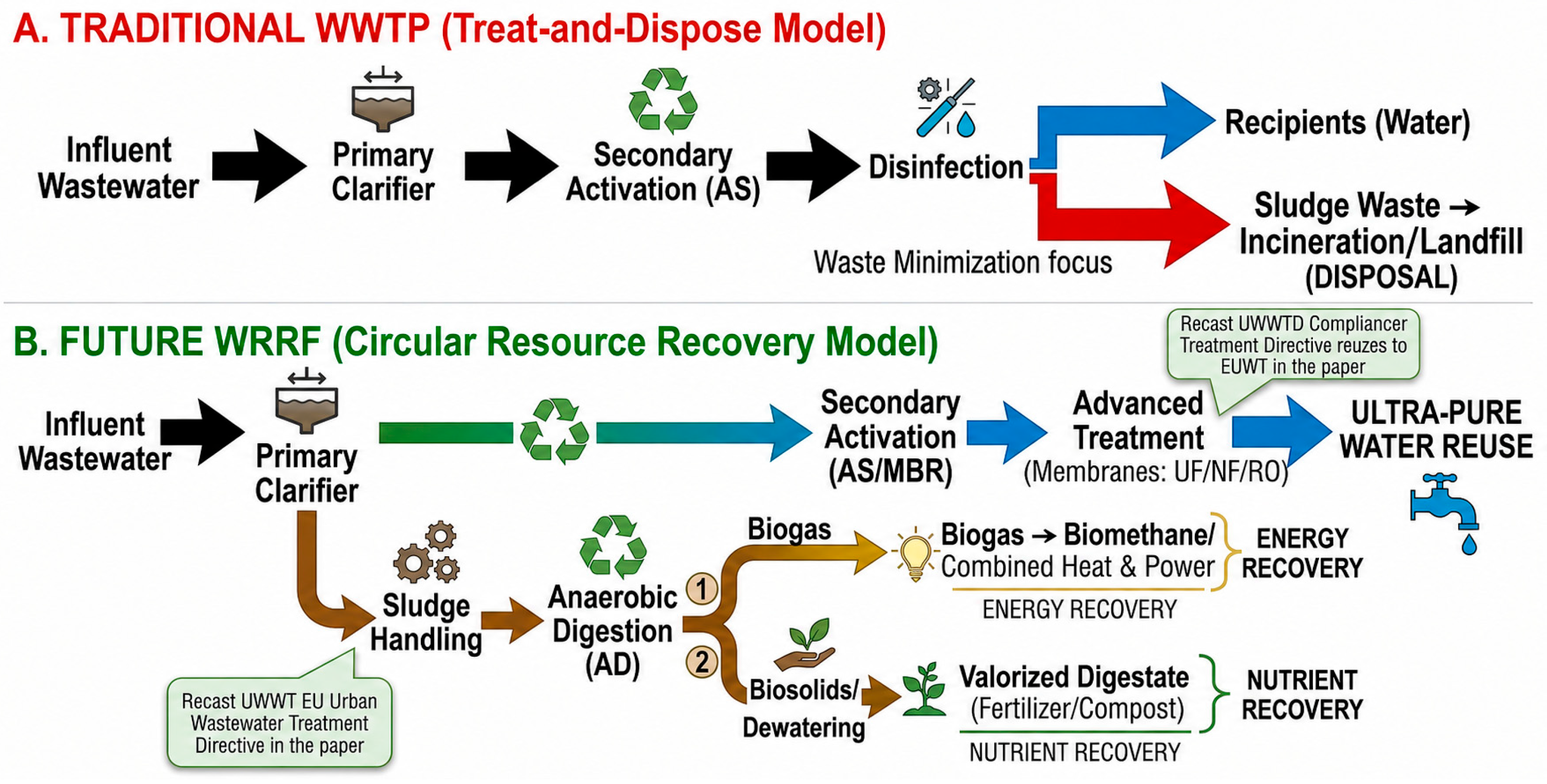
The conceptual shift from conventional treatment and disposal toward circular resource recovery is summarized in Figure 1.
It is important to recognize that the properties of sewage sludge, and therefore of the digestate produced after anaerobic digestion, depend strongly on influent origin and plant configuration. In municipal systems, urban wastewater can comprise different mixtures of domestic wastewater, non-domestic discharges, and urban runoff, while upstream industrial inputs and combined sewer conditions can substantially alter organic composition, inorganic content, contaminant profiles, and biodegradability [3,4]. Following anaerobic digestion, these differences remain reflected in the physicochemical characteristics of the resulting digestate, which condition its suitability for downstream nutrient recovery and membrane-based processing [6,7].
Despite its considerable resource potential, digestate presents substantial mechanical and hydrodynamic challenges for downstream separation. Digested sludge behaves as a complex non-Newtonian suspension whose apparent viscosity increases strongly with solids concentration, and its rheology is further shaped by treatment history and solids composition [8,9]. In parallel, extracellular polymeric substances (EPS) strongly influence floc structure, water retention, and sludge dewaterability [10]. EPS should not be treated as a single uniform fraction, because bound and soluble EPS have different implications for downstream processing. Bound EPS is commonly described as tightly bound EPS (TB-EPS), which is closely associated with cell surfaces and contributes to floc cohesion, and loosely bound EPS (LB-EPS), which forms a more hydrated outer layer affecting inter-floc interactions, water retention, and dewaterability [10,11]. In contrast, soluble EPS and soluble microbial products (SMPs) are free macromolecules in the bulk liquid phase, including proteins, polysaccharides, humic-like substances, and other cell- or hydrolysis-derived compounds [11,12]. These soluble and colloidal fractions are particularly relevant for membrane filtration because they can adsorb onto membrane surfaces, constrict or block pores, and promote gel-layer formation, thereby increasing hydraulic resistance in pressure-driven systems [12,13]. Pretreatment can therefore create a trade-off: disruption of bound EPS may support hydrolysis and alter dewaterability, but it may also increase the soluble biopolymer load available to foul downstream membranes. Anaerobic digestion effectively stabilizes organic matter and enables energy recovery; however, hydrolysis remains its principal biological bottleneck. This limitation necessitates pretreatment, which can subsequently complicate membrane separation if the digestate retains challenging rheological and colloidal properties [14].
In this context, membrane separation technologies have emerged as key enablers for digestate valorization. Pressure-driven membrane methods can be divided into clarification-oriented processes, such as microfiltration and ultrafiltration, and tighter separation processes, such as nanofiltration and reverse osmosis. In contrast, membrane distillation and electrodialysis represent advanced thermal and electrochemical membrane-based approaches that can support nutrient concentration, ammonia recovery, and high-quality water production from liquid digestate fractions [7,15,16,17]. Their performance and long-term stability are strongly governed by feedstock properties, especially viscosity, particle-size distribution, dissolved and colloidal organic matter, and ionic composition, all of which affect hydrodynamics, mass-transfer resistance, fouling, and scaling propensity [17,18,19].
Recent studies show that membrane-based digestate treatment is increasingly moving from single-unit demonstrations toward integrated treatment trains designed for specific recovery targets. In pressure-driven systems, ultrafiltration is commonly used to remove residual solids and colloids before nanofiltration or reverse osmosis, which can produce a reusable permeate and a nutrient-enriched concentrate for further fertilizer recovery [20]. Electro-driven separation has also gained attention. Pilot-scale work on the liquid fraction of digested sewage sludge has shown that inserting selective electrodialysis between ultrafiltration and reverse osmosis can improve fractionation of ammonium, phosphate, and potassium and increase clean-water recovery from approximately 38% to 88%, although performance remains sensitive to dissolved organic matter and fouling [21]. Membrane distillation has also been investigated for ammonia recovery from liquid digestate [22], while solar-driven and photothermal MD configurations are developing rapidly, although most reported applications still focus on saline rather than digestate-type feeds [23].
Taken together, recent membrane studies indicate that digestate valorization usually requires complementary unit operations rather than a single membrane process. Clarification, selective ion separation, nutrient concentration, ammonia recovery, and water reuse are normally achieved through staged systems whose performance depends strongly on feed conditioning, fouling control, and downstream product requirements [7,20]. These studies also highlight recurring implementation barriers, including colloidal and macromolecular fouling, scaling, energy demand, cleaning requirements, and the lack of long-term full-scale validation. It is therefore useful to examine membrane-based digestate valorization not only by membrane type, but also through the links between feedstock properties, pretreatment-induced changes, and downstream separation behavior.
Existing reviews have advanced the field considerably, but they tend to treat the relevant subjects in isolation. Digestate management, membrane-based nutrient recovery, membrane fouling, and sludge pretreatment are each the subject of dedicated reviews, yet relatively few works trace how upstream choices—feedstock origin, rheology, EPS and SMP release, and pretreatment severity—propagate forward into membrane flux, fouling and scaling behavior, energy demand, techno-economic implications, and scale-up constraints. As a result, conditioning decisions and downstream separation performance are often discussed separately rather than as a connected treatment train. This review addresses that gap by treating the pretreatment–membrane sequence as a single conditioning-to-separation pathway and by interpreting reported performance through that lens, while making clear where the supporting evidence is robust and where it remains fragmentary.
This review synthesizes recent advances in the pretreatment–membrane nexus, focusing on how digestate feedstock characteristics and pretreatment-induced transformations physically condition membrane separation performance. While selected pretreatment mechanisms are discussed using sludge-based literature where it provides transferable physicochemical insight, the review maintains a digestate-focused perspective and explicitly notes where extrapolation is uncertain. Thermal hydrolysis and microwave conditioning are treated as representative high-intensity pretreatments because they have an established empirical basis for increasing solubilization, modifying sludge rheology, and altering particle-size distributions prior to digestion and downstream separation [14,24,25]. For downstream separation, the review covers pressure-driven membranes, membrane distillation, and electrodialysis as complementary routes for water and nutrient recovery from liquid digestate fractions, with emphasis on sustainable-flux thinking, molecular fouling and scaling mechanisms, and process integration rather than isolated performance maxima [15,16,26].

2. Review Methodology and Literature-Selection Strategy

This review was prepared using a structured narrative approach. The aim was to identify and compare studies dealing with sludge digestate, liquid digestate fractions, digested sludge liquors, and related high-strength wastewater streams in which pretreatment and membrane-based separation were connected to resource recovery. A full meta-analysis was not considered appropriate because the available studies differ substantially in feedstock origin, solids content, pretreatment conditions, membrane type, operating mode, and reported performance indicators. Therefore, the review focused on comparing reported trends, mechanisms, performance ranges, and practical limitations rather than statistically pooling the results.
The literature search was carried out using Web of Science, Scopus, and ScienceDirect. Google Scholar was also used as a supplementary search tool to locate additional peer-reviewed papers and relevant institutional or regulatory documents. In addition, the reference lists of key review papers and highly relevant experimental studies were checked manually to identify further sources.
The search terms were selected to cover four main areas: feedstock type, pretreatment, membrane technology, and recovery performance. The main keywords included “sludge digestate”, “anaerobic digestate”, “liquid fraction of digestate”, “digested sludge centrate”, “membrane filtration”, “microfiltration”, “ultrafiltration”, “nanofiltration”, “reverse osmosis”, “electrodialysis”, “bipolar membrane electrodialysis”, “membrane distillation”, “thermal hydrolysis”, “microwave pretreatment”, “alkaline pretreatment”, “ozonation”, “extracellular polymeric substances”, “EPS”, “soluble microbial products”, “SMP”, “fouling”, “scaling”, “nutrient recovery”, “ammonium recovery”, “phosphorus recovery”, “potassium recovery”, “volatile fatty acids”, “rheology”, and “solubilization”. Search strings were built by combining feedstock terms with process and outcome terms using Boolean operators. For example, feedstock terms such as (“sludge digestate” OR “anaerobic digestate” OR “liquid fraction of digestate” OR “digested sludge centrate”) were combined with membrane terms such as (“membrane filtration” OR “microfiltration” OR “ultrafiltration” OR “nanofiltration” OR “reverse osmosis” OR “electrodialysis” OR “bipolar membrane electrodialysis” OR “membrane distillation”) and recovery or performance terms such as (“nutrient recovery” OR “ammonium recovery” OR “phosphorus recovery” OR “potassium recovery” OR “volatile fatty acids” OR “fouling” OR “scaling”) using the operator AND. This approach was used to capture studies linking feedstock characteristics, pretreatment effects, membrane performance, fouling behavior, and recovery outcomes.
The search covered literature published from 2000 to June 2026, which was the final search date used during manuscript revision. Particular attention was given to studies published from 2010 onward, because most digestate-specific membrane studies and resource-recovery-oriented membrane applications have been reported during the last decade. Earlier studies were included when they provided important mechanistic background, such as resistance-in-series modeling, concentration polarization, critical flux, EPS characterization, or general membrane fouling theory.
Studies were included when they addressed at least one of the main topics of the review: sludge or digestate characterization; pretreatment-induced changes in rheology, particle-size distribution, solubilization, or EPS/SMP release; membrane treatment of digestate, sludge liquor, centrate, or comparable high-strength streams; fouling and scaling behavior; nutrient or water recovery; energy demand; or implementation challenges. Studies reporting quantitative indicators such as permeate flux, recovery efficiency, fouling resistance, solubilization degree, particle-size reduction, specific energy consumption, or operational stability were prioritized. Pilot-scale and full-scale studies were preferred where available, while laboratory-scale studies were included when they provided relevant mechanistic or quantitative information.
Studies were excluded when they focused on matrices unrelated to sludge, digestate, wastewater treatment, or resource recovery, unless they provided clearly transferable mechanistic insight. Papers were also excluded when the membrane or pretreatment process was outside the scope of the review, when only an abstract was available, or when the available information was insufficient to evaluate relevance to digestate or sludge-derived liquid streams. Non-peer-reviewed sources were used only for regulatory, market, or implementation context and were not treated as primary evidence for membrane performance.
The screening was performed in sequential steps. Records were first screened based on title, keywords, and abstract to exclude clearly irrelevant studies. Potentially relevant records were then assessed through full-text reading, with priority given to studies that provided quantitative performance indicators, digestate-relevant operating conditions, or mechanistic evidence linking pretreatment, feed characteristics, membrane behavior, and recovery outcomes. Final inclusion was based on relevance to the review scope and the availability of sufficient methodological or performance information.
The selected literature was organized according to feedstock characteristics, pretreatment effects, membrane technology, fouling and scaling mechanisms, nutrient-recovery potential, energy demand, and implementation constraints. Because this review was designed as a structured narrative review rather than a formal systematic review, the literature-selection process was not intended to provide a complete PRISMA-type record count. Instead, the selection focused on identifying studies that were directly relevant to the pretreatment–membrane nexus and that provided either quantitative performance indicators or mechanistic insight applicable to sludge digestate, liquid digestate fractions, digested sludge liquors, and comparable high-strength wastewater streams. This approach helped identify comparable performance indicators across membrane technologies and pretreatment strategies, while also showing where standardized reporting, long-term operation, and full-scale validation are still limited.

3. The Impact of Pretreatment on Digestate Rheology and Chemistry

The effectiveness of sludge valorization and downstream resource recovery is fundamentally governed by the physical and chemical state of the feedstock. Pretreatment technologies act as a critical conditioning lever by modifying sludge structure to alleviate hydrolysis limitations, enhance mass transfer, and prepare the resulting digestate and liquid fractions for solid–liquid separation and membrane-based recovery processes. From an engineering perspective, the principal pretreatment targets are (i) reducing apparent viscosity and yield stress to improve pumping, mixing, and hydraulic performance; and (ii) promoting controlled solubilization of particulate chemical oxygen demand (COD) to increase bioavailability and conversion efficiency, while recognizing that excessive release of soluble biopolymers can increase the fouling burden in downstream membrane treatment [27,28,29,30,31,32]. A comprehensive overview of how thermal, microwave, chemical, and related pretreatment technologies affect digestate rheology and downstream membrane performance is summarized in Table 1.
Pretreatment mechanisms observed in thickened sludge prior to digestion remain highly relevant for downstream processing. Specifically, pretreatment-induced EPS disruption, solubilization, and rheological shifts dictate the properties of the digested slurry and the final composition of the dewatered liquid fraction [24,28]. Importantly, “solubilization” is not adequately described by COD alone: thermal pretreatment can differentially increase soluble proteins, soluble carbohydrates/polysaccharides, and other EPS- or cell-derived macromolecules [33,34,35]. This distinction matters for membranes because an increase in soluble biopolymers may improve biodegradability while simultaneously increasing the organic-fouling propensity of downstream UF/NF/RO treatment of digestate liquors [11,31,32].

3.1. Rheological Framework

Digestate and sludge suspensions are typically non-Newtonian, commonly exhibiting shear-thinning behavior, an apparent yield stress, and, in many cases, thixotropy. For engineering description, flow behavior is frequently represented using the Herschel–Bulkley model [36,37]:
τ = τ 0 + K γ . n
where τ is shear stress, τ0 is yield stress, K is the consistency index, γ . is shear rate, and n is the flow behavior index (n < 1 for shear-thinning). Pretreatment-induced disruption of flocs and EPS networks often reduces τ0 and K and may shift n toward more Newtonian-like behavior, which improves pumpability and mixing at a given solids content [36,37]. These bulk rheological changes are important for digester operation and for hydraulic conditions upstream of dewatering and membrane treatment. However, improved bulk rheology does not automatically imply improved separability, because membrane performance is frequently constrained by colloidal and soluble-biopolymer loading, concentration polarization, and specific fouling mechanisms rather than by viscosity alone [13,26,32].

3.2. Thermal Hydrolysis Pretreatment (THP)

Thermal Hydrolysis Pretreatment (THP) is among the most widely implemented full-scale pretreatment options for advanced sludge conditioning prior to anaerobic digestion. The process typically heats dewatered or thickened sludge to elevated temperatures, commonly around 150–170 °C, under pressure for short residence times, followed by rapid depressurization; the exact operating window depends on the process configuration and plant objectives [28,38]. The combined effect of temperature, pressure, and decompression promotes cell disruption and weakens the gel-like EPS network that stabilizes flocs and retains water [24,39]. Beyond SCOD release, THP commonly increases soluble protein and carbohydrate fractions, reflecting disruption of cellular and EPS-bound macromolecules [11,33,34,35].

Mechanisms of Solubilization and Rheological Transformation

A central mechanism underlying THP performance is the conversion of particulate COD into soluble COD (SCOD), driven by thermal lysis of microbial structures and partial hydrolysis of EPS and cell-associated polymers [24,28]. As cellular structures rupture and EPS matrices are disrupted, water previously bound within flocs and EPS is released to the bulk liquid phase, and the cohesive strength of the particulate network decreases [11,39]. These transformations shift the suspension from a more structured, yield-stress material toward more fluid behavior, consistent with reduced τ 0 and K and a higher flow-behavior index in Herschel–Bulkley fits reported for thermally treated sludge [36,37].
In practice, THP is frequently associated with some of the largest viscosity reductions among pretreatment options, although the magnitude depends strongly on sludge type, solids content, treatment severity, and measurement conditions [38]. Lower viscosity and yield stress are operationally valuable because they improve pumping and mixing and can support higher-solids digestion with lower hydraulic penalties [24,38]. At the same time, THP-driven increases in soluble proteins and polysaccharides are directly relevant for downstream separation because these fractions can act as important foulants or foulant precursors in pressure-driven membrane systems [11,31,32].

3.3. Implications for Dewaterability and Downstream Membrane Processes

3.3.1. Dewaterability

THP can substantially improve dewaterability by releasing bound water and disrupting the highly retentive EPS-structured matrix that otherwise confines water within flocs. At plant scale, this is operationally important because higher cake dry solids directly reduce the mass of material requiring transport, handling, and final disposal [24,40]. Reported outcomes remain matrix- and equipment-dependent, but THP generally improves dewatered cake solids relative to conventional digestion and simultaneously changes the quality of the centrate/reject water [40]. THP also redistributes organic matter toward the liquid phase: in a study of thermally pretreated secondary sludge, about 30% of particulate organic matter and roughly 34% of the VS feeding were shifted to the liquid fraction, which then contributed nearly half of the methane produced after fraction-specific digestion [41]. For integration with membrane recovery, this creates a clear trade-off: improved solids reduction and handling on the one hand, but a more concentrated load of soluble and colloidal foulants in the liquid phase on the other [31].

3.3.2. Thermal Severity and Refractory Organics

A further integration issue is that increasing THP severity can promote the formation of colored and more refractory dissolved organics, often described as melanoidin-like Maillard products formed from reactions between amino compounds and reducing sugars [35,42,43]. Product-color studies have shown that lower hydrolysis temperatures can reduce color formation without sacrificing degradability, while full-scale THP reject waters have been reported to contain elevated melanoidin-related signals that can affect downstream polishing and nutrient-recovery processes [42,43]. For membrane-based polishing, this indicates that THP should be treated as a tunable conditioning step rather than as a uniformly beneficial front-end process: higher solubilization can aid digestion, but it can also increase the burden of organic fouling and its coupling with inorganic scaling, which makes severity optimization and staged pretreatment essential [31,32,44].
For digestate-derived liquids, it is technically useful to distinguish the dominant fouling/scaling mechanisms:
  • reversible cake-layer formation (suspended solids);
  • pore blocking and adsorptive organic fouling (soluble proteins/polysaccharides);
  • inorganic scaling/precipitation (e.g., carbonate/phosphate minerals and struvite);
  • biofouling (microbial attachment and EPS formation).
These mechanisms can be coupled, and concentration polarization often accelerates the onset of persistent layers [11,13,26].
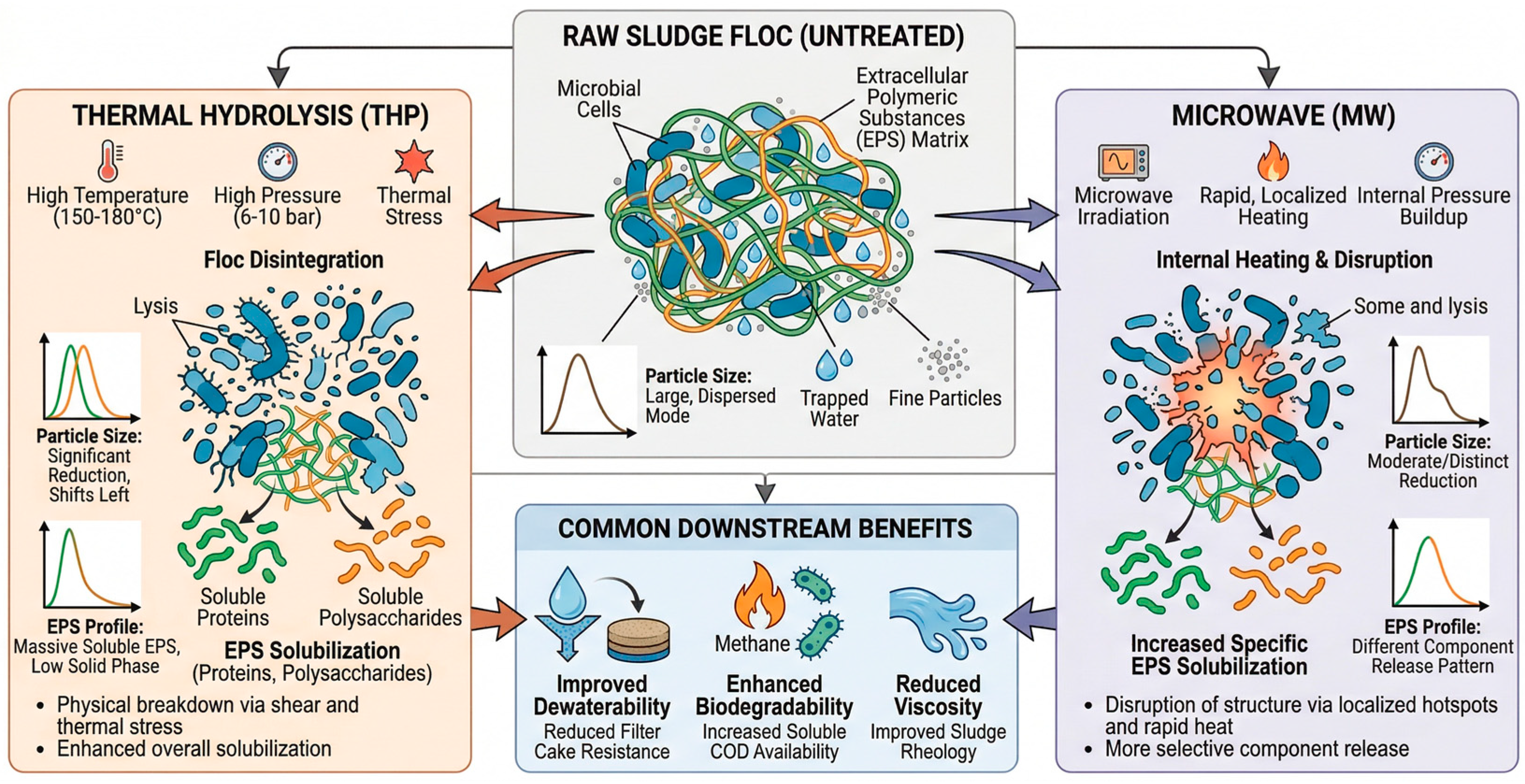
The relationship between pretreatment-induced EPS/SMP release, soluble foulant formation, and downstream membrane fouling is illustrated in Figure 2.
Table 1. Impact of Pretreatment Technologies on Digestate Rheology and Membrane Performance.
Pretreatment TechnologyPrimary MechanismExpected Rheology EffectLikely Shift in Liquid Fraction ChemistryMembrane-Relevant Implications (Tight UF/NF/RO Treating Dewatering Liquors)Reference
Thermal hydrolysis (THP)Heat + pressure + rapid decompressionStrong reduction in yield stress/consistency; improved pumpability↑ SCOD; ↑ soluble proteins/polysaccharides; possible refractory dissolved organics at high severityHigher hydraulic operability; trade-off: ↑ biopolymer-driven organic fouling risk; severity-dependent persistent dissolved organics may worsen NF/RO fouling[24,28,33,34,38]
Microwave irradiation (MW)Dielectric heating (dipole rotation + ionic conduction); rapid volumetric heating; floc/cell disruptionOften decreases apparent viscosity (matrix-dependent); may create finer PSD and reduce floc strength↑ solubilization (SCOD) and release of soluble biopolymers/SMP; ↑ fine colloids; potential increase in soluble proteins/polysaccharidesTrade-off: improved disintegration/solubilization but ↑ risk of pore blocking/gel formation due to fines and biopolymers; often needs staged clarification (MF/UF) before tight NF/RO; fouling sensitivity strongly severity- and matrix-dependent[13,25,45,46,47]
Alkaline hydrolysispH-induced solubilization; EPS weakeningVariable: can reduce yield stress but depends on dose and neutralization↑ solubilization; ↑ ionic strength; pH shiftCan increase scaling/precipitation tendency and change charge interactions; requires pH/alkalinity and hardness management for membranes[33,39]
OzonationOxidative degradation of organics/EPSOften improves filterability (case-dependent)Oxidation of soluble/colloidal organics; altered biopolymer characteristicsPotential reduction in high-fouling fractions if dosed correctly; overdosing may increase smaller soluble organics and shift fouling behavior; dose-sensitive[14,48,49]
Enzymatic/biological conditioningTargeted polymer hydrolysisUsually modest alone unless combinedSelective conversion of specific polymersPotential benefits if it reduces problematic biopolymers; feasibility constrained by cost/robustness and matrix variability[11,14]

3.4. Microwave Irradiation (MW): Particle Size and Solubilization Risks

Microwave (MW) pretreatment (as outlined in Table 1) applies electromagnetic radiation, typically at 2.45 GHz in laboratory and industrial systems, to deliver energy volumetrically into high-water matrices such as thickened sludge and digestate slurries [25,46]. In contrast to conventional conductive heating, which is limited by wall heat transfer and boundary-layer resistance, MW heating is governed by dielectric mechanisms, primarily (i) dipolar rotation of polar molecules and (ii) ionic conduction driven by dissolved ions and charged species [45,46]. Consequently, MW performance is highly sensitive to moisture content, ionic strength, solids concentration, and penetration depth, which together influence heating uniformity, localized hot-spot formation, and the extent of floc and cell disruption [25,46].

3.4.1. Athermal vs. Thermal Effects

Current literature debates whether MW irradiation induces “athermal” effects—namely, changes attributable to the electromagnetic field itself rather than to localized heating. In practice, separating field effects from rapid localized heating is difficult because sludge and digestate are heterogeneous materials with non-uniform dielectric properties and micro-scale temperature gradients. Most synthesis literature therefore treats temperature–time severity and energy input as the dominant, reproducible predictors of solubilization outcomes, while acknowledging that some comparative studies report differences between MW and conventional heating at similar bulk temperatures [25,45,46]. For process design, MW pretreatment is therefore best interpreted as a dielectric-heating method whose practical outcomes are governed mainly by measurable operating variables—temperature, power density, exposure time, solids fraction, and ionic strength—rather than by assuming field-specific biological effects.

3.4.2. The Particle Size Paradox

A defining characteristic of MW pretreatment is strong fragmentation of sludge flocs. Fragmentation increases the specific surface area and can improve accessibility of particulate organics for hydrolysis and fermentation, but it also increases the fraction of fine particles and colloids that are prone to pore entry, pore blocking, and formation of more persistent deposits than a looser surface cake layer [13]. This trade-off is particularly relevant when MW is used upstream of membrane trains, where irreversible fouling risk is often governed by the fine and colloidal fraction rather than by bulk suspended solids. A clear empirical example is summarized in Table 2. Although the cited dataset was generated using raw waste activated sludge before anaerobic digestion, it remains relevant here because it quantifies the structural responses expected after severe MW conditioning: increased solubilization, collapse of the particle-size distribution, and deterioration of dewaterability [47].
The dataset in Table 2 illustrates a clear engineering trade-off. Under MW disintegration at 80 °C with a slow ramp rate, soluble COD increased from 88.5 to 2380 mg/L, d50 decreased from 228 to 45 µm, d90 decreased from 368 to 73 µm, and sludge filter resistance (SFR) increased from 1.02 × 10¹³ to 2.15 × 10¹⁴ m/kg, indicating markedly poorer dewaterability [47]. For membrane integration, this shift in particle-size distribution is significant because it can move the dominant resistance contribution from largely reversible cake filtration toward more persistent pore-scale deposition and internal blocking once the colloidal fraction becomes dominant [13]. As a conservative design implication, MW pretreatment intended to enhance solubilization should be paired with an appropriately selected upstream barrier step, such as MF/UF or equivalent solids management, before tighter membranes are applied, rather than assuming that MW-generated fines can be managed by hydraulics alone [50].

3.5. Chemical and Biological Pretreatment Nuances

While thermal and microwave pretreatments are often discussed in the context of improving biodegradability and hydrolysis kinetics, chemical and biological pretreatments can be advantageous when the process objective is targeted solubilization, for example in VFA-oriented schemes, or selective alteration of biopolymer characteristics relevant to membrane fouling [11,14].

3.5.1. Alkaline Pretreatment

Alkaline pretreatment, which presents distinct scaling risks (Table 1), typically involves increasing pH, commonly to approximately 10–12, using bases such as NaOH or CaO. Mechanistically, alkaline conditions ionize functional groups and disrupt intermolecular interactions within EPS and floc structures, promoting deflocculation and release of particulate organics into the soluble phase [11,29]. Alkaline dosing can increase COD solubilization and is frequently used in schemes aimed at promoting hydrolysis and, under controlled configurations, VFA accumulation; however, achievable outcomes remain strongly feedstock- and configuration-dependent [14,51].
From a membrane perspective, a critical constraint is that alkaline dosing increases ionic strength and can elevate the precipitation potential of carbonate- and phosphate-bearing salts. In digestate-type streams, higher pH has been associated with greater CaCO3 formation potential, while membrane processing of manure and digestate liquid fractions is known to be vulnerable to inorganic foulants containing calcium, phosphorus, and magnesium [50,52]. Practically, alkaline pretreatment is therefore best positioned as an upstream conditioning lever followed by explicit pH and scaling management before tight-membrane recovery stages.

3.5.2. Ozonation

Ozonation is an oxidative pretreatment that can disrupt cell envelopes and oxidize EPS constituents and other biopolymers, thereby altering sludge structure and downstream filtration behavior [14,48]. It can also provide a disinfection benefit: sludge ozonation has been shown to reduce viable bacterial populations, although the extent of inactivation is dose-dependent rather than universal [53]. Reported studies further indicate that carefully controlled ozone dosing can modify filterability and, in digestate-liquid applications, can substantially improve ultrafiltration performance; under-stoichiometric ozonation increased UF flux by approximately 50–80% in laboratory and pilot operation, consistent with partial oxidation of biopolymer-associated resistance [49,54].
At the same time, ozonation is non-selective and energy-intensive, and excessive dosing can over-fragment organics into smaller soluble fractions rather than universally improving filtration behavior [14,54]. Residual ozone also poses a materials-compatibility risk for polymeric membranes. Long-term ozone exposure has been shown to alter membrane pore structure and permeability and to seriously degrade supported polymeric UF membranes, particularly the PET support layer in PVDF/PET materials [55]. Ozonation should therefore be treated as a tightly controlled conditioning step rather than as a universally beneficial pre-oxidation [14,49].

3.5.3. Enzymatic Hydrolysis

Enzymatic pretreatment, for example using proteases and glycosidases, offers a more targeted approach to modifying EPS and can, therefore, reduce gel-layer tendency and interfacial “stickiness” without generating the fine inorganic colloids often associated with aggressive physical fragmentation. However, enzymatic effects are substrate-specific, reaction kinetics can be slower than in physicochemical methods, and operating costs remain a major practical constraint, which limits deployment to cases where selectivity or downstream performance gains justify the expense [11,14]. To synthesize the comparative effects of these physical and chemical conditioning methods, Table 3 outlines their expected rheological and solubilization shifts alongside their conceptual implications for downstream membrane flux.

3.6. Combined Pretreatment Strategies and Their Implications for Membrane Performance

Single pretreatment methods are increasingly applied in combination because pairing a physical, thermal, or oxidative step with chemical conditioning can enhance sludge disintegration and solubilization more effectively than either step alone. For waste activated sludge, low-temperature thermo-alkaline treatment (0–0.2 M NaOH, 60–90 °C) has been reported to achieve sludge disintegration of up to approximately 75.6% and methane production increases of up to about 70.6% compared with untreated controls [56]. Microwave–alkaline treatment has also shown synergistic behavior: at approximately 85 °C and pH 12, COD solubilization reached about 46%, exceeding the value expected from the additive effects of microwave-only and alkaline-only treatments, approximately 26.5% [57]. Similarly, simultaneous ultrasonic–alkaline treatment of sewage sludge increased soluble COD from approximately 1200 to 11,000 mg/L, indicating strong solubilization of organic material [58]. These results demonstrate the potential of combined pretreatments to intensify hydrolysis and organic-matter release, although most evidence is based on raw or thickened sludge before digestion rather than on digestate liquors; therefore, the reported magnitudes should not be transferred directly to membrane treatment of digestate.
From a membrane perspective, the same solubilization effect can become a drawback if it increases the load of soluble and colloidal foulants. In the ultrasonic–alkaline study, the fraction of high-molecular-weight organics (>300 kDa) increased from approximately 7.8% to 42.3%, and the dominant products were reported as SMP-like and humic-like substances [58]. Such macromolecular fractions are closely related to gel-layer formation, adsorption, and pore blocking in pressure-driven membrane systems [11,13]. Combined pretreatments can therefore shift part of the foulant burden from particulate-bound material toward soluble biopolymers and fine colloids, making clarification or solid–liquid separation important before UF/NF/RO or other tighter membrane stages [13,31,59]. In contrast, oxidative combinations may improve membrane performance when carefully controlled; for example, under-stoichiometric ozonation coupled with ultrafiltration of anaerobic digestate has been reported to increase UF flux by approximately 50–80%, although excessive oxidation may produce smaller, more mobile organics and can also raise membrane-material compatibility concerns [49,54]. Combined pretreatments should therefore be evaluated as part of integrated pretreatment–separation trains rather than as universally beneficial front-end steps.
A recurring limitation across these studies is that pretreatment intensity and downstream membrane behavior are rarely measured on the same feed: solubilization and disintegration gains are typically quantified on raw or thickened sludge, whereas the fouling, scaling, and flux consequences appear later and often in separate experiments. Establishing this severity–fouling link on the same digestate, rather than inferring it across studies, remains one of the clearer gaps in rational selection of pretreatment–membrane trains.

4. Membrane-Based Valorization: Technologies and Performance

The drive to deploy advanced separation technologies is increasingly underpinned by stricter legislative frameworks. Notably, the revised European Union Urban Wastewater Treatment Directive (UWWTD) entered into force on 1 January 2025 and strengthens nutrient-removal and resource-recovery requirements, introduces quaternary treatment for micropollutant control, and pushes the sector toward energy and climate neutrality [4]. Within this regulatory context, membrane operations can support digestate valorization and statutory compliance primarily by (i) fractionating the liquid fraction of digestate into clarified permeate and concentrate streams, (ii) concentrating nutrients to reduce downstream chemical demand and transport volumes, and (iii) creating “process-ready” streams for targeted recovery steps such as struvite crystallization, ammonia recovery, or electro-driven separation. In most practical flowsheets, membranes do not recover nutrients as discrete products on their own; rather, they enable controlled concentration and separation, after which nutrients are recovered through precipitation, stripping/absorption, or electrochemical processes, depending on the intended product and site-specific constraints [7,17].
In this review, digestate refers to anaerobically digested residues (e.g., agricultural/manure co-digestates or municipal digestates). The liquid fraction of digestate (LFD) refers to the liquid stream obtained after mechanical solid–liquid separation (e.g., screw press or decanter centrifuge). Where municipal WWTP practice is discussed, the analogous stream is the dewatering liquor/centrate from digested sludge. These streams often share high ammoniacal nitrogen and dissolved salts, but they can differ substantially in solids content, colloidal load, organic matter composition, and scaling propensity; therefore, reported membrane performance should always be interpreted in the context of feed characterization and pretreatment history [7,59,60].

4.1. Pressure-Driven Membrane Processes (MF, UF, NF, RO)

Pressure-driven membranes form the backbone of many digestate-treatment trains and are commonly arranged in cascades so that the feed is clarified first and the dissolved fraction is subsequently concentrated or polished [17,61]. A comparative analysis of these individual membrane technologies is provided after the individual process descriptions.
Across studies and practical designs, MF/UF typically serve as front-end clarification steps that remove suspended solids and colloids and protect tighter downstream membranes from rapid fouling, whereas NF/RO are generally deployed later to concentrate dissolved nutrients and salts and to produce a low-turbidity, reusable permeate. However, tighter membranes are more sensitive to scaling and generally entail a higher energy demand than MF/UF [7,61,62].

4.1.1. Key Performance Metrics and Governing Relations (Flux, Fouling, Polarization)

For pressure-driven membranes, the primary operational metric is the permeate flux (J, e.g., L m−2 h−1). Before linking pretreatment to membrane performance, concentration polarization (CP) should be defined clearly. CP is the accumulation of rejected solutes and colloids in a boundary layer adjacent to the membrane surface during filtration. This accumulation reduces the effective driving force and, in NF/RO, increases local osmotic pressure; it can also accelerate the transition toward gel or cake formation and thereby contribute to flux decline [26,63].
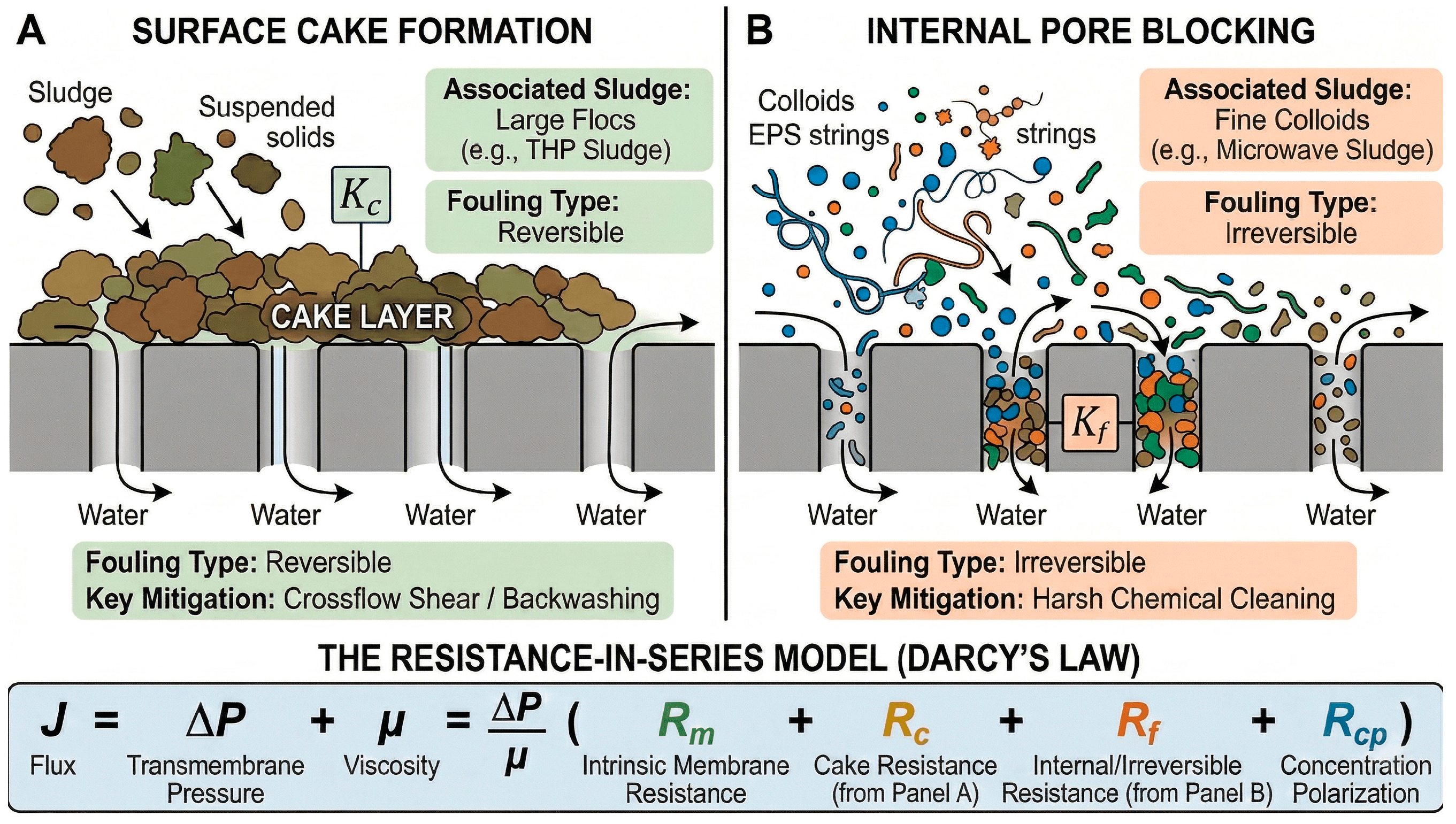
The influence of pretreatment on membrane operation can be quantified using the resistance-in-series model for permeate flux:
J = ΔP/[μ(Rm + Rc + Rf + Rcp)]
where J is permeate flux, ΔP is transmembrane pressure, μ is dynamic viscosity, and the denominator represents the overall hydraulic resistance (Rtotal). To fully capture the dynamics of digestate filtration, it is best to express this overall resistance as a sum of its many different forms, typically written as Rtotal = Rm + Rc + Rf + Rcp [26,64]. In this expanded framework, Rm is the intrinsic membrane resistance, Rc is the reversible cake layer resistance from suspended solids, Rf accounts for persistent internal pore blocking and adsorption by biopolymers [13], and crucially, Rcp represents the specific, dynamic resistance caused by the concentration polarization boundary layer [26]. In highly complex fluids like digestate, these individual resistances compound rapidly; concentration polarization (Rcp) not only acts as its own barrier to flux but also serves as a trigger for supersaturation (inorganic scaling) and the transition toward irreversible fouling [13,26,64].
For NF/RO, water flux is commonly represented by the solution-diffusion form:
NF/RO (net driving force):
Jw = A(ΔPΔπ)
where A is water permeability, ΔP is applied pressure difference, and Δπ is the osmotic pressure difference across the membrane [26].
For concentration polarization, a commonly used boundary-layer expression (for strongly retained solutes) illustrates how increasing flux can exponentially increase near-surface concentration:
Cw = Cb · exp(J/k)
where Cw is solute concentration at the membrane surface, Cb is bulk concentration, and k is the mass transfer coefficient [26,63]. This helps explain why bulk-viscosity reductions alone do not guarantee improved membrane performance: even if improved hydraulics increase (k), increases in soluble biopolymers and fine colloids can still intensify irreversible fouling and CP-related gel formation in downstream tight-membrane stages [11,13,63].
The main hydraulic-resistance components governing membrane flux are summarized schematically in Figure 3.
Finally, the critical flux concept is useful for digestate/LFD because operation above a system-specific critical flux can trigger rapid and partly irreversible fouling: below Jc fouling is limited or largely reversible; above Jc irreversible fouling accelerates [13,65]. In digestate applications, these relations emphasize why front-end clarification (to reduce foulant load), hydrodynamic control (to increase k), and conservative flux targets relative to Jc are typically decisive for stable operation [7,13].
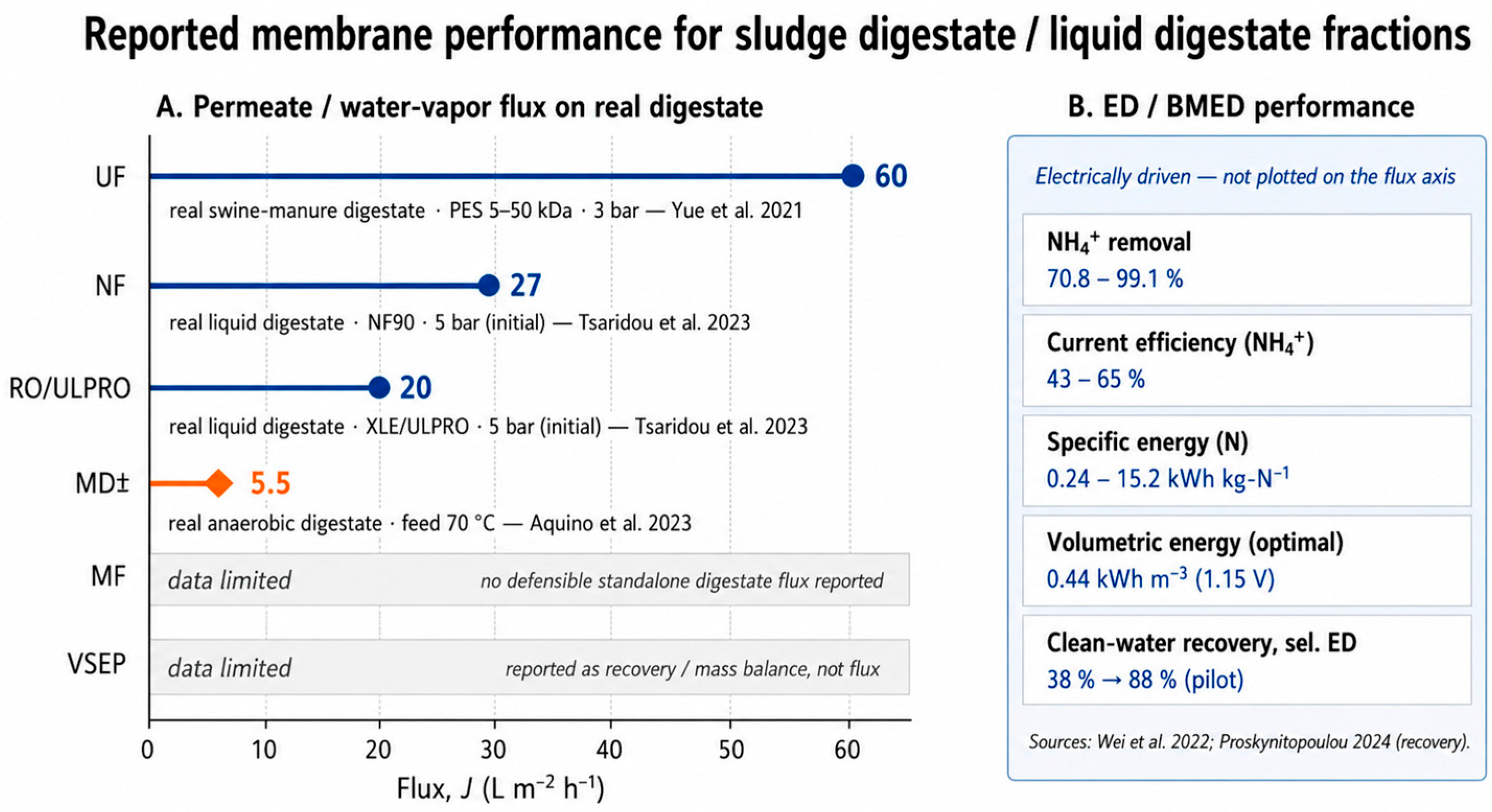
Reported performance values for membrane treatment of digestate-type streams are summarized in Table 4 and Figure 4 to make the quantitative basis of the technology comparison more explicit. The values should be interpreted as indicative operating points rather than universal performance limits, because flux and recovery depend strongly on feed composition, pretreatment, membrane material, transmembrane pressure, temperature, cross-flow velocity, and operating scale. Where digestate-specific hydraulic flux values are not consistently reported, this limitation is shown explicitly rather than replaced by non-comparable recovery or mass-balance data.
The comparison highlights that the highest reported real-feed flux among the selected pressure-driven examples is associated with UF, whereas NF and RO/ULPRO show lower initial fluxes under comparable real-liquid-digestate testing conditions. This ranking is consistent with increasing membrane selectivity and greater susceptibility to concentration polarization, organic fouling, and scaling. MD operates in a similar numerical range but is driven by a thermal gradient rather than hydraulic pressure, so its value should be interpreted separately. ED/BMED is excluded from the flux axis because its performance is governed by ion transport and energy efficiency rather than hydraulic permeation. This distinction is important for avoiding misleading cross-technology comparisons and for identifying where the literature still lacks standardized reporting.

4.1.2. Microfiltration (MF) and Ultrafiltration (UF)

MF (typical pore size ~0.1–10 μm) and UF (~0.001–0.1 μm) remove suspended solids, bacteria, and macromolecular/colloidal fractions [7]. In digestate treatment trains, their main role is foulant management: reducing turbidity, colloids, and EPS-associated material that can drive rapid flux decline in NF/RO and electrodialysis stacks [7,11,13]. Practically, MF/UF split organics and nutrients across phases: particulate-bound phosphorus and solids-associated contaminants largely follow concentrates, while a substantial fraction of ammonium remains in the permeate and can be addressed by downstream selective steps (e.g., electrodialysis, RO) [17].

4.1.3. Nanofiltration (NF): Selective Fractionation

NF (nominal MWCO ~200–1000 Da) is often positioned after UF to retain multivalent ions and part of the dissolved organics while allowing partial passage of monovalent ions, depending on membrane charge and operating conditions [7]. For digestate/LFD, NF can serve as an intermediate concentrator that reduces the load on RO and can increase selectivity in multi-stage nutrient recovery flowsheets. However, because LFD contains scaling-prone ions (e.g., Ca2+, Mg2+, carbonate/phosphate) and residual organics, NF is typically constrained by scaling control (pH management/antiscalants) and conservative flux targets to limit CP-driven supersaturation [7,26].
Comparison with non-membrane nutrient recovery technologies
It is useful to benchmark membrane trains against established non-membrane options:
  • Struvite crystallization can achieve high phosphorus capture when chemistry is favorable (sufficient Mg2+, pH control), but performance depends strongly on competing ions, alkalinity, and the fraction of P that is particulate-bound before crystallization [60];
  • Air/steam stripping with acid absorption is a mature route for ammonia recovery as ammonium sulfate/nitrate; however, it requires heat and/or pH elevation and is sensitive to solids-related fouling in packed columns unless robust pre-separation is used [68,69,70];
  • In practice, membrane clarification (MF/UF) is frequently positioned as an enabling step for these non-membrane recoveries (e.g., reducing solids before stripping or precipitation) rather than as a competing pathway [7,68].

4.1.4. Reverse Osmosis (RO): Total Concentration

RO is typically used as a final polishing/concentration step to produce reusable water and a nutrient-rich concentrate. Because RO rejects most dissolved salts and organics, it can deliver high-quality permeate, but this comes with a higher sensitivity to scaling and an energy penalty compared with MF/UF. As a result, RO for digestate is usually deployed only after rigorous front-end solids removal (often MF/UF) and often with additional ion-selective or scaling-control measures [17,61,62].

4.1.5. Shear-Enhanced Processing (VSEP)

Vibratory shear-enhanced processing (VSEP) imposes oscillatory shear at the membrane surface to suppress cake build-up and delay flux decline. In highly loaded digestate or pig-slurry streams, this operating mode can make membrane concentration feasible where conventional operation would require much more conservative fluxes. However, VSEP does not remove the need for scaling control in tight membranes, and performance remains strongly feed-specific; published digestate and pig-slurry studies therefore position VSEP as a robust option for difficult solids-rich feeds rather than as a universal cure for fouling [13,71,72]. Table 5 summarizes the driving forces, typical roles, and main constraints of VSEP alongside the standard pressure-driven and electrochemical membrane systems.

4.2. Electrodialysis (ED) and Bipolar Membrane Electrodialysis (BMED)

Electrodialysis uses ion-exchange membranes to drive selective ion transport under an electric field and, in digestate treatment, is most defensible after clarification steps such as MF/UF or equivalent solids removal. In practice, this positioning is important because upstream solids and dissolved-organic reduction lowers the risk of spacer clogging and ion-exchange-membrane fouling during longer operation. Accordingly, recent pilot digestate treatment trains have placed selective ED after membrane clarification and before final RO polishing for water reuse and nutrient concentration [19,21,73,76,77].
Mechanisms and Selective Recovery
  • Nitrogen (NH4+): Ammonium is a favorable ED target because it remains in dissolved form in clarified liquid fractions and can be transferred into a concentrate stream. In pilot-scale digestate treatment, selective ED recovered substantial ammonium and potassium from clarified feed; however, whole-train mass balances show that upstream membrane steps can still divert a significant share of ammonium to side concentrates, so ED recovery must be interpreted at process level rather than stack level alone [21,77];
  • Phosphorus: In digestate, phosphorus recovery by ED is typically more constrained than ammonium recovery because phosphate can be partitioned earlier in the treatment train. In pig-manure digestate, most phosphate was retained in coarse-filtration and ultrafiltration fractions before ED/RO polishing, leaving a comparatively smaller soluble phosphorus load available for electro-driven recovery downstream [17];
  • Carboxylates (VFAs): Recovery of dissociated short-chain carboxylates has been demonstrated most clearly in manure-derived liquors when ED is coupled with bipolar membranes, rather than in simple nutrient-concentration ED alone. Even in those systems, selectivity and product purity remain strongly dependent on feed composition, competing ions, and membrane fouling, so VFA claims for real digestate should be presented conservatively unless feed-specific stack data are available [19,78,79].

Bipolar Membrane Electrodialysis (BMED): Acid/Base Valorization

Bipolar Membrane Electrodialysis (BMED) advances standard ED by incorporating bipolar membranes that dissociate water molecules at the membrane interface into protons (H+) and hydroxide ions (OH) under an electric field. This enables in situ conversion of salt streams into corresponding acids and bases and is therefore attractive when carboxylate salts or nutrient salts must be transformed into more directly usable products [73,78,79].
  • Process Utility: In manure hydrolysate systems, BMED has been used to recover ammonium, phosphate, and VFAs while simultaneously generating acid and base streams. For VFA valorization, the key advantage is not only concentration, but acidification of the carboxylate stream; in principle, this can reduce downstream chemical demand if the regenerated base is internally reused elsewhere in the treatment train [78,79];
  • Performance: Verified manure-related BMED studies support the technical feasibility of this route, but the exact recovery efficiency, product purity, and specific energy demand vary strongly with membrane configuration, current density, and feed composition. It is therefore more accurate to describe BMED here as a promising enabling step for acid/base valorization and manure-derived VFA recovery than to attach a single universal performance number to all digestate applications [78,79].
Energy Consumption and Efficiency
Energy efficiency is a critical determinant of ED viability and must always be interpreted against feed conductivity, separation target, and system layout. For brackish digestate streams, ED can be attractive because ion transport is driven electrically rather than by the hydraulic pressures required by RO [67,73].
  • Standard Operation: For highly brackish swine digestate with a conductivity of about 10.9 mS/cm, Wei et al. identified an operating point near 1.15 V per cell that delivered about 93% total ion removal at 0.44 kWh/m3. Across the operating envelope they tested, the energy demand for nitrogen recovery ranged from 0.24 to 15.2 kWh/kg-N, showing how strongly the result depends on the removal target and operating mode [67];
  • Practical Implication: These data indicate that ED can be energetically favorable for clarified, moderate-salinity digestate streams, but the specific energy requirement rises as higher concentration factors, deeper removals, or more difficult feed matrices are pursued. In real digestate, fouling control remains integral to maintaining acceptable energy performance over time [19,67,76];
  • Hybrid Systems: In MF/UF–ED–RO treatment trains, the overall energy and recovery picture is controlled not only by the ED stack itself, but also by how nutrients partition across the upstream membrane steps and by the final water-quality target. This is particularly important for phosphorus, which may be captured largely before ED, and for ammonium, which may partly accumulate in upstream concentrates depending on feed composition and pretreatment strategy [21,67,77].

4.3. Membrane Distillation (MD): Utilizing Waste Heat for Ammonia and VFA Recovery

Membrane Distillation (MD) is a thermally driven separation process where a vapor pressure difference across a hydrophobic microporous membrane drives the transport of volatile components. It is uniquely suited for digestate valorization due to its ability to utilize low-grade waste heat (50–90 °C), a resource often abundant at biogas plants via Combined Heat and Power (CHP) units [15].
Mechanisms of Ammonia and VFA Separation
MD exploits the relative volatility of specific compounds compared to water and other solutes.
  • Ammonia Recovery: Raising feed pH shifts the NH4+/NH3 equilibrium toward volatile NH3, which can permeate the membrane and then be captured in an acidic receiving phase to form ammonium salts. Digestate-specific studies have used sulfuric-acid scrubbing or analogous acidic capture, and current literature consistently shows that pH control and thermal driving force are decisive for ammonia transfer [22,74];
  • VFA Recovery: MD can, in principle, recover undissociated volatile organic acids, but available digestate-specific studies provide much stronger evidence for ammonia-selective operation and nutrient/water separation than for direct VFA-selective MD. For that reason, VFA recovery in digestate is currently better presented as a mechanistic possibility than as a fully benchmarked digestate MD application [15,66].
Performance and Efficiency
  • Ammonia Removal: In simulated anaerobic digestate, a two-stage DCMD process operated at pH 12 and 60 °C achieved 84.2% ammonia removal and produced a recovered ammonia-nitrogen concentration of 26.3 ± 3.0 g/L. In real liquid digestate after phosphate precipitation, vacuum MD at temperatures below about 45 °C and a transmembrane driving force below 20 mbar still achieved ammonia removal fractions above 0.85 under near-optimum conditions. A separate anti-wetting membrane study on digestate reported ammonia recovery above 95% with stable operation [22,74,75];
  • Thermal Efficiency: For MD, the dominant energy duty remains thermal because evaporation still requires latent heat, whereas the electrical demand is mainly associated with pumping and circulation. Consequently, the practical viability of MD in biogas or digestate applications depends heavily on heat integration and module design rather than on electrical consumption alone [15,22,66];
  • Water Reclamation: MD can produce a high-quality distillate because non-volatile solutes are retained. In digestate DCMD, reductions in distillate COD and phosphate of about 99.0% and 99.9%, respectively, have been reported. However, wetting and fouling remain central risks, especially in feeds containing surfactants, low-surface-tension organics, scaling precursors, or foulant layers that reduce liquid-entry pressure or promote pore intrusion [66,75,80].

Hybrid Configurations and Fouling Mitigation

Across membrane trains, defensible process design typically relies on hybridization: (i) staged solids removal (sieving/MF/UF), (ii) selective ion recovery (ED/BMED) where justified, and (iii) final polishing (NF/RO) for water reuse and controlled concentration. Crucially, while these integrated configurations are fundamentally designed to maximize separation efficiency and mitigate fouling, they simultaneously serve to strategically minimize the aggregate energy requirements of the entire processing train [7]. By deploying energy-efficient, low-pressure barriers to intercept foulants early, hybrid systems prevent the severe flux declines that would otherwise dictate excessive pumping energy and elevated operating pressures in downstream, energy-intensive NF and RO stages [32,73]. Fouling/scaling mitigation is best framed as a combination of feed conditioning (including oxidation or pH control where appropriate), conservative flux selection (relative to critical flux), and hydrodynamic enhancement to reduce CP.
Overall, hybrid systems remain the most defensible pathway for membrane-enabled digestate valorization: membranes are used to stabilize, fractionate, and concentrate complex feeds, while discrete nutrient products are recovered via precipitation/absorption/electrochemical routes downstream [7,17].
What is still missing from most of these demonstrations is a common reporting basis: flux, recovery, rejection, and the conditions under which they were obtained are defined differently from study to study, which makes apparent performance differences between configurations difficult to attribute to the membranes themselves rather than to feed or operating choices. Comparable, condition-explicit reporting would do more to clarify process selection than further isolated single-configuration performance records.
Although membrane-based digestate valorization is frequently described in qualitative terms, the available studies do report quantitative performance indicators that can be compared when the underlying metric is made explicit. Table 6 compiles representative values for digestate and closely related digestate-derived streams across electro-driven (ED, selective ED, EDR, BMED), thermal-membrane (DCMD, VMD, MD), and pressure-driven (UF–RO) routes, including lab, pilot, and full-scale evidence. Because these studies report different quantities—recovery, removal, rejection, current efficiency, product concentration, water recovery, and specific energy consumption—each entry is labeled by metric type, and values that are not directly comparable across categories are flagged in the final column rather than presented as a single performance ranking.
The comparison indicates that ammonium/TAN is the most consistently recoverable or removable target across membrane-based digestate systems, particularly through selective ED, BMED, and MD-based ammonia recovery. Phosphate behavior is more route-dependent: selective ED mobilizes only part of the phosphate into a liquid product, whereas full-scale pressure-driven cascades remove most phosphorus upstream of RO into solid or concentrate fractions. Therefore, phosphate “recovery” and phosphate “removal” should not be treated as equivalent outcomes. Water recovery is best documented for integrated pressure-driven trains and UF–selective ED–RO systems, while VFA recovery and quantitative potassium recovery from genuine post-AD digestate remain less consistently reported. Overall, the table reinforces that membrane performance should be interpreted according to metric type and process objective rather than ranked using a single generalized efficiency value.
The hybridization strategies and process integration principles outlined above establish a framework for defensible membrane train design; however, their practical effectiveness depends directly on how well fouling and scaling are understood, anticipated, and controlled under realistic digestate conditions. The following section therefore addresses fouling mechanisms, scaling risks, and operational bottlenecks as the primary technical constraints on membrane performance, providing the mechanistic basis that underlies the process-design choices discussed above and that informs the economic evaluation presented later.

5. Fouling, Scaling, and Operational Bottlenecks

Membrane fouling remains one of the major technical constraints on membrane-based sludge valorization and nutrient-recovery trains because process stability and economics depend strongly on digestate composition, pretreatment intensity, and the resulting loads of suspended solids and soluble organics [7,32]. In practice, fouling is expressed as a progressive decline in permeate flux together with an increase in transmembrane pressure (TMP), which increases cleaning frequency, energy demand, and membrane replacement requirements [13,32].

5.1. Fouling and Extracellular Polymeric Substances (EPS)

Extracellular polymeric substances (EPS) and soluble microbial products (SMP) are key biological foulants in digestate-processing membrane systems. Proteins and polysaccharides in EPS contribute to cohesive surface deposits and gel-like layers, whereas dissolved and colloidal SMP intensify pore constriction and hydraulic resistance [12,81]. Pretreatments that intensify sludge disintegration and hydrolysis can further increase the soluble organic load. In microwave-pretreated sludge, for example, soluble COD, proteins, and sugars rise markedly together with substantial changes in particle morphology and specific surface area [47]. If these solubilized biopolymers are not biologically degraded or removed before high-pressure polishing steps, they can accelerate downstream NF and RO fouling and contribute to partially irreversible flux loss [7,13].

5.2. Particle Size Effects on Fouling Mechanisms

Particle-size distribution is a major determinant of dominant fouling mechanisms. In submerged anaerobic membrane bioreactors, higher fractions of fine flocs are associated with denser cake layers, higher resistance, and poorer filtration behavior, whereas larger and less compressible particles are more likely to remain in surface deposits that are at least partly removable by hydraulic cleaning [13,81].
  • Thermal pretreatment: Thermal hydrolysis is well known to reduce sludge viscosity and yield stress, thereby improving flowability and hydrodynamics. Where excessive fragmentation of flocs is avoided, fouling is more likely to be dominated by external deposit formation than by deep pore constriction, which is generally easier to manage by physical cleaning [37,81];
  • Microwave pretreatment: Microwave disintegration produces much finer particles. In one recent study, the d10, d50, and d90 values decreased to 14.5, 44.6, and 72.8 µm, respectively, while the specific surface area increased to 235.9 m2/kg; soluble COD, protein, and sugar concentrations also increased markedly [47]. Such finer colloidal and sub-floc fractions are more likely to penetrate or constrict membrane pores and to promote less reversible fouling than coarse-particle cake deposition [13,81].

5.3. Inorganic Scaling

In addition to organic fouling, inorganic scaling represents a major challenge in membrane-based nutrient recovery, particularly under conditions associated with alkaline pretreatment or ammonia stripping. Elevated pH increases the concentration of dissolved ions such as Mg2+, Ca2+, NH4+, and PO43−, often exceeding solubility limits at the membrane surface. This promotes the precipitation of sparingly soluble salts, including struvite (MgNH4PO4·6H2O) and calcium carbonate (CaCO3), either on the membrane surface or within membrane pores [7,82]. Scaling is especially problematic in NF and RO systems, where crystal growth within pores can cause irreversible blockage, membrane damage, and permanent flux loss [13].

5.4. Fouling Mitigation Strategies

To manage these fouling challenges, contemporary sludge valorization schemes increasingly rely on integrated and hybrid process configurations [32].
  • Hybrid membrane trains: Multi-stage arrangements that combine solid–liquid separation with UF followed by RO are already in use at pilot scale for digestate processing. In these trains, upstream separation and UF reduce the suspended-solids and particulate-organics load entering the high-pressure stage, thereby protecting downstream membranes and improving operational stability [7,83];
  • Vibratory Shear-Enhanced Processing (VSEP): VSEP systems apply high-frequency vibration (50–60 Hz) to the membrane module, generating intense shear forces at the membrane surface (up to ~150,000 s−1). This hydrodynamic regime suppresses particle deposition and can sustain relatively high fluxes in difficult feeds, although inorganic scaling may still occur and the energy demand is higher than in conventional modules [84,85];
  • Ozonation: Low-dose ozonation upstream of membrane filtration can lessen fouling by oxidizing high-molecular-weight organics and reducing foulant-layer accumulation, but ozone dosage must be tightly controlled because ozone can also damage thin-film polyamide membranes [86,87].
Taken together, the mitigation options above are mature in principle but are still reported mainly as short-term flux or pressure responses rather than as durability outcomes. For digestate, the more decisive questions are how cleanability, fouling reversibility, and scaling resistance hold up over months of operation on a real, variable feed, and how often chemical cleaning and module replacement are actually required—quantities that are seldom reported consistently enough to compare. Until fouling control is described in these operational terms, performance demonstrated over hours or days cannot be assumed to translate to stable full-scale operation.

6. Techno-Economic and Implementation Considerations

The preceding technical analysis of fouling mechanisms and mitigation strategies provides the necessary context for evaluating whether membrane-enabled digestate valorization is economically viable under real operating conditions. Product market values, avoided disposal costs, and energy demand cannot be meaningfully interpreted in isolation from the operational realities of fouling, cleaning frequency, and membrane replacement—costs that are often underreported but that substantially affect the return on investment for any recovery train. This section, therefore, reviews indicative market values for recovered products and the economic incentives associated with avoided disposal, while explicitly acknowledging that the figures presented are context-dependent estimates rather than universal benchmarks and that integration with the technical performance picture described above is essential for realistic assessment.

6.1. Recovered Product Values and Market Context (2024–2025)

The economic feasibility of sludge valorization technologies hinges heavily on the arbitrage between the cost of recovery and the market value of the derived products. The 2024–2025 European market landscape presents a mixed but generally favorable environment for high-value recovery, driven by supply chain constraints, energy prices, and regulatory mandates for circular economy practices [27,88]. Table 7 provides a synthesized techno-economic comparison of the recoverable products discussed in this section, contrasting their current market values with estimated production costs.

6.1.1. Volatile Fatty Acids (VFAs)

VFAs, including acetic, propionic, and butyric acids, serve as versatile platform chemicals for industries ranging from bioplastics (polyhydroxyalkanoates–PHAs) to pharmaceuticals and food preservatives. Their bio-based production from sludge offers a sustainable, low-carbon substitute for fossil-derived equivalents [89,90].
Acetic Acid:
  • Market Trends (2024–2025): The European acetic acid market has experienced significant volatility. While prices stabilized around €550–€660 per ton in late 2024, Q1 2025 saw prices averaging €700/ton FD Hamburg [91]. However, significant price drops were recorded in Q3 2025, with North American prices falling by over 12% and European markets softening due to weak demand from the construction and textile sectors. The packaging sector, however, provided some resilience to the demand curve;
  • Drivers: The market is heavily influenced by feedstock costs (methanol) and energy prices. European production costs remain structurally high due to natural gas prices, keeping the floor price elevated compared to Asian imports;
  • Viability: Acetic acid recovery alone is generally not profitable due to the complexity of separation and the relatively low market value compared to production costs. However, it adds critical volume and value to a mixed VFA stream intended for downstream bioplastic (PHA) production, where the specific VFA profile is less critical than the total carbon content [90].
Propionic Acid:
  • Market Trends (2024–2025): Propionic acid commands a significant premium over acetic acid. Technical grade prices are estimated to be between €1300 and €1500 per ton [92]. In Q3 2025, prices in Spain reached $1432/MT, reflecting tight supply conditions and strong demand from the animal feed sector [93];
  • Drivers: Growth is primarily driven by the agricultural sector, specifically the ban on antibiotic growth promoters in animal husbandry, which necessitates organic acid alternatives for feed preservation and gut health [90]. The market is projected to grow at a Compound Annual Growth Rate (CAGR) of ~5.3% [94];
  • Viability: With production costs via membrane technologies estimated at $2200–$3500/ton ($2.40–$3.80/kg), the margins for propionic acid are tight but potentially positive for high-purity streams. It represents the highest value-density product recoverable from sludge, making it a key target for BMED systems [89].

6.1.2. Fertilizer Products: Struvite and Ammonium Sulfate

The recovery of nitrogen (N) and phosphorus (P) is driven less by profit maximization and more by strategic autonomy—phosphorus is a critical raw material in the EU—and regulatory compliance regarding nutrient discharge and recycling [82,88].
Struvite (Magnesium Ammonium Phosphate):
  • Market Price: Recovered struvite trades between €300 and €500 per ton in Europe. This pricing is increasingly competitive with conventional Diammonium Phosphate (DAP), which saw prices surge to ~$800/ton in 2024 before settling;
  • Growth and Regulation: The global struvite market is projected to grow at a CAGR of 9.8% from 2024 to 2033 [95]. A critical enabler is the EU Fertilizing Products Regulation (FPR), which now recognizes recovered struvite (CMC 12) [96], allowing it to be traded freely across borders as a CE-marked fertilizer. This regulatory change has significantly boosted its marketability and acceptance among agricultural cooperatives;
  • Trends: There is a rising demand for “precision fertilizers” with slow-release properties, for which struvite is ideal. The market is seeing increased integration of struvite into fertigation, hydroponic, and vertical farming systems, where controlled nutrient release is paramount [82].
Ammonium Sulfate:
  • Market Price: Prices in Europe for 2024–2025 have stabilized in the range of €150–€195 per ton [97];
  • Viability: While the market revenue is modest, the recovery of ammonium sulfate via stripping/scrubbing or membrane distillation is often justified by the “avoided cost” of nitrogen removal in the biological treatment line. Recovering ammonia reduces the nitrogen load returned to the head of the plant, lowering aeration energy demands by 10–20% and protecting downstream piping and pumps from uncontrolled struvite scaling [7].

6.1.3. Avoided Costs of Disposal

For utilities, the “avoided cost” of sludge disposal often outweighs the direct revenue from product sales, fundamentally altering the return on investment (ROI) calculation for recovery technologies [27,88].
  • Incineration: This is the dominant disposal route in Germany, the Netherlands, and France. Gate fees are high, typically €90–€130 per ton of wet sludge [98]. When transport and ash disposal are included, total costs can exceed €200/ton dry solids;
  • Landfilling: While banned for organic waste in many Western EU nations, it remains relevant in parts of Eastern Europe. However, aggressive taxation (e.g., UK tax > £100/ton) creates a strong economic disincentive [99];
  • Volume Reduction: Technologies like THP that increase cake dryness from 22% to 32% can reduce disposal volumes by ~30%, generating massive OPEX savings that subsidize the capital investment for recovery technologies. For a large utility, this volume reduction can amount to millions of Euros in annual savings [24].
Ultimately, the economic viability of product recovery depends significantly on both direct market revenues and avoided disposal costs (Table 7).

6.2. Operational Energy Demand and Energy-Reporting Gaps

Energy demand is one of the most consequential operating-cost drivers for membrane-based digestate valorization, yet it is reported inconsistently, which limits direct comparison. Reported values differ not only in magnitude but in the underlying metric and driving force: electro-driven processes (ED, EDR) report electrical energy per unit volume treated or per unit nutrient or product recovered; thermally driven membrane distillation reports thermal energy; and pressure-driven processes (UF, NF, RO) report electrical pumping energy. These quantities are physically distinct and cannot be placed on a common scale. Table 8 therefore compiles representative energy indicators grouped by driving force, retaining only verified digestate or digestate-derived values together with the cases where digestate-specific energy data are not consistently reported. The values are indicative and depend strongly on feed composition, target recovery, concentration factor, and operating scale.
Several patterns emerge, although the evidence base remains uneven. Digestate-specific energy data are concentrated in electro-driven processes, where volumetric demand for clarified, moderate-salinity streams can be low, about 0.44 kWh m−3 at ~93% ion removal, but rises substantially as deeper removals, higher concentration factors, or per-product targets are pursued. This is visible in the 0.24–15.2 kWh kg-N−1 range reported for ED and in the 29.42–160.13 kWh kg-NaH2PO4−1 range reported for EDR as feed phosphate fell and current efficiency declined. Pilot-scale ED on digester centrate, about 4.9 kWh kg-N−1, lies within this per-N envelope, which suggests that laboratory energy figures may be broadly representative at larger scale, although confirmation across feed types remains limited. For membrane distillation, performance is well documented for real digestate, but specific thermal energy is not consistently reported for genuine post-anaerobic-digestion digestate, so this is best treated as a reporting gap rather than as evidence of favorable or unfavorable energetics. Pressure-driven and shear-enhanced systems are similarly affected: high energy demand is recognized as a barrier, but directly comparable digestate-specific values are not consistently available. At plant level, recovering ammonia can reduce the nitrogen load returned to the biological line and the associated aeration energy, but such offsets are not equivalent to membrane specific-energy values and should be accounted separately. Taken together, the data support reporting energy by metric and driving force rather than ranking processes against one another, and they reinforce the need for standardized, scale-explicit energy reporting in future digestate studies.
The same reporting gap blunts economic assessment: because fouling-driven cleaning, membrane replacement, recirculation, and downtime are rarely costed alongside product revenues and avoided-disposal credits, current viability estimates capture the value of recovered products more reliably than the operating burden of obtaining them.
Together, the technical constraints described in Section 5 and the economic context outlined here suggest that near-term progress in membrane-based digestate valorization will depend less on the discovery of novel separation principles and more on the practical translation of existing knowledge into robust, fouling-tolerant designs operating under real digestate variability. Against this background, the following section considers future perspectives with particular attention to the gap between laboratory-demonstrated performance and engineering feasibility, highlighting where material advances and operational innovations could realistically narrow that gap.

7. Future Perspectives

The transition of municipal wastewater treatment facilities into integrated resource recovery biofactories requires overcoming the critical limitations of membrane-based digestate valorization. While membrane technologies offer the precision to fractionate volatile fatty acids (VFAs), ammoniacal nitrogen, and reclaimable water, their full-scale deployment is severely hindered by aggressive fouling and material degradation. Advancing continuous, high-efficiency valorization protocols requires targeted research in next-generation membrane materials, anti-fouling surfaces, and product recovery optimization.
Crucially, the value of these advances will be determined less by the flux or selectivity they reach in clean or synthetic tests than by whether they retain those properties in real digestate over extended operation; the subsections below should therefore be read as promising directions whose practical relevance still depends on demonstrated durability, cleanability, chemical and oxidative stability, and resistance to scaling under realistic loads.

7.1. Next-Generation Membrane Materials

Conventional polymeric membranes are highly susceptible to the harsh chemical milieu of sewage sludge digestate. Future trajectories are prioritizing the integration of sophisticated two-dimensional (2D) architectures and robust inorganic frameworks. Graphene oxide (GO) and MXenes (2D transition metal carbides) have been reported to offer high flux. For example, transition metal oxide (WO3)/MXene composite membranes provide superhydrophilic properties that physically repel hydrophobic foulants and allow for UV-activated self-cleaning [101]. Additionally, highly tuned organosilicon membranes, such as polyalkylmethylsiloxane variants, allow for the precise manipulation of fractional free volume to achieve the highly selective extraction of volatile organics [102]. For highly abrasive digestate fractions, hierarchically structured flat ceramic membranes deployed after upstream nutrient precipitation show exceptional resistance to irreversible pore constriction [103].

7.2. Anti-Fouling Surface Technologies

Membrane fouling by extracellular polymeric substances (EPS) remains the primary thermodynamic barrier to economic digestate valorization. Next-generation anti-fouling technologies focus on highly repulsive and reactive surface interfaces. Electrospun nanocomposites, such as polyvinylidene fluoride (PVDF) blended with cellulose acetate (CA), may enhance surface wettability and porosity. This combination enforces a rigid hydration layer that prevents EPS adhesion and stabilizes transmembrane pressure [104]. Furthermore, novel interfacial polymerization techniques are creating “sandwich-structured” tri-layer nanofiltration membranes (e.g., PVA/PA/PVA) that eliminate the rough, chlorine-sensitive surfaces of conventional polyamides, potentially improving permeability and biofouling resistance [105]. Catalytic interfaces, such as CuFeS2/MXene-modified PVDF membranes, take this a step further by actively degrading recalcitrant organics via advanced oxidation [106].

7.3. Enhancing Valorization Efficiency

The ultimate goal of digestate processing is the highly selective isolation of discrete, valuable fractions. For VFA extraction, hydrophobic pervaporation circumvents the azeotropic limitations of traditional distillation, continuously removing product inhibitors from the fermentation broth to maximize acidogenic yields [102]. Simultaneously, advancements in electromembrane processes like electrodialysis are targeting the precise fractionation of ammoniacal nitrogen, provided that robust upstream pretreatments mitigate colloidal scaling. Finally, thermally driven membrane distillation (MD) may enable low-liquid-discharge or zero-liquid-discharge operation and high-quality water reclamation using low-grade waste heat, strengthening the potential role of advanced membranes in the circular water economy.

7.4. From Material Performance to Operational Readiness

The materials and configurations discussed above will only influence practice if they are evaluated against the conditions that govern full-scale digestate processing. Instead of relying primarily on peak flux or selectivity measured using idealized feeds, future studies should report long-term flux stability on real digestate, cleaning frequency, permeability recovery after cleaning, chemical and oxidative stability under repeated regeneration, resistance to inorganic scaling, and membrane lifetime under variable loads. These operational properties, together with concentrate management, product purity, energy demand, and cost, determine whether a laboratory result can become a deployable process.
Several specific gaps remain especially important for moving membrane-based digestate valorization toward implementation:
  • standardized, condition-explicit reporting of flux, recovery, rejection, energy demand, and cleaning protocols, so that processes and materials can be compared on a common basis;
  • long-term pilot- and full-scale operation on real digestate, rather than short-term tests on synthetic or highly clarified feeds;
  • direct coupling of pretreatment severity to downstream membrane fouling and scaling, measured on the same feed;
  • digestate-specific energy accounting that includes pumping, recirculation, cleaning, and downtime, not separation work alone;
  • concentrate management strategies and product-quality specifications suitable for fertilizer or water-reuse markets;
  • membrane durability under alkaline, oxidative, and scaling-prone conditions characteristic of digestate and its pretreatment;
  • transferable scale-up criteria for integrated pretreatment–membrane trains, including fouling-tolerant design and maintenance requirements.

8. Conclusions and Limitations

Membrane-based technologies offer a promising pathway for the valorization of sewage sludge digestates when appropriately integrated with upstream pretreatment processes [27,88]. Pretreatment plays an important role in controlling digestate rheology, solubilization behavior, particle size distribution, and fouling mechanisms. Thermal hydrolysis remains the most established method for improving flowability and digestion efficiency, while microwave and chemical pretreatments can enhance solubilization but require additional control to mitigate fouling and scaling risks [24,28]. Pressure-driven and electrochemical membrane processes can support the selective recovery of nutrients, organic carbon, and water; however, their successful application depends on multistage process design that considers the interactions among individual unit operations. Membrane fouling, driven by extracellular polymeric substances, fine colloids, and inorganic precipitation, remains the primary technical limitation. Therefore, future development should focus on pretreatment–membrane integration, fouling mitigation strategies, and system optimization to improve operational stability and economic feasibility [7,32].
Despite this potential, several limitations constrain direct comparison across the reviewed studies and reduce the extent to which general conclusions can be drawn. Feedstock heterogeneity is a persistent challenge: digestate composition, organic loading, ionic strength, and colloidal characteristics vary substantially with sludge origin, pretreatment severity, digestion conditions, and solid–liquid separation configuration, making performance benchmarking across studies difficult. Many promising membrane configurations, particularly tighter or more selective membrane trains applied to real digestate liquors, have been investigated mainly at laboratory or small pilot scale, while long-term operation under continuously variable full-scale digestate conditions remains insufficiently reported. Net energy balance and economic viability are also uncertain because fouling-related energy penalties, chemical cleaning frequency, membrane replacement intervals, and concentrate management costs are not consistently quantified alongside performance data. Upscaling, therefore, remains challenging, since membrane flux, fouling behavior, and nutrient recovery efficiency are strongly influenced by site-specific rheology, EPS composition, and inorganic scaling potential, which may not be fully represented in controlled experimental conditions [7,32,50].
Overall, sludge digestate valorization through membrane-based systems is technically promising and increasingly supported by regulatory and resource-recovery drivers. Continued research and pilot-scale implementation are required to translate these technologies into reliable and scalable solutions within the circular economy framework [27,88].

Author Contributions

Conceptualization, C.H.; methodology, S.B.; validation, Z.P.J. and S.B.; investigation, A.I.; resources, A.I., S.B. and C.H.; writing—original draft preparation, A.I., C.H., S.B. and Z.P.J.; writing—review and editing, A.I., C.H., S.B. and Z.P.J.; visualization, A.I.; supervision, C.H. All authors have read and agreed to the published version of the manuscript.

Funding

This research was funded by the National Research Development Innovation Office, grant number FK146344.

Data Availability Statement

The original contributions presented in this study are included in the article; further inquiries can be directed to the corresponding author.

Conflicts of Interest

The authors declare no conflicts of interest.

Abbreviations

The following abbreviations are used in this manuscript:
ADAnaerobic Digestion
BMEDBipolar Membrane Electrodialysis
CACellulose Acetate
CAGRCompound Annual Growth Rate
CFVCross-flow Velocity
CHPCombined Heat and Power
CODChemical Oxygen Demand
CPConcentration Polarization
DAPDiammonium Phosphate
DCMDDirect Contact Membrane Distillation
EDElectrodialysis
EPSExtracellular Polymeric Substances
FPRFertilizing Products Regulation
GOGraphene Oxide
LFDLiquid Fraction of Digestate
MBRMembrane Bioreactor
MDMembrane Distillation
MFMicrofiltration
MWMicrowave
MWCOMolecular Weight Cut-Off
NFNanofiltration
PESPolyethersulfon
PETPolyethylene Terephthalate
PHAPolyhydroxyalkanoates
PSDParticle Size Distribution
PVA/PAPolyvinyl Alcohol/Polyamide
PVDFPolyvinylidene Fluoride
ROReverse Osmosis
ROIReturn on Investment
SCODSoluble Chemical Oxygen Demand
SMPSoluble Microbial Products
TANTotal Ammonia Nitrogen
TDSTotal Dissolved Solids
THPThermal Hydrolysis Pretreatment
TMPTransmembrane Pressure
TNTotal Nitrogen
UFUltrafiltration
ULPROUltra Low-Pressure Reverse Osmosis
UWWTDUrban Wastewater Treatment Directive
VMDVacuum Membrane Distillation
VFAVolatile Fatty Acids
VSEPVibratory Shear-Enhanced Processing
WRRFWater Resource Recovery Facility
WWTPWastewater Treatment Plant

References

  1. Cieślik, B.M.; Namieśnik, J.; Konieczka, P. Review of Sewage Sludge Management: Standards, Regulations and Analytical Methods. J. Clean. Prod. 2015, 90, 1–15. [Google Scholar] [CrossRef]
  2. Shaddel, S.; Bakhtiary-Davijany, H.; Kabbe, C.; Dadgar, F.; Østerhus, S. Sustainable Sewage Sludge Management: From Current Practices to Emerging Nutrient Recovery Technologies. Sustainability 2019, 11, 3435. [Google Scholar] [CrossRef]
  3. Kominko, H.; Gorazda, K.; Wzorek, Z. Sewage Sludge: A Review of Its Risks and Circular Raw Material Potential. J. Water Process Eng. 2024, 63, 105522. [Google Scholar] [CrossRef]
  4. European Parliament and Council of the European Union. Directive (EU) 2024/3019 of 27 November 2024 Concerning Urban Wastewater Treatment (Recast). Available online: https://eur-lex.europa.eu/eli/dir/2024/3019/oj/eng (accessed on 16 April 2026).
  5. Coats, E.R.; Wilson, P.I. Toward Nucleating the Concept of the Water Resource Recovery Facility (WRRF): Perspective from the Principal Actors. Environ. Sci. Technol. 2017, 51, 4158–4164. [Google Scholar] [CrossRef] [PubMed]
  6. Vaneeckhaute, C.; Lebuf, V.; Michels, E.; Belia, E.; Vanrolleghem, P.A.; Tack, F.M.G.; Meers, E. Nutrient Recovery from Digestate: Systematic Technology Review and Product Classification. Waste Biomass Valorization 2017, 8, 21–40. [Google Scholar] [CrossRef]
  7. Zielińska, M.; Bułkowska, K. Use of Membrane Techniques for Removal and Recovery of Nutrients from Liquid Fraction of Anaerobic Digestate. Membranes 2025, 15, 45. [Google Scholar] [CrossRef] [PubMed]
  8. Cheng, Y.; Li, H. Rheological Behavior of Sewage Sludge with High Solid Content. Water Sci. Technol. 2015, 71, 1686–1693. [Google Scholar] [CrossRef] [PubMed]
  9. Collivignarelli, M.C.; Carnevale Miino, M.; Bellazzi, S.; Caccamo, F.M.; Durante, A.; Abbà, A. Review of Rheological Behaviour of Sewage Sludge and Its Importance in the Management of Wastewater Treatment Plants. Water Pract. Technol. 2022, 17, 483–491. [Google Scholar] [CrossRef]
  10. Liu, Y.; Fang, H.H.P. Influences of Extracellular Polymeric Substances (EPS) on Flocculation, Settling, and Dewatering of Activated Sludge. Crit. Rev. Environ. Sci. Technol. 2003, 33, 237–273. [Google Scholar] [CrossRef]
  11. Sheng, G.-P.; Yu, H.-Q.; Li, X.-Y. Extracellular Polymeric Substances (EPS) of Microbial Aggregates in Biological Wastewater Treatment Systems: A Review. Biotechnol. Adv. 2010, 28, 882–894. [Google Scholar] [CrossRef] [PubMed]
  12. Lin, H.; Zhang, M.; Wang, F.; Meng, F.; Liao, B.-Q.; Hong, H.; Chen, J.; Gao, W. A Critical Review of Extracellular Polymeric Substances (EPSs) in Membrane Bioreactors: Characteristics, Roles in Membrane Fouling and Control Strategies. J. Membr. Sci. 2014, 460, 110–125. [Google Scholar] [CrossRef]
  13. Le-Clech, P.; Chen, V.; Fane, T.A.G. Fouling in Membrane Bioreactors Used in Wastewater Treatment. J. Membr. Sci. 2006, 284, 17–53. [Google Scholar] [CrossRef]
  14. Carrère, H.; Dumas, C.; Battimelli, A.; Batstone, D.J.; Delgenès, J.P.; Steyer, J.P.; Ferrer, I. Pretreatment Methods to Improve Sludge Anaerobic Degradability: A Review. J. Hazard. Mater. 2010, 183, 1–15. [Google Scholar] [CrossRef] [PubMed]
  15. Alkhudhiri, A.; Darwish, N.; Hilal, N. Membrane Distillation: A Comprehensive Review. Desalination 2012, 287, 2–18. [Google Scholar] [CrossRef]
  16. Wang, Z.; He, P.; Zhang, H.; Zhang, N.; Lü, F. Desalination, Nutrients Recovery, or Products Extraction: Is Electrodialysis an Effective Way to Achieve High-Value Utilization of Liquid Digestate? Chem. Eng. J. 2022, 446, 136996. [Google Scholar] [CrossRef]
  17. Proskynitopoulou, V.; Vourros, A.; Garagounis, I.; Toursidis, P.D.; Lorentzou, S.; Kougias, P.; Zouboulis, A.; Panopoulos, K.D. Treatment of Anaerobically Digested Pig Manure by Applying Membrane Processes for Nutrient Recovery and Antibiotics Removal. Environ. Sci. Pollut. Res. 2024, 32, 27715–27727. [Google Scholar] [CrossRef] [PubMed]
  18. Yue, C.; Dong, H.; Chen, Y.; Shang, B.; Wang, Y.; Wang, S.; Zhu, Z. Direct Purification of Digestate Using Ultrafiltration Membranes: Influence of Pore Size on Filtration Behavior and Fouling Characteristics. Membranes 2021, 11, 179. [Google Scholar] [CrossRef] [PubMed]
  19. Meng, J.; Shi, L.; Wang, S.; Hu, Z.; Terada, A.; Zhan, X. Membrane Fouling during Nutrient Recovery from Digestate Using Electrodialysis: Impacts of the Molecular Size of Dissolved Organic Matter. J. Membr. Sci. 2023, 685, 121974. [Google Scholar] [CrossRef]
  20. Tsaridou, C.; Karanasiou, A.; Plakas, K.V.; Karabelas, A.J. Valorization of Anaerobic-Fermentation Liquid Digestates—Membrane-Based Process Development. Membranes 2023, 13, 297. [Google Scholar] [CrossRef] [PubMed]
  21. Proskynitopoulou, V.; Vourros, A.; Garagounis, I.; Dimopoulos Toursidis, P.; Lorentzou, S.; Zouboulis, A.; Panopoulos, K. Enhancing Nutrient and Water Recovery from Liquid Digestate: A Comparative Study of Selective Electrodialysis and Conventional Treatment Methods. J. Environ. Chem. Eng. 2024, 12, 112675. [Google Scholar] [CrossRef]
  22. Karanasiou, A.; Angistali, K.; Plakas, K.V.; Kostoglou, M.; Karabelas, A.J. Ammonia Recovery from Anaerobic-Fermentation Liquid Digestate with Vacuum Membrane Distillation. Sep. Purif. Technol. 2023, 314, 123602. [Google Scholar] [CrossRef]
  23. Aytaç, E.; Ahmed, F.E.; Aziz, F.; Khayet, M.; Hilal, N. A Metadata Survey of Photothermal Membranes for Solar-Driven Membrane Distillation. Sep. Purif. Technol. 2025, 364, 132565. [Google Scholar] [CrossRef]
  24. Barber, W.P.F. Thermal Hydrolysis for Sewage Treatment: A Critical Review. Water Res. 2016, 104, 53–71. [Google Scholar] [CrossRef] [PubMed]
  25. Bozkurt, Y.C.; Apul, O.G. Critical Review for Microwave Pretreatment of Waste-Activated Sludge Prior to Anaerobic Digestion. Curr. Opin. Environ. Sci. Health 2020, 14, 1–9. [Google Scholar] [CrossRef]
  26. Bacchin, P.; Aimar, P.; Field, R. Critical and Sustainable Fluxes: Theory, Experiments and Applications. J. Membr. Sci. 2006, 281, 42–69. [Google Scholar] [CrossRef]
  27. Gherghel, A.; Teodosiu, C.; De Gisi, S. A Review on Wastewater Sludge Valorisation and Its Challenges in the Context of Circular Economy. J. Clean. Prod. 2019, 228, 244–263. [Google Scholar] [CrossRef]
  28. Carrere, H.; Antonopoulou, G.; Affes, R.; Passos, F.; Battimelli, A.; Lyberatos, G.; Ferrer, I. Review of Feedstock Pretreatment Strategies for Improved Anaerobic Digestion: From Lab-Scale Research to Full-Scale Application. Bioresour. Technol. 2016, 199, 386–397. [Google Scholar] [CrossRef] [PubMed]
  29. Appels, L.; Baeyens, J.; Degrève, J.; Dewil, R. Principles and Potential of the Anaerobic Digestion of Waste-Activated Sludge. Prog. Energy Combust. Sci. 2008, 34, 755–781. [Google Scholar] [CrossRef]
  30. Tiehm, A.; Nickel, K.; Zellhorn, M.; Neis, U. Ultrasonic Waste Activated Sludge Disintegration for Improving Anaerobic Stabilization. Water Res. 2001, 35, 2003–2009. [Google Scholar] [CrossRef] [PubMed]
  31. Cifuentes-Cabezas, M.; Pérez-Valiente, E.; Luján-Facundo, M.-J.; Bes-Piá, M.-A.; Álvarez-Blanco, S.; Mendoza-Roca, J.A. Ultrafiltration of Anaerobically Digested Sludge Centrate as Key Process for a Further Nitrogen Recovery Process. Environ. Technol. Innov. 2024, 35, 103661. [Google Scholar] [CrossRef]
  32. Ren, L.; Chen, X.; Wu, J.; Huang, S.; Williams, A.; Su, Q. Study on Membrane Fouling Mechanisms and Mitigation Strategies in a Pilot-Scale Anaerobic Membrane Bioreactor (P-AnMBR) Treating Digestate. Water Res. 2024, 263, 122166. [Google Scholar] [CrossRef] [PubMed]
  33. Donoso-Bravo, A.; Pérez-Elvira, S.; Aymerich, E.; Fdz-Polanco, F. Assessment of the Influence of Thermal Pre-Treatment Time on the Macromolecular Composition and Anaerobic Biodegradability of Sewage Sludge. Bioresour. Technol. 2011, 102, 660–666. [Google Scholar] [CrossRef] [PubMed]
  34. Xue, Y.; Liu, H.; Chen, S.; Dichtl, N.; Dai, X.; Li, N. Effects of Thermal Hydrolysis on Organic Matter Solubilization and Anaerobic Digestion of High Solid Sludge. Chem. Eng. J. 2015, 264, 174–180. [Google Scholar] [CrossRef]
  35. Wilson, C.A.; Novak, J.T. Hydrolysis of Macromolecular Components of Primary and Secondary Wastewater Sludge by Thermal Hydrolytic Pretreatment. Water Res. 2009, 43, 4489–4498. [Google Scholar] [CrossRef] [PubMed]
  36. Feng, G.; Liu, L.; Tan, W. Effect of Thermal Hydrolysis on Rheological Behavior of Municipal Sludge. Ind. Eng. Chem. Res. 2014, 53, 11185–11192. [Google Scholar] [CrossRef]
  37. Hii, K.; Farno, E.; Baroutian, S.; Parthasarathy, R.; Eshtiaghi, N. Rheological Characterization of Thermal Hydrolysed Waste Activated Sludge. Water Res. 2019, 156, 445–455. [Google Scholar] [CrossRef] [PubMed]
  38. Pilli, S.; Yan, S.; Tyagi, R.D.; Surampalli, R.Y. Thermal Pretreatment of Sewage Sludge to Enhance Anaerobic Digestion: A Review. Crit. Rev. Environ. Sci. Technol. 2015, 45, 669–702. [Google Scholar] [CrossRef]
  39. Neyens, E.; Baeyens, J. A Review of Thermal Sludge Pre-Treatment Processes to Improve Dewaterability. J. Hazard. Mater. 2003, 98, 51–67. [Google Scholar] [CrossRef] [PubMed]
  40. Higgins, M.J.; Beightol, S.; Mandahar, U.; Suzuki, R.; Xiao, S.; Lu, H.-W.; Le, T.; Mah, J.; Pathak, B.; DeClippeleir, H.; et al. Pretreatment of a Primary and Secondary Sludge Blend at Different Thermal Hydrolysis Temperatures: Impacts on Anaerobic Digestion, Dewatering and Filtrate Characteristics. Water Res. 2017, 122, 557–569. [Google Scholar] [CrossRef] [PubMed]
  41. Pérez-Elvira, S.I.; Sapkaite, I.; Fdz-Polanco, F. Separate digestion of liquid and solid fractions of thermally pretreated secondary sludge. Assessment and global evaluation. Braz. J. Chem. Eng. 2016, 33, 699–704. [Google Scholar] [CrossRef]
  42. Dwyer, J.; Starrenburg, D.; Tait, S.; Barr, K.; Batstone, D.J.; Lant, P. Decreasing Activated Sludge Thermal Hydrolysis Temperature Reduces Product Colour, without Decreasing Degradability. Water Res. 2008, 42, 4699–4709. [Google Scholar] [CrossRef] [PubMed]
  43. Pavez-Jara, J.A.; Van Lier, J.B.; De Kreuk, M.K. Effects of Thermal Hydrolysis Process-Generated Melanoidins on Partial Nitritation/Anammox in Full-Scale Installations Treating Waste Activated Sludge. J. Clean. Prod. 2023, 432, 139767. [Google Scholar] [CrossRef]
  44. Tong, T.; Liu, X.; Li, T.; Park, S.; Anger, B. A Tale of Two Foulants: The Coupling of Organic Fouling and Mineral Scaling in Membrane Desalination. Environ. Sci. Technol. 2023, 57, 7129–7149. [Google Scholar] [CrossRef] [PubMed]
  45. Eskicioglu, C.; Terzian, N.; Kennedy, K.; Droste, R.; Hamoda, M. Athermal Microwave Effects for Enhancing Digestibility of Waste Activated Sludge. Water Res. 2007, 41, 2457–2466. [Google Scholar] [CrossRef] [PubMed]
  46. Tyagi, V.K.; Lo, S.-L. Microwave Irradiation: A Sustainable Way for Sludge Treatment and Resource Recovery. Renew. Sustain. Energy Rev. 2013, 18, 288–305. [Google Scholar] [CrossRef]
  47. Alhraishawi, A.; Aslan, S. Effect of Low Microwave Temperature on the Physical and Chemical Properties of Waste Activated Sludge. Eur. J. Sustain. Dev. Res. 2024, 8, em0255. [Google Scholar] [CrossRef] [PubMed]
  48. Bougrier, C.; Albasi, C.; Delgenès, J.P.; Carrère, H. Effect of Ultrasonic, Thermal and Ozone Pre-Treatments on Waste Activated Sludge Solubilisation and Anaerobic Biodegradability. Chem. Eng. Process. Process Intensif. 2006, 45, 711–718. [Google Scholar] [CrossRef]
  49. Gienau, T.; Ehrmanntraut, A.; Kraume, M.; Rosenberger, S. Influence of Ozone Treatment on Ultrafiltration Performance and Nutrient Flow in a Membrane Based Nutrient Recovery Process from Anaerobic Digestate. Membranes 2020, 10, 64. [Google Scholar] [CrossRef] [PubMed]
  50. Camilleri-Rumbau, M.S.; Briceño, K.; Fjerbæk Søtoft, L.; Christensen, K.V.; Roda-Serrat, M.C.; Errico, M.; Norddahl, B. Treatment of Manure and Digestate Liquid Fractions Using Membranes: Opportunities and Challenges. Int. J. Environ. Res. Public Health 2021, 18, 3107. [Google Scholar] [CrossRef] [PubMed]
  51. Li, H.; Li, C.; Liu, W.; Zou, S. Optimized Alkaline Pretreatment of Sludge before Anaerobic Digestion. Bioresour. Technol. 2012, 123, 189–194. [Google Scholar] [CrossRef] [PubMed]
  52. Melgaço, L.; Robles-Aguilar, A.; Meers, E.; Mota, C. Phosphorus Recovery from Liquid Digestate by Chemical Precipitation Using Low-cost Ion Sources. J. Chem. Technol. Biotechnol. 2021, 96, 2891–2900. [Google Scholar] [CrossRef]
  53. Tian, S.; Tian, Z.; Yang, H.; Yang, M.; Zhang, Y. Detection of Viable Bacteria during Sludge Ozonation by the Combination of ATP Assay with PMA-Miseq Sequencing. Water 2017, 9, 166. [Google Scholar] [CrossRef]
  54. Erden, G.; Filibeli, A. Ozone Oxidation of Biological Sludge: Effects on Disintegration, Anaerobic Biodegradability, and Filterability. Environ. Prog. Sustain. Energy 2011, 30, 377–383. [Google Scholar] [CrossRef]
  55. Li, K.; Xu, W.; Wen, G.; Zhou, Z.; Han, M.; Zhang, S.; Huang, T. Aging of Polyvinylidene Fluoride (PVDF) Ultrafiltration Membrane Due to Ozone Exposure in Water Treatment: Evolution of Membrane Properties and Performance. Chemosphere 2022, 308, 136520. [Google Scholar] [CrossRef] [PubMed]
  56. Kim, J.; Yu, Y.; Lee, C. Thermo-Alkaline Pretreatment of Waste Activated Sludge at Low-Temperatures: Effects on Sludge Disintegration, Methane Production, and Methanogen Community Structure. Bioresour. Technol. 2013, 144, 194–201. [Google Scholar] [CrossRef] [PubMed]
  57. Chang, C.-J.; Tyagi, V.K.; Lo, S.-L. Effects of Microwave and Alkali Induced Pretreatment on Sludge Solubilization and Subsequent Aerobic Digestion. Bioresour. Technol. 2011, 102, 7633–7640. [Google Scholar] [CrossRef] [PubMed]
  58. Tian, X.; Wang, C.; Trzcinski, A.P.; Lin, L.; Ng, W.J. Insights on the Solubilization Products after Combined Alkaline and Ultrasonic Pre-Treatment of Sewage Sludge. J. Environ. Sci. 2015, 29, 97–105. [Google Scholar] [CrossRef] [PubMed]
  59. Carraro, G.; Tonderski, K.; Enrich-Prast, A. Solid-Liquid Separation of Digestate from Biogas Plants: A Systematic Review of the Techniques’ Performance. J. Environ. Manag. 2024, 356, 120585. [Google Scholar] [CrossRef] [PubMed]
  60. Martí, N.; Pastor, L.; Bouzas, A.; Ferrer, J.; Seco, A. Phosphorus Recovery by Struvite Crystallization in WWTPs: Influence of the Sludge Treatment Line Operation. Water Res. 2010, 44, 2371–2379. [Google Scholar] [CrossRef] [PubMed]
  61. Van Puffelen, J.L.; Brienza, C.; Regelink, I.C.; Sigurnjak, I.; Adani, F.; Meers, E.; Schoumans, O.F. Performance of a Full-Scale Processing Cascade That Separates Agricultural Digestate and Its Nutrients for Agronomic Reuse. Sep. Purif. Technol. 2022, 297, 121501. [Google Scholar] [CrossRef]
  62. Chiumenti, A.; da Borso, F.; Teri, F.; Chiumenti, R.; Piaia, B.B. Full-Scale Membrane Filtration System for the Treatment of Digestate from a Co-Digestion Plant. Appl. Eng. Agric. 2013, 29, 985–990. [Google Scholar] [CrossRef]
  63. Giacobbo, A.; Moura Bernardes, A.; Filipe Rosa, M.J.; De Pinho, M.N. Concentration Polarization in Ultrafiltration/Nanofiltration for the Recovery of Polyphenols from Winery Wastewaters. Membranes 2018, 8, 46. [Google Scholar] [CrossRef] [PubMed]
  64. Di Bella, G.; Di Trapani, D. A Brief Review on the Resistance-in-Series Model in Membrane Bioreactors (MBRs). Membranes 2019, 9, 24. [Google Scholar] [CrossRef] [PubMed]
  65. Field, R.W.; Wu, D.; Howell, J.A.; Gupta, B.B. Critical Flux Concept for Microfiltration Fouling. J. Membr. Sci. 1995, 100, 259–272. [Google Scholar] [CrossRef]
  66. Aquino, M.; Santoro, S.; Di Profio, G.; La Russa, M.F.; Limonti, C.; Straface, S.; D’Andrea, G.; Curcio, E.; Siciliano, A. Membrane Distillation for Separation and Recovery of Valuable Compounds from Anaerobic Digestates. Sep. Purif. Technol. 2023, 315, 123687. [Google Scholar] [CrossRef]
  67. Wei, C.-Y.; Pan, S.-Y.; Lin, Y.-I.; Cao, T.N.-D. Anaerobic Swine Digestate Valorization via Energy-Efficient Electrodialysis for Nutrient Recovery and Water Reclamation. Water Res. 2022, 224, 119066. [Google Scholar] [CrossRef] [PubMed]
  68. Baldi, M.; Collivignarelli, M.C.; Abbà, A.; Benigna, I. The Valorization of Ammonia in Manure Digestate by Means of Alternative Stripping Reactors. Sustainability 2018, 10, 3073. [Google Scholar] [CrossRef]
  69. Melgaço, L.A.O.; Meers, E.; Mota, C.R. Ammonia Recovery from Food Waste Digestate Using Solar Heat-Assisted Stripping-Absorption. Waste Manag. 2020, 113, 244–250. [Google Scholar] [CrossRef] [PubMed]
  70. Palakodeti, A.; Azman, S.; Rossi, B.; Dewil, R.; Appels, L. A Critical Review of Ammonia Recovery from Anaerobic Digestate of Organic Wastes via Stripping. Renew. Sustain. Energy Rev. 2021, 143, 110903. [Google Scholar] [CrossRef]
  71. Vaneeckhaute, C.; Darveau, O.; Meers, E. Fate of Micronutrients and Heavy Metals in Digestate Processing Using Vibrating Reversed Osmosis as Resource Recovery Technology. Sep. Purif. Technol. 2019, 223, 81–87. [Google Scholar] [CrossRef]
  72. Herrera, A.; D’Imporzano, G.; Clagnan, E.; Pigoli, A.; Bonadei, E.; Meers, E.; Adani, F. Pig Slurry Management Producing N Mineral Concentrates: A Full-Scale Case Study. ACS Sustain. Chem. Eng. 2023, 11, 7309–7322. [Google Scholar] [CrossRef] [PubMed]
  73. Strathmann, H. Electrodialysis, a Mature Technology with a Multitude of New Applications. Desalination 2010, 264, 268–288. [Google Scholar] [CrossRef]
  74. Xu, B.; He, Z. Ammonia Recovery from Simulated Anaerobic Digestate Using a Two-stage Direct Contact Membrane Distillation Process. Water Environ. Res. 2021, 93, 1619–1626. [Google Scholar] [CrossRef] [PubMed]
  75. Ma, W.; Han, R.; Zhu, L.; Jiang, L.; Zhang, W.; Zhang, H.; Chen, L. Efficient Recovery of Ammonia from Digestate by Membrane Distillation: Nano-FeOOH Re-Entry Structure Modification, Anti-Fouling, and Anti-Wetting Performance. Sep. Purif. Technol. 2023, 323, 124414. [Google Scholar] [CrossRef]
  76. Shi, L.; Xie, S.; Hu, Z.; Wu, G.; Morrison, L.; Croot, P.; Hu, H.; Zhan, X. Nutrient Recovery from Pig Manure Digestate Using Electrodialysis Reversal: Membrane Fouling and Feasibility of Long-Term Operation. J. Membr. Sci. 2019, 573, 560–569. [Google Scholar] [CrossRef]
  77. Proskynitopoulou, V.; Garagounis, I.; Vourros, A.; Dimopoulos Toursidis, P.; Lorentzou, S.; Zouboulis, A.; Panopoulos, K. Nutrient Recovery from Digestate: Pilot Test Experiments. J. Environ. Manag. 2024, 353, 120166. [Google Scholar] [CrossRef] [PubMed]
  78. Shi, L.; Hu, Y.; Xie, S.; Wu, G.; Hu, Z.; Zhan, X. Recovery of Nutrients and Volatile Fatty Acids from Pig Manure Hydrolysate Using Two-Stage Bipolar Membrane Electrodialysis. Chem. Eng. J. 2018, 334, 134–142. [Google Scholar] [CrossRef]
  79. Shi, L.; Xiao, L.; Hu, Z.; Zhan, X. Nutrient Recovery from Animal Manure Using Bipolar Membrane Electrodialysis: Study on Product Purity and Energy Efficiency. Water Cycle 2020, 1, 54–62. [Google Scholar] [CrossRef]
  80. Rezaei, M.; Warsinger, D.M.; Lienhard V, J.H.; Duke, M.C.; Matsuura, T.; Samhaber, W.M. Wetting Phenomena in Membrane Distillation: Mechanisms, Reversal, and Prevention. Water Res. 2018, 139, 329–352. [Google Scholar] [CrossRef] [PubMed]
  81. Lin, H.J.; Xie, K.; Mahendran, B.; Bagley, D.M.; Leung, K.T.; Liss, S.N.; Liao, B.Q. Sludge Properties and Their Effects on Membrane Fouling in Submerged Anaerobic Membrane Bioreactors (SAnMBRs). Water Res. 2009, 43, 3827–3837. [Google Scholar] [CrossRef] [PubMed]
  82. Egle, L.; Rechberger, H.; Krampe, J.; Zessner, M. Phosphorus Recovery from Municipal Wastewater: An Integrated Comparative Technological, Environmental and Economic Assessment of P Recovery Technologies. Sci. Total Environ. 2016, 571, 522–542. [Google Scholar] [CrossRef] [PubMed]
  83. Gienau, T.; Brüß, U.; Kraume, M.; Rosenberger, S. Nutrient Recovery from Anaerobic Sludge by Membrane Filtration: Pilot Tests at a 2.5 MWe Biogas Plant. Int. J. Recycl. Org. Waste Agric. 2018, 7, 325–334. [Google Scholar] [CrossRef]
  84. Shi, W.; Benjamin, M.M. Fouling of RO Membranes in a Vibratory Shear Enhanced Filtration Process (VSEP) System. J. Membr. Sci. 2009, 331, 11–20. [Google Scholar] [CrossRef]
  85. Subramani, A.; DeCarolis, J.; Pearce, W.; Jacangelo, J.G. Vibratory Shear Enhanced Process (VSEP) for Treating Brackish Water Reverse Osmosis Concentrate with High Silica Content. Desalination 2012, 291, 15–22. [Google Scholar] [CrossRef]
  86. Yu, W.; Graham, N.J.D.; Fowler, G.D. Coagulation and Oxidation for Controlling Ultrafiltration Membrane Fouling in Drinking Water Treatment: Application of Ozone at Low Dose in Submerged Membrane Tank. Water Res. 2016, 95, 1–10. [Google Scholar] [CrossRef] [PubMed]
  87. Ouali, S.; Loulergue, P.; Biard, P.-F.; Nasrallah, N.; Szymczyk, A. Ozone Compatibility with Polymer Nanofiltration Membranes. J. Membr. Sci. 2021, 618, 118656. [Google Scholar] [CrossRef]
  88. Romano, P.; Zuffranieri, A.; Di Giacomo, G. Energy Valorization and Resource Recovery from Municipal Sewage Sludge: Evolution, Recent Advances, and Future Prospects. Energies 2025, 18, 3442. [Google Scholar] [CrossRef]
  89. Zacharof, M.-P.; Lovitt, R.W. Recovery of Volatile Fatty Acids (VFA) from Complex Waste Effluents Using Membranes. Water Sci. Technol. 2014, 69, 495–503. [Google Scholar] [CrossRef] [PubMed]
  90. Atasoy, M.; Owusu-Agyeman, I.; Plaza, E.; Cetecioglu, Z. Bio-Based Volatile Fatty Acid Production and Recovery from Waste Streams: Current Status and Future Challenges. Bioresour. Technol. 2018, 268, 773–786. [Google Scholar] [CrossRef] [PubMed]
  91. ChemAnalyst. Acetic Acid Price Trend and Forecast. Available online: https://www.chemanalyst.com/Pricing-data/acetic-acid-9 (accessed on 16 April 2026).
  92. BASF. BASF Report 2018. Available online: https://report.basf.com/2018/en/servicepages/downloads/files/BASF_Report_2018.pdf (accessed on 16 April 2026).
  93. IMARC Group. Propionic Acid Pricing Report. Available online: https://www.imarcgroup.com/propionic-acid-pricing-report (accessed on 16 April 2026).
  94. Precision Business Insights. Calcium Propionate Market Report. Available online: https://www.precisionbusinessinsights.com/market-reports/calcium-propionate-market (accessed on 16 April 2026).
  95. ResearchIntelo. Struvite Fertilizer Market Outlook. Available online: https://researchintelo.com/report/struvite-fertilizer-market (accessed on 16 April 2026).
  96. European Parliament and Council of the European Union. Regulation (EU) 2019/1009 Laying Down Rules on the Making Available on the Market of EU Fertilising Products. Available online: https://eur-lex.europa.eu/legal-content/EN/TXT/?uri=CELEX%3A32019R1009 (accessed on 16 April 2026).
  97. Green Markets. Fertilizer Pricing Indicators: February 2024. Available online: https://nutrientsforlife.org/wp-content/uploads/2021/01/Green-markets-20240225.pdf (accessed on 16 April 2026).
  98. EIB. Managing Refuse Derived and Solid Recovered Fuels. Available online: https://www.eib.org/attachments/lucalli/20230376_managing_refuse_derived_and_solid_recovered_fuels_en.pdf (accessed on 16 April 2026).
  99. HM Revenue & Customs. Landfill Tax: Increase in Rates from 1 April 2026. Available online: https://www.gov.uk/government/publications/landfill-tax-rates-for-2026-to-2027/landfill-tax-increase-in-rates-from-1-april-2026 (accessed on 16 April 2026).
  100. Ward, A.J.; Arola, K.; Thompson Brewster, E.; Mehta, C.M.; Batstone, D.J. Nutrient Recovery from Wastewater through Pilot Scale Electrodialysis. Water Res. 2018, 135, 57–65. [Google Scholar] [CrossRef] [PubMed]
  101. Amari, A.; Osman, H.; Boujelbene, M.; Abdulameer, M.K.; Scholz, M.; Sammen, S.S. Enhancing Oil-Water Separation Efficiency with WO3/MXene Composite Membrane. Water 2024, 16, 1767. [Google Scholar] [CrossRef]
  102. Grushevenko, E.; Rokhmanka, T.; Chechenov, I.; Safronov, P.; Anokhina, T.; Bazhenov, S.; Borisov, I. Oxygenates Removal from Water by Hydrophobic Pervaporation with Polyalkylmethylsiloxane Membranes. Water 2025, 17, 60. [Google Scholar] [CrossRef]
  103. Urbanowska, A.; Polowczyk, I. An Integrated Process of Struvite Precipitation/Membrane Filtration Using Flat Ceramic Membranes Is an Effective Method for the Treatment of Liquid Fraction Digestate from a Municipal Biogas Plant. Water 2024, 16, 1928. [Google Scholar] [CrossRef]
  104. Mallah, N.B.; Shah, A.A.; Pirzada, A.M.; Ali, I.; Ullman, J.L.; Mahar, R.B.; Khan, M.I. Development of Antifouling Polyvinylidene Fluoride and Cellulose Acetate Nanocomposite Membranes for Wastewater Treatment Using a Membrane Bioreactor. Water 2025, 17, 1767. [Google Scholar] [CrossRef]
  105. Cai, W.; Wang, Y.; Li, Y.; Ye, H.; Xiao, F.; Wang, L.; Gai, H. The Sandwich-Structured PVA/PA/PVA Tri-Layer Nanofiltration Membrane with High Performance for Desalination and Pollutant Removal. Water 2024, 16, 2752. [Google Scholar] [CrossRef]
  106. Zhang, D.; Li, K.; Fang, L.; Chen, H. CuFeS2/MXene-Modified Polyvinylidene Fluoride Membrane for Antibiotics Removal through Peroxymonosulfate Activation. Water 2024, 16, 1504. [Google Scholar] [CrossRef]
Figure 1. The paradigm shift from WWTP to WRRF.
Water 18 01505 g001
Figure 2. Mechanism of Sludge Pretreatment and EPS Release.
Water 18 01505 g002
Figure 3. Surface Cake Formation vs. Internal Pore Blocking (Resistance-in-Series Model).
Water 18 01505 g003
Figure 4. Reported membrane performance for sludge digestate and liquid digestate fractions. (A) Permeate or water-vapor flux, J, for selected membrane processes applied to real digestate-type streams. UF, NF, and RO/ULPRO are shown as pressure-driven flux values, while MD± is shown separately as thermally driven water-vapor flux and is not directly comparable with pressure-driven flux. MF and VSEP are indicated as data-limited because defensible standalone digestate-specific flux values were not consistently reported. (B) ED/BMED performance is presented using non-hydraulic metrics, including ammonium removal, current efficiency, specific energy demand, and clean-water recovery improvement, because ED/BMED does not generate hydraulic permeate flux. Values are indicative and depend on feed characteristics, pretreatment, pressure or temperature, cross-flow conditions, and operating scale [18,20,21,66,67].
Water 18 01505 g004
Table 2. Particle Size Distribution and Rheological Changes Under Microwave Treatment [47].
ParameterRaw Activated SludgeMW Treated (80 °C, 5 min)Change (%)Impact on Downstream Process
Median Diameter (d50)228 μm44.6 μm−80.4%Increases bio-kinetics (positive); Increases pore blocking risk (negative).
Coarse Fraction (d90)368 μm72.8 μm−80.2%Eliminates large flocs that usually form reversible cake layers.
Specific Surface Area~70 m2/kg235.9 m2/kg+237%Massive increase in enzyme accessibility.
Sludge Filter Resistance (SFR)1.02 × 10¹³ m/kg2.15 × 1014 m/kg+2007.8%Severe deterioration in dewaterability due to fines blinding the filter media.
Soluble COD (SCOD)~88.5 mg/L2380 mg/L+2280%Massive release of organics for VFA/Methane production.
Table 3. Impact of Pretreatment on Sludge Rheology and Solubilization Metrics.
PretreatmentViscosity ReductionSolubilization (SCOD Increase)Implication for Membrane Flux (Conceptual)Reference
Thermal hydrolysis (THP)High (often reported as large reductions)Moderate (commonly reported increases)Often favorable
for hydraulics; cake-layer dominated fouling more likely than pore blocking (matrix-dependent)
[24,38]
Microwave (MW)Moderate/variableHigh to very high (case-dependent)Mixed: increased fine fraction can raise pore blocking risk; typically benefits from MF/UF barrier protection before tight membranes[13,25,46]
Alkaline (e.g., pH ~10)Low to moderateHigh (often reported increases)Negative risk driver if scaling is unmanaged; requires pH/scaling control before NF/RO[7,28,29]
Table 4. Data basis for the membrane-performance comparison in Figure 4.
ProcessReported Value Used in Figure 4Feed and Operating ContextReference
UF≈60 L m−2 h−1Real swine-manure anaerobic digestate; PES UF membranes, 5–50 kDa; 3 bar, 25 °C, CFV 1.5 m s−1[18]
NF≈27 L m−2 h−1, initial fluxReal liquid digestate; NF90 flat-sheet membrane; 5 bar, ≈20 cm s−1, 25 °C[20]
RO/ULPRO≈20 L m−2 h−1, initial fluxReal liquid digestate; XLE/ULPRO flat-sheet membrane; 5 bar, ≈20 cm s−1, 25 °C[20]
MD≈5.5 L m−2 h−1Real anaerobic digestate; thermally driven water-vapor flux; feed temperature 70 °C; water recovery factor 40%[66]
MFData limitedStandalone digestate-specific hydraulic flux not consistently reported; often used as front-end clarification or reported through recovery/mass balanceLiterature assessment
VSEPData limitedDigestate studies report recovery, nutrient fate, or mass balance more often than standalone hydraulic fluxLiterature assessment
ED/BMEDNot expressed as LMHElectrically driven process; performance reported using removal/recovery, current efficiency, ion flux, and energy demand[21,67]
Table 5. Analysis of Membrane Technologies for Digestate Valorization.
TechnologyDriving ForcePrimary SeparationTypical Role in TrainsMain OutputsKey Constraints/Risks
MF/UFPressure (TMP)Size exclusion (particles/colloids/macromolecules)Front-end clarification; protects ED/NF/RO; reduces solids-associated fouling loadClarified permeate + solids/colloid-rich concentrateCake/gel formation; EPS-driven fouling; flux set by critical-flux constraints [11,13,65]
NFPressure (ΔP-Δπ)Size + charge effects (partial monovalent passage)Intermediate concentration/partial selectivity before ROLower-salinity permeate + multivalent-enriched concentrateCP-driven scaling; strong dependence on pH/ionic composition [7,26]
ROPressure (ΔP-Δπ)Solution-diffusion (high salt rejection)Final polishing to water reuse; strong concentration of remaining solutesReusable permeate + brine/concentrateScaling/precipitation; higher energy; requires strong pretreatment [61,62]
VSEP (shear-enhanced)Pressure + vibration shearSize exclusion with high surface shearRobust clarification/concentration for difficult feedsClarified permeate + concentrated slurryEquipment complexity; still needs scaling control downstream [72]
ED/selective EDElectric fieldIon migration through ion-exchange membranesSelective recovery of nutrient ions (e.g., NH4+, K+) from clarified feedsIon-rich product stream + depleted streamSensitive to solids/organics → requires MF/UF; stack resistance/energy depends on salinity [17,73]
BMEDElectric field + water splittingIon migration + in situ H+/OH generationAcid/base generation for capture/valorization (e.g., NH3 capture, carboxylate conversion)Acid stream + base stream + treated effluentEnergy demand; membrane durability; scaling control [7,73]
MDTemperature gradient (vapor pressure)Volatile transfer through hydrophobic poresNH3 recovery (after alkalization) or water recovery using low-grade heatNH3-rich receiving solution and/or distilled waterMembrane wetting by surfactants/organics; scaling; heat integration needed [15,74,75]
Table 6. Reported nutrient-recovery, removal, and water/energy performance indicators for membrane-based valorization of digestate and digestate-derived streams. Metric types differ and are not directly comparable across categories.
Process/ConfigurationFeed TypeTarget/ComponentMetric TypeReported ValueScaleReferenceComparability Note
Integrated UF–selective ED–ROLiquid fraction of digested sewage sludgeWater; TDSWater recovery (+ permeate quality)Clean-water recovery 38% → 88% with the sED step; permeate TDS 869.0 → 10.3 mg/LPilot[21]Water-recovery %; comparable only to other water-recovery entries, not to ion recovery/removal
Selective EDLiquid digestate/digested sewage sludge liquorNH4+, K+, PO43−Recovery>95% NH4+ and K+; ≈55% PO43−; ≈75% of recovered phosphate retrieved as struvitePilot[77]Ion recovery %; lower PO43− partly attributed to its larger hydrated radius; not single-pass rejection
ED (conventional)Anaerobic swine digestateTotal ions; N (NH4+)Removal + specific energy + current efficiency~93% total ion removal at 0.44 kWh/m3; N-recovery energy 0.24–15.2 kWh kg-N−1; NH4+ current efficiency 43–65%Lab[67]Electro-metrics not comparable to hydraulic flux or water recovery; energy spans two orders of magnitude with removal target
EDLiquid digestate from food wasteSalts; N and P; VFARemoval + recovery/extraction>90% salt removal; 35–70% N and P recovery; ~70% VFA extraction from fresh digestateLab[16]Mixed metrics within one study; VFA value is extraction/recovery, not rejection
Electrodialysis reversal (EDR)Pig manure digestatePO43−Current efficiency + specific energyPO443− current efficiency 3.55% → 0.65% as feed PO3− rose 60 → 470 mg/L; specific energy 29.42 → 160.13 kWh/kg NaH2PO4Lab[76]Per-product current efficiency and energy are not comparable to ED kWh/m3 values
Two-stage BMEDPig manure hydrolysateNH4+, PO43−, VFARecovery to acid/product compartment78% NH4+ recovery; 75% PO43− and 87% VFA separated to the acid compartmentLab[78]Recovery to product compartment; hydrolysate is pre-/peri-AD, not post-AD digestate—digestate-adjacent
BMEDAnimal manure streamNH3 product; charge useProduct concentration + current efficiencyNH3 concentrated up to 16 g/L in the base stream; current efficiency declined from 69% to 54% over sequencing-batch operationLab[79]Product concentration and current efficiency are not comparable to recovery %
Two-stage DCMDSynthetic anaerobic digestate (analogue-adjacent)Ammonia/NRemoval + product concentrationAmmonia removal 16.0 ± 2.0% without pH adjustment → 84.2 ± 1.9% at pH 12; product reached 26.3 ± 3.0 g N/L after five batchesLab[74]Synthetic feed; removal fraction may overstate performance compared with real digestate
VMDIndustrial liquid digestate (real)Ammonia/TANRemoval fractionAmmonia removal fraction r > 0.85Lab[22]Removal fraction; comparable mainly to other MD ammonia-removal entries
MD (nano-FeOOH–modified membrane)Digestate with concentrated ammoniaAmmoniaRecovery + ammonia flux95.2 ± 2.3% ammonia recovery; ammonia flux 3.89 ± 0.18 g/m2·hLab[75]Ammonia mass flux is not interchangeable with pressure-driven hydraulic flux or recovery %
Full-scale cascade (decanters + MF + RO + ion exchange)Agricultural co-digestion digestateP, NH4-N, K, waterRecovery/mass distribution + water recovery + product concentration~98% of P removed before RO; 48% NH4-N and 54% K to RO concentrate; purified water 18% of feed; RO concentrate 8.0 g NH4-N/kg and 7.9 g K/kg fresh weightFull-scale[61]“Recovery” here means mass split to fractions, not single-pass rejection
Full-scale UF–RO cascadeCo-digestion digestateTN, P, waterRemoval/separation + water recoveryMembrane stages separated 24–28% of TN; >99% of P removed before RO; clean RO permeate = 48% of feedFull-scale[62]Mass-separation %; COD-removal figures excluded pending primary-source verification
Note on row 5: For this EDR system, only the current-efficiency and specific-energy values are reported here, as these were the indicators that could be verified directly. Near-complete NH4+ removal and specific NH4+/PO43− product concentrations are sometimes cited for this system but are not included, pending confirmation against the primary source.
Table 7. Techno-Economic Comparison of Recovered Products (2024/2025).
ProductMarket Value (2024/25)Production Cost (Est.)Economic Viability
Acetic Acid (VFA)~€700/ton (Q1 2025 avg)~$380–$500/tonHigh (as part of mix)
Propionic Acid (VFA)€1300–€1500/ton~$2200–$3500/tonVery High (high purity required)
Struvite (Fertilizer)€300–€500/ton~$580/tonLow/Marginal (requires avoided cost valuation)
Ammonium Sulfate€150–€195/tonVariable (Low if waste heat used)Moderate
Table 8. Reported energy-consumption indicators for membrane-based valorization of digestate and digestate-derived streams, grouped by driving force. Metrics from different driving forces are not directly comparable and are not ranked against one another.
Driving Force/ProcessFeed SpecificityEnergy Metric and Reported ValueScaleReferenceStatus/Comparability Note
Electro-driven—EDReal anaerobic swine digestate0.44 kWh m−3 at ~93% total ion removalLab[67]Volumetric electrical energy; not comparable with per-N, per-product, thermal, or pressure-driven values
Electro-driven—EDReal anaerobic swine digestate0.24–15.2 kWh kg-N−1; NH4+ removal 70.8–99.1%Lab[67]Per-N electrical energy; range reflects removal target, not process inefficiency
Electro-driven—EDRReal pig manure digestate29.42–160.13 kWh kg-NaH2PO4−1 as feed PO43− fell and current efficiency declinedBench[76]Per-product electrical energy; strongly feed-concentration dependent; not comparable with kWh m−3
Electro-driven—ED, pilotDomestic AD digester centrate/digestate liquid fraction4.9 ± 1.5 kWh kg-N−1, NH4-N basisPilot[100]Pilot electrical energy; lies within the lab-reported per-N envelope
Thermal—MD/VMD/DCMDReal post-AD digestateSpecific thermal energy, kWh-thermal m−3, not consistently reportedLab[22,66,74,75]Reporting gap: flux, ammonia recovery, and rejection are documented, but digestate-specific thermal energy is not
Pressure-driven—UF, NF, ROLiquid fraction of digestateDigestate-specific energy consumption not consistently reported in comparable form[7]Reporting gap: high energy demand is recognized as a barrier, but a directly comparable digestate kWh m−3 value is not established
Mechanical/shear-enhanced—VSEPDigestate/co-digested slurryNo digestate-specific energy value reportedPilot[71,72]Reporting gap: rejection performance is reported without an accompanying energy figure for digestate
Plant-level offsetPlant-wide returned N loadAmmonia recovery may lower the returned nitrogen load and associated aeration energy; manuscript estimate ≈10–20%, see Section 6.1.2Plant-level[7]Avoided-energy offset, not a membrane specific-energy value; accounted separately
Disclaimer/Publisher’s Note: The statements, opinions and data contained in all publications are solely those of the individual author(s) and contributor(s) and not of MDPI and/or the editor(s). MDPI and/or the editor(s) disclaim responsibility for any injury to people or property resulting from any ideas, methods, instructions or products referred to in the content.