1. Introduction
Irrigation water management is a critical determinant of productivity and sustainability in smallholder agriculture, particularly in water-limited environments such as the Sahelian zone. African smallholder agriculture increasingly relies on irrigation to intensify production and buffer climate variability, especially in the water-scarce Sahelian zone. In Burkina Faso and neighboring countries of West Africa, urban and peri-urban market gardening has expanded rapidly since the 1990s to meet rising demand for fresh produce [
1]. This expansion has been largely driven by farmers themselves investing in small-scale irrigation, often with minimal external support [
2]. Despite its importance for food security and livelihoods, the sustainability of these irrigation practices remains a major challenge due to constrained water resources, high rainfall variability, and the need for effective soil and water management.
Development initiatives have introduced technologies such as motorized pumps, sprinkler systems, and drip irrigation to improve water productivity. However, adoption and sustained use have often been low [
3]. Consequently, agricultural water management interventions must navigate complex trade-offs between adaptation and mitigation goals, requiring careful evaluation of how technologies perform across different scales and contexts to ensure positive outcomes for food security and water sustainability [
4]. For example, an investigation of ten NGO-built small-scale irrigation systems in Burkina Faso revealed that despite millions of dollars invested annually in irrigation development, these systems largely failed due to poor engineering choices such as digging wells in clayey subsoils with inadequate water yields and implementing low-pressure drip irrigation prone to clogging leading to the abandonment of nine out of ten schemes within months after project completion [
5]. These outcomes underscore that irrigation solutions must be both biophysically appropriate and socio-technically acceptable.
Technology adoption is shaped by multiple interacting factors. Classical diffusion theory emphasizes perceived relative advantage, compatibility, complexity, and trialability [
6] while more recent studies highlight the importance of farmer knowledge, attitudes, and risk perceptions [
7,
8]. Broader structural factors—including access to information, wealth, land tenure, and social capital—also play a critical role [
9,
10]. In particular, participation in farmer organizations and irrigation user groups can enhance adoption by facilitating knowledge exchange and reducing information barriers [
11]. Similarly, effective extension services have been shown to support the uptake of sustainable practices by providing localized technical support [
12]. Findings from the Sahel underscore that low-pressure drip irrigation systems often fail due to clogging and maintenance challenges, whereas micro-sprinkler systems with adequate pressure (1.5 bar) prove more sustainable for smallholders [
5].
At the same time, institutional support systems are essential for sustained adoption. Recent evidence from southern and eastern Africa demonstrates that sustained change in smallholder irrigation requires integrated socio-institutional and technological interventions, including participatory multi-stakeholder platforms and adaptive management systems that transition effectively from development to operational phases [
4]. Successful irrigation interventions typically combine infrastructure with training, maintenance services, and inclusive management frameworks [
13]. Conversely, the absence of credit, technical support, and extension services can constrain adoption even when technologies are available [
14]. In Botswana, adoption of climate-smart irrigation technologies remains constrained by credit limitations, knowledge deficits, and inadequate extension services, highlighting that even when technologies are available, institutional barriers prevent sustained uptake [
14]. In Sub-Saharan Africa, small-scale private irrigation systems often outperform large-scale public schemes due to their adaptability and farmer-led management [
15], highlighting the importance of context-specific and user-centred approaches.
From a biophysical perspective, irrigation performance is closely linked to water management and soil conditions. Variability in water application can significantly affect yields, particularly in sandy soils with low water-holding capacity, while interactions between water availability and soil fertility influence nutrient uptake and productivity [
16,
17,
18]. Few studies, however, explicitly link socio-technical adoption dynamics with field-scale irrigation water variability and its effects on crop performance, especially in West African peri-urban systems.
A clear mechanistic pathway links irrigation management to field-scale yield variability. Reverting from a pressurized sprinkler system to traditional manual watering reduces control over irrigation timing, application depth, and spatial water distribution. Under manual irrigation, water application depends largely on farmers’ labour availability, experience, and operational constraints rather than on a calibrated delivery system, thereby increasing the likelihood of non-uniform water application across the field. Recent studies have demonstrated that irrigation application uniformity is a key determinant of root zone soil moisture distribution, crop water availability, and overall irrigation performance [
19,
20,
21]. In water-limited environments, spatial variability in irrigation water inputs can lead to heterogeneous soil moisture conditions, particularly in coarse-textured soils with low water-holding capacity, where differences in applied water are rapidly translated into differences in root zone water availability [
22]. Consequently, under-irrigated areas may experience recurrent water stress, while over-irrigated zones are more susceptible to nutrient leaching, non-productive water losses, and reduced water-use efficiency. These effects can be further amplified by spatial variability in soil fertility, resulting in uneven nutrient uptake and crop growth [
23,
24]. Recent advances in precision irrigation, remote sensing, and soil moisture monitoring have consistently shown that improved irrigation scheduling and application uniformity reduce water consumption while maintaining or increasing crop productivity and yield stability [
21,
25,
26,
27,
28]. Collectively, these findings suggest that reduced irrigation control is likely to increase soil moisture heterogeneity and, consequently, yield variability.
This hypothesis is particularly relevant for the sandy soils of the studied peri-urban vegetable gardens, where limited water retention capacity makes crop performance highly sensitive to spatial differences in water application. Despite the growing body of evidence linking irrigation uniformity, soil moisture heterogeneity, and crop productivity, relatively few studies have simultaneously examined the socio-technical drivers of irrigation technology dis-adoption and their biophysical consequences for water distribution and yield variability under smallholder conditions. The present study addresses this knowledge gap by combining social and biophysical analyses of irrigation water management in a peri-urban West African setting.
The investigation focused on two vegetable-growing sites in Ouagadougou, Burkina Faso—Bogdin and 14 Yaar—which share similar semi-arid climatic conditions and cropping systems. As part of a recent development intervention, both sites were equipped with modern sprinkler irrigation systems designed to improve water-use efficiency and reduce labour requirements. Although initial uptake was positive, many farmers reverted within a few years to traditional manual irrigation using watering cans. This transition created a unique opportunity to examine both the socio-technical factors underlying the dis-adoption of modern irrigation technology and the biophysical consequences of that shift for irrigation water distribution, soil moisture dynamics, and crop yield variability. To this end, participatory surveys and field measurements were conducted to co-generate knowledge with farmers regarding the challenges, constraints, and opportunities associated with sustainable irrigation management.
The specific objectives of the study were: (1) to identify the socio-technical factors influencing farmers’ decisions to abandon or continue using modern irrigation technology, including perceived benefits, obstacles, and needed improvements; and (2) to assess how irrigation water management practices, particularly the amount and variability of water application under prevailing manual irrigation, together with soil characteristics, influence crop yield variability in these market gardens.
By examining these two dimensions together, the study seeks to provide insights into the factors affecting both the adoption and long-term use of irrigation technologies and the effectiveness of water management practices in supporting crop production. Ultimately, this integrated perspective can inform strategies to enhance the sustainability of irrigation water management in peri-urban West Africa.
Based on the conceptual framework outlined above, we hypothesize (H1) that the dis-adoption of the sprinkler irrigation system is primarily associated with operational, economic, and institutional constraints that reduce its perceived usefulness and long-term usability among farmers. We further hypothesize (H2) that variability in irrigation water application influences crop yield variability through its effects on soil moisture availability. Consequently, we expect areas receiving more uniform water application to exhibit more consistent crop performance, whereas areas characterized by greater variability in irrigation inputs will show greater variability in yield.
The corresponding null hypotheses are that (i) sprinkler system dis-adoption is unrelated to operational, economic, and institutional constraints, and (ii) irrigation water management does not significantly influence crop yield variability through its effects on soil moisture availability. The following sections describe the methodological approach used to evaluate these hypotheses, present the socio-technical and biophysical findings, and discuss their implications for the design and long-term sustainability of irrigation systems in peri-urban West Africa.
2. Methods
Study Area: The research was conducted at two peri-urban horticultural sites, Bogdin and 14 Yaar, located on the outskirts of Ouagadougou, Burkina Faso. Both sites are informal irrigated market gardens cultivated predominantly by women’s farming groups. They lie in the North Sudanian-Sahelian climate zone, characterized by a long dry season (October–May) and a short rainy season (June–September). Annual rainfall is around 800 mm, but highly variable, and average temperatures range from 15 °C in cool season nights to 40+ °C in hot season days. Soils at the sites are sandy to loamy sands with low inherent fertility typical of degraded urban outskirts.
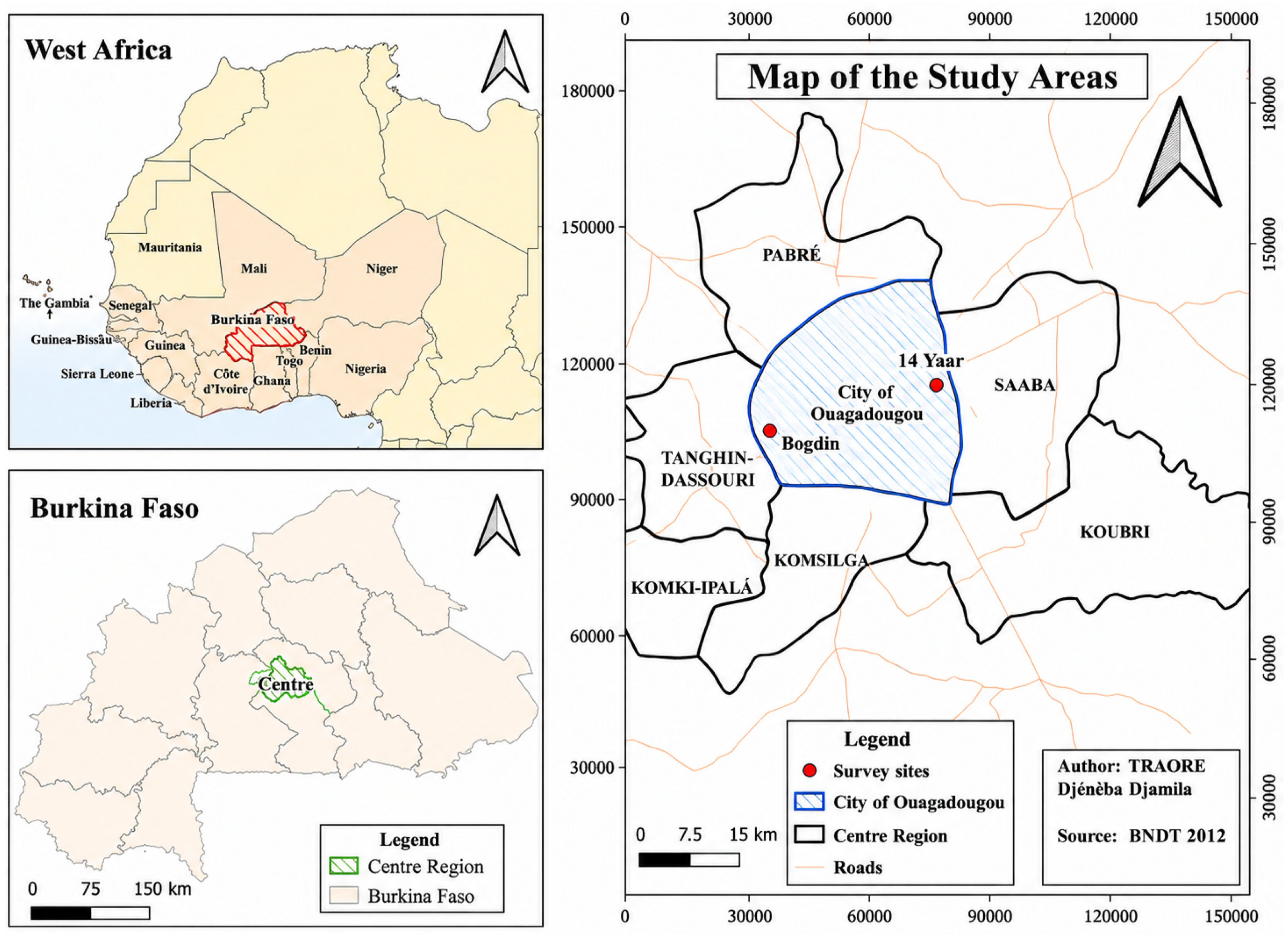
Figure 1 situates the two study sites: they are within the peri-urban communes of Ouagadougou, a few kilometres apart, each covering a few hectares of irrigated plots. Both sites traditionally relied on shallow well water and manual irrigation using watering cans. In 2023 (as part of an earlier project), a motorized pump and overhead sprinkler pipe network were installed at each site to improve irrigation efficiency and reduce labour. By 2025, field observations indicated that the sprinkler system at Bogdin was entirely inoperative, whereas at 14 Yaar some infrastructure remained in partial use, mainly as conduits for filling watering cans. This context provided a natural experiment to examine farmers’ perspectives and agronomic effects of the shift back to manual watering.
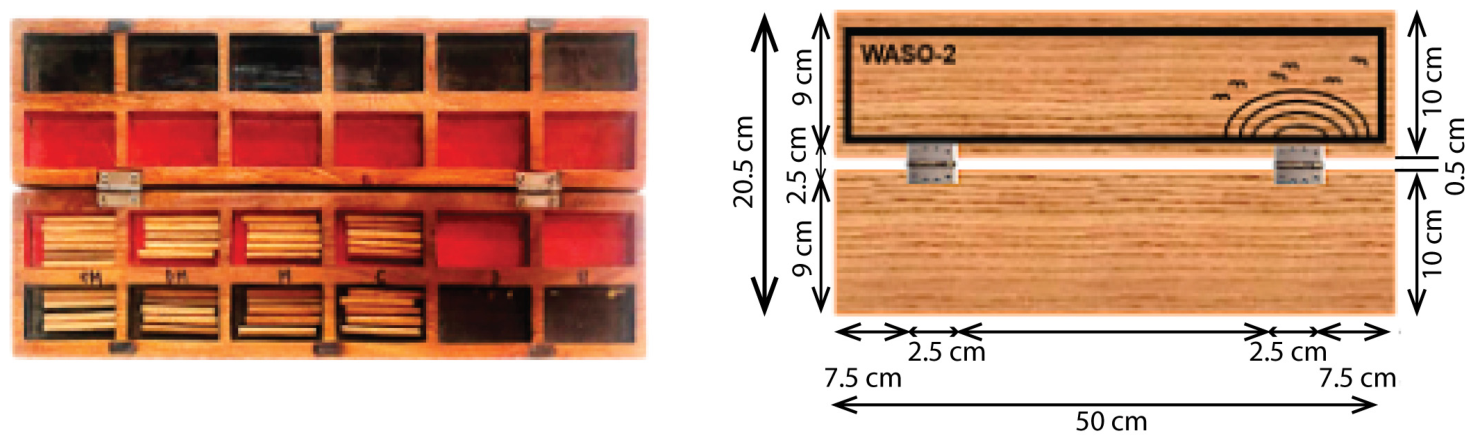
Socio-technical survey: We deployed a structured survey to capture farmers’ experiences and opinions regarding the modern irrigation system versus traditional watering. Given the predominantly low literacy level of participants, we used the WASO-2 (
Figure 2) tool (Walf-Soro board), an innovative participatory device that allows individuals to express quantitative opinions without writing [
29]. Each farmer responded to a series of closed questions by allocating counters on a board, effectively scoring their level of agreement or the importance of various factors on a scale from 1 to 20.
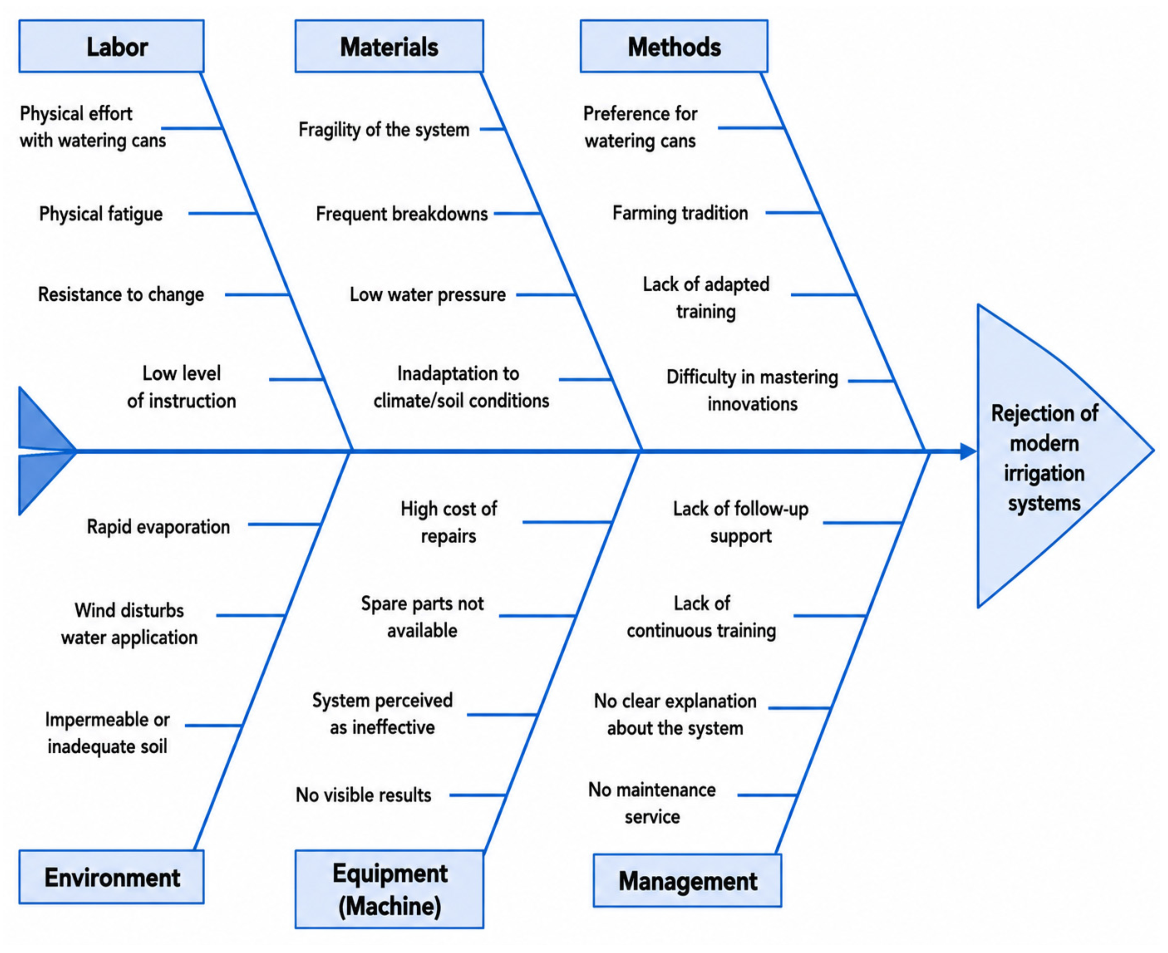
The questionnaire was developed through a pilot exercise incorporating a cause-and-effect (Ishikawa) analysis to ensure all relevant themes were covered (
Figure 3). It addressed topics including reasons for abandoning the sprinkler system (e.g., technical failures, cost, social preferences), perceived advantages/disadvantages of manual vs. modern irrigation, attitudes toward innovation and risk, the adequacy of training received, and conditions under which they would reconsider using the modern system.
A total of 50 producers (25 at each site) were interviewed individually in the local language (Mooré), with responses recorded using the WASO-2 scoring system. The sample represented the active members of the farming groups and included a mix of genders (although women constituted the majority) and age groups ranging from youth to elders. To analyse the survey data, each question’s response options were coded numerically based on the assigned scores (1–20). One-way Analysis of Variance (ANOVA) was then used to determine whether certain response options were rated significantly higher than others, thereby identifying prioritized factors. For each thematic question, the ANOVA compared the mean scores assigned to alternative response options within that theme. Thus, the analytical groups corresponded to response categories rather than to subgroups of farmers, and each response option was scored by all 25 respondents at a given site. Prior to ANOVA, homogeneity of variances was assessed using Levene’s test. Where ANOVA indicated a significant difference (p < 0.05), Tukey’s Honest Significant Difference (HSD) post hoc tests were applied to identify which response options differed significantly.
This statistical procedure enabled the ranking of reported factors according to their perceived importance (e.g., whether “lack of spare parts” was rated significantly higher than other reasons for abandoning the sprinkler system). All analyses were conducted separately for each site and then compared to assess the consistency of response patterns. Statistical analyses were performed using XLSTAT (2025) software, and results are reported with corresponding F-values and significance levels. In addition to the quantitative WASO-2 scoring, qualitative comments provided during the individual interviews were recorded to help contextualize the survey findings. Farmers frequently described practical difficulties associated with system maintenance, equipment failures, and repair costs, and these observations were used as complementary evidence alongside the quantitative results.
Agronomic measurements: In parallel with the socio-technical survey, field measurements were conducted to quantify soil properties, water inputs, and crop yields at the two study sites. The focus was on dry season lettuce (Lactuca sativa), a common high-value crop in these peri-urban systems. Data collection was carried out during a single cropping cycle (January–March 2025) under farmers’ normal management practices. At the time of the study, all sampled plots at both sites were irrigated manually using watering cans, as the sprinkler systems had already been abandoned. At Bogdin, the sprinkler system was entirely inoperative. At 14 Yaar, parts of the infrastructure remained in partial use, mainly as conduits for filling watering cans, but crop irrigation was performed manually. Consequently, the field measurements characterize spatial variability within the prevailing manual irrigation regime rather than providing a direct comparison between sprinkler and manual irrigation systems.
At each site, nine sampling points were established across the cultivated area, covering both central and peripheral plots (
Supplementary Figures S1 and S2). The sampling points were distributed among plots managed by different members of the women’s farming groups rather than belonging to a single farmer. Because irrigation was applied manually using watering cans, differences among operators in labour availability, watering frequency, application technique, and distance from the water source were expected to influence irrigation amounts. Such operator-level variability was considered an intrinsic characteristic of the irrigation system rather than a source of experimental error. The sampling design was therefore intended to capture the diversity of irrigation practices occurring within each site and to assess how differences in water application contributed to spatial variability in soil moisture and crop yield.
Three categories of measurements were collected at each sampling point. First, soil physicochemical properties were determined from a single composite topsoil sample (0–20 cm) collected during the cropping cycle. Laboratory analyses included nitrate nitrogen (N), available phosphorus (P), exchangeable potassium (K), soil pH, and electrical conductivity (EC). Standard analytical procedures were applied, including colorimetry for N, the Bray II method for P, and flame photometry for K. In addition, selected soil properties, including pH, temperature, and EC, were measured in situ using a multiparameter probe. Soil texture and infiltration characteristics were assessed qualitatively and indicated predominantly sandy soils with high infiltration rates (approximately 160 mm h−1).
Second, irrigation practices were monitored throughout the cropping cycle. Watering frequency and the number of watering can applications per plot were recorded during field visits and cross-checked with farmers to estimate the cumulative gross irrigation dose. Irrigation volumes were calculated from the known capacity of the watering cans (approximately 10 L) and the recorded number of applications, which were converted into irrigation depths (mm) based on plot area. These estimates represent applied water volumes under farmers’ normal management practices and do not constitute direct flow-meter measurements. Soil moisture (%) was measured near the root zone using a portable TDR probe approximately one hour after irrigation events.
Third, crop yield was measured once at harvest, approximately 45 days after transplanting. Fresh lettuce biomass was collected from a 0.5 m2 quadrat at each sampling point, weighed, and extrapolated to tonnes per hectare (t ha−1) to quantify spatial variability in productivity.
Data analysis combined site comparisons with multivariate analyses of soil, water, and crop variables. Mean yields and standard deviations were calculated for each site, and differences between sites were assessed using independent-samples t-tests at a significance level of α = 0.05. Prior to analysis, normality of yield distributions was evaluated using the Shapiro–Wilk test, and homogeneity of variances was assessed using Levene’s test. Yield variability was further characterized using coefficients of variation and quartile distributions. Given the limited sample size (n = 9 per site), these analyses were interpreted primarily as descriptive and exploratory rather than confirmatory.
Irrigation regimes were compared using average irrigation dose and variability (CV) to assess application uniformity. Relationships between yield and environmental variables were evaluated using Spearman’s rank correlation because of the limited sample size (n = 9 per site). Given this small sample size, the correlation analyses were considered exploratory and intended to identify potential relationships for future investigation rather than provide definitive inference. Correlations were examined between yield and irrigation dose, soil moisture, and soil fertility indicators (N, P, K, and pH), with significance assessed at p < 0.05. Given the exploratory nature of the study and the limited sample size, associations at p < 0.10 were also reported. Principal component analysis (PCA) was used as an exploratory tool to describe multivariate patterns among soil, water, and yield variables. All statistical analyses were conducted using R (version 4.2.2) software.
It should be noted that the soil physicochemical measurements and yield assessments represent a single cropping cycle and a single point in time. Soil properties were determined from one composite topsoil sample (0–20 cm) per sampling point and therefore provide only a snapshot of nutrient conditions. Consequently, the measurements cannot capture within-season nutrient dynamics or depth-dependent variability. While irrigation monitoring was conducted throughout the cropping cycle, the findings should not be generalized across seasons or years without additional multi-season observations. These limitations are considered when interpreting soil–yield relationships and other biophysical associations reported in this study.
By combining participatory surveys of socio-technical factors with field-based measurements of biophysical variables, the study provides an integrated assessment of irrigation system performance. The next section presents the results, first focusing on the socio-technical drivers of irrigation adoption and abandonment, followed by soil–water–crop relationships and their implications for irrigation sustainability.
3. Results
3.1. Socio-Technical Factors Affecting Irrigation Adoption
Out of the 50 farmers surveyed (25 per site), 42 (84%) had fully reverted to manual watering with cans (
Table 1), abandoning the installed sprinkler system after a short period of use. This reversion to manual irrigation was evident at both sites but differed in degree: at Bogdin all 25 farmers had abandoned the system entirely, whereas at 14 Yaar about 68% had done so while 32% retained partial use—typically repurposing the sprinkler lines to fill their cans on the plot rather than running the system as designed.
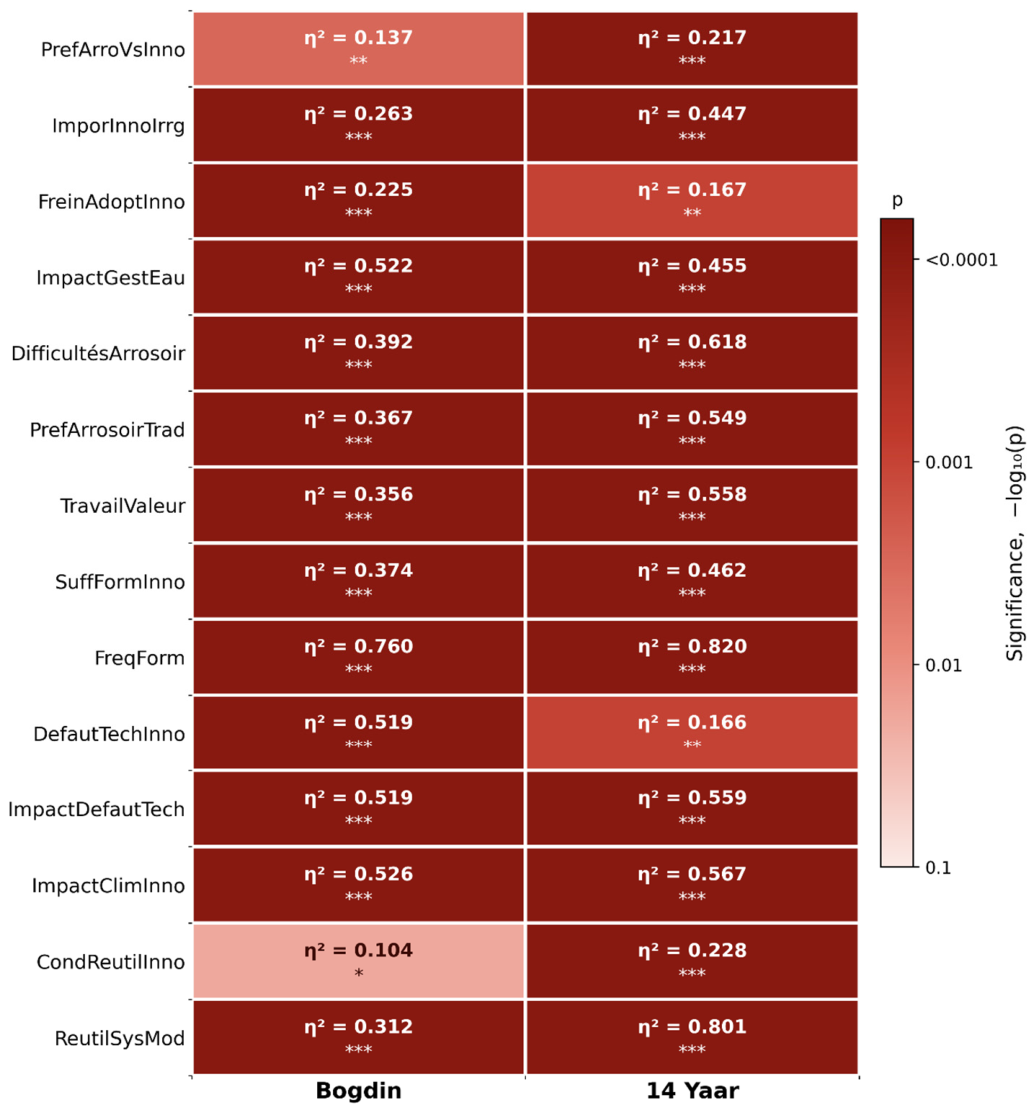
The heatmap (
Figure 4,
Supplementary Table S1) summarizes the statistical significance and effect sizes associated with farmers’ perceptions, constraints, and expectations regarding irrigation technologies. Darker shades indicate stronger statistical significance based on −log10(
p-values), while cell labels report the corresponding effect size (η
2). Overall, nearly all survey themes showed significant differences among response options (
p < 0.05), often at very strong levels (
p < 0.001), indicating that farmers clearly prioritized certain constraints, benefits, and conditions for adoption over others. Constraints to adoption (FreinAdoptInno), difficulties associated with manual irrigation (DifficultésArrosoir), and training-related variables (SuffFormInno and FreqForm) were among the most consistently significant themes across both sites. Some site-specific differences were also observed; for example, conditions for reusing modern systems (CondReutilInno) were less strongly differentiated at Bogdin (
p = 0.019) than at 14 Yaar (
p < 0.0001), suggesting differences in farmers’ expectations regarding future adoption.
The illustrative quotations presented below were obtained during individual farmer interviews conducted as part of the WASO-2 survey and are presented as examples of perceptions that were commonly reported by respondents. Farmers highlighted multiple technical and organizational barriers to adoption. Tukey post hoc tests showed that the fragility of equipment and difficulty of maintenance were among the highest-rated defects (
DefautTechInno,
Table 2,
Supplementary Table S2). Breakdowns of sprinkler heads and PVC lines were frequently mentioned, with 76% of respondents reporting at least one major failure in the first dry season. As one farmer explained: “
a single broken valve costs more than a month of profit from my vegetables, so I cannot keep spending on that.” At both sites, the absence of local support services and the high costs of repairs were also identified as critical obstacles (
ImpactDefautTech,
Table 2,
Supplementary Table S2).
At 14 Yaar, high maintenance costs, perceived inefficiency, and lack of follow-up support were the three most important constraints (
FreinAdoptInno,
Table 2,
Supplementary Table S2), while at Bogdin lack of follow-up dominated. Farmers generally expressed limited confidence in the long-term reliability of the sprinkler systems, citing recurring maintenance problems, equipment failures, and insufficient technical assistance. In contrast, watering cans were viewed as reliable, familiar, and easy to control. As one farmer stated: “
With the can, I know exactly how to water; with the sprinklers, I must wait for someone else to fix it.”
Despite this preference for the status quo technology, farmers were keenly aware of its drawbacks. Nearly all (96%) agreed that manual watering is arduous physical work, and many described it as painful or exhausting (“
pénible”). When asked about the difficulties of watering cans, the most emphatically endorsed issue was the heavy labour and fatigue it entails (
DifficultésArrosoir,
Table 2,
Supplementary Table S2). Carrying many 10 L cans multiple times a day, especially under hot dry season conditions, was described as a major burden. Other difficulties noted included the time consumption and water loss through surface evaporation.
When farmers were asked why they continue with manual irrigation, practical efficiency arguments dominated over any traditional sentiment. Both at Bogdin and 14 Yaar, the vast majority disagreed with the statement “
We use cans because it’s our tradition” and “
we don’t want to change.” Instead, they emphasized effectiveness, simplicity, and adaptability. The highest-rated affirmations were “
The watering can is used not because of tradition but because it is reliable and easy to control” and “
New tools must prove efficient and practical, otherwise we prefer what we know” (
PrefArrosoirTrad,
Table 2,
Supplementary Table S2).
The survey also revealed conditions for sustainable adoption of modern irrigation in the future. Farmers prioritized more frequent and hands-on training sessions (
SuffFormInno;
FreqForm,
Table 2,
Supplementary Table S2). At 14 Yaar, “monthly training sessions” received the highest score, significantly above quarterly or annual training. Farmers stressed the importance of follow-up training after installation to troubleshoot issues. Local maintenance services were also repeatedly mentioned as a need (
CondReutilInno,
Table 2,
Supplementary Table S2). Suggestions included establishing a community-based technician to handle repairs affordably.
Equipment design improvements were also cited in open comments, such as replacing fragile plastic parts with durable materials, protecting pipes from animals and sunlight, and adding filters to prevent nozzle clogging. Cost-sharing mechanisms were another priority, with several respondents noting that subsidies for spare parts or pumping costs would improve system viability.
Finally, willingness to re-adopt the modern system was conditional. When asked directly, 70% said they would use the sprinkler system again if improvements and support were provided. The three top conditions were: “
if the system is made more reliable and sturdy,” “
if we receive continuous training in its use,” and “
if there is a local mechanism for repair/maintenance.” At both sites, the response options “OuiAmelior” (yes, with good improvements) and “OuiSiFiable” (yes, but with guarantees on reliability.) received the highest Tukey scores (
ReutilSysMod,
Table 2,
Supplementary Table S2). Simply providing infrastructure without these supports was not sufficient.
3.2. Soil–Water–Crop Dynamics and Yield Variability Under Manual Irrigation
Despite differences in irrigation methods at the two sites, overall lettuce yields were in a similar range, but with clear contrasts in variability and determining factors. The mean yield (
Table 3,
Supplementary Table S3) at Bogdin was slightly higher (30.85 t/ha) than at 14 Yaar (25.48 t/ha), but this difference was not statistically significant (Student’s
t-test, t = −1.017,
p = 0.325), as confirmed by the prior verification of normality at both sites (Shapiro–Wilk: W = 0.910,
p = 0.314 at 14 Yaar; W = 0.907,
p = 0.298 at Bogdin). The distribution of yields (
Table 3) shows comparable medians (22.84 t/ha at 14 Yaar vs. 26.76 t/ha at Bogdin) but wider variability at 14 Yaar. At the lower end, 25% of plots at 14 Yaar yielded ≤ 18.92 t/ha, whereas the lowest quartile at Bogdin was ≥20.88 t/ha. Conversely, the top quartile at Bogdin exceeded 39.80 t/ha compared to only 30.69 t/ha at 14 Yaar. This is reflected in the coefficient of variation (CV = 44.0% at 14 Yaar vs. 36.4% at Bogdin), suggesting more uniform production conditions at Bogdin.
Water management differences were also pronounced (
Table 3). Farmers at 14 Yaar applied more water per irrigation event (mean 80.4 mm vs. 66.9 mm at Bogdin), but with far greater variability (CV = 42.3% vs. 20.9%). At 14 Yaar, irrigation doses ranged widely, from about 53 mm to 165 mm, whereas Bogdin doses spanned a lower range (38–92 mm) but were far more tightly clustered (interquartile range ≈ 63–72 mm). This roughly three-fold range in irrigation dose at 14 Yaar is consistent with the socio-technical survey results, which identified physical fatigue as the principal constraint associated with manual irrigation (mean WASO-2 score = 16.8/20). Differences in labour availability, watering frequency, application practices, and proximity to water sources are therefore the most plausible explanations for the observed variability in water application, although these factors were not measured directly in the present study. Moreover, at 14 Yaar, yield was strongly and positively correlated with irrigation dose (r = 0.862,
p < 0.01), indicating that plots receiving larger irrigation inputs generally achieved higher yields. By contrast, no significant relationship was detected at Bogdin, where irrigation doses were more uniform (
Supplementary Table S4). These results suggest that variability in manual water application was more strongly associated with yield variability at 14 Yaar than at Bogdin.
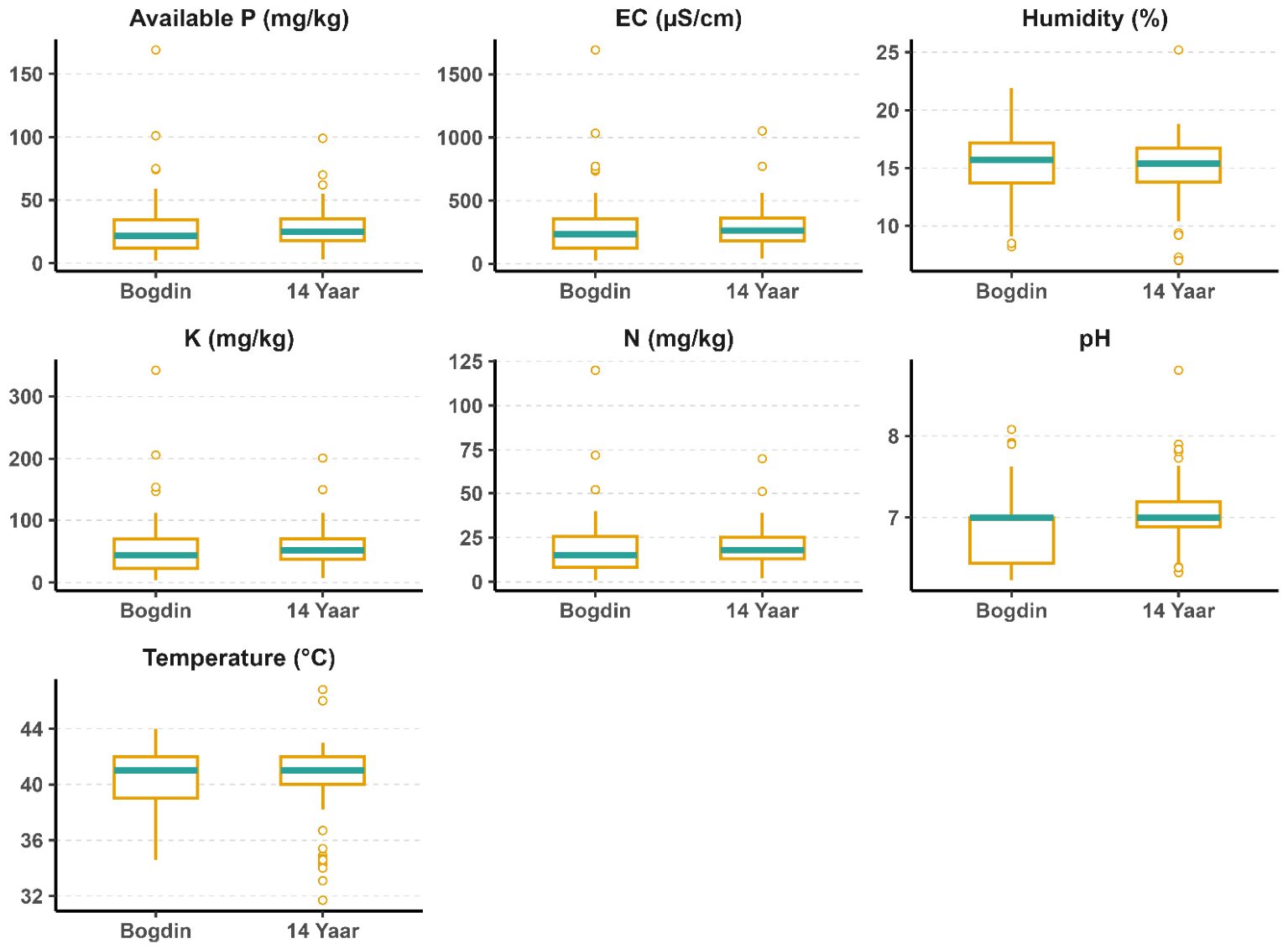
The two sites had broadly similar mean nutrient levels (
Figure 5). Correlations between soil properties and yield were generally stronger at 14 Yaar than at Bogdin (
Supplementary Table S4), but none reached statistical significance. At 14 Yaar, soil nitrogen, phosphorus, and potassium exhibited positive but non-significant correlations with yield (r = 0.44–0.52,
p > 0.25), while soil pH exhibited a negative but non-significant correlation (r = −0.38,
p > 0.25). Similarly, none of the soil fertility variables were significantly correlated with yield at Bogdin (
Supplementary Table S4). Irrigation dose was the only variable significantly associated with yield at 14 Yaar. Given the limited sample size (
n = 9 per site), no statistically significant relationship between soil fertility indicators and yield could be detected, and any potential contribution of soil fertility remains to be evaluated in future studies with larger sample sizes and greater temporal replication.
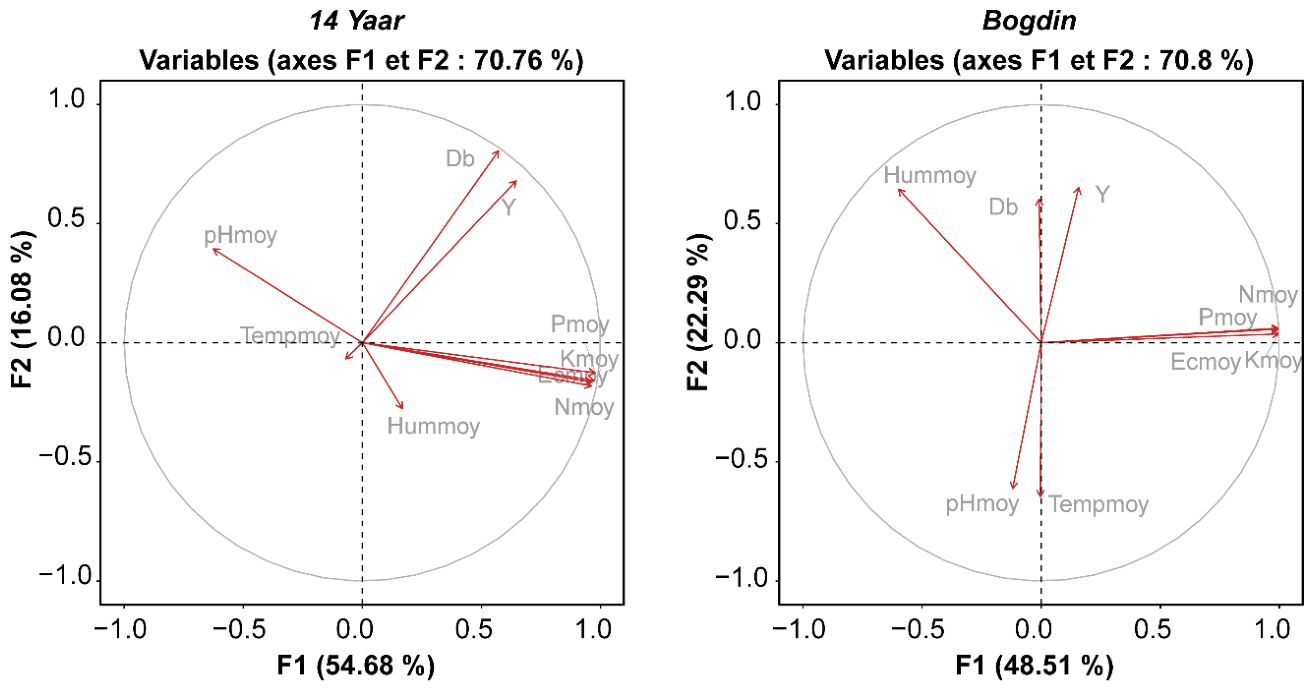
The principal component analysis (PCA;
Figure 6;
Supplementary Table S5) revealed contrasting patterns between the two sites. At 14 Yaar, the first two axes explained 70.76% of the total variance, leaving 29.24% represented by higher-order components. Axis 1 (54.68%) was dominated by a nutrient–salinity gradient (N, P, K, and EC), while Axis 2 (16.08%) aligned irrigation dose and yield, indicating that crop productivity was more closely associated with water availability. Soil fertility variables contributed primarily to the nutrient–salinity gradient represented by Axis 1. The remaining unexplained variance may reflect additional environmental and management factors not captured by the measured variables.
At Bogdin, the first two axes explained 70.80% of the total variance, leaving 29.20% unexplained. Axis 1 (48.51%) showed a similar fertility–salinity gradient, whereas Axis 2 (22.29%) reflected a broader environmental gradient involving humidity, irrigation dose, yield, temperature, and pH. In contrast to 14 Yaar, where yield aligned more closely with irrigation dose, yield variability at Bogdin appeared to be associated with a broader set of environmental factors. The remaining unexplained variance may reflect additional environmental and management factors not captured by the measured variables.
Overall, the PCA suggests that yield at 14 Yaar was more closely associated with irrigation dose, while the PCA identified a broader multivariate structure involving soil and environmental variables, whereas at Bogdin yield variability appeared to be associated with a broader set of environmental factors. Given the limited sample size (n = 9 per site) and the absence of significant nutrient–yield correlations, these patterns should be interpreted as exploratory rather than confirmatory.
4. Discussion
This study set out to examine how irrigation water management, shaped by socio-technical adoption dynamics and field conditions, influences the sustainability of smallholder irrigation systems and crop performance in peri-urban West Africa. By combining participatory surveys with field-based agronomic measurements, an integrated assessment is provided of why a modern sprinkler irrigation system was abandoned and how irrigation management under the prevailing manual regime was associated with crop productivity. Overall, the findings reveal a clear disconnect between the technical potential of improved irrigation and its practical sustainability under local conditions. While the introduced system offered theoretical benefits in terms of labour reduction and water-use efficiency, its long-term use was undermined by technical fragility, lack of maintenance support, and insufficient training. At the same time, the shift back to manual irrigation exposed limitations in water management, leading to increased variability in yields and suggesting that improved irrigation water consistency may enhance yield stability and water-use efficiency.
These results highlight that effective irrigation water management is not solely a technical challenge, but a socio-ecological one, requiring alignment between technology design, user capacity, and environmental constraints. The following sections discuss these findings in relation to existing literature, focusing on the interaction between social and biophysical processes, drivers of adoption and dis-adoption, institutional and agronomic implications, and pathways for designing more sustainable irrigation interventions.
4.1. Integrating Social and Biophysical Perspectives
Irrigation sustainability in small-scale farming systems is inherently a coupled socio-ecological process, shaped by interactions between human decision-making and biophysical constraints. Conceptual frameworks in socio-hydrology and social–ecological systems emphasize that water management outcomes emerge from feedback between users, institutions, and environmental conditions [
30,
31,
32]. These frameworks highlight that technological performance alone is insufficient, as sustainability depends equally on user acceptance, institutional support, and environmental suitability [
33,
34,
35].
The results provide empirical evidence of these coupled dynamics, showing how socio-technical constraints coincided with differences in irrigation practices, water distribution patterns, and yield variability between sites. The case of Bogdin and 14 Yaar provides a concrete example of this interplay, where a technically sound irrigation system initially promised improved efficiency but ultimately failed due to socio-technical misalignment.
Although sprinkler irrigation systems were introduced to improve water-use efficiency and reduce labour, their long-term sustainability was undermined by socio-technical constraints. Similar outcomes have been documented across Sub-Saharan Africa, where externally introduced irrigation technologies frequently fail when insufficient attention is given to maintenance systems, user capacities, and institutional embedding [
15,
36,
37,
38]. Studies on agricultural innovation further emphasize that technologies must fit within local socio-technical systems rather than being assessed solely on agronomic performance [
39,
40,
41]. In this case, the misalignment was evident in the rapid transition from initial adoption to widespread abandonment, despite the potential agronomic benefits of the technology.
4.2. Adoption, Dis-Adoption, and the Primacy of Reliability
The widespread abandonment of sprinkler systems reflects a broader phenomenon of technology dis-adoption, which remains less studied than initial uptake. While diffusion theory identifies perceived relative advantage, compatibility, and complexity as key drivers of adoption [
6], empirical evidence shows that continued use depends critically on reliability, maintainability, and farmers’ risk perceptions [
40,
42,
43,
44]. In smallholder systems characterized by uncertainty and limited access to repair services, robustness and autonomy are often prioritized over theoretical efficiency gains [
45,
46,
47]. Technologies that increase dependency on external inputs or technical expertise may therefore be perceived as risky, even when they offer productivity advantages [
39,
41].
In this context, the preference for manual irrigation can be interpreted as a rational cost–benefit reassessment, where the perceived risks and maintenance burdens of the sprinkler system outweighed its initial advantages. Manual irrigation was valued not for tradition, but for its reliability, controllability, and independence from external support. Importantly, the return to manual irrigation should not be interpreted as resistance to innovation. Participatory research has shown that farmers actively evaluate technologies based on performance, cost, and manageability rather than cultural attachment [
40,
48,
49]. The findings indicate that farmers remain willing to adopt improved systems, provided that reliability, training, and maintenance conditions are adequately addressed.
4.3. The Role of Institutions, Training, and Support Systems
A central finding is that the failure of the sprinkler systems was not purely technical but institutional. Research on irrigation governance consistently shows that infrastructure performance depends on institutional arrangements, including rules, collective action, and access to maintenance [
30,
33,
50,
51]. Participatory irrigation management and community-based approaches have been shown to enhance sustainability by strengthening ownership and accountability [
52,
53,
54].
Similarly, agricultural innovation systems literature highlights the importance of networks linking farmers, extension services, and technical actors to enable continuous learning and adaptation [
34,
55]. Extension services play a key role in facilitating adoption and adaptation to new technologies [
12,
47,
56]. In this case, the absence of such institutional and support mechanisms, particularly training and maintenance services, directly contributed to system failure and abandonment. This is consistent with the strong demand expressed by farmers for frequent, hands-on training and locally accessible repair services. Consequently, sustained engagement, rather than one-off interventions, is essential for long-term adoption of irrigation technologies.
4.4. Agronomic Implications: Irrigation Water Management, Variability, and Yield Gaps
From a biophysical perspective, consistent irrigation water management and distribution were strongly associated with crop performance. Irrigation science literature shows that variability in water application can lead to significant yield disparities, particularly in sandy soils with low water-holding capacity [
16,
17]. Yield gaps in both irrigated and rainfed systems are often driven by water limitations and uneven resource distribution [
57,
58]. Water availability also interacts strongly with soil fertility, influencing nutrient uptake and use efficiency [
59,
60,
61]. In sandy soils, inappropriate irrigation can exacerbate nutrient losses through leaching, further constraining productivity [
16]. These findings suggest that variability in water application may be an important contributor to yield variability in smallholder irrigation systems.
The results illustrate these mechanisms clearly. At 14 Yaar, where water application was highly variable, irrigation dose emerged as the sole statistically significant predictor of yield (r = 0.862, p = 0.006), consistent with irrigation water supply and its uneven distribution being the primary limiting factors. In practical terms, farmers unable to sustain the labour required for adequate manual watering faced under-irrigation and consequently reduced yields, suggesting that improving the uniformity of irrigation water application may help reduce yield variability and narrow yield gaps without requiring major changes in cropping practices. Because the nine plots at each site were watered by different operators, the wide range of per-event doses recorded at 14 Yaar (from below 40 to about 165 mm) most plausibly reflects operator-level differences in labour capacity, watering frequency, and access to the water source, rather than a deliberately managed irrigation schedule; this links the biophysical dose variability directly to the labour burden of manual watering identified in the survey. Positive but non-significant trends in soil nutrient correlations (r = 0.44–0.52, p > 0.25) were not statistically significant, so no nutrient effect could be detected at this sample size; any secondary role for soil fertility therefore remains an untested hypothesis rather than a finding, whereas water availability was the dominant measured constraint.
At Bogdin, where water application was more uniform, yields were also less variable and no single variable emerged as a dominant driver, reinforcing the view that consistency of irrigation water application underpins productivity as much as the volume applied. Taken together, these findings suggest a two-stage pathway for improving productivity in peri-urban West African market gardens: first, stabilizing irrigation practices to reduce water-driven variability in crop performance; and second, evaluating whether soil fertility constraints limit productivity once water management has been improved. The latter remains a hypothesis for future investigation using larger sample sizes and multi-season datasets.
4.5. Water Productivity and Efficiency Considerations
The results also have important implications for water productivity, defined as the ratio of yield to water-use [
17,
62]. Efficient irrigation systems are designed to optimize this ratio by reducing losses and improving water distribution [
17,
63]. However, when such systems are not functional or properly managed, these potential gains cannot be realized [
64].
Manual irrigation resulted in substantial variability in water application, despite acceptable average yields. This variability reflects the constraints of labour-intensive irrigation practices and suggests that water was not distributed consistently across plots. Together, these patterns indicate potential inefficiencies in water-use and a missed opportunity to improve water productivity through more uniform and reliable irrigation management, particularly in resource-constrained environments.
4.6. Co-Design and Pathways Toward Sustainable Irrigation
The findings strongly support the need for co-design and participatory approaches in irrigation development. Participatory and farmer-centred approaches have been shown to improve the relevance, usability, and adoption of agricultural technologies [
34,
45,
48,
49]. By integrating local knowledge and preferences, co-design can help ensure that technologies are adapted to specific socio-ecological contexts. Innovation platform approaches and farmer field schools provide mechanisms for collaborative learning and experimentation [
55,
56].
The results demonstrate that without such participatory processes, even technically appropriate irrigation systems may fail to persist beyond the initial implementation phase. Importantly, the conditions farmers prioritised translate into concrete, testable design criteria rather than generic principles, each anchored in a specific survey result (
Table 2;
Supplementary Table S1). First, accessible local maintenance was the highest-rated condition for re-adoption (CondReutilInno: 16.00/20 at 14 Yaar; 14.16/20 at Bogdin), pointing to a community-based repair mechanism with spare parts available within a defined local travel distance rather than reliance on distant or project-dependent servicing. Second, farmers’ preferred training was frequent and hands-on, with monthly sessions scoring highest (FreqForm, “monthly training”: 15.72/20 at 14 Yaar; 15.08/20 at Bogdin), indicating that follow-up support should be scheduled at roughly monthly intervals rather than provided once at installation. Third, equipment fragility and difficult maintenance were among the most-cited technical defects (DefautTechInno), and open comments specifically identified breakage of plastic components and nozzle clogging; design responses therefore include replacing fragile plastic nozzles and valves with more durable components and adding in-line filtration to reduce clogging. Taken together, these criteria favour hybrid or simplified systems, such as gravity-fed distribution combined with flexible hose-based irrigation, over fully mechanised sprinkler packages. Such “adaptive modernisation,” combining improved but locally maintainable infrastructure with measures that stabilise per-event water application, is likely to be more sustainable than standardised technological packages.
4.7. Implications for Policy and Development Practice
At a broader level, these findings point to the need to rethink irrigation water management strategies for semi-arid peri-urban vegetable systems in West Africa. Although wider evidence from Sub-Saharan Africa shows that infrastructure investments alone are insufficient unless complemented by institutional support, capacity building, and governance mechanisms [
15,
36], we caution against extrapolating site-specific results from two gardens across the region’s considerable ecological and socio-economic heterogeneity. Integrated approaches that address multiple constraints simultaneously are more likely to achieve sustained impacts [
45].
The patterns observed, characterised by initial adoption followed by rapid dis-adoption, illustrate the risks of technology-focused interventions that neglect broader system components, particularly those related to irrigation water management and institutional support. In comparable peri-urban West African settings, policy efforts should therefore prioritise strengthening extension services, supporting locally accessible maintenance systems, and promoting adaptive, context-specific innovations that can evolve with farmers’ needs. Overall, improving irrigation performance in smallholder systems depends not only on access to water, but on reducing variability in water distribution and aligning irrigation practices with farmer capacities.
5. Limitations
Several limitations should be considered when interpreting these findings. The biophysical analyses were based on a limited number of sampling points (n = 9 per site), which reduces statistical power and limits the ability to detect weaker relationships between soil, water, and yield variables. Consequently, the absence of statistically significant relationships should not be interpreted as evidence that such relationships do not exist. The sparse, nine-point grid at each site is also too coarse to support a reliable test of spatial autocorrelation (e.g., Moran’s I); the variability we report is therefore quantified as statistical dispersion—coefficients of variation in yield (44.0% at 14 Yaar; 36.4% at Bogdin) and in irrigation dose (42.3% vs. 20.9%)—rather than as formally tested spatial structure. Characterizing spatial autocorrelation in soil moisture, irrigation dose, and yield would require a substantially denser sampling grid, which we recommend for future work.
The field measurements were collected during a single cropping cycle and therefore represent only a snapshot of system performance. Seasonal and interannual variability in weather, water availability, management practices, and crop responses were not assessed. Similarly, soil physicochemical properties were determined from a single composite topsoil sample (0–20 cm) at each sampling point and do not capture temporal nutrient dynamics, deeper soil conditions, or root zone variability that may influence crop performance.
All agronomic measurements were conducted after farmers had reverted to manual irrigation. Consequently, the study does not provide a direct experimental comparison between sprinkler and manual irrigation systems. The biophysical analyses therefore characterize variability within the prevailing manual irrigation regime, whereas the assessment of sprinkler system performance relies primarily on farmer experiences, field observations, and survey responses.
The survey dataset (n = 50 farmers) and the agronomic dataset (n = 9 sampling points per site) were not collected using common farmer or plot identifiers and therefore could not be linked at the individual level. As a result, the socio-technical and biophysical analyses should be interpreted as complementary lines of evidence rather than directly matched observations.
Several potentially important factors were not measured, including groundwater-level fluctuations, well depth, irrigation system pressure, water quality characteristics (e.g., salinity, turbidity, and suspended solids), soil organic matter, and differences in labour availability among farmers. These factors may influence both irrigation performance and crop productivity and could contribute to the unexplained variance observed in the multivariate analyses.
In addition, qualitative information was derived from comments provided during individual farmer interviews and was used primarily to contextualize the quantitative survey findings. These observations were not collected or analyzed as a standalone qualitative dataset.
Finally, the study was conducted at only two peri-urban vegetable-growing sites in Ouagadougou. The findings therefore provide insights that are most directly applicable to similar semi-arid peri-urban vegetable production systems in West Africa and should not be generalized beyond comparable contexts without further validation.
6. Conclusions
This study demonstrates that the sustainability of irrigation technologies in peri-urban vegetable systems is shaped by the interaction between socio-technical and biophysical factors. More than 80% of farmers abandoned the sprinkler systems within two years of installation, primarily because of technical fragility, maintenance difficulties, inadequate post-installation support, and insufficient follow-up training. Following this transition to manual irrigation, substantial variability in water application was observed, particularly at 14 Yaar, where irrigation dose was strongly associated with crop yield variability. Together, these findings indicate that the long-term success of irrigation technologies depends not only on their technical performance but also on the support systems that sustain their use, while irrigation water management remains a key factor associated with crop productivity under the prevailing manual irrigation regime.
The findings indicate that improving irrigation performance is not solely a matter of introducing more efficient technologies. Rather, the long-term success of irrigation innovations depends on reliable maintenance services, continued farmer training, access to spare parts, and institutional support mechanisms that enable sustained use. In this context, socio-technical conditions act as enabling factors, whereas irrigation water management represents the biophysical mechanism through which crop productivity is affected.
From a biophysical perspective, irrigation water management was the factor most strongly associated with crop performance in the present study. The strong relationship between irrigation dose and yield at 14 Yaar suggests that variability in water application contributed to observed differences in crop productivity, whereas no significant relationships were detected between yield and the measured soil properties. Although a role for soil fertility cannot be excluded, this hypothesis requires confirmation through larger and more temporally extensive datasets.
From a practical perspective, future irrigation interventions should focus not only on improving application efficiency but also on strengthening the support systems required for long-term operation. Farmers consistently identified accessible maintenance services, regular follow-up training, and improved system reliability as prerequisites for re-adoption. At the field level, reducing variability in irrigation water application may help improve yield stability and water-use efficiency under both manual and mechanized irrigation systems.
Although a formal economic analysis was beyond the scope of this study, the widespread abandonment of the sprinkler systems despite their potential agronomic advantages suggests that technologies perceived as difficult or costly to maintain may not remain economically attractive from the farmers’ perspective. Future interventions should therefore evaluate both agronomic performance and long-term maintenance requirements to ensure that productivity gains are accompanied by operational sustainability.
Future research should evaluate these relationships across multiple seasons and sites, integrate farmer-level management information with plot-level agronomic measurements, and identify practical performance targets for irrigation uniformity and service provision in semi-arid peri-urban West African vegetable systems. Such integrated approaches will be essential for designing irrigation solutions that are both technically effective and socially sustainable.
Supplementary Materials
The following supporting information can be downloaded at:
https://www.mdpi.com/article/10.3390/w18121506/s1, Figure S1: Distribution of Sampling Points at the 14 Yaar Site; Figure S2: Distribution of Sampling Points at the Bogdin Site; Table S1: Summary of All Survey Variables (WASO-2 Tool,
n = 50 farmers, 25 per site); Table S2: Significant pairwise differences (Tukey HSD,
p < 0.05) among WASO-2 response options, by question and site. For each WASO-2 question, response options were compared with one-way ANOVA (factor = response option;
n = 25 farmers per site) followed by Tukey’s honestly significant difference (HSD) post-hoc test. Only pairs whose 95% family-wise confidence interval excludes zero (adjusted
p < 0.05) are listed; non-significant pairs are omitted. Mean difference is option A minus option B on the WASO-2 score (0–20). A positive value means option A was rated higher than option B; Table S3: Descriptive Statistics, Normality and Significance Tests for Lettuce Yield for Bogdin and 14 Yaar; Table S4: Spearman Correlation Coefficients between Soil–Water Parameters and Lettuce Yield at Both Sites; Table S5: Principal component loadings for soil fertility, environmental, and irrigation variables at the 14 Yaar and Bogdin sites (PC1–PC4).
Author Contributions
Conceptualization, K.O.L.H., A.K., and E.J.T.; methodology, K.O.L.H., A.K., E.J.T., D.D.T., and N.M.H.; field data collection, D.D.T. and N.M.H.; formal analysis, K.O.L.H., D.D.T., N.M.H., A.K., and E.J.T.; soil laboratory analysis, N.M.H., E.J.T., and K.O.L.H.; survey design and administration, A.K. and D.D.T.; statistical analysis, K.O.L.H., D.D.T., N.M.H., A.K., and E.J.T.; visualization, K.O.L.H., D.D.T., N.M.H., A.K., and E.J.T.; writing—original draft preparation, K.O.L.H., A.K., and E.J.T.; writing, review and editing, K.O.L.H., A.K., E.J.T., D.D.T., N.M.H., A.Y.B., Y.Y., J.H., T.H.K., O.U.C.G., D.F.B., and S.K.; supervision, A.K. and E.J.T.; project administration, K.O.L.H. and T.H.K.; funding acquisition, K.O.L.H., A.K., E.J.T., and O.U.C.G. All authors have read and agreed to the published version of the manuscript.
Funding
This research was funded by IHE Delf under Water and Development Partnership Program, grant number 111893.
Data Availability Statement
The original contributions presented in this study are included in the article and its
Supplementary Materials. The datasets generated and analyzed during the current study, including soil physicochemical measurements (N, P, K, pH, and EC), irrigation dose estimates, lettuce yield data, and coded WASO-2 survey responses, are available in the Figshare repository (DOI/link to be activated upon publication). Requests for additional information may be directed to the corresponding author.
Acknowledgments
The authors gratefully acknowledge the farmers of Bogdin and 14 Yaar for their active participation and valuable insights. We thank the field assistants and partner institutions, including 2iE and local organizations, for their logistical and technical support during data collection. Special thanks are extended to all contributors who supported the implementation of the WASO-2 survey tool and agronomic measurements.
Conflicts of Interest
Author K.O.L.H. was employed by Hydro-Climate Services (HCS) and by the Association for the Promotion of Hydro-Climatic and Environmental Services (APROSHE). Author T.H.K. was employed by APROSHE. The remaining authors declare that the research was conducted in the absence of any commercial or financial relationships that could be construed as a potential conflict of interest.
References
- Gross, B.; Jaubert, R. Vegetable gardening in Burkina Faso: Drip irrigation, agroecological farming and the diversity of smallholders. Water Altern. 2019, 12, 46–67. [Google Scholar] [CrossRef]
- Venot, J.P.; Zwarteveen, M.; Kuper, M.; Boesveld, H.; Bossenbroek, L.; Kooij, S.V.D.; Wanvoeke, J.; Benouniche, M.; Errahj, M.; Fraiture, C.D. Beyond the promises of technology: A review of the discourses and actors who make drip irrigation. Irrig. Drain. 2014, 63, 186–194. [Google Scholar] [CrossRef]
- Ouedraogo, R.; Montginoul, M.; Barbier, B. Farmers’ behavior and innovations’ adoption processes in rural Sahel: Case of supplemental irrigation from farm ponds in Burkina Faso. J. Rural Community Dev. 2024, 19, 285463813. [Google Scholar]
- Lefore, N.; Schmitter, P. Agricultural water management for adaptation and mitigation: Tension or co-benefits in achieving global good? PLoS Water 2025, 4, e0000479. [Google Scholar] [CrossRef]
- Keita, A.; Niang, D.; Sandwidi, S.A. How Non-Governmental-Organization-Built Small-Scale Irrigation Systems Are a Failure in Africa. Sustainability 2022, 14, 11315. [Google Scholar] [CrossRef]
- Rogers, E.M.; Singhal, A.; Quinlan, M.M. Diffusion of innovations. In An Integrated Approach to Communication Theory and Research; Routledge: Oxford, UK, 2014; pp. 432–448. [Google Scholar]
- Choruma, D.J.; Dirwai, T.L.; Matchaya, G.; Kasoma-Pele, W.; Mutenje, M. Exploring the smallholder irrigation equipment supply landscape in Zambia: A scoping review. Discov. Sustain. 2025, 6, 504. [Google Scholar] [CrossRef]
- Kule, E.K.; Obia, A.; Agole, D.; Okello, D.M.; Odongo, W. Farmer perceptions and their implications for adoption of sustainable agricultural intensification practices. Discov. Sustain. 2025, 6, 210. [Google Scholar] [CrossRef]
- Arslan, A.; Floress, K.; Lamanna, C.; Lipper, L.; Rosenstock, T.S. A meta-analysis of the adoption of agricultural technology in Sub-Saharan Africa. PLoS Sustain. Transform. 2022, 1, e0000018. [Google Scholar] [CrossRef]
- Mponji, R.F.; Cao, X.; Wang, J.; Jia, X. Meta-analysis on farmers’ adoption of agricultural technologies in East Africa: Evidence from Chinese agricultural technology demonstration centers. Agriculture 2024, 14, 2003. [Google Scholar] [CrossRef]
- Asmare, J.T.; Ayalew, Z.; Muchie, M.; Adugna, M. Determinants of the adoption of irrigation technology by smallholder wheat farmers in Northwestern Ethiopia. Discov. Sustain. 2025, 6, 1454. [Google Scholar] [CrossRef]
- Antwi-Agyei, P.; Stringer, L.C. Improving the effectiveness of agricultural extension services in supporting farmers to adapt to climate change: Insights from northeastern Ghana. Clim. Risk Manag. 2021, 32, 100304. [Google Scholar] [CrossRef]
- Bjornlund, H.; van Rooyen, A.; Pittock, J.; Parry, K.; Moyo, M.; Mdemu, M.; de Sousa, W. Institutional innovation and smart water management technologies in small-scale irrigation schemes in southern Africa. In Smart Water Management; Routledge: Oxford, UK, 2023; pp. 110–139. [Google Scholar]
- Jagadeesh, D.; Christian, M.; Khobai, H.; Letsoalo, S. Adoption Drivers of Climate Smart Irrigation Technologies for Sustainable Production by Smallholder Maize Farmers in Botswana. S. Afr. J. Agric. Ext. 2025, 53, 131–152. [Google Scholar] [CrossRef]
- De Fraiture, C.; Giordano, M. Small private irrigation: A thriving but overlooked sector. Agric. Water Manag. 2014, 131, 167–174. [Google Scholar] [CrossRef]
- Hillel, D. Introduction to Environmental Soil Physics; Elsevier: New York, NY, USA, 2003. [Google Scholar]
- Pereira, L.S.; Cordery, I.; Iacovides, I. Improved indicators of water use performance and productivity for sustainable water conservation and saving. Agric. Water Manag. 2012, 108, 39–51. [Google Scholar] [CrossRef]
- Aduramigba-Modupe, V.O.; Oke, A.O. Scaling Precision Agriculture in West Africa Smallholder Irrigation and Water Management Systems. FARA Res. Rep. 2023, 7, 128–133. [Google Scholar]
- Howell, T.A. Irrigation efficiency. Encycl. Water Sci. 2003, 467, 500. [Google Scholar]
- Ünlü, M.; Kanber, R.; Şenyigit, U.; Onaran, H.; Diker, K. Trickle and sprinkler irrigation of potato (Solanum tuberosum L.) in the Middle Anatolian Region in Turkey. Agric. Water Manag. 2006, 79, 43–71. [Google Scholar] [CrossRef]
- Boninsenha, Í.; Mantovani, E.C.; Rudnick, D.R.; Ribeiro, H.d.Q. Revealing irrigation uniformity with remote sensing: A comparative analysis of satellite-derived uniformity coefficient. Agric. Water Manag. 2024, 301, 108944. [Google Scholar] [CrossRef]
- Or, D.; Hanks, R. Soil water and crop yield spatial variability induced by irrigation nonuniformity. Soil Sci. Soc. Am. J. 1992, 56, 226–233. [Google Scholar] [CrossRef]
- Pandey, R.; Maranville, J.; Admou, A. Deficit irrigation and nitrogen effects on maize in a Sahelian environment: I. Grain yield and yield components. Agric. Water Manag. 2000, 46, 1–13. [Google Scholar] [CrossRef]
- Pandey, R.; Maranville, J.; Chetima, M. Deficit irrigation and nitrogen effects on maize in a Sahelian environment: II. Shoot growth, nitrogen uptake and water extraction. Agric. Water Manag. 2000, 46, 15–27. [Google Scholar] [CrossRef]
- Baldoncini, M.; Albéri, M.; Bottardi, C.; Chiarelli, E.; Raptis, K.G.C.; Strati, V.; Mantovani, F. Biomass water content effect on soil moisture assessment via proximal gamma-ray spectroscopy. Geoderma 2019, 335, 69–77. [Google Scholar] [CrossRef]
- Mulla, D.J. Twenty five years of remote sensing in precision agriculture: Key advances and remaining knowledge gaps. Biosyst. Eng. 2013, 114, 358–371. [Google Scholar] [CrossRef]
- Goap, A.; Sharma, D.; Shukla, A.K.; Krishna, C.R. An IoT based smart irrigation management system using Machine learning and open source technologies. Comput. Electron. Agric. 2018, 155, 41–49. [Google Scholar] [CrossRef]
- Onyango, C.M.; Nyaga, J.M.; Wetterlind, J.; Söderström, M.; Piikki, K. Precision agriculture for resource use efficiency in smallholder farming systems in sub-saharan africa: A systematic review. Sustainability 2021, 13, 1158. [Google Scholar] [CrossRef]
- Keïta, A.; Koïta, M.; Niang, D.; Lidon, B. Waso: An innovative device to uncover independent converging opinions of irrigation system farmers. Irrig. Drain. 2019, 68, 496–506. [Google Scholar] [CrossRef]
- Ostrom, E. A general framework for analyzing sustainability of social-ecological systems. Science 2009, 325, 419–422. [Google Scholar] [CrossRef] [PubMed]
- Falkenmark, M.; Rockström, J. The new blue and green water paradigm: Breaking new ground for water resources planning and management. J. Water Resour. Plan. Manag. 2006, 132, 129–132. [Google Scholar] [CrossRef]
- Boerger, V.; Bojic, D.; Bosc, P.; Clark, M.; Dale, D.; England, M.; Hoogeveen, J.; Koo-Oshima, S.; Mejias Moreno, P.; Muchoney, D. The State of the World’s Land and Water Resources for Food and Agriculture–Systems at Breaking Point; Synthesis Report 2021; FAO: Rome, Italy, 2021.
- Meinzen-Dick, R. Property rights and sustainable irrigation: A developing country perspective. Agric. Water Manag. 2014, 145, 23–31. [Google Scholar] [CrossRef]
- Klerkx, L.; Van Mierlo, B.; Leeuwis, C. Evolution of systems approaches to agricultural innovation: Concepts, analysis and interventions. In Farming Systems Research into the 21st Century: The New Dynamic; Springer: Berlin/Heidelberg, 2012; pp. 457–483. [Google Scholar]
- Stirling, A. “Opening up” and “closing down” power, participation, and pluralism in the social appraisal of technology. Sci. Technol. Hum. Values 2008, 33, 262–294. [Google Scholar]
- Burney, J.A.; Naylor, R.L. Smallholder irrigation as a poverty alleviation tool in sub-Saharan Africa. World Dev. 2012, 40, 110–123. [Google Scholar] [CrossRef]
- Namara, R.E.; Horowitz, L.; Nyamadi, B.; Barry, B. Irrigation Development in Ghana: Past Experiences, Emerging Opportunities, and Future Directions; International Food Policy Research Institute: Washington, DC, USA, 2011.
- Wanvoeke, J.; Venot, J.-P.; Zwarteveen, M.; de Fraiture, C. Performing the success of an innovation: The case of smallholder drip irrigation in Burkina Faso. Water Int. 2015, 40, 432–445. [Google Scholar] [CrossRef]
- Feder, G.; Just, R.E.; Zilberman, D. Adoption of agricultural innovations in developing countries: A survey. Econ. Dev. Cult. Change 1985, 33, 255–298. [Google Scholar] [CrossRef]
- Meijer, S.S.; Catacutan, D.; Ajayi, O.C.; Sileshi, G.W.; Nieuwenhuis, M. The role of knowledge, attitudes and perceptions in the uptake of agricultural and agroforestry innovations among smallholder farmers in sub-Saharan Africa. Int. J. Agric. Sustain. 2015, 13, 40–54. [Google Scholar]
- Doss, C.R. Analyzing technology adoption using microstudies: Limitations, challenges, and opportunities for improvement. Agric. Econ. 2006, 34, 207–219. [Google Scholar] [CrossRef]
- Adesina, A.A.; Baidu-Forson, J. Farmers’ perceptions and adoption of new agricultural technology: Evidence from analysis in Burkina Faso and Guinea, West Africa. Agric. Econ. 1995, 13, 1–9. [Google Scholar] [CrossRef]
- Marra, M.; Pannell, D.J.; Ghadim, A.A. The economics of risk, uncertainty and learning in the adoption of new agricultural technologies: Where are we on the learning curve? Agric. Syst. 2003, 75, 215–234. [Google Scholar] [CrossRef]
- Mottaleb, K.A.; Mohanty, S.; Nelson, A. Factors influencing hybrid rice adoption: A Bangladesh case. Aust. J. Agric. Resour. Econ. 2015, 59, 258–274. [Google Scholar]
- Giller, K.E.; Delaune, T.; da Silva, J.; Descheemaeker, K.; van de Ven, G.; Schut, T. The future of farming: Who will produce our food. IFAD Res. Ser. 2022, 83, 1073–1099. [Google Scholar]
- Tittonell, P.; Muriuki, A.; Klapwijk, C.; Shepherd, K.D.; Coe, R.; Vanlauwe, B. Soil heterogeneity and soil fertility gradients in smallholder farms of the East African highlands. Soil Sci. Soc. Am. J. 2013, 77, 525–538. [Google Scholar] [CrossRef]
- Andersson, J.A.; Giller, K.E. On heretics and God’s blanket salesmen: Contested claims for Conservation Agriculture and the politics of its promotion in African smallholder farming. In Contested Agronomy; Routledge: Oxford, UK, 2012; pp. 22–46. [Google Scholar]
- Chambers, R. The origins and practice of participatory rural appraisal. World Dev. 1994, 22, 953–969. [Google Scholar] [CrossRef]
- Pretty, J.N. Participatory learning for sustainable agriculture. World Dev. 1995, 23, 1247–1263. [Google Scholar] [CrossRef]
- Uphoff, N. Agroecological Innovations: Increasing Food Production with Participatory Development; Earthscan: Oxford, UK, 2002. [Google Scholar]
- Baland, J.-M.; Platteau, J.-P. Halting Degradation of Natural Resources: Is There a Role for Rural Communities? Food & Agriculture Organization: Rome, Italy, 1996.
- Vermillion, D.L. Impacts of Irrigation Management Transfer: A Review of the Evidence; IWMI: Colombo, Sri Lanka, 1997. [Google Scholar]
- Meinzen-Dick, R.; Raju, K.V.; Gulati, A. What affects organization and collective action for managing resources? Evidence from canal irrigation systems in India. World Dev. 2002, 30, 649–666. [Google Scholar] [CrossRef]
- Mukherji, A.; Facon, T. Revitalizing Asia’s Irrigation: To Sustainable Meet Tomorrow’s Food Needs; IWMI: Colombo, Sri Lanka, 2009. [Google Scholar]
- Hall, A.; Mytelka, L.; Oyeyinka, B. Innovation Systems: Implications for Agricultural Policy and Practice; ILAC: Toronto, ON, Canada, 2005. [Google Scholar]
- Davis, K.; Nkonya, E.; Kato, E.; Mekonnen, D.A.; Odendo, M.; Miiro, R.; Nkuba, J. Impact of farmer field schools on agricultural productivity and poverty in East Africa. World Dev. 2012, 40, 402–413. [Google Scholar] [CrossRef]
- Rockström, J.; Karlberg, L.; Wani, S.P.; Barron, J.; Hatibu, N.; Oweis, T.; Bruggeman, A.; Farahani, J.; Qiang, Z. Managing water in rainfed agriculture—The need for a paradigm shift. Agric. Water Manag. 2010, 97, 543–550. [Google Scholar] [CrossRef]
- Van Ittersum, M.K.; Cassman, K.G.; Grassini, P.; Wolf, J.; Tittonell, P.; Hochman, Z. Yield gap analysis with local to global relevance—A review. Field Crops Res. 2013, 143, 4–17. [Google Scholar] [CrossRef]
- Loomis, R.; Connor, D. Crop Ecology: Productivity and Management in Agricultural Systems; Cambridge University Press: Cambridge, UK, 1992. [Google Scholar]
- Marschner, H. Marschner’s Mineral Nutrition of Higher Plants; Academic Press: Cambridge, MA, USA, 2011. [Google Scholar]
- Fixen, P.; Brentrup, F.; Bruulsema, T.; Garcia, F.; Norton, R.; Zingore, S. Nutrient/fertilizer use efficiency: Measurement, current situation and trends. Manag. Water Fertil. Sustain. Agric. Intensif. 2015, 270, 1–30. [Google Scholar]
- Molden, D. Water for Food Water for Life: A Comprehensive Assessment of Water Management in Agriculture; Earthscan: London, UK; IWMI: Colombo, Sri Lanka, 2007. [Google Scholar]
- Carr, M. Crop Yield Response to Water. FAO Irrigation and Drainage Paper 66. By P. Steduto, TC Hsiao, E. Fereres and D. Raes. Rome, Italy: Food and Agriculture Organization of the United Nations (2012), pp. 500, US $100.00. ISBN 978-92-5-107274-5. The whole report can be downloaded from: http://www.fao.org/docrep/016/i2800e/i2800e00.htm. Exp. Agric. 2013, 49, 311. [Google Scholar] [CrossRef]
- Lankford, B. Resource Efficiency Complexity and the Commons: The Paracommons and Paradoxes of Natural Resource Losses, Wastes and Wastages; Routledge: Oxford, UK, 2013. [Google Scholar]
Figure 1.
Location of the study sites (Bogdin and 14 Yaar) in Ouagadougou, Burkina Faso. Both are peri-urban market gardening areas where modern irrigation infrastructure was introduced.
Figure 1.
Location of the study sites (Bogdin and 14 Yaar) in Ouagadougou, Burkina Faso. Both are peri-urban market gardening areas where modern irrigation infrastructure was introduced.
Figure 2.
WASO-2 Survey Tool, Interior view on the left and exterior view on the right [
29].
Figure 2.
WASO-2 Survey Tool, Interior view on the left and exterior view on the right [
29].
Figure 3.
Ishikawa diagram illustrating the causes of rejection of modern irrigation systems.
Figure 3.
Ishikawa diagram illustrating the causes of rejection of modern irrigation systems.
Figure 4.
ANOVA significance and effect size (η2) by WASO-2 question and site. Cell colour shows statistical significance (−log10 p); cell label: effect size η2 with significance markers (*** p < 0.001, ** p < 0.01, * p < 0.05). PrefArroVsInno: preference for the watering can versus modern irrigation systems; ImporInnoIrrg: perceived importance of the installed irrigation innovations; FreinAdoptInno: barriers to adoption of irrigation innovations; ImpactGestEau: impact of modern techniques on water management; DifficultésArrosoir: difficulties associated with manual watering; PrefArrosoirTrad: preference for the watering can based on farming traditions; TravailValeur: value attached to physical effort in the choice of method; SuffFormInno: sufficiency of the training received on modern systems; FreqForm: desired frequency of training on modern irrigation; DefautTechInno: technical defects of modern irrigation systems; ImpactDefautTech: impact of technical defects on system abandonment; ImpactClimInno: impact of climatic conditions on system efficiency; CondReutilInno: conditions required to reuse the irrigation innovations; ReutilSysMod: willingness to reuse an improved, modernized system.
Figure 4.
ANOVA significance and effect size (η2) by WASO-2 question and site. Cell colour shows statistical significance (−log10 p); cell label: effect size η2 with significance markers (*** p < 0.001, ** p < 0.01, * p < 0.05). PrefArroVsInno: preference for the watering can versus modern irrigation systems; ImporInnoIrrg: perceived importance of the installed irrigation innovations; FreinAdoptInno: barriers to adoption of irrigation innovations; ImpactGestEau: impact of modern techniques on water management; DifficultésArrosoir: difficulties associated with manual watering; PrefArrosoirTrad: preference for the watering can based on farming traditions; TravailValeur: value attached to physical effort in the choice of method; SuffFormInno: sufficiency of the training received on modern systems; FreqForm: desired frequency of training on modern irrigation; DefautTechInno: technical defects of modern irrigation systems; ImpactDefautTech: impact of technical defects on system abandonment; ImpactClimInno: impact of climatic conditions on system efficiency; CondReutilInno: conditions required to reuse the irrigation innovations; ReutilSysMod: willingness to reuse an improved, modernized system.

Figure 5.
Distribution of selected soil chemical properties (available P, K, and pH) at Bogdin and 14 Yaar. Boxplots display the interquartile range (25th–75th percentiles) with the median indicated by a horizontal line, while whiskers represent the spread of non-outlier observations. Open circles denote outlier observations beyond the whisker limits. Variations between sites highlight differences in soil fertility status. Nmoy (soil nitrate nitrogen, mg kg−1), Pmoy (available phosphorus, mg kg−1), Kmoy (exchangeable potassium, mg kg−1), pHmoy (soil pH), Tempmoy (soil temperature, °C), Hummoy (soil moisture content, %), Ecmoy (electrical conductivity, µS cm−1).
Figure 5.
Distribution of selected soil chemical properties (available P, K, and pH) at Bogdin and 14 Yaar. Boxplots display the interquartile range (25th–75th percentiles) with the median indicated by a horizontal line, while whiskers represent the spread of non-outlier observations. Open circles denote outlier observations beyond the whisker limits. Variations between sites highlight differences in soil fertility status. Nmoy (soil nitrate nitrogen, mg kg−1), Pmoy (available phosphorus, mg kg−1), Kmoy (exchangeable potassium, mg kg−1), pHmoy (soil pH), Tempmoy (soil temperature, °C), Hummoy (soil moisture content, %), Ecmoy (electrical conductivity, µS cm−1).
Figure 6.
PCA biplots showing soil–water–yield interactions at the 14 Yaar and Bogdin sites. Red arrows indicate the direction and strength of variable contributions to the principal components. Nmoy (soil nitrate nitrogen, mg kg−1), Pmoy (available phosphorus, mg kg−1), Kmoy (exchangeable potassium, mg kg−1), pHmoy (soil pH), Tempmoy (soil temperature, °C), Hummoy (soil moisture content, %), Ecmoy (electrical conductivity, µS cm−1), Y (lettuce yield, t ha−1), and Db (gross irrigation dose, mm).
Figure 6.
PCA biplots showing soil–water–yield interactions at the 14 Yaar and Bogdin sites. Red arrows indicate the direction and strength of variable contributions to the principal components. Nmoy (soil nitrate nitrogen, mg kg−1), Pmoy (available phosphorus, mg kg−1), Kmoy (exchangeable potassium, mg kg−1), pHmoy (soil pH), Tempmoy (soil temperature, °C), Hummoy (soil moisture content, %), Ecmoy (electrical conductivity, µS cm−1), Y (lettuce yield, t ha−1), and Db (gross irrigation dose, mm).
Table 1.
Field-Observed Operational Status of Sprinkler Irrigation Systems.
Table 1.
Field-Observed Operational Status of Sprinkler Irrigation Systems.
| | 14 Yaar (n = 25) | Bogdin (n = 25) |
|---|
| System status | Partially reused | Entirely inoperative |
| Description | Sprinkler lines partially retained with heads removed and pipes repurposed as conduits to fill watering cans on the plot | Sprinkler system completely idle; no component in active use for irrigation |
| Nature of reuse | Repurposed with infrastructure partially
retained but with function redirected | |
| Irrigation method in practice | Manual (watering cans, partly filled via repurposed sprinkler lines) | Manual (watering cans filled directly from water source) |
| Degree of abandonment | Partial | Total |
| Overall abandonment rate | 68% (total); 32% (partial) | 100% (total) |
Table 2.
Key findings from Tukey HSD post hoc tests (highest-ranked response categories). Values in parentheses represent the mean WASO-2 score (scale: 1–20) assigned by respondents to each response category. Higher scores indicate greater perceived importance or agreement. Categories followed by “(A)” belong to the highest-ranked Tukey HSD grouping and were not significantly different from one another at p < 0.05.
Table 2.
Key findings from Tukey HSD post hoc tests (highest-ranked response categories). Values in parentheses represent the mean WASO-2 score (scale: 1–20) assigned by respondents to each response category. Higher scores indicate greater perceived importance or agreement. Categories followed by “(A)” belong to the highest-ranked Tukey HSD grouping and were not significantly different from one another at p < 0.05.
| Theme/Variable | Bogdin—Highest Scoring Group(s) | 14 Yaar—Highest Scoring Group(s) |
|---|
| Preference for watering can vs. modern irrigation (PrefArroVsInno) | Better water control with the watering can (12.12), Modern systems require too much maintenance (12.04) (A) | Modern systems require too much maintenance (12.28) (A) |
| Perceived importance of irrigation innovations (ImporInnoIrrg) | Necessary but adjustments are required (14.32) (A) | Necessary but adjustments are required (15.44) (A) |
| Barriers to adoption of irrigation innovations (FreinAdoptInno) | Lack of support and follow-up after installation (13.52) (A) | High maintenance cost (13.12), Perceived inefficiency (12.56), Lack of support and follow-up after installation (11.72) (A) |
| Impact on water management (ImpactGestEau) | Reduces water wastage (14.48), Better water control with the watering can (13.24) (A) | Reduces water wastage (15.12) (A) |
| Difficulties associated with manual watering (DifficultésArrosoir) | Physical fatigue (14.36), High water consumption (14.00) (A) | Physical fatigue (16.80) (A) |
| Tradition versus innovation (PrefArrosoirTrad) | Efficiency matters more than tradition (14.84), Innovation is necessary (14.20) (A) | Innovation is necessary (16.72), Efficiency matters more than tradition (15.64) (A) |
| Value of labour and effort (TravailValeur) | Productivity matters more than work intensity (14.64), Physical work is valued (14.28) (A) | Productivity matters more than work intensity (15.88) (A) |
| Sufficiency of training (SuffFormInno) | Continuous follow-up is needed (14.64) (A) | Continuous follow-up is needed (15.92) (A) |
| Preferred training frequency (FreqForm) | Monthly training (15.08), Semi-annual training (14.64) (A) | Monthly training (15.72) (A) |
| Technical defects of modern irrigation systems (DefautTechInno) | Difficult maintenance and repair (14.20), Equipment fragility and frequent breakdowns (13.60) (A) | Difficult maintenance and repair (12.84), Equipment fragility and frequent breakdowns (12.04) (A) |
| Impact of technical defects (ImpactDefautTech) | Frequent breakdowns and repair costs (14.56), Lack of technical support (13.60) (A) | Frequent breakdowns and repair costs (13.08), Lack of technical support (12.60) (A) |
| Impact of climate conditions (ImpactClimInno) | Systems can adapt if well managed (13.96), Water losses due to wind or soil conditions (13.84) (A) | Systems can adapt if well managed (14.28) (A) |
| Conditions for re-adoption (CondReutilInno) | Accessible maintenance service (14.16) (A) | Accessible maintenance service (16.00) (A) |
| Willingness to reuse an improved system (ReutilSysMod) | Yes, if the system is improved (14.60), Yes, if reliability is guaranteed (12.92) (A) | Yes, if the system is improved (16.24), Yes, if reliability is guaranteed (15.20) (A) |
Table 3.
Descriptive statistics of lettuce yield and gross irrigation dose per event at the two study sites. Values are summarised at the plot level (n = 9 plots per site).
Table 3.
Descriptive statistics of lettuce yield and gross irrigation dose per event at the two study sites. Values are summarised at the plot level (n = 9 plots per site).
| Variable | Site | n | Mean | SD | CV (%) | Min | Q1 | Median | Q3 | Max |
|---|
| Lettuce yield (t ha−1) | Bogdin | 9 | 30.85 | 11.22 | 36.36 | 18.24 | 20.88 | 26.76 | 39.80 | 47.75 |
| | 14 Yaar | 9 | 25.48 | 11.20 | 43.95 | 12.06 | 18.92 | 22.84 | 30.69 | 49.51 |
| Gross irrigation dose (mm) | Bogdin | 9 | 66.90 | 13.96 | 20.87 | 38.10 | 63.49 | 65.63 | 71.68 | 92.17 |
| | 14 Yaar | 9 | 80.42 | 34.06 | 42.35 | 52.87 | 62.50 | 71.30 | 84.33 | 164.84 |
| Disclaimer/Publisher’s Note: The statements, opinions and data contained in all publications are solely those of the individual author(s) and contributor(s) and not of MDPI and/or the editor(s). MDPI and/or the editor(s) disclaim responsibility for any injury to people or property resulting from any ideas, methods, instructions or products referred to in the content. |




 ,
,