1. Introduction
Water has accompanied human civilization from its earliest stages, not only as a condition for survival but also as a source of meaning, fear, reverence, and hope. In many ancient societies, rivers, springs, rain, floods, and seas were not perceived merely as natural phenomena, but as living expressions of divine or cosmic power. In ancient Egypt, for example, the Nile had already acquired sacred significance by the fourth millennium BC, while in the Ancient Near East, water occupied a central place in creation myths such as the Enuma Elish, where the mingling of fresh and salt waters, personified by Apsu and Tiamat, precedes the birth of the gods. Similarly, the Sumero-Babylonian Atra-Hasis preserves one of the earliest written accounts of the Flood or Deluge [
1].
Across different cultural settings, water was closely associated with creation, fertility, purification, healing, and destruction. The ancient Egyptians, Minoans, Indus Valley peoples, Babylonians, Greeks, Romans, and many Indigenous communities of the Americas all developed religious ideas and ritual practices around water deities, rain, springs, rivers, and floods. These beliefs often inspired the construction of temples, sacred basins, fountains, and water infrastructures, especially in societies whose survival depended on rivers, rainfall, irrigation, or maritime life [
2,
3]. In the Aegean world, and particularly in Crete, the location of early settlements near natural water sources also reflects the practical and symbolic importance of water in shaping human habitation, health, and protection from environmental risks [
4,
5].
Over time, religious interpretations of water increasingly intersected with medical and hygienic practices. During the Classical and Hellenistic periods, the development of a more scientific approach to medicine and hygiene did not replace the sacred value of water, but rather expanded its significance. The Asclepieia, sanctuaries dedicated to Asclepius, gradually evolved into centers of healing where spring waters were believed to possess therapeutic properties and to provide relief to the sick and suffering [
6]. This close relationship between water, health, and ritual continued into later religious traditions. With the rise and diversification of Christianity, water became central to baptism and other rites across Christian traditions. Blessed or consecrated water is especially prominent in Catholic and Orthodox practice, while many Protestant churches also emphasize water in baptism and, in some traditions, in blessings, remembrance of baptism, and pastoral or healing rites [
7].
The symbolic role of water as a purifying and life-giving element is shared by many major religious traditions. Ritual washing, immersion, or ablution appears in Judaism, Christianity, Islam, Hinduism, Buddhism, and many other belief systems. In Christianity, baptism represents spiritual rebirth, while in Islam, ritual ablutions before prayer express both physical cleanliness and spiritual preparation. Sacred texts also reinforce this symbolism: the Bible presents water as part of the very formation of the earth [
8], while the Qur’an repeatedly emphasizes that living beings were created from water and frequently uses water in descriptions of Paradise [
9].
Across these historical settings, the practical and religious roles of water were often closely connected. Irrigation, healing, washing, drinking, bathing, and movement through the landscape could also become occasions for ritual action, communal memory, or reflection on the relationship between humans, nature, and the sacred. For this reason, water protection cannot be understood only as a technical or economic issue. It also carries cultural and moral dimensions, since water sustains both human communities and many of the symbolic worlds through which societies understand their place in nature and the cosmos [
10,
11].
The traditions discussed in this review are not intended to form an exhaustive catalogue of world religions. They have been selected as representative case studies in which the symbolic, ritual, geographical, or material importance of water is especially well documented. Following this introductory section,
Section 2 examines ancient and long-standing religious traditions from the Near East, the Mediterranean, Africa, and Asia.
Section 3 turns to Indigenous traditions of the Americas and the Caribbean, with attention to water-related myths, rituals, sacred landscapes, and religious continuity.
Section 4 examines water in Judaism, Christianity, and Islam, emphasizing both shared ritual concerns and important theological differences. The final section brings these examples together by comparing recurring symbolic patterns and considering their relevance for hydraulic heritage, environmental ethics, and contemporary water protection.
The purpose of this review is therefore comparative and synthetic rather than encyclopedic. It does not attempt to provide a complete history of water in world religions, nor does it seek to advance a new general theory of religion or ritual. Instead, it examines how water becomes religiously meaningful through the interaction of symbolic interpretation, ritual practice, sacred landscape, and material water infrastructure. This approach allows the discussion to move from individual traditions toward broader recurring patterns, while still recognizing that the meanings of water are always shaped by specific historical, cultural, and religious contexts. In this sense, the article’s main contribution lies in bringing religious meanings and material expressions of water together under the concept of hydraulic heritage. This term is used here to describe the ways in which water-related beliefs, rituals, sacred places, and infrastructures—such as rivers, springs, wells, sacred basins, fountains, hammams, monastic water systems, and irrigation works—become part of cultural memory and inherited water landscapes.
In this article, the terms symbolic, ritual, theological, and material are used as related but distinct analytical categories. The symbolic dimension refers to meanings associated with water, including creation, fertility, purification, healing, danger, and renewal. The ritual dimension refers to embodied practices in which water is used, handled, approached, or transformed through repeated religious action. The theological dimension refers more specifically to doctrinal, scriptural, or explicitly religious interpretations of water within particular traditions. The material dimension refers to the physical forms through which water-related meanings are expressed, including rivers, springs, wells, sacred basins, fountains, hammams, monastic water systems, and irrigation works. Distinguishing these dimensions helps avoid treating all religious uses of water as simply “symbolic,” while also showing how meanings, practices, and infrastructures often overlap.
A useful way to frame this process is through the idea of hierophany, understood here as the manifestation or disclosure of sacred meaning through an ordinary element, place, or object. In many of the traditions discussed below, water is not sacred simply because it is useful or visually powerful. It becomes religiously meaningful when rivers, springs, rain, wells, floods, basins, or ritual waters are experienced as points of contact between human life and a larger sacred order. This does not mean that all traditions interpret water in the same way, but it helps explain why water so often becomes a medium through which creation, purification, healing, danger, renewal, and divine presence are expressed.
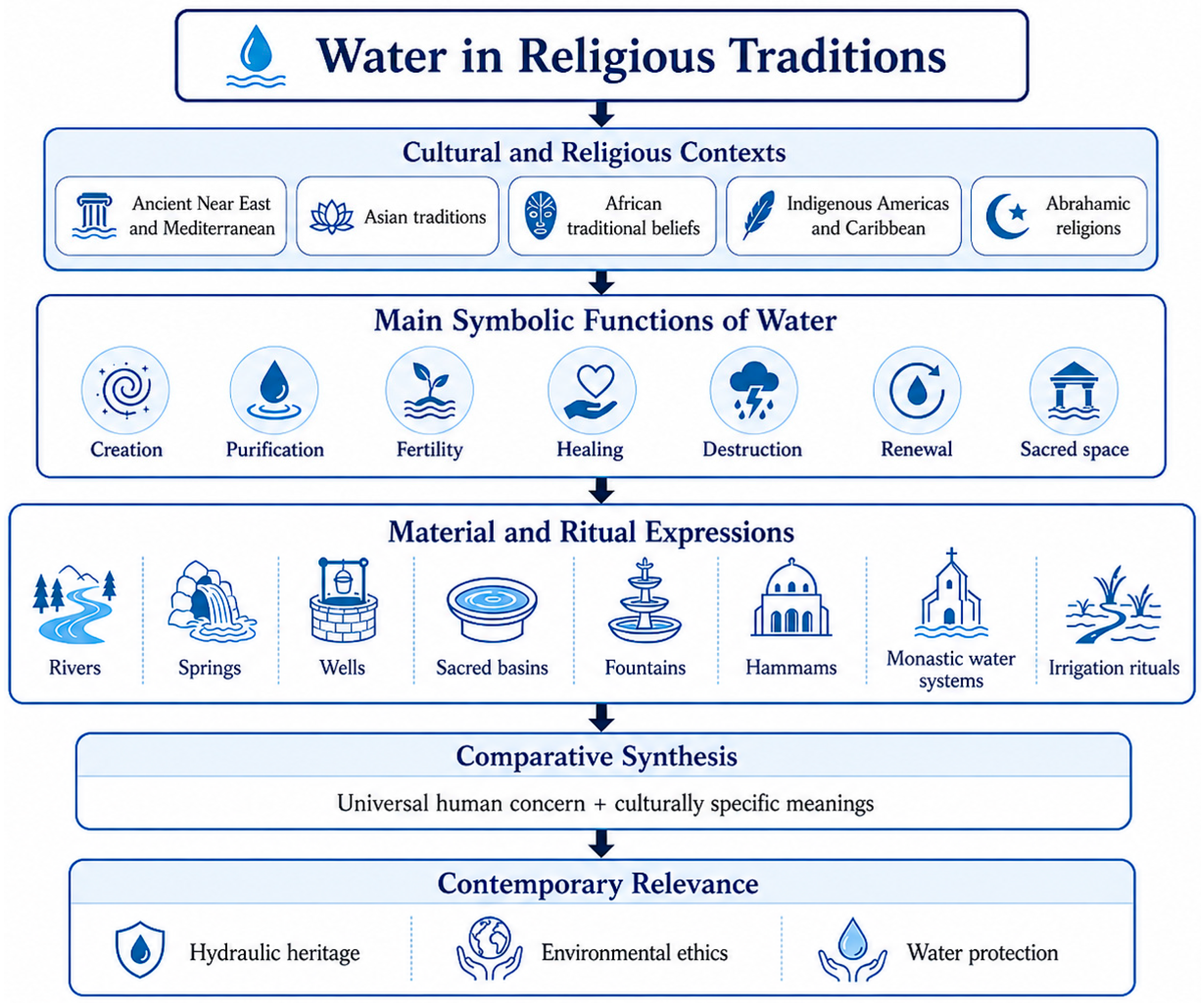
Figure 1 summarizes the conceptual framework followed in this review.
2. Ancient and Long-Standing Religious Traditions
This section examines a range of ancient and long-standing religious traditions in which water played a central role as a sacred, symbolic, and ritual element. The discussion begins with early civilizations of the Near East and the Mediterranean, including Pharaonic Egypt, Mesopotamia, Phoenicia, Minoan, Greece, and Rome. It then turns to religious traditions with ancient roots that continue to be practiced today, such as Hinduism and Buddhism, before considering animistic beliefs and ancient African traditions. This organization is not intended to imply that all the traditions discussed here belong only to the past. Rather, it highlights the historical depth of water symbolism and the ways in which many early beliefs and practices have continued, changed, or been reinterpreted over time. These examples are not intended to stand as isolated summaries. Read together, they show how water moved between cosmology, ritual practice, healing, agricultural fertility, and built or natural sacred places. The aim is therefore to identify patterns of meaning across different settings, while avoiding the assumption that all traditions understood water in the same way.
2.1. The Ancient Egyptians (ca. 4000–67 BC)
The annual flooding of the Nile was so central to Egyptian life that, from early times, it marked the beginning of the calendar. Further evidence of this importance is provided by the depiction of Hapy, the god of fertility and of the Nile inundation, as a robust figure whose blue skin symbolized the river’s life-giving properties. According to Egyptian mythology, the Nile floods were considered the tears shed by the goddess Isis, mourning the death of her husband Osiris, at the hands of his brother, the malevolent Seth.
Indeed, the Nile floods were not only a natural phenomenon to be harnessed for agriculture, but also held profound sacred significance, being regarded as a sign of the continuity of life and the benevolence of the gods. To honor these deities, offerings (including food, libations and figurines of mud or wax, symbols of fertility and rebirth) were either cast into the river or placed along its banks.
Moreover, certain temples, including those at Dendera and Edfu, were directly connected to the Nile by means of underground channels, through which river water flowed into subterranean chambers located below ground level and beneath the main halls, referred to by modern archaeologists as “Nile Chambers.” This water symbolized the life-giving flow of the Nile and was used by priests in ceremonies and religious practices [
12].
Concern for the proper use and flow of Nile waters also appears in ancient Egyptian moral and religious thought. In funerary texts such as the Egyptian Book of the Dead, the righteous deceased denies having obstructed water or interfered with its proper course. This evidence should not be treated as a legal code, but it shows that the free and orderly movement of water could be understood as part of a wider moral order. In this sense, the Nile was not only a source of fertility and ritual meaning, but also a feature of the world whose disruption could be imagined as a failure of justice, balance, and social responsibility [
13].
The symbolic memory of the Nile has also continued in later and modern contexts. The traditional flood season is still recalled through the Wafaa El Nil festival, although the construction of the Aswan High Dam ended the natural inundation cycle and transformed the celebration into a cultural commemoration of the river’s place in Egyptian history and identity. Some local Coptic practices also preserved symbolic acts of blessing the river, but these should be understood as Christian devotional expressions rather than as a direct continuation of Pharaonic religion.
2.2. The Mesopotamians (ca. 4500–539 BC)
Mesopotamia, the land between the Tigris and Euphrates rivers, was one of the earliest regions in which water became inseparably linked with civilization, religion, and social order. Although the area was home to several successive cultures, including the Sumerians, Akkadians, Assyrians, and Babylonians, their religious traditions shared a common perception of water as a primordial and life-giving force. In this riverine world, water was not only a practical necessity for agriculture and urban life, but also a sacred element through which creation, fertility, divine power, and destruction could be understood [
14].
Jacobsen’s classic work on Mesopotamian religion helps show that water was closely connected with the way Mesopotamian societies imagined divine power, fertility, wisdom, and cosmic order. In this context, the rivers and the subterranean freshwater realm were not only elements of the physical environment, but also part of a religious language through which creation, abundance, protection, and danger could be expressed [
15].
This symbolic and theological role is clearly expressed in Mesopotamian mythology. In the Enuma Elish, water existed before the formation of the ordered world, personified by Tiamat, the goddess of salt water, and Apsu, the male deity of fresh water. Their mingling precedes the birth of the gods, making water the original substance from which divine and cosmic life emerges. The same association between water and generative power is reflected in the Sumerian language, where the term for water was also linked with semen, further emphasizing its creative and fertile character [
14].
Among the most important Mesopotamian water deities was Enki, known in Akkadian as Ea. As lord of the Apsu, the subterranean freshwater realm, Enki/Ea embodied wisdom, creation, and benevolence toward humankind. He was often represented with streams of water flowing from his shoulders, symbolizing the Tigris and Euphrates, or holding a vessel from which water emerged. Through this imagery, water appears not only as a natural resource, but also as a visible sign of divine knowledge, abundance, and protection [
14].
At the same time, Mesopotamian traditions also recognized the destructive and ambivalent power of water. This is especially evident in the flood narratives preserved in different versions across Mesopotamian literature. In these accounts, the gods decide to destroy humanity through a deluge, but Enki/Ea intervenes by warning a chosen human figure—Ziusudra in the Sumerian tradition, Atra-Hasis in the Old Babylonian Akkadian version, and Utnapishtim in the Epic of Gilgamesh. The flood therefore becomes both an image of divine punishment and a moment of renewal, revealing water as a force capable of ending life while also allowing it to begin again [
14].
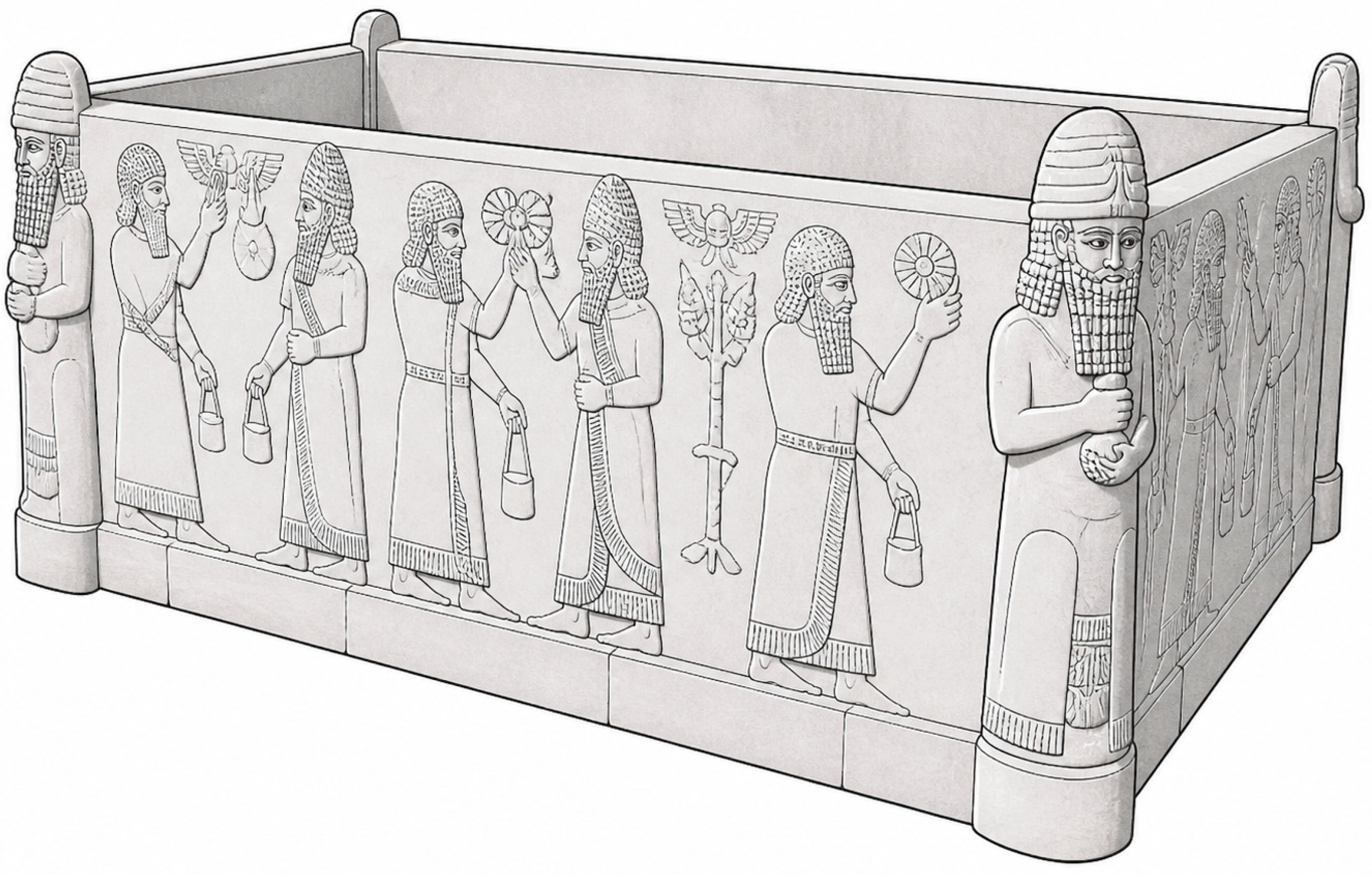
The sacred role of water is also supported by archaeological evidence. A notable example is the basalt water basin discovered in the courtyard of the temple of Ashur, the capital of Assyria (
Figure 2). Although undecorated on the inside, its exterior depicts water gods holding overflowing vessels, with streams descending from above toward the earth. Two priests, represented wearing fish skins and holding small buckets, appear to purify the figure of the water god at the center of the scene. The basin also bears repeated cuneiform inscriptions invoking the Assyrian king Sennacherib (704–681 BC). Its location and decoration strongly suggest that it was used in ritual purification practices, further demonstrating the close relationship between water, ritual purity, and divine presence in Mesopotamian religion [
16].
2.3. The Phoenicians (ca. 2500–539 BC)
The roots of Phoenician civilization lie in the cultures of the Mediterranean coastal regions of the Levant during the second millennium BC [
17]. Most of the major Phoenician cities, such as Tyre, Sidon, Beirut, Byblos, and Tripoli, developed in close connection with the sea and with natural harbors. This coastal orientation was not only important for maritime trade, but also shaped the way Phoenician communities understood and managed water. Rivers, springs, harbors, and sacred basins were closely linked with daily life, healing practices, and religious experience [
18].
From the second millennium BC onward, the Phoenicians appear to have developed systems for capturing and conveying water from nearby rivers to their cities and harbors [
19]. A clear example is Sidon, where water was channeled from the nearby Awali River, known in antiquity as the Asclepius or Bostrenus River [
20]. Between the river and the city stood the sanctuary of Eshmun, the Phoenician god of healing. This sanctuary included ritual ablution basins supplied by canals that brought water from the river and from the sacred “Ydlal” spring. These installations suggest that water served practical needs while also supporting purification, healing, and forms of contact with the divine [
21].
Sacred basins for worship, known as Baathiye, were also widespread in ancient Phoenicia and were usually located near freshwater springs. They typically consisted of a shrine and a pool used for ritual ablutions [
1]. Several such sites are found in modern Lebanon, including Jounieh, Tabarja, Bouar, and Enfeh, and some of them continue to be visited by local Christian worshippers today. This continuity suggests that certain sacred landscapes associated with water retained their religious meaning even after major changes in religious identity.
Within this cultural context, several Phoenician and Canaanite deities were associated with water, healing, rainfall, fertility, and the natural water cycle. Eshmun was linked with healing and purification through sacred waters; Atargatis with fertility, water, and springs; and Hadaranes, identified in some contexts with Hadad, with thunder, lightning, and rain. Talaya, whose name has been interpreted as “Dew, Daughter of Rain,” also points to the symbolic value attributed to atmospheric moisture in the Levant, where even dew could be associated with fertility, renewal, and life [
22].
The myth of Adonis offers a particularly clear example of the connection between water, vegetation, death, and seasonal renewal in Phoenician religious imagination. Associated with the springs of Afqa and the river that later bore his name, Adonis was remembered as a fertility figure linked with the life cycle of vegetation. According to the tradition, he was killed by a wild boar near the springs, and his blood was believed to have reddened the river, connecting flowing water with mourning, fertility, and rebirth [
23].
The inhabitants of Byblos held Adonis in particular reverence and associated the reddish color of the river after the first autumn rains with the “blood of Adonis.” This seasonal phenomenon, probably caused by soil erosion and torrential flows, was interpreted as a sign of mourning and was linked with ritual commemoration [
24]. In spring, the renewal of vegetation, including the blooming of anemones, reinforced the idea of Adonis’s return and the restoration of life [
25,
26]. Although these rites are no longer practiced as religious ceremonies, the landscape still preserves the cultural memory of this association between water, fertility, mourning, and renewal.
2.4. Minoan Civilization (ca. 3200–1100 BC)
The Minoan civilization developed primarily on the island of Crete and exerted significant influence throughout the Aegean basin. Evidence of Minoan cultural influence has also been identified in western Anatolia, including Miletus, particularly during the early second millennium BC. Minoan religion is generally regarded as closely connected with ancient Near Eastern religious traditions. Based mainly on iconographic evidence, it appears to have been polytheistic and closely linked with vegetation cycles. Scholars have often suggested the existence of a prominent ‘Great Mother Goddess’, associated with fertility and nature, together with a ‘Young God’ figure interpreted as embodying the annual regeneration of vegetation [
27]. Our understanding of Minoan religion remains, however, limited, as the Minoans did not construct monumental temples nor produce large-scale sculptural representations of deities. Nevertheless, they left a variety of other forms of material evidence, including small shrines, some fountains and numerous representations of sacred birds, trees, bulls, and snakes.
Some fountains may also have served a sacred or ritual function [
28]. A possible example is the Tykte fountain at the Caravanserai, opposite the main entrance of the palace of Knossos on Crete. Archaeological evidence suggests that water supplied by the Knossos aqueduct may have been continuously available there. This has led some scholars to suggest that the fountain, and perhaps other similar installations, could have been used for washing visitors before they entered the palace, possibly as part of purification practices. However, the available evidence does not allow these ritual uses to be reconstructed with certainty.
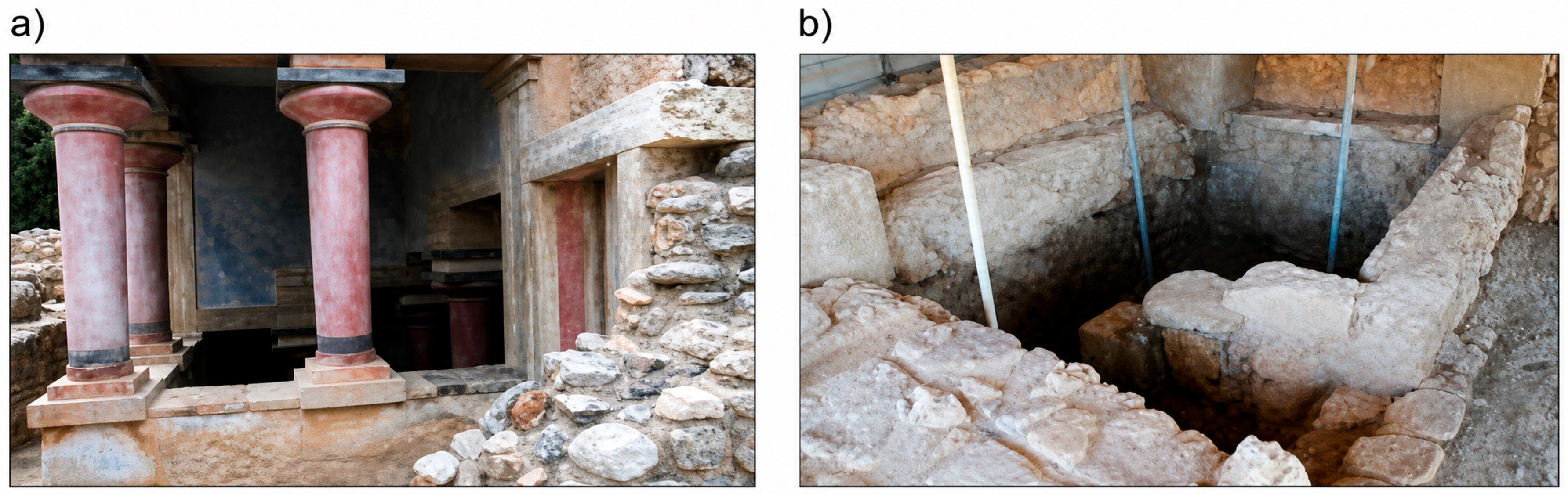
The Minoans also constructed lustral basins, namely sunken rooms or basins traditionally interpreted as possible spaces for ritual purification, such as those shown in
Figure 3. They also appear to have used sacred caves and peak sanctuaries for cult purposes [
2]. Nevertheless, given the fragmentary nature of the evidence and the absence of direct textual sources, the precise function and significance of these water installations must remain a matter of cautious interpretation.
2.5. The Greek and Roman Worlds
This section explores the sacred and non-sacred uses of water in the Greek and Roman worlds, with a focus on the Classical and Hellenistic Greek periods, and the Roman and Late Antique periods.
2.5.1. Archaic, Classical, and Hellenistic Periods (ca. 750–31 BC)
Following the Minoans, Mycenaeans, and other earlier Aegean cultures, the ancient Greeks continued to attribute sacred meaning to water. Springs, rivers, rain, fountains, and healing waters were not seen only as natural resources, but also as places and forces through which divine presence could be experienced. At the same time, the Archaic, Classical, and Hellenistic periods introduced a new way of thinking. Mythological interpretations remained important, but they gradually coexisted with more rational and natural explanations of the world. Greek culture is therefore especially useful for this review because it shows sacred interpretations of water gradually coexisting with more observational and philosophical approaches [
23].
Water Deities and Mythological Symbolism
In Greek mythology, water was closely connected with divine beings who inhabited or protected specific natural places. Nymphs were minor female nature deities, often associated with springs, fountains, streams, trees, mountains, and other features of the landscape [
29]. Among them, the water nymphs, known as Hydriades or Ephydriades, included the Naiads, who presided over freshwater sources such as springs, wells, fountains, brooks, and streams [
30]. Their presence shows how strongly the Greeks associated freshwater with life, beauty, protection, and sacred places.
This reverence for water was not limited to local springs. Achelous, associated with the Achelous River, was regarded as the chief of the river gods, while many rivers were thought to have their own divine spirit [
31]. Tethys and Oceanus also belonged to a wider mythological world in which waters were imagined as generative and cosmic forces. Through these figures, water appeared not simply as a physical element, but as part of a living sacred landscape.
Rain and agricultural fertility were also central to Greek religious imagination. Zeus was strongly associated with rain, clouds, and storms, while Poseidon embodied the power of the sea and other waters. Demeter, as goddess of agriculture, fertility, and the earth’s productivity, was indirectly linked with water through the growth of crops and the fertility of the land [
23]. The mythic contest between Athena and Poseidon for the protection of Athens is especially meaningful in this context. The Athenians chose Athena’s gift of the olive tree over Poseidon’s gift of water, a symbolic preference for wisdom, cultivation, and civic order rather than the mere abundance of natural resources [
32]. Yet the continuing presence of rain prayers and expressions such as “Zeus is raining” shows that water remained deeply embedded in everyday religious language and practice [
33].
Healing Water and the Asclepieia
Water also acquired special importance in Greek healing practices. This connection became particularly visible in the sanctuaries of Asclepius, the god of medicine and healing. According to Greek mythology, Asclepius was the son of Apollo and Coronis and was educated by the wise centaur Chiron in the art of healing [
34]. Over time, his cult expanded widely, and more than 400 Asclepieia are known to have operated across the ancient world, especially in the Greek-speaking regions [
35].
These sanctuaries were not only places of worship. They also functioned as early healing centers, where religious ritual, bodily care, dreams, incubation practices, and the use of appropriate natural settings were combined. Water was essential to this environment. Springs, fountains, and clean water sources supported purification, ritual preparation, and therapeutic practices. In this way, the Asclepieia illustrate an important meeting point between religion and medicine: water remained sacred, but it also became part of a more organized concern for health, hygiene, and bodily restoration.
This development prepared the ground for a broader Greek interest in the relationship between water and health. Hippocratic medicine, for example, emphasized the importance of environmental conditions, including water, for human well-being. The well-known statement attributed to Hippocrates that “water contributes much towards health” reflects this wider movement from purely sacred healing toward a more observational and medical understanding of the human body and its surroundings.
From Myth to Natural Philosophy
Alongside mythological and healing traditions, the Greeks gradually began to approach water in more philosophical and natural terms. This shift is especially associated with Ionia and the early natural philosophers. Thales of Miletus, traditionally regarded as one of the Seven Sages of Greece and as an early founder of natural philosophy, gave water a central place in his explanation of the world. By arguing that water was the first principle of all things, he expressed the idea that life and matter ultimately arise from a single natural substance [
36].
Thales’ importance lies not only in his theory itself, but also in the kind of explanation he introduced. He sought to understand natural phenomena through natural causes rather than through myth alone. Later Greek thinkers, including Plato and Aristotle, continued to treat water as one of the fundamental elements of the natural world [
37,
38]. In this intellectual tradition, water did not lose its sacred or symbolic value; rather, it was increasingly interpreted through philosophy, observation, and early scientific reasoning.
The Greek evidence points to a gradual broadening of water’s meaning, from myth and ritual healing to philosophical and medical reflection. Water remained sacred, powerful, and symbolically rich, but it also became an object of medical, philosophical, and practical inquiry. The Classical and Hellenistic Greek world therefore marks a turning point in the history of water symbolism, not because myth was replaced by science, but because religious meaning and rational explanation came to coexist.
2.5.2. Roman and Late Antique Periods (ca. 31 BC–330 AD)
In the Roman world, water occupied a double role. It was a practical resource that sustained cities, baths, fountains, gardens, roads, and agriculture, but it was also closely connected with sacred places, ritual washing, healing, and divine protection. Roman culture did not treat water only as an engineering problem. It also absorbed and reshaped older Greek, Phoenician, Syrian, and local religious traditions in which springs, rivers, pools, and flowing waters were understood as signs of sacred presence.
This connection is especially visible in several Roman-period sanctuaries dedicated to water-related deities. Two notable examples are located in ancient Provincia Syria, in the Beqaa Valley of modern Lebanon. The first is the sanctuary of Temnine el-Fawqa, built near a spring and associated with a local god of flowing water, identified with Volturnus. A deep reservoir stood within the sanctuary, and when filled, its waters flowed through channels carved into the rock. The setting of the shrine, beside a stream and surrounded by trees, suggests a sacred landscape in which flowing water, fertility, and divine power were experienced together [
39].
A second example is the temple at Niha, dedicated to Atargatis, goddess of fertility, water, and springs, and to her consort Hadaranes/Hadad, associated with thunder, lightning, and rain. Water channels carved within and around the temple brought water from the mountain toward the Niha River. Their presence suggests that water was used not only for practical supply, but also for ritual ablutions and acts of purification connected with the cult [
40].
Beyond individual temples, Roman sacred landscapes often developed along routes where water was available. In the region of Mount Lebanon, roads connecting Byblos with Damascus crossed areas rich in springs and water sources. Along these routes, shrines, sacred basins, and ablution pools were established at places such as Machnaqa, Yanouh, Afqa, Yammouneh, Iaat, Baalbeck, and Anjar. For travelers, traders, and worshippers, water was therefore both a necessity and a marker of sacred geography. It supported movement across the landscape, but it also shaped the location of cult places and ritual practices [
41].
Roman water infrastructure further illustrates this close relationship between water, public life, and cultural order. Aqueducts, fountains, baths, reservoirs, drainage systems, and sometimes water-powered mills formed part of the Roman urban environment. These systems helped supply households, gardens, public baths, and civic spaces, while also contributing to cleanliness, comfort, and social life. In this sense, Roman hydraulic works were not only technical achievements. They also helped create ordered, habitable, and symbolically meaningful urban spaces, where water became part of everyday public culture.
The later Christian use of water in former Roman or Roman-period spaces shows how these meanings continued to evolve. At Philippi in northern Greece, for example, the Octagon, a Christian church built within the broader setting of an earlier Roman sanctuary area, included a special room used for baptismal ceremonies. This example does not belong to traditional Roman religion itself, but it is important as a sign of transition: water remained central, while its meaning shifted from older sacred and purificatory practices to Christian baptism and spiritual rebirth.
2.6. Hinduism
Hinduism is one of the world’s oldest living religious traditions. It has no single founder, but gradually developed through a rich combination of beliefs, sacred texts, rituals, and philosophical traditions. Within this diverse religious world, water holds a central place as a source of life, a sacred presence, and a powerful means of purification [
42].
In Hindu belief and practice, water is closely linked with both physical and spiritual purification. Daily washing, ritual bathing, and cleansing before entering temples are important expressions of this symbolism, and many temples and pilgrimage sites are located near rivers, springs, or other water bodies [
42]. Among sacred waters, the Ganges occupies a particularly important position. Revered as the goddess Ganga, it is believed to cleanse sins, grant spiritual merit, and connect worshippers with divine grace. Other rivers, including the Godavari, Kaveri, Narmada, Sarasvati, Sindhu, and Yamuna, are also regarded as sacred within Hindu tradition. Pilgrims visit their banks to pray, bathe, and make offerings, while ritual bathing, known as snan, is understood as a means of removing impurity and renewing spiritual life [
43].
Water also plays an important role in Hindu festivals and ceremonial practices. During festivals such as Durga Puja and Ganesh Chaturthi, images of deities are immersed in rivers, lakes, or the sea, symbolically returning them to the cosmic and divine order from which they came [
44]. In other rites, such as yagnas and abhishekams, water functions as an offering, a medium of blessing, and a sign of sacred presence [
45]. Its meaning is therefore not limited to cleansing alone: water is also connected with creation, fertility, divine energy, and cosmic balance. As one of the Panchamahabhuta, the five great elements, it forms part of Hindu cosmology, while its personification through deities such as Ganga and Varuna further underscores its religious significance.
The importance of water in Hindu culture also developed alongside practical traditions of water management and environmental awareness. Ancient Indian societies showed a strong concern for the collection, distribution, and protection of water resources, linking ritual respect for water with everyday needs. The Indus Valley civilization, for example, is well known for its advanced systems of water collection, drainage, and sanitation [
46]. Later sacred and technical texts from the Vedic period also reflect an interest in hydraulics and the management of water flows [
47]. In this sense, Hindu traditions reveal water not only as a sacred symbol, but also as a resource whose careful use was essential for sustaining life, ritual practice, and social organization [
48].
2.7. Buddhism
Buddhism emerged in India around the fifth century BC through the teachings of Siddhartha Gautama, the Buddha. Unlike traditions in which water is often personified as a deity, Buddhist traditions usually treat water as a ritual medium and a moral symbol rather than as a divine being in itself. Its importance lies in the qualities it helps express: purity, calmness, generosity, humility, compassion, merit, and ethical renewal.
One important use of water in Buddhist practice is purification and blessing. Water may be sprinkled during consecration ceremonies, chanting services, domestic rituals, temple rituals, and other moments in which protection, peace, and spiritual well-being are requested. In these contexts, water does not simply “wash away” impurity in a physical sense. It becomes a gentle ritual sign of mental clarity, moral intention, and the wish to live in a more compassionate and disciplined way.
Water also appears as an offering and as a sign of generosity. In Vajrayana Buddhist practice, the offering of seven bowls of water symbolizes devotion and the willingness to give without attachment. Because water is simple, available, and life-sustaining, it can express the ideal of offering something pure and sincere rather than something costly or socially prestigious. In this sense, water’s ritual value lies partly in its humility [
49].
A further use of water appears in funerary and commemorative practices connected with the transfer of merit. In several Buddhist communities, water may be poured or allowed to overflow as merit is dedicated to deceased relatives or other beings. The movement of water gives visible form to the idea that merit can flow beyond the individual practitioner. Here, water links the living and the dead, not as a magical substance in itself, but as a ritual expression of compassion, memory, and interdependence.
Water is also present in life-cycle and communal rituals. Blessed water may be used in ceremonies related to birthdays, marriages, anniversaries, and other moments of transition. In Cambodia, for example, Buddhist New Year practices include the respectful bathing of elderly parents or grandparents with water, perfume, soap, and flowers. This act expresses purification from past mistakes, gratitude toward elders, and the hope for happiness, prosperity, and long life [
50].
Pilgrimage adds another important dimension. Buddhist sacred places are often meaningful not only because of temples or relics, but also because of their wider landscape. Bodh Gaya, associated with the Buddha’s awakening, is part of a sacred geography in which memory, bodily practice, ritual action, and place reinforce one another [
51]. In Himalayan and Tibetan Buddhist contexts, pilgrimage landscapes may also include mountains, lakes, caves, rivers, and springs, where movement through the landscape becomes a religious act of remembrance, purification, and devotion [
52].
Overall, Buddhist uses of water show a pattern different from traditions in which water is mainly presented as a god, goddess, or primordial cosmic being. In Buddhist contexts, water more often works as a modest ritual medium through which purity, generosity, compassion, merit, humility, and ethical transformation are expressed. Its significance lies not only in what it is, but in what it helps practitioners do: bless, offer, remember, purify, give thanks, and renew moral intention.
2.8. Animism
Animism should not be understood as a single religion or as a worldview belonging only to the distant past. In contemporary scholarship, the term is often used as an analytical category for describing relational ways of understanding the world. In such contexts, humans, animals, plants, rivers, lakes, springs, stones, mountains, and other beings may be approached as participants in a shared field of life rather than as passive objects.
A useful starting point for this discussion is Hallowell’s concept of “other-than-human persons,” developed in his study of Ojibwa ontology [
53]. This idea helps explain why natural beings or places may be treated not simply as symbols, but as persons or agents with whom humans enter into relationships. Later discussions of New Animism have developed similar concerns, emphasizing relationality, agency, and the ethical responsibilities that may arise between humans and other beings [
54].
Within these diverse frameworks, water is especially important because it moves between worlds and forms of life. Rivers, springs, lakes, rain, and wetlands may be understood as living presences, dwelling places of spirits, sources of healing, or places of danger. In some traditions, water is approached through offerings, taboos, prayers, or rules of respectful conduct. These practices do not simply “symbolize” respect for nature; they can express a lived relationship with waters understood as active and responsive.
This perspective also helps clarify why water spirits are so widespread in different regions, while taking different forms in each cultural setting. In parts of Western and Southern Africa, water spirits are often imagined in serpent or snake-like forms, while in Northern and Central Europe, mermaid or human-like figures are more common. Such examples should not be reduced to a single animistic doctrine. Rather, they show how water can become a relational presence associated with healing, fertility, protection, initiation, and sometimes danger [
54].
2.9. African Traditional Beliefs and Water Rituals
In many African traditional religions, water is more than a source of physical sustenance. It is also a medium through which people relate to deities, ancestors, spirits, fertility, healing, rain, and sacred landscapes. Because African religious traditions are highly diverse, it would be misleading to present them as a single system. This subsection therefore focuses on selected examples, especially Yoruba traditions and the Basotho case, in order to show how water may become sacred in different African contexts.
In Yoruba religion, water is closely associated with life, fertility, healing, beauty, and spiritual power. A central example is Osun, the Yoruba river deity connected with the Osun River and the sacred landscape of Osogbo [
55]. The Osun-Osogbo Sacred Grove, located along the Osun River in southwestern Nigeria, is regarded as the spiritual abode of Osun and contains shrines, sculptures, sanctuaries, and ritual spaces dedicated to her and to other Yoruba deities [
56]. The grove shows how water, forest, deity, ritual, and community memory can form a single sacred landscape.
In this context, water is not only a ritual substance but also part of a living relationship between people and place. Rituals and offerings associated with Osun express requests for fertility, healing, protection, prosperity, and social well-being. The river is therefore not treated simply as scenery around a shrine; it is part of the sacred presence that gives the place its meaning. The annual Osun-Osogbo festival further shows how water-related devotion can continue as both religious practice and cultural heritage.
Rainmaking provides another important example of the sacred role of water in African religious life. Rain was often understood not merely as a physical event, but as a blessing connected with fertility, social well-being, and the relationship between human communities and spiritual powers. Chants, prayers, rituals, and sacrifices could be addressed to rainmakers, who were believed to have the authority to mediate between the community, the land, and the powers associated with rain [
57].
Among the Basotho of southern Africa, water, rain, and spiritual forces were also closely connected. In Basotho tradition, the water snake was associated with rain, fertility, and spiritual power, but also with danger. Spirits linked with streams or water places were believed to require respect, especially from those wishing to cross rivers or build near their banks. Such beliefs show that water could be approached as a powerful presence that sustains life while also demanding caution and proper conduct [
58,
59].
These examples should not be reduced to a single African view of water. Rather, they show how different African traditions can connect water with sacred beings, ritual practice, healing, rain, fertility, danger, and moral responsibility toward place. In some cases, as with Osun-Osogbo, these meanings are also preserved through heritage landscapes, where religious devotion and cultural memory continue to overlap.
Taken together, the traditions discussed in this section show that water was rarely confined to one meaning. It could be primordial and creative in myth, purifying in ritual, healing in practice, fertile in agricultural life, and dangerous in stories of flood, drought, or spiritual power. These meanings were often anchored in material places and practices: rivers, springs, temple channels, sacred basins, lustral spaces, and rainmaking ceremonies. The value of comparison lies not in reducing these traditions to a single pattern, but in showing how similar qualities of water—flow, depth, renewal, cleansing, and dependence—were interpreted through different religious and cultural worlds.
3. The Americas and the Caribbean
In this section, the term “the Americas” refers to the entire American continent, together with the Caribbean, rather than only to the United States. The Indigenous societies of these regions were highly diverse, from Arctic and North American communities to the civilizations of Mesoamerica and the Andes, as well as Amazonian, Caribbean, and southern South American peoples [
60,
61,
62,
63,
64,
65,
66,
67,
68]. Given this diversity, the section does not attempt a full cultural history of the Americas. Rather, the section focuses on selected examples that show how water appears in Indigenous myths, rituals, sacred landscapes, and later forms of religious syncretism.
Because many of the peoples mentioned in this section may be unfamiliar to readers, examples are grouped whenever possible within broad cultural and geographical regions, including North America, Mesoamerica, the Andes, Amazonia, the Caribbean, and southern South America. These regional labels are used only as guides for orientation; they should not be taken to imply that the traditions within each region were uniform.
Across the Americas and the Caribbean, water often occupied a central place in religious imagination. It could appear as the primordial substance from which the world emerged, as a cosmic sea supporting the earth, as a destructive flood that ended one age and opened another, or as a sacred presence in springs, lakes, rivers, caves, cenotes, and rain. Although these traditions differ greatly from one region to another, they often share a common understanding of water as a living force that connects humans, ancestors, deities, animals, and the wider cosmos.
The arrival of Europeans profoundly transformed many of these traditions. Numerous Indigenous societies were disrupted by conquest, disease, forced labor, displacement, and missionary activity. As a result, much of what is known today about pre-Columbian religions comes through colonial documents, missionary accounts, oral traditions recorded after contact, and later ethnographic sources [
69,
70,
71,
72]. For this reason, the interpretation of Indigenous water beliefs must be approached with caution. Some myths and rituals preserve older cosmological patterns, while others reflect processes of adaptation, reinterpretation, and religious syncretism with Christianity.
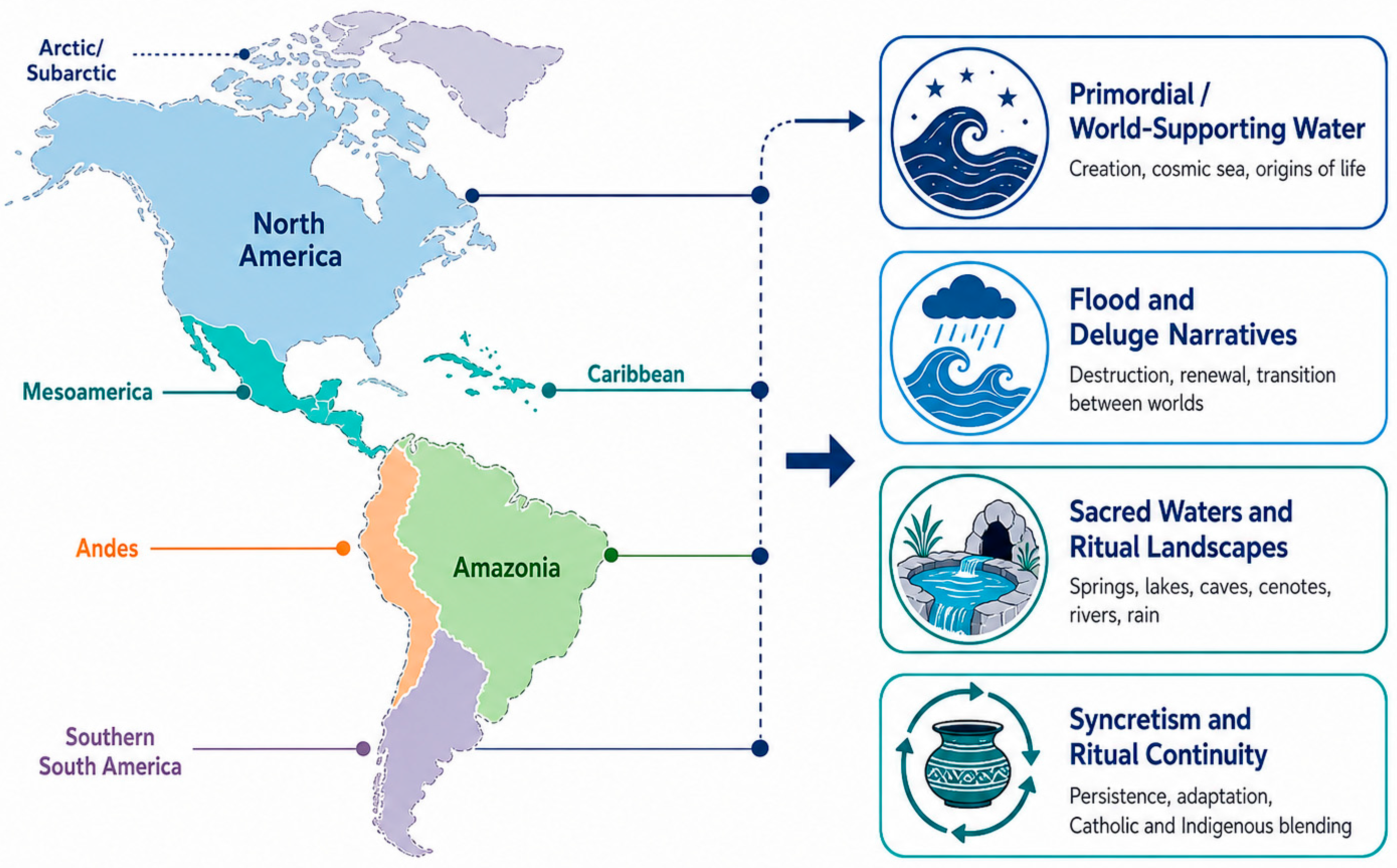
Despite these historical disruptions, many water-related traditions have continued into the present, often in transformed forms. Rituals involving rain, springs, sacred lakes, offerings, purification, and ceremonial bathing continue to show how closely many communities relate water to land, memory, and spiritual life. The following subsections therefore examine four major themes: water as a primordial or world-supporting substance, flood and deluge narratives, sacred waters and water-related rituals, and the continuity of these practices through religious syncretism (
Figure 4).
3.1. Water as the Primeval Substance or Earth’s Supporting Sea
Across many Indigenous traditions of the Americas and the Caribbean, water appears not only as a natural element, but as the condition from which the world itself emerges. In several North American creation stories, the beginning of the cosmos is imagined as a vast expanse of water or sea. The Haida myth of the Raven, for example, describes a world originally covered by water, from which land appears through a creative divine act [
73]. Similar motifs appear in a range of North American traditions, including examples from the Southwest and Plains, the Great Lakes region, California, and the Southeast, such as Apache, Huron, Blackfoot, Maidu, Achomawi, Mandan, Yuchi, and Cherokee narratives [
74,
75,
76,
77,
78,
79,
80]. Rather than treating these traditions as identical, the point here is that different communities used the image of primordial water to explain the emergence of land, life, or human society.
This idea also appears in early colonial and Mesoamerican sources. Accounts recorded by Gregorio García and Diego Durán describe the pre-created world as dark, watery, and unformed, while the Popol Vuh of the Maya-Quiché tradition begins with a silent and motionless world in which only the sky and calm sea exist before creation begins [
81,
82,
83]. These narratives show that water could be understood as both peaceful and mysterious: a still, primordial presence from which order gradually emerges.
In South American and Andean traditions, the same theme takes different forms. Among the Kogui, the world originates from a feminine primordial sea, while the Cashibo, Guarayos, and other Amazonian groups also preserve traditions in which water is present at the beginning of all things [
84,
85,
86,
87]. In Inca cosmology, the earth was believed to float upon a cosmic sea, and Lake Titicaca held a central place as a sacred point of origin. From its waters, Viracocha was believed to have emerged to create the sun, moon, stars, and human beings, while later traditions connected the same lake with the emergence of Manco Cápac and Mama Ocllo, civilizing figures in Inca myth [
63,
64,
88].
Other South American traditions emphasize water’s generative and ambivalent character. Among the Matsigenka, creation begins when a divine being acts upon the waters, separating water and earth [
89]. In Tehuelche tradition, the world was once a boundless ocean before land appeared through divine intervention [
90]. In Andean thought more broadly, flowing water could represent a dynamic life force, while the Huarochirí Manuscript links life to the union of feminine earth and masculine water [
91,
92]. The figure of Eshnuwarta among the Chamacoco and Ayoreo expresses this duality especially clearly: she is both a nourishing “woman of water” and a terrifying storm-being [
93]. These myths do not amount to a single doctrine, but they point to a recurring symbolic pattern: water was widely imagined as the beginning of life, the support of the earth, and a force that could be at once creative, fertile, mysterious, and dangerous.
3.2. The Flood or Deluge
Flood myths are widespread across the Americas and the Caribbean, but their meaning is not always identical to that of the Biblical deluge. In many Indigenous traditions, floods do not function only as divine punishment for sin. They often mark the end of one cosmic age and the beginning of another, linking destruction with renewal and the possibility of a more balanced world.
In North American traditions, flood narratives frequently express the consequences of disorder, disrespect, or moral imbalance. Inuit traditions describe a great flood in which ocean waters rise and cover the land [
94,
95]. Haida accounts preserve several versions of a deluge, some connected with human noise, disrespect, or improper behavior, recalling in broad terms the Mesopotamian motif of humanity’s disturbance of the divine order [
14]. Comparable flood narratives are also found in many other North American traditions, including those of the Gros Ventre, Pawnee, Bannock, Cherokee, Pomo, Wintu, Hopi, Cochiti, Pima, and Jicarilla Apache [
74,
96,
97,
98,
99,
100,
101,
102,
103,
104,
105,
106]. For the purposes of this review, their importance lies less in the individual narrative details than in the recurring symbolic pattern they share: floodwater marks rupture, cleansing, survival, and the possibility of a renewed world.
These stories vary greatly in detail. Some emphasize divine anger; others focus on grief, cosmic imbalance, or the need to cleanse and remake the world. The Hopi tradition, for example, presents a sequence of worlds destroyed when humanity fails to live in harmony with the Creator’s intentions [
96]. In other narratives, such as those of the Cochiti or Pima, the flood story contains elements that may reflect post-contact influence, including motifs reminiscent of the Biblical ark tradition [
104,
105,
106]. These examples show that Indigenous flood narratives often preserve older cosmological patterns while also bearing traces of later cultural exchange.
In Andean and southern South American traditions, flood myths are also connected with creation, judgment, and transformation. In one Inca narrative, Viracocha destroys an earlier humanity by flood after people begin worshipping natural features such as rivers, springs, and mountains as independent deities [
107]. In other traditions, the catastrophe is not caused primarily by rainfall, but by the rising of waters or by overwhelming inundation [
108]. The Yaganes of Tierra del Fuego, for example, tell of a time when the Moon fell into the ocean, submerging the earth and leaving only an island from which the survivors became the ancestors of the people [
109].
Thus, flood myths in the Americas should not be treated simply as local versions of the Biblical deluge. They form a diverse body of narratives in which water becomes a force of destruction, cleansing, transition, and renewal. What links these narratives is not a common theology, but the recurring idea that floodwater can destroy an existing order and open the way for renewal.
3.3. Sacred Water
Beyond creation and flood narratives, water also appears across Indigenous traditions of the Americas and the Caribbean as a sacred presence within the landscape. Rivers, springs, lakes, caves, cenotes, and rain were often understood as living or spiritually charged elements that connected human communities with ancestors, deities, spirits, and the wider cosmos.
In North America, water was frequently associated with life, purification, and healing. Among the Cherokee, ritual practices such as “Going to the Water” expressed both physical and spiritual renewal [
110]. Among the Tewa of New Mexico, rivers, springs, and lakes were believed to be connected through subterranean networks, through which sacred water serpents could carry prayers to spiritual beings [
111]. Such traditions show that water was not only used in ritual; it was often imagined as an active pathway between worlds.
In Mesoamerica, sacred water was strongly connected with caves, cenotes, springs, and rain. Among the Maya and other Mesoamerican peoples, caves and cenotes were often understood not simply as natural features, but as openings into the earth and points of contact with ancestors, gods, rain powers, and the underworld [
112]. In Mexica religion, the sacredness of water was also expressed through the worship of Tlaloc, the rain god, and Chalchiuhtlicue, goddess of terrestrial waters [
113]. This helps explain why water places could become ritual landscapes rather than isolated sacred spots. The significance of such places is also supported by archaeological and ethnographic studies of Mesoamerican ritual cave use, which show that caves and water-bearing places often formed part of a wider sacred geography [
112].
In the Andes, water from springs, rivers, lakes, and oceans was associated with fertility, origin, and cosmic vitality. Lake Titicaca was venerated as a place of creation, while sacred springs and caves, known as pakarinas, were understood as places of emergence for clans and peoples [
114,
115]. In Andean cosmology, water could be imagined as the “blood” of the earth and the universe, sustaining life and connecting different levels of reality [
116].
Water’s sacred character was also expressed through ritual action. Rainmaking ceremonies, offerings at springs or caves, sweat lodge ceremonies, ritual immersions, rain dances, and rites of weeping or crying for rain all show that water was central to communal life, agricultural hope, purification, and spiritual communication [
110,
117,
118,
119]. Across these practices, water links the body, the land, the community, and the sacred in ways that are both ritual and practical.
Across these examples, sacred water is best understood not only as a theme in myth, but also as part of lived sacred geography. Springs, lakes, rivers, caves, cenotes, and rain were often treated as places or forces through which different levels of reality could meet: the human community, the ancestors, the land, the underworld, and the divine or spirit world. This perspective helps move the discussion beyond a list of examples and shows why water could become central to ritual action, territorial memory, and communal identity.
3.4. Religious Syncretism and Continuity of Water Rituals to the Present
Many Indigenous water-related traditions in the Americas and the Caribbean did not disappear after European colonization. Instead, they often continued in transformed forms, sometimes openly and sometimes under Christian, especially Catholic, symbolism. These processes of religious syncretism were complex. In some cases, Indigenous communities adapted Christian symbols to preserve older meanings; in others, missionaries encouraged the blending of traditions as a way to support conversion.
In North America, practices such as sweat lodge ceremonies, rain dances, and “Going to the Water” continue to express a deep relationship between water, purification, prayer, and renewal. Sweat lodges, used by communities such as the Cherokee and Lakota, combine heat, steam, prayer, and enclosure to cleanse both body and spirit [
120,
121,
122]. Rain dances and ritual immersions likewise preserve the idea that water is not only a material need, but also a sacred force that sustains community, land, and spiritual life [
110,
123,
124].
In Mesoamerica, pre-Hispanic water rituals have often been reframed within Catholic calendars and symbols. Ceremonies of petition and thanksgiving, rooted in older traditions connected with Tlaloc and Chalchiuhtlicue, continue to be performed at mountains, lakes, springs, and cenotes, where offerings are made for rain, fertility, and agricultural abundance [
113,
125,
126]. The Fiesta de la Santa Cruz, celebrated in early May, is especially relevant here because it coincides with the beginning of the agricultural cycle and often includes prayers for rain, rituals at springs or wells, and the cleaning of water sources [
117,
127].
In the Andes, water remains closely connected with Pachamama, Yaku Mama, sacred lakes, and agricultural renewal. Lake Titicaca continues to function as a sacred landscape and pilgrimage site, while water is personified as a maternal and life-giving presence [
116,
128]. During the Fiesta of Pachamama, offerings to Mother Earth may be combined with Catholic prayers, illustrating how Indigenous and Christian forms of devotion became interwoven over time.
Some water rituals also retain a direct practical and communal function. The limpia de acequia, or cleaning of irrigation ditches, is still practiced in parts of Peru, northern Chile, and northwestern Argentina. Its culmination in the ceremonial release of water, known as the largada del agua, joins irrigation management with symbolic renewal [
129,
130]. Similarly, the Mapuche ngüillatún invokes water and natural forces in prayers for fertility, rain, and well-being, often near rivers or lakes [
131]. These practices remain active forms of ecological care, agricultural memory, and spiritual identity.
4. Water in the Major Abrahamic Religions
This section explores the symbolic, ritual, and theological significance of water in the three major Abrahamic religions: Judaism, Christianity, and Islam. Although these traditions developed in different historical contexts and express distinct theological understandings, they share a common recognition of water as a divine gift, a source of life, and a medium of purification. In all three religions, water is closely connected with covenant, blessing, moral renewal, bodily and spiritual cleansing, and human dependence on God.
With the expansion of diasporic communities, missionary activity, pilgrimage, and modern global mobility, Judaism, Christianity, and Islam can no longer be understood as traditions confined to a single geographical region. For this reason, the following discussion follows a broadly chronological order, beginning with Judaism, followed by Christianity and Islam, while also emphasizing their shared water-related themes, especially purification, sacred space, and prayers for rain.
4.1. Judaism
Judaism, the oldest of the three Abrahamic religions, centers on the belief in one God and on the covenantal relationship between God and the people of Israel. Its foundational texts are contained in the Torah, which forms part of the Hebrew Bible, or Tanakh. Within Jewish tradition, water carries both practical and spiritual significance. It is associated with life, divine wisdom, purification, blessing, and, at times, divine judgment. In ancient communities, water was supplied through springs, wells, aqueducts, fountains, and reservoirs, as in many other religious traditions [
132,
133].
Within this religious and social context, wells held particular importance. Throughout ancient history, they served not only as essential sources of water, but also as places of daily gathering, exchange, and social interaction. These small, deep water sources, accessed with ropes and buckets, often became central public spaces. One notable example is Beersheba, in present-day Israel, which developed around such a well [
132].
According to biblical tradition, one of the earliest references to a well as a symbol of covenant appears in the Book of Genesis. A pact is said to have been made between the patriarch Abraham, regarded as a founding figure of Judaism, and the Philistine king Abimelech over the ownership of a specific well. Seven ewe lambs were exchanged as tokens of the agreement, and the site was named “Be’er Sheva,” meaning “Well of the Oath” in Hebrew [
133]. In this narrative, the well is more than a practical source of water; it becomes a marker of covenant, memory, and communal identity.
4.1.1. Biblical and Early Jewish Traditions
In the biblical narrative of Moses—revered as a prophet in Judaism, Christianity, and Islam—water is frequently associated with divine intervention. During the Israelites’ exodus from Egypt, Moses parted the Red Sea to allow his people to escape from Pharaoh’s army, an act described as a miracle in both the Bible and the Quran. Later, in the Sinai Desert, Moses is said to have struck a rock from which twelve springs of water emerged to quench the thirst of the Israelites (Exodus 15–17). These miraculous events underscore the life-giving and spiritual symbolism of water in early Jewish tradition.
4.1.2. Later Jewish Traditions and Contemporary Practice
In medieval and early modern Judaism, water retained its symbolic meaning of purification and renewal. The Hebrew Bible includes numerous references to water as both a blessing and a form of judgment. It is associated with purity, punishment, salvation, and divine wisdom: “Divine wisdom will cover the earth as water covers the sea” (Isaiah 11:9). Connected to these meanings, two important ritual forms of washing and immersion became especially significant in Jewish practice. The first is tevilah, a full-body immersion in a mikveh (ritual bath), typically required for conversions, before major holidays, or after certain bodily events. The second is netilat yadayim, the ceremonial washing of hands, usually before meals and prayers. In addition, many Jewish communities continue to observe seasonal prayers for rain. On the evening of December 4, for example, a traditional prayer is offered for life-sustaining rain, symbolically asking for “rain for life, not for death” [
134]. These rituals underscore Judaism’s enduring importance of water both in its material and spiritual (as a divine blessing) dimension.
4.2. Christianity
Christianity, the second Abrahamic religion, emerged in the first century CE, founded on the life and teachings of Jesus of Nazareth, regarded by Christians as the Messiah and Son of God. Today, Christianity is the world’s largest religion, comprising roughly 30% of the global population. Water holds profound symbolic and theological significance across Christian traditions, although its ritual use varies among denominations. Baptism is central to Christian identity, while holy water, sacred springs, and water blessings are especially prominent in Orthodox and Catholic practice. The following subsections explore how these meanings evolved from early Christianity through medieval and modern times, into contemporary religious practice [
1,
7].
4.2.1. Early Christianity (ca. 1–330 AD)
In early Christianity, water functioned as a central religious symbol, often conveying paradoxical meanings—death and rebirth, sin and purification, destruction and renewal. John the Baptist, a prophetic figure and forerunner of Jesus, conducted ritual immersions in the Jordan River, calling for repentance and spiritual cleansing. His practice gave rise to the term baptism, derived from the Greek word baptizein, meaning “to immerse.”
Jesus himself was baptized in the Jordan, not out of personal need for purification, but to sanctify the act and bless the water for humanity. Baptism became the rite of initiation into the Christian faith, symbolizing the death of the old self and the birth of a new, Christ-centered life. As described in the Gospel of John, Jesus offered “living water” to the Samaritan woman, proclaiming: “Whoever drinks the water I give them will never thirst… it will become a spring of water welling up to eternal life” [
135]. In this context, it denotes the spiritual water that Jesus, acting on God’s behalf, bestows upon those who believe in him, causing it to flow within the soul of the believer. This water signifies eternal life and serves as a symbol of salvation and spiritual regeneration.
4.2.2. Christianity in Medieval Times (ca. 330–1400 AD)
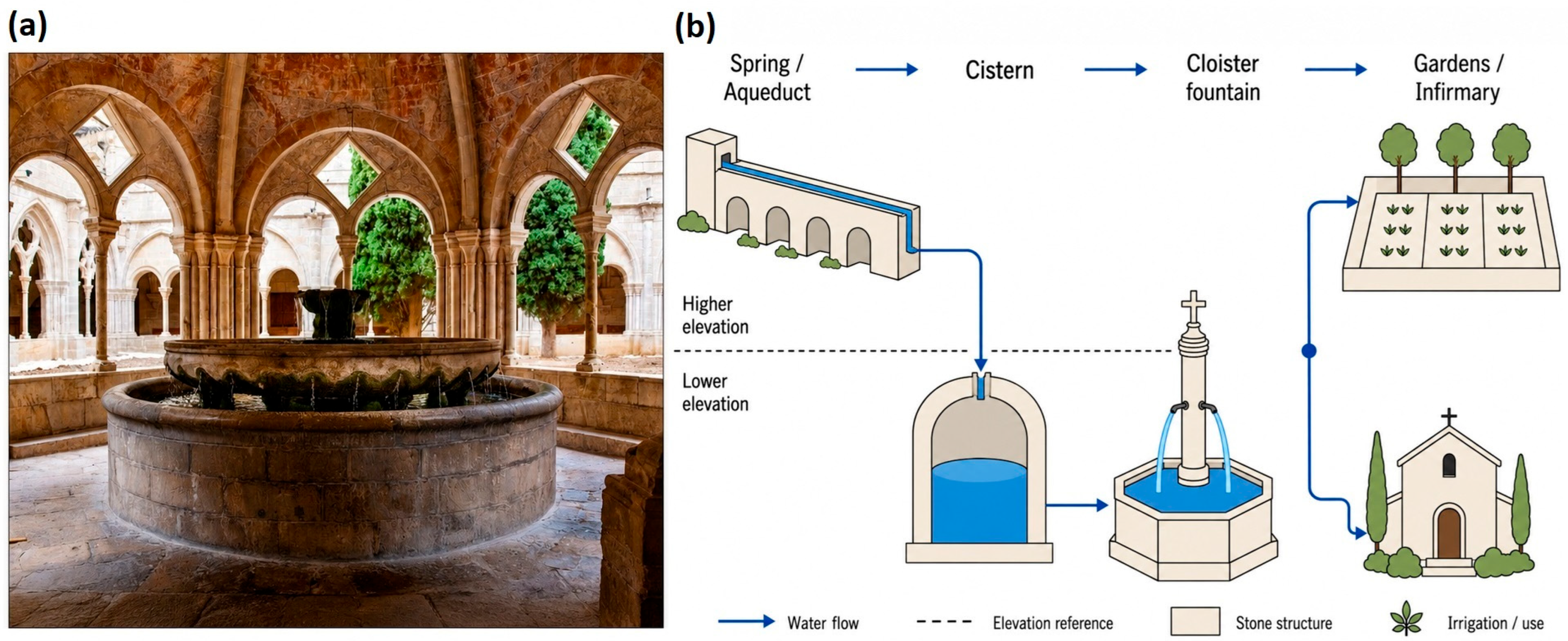
During the Middle Ages, monasteries became important centers of Christian spirituality, learning, hospitality, and care. Water was essential to this monastic world not only because it sustained daily life, but also because it helped shape the monastery as an ordered and sacred space. It was needed for drinking, cooking, washing, gardens, the care of the sick, and the reception of guests, but it also carried a symbolic value connected with purity, discipline, humility, and spiritual renewal.
The Rule of Saint Benedict, which deeply influenced Western monastic life, required monasteries to have access to a reliable source of water. This practical requirement often determined the location of monastic communities, many of which were built in valleys or near springs, rivers, and areas with abundant groundwater. In this context, hydraulic systems such as aqueducts, cisterns, fountains, and water wheels should not be viewed only as technical achievements. They were also part of the spiritual organization of monastic life, allowing the community to live in self-sufficiency, cleanliness, hospitality, and ritual order [
136].
Medieval monasteries therefore offer a clear example of the double role of water in Christianity: it was both a material necessity and a sacred medium. The cloister fountain, for example, was not simply a point of water supply. Placed within the heart of the monastic enclosure, it could also express ideas of purification, inner order, and renewal. In the Ebro River valley of Spain, several monasteries developed water-lifting and distribution systems that illustrate how practical water management became integrated into Christian communal life and sacred architecture (
Figure 5) [
137].
4.2.3. Byzantine, Early Modern, and Modern Christian Water Traditions
During this period, water continued to play a central role in Christian theology and ritual. Baptism—by immersion or sprinkling—was recognized as the sacrament marking entry into the Church and a cleansing from original sin [
1]. Holy springs and sacred waters, known in the Eastern Christian tradition as hagiasmata (from the Greek ἁγίασμα, meaning “holy thing”), were often associated with saints and pilgrimage sites. The Orthodox tradition traces this practice to Jesus’s baptism, interpreting his immersion as a sanctification of water itself. In Greek Orthodoxy, baptism is among the most important rites of passage. Infants are typically baptized within their first year, fully immersed in consecrated water mixed with olive oil, as the priest recites the child’s name [
138]. One notable tradition involves churches dedicated to the Zoodochos Pigi—”Life-Giving Spring”—a title for the Virgin Mary. The original shrine of Zoodochos Pigi in Constantinople (now Istanbul) became one of the most venerated Christian water sanctuaries in the Byzantine world [
139].
4.2.4. Christianity in Contemporary Times (1900 AD–Present)
In many contemporary Christian traditions, water continues to hold an important liturgical and symbolic role, especially in baptism, blessing rituals, and practices of purification. In Orthodox and Catholic practice, holy water is commonly used in rituals of protection, renewal, and sanctification. In Eastern Orthodox churches, the blessing of water is especially associated with the Feast of Theophany, which commemorates the baptism of Jesus in the Jordan River. In many Orthodox communities, water blessings may also be performed at the beginning of the month, the school year, or important moments in personal and communal life. During the Feast of the Theophany, the priest blesses rivers, seas, or fountains in a public ceremony reenacting Jesus’s baptism. Water is also used in various rituals surrounding life and death. After funerals, mourners may wash their hands in symbolic purification. In Catholic and Orthodox Eucharistic rites, a small amount of water is mixed with wine, a gesture commonly interpreted as symbolizing the union of humanity with Christ and the mystery of salvation. The enduring reverence for water reflects Christianity’s view of it as a sacred medium—capable of purifying, consecrating, and linking the believer with divine grace [
7].
4.3. Islam
Islam is the third, and chronologically most recent, of the Abrahamic monotheistic religions. It emerged in the early seventh century AD in the Arabian Peninsula, where water scarcity gave particular meaning to water as a sign of mercy, purity, survival, and divine provision. The Prophet Muhammad, regarded in Islam as the final messenger of God (Allah), preached the worship of one God and emphasized justice, peace, and moral integrity. Islam soon expanded beyond Arabia and developed into a major religious, cultural, and political civilization. In Islamic theology and ritual law, water is closely associated with purity, mercy, divine provision, and the preparation of the believer for worship. As in Judaism and Christianity, it is considered not only a basic necessity, but also a symbol of purity, mercy, blessing, and divine power. The following subsections examine the role of water in Islam across different historical periods [
140].
4.3.1. Early and Medieval Islam (ca. 610–1500 AD)
The Quran mentions water more than 60 times, underscoring its centrality in the Islamic worldview. According to the Quran, all living beings were created from water [
141]: “We made from water every living thing”, “Allah has created every creature from water”. Water is described as both a mercy and a sign of divine power. Rain is sent from the heavens to revive dead land, grow crops, and sustain life [
141]: “And We sent down blessed rain from the sky and made grow thereby gardens and grain for the harvest”. Yet the Quran also warns that God can withhold water as a form of punishment [
141]. This dual symbolism—life-giving and disciplinary—forms the foundation of water’s spiritual and regulatory role in Islam.
Islamic legal and ethical traditions grant universal access to water as a communal resource. Two primary rights are recognized: (a) the right to quench one’s thirst, and (b) the right to irrigate crops. Water laws in Islamic jurisprudence include regulations on usage, passage, protection zones, and shared responsibilities [
1]. The Quran also emphasizes conservation [
141]: “And We sent down water from the sky in fixed measure”, “O Children of Adam! Eat and drink, but do not waste”.
The importance of water in Islamic culture is reflected in several rituals performed to attain ritual purity (taharah), a central and complex concept in Islam that concerns the state of both physical and spiritual cleanliness required—as a sign of respect toward Allah—to carry out religious practices such as praying, touching or reciting the Quran, or entering a mosque.
Ritual purity is achieved through water, but its meaning extends beyond hygiene: it prepares the believer physically and spiritually for acts of worship. It signifies an awareness of the sacred and, through the cleansing of the body, symbolizes the purification of the soul. To attain it, Muslims are required to perform either minor ablution (wudu) or full-body ablution (ghusl), depending on the degree of impurity they find themselves in and from which they must therefore purify themselves.
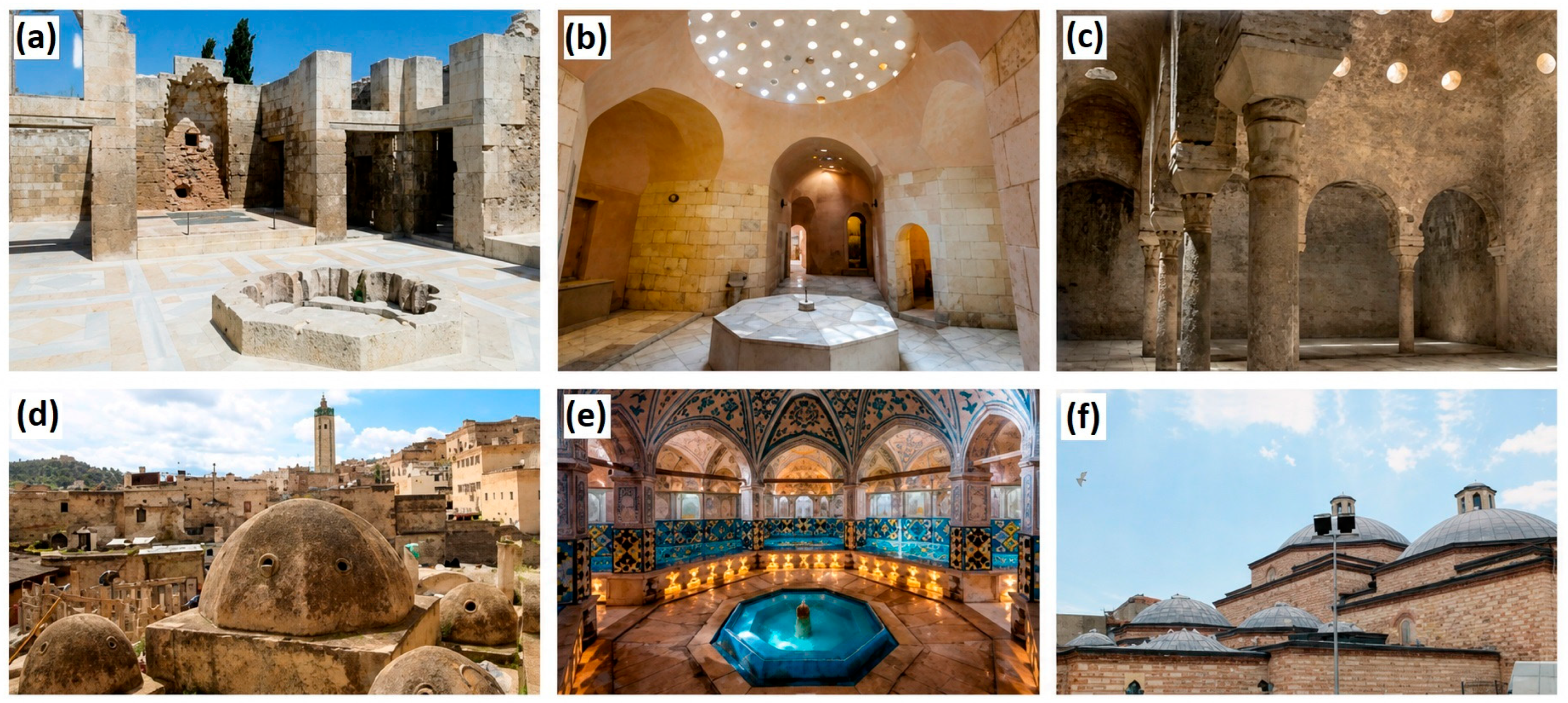
Closely connected with the Islamic requirement for ritual purity was the tradition of the hammam. These public bathhouses, characteristic of many Islamic cities, developed from earlier Roman and Byzantine bathing traditions, but were gradually adapted to the religious and social needs of Muslim communities. Their significance was not limited to hygiene. Located often near mosques, markets, or central urban areas, hammams became spaces where bodily cleansing, ritual preparation, social encounter, and communal identity met. In this sense, they expressed a broader Islamic understanding of cleanliness as both a physical and spiritual condition [
142].
Water also shaped Islamic architecture and urban life through the presence of ablution fountains in mosque courtyards. These fountains were not merely functional installations. They prepared worshippers for prayer through wudu, marking the transition from ordinary daily activity to a state of ritual attention before God. By placing water at the threshold of worship, mosque architecture made purification visible and communal, turning a practical act into a shared religious experience.
Islamic hydraulic knowledge also belongs to this wider religious and cultural context. Devices such as water wheels, pumps, fountains, and water clocks were important technical achievements [
143,
144], but they also formed part of urban environments in which water expressed order, cleanliness, prosperity, and divine mercy. Their relevance to the present study lies not only in their engineering value, but also in their place within the broader hydraulic heritage of Islamic civilization.
Water also played a central role in Islamic gardens, especially in the charbagh layout, traditionally interpreted as an earthly evocation of the four rivers of Paradise. Pools, channels, and fountains created spaces of shade, reflection, sound, and movement, transforming water into a symbol of divine grace, cosmic harmony, and promised blessedness [
145]. In this way, Islamic gardens did not merely display water as ornament or technology; they translated Qur’anic images of Paradise into lived architectural and sensory experience.
4.3.2. Modern and Contemporary Islam (1500 AD–Present)
Water continues to hold a central role in modern and contemporary Islamic culture. The requirement of ritual purity remains one of the most visible expressions of this continuity. Muslims are generally required to perform wudu before the five daily prayers when they are not already in a state of ritual purity, using clean water to wash specific parts of the body in a prescribed sequence. This act is not understood merely as hygiene, but as preparation for standing before God. Full-body purification, or ghusl, is required in specific circumstances and is recommended in many Islamic traditions before Friday prayer and major feast days, such as Eid al-Fitr and Eid al-Adha [
146].
The role of hammams has changed considerably in modern times, especially with the spread of private bathrooms and indoor plumbing. In many cities, traditional hammams have declined as everyday religious and social institutions. Some, however, still preserve their communal and ritual functions, while others have been transformed into heritage sites or wellness spaces. This transformation shows how the symbolic meaning of water may shift over time: from ritual purification and social gathering to cultural memory, relaxation, and identity (
Figure 6) [
142].
A particularly important example of the continuing sacred value of water in Islam is the Zamzam well in Mecca. According to Islamic tradition, this water source miraculously appeared when Hagar searched for water for her son Ishmael in the desert. Pilgrims today drink Zamzam water during the Hajj and Umrah pilgrimages, and many take it home as a sign of blessing, divine providence, and spiritual purification [
147]. The enduring reverence for Zamzam illustrates how water remains a living symbol of mercy, survival, and nearness to God in Islamic devotion.
4.4. Prayers for Rain as a Shared Abrahamic Theme
Having examined Judaism, Christianity, and Islam separately, this subsection turns to one ritual theme they share: prayers for rain. Although the three Abrahamic traditions differ in theology, liturgy, and ritual structure, all of them understand rain as a divine gift on which human life, agriculture, and social stability depend. In this sense, prayers for rain express a shared awareness of human vulnerability before nature and dependence on God.
In Judaism, prayers for rain are highly structured and closely connected with the seasonal rhythm of the land of Israel. Alongside liturgical formulas incorporated into daily prayer and communal supplications during drought, the annual prayer known as Tefillat Geshem marks the beginning of the rainy season. Its wording clearly distinguishes between rain that sustains life and rain that destroys: “rain for life and not for death; for blessing and not for curse” [
134]. This distinction is important because it shows that rain is not valued simply as water, but as water given in the right measure, at the right time, and as a sign of divine blessing.
In Christianity, prayers for rain are generally less formalized as universal liturgical obligations, but they have remained important in many rural and agricultural communities. A notable example is the tradition of Rogations, or blessings of the fields, especially in parts of Europe and Latin America. During these processions, fields may be blessed with holy water while prayers are offered for rain, protection from hail, and a good harvest. Local variants often include the carrying of saints’ statues or relics as intercessory figures. These practices show how Christian communities connected water, agricultural fertility, divine protection, and communal hope, even when such rites belonged more to popular devotion than to universal liturgical prescription.
In Islam, prayers for rain are expressed through both informal supplication (duʿāʾ) and the more formal communal prayer known as ṣalāt al-istisqāʾ. Both practices are performed during drought or prolonged lack of rain and express humility, repentance, and trust in Allah’s mercy. While duʿāʾ may be offered individually or collectively in different settings, ṣalāt al-istisqāʾ is usually performed as a communal prayer, often in an open space and led by an imam. Its purpose is not only to ask for rainfall, but also to restore a sense of spiritual and social dependence on divine mercy [
148].
Taken together, these three traditions show that rain prayers are never only practical requests for water. They also express moral and spiritual attitudes: gratitude, humility, repentance, hope, and recognition of human dependence on a power beyond human control. At the same time, each tradition gives this shared theme a different form. Judaism frames rain strongly through covenant and seasonal liturgy; Christianity often expresses it through blessings of fields, saints, and rural devotional practice; and Islam emphasizes communal supplication, mercy, and submission to God. Rain therefore becomes a meeting point between ecology, agriculture, ritual, and theology.
5. Discussion and Conclusions
5.1. Comparative Patterns in the Religious Symbolism of Water
The traditions examined here suggest that few natural elements have been as consistently reinterpreted in religious life as water. The purpose of comparison is not to claim that all traditions share the same theology of water, but to show how similar physical qualities of water—its ability to flow, cleanse, sustain, destroy, and return—have been drawn into different religious worlds. Its meanings vary across cultures, but several recurring patterns can be identified. Across the material reviewed, water is linked to creation, purification, fertility, healing, destruction, divine judgment, and the formation of sacred space.
Viewed in this way, many of the examples discussed in the article can be understood as forms of sacred manifestation. Water does not carry a single universal religious meaning; rather, its physical qualities—flow, depth, clarity, fertility, danger, and renewal—allow it to become a powerful medium through which different communities express relationships with the sacred, the land, the body, and the wider cosmos.
One of the strongest shared patterns is the association between water and beginnings. In Mesopotamian, Biblical, Qur’anic, Hindu, Mesoamerican, Andean, and Indigenous American traditions, water often appears before the ordered world or at the moment when life begins. The recurrence of this theme should not be mistaken for theological uniformity. Rather, it reflects how easily water’s life-sustaining role could be extended into narratives of cosmic origin, divine creativity, and order emerging from chaos. A second major pattern is purification. In Christianity, baptism and holy water express spiritual cleansing and rebirth. In Islam, wudu and ghusl prepare the believer for prayer and restore ritual purity. In Judaism, immersion in the mikveh and handwashing rituals mark transitions, preparation, and renewal. These examples, from Hindu ritual bathing and Buddhist blessed water to African and Indigenous American purification ceremonies, show that water is widely understood as capable of removing impurity, not only from the body but also from the moral, social, or spiritual self.
Water is also closely linked with fertility, abundance, and healing. This is especially visible in river-based civilizations, agricultural societies, and traditions where springs, rain, or sacred rivers are treated as divine gifts. The Nile flood in Egypt, the sacred rivers of Hinduism, the rain-related rites of the Abrahamic traditions, the cult of Adonis in the Levant, and Indigenous American rain and spring rituals all express the same basic human recognition: without water, there is no harvest, no health, no continuity, and no community.
At the same time, water is not only gentle or beneficial. Flood myths, storms, droughts, and destructive rains show that many cultures also understood water as a force of judgment, danger, and cosmic reset. In Mesopotamian and Biblical flood traditions, water may punish or cleanse a corrupted world. In Indigenous American narratives, floods often mark the end of one age and the beginning of another. This ambivalence is essential to water symbolism. Water becomes sacred partly because of this ambiguity: it sustains life, but it can also destroy, cleanse, and make renewal imaginable.
5.2. Water, Ritual Space, and Community
A further pattern concerns place: water often helps turn ordinary landscapes or built spaces into sacred ones. Rivers, springs, wells, lakes, caves, cenotes, temple basins, fountains, and ablution areas become more than physical locations. They become points of contact between human communities and the divine, the ancestors, the cosmos, or the moral order.
This spatial role differs across traditions. In Hinduism, the Ganges and other sacred rivers may themselves become places of worship. In Indigenous American and Andean traditions, lakes, springs, caves, and flowing waters often function as living sacred landscapes. In Christianity and Islam, water is more often used as a ritual medium within sacred architecture: baptismal fonts, holy water vessels, monastery fountains, and mosque ablution fountains prepare the body and the soul for worship. In Judaism, the mikveh creates a controlled ritual space where immersion marks purification, transition, and renewal.
Water rituals also have a social dimension. Rain prayers, processions, pilgrimages, ablutions, baptisms, bathing ceremonies, and offerings are rarely only private acts. They often bring people together around a shared need: health, purity, forgiveness, harvest, protection, or blessing. This communal aspect matters because water rituals rarely concern individual devotion alone. It is also a medium through which societies express dependence, solidarity, memory, and hope.
5.3. Sacred Water, Hydraulic Heritage, and Environmental Ethics
The material examined in this review shows that hydraulic heritage should not be understood only as a technical or secular legacy. Nor should it be seen as a stage that comes after religious meaning has disappeared. Sacred basins, wells, temple channels, fountains, monastic water systems, hammams, gardens, irrigation ditches, and ritual landscapes show that water infrastructure often carried religious, symbolic, and communal meanings.
The monastic examples discussed above are especially useful in this respect, because they show how water systems could organize daily life while also supporting prayer, hospitality, healing, cleanliness, and the symbolic ordering of sacred space.
A central pattern that emerges from the examples is not a simple opposition between practical use and religious meaning, but their frequent overlap. The same waters that sustained agriculture, healing, travel, or urban life could also become ritually marked, morally charged, or remembered as part of a sacred landscape.
This historical perspective can also contribute to present-day debates about water. Modern water debates are often framed in technical, economic, or political terms, such as supply, scarcity, irrigation, sanitation, pollution, and governance. These dimensions are essential, but they do not fully capture the cultural, moral, and in some cases continuing religious importance of water. In many of the traditions reviewed here, water is more than a usable resource: it may be understood as a gift, boundary, blessing, purifier, meeting point, or warning.
This does not mean that ancient religious views can be applied directly to modern environmental policy, nor that they can replace scientific water management, engineering, or legal regulation. Their relevance is more indirect, but still important. They can preserve cultural memory around water places, strengthen public attachment to rivers, springs, wells, and wetlands, and deepen the ethical language through which societies think about water protection. Traditions that regard water as sacred show that water conservation is not only a matter of efficiency. It is also a matter of responsibility toward human communities, future generations, and the natural world.
At the same time, the comparison also shows that “sacred water” is not a single universal idea. Some traditions personify water through deities or spirits; others understand it as a divine creation; and others use it primarily as a ritual medium. These differences matter, because they prevent us from reducing all religions to the same symbolic system. Despite these differences, the traditions reviewed here repeatedly place water at the intersection of life, body, land, society, and transcendence.
5.4. Conclusions
This review has shown that water becomes religiously meaningful through the interaction of symbolic meanings, ritual practices, sacred landscapes, and material water infrastructures. Across the traditions examined here, water appears as a source of creation, purification, fertility, healing, danger, judgment, renewal, and sacred presence. These recurring themes show why water can be described as a universal religious symbol. At the same time, the comparison also shows that “sacred water” is not a single universal idea. Each tradition gives water its own meanings through specific myths, rituals, texts, places, and historical experiences.
A central contribution of this review is the use of hydraulic heritage as a category linking religious symbolism with material practice. Hydraulic heritage refers here to inherited water-related places, structures, practices, and landscapes in which practical water management and religious or cultural meaning overlap. Sacred basins, temple channels, wells, fountains, monastic water systems, hammams, irrigation ditches, sacred rivers, springs, and ritual landscapes all show that water was often experienced through both use and meaning. These examples demonstrate that water infrastructure could support daily life while also organizing sacred space, ritual purity, communal identity, and cultural memory.
The review also suggests that sacred water traditions remain relevant today, but not because they provide direct technical solutions to modern water problems. Their importance lies in the cultural and ethical perspectives they preserve. In a period marked by climate change, pollution, scarcity, and unequal access to clean water, religious and cultural memories of water can enrich the language of care, restraint, responsibility, gratitude, and interdependence. They remind us that water protection is not only a technical or economic challenge, but also a cultural and moral responsibility.
Overall, the traditions discussed in this article show that water has rarely been only a resource or only a symbol. It has often been both at once: a material condition of life and a medium through which communities understand the body, the land, the sacred, and their obligations to one another.




 ,
,