1. Introduction
Water resources are essential for ecosystem stability, environmental protection, and socio-economic development. Global water demand continues to increase due to population growth, agricultural expansion, and industrial activities, generating increasing pressure on available freshwater resources. Recent assessments indicate that worldwide water demand grows at approximately 1% per year, intensifying the risk of water scarcity in regions with high climatic variability and limited storage capacity [
1,
2]. Blue water scarcity, defined as the condition in which surface and groundwater resources are insufficient to satisfy human demand, already affects large parts of the global population and is expected to intensify under future climate change scenarios [
3].
High-Andean basins are especially sensitive to hydroclimatic variability because their hydrological balance depends strongly on seasonal precipitation, groundwater recharge, and complex mountain topography [
4]. Small variations in temperature or rainfall may significantly affect runoff generation, infiltration, and river discharge. In the Lake Titicaca watershed, severe flood events recorded during 1982–1986 and 2003–2004 were associated with anomalous precipitation patterns and lake-level fluctuations, demonstrating the high sensitivity of these mountain systems to climate variability [
5,
6]. These changes are critical because water resources in the Altiplano sustain agricultural production, livestock systems, wetlands, and rural populations whose livelihoods depend directly on seasonal water availability [
7,
8].
Climate projections indicate that temperature in the tropical Andes will continue to increase throughout the twenty-first century, enhancing evapotranspiration and reducing effective infiltration, which may lead to decreased groundwater recharge and reduced baseflow contributions to rivers [
9,
10,
11]. In mountain basins, these processes may trigger nonlinear hydrological responses, increasing the likelihood of flood events during wet periods and water deficits during dry seasons. Such changes may directly affect water availability [
12,
13], agricultural productivity, and ecosystem stability in high-altitude regions, thereby increasing the vulnerability of rural communities in the Altiplano [
14,
15].
Hydrological models have become essential tools for evaluating the impacts of climate change on water resources. The Soil and Water Assessment Tool (SWAT) allows simulation of runoff, percolation, groundwater recharge, and water balance under different climate scenarios, providing a useful framework for assessing hydrological responses at the basin scale [
16,
17]. The integration of SWAT with climate projections has been widely applied in mountain and semi-arid regions to estimate future changes in water availability and flow variability [
18,
19,
20]. In addition, the Water Stress Index (WSI) provides a useful indicator of pressure on water resources under changing climatic conditions and increasing human demand [
21,
22].
In Peru, previous studies have shown that Andean basins are highly sensitive to climate variability, with reductions in groundwater recharge and increased pressure on water resources under warming conditions. However, the long-term evolution of water availability and water stress in the Coata River basin remains insufficiently quantified under future climate scenarios [
23,
24,
25,
26,
27]. This basin contains high-altitude ecosystems that regulate infiltration and runoff, but projected warming may increase evapotranspiration losses and alter the hydrological balance, affecting agricultural production, rural water supply, and ecosystem stability. These potential changes may increase water scarcity risk in the northern Altiplano, where local populations depend strongly on seasonal water resources.
It is hypothesized that projected increases in temperature and changes in precipitation patterns will reduce groundwater recharge, increase hydrological variability, and intensify water stress conditions in the Coata River basin. Therefore, the objective of this study is to evaluate the impacts of climate change on runoff, groundwater recharge, renewable water resources, and water stress using the SWAT hydrological model forced with CMIP5 climate projections under the RCP 4.5 and RCP 8.5 scenarios.
This study provides a comprehensive assessment of climate change impacts on hydrological dynamics and water scarcity in a high-Andean basin using an integrated SWAT-CMIP5 framework. Unlike previous studies in the Lake Titicaca region, this research evaluates multiple hydrological components simultaneously, including runoff, groundwater recharge, renewable water resources, and water stress. This approach contributes to a more integrated understanding of climate-driven hydrological responses in data-scarce mountain environments and provides relevant information for water management in the Andean Altiplano.
2. Materials and Methods
2.1. Study Area
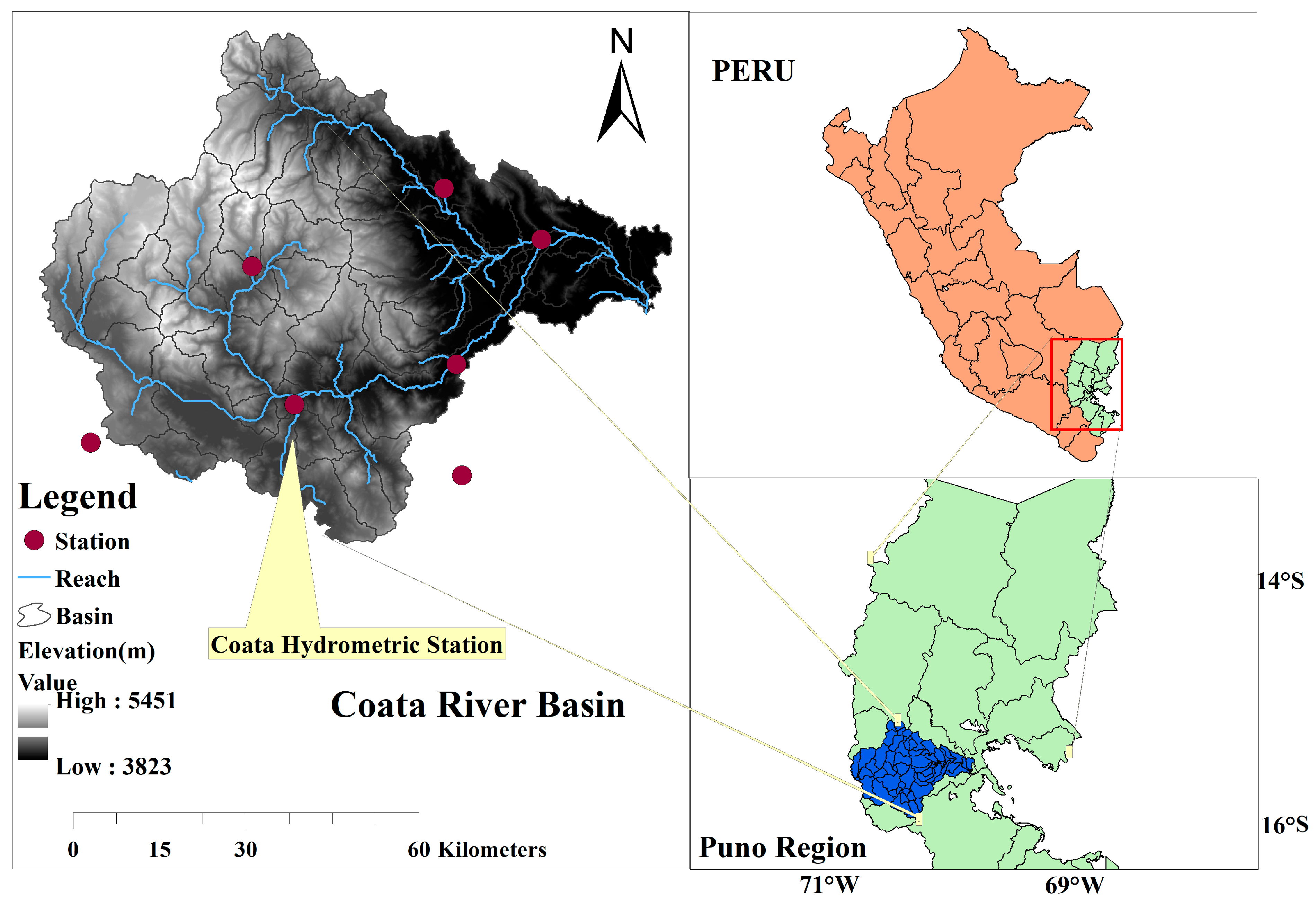
The Coata River Basin is located in the northern sector of the Lake Titicaca watershed in the department of Puno, southern Peru (
Figure 1). The basin forms part of the endorheic hydrological system of the Altiplano, where surface waters drain into Lake Titicaca rather than reaching the ocean. The Coata River is one of the principal tributaries of the lake on the Peruvian side and plays a key role in the hydrological balance of the basin. Geographically, the basin extends across the northern Altiplano plateau between approximately 15°30′ and 16°05′ south latitude and 70°00′ and 70°40′ west longitude. The watershed covers an area of approximately 4882.00 km
2 and is characterized by high-altitude plateau landscapes and gently undulating terrain typical of the Andean Altiplano. Elevations range between 3800 and 4200 m above sea level, reflecting the typical geomorphology of the Titicaca basin [
28].
The hydrographic network of the basin consists of numerous tributaries that converge into the Coata River, which ultimately discharges into Lake Titicaca. Several streams originating in the surrounding highlands collect surface runoff and transport water and sediments toward the main channel. Studies have shown that sediments transported by the river contain trace metals derived from both lithogenic sources and anthropogenic activities in the watershed [
29].
Administratively, the basin includes territories of several districts within the provinces of San Román and nearby areas of Puno. The watershed encompasses both rural and peri-urban zones where agriculture and livestock production represent the dominant land-use activities. Human settlements in the basin depend largely on water resources derived from tributary streams, groundwater, and the hydrological system connected to Lake Titicaca. The basin therefore represents an important socio-ecological system where water resources support local livelihoods and agricultural production. The climate of the basin corresponds to a cold semi-arid high-Andean climate, characterized by strong seasonality in precipitation. Most rainfall occurs during the austral summer months (December–March), while the dry season extends from May to September. These climatic conditions strongly influence runoff generation and seasonal river discharge within the watershed. Land cover within the basin is dominated by high-Andean grasslands (puna vegetation) agricultural fields, and grazing lands, which support livestock such as alpaca, sheep, and cattle. The watershed therefore represents a typical high-Andean socio-hydrological system where ecological processes and human activities interact closely.
2.2. SWAT Data
The simulation of the Coata River basin was conducted through the application of the SWAT model [
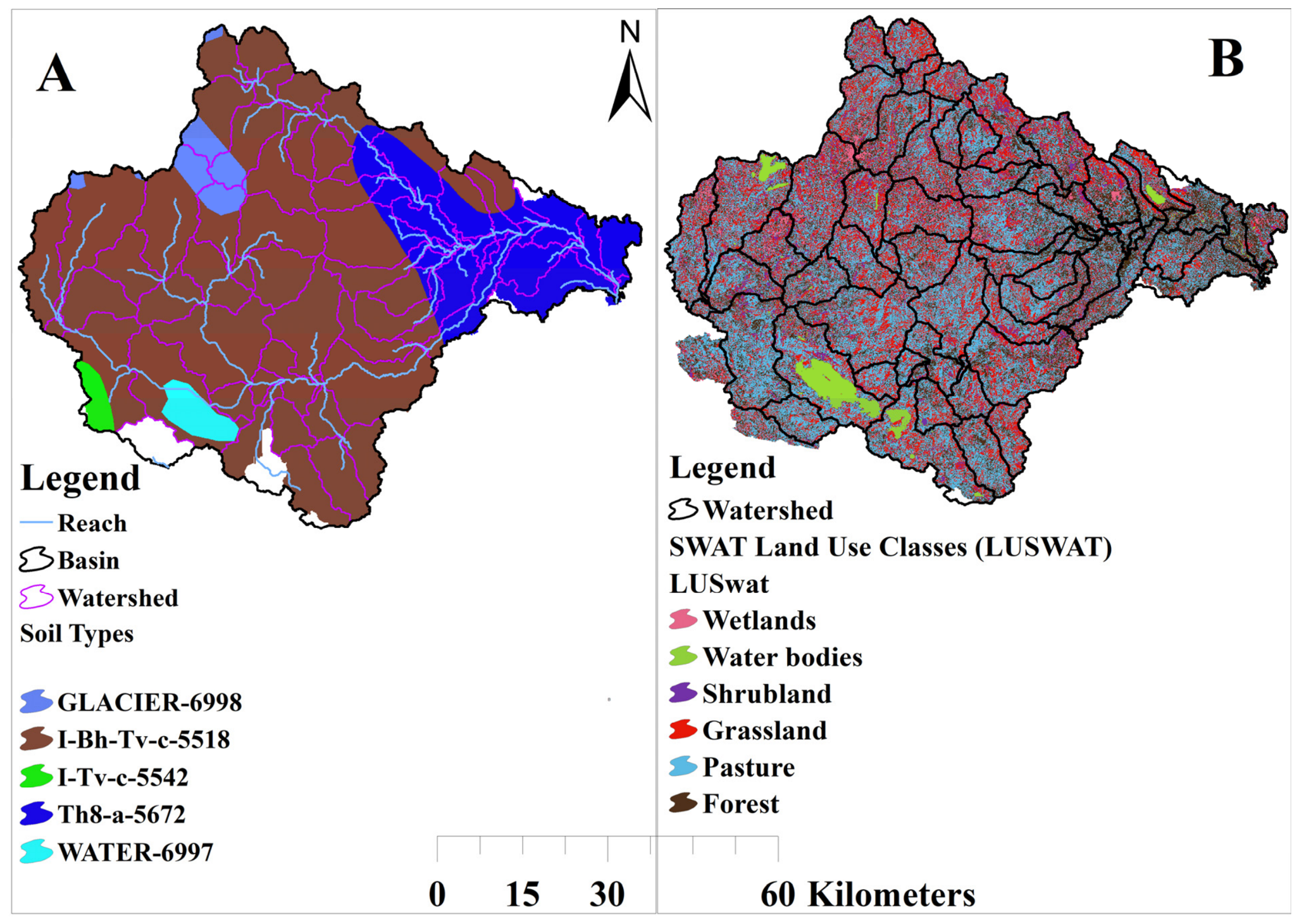
30], incorporating high-resolution geospatial and climatic datasets to represent basin characteristics. A 90 m Digital Elevation Model (DEM) obtained from the Alaska Satellite Facility (ASF) was used to delineate the watershed and define the drainage network within a GIS environment. Soil and land-use data were obtained from the FAO Digital Soil Map of the World (Version 3.6; FAO, 1995; updated 2003), ensuring consistent spatial classification across the basin. Based on these inputs, the basin was divided into 67 sub-basins and further discretized into 1828 Hydrological Response Units (HRUs), each representing a unique combination of soil type, land use, and slope characteristics. Slope classes were defined as <12%, 12–25%, 25–50%, 50–75%, and >75%, reflecting the topographic variability of the high-Andean terrain. HRUs were generated using the multiple HRU option without applying threshold filters (0% for land use, soil, and slope), meaning that all spatial units were retained without aggregation. This approach preserves spatial heterogeneity and allows a more detailed representation of hydrological processes. Land-use classes were reclassified according to the SWAT database (LUSWAT codes) to ensure consistency in hydrological response representation. The spatial distribution of soil types and land-use classes in the Coata River basin is presented in
Figure 2.
The SWAT model (version 2012) was forced using daily precipitation and maximum and minimum temperature data obtained from SENAMHI (PISCO v2.1) for the period 1981–2015. Missing data were addressed through the preprocessing of gridded datasets. Potential evapotranspiration (PET) was estimated internally within SWAT using the Penman–Monteith method. The modeling framework was implemented in ArcGIS 10.8, allowing detailed spatial representation of hydrological processes. The Coata River basin has an area of 4882.00 km2 and is located in the northern sector of the Lake Titicaca watershed, with elevations ranging from 3800 to 5200 m above sea level.
Given the high-altitude conditions of the basin, elevation effects were partially represented in the model through temperature lapse rate adjustments (TLAPS) and the inclusion of snow-related processes. Snow accumulation and melt were simulated using temperature-based parameters (SFTMP, SMTMP, SMFMX, and SMFMN). Although snowfall is not the dominant hydrological driver, its inclusion allows for a more realistic representation of seasonal variability and cold-season hydrological responses.
To evaluate model performance, calibration and validation were conducted at a monthly time scale using observed streamflow data from the Puente Coata–Unocolla hydrometric station. Model calibration was performed using the SUFI-2 algorithm within the SWAT-CUP platform, with a total of 45 simulations. Model performance was evaluated using
, NSE, PBIAS, and KGE, while uncertainty was assessed using the p-factor and r-factor. The calibration period (1981–2016) yielded NSE = 0.86 and
= 0.86, indicating a strong agreement between simulated and observed streamflow. In contrast, the validation period (2017–2024) showed NSE = 0.53 and
= 0.67, reflecting a moderate but acceptable model performance under independent conditions. Finally, the weather data were prepared in text file format as required by the SWAT model (
Table 1).
2.3. Configuration of Annual Scenarios Through the Forcing of General Circulation Models
To evaluate the hydroclimatic response of the basin under different radiative forcing conditions, the General Circulation Models MPI-ESM-MR and ACCESS1-0, developed within the CMIP5 framework, were selected for this study. The selection of these models was based on their performance in representing regional climate patterns in the Andean region, their availability, and their widespread use in climate impact studies in South America. Additionally, these models provide consistent simulations of temperature and precipitation variability, which are key drivers for hydrological modeling. The analysis considered the representative concentration pathways RCP 4.5 and RCP 8.5, representing intermediate stabilization and high-emission scenarios, respectively. The detailed characteristics of the climate models are provided in the
Supplementary Material (Table S1) [
31,
32].
Due to the coarse spatial resolution of GCM outputs, precipitation and temperature series were post-processed using the CMhyd tool v1.02 tool. This procedure included data extraction, spatial disaggregation, statistical downscaling, and bias correction to improve the agreement between projected and observed historical data [
33,
34]. Such techniques are widely applied to reduce systematic biases in climate model outputs across different regions [
34,
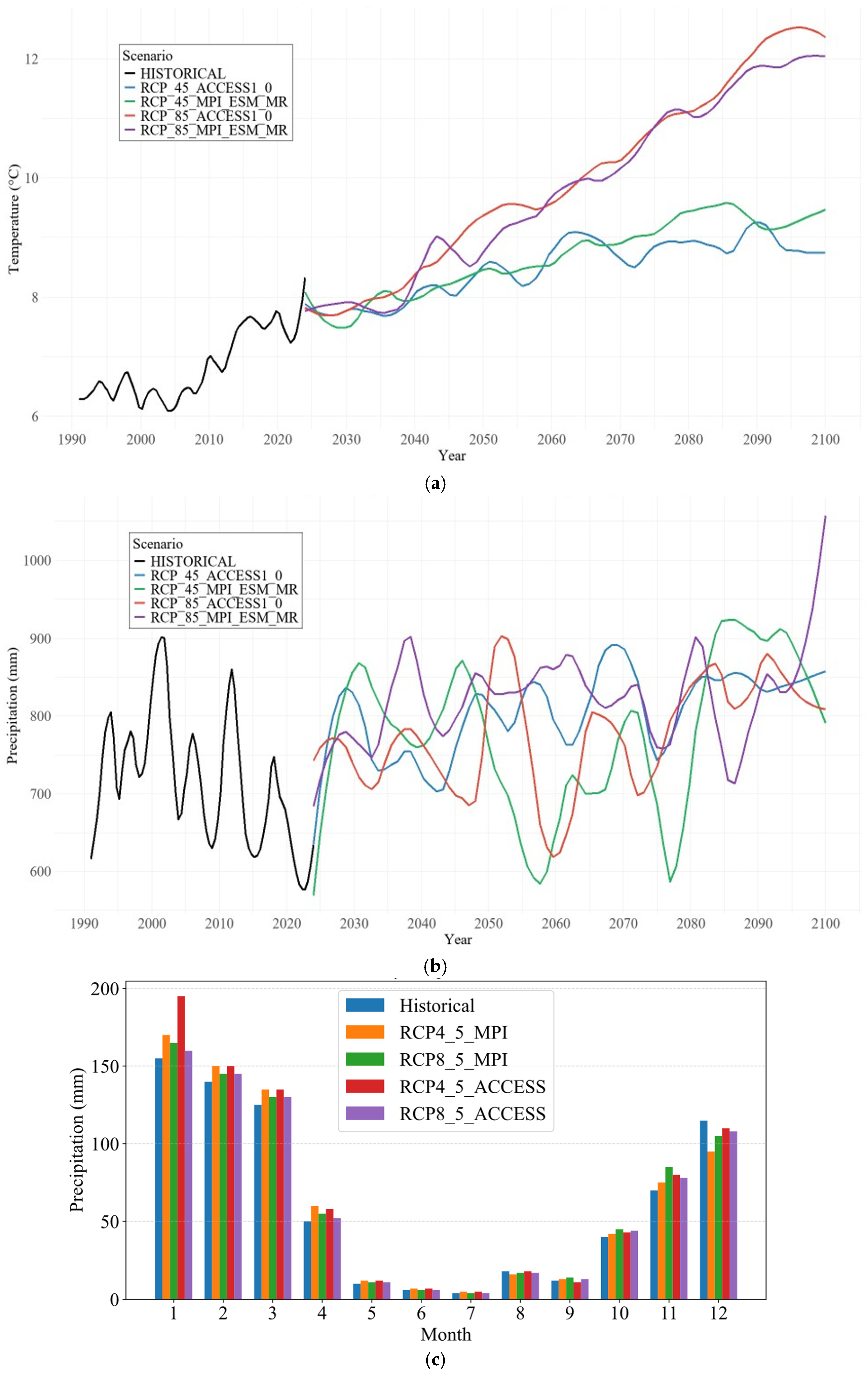
35]. The corrected daily climate dataset was then used as input for the SWAT model to simulate hydrometeorological variations in the basin for the period 2025–2100. The projected changes in temperature and precipitation are shown in
Figure 3. Temperature exhibits a consistent increasing trend across all scenarios, with a more pronounced rise under RCP 8.5 (
Figure 3a). In contrast, precipitation shows strong interannual variability without a clear long-term trend (
Figure 3b). The corrected daily climate dataset was subsequently incorporated as a forcing input for the SWAT model, enabling a comparative analysis of the projected hydrometeorological variations in the basin for the 2025–2100 period. Additionally, the seasonal distribution of precipitation (
Figure 3c) reveals a strong concentration of rainfall during the wet season (December–March), with variations in magnitude and timing among scenarios. The seasonal distribution of precipitation (
Figure 3c) reveals a marked concentration of rainfall during the wet season (December–March), with differences in magnitude and timing among scenarios. These seasonal patterns play a critical role in runoff generation, as rainfall concentrated over short periods enhances surface runoff, whereas more evenly distributed precipitation promotes infiltration.
These projected climate trends reinforce the role of temperature increase and precipitation variability as primary drivers of hydrological change in the basin. These climatic changes directly influence hydrological processes by increasing evapotranspiration and modifying runoff generation and groundwater recharge dynamics.
2.4. SWAT Model Setup and Simulation
The Soil and Water Assessment Tool SWAT is a physically based, semi-distributed model that operates continuously over time, developed to assess the effects of soil and land management practices on watershed hydrology, sediment transport, and agrochemical behavior in complex basins [
36,
37,
38] Unlike purely empirical models, SWAT uses spatially explicit observational data, including topography, soil properties, vegetation cover, and climate variables, to partition the watershed into sub-basins. Each sub-basin is further divided into Hydrological Response Units (HRUs), which correspond to specific combinations of land use, soil type, and slope. This approach is based on the assumption that areas with similar biophysical characteristics display comparable hydrological behavior [
39,
40]. Based on this data, it indirectly simulates physical processes such as water flow, sediment transport, plant growth, and nutrient cycling using defined input parameters. Using these inputs, SWAT indirectly simulates key watershed processes such as water movement, sediment transport, plant growth, and nutrient cycling through a set of defined parameters.
The model is computationally efficient, enabling the simulation of long-term processes, including soil erosion and nutrient dynamics. Surface runoff is calculated using the Soil Conservation Service Curve Number (SCS-CN) method, which also accounts for lateral subsurface flow, snowmelt, and groundwater recharge. At its core, SWAT relies on the fundamental water balance equation, which governs the distribution, storage, and fluxes of water within the soil profile. Equation (1) allows the estimation of both soil water content and river discharge by integrating the main hydrological components, including inflows, outflows, and storage changes [
41]. Consequently, the SWAT hydrological simulations are fundamentally governed by this water balance equation:
where
represents the total soil water content at time t,
is the initial soil water content,
is precipitation,
is surface runoff,
is evapotranspiration,
is percolation, and
is return flow.
2.5. Model Sensitivity Analysis and Calibration
Due to the large number of parameters in the SWAT model and the complexity of the hydrological processes it simulates, the SWAT-CUP (SWAT Calibration and Uncertainty Procedures) framework was used to optimize the model’s performance [
42]. The calibration process began with a global sensitivity analysis, which evaluates the simultaneous influence of all parameters on the model output, in contrast to local sensitivity approaches that adjust one parameter at a time. The statistical importance of each parameter was assessed using the t-statistic and
p-value, with parameters exhibiting higher absolute t-values and
p-values approaching zero considered as the most influential drivers of model behavior [
43,
44]. Once the key parameters were identified, the model was calibrated to reduce differences between simulated and observed data, and its performance was assessed using the coefficient of determination (
and Nash–Sutcliffe Efficiency (NSE) to ensure accurate representation of the basin’s hydrological processes.
2.6. Water Stress Algorithm
The Water Stress Index (WSI) was derived from the relationship between actual evapotranspiration (
) and potential evapotranspiration (PET) [
45]. The discrepancy between these variables represents the combined effects of water availability, irrigation practices, and water-use efficiency. Consequently, the WSI is widely applied to assess water stress conditions and to monitor vegetation dynamics and land degradation processes within a given region. In this study, the WSI was used to quantify water stress in the analyzed areas, calculated according to Equation (2):
where WSI represents the water stress index and PET corresponds to potential evapotranspiration calculated using the FAO Penman–Monteith method (mm). According to classification criteria reported in previous national and international studies [
44,
46], water stress in representative irrigation areas was categorized into five levels. In this classification, a WSI value of 0.2 was established as the minimum threshold for identifying water stress conditions (
Table 2).
3. Results
3.1. Analysis of Model Parameter Variability
The period between 1981 and 2024 was selected based on the availability and consistency of meteorological and hydrometric data in the studied basin, as well as the requirement for continuous time series for hydrological modeling. Within this period, the years 1981–2016 were used for model calibration, while the period 2017–2024 was used for model validation.
To calibrate and validate the SWAT model, monthly observed streamflow data were processed using the SWAT-CUP2019, version 5.2.1 software with the SUFI-2 algorithm. A total of 24 parameters were initially considered during the sensitivity analysis. From this set, only the most sensitive parameters were selected for calibration and are presented in
Table S2 The complete list of evaluated parameters is provided in the
Supplementary Material (Table S2). The selection of sensitive parameters was based on statistical indicators, including the t-stat and
p-value. Parameters with higher absolute t-stat values and
p-values close to zero were identified as the most influential in controlling streamflow simulation in the basin.
Table 1 summarizes the main parameters considered, while
Table 3 presents the sensitivity analysis results, including their statistical significance.
3.2. Model Calibration and Evaluation
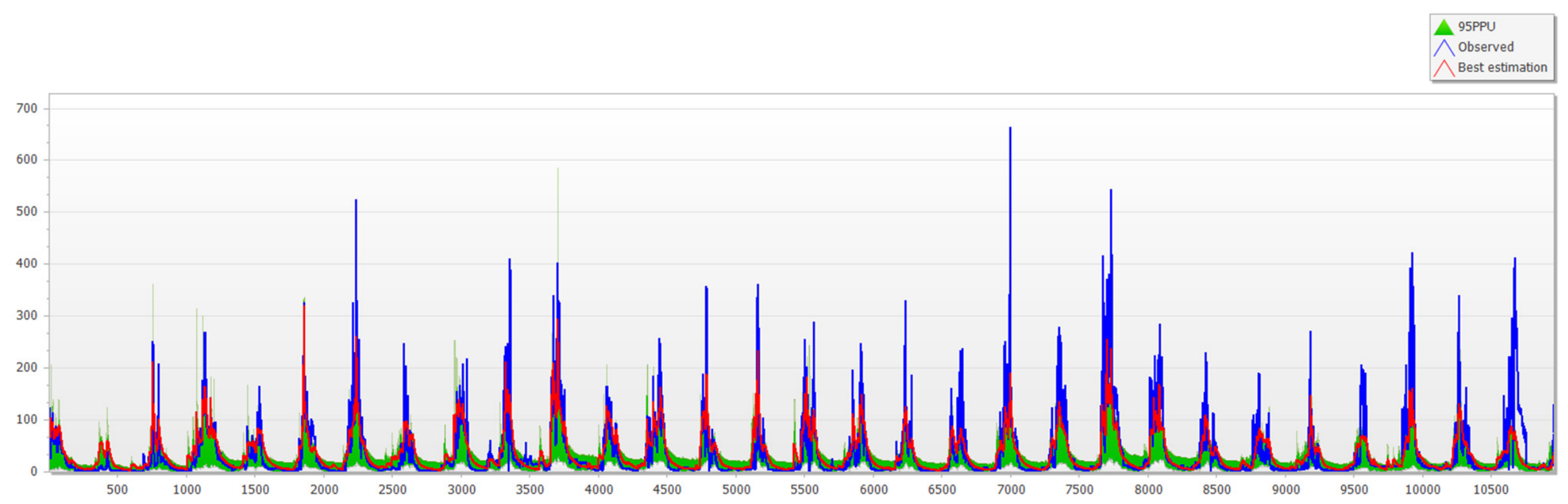
Following the sensitivity analysis, the model was calibrated and validated by comparing simulated outputs with observed monthly streamflow at the Puente Coata–Unocolla hydrometric station. Model calibration was performed using the SUFI-2 algorithm implemented in the SWAT-CUP platform, with a total of 45 simulations. Model performance was evaluated using the coefficient of determination (), Nash–Sutcliffe efficiency (NSE), percent bias (PBIAS), and Kling–Gupta efficiency (KGE). Uncertainty was assessed using the p-factor and r-factor, based on the 95% prediction uncertainty (95PPU).
The calibration period showed = 0.86 and NSE = 0.86, while the validation period yielded = 0.67 and NSE = 0.53. The model exhibited a PBIAS of −0.9 during calibration and −36.3 during validation, indicating low bias in calibration and higher deviation under validation conditions. The RMSE increased from 17.06 in calibration to 36.27 in validation, reflecting greater dispersion in simulated values during the validation period. The Kling–Gupta efficiency (KGE) reached 0.59, indicating an overall satisfactory model performance.
The uncertainty analysis resulted in a p-factor of 0.86 and an r-factor of 0.73 for the best simulation, while behavioral simulations showed p-factor = 0.73 and r-factor = 0.48. The objective function was based on the Nash–Sutcliffe efficiency. As illustrated in the hydrograph in
Figure 4, including the 95PPU band, the SWAT model adequately captures seasonal trends and runoff peaks despite the spatial complexity of the basin. These results confirm the robustness of the model parameterization and its reliability for simulating hydrological processes in the study area.
3.3. Annual Surface Runoff Modeling
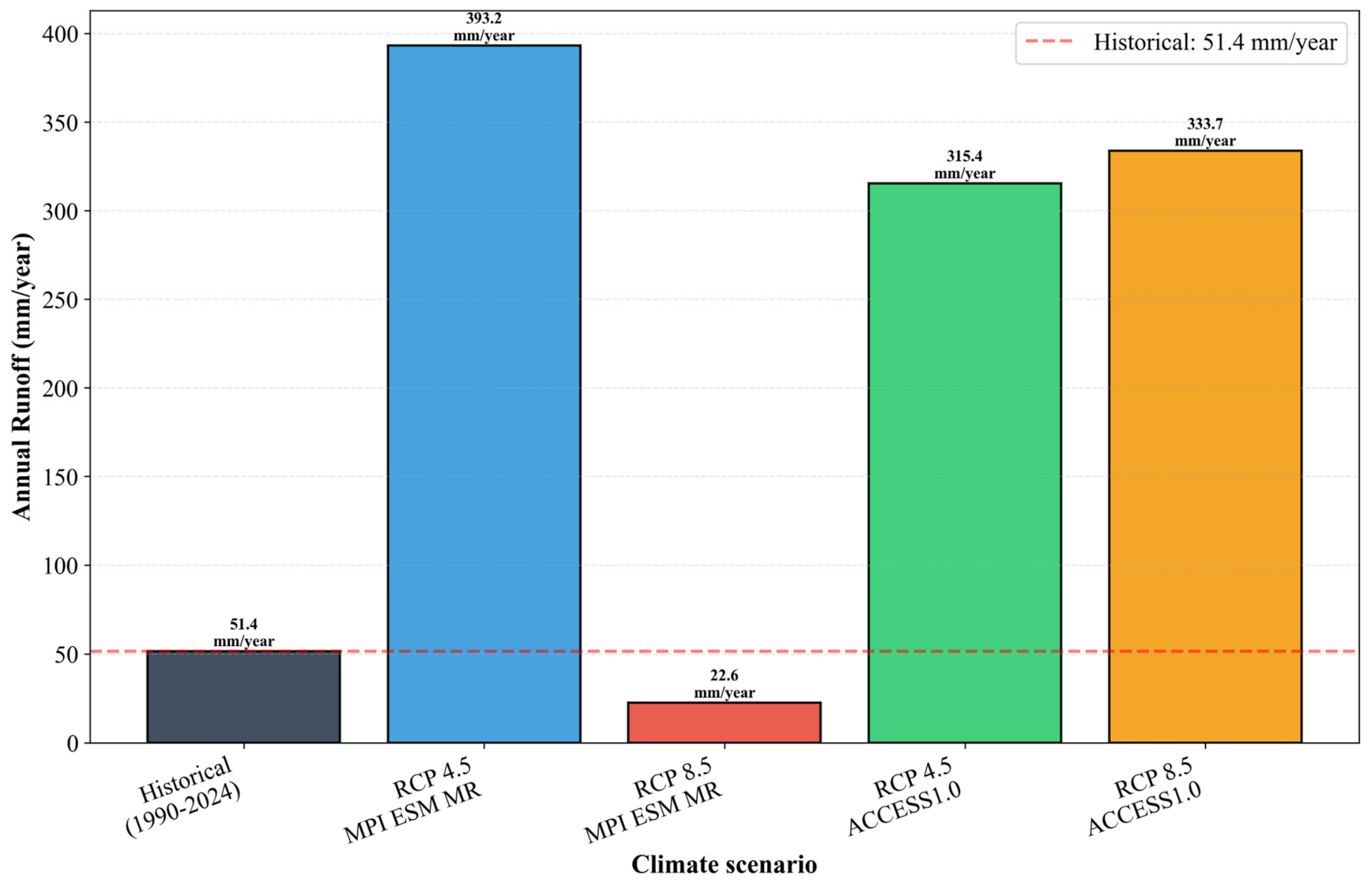
Future hydrological conditions in the Coata River basin were simulated for the period 2025–2100 using climate projections from the MPI-ESM-MR and ACCESS1-0 global circulation models under the RCP 4.5 and RCP 8.5 scenarios. The projected variations in annual runoff, expressed as water depth (mm/year), are presented in
Figure 5. The historical simulation (1981–2024) shows an average annual runoff of 51.4 mm/year, which was used as the baseline reference to evaluate future changes. Under the MPI-ESM-MR model, the RCP 4.5 scenario projects a substantial increase in runoff to 393.2 mm/year, representing an increase of approximately 665% compared with the historical period. In contrast, the RCP 8.5 scenario produces a value of 22.6 mm/year, indicating a significant reduction relative to baseline conditions. The ACCESS1-0 model projects consistently higher runoff values under both emission scenarios, reaching 315.4 mm/year under RCP 4.5 and 333.7 mm/year under RCP 8.5, corresponding to increases of approximately 514% and 549%, respectively (
Figure 5).
These results indicate that projected runoff in the Coata basin is highly sensitive to precipitation variability simulated by the climate models. The increase in runoff is consistent with the projected concentration of precipitation during peak wet-season months (
Figure 3c), where monthly precipitation exceeds historical values by up to 26% during the austral summer (January), particularly under the ACCESS1-0 RCP 4.5 scenario. In addition to this monthly increase, the seasonal concentration of rainfall during the December–March period results in a greater proportion of precipitation occurring within shorter time intervals, effectively amplifying runoff generation. This temporal redistribution increases effective rainfall intensity, even in the absence of large changes in annual totals.
The magnitude of projected runoff increase is therefore not solely driven by total precipitation, but by the nonlinear response of the basin to rainfall concentration. When precipitation is concentrated during peak months, soil saturation is reached more rapidly, reducing infiltration capacity and enhancing direct surface runoff. This mechanism explains why moderate increases in monthly precipitation (on the order of 20–30%) can result in disproportionately large increases in annual runoff. Such amplification is characteristic of high-altitude basins with limited storage capacity and strong seasonal hydrological regimes.
The large differences between scenarios highlight considerable inter-model variability and uncertainty in future hydrological conditions in the tropical Andes. Importantly, expressing runoff in mm/year allows direct comparison with precipitation, confirming the physical consistency of the projected hydrological responses. Although some projections indicate substantial increases in surface runoff, these changes do not necessarily imply greater effective water availability. Increased runoff may occur simultaneously with reduced infiltration and groundwater recharge, limiting subsurface storage and dry-season water supply. Such behavior may increase the probability of extreme flow events, soil erosion, and seasonal water imbalances, affecting the stability of the hydrological regime.
These differences can be explained by nonlinear hydrological responses in high-Andean basins. The projected increase in precipitation during peak wet-season months leads to rapid soil saturation and limited infiltration capacity, enhancing direct surface runoff generation. This effect is particularly pronounced when rainfall is concentrated over short periods, as indicated by the seasonal precipitation patterns (
Figure 3c). At the same time, rising temperatures increase evapotranspiration, reducing soil moisture and groundwater recharge during non-peak periods. Sensitivity analysis indicates that parameters such as CN2, REVAPMN, and RCHRG_DP control the partitioning between runoff and infiltration, explaining the magnitude of projected changes. These hydrological responses are consistent with the projected climate variability shown in
Figure 3, particularly the increase in temperature and the variability in precipitation patterns.
3.4. Groundwater Recharge and Subsurface Discharge (Percolation)
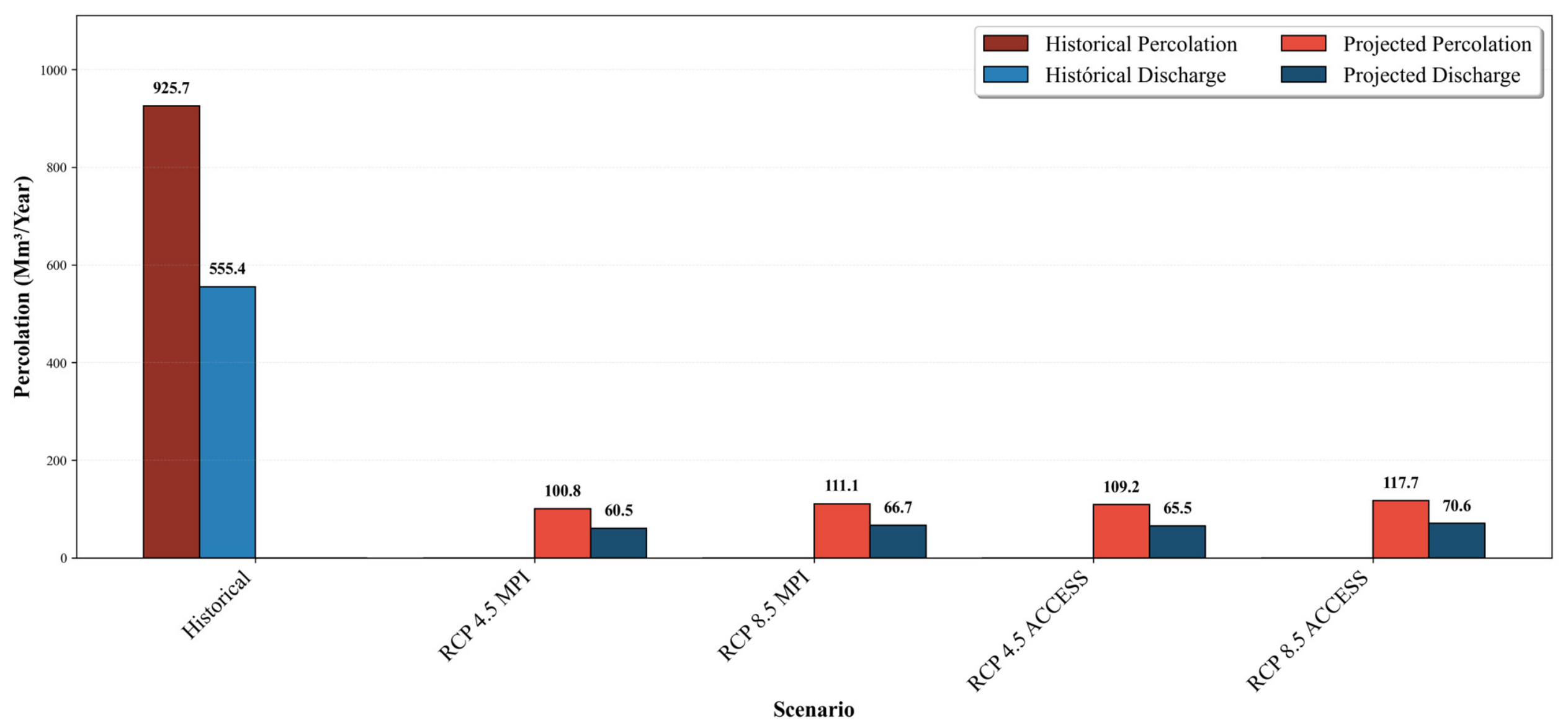
The evolution of groundwater recharge and subsurface discharge under future climate scenarios is shown in
Figure 6. These variables represent key components of the basin water balance, as groundwater storage plays a fundamental role in sustaining streamflow during dry periods in high-Andean environments. Under historical conditions (1981–2024), the basin presents an average annual groundwater recharge of 925.7 Mm
3/year and a discharge of 555.4 Mm
3/year, indicating that subsurface flow constitutes a significant contribution to the total water balance. This behavior reflects the importance of infiltration and groundwater storage processes in maintaining hydrological stability in the basin. Future projections show a pronounced reduction in groundwater recharge across all evaluated scenarios. Under the MPI-ESM-MR model, recharge decreases to 100.8 Mm
3/year under RCP 4.5 and 111.1 Mm
3/year under RCP 8.5, while the corresponding discharge values decline to 60.5 Mm
3/year and 66.7 Mm
3/year, respectively. Similar results are obtained with the ACCESS1-0 model, where recharge ranges between 109.2 Mm
3/year and 117.7 Mm
3/year, and discharge varies between 65.5 Mm
3/year and 70.6 Mm
3/year (
Figure 6).
The consistent reduction in recharge under all climate scenarios suggests a significant weakening of subsurface storage processes. This behavior is likely associated with increased evapotranspiration and changes in precipitation distribution, which reduce effective infiltration and limit groundwater replenishment. In high-altitude basins, where dry-season flows depend largely on groundwater reserves, this reduction may lead to lower baseflow contributions and decreased water availability during prolonged dry periods. These results indicate that future climate conditions may reduce the capacity of the basin to store water in the subsurface, increasing hydrological variability and the risk of seasonal water deficits.
The projected decline in groundwater recharge may affect irrigation, drinking water supply, and wetland ecosystems that depend on sustained baseflow, thereby increasing the vulnerability of rural communities in the Altiplano.
Changes in precipitation patterns combined with rising temperatures are reducing effective infiltration and slowing aquifer recharge and threatening water security in the short and medium term. This scenario creates critical challenges for sustainable water management, requiring new adaptation frameworks that address the growing uncertainty surrounding underground water flows.
3.5. Modeling and Quantification of Renewable Water Resources (RHR)
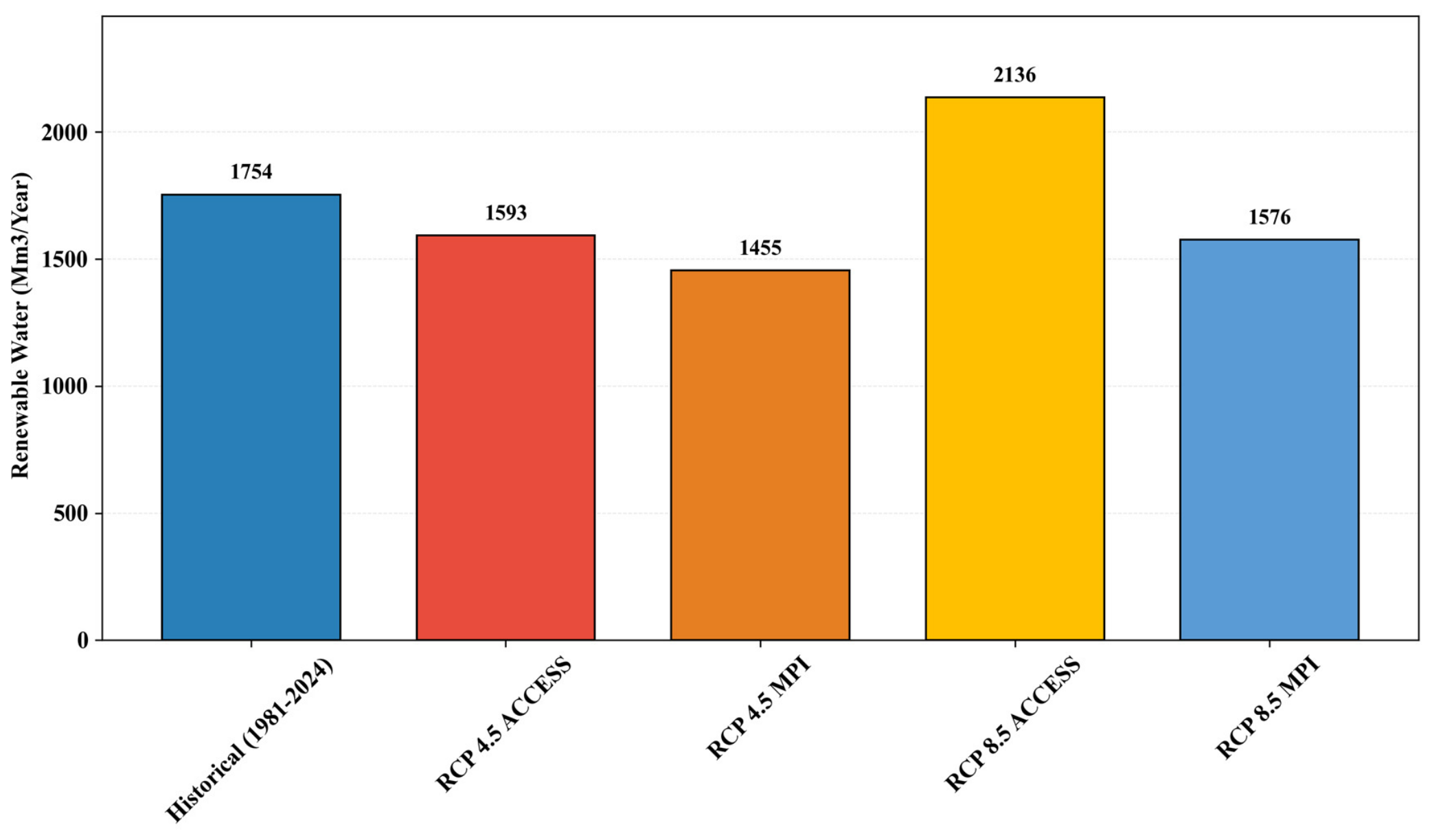
The projected evolution of renewable water resources in the Coata River basin is presented in
Figure 7. Renewable water resources represent the total amount of water available in the basin and constitute a key indicator for evaluating future water availability under climate change conditions. During the historical period (1981–2024), the basin shows an average renewable water availability of 1754 Mm
3/year, which was used as the reference value for comparison with future scenarios.
Under the RCP 4.5 scenario, both climate models project a reduction in renewable water resources relative to historical conditions. The ACCESS1-0 model estimates 1593 Mm
3/year, representing a decrease of approximately 9%, while the MPI-ESM-MR model projects 1455 Mm
3/year, corresponding to a reduction of about 17% (
Figure 7). Under the RCP 8.5 scenario, the projections show greater variability between models. The ACCESS1-0 model produces an increase to 2136 Mm
3/year, whereas the MPI-ESM-MR model estimates 1576 Mm
3/year, indicating only a slight decrease compared with the baseline.
These differences reflect the high sensitivity of the basin water balance to projected precipitation changes and highlight the uncertainty associated with climate projections in high-Andean environments. Despite some scenarios showing temporary increases in renewable water resources, these values do not necessarily imply improved water security. Higher surface runoff may occur simultaneously with reduced groundwater recharge, which limits long-term storage capacity. This behavior may lead to seasonal water imbalances, with short periods of high flow followed by prolonged dry conditions. The projected reductions in renewable water resources may increase competition between agricultural, domestic, and ecological water uses, particularly during the dry season. Because water demand in the basin depends strongly on irrigation, livestock production, and rural consumption, decreases in renewable water availability may increase the risk of water scarcity and reduce the resilience of local communities in the northern Altiplano.
These results support the hypothesis that climate change may alter the hydrological balance of the basin by reducing effective water availability and increasing the probability of seasonal water deficits under future climate conditions.
3.6. Water Stress Variation
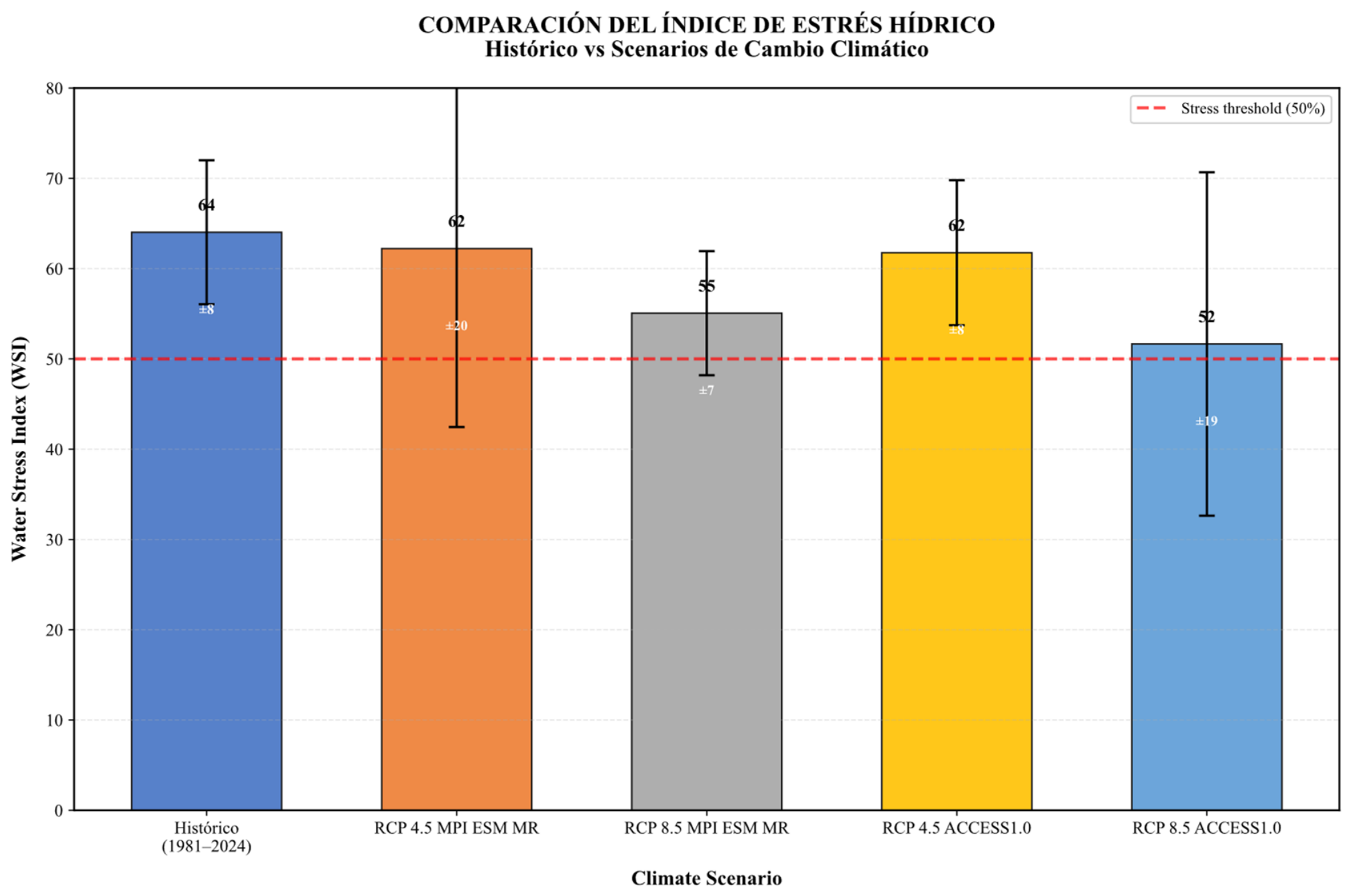
The projected Water Stress Index (WSI) for the Coata River basin is shown in
Figure 8. The WSI represents the relationship between water demand and water availability and provides an indicator of the pressure exerted on water resources under changing climatic conditions.
During the historical period, the basin exhibits a WSI value of 64.03%, which exceeds the commonly accepted threshold of 50% for significant water stress conditions, indicating that water demand is high relative to available water resources. This suggests that the basin currently operates under significant pressure on water resources, particularly during periods of low water availability. Under future climate scenarios, the WSI remains close to or above the critical stress threshold in most projections. The MPI-ESM-MR model estimates values of 62.22% under the RCP 4.5 scenario and 55.06% under RCP 8.5, while the ACCESS1-0 model projects values of 61.76% and 51.65%, respectively (
Figure 8).
Although some scenarios show a slight reduction in the WSI compared with historical conditions, the basin continues to operate under persistent water stress. This behavior reflects the combined influence of climate variability and water demand, which limits the capacity of the system to maintain sustainable water availability over time. Persistent water stress conditions may increase competition between agricultural, domestic, and ecological water uses, particularly during dry periods when river discharge and groundwater contributions decrease. In the Coata basin, where agricultural activities and rural livelihoods depend strongly on seasonal water availability, these conditions may increase the vulnerability of local communities to water scarcity.
4. Discussion
This study demonstrates that climate change may significantly modify the hydrological balance of the Coata River basin, primarily through reductions in groundwater recharge, increased variability in surface runoff, and persistent water stress conditions. These results confirm that projected increases in temperature and changes in precipitation patterns alter the main components of the water balance in high-Andean basins, where hydrological processes strongly depend on seasonal rainfall and subsurface storage.
One of the most critical findings is the strong reduction in groundwater recharge under all climate scenarios. Historical simulations indicate recharge values of approximately 925 Mm
3/year, whereas future projections decrease to around 100–120 Mm
3/year. This reduction is consistent with previous studies in high-altitude basins, where increased evapotranspiration under warming conditions reduces effective infiltration and limits aquifer replenishment [
11,
24,
35]. In the Lake Titicaca watershed, similar evidence suggests that temperature increases reduce baseflow contributions and affect dry-season discharge [
9,
10]. Given that groundwater sustains streamflow during dry periods, this decline may increase the likelihood of seasonal water deficits in the northern Altiplano.
Runoff projections show substantial variability between climate models, reflecting high uncertainty in future hydrological conditions. The marked increase observed under certain scenarios is mainly associated with changes in precipitation intensity and the nonlinear response of hydrological processes. Sensitivity analysis indicates that parameters such as CN2, REVAPMN, and RCHRG_DP control the partitioning between runoff and infiltration, explaining the magnitude of these changes. However, increases in surface runoff should not be interpreted as improved water availability, since they may occur simultaneously with reduced infiltration and groundwater storage. This behavior suggests a shift toward more irregular hydrological regimes, characterized by short periods of high flow followed by prolonged dry conditions.
The analysis of renewable water resources indicates variable responses across scenarios. While some projections show increases relative to historical conditions, others indicate reductions, reflecting the sensitivity of the basin to climate variability. Despite this variability, the consistent decrease in groundwater recharge suggests a reduction in subsurface storage capacity, which is essential for maintaining hydrological stability. Similar patterns have been reported in other SWAT-based studies, where climate change alters the balance between precipitation, evapotranspiration, and infiltration processes, resulting in greater variability in water availability [
24,
25,
26,
27,
28,
29,
30,
31,
32,
33,
34,
35,
36,
37,
38,
39,
40,
41,
42,
43,
44,
45,
46].
Water stress remains persistently high under all evaluated scenarios. However, it is important to note that this study does not explicitly simulate water demand, allocation, or sectoral water use. Therefore, interpretations related to water supply or system pressure should be understood as potential implications derived from hydrological changes rather than direct model outputs.
Uncertainty remains an important consideration in this study. Differences between climate models, limitations in meteorological data, and parameter sensitivity may influence the magnitude of projected changes. In data-scarce mountain basins, hydrological models may overestimate runoff or underestimate infiltration processes. Therefore, results should be interpreted as plausible future scenarios rather than exact predictions. Despite these limitations, the consistent reduction in groundwater recharge and the persistence of water stress across all scenarios indicate a clear trend toward increasing hydrological vulnerability.
From a management perspective, these findings highlight the importance of incorporating climate projections into regional water planning. Measures such as protecting recharge zones, conserving high-Andean wetlands, improving storage infrastructure, and increasing water-use efficiency may help reduce the impacts of future hydroclimatic changes. Further studies integrating water demand and management scenarios are required to fully assess future water availability.
These changes are also reflected in the relative contribution of hydrological components, where increased surface runoff is accompanied by a reduction in groundwater recharge and percolation. This shift in the water balance indicates a redistribution of flow pathways, with a larger proportion of precipitation contributing to direct runoff rather than subsurface storage.
5. Conclusions
This study demonstrates that climate change will significantly alter the hydrological dynamics of the Coata River basin through a redistribution of water balance components. The consistent reduction in groundwater recharge across all scenarios indicates a weakening of subsurface storage processes that are critical for sustaining dry-season flows.
Although some projections indicate increases in runoff, these do not represent improved water availability. Instead, they reflect a shift in flow partitioning, where reduced infiltration and groundwater storage lead to more irregular hydrological regimes, characterized by short periods of high flow followed by prolonged low-flow conditions.
Water stress remains persistently high under all evaluated scenarios, indicating that future climate conditions will maintain strong pressure on already limited water resources. This highlights the high vulnerability of high-Andean basins to climatic variability.
This study provides new evidence of the nonlinear response of hydrological processes to climate forcing in mountainous environments, particularly the decoupling between surface runoff and effective water availability. These findings underscore the importance of integrating climate projections into water management strategies, including recharge zone protection, improved storage capacity, and more efficient water use to enhance long-term water security.
Author Contributions
Conceptualization, J.H.M. and B.P.C.C.; methodology, J.H.M. and Y.T.P.A.; software, J.H.M.; validation, J.A.R.C. and H.P.V.; formal analysis, J.A.R.C.; investigation, J.H.M., J.A.R.C. and J.M.T.H.; data curation, E.W.P.P.; writing—original draft preparation, J.H.M.; writing—review and editing, B.P.C.C., Y.T.P.A. and M.C.T.; visualization, J.H.M.; supervision, B.P.C.C.; project administration, B.P.C.C. All authors have read and agreed to the published version of the manuscript.
Funding
The APC was supported by Universidad Nacional de Juliaca.
Data Availability Statement
The datasets used in this study were obtained from national public institutions in Peru, including SENAMHI (National Service of Meteorology and Hydrology of Peru) and ANA (National Water Authority). These data are subject to institutional regulations and therefore cannot be fully deposited in a public repository. However, the data can be made available by the corresponding author upon reasonable request for academic and research purposes.
Acknowledgments
The authors acknowledge the support of the Universidad Nacional de Juliaca during the development of this study.
Conflicts of Interest
The authors declare no conflicts of interest.
References
- UNESCO. Water for Prosperity and Peace; Statistics; UNESCO: Paris, France, 2024. [Google Scholar]
- Zhao, S.; Huang, Y.; Liu, Z.; Liu, T.; Tang, X. Estimation of Actual Evapotranspiration and Water Stress in Typical Irrigation Areas in Xinjiang, Northwest China. Remote Sens. 2024, 16, 2676. [Google Scholar] [CrossRef]
- Liao, R. Water scarcity assessment index from the realistic perspective of human basic water requirements. Environ. Sustain. Indic. 2024, 22, 100404. [Google Scholar] [CrossRef]
- Kenabatho, P. Innovative trend analysis of long-term spatial-temporal rainfall patterns over Botswana: Implications for water resources management. J. Hydrol. Reg. Stud. 2025, 58, 102217. [Google Scholar] [CrossRef]
- Buytaert, W.; Célleri, R.; Timbe, L. Predicting climate change impacts on water resources in the tropical Andes: Effects of GCM uncertainty. Geophys. Res. Lett. 2009, 36, L07406. [Google Scholar] [CrossRef]
- Poudel, U.; Adhikari, S.; Karki, S.; Regmi, R.K. Climate change and hydropower resilience: A CMIP6-SWAT analysis of the Kankai River Basin’s energy landscape. H2Open J. 2025, 8, 465–490. [Google Scholar] [CrossRef]
- Canedo, C.; Zolá, R.P.; Berndtsson, R. Role of Hydrological Studies for the Development of the TDPS System. Water 2016, 8, 144. [Google Scholar] [CrossRef]
- Dharmarathne, G.; Waduge, A.; Bogahawaththa, M.; Rathnayake, U.; Meddage, D. Adapting cities to the surge: A comprehensive review of climate-induced urban flooding. Results Eng. 2024, 22, 102123. [Google Scholar] [CrossRef]
- Lima-Quispe, N.; Ruelland, D.; Rabatel, A.; Lavado-Casimiro, W.; Condom, T. Modeling Lake Titicaca’s water balance: The dominant roles of precipitation and evaporation. Hydrol. Earth Syst. Sci. 2025, 29, 655–682. [Google Scholar] [CrossRef]
- Lima-Quispe, N.; Escobar, M.; Wickel, A.J.; von Kaenel, M.; Purkey, D. Untangling the effects of climate variability and irrigation management on water levels in Lakes Titicaca and Poopó. J. Hydrol. Reg. Stud. 2021, 37, 100927. [Google Scholar] [CrossRef]
- Zubieta, R.; Molina-Carpio, J.; Laqui, W.; Sulca, J.; Ilbay, M. Comparative Analysis of Climate Change Impacts on Meteorological, Hydrological, and Agricultural Droughts in the Lake Titicaca Basin. Water 2021, 13, 175. [Google Scholar] [CrossRef]
- Vicuña, S.; Garreaud, R.D.; McPhee, J. Climate change impacts on the hydrology of a snowmelt driven basin in semiarid Chile. Clim. Change 2011, 105, 469–488. [Google Scholar] [CrossRef]
- Ilbay-Yupa, M.; Ilbay, F.; Zubieta, R.; García-Mora, M.; Chasi, P. Impacts of Climate Change on the Precipitation and Streamflow Regimes in Equatorial Regions: Guayas River Basin. Water 2021, 13, 3138. [Google Scholar] [CrossRef]
- Chen, M.; Huang, Y.; Hu, X.-M.; Xue, M.; Hong, Y.; Novoa, H.M.; Martin, E.R.; McPherson, R.A.; Zhu, S.; Peraz, A.V.; et al. Arequipa’s Water in the Short Future: A Hydrologic Outlook in an Arid Peruvian Andes Region Utilizing Hyperresolution RCM and CREST-VEC Model Simulations Under SSP5-8.5. Am. J. Water Resour. 2025, 13, 51–62. [Google Scholar] [CrossRef]
- Zhiña, D.; Montenegro, M.; Montalván, L.; Mendoza, D.; Contreras, J.; Campozano, L.; Avilés, A. Climate Change Influences of Temporal and Spatial Drought Variation in the Andean High Mountain Basin. Atmosphere 2019, 10, 558. [Google Scholar] [CrossRef]
- Aguayo, R.; León-Muñoz, J.; Garreaud, R.; Montecinos, A. Hydrological droughts in the southern Andes (40–45°S) from an ensemble experiment using CMIP5 and CMIP6 models. Sci. Rep. 2021, 11, 5530. [Google Scholar] [CrossRef] [PubMed]
- Del Aguila, S.; Espinoza-Montes, F. Impact of climate change on future discharges from a high Andean basin in Peru to 2100. Tecnol. Cienc. Agua 2024, 15, 111–155. [Google Scholar] [CrossRef]
- Fernandez-Palomino, C.A.; Hattermann, F.F.; Krysanova, V.; Vega-Jácome, F.; Menz, C.; Gleixner, S.; Bronstert, A. High-resolution climate projection dataset based on CMIP6 for Peru and Ecuador: BASD-CMIP6-PE. Sci. Data 2024, 11, 34. [Google Scholar] [CrossRef] [PubMed]
- Babamiri, O.; Dinpashoh, Y.; Samavati, A.; Shoja, F. Projection of hydrological drought based on SSP scenarios using surface water supply index and SWAT model in mountainous watershed. Appl. Water Sci. 2025, 15, 221. [Google Scholar] [CrossRef]
- Immerzeel, W.W.; Van Beek, L.P.H.; Bierkens, M.F.P. Climate change will affect the Asian Water Towers. Science 2010, 328, 1382–1385. [Google Scholar] [CrossRef] [PubMed]
- Aloui, S.; Mazzoni, A.; Elomri, A.; Aouissi, J.; Boufekane, A.; Zghibi, A. A review of Soil and Water Assessment Tool (SWAT) studies of Mediterranean catchments: Applications, feasibility, and future directions. J. Environ. Manag. 2023, 326, 116799. [Google Scholar] [CrossRef] [PubMed]
- Janjić, J.; Tadić, L. Fields of Application of SWAT Hydrological Model—A Review. Earth 2023, 4, 331–344. [Google Scholar] [CrossRef]
- Tan, M.L.; Ibrahim, A.L.; Yusop, Z.; Chua, V.P.; Chan, N.W. Climate change impacts under CMIP5 RCP scenarios on water resources of the Kelantan River Basin, Malaysia. Atmos. Res. 2017, 189, 1–10. [Google Scholar] [CrossRef]
- Brighenti, T.M.; Gassman, P.W.; Gutowski, W.J.; Thompson, J.R. Assessing the Influence of a Bias Correction Method on Future Climate Scenarios Using SWAT as an Impact Model Indicator. Water 2023, 15, 750. [Google Scholar] [CrossRef]
- Saddiqi, M.M.; Karpuzcu, M.E.; Dereli, R.K. Open-source hydrological modeling: Assessing climate change impacts using SWAT with Sentinel-2 and ERA5 data integration. Water Sci. 2025, 39, 449–471. [Google Scholar] [CrossRef]
- Satriagasa, M.C.; Tongdeenok, P.; Kaewjampa, N. Assessing the Implication of Climate Change to Forecast Future Flood Using SWAT and HEC-RAS Model under CMIP5 Climate Projection in Upper Nan Watershed, Thailand. Sustainability 2023, 15, 5276. [Google Scholar] [CrossRef]
- Dinku, M.B.; Gibre, A.M. Comparison of bias correction methods to regional climate model simulations for climate change projection in Muger Subbasin, Upper Blue Nile Basin, Ethiopia. J. Water Clim. Change 2024, 15, 2612–2627. [Google Scholar] [CrossRef]
- Mamani-Matamet, J.A.; Mamani-Matamet, F.R.; Bonotto, D.M. Geochemical indices for Zn, Cu, and Co in sediment cores of Coata River, Puno Region, Peru. Geochim. Bras. 2024, 38, e-24006. [Google Scholar] [CrossRef]
- Cornejo-Olarte, D.; Sucari, W.; Belizario-Quispe, G.; Cornejo-Puma, K. La contaminación por metales potencialmente tóxicos de sedimentos del río Coata, Puno, Perú. Cienc. Amaz. 2023, 11, 17–28. [Google Scholar] [CrossRef]
- Arnold, J.G.; Srinivasan, R.; Muttiah, R.S.; Williams, J.R. Large area hydrologic modeling and assessment part I: Model development. JAWRA J. Am. Water Resour. Assoc. 1998, 34, 73–89. [Google Scholar] [CrossRef]
- Rowshon, M.K.; Dlamini, N.S.; Mojid, M.A.; Adib, M.N.M.; Amin, M.S.M.; Lai, S.H. Modeling climate-smart decision support system (CSDSS) for analyzing water demand of a large-scale rice irrigation scheme. Agric. Water Manag. 2019, 216, 138–152. [Google Scholar] [CrossRef]
- Oeurng, C.; Cochrane, T.A.; Arias, M.E.; Shrestha, B.; Piman, T. Assessment of changes in riverine nitrate in the Sesan, Srepok and Sekong tributaries of the Lower Mekong River Basin. J. Hydrol. Reg. Stud. 2016, 8, 95–111. [Google Scholar] [CrossRef]
- Basheer, A.K.; Lu, H.; Omer, A.; Ali, A.B.; Abdelgader, A.M.S. Impacts of climate change under CMIP5 RCP scenarios on the streamflow in the Dinder River and ecosystem habitats in Dinder National Park, Sudan. Hydrol. Earth Syst. Sci. 2016, 20, 1331–1353. [Google Scholar] [CrossRef]
- Iqbal, M.; Wen, J.; Masood, M.; Masood, M.U.; Adnan, M. Impacts of Climate and Land-Use Changes on Hydrological Processes of the Source Region of Yellow River, China. Sustainability 2022, 14, 14908. [Google Scholar] [CrossRef]
- Anandhi, A.; Frei, A.; Pierson, D.C.; Schneiderman, E.M.; Zion, M.S.; Lounsbury, D.; Matonse, A.H. Examination of change factor methodologies for climate change impact assessment. Water Resour. Res. 2011, 47, W03501. [Google Scholar] [CrossRef]
- Winchell, M.; Srinivasan, R.; Di Luzio, M.; Arnold, J. ArcSWAT Interface for SWAT2009 User’s Guide; Blackland Research Center: Temple, TX, USA; Grassland Soil and Water Research Laboratory: Temple, TX, USA, 2010; p. 489.
- Santhi, C.; Kannan, N.; Arnold, J.G.; Di Luzio, M. Spatial Calibration and Temporal Validation of Flow for Regional Scale Hydrologic Modeling1. JAWRA J. Am. Water Resour. Assoc. 2008, 44, 829–846. [Google Scholar] [CrossRef]
- Mengistu, A.G.; van Rensburg, L.D.; Woyessa, Y.E. Techniques for calibration and validation of SWAT model in data scarce arid and semi-arid catchments in South Africa. J. Hydrol. Reg. Stud. 2019, 25, 100621. [Google Scholar] [CrossRef]
- Bennour, A.; Jia, L.; Menenti, M.; Zheng, C.; Zeng, Y.; Barnieh, B.A.; Jiang, M. Calibration and Validation of SWAT Model by Using Hydrological Remote Sensing Observables in the Lake Chad Basin. Remote Sens. 2022, 14, 1511. [Google Scholar] [CrossRef]
- Hinojosa-Mamani, J.; Mamani-Flores, A.; Apaza-Chino, J.; Apaza-Ticona, J.; Quea-Gutierrez, L.; Villanueva-Alvaro, N.S.; Calderon-Torres, A.; Alanoca-Arocutipa, V.; Maquera-Maquera, Y.; Cotrado-Lupo, S.L.; et al. Quantitative assessment of the effects of climate change on water resources in the Huancané River basin, Peruvian Andes. Period. Eng. Nat. Sci. (PEN) 2025, 13, 503–520. [Google Scholar] [CrossRef]
- Abbaspour, K.C. SWAT-COPA 2012. Programa de Calibración e Incertidumbre SWAT—A Manual Del Usuario. 2012. Available online: https://swat.tamu.edu/media/114860/usermanual_swatcup.pdf (accessed on 22 February 2025).
- Servat, E.; Dezetter, A. Sélection de fonctions critères dans le cadre modélisation pluie-débit en zone de savane soudanaise. Hydrol. Sci. J. 1991, 36, 307–330. [Google Scholar] [CrossRef]
- Geza, M.; Murray, K.E.; McCray, J.E. Watershed-Scale Impacts of Nitrogen from On-Site Wastewater Systems: Parameter Sensitivity and Model Calibration. J. Environ. Eng. 2010, 136, 926–938. [Google Scholar] [CrossRef]
- Jahangir, M.H.; Arast, M. Remote sensing products for predicting actual evapotranspiration and water stress footprints under different land cover. J. Clean. Prod. 2020, 266, 121818. [Google Scholar] [CrossRef]
- Liaqat, U.W.; Choi, M. Accuracy comparison of remotely sensed evapotranspiration products and their associated water stress footprints under different land cover types in Korean peninsula. J. Clean. Prod. 2017, 155, 93–104. [Google Scholar] [CrossRef]
- Khalilian, S.; Shahvari, N. A SWAT Evaluation of the Effects of Climate Change on Renewable Water Resources in Salt Lake Sub-Basin, Iran. AgriEngineering 2019, 1, 44–57. [Google Scholar] [CrossRef]
Figure 1.
Location and hydrological characteristics of the Coata River Basin. The polygons on the national map of Peru represent departmental divisions, while on the map of the Puno Region they represent provincial divisions.
Figure 1.
Location and hydrological characteristics of the Coata River Basin. The polygons on the national map of Peru represent departmental divisions, while on the map of the Puno Region they represent provincial divisions.
Figure 2.
Spatial distribution of soil types (A) and land-use classes (B) in the Coata River basin. Soil units are based on FAO classifications (e.g., GLACIER-6998, I-Bh-Tv-c-5518, I-Tv-c-5542, Th8-a-5672, WATER-6997) and represent different soil properties relevant to hydrological processes. Land-use classes follow the SWAT classification system (LUSWAT), including wetlands, water bodies, shrubland, grassland, pasture, and forest. These classes illustrate the spatial distribution of vegetation and land cover influencing runoff generation and infiltration processes.
Figure 2.
Spatial distribution of soil types (A) and land-use classes (B) in the Coata River basin. Soil units are based on FAO classifications (e.g., GLACIER-6998, I-Bh-Tv-c-5518, I-Tv-c-5542, Th8-a-5672, WATER-6997) and represent different soil properties relevant to hydrological processes. Land-use classes follow the SWAT classification system (LUSWAT), including wetlands, water bodies, shrubland, grassland, pasture, and forest. These classes illustrate the spatial distribution of vegetation and land cover influencing runoff generation and infiltration processes.
Figure 3.
Projected annual climate variables in the Coata River basin under CMIP5 scenarios (1981–2100): (a) Annual temperature trends, (b) annual precipitation variability, and (c) monthly precipitation climatology averaged over the basin. Panel (c) illustrates the seasonal distribution of precipitation and highlights differences in rainfall intensity and timing among scenarios, which directly influence runoff generation and hydrological responses.
Figure 3.
Projected annual climate variables in the Coata River basin under CMIP5 scenarios (1981–2100): (a) Annual temperature trends, (b) annual precipitation variability, and (c) monthly precipitation climatology averaged over the basin. Panel (c) illustrates the seasonal distribution of precipitation and highlights differences in rainfall intensity and timing among scenarios, which directly influence runoff generation and hydrological responses.
Figure 4.
Hydrograph of Observed and Simulated Monthly Flows with 95% Predictive Uncertainty (95PPU) at the Puente Coata–Unocolla Hydrometric Station.
Figure 4.
Hydrograph of Observed and Simulated Monthly Flows with 95% Predictive Uncertainty (95PPU) at the Puente Coata–Unocolla Hydrometric Station.
Figure 5.
Projected mean annual runoff (mm/year) under CMIP5 climate scenarios.
Figure 5.
Projected mean annual runoff (mm/year) under CMIP5 climate scenarios.
Figure 6.
Comparison of Annual Deep Percolation and Groundwater Discharge Across Scenarios: Baseline versus RCP 4.5 and RCP 8.5 Projections.
Figure 6.
Comparison of Annual Deep Percolation and Groundwater Discharge Across Scenarios: Baseline versus RCP 4.5 and RCP 8.5 Projections.
Figure 7.
Projected Total Renewable Water Resources in the Coata Basin: Comparison Between Historical (1981–2024) and CMIP5 Climate Forcing Scenarios.
Figure 7.
Projected Total Renewable Water Resources in the Coata Basin: Comparison Between Historical (1981–2024) and CMIP5 Climate Forcing Scenarios.
Figure 8.
Error bars represent the variability among climate model projections (MPI-ESM-MR and ACCESS1-0) under different emission scenarios, expressed as the range between minimum and maximum projected values.
Figure 8.
Error bars represent the variability among climate model projections (MPI-ESM-MR and ACCESS1-0) under different emission scenarios, expressed as the range between minimum and maximum projected values.
Table 1.
Parameters used for sensitivity analysis.
Table 1.
Parameters used for sensitivity analysis.
| Parameter Name | Description |
|---|
| CN2.mgt | SCS runoff curve |
| REVAPMN.gw | Groundwater evaporation coefficient |
| GWQMN.gw | Minimum groundwater level for base flow [mm] |
| RCHRG_DP.gw | Deep recharge fraction of the aquifer |
Table 2.
Classification standards for the WSI.
Table 2.
Classification standards for the WSI.
| Threshold | Classification |
|---|
| Free water stress |
| Low water stress |
| Moderate water stress |
| Severe water stress |
| Extreme water stress |
Table 3.
Sensitivity analysis and determination of effective model parameters.
Table 3.
Sensitivity analysis and determination of effective model parameters.
| Parameter Key | Meaning | T-Stat | p-Value |
|---|
| CN2.mgt | SCS runoff curve | 5.50 | 0.00 |
| REVAPMN.gw | Groundwater evaporation coefficient | −2.29 | 0.03 |
| GWQMN.gw | Minimum groundwater level for base flow [mm] | −2.13 | 0.05 |
| RCHRG_DP.gw | Deep recharge fraction of the aquifer | 2.10 | 0.05 |
| Disclaimer/Publisher’s Note: The statements, opinions and data contained in all publications are solely those of the individual author(s) and contributor(s) and not of MDPI and/or the editor(s). MDPI and/or the editor(s) disclaim responsibility for any injury to people or property resulting from any ideas, methods, instructions or products referred to in the content. |




 ,
,