Article

Performance Comparison of Three Photobioreactor Systems Differing in Scale, Geometry, and Operating Conditions for Landfill Leachate Treatment Using Red Algae: Nutrient Removal and Biomass Growth


1
School of Architecture and Civil Engineering, Anhui Polytechnic University, Wuhu 241000, China
2
Department of Civil & Environmental Engineering, Lamar University, Beaumont, TX 77705, USA
3
Engineering Research Center of Anhui Green Building and Digital Construction, Anhui Polytechnic University, Wuhu 241000, China
4
Center for Advances in Water & Air Quality, Lamar University, Beaumont, TX 77705, USA
*
Authors to whom correspondence should be addressed.
Water 2026, 18(12), 1471; https://doi.org/10.3390/w18121471 (registering DOI)
Submission received: 10 May 2026 / Revised: 6 June 2026 / Accepted: 9 June 2026 / Published: 15 June 2026
(This article belongs to the Section Wastewater Treatment and Reuse)

Abstract

The algae-based landfill leachate (LL) treatment system has been proved promising for nutrient recycling and biomass production at lab- or small-scale photobioreactors (PBRs). However, many assessment tools such as techno-economic analyses (TEAs) usually utilize parameters from small-scale experiments as input data to predict the potential performance of commercial large-scale or full-scale bioreactors. Reliability of using data from lab-scale for commercial large-scale estimation is still uncertain. This study compared the performance of three photobioreactor systems that differed simultaneously in scale, geometry, light intensity, mixing mode, and aeration: 0.125 L small-scale flask, 1 L medium-scale tubular PBR, and 15 L wall-shaped PBR for real LL treatment. The 1 L medium-scale tubular photobioreactor outperformed the other two systems in biomass growth rate and the rates of nitrogen and phosphorus removal, even though all three systems removed nearly all NH4-N and PO4-P (≈100%) within two weeks. Possible reasons for this better performance include stronger illumination, a bubbling aeration mode, the reactor shape (which improves mixing), and higher surface area to volume ratio × light intensity. According to these results, using relatively small-scale flask experimental data for predictive analysis of industrial-scale algal systems could be inadequate. In this study, volumetric optical radiation (VOR) serves as a promising preliminary descriptive indicator to reflect the overall performance of an algal-based treatment system.

1. Introduction

Landfill leachate (LL) is considered a significant water pollution concern, necessitating appropriate treatment before its discharge into the receiving water environment [1,2]. Without adequate treatment, landfill leachate can pollute soil and aquatic environments, thereby harming agricultural crops, marine organisms, and freshwater supplies [3]. In contrast to the prevailing approach of treating landfill leachate together with domestic sewage in the Wastewater Treatment Plants (WWTPs), A more beneficial and advanced strategy is to deploy an on-site algal-based treatment process, which can save the costs of trucking or piping leachate to a separate treatment plant.
The thermophilic and mixotrophic alga Galdieria sulphuraria strain 5587 grows at a pH of 0.5–4 and temperatures up to 56 °C. This tolerance of extreme conditions gives G. sulphuraria a competitive advantage over other organisms [4]. Evidence indicates that G. sulphuraria holds promise for simultaneously removing nutrients and producing biomass.
Multiple studies have shown that landfill leachate can be treated by algae, either alone or together with bacteria [5,6,7,8,9]. The majority of those studies were conducted in small-scale or lab-scale reactors, typically with a working volume of less than 1 L. A previous study by our team proved that this particular algal strain is well-suited for simultaneous algal growth and nutrient removal, and it also examined the effects of initial algal density and phosphorus addition on these processes [10]. This information is critical for predicting and assessing the environmental and economic viability of the technology. As reported in the literature, production efficiency data from small-scale reactors, which use green algae, do not correspond well with those obtained from large-scale industrial operations [11]. However, quantitative comparisons of growth and nutrient removal rates across a wide range of reactor volumes (from <0.1 L to >10 L) using real landfill leachate have not been reported for pure red algal systems, particularly for Galdieria sulphuraria. The scale-up of microalgae photobioreactors is not simply a matter of increasing volume. As the reactor size increases, the longer light penetration distance leads to severe light attenuation [12,13,14]; the reduction in mixing efficiency tends to create local dead zones [15,16]; and the decrease in gas–liquid specific mass transfer area limits CO2 transfer efficiency [17,18]. Furthermore, different reactor geometries can profoundly influence nutrient distribution and hydrodynamic characteristics [19,20,21].
In the current study, red algae Galdieria sulphuraria was used to compare biomass production, nutrient removal efficiency, and removal rate in actual landfill leachate among three different volume and configuration reactors: small-scale (0.125 L flasks), medium-scale (1 L tubular PBRS), and large-scale (15 L wall-shaped PBRs). The resulting comparisons can assist in determining whether relative small-scale reactor results are valid and representative for the modeling and operation of pilot- and full-scale reactors. This study provides the following novel contributions:
(1) For the first time, the growth and purification performance of an extreme acidophilic and thermotolerant algal strain in real landfill leachate was evaluated under multiple reactor scales and configurations. Because scale, configuration, and operating conditions co-vary, this study does not isolate scale as an independent factor but rather compares three distinct reactor systems as they would be operated in practice.
(2) Considering both light and volume ratio, volumetric optical radiation (VOR) was proposed and preliminarily evaluated as an indicator for assessing system performance under complex operating conditions.

2. Materials and Methods

2.1. Cultivation of G. sulphuraria

In the present work, we assessed Galdieria sulphuraria (strain CCMEE 5587.1), a unicellular red algal isolate acquired from CCMEE. This strain was grown at 42 °C in Cyanidium medium (CM) under a continuous artificial light source (4000 lux) using an incubator [22]. The carbon dioxide concentration was kept at 3% (v/v) in the incubator. After streaking the cultures onto agar Petri dishes, separated colonies were selected to establish axenic cultures. These were transferred from the Petri dish to CM and subsequently scaled up to a volume of 1 L in bigger Erlenmeyer flasks. Each liter CM used following recipe: KH2PO4, 0.27 g L−1; (NH4)2SO4, 1.32 g L−1; NaCl, 0.12 g L−1; MgSO4·7H2O, 0.25 g L−1; CaCl2·2H2O, 0.07 g L−1; FeCl3 (solution = 0.29 g L−1), 1.0 mL; Nitch’s trace element solution, 0.5 mL. Additionally, 10 N H2SO4 was used to adjust media pH to ~2.5 [23].

2.2. Source and Characteristics of Landfill Leachate

For this research, we gained LL from a WWTP which accepts stabilized leachate (age of landfill > 10 years), and we kept LL in a refrigerator at 4 °C. Parameters of raw LL and CM are listed in Table 1.

2.3. Experiment Design

In the present study, Galdieria sulphuraria was tested in real landfill leachate to compare biomass production and nutrient removal performance using three batch-mode bioreactors of different scales and configurations, 0.125 L flasks, 1 L, and 15 L, with working volumes of 0.05 L, 0.5 L, and 10 L, respectively. A concentration of 20% leachate was used as the growth medium. The CM media ingredients were added to every medium preparation, excluding (NH4)2SO4 and KH2PO4; thereafter, 10 N H2SO4 solution was used to adjust the pH of the medium to ~2.5. In order to balance N/P ratio for better algae growth, additional KH2PO4 was added to the media to adjust N/P mass ratio from 255:1 to 25:1. Preparation of the algal inoculum involved cultivation in 1 L Erlenmeyer flasks according to Section 2.1. Seed alga was cultured in 1 L flasks more than 10 days and the approximate optical density increased above 2.5 g L−1 prior to centrifugation and transfer into the experimental bioreactors. At time zero, the algal inoculum was subjected to centrifugation at 4000 rpm for 10 min at 25 °C using a Fisher Scientific accuSpin 400 centrifuge (Fisher Scientific, Waltham, MA, USA). The resulting algal pellets were then re-suspended in adjusted 20% LL medium.
Biomass density was measured daily for the first 7 days, and every 3–4 days for the subsequent 7 days. Nutrient samples were collected once every 2–4 days. Samples were centrifuged at 4000 rpm for 10 min, the supernatants were separated and stored at 4 °C in a refrigerator for subsequent analyses.
Specifically, the small-scale (0.125 L) and medium-scale (1 L) experiments were conducted in biological triplicates (n = 3), while the large-scale (15 L) experiment was conducted in duplicate (n = 2). All experiments were conducted simultaneously using the same batch of landfill leachate and inoculum. The 15 L system was run in duplicate due to severe space constraints in the temperature-controlled chamber (kept at 42 °C) and the practical limitations of acquiring and storing sufficient volumes of real landfill leachate. During the experiment, a platform shaker was used to mix the small-scale bioreactor contents, and the shaker was placed inside a temperature-controlled chamber. The chamber was kept at 42 °C under 24 h constant light (4000 lux), with a CO2 level of 3 ± 0.5% (v/v). The medium- and large-scale photobioreactor systems were housed inside a big, sealed, wood-framed box with walls made of foam material. A heater was used to keep the internal temperature of the box at 42 °C, with 24 h illumination (20,000 lux). The 1 L and 15 L bioreactors received CO2-enriched gas through their bottom ports. This gas supply provided inorganic carbon for algal photosynthesis while also keeping the culture medium and algae fully mixed at all times.
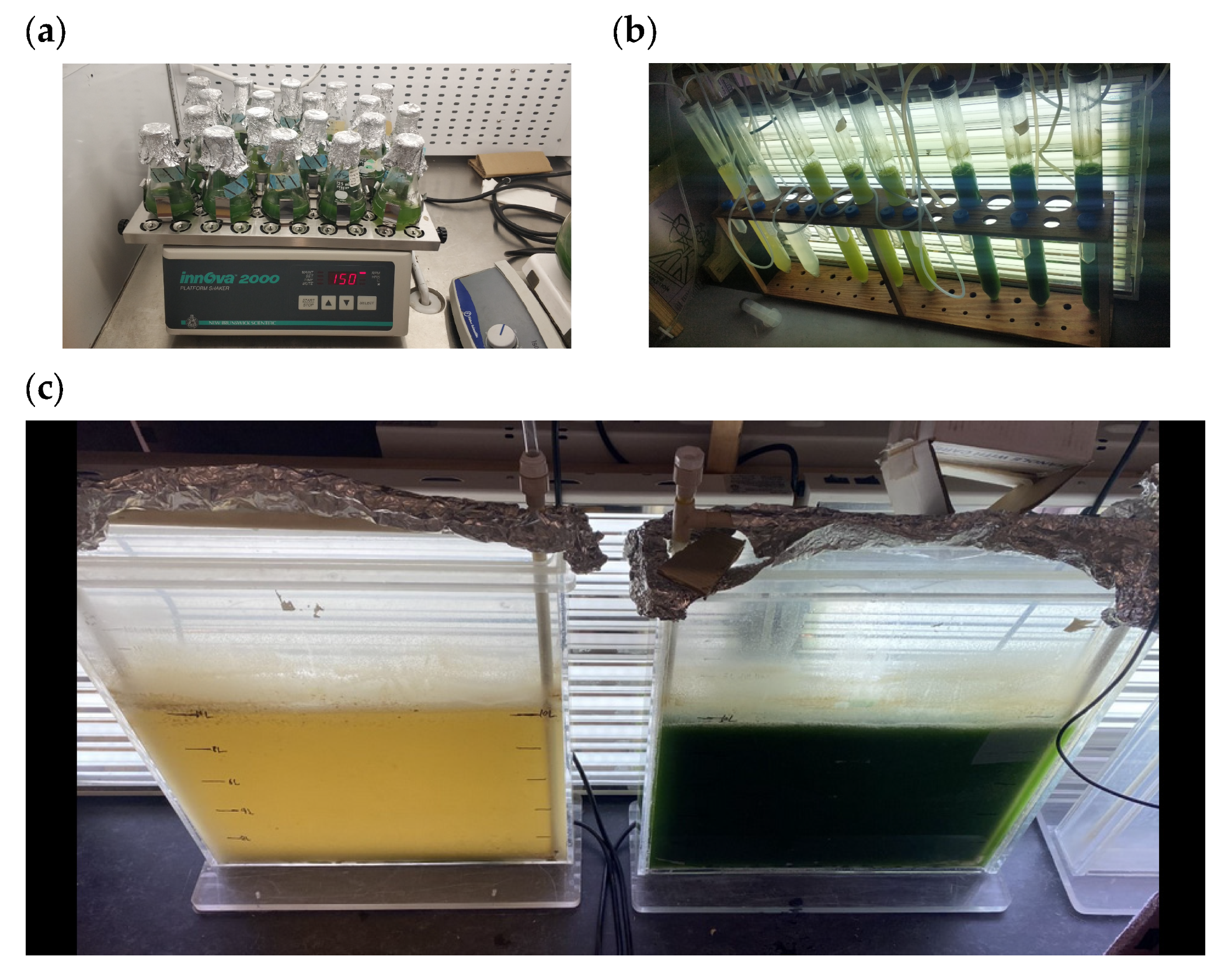
Figure 1a–c shows photographs of the three scale bioreactors. The light-exposed surface area (LESA) was calculated based on the geometric dimensions of each reactor, not directly measured. For the small-scale Erlenmeyer flask, the light source for the Erlenmeyer flask comes from directly above; moreover, the top of the Erlenmeyer flask is wrapped in aluminum foil, and light cannot penetrate it. So, the illuminated area was approximated as the inner surface area of the glass from the bottom to the boundary below the mouth of the Erlenmeyer flask. The light source for the medium-scale tubular PBR and large-scale wall-shaped PBR comes from one side. For the medium-scale tubular PBR, LESA was half of the cylindrical wall area submerged in the culture. For the large-scale wall-shaped PBR, LESA was the area of the one-side walls in contact with the liquid.

2.4. Analytical Methods

Measurements of pH and conductivity were performed with a Hanna HI 5522 m (Hanna, Woonsocket, RI, USA). A HACH DR 3900 spectrophotometer (HACH, Loveland, CO, USA) was used, with corresponding standard test vials or powders, to quantify NH4-N, NO2-N, NO3-N, TN, PO4-P and TP. Metal element analysis was carried out on an iCAP 7000 Inductively Coupled Plasma Optical Emission Spectrometer (ICP-OES, Thermo Fisher Scientific, Waltham, MA, USA) [23].
To quantify biomass density, optical density (OD) was recorded at 750 nm on a HACH DR 3900 spectrophotometer (HACH, Loveland, CO, USA). Biomass density, expressed as ash-free dry weight (Y, g AFDW/L), was then correlated with the measured OD at 750 nm using the following relationship [24]:
Y = 0.4775 × X − 0.0163; R2 = 0.9967; n = 12; X = OD value at 750 nm
To prevent interference from leachate color and suspended solids, the blank used for OD750 measurements was the exact 20% leachate medium without algae. The calibration curve was established using this specific background, thereby mitigating systematic bias across the different reactors.

2.5. Statistical Analysis

Statistical analyses were performed using Excel 2016 and SPSS 20. A One-way Analysis of Variance (ANOVA) was performed, followed by Tukey’s HSD post hoc test for multiple comparisons, with the significance level set at p < 0.05. We also confirmed that the assumptions of normality (Shapiro–Wilk test) and homogeneity of variances (Levene’s test) prior to ANOVA. The reduced replication for the large-scale setup limits the statistical power, necessitating a cautious interpretation of those specific comparisons.

3. Results and Discussion

3.1. Biomass Density of Red Algae in LL Under Various Scales and Configurations

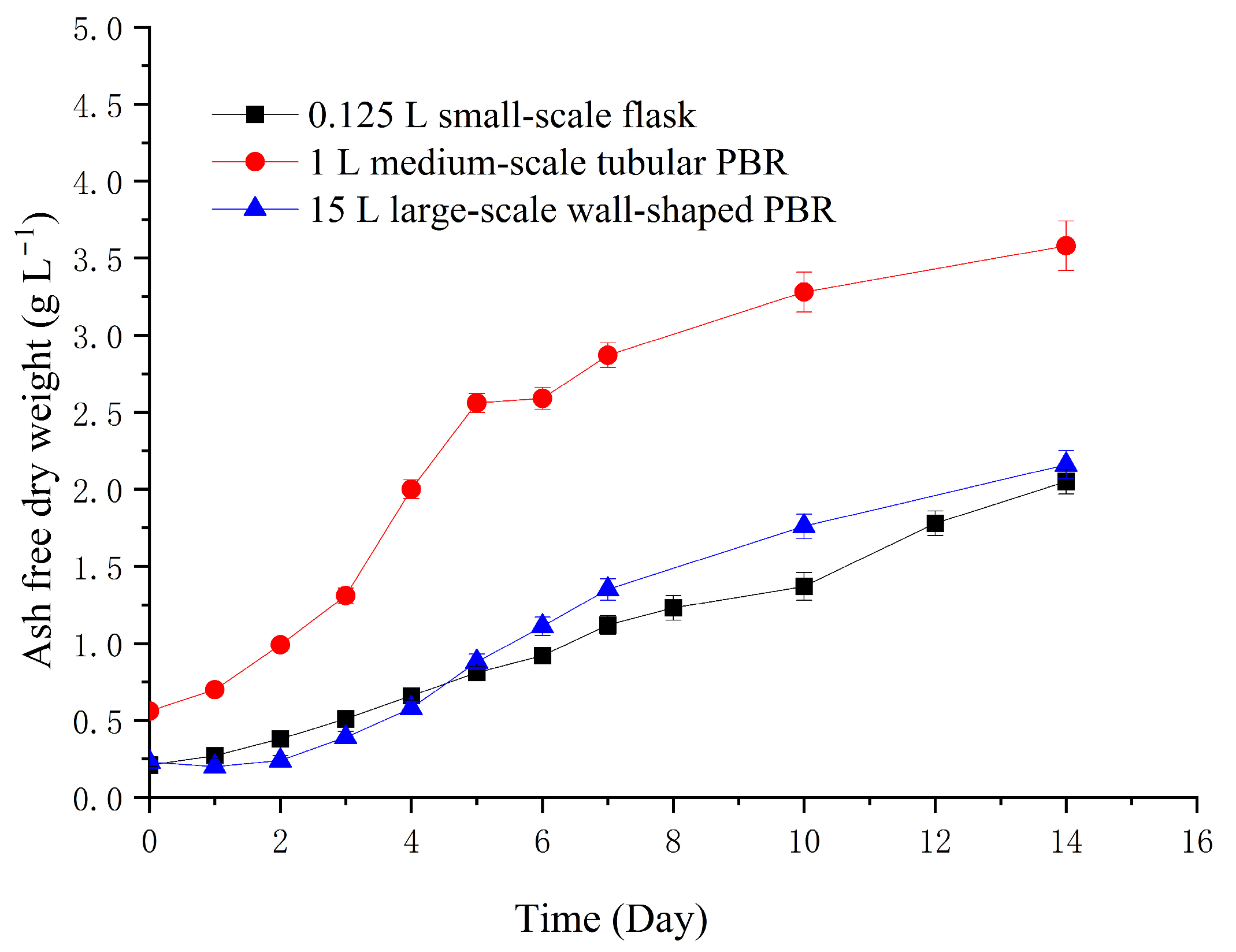
Figure 2 presents the algal biomass density curves of Galdieria sulphuraria growing in bioreactors of different systems. The figure shows the change in algal biomass concentration over a 14-day period, clearly indicating that growth occurred throughout the entire experimental duration in all tested reactor scales, except for a one-day lag phase observed in the large-scale bioreactor. The reason for this lag phase may be the substantial change in vessel size. Initial biomass densities were 0.21, 0.56, 0.23 g L−1 from small- to large-scale vessels. While we intended to normalize the initial biomass across all reactors, minor variations during the centrifugation, pellet resuspension, and large-volume distribution processes resulted in the medium reactor starting at a higher density compared to the others. Final biomass concentrations of 2.05 g L−1 (small), 3.58 g L−1 (medium), and 2.16 g L−1 (large) were achieved in the three scale reactors. When calculating algal growth rate, we used ash-free dry weight data from days 0–14, 0–5, and 2–7 for the small, medium, and large reactors, respectively. As shown in Table 2, among the three systems tested, the 1 L tubular PBR (medium-scale) achieved the highest growth rate under its specific operating conditions (20,000 lux, bubbling aeration, tubular geometry) (0.461 g L−1 day−1). This value was 3.16 times that of the 0.125 L flask (small-scale) reactor (0.146 g L−1 day−1) and 2.08 times that of the 15 L (large-scale) PBR (0.222 g L−1 day−1). From the statistical analysis related to the significance of comparison in Table 3, final biomass density and growth rate differed significantly between the medium-scale reactor and both the small-scale (p < 0.0005) and large-scale (p < 0.0005) reactors. However, there is no significant difference between small and large scale for biomass density (p = 0.716, >0.05) and biomass growth rate (p = 0.1496, >0.05). Notably, the low replication (n = 2) for the large-scale reactor warrants cautious interpretation. Generally, larger scale bioreactors tend to exhibit lower biomass production and growth rates due to a lower surface-area-to-volume ratio, which is the opposite of the trend observed here. In this study, the highest final biomass density and growth rate in the 1 L medium-scale tubular reactor may have benefited slightly from its higher initial biomass density. Crucially, as demonstrated in our previous study [10], while variations in initial biomass density in this range significantly affect the final biomass yield, they do not significantly alter the growth rate during the exponential phase. Specific growth rates (μ, day−1) during the exponential phase for each reactor were calculated using the formula μ = ln(X2/X1)/(t2 − t1). We identified the exponential phase as: small-scale day 0–5, medium-scale day 0–4, large-scale day 1–6. The specific growth rates were: 0.125 L small-scale flask 0.27 day−1, 1 L medium-scale tubular PBR 0.32 day−1, 15 L large-scale wall-shaped PBR 0.31 day−1. Even after normalizing for initial biomass, the 1 L medium-scale tubular BPR still shows the highest specific growth rate, confirming that its superior performance is not merely an artifact of higher starting density. Therefore, the higher growth rate observed in the 1 L medium-scale reactor can still be attributed to its superior configuration and operational conditions.
We estimated the CO2 fixation rate based on biomass growth rate and a carbon content of 0.36 g C per g AFDW (reported for Redfield ratio C106H263O110N16P in the literature). The calculated CO2 fixation rates were 0.18, 0.58, and 0.28 g CO2 L−1day−1 for small-, medium-, and large-scale reactors, respectively (Table 2). Algal yields were 7.56, 13.02, and 8.67 g AFDW produced per g N removed, respectively (Table 2). The 1 L medium-scale tubular PBR achieved the highest CO2 fixation rate and algal yield, further supporting its superior performance.

3.2. Performance of Red Algae in Removing Nitrogen from LL Medium Under Various Scales and Configurations

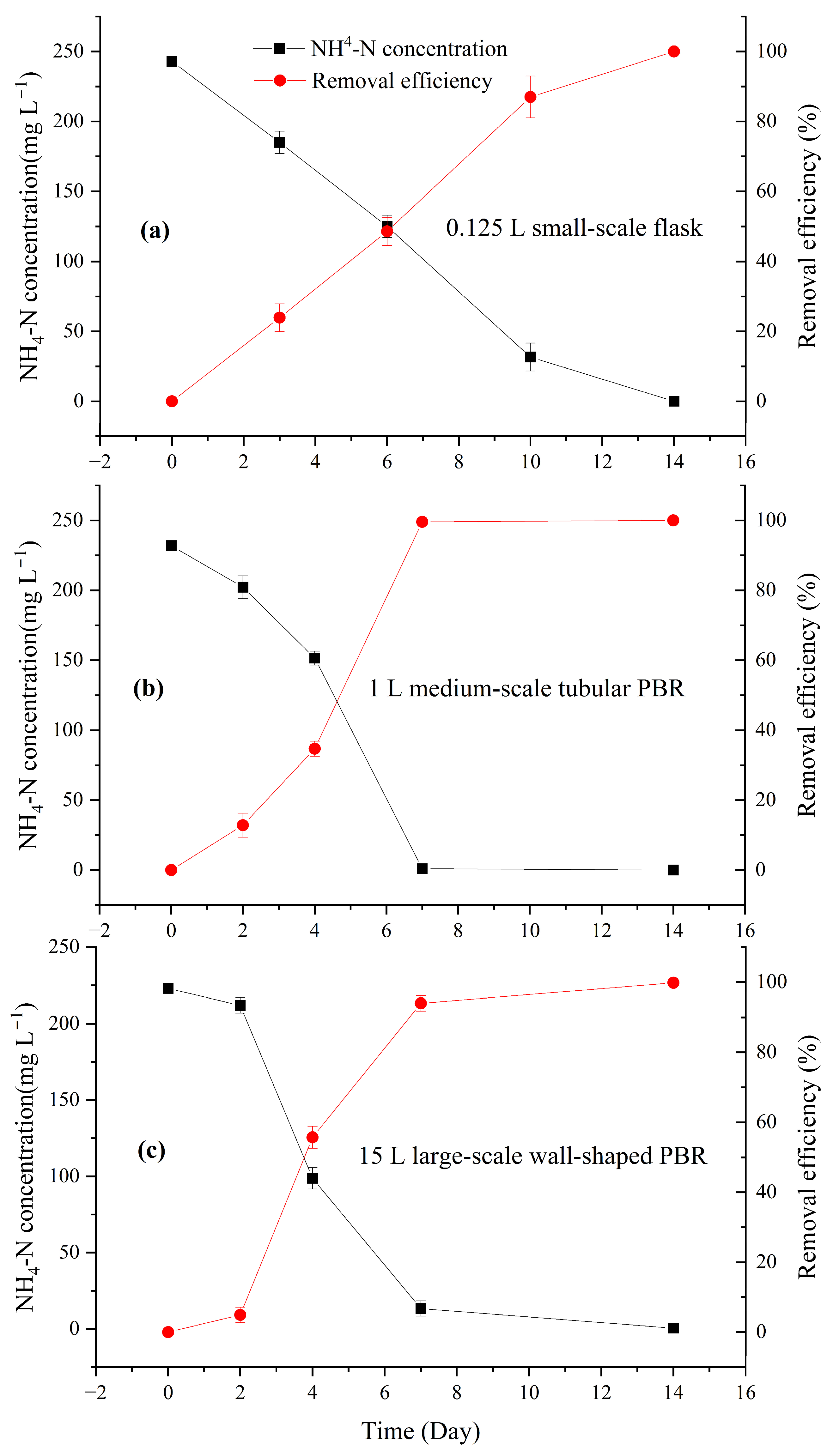
As shown in Table 1, NH4-N and TN concentration in original LL were 1140 mg L−1 and 1320 mg L−1, which means that 86% N exists in LL in the form of NH4-N. NOx-N is less than 10 mg L−1, which is negligible. We also monitored the entire biological treatment process and found no increase in NO3-N or NO2-N concentrations. Therefore, we focused on changes in NH4-N concentration rather than individual nitrogen species. Figure 3a–c presents the NH4-N concentrations and removal efficiencies of G. sulphuraria cultivated in bioreactors of different scales. In all three systems tested, the initial NH4-N concentration was approximately 230 mg L−1. The concentration decreased rapidly over the first 10 days (small-scale), 7 days (medium-scale), and 7 days (large-scale), with NH4-N removal efficiency exceeding 92% during these periods. When the experiment was over, all three systems achieved 100% NH4-N removal efficiency (Table 3). The highest NH4-N removal rate (33.14 mg L−1 day−1) was observed at 1 L tubular PBR (medium-scale), followed by the 15 L wall-shaped PBR (large-scale) (29.96 mg L−1 day−1) and then the small scale (21.09 mg L−1 day−1) under its specific operating conditions (20,000 lux, bubbling aeration, tubular geometry) (Table 2). Significant differences in NH4-N removal rate were found for all system pairs: small vs. medium (p < 0.0005), small vs. large (p < 0.0005), and medium vs. large (p = 0.0096). Although the comparison between medium- and large-scale yielded p = 0.0096 for NH4-N removal rate, the low replication (n = 2) for the large-scale reactor warrants cautious interpretation. The difference in NH4-N removal rates between the medium- and large-scale reactors was smaller (a factor of 1.106) than the difference in growth rates (a factor of 2.08) in Section 3.1. This result indicates that changes from 1 L medium-scale PBR to 15 L large-scale PBR under the specific conditions tested would cause a more obvious promoted effect on growth rate than NH4-N removal rate.

3.3. Performance of Red Algae in Removing Phosphorus from LL Medium Under Various Scales and Configurations

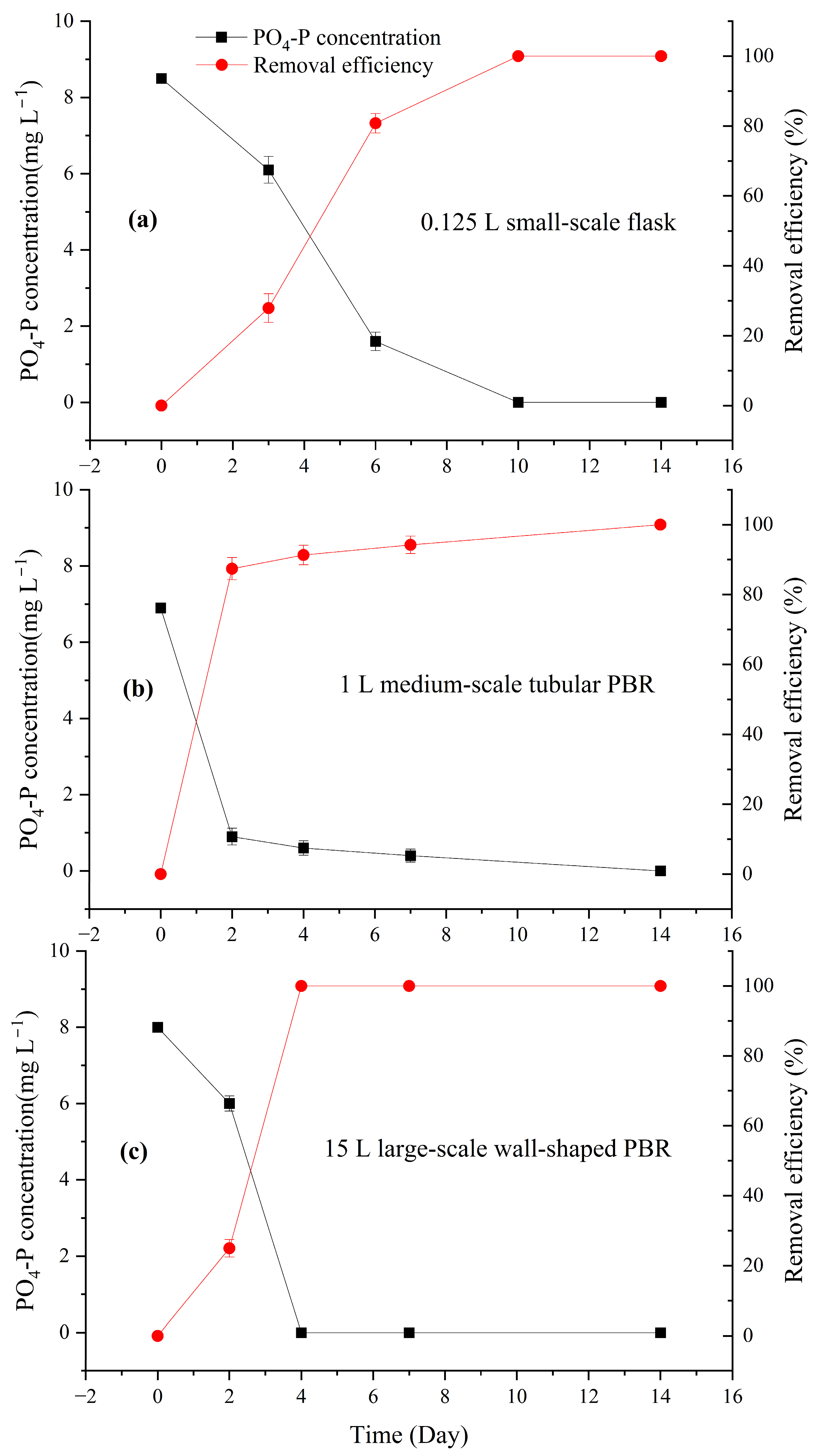
As shown in Table 1, the concentration of free PO4-P and total phosphorus in the raw LL were 4.47 mg L−1 and 18.80 mg L−1, respectively. Figure 4a–c presents the PO4-P concentrations and removal efficiencies of G. sulphuraria grown in bioreactors of different scales and configurations. According to the figure, at the beginning of the experiment, PO4-P concentrations in all three systems were roughly 8 mg L−1. They declined rapidly within the first 6, 2 and 4 days for small-, medium- and large-scale systems, respectively. More than 80% of PO4-P was removed during these periods. At the end of the experiment, all three systems had nearly 100% PO4-P removal efficiencies. The experiment results verified that all scale PBRs were capable of achieving complete NH4-N and PO4-P removal from LL in this algae-based treatment system, which ensures this technology’s capability to more easily to reach effluent disposal standards. The maximum PO4-P removal rate was 3.05 mg L−1 day−1 in the 1 L medium scale tubular system, followed by the 15 L large-scale system (2.05 mg L−1 day−1), while the smallest rate (1.14 mg L−1 day−1) occurred at the 0.125 L small-scale flask. Significant differences in PO4-P removal rate were found for all system pairs: small vs. medium (p < 0.0005), small vs. large (p < 0.0005), and medium vs. large (p < 0.0005).
G. sulphuraria is cultivated at a highly acidic pH (~2.5); abiotic precipitation of phosphorus (e.g., as calcium or magnesium phosphates, which typically occurs at alkaline pH) is thermodynamically impossible in our system. While the acidic pH makes abiotic precipitation unlikely, the absence of controls means we cannot completely rule out other non-biological pathways. Nevertheless, biological assimilation by G. sulphuraria is likely the dominant mechanism.
One limitation of the present study is the absence of a control without phosphorus addition. However, our earlier work [23] demonstrated that under high NH4-N conditions, P supplementation to achieve an N:P mass ratio of 25:1 significantly enhanced algal growth and nutrient removal at the 0.125 L scale flask PBRs. Whether the scale-dependent differences observed here would persist without P addition remains to be tested.
Another limitation of this study is the absence of abiotic (no-algae) or acidified-leachate controls. While the abiotic precipitation of phosphorus is thermodynamically unfavorable at pH ~2.5, we cannot fully exclude other non-biological removal mechanisms such as adsorption to reactor walls or to algal cell surfaces. Therefore, the observed PO4-P removal should be interpreted as primarily biological, but with some uncertainty.

3.4. COD and pH Changes in the Three Bioreactor Scales and Configurations

COD at day 0 and day 14 for all three scales were measured during the original experiment. The initial COD after dilution was all approximately 1000 mg L−1. The final effluent COD concentrations ranged from 850 to 900 mg L−1. Briefly, COD removal efficiency was limited (10–15% after 14 days), much lower than NH4-N and PO4-P removal efficiency. The LL used in this study came from an old-aged landfill (>10 years), and the BOD5 and COD of raw LL were 650 and 4827 mg L−1 (Table 1), thus the low BOD5/COD ratio of 0.135 may explain this result. Usually, low BOD5/COD ratio means that the biodegradability of this wastewater is very poor, and COD removal is hard to achieve by conventional biological treatment technology. Therefore, higher residual COD shows a need for post-treatment (e.g., physicochemical) to meet discharge standards.
pH at day 0 and day 14 for all three scales was also measured during the original experiment. The pH decreased in all systems. The 1 L tubular PBR (medium-scale) showed a slightly larger pH drop (from 2.5 to 1.6) under its specific operating conditions, whereas the small- and large-scale reactors showed smaller drops (to approximately 1.8). These differences are consistent with the higher metabolic activity in the medium-scale reactor.

3.5. Geometric and Operational Parameters of the Three Bioreactor Scales and Configurations

Several bioreactor features and operational parameters for the three scales are listed in Table 4. Light—a key energy source for photosynthesis—affects algal growth via intensity, quality, photoperiod and light-exposed surface area [25]. Here, light quality and photoperiod were the same for all scales. In principle, within a suitable range, higher light intensity and a larger area-to-volume ratio could promote algal growth. Sniff et al. [26] reported that 0.25 L flask cultures, which had a surface-area-to-volume ratio more than 10 times higher, grew faster than larger-scale systems.
Contrary to that trend, the present study found the fastest growth in the medium-scale bioreactor, followed by the large-scale, and the slowest in the small-scale—despite the small reactor having the highest surface-area-to-volume ratio (LESA:V = 100 m−1, Table 4). Light intensity was 4000 lux for the small-scale experiment and 20,000 lux for the medium- and large-scale experiments. The small-scale system received only 20% of the light intensity provided to the other two scales, which likely counteracted its higher surface-area-to-volume ratio advantage. Additionally, mixing differed: the small-scale reactor was shaken on a platform, while the medium- and large-scale reactors used bottom bubbling, ensuring more complete mixing. The rising CO2-rich bubbles achieved higher CO2 mass-transfer rates than the static incubator air above the small-scale flask’s medium surface, even though the ambient CO2 concentration was identical (3% v/v) [27]. Therefore, algae in the medium and large scales could access more CO2 as an inorganic carbon source for photosynthesis, leading to higher growth rates. We did not monitor aeration rate data at the time, nor did we have a dissolved CO2 probe or direct measurements of the CO2 mass transfer coefficient. However, based on the strong turbulence induced by aeration, we speculate that the gas–liquid mass transfer efficiency was significantly higher than that in the shaking flask. This requires further quantification in future studies through hydrodynamic measurements. While a high LESA:V ratio is intrinsically advantageous, its benefits in the small-scale reactor were overshadowed by the significantly higher total light availability (LESA×LI) and superior mixing provided in the medium and large-scale reactors. Although both medium- and large-scale reactors used bubbling, their gas-flow-to-medium-volume ratios were not equal; the medium-scale exhibited a larger ratio. Overall, algal growth is determined not by a single factor but by a combination of multiple interacting conditions.
Table 4 introduces a derived parameter, LESA × LI:V, which represents the amount of optical radiation available per unit volume. We define a short phrase ‘volumetric optical radiation’ (VOR) to represent LESA*LI: V value. The descending order of VOR values for different reactors systems is as follows: l L medium-scale tubular photobioreactor (88,000), 15 L wall-shaped large-scale reactor (60,000), and 0.125 L small-scale flask (40,000). This order is consistent with the order of final biomass density, growth rate, N removal rate and P removal rate (Table 2). Therefore, VOR serves as a promising preliminary descriptive indicator to reflect the overall performance of an algal-based treatment system. However, its applicability as a general predictive parameter requires further validation across a broader range of operational conditions. Future studies testing VOR under controlled single variable conditions are recommended.

3.6. Practical Implications for Scale-Up Design

Based on experimental results and findings, we offer the following suggestions for scale-up design:
(1)
The medium-scale tubular reactor (1 L) outperformed both smaller and larger reactors under the specific conditions tested (including higher light intensity, bubbling aeration, and tubular geometry), suggesting that a tubular geometry with bubbling mixing is preferable to flasks or rectangular tanks;
(2)
Volumetric optical radiation (VOR) may be a more useful descriptive parameter than surface-area-to-volume ratio;
(3)
Direct use of small-scale flask data may underestimate the required light intensity and mixing energy;
(4)
Given limited COD removal, post-treatment should be integrated into full-scale designs.

4. Conclusions

According to study results, all three photobioreactor systems achieved near-complete NH4-N and PO4-P removal (≈100%) within 14 days. Among the three systems tested, the 1 L tubular PBR (medium-scale) exhibited superior results compared to the 0.125 L flask (small-scale) and the 15 L wall-shaped PBR (large-scale) under its specific operating conditions (20,000 lux, bubbling aeration, tubular geometry) in terms of algal growth (0.461 g L−1day−1) and the removal rates of nitrogen (33.14 mg L−1day−1) and phosphorus (3.05 mg L−1day−1). Possible reasons include higher light intensity, bubble aeration, tubular geometry that enhances mixing, and a greater product of surface-area-to-volume ratio and light intensity. VOR serves as a promising preliminary descriptive indicator to reflect the overall performance of an algal-based treatment system.
Limitations and Interpretation Caveats. The following limitations should be considered when interpreting the results:
(1)
Reactor scale is confounded with configuration and operating conditions (light intensity, mixing mode, aeration rate, geometry). Therefore, this study is a comparison of three specific reactor systems rather than a true scale-up experiment.
(2)
No-algae or abiotic controls were included, so removal by adsorption or precipitation cannot be fully excluded.
(3)
The large-scale reactor had only n = 2 replicates, limiting statistical power.
(4)
Initial biomass concentrations were not perfectly equal across reactors. These caveats are discussed in relation to each result in the relevant sections.

Author Contributions

Conceptualization, T.S. and X.S.; methodology, S.P.; software, S.P.; validation, S.P.; formal analysis, X.X.; investigation, R.R.; resources, T.S.; data curation, X.X.; writing—original draft preparation, S.P. and R.R.; writing—review and editing, S.P., T.S., D.Z., R.R., X.X. and X.S.; visualization, X.S.; supervision, T.S.; project administration, D.Z. All authors have read and agreed to the published version of the manuscript.

Funding

This research was funded by the Scientific research startup fund of Anhui Polytechnic University (Grant No. 2021YQQ063), the Science and Technology Project of Wuhu (Grant No. 2024kj034), Anhui Gaosheng Building Decoration Engineering Co., Ltd., Horizontal Entrustment (Grant No. HX-2023-12-196), and Nanjing Nanlan Environmental Protection Industry Co., Ltd., Horizontal Entrustment (Grant No. HX-2024-12-094). Any opinions, findings, conclusions, or recommendations do not necessary reflect the views of the funding agencies.

Data Availability Statement

Although the datasets generated in this work can be obtained by contacting the corresponding authors, they are not made publicly available as the authors are still pursuing a related follow-up study.

Acknowledgments

This study gained technical supports from the Center for Advances in Water and Air Quality (CAWAQ) of Lamar University and the Engineering Research Center of Anhui Green Building and Digital Construction of Anhui Polytechnic University.

Conflicts of Interest

The authors declare that this study received funding from Anhui Gaosheng Building Decoration Engineering Co., Ltd. and Nanjing Nanlan Environmental Protection Industry Co., Ltd. The funder was not involved in the study design, collection, analysis, interpretation of data, the writing of this article, or the decision to submit it for publication.

Abbreviations

The following abbreviations are used in this manuscript:
LLLandfill leachate
TEAsTechno-economic analyses
CMCyanidium medium
OPOptical density
PBRPhotobioreactor
LESALight-exposed Surface Area
CODChemical oxygen demand
TOCTotal organic carbon
BOD5Biochemical oxygen demand
NH4-NAmmonia nitrogen
NO3-NNitrate nitrogen
NO2-NNitrite nitrogen
TNTotal nitrogen
PO4-PFree phosphate phosphorus
TPTotal phosphorus
VORVolumetric optical radiation
CCMEEthe Culture Collection of Microorganisms from Extreme Environments

References

  1. Renou, S.; Givaudan, J.G.; Poulain, S.; Dirassouyan, F.; Moulin, P. Landfill leachate treatment: Review and opportunity. J. Hazard. Mater. 2008, 150, 468–493. [Google Scholar] [CrossRef] [PubMed]
  2. Zuorro, A.; Ortiz-Alvarez, M.D.; Lavecchia, R.; Barajas-Ferreira, C.; García-Martínez, J.B.; Barajas-Solano, A.F. A Circular Economy Approach to Landfill Leachate Biotransformation: Application of Microalgae and Cyanobacteria for Environmental Sustainability and Value-Added Products. Water 2026, 18, 462. [Google Scholar] [CrossRef]
  3. Ghosh, P.; Thakur, I.S. Biosorption of landfill leachate by Phanerochaete sp ISTL01: Isotherms, kinetics and toxicological assessment. Environ. Technol. 2017, 38, 1800–1811. [Google Scholar] [CrossRef]
  4. Delanka-Pedige, H.M.K.; Munasinghe-Arachchige, S.P.; Cornelius, J.; Henkanatte-Gedera, S.M.; Tchinda, D.; Zhang, Y.Y.; Nirmalakhandan, N. Pathogen reduction in an algal-based wastewater treatment system employing Galdieria sulphuraria. Algal Res.-Biomass Biofuels Bioprod. 2019, 39, 6. [Google Scholar] [CrossRef]
  5. Mustafa, E.M.; Phang, S.M.; Chu, W.L. Use of an algal consortium of five algae in the treatment of landfill leachate using the high-rate algal pond system. J. Appl. Phycol. 2012, 24, 953–963. [Google Scholar] [CrossRef]
  6. Martínez, M.E.; Sánchez, S.; Jiménez, J.M.; El Yousfi, F.; Muñoz, L. Nitrogen and phosphorus removal from urban wastewater by the microalga Scenedesmus obliquus. Bioresour. Technol. 2000, 73, 263–272. [Google Scholar] [CrossRef]
  7. Lin, L.; Chan, G.Y.; Jiang, B.L.; Lan, C.Y. Use of ammoniacal nitrogen tolerant microalgae in landfill leachate treatment. Waste Manag. 2007, 27, 1376–1382. [Google Scholar] [CrossRef]
  8. Kumari, M.; Ghosh, P.; Thakur, I.S. Landfill leachate treatment using bacto-algal co-culture: An integrated approach using chemical analyses and toxicological assessment. Ecotoxicol. Environ. Saf. 2016, 128, 44–51. [Google Scholar] [CrossRef]
  9. Costa, R.H.R.; Martins, C.L.; Fernandes, H.; Velho, V.F. Consortia of microalgae and bacteria in the performance of a stabilization pond system treating landfill leachate. Water Sci. Technol. 2014, 70, 486–494. [Google Scholar] [CrossRef]
  10. Selvaratnam, T.; Pan, S.; Rahman, A.; Tan, M.; Kharel, H.L.; Agrawal, S.; Nawaz, T. Bioremediation of Raw Landfill Leachate Using Galdieria sulphuraria: An Algal-Based System for Landfill Leachate Treatment. Water 2022, 14, 2389. [Google Scholar] [CrossRef]
  11. Paskuliakova, A.; McGowan, T.; Tonry, S.; Touzet, N. Phycoremediation of landfill leachate with the chlorophyte Chlamydomonas sp SW15aRL and evaluation of toxicity pre and post treatment. Ecotoxicol. Environ. Saf. 2018, 147, 622–630. [Google Scholar] [CrossRef] [PubMed]
  12. Tang, C.C.; Liu, J.Q.; Cheng, Y.Q.; Hu, Y.R.; He, Z.W.; Wang, W.Q.; Li, Z.H.; Wang, X.C.; Tian, Y. Designing light-guiding carriers in microalgal-bacterial systems: From optimization to integration and development perspectives. Chem. Eng. J. 2025, 525, 15. [Google Scholar] [CrossRef]
  13. Portillo, F.V.L.; Montenegro-Herrera, C.A.; Porta, H.; Martinez, A. Self-Shading effect caused by high biomass concentration increased phycocyanin accumulation in Galdieria sulphuraria strain UTEX 2919 under autotrophic conditions. J. Appl. Phycol. 2026, 38, 131–140. [Google Scholar] [CrossRef]
  14. Wang, S.K.; Stiles, A.R.; Guo, C.; Liu, C.Z. Microalgae cultivation in photobioreactors: An overview of light characteristics. Eng. Life Sci. 2014, 14, 550–559. [Google Scholar] [CrossRef]
  15. Dayanath, W.M.S.; Lim, Y.A.; Ilankoon, I.; Chong, M.N.; Foo, S.C. Flow visualisation in flat panel photobioreactors with optimised gas spargers using fluorescent dyes and microspheres to evaluate mixing mechanisms and microalgae growth. Bioresour. Technol. Rep. 2025, 32, 13. [Google Scholar] [CrossRef]
  16. Ren, S.Y.; Shao, C.; Zhu, F.F.; Schagerl, M.; Hu, X.J.; Sobhi, M.; Xu, L.; Qian, J.Y.; Huo, S.H. Optimization and synergistic enhancement of microalgae productivity in laboratory raceway ponds via co-regulation of automated light-supplemented mixers and electric field system. Biotechnol. Biofuels Bioprod. 2025, 18, 16. [Google Scholar] [CrossRef]
  17. Ndiaye, M.; Gadoin, E.; Gentric, C. CO2 gas-liquid mass transfer and kLa estimation: Numerical investigation in the context of airlift photobioreactor scale-up. Chem. Eng. Res. Des. 2018, 133, 90–102. [Google Scholar] [CrossRef]
  18. Chen, Z.J.; Jiang, Z.Y.; Zhang, X.X.; Zhang, J. Numerical and experimental study on the CO2 gas-liquid mass transfer in flat-plate airlift photobioreactor with different baffles. Biochem. Eng. J. 2016, 106, 129–138. [Google Scholar] [CrossRef]
  19. Amanna, B.; Bahri, P.A.; Moheimani, N.R. Application of computational fluid dynamics in optimizing microalgal photobioreactors. Algal Res.-Biomass Biofuels Bioprod. 2024, 83, 17. [Google Scholar] [CrossRef]
  20. Cui, X.Y.; Yang, J.H.; Feng, Y.Z.; Zhang, W.W. Simulation of a Novel Tubular Microalgae Photobioreactor with Aerated Tangent Inner Tubes: Improvements in Mixing Performance and Flashing-Light Effects. Archaea-Int. Microbiol. J. 2020, 2020, 16. [Google Scholar] [CrossRef]
  21. Bitog, J.P.; Lee, I.B.; Lee, C.G.; Kim, K.S.; Hwang, H.S.; Hong, S.W.; Seo, I.H.; Kwon, K.S.; Mostafa, E. Application of computational fluid dynamics for modeling and designing photobioreactors for microalgae production: A review. Comput. Electron. Agric. 2011, 76, 131–147. [Google Scholar] [CrossRef]
  22. Toplin, J.A.; Norris, T.B.; Lehr, C.R.; McDermott, T.R.; Castenholz, R.W. Biogeographic and phylogenetic diversity of thermoacidophilic Cyanidiales in Yellowstone National Park, Japan, and New Zealand. Appl. Environ. Microbiol. 2008, 74, 2822–2833. [Google Scholar] [CrossRef]
  23. Pan, S.; Dixon, K.L.; Nawaz, T.; Rahman, A.; Selvaratnam, T. Evaluation of Galdieria sulphuraria for nitrogen removal and biomass production from raw landfill leachate. Algal Res. 2021, 54, 102183. [Google Scholar] [CrossRef]
  24. Pan, S. Bioremediation of Landfill Leachate Using an Algal-Based System: An Application of Red Alga Galdieria sulphuraria; Lamar University-Beaumont: Beaumont, TX, USA, 2021. [Google Scholar]
  25. Singh, S.P.; Singh, P. Effect of temperature and light on the growth of algae species: A review. Renew. Sustain. Energy Rev. 2015, 50, 431–444. [Google Scholar] [CrossRef]
  26. Sniffen, K.D.; Price, J.R.; Sales, C.M.; Olson, M.S. Influence of Scale on Biomass Growth and Nutrient Removal in an Algal-Bacterial Leachate Treatment System. Environ. Sci. Technol. 2017, 51, 13344–13352. [Google Scholar] [CrossRef]
  27. Porto, B.; Goncalves, A.L.; Esteves, A.F.; de Souza, S.; de Souza, A.A.U.; Vilar, V.J.P.; Pires, J.C.M. Assessing the potential of microalgae for nutrients removal from a landfill leachate using an innovative tubular photobioreactor. Chem. Eng. J. 2021, 413, 127546. [Google Scholar] [CrossRef]
Figure 1. Photographs of 0.125 L small-scale flasks (a); 1 L medium-scale tubular PBRs (b); and 15 L large-scale wall-shaped PBRs (c).
Water 18 01471 g001
Figure 2. Concentration change in G. sulphuraria in 20% LL under three different PBR systems: 0.125 L small-scale flask, 1 L medium-scale tubular PBR, and 15 L large-scale wall-shaped PBR. Error bars represent the standard deviation of replicates (n = 3 for small/medium, n = 2 for large).
Water 18 01471 g002
Figure 3. NH4-N elimination from LL media by red algae in bioreactors of three different PBR systems: (a) 0.125 L small-scale flask, (b) 1 L medium-scale tubular PBR, and (c) 15 L large-scale wall-shaped PBR. Error bars represent the standard deviation of replicates (n = 3 for small/medium, n = 2 for large).
Water 18 01471 g003
Figure 4. PO4-P elimination from LL media by red algae in bioreactors of three different PBR systems: (a) 0.125 L small-scale flask, (b) 1 L medium-scale tubular PBR, and (c) 15 L large-scale wall-shaped PBR. Error bars represent the standard deviation of replicates (n = 3 for small/medium, n = 2 for large).
Water 18 01471 g004
Table 1. Physicochemical parameters of original CM and LL. Data were shown in form of triplicate samplings’ average ± SD (n = 3) [23].
ParametersCMLL
pH2.508.08 ± 0.20
Conductivity5.5522.47 ± 0.01
Total solids2.6023.97 ± 0.24
Chemical oxygen demand (COD)04827 ± 186
Total organic carbon (TOC)0743 ± 16
Biochemical oxygen demand (BOD5)0650 ± 10
Free phosphate phosphorus (PO4-P)61.504.47 ± 0.11
Total phosphorus (TP)61.5018.80 ± 0.20
Ammonia nitrogen (NH4-N)2801140 ± 29
Nitrate nitrogen (NO3-N)07.08 ± 0.05
Nitrite nitrogen (NO2-N)00.13 ± 0.02
Total nitrogen (TN)2801320 ± 35
Ca19148 ± 3
Mg25254 ± 7
Na47>1000
K78832 ± 43
Fe0.101.00 ± 0.07
Mn0.720.45 ± 0.01
Zn0.112.36 ± 0.01
Cu0.0041.14 ± 0.16
Note: All unit is mg L−1 except for g L−1 for Total solid, mS cm−1 for Conductivity and no unit for pH.
Table 2. Algal growth and nutrient removal comparisons at different scales and configurations.
Final Biomass DensityBiomass Growth RateYieldμ **CO2 Fixation RateNH4-N Removal EfficiencyNH4-N Removal RatePO4-P Removal EfficiencyPO4-P Removal Rate
g L−1g L−1day−1g gN−1 *day−1g L−1day−1%mg L−1day−1%mg L−1day−1
small-scale2.05 ± 0.080.146 ± 0.0147.560.270.1810021.09 ± 1.481001.15 ± 0.17
medium-scale3.58 ± 0.160.461 ± 0.07613.020.320.5810033.14 ± 0.091003.05 ± 0.11
large-scale2.16 ± 0.090.222 ± 0.0018.670.310.2810029.96 ± 0.161002.05 ± 0.08
Note: * gram algal biomass produced per unit gram ammonia nitrogen consumed. ** specific growth rate.
Table 3. Analysis of significant differences in data comparison among different scales and configurations.
p-Value of Multiple ComparisonsFinal Biomass DensityBiomass Growth RateNH4-N Removal RatePO4-P Removal Rate
small-scale vs. medium-scale<0.00050.0005<0.0005<0.0005
small-scale vs. large-scale0.7160.1496<0.0005<0.0005
medium-scale vs. large-scale<0.00050.00310.0096<0.0005
Note: Removal efficiency was 100% for all reactors with zero variance; therefore, ANOVA comparisons are not applicable.
Table 4. Geometric and operational parameters of the three bioreactor scales and configurations: LESA:V, light intensity, and mixing type.
ScaleBioreactor
(Working Volume)
Light-Exposed Surface Area (LESA)LESA:VLight Intensity (LI) LESA × LI:VMixing Type
m2m−1lux
small0.125 L flask (50 mL)0.0051004000400,000Shaking platform
medium1 L tubular PBR (500 mL)0.0224420,000880,000bubbling
large15 L wall-shape PBR (10 L)0.3073020,000600,000bubbling
Disclaimer/Publisher’s Note: The statements, opinions and data contained in all publications are solely those of the individual author(s) and contributor(s) and not of MDPI and/or the editor(s). MDPI and/or the editor(s) disclaim responsibility for any injury to people or property resulting from any ideas, methods, instructions or products referred to in the content.