Article

Numerical Simulation of the Impact of Plants on Water–Sediment–Phosphorus Transport and Fish Habitat in Riparian Nearshore Waters

1
Chongqing Ecological Environment Monitoring Center, Chongqing 400000, China
2
College of Environment and Ecology, Chongqing University, Chongqing 400044, China
*
Authors to whom correspondence should be addressed.
Water 2026, 18(12), 1470; https://doi.org/10.3390/w18121470 (registering DOI)
Submission received: 27 March 2026 / Revised: 13 May 2026 / Accepted: 19 May 2026 / Published: 15 June 2026
(This article belongs to the Section Water Erosion and Sediment Transport)

Abstract

In inland river basins, the coupling relationship among water, sediment, and phosphorus is essentially the redistribution of phosphorus carried in the river system, and the presence of plants affects its transport and distribution. Meanwhile, fish are the most important component in river ecosystems, and the transport patterns of water, sediment, and phosphorus directly affect the living environment of fish. This study focuses on the coupling relationship among water–sediment–phosphorus and the suitability of fish habitats. By developing a sediment transport program and constructing a coupled movement model through numerical simulation, combined with the fuzzy mathematical theory, an evaluation model for fish habitat suitability is established to explore the coupling transport patterns of water–sediment–phosphorus near the riverbank plant areas and the distribution characteristics of fish habitats. The study found that the flow velocity near arbor is low and vortex structures exist, and the flow velocity values between the plants in the spanwise direction are high, leading to significant bank erosion. Among them, the erosion near arbor is severe, and the depth of erosion pits on the shallow water side is large. The transport of suspended sediment and phosphorus is closely related to water flow movement. In the spanwise direction between plants, sediment and phosphorus high-concentration areas are layered in a “strip” shape along the flow direction. Turbulent water flow drives the suspension of riverbed sediment and releases high phosphorus flux. Arbors have a significant impact on phosphorus transport, and the diffusion of dissolved phosphorus in pore water in some areas is prone to increase the concentration of phosphorus in the water body. The nitrogen–phosphorus ratio is regularly distributed, and the ratio between plants in the spanwise direction is close to the Redfield value, which is suitable for the growth of phytoplankton. In terms of fish habitats, areas near bank plants are not suitable for the survival of juvenile fish. The suitable areas for fish spawning are mainly distributed between plants in the spanwise direction, and the area is relatively small, but plants can provide emergency shelter. The innovation of this study lies in constructing a coupled movement model of water–sediment–phosphorus and an evaluation model for fish habitat suitability, clarifying the mechanism of plant influence on phosphorus migration in nearshore sediment and the distribution pattern of fish habitat suitability. The research results can provide important theoretical support and practical reference for the management of water environment and aquatic ecosystems in inland river basins.

1. Introduction

Phosphorus, an important biogenic element in nature, is an essential element for all life forms such as plants, animals and microorganisms, and is also the main control factor for eutrophication of water bodies. Its distribution, migration and circulation at the sediment–water interface directly affect the primary productivity of the water body [1,2,3]. Phosphorus in the water environment is generally divided into dissolved phosphorus (TDP) and particulate phosphorus (TPP) [4]. Dissolved and particulate phosphorus can be converted under specific conditions: phosphorus in the water environment has “particle adsorption property”, that is, phosphorus is easy to adsorb, complex or precipitate with metal oxides and small molecular organic matter attached to the sediment surface or inside, forming phosphorus containing compounds insoluble in water [5,6,7,8]. When the content of dissolved phosphorus in the environment is low or it is not enough for aquatic organisms to absorb and utilize, the unstable bound phosphorus contained on the surface of some particles will undergo desorption, reduction or dissociation reactions, which will transform into dissolved phosphorus and enter the water body for diffusion and transport. In the process of phosphorus transport in rivers (including river type reservoirs), TDP mainly diffuses and migrates along the flow direction, and TPP mainly keeps consistent with the transport path of suspended sediment.
Sediment at the bottom of the river is an important part of the aquatic ecosystem, and sediment movement affects the transport trajectory and existing form of phosphorus. Riverbed sediment is not only a phosphorus sink, but also a phosphorus release source: when the water environment is disturbed, the phosphorus in the sediment will be released into the water, and the endogenous release of sediment will increase the phosphorus concentration in the water. The water flow is smooth and stable, and the suspended sediment in the water absorbs the phosphorus in the water and settles at the bottom of the riverbed. Therefore, water and sediment are the main carriers of phosphorus [9]. The dynamic change relationship between water, sediment and phosphorus is the most active part of the basin, which is closely related to the stability of water potential and river lake ecosystem. Its essence is the redistribution of phosphorus carried by the river in the river reservoir system [10].
Experts and scholars at home and abroad have conducted a lot of research on water and sediment movement and phosphorus transport. Tian et al. have studied the transport, adsorption and bioavailability characteristics of water, suspended sediment (SS) and phosphorus along the Dongting Lake of the Yangtze River. The results show that phosphorus transport is significantly related to sediments [11]. Jin et al. studied the phosphorus dynamics in the low flow zone through flume and numerical simulation, and revealed the migration and distribution of phosphorus in pore water [12]. Hanchaonan took the Three Gorges Reservoir as the research object, with the help of hydrological data collection, field sampling investigation and indoor experimental simulation methods, the source and budget characteristics of total phosphorus in the Three Gorges Reservoir water were determined, and the morphological distribution characteristics of phosphorus in water, suspended particulate matter, soil and sediment in the water level fluctuation zone were analyzed [13,14]. Wang et al. built a dynamic and water quality model of the Yangtze River Estuary based on DHI’s Ecolab open platform, and simulated and analyzed the migration and transformation process of different forms of nitrogen and phosphorus nutrients [15]. Huang et al. established a phase separation model of hydrodynamic sediment–phosphorus transport and applied the model to the Three Gorges Reservoir. The calculation shows that the sediment discharge ratio of the Three Gorges Reservoir is 27.4% from 2003 to 2011, and about 51.4% of TP is deposited in the reservoir area [16]. Liu et al. adopted Integrated Model to Assess the Global Environment—Global Nutrient Model (IMAGE-GNM); it is found that about 10% of the incoming TP is retained in the Three Gorges Reservoir [17].
Plants have a significant impact on the distribution of water flow characteristics. Vegetation affects the average flow field and turbulent field of water flow [18], flow transport [19], sediment transport [20], river morphology and morphology dynamics [21], and is a key component in controlling the fluid dynamics of aquatic ecosystems [22]. At the same time, vegetation also directly or indirectly affects the transport of particles. Zhao, F. analyzed the characteristics of water flow near plants based on physical and mathematical models [23]. J. Lu et al. analyzed the characteristics of water flow and the distribution of pollutants under vegetation conditions through numerical simulations [24,25,26].
Fish, as an important component of river ecosystems, can serve as a crucial indicator for evaluating the quality of river ecosystems. There are many factors that affect the swimming behavior of aquatic animals such as fish, which can be roughly divided into physiological factors and environmental factors. Environmental factors mainly include food, temperature, oxygen content, pH value, and hydraulic characteristics [27,28,29,30,31,32]. Hydraulic characteristics mainly include flow velocity, water depth, turbulence intensity, flow velocity gradient, etc. Fish will gather and inhabit certain specific areas, which are suitable for fish survival [33,34].
In summary, water and sediment, as the primary carriers of phosphorus, are influenced by the presence of plants, which affects inter-plant water flow and sediment movement, leading to changes in phosphorus transport and distribution. Simultaneously, the transport patterns of water, sediment, and phosphorus also impact fish habitats. Therefore, the sediment–water interface (SWI), as a crucial interface in the terrestrial surface system, serves as a significant site for phosphorus migration and transformation.
This study focuses on riverbank slopes as the research area. Riverbank slopes are the most active areas for life in the river ecosystem, serving as a transition zone between water and land. They possess dual characteristics, facilitating the exchange of matter, energy, and information between aquatic and terrestrial ecosystems, and fulfilling functions such as flood control, ecological corridor, and buffer zone.
Therefore, focusing on the waters near the river bank slopes, this study developed a sediment transport program using numerical simulation. The study investigates the water flow, sediment transport patterns, water–sediment–phosphorus coupling transport patterns, and riverbed sediment release patterns near the riverbank under parallel plant distribution conditions. Based on the fuzzy mathematical model and the characteristics of water–sediment–phosphorus movement, the feasibility analysis of fish habitat suitability was carried out with the four famous domestic fishes in the Yangtze River Basin as the research object. Most previous studies have treated the movement of water, sediment, and phosphorus separately from the study of fish habitats. This study focuses on the waters near the riverbank as the primary research area, considering the impact of the transport and distribution patterns of water, sediment, and phosphorus on the fish’s living environment. It provides ideas and methods for studying nearshore phosphorus transport patterns and fish habitats.

2. Materials and Methods

2.1. Flow Model

The numerical simulation of hydraulic characteristics in this chapter mainly adopts the large eddy simulation turbulence model. The working principle of the LES turbulence model is to divide fluid flow into large-scale flow and small-scale flow. Large-scale flow is sensitive to boundaries and is currently mainly simulated and solved directly based on the Navier-Stokes (N-S) equation. The turbulence model filters out small-scale flow directly through filtering. For small-scale flows, which have isotropic properties and are less affected by boundary conditions, a subgrid scale model with universality for small-scale flows is established for simulation.

2.1.1. Flow Control Equation

The basic equation of turbulence model is the classical N-S equation. This chapter simulates incompressible fluid, and the equation is as follows:
Continuity equation:
u i x i = 0
Momentum equation:
u i t + u i u j x j = 1 ρ t p x i + υ 2 u i x j x j + f i
where u i represents instantaneous velocity in x i (i represents x, y and z);
f i represents the mass force component in the x i direction;
υ stands for viscosity coefficient; and
p is the instantaneous pressure on the computational grid.
The filtered N-S equation is as follows:
Continuity equation:
u i ¯ x i = 0
Momentum equation:
u i ¯ t + u i ¯ u j ¯ x j = 1 ρ t p ¯ x i + υ 2 u i ¯ x j x j τ i j S G S x j
where the subgrid stress is expressed as follows: τ i j S G S = u i u j ¯ u i ¯ u j ¯ .

2.1.2. Subgrid Stress Model

In LES simulation, the subgrid stress model affects the accuracy of the calculation results; therefore, selecting an appropriate subgrid stress model can accurately simulate the energy transfer process between large and small scales. The research area is located near the nearshore ecological protection structure of the bank slope; therefore, the WMLES model based on the evolution of the Smagorinsky model is adopted.
The Smagorinsky has the advantages of simple form, good stability, and convenient calculation. The Smagorinsky model is similar to viscous stress in laminar flow, and the subgrid stress term τ ij SGS is obtained by solving the strain rate tensor S ij ¯ and viscous coefficient υ t :
S ij = 1 2 ( u i ¯ x j + u j ¯ x i )   S - ij = S ij ¯   S ij ¯
υ t is not a unique property of fluids, but a parameter based on the modeled flow field:
υ t lq
Among them, l represents the mixing length; q represents the flow velocity at the subgrid scale. Compared to the RANS model, the calculation of mixing length in LES is relatively simple and requires modeling the maximum scale to be similar to the filtering scale:
l   =   C s
C s represents the Smagorinsky constant; and represents the grid scale. Based on the Prandtl mixing assumption, the flow velocity at the subgrid scale is as follows:
q   =   l S - ij   =   C s S - ij
Substitute Equations (7) and (8) into Equation (6):
υ t   =   lq   =   l 2 S - ij   =   ( C s ) 2 S - ij
The Smagorinsky subgrid model has irreversible transfer, which means that the subgrid model can only simulate the process of energy transfer from a large scale to a small scale. Meanwhile, in complex three-dimensional flows, C s value varies with position, and the Smagorinsky subgrid model cannot accurately simulate it.
This study chose the improved subgrid stress model WMLES based on the Smagorinsky subgrid stress model. The WMLES model overcomes the scale limitation of Reynolds number and allows for the simulation of high Reynolds number conditions:
υ t = min   [ k d w 2 , C smag 2 ]   S   { 1 exp   [ ( y + / 25 ) 3 ] }
In the formula, S is the strain rate; dw is the distance from the point to the wall; k is a constant, 0.41; Csmag = 0.2; and represents the subgrid scale size:   =   min   ( max C w · d w ,   C w · h max ,   h uw ,   h max ) .

2.2. Riverbed Scouring Motion Model

2.2.1. Stress Analysis of Sediment Movement

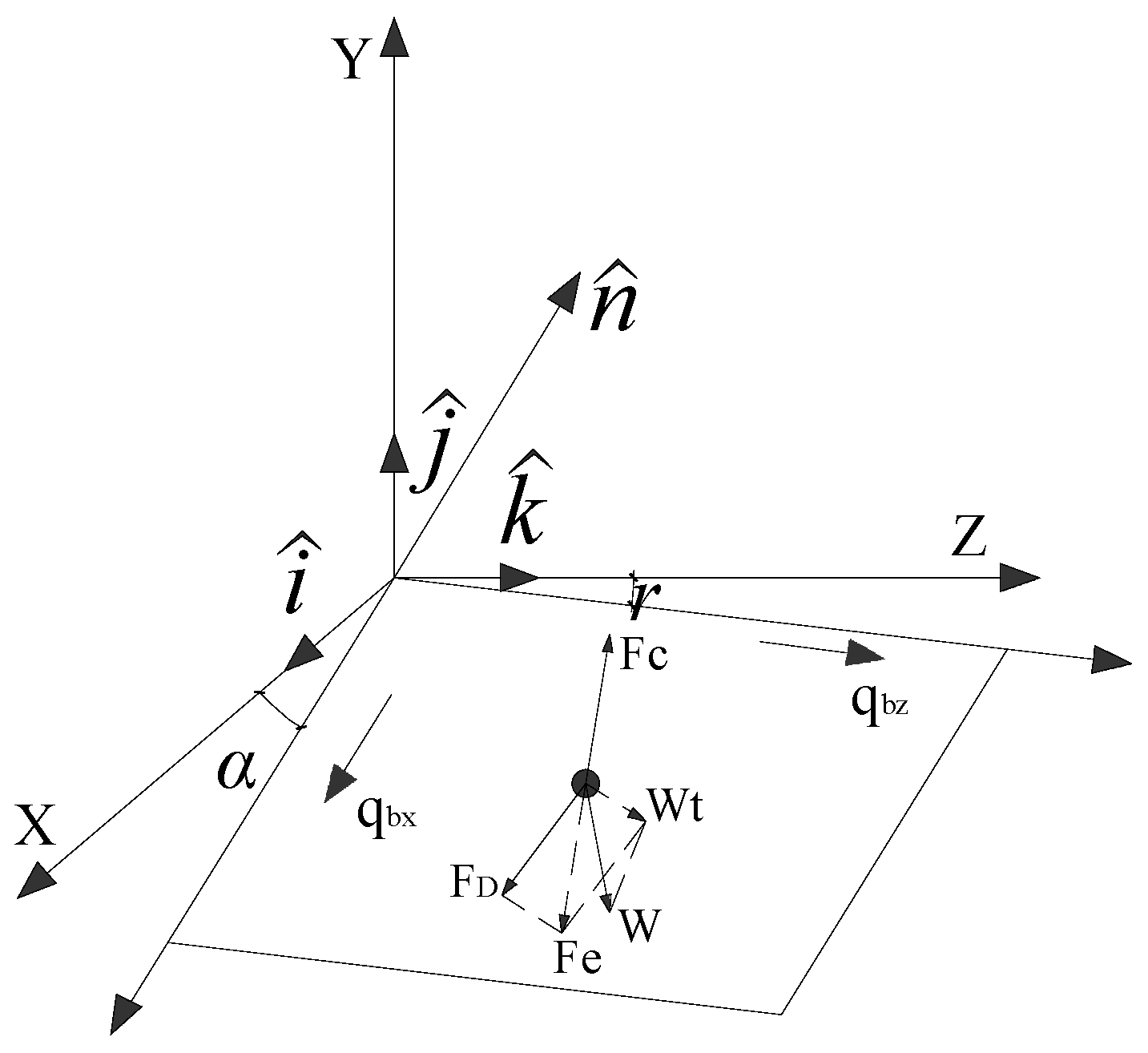
The sediment on the bank slope is mainly affected by underwater gravity (W), flow drag force ( F D ) and Coulomb force ( F c ), as shown in Figure 1.
The vector form of water drag force is as follows:
F D = C D π D 2 4 τ b f ^
where CD is the drag coefficient, which is generally assumed to be constant; D refers to sediment particle size; τ b is the bank slope shear stress; f ^   =   c o s w x i ^   +   c o s w y j ^ +   c o s w z k ^ , represents the unit vector in the drag force direction,   w x , w y and w z are cosine values in the X, Y, Z axis directions respectively, and i ^ , j ^ and k ^ represent the unit vector in the X, Y and Z axis directions.
The shear stress of gravity parallel to the bed surface is expressed as follows:
W t = W ( k ^ c o s β n ^ )
where n ^ is the unit vector in the normal direction outside the bank slope, and β is the angle between n ^ and the positive direction of Y axis, that is, the bank slope.
The Coulomb force on sediment is expressed as follows:
F c = W c o s β   t a n ϕ   e ^
where e ^ = F e / | F e | , F e is the resultant force of sediment on the bank slope:
F e = F D + W t
The included angles between the normal direction outside the bed and the X and Z axes are expressed in α and β, respectively. The satisfaction relationship between α, β and γ is c o s β = ( 1 + t a n 2 α + t a n 2 γ ) 0.5 .
ϕ is the angle of repose of sediment. The choice of angle of repose is based on the calculation formula obtained from test [35]:
35.3 D0.04 (0.061 mm ≤ D ≤ 9 mm)
D/(0.0071 + 0.0237 D) (1.5 mm ≤ D ≤ 500 mm)

2.2.2. Sediment Critical Threshold Analysis

When the resultant force of the active force acting on the sediment particles and the Coulomb friction force balance, the particles reach the critical starting state, and the force balance equation is as follows:
F c + F e = 0
When the slope is 0, Wt = 0, substitute Equations (13) and (14) into Equation (17):
W t a n ϕ = C D π D 2 4 τ c 0
Considering the effect of shear stress and sediment transport caused by the tangential component of gravity as a whole, an effective shear stress τ b e and the corresponding critical starting effective shear stress τ s c e are defined in the direction of Fe.
F e = C D π D 2 4 τ b e
Combine Equations (14), (18) and (19) to obtain:
τ b e = τ b ( τ c 0 / τ b ) 2 s i n 2 β / t a n 2 ϕ + 1 2 ( τ c 0 / τ b ) c o s w y t a n ϕ
Combine Equations (17), (19) and (20) to obtain:
τ s c e = τ b , c r c o s β
τ b , c r = ρ g ( s 1 ) d 50 θ c r
where τ b , c r is the temporary shear stress of sediment initiation; s is the relative density; ρ s/ ρ , ρ s is the sediment density; d50 is the median particle size of sediment; and θ c r is the critical Shields number, as follows:
0.24 D * 1 D * 4 0.14 D * 0.64 4 < D * 10 0.04 D * 0.1 10 < D * 20 0.13 D * 0.29 20 < D * 150 0.55 D * > 150
where D * = d 50 [ ( s 1 ) g / υ 2 ] 1 / 3 .
To determine whether the local sediment is scoured, the dimensionless shear stress discrimination coefficient T determines the sediment start-up:
T = ( τ b e τ s c e ) / τ s c e

2.2.3. Solution of Riverbed Scouring Transport

Based on the principle of sediment transport balance, the scouring and silting equation formula of riverbed changes with time:
y t = ( q b x x + q b z z ) / ( 1 n )
where n is the sediment porosity of bank slope, n = 0.4; q b x and q b z respectively represent the transverse and downstream components of sediment discharge rate q b , where ε and σ represent the included angle between the normal direction of bank slope and the X and Z axes:
q b = 0.053 [ ( s 1 ) g ] 0.5 d 50 0.5 T 0.5 D 0.3
q b x = q b ( τ b c o s w x + τ b , c r c o s ε c o s β / t a n ϕ ) / ( τ b e c o s α )
q b z = q b ( τ b c o s w y + τ b , c r c o s σ c o s β / t a n ϕ ) / ( τ b e c o s r )

2.3. Theoretical Equation of Discrete Phase Model

The discrete phase model simulates the motion trajectory of particles in the continuous phase through the Lagrangian tracking method, with the core assumption of ignoring the interactions between particles. According to Sommerfeld’s classical theory [36], when the volume fraction of particle phase is less than 10%, the collision frequency between particles can be ignored. Therefore, the applicability conditions of DPM (Discrete Phase Model) are highly consistent with the working conditions of this study. The model predicts the motion trajectory of particles by solving the force balance equation. The specific method is to time integrate the resultant forces (including fluid resistance, gravity, buoyancy, and other additional forces) acting on the particles. The dynamic equation follows Newton’s second law, which is the vector balance relationship between particle inertia and external forces. The formula is as follows:
d u p d t = f D ( v v p ) + g x ( ρ p ρ ) ρ p + f x
f D = 18 μ ρ p d p 2 C D R p 24
R e p = ρ d p | v v p | μ
In the formula: fD is the directional force, N;
v is the fluid velocity, m/s;
v p is the particle velocity, m/s;
g x is the acceleration due to gravity, m/s2;
fx is the force per unit mass of particles, N;
ρ p is the particle density, kg/m3;
d p is the particle diameter, m;
C D is the drag coefficient;
R e p is the relative Reynolds number of particles.

2.4. Fuzzy Mathematics Theory

The fuzzy set theory is an extension of the classical set theory with fuzzy set or membership function as the central concept. The fuzzy logic method uses fuzzy sets and fuzzy rules to infer unknown models, uncertain system descriptions, and control objects with strong nonlinearity and large delay through the judgment of uncertain concepts and reasoning thinking mode, and expresses transitional boundaries or qualitative knowledge and experience by simulating human brain. At this stage, the key hydraulic factors suitable for fish habitat have not been determined; therefore, the establishment of fuzzy mathematical model is very useful to express the distribution of fish habitat suitability.
For the regular fuzzy information problem which is difficult to be solved by conventional methods, fuzzy comprehensive judgment is adopted. According to the above analysis, fuzzy logic reasoning is divided into three steps:
The membership function is used to fuzzify the explicit value input: in fuzzy mathematics, a real number between 0 and 1 is used to reflect the degree that the element belongs to the fuzzy set, which is called membership degree. The membership function can be used to convert the general set and the fuzzy set described by membership degree. Fuzzification is to transform the explicit value into the linguistic variable value with a certain degree of membership through the membership function, which provides input for fuzzy reasoning.
Using fuzzy rules for fuzzy logic reasoning: generally, fuzzy reasoning is based on expert experience and existing conclusions to formulate fuzzy rules, and fuzzy input is transformed into fuzzy output.
The output result is defuzzified to obtain a definite value: the output result of fuzzy logic reasoning is defuzzified to convert it into a definite value. Defuzzification methods: barycenter method, area integral method, maximum method, etc. The center of gravity method is the most commonly used, and the center of gravity (cog) calculation method is as follows:
Vcog = z 1 z 2 z μ ( z ) dz / z 1 z 2 μ ( z ) dz
where z is the explicit value of the language variable; z1 and z2 represent the minimum and maximum values of z, respectively; μ(z) represents the membership function of the language variable C; and Vcog represents the explicit value of the final output after defuzzification.

2.5. Habitat Suitability Index

The habitat suitability index (HSI) represents the degree to which the habitat requirements of the target species in the study area are met [37]. It is calculated using a grid as the smallest unit and directly output from the habitat model. The range of values for the habitat suitability index is between 0 (completely not meeting the target species’ habitat needs) and 1 (fully meeting the target species’ habitat needs).

2.6. Experimental Design

2.6.1. Selection of Grid Size, Initial and Boundary Conditions

In the calculation process, selecting appropriate grids can improve the convergence and accuracy of numerical simulations. In this study, the computational domain was chosen as an unstructured mesh with regular tetrahedra, which has the advantages of high generation quality, simple data structure, and convenient information storage. In order to accurately reflect the hydraulic characteristics near the coast. The grid thickness near the wall is y+ = 1, which is 2 × 10⁻⁵ m, and the laying thickness is 5 layers. The grid layout in the vicinity of the computational domain is dense, accounting for 70% of the total grid. Due to the stable boundary conditions at the far end and transition section, the grid size is appropriately increased.
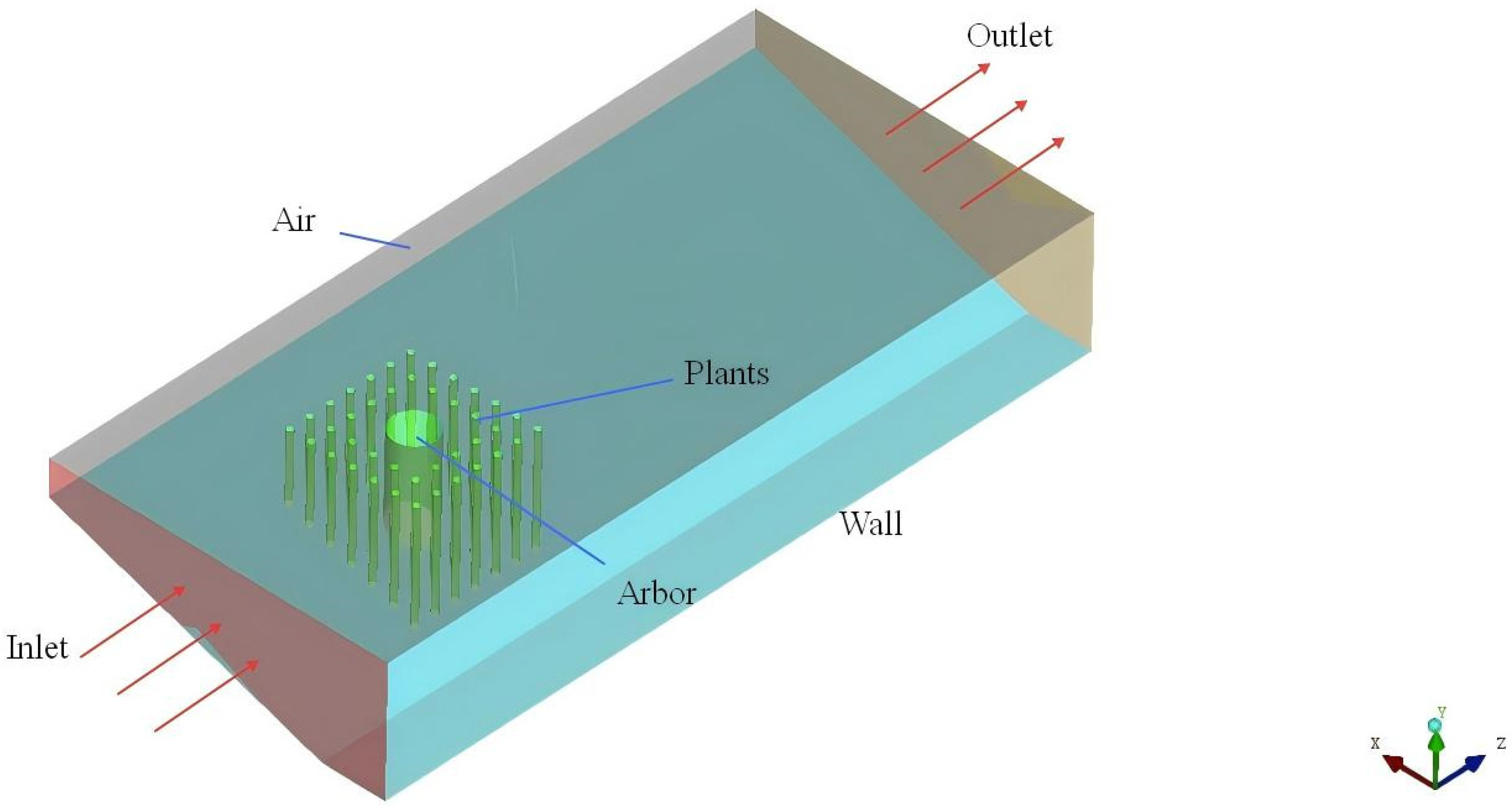
The boundary conditions of the model are set as shown in Figure 2. Use the fully developed water flow UDF file written above to set the inlet as the velocity inlet boundary (velocity inlet). The outlet is set as a pressure outlet boundary condition (pressure output). The top region of the computational domain (with slight fluctuations in the water surface) is set as a rigid cover boundary. The bottom and sides of the computational domain are set as wall boundary conditions, satisfying the no slip condition. Solution time: Time step of 1 × 10⁻³ s.
In this study, the length of the computational domain will be shortened to 3.5 m long, 1 m wide, and 0.6 m high. In this study, plants were treated as discrete cylindrical units, as shown in Figure 2. Aquatic plants have a certain height and small diameter; therefore, multiple small plants are summarized as one large plant for analysis.
The calculation area of this study is near the river bank slope, and the water–sediment–phosphorus coupling transport and distribution law near the plants under non submerged state is studied. The applicable situation is to maintain the ecological riverbank by planting plants to ensure smooth, stable, and ecological water flow near the riverbank. Small aquatic plants and large arbor are neatly arranged on the bank slope. Considering the computational cost and analysis difficulty, this study adopts plant patches for analysis, dividing the research unit into several small emergent plants and one large tree. In this study, tall grass cover plants were selected, such as miscanthus that is a perennial reed like herbaceous plant in the Poaceae family, with a stem height of over 50 cm and a diameter of over 2 mm. Due to the uniform morphology of the vegetation studied in the vertical direction, an equivalent representation of an equal diameter cylinder can be used, ignoring subtle morphological differences such as sharp top and sparse bottom of the canopy, as shown in Figure 2. Aquatic plants have a small diameter, with a concentrated planting area. Therefore, 3–5 small plants are summarized as one large plant for analysis.

2.6.2. Test Conditions Design

The generalized simulation of the experiment is based on on-site data collected from the Three Gorges Reservoir area in the middle and upper reaches of the Yangtze River. The common bank slope gradient in the Jingjiang section of the Yangtze River Basin is generally between 15° and 40°. Therefore, the experimental bank slope in this article is selected to be around 20°, with a slope of 1:3. According to hydrological data, the average flow velocity in the middle and lower reaches of the Yangtze River ranges from 0.5 to 3.0 m/s [38]. Different conditions were simulated through experiments, and an average flow velocity of 1.3 m/s was selected as the experimental average flow velocity. Due to limitations in experimental conditions and model computational capabilities, a water depth of 0.6 m was chosen as the experimental depth. The concentrations of sediment, dissolved nitrogen, and dissolved phosphorus are 5 mg/L, 2.7 mg/L, and 0.24 mg/L, respectively, as shown in Table 1.

2.6.3. Feasibility Verification of Numerical Models

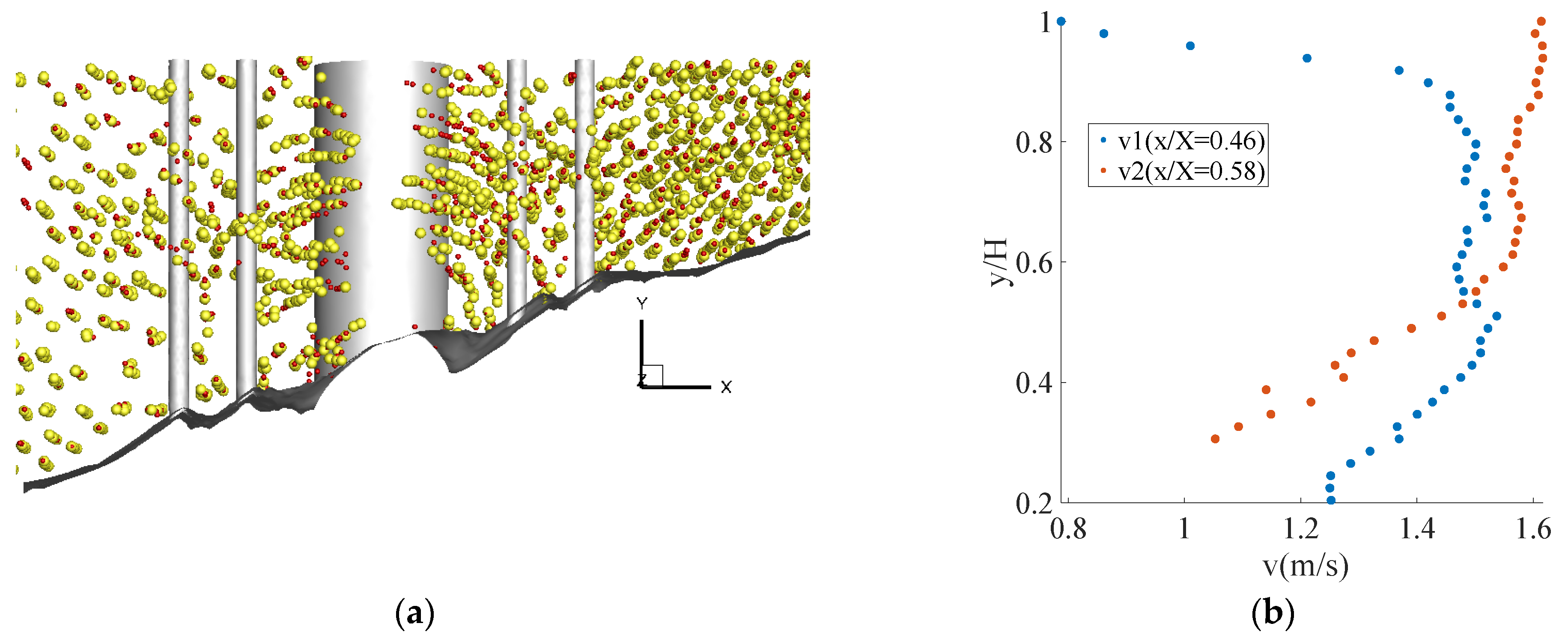
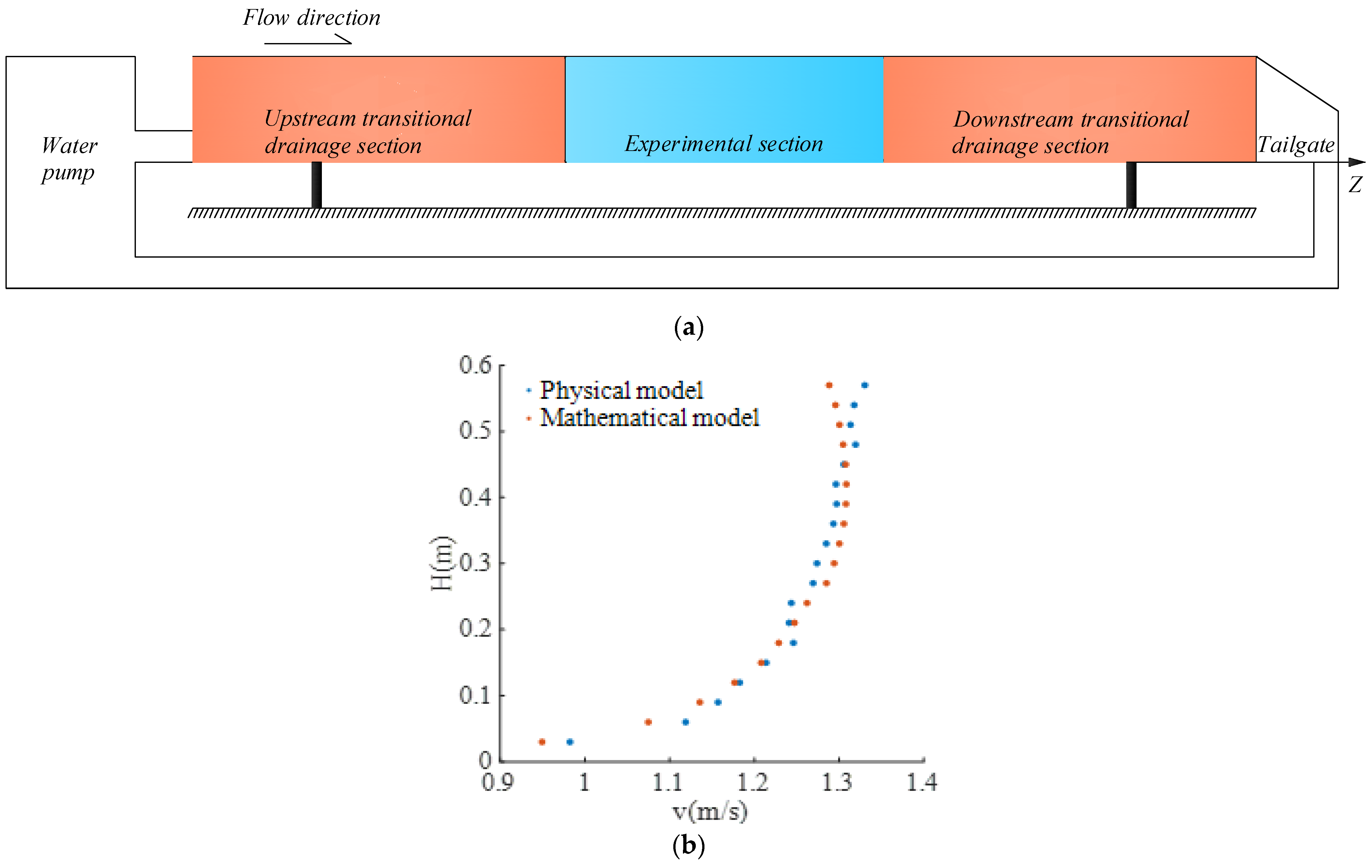
The data generated from physical model experiments is mainly used for feasibility verification of numerical models, ensuring the accuracy and reliability of mathematical model experimental data. The physical experiment research in this article is conducted using a rectangular water tank. As shown in Figure 3a, the water tank is a glass wall circulating water tank with a length of 30 m and a width of 2 m and the water flow cross-section and numerical model are the same. This study divides the experimental water tank into three parts: upstream transition section, experimental section, and downstream transition section. The upstream and downstream transition sections are designed to ensure a smooth, constant, and fully developed flow state of the water entering the experimental section. In the experiment, the flow rate is controlled by the inlet valve and electromagnetic flowmeter, while the water depth is controlled by an adjustable height tailgate installed at the end of the water tank.
The velocity fitting results show that the model is constructed reasonably and can be used for further research, as shown in Figure 3b.

3. Results

3.1. Sediment Movement Analysis

3.1.1. Flow Field Characteristics Analysis

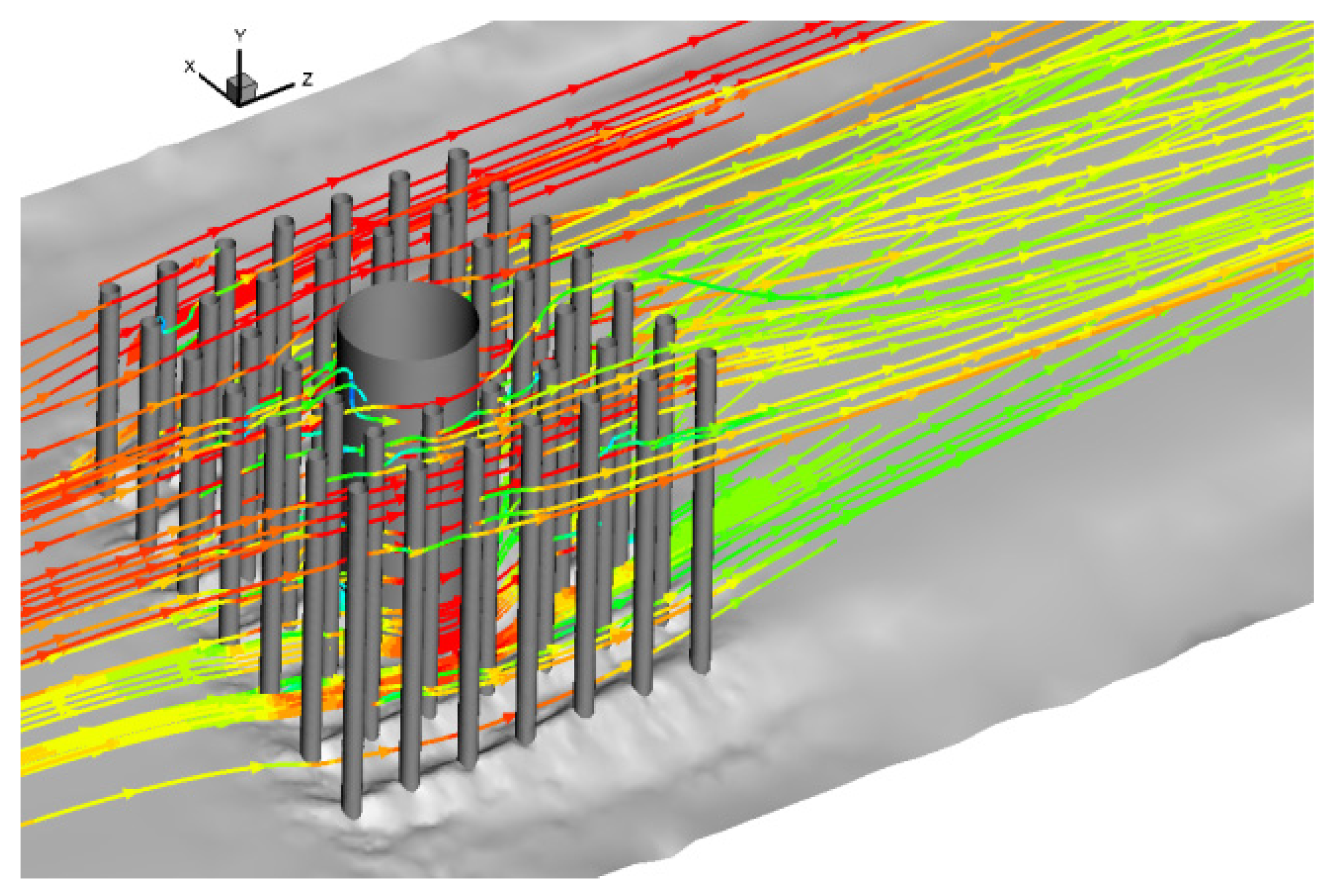
The X-axis, Y-axis and Z-axis respectively represent the spanwise, vertical and downstream directions of the calculation domain. As shown in Figure 4, the three-dimensional streamline near plants can clearly see that the streamline shape between plants is relatively complex, and there are water flow patterns with different scales and intensities, reflecting the complex water flow conditions between plants and strong three-dimensional characteristics.
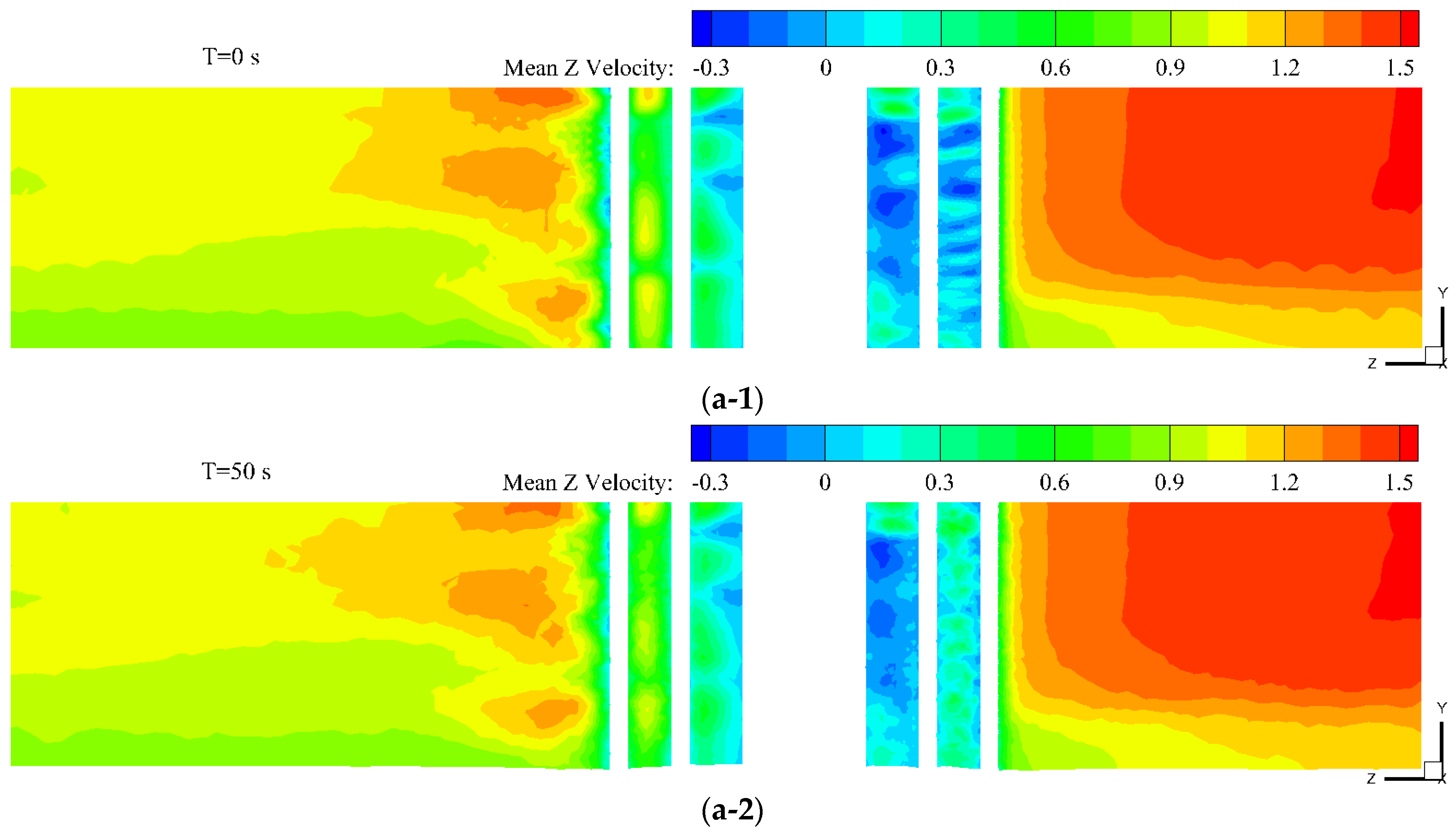
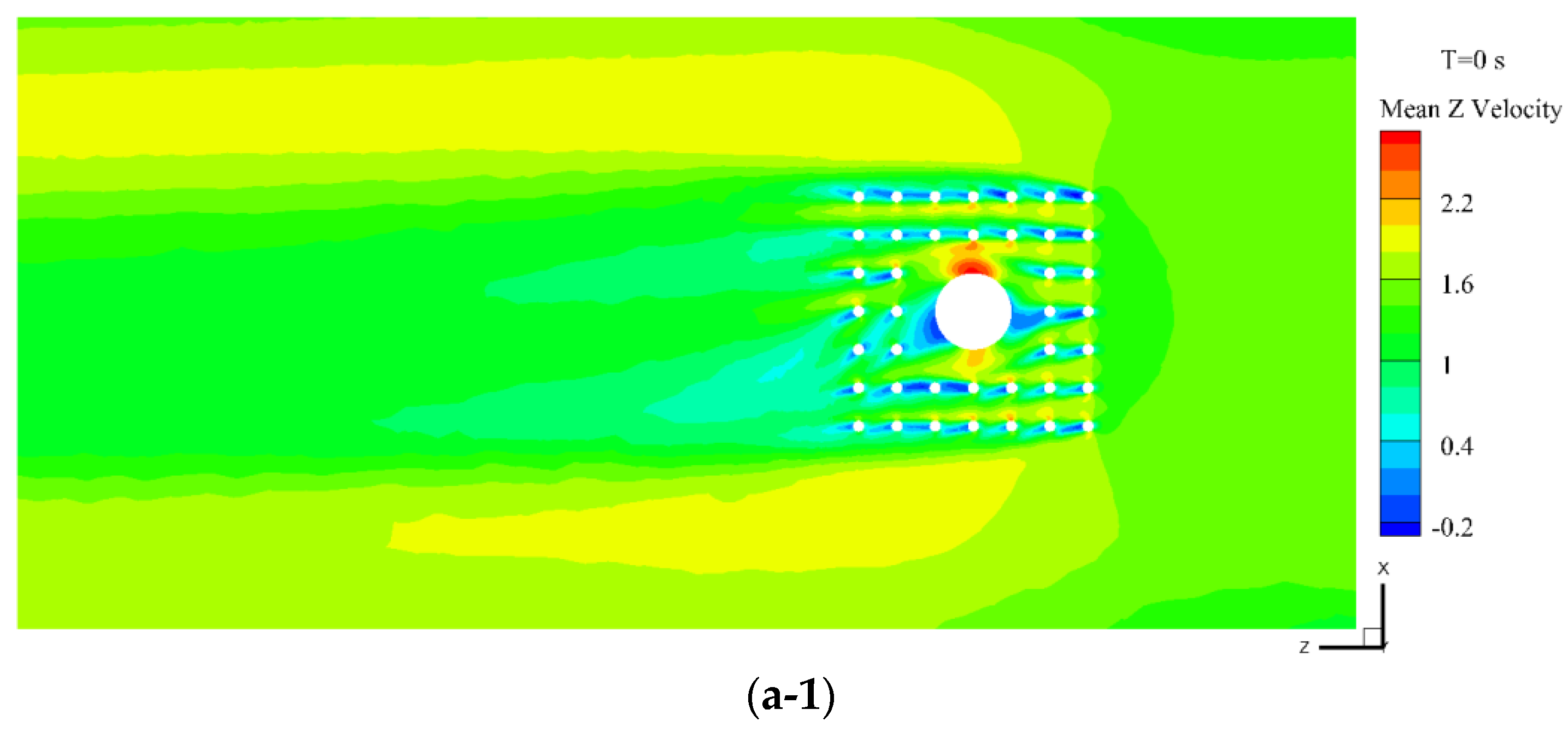
As shown in Figure 5(a-1), the water flow characteristics between plants are complex in the direction of water flow. The section x/X = 0.52, the flow velocity between plants decreases. Due to the obstruction of arbor, there is a water flow on the upstream surface that is opposite to the mainstream, indicating the presence of vortex structures. At the same time, the velocity distribution and temporal correlation between plants along the water flow are weak, and the velocity values near the coast are low. The scouring effect on the bank slope is weak, as shown in Figure 5(a-2), T = 50 s. The elevation change in the bank slope is not significant.
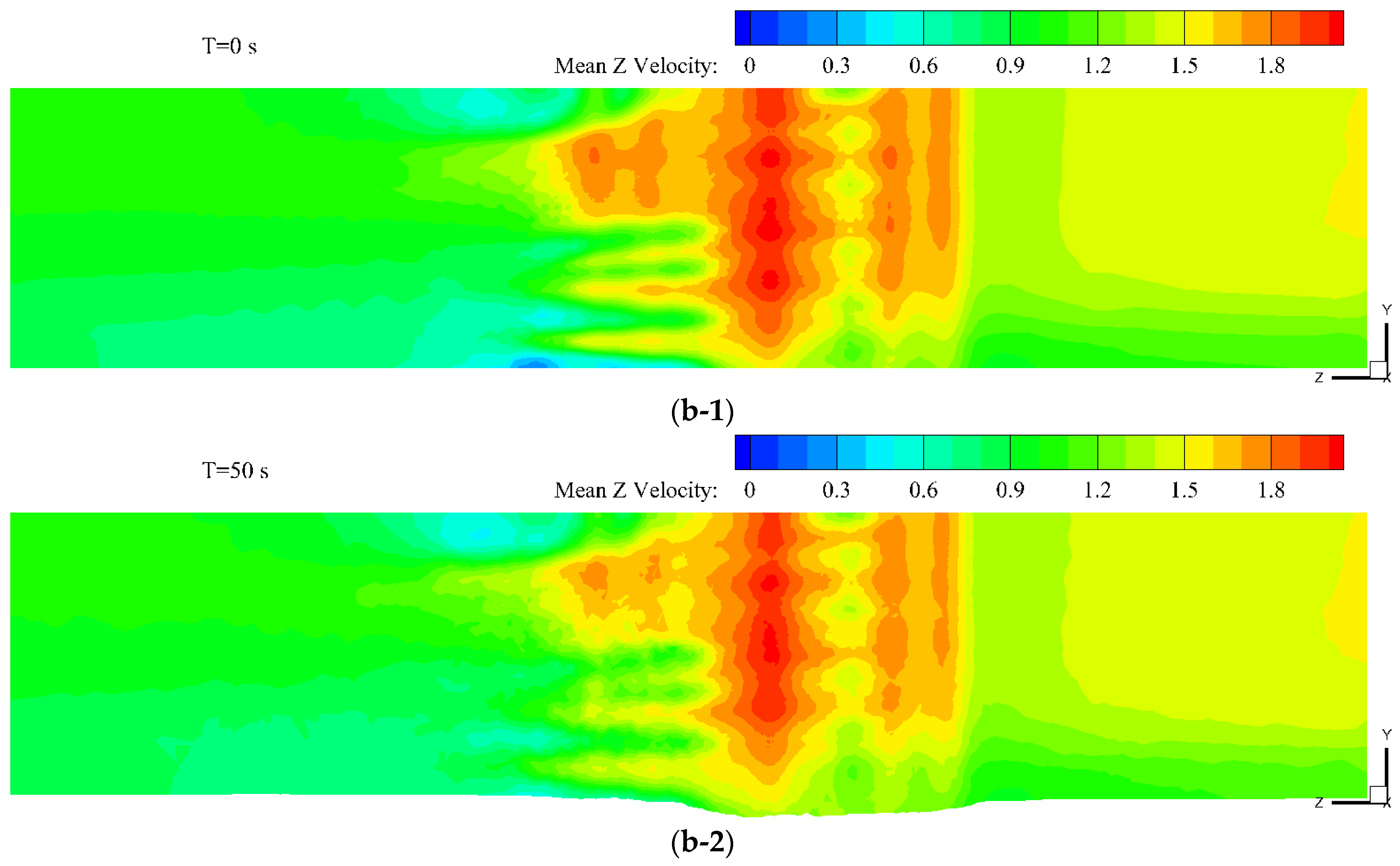
As shown in Figure 5(b-1), at section x/X = 0.43, the flow velocity between plants is significantly increased compared to section x/X = 0.52, and the high flow velocity values are mainly concentrated near the plants. The flow around the plants causes an increase in flow rate as the water flows towards both sides of the plants. Over time, T = 50 s. The scouring effect of the bank slope is more obvious, and the range of high flow velocity values extends towards the bottom of the bank, as shown in Figure 5(b-2).
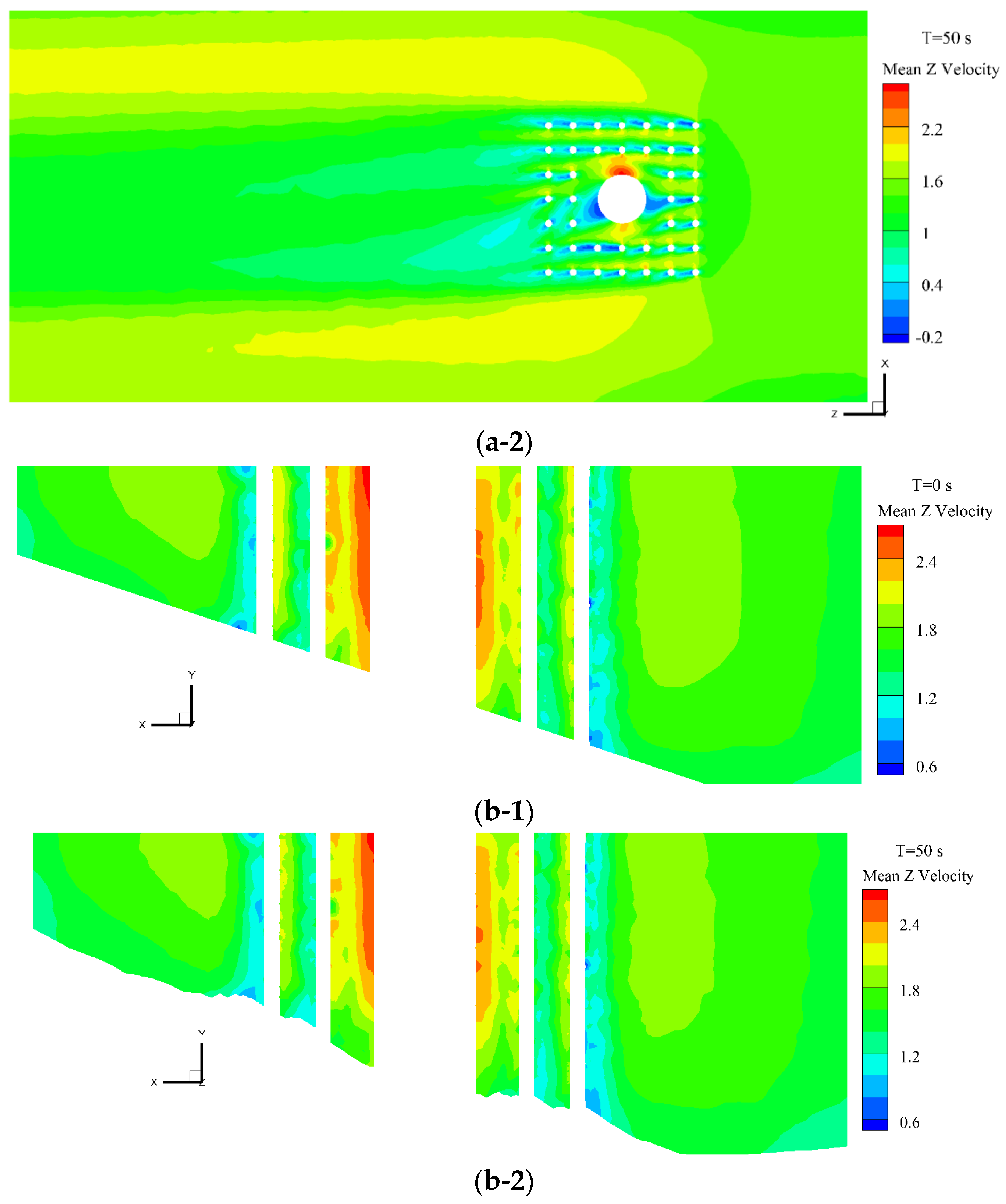
As shown in Figure 6, with section y/Y = 0.98 and section z/Z = 0.29, the flow field distribution between plants in the spanwise and vertical directions shows asymmetry due to the presence of a certain slope on the bank slope, especially near the arbor. The shallow water side has higher flow velocity values compared to the deep water side, and the range of high flow velocity is wider.
To sum up, there are differences in velocity in different regions: along the flow direction, the velocity between plants is low, and there is vortex structure near the upstream surface of the arbor. Due to the bank slope inclination, the measured velocity value of shallow water side is larger than that of deep water, and the distribution range of large velocity is wider.

3.1.2. Scour Pattern and Shear Stress Analysis

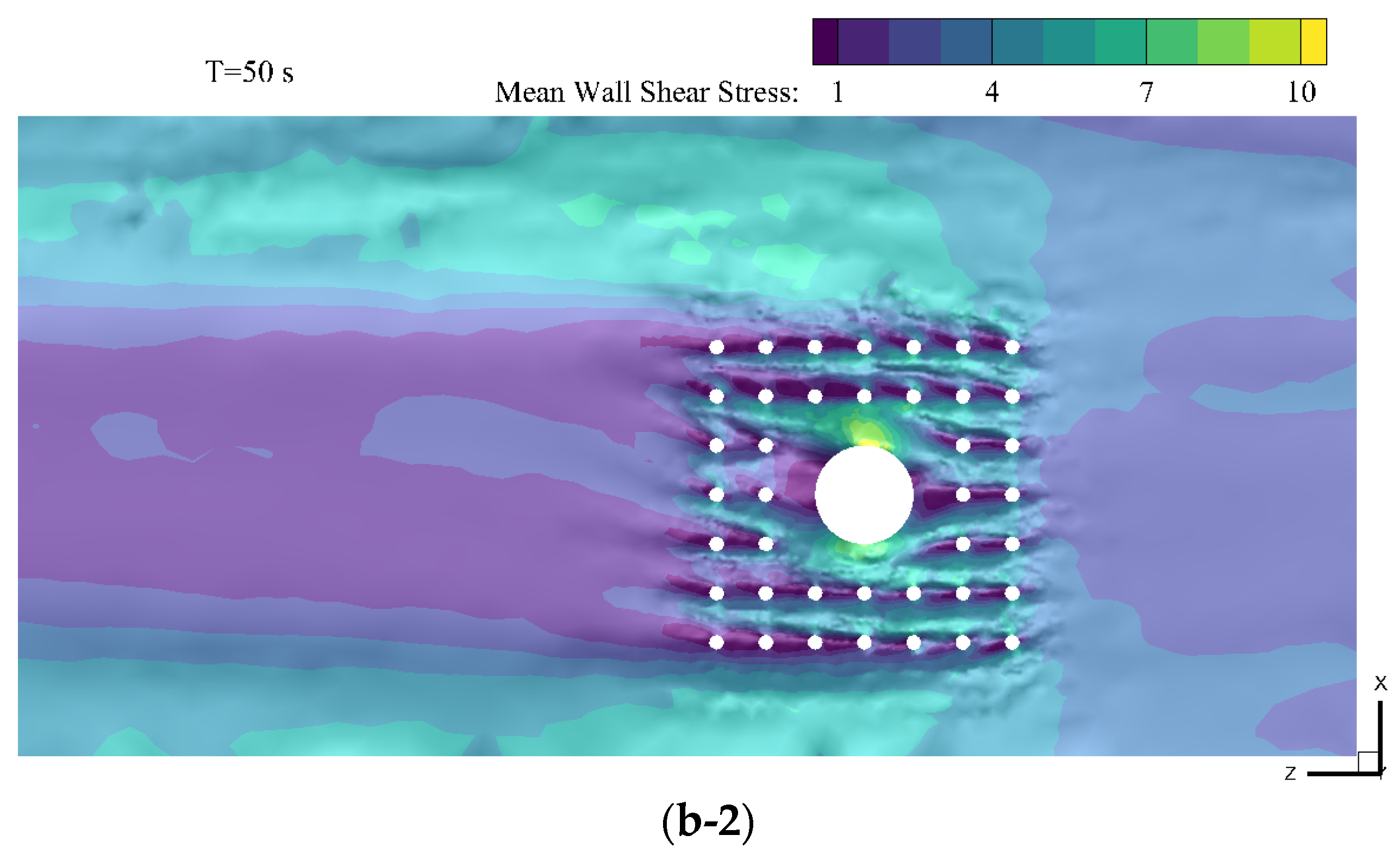
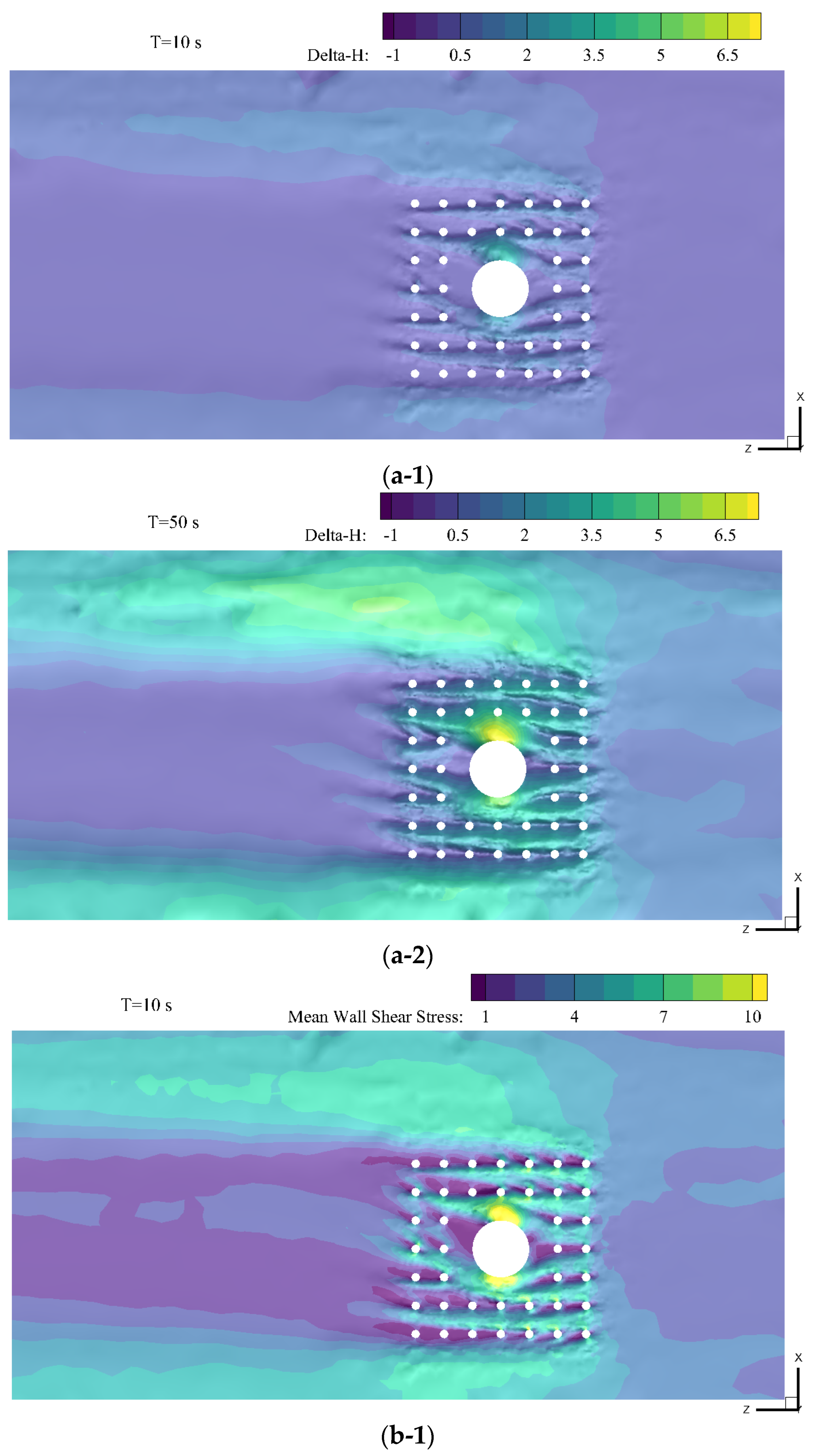
According to the above analysis, the flow disturbance near the bottom is the main cause of bank slope erosion. As shown in Figure 7(a-1,a-2), the scour pattern and depth of the scour pit is a “strip” distribution along the flow direction. Through the analysis of the flow field distribution, it can be seen that the flow velocity between the spanwise plants is too large, resulting in obvious scouring effect in this area. Near the arbor, the depth of scour pit at shallow water side is significantly greater than that at deep water side. Through the analysis of shear stress distribution at the bottom of the bank slope, it can be observed that near the arbor, the shear stress values are negatively correlated with the scour depth. With the increase in the scouring depth, the shear stress value decreases, as shown in Figure 7(b-1,b-2).

3.2. Analysis of Water–Sediment–Phosphorus Movement Law

Water disturbance is a key factor in the migration and transformation of nutrients in water bodies. As the main carrier of phosphorus, water and sand have changed the shape of the riverbed due to the erosion of the bank slope, leading to changes in water and sand movement and affecting the transport and concentration distribution of phosphorus. Therefore, this section studies and analyzes the distribution and transport patterns of phosphorus concentration under water–sediment coupling conditions.
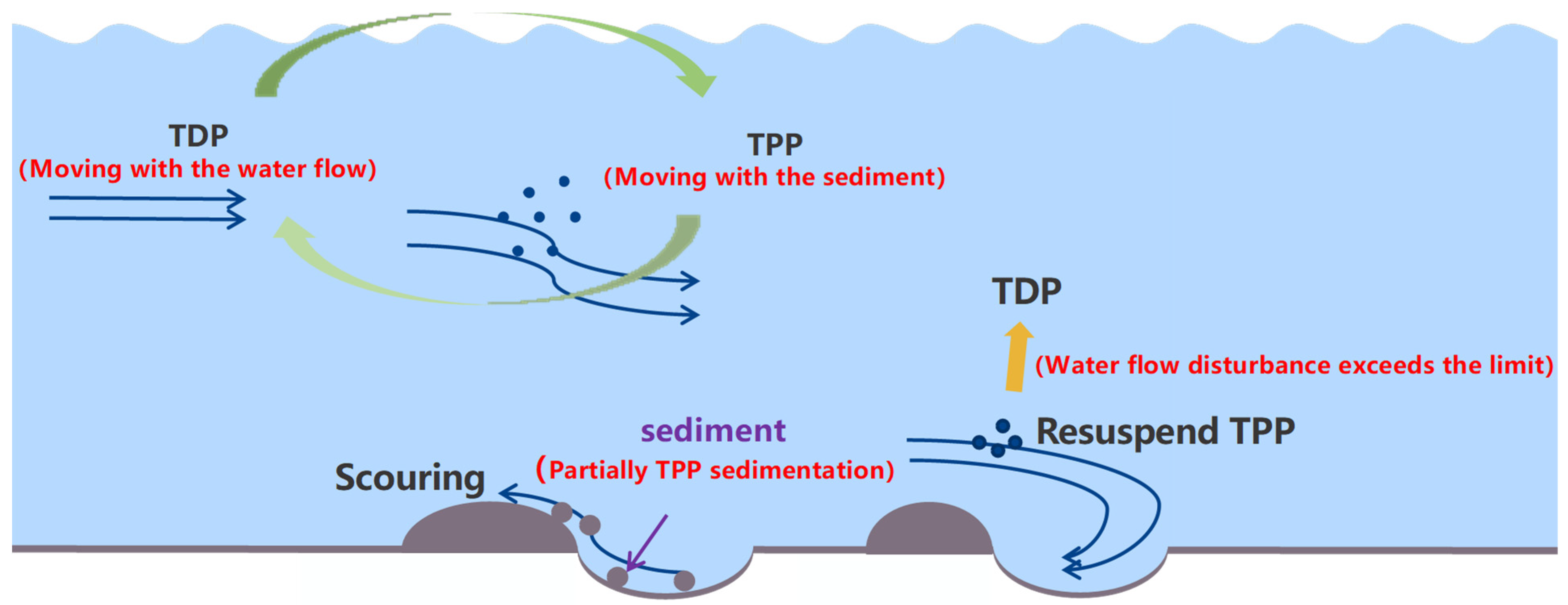
In this study, it is assumed that the phosphorus adsorption capacity of both riverbed sediments and suspended sediment is not saturated. When the water environment is disturbed beyond a certain threshold, the phosphorus adsorbed by resuspended sediment is “desorbed” and released into the water. The mechanism of phosphorus migration and transformation is illustrated in the figure, as shown in Figure 8.

3.2.1. Analysis of Time Average Concentration Distribution of Water–Sediment–Phosphorus

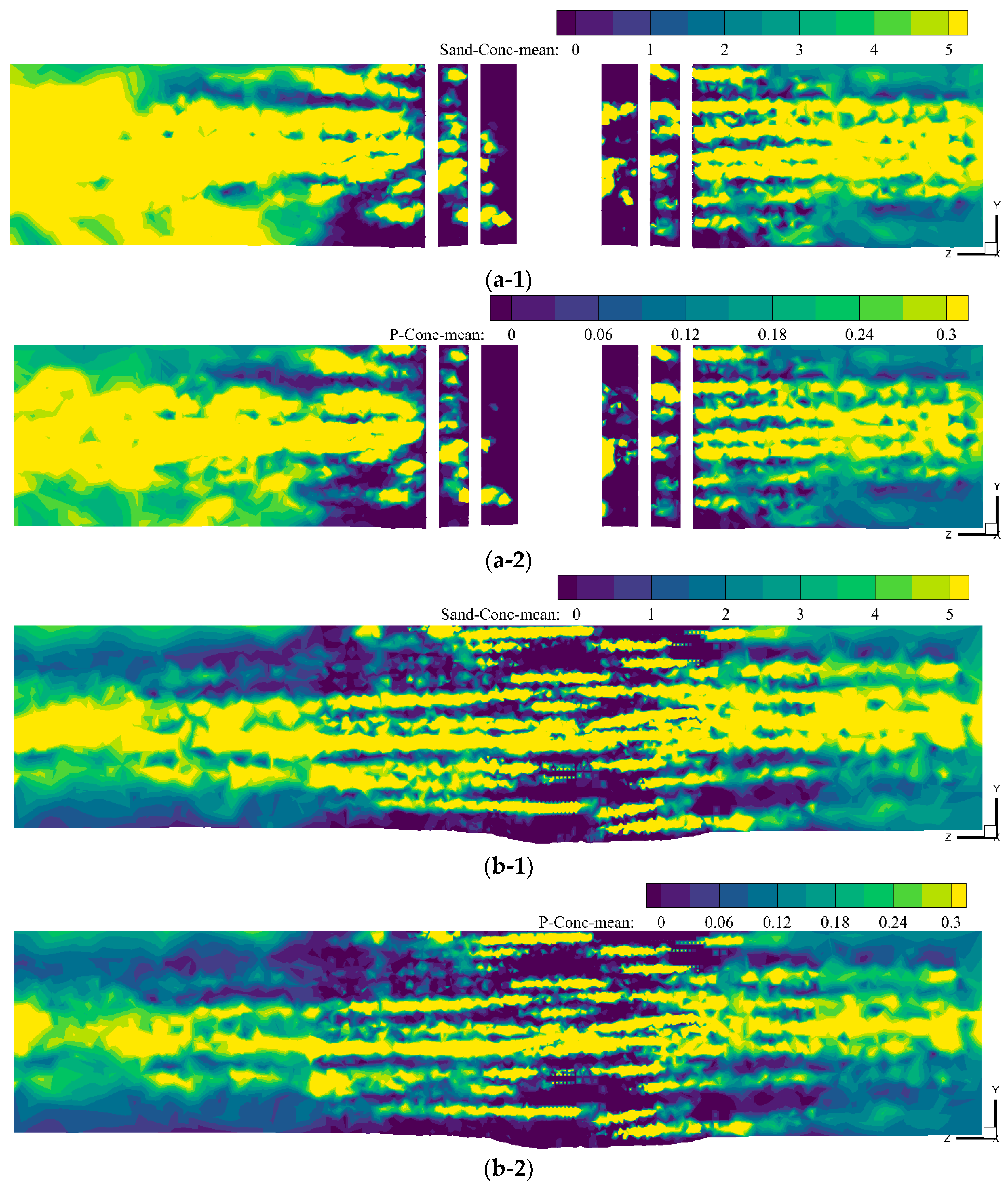
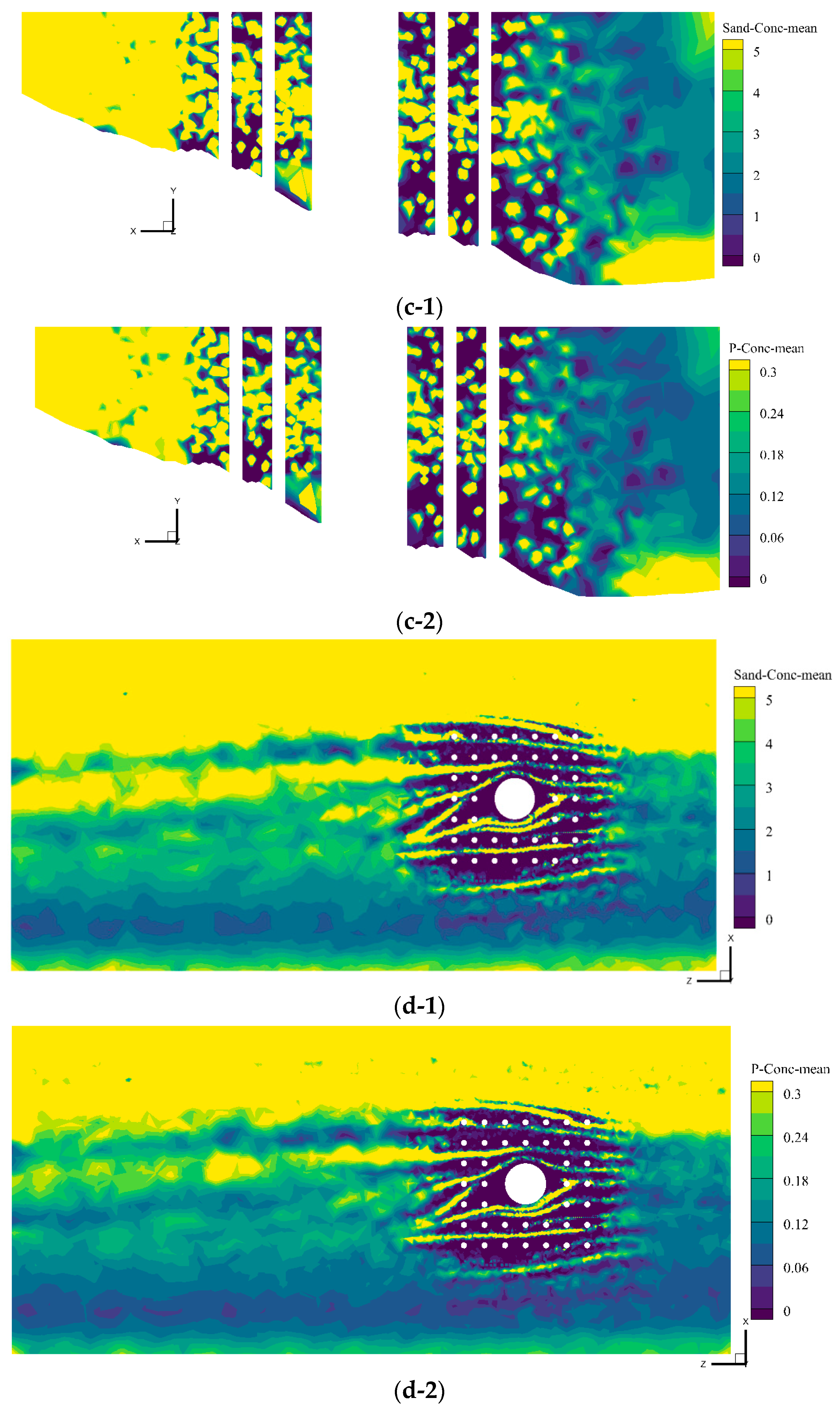
This study found that the concentration distribution is consistent. As shown in Figure 9(a-1,a-2), section x/X = 0.52, the concentrations of suspended sediment and dissolved phosphorus among plants are generally low, the high concentration area is distributed in a decentralized manner, and the concentrations on both sides of the upstream and downstream are higher than those in the middle area. As shown in Figure 9(b-1,b-2), section x/X = 0.43. Among plants, the area with high concentration of suspended sediment and dissolved phosphorus presents a “strip” layered distribution, and the area of high concentration near the middle layer of the water depth is relatively large. As shown in Figure 9(c-1,c-2), section z/Z = 0.29, the suspended sediment and dissolved phosphorus among the plants in the spanwise direction have strong fluidity, the high concentration area is widely distributed, and the proportion of the high concentration area among the plants in the shallow water side is higher than that in the deep water side. As shown in Figure 9(d-1,d-2), section y/Y = 0.98, suspended sediment and dissolved phosphorus are moving towards the plants, and after flowing through the arbor, the distribution direction of high concentration changes and shifts to the deep water side.
Through the systematic analysis of the flow movement and the distribution of suspended sediment and dissolved phosphorus, the characteristics of flow movement and concentration distribution are consistent. The high concentration area is mainly distributed in the area with large flow velocity, for example, the flow velocity between plants along the flow is lower than that among plants in the spanwise direction, resulting in the small area with high concentration of suspended sediment and dissolved phosphorus.

3.2.2. Analysis of Water–Sediment–Phosphorus Transport Law

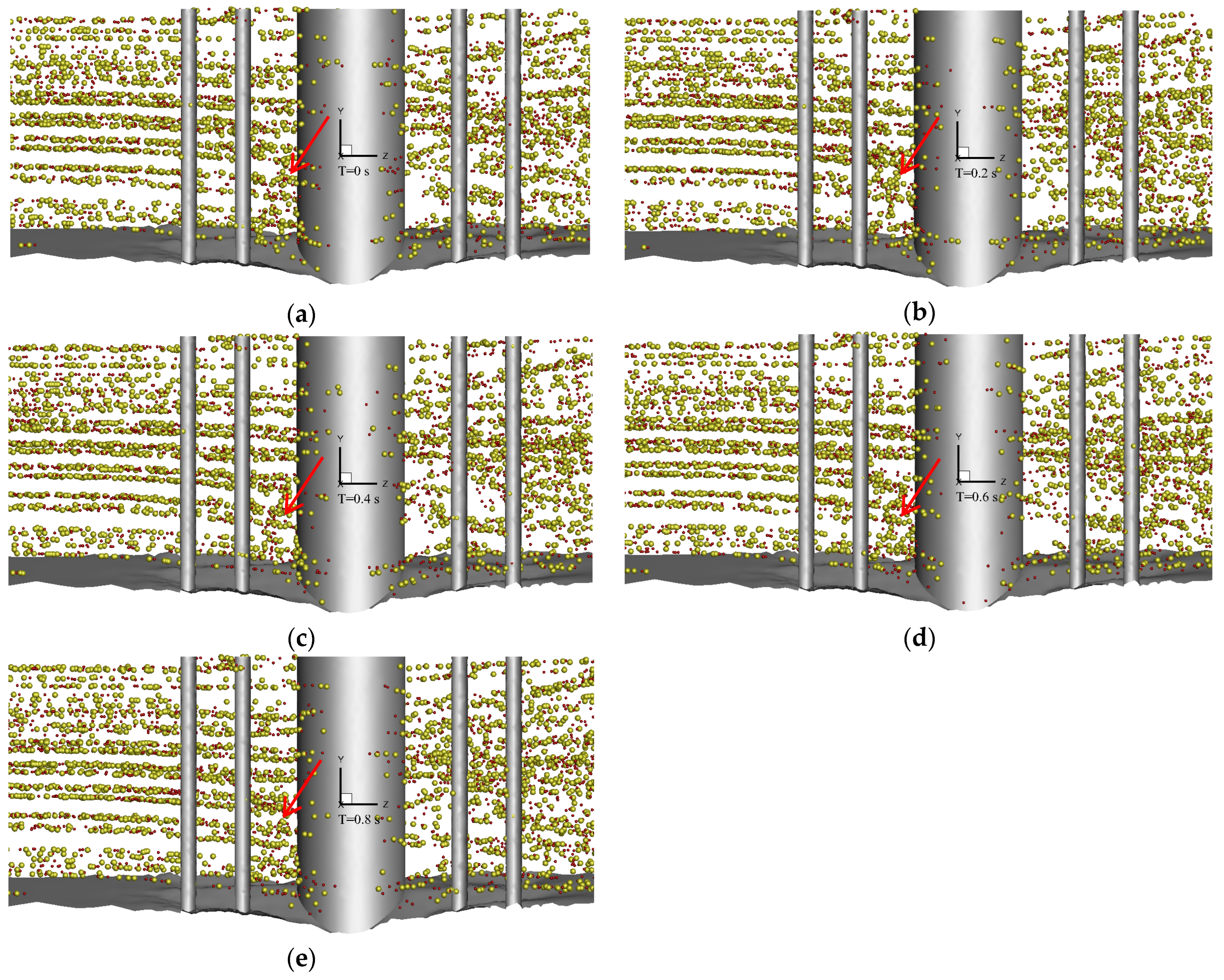
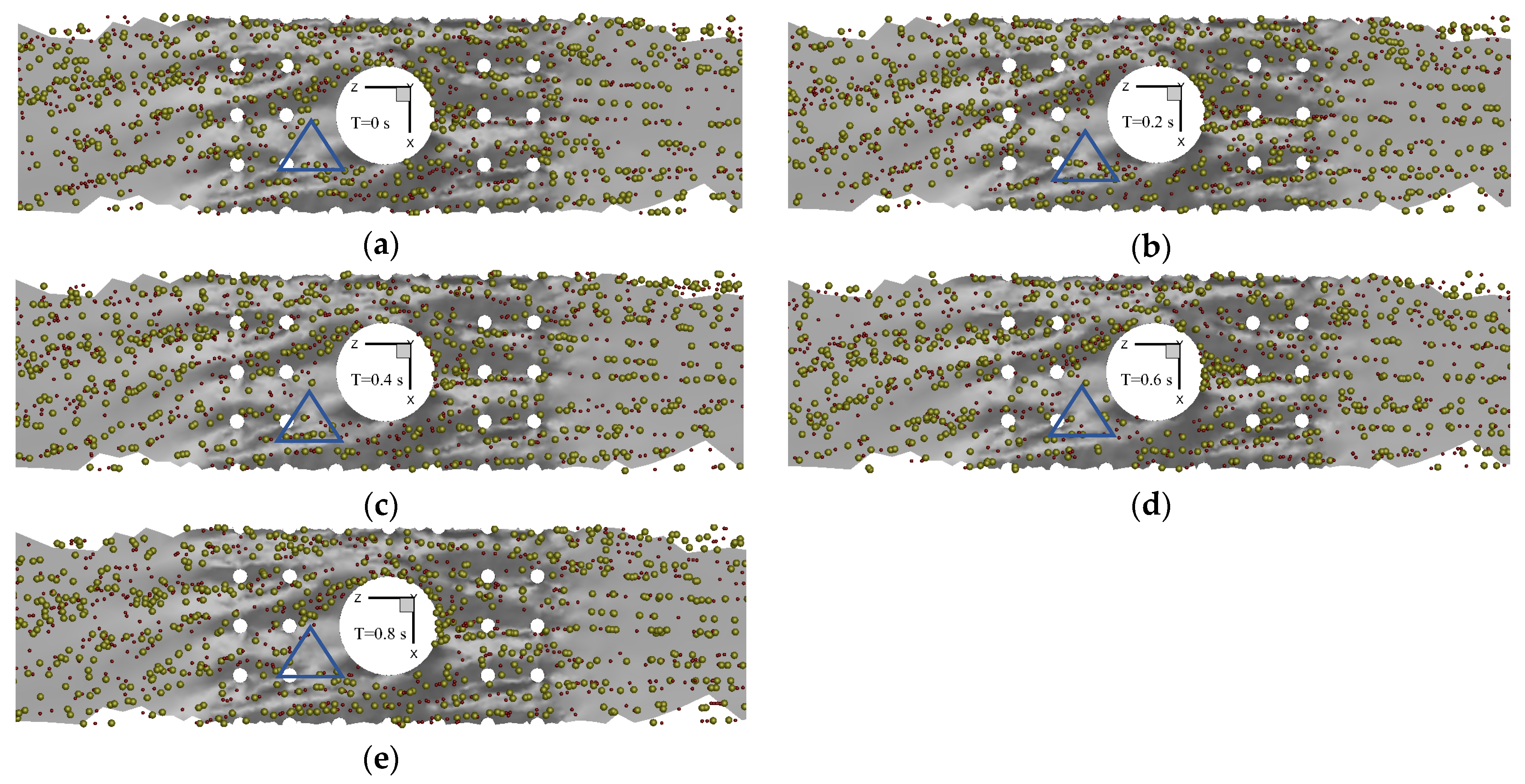
Yellow particles represent suspended sediment and red particles represent dissolved phosphorus. The change in particle transport trajectory is mainly affected by the larger arbor. When the particles touch the plant surface, the movement trajectory changes: affected by water flow, some of them exist on the upstream side of the arbor and move to the bottom, as shown by the red arrow in Figure 10. The other part moves downstream around the column, and there is an area with 0 concentration of suspended load and dissolved phosphorus on the water side behind the arbor, as shown in the blue triangle marked area in Figure 11. At the same time, near the bottom, particles are transported in the scouring pit. The movement of particles between plants on the downstream side is obviously disordered compared with that on the upstream side, indicating that there is a correlation between particle transport and water flow.
According to the analysis of the transport path of suspended sediment and phosphorus particles, the transport law is basically the same. Phosphorus exists on the surface of suspended sediment. The flow between plants, especially near the arbor, has strong turbulence characteristics and large disturbance, which is helpful to release phosphorus on sediment particles into the water body. At the same time, the sediment has a strong potential of phosphorus source, and the sediment movement near the plant spread causes the suspended sediment on the bank slope and the dynamic release of large phosphorus flux. Along the flow direction, the concentration near the arbor is low. Combined with Fick [39] diffusion theorem, the dissolved phosphorus in the sediment pore water will be released into the water body, causing the concentration increase in this area. Therefore, the arbor has a great impact on phosphorus transport and diffusion.
Comparing Figure 9(d-1,d-2) and Figure 11, the regional distribution of the concentration of 0 in the backwater of the arbor is different. By observing the distribution of particles on the back water side, the area with concentration of 0 shows an inclined “)(” distribution along the water depth. The area near the bottom develops towards the shallow water side, and the area near the water surface develops towards the deep water side, as shown in Figure 12a. The reason may be that compared with the case where the riverbed inclination is 0, the concentration is symmetrically distributed. However, there is a velocity difference between the two sides caused by the inclined bank slope, which is the main reason for the difference in the concentration distribution near the ground and the water surface. The low concentration area is inclined to the low velocity side, as shown in Figure 12b, where section x/X = 0.46 and 0.58, and there is a significant difference in the velocity.
In conclusion, the concentrations and transport laws of suspended sediment and dissolved phosphorus among plants are similar: the flow movement characteristics, concentration distribution and transport characteristics are consistent, and the high concentration area is generally distributed in a “strip” shape along the flow, mainly in the area with large flow velocity. The proportion of plant concentration and distribution area in shallow water side was significantly higher than that in deep water side. After flowing through the arbor, the distribution direction of high concentration changed and shifted to the deep water side. Affected by the bank slope, there is an area with a concentration of 0 on the water side behind the arbor, which is distributed in an inclined shape along the water depth, and tends to the side with low velocity.

3.2.3. Distribution of Nitrogen–Phosphorus Ratio

Nitrogen and phosphorus nutrients, as the material basis of primary productivity in river ecosystems, are important factors leading to eutrophication. As a limiting resource, in addition to absolute concentration, the nitrogen–phosphorus ratio (TN/TP) is also an important factor that directly affects the biomass of phytoplankton and the structure of algal communities, and it is also one of the factors that indirectly affect the survival of fish [40,41]. The numerical simulation of nitrogen transport in this study is identical to that of phosphorus, ensuring the accuracy and consistency of the data.
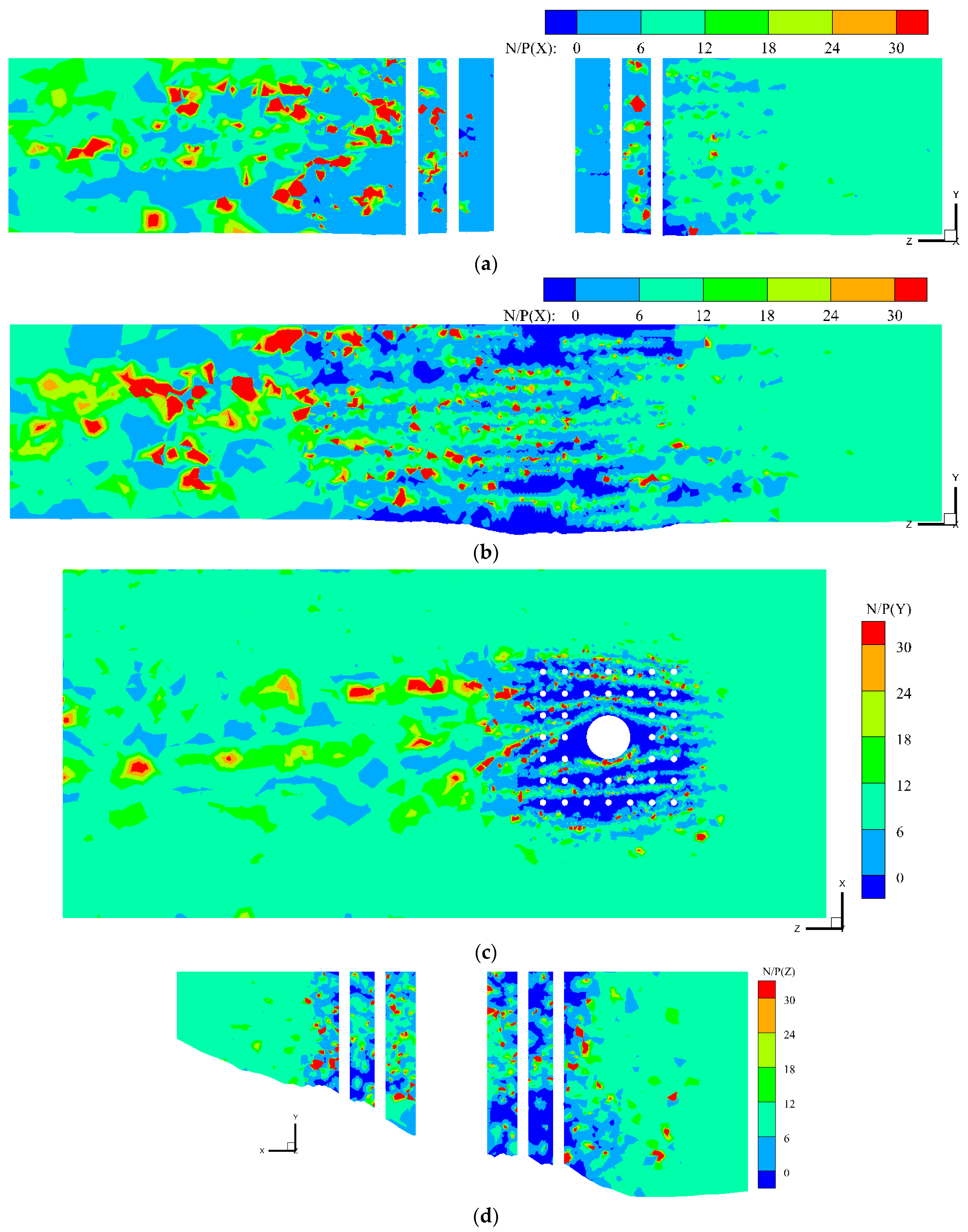
Extremely high or low TN/TP values can indirectly damage the living environment of fish by altering the physicochemical characteristics and biological communities of water bodies. Section x/X = 0.52, the ratio near the arbor is generally low, and the TN/TP value is not higher than 6, as shown in Figure 13a. The ratio between the upstream and downstream sides of the plants is higher than that in the middle area. The distribution of high TN/TP values (>30) is scattered and the proportion is relatively low. As shown in Figure 13b–d, the section x/X = 0.43, the section y/Y = 0.98, and the section z/Z = 0.29. The TN/TP values between plants in the spanwise direction are between 12 and 24.
Therefore, among the plants, the nitrogen–phosphorus ratio is mainly concentrated between 12 and 24. Due to the obstruction of water by plants, the nitrogen–phosphorus ratio between plants flowing along the water flow is relatively small, not exceeding 6. Areas with a nitrogen to phosphorus ratio exceeding 30 exhibit dispersed distribution. At the same time, the TN/TP value required for the growth and physiological balance of phytoplankton is 16, which is the Redfield value [42], indicating the optimal growth of phytoplankton. Based on the above analysis, it is found that the growth of phytoplankton is most suitable between plants.

3.3. Analysis of Fish Habitat Suitability

Fish is the most important component of river ecosystems, flow velocity is the main evaluation factor affecting fish habitats, while the nitrogen–phosphorus ratio is an indirect evaluation factor affecting fish habitats. This section takes four famous domestic fish species as research objects, and combines the fuzzy mathematics theory to select flow rate and the nitrogen–phosphorus ratio as habitat factors to study the distribution of habitat suitability of fish near plants.

3.3.1. Fish Habitat Factors

  • Nitrogen–phosphorus ratio
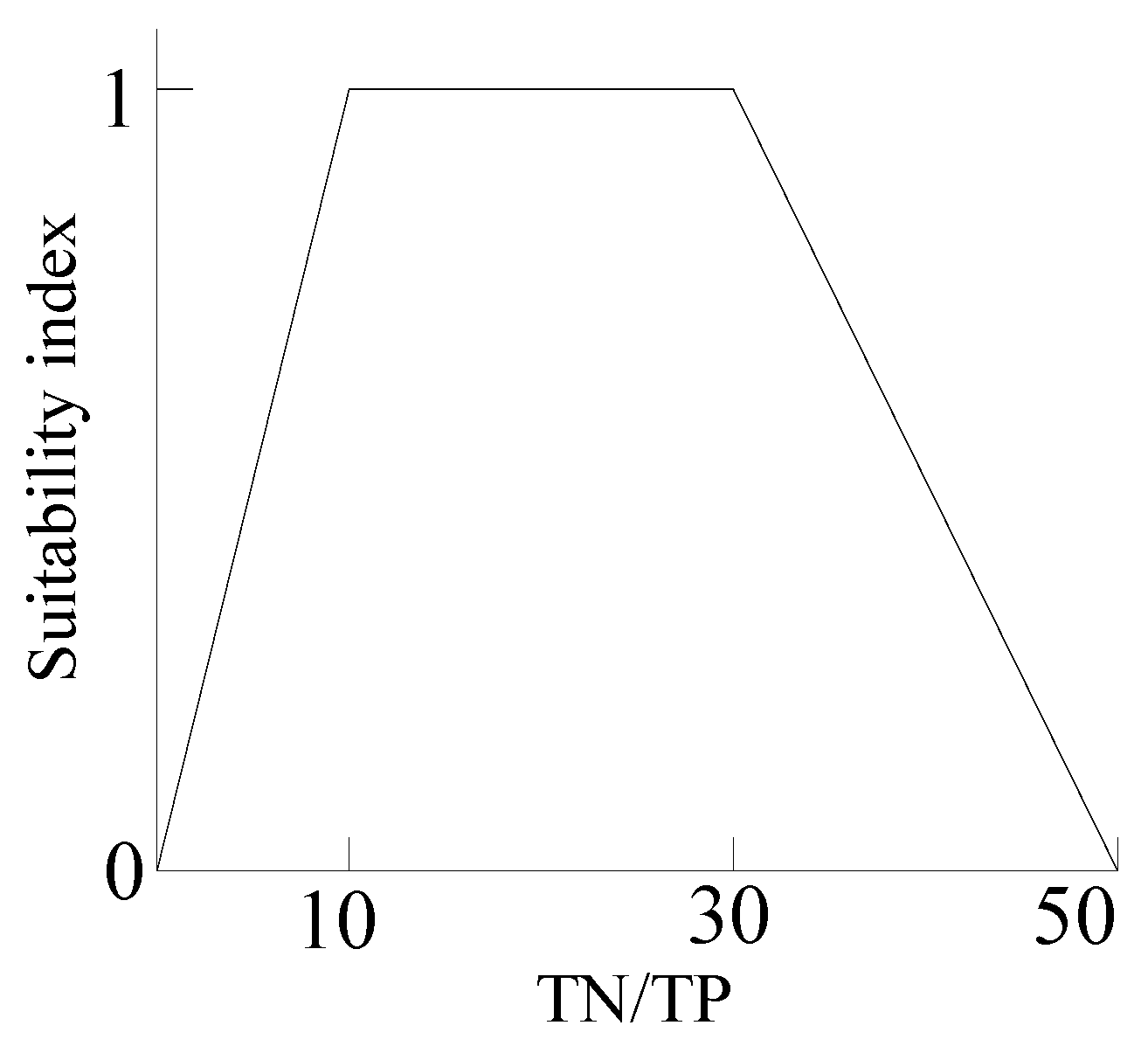
This study defines a TN/TP value between 10 and 30 as a suitable water environment for fish survival. At this ratio, the community structure of phytoplankton and zooplankton is balanced, the primary productivity is moderate, and it can provide a stable feed foundation for fish. At the same time, the physical and chemical indicators of the water are within the tolerance range of fish [43]. As shown in Figure 14.
  • Water flow characteristic factors
Flow rate is a decisive factor affecting biological composition. The swimming ability of fish plays an important role in important life activities such as migration, passing through obstacles, evading enemies, and predation. At present, in the measurement of fish swimming ability, the induced flow velocity reflects the fish’s ability to perceive the direction of water flow and is the minimum flow velocity at which fish can distinguish the direction of water flow. The critical swimming speed refers to the maximum swimming speed that fish can achieve within a certain time step and flow rate growth pattern, also known as the maximum sustainable swimming speed, and is widely used as an indicator to evaluate the variable speed swimming ability of fish.
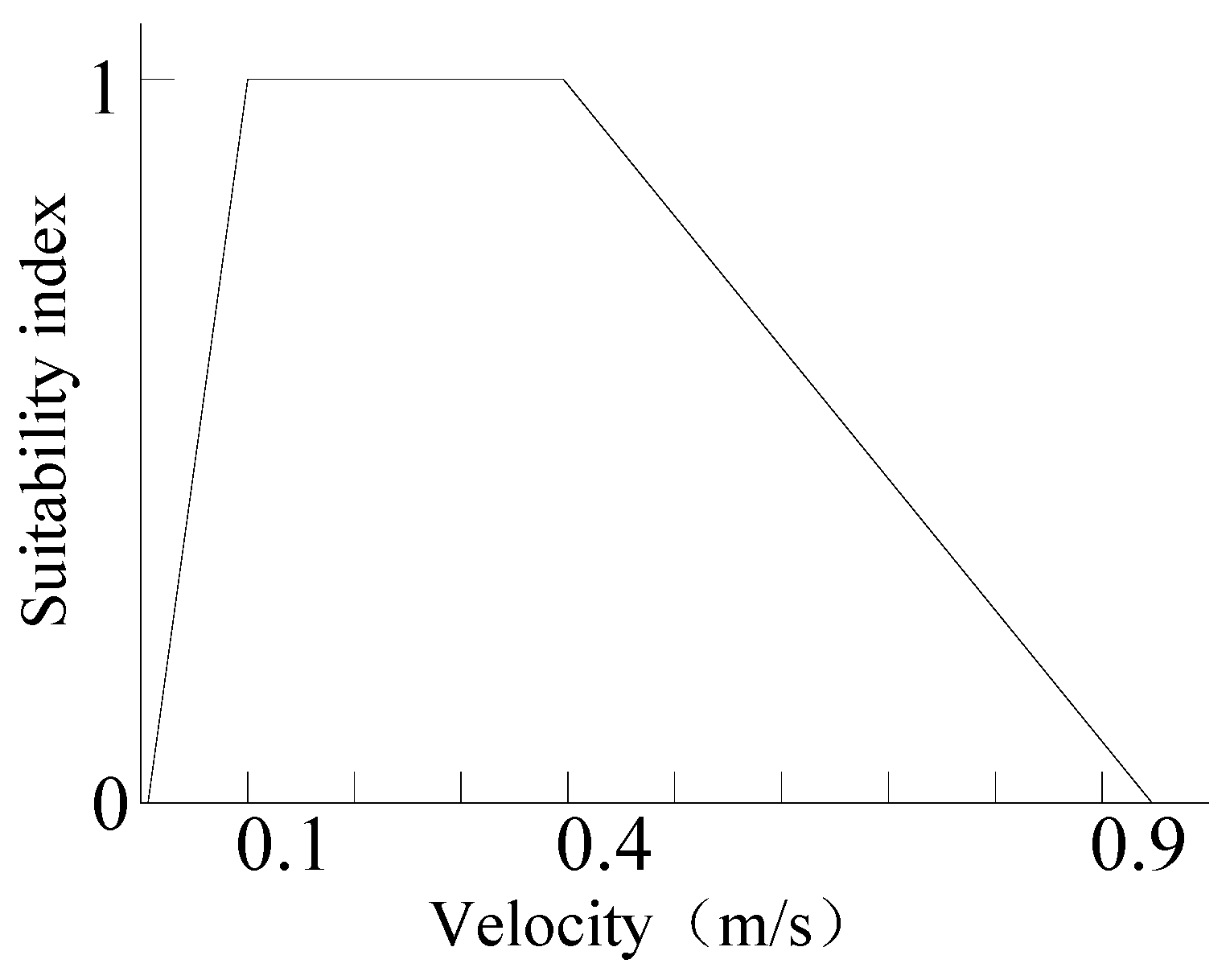
In this study, young fish were selected to have a body length of 2~8 cm. According to the above analysis, the threshold value of the habitat indicators of young fish was determined: the induced flow velocity of young fish ranged from 0.03 m/s to 0.1 m/s. When the flow velocity was lower than 0.03 m/s, young fish lost the ability to identify directions. The critical flow velocity range for juvenile fish is 0.39–0.94 m/s. When the flow velocity is greater than 0.94 m/s, it is not conducive to the long-term survival of fish [44]. The subsection curve function of flow velocity suitability index in the survival area of juvenile fish is shown in Figure 15.
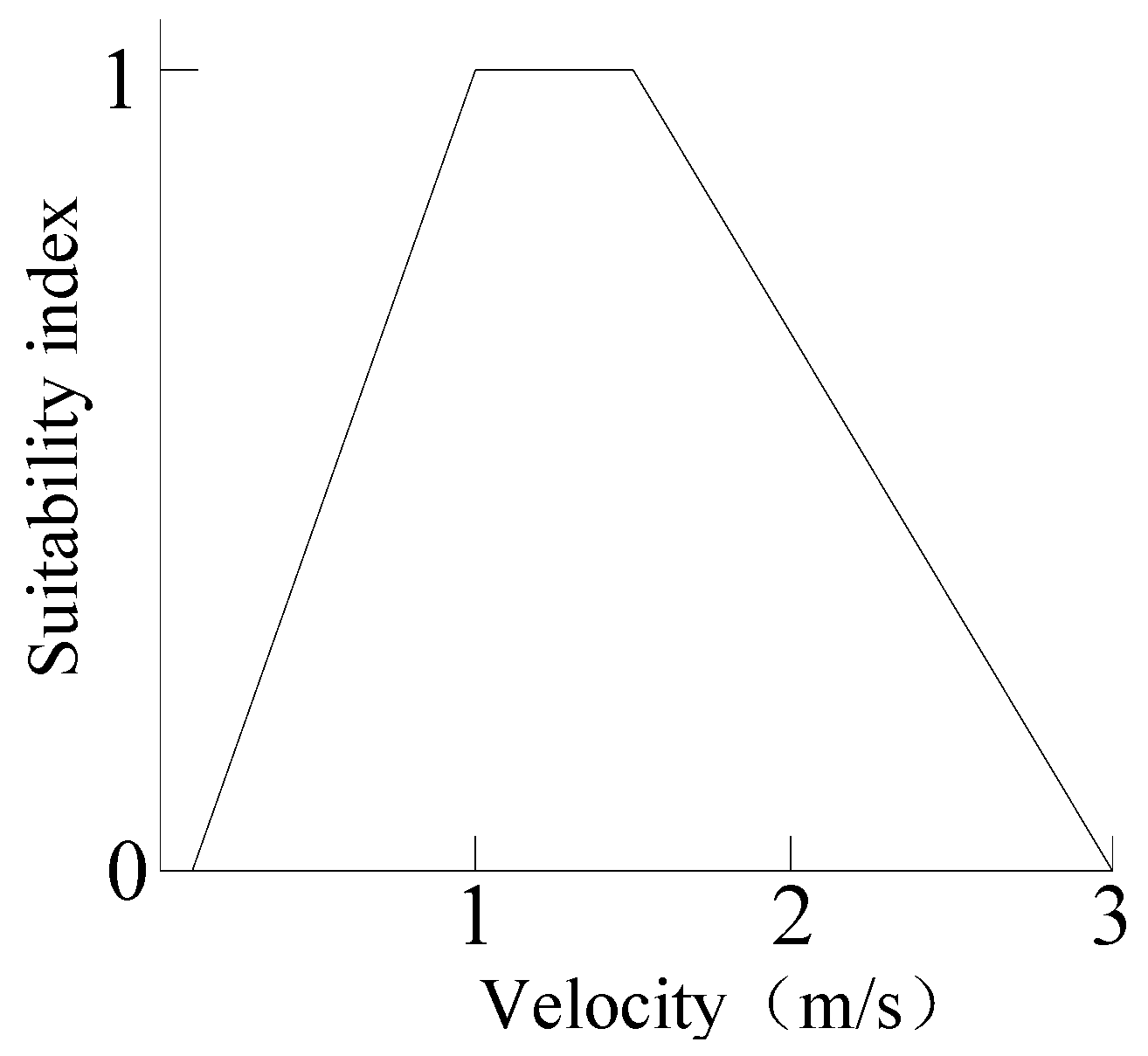
Oviposition is the most important part of the life of the four famous domestic fishes. The survival of the four famous domestic fishes eggs requires certain water flow conditions. The reason is that the four famous domestic fishes eggs belong to drift fish. After fertilization, the eggs absorb water and expand. When they sink into the bottom, they will affect development and cause death, leading to reduced survival rate. Regarding fish spawning, researchers have conducted physical model experiments and field surveys, and the experiments have shown that the minimum flow rate suitable for fish eggs to survive is not less than 0.25 m/s [45]. Based on previous research results, the flow rate range that is most conducive to the reproduction and spawning of the four famous domestic fishes was determined [46]. The segmented curve function of the suitability index for water flow velocity in the spawning area of fish is shown in Figure 16.

3.3.2. Construction of Fuzzy Mathematical Models

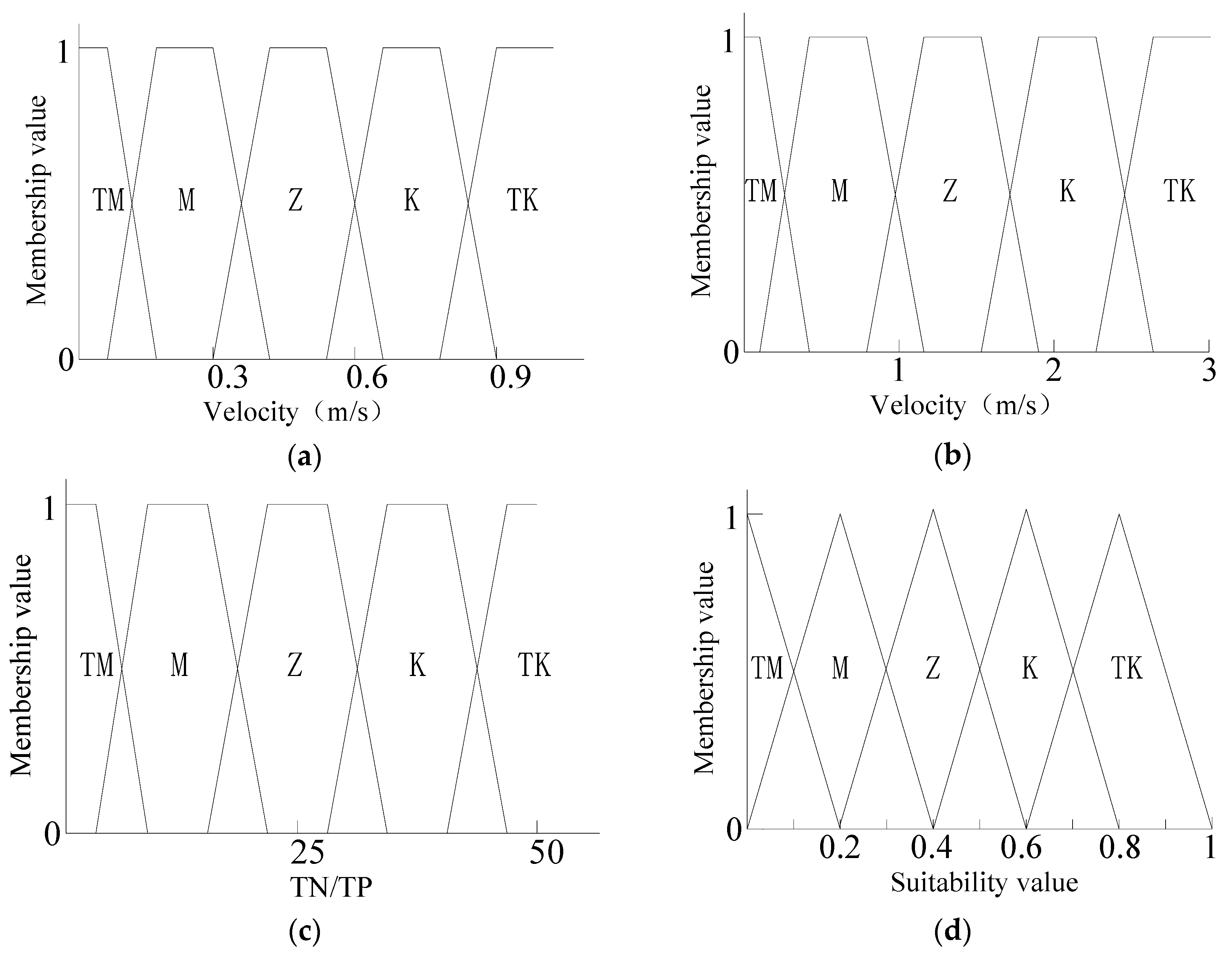
The fish habitat suitability evaluation model established through multiple habitat factors can determine the distribution of fish habitats in different life cycles. Described using triangular and trapezoidal membership functions, the flow velocity variable values are extremely slow (TM), slow (M), medium (Z), fast (K), and extremely fast (TK); TN/TP variable values: extremely low (TM), low (M), medium (Z), high (K), and extremely high (TK). The habitat suitability index values are 0~0.2 extremely unsuitable (TM), 0.2~0.4 unsuitable (M), 0.4~0.6 moderate (Z), 0.6~0.8 suitable (K), and 0.8~1.0 suitable (TK). The schematic diagram of membership degree is shown in Figure 17. In this study, Matlab R2018b was used to analyze the membership degree of suitability for spawning grounds, as shown in Figure 17.

3.3.3. Distribution of Fish Habitat Suitability

  • Analysis on the suitability of young fish living environment
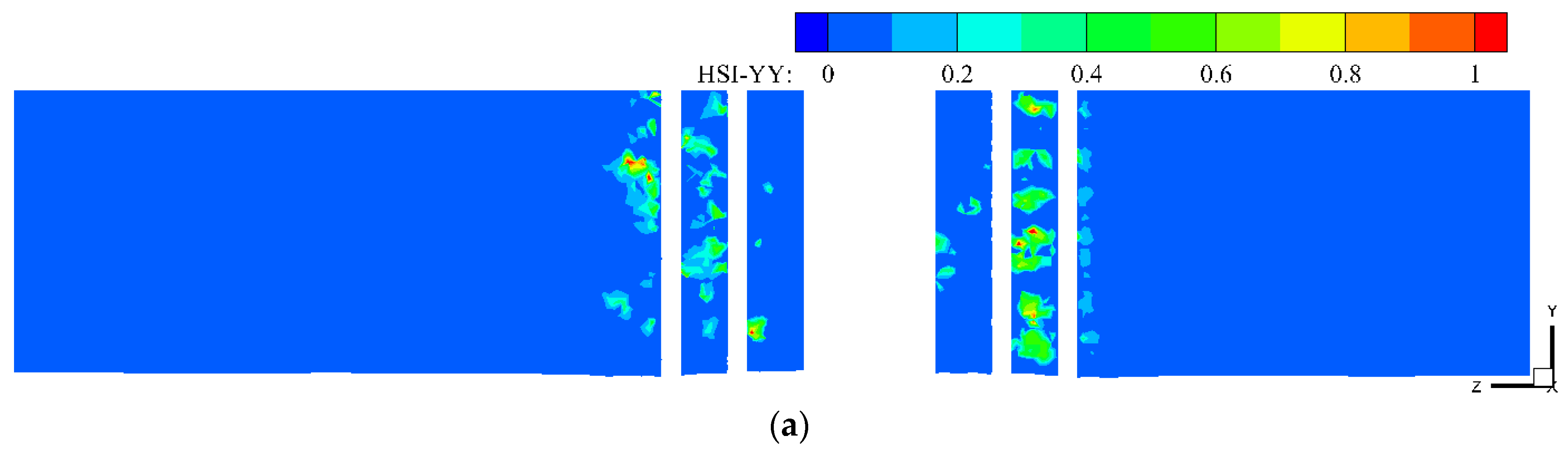
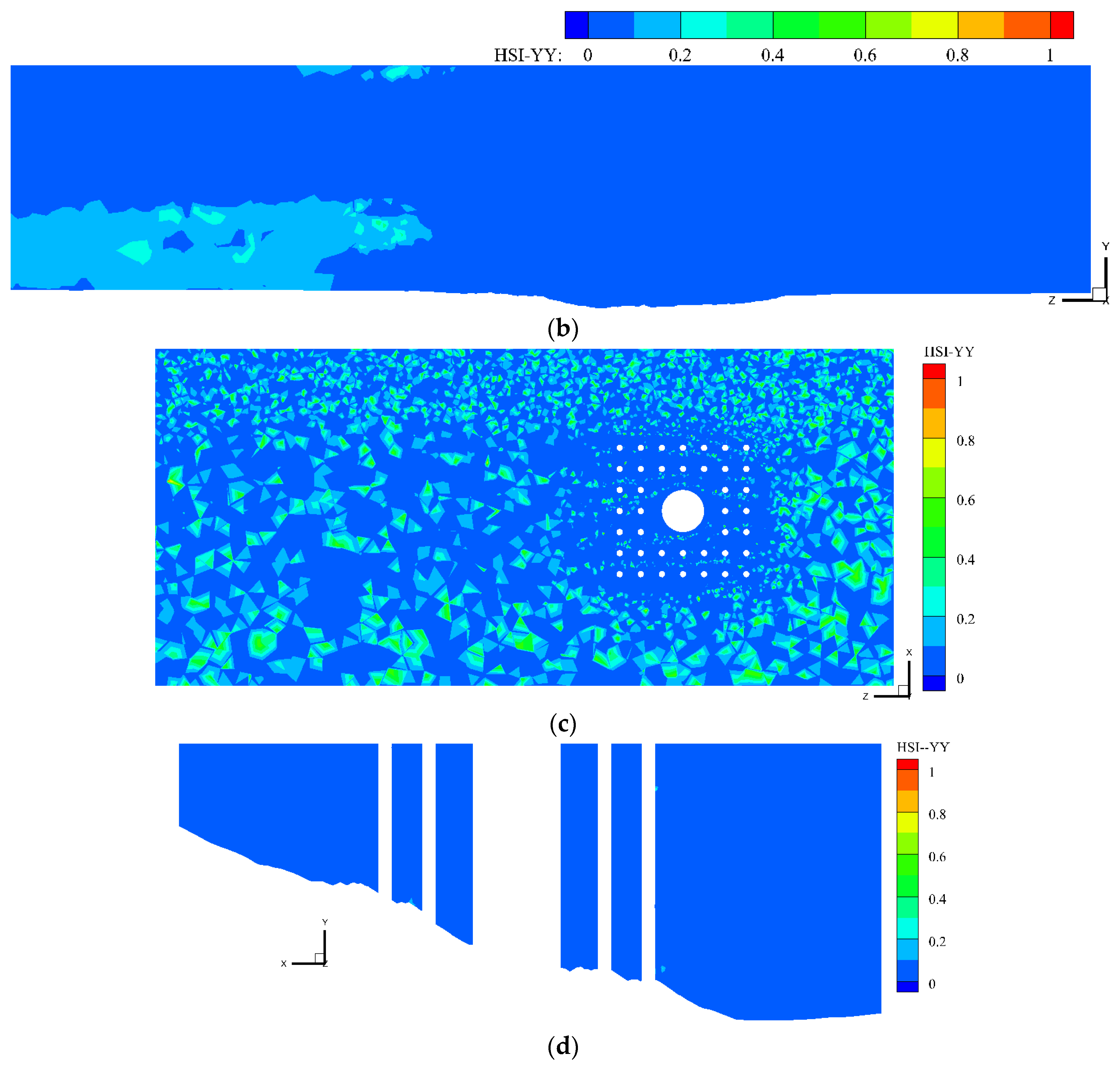
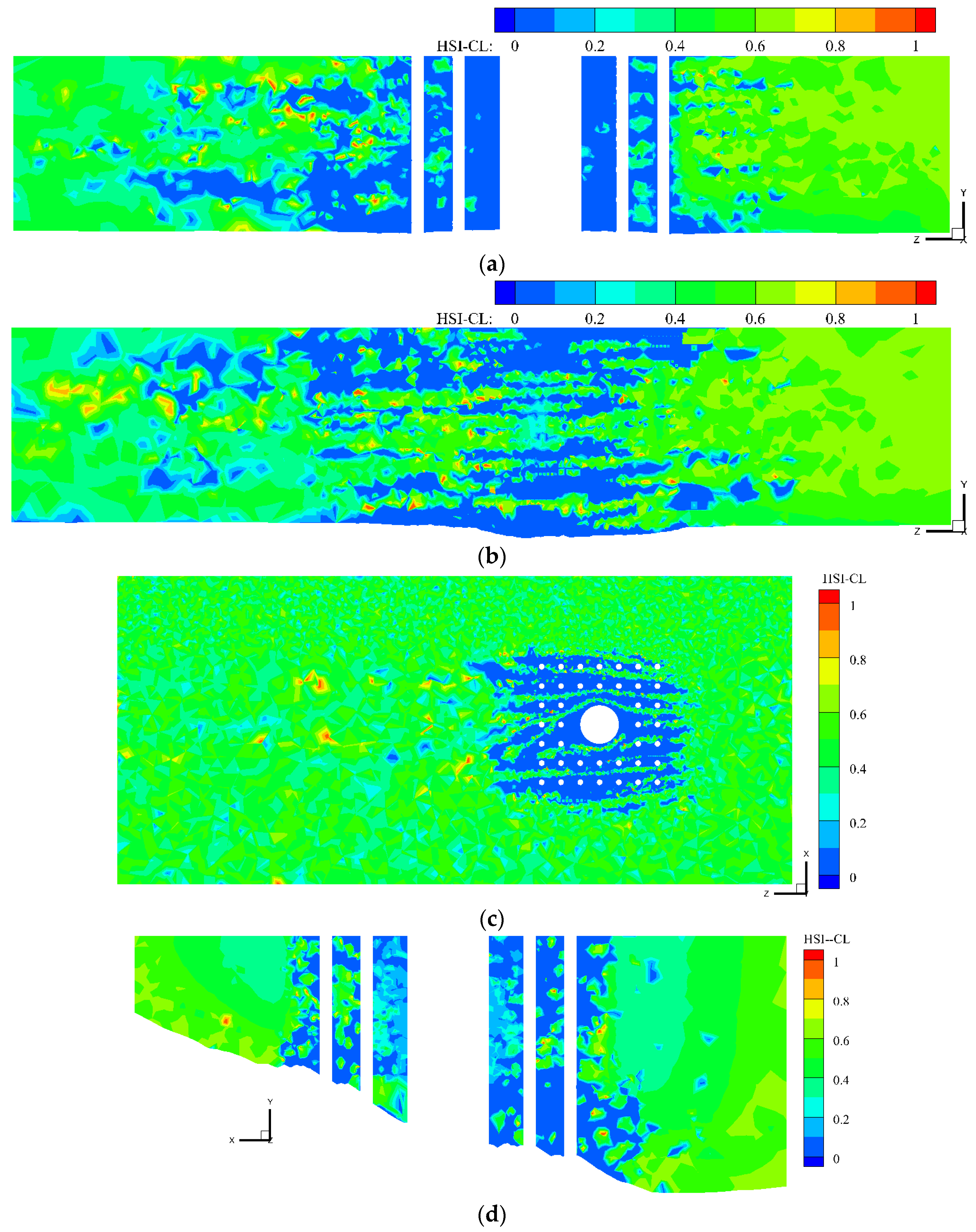
The distribution of habitat suitability index of young fish near the plants on the bank slope is shown in Figure 18. Under the conditions of this study, as shown in Figure 18a, the calculation domain is near the arbor of cross section x/X = 0.52, and the fitness index of juvenile fish habitat is 0.4~0.6 distributed dispersedly, with relatively few areas. As shown in Figure 18b–d, in other sections, the habitat suitability index of young fish in waters near plants ranges from 0 to 0.2, which is extremely unsuitable for survival. Therefore, the water area near the slope plants is not suitable as a long-term stable living environment for juvenile fish. Based on the above analysis of flow velocity distribution, it can be concluded that the flow velocity near the bank slope is relatively high, with the maximum value between plants exceeding 1.5 m/s, which exceeds the maximum sustainable swimming velocity that young fish can withstand and is not conducive to the long-term survival of fish.
  • Habitat suitability analysis of fish spawning grounds
By analyzing the distribution of suitability index for spawning habitats of fish in the waters near the slope plants, the water area near the bank slope has a suitability index range of 0.4~0.6, which is moderately suitable for fish spawning. The presence of plants has changed the distribution of fitness index: the cross-sectional x/X = 0.52, as shown in Figure 19a, the regions with fitness index between plants ranging from 0.4 to 0.6 are dispersed and have a relatively small area proportion. The cross-section x/X = 0.43, as shown in Figure 19b, is distributed in a stratified manner with a suitability index of 0.4~0.6, mainly concentrated near the middle water layer. Section y/Y = 0.98, as shown in Figure 19c. Among plants, the areas with a suitability index of 0.4~0.6 are mainly concentrated in the spanwise plants, while the suitability index for fish spawning in other areas ranges from 0 to 0.2. Section z/Z = 0.29, as shown in Figure 19d. The fitness index near the tree is around 0.2, indicating that the water area near the arbor is not suitable for fish to lay eggs.
In summary, under the conditions of this study, selecting flow velocity and nitrogen– phosphorus ratio as influencing factors, the presence of plants and nearshore waters is not suitable for the long-term survival of juvenile fish. However, as a spawning ground for fish, the suitability index between spreading plants remains between 0.4 and 0.6, with a relatively low proportion. But the presence of plants provides an emergency shelter for fish. Therefore, the waters near plants are suitable for fish to lay eggs.

4. Conclusions

This article uses numerical simulation methods to develop a sediment transport model and systematically study the coupled transport laws of water, sediment, and phosphorus in the nearshore waters of emergent plants. At the same time, combining the fuzzy mathematics theory, a fish habitat suitability evaluation model is constructed with flow velocity and the nitrogen–phosphorus ratio (TN/TP) as the main influencing factors, focusing on exploring the distribution characteristics of the habitat suitability index (HSI) of nearshore fish habitats, and clarifying the impact mechanism of plants on coupled transport and fish habitats.
1. There are significant differences in flow velocity distribution among plants, and there is a strong correlation between water and sediment movement. In the direction of water flow, there is a vortex structure near the arbor, and the flow velocity is relatively low. Between the spreading structures, the measured flow velocity on the shallow water side is higher than that on the deep water side, and the distribution range of high flow velocity is wider. The distribution of flow velocity leads to differences in sediment movement at the bottom of the bank slope, and erosion mainly occurs between the spreading plants. The depth of erosion is greatest near the arbor, and the depth of erosion pits on the shallow water side is significantly greater than that on the deep water side.
2. The transport of suspended sediment and dissolved phosphorus is closely related to water flow. The flow of water between plants in the downstream direction is strong, and the high concentration areas of the two are distributed in a “strip” shape along the water flow. The proportion of high concentration areas between plants on the shallow water side is higher than that on the deep water side, and they migrate towards the deep water side after passing through arbors.
3. The concentration on the water side behind the arbor is 0 and varies with water depth. The difference in flow velocity between the two sides leads to differences in its distribution near the ground and water surface. The area with a concentration of 0 tends to have a lower flow velocity and slopes along the water depth direction, forming an inclined distribution along the water depth.
4. Arbors have a significant impact on the transport and diffusion of phosphorus. The turbulent flow characteristics and disturbance of water flow near them can promote the release of phosphorus adsorbed by sediments into the water body, while also promoting the release of dissolved phosphorus from sediment pore water into the water body, resulting in an increase in phosphorus concentration in the area and achieving dynamic release of phosphorus flux.
5. The distribution of TN/TP ratio between plants has regularity, with areas with a ratio greater than 30 dispersed and having a lower proportion. The TN/TP ratio between diffusion structures is 12–24, which is close to the Redfield value and suitable for the growth of phytoplankton.
6. There is significant differentiation in the habitat of fish in the water near plants. Under the parameter conditions of this study, the suitability index of juvenile fish in the water near the plant is 0–0.2, which is not suitable for providing a stable living environment for juvenile fish. The areas suitable for fish to lay eggs are mainly concentrated among the spreading plants, with a relatively low proportion of area. But plants can provide emergency shelter, making the waters near the plants suitable as spawning grounds for fish.
The innovation of this study lies in the development of a dedicated sediment transport model through numerical simulation, which accurately reveals the regulatory mechanism of emergent plants (especially arbor) on the coupled transport of nearshore water, sediment, and phosphorus. At the same time, a targeted fish habitat suitability evaluation model is constructed to clarify the distribution pattern of habitat suitability for different stages of fish life (juvenile fish, spawning period). The research results have enriched the research content of the coupling process of nearshore ecosystems in inland river basins, providing scientific basis and practical reference for nearshore water environment governance, aquatic organism protection, and ecosystem restoration.


Author Contributions

Conceptualization, methodology, validation, formal analysis, investigation, data curation, writing—original draft, visualization, resources, J.L.; conceptualization, methodology, software, data curation, resources, funding acquisition, X.Z.; conceptualization, validation, resources, supervision, project administration, Q.H.; conceptualization, validation, M.G.; conceptualization, validation, Y.C. All authors have read and agreed to the published version of the manuscript.

Funding

This study received partial funding from the National Natural Science Foundation of China, with grant number 52530003. This research was partially supported by Chongqing scientific research institutions’ performance incentive and guidance project, grant number: CSTB2024JXJL-YFX0075. This research was partially supported by Chongqing scientific research institutions’ performance incentive and guidance project, grant number: CSTB2023JXJL-YFX0054. This research was partially supported by Chongqing scientific research institutions’ performance incentive and guidance project, grant number: CSTB2025JXJL-YFX0045.

Data Availability Statement

The data presented in this study are available on request from the corresponding author due to currently undergoing experimental research.

Conflicts of Interest

The authors declare no conflicts of interest.

References

  1. Zhang, J.; Zheng, X.; Dong, H.; Li, Q. Kinetic Characteristics of Phosphate Release from Supface Sediments in Estuaries. Mar. Geol. Front. 2012, 28, 1–6. [Google Scholar] [CrossRef]
  2. Ryther, J.H.; Dunstan, W.M. Nitrogen, Phosphorus, and Eutrophication in the Coastal Marine Environment. Science 1971, 171, 1008–1013. [Google Scholar] [CrossRef]
  3. Benitez, N.; Claudia, R. The biogeochemical cycling of phosphorus in marine systems. Earth-Sci. Rev. 2000, 51, 109–135. [Google Scholar] [CrossRef]
  4. Qin, Y.-W.; Han, C.-N.; Zheng, B.-H.; Ma, Y.-Q.; Yang, C.-C.; Liu, Z.-C.; Zhang, L.; Zhao, Y.-M. Analysis of Transport and Transformation Characteristics Between Dissolved Phosphorus and Particulate Phosphorus in Water of the Three Gorges Reservoir. Environ. Sci. 2019, 40, 2152–2159. [Google Scholar] [CrossRef]
  5. He, H.J.; Chen, H.T.; Yao, Q.Z.; Qin, Y.; Mi, T.; Yu, Z. Behavior of different phosphorus species in suspended particulate matter in the Changjiang estuary. Chin. J. Oceanol. Limnol. 2009, 27, 859–868. [Google Scholar] [CrossRef]
  6. Pan, G.; Krom, M.D.; Herut, H. Adsorption-desorption of phosphate on airborne dust and riverborne particulates in East Mediterranean seawater. Environ. Sci. Technol. 2002, 36, 3519–3524. [Google Scholar] [CrossRef] [PubMed]
  7. Tang, X.Q.; Wu, M.; Li, R. Phosphorus distribution and bioavailability dynamics in the mainstream water and surface sediment of the Three Gorges Reservoir between 2003 and 2010. Water Res. 2019, 145, 321–331. [Google Scholar] [CrossRef]
  8. Dorich, R.A.; Nelson, D.W.; Sommers, L.E. Estimating algal available phosphorus in suspended sediments by chemical extraction. J. Environ. Qual. 1985, 14, 400–405. [Google Scholar] [CrossRef]
  9. Miller, M.P. The influence of reservoirs, climate, land use and hydrologic conditions on loads and chemical quality of dissolved organic carbon in the Colorado River. Water Reserv. Resour. 2012, 48, 810–830. [Google Scholar] [CrossRef]
  10. Zhang, W.; Li, R.; Wang, D.; Tang, X. The transport impact and control strategy recommendations of total phosphorus of the Yangtze River under the establishmentand operation of upstream cascade reservoirs. J. Lake Sci. 2024, 36, 1720–1731. [Google Scholar] [CrossRef]
  11. Tian, Z.; Wang, L.; Li, Y.; Zheng, B.; Chu, Z. Changes of phosphorus delivery from Yangtze River to Dongting Lake under new water and sediment conditions. J. Clean. Prod. 2021, 316, 128248. [Google Scholar] [CrossRef]
  12. Jin, G.; Chen, H.; Zhang, Z.; Jiang, Q.; Liu, Z.; Tang, H. Transport of phosphorus in the hyporheic zone. Water Resour. Res. 2022, 58, e2021WR031292. [Google Scholar] [CrossRef]
  13. Han, C. Characteristics of Phosphorus Transport and Transformation and Its Influence Mechanism in the Three Gorges Reservoir. Ph.D. Thesis, Tsinghua University, Beijing, China, 2018. [Google Scholar]
  14. Han, C.; Zheng, B.; Qin, Y.; Ma, Y.; Yang, C.; Liu, Z.; Cao, W.; Chi, M. Impact of upstream river inputs and reservoir operation on phosphorus fractions in water-particulate phases in the Three Gorges Reservoir. Sci. Total Environ. 2018, 610–611, 1546–1556. [Google Scholar] [CrossRef]
  15. Wang, B.; Lu, S.Q.; Lin, W.Q.; Yang, Y.F.; Wang, D.Z. Water quality model with multiform of N/P transport and transformation in the Yangtze River Estuary. J. Hydrodyn. 2016, 289, 423–430. [Google Scholar] [CrossRef]
  16. Huang, L.; Fang, H.W.; Reible, D. Mathematical model for interactions and transport of phosphorus and sediment in the Three Gorges Reservoir. Water Res. 2015, 85, 393–403. [Google Scholar] [CrossRef]
  17. Liu, X.; Beusen, A.H.; Van Beek, L.P.; Mogollón, J.M.; Ran, X.; Bouwman, A.F. Exploring spatiotemporal changes of the Yangtze river (Changjiang) nitrogen and phosphorus sources, retention and export to the East China Sea and Yellow Sea. Water Res. 2018, 142, 246–255. [Google Scholar] [CrossRef] [PubMed]
  18. Heidi, M.N. Hydrodynamics of vegetated channels. J. Hydraul. Res. 2012, 50, 262–279. [Google Scholar] [CrossRef]
  19. Jrvel, J. Flow resistance of flexible and stiff vegetation: A flume study with natural plants. J. Hydrol. 2002, 269, 44–54. [Google Scholar] [CrossRef]
  20. Sand-Jensen, K. Drag and reconfiguration of freshwater macrophyte. Freshw. Biol. 2003, 48, 271–283. [Google Scholar] [CrossRef]
  21. Gurnell, A. Plants as river system engineers. Earth Surf. Process. Landf. 2014, 39, 4–25. [Google Scholar] [CrossRef]
  22. Nikora, V.I. Hydrodynamics of Aquatic Ecosystems: An interface between ecology, biomechanics and environmental fluid mechanics. River Res. Appl. 2010, 26, 367–384. [Google Scholar] [CrossRef]
  23. Zhao, F. Research on Hydraulic Characteristics of Open Channel Flows with Rigid Vegetation. Ph.D. Thesis, Wuhan University, Wuhan, China, 2017. [Google Scholar]
  24. Lu, J.; Dai, H.C. Three dimensional numerical modeling of flows and scalar transport in a vegetated channel. J. Hydro-Environ. Res. 2017, 16, 27–33. [Google Scholar] [CrossRef]
  25. Lu, J.; Dai, H.C. Numerical modeling of pollution transport in flexible vegetation. J. Hydrodyn. Ser. B 2018, 64, 93–105. [Google Scholar] [CrossRef]
  26. Lu, J.; Dai, H.C. Effect of submerged vegetation on solute transport in an open channel using large eddy simulation. Adv. Water Resour. 2016, 97, 87–99. [Google Scholar] [CrossRef]
  27. Farrell, A.P.; Thorarensen, H.; Axelsson, M.; Crocker, C.E.; Gamperl, A.; Cech, J.J. Gut blood flow in fish during exercise and Severe Hypercapnia. Comp. Biochem. Physiol. Part A Mol. Integr. Physiol. 2001, 128, 551–563. [Google Scholar] [CrossRef] [PubMed]
  28. Peake, S.; Mckinley, R.S.; Scruton, D.A. Swimming performance of walleye (Stizostedion vitreum). Can. J. Zool. 2000, 78, 1686–1690. [Google Scholar] [CrossRef]
  29. Mcdonald, D.G.; Milligan, C.L.; Mcfarlane, W.J.; Croke, S.; Currie, S.; Hooke, B.; Angus, R.; Tufts, B.; Davidson, K. Condition and performance of juvenile Atlantic salmon (Salmo salary): Effects of rearing practices on hatchery fish and comparison with wild fish. Can. J. Fish. Aquat. Sci. 1998, 55, 1208–1219. [Google Scholar] [CrossRef]
  30. Colavecchia, M.; Katopodis, C.; Goosney, R.; Scruton, D.A.; McKinley, R.S. Measurement of burst swimming performance in wild Atlantic salmon (Salmo salar L.) using digital telemetry. Regul. Rivers-Res. Manag. 1998, 14, 41–51. [Google Scholar] [CrossRef]
  31. Wood, C.M.; Turner, J.D.; Graham, M.S. Why do fish die after severe exercise. J. Fish Biol. 1983, 22, 189–201. [Google Scholar] [CrossRef]
  32. Bai, H. Analysis on Topographical Characteristics and Ecological Hydrodynamic Factors of the Four Major Chinese Carps’ Yidu Spawning Ground in Yangtze River. Ph.D. Thesis, China Institute of Water Resources and Hydropower Research, Beijing, China, 2015. [Google Scholar]
  33. Breen, M.; Dyson, J.; O’Neill, F.G.; Jones, E.; Haigh, M. Swimming endurance of haddock (Melanogrammus aeglefinus L.) at prolonged and sustained swimming speeds, and its role in their capture by towed fishing gears. ICES J. Mar. Sci. 2004, 61, 1071–1079. [Google Scholar] [CrossRef]
  34. Bretón, F.; Baki, A.B.M.; Link, O.; Zhu, D.Z.; Rajaratnam, N. Flow in nature-like fishway and its relation to fish behaviour. Can. J. Civ. Eng. 2013, 40, 567–573. [Google Scholar] [CrossRef]
  35. Zhang, H.; Wang, J. Experimental study on underwater repose angle of sand and model sand. J. Sediment Res. 2016, 7, 90–96. [Google Scholar] [CrossRef]
  36. Sommerfeld, M. Validation of a stochastic lagrangian modelling approach for inter-particle collisions in homogeneous isotropic turbulence. Int. J. Multiph. Flow 2001, 27, 1829–1858. [Google Scholar] [CrossRef]
  37. Fukuda, S.; Tanakura, T.; Hiramatsu, K.; Harada, M. Assessment of spatial habitat heterogeneity by coupling data-driven habitat suitability models with a 2D hydrodynamic model in small-scale streams. Ecol. Inform. 2015, 29, 147–155. [Google Scholar] [CrossRef]
  38. Yang, Q. Study on Hydraulic Characteristics of the New Type Ecological Revetment Structure. Ph.D. Thesis, Chongqing Jiaotong University, Chongqing, China, 2015. [Google Scholar]
  39. Zhu, W.; Hou, H.; Liu, H.; Xu, X.; Zhu, Y.; Chen, N.; Cao, J.; Lin, N. A review of sediment phosphorus release amount and rules in Lake Taihu. J. Lake Sci. 2025, 37, 14–35. [Google Scholar] [CrossRef]
  40. Fengchang, W.; Xiangcan, J.; Runyu, Z.; Haiqing, L.; Shengrui, W.; Xia, J.; Liying, W.; Jianyang, G.; Wen, L.; Xiaoli, Z. Effect and significance of organic and phosphorus in the lake aquatic environment. J. Lake Sci. 2010, 22, 1–7. [Google Scholar] [CrossRef]
  41. Wu, Z.; Wu, S.; Liu, Y.; Zhang, Y.; Xie, S.; Guo, H. Key Processes and Mechanisms of Nitrogen and Phosphorus Cycling in Lakes. Acta Sci. Nat. Univ. Pekin. 2018, 54, 218–228. [Google Scholar] [CrossRef]
  42. Redfield, A.C. The biological control of chemical factors in the environment. Am. Sci. 1958, 46, 205–221. [Google Scholar]
  43. Ji, P.; Xu, H.; Zhan, X.; Zhu, G.-W.; Zou, W.; Zhu, M.-Y.; Kang, L.-J. Spatial-temporal Variations and Driving of Nitrogen and Phosphorus Ratios in Lakes in the Middle and Lower Reaches of Yangtze River. Environ. Sci. 2020, 41, 4030–4041. [Google Scholar] [CrossRef]
  44. Hu, J. Hydraulic Characteristics of a New Permeable Spur Dike and Its Effect on Fish Behaviore. Ph.D. Thesis, Chongqing Jiaotong University, Chongqing, China, 2021. [Google Scholar]
  45. Bai, H.; Peng, Q.; Li, C.; Ren, J. A summary of topographical characteristics of the four major Chinese carps’ spawning grounds and hydrodynamic conditions for natural propagationin the Yangtze River. J. China Inst. Water Resour. Hydropower Res. 2014, 12, 249–257. [Google Scholar] [CrossRef]
  46. Lou, Q. Study on the Habitat Reclamation of the Four Major Chinese Carps in the Luoqi Channel for the Upstream of the Yangtze River. Ph.D. Thesis, Chongqing Jiaotong University, Chongqing, China, 2023. [Google Scholar]
Figure 1. Stress analysis of sediment on bank slope.
Water 18 01470 g001
Figure 2. Experimental model design.
Water 18 01470 g002
Figure 3. Physical model and numerical model validation diagram. (a) Physical model experiment. (b) Fitting results.
Water 18 01470 g003
Figure 4. Three-dimensional flow velocity field distribution.
Water 18 01470 g004
Figure 5. Flow field distribution along the flow section. (a-1) When T = 0 s, the cross-sectional x/X = 0.52 velocity distribution. (a-2) When T = 50 s, the cross-sectional x/X = 0.52 velocity distribution. (b-1) When T = 0 s, the cross-sectional x/X = 0.43 velocity distribution.(b-2) When T = 50 s, the cross-sectional x/X = 0.43 velocity distribution.
Water 18 01470 g005aWater 18 01470 g005b
Figure 6. Vertical and spanwise flow field distribution. (a-1) When T = 0 s, the cross-sectional y/Y = 0.98 velocity distribution. (a-2) When T = 50 s, the cross-sectional y/Y = 0.98 velocity distribution. (b-1) When T = 0 s, the cross-sectional z/Z = 0.29 velocity distribution. (b-2) When T = 50 s, the cross-sectional z/Z = 0.29 velocity distribution.
Water 18 01470 g006aWater 18 01470 g006b
Figure 7. Scouring pattern and shear stress distribution of bank slope. (a-1) When T = 10 s, the depth distribution of bank slope erosion. (a-2) When T = 50 s, the depth distribution of bank slope erosion. (b-1) When T = 0 s, the distribution of shear stress values on the bank slope. (b-2) When T = 50 s, the distribution of shear stress values on the bank slope.
Water 18 01470 g007aWater 18 01470 g007b
Figure 8. Schematic diagram of phosphorus migration and transformation mechanism.
Water 18 01470 g008
Figure 9. Distribution of hourly average concentration of sediment and phosphorus. (a-1) Section x/X = 0.52, distribution of suspended sediment concentration. (a-2) Section x/X = 0.52, distribution of phosphorus concentration. (b-1) Section x/X = 0.43, distribution of suspended sediment concentration. (b-2) Section x/X = 0.43, distribution of phosphorus concentration. (c-1) Section z/Z = 0.29, distribution of suspended sediment concentration. (c-2) Section z/Z = 0.29, distribution of phosphorus concentration. (d-1) Section y/Y = 0.98, distribution of suspended sediment concentration. (d-2) Section y/Y = 0.98, distribution of phosphorus concentration.
Water 18 01470 g009aWater 18 01470 g009b
Figure 10. Instantaneous transport law of sediment and phosphorus near x/X = 0.52. (a) When T = 0 s, the transport patterns of suspended sediment and phosphorus. (b) When T = 0.2 s, the transport patterns of suspended sediment and phosphorus. (c) When T = 0.4 s, the transport patterns of suspended sediment and phosphorus. (d) When T = 0.6 s, the transport patterns of suspended sediment and phosphorus. (e) When T = 0.8 s, the transport patterns of suspended sediment and phosphorus.
Water 18 01470 g010
Figure 11. Instantaneous transport law of sediment and phosphorus near y/Y = 0.98. (a) When T = 0 s, the transport patterns of suspended sediment and phosphorus. (b) When T = 0.2 s, the transport patterns of suspended sediment and phosphorus. (c) When T = 0.4 s, the transport patterns of suspended sediment and phosphorus. (d) When T = 0.6 s, the transport patterns of suspended sediment and phosphorus. (e) When T = 0.8 s, the transport patterns of suspended sediment and phosphorus.
Water 18 01470 g011
Figure 12. Particle transport distribution and velocity distribution on the water side behind arbors. (a) Particle transport on the water side behind arbors. (b) Velocity distribution on the water side behind arbors.
Water 18 01470 g012
Figure 13. Time averaged distribution of TN/TP. (a) The cross-section with x/X = 0.52. (b) The cross-section with x/X = 0.43. (c) The cross-section with y/Y = 0.98. (d) The cross-section with z/Z = 0.29.
Water 18 01470 g013
Figure 14. Suitability curve of nitrogen and phosphorus ratio of the four famous domestic fishes.
Water 18 01470 g014
Figure 15. Suitability curve of hydraulic characteristics during the juvenile stage.
Water 18 01470 g015
Figure 16. Hydraulic characteristics suitability curve during the spawning period.
Water 18 01470 g016
Figure 17. Schematic diagram of membership degree. (a) The distribution of membership degrees of juvenile flow velocity. (b) The distribution of flow velocity membership degrees during the spawning period is displayed. (c) The membership distribution of the nitrogen–phosphorus ratio is displayed. (d) The distribution of habitat suitability membership degrees is displayed.
Water 18 01470 g017
Figure 18. Distribution of habitat suitability of juvenile fish. (a) The cross-section with x/X = 0.52. (b) The cross-section with x/X = 0.43. (c) The cross-section with y/Y = 0.98. (d) The cross-section with z/Z = 0.29.
Water 18 01470 g018aWater 18 01470 g018b
Figure 19. Distribution map of suitability for spawning habitats of fish. (a) The cross-section with x/X = 0.52. (b) The cross-section with x/X = 0.43. (c) The cross-section with y/Y = 0.98. (d) The cross-section with z/Z = 0.29.
Water 18 01470 g019
Table 1. Test scheme.
Test ConditionsWater Depth (m)GradientVelocity
(m/s)
Arbor Size (cm)Vegetation Size (cm)Sediment
Concentration
Nitrogen ConcentrationPhosphorus
Concentration
Case 10.61:31.320352.70.24
Disclaimer/Publisher’s Note: The statements, opinions and data contained in all publications are solely those of the individual author(s) and contributor(s) and not of MDPI and/or the editor(s). MDPI and/or the editor(s) disclaim responsibility for any injury to people or property resulting from any ideas, methods, instructions or products referred to in the content.