Removal of Azo Dyes Using a Coupled Adsorption and Electrochemical Oxidation Process—The Impact of Effluent Conditions
 , ,
, ,  , and
, and
Abstract
1. Introduction
2. Materials and Methods
2.1. Materials
2.2. Adsorption Experiments
2.3. Nyex RosaloxTM Process Experiments
3. Results
3.1. Adsorption Results
3.2. Nyex RosaloxTM Experiments
4. Discussion
4.1. Impact of Effluent Condition on the Adsorption of Azo Dyes onto the NyexTM Media
4.2. Impact of Effluent Conditions on the Azo Dye Removal Efficiency Using the NR Process
5. Conclusions
Author Contributions
Funding
Data Availability Statement
Acknowledgments
Conflicts of Interest
References
- Desore, A.; Narula, S.A. An overview on corporate response towards sustainability issues in textile industry. Environ. Dev. Sustain. 2018, 20, 1439–1459. [Google Scholar] [CrossRef]
- Raja, A.S.M.; Arputharaj, A.; Saxena, S.; Patil, P.G. Water requirement and sustainability of textile processing industries. In Water in Textiles and Fashion; Muthu, S.S., Ed.; Woodhead Publishing: Cambridge, UK, 2019; pp. 155–173. [Google Scholar]
- de Castro, K.C.; Leme, V.F.C.; Souza, F.H.M.; Costa, G.O.B.; Santos, G.E.; Litordi, L.R.V.; Andrade, G.S.S. Performance of inactivated Aspergillus oryzae cells on dye removal in aqueous solutions. Environ. Technol. Innov. 2021, 24, 101828. [Google Scholar] [CrossRef]
- Shankarling, G.S.; Deshmukh, P.P.; Joglekar, A.R. Process intensification in azo dyes. J. Environ. Chem. Eng. 2017, 5, 3302–3308. [Google Scholar] [CrossRef]
- Schweitzer, L.; Noblet, J. Water Contamination and Pollution. In Green Chemistry; Török, B., Dransfield, T., Eds.; Elsevier: Amsterdam, The Netherlands, 2018; pp. 261–290. [Google Scholar]
- Forss, J.; Welander, U. Decolourization of reactive azo dyes with microorganisms growing on soft wood chips. Int. Biodeterior. Biodegrad. 2009, 63, 752–758. [Google Scholar] [CrossRef]
- Al-Degs, Y.; Khraisheh, M.A.M.; Allen, S.J.; Ahmad, M.N. Effect of carbon surface chemistry on the removal of reactive dyes from textile effluent. Water Res. 2000, 34, 927–935. [Google Scholar] [CrossRef]
- Pereira, L.; Alves, M. Dyes—Environmental Impact and Remediation. In Environmental Protection Strategies for Sustainable Development; Malik, A., Grohmann, E., Eds.; Springer: Dordrecht, The Netherlands, 2012; pp. 111–162. [Google Scholar]
- Venn, R. The Removal of Azo Dyes Using the Nyex®RosaloxTM Coupled Adsorption and Electrochemical Oxidation Process. Master’s Thesis, Univeristy of Manchester, Manchester, UK, 2023. [Google Scholar]
- Brown, N.W.; Roberts, E.P.L.; Garforth, A.A.; Dryfe, R.A.W. Electrochemical regeneration of a carbon-based adsorbent loaded with crystal violet dye. Electrochim. Acta 2004, 49, 3269–3281. [Google Scholar] [CrossRef]
- Nabeerasool, M.A.; Campen, A.K.; Polya, D.A.; Brown, N.W.; van Dongen, B.E. Removal of Metaldehyde from Water Using a Novel Coupled Adsorption and Electrochemical Destruction Technique. Water 2015, 7, 3057–3071. [Google Scholar] [CrossRef]
- Asghar, H.M.A.; Hussain, S.N.; Brown, N.W.; Roberts, E.P.L. Comparative adsorption–regeneration performance for newly developed carbonaceous adsorbent. J. Ind. Eng. Chem. 2019, 69, 90–98. [Google Scholar] [CrossRef]
- Asghar, H.M.A.; Roberts, E.P.L.; Hussain, S.N.; Campen, A.K.; Brown, N.W. Wastewater treatment by adsorption with electrochemical regeneration using graphite-based adsorbents. J. Appl. Electrochem. 2012, 42, 797–807. [Google Scholar] [CrossRef]
- Hussain, S.N.; Asghar, H.M.A.; Sattar, H.; Brown, N.W.; Roberts, E.P.L. Removal of Tartrazine From Water by Adsorption with Electrochemical Regeneration. Chem. Eng. Commun. 2015, 202, 1280–1288. [Google Scholar] [CrossRef]
- Liu, H.; Li, G.; Qu, J.; Liu, H. Degradation of azo dye Acid Orange 7 in water by Fe0/granular activated carbon system in the presence of ultrasound. J. Hazard. Mater. 2007, 144, 180–186. [Google Scholar] [CrossRef]
- Mohammed, F.M.; Roberts, E.P.L.; Hill, A.; Campen, A.K.; Brown, N.W. Continuous water treatment by adsorption and electrochemical regeneration. Water Res. 2011, 45, 3065–3074. [Google Scholar] [CrossRef]
- Cullen, K.; Venn, R.; Brown, N.; Boult, S.; Polya, D.A.; Uzuh, F.D.; Wang, M.; Wogelius, R.A.; van Dongen, B.E. Coupled adsorption and electrochemical oxidation can be effective for azo dye removal. Water 2026, 18, 659. [Google Scholar] [CrossRef]
- Wang, M.; Boult, S.; Brown, N.; van Dongen, B.E. Removal of tributyltin from water using a coupled adsorption and electrochemical oxidation process. Water Res. 2026, 298, 125813. [Google Scholar] [CrossRef] [PubMed]
- Hejazifar, M.; Azizian, S. Adsorption of Cationic and Anionic Dyes onto the Activated Carbon Prepared from Grapevine Rhytidome. J. Dispers. Sci. Technol. 2012, 33, 846–853. [Google Scholar] [CrossRef]
- Saha, B.; Suresh Kumar, G. Microcalorimetry and spectroscopic studies on the binding of dye janus green blue to deoxyribonucleic acid. J. Therm. Anal. Calorim. 2016, 123, 1993–2001. [Google Scholar] [CrossRef]
- United Utilities. Water Quality Search Results. Available online: https://www.unitedutilities.com/help-and-support/your-water-supply/your-water/water-quality/ (accessed on 1 January 2026).
- Worrall, F.; Harriman, R.; Evans, C.D.; Watts, C.D.; Adamson, J.; Neal, C.; Tipping, E.; Burt, T.; Grieve, I.; Monteith, D.; et al. Trends in Dissolved Organic Carbon in UK Rivers and Lakes. Biogeochemistry 2004, 70, 369–402. [Google Scholar] [CrossRef]
- Broadbent, A.D. Basic Principles of Textile Coloration; Society of Dyers and Colourists: Bradford, UK, 2001. [Google Scholar]
- Gamal, A.M.; Farha, S.A.A.; Sallam, H.; Mahmoud, G.A.E.; Ismail, L.F.M. Kinetic Study and Equilibrium Isotherm Analysis of Reactive Dyes Adsorption onto Cotton Fiber. Nat. Sci. 2010, 8, 95–110. [Google Scholar]
- Zayed, A.M.; Abdel Wahed, M.S.M.; Mohamed, E.A.; Sillanpää, M. Insights on the role of organic matters of some Egyptian clays in methyl orange adsorption: Isotherm and kinetic studies. Appl. Clay Sci. 2018, 166, 49–60. [Google Scholar] [CrossRef]
- Yagub, M.T.; Sen, T.K.; Afroze, S.; Ang, H.M. Dye and its removal from aqueous solution by adsorption: A review. Adv. Colloid Interface Sci. 2014, 209, 172–184. [Google Scholar] [CrossRef]
- Parsa, J.B.; Rezaei, M.; Soleymani, A.R. Electrochemical oxidation of an azo dye in aqueous media investigation of operational parameters and kinetics. J. Hazard. Mater. 2009, 168, 997–1003. [Google Scholar] [CrossRef] [PubMed]
- Zhou, M.; Särkkä, H.; Sillanpää, M. A comparative experimental study on methyl orange degradation by electrochemical oxidation on BDD and MMO electrodes. Sep. Purif. Technol. 2011, 78, 290–297. [Google Scholar] [CrossRef]
- Hai, N.T.M.; Huynh, T.M.T.; Fluegel, A.; Mayer, D.; Broekmann, P. Adsorption behavior of redox-active suppressor additives: Combined electrochemical and STM studies. Electrochim. Acta 2011, 56, 7361–7370. [Google Scholar] [CrossRef]
- Cañizares, P.; Hernández-Ortega, M.; Rodrigo, M.A.; Barrera-Díaz, C.E.; Roa-Morales, G.; Sáez, C. A comparison between Conductive-Diamond Electrochemical Oxidation and other Advanced Oxidation Processes for the treatment of synthetic melanoidins. J. Hazard. Mater. 2009, 164, 120–125. [Google Scholar] [CrossRef]
- Scialdone, O.; Randazzo, S.; Galia, A.; Silvestri, G. Electrochemical oxidation of organics in water: Role of operative parameters in the absence and in the presence of NaCl. Water Res. 2009, 43, 2260–2272. [Google Scholar] [CrossRef] [PubMed]
- Yaseen, D.A.; Scholz, M. Textile dye wastewater characteristics and constituents of synthetic effluents: A critical review. Int. J. Environ. Sci. Technol. 2019, 16, 1193–1226. [Google Scholar] [CrossRef]



| CAS Name & No. (Supplier) | Type | Molecular Weight (g mol−1) | Structure & Formula | UV-Vis Adsorption Maximum 2 (nm) |
|---|---|---|---|---|
| Acid Orange 6547-57-9 (Acros Organics; Geel, Belgium) 1 | Acidic/Anionic | 316.26 |  C12H9N2NaO5S | 430 |
| Methyl Orange 547-58-0 (Sigma Aldrich; Darmstadt, Germany) | Acidic/Anionic | 327.33 |  C14H14N3NaO3S | 465 |
| Methyl Red Sodium Salt 845-10-3 (Acros Organics; Geel, Belgium) | Acidic/Anionic | 291.28 |  C15H14N3NaO2 | 437 |
| Janus Green B 2869-83-2 (Acros Organics; Geel, Belgium) | Basic/Cationic | 511.07 |  C30H31ClN6 | 606 |
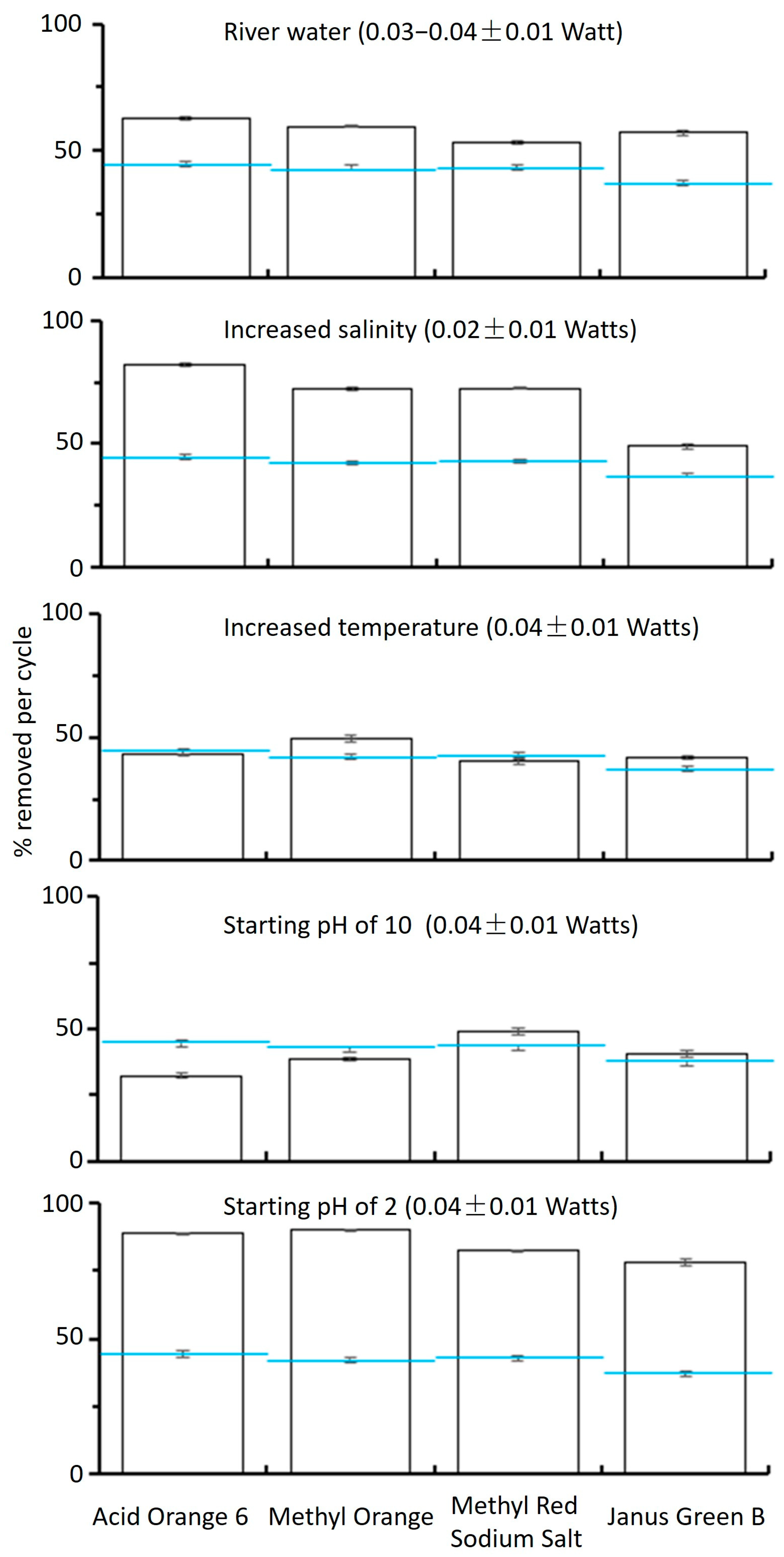
| Dye | River Water Used (DOC = 6.0 ± 0.05) 1 | Increased Salinity (+1 mg L−1 NaCl) | Increased Temperature (35 ± 3 °C) | Alkaline Conditions (pH = 10) | Acidic Conditions (pH = 2) |
|---|---|---|---|---|---|
| Acid Orange 6 | t(16) = −4.65, p-value < 0.001 (+16.4 ± 1.6%) | t(16) = 12.49, p-value < 0.001 (+37.5 ± 1.7%) | t(16) = −0.95, p-value = 0.356 (−1.1 ± 2.0%) | t(16) = 3.92, p-value < 0.001, (−12.2 ± 1.9%) | t(16) = −16.18, p-value < 0.001 (+44.15 ± 1.5%) |
| Methyl Orange | t(16) = −7.60, p-value < 0.001, (+17.9 ± 1.7%) | t(16) = 11.42, p-value < 0.001 (+30 ± 1.7%) | t(16) = −0.02, p-value = 0.987 (+7.8 ± 1.6%) | t(16) = 0.91, p-value = 0.376 (−4.3 ± 1.5%) | t(16) = −22.32, p-value < 0.001 (+47.7 ± 1.2%) |
| Methyl Red Sodium Salt | t(16) = −3.56, p-value < 0.001 (+9.9 ± 1.6%) | t(16) = 13.40, p-value < 0.001, (29.6 ± 1.2%) | t(16) = −0.68491, p-value = 0.503 (−2.8 ± 2.0%) | t(16) = −0.47, p-value = 0.647 (+5.7 ± 2.3%) | t(16) = −17.36, p-value < 0.001, (+39.2 ± 1.4%) |
| Janus Green B | t(16) = −6.63, p-value < 0.001 (+19.7 ± 1.7%) | t(16) = 3.75, p-value < 0.001, (+11.7 ± 1.9%) | t(16) = 1.9319, p-value = 0.071 (+4.6 ± 1.6%) | t(16) = −1.08, p-value = 0.295 (+3.24 ± 2.2%) | t(16) = −13.42, p-value < 0.001 (+40.7 ± 1.9%) |
Disclaimer/Publisher’s Note: The statements, opinions and data contained in all publications are solely those of the individual author(s) and contributor(s) and not of MDPI and/or the editor(s). MDPI and/or the editor(s) disclaim responsibility for any injury to people or property resulting from any ideas, methods, instructions or products referred to in the content. |
© 2026 by the authors. Licensee MDPI, Basel, Switzerland. This article is an open access article distributed under the terms and conditions of the Creative Commons Attribution (CC BY) license.
Share and Cite
Venn, R.; Cullen, K.; Brown, N.; Boult, S.; Polya, D.A.; Wogelius, R.A.; Dongen, B.E.v. Removal of Azo Dyes Using a Coupled Adsorption and Electrochemical Oxidation Process—The Impact of Effluent Conditions. Water 2026, 18, 1468. https://doi.org/10.3390/w18121468
Venn R, Cullen K, Brown N, Boult S, Polya DA, Wogelius RA, Dongen BEv. Removal of Azo Dyes Using a Coupled Adsorption and Electrochemical Oxidation Process—The Impact of Effluent Conditions. Water. 2026; 18(12):1468. https://doi.org/10.3390/w18121468
Chicago/Turabian StyleVenn, Rosamonde, Katrina Cullen, Nigel Brown, Stephen Boult, David A. Polya, Roy A. Wogelius, and Bart E. van Dongen. 2026. "Removal of Azo Dyes Using a Coupled Adsorption and Electrochemical Oxidation Process—The Impact of Effluent Conditions" Water 18, no. 12: 1468. https://doi.org/10.3390/w18121468
APA StyleVenn, R., Cullen, K., Brown, N., Boult, S., Polya, D. A., Wogelius, R. A., & Dongen, B. E. v. (2026). Removal of Azo Dyes Using a Coupled Adsorption and Electrochemical Oxidation Process—The Impact of Effluent Conditions. Water, 18(12), 1468. https://doi.org/10.3390/w18121468