Article

Effects of Microplastics on Diclofenac Degradation in the Permanganate–Manganese Dioxide System

Xiamen Key Laboratory of Municipal and Industrial Solid Waste Utilization and Pollution Control, College of Civil Engineering, Huaqiao University, Xiamen 361021, China
*
Author to whom correspondence should be addressed.
Water 2026, 18(12), 1464; https://doi.org/10.3390/w18121464 (registering DOI)
Submission received: 15 April 2026 / Revised: 1 June 2026 / Accepted: 9 June 2026 / Published: 14 June 2026

Abstract

Microplastics (MPs) are increasingly recognized as pervasive co-contaminants in aquatic environments, yet their impacts on advanced oxidation processes remain poorly understood. Herein, we systematically investigate the role of representative MPs in diclofenac (DCF) degradation within a permanganate–manganese dioxide (PM-MnO2) catalytic system. Results show that PM alone exhibits limited reactivity toward DCF, while MnO2 significantly enhances DCF degradation. In the absence of MnO2, MPs increase PM consumption but do not influence DCF degradation, indicating that MPs primarily act as competing oxidant sinks. In contrast, under MnO2 catalytic conditions, the effect of MPs strongly depends on their interaction with MnO2. Pre-adhesion of MPs onto MnO2 suppresses DCF degradation by blocking active sites and inhibiting interfacial electron transfer. However, when MPs are introduced without pre-adhesion, no inhibition is observed; instead, a slight enhancement in DCF removal occurs. This promotion is attributed to in situ oxidation of MPs, which consumes PM and simultaneously generates secondary MnO2 colloids that provide additional reactive interfaces. Further analysis reveals that PM consumption is decoupled from DCF degradation due to multi-pathway oxidant partitioning, including DCF oxidation, MP oxidation, and Mn redox cycling. These findings demonstrate that MPs can act as both inhibitors and promoters depending on their interaction mode with catalysts, highlighting the importance of catalyst accessibility and reaction sequence. This study provides new insights into the complex roles of MPs in catalytic oxidation systems and offers guidance for applying PM-based technologies in realistic water matrices.

1. Introduction

Pharmaceutical pollution in aquatic environments has become increasingly prevalent, raising growing concerns about potential environmental risks [1,2]. Diclofenac (DCF), a widely prescribed non-steroidal anti-inflammatory drug, has been extensively consumed worldwide and is consequently recognized as a typical emerging pharmaceutical contaminant in aquatic environments [3,4]. Due to its high concentrations up to mg·L−1 level and incomplete removal in conventional wastewater treatment processes, DCF has been frequently detected in surface water, groundwater, and even drinking water at trace concentrations [5,6]. The persistence and bioaccumulative nature of DCF pose significant ecological risks, including chronic toxicity to aquatic organisms and disruption of ecosystem functions [5,7]. These findings underscore the urgent need to develop efficient, cost-effective, and environmentally benign technologies for DCF removal.
Permanganate (PM) has been widely used for the degradation of DCF and other drugs with halogenated aromatic structures, attributed to its strong oxidation potential, cost-effectiveness, and ability to avoid the formation of halogenated byproducts. Manganese dioxide (MnO2), including in situ-generated colloids and commercial products, could catalyze pollutant oxidation by PM [8,9]. In the PM-MnO2 system, reactive Mn(III) intermediates generated via Mn redox cycling enable effective degradation of refractory organic contaminants such as DCF. Importantly, compared with chlorine-based oxidation and disinfection processes, the PM-MnO2 systems minimize the formation of toxic chlorinated by-products [10,11]. However, natural water matrices are far more complex than ideal laboratory systems, and the influence of coexisting emerging contaminants, particularly microplastics (MPs), on PM-MnO2 performance remains largely unknown.
MPs, especially with a size in nm to μm levels, have been ubiquitously detected in wastewater treatment plants, drinking water treatment systems, and natural water bodies worldwide [12,13]. Migration and accumulation of MPs in the atmosphere, soil, and water bodies through the food chain pose serious hazards to human health [14]. Numerous studies have reported the occurrence of MPs across multiple treatment stages, indicating their incomplete removal and continuous release into receiving environments [15]. Due to their large specific surface area and hydrophobic properties, MPs can act as vectors for organic pollutants such as DCF through adsorption processes [16,17]. Such adsorption may reduce the bioavailability of pollutants or alter their degradation pathways during water treatment processes [18]. In addition, MPs can interact directly with catalytic materials, such as MnO2, via surface adhesion, potentially blocking active sites or modifying surface coordination environments [19]. These interactions may influence the generation of reactive species and ultimately affect the oxidation efficiency of the PM-MnO2 system. Given the ubiquitous presence of MPs in aquatic environments, understanding their potential interference with heterogeneous catalysis processes is critical for evaluating the practical applicability of PM-MnO2 technology.
In this study, polypropylene (PP), polyethylene (PE), polystyrene (PS), polyvinyl chloride (PVC), and polyethylene terephthalate (PET), obtained by 1000-mesh sieving, were selected as representative MPs. The selected 1000-mesh microplastics possess an approximate geometric particle size of 15 µm. This fine-fraction scale is highly representative of secondary microplastics formed via the physical and chemical weathering of larger plastic debris in natural waters. Their elevated specific surface areas and highly hydrophobic morphologies facilitate robust interfacial interactions with both aqueous contaminants and solid catalysts. The effects of different MP types on the degradation of DCF in the PM-MnO2 system were systematically investigated. Furthermore, the influence of MP dosage and pre-contact time with MnO2 was examined to elucidate the role of MP-catalyst interactions in regulating catalytic activity. In addition, the adsorption behavior of DCF on MPs was modulated to assess its impact on subsequent oxidative degradation. The results reveal the interactions between emerging contaminants and catalytic oxidation systems, providing new insights into the mechanisms of MPs affecting PM-MnO2-mediated DCF degradation.

2. Materials and Methods

2.1. Materials and Characterization

Diclofenac ([2-(2,6-Dichloroanilino)phenyl]acetic acid, DCF), manganese dioxide (MnO2, 99%), Sodium chloride (NaCl, 99.8%), Humic acid (fulvic acid > 90%), and sodium thiosulfate pentahydrate (Na2S2O3·5H2O, 99%) were purchased from Aladdin Bio-Chem Technology Co., Ltd. (Shanghai, China); PP, PE, PS, PVE, and PET obtained by 1000-mesh sieving were purchased from HENGFA SUHUA, Dongguan, Guangdong, China. All reagent solutions were prepared with ultrapure water (18.2 MΩ cm) produced from a Millipore purification system (Milli-Q Biocel, Shanghai, China). All microplastic samples were subjected to a rigorous sequential washing protocol utilizing ultrapure water and absolute ethanol. This process effectively eluted labile manufacturing additives and superficial impurities. The cleaned particles were subsequently lyophilized to preserve their intrinsic surface morphologies. Residual permanganate concentrations were stringently quantified using a high-precision UV-Vis spectrophotometer at a characteristic wavelength of 525 nm, housed within a standard 1 cm quartz cuvette. Absolute optical clarity was guaranteed by systematically processing all aliquots through a 0.45 µm microporous filtration membrane prior to analysis, thereby completely eliminating any potential interference from colloidal scattering or suspended polymeric fragments.

2.2. Experimental Procedures

All DCF degradation experiments were conducted in cylindrical jacketed glass reactors placed on a magnetic stirrer for continuous magnetic stirring. Typically, 60 mL of solution with an initial pH of 7.0 was prepared in the jacketed glass reactor, containing 3 or 10 μM DCF, 1 mmol/L NaCl, 1 mg/L HA, MPs with a concentration of 10 or 100 mg/L, and 0.2 g/L MnO2 particles. The detailed crystalline structure and surface chemical states of the MnO2 catalyst, including XRD and XPS analyses, have been systematically characterized in our previous study [8]. The concentrations of DCF, HA and MPs are environment-relevant during practical water treatment [20,21,22]. After 1-d stirring, PM with a concentration of 20 μM was added to the solution to initiate the reaction. To evaluate the effects of Mp-MnO2 interaction, MnO2 was added together with PM after 1-d stirring, which eliminates MP-MnO2 pre-adhesion before DCF degradation. To investigate the influence of DCF adsorption on MnO2 and MPs, a comparative test was conducted with the same procedures except adding DCF after the 1-d stirring process. All reactions were maintained at 25 ± 1 °C by cooling water flowing through the jacket. The 1-d continuous stirring was conducted to establish equilibrium across solid–liquid interfaces and the steady solid–solid pre-adhesion. The 1-d mixing ensured either the complete pre-adhesion of MPs onto the facets of the MnO2 catalyst or the adsorption of DCF on the surface of MPs and MnO2 particles prior to the initiation of oxidation. To investigate the effects of the 1-d equilibrium on DCF degradation, a series of experiments was conducted in which one component (e.g., MPs or DCF) was excluded during the 1-d mixing period and subsequently introduced together with PM (Table 1). Each test was conducted in duplicate, and all data points in the figures were presented with mean values. Gemini 3.1Pro and Microsoft 365 PowerPoint were used for preparing the mechanism illustrations.

2.3. Analysis Methods

Suspension was collected from the reactor at predetermined time intervals and filtered through a 0.45 μm membrane to remove MnO2 particles. Then, a 20-μL sodium thiosulfate solution of 0.5 mol/L was added to the filtrate to quench PM. The concentration of DCF was determined by a high-performance liquid chromatography (HPLC, Agilent 1220, Santa Clara, CA, USA) equipped with an Agilent TC-C18 column (5 μm, 150 mm × 4.6 mm) at the detection wavelength of 274 nm. The mobile phases contains 0.1% acetic acid solution and acetonitrile with a ratio of 35:65 (v/v). The flow rate and column temperature were maintained at 1 mL/min and 35 °C, respectively. The consumption of PM was recorded with the adsorbance of the filtrate at 525 nm. Kinetics of DCF removal was simulated with a pseudo-first-order kinetic model:
d C d t = k C
where C is the DCF concentration (μmol/L) at time t (min), and k (min−1) is the apparent first-order kinetic constant. The pseudo-first-order kinetic model showed satisfactory fitting quality. However, for adsorption-dominated systems exhibiting rapid initial uptake followed by an apparent plateau, only the initial 30 min prior to adsorption saturation were used for fitting.

3. Results and Discussion

3.1. Effect of MPs on DCF Degradation by PM

The direct oxidation of DCF by PM alone exhibited limited efficiency under the investigated conditions, as evidenced by the control experiments (Figure 1). Specifically, only 63% of DCF at 3 μmol L−1 and 21% at 10 μmol L−1 were removed, highlighting the intrinsically slow kinetics of PM toward electron-rich aromatic pharmaceuticals in the absence of catalytic activation. This observation is consistent with previous reports that permanganate preferentially reacts with activated moieties such as phenols or anilines, while exhibiting relatively sluggish reactivity toward more stable pharmaceutical structures [23,24].
At a lower DCF concentration (3 μmol/L), the introduction of 100 mg/L PP resulted in a slight suppression of DCF degradation, whereas other types and dosages of MPs exerted negligible influence (Figure 1a,b). This marginal inhibition may be attributed to weak adsorption interactions between DCF and hydrophobic PP surfaces [25], partially reducing the accessibility of dissolved DCF to PM. However, such effects were not consistently observed across other polymer types, suggesting that adsorption alone does not dominate the kinetics of DCF oxidation by PM. At a higher DCF concentration (10 μmol/L), neither low (10 mg/L) nor high (100 mg/L) MP loadings produced any discernible impact on DCF removal (Figure 1c,d), further confirming that the presence of MPs does not substantially interfere with the direct oxidation pathway of DCF by PM.
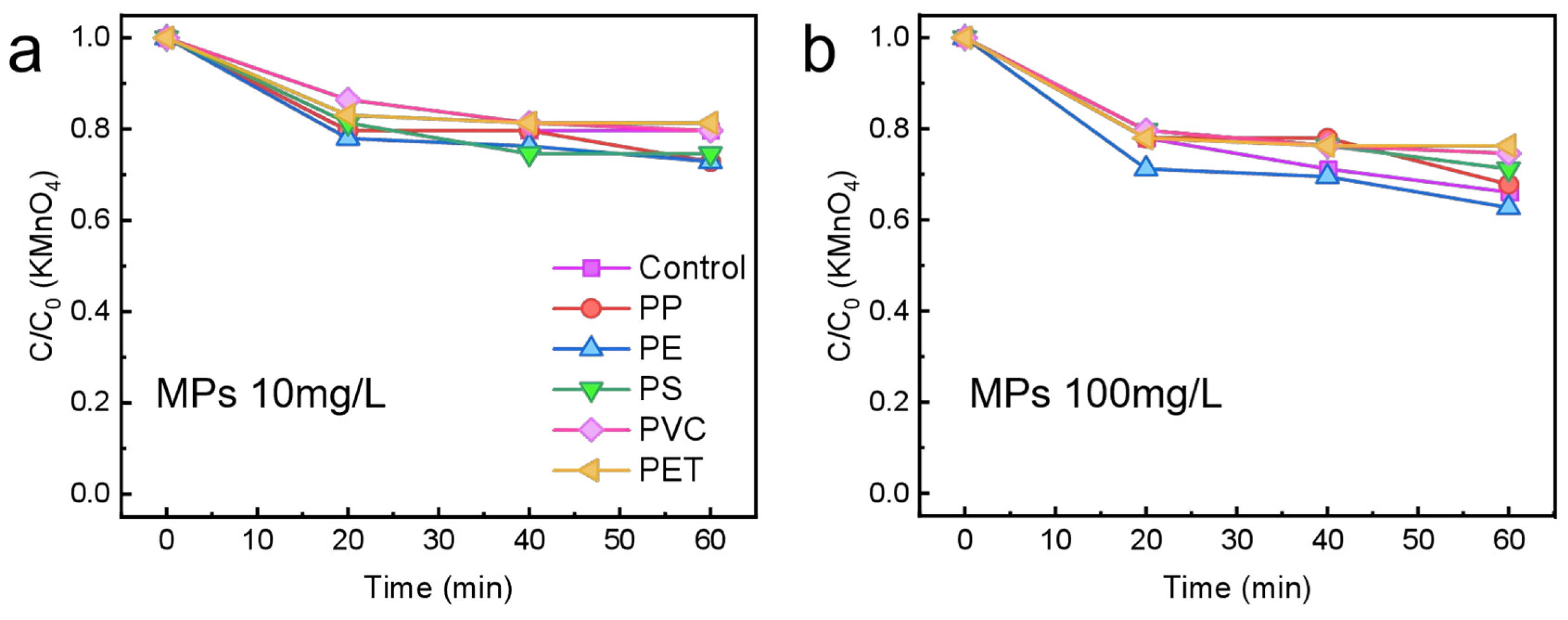
In contrast to the minimal effect on DCF degradation, the presence of MPs significantly influenced PM consumption. As shown in Figure 2, increasing MP concentration led to a pronounced increase in PM depletion, from 20% in the absence of MPs (Control) to 30 ± 5% at higher MP loadings with different MP types. However, the increased PM consumption was not accompanied by enhanced DCF degradation, suggesting that the additional PM depletion was mainly associated with side reactions involving MPs. This enhanced consumption of PM suggests that MPs themselves underwent oxidative transformation, acting as additional reductive substrates for PM. Such reactions have been reported to induce surface oxidation, chain scission, and structural disruption of polymer matrices, ultimately leading to the formation of carboxyl and hydroxyl groups and sinking behavior of MPs [26,27]. Concomitantly, the reduction of PM during these reactions likely promoted the in situ formation of MnO2 colloids [28,29]. While these MnO2 colloidal species are generally considered catalytically active in PM-based systems, the improved PM reduction and MnO2 generation in the presence of MPs did not translate into enhanced DCF degradation.

3.2. Effect of MPs on DCF Degradation in the PM-MnO2 Catalytic System

The introduction of MnO2 as a heterogeneous catalyst dramatically enhanced the degradation efficiency of DCF in the PM system, increasing the removal from 28.4% to 84.6% and elevating the pseudo-first-order rate constant from 5.2 × 10⁻³ to 27.4 × 10⁻³ min−1 (Figure 3a). All data were well fitted by the pseudo-first-order kinetic model, with an average R2 value of 0.939. Adsorption of DCF by MnO2, conducted in our previous study, showed that MnO2 removed only 16.2% of DCF, indicating that adsorption contributed to minor DCF elimination [8]. This pronounced enhancement is consistent with the well-established role of MnO2 in activating PM through surface-mediated redox cycling, where highly reactive Mn(III) intermediates capable of oxidizing electron-rich organic contaminants such as DCF are regenerated from Mn(II) oxidation by PM [8,30]. Such Mn(III)/Mn(II) cycling is known to occur preferentially at surface-active sites, including defect sites and hydroxylated Mn centers, which act as key catalytic hotspots governing reaction kinetics [31,32]. The dominance of the Mn(III)-mediated non-radical oxidation pathway is structurally validated by pyrophosphate complexation [8]. The deliberate introduction of pyrophosphate selectively sequesters and over-stabilizes the surface-bound Mn(III) transients, while moderate stabilization enhances DCF degradation kinetics.
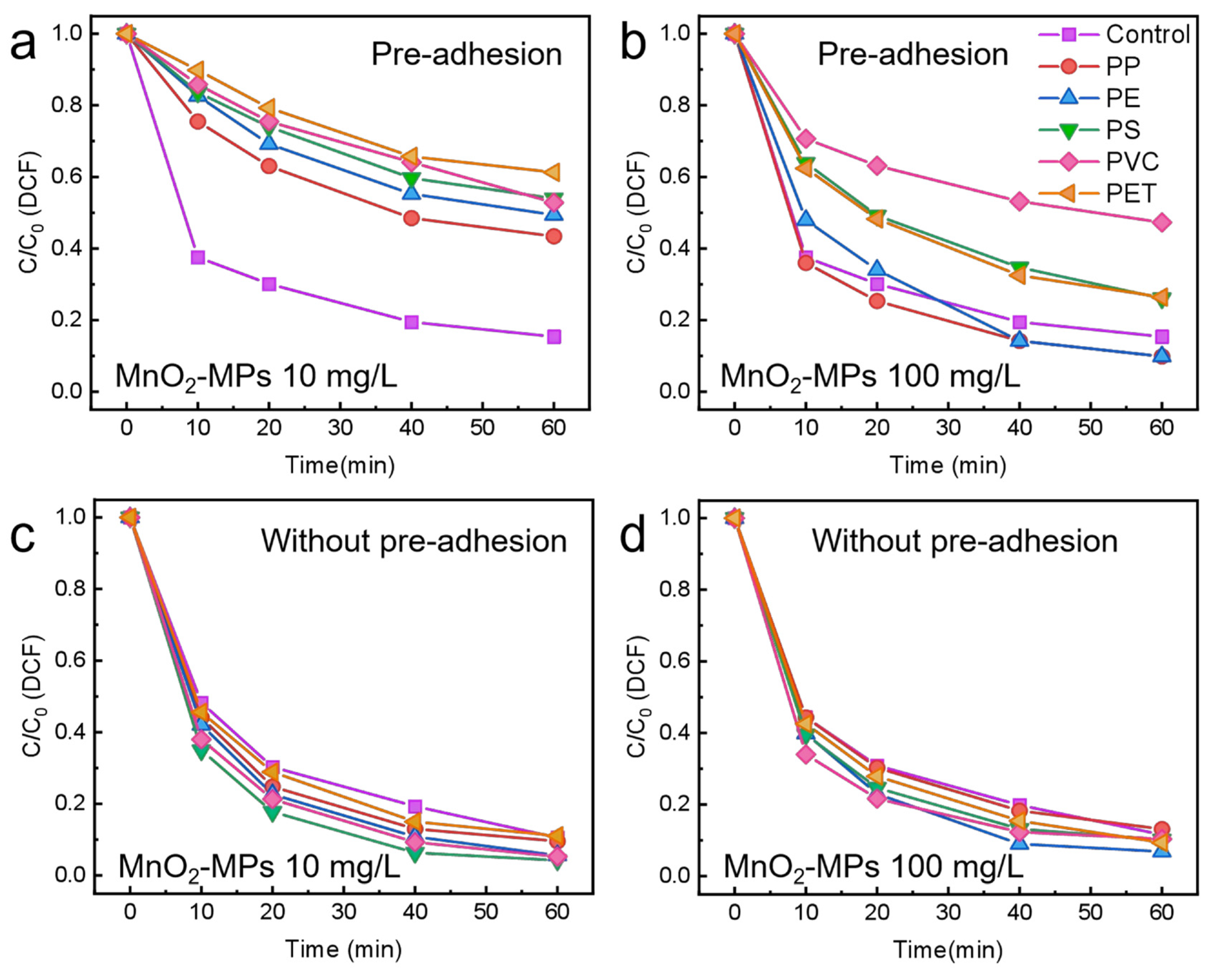
However, when MPs were pre-mixed with MnO2 and allowed to adhere for 24 h prior to reaction, a substantial inhibition in DCF degradation was observed across all MP types (Figure 3a). This inhibitory effect suggests that MPs may partially occupy or shield catalytically active sites on MnO2 [26], thereby potentially suppressing interfacial electron transfer between PM and the catalyst surface. Such surface passivation phenomena have been widely reported in heterogeneous catalysis, where non-reactive or weakly reactive organic matrices adsorb onto catalyst surfaces and block access to reactive centers [33,34]. Among the tested MPs, PVC exhibited the most pronounced inhibitory effect, reducing DCF degradation efficiency to 47%, which may be attributed to its relatively higher polarity and potential for stronger interactions with metal oxide surfaces through dipole–dipole or electrostatic interactions [35,36].
At elevated MP concentrations (100 mg/L), the system exhibited a markedly different and MP-dependent response (Figure 3b). For PE and PP, the inhibitory effect observed at lower concentrations was largely mitigated, while for PS and PET, the suppression was significantly weakened. This phenomenon suggests that at higher MP loadings, additional processes beyond simple site blocking become operative. Specifically, polyolefin-based MPs such as PE and PP are known to be susceptible to oxidative degradation under strong oxidizing conditions, possibly leading to chain scission and the formation of oxygenated intermediates [37,38]. Under MnO2-catalyzed oxidation by PM, oxidation of MPs resulting in reductive consumption of PM promotes the in situ generation of secondary MnO2 colloids. These newly formed MnO2 colloids can still contribute to catalytic activity by providing additional reactive interfaces for DCF oxidation. As a result, the net effect reflects a dynamic balance between catalytic site blocking by MPs and the generation of new catalytic phases, ultimately diminishing the observed inhibition. In contrast, PVC maintained a persistent inhibitory effect even at high concentrations, likely due to its greater chemical resistance to oxidative degradation and limited participation in redox cycling processes [39,40]. This resistance prevents the formation of compensatory MnO2 species, rendering PVC primarily a passive fouling agent that continuously blocks active sites. These results underscore the importance of polymer chemistry in dictating the environmental behavior of MPs in advanced oxidation systems.

3.3. Effects of Mps-MnO2 Pre-Adhesion on DCF Degradation in the PM-MnO2 System

To decouple the effect of pre-adhesion from intrinsic reaction dynamics, parallel experiments were conducted without the pre-adhesion step (Figure 3c,d). In striking contrast to the pre-adhesion scenario, no inhibitory effects were observed regardless of MP concentration, and a slight enhancement in DCF degradation was consistently detected. This dynamic is strictly governed by competitive binding kinetics. Diclofenac with carboxylate groups capable of rapidly establishing direct coordination with surface reactive manganese sites, which have been previously confirmed through open-circuit potential responses and competitive cation binding assays [8]. The simultaneous adhesion of MPs with MnO2 may decrease the accessibility of the MnO2 surface for DCF adsorption. Therefore, the absence of MPs-MnO2 pre-adhesion ensures that surface reactive sites remain available during the initial stage of the reaction. The observed promotional effect further suggests that MPs can act as reactive substrates under oxidative conditions, undergoing partial degradation that contributes to additional MnO2 formation during the reaction process. Such in situ generation of Mn-based catalytic species has been reported to enhance oxidation efficiency in permanganate systems by increasing the density of active redox centers [30]. Therefore, the temporal sequence of interactions among MPs, MnO2 and DCF plays a decisive role in determining their overall impact on catalytic performance.
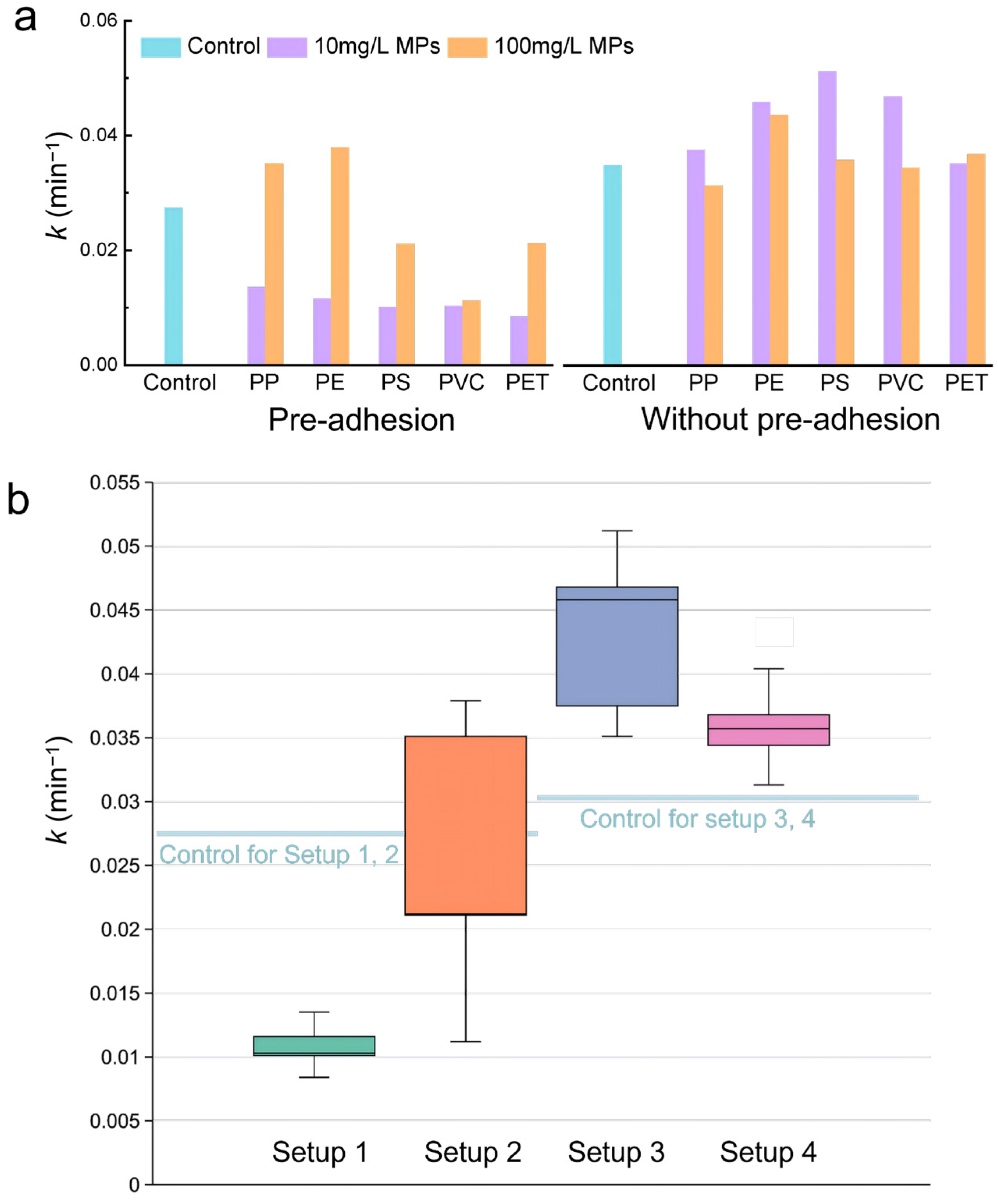
A quantitative comparison of pseudo-first-order rate constants further substantiates these mechanistic interpretations (Figure 4a,b). The box plot represents the pseudo-first-order rate constants (k) across five MPs (PP, PE, PS, PVC, and PET) under varied experimental setups. The results show that the distribution of rate constants is highly influenced by the experimental setup. Systems without MP pre-adhesion consistently exhibited higher rate constants than their pre-adhesion counterparts, confirming that surface accessibility is a dominant factor controlling reaction kinetics (Figure 5a,b). Within the pre-adhesion systems, higher MP concentrations (100 mg/L) resulted in less pronounced inhibition compared to lower concentrations (10 mg/L), supporting the hypothesis that oxidative transformation of MPs at elevated loadings partially offsets catalytic site blocking. Interestingly, in the absence of pre-adhesion, systems with lower MP concentrations exhibited slightly higher reaction rates than those with higher concentrations. This subtle trend suggests that even without intentional pre-adhesion, MPs at high concentrations may rapidly associate with MnO2 surfaces upon mixing, leading to transient site blocking effects that partially suppress catalytic activity. Such rapid adhesion dynamics have been widely observed in nanoparticle–organic matter interactions, where equilibrium can be reached within minutes [40,41].
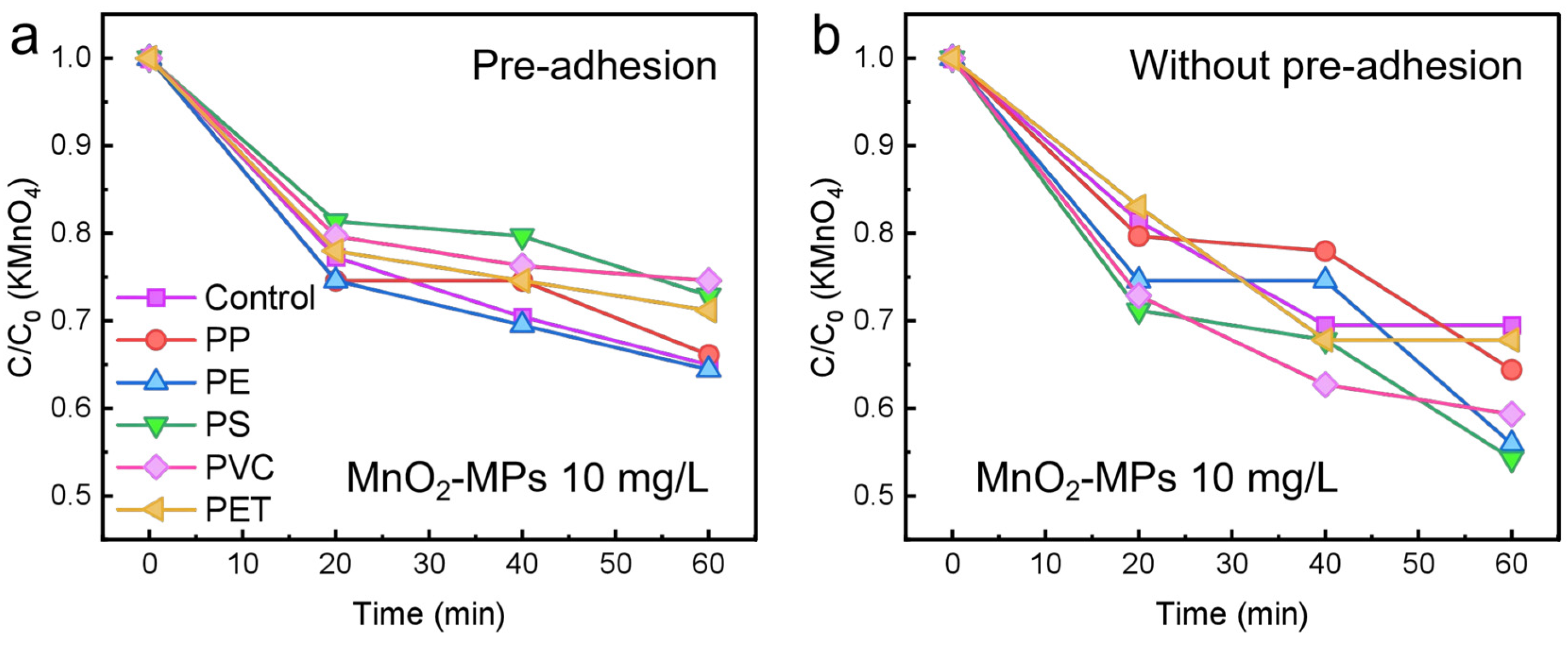
The consumption of permanganate (PM) was substantially enhanced in the presence of MnO2 (Figure 6a) compared to the PM-only system (Figure 2a), indicating a fundamental shift in oxidant utilization upon catalytic activation. This increase is consistent with the enhanced degradation of DCF, which requires higher oxidant input. In addition, MnO2 promotes interfacial electron transfer and facilitates Mn(IV)/Mn(III)/Mn(II) redox cycling, which accelerates the reduction of Mn(VII) and thereby enhances overall PM depletion [30]. Notably, even in the absence of a pre-adhesion step, the presence of MPs such as polyethylene (PE) and polystyrene (PS) led to a discernible increase in PM consumption (Figure 6b). This observation suggests that free MPs themselves act as reactive substrates and undergo oxidation during the reaction process.

3.4. Effect of DCF Pre-Adsorption on DCF Degradation in the PM-MnO2 System

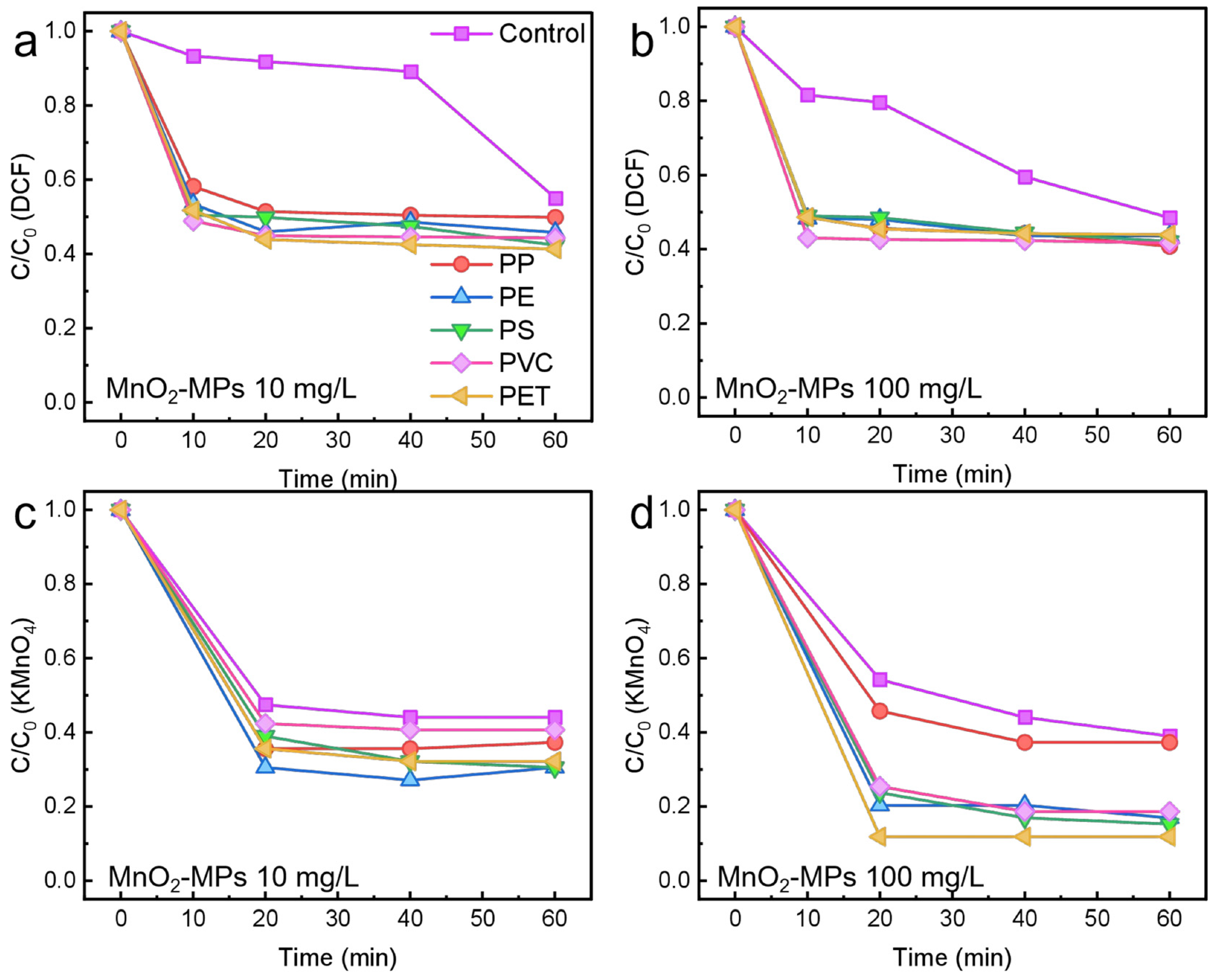
The degradation of DCF in the PM–MnO2 system is markedly reduced in the absence of pre-adsorption onto the MnO2 surface, with removal efficiency decreasing from 84.6% to 50–60% (Figure 7a,b). This pronounced decline highlights the critical role of interfacial interactions in governing catalytic oxidation processes. Specifically, adsorption of DCF onto MnO2 facilitates intimate contact with surface-active Mn sites, which is essential for efficient interfacial electron transfer and the generation of reactive Mn(III) intermediates. In the absence of pre-adsorption, DCF remains predominantly in the bulk solution, and its oxidation relies on diffusion-limited interactions with MnO2 [42], thereby reducing the effective reaction rate. This limitation is consistent with heterogeneous catalytic frameworks, in which mass transfer and adsorption equilibria strongly influence overall reaction kinetics. The kinetic model fitting for these adsorption-dominated reactions was performed using data collected within the first 20 min, yielding R2 values greater than 0.76.
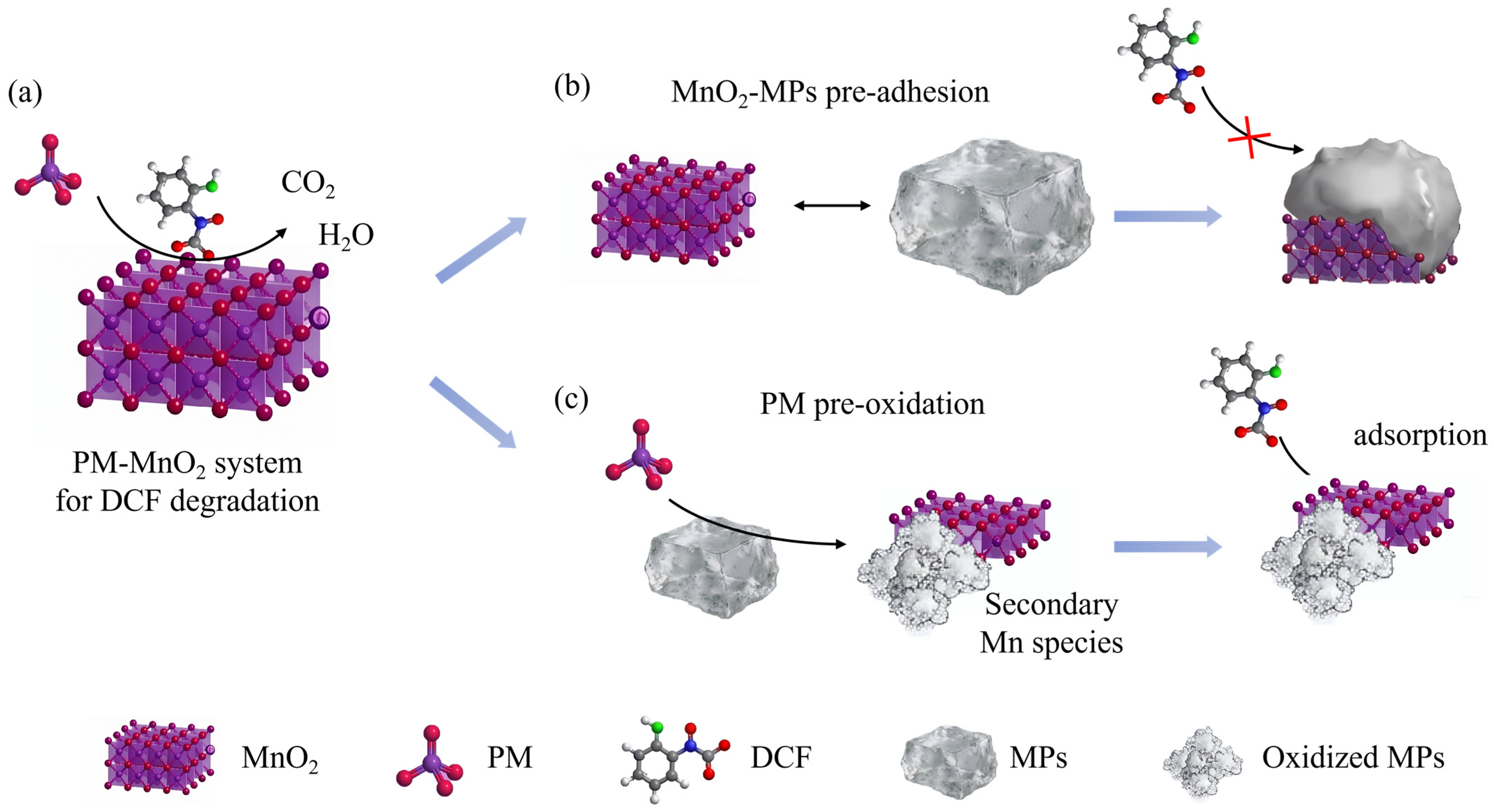
When MnO2-MP composites are pre-oxidized by PM prior to DCF introduction, the degradation behavior shifts significantly, with DCF removal rapidly reaching a plateau within 10 min (Figure 7a,b). While this behavior may superficially resemble adsorption-dominated removal, it more plausibly reflects a loss of catalytic reactivity rather than a simple increase in adsorption capacity. Our previous study showed that only 16.2% of DCF could be removed by MnO2 adsorption [8], so the DCF adsorption efficiency by MnO2-MPs improved to approximately 60% may be attributed to the adsorption by pre-oxidized MPs. Compared to the control test (without MPs), PM consumption is enhanced in the presence of MPs, resulting from the transformation of the oxidation of MPs and the formation of secondary MnO2 colloids. Unlike the crysalline β-MnO2 used in this study [8], these newly formed secondary Mn species are often structurally disordered or poorly crystalline [11], providing additional surface area, and thus may exhibit higher adsorption behavior compared to the original MnO2. As the microplastics undergo extensive structural oxidation, the corresponding massive reduction of the PM inevitably precipitates these disordered transient secondary oxides for DCF adsorption (Figure 5c). Moreover, the oxidative aging of MPs can generate oxygenated functional groups that enhance their affinity for organic pollutants, enabling them to act as auxiliary adsorption phases [43].
However, increasing MP concentration from 10 mg/L to 100 mg/L does not result in a proportional increase in DCF removal (Figure 7a,b), suggesting that the system is not governed by adsorption site availability on MPs. Instead, this behavior indicates that the extent of MP oxidation and consequently the formation of secondary MnO2 colloids are constrained by the availability of reactive Mn species rather than MP abundance. This interpretation is supported by PM consumption data (Figure 7c,d), which show that PM is not fully depleted even at higher MP concentrations, implying that the oxidation process reaches a plateau under fixed MnO2 concentration. Such behavior is characteristic of catalyst-limited systems, where the rate and extent of substrate transformation are controlled by the availability and reactivity of catalytic sites rather than substrate concentration [44]. Consequently, similar amounts of secondary MnO2 colloids are generated across different MP loadings, resulting in comparable adsorption capacities and overall DCF removal efficiencies.

3.5. Effects of MP Types on the DCF Removal

The influence of MP types on DCF removal is strongly dependent on the reaction configuration and the presence of catalytic MnO2, reflecting a complex interplay between oxidant consumption, catalyst accessibility, and interfacial reactions. In the scenario of DCF removal by PM without MnO2, variations in PM consumption induced by different MPs do not translate into measurable differences in DCF degradation rates. This observation indicates that, under non-catalytic conditions, DCF oxidation is governed primarily by the intrinsic reactivity and initial concentration of PM, rather than by competing interactions with MPs.
When MnO2-MP composites are pre-oxidized by PM prior to DCF introduction, a substantial increase from 0.23 to 0.65 in PM consumption was observed, indicating that prolonged contact between PM and MPs enhances the oxidative transformation of MPs. This process likely involves progressive surface oxidation and structural modification of MPs, which increases their reactivity toward permanganate over time [45]. Concomitantly, a moderate increase in DCF removal is observed alongside elevated PM consumption from 0.58 to 0.7, suggesting that additional processes contribute to DCF attenuation. However, this enhancement should not be attributed solely to increased oxidant availability. Instead, it is more plausibly associated with the formation of secondary MnO2 colloids generated during PM reduction, which provide additional surfaces for DCF adsorption.
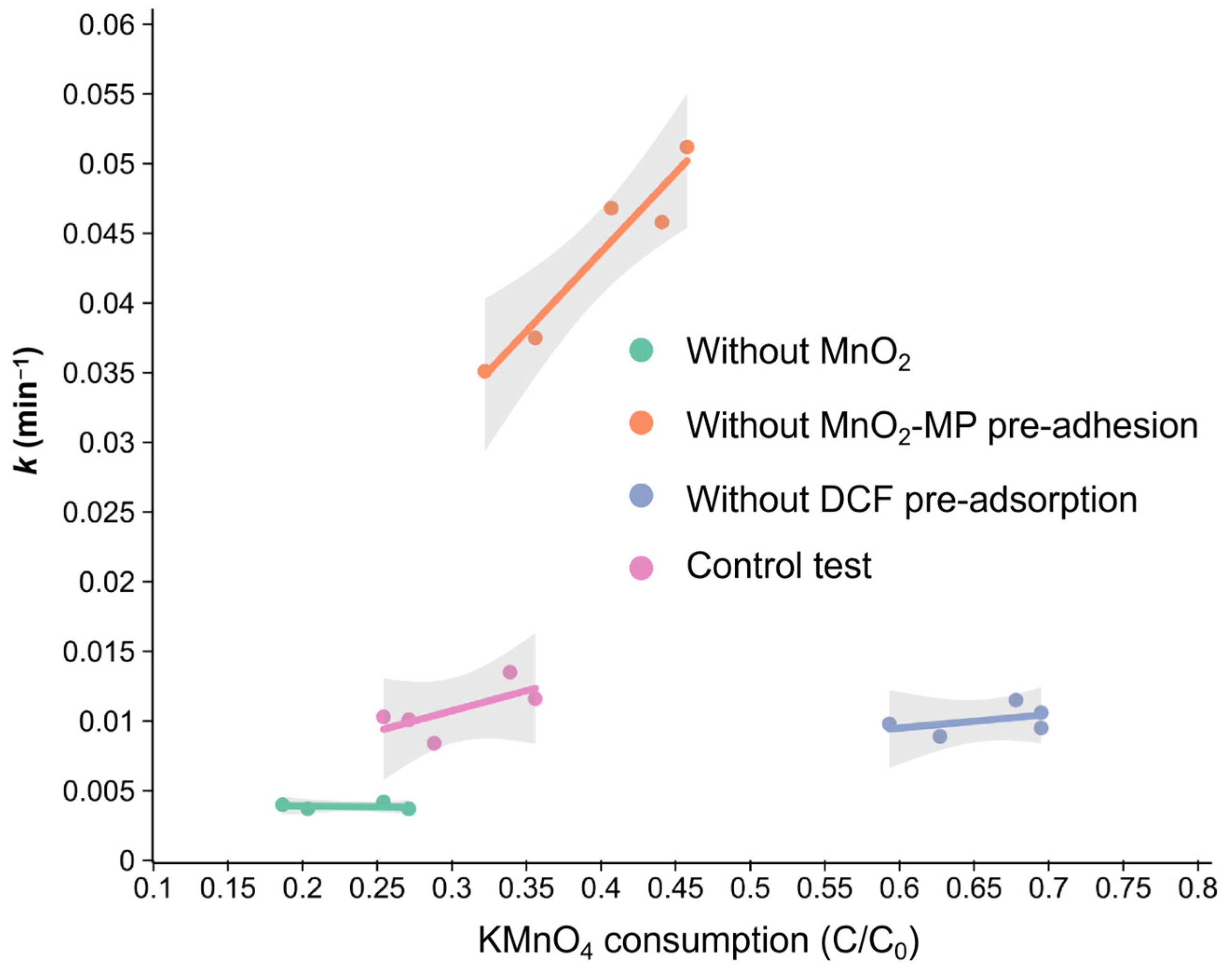
In contrast, under conditions without MnO2-MP pre-adhesion, both PM consumption and DCF degradation rates are significantly higher than those observed in the pre-adhesion scenario. This indicates that the absence of prior MP coverage preserves the accessibility of active MnO2 sites, thereby enhancing catalytic efficiency. In such systems, the increased PM consumption by different MP types is more effectively coupled to DCF oxidation, rather than being diverted toward non-productive pathways such as surface passivation or MP oxidation. Furthermore, the observed correlation between PM consumption, increasing from 0.32 to 0.45, and DCF degradation rate constants, from 0.035 to 0.053 min−1. In addition, the results of linear regression between PM consumption and k values (Table 2) showed that although the data points under different experimental conditions were distributed in distinct regions (Figure 8), only the experimental setup without MnO2-MP pre-adhesion exhibited a clear linear relationship between PM consumption and the DCF degradation rate constant, with an R2 value of 0.9220. This result indicates that although MP types determine PM consumption in different systems, the DCF degradation improves proportionally with PM consumption only in the system without MnO2-MP pre-adhesion. In other words, reduced MP adhesion leads to more MP oxidation and more availability of active Mn sites, promoting both oxidant utilization and DCF degradation. This trend highlights a key mechanistic insight: the extent of MnO2-MP association governs the partitioning of PM consumption between productive, i.e., DCF oxidation to less toxic products [8], and non-productive, i.e., MP oxidation or surface passivation, pathways.

4. Conclusions

This study systematically elucidated the multifaceted roles of MPs in the PM-MnO2 catalytic system for DCF degradation. The results demonstrated that the influence of MPs was highly dependent on reaction configuration, catalyst availability, and interfacial interactions. In the absence of MnO2, MPs significantly increased PM consumption but did not alter DCF degradation kinetics, confirming that MPs primarily acted as competing reductive substrates rather than modifiers of the oxidation pathway. In contrast, MnO2 catalysis markedly enhanced DCF degradation through surface-mediated Mn redox reactions. Under these conditions, MPs exerted dual and dynamic effects. Pre-adhesion of MPs onto MnO2 resulted in surface passivation, reducing catalytic activity by blocking active Mn sites and inhibiting interfacial electron transfer, which decreased DCF removal efficiency from 84.6% to approximately 50–60%. This led to a decoupling between oxidant consumption and pollutant degradation, where PM was consumed without a proportional increase in DCF removal. Conversely, when MPs were introduced without pre-adhesion, catalytic performance was preserved or slightly enhanced, with the apparent DCF degradation rate constants increasing from 0.035 to 0.053 min−1. This behavior may be associated with MP oxidation and concurrent Mn species transformation during the reaction process, which could provide additional reactive interfaces and partially compensate for catalyst deactivation. Furthermore, the extent of MP oxidation appeared to be primarily limited by catalyst availability rather than MP concentration, explaining the weak correlation between MP dosage and DCF removal. The plausible MP oxidation associated with PM depletion further validation through direct microscopic and spectroscopic evidence. Overall, the system was governed by the dynamic interplay among catalyst accessibility, oxidant partitioning, and material transformation.
This work demonstrates that MPs are not merely passive interferents but can actively influence catalytic oxidation processes in complex water matrices. These findings provide important insights into the behavior of advanced oxidation systems under realistic coexistence conditions of emerging contaminants and MPs. Nevertheless, several limitations should be acknowledged. The present study was conducted in simplified laboratory water matrices, and the effects of real-water constituents, aged MPs, toxicity evolution, and transformation products were not evaluated. In addition, the long-term impacts of MP accumulation on catalyst stability and regeneration remain unclear. From a practical perspective, strategies such as upstream MP removal, reducing MP–catalyst contact time, and periodic catalyst regeneration may help alleviate catalyst passivation and improve long-term treatment performance in water treatment applications. It should be noted that the current findings are based on simplified laboratory matrices. While this model provides fundamental mechanistic insights, further investigations involving real water constituents, aged microplastics, and long-term toxicity evaluations are required to further validate the practical influences of MPs on heterogeneous catalytic systems.

Author Contributions

Methodology, X.L.; Investigation, X.L., Y.-B.H. and S.Y.; Data curation, X.L., Y.-B.H., S.Y., W.P. and Z.Z.; Writing—original draft, X.L.; Writing—review and editing, Y.-B.H. and Z.Z.; Visualization, X.L., Y.-B.H., S.Y. and W.P.; Supervision, Y.-B.H. and Z.Z.; Funding acquisition, Y.-B.H. All authors have read and agreed to the published version of the manuscript.

Funding

This research was funded by the National Natural Science Foundation of China, grant number 52370169. This research was funded by the Natural Science Foundation of Fujian Province, grant number 2024J09037. This research was funded by the China Postdoctoral Science Foundation grant number 2023M742247.

Data Availability Statement

The raw data supporting the conclusions of this article will be made available by the authors on request.

Acknowledgments

During the preparation of this manuscript, the authors used Gemini 3.1Pro and Microsoft 365 PowerPoint for the purposes of creating the items in the graphical abstract and Figure 5, and the box plot was drawn using ChiPlot (https://www.chiplot.online/, accessed on 10 April 2026). The authors have reviewed and edited the output and take full responsibility for the content of this publication.

Conflicts of Interest

The authors declare no conflicts of interest.

References

  1. Michelangeli, M.; Martin, J.M.; Robson, S.; Cerveny, D.; Walsh, R.; Richmond, E.K.; Grace, M.R.; Brand, J.A.; Bertram, M.G.; Ho, S.S.; et al. Pharmaceutical pollution alters the structure of freshwater communities and hinders their recovery from a fish predator. Environ. Sci. Technol. 2024, 58, 13904–13917. [Google Scholar] [CrossRef]
  2. Cizmas, L.; Sharma, V.K.; Gray, C.M.; McDonald, T.J. Pharmaceuticals and personal care products in waters: Occurrence, toxicity, and risk. Environ. Chem. Lett. 2015, 13, 381–394. [Google Scholar] [CrossRef]
  3. An, X.; Tao, Y.; Wu, J.; Li, Z.; Li, H.; Chen, S.; Pang, Y. Occurrence, toxicity, ecological risk, and remediation of diclofenac in surface water environments: A review with a focus on China. Environ. Toxicol. Chem. 2026, 45, 753–767. [Google Scholar] [CrossRef]
  4. Aus der Beek, T.; Weber, F.A.; Bergmann, A.; Hickmann, S.; Ebert, I.; Hein, A.; Küster, A. Pharmaceuticals in the environment—Global occurrences and perspectives. Environ. Toxicol. Chem. 2016, 35, 823–835. [Google Scholar] [CrossRef]
  5. Duarte, C.; Di Lorenzo, T.; Reboleira, A.S.P. Environmental risk of diclofenac in European groundwaters and implications for environmental quality standards. Sci. Rep. 2024, 14, 20689. [Google Scholar] [CrossRef] [PubMed]
  6. Yu, H.; Nie, E.; Xu, J.; Yan, S.; Cooper, W.J.; Song, W. Degradation of diclofenac by advanced oxidation and reduction processes: Kinetic studies, degradation pathways and toxicity assessments. Water Res. 2013, 47, 1909–1918. [Google Scholar] [CrossRef] [PubMed]
  7. Bound, J.; Voulvoulis, N. Pharmaceuticals in the aquatic environment—A comparison of risk assessment strategies. Chemosphere 2004, 56, 1143–1155. [Google Scholar] [CrossRef] [PubMed]
  8. Zheng, Z.; Lin, L.; Hu, Y.-b.; Liao, X.; Fu, M.-L.; Yuan, B. Effective diclofenac degradation via intrinsic Mn (III)-Mn (II) cycle in the permanganate-manganese dioxide system. J. Environ. Chem. Eng. 2025, 13, 117172. [Google Scholar] [CrossRef]
  9. Hu, Y.-b.; Lo, S.-L.; Li, Y.-F.; Lee, Y.-C.; Chen, M.-J.; Lin, J.-C. Autocatalytic degradation of perfluorooctanoic acid in a permanganate-ultrasonic system. Water Res. 2018, 140, 148–157. [Google Scholar] [CrossRef]
  10. Wang, Y.; Zheng, K.; Guo, H.; Tian, L.; He, Y.; Wang, X.; Zhu, T.; Sun, P.; Liu, Y. Potassium permanganate-based advanced oxidation processes for wastewater decontamination and sludge treatment: A review. Chem. Eng. J. 2023, 452, 139529. [Google Scholar] [CrossRef]
  11. Jiang, J.; Pang, S.-Y.; Ma, J. Oxidation of triclosan by permanganate (Mn (VII)): Importance of ligands and in situ formed manganese oxides. Environ. Sci. Technol. 2009, 43, 8326–8331. [Google Scholar] [CrossRef]
  12. Birch, Q.T.; Potter, P.M.; Pinto, P.X.; Dionysiou, D.D.; Al-Abed, S.R. Sources, transport, measurement and impact of nano and microplastics in urban watersheds. Rev. Environ. Sci. Bio/Technol. 2020, 19, 275–336. [Google Scholar] [CrossRef]
  13. Guo, Y.; Yang, L.; Cheng, X.; Wang, X. The application and reaction mechanism of catalytic ozonation in water treatment. J. Environ. Anal. Toxicol. 2012, 2, 1000150. [Google Scholar] [CrossRef]
  14. Nihart, A.J.; Garcia, M.A.; El Hayek, E.; Liu, R.; Olewine, M.; Kingston, J.D.; Castillo, E.F.; Gullapalli, R.R.; Howard, T.; Bleske, B. Bioaccumulation of microplastics in decedent human brains. Nat. Med. 2025, 31, 1114–1119. [Google Scholar] [CrossRef] [PubMed]
  15. Gatidou, G.; Arvaniti, O.S.; Stasinakis, A.S. Review on the occurrence and fate of microplastics in Sewage Treatment Plants. J. Hazard. Mater. 2019, 367, 504–512. [Google Scholar] [CrossRef] [PubMed]
  16. Santos, L.H.; Rodríguez-Mozaz, S.; Barceló, D. Microplastics as vectors of pharmaceuticals in aquatic organisms—An overview of their environmental implications. Case Stud. Chem. Environ. Eng. 2021, 3, 100079. [Google Scholar] [CrossRef]
  17. Sedlak, D.L.; Pinkston, K.E. Factors affecting the concentrations of pharmaceuticals released to the aquatic environment. J. Contemp. Water Res. Educ. 2011, 120, 7. [Google Scholar]
  18. Rocha-Santos, T.; Costa, M.; Mouneyrac, C. Handbook of Microplastics in the Environment; Springer: Cham, Switzerland, 2021. [Google Scholar]
  19. Zhang, S.; Gutierrez, L.; Niu, X.-Z.; Qi, F.; Croue, J.-P. The characteristics of organic matter influence its interfacial interactions with MnO2 and catalytic oxidation processes. Chemosphere 2018, 209, 950–959. [Google Scholar] [CrossRef] [PubMed]
  20. Rodríguez-Serin, H.; Gamez-Jara, A.; De La Cruz-Noriega, M.; Rojas-Flores, S.; Rodriguez-Yupanqui, M.; Gallozzo Cardenas, M.; Cruz-Monzon, J. Literature review: Evaluation of drug removal techniques in municipal and hospital wastewater. Int. J. Environ. Res. Public Health 2022, 19, 13105. [Google Scholar] [CrossRef]
  21. Reddy, A.S.; Nair, A.T. The fate of microplastics in wastewater treatment plants: An overview of source and remediation technologies. Environ. Technol. Innov. 2022, 28, 102815. [Google Scholar] [CrossRef]
  22. Montecinos, S.; Tognana, S.; Salgueiro, W.; Frosinini, C. Temporal variation of the microplastic concentration in a stream that receives discharge from wastewater treatment plants. Environ. Pollut. 2024, 340, 122776. [Google Scholar] [CrossRef]
  23. Laszakovits, J.R.; Kerr, A.; MacKay, A.A. Permanganate oxidation of organic contaminants and model compounds. Environ. Sci. Technol. 2022, 56, 4728–4748. [Google Scholar] [CrossRef]
  24. Li, J.; Pang, S.-Y.; Wang, Z.; Guo, Q.; Duan, J.; Sun, S.; Wang, L.; Cao, Y.; Jiang, J. Oxidative transformation of emerging organic contaminants by aqueous permanganate: Kinetics, products, toxicity changes, and effects of manganese products. Water Res. 2021, 203, 117513. [Google Scholar] [CrossRef] [PubMed]
  25. Kalaronis, D.; Evgenidou, E.; Kyzas, G.Z.; Bikiaris, D.N.; Lambropoulou, D.A. Adsorption of a mixture of daily use pharmaceuticals on pristine and aged polypropylene microplastics. Environments 2024, 11, 198. [Google Scholar] [CrossRef]
  26. Chen, Y.; Liu, R.; Wu, X.; Liu, Y.; Fu, J.; Ou, H. Surface characteristic and sinking behavior modifications of microplastics during potassium permanganate pre-oxidation. J. Hazard. Mater. 2022, 422, 126855. [Google Scholar] [CrossRef] [PubMed]
  27. Nguyen, T.-B.; Chen, C.-W.; Chen, W.-H.; Bui, X.-T.; Hsieh, S.; Dong, C.-D. Enhancing the degradation of microplastics through combined KMnO4 oxidation and UV radiation. J. Environ. Manag. 2024, 370, 122942. [Google Scholar] [CrossRef]
  28. Song, Q.; Cao, S.; Zavala-Rivera, P.; Ping Lu, L.; Li, W.; Ji, Y.; Al-Muhtaseb, S.A.; Cheetham, A.K.; Sivaniah, E. Photo-oxidative enhancement of polymeric molecular sieve membranes. Nat. Commun. 2013, 4, 1918. [Google Scholar] [CrossRef]
  29. Pang, S.-Y.; Duan, J.-B.; Zhou, Y.; Gao, Y.; Jiang, J. Oxidation kinetics of anilines by aqueous permanganate and effects of manganese products: Comparison to phenols. Chemosphere 2019, 235, 104–112. [Google Scholar] [CrossRef]
  30. Wang, S.; Chen, J.; Sun, Y.; Sun, B.; Qiao, J.; Guan, X. Roles of MnO2 colloids and Mn (III) during the oxidation of organic contaminants by permanganate. Environ. Sci. Technol. 2022, 57, 997–1005. [Google Scholar] [CrossRef]
  31. Yang, Y.; Zhang, P.; Hu, K.; Zhou, P.; Wang, Y.; Asif, A.H.; Duan, X.; Sun, H.; Wang, S. Crystallinity and valence states of manganese oxides in Fenton-like polymerization of phenolic pollutants for carbon recycling against degradation. Appl. Catal. B Environ. 2022, 315, 121593. [Google Scholar] [CrossRef]
  32. Wang, Y.; Bai, Y.; Su, J.; Ali, A.; Gao, Z.; Huang, T.; Cao, M.; Ren, M. Advances in microbially mediated manganese redox cycling coupled with nitrogen removal in wastewater treatment: A critical review and bibliometric analysis. Chem. Eng. J. 2023, 461, 141878. [Google Scholar] [CrossRef]
  33. Liu, K.; Jiang, L.; Huang, W.; Zhu, G.; Zhang, Y.-J.; Xu, C.; Qin, R.; Liu, P.; Hu, C.; Wang, J. Atomic overlayer of permeable microporous cuprous oxide on palladium promotes hydrogenation catalysis. Nat. Commun. 2022, 13, 2597. [Google Scholar] [CrossRef] [PubMed]
  34. Shen, T.; Bao, H.; Su, W.; Jiang, Y.; Tong, S. Manganese containing oxides catalytic ozonation in aqueous solution: Catalytic mechanism on acid sites. Sep. Purif. Technol. 2022, 282, 120053. [Google Scholar] [CrossRef]
  35. Zhou, J.; Saeidi, N.; Wick, L.Y.; Kopinke, F.-D.; Georgi, A. Adsorption of polar and ionic organic compounds on activated carbon: Surface chemistry matters. Sci. Total Environ. 2021, 794, 148508. [Google Scholar] [CrossRef]
  36. Huang, R.; Guan, C.; Guo, Q.; Wang, Z.; Pan, H.; Jiang, J. Oxidation of diclofenac by permanganate: Kinetics, products and effect of inorganic reductants. Chin. Chem. Lett. 2023, 34, 107610. [Google Scholar] [CrossRef]
  37. Andrady, A.L.; Koongolla, B. Degradation and fragmentation of microplastics. In Plastics and the Ocean: Origin, Characterization, Fate, Impact; Wiley: Hoboken, NJ, USA, 2022; pp. 227–268. [Google Scholar]
  38. Awfa, D.; Ateia, M.; Fujii, M.; Yoshimura, C. Photocatalytic degradation of organic micropollutants: Inhibition mechanisms by different fractions of natural organic matter. Water Res. 2020, 174, 115643. [Google Scholar] [CrossRef] [PubMed]
  39. Kim, S.; Sin, A.; Nam, H.; Park, Y.; Lee, H.; Han, C. Advanced oxidation processes for microplastics degradation: A recent trend. Chem. Eng. J. Adv. 2022, 9, 100213. [Google Scholar] [CrossRef]
  40. Li, Z.-L.; Cheng, R.; Chen, F.; Lin, X.-Q.; Yao, X.-J.; Liang, B.; Huang, C.; Sun, K.; Wang, A.-J. Selective stress of antibiotics on microbial denitrification: Inhibitory effects, dynamics of microbial community structure and function. J. Hazard. Mater. 2021, 405, 124366. [Google Scholar] [CrossRef]
  41. Rashid, M.; Sterbinsky, G.E.; Pinilla, M.Á.G.; Cai, Y.; O’Shea, K.E. Kinetic and mechanistic evaluation of inorganic arsenic species adsorption onto humic acid grafted magnetite nanoparticles. J. Phys. Chem. C 2018, 122, 13540–13547. [Google Scholar] [CrossRef]
  42. Forrez, I.; Carballa, M.; Verbeken, K.; Vanhaecke, L.; Ternes, T.; Boon, N.; Verstraete, W. Diclofenac oxidation by biogenic manganese oxides. Environ. Sci. Technol. 2010, 44, 3449–3454. [Google Scholar] [CrossRef] [PubMed]
  43. Bhadra, B.N.; Seo, P.W.; Jhung, S.H. Adsorption of diclofenac sodium from water using oxidized activated carbon. Chem. Eng. J. 2016, 301, 27–34. [Google Scholar] [CrossRef]
  44. Remucal, C.K.; Ginder-Vogel, M. A critical review of the reactivity of manganese oxides with organic contaminants. Environ. Sci. Process Impact 2014, 16, 1247–1266. [Google Scholar] [CrossRef] [PubMed]
  45. Pujari, S.P.; Scheres, L.; Marcelis, A.T.; Zuilhof, H. Covalent surface modification of oxide surfaces. Angew. Chem. Int. Ed. 2014, 53, 6322–6356. [Google Scholar] [CrossRef] [PubMed]
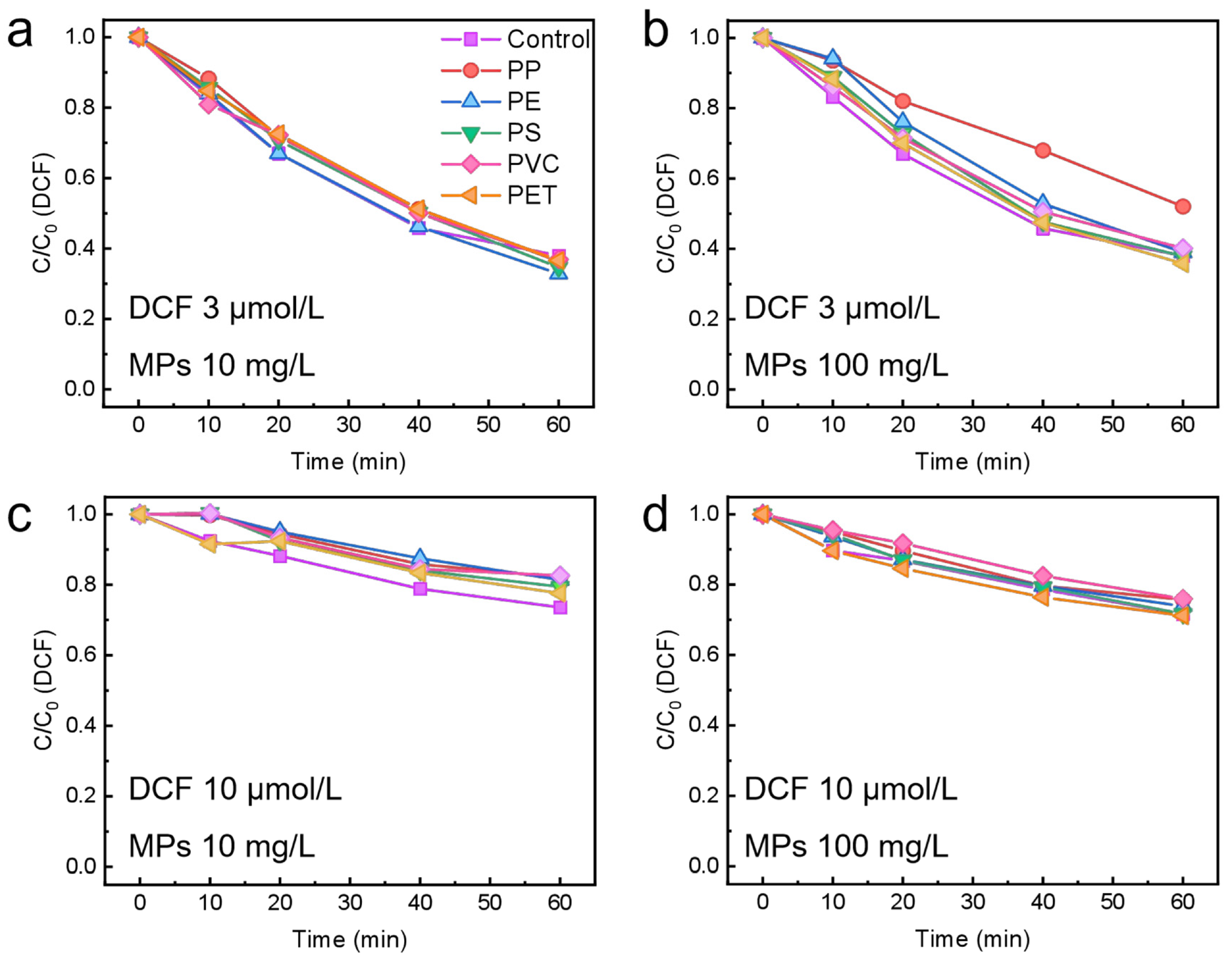
Figure 1. DCF degradation by PM in the presence of MPs with the DCF concentrations of (a,b) 3 and (c,d) 10 μmol/L and MPs concentrations of (a,c) 10 and (b,d) 100 mg/L. Reaction conditions: [PM] = 20 μmol/L, pH = 7.0 ± 0.05, and T = 25 ± 1 °C.
Water 18 01464 g001
Figure 2. PM consumption during DCF degradation by PM with MPs of (a) 10 and (b) 100 mg/L. Reaction conditions: [DCF] = 10 μmol/L, [PM] = 20 μmol/L, pH = 7.0 ± 0.05, and T = 25 ± 1 °C.
Water 18 01464 g002
Figure 3. Effects of MPs on DCF degradation in the PM-MnO2 system (a,b) with and (c,d) without MnO2-MP pre-adhesion with MP concentrations of (a,c) 10 and (b,d) 100 mg/L. Reaction conditions: [DCF] = 10 μmol/L, [PM] = 20 μmol/L, [MnO2] = 0.2 g/L, pH = 7.0 ± 0.05, and T = 25 ± 1 °C.
Water 18 01464 g003
Figure 4. Rate constant k of DCF degradation in the PM-MnO2 system: (a) k values with and without MnO2−MP pre-adhesion in the presence of 10 and 100 mg/L MPs. (b) Box-plot representation of k values with different experiment setups: (setup 1) 10 mg/L MPs with pre-adhesion, (setup 2) 100 mg/L MPs with pre-adhesion, (setup 3) 10 mg/L MPs without pre-adhesion, (setup 4) 100 mg/L MPs without pre-adhesion. Reaction conditions: [DCF] = 10 μmol/L, [PM] = 20 μmol/L, [MnO2] = 0.2 g/L, pH = 7.0 ± 0.05, and T = 25 ± 1 °C.
Water 18 01464 g004
Figure 5. Illustration on (a) DCF degradation in the PM/MnO2 system and influential mechanisms with (b) MnO2-MPs pre-adhesion and (c) PM pre-oxidation process on the DCF removal.
Water 18 01464 g005
Figure 6. PM consumption during DCF degradation in the PM-MnO2 system in the presence of 10 mg/L MPs (a) with and (b) without MnO2-MP pre-adhesion. Reaction conditions: [DCF] = 10 μmol/L, [PM] = 20 μmol/L, [MnO2] = 0.2 g/L, pH = 7.0 ± 0.05, and T = 25 ± 1 °C.
Water 18 01464 g006
Figure 7. DCF degradation and PM consumption in the PM-MnO2 system in the presence of MPs without 1-d pre-adsorption: (a,b) DCF degradation and (c,d) PM consumption in the presence of (a,c) 10 and (b,d) 100 mg/L MPs. Reaction conditions: [DCF] = 10 μmol/L, [PM] = 20 μmol/L, [MnO2] = 0.2 g/L, pH = 7.0 ± 0.05, and T = 25 ± 1 °C.
Water 18 01464 g007
Figure 8. Correlation between PM consumption and DCF removal rate constants k. Reaction conditions for control test: [DCF] = 10 μmol/L, [PM] = 20 μmol/L, [MnO2] = 0.2 g/L, [MPs] = 10 mg/L, pH = 7.0 ± 0.05, and T = 25 ± 1 °C.
Water 18 01464 g008
Table 1. Four typical experimental setups.
Experiment GroupExperimental Setup
Standard control testDCF, NaCl, HA, MPs and MnO2 were mixed by stirring for 1-d. Then, PM was added to initiate the reaction.
Without MnO2Same process as the control test, except MnO2 was absent.
Without MnO2-MP pre-adhesionSame process with the control test, except MnO2 was added with PM after the 1-d stirring.
Without DCF pre-adsorptionSame process with the control test, except PM was added during the 1-d stirring, and DCF was added after the 1-d stirring.
Table 2. Linear regression equations and corresponding R2 values between PM consumption and DCF degradation rate constants under different experimental conditions.
Experimental SetupRegression EquationR2
Control testy = 0.0288x + 0.00210.4425
Without MnO2y = −0.0011x + 0.00410.0343
Without MnO2-MP pre-adhesiony = 0.1136x − 0.00180.9220
Without DCF pre-adsorptiony = 0.0098x + 0.00360.1923
Disclaimer/Publisher’s Note: The statements, opinions and data contained in all publications are solely those of the individual author(s) and contributor(s) and not of MDPI and/or the editor(s). MDPI and/or the editor(s) disclaim responsibility for any injury to people or property resulting from any ideas, methods, instructions or products referred to in the content.