Article

Impact of Urbanization on the Risk of Flash Flooding in Ellicott City, Maryland

1
NOAA Physical Sciences Laboratory, Boulder, CO 80305, USA
2
Cooperative Institute for Research in the Atmosphere, Colorado State University, Fort Collins, CO 80523, USA
*
Author to whom correspondence should be addressed.
Water 2026, 18(12), 1463; https://doi.org/10.3390/w18121463 (registering DOI)
Submission received: 12 May 2026 / Revised: 9 June 2026 / Accepted: 11 June 2026 / Published: 13 June 2026
(This article belongs to the Special Issue Urban Flood Risk Assessment and Management)

Abstract

Quantifying the impact of land use changes on the threat of flash-floods is a critical consideration in flood hazard planning and risk reduction, and is an area of active research. Here, a coupled Weather Research and Forecasting model hydrological extension package (i.e., WRF-Hydro) modeling approach is applied to simulate flash-flooding processes for short-duration, localized, intense precipitation events. To better understand the effect of urbanization on flash floods, a series of numerical experiments is performed surrounding Ellicott City, Maryland, a location which has experienced both significant heavy rainfall events and suburban development over the past several decades. Two intense rainfall events occurring on 30 July 2016 and 27 May 2018 are investigated, respectively, to first calibrate the hydrologic model performance and then quantify the sensitivity of flash flooding to varying degrees of urbanization. Performing the same experiments using observed historical land use states is of more limited insight, as the thrust of suburban development in the Ellicott City region significantly predates satellite-derived land use datasets. Results confirm that urbanization produces larger river streamflow, higher water stages, faster hydrologic responses to achieve peak flow discharge, and shorter recession limbs, even for very intense, short-duration events. The collective findings suggest that WRF-Hydro is applicable for both watershed flash flood prediction and hypothesis testing, and demonstrates potential utility to urban development decision-makers in locations such as Ellicott City, which could face future increases in catastrophic flooding.

1. Introduction

Increasing trends in the frequency, duration, and intensity of catastrophic floods have been documented in studies at both the global and local scales [1,2,3]. Such increases have been attributed to a combination of anthropogenic impacts, including both global climate change (e.g., [4,5,6,7]) and human-inflicted land use changes. The impact of climate change on flooding is an active area of research; however, understanding the physical processes responsible for the impact of anthropogenic land use effects on flood risk remains a critical area of outstanding research need [8,9,10]). Land use changes, such as deforestation, urbanization, agricultural practices, and terracing, have been shown to influence the catchment water balance and thus also flood-generating processes [11]. For example, urbanization in Houston, Texas, was shown to increase the probability of extreme flooding associated with Hurricane Harvey by approximately 21 times [8]. Furthermore, in the riverine metropolitan regions of the U.S., flood risk mitigation practices are driven by local hydrology and shaped by socioeconomic factors that often also expose racial inequity in flood exposure and capacity for resilience [2]. Across a multitude of disciplines, past studies have demonstrated that land use and changes therein impose significant controls on floods and human impacts (e.g., [11,12,13]).
To demonstrate the impact of different land use scenarios on flooding, various model-based sensitivity study approaches have been used in recent years [13,14,15,16,17,18]. For example, Jodar-Abellan et al. (2019) [16] employed the Soil and Water Assessment Tool (SWAT) model to capture the variation in flash-flood risk at the watershed scale under five land use scenarios in southeast Spain. Feng et al. (2021) [13] illustrated the effects of urbanization on changes in urban flood risks over a small watershed in Toronto, Canada, using the coupling of a hydrologic model, i.e., Hydrologic Engineering Center (HEC)-Hydrological Model System (HMS) and a hydraulic model, i.e., HEC-River Analysis System (RAS). Gori et al. (2019) [15] characterized urbanization impacts on the floodplain through the integration of a land use projection model, a physically based, distributed hydrologic model (i.e., Vflo), and a hydraulic model (i.e., HEC-RAS) for a natural watershed in Houston, Texas. However, understanding the effect of land use changes on flash-flood processes across different spatiotemporal scales is still not comprehensively understood. More specifically, quantifying the role of land use changes in modified river floodplains at the catchment/watershed scale remains elusive. In addition, there is no one-size-fits-all hydrologic model that could address the multi-scale uncertainties of flood inundation prediction, and to date, less attention has been focused on the impacts of urbanization on inundation.
Although there are numerous examples of urban communities confronting the challenge of growth in population and infrastructure and the growing risk of adverse hydrologic impacts, Ellicott City, MD, in particular, has suffered several recent catastrophic flooding events, which present a unique opportunity to explore changes in hydrologic response during heavy rain events with increasing urbanization. Both of the recent flash-flooding events caused extensive damage and loss of life, and, in the face of expensive recovery and rebuilding efforts, the Ellicott City community is concerned about the extent to which urban development and land use contribute to the increasing flood risk (e.g., https://www.howardcountymd.gov/county-executive/ellicott-city-safe-and-sound, accessed on 10 June 2026). The aim of the present study is to analyze the watershed flood sensitivity to land use changes in Ellicott City, Maryland, which is a small urban watershed that has experienced catastrophic flooding multiple times in recent years [19,20]. Studying the role of land use and human development in Ellicott City in particular is crucial because continuous urbanization and the addition of impervious surfaces have been documented as being a major contributor driving community displacement from the region, stemming in part from residents’ fears of flash flooding and associated frustration over local government development plans [21]. We employed the WRF-Hydro model, along with a newly developed basin-by-basin calibration strategy, to investigate multiple watersheds surrounding this area. This analysis provides valuable insights into how urban development may worsen local flash-flood impacts.

2. Materials and Methods

2.1. Study Area and Data

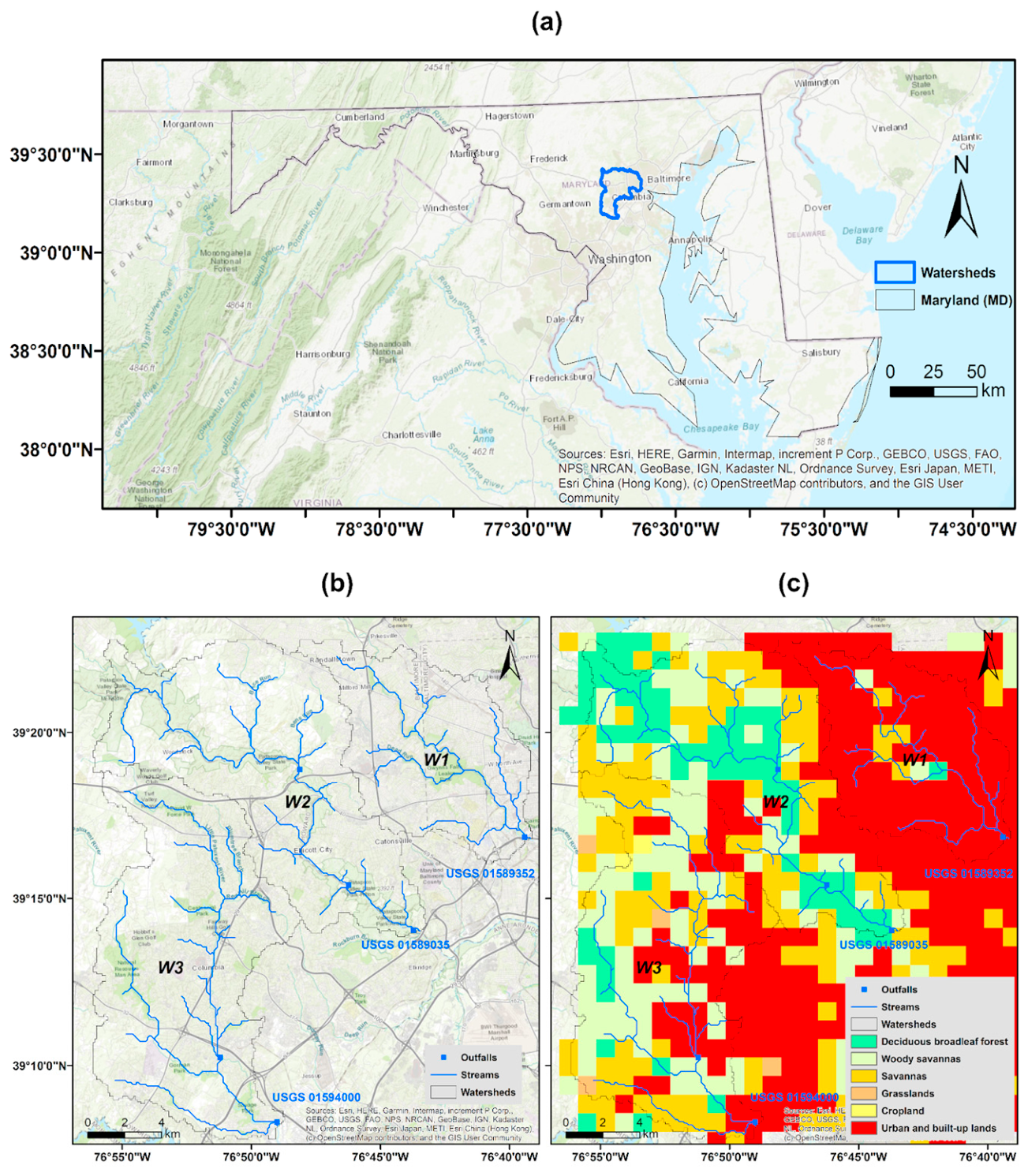
Ellicott City is a historic town in the valley of the Patapsco River (Figure 1a). It is located at the foot of a steep, funnel-shaped terrain depression that runs alongside the Patapsco River (W2 in Figure 1b). Although Ellicott City’s drainage area is not large, it is a significant location as it is where three tributaries converge—the Tiber, Hudson, and New Cut branches of the Patapsco. This confluence point is situated near Main Street, which is lined with popular storefronts.
Ellicott City is susceptible to flash flooding from the Patapsco River and Tiber River, as noted by Viterbo et al. (2020) [19]. The town has a history of experiencing catastrophic floods dating back to 1768 [20]. These floods have caused loss of life, destruction of property, and significant social and economic damage. The town experienced two severe flash floods on 30 July 2016 and 27 May 2018, respectively, with each event meeting statistical definitions of a ‘1-in-1000 chance’ rain event [19]. These events occurred only 22 months apart.
Intense precipitation is a well-known primary cause of flash flooding in Ellicott City; however, topography and land surface characteristics also have an extraordinary impact [22]. Land cover in this area has been converted from forest and thick soil to impervious materials like buildings, parking lots, and roadways, particularly as population growth exploded starting around 1950. For context, from 1980 to 1990, the population in Ellicott City doubled from nearly 22,000 to more than 40,000 residents, and now exceeds 76,000 residents. The population of surrounding (and largely upstream from Ellicott City) Howard County, MD, now exceeds 330,000 vs. roughly 119,000 in 1980. To accommodate such growth, the Tiber-Hudson watershed, which encompasses Ellicott City, transitioned over these decades from generally forested land cover to more impervious surfaces, particularly in response to housing development.
In this study, the model domain is set up in three watersheds encompassing the greater Ellicott City region (W1 to W3 in Figure 1b). The land cover states were initialized using Terra and Aqua combined Moderate Resolution Imaging Spectroradiometer (MODIS) land cover type (MCD12Q1) Version 6 data derived from the WRF preprocessing tool (WPS) version 4.0. Figure 1c shows that land use varies significantly across the watersheds. W1is the smallest watershed used in the analysis (Table 1) and is classified as urban, consisting primarily of impervious surfaces. Watersheds W2 and W3 include the Patapsco River and the Little Patuxent River, respectively. These watersheds are similar in area and consist of various land cover types, including urban, forest, grassland, and cropland. While flood impacts were less severe in W1 and W3 in the events studied here, all were affected by moderate-to-heavy precipitation and thus of interest in assessing hydrologic impact sensitivities. The descriptions and locations of the three watersheds are summarized in Table 1, along with three USGS stream gauges used to evaluate the model simulations. Note that river management via dams and reservoirs is accounted for in WRF-Hydro, but was not influential in this event as the impactful precipitation fell downstream of Liberty Reservoir and there were no managed releases at the time [23].
This study focuses on investigating the two catastrophic events that occurred in Ellicott City on 30 July 2016 and 27 May 2018, as noted above. The hourly, gauge-corrected Multi-Radar Multi-Sensor (MRMS) data with a spatial resolution of 1 km × 1 km produced by the operational Next Generation Weather Radar (NEXRAD) system [24] is used as precipitation input in the WRF-Hydro simulations.
To assess the effect of urbanization on the risk of flash flooding in Ellicott City, six land use scenarios are created by altering the degree of urbanization and forestation in the study area. The urbanization percentages for the sensitivity experiments were chosen at uniform 20% increments (ranging from 0% to 100%) to establish a controlled, linear gradient that systematically isolates and quantifies the hydrologic response to progressive land use conversion. A Gaussian random allocation approach is used to generate land use scenarios with different levels of urbanization. First, a spatially correlated Gaussian random field was created over the study area. Spatial smoothing was applied to introduce clustering among neighboring cells, producing contiguous patches rather than isolated pixels. For each scenario, cells were ranked according to their Gaussian field values, and a threshold was selected to achieve the target urban-to-forest ratio specified in Table 2. Cells above the threshold were classified as urban, while the remaining cells were assigned as forest. Unlike purely random assignment, this approach preserves the prescribed land use proportions while generating spatial patterns that more closely resemble realistic urban expansion and forest fragmentation than purely random allocation.
The proportion of forest relative to urban land use decreases with each scenario number, as outlined in Table 2 and illustrated in Figure 2. Note that the Gaussian randomization patterns are a relatively conservative way to consider these synthetic scenarios, as there is sensitivity to the spatial pattern of urban development. For example, when urbanization is spatially concentrated along river corridors, it places impervious surfaces directly adjacent to the drainage network, which dramatically accelerates runoff delivery and shortens the catchment’s response time compared to a more dispersed development pattern. Therefore, the results generated here could be even more dramatic with more intentional urbanization specification, but we elected to go with a relatively more moderate Gaussian randomized solution.
Additionally, in order to complement the idealized sensitivity tests with actual land cover information, this study utilizes multiple time instances of the MCD12Q1 V6 dataset, which offers gridded historical land use data at yearly intervals with a spatial resolution of 500 m from 2001 to the present. We selected the land use data from the years 2001, 2010, and 2020 for three additional simulations of the 2018 storm event to investigate whether any more recent changes in land use and development might have a discernible effect on flood impacts.

2.2. Weather Research and Forecasting Model Hydrological Modeling System (WRF-Hydro)

2.2.1. Model Overview

The WRF-Hydro modeling system is used in this study for simulating the 2016 and 2018 Ellicott City flooding events. WRF-Hydro is designed to provide representation of water and energy states and fluxes at a high spatial resolution (1 km or less) and offers multiple options for land-surface model (LSM) and hydrological routing physics, including surface, subsurface, baseflow, channel routing, and reservoir routing schemes [25]. Unlike simpler conceptual models like SAC-SMA or traditional hydraulic tools like HEC-RAS and HEC-HMS, WRF-Hydro offers a fully distributed, physics-based framework that couples atmospheric processes with high-resolution terrain routing, allowing for a much higher-fidelity representation of complex physical processes across the catchment scale of interest here.
WRF-Hydro is forced using incoming shortwave and longwave radiation, specific humidity, air temperature, surface pressure, near-surface wind speed in both u-/v-components, and liquid water precipitation rate. The model workflow begins with the initialization of static land surface physiographic data and the setup of the research domain and computational arrays, followed by the execution of LSM, which passes land-surface information to higher spatial resolution hydrologic processes, such as sub-surface, surface, conceptual base flow, and channel and reservoir routing components.
The WRF-Hydro modeling system, which integrates the Weather Research and Forecasting (WRF) model with a hydrological model, provides a unique opportunity for merging hydrological and atmospheric processes in a physically consistent manner [25]. More importantly, it has proven to be reliable for flood discharge prediction during extreme precipitation events [26,27,28,29,30]. Furthermore, the National Oceanic and Atmospheric Administration (NOAA)’s National Water Service (NWS) currently uses the WRF-Hydro model as the core architecture for its high-resolution, operational water forecasting model, the National Water Model (NWM) [25]. In this study, the version 5.1.1 NWM routing configuration of WRF-Hydro is utilized to examine its capability in simulating flash floods in the watershed scale. Overall, WRF-Hydro provides a flexible and powerful platform for hydrologic routing that can be tailored to a variety of research and application needs.

2.2.2. Model Configuration

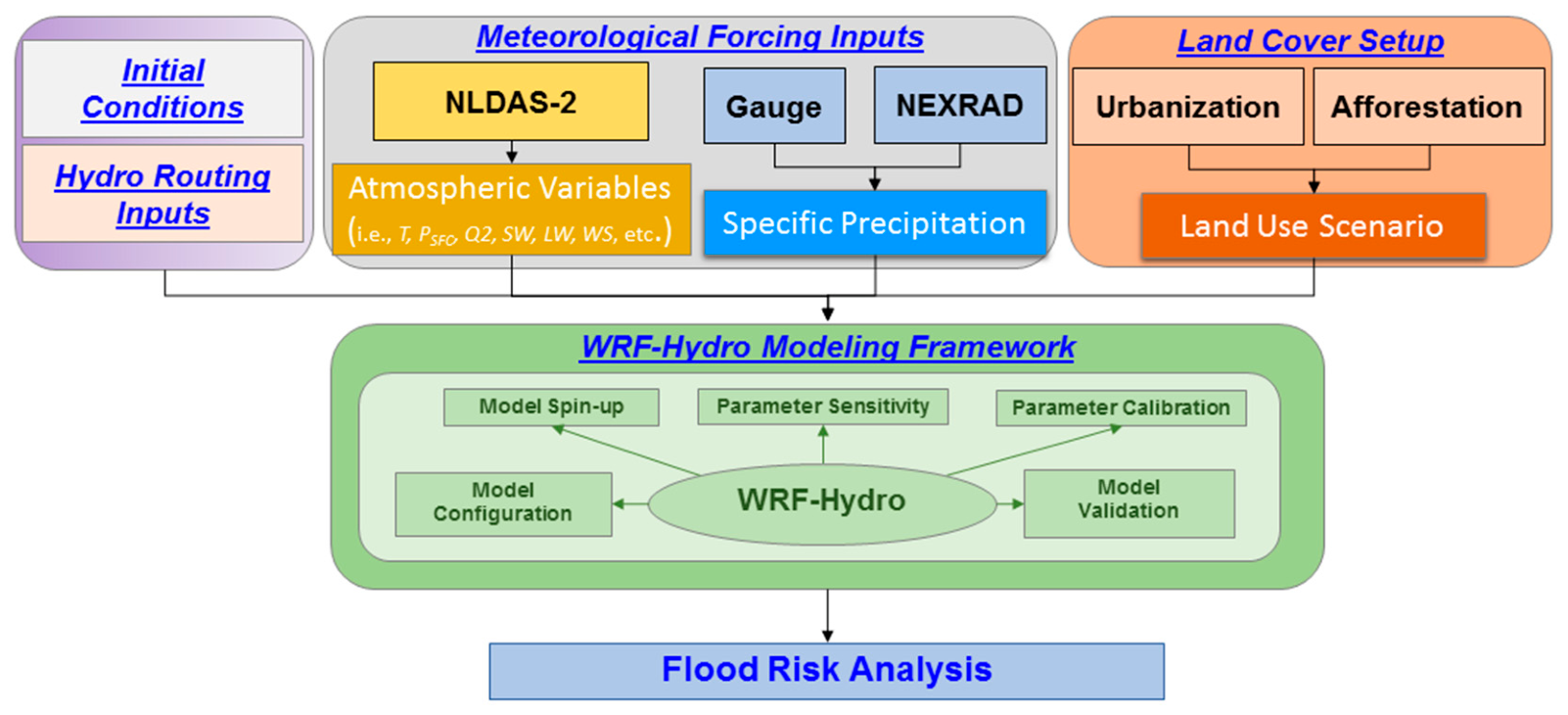
Figure 2 illustrates the flowchart for this study, which employs an “offline” mode for WRF-Hydro. The Noah-MP LSM is used as the vertical column model with a grid spacing of 1 km × 1 km. Details of the Noah-MP configuration are consistent with Ma et al. (2021) [30]. Hourly NLDAS-2 data is used for meteorological forcing inputs (including air temperature (T), surface pressure (PSFC), specific humidity (Q2), shortwave (SW) and longwave (LW) radiations, and wind speed (WS)), except for precipitation rate, which is obtained from the gauge-corrected MRMS product at an hourly resolution. The bilinear interpolation method is used to regrid the forcing inputs onto a 1 km × 1 km grid. The column moisture flux is disaggregated from the LSM grid to the hydro-routing grid at 100 m × 100 m for each hourly time step in the simulation, using a sub-grid disaggregation-aggregation transformation method. The disaggregated flux is then transferred to the terrain and channel routing processes. The terrain and channel routing processes are executed at time intervals of 10 s and 100 s, respectively.
To ensure that the state variables reach equilibrium during the spin-up period, WRF-Hydro is “cold”-started from 0100 UTC 30 July 2015 and run to 0000 UTC 30 July 2016. After this, the model is “warm”-started and calibrated using the restart files at 0000 UTC 30 July 2016 until 0000 UTC 1 August 2016. During the continuous rainfall from 1700 UTC 30 July to 0200 UTC 31 July 2016 in Ellicott City, the hourly gauge-corrected MRMS product shows a maximum record at 0000 or 0100 UTC 31 July 2016 across the three watersheds. For the 2018 flood event, WRF-Hydro is “cold”-started using the calibrated optimal parameters from 0100 UTC 27 May 2017 to 0000 UTC 27 May 2018, to again ensure a one-year spin-up period. The model is then run using restart files from the end of the spin-up period across the period from 0100 UTC 27 May to 0000 UTC 29 May 2018 in the three watersheds of interest. Finally, the impact of urbanization on the risk of flash flood is examined for the 2018 flood event, with a focus on the W2 watershed that includes Ellicott City.

2.2.3. Parameter Sensitivity Analysis and Calibration Strategy

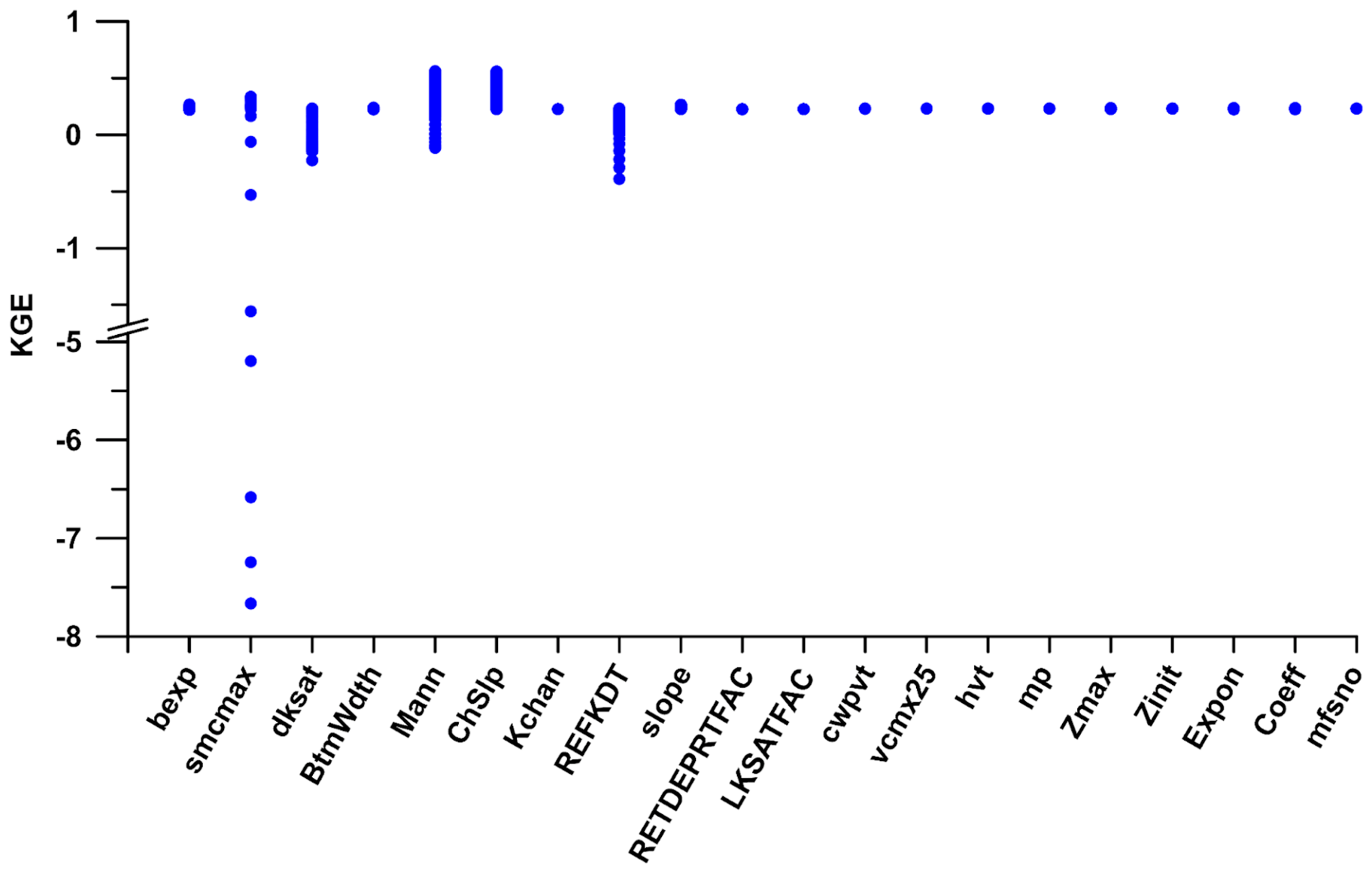
Before calibrating the model parameters, a simple sensitivity analysis with 20 variables related to soil, channel, runoff, and groundwater modules is applied based on a one-at-a-time (OAT) approach to understand how variations in model input parameters affect the model outputs. Although the OAT approach does not explicitly account for parameter interactions, it provides an efficient screening method for identifying influential parameters in computationally demanding hydrologic models such as WRF-Hydro. A more comprehensive global sensitivity analysis (e.g., [31,32,33]) is recommended for future studies. A series of model simulations is performed with the defined parameter sets (Table 3). For each parameter, the sensitivity indices are presented using Kling–Gupta efficiency (KGE) between simulated and observed streamflow during the 2016 flood event at the USGS outlet in W2 (Figure 3 and Figure 4). From Figure 3, it is found that smcmax, dksat, Mann, ChSlp, and REFKDP are the to −5 significant impacts on the WRF-Hydro modeling system. Thus, these five parameters are specified for model calibration.
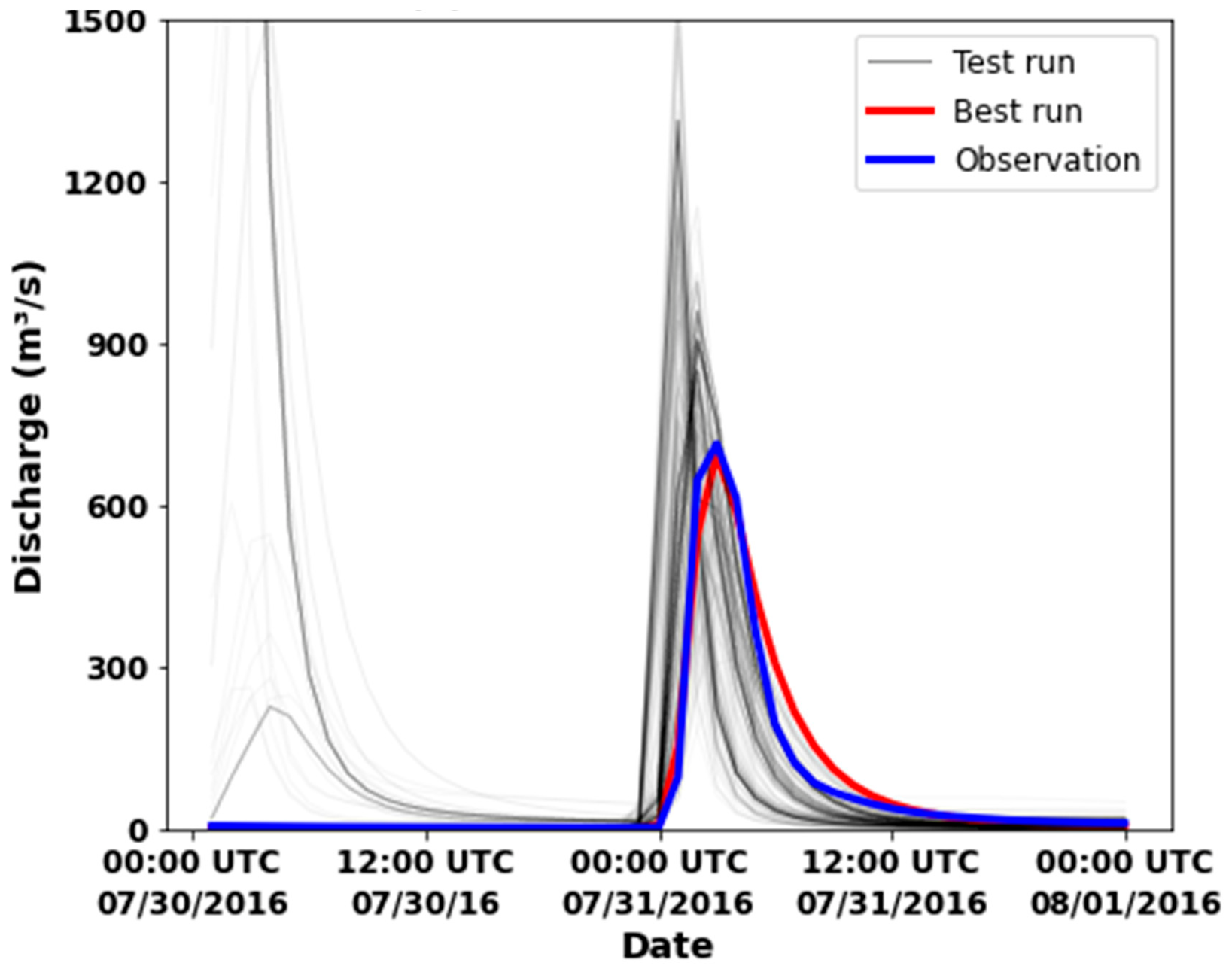
Following Ma et al. (2021) [30], the selected five parameters are calibrated using the dynamically dimensioned search (DDS) algorithm [34] with 250 iterations. The simulated streamflow with peak values after 0000 UTC 31 July 2016 in the calibration period at the USGS outlet of W2 is shown in Figure 4. The calibrated parameters are derived according to the optimization of the KGE at the analyzed USGS outlet, and the red curve presents the optimally simulated hydrograph close to the observed streamflow with the blue curve.

2.3. Evaluation Metrics

In order to assess the accuracy of the “control” model simulations, four error indices are used: mean bias (BIAS), root mean square error (RMSE), Pearson’s correlation coefficient (CORR), and Kling–Gupta efficiency (KGE). The equations for these indices are given below:
B I A S =   1 N n = 1 N ( S i m n O b s n )
R M S E = 1 N n = 1 N ( S i m n O b s n ) 2
C O R R = n = 1 N ( S i m n S i m _ ) ( O b s n O b s _ ) n = 1 N ( S i m n S i m _ ) 2 n = 1 N ( O b s n O b s _ ) 2
K G E = 1 ( r 1 ) 2 + ( α 1 ) 2 + ( β 1 ) 2
where Sim and Obs represent the simulated and observed hourly data, respectively, N is the total number of samples, and the subscript n indicates the nth sample. The variable r denotes the correlation between the simulation and observation, represents relative variability between simulated and observed data, and is the bias of simulated values. The KGE is particularly useful as it can identify the sources of errors arising from the mean, variance and correlation components [35], and is therefore utilized to evaluate model performance in this study.

3. Results

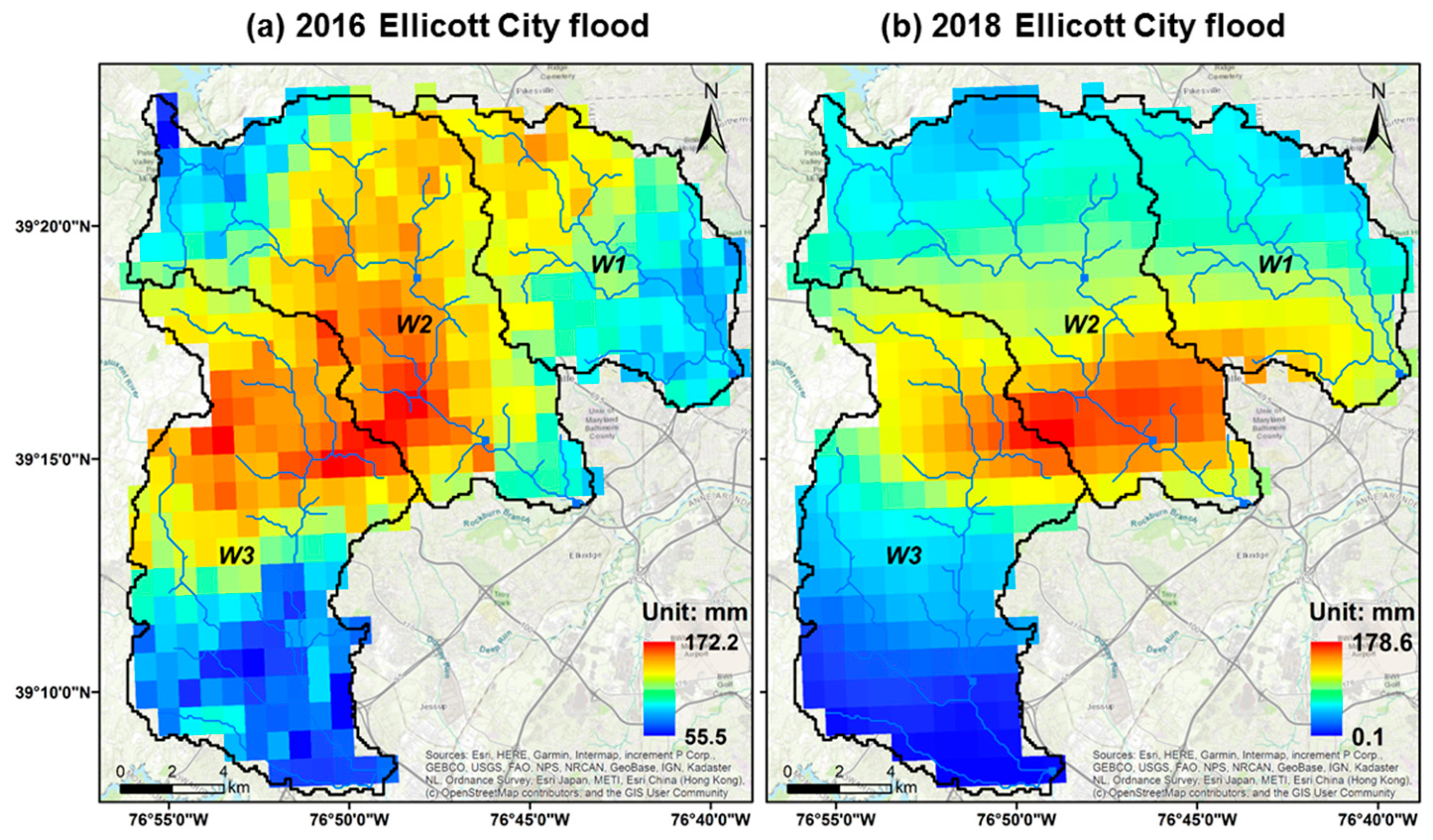
Figure 5 illustrates the spatial distribution of accumulated areal precipitation in the surveyed watersheds from the gauge-corrected MRMS products during the storm events. Total precipitation maxima in the three watersheds exceeded 170 mm for both the 2016 and 2018 cases, but the spatial distribution above this threshold was more widespread in the 2016 event. As indicated in Figure 5, both flood events exhibited large variability in total accumulation across the three watersheds; however, the largest totals in each event were similar, with precipitation totals exceeding 100 mm over the developed downtown region of Ellicott City (i.e., inside W2). The 2018 event had maximum precipitation concentrated toward the southern end of W2, while the 2016 event was characterized by its extensive aerial coverage of rainfall accumulations in amounts ranging from 100 to 150 mm. Both rainfall distributions led to devastating impacts on the downtown area of Ellicott City.

3.1. Model Validation with Observed USGS Streamflow

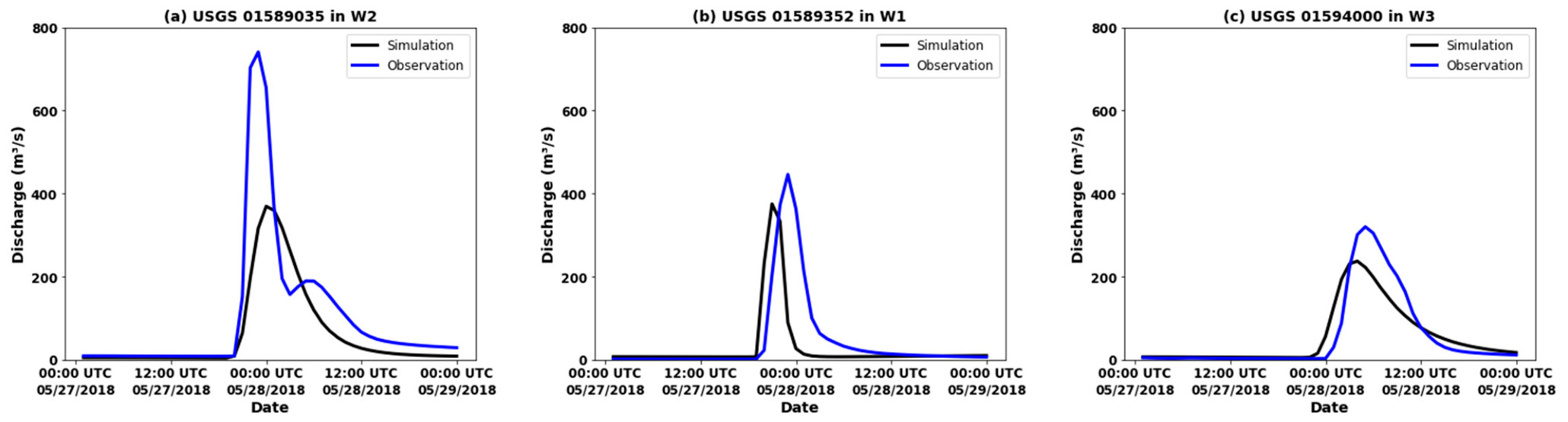
WRF-Hydro streamflow is first evaluated using three USGS outlets in the three watersheds (W1 to W3) for the 2018 Ellicott City flood event. Statistical error indices are summarized in Table 4, and the corresponding simulated streamflow hydrographs for the two cases are shown in Figure 6.
For the 2018 flood event, MRMS radar reflectivity data reveal that Ellicott City was impacted by multiple sub-hourly rainfall pulses from 1900 to 2300 UTC 27 May (not shown). Due to its hourly temporal resolution, the gauge-corrected MRMS quantitative precipitation estimates depict the sub-hourly rainfall pulses as discrete hourly rainfall peaks from 1900 to 0000 UTC, with a maximum at 2200 UTC. Forced with hourly radar-based rainfall data, WRF-Hydro generates corresponding hourly streamflow responses. The timing of the simulated flow peak is around 1–2 h after the maximum rainfall. Close temporal correspondence (i.e., less than 1 h) between the simulated and observed streamflow peaks is found across all three watersheds (Figure 6).
Note that while the USGS hydrograph exhibits a double-peaked bimodal hydrograph shape in W2, where the time interval between the two peaks is around four hours, the WRF-Hydro simulation only produces a single, underestimated peak at the corresponding outlets (Figure 6a). As discussed in Viterbo et al. (2020) [19], this is likely due to both hourly precipitation forcing in an event where sub-hourly rainfall pulses were critical, as well as hydrologic travel time within the complex basin. The sub-hourly rainfall intensities that contribute to the concentration of the storm total precipitation within a one-hour period may have important consequences for the impact of land use type on flood inundation extent, and this should be explored in a future study for which sub-hourly data is available for a more contemporary flood case. Such work is ongoing for recent burn scar studies, but as the conclusions of this study center on the sensitivity caused by changes in the land-surface state, the findings with respect to this particular driving question should remain unaffected.

3.2. Impact of Urbanization on Flash-Flood Risk in the 21St Century

As described above, though most of the urbanization surrounding and upstream of Ellicott City pre-dated 2001, this study aimed to complement our idealized sensitivity tests using publicly available gridded historical land use data. Satellite-based gridded datasets are available starting in 2001; we thus selected the land use data from the years 2001, 2010, and 2020 to simulate as the land use dataset for three additional simulations of the 2018 flood event and compare the flash-flood streamflow to both observations as well as the idealized sensitivity study results.
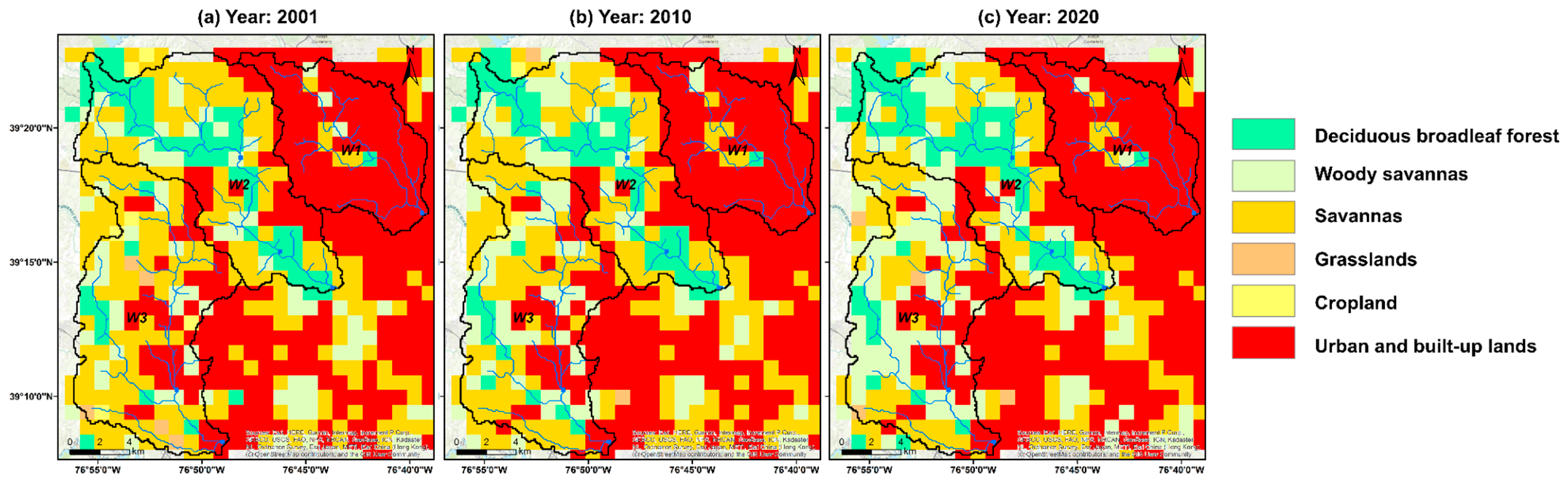
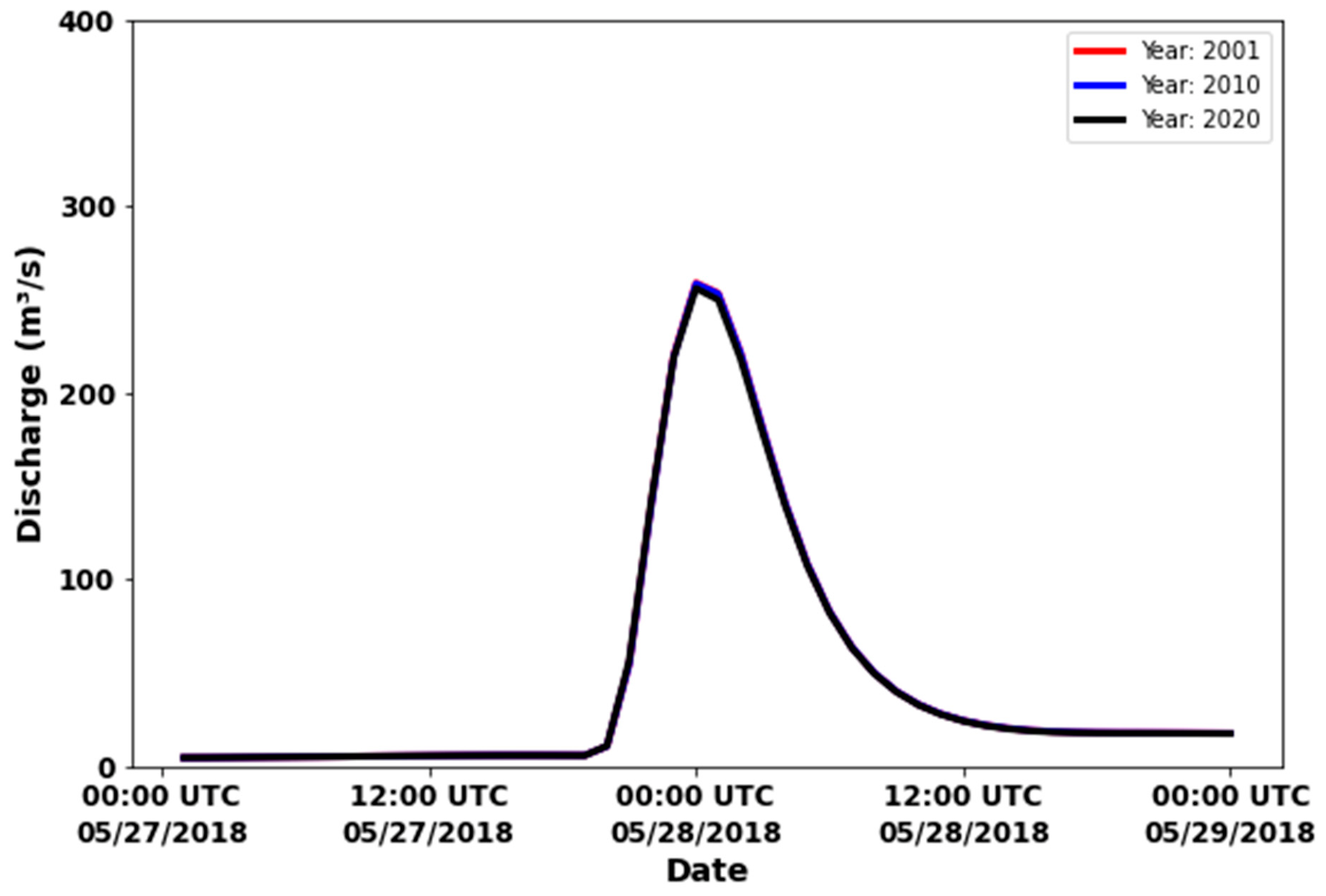
However, changes in land use are barely evident in the MODIS MCD12Q1 V6 dataset from 2001 to 2010 to 2020, respectively, as shown in Figure 7. Accordingly, the WRF-Hydro sensitivity simulations using each of these land cover states yield streamflows that are almost identical (Figure 8).
The MODIS land cover dataset is relatively coarse with respect to both spatial resolution as well as only having six landcover states distinguished. This alone makes it exceedingly difficult to discern whether finer-scale land use changes occurring over particular sub-regions within the watersheds, or perhaps more subtle shifts in land use changes (e.g., development that did not occur at scale to alter the gridbox-assigned land use value) might still perhaps affect hydrologic response in reality. Further, however, the lack of gridded land use data prior to 2000 and the reality that the Ellicott City and surrounding areas were mostly developed well prior to 2000 require that we test our hypothesis using a different experimental approach. The next section details the results of systematically shifting land use in a synthetic manner. This framework provides physical insight into the overall sensitivity of hydrologic processes to forest vs. urban land use distinctions during an extreme, short-duration, high-intensity precipitation event.

3.3. Sensitivity Test: Comparison of Simulated Streamflow from Progressively Urban Synthetic Land Use Scenarios

Figure 8 compares hydrographs at the W2 outlet under each of the different land use conditions described in Table 2 for the 2018 extreme flooding event. As expected, increasing urban land cover type generally corresponds to earlier timing and larger peak discharge, and it also leads to a shorter recession. Over the W2 drainage area (W2; 152.4 km2), the simulated flow peak under the 100% urban scenario occurs at 0000 UTC 28 May 2018 with a value of 376 m3/s versus the 100% forest scenario, where peak flow occurs at 0100 UTC, and with a lower value of 309 m3/s. Thus, peak streamflow occurs one hour sooner, with a volume increase greater than 20% between the 100% urban and the 100% forest scenarios, respectively. While specific sensitivities will vary according to other scenarios one may elect to test, qualitatively, it is clear that hydrologic response becomes progressively faster as the urban-to-forest ratio increases, and simulations performed using smaller watershed subdivisions only amplify these changes (not shown; [36]). Results are similar for W1 and W3 (not shown). In summary, increasing urbanization increases river discharge and accelerates the timing of peak streamflow in each watershed in the 2018 flood event, consistent with a reduction in soil infiltration capacity as forest land is replaced by urban infrastructure. These results also bear repercussions for surface flooding impacts, as shown by earlier flood inundation modeling efforts in which the increased river discharge led to greater overbank flow and thus larger expanses of flooded area in downtown Ellicott City [36].

4. Discussion

A combination of idealized and real-data sensitivity experiments is performed using the WRF-Hydro modeling system to investigate the impact of land use on changes in streamflow and hydrologic response for an extreme precipitation event that occurred in Ellicott City, MD, in 2018.
The suite of experiments simulated hourly streamflow under various land use scenarios, first calibrating the model using a similarly high-impact flood event occurring in July 2016, and then running experiments for the 27 May 2018 flood event. The primary findings are summarized as follows:
  • The WRF-Hydro model has the ability to simulate observed streamflow magnitude and timing, reasonably representing hydrographs at three watershed outlets for both the 2016 and 2018 flood cases.
  • Sensitivity experiments examining the effect of land use changes on flash flooding show that urbanization accelerates the hydrologic responses to heavy rainfall and creates larger streamflow and higher river stage, increasing the extent of flood inundation across all the watersheds examined in this study.
  • Sensitivity experiments using observed land use characteristics from 2001–present do not reflect appreciable change in the Ellicott City watershed, as most development in the region pre-dated satellite-based gridded land use datasets and thus the experiments available to this study. However, the synthetically generated land use data-driven simulations provide insight into hydrologic response characteristics for earlier decades in which forested and agricultural land use existed in greater ratios to urban or developed land use versus today.
These experiments offer insight into understanding hydrologic responses to land use changes, even for events in which heavy precipitation alone would be expected to primarily drive the hydrologic response signal for both riverine and pluvial flooding. Future research could explore flood inundation prediction variables (e.g., coverage and volume) over sensitive regions and may also benefit from evaluating the use of higher temporal resolution (i.e., sub-hourly) precipitation forcing during extreme rainfall events.

Author Contributions

Conceptualization, K.M. and Y.M.; methodology, Y.M.; software, Y.M.; validation, Y.M.; formal analysis, Y.M.; investigation, Y.M. and K.M.; resources, R.C. and V.C.; data curation, Y.M.; writing—original draft preparation, Y.M. and K.M.; writing—review and editing, K.M. and R.C.; visualization, Y.M.; supervision, K.M.; project administration, R.C., K.M. and V.C.; funding acquisition, V.C. and R.C. All authors have read and agreed to the published version of the manuscript.

Funding

This work is supported by the NOAA Physical Sciences Laboratory and the Cooperative Institute for Research in the Atmosphere, Colorado State University.

Data Availability Statement

Data utilized in this study for the purposes of initializing model experiments are all existing public data, which are openly available at locations cited in the reference section. The output of the model runs themselves can be made available upon request.

Acknowledgments

We would like to thank David Gochis and Aubrey Dugger from the National Center for Atmospheric Research, as well as William Ryan Currier from the NOAA Physical Sciences Laboratory, for their helpful comments and suggestions in improving the manuscript.

Conflicts of Interest

The authors declare no conflicts of interest.

References

  1. Hall, J.; Arheimer, B.; Borga, M.; Brázdil, R.; Claps, P.; Kiss, A.; Kjeldsen, T.R.; Kriauciuniene, J.; Kundzewicz, Z.W.; Lang, M.; et al. Understanding flood regime changes in Europe: A state-of-the-art assessment. Hydrol. Earth Syst. Sci. 2014, 18, 2735–2772. [Google Scholar] [CrossRef]
  2. Knighton, J.; Hondula, K.; Sharkus, C.; Guzman, C.; Elliott, R. Flood risk behaviors of United States riverine metropolitan areas are driven by local hydrology and shaped by race. Proc. Natl. Acad. Sci. USA 2021, 118, e2016839118. [Google Scholar] [CrossRef]
  3. Yang, L.; Yang, Y.X.; Villarini, G.; Li, X.; Hu, H.C.; Wang, L.C.; Blöschl, G.; Tian, F.Q. Climate More Important for Chinese Flood Changes Than Reservoirs and Land Use. Geophys. Res. Lett. 2021, 48, e2021GL093061. [Google Scholar] [CrossRef]
  4. Alfieri, L.; Burek, P.; Feyen, L.; Forzieri, G. Global warming increases the frequency of river floods in Europe. Hydrol. Earth Syst. Sci. 2015, 19, 2247–2260. [Google Scholar] [CrossRef]
  5. Hodgkins, G.A.; Whitfield, P.H.; Burn, D.H.; Hannaford, J.; Renard, B.; Stahl, K.; Fleig, A.K.; Madsen, H.; Mediero, L.; Korhonen, J.; et al. Climate-driven variability in the occurrence of major floods across North America and Europe. J. Hydrol. 2017, 552, 704–717. [Google Scholar] [CrossRef]
  6. Bloschl, G.; Hall, J.; Viglione, A.; Perdigao, R.A.P.; Parajka, J.; Merz, B.; Lun, D.; Arheimer, B.; Aronica, G.T.; Bilibashi, A.; et al. Changing climate both increases and decreases European river floods. Nature 2019, 573, 108–111. [Google Scholar] [CrossRef]
  7. Blöschl, G.; Hall, J.; Parajka, J.; Perdigao, R.A.P.; Merz, B.; Arheimer, B.; Aronica, G.T.; Bilibashi, A.; Bonacci, O.; Borga, M.; et al. Changing climate shifts timing of European floods. Science 2017, 357, 588–590. [Google Scholar] [CrossRef]
  8. Zhang, W.; Villarini, G.; Vecchi, G.A.; Smith, J.A. Urbanization exacerbated the rainfall and flooding caused by hurricane Harvey in Houston. Nature 2018, 563, 384–388. [Google Scholar] [CrossRef]
  9. Munoz, S.E.; Giosan, L.; Therrell, M.D.; Remo, J.W.F.; Shen, Z.X.; Sullivan, R.M.; Wiman, C.; O’Donnell, M.; Donnelly, J.P. Climatic control of Mississippi River flood hazard amplified by river engineering. Nature 2018, 556, 95–98. [Google Scholar] [CrossRef]
  10. Best, J. Anthropogenic stresses on the world’s big rivers. Nat. Geosci. 2019, 12, 7–21. [Google Scholar] [CrossRef]
  11. Rogger, M.; Agnoletti, M.; Alaoui, A.; Bathurst, J.C.; Bodner, G.; Borga, M.; Chaplot, V.; Gallart, F.; Glatzel, G.; Hall, J.; et al. Land use change impacts on floods at the catchment scale: Challenges and opportunities for future research. Water Resour. Res. 2017, 53, 5209–5219. [Google Scholar] [CrossRef]
  12. Huong, H.T.L.; Pathirana, A. Urbanization and climate change impacts on future urban flooding in Can Tho city, Vietnam. Hydrol. Earth Syst. Sci. 2013, 17, 379–394. [Google Scholar] [CrossRef]
  13. Feng, B.Y.; Zhang, Y.; Bourke, R. Urbanization impacts on flood risks based on urban growth data and coupled flood models. Nat. Hazards 2021, 106, 613–627. [Google Scholar] [CrossRef]
  14. Szwagrzyk, M.; Kaim, D.; Price, B.; Wypych, A.; Grabska, E.; Kozak, J. Impact of forecasted land use changes on flood risk in the Polish Carpathians. Nat. Hazards 2018, 94, 227–240. [Google Scholar] [CrossRef]
  15. Gori, A.; Blessing, R.; Juan, A.; Brody, S.; Bedient, P. Characterizing urbanization impacts on floodplain through integrated land use, hydrologic, and hydraulic modeling. J. Hydrol. 2019, 568, 82–95. [Google Scholar] [CrossRef]
  16. Jodar-Abellan, A.; Valdes-Abellan, J.; Pla, C.; Gomariz-Castillo, F. Impact of land use changes on flash flood prediction using a sub-daily SWAT model in five Mediterranean ungauged watersheds (SE Spain). Sci. Total Environ. 2019, 657, 1578–1591. [Google Scholar] [CrossRef]
  17. Gao, Y.Q.; Chen, J.H.; Luo, H.; Wang, H.Z. Prediction of hydrological responses to land use change. Sci. Total Environ. 2020, 708, 134998. [Google Scholar] [CrossRef]
  18. Beshir, A.A.; Song, J. Urbanization and its impact on flood hazard: The case of Addis Ababa, Ethiopia. Nat. Hazards 2021, 109, 1167–1190. [Google Scholar] [CrossRef]
  19. Viterbo, F.; Mahoney, K.; Read, L.; Salas, F.; Bates, B.; Elliott, J.; Cosgrove, B.; Dugger, A.; Gochis, D.; Cifelli, R. A Multiscale, Hydrometeorological Forecast Evaluation of National Water Model Forecasts of the May 2018 Ellicott City, Maryland, Flood. J. Hydrometeorol. 2020, 21, 475–499. [Google Scholar] [CrossRef]
  20. Thakali, R.; Bhandari, R.; Kandissounon, G.A.A.D.; Kalra, A.; Ahmad, S. Flood Risk Assessment Using the Updated FEMA Floodplain Standard in the Ellicott City, Maryland, United States. In Proceedings of the World Environmental and Water Resources Congress 2017: Hydraulics and Waterways and Water Distribution Systems Analysis, Sacramento, CA, USA, 21–25 May 2017; pp. 280–291. [Google Scholar]
  21. Chan, A.Y.; Burrows, K.; Bell, M.L. Why They Stayed and Why They Left-A Case Study from Ellicott City, MD after Flash Flooding. Int. J. Environ. Res. Public Health 2022, 19, 10636. [Google Scholar] [CrossRef]
  22. Halverson, J.B. Flood city, USA: Ellicott City faces latest historical flooding. Weatherwise 2019, 72, 12–18. [Google Scholar] [CrossRef]
  23. Doheny, E.J.; Nealen, C.W. Storms and Floods of July 30, 2016, and May 27, 2018, in Ellicott City, Howard County, Maryland; U.S. Geological Survey: Reston, VA, USA, 2021; p. 6.
  24. Zhang, J.; Howard, K.; Langston, C.; Vasiloff, S.; Kaney, B.; Arthur, A.; Van Cooten, S.; Kelleher, K.; Kitzmiller, D.; Ding, F.; et al. NATIONAL MOSAIC AND MULTI-SENSOR QPE (NMQ) SYSTEM Description, Results, and Future Plans. Bull. Am. Meteorol. Soc. 2011, 92, 1321–1338. [Google Scholar] [CrossRef]
  25. Gochis, D.; Barlage, M.; Dugger, A.; FitzGerald, K.; Karsten, L.; McAllister, M.; Yu, W. The WRF-Hydro modeling system technical description (version 5.1.1). NCAR Tech. Note 2018, 107, 484. [Google Scholar]
  26. Yucel, I.; Onen, A.; Yilmaz, K.K.; Gochis, D.J. Calibration and evaluation of a flood forecasting system: Utility of numerical weather prediction model, data assimilation and satellite-based rainfall. J. Hydrol. 2015, 523, 49–66. [Google Scholar] [CrossRef]
  27. Lin, P.R.; Yang, Z.L.; Gochis, D.J.; Yu, W.; Maidment, D.R.; Somos-Valenzuela, M.A.; David, C.H. Implementation of a vector-based river network routing scheme in the community WRF-Hydro modeling framework for flood discharge simulation. Environ. Model. Softw. 2018, 107, 1–11. [Google Scholar] [CrossRef]
  28. Wehbe, Y.; Temimi, M.; Weston, M.; Chaouch, N.; Branch, O.; Schwitalla, T.; Wulfmeyer, V.; Zhan, X.W.; Liu, J.C.; Al Mandous, A. Analysis of an extreme weather event in a hyper-arid region using WRF-Hydro coupling, station, and satellite data. Nat. Hazards Earth Syst. Sci. 2019, 19, 1129–1149. [Google Scholar] [CrossRef]
  29. Chao, L.J.; Zhang, K.; Yang, Z.L.; Wang, J.F.; Lin, P.R.; Liang, J.J.; Li, Z.J.; Gu, Z. Improving flood simulation capability of the WRF-Hydro-RAPID model using a multi-source precipitation merging method. J. Hydrol. 2021, 592, 125814. [Google Scholar] [CrossRef]
  30. Ma, Y.; Chandrasekar, V.; Chen, H.N.; Cifelli, R. Quantifying the Potential of AQPI Gap-Filling Radar Network for Streamflow Simulation through a WRF-Hydro Experiment. J. Hydrometeorol. 2021, 22, 1869–1882. [Google Scholar] [CrossRef]
  31. Sobol, I.M. Sensitivity Estimates for Nonlinear Mathematical Models. Math. Model. Comput. Exp. 1993, 4, 407–414. [Google Scholar]
  32. Sobol, I.M. Global sensitivity indices for nonlinear mathematical models and their Monte Carlo estimates. Math. Comput. Simul. 2001, 55, 271–280. [Google Scholar] [CrossRef]
  33. Saltelli, A.; Ratto, M.; Andres, T.; Campolongo, F.; Cariboni, J.; Gatelli, D.; Saisana, M.; Tarantola, S. Global Sensitivity Analysis: The Primer; Wiley: Hoboken, NJ, USA, 2008. [Google Scholar]
  34. Tolson, B.A.; Shoemaker, C.A. Dynamically dimensioned search algorithm for computationally efficient watershed model calibration. Water Resour. Res. 2007, 43, W01413. [Google Scholar] [CrossRef]
  35. Gupta, H.V.; Kling, H.; Yilmaz, K.K.; Martinez, G.F. Decomposition of the mean squared error and NSE performance criteria: Implications for improving hydrological modelling. J. Hydrol. 2009, 377, 80–91. [Google Scholar] [CrossRef]
  36. Ma, Y.Z.; Mahoney, K.M.; Cifelli, R.; Chandrasekar, V. Evaluating the impact of urbanization on flood risk during heavy precipitation events in Ellicott City, MD. In Proceedings of the 36th Conference on Hydrology, American Meteorological Society Annual Meeting, Houston, TX, USA, 24 January 2024. [Google Scholar]
Figure 1. (a) A regional map of the research area in Maryland, with the hydrologic basins of interest collectively outlined in blue; (b) location of three watersheds of interest (W1, W2, W3) with gray polygon borders and corresponding USGS gaging outlets (blue points); and (c) the spatial distribution of land use types in the three watersheds of study domain.
Water 18 01463 g001
Figure 2. The overview of the WRF-Hydro approach used in this study.
Water 18 01463 g002
Figure 3. The sensitivity of model outputs to changes in model input parameters analysis in this study.
Water 18 01463 g003
Figure 4. Model performance of parameter calibration with the top 5 significant parameters in this study at USGS 01589035 in W2.
Water 18 01463 g004
Figure 5. The accumulated areal precipitation (unit: mm) derived from gauge-corrected MRMS hourly precipitation analysis on the two flood events, including (a) from 1700 UTC 30 July to 0200 UTC 31 July 2016, and (b) from 1800 UTC 27 May 27 to 0100 UTC 28 May 2018 in the three watersheds described in the text.
Water 18 01463 g005
Figure 6. Observed and simulated hourly river stages at the three outfalls in the three watersheds, shown left to right as: W2, W1 and W3, for the 2018 Ellicott City flood. In each panel, the observed and simulated river stages are shown by black and blue curves, respectively.
Water 18 01463 g006
Figure 7. Land use conditions according to the MODIS MCD12Q1 V6 dataset from 2001 to 2010 to 2020 (shown left to right).
Water 18 01463 g007
Figure 8. River hydrographs for W2 under three estimated land use conditions (from years 2001, 2010, and 2020) for the 2018 Ellicott City flood.
Water 18 01463 g008
Table 1. Description of the three watersheds of focus in this study.
IDDrainage Area (km2)RiverOutletDescription
W187.66Gwynn FallsUSGS 01589352Gwynns Falls at Baltimore, which is fully covered by urban areas.
W2153.40PatapscoUSGS 01589035Patapsco River near Elkridge, and the flow is regulated by Liberty Reservoir
W3151.36Little PatuxentUSGS 01594000Little Patuxent River at Savage, and the flow is impacted by T. Howard Duckett Dam
Table 2. Six land use scenarios applied in the three watersheds (W1 to W3) surrounding Ellicott City, MD.
Land Use ScenariosTypesWatersheds
AllW1W2W3
Scenario 1: Whole Forest Urban0000
Forest100%100%100%100%
Scenario 2: Urban [20%] and Forest [80%]Urban20%24.44%19.54%14.29%
Forest80%75.56%80.46%85.71%
Scenario 3: Urban [40%] and Forest [60%]Urban40%41.11%32.18%45.24%
Forest60%58.89%67.82%54.76%
Scenario 4: Urban [60%] and Forest [40%]Urban60%57.78%59.77%52.38%
Forest40%42.22%40.23%47.62%
Scenario 5: Urban [80%] and Forest [20%]Urban80%82.22%75.86%76.19%
Forest20%17.78%24.14%23.81%
Scenario 6: Whole UrbanUrban100%100%100%100%
Forest0000
Table 3. List of model parameters for sensitivity analysis.
TypeParameterDescriptionUnitDefault ValueMinimum ValueMaximum Value
SoilbexpPore size distribution indexDimensionless×1.0×0.1×10
smcmaxSaturation soil moisture content (i.e., porosity)Volumetric fraction×1.0×0.1×10
dksatSaturated hydraulic conductivitym/s×1.0×0.1×10
ChannelBtmWdthParameterized width of the bottom of the stream networkm×1.0×0.1×10
MannManning’s roughness coefficientDimension×1.0×0.1×10
ChSlpChannel side slopem/m×1.0×0.1×10
KchanChannel conductivitym/s00.011.0
RunoffREFKDTA tunable parameter that significantly impacts surface infiltration and hence the partitioning of total runoff into surface and subsurface runoffUnitless30.110
slopeLinear scaling of “openness” of bottom drainage boundaryUnitless0.10.011
RETDEPRTFACMultiplier on retention depth limitUnitless10.110
LKSATFACMultiplier on lateral hydraulic conductivity Unitless10001010,000
VegetationCWPVTCanopy wind parameter for canopy wind profile formulation1/m×1.0×0.1×10
VCMX25Maximum carboxylation at 25CUmol/m2/s×1.0×0.1×10
hvtTop of vegetation canopym×1.0×0.05×5
MPSlope of Ball-Berry conductance relationshipUnitless×1.0×0.05×5
GroundwaterZmaxMaximum groundwater bucket depthmm5010250
ZinitInitial groundwater bucket depthmm100.150
ExponExponent controlling rate of bucket drainage as a function of depthDimensionless3.00.110
CoeffCoefficient controlling rate of bucket drainage as a function of depthDimensionless1.00.110
SnowMFSNOMelt factor for snow depletion curve; larger values yields a smaller snow cover fraction for the same snow heightDimensionless×1.0×0.05×5
Table 4. Statistical error indices (i.e., BIAS, RMSE, CORR, KGE) of simulated streamflow at the three outlets in the three watersheds (i.e., W1 to W3) in the validation periods of 01:00 UTC 27 May to 00:00 UTC 29 May 2018 (2018 Ellicott City flood).
Stream Gauges2018 Ellicott City Flood
BIAS (m3/s)RMSE (m3/s)CORRKGE
USGS 01589352, W1−0.35787.980.5470.626
USGS 01589035, W2−0.396111.240.830.590
USGS 01594000, W3−0.0439.930.920.27
Disclaimer/Publisher’s Note: The statements, opinions and data contained in all publications are solely those of the individual author(s) and contributor(s) and not of MDPI and/or the editor(s). MDPI and/or the editor(s) disclaim responsibility for any injury to people or property resulting from any ideas, methods, instructions or products referred to in the content.