This is an early access version, the complete PDF, HTML, and XML versions will be available soon.
Open AccessArticle
A Performance-Based Quantification Approach to Inform Resilience Management of Urban Water Supply
by
Aina Crozier
 Aina Crozier
 and
and
Steven V. Weijs
Steven V. Weijs
Department of Civil Engineering, The University of British Columbia, 2002-6250 Applied Science Ln, Vancouver, BC V6T 1Z4, Canada
*
Author to whom correspondence should be addressed.
Water 2026, 18(12), 1458; https://doi.org/10.3390/w18121458 (registering DOI)
Submission received: 20 April 2026
/
Revised: 1 June 2026
/
Accepted: 9 June 2026
/
Published: 13 June 2026
Abstract
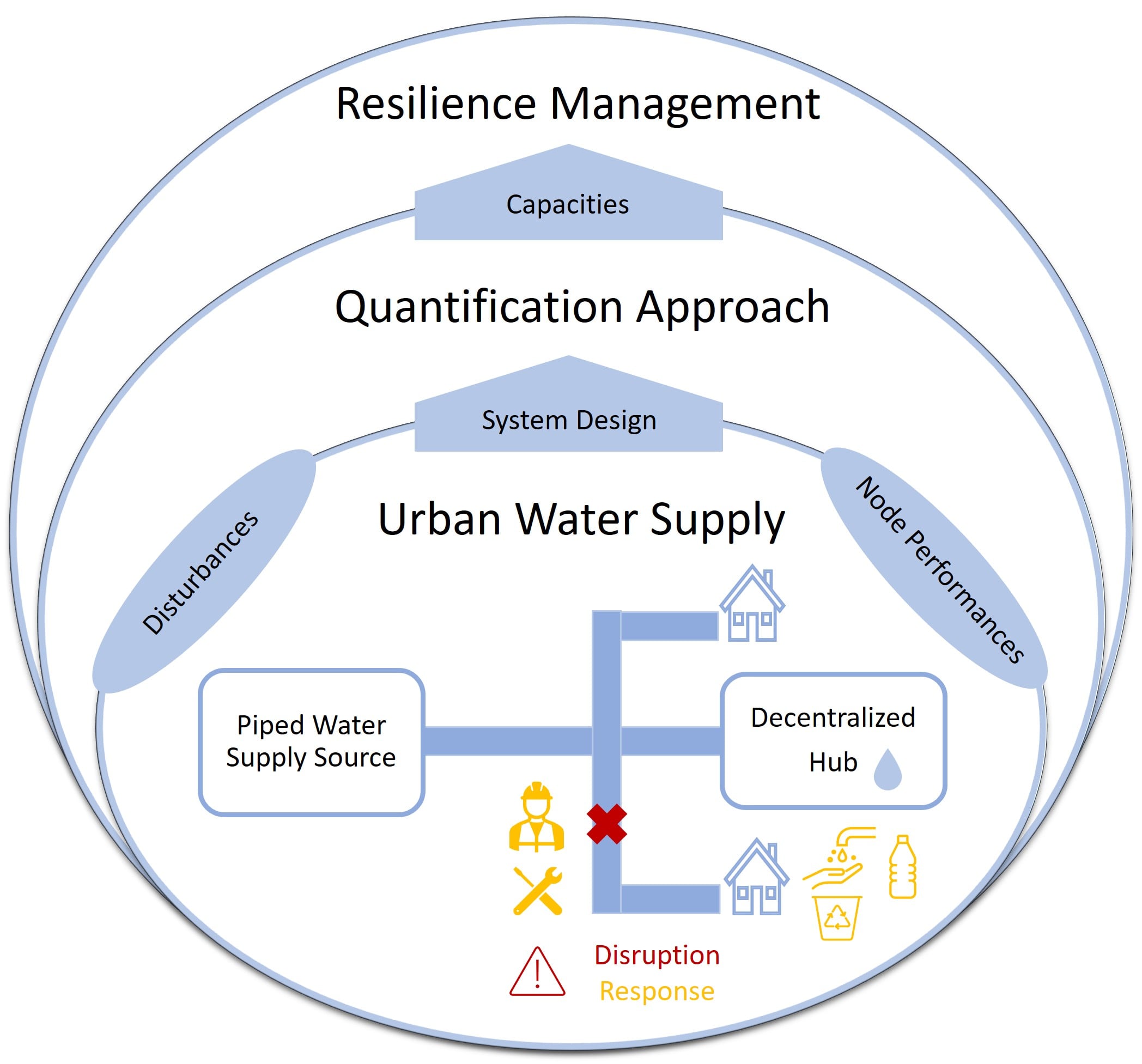
Investments in urban water supply should be informed by resilience management frameworks that consider traditional reliability requirements, community preparedness during system disruptions, and sustainability goals in long-term planning. Grounded in a framework (WARATA) that integrates these aspects, this paper presents a stepwise, performance-based theoretical approach to resilience quantification, supported by explanations and practical guidance. For instance, in addition to the piped infrastructure components, emergency supply options and human resources should be incorporated within the system boundaries (Step 1), and water supplied to users is recommended as a single performance measure (Step 2). During disruptions, performance at user nodes is influenced by operational rules for resource allocation (Step 3), which must be implemented in the required computer model for simulating performance (Step 4). Equations for computing withstanding, absorptive, restorative, adaptive, and transformative capabilities as time-based metrics are proposed (Step 5), enabling the analysis of results from the bottom up (Step 6) to inform resilience management. Using illustrations of performance curves at individual system nodes, this paper advocates for extended system boundaries that bridge the gap between infrastructure and community resilience; discusses challenges with the modeling of dynamic, adaptive performances; and emphasizes the importance of assessing temporal distances to fail-safe and safe-fail thresholds during disturbances. Pending case study validation and integration into tools for predictive and real-time analyses of options, the quantification approach could support infrastructure and emergency response planning and management, ultimately ensuring sustainable system designs with equitable resilience outcomes.
Share and Cite
MDPI and ACS Style
Crozier, A.; Weijs, S.V.
A Performance-Based Quantification Approach to Inform Resilience Management of Urban Water Supply. Water 2026, 18, 1458.
https://doi.org/10.3390/w18121458
AMA Style
Crozier A, Weijs SV.
A Performance-Based Quantification Approach to Inform Resilience Management of Urban Water Supply. Water. 2026; 18(12):1458.
https://doi.org/10.3390/w18121458
Chicago/Turabian Style
Crozier, Aina, and Steven V. Weijs.
2026. "A Performance-Based Quantification Approach to Inform Resilience Management of Urban Water Supply" Water 18, no. 12: 1458.
https://doi.org/10.3390/w18121458
APA Style
Crozier, A., & Weijs, S. V.
(2026). A Performance-Based Quantification Approach to Inform Resilience Management of Urban Water Supply. Water, 18(12), 1458.
https://doi.org/10.3390/w18121458
Note that from the first issue of 2016, this journal uses article numbers instead of page numbers. See further details
here.
Article Metrics
Article metric data becomes available approximately 24 hours after publication online.