Article

Cost Assessment of a Proposed Combined MDC–RO Process as a Performance Upgrade of the Doha Plant (Kuwait)


by
Mohammad S. Shanat
1,
Mohammad M. Ibrahim
1,
Mohamed Abdel-Hamid
1,
Wail A. Fahmy
1 and
Mostafa M. El-Seddik
2,*
1
Civil Engineering Department, Faculty of Engineering at Shoubra, Benha University, Cairo 11629, Egypt
2
Sanitary and Environmental Engineering, Civil Engineering Department, Institute of Aviation Engineering and Technology, Giza 12658, Egypt
*
Author to whom correspondence should be addressed.
Water 2026, 18(12), 1460; https://doi.org/10.3390/w18121460 (registering DOI)
Submission received: 2 May 2026 / Revised: 9 June 2026 / Accepted: 10 June 2026 / Published: 13 June 2026
(This article belongs to the Section Wastewater Treatment and Reuse)

Abstract

In the Arabian Gulf region, saltwater desalination is considered to be a significant process in producing clean water. This paper presents a sustainable, combined process for upgrading a Doha reverse osmosis (RO) plant in Kuwait. A pilot-scale microbial desalination cell (MDC) stack is proposed as a pre-treatment unit prior to the RO process in order to improve plant performance. A cost–benefit analysis is conducted for the combined system to emphasize the significance of the MDC–RO process. In RO, the expected energy consumption is 2.6–13 kWh per m3 of desalinated water, whereas using MDC can reduce this to about 0.52–5.3 kWh/m3. Moreover, this new technology using catalytic MDCs can help in improving electric current production and reducing the amount of rejected brine and membrane fouling in the RO process. The electric current is improved by reducing MDCs’ internal resistance using a reduced graphene oxide/polyaniline composite-coated stainless steel mesh cathode electrode. Layer-by-layer electro-deposition can be applied to achieve these coatings. An intermediate zeolite filter is proposed to mitigate RO membrane fouling. The combined system’s natural zeolite-membrane filter improves water purification. In this study, we assessed the combined MDC–RO process for upgrading the Doha plant’s performance in terms of quality, cost, and time. The suggested catalytic MDC, using efficient, low-cost materials as cathode electrodes with an equivalent daily cost of 0.01 USD/m3 and a desalination efficiency of about 40%, acts as an alternative to high-cost platinum metal electrodes. The results also indicate that the equivalent daily cost of energy consumption using the MDC process is about 0.03 USD/m3, whereas the investment cost is about 0.4 USD/m3 daily for one year of cell operation.

1. Introduction

Due to the world’s increased population growth over the years, the demand for healthy, consumable water for human consumption and other activities is high. Furthermore, some industries require clean water for some of their operational processes. Two major types of desalination techniques are utilized in the Arabian Gulf district: thermal and membrane desalination [1,2,3]. Several methods, such as reverse osmosis (RO), electro-dialysis (ED), membrane distillation (MD), multi-stage flash (MSF) process, multi-effect distillation (MED), and vapor-compression distillation (VC), are incorporated [1]. However, the economic cost of such processes and water purification quality can emerge as significant limitations [4,5,6]. In addition, assessing such desalination processes can adversely affect the water quality in the Arabian Gulf Bay [7]. In Kuwait, conventional technologies rely on fossil fuels for generating electricity required to operate the desalination plants. Beyond their high energy requirements, power desalination plants’ fossil fuel consumption is considered to be an environmental problem. Recently, the Gulf nations have shifted to solar-powered RO processes for seawater desalination in order to counteract the carbon footprint of intensive desalination. However, brine discharge is also a major environmental concern that can adversely affect the aquatic and marine environment. Another engineering challenge is to overcome severe membrane fouling in the RO process, caused by separation of total dissolved salts (TDS) and other contaminants in seawater resulting in red tides (harmful algal blooms). Microbial desalination cells (MDCs) are a new technology for highly saline water desalination, wastewater treatment and power generation [8,9]. Two main streams are entering MDCs: wastewater stream entering the anodic chamber and saline water stream entering the middle chamber. These MDCs use anaerobic micro-organisms in their anodic chamber to oxidize organic matter by exoelectrogens at the anode electrode, thus releasing electrons that transfer to the cathode electrode in the cathodic chamber. As a result, a potential difference is created across the electric circuit and a current is produced. The release of both electrons and protons at the anode electrode promotes the migration of negatively charged salt ions from the middle chamber to the anode chamber through the anion exchange membrane (AEM), whereas the oxygen reduction reaction at the cathode electrode improves migration of positively charged salt ions from the middle chamber to the cathode chamber through the cation-exchange membrane (CEM) [10]. By varying MDCs’ microbial consortia, this innovative technology can lead to improved salt removal efficiency, electric current production, and power density generation [11]. The configuration of the MDC plays a crucial role in its performance. Although multi-stage MDCs can accommodate a higher amount of saline water, cell internal resistance may reduce their performance. However, careful choice of catalytic electrode and membrane types can enhance desalination efficiency and electric current production by reducing MDCs’ internal resistance [10].
Cost–benefit analysis is an essential factor in evaluating the sustainability of new technology. Recent studies have reported on the use of low-cost electrode materials to improve both current generation and water desalination in bio-electrochemical systems [10,12,13]. Several researchers have previously discussed MDC performance and its relevance to water desalination efficiency and the amount of power generated [9,10]. However, MDC cost assessment has not been significantly studied. Although the integrated MDC–RO process has been previously studied, the previous studies lack a detailed cost estimation for the combined system using different electrode materials in MDC units. In addition, adopting an additional pre-treatment setup is essential to mitigate RO membrane fouling and reduce high pressure (up to 60–65 bar) required by the RO process to overcome the natural osmotic pressure due to high salinity and temperature in the Arabian Gulf seawater. The current study presents a cost–benefit analysis for a proposed MDC–RO process including an intermediate zeolite filter (ZF). The cost–benefit analysis for MDCs is based on a cost framework analysis as reported by Shanat et al. [14], whereas the energy consumption, operating and maintenance costs, membrane costs, and capital costs of structure units and pumps including auxiliary equipment are estimated based on previous cost studies of seawater RO (SWRO) plants treating saline seawater (see Table 1). A proposed prototype of combined MDC–ZF–RO is presented to reduce energy consumption of required pumps and mitigate membrane fouling in the RO process. Moreover, a lab-scale experimental study is conducted using natural zeolites for contaminant removal and salt mitigation from real brackish water. In addition, in this study, the application of the MDC–RO combined system is compared with the RO process used for water desalination in the Doha plant, Kuwait. Furthermore, a natural-based adsorption filter is proposed as a low-cost process for mitigating the salt concentration in influent raw water in the RO process. Two modifications are considered in the new system for improved desalination: MDC stainless steel cathode electrodes are supported with a reduced graphene oxide–polyaniline composite instead of a high-cost platinum electrode, and natural zeolites are utilized as natural gravel for the silica sand filter prior to the RO process.
Notably, brackish and SWRO systems require an energy consumption of 2.6–13 kWh/m3 of fresh water produced [15,16]. According to a statistical analysis of the Doha RO plant, the water production cost was estimated as 1.105 USD/m3 of desalinated water produced (KWD 1 ≈ USD 3.25) [15,17]. Energy consumption contributes about 30% of the total cost, whereas the fixed cost of the RO unit represents about 25% of the total [5,15]. The suggested MDCs can reduce the RO process energy requirements by about 40–60%, whereas their energy consumption for water desalination (both brackish and sea water) is expected to be 0.52–5.3 kWh/m3 of fresh water produced [18]. MDCs’ energy consumption can be distributed as follows: (a) 0.03 to 4.2 kWh/m3 for salinity removal, (b) 0.26 to 1.2 kWh/m3 for wastewater treatment, and (c) 0.11 to 0.32 kWh/m3 for recycled water treatment, distribution, and discharge. The fixed cost of MDCs can be minimized if expensive metal electrodes are replaced with low-cost conductive materials. Rahman et al. [10] reported on the efficacy of using a reduced graphene oxide/polyaniline composite-coated stainless steel mesh cathode for improved bio-electrochemical desalination. Previous studies have utilized reduced graphene oxide to increase electrical conductivity by removing some oxygen functional groups [10,13]. Furthermore, polyaniline is an effective polymer that can improve desalination efficiency without the need for high-cost metal electrodes [10]. Layer-by-layer electro-deposition can be applied for stainless steel cathode electrode coating. MDCs’ performance enhancement can be attributed to the catalytic interaction between the air and the cathode electrode, leading to a better oxygen reduction reaction and improved polymeric electrode stability [10,12]. The use of natural materials for salt adsorption also helps in pursuing a low-cost desalination process [19,20]. Found in natural soil as granular-like gravel, zeolites are composed of chemical compounds that can adsorb salts and metals from water [21,22]. Due to their availability in nature, zeolites are lower cost than other synthetic materials. They are formed due to volcanic eruptions and rocks clashing with highly alkaline water. Silicon and aluminum are tetrahedrally coordinated to form the aluminosilicate framework of natural zeolites, a structure within which clinoptilolite forms the main component. Compared with other adsorbents, these natural materials are capable of efficiently adsorbing volatile organic compounds, heavy metals and dyes. Natural zeolites’ high adsorption capacity can be attributed to the morphology, size and favorable surface properties of porous silica materials. The aim of this study is to evaluate a low-cost innovative technology for saline water desalination and upgrade the performance of the Doha RO plant in Kuwait. The cost and performance of MDCs using different electrodes are assessed and compared to those of the RO process. In addition, an experimental study is conducted to evaluate the effect of using pre-treated natural zeolites in water purification.

2. Materials and Methods

2.1. Design Assumptions of Proposed Prototype

A cost assessment of the combined MDC–RO process is predicted based on capital, operating and energy costs per cubic meter of produced water estimated for one cubic meter of each cell. The cost estimation for the near-final prototype of combined process is based on the methodology reported by Shanat et al. [14], utilizing low-cost catalytic cathode electrodes and durable inorganic membranes. Lifetime of the MDC large-scale plant is assumed based on a reasonable estimation for investment cost of structural materials of the cell chamber. This assumption is justified by a later discussion of recent studies examining the durability of electrodes in MDCs. The limitations of a large-scale MDC plant are also discussed for the near-final prototype proposed at the Doha plant in Kuwait. Based on several references, the process assumptions are systematically presented and further solutions are suggested to overcome such limitations. However, sensitivity analyses of such processes can elucidate the variance of MDC capital and operating costs under the different structure materials and operational conditions. The sensitivity cost analyses of both MDC and RO process are later discussed. An integrated economic study is conducted to illustrate the predicted cost of a combined MDC–RO process at the Doha plant, Kuwait. The capital costs, including MDC electrode materials, membrane operation and maintenance, and combined system lifetime, are also addressed. Moreover, the cost–benefit analysis is later discussed for the integrated MDC–RO process at the Doha plant in Kuwait. The analysis elucidates an estimation of the investment costs, operational and maintenance costs, and energy consumption costs for MDC–RO combination at the Doha plant. Furthermore, the predicted annual and daily costs are estimated for a large-scale capacity at Doha plant. The energetic consumption per salt removal is discussed for the integrated system, and compared with that of the RO process alone. The estimated cost analysis is based on a reduction in influent salinity of about 30% by the RO process in the proposed combined prototype. This assumption is justified by the ability of the Tenerife (Spain) pilot plant to reduce about 65% of TDS using stacked MDCs. The current study can later be implemented for further prediction of the total cost of a full-scale desalination plant in Kuwait.
In the current study, natural zeolites, namely clinoptilolite (1.5 cm size), are extracted from a soil deposit in Al-Azraq, Jordan. The cost of extracting and processing this natural zeolite is estimated to be 0.00001 USD/gm. The zeolite filter’s cross-sectional area is relevant to the influent discharge to the filter. In the Doha plant, the latter varies from about 4800 m3/day to about 27,300 m3/day [5,15]. The statistical and comparative studies are based on the in-situ plant analyses as reported by Shanat et al. [14]. Accordingly, up to about 30 filters, the proposed filter area is estimated to be 50 m2 at a filtration rate in the range of 12 to 24 m/day. According to statistical analysis, the current discharge to the Doha plant is expected to reach 160,000 m3/day, requiring the use of about 134 filters. Although the zeolite filter is tested on a laboratory scale, the mechanism can further be applied on a larger scale of flow capacity by increasing surface area of the filter to reach a hydraulic surface loading (HSL) of about 24 m/day. In such a case, the contact time for water purification will be 1.5 h at filter depth of 1.5 m. The surface area of the filter can practically be increased by increasing number of zeolite filters using an area of about 50 m2 for each filter.

2.2. Description of Combined MDC–RO Process

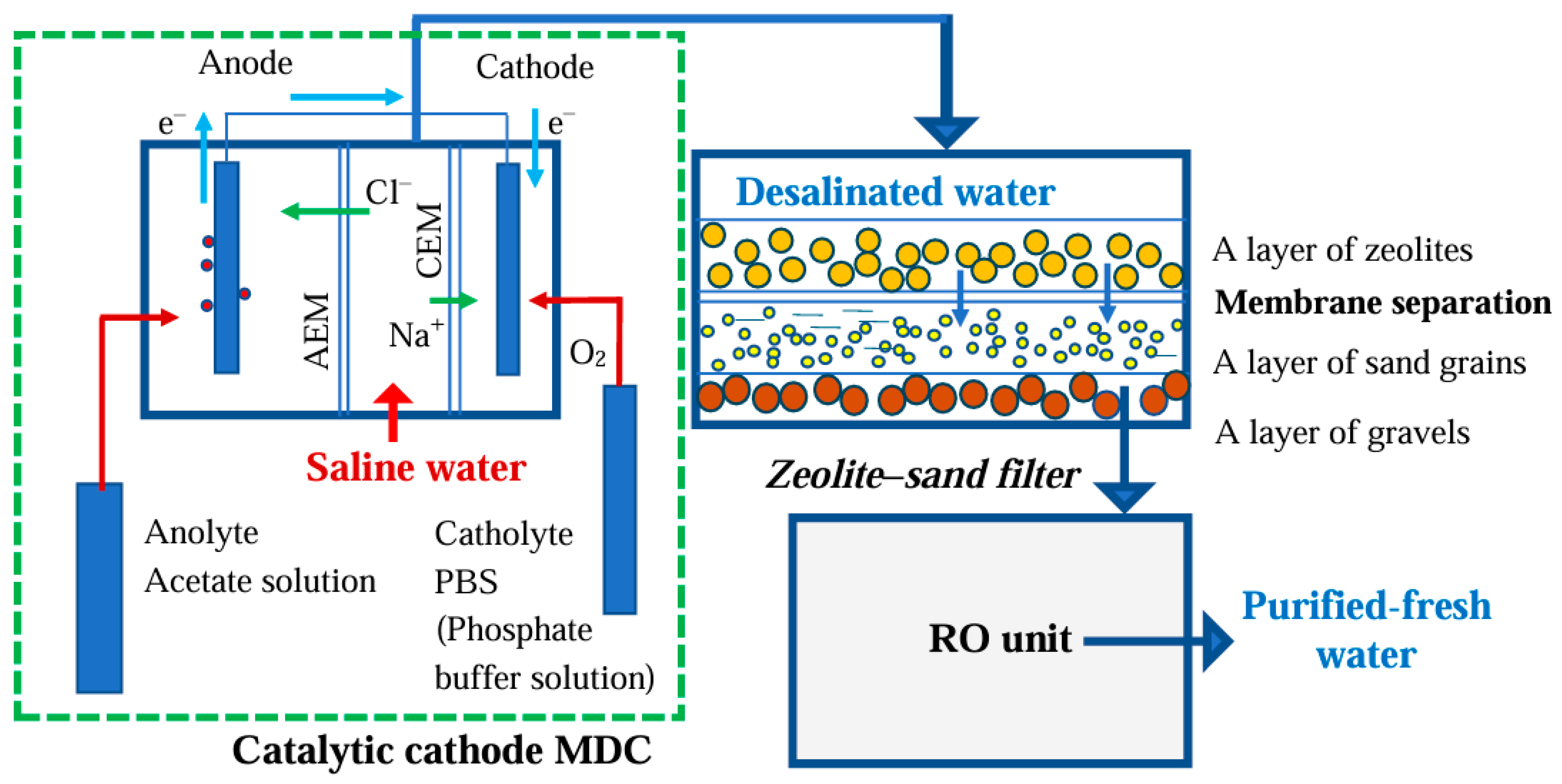
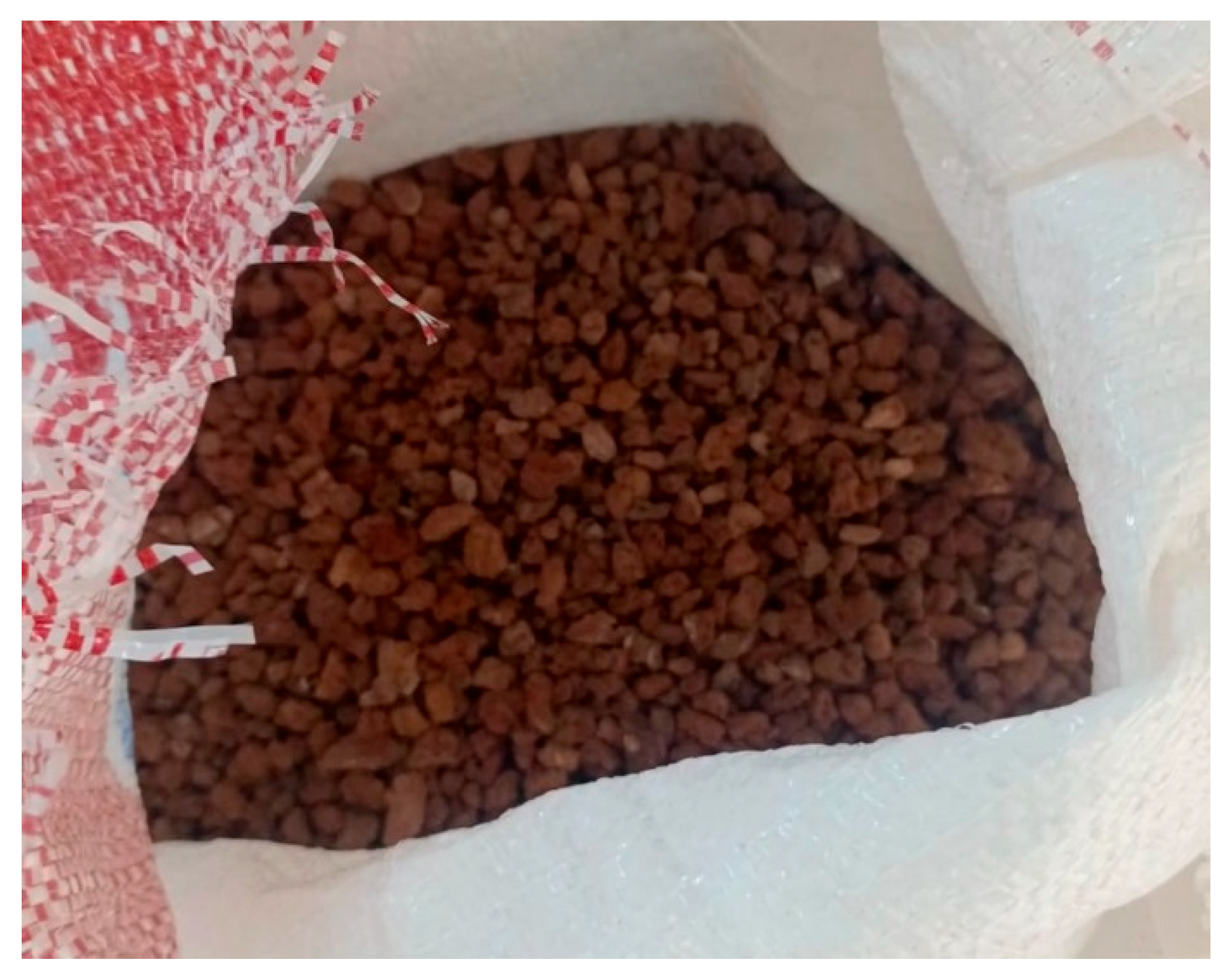
As shown in Figure 1, a catalytic cathode MDC installed with a zeolite–sand filter is proposed as a pre-treatment stage prior to the RO process. The system integrates the interactions between bio-electrochemical and adsorption processes. The methodology of bio-electrochemical cells in water desalination is clearly illustrated by Shanat et al. [14]. The catalytic cathode MDC is capable of ionically separating salts from saline water by electron transfer from the anode to cathode electrodes, as well as electric current production using highly conductive electrodes. Air–cathode electrodes simultaneously enhance the desalination process for an improved oxygen reduction reaction. Carbon nanotubes and graphene electrodes are used in MDCs due to their stability for micro-organism growth on porous structures. Although carbon-based materials are cheap, conductive and corrosion-resistant [10], their electric conductivity is not as high as that of platinum metal electrodes. An ammoniating carbon-based anode at high temperature or the use of granular activated carbon can enhance MDCs’ electrogenic performance. In addition, the catalytic cathode electrode can significantly improve their desalination process. A reduced graphene oxide/polyaniline composite-coated stainless steel mesh cathode electrode is able to enhance the desalination process by promoting oxygen reduction [10]. Furthermore, titanium oxides or manganese oxides can be used as cathode catalysts to improve desalination [23]. Acetate solution is used as an anolyte, while phosphate-buffered solution (PBS) is used as an electrolyte for pH adjustment in the cathodic chamber. In turn, the treated water is directed to a multi-layer filter for better water purification. This filter is composed of a top layer of zeolites followed by membrane separation and a bottom layer of gravel supporting a layer of sand grains. Zeolites are capable of adsorbing specific inorganic salts, as well as positively charged metallic ions, from saline water. Different amounts of natural zeolite deposit extracted from Jordan (see Figure 2) are applied for saline water examination at an ambient temperature of 25 °C. The elements found in this material were characterized via laboratory examination in Jordan. A pH–electron conductivity meter-THERMO was used for testing conductivity and pH in solution, while ammonia, sodium, and chloride concentrations were tested using the Kjeldahl–Gerhardt method of nitrogen determination, a flamephotometer-BWB, and the titration method by AgNO3, respectively. The treated water is then directed to an RO unit for supplementary saline water purification [24].
A unified protocol is applied for a hybrid combined system using water characteristics at the Doha plant in Kuwait (see Supplementary Materials, Figures S1 and S2). Instead of a single desalination chamber, multiple pairs of AEM and CEM are inserted between a single pair of electrodes. This type of arrangement amplifies ion removal per unit surface area and organic substrate. Large-scale cells frequently pack the desalination chambers with mixed ion-exchange resins. These resins can increase the conductivity of low-salinity water and enhance effluent water quality without massive energy overhead. The reactor configuration can be applied for series or parallel flow dynamics. While conventional electrodialyzers use parallel flow, stacked MDCs can direct the concentrate and diluate serially into cells in the stack to enhance the extent of desalination. An energy balance is applied to the proposed system by incorporating the forward osmosis (FO) process with the MDC and RO process. The total energy consumption estimation is based on the summation of the energy required for the FO process, MDC auxiliary operations, and RO process and subtracting the energy generated biologically by MDC. Both MDC and FO processes require lower energy compared with the RO process. The energetic consumption of the proposed system depends on the influent salinity concentration and desalination efficiency. The combined system is subjected to an influent capacity of 160,000 m3/day and a salinity concentration of between 30 and 45 g/L. The characteristics of saline water at the Doha plant are listed in Table 2. At a high salinity level, the forward osmosis (FO) process is suggested prior to MDC to reduce the salinity concentration to 30 g/L. This concentration is based on mass balance flow considering 50% flow recovery as flux flow in the forward osmosis process. Brackish water can be used as a feed solution to dilute the influent saline water to the Doha plant using the FO process [25].
FO is a membrane separation process in which water naturally moves through a semi-permeable membrane from a low-salinity concentration feed solution toward a high-salinity concentration draw solution due to osmotic pressure difference rather than externally applied hydraulic pressure. Accordingly, unlike the RO process, FO operates under low pressure, which reduces membrane fouling and energy consumption. In the proposed FO mechanism, 50% flow recovery of MDC effluent is considered the feed solution with salinity of 15 g/L as brackish water source, whereas the Arab Gulf seawater influent flow of 160,000 m3/day is considered the draw solution with salinity of 45 g/L as saline water source. By applying mass balance, the influent flow to MDC units is diluted to a salinity of about 30 g/L. Regarding the mass balance of the proposed concept, a clear dilution-water input with changed total flow is presented prior to stacked MDCs in the proposed prototype at high influent saline concentration of 45 g/L, whereas a separate brine stream is presented within the FO process (see Supplementary Materials Figure S2). About 50% of effluent flow of stacked MDCs is returned back to be mixed with the influent Arab Gulf seawater of salinity concentration of 45 g/L and a flow rate of 160,000 m3/day entering the proposed plant. A separate brine stream of salinity of 14.9 g/L is considered to be rejected by FO membranes, whereas a return flow of about 80,000 m3/day and salinity of 0.1 g/L is considered as feed flow to pass through the FO membrane into the draw of influent seawater. By applying mass balance flow prior to stacked MDCs, the mixed flow will increase to about 240,000 m3/day with a salinity concentration of about 30 g/L. The FO membrane area is determined based on a permeate water flux rate of about 20 L/m2/hr. To process 80,000 m3/day of water in the FO system, hundreds of standard industrial spiral-wound FO modules (commonly 8 inches in diameter × 40 inches long) can be installed to achieve the required surface area. To house this many modules, the membranes are stacked into pressure vessels (typically holding 8 elements each of about 40 m2 per module). The total plant footprint is determined based on the suggested configuration. However, internal and external concentration polarization limit flux in FO. Membrane choice (such as thin-film composite membranes) and spacer design greatly influence the effective flux. Also, large-scale plants require staging the modules in series to maintain efficiency and optimize active area. Membrane fouling can be controlled by increasing the water flux rate that generates higher shear stress, washing away accumulated particles or using osmotic backwash (using a higher concentration on the feed side) by inducing reverse flow of water, which lifts the fouling layer off the membrane surface. Clean-in-place can also control membrane fouling using mild acids to dissolve inorganic scales or bases to break down organic matter and proteins. By applying mass balance flow, as shown in Supplementary Materials Figure S2, an MDC effluent flow at a salinity concentration of about 13–15 g/L will be directed to the natural ZF and RO process. The estimated effluent salinity concentration of MDC units is justified by the Tenerife (Spain) pilot plant treating real seawater with salinity concentration of between 35 and 40 g/L with characteristics similar to Atlantic seawater near the Canary Islands. The Tenerife pilot plant was developed within the European Horizon 2020 project for microbial desalination. The current study presents a proposed prototype for a large-scale MDC plant based on a realistic equivalent study to be further applied at Doha plant (Kuwait). The proposed MDC pilot plant is based on the configuration proposed by the authors of [26]. Its 4800 m3 capacity comprises an assembly of 140 MDC pilot-unit stacks, each composed of 34-unit cells of 1 m3 capacity and around 1 m2 electrode area per cell. According to Shanat et al. [14], an assembly for stacked MDCs was proposed to accommodate a discharge of about 30,000 m3/day. For the full plant, an assembly of 1600 unit stacks composed of 100-unit cells each is suggested to accommodate a current flow rate of 160,000 m3/day. The operational conditions of the proposed MDCs can be determined based on previous studies. Table 3 and Table 4 present the operational conditions of multiple bio-electrochemical cells using different electrode materials.

2.3. Limitations of Doha MDC–RO Plant

The limitations of an integrated system are further discussed to focus on optimizing MDC technologies, reducing capital costs and enhancing scalability, thereby positioning it as a viable complement or alternative to conventional RO systems in desalination plants. Stacked MDCs are suggested for overcoming the scalability limitations reported by Chen et al. [37] and Zuo et al. [38]. Furthermore, the suggested catalytic MDCs can be scaled based on the system developed by Zhang and He [39]. A practical solution for system scalability is multiple smaller MDCs acting in parallel; in this way, the difficulty of cleaning and maintaining MDCs after biofouling, once scaled up, can be overcome. Furthermore, the predicted investment cost of a single MDC handling the load of an entire seawater reverse osmosis (RO) plant will likely be extremely expensive and thus sometimes impractical [40]. Thus, another solution is having part of the load of the whole plant handled by the MDC configuration. This would allow for the construction of a smaller MDC while still lowering the total seawater load. The MDC pilot plant is suggested according to that proposed by Dargam et al. [26] using stacked MDC units (see Supplementary Materials, Figure S1). According to Al-Mamun et al., MDC performance can be studied at a large scale [41]. Microbial stability can be controlled by adjusting the wastewater sludge pH in a preliminary unit to an acceptable neutral level before entering the anodic compartment of MDCs. The continuous circulation of electrolytes can improve MDC performance by removing pH fluctuations, affecting mass transfer resistance, and consequently improving the desalination rate and power density [41,42]. Furthermore, using inorganic ceramic membranes can help in overcoming the problem of membrane biodegradability and biofouling. In addition, incorporating microbial fuel cell (MFC) with MDC can enhance system performance. As reported by Borjas et al. [43], the MFC/MDC start-up protocol and merging strategies can enhance performance at a larger scale in order to accommodate the variation in influent quality and maintenance needs for the Doha RO plant.

3. Results and Discussion

3.1. Cost Assessment of Doha MDC–RO Plant

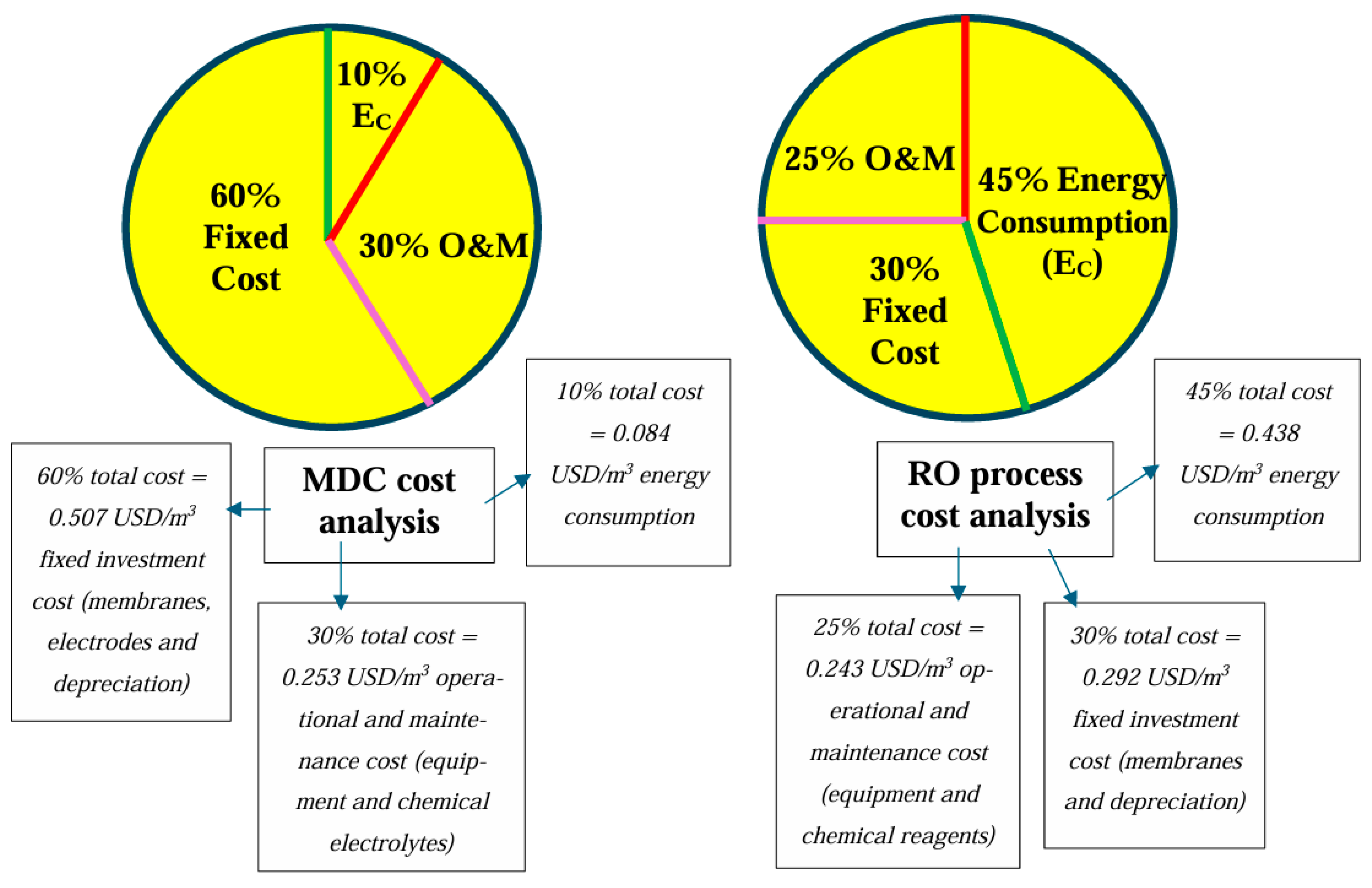
A detailed economic analysis is conducted to compare the cost structure of two desalination technologies—MDC and RO—applied at the Doha water treatment plant, as shown in Figure 3. This comparison aims to evaluate the feasibility, sustainability, and operational advantages of each system based on the respective cost components, namely the fixed investment costs, operational and maintenance (O&M) costs, and energy consumption. Shanat et al. [14] reported on a general framework for cost analysis estimation of bio-electrochemical cells. MDC technology exhibits a total production cost of 0.845 USD/m3 of produced water, which is primarily driven by the fixed investment component. The fixed cost accounts for approximately 60% of the total cost, equating to 0.507 USD/m3 of produced water. These costs encompass the initial capital investment for the membrane, the electrodes, and infrastructure depreciation. The operational and maintenance costs constitute 30% of the total, or 0.253 USD/m3 of produced water, and include the cost of the equipment and chemical electrolytes required for continuous operation. Notably, the energy consumption cost for MDCs is significantly lower compared to RO, contributing only 10% to the total cost, or 0.084 USD/m3 of produced water. This relatively low energy demand is one of the main advantages of the MDC system, making it a promising candidate for sustainable desalination applications.
In contrast, the RO process presents a higher total cost of 0.975 USD/m3 of produced water [5,15]. The cost structure is markedly different, with energy consumption representing the largest portion. Approximately 45% of the total cost, or 0.438 USD/m3 of produced water, is attributed to energy usage, reflecting the high-pressure requirements of membrane filtration in RO systems. The fixed investment costs account for 30% of the total (0.292 USD/m3 of produced water), covering the expenses of membrane infrastructure and equipment depreciation. The O&M costs make up the remaining 25%, equating to 0.243 USD/m3 of produced water, and include chemical reagents and equipment maintenance [5,15]. A comparative analysis reveals that, while the RO system incurs slightly higher total costs, its widespread adoption and technological maturity make it a reliable option in current desalination infrastructure. However, energy dependency remains a critical limitation, especially in regions where energy resources are constrained or where environmental impact is a concern. Conversely, MDC offers a compelling alternative with significantly lower energy requirements, suggesting its potential for long-term sustainability. Nevertheless, the technology’s higher fixed costs and relative novelty may pose barriers to immediate large-scale implementation. In conclusion, MDCs and RO each have distinct economic and operational profiles. The former is advantageous from an energy efficiency perspective and could be strategically integrated into future, sustainability-focused desalination frameworks. Meanwhile, RO continues to serve as a practical solution where infrastructure and operational support are well-established.

3.2. Insights into Catalytic MDC Performance

The findings presented in Table 3 reveal that, in MDCs, a power density of about 338 mW/m2 is generated using a platinum electrode as the cathode and an activated carbon electrode as the anode, where the anode chamber volume is about 84 mL and food factory wastewater is used as the anolyte substrate [27]. Conversely, the output power density is expected to decline to 3.1 mW/m2 if stainless steel mesh is used as the cathode electrode and graphite felt is used as the anode electrode, where the anode chamber volume is 40 mL and synthetic wastewater from sodium acetate is used as the anolyte substrate [28]. Majumder et al. [30] reported an improved produced current of about 1.8 mA using a carbon brush as the anode and cathode electrodes, where the anode chamber volume is 300 mL and industrial wastewater is used as the anolyte substrate. The power density can be improved using stainless steel mesh coated with a reduced graphene oxide/polyaniline composite. According to Rahman et al. [10], the power density can reach 151.23 mW/m2 using a catalytic cathode electrode and a carbon fiber brush as an anode electrode, where the anode chamber volume is 40 mL, synthetic wastewater from sodium acetate is used as the anolyte substrate, the influent substrate concentration to the anode chamber is 2 g/L, and the influent saline water concentration to the middle chamber is 35 g/L.
As mentioned in Table 4, graphene-based polyaniline nanocomposite electrodes have demonstrated improvements of about 40% in desalination efficiency and a current production of 512 mA/m2 in MDC with low-cost alternatives for platinum metal electrodes. Comparing it with other studies, Ping et al. [31] examined the performance of an MDC with an operational desalination volume of 150 mL at an influent substrate concentration to the anode chamber of 1 g/L, influent saline water concentration to the middle chamber of 30.6 g/L, internal resistance of 30 Ohm and different external resistances. A desalination efficiency of about 50% was achieved using a cathode electrode of carbon cloth coated with activated carbon-supported platinum as a catalyst and an anode electrode of a carbon fiber brush [31]. Other studies implied a desalination efficiency in the range of 20% to 50% and current production varying between about 1 and 5 mA, which can be attributed to the MDC operational conditions [23,32,33,35]. In addition, Rahman et al. [36] reported an increased generated power of 1.4 mW and desalination rate of 9 mg/h in MDC using a carbon fiber brush as an anode electrode and a carbon cloth coated with 0.5 gm platinum/cm2 as the cathode electrode. However, using platinum-coated carbon cloth electrodes as catalysts is more expensive than using stainless steel electrodes coated with graphene oxide/polyaniline composite.
Furthermore, several studies have explored stacked MDC unit performance for larger scale pilot plants. The stacked MDC configuration can improve the desalination efficiency by about 45%, with concurrent improvements in charge transfer efficiency, total desalination rate, enhanced ionic pair separation, and energy recovery [37,44,45]. In addition, Zuo et al. [38] reported on the efficacy of stacked MDC in achieving a desalination efficiency of about 95% in 12 h using a large-scale pilot plant with a capacity greater than ten liters and low-salinity influent water. Furthermore, Zhang and He developed a large-scale MDC system with a liquid volume of 105 L to investigate system scale-up [39]. The results of this study indicated a desalination efficiency of about 42% at an influent salinity concentration of 35 g/L and hydraulic retention time (HRT) of 2 days, whereas the generated current reached about 400 mA at an anolyte substrate concentration greater than 2 g/L and an external resistance of 0.1 Ohm. At higher anolyte substrate concentrations, the different species of microbial consortia may overcome the microbial limitation at very low external resistance. However, Chen et al. [37] optimized two stacked MDCs at an external resistance of 10 Ohm, influent salinity of 20 g/L, and anolyte substrate concentration of 1.6 g/L. This is due to the unfavorable microbial conditions at an external resistance below 10 Ohm for limited anolyte substrate concentrations. Although the specific desalination ratio decreases with increased desalination chambers and thus internal resistance, ionic separation in each chamber is enhanced, increasing the total desalination ratio in stacked MDCs [37]. The Tenerife (Spain) large-scale pilot plant has also indicated high salinity removal using stacked MDCs prior to the RO process. About 65% of TDS can be removed from real seawater of influent TDS concentration of 35–40 g/L using stacked MDCs at the pilot plant. Although the applicability of MDC on a large-scale system, the capital cost of structural units and the operational cost for maintaining stable conditions should be considered. The characteristics of influent wastewater to anode chamber as well as the catholyte regeneration play a significant role in the performance of stacked MDCs. In addition, the durability of ion-exchange membranes and sustainability of highly conductive electrodes may increase the capital cost of stacked MDCs.

3.3. Evaluation of Material-Based Adsorption Process

Across several studies, different materials have been used as efficient and cost-effective adsorbents for removing organic and inorganic contaminants from both water and wastewater [46]. Mkilima et al. [20] reported on the efficacy of using a fixed-bed column filter, containing natural zeolites (1.5 mm size) with a depth of 1 m and filter diameter of 5.08 cm, in order to reduce groundwater salinity levels. According to Mkilima et al. [20], the filtration rate was determined so that an adequate contact time for salt adsorption could be achieved at a pH value varying between 6.4 and 12.5 in saline water. Their results indicated that a TDS removal efficiency of about 50% could be reached at an average influent TDS concentration of 7680 mg/L. In the current study, Table 5 presents the experimental results for saline water purification using 250 g of zeolite in a 250 mL beaker at an influent salinity concentration of 4320 mg/L. The results show that around 5% reduction in TDS at a contact time of 2 h can be attributed to the morphology and characteristics of natural zeolite aggregates after washing and drying at 105 °C, and pH value of 8.13. The salinity level can exceed the 20% removal efficiency if the filter is filled with three layers of natural zeolites with a total depth of 1.5 m at HSL of about 6 m/day. Such efficiency can be attributed to salt adsorption on clinoptilolite at a higher retention time, a lower HSL, and the solution’s neutral pH value [19,20]. Moreover, the zeolite-membrane filter (ZF) is capable of removing around 50% of the ammonium ions present, indicating the significance of using filters in purifying the effluent water discharge in Kuwait Bay, as reported by Hamoda et al. [7]. In addition, the experimental results show that these natural zeolites can enhance the quality of saline water by removing 26% of calcium ions, 31% of magnesium ions, 43% of potassium ions, and about 16% of sulfate ions. This can mitigate membrane fouling in the RO process, and thus the operational and maintenance costs can significantly be reduced in the RO process.
The salinity removal efficiency observed at 4300 mg/L may differ under higher influent salinity conditions due to increased ionic strength affecting mass transfer, and finite ion-exchange capacity or limited adsorption sites of natural zeolites. However, similar salinity removal efficiency can be obtained at influent salinity of 15 g/L as more amounts of salts are removed according to the law of mass action and Le Chatelier’s principle for binding ions on zeolite surface. In addition, regenerating natural zeolites (like clinoptilolite) can overcome their finite cation-exchange capacity by using highly concentrated salt or caustic solution to reverse the ion-exchange process. That flushes out the trapped contaminants (such as ammonium ions, heavy metals or water hardness ions) and reloads the zeolite with active ions such as potassium cations, allowing the natural zeolites to be used over multiple cycles. During system flushing, the brine solution itself can only be used to regenerate the zeolite bed and is rinsed completely until all salt residue and desorbed minerals are washed away down the drain in the backwash cycle. Furthermore, additional analyses should be studied regarding the need for future investigations under conditions more representative of the proposed prototype. These future studies should include experiments using influent salinity levels closer to 15 g/L, evaluation of different zeolite depths and particle sizes, longer hydraulic retention times considering less hydraulic loading rates, regeneration cycle assessment, and continuous-flow column operation to better characterize long-term filtration behavior and salt removal efficiency.
In terms of economic cost, natural zeolites can be reused several times if the gravel is washed in a less saline solution containing citric acid or an acidic solution with a pH between 5 and 6 [47]. With a particle density of 2.65 gm/cm3, the cost of natural zeolite is about 0.000026 USD/cm3. To accommodate the influent discharge of the Doha plant, the cost of obtaining natural zeolite for a 6 m × 8 m × 1.5 m filter can reach about USD 1872. In addition, an additional cost of about 20% is predicted for membrane separation when using sand–gravel layers in the proposed filter. Gravity filters can be used to decrease capital and operating costs. However, pressure drop system can be used for the intermediate ZF to overcome the severe media clogging at low HSL. The capital and operational expenditures of an intermediate filtration system can be estimated as a percentage of RO process expenditures. The energy consumption of high-pressure pumps in the RO process represents about 45–60% of the total energy consumption of industrial SWRO plants because of the high osmotic pressure associated with Gulf seawater salinity, whereas the energy consumption of pre-treatment units as multi-media filtration is about 5–12% of the total energy consumption of industrial SWRO plants. In this regard, an additional cost for the multi-media filtration pre-treatment units is estimated as 15–25% of RO capital cost. Also, the operating cost of the auxiliary system filtration units including membrane cleaning-in-process and instrumentation is estimated as 10–15% of RO operational cost. However, the intermediate ZF can achieve savings in the capital and operating costs of the RO process by significantly reducing membrane fouling in the RO process.

3.4. Cost–Benefit Analysis of MDC–RO Plant

We conducted a cost analysis for applying the MDC process in the Doha RO plant at an influent capacity of 4800 m3/d. Table 6 shows that the MDC assembly (with a 40 mL desalination capacity) investment cost is about 160 USD/m3, including membranes, anodes, and stainless-steel catalytic cathode electrodes, as reported by Rahman et al. [10]. Accordingly, the predicted annual cost is estimated to reach about USD 768,000 for about one year of cell operation, resulting in a daily investment cost of about 0.43 USD/m3 of produced water. Other studies imply a reduced MDC assembly (with a 500 mL desalination capacity) capital cost of about 55 USD/m3 for cell membranes [10,48]. Accordingly, the annual cost for upgrading the Doha plant with MDCs is expected to be USD 264,000 for around one year of cell operation, resulting in a daily fixed cost of 0.15 USD/m3. Regarding the type of electrodes used in MDC [49], we found that the cost of platinum and titanium electrodes varies between 40 and 60 USD/m3, indicating a daily fixed cost in the range of about 0.11 to 0.16 USD/m3 of produced water for cell electrodes, assuming a lifetime of about one year of cell operation. Conversely, the costs of graphite polyaniline and activated carbon electrodes reach about 4 and 13.6 USD/m3, respectively, indicating a better daily fixed cost of, on average, around 0.025 USD/m3 of produced water for cell electrodes, again assuming a lifetime of about one year of cell operation. The electrode lifetime of about one year is justified by the intrinsic durability and long operational stability of carbon-based electrodes and corrosion-resistant metals, especially stainless-steel electrodes. Dai and Meng [50] and Shamsuddin et al. [51] reported on the sustainability of carbon-based and stainless-steel electrodes. Carbon-based electrodes are chemically inert and highly corrosion-resistant. Graphite and carbon felt electrodes can operate for several months without significant material degradation because carbon does not undergo electrochemical dissolution under normal MDC operating potentials. Recent studies have reported that stainless steel electrodes exhibit an extremely low corrosion rate of about 0.03 mm/year. Moreover, these electrodes have demonstrated a stable hydrogen-production performance over a 120-day continuous operation period.
According to Wei et al. [49], the capital cost sensitivity analysis of MDC indicates the electrodes material cost of stainless steel at 1.05–7.5 USD/m2, carbon cloth at 6–19.5 USD/m2, graphite granule at 0.83–3 USD/kg, granular activated carbon at 0.023–0.15 USD/kg, carbon felt or carbon fiber at 22.5–45 USD/kg, and titanium at 15–150 USD/m2. However, the capital cost can be increased to 5 times at scaling of MDCs. The significant variance in the electrode cost can be attributed to the density of electrode material, the metal catalyst coating for electrode, and mesh geometry for cell configuration. The metal catalyst coating can increase the electrode conductivity, electrochemical reactions for active surfaces, lifetime of electrode, and resistance to corrosion. Also, the membrane cost significantly varies in MDC where about 50–100 USD/m2 can be estimated for the cost of the conventional ion-exchange membrane in MDC compared with the Nafion membrane that exceeds about 500 USD/m2 for excellent ion transfer in MDC [48]. In the RO process, standard polyamide membranes can cost about 20–60 USD/m2 compared with thin-film composite membrane that costs about 60–120 USD/m2 for better salt rejection. The energy recovery device can also be used in order to reduce the long-term energy cost in the RO process as utilized at the Ras Al-Khair plant in Saudi Arabia. However, the capital cost can be increased by about 15–25% in the RO process. Moreover, the sensitivity analysis of operating cost is associated with energy demand in the desalination process. The RO energy demand varies between 2 and 6 kWh/m3 compared with about 0.5–1.5 kWh/m3 for MDC at TDS between 10 and 35 g/L, whereas the RO process may require an increase in energy consumption of 30–50% due to the high operating pressure of RO pumps [40]. Furthermore, the RO process requires an additional maintenance cost of 25–40% due to severe membrane fouling compared with about an additional cost of 20–35% for membrane cleaning in MDC. At high TDS of 45 g/L, the integrated FO–MDC–RO process can achieve the greatest energy savings. This can be attributed to the fact that FO dilutes saline feed without hydraulic pressure, MDC partially removes salts in a biological method, and RO operates under significantly reduced osmotic pressure. In this regard, the energy consumption can be reduced by about 40–60%.
Table 7 also shows the operational and energy consumption costs of using the MDC process to upgrade the Doha plant. As reported by Rahman et al. [10], the expected operational and maintenance costs of MDC can reach below 0.5 USD/m3 if low-cost natural electrolytes are used in MDC, indicating a daily cost of about 0.09 USD/m3 of produced water for about one year of cell operation. In addition, the cost of MDC energy consumption is expected to reach about 0.03 USD/m3, resulting in a daily cost of about 0.03 USD/m3 of produced water for an assumed lifetime of about one year of cell operation. These findings reveal that using a combination of MDC and RO processes can improve the overall efficiency of the Doha plant with minimum costs [52]. We suggest that using MDCs prior to the RO process can decrease the energy consumption by about three times; however, the investment cost of the former may be higher than that of the RO process. Furthermore, due to membrane fouling in RO units at the Doha plant, the use of MDC prior to the RO process can promote affordability [53,54]. The estimated cost results for the combined MDC–RO system are presented in Table 8 and Table 9. The estimated cost of the RO process alone is based on recent studies as reported by Feo-Garcia et al. [55], whereas the estimated cost of stacked MDC is based on the in situ Tenerife (Spain) pilot plant treating real seawater with high salinity concentration. The energetic consumption of the RO alone is 0.52 kWh/kg of salt removed, whereas the energetic consumption of the MDC–RO combination is about 0.37 kWh/kg of salt removed. These findings are based on a reduction in the influent salinity of about 30% by the RO process in the combined system, compared with that of using the RO process alone. The validation of the RO process performance is justified by the ability of the Tenerife pilot plant to reduce salinity by 65% using stacked MDCs. Also, the treatment efficiency results of the proposed MDC–RO combination at the Doha plant are estimated in compliance with the outcomes of the Tenerife pilot plant treating seawater salinity concentration of 35–40 g/L. In addition, the results show that the investment cost of the MDC–RO combination can reach around 0.6 USD/m3 if low-cost electrode materials are used in MDCs. The type of wastewater used in the anode chamber can also enhance the microbial activity for better MDC operational conditions. Further studies could explore the optimum operational MDC conditions to overcome the additional costs induced by the plant’s increasing capacity. Alternative low-cost materials could also be recommended for MDC design to minimize the investment costs necessary for upgrading plant performance.

4. Conclusions

The current study focused on the feasibility of combining MDC and RO processes for water desalination at the Doha plant, Kuwait. Using catalytic MDC prior to RO, the combined system could improve water desalination. For such a system, a zeolite–sand filter can be provided containing three layers of pre-washed natural zeolite rocks extracted from a soil deposit in Jordan. The integrated MDC–RO process constitutes an economic technology for upgrading the Doha plant. The cost analysis explicitly proves that the MDC–RO process can reduce the energy consumption per cubic meter of fresh water produced by more than 50% compared with that of the RO process alone. In this regard, combined MDC–RO technology can reduce the energetic consumption from 0.52 to 0.37 kWh per kg of salt removed. The intermediate filter can promote water purification by metal adsorption on pre-treated natural zeolites, whereas the limited amounts of dissolved salts are reduced by about 5% after a contact time of 2 h. However, the salt removal can be enhanced by decreasing HSL to 6 m/day at a neutral pH solution using a zeolite filter depth of 1.5 m. The natural zeolites can be used several times for effective contaminant removal. These zeolites should be pre-washed and dried at 105 °C prior to aggregate arrangement in a filter unit. Our cost study highlights the low cost of using stainless steel electrodes coated with graphene–polyaniline composite compared with that of using platinum metal electrodes in MDC. In addition, stacked MDC catalytic cathode electrodes can improve the desalination efficiency and current generated, overcoming scalability limitations and upgrading the Doha plant’s performance. At an influent salinity of 30 g/L, the operational conditions of stacked MDCs can be considered for an anolyte substrate concentration of 2 g/L, external resistance of 10–50 Ohm and HRT of 1–2 days. The combined MDC–filter–RO system reduces the operational and energy consumption costs, promoting affordability in light of the membrane fouling in the RO process. The investment cost for stacked MDCs can be reduced from USD 0.43/m3 to about USD 0.31/m3 of produced water via the use of low-cost durable membranes and catalytic electrodes in MDC units.

Supplementary Materials

The following supporting information can be downloaded at: https://www.mdpi.com/article/10.3390/w18121460/s1, Figure S1: Schematic diagram of stacked MDC for saline water desalination. Figure S2. Mass balance flow of salinity load using hybrid MDC-zeolite/membrane filter-RO system at Doha plant.

Author Contributions

M.S.S.: methodology, investigation, former analysis, writing—original draft. M.M.I.: supervision, visualization, review and editing. M.A.-H.: supervision, visualization, review and editing. W.A.F.: supervision, review and editing. M.M.E.-S.: conceptualization, visualization, supervision, methodology, investigation, former analysis, data curation, validation, writing—original draft, review and editing. All authors have read and agreed to the published version of the manuscript.

Funding

This research received no external funding.

Data Availability Statement

The original contributions presented in this study are included in the article. Further inquiries can be directed to the corresponding author.

Acknowledgments

The authors acknowledge Zohuir Abdullah Ali Al balawna for the assistance provided in examining the saline water samples at Jordan Valley Authority laboratories directorate at Balqa-Dairalla.

Conflicts of Interest

The authors declare no conflict of interest.

References

  1. Nair, M.; Kumar, D. Water desalination and Challenges: The Middle East perspective: A review. Desalination Water Treat. 2013, 51, 2030–2040. [Google Scholar] [CrossRef]
  2. Curto, D.; Franzitta, V.; Guercio, A. A review of the water desalination technologies. Appl. Sci. 2021, 11, 670. [Google Scholar] [CrossRef]
  3. Chebli, H.; Fornarelli, F.; Bellantuono, N. Comparison of desalination technologies and assessment of their sustainability. J. Phys. Conf. Ser. 2023, 2648, 012021. [Google Scholar] [CrossRef]
  4. Kesieme, U.K.; Miline, N.; Aral, H.; Cheng, C.Y.; Duke, M. Economic analysis of desalination technologies in the context of carbon pricing, and opportunities for membrane distillation. Desalination 2013, 323, 66–74. [Google Scholar] [CrossRef]
  5. Jamil, M.A.; Qureshi, B.A.; Zubair, S.M. Exergo-economic analysis of a seawater reverse osmosis desalination plant with various retrofit options. Desalination 2017, 401, 88–98. [Google Scholar] [CrossRef]
  6. Al-Mutairi, E.S.; Rashed, I.G.; El-Halwany, M.M.; Mosaad, M. Environmental impact assessment of water desalinating systems: Kuwait as a case study. Mansoura Eng. J. 2024, 49, 5. [Google Scholar] [CrossRef]
  7. Hamoda, M.F.; Donia, N.S.; Al-Attar, I.M.S. Impact assessment of desalination plants on Kuwait Bay using GIS/water quality index analysis. Desalination Water Treat. 2020, 176, 45–50. [Google Scholar] [CrossRef]
  8. Jatoi, A.S.; Hashmi, Z.; Mazari, S.; Mujawar, M.N. A comprehensive review of microbial desalination cells for present and future challenges. Desalination 2022, 535, 115808. [Google Scholar] [CrossRef]
  9. El-Seddik, M.M.; Elawwad, A. An extended bio-electrochemical model for wastewater treatment and water desalination: Insights into the performance of microbial desalination cells. Desalination 2024, 586, 117791. [Google Scholar] [CrossRef]
  10. Rahman, S.; Al Shuaili, T.; Al-Mamun, A.; Khudaish, E.; Sana, A.; Baawain, M.S.; Dhar, B.R. Cost effective reduced graphene oxide/polyaniline composite coated SSM cathode for bio-electrochemical desalination: Advancing desalination via cathodic improvement. Desalination 2025, 597, 118399. [Google Scholar] [CrossRef]
  11. Tawalbeh, M.; Al-Othman, A.; Singh, K.; Douba, I. Microbial desalination cells for water purification and power generation: A critical review. Energy 2020, 209, 118493. [Google Scholar] [CrossRef]
  12. Huang, L.; Li, X.; Ren, Y.; Wang, X. In-situ modified carbon cloth with polyaniline/graphene as anode to enhance performance of microbial fuel cell. Int. J. Hydrogen Energy 2016, 41, 11369–11379. [Google Scholar] [CrossRef]
  13. Li, M.; Zhou, S.; Xu, M. Graphene oxide supported magnesium oxide as an efficient cathode catalyst for power generation and wastewater treatment in single chamber microbial fuel cells. Chem. Eng. J. 2017, 328, 106–116. [Google Scholar] [CrossRef]
  14. Shanat, M.S.; Ibrahim, M.M.; Abdel-Hamid, M.; Fahmy, W.A.; El-Seddik, M.M. Assessment of various technologies used for water desalination projects in Kuwait. Eng. Res. J. 2025, 55, 111–118. [Google Scholar] [CrossRef]
  15. Akashah, S.; Abdel-Jawad, M.; Abdelhalim, M.M.; Dahdah, J. Cost and economic analysis of Doha reverse osmosis plant (Kuwait). Desalination 1987, 64, 65–82. [Google Scholar] [CrossRef]
  16. Salinas-Rodriguez, S.G.; Schippers, J.C.; Amy, G.L.; Kim, I.S.; Kennedy, M.D. Seawater Reverse Osmosis Desalination: Assessment and Pre-Treatment of Fouling and Scaling; IWA Publishing: London, UK, 2021. [Google Scholar] [CrossRef]
  17. Shabib, A.; Tatan, B.; Elbaz, Y.; Hassan, A.A.; Hamouda, M.A.; Maraqa, M.A. Advancements in reverse osmosis desalination: Technology, environment, economy, and bibliometric insights. Desalination 2025, 598, 118413. [Google Scholar] [CrossRef]
  18. Salinas-Rodriguez, S.G.; Arevalo, J.; Ortiz, J.M.; Borras-Camps, E.; Monsalvo-Garcia, V.; Kennedy, M.D.; Esteve-Nunez, A. Microbial Desalination Cells for Low Energy Drinking Water; IWA Publishing: London, UK, 2021. [Google Scholar] [CrossRef]
  19. Wajima, T. Desalination of seawater using natural zeolite for agricultural utilization. Int. J. GEOMATE 2019, 16, 21–26. [Google Scholar] [CrossRef]
  20. Mkilima, T.; Devrishov, D.; Assel, K.; Ubaidulayeva, N.; Tleukulov, A.; Khassenova, A.; Yussupova, N.; Birimzhanova, D. Natural zeolite for the purification of saline groundwater and irrigation potential analysis. Molecules 2022, 27, 7729. [Google Scholar] [CrossRef]
  21. Grifasi, N.; Ziantoni, B.; Fino, D.; Piumetti, M. Fundamental properties and sustainable applications of the natural zeolite clinoptilolite. Environ. Sci. Pollut. Res. 2025, 32, 27805–27840. [Google Scholar] [CrossRef] [PubMed]
  22. Akhtar, M.; Sarfraz, M.; Ahmad, M.; Raza, N.; Zhang, L. Use of low-cost adsorbent for waste water treatment: Recent progress, new trend and future perspectives. Desalination Water Treat. 2025, 321, 100914. [Google Scholar] [CrossRef]
  23. Elawwad, A.; Husein, D.Z.; Ragab, M.; Hamdy, A. Enhancing the performance of microbial desalination cells using δMnO2/grapheme nonocomposite as a cathode catalyst. J. Water Reuse Desalination 2020, 10, 214–226. [Google Scholar] [CrossRef]
  24. Ludwig, H. Reverse Osmosis Seawater Desalination: Planning, Process Design and Engineering—A Manual for Study and Practice; Springer Nature: Cham, Switzerland, 2022; Volume 2. [Google Scholar] [CrossRef]
  25. Elnahas, M.; Elawwad, A.; Ghallab, A.; Ettouney, R.; El-Rifai, M. An integrated MDC-FO membrane configuration for simultaneous desalination, wastewater treatment and energy recovery. R. Soc. Chem. RSC Adv. 2023, 13, 17038–17050. [Google Scholar] [CrossRef]
  26. Dargam, F.; Prez, E.; Bergmann, S.; Rodionova, E.; Sousa, P.; Souza, F.A.; Matias, T.; Ortiz, J.M.; Esteve-Nunez, A.; Rodenas, P.; et al. Operational decision-making on desalination plants: From process modelling and simulation to monitoring and automated control with machine learning. Int. J. Decis. Support Syst. Technol. 2023, 15, 1–20. [Google Scholar] [CrossRef]
  27. Mohamed, H.O.; Obaid, M.; Sayed, E.T.; Liu, Y.; Lee, J.; Park, M.; Nam, B.; Kim, H.Y. Electricity generation from real industrial wastewater using a single-chamber air cathode microbial fuel cell with an activated carbon anode. Bioprocess Biosyst. Eng. 2017, 40, 1151–1161. [Google Scholar] [CrossRef]
  28. Zhang, Y.; Sun, J.; Hu, Y.; Li, S.; Xu, Q. Bio-cathode materials evaluation in microbial fuel cells: A comparison of graphite felt, carbon paper and stainless steel mesh materials. Int. J. Hydrogen Energy 2012, 37, 16935–16942. [Google Scholar] [CrossRef]
  29. Wu, X.Y.; Song, T.S.; Zhu, X.J.; Wei, P.; Zhou, C.C. Construction and operation of microbial fuel cell with Chlorella vulgaris biocathode for electricity generation. Appl. Biochem. Biotechnol. 2013, 171, 2082–2092. [Google Scholar] [CrossRef]
  30. Majumder, S.; Istalingamurthy, D.; Sadashiva Murthy, B.M.; Prakash, B.M. Impact of different electrodes, mediators, and microbial cultures on wastewater treatment and power generation in the microbial desalination cell (MDC). Water Sci. Technol. 2023, 88, 3194–3225. [Google Scholar] [CrossRef]
  31. Ping, Q.; Zhang, C.; Chen, X.; Zhang, B.; Huang, Z.; He, Z. Mathematical model of dynamic behavior of microbial desalination cells for simultaneous wastewater treatment and water desalination. Environ. Sci. Technol. 2014, 48, 13010–13019. [Google Scholar] [CrossRef]
  32. Ebrahimi, A.; Kebria, D.Y.; Darzi, G.N. Enhancing biodegradation and energy generation via roughened surface graphite electrode in microbial desalination cell. Water Sci. Technol. 2017, 76, 1206–1214. [Google Scholar] [CrossRef] [PubMed]
  33. Ragab, M.; Elawwad, A.; Abdel-Halim, H. Simultaneous power generation and pollutant removals using microbial desalination cell at variable operation models. Renew. Energy 2019, 143, 939–949. [Google Scholar] [CrossRef]
  34. Ragab, M.; Elawwad, A.; Abdel-Halim, H. Evaluating the performance of microbial desalination cells subjected to different operating temperatures. Desalination 2019, 462, 56–66. [Google Scholar] [CrossRef]
  35. Safwat, S.M.; Meshref, M.N.A.; Salama, M.; Elawwad, A. Influence of co-substrate existence, temperature, pH, and salt concentration on phenol removal, desalination, and power generation using microbial desalination cells. Int. J. Environ. Sci. Technol. 2022, 20, 10695–10712. [Google Scholar] [CrossRef]
  36. Rahman, S.; Al-Mamun, A.; Jafary, T.; Alhimali, H.; Baawain, M.S. Effect of internal and external resistances on desalination in microbial desalination cell. Water Sci. Technol. 2021, 83, 2389–2403. [Google Scholar] [CrossRef]
  37. Chen, X.; Xia, X.; Liang, P.; Cao, X.; Sun, H.; Huang, X. Stacked microbial desalination cells to enhance water desalination efficiency. Environ. Sci. Technol. 2011, 45, 2465–2470. [Google Scholar] [CrossRef]
  38. Zuo, K.; Cai, J.; Liang, S.; Wu, S.; Zhang, C.; Liang, P.; Huang, X. A ten liter stacked microbial desalination cell packed with mixed ion-exchange resins for secondary effluent desalination. Environ. Sci. Technol. 2014, 48, 9917–9924. [Google Scholar] [CrossRef] [PubMed]
  39. Zhang, F.; He, Z. Scaling up microbial desalination cell system with a post-aerobic process for simultaneous wastewater treatment and seawater desalination. Desalination 2015, 360, 28–34. [Google Scholar] [CrossRef]
  40. Elmekawy, A.; Hegab, H.M.; Pant, D. The near-future integration of microbial desalination cells with reverse osmosis technology. Energy Environ. Sci. 2014, 7, 3921–3933. [Google Scholar] [CrossRef]
  41. Al-Mamun, A.; Ahmad, W.; Baawain, M.S.; Khadem, M.; Dhar, B.R. A review of microbial desalination cell technology: Configurations, optimization and applications. J. Clean. Prod. 2018, 183, 458–480. [Google Scholar] [CrossRef]
  42. Jacobson, K.S.; Drew, D.M.; He, Z. Efficient salt removal in a continuously operated upflow microbial desalination cell with an air cathode. Bioresour. Technol. 2011, 102, 376–380. [Google Scholar] [CrossRef]
  43. Borjas, Z.; Esteve-Nunez, A.; Ortiz, J. Strategies for merging microbial fuel cell technologies in water desalination processes: Start-up protocol and desalination efficiency assessment. J. Power Sources 2017, 356, 519–528. [Google Scholar] [CrossRef]
  44. Kim, Y.; Logan, B.E. Series assembly of microbial desalination cells containing stacked electrodialysis cells for partial or complete seawater desalination. Environ. Sci. Technol. 2011, 45, 5840–5845. [Google Scholar] [CrossRef]
  45. Kim, Y.; Logan, B.E. Microbial desalination cells for energy production and desalination. Desalination 2013, 308, 122–130. [Google Scholar] [CrossRef]
  46. Sahu, D.; Pervez, S.; Karbhal, I.; Tamrakar, A.; Mishra, A.; Verma, S.R.; Deb, M.K.; Ghosh, K.K.; Pervez, Y.F.; Shrives, K.; et al. Applications of different adsorbent materials for the removal of organic and inorganic contaminants from water and wastewater-A review. Desalination Water Treat. 2024, 317, 100253. [Google Scholar] [CrossRef]
  47. Abdella Ahmed, A.K.; Muhammad, A.Y.; Abdel-Wahed, T.; El-Seddik, M.M. Iron adsorption from water using natural zeolite-kaolin aggregates: Model kinetics. J. Appl. Water Eng. Res. 2026; in press. [CrossRef]
  48. Min, B.K.; Cheng, S.A.; Logan, B.E. Electricity generation using membrane and salt bridge microbial fuel cells. Water Res. 2005, 39, 1675–1686. [Google Scholar] [CrossRef] [PubMed]
  49. Wei, J.; Liang, P.; Huang, X. Recent progress in electrodes for microbial fuel cells. Bioresour. Technol. 2011, 102, 9335–9344. [Google Scholar] [CrossRef] [PubMed]
  50. Dai, S.; Meng, C. Advances in electrode materials for bio-electrochemical systems: A comprehensive review. Highlights Sci. Eng. Technol. 2025, 143, 76–81. [Google Scholar] [CrossRef]
  51. Shamsuddin, R.A.; Abu Bakar, M.H.; Daud, W.R.W.; Kim, B.H.; Jahim, J.M.; Noor, W.S.A.W.M.; Yunus, R.M.; Satar, I.; Ndayisenga, F. Evaluating the performance of stainless steel in microbial electrolysis cells: Hydrogen production and corrosion behaviour. Int. J. Renew. Energy Dev. 2026, 15, 242–253. [Google Scholar] [CrossRef]
  52. Shivakumar, T.; Razaviarani, V. An integrated approach to enhance the desalination process: Coupling reverse osmosis with microbial desalination cells in the UAE. Water Supply 2020, 21, 1127–1143. [Google Scholar] [CrossRef]
  53. Kumar, S.V.; Ragunathan, B.; Nishant, K. Membrane Desalination of Wastewater for the Contaminant Removal and Reduction of Fouling. In Advances in Water Treatment and Management; Mudgal, A., Davies, P., Kenndy, M., Zaragoza, G., Park, K., Eds.; Springer Nature: Singapore, 2024. [Google Scholar] [CrossRef]
  54. Soumbati, Y.; Bouatou, I.; Abushaban, A.; Belmabkhout, Y.; Necibi, M.C. Review of membrane distillation for desalination applications: Advanced modeling, specific energy consumption, and water production cost. J. Water Process Eng. 2025, 71, 107296. [Google Scholar] [CrossRef]
  55. Feo-Garcia, J.; Pulido-Alonso, A.; Florido-Betancor, A.; Florido-Suarez, N.R. Cost studies of reverse osmosis desalination plants in the range of 23,000–33,000 m3/day. Water 2024, 16, 910. [Google Scholar] [CrossRef]
Figure 1. Schematic diagram of MDC–RO process for saline water desalination.
Water 18 01460 g001
Figure 2. A photograph of natural zeolite deposit from Jordan.
Water 18 01460 g002
Figure 3. Comparison between MDC and RO annualized daily cost analysis for Doha plant.
Water 18 01460 g003
Table 1. Comparative technical and cost analysis of major SWRO plants in the Arab Gulf.
Plant
Location
Saline Water SourcePlant CapacityCapital Cost
CAPEX *
EC *O&M * CostsMembrane & Reagent CostsPumps, RO Units & Structure CostsSalt RE *
Taweelah RO Plant,
Abu Dhabi, UAE
Arabian Gulf seawater; TDS 45,000–53,500 mg/L909,000 m3/day~USD 890 million~3.0–3.5 kWh/m3~0.25–0.45 USD/m3~0.06–0.15 USD/m3~35–55% of CAPEX99.5–99.8%
Jubail 3A IWP,
Jubail, Saudi Arabia
Arabian Gulf seawater; TDS > 43,800 mg/L600,000 m3/day~USD 650 million~2.8–3.5 kWh/m3~0.25–0.45 USD/m3~0.06–0.15 USD/m3~35–55% of CAPEX99.5–99.8%
Umm Al Quwain IWP,
UAE
Arabian Gulf seawater; High salinity682,000 m3/day~USD 797 million~3.0–4.0 kWh/m3~0.25–0.50 USD/m3~0.06–0.16 USD/m3~35–55% of CAPEX99.5–99.8%
Barka IV IWP,
Oman
Gulf of Oman/Arabian Sea281,000 m3/day~USD 314 million~3.0–4.0 kWh/m3~0.25–0.45 USD/m3~0.06–0.15 USD/m3~35–55% of CAPEX99.5–99.8%
Rabigh 3 IWP
Saudi Arabia
Red Sea; High salinity600,000 m3/day~USD 750 million~3.16–3.5 kWh/m3~0.20–0.40 USD/m3~0.05–0.14 USD/m3~35–55% of CAPEX99.5–99.8%
Shuaibah 3 IWP
Saudi Arabia
Red Sea; High salinity600,000 m3/day~USD 821 million2.52 kWh/m3 reported~0.20–0.40 USD/m3~0.05–0.14 USD/m3~35–55% of CAPEX99.5–99.8%
Umm Al Houl SWRO Plant,
Qatar
Arabian Gulf seawater; Elevated biofouling564,000 m3/day (RO section)Not publicly separated~3.0–4.0 kWh/m3~0.25–0.50 USD/m3~0.06–0.16 USD/m3~35–55% of CAPEX99.5–99.8%
Az-Zour RO Units,
Kuwait
Arabian Gulf seawater; High salinity~170,000 m3/day RONot publicly separated~3.5–5.0 kWh/m3~0.30–0.55 USD/m3~0.07–0.18 USD/m3~35–55% of CAPEX99.5–99.8%
Notes: * CAPEX: Capital Expenditure; EC: Energy Consumption; O&M: Operating and Maintenance; RE: Removal Efficiency.
Table 2. Characteristics of influent saline water to Doha RO plant.
ParameterUnitValue
TDSmg/L47,000
Total alkalinity, as CaCO3mg/L150
Carbonatemg/L15
Bicarbonatemg/L115
Free Carbon Dioxidemg/L0.4
Sulfatemg/L3692
Chloridemg/L26,026
Calciummg/L646
Magnesiummg/L1927
Sodiummg/L13,997
Potassiummg/L544
Total ironmg/L0.08
pH-8.2
Table 3. Output power generated for multiple bio-electrochemical cells using various electrodes.
Anode MaterialCathode MaterialAnode Area (cm2)Anolyte Substrate TypeVolume of Anode Chamber (mL)Power Density (mW/m2)Cycle
(Days)
Ref.
Activated carbonPlatinum (Pt)-loaded carbon paper6.25Wastewater from food factory843386Mohamed et al. [27]
Carbon clothPt-loaded carbon paper6.25Wastewater from food factory84786Mohamed et al. [27]
Graphite feltStainless steel mesh biocathode7Synthetic wastewater of sodium acetate403.14Zhang et al. [28]
Graphene- polyaniline modified carbon clothPt-loaded carbon cloth7Synthetic wastewater of sodium acetate288842Huang et al. [12]
Graphite feltGraphite felt biocathode7Synthetic wastewater of sodium acetate40109.54Zhang et al. [28]
Carbon feltPt-loaded carbon paper49.5Synthetic wastewater of glucose50027.58Wu et al. [29]
Carbon fiber brushStainless steel mesh coated with reduced graphene oxide/polyaniline composite16 (block area)Synthetic wastewater of sodium acetate40151.23 (at 30 deposition cycles)5Rahman et al. [10]
Roughened carbon rodRoughened carbon rod45.9Industrial wastewater3001.2 mA
500 mV
6Majumder et al. [30]
Carbon brushCarbon brush77.7Industrial wastewater3001.8 mA
600 mV
6Majumder et al. [30]
Roughened carbon plateRoughened carbon plate35Industrial wastewater3001.2 mA
350 mV
6Majumder et al. [30]
Carbon clothCarbon cloth51Industrial wastewater3000.4 mA
300 mV
6Majumder et al. [30]
Table 4. Performance of multiple MDCs using different operating parameters.
Anode Electrode Type **Cathode Electrode Type **Sin * (g/L)CSalt * (g/L)V * mLRext * OhmRint* OhmDE * (%)Current (mA)Power (mW)Ref.
Carbon fiber brushStainless steel mesh coated with reduced graphene oxide/polyaniline composite23540130.634.32.1 mA
(512 mA/m2)
151.23 mW/m2Rahman et al. [10]
Carbon fiber brushCarbon cloth coated with activated carbon-supported Pt as a catalyst1151500.1-64.712-Ping et al. [31]
Carbon fiber brushCarbon cloth coated with activated carbon-supported Pt as a catalyst1151501003052.95-Ping et al. [31]
Plain graphiteCarbon cloth1.635501001005530.87Ebrahimi et al. [32]
Plain carbon cloth 6 cm × 5 cmCarbon cloth 5 cm × 5 cm covered by 0.5 mg/cm2 20% Pt as a catalyst1.51010510228343.50.06Ragab et al. [33]
Plain carbon cloth 6 cm × 5 cmCarbon cloth 5 cm × 5 cm covered by 0.5 mg/cm2 20% Pt as a catalyst1.510105100228302.80.8Ragab et al. [33]
Plain carbon cloth 6 cm × 5 cmCarbon cloth 5 cm × 5 cm covered by 0.5 mg/cm2 20% Pt as a catalyst1.510105500228251.20.72Ragab et al. [33]
Plain carbon cloth 6.5 cm × 6.5 cmCarbon cloth 5 cm × 5 cm covered by 0.5 mg/cm2 20% Pt as a catalyst120125100400252.10.44Ragab et al. [34]
Plain carbon cloth 6 cm × 5 cmPlain carbon cloth 5 cm × 5 cm coated with MnO2/G graphene nanocomposite as a catalyst1.510105100430200.790.06 mW
12.5 mW/m2
Elawwad et al. [23]
Plain carbon cloth 6 cm × 5 cmCarbon cloth 5 cm × 5 cm covered with 0.5 mg/cm2 20% Pt1.51010510004009--Safwat et al. [35]
Carbon fiber brushCarbon cloth coated by 0.5 gm Pt/cm2235327070DR = 9 mg/h4.51.4Rahman et al. [36]
Notes: * Sin: influent substrate conc. in anode chamber; CSalt: influent salt conc. in middle chamber; V: operational desalination volume; Rext: external resistance; Rint: internal resistance; DE: desalination efficiency; DR: desalination rate. ** Synthetic wastewater of sodium acetate is anolyte substrate; phosphate buffer solution is catholyte electrolyte.
Table 5. Saline water examination using an amount of 250 g natural zeolite in a 250 mL beaker for different contact times.
Raw Saline Water Characteristics (Influent)Contact Time of Natural Zeolites and Saline Water at Ambient Temperature of 25 °C
30 min60 min120 min
Test NameUnitValueTrial 1Trial 2Trial 3Trial 1Trial 2Trial 3Trial 1Trial 2Trial 3
EC *ds/m6.756.676.656.686.576.66.56.456.416.48
TDSppm43204268.842564275.2420542244160412841024147
pH-8.138.138.158.128.138.128.138.128.118.1
Nappm982.5010101017.51019.310231061965.1939944.5943
Kppm74.2038.654441.946.856.744.543.441.540.6
Cappm163.40126131128.6129130.4121.1120.2121120
Mgppm263.70217.49197.53218.2185.3172.1188.4185.2187.3181.3
Clppm1867.11809.61806.81869.2181318231819181517941868
HCO3ppm48.4035.1533.9334.233.633.633.431.1731.2731.78
SO4ppm938.50900.82903.6952.3876.5853.1844.2775.42820.12788.6
N-NO3ppm2.953.273.513.423.43.443.53.453.473.71
CO3ppm0.00000000000
NH4ppm0.630.50.490.480.410.410.420.340.320.31
Note: * EC: Electrical Conductivity.
Table 6. MDC capital cost analysis for upgrading Doha plant.
Materials (Fixed Items)Investment Cost (USD)Doha Plant Discharge (m3/d)Predicted Annual Cost (USD)Predicted Daily Cost (USD/m3)
MDC assembly (chamber capacity) including membranes, anode and stainless-steel catalytic cathode electrodes$160/m3
(Rahman et al. [10])
Q = 4800 m3/d
HRT= 1 day
V = 4800 m3
(140-unit stacks), 34 cells per stack
$768,000 = 160 × 4800
assuming lifetime of one year
$0.43/m3 = 768,000/(4800 × 365)
MDC membranes$55 Estimated (Min et al. [48])Q = 4800 m3/d$264,000$0.15/m3
Platinum metal electrodes$40 (Wei et al. [49])Q = 4800 m3/d$192,000$0.109/m3
Graphite-polyaniline electrodes$4 (Wei et al. [49])Q = 4800 m3/d$19,200$0.01/m3
Activated carbon electrodes$13.6 (Wei et al. [49])Q = 4800 m3/d$65,280$0.037/m3
Titanium electrodes$60 (Wei et al. [49])Q = 4800 m3/d$288,000$0.16/m3
Table 7. MDC variable cost analysis for upgrading Doha plant.
Variable ItemsCost (USD/m3 Water Produced)Doha Plant Discharge (m3/d)Predicted Annual Cost (USD)Predicted Daily Cost (USD/m3)
Operation and Maintenance$0.09/m3
Estimated
Q = 4800 m3/d
HRT = 1 day
V = 4800 m3
$157,680 = 0.09 × 4800 × 365$0.09/m3 = 0.09/1
Energy consumption$0.03/m3
Estimated
Q = 4800 m3/d$52,560
(For one year)
$0.03/m3
Table 8. Integrated MDC–RO investment costs per m3 of produced water.
ItemsPilot-Scale MDCRO process Alone (Feo-Garcia et al. [55])MDC + RO Estimated Cost (USD/m3)
Material unit structure$0.16/m3$0.28/m3$0.12/m3$0.22 + 30% (0.12) = $0.256/m3
High-quality membranes$0.15/m3$0.15/m3$0.15 + 30% (0.15) = $0.195/m3
Pumps and tanks water distribution system$0.075/m3$0.075/m3$0.097/m3
Control and monitoring system$0.075/m3$0.075/m3$0.097/m3
Bacterial preparation and initial setup$0.037/m3-$0.037/m3
Table 9. Integrated MDC–RO operational costs per m3 of produced water.
ItemsPilot-Scale MDCRO Process Alone (Feo-Garcia et al. [55])MDC + RO Estimated Cost (USD/m3)
Annual membrane replacement, operation and maintenance$0.09/m3$0.225/m3$0.09 + 30% (0.225) = $0.157/m3
Energy consumption$0.03/m3$0.405/m3$0.03 + 30% (0.405) = $0.151/m3
Disclaimer/Publisher’s Note: The statements, opinions and data contained in all publications are solely those of the individual author(s) and contributor(s) and not of MDPI and/or the editor(s). MDPI and/or the editor(s) disclaim responsibility for any injury to people or property resulting from any ideas, methods, instructions or products referred to in the content.