The Impact Mechanism of Artificial Intelligence Development on Water–Energy–Food System Technical Efficiency—An Empirical Study in China

Abstract
1. Introduction
2. Sample Selection and Data Processing
3. Method and Data Sources
3.1. Measurement of WEF-TE
3.1.1. Model Description and Variable Settings
3.1.2. Model Construction
3.2. The Impact Mechanism of AID on WEF-TE
3.2.1. Variables Settings
- (1)
- Core Explanatory Variables.
- (2)
- Control Variables.
3.2.2. Construction of Adjustment Mechanism Analysis Model
3.2.3. Construction of Driving Mechanism Analysis Model
3.3. Data Sources
4. Results and Analysis
4.1. Measurements and Analysis of the WEF-TE
4.2. Test Results and Analysis of the Adjustment Mechanism in WEF-TE
4.3. Roustness Test for ECM
4.4. Assessment Results and Analyses of the Driving Mechanism in WEF-TE
5. Discussion
5.1. Comparison and Innovation
5.2. Limitations and Future Research
6. Conclusions and Implications
6.1. Conclusions
- (1)
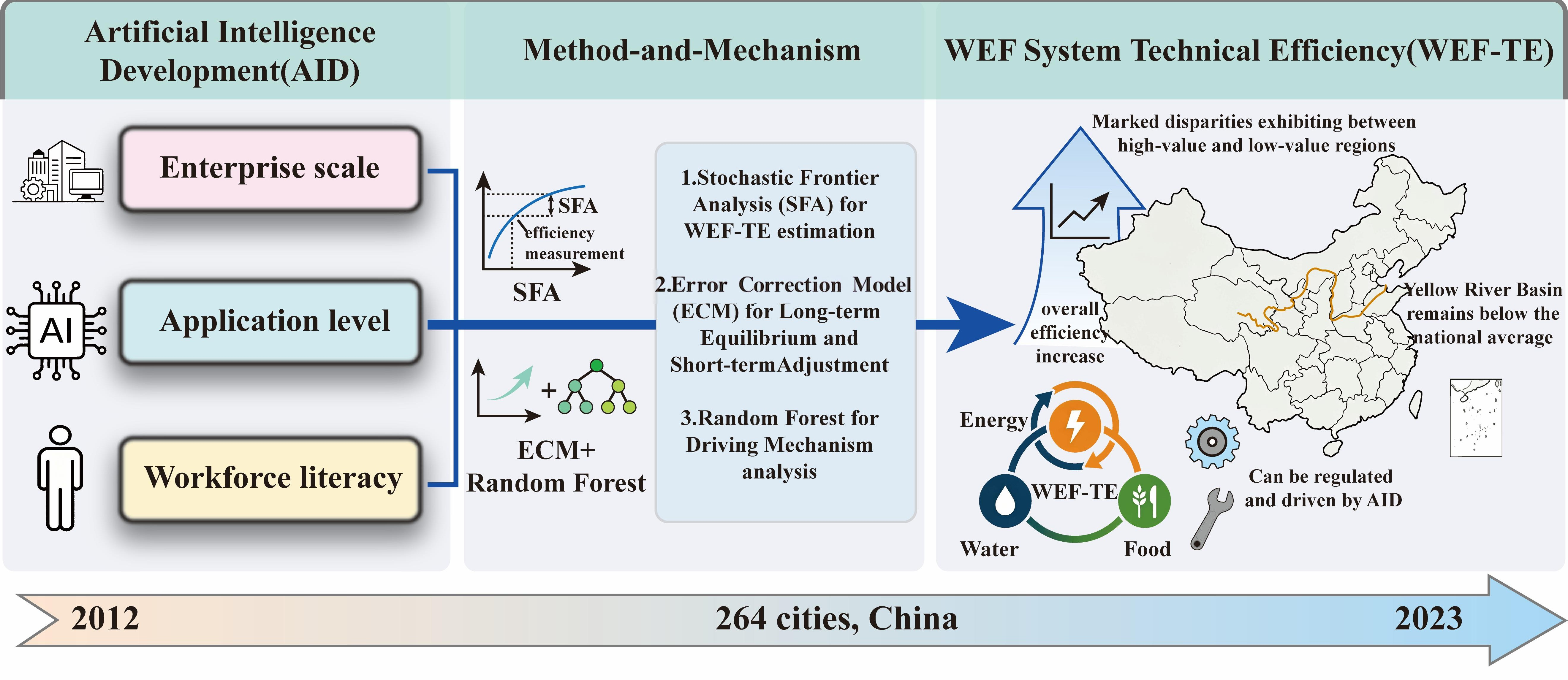
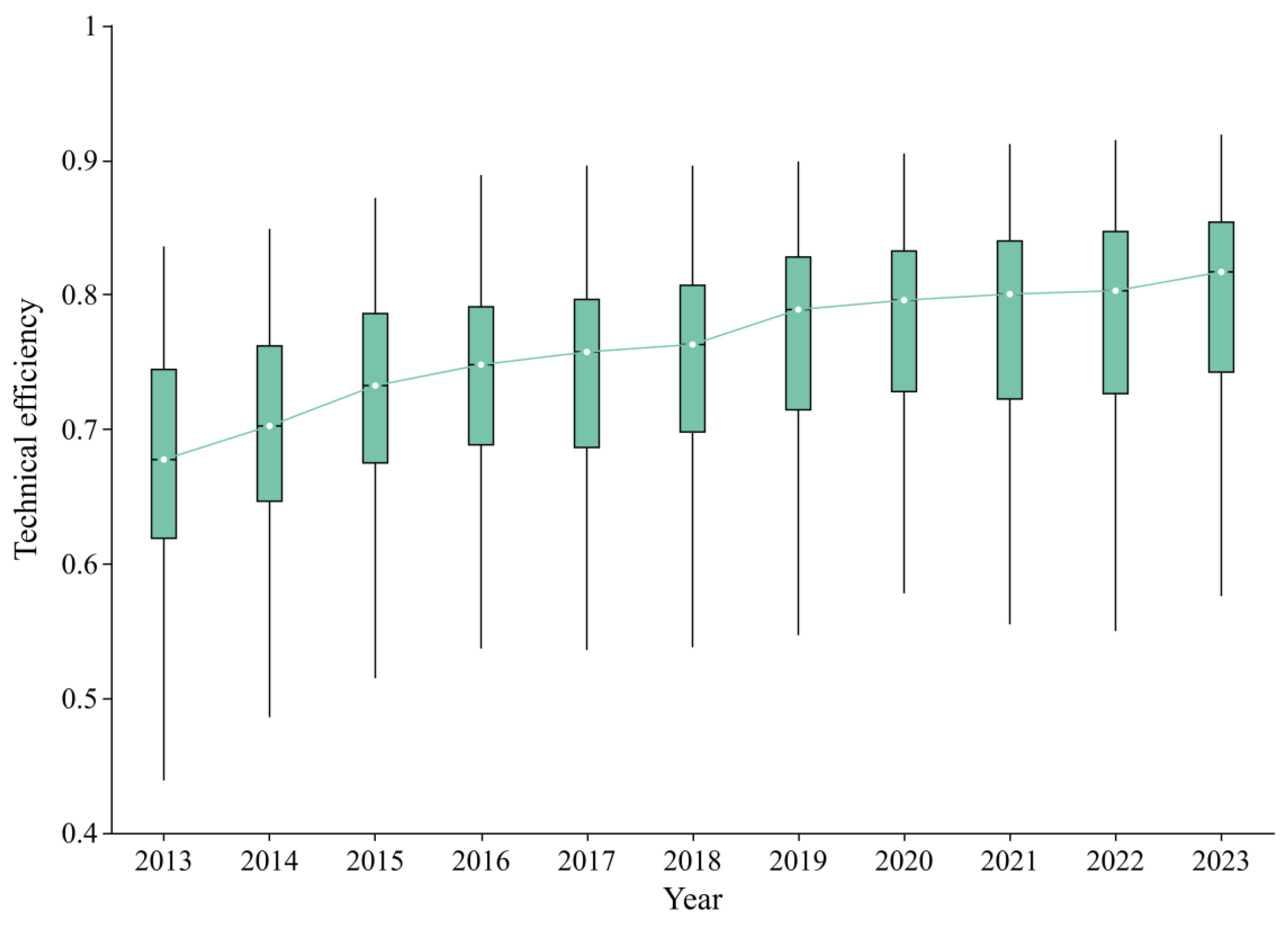
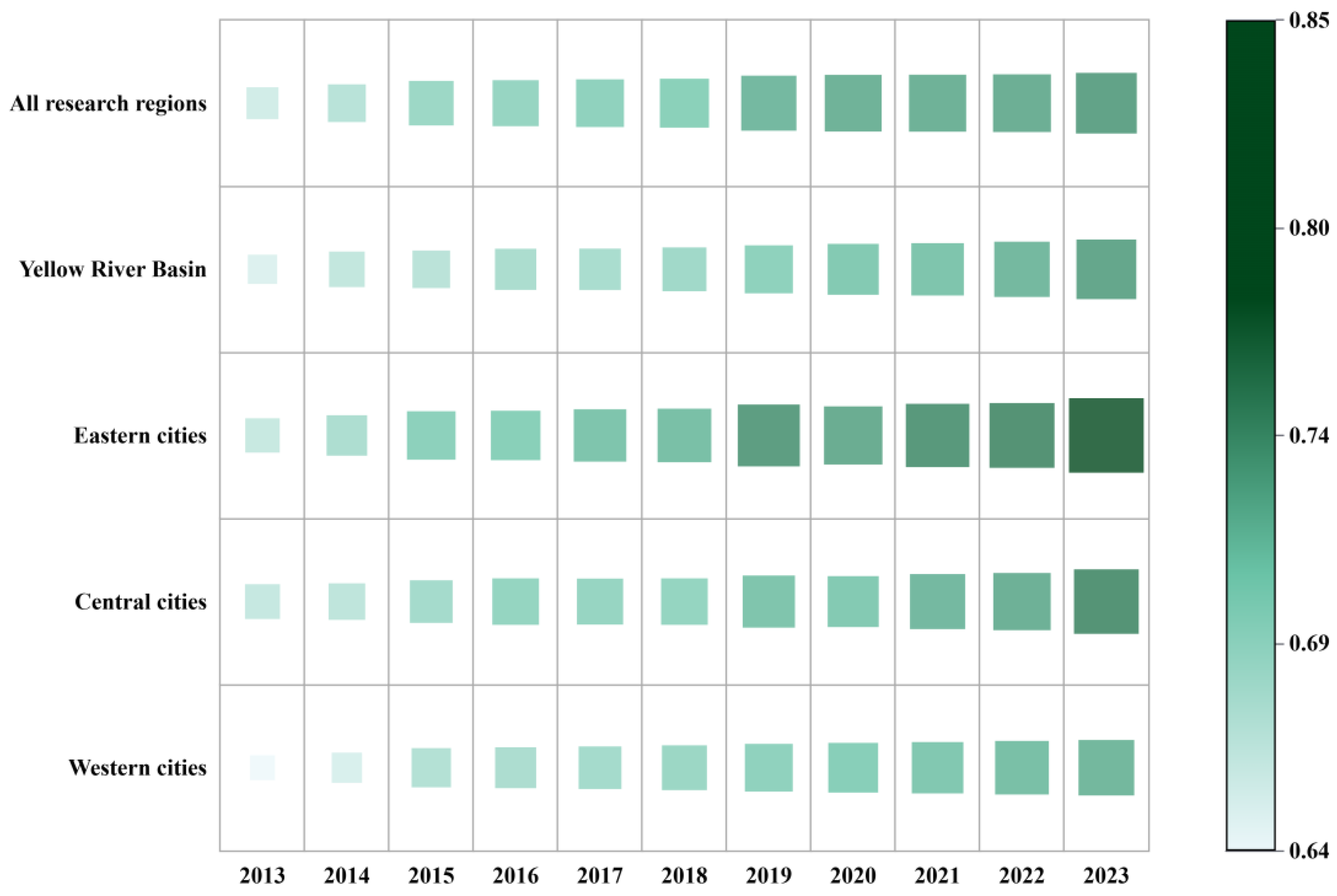
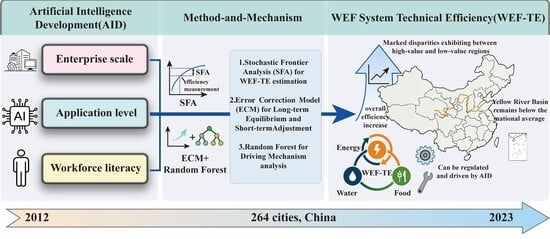
- Throughout our study process, China’s overall WEF-TE showed an upward trend, but significant technical disparities remained, with lagging regions exhibiting particularly severe deviations, indicating that vigilance is required to prevent potential decoupling. China’s WEF-TE demonstrates a gradient distribution pattern: eastern cities > central cities > western cities. Since China entered the “new normal” phase of economic development in 2014, the rate of improvement in eastern cities has been significantly faster than that in central cities. However, because of influence of supply-side structural reforms and the COVID-19 pandemic, growth trends in both eastern and central regions experienced fluctuations around 2020. As the core region of China’s WEF system, the Yellow River Basin has remained below the national average in terms of technological optimization, although this gap has narrowed to some extent since 2019.
- (2)
- AID can improve WEF-TE across multiple dimensions; however, due to constraints associated with AI-related energy consumption, a threshold effect exists in this optimization process. Specifically, this is reflected in the adjustment of WEF-TE losses, and over time, these two factors tend to reach a long-term equilibrium. This conclusion remains robust after applying various robustness tests.
- (3)
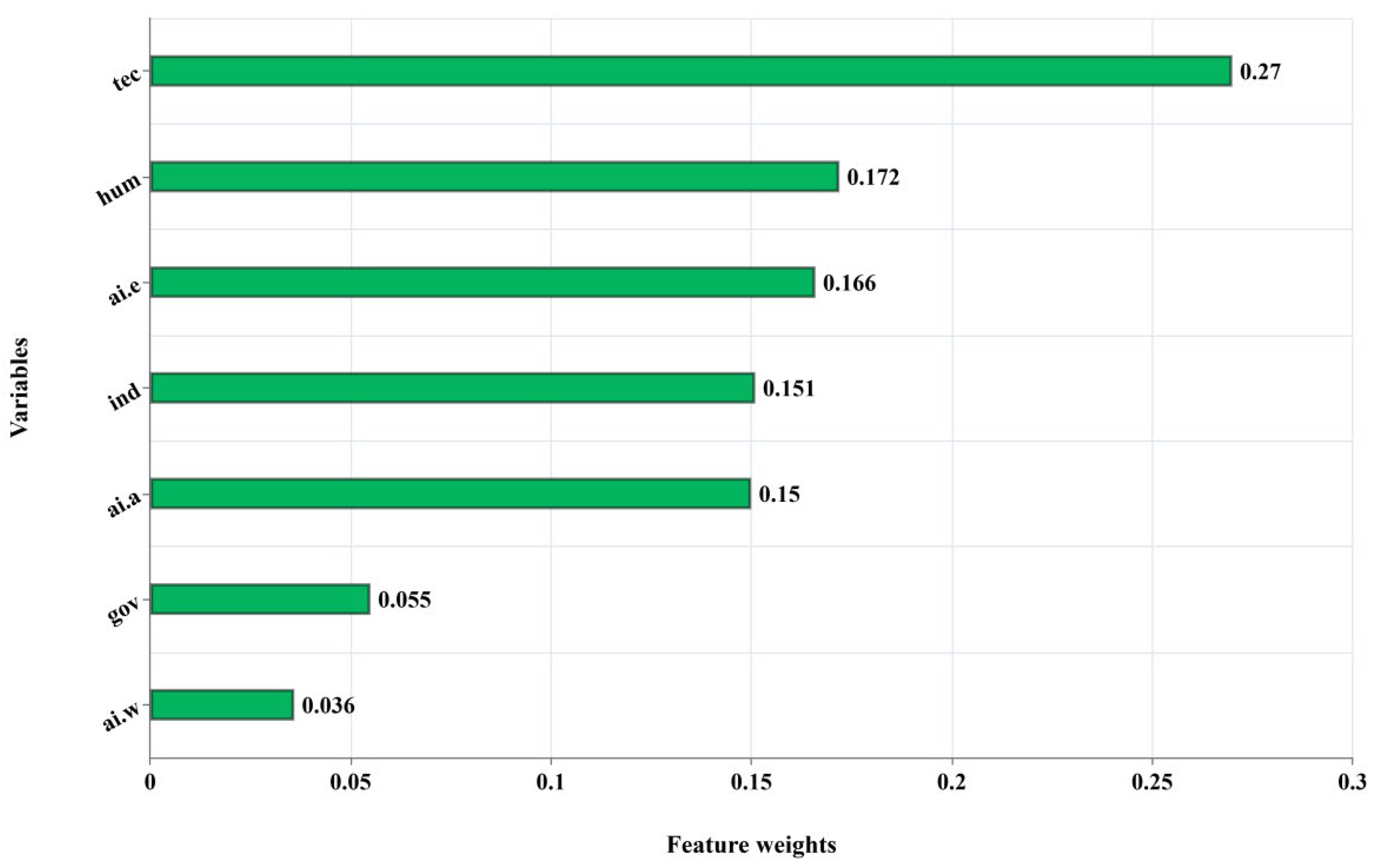
- Investments in technology and human capital continue to be the primary driving forces behind improvements in China’s WEF-TE. At the same time, AI enterprise scale and AI application level also play important roles, showing clear synergies with the rationalization of regional industrial structures. Although the driving effect of workforce AI literacy is not yet prominent, it has considerable potential for growth as AI adoption within the WEF system expands.
6.2. Policy Implications
Author Contributions
Funding
Data Availability Statement
Conflicts of Interest
References
- Ramanauske, N.; Balezentis, T.; Streimikiene, D. Biomass use and its implications for bioeconomy development: A resource efficiency perspective for the European countries. Technol. Forecast. Soc. Change 2023, 193, 122628. [Google Scholar] [CrossRef]
- Holger, H. Understanding the Nexus. In Proceedings of the Background Paper for the Bonn 2011 Conference: The Water, Energy and Food Security Nexus; Stockholm Environment Institute: Stockholm, Sweden, 2011. [Google Scholar]
- Karri, R.R.; Ravindran, G.; Pingili, V.; Mubarak, N.M.; Ruslan, K.N.; Tan, Y.H. Integrating the Food-Energy-Water Nexus: Strategies for climate change mitigation with SDG alignment. Environ. Impact Assess. Rev. 2026, 116, 108070. [Google Scholar] [CrossRef]
- Huang, R.; Han, Y. Differentiated Optimization Policies for Water–Energy–Food Resilience Security: Empirical Evidence Based on Shanxi Province and the GWR Model. Water 2025, 17, 1540. [Google Scholar] [CrossRef]
- Gai, D.H.B.; Shittu, E.; Ethan Yang, Y.; Li, H.-Y. A comprehensive review of the nexus of food, energy, and water systems: What the models tell us. J. Water Resour. Plan. Manag. 2022, 148, 04022031. [Google Scholar] [CrossRef]
- Zhou, Y.; Wei, B.; Zhang, R.; Li, H. Evolution of water–energy–food–climate study: Current status and future prospects. J. Water Clim. Change 2022, 13, 463–481. [Google Scholar] [CrossRef]
- Javan, K.; Altaee, A.; BaniHashemi, S.; Darestani, M.; Zhou, J.; Pignatta, G. A review of interconnected challenges in the water–energy–food nexus: Urban pollution perspective towards sustainable development. Sci. Total Environ. 2024, 912, 169319. [Google Scholar] [CrossRef]
- Fan, X.; Zhang, W.; Chen, W.; Chen, B. Land–water–energy nexus in agricultural management for greenhouse gas mitigation. Appl. Energy 2020, 265, 114796. [Google Scholar] [CrossRef]
- Veldhuis, A.J.; Glover, J.; Bradley, D.; Behzadian, K.; López-Avilés, A.; Cottee, J.; Downing, C.; Ingram, J.; Leach, M.; Farmani, R.; et al. Re-distributed manufacturing and the food-water-energy nexus: Opportunities and challenges. Prod. Plan. Control 2019, 30, 593–609. [Google Scholar] [CrossRef]
- Maia, R.G.T.; Junior, A.O.P. Eco-Efficiency of the food and beverage industry from the perspective of sensitive indicators of the water-energy-food nexus. J. Clean. Prod. 2021, 324, 129283. [Google Scholar] [CrossRef]
- Ali, M.; Anjum, M.N.; Shangguan, D.; Hussain, S. Water, energy, and food nexus in Pakistan: Parametric and non-parametric analysis. Sustainability 2022, 14, 13784. [Google Scholar] [CrossRef]
- Sun, C.; Yan, X.; Zhao, L. Coupling efficiency measurement and spatial correlation characteristic of water–energy–food nexus in China. Resour. Conserv. Recycl. 2021, 164, 105151. [Google Scholar]
- Hu, T.; Song, J.; Xing, J.; Yao, T.; Wu, Y.; Wang, X.; Yang, W. Recycling-oriented food production system highlights enhanced coupling of water, energy and food efficiencies. Sustain. Prod. Consum. 2026, 65, 31–43. [Google Scholar] [CrossRef]
- Ibrahim, M.D.; Ferreira, D.C.; Daneshvar, S.; Marques, R.C. Transnational resource generativity: Efficiency analysis and target setting of water, energy, land, and food nexus for OECD countries. Sci. Total Environ. 2019, 697, 134017. [Google Scholar] [CrossRef] [PubMed]
- Yao, Q.; Cao, H.; Zhang, R. Water–Energy–Land–Food Nexus Performance and Regional Inequality Toward Low-Carbon Transition in China. Land 2025, 14, 1343. [Google Scholar]
- Ren, F.-R.; Sun, F.-Y.; Liu, X.-Y.; Liu, H.-L. Ecological Comprehensive Efficiency and Driving Mechanisms of China’s Water–Energy–Food System and Climate Change System Based on the Carbon Nexus: Insights from the Integration of Network DEA and the Geographic Detector. Land 2025, 14, 2042. [Google Scholar] [CrossRef]
- Zhang, L.; Yang, H.; Chen, Y.; Chiu, Y.-H.; Pang, Q.; Sun, C.; Shi, Z. Assessing water-energy-food nexus efficiency for food security planning in China. Food Policy 2025, 134, 102902. [Google Scholar] [CrossRef]
- JingJing, Z.; Qingzhou, Y.; Yang, L. Research on Energy Green Efficiency and Regional Heterogeneity Based on the Water-Energy-Food Nexus. Econ. Probl. 2024, 46, 106–113. [Google Scholar] [CrossRef]
- Yaqiu, W.; Haibin, L. Study on Regional Differences and Technical Gap of Urban Food Total Factor Productivity in the Yellow River Basin. Econ. Probl. 2024, 46, 121–128. [Google Scholar] [CrossRef]
- Davidson, S. The economic institutions of artificial intelligence. J. Institutional Econ. 2024, 20, e20. [Google Scholar] [CrossRef]
- Sima, V.; Gheorghe, I.G.; Subić, J.; Nancu, D. Influences of the industry 4.0 revolution on the human capital development and consumer behavior: A systematic review. Sustainability 2020, 12, 4035. [Google Scholar] [CrossRef]
- Ma, L.; Luo, X.; Xi, M. The impact of regional artificial intelligence development on the resilience of enterprise supply chains. Int. Rev. Econ. Financ. 2025, 102, 104305. [Google Scholar] [CrossRef]
- Dong, Z.; Abd Aziz, M.F.; Wang, Y. An empirical analysis of how artificial intelligence development influences the adjustment of human capital structure. Financ. Res. Lett. 2025, 84, 107827. [Google Scholar] [CrossRef]
- Qian, C.; Zhu, C.; Huang, D.-H.; Zhang, S. Examining the influence mechanism of artificial intelligence development on labor income share through numerical simulations. Technol. Forecast. Soc. Change 2023, 188, 122315. [Google Scholar] [CrossRef]
- Lin, J.; Zeng, Y.; Wu, S.; Luo, X.R. How does artificial intelligence affect the environmental performance of organizations? The role of green innovation and green culture. Inf. Manag. 2024, 61, 103924. [Google Scholar] [CrossRef]
- Zhang, H.; Liu, P. Can artificial intelligence development improve urban land green utilization efficiency? J. Asia Pac. Econ. 2025, 1–21. [Google Scholar] [CrossRef]
- Guan, T.; Zheng, R.; Chen, A. Artificial intelligence and corporate energy consumption: The policy effects of the new-generation artificial intelligence innovation and development pilot zones. Econ. Anal. Policy 2025, 89, 148–164. [Google Scholar] [CrossRef]
- Polat, E.; Zincirli, M.; Zengin, E. Examining the interaction between artificial intelligence literacy and individual entrepreneurial orientation in teacher candidates: The mediating role of sustainable development. Int. J. Manag. Educ. 2025, 23, 101156. [Google Scholar] [CrossRef]
- Hunter, L.Y. Artificial intelligence, data centers, energy capabilities, and international security: An exploratory analysis. Armed Forces Soc. 2025, 0095327X241308839. [Google Scholar] [CrossRef]
- Olu-Ajayi, R.; Alaka, H.; Sunmola, F.; Ajayi, S.; Mporas, I. Statistical and artificial intelligence-based tools for building energy prediction: A systematic literature review. IEEE Trans. Eng. Manag. 2024, 71, 14733–14753. [Google Scholar] [CrossRef]
- Fan, J.; Li, W.; Chen, L. How does artificial intelligence affect energy efficiency? Evidence from supply chain digitization pilot program. Energy Econ. 2025, 149, 108728. [Google Scholar] [CrossRef]
- Park, C.; Kim, M. Utilization and challenges of artificial intelligence in the energy sector. Energy Environ. 2024, 0958305X241258795. [Google Scholar] [CrossRef]
- Zhao, Q.; Wang, L.; Stan, S.-E.; Mirza, N. Can artificial intelligence help accelerate the transition to renewable energy? Energy Econ. 2024, 134, 107584. [Google Scholar] [CrossRef]
- Valdivia, A. The supply chain capitalism of AI: A call to (re) think algorithmic harms and resistance through environmental lens. Inf. Commun. Soc. 2025, 28, 2118–2134. [Google Scholar] [CrossRef]
- Bergougui, B. Institutional adaptability, skill-bias technological shifts, and energy efficiency in global decarbonization pathways: Exploring the role of artificial intelligence patents. Technol. Soc. 2025, 83, 103029. [Google Scholar] [CrossRef]
- Xie, H.; Cheng, J.; Tan, X.; Li, J. Artificial Intelligence Technology Applications and Energy Utilization Efficiency: Empirical Evidence from China. Sustainability 2025, 17, 6463. [Google Scholar] [CrossRef]
- Zhu, Q.; Che, J.; Liu, S.; Wu, L.; Zhang, J.; Li, Y. How can artificial intelligence technology applications accelerate energy innovation in China? Evidence from provincial regional data. Econ. Anal. Policy 2025, 87, 484–502. [Google Scholar] [CrossRef]
- Yuan, B.; Gu, R.; Wang, P.; Hu, Y. How Does New Quality Productive Forces Affect Green Total Factor Energy Efficiency in China? Consider the Threshold Effect of Artificial Intelligence. Sustainability 2025, 17, 7012. [Google Scholar] [CrossRef]
- Liu, M.; Yuan, Z.; Ping, W. Artificial intelligence and green total factor energy efficiency: Evidence from non-linear models. Appl. Econ. 2026, 58, 2664–2680. [Google Scholar] [CrossRef]
- Ding, M.; Gao, Q. The impact of artificial intelligence technology application on total factor productivity in agricultural enterprises: Evidence from China. Econ. Anal. Policy 2025, 86, 399–415. [Google Scholar] [CrossRef]
- Amin, A.; Wang, X.; Zhang, Y.; Tianhua, L.; Chen, Y.; Zheng, J.; Shi, Y.; Abdelhamid, M.A. A comprehensive review of applications of robotics and artificial intelligence in agricultural operations. Stud. Inform. Control 2023, 32, 59–70. [Google Scholar] [CrossRef]
- El Jarroudi, M.; Kouadio, L.; Delfosse, P.; Bock, C.H.; Mahlein, A.-K.; Fettweis, X.; Mercatoris, B.; Adams, F.; Lenné, J.M.; Hamdioui, S. Leveraging edge artificial intelligence for sustainable agriculture. Nat. Sustain. 2024, 7, 846–854. [Google Scholar] [CrossRef]
- Nath, P.C.; Mishra, A.K.; Sharma, R.; Bhunia, B.; Mishra, B.; Tiwari, A.; Nayak, P.K.; Sharma, M.; Bhuyan, T.; Kaushal, S. Recent advances in artificial intelligence towards the sustainable future of agri-food industry. Food Chem. 2024, 447, 138945. [Google Scholar] [CrossRef] [PubMed]
- Xiang, X.; Li, Q.; Khan, S.; Khalaf, O.I. Urban water resource management for sustainable environment planning using artificial intelligence techniques. Environ. Impact Assess. Rev. 2021, 86, 106515. [Google Scholar] [CrossRef]
- Krishnan, S.R.; Nallakaruppan, M.; Chengoden, R.; Koppu, S.; Iyapparaja, M.; Sadhasivam, J.; Sethuraman, S. Smart water resource management using Artificial Intelligence—A review. Sustainability 2022, 14, 13384. [Google Scholar] [CrossRef]
- Abdulameer, L.; Al-Khafaji, M.S.; Al-Awadi, A.T.; Al Maimuri, N.M.; Al-Shammari, M.; Al-Dujaili, A.N. Artificial intelligence in climate-resilient water management: A systematic review of applications, challenges, and future directions. Water Conserv. Sci. Eng. 2025, 10, 44. [Google Scholar] [CrossRef]
- Barabuffi, S.; Cricchio, J.; Di Minin, A. The’picking the fittest’approach and spatial dynamics in China’s artificial intelligence regional development. Pap. Reg. Sci. 2025, 104, 100096. [Google Scholar] [CrossRef]
- Li, Z.; Liu, Y. Research on the spatial distribution pattern and influencing factors of digital economy development in China. IEEE Access 2021, 9, 63094–63106. [Google Scholar] [CrossRef]
- Zheng, Y.; Liu, C.; Li, L.; Jiang, E.; Feng, G.; Qu, B.; Hao, L.; Li, J.; Li, J. Spatiotemporal Evolution and Driving Mechanisms of Water–Energy–Food Synergistic Efficiency: A Case Study of Irrigation Districts in the Lower Yellow River. Sustainability 2025, 17, 11265. [Google Scholar] [CrossRef]
- Zhang, W.; Xuan, Y. How to improve the regional energy efficiency via intelligence? Empirical analysis based on provincial panel data in China. Bus. Manag. J. 2022, 44, 27–46. [Google Scholar] [CrossRef]
- Han, J.; Yuan, X. Research on the mechanism of AI-empowered agricultural mechinery services in improving rice production technical efficiency: An empirical analysis based on smart agricultural machinery applications in Shandong province. Hubei Agric. Sci. 2026, 65, 233–239. [Google Scholar] [CrossRef]
- Bardazzi, E.; Bosello, F. Critical reflections on water-energy-food nexus in computable general equilibrium models: A systematic literature review. Environ. Model. Softw. 2021, 145, 105201. [Google Scholar] [CrossRef]
- Huang, M.-L.; Liu, J.-Y.; Wang, X.; Dong, H.; Ai, Z. On-farm resource-use efficiency in China: Overall rebounding trends and region-specific enhancement opportunities. Humanit. Soc. Sci. Commun. 2025, 12, 877. [Google Scholar] [CrossRef]
- Barrera-Santana, J.; Marrero, G.; Ramos-Real, F. Energy efficiency and energy governance: A stochastic frontier analysis approach. Energy J. 2022, 43, 243–284. [Google Scholar] [CrossRef]
- Xiangyu, G.; Jiaming, F.; Heng, Z.; Jinghui, Z. Configuration analysis of the impact of contractual arrangements on the production technology efficiency of grain full-process trusteeship organizations. Res. Agric. Mod. 2026, 47, 444–456. [Google Scholar] [CrossRef]
- Liu, Y.; Guo, J.; Shen, F.; Song, Y. Can artificial intelligence technology improve green total factor efficiency in energy utilisation? Empirical evidence from 282 cities in China. Econ. Change Restruct. 2025, 58, 23. [Google Scholar] [CrossRef]
- Ke, L.; Lin, P.; Chen, X. Development of artificial intelligence, green finance, and high-quality development of regional cultural industries. Financ. Res. Lett. 2025, 79, 107291. [Google Scholar] [CrossRef]
- Wang, L.; Jiang, H.; Dong, Z. Will industrial intelligence reshape the geography of companies. China Ind. Econ. 2022, 2, 137–155. [Google Scholar]
- Abulibdeh, A.; Zaidan, E.; Abulibdeh, R. Navigating the confluence of artificial intelligence and education for sustainable development in the era of industry 4.0: Challenges, opportunities, and ethical dimensions. J. Clean. Prod. 2024, 437, 140527. [Google Scholar] [CrossRef]
- Li, H.; Kim, S. Developing AI literacy in HRD: Competencies, approaches, and implications. Hum. Resour. Dev. Int. 2024, 27, 345–366. [Google Scholar] [CrossRef]
- Zhou, Y.; Bu, W. Artificial Intelligence Adoption, Energy Management, and Corporate Energy Transition: Evidence from Energy Consumption, Energy Intensity, and Carbon Emission Intensity. Energies 2026, 19, 821. [Google Scholar] [CrossRef]
- Chen, L.; Jiang, N.; Wang, S. An impossible driver for energy justice? Exploring the impact of artificial intelligence on China’s energy transition. Energy Policy 2025, 207, 114839. [Google Scholar] [CrossRef]
- Du, W.; Li, M.; Wang, Z. The impact of environmental regulation on firms’ energy-environment efficiency: Concurrent discussion of policy tool heterogeneity. Ecol. Indic. 2022, 143, 109327. [Google Scholar] [CrossRef]
- Qiu, Y.; Han, W.; Zeng, D. Impact of biased technological progress on the total factor productivity of China’s manufacturing industry: The driver of sustainable economic growth. J. Clean. Prod. 2023, 409, 137269. [Google Scholar] [CrossRef]
- Zhu, Z. Driving effect of governance mechanism on green technology innovation. China Soft Sci. 2022, 32, 125–135. [Google Scholar]
- Skare, M.; Gavurova, B.; Sinkovic, D. Measuring artificial intelligence’s impact on sustainable energy transition: Empirical insights and policy implications. Energy Econ. 2025, 150, 108825. [Google Scholar] [CrossRef]
- Gao, J.; Peng, B.; Yan, Y. Time-varying vector error-correction models: Estimation and inference. J. Econom. 2025, 251, 106035. [Google Scholar] [CrossRef]
- Huang, R.; Liu, H. Development Level Evaluation and Driving Factors Analysis of China’s New Energy System: Based on Random Forest. Systems 2025, 13, 983. [Google Scholar] [CrossRef]
- Qingbin, G.; Mengyao, M.; Yeqing, C. Spatio-temporal Characteristic of Urban-Rural Integration Development Level in Hainan Free Trade Port and Its Driving Mechanism. Econ. Geogr. 2024, 44, 62–71. [Google Scholar]
- Biau, G.; Scornet, E. A random forest guided tour. Test 2016, 25, 197–227. [Google Scholar] [CrossRef]
- Lu, Y.; Shuhua, W.; Rui, F. The impact of financial agglomeration on green total factor productivity from the perspective of resource dependence. Resour. Sci. 2023, 45, 308–321. [Google Scholar]



| Variable Type | Element Type | Measurement Indicators | Unit |
|---|---|---|---|
| Input variables | Water system | Total water supply (W) | 108 m3 |
| Energy system | Total energy consumption (E) | 104 tons of standard coal | |
| Food system | Area sown with grain crops (F1) | km2 | |
| Total power of agricultural machinery (F2) | kWh | ||
| Output variable | Economic benefits | Regional Gross Domestic Product (GDP) (Y) | 108 yuan |
| Variables | Observed Values | Maximum | Minimum | Mean | Standard Deviation |
|---|---|---|---|---|---|
| TE | 2904 | 0.919 | 0.439 | 0.683 | 0.091 |
| ai.e | 2904 | 11.031 | 1.099 | 5.004 | 1.704 |
| ai.a | 2904 | 10.584 | 1.562 | 5.329 | 1.295 |
| ai.w | 2904 | 7.100 | 0.003 | 4.011 | 0.896 |
| tec | 2904 | 15.529 | 3.784 | 9.630 | 1.884 |
| hum | 2904 | 6.811 | 0.601 | 3.575 | 1.054 |
| ind | 2904 | 0.839 | 0.133 | 0.482 | 0.115 |
| gov | 2904 | 0.872 | 0.035 | 0.199 | 0.102 |
| Model | Parameter | Parameter Settings |
|---|---|---|
| Random forest | Dependent variable | TE |
| Explanatory variables | ai.e; ai.a; ai.w; control variables | |
| Training set share | 0.8 | |
| Decision tree number | 100 | |
| Node split standard | Gini index | |
| Minimal sample size for node splitting | 2 | |
| Minimum value for leaf node splitting | 1 | |
| Maximal depth of a tree | No limitation | |
| Maximal feature count limit | Automatically setting | |
| If replacement sampling be permitted | YES | |
| If out-of-bag data be tested | YES |
| Cointegration Test Results | Error Correction Model Results | ||
|---|---|---|---|
| Variables | Coefficient | Variables | Coefficient |
| ai.e | 0.012 *** (7.236) | Δai.e | 0.019 *** (14.929) |
| ai.a | 0.005 *** (3.589) | Δai.a | 0.016 *** (13.156) |
| ai.w | 0.021 *** (6.901) | Δai.w | 0.004 * (1.836) |
| Constant | 0.576 *** (62.094) | Constant | −0.012 (−0.016) |
| Control variables | NO | Control variables | YES |
| Year FE | YES | Year FE | YES |
| City FE | YES | City FE | YES |
| R2 | 0.187 | R2 | 0.500 |
| Observations | 2904 | Observations | 2904 |
| ECM(-1) | −0.124 *** (−13.928) | ||
| Variables | Re-Estimate the Dependent Variable Using the DEA Model | Exclude Samples (Eastern Cities) | Exclude Explanatory Variable (ai.w) | Using Terrain Slope as the Instrumental Variable |
|---|---|---|---|---|
| Δai.e | 0.013 ** (9.362) | 0.008 *** (7.330) | 0.019 *** (14.678) | 0.016 *** (12.154) |
| Δai.a | 0.014 ** (15.003) | 0.011 ** (9.672) | 0.018 *** (14.241) | 0.007 *** (7.512) |
| Δai.w | 0.021 * (6.026) | 0.019 (4.669) | 0.010 ** (4.347) | |
| ECM(-1) | −0.267 *** (−30.775) | −0.078 *** (−6.840) | −0.127 *** (−14.293) | −0.119 *** (−10.063) |
| Control variables | YES | YES | YES | YES |
| Year FE | YES | YES | YES | YES |
| City FE | YES | YES | YES | YES |
| Observations | 2904 | 1815 | 2904 | 2904 |
| Indicators | Test Standards | Training Set | Testing Set |
|---|---|---|---|
| R2 | Fit level—should be as close to 1 as possible. | 0.846 | 0.787 |
| MAE | The difference between the means of actual and fitted values—must approach 0 as much as possible. | 0.016 | 0.043 |
| MSE | Mean of squared errors—must approach 0 as much as possible. | 0.000 | 0.003 |
| RMSE | MSE square root—average gap value. | 0.021 | 0.048 |
| EVS | Measures explanatory capacity of the model for data fluctuations—must approach 0 as much as possible. | 0.846 | 0.787 |
Disclaimer/Publisher’s Note: The statements, opinions and data contained in all publications are solely those of the individual author(s) and contributor(s) and not of MDPI and/or the editor(s). MDPI and/or the editor(s) disclaim responsibility for any injury to people or property resulting from any ideas, methods, instructions or products referred to in the content. |
© 2026 by the authors. Licensee MDPI, Basel, Switzerland. This article is an open access article distributed under the terms and conditions of the Creative Commons Attribution (CC BY) license.
Share and Cite
Huang, R.; Han, Y.; Feng, J. The Impact Mechanism of Artificial Intelligence Development on Water–Energy–Food System Technical Efficiency—An Empirical Study in China. Water 2026, 18, 1447. https://doi.org/10.3390/w18121447
Huang R, Han Y, Feng J. The Impact Mechanism of Artificial Intelligence Development on Water–Energy–Food System Technical Efficiency—An Empirical Study in China. Water. 2026; 18(12):1447. https://doi.org/10.3390/w18121447
Chicago/Turabian StyleHuang, Ruopeng, Yue Han, and Jianjie Feng. 2026. "The Impact Mechanism of Artificial Intelligence Development on Water–Energy–Food System Technical Efficiency—An Empirical Study in China" Water 18, no. 12: 1447. https://doi.org/10.3390/w18121447
APA StyleHuang, R., Han, Y., & Feng, J. (2026). The Impact Mechanism of Artificial Intelligence Development on Water–Energy–Food System Technical Efficiency—An Empirical Study in China. Water, 18(12), 1447. https://doi.org/10.3390/w18121447