Article

The Water-Energy Nexus in Deep Excavation Dewatering: A MODFLOW–Improved Genetic Algorithm Coupled Model for Energy Efficiency Optimization and Engineering Safety Control

1
Zhejiang Huadong Geotechnical Investigation and Design Institute Corporation Limited, Hangzhou 310030, China
2
PowerChina Huadong Engineering Corporation Limited, Hangzhou 311122, China
3
School of Earth Sciences and Engineering, Hohai University, Nanjing 210098, China
*
Author to whom correspondence should be addressed.
Water 2026, 18(12), 1445; https://doi.org/10.3390/w18121445
Submission received: 16 April 2026 / Revised: 18 May 2026 / Accepted: 27 May 2026 / Published: 11 June 2026
(This article belongs to the Section Water-Energy Nexus)

Abstract

Deep excavation dewatering is an energy-intensive groundwater control process in underground engineering, especially under strong recharge and heterogeneous hydrogeological conditions. Conventional dewatering designs often rely on conservative pumping schemes to ensure the required drawdown, which may generate redundant groundwater extraction, unnecessary electricity consumption, additional carbon emissions, and excessive drawdown-induced settlement. To address this problem, this study develops a coupled improved genetic algorithm and MODFLOW optimization model, termed IGA-M, for dewatering well-group operation under engineering safety constraints. The purpose of the proposed model is not to reduce pumping arbitrarily, but to identify and eliminate redundant pumping while satisfying prescribed requirements for target water levels, settlement control, and hydraulic-gradient safety. Through the FloPy interface, the Improved Genetic Algorithm is dynamically linked with MODFLOW to establish a closed-loop simulation-optimization framework. In each optimization iteration, candidate well operation schemes are automatically transferred to MODFLOW, and the simulated hydraulic heads and settlement responses are returned to evaluate the objective function and safety constraints. In this framework, groundwater extraction, electricity consumption, carbon emissions, and land subsidence are treated as physically linked performance indicators of the optimized dewatering scheme. Validation using an idealized case shows that, under the same safety requirements, the IGA-M model reduces redundant hydraulic loading compared with the traditional uniformly distributed pumping method. By removing redundant pumping beyond the safety requirement, the optimized scheme reduced groundwater extraction by 62.7%, which was accompanied by a 44.9% decrease in both carbon emissions and comprehensive costs, as well as a 57.7% reduction in settlement at observation points. In a practical high-permeability deep excavation adjacent to the Yellow River, the model achieved well-group flow regulation under strong recharge conditions. Compared with the traditional scheme, it eliminated approximately 661,000 m3 of redundant groundwater extraction, corresponding to a 17.7% decrease, and consequently saved 26,800 kWh of electricity and reduced CO2 emissions by nearly 16,000 kg during the dewatering period. These results demonstrate that the proposed IGA-M framework can transform MODFLOW from a post-design verification tool into an active optimization engine for dewatering design. It provides a physically based decision-support method for reducing redundant pumping and improving energy efficiency while maintaining engineering safety.

1. Introduction

Deep excavation dewatering serves as a critical procedure in the construction of urban infrastructure, hydraulic complexes, and transportation networks; however, it also represents a quintessentially energy-intensive component within the field of geotechnical engineering. Particularly in projects traversing high-permeability riparian gravel strata, groundwater control systems invariably entail substantial electricity consumption and associated carbon emissions [1]. Under complex hydrogeological conditions, engineering practice confronts a rigorous multi-objective trade-off: ensuring construction safety and scheduling while achieving dewatering targets at minimum energy cost. Simultaneously, it is imperative to rigorously mitigate secondary geological hazards, such as seepage failure and land subsidence and minimize the ineffective depletion of groundwater resources [2]. However, traditional dewatering designs have long been constrained by conservative philosophies. To maintain dry excavation conditions under intense hydraulic driving forces, these designs frequently resort to redundant pumping rates. This practice directly precipitates an exponential escalation in energy consumption, excessive depletion of groundwater resources, and an exacerbated risk of potential seepage failure, thereby constituting a significant dual waste of both water and energy.
Historically, conventional dewatering designs have relied heavily on analytical methods, which typically estimate the total pit inflow and distribute pumping rates uniformly across wells. Despite their computational convenience, these methods struggle to quantify the non-linear characteristics of complex hydrogeological boundaries, yielding design schemes that are often excessively conservative [3,4]. Such redundant hydraulic loads not only escalate construction costs but also substantially amplify carbon emissions throughout the dewatering life cycle, a critical concern recently highlighted at the interdisciplinary nexus of energy and civil engineering. To address this, the integration of high-precision numerical simulation with intelligent optimization algorithms to physically eliminate redundant energy consumption has become an imperative trend in developing energy-efficient dewatering strategies. Numerical models (e.g., seepage models based on Finite Difference or Finite Element Methods) demonstrate significant superiority in characterizing stratigraphic heterogeneity, providing refined settlement predictions, and quantitatively assessing impacts on groundwater resources [5,6]. However, numerical simulations typically serve as “verification instruments” rather than proactive “design tools.” When confronting large-scale well group optimization, traditional numerical modeling necessitates cumbersome parameter reconfiguration for adjusting well placement and discharge allocation. The resulting computational inefficiency hinders their direct application in searching for a lower-energy feasible solution.
To circumvent the efficiency limitations inherent in traditional numerical simulations for parameter inversion, researchers such as Xu et al. [7] and Hansen et al. [8] introduced objective function methods, primarily focusing on single or weighted objectives, into the optimization process. Furthermore, Giagkiozis et al. [9] provided a systematic review of multi-objective optimization, offering theoretical underpinnings for complex hydrological inversions. However, dewatering engineering represents a quintessential multi-objective optimization problem characterized by conflicting goals: while increasing well count or pumping intensity accelerates water level drawdown, it inevitably leads to a non-linear escalation in energy consumption and operational costs, alongside heightened risks of secondary hazards such as land subsidence [10]. Recently, intelligent evolutionary algorithms, including Genetic Algorithms (GA) and Particle Swarm Optimization (PSO), have been widely adopted to address these challenges [11,12,13]. Nevertheless, a critical technical bottleneck persists in current research: the structural disconnect between physical simulation fidelity and algorithmic optimization efficiency. On one hand, to pursue computational speed, many intelligent optimization models employ simplified analytical formulas as surrogates for complex numerical models. These simplified approaches fail to accurately characterize strong recharge boundaries and heterogeneous stratigraphic structures. Consequently, although algorithms may converge to a theoretical “optimal solution,” these solutions may induce uneven hydraulic distribution or even trigger piping and water inrush disasters within the actual physical seepage field. On the other hand, while high-precision numerical software (e.g., MODFLOW) offers superior accuracy, its kernel encapsulation (typically in Fortran) severely restricts deep interaction with intelligent algorithms. This barrier causes the computational burden for parameter adjustment to grow geometrically with variable dimensionality, rendering real-time, closed-loop optimization prohibitively difficult [14,15].
To address these limitations, this study develops a closed-loop simulation-optimization framework by coupling the Improved Genetic Algorithm (IGA) with MODFLOW through the FloPy interface. The proposed model, termed IGA-M, is designed to optimize the operational status and pumping rates of candidate dewatering wells under prescribed engineering safety constraints. Different from conventional approaches in which numerical models are mainly used for post-design verification, the proposed framework embeds MODFLOW into each iteration of the optimization process. For each candidate pumping scheme generated by the IGA, FloPy automatically updates the MODFLOW well package, runs the groundwater flow simulation, and extracts the resulting hydraulic heads and settlement-related responses for objective-function evaluation. In this way, each optimized solution is directly constrained by physically simulated groundwater responses rather than by simplified analytical assumptions. The main objective of the model is therefore not to reduce pumping arbitrarily, but to identify and eliminate redundant pumping while satisfying the requirements of target drawdown, settlement control, and hydraulic-gradient safety. The reductions in groundwater extraction, electricity consumption, carbon emissions, and land subsidence are interpreted as coupled benefits derived from removing unnecessary hydraulic loads under safety constraints. The novelty of this study lies in establishing a physically based MODFLOW-IGA optimization framework that integrates well-group operation control, groundwater-flow simulation, and energy-safety performance evaluation within a unified closed-loop procedure. The applicability of the proposed framework is examined through an idealized model and a high-permeability deep excavation case adjacent to the Yellow River in China.

2. Methodology: Modeling the Water-Energy Nexus in Dewatering Systems

2.1. Governing Equations for Groundwater Flow and Land Subsidence

Based on the continuity equation for groundwater seepage and Darcy’s law, the mathematical model governing the transient groundwater flow can be expressed as [16]:
x K x ( H z b ) H x + y K y ( H z b ) H y + z K z ( H - z b ) H z + ε = S y H t
where H represents the hydraulic head (m); H z b denotes the saturated thickness of the unconfined aquifer (m), where z b is the elevation of the aquifer bottom; K x , K y , and K z are the hydraulic conductivities in the x, y, and z principal directions, respectively (m/d); ε is the source-sink term (m/d); a positive value indicates vertical recharge per unit horizontal area (e.g., rainfall infiltration), while a negative value represents discharge (e.g., evaporation); S y is the specific yield of the unconfined aquifer (dimensionless); t denotes time (d).
The definite conditions for the mathematical model, including the initial condition and boundary conditions, are expressed as follows:
H ( x , y , z ) = H 0 ( x , y , z ) D   t = 0
H ( x , y , z , t ) = H 1 ( x , y , z , t ) Ω 1 t > 0
K H n = q ( x , y , z , t ) Ω 2 t > 0
where D denotes the seepage domain; t represents the simulation time, with t = 0 indicating the initial state; Ω1 and Ω2 represent the Dirichlet boundary (first-type) and Neumann boundary (second-type), respectively; H0 (x,y,z) is the initial hydraulic head distribution (m); H1 (x,y,z,t) is the known head function along boundary Ω1; n denotes the outward normal direction to boundary Ω2; K is the hydraulic conductivity along the normal direction n (m/d); q(x, y, z, t) represents the specific flux (flow rate per unit cross-sectional area) along boundary Ω2 (m/d); notably, q = 0 corresponds to a no-flow boundary.
Based on Terzaghi’s effective stress principle, this study focuses exclusively on vertical stress within the stratum, neglecting horizontal stress components. It is posited that the total stress acting on any plane within the soil mass is composed of the summation of effective stress and pore water pressure. Consequently, the vertical settlement model is formulated as [17,18]:
b = S sk b h b | t = 0 = 0 , x , y , z Ω , t 0
where b denotes the total settlement (mm); Ω represents the seepage domain; S s k is the skeletal specific storage (m−1). The value of S s k is state-dependent: it adopts the inelastic skeletal specific storage ( S s k v ) when the hydraulic head drops below the historical minimum level (i.e., the preconsolidation head), and assumes the elastic skeletal specific storage ( S s k e ) when the head exceeds this threshold; h represents the variation in hydraulic head (m); b corresponds to the thickness of the respective stratum (m).

2.2. The Coupled Simulation-Optimization Architecture via FloPy

The precise characterization of the groundwater seepage field is a prerequisite for the accurate quantification and control of energy consumption and land subsidence. Analytical methods often necessitate the simplification of actual hydrogeological conditions and fail to comprehensively account for complex stratigraphic and boundary constraints, thereby compromising the precision of the solution. Although the Finite Difference Method (FDM)-based MODFLOW module provides a robust physical foundation for simulating groundwater seepage under complex boundary and media conditions, its development and encapsulation in Fortran significantly hinder the interoperability between MODFLOW (and its GUI tools) and modern mainstream programming languages. This limitation compels researchers to resort to simplified models or inefficient manual trial-and-error parameter adjustments, ultimately undermining the capacity to identify a lower-energy feasible solution [19,20].
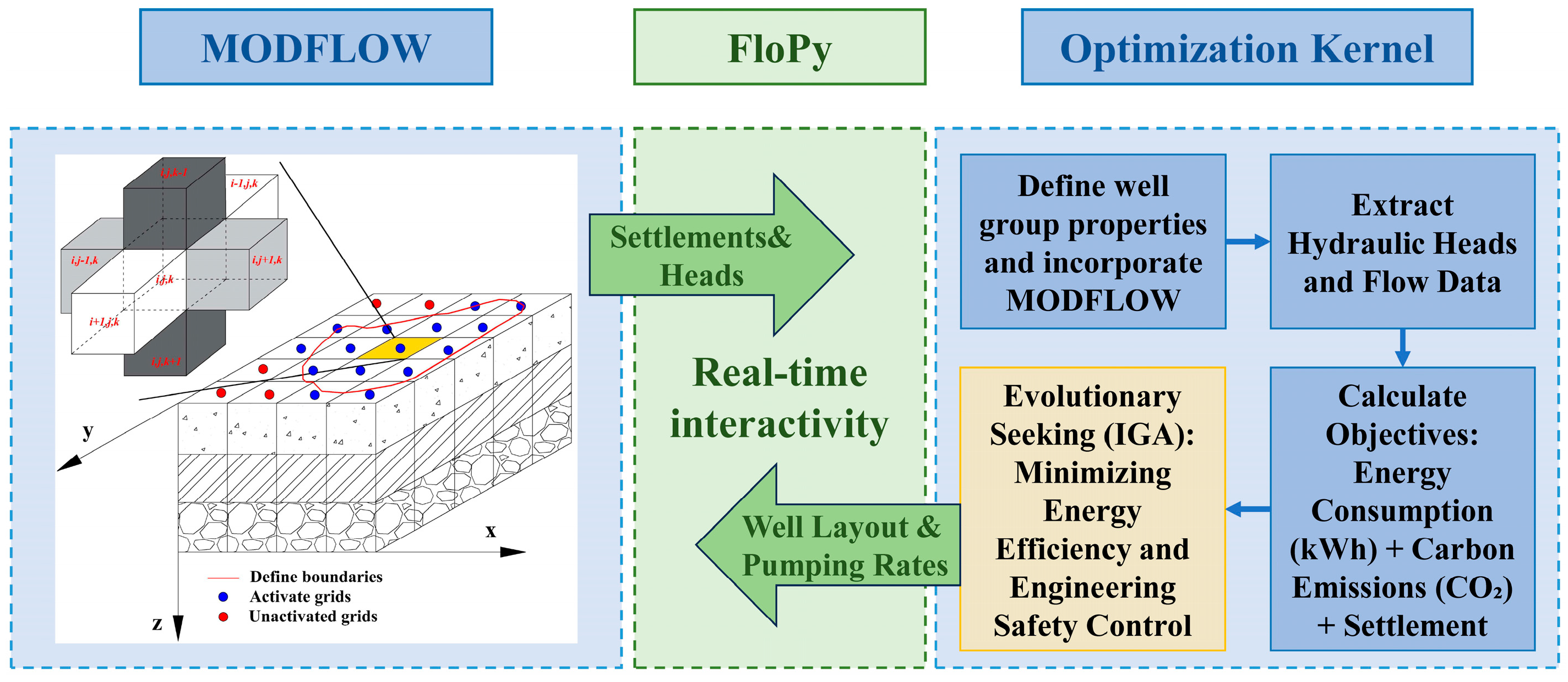
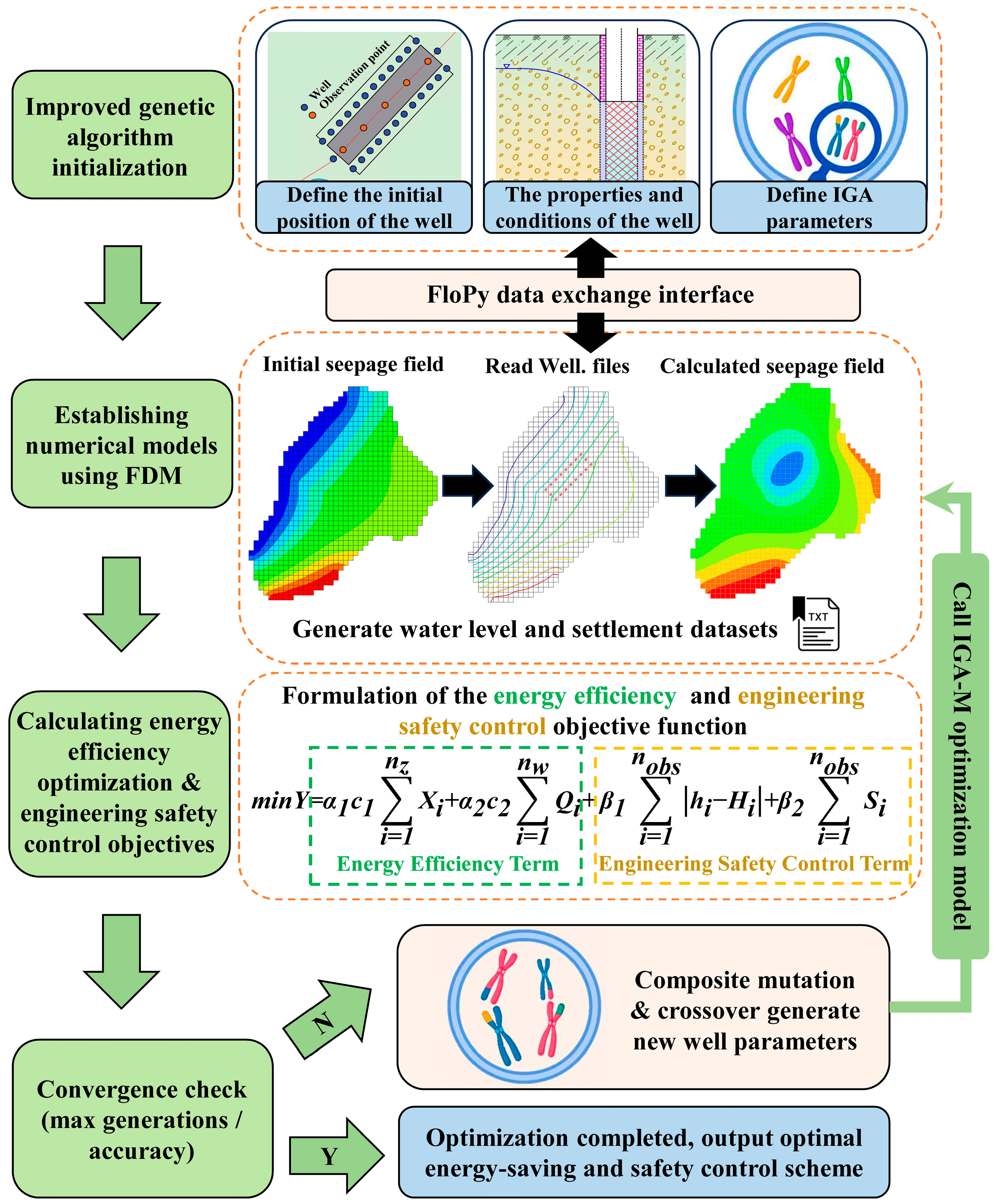
To bridge the data-exchange gap between numerical simulation and intelligent optimization, this study establishes a real-time coupling architecture between the IGA and MODFLOW through the FloPy interface. FloPy removes the barrier between the underlying hydrogeological computational kernel and the Python version 3.9.25.−based optimization program, enabling MODFLOW model construction, execution, input-file updating, and output retrieval to be automatically performed within the Python environment. As shown in Figure 1, this architecture forms a closed-loop simulation-optimization feedback mechanism. During each iteration of the Improved Genetic Algorithm, a well-group operation scheme is represented by decision variables, including the on/off status of candidate wells and the pumping rates of active wells. The Python program then uses FloPy to automatically write the candidate scheme into the MODFLOW Well package. Inactive wells are assigned a pumping rate of zero, whereas the pumping rates of active wells are assigned to the corresponding grid cells according to the values generated by the IGA. After the current candidate scheme is written into MODFLOW, FloPy calls MODFLOW to solve the corresponding groundwater-flow field. Once the simulation is completed, FloPy reads the MODFLOW output head file and extracts hydraulic heads at excavation control points, settlement observation points, and neighboring grid cells used to calculate the maximum hydraulic gradient. Based on these simulated responses, the program further calculates the water-level control deviation, settlement indicator, maximum hydraulic gradient, total pumping volume, energy consumption, and carbon emissions. These indicators are then substituted into the global objective function and constraint conditions to obtain the fitness value of the current candidate scheme. The fitness value is returned to the IGA for selection, crossover, and composite mutation, thereby generating the next generation of well-group operation schemes.
Therefore, FloPy is not used merely as a pre-processing or post-processing tool for MODFLOW in this study. Instead, it serves as the real-time data-exchange interface between the IGA and MODFLOW. Through this interface, each candidate pumping scheme generated by the optimization algorithm is physically evaluated by the groundwater numerical model within the same iteration. This mechanism ensures that the optimized result is not a mathematical optimum based on simplified analytical assumptions, but a feasible dewatering scheme directly evaluated by the physical model under complex boundary conditions and heterogeneous hydrogeological parameters.

2.3. Improved Genetic Algorithm Based on Composite Mutation Strategies

The energy optimization of dewatering well groups represents a quintessential high-dimensional, non-linear, and discrete-continuous coupled complex problem. Comprising tens or even hundreds of pumping wells, the optimization task encompasses energy consumption control, environmental impact mitigation, and construction safety assurance. The resulting high dimensionality necessitates frequent encoding and decoding operations, which not only introduce significant computational overhead but also induce conversion errors, thereby degrading both calculation speed and accuracy [21]. While the traditional Genetic Algorithm (GA), proposed by Holland [22], is widely applied to such discrete problems, it frequently encounters bottlenecks, specifically premature convergence and insufficient local search capability, when applied to complex, high-precision objective functions. As the number of decision variables expands, GA is prone to becoming trapped in local optima, defined here as sub-optimal solutions that satisfy safety constraints yet retain high energy consumption, thus failing to identify the global energy minimum. To address these challenges, this study introduces an Improved Genetic Algorithm (IGA) based on a composite mutation strategy. This strategy synergistically integrates three distinct operators, uniform mutation, binary mutation, and Gaussian mutation, to precisely balance global exploration with local exploitation capabilities [23,24].
Uniform mutation operator designed to maintain population diversity and prevent the algorithm from stagnating in local energy minima during the early stages.
Z i = x i ± U ( x i α , x i + α )
where Z i and x i represent the values after and before mutation, respectively; U denotes the uniform distribution; and α is the mutation radius.
Binary genetic algorithm (BGA) Mutation Operator Specifically employed to handle the binary on/off logic of pumps, ensuring efficient state transitions within the discrete decision space.
Z i = x i + β × a × r ×
where β is the compression rate; a is a random integer selected from {0, −1, 1}; r represents half of the variable domain range; and is the mutation step size.
Gaussian mutation operator focuses on local exploitation to precisely pinpoint the minimum energy point within promising regions during the later stages of the algorithm.
Z i = x i ± N ( x i , σ 2 )
where N ( x i , σ 2 ) denotes a normal distribution with a mean of x i and a variance of σ 2 .
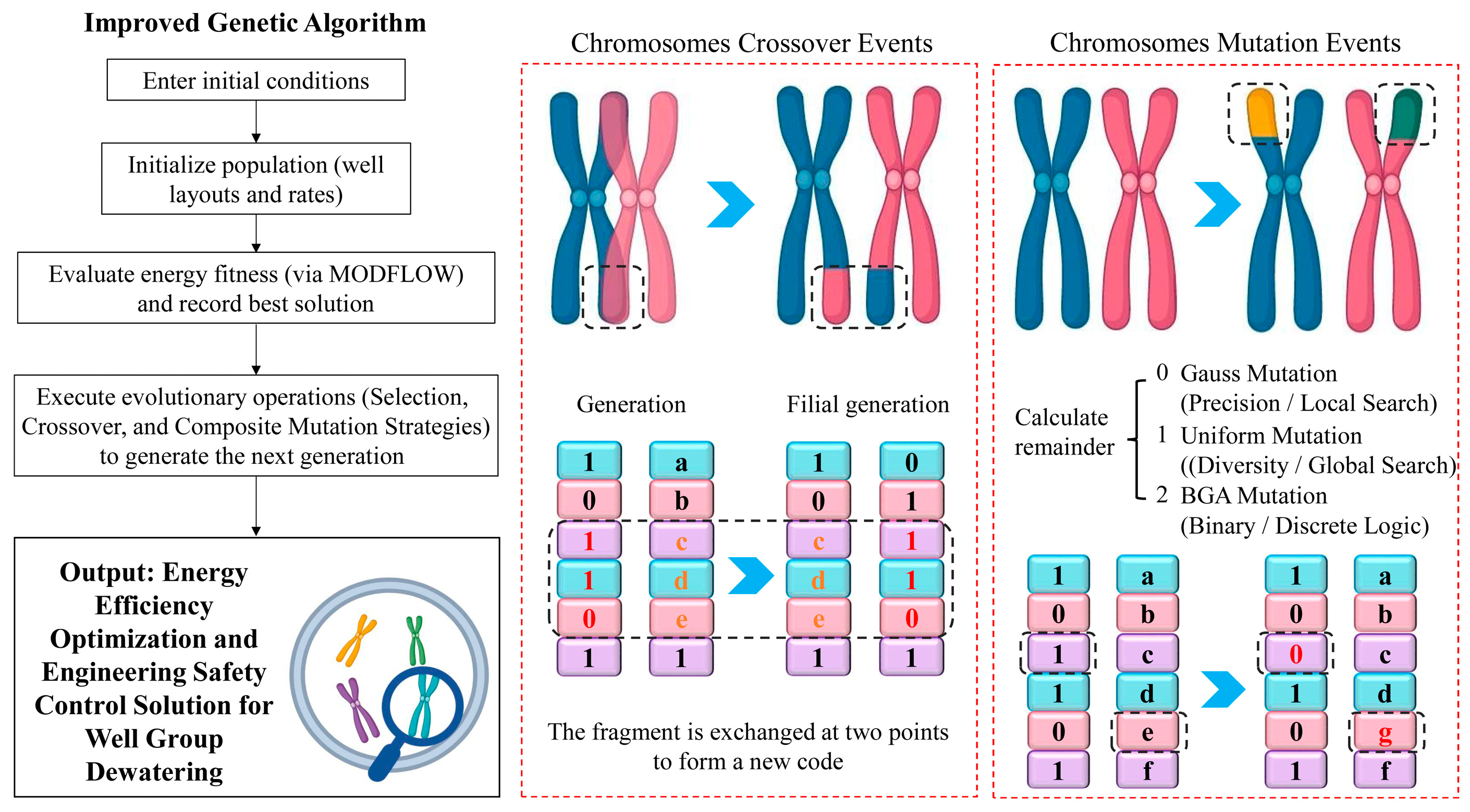
To synergistically leverage the strengths of the aforementioned operators, the IGA employs a dynamic selection mechanism based on the modulus of the iteration count. As illustrated in Figure 2, the selection logic is executed as follows: when the remainder is 0, Gaussian mutation is applied to enhance precision; when 1, Uniform mutation is utilized to augment diversity; and when 2, BGA mutation is selected to manage discrete logic. This cyclic strategy ensures that the algorithm efficiently converges to the energy-optimal solution while maintaining robust global search capabilities. The IGA hyperparameters were selected based on commonly used ranges, preliminary trial runs, and the balance between computational cost and convergence stability. Because the purpose of this study is to develop a MODFLOW-IGA coupling framework rather than to benchmark genetic-algorithm parameter settings, a systematic hyperparameter sensitivity analysis was not conducted. Instead, multiple independent runs were used to examine the robustness of the optimization results.

2.4. Formulation of the Energy-Aware and Engineering Safety Control Objective Function

2.4.1. Definition of the Optimization Problem and Global Objective Function

In this study, dewatering design is formulated as a well-group operation optimization problem. The candidate well locations are predefined according to the excavation geometry, site accessibility, and engineering layout requirements. Therefore, the well coordinates are not treated as continuous spatial optimization variables. The decision variables include two components: the on/off status of each candidate well and the pumping rate assigned to each active well. For a system with n z candidate wells, X i is the binary operational variable of the i -th candidate well. X i = 1 indicates that the well is active, whereas X i = 0 indicates that the well is inactive. Q i denotes the pumping rate of the i-th well. When X i = 0, the corresponding pumping rate is zero.
Accordingly, the intended output of the optimization is a feasible well-group operation scheme that specifies which candidate wells should be activated and how much water should be pumped from each active well. The optimized scheme must satisfy the prescribed engineering safety requirements, including the target water level in the excavation, the allowable settlement at sensitive observation points, and the allowable hydraulic gradient for seepage stability. Under these safety constraints, the optimization aims to reduce redundant pumping and unnecessary well operation embedded in conventional conservative designs, thereby decreasing groundwater extraction, electricity consumption, carbon emissions, and drawdown-induced settlement.
To avoid directly summing objective terms with different dimensions, all objective terms are normalized before aggregation. The active-well term is normalized by the total number of candidate wells n z . The pumping operation term is normalized by the total pumping volume of the traditional scheme Q t r a d . The water-level control term is normalized by the product of the number of observation points and the target drawdown scale, n o b s Δ H t a r g e t . The settlement term is normalized by the product of the number of observation points and the allowable settlement, n o b s S a l l o w . In this way, each objective term is expressed as a relative ratio and can be consistently combined in the weighted objective function. The global objective function is expressed as [25]:
m i n Y = α 1 i = 1 n z X i n z + α 2 i = 1 n z X i Q i Q t r a d + β 1 j = 1 n a b s h j H j n o b s Δ H t a r g e t + β 2 j = 1 n o b s S j n o b s S a l l o w
where the first term represents the ratio of active wells to all candidate wells, characterizing the well-group scale and the associated fixed resource consumption. The second term represents the ratio of the total pumping volume of the optimized scheme to that of the traditional scheme, characterizing pumping-related operational consumption. The third term represents the water-level control deviation relative to the target drawdown scale. The fourth term represents the settlement response relative to the allowable settlement. h j and H j are the simulated and target water levels at the j -th observation point, respectively. S j is the simulated settlement at the j -th observation point, Δ H t a r g e t is the target drawdown scale, and S a l l o w is the allowable settlement. α 1 , α 2 , β 1 , and β 2 are the weighting coefficients for well-group scale, pumping operation, water-level control, and settlement control, respectively.
The optimization problem is subject to the following constraints [26,27]:
X i { 0 , 1 } , i = 1 , 2 , , n z Q m i n X i Q i Q m a x X i , i = 1 , 2 , , n z h j H j , j = 1 , 2 , , n o b s S j S a l l o w , j = 1 , 2 , , n o b s i m a x i a l l o w
The first constraint defines the binary on/off status of candidate wells. The second constraint links well operation with pumping rate, ensuring that inactive wells have zero pumping rate and active wells operate within the allowable pumping range. The third constraint requires the simulated water level at control points to meet the design target. The fourth constraint limits the simulated settlement to the allowable value. The fifth constraint controls the maximum hydraulic gradient to avoid seepage instability, water inrush, or sand boiling. The water levels, settlement responses, and hydraulic gradients are calculated from MODFLOW simulations and returned to the optimization algorithm through FloPy for objective-function and constraint evaluation.
It should be emphasized that the optimization does not simply seek the minimum pumping rate. Instead, it searches for the least redundant well-group operation scheme within the feasible solution space that satisfies engineering safety constraints. The final outputs include the number and locations of active wells, pumping rates of active wells, simulated groundwater level distribution, settlement responses, maximum hydraulic gradient, total pumping volume, energy consumption, carbon emissions, and the comprehensive objective-function value.
Because dewatering optimization involves trade-offs between energy saving and engineering safety, an excessive reduction in pumping may fail to satisfy the target water level, whereas excessive pumping may cause unnecessary energy consumption and increased settlement risk. Therefore, the Analytic Hierarchy Process (AHP) is used to determine the weighting coefficients of the objective terms. The AHP converts qualitative engineering judgments, such as energy-priority or safety-priority scenarios, into quantitative weights, thereby identifying a balanced solution consistent with specific engineering requirements during the multi-objective optimization process.

2.4.2. Decision Variables and State Variables

The decision variables of the model encompass the quantity, spatial distribution, and individual pumping rates of the dewatering wells. To implement intelligent start-stop control for the well group, a binary variable X i is introduced to define the operational status of each well, thereby formulating the problem as a 0–1 mixed integer programming problem; specifically, X i = 1 indicates that the i-th well is active (operating), whereas X i = 0 signifies that the well is inactive (closed). Conversely, the state variables represent the system responses driven by these decision variables and computed via MODFLOW numerical simulation, which primarily comprise the groundwater level distribution within the aquifer and land subsidence at critical observation points.

2.4.3. Physical Quantification of Energy Consumption and Carbon Emissions in Pumping Systems

The operational energy consumption of the dewatering system is primarily expended on overcoming gravitational potential energy to lift groundwater. Based on the principles of fluid mechanics, the instantaneous power P(t) of the pumping well group at time t is defined as [28]:
P ( t ) = ρ g Q ( t ) H t o t a l 1000 ω
where ρ represents the water density (kg/m3); g denotes the gravitational acceleration (m/s2); Q(t) is the total pumping rate of the well group (m3/s); H t o t a l refers to the total head (m), comprising the geometric head (drawdown) and hydraulic head losses in pipelines; and ω is the overall efficiency of the pump unit.
Over the dewatering period T, the system’s total energy consumption and carbon emissions are expressed as:
E t o t a l = 0 T P ( t ) d t ρ g H a v g V 1000 ω
C F = E t o t a l × E F g r i d + n w e l l × C F w e l l
where V is the cumulative pumping volume during the dewatering period, and H a v g is the average total head. E F g r i d denotes the regional grid emission factor (kg CO2/kWh), n w e l l is the number of constructed pumping wells, and C F w e l l represents the embodied carbon emission associated with the construction of a single pumping well. In this study, the same H a v g and ω are used for all compared schemes because the drainage layout and pump operating conditions are relatively stable. Therefore, the energy comparison among schemes is mainly controlled by the cumulative pumping volume. For cases with strongly time-varying head or pump efficiency, Equation (13) should be evaluated using time-dependent H ( t ) and ω ( t ) .

3. Model Framework Validation: Efficiency and Engineering Safety Control Analysis on an Idealized Model

3.1. Establishment and Computational Process of the IGA-M Coupled Model

To achieve precise control and energy conservation for well group dewatering projects under complex hydrogeological conditions, this study develops a coupled IGA-MODFLOW optimization model (abbreviated as IGA-M). This model integrates the numerical simulation of physical fields with evolutionary search strategies into a closed-loop decision-making system; its operational workflow is illustrated in Figure 3. Initially, based on hydrogeological investigation data from the study area, a high-fidelity groundwater seepage numerical model is constructed utilizing MODFLOW. The aquifer is spatially discretized via the Finite Difference Method (FDM), with initial hydraulic heads, boundary conditions, and stratigraphic parameters rigorously configured to ensure the model faithfully captures the spatiotemporal evolution dynamics of groundwater seepage. Building upon this foundation, the operational status (operating or closed) of each individual well within the group is defined as a binary decision variable (0 or 1), thereby transforming the well group optimization task into a high-dimensional 0–1 integer programming problem.
As shown in Figure 3, a MODFLOW groundwater-flow model is established based on the hydrogeological conceptual model, including model discretization, hydraulic parameters, initial conditions, and boundary conditions. Candidate dewatering wells are then predefined according to the excavation layout, and the on/off status of each candidate well and the pumping rate of each active well are taken as optimization variables. After the IGA initializes the population, each individual represents a potential well-group operation scheme. For each candidate scheme, FloPy automatically updates the MODFLOW Well package by assigning zero pumping rates to inactive wells and the corresponding optimized pumping rates to active wells. MODFLOW is then executed to calculate the groundwater-flow field, and the simulated hydraulic heads, settlement-related indicators, and hydraulic gradients are extracted through FloPy. These physical responses are used to evaluate water-level deviation, settlement response, total pumping volume, energy consumption, carbon emissions, and safety constraints. Based on the resulting fitness values, the IGA performs selection, crossover, and composite mutation until either the maximum number of generations, set to 200 in this study, is reached or the relative change in the best fitness value remains below 10−4 for 20 successive generations. The final output includes the selected active wells, pumping rates, simulated water-level distribution, settlement response, energy consumption, carbon emissions, and comprehensive objective-function value.

3.2. Model Setup

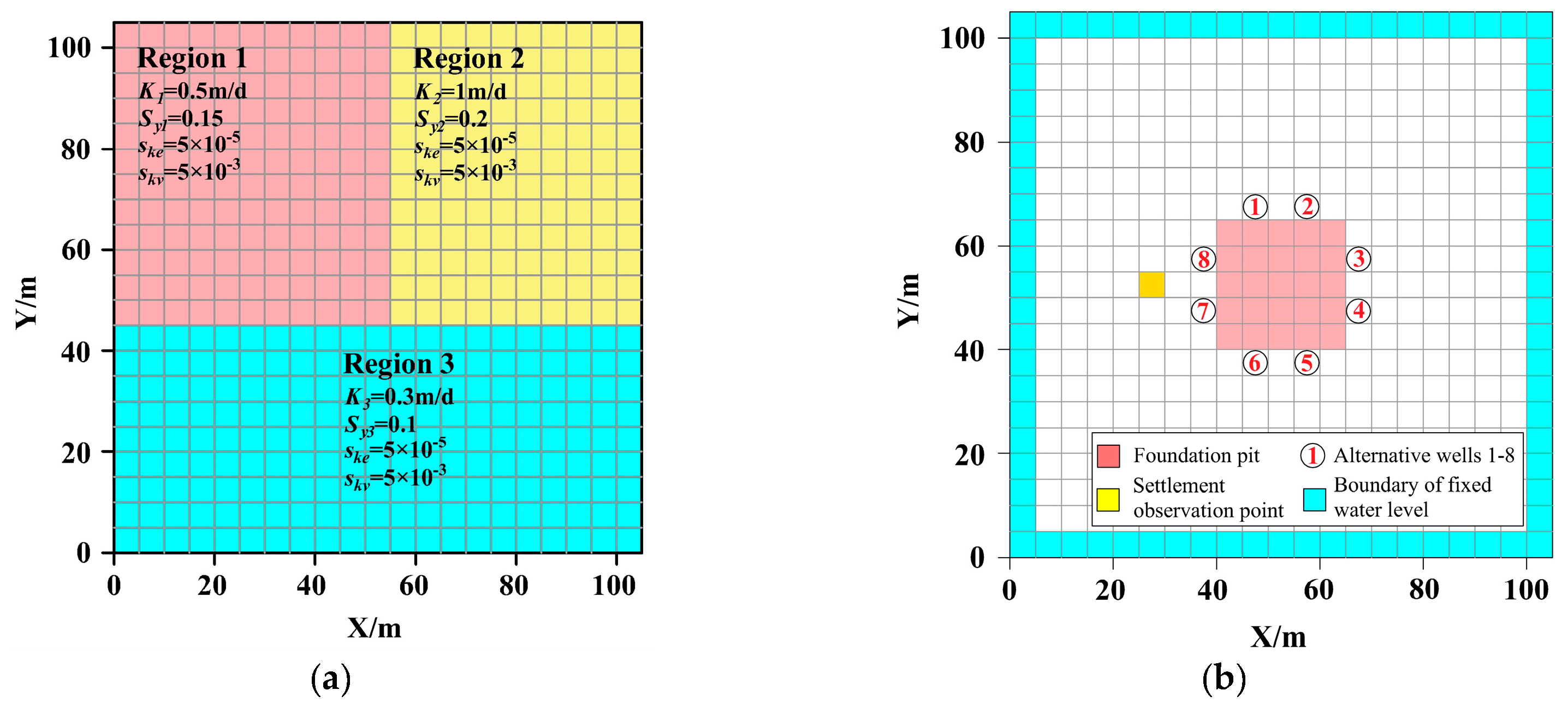
To substantiate the performance superiority of the proposed IGA-M framework over traditional dewatering methods, particularly its potential for conserving energy and groundwater resources under complex geological conditions, a conceptual benchmark model was established for comparative testing. The simulation domain is defined as an unconfined aquifer with a thickness of 20 m and a horizontal extent of 105 m, spatially discretized into 441 cells using a uniform grid size of 5 m. To mirror the complexity of realistic geological conditions and scrutinize the limitations of traditional empirical methods, the site is partitioned into three zones characterized by distinct hydrogeological parameters, as illustrated in Figure 4. The model boundary conditions are configured as 20 m constant head boundaries (consistent with the initial hydraulic head across the entire field), while the aquifer bottom is treated as an impermeable (no-flow) boundary. A square excavation pit with a side length of 25 m is situated at the domain center, surrounded by 8 candidate fully penetrating dewatering wells. The test establishes strict dual performance criteria encompassing “energy conservation & emission reduction” and “engineering safety”: the pumping scheme must mandate a 5 m drawdown at the pit center within a 10-day construction period, while simultaneously strictly limiting ground settlement at designated monitoring points to within 5 mm. Under these stringent constraints, the model aims to identify the well group control strategy that yields the minimum operational energy consumption while satisfying safety standards, thereby quantifying the energy-saving dividends of intelligent optimization relative to traditional approaches.
The traditional well group dewatering method typically determines the system configuration by first calculating the total pit inflow and subsequently distributing this volume uniformly among individual pumping wells. Calculations are performed based on the formula for a fully penetrating well in an unconfined aquifer [4]:
Q = 1.366 K 2 H S S l g R r w
R = 2 S K H
where Q is the total pit inflow (m3/d); K denotes the hydraulic conductivity of the aquifer (m/d); S represents the water level drawdown (m); H is the aquifer thickness (m); r w is the equivalent radius of the pit (m); for a rectangular pit, r w = a b , where a and b are the length and width of the rectangle, respectively (m); R denotes the radius of influence for dewatering (m).
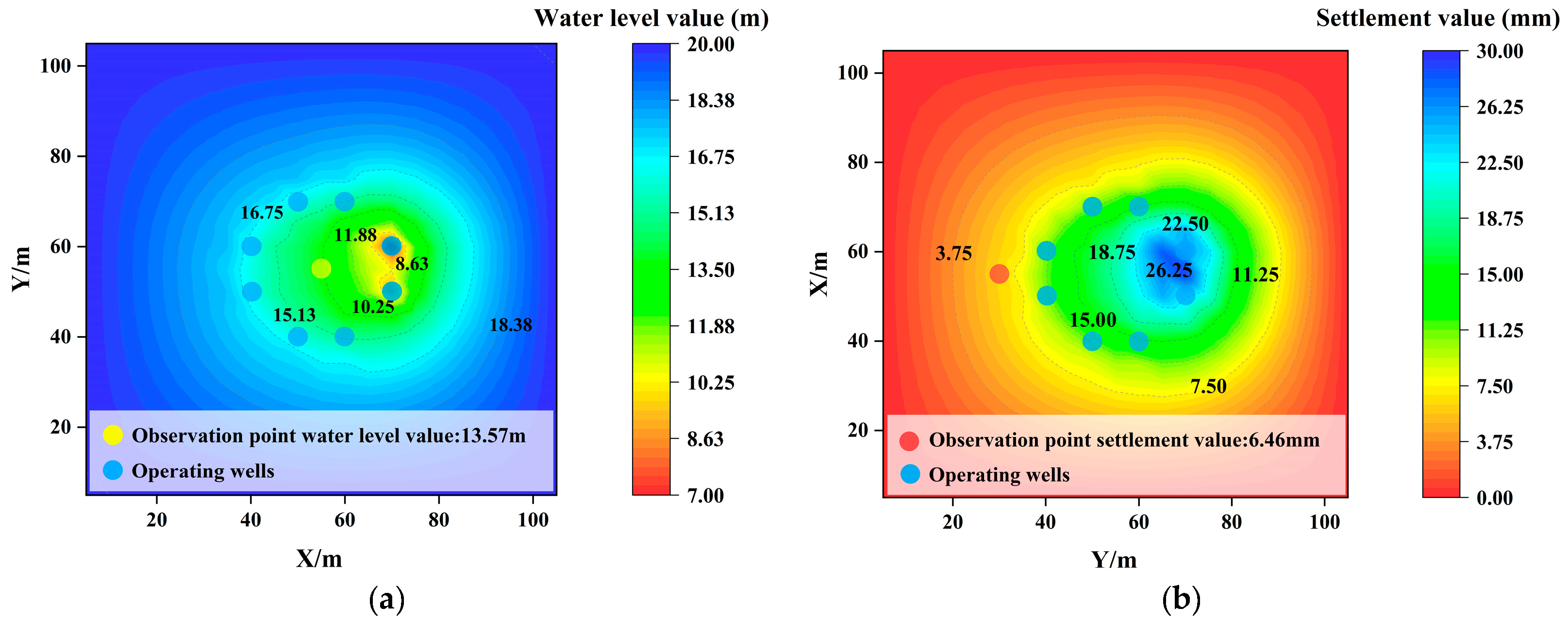
The total inflow of 996 m3, calculated using the traditional method, was uniformly allocated among the eight candidate pumping wells. The resulting contours of the groundwater level and land subsidence at the site following the pumping operation are depicted in Figure 5.
The traditional well group dewatering method yielded a hydraulic head of 13.57 m at the pit center, which is nearly 1.5 m lower than the target level. Consequently, the settlement at the observation point reached 7.93 mm. Although the traditional method offers the advantage of computational simplicity in planning, it frequently resorts to excessive pumping to guarantee the target drawdown. This approach not only incurs unnecessary energy consumption and groundwater resource wastage but also causes ground settlement to surpass permissible control limits.

3.3. Model Applicability Verification

The IGA-M coupled optimization model was invoked to solve the problem. In pursuit of a balanced non-dominated solution that reconciles “energy efficiency” with “engineering safety,” an equal-weight strategy (i.e., assigning identical coefficients to all weights) was adopted in the configuration of the multi-objective function. This approach aims to minimize both the environmental impact of settlement and the system’s comprehensive operational energy consumption to the maximum extent, under the strict prerequisite that the groundwater drawdown at the excavation center meets the design requirement of 5 m.
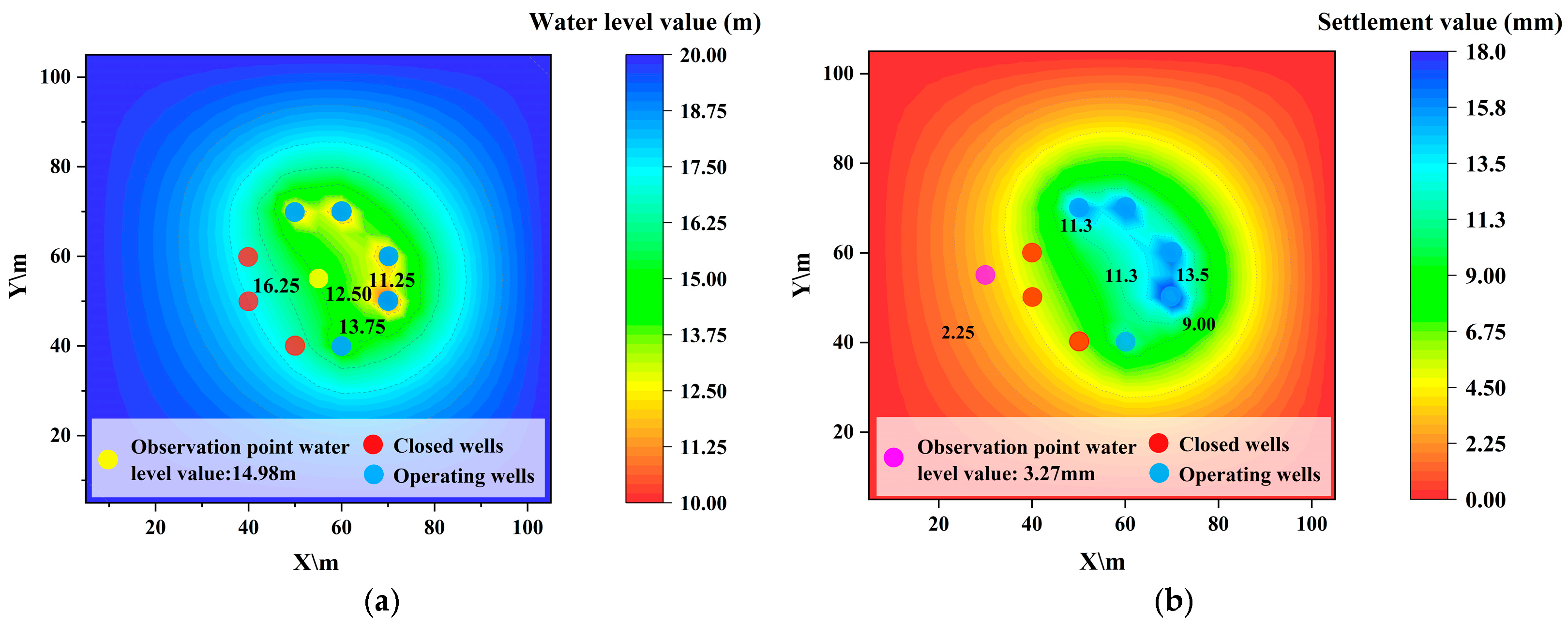
As evident from Figure 6, in stark contrast to the excessive drawdown cones typically generated by traditional methods, the seepage field produced by the IGA-M model exhibits a distinctive characteristic of “asymmetric precise control.” Specifically, the model induces the necessary drawdown solely within the core excavation zone while maintaining relatively high water levels in the settlement-sensitive area (on the left side), thereby physically blocking the mechanism of excessive settlement at its source. Furthermore, to verify the robustness of the algorithm in navigating complex non-linear solution spaces, six independent parallel computing trials were conducted. To present the comparison between the optimized solution sets derived from these trials and the traditional well group method, and to quantify the dual advantages of intelligent optimization regarding energy control and safety compliance, the calculation parameters are standardized as follows: the specific weight of water ρg is taken as the standard value of 9810 N/m3; the total head H t o t a l is set to 7 m (comprising a 5 m elevation difference and 2 m of pipeline loss); and the pump unit efficiency ω is fixed at 65%.
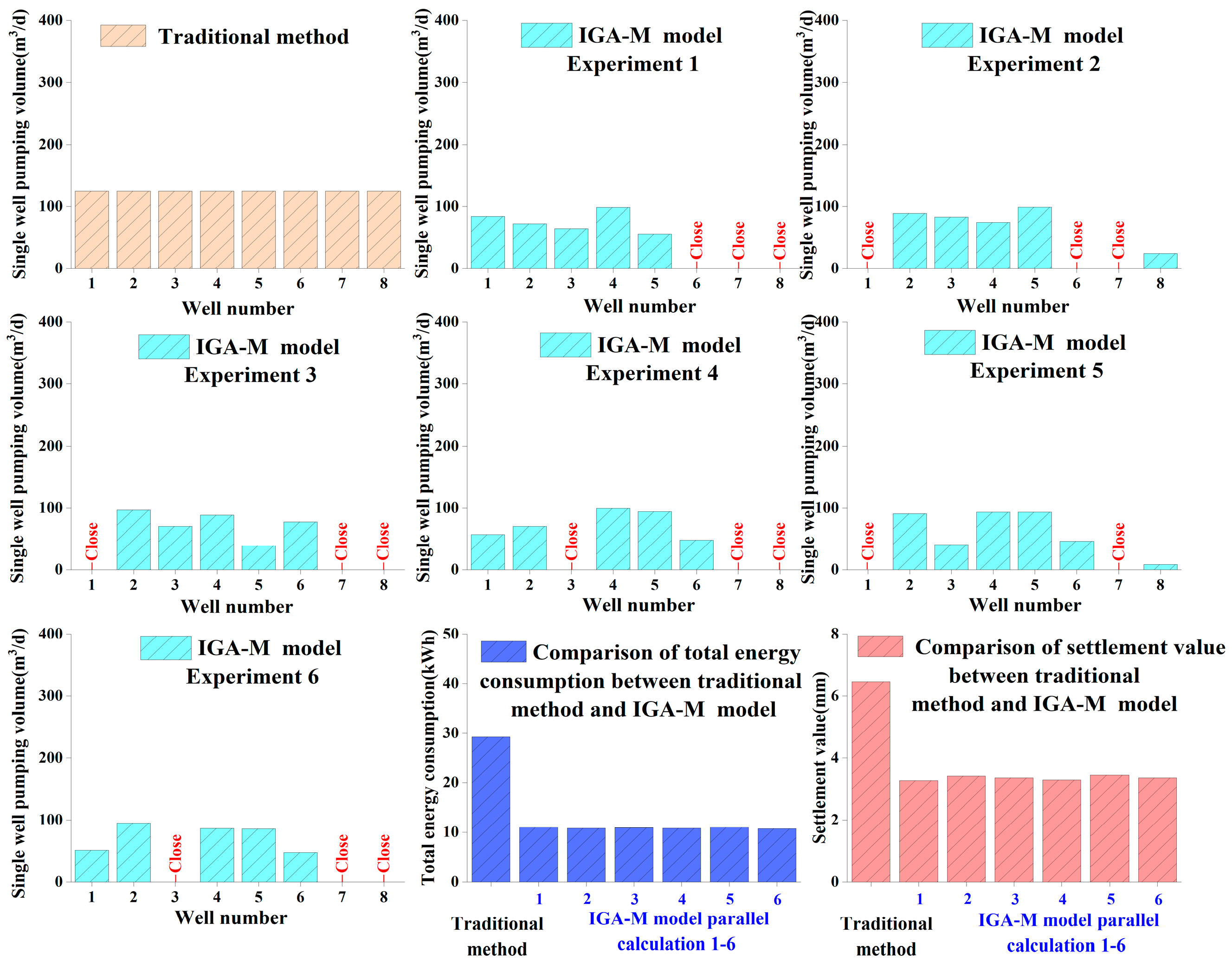
Analyzing Figure 7 reveals that the IGA-M model exhibits exceptional spatial position sensitivity alongside an intelligent decision-making mechanism. Across the six parallel trials, pumping wells located on the side of the excavation adjacent to the settlement observation points (e.g., Well 7 and Well 8) were identified by the algorithm with high frequency as “risk sources,” triggering automatic strategies for shutdown or low-flow operation. This phenomenon demonstrates that the optimization algorithm has successfully captured the non-linear response laws governing the “pumping-settlement” interaction. By proactively severing or reducing pumping volumes in sensitive areas, the model achieves strict control over peripheral settlement at the cost of lower energy consumption, all while ensuring that the groundwater drawdown at the excavation center meets compliance standards.
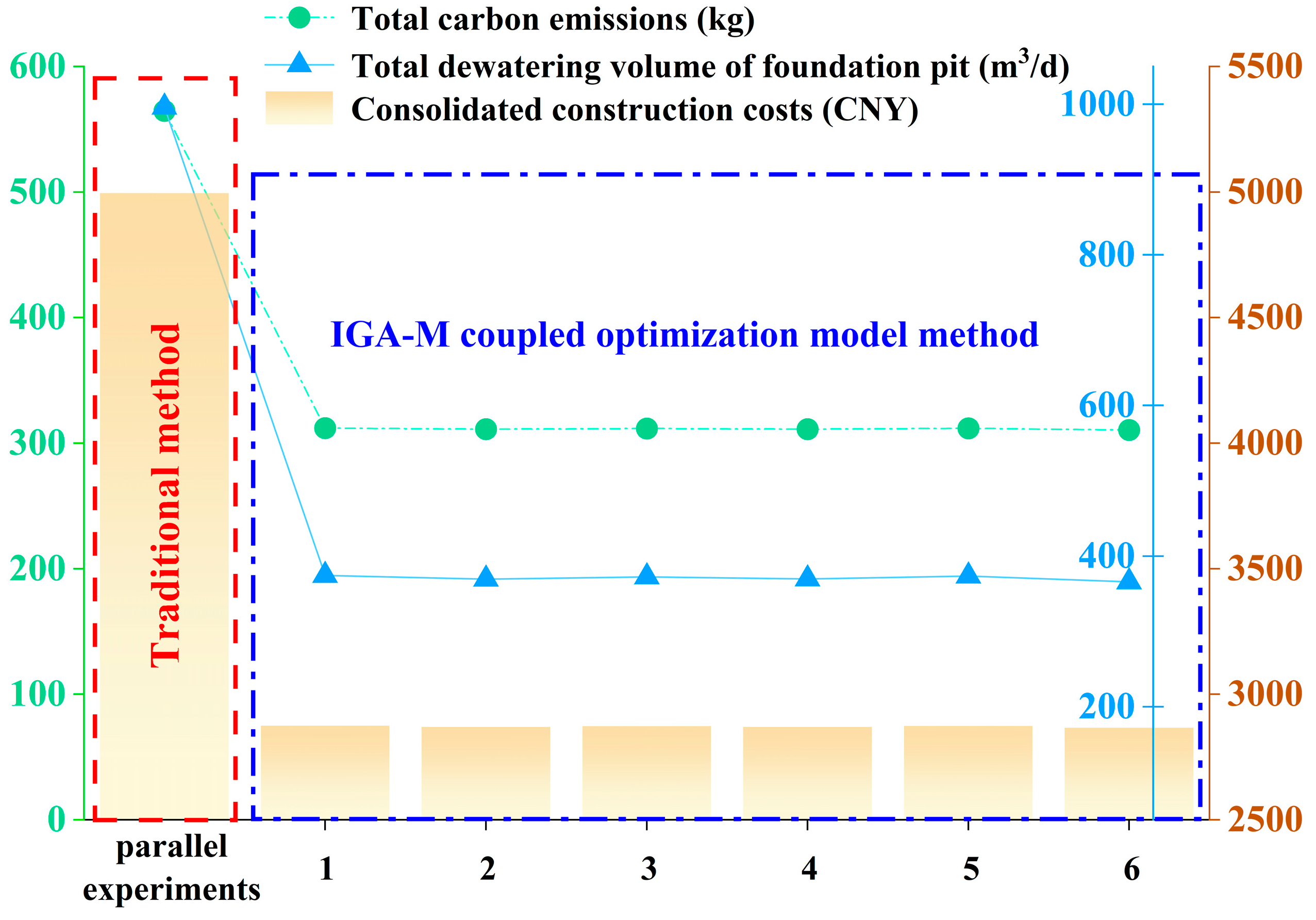
To further quantify the comprehensive efficacy of the proposed optimization strategy regarding economic costs and energy consumption, this study utilizes the established energy-carbon calculation model with the following parameters: a well construction cost coefficient of 500 CNY/well and a pumping operational cost of 1 CNY/m3. Concurrently, to accurately account for carbon emissions throughout the construction cycle, both the regional grid average emission factor ( E F g r i d ) and the embodied carbon per well ( C F w e l l ) are incorporated. Specifically, the embodied carbon is set at C F w e l l = 50 kg CO2, while the grid emission factor is adopted as E F g r i d = 0.5703 kg CO2/kWh, in accordance with the latest data released by the National Climate Center and the Ministry of Ecology and Environment of China [29,30]. Figure 8 provides a comparative visualization between the traditional well group method and the IGA-M optimization model across three key dimensions: comprehensive economic cost (summation of construction expenses and operational energy costs), total carbon emissions (aggregation of embodied and operational carbon), and the total volume of groundwater extracted.
A comprehensive analysis of the results from parallel experiments reveals that the IGA-M coupled optimization model demonstrates exceptional robustness and optimization stability when solving the validation model. In comparison with traditional well group dewatering methods, the IGA-M model not only guarantees precise compliance with the target water level at the excavation center but also achieves targeted and precise control of settlement in environmentally sensitive zones through the intelligent regulation of the well group’s spatial distribution. Consequently, it successfully mitigates the previously excessive settlement risks, bringing them strictly within safety thresholds.
Viewed through the quantitative lens of the “Water-Energy-Carbon” nexus, the optimized solution set generated by the IGA-M model demonstrates substantial advantages in comprehensive efficacy. Compared to traditional methods, the optimized scheme reduces the volume of groundwater extraction by 62.7%. This reduction directly drives a simultaneous decrease of 44.9% in both the total carbon emissions and the comprehensive construction costs over the entire dewatering cycle, while also lowering settlement at observation points by 57.7%. These results indicate that the IGA-M framework functions not merely as a tool for the precise regulation of the seepage field’s water level distribution, but as a high-efficiency decision support system capable of balancing engineering safety, economic costs, and energy conservation. It empowers decision-makers to select the optimal strategy from the solution set based on specific operational preferences, thereby facilitating an intelligent, green, and low-carbon transformation of excavation dewatering projects. Consequently, the IGA-M framework fundamentally circumvents the inherent drawbacks of traditional methods, including electricity wastage from high-energy operations, groundwater depletion caused by excessive dewatering, exorbitant construction costs arising from redundant well placements, and the high-intensity carbon emissions associated with the conventional dewatering lifecycle.

4. Case Study: Synergistic Conservation of Groundwater and Energy in a Hydraulic Complex Adjacent to the Yellow River

4.1. Site Characterization and Engineering Challenges

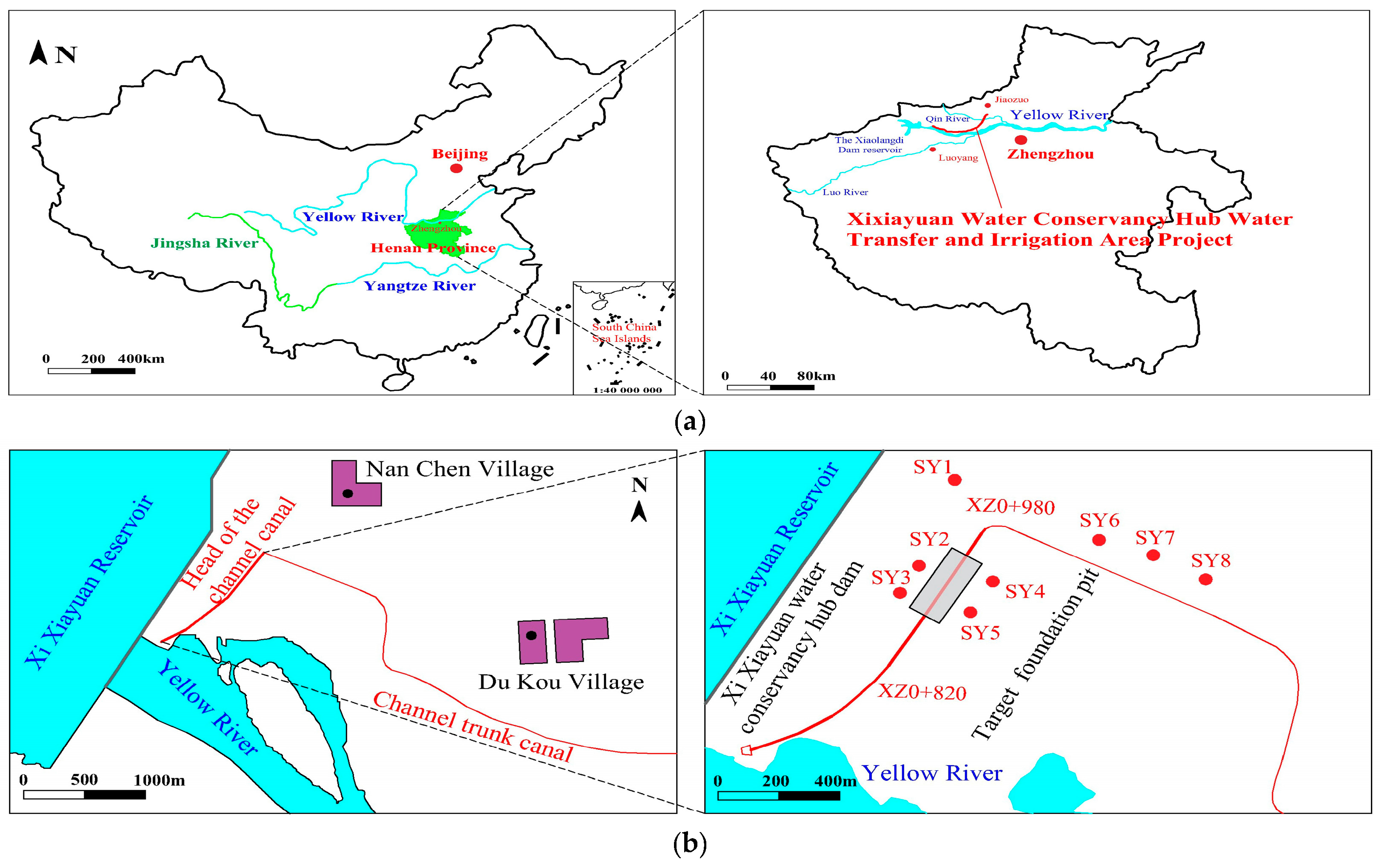
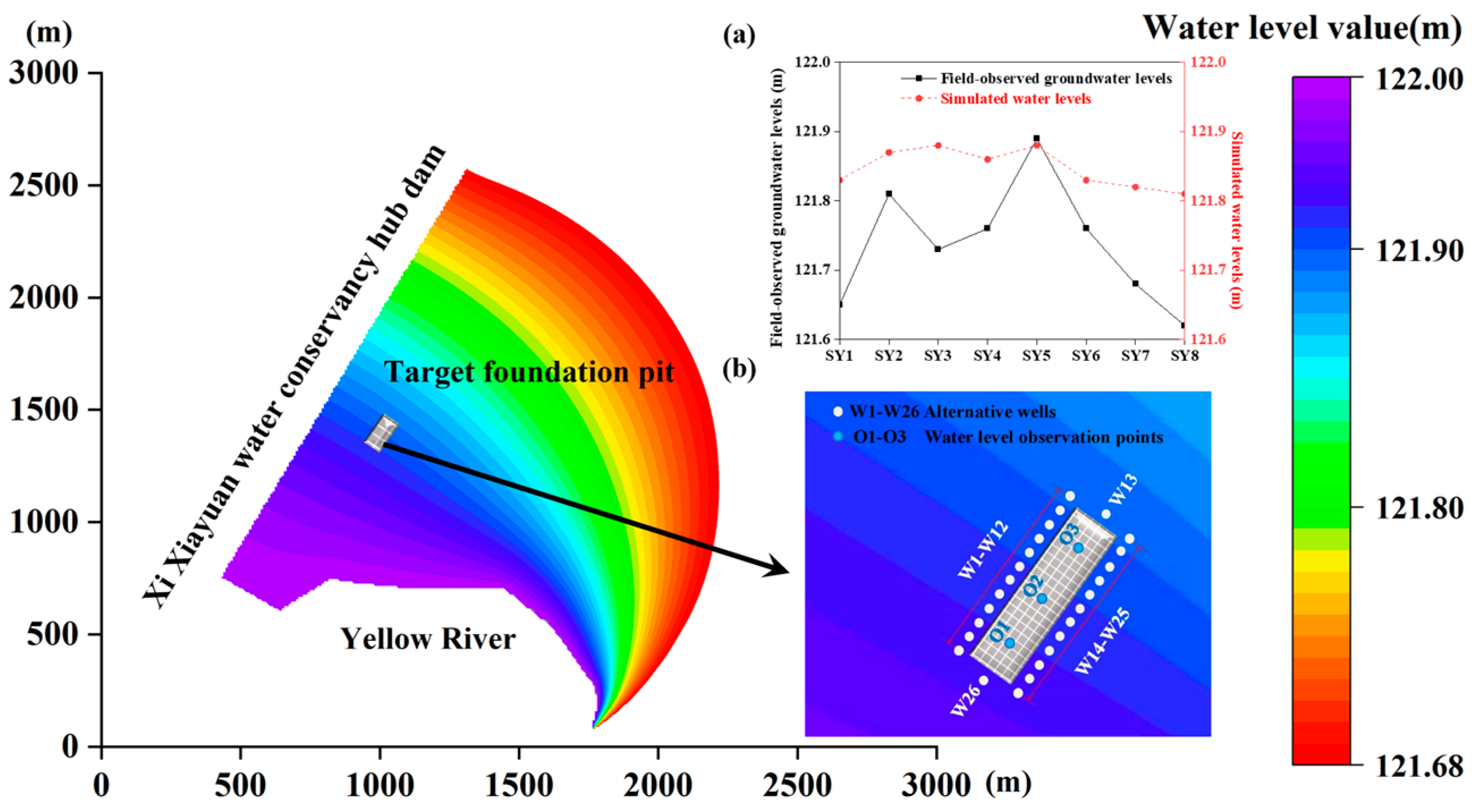
The Water Conveyance and Irrigation Project of the Xixiayuan Water Conservancy Hub is designated as one of the 172 Major National Water Conservancy Projects in China. The project’s starting point is situated within the floodplain on the northern bank of the Yellow River, as illustrated in Figure 9a. The specific subject of this study is the foundation pit for the inverted siphon section at the canal head (Station Chainage: XZ0+820 to XZ0+980). The terrain in this section is flat, with an average ground elevation of 124.5 m. The stratigraphy consists of Quaternary Holocene alluvium exhibiting a typical “binary structure”: a thin overlying layer of sandy loam and a thick underlying layer of sandy gravel-cobble, resting upon a clay rock base. Notably, the revealed gravel-cobble layer is approximately 21.5 m thick. The cobbles within this layer typically range from 0.6 to 8 cm in diameter, possess high roundness, and constitute over 60% of the matrix. The voids are filled with sandy gravel and are unconsolidated (non-cemented). With a hydraulic conductivity of 432 m/d, this layer exhibits extremely high permeability. The groundwater is characterized as pore phreatic water within the Quaternary loose sediments, maintaining an average water level of 121.68 m. It is primarily recharged by the Yellow River to the south and is entirely stored within the highly permeable sandy gravel-cobble layer.
The dewatering operation for this foundation pit confronts dual challenges of significant magnitude. Firstly, under conditions of high permeability and intense recharge, resorting to traditional well group methods to maintain target water levels would necessitate the extraction of massive volumes of groundwater, leading to colossal wastage of groundwater resources, excessive electricity consumption, and the accumulation of carbon emissions. Secondly, beyond energy challenges, the project is subject to stringent environmental and safety constraints. Located within the Yellow River Wetland National Nature Reserve and less than 400 m from the axis of the Xixiayuan Dam, the engineering operation is compelled to strike a delicate equilibrium between “minimizing energy consumption” and “controlling settlement.” High-intensity, excessive pumping could precipitate ground settlement within the reserve or compromise the structural safety of the dam; conversely, insufficient dewatering efficacy would fail to meet the design drawdown requirement of 7.68 m (maintaining the water level 1 m below the pit bottom).
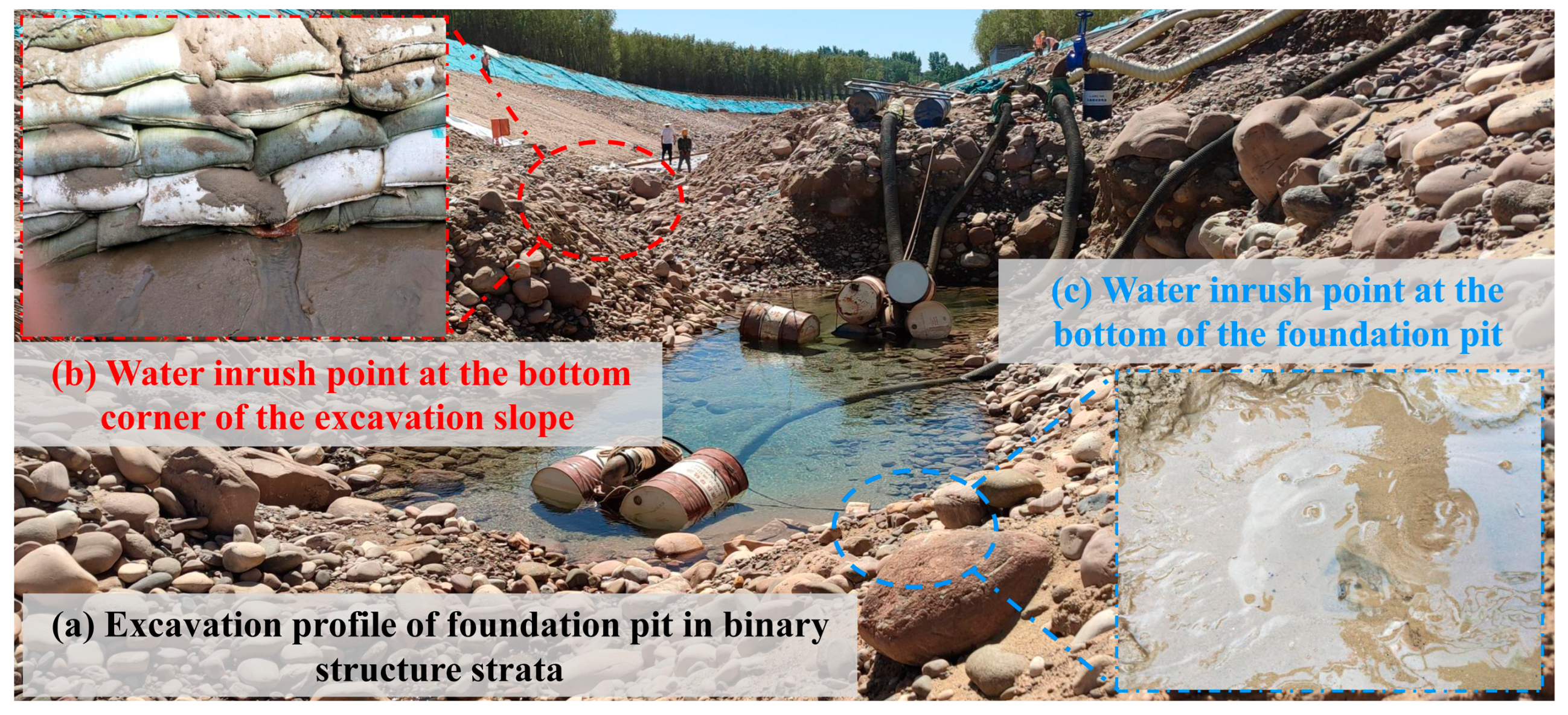
During the initial phase of the project, an attempt was made to utilize dense well clusters for high-load centralized dewatering. However, due to a failure to account for the non-uniformity of the seepage field, localized excessive hydraulic gradients precipitated seepage failure. As depicted in Figure 10, the dense distribution of pumping wells and excessive pumping rates induced extreme local hydraulic head differences. Under the action of high hydraulic heads, fine sand particles within the sandy gravel matrix were progressively elutriated (washed out) by the seepage flow. This internal erosion (suffosion) process further increased the formation’s permeability, which in turn intensified the scouring effect of the flow. Consequently, fine particles were continuously transported out of the gravel skeleton, culminating in sudden water inrush phenomena characterized by high volume and velocity at parts of the slope and pit bottom. This not only resulted in significant ineffective energy consumption but also severe groundwater wastage.
In summary, the site confronts a multi-faceted conflict characterized by the need to “maintain a dry field at high energy costs,” “environmental sensitivity,” and “strict settlement control versus seepage failure risks.” Resolving how to satisfy dry construction conditions while optimizing well group strategies via the IGA-M model, to achieve safe dewatering at the minimum cost of groundwater resources and energy, constitutes the core scientific problem that this case study aims to address.

4.2. Modeling of Groundwater System Under Strong Recharge Conditions

Given the minimal stratigraphic undulation within the canal head inverted siphon section, the strata are generalized as horizontal layers, vertically divided into two distinct units: a surficial sandy loam layer (elevation 124.5–121.9 m) and the underlying gravel-cobble stratum (121.9–99.5 m). The latter serves as the primary aquifer and the active zone for energy exchange, while the bottom clay rock formation acts as an impermeable base, resulting in a total vertical model thickness of 25 m. The configuration of boundary conditions fundamentally dictates the “water-energy” input-output characteristics of the system. Specifically, the southern boundary adjacent to the Yellow River is defined as a constant head boundary with strong recharge capabilities; physically, this acts as an “infinite water source” that continuously transmits hydraulic energy into the pit, thereby constituting the root cause of high-energy operation. In contrast, the western boundary at the Xixiayuan Dam, having undergone anti-seepage treatment, is set as a zero-flux (no-flow) boundary, whereas the remaining far-field boundaries are extended outward based on the radius of influence formula and assigned constant head values consistent with initial hydraulic heads to simulate the regional groundwater seepage background.
To ensure that the initial flow field accurately reflects field conditions, observation wells were strategically placed around the foundation pit based on their actual field coordinates after setting the initial model values. The PEST module was subsequently employed for parameter inversion. By integrating existing data with hydraulic conductivities obtained from hydrogeological tests, the parameters were adjusted based on the inversion results to ensure model convergence within specified tolerances. In the numerical simulation, the vertical hydraulic conductivity was generally set to one-tenth of the horizontal hydraulic conductivity. The optimized parameter values are summarized in Table 1.
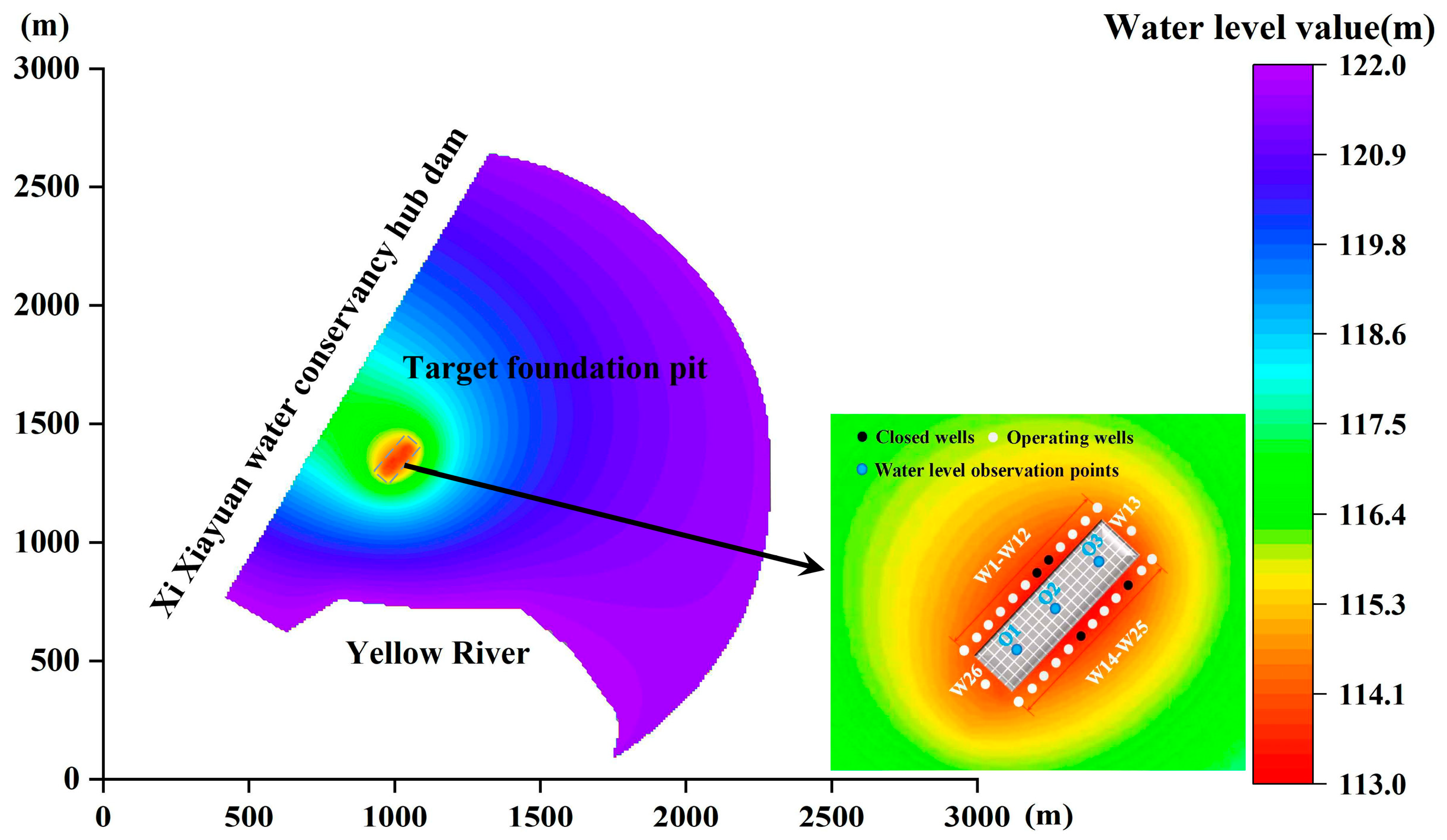
Based on the spatial discretization performed via MODFLOW, the resulting initial seepage field of the study area and the layout scheme of candidate pumping wells are illustrated in Figure 11.
Figure 11 illustrates the initial seepage field and the layout scheme of candidate pumping wells derived from the discretization process based on the aforementioned conditions. As evident from the figure, the hydraulic head within the study area manifests a distinct gradient distribution characterized by being “high in the southwest and low in the northeast.” This potent directional hydraulic drive originates primarily from the coupling effect between the high-potential recharge from the Yellow River on the southwest side and the high permeability of the gravel-cobble stratum. This specific feature of the seepage field underscores the imminent engineering challenge: the dewatering system is required to counteract this high-intensity lateral recharge while simultaneously maintaining precise control over the resulting drawdown cone. Consequently, this scenario presents a complex solution space endowed with high energy-saving potential for the IGA-M optimization model.

4.3. Quantification of Electricity Savings and Carbon Emission Reductions

In light of the specific hydrogeological characteristics of the study area, characterized by “strong recharge and high risk,” this study initially established the weighting coefficients for the optimization process using the Analytic Hierarchy Process (AHP). The aim was to construct a comprehensive evaluation framework that deeply integrates engineering safety with energy efficiency. Considering the extreme sensitivity of dam safety to ground settlement, and corroborating with on-site expert assessments, the highest decision-making weights were assigned to “target water level constraints” (0.4) and “maximum settlement limits” (0.337), thereby emphasizing the priority of safety control. Building upon this foundation, the weight for well construction (a static energy indicator representing “system embodied carbon emissions and material resource consumption”) was set at 0.165. Meanwhile, the weight for pumping operations (a dynamic energy indicator directly reflecting “system dynamic operational energy efficiency and electricity-related carbon emissions”) was set at 0.098. This strategic configuration guarantees that, when searching for the optimal solution, the IGA-M algorithm first satisfies the physical rigid constraints of “precise water control.” Subsequently, within the feasible solution space, it seeks the well group combination that offers the highest energy efficiency ratio and the lowest carbon emissions throughout the dewatering life cycle, rather than indiscriminately reducing the number of wells. This approach ensures that the generated solution set achieves “multi-objective optimality” regarding both engineering reliability and low-carbon energy efficiency. A comparison between the optimized solution set from the IGA-M coupled model and the results calculated by traditional methods is presented in Figure 12.
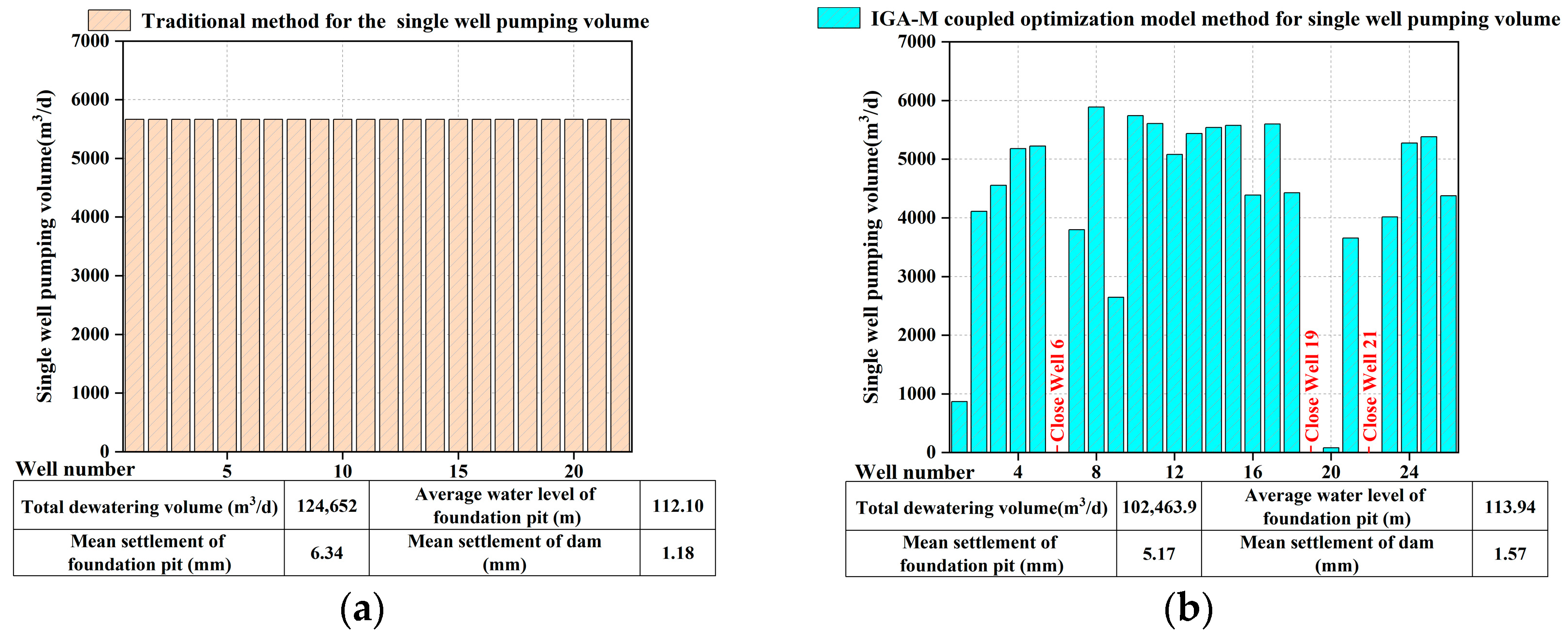
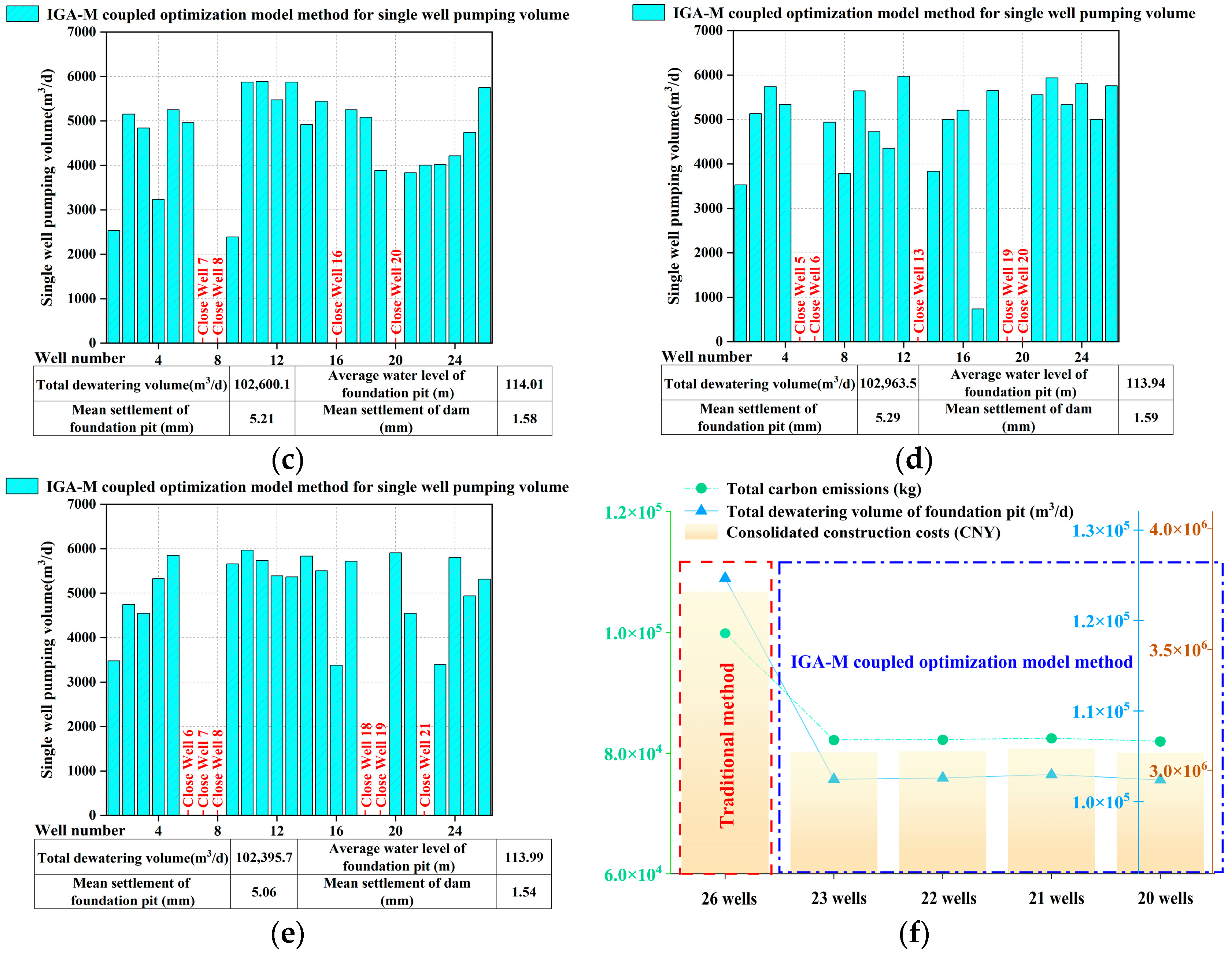
The optimization results demonstrate that the IGA-M model exhibits strong optimization performance and solution set stability, yielding non-dominated solution sets comprising 20 to 23 operating wells, respectively. Compared to the 26 wells deployed by the traditional method, the optimized schemes allow for a reduction of up to 6 redundant wells, achieving a significant streamlining of the well group scale. An analysis of the solution set characteristics in Figure 12 reveals that, although the combinations of active well locations vary across different optimization schemes (20–23 wells), their corresponding average daily pumping rates all converge to approximately 102,600 m3/d. This convergence characteristic indicates, as it unveils a lower pumping demand required to maintain the target drawdown under the tested geological and safety constraints required to maintain a dry excavation field under the specific geological conditions. In stark contrast, the traditional method necessitates a daily pumping rate as high as 124,652 m3/d, implying that approximately 17.7% of the extraction volume is essentially redundancy caused by irrational well layout. Consequently, over a single construction period (30 days), this results in the wastage of approximately 661,000 m3 of precious groundwater resources and 26,800 kWh of electricity (calculated based on a 7.68 m drawdown plus 2 m hydraulic loss), alongside an excess emission of up to 16,000 kg of CO2. The multiple sets of optimized solutions provided by the IGA-M model not only eliminate this ineffective energy consumption but also offer decision-makers a flexible “library of alternative schemes.” Contractors can select the most appropriate well layout strategy from a solution set, where environmental costs and total pumping volumes are nearly identical, based on practical constraints such as on-site construction difficulty and power access conditions. To further dissect the control efficacy of the optimized seepage field, the 22-well scheme, which balances well count with stability, was selected as a representative case; the detailed simulation results of its groundwater level and settlement distribution are depicted in Figure 13 through Figure 14.
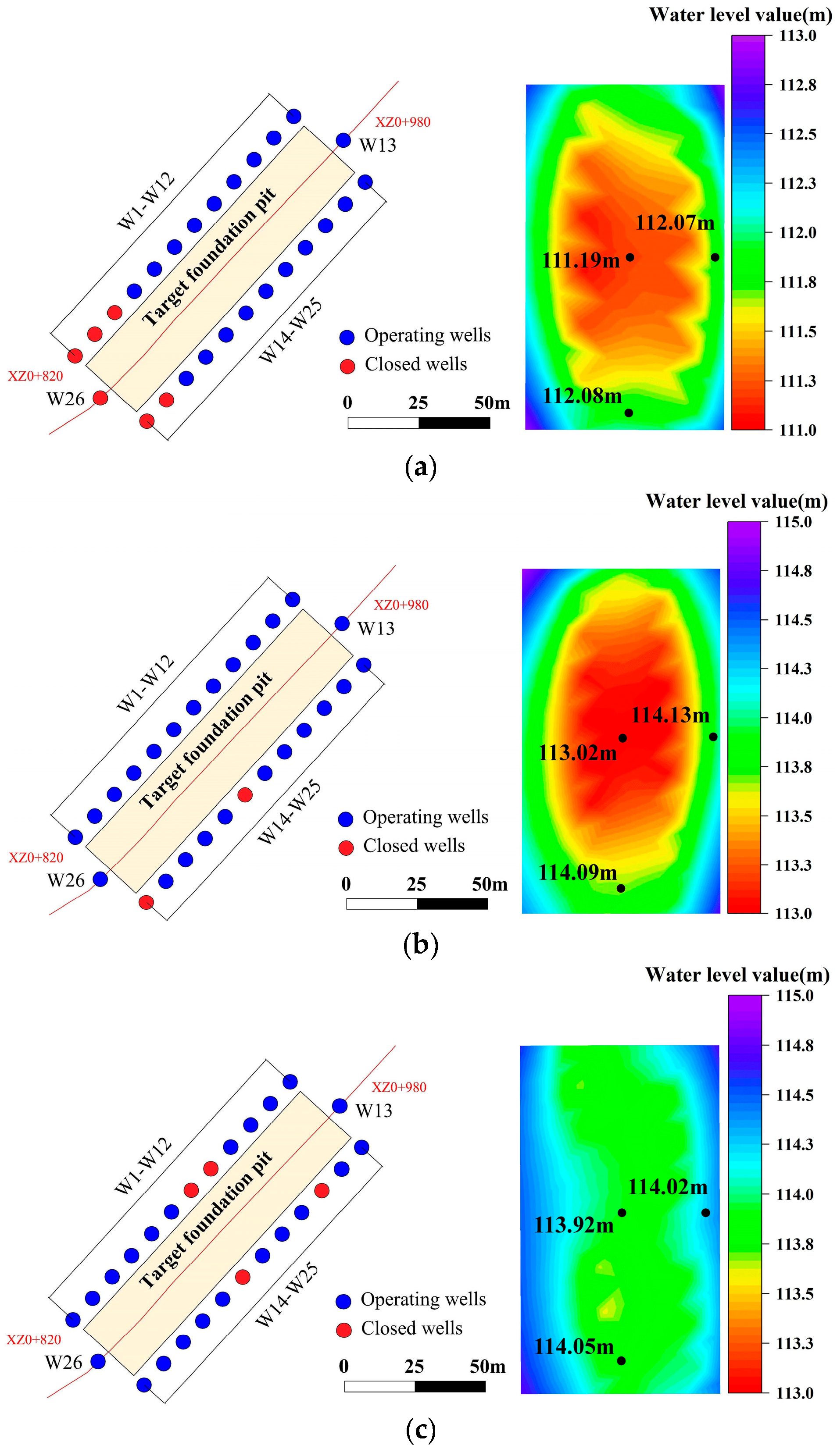
Further scrutiny of the seepage field response characteristics under both methods (Figure 12) reveals that the IGA-M coupled optimization model exhibits exceptional capabilities in “precise water level regulation.” In stark contrast to the traditional method, which excessively lowered the hydraulic head in the excavation pit to 111.0 m (nearly 3 m below the target level), the 22-well scheme optimized by the IGA-M model successfully converged the water levels at various control points precisely around the design target value of 114.0 m. This precision not only substantially reduced dewatering operational costs and lifecycle carbon emissions but also effectively mitigated the risk of secondary geohazards, such as seepage deformation, typically triggered by excessive drawdown.
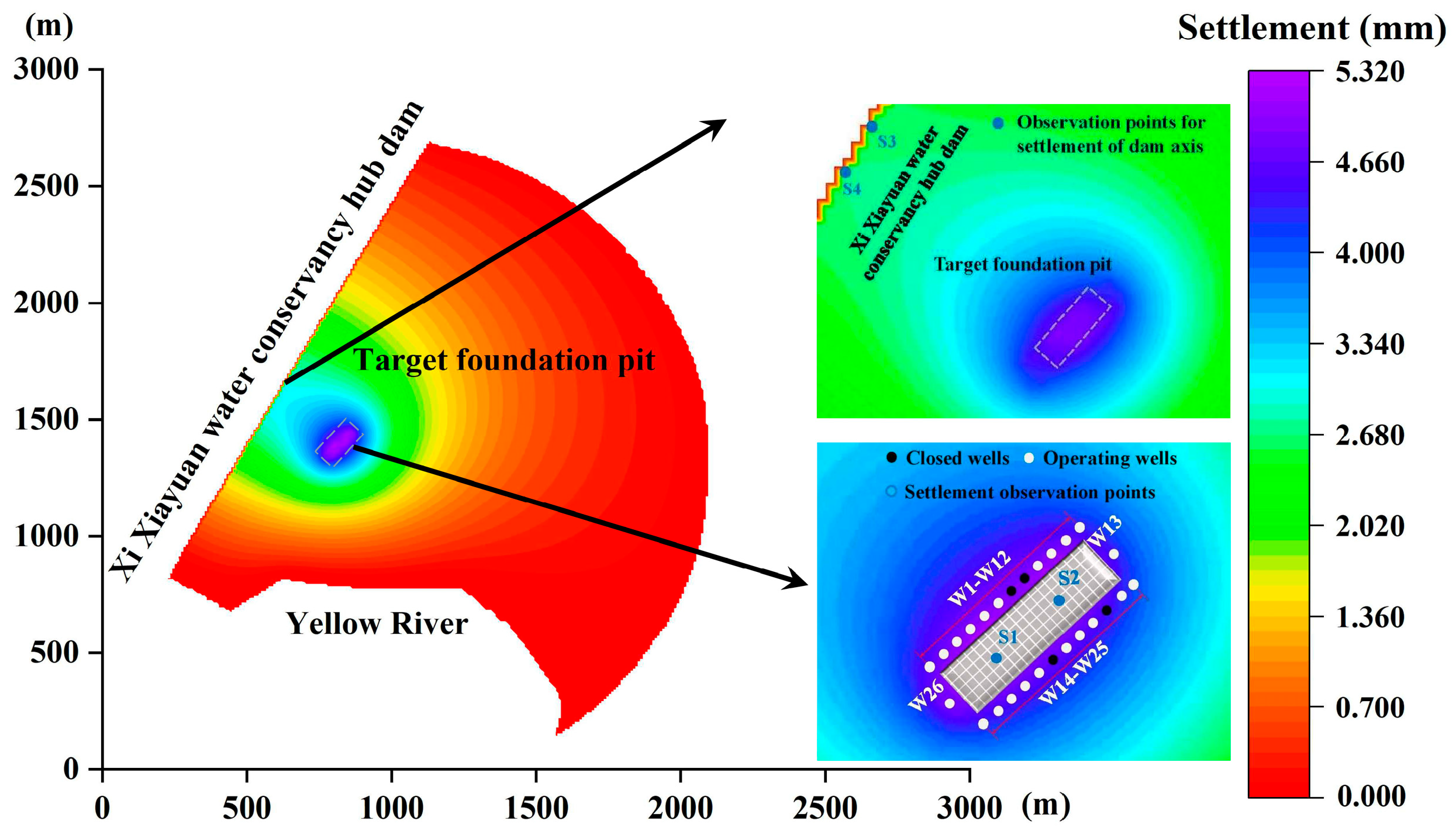
Concurrently, the settlement distribution contours in Figure 14 substantiate that this energy-saving scheme was not achieved at the expense of engineering safety. Simulation data indicate that ground settlement was strictly maintained within safety thresholds, ensuring the structural integrity of the Xixiayuan Dam throughout the dewatering construction period. Specifically, under the IGA-M optimized scheme (22 wells), the maximum cumulative settlement at the center of the pit was merely 5.21 mm. More critically, for the environmentally sensitive dam axis region, the average settlement was successfully restricted to a negligible level of 1.58 mm, far below regulatory limits. In summary, the IGA-M coupled optimization model effectively resolves the conflict between “dewatering efficacy” and “environmental safety” in practical engineering. The resulting optimized scheme not only satisfies the main technical requirements but also demonstrates, through quantified data, the considerable potential for the synergistic conservation of groundwater resources and energy under the premise of ensuring construction safety.

4.4. Algorithmic Superiority and Hydraulic-Energy Synergy Under Complex Boundaries

To further validate the advanced capabilities of the IGA-M coupled model in addressing high-dimensional non-linear hydrogeological challenges, a comparative analysis was conducted against two prevailing optimization strategies under identical constraint conditions: the single-objective optimization model based on the Fmincon function [26] and the multi-objective optimization model based on Pareto Search [25]. Figure 15 illustrates the groundwater level distribution contours within the excavation pit as computed by these three distinct algorithms.
Attributed to the unique stratigraphic and boundary conditions of the study area, the single-objective optimization model exhibits limitations in adequately accounting for environmental and economic costs, yielding a singular solution with a scarcity of alternative schemes. Conversely, although the multi-objective optimization model based on Pareto Search offers a diverse solution set, its reliance on purely mathematical formulations makes it difficult to achieve precise control over hydraulic heads at specific points within the excavation. Consequently, an examination of the post-dewatering seepage field contours derived from these two methods reveals a common deficiency: both result in excessive drawdown at the pit center (1.0–2.8 m below the target level) while maintaining relatively high water levels at the periphery. This leads to an extremely non-uniform distribution of water levels and significant hydraulic head differentials within the confined excavation area. Although the water level at the center drops significantly, the resulting phreatic surface at the slopes is excessively steep, and the regional hydraulic gradient is pronounced. This condition significantly exacerbates the risk of seepage deformation and slope instability along the excavation boundaries.
The study area is characterized by a stratigraphy comprising a thin overlying layer of sandy loam and a thick underlying layer of gravel-cobble. Within the latter, the interstices between coarse particles are filled with fine sand, resulting in an overall loose and unconsolidated structure. Furthermore, the target excavation is situated in close proximity to the Yellow River, which provides a source of intense and continuous recharge. Under these complex hydrogeological and stratigraphic conditions, an improper well layout can induce concentrated groundwater seepage driven by significant internal-external hydraulic head differences. This flow exerts a scouring effect on the formation structure, leading to the continuous loss of fine particles from the soil skeleton-a process known as internal erosion. Consequently, this triggers sudden water and sand inrush (as depicted in Figure 10), ultimately causing deformation and failure of the excavation slopes and bottom. Therefore, the well group dewatering system must not only achieve the target average water level within the pit but also ensure a uniform distribution of the water table throughout the excavation. This imposes stringent requirements on the precision of the optimization model. Utilizing the proposed model, the cross-sectional water levels and maximum hydraulic gradients following the dewatering process were calculated. Additionally, relevant parameters were obtained through laboratory geotechnical tests to assess the potential for seepage-induced failure under these complex conditions. The formula for calculating the critical hydraulic gradient is expressed as:
i e i c r = 2.2 ( G s 1 ) ( 1 - n ) 2 d 5 d 20 F s
In this equation, i cr denotes the critical hydraulic gradient, while i e represents the allowable hydraulic gradient. F s is the safety factor, adopted as 2 based on the specific conditions of the study area. G s signifies the specific gravity of the soil particles, determined by laboratory tests to be 2.6560; n indicates the soil porosity (39.16%); and the d 5 / d 20 ratio, obtained through laboratory analysis, is 0.0934. Substituting these site-specific parameters into Equation (16) gives an allowable hydraulic gradient of icr = 0.063 for the present case. To clarify the differences among the compared dewatering approaches, Table 2 summarizes their optimization formulation, optimized variables, active wells, and engineering performance indicators, including water-level control, maximum hydraulic gradient, power consumption, and CO2 emissions.
As indicated in Table 2, the single-objective optimization model based on Fmincon lacks a mechanism to balance multiple constraints. Consequently, the algorithm tends to resort to excessive pumping to satisfy drawdown requirements, resulting in a staggering operational electricity consumption of 132,566 kWh within a single 30-day construction period. This high-intensity power consumption directly propels operational carbon emissions; despite the deployment of only 20 wells (implying lower embodied carbon), the total carbon emissions over the entire dewatering cycle remain as high as 76,603 kg CO2, ranking as the highest among the three methods. More critically, this high energy expenditure failed to yield ideal control efficacy: the water level at the excavation center was forcibly drawn down to 111.19 m, generating over 2.8 m of ineffective over-drainage. This massive energy dissipation manifests in the seepage field as an extremely non-uniform drawdown cone, leading to a maximum hydraulic gradient of 0.0518. This value approaches the safety threshold, signifying that this scheme is not only characterized by high carbon and energy intensity but also harbors latent engineering risks.
In contrast, while the multi-objective model based on Pareto Search demonstrated improvements in water volume control, reducing operational electricity consumption to 124,783 kWh, it fundamentally faltered due to the limitations of its purely mathematical formulation. This approach struggles to accurately characterize the complex boundary conditions and stratigraphic structures typical of hydrogeological environments, thereby forcing the adoption of simplified model representations. Consequently, although the average water level within the excavation might theoretically meet targets, the heterogeneity of the seepage field, driven by intense local recharge sources or overly dense well placement, results in an uneven distribution of local water levels. Specifically, the generated well layout managed to control the observation point water level only to 113.02 m (still indicating approximately 1 m of ineffective over-dewatering) and, more alarmingly, induced an extreme hydraulic gradient of 0.0732. This value exceeds the safety threshold, indicating that while the Pareto Search algorithm achieved a numerical reduction in electricity usage, its actual energy utilization efficiency is critically low. Instead of optimizing the system, it essentially performed “ineffective work” that exacerbated the risk of engineering water inrush.
The IGA-M optimization model proposed in this study achieves a distinct “combined advantages” encompassing “energy efficiency, low carbon, and safety.” Maintaining a low operational energy consumption level of 124,637 kWh, IGA-M leverages the precise feedback mechanism of its physical engine to realize optimal hydraulic control efficacy with a more streamlined well group scale (22 wells). Benefiting from the reduction in well count (2 fewer than Pareto Search) and the decrease in operational energy consumption (7927 kWh less than the single-objective method), the IGA-M scheme successfully constrains the total carbon emissions throughout the entire dewatering construction cycle to 72,275 kg CO2, the lowest among the three optimization models. Simultaneously, the scheme precisely pins the water level at the excavation center to 113.92 m (closely aligning with the 114.0 m target) and significantly reduces the maximum hydraulic gradient to 0.0429. In conclusion, the IGA-M model is far from being a mere mathematical optimization tool; rather, it functions as a high-precision, physically-based decision system capable of eliminating ineffective energy dissipation, reducing embodied carbon emissions, and reducing potential safety risks. Its comprehensive efficacy under complex hydrogeological conditions shows better overall performance under the tested conditions in the same category.

4.5. Limitations and Future Research

Although the proposed IGA-M framework can optimize dewatering well-group operation under strong recharge and high-permeability conditions, several limitations should be further addressed in future studies. First, the engineering case analyzed in this study mainly focuses on a high-permeability gravel-cobble aquifer adjacent to the Yellow River. Under such conditions, the dominant challenges in dewatering optimization are excessive pumping, locally large hydraulic gradients, and the risks of water inrush and sand boiling. In contrast, dewatering-induced settlement is not the most sensitive controlling factor in this case because of the relatively stiff load-bearing skeleton of the gravel-cobble layer. However, this does not mean that settlement control can be neglected in well-group optimization. On the one hand, the study area still contains an overlying sandy loam layer and is located near a dam and an environmentally sensitive area, where even small deformation should be constrained and evaluated. On the other hand, in soft soils, clayey deposits, multilayer compressible strata, or excavations adjacent to sensitive buildings, pipelines, and metro structures, settlement may become a key factor controlling well layout and pumping intensity. Therefore, future studies should apply the proposed framework to different stratigraphic conditions and further couple it with more detailed hydro-mechanical deformation models and field settlement monitoring data to improve settlement prediction and control in complex compressible formations. Second, the present optimization framework mainly considers the on/off status of candidate wells and the pumping rate of each active well as decision variables, while the structural properties of pumping wells are not explicitly optimized. At the MODFLOW grid scale, pumping wells are commonly represented as source-sink terms, which is suitable for regional groundwater-flow simulation and comparison of well-group operation schemes. However, this treatment simplifies near-well head losses, well efficiency, and the actual operational capacity of individual wells. Future work could incorporate well-structured parameters, well-loss models, pump-efficiency curves, and pipeline head losses into the optimization variables or constraints. This would allow the development of a more comprehensive optimization framework that simultaneously considers well-group layout, well construction design, pumping scheduling, and energy-consumption estimation. Third, the current optimization is performed for a prescribed construction period with relatively stable hydrogeological parameters. The dynamic nonlinearity of the construction process and aquifer properties has not yet been fully considered. In practical excavation projects, excavation depth, exposed area, target control water level, and dewatering demand may vary with daily construction progress. Meanwhile, aquifer compression, fine-particle migration, or changes in seepage pathways may lead to time-varying hydraulic conductivity and specific yield. The proposed framework can be extended to staged dewatering scheduling by modifying MODFLOW stress periods and boundary conditions, but this process has not been systematically analyzed in the present study. Future studies should incorporate staged excavation progress, time-varying target water levels, dynamic pumping schedules, and nonlinear parameter-updating mechanisms to develop a real-time optimization model supported by field monitoring and feedback control.


5. Conclusions

This study developed an IGA-M coupled simulation-optimization framework for dewatering well-group operation under complex hydrogeological conditions. By embedding MODFLOW into the IGA optimization process through FloPy, the framework enables each candidate pumping scheme to be evaluated by physically simulating groundwater responses. The model therefore optimizes the on/off status and pumping rates of candidate wells under target drawdown, settlement-control, and hydraulic-gradient constraints, rather than relying on conservative uniform pumping.
The idealized case demonstrates that the proposed framework can effectively reduce redundant pumping while maintaining the required safety constraints. Compared with the traditional uniformly distributed pumping scheme, the optimized scheme reduced groundwater extraction by 62.7%, decreased comprehensive costs and carbon emissions by 44.9%, and lowered settlement at observation points by 57.7%. These results indicate that water saving, energy saving, carbon reduction, and settlement control are coupled outcomes of removing unnecessary hydraulic loads, rather than independent or conflicting objectives.
The engineering case adjacent to the Yellow River further confirms the applicability of the framework under strong recharge and high-permeability conditions. Compared with the traditional scheme, the optimized scheme reduced groundwater extraction by approximately 661,000 m3 over a 30-day dewatering period, saved 26,800 kWh of electricity, and reduced CO2 emissions by approximately 16,000 kg, while maintaining the target water level and engineering safety. Overall, the IGA-M framework provides a physically based optimization tool for reducing redundant pumping and improving energy efficiency in excavation dewatering design.

Author Contributions

W.Z.: Conceptualization; W.L., X.X. and H.W.: Data curation; W.Z. and W.L.: Formal analysis; Y.Z.: Funding acquisition; X.X. and X.D.: Investigation; Y.Z., W.Z. and W.L.: Methodology; Y.Z. and W.Z.: Project administration; Y.Z. and W.Z.: Resources; L.Z. and W.L.: Software; W.Z. and Y.Z.: Supervision; W.Z. and W.L.: Validation; X.X. and L.Z.: Visualization; W.L. and W.Z.: Writing—original draft; W.L., W.Z., X.X. and L.Z.: Writing—review and editing. All authors have read and agreed to the published version of the manuscript.

Funding

The authors declare that this study received funding from the National Natural Science Foundation of China (NSFC) [Grant No. 42572315]. The funder was not involved in the study design, collection, analysis, interpretation of data, the writing of this article, or the decision to submit it for publication.

Data Availability Statement

The raw data supporting the conclusions of this article will be made available by the authors on request.

Acknowledgments

The authors gratefully acknowledge the School of Earth Sciences and Engineering at Hohai University for supporting the graduate student involved in this research. We also extend our sincere appreciation to Zhejiang Huadong Geotechnical Investigation and Design Institute Corporation Limited and PowerChina Huadong Engineering Corporation Limited for their collaborative efforts and essential resources.

Conflicts of Interest

Authors Weiwei Li, Wenbing Zhang, Xin Xiong, and Lipei Zhou were employed by the company Zhejiang Huadong Geotechnical Investigation and Design Institute Corporation Limited and PowerChina Huadong Engineering Corporation Limited. The remaining authors declare that the research was conducted in the absence of any commercial or financial relationships that could be construed as a potential conflict of interest.

References

  1. Du, S.; Liang, C.; Sun, H.; Deng, X.; Xue, J.; Chen, F.; Xiao, W.; Zhou, H.; Meng, C.; You, Z.; et al. Policy implications of energy–water–carbon emissions nexus based on national policies in China. Energy 2025, 339, 138950. [Google Scholar] [CrossRef]
  2. Li, K.P.; Chen, S.H.; Pei, R.P.; Chen, J.F. Theoretical prediction study on drawdown and surface settlement induced by dewatering and excavation in unconfined aquifers. Comput. Geotech. 2025, 179, 107041. [Google Scholar] [CrossRef]
  3. Wu, Y.X.; Shen, S.L.; Wu, H.N.; Xu, Y.S.; Yin, Z.Y.; Sun, W.J. Environmental protection using dewatering technology in a deep confined aquifer beneath a shallow aquifer. Eng. Geol. 2015, 196, 59–70. [Google Scholar] [CrossRef]
  4. Wang, C.; Wang, H.; Li, L.; He, S.; Guo, H. Analysis of the Influence of Foundation Pit Dewatering on Seepage Deformation and Settlement Safety in Strong Permeable Strata. Yellow River 2023, 45, 143–149+160. [Google Scholar]
  5. Peksezer-Sayit, A.; Yazicigil, H. Assessment of dewatering requirements and dewatering well design for an open pit coal mine in Central Anatolia. Mine Water Environ. 2022, 41, 748–763. [Google Scholar] [CrossRef]
  6. Çakır, U.F.; Arslan, E.; Sert, S. Numerical modeling of geothermal energy piles with sensitivity and parameter variation analysis of a case study. Open Geosci. 2025, 17, 20250910. [Google Scholar] [CrossRef]
  7. Xu, Y.; Zhao, W.; Li, S.G. Optimization of well group dewatering for metro tunnels based on objective function method. Hydrogeol. Eng. Geol. 2009, 36, 98–101. [Google Scholar] [CrossRef]
  8. Hansen, A.K.; Hendricks Franssen, H.J.; Bauer-Gottwein, P.; Madsen, H.; Rosbjerg, D.; Kaiser, H.-P. Well field management using multi-objective optimization. Water Resour. Manag. 2013, 27, 629–648. [Google Scholar] [CrossRef]
  9. Giagkiozis, I.; Fleming, P.J. Methods for multi-objective optimization: An analysis. Inf. Sci. 2015, 293, 338–350. [Google Scholar] [CrossRef]
  10. Halilovic, S.; Böttcher, F.; Zosseder, K.; Hamacher, T. Spatial analysis of thermal groundwater use based on optimal sizing and placement of well doublets. Energy 2024, 304, 132058. [Google Scholar] [CrossRef]
  11. Elçi, A.; Ayvaz, M.T. Differential-evolution algorithm based optimization for the site selection of groundwater production wells with the consideration of the vulnerability concept. J. Hydrol. 2014, 511, 736–749. [Google Scholar] [CrossRef]
  12. Mansour, M.A.; Aly, M.M. A simulation–optimization approach for optimal design of dewatering systems in unconfined strata. Alex. Eng. J. 2020, 59, 839–850. [Google Scholar] [CrossRef]
  13. Lyu, J.; Mo, S.; Nam, W.H.; Zhang, L.; Sun, H.; Yan, S. Enhancing the sustainability of the water–food–energy nexus within an optimization framework: A case study of Ningxia, Northwest China. Energy Nexus 2025, 20, 100591. [Google Scholar] [CrossRef]
  14. De Caro, M.; Crosta, G.B.; Previati, A. Modelling the interference of underground structures with groundwater flow and remedial solutions in Milan. Eng. Geol. 2020, 272, 105652. [Google Scholar] [CrossRef]
  15. Li, J.B.; Li, M.G.; Chen, H.B.; Chen, J.J. Numerical investigation of the effects of compressibility of gassy groundwater (CGG) on the performance of deep excavations in Shanghai soft deposits. Eng. Geol. 2023, 327, 107306. [Google Scholar] [CrossRef]
  16. Zhao, Y.R.; Wang, H.N.; Wang, J.G.; Yang, Y.K.; Dong, X.S.; Ma, Z.H. Study on regional nonlinear seepage flow combining indoor tests and numerical simulation. J. Hydrol. Reg. Stud. 2026, 64, 103157. [Google Scholar] [CrossRef]
  17. Lu, W.; Chen, Z.; Wu, R.; Zhang, Z. Numerical modeling of foundation pit dewatering based on Visual Modflow. In IOP Conference Series: Earth and Environmental Science, Proceedings of the 5th International Conference on Resource Exploration and Utilization, Geography and Geological Engineering (GEE 2021), Guilin, China, 23–25 April 2021; IOP Publishing: Bristol, UK, 2021; Volume 781, p. 022003. [Google Scholar] [CrossRef]
  18. Chen, Z.; Huang, J.T.; Zhan, H.B.; Wang, J.; Dou, Z.; Zhang, C.; Chen, C.; Fu, Y. Optimization schemes for deep foundation pit dewatering under complicated hydrogeological conditions using MODFLOW-USG. Eng. Geol. 2022, 303, 106653. [Google Scholar] [CrossRef]
  19. Jeon, J.S.; Lee, S.R.; Kim, W.J. Applicability of thermal response tests in designing standing column well system: A numerical study. Energy 2016, 109, 679–693. [Google Scholar] [CrossRef]
  20. Chen, K.; Sun, X.; Soga, K.; Nico, P.S.; Dobson, P.F. Machine-learning-assisted long-term G functions for bidirectional aquifer thermal energy storage system operation. Energy 2024, 301, 131638. [Google Scholar] [CrossRef]
  21. Wani, A.A. Comprehensive review of dimensionality reduction algorithms: Challenges, limitations, and innovative solutions. PeerJ Comput. Sci. 2025, 11, e3025. [Google Scholar] [CrossRef]
  22. Holland, J.H. Adaptation in Natural and Artificial Systems; University of Michigan Press: Ann Arbor, MI, USA, 1975. [Google Scholar]
  23. Wang, J.Q.; Cheng, Z.W.; Zhang, P.L.; Dai, W.T. Research on improvement of real-coded genetic algorithm for solving constrained optimization problems. Control. Decis. 2019, 34, 937–946. [Google Scholar]
  24. He, B.H.; Fu, Z.M.; Wu, W.; Zhao, Z.J.; Zhou, B.; Wang, G.X. Daily optimal scheduling of water supply pumping station based on improved genetic algorithm and dynamic programming. Hydropower Energy Sci. 2023, 41, 128–132. [Google Scholar] [CrossRef]
  25. Ma, Z.H.; Wang, J.G.; Zhao, Y.R.; Li, B.L.; Wei, Y.F. Research on multi-objective optimization model of foundation pit dewatering based on NSGA-II algorithm. Appl. Sci. 2023, 13, 10865. [Google Scholar] [CrossRef]
  26. Zhao, Y.R.; Wang, H.N.; Xu, L.J.; Gao, M.J.; Wei, Y.F.; Wang, J.G.; Ma, Z.H. Optimization model for foundation pit dewatering based on objective function method: Solution and application. Yellow River 2023, 45, 136–142. [Google Scholar]
  27. Li, B.; Zhao, Y.; Dong, X.; Wang, H.; Xu, L. Research on Multi-objective Optimization Model of Foundation Pit Dewatering Based on Pattern Search Method. Water Power 2025, 51, 44–54. [Google Scholar]
  28. Mora, M.; Vera, J.; Rocamora, C.; Contessotto, E.E.; González, J. Energy Efficiency and Maintenance Costs of Pumping Systems for Groundwater Extraction. Water Resour. Manag. 2013, 27, 4395–4408. [Google Scholar] [CrossRef]
  29. Ministry of Ecology and Environment of the People’s Republic of China. 2019 Baseline Emission Factors for Regional Power grids in China. 2020. Available online: https://www.mee.gov.cn/ywgz/ydqhbh/wsqtk/202012/t20201229_815386.shtml (accessed on 1 February 2026).
  30. Ministry of Ecology and Environment of the People’s Republic of China. Notification on the Release of the 2022 National Power Grid Average Emission Factor. 2024. Available online: https://www.mee.gov.cn/ywgz/ydqhbh/wsqtk/202404/t20240412_1070691.shtml (accessed on 1 February 2026).
Figure 1. Real−time coupled calculation of MODFLOW and algorithms based on FloPy.
Water 18 01445 g001
Figure 2. Schematic of the improved genetic algorithm (IGA) integrating composite mutation strategies for the collaborative optimization of energy consumption and engineering safety.
Water 18 01445 g002
Figure 3. Simulation-optimization framework for minimizing energy consumption under engineering safety constraints.
Water 18 01445 g003
Figure 4. Verification model setting diagram (a) Hydrogeological parameter zoning (b) Alternative pumping well layout plan. The hydraulic conductivity K values for Region 1, Region 2, and Region 3 are defined as 0.5 m/d, 1 m/d, and 0.3 m/d, respectively; their specific yields are set at 0.15, 0.2, and 0.1, indicating the heterogeneity of the aquifer.
Water 18 01445 g004
Figure 5. Contour map of groundwater level and surface settlement under dewatering by the traditional well group dewatering method. (a) Contour map of site water level (b) Contour map of site settlement.
Water 18 01445 g005
Figure 6. Simulated groundwater level and surface settlement contours using the IGA-M coupled optimization model. (a) Contour map of site water level (b) Contour map of site settlement. Due to the placement of settlement observation points, the IGA-M coupled optimization model selectively reduces or shuts off pumping on the side near these points, causing the center of the drawdown cone to shift toward the opposite side.
Water 18 01445 g006
Figure 7. The robustness performance of IGA-M optimization model under parallel computing and its evaluation of energy consumption and settlement control benefits compared to traditional method.
Water 18 01445 g007
Figure 8. Comparison of comprehensive economic cost and carbon emissions throughout the entire construction period between the traditional well group dewatering method and the IGA-M optimization model.
Water 18 01445 g008
Figure 9. Schematic diagram of the study area and the target foundation pit location. (a) Location of the Xixiayuan Water Conservancy Hub Water Transfer and Irrigation Project. (b) Study area, location of the target foundation pit, and distribution of groundwater level observation wells.
Water 18 01445 g009
Figure 10. The cross-section of the foundation pit adjacent to the target pit, spanning XZ0+506 to XZ0+820, leads to the development of significant hydraulic gradients around the excavation and causing considerable loss of groundwater resources.
Water 18 01445 g010
Figure 11. Initial groundwater seepage field, candidate dewatering well layout, and groundwater-level verification for the engineering case. (a) Comparison of simulated and observed groundwater levels. (b) Schematic diagram of initial dewatering well group layout.
Water 18 01445 g011
Figure 12. Distribution of the non-dominated solution set generated by IGA-M compared with the traditional method. (a) Operation of 26 pumping wells using the traditional method, (b) Operation of 23 pumping wells using the IGA-M coupled optimization model, (c) Operation of 22 pumping wells using the IGA-M coupled optimization model, (d) Operation of 21 pumping wells using the IGA-M coupled optimization model, (e) Operation of 20 pumping wells using the IGA-M coupled optimization model, (f) Comparison of results calculated by the traditional method and the IGA-M coupled optimization model.
Water 18 01445 g012aWater 18 01445 g012b
Figure 13. Simulation of the groundwater level field under the IGA-M optimized model (22 wells), demonstrating precise target control at 114.0 m to minimize hydraulic energy waste.
Water 18 01445 g013
Figure 14. Spatial distribution of land subsidence under the optimized model, verifying the safety and stability of the adjacent Xixiayuan Dam and the foundation pit.
Water 18 01445 g014
Figure 15. Comparison of computational results among the single-objective optimization model [26], the Pareto search-based multi-objective model [25], and the IGA-M multi-objective optimization model proposed in this study. (a) Solution results of the single-objective optimization model based on the Fmincon function [26], (b) Solution results of the multi-objective optimization model for foundation pit dewatering based on Pareto search [25], (c) Solution results based on the IGA-M coupled optimization model.
Water 18 01445 g015
Table 1. Hydrogeological parameter values after model correction.
Kx/y (m/d)Kz (m/d)Sy
sandy loam layer6.600.660.05
gravel-cobble stratum400.0040.000.2
Table 2. Comparison of optimization formulation and engineering performance among different dewatering methods.
MethodOptimization
Formulation
Optimized
Variables
Active WellsObservation-Point Water Level (m)Maximum Hydraulic GradientPower
Consumption (kWh)
CO2
Emissions (kg)
Traditional large-well methodEmpirical inflow estimation and uniform pumping allocationNot explicitly optimized26111.000.0660151,43788,275
Single-objective optimization model based on Fmincon functionMathematical single-objective optimizationPumping allocation under simplified constraints20111.190.0518132,56676,603
Multi-objective optimization model based on Pareto SearchMathematical multi-objective optimizationPumping allocation and objective trade-off24113.020.0732124,78372,363
IGA-M coupled optimization modelMODFLOW-based closed-loop simulation-optimizationWell on/off status and pumping rate22113.920.0429124,63772,275
Disclaimer/Publisher’s Note: The statements, opinions and data contained in all publications are solely those of the individual author(s) and contributor(s) and not of MDPI and/or the editor(s). MDPI and/or the editor(s) disclaim responsibility for any injury to people or property resulting from any ideas, methods, instructions or products referred to in the content.