Impacts of Cascade Hydropower Development on Aquatic Ecosystems in the Middle Jinsha River Basin: A DPSIR-Based Ecological Risk Assessment
 , , ,
, , ,
Abstract
1. Introduction
2. Materials and Methods
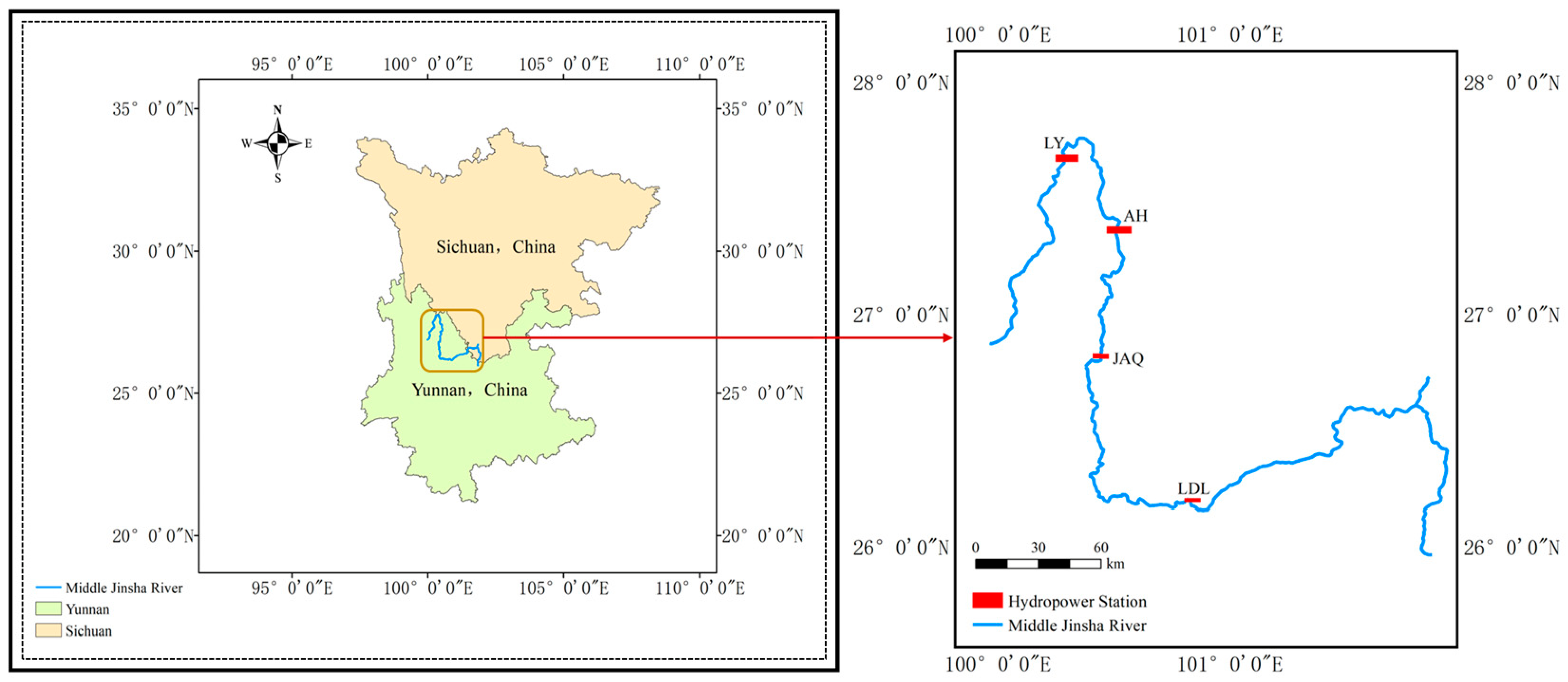
2.1. Overview of the Study Area
2.2. Data
2.3. Methods
2.3.1. Development of an Evaluation Index System
2.3.2. Determination of Indicator Weights
- Improved Group AHP Method
- 2.
- CRITIC Method
- 3.
- Determination of Comprehensive Weights
2.3.3. Comprehensive Evaluation Method
- Evaluation method
- 2.
- Evaluation criteria
3. Results and Analysis
3.1. Variation in Hydrological Regime
3.1.1. Change Rate of IHA Indicators
3.1.2. Ecological Flow Guarantee Degree
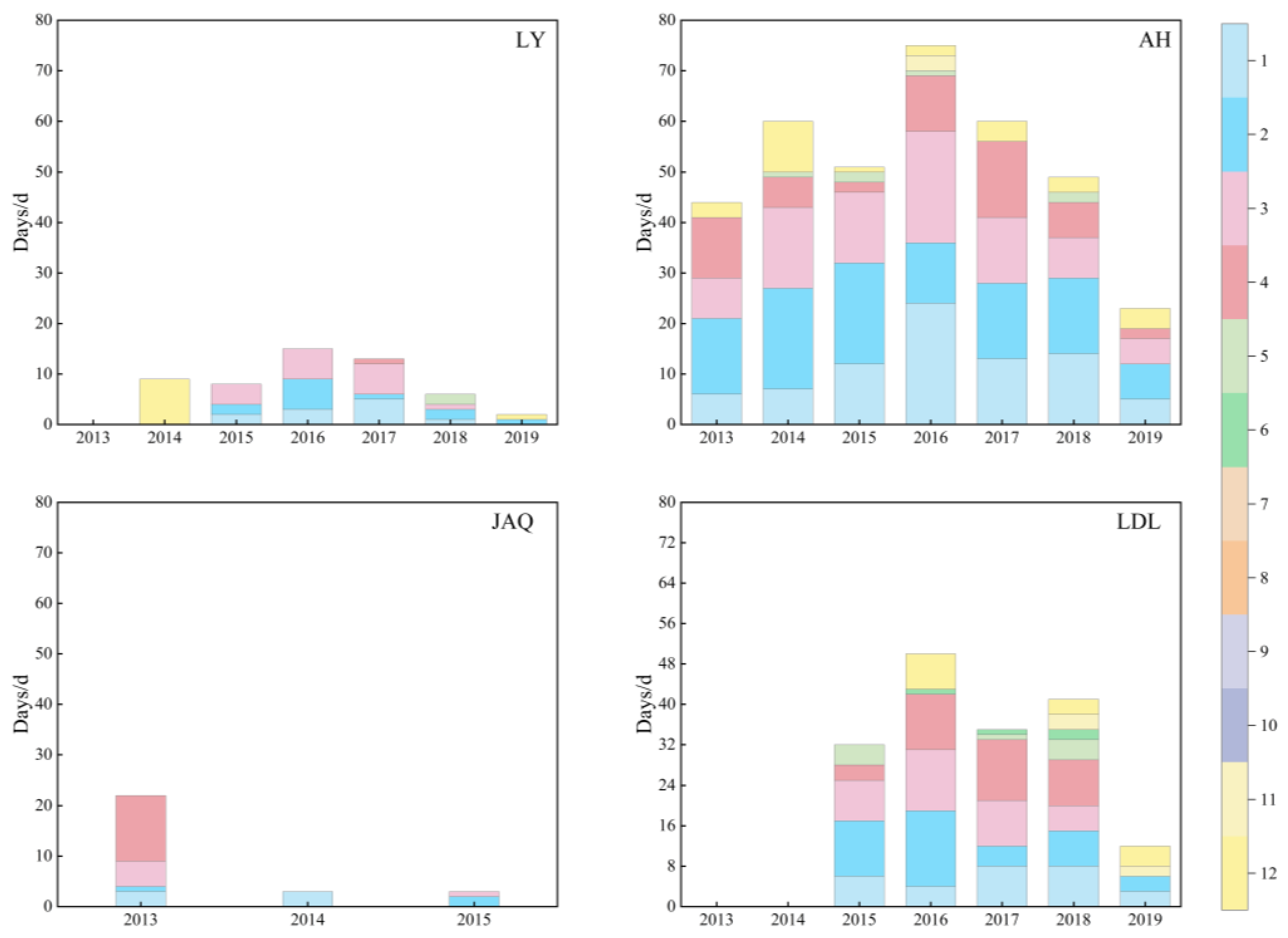
3.2. Changes in Water Environmental Quality
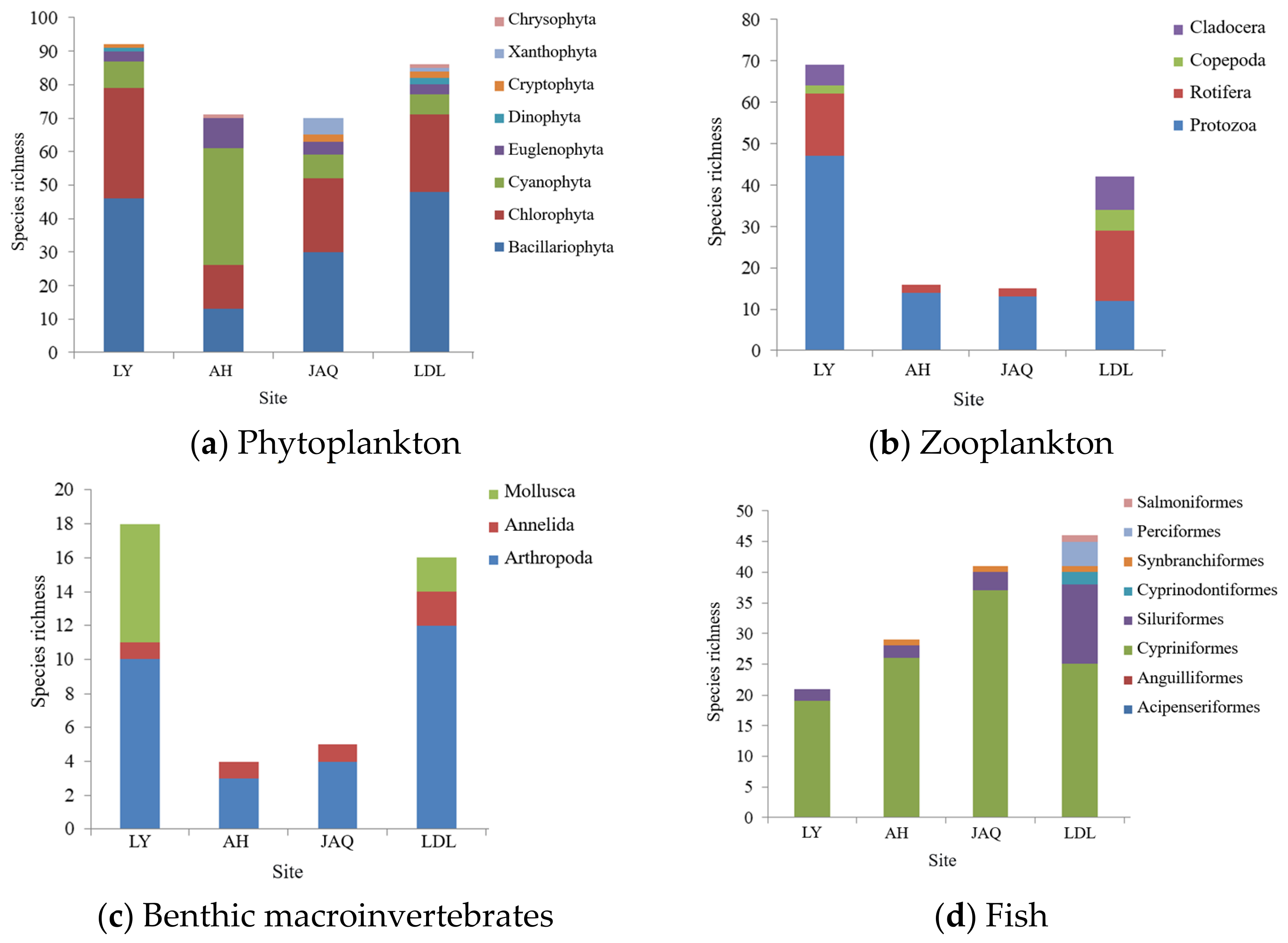
3.3. Changes in Aquatic Organisms
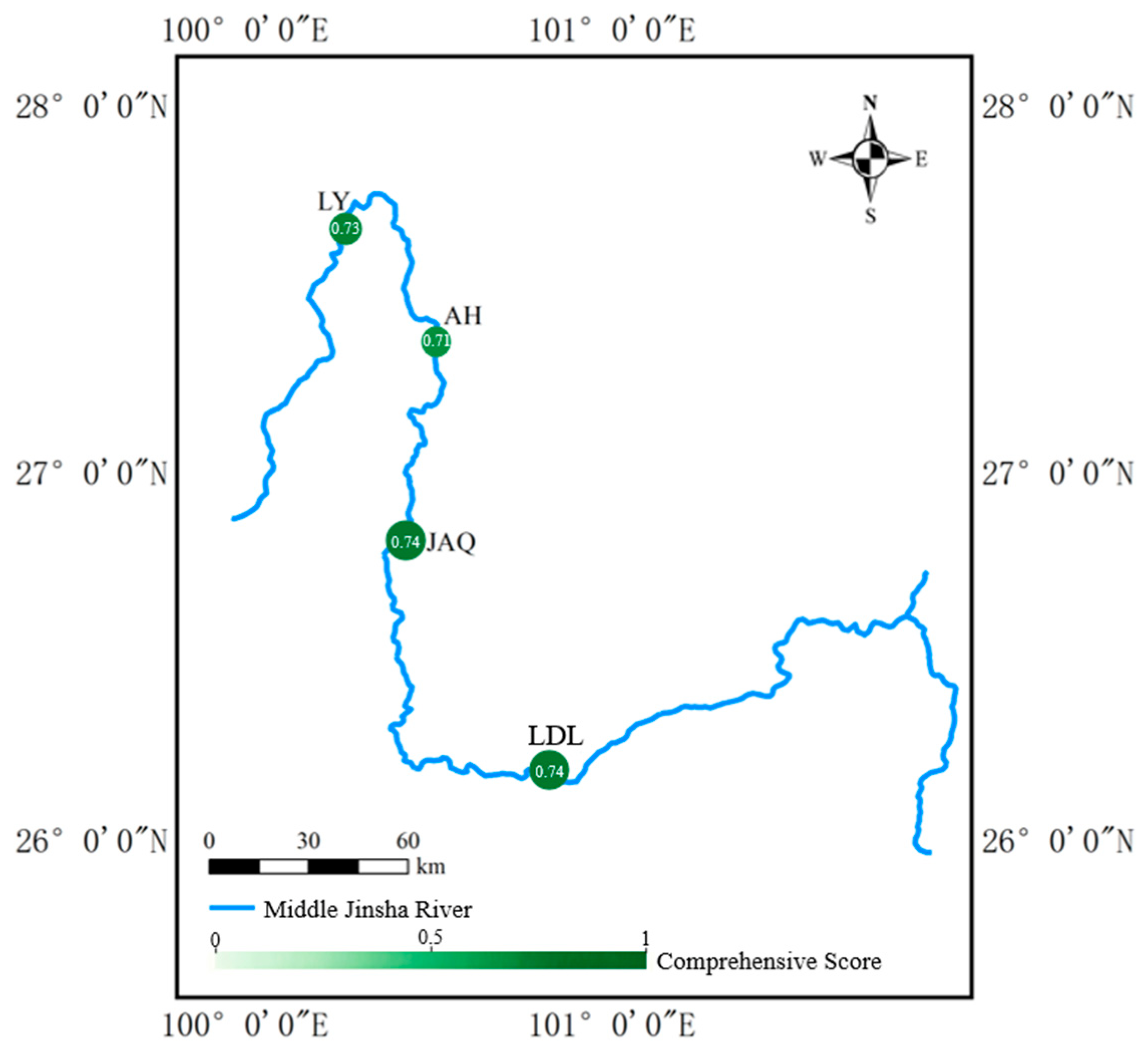
3.4. Assessment of Basin Water Ecological Security
4. Discussion
4.1. Ecological Mechanism of Cascade Hydropower Impacts
4.2. Comparison with Similar Studies
4.3. Limitations of the DPSIR Model and This Study
5. Conclusions
- (1)
- An ERA system suitable for river basins with cascade hydropower development was constructed, including three element layers and 10 indicator layers. The AHP and CRITIC methods were coupled to determine the weights, which took into account both subjective experience and objective data, and the evaluation results were scientific and reliable.
- (2)
- The hydrological regime in the middle reaches of the Jinsha River Basin presented mild variation, and the cascade hydropower stations significantly changed the seasonal distribution of flow; there were temporal and spatial differences in the ecological flow guarantee rate, and the guarantee effect of weekly regulating hydropower stations was better than that of daily regulating hydropower stations; the water quality generally maintained the Class II standard, and the reservoir area was in an oligotrophic to mesotrophic state; the number of important protected fish species did not decrease.
- (3)
- The overall ecological security of the basin was at a “generally safe” level with a comprehensive score of 0.71–0.74. Insufficient river connectivity was the core limiting factor, and the optimization of ecological flow dispatching and water environment management were the keys to improving the security level.
Author Contributions
Funding
Data Availability Statement
Conflicts of Interest
References
- Huang, C.; Geng, L.; Wang, L.; Wang, S.; Bian, J. Evaluation on China Water Resources and Water Ecological Security. Yellow River 2010, 32, 14–16. [Google Scholar]
- Li, J. Global Water Scarcity and Food Crisis. Ecol. Econ. 2021, 37, 5–8. [Google Scholar]
- Wang, Q. Discussion on the Evaluation Model of Ecological Security of Watershed Water Environment. Hydro Sci. Cold Zone Eng. 2021, 4, 175–177. [Google Scholar]
- Qiu, X.; Zhao, Z.; Cai, J.; Xie, R.; Li, J. Ecological Security Evaluation of Reservoir Based on DPSIR Model. Sichuan Environ. 2024, 43, 128–138. [Google Scholar]
- Gari, S.R.; Newton, A.; Icely, J.D. A Review of the Application and Evolution of the DPSIR Framework. Ocean Coast. Manag. 2015, 103, 63–77. [Google Scholar] [CrossRef]
- Jing, X.; Tao, S.; Hu, H.; Sun, M.; Mark, W. Spatio-temporal Evaluation of Ecological Security of Cultivated Land in China. Ecol. Indic. 2024, 166, 112579. [Google Scholar] [CrossRef]
- Nilsson, C.; Reidy, C.A.; Dynesius, M.; Revenga, C. Fragmentation and flow regulation of the world’s large river systems. Science 2005, 308, 405–408. [Google Scholar] [CrossRef] [PubMed]
- Grill, G.; Lehner, B.; Thieme, M.; Geenen, B.; Tickner, D.; Antonelli, F.; Babu, S.; Borrelli, P.; Cheng, L.; Crochetiere, H.; et al. Mapping the world’s free-flowing rivers. Nature 2019, 569, 215–221. [Google Scholar] [CrossRef]
- Poff, N.L.; Allan, J.D.; Bain, M.B.; Karr, J.R.; Prestegaard, K.L.; Richter, B.D.; Sparks, R.E.; Stromberg, J.C. The natural flow regime. BioScience 1997, 47, 769–784. [Google Scholar] [CrossRef]
- Richter, B.D.; Davis, M.M.; Apse, C.; Konrad, C. A method for assessing hydrologic alteration within ecosystems. Conserv. Biol. 1996, 10, 1163–1174. [Google Scholar] [CrossRef]
- Vörösmarty, C.J.; McIntyre, P.B.; Gessner, M.O.; Dudgeon, D.; Prusevich, A.; Green, P.; Glidden, S.; Bunn, S.E.; Sullivan, C.A.; Liermann, C.R.; et al. Global threats to human water security and river biodiversity. Nature 2010, 467, 555–561. [Google Scholar] [CrossRef]
- Liu, X.; Zhang, Q.; Chen, L. Coupled impacts of cascade hydropower and agricultural non-point source pollution on water quality in the Jinsha River Basin. Environ. Pollut. 2025, 357, 124789. [Google Scholar]
- Wang, X.; Shao, J.; Cui, Y.; Zhao, H.; Guo, X.; Sun, Q. Evaluation of Water Resources Carrying Capacity in Fukang City. South North Water Transf. Water Sci. Technol. 2017, 15, 37–48. [Google Scholar]
- Yi, Y.; Ye, J.; Ding, H.; Yin, S. Research progress and prospect in China of aquatic ecosystem assessment methods. J. Lake Sci. 2024, 36, 657–669. [Google Scholar] [CrossRef]
- Wang, Y.; Zhou, C.; Huang, R.; Xue, Z.; Tian, S. Evaluation of water ecological security and barrier analysis in Shaanxi Province. Environ. Sci. 2025, 46, 4335–4348. [Google Scholar]
- Ren, C.; Sun, L. Dynamic evaluation of three-stage subjective and objective fair weights for collaborative enterprise groups. Comput. Integr. Manuf. Syst. 2019, 25, 2874–2891. [Google Scholar] [CrossRef]
- GB 3838-2002; Environmental Quality Standards for Surface Water. Ministry of Ecology and Environment: Beijing, China, 2002.
- Bu, J.; Li, C.; Wang, X.; Zhang, Y.; Yang, Z. Assessment and Prediction of the Water Ecological Carrying Capacity in Changzhou City, China. J. Clean. Prod. 2020, 277, 123988. [Google Scholar] [CrossRef]
- Tian, P.; Wu, H.; Yang, T.; Jiang, F.; Zhang, W.; Zhu, Z.; Yue, Q.; Liu, M.; Xu, X. Evaluation of Urban Water Ecological Civilization: A Case Study of Three Urban Agglomerations in the Yangtze River Economic Belt, China. Ecol. Indic. 2021, 123, 107351. [Google Scholar] [CrossRef]
- Ma, J.; Fan, Z.P.; Huang, L.H. A subjective and objective integrated approach to determine attribute weights. Eur. J. Oper. Res. 1999, 112, 397–404. [Google Scholar] [CrossRef]
- Wang, Y.M.; Luo, Y. Integration of correlations with standard deviations for determining attribute weights in multiple attribute decision making. Math. Comput. Model. 2010, 51, 1–12. [Google Scholar] [CrossRef]
- Saaty, T.L. How to make a decision: The analytic hierarchy process. Eur. J. Oper. Res. 1990, 48, 9–26. [Google Scholar] [CrossRef]
- Vaidya, O.S.; Kumar, S. Analytic hierarchy process: An overview of applications. Eur. J. Oper. Res. 2006, 169, 1–29. [Google Scholar] [CrossRef]
- Yao, Y.; Lin, Q.; Yang, H.; He, W.; Zhang, Y. Combat Effectiveness Evaluation of Air Defense Early Warning Equipment System Based on Improved AHP. Mod. Def. Technol. 2025, 53, 21–29. [Google Scholar]
- Aczél, J.; Saaty, T.L. Procedures for synthesizing ratio judgements. J. Math. Psychol. 1983, 27, 93–102. [Google Scholar] [CrossRef]
- Diakoulaki, D.; Mavrotas, G.; Papayannakis, L. Determining objective weights in multiple criteria problems: The critic method. Comput. Oper. Res. 1995, 22, 763–770. [Google Scholar] [CrossRef]
- Yue, X.; Tang, X.; Wang, S.; Chen, Z.; Luo, Y.; Wang, C. Spatial-Temporal Characteristics of Climate Comfort in Guizhou Province based on the AHP-CRITIC Model. Plateau Meteorol. 2026, 45, 744–757. [Google Scholar] [CrossRef]
- Lin, A.; Li, R.; Dou, H.; Huang, S. Emergency material node siting and optimal route selection for large photovoltaic power plants based on AHP-CRITIC and GIS. Bull. Sci. Technol. 2024, 40, 38–45. [Google Scholar] [CrossRef]
- Forman, E.H.; Peniwati, K. Aggregating individual judgments and priorities with the analytic hierarchy process. Eur. J. Oper. Res. 1998, 108, 165–169. [Google Scholar] [CrossRef]
- Xu, X. A note on the subjective and objective integrated approach to determine attribute weights. Eur. J. Oper. Res. 2004, 156, 530–532. [Google Scholar] [CrossRef]
- Li, G.; Li, J.; Sun, X.; Zhao, M. Research on a Combined Method of Subjective-Objective Weighing and the Its Rationality. Manag. Rev. 2017, 29, 17–26+61. [Google Scholar] [CrossRef]
- Shiau, J.T.; Wu, F.C. A histogram matching approach for assessment of flow regime alteration: Application to environmental flow optimization. River Res. Appl. 2008, 24, 914–928. [Google Scholar] [CrossRef]
- Wang, Y.; Cui, L.; Li, Q.; Zhang, H. The Current Status of Fishery Resources in the Middle Reaches of Jinsha River and the Impact of Cascade Development. Acta Hydrobiol. Sin. 2024, 48, 1425–1432. [Google Scholar] [CrossRef]
- Cheng, F.; Li, W.; Klopfer, M.; Murphy, B.R.; Xie, S. Population genetic structure and its implication for conservation of Coreius guichenoti in the upper Yangtze River. Environ. Biol. Fishes 2015, 98, 1999–2007. [Google Scholar] [CrossRef]
- Yang, Y.; Zhou, L.; Zhu, L.; Liu, W.; Wang, J. Impact of upstream reservoirs on geomorphic evolution in the middle and lower reaches of the Yangtze River. Earth Surf. Process. Landf. 2022, 48, 582–595. [Google Scholar] [CrossRef]
- Chen, Z.; Xue, J.; Chen, J.; Cui, L. Water Security Assessment and Prediction for Shanxi Province Based on the DPSIR Model. Water Sav. Irrig. 2025, 12, 80–88. [Google Scholar]
- Bunn, S.E.; Arthington, A.H. Basic principles and ecological consequences of altered flow regimes for aquatic biodiversity. Environ. Manag. 2002, 30, 492–507. [Google Scholar] [CrossRef]
- Sun, D.; Ji, Z.; Wang, Y.; Zhang, W. Assessment and Forecasting of Water Ecological Security and Obstacle Factor Diagnosis in the Hexi Corridor of Northwest China. Sci. Rep. 2024, 14, 23507. [Google Scholar] [CrossRef]
- Xie, H.; Gao, T.; Wan, N.; Xiong, Z.; Dong, J.; Lin, C.; Lai, X. Controls for multi-temporal patterns of riverine nitrogen and phosphorus export to lake: Implications for catchment management by high-frequency observations. J. Environ. Manag. 2022, 320, 115858. [Google Scholar] [CrossRef]
- Zhang, X.; Liao, X.; Li, G.; Ren, D.; Zhang, S. Assessment of Water Ecological Security and Future Trend Projection for Urban Agglomerations Along the Main Stream of the Yangtze River in Hubei Province Based on the DPSIR Model. Ecol. Environ. Sci. 2025, 34, 1618–1632. [Google Scholar]
- Li, J.; Lin, Y.; Chen, M.; Zhang, S.; Ren, Y.; Chen, Q.; Wang, Q.; Zhou, Y.; Hu, X.; Liu, Z.; et al. Ecological security assessment of the Lancang River cascade hydropower basin based on the improved DPSIR model. J. Hydrol. 2024, 630, 130456. [Google Scholar] [CrossRef]
- Qiu, M.; Zuo, Q.; Wu, Q.; Yang, Z.; Zhang, J. Water Ecological Security Assessment and Spatial Autocorrelation Analysis of Prefectural Regions Involved in the Yellow River Basin. Sci. Rep. 2022, 12, 5105. [Google Scholar] [CrossRef]
- Svarstad, H.; Petersen, L.K.; Rothman, D.S.; Siepel, H.; Wätzold, F. Discursive biases of the DPSIR framework. Environ. Sci. Policy 2008, 11, 111–121. [Google Scholar]
- Tong, C. Review on Environmental Indicator Research. Res. Environ. Sci. 2000, 13, 53–55. [Google Scholar]
- Karageorgis, A.P.; Kapsimalis, V.; Kontogianni, A.; Skourtos, M.; Turner, K.R.; Salomons, W. Impact of 100-year human interventions on the deltaic coastal zone of the Inner Thermaikos Gulf (Greece): A DPSIR framework analysis. Environ. Manag. 2006, 38, 304–315. [Google Scholar] [CrossRef]

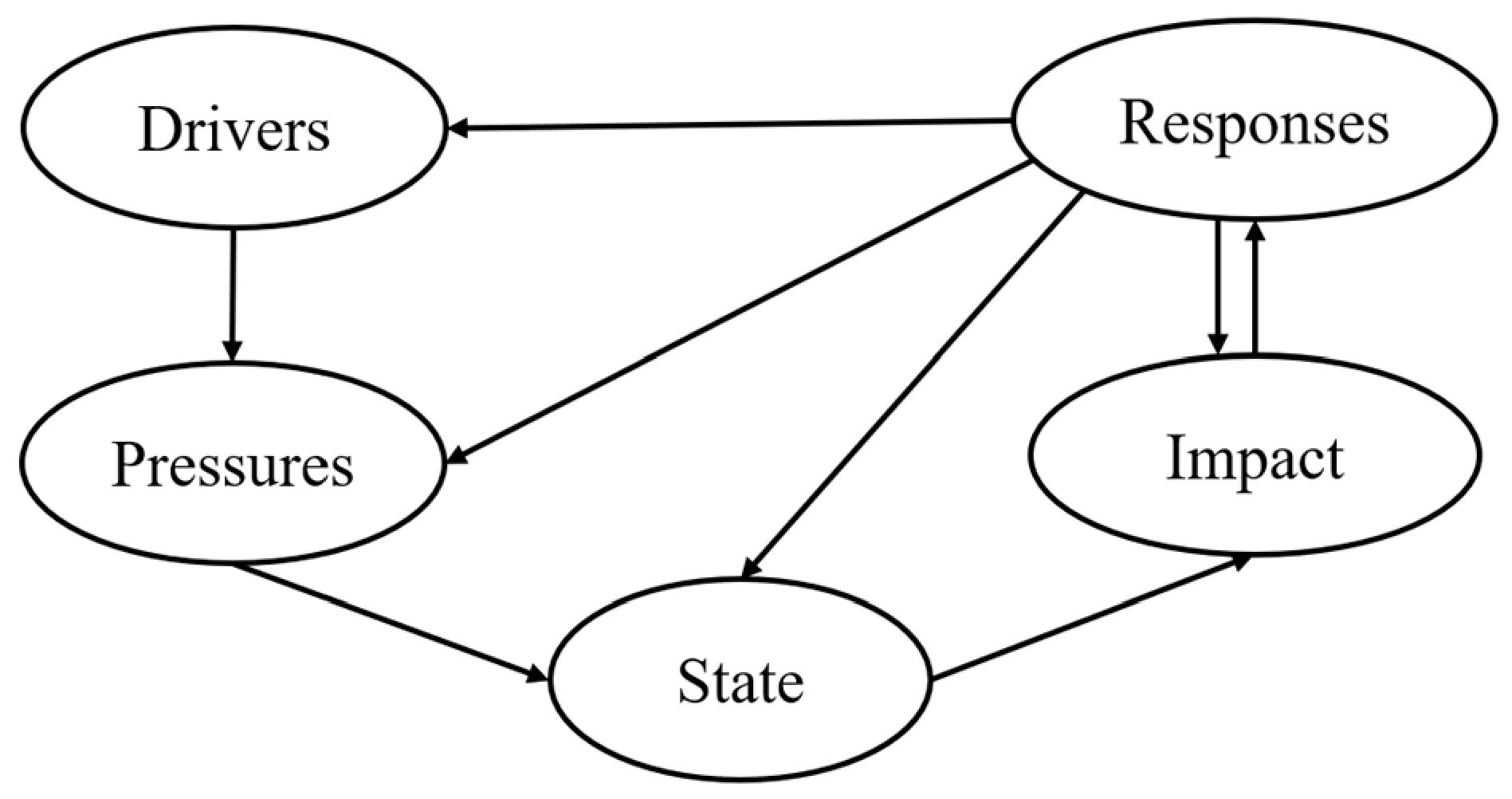
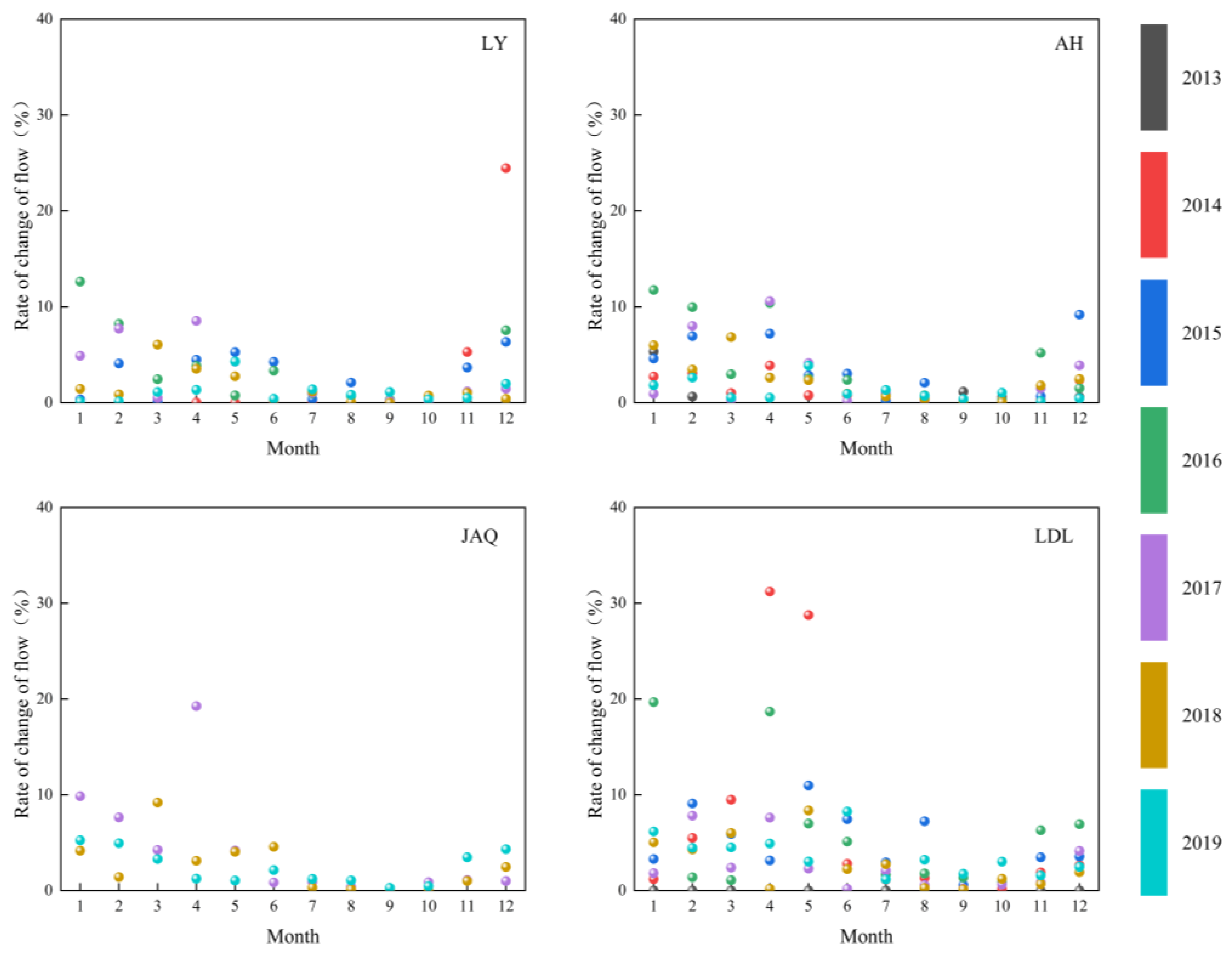



| Target Layer | Element Layer | Indicator Layer | Indicator Attribute |
|---|---|---|---|
| Comprehensive index of ecological security | Hydrological regime data | Change rate of Indicators of Hydrologic Alteration (IHA) | Quantitative assessment of the change degree of river hydrological regime |
| Monthly average flow change rate | Guarantee status for maintaining the non-degradation of river ecosystem | ||
| Ecological flow guarantee degree | Guarantee status for maintaining the non-degradation of river ecosystem | ||
| River connectivity | An important indicator for evaluating the integrity of river ecosystem | ||
| Water environment quality | ) concentration | An important indicator reflecting water quality | |
| Ammonia nitrogen (NH3-N) concentration | An important indicator for evaluating water quality | ||
| TN concentration | A key indicator for evaluating water eutrophication degree and water quality | ||
| TP concentration | An important indicator for evaluating water eutrophication degree and water quality | ||
| Water ecological security | Trophic state | An important indicator reflecting eutrophication and algae biomass | |
| Number of important fish species | An important indicator for evaluating aquatic ecology |
| Total Utility Value | 1 | [0.75, 1) | [0.6, 0.75) | [0.1, 0.6) | [0, 0.1) |
|---|---|---|---|---|---|
| Evaluation result | Safe | Relatively safe | Generally safe | Unsafe | Extremely unsafe |
| Hydrological Regime | Monthly average flow | Meeting the habitat needs of aquatic organisms, the needs of plants for soil moisture content, the water needs of terrestrial organisms with high reliability, the migration needs of carnivores, and the impacts on water temperature and dissolved oxygen |
| Annual extreme flow | Meeting the needs of vegetation expansion, construction of river geomorphology and natural habitats, nutrient exchange between rivers and flood detention areas, and distribution of plant communities in lakes, ponds and flood detention areas | |
| Occurrence time of annual extreme flow | Meeting the needs of fish migration and spawning, cyclic reproduction of living organisms, habitat conditions during the biological reproduction period, and species evolution | |
| Frequency and duration of high and low flow | Generating the frequency and magnitude of soil moisture required by vegetation, meeting the support of flood detention areas for aquatic organisms, sediment transport, river channel structure, bottom disturbance, etc. |
| IHA Indicator Category | Correlation Coefficient Between Shigu and Panzhihua | RVA Threshold | Variation Degree | |||
|---|---|---|---|---|---|---|
| Monthly average flow | January average flow | 0.961593 | 626.8 | 497 | 687 | 0.08 |
| February average flow | 0.951701 | 566 | 465 | 644 | 0.04 | |
| March average flow | 0.940085 | 558.5 | 492 | 635 | 0.00 | |
| April average flow | 0.977992 | 648.3 | 662 | 1002 | −0.19 | |
| May average flow | 0.871575 | 1032 | 895 | 1683 | −0.19 | |
| June average flow | 0.893575 | 1902 | 1686 | 3079 | −0.18 | |
| July average flow | 0.993853 | 3783 | 2283 | 5956 | −0.08 | |
| August average flow | 0.992646 | 3933 | 2030 | 5762 | 0.01 | |
| September average flow | 0.974825 | 3869 | 2436 | 5741 | −0.01 | |
| October average flow | 0.87326 | 2328 | 1588 | 3333 | 0.01 | |
| November average flow | 0.861473 | 1295 | 918 | 1372 | 0.09 | |
| December average flow | 0.937703 | 801.7 | 608 | 1027 | 0.08 | |
| Annual extreme flow | 1-day minimum flow | 0.922306 | 460.3 | 451 | 556 | −0.10 |
| 3-day minimum flow | 0.940193 | 467.7 | 454 | 556 | −0.10 | |
| 7-day minimum flow | 0.958408 | 476.9 | 456 | 558 | −0.08 | |
| 30-day minimum flow | 0.954279 | 507.6 | 465 | 605 | −0.05 | |
| 90-day minimum flow | 0.938587 | 559.5 | 487 | 650 | 0.00 | |
| 1-day maximum flow | 0.995237 | 6518 | 3864 | 9016 | 0.00 | |
| 3-day maximum flow | 0.994388 | 6301 | 3784 | 8768 | −0.01 | |
| 7-day maximum flow | 0.997383 | 5851 | 3641 | 8163 | −0.01 | |
| 30-day maximum flow | 0.972984 | 4843 | 3184 | 6198 | −0.02 | |
| 90-day maximum flow | 0.963377 | 3928 | 2657 | 5379 | −0.03 | |
| Occurrence time of annual extreme flow | Occurrence time of annual minimum flow/d/d | 0.503466 | 34 | 32 | 61 | 0.42 |
| Occurrence time of annual maximum flow/d/d | 0.789281 | 223 | 189 | 244 | 0.03 | |
| Frequency and duration of high and low flow | Number of low pulses/times | 1 | 0 | 0 | 0 | 0 |
| Duration of low pulses/d | 1 | 0 | 0 | 0 | 0 | |
| Number of high pulses/times | −0.0625 | 4 | 2 | 5 | 0.35 | |
| Duration of high pulses/d | 0.494567 | 23 | 9 | 47 | 0.52 | |
| Flow change rate and frequency | Rise rate/(m3·s−1·d−1) | 0.915828 | 150.2 | 68 | 116 | 0.50 |
| Fall rate/(m3·s−1·d−1) | 0.897304 | −132.3 | −94 | −50 | 0.83 | |
| Number of reversals/times | 0.107742 | 93 | 79 | 107 | 0.39 | |
| IHA Indicator | Weight | Variation Degree | Overall Variation Degree | Comprehensive Variation Degree | |
|---|---|---|---|---|---|
| Monthly average flow | January average flow | 0.086 | 0.08 | −0.035 | 0.139 |
| February average flow | 0.091 | 0.04 | |||
| March average flow | 0.083 | 0.00 | |||
| April average flow | 0.094 | −0.19 | |||
| May average flow | 0.082 | −0.19 | |||
| June average flow | 0.098 | −0.18 | |||
| July average flow | 0.084 | −0.08 | |||
| August average flow | 0.084 | 0.01 | |||
| September average flow | 0.094 | −0.01 | |||
| October average flow | 0.071 | 0.01 | |||
| November average flow | 0.068 | 0.09 | |||
| December average flow | 0.072 | 0.08 | |||
| Annual extreme flow | 1-day minimum flow | 0.092 | −0.10 | −0.039 | |
| 3-day minimum flow | 0.092 | −0.10 | |||
| 7-day minimum flow | 0.095 | −0.08 | |||
| 30-day minimum flow | 0.116 | −0.05 | |||
| 90-day minimum flow | 0.118 | 0.00 | |||
| 1-day maximum flow | 0.101 | 0.00 | |||
| 3-day maximum flow | 0.097 | −0.01 | |||
| 7-day maximum flow | 0.099 | −0.01 | |||
| 30-day maximum flow | 0.097 | −0.02 | |||
| 90-day maximum flow | 0.097 | −0.03 | |||
| Occurrence time of annual extreme flow | Occurrence time of annual minimum flow/d/d | 0.5 | 0.42 | 0.225 | |
| Occurrence time of annual maximum flow/d/d | 0.5 | 0.03 | |||
| Frequency and duration of high and low flow | Number of low pulses/times | 0.5 | 0 | 0.442 | |
| Duration of low pulses/d | 0.5 | 0 | |||
| Number of high pulses/times | 0.46 | 0.35 | |||
| Duration of high pulses/d | 0.54 | 0.52 | |||
| Flow change rate and frequency | Rise rate/(m3·s−1·d−1) | 0.39 | 0.50 | 0.63 | |
| Fall rate/(m3·s−1·d−1) | 0.36 | 0.83 | |||
| Number of reversals/times | 0.35 | 0.39 | |||
| Indicator Layer | LY | AH | JAQ | LDL |
|---|---|---|---|---|
| IHA indicator variation degree | 0.90 | 0.90 | 0.90 | 0.90 |
| Ecological flow guarantee degree | 0.95 | 0.80 | 0.95 | 0.95 |
| River connectivity | 0 | 0 | 0 | 0 |
| Chemical oxygen demand concentration | 0.90 | 0.90 | 0.90 | 0.90 |
| Ammonia nitrogen concentration | 0.90 | 0.90 | 0.90 | 0.90 |
| Total nitrogen concentration | 0.80 | 0.90 | 0.90 | 0.85 |
| Total phosphorus concentration | 0.80 | 0.85 | 0.85 | 0.90 |
| Trophic state | 0.90 | 0.90 | 0.90 | 0.90 |
| Number of important fish species | 1.00 | 1.00 | 1.00 | 1.00 |
| Indicator Layer | Weight | LY | AH | JAQ | LDL |
|---|---|---|---|---|---|
| IHA indicator variation degree | 0.09 | 0.08 | 0.08 | 0.08 | 0.08 |
| Ecological flow guarantee degree | 0.17 | 0.16 | 0.13 | 0.16 | 0.16 |
| River connectivity | 0.22 | 0.00 | 0.00 | 0.00 | 0.00 |
| Chemical oxygen demand concentration | 0.07 | 0.06 | 0.06 | 0.06 | 0.06 |
| Ammonia nitrogen concentration | 0.03 | 0.03 | 0.03 | 0.03 | 0.03 |
| Total nitrogen concentration | 0.03 | 0.03 | 0.03 | 0.03 | 0.03 |
| Total phosphorus concentration | 0.04 | 0.03 | 0.03 | 0.03 | 0.03 |
| Trophic state | 0.07 | 0.06 | 0.06 | 0.06 | 0.06 |
| Number of important fish species | 0.28 | 0.28 | 0.28 | 0.28 | 0.28 |
Disclaimer/Publisher’s Note: The statements, opinions and data contained in all publications are solely those of the individual author(s) and contributor(s) and not of MDPI and/or the editor(s). MDPI and/or the editor(s) disclaim responsibility for any injury to people or property resulting from any ideas, methods, instructions or products referred to in the content. |
© 2026 by the authors. Licensee MDPI, Basel, Switzerland. This article is an open access article distributed under the terms and conditions of the Creative Commons Attribution (CC BY) license.
Share and Cite
He, X.; Luo, H.; Feng, Z.; Liu, B.; Wang, X.; Huang, Y.; Xu, T.; Yang, Q. Impacts of Cascade Hydropower Development on Aquatic Ecosystems in the Middle Jinsha River Basin: A DPSIR-Based Ecological Risk Assessment. Water 2026, 18, 1406. https://doi.org/10.3390/w18121406
He X, Luo H, Feng Z, Liu B, Wang X, Huang Y, Xu T, Yang Q. Impacts of Cascade Hydropower Development on Aquatic Ecosystems in the Middle Jinsha River Basin: A DPSIR-Based Ecological Risk Assessment. Water. 2026; 18(12):1406. https://doi.org/10.3390/w18121406
Chicago/Turabian StyleHe, Xiaorong, Huihuang Luo, Zhen Feng, Bing Liu, Xueqian Wang, Yuling Huang, Tianbao Xu, and Qingrui Yang. 2026. "Impacts of Cascade Hydropower Development on Aquatic Ecosystems in the Middle Jinsha River Basin: A DPSIR-Based Ecological Risk Assessment" Water 18, no. 12: 1406. https://doi.org/10.3390/w18121406
APA StyleHe, X., Luo, H., Feng, Z., Liu, B., Wang, X., Huang, Y., Xu, T., & Yang, Q. (2026). Impacts of Cascade Hydropower Development on Aquatic Ecosystems in the Middle Jinsha River Basin: A DPSIR-Based Ecological Risk Assessment. Water, 18(12), 1406. https://doi.org/10.3390/w18121406