Article

Future Sea Level Rise Impacts on Sandy Beaches Under Contrasting Tidal Regimes: The Role of Wave Run-Up in Southern Spain


by
Antonio Contreras-de-Villar
1,*,
Juan J. Muñoz-Perez
1,
Francisco Contreras-de-Villar
1,
Juan M. Vidal-Perez
2,
Cristina Perez-Moreno
1,
Jose J. Alonso del Rosario
2,
Patricia Lopez-Garcia
1 and
Bismarck Jigena-Antelo
1
1
Coastal Engineering Research Group, University of Cadiz, 11510 Puerto Real, Spain
2
Centro Andaluz Superior de Estudios Marinos (CASEM)—Escuela de Ingenieria Naval y Oceanica, University of Cadiz, 11510 Puerto Real, Spain
*
Author to whom correspondence should be addressed.
Water 2026, 18(12), 1407; https://doi.org/10.3390/w18121407 (registering DOI)
Submission received: 6 February 2026 / Revised: 4 May 2026 / Accepted: 1 June 2026 / Published: 9 June 2026
(This article belongs to the Section Oceans and Coastal Zones)

Abstract

Sea level rise poses a major threat to dry beach areas, particularly in low-lying and managed coastal environments. Reliable assessments of future beach vulnerability therefore require the combined consideration of sea level rise, tidal regime, meteorological forcing, and wave-driven processes. Here, a physically based methodology is applied to evaluate future inundation and beach response at five representative sandy beaches along the southern coast of Spain. The selected sites span mesotidal Atlantic and microtidal Mediterranean settings. The approach integrates present-day conditions with sea level rise projections under RCP 4.5 and RCP 8.5 scenarios, astronomical tide, and meteorological residuals. Wave run-up is estimated using the IH2VOF CFD (Computational Fluid Dynamics) model. Extreme still water levels and maximum inundation levels are derived for mid-century (2026–2045) and end-of-century (2081–2100) periods, and their impacts on available dry beach surface and beach width are quantified using cross-shore profiles. Results indicate a progressive reduction in dry beach surface and width across all sites, with impacts intensifying from mid- to end-century and from moderate to high-emission scenarios. While losses remain comparatively moderate under still-water assumptions, the inclusion of wave effects leads to substantially larger impacts. At the most vulnerable sites, dry beach surface losses reach up to 80% under still-water conditions, and up to complete loss (100%) when wave run-up is included, particularly along the mesotidal Atlantic coast. Overall, the results demonstrate that neglecting wave run-up can lead to a substantial underrepresentation of future beach inundation, and that its explicit inclusion provides a more reliable basis for beach management and adaptation planning under sea level rise.

1. Introduction

Climate change is producing major environmental changes in coastal regions worldwide. These include sea level rise, ocean warming, ocean acidification, and changes in the frequency and intensity of extreme events [1,2,3,4,5]. Among these processes, sea level rise plays a central role in coastal flooding and erosion hazards, potentially amplified by changes in storm characteristics and wave climate [6,7], with wide-ranging consequences for natural systems and human societies, including impacts on water resources, food security, population displacement, and human health and well-being [8,9]. In response, international scientific institutions regularly assess observed and projected changes in the global climate system, providing a consistent scientific basis for evaluating future coastal risks [10,11,12,13].
Mean sea level has been rising at an accelerating rate over recent decades, driven primarily by the thermal expansion of seawater and the melting of glaciers and continental ice sheets. Observational records indicate that the global mean sea level rise rate increased from approximately 1.3 mm yr−1 during 1900–1971 to about 3.7 mm yr−1 for the period 2006–2018 [14]. Projections indicate that this acceleration is expected to continue throughout the twenty-first century under all emission scenarios, leading to further increases in mean sea level by 2100 [11,15].
Numerous studies have examined sea level rise impacts at global, regional, and local scales, considering both natural and anthropogenically modified coastal environments [16]. Within this context, sandy beaches are particularly responsive to rising water levels, as reductions in dry beach width and surface directly affect their capacity to dissipate wave energy and limit the inland propagation of marine flooding [17,18,19,20]. As a result, coastal ecosystems, infrastructure, and economic activities become increasingly exposed to marine flooding under present and future conditions [21,22,23].
Previous studies have applied a variety of methodologies to estimate sea level rise impacts and coastal flooding, including vulnerability indices, statistical extreme value analysis, and deterministic or hybrid modelling frameworks [24,25,26,27,28,29]. While these approaches have proven effective for large-scale assessments and risk mapping, comparatively fewer studies explicitly quantify beach inundation under contrasting tidal regimes while resolving wave run-up using physically based, profile-scale methods.
Large-scale studies have also provided probabilistic projections of future extreme sea levels along European coasts. For example, Vosdoukas et al. [30] combined sea-level rise, tides, storm surges, and wave-related components to assess changes in extreme sea levels. The present study addresses a complementary local-scale question by using measured beach profiles and numerical run-up simulations to evaluate beach response under defined forcing scenarios.
Sandy beaches contribute to coastal protection by dissipating wave energy and buffering marine flooding, but progressive sea level rise reduces the width and surface of the dry beach, directly constraining this buffering capacity and increasing the exposure of adjacent dune systems, infrastructure, and urban developments. Beach response to rising sea levels is therefore highly site-specific and depends on local factors such as beach morphology, sediment characteristics, tidal regime, and wave climate.
The concept of resilience has been widely applied to assess the capacity of coastal systems to withstand disturbances and adapt to changing boundary conditions [30,31,32,33]. In coastal environments, resilience-based approaches support the evaluation of present and future hazards and facilitate comparisons between nature-based solutions and engineered interventions [34]. Within this framework, metrics related to dry beach availability provide a practical basis for assessing the functional response of sandy beaches to sea level rise.
The southern coast of Spain offers a natural laboratory for assessing the impacts of future sea level rise on sandy beaches, as it encompasses both mesotidal Atlantic environments and microtidal Mediterranean settings within a relatively limited geographic domain. This configuration allows for a direct comparison of beach response under contrasting tidal regimes while minimizing the influence of large-scale climatic gradients.
No significant long-term vertical land movements have been reported in the study area, and relative sea-level change is therefore assumed to be dominated by eustatic sea-level rise.
Despite the relevance of this setting, integrated assessments explicitly comparing beach inundation under contrasting tidal conditions remain relatively scarce. In Spain, coastal flood hazard and risk have been addressed through national regulations and technical guidelines, including the development of official hazard and risk maps along the Spanish coastline [35].
The aim of this study is to assess the impacts of future sea level rise on sandy beaches. The analysis focuses on beaches under contrasting tidal regimes along the southern coast of Spain. Extreme water levels are estimated by combining sea level rise, astronomical tide, meteorological residuals, and wave run-up. These levels are used to estimate beach inundation, dry beach width, and dry beach surface area. The proposed methodology is intended to be extensible to other sectors of the Andalusian coastline and to support coastal planning and management under future climate change scenarios.

2. Study Area

The selected study sites are distributed along the Atlantic and Mediterranean coasts of southern Spain, encompassing mesotidal and microtidal environments, respectively (Figure 1). This coastal sector has been widely addressed in previous regional and local studies focusing on coastal morphology, flooding, and vulnerability to sea level rise [35,36]. Its relevance lies in the coexistence of markedly different tidal regimes, wave climates, and geomorphological settings within a relatively limited geographic domain.
The Atlantic coast of the province of Cadiz is characterized by a mesotidal regime, with tidal ranges that may exceed several meters during spring tides [37,38]. Wave conditions along this sector are mainly controlled by North Atlantic storm systems, generating relatively energetic wave climates and a strong interaction between tidal level and wave-driven processes [39,40]. Beaches in this area generally display wide intertidal zones, gently sloping profiles, and, in some cases, significant geological control, all of which influence their response to marine flooding and erosion.
In contrast, the Mediterranean coast of the province of Malaga is subject to a microtidal regime, with tidal ranges typically below a few decimeters [38,41]. Wave conditions in this sector are mainly driven by regional and local meteorological systems, resulting in lower average wave energy compared to the Atlantic coast [42,43]. Beaches along the Malaga coastline are generally narrower, with steeper profiles and a limited intertidal zone, characteristics that may increase their sensitivity to changes in mean sea level despite the reduced tidal influence [18,19].
Five sandy beaches were selected as representative case studies: Toruños (El Puerto de Santa Maria), Hierbabuena (Barbate), Rinconcillo (Algeciras), Torreguadiaro (San Roque), and Malagueta (Malaga). These sites have been previously described in regional coastal assessments and technical reports and were selected based on the availability of high-resolution topographic and bathymetric data, their geomorphological representativeness, and their relevance for coastal management and planning [37,44].
The selected beaches encompass a wide range of morphodynamic characteristics, including differences in beach width, slope, sediment properties, and the presence or absence of dune systems or coastal infrastructure [45,46,47]. Sediment characteristics vary across the study sites, with median grain sizes (D50) ranging from approximately 250 μm in Atlantic beaches to about 900 μm in Mediterranean ones [48].
This diversity allows for a comparative assessment of beach response to future sea level rise under contrasting tidal and hydrodynamic conditions while applying a consistent analytical framework across all study sites.
The study area has been extensively investigated in relation to sediment transport, beach nourishment, and morphodynamic evolution, providing a solid regional background for the present analysis [49].

3. Methodology

3.1. Overview of the Methodological Framework

This section provides an overview of the methodological framework used to assess the impacts of future sea-level rise on sandy beaches. The approach integrates present-day observations, projected sea level rise scenarios, and hydrodynamic forcing components to derive extreme water levels, inundation extents, and quantitative indicators of beach response.
The same framework is applied consistently across all study sites, allowing for a comparative assessment under contrasting tidal regimes while maintaining a homogeneous analytical structure.
Sea level rise projections and offshore wave conditions used in this study were obtained using the C3E web-based viewer developed by IH Cantabria [50]. The tool provides regionalised projections of sea level rise and wave climate for the Spanish coastline under different emission scenarios.
Wave run-up along the selected beach profiles was simulated using the IH2VOF numerical model [51]. IH2VOF is a two-dimensional vertical (2DV) CFD model solving the Reynolds–Averaged Navier–Stokes equations. The model simulates wave transformation, breaking, and run-up processes along beach profiles and has been validated in laboratory and field studies.

3.2. Reference Sea Level and Present-Day Conditions

Present-day mean sea level values were obtained from tide gauge records distributed along the southern Spanish coast, including stations representative of both the Atlantic and Mediterranean sectors. The present-day mean Highest High Water Level (HHWL) is defined as the average of the highest observed high tide levels derived from tide-gauge records.
The sea level values used in this study are summarized in Table 1, which lists the tide gauges considered and the corresponding mean high water level estimates derived from official sources (Figure 1). These values correspond to long-term estimates derived from tide-gauge records provided by the Spanish Navy Hydrographic Institute and Puertos del Estado. For beaches without a nearby tide gauge, HHWL values were assigned from the nearest available station along the same coastal sector. Reference datum is the Lowest Low Water Level (LLWL).
These values provide the baseline for the subsequent incorporation of astronomical tide, meteorological residuals, and projected sea level rise.

3.3. Future Sea Level Rise Scenarios

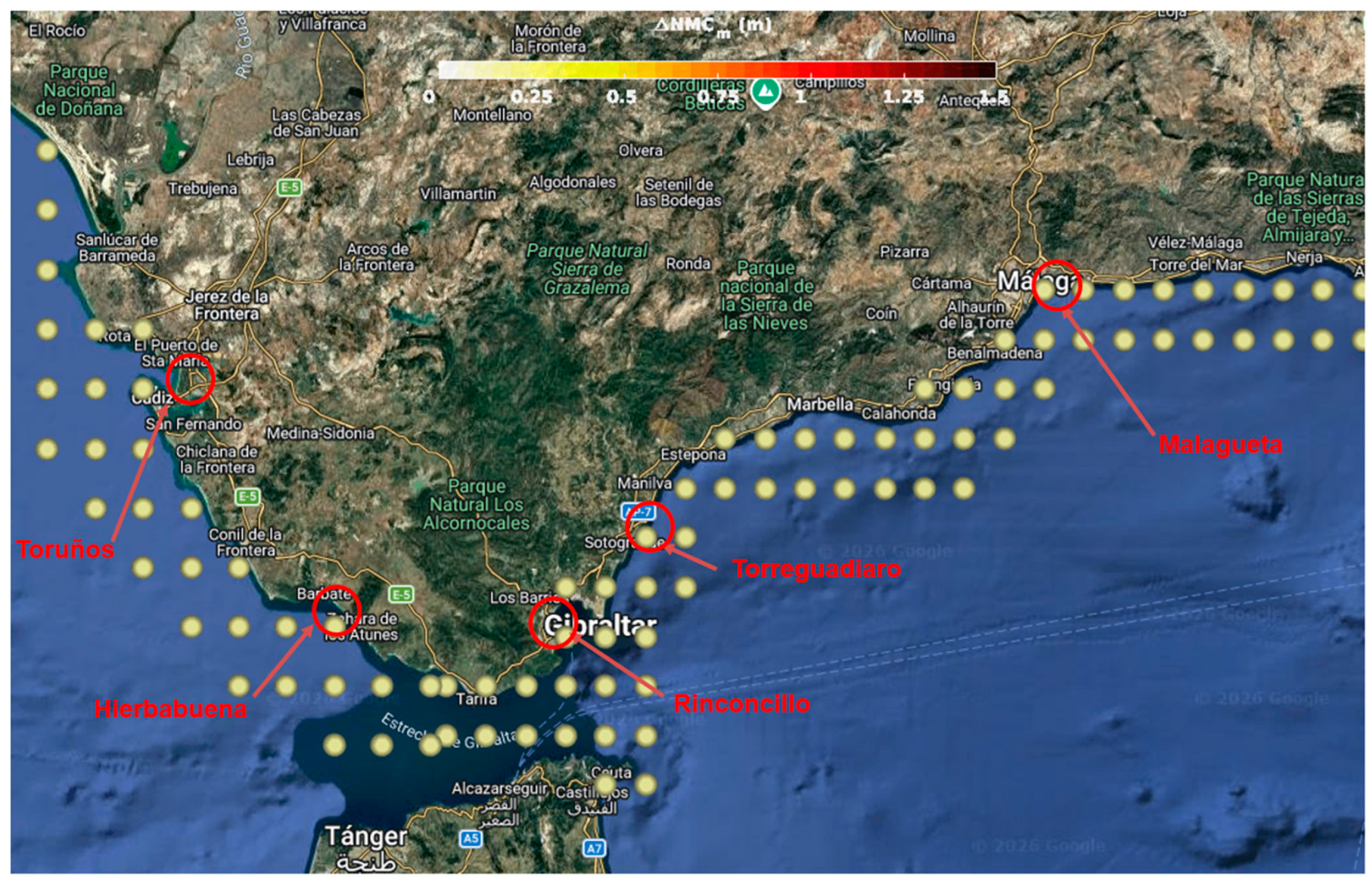
Future sea level rise scenarios were defined based on projections from the IPCC and regionalized climate assessments for the Spanish coast, obtained using the C3E web-based viewer (Figure 2). The viewer provides sea level rise estimates associated with different emission scenarios and time horizons, which were used to define future baseline conditions. Regional marine climate projections used in this study were obtained following the technical guidelines and data access protocols provided by the Spanish Ministry for the Ecological Transition [54].
Two Representative Concentration Pathways (RCPs) were considered in this study: RCP 4.5, representing a moderate emission trajectory with a radiative forcing of 4.5 W m−2 and an atmospheric CO2 concentration of approximately 538 ppm by 2100, and RCP 8.5, representing a high-emission pathway with radiative forcing of 8.5 W m−2 and CO2 concentrations reaching about 936 ppm by the end of the century [55]. Sea level rise increments associated with these scenarios were defined for two future periods, 2026–2045 and 2081–2100, and added to the present-day mean sea level to generate the future baseline conditions used in the analysis. Mean sea level rise (MSLR) range from 0.14 to 0.15 m for 2026–2045 and from 0.40 to 0.56 m for 2081–2100, depending on the emission scenario and study site. These periods correspond to projection horizons commonly used in regional sea-level rise assessments and do not represent analysed time series.
Sea-level rise projections were extracted from the C3E viewer for each study site and scenario. For clarity, the values used in this study are summarized in Table 2. Overall, projected sea-level rise ranges between 0.14 and 0.15 m for the period 2026–2045 and between 0.40 and 0.56 m for 2081–2100, with minor differences between Atlantic and Mediterranean sites.
The sea-level rise values used in this study correspond to the central estimates (50th percentile, P50) provided by the C3E viewer for each scenario, site, and projection horizon. These values represent the median of the probabilistic distribution of sea-level rise and are consistent with regionalised projections derived from climate model ensembles aligned with the IPCC framework. The selection of the median projection is intended to represent expected conditions and to enable a consistent comparison between scenarios. Higher percentiles (e.g., P95) represent low-probability outcomes within the projection range, which may be more appropriate for risk-based or conservative coastal design applications.
These values are not associated with a specific year, but represent aggregated projections over the corresponding multi-decadal period.

3.4. Astronomical Tide and Meteorological Residuals

Astronomical tide data were obtained from official tidal databases and long-term observations available for the study area [51,55]. Meteorological residuals associated with atmospheric pressure variations and wind forcing were derived from tide-gauge records along the southern Spanish coast [55,56]. These residuals represent the non-tidal component of sea-level variability.
These residuals were obtained using standard processing tools that incorporate observational data and pre-processed datasets. In this context, residuals are defined as the difference between observed water levels and predicted astronomical tide. The analysis was based on the full available time series, without isolating individual storm events. For the extreme water-level assessment, the meteorological residual component is represented using the MMr = 50 descriptor adopted in the C3E framework [57].
Astronomical tide and meteorological residuals were combined to define the Still Water Level (SWL). Extreme Water Level (EWL) was then estimated from the observed water-level records using extreme value analysis. Projected mean sea level rise (MSLR) was subsequently added to represent future conditions, contributing to the definition of Extreme Water Level (EWL) as described in Section 3.7.
The resulting SWL values constitute the baseline water levels used in the analysis. When wave run-up contributions are included, the resulting levels correspond to the Extreme Water Level (EWL) used to evaluate beach inundation.
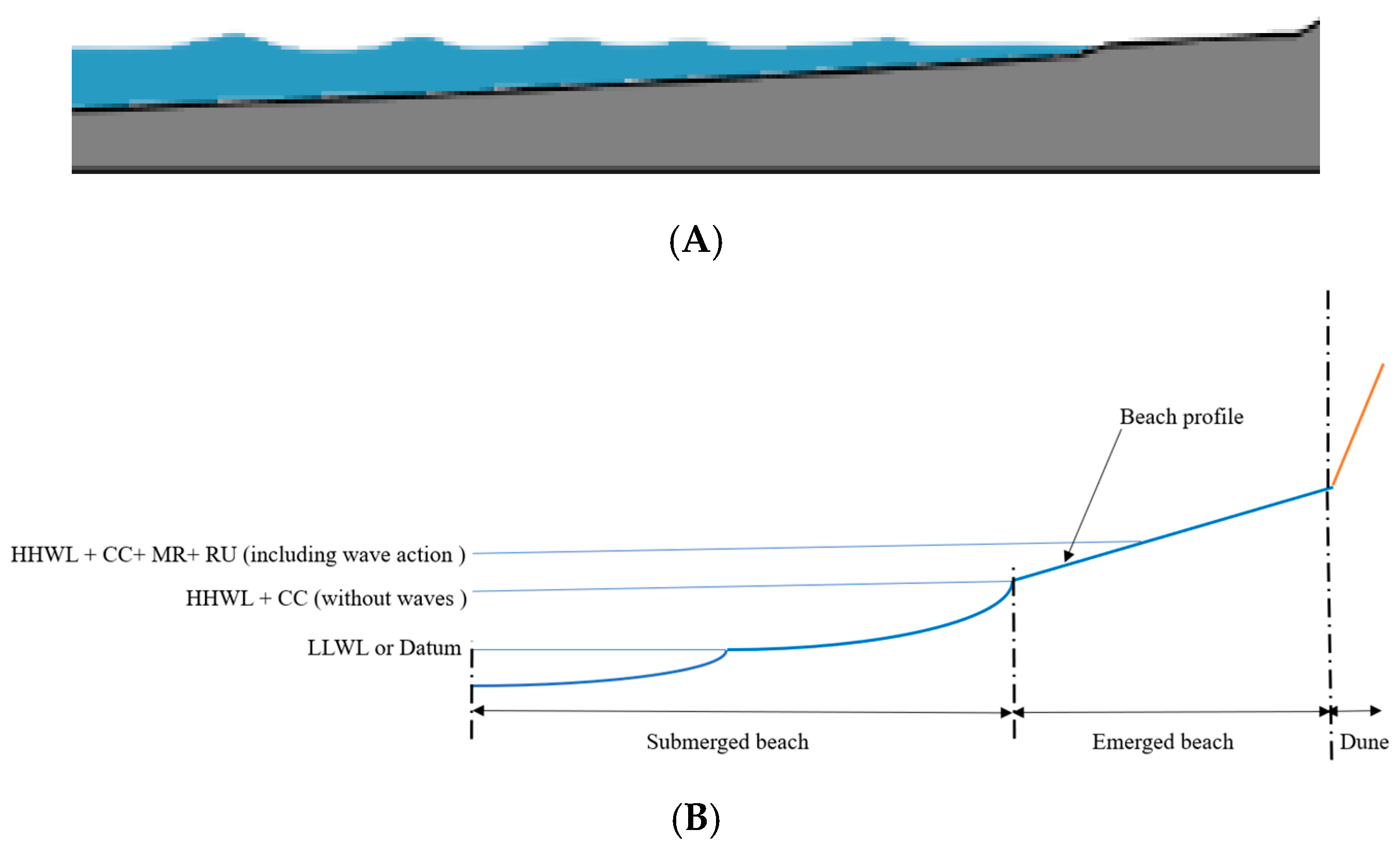
The resulting values of SWL for each scenario and period are presented in Table 2 and constitute a key input for the subsequent run-up and inundation analyses. A schematic representation of the different water levels considered in the analysis (SWL and EWL) is shown in Figure 3B.

3.5. Beach Morphology and Geomorphological Parameters

High-resolution bathymetric data from official ecocartographic surveys were used to characterize submerged beach morphology. Topographic data were collected by the research team using differential GPS surveys and terrestrial laser scanning to characterize the emerged beach and extract representative cross-shore profiles at each study site. Profiles were extracted at approximately 200 m spacing alongshore, extending from the submerged beach to the dune foot or the landward infrastructure boundary.
The mean slope of the dry beach, calculated from the emerged portion of each profile, is presented in Table 3. Present-day sea level values assigned to each study beach, based on the nearest tide gauge, are additionally reported in Table 4. These parameters are essential for interpreting beach response to sea level rise and wave forcing. In this context, the mean slope is only provided as a general descriptor of beach morphology. Wave run-up simulations were performed using the full cross-shore profiles in the numerical model.

3.6. Wave Conditions and Run-Up Estimation

Wave conditions were characterized using regional wave climate data and previous studies describing wave forcing along the Andalusian coast. The representative offshore wave parameters adopted for the run-up simulations are summarized in Table 3 and were obtained from the C3E web viewer.
In this study, wave conditions are defined as representative energetic scenarios rather than probabilistic extremes. These scenarios combine offshore wave parameters with sea-level rise and tidal conditions to define consistent forcing cases across all sites.
The same offshore wave conditions are applied across all scenarios and projection periods. This assumption allows the influence of sea-level rise on wave run-up and inundation patterns to be evaluated independently of potential changes in wave climate.
Wave run-up was estimated using the IH2VOF numerical model (Figure 3), which is a two-dimensional vertical (2DV) Computational Fluid Dynamics model that solves the Reynolds-Averaged Navier–Stokes equations. The IH2VOF framework uses the VOF (Volume of Fluid) method to track the free surface (the interface between water and air) which allows the simulation of complex processes such as wave breaking [51].
The governing equations describe the conservation of mass and momentum through the Reynolds-averaged Navier–Stokes framework, coupled with a turbulence closure scheme to represent turbulent stresses. This formulation allows resolving key hydrodynamic processes such as wave breaking, uprush and backwash, which are essential for accurate estimation of maximum wave run-up.
The model simulates wave transformation, breaking and run-up processes from offshore to the swash zone, allowing for the estimation of wave-driven contributions to extreme water levels.
The IH2VOF model has been validated in several studies through comparisons with laboratory experiments and field observations [50,58,59]. Empirical formulations commonly used to estimate wave run-up on sandy beaches, such as those proposed by Stockdon [60], are not used in the simulations but provide a useful benchmark for comparison with the model results. These studies support the reliability of the model for estimating maximum wave run-up under the hydrodynamic conditions considered in this study.
In the numerical simulations, the present-day beach profiles were maintained unchanged. Future sea-level rise scenarios were incorporated by increasing the still-water level boundary condition according to the projected mean sea level rise (MSLR). Therefore, the run-up simulations represent the hydrodynamic response of the present beach morphology under elevated water levels.
An example of run-up results, including mean, 2% exceedance, and maximum values for selected profiles at Hierbabuena beach, is provided in Table 4.

3.7. Extreme Water Levels

Extreme water levels were computed by summing the contributions of mean sea level (present-day or projected), astronomical tide, meteorological residual, and wave run-up, as described in Section 3.3, Section 3.4, Section 3.5 and Section 3.6.
To improve clarity, Extreme Water Level (EWL) is explicitly defined as
E W L = M S L + η _ t i d e + η _ r e s + R
where MSL represents the mean sea level including projected Mean Sea Level Rise (MSLR), η_tide is the astronomical tide, η_res is the meteorological residual, and R is the wave run-up contribution.
Extreme still-water levels were not derived in this study by fitting a new statistical extreme-value distribution to tide-gauge records. The resulting water levels therefore correspond to scenario-based combinations of forcing components, rather than probabilistic extreme water levels derived from joint statistical analysis.
Instead, the analysis combines observational data and pre-processed sea-level descriptors consistent with the C3E framework [49,58]. In this context, the meteorological residual component is represented using the MMr = 50 descriptor, where MMr denotes the meteorological residual, and the value 50 refers to the associated return period [57]. Projected mean sea level rise is defined using the central estimate (P50) for each projection horizon [49,58], representing the median projection within the available ensemble.
These components are combined with astronomical tide and wave run-up to obtain the water levels used in the inundation analysis.
Two physical conditions were analyzed: (1) inundation considering still-water levels only (astronomical tide, meteorological residuals, and sea-level rise), and (2) inundation including the contribution of maximum wave run-up, which defines the extreme water level used in the inundation analysis.
Finally, the simulated wave run-up values were added to the extreme still-water levels to obtain the total water levels used to estimate beach inundation.
From this point onward, the maximum run-up value was adopted for the study. The resulting inundation levels without wave contribution are summarized in Table 5, while maximum inundation levels including wave effects are presented in Table 6.

3.8. Inundation Mapping and Beach Response Metrics

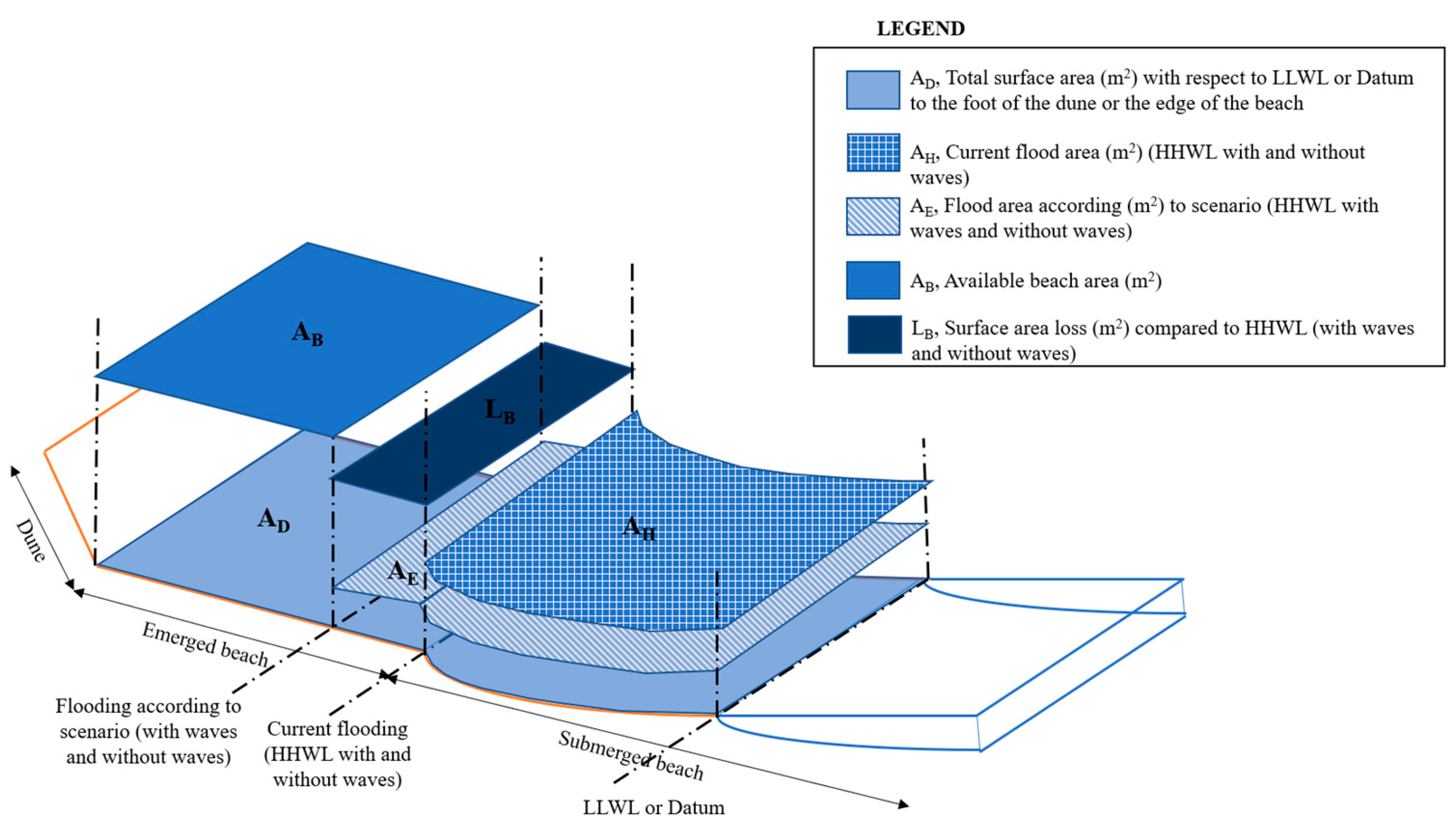
Inundation extents were determined by intersecting the calculated extreme water levels with the topographic profiles. The spatial interpretation of inundated and non-inundated areas is illustrated in Figure 4, which defines the beach surface components used in the analysis.
Based on these spatial definitions, quantitative metrics were defined to estimate available and lost beach surface under present-day and future extreme water level conditions:
A B = A D A E
and
L B = A E A H
where
  • AD is the total beach surface measured from the hydrographic zero (datum) to the dune foot or landward beach limit;
  • AE is the inundated beach surface measured from the hydrographic zero (Datum) to the considered scenario water level;
  • AH is the inundated beach surface under present-day extreme water level conditions;
  • AB is the dry beach surface remaining above water level in a specific scenario;
  • LB is the loss of dry beach surface for a specific scenario with respect present-day extreme water level conditions.
Subscripts D, E, and H denote surfaces measured from the reference datum (LLWL) to the dune (D), future scenario (E), and present-day extreme water level (H), respectively.
Under present-day conditions, the available beach surface (AB) is therefore defined as
I f   A D A H > 0 ;   A B = A D A H
I f   A D A H 0 ; A B = 0
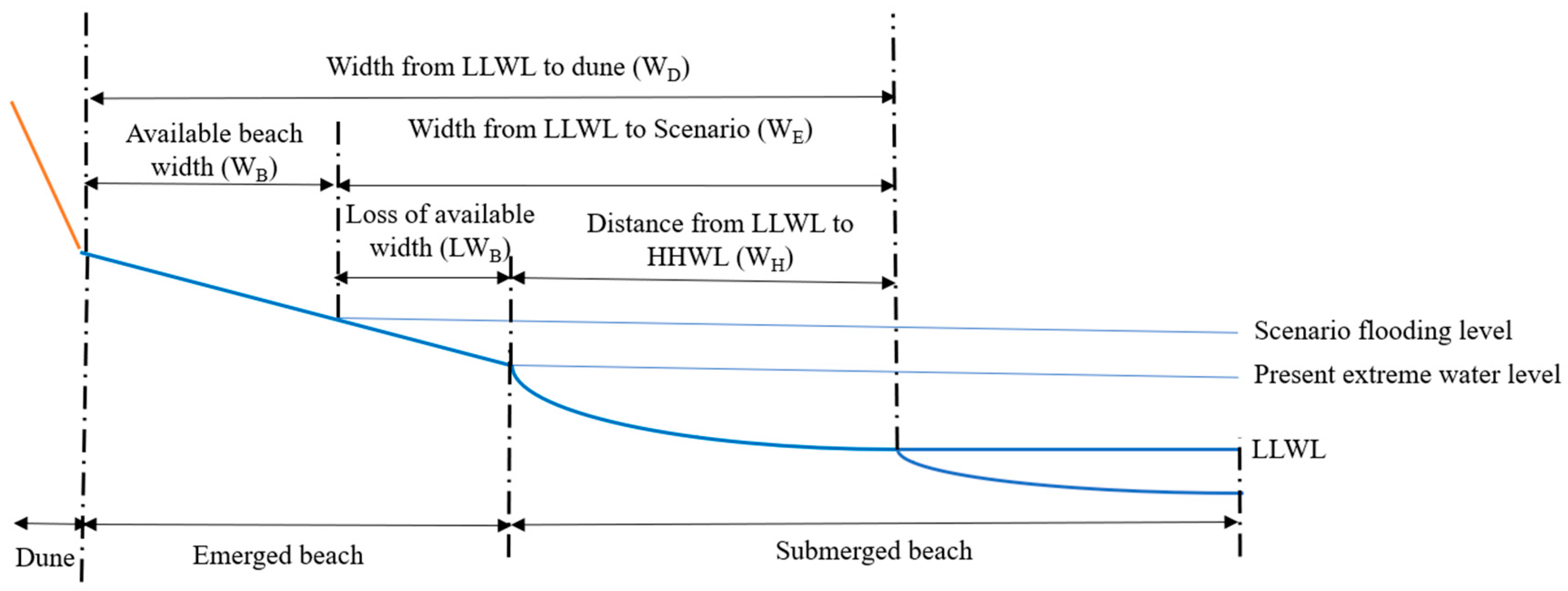
Similarly, beach width metrics were defined as the horizontal distance between the dune foot and the maximum inundation limit. The definition of available beach width and width loss is illustrated in Figure 5.
If   W D W E > 0 ;   W B = W D W E
If   W D W E 0 ; W B = 0
and
L W B = W E W H
where
  • WD is the horizontal distance (m) from the hydrographic zero (datum) to the dune foot or landward beach limit;
  • WE is the horizontal distance (m) from the hydrographic zero to the scenario water level (with or without wave contribution);
  • WH is the horizontal distance (m) from the hydrographic zero to the present-day extreme water level (with or without wave contribution);
  • WB is the horizontal distance (m) from the dune foot or landward beach limit to the scenario water level (with or without wave contribution);
  • LWB is the loss of horizontal distance for a specific scenario with respect present-day extreme water level conditions.
These metrics provide the basis for the quantitative assessment of beach response under present and future sea level rise scenarios.

4. Results

This section presents the results of the analysis for the five studied beaches. Results are organised to first describe beach morphology, followed by inundation patterns, and finally quantitative indicators of beach response in terms of surface area and width.
The analysis focuses on inundation extent, changes in available dry beach surface, and variations in beach width under different hydrodynamic conditions and time horizons.
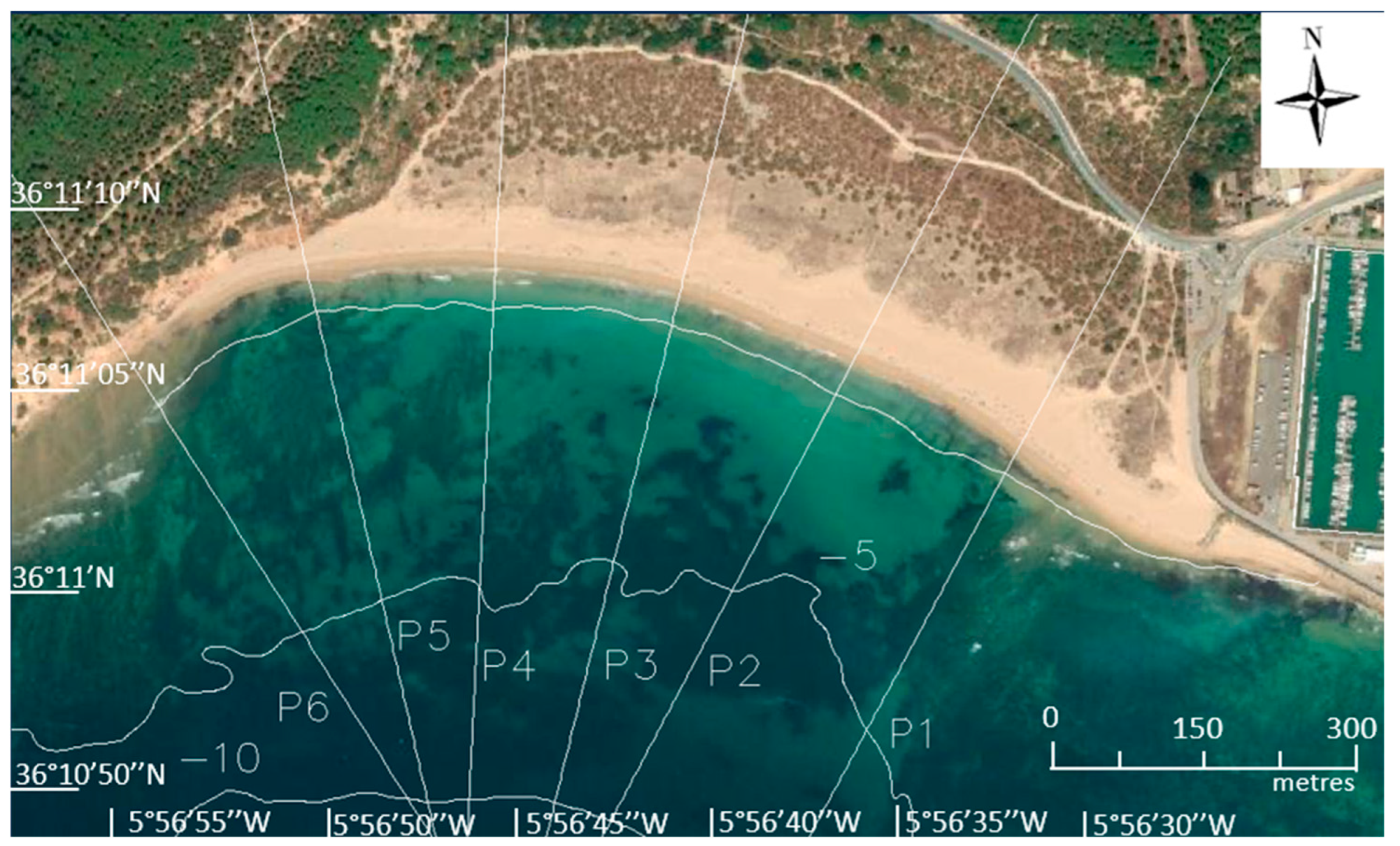
Figure 6 provides an overview of the study sites, including orthophotography, topo-bathymetric information, and the location of the cross-shore profiles used in the analysis. The figure illustrates the spatial distribution of the profiles along each beach and highlights differences in beach extent and nearshore bathymetry among the study areas. Representative cross-shore profiles used in the analysis are described in Section 3.5.
In the following sections, results are presented for scenarios without wave contribution and scenarios including wave run-up effects, allowing direct comparison of their influence on beach inundation patterns and dry beach availability.

4.1. Beach Morphology and Profile Characterization

The five studied beaches show clear differences in morphology, beach width, and profile geometry, reflecting the contrast between Atlantic and Mediterranean settings. Representative cross-shore profiles for each beach are located in Figure 6, extending from the submerged zone to the dune foot or landward limit.
Atlantic beaches display wider profiles and gentler slopes, whereas Mediterranean beaches are narrower and steeper. These differences define the baseline conditions controlling beach inundation under increasing extreme water levels.
The mean dry beach slopes reported in Table 3 range from approximately 2% at Toruños to values exceeding 6% at Malagueta and Torreguadiaro. This contrast reflects the distinct morphodynamic characteristics of the two coastal sectors.
Sediment characteristics also differ between sectors. Median grain size (D50) ranges from approximately 250 μm in Atlantic beaches to about 900 μm at Malagueta, indicating coarser sediments along the Mediterranean coast.
Mediterranean beaches also tend to present more confined profiles, with reduced beach width and limited accommodation space for inland water propagation.

4.2. Extreme Water Levels and Inundation Patterns

The extreme water levels calculated for the different studied beaches under present-day conditions and future sea level rise scenarios produce distinct inundation patterns depending on tidal regime, beach morphology, and the inclusion or exclusion of wave run-up effects.
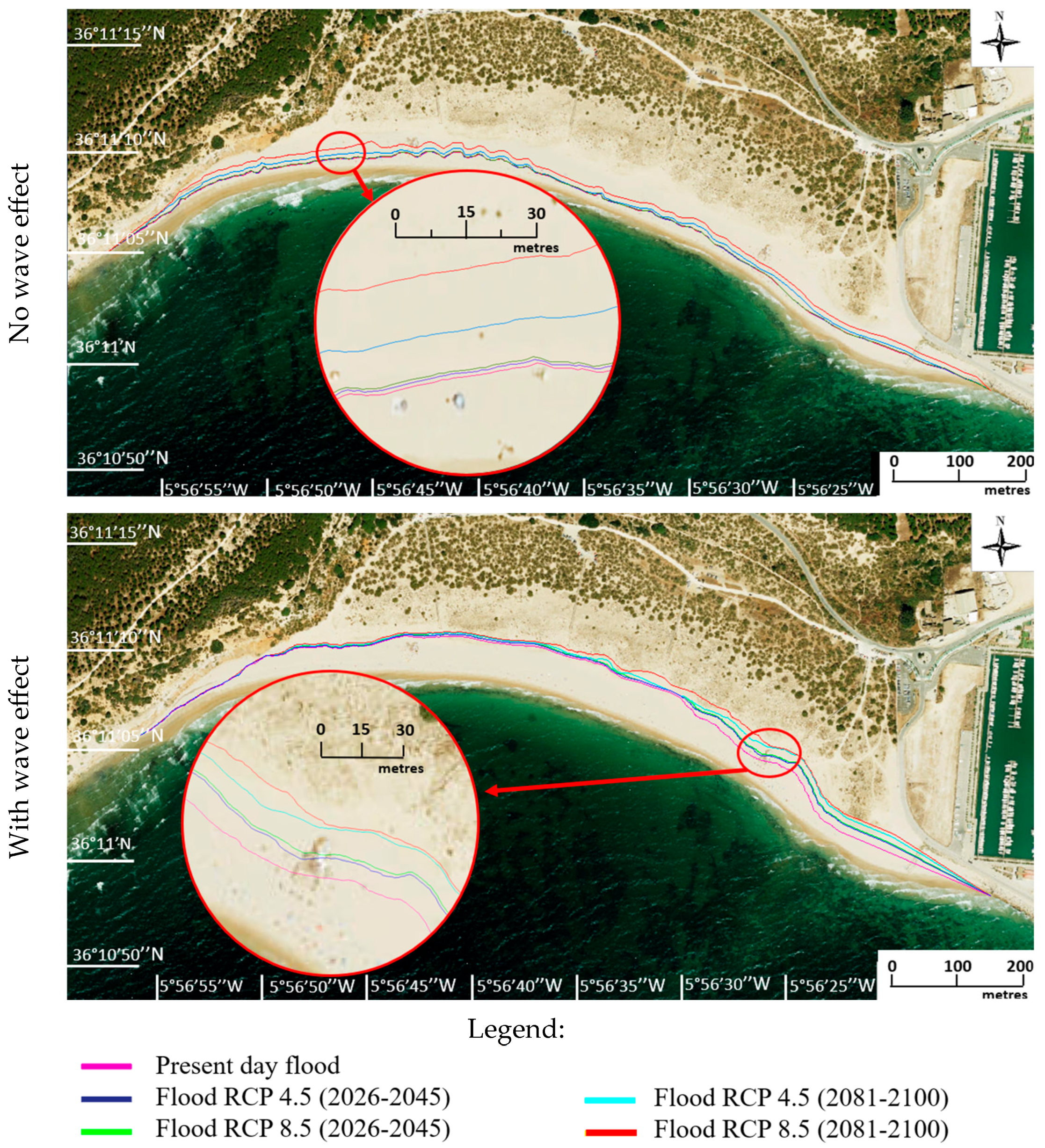
Figure 7 shows an example of inundation patterns at Hierbabuena beach under present and future scenarios. The figure focuses on a representative central sector to improve visualization of inundation limits. Inundation without wave contribution reflects passive flooding driven by sea-level rise, astronomical tide, and meteorological residuals. When wave run-up is included, higher extreme water levels are reached, leading to greater inundation extent. This comparison highlights the significant contribution of wave run-up to beach inundation.
Clear differences are observed between Mediterranean and Atlantic beaches, with the latter generally exhibiting a stronger increase in inundation extent when wave effects are considered.
In particular, Toruños beach exhibits near-complete inundation under scenarios including wave run-up, due to its low-lying morphology and the presence of extensive back-barrier areas that facilitate landward water propagation.
The results are subject to uncertainties associated with both input data and methodological assumptions. These include the accuracy of topographic and bathymetric data, the representativeness of tide-gauge records, and the adopted sea-level rise projections. In addition, wave run-up estimates depend on the selected offshore wave conditions and model assumptions. These sources of uncertainty may affect the absolute values of inundation extent and beach loss, but do not alter the comparative patterns observed between scenarios and study sites.

4.3. Changes in Available Beach Surface Area

Quantitative results for changes in available dry beach surface area under present-day and future scenarios are summarized in Table 7. The table reports the total available beach surface and the corresponding surface loss for each study site, considering both inundation without wave effects and inundation including wave run-up.
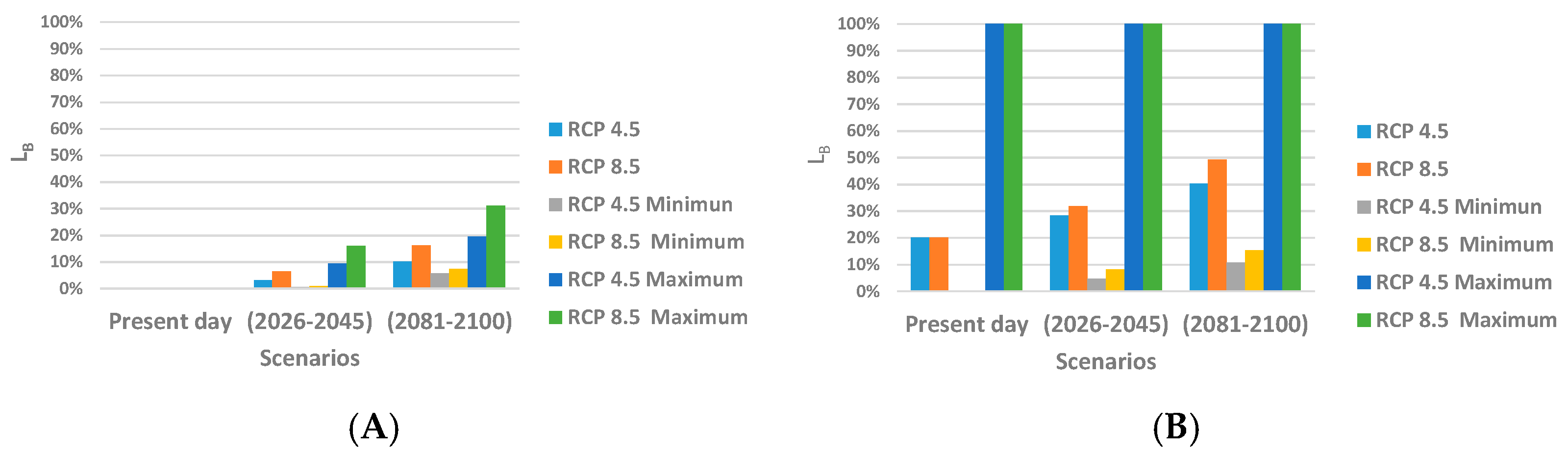
Overall, the results indicate a progressive reduction in available beach surface area with increasing sea level rise. Relative losses are systematically larger when wave run-up is included, increasing from values typically below 20% under still-water conditions to values exceeding 40% and reaching up to complete loss (100%) when wave run-up effects are considered, particularly in low-lying Atlantic beaches under end-of-century scenarios, although the magnitude of change varies among sites. Moreover, Mediterranean beaches generally retain a higher proportion of available beach surface under future scenarios than Atlantic beaches.
Nevertheless, even under moderate sea level rise scenarios, substantial surface losses are observed at several sites when wave effects are considered. The percentage of mean beach surface loss under present-day and future scenarios, with and without wave effects, is shown graphically in Figure 8.

4.4. Changes in Beach Width

Changes in available dry beach width under the different scenarios are presented in Table 8, as a complementary metric to the surface area changes described in the previous section. As observed for beach surface area, beach width losses increase with sea level rise magnitude and are amplified by the inclusion of wave run-up.
Atlantic beaches generally exhibit larger proportional reductions in available beach width compared to Mediterranean beaches. In several cases, future scenarios that include wave effects result in very limited or near-complete loss of dry beach width under extreme water level conditions.
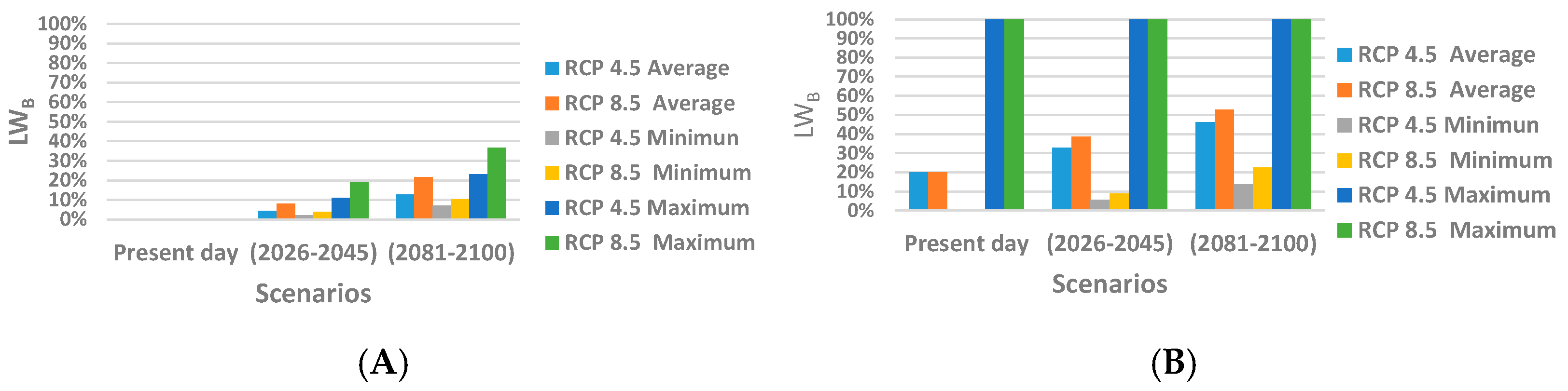
Results are reported for each study site under scenarios without wave contribution and with wave run-up effects. Figure 9 provides a graphical comparison of the percentage of mean dry beach width loss under the different scenarios, highlighting the amplifying effect of wave run-up.

5. Discussion

5.1. Interpretation of Inundation Patterns and Controlling Factors

The results of this study indicate that future sea level rise will significantly modify inundation patterns on sandy beaches along the southern coast of Spain. The combined influence of rising mean sea level, astronomical tide, meteorological residuals, and wave run-up produces a landward shift in extreme water levels. This shift leads to progressive reductions in available dry beach surface and beach width at all study sites.
The comparison between scenarios with and without wave effects allows the contribution of wave run-up to be quantified. In all study sites, the inclusion of wave run-up increases extreme water levels by several decimetres (Table 6 and Table 7). For example, inundation levels increase from approximately 3.84 m to about 6.12 m in some cases (e.g., Los Toruños Beach) when wave effects are included. This additional water level leads to substantially larger reductions in dry beach width and surface (Figure 9). Under the most severe scenarios, dry beach width losses exceed 30% at some beaches (e.g., at La Malagueta (Mediterranean), where the water level increases from 1.81 m without waves to 3.44 m when wave effects are included.). These results highlight the strong coupling between sea level rise and wave-driven processes in determining future beach inundation patterns.
A key outcome is the contrast between scenarios based only on still water levels and those that include wave run-up. In all cases, the inclusion of wave processes results in higher extreme water levels and larger inundation extents.
Under present-day conditions, inundation extents remain relatively limited across the analysed beaches, with lower values generally observed in the microtidal environments. Along the Atlantic coast, although wider intertidal zones facilitate greater wave energy dissipation, this buffering capacity is progressively reduced as sea levels rise due to the shallower beach slope. As a result, a threshold-like response emerges, whereby relatively small increases in extreme water levels produce disproportionately large losses of dry beach surface and width. This occurs when the water level exceeds the elevation of the upper beach, leading to rapid inland propagation of inundation and a sharp reduction in available dry beach area.
In addition to hydrodynamic and geomorphological factors, human interventions may also influence beach vulnerability to coastal inundation. Some beaches along the Andalusian coast have experienced management actions such as beach nourishment, sediment redistribution, or coastal protection works. These interventions can temporarily increase beach width and therefore reduce the immediate impacts of extreme water levels. However, the present study focuses on the influence of hydrodynamic forcing and beach morphology under natural conditions. Human interventions were therefore not explicitly incorporated into the analysis. Future work could examine how beach nourishment or other coastal management measures may modify the projected impacts of sea level rise on dry beach availability.
In addition to hydrodynamic forcing and human interventions, sediment dynamics may also influence the observed differences in vulnerability among the studied beaches. Many Mediterranean coasts are characterized by limited sediment supply due to river regulation, coastal infrastructure, and reduced fluvial sediment delivery. Moreover, intense coastal urbanization has often reduced or degraded dune systems that normally act as natural sediment reservoirs. The absence or limited development of dune fields may reduce the capacity of beaches to naturally recover from storm-induced erosion or extreme water levels. Under such conditions, the impacts of sea level rise on dry beach availability may be further exacerbated. In contrast, beaches with greater sediment availability or preserved dune systems may show higher resilience to similar hydrodynamic forcing.
Tidal regime and wave run-up play a key role in modulating beach response to future sea level rise. Differences between Atlantic and Mediterranean beaches are evident in their response to sea-level rise.
Along the Atlantic coast, the mesotidal regime favours the development of wider intertidal zones. These zones allow part of the incoming wave energy to dissipate over a broader beach surface but shallower beach slope. Under present-day conditions and moderate sea level rise scenarios, this mechanism partially limits the landward propagation of extreme water levels.
Mediterranean beaches, by contrast, are characterised by a microtidal regime with limited tidal modulation. Under these conditions, wave run-up becomes a dominant control on extreme water levels. Including wave effects therefore leads to increase in inundation extent and beach losses, particularly under higher sea level rise scenarios. These results indicate that assessments based solely on still water levels are likely to underestimate future impacts in microtidal environments.
The comparison between Atlantic and Mediterranean beaches reveals systematic differences in their response to future sea level rise. These differences are associated with contrasting tidal regimes, wave climates, and geomorphological characteristics. Although all sites experience reductions in dry beach surface and width, the magnitude and evolution of these changes differ between the two coastal settings.
Atlantic beaches generally exhibit profiles with gentler slopes and higher dynamic exposure. Far from offering protection, this configuration promotes a greater inundation extent, as the reduced slope facilitates deeper wave run-up penetration. The presence of an extensive intertidal zone, combined with high-energy conditions, enables rapid landward migration of the inundation limits. Consequently, losses of dry beach surface and width tend to occur more critically and rapidly, even under moderate forcing scenarios.
Conversely, Mediterranean beaches display a more attenuated response. Their steeper profiles, often more confined and subject to limited tidal modulation, restrict the horizontal propagation of the flow. Under these conditions, the beach morphology allows for more efficient dissipation of extreme water level increments. Therefore, sea-level rise or wave run-up increases result in proportional and less drastic reductions in dry beach surface.
Local geomorphological constraints exacerbate these responses along the Atlantic coast. The combination of gentle slopes and enhanced run-up amplifies the landward profile adjustment, drastically increasing vulnerability to marine flooding. In contrast, Mediterranean beaches exhibit significantly higher resilience and buffering capacity.
Table 9 show a comparative analysis of the percentage dry beach surface loss (%LB) and dry beach width loss (%LWB) between the Atlantic (Atl) and Mediterranean (Med) coasts under different scenarios. Regarding the percentage of dry beach surface area loss (%LB) without wave effects, both coasts show moderate losses; however, the Atlantic coast consistently exhibits higher vulnerability. Under the RCP 8.5 scenario for 2100, the Atlantic coast experiences an 18.29% surface area loss compared to 13.01% for the Mediterranean. When wave effects are included, the discrepancy becomes substantial: in the Atlantic, wave action triples the surface area loss relative to the still water level.
A similar pattern is observed for the percentage of dry beach width loss (%LWB) without wave effects: the Atlantic coast undergoes greater narrowing (26.68%) than the Mediterranean (14.29%) by the end of the century under the most severe scenario. With the incorporation of wave run-up, the Atlantic coast displays critical vulnerability, losing an average of 69.15% of its dry beach width. This suggests that many Atlantic beaches would be left virtually without recreational space or coastal protection. In contrast, the Mediterranean coast shows greater resilience in percentage terms, with a width loss of 28.15%
From a geometric perspective, Mediterranean beaches, characterized by steeper slopes, are expected to experience significantly smaller horizontal shoreline displacements for a given sea-level rise. Their steeper profile acts as an effective topographic barrier, restricting the landward extent of inundation. Consequently, even under extreme water level conditions, horizontal water propagation is notably more contained compared to milder slopes. These results underscore the deterministic role of steep beach morphology in flood mitigation, effectively limiting the magnitude of the system’s response to sea-level rise.
Conversely, the tidal regime and configuration of Atlantic beaches favour greater susceptibility to inundation, where the combination of gentle slopes and enhanced run-up potential facilitates a more accelerated loss of dry beach surface.

5.2. Implications for Future Coastal Management

The results have direct implications for coastal management along the southern Spanish coast under ongoing sea level rise. The projected reductions in dry beach surface and width indicate increasing pressure on coastal systems, with consequences for coastal protection, recreation, and ecosystem services. These findings are consistent with priorities identified in the Spanish National Climate Change Adaptation Plan 2021–2030, which recognises sea level rise and coastal flooding as major challenges [61].
The contrasting responses observed between Atlantic and Mediterranean beaches indicate that management strategies should be adapted to local hydrodynamic and geomorphological conditions. In mesotidal Atlantic environments, wider beaches and stronger tidal modulation may provide additional time and space for adaptive measures. In microtidal Mediterranean settings, even moderate increases in extreme water levels can lead to severe beach losses.
These differences suggest that adaptation measures should also be differentiated according to the level of beach vulnerability. For beaches with the highest projected losses, priority measures may include periodic beach nourishment, dune restoration where space is still available, and stricter control of backshore occupation. For intermediate-vulnerability beaches, sediment management and the preservation of beach width may help reduce future losses. In wider mesotidal Atlantic beaches, the conservation of intertidal space, dune systems, and natural sediment pathways may provide an effective buffer against future inundation. In all cases, avoiding additional urban encroachment and incorporating wave run-up into coastal planning are essential to improve long-term adaptation.
The analysis also highlights the importance of explicitly incorporating wave run-up into coastal hazard assessments. The results show the significant contribution of wave-driven processes to beach inundation, particularly in mesotidal environments. Including wave-driven processes can therefore improve the reliability of vulnerability assessments and support more robust coastal planning.

5.3. Methodological Limitations and Transferability

Several limitations of the proposed methodology should be acknowledged. Uncertainties associated with sea level rise projections, particularly for high-emission scenarios and long-term horizons, directly affect the magnitude of estimated inundation and beach losses. These uncertainties are inherent to climate projections and should be considered when interpreting the results.
Recent studies have applied advanced extreme value analysis techniques to sea level and wave records along the Andalusian coast, highlighting the importance of robust statistical approaches for coastal risk assessment [61].
Wave run-up simulations are based on present-day wave climate conditions. Potential future changes in wave characteristics are not explicitly considered. This represents a controlled simplification that allows consistent comparisons across sites and scenarios, but it may not capture all aspects of future coastal dynamics. In addition, beach morphology is assumed to be static, and long-term morphological feedbacks such as sediment redistribution or shoreline retreat are not included.
Despite these limitations, the methodology enables consistent comparisons across coastal settings with contrasting tidal regimes and wave climates. This approach is complementary to large-scale probabilistic assessments such as Vosdoukas et al. [30]. Those studies are essential for estimating regional changes in extreme sea levels and coastal flood exposure. Here, the focus is narrower and site-specific. The objective is to examine how local beach morphology modulates inundation and dry beach loss under defined sea-level and wave-forcing scenarios.
The use of widely available topographic data, standardised sea level rise scenarios, and physically based hydrodynamic components makes the approach suitable for comparative assessments in coastal regions with contrasting tidal regimes and wave climates. As such, it provides a useful framework to support coastal management and planning under future climate change.
An additional source of uncertainty is the assumption of present-day wave climate conditions in the run-up simulations. Future changes in wave climate could modify wave run-up levels and therefore influence coastal flooding. Several studies suggest that changes in North Atlantic storm tracks and storm intensity may affect wave energy along the Atlantic coast of Europe. An increase in storm intensity could lead to higher significant wave heights and therefore larger run-up levels during extreme events. Under such conditions, the inundation losses estimated for mesotidal Atlantic beaches could be further amplified. However, projections of future wave climate show substantial regional variability and remain subject to significant uncertainty. For this reason, the present study isolates the influence of sea level rise and wave run-up processes under representative wave conditions. Future work should evaluate the potential combined effects of sea level rise and projected changes in wave climate.

6. Conclusions

This study assesses the impacts of future sea level rise on sandy beaches under contrasting tidal regimes along the southern coast of Spain. The analysis combines sea level rise projections with astronomical tide, meteorological residuals, and wave run-up, providing a consistent framework to evaluate future beach inundation and dry beach availability.
Results indicate a progressive reduction in dry beach surface and width at all study sites. Losses increase from mid-century to end-of-century scenarios and from moderate to high-emission pathways. The inclusion of wave run-up strongly amplifies these impacts compared to still water level assessments.
Clear differences are observed between mesotidal Atlantic and microtidal Mediterranean beaches. Mediterranean beaches exhibit a greater capacity to accommodate rising extreme water levels due to their steeper profiles and more stable geomorphological configuration. By contrast, Atlantic beaches respond more abruptly. Their milder profiles, combined with a more dynamic tidal regime, appear to contribute to the larger relative losses observed when wave effects and increased run-up reach are considered.
The results confirm that wave-driven processes are a key control on future beach vulnerability. Approaches based solely on still water levels tend to underestimate inundation and dry beach loss, particularly in microtidal environments. Functional indicators such as available dry beach surface and width provide a more meaningful measure of coastal response than shoreline displacement alone.
Overall, the study highlights the need to explicitly incorporate wave run-up in coastal inundation assessments and management strategies. The physically based, profile-scale methodology adopted here is robust and transferable, offering a practical tool to support long-term coastal planning and adaptation under future climate change.

Author Contributions

Conceptualization, A.C.-d.-V., J.J.M.-P. and J.M.V.-P.; methodology, A.C.-d.-V., J.J.M.-P. and F.C.-d.-V.; software, A.C.-d.-V., F.C.-d.-V. and C.P.-M.; validation, A.C.-d.-V., J.J.M.-P. and J.M.V.-P.; formal analysis, J.J.M.-P. and J.M.V.-P.; investigation, A.C.-d.-V., J.J.M.-P., C.P.-M., F.C.-d.-V., J.J.A.d.R., P.L.-G. and B.J.-A.; resources, J.J.M.-P. and J.M.V.-P.; data curation, A.C.-d.-V., C.P.-M. and P.L.-G.; writing—original draft preparation, A.C.-d.-V. and J.J.M.-P.; writing—review and editing A.C.-d.-V. and J.J.M.-P.; visualization, A.C.-d.-V. and J.J.M.-P.; supervision, A.C.-d.-V., J.J.M.-P., J.M.V.-P., F.C.-d.-V., C.P.-M., J.J.A.d.R. and B.J.-A.; project administration, J.J.M.-P. and J.M.V.-P.; funding acquisition, J.J.M.-P. and J.M.V.-P. All authors have read and agreed to the published version of the manuscript.

Funding

This research was funded by Project PCM_00124, funded by the Next Generation EU Recovery Fund through the Recovery, Transformation and Resilience Plan (Ministry of University, Research and Innovation), and co-funded by the Regional Government of Andalusia.

Data Availability Statement

The original contributions presented in this study are included in the article. Further inquiries can be directed to the corresponding author.

Conflicts of Interest

The authors declare no conflicts of interest.

References

  1. Gilman, E.L.; Ellison, J.; Duke, N.C.; Field, C. Threats to mangroves from climate change and adaptation options: A review. Aquat. Bot. 2008, 89, 237–250. [Google Scholar] [CrossRef]
  2. Thuiller, W.; Lavorel, S.; Araújo, M.B.; Sykes, M.T.; Prentice, I.C. Climate change threats to plant diversity in Europe. Proc. Natl. Acad. Sci. USA 2005, 102, 8245–8250. [Google Scholar] [CrossRef]
  3. Sheffield, P.E.; Landrigan, P.J. Global Climate Change and Children’s Health: Threats and Strategies for Prevention. Environ. Health Perspect. 2010, 119, 291. [Google Scholar] [CrossRef]
  4. Kweku, D.W.; Bismark, O.; Maxwell, A.; Desmond, K.A.; Danso, K.B.; Asante Oti-Mensah, E.; Quachie, A.T.; Adormaa, B.B. Greenhouse Effect: Greenhouse Gases and Their Impact on Global Warming. J. Sci. Res. Rep. 2018, 17, 1–9. [Google Scholar] [CrossRef]
  5. Liu, X.; He, P.; Chen, W.; Gao, J. Improving Multi-Task Deep Neural Networks via Knowledge Distillation for Natural Language Understanding. arXiv 2019, arXiv:1904.09482. [Google Scholar] [CrossRef]
  6. Wolf, J.; Woolf, D.; Bricheno, L. Impacts of climate change on storms and waves relevant to the coastal and marine environment around the UK. MCCIP Sci. Rev. 2020, 2020, 132–157. [Google Scholar] [CrossRef]
  7. Grabemann, I.; Weisse, R. Climate change impact on extreme wave conditions in the North Sea: An ensemble study. Ocean Dyn. 2008, 58, 199–212. [Google Scholar] [CrossRef]
  8. Nhemachena, C.; Nhamo, L.; Matchaya, G.; Nhemachena, C.R.; Muchara, B.; Karuaihe, S.T.; Mpandeli, S. Climate Change Impacts on Water and Agriculture Sectors in Southern Africa: Threats and Opportunities for Sustainable Development. Water 2020, 12, 2673. [Google Scholar] [CrossRef]
  9. Hrabok, M.; Delorme, A.; Agyapong, V.I.O. Threats to Mental Health and Well-Being Associated with Climate Change. J. Anxiety Disord. 2020, 76, 102295. [Google Scholar] [CrossRef]
  10. IPCC; Grupo Intergubernamental de expertos sobre el cambio climático; Stocker, T.F.; Qin, D.; Plattner, G.-K.; Tignor, M.; Allen, S.K.; Boschung, J.; Nauels, A.; Xia, Y.; et al. Climate Change 2013: The Physical Science Basis. Contribution of Working Group I to the Fifth Assessment Report of the Intergovernmental Panel on Climate Change; Cambridge University Press: Cambridge, UK; New York, NY, USA, 2013. [Google Scholar]
  11. Intergovernmental panel on climate change (IPCC) Summary for Policymakers. In Climate Change 2022—Impacts, Adaptation and Vulnerability; Cambridge University Press: Cambridge, UK, 2023; pp. 3–34.
  12. WMO. World Meteorological Organization. 2023. Available online: https://wmo.int/ (accessed on 15 March 2025).
  13. ENEP. Programa de las Naciones Unidas para el Medio Ambiente. Ginebra Suiza 2024. Available online: https://www.unep.org/annualreport/es/2024 (accessed on 15 March 2025).
  14. Holgate, S.J.; Woodworth, P.L. Evidence for enhanced coastal sea level rise during the 1990s. Geophys. Res. Lett. 2004, 31. [Google Scholar] [CrossRef]
  15. Muñoz-Perez, J.J.; Contreras-de-Villar, A.; Diaz-Carrasco, P. Airy and Other Analytical Waves for Beginners; Springer: Berlin/Heidelberg, Germany, 2024. [Google Scholar]
  16. Calvillo García, Y.; Ramírez-Herrera, M.T.; Delgado-Trejo, C.; Legorreta-Paulin, G.; Corona, N.; Calvillo García, Y.; Ramírez-Herrera, M.T.; Delgado-Trejo, C.; Legorreta-Paulin, G.; Corona, N. Modeling sea-level change, inundation scenarios, and their effect on the Colola Beach Reserve—A nesting-habitat of the black sea turtle, Michoacán, Mexico. Geofísica Int. 2015, 54, 179–190. [Google Scholar] [CrossRef]
  17. Nicholls, R.J. Analysis of global impacts of sea-level rise: A case study of flooding. Phys. Chem. Earth Parts A/B/C 2002, 27, 1455–1466. [Google Scholar] [CrossRef]
  18. Pendleton, E.A.; Thieler, E.R.; Williams, S.J.; Pendleton, E.A.; Thieler, E.R.; Williams, S.J. Importance of Coastal Change Variables in Determining Vulnerability to Sea- and Lake-Level Change. J. Coast. Res. 2010, 26, 176–183. [Google Scholar] [CrossRef]
  19. Toubes, D.R.; Gössling, S.; Hall, C.M.; Scott, D. Vulnerability of Coastal Beach Tourism to Flooding: A Case Study of Galicia, Spain. Environ. 2017, 4, 83. [Google Scholar] [CrossRef]
  20. Toimil, A.; Losada, I.J.; Álvarez-Cuesta, M.; Le Cozannet, G. Demonstrating the value of beaches for adaptation to future coastal flood risk. Nat. Commun. 2023, 14, 3474. [Google Scholar] [CrossRef]
  21. Finlayson, C.M.; Davis, J.A.; Gell, P.A.; Kingsford, R.T.; Parton, K.A. The status of wetlands and the predicted effects of global climate change: The situation in Australia. Aquat. Sci. 2011, 75, 73–93. [Google Scholar] [CrossRef]
  22. Aguilera-Vidal, M.; Muñoz-Perez, J.J.; Contreras, A.; Contreras, F.; Lopez-Garcia, P.; Jigena, B. Increase in the Erosion Rate due to the Impact of Climate Change on Sea Level Rise: Victoria Beach, a Case Study. J. Mar. Sci. Eng. 2022, 10, 1912. [Google Scholar] [CrossRef]
  23. Ramos-Reyes, R.; Zavala-Cruz, J.; Gama-Campillo, L.M.; Pech-Pool, D.; Ortiz-Pérez, M.A. Indicadores geomorfológicos para evaluar la vulnerabilidad por inundación ante el ascenso del nivel del mar debido al cambio climático en la costa de Tabasco y Campeche, México. Boletín La Soc. Geológica Mex. 2016, 68, 581–598. [Google Scholar] [CrossRef]
  24. Houston, J.R. The value of Florida beaches. Shore Beach 2013, 81, 4–11. [Google Scholar]
  25. Balica, S.F.; Wright, N.G.; van der Meulen, F. A flood vulnerability index for coastal cities and its use in assessing climate change impacts. Nat. Hazards 2012, 64, 73–105. [Google Scholar] [CrossRef]
  26. Alcocer-Yamanaka, V.H.; Rodríguez-Varela, J.M.; Bourguett-Ortiz, V.J.; Llaguno-Guilberto, O.J.; Albornoz-Góngora, P.M. Metodología para la generación de mapas de riesgo por inundación en zonas urbanas. Tecnol. Cienc. Agua 2016, 5, 33–55. [Google Scholar]
  27. Ezer, T. A Demonstration of a Simple Methodology of Flood Prediction for a Coastal City Under Threat of Sea Level Rise: The Case of Norfolk, VA, USA. Earth’s Futur. 2022, 10, e2022EF002786. [Google Scholar] [CrossRef]
  28. Viigand, K.; Eelsalu, M.; Soomere, T. Inherent non-stationarity in the GEV distribution for extreme sea levels: Implications for coastal vulnerability in the Baltic Sea. Ocean Eng. 2025, 341, 122681. [Google Scholar] [CrossRef]
  29. Hung, N.T.; Cuong, V.D.; Thanh, N.T.; Quan, T.Q. Simulation of Coastal Flooding Under Extreme Weather Patterns for Quang Tri Province, Vietnam. Estuaries Coasts 2026, 49, 22. [Google Scholar] [CrossRef]
  30. Vousdoukas, M.I.; Mentaschi, L.; Voukouvalas, E.; Verlaan, M.; Feyen, L. Extreme sea levels on the rise along Europe’s coasts. Earth’s Futur. 2017, 5, 304–323. [Google Scholar] [CrossRef]
  31. Angulo, A.M.; Mur, J.; Trívez, F.J. Measuring resilience to economic shocks: An application to Spain. Ann. Reg. Sci. 2017, 60, 349–373. [Google Scholar] [CrossRef]
  32. Fernández, J.; Fita, L.; García-Díez, M.; Montávez, J.P.; Jiménez-Guerrero, P.; Domínguez, M.; Romera, R.; López de la Franca, N.; Sánchez, E.; Liguori, G.; et al. Escenarios-PNACC 2012: Resultados de regionalización dinámica. Publicaciones AEC Ser. A 2012, 8, 63–72. [Google Scholar]
  33. Fang, Y.-P.; Zhu, F.-B.; Qiu, X.; Zhao, S. Effects of natural disasters on livelihood resilience of rural residents in Sichuan. Habitat Int. 2018, 76, 19–28. [Google Scholar] [CrossRef]
  34. Klein Richard, J.T.; Nicholls, R.J. Assessment of Coastal Vulnerability to Climate Change on JSTOR. J. Coast. Res. 1999, 28, 182–187. [Google Scholar]
  35. Alimentación y Medio Ambiente del Gobierno de España. Elaboracion de los Mapas de Peligrosidad y Riesgo Requeridos por RD 903/2010 en la Costa Española. 2010. Available online: https://www.miteco.gob.es/content/dam/miteco/es/agua/temas/gestion-de-los-riesgos-de-inundacion/mapri/MEMORIA_INUNDACIONES_COSTAS.pdf (accessed on 14 January 2025).
  36. Ojeda, J.; Álvarez, J.; Cajaraville, D.; Fraile, P. El uso de las TIG para el cálculo del indice de vulnerabilidad costera (CVI) ante una potencial subida del nivel del mar en la costa andaluza (España). GeoFocus (Artículos) 2009, 9, 83–101. [Google Scholar]
  37. Ojeda-Bustamante, W.; Sifuentes-Ibarra, E.; Íñiguez-Covarrubias, M.; Montero-Martínez, M.J. Climate change impact on crop development and water requirements. Agrociencia 2011, 45, 1–11. [Google Scholar]
  38. UTE Ecoatlantico. Estudio Ecocartográfico del Litoral de la Provincia de Cádiz. Estudio de Mareas. 2013. Available online: https://www.miteco.gob.es/es/costas/temas/proteccion-costa/ecocartografias/ecocartografia-cadiz.html (accessed on 4 February 2025).
  39. Ambiente, M.d.M.; de Costas, D.G. Universidad de Cantabria, Atlas de inundación del litoral peninsular español. 2006. Available online: https://es.scribd.com/document/328320002/01-06-02-08-Resumen-Atlas-de-inundacion-del-litoral-espan-ol-DVD (accessed on 22 April 2025).
  40. Gómez-Pina, G.; Fages, L.; Ramírez, J.L.; Muñoz-Pérez, J.J.; Enriquez, J. A critical review of beach restoration projects in the northern coast of Cadiz (Spain) after thirteen years. Coast. Eng. 2007, 2006, 4167–4178. [Google Scholar]
  41. Sánchez-Artús, X.; Gracia, V.; Espino, M.; Sierra, J.P.; Pinyol, J.; Sánchez-Arcilla, A. Present and future flooding and erosion along the NW Spanish Mediterranean Coast. Front. Mar. Sci. 2023, 10, 1125138. [Google Scholar] [CrossRef]
  42. Intecsa-Inarsa, U. Ecocartografía del litoral de la provincia de Málaga. Dir. Gen. Sostenibilidad la Costa y el Mar 2004. Available online: https://www.miteco.gob.es/es/costas/temas/proteccion-costa/ecocartografias/ecocartografia-malaga.html (accessed on 4 February 2025).
  43. Grases, A.; Gracia, V.; García-León, M.; Lin-Ye, J.; Sierra, J.P. Coastal Flooding and Erosion under a Changing Climate: Implications at a Low-Lying Coast (Ebro Delta). Water 2020, 12, 346. [Google Scholar] [CrossRef]
  44. Agulles, M.; Jordà, G.; Lionello, P. Flooding of Sandy Beaches in a Changing Climate. The Case of the Balearic Islands (NW Mediterranean). Front. Mar. Sci. 2021, 8, 760725. [Google Scholar] [CrossRef]
  45. Hidtma, S.L. UTE Ecoatlántico. Estudio ecocartográfico del litoral de la provincia de Cádiz. Referencia 28-4983. 2013. Available online: https://www.miteco.gob.es/es/costas/temas/proteccion-costa/ecocartografias.html (accessed on 4 February 2025).
  46. Contreras de Villar, A.; Gómez-Pina, G.; Muñoz-Pérez, J.; Contreras de Villar, F.; López-García, P.; Ruiz-Ortiz, V. New design parameters for biparabolic beach profiles (SW Cadiz, Spain). Rev. Construción 2019, 18, 432–444. [Google Scholar] [CrossRef]
  47. Contreras-de-Villar, F.; García, F.J.; Muñoz-Perez, J.J.; Contreras-de-Villar, A.; Ruiz-Ortiz, V.; Lopez, P.; Garcia-López, S.; Jigena, B. Beach Leveling Using a Remotely Piloted Aircraft System (RPAS): Problems and Solutions. J. Mar. Sci. Eng. 2021, 9, 19. [Google Scholar] [CrossRef]
  48. Poullet, P.; Muñoz-Perez, J.J.; Poortvliet, G.; Mera, J.; Contreras, A.; Lopez, P. Influence of different sieving methods on estimation of sand size parameters. Water 2019, 11, 879. [Google Scholar] [CrossRef]
  49. Pranzini, E.; Anfuso, G.; Muñoz-Perez, J.J. A probabilistic approach to borrow sediment selection in beach nourishment projects. Coast. Eng. 2018, 139, 32–35. [Google Scholar] [CrossRef]
  50. Cantabría, I.H. Visor C3E. 2016. Available online: https://c3e.ihcantabria.com/ (accessed on 6 February 2025).
  51. Lara, J.L.; Losada, I.J.; Maza, M.; Guanche, R. Breaking solitary wave evolution over a porous underwater step. Coast. Eng. 2011, 58, 837–850. [Google Scholar] [CrossRef]
  52. Instituto Hidrográfico de la Marina (IHM). Tide Tables and Tidal Databases for Spanish Coastal Waters; Spanish Navy Hydrographic Institute: Cadiz, Spain, 2023. [Google Scholar]
  53. Puertos del Estado. 2022. Available online: https://portus.puertos.es/#/ (accessed on 18 November 2024).
  54. Ministerio para la Transición Ecológica (MITECO). Guía Para el Acceso a Los Datos de Proyecciones Climáticas Regionales Marinas en España; Ministerio para la Transición Ecológica: Madrid, Spain, 2016. [Google Scholar]
  55. Agencia Estatal de Meteorología (AEMET). Guia de Escenarios Regionalizados de Cambio Climático Sobre España a Partir de los Resultados del IPCC-AR5; Ministerio: Madrid, Spain, 2017. [Google Scholar]
  56. Puertos del Estado. REDMAR sea level observations and tide-gauge data network. In Spanish Port Authority System; Ministry of Transport, Mobility and Urban Agenda: Madrid, Spain, 2023. [Google Scholar]
  57. Sampedro, A.T.; Abad Herrero, S.; Losada Rodríguez, I.J. Incorporación de los Efectos del Cambio Climático para dar Cumplimiento a la Directiva de Evaluación y Gestión de los Riesgos de Inundación; Ministerio para la Transición Ecológica y el Reto Demográfico (MITECO): Madrid, Spain, 2020. [Google Scholar]
  58. Marcos, M.; Tsimplis, M.N.; Shaw, A.G.P. Sea level extremes in southern Europe. J. Geophys. Res. Ocean. 2009, 114, C01007. [Google Scholar] [CrossRef]
  59. Losada, I.J.; Lara, J.L.; Guanche, R.; Gonzalez-Ondina, J. Numerical analysis of wave overtopping of rubble mound breakwaters. Coast. Eng. 2008, 55, 47–62. [Google Scholar] [CrossRef]
  60. Stockdon, H.F.; Holman, R.A.; Howd, P.A.; Sallenger, A.H. Empirical parameterization of setup, swash, and runup. Coast. Eng. 2006, 53, 573–588. [Google Scholar] [CrossRef]
  61. Ministerio para la Transición (MITECO) y el Reto Demográfico Ecológica. Plan Nacional de Adpatación al CAMBIO climático 2021–2030; Ministry for the Ecological Transition and the Demographic Challenge (MITERD) of Spain: Madrid, Spain, 2020. [Google Scholar]
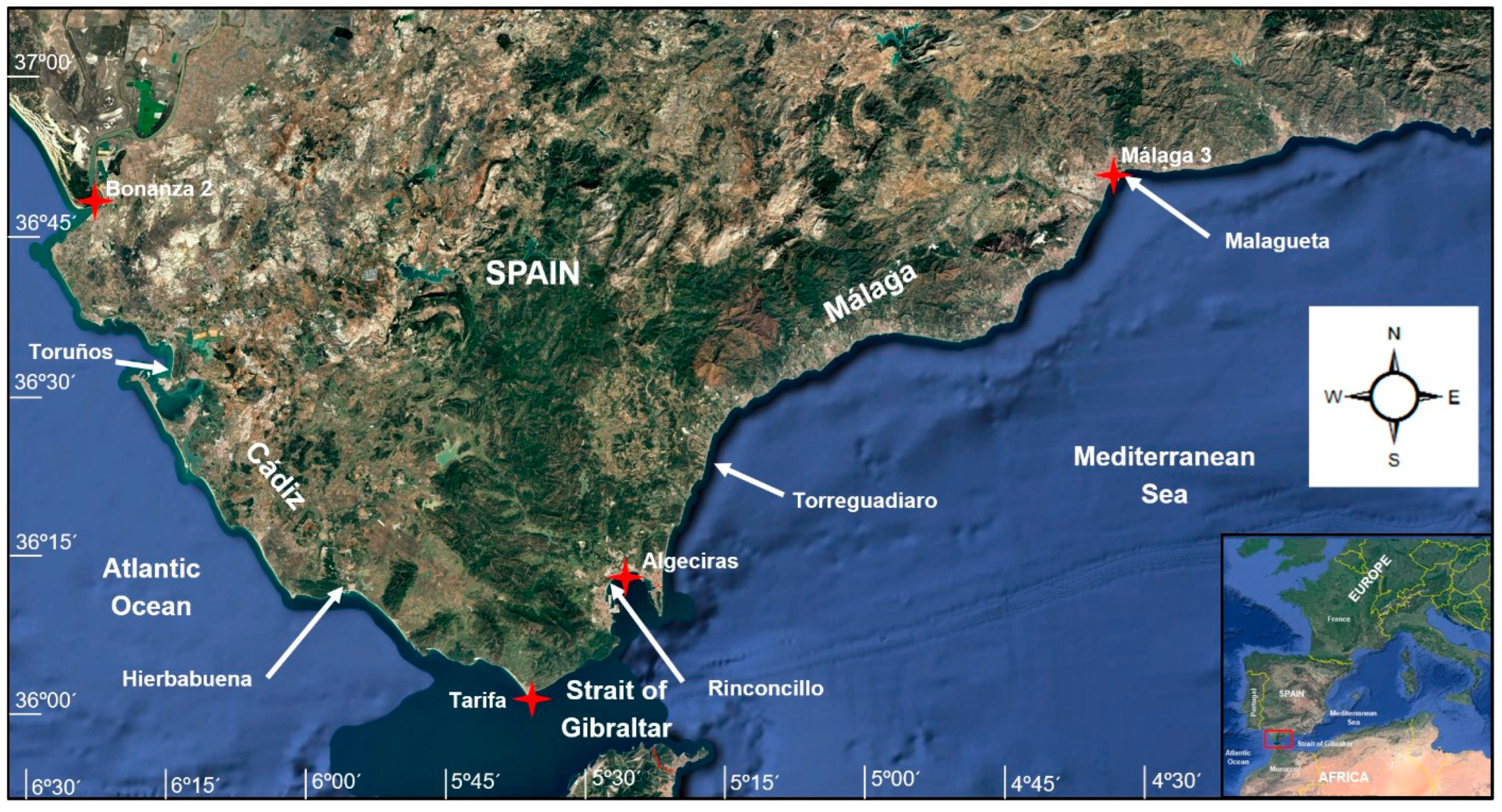
Figure 1. Location of the study area, selected sandy beaches and tide gauges (red stars) along the southern coast of Spain. The figure shows the five study sites located in the provinces of Cadiz (Atlantic coast) and Malaga (Mediterranean coast), representing mesotidal and microtidal environments, respectively: Los Toruños, Hierbabuena, El Rinconcillo, Torreguadiaro, and Malagueta.
Water 18 01407 g001
Figure 2. Regional nodes of the C3E web-based viewer used to obtain sea-level rise projections for the southern Spanish coast. Yellow points indicate the grid nodes providing regionalised projections, while red circles identify the five beaches analysed in this study. Mean sea level rise (MSLR) were extracted from the nearest nodes of the C3E viewer and applied in the inundation analysis.
Water 18 01407 g002
Figure 3. (A) Example of wave transformation and run-up simulated with the IH2VOF model along a representative cross-shore profile at Hierbabuena beach (Profile 2). The figure illustrates wave breaking and run-up processes under representative conditions. Offshore wave conditions used in the simulation were Hs = 3.46 m and Tp = 12.18 s. (B) Schematic representation of the water levels considered in the analysis, including the Lowest Low Water Level (LLWL) which is used as the vertical datum, Still Water Level (SWL), and Extreme Water Level (EWL) obtained when wave run-up is included. All vertical elevations are referenced to LLWL.
Water 18 01407 g003
Figure 4. Graphical definition of beach surface components used to quantify inundation and dry beach availability. The figure illustrates the distinction between inundated and non-inundated beach areas under extreme water level conditions, forming the basis for the calculation of available beach surface and surface loss.
Water 18 01407 g004
Figure 5. Definition of beach width metrics used to quantify available dry beach width and width loss under extreme water level conditions. The figure illustrates the horizontal distances measured from the LLWL datum to the dune foot and to the extreme water levels considered in the analysis. The present extreme water level corresponds to the current flooding level, while the scenario flooding level represents the extreme water level obtained under future sea-level rise conditions with or without wave run-up.
Water 18 01407 g005
Figure 6. Example of Orthophotography and topo-bathymetric representation at Hierbabuena beach, showing the location of the cross-shore profiles used in the analysis. Beach extent and nearshore bathymetry are indicated, and a scale is included.
Water 18 01407 g006
Figure 7. Example of inundation patterns at Hierbabuena beach under present conditions and future sea-level rise scenarios. The upper panel shows inundation without wave run-up, while the lower panel includes the contribution of maximum wave run-up. The plotted lines represent the present extreme water level and the projected flooding limits under RCP 4.5 and RCP 8.5 scenarios for the periods 2026–2045 and 2081–2100. The figure focuses on a representative central sector of the beach to improve visualization of the differences between scenarios. A scale bar (in meters) is included within each subpanel to facilitate comparison of spatial differences. Panels upper and lower correspond to inundation without and with wave run-up, respectively.
Water 18 01407 g007
Figure 8. Graphical representation of the mean percentage of dry beach surface loss for the five studied beaches under present-day conditions and RCP 4.5 and RCP 8.5 scenarios for the periods 2026–2045 and 2081–2100, without wave effects (A) and including wave effects (B) with minimum and maximum values. Error bars represent the minimum and maximum values among the five analysed beaches for each scenario.
Water 18 01407 g008
Figure 9. Graphical representation of the mean percentage of dry beach width loss (%LWB) for the five studied beaches under present-day conditions and RCP 4.5 and RCP 8.5 scenarios for the periods 2026–2045 and 2081–2100, without wave effects (A) and including wave effects (B) with minimum and maximum values. Error bars represent the minimum and maximum values among the five analysed beaches for each scenario.
Water 18 01407 g009
Table 1. Present-day mean Highest High Water Level (HHWL) values (in meters) obtained from tide gauge records (based on official data from the Spanish Navy Hydrographic Institute (IHM) [52] and Puertos del Estado webpage https://www.puertos.es/). Datum LLWL [53].
Tide GaugeMean HHWL (m)
Bonanza 23.63
Tarifa1.65
Algeciras1.42
Malaga 31.26
Table 2. Still water level for the different scenarios, obtained by adding astronomical tide, meteorological residual, and sea level rise due to climate change for each study beach.
Present Day2026–20452081–2100
Study Area RCP 4.5RCP 8.5RCP 4.5RCP 8.5
Toruños3.703.853.854.114.26
Hierbabuena 3.023.173.173.433.58
Rinconcillo1.821.971.972.232.38
Torreguadiaro 1.741.891.892.152.30
Malagueta1.641.781.792.042.19
Table 3. Mean slope of the dry beach for each study site, calculated from the emerged part of the cross-shore profiles, and Present-day HHWL (m) values assigned to each study beach based on the nearest tide gauge [38]; and Representative offshore wave parameters (significant wave height “Hs” and peak period “Tp”) used for the run-up simulations at each study beach, obtained from the C3E web viewer [50]. Datum LLWL.
Study BeachMean Slope (%)HHWL (m)Hs (m)Tp (s)
Toruños2.0 3.72.512.5
Hierbabuena5.5 2.63.512.2
Rinconcillo3.0 1.41.410.3
Torreguadiaro6.2 1.43.310.6
Malagueta6.7 1.32.59.4
Table 4. Example of mean, 2% exceedance, and maximum wave run-up (meters) for profile 2 at Hierbabuena beach (Atlantic coast) and Malagueta beach (Mediterranean coast) under the different scenarios.
2026–20452081–2100
Present DayRCP 4.5RCP 8.5RCP 4.5RCP 8.5
Hierbabuena
Profile 2
Mean Run-Up (m)0.270.280.320.290.33
Run-Up 2% (m)0.650.670.680.660.70
Max Run-Up (m)0.800.810.830.821.01
Malagueta
Profile 2
Mean Run-Up (m)0.340.360.370.390.40
Run-Up 2% (m)0.940.950.971.001.06
Max Run-Up (m)0.970.991.001.111.25
Table 5. Inundation level (m) without waves (astronomical tide and sea level rise due to climate change) for the different beaches and scenarios.
2026–20452081–2100
Study BeachPresent DayRCP 4.5RCP 8.5RCP 4.5RCP 8.5
Toruños3.283.433.433.693.84
Hierbabuena2.602.752.753.013.16
Rinconcillo1.421.571.571.831.98
Torreguadiaro1.351.501.501.761.91
Malagueta1.261.401.411.661.81
Average1.982.132.132.392.54
Table 6. Maximum inundation level (astronomical tide and sea level rise due to climate change) including wave action for the different beaches and scenarios (in meters).
2026–20452081–2100
Study BeachPresent DayRCP 4.5RCP 8.5RCP 4.5RCP 8.5
Toruños 5.315.555.625.916.12
Hierbabuena 4.174.364.424.654.93
Rinconcillo 2.652.922.983.233.51
Torreguadiaro 3.143.323.363.653.83
Malagueta2.612.772.793.153.44
Average3.583.783.834.124.37
Table 7. Quantification of available beach surface area (AB), beach surface loss relative to present-day extreme water level (LB), percentage of available beach surface (%AB), and percentage of beach surface loss (%LB) for Toruños, Hierbabuena, Rinconcillo, Torreguadiaro, and Malagueta under present conditions and RCP 4.5 and RCP 8.5 scenarios for the periods Mid-century (2026–2045) and End-century (2081–2100).
Still Water LevelExtreme Water Level
No Wave EffectRun Up Included
Study BeachParametersPresent Day Mid-Century
(2026–2045)
End-Century
(2081–2100)
Present Day Mid-Century
(2026–2045)
End-Century (2081–2100)
RCP 4.5RCP 8.5 RCP 4.5RCP 8.5RCP 4.5 RCP 8.5 RCP 4.5RCP 8.5
ToruñosAB (m2)408,926.3370,672.5343,332.9328,978.9281,405.40.00.00.00.00.0
LB (m2)0.038,253.865,593.479,947.4127,520.90.025,905.545,630.372,959.4105,345.9
% AB100.090.784.080.568.80.00.000.00.000.00
% LB0.09.416.019.631.1100.0100.0100.0100.0100.0
HierbabuenaAB (m2)119,199.6118,346.0117,986.1112,523.2102,127.989,320.683,145.182,015.676,672.571,986.2
LB (m2)0.0853.71213.66676.517,071.70.06175.57305.112,648.117,334.4
% AB100.099.399.094.485.7100.093.191.885.880.6
% LB0.00.71.05.614.30.06.98.214.219.4
RinconcilloAB (m2)110,292.3108,357.5106,852.5104,010.699,978.944,294.835,196.332,402.619,547.27797.9
LB (m2)0.01934.83439.96281.710,313.50.09098.611,892.224,747.636,496.9
% AB100.098.296.994.390.7100.079.573.244.117.6
% LB0.01.83.15.79.40.020.526.955.982.4
TorreguadiaroAB (m2)75,654.274,100.072,791.770,565.969,659.367,504.964,357.762,030.060,290.157,182.9
LB (m2)0.01146.22454.54680.35587.00.03147.25474.97214.710,322.0
% AB100.098.596.793.892.6100.095.391.989.384.7
% LB0.01.53.36.27.40.04.78.110.715.3
MalaguetaAB (m2)75,246.273,191.168,861.064,902.561,259.847,018.942,419.339,589.137,089.133,183.2
LB (m2)0.02055.16385.210,343.813,986.40.04599.57429.79929.813,835.7
% AB100.097.291.586.381.4100.090.284.278.970.6
% LB0.02.78.513.818.60.09.815.821.129.4
Average AB (m2)157,863.7148,933.4141,964.8136,196.2122,886.349,627.845,023.743,207.538,719.834,030.0
LB (m2)0.08848.715,817.321,585.934,895.90.09785.315,546.425,499.936,667.0
% AB100.096.893.689.883.880.071.668.259.650.7
% LB0.03.26.410.116.20.228.431.840.449.3
Minimum % LB0.00.71.05.67.40.04.78.110.715.3
Maximum % LB0.09.416.019.631.2100.0100.0100.0100.0100.0
Table 8. Mean dry beach width and width loss metrics for the five studied beaches under present conditions and RCP 4.5 and RCP 8.5 scenarios for the periods 2026–2045 and 2081–2100. WB: mean dry beach width; LWB: dry beach width loss; %WB: percentage of available dry beach width; %LWB: percentage of dry beach width loss.
Still Water LevelExtreme Water Level
No Wave EffectRun Up Included
Mid-CenturyEnd-Century Mid-CenturyEnd-Century
Beach NameParameterPresent
Day
(2026–2045)(2081–2100)Present Day(2026–2045)(2081–2100)
RCP 4.5RCP 8.5 RCP 4.5RCP 8.5RCP 4.5 RCP 8.5 RCP 4.5RCP 8.5
ToruñosWB (m)91.782.676.172.761.40.00.00.00.00.0
LWB (m)0.09.115.619.030.3−603.1−603.9−605.2−606.1−607.1
% WB100.089.081.177.063.30.00.00.00.00.0
% LWB 0.011.018.923.036.7100.0100.0100.0100.0100.0
HierbabuenaWB (m)86.385.785.382.074.555.052.151.449.246.4
LWB (m)0.00.61.04.311.80.02.83.65.88.6
% WB100.096.995.288.268.2100.087.181.277.371.8
% LWB 0.03.14.811.831.50.012.918.822.728.2
RinconcilloWB (m)39.338.738.237.235.818.615.213.59.16.9
LWB (m)0.00.71.22.13.50.03.04.44.03.4
% WB100.097.896.192.888.1100.068.254.129.720.7
% LWB 0.02.33.97.211.90.031.845.970.379.3
TorreguadiaroWB (m)54.453.152.050.248.745.943.441.939.435.5
LWB (m)0.01.32.34.25.60.02.64.06.510.5
% WB100.097.595.792.389.7100.094.591.386.277.5
% LWB 0.02.54.37.710.30.05.58.713.822.5
MalaguetaWB (m)57.055.452.950.347.637.533.130.929.226.2
LWB (m)0.01.64.16.79.40.04.46.68.311.3
% WB100.096.691.886.581.8100.086.480.575.466.2
% LWB 0.03.38.213.518.20.013.619.524.633.8
AverageWB (m)65.763.160.958.553.631.428.727.525.423.0
LWB (m)0.02.64.87.312.1−120.6−118.2−117.3−116.3−114.7
% WB100.0095.591.987.378.280.067.261.453.747.2
% LWB 0.04.48.012.621.720.032.838.646.352.8
Minimum % LWB0.02.33.97.210.30.05.28.%13.222.5
Maximum % LWB0.011.018.923.036.7100.0100.0100.0100.0100.0
Table 9. Comparative analysis of the percentage dry beach surface loss (%LB) and dry beach width loss (%LWB) for the average of the Atlantic beaches (Atl) and the Mediterranean beaches (Med) under present conditions and RCP 4.5 and RCP 8.5 scenarios for the periods Mid-century (2026–2045) and End-century (2081–2100).
Still Water LevelExtreme Water Level
No Wave EffectRun Up Included
Mid-CenturyEnd-Century Mid-CenturyEnd-Century
Beach ParameterPresent
Day
(2026–2045)(2081–2100)Present
Day
(2026–2045)(2081–2100)
RCP 4.5RCP 8.5 RCP 4.5RCP 8.5RCP 4.5 RCP 8.5 RCP 4.5RCP 8.5
Atl% LB0.03.96.710.218.233.342.545.056.767.7
Med0.02.15.810.013.00.07.211.915.9022.3
Atl% LWB0.05.49.214.026.633.348.254.964.369.1
Med0.02.96.210.614.20.09.614.119.228.1
Disclaimer/Publisher’s Note: The statements, opinions and data contained in all publications are solely those of the individual author(s) and contributor(s) and not of MDPI and/or the editor(s). MDPI and/or the editor(s) disclaim responsibility for any injury to people or property resulting from any ideas, methods, instructions or products referred to in the content.