Applicability of the Elastic Water Column Method to Pressurized Pipeline Emptying: Dimensionless Pressure Analysis Under Different Air Pocket Configurations




Abstract
1. Introduction
2. Modeling Approaches for Hydraulic Transients
3. Modeling of Transient Flow During Emptying of Pressurized Pipelines
4. Challenges and Perspectives in Emptying Modeling
5. Considerations for Extending the Elastic Method to Emptying Operations
Elastic Modeling of Emptying Process for Different Air Pocket Sizes
6. Conclusions
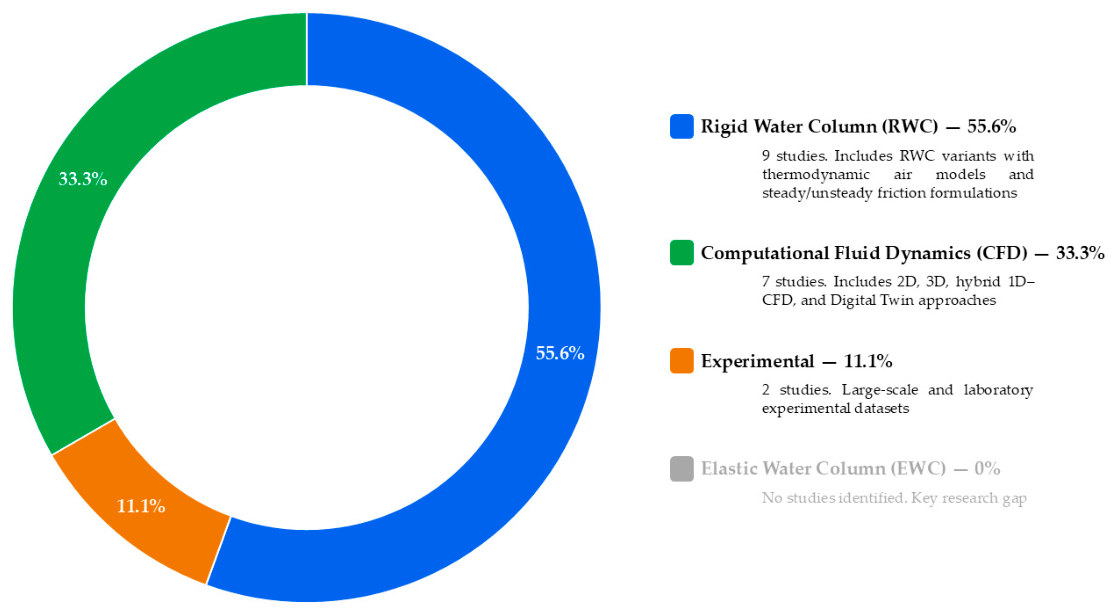
- The existing literature reveals a significant gap in the study of pipeline emptying: while filling processes have been extensively modeled using elastic formulations, the application of elastic water column models to emptying operations has not been systematically addressed.
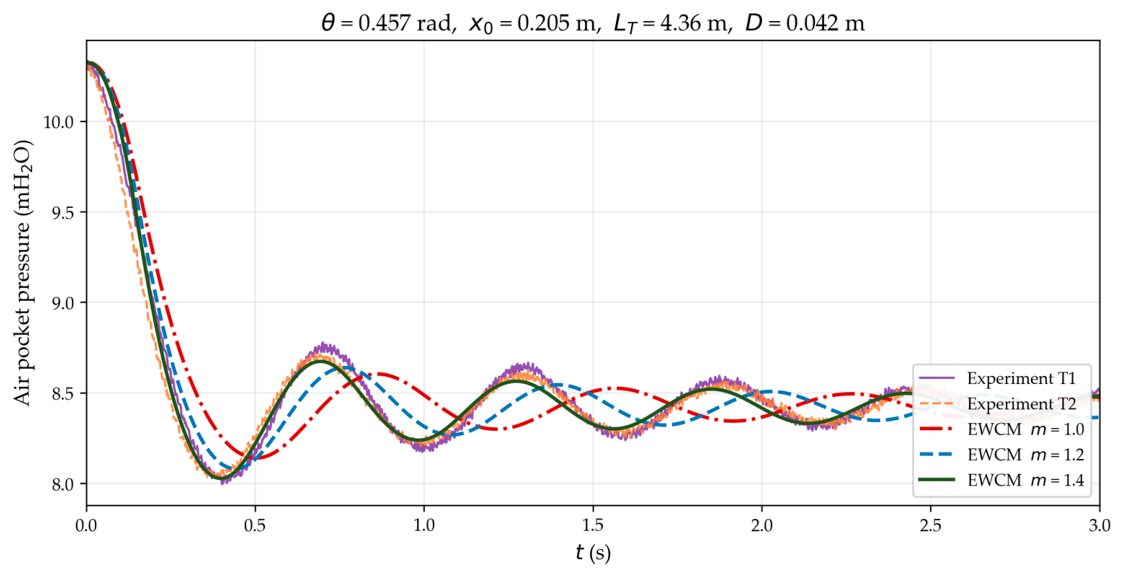
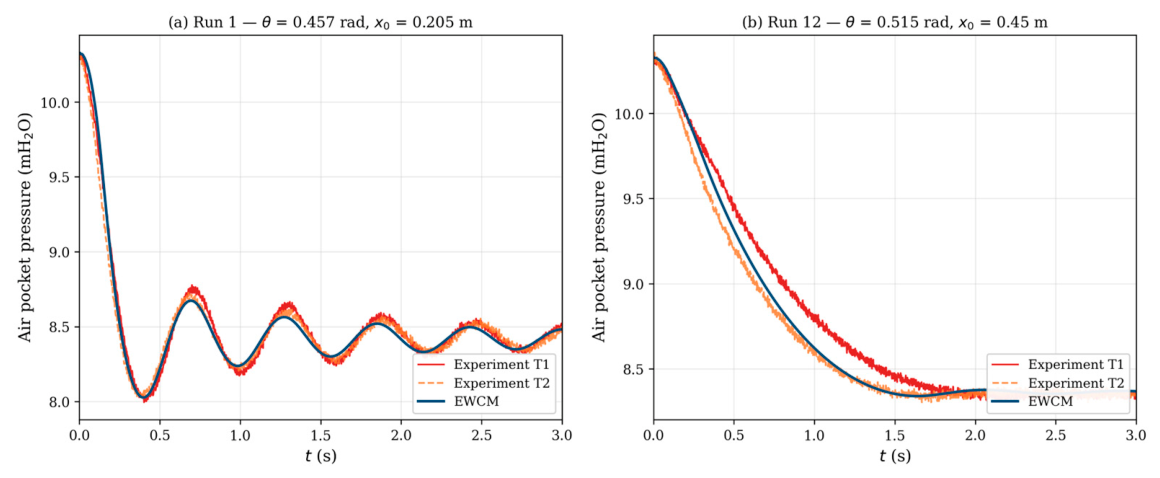
- The EWCM developed was validated against laboratory data from Fuertes-Miquel et al. [27], demonstrating mean absolute errors below 0.35% in minimum pressure across 24 experimental cases, confirming the physical consistency of the formulation. The sensitivity analysis conducted on Run 1 shows that yields the closest agreement with experimental data in terms of pressure magnitude and oscillation period, consistent with the adiabatic conditions expected during rapid transients in short pipelines. For the dimensionless analysis, is adopted following the reference geometry of Fuertes-Miquel et al. [11], which corresponds to quasi-isothermal conditions in longer pipelines where heat exchange is more significant. However, the performance of the formulation under different geometric conditions, such as variations in diameter and pipe length, as well as the dynamic variation of m throughout the transient, should be addressed in future work to improve predictions across a wider range of operational conditions.
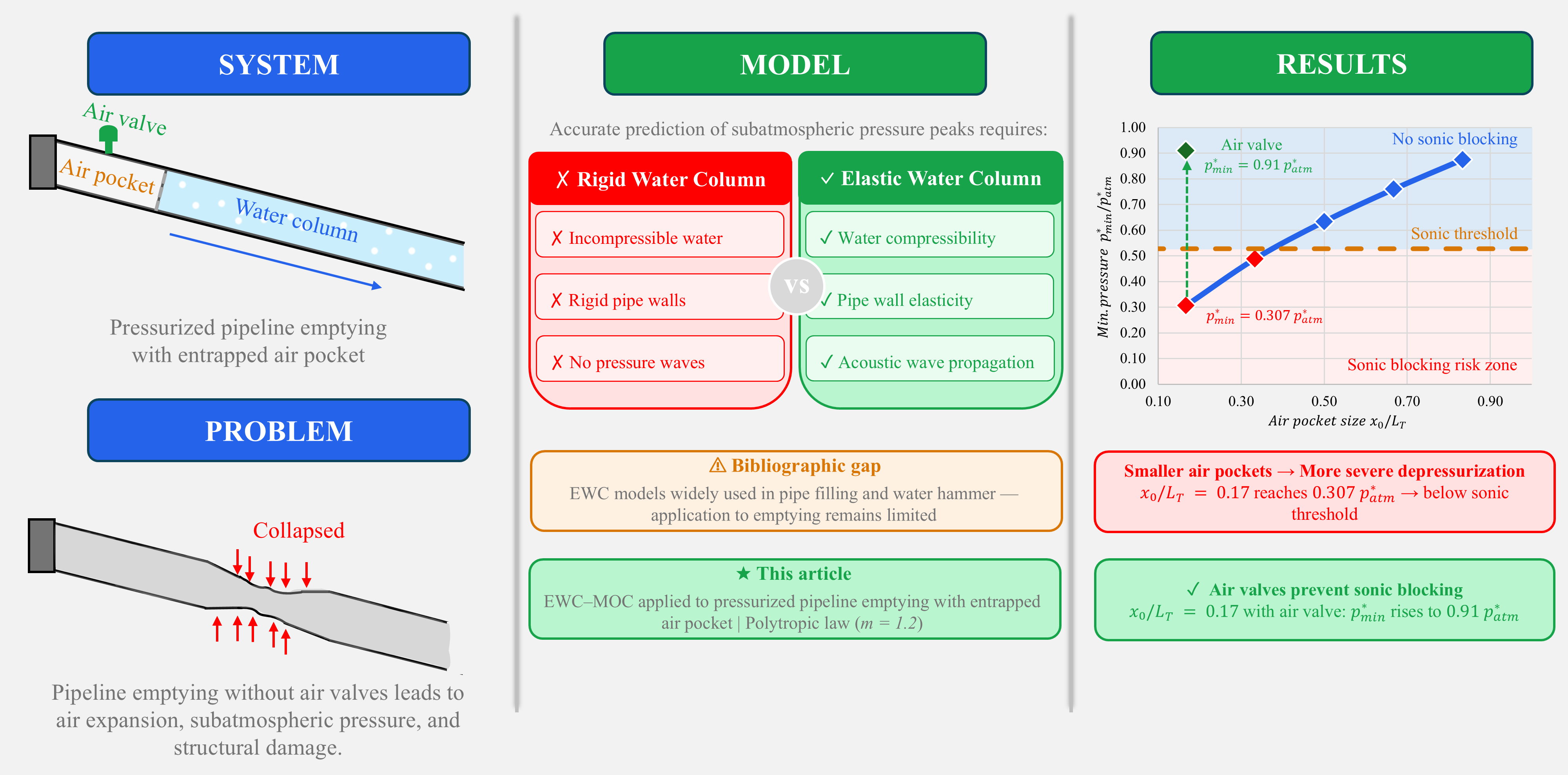
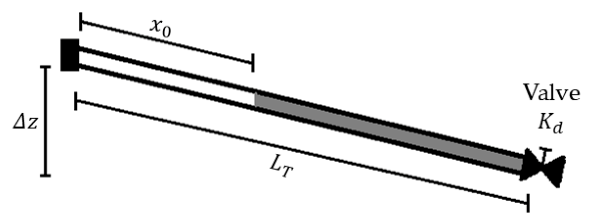
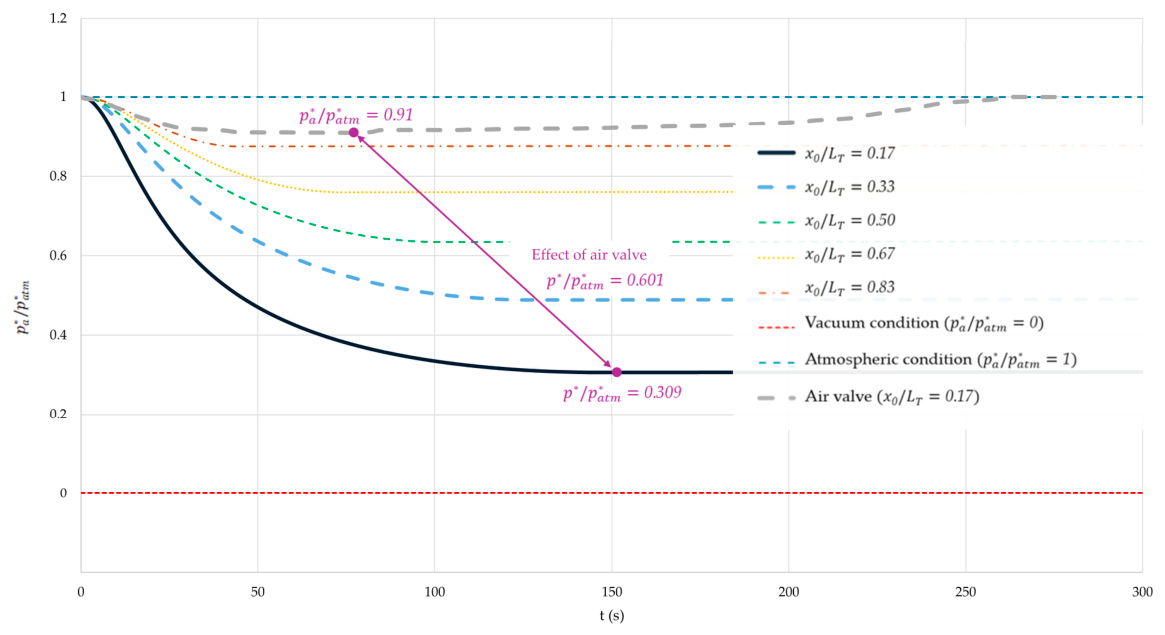
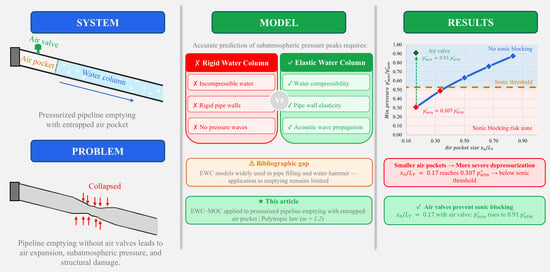
- The dimensionless analysis confirms that the minimum pressure attained during pipeline emptying is strongly controlled by the relative size of the entrapped air pocket with respect to the total pipe length. Expressing the air-pocket size through the dimensionless parameter reveals a systematic relationship with the normalized pressure , indicating that smaller relative air volumes lead to significantly more severe depressurization conditions. This behavior follows directly from the polytropic pressure–volume relation governing the air pocket and suggests that dimensionless parameters provide a useful framework for generalizing emptying dynamics across different pipeline scales.
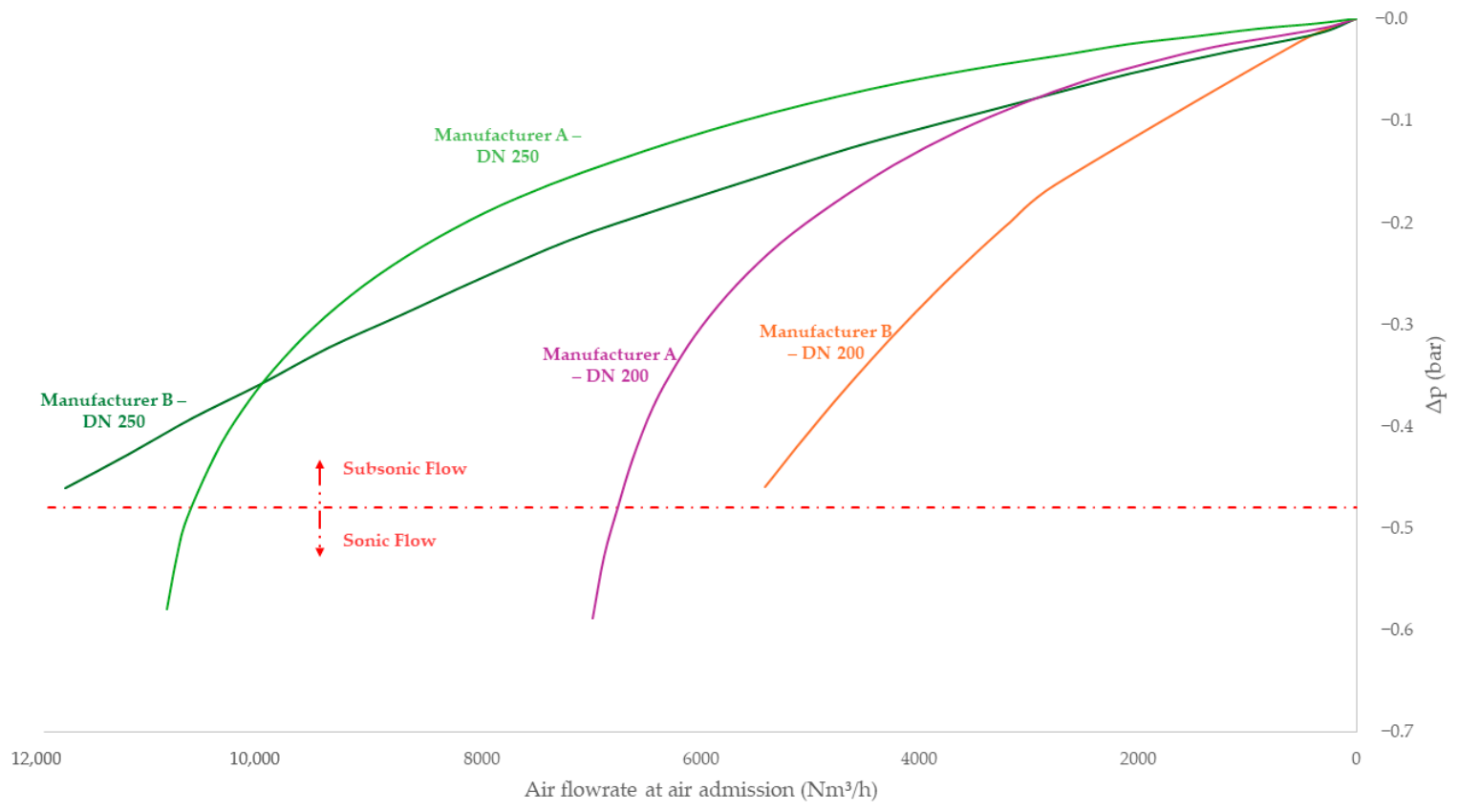
- The comparison between protected and unprotected scenarios shows that air admission devices effectively prevent sub-atmospheric pressure development. For the most critical case analyzed (), the unprotected minimum pressure of falls below the sonic blocking threshold of , underscoring that both the presence and adequate sizing of air valves are essential conditions for safe emptying operations. For small air pocket configurations, adequate valve sizing is therefore a critical design requirement.
Author Contributions
Funding
Data Availability Statement
Acknowledgments
Conflicts of Interest
Abbreviations
| ANNs | Artificial Neural Networks |
| CFD | Computational Fluid Dynamics |
| CV | Control Volume |
| DAM | Discrete Air Model |
| EWC | Elastic Water Column |
| FDM | Finite Difference Method |
| FEM | Finite Element Method |
| FVM | Finite Volume Method |
| GTS | Godunov-Type Scheme |
| MAP | Maximum Air Pressure |
| ML | Machine Learning |
| MOC | Method of Characteristics |
| PINNs | Physics-Informed Neural Networks |
| EWCM | Elastic Water Column Model |
| RANS | Reynolds-Averaged Navier–Stokes |
| RWC | Rigid Water Column |
| SIMPLE | Semi-Implicit Method for Pressure-Linked Equations |
| UAM | Uniform Air Model |
| URANS | Unsteady Reynolds-Averaged Navier–Stokes |
| VOF | Volume of Fluid |
| VPM | Virtual Plug Method |
| CLSVOF | Coupled Level-Set and Volume of Fluid |
References
- Zhou, L.; Liu, D.; Karney, B.; Zhang, Q. Influence of Entrapped Air Pockets on Hydraulic Transients in Water Pipelines. J. Hydraul. Eng. 2011, 137, 1686–1692. [Google Scholar] [CrossRef]
- Britton, L.G.; Willey, R.J. Avoiding Water Hammer and Other Hydraulic Transients. Process Saf. Prog. 2024, 43, 101–112. [Google Scholar] [CrossRef]
- Zhang, Z. Hydraulic Transients and Computations; Springer International Publishing: Cham, Switzerland, 2020. [Google Scholar]
- Karim, I.R.; Sahib, S.A.; Abdullah, H.H.; Aziz, R.R. Water Hammer Analysis in the Main Pipe-Line for the Proposed Taq-Taq Dam Irrigation Project in Iraq. IOP Conf. Ser. Mater. Sci. Eng. 2020, 737, 012154. [Google Scholar] [CrossRef]
- Laanearu, J.; Hou, Q.; Annus, I.; Tijsseling, A.S. Water-Column Mass Losses during the Emptying of a Large-Scale Pipeline by Pressurized Air. Proc. Est. Acad. Sci. 2015, 64, 8. [Google Scholar] [CrossRef]
- Abreu, J.; Cabrera, E.; García-Serra, J.; Izquierdo, J. Boundary between Elastic and Inelastic Models in Hydraulic Transients Analysis with Entrapped Air Pockets. In Proceedings of the Hydraulic Transients with Water Column Separation, Valencia, Spain, 4–6 september 1991; pp. 159–179. [Google Scholar]
- Lee, N. Effect of Pressurization and Expulsion of Entrapped Air in Pipelines; Georgia Institute of Technology: Atlanta, GE, USA, 2006. [Google Scholar]
- Liu, J.; Zhang, J.; Yu, X. Analytical and Numerical Investigation on the Dynamic Characteristics of Entrapped Air in a Rapid Filling Pipe. J. Water Supply Res. Tec. 2018, 67, 137–146. [Google Scholar] [CrossRef]
- Delgado, J.N.; Martins, N.M.C.; Covas, D.I.C. Uncertainties in Hydraulic Transient Modelling in Raising Pipe Systems: Laboratory Case Studies. Procedia Eng. 2014, 70, 487–496. [Google Scholar] [CrossRef]
- Feng, R.; Tasca, E.; Meerkerk, M.V.; Besharat, M.; Zhou, L.; Ramos, H.; Karadzic, U. Experimental Study on Dynamic Characteristics of Entrapped Air in Urban Drainage System. In Proceedings of the 41st IAHR World Congress; International Association for Hydro-Environment Engineering and Research: Singapore, 2025; pp. 1386–1393. [Google Scholar]
- Fuertes-Miquel, V.S.; Coronado-Hernández, O.E.; Mora-Meliá, D.; Iglesias-Rey, P.L. Hydraulic Modeling during Filling and Emptying Processes in Pressurized Pipelines: A Literature Review. Urban Water J. 2019, 16, 299–311. [Google Scholar] [CrossRef]
- Chen, X.; Hou, Q.; Tijsseling, A.S.; Laanearu, J.; Khu, S.T. Analyzing the Emptying Process of a Large-Scale Pipeline with Three-Dimensional CFD Simulations. J. Hydraul. Eng. 2025, 151, 04025036. [Google Scholar] [CrossRef]
- Tijsseling, A.S.; Hou, Q.; Bozkuş, Z.; Laanearu, J. Improved One-Dimensional Models for Rapid Emptying and Filling of Pipelines. J. Press. Vessel Technol. 2016, 138, 031301. [Google Scholar] [CrossRef]
- Liu, P.; Gong, J.; Shi, B.; Song, S.; Shen, Q. Hybrid Method for Hydraulic Transient Analysis of Liquid Pipe Networks Based on Characteristic Lines and Equivalent Circuits. Geoenergy Sci. Eng. 2024, 239, 212968. [Google Scholar] [CrossRef]
- Zhou, L.; Feng, R.-L.; Pan, T.; Li, Y.; Liu, D.; Che, T.-C. Coupled Second-Order GTS-MOC Scheme for Transient Pipe Flows with an Entrapped Air Pocket. J. Hydraul. Eng. 2023, 149, 04023030. [Google Scholar] [CrossRef]
- Zeng, W.; Zecchin, A.C.; Lambert, M.F. Elastic Water Column Model for Hydraulic Transient Analysis of Pipe Networks. J. Hydraul. Eng. 2022, 148, 04022027. [Google Scholar] [CrossRef]
- Izquierdo, J.; Fuertes, V.S.; Cabrera, E.; Iglesias, P.L.; Garcia-Serra, J. Pipeline Start-up with Entrapped Air. J. Hydraul. Res. 1999, 37, 579–590. [Google Scholar] [CrossRef]
- Malekpour, A.; Karney, B.W. Rapid Filling Analysis of Pipelines with Undulating Profiles by the Method of Characteristics. ISRN Appl. Math. 2011, 2011, 930460. [Google Scholar] [CrossRef][Green Version]
- Warda, H.A.; Wahba, E.M.; Elamrousy, S.I. Experimental and Numerical Investigation of Entrapped Air Presence and Expulsions in Irregular Pipelines on Hydraulic Transients. J. Phys. Conf. Ser. 2023, 2616, 012014. [Google Scholar] [CrossRef]
- Cabrera, E.; Abreu, J.; Pérez, R.; Vela, A. Influence of Liquid Length Variation in Hydraulic Transients. J. Hydraul. Eng. 1992, 118, 1639–1650. [Google Scholar] [CrossRef]
- Collins, R.P.; Boxall, J.B.; Karney, B.W.; Brunone, B.; Meniconi, S. How Severe Can Transients Be after a Sudden Depressurization? J.-Am. Water Work. Assoc. 2012, 104, E243–E251. [Google Scholar] [CrossRef]
- Coronado-Hernández, O.; Fuertes-Miquel, V.; Besharat, M.; Ramos, H. Experimental and Numerical Analysis of a Water Emptying Pipeline Using Different Air Valves. Water 2017, 9, 98. [Google Scholar] [CrossRef]
- Hou, Q.; Zhang, L.X.; Tijsseling, A.S.; Kruisbrink, A.C.H. Rapid Filling of Pipelines with the SPH Particle Method. Procedia Eng. 2012, 31, 38–43. [Google Scholar] [CrossRef]
- Bonilla-Correa, D.M.; Coronado-Hernández, Ó.E.; Fuertes-Miquel, V.S.; Besharat, M.; Ramos, H.M. Application of Newton–Raphson Method for Computing the Final Air–Water Interface Location in a Pipe Water Filling. Water 2023, 15, 1304. [Google Scholar] [CrossRef]
- Hanif Chaudhry, M.; Prashanth Reddy, H. Mathematical Modeling of Lake Tap Flows. J. Hydraul. Eng. 2011, 137, 611–614. [Google Scholar] [CrossRef]
- Coronado Hernández, Ó.E. Transient Phenomena during the Emptying Process of Water in Pressurized Pipelines. Ph.D. Thesis, Universitat Politècnica de València, Valencia, Spain, 2019. [Google Scholar]
- Fuertes-Miquel, V.S.; Coronado-Hernández, O.E.; Iglesias-Rey, P.L.; Mora-Meliá, D. Transient Phenomena during the Emptying Process of a Single Pipe with Water–Air Interaction. J. Hydraul. Res. 2019, 57, 318–326. [Google Scholar] [CrossRef]
- Laanearu, J.; Annus, I.; Koppel, T.; Bergant, A.; Vučković, S.; Hou, Q.; Tijsseling, A.S.; Anderson, A.; Van’T Westende, J.M.C. Emptying of Large-Scale Pipeline by Pressurized Air. J. Hydraul. Eng. 2012, 138, 1090–1100. [Google Scholar] [CrossRef]
- Romero, G.; Fuertes-Miquel, V.S.; Coronado-Hernández, Ó.E.; Ponz-Carcelén, R.; Biel-Sanchis, F. Transient Phenomena Generated in Emptying Operations in Large-Scale Hydraulic Pipelines. Water 2020, 12, 2313. [Google Scholar] [CrossRef]
- Bucur, D.M.; Dunca, G.; Cervantes, M.J. Maximum Pressure Evaluation during Expulsion of Entrapped Air from Pressurized Pipelines. J. Appl. Fluid Mech. 2017, 10, 11–20. [Google Scholar] [CrossRef]
- Malekpour, A.; Karney, B.W.; Nault, J. Physical Understanding of Sudden Pressurization of Pipe Systems with Entrapped Air: Energy Auditing Approach. J. Hydraul. Eng. 2016, 142, 04015044. [Google Scholar] [CrossRef]
- Chaiko, M.A.; Brinckman, K.W. Models for Analysis of Water Hammer in Piping with Entrapped Air. J. Fluids Eng. 2002, 124, 194–204. [Google Scholar] [CrossRef]
- Vasconcelos, J.G.; Wright, S.J. Rapid Flow Startup in Filled Horizontal Pipelines. J. Hydraul. Eng. 2008, 134, 984–992. [Google Scholar] [CrossRef]
- Zhou, F.; Hicks, F.E.; Steffler, P.M. Transient Flow in a Rapidly Filling Horizontal Pipe Containing Trapped Air. J. Hydraul. Eng. 2002, 128, 625–634. [Google Scholar] [CrossRef]
- Chen, Y.; Li, P.; Fei, Z.; Wang, R.; Zhang, H.; Zhu, D.Z.; Qian, S. Air–Water Interactions during Rapid Filling of a Closed Horizontal Pipe. Phys. Fluids 2025, 37, 043326. [Google Scholar] [CrossRef]
- Cai, Y.; Wei, J.; Hou, Q.; Fan, H.; Tijsseling, A.S. A Lagrangian Particle Model for One-Dimensional Transient Pipe Flow with Moving Boundary. Eng. Appl. Comput. Fluid Mech. 2025, 19, 2452360. [Google Scholar] [CrossRef]
- Wang, L.; Wang, F.; Karney, B.; Malekpour, A. Numerical Investigation of Rapid Filling in Bypass Pipelines. J. Hydraul. Res. 2017, 55, 647–656. [Google Scholar] [CrossRef]
- Feng, R.-L.; Zhou, L.; Besharat, M.; Xue, Z.; Li, Y.; Chen, Q.; Hu, Y.; Lu, Y. Discrete Air Model for Large Scale Rapid Filling Process Contained Entrapped Air. Eng. Appl. Comput. Fluid Mech. 2024, 18, 2428423. [Google Scholar] [CrossRef]
- Do Nascimento Rocha, P.H.; De Campos, J.A.A.; Camargo, M.R.; Da Silva Rocha, M. Numerical Model for Calculation of Hydraulic Transients with Two-Phase Flow and Fluid–Structure Interaction. J. Braz. Soc. Mech. Sci. Eng. 2024, 46, 206. [Google Scholar] [CrossRef]
- Chaudhry, M.H.; Bhallamudi, S.M.; Martin, C.S.; Naghash, M. Analysis of Transient Pressures in Bubbly, Homogeneous, Gas-Liquid Mixtures. J. Fluids Eng. 1990, 112, 225–231. [Google Scholar] [CrossRef]
- Aghaei, S.; Hamidi, M.; Malekpour, A.; Besharat, M. A Numerical Investigation into the Performance of Bypass Systems During Filling and Air Removal in Partially Drained Pipelines. Water 2025, 17, 1544. [Google Scholar] [CrossRef]
- Martins, N.M.C.; Delgado, J.N.; Ramos, H.M.; Covas, D.I.C. Maximum Transient Pressures in a Rapidly Filling Pipeline with Entrapped Air Using a CFD Model. J. Hydraul. Res. 2017, 55, 506–519. [Google Scholar] [CrossRef]
- Zhou, F. Effects of Trapped Air on Flow Transients in Rapidly Filling Sewers. Ph.D. Thesis, University of Alberta, Edmonton, AB, Canada, 2000. [Google Scholar]
- Zhu, J.; Duan, X.; Wu, G.; Li, X.; Tang, X. Numerical Investigations of Hydraulic Transient and Thermodynamic Characteristics of Water Flow Impacting Air Pocket inside Pipe Based on CLSVOF. J. Hydroinform. 2022, 24, 856–874. [Google Scholar] [CrossRef]
- Martins, N.M.C.; Soares, A.K.; Ramos, H.M.; Covas, D.I.C. CFD Modeling of Transient Flow in Pressurized Pipes. Comput. Fluids 2016, 126, 129–140. [Google Scholar] [CrossRef]
- Cao, Y.; Zhou, L.; Ou, C.; Fang, H.; Liu, D. 3D CFD Simulation and Analysis of Transient Flow in a Water Pipeline. J. Water Supply Res. Technol.-Aqua 2022, 71, 751–767. [Google Scholar] [CrossRef]
- Wang, C.; Nilsson, H.; Yang, J.; Petit, O. 1D–3D Coupling for Hydraulic System Transient Simulations. Comput. Phys. Commun. 2017, 210, 1–9. [Google Scholar] [CrossRef]
- Zhang, P.; Cheng, Y.; Xue, S.; Hu, Z.; Tang, M.; Chen, X. 1D-3D Coupled Simulation Method of Hydraulic Transients in Ultra-Long Hydraulic Systems Based on OpenFOAM. Eng. Appl. Comput. Fluid Mech. 2023, 17, 2229889. [Google Scholar] [CrossRef]
- Zhang, X.; Cheng, Y. Simulation of Hydraulic Transients in Hydropower Systems Using the 1-D-3-D Coupling Approach. J. Hydrodyn. 2012, 24, 595–604. [Google Scholar] [CrossRef]
- Ye, J.; Do, N.C.; Zeng, W.; Lambert, M. Physics-Informed Neural Networks for Hydraulic Transient Analysis in Pipeline Systems. Water Res. 2022, 221, 118828. [Google Scholar] [CrossRef]
- Bohorquez, J.; Alexander, B.; Simpson, A.R.; Lambert, M.F. Leak Detection and Topology Identification in Pipelines Using Fluid Transients and Artificial Neural Networks. J. Water Resour. Plan. Manag. 2020, 146, 04020040. [Google Scholar] [CrossRef]
- Ayati, A.H.; Haghighi, A.; Ghafouri, H.R. Machine Learning–Assisted Model for Leak Detection in Water Distribution Networks Using Hydraulic Transient Flows. J. Water Resour. Plan. Manag. 2022, 148, 04021104. [Google Scholar] [CrossRef]
- Coronado-Hernández, O.E.; Fuertes-Miquel, V.S.; Iglesias-Rey, P.L.; Martínez-Solano, F.J. Rigid Water Column Model for Simulating the Emptying Process in a Pipeline Using Pressurized Air. J. Hydraul. Eng. 2018, 144, 06018004. [Google Scholar] [CrossRef]
- Coronado-Hernández, O.E.; Fuertes-Miquel, V.S.; Besharat, M.; Ramos, H.M. Subatmospheric Pressure in a Water Draining Pipeline with an Air Pocket. Urban Water J. 2018, 15, 346–352. [Google Scholar] [CrossRef]
- Coronado-Hernández, O.; Fuertes-Miquel, V.; Angulo-Hernández, F. Emptying Operation of Water Supply Networks. Water 2017, 10, 22. [Google Scholar] [CrossRef]
- Sun, S.; Ma, J.; Zhang, B.; Jia, J.; Li, J. Characterization of Non-Constant Flow in the Recession Process of Pressurized Pipelines with Air Valves. Water 2025, 17, 3022. [Google Scholar] [CrossRef]
- Besharat, M.; Coronado-Hernández, O.E.; Fuertes-Miquel, V.S.; Viseu, M.T.; Ramos, H.M. Backflow Air and Pressure Analysis in Emptying a Pipeline Containing an Entrapped Air Pocket. Urban Water J. 2018, 15, 769–779. [Google Scholar] [CrossRef]
- Bonilla-Correa, D.M.; Coronado-Hernández, O.E.; Arrieta-Pastrana, A.; Fuertes-Miquel, V.S.; Pérez-Sánchez, M.; Ramos, H.M. Mathematical Approach for Directly Solving Air–Water Interfaces in Water Emptying Processes. Water 2024, 16, 3203. [Google Scholar] [CrossRef]
- Chen, X.; Hou, Q.; Laanearu, J.; Tijsseling, A.S. Experimental Data on Filling and Emptying of a Large-Scale Pipeline. Sci. Data 2024, 11, 603. [Google Scholar] [CrossRef]
- Liu, E.; Wen, D.; Peng, S.; Sun, H.; Yang, Y. A Study of the Numerical Simulation of Water Hammer with Column Separation and Cavity Collapse in Pipelines. Adv. Mech. Eng. 2017, 9, 168781401771812. [Google Scholar] [CrossRef]
- Liu, D.; Zhou, L.; Karney, B.; Zhang, Q.; Ou, C. Rigid-Plug Elastic-Water Model for Transient Pipe Flow with Entrapped Air Pocket. J. Hydraul. Res. 2011, 49, 799–803. [Google Scholar] [CrossRef]
- Zhou, L.; Liu, D.; Karney, B.; Wang, P. Phenomenon of White Mist in Pipelines Rapidly Filling with Water with Entrapped Air Pockets. J. Hydraul. Eng. 2013, 139, 1041–1051. [Google Scholar] [CrossRef]
- Zhou, L.; Pan, T.; Wang, H.; Liu, D.; Wang, P. Rapid Air Expulsion through an Orifice in a Vertical Water Pipe. J. Hydraul. Res. 2019, 57, 307–317. [Google Scholar] [CrossRef]
- Koppel, T.; Laanearu, J.; Annus, I.; Raidmaa, M. Using Transient Flow Equations for Modelling of Filling and Emptying of Large-Scale Pipeline. In Proceedings of the Water Distribution Systems Analysis 2010; American Society of Civil Engineers: Tucson, AZ, USA, 2011; pp. 112–121. [Google Scholar]
- Wylie, E.B.; Streeter, V.L.; Streeter, V.L. Fluid Transients; McGraw-Hill International Book Co.: New York, NY, USA, 1978. [Google Scholar]
- Fuertes Miquel, V.S. Transitorios Hidráulicos con Aire Atrapado. Ph.D. Thesis, Universitat Politècnica de València, Valencia, Spain, 2001. Available online: https://dialnet.unirioja.es/servlet/tesis?codigo=243082 (accessed on 15 March 2026).
- Zhou, L.; Liu, D.; Karney, B. Investigation of Hydraulic Transients of Two Entrapped Air Pockets in a Water Pipeline. J. Hydraul. Eng. 2013, 139, 949–959. [Google Scholar] [CrossRef]
- Laanearu, J.; Hou, D.Q.; Tijsseling, A.S. Experimental and Analytical Study of the Air-Water Interface Kinematics during Filling and Emptying of a Horizontal Pipeline. In Proceedings of the 12th International Conference on Pressure Surges, Dublin, Ireland, 18 November 2015. [Google Scholar]



| Modeling Approach | System Characteristics | Validation | Reference |
|---|---|---|---|
| RWC | Based on Martins et al. [42]. The system consists of a pressurized tank connected to a dead-end pipe through a valve, with an internal diameter of 0.0536 m and a total length of 3.62 m. | Validated through experimental verification. | [8] |
| RWC | Single pipe of 600 m; internal diameter of 0.30 m; pipe slope of 0.02 rad, polytropic coefficient of 1.2; initial air pocket of 500 m; a constant friction factor of 0.018, resistance coefficient of 0.11 s2/m5; initial pressure supplied by a tank of 202,650 Pa. | Validated through experimental verification. | [24] |
| RWC | The experimental setup consisted of a ; acrylic pipeline laid on a horizontal slope and upstream reservoir with a cross-sectional area of . Three piezoresistive pressure transducers, Two MicroADV (Acoustic Doppler Velocimeter) and Digital camcorder (30 frames per sec) | Validated through experimental verification. | [33] |
| RWC | A domestic water supply pressure tank in the upstream. A 10 m long pipe was made of galvanized steel and had an inside diameter of 0.035 m. Three quarter-turn ball valves. Three high-frequency-response strain-gauge pressure transducers. | Validated through experimental verification. | [34] |
| EWC | The system consists of an upstream reservoir with cross section, a gate valve, a quarter-turn ball valve, a water vent, and an approximately 4.44 m long pipeline with a 0.09 m diameter. The measuring system consists of one pressure gauge and five pressure transducers. | Comparison with complete elastic model and experimental results | [1] |
| EWC | Four equal diameter (100 mm) pipes of length 6, 3, 9, and 10 m constitute a simple bypass pipeline. | Comparison with experimental data for a single pipeline with dead-end presented by Zhou [43] | [37] |
| EWC | Experimental apparatus from Zhou et al. [15] and simulations using a 2400 m pipeline with an intermediate valve and a diameter of 0.30 m to investigate air behavior in a large-scale water pipe. | Comparison with UAM and experimental results from Zhou et al. [15]. | [38] |
| EWC | Upstream Pressure Tank, 8.862 m pipe with 0.4 cm diameter, a flow meter, a pressure gauge, six pressure transducers, flow range from 0–25 m3/h. | Validated through experimental verification. | [15] |
| EWC | Upstream Pressure Tank with a pressure regulator, 30.6 m pipe with 0.026 m diameter, high-frequency-response pressure transducers at three locations ( and , respectively, from the upstream end). | Comparison with experimental results from Chaudhry et al. [40] | [39] |
| Model | Strengths | Limitations | Suitability |
|---|---|---|---|
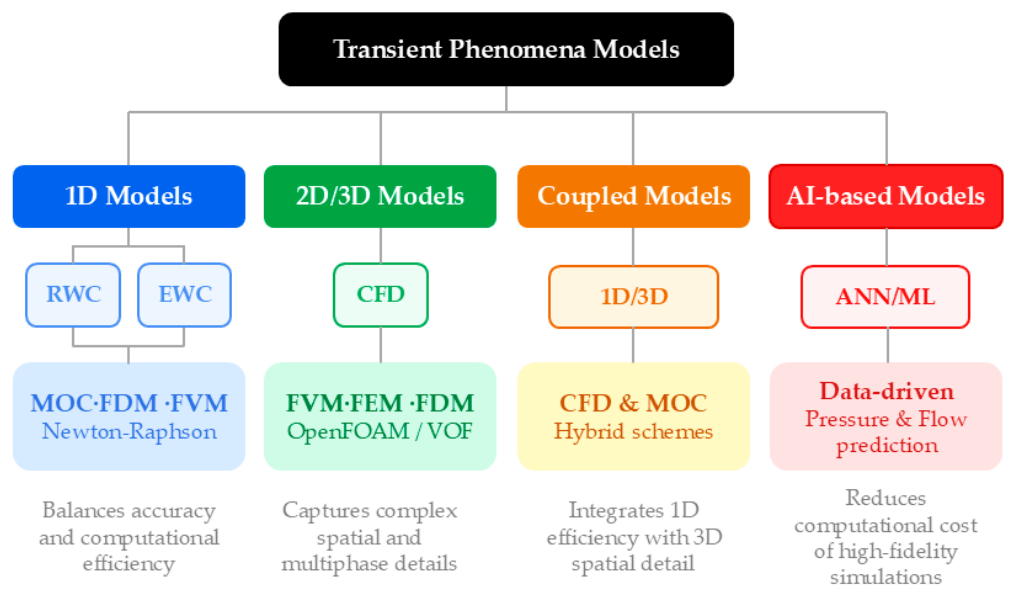
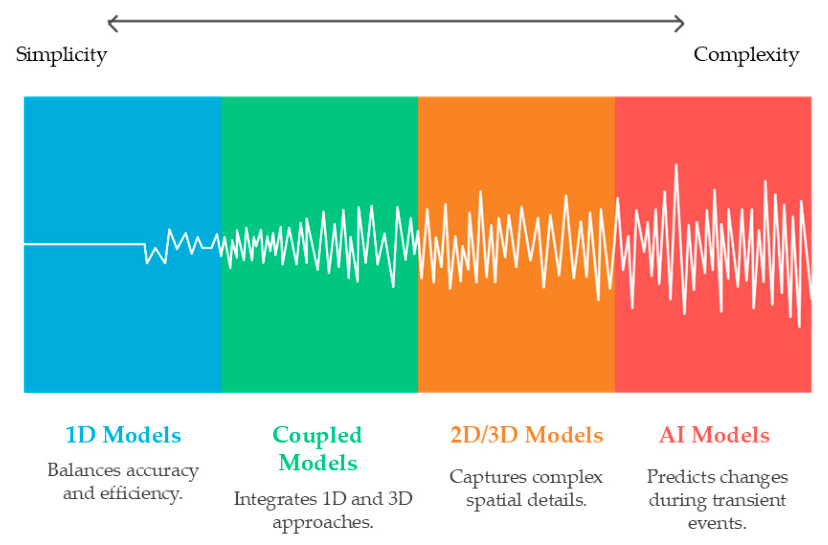
| 1D Models | This method is efficient and widely validated. It includes both RWC and EWC components, making it well suited for engineering design and real-time applications. | May overlook detailed spatial phenomena; accuracy is limited for rapid transients involving air interaction unless EWC is utilized. | Designing pressurized systems involves analyzing water hammer effects, utilizing surge tanks, and managing the processes of filling and emptying pipelines. |
| 2D/3D Models | High spatial and temporal resolution; captures detailed transient interactions including turbulence and multiphase flow. | Very high computational demand; difficult to apply to large-scale systems; requires detailed geometry and calibration. | Research settings, validation studies, multiphase flow analysis, and localized transient investigations. |
| Coupled Models | Combine accuracy of 3D with efficiency of 1D; adaptable to complex systems; enhance representativity while reducing cost. | Interface complexity; requires expertise in both domains; sensitive to model coupling and boundary definition. | Urban networks, smart water systems, integrated hydraulic and structural analyses. |
| AI based Models | Fast prediction once trained; can model nonlinear and complex behavior; useful for system monitoring and control. | Requires large and high-quality datasets; lacks physical interpretability; generalization can be limited. | Real-time monitoring, leak detection, failure prediction, and performance optimization. |
| Reference | Model or Method | Application or Context | Key Findings/Relevance for Emptying Modeling |
|---|---|---|---|
| Fuertes-Miquel et al. (2019) [11] | Comprehensive literature review on filling and emptying models | Synthesis of transient models and identification of research gaps | Highlights scarcity of studies on elastic behavior during emptying; identifies key gaps in two-phase transient modeling. |
| Liu et al. (2011) [61] | Rigid-Plug Elastic-Water Model (EWC) | Transient flow in pipes with entrapped air (elastic coupling) | Demonstrates elastic coupling of air-water phases; forms theoretical basis for extending EWC to emptying. |
| Fuertes-Miquel et al. (2019) [27] | Transient analysis of single-pipe emptying with air-water interaction | Experimental and numerical analysis of air-water interface dynamics | Shows importance of air-pocket dynamics and heat transfer in emptying phenomena. |
| Laanearu et al. (2012) [28] | Experimental study of large-scale pipeline emptying with pressurized air | Experimental validation of air-pocket motion and transient pressure | Confirms influence of air elasticity on water-column motion; key for model calibration. |
| Romero et al. (2020) [29] | Large-scale experiments of emptying operations in hydraulic systems | Validation of transient behavior in real-scale drainage systems | Bridges laboratory and field-scale transients; underlines challenges in scaling elastic effects. |
| Coronado-Hernández et al. (2018) [53] | Rigid Water Column Model for pressurized-air-driven emptying | Simulation of air-pressurized emptying events | Validates RWC formulation; supports EWC development with air compressibility effects. |
| Coronado-Hernández et al. (2018) [54] | Subatmospheric pressure analysis with air pocket in draining pipeline | Analysis of negative pressure and air-pocket effects during drainage | Quantifies subatmospheric pressure and backflow during draining; essential for validation. |
| Coronado-Hernández et al. (2017) [55] | Mathematical model for emptying operations in supply networks | Elastic formulation for network-scale emptying operations | Provides conceptual framework for network-scale EWC applications in emptying. |
| Besharat et al. (2018) [57] | Backflow and air-pocket analysis during emptying (CFD + 1D) | Pressure and backflow prediction in air-pocket-dominated events | Demonstrates coupled air-water transient modeling; useful for calibration of EWC and CFD. |
| Zhou et al. (2013) [62] | Thermodynamic study of air behavior during rapid filling | Comparison of adiabatic and quasi-isothermal air compression ( = 1.0–1.4) | Identifies time-dependent variation of (1.4 to 1.0) and its influence on pressure prediction. |
| Zhou et al. (2019) [63] | Rapid air expulsion model through an orifice in vertical pipe | Simulation of air expulsion and transient pressure oscillations | Validates adiabatic assumption for first pressure peak; shows limits of constant m assumption. |
| Zhou et al. (2013) [67] | Virtual Plug Method (VPM) for air–water interface representation | Simulation of transients involving two entrapped air pockets in a pipeline | Introduces a simplified piston-type formulation for air–water interface motion; potentially adaptable to emptying processes. |
| Run | () | (m) | EWCM () | T1 Exp. () | εp T1 (%) | T2 Exp. () | εp T2 (%) |
|---|---|---|---|---|---|---|---|
| 1 | 0.457 | 0.205 | 8.027 | 7.995 | 0.40 | 8.028 | −0.02 |
| 2 | 0.457 | 0.340 | 8.232 | 8.225 | 0.08 | 8.212 | 0.24 |
| 3 | 0.457 | 0.450 | 8.348 | 8.298 | 0.61 | 8.304 | 0.53 |
| 4 | 0.457 | 0.205 | 8.211 | 8.199 | 0.14 | 8.199 | 0.14 |
| 5 | 0.457 | 0.340 | 8.346 | 8.311 | 0.42 | 8.304 | 0.50 |
| 6 | 0.457 | 0.450 | 8.465 | 8.456 | 0.11 | 8.449 | 0.18 |
| 7 | 0.515 | 0.205 | 8.055 | 8.048 | 0.09 | 8.015 | 0.50 |
| 8 | 0.515 | 0.340 | 8.097 | 8.087 | 0.12 | 8.068 | 0.37 |
| 9 | 0.515 | 0.450 | 8.243 | 8.212 | 0.37 | 8.206 | 0.45 |
| 10 | 0.515 | 0.205 | 8.189 | 8.146 | 0.52 | 8.140 | 0.60 |
| 11 | 0.515 | 0.340 | 8.279 | 8.232 | 0.58 | 8.225 | 0.66 |
| 12 | 0.515 | 0.450 | 8.341 | 8.311 | 0.36 | 8.304 | 0.44 |
Disclaimer/Publisher’s Note: The statements, opinions and data contained in all publications are solely those of the individual author(s) and contributor(s) and not of MDPI and/or the editor(s). MDPI and/or the editor(s) disclaim responsibility for any injury to people or property resulting from any ideas, methods, instructions or products referred to in the content. |
© 2026 by the authors. Licensee MDPI, Basel, Switzerland. This article is an open access article distributed under the terms and conditions of the Creative Commons Attribution (CC BY) license.
Share and Cite
Medrano-Barboza, J.P.; Fuertes-Miquel, V.S.; Coronado-Hernández, O.E. Applicability of the Elastic Water Column Method to Pressurized Pipeline Emptying: Dimensionless Pressure Analysis Under Different Air Pocket Configurations. Water 2026, 18, 1357. https://doi.org/10.3390/w18111357
Medrano-Barboza JP, Fuertes-Miquel VS, Coronado-Hernández OE. Applicability of the Elastic Water Column Method to Pressurized Pipeline Emptying: Dimensionless Pressure Analysis Under Different Air Pocket Configurations. Water. 2026; 18(11):1357. https://doi.org/10.3390/w18111357
Chicago/Turabian StyleMedrano-Barboza, Juan Pablo, Vicente S. Fuertes-Miquel, and Oscar E. Coronado-Hernández. 2026. "Applicability of the Elastic Water Column Method to Pressurized Pipeline Emptying: Dimensionless Pressure Analysis Under Different Air Pocket Configurations" Water 18, no. 11: 1357. https://doi.org/10.3390/w18111357
APA StyleMedrano-Barboza, J. P., Fuertes-Miquel, V. S., & Coronado-Hernández, O. E. (2026). Applicability of the Elastic Water Column Method to Pressurized Pipeline Emptying: Dimensionless Pressure Analysis Under Different Air Pocket Configurations. Water, 18(11), 1357. https://doi.org/10.3390/w18111357