Article

Potential Impact of Interannual Variation in April Sea Ice of Barents–Kara Seas on Meiyu Length over the Yangtze–Huaihe River Basin, China


1
Department of Mathematics and Physics, Suzhou Polytechnic University, Suzhou 215104, China
2
Suzhou Dahuan Technology Co., Ltd., Suzhou 215010, China
3
School of Atmospheric Sciences, Nanjing University of Information Science & Technology, Nanjing 210044, China
4
School of Mathematics, Jilin University, Changchun 130012, China
5
China Liaoning Geology and Mineral Resources Institute Co., Ltd., Shenyang 110032, China
*
Author to whom correspondence should be addressed.
Water 2026, 18(11), 1356; https://doi.org/10.3390/w18111356
Submission received: 24 April 2026 / Revised: 27 May 2026 / Accepted: 1 June 2026 / Published: 3 June 2026

Abstract

The Meiyu season over the Yangtze–Huaihe River Basin exhibits pronounced interannual variability and directly reflects the persistence of the East Asian summer rainband. This study examined the relationship between the preceding April sea ice anomaly of the Barents–Kara seas and Meiyu length during 1979–2023 based on CN05.1 precipitation, ERA5, HadISST sea ice concentration datasets, and Indo-Pacific SST index. A statistically significant inverse relationship was identified between the interannual Meiyu Length and the preceding April Barents–Kara seas sea ice anomaly, with the strongest signal located over the core Barents–Kara seas sector and a filtered Barents–Kara seas sea ice index–Meiyu length index correlation coefficient of −0.662. Composite and regression analyses demonstrated that reduced interannual April Barents–Kara seas sea ice concentration is associated with a downstream Rossby-wave-like upper-tropospheric circulation pattern, leading to a clearer upper-level potential vorticity band and an intensified westerly jet that generates increased convergence over the Yangtze–Huaihe River Basin. Additionally, the north-low–south-high circulation contrast over the East Asian–western North Pacific sector during years with a longer Meiyu period, associated with an interannual reduction in the Barents–Kara seas sea ice index, contributes to enhanced moisture convergence and convection that drive stronger ascent over the Yangtze–Huaihe River Basin, favoring a more persistent Meiyu rainband and a longer Meiyu period.

1. Introduction

Meiyu is a prominent component of the East Asian summer rainy season over the Yangtze–Huaihe River Basin (YHRB), closely tied to the seasonal northward advance of the East Asian summer monsoon into the subtropical region of East Asia [1,2,3,4]. During early summer, the Meiyu rainband associated with the Meiyu–Baiu front typically appears as a quasi-stationary zonal belt extending from central-eastern China to Korea and Japan [5,6,7]. Meiyu anomalies over the YHRB can often cause severe floods and droughts, with profound impacts on regional agriculture, water resources, and socioeconomic development [8,9,10].
Previous related studies have shown that Meiyu over the YHRB is regulated by multiple circulation systems and external forcings on the interannual timescale [11,12,13,14,15]. The major circulation factors include the East Asian westerly jet, the western North Pacific subtropical high (WNPSH), the South Asian high, and mid–high-latitude blocking anomalies, all of which can modulate the position and persistence of the Meiyu rainband [16,17,18,19]. Additionally, sea surface temperature anomalies over the tropical Pacific Ocean, Indian Ocean, Arabian Sea, and tropical South Atlantic Ocean, as well as Arctic sea ice anomalies and land thermal forcing, are all associated with the YHRB Meiyu via their regulating impacts on these atmospheric systems [20,21,22,23,24,25,26]. Accordingly, considerable attention has been paid to anomalies of the Meiyu onset date (MOD), Meiyu withdrawal date (MWD), and Meiyu seasonal rainfall over the YHRB [22,27,28,29,30,31,32,33], whereas few studies have directly investigated Meiyu length (ML). Because ML reflects the persistence of the Meiyu rainband over the YHRB, it provides a useful perspective for understanding sustained floods and droughts in East Asia.
Increasingly, Arctic sea ice is becoming recognized as an important high-latitude forcing for East Asian summer climate and precipitation [34,35,36,37,38]. Previous studies suggested that spring Arctic sea ice anomalies can affect East Asian rainfall through downstream wave-train-like circulation anomalies over Eurasia, changes in the upper-level jet, and circulation responses over the western North Pacific [39,40,41,42]. Specific to the YHRB, recent studies have shown that spring sea ice in the Barents–Kara seas (BKS) can modulate the MOD [27,28,29], while early spring Arctic sea ice can also influence the MWD through a meridional circulation contrast over the East Asian–western North Pacific sector [22,32]. Additionally, Arctic sea ice loss along the Siberian coast was found to have intensified the 2020 record-breaking Meiyu–Baiu rainfall through its impact on East Siberian blocking and associated cold air outbreaks into the frontal zone [10]. Moreover, sea ice loss along the Eurasian Arctic coast, especially that of the Kara Sea, has been shown to prolong the Meiyu–Baiu season and strengthen convective activity under the background of Indian Ocean warming [26].
Although substantial progress has been made in understanding the influences of Arctic sea ice on Meiyu onset, withdrawal, seasonal rainfall anomalies, and occurrence of extreme Meiyu events over the YHRB, direct investigation of ML remains limited [4,6]. Because ML is closely related to the persistence of the Meiyu rainband over the YHRB, it provides a useful metric for assessment of sustained flood–drought risk in eastern China. From this perspective, the key questions are whether the spring BKS sea ice anomaly is a useful precursor signal of interannual variability of ML and how this forcing is physically linked to the subsequent circulation, moisture, and convective anomalies over the YHRB.
To address these issues, this study investigated the interannual variability of ML over the YHRB during 1979–2023 and examined its relationship with the BKS sea ice anomaly in the preceding April. The remainder of this paper is organized as follows. Section 2 introduces the data and methods used in the study. Section 3 presents the Meiyu characteristics over the YHRB, the circulation background associated with ML variability, and discusses the possible role of April BKS sea ice in the interannual variability of ML. Finally, Section 4 summarizes the derived conclusions and discussion.

2. Data and Methods

2.1. Data

Daily precipitation data spanning 1979–2023 were extracted from the CN05.1 gridded dataset (horizontal resolution: 0.25° × 0.25°) interpolated using station-based rainfall observations from across China [43]. For each grid point, the Meiyu season precipitation was defined as the cumulative rainfall in June and July averaged daily from 1 June to 31 July for every individual year. Monthly atmospheric circulation variables for the period 1979–2023 were sourced from the fifth-generation reanalysis product of the European Centre for Medium-Range Weather Forecasts (ERA5) [44]. The ERA5 isobaric data span 37 pressure levels from 1000 to 1 hPa, with horizontal grid spacing of 0.25° × 0.25°. The monthly mean moisture flux divergence data vertically integrated over 1000–300 hPa were also extracted from the ERA5 archive, with horizontal resolution of 0.25° × 0.25°. Monthly mean sea ice concentration (SIC) data, acquired from the Hadley Centre Sea Ice and Sea Surface Temperature (HadISST1) dataset [45], also covered the period 1979–2023. In addition, the monthly Pacific decadal oscillation (PDO) index was derived from the National Oceanic and Atmospheric Administration (NOAA) National Centers for Environmental Information. The monthly Indian Ocean Dipole (IOD) Mode Index (DMI) was taken from the NOAA Climate Prediction Center. The monthly Niño 3.4 index which represents sea surface temperature anomalies in the central equatorial Pacific and used to indicate El Niño–Southern Oscillation (ENSO) variability was obtained from the NOAA Physical Sciences Laboratory [46].

2.2. Definition of the ML over the YHRB Region

Based on the Meiyu Monitoring Indices issued by the China Meteorological Administration in 2017 (GB/T 33671-2017) [47], MOD in this study was determined as follows. (a) Define a certain day as a rainy day over the YHRB (28–34° N, 110–122.5° E) when at least 93 of the 277 monitoring stations recorded daily precipitation of no less than 0.1 mm day−1, and the basin-averaged daily precipitation reached or exceeded 2.0 mm day−1. (b) If rainy days accounted for at least 50% of the total days within consecutive windows of 2–10 days beginning from a candidate rainy day, that day was designated as the start of a rainy period. The Meiyu season might comprise multiple rainy periods; therefore, the onset date of the first rainy period was defined as the MOD, and the withdrawal date of the final rainy period was defined as the MWD. The ML was then calculated as the total number of days from the MOD to the MWD, with both the onset and withdrawal dates included.

2.3. Methods

The TN horizontal wave activity flux (W) used in this study was derived by Takaya and Nakamura based on the Plumb wave flux, which is suitable for diagnosing the propagation anomaly in the mid–high latitudes [48,49,50]. The value of W can be calculated using the following formula:
W = p 2 U U ψ x 2 ψ ψ x x + V ψ x ψ y ψ ψ x y U ψ x ψ y ψ ψ x y + V ψ y 2 ψ ψ y y
where ψ represents the quasi-geostrophic perturbation stream function, and U represents the horizontal wind speed.
Climatologically, Meiyu rainfall in China occurs from early June to mid-July over a broad region extending from south of the Yangtze River to the Huaihe Basin [1,51,52]. Accordingly, in this study, the period of June–July (JJ) was defined as the Meiyu season. The circulation characteristics during the Meiyu season were derived by averaging the monthly circulation fields in June and July for each year. The analysis period considered in this study covered 1979–2023.
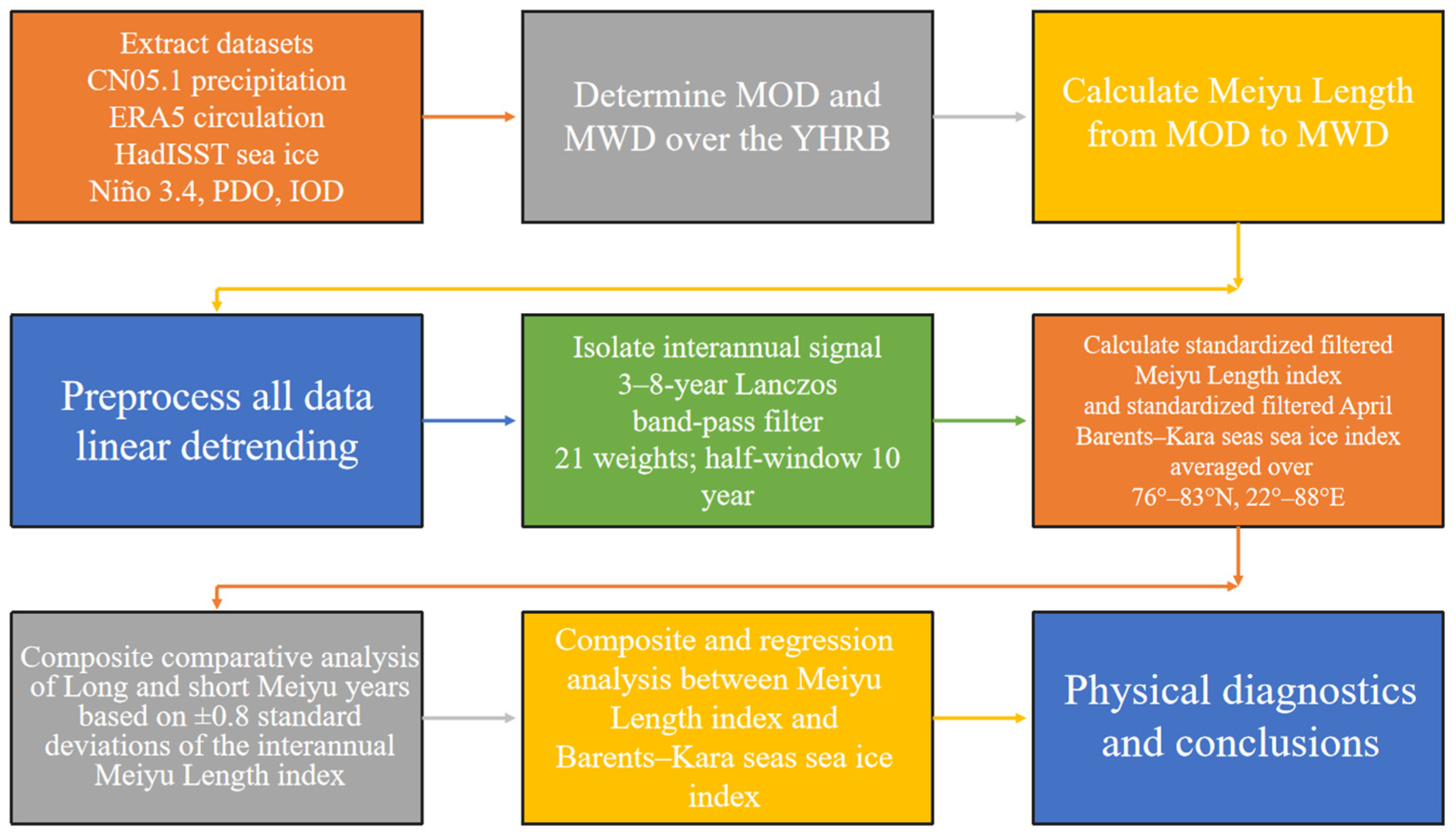
All data in this study were linearly detrended prior to eliminating the possible influence of global warming, and help reveal the underlying physical mechanisms. A 3–8-year Lanczos band-pass filter with 21 weights was then applied to isolate the interannual component to better reflect the interannual characteristics of Meiyu variability. The half-window length was 10 years. The statistical significance of the composite analyses and regression results was assessed using a two-tailed Student’s t-test. The overall methodological framework used in this study is summarized in Figure 1.

3. Results

3.1. Overview of Meiyu over the YHRB

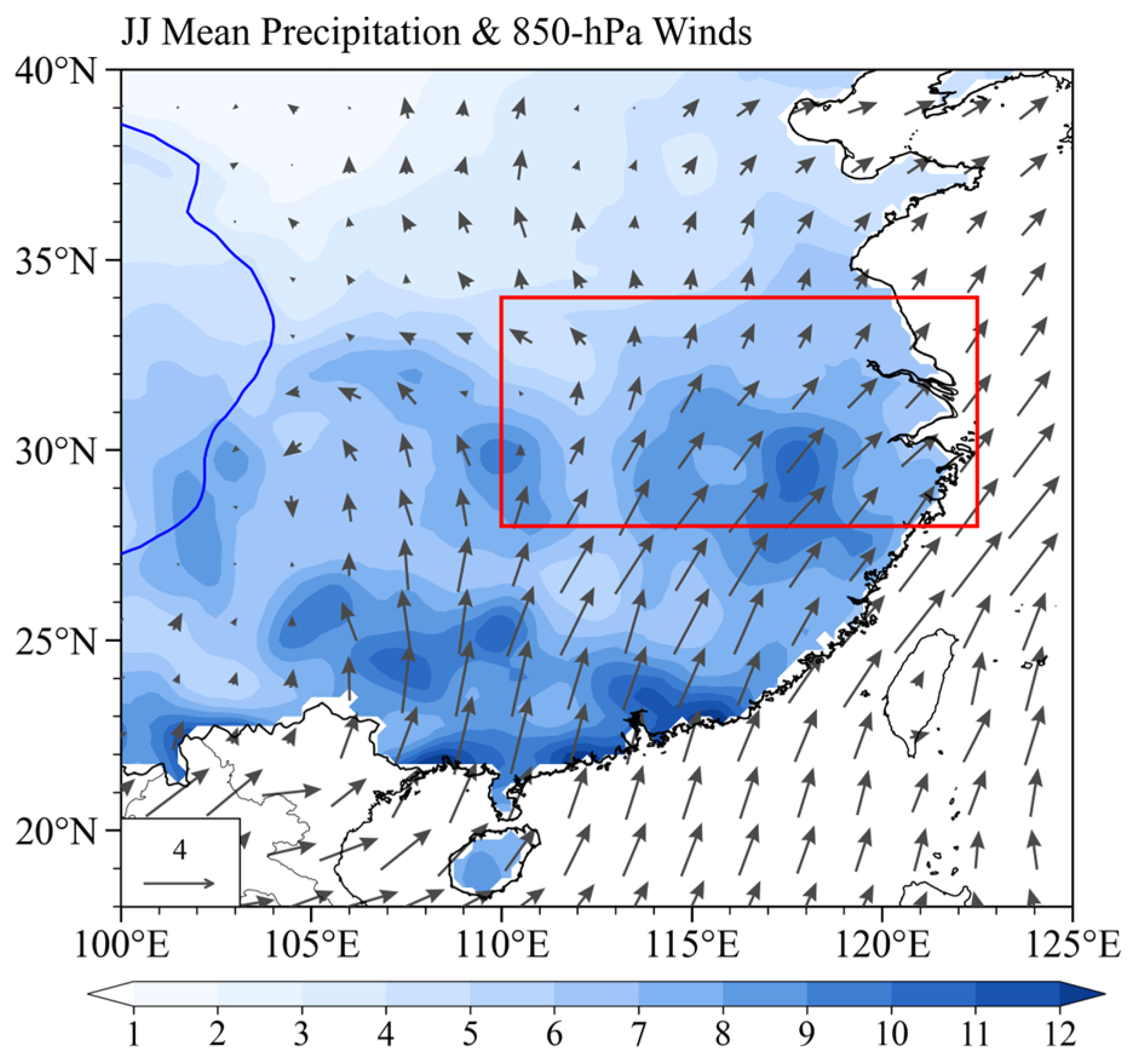
In accordance with GB/T 33671-2017, Figure 2 presents the climatological mean JJ precipitation during 1979–2023. The red rectangle (28–34° N, 110–122.5° E) marks the YHRB Meiyu region, which lies beneath a zonally elongated rainband extending from central-eastern China to the adjacent coastal seas [27,32]. Meanwhile, low-level (850-hPa) southwesterly to southerly winds are evident over the YHRB and to its south, providing favorable moisture transport into the Meiyu region.
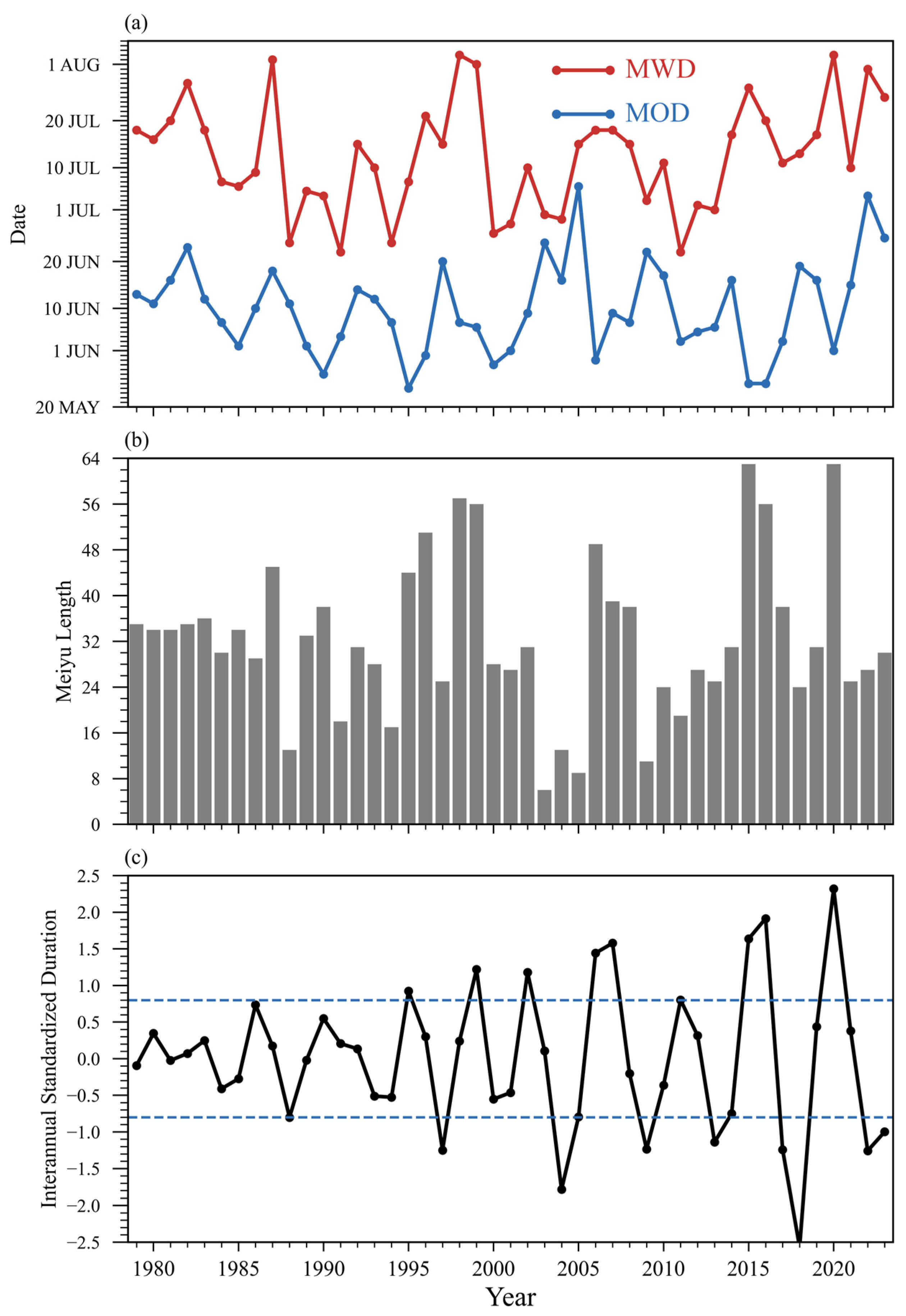
Figure 3 presents the temporal evolution of the MOD, MWD, and ML over the YHRB during 1979–2023. Both MOD and MWD exhibit evident interannual variability (Figure 3a), and ML also shows pronounced interannual fluctuations, with substantial differences among individual years (Figure 3b). To extract the interannual signal, a Lanczos band-pass filter was applied to the ML index (MLI), and the filtered time series reveals clear low-frequency fluctuations with alternating positive and negative phases (Figure 3c). Based on the filtered MLI, years with anomalies exceeding +0.8 standard deviations were classified as longer Meiyu years, i.e., 1995, 1999, 2002, 2006, 2007, 2011, 2015, 2016, and 2020, whereas years with anomalies below −0.8 standard deviations were classified as shorter Meiyu years, i.e., 1988, 1997, 2004, 2009, 2013, 2017, 2018, 2022, and 2023 (Figure 3c). These two groups of years served as the basis for the composite analyses in the following sections, and the ML is further examined from the interannual band-pass-filtered perspective to reveal its interannual variability.

3.2. Circulation Characteristics of Meiyu over the YHRB

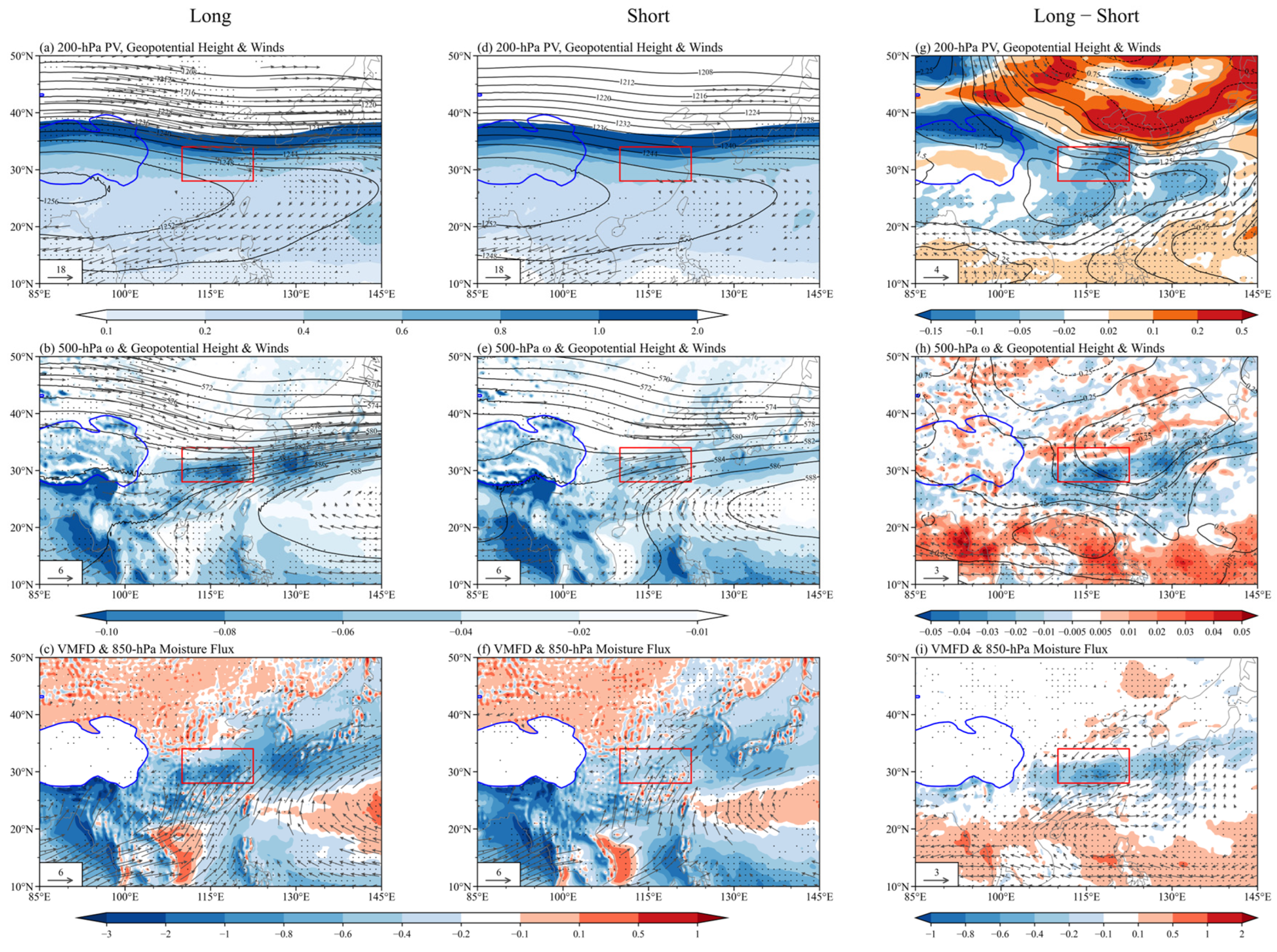
To understand the large-scale atmospheric conditions associated with ML variability, composite analyses of the circulation and moisture anomalies for longer and shorter Meiyu years are presented in Figure 4. Longer and shorter Meiyu years were defined by the positive and negative phases of the MLI, as described in Section 3.1, and the composite differences were calculated as longer Meiyu years minus shorter Meiyu years. In longer Meiyu years, the upper troposphere over East Asia is characterized by a clear potential vorticity (PV) band, accompanied by a stronger westerly jet on the northeastern flank of the Meiyu monitoring domain (MMD), triggering divergence in the upper troposphere and convergent ascent in the mid–lower troposphere (Figure 4a). In the mid-troposphere, clear upward motion appears over the MMD, while positive geopotential height anomalies are evident over the subtropical western North Pacific (Figure 4b). Consequently, the YHRB lies along the northwestern flank of the stronger and more westward-extending WNPSH, which promotes the transport of warm and moist air into the YHRB (Figure 4b). Accordingly, southwesterly moisture transport extends into the YHRB, and a negative center of vertically integrated moisture flux divergence (VMFD) is anchored over the MMD in the lower troposphere, indicating robust regional moisture convergence (Figure 4c) [2,3,4,5]. In contrast, shorter Meiyu years are marked by a diffuse PV band and a less distinct upper-level westerly jet near the MMD (Figure 4d,g). The YHRB is no longer covered by a well-developed center of ascent, and the southwesterly moisture transport and the center of negative VMFD are also weaker than in longer Meiyu years, suggesting an obviously weaker background circulation (Figure 4e,f,h,i).
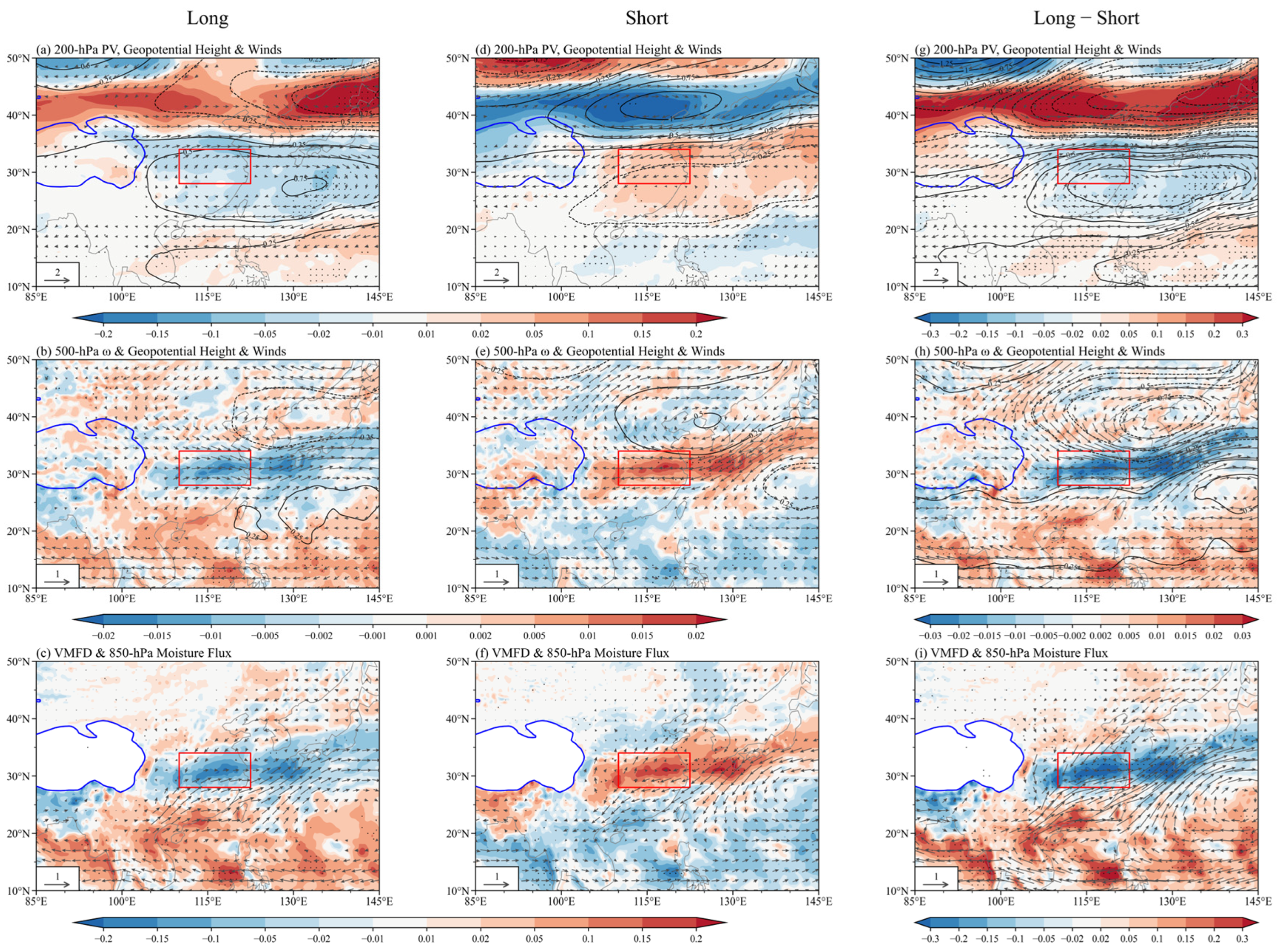
The major circulation and moisture anomalies associated with ML remain clearly visible after applying the interannual Lanczos band-pass filter in Figure 5. In longer Meiyu years, the upper troposphere over East Asia is still characterized by a clear PV band and a distinct westerly jet on the northeastern side of the MMD (Figure 5a). Meanwhile, a pronounced center of ascent is evident over the MMD, and positive geopotential height anomalies persist over the subtropical western North Pacific, placing the YHRB along the northwestern flank of the stronger WNPSH (Figure 5b). Under this background circulation, southwesterly moisture transport continues to extend into the YHRB, and the negative VMFD center remains anchored over the MMD, indicating sustained regional moisture convergence (Figure 5c). In shorter Meiyu years, the corresponding anomalies are much less organized: the PV band is diffuse, the westerly jet near the MMD is weakened, and the center of ascent over the YHRB is no longer established over the MMD (Figure 5d,e). Moreover, the southwesterly moisture transport is confined further south, and the moisture convergence over the MMD is much weaker (Figure 5f). The direct differences between longer and shorter Meiyu years further highlight these interannual signals. Compared with shorter Meiyu years, longer Meiyu years exhibit stronger upper-level westerlies on the northeastern flank of the MMD (Figure 5g). Longer Meiyu years are also accompanied by a clearer center of ascent over the YHRB and a more distinct north-low–south-high circulation contrast over the East Asian–western North Pacific sector (Figure 5h). Additionally, southwesterly moisture transport into the YHRB is stronger, and the negative VMFD center over the MMD is more concentrated.
These results indicate that the interannual variability of ML is closely tied to a stable circulation–moisture configuration, with the most prominent signals being sustained ascent and moisture convergence over the YHRB. Previous related studies suggested that Arctic sea ice can affect Meiyu variability through large-scale circulation adjustment over East Asia and the western North Pacific [20,32]. Therefore, the relationship between spring BKS SIC and the interannual variability of ML over the YHRB is further examined in Section 3.3.

3.3. Role of BKS Sea Ice in Interannual Variability of ML over the YHRB

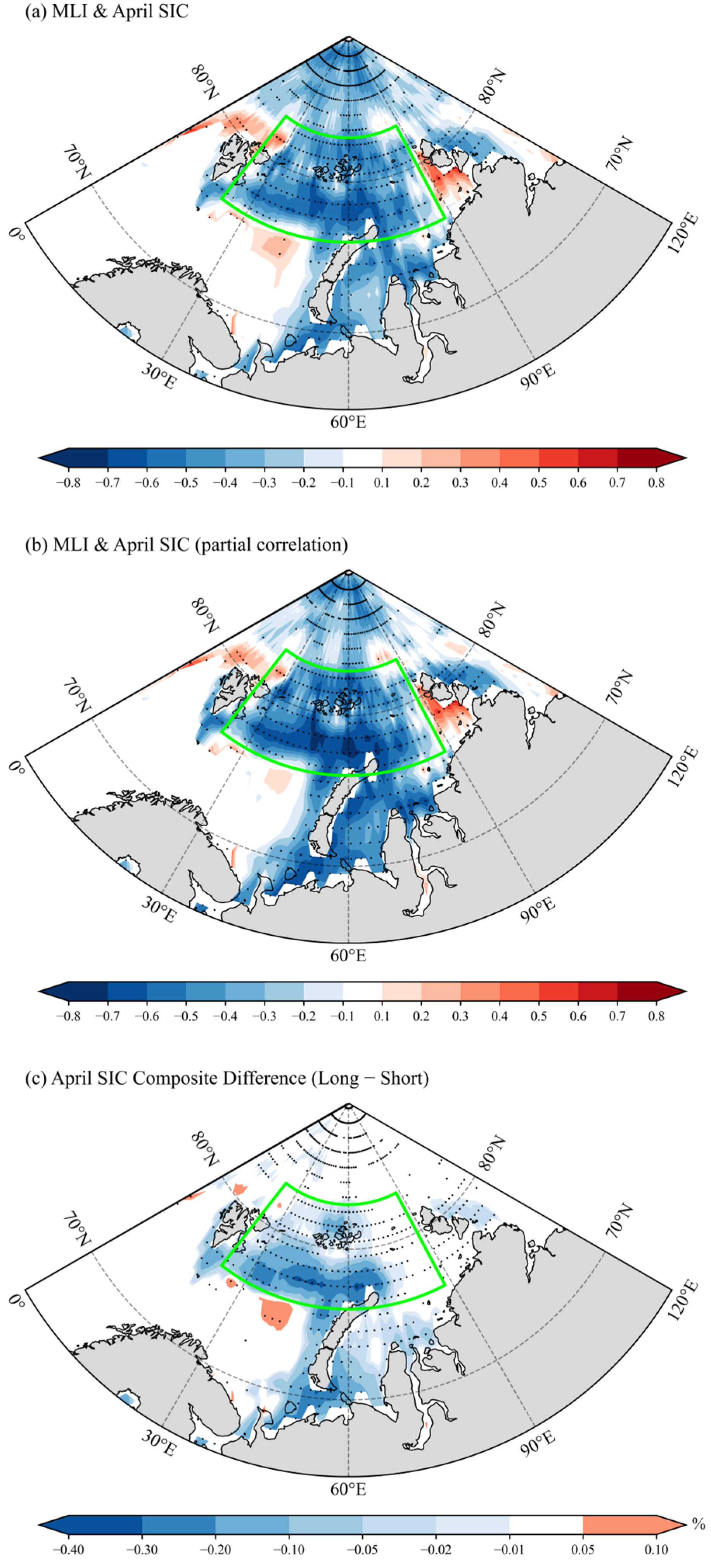
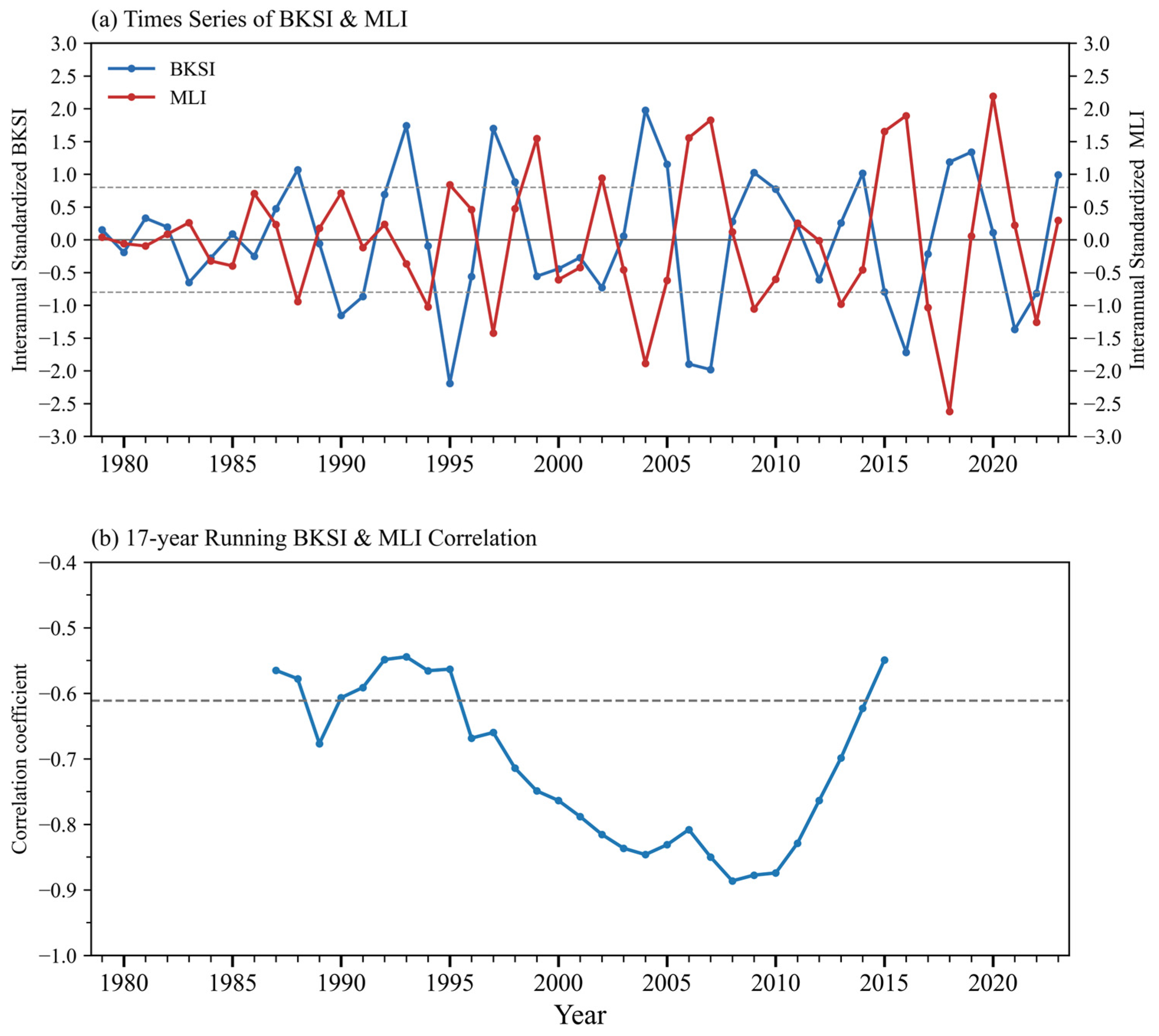
To address the role of the spring BKS SIC in the interannual variability of the ML over the YHRB region, Figure 6a illustrates the spatial correlation coefficients between the interannual Lanczos band-pass-filtered component of the MLI and the interannual Lanczos band-pass-filtered component of the April SIC. The most notable negative SIC anomalies are located over the BKS region (76–83° N, 22–88° E), and the maximum correlation coefficient exceeds −0.8, indicating that the BKS sector is the key Arctic region linked to the interannual variability of ML over the YHRB. Considering the possible influence of Indo-Pacific SST variability on Meiyu [53,54,55], partial correlations were further calculated after removing the linear relationships with the Niño 3.4, PDO, and IOD indices. As shown in Figure 6b, the negative correlation between the interannual variability of the April BKS SIC and the SIC over the key BKS region is still evident after quantitatively controlling Indo-Pacific SST variability, further highlighting the prominent role of April BKS SIC in the interannual variability of the ML. To facilitate the following analysis, the standardized interannual Lanczos band-pass-filtered component of area-averaged April SIC over the key BKS region is defined as the BKS sea ice index (BKSI), and the standardized interannual Lanczos band-pass-filtered component of ML is defined as the ML index (MLI). As shown in Figure 6c, longer Meiyu years are accompanied by evident negative SIC anomalies over the key BKS region, relative to those in shorter Meiyu years. Figure 7a further shows an apparent out-of-phase relationship between the regional mean BKSI and the standardized MLI, with a correlation coefficient of −0.662, indicating that April BKSI explains approximately 43.8% of the interannual ML variance. This result indicates that April BKSI accounts for a substantial fraction of the interannual variance of MLI. To further examine the temporal robustness of this relationship, a 17-year running correlation is calculated between the filtered BKSI and MLI, as shown in Figure 7b. The correlation coefficients calculated within each 17-year moving period remain negative, indicating that the inverse BKSI–MLI relationship is not confined to a specific subperiod. However, the magnitude of the correlation varies over time, with a stronger relationship from the late 1990s to around 2010 and a relatively weaker relationship before the mid-1990s and after 2010. Therefore, the relationship between the interannual BKSI and MLI is robust in sign while exhibiting decadal modulation in strength, and the reduced April BKS SIC represents an important precursor signal of the interannual variability of ML over the YHRB.
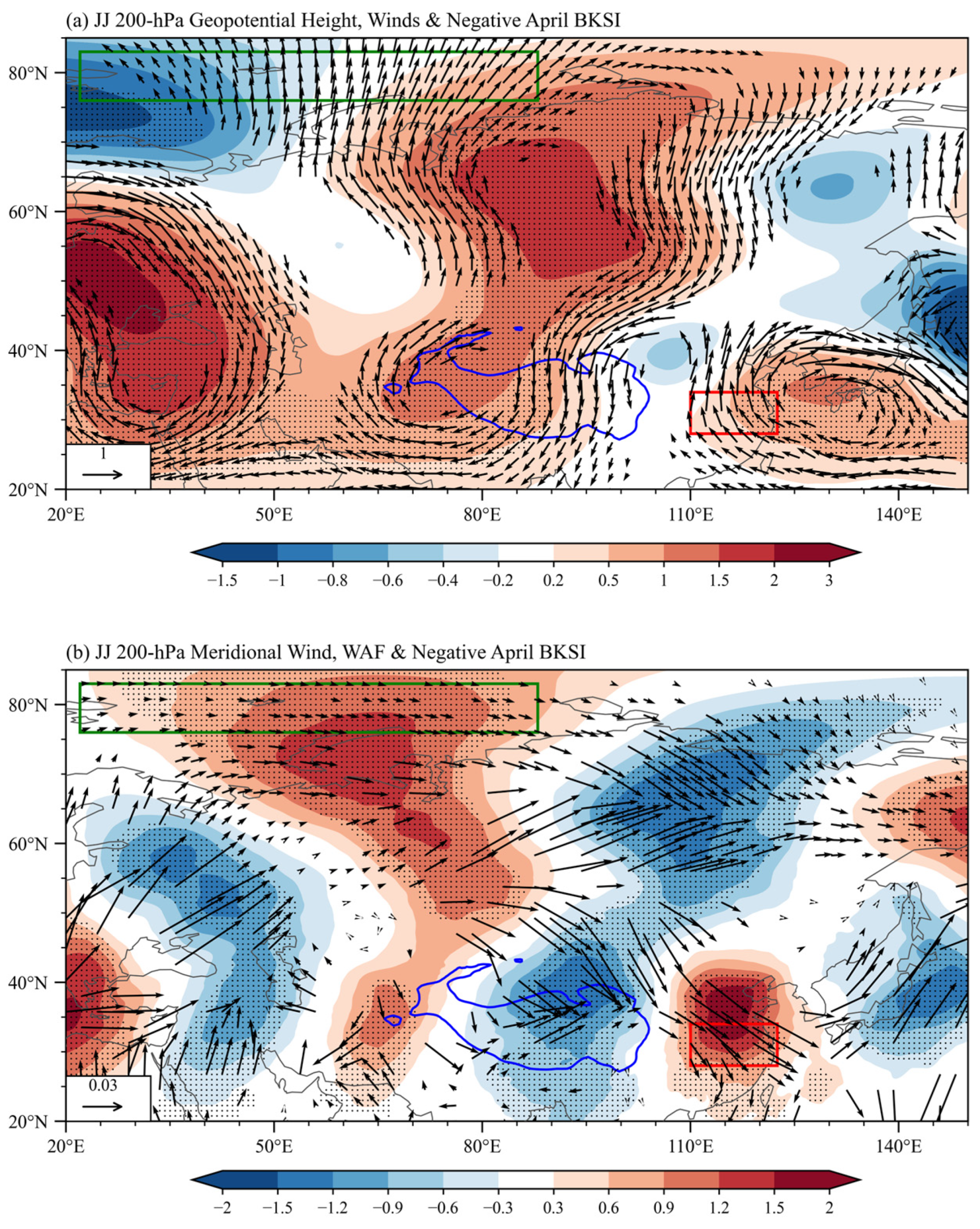
Sea ice in the BKS sector can affect the Meiyu by regulating the large-scale circulation over East Asia and the western North Pacific [20,32]. Previous related studies suggested that the relevant upper-level factors mainly include the Eurasian wave-like circulation and the East Asian westerly jet [4,16]. Figure 7a illustrates that the sign-reversed April BKSI is associated with a downstream Rossby-wave-like geopotential height anomaly pattern extending from Eurasia to East Asia. Over the East Asian–western North Pacific, negative height anomalies are located to the north of the YHRB, whereas positive height anomalies appear over the subtropical western North Pacific (Figure 8a), enhancing the meridional geopotential height gradient over East Asia and contributing to a strengthened East Asian subtropical jet. Meanwhile, enhanced anomalous westerlies dominate the northeastern side of the YHRB (Figure 8a).
A similar upper-level Eurasian wave-like circulation pattern is also observed in the meridional wind anomalies (Figure 8b). Positive meridional wind anomalies are located over the BKS region and the MMD, whereas negative anomalies are seen over northeastern Asia and the area east of the Tibetan Plateau, indicating that wave energy propagates eastward along the high-latitude Eurasian waveguide before turning southeastward toward East Asia and the northwestern Pacific (Figure 8b). This circulation pattern favors intrusion of warm and moist air into the YHRB (Figure 9a), thereby increasing specific humidity over the YHRB (Figure 9b) and ultimately contributing to maintenance of the Meiyu over the YHRB.
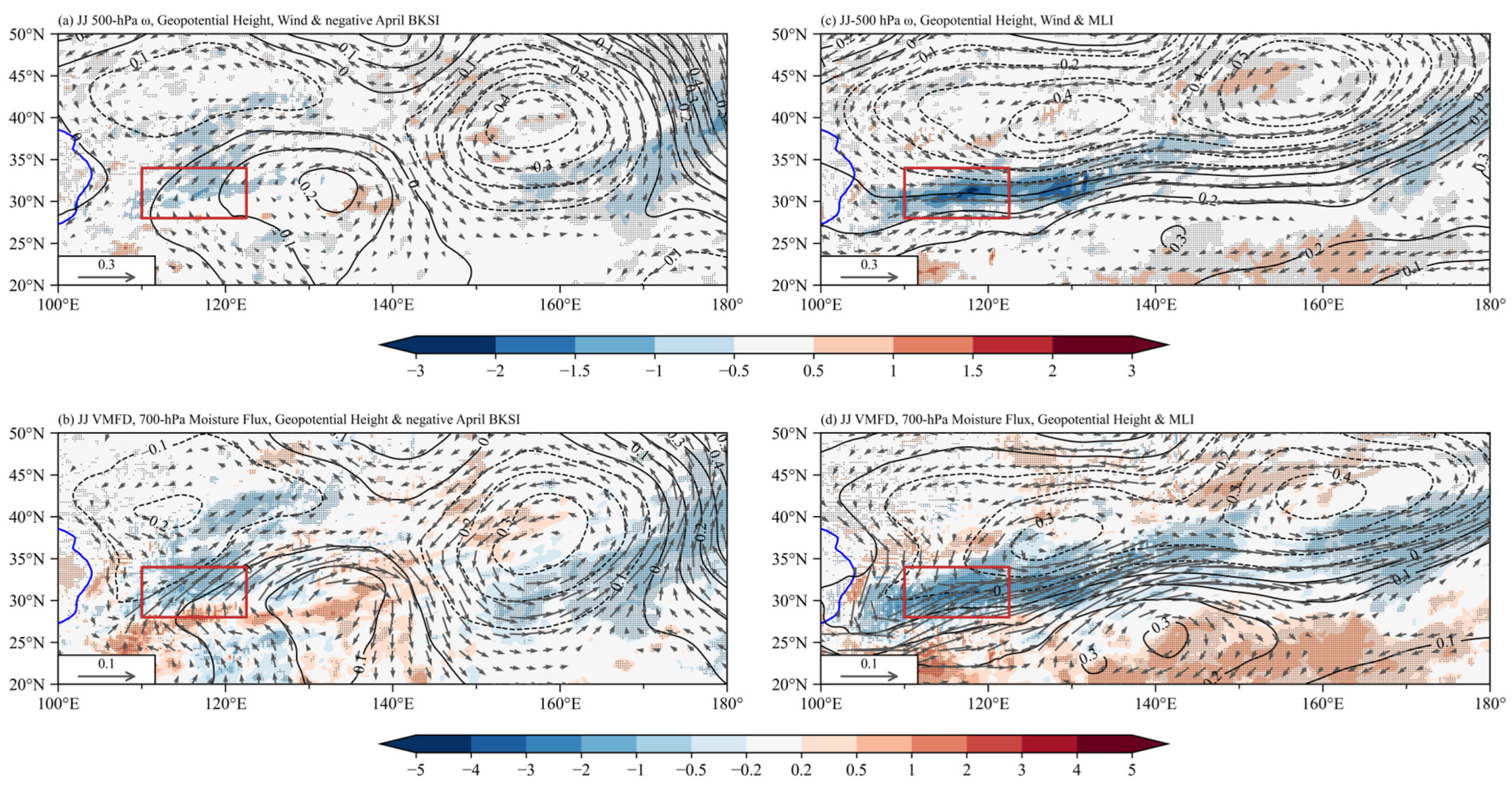
In the middle troposphere, the BKSI-related circulation further reflects the dynamic background favorable for a longer Meiyu period. As shown in Figure 9a, the sign-reversed April BKSI is associated with negative anomalous vertical velocity over the MMD, indicating enhanced regional ascent. Moreover, negative height anomalies appear to the north of the YHRB, whereas positive height anomalies are located over the subtropical western North Pacific, and a cyclonic anomaly is centered over the Sea of Japan (Figure 9a). This meridional contrast reflects a cyclonic circulation background to the north of the YHRB and an anticyclonic circulation background over the western North Pacific, indicating an enhanced and maintained WNPSH (Figure 9a). Such a circulation pattern also leads to the strengthened southwesterly moisture transport that contributes to a longer Meiyu period (Figure 9a) [2,16]. The MMD is located between these two anomaly centers, reflecting a north-low–south-high meridional seesaw background, favoring the persistence of ascent over the YHRB (Figure 9a) [22,32]. Figure 9c presents a similar but stronger pattern in association with the MLI. A zonally elongated negative vertical velocity band appears along 30–35° N, and the meridional contrast between the northern negative height anomalies and the southern positive height anomalies becomes clearer (Figure 9c). Under the favorable upper-level jet background shown in Figure 8, the mid-tropospheric circulation provides dynamic conditions more favorable for sustained ascent over the YHRB, contributing to maintenance of the Meiyu rainband (Figure 9a,c) [4,16].
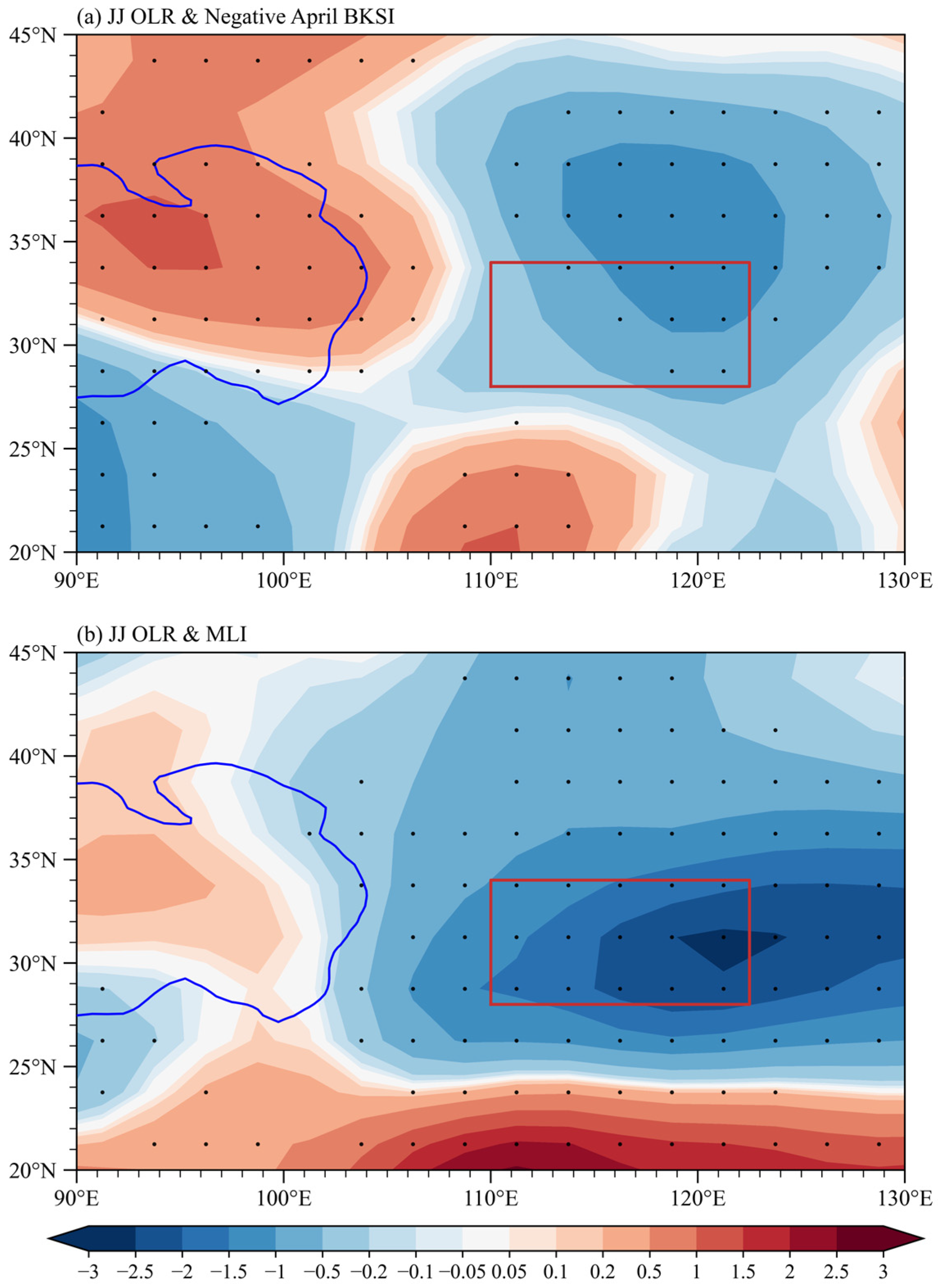
The lower-tropospheric moisture distribution provides direct evidence for the local response of the Meiyu rainband. In association with the sign-reversed April BKSI, enhanced southwesterly moisture transport is directed toward the YHRB, and negative VMFD anomalies are distributed over the MMD, implying stronger moisture convergence (Figure 9b). A northerly airflow is also present on the northern side of the rainband. In combination with the southwesterlies on the southern side of the MMD, the anomalous northerlies create an environment with stronger convergence over the YHRB (Figure 9b). In the MLI regression, the overall pattern remains similar but becomes stronger. The negative VMFD anomalies are more continuous along 28–35° N, and the southwesterly moisture transport is more organized (Figure 9d). This feature suggests that a prolonged Meiyu is closely related to sustained moisture supply and enhanced low-level convergence over the YHRB, which are important factors for the maintenance of the Meiyu rainband (Figure 9d) [12,16]. Negative outgoing longwave radiation anomalies are also found over the YHRB and its eastward extension in both the BKSI and MLI regressions, implying enhanced convective cloudiness and intensified latent heating over the MMD (Figure 10). Therefore, reduced April BKS SIC is associated with stronger moisture convergence and more active convection over the YHRB, favoring persistence of the Meiyu rainband and an extended ML (Figure 9b,d and Figure 10).
Therefore, reduced April BKS SIC is associated with the interannual variability of ML over the YHRB by modifying the subsequent large-scale circulation and local Meiyu environment. In association with the reduced BKS SIC, a wave-like upper-tropospheric geopotential height anomaly pattern extends from Eurasia to East Asia (Figure 8). Enhanced upper-level westerlies appear on the northeastern side of the YHRB, which favors upper-level divergence and the development of ascent (Figure 8). Meanwhile, negative height anomalies appear to the north of the YHRB, whereas positive height anomalies are located over the subtropical western North Pacific in the middle troposphere (Figure 9). The YHRB lies between these two anomaly centers, favoring sustained ascent over the Meiyu region (Figure 9). Furthermore, low-level southwesterly moisture transport and convergence are strengthened over the YHRB (Figure 9). Negative outgoing longwave radiation anomalies are also found over the YHRB and its eastward extension, suggesting enhanced convective activity over the Meiyu region (Figure 10). These factors combine to maintain the Meiyu rainband over the YHRB, leading to an extended Meiyu period.

4. Conclusions and Discussion

This study examined the interannual variability of ML over the YHRB and explored the potential role of the preceding April BKS SIC during 1979–2023. Typically, ML is characterized by pronounced interannual variability, reflecting remarkable year-to-year variations in the persistence of this East Asian summer rainband.
The variability of ML is closely linked to the persistence of large-scale dynamics and moisture conditions over the YHRB. Longer-than-normal Meiyu years are characterized by a clearer upper-level PV band and a stronger westerly jet, whether on the full or interannual scale, which intensifies ascent and moisture convergence over the YHRB, thereby maintaining the persistent rainband and thus contributing to an extended ML.
A statistically significant inverse relationship is identified between the MLI and the preceding April BKS sea ice anomaly on the interannual scale. The strongest negative correlation is located over the core BKS sector, and the correlation coefficient between the Lanczos-filtered MLI and BKSI reached −0.662, suggesting that the April BKSI explains approximately 43.8% of the interannual ML variance. The negative correlation remained evident after removing the linear effects of the Niño 3.4, PDO, and IOD indices, and the 17-year running correlation stayed negative throughout all moving windows, indicating that the April BKSI is a robust Arctic precursor signal of ML variability over the YHRB.
Reduced interannual April BKS SIC is followed by a downstream Rossby-wave-like upper-tropospheric circulation pattern extending from Eurasia to East Asia, enhancing the westerly jet in the upper troposphere on the northeast flank of the YHRB. Meanwhile, accompanied by the strengthened East Asian subtropical jet, ascending motion associated with convergence in the middle and lower levels occurs over the YHRB. Additionally, a north-low–south-high circulation contrast over the East Asian–Western North Pacific sector promotes continuous transport of warm and moist monsoonal air into the YHRB, which results in enhanced regional convection over the YHRB that contributes to the maintenance of the Meiyu rainband. The structural resemblance between the BKSI-related and MLI-related circulation and moisture patterns, together with the consistency between the regression and composite analyses, corroborates the robustness of this physical linkage. Reduced spring BKS SIC is therefore associated with a prolonged Meiyu season over the YHRB, while enhanced spring BKS SIC tends to correspond to a shortened one.
In summary, these results represent a physically interpretable framework for how reduced April BKS SIC might be associated with the persistence of the East Asian summer Meiyu rainband on the interannual scale. The present analyses were based mainly on observational diagnosis and monthly mean circulation patterns. Numerical experiments are needed to verify the causality of the BKS forcing and to quantify its role in comparison with that of other large-scale climate signals. The possible influences of tropical sea surface temperature forcing, monsoon circulation variability, and other mid–high-latitude processes on Meiyu persistence also deserve further examination. The stability of the BKS–ML relationship on longer timescales is another issue that should be addressed in future work.

Author Contributions

Conceptualization, X.Z. (Xuejie Zhao), Z.S. and X.Z. (Xiaoqi Zhang); Formal Analysis, X.Z. (Xuejie Zhao), M.L. and W.X.; Funding Acquisition, X.Z. (Xuejie Zhao) and Z.S.; Investigation, X.Z. (Xuejie Zhao) and Z.S.; Methodology, X.Z. (Xuejie Zhao), M.L. and W.X.; Software, X.Z. (Xuejie Zhao) and W.X.; Validation, X.Z. (Xuejie Zhao), Z.S. and X.Z. (Xiaoqi Zhang); Writing—Original Draft, X.Z. (Xuejie Zhao); Writing—Review and Editing, X.Z. (Xuejie Zhao), Z.S. and Z.L. All authors have read and agreed to the published version of the manuscript.

Funding

This research was funded by the Research Center for Intelligent Data Inference and Secure Decision Making of Suzhou Polytechnic University (Grant No. KY2025PT10), the Joint Open Project of Key Laboratory of Meteorological Disaster, Ministry of Education & Collaborative Innovation Center on Forecast and Evaluation of Meteorological Disasters, Nanjing University of Information Science & Technology (Grant No. KLME202505) and the Industry–University–Research Cooperation Project of Jiangsu Province (Grant No. BY20251605).

Data Availability Statement

The CN05.1 dataset is available from https://nzc.iap.ac.cn/content?cid=24&aid=999 (accessed on 10 December 2025). The HadISST1 SIC data can be obtained from https://www.metoffice.gov.uk/hadobs/hadisst/data/download.html (accessed on 10 December 2025). The ERSST v5 data are available online at https://psl.noaa.gov/data/gridded/data.noaa.ersst.v5.html (accessed on 10 December 2025). The NCEP/NCAR reanalysis data are downloadable from https://psl.noaa.gov/data/gridded/data.ncep.reanalysis.derived.html (accessed on 10 December 2025). The ERA5 reanalysis dataset of the ECMWF can be obtained from https://cds.climate.copernicus.eu/datasets/reanalysis-era5-single-levels-monthly-means?tab=download (accessed on 10 December 2025). The PDO index is derived from https://www.ncei.noaa.gov/pub/data/cmb/ersst/v5/v6/index/ersst.v6.pdo.dat (accessed on 20 May 2026). The IOD index is taken from https://www.cpc.ncep.noaa.gov/products/international/ocean_monitoring/indian/IODMI/DMI_month.html (accessed on 20 May 2026). The Niño 3.4 index is obtained from https://psl.noaa.gov/data/timeseries/month/DS/Nino34/ (accessed on 20 May 2026).

Acknowledgments

The authors acknowledge the support of the 333 High Level Talent Training Project of Jiangsu Province.

Conflicts of Interest

Author Xuejie Zhao was employed by the company Suzhou Dahuan Technology Co., Ltd., Suzhou, China and author Zhunan Liu was employed by the company China Liaoning Geology and Mineral Resources Institute Co., Ltd., Shenyang, China. The remaining authors declare that the research was conducted in the absence of any commercial or financial relationship that could be construed as a potential conflict of interest.

Abbreviations

The following abbreviations are used in this manuscript:
MMDMeiyu monitoring domain
YHRB Yangtze–Huaihe River Basin
MODMeiyu onset date
MWDMeiyu withdrawal date
BKS Barents–Kara seas
JJ June–July
ML Meiyu length
SIC Sea ice concentration
WNPSH Western North Pacific subtropical high
PDOPacific decadal oscillation
DMIIndian Ocean Dipole Mode Index
WAFWave activity flux
OLROutgoing longwave radiation

References

  1. Tao, S.; Chen, L. A review of recent research on the East Asian summer monsoon in China. In Monsoon Meteorology; Oxford University Press: Beijing, China, 1987; pp. 60–92. [Google Scholar]
  2. Ding, Y.; Chan, J.C.L. The East Asian summer monsoon: An overview. Meteorol. Atmos. Phys. 2005, 89, 117–142. [Google Scholar] [CrossRef]
  3. Wang, B.; LinHo, X. Rainy season of the Asian–Pacific summer monsoon. J. Clim. 2002, 15, 386–398. [Google Scholar] [CrossRef]
  4. Ding, Y.; Liang, P.; Liu, Y.; Zhang, Y. Multiscale variability of Meiyu and its prediction: A new review. J. Geophys. Res. Atmos. 2020, 125, e2019JD031496. [Google Scholar] [CrossRef]
  5. Li, Y.; Deng, Y.; Yang, S.; Zhang, H. Multi-scale temporospatial variability of the East Asian Meiyu-Baiu fronts: Characterization with a suite of new objective indices. Clim. Dyn. 2018, 51, 1659–1670. [Google Scholar] [CrossRef]
  6. Liang, P.; Ding, Y. Climatologic characteristics of the intraseasonal oscillation of East Asian meiyu. Acta Meteorol. Sin. 2012, 70, 418–435. (In Chinese) [Google Scholar]
  7. Chen, T.; Wang, S.; Huang, W.; Yen, M. Variation of the East Asian Summer Monsoon Rainfall. J. Clim. 2004, 17, 744–762. [Google Scholar] [CrossRef]
  8. Ding, Y.; Liu, Y.; Hu, Z. The Record-breaking Mei-yu in 2020 andAssociated Atmospheric Circulation and Tropical SST Anomalies. Adv. Atmos. Sci. 2021, 38, 1980–1993. [Google Scholar] [CrossRef]
  9. Liu, C.; Hu, C.; Yang, S.; Lian, T.; Zhang, C.; Lin, L.; Cai, F. Extreme Mei-yu in 2020: Characteristics, causes, predictability and perspectives. Earth Sci. Rev. 2023, 246, 104597. [Google Scholar] [CrossRef]
  10. Chen, X.; Dai, A.; Wen, Z.; Song, Y. Contributions of Arctic Sea-Ice Loss and East Siberian Atmospheric Blocking to 2020 Record-Breaking Meiyu-Baiu Rainfall. Geophys. Res. Lett. 2021, 48, e2021GL092748. [Google Scholar] [CrossRef]
  11. Huang, R.; Chen, J.; Wang, L.; Lin, Z. Characteristics, processes, and causes of the spatio-temporal variabilities of the East Asian monsoon system. Adv. Atmos. Sci. 2012, 29, 910–942. [Google Scholar] [CrossRef]
  12. Ninomiya, K.; Shibagaki, Y. Multi-scale features of the Meiyu-Baiu front and associated precipitation systems. J. Meteorol. Soc. Jpn. 2007, 85B, 103–122. [Google Scholar] [CrossRef]
  13. Ding, Y.; Sun, Y.; Wang, Z.; Zhu, Y.; Song, Y. Inter-decadal Variation of the Summer Precipitation in China and Its Association with Decreasing Asian Summer Monsoon. Part II: Possible Causes. Int. J. Climatol. 2009, 29, 1926–1944. [Google Scholar] [CrossRef]
  14. Kosaka, Y.; Xie, S.-P.; Nakamura, H. Dynamics of Interannual Variability in Summer Precipitation over East Asia. J. Clim. 2011, 24, 5435–5453. [Google Scholar] [CrossRef]
  15. Yao, Y.; Lin, H.; Wu, Q. Linkage between Interannual Variation of the East Asian Intraseasonal Oscillation and Mei-Yu Onset. J. Clim. 2019, 32, 145–160. [Google Scholar] [CrossRef]
  16. Sampe, T.; Xie, S.-P. Large-scale dynamics of the Meiyu-Baiu rainband: Environmental forcing by the westerly jet. J. Clim. 2010, 23, 113–134. [Google Scholar] [CrossRef]
  17. Dong, L.; Xu, X.; Zhao, T.; Ren, H. Linkage between moisture transport over the Yangtze River Basin and a critical area of the Tibetan Plateau during the Meiyu. Clim. Dyn. 2019, 53, 2643–2662. [Google Scholar] [CrossRef]
  18. Wang, L.; Sun, X.; Yang, X.; Tao, L.; Zhang, Z. Contribution of Water Vapor to the Record-Breaking Extreme Meiyu Rainfall along the Yangtze River Valley in 2020. J. Meteorol. Res. 2021, 35, 557–570. [Google Scholar] [CrossRef]
  19. Hu, J.; Zhang, J.; Abhishek; Zhao, W.; Zhou, C.; Liang, S.; Long, B.; Xu, Y.; Ma, S. Spatiotemporal Patterns and Atmospheric Drivers of Anomalous Precipitation in the Taihu Basin, Eastern China. Water 2025, 17, 2442. [Google Scholar] [CrossRef]
  20. Wu, B.; Zhang, R.; Wang, B.; D’Arrigo, R. On the association between spring Arctic sea ice concentration and Chinese summer rainfall. Geophys. Res. Lett. 2009, 36, L09501. [Google Scholar] [CrossRef]
  21. Huang, Q.; Wang, L.; Li, Y.; He, J. Determination of the onset and ending of regional Meiyu over Yangtze-Huaihe River Valley and its characteristics. J. Trop. Meteorol. 2012, 28, 749–756. (In Chinese) [Google Scholar]
  22. Wang, J.; Liu, Y.; Ding, Y.; Wu, Z. Towards Influence of Arabian Sea SST Anomalies on the Withdrawal Date of Meiyu over the Yangtze-Huaihe River Basin. Atmos. Res. 2021, 249, 105340. [Google Scholar] [CrossRef]
  23. Zhang, S.; Liu, Y.; Sheng, C.; Ma, T. Influence of boreal spring sea surface temperature anomalies over the tropical South Atlantic on the Meiyu onset. Clim. Dyn. 2022, 60, 3613–3628. [Google Scholar] [CrossRef]
  24. Sun, B.; Li, H.; Wang, H.; Ding, Y.; Watanabe, M.; Ahn, J.; Takaya, Y.; Liu, Y.; Qiao, S.; Huang, Y. Impact of ENSO on Meiyu-Baiu-Changma rains: Processes, mechanisms, modeling, and future challenges. Rev. Geophys. 2026, 64, e2025RG000890. [Google Scholar] [CrossRef]
  25. Takaya, Y.; Ishikawa, I.; Kobayashi, C.; Endo, H.; Ose, T. Enhanced Meiyu-Baiu rainfall in early summer 2020: Aftermath of the 2019 super IOD event. Geophys. Res. Lett. 2020, 47, e2020GL090671. [Google Scholar] [CrossRef]
  26. Chen, X.; Wen, Z.; Liu, J.; Mei, W.; Zhang, R.; Huang, S.; Guo, Y.; Li, J. Sea-ice loss in Eurasian Arctic coast intensifies heavy Meiyu–Baiu rainfall associated with Indian Ocean warming. npj Clim. Atmos. Sci. 2024, 7, 217. [Google Scholar] [CrossRef]
  27. Song, Z.; Zhao, X.; Hu, Y.; Zhou, F.; Lu, J. Modulation of Spring Barents and Kara Seas Ice Concentration on the Meiyu Onset over the Yangtze–Huaihe River Basin in China. Atmosphere 2025, 16, 838. [Google Scholar] [CrossRef]
  28. Li, H.; He, S.; Fan, K.; Wang, H. Relationship between the onset date of the Meiyu and the South Asian anticyclone in April and the related mechanisms. Clim. Dyn. 2019, 52, 209–226. [Google Scholar] [CrossRef]
  29. Wen, D.; Gui, S.; Cao, J. Impact of May atmospheric latent heating over the Southeast Asian low-latitude highlands on interannual variability in the Meiyu onset date. Atmos. Res. 2024, 298, 107158. [Google Scholar] [CrossRef]
  30. Zhu, X.; Wu, Z.; He, J. Anomalous Meiyu onset averaged over the Yangtze River Valley. Theor. Appl. Climatol. 2008, 94, 81–95. [Google Scholar] [CrossRef]
  31. Wang, J.; He, J.; Liu, X.; Wu, B. Interannual Variability of the Meiyu Onset over Yangtze-Huaihe River Valley and Analyses of Its Previous Strong Influence Signal. Chin. Sci. Bull. 2009, 54, 687–695. [Google Scholar] [CrossRef]
  32. Wang, J.; Fu, N.; Liang, P.; Li, M. Possible impact of early spring Arctic sea ice on Meiyu cessation over the Yangtze–Huaihe River Basin. Atmosphere 2022, 13, 1293. [Google Scholar] [CrossRef]
  33. Choi, J.-W.; Kim, H.-D.; Wang, B. Interdecadal Variation of Changma (Korean Summer Monsoon Rainy Season) Retreat Date in Korea. Int. J. Climatol. 2020, 40, 1348–1360. [Google Scholar] [CrossRef]
  34. Liu, Y.; Zhu, Y.; Wang, H.; Gao, Y.; Sun, J.; Wang, T.; Ma, J.; Yurova, A.; Li, F. Role of autumn Arctic sea ice in the subsequent summer precipitation variability over East Asia. Int. J. Climatol. 2020, 40, 706–722. [Google Scholar] [CrossRef]
  35. Lin, Z.-D.; Li, F. Impact of Interannual Variations of Spring Sea Ice in the Barents Sea on East Asian Rainfall in June. Atmos. Ocean. Sci. Lett. 2018, 11, 275–281. [Google Scholar] [CrossRef]
  36. Wu, Z.; Li, X.; Li, Y.; Li, Y. Potential Influence of Arctic Sea Ice to the Interannual Variations of East Asian Spring Precipitation. J. Clim. 2016, 29, 2797–2813. [Google Scholar] [CrossRef]
  37. Uotila, P.; Karpechko, A.; Vihma, T. Links between Arctic Sea Ice and Extreme Summer Precipitation in China: An Alternative View. Adv. Polar Sci. 2014, 25, 222–233. [Google Scholar] [CrossRef]
  38. Coumou, D.; Di Capua, G.; Vavrus, S.; Wang, L.; Wang, S. The influence of Arctic amplification on mid-latitude summer circulation. Nat. Commun. 2018, 9, 2959. [Google Scholar] [CrossRef]
  39. He, S.; Gao, Y.; Li, F.; Wang, H.; He, Y. Impact of Arctic sea ice anomalies on East Asian summer precipitation via the Silk Road pattern. Adv. Atmos. Sci. 2018, 35, 117–128. [Google Scholar] [CrossRef]
  40. Wang, H.; Wang, W.; Guo, F. Time-Lag Effects of Winter Arctic Sea Ice on Subsequent Spring Precipitation Variability over China and Its Possible Mechanisms. Water 2025, 17, 1443. [Google Scholar] [CrossRef]
  41. Qian, D.; Huang, Y.; Li, H.; Zhou, B.; Yin, Z.; Wang, H. Decadal Variations in the Summer Precipitation over Eastern China Associated with Spring Arctic Sea Ice. J. Geophys. Res. Atmos. 2023, 128, e2023JD039231. [Google Scholar] [CrossRef]
  42. Guo, D.; Gao, Y.; Bethke, I.; Gong, D.; Johannessen, O.M.; Wang, H. Mechanism on how the spring Arctic sea ice impacts the East Asian summer monsoon. Theor. Appl. Climatol. 2014, 115, 107–119. [Google Scholar] [CrossRef]
  43. Wu, J.; Gao, X.; Giorgi, F.; Chen, D. Changes of effective temperature and cold/hot days in late decades over China based on a high resolution gridded observation dataset. Int. J. Climatol. 2017, 37, 788–800. [Google Scholar] [CrossRef]
  44. Hersbach, H.; Bell, B.; Berrisford, P.; Biavati, G.; Horányi, A.; Muñoz Sabater, J.; Nicolas, J.; Peubey, C.; Radu, R.; Rozum, I.; et al. ERA5 hourly data on pressure levels from 1940 to present. Copernic. Clim. Change Serv. (C3S) Clim. Data Store (CDS) 2023. [Google Scholar] [CrossRef]
  45. Rayner, N.; Parker, D.; Horton, E.; Folland, C.; Alexander, L.; Rowell, D.; Kent, E.; Kaplan, A. Global analyses of sea surface temperature, sea ice, and night marine air temperature since the late nineteenth century. J. Geophys. Res. 2003, 108, 4407. [Google Scholar] [CrossRef]
  46. Huang, B.; Thorne, P.; Banzon, V.; Boyer, T.; Chepurin, G.; Lawrimore, J.; Menne, M.; Smith, T.; Vose, R.; Zhang, H. Extended Reconstructed Sea Surface Temperature, Version 5 (ERSSTv5): Upgrades, Validations, and Intercomparisons. J. Clim. 2017, 30, 8179–8205. [Google Scholar] [CrossRef]
  47. GB/T 33671-2017; Meiyu Monitoring Indices. National Standardization Administration: Beijing, China, 2017.
  48. Takaya, K.; Nakamura, H. A Formulation of a Phase-Independent Wave-Activity Flux for Stationary and Migratory Quasigeostrophic Eddies on a Zonally Varying Basic Flow. J. Atmos. Sci. 2001, 58, 608–627. [Google Scholar] [CrossRef]
  49. Takaya, K.; Nakamura, H. A formulation of a wave-activity flux for stationary Rossby waves on a zonally varying basic flow. Geophys. Res. Lett. 1997, 24, 2985–2988. [Google Scholar] [CrossRef]
  50. Nakamura, M.; Kadota, M.; Yamane, S. Quasigeostrophic transient wave activity flux: Updated climatology and its role in polar vortex anomalies. J. Atmos. Sci. 2010, 67, 3164–3189. [Google Scholar] [CrossRef]
  51. Zhao, X.; Wu, G.; Mao, J.; Liu, Y.; He, B. Factors responsible for the increasing trend of mei-yu season rainfall during 1979–2020 over the western and eastern mei-yu domain. Atmos. Ocean. Sci. Lett. 2023, 16, 1674–2834. [Google Scholar] [CrossRef]
  52. Xie, Z.; Du, Y.; Zeng, Y.; Miao, Q. Classification of yearly extreme precipitation events and associated flood risk in the Yangtze-Huaihe River Valley. Sci. China Earth Sci. 2018, 61, 1341–1356. [Google Scholar] [CrossRef]
  53. Sun, B.; Wang, H.; Zhou, B.; Li, H. Interdecadal Variation in the Synoptic Features of Mei-Yu in the Yangtze River Valley Region and Relationship with the Pacific Decadal Oscillation. J. Clim. 2019, 32, 6251–6270. [Google Scholar] [CrossRef]
  54. Zhang, Y.; Zhou, W.; Wang, X.; Wang, X.; Zhang, R.; Li, Y.; Gan, J. IOD, ENSO, and seasonal precipitation variation over Eastern China. Atmos. Res. 2022, 270, 106042. [Google Scholar] [CrossRef]
  55. Xiao, M.; Zhang, Q.; Singh, V. Influences of ENSO, NAO, IOD and PDO on seasonal precipitation regimes in the Yangtze River basin, China. Int. J. Climatol. 2015, 35, 3556–3567. [Google Scholar] [CrossRef]
Figure 1. Flowchart of the Methodology. The Niño 3.4 index which represents sea surface temperature anomalies in the central equatorial Pacific is used to indicate El Niño–Southern Oscillation (ENSO) variability.
Water 18 01356 g001
Figure 2. Spatial distribution of Meiyu season (June–July; JJ) rainfall (shading; unit: mm d−1) and 850-hPa horizontal winds (vectors, unit: m s−1) over the Yangtze–Huaihe River Basin(YHRB) for the period 1979–2023. Red rectangle denotes the Meiyu monitoring domain (MMD, 28–34° N, 110–122.5° E), and the area of the Tibetan Plateau with terrain elevation of >3000 m is outlined by the thick blue line.
Water 18 01356 g002
Figure 3. Time series of (a) Meiyu onset date (MOD, blue line) and Meiyu withdrawal date (MWD, red line), (b) Meiyu Length (ML, gray bars), and (c) the interannual standardized duration of the ML after application of Lanczos band-pass filtering for JJ during 1979–2023. Dashed lines in (c) denote the thresholds of ±0.8 standard deviations.
Water 18 01356 g003
Figure 4. Composite distributions of (a) 200-hPa geopotential height (color shading; unit: dagpm), potential vorticity (PV, black contours; unit: PVU; 1 PVU = 10−6 K m2 s−1 kg−1), and horizontal winds (vectors; unit: m s−1, reference vector is given at bottom left), (b) 500-hPa vertical velocity (ω, color shading; unit: Pa s−1), geopotential height (black contours; unit: dagpm), and horizontal winds (vectors; unit: m s−1, reference vector is given at bottom left), and (c) vertically integrated (1000–300-hPa) moisture flux divergence (VMFD, color shading; unit: 10−4 kg m−2 s−1) and 850-hPa horizontal moisture flux (vectors, unit: 10−2 kg m−1 Pa−1 s−1, reference vector is given at bottom left) in longer Meiyu years for JJ during 1979–2023. (df) As in (ac), respectively, but in shorter Meiyu years. (gi) As in (a)–(c), respectively, but for the differences between longer Meiyu years and shorter Meiyu years. Longer Meiyu years and shorter Meiyu years are defined based on the interannual component of the Meiyu length index (MLI) greater than +0.8 standard deviations and less than −0.8 standard deviations, respectively. Black dots indicate regions where the color-shaded variables are statistically significant at the 0.1 significance level, and only vectors statistically significant at the 0.1 significance level are shown.
Water 18 01356 g004
Figure 5. As in Figure 4, but for interannual Lanczos band-pass-filtered components of all variables.
Water 18 01356 g005
Figure 6. (a) Correlation coefficients between the interannual Lanczos band-pass-filtered component of the MLI and the April interannual Lanczos band-pass-filtered component of Barents–Kara seas (BKS) sea ice index (SIC) during 1979–2023. Boxed green region (76–83° N, 22–88° E) denotes the key BKS sea ice area used to define the April BKS sea ice index (BKSI). (b) Partial correlation coefficients between the interannual April BKSI and the interannual MLI after removing the linear relationship with the April Niño 3.4 index, Pacific decadal oscillation (PDO) index, and Indian Ocean Dipole (IOD) Mode Index (DMI). (c) Composite differences in the interannual April SIC (unit: %) between the longer Meiyu years and shorter years during 1979–2023. Black dots indicate regions where the color-shaded variables are statistically significant at the 0.1 significance level.
Water 18 01356 g006
Figure 7. Time series of (a) the standardized interannual Lanczos band-pass-filtered component of the April BKSI (left axis, blue line) and the standardized interannual Lanczos band-pass-filtered component of the MLI (right axis, red line), and (b) the 17-year running correlation between the interannual BKSI and the interannual MLI. The horizontal dashed lines in (a) denote the thresholds of ±0.8 standard deviations, and the dashed line in (b) indicates the correlation coefficient of the interannual BKSI with the interannual MLI.
Water 18 01356 g007
Figure 8. Regressions of the JJ mean interannual Lanczos band-pass-filtered components of (a) 200-hPa geopotential height (color shading; unit: dagpm), and horizontal winds (vectors; unit: m s−1, reference vector is given at bottom left), and (b) 200-hPa meridional winds (v, color shading; unit: m s−1) and horizontal wave activity flux (WAF; vectors; unit: m2 s−1) on the sign-reversed AprilBKSI. Green rectangles indicate the research domain of the BKS region.
Water 18 01356 g008
Figure 9. Regressions of the JJ mean interannual Lanczos band-pass-filtered components of (a) 500-hPa vertical velocity (ω; color shading; unit: 10−2 Pa s−1), geopotential height (contours; unit: dagpm), and horizontal winds (vectors; unit; m s−1, reference vector is given at bottom left), and (b) VMFD (color shading, unit: 10−5 kg m−2 s−1), geopotential height (contours; unit: dagpm), and 700-hPa horizontal moisture flux (vectors, unit: 10−2 kg m−1 Pa−1 s−1, reference vector is given at bottom left) on the sign-reversed April BKSI. (c) As in (a) but regressed with the interannual Lanczos band-pass-filtered component of the MLI. (d) As in (b) but regressed with the interannual Lanczos band-pass-filtered component of the MLI.
Water 18 01356 g009
Figure 10. Regressions of the JJ mean interannual Lanczos band-pass-filtered components of outgoing longwave radiation (OLR; color shading; unit: W m−2) on (a) the sign-reversed April BKSI and (b) the MLI.
Water 18 01356 g010
Disclaimer/Publisher’s Note: The statements, opinions and data contained in all publications are solely those of the individual author(s) and contributor(s) and not of MDPI and/or the editor(s). MDPI and/or the editor(s) disclaim responsibility for any injury to people or property resulting from any ideas, methods, instructions or products referred to in the content.